EP0391410B1 - Antiviral composition - Google Patents
Antiviral composition Download PDFInfo
- Publication number
- EP0391410B1 EP0391410B1 EP19900106509 EP90106509A EP0391410B1 EP 0391410 B1 EP0391410 B1 EP 0391410B1 EP 19900106509 EP19900106509 EP 19900106509 EP 90106509 A EP90106509 A EP 90106509A EP 0391410 B1 EP0391410 B1 EP 0391410B1
- Authority
- EP
- European Patent Office
- Prior art keywords
- hiv
- cells
- virus
- sodium
- activity
- Prior art date
- Legal status (The legal status is an assumption and is not a legal conclusion. Google has not performed a legal analysis and makes no representation as to the accuracy of the status listed.)
- Expired - Lifetime
Links
Classifications
-
- A—HUMAN NECESSITIES
- A61—MEDICAL OR VETERINARY SCIENCE; HYGIENE
- A61K—PREPARATIONS FOR MEDICAL, DENTAL OR TOILETRY PURPOSES
- A61K31/00—Medicinal preparations containing organic active ingredients
- A61K31/70—Carbohydrates; Sugars; Derivatives thereof
- A61K31/715—Polysaccharides, i.e. having more than five saccharide radicals attached to each other by glycosidic linkages; Derivatives thereof, e.g. ethers, esters
Definitions
- This invention relates to the use of the sulfated polysaccharide DS-4152 or its derivatives wherein sodium of the sulfated polysaccharide DS-4152 is replaced by a pharmaceutical metal other than sodium, for preparing an antiviral composition.
- the sulfated polysaccharide DS-4152 is a substance disclosed, for example, in European Patent Application No. 246,654, published November 25, 1987.
- the substance is known to have antitumor and vascularization inhibiting activities. However, the substance has not been previously known to have antiviral activity.
- dextran sulfate one of sulfated polysaccharides
- antiviral activity Proc. Nati. Acad. Sci. USA, 85 6132 (1988), Antimicrob. Agents Chemther. 32 1742 (1988)
- this substance is not yet fully satisfactory in that it can produce a serious adverse effect, namely potent anticoagulant effect.
- EP-A-240 098 discloses compositions containing as active ingredient a natural or synthetic oligo- or polysaccharide having at least one S-oxo acid group attached to the saccharic carbon atom through a linking group of lower molecular weight.
- the compositions are described to be suitable for the treatment of diseases caused by retrovirus.
- the present invention relates to the use of the sulfated polysaccharide DS-4152 or its derivatives wherein the sodium of DS-4152 is replaced by a pharmaceutical metal other than sodium for preparing an antiviral pharmaceutical composition.
- DS-4152 is a sulfated polysaccharide species obtainable from the polysaccharide DF-4639 [cf. JP-A-56-67301 (the term "JP-A” as used herein means an "unexamined published Japanese Patent Application”)], which can be isolated from a culture of the bacterial strain Arthrobacter sp. AT-25 (deposited with the Fermentation Research Institute, Agency of Industrial Science and Technology, Ministry of International Trade and Industry, Japan as Micrococcus sp. AT-25 with the accession number FERM P-5255, and deposited under Budapest Treaty as Arthrobacter sp.
- the sulfated polysaccharide DS-4152 has the following physicochemical characteristics:
- the derivative of DS-4152 wherein sodium of DS-4152 is replaced to another pharmaceutical metal, can be prepared by usual salt exchanging methods such as a method using a ion exchanging chromatography.
- the above pharmaceutical metal other than sodium can include alkali metal such as potassium lichium, alkaline earth metal such as calcium, magnesium, and the like.
- composition according to the present invention is effective against RNA viruses, for example, retroviruses such as AIDS virus (human immunodeficiency virus; HIV), e.g., HIV-1 or HIV-2, and Human T cell Leukemia virus (HTLV), e.g., HTLV-I or HTLV-II, as well as DNA viruses, for example, viruses of Herpesviridae , such as cytomegalovirus and type I or type II herpes simplex virus, and type C, type B or type A hepatitis virus.
- HIV human immunodeficiency virus
- HTLV Human T cell Leukemia virus
- DS-4152 or its derivatives can be expected to be particularly effective against HIV and viruses of Herpesviridae .
- DS-4152 or its derivatives is a highly safe substance. Its acute intravascular toxicity (LD50) in mice (slc-ddy strain, male, 6 weeks of age) is not less than 2,000 mg/kg.
- DS-4152 or its derivatives together with a conventional pharmaceutical carrier or excipient such as lactase, cornstarch, talc, magnesium stearate, can be made up into such dosage forms as solutions, powders, granules, tablets, or injectable solutions or suppository by conventional pharmaceutical techniques.
- a conventional pharmaceutical carrier or excipient such as lactase, cornstarch, talc, magnesium stearate
- DS-4152 or its derivatives can be administered orally, intravenously or intradermally, preferably intravenously.
- the daily dose is within the range of 0.1 to 10 g per human adult in the case of oral administration and within the range of 10 to 500 mg per human adult in the case of intravenous administration.
- DS-4152 did not affect the proliferation of host cells but did show a selective growth inhibiting effect on HIV and on viruses of Herpesviridae , specifically, type I or type II herpes simplex virus (HSV-1 or HSV-2).
- DS-4152 or its derivatives can be said to be an excellent antiviral agent useful in the treatment of infectious diseases caused by various kinds of virus, for example, AIDS, AIDS-related complex such as disseminated histoplasmosis, bronchial and pulmonary candidiasis including pneumocystic pneumonia, non-Hadgkin's lymphoma, kaposis sarcoma and herpes infections, as well as in the prevention of development of viral diseases in carriers of relevant viruses.
- viruses for example, AIDS, AIDS-related complex such as disseminated histoplasmosis, bronchial and pulmonary candidiasis including pneumocystic pneumonia, non-Hadgkin's lymphoma, kaposis sarcoma and herpes infections, as well as in the prevention of development of viral diseases in carriers of relevant viruses.
- Host cells precultured for 3 days were challenged with HIV at an MOI (multiplicity of infection) of 0.01 to 0.05. After an absorption period of 90 minutes, the cells were suspended in the culture medium at a concentration of 5 ⁇ 105 cells/ml. A 0.5 ml portion of the suspension, 0.4 ml of the culture medium and 0.1 ml of each test substance solution were poured into each of several wells on a 24-well multiplate. Incubation was carried out in 5% CO2-95% air.
- MOI multiplicity of infection
- Control wells contained 0.1 ml of physiological saline in lieu of the test substance solution.
- CPIE50 50% cytopathic effect inhibition concentration
- CLE50 50% lethal concentration
Landscapes
- Health & Medical Sciences (AREA)
- Life Sciences & Earth Sciences (AREA)
- Molecular Biology (AREA)
- Chemical & Material Sciences (AREA)
- Medicinal Chemistry (AREA)
- Pharmacology & Pharmacy (AREA)
- Epidemiology (AREA)
- Animal Behavior & Ethology (AREA)
- General Health & Medical Sciences (AREA)
- Public Health (AREA)
- Veterinary Medicine (AREA)
- Pharmaceuticals Containing Other Organic And Inorganic Compounds (AREA)
Description
- This invention relates to the use of the sulfated polysaccharide DS-4152 or its derivatives wherein sodium of the sulfated polysaccharide DS-4152 is replaced by a pharmaceutical metal other than sodium, for preparing an antiviral composition.
- The sulfated polysaccharide DS-4152 is a substance disclosed, for example, in European Patent Application No. 246,654, published November 25, 1987. The substance is known to have antitumor and vascularization inhibiting activities. However, the substance has not been previously known to have antiviral activity.
- On the other hand, dextran sulfate, one of sulfated polysaccharides, is known to have antiviral activity (Proc. Nati. Acad. Sci. USA, 85 6132 (1988), Antimicrob. Agents Chemther. 32 1742 (1988)). From the clinical viewpoint, however, this substance is not yet fully satisfactory in that it can produce a serious adverse effect, namely potent anticoagulant effect.
- EP-A-240 098 discloses compositions containing as active ingredient a natural or synthetic oligo- or polysaccharide having at least one S-oxo acid group attached to the saccharic carbon atom through a linking group of lower molecular weight. The compositions are described to be suitable for the treatment of diseases caused by retrovirus.
- The present invention relates to the use of the sulfated polysaccharide DS-4152 or its derivatives wherein the sodium of DS-4152 is replaced by a pharmaceutical metal other than sodium for preparing an antiviral pharmaceutical composition.
- DS-4152 is a sulfated polysaccharide species obtainable from the polysaccharide DF-4639 [cf. JP-A-56-67301 (the term "JP-A" as used herein means an "unexamined published Japanese Patent Application")], which can be isolated from a culture of the bacterial strain Arthrobacter sp. AT-25 (deposited with the Fermentation Research Institute, Agency of Industrial Science and Technology, Ministry of International Trade and Industry, Japan as Micrococcus sp. AT-25 with the accession number FERM P-5255, and deposited under Budapest Treaty as Arthrobacter sp. AT-25 with the accession number FERM BP-1357), by removing therefrom pyrogenic substances, which is contained therein and have a molecular weight of not less than about 15x10⁴, using appropriate fractionation techniques, for example, gel filtration, ultrafiltration, dialysis and/or alcohol precipitation.
- The sulfated polysaccharide DS-4152 has the following physicochemical characteristics:
- (1) Molecular weight (according to gel filtration method):
About 29,000 ± 3,000 - (2) Elemental analysis (ranges for 5 lots):
C, 24.42 to 25.76%; H, 3.34 to 3.98%; N, 0.51 to 0.89%; S, 10.6 to 11.7%; P, 0.77 to 1.06%. - (3) Sugar content and protein content:
Sugar content (%): About 57 ± 3 (Phenolsulfuric acid method, with galactose as a standard)
Protein content (%): 1 ± 0.5 (Lowry-Folin method, with bovine serum albumin as a standard) - (4) Specific rotation:
[α]
- (5) Main absorption bands in infrared absorption spectrum:
1240, 840 (shoulder), 810 (cm⁻¹; KBr) - (6) Solubility:
Freely soluble in water; practically insoluble in ethyl ether, benzene, chloroform, methanol, ethanol and other organic solvents. - (7) Color reactions:
It can give positive phenol-sulfuric acid, anthronesulfuric acid, biuret and Lowry-Folin reactions. Its hydrolysate can give positive Elson-Morgan and nihydrin reactions. It can give negative carbazole and Sakaguchi reactions. - (8) Degree of basic, neutral or acidic:
About pH 6 to 8 (3% aqueous solution) - (9) Constituent sugar, sulfate group and phosphorus content ratio:
The molar ratio of D-Glucose/D-galactose/sulfate group as SO₃Na/P (D-glucose content being taken as 10) is about 10:61:73:6. - (10) Constituent amino acids and amino sugars:
Analysis of its hydrolysate on an amino acid analyzer has revealed the presence of alanine, glycine, glutamic acid, diaminopimelic acid, glucosamine and muramic acid. - The derivative of DS-4152, wherein sodium of DS-4152 is replaced to another pharmaceutical metal, can be prepared by usual salt exchanging methods such as a method using a ion exchanging chromatography.
- The above pharmaceutical metal other than sodium can include alkali metal such as potassium lichium, alkaline earth metal such as calcium, magnesium, and the like.
- The composition according to the present invention is effective against RNA viruses, for example, retroviruses such as AIDS virus (human immunodeficiency virus; HIV), e.g., HIV-1 or HIV-2, and Human T cell Leukemia virus (HTLV), e.g., HTLV-I or HTLV-II, as well as DNA viruses, for example, viruses of Herpesviridae, such as cytomegalovirus and type I or type II herpes simplex virus, and type C, type B or type A hepatitis virus. Administration of DS-4152 or its derivatives can be expected to be particularly effective against HIV and viruses of Herpesviridae.
- DS-4152 or its derivatives is a highly safe substance. Its acute intravascular toxicity (LD₅₀) in mice (slc-ddy strain, male, 6 weeks of age) is not less than 2,000 mg/kg.
- DS-4152 or its derivatives, together with a conventional pharmaceutical carrier or excipient such as lactase, cornstarch, talc, magnesium stearate, can be made up into such dosage forms as solutions, powders, granules, tablets, or injectable solutions or suppository by conventional pharmaceutical techniques.
- DS-4152 or its derivatives can be administered orally, intravenously or intradermally, preferably intravenously. Generally, the daily dose is within the range of 0.1 to 10 g per human adult in the case of oral administration and within the range of 10 to 500 mg per human adult in the case of intravenous administration.
- In in vitro testing, DS-4152 did not affect the proliferation of host cells but did show a selective growth inhibiting effect on HIV and on viruses of Herpesviridae, specifically, type I or type II herpes simplex virus (HSV-1 or HSV-2). Therefore, DS-4152 or its derivatives can be said to be an excellent antiviral agent useful in the treatment of infectious diseases caused by various kinds of virus, for example, AIDS, AIDS-related complex such as disseminated histoplasmosis, bronchial and pulmonary candidiasis including pneumocystic pneumonia, non-Hadgkin's lymphoma, kaposis sarcoma and herpes infections, as well as in the prevention of development of viral diseases in carriers of relevant viruses.
- The following examples are further illustrative of the present invention but by no means limitative of the scope thereof.
-
- (1) HIV-1, LAV1 strain, was used as the virus and CEM/C113 cells as the host cells.
- (2) RPMI-1640 medium (manufactured by Gibco) supplemented with 10% inactivated fetal calf serum was used as the culture medium.
- Host cells precultured for 3 days were challenged with HIV at an MOI (multiplicity of infection) of 0.01 to 0.05. After an absorption period of 90 minutes, the cells were suspended in the culture medium at a concentration of 5×10⁵ cells/ml. A 0.5 ml portion of the suspension, 0.4 ml of the culture medium and 0.1 ml of each test substance solution were poured into each of several wells on a 24-well multiplate. Incubation was carried out in 5% CO₂-95% air.
- Control wells contained 0.1 ml of physiological saline in lieu of the test substance solution.
- Cells were counted at timed intervals and percent cell viability determination was performed by the Trypan blue exclusion technique. At the same time, HIV antigen positive cell percentage (IFA positive rate) determination was performed by the indirect immunofluorescent antibody (IFA) technique. The results thus obtained are shown below in Table 1.

- As is evident from the data shown in Table 1, the cell viability increased and the IFA positive cell percentage decreased in a dose-dependent manner. The anti-HIV activity of DS-4152 was thus confirmed. Even when noninfected cells were treated with DS-4152 at a concentration of 100 µg/ml, any sign of cytotoxicity was not observed at all.
-
- (1) Reverse transcriptase of HIV:
CEM cells were inoculated with HIV by the method described in Example 1. Incubation was performed for 7 days and viral particles were purified from the culture supernatant by density gradient centrifugation. The purified viral particles were added to a final concentration of 0.1% aqueous solution of Triton(R) X-100, and the resultant mixture was used as an HIV reverse transcriptase preparation after allowing to stand at 37°C for 10 minutes. - (2) All substrates used in the enzymatic reaction system were purchased from Pharmacia except for the isotope-labeled thymidine triphosphate (hereinafter, TTP; manufactured by Amersham). Other reagents were purchased from Sigma.
- The HIV reverse transcriptase solution (10 µg protein) prepared as described above under Materials (1) and 1, 0.5.or 0.25 µg of the active ingredient (DS-4152) were added to the reaction system specified below and contained in a reaction tube (total amount 50 µg/tube), and the tube was kept at 37°C for 60 minutes. Reaction products resulting from the reverse transcriptase activity were quantitated by measuring the incorporation of isotope with a liquid scintillation counter. Distilled water was used as a control in lieu of the active ingredient.
- 50 mM Tris-HCl (pH 8.0)
5 mM Magnesium chloride
1 mM Dithiothreitol
20 mM Potassium chloride
10 µg/ml Poly(A)-oligo(dT)[(γA)n(dT)₁₂₋₁₈]
10 nM Deoxythimidine triphosphate
1.85·10⁴ s⁻¹ (0.5 µCi) ³H-TTP
0.1% Triton(R) X-100
15% Glycerol
- As evidenced by the data given in Table 2, it was confirmed that the active ingredient inhibits the reverse transcriptase activity of HIV in a dose-dependent manner.
-
- (1) CEM/C113 cells were used as the host cells.
- (2) RPMI-1640 medium (Gibco) supplemented with 10% inactivated fetal calf serum was used as the culture medium.
- (3) A monoclonal antibody to the OKT4A antigen was used as purchased from Orthomune.
- The active ingredient (DS-4152) was added to 1 ml of a host cell suspension (2.5×10⁵ cells/ml) to a concentration of 500 µg/ml and cultivation was performed in 5% Co₂-95% air for 48 hours. In a control run, the same volume of physiological saline was added and cultivation was carried out in the same manner. The cells were then stained with the FITC-conjugated anti-OKT4A antibody and the intensity of fluorescence was measured using a Showa Denko model CS-20 cell sorter. The results thus obtained are shown in Table 3.
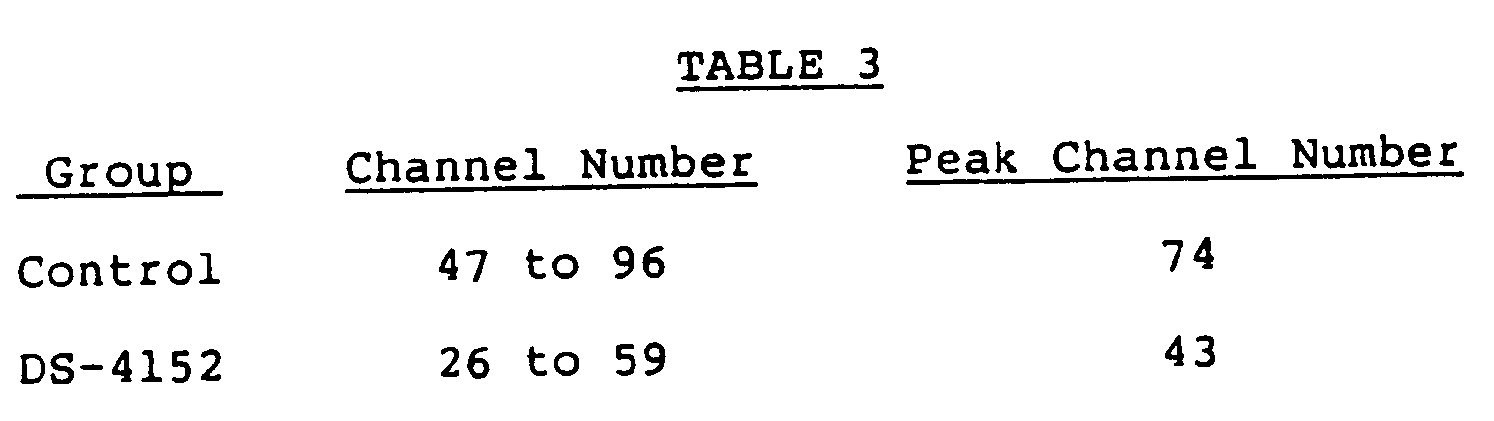
- As shown in Table 3, the DS-4152 treatment-free (control) cells, when treated with the FITC-conjugated anti-OKT4A antibody, gave a distribution with Channel No. 74 as a peak showing a high fluorescence intensity. On the contrary, the cells treated with DS-4152 in advance, when treated with the above-mentioned antibody, gave a distribution with Channel No. 43 as a peak showing a low fluorescence intensity. It was therefore presumed that DS-4152 covered the OKT4A antigen of the cultured cells and thereby inhibited the HIV-1 from being adsorbed on said antigen.
-
- 1) The KOS strain of type I herpes simplex virus (HSV-1) was used as the virus and Vero cells were used as the host cells.
- 2) MEM medium (manufactured by Eiken Kagaku) supplemented with 1.5% inactivated fetal calf serum was used as the culture medium.
- A host cell suspension was distributed into the wells of a 96-well plate and incubated at 37°C in 5% CO₂-95% air for 1 day. Active ingredient (DS-4152) solutions were added to respective wells, immediately followed by inoculation with the virus. Cultivation was performed for 72 hours under the same conditions as mentioned above.
- In parallel, a viral infection-free system was provided for cytotoxicity evaluation. The other conditions were the same as mentioned above. Cells were fixed and stained, followed by absorbance measurement. The 50% cytopathic effect inhibition concentration (CPIE₅₀) was determined as an index of anti-HSV-1 activity and the 50% lethal concentration (CLE₅₀) as an index of cytotoxicity. The results obtained are shown in Table 4.

- As evidenced by the data given in Table 4, it was confirmed that DS-4152 does not exhibit toxicity to host cells but inhibits the proliferation of HSV-1 selectively.
-
- (1) Dextran sulfate sodium (manufactured by Seikagaku Kogyo; average molecular weight 10,700) was used as a positive control.
- (2) Clotek (manufactured by Sanko Junyaku) was used for clotting or coagulation time (PCT) measurement.
- 0.1 ml of saline solutions of the test substance in varied concentrations were respectively added to 0.1 ml portions of citrated rat serum. Each mixture was warmed at 37°C for 3 minutes and 0.1 ml of 0.025 M aqueous calcium chloride was then added to the mixture for causing coagulation to start. The clotting time was plotted against the concentration on an ordinary scale section paper, and the anticoagulant activity, which is defined as the concentration (CT₂) at which the clotting time is doubled as compared with that of the control group free of either test substance, was determined graphically. The results thus obtained are shown in Table 5.

- It is clear from Table 5 that DS-4152 is weaker in anticoagulant activity than dextran sulfate sodium.
Claims (2)
- The use of the sulfated polysaccharide DS-4152 or its derivatives wherein the sodium of said DS-4152 is replaced by a pharmaceutical metal other than sodium for preparing an antiviral pharmaceutical composition.
- The use of claim 1, wherein the composition is effective against a human retrovirus, a human immunodeficiency virus, a virus of Herpesviridae and/or a type 1 herpes simplex virus.
Applications Claiming Priority (2)
| Application Number | Priority Date | Filing Date | Title |
|---|---|---|---|
| JP8729589 | 1989-04-06 | ||
| JP87295/89 | 1989-04-06 |
Publications (2)
| Publication Number | Publication Date |
|---|---|
| EP0391410A1 EP0391410A1 (en) | 1990-10-10 |
| EP0391410B1 true EP0391410B1 (en) | 1993-07-28 |
Family
ID=13910826
Family Applications (1)
| Application Number | Title | Priority Date | Filing Date |
|---|---|---|---|
| EP19900106509 Expired - Lifetime EP0391410B1 (en) | 1989-04-06 | 1990-04-05 | Antiviral composition |
Country Status (3)
| Country | Link |
|---|---|
| EP (1) | EP0391410B1 (en) |
| CA (1) | CA2013843A1 (en) |
| DE (1) | DE69002365T2 (en) |
Families Citing this family (2)
| Publication number | Priority date | Publication date | Assignee | Title |
|---|---|---|---|---|
| GB2355192A (en) * | 1999-10-15 | 2001-04-18 | Henderson Morley Res & Dev Ltd | Anti-viral treatment |
| US20030181416A1 (en) * | 2002-01-10 | 2003-09-25 | Comper Wayne D. | Antimicrobial charged polymers that exhibit resistance to lysosomal degradation during kidney filtration and renal passage, compositions and method of use thereof |
Family Cites Families (2)
| Publication number | Priority date | Publication date | Assignee | Title |
|---|---|---|---|---|
| EP0240098A3 (en) * | 1986-04-04 | 1989-05-10 | Kabushiki Kaisha Ueno Seiyaku Oyo Kenkyujo | Oligo and polysaccharides for the treatment of diseases caused by retroviruses |
| IE61758B1 (en) * | 1986-05-23 | 1994-11-30 | Daiichi Seiyaku Co | Use of a sulfated polysaccharide |
-
1990
- 1990-04-04 CA CA 2013843 patent/CA2013843A1/en not_active Abandoned
- 1990-04-05 EP EP19900106509 patent/EP0391410B1/en not_active Expired - Lifetime
- 1990-04-05 DE DE1990602365 patent/DE69002365T2/en not_active Expired - Fee Related
Also Published As
| Publication number | Publication date |
|---|---|
| DE69002365D1 (en) | 1993-09-02 |
| EP0391410A1 (en) | 1990-10-10 |
| CA2013843A1 (en) | 1990-10-06 |
| DE69002365T2 (en) | 1993-11-18 |
Similar Documents
| Publication | Publication Date | Title |
|---|---|---|
| KR900007498B1 (en) | Polysaccharides and antiviral drugs containing them as active ingredients | |
| US4880782A (en) | Method of treating viral infections in humans and compositions therefor | |
| EP0240098A2 (en) | Oligo and polysaccharides for the treatment of diseases caused by retroviruses | |
| Marchetti et al. | Inhibition of herpes simplex virus infection by negatively charged and neutral carbohydrate polymers | |
| AU636850B2 (en) | Method of modulating virus-host cell interactions using carbohydrates and carbohydrate derivatives | |
| US5681831A (en) | Method of treating viral and retroviral infections including HIV by administration of N6 -(Δ)2 -isopentenyl) adenosine or an analogue thereof | |
| US4966894A (en) | Polysulfated heparins for treating diseases caused by retroviruses | |
| Schols et al. | Sulphated cyclodextrins are potent anti-HIV agents acting synergistically with 2′, 3′-dideoxynucleoside analogues | |
| Moriya et al. | A new candidate for an anti-HIV-1 agent: modified cyclodextrin sulfate (mCDS71) | |
| AU609099B2 (en) | Methods of treating acquired immune deficiency syndrome (AIDS) caused by human immunodeficiency virus (HIV) | |
| EP0391410A1 (en) | Antiviral composition | |
| EP0331821B1 (en) | Antiviral agent | |
| Meldrum et al. | Cell culture studies on the antiviral activity of ether derivatives of 5-hydroxymethyldeoxyuridine | |
| EP0295961A2 (en) | Polysaccharides and antiviral drug containing polysaccharides as active ingredient | |
| EP1411956B1 (en) | Use of oversulfated polysaccharides as inhibitors of hiv | |
| Zacharopoulos et al. | Cell-mediated HTLV-I infection of a cervix-derived epithelial cell line | |
| WO1989003684A1 (en) | Anti-hiv agent | |
| Hashimoto et al. | Antiviral activity of a sulphated polysaccharide extracted from the marine Pseudomonas and marine plant Dinoflagellata against human immunodeficiency viruses and other enveloped viruses | |
| EP0295962B1 (en) | Protein-polysaccharide for treating retroviral infections | |
| Franchetti et al. | Inhibition of HIV-1 replication in macrophages by red blood cell-mediated delivery of a heterodinucleotide of azidothymidine and 9-(R)-2-(phosphono methoxypropyl) adenine | |
| JPH0454125A (en) | Drugs for the treatment and prevention of retroviral infections | |
| EP0356330B1 (en) | Pharmaceutical composition for inhibiting infection with virus causative of acquired human immunodeficiency syndrome | |
| JPH03218317A (en) | Anti-retrovirus agent | |
| CA1335078C (en) | Antiviral method for human immunodeficiency virus with bu-3608 | |
| JPH07110814B2 (en) | Antiviral agent |
Legal Events
| Date | Code | Title | Description |
|---|---|---|---|
| PUAI | Public reference made under article 153(3) epc to a published international application that has entered the european phase |
Free format text: ORIGINAL CODE: 0009012 |
|
| AK | Designated contracting states |
Kind code of ref document: A1 Designated state(s): CH DE FR GB IT LI NL |
|
| 17P | Request for examination filed |
Effective date: 19901221 |
|
| 17Q | First examination report despatched |
Effective date: 19911004 |
|
| ITF | It: translation for a ep patent filed | ||
| GRAA | (expected) grant |
Free format text: ORIGINAL CODE: 0009210 |
|
| AK | Designated contracting states |
Kind code of ref document: B1 Designated state(s): CH DE FR GB IT LI NL |
|
| REF | Corresponds to: |
Ref document number: 69002365 Country of ref document: DE Date of ref document: 19930902 |
|
| ET | Fr: translation filed | ||
| PLBE | No opposition filed within time limit |
Free format text: ORIGINAL CODE: 0009261 |
|
| STAA | Information on the status of an ep patent application or granted ep patent |
Free format text: STATUS: NO OPPOSITION FILED WITHIN TIME LIMIT |
|
| 26N | No opposition filed | ||
| ITTA | It: last paid annual fee | ||
| PGFP | Annual fee paid to national office [announced via postgrant information from national office to epo] |
Ref country code: GB Payment date: 19960327 Year of fee payment: 7 |
|
| PGFP | Annual fee paid to national office [announced via postgrant information from national office to epo] |
Ref country code: FR Payment date: 19960429 Year of fee payment: 7 |
|
| PGFP | Annual fee paid to national office [announced via postgrant information from national office to epo] |
Ref country code: NL Payment date: 19960430 Year of fee payment: 7 |
|
| PGFP | Annual fee paid to national office [announced via postgrant information from national office to epo] |
Ref country code: CH Payment date: 19960501 Year of fee payment: 7 |
|
| PGFP | Annual fee paid to national office [announced via postgrant information from national office to epo] |
Ref country code: DE Payment date: 19960625 Year of fee payment: 7 |
|
| PG25 | Lapsed in a contracting state [announced via postgrant information from national office to epo] |
Ref country code: GB Effective date: 19970405 |
|
| PG25 | Lapsed in a contracting state [announced via postgrant information from national office to epo] |
Ref country code: LI Free format text: LAPSE BECAUSE OF NON-PAYMENT OF DUE FEES Effective date: 19970430 Ref country code: CH Free format text: LAPSE BECAUSE OF NON-PAYMENT OF DUE FEES Effective date: 19970430 |
|
| PG25 | Lapsed in a contracting state [announced via postgrant information from national office to epo] |
Ref country code: NL Effective date: 19971101 |
|
| GBPC | Gb: european patent ceased through non-payment of renewal fee |
Effective date: 19970405 |
|
| REG | Reference to a national code |
Ref country code: CH Ref legal event code: PL |
|
| PG25 | Lapsed in a contracting state [announced via postgrant information from national office to epo] |
Ref country code: FR Free format text: LAPSE BECAUSE OF NON-PAYMENT OF DUE FEES Effective date: 19971231 |
|
| PG25 | Lapsed in a contracting state [announced via postgrant information from national office to epo] |
Ref country code: DE Free format text: LAPSE BECAUSE OF NON-PAYMENT OF DUE FEES Effective date: 19980101 |
|
| NLV4 | Nl: lapsed or anulled due to non-payment of the annual fee |
Effective date: 19971101 |
|
| REG | Reference to a national code |
Ref country code: FR Ref legal event code: ST |
|
| PG25 | Lapsed in a contracting state [announced via postgrant information from national office to epo] |
Ref country code: IT Free format text: LAPSE BECAUSE OF NON-PAYMENT OF DUE FEES Effective date: 20050405 |