EP0390578A2 - Method of manufacturing thermoplastic resin sheets - Google Patents
Method of manufacturing thermoplastic resin sheets Download PDFInfo
- Publication number
- EP0390578A2 EP0390578A2 EP90303416A EP90303416A EP0390578A2 EP 0390578 A2 EP0390578 A2 EP 0390578A2 EP 90303416 A EP90303416 A EP 90303416A EP 90303416 A EP90303416 A EP 90303416A EP 0390578 A2 EP0390578 A2 EP 0390578A2
- Authority
- EP
- European Patent Office
- Prior art keywords
- thermoplastic resin
- extrusion
- slit
- mold
- sheets
- Prior art date
- Legal status (The legal status is an assumption and is not a legal conclusion. Google has not performed a legal analysis and makes no representation as to the accuracy of the status listed.)
- Granted
Links
Images


Classifications
-
- B—PERFORMING OPERATIONS; TRANSPORTING
- B32—LAYERED PRODUCTS
- B32B—LAYERED PRODUCTS, i.e. PRODUCTS BUILT-UP OF STRATA OF FLAT OR NON-FLAT, e.g. CELLULAR OR HONEYCOMB, FORM
- B32B17/00—Layered products essentially comprising sheet glass, or glass, slag, or like fibres
- B32B17/06—Layered products essentially comprising sheet glass, or glass, slag, or like fibres comprising glass as the main or only constituent of a layer, next to another layer of a specific material
- B32B17/10—Layered products essentially comprising sheet glass, or glass, slag, or like fibres comprising glass as the main or only constituent of a layer, next to another layer of a specific material of synthetic resin
- B32B17/10005—Layered products essentially comprising sheet glass, or glass, slag, or like fibres comprising glass as the main or only constituent of a layer, next to another layer of a specific material of synthetic resin laminated safety glass or glazing
- B32B17/1055—Layered products essentially comprising sheet glass, or glass, slag, or like fibres comprising glass as the main or only constituent of a layer, next to another layer of a specific material of synthetic resin laminated safety glass or glazing characterized by the resin layer, i.e. interlayer
- B32B17/10559—Shape of the cross-section
- B32B17/10577—Surface roughness
-
- B—PERFORMING OPERATIONS; TRANSPORTING
- B32—LAYERED PRODUCTS
- B32B—LAYERED PRODUCTS, i.e. PRODUCTS BUILT-UP OF STRATA OF FLAT OR NON-FLAT, e.g. CELLULAR OR HONEYCOMB, FORM
- B32B17/00—Layered products essentially comprising sheet glass, or glass, slag, or like fibres
- B32B17/06—Layered products essentially comprising sheet glass, or glass, slag, or like fibres comprising glass as the main or only constituent of a layer, next to another layer of a specific material
- B32B17/10—Layered products essentially comprising sheet glass, or glass, slag, or like fibres comprising glass as the main or only constituent of a layer, next to another layer of a specific material of synthetic resin
- B32B17/10005—Layered products essentially comprising sheet glass, or glass, slag, or like fibres comprising glass as the main or only constituent of a layer, next to another layer of a specific material of synthetic resin laminated safety glass or glazing
- B32B17/1055—Layered products essentially comprising sheet glass, or glass, slag, or like fibres comprising glass as the main or only constituent of a layer, next to another layer of a specific material of synthetic resin laminated safety glass or glazing characterized by the resin layer, i.e. interlayer
- B32B17/10559—Shape of the cross-section
- B32B17/10577—Surface roughness
- B32B17/10587—Surface roughness created by embossing
-
- B—PERFORMING OPERATIONS; TRANSPORTING
- B29—WORKING OF PLASTICS; WORKING OF SUBSTANCES IN A PLASTIC STATE IN GENERAL
- B29C—SHAPING OR JOINING OF PLASTICS; SHAPING OF MATERIAL IN A PLASTIC STATE, NOT OTHERWISE PROVIDED FOR; AFTER-TREATMENT OF THE SHAPED PRODUCTS, e.g. REPAIRING
- B29C48/00—Extrusion moulding, i.e. expressing the moulding material through a die or nozzle which imparts the desired form; Apparatus therefor
- B29C48/03—Extrusion moulding, i.e. expressing the moulding material through a die or nozzle which imparts the desired form; Apparatus therefor characterised by the shape of the extruded material at extrusion
- B29C48/07—Flat, e.g. panels
- B29C48/08—Flat, e.g. panels flexible, e.g. films
-
- B—PERFORMING OPERATIONS; TRANSPORTING
- B29—WORKING OF PLASTICS; WORKING OF SUBSTANCES IN A PLASTIC STATE IN GENERAL
- B29C—SHAPING OR JOINING OF PLASTICS; SHAPING OF MATERIAL IN A PLASTIC STATE, NOT OTHERWISE PROVIDED FOR; AFTER-TREATMENT OF THE SHAPED PRODUCTS, e.g. REPAIRING
- B29C48/00—Extrusion moulding, i.e. expressing the moulding material through a die or nozzle which imparts the desired form; Apparatus therefor
- B29C48/03—Extrusion moulding, i.e. expressing the moulding material through a die or nozzle which imparts the desired form; Apparatus therefor characterised by the shape of the extruded material at extrusion
- B29C48/13—Articles with a cross-section varying in the longitudinal direction, e.g. corrugated pipes
-
- B—PERFORMING OPERATIONS; TRANSPORTING
- B29—WORKING OF PLASTICS; WORKING OF SUBSTANCES IN A PLASTIC STATE IN GENERAL
- B29C—SHAPING OR JOINING OF PLASTICS; SHAPING OF MATERIAL IN A PLASTIC STATE, NOT OTHERWISE PROVIDED FOR; AFTER-TREATMENT OF THE SHAPED PRODUCTS, e.g. REPAIRING
- B29C48/00—Extrusion moulding, i.e. expressing the moulding material through a die or nozzle which imparts the desired form; Apparatus therefor
- B29C48/25—Component parts, details or accessories; Auxiliary operations
- B29C48/27—Cleaning; Purging; Avoiding contamination
- B29C48/272—Cleaning; Purging; Avoiding contamination of dies
-
- B—PERFORMING OPERATIONS; TRANSPORTING
- B29—WORKING OF PLASTICS; WORKING OF SUBSTANCES IN A PLASTIC STATE IN GENERAL
- B29C—SHAPING OR JOINING OF PLASTICS; SHAPING OF MATERIAL IN A PLASTIC STATE, NOT OTHERWISE PROVIDED FOR; AFTER-TREATMENT OF THE SHAPED PRODUCTS, e.g. REPAIRING
- B29C48/00—Extrusion moulding, i.e. expressing the moulding material through a die or nozzle which imparts the desired form; Apparatus therefor
- B29C48/25—Component parts, details or accessories; Auxiliary operations
- B29C48/30—Extrusion nozzles or dies
- B29C48/305—Extrusion nozzles or dies having a wide opening, e.g. for forming sheets
- B29C48/31—Extrusion nozzles or dies having a wide opening, e.g. for forming sheets being adjustable, i.e. having adjustable exit sections
- B29C48/313—Extrusion nozzles or dies having a wide opening, e.g. for forming sheets being adjustable, i.e. having adjustable exit sections by positioning the die lips
-
- B—PERFORMING OPERATIONS; TRANSPORTING
- B29—WORKING OF PLASTICS; WORKING OF SUBSTANCES IN A PLASTIC STATE IN GENERAL
- B29C—SHAPING OR JOINING OF PLASTICS; SHAPING OF MATERIAL IN A PLASTIC STATE, NOT OTHERWISE PROVIDED FOR; AFTER-TREATMENT OF THE SHAPED PRODUCTS, e.g. REPAIRING
- B29C48/00—Extrusion moulding, i.e. expressing the moulding material through a die or nozzle which imparts the desired form; Apparatus therefor
- B29C48/001—Combinations of extrusion moulding with other shaping operations
Definitions
- This invention relates to a method for the manufacture of thermoplastic resin sheets with embossed surfaces. More particularly, it relates to a method for the manufacture of the type of thermoplastic resin sheets suitable for use in the laminated glass products which are widely applied in the automotive, aircraft, construction and other industries.
- Laminated glass is fabricated by interposing a thermoplastic resin sheet as an intermediate layer between two plates of glass, and then applying pressure thereto.
- a thermoplastic resin sheet as an intermediate layer between two plates of glass, and then applying pressure thereto.
- the air between the glass plates and the resin sheet must be adequately expelled, and therefore thermoplastic resin sheets with embossed surfaces are employed.
- thermoplastic resin sheets with embossed surfaces The following methods have been proposed for the manufacture of thermoplastic resin sheets with embossed surfaces.
- thermoplastic resin possesses high tack
- the sheet when passing between the embossing rollers, the sheet may adhere and wind onto the rollers, thus causing malfunctions in the manufacturing process. Since it is difficult for the sheet to be detached from the embossing rollers, blemishes are formed and the appearance of the sheet deteriorates.
- large rollers of width exceeding that of the sheets are required, which entails high equipment expenditures and running costs.
- the lip of the extrusion mold must be cooled sufficiently to ensure that the temperature difference between the resin and the lip is approximately 40°C. Therefore, cooling ducts must be incorporated into the mold, which makes, the structure of the mold complex, and moreover, temperature regulation devices must also be provided in the mold, which makes equipment costs for this process high.
- the edges of the lips 13 are generally rounded 14 or bevelled 15 .
- sheets are fabricated by extrusion of a tacky thermoplastic resin (e.g., polyvinyl butyral or ethylene vinyl acetate copolymers) from a mold 16 such that the lips 13 have been rounded 14 or bevelled 15 , then, as indicated in Figure 9a, scraps of resin (lip debris) 17 adhere to the edges of the lips of the mold 16 .
- a tacky thermoplastic resin e.g., polyvinyl butyral or ethylene vinyl acetate copolymers
- thermoplastic resin sheet comprising extruding molten thermoplastic resin at an extrusion velocity V through a slit provided in an extrusion mold so as to form thermoplastic resin sheet with embossed surfaces, wherein said thermoplastic resin is extruded from said slit in said extrusion mold under conditions such that the ratio V/H of said extrusion velocity V to the width H of said slit exceeds a critical value (V/H)c, said critical value (V/H)c being the ratio of the extrusion velocity to the width of the mold slit corresponding to the minimum value of the roughness of the embossment formed on the surface of said thermoplastic resin at which the roughness of said embossment begins to increase after initially decreasing when said thermoplastic resin sheet is fabricated under conditions where said ratio V/H is progressively increased.
- the ratio V/H of said extrusion velocity V to said slit width H preferably lies in the range exceeding said critical value (V/H)c but not exceeding 1.4 times said critical value (V/H)c.
- the ratio V/H of said extrusion velocity V to said slit width H lies in the range exceeding said critical value (V/H)c but not exceeding 1.2 times said critical value (V/H)c.
- thermoplastic resin is preferably polyvinyl butyral.
- the angle between the face contiguous with the resin flow channel and the outside surface of the end of a lip of said extrusion mold is approximately 90°, and the corner at the intersection of the face contiguous to said resin flow channel and the outside surface of said lip is not rounded or bevelled.
- the velocity V of extrusion of the thermoplastic resin through the slit of the extruder is determined by the following formula (1).
- Extrusion velocity V extrusion volume rate of molten resin/(breadth of mold slit x width H of mold slit) (1)
- the units used in formula (1) are cm/sec for extrusion velocity V, cm3/sec for extrusion volume rate, cm for slit breadth, and cm for slit width H.
- the ratio V/H of the extrusion velocity V to the slit width H can be varied by changing the slit width H and/or the extrusion velocity V of the resin. For example, to raise the value of V/H, the extrusion velocity V can be increased and/or the slit width H can be narrowed. Conversely, to lower the value of V/H, the opposite adjustments can be performed.
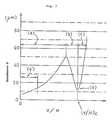
- Figure 1 shows the relationship between the ratio V/H of the extrusion velocity V of the resin to the slit width H and the roughness R of the embossment on the surface of the extruded sheet.
- the roughness R is measured in accordance with ISO R468, and the values thereof used here are mean values of the roughness measured at ten points on the sheet.
- the form of the embossment created on the surface of the sheet in the aforesaid region a consists of a multitude of alternating long ridges and furrows perpendicular to the direction of extrusion of the sheet.
- the form of the embossment in region a could be described as undulant (wave-formed).
- the sheets are fabricated under conditions corresponding to those of the region a, in such a manner that the roughness R is as small as possible (region a′ of Figure 1).
- the form of the embossment created on the surface of the sheet in the aforesaid region b consists of the above-mentioned "waves” combined with a multitude of discontinuous non-oriented minute indentations and protuberances ("random" pattern).
- the roughness R of the embossment on the surface of the sheets obtained in region b decreases with an increase in the values of V/H.
- the value of V/H corresponding to the minimum value of the roughness R (point d in Figure 1) is the critical value (V/H)c specified by the present invention.
- the form of the embossment on the sheet surface in the aforesaid region c is entirely different from the undulant forms observed in regions a and b.
- the form of embossment created in region c consists entirely of multitudes of discontinuous unoriented minute indentations and protuberances ("random" form).
- the protuberances 11 of this embossment are sharply formed, while the indentations 12 are gentle.
- This type of "random" pattern facilitates the expulsion of air from the space between the thermoplastic resin sheet so obtained and the glass plates when the said sheet is interposed between glass plates and compressed to manufacture laminated glass.
- the protuberances of the embossment on sheets obtained by the conventional embossing roller method tend to be rounded in form, and therefore impede the escape of air.
- the roughness R of the embossment formed on the surface of the sheet can be varied in the range of approximately 15-70 ⁇ m.
- the sheet is formed by extrusion of molten thermoplastic resin through the slit of the mold at a value of V/H below the critical value (V/H)c (regions a and b of Figure 1), then the embossment created on the surface of the sheet so obtained is principally of the undulant form.
- V/H critical value
- the embossment created on the surface of the sheet so obtained is principally of the undulant form.
- thermoplastic resin sheets impressed with this type of embossment are used, for example, in the manufacture of laminated glass, then the escape of the air between the sheet and the glass plates is difficult.
- the reason for this difficulty is the fact that the undulant pattern of the embossment formed on the surface of the sheet has furrows oriented only in one direction, which does not readily permit the escape of the air from the space between the sheet and the glass plates.
- the pattern embossed on the surfaces of sheets fabricated under the conditions of region c is of the "random" type.
- the large number of indentations formed in this type of embossment pattern are mutually interconnected, and small furrows oriented in all directions on the surface are formed. Consequently, when lamination is effected by interposing the sheet between glass plates and applying pressure, the air is readily expelled from the space between the sheet and the glass plates.
- the roughness R of the embossment formed on the sheet surface can be adjusted to a value in the range 15-70 ⁇ m, which is appropriate for use in the manufacture of laminated glass, or, more preferably, to a value in the range 20-50 ⁇ m.
- the critical value (V/H)c varies according to factors such as the type of thermoplastic resin used in the process as well as the viscosity of the resin and the resin temperature used during molding, etc.
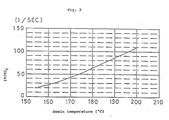
- Figure 2 shows the relationship between the critical value (V/H)c and the molding temperature for the case where the thermoplastic resin sheets are formed using polyvinyl butyral.
- Figure 2 indicates that the critical V (V/H)c increases with rising resin temperature. Therefore, if the resin temperature is high, then the width H of the slit in the mold should be correspondingly narrowed, and/or the extrusion velocity V of the molten resin correspondingly increased.
- the value of the ratio V/H during the manufacture of the sheet exceeds the critical value (V/H)c and preferably does not exceed 1.4 times the said critical value (V/H)c, or more preferably, does not exceed 1.2 times the said critical value (V/H)c.
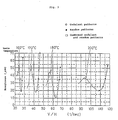
- Figure 3 shows the relationships between the resin temperature of plasticized polyvinyl butyral, the ratio V/H and the roughness R of the embossment formed on the surface of the sheet.
- the white disks ⁇ in Figure 3 represent the formation of "undulant” embossment patterns on the sheet surface, while the black disks ⁇ represent “random” embossment patterns, and the white squares ⁇ represent a mixture of "undulant” and "random” patterns.
- the present invention when sheets are formed by extrusion of molten resin from the slit of the mold at a prescribed temperature, several sheets are fabricated for various values of the ratio V/H, and the roughness R of the embossments on the surface of each of the sheets so obtained is measured. Then, the minimum of the roughness R is located by observing the value at which this roughness, after diminishing, again begins to increase, and the value of the ratio V/H is (i.e., the critical value (V/H)c) that corresponds to the value of the minim of the roughness R is determined.
- V/H critical value
- thermoplastic resin is then extruded from the slit of the mold at a value of the ratio V/H exceeding the critical value (V/H)c determined in this manner, then, as described above, a thermoplastic resin sheet with the desired type of embossment is obtained. Conversely, if the ratio V/H has been fixed, then the resin temperature can be varied so that the critical value (V/H)c becomes smaller than this fixed value of V/H.
- thermoplastic resin As the type of thermoplastic resin appropriate for use in the method of the present invention, any thermoplastic resin which possesses the property that the roughness R of the embossment formed on the surfaces of the sheets decreases and then subsequently increases when sheets are formed with the ratio V/H of the extrusion velocity V of the molten resin to the width H of the slit in the mold being progressively increased, as indicated in Figure 1, i.e., any thermoplastic resin possessing a critical ratio (V/H)c, is applicable.
- V/H critical ratio
- vinyl acetal resins such as polyvinyl butyral or other similar resins are appropriate for the present purpose.
- the method of the present invention requires no cooling of the mold slit, as is necessary in conventional techniques, and therefore the present method permits the preparation of thermoplastic resin sheets possessing embossments of desirable form by using ordinary general-purpose extrusion molds and suitably adjusting the relevant parameters such as the extrusion velocity of the molten resin and the width of the slit.
- cooling ducts can be inserted into the edge portion of the lips and the extruded sheets cooled by means of these ducts.
- the form and roughness R of the aforesaid embossment formed on the surface of the sheet are not affected by this method of cooling.
- the sheets should desirably be fabricated using a mold with the structure shown in Figure 6.
- the mold 1 is provided with a slit 3a formed between a pair of lips 3 and 3′ .
- the width H of the slit 3a is adjusted by means of an adjusting screw 4 .
- a resin flow channel 2 is disposed within the mold 1 .
- the reference numeral 5 is a manifold.
- the face 31 of the end of each lip 3 or 3′ on the side contiguous with the resin flow channel 2 forms, as shown in Figure 7, an angle of nearly 90° to the outside surface 32 of the lip.
- the angle ⁇ between the face 31 contiguous with the resin flow channel 2 and the outside surface 32 of the lip 3 should preferably be in the range of 89.0 to 91.0°, more preferably in the range of 89.7 to 90.3°, or still more preferably, 90°.
- the fact that the corner 33 at the intersection of the face 31 contiguous with the resin flow channel 2 and the outside surface 32 of the lip 3 is not rounded nor bevelled implies that both the face 31 contiguous with the resin flow channel 2 and the outside surface 32 of the lip 3 form almost flat planes extending up to the very corner 33 of the lip 3 .
- the distance L from the margin on the corner 33 side of the planar portion 31a of the face 31 contiguous with the resin flow channel 2 to the extension of the outside surface, as shown in Figure 7, should be preferably not exceed 0.1 mm, or more preferably, should not exceed 0.05 mm.
- the distance M from the margin on the corner 33 side of the planar portion 32a of the outside surface 32 of the lip 3 to the extension of the face 31 contiguous with the resin flow channel 2 should be preferably not exceed 0.1 mm, or more preferably, should not exceed 0.05 mm.
- the aforesaid distance L becomes 0.2-1.0 mm. If chipped or burred defects are present on the edge of the lip 3 , then the formation of lip debris is concentrated at the sites of these defects, and therefore the size of these chipped or burred defects should be desirably not exceed the aforesaid distance L.
- the roughness of the faces 31 and 32 of the lip 3 is not subject to any particular restriction. However, in order to further enhance the inhibiting effect upon the formation of the aforesaid lip debris, this roughness should preferably not exceed, e.g., about 5 ⁇ m.
- the form and specifications of the upper lip 3′ should be the same as that of the lower lip 3 , as described above.
- embossed polyvinyl butyral sheets were obtained by extruding polyvinyl butyral through the slit of an extrusion mold at various resin temperatures, various values of the resin extrusion velocity V and various values of the width H of the slit.
- the values of the ratio V/H shown in Table 1 were calculated from the actual measured values of the resin extrusion volume velocity, slit breadth and slit width, using the above-stated formula (1) for the calculation of V.
- the roughness R of the embossment of the sheets so obtained was measured in accordance with ISO R468, and the values given are the means of measurements performed at 10 points on the sheet.
- the critical values (V/H)c were determined from the relationship between the roughness R of the embossment on the surfaces of the sheets so obtained and the ratio V/H.
- the pattern embossed on the surfaces of the sheets was observed by eyes.
- Plasticized polyvinyl butyral sheets were formed by extrusion using the flat sheet extrusion mold shown in Figure 4.
- the width H of the slit was 0.1 cm and the extrusion velocity V was 9.2 cm/sec.
- the temperatures of various points of the resin and the mold 1 were measured by the use of a thermocouple.
- the temperature of the resin channel 2 (at the point indicated by the symbol A in Figure 6) was 191°C.
- the temperature at a point of the upper lip 3′ that is approximately 20 mm deep in the mold as reckoned from the outer edge of the lip 3′ (indicated by the symbol B in Figure 6) was 182°C
- the temperature at a point of the lower lip 3 situated 3 mm downstream of the resin channel and approximately 20 mm deep in the mold as reckoned from the outer edge of the lip 3 (indicated by the symbol C in Figure 6) was 186°C.
- the pattern embossed on the sheets so obtained was of the "random" type, and the roughness R of these embossments was 30 ⁇ m.
- the ratio V/H used in the preparation of the sheets was 92, which was greater than the critical value of 85 (for the resin temperature 191°C), thus satisfying the condition specified by the present invention.
- Thermoplastic resin sheets were obtained in the same manner as described in Example 1, except for the use of molds with varied distances L and M, as shown in Table 2. Fabrication of the said sheets was continued for a considerable length of time, the lips were cleaned when scraps of resin began to adhere to the edges of the lips, and the respective periods of time elapsed before each of two consecutive cleaning operations were recorded.
- the distances L and M for the bevelled lips of the molds used in Example 14 were both in the range of 0.2 to 1.0 mm.
- the above-mentioned periods of time recorded between the successive cleanings of the lips were represented as a ratio of cleaning cycles in Table 2.
Landscapes
- Engineering & Computer Science (AREA)
- Mechanical Engineering (AREA)
- Manufacturing & Machinery (AREA)
- Extrusion Moulding Of Plastics Or The Like (AREA)
- Shaping Of Tube Ends By Bending Or Straightening (AREA)
Abstract
Description
- This invention relates to a method for the manufacture of thermoplastic resin sheets with embossed surfaces. More particularly, it relates to a method for the manufacture of the type of thermoplastic resin sheets suitable for use in the laminated glass products which are widely applied in the automotive, aircraft, construction and other industries.
- Laminated glass is fabricated by interposing a thermoplastic resin sheet as an intermediate layer between two plates of glass, and then applying pressure thereto. In the manufacture of laminated glass, the air between the glass plates and the resin sheet must be adequately expelled, and therefore thermoplastic resin sheets with embossed surfaces are employed.
- The following methods have been proposed for the manufacture of thermoplastic resin sheets with embossed surfaces.
- (1) First, a thermoplastic resin sheet with a flat surface is manufactured by means of an extruder or mold. Then, an embossed pattern is impressed upon the surface of this sheet by passage between a pair of embossing rollers (Japanese Laid-Open Patent Publication No. 61-61835).
- (2) A resin composition containing 0.6-15% by weight of water is extruded from an extruder, and compressed in a mold, resulting in an embossed sheet (USP 2,904,844).
- (3) The lips of an extrusion mold are maintained at a temperature lower than that of the resin being extruded from these lips, thereby creating a temperature difference between the inside and outside of the resin. A desired sheet is obtained by extruding molten resin from the lips under these conditions (Japanese Laid-Open Patent Publication No. 61-154919).
- In the aforesaid method (1), if the thermoplastic resin possesses high tack, then, when passing between the embossing rollers, the sheet may adhere and wind onto the rollers, thus causing malfunctions in the manufacturing process. Since it is difficult for the sheet to be detached from the embossing rollers, blemishes are formed and the appearance of the sheet deteriorates. Moreover, when wide sheets are manufactured by this process, large rollers of width exceeding that of the sheets are required, which entails high equipment expenditures and running costs.
- In the aforesaid method (2), since the resin contains water, this water may cause foaming of the sheet. If dehydration adequate to prevent the foaming of the sheet is performed within the extruder, then the embossment of the sheet so obtained is not sufficiently rough.
- As for the aforesaid method (3), the lip of the extrusion mold must be cooled sufficiently to ensure that the temperature difference between the resin and the lip is approximately 40°C. Therefore, cooling ducts must be incorporated into the mold, which makes, the structure of the mold complex, and moreover, temperature regulation devices must also be provided in the mold, which makes equipment costs for this process high.
- When the lips are finished by lapping or polishing, if the edges of the lips on the side of the resin extrusion orifice are unduly sharp, then chipping or burrs are prone to occur, and therefore, as shown in Figures 8a and 8b, the edges of the
lips 13 are generally rounded 14 or bevelled 15. However, if sheets are fabricated by extrusion of a tacky thermoplastic resin (e.g., polyvinyl butyral or ethylene vinyl acetate copolymers) from amold 16 such that thelips 13 have been rounded 14 or bevelled 15, then, as indicated in Figure 9a, scraps of resin (lip debris) 17 adhere to the edges of the lips of themold 16. If thesescraps 17 accumulate on the edges of thelips 13, as shown in Figure 9b, this develops into so-calledlip residue 18, and thisresidue 18 adheres to thesheet 10 extruded from the slit, resulting in the production ofdefective sheets 10. Therefore, thelips 13 of themold 16 must be adequately cleaned to avoid adhesion oflip debris 17 to thesheets 10, which entails a substantial drop in productivity. - The following methods have been proposed in order to prevent adhesion of resin scraps to the lips.
- (4) An anti-adhesive solution composed of fluorocarbon resin or other suitable substance is applied to the surfaces of the lips (Japanese Laid-Open Patent Publication No. 58-12743).
- (5) Anti-adhesive parts composed of tetrafluoroethylene resin are attached to the edges of the lips (Japanese Laid-Open Patent Publication No. 56-95637).
- In the aforesaid method (4), since a special process is required for the application of an anti-adhesive solution to the lip surfaces, the cost of the molds is increased. Likewise, in the aforesaid method (5), the attachment of anti-adhesive parts to the mold requires special work, thereby raising the cost of the mold, and moreover, the cleaning of the lips becomes difficult.
- According to the present invention, there is provided a method of manufacturing thermoplastic resin sheet comprising extruding molten thermoplastic resin at an extrusion velocity V through a slit provided in an extrusion mold so as to form thermoplastic resin sheet with embossed surfaces,
wherein said thermoplastic resin is extruded from said slit in said extrusion mold under conditions such that the ratio V/H of said extrusion velocity V to the width H of said slit exceeds a critical value (V/H)c, said critical value (V/H)c being the ratio of the extrusion velocity to the width of the mold slit corresponding to the minimum value of the roughness of the embossment formed on the surface of said thermoplastic resin at which the roughness of said embossment begins to increase after initially decreasing when said thermoplastic resin sheet is fabricated under conditions where said ratio V/H is progressively increased. - It has been found that the fabrication of sheets with excellent surface embossment, suitable, for example, for the intermediate layer of laminated safety glass, can be effected by extrusion forming of sheets composed, in particular, of polyvinyl butyral or a similar thermoplastic resin, if the said thermoplastic resin is extruded under conditions such that the ratio of the width of the slit in the extrusion mold and the extrusion velocity of the resin exceeds a certain prescribed value. In this manner, the above-mentioned shortcomings of the conventional methods can be overcome.
- The ratio V/H of said extrusion velocity V to said slit width H preferably lies in the range exceeding said critical value (V/H)c but not exceeding 1.4 times said critical value (V/H)c.
- Advantageously the ratio V/H of said extrusion velocity V to said slit width H lies in the range exceeding said critical value (V/H)c but not exceeding 1.2 times said critical value (V/H)c.
- The thermoplastic resin is preferably polyvinyl butyral.
- In a preferred embodiment, the angle between the face contiguous with the resin flow channel and the outside surface of the end of a lip of said extrusion mold is approximately 90°, and the corner at the intersection of the face contiguous to said resin flow channel and the outside surface of said lip is not rounded or bevelled.
- In the procedure of the present invention, the velocity V of extrusion of the thermoplastic resin through the slit of the extruder is determined by the following formula (1).
Extrusion velocity V =
extrusion volume rate of molten resin/(breadth of mold slit x width H of mold slit) (1) - The units used in formula (1) are cm/sec for extrusion velocity V, cm³/sec for extrusion volume rate, cm for slit breadth, and cm for slit width H.
- The ratio V/H of the extrusion velocity V to the slit width H can be varied by changing the slit width H and/or the extrusion velocity V of the resin. For example, to raise the value of V/H, the extrusion velocity V can be increased and/or the slit width H can be narrowed. Conversely, to lower the value of V/H, the opposite adjustments can be performed.
- The invention described herein makes possible the objectives of:
- (1) providing a method for the manufacture of thermoplastic resin sheets with embossed surfaces which eliminates defects such as the adhesion to and winding onto rollers, inferior appearance and sizing marks which are prone to occur when the sheet is embossed with embossing rollers;
- (2) providing a method for the manufacture of thermoplastic resin sheets with embossed surfaces, such that foaming does not occur in the manufacturing process;
- (3) providing a method for the manufacture of thermoplastic resin sheets with embossed surfaces which can be implemented using conventional general purpose molds, without the necessity for molds of complex structure or the installation of supplementary temperature regulating devices, etc.;
- (4) providing a method for the manufacture of thermoplastic resin sheets with embossed surfaces which permits substantial reduction of equipment expenditures and running costs;
- (5) providing a method for the manufacture of thermoplastic resin sheets, wherein the formation of lip debris can be inhibited merely by appropriate finishing of the lip edges, without applying anti-adhesive solutions to lip surfaces or attachment of anti-adhesive parts; and
- (6) providing a method for the manufacture of thermoplastic resin sheets with embossed surfaces, which, by reducing the adhesion of lip debris to the sheets, permits a substantial prolongation of the period elapsed before cleaning of the lips is required.
- For a better understanding of the invention and to show how the same may be carried into effect, reference will now be made, by way of example, to the accompanying drawings in which:
- Figure 1 is a graph showing the relationship between the value of the ratio V/H and the roughness R of the embossment formed on the surface of the sheet;
- Figure 2 is a graph showing the relationship between the resin temperature and the critical value (V/H)c in the manufacture of polyvinyl butyral sheets;
- Figure 3 is graphs showing the relationships between the molding temperature of polyvinyl butyral, the value of V/H and the roughness R of the sheet surface ;
- Figure 4 is a cross-sectional view showing the form of the embossment on the surfaces of the sheets obtained by the method of the present invention;
- Figure 5 is a cross-sectional view showing the form of the embossment on the surfaces of the sheets obtained by a conventional method ;
- Figure 6 is a cross-sectional diagram showing the main portion of the extrusion mold used for the formation of the flat sheet;
- Figure 7 is a cross-sectional view showing the lips of the extrusion mold of the present invention ;
- Figures 8a and 8b are cross-sectional views showing the lips of conventional extrusion molds ; and
- Figures 9a and 9b are cross-sectional and perspective views, respectively, of a conventional type of extrusion mold.
- Referring now to the drawings, Figure 1 shows the relationship between the ratio V/H of the extrusion velocity V of the resin to the slit width H and the roughness R of the embossment on the surface of the extruded sheet. The roughness R is measured in accordance with ISO R468, and the values thereof used here are mean values of the roughness measured at ten points on the sheet.
- As shown by Figure 1, as the value of V/H used during the extrusion of the molten resin through the slit is increased, the roughness R of the embossment formed on the surface of the sheet initially increases (region a in Figure 1). However, if the value of V/H used during the extrusion of the molten resin through the slit is further increased, then the roughness R of the embossment on the surface of the sheet decreases abruptly, and drops to approximately 10-20 µm (region b in Figure 1). Then, as the value of V/H used during the extrusion of the molten resin though the slit is increased still further, the roughness R of the sheet surface increases abruptly (region c in Figure 1).
- The form of the embossment created on the surface of the sheet in the aforesaid region a consists of a multitude of alternating long ridges and furrows perpendicular to the direction of extrusion of the sheet. The form of the embossment in region a could be described as undulant (wave-formed).
- When sheet surfaces are embossed by the conventional embossing roller method, the sheets are fabricated under conditions corresponding to those of the region a, in such a manner that the roughness R is as small as possible (region a′ of Figure 1).
- The form of the embossment created on the surface of the sheet in the aforesaid region b consists of the above-mentioned "waves" combined with a multitude of discontinuous non-oriented minute indentations and protuberances ("random" pattern). The roughness R of the embossment on the surface of the sheets obtained in region b decreases with an increase in the values of V/H. The value of V/H corresponding to the minimum value of the roughness R (point d in Figure 1) is the critical value (V/H)c specified by the present invention.
- The form of the embossment on the sheet surface in the aforesaid region c is entirely different from the undulant forms observed in regions a and b. The form of embossment created in region c consists entirely of multitudes of discontinuous unoriented minute indentations and protuberances ("random" form). Moreover, as shown in Figure 4, the protuberances 11 of this embossment are sharply formed, while the
indentations 12 are gentle. This type of "random" pattern facilitates the expulsion of air from the space between the thermoplastic resin sheet so obtained and the glass plates when the said sheet is interposed between glass plates and compressed to manufacture laminated glass. By contrast, as shown in Figure 5, the protuberances of the embossment on sheets obtained by the conventional embossing roller method tend to be rounded in form, and therefore impede the escape of air. - By fabricating sheets under conditions where the ratio V/H assumes various values above the said critical value (V/H)c, the roughness R of the embossment formed on the surface of the sheet can be varied in the range of approximately 15-70 µm.
- As mentioned above, if the sheet is formed by extrusion of molten thermoplastic resin through the slit of the mold at a value of V/H below the critical value (V/H)c (regions a and b of Figure 1), then the embossment created on the surface of the sheet so obtained is principally of the undulant form. If thermoplastic resin sheets impressed with this type of embossment are used, for example, in the manufacture of laminated glass, then the escape of the air between the sheet and the glass plates is difficult. The reason for this difficulty is the fact that the undulant pattern of the embossment formed on the surface of the sheet has furrows oriented only in one direction, which does not readily permit the escape of the air from the space between the sheet and the glass plates.
- By contrast, the pattern embossed on the surfaces of sheets fabricated under the conditions of region c is of the "random" type. The large number of indentations formed in this type of embossment pattern are mutually interconnected, and small furrows oriented in all directions on the surface are formed. Consequently, when lamination is effected by interposing the sheet between glass plates and applying pressure, the air is readily expelled from the space between the sheet and the glass plates.
- In addition, by fabricating the sheets under conditions with various values of V/H in region c, the roughness R of the embossment formed on the sheet surface can be adjusted to a value in the range 15-70 µm, which is appropriate for use in the manufacture of laminated glass, or, more preferably, to a value in the range 20-50 µm.
- The critical value (V/H)c varies according to factors such as the type of thermoplastic resin used in the process as well as the viscosity of the resin and the resin temperature used during molding, etc. Figure 2 shows the relationship between the critical value (V/H)c and the molding temperature for the case where the thermoplastic resin sheets are formed using polyvinyl butyral.
- Figure 2 indicates that the critical V (V/H)c increases with rising resin temperature. Therefore, if the resin temperature is high, then the width H of the slit in the mold should be correspondingly narrowed, and/or the extrusion velocity V of the molten resin correspondingly increased. By this way, in the method of the present invention, the value of the ratio V/H during the manufacture of the sheet exceeds the critical value (V/H)c and preferably does not exceed 1.4 times the said critical value (V/H)c, or more preferably, does not exceed 1.2 times the said critical value (V/H)c.
- Figure 3 shows the relationships between the resin temperature of plasticized polyvinyl butyral, the ratio V/H and the roughness R of the embossment formed on the surface of the sheet. The white disks ○ in Figure 3 represent the formation of "undulant" embossment patterns on the sheet surface, while the black disks ● represent "random" embossment patterns, and the white squares □ represent a mixture of "undulant" and "random" patterns. The data shown in Figure 3 indicate that, in general, when sheets are formed from plasticized polyvinyl butyral in the temperature range of 150 to 220°C, a critical value (V/H)c exists, and, moreover, values of the ratio V/H exist which permit embossing with a desirable level of roughness R.
- Therefore, according to the present invention, when sheets are formed by extrusion of molten resin from the slit of the mold at a prescribed temperature, several sheets are fabricated for various values of the ratio V/H, and the roughness R of the embossments on the surface of each of the sheets so obtained is measured. Then, the minimum of the roughness R is located by observing the value at which this roughness, after diminishing, again begins to increase, and the value of the ratio V/H is (i.e., the critical value (V/H)c) that corresponds to the value of the minim of the roughness R is determined. If the thermoplastic resin is then extruded from the slit of the mold at a value of the ratio V/H exceeding the critical value (V/H)c determined in this manner, then, as described above, a thermoplastic resin sheet with the desired type of embossment is obtained. Conversely, if the ratio V/H has been fixed, then the resin temperature can be varied so that the critical value (V/H)c becomes smaller than this fixed value of V/H.
- As the type of thermoplastic resin appropriate for use in the method of the present invention, any thermoplastic resin which possesses the property that the roughness R of the embossment formed on the surfaces of the sheets decreases and then subsequently increases when sheets are formed with the ratio V/H of the extrusion velocity V of the molten resin to the width H of the slit in the mold being progressively increased, as indicated in Figure 1, i.e., any thermoplastic resin possessing a critical ratio (V/H)c, is applicable. For example, vinyl acetal resins such as polyvinyl butyral or other similar resins are appropriate for the present purpose.
- As pointed out above, the method of the present invention requires no cooling of the mold slit, as is necessary in conventional techniques, and therefore the present method permits the preparation of thermoplastic resin sheets possessing embossments of desirable form by using ordinary general-purpose extrusion molds and suitably adjusting the relevant parameters such as the extrusion velocity of the molten resin and the width of the slit.
- When polyvinyl butyral or similar tacky resins are extruded through the slit of a mold, the resin is prone to adhere to the orifice portion of the lips of the mold. Therefore in order to prevent this adhesion of resin, for example, as disclosed in Japanese Utility Model Publication No. 61-36349, cooling ducts can be inserted into the edge portion of the lips and the extruded sheets cooled by means of these ducts. The form and roughness R of the aforesaid embossment formed on the surface of the sheet are not affected by this method of cooling.
- Moreover, in order to prevent adhesion of resin to the edges of the lips, the sheets should desirably be fabricated using a mold with the structure shown in Figure 6. The
mold 1 is provided with aslit 3a formed between a pair oflips slit 3a is adjusted by means of an adjusting screw 4. Aresin flow channel 2 is disposed within themold 1. Thereference numeral 5 is a manifold. Theface 31 of the end of eachlip resin flow channel 2 forms, as shown in Figure 7, an angle of nearly 90° to theoutside surface 32 of the lip. If this angle were to substantially exceed 90°, then the molten resin extruded from theslit 3a would be prone to adhere to the surface of the lip (thecorner 33 and the outside surface 32), and as a result lip debris would be prone to form. On the other hand, if the angle were substantially less than 90°, then the molten resin extruded from theslit 3a would indeed have less opportunity for contact with the outside surfaces of the lips. However, in cases where themold 1 is so arranged as to extrude resin in a downward direction, the lip debris adhering to theface 31 of thelip 3 contiguous with theresin flow channel 2 would flow downward along the lip surface under the force of gravity, and therefore lip debris would adhere to the thermoplastic resin sheet within a short period. Moreover, in this case, since the mechanical strength of the edge of thelip 3 is diminished, and the edge of thelip 3 is prone to deformation. Therefore, the angle α between theface 31 contiguous with theresin flow channel 2 and theoutside surface 32 of thelip 3 should preferably be in the range of 89.0 to 91.0°, more preferably in the range of 89.7 to 90.3°, or still more preferably, 90°. - In the present invention, the fact that the
corner 33 at the intersection of theface 31 contiguous with theresin flow channel 2 and theoutside surface 32 of thelip 3 is not rounded nor bevelled implies that both theface 31 contiguous with theresin flow channel 2 and theoutside surface 32 of thelip 3 form almost flat planes extending up to thevery corner 33 of thelip 3. The distance L from the margin on thecorner 33 side of theplanar portion 31a of theface 31 contiguous with theresin flow channel 2 to the extension of the outside surface, as shown in Figure 7, should be preferably not exceed 0.1 mm, or more preferably, should not exceed 0.05 mm. Similarly, the distance M from the margin on thecorner 33 side of theplanar portion 32a of theoutside surface 32 of thelip 3 to the extension of theface 31 contiguous with theresin flow channel 2 should be preferably not exceed 0.1 mm, or more preferably, should not exceed 0.05 mm. - When the faces 31 and 32 of the
lips 3 are finished by bevelling or buffing, the aforesaid distance L becomes 0.2-1.0 mm. If chipped or burred defects are present on the edge of thelip 3, then the formation of lip debris is concentrated at the sites of these defects, and therefore the size of these chipped or burred defects should be desirably not exceed the aforesaid distance L. The roughness of thefaces lip 3 is not subject to any particular restriction. However, in order to further enhance the inhibiting effect upon the formation of the aforesaid lip debris, this roughness should preferably not exceed, e.g., about 5 µm. The form and specifications of theupper lip 3′ should be the same as that of thelower lip 3, as described above. - Flat sheets were prepared by the use of the extrusion mold of Figure 6 mentioned above.
- As shown in Table 1, embossed polyvinyl butyral sheets were obtained by extruding polyvinyl butyral through the slit of an extrusion mold at various resin temperatures, various values of the resin extrusion velocity V and various values of the width H of the slit.
- The values of the ratio V/H shown in Table 1 were calculated from the actual measured values of the resin extrusion volume velocity, slit breadth and slit width, using the above-stated formula (1) for the calculation of V. The roughness R of the embossment of the sheets so obtained was measured in accordance with ISO R468, and the values given are the means of measurements performed at 10 points on the sheet. The critical values (V/H)c were determined from the relationship between the roughness R of the embossment on the surfaces of the sheets so obtained and the ratio V/H. The pattern embossed on the surfaces of the sheets was observed by eyes.
Table 1 Resin temparatures V/H Critical values Roughness R Patterns embossed ° C 1/ sec 1/sec µm Examples 1 200 109 108 20 Random 2 200 118 108 53 Random 3 160 27.6 27 33 Random 4 160 28.6 27 64 Random 5 170 42 40 28 Random 6 170 44.6 40 35 Random 7 180 66.9 63 33 Random 8 180 68.3 63 51 Random Comparative Examples 1 200 94 108 36 Undulant 2 160 23.5 27 44 Undulant 3 170 34.8 40 30 Undulant 4 180 55 63 34 Undulant - The results obtained in connection with Examples 1-8 are shown in Table 1, from which it was confirmed that when the value of the ratio V/H exceeds the critical value (V/H)c, the sheets obtained are such that the roughness R of the embossment is suitable for the use as the intermediate layer in laminated glass, and moreover, the pattern of this embossment is of the "random" form.
- Plasticized polyvinyl butyral sheets were formed by extrusion using the flat sheet extrusion mold shown in Figure 4.
- The width H of the slit was 0.1 cm and the extrusion velocity V was 9.2 cm/sec. The temperatures of various points of the resin and the
mold 1 were measured by the use of a thermocouple. The temperature of the resin channel 2 (at the point indicated by the symbol A in Figure 6) was 191°C. The temperature at a point of theupper lip 3′ that is approximately 20 mm deep in the mold as reckoned from the outer edge of thelip 3′ (indicated by the symbol B in Figure 6) was 182°C, and the temperature at a point of thelower lip 3, situated 3 mm downstream of the resin channel and approximately 20 mm deep in the mold as reckoned from the outer edge of the lip 3 (indicated by the symbol C in Figure 6) was 186°C. - The pattern embossed on the sheets so obtained was of the "random" type, and the roughness R of these embossments was 30 µm. In this example, the ratio V/H used in the preparation of the sheets was 92, which was greater than the critical value of 85 (for the resin temperature 191°C), thus satisfying the condition specified by the present invention.
- Thermoplastic resin sheets were obtained in the same manner as described in Example 1, except for the use of molds with varied distances L and M, as shown in Table 2. Fabrication of the said sheets was continued for a considerable length of time, the lips were cleaned when scraps of resin began to adhere to the edges of the lips, and the respective periods of time elapsed before each of two consecutive cleaning operations were recorded. The distances L and M for the bevelled lips of the molds used in Example 14 were both in the range of 0.2 to 1.0 mm. The above-mentioned periods of time recorded between the successive cleanings of the lips were represented as a ratio of cleaning cycles in Table 2. The data shown in Table 2 demonstrated that shortened distances L and M on the lips of the mold were associated with prolongation of the period between successive cleanings of the lips.
Table 2 Distances L and M on lips (mm) Ratios of cleaning cycles Example 10 Both 0.005 Approximately 3.5 Example 11 Both 0.01 Approximately 3.0 Example 12 Both 0.5 Approximately 2.5 Example 13 Both 0.1 Approximately 2 Example 14 Both 0.2-1.0 1
Claims (5)
wherein said thermoplastic resin is extruded from said slit in said extrusion mold under conditions such that the ratio V/H of said extrusion velocity V to the width H of said slit exceeds a critical value (V/H)c, said critical value (V/H)c being the ratio of the extrusion velocity to the width of the mold slit corresponding to the minimum value of the roughness of the embossment formed on the surface of said thermoplastic resin at which the roughness of said embossment begins to increase after initially decreasing when said thermoplastic resin sheet is fabricated under conditions where said ratio V/H is progressively increased.
Applications Claiming Priority (4)
| Application Number | Priority Date | Filing Date | Title |
|---|---|---|---|
| JP83315/89 | 1989-03-31 | ||
| JP83316/89 | 1989-03-31 | ||
| JP1083315A JPH0829559B2 (en) | 1989-03-31 | 1989-03-31 | Extrusion mold lip structure |
| JP1083316A JPH0735078B2 (en) | 1989-03-31 | 1989-03-31 | Method for producing embossed thermoplastic resin sheet |
Publications (3)
| Publication Number | Publication Date |
|---|---|
| EP0390578A2 true EP0390578A2 (en) | 1990-10-03 |
| EP0390578A3 EP0390578A3 (en) | 1992-05-20 |
| EP0390578B1 EP0390578B1 (en) | 1994-06-01 |
Family
ID=26424363
Family Applications (1)
| Application Number | Title | Priority Date | Filing Date |
|---|---|---|---|
| EP90303416A Expired - Lifetime EP0390578B1 (en) | 1989-03-31 | 1990-03-30 | Method of manufacturing thermoplastic resin sheets |
Country Status (7)
| Country | Link |
|---|---|
| US (1) | US5151234A (en) |
| EP (1) | EP0390578B1 (en) |
| KR (1) | KR0133519B1 (en) |
| AU (1) | AU621471B2 (en) |
| CA (1) | CA2013383C (en) |
| DE (1) | DE69009270T2 (en) |
| MX (1) | MX171902B (en) |
Cited By (5)
| Publication number | Priority date | Publication date | Assignee | Title |
|---|---|---|---|---|
| EP0484841A1 (en) * | 1990-11-05 | 1992-05-13 | Röhm Gmbh | Extrusion die for manufacturing flat webs of thermoplastic material |
| WO2001072510A3 (en) * | 2000-03-29 | 2002-03-07 | Du Pont | Glass/polyvinylbutyral laminates having directional surface patterns and a process for preparing same |
| EP1233007A4 (en) * | 1999-07-01 | 2004-05-06 | Sekisui Chemical Co Ltd | INTERMEDIATE LAYER FOR LAMINATED GLASSES AND LAMINATED GLASS |
| WO2008085188A3 (en) * | 2006-12-29 | 2008-09-12 | Du Pont | Process and apparatus for reducing die drips and for controlling surface roughness during polymer extrusion |
| US8025826B2 (en) | 2002-08-14 | 2011-09-27 | E.I. Du Pont De Nemours And Company | Glass/polyvinylbutyral laminates having directional surface patterns and a process for preparing same |
Families Citing this family (7)
| Publication number | Priority date | Publication date | Assignee | Title |
|---|---|---|---|---|
| US5601778A (en) * | 1990-03-30 | 1997-02-11 | Solvay & Cie | Process for producing a resin film based on a copolymer of ethylene and vinyl acetate |
| US6077374A (en) * | 1993-08-16 | 2000-06-20 | Monsanto | Method of preparing prelaminate using rough-surfaced interlayer |
| CA2309537A1 (en) | 1997-12-19 | 1999-07-01 | E.I. Du Pont De Nemours And Company | Interlayer structure for laminated glass |
| US6383425B1 (en) * | 1998-09-03 | 2002-05-07 | Bp Corporation North America Inc. | Method for extruding foamed polypropylene sheet having improved surface appearance |
| US8197928B2 (en) | 2006-12-29 | 2012-06-12 | E. I. Du Pont De Nemours And Company | Intrusion resistant safety glazings and solar cell modules |
| WO2009120824A1 (en) * | 2008-03-26 | 2009-10-01 | E. I. Du Pont De Nemours And Company | High performance anti-spall laminate article |
| MX388891B (en) * | 2014-03-31 | 2025-03-20 | Sekisui Chemical Co Ltd | INTERMEDIATE FILM FOR LAMINATED GLASS AND LAMINATED GLASS. |
Family Cites Families (21)
| Publication number | Priority date | Publication date | Assignee | Title |
|---|---|---|---|---|
| US2876497A (en) * | 1955-04-14 | 1959-03-10 | Union Carbide Corp | Process of melt extruding plastic film |
| US2904844A (en) * | 1956-02-10 | 1959-09-22 | Du Pont | Process for embossing polyvinyl acetal sheets |
| NL101863C (en) * | 1957-02-28 | 1900-01-01 | ||
| US2991508A (en) * | 1959-09-23 | 1961-07-11 | Du Pont | Fabrication of thermoplastic resins |
| US3382535A (en) * | 1965-04-16 | 1968-05-14 | Western Electric Co | Minimum length extrusion die |
| US3415796A (en) * | 1966-03-24 | 1968-12-10 | Rohm & Haas | Extruded matte finish acrylic film |
| DE1779235C3 (en) * | 1967-08-07 | 1974-09-26 | Reifenhaeuser Kg, 5210 Troisdorf | Slot die for screw presses for the production of profiled thermoplastic plastic films |
| US3574808A (en) * | 1968-10-16 | 1971-04-13 | Phillips Petroleum Co | Method of forming patterned articles employing differential pressure |
| US3935359A (en) * | 1972-06-23 | 1976-01-27 | Rowland Development Corporation | Retroreflective sheeting and method and apparatus for producing same |
| GB1441586A (en) * | 1972-07-12 | 1976-07-07 | Ici Ltd | Method for reducing sharkskin on extruded polymeric material |
| US3994654A (en) * | 1975-01-02 | 1976-11-30 | Monsanto Company | Die for extruding thermoplastic sheets |
| JPS5695637A (en) * | 1979-12-29 | 1981-08-03 | Matsushita Electric Works Ltd | Structure of die for extrusion molding |
| JPS5812743A (en) * | 1981-07-16 | 1983-01-24 | Sumitomo Chem Co Ltd | Die for extrusion molding of synthetic resin |
| US4485062A (en) * | 1983-07-05 | 1984-11-27 | E. I. Du Pont De Nemours And Company | Process for extruding polymers |
| JPS60204643A (en) * | 1984-03-30 | 1985-10-16 | Sekisui Chem Co Ltd | Interlayer for sandwich glass |
| JPS6161835A (en) * | 1984-08-31 | 1986-03-29 | Sekisui Chem Co Ltd | Manufacture of embossed thermoplastic resin sheet |
| US4575540A (en) * | 1984-12-21 | 1986-03-11 | Monsanto Company | Polyvinyl butyral sheet roughness control |
| EP0185863B1 (en) * | 1984-12-24 | 1989-05-03 | Hüls Troisdorf Aktiengesellschaft | Process for producing films, especially those based on polyvinyl butyral with a slight surface tackiness |
| US4654179A (en) * | 1985-07-02 | 1987-03-31 | Monsanto Company | Polyvinyl butyral sheet roughness control |
| US4808357A (en) * | 1987-11-17 | 1989-02-28 | Monsanto Company | Process for forming shaped interlayer blanks |
| US4768939A (en) * | 1987-11-17 | 1988-09-06 | Monsanto Company | Apparatus for forming shaped interlayer blanks |
-
1990
- 1990-03-28 AU AU52285/90A patent/AU621471B2/en not_active Ceased
- 1990-03-29 CA CA002013383A patent/CA2013383C/en not_active Expired - Fee Related
- 1990-03-29 US US07/500,988 patent/US5151234A/en not_active Expired - Lifetime
- 1990-03-30 DE DE69009270T patent/DE69009270T2/en not_active Expired - Lifetime
- 1990-03-30 KR KR1019900004314A patent/KR0133519B1/en not_active Expired - Lifetime
- 1990-03-30 EP EP90303416A patent/EP0390578B1/en not_active Expired - Lifetime
- 1990-03-30 MX MX020116A patent/MX171902B/en unknown
Cited By (11)
| Publication number | Priority date | Publication date | Assignee | Title |
|---|---|---|---|---|
| EP0484841A1 (en) * | 1990-11-05 | 1992-05-13 | Röhm Gmbh | Extrusion die for manufacturing flat webs of thermoplastic material |
| US5273420A (en) * | 1990-11-05 | 1993-12-28 | Roehm Gmbh Chemische Fabrik | Extrusion die for thermoplastic webs |
| EP1233007A4 (en) * | 1999-07-01 | 2004-05-06 | Sekisui Chemical Co Ltd | INTERMEDIATE LAYER FOR LAMINATED GLASSES AND LAMINATED GLASS |
| US6863956B1 (en) | 1999-07-01 | 2005-03-08 | Sekisui Chemical Co., Ltd. | Interlayer for laminated glass and laminated glass |
| US7150905B2 (en) | 1999-07-01 | 2006-12-19 | Sekisui Chemical Co., Ltd. | Interlayer for laminated glass and laminated glass |
| US7378142B2 (en) | 1999-07-01 | 2008-05-27 | Sekisui Chemical Co., Ltd. | Interlayer for laminated glass and laminated glass |
| EP1932661A1 (en) * | 1999-07-01 | 2008-06-18 | Sekisui Chemical Co., Ltd. | Interlayer for Laminated Glass |
| EP2292427A1 (en) * | 1999-07-01 | 2011-03-09 | Sekisui Chemical Co., Ltd. | Interlayer for laminated glass |
| WO2001072510A3 (en) * | 2000-03-29 | 2002-03-07 | Du Pont | Glass/polyvinylbutyral laminates having directional surface patterns and a process for preparing same |
| US8025826B2 (en) | 2002-08-14 | 2011-09-27 | E.I. Du Pont De Nemours And Company | Glass/polyvinylbutyral laminates having directional surface patterns and a process for preparing same |
| WO2008085188A3 (en) * | 2006-12-29 | 2008-09-12 | Du Pont | Process and apparatus for reducing die drips and for controlling surface roughness during polymer extrusion |
Also Published As
| Publication number | Publication date |
|---|---|
| AU621471B2 (en) | 1992-03-12 |
| EP0390578B1 (en) | 1994-06-01 |
| DE69009270T2 (en) | 1994-09-08 |
| US5151234A (en) | 1992-09-29 |
| EP0390578A3 (en) | 1992-05-20 |
| CA2013383A1 (en) | 1990-09-30 |
| MX171902B (en) | 1993-11-23 |
| KR0133519B1 (en) | 1998-04-21 |
| AU5228590A (en) | 1990-10-04 |
| DE69009270D1 (en) | 1994-07-07 |
| CA2013383C (en) | 1994-10-25 |
| KR900014118A (en) | 1990-10-22 |
Similar Documents
| Publication | Publication Date | Title |
|---|---|---|
| US5425977A (en) | Rough-surfaced interlayer | |
| EP0390578B1 (en) | Method of manufacturing thermoplastic resin sheets | |
| EP2292427B1 (en) | Interlayer for laminated glass | |
| CN105102223B (en) | Embossed polymer sheet | |
| EP1004432B1 (en) | Hot melt calendered or extruded wear layer for embossed substrates and method of manufacture | |
| KR102265817B1 (en) | Process for production of embossed films based on plasticized polyvinyl acetal | |
| US8025826B2 (en) | Glass/polyvinylbutyral laminates having directional surface patterns and a process for preparing same | |
| CA2044117A1 (en) | Method of manufacturing thermoplastic sheet of film | |
| US6077374A (en) | Method of preparing prelaminate using rough-surfaced interlayer | |
| EP1268196B2 (en) | Glass/polyvinylbutyral laminates having directional surface patterns and a process for preparing same | |
| EP0532340A2 (en) | A synthetic resin decorative product and a process for manufacturing same | |
| JP2001019499A (en) | Interlayer for laminated glass | |
| JP2003048762A (en) | Interlayer film for laminated glass | |
| KR101547233B1 (en) | Polyvinyl acetal sheet for use in connection of two glass plates, preparation method thereof and preparation method of glass plate laminate | |
| JPH1017338A (en) | Interlayer for laminated glass | |
| JPH10231150A (en) | Interlayer for laminated glass | |
| JP2000203902A (en) | Interlayer for laminated glass | |
| JP2000044295A (en) | Interlayer for laminated glass and laminated glass | |
| JPH08143346A (en) | Method for producing interlayer film for laminated glass | |
| JPH04138238A (en) | Manufacture of embossed thermoplastic resin sheet | |
| JPH07178812A (en) | Method for manufacturing interlayer film | |
| JP3238742B2 (en) | Method and apparatus for producing a textured sheet | |
| JPS55109626A (en) | Manufacturing sheet of two-axis-stretched styrene resin | |
| CA2549785C (en) | Interlayer for laminated glass and laminated glass | |
| JPH0735078B2 (en) | Method for producing embossed thermoplastic resin sheet |
Legal Events
| Date | Code | Title | Description |
|---|---|---|---|
| PUAI | Public reference made under article 153(3) epc to a published international application that has entered the european phase |
Free format text: ORIGINAL CODE: 0009012 |
|
| AK | Designated contracting states |
Kind code of ref document: A2 Designated state(s): BE DE FR GB IT |
|
| PUAL | Search report despatched |
Free format text: ORIGINAL CODE: 0009013 |
|
| AK | Designated contracting states |
Kind code of ref document: A3 Designated state(s): BE DE FR GB IT |
|
| 17P | Request for examination filed |
Effective date: 19920706 |
|
| 17Q | First examination report despatched |
Effective date: 19931001 |
|
| GRAA | (expected) grant |
Free format text: ORIGINAL CODE: 0009210 |
|
| AK | Designated contracting states |
Kind code of ref document: B1 Designated state(s): BE DE FR GB IT |
|
| ITF | It: translation for a ep patent filed | ||
| REF | Corresponds to: |
Ref document number: 69009270 Country of ref document: DE Date of ref document: 19940707 |
|
| ET | Fr: translation filed | ||
| PLBE | No opposition filed within time limit |
Free format text: ORIGINAL CODE: 0009261 |
|
| STAA | Information on the status of an ep patent application or granted ep patent |
Free format text: STATUS: NO OPPOSITION FILED WITHIN TIME LIMIT |
|
| 26N | No opposition filed | ||
| PGFP | Annual fee paid to national office [announced via postgrant information from national office to epo] |
Ref country code: FR Payment date: 19990309 Year of fee payment: 10 |
|
| PGFP | Annual fee paid to national office [announced via postgrant information from national office to epo] |
Ref country code: GB Payment date: 19990401 Year of fee payment: 10 |
|
| PG25 | Lapsed in a contracting state [announced via postgrant information from national office to epo] |
Ref country code: GB Free format text: LAPSE BECAUSE OF NON-PAYMENT OF DUE FEES Effective date: 20000330 |
|
| GBPC | Gb: european patent ceased through non-payment of renewal fee |
Effective date: 20000330 |
|
| PG25 | Lapsed in a contracting state [announced via postgrant information from national office to epo] |
Ref country code: FR Free format text: LAPSE BECAUSE OF NON-PAYMENT OF DUE FEES Effective date: 20001130 |
|
| REG | Reference to a national code |
Ref country code: FR Ref legal event code: ST |
|
| PG25 | Lapsed in a contracting state [announced via postgrant information from national office to epo] |
Ref country code: IT Free format text: LAPSE BECAUSE OF NON-PAYMENT OF DUE FEES;WARNING: LAPSES OF ITALIAN PATENTS WITH EFFECTIVE DATE BEFORE 2007 MAY HAVE OCCURRED AT ANY TIME BEFORE 2007. THE CORRECT EFFECTIVE DATE MAY BE DIFFERENT FROM THE ONE RECORDED. Effective date: 20050330 |
|
| PGFP | Annual fee paid to national office [announced via postgrant information from national office to epo] |
Ref country code: BE Payment date: 20090226 Year of fee payment: 20 |
|
| PGFP | Annual fee paid to national office [announced via postgrant information from national office to epo] |
Ref country code: DE Payment date: 20090327 Year of fee payment: 20 |
|
| BE20 | Be: patent expired |
Owner name: *SEKISUI KAGAKU KOGYO K.K. Effective date: 20100330 |
|
| PG25 | Lapsed in a contracting state [announced via postgrant information from national office to epo] |
Ref country code: DE Free format text: LAPSE BECAUSE OF EXPIRATION OF PROTECTION Effective date: 20100330 |