EP0389282B1 - Xanthinederivatives, process for their preparation and their pharmaceutical use - Google Patents
Xanthinederivatives, process for their preparation and their pharmaceutical use Download PDFInfo
- Publication number
- EP0389282B1 EP0389282B1 EP90303093A EP90303093A EP0389282B1 EP 0389282 B1 EP0389282 B1 EP 0389282B1 EP 90303093 A EP90303093 A EP 90303093A EP 90303093 A EP90303093 A EP 90303093A EP 0389282 B1 EP0389282 B1 EP 0389282B1
- Authority
- EP
- European Patent Office
- Prior art keywords
- formula
- compound
- group
- pharmaceutically acceptable
- appropriate
- Prior art date
- Legal status (The legal status is an assumption and is not a legal conclusion. Google has not performed a legal analysis and makes no representation as to the accuracy of the status listed.)
- Expired - Lifetime
Links
- 238000000034 method Methods 0.000 title claims abstract description 47
- 238000002360 preparation method Methods 0.000 title claims description 30
- 230000008569 process Effects 0.000 title claims description 9
- 229940083747 low-ceiling diuretics xanthine derivative Drugs 0.000 title description 2
- 150000001875 compounds Chemical class 0.000 claims abstract description 94
- 150000003839 salts Chemical class 0.000 claims abstract description 25
- 208000037265 diseases, disorders, signs and symptoms Diseases 0.000 claims abstract description 21
- 238000011282 treatment Methods 0.000 claims abstract description 15
- 230000002490 cerebral effect Effects 0.000 claims abstract description 7
- 125000000449 nitro group Chemical group [O-][N+](*)=O 0.000 claims abstract description 7
- 239000001257 hydrogen Substances 0.000 claims abstract description 5
- 229910052739 hydrogen Inorganic materials 0.000 claims abstract description 5
- 208000026106 cerebrovascular disease Diseases 0.000 claims abstract description 3
- 239000003814 drug Substances 0.000 claims description 8
- 208000017520 skin disease Diseases 0.000 claims description 7
- 125000001559 cyclopropyl group Chemical group [H]C1([H])C([H])([H])C1([H])* 0.000 claims description 6
- 230000000302 ischemic effect Effects 0.000 claims description 6
- 238000011321 prophylaxis Methods 0.000 claims description 6
- 239000003795 chemical substances by application Substances 0.000 claims description 5
- 230000002062 proliferating effect Effects 0.000 claims description 5
- 210000002345 respiratory system Anatomy 0.000 claims description 5
- UFHFLCQGNIYNRP-UHFFFAOYSA-N Hydrogen Chemical compound [H][H] UFHFLCQGNIYNRP-UHFFFAOYSA-N 0.000 claims description 4
- 208000010668 atopic eczema Diseases 0.000 claims description 4
- 125000001995 cyclobutyl group Chemical group [H]C1([H])C([H])([H])C([H])(*)C1([H])[H] 0.000 claims description 4
- 239000008194 pharmaceutical composition Substances 0.000 claims description 4
- 206010003645 Atopy Diseases 0.000 claims description 3
- 208000018262 Peripheral vascular disease Diseases 0.000 claims description 3
- 230000000172 allergic effect Effects 0.000 claims description 3
- KSPYMJJKQMWWNB-UHFFFAOYSA-N cipamfylline Chemical compound O=C1N(CC2CC2)C(=O)C=2NC(N)=NC=2N1CC1CC1 KSPYMJJKQMWWNB-UHFFFAOYSA-N 0.000 claims description 3
- 210000003979 eosinophil Anatomy 0.000 claims description 3
- 230000004770 neurodegeneration Effects 0.000 claims description 3
- 230000000802 nitrating effect Effects 0.000 claims description 3
- 125000006552 (C3-C8) cycloalkyl group Chemical group 0.000 claims description 2
- 125000000113 cyclohexyl group Chemical group [H]C1([H])C([H])([H])C([H])([H])C([H])(*)C([H])([H])C1([H])[H] 0.000 claims description 2
- 125000001511 cyclopentyl group Chemical group [H]C1([H])C([H])([H])C([H])([H])C([H])(*)C1([H])[H] 0.000 claims description 2
- 239000003937 drug carrier Substances 0.000 claims description 2
- 238000004519 manufacturing process Methods 0.000 claims description 2
- 239000000126 substance Substances 0.000 claims description 2
- 230000001225 therapeutic effect Effects 0.000 claims description 2
- WQBKKJIJEGGRNX-UHFFFAOYSA-N 8-amino-1,3-bis(cyclobutylmethyl)-7h-purine-2,6-dione Chemical compound O=C1N(CC2CCC2)C(=O)C=2NC(N)=NC=2N1CC1CCC1 WQBKKJIJEGGRNX-UHFFFAOYSA-N 0.000 claims 1
- FZMLHPFGNMRBNM-UHFFFAOYSA-N 8-amino-1,3-bis(cyclohexylmethyl)-7h-purine-2,6-dione Chemical compound O=C1N(CC2CCCCC2)C(=O)C=2NC(N)=NC=2N1CC1CCCCC1 FZMLHPFGNMRBNM-UHFFFAOYSA-N 0.000 claims 1
- MVILGRWJMAJOGO-UHFFFAOYSA-N 8-amino-1,3-bis(cyclopentylmethyl)-7h-purine-2,6-dione Chemical compound O=C1N(CC2CCCC2)C(=O)C=2NC(N)=NC=2N1CC1CCCC1 MVILGRWJMAJOGO-UHFFFAOYSA-N 0.000 claims 1
- 150000001412 amines Chemical class 0.000 claims 1
- 239000000203 mixture Substances 0.000 abstract description 25
- IJGRMHOSHXDMSA-UHFFFAOYSA-N nitrogen Substances N#N IJGRMHOSHXDMSA-UHFFFAOYSA-N 0.000 abstract description 4
- 229910052757 nitrogen Inorganic materials 0.000 abstract description 3
- 125000005843 halogen group Chemical group 0.000 abstract description 2
- QJGQUHMNIGDVPM-UHFFFAOYSA-N nitrogen group Chemical group [N] QJGQUHMNIGDVPM-UHFFFAOYSA-N 0.000 abstract description 2
- 125000000217 alkyl group Chemical group 0.000 abstract 2
- 125000004448 alkyl carbonyl group Chemical group 0.000 abstract 1
- 125000000623 heterocyclic group Chemical group 0.000 abstract 1
- 125000004435 hydrogen atom Chemical class [H]* 0.000 abstract 1
- 231100000252 nontoxic Toxicity 0.000 abstract 1
- 230000003000 nontoxic effect Effects 0.000 abstract 1
- HEDRZPFGACZZDS-MICDWDOJSA-N Trichloro(2H)methane Chemical compound [2H]C(Cl)(Cl)Cl HEDRZPFGACZZDS-MICDWDOJSA-N 0.000 description 22
- XLYOFNOQVPJJNP-UHFFFAOYSA-N water Substances O XLYOFNOQVPJJNP-UHFFFAOYSA-N 0.000 description 21
- LFQSCWFLJHTTHZ-UHFFFAOYSA-N Ethanol Chemical compound CCO LFQSCWFLJHTTHZ-UHFFFAOYSA-N 0.000 description 14
- 208000035475 disorder Diseases 0.000 description 14
- 238000005160 1H NMR spectroscopy Methods 0.000 description 12
- 238000006243 chemical reaction Methods 0.000 description 12
- 239000000047 product Substances 0.000 description 10
- 239000007787 solid Substances 0.000 description 10
- YMWUJEATGCHHMB-UHFFFAOYSA-N Dichloromethane Chemical compound ClCCl YMWUJEATGCHHMB-UHFFFAOYSA-N 0.000 description 9
- YXFVVABEGXRONW-UHFFFAOYSA-N Toluene Chemical compound CC1=CC=CC=C1 YXFVVABEGXRONW-UHFFFAOYSA-N 0.000 description 9
- VEXZGXHMUGYJMC-UHFFFAOYSA-N Hydrochloric acid Chemical compound Cl VEXZGXHMUGYJMC-UHFFFAOYSA-N 0.000 description 8
- 239000003981 vehicle Substances 0.000 description 8
- -1 1,3-dimethyl- 8-substituted xanthines Chemical class 0.000 description 7
- 229920005654 Sephadex Polymers 0.000 description 7
- 239000012507 Sephadex™ Substances 0.000 description 7
- 210000004369 blood Anatomy 0.000 description 7
- 239000008280 blood Substances 0.000 description 7
- 230000000694 effects Effects 0.000 description 7
- 238000012360 testing method Methods 0.000 description 7
- QTBSBXVTEAMEQO-UHFFFAOYSA-N Acetic acid Chemical compound CC(O)=O QTBSBXVTEAMEQO-UHFFFAOYSA-N 0.000 description 6
- WFDIJRYMOXRFFG-UHFFFAOYSA-N Acetic anhydride Chemical compound CC(=O)OC(C)=O WFDIJRYMOXRFFG-UHFFFAOYSA-N 0.000 description 6
- IAZDPXIOMUYVGZ-UHFFFAOYSA-N Dimethylsulphoxide Chemical compound CS(C)=O IAZDPXIOMUYVGZ-UHFFFAOYSA-N 0.000 description 6
- 241001465754 Metazoa Species 0.000 description 6
- OKKJLVBELUTLKV-UHFFFAOYSA-N Methanol Chemical compound OC OKKJLVBELUTLKV-UHFFFAOYSA-N 0.000 description 6
- PMZURENOXWZQFD-UHFFFAOYSA-L Sodium Sulfate Chemical compound [Na+].[Na+].[O-]S([O-])(=O)=O PMZURENOXWZQFD-UHFFFAOYSA-L 0.000 description 6
- HEMHJVSKTPXQMS-UHFFFAOYSA-M Sodium hydroxide Chemical compound [OH-].[Na+] HEMHJVSKTPXQMS-UHFFFAOYSA-M 0.000 description 6
- 239000002253 acid Substances 0.000 description 6
- 239000000872 buffer Substances 0.000 description 6
- 239000003153 chemical reaction reagent Substances 0.000 description 6
- 239000002904 solvent Substances 0.000 description 6
- 238000003756 stirring Methods 0.000 description 6
- QKNYBSVHEMOAJP-UHFFFAOYSA-N 2-amino-2-(hydroxymethyl)propane-1,3-diol;hydron;chloride Chemical compound Cl.OCC(N)(CO)CO QKNYBSVHEMOAJP-UHFFFAOYSA-N 0.000 description 5
- FAPWRFPIFSIZLT-UHFFFAOYSA-M Sodium chloride Chemical compound [Na+].[Cl-] FAPWRFPIFSIZLT-UHFFFAOYSA-M 0.000 description 5
- 229940079593 drug Drugs 0.000 description 5
- 235000019441 ethanol Nutrition 0.000 description 5
- 239000007788 liquid Substances 0.000 description 5
- 125000002496 methyl group Chemical group [H]C([H])([H])* 0.000 description 5
- 230000000144 pharmacologic effect Effects 0.000 description 5
- 239000002244 precipitate Substances 0.000 description 5
- LRFVTYWOQMYALW-UHFFFAOYSA-N 9H-xanthine Chemical compound O=C1NC(=O)NC2=C1NC=N2 LRFVTYWOQMYALW-UHFFFAOYSA-N 0.000 description 4
- 206010014950 Eosinophilia Diseases 0.000 description 4
- 102000004861 Phosphoric Diester Hydrolases Human genes 0.000 description 4
- 108090001050 Phosphoric Diester Hydrolases Proteins 0.000 description 4
- 241000700159 Rattus Species 0.000 description 4
- OIRDTQYFTABQOQ-KQYNXXCUSA-N adenosine Chemical compound C1=NC=2C(N)=NC=NC=2N1[C@@H]1O[C@H](CO)[C@@H](O)[C@H]1O OIRDTQYFTABQOQ-KQYNXXCUSA-N 0.000 description 4
- 125000003277 amino group Chemical group 0.000 description 4
- 239000006071 cream Substances 0.000 description 4
- 239000013078 crystal Substances 0.000 description 4
- 210000003743 erythrocyte Anatomy 0.000 description 4
- 238000009472 formulation Methods 0.000 description 4
- 239000000499 gel Substances 0.000 description 4
- 125000002924 primary amino group Chemical group [H]N([H])* 0.000 description 4
- 125000006239 protecting group Chemical group 0.000 description 4
- JVBXVOWTABLYPX-UHFFFAOYSA-L sodium dithionite Chemical compound [Na+].[Na+].[O-]S(=O)S([O-])=O JVBXVOWTABLYPX-UHFFFAOYSA-L 0.000 description 4
- 239000000725 suspension Substances 0.000 description 4
- OHDMDZZJAVGDNV-UHFFFAOYSA-N 1,3-bis(cyclopentylmethyl)urea Chemical compound C1CCCC1CNC(=O)NCC1CCCC1 OHDMDZZJAVGDNV-UHFFFAOYSA-N 0.000 description 3
- XAGQMRUTNXDJQC-UHFFFAOYSA-N 1,3-bis(cyclopropylmethyl)-7h-purine-2,6-dione Chemical compound C1=2N=CNC=2C(=O)N(CC2CC2)C(=O)N1CC1CC1 XAGQMRUTNXDJQC-UHFFFAOYSA-N 0.000 description 3
- VRXVAUKMNNZOCS-UHFFFAOYSA-N 1,3-bis(cyclopropylmethyl)urea Chemical compound C1CC1CNC(=O)NCC1CC1 VRXVAUKMNNZOCS-UHFFFAOYSA-N 0.000 description 3
- SKYWUTJNPCCSDO-UHFFFAOYSA-N 6-amino-1,3-bis(cyclohexylmethyl)pyrimidine-2,4-dione Chemical compound O=C1N(CC2CCCCC2)C(N)=CC(=O)N1CC1CCCCC1 SKYWUTJNPCCSDO-UHFFFAOYSA-N 0.000 description 3
- RJESRRNHHAUWFK-UHFFFAOYSA-N 6-amino-1,3-bis(cyclopentylmethyl)pyrimidine-2,4-dione Chemical compound O=C1N(CC2CCCC2)C(N)=CC(=O)N1CC1CCCC1 RJESRRNHHAUWFK-UHFFFAOYSA-N 0.000 description 3
- QARPQNOWMWFOHG-UHFFFAOYSA-N 6-amino-1,3-bis(cyclopropylmethyl)pyrimidine-2,4-dione Chemical compound O=C1N(CC2CC2)C(N)=CC(=O)N1CC1CC1 QARPQNOWMWFOHG-UHFFFAOYSA-N 0.000 description 3
- WEVYAHXRMPXWCK-UHFFFAOYSA-N Acetonitrile Chemical compound CC#N WEVYAHXRMPXWCK-UHFFFAOYSA-N 0.000 description 3
- UHOVQNZJYSORNB-UHFFFAOYSA-N Benzene Chemical compound C1=CC=CC=C1 UHOVQNZJYSORNB-UHFFFAOYSA-N 0.000 description 3
- FBPFZTCFMRRESA-FSIIMWSLSA-N D-Glucitol Natural products OC[C@H](O)[C@H](O)[C@@H](O)[C@H](O)CO FBPFZTCFMRRESA-FSIIMWSLSA-N 0.000 description 3
- DNIAPMSPPWPWGF-UHFFFAOYSA-N Propylene glycol Chemical compound CC(O)CO DNIAPMSPPWPWGF-UHFFFAOYSA-N 0.000 description 3
- 206010039966 Senile dementia Diseases 0.000 description 3
- ATJFFYVFTNAWJD-UHFFFAOYSA-N Tin Chemical compound [Sn] ATJFFYVFTNAWJD-UHFFFAOYSA-N 0.000 description 3
- ZMANZCXQSJIPKH-UHFFFAOYSA-N Triethylamine Chemical compound CCN(CC)CC ZMANZCXQSJIPKH-UHFFFAOYSA-N 0.000 description 3
- 239000000443 aerosol Substances 0.000 description 3
- 238000003556 assay Methods 0.000 description 3
- 125000001797 benzyl group Chemical group [H]C1=C([H])C([H])=C(C([H])=C1[H])C([H])([H])* 0.000 description 3
- 229940124630 bronchodilator Drugs 0.000 description 3
- 125000004432 carbon atom Chemical group C* 0.000 description 3
- 238000011049 filling Methods 0.000 description 3
- 238000011534 incubation Methods 0.000 description 3
- 230000005764 inhibitory process Effects 0.000 description 3
- 239000006210 lotion Substances 0.000 description 3
- 238000002156 mixing Methods 0.000 description 3
- 239000002674 ointment Substances 0.000 description 3
- 239000000546 pharmaceutical excipient Substances 0.000 description 3
- 239000000843 powder Substances 0.000 description 3
- 239000003755 preservative agent Substances 0.000 description 3
- 239000011780 sodium chloride Substances 0.000 description 3
- 229910052938 sodium sulfate Inorganic materials 0.000 description 3
- 235000011152 sodium sulphate Nutrition 0.000 description 3
- 239000000243 solution Substances 0.000 description 3
- 239000000600 sorbitol Substances 0.000 description 3
- 235000010356 sorbitol Nutrition 0.000 description 3
- 235000020357 syrup Nutrition 0.000 description 3
- 239000006188 syrup Substances 0.000 description 3
- 239000003826 tablet Substances 0.000 description 3
- 210000001519 tissue Anatomy 0.000 description 3
- 239000012049 topical pharmaceutical composition Substances 0.000 description 3
- KWGRBVOPPLSCSI-WPRPVWTQSA-N (-)-ephedrine Chemical compound CN[C@@H](C)[C@H](O)C1=CC=CC=C1 KWGRBVOPPLSCSI-WPRPVWTQSA-N 0.000 description 2
- WZVGJFXVRIKPSD-UHFFFAOYSA-N 1,3-bis(cyclobutylmethyl)-7h-purine-2,6-dione Chemical compound C1=2N=CNC=2C(=O)N(CC2CCC2)C(=O)N1CC1CCC1 WZVGJFXVRIKPSD-UHFFFAOYSA-N 0.000 description 2
- GZWUQOCKCAKYIS-UHFFFAOYSA-N 1,3-bis(cyclohexylmethyl)-7h-purine-2,6-dione Chemical compound C1=2N=CNC=2C(=O)N(CC2CCCCC2)C(=O)N1CC1CCCCC1 GZWUQOCKCAKYIS-UHFFFAOYSA-N 0.000 description 2
- SVZORQBLCFZGBK-UHFFFAOYSA-N 1,3-bis(cyclohexylmethyl)urea Chemical compound C1CCCCC1CNC(=O)NCC1CCCCC1 SVZORQBLCFZGBK-UHFFFAOYSA-N 0.000 description 2
- WWMMXCMIUSNVGD-UHFFFAOYSA-N 1,3-bis(cyclopentylmethyl)-7h-purine-2,6-dione Chemical compound C1=2N=CNC=2C(=O)N(CC2CCCC2)C(=O)N1CC1CCCC1 WWMMXCMIUSNVGD-UHFFFAOYSA-N 0.000 description 2
- PEUMRAZSOJOADF-UHFFFAOYSA-N 1,3-dibutyl-8-nitro-7h-purine-2,6-dione Chemical compound O=C1N(CCCC)C(=O)N(CCCC)C2=C1NC([N+]([O-])=O)=N2 PEUMRAZSOJOADF-UHFFFAOYSA-N 0.000 description 2
- LNDZXOWGUAIUBG-UHFFFAOYSA-N 6-aminouracil Chemical compound NC1=CC(=O)NC(=O)N1 LNDZXOWGUAIUBG-UHFFFAOYSA-N 0.000 description 2
- PKUFNWPSFCOSLU-UHFFFAOYSA-N 6-chloro-1h-pyrimidine-2,4-dione Chemical compound ClC1=CC(=O)NC(=O)N1 PKUFNWPSFCOSLU-UHFFFAOYSA-N 0.000 description 2
- CIWBSHSKHKDKBQ-JLAZNSOCSA-N Ascorbic acid Chemical compound OC[C@H](O)[C@H]1OC(=O)C(O)=C1O CIWBSHSKHKDKBQ-JLAZNSOCSA-N 0.000 description 2
- 239000002126 C01EB10 - Adenosine Substances 0.000 description 2
- OKTJSMMVPCPJKN-UHFFFAOYSA-N Carbon Chemical compound [C] OKTJSMMVPCPJKN-UHFFFAOYSA-N 0.000 description 2
- IVOMOUWHDPKRLL-KQYNXXCUSA-N Cyclic adenosine monophosphate Chemical compound C([C@H]1O2)OP(O)(=O)O[C@H]1[C@@H](O)[C@@H]2N1C(N=CN=C2N)=C2N=C1 IVOMOUWHDPKRLL-KQYNXXCUSA-N 0.000 description 2
- 201000004624 Dermatitis Diseases 0.000 description 2
- 206010012438 Dermatitis atopic Diseases 0.000 description 2
- ZHNUHDYFZUAESO-UHFFFAOYSA-N Formamide Chemical compound NC=O ZHNUHDYFZUAESO-UHFFFAOYSA-N 0.000 description 2
- 108010010803 Gelatin Proteins 0.000 description 2
- PEDCQBHIVMGVHV-UHFFFAOYSA-N Glycerine Chemical compound OCC(O)CO PEDCQBHIVMGVHV-UHFFFAOYSA-N 0.000 description 2
- 206010020649 Hyperkeratosis Diseases 0.000 description 2
- 208000001126 Keratosis Diseases 0.000 description 2
- GUBGYTABKSRVRQ-QKKXKWKRSA-N Lactose Natural products OC[C@H]1O[C@@H](O[C@H]2[C@H](O)[C@@H](O)C(O)O[C@@H]2CO)[C@H](O)[C@@H](O)[C@H]1O GUBGYTABKSRVRQ-QKKXKWKRSA-N 0.000 description 2
- 235000010643 Leucaena leucocephala Nutrition 0.000 description 2
- 240000007472 Leucaena leucocephala Species 0.000 description 2
- TWRXJAOTZQYOKJ-UHFFFAOYSA-L Magnesium chloride Chemical compound [Mg+2].[Cl-].[Cl-] TWRXJAOTZQYOKJ-UHFFFAOYSA-L 0.000 description 2
- GRYLNZFGIOXLOG-UHFFFAOYSA-N Nitric acid Chemical compound O[N+]([O-])=O GRYLNZFGIOXLOG-UHFFFAOYSA-N 0.000 description 2
- KDLHZDBZIXYQEI-UHFFFAOYSA-N Palladium Chemical compound [Pd] KDLHZDBZIXYQEI-UHFFFAOYSA-N 0.000 description 2
- 208000006011 Stroke Diseases 0.000 description 2
- IVOMOUWHDPKRLL-UHFFFAOYSA-N UNPD107823 Natural products O1C2COP(O)(=O)OC2C(O)C1N1C(N=CN=C2N)=C2N=C1 IVOMOUWHDPKRLL-UHFFFAOYSA-N 0.000 description 2
- YVGVBKYNDBGWGY-UHFFFAOYSA-N [N].O=C1NC(=O)NC2=C1NC=N2 Chemical group [N].O=C1NC(=O)NC2=C1NC=N2 YVGVBKYNDBGWGY-UHFFFAOYSA-N 0.000 description 2
- 239000000654 additive Substances 0.000 description 2
- 229960005305 adenosine Drugs 0.000 description 2
- VSCWAEJMTAWNJL-UHFFFAOYSA-K aluminium trichloride Chemical compound Cl[Al](Cl)Cl VSCWAEJMTAWNJL-UHFFFAOYSA-K 0.000 description 2
- 208000006673 asthma Diseases 0.000 description 2
- 125000004429 atom Chemical group 0.000 description 2
- 201000008937 atopic dermatitis Diseases 0.000 description 2
- 210000004556 brain Anatomy 0.000 description 2
- 239000000168 bronchodilator agent Substances 0.000 description 2
- 239000002775 capsule Substances 0.000 description 2
- 238000009903 catalytic hydrogenation reaction Methods 0.000 description 2
- 210000004027 cell Anatomy 0.000 description 2
- 238000005119 centrifugation Methods 0.000 description 2
- 238000001816 cooling Methods 0.000 description 2
- 229940095074 cyclic amp Drugs 0.000 description 2
- 239000002552 dosage form Substances 0.000 description 2
- 150000002148 esters Chemical class 0.000 description 2
- 238000002474 experimental method Methods 0.000 description 2
- 239000000945 filler Substances 0.000 description 2
- 238000001914 filtration Methods 0.000 description 2
- 239000008273 gelatin Substances 0.000 description 2
- 229920000159 gelatin Polymers 0.000 description 2
- 235000019322 gelatine Nutrition 0.000 description 2
- 235000011852 gelatine desserts Nutrition 0.000 description 2
- 150000004820 halides Chemical class 0.000 description 2
- 206010021198 ichthyosis Diseases 0.000 description 2
- 239000000543 intermediate Substances 0.000 description 2
- 208000028867 ischemia Diseases 0.000 description 2
- 239000008101 lactose Substances 0.000 description 2
- HQKMJHAJHXVSDF-UHFFFAOYSA-L magnesium stearate Chemical compound [Mg+2].CCCCCCCCCCCCCCCCCC([O-])=O.CCCCCCCCCCCCCCCCCC([O-])=O HQKMJHAJHXVSDF-UHFFFAOYSA-L 0.000 description 2
- 230000003211 malignant effect Effects 0.000 description 2
- 239000000463 material Substances 0.000 description 2
- 239000012528 membrane Substances 0.000 description 2
- 230000002503 metabolic effect Effects 0.000 description 2
- BDAGIHXWWSANSR-UHFFFAOYSA-N methanoic acid Natural products OC=O BDAGIHXWWSANSR-UHFFFAOYSA-N 0.000 description 2
- YCWKZLXTHMGYAO-UHFFFAOYSA-N n-methylcyclopropanamine;hydrochloride Chemical compound Cl.CNC1CC1 YCWKZLXTHMGYAO-UHFFFAOYSA-N 0.000 description 2
- 229910017604 nitric acid Inorganic materials 0.000 description 2
- 239000012044 organic layer Substances 0.000 description 2
- 238000007911 parenteral administration Methods 0.000 description 2
- 239000002245 particle Substances 0.000 description 2
- 239000008188 pellet Substances 0.000 description 2
- YBYRMVIVWMBXKQ-UHFFFAOYSA-N phenylmethanesulfonyl fluoride Chemical compound FS(=O)(=O)CC1=CC=CC=C1 YBYRMVIVWMBXKQ-UHFFFAOYSA-N 0.000 description 2
- 235000013855 polyvinylpyrrolidone Nutrition 0.000 description 2
- 239000001267 polyvinylpyrrolidone Substances 0.000 description 2
- 229920000036 polyvinylpyrrolidone Polymers 0.000 description 2
- BWHMMNNQKKPAPP-UHFFFAOYSA-L potassium carbonate Chemical compound [K+].[K+].[O-]C([O-])=O BWHMMNNQKKPAPP-UHFFFAOYSA-L 0.000 description 2
- 210000002027 skeletal muscle Anatomy 0.000 description 2
- LPXPTNMVRIOKMN-UHFFFAOYSA-M sodium nitrite Chemical compound [Na+].[O-]N=O LPXPTNMVRIOKMN-UHFFFAOYSA-M 0.000 description 2
- 239000007921 spray Substances 0.000 description 2
- 229910021653 sulphate ion Inorganic materials 0.000 description 2
- ZFXYFBGIUFBOJW-UHFFFAOYSA-N theophylline Chemical compound O=C1N(C)C(=O)N(C)C2=C1NC=N2 ZFXYFBGIUFBOJW-UHFFFAOYSA-N 0.000 description 2
- 210000003462 vein Anatomy 0.000 description 2
- 238000005406 washing Methods 0.000 description 2
- 239000000080 wetting agent Substances 0.000 description 2
- 229940075420 xanthine Drugs 0.000 description 2
- JWZZKOKVBUJMES-UHFFFAOYSA-N (+-)-Isoprenaline Chemical compound CC(C)NCC(O)C1=CC=C(O)C(O)=C1 JWZZKOKVBUJMES-UHFFFAOYSA-N 0.000 description 1
- ALSTYHKOOCGGFT-KTKRTIGZSA-N (9Z)-octadecen-1-ol Chemical compound CCCCCCCC\C=C/CCCCCCCCO ALSTYHKOOCGGFT-KTKRTIGZSA-N 0.000 description 1
- ZORQXIQZAOLNGE-UHFFFAOYSA-N 1,1-difluorocyclohexane Chemical compound FC1(F)CCCCC1 ZORQXIQZAOLNGE-UHFFFAOYSA-N 0.000 description 1
- MSSZQURLOVFBSC-UHFFFAOYSA-N 1,3-bis(cyclobutylmethyl)urea Chemical compound C1CCC1CNC(=O)NCC1CCC1 MSSZQURLOVFBSC-UHFFFAOYSA-N 0.000 description 1
- KXZCOUISCHFBJW-UHFFFAOYSA-N 1,3-bis(cyclopropylmethyl)-8-nitro-7h-purine-2,6-dione Chemical compound O=C1N(CC2CC2)C(=O)C=2NC([N+](=O)[O-])=NC=2N1CC1CC1 KXZCOUISCHFBJW-UHFFFAOYSA-N 0.000 description 1
- HDAPVDGMACVEKL-UHFFFAOYSA-N 1,3-dibutyl-7h-purine-2,6-dione Chemical compound O=C1N(CCCC)C(=O)N(CCCC)C2=C1NC=N2 HDAPVDGMACVEKL-UHFFFAOYSA-N 0.000 description 1
- ZWBASWPKNUWUSZ-UHFFFAOYSA-N 1,3-dimethyl-8-nitro-7h-purine-2,6-dione Chemical compound O=C1N(C)C(=O)N(C)C2=C1NC([N+]([O-])=O)=N2 ZWBASWPKNUWUSZ-UHFFFAOYSA-N 0.000 description 1
- IIZPXYDJLKNOIY-JXPKJXOSSA-N 1-palmitoyl-2-arachidonoyl-sn-glycero-3-phosphocholine Chemical compound CCCCCCCCCCCCCCCC(=O)OC[C@H](COP([O-])(=O)OCC[N+](C)(C)C)OC(=O)CCC\C=C/C\C=C/C\C=C/C\C=C/CCCCC IIZPXYDJLKNOIY-JXPKJXOSSA-N 0.000 description 1
- JKMHFZQWWAIEOD-UHFFFAOYSA-N 2-[4-(2-hydroxyethyl)piperazin-1-yl]ethanesulfonic acid Chemical compound OCC[NH+]1CCN(CCS([O-])(=O)=O)CC1 JKMHFZQWWAIEOD-UHFFFAOYSA-N 0.000 description 1
- KPGXRSRHYNQIFN-UHFFFAOYSA-N 2-oxoglutaric acid Chemical compound OC(=O)CCC(=O)C(O)=O KPGXRSRHYNQIFN-UHFFFAOYSA-N 0.000 description 1
- APIXJSLKIYYUKG-UHFFFAOYSA-N 3 Isobutyl 1 methylxanthine Chemical class O=C1N(C)C(=O)N(CC(C)C)C2=C1N=CN2 APIXJSLKIYYUKG-UHFFFAOYSA-N 0.000 description 1
- OSWFIVFLDKOXQC-UHFFFAOYSA-N 4-(3-methoxyphenyl)aniline Chemical compound COC1=CC=CC(C=2C=CC(N)=CC=2)=C1 OSWFIVFLDKOXQC-UHFFFAOYSA-N 0.000 description 1
- QCQCHGYLTSGIGX-GHXANHINSA-N 4-[[(3ar,5ar,5br,7ar,9s,11ar,11br,13as)-5a,5b,8,8,11a-pentamethyl-3a-[(5-methylpyridine-3-carbonyl)amino]-2-oxo-1-propan-2-yl-4,5,6,7,7a,9,10,11,11b,12,13,13a-dodecahydro-3h-cyclopenta[a]chrysen-9-yl]oxy]-2,2-dimethyl-4-oxobutanoic acid Chemical group N([C@@]12CC[C@@]3(C)[C@]4(C)CC[C@H]5C(C)(C)[C@@H](OC(=O)CC(C)(C)C(O)=O)CC[C@]5(C)[C@H]4CC[C@@H]3C1=C(C(C2)=O)C(C)C)C(=O)C1=CN=CC(C)=C1 QCQCHGYLTSGIGX-GHXANHINSA-N 0.000 description 1
- 101710169336 5'-deoxyadenosine deaminase Proteins 0.000 description 1
- YELONTAYOSQWBQ-UHFFFAOYSA-N 6-amino-1,3-bis(cyclobutylmethyl)pyrimidine-2,4-dione Chemical compound O=C1N(CC2CCC2)C(N)=CC(=O)N1CC1CCC1 YELONTAYOSQWBQ-UHFFFAOYSA-N 0.000 description 1
- KOBLFDIMZMUIQY-UHFFFAOYSA-N 8-amino-1,3-dibutyl-7h-purine-2,6-dione;hydrochloride Chemical compound Cl.O=C1N(CCCC)C(=O)N(CCCC)C2=C1NC(N)=N2 KOBLFDIMZMUIQY-UHFFFAOYSA-N 0.000 description 1
- ZZESAIGPDOBLKZ-UHFFFAOYSA-N 8-amino-1,3-dimethyl-7h-purine-2,6-dione Chemical compound O=C1N(C)C(=O)N(C)C2=C1NC(N)=N2 ZZESAIGPDOBLKZ-UHFFFAOYSA-N 0.000 description 1
- MWAMGTOITZRWMI-UHFFFAOYSA-N 8-amino-3,7-dihydropurine-2,6-dione Chemical class N1C(=O)NC(=O)C2=C1N=C(N)N2 MWAMGTOITZRWMI-UHFFFAOYSA-N 0.000 description 1
- QTBSBXVTEAMEQO-UHFFFAOYSA-M Acetate Chemical compound CC([O-])=O QTBSBXVTEAMEQO-UHFFFAOYSA-M 0.000 description 1
- 208000002874 Acne Vulgaris Diseases 0.000 description 1
- 102000055025 Adenosine deaminases Human genes 0.000 description 1
- 102000009346 Adenosine receptors Human genes 0.000 description 1
- 108050000203 Adenosine receptors Proteins 0.000 description 1
- 235000019489 Almond oil Nutrition 0.000 description 1
- 208000024827 Alzheimer disease Diseases 0.000 description 1
- 241000416162 Astragalus gummifer Species 0.000 description 1
- 208000023095 Autosomal dominant epidermolytic ichthyosis Diseases 0.000 description 1
- 206010004146 Basal cell carcinoma Diseases 0.000 description 1
- BTBUEUYNUDRHOZ-UHFFFAOYSA-N Borate Chemical compound [O-]B([O-])[O-] BTBUEUYNUDRHOZ-UHFFFAOYSA-N 0.000 description 1
- CPELXLSAUQHCOX-UHFFFAOYSA-M Bromide Chemical compound [Br-] CPELXLSAUQHCOX-UHFFFAOYSA-M 0.000 description 1
- 229920002134 Carboxymethyl cellulose Polymers 0.000 description 1
- 206010008120 Cerebral ischaemia Diseases 0.000 description 1
- KRKNYBCHXYNGOX-UHFFFAOYSA-K Citrate Chemical compound [O-]C(=O)CC(O)(CC([O-])=O)C([O-])=O KRKNYBCHXYNGOX-UHFFFAOYSA-K 0.000 description 1
- 229920002261 Corn starch Polymers 0.000 description 1
- 239000000055 Corticotropin-Releasing Hormone Substances 0.000 description 1
- FBPFZTCFMRRESA-JGWLITMVSA-N D-glucitol Chemical compound OC[C@H](O)[C@@H](O)[C@H](O)[C@H](O)CO FBPFZTCFMRRESA-JGWLITMVSA-N 0.000 description 1
- 206010012442 Dermatitis contact Diseases 0.000 description 1
- FEWJPZIEWOKRBE-JCYAYHJZSA-N Dextrotartaric acid Chemical compound OC(=O)[C@H](O)[C@@H](O)C(O)=O FEWJPZIEWOKRBE-JCYAYHJZSA-N 0.000 description 1
- KCXVZYZYPLLWCC-UHFFFAOYSA-N EDTA Chemical compound OC(=O)CN(CC(O)=O)CCN(CC(O)=O)CC(O)=O KCXVZYZYPLLWCC-UHFFFAOYSA-N 0.000 description 1
- 239000004150 EU approved colour Substances 0.000 description 1
- 201000009040 Epidermolytic Hyperkeratosis Diseases 0.000 description 1
- IAYPIBMASNFSPL-UHFFFAOYSA-N Ethylene oxide Chemical compound C1CO1 IAYPIBMASNFSPL-UHFFFAOYSA-N 0.000 description 1
- DHMQDGOQFOQNFH-UHFFFAOYSA-N Glycine Chemical compound NCC(O)=O DHMQDGOQFOQNFH-UHFFFAOYSA-N 0.000 description 1
- 208000010496 Heart Arrest Diseases 0.000 description 1
- 241000282412 Homo Species 0.000 description 1
- CPELXLSAUQHCOX-UHFFFAOYSA-N Hydrogen bromide Chemical compound Br CPELXLSAUQHCOX-UHFFFAOYSA-N 0.000 description 1
- 239000004354 Hydroxyethyl cellulose Substances 0.000 description 1
- 229920000663 Hydroxyethyl cellulose Polymers 0.000 description 1
- 206010022562 Intermittent claudication Diseases 0.000 description 1
- HUYWAWARQUIQLE-UHFFFAOYSA-N Isoetharine Chemical compound CC(C)NC(CC)C(O)C1=CC=C(O)C(O)=C1 HUYWAWARQUIQLE-UHFFFAOYSA-N 0.000 description 1
- 208000001913 Lamellar ichthyosis Diseases 0.000 description 1
- 238000005684 Liebig rearrangement reaction Methods 0.000 description 1
- 235000019759 Maize starch Nutrition 0.000 description 1
- 229920000168 Microcrystalline cellulose Polymers 0.000 description 1
- 208000005314 Multi-Infarct Dementia Diseases 0.000 description 1
- XTUVJUMINZSXGF-UHFFFAOYSA-N N-methylcyclohexylamine Chemical compound CNC1CCCCC1 XTUVJUMINZSXGF-UHFFFAOYSA-N 0.000 description 1
- 229910002651 NO3 Inorganic materials 0.000 description 1
- 229910004878 Na2S2O4 Inorganic materials 0.000 description 1
- NHNBFGGVMKEFGY-UHFFFAOYSA-N Nitrate Chemical compound [O-][N+]([O-])=O NHNBFGGVMKEFGY-UHFFFAOYSA-N 0.000 description 1
- 229910019142 PO4 Inorganic materials 0.000 description 1
- 208000018737 Parkinson disease Diseases 0.000 description 1
- YGYAWVDWMABLBF-UHFFFAOYSA-N Phosgene Chemical compound ClC(Cl)=O YGYAWVDWMABLBF-UHFFFAOYSA-N 0.000 description 1
- 201000004681 Psoriasis Diseases 0.000 description 1
- 241000700157 Rattus norvegicus Species 0.000 description 1
- 206010062109 Reversible airways obstruction Diseases 0.000 description 1
- 206010039793 Seborrhoeic dermatitis Diseases 0.000 description 1
- DBMJMQXJHONAFJ-UHFFFAOYSA-M Sodium laurylsulphate Chemical compound [Na+].CCCCCCCCCCCCOS([O-])(=O)=O DBMJMQXJHONAFJ-UHFFFAOYSA-M 0.000 description 1
- 239000004141 Sodium laurylsulphate Substances 0.000 description 1
- 229920002472 Starch Polymers 0.000 description 1
- 238000000692 Student's t-test Methods 0.000 description 1
- QAOWNCQODCNURD-UHFFFAOYSA-L Sulfate Chemical compound [O-]S([O-])(=O)=O QAOWNCQODCNURD-UHFFFAOYSA-L 0.000 description 1
- 239000000150 Sympathomimetic Substances 0.000 description 1
- 229920001615 Tragacanth Polymers 0.000 description 1
- 208000024780 Urticaria Diseases 0.000 description 1
- 201000004810 Vascular dementia Diseases 0.000 description 1
- 244000130402 Waltheria indica Species 0.000 description 1
- 125000000738 acetamido group Chemical group [H]C([H])([H])C(=O)N([H])[*] 0.000 description 1
- 206010000496 acne Diseases 0.000 description 1
- 239000004480 active ingredient Substances 0.000 description 1
- 239000011149 active material Substances 0.000 description 1
- 239000013543 active substance Substances 0.000 description 1
- 230000010933 acylation Effects 0.000 description 1
- 238000005917 acylation reaction Methods 0.000 description 1
- 238000011276 addition treatment Methods 0.000 description 1
- 150000003835 adenosine derivatives Chemical class 0.000 description 1
- 239000002671 adjuvant Substances 0.000 description 1
- 230000001919 adrenal effect Effects 0.000 description 1
- NDAUXUAQIAJITI-UHFFFAOYSA-N albuterol Chemical compound CC(C)(C)NCC(O)C1=CC=C(O)C(CO)=C1 NDAUXUAQIAJITI-UHFFFAOYSA-N 0.000 description 1
- 239000012670 alkaline solution Substances 0.000 description 1
- 125000003806 alkyl carbonyl amino group Chemical group 0.000 description 1
- 230000029936 alkylation Effects 0.000 description 1
- 238000005804 alkylation reaction Methods 0.000 description 1
- 208000002029 allergic contact dermatitis Diseases 0.000 description 1
- 239000008168 almond oil Substances 0.000 description 1
- HXXFSFRBOHSIMQ-VFUOTHLCSA-N alpha-D-glucose 1-phosphate Chemical compound OC[C@H]1O[C@H](OP(O)(O)=O)[C@H](O)[C@@H](O)[C@@H]1O HXXFSFRBOHSIMQ-VFUOTHLCSA-N 0.000 description 1
- AWUCVROLDVIAJX-UHFFFAOYSA-N alpha-glycerophosphate Natural products OCC(O)COP(O)(O)=O AWUCVROLDVIAJX-UHFFFAOYSA-N 0.000 description 1
- CEGOLXSVJUTHNZ-UHFFFAOYSA-K aluminium tristearate Chemical compound [Al+3].CCCCCCCCCCCCCCCCCC([O-])=O.CCCCCCCCCCCCCCCCCC([O-])=O.CCCCCCCCCCCCCCCCCC([O-])=O CEGOLXSVJUTHNZ-UHFFFAOYSA-K 0.000 description 1
- 229960003556 aminophylline Drugs 0.000 description 1
- FQPFAHBPWDRTLU-UHFFFAOYSA-N aminophylline Chemical compound NCCN.O=C1N(C)C(=O)N(C)C2=C1NC=N2.O=C1N(C)C(=O)N(C)C2=C1NC=N2 FQPFAHBPWDRTLU-UHFFFAOYSA-N 0.000 description 1
- 239000003708 ampul Substances 0.000 description 1
- 230000003444 anaesthetic effect Effects 0.000 description 1
- 239000005557 antagonist Substances 0.000 description 1
- 230000001088 anti-asthma Effects 0.000 description 1
- 239000002260 anti-inflammatory agent Substances 0.000 description 1
- 230000003110 anti-inflammatory effect Effects 0.000 description 1
- 239000000043 antiallergic agent Substances 0.000 description 1
- 239000000924 antiasthmatic agent Substances 0.000 description 1
- 239000008346 aqueous phase Substances 0.000 description 1
- 229940072107 ascorbate Drugs 0.000 description 1
- 235000010323 ascorbic acid Nutrition 0.000 description 1
- 239000011668 ascorbic acid Substances 0.000 description 1
- QVGXLLKOCUKJST-UHFFFAOYSA-N atomic oxygen Chemical compound [O] QVGXLLKOCUKJST-UHFFFAOYSA-N 0.000 description 1
- 201000000751 autosomal recessive congenital ichthyosis Diseases 0.000 description 1
- 230000008901 benefit Effects 0.000 description 1
- WPYMKLBDIGXBTP-UHFFFAOYSA-N benzoic acid Chemical compound OC(=O)C1=CC=CC=C1 WPYMKLBDIGXBTP-UHFFFAOYSA-N 0.000 description 1
- KCXMKQUNVWSEMD-UHFFFAOYSA-N benzyl chloride Chemical compound ClCC1=CC=CC=C1 KCXMKQUNVWSEMD-UHFFFAOYSA-N 0.000 description 1
- 229940073608 benzyl chloride Drugs 0.000 description 1
- 239000011230 binding agent Substances 0.000 description 1
- 230000015572 biosynthetic process Effects 0.000 description 1
- 230000017531 blood circulation Effects 0.000 description 1
- 230000003925 brain function Effects 0.000 description 1
- 239000006172 buffering agent Substances 0.000 description 1
- 244000309464 bull Species 0.000 description 1
- 239000001506 calcium phosphate Substances 0.000 description 1
- 229910000389 calcium phosphate Inorganic materials 0.000 description 1
- 235000011010 calcium phosphates Nutrition 0.000 description 1
- 239000001768 carboxy methyl cellulose Substances 0.000 description 1
- 235000010948 carboxy methyl cellulose Nutrition 0.000 description 1
- 239000008112 carboxymethyl-cellulose Substances 0.000 description 1
- 229940082638 cardiac stimulant phosphodiesterase inhibitors Drugs 0.000 description 1
- 239000000969 carrier Substances 0.000 description 1
- 239000003054 catalyst Substances 0.000 description 1
- 230000032823 cell division Effects 0.000 description 1
- 210000001638 cerebellum Anatomy 0.000 description 1
- 239000003638 chemical reducing agent Substances 0.000 description 1
- 230000035606 childbirth Effects 0.000 description 1
- 239000003240 coconut oil Substances 0.000 description 1
- 235000019864 coconut oil Nutrition 0.000 description 1
- 208000010877 cognitive disease Diseases 0.000 description 1
- 235000008504 concentrate Nutrition 0.000 description 1
- 239000012141 concentrate Substances 0.000 description 1
- 239000012050 conventional carrier Substances 0.000 description 1
- 238000007796 conventional method Methods 0.000 description 1
- 239000003246 corticosteroid Substances 0.000 description 1
- 229960001334 corticosteroids Drugs 0.000 description 1
- IDLFZVILOHSSID-OVLDLUHVSA-N corticotropin Chemical compound C([C@@H](C(=O)N[C@@H](CO)C(=O)N[C@@H](CCSC)C(=O)N[C@@H](CCC(O)=O)C(=O)N[C@@H](CC=1NC=NC=1)C(=O)N[C@@H](CC=1C=CC=CC=1)C(=O)N[C@@H](CCCNC(N)=N)C(=O)N[C@@H](CC=1C2=CC=CC=C2NC=1)C(=O)NCC(=O)N[C@@H](CCCCN)C(=O)N1[C@@H](CCC1)C(=O)N[C@@H](C(C)C)C(=O)NCC(=O)N[C@@H](CCCCN)C(=O)N[C@@H](CCCCN)C(=O)N[C@@H](CCCNC(N)=N)C(=O)N[C@@H](CCCNC(N)=N)C(=O)N1[C@@H](CCC1)C(=O)N[C@@H](C(C)C)C(=O)N[C@@H](CCCCN)C(=O)N[C@@H](C(C)C)C(=O)N[C@@H](CC=1C=CC(O)=CC=1)C(=O)N1[C@@H](CCC1)C(=O)N[C@@H](CC(N)=O)C(=O)NCC(=O)N[C@@H](C)C(=O)N[C@@H](CCC(O)=O)C(=O)N[C@@H](CC(O)=O)C(=O)N[C@@H](CCC(O)=O)C(=O)N[C@@H](CO)C(=O)N[C@@H](C)C(=O)N[C@@H](CCC(O)=O)C(=O)N[C@@H](C)C(=O)N[C@@H](CC=1C=CC=CC=1)C(=O)N1[C@@H](CCC1)C(=O)N[C@@H](CC(C)C)C(=O)N[C@@H](CCC(O)=O)C(=O)N[C@@H](CC=1C=CC=CC=1)C(O)=O)NC(=O)[C@@H](N)CO)C1=CC=C(O)C=C1 IDLFZVILOHSSID-OVLDLUHVSA-N 0.000 description 1
- 229960000258 corticotropin Drugs 0.000 description 1
- 239000002537 cosmetic Substances 0.000 description 1
- 125000000753 cycloalkyl group Chemical group 0.000 description 1
- LQNHRNOPWKZUSN-UHFFFAOYSA-N cyclobutylmethanamine Chemical compound NCC1CCC1 LQNHRNOPWKZUSN-UHFFFAOYSA-N 0.000 description 1
- UBLYEVLMRSPMOG-UHFFFAOYSA-N cyclopentylmethanamine Chemical compound NCC1CCCC1 UBLYEVLMRSPMOG-UHFFFAOYSA-N 0.000 description 1
- KWGRBVOPPLSCSI-UHFFFAOYSA-N d-ephedrine Natural products CNC(C)C(O)C1=CC=CC=C1 KWGRBVOPPLSCSI-UHFFFAOYSA-N 0.000 description 1
- 238000000354 decomposition reaction Methods 0.000 description 1
- 230000003412 degenerative effect Effects 0.000 description 1
- 210000004207 dermis Anatomy 0.000 description 1
- WYFOQGIQQHUYIR-UHFFFAOYSA-N di(cyclobutyl)methylurea Chemical compound C1(CCC1)C(NC(N)=O)C1CCC1 WYFOQGIQQHUYIR-UHFFFAOYSA-N 0.000 description 1
- VMFKPOAQGBFDRH-UHFFFAOYSA-N dicyclohexylmethylurea Chemical compound C1(CCCCC1)C(NC(N)=O)C1CCCCC1 VMFKPOAQGBFDRH-UHFFFAOYSA-N 0.000 description 1
- 230000004069 differentiation Effects 0.000 description 1
- 239000003085 diluting agent Substances 0.000 description 1
- 201000010099 disease Diseases 0.000 description 1
- 239000007884 disintegrant Substances 0.000 description 1
- 231100000673 dose–response relationship Toxicity 0.000 description 1
- 238000001035 drying Methods 0.000 description 1
- 239000008157 edible vegetable oil Substances 0.000 description 1
- 239000003974 emollient agent Substances 0.000 description 1
- 239000003995 emulsifying agent Substances 0.000 description 1
- 239000000839 emulsion Substances 0.000 description 1
- 239000002702 enteric coating Substances 0.000 description 1
- 238000009505 enteric coating Methods 0.000 description 1
- 229960002179 ephedrine Drugs 0.000 description 1
- 210000002615 epidermis Anatomy 0.000 description 1
- 208000033286 epidermolytic ichthyosis Diseases 0.000 description 1
- BEFDCLMNVWHSGT-UHFFFAOYSA-N ethenylcyclopentane Chemical compound C=CC1CCCC1 BEFDCLMNVWHSGT-UHFFFAOYSA-N 0.000 description 1
- FCZCIXQGZOUIDN-UHFFFAOYSA-N ethyl 2-diethoxyphosphinothioyloxyacetate Chemical compound CCOC(=O)COP(=S)(OCC)OCC FCZCIXQGZOUIDN-UHFFFAOYSA-N 0.000 description 1
- 238000001704 evaporation Methods 0.000 description 1
- 230000008020 evaporation Effects 0.000 description 1
- 238000000605 extraction Methods 0.000 description 1
- 239000003925 fat Substances 0.000 description 1
- 235000019197 fats Nutrition 0.000 description 1
- 239000000796 flavoring agent Substances 0.000 description 1
- 239000012530 fluid Substances 0.000 description 1
- 235000019253 formic acid Nutrition 0.000 description 1
- 229950010772 glucose-1-phosphate Drugs 0.000 description 1
- 235000011187 glycerol Nutrition 0.000 description 1
- 239000008187 granular material Substances 0.000 description 1
- XMBWDFGMSWQBCA-UHFFFAOYSA-N hydrogen iodide Chemical compound I XMBWDFGMSWQBCA-UHFFFAOYSA-N 0.000 description 1
- 235000019447 hydroxyethyl cellulose Nutrition 0.000 description 1
- 238000011065 in-situ storage Methods 0.000 description 1
- 230000006698 induction Effects 0.000 description 1
- 239000003112 inhibitor Substances 0.000 description 1
- 238000002347 injection Methods 0.000 description 1
- 239000007924 injection Substances 0.000 description 1
- 208000021156 intermittent vascular claudication Diseases 0.000 description 1
- 238000007918 intramuscular administration Methods 0.000 description 1
- 238000001990 intravenous administration Methods 0.000 description 1
- 150000004694 iodide salts Chemical class 0.000 description 1
- 208000001875 irritant dermatitis Diseases 0.000 description 1
- 229960001268 isoetarine Drugs 0.000 description 1
- 229960001317 isoprenaline Drugs 0.000 description 1
- 235000010445 lecithin Nutrition 0.000 description 1
- 239000000787 lecithin Substances 0.000 description 1
- 229940067606 lecithin Drugs 0.000 description 1
- 239000003446 ligand Substances 0.000 description 1
- 238000000670 ligand binding assay Methods 0.000 description 1
- 230000002366 lipolytic effect Effects 0.000 description 1
- 239000007937 lozenge Substances 0.000 description 1
- 229910001629 magnesium chloride Inorganic materials 0.000 description 1
- 235000019359 magnesium stearate Nutrition 0.000 description 1
- VZCYOOQTPOCHFL-UPHRSURJSA-N maleic acid Chemical compound OC(=O)\C=C/C(O)=O VZCYOOQTPOCHFL-UPHRSURJSA-N 0.000 description 1
- 206010027175 memory impairment Diseases 0.000 description 1
- GBMDVOWEEQVZKZ-UHFFFAOYSA-N methanol;hydrate Chemical compound O.OC GBMDVOWEEQVZKZ-UHFFFAOYSA-N 0.000 description 1
- 229920000609 methyl cellulose Polymers 0.000 description 1
- 239000004292 methyl p-hydroxybenzoate Substances 0.000 description 1
- 235000010270 methyl p-hydroxybenzoate Nutrition 0.000 description 1
- 239000001923 methylcellulose Substances 0.000 description 1
- 235000010981 methylcellulose Nutrition 0.000 description 1
- 229940016286 microcrystalline cellulose Drugs 0.000 description 1
- 235000019813 microcrystalline cellulose Nutrition 0.000 description 1
- 239000008108 microcrystalline cellulose Substances 0.000 description 1
- 201000002266 mite infestation Diseases 0.000 description 1
- 230000004048 modification Effects 0.000 description 1
- 238000012986 modification Methods 0.000 description 1
- 239000006199 nebulizer Substances 0.000 description 1
- 239000013642 negative control Substances 0.000 description 1
- 230000001537 neural effect Effects 0.000 description 1
- 239000002687 nonaqueous vehicle Substances 0.000 description 1
- 230000009871 nonspecific binding Effects 0.000 description 1
- 235000016709 nutrition Nutrition 0.000 description 1
- 239000003883 ointment base Substances 0.000 description 1
- XMLQWXUVTXCDDL-UHFFFAOYSA-N oleyl alcohol Natural products CCCCCCC=CCCCCCCCCCCO XMLQWXUVTXCDDL-UHFFFAOYSA-N 0.000 description 1
- 229940055577 oleyl alcohol Drugs 0.000 description 1
- 229940006093 opthalmologic coloring agent diagnostic Drugs 0.000 description 1
- 150000007524 organic acids Chemical class 0.000 description 1
- 239000001301 oxygen Substances 0.000 description 1
- 229910052760 oxygen Inorganic materials 0.000 description 1
- 230000020477 pH reduction Effects 0.000 description 1
- 229910052763 palladium Inorganic materials 0.000 description 1
- 239000003182 parenteral nutrition solution Substances 0.000 description 1
- 230000035515 penetration Effects 0.000 description 1
- 229960001802 phenylephrine Drugs 0.000 description 1
- SONNWYBIRXJNDC-VIFPVBQESA-N phenylephrine Chemical compound CNC[C@H](O)C1=CC=CC(O)=C1 SONNWYBIRXJNDC-VIFPVBQESA-N 0.000 description 1
- NBIIXXVUZAFLBC-UHFFFAOYSA-K phosphate Chemical compound [O-]P([O-])([O-])=O NBIIXXVUZAFLBC-UHFFFAOYSA-K 0.000 description 1
- 239000010452 phosphate Substances 0.000 description 1
- 239000008363 phosphate buffer Substances 0.000 description 1
- 239000002571 phosphodiesterase inhibitor Substances 0.000 description 1
- 239000004033 plastic Substances 0.000 description 1
- 229920003023 plastic Polymers 0.000 description 1
- 239000004417 polycarbonate Substances 0.000 description 1
- 229920000515 polycarbonate Polymers 0.000 description 1
- 229910000027 potassium carbonate Inorganic materials 0.000 description 1
- 229960005205 prednisolone Drugs 0.000 description 1
- OIGNJSKKLXVSLS-VWUMJDOOSA-N prednisolone Chemical compound O=C1C=C[C@]2(C)[C@H]3[C@@H](O)C[C@](C)([C@@](CC4)(O)C(=O)CO)[C@@H]4[C@@H]3CCC2=C1 OIGNJSKKLXVSLS-VWUMJDOOSA-N 0.000 description 1
- 230000002335 preservative effect Effects 0.000 description 1
- 235000010232 propyl p-hydroxybenzoate Nutrition 0.000 description 1
- 239000004405 propyl p-hydroxybenzoate Substances 0.000 description 1
- 235000013772 propylene glycol Nutrition 0.000 description 1
- QELSKZZBTMNZEB-UHFFFAOYSA-N propylparaben Chemical compound CCCOC(=O)C1=CC=C(O)C=C1 QELSKZZBTMNZEB-UHFFFAOYSA-N 0.000 description 1
- 210000004129 prosencephalon Anatomy 0.000 description 1
- 230000001681 protective effect Effects 0.000 description 1
- 238000000159 protein binding assay Methods 0.000 description 1
- 239000011541 reaction mixture Substances 0.000 description 1
- 230000009467 reduction Effects 0.000 description 1
- 238000010992 reflux Methods 0.000 description 1
- 206010039083 rhinitis Diseases 0.000 description 1
- 229960002052 salbutamol Drugs 0.000 description 1
- 238000005070 sampling Methods 0.000 description 1
- 238000007789 sealing Methods 0.000 description 1
- 208000008742 seborrheic dermatitis Diseases 0.000 description 1
- 210000003491 skin Anatomy 0.000 description 1
- AWUCVROLDVIAJX-GSVOUGTGSA-N sn-glycerol 3-phosphate Chemical compound OC[C@@H](O)COP(O)(O)=O AWUCVROLDVIAJX-GSVOUGTGSA-N 0.000 description 1
- 239000011734 sodium Substances 0.000 description 1
- AJPJDKMHJJGVTQ-UHFFFAOYSA-M sodium dihydrogen phosphate Chemical compound [Na+].OP(O)([O-])=O AJPJDKMHJJGVTQ-UHFFFAOYSA-M 0.000 description 1
- 235000019333 sodium laurylsulphate Nutrition 0.000 description 1
- 235000010288 sodium nitrite Nutrition 0.000 description 1
- 229910000162 sodium phosphate Inorganic materials 0.000 description 1
- 229940080313 sodium starch Drugs 0.000 description 1
- 235000010199 sorbic acid Nutrition 0.000 description 1
- 239000004334 sorbic acid Substances 0.000 description 1
- 229940075582 sorbic acid Drugs 0.000 description 1
- 239000001593 sorbitan monooleate Substances 0.000 description 1
- 235000011069 sorbitan monooleate Nutrition 0.000 description 1
- 229940035049 sorbitan monooleate Drugs 0.000 description 1
- 238000012453 sprague-dawley rat model Methods 0.000 description 1
- 206010041823 squamous cell carcinoma Diseases 0.000 description 1
- 238000010186 staining Methods 0.000 description 1
- 239000008107 starch Substances 0.000 description 1
- 229940032147 starch Drugs 0.000 description 1
- 235000019698 starch Nutrition 0.000 description 1
- 230000001954 sterilising effect Effects 0.000 description 1
- 238000004659 sterilization and disinfection Methods 0.000 description 1
- 239000000021 stimulant Substances 0.000 description 1
- 238000006467 substitution reaction Methods 0.000 description 1
- 239000000758 substrate Substances 0.000 description 1
- KDYFGRWQOYBRFD-UHFFFAOYSA-L succinate(2-) Chemical compound [O-]C(=O)CCC([O-])=O KDYFGRWQOYBRFD-UHFFFAOYSA-L 0.000 description 1
- 235000000346 sugar Nutrition 0.000 description 1
- 239000006228 supernatant Substances 0.000 description 1
- 239000000829 suppository Substances 0.000 description 1
- 239000004094 surface-active agent Substances 0.000 description 1
- 238000001356 surgical procedure Methods 0.000 description 1
- 239000000375 suspending agent Substances 0.000 description 1
- 238000003786 synthesis reaction Methods 0.000 description 1
- 229940065721 systemic for obstructive airway disease xanthines Drugs 0.000 description 1
- 239000002278 tabletting lubricant Substances 0.000 description 1
- 229940095064 tartrate Drugs 0.000 description 1
- 229960000278 theophylline Drugs 0.000 description 1
- 238000002560 therapeutic procedure Methods 0.000 description 1
- 238000011200 topical administration Methods 0.000 description 1
- 230000000699 topical effect Effects 0.000 description 1
- 239000008009 topical excipient Substances 0.000 description 1
- 231100000331 toxic Toxicity 0.000 description 1
- 230000002588 toxic effect Effects 0.000 description 1
- 230000002110 toxicologic effect Effects 0.000 description 1
- 231100000759 toxicological effect Toxicity 0.000 description 1
- 239000000196 tragacanth Substances 0.000 description 1
- 235000010487 tragacanth Nutrition 0.000 description 1
- 229940116362 tragacanth Drugs 0.000 description 1
- VZCYOOQTPOCHFL-UHFFFAOYSA-N trans-butenedioic acid Natural products OC(=O)C=CC(O)=O VZCYOOQTPOCHFL-UHFFFAOYSA-N 0.000 description 1
- 230000001052 transient effect Effects 0.000 description 1
- QORWJWZARLRLPR-UHFFFAOYSA-H tricalcium bis(phosphate) Chemical compound [Ca+2].[Ca+2].[Ca+2].[O-]P([O-])([O-])=O.[O-]P([O-])([O-])=O QORWJWZARLRLPR-UHFFFAOYSA-H 0.000 description 1
- 238000009827 uniform distribution Methods 0.000 description 1
- 230000002792 vascular Effects 0.000 description 1
- 239000008215 water for injection Substances 0.000 description 1
- 238000005303 weighing Methods 0.000 description 1
Classifications
-
- A—HUMAN NECESSITIES
- A61—MEDICAL OR VETERINARY SCIENCE; HYGIENE
- A61K—PREPARATIONS FOR MEDICAL, DENTAL OR TOILETRY PURPOSES
- A61K31/00—Medicinal preparations containing organic active ingredients
- A61K31/33—Heterocyclic compounds
- A61K31/395—Heterocyclic compounds having nitrogen as a ring hetero atom, e.g. guanethidine or rifamycins
- A61K31/495—Heterocyclic compounds having nitrogen as a ring hetero atom, e.g. guanethidine or rifamycins having six-membered rings with two or more nitrogen atoms as the only ring heteroatoms, e.g. piperazine or tetrazines
- A61K31/505—Pyrimidines; Hydrogenated pyrimidines, e.g. trimethoprim
- A61K31/519—Pyrimidines; Hydrogenated pyrimidines, e.g. trimethoprim ortho- or peri-condensed with heterocyclic rings
- A61K31/52—Purines, e.g. adenine
-
- C—CHEMISTRY; METALLURGY
- C07—ORGANIC CHEMISTRY
- C07D—HETEROCYCLIC COMPOUNDS
- C07D473/00—Heterocyclic compounds containing purine ring systems
- C07D473/02—Heterocyclic compounds containing purine ring systems with oxygen, sulphur, or nitrogen atoms directly attached in positions 2 and 6
- C07D473/04—Heterocyclic compounds containing purine ring systems with oxygen, sulphur, or nitrogen atoms directly attached in positions 2 and 6 two oxygen atoms
- C07D473/06—Heterocyclic compounds containing purine ring systems with oxygen, sulphur, or nitrogen atoms directly attached in positions 2 and 6 two oxygen atoms with radicals containing only hydrogen and carbon atoms, attached in position 1 or 3
-
- A—HUMAN NECESSITIES
- A61—MEDICAL OR VETERINARY SCIENCE; HYGIENE
- A61P—SPECIFIC THERAPEUTIC ACTIVITY OF CHEMICAL COMPOUNDS OR MEDICINAL PREPARATIONS
- A61P11/00—Drugs for disorders of the respiratory system
-
- A—HUMAN NECESSITIES
- A61—MEDICAL OR VETERINARY SCIENCE; HYGIENE
- A61P—SPECIFIC THERAPEUTIC ACTIVITY OF CHEMICAL COMPOUNDS OR MEDICINAL PREPARATIONS
- A61P25/00—Drugs for disorders of the nervous system
-
- A—HUMAN NECESSITIES
- A61—MEDICAL OR VETERINARY SCIENCE; HYGIENE
- A61P—SPECIFIC THERAPEUTIC ACTIVITY OF CHEMICAL COMPOUNDS OR MEDICINAL PREPARATIONS
- A61P25/00—Drugs for disorders of the nervous system
- A61P25/28—Drugs for disorders of the nervous system for treating neurodegenerative disorders of the central nervous system, e.g. nootropic agents, cognition enhancers, drugs for treating Alzheimer's disease or other forms of dementia
-
- A—HUMAN NECESSITIES
- A61—MEDICAL OR VETERINARY SCIENCE; HYGIENE
- A61P—SPECIFIC THERAPEUTIC ACTIVITY OF CHEMICAL COMPOUNDS OR MEDICINAL PREPARATIONS
- A61P37/00—Drugs for immunological or allergic disorders
- A61P37/08—Antiallergic agents
-
- A—HUMAN NECESSITIES
- A61—MEDICAL OR VETERINARY SCIENCE; HYGIENE
- A61P—SPECIFIC THERAPEUTIC ACTIVITY OF CHEMICAL COMPOUNDS OR MEDICINAL PREPARATIONS
- A61P9/00—Drugs for disorders of the cardiovascular system
-
- A—HUMAN NECESSITIES
- A61—MEDICAL OR VETERINARY SCIENCE; HYGIENE
- A61P—SPECIFIC THERAPEUTIC ACTIVITY OF CHEMICAL COMPOUNDS OR MEDICINAL PREPARATIONS
- A61P9/00—Drugs for disorders of the cardiovascular system
- A61P9/08—Vasodilators for multiple indications
-
- A—HUMAN NECESSITIES
- A61—MEDICAL OR VETERINARY SCIENCE; HYGIENE
- A61P—SPECIFIC THERAPEUTIC ACTIVITY OF CHEMICAL COMPOUNDS OR MEDICINAL PREPARATIONS
- A61P9/00—Drugs for disorders of the cardiovascular system
- A61P9/10—Drugs for disorders of the cardiovascular system for treating ischaemic or atherosclerotic diseases, e.g. antianginal drugs, coronary vasodilators, drugs for myocardial infarction, retinopathy, cerebrovascula insufficiency, renal arteriosclerosis
-
- C—CHEMISTRY; METALLURGY
- C07—ORGANIC CHEMISTRY
- C07D—HETEROCYCLIC COMPOUNDS
- C07D473/00—Heterocyclic compounds containing purine ring systems
- C07D473/02—Heterocyclic compounds containing purine ring systems with oxygen, sulphur, or nitrogen atoms directly attached in positions 2 and 6
- C07D473/04—Heterocyclic compounds containing purine ring systems with oxygen, sulphur, or nitrogen atoms directly attached in positions 2 and 6 two oxygen atoms
Definitions
- the present invention relates to 8-amino xanthine derivatives having pharmacological activity, to a process for the preparation of such compounds, to pharmaceutical compositions containing such compounds and to the use of such compounds and compositions in medicine.
- Van K.H. Klingler discloses certain 1,3-dimethyl- 8-substituted xanthines as intermediates solely in the synthesis of phenylethyl aminoalkyl xanthines.
- Drug Res. 31 (11), Nr. 12, 1981, R.G. Werner et al , pages 2044-2048 discloses certain 1,3-dimethyl-8-substituted xanthines. No pharmacological activity is disclosed for these compounds.
- Biochemistry, 16 (1977), 3316-3321 relates to certain analogues of 1-methyl-3-isobutylxanthine.
- J.Med.Chem, 24 (1981), 954-958 relates to certain 1, 3-disubstituted and 1, 3, 8-trisubstituted xanthines.
- WO-A-8606724 discloses substituted 2, 3-dihydro-6-hydroxy-pyrimido-[2, 1-f]-purine-4, 8, (1H, 9H)-diones and their use as anti-inflammatory and anti-allergy agents.
- EP-A-0152944 discloses certain adenosine derivatives and their use as antiallergenics and bronchodilators.
- EP-A-0267676 discloses the use of 1, 3-di-n-butyl-7-(2-oxypropyl) xanthine in the treatment of inter alia cerebrovasular disorders.
- These compounds are also indicated to have neuroprotectant activity. They are therefore useful in the prophylaxis of disorders associated with neuronal degeneration resulting from ischaemic events, including cerebral ischaemia due to cardiac arrest, stroke and also after cerebral ischaemic events such as those resulting from surgery and/or during childbirth.
- treatment with the compound is indicated to be of benefit for the treatment of functional disorders resulting from disturbed brain function following ischaemia.
- These compounds also act as phosphodiesterase inhibitors and elevate cyclic AMP levels and are therefore of potential use in the treatment of proliferative skin disease in human or non-human mammals.
- These compounds are also indicated to have bronchodilator activity and thus to be of potential use in the treatment of disorders of the respiratory tract, such as reversible airways obstruction and asthma.
- novel compounds are also indicated to possess useful adenosine Al antagonist activity.
- the invention provides a compound of formula (IA): or if appropriate a pharmaceutically acceptable salt thereof, wherein R 1 and R 2 each independently represents a moiety of formula (a): -CH 2 -A wherein A represents an unsubstituted single ring C 3-8 cycloalkyl group.
- A represents an unsubstituted cyclopropyl, cyclobutyl, cyclopentyl or cyclohexyl group.
- A represents a cyclopropyl group or a cyclobutyl group.
- A represents a cyclopropyl group.
- Suitable pharmaceutically acceptable salts are pharmaceutically acceptable base salts and pharmaceutically acceptable acid addition salts.
- suitable acid addition salts of the compounds of formula (IA) are the acid addition salts including pharmaceutically acceptable inorganic salts such as the sulphate, nitrate, phosphate, borate, hydrochloride and hydrobromide and pharmaceutically acceptable organic acid addition salts such as acetate, tartrate, maleate, citrate, succinate, benzoate, ascorbate, methane-sulphate, ⁇ -keto glutarate, ⁇ -glycerophosphate and glucose-1- phosphate.
- the acid addition salt is a hydrochloride salt.
- the pharmaceutically acceptable salts of the compounds of formula (IA) are prepared using conventional procedures.
- 'cyclic hydrocarbon radical' includes single ring, cyclic hydrocarbons comprising up to 8 carbon atoms in the ring, suitably up to 6 carbon atoms, for example 3, 4, 5 or 6 carbon atoms.
- proliferative skin diseases means benign and malignant proliferative skin diseases which are characterized by accelerated cell division in the epidermis, dermis or appendages thereto, associated with incomplete tissue differentiation.
- diseases include: psoriasis, atopic dermatitis, non-specific dermatitis, primary irritant contact dermatitis, allergic contact dermatitis, basal and squamous cell carcinomas of the skin, lamellar ichthyosis, epidermolytic hyperkeratosis, premalignant sun induced keratosis, non-malignant keratosis, acne, and seborrheic dermatitis in humans and atopic dermatitis and mange in domesticated animals.
- the compounds of formula (IA) are preferably in pharmaceutically acceptable form.
- pharmaceutically acceptable form is meant, inter alia, of a pharmaceutically acceptable level of purity excluding normal pharmaceutical additives such as diluents and carriers, and including no material considered toxic at normal dosage levels.
- a pharmaceutically acceptable level of purity will generally be at least 50% excluding normal pharmaceutical additives, preferably 75%, more preferably 90% and still more preferably 95%.
- the invention provides the use of a compound of formula (IA), or if appropriate a pharmaceutically acceptable salt thereof, for the manufacture of a medicament for the treatment of cerebrovascular disorders and/or disorders associated with cerebral senility and/or prophylaxis of disorders associated with neuronal degeneration resulting from ischaemic events and/or peripheral vascular disease and/or proliferative skin diseases and/or disorders of the respiratory tract and/or the treatment or prophylaxis of disorders associated with increased numbers of eosinophils and allergic disorders associated with atopy.
- a compound of formula (IA) or if appropriate a pharmaceutically acceptable salt thereof
- the present invention also provides a pharmaceutical composition
- a pharmaceutical composition comprising a compound of formula (IA) or if appropriate a pharmaceutically acceptable salt thereof and a pharmaceutically acceptable carrier therefor.
- the invention provides a compound of formula (IA), or if appropriate a pharmaceutically acceptable salt thereof, for use as an active therapeutic substance.
- the compounds of formula (IA) are prepared by reacting a compound of formula (II): wherein R 1a represents R 1 , as defined in relation to formula (IA), or a group convertible to R 1 and R 2a represents R 2 , as defined in relation to formula (IA), or a group convertible thereto, with a reagent capable of substituting the C-8 hydrogen of the compound of formula (II) with a group R 3b wherein R 3b represents amino or a group convertible thereto; and thereafter, if required carrying out one or more of the following optional steps:
- R 3b is a nitro group which may then be converted to amino.
- Suitable reagents for substituting the C-8 hydrogen of the compound of formula (II) with a group R 3b are the appropriate conventional reagents.
- One particularly suitable reagent is a nitrating agent.
- the compound of formula (II) is reacted with a suitable nitrating agent to provide a compound of formula (IA) wherein R 3a represents a nitro group and then converting the nitro group into a halogen atom or an amino group.
- a compound of formula (II) may be prepared by the dehydrating cyclisation of a compound of formula (III): wherein R 1a represents R 1 , as defined in relation to formula (IA), or a group convertible to R 1 and R 2a represents R 2 , as defined in relation to formula (IA), or a group convertible thereto, A 1 represents - NO or -NH-CHO and A 2 represents -NH.CH 3 or -NH 2 , providing that when A 1 is -NO then A 2 is -NH.CH 3 and when A 1 is -NH.CHO then A 2 is NH 2 ; and thereafter, if required, converting any group R 1a to R 1 and/or R 2a to R 2 .
- the dehydrating cyclisation of a compound of formula (III) may be carried out under any suitable conditions.
- the conditions chosen are these wherein the water formed is removed from the reaction mixture, thus the reaction is generally carried out at an elevated temperature in the range of from 100°C to 200°C, such as in the range of 180°C to 190°C.
- the reaction is carried out in a solvent immiscible with water, such as toluene, at the reflux temperature of the solvent, the water being removed using a water-separator.
- water such as toluene
- Suitable values for R 1a and R 2a include R 1 and R 2 respectively or nitrogen protecting groups such as benzyl groups.
- R 1a or R 2a represents other than R 1 or R 2 repectively
- the abovementioned conversions of R 1a into R 1 and R 2a to R 2 may be carried out using the appropriate conventional procedure.
- R 1a (or R 2a ) represents a nitrogen protecting group, such as a benzyl group
- the protecting group may be removed using the appropriate conventional procedure, such as catalytic hydrogenation, and the resulting product reacted with a compound of formula (IV): X-CH 2 -A wherein A and is as defined in relation to formula (IA) and X represents a leaving group, such as halide, for example bromide or iodide.
- any reactive group or atom such as the xanthine nitrogen atom may be carried out at any appropriate stage in the aforementioned process.
- Suitable protecting groups include those used conventionally in the art for the particular group or atom being protected, for example suitable protecting groups for the xanthine nitrogen atoms are benzyl groups.
- N-benzyl protecting groups may be prepared by treating the appropriate compound of formula (II) with benzyl chloride in the presence of a base such as triethylamine.
- the N-benzyl protecting groups may be removed by catalytic hydrogenation over a suitable catalyst, such as palladium on activated charcoal, in a suitable solvent, such as ethanol conveniently at an elevated temperature, or by treatment with anhydrous aluminium chloride in dry benzene at ambient temperature.
- a compound of formula (III) wherein A 1 represents -NH-CHO and R 2 represents -NH 2 may suitably be prepared from a 6-aminouracil of formula (A) according to the following reaction scheme: wherein R 1a and R 2a are as defined in relation to formula (II).
- the reaction conditions used in the abovementioned reaction scheme are appropriate conventional conditions.
- the conversion of the 6-aminouracil (A), via (B) and (C), to the corresponding compound of formula (III) and the cyclisation of the compound of formula (III) to the compound of formula (II) are all carried out in - situ , suitably by using an analogous procedure to that of H. Bredereck and A. Edenhofer, Chem. Berichte 88, 1306-1312 (1955).
- the 6-aminouracils of formula (A) may themselves be prepared by the method of V. Papesch and E. F. Schroder, J. Org. Chem., 16, 1879-90 (1951), or Yozo Ohtsuka, Bull. Chem. Soc. Jap., 1973, 46(2), 506-9.
- a compound of formula (III) wherein A 1 represents -NO and A 2 represents -NH.CH 3 may conveniently be prepared from a 6-chlorouracil of formula (D), according to the following reaction scheme: wherein R 1a and R 2a are as defined in relation to formula (II).
- the reaction conditions used in the last above mentioned scheme are the appropriate conventional conditions, for example those used in the method of H. Goldner, G. Dietz and E. Carstens, Liebigs Annalen der Chemie, 691 , 142-158 (1965).
- the 6-chlorouracil of formula (D) may also be prepared according to the procedure of Dietz et al .
- a nitro group may conveniently be converted into an amino group by conventional reduction methods for example by using tin powder and concentrated hydrochloric acid at ambient temperature or by using sodium dithionite in aqueous methanol at ambient temperature.
- Suitable alkylation methods for use in the abovementioned conversions include those used conventionally in the art, for example methods using halides, preferably iodides, in the presence of a base such as potassium carbonate in any convenient solvent for example acetonitrile or toluene.
- Suitable acylation methods for use in the abovementioned conversions include those used conventionally in the art, thus an amino group may be converted into an alkylcarbonyl amino group by using an appropriate acylating agent, for example an amino group may be converted to an acetylamino group by using acetic anhydride at elevated temperature.
- the compounds of formula (IA) may be prepared according to the abovementioned methods or, as appropriate, by the methods of the abovementioned publications.
- the active compound may be formulated for administration by any suitable route, the preferred route depending upon the disorder for which treatment is required, and is preferably in unit dosage form or in a form that a human patient may administer to himself in a single dosage.
- the composition is suitable for oral, rectal, topical, parenteral, intravenous or intramuscular administration or through the respiratory tract. Preparations may be designed to give slow release of the active ingredient.
- compositions of the invention may be in the form of tablets, capsules, sachets, vials, powders, granules, lozenges, suppositories, reconstitutable powders, or liquid preparations such as oral or sterile parenteral solutions or suspensions. Topical formulations are also envisaged where appropriate.
- composition of the invention is in the form of a unit dose.
- Unit dose presentation forms for oral administration may be tablets and capsules and may contain conventional excipients such as binding agents, for example syrup, acacia, gelatin, sorbitol, tragacanth, or polyvinylpyrrolidone; fillers, for example lactose, sugar, maize-starch, calcium phosphate, sorbitol or glycine; tabletting lubricants, for example magnesium stearate; disintegrants, for example starch, polyvinylpyrrolidone, sodium starch glycollate or microcrystalline cellulose; or pharmaceutically acceptable wetting agents such as sodium lauryl sulphate.
- binding agents for example syrup, acacia, gelatin, sorbitol, tragacanth, or polyvinylpyrrolidone
- fillers for example lactose, sugar, maize-starch, calcium phosphate, sorbitol or glycine
- tabletting lubricants for example magnesium stearate
- disintegrants for example star
- the solid oral compositions may be prepared by conventional methods of blending, filling, tabletting or the like. Repeated blending operations may be used to distribute the active agent throughout those compositions employing large quantities of fillers.
- the tablets may be coated according to methods well known in normal pharmaceutical practice, in particular with an enteric coating.
- Oral liquid preparations may be in the form of, for example, emulsions, syrups, or elixirs, or may be presented as a dry product for reconstitution with water or other suitable vehicle before use.
- Such liquid preparations may contain conventional additives such as suspending agents, for example sorbitol, syrup, methyl cellulose, gelatin, hydroxyethylcellulose, carboxymethylcellulose, aluminium stearate gel, hydrogenated edible fats; emulsifying agents, for example lecithin, sorbitan monooleate, or acacia; non-aqueous vehicles (which may include edible oils), for example almond oil, fractionated coconut oil, oily esters such as esters of glycerine, propylene glycol, or ethyl alcohol; preservatives, for example methyl or propyl p-hydroxybenzoate or sorbic acid; and if desired conventional flavouring or colouring agents.
- suspending agents for example sorbitol, syrup, methyl cellulose,
- compositions may also suitably be presented for administration to the respiratory tract as a snuff or an aerosol or solution for a nebulizer, or as a microfine powder for insufflation, alone or in combination with an inert carrier such as lactose.
- the particles of active compound suitably have diameters of less than 50 microns, such as from 0.1 to 50 microns, preferably less than 10 microns, for example from 1 to 10 microns, 1 to 5 microns or from 2 to 5 microns.
- small amounts of other anti-asthmatics and bronchodilators for example sympathomimetic amines such as isoprenaline, isoetharine, salbutamol, phenylephrine and ephedrine; xanthine derivatives such as theophylline and aminophylline and corticosteroids such as prednisolone and adrenal stimulants such as ACTH may be included.
- sympathomimetic amines such as isoprenaline, isoetharine, salbutamol, phenylephrine and ephedrine
- xanthine derivatives such as theophylline and aminophylline and corticosteroids such as prednisolone and adrenal stimulants such as ACTH
- ACTH adrenal stimulants
- fluid unit dosage forms are prepared utilizing the compound and a sterile vehicle, and, depending on the concentration used, can be either suspended or dissolved in the vehicle.
- the compound can be dissolved in water for injection and filter sterilized before filling into a suitable vial or ampoule and sealing.
- adjuvants such as a local anaesthetic, a preservative and buffering agents can be dissolved in the vehicle.
- the composition can be frozen after filling into the vial and the water removed under vacuum.
- Parenteral suspensions are prepared in substantially the same manner, except that the compound is suspended in the vehicle instead of being dissolved, and sterilization cannot be accomplished by filtration.
- the compound can be sterilized by exposure to ethylene oxide before suspending in the sterile vehicle.
- a surfactant or wetting agent is included in the composition to facilitate uniform distribution of the compound.
- compositions may contain from 0.1% to 99% by weight, preferably from 10-60% by weight, of the active material, depending on the method of administration.
- Compounds of formula (IA), or if appropriate a pharmaceutically acceptable salt thereof, may also be administered as a topical formulation in combination with conventional topical excipients.
- Topical formulations may be presented as, for instance, ointments, creams or lotions, impregnated dressings, gels, gel sticks, spray and aerosols, and may contain appropriate conventional additives such as preservatives, solvents to assist drug penetration and emollients in ointments and creams.
- the formulations may contain compatible conventional carriers, such as cream or ointment bases and ethanol or oleyl alcohol for lotions.
- Suitable cream, lotion, gel, stick, ointment, spray or aerosol formulations that may be used for compounds of formula (IA) or if appropriate a pharmaceutically acceptable salt thereof, are conventional formulations well known in the art, for example, as described in standard text books of pharmaceutics and cosmetics, such as Harry's Cosmeticology published by Leonard Hill Books, Remington's Pharmaceutical Sciences, and the British and US Pharmacopoeias.
- the compound of formula (IA), or if appropriate a pharmaceutically acceptable salt thereof will comprise from 0.5 to 20% by weight of the formulation, favourably from 1 to 10%, for example 2 to 5%.
- suitable unit doses may be 0.1 to 1000mg, such as 0.5 to 200, 0.5 to 100 or 0.5 to 10 mg, for example 0.5, 1, 2, 3, 4 or 5 mg; and such unit doses may be administered more than once a day, for example 2, 3, 4, 5 or 6 times a day, but preferably 1 or 2 times per day, so that the total daily dosage for a 70kg adult is in the range of about 0.1 to 1000 mg, that is in the range of about 0.001 to 20 mg/kg/day, such as 0.007 to 3, 0.007 to 1.4, 0.007 to 0.14 or 0.01 to 0.5 mg/kg/day, for example 0.01, 0.02, 0.04, 0.05, 0.06, 0.08, 0.1 or 0.2 mg/kg/day; and such therapy may extend for a number of weeks or months.
- the term 'pharmaceutically acceptable encompasses materials suitable for both human and veterinary use.
- 1,3-Di-n-butylxanthine (73g, 0.28mol) was dissolved in acetic acid (120ml) and then treated with concentrated nitric acid (49g) at 87°C. After 1 hour, the mixture was cooled to 5°C, the resulting yellow precipitate filtered off and washed with water (50ml). The yellow crystals were dissolved in dichloromethane and washed twice with water.
- 1,3-Di-cyclopropylmethyl xanthine (20g, 0.076mol) was dissolved in acetic acid (33ml) and then treated with concentrated nitric acid (13.2g) at 87°C. After 1 hour, the mixture was cooled to 5°C and the resulting yellow precipitate filtered off. The yellow crystals were dissolved in dichloromethane and washed with water. The separated organic layer was then dried over anhydrous sodium sulphate and concentrated in vacuo . The product crystallized from the concentrate to yield a yellow crystalline product yield 12.2g, (56.5%), m.pt. 207°C (with decomposition).
- 1,3-Di-cylopropylmethyl-8-nitro xanthine (4g, 0,014mol), suspended in 50ml of concentrated hydrochloric acid, was treated with small portions of tin (8g) at room temperature. The mixture was then stirred at room temperature for two hours.
- 1,3-Di-cyclopropylmethyl xanthine was prepared using an analogous procedure to that described in Chem. Berichte 88 , 1306-1312, 1955: 20.2g (0.0855 mol) of 1,3-dicyclopropylmethyl-6-amino-uracil was dissolved in 100ml of formamide, then 5.9g sodium nitrite was added and at 60°C 13.4ml formic acid was added slowly with stirring. After the colour had changed from yellow to violet, the mixture was heated up to 100°C and 3.1g of sodium dithionite (Na 2 S 2 O 4 ) was added in small portions.
- sodium dithionite Na 2 S 2 O 4
- 1,3-Di-cyclobutylmethyl xanthine was prepared from 1,3-dicyclobutylmethyl-6-aminouracil using an analogous procedure to that described in Preparation 1.
- the title compound was isolated as a crystalline solid, m.p. 191°C.
- 1,3-Di-cyclopentylmethyl xanthine was prepared from 1,3-di-cyclopentylmethyl-6-aminouracil using an analogous procedure to that described in Preparation 1.
- the title compound was isolated as a crystalline solid, m.p. 208°C.
- 1 H NMR (CDCl 3 ): ppm: 1.0-2.0 (16H, m); 2.2-2.9 (2H, m); 4.0-4.3 (4H, m); 7.78 (1H, d, J 1.2Hz, exch. with D 2 O to give s; 12.9 (1H, br.s, exch. with D 2 O).
- 1,3-Di-cyclohexylmethyl xanthine was prepared from 1,3-di-cyclohexylmethyl-6-aminouracil using an analogous procedure to that described in Preparation 1.
- the title compound was isolated as a crystalline solid,m.p. 237°C.
- 1,3-Di-cyclopropylmethyl-6-aminouracil was prepared using an analogous procedure to that described in J. Org. Chem. 16 , 1879-1890, (1951):
- 1,3-Di-cyclopentylmethyl-6-aminouracil was prepared from N,N'-di-cyclopentylmethyl urea using a procedure analogous to that described in Preparation 5.
- 1,3-Di-cyclohexylmethyl-6-aminouracil was prepared from N,N'-di-cyclohexylmethyl urea using a procedure analogous to that described in Preparation 5.
- the title compound was isolated as a crystalline solid, m.p. 185°C.
- N,N'-Di-cyclopropylmethyl urea was prepared using a procedure analogous to that described in J. Org. Chem. 16 , 1879-1890, (1951):
- Phosgene, 33g was then slowly introduced through a capillary tube with stirring. Thereafter the mixture was stirred for 1 hour and, as necessary, after acidification with 0.1 N HCl, the product was extracted with dichloromethane.
- N,N'-Di-cyclobutylmethyl urea was prepared from cyclobutylmethylamine using a procedure analogous to that described in Preparation 8. The title compound was isolated as a crystalline solid, m.p. 155°C. 1 H NMR (CDCl 3 ): ppm: 1.4-2.8 (14H, m); 3.0-3.3 (4H, m); 4.59 (2H, br.s, exch. with D 2 O).
- N,N'-Di-cyclopentylmethyl urea was prepared from cyclopentylmethylamine using a procedure analogous to that described in Preparation 8. The title compound was isolated as a crystalline solid, m.p. 150°C. 1 H NMR (CDCl 3 ): ppm: 1.0-2.2 (18H, m); 2.9-3.2 (4H, m); 4.59 (2H, br.s, exch. with D 2 O).
- N,N'-Di-cyclohexylmethyl urea was prepared from cyclohexylmethylamine using a procedure analogous to that described in Preparation 8. The title compound was isolated as a crystalline solid, m.p. 159°C.
- Erythrocytes were obtained from Na-citrate (16 mM; 0.1 ml/ml blood) anticoagulated blood by repeated centrifugation with removal of the buff coat and washing with an isotonic buffer (composition in mM: NaCl 13.7, KCl 4, CaCl 2 .2 H 2 O 1.8, Na 2 HPO 4 .12 H 2 O 0.8, NaH 2 PO 4 0.2, MgSO 4 .7 H 2 O 0.7, Hepes 3.4; pH 7.4).
- an isotonic buffer composition in mM: NaCl 13.7, KCl 4, CaCl 2 .2 H 2 O 1.8, Na 2 HPO 4 .12 H 2 O 0.8, NaH 2 PO 4 0.2, MgSO 4 .7 H 2 O 0.7, Hepes 3.4; pH 7.4
- the phosphodiesterase was extracted by mixing the erythrocytes with 4 volumes of 7 mM phosphate buffer, pH7.4, followed by sonification (3 x 10 sec; 100 W) and then centrifuging for 30 min at 4200 x g.
- Sephadex G200 particle size 40 to 120 micron, was suspended in isotonic saline at 0.5mg/ml, and stored for 48h at 4°C. 1ml of the suspension was given intravenously to rats on days 0,2 and 5. A control group received saline. The test compound was given before the Sephadex on each occasion, with a contact time expected to give maximum activity at the time of the Sephadex administration. Blood was taken from the tail vein of the rats on day 7 for the determination of total and differential leucocyte counts.
- a control group of at least 6 animals was included each time a compound was evaluated.
- the control group received Sephadex and the vehicle without test compound.
- the results in the drug treated animals were compared with the control group.
- the mean for the control group for any experiment was not statistically different from the mean of the sum of all of the control groups, then the treated animal results for that experiment were compared with the mean of the sum of all the control groups.
- Test animals Wistar rats ca . 250g.
Landscapes
- Health & Medical Sciences (AREA)
- Chemical & Material Sciences (AREA)
- Organic Chemistry (AREA)
- Engineering & Computer Science (AREA)
- Bioinformatics & Cheminformatics (AREA)
- Veterinary Medicine (AREA)
- Public Health (AREA)
- Medicinal Chemistry (AREA)
- Pharmacology & Pharmacy (AREA)
- Life Sciences & Earth Sciences (AREA)
- Animal Behavior & Ethology (AREA)
- General Health & Medical Sciences (AREA)
- General Chemical & Material Sciences (AREA)
- Nuclear Medicine, Radiotherapy & Molecular Imaging (AREA)
- Chemical Kinetics & Catalysis (AREA)
- Neurosurgery (AREA)
- Biomedical Technology (AREA)
- Heart & Thoracic Surgery (AREA)
- Neurology (AREA)
- Cardiology (AREA)
- Pulmonology (AREA)
- Immunology (AREA)
- Hospice & Palliative Care (AREA)
- Vascular Medicine (AREA)
- Urology & Nephrology (AREA)
- Psychiatry (AREA)
- Epidemiology (AREA)
- Pharmaceuticals Containing Other Organic And Inorganic Compounds (AREA)
- Organic Low-Molecular-Weight Compounds And Preparation Thereof (AREA)
- Saccharide Compounds (AREA)
- Macromolecular Compounds Obtained By Forming Nitrogen-Containing Linkages In General (AREA)
- Acyclic And Carbocyclic Compounds In Medicinal Compositions (AREA)
Abstract
Description
- The present invention relates to 8-amino xanthine derivatives having pharmacological activity, to a process for the preparation of such compounds, to pharmaceutical compositions containing such compounds and to the use of such compounds and compositions in medicine.
- Molecular Pharmacology, Volume 6, No. 6, 1970, p.597-603 discloses 1,3-dimethyl-8-nitro-xanthine. This compound is disclosed as having lipolytic activity.
- Annalen der Chemie, 47, 362-365 (1957) discloses 1,3- dimethyl-8-amino-xanthine and a process by which it may be prepared. No pharmacological utility is disclosed for this compound.
- Drug Res. 27(1) Nr 19, 1977, pages 4-14, Van K.H. Klingler discloses certain 1,3-dimethyl- 8-substituted xanthines as intermediates solely in the synthesis of phenylethyl aminoalkyl xanthines.
- Drug Res. 31 (11), Nr. 12, 1981, R.G. Werner et al, pages 2044-2048 discloses certain 1,3-dimethyl-8-substituted xanthines. No pharmacological activity is disclosed for these compounds.
- Biochemistry, 16 (1977), 3316-3321 relates to certain analogues of 1-methyl-3-isobutylxanthine.
- J.Med.Chem, 24 (1981), 954-958 relates to certain 1, 3-disubstituted and 1, 3, 8-trisubstituted xanthines.
- WO-A-8606724 discloses substituted 2, 3-dihydro-6-hydroxy-pyrimido-[2, 1-f]-purine-4, 8, (1H, 9H)-diones and their use as anti-inflammatory and anti-allergy agents.
- EP-A-0152944 discloses certain adenosine derivatives and their use as antiallergenics and bronchodilators.
- EP-A-0267676 discloses the use of 1, 3-di-n-butyl-7-(2-oxypropyl) xanthine in the treatment of inter alia cerebrovasular disorders.
- It has now been discovered that certain 8-substituted xanthines have a protective effect against the consequences of cerebral metabolic inhibition. The said compounds improve data acquisition or retrieval following transient forebrain ischaemia and are therefore useful in the treatment of cerebral vascular and neuronal degenerative disorders associated with learning, memory and cognitive dysfunctions including cerebral senility, multi-infarct dementia, senile dementia of the Alzheimer type, age associated memory impairment and certain disorders associated with Parkinson's disease.
- These compounds are also indicated to have neuroprotectant activity. They are therefore useful in the prophylaxis of disorders associated with neuronal degeneration resulting from ischaemic events, including cerebral ischaemia due to cardiac arrest, stroke and also after cerebral ischaemic events such as those resulting from surgery and/or during childbirth. In addition treatment with the compound is indicated to be of benefit for the treatment of functional disorders resulting from disturbed brain function following ischaemia.
- These compounds are also active in increasing the oxygen tension in ischaemic skeletal muscle. This property results in an increase in the nutritional blood flow through ischaemic skeletal muscle which in turn indicates that the compounds of the invention are of potential use as agents for the treatment of peripheral vascular disease such as intermittent claudication.
- These compounds also act as phosphodiesterase inhibitors and elevate cyclic AMP levels and are therefore of potential use in the treatment of proliferative skin disease in human or non-human mammals.
- These compounds are also indicated to have bronchodilator activity and thus to be of potential use in the treatment of disorders of the respiratory tract, such as reversible airways obstruction and asthma.
- It has now also surprisingly been discovered that these compounds are good inhibitors of induced blood eosinophilia and that they are therefore potentially useful in the treatment and/or prophylaxis of disorders associated with increased numbers of eosinophils, such as asthma, and allergic disorders associated with atopy, such as urticaria, eczema and rhinitis.
- Certain of the novel compounds are also indicated to possess useful adenosine Al antagonist activity.
- Finally the present compounds also show good metabolic stability.
- Accordingly, the invention provides a compound of formula (IA):or if appropriate a pharmaceutically acceptable salt thereof, wherein R1 and R2 each independently represents a moiety of formula (a):

- In particular, A represents an unsubstituted cyclopropyl, cyclobutyl, cyclopentyl or cyclohexyl group.
- Favourably, A represents a cyclopropyl group or a cyclobutyl group.
- Preferably, A represents a cyclopropyl group.
- Suitable pharmaceutically acceptable salts are pharmaceutically acceptable base salts and pharmaceutically acceptable acid addition salts.
- The compounds of formula (IA) form acid addition salts, suitable acid addition salts of the compounds of formula (IA) are the acid addition salts including pharmaceutically acceptable inorganic salts such as the sulphate, nitrate, phosphate, borate, hydrochloride and hydrobromide and pharmaceutically acceptable organic acid addition salts such as acetate, tartrate, maleate, citrate, succinate, benzoate, ascorbate, methane-sulphate, α-keto glutarate, α-glycerophosphate and glucose-1- phosphate. Preferably the acid addition salt is a hydrochloride salt.
- The pharmaceutically acceptable salts of the compounds of formula (IA) are prepared using conventional procedures.
- When used herein the term 'cyclic hydrocarbon radical' includes single ring, cyclic hydrocarbons comprising up to 8 carbon atoms in the ring, suitably up to 6 carbon atoms, for example 3, 4, 5 or 6 carbon atoms.
- When used herein the expression 'proliferative skin diseases' means benign and malignant proliferative skin diseases which are characterized by accelerated cell division in the epidermis, dermis or appendages thereto, associated with incomplete tissue differentiation. Such diseases include: psoriasis, atopic dermatitis, non-specific dermatitis, primary irritant contact dermatitis, allergic contact dermatitis, basal and squamous cell carcinomas of the skin, lamellar ichthyosis, epidermolytic hyperkeratosis, premalignant sun induced keratosis, non-malignant keratosis, acne, and seborrheic dermatitis in humans and atopic dermatitis and mange in domesticated animals.
- The compounds of formula (IA) are preferably in pharmaceutically acceptable form. By pharmaceutically acceptable form is meant, inter alia, of a pharmaceutically acceptable level of purity excluding normal pharmaceutical additives such as diluents and carriers, and including no material considered toxic at normal dosage levels. A pharmaceutically acceptable level of purity will generally be at least 50% excluding normal pharmaceutical additives, preferably 75%, more preferably 90% and still more preferably 95%.
- In another aspect, the invention provides the use of a compound of formula (IA), or if appropriate a pharmaceutically acceptable salt thereof, for the manufacture of a medicament for the treatment of cerebrovascular disorders and/or disorders associated with cerebral senility and/or prophylaxis of disorders associated with neuronal degeneration resulting from ischaemic events and/or peripheral vascular disease and/or proliferative skin diseases and/or disorders of the respiratory tract and/or the treatment or prophylaxis of disorders associated with increased numbers of eosinophils and allergic disorders associated with atopy.
- The present invention also provides a pharmaceutical composition comprising a compound of formula (IA) or if appropriate a pharmaceutically acceptable salt thereof and a pharmaceutically acceptable carrier therefor.
- In a further aspect the invention provides a compound of formula (IA), or if appropriate a pharmaceutically acceptable salt thereof, for use as an active therapeutic substance.
- The compounds of formula (IA) are prepared by reacting a compound of formula (II):wherein R1a represents R1, as defined in relation to formula (IA), or a group convertible to R1 and R2a represents R2, as defined in relation to formula (IA), or a group convertible thereto, with a reagent capable of substituting the C-8 hydrogen of the compound of formula (II) with a group R3b wherein R3b represents amino or a group convertible thereto; and thereafter, if required carrying out one or more of the following optional steps:
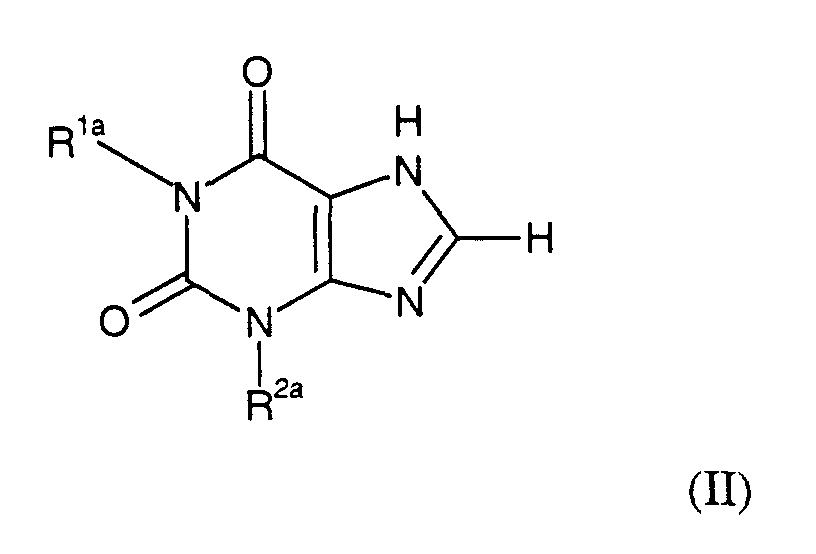
- (i) converting any group R1a to R1 and/or R2a to R2;
- (ii) when R3b is not amino, converting R3b to amino;
- (iii) converting a compound of formula (IA) into a further compound of formula (IA);
- (iv) converting a compound of formula (IA) into a pharmaceutically acceptable salt.
-
- One preferred group R3b is a nitro group which may then be converted to amino.
- Suitable reagents for substituting the C-8 hydrogen of the compound of formula (II) with a group R3b are the appropriate conventional reagents.
- The conditions of reaction for the substitution of the C-8 hydrogen of the compound of formula (II) will of course depend upon the particular reagent chosen, and in general the conditions used will be those which are conventional for the reagent used.
- One particularly suitable reagent is a nitrating agent.
- In one convenient form of the abovementioned process the compound of formula (II) is reacted with a suitable nitrating agent to provide a compound of formula (IA) wherein R3a represents a nitro group and then converting the nitro group into a halogen atom or an amino group.
- A compound of formula (II) may be prepared by the dehydrating cyclisation of a compound of formula (III):wherein R1a represents R1, as defined in relation to formula (IA), or a group convertible to R1 and R2a represents R2, as defined in relation to formula (IA), or a group convertible thereto, A1 represents - NO or -NH-CHO and A2 represents -NH.CH3 or -NH2, providing that when A1 is -NO then A2 is -NH.CH3 and when A1 is -NH.CHO then A2 is NH2; and thereafter, if required, converting any group R1a to R1 and/or R2a to R2.

- The dehydrating cyclisation of a compound of formula (III) may be carried out under any suitable conditions. Favourably the conditions chosen are these wherein the water formed is removed from the reaction mixture, thus the reaction is generally carried out at an elevated temperature in the range of from 100°C to 200°C, such as in the range of 180°C to 190°C.
- In one aspect of the process, especially when A1 is -NO and A2 is -NH.CH3, the reaction is carried out in a solvent immiscible with water, such as toluene, at the reflux temperature of the solvent, the water being removed using a water-separator.
- Suitable values for R1a and R2a include R1 and R2 respectively or nitrogen protecting groups such as benzyl groups.
- When R1a or R2a represents other than R1 or R2 repectively, the abovementioned conversions of R1a into R1 and R2a to R2 may be carried out using the appropriate conventional procedure. For example when R1a (or R2a) represents a nitrogen protecting group, such as a benzyl group, the protecting group may be removed using the appropriate conventional procedure, such as catalytic hydrogenation, and the resulting product reacted with a compound of formula (IV):
- The protection of any reactive group or atom, such as the xanthine nitrogen atom may be carried out at any appropriate stage in the aforementioned process. Suitable protecting groups include those used conventionally in the art for the particular group or atom being protected, for example suitable protecting groups for the xanthine nitrogen atoms are benzyl groups.
- Protecting groups may be prepared and removed using the appropriate conventional procedure:
- For example, N-benzyl protecting groups may be prepared by treating the appropriate compound of formula (II) with benzyl chloride in the presence of a base such as triethylamine. The N-benzyl protecting groups may be removed by catalytic hydrogenation over a suitable catalyst, such as palladium on activated charcoal, in a suitable solvent, such as ethanol conveniently at an elevated temperature, or by treatment with anhydrous aluminium chloride in dry benzene at ambient temperature.
- A compound of formula (III) wherein A1 represents -NH-CHO and R2 represents -NH2 may suitably be prepared from a 6-aminouracil of formula (A) according to the following reaction scheme:wherein R1a and R2a are as defined in relation to formula (II).
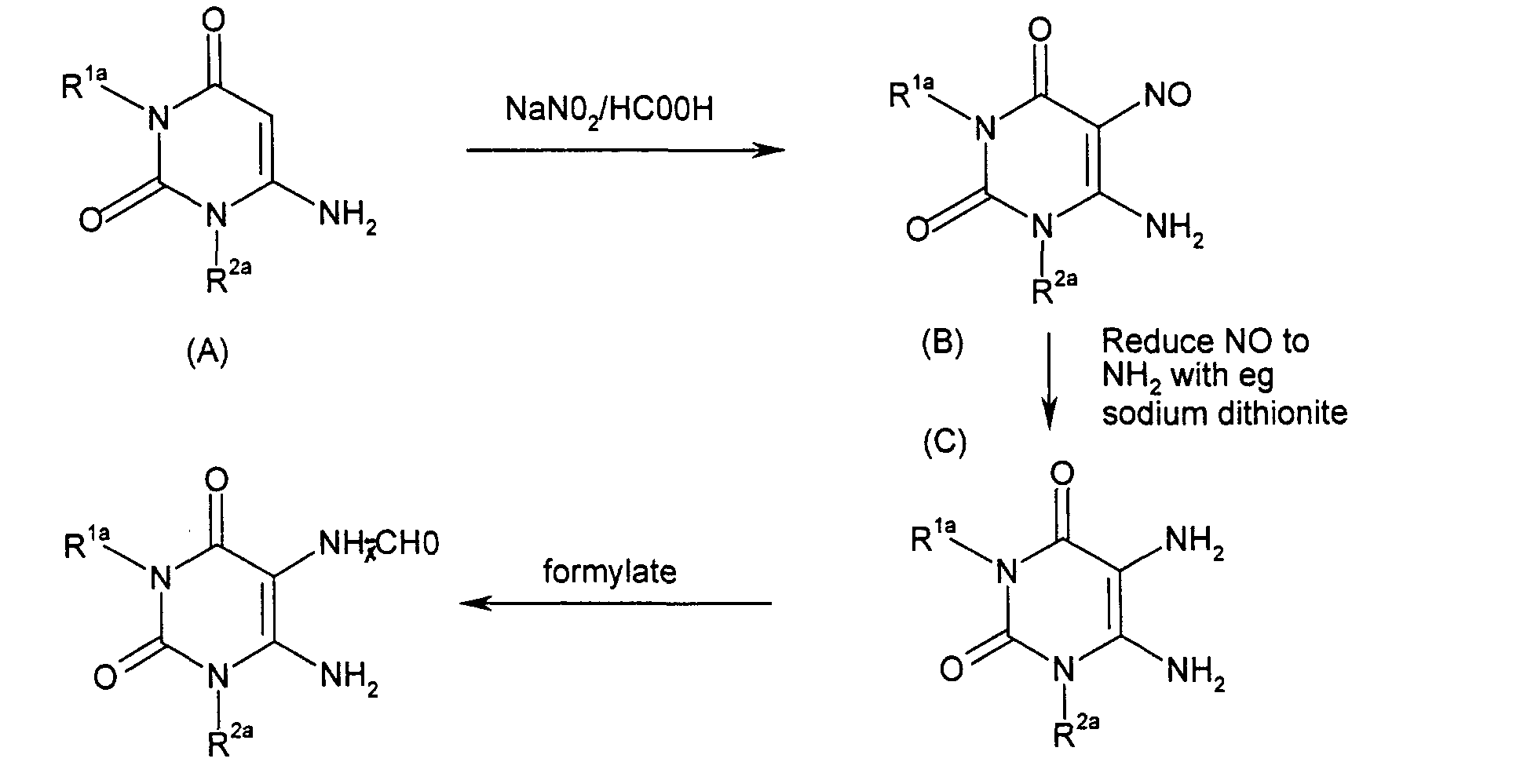
- Suitably, the reaction conditions used in the abovementioned reaction scheme are appropriate conventional conditions. In a preferred aspect of the process, the conversion of the 6-aminouracil (A), via (B) and (C), to the corresponding compound of formula (III) and the cyclisation of the compound of formula (III) to the compound of formula (II) are all carried out in-situ, suitably by using an analogous procedure to that of H. Bredereck and A. Edenhofer, Chem. Berichte 88, 1306-1312 (1955).
- The 6-aminouracils of formula (A) may themselves be prepared by the method of V. Papesch and E. F. Schroder, J. Org. Chem., 16, 1879-90 (1951), or Yozo Ohtsuka, Bull. Chem. Soc. Jap., 1973, 46(2), 506-9.
- A compound of formula (III) wherein A1 represents -NO and A2 represents -NH.CH3 may conveniently be prepared from a 6-chlorouracil of formula (D), according to the following reaction scheme:wherein R1a and R2a are as defined in relation to formula (II).

- Suitably, the reaction conditions used in the last above mentioned scheme are the appropriate conventional conditions, for example those used in the method of H. Goldner, G. Dietz and E. Carstens, Liebigs Annalen der Chemie, 691, 142-158 (1965). The 6-chlorouracil of formula (D) may also be prepared according to the procedure of Dietz et al.
- A nitro group may conveniently be converted into an amino group by conventional reduction methods for example by using tin powder and concentrated hydrochloric acid at ambient temperature or by using sodium dithionite in aqueous methanol at ambient temperature.
- Suitable alkylation methods for use in the abovementioned conversions include those used conventionally in the art, for example methods using halides, preferably iodides, in the presence of a base such as potassium carbonate in any convenient solvent for example acetonitrile or toluene.
- Suitable acylation methods for use in the abovementioned conversions include those used conventionally in the art, thus an amino group may be converted into an alkylcarbonyl amino group by using an appropriate acylating agent, for example an amino group may be converted to an acetylamino group by using acetic anhydride at elevated temperature.
- The compounds of formula (IA) may be prepared according to the abovementioned methods or, as appropriate, by the methods of the abovementioned publications.
- The active compound may be formulated for administration by any suitable route, the preferred route depending upon the disorder for which treatment is required, and is preferably in unit dosage form or in a form that a human patient may administer to himself in a single dosage. Advantageously, the composition is suitable for oral, rectal, topical, parenteral, intravenous or intramuscular administration or through the respiratory tract. Preparations may be designed to give slow release of the active ingredient.
- The compositions of the invention may be in the form of tablets, capsules, sachets, vials, powders, granules, lozenges, suppositories, reconstitutable powders, or liquid preparations such as oral or sterile parenteral solutions or suspensions. Topical formulations are also envisaged where appropriate.
- In order to obtain consistency of administration it is preferred that a composition of the invention is in the form of a unit dose.
- Unit dose presentation forms for oral administration may be tablets and capsules and may contain conventional excipients such as binding agents, for example syrup, acacia, gelatin, sorbitol, tragacanth, or polyvinylpyrrolidone; fillers, for example lactose, sugar, maize-starch, calcium phosphate, sorbitol or glycine; tabletting lubricants, for example magnesium stearate; disintegrants, for example starch, polyvinylpyrrolidone, sodium starch glycollate or microcrystalline cellulose; or pharmaceutically acceptable wetting agents such as sodium lauryl sulphate.
- The solid oral compositions may be prepared by conventional methods of blending, filling, tabletting or the like. Repeated blending operations may be used to distribute the active agent throughout those compositions employing large quantities of fillers.
- Such operations are of course conventional in the art. The tablets may be coated according to methods well known in normal pharmaceutical practice, in particular with an enteric coating.
- Oral liquid preparations may be in the form of, for example, emulsions, syrups, or elixirs, or may be presented as a dry product for reconstitution with water or other suitable vehicle before use. Such liquid preparations may contain conventional additives such as suspending agents, for example sorbitol, syrup, methyl cellulose, gelatin, hydroxyethylcellulose, carboxymethylcellulose, aluminium stearate gel, hydrogenated edible fats; emulsifying agents, for example lecithin, sorbitan monooleate, or acacia; non-aqueous vehicles (which may include edible oils), for example almond oil, fractionated coconut oil, oily esters such as esters of glycerine, propylene glycol, or ethyl alcohol; preservatives, for example methyl or propyl p-hydroxybenzoate or sorbic acid; and if desired conventional flavouring or colouring agents.
- Compositions may also suitably be presented for administration to the respiratory tract as a snuff or an aerosol or solution for a nebulizer, or as a microfine powder for insufflation, alone or in combination with an inert carrier such as lactose. In such a case the particles of active compound suitably have diameters of less than 50 microns, such as from 0.1 to 50 microns, preferably less than 10 microns, for example from 1 to 10 microns, 1 to 5 microns or from 2 to 5 microns. Where appropriate, small amounts of other anti-asthmatics and bronchodilators, for example sympathomimetic amines such as isoprenaline, isoetharine, salbutamol, phenylephrine and ephedrine; xanthine derivatives such as theophylline and aminophylline and corticosteroids such as prednisolone and adrenal stimulants such as ACTH may be included.
- For parenteral administration, fluid unit dosage forms are prepared utilizing the compound and a sterile vehicle, and, depending on the concentration used, can be either suspended or dissolved in the vehicle. In preparing solutions the compound can be dissolved in water for injection and filter sterilized before filling into a suitable vial or ampoule and sealing.
- Advantageously, adjuvants such as a local anaesthetic, a preservative and buffering agents can be dissolved in the vehicle. To enhance the stability, the composition can be frozen after filling into the vial and the water removed under vacuum. Parenteral suspensions are prepared in substantially the same manner, except that the compound is suspended in the vehicle instead of being dissolved, and sterilization cannot be accomplished by filtration. The compound can be sterilized by exposure to ethylene oxide before suspending in the sterile vehicle. Advantageously, a surfactant or wetting agent is included in the composition to facilitate uniform distribution of the compound.
- The compositions may contain from 0.1% to 99% by weight, preferably from 10-60% by weight, of the active material, depending on the method of administration.
- Compounds of formula (IA), or if appropriate a pharmaceutically acceptable salt thereof, may also be administered as a topical formulation in combination with conventional topical excipients.
- Topical formulations may be presented as, for instance, ointments, creams or lotions, impregnated dressings, gels, gel sticks, spray and aerosols, and may contain appropriate conventional additives such as preservatives, solvents to assist drug penetration and emollients in ointments and creams. The formulations may contain compatible conventional carriers, such as cream or ointment bases and ethanol or oleyl alcohol for lotions.
- Suitable cream, lotion, gel, stick, ointment, spray or aerosol formulations that may be used for compounds of formula (IA) or if appropriate a pharmaceutically acceptable salt thereof, are conventional formulations well known in the art, for example, as described in standard text books of pharmaceutics and cosmetics, such as Harry's Cosmeticology published by Leonard Hill Books, Remington's Pharmaceutical Sciences, and the British and US Pharmacopoeias.
- Suitably, the compound of formula (IA), or if appropriate a pharmaceutically acceptable salt thereof, will comprise from 0.5 to 20% by weight of the formulation, favourably from 1 to 10%, for example 2 to 5%.
- The dose of the compound used in the treatment of the invention will vary in the usual way with the seriousness of the disorders, the weight of the sufferer, and the relative efficacy of the compound. However, as a general guide suitable unit doses may be 0.1 to 1000mg, such as 0.5 to 200, 0.5 to 100 or 0.5 to 10 mg, for example 0.5, 1, 2, 3, 4 or 5 mg; and such unit doses may be administered more than once a day, for example 2, 3, 4, 5 or 6 times a day, but preferably 1 or 2 times per day, so that the total daily dosage for a 70kg adult is in the range of about 0.1 to 1000 mg, that is in the range of about 0.001 to 20 mg/kg/day, such as 0.007 to 3, 0.007 to 1.4, 0.007 to 0.14 or 0.01 to 0.5 mg/kg/day, for example 0.01, 0.02, 0.04, 0.05, 0.06, 0.08, 0.1 or 0.2 mg/kg/day; and such therapy may extend for a number of weeks or months.
- When used herein the term 'pharmaceutically acceptable' encompasses materials suitable for both human and veterinary use.
- No toxicological effects have been established for the compounds of formula (IA) in the abovementioned dosage ranges.
- The following pharmacological data and examples illustrate the invention. The following preparations illustrate the preparation of intermediates to the novel compounds of formula (IA).
- 1,3-Di-n-butylxanthine (73g, 0.28mol) was dissolved in acetic acid (120ml) and then treated with concentrated nitric acid (49g) at 87°C. After 1 hour, the mixture was cooled to 5°C, the resulting yellow precipitate filtered off and washed with water (50ml). The yellow crystals were dissolved in dichloromethane and washed twice with water. The separated organic layer was then dried (anhydrous sodium sulphate) and concentrated to give a crystalline product, yield 73g (86%), m.pt 168°C
1H NMR (CDCl3/DMSO):
ppm: 0.93 (t, J=6.3Hz, 6H), 1.1-2.0 (m, 8H), 3.8-4.25 (m, 4H). - 1,3-Di-cyclopropylmethyl xanthine (20g, 0.076mol) was dissolved in acetic acid (33ml) and then treated with concentrated nitric acid (13.2g) at 87°C. After 1 hour, the mixture was cooled to 5°C and the resulting yellow precipitate filtered off. The yellow crystals were dissolved in dichloromethane and washed with water. The separated organic layer was then dried over anhydrous sodium sulphate and concentrated in vacuo. The product crystallized from the concentrate to yield a yellow crystalline product yield 12.2g, (56.5%), m.pt. 207°C (with decomposition).
1H NMR (CDCl3):
ppm: 0.35-0.7 (m, 8H), 1.1 -1.7 (m, 2H), 3.95-4.2 (m, 4H), 9.0-11.0 (br. exchanges with D2O, 1H). - The following compounds were prepared using an analogous procedure to that described in Demonstration Example 1. The appropriate 1,3-di-cycloalkylmethyl xanthine substrates were prepared according to the procedures described herein in and in United Kingdom Patent Application No. 8826595.4.

- 1,3-Di-n-butyl-8-nitro xanthine from Example 1 (8.5g) was suspended in concentrated hydrochloric acid (85ml) and then treated at room temperature with tin powder (14.5g) in small portions. After stirring for 10 minutes the yellow colour of the suspension disappeared. Thereafter the precipitate was filtered off and recrystallised twice from ethanol. The product formed colourless crystals, yield 5.5g (63%) m.pt>250°C
1H NMR (DMSO):
ppm: 0.90 (t, J=6.1Hz, 6H), 1.05-1.9 (m, 8H), 3.65-4.15 (m, 4H), 6.9 (br, exchanges with D2O, 4H). - 1,3-Di-cylopropylmethyl-8-nitro xanthine (4g, 0,014mol), suspended in 50ml of concentrated hydrochloric acid,was treated with small portions of tin (8g) at room temperature. The mixture was then stirred at room temperature for two hours.
- The resulting precipitate was filtered off and crystallised from ethanol to give white crystals of the title product, yield 0.9g (23%), m.pt. 281°C.
- In an alternative procedure, using sodium dithionite as reducing agent (in methanol-water mixture). The yield was 36% (compare Demonstration Example 8).
1H NMR (CDCl3):
ppm: 0.3-0.6 (m,8H), 1.0-1.6 (m,2H), 3.7-4.0 (m,4H), 5.75 (br,2H), 10.84 (br. exchanges with D2O, 1H). - The following compounds were prepared using an analogous procedure to that described above for the preparation of a compound of Demonstration Example 1.
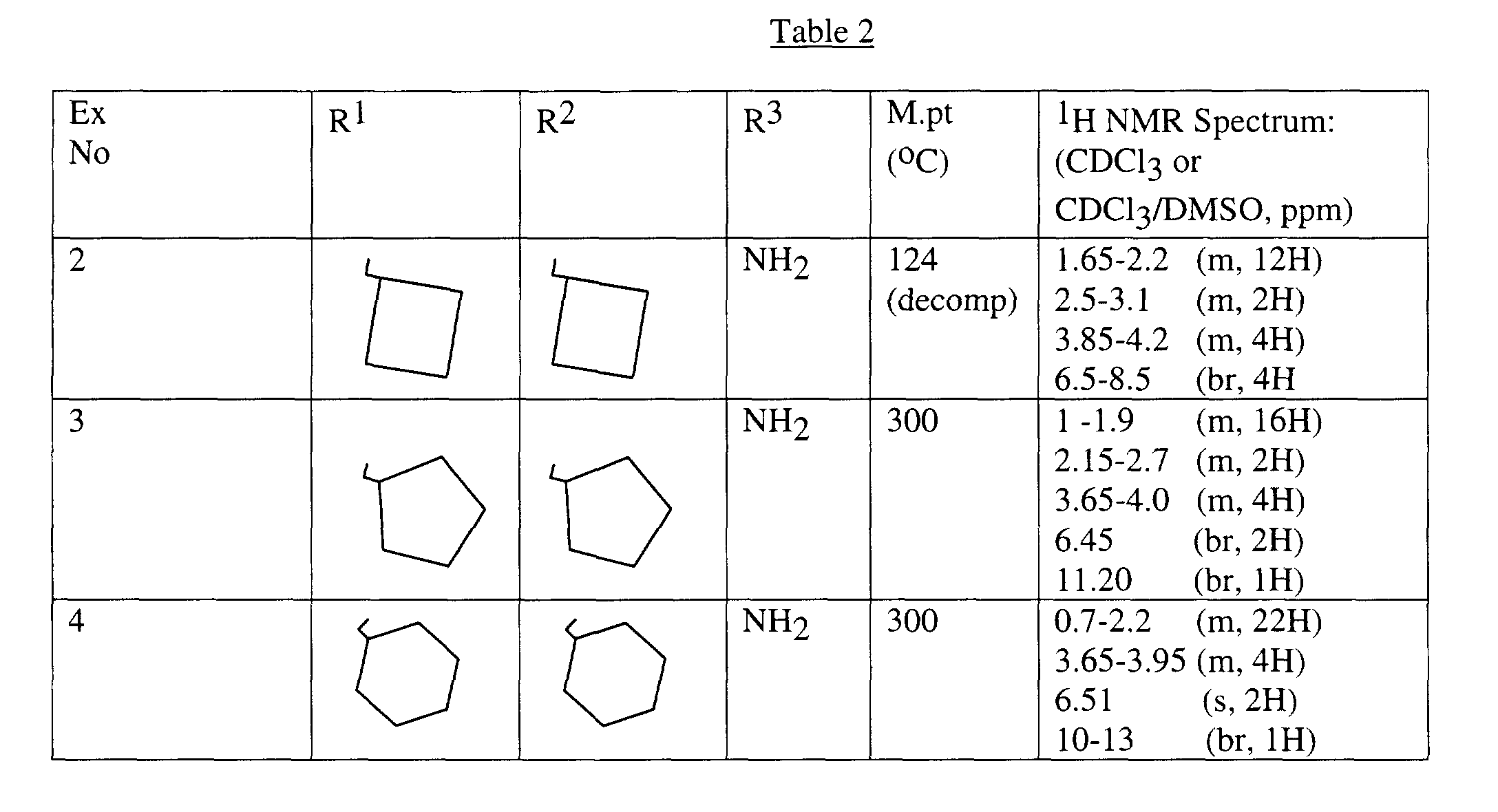
- 1,3-Di-cyclopropylmethyl xanthine was prepared using an analogous procedure to that described in Chem. Berichte 88, 1306-1312, 1955: 20.2g (0.0855 mol) of 1,3-dicyclopropylmethyl-6-amino-uracil was dissolved in 100ml of formamide, then 5.9g sodium nitrite was added and at 60°C 13.4ml formic acid was added slowly with stirring. After the colour had changed from yellow to violet, the mixture was heated up to 100°C and 3.1g of sodium dithionite (Na2S2O4) was added in small portions.
- Then the mixture was heated to 180-190°C and held at this temperature for 30 minutes.
- After cooling, the precipitate was sucked off, washed with 50ml of water and recrystallised from toluene. Yield: 22.5g, m.p. 203°C.
1H NMR (CDCl3):
ppm: 0.44-0.54 (8H, q); 1.18-1.57 (2H, m); 3.98-4.12 (4H, 2d); 7.81 (1H, s); 12.8-13.2 (1H, s, exch. with D2O). - 1,3-Di-cyclobutylmethyl xanthine was prepared from 1,3-dicyclobutylmethyl-6-aminouracil using an analogous procedure to that described in Preparation 1. The title compound was isolated as a crystalline solid, m.p. 191°C.
1H NMR (CDCl3):
ppm: 1.6-2.3 (12H, m); 2.4-3.2 (2H, m); 4.16 (2H, d, J=7.0Hz); 4.21 (2H, d, J=7.3Hz); 7.76 (1H, d, J=1.3Hz, exch. with D2O to give s) 12.7 (1H, br.s, exch. with D2O). - 1,3-Di-cyclopentylmethyl xanthine was prepared from 1,3-di-cyclopentylmethyl-6-aminouracil using an analogous procedure to that described in Preparation 1. The title compound was isolated as a crystalline solid, m.p. 208°C.
1H NMR (CDCl3):
ppm: 1.0-2.0 (16H, m); 2.2-2.9 (2H, m); 4.0-4.3 (4H, m); 7.78 (1H, d, J=1.2Hz, exch. with D2O to give s; 12.9 (1H, br.s, exch. with D2O). - 1,3-Di-cyclohexylmethyl xanthine was prepared from 1,3-di-cyclohexylmethyl-6-aminouracil using an analogous procedure to that described in Preparation 1. The title compound was isolated as a crystalline solid,m.p. 237°C.
1H NMR (CDCl3):
ppm: 0.8-2.2 (22H, m); 3.85-4.15 (4H, m (dd)); 7.73 (1H, s); 13.1 (1H, br.s, exch. with D2O). - 1,3-Di-cyclopropylmethyl-6-aminouracil was prepared using an analogous procedure to that described in J. Org. Chem. 16, 1879-1890, (1951):
- 22.6g (0.138mol) of the N,N'-dicyclopropylmethyl-urea (from Preparation 1) was treated with 44ml (0.43mol) of acetic anhydride and 14g (0.165mol) of cyanocetic-acid at 70°C for 2 hours.
- After cooling and the addition of 15ml of water, 40ml of 50% NaOH/water-solution was dropped slowly onto the mixture at 45°C with stirring.
- After stirring for 1 hour at room temperature, the strongly alkaline solution was separated and the oily residue washed carefully with 60ml water.
- The semi-solid residue was dissolved in 220ml methanol and dropped into 1 litre of water with stirring. Thereby the product crystallised. Yield: 25.5g, 78.5% approx., m.p. 85-95°C (wax-like).
- 1,3-Di-cyclopentylmethyl-6-aminouracil was prepared from N,N'-di-cyclopentylmethyl urea using a procedure analogous to that described in Preparation 5. The title compound was isolated as a crystalline solid, m.p. 108°C.
1H NMR (CDCl3):
ppm: 1.0-2.6 (18H, m); 3.86 (4H, d, J = 7.4Hz); 4.98 (3H, m, 2H exch. with D2O). - 1,3-Di-cyclohexylmethyl-6-aminouracil was prepared from N,N'-di-cyclohexylmethyl urea using a procedure analogous to that described in Preparation 5. The title compound was isolated as a crystalline solid, m.p. 185°C.
- N,N'-Di-cyclopropylmethyl urea, m.p. 124°C, was prepared using a procedure analogous to that described in J. Org. Chem. 16, 1879-1890, (1951):
- 68.2g (0.634mol) cyclopropylmethylamine-hydrochloride in 800ml of water was treated with 25g sodium hydroxide dissolved in 100ml of water and the mixture cooled to -15°C.
- Phosgene, 33g was then slowly introduced through a capillary tube with stirring. Thereafter the mixture was stirred for 1 hour and, as necessary, after acidification with 0.1 N HCl, the product was extracted with dichloromethane.
- After washing with water and drying over anhydrous sodium sulphate the product was obtained after evaporation of the solvent. Yield: 21g, 40% approx.
- From the aqueous phase, 20g of the unreacted aduct (cyclopropylmethylamine-hydrochloride) can be obtained.
1H NMR (CDCl3):
ppm: 0.06-0.59 (8H, m); 0.72-1.06 (2H, m); 3.01-3.09 (4H, d); 4.66 (1H, br.s, exch. with D2O). - N,N'-Di-cyclobutylmethyl urea was prepared from cyclobutylmethylamine using a procedure analogous to that described in Preparation 8. The title compound was isolated as a crystalline solid, m.p. 155°C.
1H NMR (CDCl3):
ppm: 1.4-2.8 (14H, m); 3.0-3.3 (4H, m); 4.59 (2H, br.s, exch. with D2O). - N,N'-Di-cyclopentylmethyl urea was prepared from cyclopentylmethylamine using a procedure analogous to that described in Preparation 8. The title compound was isolated as a crystalline solid, m.p. 150°C.
1H NMR (CDCl3):
ppm: 1.0-2.2 (18H, m); 2.9-3.2 (4H, m); 4.59 (2H, br.s, exch. with D2O). - N,N'-Di-cyclohexylmethyl urea was prepared from cyclohexylmethylamine using a procedure analogous to that described in Preparation 8. The title compound was isolated as a crystalline solid, m.p. 159°C.
- The procedure used was that described by Arch, J.R.S. and Newsholme, E.A. in Biochem. J. 158, 603, (1976):
- Erythrocytes were obtained from Na-citrate (16 mM; 0.1 ml/ml blood) anticoagulated blood by repeated centrifugation with removal of the buff coat and washing with an isotonic buffer (composition in mM: NaCl 13.7, KCl 4, CaCl2.2 H2O 1.8, Na2HPO4.12 H2O 0.8, NaH2PO4 0.2, MgSO4.7 H2O 0.7, Hepes 3.4; pH 7.4).
- The phosphodiesterase was extracted by mixing the erythrocytes with 4 volumes of 7 mM phosphate buffer, pH7.4, followed by sonification (3 x 10 sec; 100 W) and then centrifuging for 30 min at 4200 x g.
- All supernatants were diluted in the extraction medium and assayed for phosphodiesterase activity within 6 hours of preparation, using the radiochemical procedure described in the above mentioned reference.
Results Example No. Ki [µM] c-AMP phosphodiesterase (erythrocytes) 1 1.6 2 0.53 3 0.57 - Male Charles River Sprague Dawley rats weighing between 250 to 300g were used.
- The method used was a modification of that described by Laycock et al (Int. Arch. Appl. Immunol, (1986). 81, 363).
- Sephadex G200, particle size 40 to 120 micron, was suspended in isotonic saline at 0.5mg/ml, and stored for 48h at 4°C. 1ml of the suspension was given intravenously to rats on days 0,2 and 5. A control group received saline. The test compound was given before the Sephadex on each occasion, with a contact time expected to give maximum activity at the time of the Sephadex administration. Blood was taken from the tail vein of the rats on day 7 for the determination of total and differential leucocyte counts.
- A control group of at least 6 animals was included each time a compound was evaluated. The control group received Sephadex and the vehicle without test compound. The results in the drug treated animals were compared with the control group. Alternatively, if the mean for the control group for any experiment was not statistically different from the mean of the sum of all of the control groups, then the treated animal results for that experiment were compared with the mean of the sum of all the control groups.
- 20µl samples of blood, taken from the tail vein of the rats, were added to 10ml of Isoton II and, within 30min, Zaponin (3 drops) was added, to lyse the erythrocytes. Five minutes later the total cell count was determined using a Coulter Counter Model DN. Differential leucocyte counts were carried out by fixing and staining a blood smear on a microscopic slide with May-Grunwald and Giemsa stains. A minimum of 400 cells were counted on each slide.
- Probability values were calculated using the Student's t test.
- The effect of the test compound upon Sephadex induced eosinophilia in the rat is set out in Table 3. The test compound was given orally 30 minutes before each injection of Sephadex. The results indicate that the test compound inhibits the induced eosinophilia in a dose dependent manner.
Test Compound Dose mg/kg (orally - 30 mins) % of Control Mean ± SEM (n=12 or more) Vehicle dosed control + sephadex i.v - 100 ± 7 Negative control saline i.v. - 10 ± 0.9 Example 1 2.0 48 ± 7 0.2 61 ± 8 Example 2 5.0 47 ± 4 - The A1, [3H]-CHA binding assay was performed as described by Bruns et al in Mol. Pharm. 29, 331-346 (1986).
- Brains were removed and one gram of the relevant tissues (whole brain minus cerebellum for the [3H]-CHA) were homogenized in 50mM Tris-HCl (pH 7.4) supplemented with 10µm PMSF (phenylmethanesulphonylfluoride)for 30 seconds with a Potter S homogenizer, 10 strokes at 1.500 r.p.m. The homogenate was diluted and centrifuged at 42000g for 18 minutes. The pellet was re-suspended with the Potter S homogenizer in Tris-HCl buffer and the centrifugation step repeated. The pellet was then resuspended in Tris-HCl buffer, which contained 1mM EDTA, and stored in plastic vials in liquid nitrogen. The membranes were used within one week.
- All incubations were performed in triplicate in 12 x 75mm polycarbonate tubes in a shaking water bath. Tubes contained 1ml of 50mM Tris-HCl (pH 7.4) and 2.5 or 0.1 units ml-1 of adenosine deaminase. Membranes obtained from 2mg of tissue in 400µl buffer were used in the [3H]-CHA assay. The radiolabelled ligand concentrations were 2.5nm [3H]-CHA. Non-specific binding was determined by the addition of 50µm PIA.
- Incubations were for 90 minutes at 37°C for the [3H]-CHA assay. Incubations were terminated by the addition of 3.8ml ice cold buffer (50mM Tris-HCl, 10mM MgCl2; pH 7.4) followed by rapid filtration through 2.4cm GF/B filters under reduced pressure using a Millipore 1225 sampling manifold. Filters were washed with three 3.8ml portions of buffer. The damp filters were placed in scintillation vials and 5 ml of Aqualuma added. The vials were left overnight, shaken and radioactivity counted in a liquid scintillation counter. All assays were repeated at least three times.
Results Example No. Adenosine A1 inhibition Ki[µM] 1 5 2 7.2 3 4.6
Claims (11)
- A compound of formula (IA):or if appropriate a pharmaceutically acceptable salt thereof,
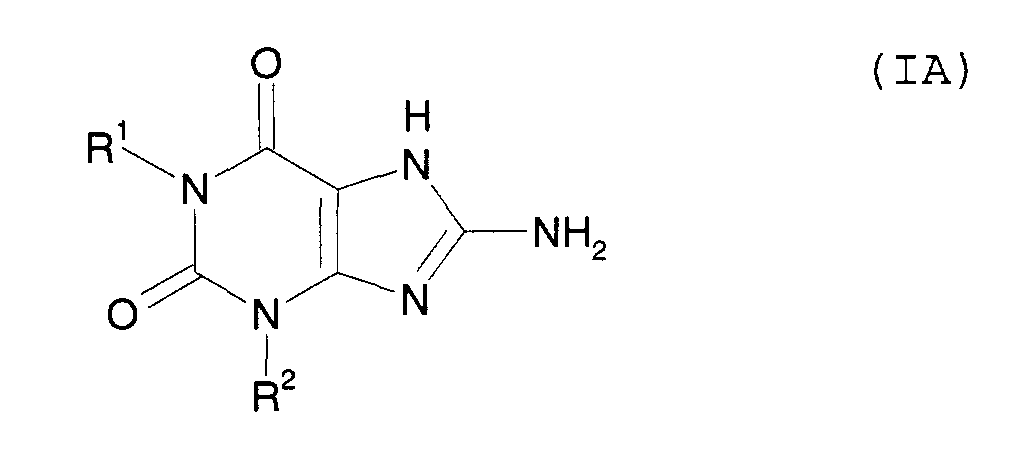
characterised in that:
R1 and R2 each independently represent a moiety of formula (a): - A compound according to claim 1, wherein A is an unsubstituted cyclopropyl, cyclobutyl, cyclopentyl or cyclohexyl group.
- A compound according to claim1 or claim 2, wherein A represents a cyclopropyl group or a cyclobutyl group.
- A compound according to any one of claims 1 to 3, wherein A represents a cyclopropyl group.
- A compound according to claim 1 selected from the group consisting of:1,3-di-cyclopropylmethyl-8-amino xanthine;1,3-di-cyclobutylmethyl-8-amino xanthine;1,3-di-cyclopentylmethyl-8-amino xanthine;and1,3-di-cyclohexylmethyl-8-amino xanthine; or if appropriate a pharmaceutically acceptable salt thereof.
- A process for the preparation of a compound of formula (IA) according to claim 1, characterised in that the process comprises reacting a compound of formula (II):wherein R1a represents R1, as defined in relation to formula (IA), or a group convertible to R1 and R2a represents R2, as defined in relation to formula (IA), or a group convertible thereto, with a nitrating agent thereby substituting the C-8 hydrogen of the compound of formula (II) with a nitro group and thereafter converting the nitro group into an amine; and thereafter, if required carrying out one or more of the following optional steps:
 (i) converting any group R1a to R1 and/or R2a to R2;(ii) converting a compound of formula (IA) into a pharmaceutically acceptable salt.
 - A pharmaceutical composition comprising a compound of formula (IA) according to claim 1, or-if appropriate a pharmaceutically acceptable salt thereof, and a pharmaceutically acceptable carrier therefor.
- A compound of formula (IA) according to claim 1, or if appropriate a pharmaceutically acceptable salt thereof, for use as an active therapeutic substance.
- The use of a compound of formula (IA) according to claim 1 for the manufacture of a medicament for the treatment of cerebrovascular disorders and/or disorders associated with cerebral senility and/or prophylaxis of disorders associated with neuronal degeneration resulting from ischaemic events and/or peripheral vascular disease and/or proliferative skin diseases and/or disorders of the respiratory tract and/or the treatment or prophylaxis of disorders associated with increased numbers of eosinophils and allergic disorders associated with atopy.
- A compound according to claim 1 being
1,3-di-cyclopropylmethyl-8-amino xanthine; or if appropriate a pharmaceutically acceptable salt thereof. - A pharmaceutical composition comprising a compound according to claim 10.
Priority Applications (1)
| Application Number | Priority Date | Filing Date | Title |
|---|---|---|---|
| EP00203905A EP1120417A3 (en) | 1989-03-23 | 1990-03-22 | Xanthine derivatives for the treatment of cerebrovascular disorders |
Applications Claiming Priority (2)
| Application Number | Priority Date | Filing Date | Title |
|---|---|---|---|
| GB8906792 | 1989-03-23 | ||
| GB898906792A GB8906792D0 (en) | 1989-03-23 | 1989-03-23 | Treatment and compounds |
Related Child Applications (1)
| Application Number | Title | Priority Date | Filing Date |
|---|---|---|---|
| EP00203905A Division EP1120417A3 (en) | 1989-03-23 | 1990-03-22 | Xanthine derivatives for the treatment of cerebrovascular disorders |
Publications (3)
| Publication Number | Publication Date |
|---|---|
| EP0389282A2 EP0389282A2 (en) | 1990-09-26 |
| EP0389282A3 EP0389282A3 (en) | 1992-07-01 |
| EP0389282B1 true EP0389282B1 (en) | 2002-02-20 |
Family
ID=10653940
Family Applications (2)
| Application Number | Title | Priority Date | Filing Date |
|---|---|---|---|
| EP00203905A Withdrawn EP1120417A3 (en) | 1989-03-23 | 1990-03-22 | Xanthine derivatives for the treatment of cerebrovascular disorders |
| EP90303093A Expired - Lifetime EP0389282B1 (en) | 1989-03-23 | 1990-03-22 | Xanthinederivatives, process for their preparation and their pharmaceutical use |
Family Applications Before (1)
| Application Number | Title | Priority Date | Filing Date |
|---|---|---|---|
| EP00203905A Withdrawn EP1120417A3 (en) | 1989-03-23 | 1990-03-22 | Xanthine derivatives for the treatment of cerebrovascular disorders |
Country Status (27)
| Country | Link |
|---|---|
| US (4) | US5734051A (en) |
| EP (2) | EP1120417A3 (en) |
| JP (1) | JP2510889B2 (en) |
| KR (1) | KR0160768B1 (en) |
| CN (1) | CN1031641C (en) |
| AT (1) | ATE213498T1 (en) |
| AU (1) | AU629315B2 (en) |
| CA (1) | CA2012686C (en) |
| CZ (1) | CZ391891A3 (en) |
| DE (1) | DE69033915T2 (en) |
| DK (1) | DK0389282T3 (en) |
| ES (1) | ES2173074T3 (en) |
| FI (1) | FI95033C (en) |
| GB (1) | GB8906792D0 (en) |
| HK (1) | HK1040392A1 (en) |
| HU (1) | HU207081B (en) |
| IL (1) | IL93832A (en) |
| MA (1) | MA21800A1 (en) |
| MY (1) | MY109737A (en) |
| NO (1) | NO175592C (en) |
| NZ (1) | NZ233021A (en) |
| PL (1) | PL164811B1 (en) |
| PT (1) | PT93527B (en) |
| SA (1) | SA90100215B1 (en) |
| SK (1) | SK391891A3 (en) |
| ZA (1) | ZA902170B (en) |
| ZW (1) | ZW3690A1 (en) |
Cited By (1)
| Publication number | Priority date | Publication date | Assignee | Title |
|---|---|---|---|---|
| US6821978B2 (en) | 2000-09-19 | 2004-11-23 | Schering Corporation | Xanthine phosphodiesterase V inhibitors |
Families Citing this family (92)
| Publication number | Priority date | Publication date | Assignee | Title |
|---|---|---|---|---|
| US5021422A (en) * | 1989-06-08 | 1991-06-04 | Senetek Plc | Method and composition for treating hyperproliferative skin diseases using 6-aminopurine cytokinins |
| GB9020921D0 (en) * | 1990-09-26 | 1990-11-07 | Beecham Group Plc | Novel compounds |
| GB9020959D0 (en) * | 1990-09-26 | 1990-11-07 | Beecham Group Plc | Novel compounds |
| NZ240644A (en) * | 1990-11-21 | 1994-08-26 | Smithkline Beecham Corp | Use of xanthine derivatives to inhibit the production of tumour necrosis factor (tnf) |
| ATE194345T1 (en) * | 1990-12-21 | 2000-07-15 | Beecham Group Plc | XANTHINE DERIVATIVES |
| ATE141791T1 (en) | 1991-07-05 | 1996-09-15 | Byk Gulden Lomberg Chem Fab | USE OF SUBSTITUTED PYRIDAZINE AGAINST DERMATOSES |
| AU3725893A (en) * | 1992-02-21 | 1993-09-13 | Smithkline Beecham Corporation | TNF inhibitors |
| US5342841A (en) * | 1992-03-12 | 1994-08-30 | Kyowa Hakko Kogyo Co., Ltd. | Xanthine derivatives |
| CA2093403C (en) * | 1992-04-08 | 1999-08-10 | Fumio Suzuki | Therapeutic agent for parkinson's disease |
| GB9210839D0 (en) * | 1992-05-21 | 1992-07-08 | Smithkline Beecham Plc | Novel compounds |
| GB9215633D0 (en) * | 1992-07-23 | 1992-09-09 | Smithkline Beecham Plc | Novel treatment |
| US6693105B1 (en) | 1992-11-16 | 2004-02-17 | Cell Therapeutics, Inc. | Hydroxyl-containing compounds |
| US6469017B1 (en) | 1998-01-16 | 2002-10-22 | Cell Therapeutics, Inc. | Method of inhibiting interleukin-12 signaling |
| GB9312853D0 (en) | 1993-06-22 | 1993-08-04 | Euro Celtique Sa | Chemical compounds |
| US6878715B1 (en) * | 1994-02-18 | 2005-04-12 | Cell Therapeutics, Inc. | Therapeutic compounds for inhibiting interleukin-12 signals and method for using same |
| US5646156A (en) * | 1994-04-25 | 1997-07-08 | Merck & Co., Inc. | Inhibition of eosinophil activation through A3 adenosine receptor antagonism |
| US5591776A (en) | 1994-06-24 | 1997-01-07 | Euro-Celtique, S.A. | Pheynl or benzyl-substituted rolipram-based compounds for and method of inhibiting phosphodiesterase IV |
| US5922751A (en) | 1994-06-24 | 1999-07-13 | Euro-Celtique, S.A. | Aryl pyrazole compound for inhibiting phosphodiesterase IV and methods of using same |
| EP0814809B1 (en) | 1994-12-13 | 2003-08-13 | Euroceltique S.A. | Aryl thioxanthines |
| JP2001523213A (en) | 1994-12-13 | 2001-11-20 | ユーロ−セルティーク,エス.エイ. | Trisubstituted thioxanthines |
| CA2218548A1 (en) * | 1995-05-19 | 1996-11-21 | Chiroscience Limited | Xanthines and their therapeutic use |
| US6166041A (en) | 1995-10-11 | 2000-12-26 | Euro-Celtique, S.A. | 2-heteroaryl and 2-heterocyclic benzoxazoles as PDE IV inhibitors for the treatment of asthma |
| US6075016A (en) | 1996-04-10 | 2000-06-13 | Euro-Celtique S.A. | 6,5-fused aromatic ring systems having enhanced phosphodiesterase IV inhibitory activity |
| US5864037A (en) * | 1996-06-06 | 1999-01-26 | Euro-Celtique, S.A. | Methods for the synthesis of chemical compounds having PDE-IV inhibitory activity |
| US5958926A (en) * | 1996-11-01 | 1999-09-28 | Nitromed, Inc. | Nitrosated and nitrosylated phosphodiesterase inhibitor compounds, compositions and their uses |
| GB9623859D0 (en) * | 1996-11-15 | 1997-01-08 | Chiroscience Ltd | Novel compounds |
| GB9703044D0 (en) | 1997-02-14 | 1997-04-02 | Glaxo Group Ltd | Phenyl xanthine esters and amides |
| DE69834500T2 (en) * | 1997-09-05 | 2007-05-03 | Kyowa Hakko Kogyo Co., Ltd. | XANTHINE DERIVATIVES FOR THE TREATMENT OF BRAINISHEMIA |
| MA24682A1 (en) * | 1997-10-23 | 1999-07-01 | Smithkline Beecham Corp | NEW POLYMORPHIC FORMS OF CIPAMFYLLINE, PROCESS FOR THEIR PREPARATION AND COMPOSITIONS CONTAINING THEM |
| GB9817623D0 (en) | 1998-08-13 | 1998-10-07 | Glaxo Group Ltd | Pharmaceutical compounds |
| CA2715683A1 (en) | 1999-08-21 | 2001-03-01 | Nycomed Gmbh | Synergistic combination |
| WO2001068600A2 (en) | 2000-03-16 | 2001-09-20 | Inflazyme Pharmaceuticals Limited | Benzylated pde4 inhibitors |
| US6586429B2 (en) * | 2000-11-29 | 2003-07-01 | Cell Therapeutics, Inc. | Tricyclic fused xanthine compounds and their uses |
| EE05643B1 (en) * | 2001-02-24 | 2013-04-15 | Boehringer Ingelheim Pharma Gmbh & Co. Kg | Xanthine derivatives, their preparation and use as medicaments |
| DE60228073D1 (en) * | 2001-05-08 | 2008-09-18 | Brni Neurosciences Inst | ADENOSINE A1 RECEPTOR ANTAGONISTS FOR THE TREATMENT OF HYPOXINE LEARNING AND MEMORY DISORDERS |
| US6825180B2 (en) * | 2001-05-18 | 2004-11-30 | Cell Therapeutics, Inc. | Pyridopyrimidine compounds and their uses |
| AU2002333193A1 (en) * | 2001-08-15 | 2003-03-03 | Leo Pharma A/S | A pharmaceutical composition for dermal application |
| MXPA04001891A (en) | 2001-08-28 | 2004-06-15 | Schering Corp | Polycyclic guanine phosphodiesterase v inhibitors. |
| WO2003042216A1 (en) | 2001-11-09 | 2003-05-22 | Schering Corporation | Polycyclic guanine derivative phosphodiesterase v inhibitors |
| US20030175314A1 (en) * | 2001-11-19 | 2003-09-18 | Didriksen Erik Johannes | Pharmaceutical composition for dermal application |
| US7407955B2 (en) | 2002-08-21 | 2008-08-05 | Boehringer Ingelheim Pharma Gmbh & Co., Kg | 8-[3-amino-piperidin-1-yl]-xanthines, the preparation thereof and their use as pharmaceutical compositions |
| US7772188B2 (en) | 2003-01-28 | 2010-08-10 | Ironwood Pharmaceuticals, Inc. | Methods and compositions for the treatment of gastrointestinal disorders |
| EA200501548A1 (en) | 2003-04-01 | 2006-02-24 | Апплайд Резеч Системз Арс Холдинг Н.В. | PHOSPHODYSTERASE INHIBITORS FOR INFERTILITY |
| WO2005012303A1 (en) * | 2003-07-31 | 2005-02-10 | Schering Corporation | Metabolite of xanthine phosphodiesterase 5 inhibitor and derivatives thereof useful for treatment of erectile dysfunction |
| JPWO2005056016A1 (en) * | 2003-12-09 | 2007-07-05 | 協和醗酵工業株式会社 | Preventive and / or therapeutic agent for higher brain dysfunction |
| RU2395511C2 (en) * | 2004-02-14 | 2010-07-27 | Смитклайн Бичам Корпорейшн | Novel compounds |
| HRP20130406T1 (en) | 2004-02-14 | 2013-06-30 | Glaxosmithkline Intellectual Property Development Limited | Medicaments with hm74a receptor activity |
| US7501426B2 (en) | 2004-02-18 | 2009-03-10 | Boehringer Ingelheim International Gmbh | 8-[3-amino-piperidin-1-yl]-xanthines, their preparation and their use as pharmaceutical compositions |
| DE102004030502A1 (en) | 2004-06-24 | 2006-01-12 | Boehringer Ingelheim Pharma Gmbh & Co. Kg | Novel imidazoles and triazoles, their preparation and use as medicines |
| DE102004054054A1 (en) | 2004-11-05 | 2006-05-11 | Boehringer Ingelheim Pharma Gmbh & Co. Kg | Process for preparing chiral 8- (3-amino-piperidin-1-yl) -xanthines |
| DE102005035891A1 (en) | 2005-07-30 | 2007-02-08 | Boehringer Ingelheim Pharma Gmbh & Co. Kg | 8- (3-amino-piperidin-1-yl) -xanthines, their preparation and their use as pharmaceuticals |
| JP5112316B2 (en) | 2005-08-10 | 2013-01-09 | グラクソスミスクライン・リミテッド・ライアビリティ・カンパニー | Xanthine derivatives as selective HM74A agonists |
| AU2007226937A1 (en) * | 2006-03-21 | 2007-09-27 | Dr. Reddy's Laboratories Ltd. | Docetaxel polymorphs and processes |
| CN102838599A (en) | 2006-05-04 | 2012-12-26 | 贝林格尔.英格海姆国际有限公司 | Polymorphs |
| PE20080251A1 (en) | 2006-05-04 | 2008-04-25 | Boehringer Ingelheim Int | USES OF DPP IV INHIBITORS |
| EP1852108A1 (en) | 2006-05-04 | 2007-11-07 | Boehringer Ingelheim Pharma GmbH & Co.KG | DPP IV inhibitor formulations |
| EP2057160A1 (en) | 2006-08-08 | 2009-05-13 | Boehringer Ingelheim International GmbH | Pyrrolo [3, 2 -d]pyrimidines as dpp-iv inhibitors for the treatment of diabetes mellitus |
| US8969514B2 (en) | 2007-06-04 | 2015-03-03 | Synergy Pharmaceuticals, Inc. | Agonists of guanylate cyclase useful for the treatment of hypercholesterolemia, atherosclerosis, coronary heart disease, gallstone, obesity and other cardiovascular diseases |
| MX2009013293A (en) | 2007-06-04 | 2010-02-15 | Synergy Pharmaceuticals Inc | Agonists of guanylate cyclase useful for the treatment of gastrointestinal disorders, inflammation, cancer and other disorders. |
| US8871751B2 (en) * | 2008-01-18 | 2014-10-28 | The Board Of Trustees Of The University Of Illinois | Compositions and methods relating to nuclear hormone and steroid hormone receptors including inhibitors of estrogen receptor alpha-mediated gene expression and inhibition of breast cancer |
| PE20091730A1 (en) | 2008-04-03 | 2009-12-10 | Boehringer Ingelheim Int | FORMULATIONS INVOLVING A DPP4 INHIBITOR |
| EP2810951B1 (en) | 2008-06-04 | 2017-03-15 | Synergy Pharmaceuticals Inc. | Agonists of guanylate cyclase useful for the treatment of gastrointestinal disorders, inflammation, cancer and other disorders |
| CA2730603C (en) | 2008-07-16 | 2019-09-24 | Synergy Pharmaceuticals Inc. | Agonists of guanylate cyclase useful for the treatment of gastrointestinal disorders, inflammation, cancer and other disorders |
| KR20200118243A (en) | 2008-08-06 | 2020-10-14 | 베링거 인겔하임 인터내셔날 게엠베하 | Treatment for diabetes in patients inappropriate for metformin therapy |
| UY32030A (en) | 2008-08-06 | 2010-03-26 | Boehringer Ingelheim Int | "TREATMENT FOR DIABETES IN INAPPROPRIATE PATIENTS FOR THERAPY WITH METFORMIN" |
| BRPI0919288A2 (en) | 2008-09-10 | 2015-12-15 | Boehring Ingelheim Internat Gmbh | combination therapy for treatment of diabetes and related conditions. |
| US20200155558A1 (en) | 2018-11-20 | 2020-05-21 | Boehringer Ingelheim International Gmbh | Treatment for diabetes in patients with insufficient glycemic control despite therapy with an oral antidiabetic drug |
| EA022310B1 (en) | 2008-12-23 | 2015-12-30 | Бёрингер Ингельхайм Интернациональ Гмбх | SALT FORMS OF ORGANIC COMPOUND |
| AR074990A1 (en) | 2009-01-07 | 2011-03-02 | Boehringer Ingelheim Int | TREATMENT OF DIABETES IN PATIENTS WITH AN INAPPROPRIATE GLUCEMIC CONTROL THROUGH METFORMIN THERAPY |
| NZ599298A (en) | 2009-11-27 | 2014-11-28 | Boehringer Ingelheim Int | Treatment of genotyped diabetic patients with dpp-iv inhibitors such as linagliptin |
| WO2011138421A1 (en) | 2010-05-05 | 2011-11-10 | Boehringer Ingelheim International Gmbh | Combination therapy |
| NZ603319A (en) | 2010-06-24 | 2015-04-24 | Boehringer Ingelheim Int | Diabetes therapy |
| US9616097B2 (en) | 2010-09-15 | 2017-04-11 | Synergy Pharmaceuticals, Inc. | Formulations of guanylate cyclase C agonists and methods of use |
| AR083878A1 (en) | 2010-11-15 | 2013-03-27 | Boehringer Ingelheim Int | VASOPROTECTORA AND CARDIOPROTECTORA ANTIDIABETIC THERAPY, LINAGLIPTINA, TREATMENT METHOD |
| CA3100941C (en) | 2011-03-01 | 2024-03-05 | Synergy Pharmaceuticals Inc. | Process of preparing guanylate cyclase c agonists |
| CA2841552C (en) | 2011-07-15 | 2020-06-23 | Boehringer Ingelheim International Gmbh | Substituted quinazolines, the preparation thereof and the use thereof in pharmaceutical compositions |
| US9555001B2 (en) | 2012-03-07 | 2017-01-31 | Boehringer Ingelheim International Gmbh | Pharmaceutical composition and uses thereof |
| EP3685839A1 (en) | 2012-05-14 | 2020-07-29 | Boehringer Ingelheim International GmbH | Linagliptin for use in the treatment of albuminuria and kidney related diseases |
| US20130303554A1 (en) | 2012-05-14 | 2013-11-14 | Boehringer Ingelheim International Gmbh | Use of a dpp-4 inhibitor in sirs and/or sepsis |
| WO2013174767A1 (en) | 2012-05-24 | 2013-11-28 | Boehringer Ingelheim International Gmbh | A xanthine derivative as dpp -4 inhibitor for use in modifying food intake and regulating food preference |
| EP3718557A3 (en) | 2013-02-25 | 2020-10-21 | Bausch Health Ireland Limited | Guanylate cyclase receptor agonist sp-333 for use in colonic cleansing |
| JP2016514670A (en) | 2013-03-15 | 2016-05-23 | シナジー ファーマシューティカルズ インコーポレイテッド | Guanylate cyclase receptor agonists in combination with other drugs |
| JP2016514671A (en) | 2013-03-15 | 2016-05-23 | シナジー ファーマシューティカルズ インコーポレイテッド | Guanylate cyclase agonists and uses thereof |
| EA201592263A1 (en) | 2013-06-05 | 2016-05-31 | Синерджи Фармасьютикалз, Инк. | ULTRASCULAR AGONISTS OF GUANYLACYCLASE C, METHOD OF THEIR RECEIVING AND USING |
| KR20160042039A (en) | 2013-08-09 | 2016-04-18 | 알데릭스, 인코포레이티드 | Compounds and methods for inhibiting phosphate transport |
| ES2950384T3 (en) | 2014-02-28 | 2023-10-09 | Boehringer Ingelheim Int | Medical use of a DPP-4 inhibitor |
| SG11201705889VA (en) | 2015-01-30 | 2017-08-30 | Shanton Pharma Co Ltd | Prevention or Treatment of Uratic or Gouty Diseases |
| DK3280417T3 (en) | 2015-04-08 | 2020-11-02 | Lewis And Clark Pharmaceuticals Inc | XANTHIN-SUBSTITUTED ALKYNYL CARBAMATES / REVERSE CARBAMATES AS A2B ANTAGONISTS |
| EP3165224A1 (en) | 2015-11-09 | 2017-05-10 | Albert-Ludwigs-Universität Freiburg | Use of pde4 inhibitors for the prophylaxis and/or therapy of dyslipoproteinaemia and related disorders |
| WO2017089347A1 (en) | 2015-11-25 | 2017-06-01 | Inserm (Institut National De La Sante Et De La Recherche Medicale) | Methods and pharmaceutical compositions for the treatment of braf inhibitor resistant melanomas |
| WO2017211979A1 (en) | 2016-06-10 | 2017-12-14 | Boehringer Ingelheim International Gmbh | Combinations of linagliptin and metformin |
| WO2020237096A1 (en) | 2019-05-21 | 2020-11-26 | Ardelyx, Inc. | Combination for lowering serum phosphate in a patient |
Family Cites Families (15)
| Publication number | Priority date | Publication date | Assignee | Title |
|---|---|---|---|---|
| US757328A (en) * | 1903-02-07 | 1904-04-12 | Boehringer & Soehne | Art of preparing xanthin derivatives. |
| US2517410A (en) * | 1947-08-15 | 1950-08-01 | Searle & Co | Hydroxy alkyl xanthines and the production thereof |
| US2534813A (en) * | 1950-01-21 | 1950-12-19 | Searle & Co | 8-haloxanthine salts of cyclic-aminoalkyl benzohydryl ethers and the production thereof |
| US4120947A (en) * | 1976-03-31 | 1978-10-17 | Cooper Laboratories, Inc. | Xanthine compounds and method of treating bronchospastic and allergic diseases |
| CH654008A5 (en) * | 1979-05-22 | 1986-01-31 | Nestle Sa | PROCESS FOR THE PREPARATION OF 1,3,7-TRIALKYLXANTHINES. |
| IT1200944B (en) * | 1982-08-10 | 1989-01-27 | Malesci Sas | XANTHINIC DERIVATIVES, PROCEDURE FOR THEIR PREPARATION, PHARMACEUTICAL COMPOSITIONS THAT CONTAIN IT AND THEIR THERAPEUTIC USE |
| US4593095A (en) * | 1983-02-18 | 1986-06-03 | The Johns Hopkins University | Xanthine derivatives |
| US4567183A (en) * | 1983-03-11 | 1986-01-28 | Analgesic Associates | Analgesic and anti-inflammatory compositions comprising xanthines and methods of using same |
| US4558051A (en) * | 1983-10-11 | 1985-12-10 | Richardson-Vicks, Inc. | Analgesic and anti-inflammatory compositions comprising xanthines and methods of using same |
| DE3406533A1 (en) * | 1984-02-23 | 1985-08-29 | Boehringer Mannheim Gmbh, 6800 Mannheim | USE OF ADENOSINE DERIVATIVES AS ANTIALLERGICA AND MEDICINAL PRODUCTS CONTAINING THEM |
| US4666914A (en) * | 1985-05-13 | 1987-05-19 | Schering Corporation | Anti-inflammatory and anti-allergic substituted-2,3-dihydro-6-(hydroxy)pyrimido[2,1-f]-purine-4,8(1H,9H)-diones |
| GB8610136D0 (en) * | 1986-04-25 | 1986-05-29 | Wellcome Found | Compounds |
| GB8621869D0 (en) * | 1986-09-11 | 1986-10-15 | Beecham Group Plc | Treatment |
| DK674487A (en) | 1986-12-22 | 1988-06-23 | Zambeletti Spa L | piperidine |
| IT1197516B (en) * | 1986-12-24 | 1988-11-30 | Abc Ist Biolog Chem Spa | THEOFILLINMETYLANIC AND THEOFILLINMETYLDITIAN DERIVATIVES PROCEDURE FOR THEIR PREPARATION AND PHARMACEUTICAL COMPOSITIONS THAT INCLUDE THEM |
-
1989
- 1989-03-23 GB GB898906792A patent/GB8906792D0/en active Pending
-
1990
- 1990-03-20 MA MA22044A patent/MA21800A1/en unknown
- 1990-03-21 NZ NZ233021A patent/NZ233021A/en unknown
- 1990-03-21 ZA ZA902170A patent/ZA902170B/en unknown
- 1990-03-21 NO NO901300A patent/NO175592C/en unknown
- 1990-03-21 CA CA002012686A patent/CA2012686C/en not_active Expired - Fee Related
- 1990-03-21 IL IL9383290A patent/IL93832A/en unknown
- 1990-03-21 PT PT93527A patent/PT93527B/en not_active IP Right Cessation
- 1990-03-21 AU AU52083/90A patent/AU629315B2/en not_active Ceased
- 1990-03-22 DK DK90303093T patent/DK0389282T3/en active
- 1990-03-22 HU HU901792A patent/HU207081B/en not_active IP Right Cessation
- 1990-03-22 FI FI901447A patent/FI95033C/en not_active IP Right Cessation
- 1990-03-22 ES ES90303093T patent/ES2173074T3/en not_active Expired - Lifetime
- 1990-03-22 EP EP00203905A patent/EP1120417A3/en not_active Withdrawn
- 1990-03-22 DE DE69033915T patent/DE69033915T2/en not_active Expired - Fee Related
- 1990-03-22 KR KR1019900003902A patent/KR0160768B1/en not_active Expired - Fee Related
- 1990-03-22 ZW ZW36/90A patent/ZW3690A1/en unknown
- 1990-03-22 EP EP90303093A patent/EP0389282B1/en not_active Expired - Lifetime
- 1990-03-22 AT AT90303093T patent/ATE213498T1/en not_active IP Right Cessation
- 1990-03-23 MY MYPI90000465A patent/MY109737A/en unknown
- 1990-03-23 PL PL90284429A patent/PL164811B1/en not_active IP Right Cessation
- 1990-03-23 CN CN90102240A patent/CN1031641C/en not_active Expired - Fee Related
- 1990-03-23 JP JP2075359A patent/JP2510889B2/en not_active Expired - Fee Related
- 1990-05-08 SA SA90100215A patent/SA90100215B1/en unknown
-
1991
- 1991-12-19 CZ CS913918A patent/CZ391891A3/en unknown
- 1991-12-19 SK SK3918-91A patent/SK391891A3/en unknown
-
1995
- 1995-06-07 US US08/477,157 patent/US5734051A/en not_active Expired - Fee Related
- 1995-06-07 US US08/474,093 patent/US5981535A/en not_active Expired - Fee Related
-
1998
- 1998-02-17 US US09/024,252 patent/US6180791B1/en not_active Expired - Fee Related
- 1998-12-15 HK HK02100617.1A patent/HK1040392A1/en unknown
-
2000
- 2000-11-08 US US09/708,338 patent/US6531600B1/en not_active Expired - Fee Related
Cited By (2)
| Publication number | Priority date | Publication date | Assignee | Title |
|---|---|---|---|---|
| US6821978B2 (en) | 2000-09-19 | 2004-11-23 | Schering Corporation | Xanthine phosphodiesterase V inhibitors |
| US7268141B2 (en) | 2000-09-19 | 2007-09-11 | Schering Corporation | Xanthine phosphodiesterase V inhibitors |
Also Published As
Similar Documents
| Publication | Publication Date | Title |
|---|---|---|
| US5981535A (en) | Substituted xanthines and their use in the treatment of cerebrovascular disorders and other diseases | |
| US5409934A (en) | Xanthine derivatives | |
| US4294831A (en) | Purine derivatives | |
| EP0550570A1 (en) | Xanthine derivatives | |
| EP0369744B1 (en) | Xanthine derivatives, process for their preparation and pharmaceutical compositions | |
| EP0641344A1 (en) | 8-substituted anthines as phosphodiesterase inhibitors | |
| US7875608B2 (en) | Substituted 8-[6-amino-3pyridyl]xanthines | |
| AU650679B2 (en) | Xanthines | |
| US5321029A (en) | Xanthines | |
| HK1012360B (en) | Xanthinederivatives, process for their preparation and their pharmaceutical use | |
| HK1012360A (en) | Xanthinederivatives, process for their preparation and their pharmaceutical use | |
| IE44708B1 (en) | Esters of hydroxyalkoxylkyl purines, their preparation, and pharmaceutical compositions containing them | |
| GB1561380A (en) | Esters of hydroxyalkoxyalkyl purines their preparation and pharmaceutical compositions containing them | |
| HK1004551B (en) | Xanthine derivatives, process for their preparation and pharmaceutical compositions. |
Legal Events
| Date | Code | Title | Description |
|---|---|---|---|
| PUAI | Public reference made under article 153(3) epc to a published international application that has entered the european phase |
Free format text: ORIGINAL CODE: 0009012 |
|
| AK | Designated contracting states |
Kind code of ref document: A2 Designated state(s): AT BE CH DE DK ES FR GB GR IT LI LU NL SE |
|
| PUAL | Search report despatched |
Free format text: ORIGINAL CODE: 0009013 |
|
| AK | Designated contracting states |
Kind code of ref document: A3 Designated state(s): AT BE CH DE DK ES FR GB GR IT LI LU NL SE |
|
| 17P | Request for examination filed |
Effective date: 19920720 |
|
| 17Q | First examination report despatched |
Effective date: 19941124 |
|
| GRAG | Despatch of communication of intention to grant |
Free format text: ORIGINAL CODE: EPIDOS AGRA |
|
| RIC1 | Information provided on ipc code assigned before grant |
Free format text: 7C 07D 473/06 A, 7A 61K 31/52 B, 7A 61P 25/28 B |
|
| RIC1 | Information provided on ipc code assigned before grant |
Free format text: 7C 07D 473/06 A, 7A 61K 31/52 B, 7A 61P 25/28 B |
|
| GRAG | Despatch of communication of intention to grant |
Free format text: ORIGINAL CODE: EPIDOS AGRA |
|
| GRAG | Despatch of communication of intention to grant |
Free format text: ORIGINAL CODE: EPIDOS AGRA |
|
| GRAH | Despatch of communication of intention to grant a patent |
Free format text: ORIGINAL CODE: EPIDOS IGRA |
|
| GRAH | Despatch of communication of intention to grant a patent |
Free format text: ORIGINAL CODE: EPIDOS IGRA |
|
| REG | Reference to a national code |
Ref country code: GB Ref legal event code: IF02 |
|
| RAP1 | Party data changed (applicant data changed or rights of an application transferred) |
Owner name: BEECHAM GROUP P.L.C. Owner name: SMITHKLINE BEECHAM PHARMA GMBH |
|
| GRAA | (expected) grant |
Free format text: ORIGINAL CODE: 0009210 |
|
| AK | Designated contracting states |
Kind code of ref document: B1 Designated state(s): AT BE CH DE DK ES FR GB GR IT LI LU NL SE |
|
| REF | Corresponds to: |
Ref document number: 213498 Country of ref document: AT Date of ref document: 20020315 Kind code of ref document: T |
|
| REG | Reference to a national code |
Ref country code: CH Ref legal event code: EP |
|
| REF | Corresponds to: |
Ref document number: 69033915 Country of ref document: DE Date of ref document: 20020328 |
|
| ET | Fr: translation filed | ||
| REG | Reference to a national code |
Ref country code: DK Ref legal event code: T3 |
|
| REG | Reference to a national code |
Ref country code: CH Ref legal event code: NV Representative=s name: E. BLUM & CO. PATENTANWAELTE |
|
| RAP2 | Party data changed (patent owner data changed or rights of a patent transferred) |
Owner name: SMITHKLINE BEECHAM PHARMA GMBH & CO. KG Owner name: BEECHAM GROUP P.L.C. |
|
| REG | Reference to a national code |
Ref country code: CH Ref legal event code: PFA Free format text: SMITHKLINE BEECHAM PHARMA GMBH;BEECHAM GROUP P.L.C. TRANSFER- BEECHAM GROUP P.L.C.;SMITHKLINE BEECHAM PHARMA GMBH & CO. KG |
|
| NLT2 | Nl: modifications (of names), taken from the european patent patent bulletin |
Owner name: SMITHKLINE BEECHAM PHARMA GMBH & CO. KG EN BEECHAM |
|
| REG | Reference to a national code |
Ref country code: GR Ref legal event code: EP Ref document number: 20020402185 Country of ref document: GR |
|
| REG | Reference to a national code |
Ref country code: ES Ref legal event code: FG2A Ref document number: 2173074 Country of ref document: ES Kind code of ref document: T3 |
|
| PLBE | No opposition filed within time limit |
Free format text: ORIGINAL CODE: 0009261 |
|
| STAA | Information on the status of an ep patent application or granted ep patent |
Free format text: STATUS: NO OPPOSITION FILED WITHIN TIME LIMIT |
|
| BECA | Be: change of holder's address |
Free format text: 20020220 *SMITHKLINE BEECHAM PHARMA G.M.B.H. & CO. K.G.;*BEECHAM GROUP P.L.C.:LEOPOLDSTRASSE 175, 80804 MUENCHEN;SB HOUSE,GREAT WEST ROAD, BRENTFORD, MIDDLESEX TW8 9BD (GB) |
|
| BECH | Be: change of holder |
Free format text: 20020220 *SMITHKLINE BEECHAM PHARMA G.M.B.H. & CO. K.G.;*BEECHAM GROUP P.L.C. |
|
| NLS | Nl: assignments of ep-patents |
Owner name: BEECHAM GROUP PLC;SMITHKLINE BEECHAM PHARMA GMBH & |
|
| 26N | No opposition filed |
Effective date: 20021121 |
|
| REG | Reference to a national code |
Ref country code: FR Ref legal event code: CD Ref country code: FR Ref legal event code: CJ |
|
| PGFP | Annual fee paid to national office [announced via postgrant information from national office to epo] |
Ref country code: FR Payment date: 20050302 Year of fee payment: 16 |
|
| PGFP | Annual fee paid to national office [announced via postgrant information from national office to epo] |
Ref country code: LU Payment date: 20051223 Year of fee payment: 17 |
|
| PGFP | Annual fee paid to national office [announced via postgrant information from national office to epo] |
Ref country code: GR Payment date: 20051229 Year of fee payment: 17 |
|
| PGFP | Annual fee paid to national office [announced via postgrant information from national office to epo] |
Ref country code: AT Payment date: 20060206 Year of fee payment: 17 Ref country code: DK Payment date: 20060206 Year of fee payment: 17 Ref country code: GB Payment date: 20060206 Year of fee payment: 17 |
|
| PGFP | Annual fee paid to national office [announced via postgrant information from national office to epo] |
Ref country code: NL Payment date: 20060209 Year of fee payment: 17 |
|
| PGFP | Annual fee paid to national office [announced via postgrant information from national office to epo] |
Ref country code: CH Payment date: 20060308 Year of fee payment: 17 |
|
| PGFP | Annual fee paid to national office [announced via postgrant information from national office to epo] |
Ref country code: ES Payment date: 20060317 Year of fee payment: 17 |
|
| PGFP | Annual fee paid to national office [announced via postgrant information from national office to epo] |
Ref country code: BE Payment date: 20060329 Year of fee payment: 17 |
|
| PGFP | Annual fee paid to national office [announced via postgrant information from national office to epo] |
Ref country code: DE Payment date: 20060330 Year of fee payment: 17 |
|
| PGFP | Annual fee paid to national office [announced via postgrant information from national office to epo] |
Ref country code: IT Payment date: 20060331 Year of fee payment: 17 |
|
| PG25 | Lapsed in a contracting state [announced via postgrant information from national office to epo] |
Ref country code: SE Free format text: LAPSE BECAUSE OF NON-PAYMENT OF DUE FEES Effective date: 20070323 |
|
| REG | Reference to a national code |
Ref country code: CH Ref legal event code: PFA Owner name: BEECHAM GROUP P.L.C. Free format text: BEECHAM GROUP P.L.C.#SB HOUSE, GREAT WEST ROAD#BRENTFORD, MIDDLESEX TW8 9BD (GB) $ SMITHKLINE BEECHAM PHARMA GMBH & CO. KG#LEOPOLDSTRASSE 175#80804 MUENCHEN (DE) -TRANSFER TO- BEECHAM GROUP P.L.C.#SB HOUSE, GREAT WEST ROAD#BRENTFORD, MIDDLESEX TW8 9BD (GB) $ SMITHKLINE BEECHAM PHARMA GMBH & CO. KG#LEOPOLDSTRASSE 175#80804 MUENCHEN (DE) |
|
| REG | Reference to a national code |
Ref country code: DK Ref legal event code: EBP |
|
| REG | Reference to a national code |
Ref country code: CH Ref legal event code: PL |
|
| EUG | Se: european patent has lapsed | ||
| PG25 | Lapsed in a contracting state [announced via postgrant information from national office to epo] |
Ref country code: AT Free format text: LAPSE BECAUSE OF NON-PAYMENT OF DUE FEES Effective date: 20070322 |
|
| GBPC | Gb: european patent ceased through non-payment of renewal fee |
Effective date: 20070322 |
|
| NLV4 | Nl: lapsed or anulled due to non-payment of the annual fee |
Effective date: 20071001 |
|
| BERE | Be: lapsed |
Owner name: *SMITHKLINE BEECHAM PHARMA G.M.B.H. & CO. K.G. Effective date: 20070331 Owner name: *BEECHAM GROUP P.L.C. Effective date: 20070331 |
|
| PG25 | Lapsed in a contracting state [announced via postgrant information from national office to epo] |
Ref country code: BE Free format text: LAPSE BECAUSE OF NON-PAYMENT OF DUE FEES Effective date: 20070331 |
|
| REG | Reference to a national code |
Ref country code: FR Ref legal event code: ST Effective date: 20071130 |
|
| PG25 | Lapsed in a contracting state [announced via postgrant information from national office to epo] |
Ref country code: DE Free format text: LAPSE BECAUSE OF NON-PAYMENT OF DUE FEES Effective date: 20071002 Ref country code: NL Free format text: LAPSE BECAUSE OF NON-PAYMENT OF DUE FEES Effective date: 20071001 |
|
| PGFP | Annual fee paid to national office [announced via postgrant information from national office to epo] |
Ref country code: SE Payment date: 20060303 Year of fee payment: 17 |
|
| PG25 | Lapsed in a contracting state [announced via postgrant information from national office to epo] |
Ref country code: LI Free format text: LAPSE BECAUSE OF NON-PAYMENT OF DUE FEES Effective date: 20070331 Ref country code: CH Free format text: LAPSE BECAUSE OF NON-PAYMENT OF DUE FEES Effective date: 20070331 |
|
| PG25 | Lapsed in a contracting state [announced via postgrant information from national office to epo] |
Ref country code: DK Free format text: LAPSE BECAUSE OF NON-PAYMENT OF DUE FEES Effective date: 20070402 Ref country code: GB Free format text: LAPSE BECAUSE OF NON-PAYMENT OF DUE FEES Effective date: 20070322 |
|
| REG | Reference to a national code |
Ref country code: ES Ref legal event code: FD2A Effective date: 20070323 |
|
| PG25 | Lapsed in a contracting state [announced via postgrant information from national office to epo] |
Ref country code: FR Free format text: LAPSE BECAUSE OF NON-PAYMENT OF DUE FEES Effective date: 20070402 Ref country code: ES Free format text: LAPSE BECAUSE OF NON-PAYMENT OF DUE FEES Effective date: 20070323 |
|
| PG25 | Lapsed in a contracting state [announced via postgrant information from national office to epo] |
Ref country code: FR Free format text: LAPSE BECAUSE OF NON-PAYMENT OF DUE FEES Effective date: 20060331 |
|
| PG25 | Lapsed in a contracting state [announced via postgrant information from national office to epo] |
Ref country code: GR Free format text: LAPSE BECAUSE OF NON-PAYMENT OF DUE FEES Effective date: 20071003 |
|
| PG25 | Lapsed in a contracting state [announced via postgrant information from national office to epo] |
Ref country code: LU Free format text: LAPSE BECAUSE OF NON-PAYMENT OF DUE FEES Effective date: 20070322 |
|
| PG25 | Lapsed in a contracting state [announced via postgrant information from national office to epo] |
Ref country code: IT Free format text: LAPSE BECAUSE OF NON-PAYMENT OF DUE FEES Effective date: 20070322 |