EP0388532B1 - Dye image receiving material - Google Patents
Dye image receiving material Download PDFInfo
- Publication number
- EP0388532B1 EP0388532B1 EP89200708A EP89200708A EP0388532B1 EP 0388532 B1 EP0388532 B1 EP 0388532B1 EP 89200708 A EP89200708 A EP 89200708A EP 89200708 A EP89200708 A EP 89200708A EP 0388532 B1 EP0388532 B1 EP 0388532B1
- Authority
- EP
- European Patent Office
- Prior art keywords
- image
- group
- receiving layer
- receiving material
- image receiving
- Prior art date
- Legal status (The legal status is an assumption and is not a legal conclusion. Google has not performed a legal analysis and makes no representation as to the accuracy of the status listed.)
- Expired - Lifetime
Links
- 239000000463 material Substances 0.000 title claims description 34
- 239000010410 layer Substances 0.000 claims description 68
- -1 silver halide Chemical class 0.000 claims description 32
- VYPSYNLAJGMNEJ-UHFFFAOYSA-N Silicium dioxide Chemical compound O=[Si]=O VYPSYNLAJGMNEJ-UHFFFAOYSA-N 0.000 claims description 23
- 238000009792 diffusion process Methods 0.000 claims description 19
- 229920005989 resin Polymers 0.000 claims description 19
- 239000011347 resin Substances 0.000 claims description 19
- 238000012546 transfer Methods 0.000 claims description 18
- 239000004332 silver Substances 0.000 claims description 15
- 229910052709 silver Inorganic materials 0.000 claims description 15
- BZHJMEDXRYGGRV-UHFFFAOYSA-N Vinyl chloride Chemical compound ClC=C BZHJMEDXRYGGRV-UHFFFAOYSA-N 0.000 claims description 13
- 239000000839 emulsion Substances 0.000 claims description 13
- 238000012545 processing Methods 0.000 claims description 13
- 108010010803 Gelatin Proteins 0.000 claims description 12
- 229920000159 gelatin Polymers 0.000 claims description 12
- 239000008273 gelatin Substances 0.000 claims description 12
- 235000019322 gelatine Nutrition 0.000 claims description 12
- 235000011852 gelatine desserts Nutrition 0.000 claims description 12
- 229920000642 polymer Polymers 0.000 claims description 12
- 239000003795 chemical substances by application Substances 0.000 claims description 11
- 239000008119 colloidal silica Substances 0.000 claims description 11
- 125000000217 alkyl group Chemical group 0.000 claims description 10
- 238000003475 lamination Methods 0.000 claims description 10
- 125000002091 cationic group Chemical group 0.000 claims description 9
- 238000004519 manufacturing process Methods 0.000 claims description 9
- 125000003055 glycidyl group Chemical group C(C1CO1)* 0.000 claims description 8
- PNEYBMLMFCGWSK-UHFFFAOYSA-N aluminium oxide Inorganic materials [O-2].[O-2].[O-2].[Al+3].[Al+3] PNEYBMLMFCGWSK-UHFFFAOYSA-N 0.000 claims description 7
- 239000011230 binding agent Substances 0.000 claims description 7
- 238000011161 development Methods 0.000 claims description 7
- RWRDLPDLKQPQOW-UHFFFAOYSA-N Pyrrolidine Chemical compound C1CCNC1 RWRDLPDLKQPQOW-UHFFFAOYSA-N 0.000 claims description 6
- 125000002947 alkylene group Chemical group 0.000 claims description 6
- 229920002635 polyurethane Polymers 0.000 claims description 6
- 239000004814 polyurethane Substances 0.000 claims description 6
- 125000001302 tertiary amino group Chemical group 0.000 claims description 6
- 239000004698 Polyethylene Substances 0.000 claims description 5
- 239000004372 Polyvinyl alcohol Substances 0.000 claims description 5
- 230000002378 acidificating effect Effects 0.000 claims description 5
- 229910052681 coesite Inorganic materials 0.000 claims description 5
- 229910052906 cristobalite Inorganic materials 0.000 claims description 5
- 229920000573 polyethylene Polymers 0.000 claims description 5
- 229920002451 polyvinyl alcohol Polymers 0.000 claims description 5
- 235000019422 polyvinyl alcohol Nutrition 0.000 claims description 5
- 239000000377 silicon dioxide Substances 0.000 claims description 5
- 235000012239 silicon dioxide Nutrition 0.000 claims description 5
- 229910052682 stishovite Inorganic materials 0.000 claims description 5
- 229910052905 tridymite Inorganic materials 0.000 claims description 5
- WHNWPMSKXPGLAX-UHFFFAOYSA-N N-Vinyl-2-pyrrolidone Chemical compound C=CN1CCCC1=O WHNWPMSKXPGLAX-UHFFFAOYSA-N 0.000 claims description 4
- NQRYJNQNLNOLGT-UHFFFAOYSA-N Piperidine Chemical compound C1CCNCC1 NQRYJNQNLNOLGT-UHFFFAOYSA-N 0.000 claims description 4
- 125000004432 carbon atom Chemical group C* 0.000 claims description 4
- 125000004435 hydrogen atom Chemical group [H]* 0.000 claims description 4
- 239000012948 isocyanate Substances 0.000 claims description 4
- IQPQWNKOIGAROB-UHFFFAOYSA-N isocyanate group Chemical group [N-]=C=O IQPQWNKOIGAROB-UHFFFAOYSA-N 0.000 claims description 4
- 150000002513 isocyanates Chemical class 0.000 claims description 4
- 230000000306 recurrent effect Effects 0.000 claims description 4
- 229920002396 Polyurea Polymers 0.000 claims description 3
- 239000002253 acid Substances 0.000 claims description 3
- 239000012790 adhesive layer Substances 0.000 claims description 3
- 230000015572 biosynthetic process Effects 0.000 claims description 3
- 229910052593 corundum Inorganic materials 0.000 claims description 3
- LRCFXGAMWKDGLA-UHFFFAOYSA-N dioxosilane;hydrate Chemical compound O.O=[Si]=O LRCFXGAMWKDGLA-UHFFFAOYSA-N 0.000 claims description 3
- 229960004029 silicic acid Drugs 0.000 claims description 3
- 229910001845 yogo sapphire Inorganic materials 0.000 claims description 3
- VGGSQFUCUMXWEO-UHFFFAOYSA-N Ethene Chemical compound C=C VGGSQFUCUMXWEO-UHFFFAOYSA-N 0.000 claims description 2
- 239000005977 Ethylene Substances 0.000 claims description 2
- YNAVUWVOSKDBBP-UHFFFAOYSA-N Morpholine Chemical group C1COCCN1 YNAVUWVOSKDBBP-UHFFFAOYSA-N 0.000 claims description 2
- 150000001298 alcohols Chemical class 0.000 claims description 2
- 125000004183 alkoxy alkyl group Chemical group 0.000 claims description 2
- 239000004411 aluminium Substances 0.000 claims description 2
- 229910052782 aluminium Inorganic materials 0.000 claims description 2
- XAGFODPZIPBFFR-UHFFFAOYSA-N aluminium Chemical compound [Al] XAGFODPZIPBFFR-UHFFFAOYSA-N 0.000 claims description 2
- 150000001412 amines Chemical class 0.000 claims description 2
- 125000004103 aminoalkyl group Chemical group 0.000 claims description 2
- 125000003710 aryl alkyl group Chemical group 0.000 claims description 2
- 125000000732 arylene group Chemical group 0.000 claims description 2
- 125000004429 atom Chemical group 0.000 claims description 2
- 125000002993 cycloalkylene group Chemical group 0.000 claims description 2
- 150000004985 diamines Chemical class 0.000 claims description 2
- 125000005442 diisocyanate group Chemical group 0.000 claims description 2
- 150000002009 diols Chemical class 0.000 claims description 2
- RTZKZFJDLAIYFH-UHFFFAOYSA-N ether Substances CCOCC RTZKZFJDLAIYFH-UHFFFAOYSA-N 0.000 claims description 2
- 238000011065 in-situ storage Methods 0.000 claims description 2
- 239000011872 intimate mixture Substances 0.000 claims description 2
- 239000000178 monomer Substances 0.000 claims description 2
- 125000004193 piperazinyl group Chemical group 0.000 claims description 2
- 229920000139 polyethylene terephthalate Polymers 0.000 claims description 2
- 239000005020 polyethylene terephthalate Substances 0.000 claims description 2
- 229920002689 polyvinyl acetate Polymers 0.000 claims description 2
- 239000011118 polyvinyl acetate Substances 0.000 claims description 2
- 239000000975 dye Substances 0.000 description 36
- 239000004800 polyvinyl chloride Substances 0.000 description 8
- 229920000915 polyvinyl chloride Polymers 0.000 description 8
- 239000000203 mixture Substances 0.000 description 7
- 238000000576 coating method Methods 0.000 description 6
- 238000000034 method Methods 0.000 description 6
- 239000003599 detergent Substances 0.000 description 5
- 230000002209 hydrophobic effect Effects 0.000 description 5
- XLYOFNOQVPJJNP-UHFFFAOYSA-N water Substances O XLYOFNOQVPJJNP-UHFFFAOYSA-N 0.000 description 5
- GWEVSGVZZGPLCZ-UHFFFAOYSA-N Titan oxide Chemical compound O=[Ti]=O GWEVSGVZZGPLCZ-UHFFFAOYSA-N 0.000 description 4
- 239000008199 coating composition Substances 0.000 description 4
- 150000001875 compounds Chemical class 0.000 description 4
- 238000003851 corona treatment Methods 0.000 description 4
- 150000002430 hydrocarbons Chemical group 0.000 description 4
- 230000008569 process Effects 0.000 description 4
- 238000007789 sealing Methods 0.000 description 4
- 239000000126 substance Substances 0.000 description 4
- WSFSSNUMVMOOMR-UHFFFAOYSA-N Formaldehyde Chemical compound O=C WSFSSNUMVMOOMR-UHFFFAOYSA-N 0.000 description 3
- VSCWAEJMTAWNJL-UHFFFAOYSA-K aluminium trichloride Chemical compound Cl[Al](Cl)Cl VSCWAEJMTAWNJL-UHFFFAOYSA-K 0.000 description 3
- 125000000129 anionic group Chemical group 0.000 description 3
- 239000011248 coating agent Substances 0.000 description 3
- 229920001577 copolymer Polymers 0.000 description 3
- 208000028659 discharge Diseases 0.000 description 3
- 239000000049 pigment Substances 0.000 description 3
- KAKZBPTYRLMSJV-UHFFFAOYSA-N Butadiene Chemical compound C=CC=C KAKZBPTYRLMSJV-UHFFFAOYSA-N 0.000 description 2
- SJEYSFABYSGQBG-UHFFFAOYSA-M Patent blue Chemical compound [Na+].C1=CC(N(CC)CC)=CC=C1C(C=1C(=CC(=CC=1)S([O-])(=O)=O)S([O-])(=O)=O)=C1C=CC(=[N+](CC)CC)C=C1 SJEYSFABYSGQBG-UHFFFAOYSA-M 0.000 description 2
- 229910000831 Steel Inorganic materials 0.000 description 2
- PPBRXRYQALVLMV-UHFFFAOYSA-N Styrene Chemical compound C=CC1=CC=CC=C1 PPBRXRYQALVLMV-UHFFFAOYSA-N 0.000 description 2
- 239000000980 acid dye Substances 0.000 description 2
- QVGXLLKOCUKJST-UHFFFAOYSA-N atomic oxygen Chemical compound [O] QVGXLLKOCUKJST-UHFFFAOYSA-N 0.000 description 2
- 229910052801 chlorine Inorganic materials 0.000 description 2
- 239000000460 chlorine Substances 0.000 description 2
- 238000004140 cleaning Methods 0.000 description 2
- 239000000084 colloidal system Substances 0.000 description 2
- 238000001816 cooling Methods 0.000 description 2
- 229910052760 oxygen Inorganic materials 0.000 description 2
- 239000001301 oxygen Substances 0.000 description 2
- 239000002245 particle Substances 0.000 description 2
- 238000002360 preparation method Methods 0.000 description 2
- 150000003839 salts Chemical class 0.000 description 2
- 239000003381 stabilizer Substances 0.000 description 2
- 239000010959 steel Substances 0.000 description 2
- 239000004408 titanium dioxide Substances 0.000 description 2
- 239000000080 wetting agent Substances 0.000 description 2
- BQCIDUSAKPWEOX-UHFFFAOYSA-N 1,1-Difluoroethene Chemical compound FC(F)=C BQCIDUSAKPWEOX-UHFFFAOYSA-N 0.000 description 1
- PDKAXHLOFWCWIH-UHFFFAOYSA-N 1,1-dichlorobuta-1,3-diene Chemical compound ClC(Cl)=CC=C PDKAXHLOFWCWIH-UHFFFAOYSA-N 0.000 description 1
- OEPOKWHJYJXUGD-UHFFFAOYSA-N 2-(3-phenylmethoxyphenyl)-1,3-thiazole-4-carbaldehyde Chemical compound O=CC1=CSC(C=2C=C(OCC=3C=CC=CC=3)C=CC=2)=N1 OEPOKWHJYJXUGD-UHFFFAOYSA-N 0.000 description 1
- KGIGUEBEKRSTEW-UHFFFAOYSA-N 2-vinylpyridine Chemical compound C=CC1=CC=CC=N1 KGIGUEBEKRSTEW-UHFFFAOYSA-N 0.000 description 1
- KFDVPJUYSDEJTH-UHFFFAOYSA-N 4-ethenylpyridine Chemical compound C=CC1=CC=NC=C1 KFDVPJUYSDEJTH-UHFFFAOYSA-N 0.000 description 1
- NLHHRLWOUZZQLW-UHFFFAOYSA-N Acrylonitrile Chemical compound C=CC#N NLHHRLWOUZZQLW-UHFFFAOYSA-N 0.000 description 1
- LZZYPRNAOMGNLH-UHFFFAOYSA-M Cetrimonium bromide Chemical compound [Br-].CCCCCCCCCCCCCCCC[N+](C)(C)C LZZYPRNAOMGNLH-UHFFFAOYSA-M 0.000 description 1
- ZAMOUSCENKQFHK-UHFFFAOYSA-N Chlorine atom Chemical compound [Cl] ZAMOUSCENKQFHK-UHFFFAOYSA-N 0.000 description 1
- RWSOTUBLDIXVET-UHFFFAOYSA-N Dihydrogen sulfide Chemical class S RWSOTUBLDIXVET-UHFFFAOYSA-N 0.000 description 1
- 229920003171 Poly (ethylene oxide) Polymers 0.000 description 1
- 239000004743 Polypropylene Substances 0.000 description 1
- XUIMIQQOPSSXEZ-UHFFFAOYSA-N Silicon Chemical group [Si] XUIMIQQOPSSXEZ-UHFFFAOYSA-N 0.000 description 1
- BQCADISMDOOEFD-UHFFFAOYSA-N Silver Chemical compound [Ag] BQCADISMDOOEFD-UHFFFAOYSA-N 0.000 description 1
- XTXRWKRVRITETP-UHFFFAOYSA-N Vinyl acetate Chemical compound CC(=O)OC=C XTXRWKRVRITETP-UHFFFAOYSA-N 0.000 description 1
- 238000005299 abrasion Methods 0.000 description 1
- 239000011358 absorbing material Substances 0.000 description 1
- 230000004075 alteration Effects 0.000 description 1
- HAMNKKUPIHEESI-UHFFFAOYSA-N aminoguanidine Chemical class NNC(N)=N HAMNKKUPIHEESI-UHFFFAOYSA-N 0.000 description 1
- 239000012736 aqueous medium Substances 0.000 description 1
- 238000013475 authorization Methods 0.000 description 1
- ZYGHJZDHTFUPRJ-UHFFFAOYSA-N benzo-alpha-pyrone Natural products C1=CC=C2OC(=O)C=CC2=C1 ZYGHJZDHTFUPRJ-UHFFFAOYSA-N 0.000 description 1
- 238000005282 brightening Methods 0.000 description 1
- 229920002678 cellulose Polymers 0.000 description 1
- 125000001309 chloro group Chemical group Cl* 0.000 description 1
- YACLQRRMGMJLJV-UHFFFAOYSA-N chloroprene Chemical compound ClC(=C)C=C YACLQRRMGMJLJV-UHFFFAOYSA-N 0.000 description 1
- UUAGAQFQZIEFAH-UHFFFAOYSA-N chlorotrifluoroethylene Chemical group FC(F)=C(F)Cl UUAGAQFQZIEFAH-UHFFFAOYSA-N 0.000 description 1
- 238000004040 coloring Methods 0.000 description 1
- 230000000052 comparative effect Effects 0.000 description 1
- 235000001671 coumarin Nutrition 0.000 description 1
- 150000004775 coumarins Chemical class 0.000 description 1
- KPUWHANPEXNPJT-UHFFFAOYSA-N disiloxane Chemical class [SiH3]O[SiH3] KPUWHANPEXNPJT-UHFFFAOYSA-N 0.000 description 1
- 238000001035 drying Methods 0.000 description 1
- 230000000694 effects Effects 0.000 description 1
- 239000003995 emulsifying agent Substances 0.000 description 1
- 125000003700 epoxy group Chemical group 0.000 description 1
- 125000001495 ethyl group Chemical group [H]C([H])([H])C([H])([H])* 0.000 description 1
- 238000005562 fading Methods 0.000 description 1
- XUCNUKMRBVNAPB-UHFFFAOYSA-N fluoroethene Chemical compound FC=C XUCNUKMRBVNAPB-UHFFFAOYSA-N 0.000 description 1
- 239000011521 glass Substances 0.000 description 1
- 229910052736 halogen Inorganic materials 0.000 description 1
- 150000002367 halogens Chemical class 0.000 description 1
- 229920001519 homopolymer Polymers 0.000 description 1
- 150000004679 hydroxides Chemical class 0.000 description 1
- 125000002887 hydroxy group Chemical group [H]O* 0.000 description 1
- 238000003384 imaging method Methods 0.000 description 1
- 238000010348 incorporation Methods 0.000 description 1
- 239000004615 ingredient Substances 0.000 description 1
- 239000000976 ink Substances 0.000 description 1
- 229910052751 metal Inorganic materials 0.000 description 1
- 239000002184 metal Substances 0.000 description 1
- 125000002496 methyl group Chemical group [H]C([H])([H])* 0.000 description 1
- SYXUBXTYGFJFEH-UHFFFAOYSA-N oat triterpenoid saponin Chemical compound CNC1=CC=CC=C1C(=O)OC1C(C=O)(C)CC2C3(C(O3)CC3C4(CCC5C(C)(CO)C(OC6C(C(O)C(OC7C(C(O)C(O)C(CO)O7)O)CO6)OC6C(C(O)C(O)C(CO)O6)O)CCC53C)C)C4(C)CC(O)C2(C)C1 SYXUBXTYGFJFEH-UHFFFAOYSA-N 0.000 description 1
- 150000002916 oxazoles Chemical class 0.000 description 1
- 150000004714 phosphonium salts Chemical class 0.000 description 1
- 229920003023 plastic Polymers 0.000 description 1
- 239000004033 plastic Substances 0.000 description 1
- 229920001225 polyester resin Polymers 0.000 description 1
- 239000004645 polyester resin Substances 0.000 description 1
- 229920001155 polypropylene Polymers 0.000 description 1
- 229920000036 polyvinylpyrrolidone Polymers 0.000 description 1
- 239000001267 polyvinylpyrrolidone Substances 0.000 description 1
- 235000013855 polyvinylpyrrolidone Nutrition 0.000 description 1
- 238000003825 pressing Methods 0.000 description 1
- 238000002203 pretreatment Methods 0.000 description 1
- 230000001681 protective effect Effects 0.000 description 1
- 125000001453 quaternary ammonium group Chemical group 0.000 description 1
- 230000005855 radiation Effects 0.000 description 1
- 238000006479 redox reaction Methods 0.000 description 1
- 239000011435 rock Substances 0.000 description 1
- 238000007788 roughening Methods 0.000 description 1
- RMAQACBXLXPBSY-UHFFFAOYSA-N silicic acid Chemical compound O[Si](O)(O)O RMAQACBXLXPBSY-UHFFFAOYSA-N 0.000 description 1
- 229910052710 silicon Inorganic materials 0.000 description 1
- 238000002791 soaking Methods 0.000 description 1
- 239000007787 solid Substances 0.000 description 1
- 239000002904 solvent Substances 0.000 description 1
- 238000001179 sorption measurement Methods 0.000 description 1
- 150000001629 stilbenes Chemical class 0.000 description 1
- 235000021286 stilbenes Nutrition 0.000 description 1
- 239000004094 surface-active agent Substances 0.000 description 1
- 230000008961 swelling Effects 0.000 description 1
- BFKJFAAPBSQJPD-UHFFFAOYSA-N tetrafluoroethene Chemical group FC(F)=C(F)F BFKJFAAPBSQJPD-UHFFFAOYSA-N 0.000 description 1
- 230000009466 transformation Effects 0.000 description 1
- 150000003918 triazines Chemical class 0.000 description 1
- FUSUHKVFWTUUBE-UHFFFAOYSA-N vinyl methyl ketone Natural products CC(=O)C=C FUSUHKVFWTUUBE-UHFFFAOYSA-N 0.000 description 1
- 239000012463 white pigment Substances 0.000 description 1
Classifications
-
- G—PHYSICS
- G03—PHOTOGRAPHY; CINEMATOGRAPHY; ANALOGOUS TECHNIQUES USING WAVES OTHER THAN OPTICAL WAVES; ELECTROGRAPHY; HOLOGRAPHY
- G03C—PHOTOSENSITIVE MATERIALS FOR PHOTOGRAPHIC PURPOSES; PHOTOGRAPHIC PROCESSES, e.g. CINE, X-RAY, COLOUR, STEREO-PHOTOGRAPHIC PROCESSES; AUXILIARY PROCESSES IN PHOTOGRAPHY
- G03C8/00—Diffusion transfer processes or agents therefor; Photosensitive materials for such processes
- G03C8/42—Structural details
- G03C8/423—Structural details for obtaining security documents, e.g. identification cards
-
- G—PHYSICS
- G03—PHOTOGRAPHY; CINEMATOGRAPHY; ANALOGOUS TECHNIQUES USING WAVES OTHER THAN OPTICAL WAVES; ELECTROGRAPHY; HOLOGRAPHY
- G03C—PHOTOSENSITIVE MATERIALS FOR PHOTOGRAPHIC PURPOSES; PHOTOGRAPHIC PROCESSES, e.g. CINE, X-RAY, COLOUR, STEREO-PHOTOGRAPHIC PROCESSES; AUXILIARY PROCESSES IN PHOTOGRAPHY
- G03C1/00—Photosensitive materials
- G03C1/76—Photosensitive materials characterised by the base or auxiliary layers
- G03C1/91—Photosensitive materials characterised by the base or auxiliary layers characterised by subbing layers or subbing means
-
- G—PHYSICS
- G03—PHOTOGRAPHY; CINEMATOGRAPHY; ANALOGOUS TECHNIQUES USING WAVES OTHER THAN OPTICAL WAVES; ELECTROGRAPHY; HOLOGRAPHY
- G03C—PHOTOSENSITIVE MATERIALS FOR PHOTOGRAPHIC PURPOSES; PHOTOGRAPHIC PROCESSES, e.g. CINE, X-RAY, COLOUR, STEREO-PHOTOGRAPHIC PROCESSES; AUXILIARY PROCESSES IN PHOTOGRAPHY
- G03C8/00—Diffusion transfer processes or agents therefor; Photosensitive materials for such processes
- G03C8/42—Structural details
- G03C8/52—Bases or auxiliary layers; Substances therefor
- G03C8/56—Mordant layers
-
- Y—GENERAL TAGGING OF NEW TECHNOLOGICAL DEVELOPMENTS; GENERAL TAGGING OF CROSS-SECTIONAL TECHNOLOGIES SPANNING OVER SEVERAL SECTIONS OF THE IPC; TECHNICAL SUBJECTS COVERED BY FORMER USPC CROSS-REFERENCE ART COLLECTIONS [XRACs] AND DIGESTS
- Y10—TECHNICAL SUBJECTS COVERED BY FORMER USPC
- Y10S—TECHNICAL SUBJECTS COVERED BY FORMER USPC CROSS-REFERENCE ART COLLECTIONS [XRACs] AND DIGESTS
- Y10S430/00—Radiation imagery chemistry: process, composition, or product thereof
- Y10S430/142—Dye mordant
Definitions
- the present invention relates to a material containing an image receiving layer suitable for carrying out a dye diffusion transfer processing controlled by the development of a photo-exposed silver halide emulsion layer.
- a more recently developed diffusion transfer reversal process is based on the image-wise transfer of diffusible dye molecules from an image-wise exposed silver halide emulsion material into a waterpermeable image receiving layer containing a mordant for the dye(s).
- the image-wise diffusion of the dye(s) is controlled by the development of one or more image-wise exposed silver halide emulsion layers, that for the production of a multicolour image are differently spectrally sensitized and contain respectively a yellow, magenta and cyan dye molecules.
- a survey of dye diffusion transfer imaging processes has been given by Christian C. Van de Sande in Angew. Chem. - Ed. Engl. 22 (1983) n° 3, 191-209.
- the type of mordant chosen will depend upon the dye to be mordanted.
- the image-receiving layer contains basic polymeric mordants such as polymers of amino-guanidine derivatives of vinyl methyl ketone such as described in US-P 2,882,156, and basic polymeric mordants and derivatives, e.g. poly-4-vinylpyridine, the metho-p-toluene sulphonate of 2-vinylpyridine and similar compounds described in US-P 2,484,430, and the compounds described in the published DE-A 2,009,498 and 2,200,063.
- basic polymeric mordants such as polymers of amino-guanidine derivatives of vinyl methyl ketone such as described in US-P 2,882,156
- basic polymeric mordants and derivatives e.g. poly-4-vinylpyridine, the metho-p-toluene sulphonate of 2-vinylpyridine and similar compounds described in US-P 2,484,430, and the compounds described
- mordants are long-chain quaternary ammonium or phosphonium compounds of ternary sulphonium compounds, e.g. those described in US-P 3,271,147 and 3,271,148,, and cetyltrimethyl-ammonium bromide. Certain metal salts and their hydroxides that form sparingly soluble compounds with the acid dyes may be used too.
- the dye mordants are dispersed or molecularly divided in one of the usual hydrophilic binders in the image-receiving layer, e.g. in gelatin, polyvinyl alcohol, polyvinylpyrrolidone or partly or completely hydrolysed cellulose esters.
- Said cationic polymeric mordants contain glycidyl groups that can react with active hydrogen atoms being present in gelatin serving as binding agent.
- Such polymers can be made by quaternizing a basic polyurethane, polyurea or polyurea-polyurethane with a quaternizing agent capable of introducing glycidyl groups.
- the mordant layer contains preferably said cationic polymeric mordant in quantities of from 10 to 70 % by weight based on the total solids content of the mordant layer.
- An image receiving layer on the basis of said mordant is applied to polyester resin supports.
- a support of a vinyl chloride polymer that is preferred for use in the production of laminates by heat sealing, there is a problem with the adherence of said receiving layer to the support.
- the dye image receiving layer on a vinyl chloride support must remain securely anchored thereto in dry as well as in wet conditions. Such is particularly important when vinyl chloride supports are used in the production of tamperproof identification cards.
- an image receiving material suitable for image production by dye diffusion transfer processing controlled by the development of (an) image-wise exposed silver halide emulsion layer(s) is provided, wherein the support of said material is substantially consisting of a vinyl chloride polymer and the support is coated with an image receiving layer containing gelatin in admixture with a cationic polymeric mordant containing glycidyl groups that can react with active hydrogen atoms of the gelatin, the weight ratio of said polymeric mordant to gelatin being from 25:1 to 2.5:1, preferably being 5:1, and the gelatin being present at a coverage of at least 0.1 g per m2.
- gelatin is one of the most common hydrophilic colloid binding agents for forming waterpermeable coatings in which photographic ingredients can diffuse easily it has some disadvantages in the preparation of such coatings because its dissolving or transformation in sol state is preceded by a rather time consuming swelling in water mostly at elevated temperature.
- gelatin containing coatings require the use of a subbing layer to adhere properly to a hydrophobic resin support such as a vinyl chloride resin support and therefore it would be very advantageous if such subbing layer could be omitted.
- a hydrophobic resin support e.g. polyvinyl chloride resin support and adheres thereto very well in dry as well as in wet state.
- an image receiving material suitable for image production by dye diffusion transfer processing controlled by the development of (an) image-wise exposed silver halide emulsion layer(s) comprises a supported image receiving layer free from gelatin and containing (1) a cationic polymeric mordant, and (2) colloidal silica applied from an aqueous acidic colloidal sol having a pH of not more than 4, and containing hydrated silica in combination with 5 to 15% by weight of colloidal alumina, the amount of said colloidal material to said mordant in the image-receiving layer being in a weight ratio range from 1/5 to 1/2, and silica (SiO2) being present at a coverage of at least 0.5 g per m2.
- the above mentioned acidic sol can be prepared by addition of aluminium trihalide, preferably aluminium trichloride, to a basic aqueous colloidal silica sol producing that way in situ colloidal alumina forming an intimate mixture with the colloidal silica, e.g. in an amount from 5 to to 15 % by weight of Al2O3 with respect to SiO2.
- aluminium trihalide preferably aluminium trichloride
- the colloidal silica has a surface area of at least 100 m2 per gram, more preferably in the range of 200 to 300 m2 per gram.
- the surface area of the colloidal silica is determined accordinging to the method described by Nelsen and Eggertsen in "Determination of Surface Area Adsorption Measurements by Continuous Flow Method", Analytical Chemistry, Vol. 30, No. 8 (1958) 1387-1390.
- said image-receiving layer contains a non-proteinaceous colloidal binding agent such as polyvinylalcohol and/or poly-N-vinylpyrrolidinone.
- the polyvinylalcohol is preferably a watersoluble practically completely (at least 90 %) hydrolyzed polyvinyl acetate with an average molecular weight in the range of 18,000 to 200,000.
- a preferred poly-N-vinylpyrrolidinone has an average molecular weight of about 25,000.
- said binding agents are used preferably in a weight ratio range of 1/10 to 1/4 with respect to the colloidal SiO2.
- the image receiving layer composition can be coated directly to a hydrophobic resin support, e.g. made of a vinyl chloride polymer, since it has a good adherence thereto in dry as well as in wet state.
- a hydrophobic resin support e.g. made of a vinyl chloride polymer
- vinyl chloride polymer includes the homopolymer, as well as any copolymer containing at least 50 % by weight of vinyl chloride units and including no hydrophilic recurring units.
- Vinyl chloride copolymers which may serve as the support may contain one or more of the following comonomers : vinylidene chloride, vinyl acetate, acrylonitrile, styrene, butadiene, chloroprene, dichlorobutadiene, vinyl fluoride, vinylidene fluoride, trifluorochloroethylene, and tetrafluoroethylene.
- the vinyl chloride polymer serving as the support may be chlorinated to contain 60-65 % by weight of chlorine.
- polyvinyl chloride and its copolymers are improved by plasticization and their stability can be improved by stabilizers well known to those skilled in the art (see, e.g., F.W.Billmeyer, Textbook of Polymer Chemistry, Interscience Publishers, Inc., New York (1957) p. 311-315)).
- the resin support e.g. vinyl chloride polymer support
- An opaque white appearance may be obtained by incorporation of white pigments, e.g. titanium dioxide particles.
- a preferred cationic polymeric mordant for use in the image-receiving material according to the present invention contains glycidyl groups that can react with hydroxyl groups of the hydrated silica.
- a mordant is e.g. a basic polyurethane polyurea or polyurea-polyurethane consisting of from 0 to 30 mole % of recurrent units derived from a modifying monomer selected from the group consisting of monofunctional and trifunctional alcohols, amines, and isocyanates and from 70 to 100 moles % of recurrent units of the general formula : (-A-B-) in which segment A is derived from a diol, hydroxy alkylamine or diamine containing at least one tertiary amino group and by removal of two terminal hydrogen atoms corresponds to the general formula : wherein :
- Said mordant is prepared analogously to Example 12 of US-P 4,186,014.
- the dye image-receiving layer is about 2 to about 10 ⁇ m thick. This thickness, of course, can be modified depending upon the result desired.
- the image-receiving layer may also contain ultraviolet-absorbing materials to protect the mordanted dye images from fading, brightening agents such as the stilbenes, coumarins, triazines, oxazoles, dye stabilizers such as the chromanols, alkyl-phenols, etc.
- the image receiving layer in the dye image receiving material according to the present invention has a high resistance to abrasion and yields very rapidly a touch dry dye image.
- the coating of the image-receiving layer composition according to the present invention onto a resin support proceeds preferably for reducing repellence and for allowing a higher coating speed onto a corona discharge pre-treated resin support. Paper supports do not need such pre-treatment.
- the resin support or resin coated paper support e.g. in sheet or belt form
- an alternating current (AC) voltage is applied with sufficiently high potential to cause ionization of the air.
- the applied peak voltage is in the range of 10 to 20 kV.
- An AC corona unit is preferred because it does not need the use of a costly rectifier unit and the voltage level can be easily adapted with a transformer.
- a frequency range from 10 to 100 kHz is particularly useful.
- the corona-treatment can be carried out with material in the form of a belt or band at a speed of 10 to 30 m per min while operating the corona unit with a current in the range of 0.4 to 0.6 A over a belt or band width of 25 cm.
- the corona-discharge treatment makes it possible to dispense with a solvent treatment for attacking and roughening the surface of the resin support and is less expensive and more refined in its application.
- the image-receiving layer can form part of a separate image-receiving material or form an integral combination with the light-sensitive layer(s) of the photographic material.
- an alkali-permeable light-shielding layer e.g. containing white pigment particles is applied between the image-receiving layer and the silver halide emulsion layer(s) to mask the negative image with respect to the positive image as described e.g. in the book : "Photographic Silver Halide Diffusion Processes" by André Rott and Edith Weyde - The Focal Press - London - New York (1972) page 141.
- the dye image containing layer is treated with a siloxane.
- Preferred siloxane compounds for that purpose are within the scope of the following general formula : wherein : R11 represents a group containing reactive halogen such as a reactive chlorine atom, an epoxy group or an alpha,beta-ethylenically unsaturated group, representatives of such groups being e.g.
- L represents an alkylene group preferably a C1-C4 alkylene group
- R11 represents the group : wherein Z is a bivalent hydrocarbon chain including such chain interrupted by oxygen, e.g. is a -CH2-O(CH2)3- group, or a bivalent hydrocarbon group that is linked at the side of the silicon atom to oxygen, e.g. is a -CH2-O- group, and each of R12, R13 and R14 (same or different) represents a hydrocarbon group including a substituted hydrocarbon group e.g. methyl and ethyl.
- Siloxane compounds according to the above general formula are described in US-P 3,661,584 and GB-P 1,286,467 as compounds improving the adherence of proteinaceous colloid compositions to glass.
- the present image-receiving layer is particularly suited for application in the production of laminar articles comprising a dye image making part of an identification document, also called I.D. card, that contains a colour photograph by lamination sandwiched between a clear plastic protective cover sheet and a rear possibly opaque support sheet.
- I.D. cards as security document, e.g. to establish a person's authorization to conduct certain activities (e.g. driver's licence) or to have access to certain areas or to engage in particular commercial actions, it is important that forgery of the I.D. card by alteration of certain of its data and/or photograph is made impossible.
- a laminar article according to the present invention comprises the above defined image receiving layer incorporating a dye image enveloped between a vinyl chloride polymer support and a resin cover sheet fixed to the image receiving layer by lamination using pressure and heat.
- the cover sheet is a polyethylene terephthalate sheet being coated with a resinous melt-adhesive layer, preferably a polyethylene layer.
- the lamination of the present image receiving material with a covering hydrophobic resin film sheet material proceeds preferably by heat-sealing between flat steel plates under a pressure of e.g. 10 to 15 kg/cm2 at a temperature in the range of 120 to 150°C, e.g. at 135°C or by using other apparatus available on the market for heat sealing lamination purposes, e.g. hot pressure roller sealer.
- the cooling of the heat-sealed elements proceeds preferably under pressure to avoid distortion.
- the laminate may contain the image receiving layer over the whole area of the support or in a part thereof, e.g. leaving free the edge area as described in US-P 4,425,421.
- the image receiving layer is coated onto an opaque polyvinyl chloride having a thickness of only 0.050 to 0.300 mm.
- a sheet of that thickness can receive printed data by means of a mechanical printing process, e.g. offset or intaglio printing. It can receive, before or after being coated with the image receiving layer, or before or after the dye transfer, additional security marks in the form of e.g. a watermark, finger prints, printed patterns known from here notes, coded information, e.g. binary code information, signature or other printed personal data that may be applied with visibly legible or ultra-violet legible printing inks as described e.g. in GB-P 1,518,946 and US-P 4,105,333.
- holographic patterns may be obtained in silver halide emulsion layers, normally Lippmann emulsions, especially designed for that purpose and can either or not be combined with a photograph.
- the silver halide emulsion layer for producing the hologram is applied on one side of the transparent cover sheet used in the manufacture of a laminate according to the present invention and laminated to the image receiving layer either or not separated therefrom by a transparent resin intersheet being made of polyethylene or a resin sheet such as a polyvinyl chloride sheet being coated with polyethylene.
- the resin sheet used as support of the laminate has to possess a thickness required for an identification card to be inserted in a slot of an electronic identification apparatus several sheets of matted polyvinyl chloride are stacked and laminated so as to reach a final thickness of e.g. 0.075 to 1 mm.
- a final thickness e.g. 0.075 to 1 mm.
- treatment with detergent as referred to hereinbefore to remove adhering chemicals preferably preceeds the lamination.
- the laminar article contains in that case preferably in the polyvinyl chloride support sheet opacifying titanium dioxide and a suitable plasticizing agent.
- the support may be provided with an embossed structure.
- An opaque polyvinyl chloride sheet having a width of 24 cm and a thickness of 200 ⁇ m was treated with an electrical discharge produced by a corona discharge apparatus operated under the following conditions : film travelling speed : 20 m/min, electrode spacing to film surface : 2 mm, corona current : 0.55 A, AC voltage difference (peak value) : 10 kV, frequency : 30 kHz.
- Aqueous wetting agent mixture W contains dissolved in water 12 % of saponine and 5 % of an iso-nonyl phenoxy wetting agent having following structural formula :
- Aqueous hardening agent solution H consists of a 10 % solution in water of formaldehyde.
- the aqueous acidic colloidal silica/alumina sol Z has a pH of 3.4 and contains 27 g of SiO2 and 3 g of Al2O3 per 100 ml of water; it was obtained by adding AlCl3 to a basic aqueous silica sol containing colloidal silica with a surface area of 200 m2/g.
- Said sol P is marketed by Bayer AG, Leverkusen, Bayerwerk (DE) under the registered trade name "KIESELSOL 200 S".
- the corona-treated surface was coated per m2 with the following aqueous coating composition to form thereon an image receiving layer X for dye diffusion transfer processing :
- the corona-treated surface was coated per m2 with the following aqueous coating composition to form thereon an image receiving layer Y for dye diffusion transfer processing :
- the corona-treated surface was coated per m2 with the following aqueous coating composition to form thereon an image receiving layer X for dye diffusion transfer processing :
- compositions X, Y, Z and N were coated at a wet coverage of 26 m2/l. After coating the samples X, Y, Z and N were dried at 30 °C and processed in combination with a photographic dye diffusion transfer material as described in the Example of US-P 4,496,645. Said photographic material was exposed with white light through a grey wedge having a constant 0.1 and thereupon contacted for 1 minute with an image receiving material having the composition described hereinafter in a diffusion transfer apparatus COPYPROOF CP 38 (trade name of Agfa-Gevaert N.V. Belgium) having in its tray following composition :
- a transparent cover sheet being a polypropylene sheet having a thickness of 30 ⁇ m coated at one side with a thermoadhesive layer of polyethylene having a thickness of 30 ⁇ m.
- the lamination was carried out between flat steel plates pressing the layers together for 8 minutes using a pressure of 10 kg/cm2 at a temperature of 135 °C. Said pressure was maintained during cooling to reach room temperature (20 °C) again.
- the laminate containing sample N showed in wet state a poor adherence of the image receiving layer to its support that could be peeled apart after soaking the laminate in water at 20 °C for 4 h.
Landscapes
- Engineering & Computer Science (AREA)
- Physics & Mathematics (AREA)
- General Physics & Mathematics (AREA)
- Architecture (AREA)
- Structural Engineering (AREA)
- Chemical & Material Sciences (AREA)
- Materials Engineering (AREA)
- Computer Security & Cryptography (AREA)
- Thermal Transfer Or Thermal Recording In General (AREA)
Description
- The present invention relates to a material containing an image receiving layer suitable for carrying out a dye diffusion transfer processing controlled by the development of a photo-exposed silver halide emulsion layer.
- The use of image receiving materials in the silver complex diffusion transfer reversal (DTR-) process is well known state of the art.
- A more recently developed diffusion transfer reversal process is based on the image-wise transfer of diffusible dye molecules from an image-wise exposed silver halide emulsion material into a waterpermeable image receiving layer containing a mordant for the dye(s). The image-wise diffusion of the dye(s) is controlled by the development of one or more image-wise exposed silver halide emulsion layers, that for the production of a multicolour image are differently spectrally sensitized and contain respectively a yellow, magenta and cyan dye molecules. A survey of dye diffusion transfer imaging processes has been given by Christian C. Van de Sande in Angew. Chem. - Ed. Engl. 22 (1983) n° 3, 191-209.
- For use in dye diffusion transfer photography the type of mordant chosen will depend upon the dye to be mordanted. If acid dyes are to be mordanted, the image-receiving layer contains basic polymeric mordants such as polymers of amino-guanidine derivatives of vinyl methyl ketone such as described in US-P 2,882,156, and basic polymeric mordants and derivatives, e.g. poly-4-vinylpyridine, the metho-p-toluene sulphonate of 2-vinylpyridine and similar compounds described in US-P 2,484,430, and the compounds described in the published DE-A 2,009,498 and 2,200,063. Other mordants are long-chain quaternary ammonium or phosphonium compounds of ternary sulphonium compounds, e.g. those described in US-P 3,271,147 and 3,271,148,, and cetyltrimethyl-ammonium bromide. Certain metal salts and their hydroxides that form sparingly soluble compounds with the acid dyes may be used too. The dye mordants are dispersed or molecularly divided in one of the usual hydrophilic binders in the image-receiving layer, e.g. in gelatin, polyvinyl alcohol, polyvinylpyrrolidone or partly or completely hydrolysed cellulose esters.
- In US-P 4,186,014 cationic polymeric mordants are described that are particularly suited for fixing anionic dyes, e.g. sulphinic acid salt dyes that are image-wise released by a redox-reaction described in US-P 4,232,107.
- Said cationic polymeric mordants contain glycidyl groups that can react with active hydrogen atoms being present in gelatin serving as binding agent. Such polymers can be made by quaternizing a basic polyurethane, polyurea or polyurea-polyurethane with a quaternizing agent capable of introducing glycidyl groups.
- The mordant layer contains preferably said cationic polymeric mordant in quantities of from 10 to 70 % by weight based on the total solids content of the mordant layer. An image receiving layer on the basis of said mordant is applied to polyester resin supports.
- When as support for the above composed image receiving layer a support of a vinyl chloride polymer is used, that is preferred for use in the production of laminates by heat sealing, there is a problem with the adherence of said receiving layer to the support. The dye image receiving layer on a vinyl chloride support must remain securely anchored thereto in dry as well as in wet conditions. Such is particularly important when vinyl chloride supports are used in the production of tamperproof identification cards.
- In accordance with the invention described in US-P 4,772,536 an image receiving material suitable for image production by dye diffusion transfer processing controlled by the development of (an) image-wise exposed silver halide emulsion layer(s) is provided, wherein the support of said material is substantially consisting of a vinyl chloride polymer and the support is coated with an image receiving layer containing gelatin in admixture with a cationic polymeric mordant containing glycidyl groups that can react with active hydrogen atoms of the gelatin, the weight ratio of said polymeric mordant to gelatin being from 25:1 to 2.5:1, preferably being 5:1, and the gelatin being present at a coverage of at least 0.1 g per m2.
- Although gelatin is one of the most common hydrophilic colloid binding agents for forming waterpermeable coatings in which photographic ingredients can diffuse easily it has some disadvantages in the preparation of such coatings because its dissolving or transformation in sol state is preceded by a rather time consuming swelling in water mostly at elevated temperature.
- Moreover, gelatin containing coatings require the use of a subbing layer to adhere properly to a hydrophobic resin support such as a vinyl chloride resin support and therefore it would be very advantageous if such subbing layer could be omitted.
- It is an object of the present invention to provide an image receiving material containing a supported waterpermeable image receiving layer suitable for carrying out a dye diffusion transfer processing controlled by the development of a photo-exposed silver halide emulsion layer wherein said image receiving layer is free from gelatin and contains a mordant for fixing dyes transferred by diffusion.
- It is another object of the present invention to provide an image receiving material containing a supported waterpermeable image receiving layer suitable for carrying out a dye diffusion transfer processing controlled by the development of a photo-exposed silver halide emulsion layer wherein said image receiving layer containing a mordant and being free from gelatin is coated directly onto a hydrophobic resin support, e.g. polyvinyl chloride resin support and adheres thereto very well in dry as well as in wet state.
- It is an other object of the present invention to use said image receiving material in the production of heat- and pressure sealed laminates that may serve as identification document.
- Other objects and advantages of the present invention will appear from the following description.
- In accordance with the present invention an image receiving material suitable for image production by dye diffusion transfer processing controlled by the development of (an) image-wise exposed silver halide emulsion layer(s) is provided, wherein said image receiving material comprises a supported image receiving layer free from gelatin and containing (1) a cationic polymeric mordant, and (2) colloidal silica applied from an aqueous acidic colloidal sol having a pH of not more than 4, and containing hydrated silica in combination with 5 to 15% by weight of colloidal alumina, the amount of said colloidal material to said mordant in the image-receiving layer being in a weight ratio range from 1/5 to 1/2, and silica (SiO₂) being present at a coverage of at least 0.5 g per m2.
- The above mentioned acidic sol can be prepared by addition of aluminium trihalide, preferably aluminium trichloride, to a basic aqueous colloidal silica sol producing that way in situ colloidal alumina forming an intimate mixture with the colloidal silica, e.g. in an amount from 5 to to 15 % by weight of Al₂O₃ with respect to SiO₂.
- According to a preferred embodiment the colloidal silica has a surface area of at least 100 m2 per gram, more preferably in the range of 200 to 300 m2 per gram.
- The surface area of the colloidal silica is determined acording to the method described by Nelsen and Eggertsen in "Determination of Surface Area Adsorption Measurements by Continuous Flow Method", Analytical Chemistry, Vol. 30, No. 8 (1958) 1387-1390.
- Optionally said image-receiving layer contains a non-proteinaceous colloidal binding agent such as polyvinylalcohol and/or poly-N-vinylpyrrolidinone. The polyvinylalcohol is preferably a watersoluble practically completely (at least 90 %) hydrolyzed polyvinyl acetate with an average molecular weight in the range of 18,000 to 200,000.
- A preferred poly-N-vinylpyrrolidinone has an average molecular weight of about 25,000. When present said binding agents are used preferably in a weight ratio range of 1/10 to 1/4 with respect to the colloidal SiO₂.
- The image receiving layer composition can be coated directly to a hydrophobic resin support, e.g. made of a vinyl chloride polymer, since it has a good adherence thereto in dry as well as in wet state.
- The term "vinyl chloride polymer" includes the homopolymer, as well as any copolymer containing at least 50 % by weight of vinyl chloride units and including no hydrophilic recurring units.
- Vinyl chloride copolymers which may serve as the support may contain one or more of the following comonomers : vinylidene chloride, vinyl acetate, acrylonitrile, styrene, butadiene, chloroprene, dichlorobutadiene, vinyl fluoride, vinylidene fluoride, trifluorochloroethylene, and tetrafluoroethylene.
- The vinyl chloride polymer serving as the support may be chlorinated to contain 60-65 % by weight of chlorine.
- Many properties of polyvinyl chloride and its copolymers are improved by plasticization and their stability can be improved by stabilizers well known to those skilled in the art (see, e.g., F.W.Billmeyer, Textbook of Polymer Chemistry, Interscience Publishers, Inc., New York (1957) p. 311-315)).
- The resin support, e.g. vinyl chloride polymer support, may contain pigments or dyes as colouring matter e.g. in an amount up to 5 % by weight. An opaque white appearance may be obtained by incorporation of white pigments, e.g. titanium dioxide particles.
- A preferred cationic polymeric mordant for use in the image-receiving material according to the present invention contains glycidyl groups that can react with hydroxyl groups of the hydrated silica. Such a mordant is e.g. a basic polyurethane polyurea or polyurea-polyurethane consisting of from 0 to 30 mole % of recurrent units derived from a modifying monomer selected from the group consisting of monofunctional and trifunctional alcohols, amines, and isocyanates and from 70 to 100 moles % of recurrent units of the general formula :
(-A-B-)
in which segment A is derived from a diol, hydroxy alkylamine or diamine containing at least one tertiary amino group and by removal of two terminal hydrogen atoms corresponds to the general formula :
wherein : - R₁
- represents a straight or branched chain alkyl, alkoxyalkyl, aralkyl, a disubstituted aminoalkyl group of the formula :

- R₂ and R₃
- which may be the same or different represent alkyl groups having from 1 to 4 carbon atoms or together represent the atoms required to complete a pyrrolidine, piperidine or morpholine ring,
- X₁ and X₂
- which may be the same or different, respresent -O-, -NH-, -NR₄- or a group of the formula -NR₄-(CH₂)m4-X₃-
- R₄
- represents an alkyl group having from 1 to 4 carbon atoms,
- X₃
- represents -O-, -NH- or -NR₄- and may be the same as or different from X₁ and X₂, and
- m1 to m4
- represent 2 or 3, and
- (i) quaternized with quaternizing agents absent glycidyl groups, or
- (ii) neutralized with an acid, and
- R₅
- represents an alkylene group unsubstituted or substituted by an alkyl group or interrupted by ether oxygen atoms,
- R₆
- represents an alkylene group unsubstituted or substituted with alkyl groups, a cycloalkylene group or an arylene group, and
- R₇
- represents any divalent group not containing any other Zerewitinoff active group or a group capable of reacting with isocyanate groups.
- The preparation of said cationic polymeric mordant proceeds as described in US-P 4,186,014.
- A mordant having particularly good fixing power for anionic dyes is called mordant A and has the following structure (the percentage values are mole %):


X⁻ = 50 % C₂H₅SO₄⁻ + 50% Cl⁻
- Said mordant is prepared analogously to Example 12 of US-P 4,186,014.
- Generally, good results are obtained when the dye image-receiving layer is about 2 to about 10 µm thick. This thickness, of course, can be modified depending upon the result desired. The image-receiving layer may also contain ultraviolet-absorbing materials to protect the mordanted dye images from fading, brightening agents such as the stilbenes, coumarins, triazines, oxazoles, dye stabilizers such as the chromanols, alkyl-phenols, etc.
- The image receiving layer in the dye image receiving material according to the present invention has a high resistance to abrasion and yields very rapidly a touch dry dye image.
- The coating of the image-receiving layer composition according to the present invention onto a resin support proceeds preferably for reducing repellence and for allowing a higher coating speed onto a corona discharge pre-treated resin support. Paper supports do not need such pre-treatment.
- According to an embodiment of corona discharge treatment the resin support or resin coated paper support, e.g. in sheet or belt form, is led between a grounded conductive roller and corona wires whereto an alternating current (AC) voltage is applied with sufficiently high potential to cause ionization of the air. Preferably the applied peak voltage is in the range of 10 to 20 kV. An AC corona unit is preferred because it does not need the use of a costly rectifier unit and the voltage level can be easily adapted with a transformer. In corona-discharge treatment with an an AC corona unit a frequency range from 10 to 100 kHz is particularly useful. The corona-treatment can be carried out with material in the form of a belt or band at a speed of 10 to 30 m per min while operating the corona unit with a current in the range of 0.4 to 0.6 A over a belt or band width of 25 cm.
- The corona-discharge treatment makes it possible to dispense with a solvent treatment for attacking and roughening the surface of the resin support and is less expensive and more refined in its application.
- The image-receiving layer can form part of a separate image-receiving material or form an integral combination with the light-sensitive layer(s) of the photographic material.
- Where after processing of the photosensitive material the image-receiving layer applied on a support remains associated with a processed silver halide emulsion layer(s) that had been coated thereon, an alkali-permeable light-shielding layer, e.g. containing white pigment particles is applied between the image-receiving layer and the silver halide emulsion layer(s) to mask the negative image with respect to the positive image as described e.g. in the book : "Photographic Silver Halide Diffusion Processes" by André Rott and Edith Weyde - The Focal Press - London - New York (1972) page 141.
- After the obtaining of the dye image in the image receiving layer it is advantageous to remove adhering chemicals stemming from e.g. the photographic processing or used in that processing. It has been established experimentally that chemicals such as photographic silver halide developing agents impair the adherence in a lamination step, e.g. as referred to hereinafter, and therefore a cleaning step is preceding preferably the lamination for removing these chemicals. The cleaning proceeds preferably with the aid of a dissolved detergent that diminishes the surface tension in aqueous medium. Any commercial detergent can be used for that purpose. A survey of detergents can be found in the book : "McCutcheon's Detergents & Emulsifiers 1978 North American Edition - McCutcheon Division, MC Publishing Co. 175 Rock Road, Glen Rock, NJ 07452 USA. Preference is given to anionic and non-ionic surface-active agents containing a polyethyleneoxide chain in their structure. Examples of such agents are described in US-P 3,663,229.
- In order to obtain a less hydrophilic image-receiving layer with better adherence to a hydrophobic resin top coat the dye image containing layer is treated with a siloxane. Preferred siloxane compounds for that purpose are within the scope of the following general formula :
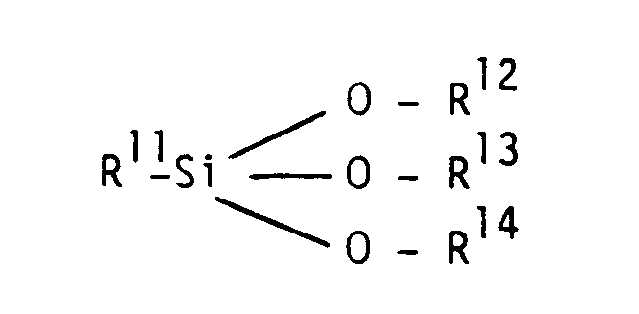
wherein :
R¹¹ represents a group containing reactive halogen such as a reactive chlorine atom, an epoxy group or an alpha,beta-ethylenically unsaturated group, representatives of such groups being e.g. the following :
Cl - CH₂ - CO - NH - L -
Br - CH₂ - CO - NH - L -

CH₂=CH-SO₂-CH₂-O-CH₂-SO₂-CH₂-NH-L-


wherein L represents an alkylene group preferably a C₁-C₄ alkylene group, or
R¹¹ represents the group :
wherein Z is a bivalent hydrocarbon chain including such chain interrupted by oxygen, e.g. is a -CH₂-O(CH₂)₃- group, or a bivalent hydrocarbon group that is linked at the side of the silicon atom to oxygen, e.g. is a -CH₂-O- group, and
each of R¹², R¹³ and R¹⁴ (same or different) represents a hydrocarbon group including a substituted hydrocarbon group e.g. methyl and ethyl. - Siloxane compounds according to the above general formula are described in US-P 3,661,584 and GB-P 1,286,467 as compounds improving the adherence of proteinaceous colloid compositions to glass.
- Examples of particularly useful siloxane compounds are listed in the following table 1.

- The present image-receiving layer is particularly suited for application in the production of laminar articles comprising a dye image making part of an identification document, also called I.D. card, that contains a colour photograph by lamination sandwiched between a clear plastic protective cover sheet and a rear possibly opaque support sheet.
- In view of the widespread use of I.D. cards as security document, e.g. to establish a person's authorization to conduct certain activities (e.g. driver's licence) or to have access to certain areas or to engage in particular commercial actions, it is important that forgery of the I.D. card by alteration of certain of its data and/or photograph is made impossible.
- In a particular useful embodiment a laminar article according to the present invention comprises the above defined image receiving layer incorporating a dye image enveloped between a vinyl chloride polymer support and a resin cover sheet fixed to the image receiving layer by lamination using pressure and heat.
- According to a preferred embodiment the cover sheet is a polyethylene terephthalate sheet being coated with a resinous melt-adhesive layer, preferably a polyethylene layer.
- The lamination of the present image receiving material with a covering hydrophobic resin film sheet material proceeds preferably by heat-sealing between flat steel plates under a pressure of e.g. 10 to 15 kg/cm2 at a temperature in the range of 120 to 150°C, e.g. at 135°C or by using other apparatus available on the market for heat sealing lamination purposes, e.g. hot pressure roller sealer. The cooling of the heat-sealed elements proceeds preferably under pressure to avoid distortion.
- The laminate may contain the image receiving layer over the whole area of the support or in a part thereof, e.g. leaving free the edge area as described in US-P 4,425,421.
- According to an embodiment the image receiving layer is coated onto an opaque polyvinyl chloride having a thickness of only 0.050 to 0.300 mm. A sheet of that thickness can receive printed data by means of a mechanical printing process, e.g. offset or intaglio printing. It can receive, before or after being coated with the image receiving layer, or before or after the dye transfer, additional security marks in the form of e.g. a watermark, finger prints, printed patterns known from banc notes, coded information, e.g. binary code information, signature or other printed personal data that may be applied with visibly legible or ultra-violet legible printing inks as described e.g. in GB-P 1,518,946 and US-P 4,105,333.
- Other possibilities to increase security against counterfeiting are the inclusion in the laminate of markings of nacreous pigments, infra-red absorbing markings, magnetic dots or strips and electronic microcircuits either or not combined with ultra-violet radiation absorbing markings hidden from visibility and/or holograms as described e.g. in DE-OS 2 639 952, GB-P 1,502,460 and 1,572,442 and US-P 3,668,795. The holographic patterns may be obtained in silver halide emulsion layers, normally Lippmann emulsions, especially designed for that purpose and can either or not be combined with a photograph.
- According to an embodiment the silver halide emulsion layer for producing the hologram is applied on one side of the transparent cover sheet used in the manufacture of a laminate according to the present invention and laminated to the image receiving layer either or not separated therefrom by a transparent resin intersheet being made of polyethylene or a resin sheet such as a polyvinyl chloride sheet being coated with polyethylene.
- When the resin sheet used as support of the laminate has to possess a thickness required for an identification card to be inserted in a slot of an electronic identification apparatus several sheets of matted polyvinyl chloride are stacked and laminated so as to reach a final thickness of e.g. 0.075 to 1 mm. When this lamination to the desired thickness occurs after dye image formation on a relatively thin polyvinyl chloride support, treatment with detergent as referred to hereinbefore to remove adhering chemicals preferably preceeds the lamination. The laminar article contains in that case preferably in the polyvinyl chloride support sheet opacifying titanium dioxide and a suitable plasticizing agent. The support may be provided with an embossed structure.
- The following comparative example illustrates the present invention without, however, limiting it thereto.
- All parts, ratios and percentages are by weight unless otherwise stated.
- An opaque polyvinyl chloride sheet having a width of 24 cm and a thickness of 200 µm was treated with an electrical discharge produced by a corona discharge apparatus operated under the following conditions :
film travelling speed : 20 m/min,
electrode spacing to film surface : 2 mm,
corona current : 0.55 A,
AC voltage difference (peak value) : 10 kV,
frequency : 30 kHz. - The corona-treated surface was coated per m² with the following aqueous coating composition to form thereon an image receiving layer X for dye diffusion transfer processing :

Aqueous wetting agent mixture W contains dissolved in water 12 % of saponine and 5 % of an iso-nonyl phenoxy wetting agent having following structural formula :
Aqueous hardening agent solution H consists of a 10 % solution in water of formaldehyde.
The aqueous acidic colloidal silica/alumina sol Z has a pH of 3.4 and contains 27 g of SiO₂ and 3 g of Al₂O₃ per 100 ml of water; it was obtained by adding AlCl₃ to a basic aqueous silica sol containing colloidal silica with a surface area of 200 m²/g. Said sol P is marketed by Bayer AG, Leverkusen, Bayerwerk (DE) under the registered trade name "KIESELSOL 200 S". - The corona-treated surface was coated per m² with the following aqueous coating composition to form thereon an image receiving layer X for dye diffusion transfer processing :

- The corona-treated surface was coated per m² with the following aqueous coating composition to form thereon an image receiving layer Y for dye diffusion transfer processing :

- The corona-treated surface was coated per m² with the following aqueous coating composition to form thereon an image receiving layer X for dye diffusion transfer processing :

- Said compositions X, Y, Z and N were coated at a wet coverage of 26 m2/l. After coating the samples X, Y, Z and N were dried at 30 °C and processed in combination with a photographic dye diffusion transfer material as described in the Example of US-P 4,496,645. Said photographic material was exposed with white light through a grey wedge having a constant 0.1 and thereupon contacted for 1 minute with an image receiving material having the composition described hereinafter in a diffusion transfer apparatus COPYPROOF CP 38 (trade name of Agfa-Gevaert N.V. Belgium) having in its tray following composition :

- After drying the thus treated samples were laminated with a transparent cover sheet being a polypropylene sheet having a thickness of 30 µm coated at one side with a thermoadhesive layer of polyethylene having a thickness of 30 µm. The lamination was carried out between flat steel plates pressing the layers together for 8 minutes using a pressure of 10 kg/cm2 at a temperature of 135 °C. Said pressure was maintained during cooling to reach room temperature (20 °C) again.
- The laminates with the samples X, Y and Z showed a sealing thus strong that on peeling apart the cover sheet the dye image was destroyed.
- The laminate containing sample N showed in wet state a poor adherence of the image receiving layer to its support that could be peeled apart after soaking the laminate in water at 20 °C for 4 h.
in which:
wherein segment A contains up to 40% of the tertiary amino group being quaternized with a quaternizing agent carrying glycidyl groups, and the remainder of the tertiary amino groups being:
in which segment B is derived from a bis-chloroformate, a diisocyanate or an isocyanate prepolymer having two isocyanate end groups, and corresponds to the formula :
-CO-Y-CO-
wherein Y represents, -O-R₅-O-, -NH-R₆-NH- or-NH-R₆-NH-CO-O-R₇-O-CO-NH-R₆-NH-, provided that Y can represent -OR₅O- only when X₁ or X₃ are not -O-,
wherein :
Claims (12)
- An image receiving material suitable for image production by dye diffusion transfer processing controlled by the development of (an) image-wise exposed silver halide emulsion layer(s), wherein said image receiving material comprises a supported image receiving layer containing a cationic polymeric mordant, and characterized in that said image receiving layer is free from gelatin and contains colloidal silica applied from an aqueous acidic colloidal sol having a pH of not more than 4, and containing hydrated silica in combination with 5 to 15 % by weight of colloidal Al₂O₃ with respect to SiO₂, the amount of said colloidal material to said mordant in the image-receiving layer being in a weight ratio range from 1/5 to 1/2, and silica (SiO₂) being present at a coverage of at least 0.5 g per m2.
- An image-receiving material according to claim 1, wherein said acidic sol has been be prepared by addition of aluminium trihalide to a basic aqueous colloidal silica sol producing that way in situ colloidal alumina forming an intimate mixture with the colloidal silica.
- Image-receiving material according to claim 1 or 2, wherein the colloidal silica has a surface area of at least 100 m2 per gram.
- Image-receiving material according to any of claims 1 to 3, wherein said image-receiving layer contains a non-proteinaceous colloidal binding agent selected from the group consisting of polyvinylalcohol and poly-N-vinylpyrrolidinone.
- Image-receiving material according to claim 4, wherein the polyvinylalcohol is a watersoluble at least 90 % hydrolyzed polyvinyl acetate with an average molecular weight in the range of 18,000 to 200,000.
- Image-receiving material according to claim 4, wherein the poly-N-vinylpyrrolidinone has an average molecular weight of about 25,000.
- Image-receiving material according to any of claims 5 to 6, wherein said binding agents are used in a weight ratio range of 1/10 to 1/4 with respect to the colloidal SiO₂.
- Image-receiving material according to any of the preceding claims, wherein said image receiving layer is coated directly to a vinyl chloride polymer support.
- An image receiving material according to any of the preceding claims, wherein the cationic polymeric mordant is a basic polyurethane polyurea or polyurea-polyurethane consisting of from 0 to 30 mole % of recurrent units derived from a modifying monomer selected from the group consisting of monofunctional and trifunctional alcohols, amines, and isocyanates and from 70 to 100 moles % of recurrent units of the general formula
(-A-B-)
in which segment A is derived from a diol, hydroxy alkylamine or diamine containing at least one tertiary amino group and which by removal of two terminal hydrogen atoms corresponds to the general formula : R₁ represents a straight or branched chain alkyl, alkoxyalkyl, aralkyl, a disubstituted aminoalkyl group of the formula :
 R₂ and R₃ which may be the same or different represent alkyl groups having from 1 to 4 carbon atoms or together represent the atoms required to complete a pyrrolidine, piperidine or morpholine ring,X₁ and X₂ which may be the same or different, respresent -O-, -NH-, -NR₄- or a group of the formula -NR₄-(CH₂)m4-X₃-in which:R₄ represents an alkyl group having from 1 to 4 carbon atoms,X₃ represents -O-, -NH- or -NR₄- and may be the same as or different from X₁ and X₂, andm1 to m4 represent 2 or 3, andwherein segment A contains up to 40% of the tertiary amino group being quaternized with a quaternizing agent carrying glycidyl groups, and the remainder of the tertiary amino groups being:(i) quaternized with quaternizing agents absent glycidyl groups, or(ii) neutralized with an acid, andin which segment B is derived from a bis-chloroformate, a diisocyanate or an isocyanate prepolymer having two isocyanate end groups, and corresponds to the formula :
-CO-Y-CO-
wherein Y represents, -O-R₅-O-, -NH-R₆-NH- or-NH-R₆-NH-CO-O-R₇-O-CO-NH-R₆-NH-, provided that Y can represent -OR₅O- only when X₁ or X₃ are not -O-,
wherein :R₅ represents an alkylene group unsubstituted or substituted by an alkyl group or interrupted by ether oxygen atoms,R₆ represents an alkylene group unsubstituted or substituted with alkyl groups, a cycloalkylene group or an arylene group, andR₇ represents any divalent group not containing any other Zerewitinoff active group or a group capable of reacting with isocyanate groups. - A laminar article comprising a dye image in an image receiving layer which is enveloped between a vinyl chloride polymer support and a resin cover sheet fixed to the image receiving layer by lamination using pressure and heat, wherein said image receiving layer is according to any of claims 1 to 9.
- A laminar article according to claim 10, wherein the resin cover sheet is a polyethylene terephthalate sheet coated with a resinous melt-adhesive layer.
- A laminar article according to claim 11, wherein the resinous melt-adhesive layer is a polyethylene layer.
Priority Applications (4)
| Application Number | Priority Date | Filing Date | Title |
|---|---|---|---|
| DE68919681T DE68919681T2 (en) | 1989-03-20 | 1989-03-20 | Dye image-receiving material. |
| EP89200708A EP0388532B1 (en) | 1989-03-20 | 1989-03-20 | Dye image receiving material |
| JP2068007A JPH02280152A (en) | 1989-03-20 | 1990-03-16 | Recording material suitable for use in electrphotography |
| US07/495,159 US5004659A (en) | 1989-03-20 | 1990-03-19 | Dye image receiving material |
Applications Claiming Priority (1)
| Application Number | Priority Date | Filing Date | Title |
|---|---|---|---|
| EP89200708A EP0388532B1 (en) | 1989-03-20 | 1989-03-20 | Dye image receiving material |
Publications (2)
| Publication Number | Publication Date |
|---|---|
| EP0388532A1 EP0388532A1 (en) | 1990-09-26 |
| EP0388532B1 true EP0388532B1 (en) | 1994-11-30 |
Family
ID=8202344
Family Applications (1)
| Application Number | Title | Priority Date | Filing Date |
|---|---|---|---|
| EP89200708A Expired - Lifetime EP0388532B1 (en) | 1989-03-20 | 1989-03-20 | Dye image receiving material |
Country Status (4)
| Country | Link |
|---|---|
| US (1) | US5004659A (en) |
| EP (1) | EP0388532B1 (en) |
| JP (1) | JPH02280152A (en) |
| DE (1) | DE68919681T2 (en) |
Families Citing this family (7)
| Publication number | Priority date | Publication date | Assignee | Title |
|---|---|---|---|---|
| US5633114A (en) * | 1993-10-06 | 1997-05-27 | Polaroid Corporation | Image-receiving element with particle containing overcoat for diffusion transfer film products |
| US5415969A (en) * | 1993-10-06 | 1995-05-16 | Polaroid Corporation | Image-receiving element for diffusion transfer photographic film products |
| US6476842B1 (en) | 1995-09-05 | 2002-11-05 | Olive Tree Technology, Inc. | Transfer printing |
| EP0771670B1 (en) * | 1995-11-03 | 2002-02-20 | Iris Graphics, Inc. | Mordanting substrates and agents |
| US20020142306A1 (en) * | 2001-03-28 | 2002-10-03 | 3M Innovative Properties Company | Method of transferring molecules to a film laminate |
| JP3515084B2 (en) * | 2001-08-02 | 2004-04-05 | 日本圧着端子製造株式会社 | Hinge connector and circuit board connected to the connector |
| US7008979B2 (en) | 2002-04-30 | 2006-03-07 | Hydromer, Inc. | Coating composition for multiple hydrophilic applications |
Family Cites Families (12)
| Publication number | Priority date | Publication date | Assignee | Title |
|---|---|---|---|---|
| UST873009I4 (en) * | 1969-11-07 | 1970-04-14 | Defensive publication | |
| US3864132A (en) * | 1972-05-22 | 1975-02-04 | Eastman Kodak Co | Article having a hydrophilic colloid layer adhesively bonded to a hydrophobic polymer support |
| DE2631521A1 (en) * | 1976-07-14 | 1978-01-19 | Agfa Gevaert Ag | LIGHT-SENSITIVE PHOTOGRAPHIC MATERIAL WITH A LAYERING AGENT |
| UST986005I4 (en) * | 1977-11-15 | 1979-09-04 | Bexford Limited | Photographic films |
| US4311774A (en) * | 1980-03-19 | 1982-01-19 | Polaroid Corporation | Irradiation treatment of polymeric photographic film supports |
| EP0065329B1 (en) * | 1981-05-18 | 1985-05-02 | Agfa-Gevaert N.V. | Surface-treated vinyl chloride polymer material including an adhering hydrophilic layer |
| GB2121812A (en) * | 1982-05-18 | 1984-01-04 | Agfa Gevaert Nv | Sealing coating for a hydrophilic colloid layer |
| US4563411A (en) * | 1984-08-17 | 1986-01-07 | Polaroid Corporation | Copolymeric mordants and photographic products and processes containing same |
| DE3567113D1 (en) * | 1985-11-15 | 1989-02-02 | Agfa Gevaert Nv | Image-receiving material for silver complex diffusion transfer reversal (dtr) processing and a laminate formed therewith |
| EP0250658B1 (en) * | 1986-07-04 | 1989-09-06 | Agfa-Gevaert N.V. | Dye image receiving material |
| DE3768246D1 (en) * | 1987-01-16 | 1991-04-04 | Agfa Gevaert Nv | IMAGE RECEIVING MATERIAL FOR USE IN DIFFUSION TRANSFER REVERSE PROCESSES. |
| DE3778545D1 (en) * | 1987-09-29 | 1992-05-27 | Agfa Gevaert Nv | DYE IMAGE RECEIVER. |
-
1989
- 1989-03-20 EP EP89200708A patent/EP0388532B1/en not_active Expired - Lifetime
- 1989-03-20 DE DE68919681T patent/DE68919681T2/en not_active Expired - Fee Related
-
1990
- 1990-03-16 JP JP2068007A patent/JPH02280152A/en active Pending
- 1990-03-19 US US07/495,159 patent/US5004659A/en not_active Expired - Fee Related
Also Published As
| Publication number | Publication date |
|---|---|
| DE68919681T2 (en) | 1995-06-29 |
| EP0388532A1 (en) | 1990-09-26 |
| DE68919681D1 (en) | 1995-01-12 |
| US5004659A (en) | 1991-04-02 |
| JPH02280152A (en) | 1990-11-16 |
Similar Documents
| Publication | Publication Date | Title |
|---|---|---|
| EP0775589B1 (en) | Laminated security document containing fluorescent dye | |
| EP0447692B1 (en) | Laminated product | |
| EP0351456B1 (en) | Process for the preparation of a laminate | |
| EP0490416B1 (en) | Image-receiving material comprising subbed polycarbonate or polypropylene | |
| EP0222045B1 (en) | Image-receiving material for silver complex diffusion transfer reversal (dtr) processing and a laminate formed therewith | |
| EP0077088B1 (en) | Process for the production of a laminar article | |
| EP0065329B1 (en) | Surface-treated vinyl chloride polymer material including an adhering hydrophilic layer | |
| US5004659A (en) | Dye image receiving material | |
| EP0309618B1 (en) | dye image receiving material | |
| EP0400220B1 (en) | Laminated article for identification purposes | |
| EP0250658B1 (en) | Dye image receiving material | |
| EP0276506B1 (en) | Image-receiving material for use in diffusion transfer reversal | |
| EP0380814B1 (en) | Process for the production of a laminar article | |
| US4808509A (en) | Diffusion transfer imaging method and receptor sheet for making personal identification documents | |
| EP0250657B1 (en) | Process for the production of a laminar article |
Legal Events
| Date | Code | Title | Description |
|---|---|---|---|
| PUAI | Public reference made under article 153(3) epc to a published international application that has entered the european phase |
Free format text: ORIGINAL CODE: 0009012 |
|
| AK | Designated contracting states |
Kind code of ref document: A1 Designated state(s): BE DE FR GB |
|
| 17P | Request for examination filed |
Effective date: 19901221 |
|
| 17Q | First examination report despatched |
Effective date: 19931026 |
|
| GRAA | (expected) grant |
Free format text: ORIGINAL CODE: 0009210 |
|
| AK | Designated contracting states |
Kind code of ref document: B1 Designated state(s): BE DE FR GB |
|
| REF | Corresponds to: |
Ref document number: 68919681 Country of ref document: DE Date of ref document: 19950112 |
|
| ET | Fr: translation filed | ||
| PLBE | No opposition filed within time limit |
Free format text: ORIGINAL CODE: 0009261 |
|
| STAA | Information on the status of an ep patent application or granted ep patent |
Free format text: STATUS: NO OPPOSITION FILED WITHIN TIME LIMIT |
|
| 26N | No opposition filed | ||
| PGFP | Annual fee paid to national office [announced via postgrant information from national office to epo] |
Ref country code: GB Payment date: 19960223 Year of fee payment: 8 |
|
| PGFP | Annual fee paid to national office [announced via postgrant information from national office to epo] |
Ref country code: DE Payment date: 19960224 Year of fee payment: 8 |
|
| PGFP | Annual fee paid to national office [announced via postgrant information from national office to epo] |
Ref country code: FR Payment date: 19960227 Year of fee payment: 8 |
|
| PGFP | Annual fee paid to national office [announced via postgrant information from national office to epo] |
Ref country code: BE Payment date: 19960304 Year of fee payment: 8 |
|
| PG25 | Lapsed in a contracting state [announced via postgrant information from national office to epo] |
Ref country code: GB Effective date: 19970320 |
|
| PG25 | Lapsed in a contracting state [announced via postgrant information from national office to epo] |
Ref country code: BE Effective date: 19970331 |
|
| BERE | Be: lapsed |
Owner name: AGFA-GEVAERT N.V. Effective date: 19970331 |
|
| GBPC | Gb: european patent ceased through non-payment of renewal fee |
Effective date: 19970320 |
|
| PG25 | Lapsed in a contracting state [announced via postgrant information from national office to epo] |
Ref country code: FR Free format text: LAPSE BECAUSE OF NON-PAYMENT OF DUE FEES Effective date: 19971128 |
|
| PG25 | Lapsed in a contracting state [announced via postgrant information from national office to epo] |
Ref country code: DE Effective date: 19971202 |
|
| REG | Reference to a national code |
Ref country code: FR Ref legal event code: ST |