EP0385598B1 - Water-soluble dietary fibers and method for preparation of same - Google Patents
Water-soluble dietary fibers and method for preparation of same Download PDFInfo
- Publication number
- EP0385598B1 EP0385598B1 EP90301329A EP90301329A EP0385598B1 EP 0385598 B1 EP0385598 B1 EP 0385598B1 EP 90301329 A EP90301329 A EP 90301329A EP 90301329 A EP90301329 A EP 90301329A EP 0385598 B1 EP0385598 B1 EP 0385598B1
- Authority
- EP
- European Patent Office
- Prior art keywords
- dietary fibers
- test
- water
- konnyaku
- soluble dietary
- Prior art date
- Legal status (The legal status is an assumption and is not a legal conclusion. Google has not performed a legal analysis and makes no representation as to the accuracy of the status listed.)
- Expired - Lifetime
Links
Classifications
-
- C—CHEMISTRY; METALLURGY
- C12—BIOCHEMISTRY; BEER; SPIRITS; WINE; VINEGAR; MICROBIOLOGY; ENZYMOLOGY; MUTATION OR GENETIC ENGINEERING
- C12Y—ENZYMES
- C12Y302/00—Hydrolases acting on glycosyl compounds, i.e. glycosylases (3.2)
- C12Y302/01—Glycosidases, i.e. enzymes hydrolysing O- and S-glycosyl compounds (3.2.1)
- C12Y302/01021—Beta-glucosidase (3.2.1.21)
-
- A—HUMAN NECESSITIES
- A21—BAKING; EDIBLE DOUGHS
- A21D—TREATMENT OF FLOUR OR DOUGH FOR BAKING, e.g. BY ADDITION OF MATERIALS; BAKING; BAKERY PRODUCTS
- A21D2/00—Treatment of flour or dough by adding materials thereto before or during baking
- A21D2/08—Treatment of flour or dough by adding materials thereto before or during baking by adding organic substances
- A21D2/14—Organic oxygen compounds
- A21D2/18—Carbohydrates
-
- A—HUMAN NECESSITIES
- A23—FOODS OR FOODSTUFFS; TREATMENT THEREOF, NOT COVERED BY OTHER CLASSES
- A23L—FOODS, FOODSTUFFS OR NON-ALCOHOLIC BEVERAGES, NOT OTHERWISE PROVIDED FOR; PREPARATION OR TREATMENT THEREOF
- A23L19/00—Products from fruits or vegetables; Preparation or treatment thereof
- A23L19/10—Products from fruits or vegetables; Preparation or treatment thereof of tuberous or like starch containing root crops
- A23L19/115—Konjak; Konntaku
-
- A—HUMAN NECESSITIES
- A23—FOODS OR FOODSTUFFS; TREATMENT THEREOF, NOT COVERED BY OTHER CLASSES
- A23L—FOODS, FOODSTUFFS OR NON-ALCOHOLIC BEVERAGES, NOT OTHERWISE PROVIDED FOR; PREPARATION OR TREATMENT THEREOF
- A23L33/00—Modifying nutritive qualities of foods; Dietetic products; Preparation or treatment thereof
- A23L33/20—Reducing nutritive value; Dietetic products with reduced nutritive value
- A23L33/21—Addition of substantially indigestible substances, e.g. dietary fibres
Definitions
- the present invention relates to dietary fibers which are readily soluble in water, which do not prevent adsorption of useful minerals such as calcium in the digestive tract, and which do not give rise to diarrhea when an excessive amount thereof is ingested, and a method for preparation of same.
- the water-soluble dietary fibers in accordance with the present invention can be utilized as an additive to processed foods and drinkables.
- the water-soluble dietary fibers in accordance with the present invention can be utilized for preparation of processed foods and drinkables.
- Konnyaku is a kind of plant belonging to the family of Araceae (Amorphophallys konjac) and has been cultivated in Japan, China and other Asian.countries, Konnyaku powder is prepared by drying smashed tubers of Amorphophallus konjac. Konnyaku powder is sold in the market as the ingredient for a traditional food called Konnyaku (devil's tongue: a paste made from the polysaccharides prepared from tubers of Amorphophallus konjac).
- Konnyaku powder has been utilized as water soluble dietary fibers or as a material for the preparation of natural food of a low-calorie, since it contains glucomannan, in a high concentration up to about 80 % (by weight), which comprises water-soluble polysaccharides and is hardly digestible in the human digestive organs (cf. "Chemistry of polysaccharide” page 280, 1955, Kyohritsu Shupran Kabushiki Kaisha).
- Konnyaku when Konnyaku is ingested, the dietary fibers thereof may reach to the large intestine without being subjected to digestion in the small intestine, and they are excreted. It has also been reported that cholesterol, derived from foods and bile, is absorbed in Konnyaku and coincidently excreted. Thus Konnyaku is effective to decrease the serum cholesterol level. Moreover, Konnyaku is effective to adjust intestinal functions or maintain good intestinal conditions and to manifest a growth promoting activity on Bifidobacteria (Kiriyama et al, Journal of Nutrition, Vol. 97, page 382, 1968; Mizutani et al, "Intestinal Flora and Nutrition", page 89, 1983, Gakukai Shuppan Center).
- the dietary fibers in Konnyaku may swell in its aqueous solution to hold a considerablyingly huge quantity of water amounting to hundreds times of itself and that when the dietary fibers are ingested, they give rise to the perception of satiety since they reside for a prolonged period in the stomach and they reside for a short time in the intestine.
- they are useful as a natural ingredient of a low-calorie food for the prevention from diverence or obesity Innami et al, "dietary fibers", pages 73 and 76, 1982, Daiichi Shuppan)
- oligosaccharide mainly in the range of disaccharides to hexasaccharides, which are prepared from hydrolysis of Konnyaku powder, are effective to promote growth of intestinal Bifidobacteria (Unexamined Patent Application Gazzette No.58-212780).
- the osmotic pressure of 20 % aqueous solution of oligosaccharides, mainly comprising di- or trisaccharides (average molecular weight 400) which are obtained by hydrolysis of Konnyaku powder is up to 500 m. Osm/kg H2O which exceeds that of human body fluid which is 285 m Osm/kg H2O.
- Aqueous solution of Konnyaku powder reach the large intestine retaining a large quantity of water which may result in symptoms of diarrhea. Therefore, it is required to restrict the dose of such oligosaccharides within a prescribed level.
- the inventors of the present invention have conducted a study on dietary fibers and found that an aqueous solution of partially hydrolysed Konnyaku powder has a relatively low osmotic pressure which does not cause diarrhea, and does not lead to a decrease in calcium content in the bones.
- the present invention is based on this discovery.
- partially hydrolysed Konnyaku powder having an average molecular weight of 2,000 - 15,000, can be prepared by suspending Konnyaku powder in water, then partially hydrolysing the polysaccharides included therein with a cellulase.
- the resulted products has various favorable functions referred to above while eliminating the defects of non-hydrolysed Konnyaku powder and exhaustively hydrolysed.
- Konnyaku powder which can be utilized as the raw material in the present invention may be a fine powder, sieved powder to a medium particle size or a coarse powder. Konnyaku powder may be declorized and deodorized with alcohol. Glucomannan, isolated from pulverized Konnyaku tubers, is also utilized.
- Any enzymes which may hydrolyze glucomannan, can be utilized in the present invention, for example, Cellulase derived from Aspergillus niger, Trichoderma viride and Penicillium notatum; mannanase derived from the genus of Streptomyces, Rhizopus niveus, Bacillus circulans and tuberous roots of Konnyaku.
- the enzymes which hydrolyse a ⁇ -glucoside bond in a molecule of glucomannan endo-type
- cellulases derived from microorganisms belonging to the genus of Aspergillus are preferable which hydrolyse endo- ⁇ -glycosidic linkage (endo-type).
- the reaction time and the pH of the enzymatic reaction may exert a large influence on the yield of the reaction products and molecular weights thereof.
- Most of the enzyme preparations available in the market are mixtures of exo-type enzyme such as exo-1,4- ⁇ -D-glucanase, endo-type enzyme such as endo-1,4- ⁇ -D-glucanase and ⁇ -glucosidase.
- exo-type enzyme such as exo-1,4- ⁇ -D-glucanase
- endo-type enzyme such as endo-1,4- ⁇ -D-glucanase and ⁇ -glucosidase.
- typical conditions for the enzymatic reaction will be 40 °C for 4 -16 hours or 55 °C for 4 hours as shown in examples 1 - 5.
- the resulting reaction products are heated to inactivate the enzymes; the supernatant liquid thereof is collected; the collected liquid is subjected to condensation with or without performing demineralization, decolorization and deodorization, and further subjected to drying to obtain powdery product of water-soluble dietary fibers.
- the dietary fibers in accordance with the present invention can be ingested as is or they can be added to various foods without changing the properties thereof.
- they can be added not only to solid foods such as frozen desserts, breads and jelly but also to liquid foods or drinkables such as milk, and fruit juice.
- test samples Three kinds of 20 % aqueous solution of water-soluble dietary fibers having different average molecular weights (test samples), prepared in the same manner as stated in Examples 1, 2 and 4, and a 20 % aqueous solution of acid hydrolyzate (control sample), having average molecular weight of 400 obtained by hydrolysis of Konnyaku powder, were prepared to test.
- Osmotic pressures of the test and the control samples were measured by the conventional method.
- test samples water-soluble dietary fibers in accordance with the present invention
- human body fluid 285 m Osm/kg H2O
- the modified basic diet was used for feeding rats.
- the composition of the diet, used as the test diet in this test was basically the same as that of the basic diet except that a portion of 20 % of corn starch was substituted with the corresponding quantity of the water-soluble dietary fibers (average molecular weight 15,000) prepared from commarcially available Konnyaku powder by the method set forth in Example 1 of the present invention.
- the composition of the control diet used in this test was basically the same as that of the basic diet except that a 20 % portion of corn starch in the basic diet was substituted with the intact Konnyaku powder without being subjected to hydrolysis. The details of the compositions of these diet feeds are shown in Table 2.
- test animals each comprising 6 Wistar rats, were fed the three kinds of diet feeds respectively for 8 weeks then ash contents of the bones of the test animals were measured in accordance with the conventional method.
- Skeletal ash content is directly proportional to calcium content thereof.
- a One hundred gram portion of the aqueous solution (15 g of water-soluble dietary fibers) was administrated to 12 healthy adult subjects (22 - 50 years old, comprising 6 men and 6 women) for 7 days, and their stools were observed on the day following the last day of the period of administration.
- Samples 1, 2 and 3 of the dietary fibers were subjected to determination.
- the dietary fiber content in the respective materials was measured by Prosky's method (Prosky et al, Journal of the Association of Official Analytical Chemistry, Vol. 67, page 1044, 1984).
- frozen dessert was prepared in accordance with the conventional method.
- test samples contained the water-soluble dietary fibers (average molecular weight 15,000) prepared in accordance with the method set forth in Example 1, while the control samples contained corn syrup instead of the water-soluble dietary fibers.
- test samples contained water-soluble dietary fibers (average molecular weight 7,000) prepared in the same manner as set forth in Example 2, and the dietary fibers were omitted in the control samples.
- test samples contained dietary fibers (average molecular weight 2,000), prepared in the same manner as in Example 4, and the control samples did not contain dietary fibers.
- test samples of fruit juice and milk respectively contained dietary fibers (average molecular weight 15,000) prepared in the same manner as in Example 1, and the control samples thereof did not contain dietary fibers.
- test samples of fruit juice and milk were distinguishable from those of the control samples, but substantial differences were not observed between the both samples in the Paired-comparison test.
- phosphate buffer solution pH: 6.5
- cellulase A trade name, purchased from Amano Seiyaku, Co., Ltd. JAPAN, specific activity: 15,000 U/g
- the resulted mixture was heated to 40 °C, and 4.0 kg of commercially available Konnyaku powder was added thereto and agitated to form a solution.
- the resulting solution was allowed to stand at 40 °C for 4 hours to effect enzymatic hydrolysis, then the hydrolysed solution was heated to 100 °C for 10 minutes to stop the enzymatic reaction.
- the resultant mixture was subjected to centrifugation at 6,000 G, and the supernatant fraction was collected.
- the collected supernatant was successively passed through cation exchange resin column to the volume of 1,000 ml (Dowex 50 Wx8; H+type) and anion exchange resin column (Dowex 1x8; OH ⁇ type) to the volume of 4,000 ml for demineralization.
- the demineralized reaction mixture was condensed and subsequently spray dried to obtain about 1,250 g of dried dietary fibers.
- the average molecular weight of the dietary fibers was 15,000.
- Soluble fibers in a quantity of 2,250 g, were obtained in the same manner as described in Example 1, except that enzymatic reaction was carried out for 8 hours.
- the average molecular weight of the dietary fibers was 7, 000.
- Soluble dietary fibers in a quantity of 2,650 g, were obtained in.the same manner as described in Example 1, except that enzymatic reaction was carried out for 12 hours.
- the average molecular weight of the soluble dietary fibers was 3,000.
- Soluble dietary fibers in a quantity of 2,800 g, were obtained in the same manner as described in Example 1, except that enzymatic reaction was carried out for 16 hours.
- the average molecular weight of the dietary fibers was 2,000.
Landscapes
- Life Sciences & Earth Sciences (AREA)
- Health & Medical Sciences (AREA)
- Chemical & Material Sciences (AREA)
- Engineering & Computer Science (AREA)
- Food Science & Technology (AREA)
- Organic Chemistry (AREA)
- Nutrition Science (AREA)
- Polymers & Plastics (AREA)
- Bioinformatics & Cheminformatics (AREA)
- Biochemistry (AREA)
- Molecular Biology (AREA)
- General Engineering & Computer Science (AREA)
- General Health & Medical Sciences (AREA)
- Genetics & Genomics (AREA)
- Mycology (AREA)
- Wood Science & Technology (AREA)
- Zoology (AREA)
- Coloring Foods And Improving Nutritive Qualities (AREA)
- Jellies, Jams, And Syrups (AREA)
- Preparation Of Compounds By Using Micro-Organisms (AREA)
- Polysaccharides And Polysaccharide Derivatives (AREA)
Description
- The present invention relates to dietary fibers which are readily soluble in water, which do not prevent adsorption of useful minerals such as calcium in the digestive tract, and which do not give rise to diarrhea when an excessive amount thereof is ingested, and a method for preparation of same.
- The water-soluble dietary fibers in accordance with the present invention can be utilized as an additive to processed foods and drinkables. In other words, the water-soluble dietary fibers in accordance with the present invention can be utilized for preparation of processed foods and drinkables.
- Recently it has been indicated that there is a correlation between the decrease in the quantity of fibers ingested due to the tendency of increased uptake of highly refined foods and the increase of various symptoms or diseases such as constipation, irregularity of defecation, disturbance of intestinal flora, carcinoma of the colon, hypertension, diabetes mellitus and others. For this reason, it is recommended to take a much larger quantity of dietary fibers.
- Konnyaku is a kind of plant belonging to the family of Araceae (Amorphophallys konjac) and has been cultivated in Japan, China and other Asian.countries, Konnyaku powder is prepared by drying smashed tubers of Amorphophallus konjac. Konnyaku powder is sold in the market as the ingredient for a traditional food called Konnyaku (devil's tongue: a paste made from the polysaccharides prepared from tubers of Amorphophallus konjac). Konnyaku powder has been utilized as water soluble dietary fibers or as a material for the preparation of natural food of a low-calorie, since it contains glucomannan, in a high concentration up to about 80 % (by weight), which comprises water-soluble polysaccharides and is hardly digestible in the human digestive organs (cf. "Chemistry of polysaccharide" page 280, 1955, Kyohritsu Shupran Kabushiki Kaisha).
- More particularly, it has been reported that when Konnyaku is ingested, the dietary fibers thereof may reach to the large intestine without being subjected to digestion in the small intestine, and they are excreted. It has also been reported that cholesterol, derived from foods and bile, is absorbed in Konnyaku and coincidently excreted. Thus Konnyaku is effective to decrease the serum cholesterol level. Moreover, Konnyaku is effective to adjust intestinal functions or maintain good intestinal conditions and to manifest a growth promoting activity on Bifidobacteria (Kiriyama et al, Journal of Nutrition, Vol. 97, page 382, 1968; Mizutani et al, "Intestinal Flora and Nutrition", page 89, 1983, Gakukai Shuppan Center).
- Also it is reported that the dietary fibers in Konnyaku may swell in its aqueous solution to hold a surprinsingly huge quantity of water amounting to hundreds times of itself and that when the dietary fibers are ingested, they give rise to the perception of satiety since they reside for a prolonged period in the stomach and they reside for a short time in the intestine. Thus they are useful as a natural ingredient of a low-calorie food for the prevention from corpulence or obesity Innami et al, "dietary fibers", pages 73 and 76, 1982, Daiichi Shuppan)
- It is also required that oligosaccharide mainly in the range of disaccharides to hexasaccharides, which are prepared from hydrolysis of Konnyaku powder, are effective to promote growth of intestinal Bifidobacteria (Unexamined Patent Application Gazzette No.58-212780).
- Although Konnyaku powder has many useful effects as mentioned above, it has some deffects as follows:
- (1) During processing of an aqueous solution of Konnyaku powder, the solution tends to be highly viscous so as to form a gel.
- (2) The use of Konnyaku powder is rectricted due to its undesirable flavor and taste.
- (3) Konnyaku has a property of adsorbing minerals which are essential for human nutrition. Thus when Konnyaku powder is ingested along with other foods or a food containing Konnyaku powder is ingested, calcium is adsorbed to the Konnyaku in the foods. This may result in the obstruction of calcium absorption in the digestive tract or in a negative nutritional calcium balance which in turn results in the decrease in minerals in the bones so as to cause osteomalacia (Oku et al, Journal of Nutrition, Vol. 112, Page 410, 1982).
- According to the results of a study by the inventors, the osmotic pressure of 20 % aqueous solution of oligosaccharides, mainly comprising di- or trisaccharides (average molecular weight 400) which are obtained by hydrolysis of Konnyaku powder, is up to 500 m. Osm/kg H₂O which exceeds that of human body fluid which is 285 m Osm/kg H₂O. Aqueous solution of Konnyaku powder reach the large intestine retaining a large quantity of water which may result in symptoms of diarrhea. Therefore, it is required to restrict the dose of such oligosaccharides within a prescribed level.
- The inventors of the present invention have conducted a study on dietary fibers and found that an aqueous solution of partially hydrolysed Konnyaku powder has a relatively low osmotic pressure which does not cause diarrhea, and does not lead to a decrease in calcium content in the bones. The present invention is based on this discovery.
- According to the method of the present invention, partially hydrolysed Konnyaku powder, having an average molecular weight of 2,000 - 15,000, can be prepared by suspending Konnyaku powder in water, then partially hydrolysing the polysaccharides included therein with a cellulase. The resulted products has various favorable functions referred to above while eliminating the defects of non-hydrolysed Konnyaku powder and exhaustively hydrolysed.
- Therefore, it is an object of the present invention to provide dietary fibers which can be widely utilized in the food industry while retaining the favouable functions of intact dietary fibers of Konnyaku powder but eliminating the adverse effects thereof. More particularly, it is an object of the present invention to provide dietary fibers which can be widely utilized for the preparation of processed foods and which do not cause diarrhea due to its moderate osmotic pressure.
- It is another object of the present invention to provide a method for preparation of such water-soluble dietary fibers.
- Konnyaku powder, which can be utilized as the raw material in the present invention may be a fine powder, sieved powder to a medium particle size or a coarse powder. Konnyaku powder may be declorized and deodorized with alcohol. Glucomannan, isolated from pulverized Konnyaku tubers, is also utilized.
- Any enzymes, which may hydrolyze glucomannan, can be utilized in the present invention, for example, Cellulase derived from Aspergillus niger, Trichoderma viride and Penicillium notatum; mannanase derived from the genus of Streptomyces, Rhizopus niveus, Bacillus circulans and tuberous roots of Konnyaku. Among the enzymes which hydrolyse a β-glucoside bond in a molecule of glucomannan (endo-type), cellulases derived from microorganisms belonging to the genus of Aspergillus are preferable which hydrolyse endo-β-glycosidic linkage (endo-type). The reaction time and the pH of the enzymatic reaction may exert a large influence on the yield of the reaction products and molecular weights thereof. Most of the enzyme preparations available in the market are mixtures of exo-type enzyme such as exo-1,4-β-D-glucanase, endo-type enzyme such as endo-1,4-β-D-glucanase and β-glucosidase. Thus, it is necessary to determine the preferable reaction time, temperature and pH os as to perform the enzymatic reaction under conditions where the activity of exo-type enzyme is lowered to minimize the production of monosaccharides and oligosaccharides.
- For example, typical conditions for the enzymatic reaction will be 40 °C for 4 -16 hours or 55 °C for 4 hours as shown in examples 1 - 5. The resulting reaction products are heated to inactivate the enzymes; the supernatant liquid thereof is collected; the collected liquid is subjected to condensation with or without performing demineralization, decolorization and deodorization, and further subjected to drying to obtain powdery product of water-soluble dietary fibers.
- The dietary fibers in accordance with the present invention can be ingested as is or they can be added to various foods without changing the properties thereof. For example, they can be added not only to solid foods such as frozen desserts, breads and jelly but also to liquid foods or drinkables such as milk, and fruit juice.
- Some exemplified tests will be described hereinafter.
- Three kinds of 20 % aqueous solution of water-soluble dietary fibers having different average molecular weights (test samples), prepared in the same manner as stated in Examples 1, 2 and 4, and a 20 % aqueous solution of acid hydrolyzate (control sample), having average molecular weight of 400 obtained by hydrolysis of Konnyaku powder, were prepared to test.
- Osmotic pressures of the test and the control samples were measured by the conventional method.
- The results are shown in Table 1.

- The osmotic pressures of the test samples (water-soluble dietary fibers in accordance with the present invention) were lower than that of the control sample and that of human body fluid (285 m Osm/kg H₂O), and therefore ingestion of the dietary fibers in accordance with the present invention nevers causes diarrhea.
- The modified basic diet was used for feeding rats. The composition of the diet, used as the test diet in this test, was basically the same as that of the basic diet except that a portion of 20 % of corn starch was substituted with the corresponding quantity of the water-soluble dietary fibers (average molecular weight 15,000) prepared from commarcially available Konnyaku powder by the method set forth in Example 1 of the present invention. The composition of the control diet used in this test was basically the same as that of the basic diet except that a 20 % portion of corn starch in the basic diet was substituted with the intact Konnyaku powder without being subjected to hydrolysis. The details of the compositions of these diet feeds are shown in Table 2.
- Three groups (A, B and C) of test animals each comprising 6 Wistar rats, were fed the three kinds of diet feeds respectively for 8 weeks then ash contents of the bones of the test animals were measured in accordance with the conventional method. The mean values and the standard deviations of the ash content (%) i.e the bones of the animals belonging to the respective groups were calculated in accordance with the conventional method.
- The results are shown in Table 2.

- It was observed that the skeletal ash content of the animals was almost the same in group A (test feed) and B (basic feed), and that the ash content was lower in group C (control feed) compared with groups A and B.
- Skeletal ash content is directly proportional to calcium content thereof.
- It is perceived that addition of Konnyaku powder to feed decreases skeletal ash content while addition of the water-soluble dietary fibers in accordance with the present invention does not affect the skeletal ash content.
- An aqueous solution of water-soluble dietary fibers in a a concentration of 15 %, prepared in accordance with the method set forth in Example 4 (average molecular weight) 2,000), was used.
- A One hundred gram portion of the aqueous solution (15 g of water-soluble dietary fibers) was administrated to 12 healthy adult subjects (22 - 50 years old, comprising 6 men and 6 women) for 7 days, and their stools were observed on the day following the last day of the period of administration.
- The results are shown in Table 3.

- It was concluded that no-one alleged diarrhea and 90 % of persons had normal stools after uptake of the dietary fibers of the present invention for 7 days.
- Samples 1, 2 and 3 of the dietary fibers, respectively prepared from commercially available Konnyaku powder in the same manner set forth in Examples 1, 2 and 4, and the intact Konnyaku powder were subjected to determination.
- The dietary fiber content in the respective materials was measured by Prosky's method (Prosky et al, Journal of the Association of Official Analytical Chemistry, Vol. 67, page 1044, 1984).
- The results are shown in Table 4.

- From Table 4, it is evident that the water-soluble dietary fibers in accordance with the present invention retain the characteristics of dietary fibers even after treatment to afford water solubility.
-
- Having used the ingredients shown hereunder, frozen dessert was prepared in accordance with the conventional method.

- It should be noted that the test samples contained the water-soluble dietary fibers (average molecular weight 15,000) prepared in accordance with the method set forth in Example 1, while the control samples contained corn syrup instead of the water-soluble dietary fibers.
- Three samples consisting of paired test samples and one control sample, or paired control samples and one test sample were given to each of 40 persons consisting of 20 women and 20 men. In order to assess the panel's reliability in perception each person is assigned to distinguish one odd sample in those uniform stimuli which are composed of two identical and one odd samples (triangle test). Each person is also instructed to declare one sample which they prefer most among the paired two and one odd samples (Paired-comparison test).
- Those who correctly distinguished the single distinct sample were eligible to be qualified panel members (Motosaburo Motoyama et al, "Application of stochastics to chemistry and biology" Vol.3, page 145, Nankohdoh, June 1961).
- The results of the test are shown in Table 5.
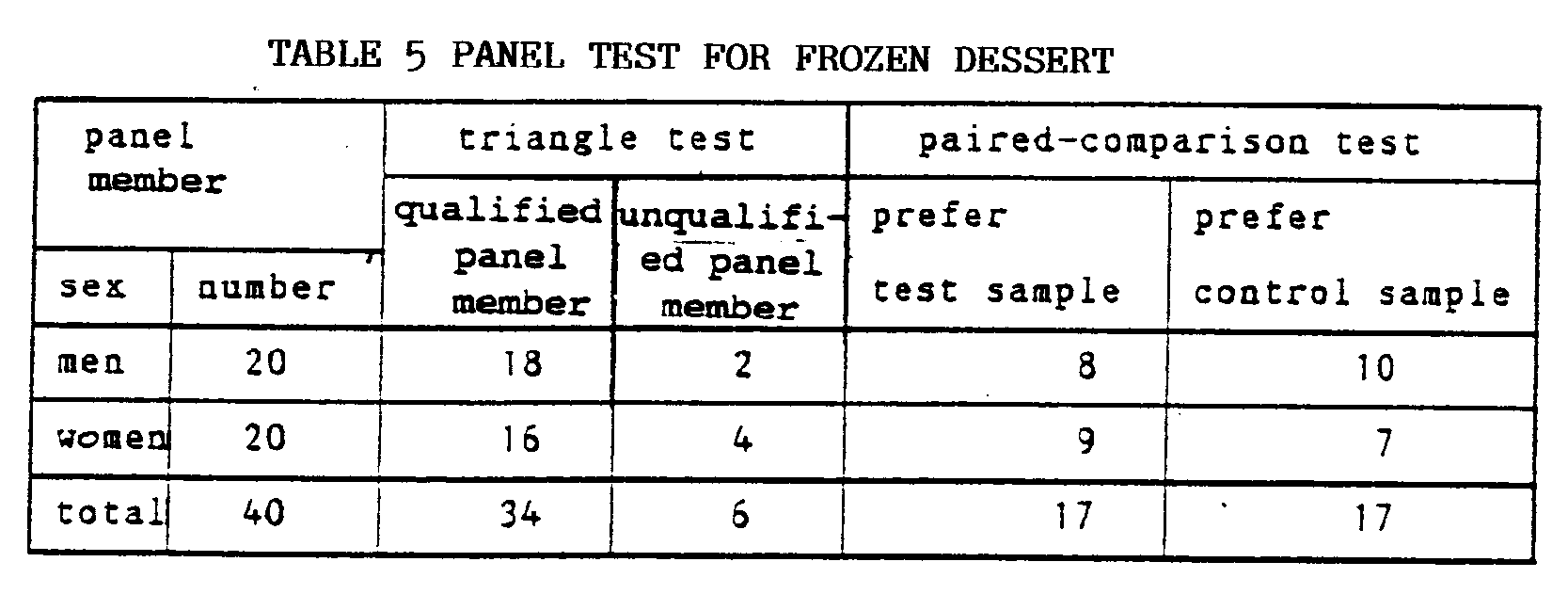
- From the results shown in Table 5, the panels were recognized to be qua ified to distinguish the test samples from the control samples, and the number of those persons who preferred test samples and those who preferred control samples were almost the same.
- With the recipe shown hereunder, the test and the control samples of cookies were prepared.

- The test samples contained water-soluble dietary fibers (average molecular weight 7,000) prepared in the same manner as set forth in Example 2, and the dietary fibers were omitted in the control samples.
- In the same manner as in Test 5, the Triangle test and the Paired-comparison test were conducted.
- The results are shown in Table 6.

- From the results shown in Table 6, cookies of test samples were distinguishable from those of control samples, but substantial difference was not observed between the samples in Paired-comparison test.
- With the recipe shown in the following table, bread for the test and the control samples was prepared.

- The test samples contained dietary fibers (average molecular weight 2,000), prepared in the same manner as in Example 4, and the control samples did not contain dietary fibers.
- As in Test 5, Triangle test and Paired-comparison test were conducted with respect to the breads of test and control samples.
- The results of the tests are shown in Table 7.

- Breads of the test sample was distinguishable from that of the control sample , but a substantial difference was not observed between the both samples in the Paired-comparison test.
- With the recipe shown in the following tables, the test and control samples of fruit juice and milk were respectively prepared.


- The test samples of fruit juice and milk respectively contained dietary fibers (average molecular weight 15,000) prepared in the same manner as in Example 1, and the control samples thereof did not contain dietary fibers.
- As in Test 5, Triangle test and Paired-comparison test was conducted with respect to the fruit juice and milk of the test and the control samples.
- No precipitation was observed in all the samples of both of fruit juice and milk.
- The results of the panel tests are shown in Tables 8 (for fruit juice) and 9 (for milk).


- The test samples of fruit juice and milk were distinguishable from those of the control samples, but substantial differences were not observed between the both samples in the Paired-comparison test.
- To 80 ℓ of phosphate buffer solution (pH: 6.5), 67 g of cellulase A (trade name, purchased from Amano Seiyaku, Co., Ltd. JAPAN, specific activity: 15,000 U/g), derived from the microorganisms belonging to the genus of Aspergillus was added. The resulted mixture was heated to 40 °C, and 4.0 kg of commercially available Konnyaku powder was added thereto and agitated to form a solution. The resulting solution was allowed to stand at 40 °C for 4 hours to effect enzymatic hydrolysis, then the hydrolysed solution was heated to 100 °C for 10 minutes to stop the enzymatic reaction. The resultant mixture was subjected to centrifugation at 6,000 G, and the supernatant fraction was collected. The collected supernatant was successively passed through cation exchange resin column to the volume of 1,000 mℓ (Dowex 50 Wx8; H⁺type) and anion exchange resin column (Dowex 1x8; OH⁻ type) to the volume of 4,000 mℓ for demineralization. The demineralized reaction mixture was condensed and subsequently spray dried to obtain about 1,250 g of dried dietary fibers. The average molecular weight of the dietary fibers was 15,000.
- Soluble fibers, in a quantity of 2,250 g, were obtained in the same manner as described in Example 1, except that enzymatic reaction was carried out for 8 hours. The average molecular weight of the dietary fibers was 7, 000.
- Soluble dietary fibers, in a quantity of 2,650 g, were obtained in.the same manner as described in Example 1, except that enzymatic reaction was carried out for 12 hours. The average molecular weight of the soluble dietary fibers was 3,000.
- Soluble dietary fibers, in a quantity of 2,800 g, were obtained in the same manner as described in Example 1, except that enzymatic reaction was carried out for 16 hours. The average molecular weight of the dietary fibers was 2,000.
- To 30 ℓ of acetate buffer solution (pH: 5.3), 13 g of cellulase Nagase (trade name, purchased from Nagase BioChemical Industry Co., Ltd., JAPAN, specific activity: 1,000 U/g), derived from the microorganisms belonging to the genus of Aspergillus was added. The resulted mixture was heated to 55 °C, and about 1.33 kg of commercially available Konnyaku powder was added thereto and agitated to dissolve. In the same manner as in Example 1, except that the resulted solution was kept at 55 °C for 1 hours, about 740 g of dietary fibers were obtained. The average molecular weight of the dietary fibers was 5,000.
- The significance of the invention is as follows:
- ① The water-soluble dietary fibers of the present invention retain the desirable effect of the conventional dietary fibers such as cholesterol adsorbability, whilst being soluble in water which is favorable for application in the food industry.
- ② The water-soluble dietary fibers of the present invention do not obstruct of useful minerals such as calcium in the digestive tract.
- ③ The water-soluble dietary fibers of the present invention cause a relatively low osmotic pressure, and do not give rise to diarrhea even if an excess amount-thereof is ingested.
- ④ The water-soluble dietary fibers of the present invention can be added to various types of foods and drinkables without affecting organoleptic characteristics thereof.
Claims (3)
- Dietary fibers comprising the partial hydrolysate of polysaccharides of Konnyaku powder having an average molecular weight ranging from 2,000 to 15,000 and the property of water solubility.
- A method for the preparation of water-soluble dietary fibers comprising:
dispersing Konnyaku powder in water;
partially hydrolysing polysaccharides of said Konnyaku powder with a cellulase which is derived from microorganisms belonging to the genus Aspergillus; and
separating water-soluble dietary fibers having an average molecular weight ranging from 2,000 - 15,000 from the reaction mixture. - Use of dietary fibers comprising the partial hydrolysate of polysaccharides of Konnyaku powder having an average molecular weight ranging from 2,000 to 15,000 and the property of water solubility in a method of preparing dietary products for treatment of medical conditions arising from absence of fiber in the diet.
Applications Claiming Priority (2)
| Application Number | Priority Date | Filing Date | Title |
|---|---|---|---|
| JP1043202A JP2639726B2 (en) | 1989-02-27 | 1989-02-27 | Water-soluble dietary fiber and method for producing the same |
| JP43202/89 | 1989-02-27 |
Publications (2)
| Publication Number | Publication Date |
|---|---|
| EP0385598A1 EP0385598A1 (en) | 1990-09-05 |
| EP0385598B1 true EP0385598B1 (en) | 1993-08-04 |
Family
ID=12657346
Family Applications (1)
| Application Number | Title | Priority Date | Filing Date |
|---|---|---|---|
| EP90301329A Expired - Lifetime EP0385598B1 (en) | 1989-02-27 | 1990-02-08 | Water-soluble dietary fibers and method for preparation of same |
Country Status (4)
| Country | Link |
|---|---|
| US (1) | US4971814A (en) |
| EP (1) | EP0385598B1 (en) |
| JP (1) | JP2639726B2 (en) |
| DE (1) | DE69002482T2 (en) |
Families Citing this family (19)
| Publication number | Priority date | Publication date | Assignee | Title |
|---|---|---|---|---|
| US5073387A (en) * | 1990-01-24 | 1991-12-17 | Lafayette Applied Chemistry, Inc. | Method for preparing reduced calorie foods |
| CA2041391C (en) * | 1990-05-17 | 1999-01-19 | Chung-Wai Chiu | Bulking agents and processes for preparing them from food gums |
| AU651626B2 (en) * | 1990-10-24 | 1994-07-28 | Nestec S.A. | Medical foods having soluble fiber |
| US5169671A (en) * | 1991-08-30 | 1992-12-08 | Ajinomoto Co., Inc. | Food containing fructose polymer |
| US5498408A (en) * | 1992-09-21 | 1996-03-12 | Sandoz Nutrition Ltd. | Oral rehydration composition |
| NL1013175C2 (en) * | 1999-09-29 | 2001-03-30 | Nutricia Nv | Food compositions containing non-digestible polysaccharides and use thereof for reducing transport through tight junctions. |
| JP4180258B2 (en) * | 2001-08-06 | 2008-11-12 | 西川ゴム工業株式会社 | IgE antibody inhibitor and food |
| JP2004099511A (en) * | 2002-09-09 | 2004-04-02 | Japan Research & Development Association For New Functional Foods | Immunosuppressants and foods |
| JP4728572B2 (en) * | 2003-11-11 | 2011-07-20 | 国立大学法人広島大学 | Allergy improvement agent |
| GB0410785D0 (en) * | 2004-05-14 | 2004-06-16 | Glycologic Ltd | Improved prebiotic |
| JP4945132B2 (en) * | 2006-01-11 | 2012-06-06 | 蒟蒻屋本舗株式会社 | Manufacturing method of konjac fluid material |
| JP6894789B2 (en) * | 2016-07-22 | 2021-06-30 | 新一郎 石橋 | Bile acid adsorbent, its manufacturing method, and beverages containing bile acid adsorbent |
| CN108783395A (en) * | 2018-05-22 | 2018-11-13 | 四川味之浓食品有限公司 | A kind of fragrant spicy sauce and its production technology |
| CN109007712A (en) * | 2018-08-10 | 2018-12-18 | 广州钮和生物科技有限公司 | A kind of jelly and preparation method with lower blood-fat and reduce weight function |
| CA3156527A1 (en) * | 2019-11-08 | 2021-05-14 | Jose Maria Lopez Pedrosa | Bovine milk-isolated powdered exosomes, nutritional compositions and methods |
| CN111000258B (en) * | 2019-12-26 | 2023-01-10 | 湖南华诚生物资源股份有限公司 | Momordica grosvenori modified dietary fiber composition containing trace metal elements and preparation method thereof |
| CN111513273A (en) * | 2020-04-01 | 2020-08-11 | 陕西理工大学 | A kind of konjac functional food and preparation method thereof |
| CN112042901B (en) * | 2020-08-25 | 2023-04-11 | 浙江李子园食品股份有限公司 | Preparation method of reproduced konjak particles |
| CN113729232B (en) * | 2021-09-08 | 2023-06-23 | 山东乐道农业科技有限公司 | Preparation method of cistanche deserticola dietary fiber |
Family Cites Families (3)
| Publication number | Priority date | Publication date | Assignee | Title |
|---|---|---|---|---|
| AU603403B2 (en) * | 1986-11-19 | 1990-11-15 | Kabushiki Kaisha Kibun | Konjak jelly |
| JPS645757A (en) * | 1987-06-26 | 1989-01-10 | Koyo Kikai Kogyo | Surface grinder and grinding wheel thereof |
| JPH03287457A (en) * | 1990-04-03 | 1991-12-18 | Toshiba Corp | Passenger guiding device |
-
1989
- 1989-02-27 JP JP1043202A patent/JP2639726B2/en not_active Expired - Lifetime
- 1989-12-29 US US07/459,327 patent/US4971814A/en not_active Expired - Lifetime
-
1990
- 1990-02-08 EP EP90301329A patent/EP0385598B1/en not_active Expired - Lifetime
- 1990-02-08 DE DE90301329T patent/DE69002482T2/en not_active Expired - Lifetime
Non-Patent Citations (4)
| Title |
|---|
| PATENT ABSTRACTS OF JAPAN vol. 13, no. 423(C-638)(3771), 20 September 1989 * |
| PATENT ABSTRACTS OF JAPAN vol. 6, (C-123)(174), 8 September 1982 * |
| PATENT ABSTRACTS OF JAPAN vol. 8, no. 56 (C-214)(1493), 14 March 1984 * |
| Patent Abstracts of Japan, Vol .8 no.56 (c-214)(1493), 14 March 1984; JP-A-58 212 780 (Yakult Honscha K.K) 10.12.1983. * |
Also Published As
| Publication number | Publication date |
|---|---|
| US4971814A (en) | 1990-11-20 |
| JPH02222659A (en) | 1990-09-05 |
| JP2639726B2 (en) | 1997-08-13 |
| EP0385598A1 (en) | 1990-09-05 |
| DE69002482T2 (en) | 1994-02-10 |
| DE69002482D1 (en) | 1993-09-09 |
Similar Documents
| Publication | Publication Date | Title |
|---|---|---|
| US4971814A (en) | Water-soluble dietary fibers and method for preparation of same | |
| Englyst et al. | Determination of dietary fibre as non-starch polysaccharides by gas–liquid chromatography | |
| Glitsø et al. | Milling of whole grain rye to obtain fractions with different dietary fibre characteristics | |
| Michel et al. | Preparation and characterisation of dietary fibre from sugar beet pulp | |
| Bengtsson et al. | Isolation and chemical characterization of water-soluble arabinoxylans in rye grain | |
| US5073387A (en) | Method for preparing reduced calorie foods | |
| AU639451B2 (en) | Sugar composition comprising soluble fibre | |
| KR940004889B1 (en) | Dietary fiber, its process and physiologically active composition containing the same as an active ingredient | |
| Fengler et al. | Water-soluble pentosans from rye: I. Isolation, partial purification, and characterization | |
| KR20000029878A (en) | Compositions of plant carbohydrates as dietary supplements | |
| EP0470895A1 (en) | Food composition having hypotensive effect | |
| Wood | Physicochemical properties and physiological effects of the (1→ 3)(1→ 4)-β-D-glucan from oats | |
| Veena et al. | Effect of processing on the composition of dietary fibre and starch in some legumes | |
| Carré et al. | Digestion of polysaccharides, protein and lipids by adult cockerels fed on diets containing a pectic cell-wall material from white lupin (Lupinus albus L.) cotyledon | |
| JP2938471B2 (en) | Foods and beverages containing water-soluble dietary fiber | |
| JP4286254B2 (en) | Glycemic index reducing composition and food | |
| Aoe et al. | Extraction of soluble dietary fibers from defatted rice bran | |
| Arrigoni et al. | Gravimetric method for the determination of insoluble and soluble dietary fibres | |
| Gooneratne et al. | Investigation of factors that affect the solubility of dietary fiber, as nonstarch polysaccharides, in seed tissues of mung bean (Vigna radiata) and black gram (Vigna mungo) | |
| JP4874191B2 (en) | Method for producing the composition | |
| Nyman et al. | Fermentation of oat fiber in the rat intestinal tract: a study of different cellular areas | |
| Acevedo et al. | Changes in dietary fiber content and its composition as affected by processing of black beans (Phaseolus vulgaris, Tamazulapa variety) | |
| Botham et al. | Physicochemical characterization of barley carbohydrates resistant to digestion in a human ileostomate | |
| Ravindran | Non-Starch polysaccharides of seeds of soybean [Glycine Max.(L)] | |
| Ralet et al. | Sugar beet fiber: Production, characteristics, food applications, and physiological benefits |
Legal Events
| Date | Code | Title | Description |
|---|---|---|---|
| PUAI | Public reference made under article 153(3) epc to a published international application that has entered the european phase |
Free format text: ORIGINAL CODE: 0009012 |
|
| AK | Designated contracting states |
Kind code of ref document: A1 Designated state(s): BE DE FR GB NL |
|
| 17P | Request for examination filed |
Effective date: 19901107 |
|
| 17Q | First examination report despatched |
Effective date: 19911219 |
|
| GRAA | (expected) grant |
Free format text: ORIGINAL CODE: 0009210 |
|
| AK | Designated contracting states |
Kind code of ref document: B1 Designated state(s): BE DE FR GB NL |
|
| REF | Corresponds to: |
Ref document number: 69002482 Country of ref document: DE Date of ref document: 19930909 |
|
| ET | Fr: translation filed | ||
| PLBE | No opposition filed within time limit |
Free format text: ORIGINAL CODE: 0009261 |
|
| STAA | Information on the status of an ep patent application or granted ep patent |
Free format text: STATUS: NO OPPOSITION FILED WITHIN TIME LIMIT |
|
| 26N | No opposition filed | ||
| REG | Reference to a national code |
Ref country code: GB Ref legal event code: IF02 |
|
| PGFP | Annual fee paid to national office [announced via postgrant information from national office to epo] |
Ref country code: NL Payment date: 20090131 Year of fee payment: 20 Ref country code: DE Payment date: 20090202 Year of fee payment: 20 |
|
| PGFP | Annual fee paid to national office [announced via postgrant information from national office to epo] |
Ref country code: GB Payment date: 20081205 Year of fee payment: 20 |
|
| PGFP | Annual fee paid to national office [announced via postgrant information from national office to epo] |
Ref country code: BE Payment date: 20090310 Year of fee payment: 20 |
|
| PGFP | Annual fee paid to national office [announced via postgrant information from national office to epo] |
Ref country code: FR Payment date: 20090202 Year of fee payment: 20 |
|
| BE20 | Be: patent expired |
Owner name: *MORINAGA MILK INDUSTRY CO. LTD Effective date: 20100208 |
|
| REG | Reference to a national code |
Ref country code: GB Ref legal event code: PE20 Expiry date: 20100207 |
|
| NLV7 | Nl: ceased due to reaching the maximum lifetime of a patent |
Effective date: 20100208 |
|
| PG25 | Lapsed in a contracting state [announced via postgrant information from national office to epo] |
Ref country code: GB Free format text: LAPSE BECAUSE OF EXPIRATION OF PROTECTION Effective date: 20100207 |
|
| PG25 | Lapsed in a contracting state [announced via postgrant information from national office to epo] |
Ref country code: DE Free format text: LAPSE BECAUSE OF EXPIRATION OF PROTECTION Effective date: 20100208 |