EP0383161A2 - Separator for alkaline cell and alkaline cell prepared by using this separator - Google Patents
Separator for alkaline cell and alkaline cell prepared by using this separator Download PDFInfo
- Publication number
- EP0383161A2 EP0383161A2 EP90102339A EP90102339A EP0383161A2 EP 0383161 A2 EP0383161 A2 EP 0383161A2 EP 90102339 A EP90102339 A EP 90102339A EP 90102339 A EP90102339 A EP 90102339A EP 0383161 A2 EP0383161 A2 EP 0383161A2
- Authority
- EP
- European Patent Office
- Prior art keywords
- separator
- cell
- cells
- alkaline cell
- inventors
- Prior art date
- Legal status (The legal status is an assumption and is not a legal conclusion. Google has not performed a legal analysis and makes no representation as to the accuracy of the status listed.)
- Withdrawn
Links
Images




Classifications
-
- H—ELECTRICITY
- H01—ELECTRIC ELEMENTS
- H01M—PROCESSES OR MEANS, e.g. BATTERIES, FOR THE DIRECT CONVERSION OF CHEMICAL ENERGY INTO ELECTRICAL ENERGY
- H01M50/00—Constructional details or processes of manufacture of the non-active parts of electrochemical cells other than fuel cells, e.g. hybrid cells
- H01M50/40—Separators; Membranes; Diaphragms; Spacing elements inside cells
- H01M50/409—Separators, membranes or diaphragms characterised by the material
- H01M50/411—Organic material
- H01M50/414—Synthetic resins, e.g. thermoplastics or thermosetting resins
-
- H—ELECTRICITY
- H01—ELECTRIC ELEMENTS
- H01M—PROCESSES OR MEANS, e.g. BATTERIES, FOR THE DIRECT CONVERSION OF CHEMICAL ENERGY INTO ELECTRICAL ENERGY
- H01M50/00—Constructional details or processes of manufacture of the non-active parts of electrochemical cells other than fuel cells, e.g. hybrid cells
- H01M50/40—Separators; Membranes; Diaphragms; Spacing elements inside cells
- H01M50/409—Separators, membranes or diaphragms characterised by the material
- H01M50/411—Organic material
- H01M50/429—Natural polymers
-
- H—ELECTRICITY
- H01—ELECTRIC ELEMENTS
- H01M—PROCESSES OR MEANS, e.g. BATTERIES, FOR THE DIRECT CONVERSION OF CHEMICAL ENERGY INTO ELECTRICAL ENERGY
- H01M2300/00—Electrolytes
- H01M2300/0002—Aqueous electrolytes
- H01M2300/0014—Alkaline electrolytes
-
- H—ELECTRICITY
- H01—ELECTRIC ELEMENTS
- H01M—PROCESSES OR MEANS, e.g. BATTERIES, FOR THE DIRECT CONVERSION OF CHEMICAL ENERGY INTO ELECTRICAL ENERGY
- H01M50/00—Constructional details or processes of manufacture of the non-active parts of electrochemical cells other than fuel cells, e.g. hybrid cells
- H01M50/40—Separators; Membranes; Diaphragms; Spacing elements inside cells
- H01M50/409—Separators, membranes or diaphragms characterised by the material
- H01M50/411—Organic material
- H01M50/429—Natural polymers
- H01M50/4295—Natural cotton, cellulose or wood
-
- H—ELECTRICITY
- H01—ELECTRIC ELEMENTS
- H01M—PROCESSES OR MEANS, e.g. BATTERIES, FOR THE DIRECT CONVERSION OF CHEMICAL ENERGY INTO ELECTRICAL ENERGY
- H01M50/00—Constructional details or processes of manufacture of the non-active parts of electrochemical cells other than fuel cells, e.g. hybrid cells
- H01M50/40—Separators; Membranes; Diaphragms; Spacing elements inside cells
- H01M50/409—Separators, membranes or diaphragms characterised by the material
- H01M50/44—Fibrous material
-
- H—ELECTRICITY
- H01—ELECTRIC ELEMENTS
- H01M—PROCESSES OR MEANS, e.g. BATTERIES, FOR THE DIRECT CONVERSION OF CHEMICAL ENERGY INTO ELECTRICAL ENERGY
- H01M50/00—Constructional details or processes of manufacture of the non-active parts of electrochemical cells other than fuel cells, e.g. hybrid cells
- H01M50/40—Separators; Membranes; Diaphragms; Spacing elements inside cells
- H01M50/489—Separators, membranes, diaphragms or spacing elements inside the cells, characterised by their physical properties, e.g. swelling degree, hydrophilicity or shut down properties
-
- Y—GENERAL TAGGING OF NEW TECHNOLOGICAL DEVELOPMENTS; GENERAL TAGGING OF CROSS-SECTIONAL TECHNOLOGIES SPANNING OVER SEVERAL SECTIONS OF THE IPC; TECHNICAL SUBJECTS COVERED BY FORMER USPC CROSS-REFERENCE ART COLLECTIONS [XRACs] AND DIGESTS
- Y02—TECHNOLOGIES OR APPLICATIONS FOR MITIGATION OR ADAPTATION AGAINST CLIMATE CHANGE
- Y02E—REDUCTION OF GREENHOUSE GAS [GHG] EMISSIONS, RELATED TO ENERGY GENERATION, TRANSMISSION OR DISTRIBUTION
- Y02E60/00—Enabling technologies; Technologies with a potential or indirect contribution to GHG emissions mitigation
- Y02E60/10—Energy storage using batteries
Definitions
- the present invention relates to the separator which is used for preparing an alkaline cell and the alkaline cell prepared by using this separator. More particularly, the invention primarily relates to the improvement of the separator used for preparing the secondary alkaline cell, where the invention provides the separator featuring the improved cell characteristic and the secondary alkaline cell prepared by using this improved separator. Furthermore, secondly, the invention relates to the improvement of the separator usable for preparing the primary alkaline cell, where the invention provides the separator featuring the improved discharge characteristic and the improved retentivity of electrolytic solution and the primary alkaline cell prepared by using the improved separator.
- a variety of conventional secondary alkaline cells mainly composed of nickel-cadmium closed type cells are known at large. Nevertheless, any of these conventional secondary alkaline cells is not yet sufficient in the flat discharge characteristic or cannot stably discharge cell voltage under severe environmental conditions in extremely cold and hot regions, or cannot fully sustain sufficient rounds of repeated charge and discharge, and as a result, any of these conventional secondary alkaline cells cannot yet fully satisfy the requirements.
- the cell manufacturers follow up trials to improve the separator by diminishing the electrical resistance of the separator, improving the resistivity against alkali and oxidation, minimizing the residual gas (O2), improving the retentivity of electrolytic solution, and by preventing the electrode-plate material from generating dendrite, as means for achieving the object.
- Japanese Patent Kokai Koho No. 165572/1980 proposes an art related to the zinc-alkaline secondary cell featuring the improved cycle-life characteristic by introducing a composite separator composed of fluorinated resin containing finely pulverized oxide like TiO2, ZrO2, or HfO2 through 200 mesh filter and the layer of non-woven fabric.
- alkaline-manganese primary cells are commercially available as the primary alkaline cell.
- any of these conventional alkaline-manganese primary cells is still defective in that the total discharge duration is very short, and yet, it cannot stably discharge current in the severe emvironmental conditions in very cold and very hot regions, or any of these conventional alkaline-manganese primary cells causes the alkaline solution (functioning as electrolytic solution) to externally leak, and thus, these cells are not always satisfactory in the performance characteristic.
- Japanese Patent Kokoku Koho No. 4048/1979 proposes the method of improving the electrical characteristic of the primary alkaline cell by applying the separator composed of the composite layer made of polypropylene/titanium dioxide/polystylene.
- This composite layer is prepared by initially coating titanium dioxide over the thin film of polypropylene, followed by drying process, coating of polystylene solution over the dried layer, and the final drying.
- 30939/1981 proposes the provision of the separator which is chemically stable to the electrolytic solution and to the anode by producing the cell separator by filling the polymer of ethylene and acrylic acid into fine holes of the porous film mainly consisting of fine particles made from inorganic compound which is insoluble to electrolytic solution.
- the characteristics of the separator can be improved, and based on this, discharge characteristic and the retentivity of electrolytic solution can also be improved. Nevertheless, further improvment of these requirements is still demanded.
- An object of the present invention is to provide a separator having an improved cell characteristics.
- the present invention provides a novel separator which is used for preparing an alkaline cell comprising substrate of separator and from 0.1 to 10% by weight based on the weight of the substrate of separator of ultra-fine particles, wherein said ultra-fine particles are substantially composed of either titanium dioxide and/or hydrated titanium dioxide, and wherein each particle is constitutionally amorphous and has a maximum of 500 ⁇ (angstrom) of the primary particle diameter and a minimum of 100 square meters per gram of the specific surface area.
- the present invention also provides an alkaline cell which is prepared by using separator comprising substrate of separator and from 0.1 to 10% by weight based on the weight of the substrate of separator of ultra-fine particles, wherein said ultra-fine particles are substantially composed of either titanium dioxide and/or hydrated titanium dioxide, and wherein each particle is constitutionally amorphous and has a maximum of 500 ⁇ (angstrom) of the primary particle diameter and a minimum of 100 square meters per gram of the specific surface area.
- Figures 1 and 2 are respectively the characteristic charts designating the results of the evaluations of the discharge characteristic executed for the examples and the comparative examples related to the invention wherein;
- Figures 3 through 6 are respectively the characteristic charts designating the results of the evaluation of the discharge characteristic executed for the examples and the comparative examples related to the invention wherein;
- the alkaline cell embodied by the invention is quite similar to any conventional alkaline cell except for the introduction of the separator embodied by the invention, the following description solely refers to the separator usable for preparing this alkaline cell.
- the substrate of the separator for embodying the invention may be composed of either a non-woven fabric, or any conventional fabric, or a film.
- the non-woven fabric or any conventional fabric can retain electrolytic solution and allows ion to pass through it, it is desired that either of these fabrics be used for composing the separator.
- a wide variety of materials are available for composing the substrate of the separator related to the invention including the following; polyamide resin like nylon 66, polyethylene, polypropylene, acrylic resin, polytetrafluoroethylene, or polyvinyl alcohol, or cotton, for example.
- any of the following be selected to compose the substrate including polypropylene for better resistivity against organic solvent, polyamide resin and polypropylene for better resistivity against alkali, and polyamide resin for better wetting effect in aqueous solution.
- the embodiment of the invention specifically uses the separator comprising substrate of separator and ultra fine particles of titanium dioxide and/or hydrated titanium dioxide.
- the embodiment of the invention uses ultra fine particles of titanium dioxide and/or hydrated titanium dioxide having a maximum of 500 ⁇ of the primary particle diameter (average particle diameter).
- the primary particle diameter shall be in a range from 100 ⁇ to a maximum of 300 ⁇ , where each particle shall properly be amorphous and have a minimum of 100 m2/gram of the specific surface area, preferably, a minimum of 120 m2/gram according to the BET measurement. If the primary particle diameter were in excess of 500 ⁇ , it not only results in the diminished specific surface area and the lowered retentivity of electrolytic solution, but it also causes the quantity of the OH group to diminish and the electrical resistance to increase, and thus, desirably, more than 500 ⁇ of the primary particle diameter shall not be used.
- the ultra fine particles are amorphous, the specific surface area diminishes and the retentivity of electrolytic solution is lowered, and yet, as a result of the decreased OH group, electrical resistance increase. Furthermore, it is also undesirable to use such ultra fine particles having less than 100 m2/gram of the specific surface area because it not only results in the lowered retentivity of electrolytic solution, but it also causes the electrical resistance to increase as a result of the decreased OH group. To achieve satisfactory distribution of the particle diameter, desirably, more than 90% of the entire fine particles shall be provided with 100 ⁇ through a maximum of 500 ⁇ of the primary particle diameter.
- the amorphous state may not be of the perfect one, but the embodiment also allows the use of substantially amorphous fine particles.
- the ultra fine particles used for embodying the invention may be composed of either titanium dioxide or hydrated titanium dioxide or the blend of these.
- ultra fine particles can be produced by vapor-phase hydrolysis of titanium alkoxide for example.
- a typical example of the method of producing such ultra fine particles based on the above art is disclosed in Japanese Patent Kokai Koho No. 201604/1986 and Japanese Patent Kokai Koho No. 186418/1985.
- the separator embodied by the invention contains 0.1% by weight through 10% by weight, desirably 0.5% by weight through a maximum of 5% by weight of the above ultra fine particles against the substrate of the separator. If the content of the ultra fine particles were less than 0.1% by weight, it results in the insufficient effect of the addition of fine particles. Conversely, if the content of the ultra fine particles were in excess of 10% by weight, it causes the ultra fine particles to drop out of the separator, or it causes the size of the cell to be enlarged by the expansion of the volume of the separator to result in the increased cost.
- the substrate of the separator contains the above ultra fine particles, it is allowable for the embodiment to introduce any available means to immerse them in the substrate.
- the substrate of the separator can be impregnated with those ultra fine particles either by (1) coating or impregnating fine particles over or into the substrate, or by (2) adding these fine particles to the substrate during the production process.
- the above method (1) can be implemented by applying those sequential processes described below. (i) Blending of the ultra fine particles with more than one of those materials including polyvinyl alcohol, latex, acrylic resin, water, and carboxymethyl cellulose. (ii) Either coating the above blend over the substrate of the separator or impregnating the substrate in aqueous emulsion of the blended compound.
- the second method can be implemented by blending the ultra fine particles with polyamide fibers or the like constituting the substrate before eventually producing non-woven fabric.
- the separator embodied by the invention is ideally suited for preparing an alkaline cells.
- the separator embodied by the invention is ideally applicable to the secondary alkaline cells including the following; nickel-cadmium closed type secondary alkaline cell, nickel-zinc closed type secondary alkaline cell, nickel-hydrogen closed type secondary alkaline cell iron-nickel secondary alkaline cell, zinc-air secondary alkaline cell, and aluminium-air secondary alkaline cell, etc.
- the separator embodied by the invention is effectively applicable to the primary alkaline cells such as alkaline-manganese dry cell, oxidized silver cell, mercury cell, and air-cell, or the like.
- the separator embodied by the invention features the improved capability to retain electrolytic solution, improved resistivity against alkali, and the least storage of residual gas during charge. Furthermore, the separator embodied by the invention minimizes the electrical resistance, improves the resistivity against oxidation, and prevents dendrite from occurrence.
- the application of the separator embodied by the invention allows the production of such secondary cells provided with the increased cycles of the repeated charge and discharge, increased cell capacity, and the improved flatness of the dischargeable voltage.
- the application of the separator embodied by the invention allows the production of such secondary cells featuring the improved temperature characteristic, the diminished internal resistance, and the improved capability to prevent occurrence of the leakage of electrolytic solution from the cells.
- the application of the separator embodied by the invention securely improves overall performances of the secondary cells.
- the separator can effectively be used for composing those secondary alkaline cells such as the nickel-cadmium closed type secondary alkaline cells, the nickel-zinc closed type secondary alkaline cells and the nickel-hydrogen closed type secondary alkaline cells for example.
- the separator embodied by the invention is extremely satisfactory in the electrical resistance, retentivity of electrolytic solution, resistivity against alkali, prevention of occurrence of the leakage of electrolytic solution, and in the internal resistance.
- the separator embodied by the invention is effectively applicable to the formation of the separator of the primary alkaline cells as well.
- titanium tetraisopoxide Ti(OC3H7)4
- a vaporizer in which nitrogen gas serving as carrier gas was used, and then inventors injected steam in order to generate 0.05 mol% of water content.
- inventors injected this material into a reactor having 30 mm of the inner diameter and the inner wall so that ultra fine particles of titanium dioxide could be bonded to the inner wall.
- inventors then generated pyrolysis reaction and hydrolysis reaction at 350°C.
- inventors cooled the product of the reaction, and then collected ultra fine particles adhered to the surface of the cooling tube.
- the fine particles After observing the collected fine particles with an electronic microscope, inventors confirmed that the fine particles had 200 ⁇ of the primary particle diameter (average particle diameter) and 100 ⁇ through a maximum of 300 ⁇ of the particle diameter distribution. Then, after analyzing the X-ray diffraction pattern, inventors confirmed that the produced fine particles were amorphous in the constitution. After checking the produced fine particles via the BET method using nitrogen gas, inventors confirmed that the produced fine particle had 126 m2 per gram of the specific surface area.
- titania ultra fine particles
- PVA polyvinyl alcohol
- CMC carboxymethyl cellulose
- electrolytic solution containing 40% KOH solution, electrode plates made of nickel plate and cadmium plate, inventors produced AA-size nickel-cadmium closed type cells having 500 mAh of the capacity.
- Table 1 designated various characteristics of the separator and the cell embodied by the invention.
- the produced nickel-cadmium closed type cells reflecting the Example 1 of the invention proved to be superior to those corresponding cells produced for the Comparative Examples 1 and 2 in the electrical resistance, retentivity of electrolytic solution, resistivity against alkali and oxidation, prevention of leakage of electrolytic solution, and the internal resistance.
- the produced cells for the first embodiment generated quite satisfactory cell characteristics including the discharge characteristic and the repeatable service life.
- Those cells produced for the Comparative Example 1 proved to be inferior to those cells of the Example 1 in the flatness of discharge characteristic.
- the voltage of the cells of the Comparative Example 1 lowered to 57% in 80 hours, thus proving faster decline than that of those cells of the Example 1.
- nickel-cadmium closed type cell incorporating the separator containing amorphous titania particles having sufficient specific surface area could generate stable discharge characteristic throughout extensive range of temperature from 0°C to 60°C.
- inventors immersed a length non-woven fabric made of nylon 66 in aqueous emulsion containing 7% by weight of titania produced by the Preparation Example, 7% by weight of polyvinyl alcohol (PVA) and 2% by weight of carboxymethyl cellulose (CMC), and then thermally dried the wet fabric at 120°C for 2 hours.
- the dried fabric contained 5% by weight of titania ingredient.
- the titania-contained non-woven fabric serving as the separator electrolytic solution containing 40% KOH solution, and electrodes made of nickel plate and zinc plate, inventors produced the nickel-zinc closed type cells of the AA-size each having 500 mAh of the capacity.
- Inventors also repeatedly executed the charge/discharge tests by applying 3-hour charge based on 2.0 mA/cm2 of the charge current density and the discharge based on 5.0 mA/cm2 of the discharge current density before the cell voltage eventually lowered to 33%.
- the discharge capacity indicated a very slow decline, and yet, inventors could repeatedly charge and discharge current for 400 cycles before the discharge capacity eventually became lower than 60% of the initial cell capacity.
- Table 2 designates the performance characteristic of the separator and the cell of the Example 3.
- the separator of the nickel-zinc closed type cell based on the Example 3 proved to be superior to those of the Comparative Examples 4 and 5 in the electrical resistance, retentivity of electrolytic solution, resistivity against alkali and oxidation, prevention of leakage of solution, and the internal resistance.
- the nickel-zinc closed type cells produced for the Comparative Example 5 proved to be superior to the Comparative Example 4 in the flatness of the discharge characteristic, but it was still slightly inferior to the Example 3 in the flatness of the discharge characteristic. It merely took 57 minutes before the cell voltage eventually lowered to 33%.
- a lengthy non-woven fabric made of nylon 66 in aqueous emulsion containing 7% by weight of titania fine particles (produced by the Preparation Example) composed of titanium dioxide and hydrated titanium dioxide. 7% by weight of polyvinyl alcohol (PVA), and 2% by weight of carboxymethyl cellulose (CMC), and then thermally dried the wet fabric at 120°C for 2 hours.
- the dried fabric contained 5% by weight of titania ingredient.
- Table 3 designates the performance characteristics of the separator and the alkaline-manganese dry cells.
- the alkaline-manganese dry cell produced by the Example 4 proved to be superior to those corresponding cells produced for the Comparative Examples 6 to 9 in the electrical resistance, retentivity of electrolytic solution, and in the prevention of leakage of this solution from the cell. It is likely that, by virtue of these advantageous properties, the alkaline-manganese dry cells of the Example 4 generated quite satisfactory cell characteristics.
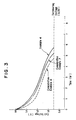
- inventors produced the alkaline-manganese dry cells. Inventors then checked the discharge characteristic and overall characteristics of the separator and the cell. The test results are shown in Figure 3 and Table 3.
- the performance characteristic of the alkaline-manganese dry cell dispensing with titania fine particles was significantly variable by surrounding temperature.
- the duration of the discharge significantly diminished in cold temperature.
- *2 Volume of 50% by weight of KOH solution needed until the solution starts to drip down from the separator after dripping the solution onto the separator.
- *3 Condition after immersing the separator in 50% by weight of KOH solution at 80°C for 5 hours and the decreased rate of the weight.
- *4 The number of the cells (out of 100 pieces of the tested cells) which generated leakage of electrolytic solution during the storage test lasted for 120 days at 45°C and 90%RH.
- inventors immersed a lengthy non-woven fabric made of nylon 66 in aqueous emulsion containing 7% by weight of titania produced by the Preparation Example, 7% by weight of polyvinyl alcohol (PVA), and 2% by weight of carboxymethyl cellulose (CMC), and then thermally dried the wet fabric at 120°C for 2 hours.
- the dried fabric contained 5% by weight of titania fine particles.
- electrolytic solution containing 40% KOH solution, and electrodes made of zinc and oxidized solver (Ag2O), inventors produced AA-size oxidized-silver cells.
- Table 4 designates the characteristics of the separator and the oxidized-silver cells. Inventors confirmed that the oxidized-silver cell produced by the Example 6 was superior to those cells produced for the following Comparative Examples 10 and 11 in the electrical resistance of the separator, retentivity of electrolytic solution, resistivity against alkali, prevention of leakage of electrolytic solution from the cell, and in the internal resistance. It is likely that, by virtue of the advantageous properties, the oxidized-silver cells produced by the Example 6 proved quite satisfactory cell characteristics.
- inventors immersed a lengthy non-woven fabric made of nylon 66 in aqueous emulsion containing 7% by weight of titania particles produced by the Preparation Example, 7% by weight of polyvinyl alcohol (PVA), and 2% by weight of carboxymethyl cellulose (CMC), and then thermally dried the wet fabric at 120°C for 2 hours.
- the dried fabric contained 5% by weight of titania particles.
- Table 5 designates the performance characteristics of the separator and the oxidized mercury cell produced by the Example 7. These cells generated more satisfactory performance characteristics in the electrical resistance of the separator, retentivity of electrolytic solution, resistivity against alkali, prevention of the leakage of electrolytic solution, and in the internal resistance, than those of the following Comparative Examples 12 and 13. It is likely that, by virtue of these advantageous properties, the oxidized mercury cell produced by the Example 7 generated quite satisfactory cell characteristic.
- inventors immersed a lengthy non-woven fabric made of nylon 66 in aqueous emulsion containing 7% by weight of titania fine particles produced by the Preparation Example, 7% by weight of polyvinyl alcohol, and 2% by weight of carboxymethyl cellulose (CMC), and then thermally dried the wet fabric at 120°C for 2 hours.
- the dried fabric contained 5% by weight of titania ingredient.
- inventors produced AA-size air cells by applying the separator made of the titania-contained non-woven fabric, electrolytic solution containing 40% KOH solution, and the negative electrode made from zinc.
- Table 6 designates the performance characteristics of the separator and the air-cell.
- the air-cells produced by the Example 8 proved to be superior to the following Comparative Examples 14 and 15 in the electrical resistance of the separator, retentivity of electrolytic solution, resistivity against alkali, prevention of leakage of solution, and in the internal resistance. It is likely that, by virtue of these advantageous properties, the air-cells produced by the Example 8 generated quite satisfactory cell characteristics.
Landscapes
- Chemical & Material Sciences (AREA)
- Chemical Kinetics & Catalysis (AREA)
- Electrochemistry (AREA)
- General Chemical & Material Sciences (AREA)
- Cell Separators (AREA)
Abstract
Description
- The present invention relates to the separator which is used for preparing an alkaline cell and the alkaline cell prepared by using this separator. More particularly, the invention primarily relates to the improvement of the separator used for preparing the secondary alkaline cell, where the invention provides the separator featuring the improved cell characteristic and the secondary alkaline cell prepared by using this improved separator. Furthermore, secondly, the invention relates to the improvement of the separator usable for preparing the primary alkaline cell, where the invention provides the separator featuring the improved discharge characteristic and the improved retentivity of electrolytic solution and the primary alkaline cell prepared by using the improved separator.
- A variety of conventional secondary alkaline cells mainly composed of nickel-cadmium closed type cells are known at large. Nevertheless, any of these conventional secondary alkaline cells is not yet sufficient in the flat discharge characteristic or cannot stably discharge cell voltage under severe environmental conditions in extremely cold and hot regions, or cannot fully sustain sufficient rounds of repeated charge and discharge, and as a result, any of these conventional secondary alkaline cells cannot yet fully satisfy the requirements.
- To improve overall performance characteristics of the secondary alkaline cells, the cell manufacturers follow up trials to improve the separator by diminishing the electrical resistance of the separator, improving the resistivity against alkali and oxidation, minimizing the residual gas (O₂), improving the retentivity of electrolytic solution, and by preventing the electrode-plate material from generating dendrite, as means for achieving the object.
- For example, regarding the nickel-zinc closed type secondary alkaline cell, typically, Japanese Patent Kokai Koho No. 165572/1980 proposes an art related to the zinc-alkaline secondary cell featuring the improved cycle-life characteristic by introducing a composite separator composed of fluorinated resin containing finely pulverized oxide like TiO₂, ZrO₂, or HfO₂ through 200 mesh filter and the layer of non-woven fabric.
- Although application of these means certainly improves the performance characteristics of the secondary alkaline cells to some extent, further improvement is still demanded by all.
- In order to further improve the cell performance characteristics, inventors followed up extensive studies and trials. As a result, inventors have successfully improved the characteristics of the separator usable for preparing the second alkaline cell including the improved retentivity of electrolytic solution, improved resistivity against alkali, decreased residual gas (O₂) generated during charge, reduced electrical resistance of the separator, improved resistivity against oxidation, and prevention of dendrite from occurrence, by effectively applying titanium dioxide having specific primary particle diameter, specific crystal form, and the specific surface area, which are selected from such titanium dioxide constitutionally having hydrophillic property and distinctly outstanding resistivity against alkali, oxidation, and chemicals, and the least electrical resistance. As a result of successful trials, inventors confirmed that the performance characteristics of the secondary alkaline cell could significantly be improved, and based on the acquired knowledge, inventors have eventually achieved the invention.
- On the other hand, alkaline-manganese primary cells are commercially available as the primary alkaline cell. However, any of these conventional alkaline-manganese primary cells is still defective in that the total discharge duration is very short, and yet, it cannot stably discharge current in the severe emvironmental conditions in very cold and very hot regions, or any of these conventional alkaline-manganese primary cells causes the alkaline solution (functioning as electrolytic solution) to externally leak, and thus, these cells are not always satisfactory in the performance characteristic.
- There is the positive demand for improving the discharge characteristic by expanding the cell capacity, diminishing the internal resistance, improving the discharge temperature characteristic, and for improving the retentivity of electrolytic solution by improving the prevention of the leakage of electrolytic solution altogether.
- As an effective measure to improve the discharge characteristic and the retentivity of electrolytic solution, trials are followed up to improve overall characteristics of the separator which stand between anode and cathode so that those requirements including the expansion of the cell capacity, reduction of the internal resistance, improvement of the discharge temperature characteristic, prevention of the leakage of electrolytic solution can be satisfied.
- For example, Japanese Patent Kokoku Koho No. 4048/1979 proposes the method of improving the electrical characteristic of the primary alkaline cell by applying the separator composed of the composite layer made of polypropylene/titanium dioxide/polystylene. This composite layer is prepared by initially coating titanium dioxide over the thin film of polypropylene, followed by drying process, coating of polystylene solution over the dried layer, and the final drying. Furthermore, Japanese Patent Kokoku Koho No. 30939/1981 proposes the provision of the separator which is chemically stable to the electrolytic solution and to the anode by producing the cell separator by filling the polymer of ethylene and acrylic acid into fine holes of the porous film mainly consisting of fine particles made from inorganic compound which is insoluble to electrolytic solution.
- According to these prior arts proposed earlier, the characteristics of the separator can be improved, and based on this, discharge characteristic and the retentivity of electrolytic solution can also be improved. Nevertheless, further improvment of these requirements is still demanded.
- In order to further improve the discharge characteristic and the retentivity of electrolytic solution, inventors continuously followed up extensive studies and trials. As a result, inventors discovered that the characteristics of the separator usable for preparing the primary alkaline cell could significantly be improved by effectively applying titanium dioxide having the predetermined primary particle diameter, specific crystal form, and the predetermined specific surface area by selecting it from such titanium dioxide inherently having hydrophillic property and outstanding resistivity against alkali, oxidation, and chemicals, and having the least electrical resistance. Based on the knowledge thus acquired, inventors have successfully achieved the invention.
- An object of the present invention is to provide a separator having an improved cell characteristics.
- Other object of the present invention is to provide an alkaline cell having an improved cell characteristics. The present invention provides a novel separator which is used for preparing an alkaline cell comprising substrate of separator and from 0.1 to 10% by weight based on the weight of the substrate of separator of ultra-fine particles, wherein said ultra-fine particles are substantially composed of either titanium dioxide and/or hydrated titanium dioxide, and wherein each particle is constitutionally amorphous and has a maximum of 500Å (angstrom) of the primary particle diameter and a minimum of 100 square meters per gram of the specific surface area.
- The present invention also provides an alkaline cell which is prepared by using separator comprising substrate of separator and from 0.1 to 10% by weight based on the weight of the substrate of separator of ultra-fine particles, wherein said ultra-fine particles are substantially composed of either titanium dioxide and/or hydrated titanium dioxide, and wherein each particle is constitutionally amorphous and has a maximum of 500Å (angstrom) of the primary particle diameter and a minimum of 100 square meters per gram of the specific surface area.
- Figures 1 and 2 are respectively the characteristic charts designating the results of the evaluations of the discharge characteristic executed for the examples and the comparative examples related to the invention wherein;
- Fig. 1 designates the discharge characteristic of the nickel-cadmium closed type cells;
- Fig. 2 designates the discharge characteristic of the nickel-zinc closed type cells;
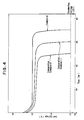
- Figures 3 through 6 are respectively the characteristic charts designating the results of the evaluation of the discharge characteristic executed for the examples and the comparative examples related to the invention wherein;
- Fig. 3 designates the discharge characteristic of the alkaline-manganese cells;
- Fig. 4 designates the discharge characteristic of the oxidized silver cells;
- Fig. 5 designates the discharge characteristic of the oxidized mercury cells; and
- Fig. 6 designates the discharge characteristic of the air cells.
- Since the alkaline cell embodied by the invention is quite similar to any conventional alkaline cell except for the introduction of the separator embodied by the invention, the following description solely refers to the separator usable for preparing this alkaline cell.
- The substrate of the separator for embodying the invention may be composed of either a non-woven fabric, or any conventional fabric, or a film. However, since the non-woven fabric or any conventional fabric can retain electrolytic solution and allows ion to pass through it, it is desired that either of these fabrics be used for composing the separator. Actually, a wide variety of materials are available for composing the substrate of the separator related to the invention including the following; polyamide resin like nylon 66, polyethylene, polypropylene, acrylic resin, polytetrafluoroethylene, or polyvinyl alcohol, or cotton, for example. Of these, it is desired that any of the following be selected to compose the substrate including polypropylene for better resistivity against organic solvent, polyamide resin and polypropylene for better resistivity against alkali, and polyamide resin for better wetting effect in aqueous solution.
- The embodiment of the invention specifically uses the separator comprising substrate of separator and ultra fine particles of titanium dioxide and/or hydrated titanium dioxide.
- Concretely, the embodiment of the invention uses ultra fine particles of titanium dioxide and/or hydrated titanium dioxide having a maximum of 500 Å of the primary particle diameter (average particle diameter). Desirably, the primary particle diameter shall be in a range from 100 Å to a maximum of 300 Å, where each particle shall properly be amorphous and have a minimum of 100 m²/gram of the specific surface area, preferably, a minimum of 120 m²/gram according to the BET measurement. If the primary particle diameter were in excess of 500 Å, it not only results in the diminished specific surface area and the lowered retentivity of electrolytic solution, but it also causes the quantity of the OH group to diminish and the electrical resistance to increase, and thus, desirably, more than 500 Å of the primary particle diameter shall not be used. Unless the ultra fine particles are amorphous, the specific surface area diminishes and the retentivity of electrolytic solution is lowered, and yet, as a result of the decreased OH group, electrical resistance increase. Furthermore, it is also undesirable to use such ultra fine particles having less than 100 m²/gram of the specific surface area because it not only results in the lowered retentivity of electrolytic solution, but it also causes the electrical resistance to increase as a result of the decreased OH group. To achieve satisfactory distribution of the particle diameter, desirably, more than 90% of the entire fine particles shall be provided with 100 Å through a maximum of 500 Å of the primary particle diameter. The amorphous state may not be of the perfect one, but the embodiment also allows the use of substantially amorphous fine particles.
- The ultra fine particles used for embodying the invention may be composed of either titanium dioxide or hydrated titanium dioxide or the blend of these.
- These ultra fine particles can be produced by vapor-phase hydrolysis of titanium alkoxide for example. A typical example of the method of producing such ultra fine particles based on the above art is disclosed in Japanese Patent Kokai Koho No. 201604/1986 and Japanese Patent Kokai Koho No. 186418/1985.
- The separator embodied by the invention contains 0.1% by weight through 10% by weight, desirably 0.5% by weight through a maximum of 5% by weight of the above ultra fine particles against the substrate of the separator. If the content of the ultra fine particles were less than 0.1% by weight, it results in the insufficient effect of the addition of fine particles. Conversely, if the content of the ultra fine particles were in excess of 10% by weight, it causes the ultra fine particles to drop out of the separator, or it causes the size of the cell to be enlarged by the expansion of the volume of the separator to result in the increased cost.
- As far as the substrate of the separator contains the above ultra fine particles, it is allowable for the embodiment to introduce any available means to immerse them in the substrate. For example, the substrate of the separator can be impregnated with those ultra fine particles either by (1) coating or impregnating fine particles over or into the substrate, or by (2) adding these fine particles to the substrate during the production process. More particularly, the above method (1) can be implemented by applying those sequential processes described below. (i) Blending of the ultra fine particles with more than one of those materials including polyvinyl alcohol, latex, acrylic resin, water, and carboxymethyl cellulose. (ii) Either coating the above blend over the substrate of the separator or impregnating the substrate in aqueous emulsion of the blended compound. The second method can be implemented by blending the ultra fine particles with polyamide fibers or the like constituting the substrate before eventually producing non-woven fabric.
- The separator embodied by the invention is ideally suited for preparing an alkaline cells. Concretely, the separator embodied by the invention is ideally applicable to the secondary alkaline cells including the following; nickel-cadmium closed type secondary alkaline cell, nickel-zinc closed type secondary alkaline cell, nickel-hydrogen closed type secondary alkaline cell iron-nickel secondary alkaline cell, zinc-air secondary alkaline cell, and aluminium-air secondary alkaline cell, etc.
- Furthermore, the separator embodied by the invention is effectively applicable to the primary alkaline cells such as alkaline-manganese dry cell, oxidized silver cell, mercury cell, and air-cell, or the like.
- As is clear from the foregoing description, the separator embodied by the invention features the improved capability to retain electrolytic solution, improved resistivity against alkali, and the least storage of residual gas during charge. Furthermore, the separator embodied by the invention minimizes the electrical resistance, improves the resistivity against oxidation, and prevents dendrite from occurrence.
- As a result, the application of the separator embodied by the invention allows the production of such secondary cells provided with the increased cycles of the repeated charge and discharge, increased cell capacity, and the improved flatness of the dischargeable voltage.
- Furthermore, the application of the separator embodied by the invention allows the production of such secondary cells featuring the improved temperature characteristic, the diminished internal resistance, and the improved capability to prevent occurrence of the leakage of electrolytic solution from the cells.
- Therefore, the application of the separator embodied by the invention securely improves overall performances of the secondary cells. In particular, because of this, the separator can effectively be used for composing those secondary alkaline cells such as the nickel-cadmium closed type secondary alkaline cells, the nickel-zinc closed type secondary alkaline cells and the nickel-hydrogen closed type secondary alkaline cells for example.
- The separator embodied by the invention is extremely satisfactory in the electrical resistance, retentivity of electrolytic solution, resistivity against alkali, prevention of occurrence of the leakage of electrolytic solution, and in the internal resistance.
- Therefore, according to the separator embodied by the invention, overall discharge characteristics can securely be improved like the increase in the cell capacity, the least internal resistance, and the improvement in the discharge characteristic independent of temperature, for example.
- Furthermore, according to the separator embodied by the invention, prevention from the leakage of electrolytic solution is improved, thus eventually promoting the capability to retain electrolytic solution.
- Accordingly, the separator embodied by the invention is effectively applicable to the formation of the separator of the primary alkaline cells as well.
- The present invention is described in greater detail with reference to the following examples.
- First, inventors evaporated titanium tetraisopoxide (Ti(OC₃H₇)₄) by applying a vaporizer, in which nitrogen gas serving as carrier gas was used, and then inventors injected steam in order to generate 0.05 mol% of water content. Next, inventors injected this material into a reactor having 30 mm of the inner diameter and the inner wall so that ultra fine particles of titanium dioxide could be bonded to the inner wall. Inventors then generated pyrolysis reaction and hydrolysis reaction at 350°C. Immediately after completing these reactions, inventors cooled the product of the reaction, and then collected ultra fine particles adhered to the surface of the cooling tube. After observing the collected fine particles with an electronic microscope, inventors confirmed that the fine particles had 200 Å of the primary particle diameter (average particle diameter) and 100 Å through a maximum of 300 Å of the particle diameter distribution. Then, after analyzing the X-ray diffraction pattern, inventors confirmed that the produced fine particles were amorphous in the constitution. After checking the produced fine particles via the BET method using nitrogen gas, inventors confirmed that the produced fine particle had 126 m² per gram of the specific surface area.
- First, inventors prepared aqueous emulsion containing 7% by weight of ultra fine particles (hereinafter called titania) composed of titanium dioxide and hydrated titanium dioxide yielded from the above Preparation Example, 7% by weight of polyvinyl alcohol (PVA), and 2% by weight of carboxymethyl cellulose (CMC), and then immersed a lengthy non-woven fabric made of nylon 66 in the prepared aqueous emulsion before drying it at 120°C for 2 hours. Inventors confirmed that the dried non-woven fabric contained 5% by weight of titania.
- Next, using the titania-contained non-woven fabric which served as the separator, electrolytic solution containing 40% KOH solution, electrode plates made of nickel plate and cadmium plate, inventors produced AA-size nickel-cadmium closed type cells having 500 mAh of the capacity.
- Inventors then followed up tests for checking the discharge characteristic of the produced AA-size nickel-cadmium closed type cells by operating a cell charger/discharger (model HJ-201B, a product of Hokuto Denko K.K.) at 20±2°C of room temperature and at 2.5 mA/cm² of the discharge current density. The test result is shown in Figure 1. These tests proved that the produced AA-size nickel cadmium closed type cells stably maintained the flatness of the discharge characteristic for a long while. Concretely, it took 132 minutes before the discharge rate was eventually lowered to 57%, in other words, from the startup 1.4VDC to the terminating voltage 0.8VDC.
- Inventors repeatedly executed the charge tests against the produced AA-size nickel-cadmium closed type cells for 3 hours based on 2 mA/cm² of the charge current density and the charge/discharge tests based on 2.5 mA/cm² of the discharge current density until the cell voltage lowered to 57%. As a result, inventors confirmed that the decline of the discharge capacity was very slow to allow the tested cells to be charged and discharged by 600 cycles until the discharge capacity eventually reached below 60% of the initial cell capacity.
- Table 1 designated various characteristics of the separator and the cell embodied by the invention. The produced nickel-cadmium closed type cells reflecting the Example 1 of the invention proved to be superior to those corresponding cells produced for the Comparative Examples 1 and 2 in the electrical resistance, retentivity of electrolytic solution, resistivity against alkali and oxidation, prevention of leakage of electrolytic solution, and the internal resistance. By virtue of these advantageous properties, it is likely that the produced cells for the first embodiment generated quite satisfactory cell characteristics including the discharge characteristic and the repeatable service life.
- Inventors produced the nickel-cadmium closed type cells by following the same way as was done for the Example 1 except for the deletion of titania from the separator used for the Example 1. Inventors then checked the discharge characteristic and overall characteristics of the separator and the cells. Test results are shown in Figure 1 and Table 1.
- Those cells produced for the Comparative Example 1 proved to be inferior to those cells of the Example 1 in the flatness of discharge characteristic. The voltage of the cells of the Comparative Example 1 lowered to 57% in 80 hours, thus proving faster decline than that of those cells of the Example 1.
- Except for the introduction of commercially available titania fine particles (P-25, a product of Degussa Company) instead of using the titania produced by the Preparation Example and used for the Example 1, inventors prepared the separator made of the titania-contained non-woven fabric for producing cells of the Comparative Example 2. As a result of observation of the purchased titania fine particles via the electronic microscope, it was confirmed that these titania particles had 350 Å of the primary particle diameter (average particle diameter) and 50 through 500 Å of the particle diameter distribution. As a result of checking the X-ray diffraction pattern, inventors confirmed that the purchased titania fine particles were mainly composed of the anatase type titanium dioxide. Inventors also confirmed that the purchased titania fine particles had 50 m² per gram of the specific surface area via the BET-applied analysis.
- Next, except for the introduction of the above separator, inventors produced the nickel-cadmium closed type cells by following the same was as was done for the Example 1. Inventors then checked the discharge characteristic and overall characteristics of the separator and the produced cells. The test results are shown in Figure 1 and Table 1. Those cells produced for the Comparative Example 2 generated better flatness of the discharge characteristic than that of those cells produced for the Comparative Example 1. Nevertheless, the flatness was still inferior to that of those cells produced by the Example 1. These cells produced for the Comparative Example 2 spent 90 minutes before the cell voltage eventually lowered to 57%.
- As a result of the charge/discharge tests done for those cells of the Comparative Example 2, the duration of the discharge capacity of these cells proved to be superior to that of the Comparative Example 1, but these cells were still inferior to those cells of the Example 1 in performance because any of these cells merely sustained 500 rounds of the charge/discharge cycles before the discharge capacity lowered below 60% of the initial cell capacity.
- Using the cell charger/discharger identical to that was used for the Example 1, inventors checked the discharge characteristic of the AA-size nickel-cadmium closed type cells produced by the Example 1 based on 2.5 mA/cm² of the discharge current density at 0°C and 60°C. These cells generated quite satisfactory flatness of the discharge characteristic. These cells spent 130 minutes before the cell voltage eventually lowered to 57% at 0°C and 60°C, concretely, from the initial 1.4VDC to 0.8VDC. As a result, these cells proved quite satisfactory performance almost being equivalent to the test results achieved under room temperature which recorded 132 minutes of the cell voltage decrease until reaching 57%.
- It was eventually confirmed that the nickel-cadmium closed type cell incorporating the separator containing amorphous titania particles having sufficient specific surface area could generate stable discharge characteristic throughout extensive range of temperature from 0°C to 60°C.
- Using the cell charger/discharger identical to that was cited above, inventors checked the discharge characteristic of the AA-size nickel-cadmium closed type cells at 0°C and 60°C. It took 65 minutes at 0°C before the tested cell voltage lowered to 57%, proving significantly fast decrease. On the other hand, it took 87 minutes at 60°C before the cell voltage lowered to 57%, thus proving substantial extension of the duration. As was found from the test under room temperature, the flatness of the voltage discharge characteristic in the Comparative Example 3 proved to be inferior to those which were achieved by the cells of the Example 1 and Example 2 after completing those tests done at 0°C and 60°C.
- As is clear from the above results, depending on the surrounding temperature, the nickel-cadmium closed type cells without titania significantly varied their own performance characteristic. In particular, duration of the discharge in cold temperature environment significantly decreased.
Table 1 Example 1 Comparative Example 1 Comparative Example 2 Electrode Ni-Cd Ni-Cd Ni-Cd Used titanium dioxide Preparation Example - Commercially Available Product Characteristic of the separator Electrical resistance (mΩ cm) *¹ 70 150 100 Solution retentivity (ml/m²) *² 55 50 52.5 Resistivity against alkali *³ Unchanged Deformed by contraction Slightly deformed by contraction Decreased by 0.2 wt% Decreased by 7 wt% Decreased by 1 wt% Resistivity against oxidation *⁴ Decreased by 0.5 wt% Decreased by 10 wt% Decreased by 2 wt% Characteristic of the cell Solution-leaked cell (number) *⁵ 3 25 10 Internal resistance (Ω) 3.0 4.2 3.6 Recycled service life (cycle) *⁶ 600 400 500 - *1: 50% by weight at 30°C. Checked in KOH solution.
- *2: Volume of KOH aqueous solution (50% by weight) needed until the solution starts to drip down from the separator after dripping the solution onto the separator.
- *3: Condition after immersing the separator in 50% wt KOH aqueous solution at 80°C for 5 hours and the decrease rate of the weight.
- *4: Decreased rate of the weight after immersing the separator sandwiched by nickel electrodes in 50% KOH aqueous solution, followed by generation of voltage at 200 mA, and finally caused oxygen gas to be generated for a period of a month.
- *5: The number of the cells (out of 100 pieces of the tested cells) which caused electrolytic solution to externally leak during the storage test which lasted for 120 days at 45°C and 90% RH.
- *6: Immediately after changing the cells by applying 2.0 mA/cm² of the charge current density at room temperature, inventors repeated charge/discharge tests by applying 2.5 mA/cm² of the discharge current density until the cell voltage lowered to 57% (from 1.4VDC to 0.8VDC).
- First, inventors immersed a length non-woven fabric made of nylon 66 in aqueous emulsion containing 7% by weight of titania produced by the Preparation Example, 7% by weight of polyvinyl alcohol (PVA) and 2% by weight of carboxymethyl cellulose (CMC), and then thermally dried the wet fabric at 120°C for 2 hours. The dried fabric contained 5% by weight of titania ingredient.
- Next, using the titania-contained non-woven fabric serving as the separator, electrolytic solution containing 40% KOH solution, and electrodes made of nickel plate and zinc plate, inventors produced the nickel-zinc closed type cells of the AA-size each having 500 mAh of the capacity.
- Next, using the cell charger/discharger (model HJ-201B, a product of Hokuto Denko K.K.), inventors checked the discharge characteristic of the produced nickel-zinc closed type cells based on 5.0 mA/cm² of the discharge current density at room temperature (20±2°C). The test result is shown in Figure 2. The produced nickel-zinc closed type cell proved to be capable of stably maintaining the flatness of the discharge characteristic for a long while. Concretely, it took 67 minutes before the cell voltage eventually lowered to 33%, i.e., from 3.0VDC to 1.0VDC of the terminating voltage.
- Inventors also repeatedly executed the charge/discharge tests by applying 3-hour charge based on 2.0 mA/cm² of the charge current density and the discharge based on 5.0 mA/cm² of the discharge current density before the cell voltage eventually lowered to 33%. As a result, the discharge capacity indicated a very slow decline, and yet, inventors could repeatedly charge and discharge current for 400 cycles before the discharge capacity eventually became lower than 60% of the initial cell capacity.
- Table 2 designates the performance characteristic of the separator and the cell of the Example 3. The separator of the nickel-zinc closed type cell based on the Example 3 proved to be superior to those of the Comparative Examples 4 and 5 in the electrical resistance, retentivity of electrolytic solution, resistivity against alkali and oxidation, prevention of leakage of solution, and the internal resistance. By virtue of these advantageous properties, it is likely that the produced nickel-zinc closed type cells generated quite satisfactory cell characteristic including the discharge characteristic and the repeated cycles of service life.
- Except for the deletion of titania fine particles from the separator, by following the same way as was done for the Example 3, inventors produced the nickel-zinc closed type cells using the separator made of nylon-66 non-woven fabric like the one used for the Example 3. Inventors then checked the discharge characteristic and overall characteristics of the separator and the cell. The test results are shown in Figure 2 and Table 2. Inventors confirmed from the above evaluation that the discharge characteristic of the cell of the Comparative Example 4 was inferior to those cells produced by the Example 3 in the flatness. It merely took 50 minutes before the cell voltage lowered to 33%.
- Inventors detected from the charge/discharge test done against the nickel-zinc cell produced for the Comparative Example 4 that the discharge capacity of this cell declined more quickly than the corresponding nickel-zinc cell produced by the Example 3. The nickel-zinc cell produced for the Comparative Example 4 merely rendered 300 rounds of the charge/discharge cycles before the discharge capacity become lower than 60% of the initial cell capacity.
- Except for the introduction of commercially available titania fine particles (P-25, a product of Degussa Company, which was also used for the Comparative Example 2) instead of using the titania fine particles produced by the Preparation Example, inventors produced nickel-zinc closed type cells by following the same way as was done for the Example 3. Inventors then checked the discharge characteristic and overall characteristics of the separator and the cell. The rest results are shown in Figure 2 and Table 2.
- The nickel-zinc closed type cells produced for the Comparative Example 5 proved to be superior to the Comparative Example 4 in the flatness of the discharge characteristic, but it was still slightly inferior to the Example 3 in the flatness of the discharge characteristic. It merely took 57 minutes before the cell voltage eventually lowered to 33%.
- Inventors detected from the charge/discharge tests that the duration of the discharge capacity was superior to that of the Comparative Example 4, but the duration of the discharge capacity of the Comparative Example 5 was not as satisfactory as that was achieved by the Example 3, where the nickel-zinc closed type cell produced for the Comparative Example 5 merely yielded a total of 350 rounds of the charge/discharge cycle before the discharge capacity eventually became lower than 60% of the initial cell capacity.
Table 2 Example 3 Comparative Example 4 Comparative Example 5 Electrode Ni-Zn Ni-Zn Ni-Zn Used titanium dioxide Preparation Example - Commercially Available Product Characteristic of the separator Electrical resistance (mΩ cm) *¹ 70 150 100 Solution retentivity (ml/m²) *² 55 50 52.5 Resistivity against alkali *³ Unchanged Deformed by contraction Slightly deformed by contraction Decreased by 0.2 wt% Decreased by 7 wt% Decreased by 1 wt% Resistivity against oxidation *⁴ Decreased by 0.5 wt% Decreased by 10 wt% Decreased by 2 wt% Characteristic of the cell Solution-leaked cell (number) *⁵ 3 25 10 Internal resistance (Ω) 3.0 4.2 3.6 Recycled service life (cycle) *⁶ 400 300 350 *1 through *5: Descriptions are exactly identical to those of *1 through *5 shown in Table 1. *6: Immediately after executing charge for 3 hours at room temperature based on 2.0 mA/cm² of the charge current density, inventors repeatedly checked the charge/discharge characteristics based on 5.0 mA/cm² of the discharge current density until the cell voltage eventually lowered to 33%, i.e., from 3.0VDC to 1.0VDC. - First, inventors immersed a lengthy non-woven fabric made of nylon 66 in aqueous emulsion containing 7% by weight of titania fine particles (produced by the Preparation Example) composed of titanium dioxide and hydrated titanium dioxide. 7% by weight of polyvinyl alcohol (PVA), and 2% by weight of carboxymethyl cellulose (CMC), and then thermally dried the wet fabric at 120°C for 2 hours. The dried fabric contained 5% by weight of titania ingredient.
- Next, using the separator made of the titania-contained non-woven fabric, electrolytic solution containing 40% KOH solution, and electrode plates made from zinc and manganese dioxide, inventors produced AA-size alkaline-manganese dry cells.
- Then, by operating the cell charger/discharger (model HJ201B, a product of Hokuto Denko K.K.), inventors discharged 300 mA of constant current from the produced alkaline-manganese dry cells at room temperature (20±2°C). The test results are shown in Figure 3. It took 5.8 hours before the cell voltage eventually lowered to 0.9VDC of the terminating voltage. This provides quite satisfactory discharge characteristic surpassing that of the following Comparative Examples 6 and 7.
- Table 3 designates the performance characteristics of the separator and the alkaline-manganese dry cells. The alkaline-manganese dry cell produced by the Example 4 proved to be superior to those corresponding cells produced for the Comparative Examples 6 to 9 in the electrical resistance, retentivity of electrolytic solution, and in the prevention of leakage of this solution from the cell. It is likely that, by virtue of these advantageous properties, the alkaline-manganese dry cells of the Example 4 generated quite satisfactory cell characteristics.
- Except for the deletion of titania fine particles from the separator, by following the same way as was done for the Example 4 and applying the separator made of nylon 66 non-woven fabric, inventors produced the alkaline-manganese dry cells. Inventors then checked the discharge characteristic and overall characteristics of the separator and the cell. Test results are shown in Figure 3 and Table 3. It took 4.8 hours before the cell voltage eventually lowered to 0.9VDC of the terminating voltage, thus proving the inferior effect to that was achieved by the corresponding dry cells of the Example 4.
- Except for the introduction of commercially available titania particles (P-25, a product of Degussa Company) instead of using the titania produced by the Preparation Example, in the same way as was done for the Example 4, inventors produced the separator made of the titania-contained non-woven fabric.
- Next, following the same was as was done for the Example 4 except for the application of the above separator, inventors produced the alkaline-manganese dry cells. Inventors then checked the discharge characteristic and overall characteristics of the separator and the cell. The test results are shown in Figure 3 and Table 3.
- It took 5.2 hours before the voltage of the dry cell of the Comparative Example 7 eventually lowered to 0.9VDC of the terminating voltage. Although being superior to the Comparative Example 6, duration of the discharge voltage was not as satisfactory as that of the Example 4.
- Using the same cell charger/discharger as that was used for the Example 4, inventors checked the discharge characteristic of the AA-size alkaline-manganese dry cells produced by the Example 4 by constantly discharging 300 mA of current at 0°C and 60°C. As a result, during the test at 0°C, the discharge voltage lowered to 0.9VDC of the terminating voltage 5.6 hours later. During the test at 60°C, the discharge voltage lowered to 0.9VDC of the terminating voltage 6.2 hours later. These results proved that the discharge characteristic of these cells was almost equivalent to that was proven at room temperature (20±2°C).
- Inventors confirmed that the alkaline-manganese dry cell incorporating the separator containing amorphous titania fine particles having substantial specific surface area generated stable discharge characteristic in extensive temperature ranging from 0°C to 60°C.
- Using the same cell charger/discharger as that was used for the preceding examples, inventors checked the discharge characteristic of the AA-size alkaline-manganese dry cells produced for the Comparative Example 6 by constantly discharging 300 mA of current at 0°C and 60°C. During the discharge test at 0°C, the cell voltage eventually lowered to 0.9VDC of the terminating voltage 3.6 hours later, thus proving significantly fast decline. During the test at 60°C, the cell voltage eventually lowered to 0.9VDC of the terminating voltage 5.4 hours later, thus proving substantially extended duration. Nevertheless, these results were still inferior to those which were achieved by the Examples 4 and 5.
- As is clear from the above results, the performance characteristic of the alkaline-manganese dry cell dispensing with titania fine particles was significantly variable by surrounding temperature. In particular, the duration of the discharge significantly diminished in cold temperature.
- Using the same cell charger/discharger as that was used for the preceding examples, inventors checked the discharge characteristic of the AA-size alkaline-manganese dry cells produced for the Comparative Example 7 by constantly discharging 300mA of current at 0°C and 60°C. In the course of the discharge test at 0°C, the cell voltage eventually lowered to the terminating voltage 4.4 hours later. This proved useful effect of the titania fine particles compared to the corresponding dry cells of the Comparative Example 8. Nevertheless, the duration of the discharge was not as satisfactory as that was achieved by the Examples 4 and 5. In the course of the discharge test at 60°C, the cell voltage eventually lowered to the terminating voltage 5.5 hours later. This indicates that the discharge duration was substantially extended. Nevertheless, still it was not as satisfactory as that was achieved by the Examples 4 and 5. As is obvious from the above results, it was confirmed that satisfactory performance (discharge characteristic) was achieved by applying the amorphous titania fine particles having substantial specific surface area to those embodiments metioned above compared to those examples which used other kinds of titania.
Table 3 Examples 4 and 5 Comparative Examples 6 and 8 Comparative Examples 7 and 9 Electrode Zn-MnO₂ Zn-MnO₂ Zn-MnO₂ Used titanium dioxide Preparation Example - Commercially Available Product Characteristic of the separator Electrical resistance (mΩ cm) *¹ 70 150 100 Solution retentivity (ml/m²) *² 55 50 52.5 Resistivity against alkali *³ Unchanged Deformed by contraction Slightly deformed by contraction Decreased by 0.2 wt% Decreased by 7 wt% Decreased by 1 wt% Characteristic of the cell Solution-leaked cell (number) *⁴ 3 25 10 *1: Measured in 50% by weight of KOH solution at 30°C. *2: Volume of 50% by weight of KOH solution needed until the solution starts to drip down from the separator after dripping the solution onto the separator. *3: Condition after immersing the separator in 50% by weight of KOH solution at 80°C for 5 hours and the decreased rate of the weight. *4: The number of the cells (out of 100 pieces of the tested cells) which generated leakage of electrolytic solution during the storage test lasted for 120 days at 45°C and 90%RH. - First, inventors immersed a lengthy non-woven fabric made of nylon 66 in aqueous emulsion containing 7% by weight of titania produced by the Preparation Example, 7% by weight of polyvinyl alcohol (PVA), and 2% by weight of carboxymethyl cellulose (CMC), and then thermally dried the wet fabric at 120°C for 2 hours. The dried fabric contained 5% by weight of titania fine particles.
- Next, using the separator made of the above titania-contained non-woven fabric, electrolytic solution containing 40% KOH solution, and electrodes made of zinc and oxidized solver (Ag₂O), inventors produced AA-size oxidized-silver cells.
- Then, using the cell charger/discharger mentioned earlier, inventors continuously discharged 500-ohm of constant resistance from the charged oxidized-silver cells at room temperature (20±2°C). The test result of the discharge characteristic is shown in Figure 4. It took 70 hours before the cell voltage eventually lowered to 1.3VDC of the terminating voltage, thus proving satisfactory discharge characteristic which was superior to that was achieved by the following Comparative Examples 10 and 11.
- Table 4 designates the characteristics of the separator and the oxidized-silver cells. Inventors confirmed that the oxidized-silver cell produced by the Example 6 was superior to those cells produced for the following Comparative Examples 10 and 11 in the electrical resistance of the separator, retentivity of electrolytic solution, resistivity against alkali, prevention of leakage of electrolytic solution from the cell, and in the internal resistance. It is likely that, by virtue of the advantageous properties, the oxidized-silver cells produced by the Example 6 proved quite satisfactory cell characteristics.
- Except for the deletion of the titania fine particles from the separator composed of nylon-66 non-woven fabric used for the Example 6, following the same way as was done for the Example 6, inventors produced the oxidized-silver cells, and then checked the discharge characteristic and the characteristics of the separator and the cell. Test results are shown in Figure 4 and Table 4.
- It took 50 hours before the cell voltage eventually lowered to 1.3VDC of the terminating voltage, thus proving the inferiority to the discharge characteristic of the corresponding cells produced by the Example 6.
- Except for the introduction of commercially available titania (P-25, a product of Degussa Company, which was also used for the Comparative Example 7) instead of using the titania produced by the Preparation Example, in the same way as was done for the Example 6, inventors produced the separator made of the titania-contained non-woven fabric. Inventors then produced the oxidized-silver cells. Next, inventors checked the discharge characteristic and overall characteristics of the separator and the oxidized-silver cells. Test results are shown in Figure 4 and Table 4.
- It took 60 hours before the cell voltage eventually lowered to 1.3VDC of the terminating voltage. Although being superior to the result of the Comparative Example 10, the discharge characteristic of the cells of the Comparative Example 11 was not as satisfactory as that was proven by the Example 6.
Table 4 Example 6 Comparative Example 10 Comparative Example 11 Electrode Zn-Ag₂O Zn-Ag₂O Zn-Ag₂O Used titanium dioxide Preparation Example - Commercially Available Product Characteristic of the separator Electrical resistance (mΩ cm) *¹ 70 150 100 Solution retentivity (ml/m²) *² 55 50 52.5 Resistivity against alkali *³ Unchanged Deformed by contraction Slightly deformed by contraction Decreased by 0.2 wt% Decreased by 7 wt% Decreased by 1 wt% Characteristic of the cell Solution-leaked cell (number) *⁴ 3 25 10 Internal resistance (Ω) 3.0 4.2 3.6 *1 through *4: Descriptions are exactly identical to those of *1 through *4 related to Table 3. - First, inventors immersed a lengthy non-woven fabric made of nylon 66 in aqueous emulsion containing 7% by weight of titania particles produced by the Preparation Example, 7% by weight of polyvinyl alcohol (PVA), and 2% by weight of carboxymethyl cellulose (CMC), and then thermally dried the wet fabric at 120°C for 2 hours. The dried fabric contained 5% by weight of titania particles.
- Next, inventors produced AA-size oxidized mercury cells by applying the separator made of the titania-contained non-woven fabric, electrolytic solution containing 40% KOH solution, and electrodes made from zinc and oxidized mercury.
- Using the cell charger/discharger mentioned above, inventors continuously discharged 1.3kohm of constant resistance from the oxidized mercury cells at room temperature (20±2°C). The test result is shown in Figure 5.
- It took 60 hours before the cell voltage eventually lowered to 0.9VDC of the terminating voltage, thus proving more satisfactory discharge characteristic than that was achieved by the following Comparative Examples 12 and 13.
- Table 5 designates the performance characteristics of the separator and the oxidized mercury cell produced by the Example 7. These cells generated more satisfactory performance characteristics in the electrical resistance of the separator, retentivity of electrolytic solution, resistivity against alkali, prevention of the leakage of electrolytic solution, and in the internal resistance, than those of the following Comparative Examples 12 and 13. It is likely that, by virtue of these advantageous properties, the oxidized mercury cell produced by the Example 7 generated quite satisfactory cell characteristic.
- Except for the deletion of the titania fine particles from the separator composed of nylon 66 non-woven fabric used for the Example 7, following the same way as was done for the Example 7, inventors produced the oxidized mercury cells. Inventors then checked the discharge characteristic and overall characteristics of the separator and the oxidized mercury cells. The test results are shown in Figure 5 and Table 5.
- It took 50 hours before the cell voltage eventually lowered to 0.9VDC of the terminating voltage, thus proving the inferiority to the discharge characteristic of the corresponding cells produced by the Example 7.
- Except for the introduction of commercially available titania (P-25, a product of Degussa Company, which was also used for the Comparative Example 7) instead of using the titania produced by the Preparation Example 1, in the same way as was done for the Example 7, inventors produced the separator made of the titania-contained non-woven fabric. Inventors then produced the oxidized-mercury cells. Next, inventors checked the discharge characteristic and overall characteristics of the separator and the oxidized-mercury cells. Test results are shown in Figure 5 and Table 5.
- It took 55 hours before the cell voltage eventually lowered to 0.9VDC of the terminating voltage. Although being superior to the result of the Comparative Example 12, the discharge characteristic of the cells of the Comparative Example 13 was not as satisfactory as that was proven by the Example 7.
Table 5 Example 7 Comparative Example 12 Comparative Example 13 Electrode Zn-HgO Zn-HgO Zn-HgO Used titanium dioxide Preparation Example - Commercially Available Product Characteristic of the separator Electrical resistance (mΩ cm) *¹ 70 150 100 Solution retentivity (ml/m²) *² 55 50 52.5 Resistivity against alkali *³ Unchanged Deformed by contraction Slightly deformed by contraction Decreased by 0.2 wt% Decreased by 7 wt% Decreased by 1 wt% Characteristic of the cell Solution-leaked cell (number) *⁴ 3 25 10 Internal resistance (Ω) 3.0 4.2 3.6 *1 through *4: Description are exactly identical to those of *1 through *4 of Table 3. - First, inventors immersed a lengthy non-woven fabric made of nylon 66 in aqueous emulsion containing 7% by weight of titania fine particles produced by the Preparation Example, 7% by weight of polyvinyl alcohol, and 2% by weight of carboxymethyl cellulose (CMC), and then thermally dried the wet fabric at 120°C for 2 hours. The dried fabric contained 5% by weight of titania ingredient.
- Next, inventors produced AA-size air cells by applying the separator made of the titania-contained non-woven fabric, electrolytic solution containing 40% KOH solution, and the negative electrode made from zinc.
- Inventors continuously discharged 6.5Kohm of constant resistance from the air-cells by applying the cell charger/discharger at room temperature (20±2°C). The test results are shown in Figure 6. It took 2,300 hours before the cell voltage eventually lowered to 1.0VDC of the terminating voltage. The air-cell proved quite satisfactory discharge characteristic compared to the following Comparative Examples 14 and 15.
- Table 6 designates the performance characteristics of the separator and the air-cell. The air-cells produced by the Example 8 proved to be superior to the following Comparative Examples 14 and 15 in the electrical resistance of the separator, retentivity of electrolytic solution, resistivity against alkali, prevention of leakage of solution, and in the internal resistance. It is likely that, by virtue of these advantageous properties, the air-cells produced by the Example 8 generated quite satisfactory cell characteristics.
- Except for the deletion of titania from the separator made of the nylon-66 non-woven fabric used for the Example 8, in the same way as was done for the Example 8, inventors produced air-cells, and then checked the discharge characteristic and overall characteristics of the separator and the air-cells. The test results are shown in Figure 6 and Table 6.
- It took 2,100 hours before the cell voltage eventually lowered to 1.0VDC of the terminating voltage, thus proving the inferiority to that of the air-cells produced by the Example 8.
- Except for the introduction of the commercially available titania (P-25, a product of Degussa Company, which was also used for the Comparative Example 7) instead of using the titania particles produced by the first production process, in the same way as was done for the Example 8, inventors produced the separator composed of the titania-contained non-woven fabric and the air-cells as well. Inventors then checked the discharge characteristic and overall characteristics of the separator and the air cells. The test results are shown in Figure 6 and Table 6.
- It took 2,200 hours before the cell voltage eventually lowered to 1.0VDC of the terminating voltage. Although this result was superior to that of the Comparative Example 14, it was not as satisfactory as that of the air-cell produced by the Example 8.
Table 6 Example 8 Comparative Example 14 Comparative Example 15 Electrode Zn-O₂ Zn-O₂ Zn-O₂ Used titanium dioxide Preparation Example - Commercially Available Product Characteristic of the separator Electrical resistance (mΩ cm) *¹ 70 150 100 Solution retentivity (ml/m²) *² 55 50 52.5 Resistivity against alkali *³ Unchanged Deformed by contraction Slightly deformed by contraction Decreased by 0.2 wt% Decreased by 7 wt% Decreased by 1 wt% Characteristic of the cell Solution-leaked cell (number) *⁴ 3 25 10 Internal resistance (Ω) 3.0 4.2 3.6 *1 through *4: Descriptions are exactly identical to those of *1 through *4 of Table 3.
Claims (7)
- (1) Separator which is used for preparing an alkaline cell comprising substrate of separator and from 0.1 to 10% by weight based on the weight of the substrate of separator of ultra-fine particles, wherein said ultra-fine particles are substantially composed of either titanium dioxide and/or hydrated titanium dioxide, and wherein each particle is constitutionally amorphous and has a maximum of 500 Å (angstrom) of the primary particle diameter and a minimum of 100 square meters per gram of the specific surface area.
- (2) The separator as claimed in Claim 1, wherein said alkaline cell is substantially the second alkaline cell.
- (3) The separator as claimed in Claim 2, wherein said secondary alkaline cell is substantially either the nickel-cadmium closed type secondary alkaline cell or the nickel-zinc closed type secondary alkaline cell.
- (4) The separator as claimed in Claim 1, wherein said alkaline cell is substantially the primary alkaline cell.
- (5) An alkaline cell which is prepared by using separator comprising substrate of separator and from 0.1 to 10% by weight based on the weight of the substrate of separator of ultra-fine particles, wherein said ultra-fine particles are substantially composed of either titanium dioxide and/or hydrated titanium dioxide, and wherein each particle is constitutionally amorphous and has a maximum of 500 Å (angstrom) of the primary particle diameter and a minimum of 100 square meters per gram of the specific surface area.
- (6) The alkaline cell as claimed in Claim 5, wherein said alkaline cell is substantially the second alkaline cell.
- (7) The alkaline cell as claimed in Claim 5, wherein said alkaline cell is substantially the primary alkaline cell.
Applications Claiming Priority (4)
| Application Number | Priority Date | Filing Date | Title |
|---|---|---|---|
| JP1030984A JPH02213047A (en) | 1989-02-13 | 1989-02-13 | Separator for alkaline secondary battery |
| JP30984/89 | 1989-02-13 | ||
| JP30985/89 | 1989-02-13 | ||
| JP1030985A JPH02213048A (en) | 1989-02-13 | 1989-02-13 | Separator for alkaline primary battery |
Publications (2)
| Publication Number | Publication Date |
|---|---|
| EP0383161A2 true EP0383161A2 (en) | 1990-08-22 |
| EP0383161A3 EP0383161A3 (en) | 1991-01-16 |
Family
ID=26369440
Family Applications (1)
| Application Number | Title | Priority Date | Filing Date |
|---|---|---|---|
| EP19900102339 Withdrawn EP0383161A3 (en) | 1989-02-13 | 1990-02-07 | Separator for alkaline cell and alkaline cell prepared by using this separator |
Country Status (4)
| Country | Link |
|---|---|
| US (1) | US5026617A (en) |
| EP (1) | EP0383161A3 (en) |
| CA (1) | CA2009933A1 (en) |
| MY (1) | MY104822A (en) |
Cited By (4)
| Publication number | Priority date | Publication date | Assignee | Title |
|---|---|---|---|---|
| EP0481338B1 (en) * | 1990-10-18 | 1995-08-16 | VARTA Batterie Aktiengesellschaft | Alcaline electrolyte for galvanic cells |
| WO1996038866A1 (en) * | 1995-05-29 | 1996-12-05 | Volta Industries S.R.L. | Dry battery having a cathode with additives |
| WO2000021148A1 (en) * | 1998-10-07 | 2000-04-13 | Matsushita Electric Industrial Co., Ltd. | Alkaline storage battery |
| WO2012019626A1 (en) * | 2010-08-11 | 2012-02-16 | Carl Freudenberg Kg | Separator with increased puncture resistance |
Families Citing this family (15)
| Publication number | Priority date | Publication date | Assignee | Title |
|---|---|---|---|---|
| US5342712A (en) * | 1993-05-17 | 1994-08-30 | Duracell Inc. | Additives for primary electrochemical cells having manganese dioxide cathodes |
| US5599644A (en) * | 1995-06-07 | 1997-02-04 | Eveready Battery Company, Inc. | Cathodes for electrochemical cells having additives |
| US5700600A (en) * | 1996-01-12 | 1997-12-23 | Danko; Thomas | Long life battery separator |
| US5700599A (en) * | 1996-01-12 | 1997-12-23 | Danko; Thomas | High absorption rate battery separator |
| GB9713683D0 (en) | 1997-06-27 | 1997-09-03 | Battery Technologies Inc | Additives for rechargeable alkaline manganese dioxide cells |
| US6833217B2 (en) * | 1997-12-31 | 2004-12-21 | Duracell Inc. | Battery cathode |
| US6143446A (en) * | 1998-10-21 | 2000-11-07 | Duracell Inc. | Battery cathode |
| AU3499100A (en) | 1999-02-26 | 2000-09-14 | Gillette Company, The | High performance alkaline battery |
| SG104277A1 (en) * | 2001-09-24 | 2004-06-21 | Inst Of Microelectronics | Circuit for measuring changes in capacitor gap using a switched capacitor technique |
| US7596936B2 (en) * | 2003-07-14 | 2009-10-06 | Shivvers Group, Inc. | Mower deck placed in maintenance and varying height positions |
| US7972726B2 (en) * | 2006-07-10 | 2011-07-05 | The Gillette Company | Primary alkaline battery containing bismuth metal oxide |
| US20110123850A1 (en) | 2008-03-27 | 2011-05-26 | Zpower, Inc. | Electrode Separator |
| US20110117413A1 (en) * | 2009-11-19 | 2011-05-19 | Yichun Wang | Alkaline Battery Separators with Ion-Trapping Molecules |
| CN102315406A (en) * | 2010-06-30 | 2012-01-11 | 比亚迪股份有限公司 | Nickel-hydrogen battery diaphragm, and preparation method and nickel-hydrogen battery thereof |
| AU2021328518A1 (en) * | 2020-08-17 | 2023-03-16 | The Regents Of The University Of California | Chemical-resistant elastomer binder for flexible electronics |
Family Cites Families (6)
| Publication number | Priority date | Publication date | Assignee | Title |
|---|---|---|---|---|
| US4327164A (en) * | 1979-05-10 | 1982-04-27 | W. R. Grace & Co. | Battery separator |
| US4287276A (en) * | 1979-06-08 | 1981-09-01 | W. R. Grace & Co. | Alkaline battery with separator of high surface area |
| US4330602A (en) * | 1979-07-13 | 1982-05-18 | W. R. Grace & Co. | Battery separator |
| EP0024862A3 (en) * | 1979-09-04 | 1981-03-25 | Harold Charles Taylor | Video apparatus for visualing effects of selected juxtaposed colours |
| US4331746A (en) * | 1981-02-27 | 1982-05-25 | The United States Of America As Represented By The Administrator Of The National Aeronautics And Space Administration | Advanced inorganic separators for alkaline batteries |
| US4734344A (en) * | 1986-05-19 | 1988-03-29 | W. R. Grace & Co. | Battery separator |
-
1990
- 1990-01-31 US US07/472,945 patent/US5026617A/en not_active Expired - Fee Related
- 1990-02-07 EP EP19900102339 patent/EP0383161A3/en not_active Withdrawn
- 1990-02-08 MY MYPI90000205A patent/MY104822A/en unknown
- 1990-02-13 CA CA002009933A patent/CA2009933A1/en not_active Abandoned
Cited By (6)
| Publication number | Priority date | Publication date | Assignee | Title |
|---|---|---|---|---|
| EP0481338B1 (en) * | 1990-10-18 | 1995-08-16 | VARTA Batterie Aktiengesellschaft | Alcaline electrolyte for galvanic cells |
| WO1996038866A1 (en) * | 1995-05-29 | 1996-12-05 | Volta Industries S.R.L. | Dry battery having a cathode with additives |
| WO2000021148A1 (en) * | 1998-10-07 | 2000-04-13 | Matsushita Electric Industrial Co., Ltd. | Alkaline storage battery |
| US6706442B1 (en) | 1998-10-07 | 2004-03-16 | Matsushita Electric Industrial Co., Ltd. | Alkaline storage battery |
| WO2012019626A1 (en) * | 2010-08-11 | 2012-02-16 | Carl Freudenberg Kg | Separator with increased puncture resistance |
| CN103026530A (en) * | 2010-08-11 | 2013-04-03 | 科德宝两合公司 | Separator with increased puncture resistance |
Also Published As
| Publication number | Publication date |
|---|---|
| EP0383161A3 (en) | 1991-01-16 |
| US5026617A (en) | 1991-06-25 |
| MY104822A (en) | 1994-06-30 |
| CA2009933A1 (en) | 1990-08-13 |
Similar Documents
| Publication | Publication Date | Title |
|---|---|---|
| US5026617A (en) | Separator for alkaline cell and alkaline cell prepared by using this separator | |
| CA1133050A (en) | Rechargeable electrical storage battery with zinc anode and aqueous alkaline electrolyte | |
| US6329101B1 (en) | Method for manufacturing a powdery material electrode member for a secondary cell | |
| CN109390565B (en) | Cathode Materials and Lithium-Ion Batteries | |
| US5576116A (en) | Sealed storage cell operating at low pressure | |
| US4994334A (en) | Sealed alkaline storage battery and method of producing negative electrode thereof | |
| US5034289A (en) | Alkaline storage battery and method of producing negative electrode thereof | |
| US6348284B1 (en) | Non-sintered nickel electrode for a secondary electro-chemical cell having an alkaline electrolyte | |
| US5492543A (en) | Preparation of electrodes and Ni/MHx electrochemical storage cell | |
| US20200388838A1 (en) | Alkaline battery | |
| US6274270B1 (en) | Non-sintered nickel electrode for an alkaline electrolyte secondary electrochemical cell | |
| KR19980064297A (en) | Manufacturing Method of Electrode, Alkaline Secondary Battery and Alkaline Secondary Battery | |
| CN1211089A (en) | Alkaline battery | |
| US6787266B1 (en) | Battery plate and battery | |
| JPH02250260A (en) | Hydrogen storage electrode and manufacture thereof | |
| JP2001155729A (en) | Positive electrode active material for non-aqueous electrolyte secondary battery and non-aqueous electrolyte secondary battery using the positive electrode active material | |
| JP2001089967A (en) | Nonwoven fabric, its production, separator for battery using the nonwoven fabric and alkaline secondary battery | |
| US5788720A (en) | Method for manufacturing positive electrode plates for an alkaline storage battery | |
| EP0825660B1 (en) | Hydrogen absorbing alloy electrode | |
| EP0975032A1 (en) | Alkaline storage battery comprising a non-woven, fibrous, polyolefinic separator | |
| JP3332139B2 (en) | Sealed alkaline storage battery | |
| EP4564470A1 (en) | Lead acid storage battery | |
| JPH05182687A (en) | Alkaline secondary battery | |
| EP1168470A1 (en) | Hydrogen absorbing alloy electrode, method of fabricating the same and alkaline storage battery | |
| JPH10247514A (en) | Nickel hydride rechargeable battery |
Legal Events
| Date | Code | Title | Description |
|---|---|---|---|
| PUAI | Public reference made under article 153(3) epc to a published international application that has entered the european phase |
Free format text: ORIGINAL CODE: 0009012 |
|
| AK | Designated contracting states |
Kind code of ref document: A2 Designated state(s): BE CH DE FR GB IT LI NL SE |
|
| PUAL | Search report despatched |
Free format text: ORIGINAL CODE: 0009013 |
|
| AK | Designated contracting states |
Kind code of ref document: A3 Designated state(s): BE CH DE FR GB IT LI NL SE |
|
| RAP1 | Party data changed (applicant data changed or rights of an application transferred) |
Owner name: IDEMITSU KOSAN COMPANY LIMITED |
|
| 17P | Request for examination filed |
Effective date: 19910709 |
|
| 17Q | First examination report despatched |
Effective date: 19921102 |
|
| STAA | Information on the status of an ep patent application or granted ep patent |
Free format text: STATUS: THE APPLICATION IS DEEMED TO BE WITHDRAWN |
|
| 18D | Application deemed to be withdrawn |
Effective date: 19930313 |