EP0382199A1 - Oxazole compounds and their use - Google Patents
Oxazole compounds and their use Download PDFInfo
- Publication number
- EP0382199A1 EP0382199A1 EP19900102435 EP90102435A EP0382199A1 EP 0382199 A1 EP0382199 A1 EP 0382199A1 EP 19900102435 EP19900102435 EP 19900102435 EP 90102435 A EP90102435 A EP 90102435A EP 0382199 A1 EP0382199 A1 EP 0382199A1
- Authority
- EP
- European Patent Office
- Prior art keywords
- group
- optionally substituted
- compound
- 6alkyl
- heterocycle containing
- Prior art date
- Legal status (The legal status is an assumption and is not a legal conclusion. Google has not performed a legal analysis and makes no representation as to the accuracy of the status listed.)
- Ceased
Links
- 150000002916 oxazoles Chemical class 0.000 title claims abstract description 5
- 150000003839 salts Chemical class 0.000 claims abstract description 79
- 125000000623 heterocyclic group Chemical group 0.000 claims abstract description 51
- 125000002252 acyl group Chemical group 0.000 claims abstract description 16
- 125000001997 phenyl group Chemical group [H]C1=C([H])C([H])=C(*)C([H])=C1[H] 0.000 claims abstract description 15
- 125000004435 hydrogen atom Chemical group [H]* 0.000 claims abstract description 11
- 125000003172 aldehyde group Chemical group 0.000 claims abstract description 6
- 239000003472 antidiabetic agent Substances 0.000 claims abstract description 6
- 229940125708 antidiabetic agent Drugs 0.000 claims abstract description 5
- 125000001183 hydrocarbyl group Chemical group 0.000 claims abstract 5
- 150000001875 compounds Chemical class 0.000 claims description 120
- -1 oxazole compound Chemical class 0.000 claims description 100
- 125000004169 (C1-C6) alkyl group Chemical group 0.000 claims description 43
- 125000001424 substituent group Chemical group 0.000 claims description 26
- 229910052736 halogen Inorganic materials 0.000 claims description 23
- 150000002367 halogens Chemical class 0.000 claims description 23
- 125000004433 nitrogen atom Chemical group N* 0.000 claims description 21
- 229910052717 sulfur Inorganic materials 0.000 claims description 21
- IJGRMHOSHXDMSA-UHFFFAOYSA-N Atomic nitrogen Chemical compound N#N IJGRMHOSHXDMSA-UHFFFAOYSA-N 0.000 claims description 20
- NINIDFKCEFEMDL-UHFFFAOYSA-N Sulfur Chemical compound [S] NINIDFKCEFEMDL-UHFFFAOYSA-N 0.000 claims description 20
- 125000004430 oxygen atom Chemical group O* 0.000 claims description 20
- 239000011593 sulfur Substances 0.000 claims description 20
- 125000004191 (C1-C6) alkoxy group Chemical group 0.000 claims description 17
- LFQSCWFLJHTTHZ-UHFFFAOYSA-N Ethanol Chemical compound CCO LFQSCWFLJHTTHZ-UHFFFAOYSA-N 0.000 claims description 15
- 239000003795 chemical substances by application Substances 0.000 claims description 14
- 125000003917 carbamoyl group Chemical group [H]N([H])C(*)=O 0.000 claims description 12
- 229910052757 nitrogen Inorganic materials 0.000 claims description 11
- 125000004454 (C1-C6) alkoxycarbonyl group Chemical group 0.000 claims description 9
- 238000002360 preparation method Methods 0.000 claims description 8
- GONLMKBQURGVBQ-UHFFFAOYSA-N 3-[4-(4-chlorophenyl)-1,3-oxazol-2-yl]propan-1-ol Chemical compound O1C(CCCO)=NC(C=2C=CC(Cl)=CC=2)=C1 GONLMKBQURGVBQ-UHFFFAOYSA-N 0.000 claims description 7
- 125000000547 substituted alkyl group Chemical group 0.000 claims description 7
- 125000003178 carboxy group Chemical group [H]OC(*)=O 0.000 claims description 6
- 230000002140 halogenating effect Effects 0.000 claims description 6
- 125000005915 C6-C14 aryl group Chemical group 0.000 claims description 4
- 125000002915 carbonyl group Chemical group [*:2]C([*:1])=O 0.000 claims description 3
- 125000004093 cyano group Chemical group *C#N 0.000 claims description 3
- 150000002148 esters Chemical group 0.000 claims description 3
- 125000000449 nitro group Chemical group [O-][N+](*)=O 0.000 claims description 3
- 125000005415 substituted alkoxy group Chemical group 0.000 claims description 3
- 125000000472 sulfonyl group Chemical group *S(*)(=O)=O 0.000 claims description 3
- KCQMHLNGKDYDIA-UHFFFAOYSA-N 2-phenylpropan-2-yl 3-[4-(4-chlorophenyl)-1,3-oxazol-2-yl]propanoate Chemical compound C=1C=CC=CC=1C(C)(C)OC(=O)CCC(OC=1)=NC=1C1=CC=C(Cl)C=C1 KCQMHLNGKDYDIA-UHFFFAOYSA-N 0.000 claims description 2
- VKSOJBTUECKBNI-UHFFFAOYSA-N 3-(4-phenyl-1,3-oxazol-2-yl)propan-1-ol Chemical compound O1C(CCCO)=NC(C=2C=CC=CC=2)=C1 VKSOJBTUECKBNI-UHFFFAOYSA-N 0.000 claims description 2
- MNNCYNIISNBLTD-UHFFFAOYSA-N 3-[4-(4-chlorophenyl)-1,3-oxazol-2-yl]-n-methylpropanamide Chemical compound O1C(CCC(=O)NC)=NC(C=2C=CC(Cl)=CC=2)=C1 MNNCYNIISNBLTD-UHFFFAOYSA-N 0.000 claims description 2
- ZAQKWRIKIFOVAS-UHFFFAOYSA-N 3-[4-(4-chlorophenyl)-1,3-oxazol-2-yl]propyl benzoate Chemical compound C1=CC(Cl)=CC=C1C1=COC(CCCOC(=O)C=2C=CC=CC=2)=N1 ZAQKWRIKIFOVAS-UHFFFAOYSA-N 0.000 claims description 2
- XULZKHIORSPTSW-UHFFFAOYSA-N benzyl 3-[4-(4-chlorophenyl)-1,3-oxazol-2-yl]propanoate Chemical compound C1=CC(Cl)=CC=C1C1=COC(CCC(=O)OCC=2C=CC=CC=2)=N1 XULZKHIORSPTSW-UHFFFAOYSA-N 0.000 claims description 2
- 125000002924 primary amino group Chemical group [H]N([H])* 0.000 claims 12
- 125000000171 (C1-C6) haloalkyl group Chemical group 0.000 claims 9
- 125000004356 hydroxy functional group Chemical group O* 0.000 claims 9
- 125000000008 (C1-C10) alkyl group Chemical group 0.000 claims 3
- 125000004178 (C1-C4) alkyl group Chemical group 0.000 claims 3
- 125000006374 C2-C10 alkenyl group Chemical group 0.000 claims 3
- 238000004519 manufacturing process Methods 0.000 claims 1
- 230000001590 oxidative effect Effects 0.000 claims 1
- XEKOWRVHYACXOJ-UHFFFAOYSA-N Ethyl acetate Chemical compound CCOC(C)=O XEKOWRVHYACXOJ-UHFFFAOYSA-N 0.000 description 57
- YMWUJEATGCHHMB-UHFFFAOYSA-N Dichloromethane Chemical compound ClCCl YMWUJEATGCHHMB-UHFFFAOYSA-N 0.000 description 51
- 238000000034 method Methods 0.000 description 49
- XLYOFNOQVPJJNP-UHFFFAOYSA-N water Substances O XLYOFNOQVPJJNP-UHFFFAOYSA-N 0.000 description 42
- ZMANZCXQSJIPKH-UHFFFAOYSA-N Triethylamine Chemical compound CCN(CC)CC ZMANZCXQSJIPKH-UHFFFAOYSA-N 0.000 description 39
- 239000013078 crystal Substances 0.000 description 36
- RTZKZFJDLAIYFH-UHFFFAOYSA-N Diethyl ether Chemical compound CCOCC RTZKZFJDLAIYFH-UHFFFAOYSA-N 0.000 description 35
- WYURNTSHIVDZCO-UHFFFAOYSA-N Tetrahydrofuran Chemical compound C1CCOC1 WYURNTSHIVDZCO-UHFFFAOYSA-N 0.000 description 34
- ZMXDDKWLCZADIW-UHFFFAOYSA-N N,N-Dimethylformamide Chemical compound CN(C)C=O ZMXDDKWLCZADIW-UHFFFAOYSA-N 0.000 description 33
- 238000006243 chemical reaction Methods 0.000 description 30
- CSNNHWWHGAXBCP-UHFFFAOYSA-L Magnesium sulfate Chemical compound [Mg+2].[O-][S+2]([O-])([O-])[O-] CSNNHWWHGAXBCP-UHFFFAOYSA-L 0.000 description 26
- 239000000203 mixture Substances 0.000 description 25
- SJRJJKPEHAURKC-UHFFFAOYSA-N N-Methylmorpholine Chemical compound CN1CCOCC1 SJRJJKPEHAURKC-UHFFFAOYSA-N 0.000 description 24
- 239000002904 solvent Substances 0.000 description 24
- UIIMBOGNXHQVGW-UHFFFAOYSA-M Sodium bicarbonate Chemical compound [Na+].OC([O-])=O UIIMBOGNXHQVGW-UHFFFAOYSA-M 0.000 description 22
- BWHMMNNQKKPAPP-UHFFFAOYSA-L potassium carbonate Chemical compound [K+].[K+].[O-]C([O-])=O BWHMMNNQKKPAPP-UHFFFAOYSA-L 0.000 description 22
- YXFVVABEGXRONW-UHFFFAOYSA-N Toluene Chemical compound CC1=CC=CC=C1 YXFVVABEGXRONW-UHFFFAOYSA-N 0.000 description 21
- HEDRZPFGACZZDS-UHFFFAOYSA-N Chloroform Chemical compound ClC(Cl)Cl HEDRZPFGACZZDS-UHFFFAOYSA-N 0.000 description 20
- 239000000243 solution Substances 0.000 description 20
- 239000002253 acid Substances 0.000 description 19
- 238000004458 analytical method Methods 0.000 description 19
- 238000001953 recrystallisation Methods 0.000 description 19
- IAZDPXIOMUYVGZ-UHFFFAOYSA-N Dimethylsulphoxide Chemical compound CS(C)=O IAZDPXIOMUYVGZ-UHFFFAOYSA-N 0.000 description 18
- CDBYLPFSWZWCQE-UHFFFAOYSA-L Sodium Carbonate Chemical compound [Na+].[Na+].[O-]C([O-])=O CDBYLPFSWZWCQE-UHFFFAOYSA-L 0.000 description 18
- 239000002585 base Substances 0.000 description 17
- YLQBMQCUIZJEEH-UHFFFAOYSA-N tetrahydrofuran Natural products C=1C=COC=1 YLQBMQCUIZJEEH-UHFFFAOYSA-N 0.000 description 17
- WQZGKKKJIJFFOK-GASJEMHNSA-N Glucose Natural products OC[C@H]1OC(O)[C@H](O)[C@@H](O)[C@@H]1O WQZGKKKJIJFFOK-GASJEMHNSA-N 0.000 description 16
- 239000008103 glucose Substances 0.000 description 16
- QTBSBXVTEAMEQO-UHFFFAOYSA-N Acetic acid Chemical compound CC(O)=O QTBSBXVTEAMEQO-UHFFFAOYSA-N 0.000 description 15
- CSCPPACGZOOCGX-UHFFFAOYSA-N Acetone Chemical compound CC(C)=O CSCPPACGZOOCGX-UHFFFAOYSA-N 0.000 description 15
- UHOVQNZJYSORNB-UHFFFAOYSA-N Benzene Chemical compound C1=CC=CC=C1 UHOVQNZJYSORNB-UHFFFAOYSA-N 0.000 description 15
- JUJWROOIHBZHMG-UHFFFAOYSA-N Pyridine Chemical compound C1=CC=NC=C1 JUJWROOIHBZHMG-UHFFFAOYSA-N 0.000 description 15
- 239000008280 blood Substances 0.000 description 15
- 210000004369 blood Anatomy 0.000 description 15
- 238000003756 stirring Methods 0.000 description 15
- HEDRZPFGACZZDS-MICDWDOJSA-N Trichloro(2H)methane Chemical compound [2H]C(Cl)(Cl)Cl HEDRZPFGACZZDS-MICDWDOJSA-N 0.000 description 14
- 239000011541 reaction mixture Substances 0.000 description 14
- ZKQFHRVKCYFVCN-UHFFFAOYSA-N ethoxyethane;hexane Chemical compound CCOCC.CCCCCC ZKQFHRVKCYFVCN-UHFFFAOYSA-N 0.000 description 13
- 150000002430 hydrocarbons Chemical group 0.000 description 13
- 239000012442 inert solvent Substances 0.000 description 13
- 229910052943 magnesium sulfate Inorganic materials 0.000 description 13
- 235000019341 magnesium sulphate Nutrition 0.000 description 13
- OKKJLVBELUTLKV-UHFFFAOYSA-N Methanol Chemical compound OC OKKJLVBELUTLKV-UHFFFAOYSA-N 0.000 description 12
- VLKZOEOYAKHREP-UHFFFAOYSA-N n-Hexane Chemical compound CCCCCC VLKZOEOYAKHREP-UHFFFAOYSA-N 0.000 description 12
- 230000035484 reaction time Effects 0.000 description 12
- 241000700159 Rattus Species 0.000 description 11
- 230000000694 effects Effects 0.000 description 11
- 229910000027 potassium carbonate Inorganic materials 0.000 description 11
- 235000011181 potassium carbonates Nutrition 0.000 description 11
- 239000003826 tablet Substances 0.000 description 11
- ZAMOUSCENKQFHK-UHFFFAOYSA-N Chlorine atom Chemical compound [Cl] ZAMOUSCENKQFHK-UHFFFAOYSA-N 0.000 description 10
- 125000000217 alkyl group Chemical group 0.000 description 10
- 150000008064 anhydrides Chemical class 0.000 description 10
- 239000000460 chlorine Substances 0.000 description 10
- 229910052801 chlorine Inorganic materials 0.000 description 10
- 235000017557 sodium bicarbonate Nutrition 0.000 description 10
- 229910000030 sodium bicarbonate Inorganic materials 0.000 description 10
- WKBOTKDWSSQWDR-UHFFFAOYSA-N Bromine atom Chemical compound [Br] WKBOTKDWSSQWDR-UHFFFAOYSA-N 0.000 description 9
- GDTBXPJZTBHREO-UHFFFAOYSA-N bromine Substances BrBr GDTBXPJZTBHREO-UHFFFAOYSA-N 0.000 description 9
- 229910052794 bromium Inorganic materials 0.000 description 9
- 125000004432 carbon atom Chemical group C* 0.000 description 9
- 229960001760 dimethyl sulfoxide Drugs 0.000 description 9
- 229910000029 sodium carbonate Inorganic materials 0.000 description 9
- 235000017550 sodium carbonate Nutrition 0.000 description 9
- QPFMBZIOSGYJDE-UHFFFAOYSA-N 1,1,2,2-tetrachloroethane Chemical compound ClC(Cl)C(Cl)Cl QPFMBZIOSGYJDE-UHFFFAOYSA-N 0.000 description 8
- 150000004820 halides Chemical class 0.000 description 8
- 239000007924 injection Substances 0.000 description 8
- 238000002347 injection Methods 0.000 description 8
- 239000011736 potassium bicarbonate Substances 0.000 description 8
- 235000015497 potassium bicarbonate Nutrition 0.000 description 8
- 229910000028 potassium bicarbonate Inorganic materials 0.000 description 8
- TYJJADVDDVDEDZ-UHFFFAOYSA-M potassium hydrogencarbonate Chemical compound [K+].OC([O-])=O TYJJADVDDVDEDZ-UHFFFAOYSA-M 0.000 description 8
- 229940086066 potassium hydrogencarbonate Drugs 0.000 description 8
- 238000010898 silica gel chromatography Methods 0.000 description 8
- QXXHVCCNFNDGIN-UHFFFAOYSA-N 3-[4-(4-chlorophenyl)-1,3-oxazol-2-yl]propanoic acid Chemical compound O1C(CCC(=O)O)=NC(C=2C=CC(Cl)=CC=2)=C1 QXXHVCCNFNDGIN-UHFFFAOYSA-N 0.000 description 7
- PXGOKWXKJXAPGV-UHFFFAOYSA-N Fluorine Chemical compound FF PXGOKWXKJXAPGV-UHFFFAOYSA-N 0.000 description 7
- 150000001412 amines Chemical class 0.000 description 7
- OAYLNYINCPYISS-UHFFFAOYSA-N ethyl acetate;hexane Chemical compound CCCCCC.CCOC(C)=O OAYLNYINCPYISS-UHFFFAOYSA-N 0.000 description 7
- 239000011737 fluorine Substances 0.000 description 7
- 229910052731 fluorine Inorganic materials 0.000 description 7
- UMJSCPRVCHMLSP-UHFFFAOYSA-N pyridine Natural products COC1=CC=CN=C1 UMJSCPRVCHMLSP-UHFFFAOYSA-N 0.000 description 7
- ZCYVEMRRCGMTRW-UHFFFAOYSA-N 7553-56-2 Chemical compound [I] ZCYVEMRRCGMTRW-UHFFFAOYSA-N 0.000 description 6
- WFDIJRYMOXRFFG-UHFFFAOYSA-N Acetic anhydride Chemical compound CC(=O)OC(C)=O WFDIJRYMOXRFFG-UHFFFAOYSA-N 0.000 description 6
- CTQNGGLPUBDAKN-UHFFFAOYSA-N O-Xylene Chemical compound CC1=CC=CC=C1C CTQNGGLPUBDAKN-UHFFFAOYSA-N 0.000 description 6
- HEMHJVSKTPXQMS-UHFFFAOYSA-M Sodium hydroxide Chemical compound [OH-].[Na+] HEMHJVSKTPXQMS-UHFFFAOYSA-M 0.000 description 6
- QAOWNCQODCNURD-UHFFFAOYSA-N Sulfuric acid Chemical compound OS(O)(=O)=O QAOWNCQODCNURD-UHFFFAOYSA-N 0.000 description 6
- 125000003710 aryl alkyl group Chemical group 0.000 description 6
- 238000001914 filtration Methods 0.000 description 6
- NOESYZHRGYRDHS-UHFFFAOYSA-N insulin Chemical compound N1C(=O)C(NC(=O)C(CCC(N)=O)NC(=O)C(CCC(O)=O)NC(=O)C(C(C)C)NC(=O)C(NC(=O)CN)C(C)CC)CSSCC(C(NC(CO)C(=O)NC(CC(C)C)C(=O)NC(CC=2C=CC(O)=CC=2)C(=O)NC(CCC(N)=O)C(=O)NC(CC(C)C)C(=O)NC(CCC(O)=O)C(=O)NC(CC(N)=O)C(=O)NC(CC=2C=CC(O)=CC=2)C(=O)NC(CSSCC(NC(=O)C(C(C)C)NC(=O)C(CC(C)C)NC(=O)C(CC=2C=CC(O)=CC=2)NC(=O)C(CC(C)C)NC(=O)C(C)NC(=O)C(CCC(O)=O)NC(=O)C(C(C)C)NC(=O)C(CC(C)C)NC(=O)C(CC=2NC=NC=2)NC(=O)C(CO)NC(=O)CNC2=O)C(=O)NCC(=O)NC(CCC(O)=O)C(=O)NC(CCCNC(N)=N)C(=O)NCC(=O)NC(CC=3C=CC=CC=3)C(=O)NC(CC=3C=CC=CC=3)C(=O)NC(CC=3C=CC(O)=CC=3)C(=O)NC(C(C)O)C(=O)N3C(CCC3)C(=O)NC(CCCCN)C(=O)NC(C)C(O)=O)C(=O)NC(CC(N)=O)C(O)=O)=O)NC(=O)C(C(C)CC)NC(=O)C(CO)NC(=O)C(C(C)O)NC(=O)C1CSSCC2NC(=O)C(CC(C)C)NC(=O)C(NC(=O)C(CCC(N)=O)NC(=O)C(CC(N)=O)NC(=O)C(NC(=O)C(N)CC=1C=CC=CC=1)C(C)C)CC1=CN=CN1 NOESYZHRGYRDHS-UHFFFAOYSA-N 0.000 description 6
- 239000011630 iodine Substances 0.000 description 6
- 229910052740 iodine Inorganic materials 0.000 description 6
- HQKMJHAJHXVSDF-UHFFFAOYSA-L magnesium stearate Chemical compound [Mg+2].CCCCCCCCCCCCCCCCCC([O-])=O.CCCCCCCCCCCCCCCCCC([O-])=O HQKMJHAJHXVSDF-UHFFFAOYSA-L 0.000 description 6
- FVAUCKIRQBBSSJ-UHFFFAOYSA-M sodium iodide Chemical compound [Na+].[I-] FVAUCKIRQBBSSJ-UHFFFAOYSA-M 0.000 description 6
- 239000008096 xylene Substances 0.000 description 6
- RYHBNJHYFVUHQT-UHFFFAOYSA-N 1,4-Dioxane Chemical compound C1COCCO1 RYHBNJHYFVUHQT-UHFFFAOYSA-N 0.000 description 5
- 241000699666 Mus <mouse, genus> Species 0.000 description 5
- 241000699670 Mus sp. Species 0.000 description 5
- 125000003545 alkoxy group Chemical group 0.000 description 5
- 125000003118 aryl group Chemical group 0.000 description 5
- 206010012601 diabetes mellitus Diseases 0.000 description 5
- 229960004132 diethyl ether Drugs 0.000 description 5
- 239000008187 granular material Substances 0.000 description 5
- WSLDOOZREJYCGB-UHFFFAOYSA-N 1,2-Dichloroethane Chemical compound ClCCCl WSLDOOZREJYCGB-UHFFFAOYSA-N 0.000 description 4
- VHYFNPMBLIVWCW-UHFFFAOYSA-N 4-Dimethylaminopyridine Chemical compound CN(C)C1=CC=NC=C1 VHYFNPMBLIVWCW-UHFFFAOYSA-N 0.000 description 4
- QGZKDVFQNNGYKY-UHFFFAOYSA-N Ammonia Chemical compound N QGZKDVFQNNGYKY-UHFFFAOYSA-N 0.000 description 4
- QOSSAOTZNIDXMA-UHFFFAOYSA-N Dicylcohexylcarbodiimide Chemical compound C1CCCCC1N=C=NC1CCCCC1 QOSSAOTZNIDXMA-UHFFFAOYSA-N 0.000 description 4
- 241000282414 Homo sapiens Species 0.000 description 4
- VEXZGXHMUGYJMC-UHFFFAOYSA-N Hydrochloric acid Chemical compound Cl VEXZGXHMUGYJMC-UHFFFAOYSA-N 0.000 description 4
- GUBGYTABKSRVRQ-QKKXKWKRSA-N Lactose Natural products OC[C@H]1O[C@@H](O[C@H]2[C@H](O)[C@@H](O)C(O)O[C@@H]2CO)[C@H](O)[C@@H](O)[C@H]1O GUBGYTABKSRVRQ-QKKXKWKRSA-N 0.000 description 4
- 241000124008 Mammalia Species 0.000 description 4
- 125000003277 amino group Chemical group 0.000 description 4
- 125000000043 benzamido group Chemical group [H]N([*])C(=O)C1=C([H])C([H])=C([H])C([H])=C1[H] 0.000 description 4
- 239000002775 capsule Substances 0.000 description 4
- 150000001732 carboxylic acid derivatives Chemical class 0.000 description 4
- 239000003638 chemical reducing agent Substances 0.000 description 4
- 238000007796 conventional method Methods 0.000 description 4
- 230000010030 glucose lowering effect Effects 0.000 description 4
- 239000008101 lactose Substances 0.000 description 4
- 239000007788 liquid Substances 0.000 description 4
- DLYUQMMRRRQYAE-UHFFFAOYSA-N tetraphosphorus decaoxide Chemical compound O1P(O2)(=O)OP3(=O)OP1(=O)OP2(=O)O3 DLYUQMMRRRQYAE-UHFFFAOYSA-N 0.000 description 4
- ZWEHNKRNPOVVGH-UHFFFAOYSA-N 2-Butanone Chemical compound CCC(C)=O ZWEHNKRNPOVVGH-UHFFFAOYSA-N 0.000 description 3
- NGNBDVOYPDDBFK-UHFFFAOYSA-N 2-[2,4-di(pentan-2-yl)phenoxy]acetyl chloride Chemical compound CCCC(C)C1=CC=C(OCC(Cl)=O)C(C(C)CCC)=C1 NGNBDVOYPDDBFK-UHFFFAOYSA-N 0.000 description 3
- WEVYAHXRMPXWCK-UHFFFAOYSA-N Acetonitrile Chemical compound CC#N WEVYAHXRMPXWCK-UHFFFAOYSA-N 0.000 description 3
- WVDDGKGOMKODPV-UHFFFAOYSA-N Benzyl alcohol Chemical compound OCC1=CC=CC=C1 WVDDGKGOMKODPV-UHFFFAOYSA-N 0.000 description 3
- 241000283690 Bos taurus Species 0.000 description 3
- CPELXLSAUQHCOX-UHFFFAOYSA-M Bromide Chemical compound [Br-] CPELXLSAUQHCOX-UHFFFAOYSA-M 0.000 description 3
- 229920002261 Corn starch Polymers 0.000 description 3
- 241000282326 Felis catus Species 0.000 description 3
- 229920002153 Hydroxypropyl cellulose Polymers 0.000 description 3
- 102000004877 Insulin Human genes 0.000 description 3
- 108090001061 Insulin Proteins 0.000 description 3
- WMFOQBRAJBCJND-UHFFFAOYSA-M Lithium hydroxide Chemical compound [Li+].[OH-] WMFOQBRAJBCJND-UHFFFAOYSA-M 0.000 description 3
- 241000283973 Oryctolagus cuniculus Species 0.000 description 3
- 241000009328 Perro Species 0.000 description 3
- KWYUFKZDYYNOTN-UHFFFAOYSA-M Potassium hydroxide Chemical compound [OH-].[K+] KWYUFKZDYYNOTN-UHFFFAOYSA-M 0.000 description 3
- KEAYESYHFKHZAL-UHFFFAOYSA-N Sodium Chemical compound [Na] KEAYESYHFKHZAL-UHFFFAOYSA-N 0.000 description 3
- 241000282898 Sus scrofa Species 0.000 description 3
- 150000008065 acid anhydrides Chemical class 0.000 description 3
- 230000002378 acidificating effect Effects 0.000 description 3
- 239000007864 aqueous solution Substances 0.000 description 3
- UXXXZMDJQLPQPH-UHFFFAOYSA-N bis(2-methylpropyl) carbonate Chemical compound CC(C)COC(=O)OCC(C)C UXXXZMDJQLPQPH-UHFFFAOYSA-N 0.000 description 3
- 125000000484 butyl group Chemical group [H]C([*])([H])C([H])([H])C([H])([H])C([H])([H])[H] 0.000 description 3
- 239000008120 corn starch Substances 0.000 description 3
- 229940099112 cornstarch Drugs 0.000 description 3
- 125000001028 difluoromethyl group Chemical group [H]C(F)(F)* 0.000 description 3
- 239000012153 distilled water Substances 0.000 description 3
- 125000003754 ethoxycarbonyl group Chemical group C(=O)(OCC)* 0.000 description 3
- RIFGWPKJUGCATF-UHFFFAOYSA-N ethyl chloroformate Chemical compound CCOC(Cl)=O RIFGWPKJUGCATF-UHFFFAOYSA-N 0.000 description 3
- 125000001495 ethyl group Chemical group [H]C([H])([H])C([H])([H])* 0.000 description 3
- 125000005843 halogen group Chemical group 0.000 description 3
- 125000002887 hydroxy group Chemical group [H]O* 0.000 description 3
- 239000001863 hydroxypropyl cellulose Substances 0.000 description 3
- 235000010977 hydroxypropyl cellulose Nutrition 0.000 description 3
- JBFYUZGYRGXSFL-UHFFFAOYSA-N imidazolide Chemical compound C1=C[N-]C=N1 JBFYUZGYRGXSFL-UHFFFAOYSA-N 0.000 description 3
- 229940125396 insulin Drugs 0.000 description 3
- 235000019359 magnesium stearate Nutrition 0.000 description 3
- 125000001160 methoxycarbonyl group Chemical group [H]C([H])([H])OC(*)=O 0.000 description 3
- CXHHBNMLPJOKQD-UHFFFAOYSA-M methyl carbonate Chemical compound COC([O-])=O CXHHBNMLPJOKQD-UHFFFAOYSA-M 0.000 description 3
- 125000002496 methyl group Chemical group [H]C([H])([H])* 0.000 description 3
- CQDGTJPVBWZJAZ-UHFFFAOYSA-N monoethyl carbonate Chemical compound CCOC(O)=O CQDGTJPVBWZJAZ-UHFFFAOYSA-N 0.000 description 3
- 230000003647 oxidation Effects 0.000 description 3
- 238000007254 oxidation reaction Methods 0.000 description 3
- NLKNQRATVPKPDG-UHFFFAOYSA-M potassium iodide Chemical compound [K+].[I-] NLKNQRATVPKPDG-UHFFFAOYSA-M 0.000 description 3
- 125000001436 propyl group Chemical group [H]C([*])([H])C([H])([H])C([H])([H])[H] 0.000 description 3
- 125000004742 propyloxycarbonyl group Chemical group 0.000 description 3
- 239000012312 sodium hydride Substances 0.000 description 3
- 229910000104 sodium hydride Inorganic materials 0.000 description 3
- 239000000126 substance Substances 0.000 description 3
- 125000002023 trifluoromethyl group Chemical group FC(F)(F)* 0.000 description 3
- QPHLRCUCFDXGLY-UHFFFAOYSA-N (3,4,5-trimethoxyphenyl)methanol Chemical compound COC1=CC(CO)=CC(OC)=C1OC QPHLRCUCFDXGLY-UHFFFAOYSA-N 0.000 description 2
- 125000000229 (C1-C4)alkoxy group Chemical group 0.000 description 2
- 125000000954 2-hydroxyethyl group Chemical group [H]C([*])([H])C([H])([H])O[H] 0.000 description 2
- 125000004200 2-methoxyethyl group Chemical group [H]C([H])([H])OC([H])([H])C([H])([H])* 0.000 description 2
- YOETUEMZNOLGDB-UHFFFAOYSA-N 2-methylpropyl carbonochloridate Chemical compound CC(C)COC(Cl)=O YOETUEMZNOLGDB-UHFFFAOYSA-N 0.000 description 2
- BDCFWIDZNLCTMF-UHFFFAOYSA-N 2-phenylpropan-2-ol Chemical compound CC(C)(O)C1=CC=CC=C1 BDCFWIDZNLCTMF-UHFFFAOYSA-N 0.000 description 2
- RBXYXVKXYDNDNR-UHFFFAOYSA-N 4-(4-chlorophenyl)-2-(3-iodopropyl)-1,3-oxazole Chemical compound C1=CC(Cl)=CC=C1C1=COC(CCCI)=N1 RBXYXVKXYDNDNR-UHFFFAOYSA-N 0.000 description 2
- ILAOJSOYLCFTEU-UHFFFAOYSA-N 4-o-[2-(4-chlorophenyl)-2-oxoethyl] 1-o-ethyl butanedioate Chemical compound CCOC(=O)CCC(=O)OCC(=O)C1=CC=C(Cl)C=C1 ILAOJSOYLCFTEU-UHFFFAOYSA-N 0.000 description 2
- YYROPELSRYBVMQ-UHFFFAOYSA-N 4-toluenesulfonyl chloride Chemical compound CC1=CC=C(S(Cl)(=O)=O)C=C1 YYROPELSRYBVMQ-UHFFFAOYSA-N 0.000 description 2
- 244000215068 Acacia senegal Species 0.000 description 2
- USFZMSVCRYTOJT-UHFFFAOYSA-N Ammonium acetate Chemical compound N.CC(O)=O USFZMSVCRYTOJT-UHFFFAOYSA-N 0.000 description 2
- 239000005695 Ammonium acetate Substances 0.000 description 2
- 0 Bc1c[o]c(*)n1 Chemical compound Bc1c[o]c(*)n1 0.000 description 2
- 229920000084 Gum arabic Polymers 0.000 description 2
- KFZMGEQAYNKOFK-UHFFFAOYSA-N Isopropanol Chemical compound CC(C)O KFZMGEQAYNKOFK-UHFFFAOYSA-N 0.000 description 2
- BAVYZALUXZFZLV-UHFFFAOYSA-N Methylamine Chemical compound NC BAVYZALUXZFZLV-UHFFFAOYSA-N 0.000 description 2
- WQDUMFSSJAZKTM-UHFFFAOYSA-N Sodium methoxide Chemical compound [Na+].[O-]C WQDUMFSSJAZKTM-UHFFFAOYSA-N 0.000 description 2
- XSQUKJJJFZCRTK-UHFFFAOYSA-N Urea Chemical compound NC(N)=O XSQUKJJJFZCRTK-UHFFFAOYSA-N 0.000 description 2
- ITLHXEGAYQFOHJ-UHFFFAOYSA-N [diazo(phenyl)methyl]benzene Chemical compound C=1C=CC=CC=1C(=[N+]=[N-])C1=CC=CC=C1 ITLHXEGAYQFOHJ-UHFFFAOYSA-N 0.000 description 2
- 239000000205 acacia gum Substances 0.000 description 2
- 235000010489 acacia gum Nutrition 0.000 description 2
- 150000007513 acids Chemical class 0.000 description 2
- 230000010933 acylation Effects 0.000 description 2
- 238000005917 acylation reaction Methods 0.000 description 2
- 150000001298 alcohols Chemical class 0.000 description 2
- 125000003342 alkenyl group Chemical group 0.000 description 2
- 229910021529 ammonia Inorganic materials 0.000 description 2
- 235000019257 ammonium acetate Nutrition 0.000 description 2
- 229940043376 ammonium acetate Drugs 0.000 description 2
- SESFRYSPDFLNCH-UHFFFAOYSA-N benzyl benzoate Chemical compound C=1C=CC=CC=1C(=O)OCC1=CC=CC=C1 SESFRYSPDFLNCH-UHFFFAOYSA-N 0.000 description 2
- AGEZXYOZHKGVCM-UHFFFAOYSA-N benzyl bromide Chemical compound BrCC1=CC=CC=C1 AGEZXYOZHKGVCM-UHFFFAOYSA-N 0.000 description 2
- AOGYCOYQMAVAFD-UHFFFAOYSA-M carbonochloridate Chemical compound [O-]C(Cl)=O AOGYCOYQMAVAFD-UHFFFAOYSA-M 0.000 description 2
- 125000001995 cyclobutyl group Chemical group [H]C1([H])C([H])([H])C([H])(*)C1([H])[H] 0.000 description 2
- 125000000582 cycloheptyl group Chemical group [H]C1([H])C([H])([H])C([H])([H])C([H])([H])C([H])(*)C([H])([H])C1([H])[H] 0.000 description 2
- 125000000113 cyclohexyl group Chemical group [H]C1([H])C([H])([H])C([H])([H])C([H])(*)C([H])([H])C1([H])[H] 0.000 description 2
- 125000001559 cyclopropyl group Chemical group [H]C1([H])C([H])([H])C1([H])* 0.000 description 2
- 125000002704 decyl group Chemical group [H]C([H])([H])C([H])([H])C([H])([H])C([H])([H])C([H])([H])C([H])([H])C([H])([H])C([H])([H])C([H])([H])C([H])([H])* 0.000 description 2
- 239000003814 drug Substances 0.000 description 2
- 230000032050 esterification Effects 0.000 description 2
- 238000005886 esterification reaction Methods 0.000 description 2
- 150000002170 ethers Chemical class 0.000 description 2
- 229940052303 ethers for general anesthesia Drugs 0.000 description 2
- GZSHHYICTGWALA-UHFFFAOYSA-N ethyl 3-[4-[3,5-bis(trifluoromethyl)phenyl]-1,3-oxazol-2-yl]propanoate Chemical compound O1C(CCC(=O)OCC)=NC(C=2C=C(C=C(C=2)C(F)(F)F)C(F)(F)F)=C1 GZSHHYICTGWALA-UHFFFAOYSA-N 0.000 description 2
- 125000000524 functional group Chemical group 0.000 description 2
- LHGVFZTZFXWLCP-UHFFFAOYSA-N guaiacol Chemical compound COC1=CC=CC=C1O LHGVFZTZFXWLCP-UHFFFAOYSA-N 0.000 description 2
- 125000003187 heptyl group Chemical group [H]C([*])([H])C([H])([H])C([H])([H])C([H])([H])C([H])([H])C([H])([H])C([H])([H])[H] 0.000 description 2
- 125000004051 hexyl group Chemical group [H]C([H])([H])C([H])([H])C([H])([H])C([H])([H])C([H])([H])C([H])([H])* 0.000 description 2
- 229910052739 hydrogen Inorganic materials 0.000 description 2
- 239000001257 hydrogen Substances 0.000 description 2
- PNDPGZBMCMUPRI-UHFFFAOYSA-N iodine Chemical compound II PNDPGZBMCMUPRI-UHFFFAOYSA-N 0.000 description 2
- 125000000959 isobutyl group Chemical group [H]C([H])([H])C([H])(C([H])([H])[H])C([H])([H])* 0.000 description 2
- 125000001972 isopentyl group Chemical group [H]C([H])([H])C([H])(C([H])([H])[H])C([H])([H])C([H])([H])* 0.000 description 2
- 125000001449 isopropyl group Chemical group [H]C([H])([H])C([H])(*)C([H])([H])[H] 0.000 description 2
- 239000012280 lithium aluminium hydride Substances 0.000 description 2
- NUJOXMJBOLGQSY-UHFFFAOYSA-N manganese dioxide Chemical compound O=[Mn]=O NUJOXMJBOLGQSY-UHFFFAOYSA-N 0.000 description 2
- 229910052751 metal Inorganic materials 0.000 description 2
- 239000002184 metal Substances 0.000 description 2
- QARBMVPHQWIHKH-UHFFFAOYSA-N methanesulfonyl chloride Chemical compound CS(Cl)(=O)=O QARBMVPHQWIHKH-UHFFFAOYSA-N 0.000 description 2
- XMJHPCRAQCTCFT-UHFFFAOYSA-N methyl chloroformate Chemical compound COC(Cl)=O XMJHPCRAQCTCFT-UHFFFAOYSA-N 0.000 description 2
- LXCFILQKKLGQFO-UHFFFAOYSA-N methylparaben Chemical compound COC(=O)C1=CC=C(O)C=C1 LXCFILQKKLGQFO-UHFFFAOYSA-N 0.000 description 2
- 239000004570 mortar (masonry) Substances 0.000 description 2
- 125000001971 neopentyl group Chemical group [H]C([*])([H])C(C([H])([H])[H])(C([H])([H])[H])C([H])([H])[H] 0.000 description 2
- QJGQUHMNIGDVPM-UHFFFAOYSA-N nitrogen group Chemical group [N] QJGQUHMNIGDVPM-UHFFFAOYSA-N 0.000 description 2
- 125000001400 nonyl group Chemical group [H]C([*])([H])C([H])([H])C([H])([H])C([H])([H])C([H])([H])C([H])([H])C([H])([H])C([H])([H])C([H])([H])[H] 0.000 description 2
- 125000002347 octyl group Chemical group [H]C([*])([H])C([H])([H])C([H])([H])C([H])([H])C([H])([H])C([H])([H])C([H])([H])C([H])([H])[H] 0.000 description 2
- 239000003960 organic solvent Substances 0.000 description 2
- CTSLXHKWHWQRSH-UHFFFAOYSA-N oxalyl chloride Chemical compound ClC(=O)C(Cl)=O CTSLXHKWHWQRSH-UHFFFAOYSA-N 0.000 description 2
- 125000001147 pentyl group Chemical group C(CCCC)* 0.000 description 2
- 239000000546 pharmaceutical excipient Substances 0.000 description 2
- BDERNNFJNOPAEC-UHFFFAOYSA-N propan-1-ol Chemical compound CCCO BDERNNFJNOPAEC-UHFFFAOYSA-N 0.000 description 2
- QELSKZZBTMNZEB-UHFFFAOYSA-N propylparaben Chemical compound CCCOC(=O)C1=CC=C(O)C=C1 QELSKZZBTMNZEB-UHFFFAOYSA-N 0.000 description 2
- 125000002914 sec-butyl group Chemical group [H]C([H])([H])C([H])([H])C([H])(*)C([H])([H])[H] 0.000 description 2
- 239000012279 sodium borohydride Substances 0.000 description 2
- 229910000033 sodium borohydride Inorganic materials 0.000 description 2
- 235000009518 sodium iodide Nutrition 0.000 description 2
- KDYFGRWQOYBRFD-UHFFFAOYSA-N succinic acid Chemical compound OC(=O)CCC(O)=O KDYFGRWQOYBRFD-UHFFFAOYSA-N 0.000 description 2
- 239000000725 suspension Substances 0.000 description 2
- 125000000999 tert-butyl group Chemical group [H]C([H])([H])C(*)(C([H])([H])[H])C([H])([H])[H] 0.000 description 2
- 229940124597 therapeutic agent Drugs 0.000 description 2
- FYSNRJHAOHDILO-UHFFFAOYSA-N thionyl chloride Chemical compound ClS(Cl)=O FYSNRJHAOHDILO-UHFFFAOYSA-N 0.000 description 2
- 231100000419 toxicity Toxicity 0.000 description 2
- 230000001988 toxicity Effects 0.000 description 2
- 125000003866 trichloromethyl group Chemical group ClC(Cl)(Cl)* 0.000 description 2
- 125000004205 trifluoroethyl group Chemical group [H]C([H])(*)C(F)(F)F 0.000 description 2
- NSEYQJDWQGTKCH-UHFFFAOYSA-N (3,4,5-trimethoxyphenyl)methyl 3-[4-(4-chlorophenyl)-1,3-oxazol-2-yl]propanoate Chemical compound COC1=C(OC)C(OC)=CC(COC(=O)CCC=2OC=C(N=2)C=2C=CC(Cl)=CC=2)=C1 NSEYQJDWQGTKCH-UHFFFAOYSA-N 0.000 description 1
- POZFIFZOFQYOAQ-UHFFFAOYSA-N (4-methoxyphenyl)methyl 3-[4-(4-chlorophenyl)-1,3-oxazol-2-yl]propanoate Chemical compound C1=CC(OC)=CC=C1COC(=O)CCC1=NC(C=2C=CC(Cl)=CC=2)=CO1 POZFIFZOFQYOAQ-UHFFFAOYSA-N 0.000 description 1
- ZEKBFXJTIAEUOF-UHFFFAOYSA-N 1-[3,5-bis(trifluoromethyl)phenyl]-2-bromoethanone Chemical compound FC(F)(F)C1=CC(C(=O)CBr)=CC(C(F)(F)F)=C1 ZEKBFXJTIAEUOF-UHFFFAOYSA-N 0.000 description 1
- 125000004066 1-hydroxyethyl group Chemical group [H]OC([H])([*])C([H])([H])[H] 0.000 description 1
- 125000000453 2,2,2-trichloroethyl group Chemical group [H]C([H])(*)C(Cl)(Cl)Cl 0.000 description 1
- 125000004206 2,2,2-trifluoroethyl group Chemical group [H]C([H])(*)C(F)(F)F 0.000 description 1
- XNWFRZJHXBZDAG-UHFFFAOYSA-N 2-METHOXYETHANOL Chemical compound COCCO XNWFRZJHXBZDAG-UHFFFAOYSA-N 0.000 description 1
- XFKCVVFQGHCLIP-UHFFFAOYSA-N 2-ethylbutanedioyl dichloride Chemical compound CCC(C(Cl)=O)CC(Cl)=O XFKCVVFQGHCLIP-UHFFFAOYSA-N 0.000 description 1
- 125000000094 2-phenylethyl group Chemical group [H]C1=C([H])C([H])=C(C([H])=C1[H])C([H])([H])C([H])([H])* 0.000 description 1
- 125000003903 2-propenyl group Chemical group [H]C([*])([H])C([H])=C([H])[H] 0.000 description 1
- 125000004105 2-pyridyl group Chemical group N1=C([*])C([H])=C([H])C([H])=C1[H] 0.000 description 1
- 125000006479 2-pyridyl methyl group Chemical group [H]C1=C([H])C([H])=C([H])C(=N1)C([H])([H])* 0.000 description 1
- 125000005809 3,4,5-trimethoxyphenyl group Chemical group [H]C1=C(OC([H])([H])[H])C(OC([H])([H])[H])=C(OC([H])([H])[H])C([H])=C1* 0.000 description 1
- NMJZWVJVQRULFA-UHFFFAOYSA-N 3-[4-(4-chlorophenyl)-1,3-oxazol-2-yl]propanal Chemical compound C1=CC(Cl)=CC=C1C1=COC(CCC=O)=N1 NMJZWVJVQRULFA-UHFFFAOYSA-N 0.000 description 1
- HIBYJKHDBPHFIE-UHFFFAOYSA-N 3-[4-(4-chlorophenyl)-1,3-oxazol-2-yl]propyl acetate Chemical compound O1C(CCCOC(=O)C)=NC(C=2C=CC(Cl)=CC=2)=C1 HIBYJKHDBPHFIE-UHFFFAOYSA-N 0.000 description 1
- XCECAPJDJRUVTE-UHFFFAOYSA-N 3-[4-[3,5-bis(trifluoromethyl)phenyl]-1,3-oxazol-2-yl]propanoic acid Chemical compound O1C(CCC(=O)O)=NC(C=2C=C(C=C(C=2)C(F)(F)F)C(F)(F)F)=C1 XCECAPJDJRUVTE-UHFFFAOYSA-N 0.000 description 1
- BMYNFMYTOJXKLE-UHFFFAOYSA-N 3-azaniumyl-2-hydroxypropanoate Chemical compound NCC(O)C(O)=O BMYNFMYTOJXKLE-UHFFFAOYSA-N 0.000 description 1
- 125000006497 3-methoxybenzyl group Chemical group [H]C1=C([H])C(=C([H])C(OC([H])([H])[H])=C1[H])C([H])([H])* 0.000 description 1
- 125000006201 3-phenylpropyl group Chemical group [H]C1=C([H])C([H])=C(C([H])=C1[H])C([H])([H])C([H])([H])C([H])([H])* 0.000 description 1
- 125000003349 3-pyridyl group Chemical group N1=C([H])C([*])=C([H])C([H])=C1[H] 0.000 description 1
- XVIMWPCQYWOFJB-UHFFFAOYSA-N 4-(4-chlorophenyl)-2-(3-phenylmethoxypropyl)-1,3-oxazole Chemical compound C1=CC(Cl)=CC=C1C1=COC(CCCOCC=2C=CC=CC=2)=N1 XVIMWPCQYWOFJB-UHFFFAOYSA-N 0.000 description 1
- AULGOVDOHGZODF-UHFFFAOYSA-N 4-(4-chlorophenyl)-2-[3-(2-methoxyphenoxy)propyl]-1,3-oxazole Chemical compound COC1=CC=CC=C1OCCCC1=NC(C=2C=CC(Cl)=CC=2)=CO1 AULGOVDOHGZODF-UHFFFAOYSA-N 0.000 description 1
- 125000006283 4-chlorobenzyl group Chemical group [H]C1=C([H])C(=C([H])C([H])=C1Cl)C([H])([H])* 0.000 description 1
- 125000004203 4-hydroxyphenyl group Chemical group [H]OC1=C([H])C([H])=C(*)C([H])=C1[H] 0.000 description 1
- 125000000339 4-pyridyl group Chemical group N1=C([H])C([H])=C([*])C([H])=C1[H] 0.000 description 1
- 229920000623 Cellulose acetate phthalate Polymers 0.000 description 1
- YXHKONLOYHBTNS-UHFFFAOYSA-N Diazomethane Chemical compound C=[N+]=[N-] YXHKONLOYHBTNS-UHFFFAOYSA-N 0.000 description 1
- VZCYOOQTPOCHFL-OWOJBTEDSA-N Fumaric acid Chemical class OC(=O)\C=C\C(O)=O VZCYOOQTPOCHFL-OWOJBTEDSA-N 0.000 description 1
- 208000002705 Glucose Intolerance Diseases 0.000 description 1
- 239000004366 Glucose oxidase Substances 0.000 description 1
- 108010015776 Glucose oxidase Proteins 0.000 description 1
- 206010018429 Glucose tolerance impaired Diseases 0.000 description 1
- UFHFLCQGNIYNRP-UHFFFAOYSA-N Hydrogen Chemical compound [H][H] UFHFLCQGNIYNRP-UHFFFAOYSA-N 0.000 description 1
- DGAQECJNVWCQMB-PUAWFVPOSA-M Ilexoside XXIX Chemical compound C[C@@H]1CC[C@@]2(CC[C@@]3(C(=CC[C@H]4[C@]3(CC[C@@H]5[C@@]4(CC[C@@H](C5(C)C)OS(=O)(=O)[O-])C)C)[C@@H]2[C@]1(C)O)C)C(=O)O[C@H]6[C@@H]([C@H]([C@@H]([C@H](O6)CO)O)O)O.[Na+] DGAQECJNVWCQMB-PUAWFVPOSA-M 0.000 description 1
- 239000012448 Lithium borohydride Substances 0.000 description 1
- 239000012359 Methanesulfonyl chloride Substances 0.000 description 1
- PHSPJQZRQAJPPF-UHFFFAOYSA-N N-alpha-Methylhistamine Chemical compound CNCCC1=CN=CN1 PHSPJQZRQAJPPF-UHFFFAOYSA-N 0.000 description 1
- ZLMJMSJWJFRBEC-UHFFFAOYSA-N Potassium Chemical compound [K] ZLMJMSJWJFRBEC-UHFFFAOYSA-N 0.000 description 1
- ABBQHOQBGMUPJH-UHFFFAOYSA-M Sodium salicylate Chemical compound [Na+].OC1=CC=CC=C1C([O-])=O ABBQHOQBGMUPJH-UHFFFAOYSA-M 0.000 description 1
- 229920002472 Starch Polymers 0.000 description 1
- 229930006000 Sucrose Natural products 0.000 description 1
- CZMRCDWAGMRECN-UGDNZRGBSA-N Sucrose Chemical compound O[C@H]1[C@H](O)[C@@H](CO)O[C@@]1(CO)O[C@@H]1[C@H](O)[C@@H](O)[C@H](O)[C@@H](CO)O1 CZMRCDWAGMRECN-UGDNZRGBSA-N 0.000 description 1
- WGLPBDUCMAPZCE-UHFFFAOYSA-N Trioxochromium Chemical compound O=[Cr](=O)=O WGLPBDUCMAPZCE-UHFFFAOYSA-N 0.000 description 1
- 101100020289 Xenopus laevis koza gene Proteins 0.000 description 1
- DGYIJVNZSDYBOE-UHFFFAOYSA-N [CH2]C1=CC=NC=C1 Chemical group [CH2]C1=CC=NC=C1 DGYIJVNZSDYBOE-UHFFFAOYSA-N 0.000 description 1
- DPXJVFZANSGRMM-UHFFFAOYSA-N acetic acid;2,3,4,5,6-pentahydroxyhexanal;sodium Chemical compound [Na].CC(O)=O.OCC(O)C(O)C(O)C(O)C=O DPXJVFZANSGRMM-UHFFFAOYSA-N 0.000 description 1
- 229910052783 alkali metal Inorganic materials 0.000 description 1
- 229910052782 aluminium Inorganic materials 0.000 description 1
- XAGFODPZIPBFFR-UHFFFAOYSA-N aluminium Chemical compound [Al] XAGFODPZIPBFFR-UHFFFAOYSA-N 0.000 description 1
- 230000002862 amidating effect Effects 0.000 description 1
- 230000009435 amidation Effects 0.000 description 1
- 238000007112 amidation reaction Methods 0.000 description 1
- 150000001408 amides Chemical class 0.000 description 1
- 150000003863 ammonium salts Chemical class 0.000 description 1
- 239000003708 ampul Substances 0.000 description 1
- 125000005428 anthryl group Chemical group [H]C1=C([H])C([H])=C2C([H])=C3C(*)=C([H])C([H])=C([H])C3=C([H])C2=C1[H] 0.000 description 1
- 230000003178 anti-diabetic effect Effects 0.000 description 1
- 230000003110 anti-inflammatory effect Effects 0.000 description 1
- 239000003125 aqueous solvent Substances 0.000 description 1
- 150000004945 aromatic hydrocarbons Chemical class 0.000 description 1
- CSKNSYBAZOQPLR-UHFFFAOYSA-N benzenesulfonyl chloride Chemical compound ClS(=O)(=O)C1=CC=CC=C1 CSKNSYBAZOQPLR-UHFFFAOYSA-N 0.000 description 1
- GLSVWYQPFXOEHU-UHFFFAOYSA-N benzhydryl 3-[4-(4-chlorophenyl)-1,3-oxazol-2-yl]propanoate Chemical compound C1=CC(Cl)=CC=C1C1=COC(CCC(=O)OC(C=2C=CC=CC=2)C=2C=CC=CC=2)=N1 GLSVWYQPFXOEHU-UHFFFAOYSA-N 0.000 description 1
- 125000004619 benzopyranyl group Chemical group O1C(C=CC2=C1C=CC=C2)* 0.000 description 1
- 125000004196 benzothienyl group Chemical group S1C(=CC2=C1C=CC=C2)* 0.000 description 1
- PASDCCFISLVPSO-UHFFFAOYSA-N benzoyl chloride Chemical compound ClC(=O)C1=CC=CC=C1 PASDCCFISLVPSO-UHFFFAOYSA-N 0.000 description 1
- 235000019445 benzyl alcohol Nutrition 0.000 description 1
- 229960002903 benzyl benzoate Drugs 0.000 description 1
- 125000001797 benzyl group Chemical group [H]C1=C([H])C([H])=C(C([H])=C1[H])C([H])([H])* 0.000 description 1
- 159000000007 calcium salts Chemical class 0.000 description 1
- 239000004202 carbamide Substances 0.000 description 1
- 239000001768 carboxy methyl cellulose Substances 0.000 description 1
- 239000000969 carrier Substances 0.000 description 1
- 239000003054 catalyst Substances 0.000 description 1
- 230000003197 catalytic effect Effects 0.000 description 1
- 238000009903 catalytic hydrogenation reaction Methods 0.000 description 1
- 229940081734 cellulose acetate phthalate Drugs 0.000 description 1
- 238000004587 chromatography analysis Methods 0.000 description 1
- KRVSOGSZCMJSLX-UHFFFAOYSA-L chromic acid Substances O[Cr](O)(=O)=O KRVSOGSZCMJSLX-UHFFFAOYSA-L 0.000 description 1
- 229910000423 chromium oxide Inorganic materials 0.000 description 1
- 239000012050 conventional carrier Substances 0.000 description 1
- 238000001816 cooling Methods 0.000 description 1
- 238000002425 crystallisation Methods 0.000 description 1
- 230000008025 crystallization Effects 0.000 description 1
- 125000006165 cyclic alkyl group Chemical group 0.000 description 1
- 125000001511 cyclopentyl group Chemical group [H]C1([H])C([H])([H])C([H])([H])C([H])(*)C1([H])[H] 0.000 description 1
- 150000008049 diazo compounds Chemical class 0.000 description 1
- FHHZOYXKOICLGH-UHFFFAOYSA-N dichloromethane;ethanol Chemical compound CCO.ClCCl FHHZOYXKOICLGH-UHFFFAOYSA-N 0.000 description 1
- SPWVRYZQLGQKGK-UHFFFAOYSA-N dichloromethane;hexane Chemical compound ClCCl.CCCCCC SPWVRYZQLGQKGK-UHFFFAOYSA-N 0.000 description 1
- 238000004821 distillation Methods 0.000 description 1
- 239000008298 dragée Substances 0.000 description 1
- 230000001804 emulsifying effect Effects 0.000 description 1
- 239000000839 emulsion Substances 0.000 description 1
- 125000005745 ethoxymethyl group Chemical group [H]C([H])([H])C([H])([H])OC([H])([H])* 0.000 description 1
- RIGGWECUPJOULP-UHFFFAOYSA-N ethyl 3-(4-phenyl-1,3-oxazol-2-yl)propanoate Chemical compound O1C(CCC(=O)OCC)=NC(C=2C=CC=CC=2)=C1 RIGGWECUPJOULP-UHFFFAOYSA-N 0.000 description 1
- RTNDFJXKLMILNR-UHFFFAOYSA-N ethyl 3-[4-(4-chlorophenyl)-1,3-oxazol-2-yl]propanoate Chemical compound O1C(CCC(=O)OCC)=NC(C=2C=CC(Cl)=CC=2)=C1 RTNDFJXKLMILNR-UHFFFAOYSA-N 0.000 description 1
- AJZOXCVIKHPZEU-UHFFFAOYSA-N ethyl 4-amino-4-oxobutanoate Chemical compound CCOC(=O)CCC(N)=O AJZOXCVIKHPZEU-UHFFFAOYSA-N 0.000 description 1
- 238000000605 extraction Methods 0.000 description 1
- 239000007941 film coated tablet Substances 0.000 description 1
- 239000000706 filtrate Substances 0.000 description 1
- AWJWCTOOIBYHON-UHFFFAOYSA-N furo[3,4-b]pyrazine-5,7-dione Chemical compound C1=CN=C2C(=O)OC(=O)C2=N1 AWJWCTOOIBYHON-UHFFFAOYSA-N 0.000 description 1
- 125000002541 furyl group Chemical group 0.000 description 1
- 239000007903 gelatin capsule Substances 0.000 description 1
- 229940116332 glucose oxidase Drugs 0.000 description 1
- 235000019420 glucose oxidase Nutrition 0.000 description 1
- 229960001867 guaiacol Drugs 0.000 description 1
- 150000008282 halocarbons Chemical class 0.000 description 1
- 230000026030 halogenation Effects 0.000 description 1
- 238000005658 halogenation reaction Methods 0.000 description 1
- 125000003707 hexyloxy group Chemical group [H]C([H])([H])C([H])([H])C([H])([H])C([H])([H])C([H])([H])C([H])([H])O* 0.000 description 1
- 150000004678 hydrides Chemical class 0.000 description 1
- 230000007062 hydrolysis Effects 0.000 description 1
- 238000006460 hydrolysis reaction Methods 0.000 description 1
- 230000003301 hydrolyzing effect Effects 0.000 description 1
- 125000004029 hydroxymethyl group Chemical group [H]OC([H])([H])* 0.000 description 1
- 125000002632 imidazolidinyl group Chemical group 0.000 description 1
- 125000002883 imidazolyl group Chemical group 0.000 description 1
- 125000001041 indolyl group Chemical group 0.000 description 1
- 238000007918 intramuscular administration Methods 0.000 description 1
- 125000001786 isothiazolyl group Chemical group 0.000 description 1
- 239000000644 isotonic solution Substances 0.000 description 1
- 125000000842 isoxazolyl group Chemical group 0.000 description 1
- 231100000053 low toxicity Toxicity 0.000 description 1
- 229910052987 metal hydride Inorganic materials 0.000 description 1
- 150000002739 metals Chemical class 0.000 description 1
- 125000004184 methoxymethyl group Chemical group [H]C([H])([H])OC([H])([H])* 0.000 description 1
- 239000004292 methyl p-hydroxybenzoate Substances 0.000 description 1
- 235000010270 methyl p-hydroxybenzoate Nutrition 0.000 description 1
- 229960002216 methylparaben Drugs 0.000 description 1
- 125000004573 morpholin-4-yl group Chemical group N1(CCOCC1)* 0.000 description 1
- 125000002757 morpholinyl group Chemical group 0.000 description 1
- PBMIETCUUSQZCG-UHFFFAOYSA-N n'-cyclohexylmethanediimine Chemical compound N=C=NC1CCCCC1 PBMIETCUUSQZCG-UHFFFAOYSA-N 0.000 description 1
- MDOZVDFCPSKMHA-UHFFFAOYSA-N n-benzyl-3-[4-(4-chlorophenyl)-1,3-oxazol-2-yl]-n-methylpropanamide Chemical compound N=1C(C=2C=CC(Cl)=CC=2)=COC=1CCC(=O)N(C)CC1=CC=CC=C1 MDOZVDFCPSKMHA-UHFFFAOYSA-N 0.000 description 1
- 125000001624 naphthyl group Chemical group 0.000 description 1
- 150000002816 nickel compounds Chemical class 0.000 description 1
- 239000002736 nonionic surfactant Substances 0.000 description 1
- 125000006611 nonyloxy group Chemical group 0.000 description 1
- 239000003921 oil Substances 0.000 description 1
- 235000019198 oils Nutrition 0.000 description 1
- 125000001715 oxadiazolyl group Chemical group 0.000 description 1
- 125000002971 oxazolyl group Chemical group 0.000 description 1
- 125000003854 p-chlorophenyl group Chemical group [H]C1=C([H])C(*)=C([H])C([H])=C1Cl 0.000 description 1
- 238000012856 packing Methods 0.000 description 1
- 230000000144 pharmacologic effect Effects 0.000 description 1
- 125000005561 phenanthryl group Chemical group 0.000 description 1
- 239000002504 physiological saline solution Substances 0.000 description 1
- 239000006187 pill Substances 0.000 description 1
- 125000005936 piperidyl group Chemical group 0.000 description 1
- 229960003975 potassium Drugs 0.000 description 1
- 239000011591 potassium Substances 0.000 description 1
- 229910052700 potassium Inorganic materials 0.000 description 1
- NTTOTNSKUYCDAV-UHFFFAOYSA-N potassium hydride Chemical compound [KH] NTTOTNSKUYCDAV-UHFFFAOYSA-N 0.000 description 1
- 229910000105 potassium hydride Inorganic materials 0.000 description 1
- LPNYRYFBWFDTMA-UHFFFAOYSA-N potassium tert-butoxide Chemical compound [K+].CC(C)(C)[O-] LPNYRYFBWFDTMA-UHFFFAOYSA-N 0.000 description 1
- 239000000843 powder Substances 0.000 description 1
- GJHIQNAQZMWUNI-UHFFFAOYSA-N propan-2-yl 3-[4-(4-chlorophenyl)-1,3-oxazol-2-yl]propanoate Chemical compound O1C(CCC(=O)OC(C)C)=NC(C=2C=CC(Cl)=CC=2)=C1 GJHIQNAQZMWUNI-UHFFFAOYSA-N 0.000 description 1
- 239000004405 propyl p-hydroxybenzoate Substances 0.000 description 1
- 235000010232 propyl p-hydroxybenzoate Nutrition 0.000 description 1
- 229960003415 propylparaben Drugs 0.000 description 1
- LVTJOONKWUXEFR-FZRMHRINSA-N protoneodioscin Natural products O(C[C@@H](CC[C@]1(O)[C@H](C)[C@@H]2[C@]3(C)[C@H]([C@H]4[C@@H]([C@]5(C)C(=CC4)C[C@@H](O[C@@H]4[C@H](O[C@H]6[C@@H](O)[C@@H](O)[C@@H](O)[C@H](C)O6)[C@@H](O)[C@H](O[C@H]6[C@@H](O)[C@@H](O)[C@@H](O)[C@H](C)O6)[C@H](CO)O4)CC5)CC3)C[C@@H]2O1)C)[C@H]1[C@H](O)[C@H](O)[C@H](O)[C@@H](CO)O1 LVTJOONKWUXEFR-FZRMHRINSA-N 0.000 description 1
- 125000003373 pyrazinyl group Chemical group 0.000 description 1
- 125000003226 pyrazolyl group Chemical group 0.000 description 1
- 125000002098 pyridazinyl group Chemical group 0.000 description 1
- 125000000714 pyrimidinyl group Chemical group 0.000 description 1
- 125000000719 pyrrolidinyl group Chemical group 0.000 description 1
- 125000001422 pyrrolinyl group Chemical group 0.000 description 1
- 125000000168 pyrrolyl group Chemical group 0.000 description 1
- 125000005493 quinolyl group Chemical group 0.000 description 1
- 239000002994 raw material Substances 0.000 description 1
- 238000010992 reflux Methods 0.000 description 1
- 238000007363 ring formation reaction Methods 0.000 description 1
- 238000005185 salting out Methods 0.000 description 1
- 230000003248 secreting effect Effects 0.000 description 1
- 239000008159 sesame oil Substances 0.000 description 1
- 235000011803 sesame oil Nutrition 0.000 description 1
- 239000011734 sodium Substances 0.000 description 1
- 229910052708 sodium Inorganic materials 0.000 description 1
- ODZPKZBBUMBTMG-UHFFFAOYSA-N sodium amide Chemical compound [NH2-].[Na+] ODZPKZBBUMBTMG-UHFFFAOYSA-N 0.000 description 1
- 235000019812 sodium carboxymethyl cellulose Nutrition 0.000 description 1
- 229920001027 sodium carboxymethylcellulose Polymers 0.000 description 1
- 229940086766 sodium chloride 180 mg Drugs 0.000 description 1
- HRZFUMHJMZEROT-UHFFFAOYSA-L sodium disulfite Chemical compound [Na+].[Na+].[O-]S(=O)S([O-])(=O)=O HRZFUMHJMZEROT-UHFFFAOYSA-L 0.000 description 1
- QDRKDTQENPPHOJ-UHFFFAOYSA-N sodium ethoxide Chemical compound [Na+].CC[O-] QDRKDTQENPPHOJ-UHFFFAOYSA-N 0.000 description 1
- 229940001584 sodium metabisulfite Drugs 0.000 description 1
- 235000010262 sodium metabisulphite Nutrition 0.000 description 1
- 229960004025 sodium salicylate Drugs 0.000 description 1
- GEHJYWRUCIMESM-UHFFFAOYSA-L sodium sulfite Chemical compound [Na+].[Na+].[O-]S([O-])=O GEHJYWRUCIMESM-UHFFFAOYSA-L 0.000 description 1
- 235000010265 sodium sulphite Nutrition 0.000 description 1
- 239000007901 soft capsule Substances 0.000 description 1
- 239000007787 solid Substances 0.000 description 1
- 239000003549 soybean oil Substances 0.000 description 1
- 235000012424 soybean oil Nutrition 0.000 description 1
- 239000008107 starch Substances 0.000 description 1
- 235000019698 starch Nutrition 0.000 description 1
- 238000007920 subcutaneous administration Methods 0.000 description 1
- 238000000859 sublimation Methods 0.000 description 1
- 230000008022 sublimation Effects 0.000 description 1
- 239000001384 succinic acid Substances 0.000 description 1
- 239000005720 sucrose Substances 0.000 description 1
- 239000007940 sugar coated tablet Substances 0.000 description 1
- 230000006103 sulfonylation Effects 0.000 description 1
- 238000005694 sulfonylation reaction Methods 0.000 description 1
- 125000004434 sulfur atom Chemical group 0.000 description 1
- 239000000829 suppository Substances 0.000 description 1
- 239000000375 suspending agent Substances 0.000 description 1
- 235000020357 syrup Nutrition 0.000 description 1
- 239000006188 syrup Substances 0.000 description 1
- 125000003831 tetrazolyl group Chemical group 0.000 description 1
- 125000001113 thiadiazolyl group Chemical group 0.000 description 1
- 125000000335 thiazolyl group Chemical group 0.000 description 1
- 125000001544 thienyl group Chemical group 0.000 description 1
- 150000003606 tin compounds Chemical class 0.000 description 1
- 229910052723 transition metal Inorganic materials 0.000 description 1
- 150000003624 transition metals Chemical class 0.000 description 1
- 125000004306 triazinyl group Chemical group 0.000 description 1
- 125000001425 triazolyl group Chemical group 0.000 description 1
- NFHRNKANAAGQOH-UHFFFAOYSA-N triphenylstannane Chemical compound C1=CC=CC=C1[SnH](C=1C=CC=CC=1)C1=CC=CC=C1 NFHRNKANAAGQOH-UHFFFAOYSA-N 0.000 description 1
- 125000000391 vinyl group Chemical group [H]C([*])=C([H])[H] 0.000 description 1
- 229920002554 vinyl polymer Polymers 0.000 description 1
- 150000003752 zinc compounds Chemical class 0.000 description 1
Classifications
-
- C—CHEMISTRY; METALLURGY
- C07—ORGANIC CHEMISTRY
- C07D—HETEROCYCLIC COMPOUNDS
- C07D263/00—Heterocyclic compounds containing 1,3-oxazole or hydrogenated 1,3-oxazole rings
- C07D263/02—Heterocyclic compounds containing 1,3-oxazole or hydrogenated 1,3-oxazole rings not condensed with other rings
- C07D263/30—Heterocyclic compounds containing 1,3-oxazole or hydrogenated 1,3-oxazole rings not condensed with other rings having two or three double bonds between ring members or between ring members and non-ring members
- C07D263/32—Heterocyclic compounds containing 1,3-oxazole or hydrogenated 1,3-oxazole rings not condensed with other rings having two or three double bonds between ring members or between ring members and non-ring members with only hydrogen atoms, hydrocarbon or substituted hydrocarbon radicals, directly attached to ring carbon atoms
-
- A—HUMAN NECESSITIES
- A61—MEDICAL OR VETERINARY SCIENCE; HYGIENE
- A61P—SPECIFIC THERAPEUTIC ACTIVITY OF CHEMICAL COMPOUNDS OR MEDICINAL PREPARATIONS
- A61P3/00—Drugs for disorders of the metabolism
- A61P3/08—Drugs for disorders of the metabolism for glucose homeostasis
-
- A—HUMAN NECESSITIES
- A61—MEDICAL OR VETERINARY SCIENCE; HYGIENE
- A61P—SPECIFIC THERAPEUTIC ACTIVITY OF CHEMICAL COMPOUNDS OR MEDICINAL PREPARATIONS
- A61P3/00—Drugs for disorders of the metabolism
- A61P3/08—Drugs for disorders of the metabolism for glucose homeostasis
- A61P3/10—Drugs for disorders of the metabolism for glucose homeostasis for hyperglycaemia, e.g. antidiabetics
Definitions
- This invention relates oxazole compounds. More particularly, it relates to oxazole compounds which possess activity for lowering blood sugar and activity for improving glucose tolerance and thus are useful as antidiabetic agents.
- suitable examples of substituents in the optionally substituted phenyl group of B are a halogen, nitro, cyano, an alkoxy which may be substituted or an alkyl which may be substituted.
- a halogen includes fluorine, chlorine, bromine and iodine, among which fluorine and chlorine are preferable.
- alkoxy groups in the alkoxy group which may be substituted are straight or branched chain alkoxy groups preferably having 1 - 10 carbon atoms and more preferably having 1 - 6 carbon atoms, such as methoxy, ethoxy, propoxy, butoxy, tert-butoxy, pentyloxy, hexyloxy, heptyloxy and nonyloxy.
- alkyl groups in the alkyl group which may be substituted are straight or branched chain alkyl groups preferably having 1 - 10 carbon atoms and more preferably having 1 - 6 carbon atoms, such as methyl, ethyl, propyl, isopropyl, butyl, isobutyl, sec-butyl, tert-butyl, pentyl, isopentyl, neopentyl, hexyl, heptyl, octyl, nonyl or decyl, and cyclic alkyl groups preferably having 3 - 7 carbon atoms, such as cyclopropyl, cyclobutyl, cyclohexyl or cycloheptyl.
- substituents on the substituted alkyl or alkoxy groups are a halogen such as fluorine, chlorine, bromine or iodine, hydroxy or a C1 ⁇ 6alkoxy such as methoxy, ethoxy, propoxy, isopropoxy, butoxy, pentyloxy or hexyloxy.
- the number of the substituent is preferably one to three. When its number is two or more, the substituents may be the same or different.
- the substituted alkoxy group may be trifluoromethoxy, difluoromethoxy, 2,2,2-trifluoroethoxy, 1,1-difluoroethoxy, 1,1-difluoropropoxy and 2,2,3,3-tetrafluorobutoxy.
- the substituted alkyl group may be trifluoromethyl, trifluoroethyl, difluoromethyl, trichloromethyl, hydroxymethyl, 1-hydroxyethyl, 2-hydroxyethyl, methoxymethyl, ethoxymethyl, 2-methoxyethyl, 2,2-dimethoxyethyl and 2,2-diethoxyethyl.
- the hydrocarbon residue in the optionally substituted hydrocarbon residue of R3 and R3′ includes an alkyl, aralkyl, alkenyl and aromatic groups.
- the alkyl group as mentioned here may be a straight or branched chain alkyl having 1 - 10 carbon atoms and preferably having 1 - 6 carbon atoms, specifically such as methyl, ethyl, propyl, isopropyl, butyl, isobutyl, sec-butyl, tert-butyl, pentyl, isopentyl, neopentyl, hexyl, heptyl, octyl, nonyl or decyl, or a cyclic alkyl preferably having 3 - 7 carbon atoms such as cyclopropyl, cyclobutyl, cyclopentyl, cyclohexyl or cycloheptyl.
- the aralkyl group may be a phenyl-C1 ⁇ 4alkyl such as benzyl, phenethyl or 3-phenylpropyl.
- the alkenyl group may be preferably a straight or branched chain or cyclic alkenyl having 2 - 10 carbon atoms, such as allyl, vinyl, crotyl, 2-penten-1-yl, 3-penten-1-yl, 2-hexen-1-yl, 3-hexen-1-yl, 2-cyclopentenyl, 2-cyclohexenyl, 2-methyl-2-propen-1-yl or 3-methyl-2-buten-1-yl.
- the aromatic group may be a C6 ⁇ 14 aryl such as phenyl, naphthyl, anthryl or phenanthryl.
- heterocyclic groups in the optionally substituted heterocyclic group of R3 and R3′ include a 5 - 7 membered heterocycle containing one sulfur, nitrogen or oxygen atom; a 5 or 6 membered heterocycle containing two to four nitrogen atoms, and a 5 or 6 membered heterocycle containing one or two nitrogen atoms and one sulfur or oxygen atom, which may be condensed with a 6 membered ring containing two or less nitrogen atom, benzene ring or a 5 membered ring containing one sulfur atom.
- the heterocyclic group may be 2-pyridyl, 3-pyridyl, 4-pyridyl, pyrimidyl, pyrazinyl, pyridazinyl, pyrazolyl, imidazolyl, thiazolyl, isothiazolyl, oxazolyl, isoxazolyl, pyrido[2,3-d]pyrimidyl, benzopyranyl, 1,8-naphthyridyl 1,5-naphthyridyl, 1,6-naphthyridyl, 1,7-naphthyridyl, quinolyl, thieno[2,3-b]pyridyl, tetrazolyl, thiadiazolyl, oxadiazolyl, triazinyl, triazolyl, thienyl, pyrrolyl, pyrrolinyl, furyl, pyrrolidinyl, benzothien
- acyl groups of R3 and R3′ are the hydrocarbon residues of R3 combined with carbonyl or sulfonyl group.
- the esterified carboxyl groups of A′ are e.g., a group of the formula -COOR4 (R4 is an ester residue).
- R4 is an ester residue.
- the ester residues of R4 are the optionally substituted hydrocarbon residues or optionally substituted heterocyclic groups as mentioned with respect to R3. These residues or groups may be substituted by one to three of a halogen, a C1 ⁇ 4 alkoxy or the like.
- amidated carboxyl groups of A′ are the group of the formula -CON(R5)(R6) in which R5 and R6 are, the same or different, a hydrogen atom, an optionally substituted hydrocarbon residue or an optionally substituted heterocyclic group.
- substituents on the optionally substituted alkyl group mentioned as one group of the optionally substituted hydrocarbon residues with respect to R3, R3′, R4, R5 and R6 are a halogen atom (e.g., fluorine, chlorine, bromine or iodine), hydroxy group, a C1 ⁇ 6 alkoxy group, an amino group which may be substituted by a C1 ⁇ 6 alkyl or a C1 ⁇ 10 acyl (e.g., dimethylamino, diethylamino, dipropylamino, acetylamino, propionylamino or benzoylamino), a carbamoyl group which may be substituted by a C1 ⁇ 6 alkyl (e.g., dimethylcarbamoyl, diethylcarbamoyl or dipropylcarbamoyl), a C1 ⁇ 6 alkoxycarbonyl group (e.g., methoxycarbonyl, ethoxy
- the substituted alkyl groups of R3, R3′ and R4 may be trifluoromethyl, trifluoroethyl, difluoromethyl, trichloromethyl, 2-hydroxyethyl, 2-methoxyethyl, 2-ethoxyethyl, 2,2-dimethoxyethyl, 2,2-diethoxyethyl, 2-pyridylmethyl, 3-pyridylmethyl, 4-pyridylmethyl, 2-(2-thienyl)ethyl, 3-(3-furyl)propyl, 2-morpholinoethyl, 3-pyrrolylbutyl, 2-piperidinoethyl, 2-(N,N-dimethylamino)ethyl, 2-(N-methyl-N-ethylamino)ethyl, 2-(N,N-diisopropylamino)ethyl, 5-(N,N-dimethylamino)pentyl, N,N-
- substituents on the optionally substituted aralkyl mentioned as one group of the optionally substituted hydrocarbon groups of R3, R3′, R4, R5 and R6 are a halogen atom (e.g., fluorine, chlorine, bromine or iodine), a C1 ⁇ 6 alkoxy group, a C1 ⁇ 6 alkyl group, a halogenated C1 ⁇ 6 alkyl group substituted by the above halogen (e.g., trifluoromethyl, difluoromethyl, 2,2,2-trifluoroethyl or 2,2,2-trichloroethyl) or an amino group which may be substituted by a C1 ⁇ 6 alkyl or a C1 ⁇ 10 acyl (e.g., methylamino, dimethylamino, diethylamino, dibutylamino, propionylamino, acetylamino or benzoylamino).
- a halogen atom e.g.
- the substituted aralkyl group of R3, R3′, R4, R5 and R6 may be 4-chlorobenzyl, 3-(2-fluorophenyl)propyl, 3-methoxybenzyl, 3,4-dimethoxyphenethyl, 4-ethylbenzyl, 4-(3-trifluoromethylphenyl)butyl, 4-acetylaminobenzyl or 4-dimethylaminophenethyl.
- substituents on the optionally substituted aromatic group mentioned as the optionally substituted hydrocarbon residue of R3, R3′, R4, R5 and R6 are a halogen atom (e.g., fluorine, chlorine, bromine or iodine), a C1 ⁇ 6 alkyl group, a halogenated C1 ⁇ 6 alkyl group substituted by the above mentioned halogen, hydroxy group, a C1 ⁇ 6 alkoxy group, a C1 ⁇ 10 acyl group, an amino group which may be substituted by a C1 ⁇ 6 alkyl or a C1 ⁇ 10 acyl (e.g., dimethylamino, diethylamino, dipropylamino, acetylamino, propionylamino or benzoylamino), a carbamoyl group which may be substituted by a C1 ⁇ 6 alkyl (e.g., dimethylcarbamoyl, diethylcarbamoyl or di
- the substituted aromatic groups of R3, R3′ and R4 may be 4-chlorophenyl, 4-cyclohexylphenyl, 5,6,7,8-terahydro-2-naphthyl, 3-trifluoromethylphenyl, 4-hydroxyphenyl, 3,4,5-trimethoxyphenyl, 6-methoxy-2-naphthyl, 4-(4-chlorobenzyloxy)phenyl, 3,4-methylenedioxyphenyl, 4-(2,2,2-trifluoroethoxy)phenyl, 4-propionylphenyl, 4-cyclohexancarbonylphenyl, 4-dimethylaminophenyl, 4-benzoylaminophenyl, 4-diethylcarbamoylphenyl or 4-tert-butoxycarbonylphenyl.
- substituents on the optionally substituted heterocyclic group of R3, R3′, R4, R5 and R6 are a halogen (e.g., fluorine, chlorine, bromine or iodine), a C1 ⁇ 6 alkyl, a halogenated C1 ⁇ 6 alkyl group substituted by the above mentioned alkyl, a hydroxy group, a C1 ⁇ 6 alkoxy group, a C1 ⁇ 10 acyl group, an amino group which may be substituted by a C1 ⁇ 6 alkyl or a C1 ⁇ 10 acyl (e.g., dimethylamino, diethylamino, dipropylamino, acetylamino, propionylamino or benzoylamino), a carbamoyl group which may be substituted by a C1 ⁇ 6 alkyl (e.g., dimethylcarbamoyl, diethylcarbamoyl, or dipropylcarbamoyl),
- the substituted heterocyclic group of R3, R3′ and R4 may be 5-chloro-2-pyridyl, 3-methoxy 2-pyridyl, 5-methyl-2-benzothiazolyl, 5-methyl-4-phenyl-2-thiazolyl, 3-phenyl-5-isoxazolyl, 4-(4-chlorophenyl)-5-methyl-2-oxazolyl, 3-phenyl-1,2,4-thiadiazol-5-yl, 5-methyl-1,3,4-thiadiazol-2-yl, 5-acetylamino-2-pyrimidyl, 2-methyl-2-thienyl, 4,5-dimethyl-2-furyl, of 4-methyl-2-morpholinyl.
- the number of the substituents on the optionally substituted alkyl, aralkyl, aromatic or heterocyclic group as mentioned above is preferably one to three. When its number is two or more, the substituents may be the same or different.
- the object compounds of the invention can be prepared by any one of the following methods.
- Raw materials to used in the methods can be prepared by known methods or analogous ones thereto.
- R7 is a lower alkyl or aralkyl group and X is a leaving group.
- B has the same meaning as defined above and R8 is a hydrocarbon residue.
- the hydrocarbon residues of R8 mean the same ones as illustrated with respect to the above R3, R4, R5 and R6.
- the leaving groups of X may be a halogen (e.g., chlorine, bromine or iodine) or substituted sulfonyloxy (e.g., mesyloxy, tosyloxy or benzenesulfonyloxy).
- the lower alkyl groups of R7 may be methyl, ethyl, propyl or butyl
- the compound (II) or salt thereof is reacted with a succinamic acid ester (III) to afford the compound (I-1) or salt thereof.
- the reaction can be conducted without solvent or in the presence of an inert solvent.
- the inert solvents are toluene, xylene, pyridine, 1,2-dichloroethane, 1,1,2,2-tetrachloroethane, N,N-dimethylformamide or dimethyl sulfoxide.
- the reaction temperature is about 30 - 200°C, preferably 60 - 150°C and the reaction time is during about 30 minute to 10 hours.
- the compound (III) is used in about 1 to 10 moles, preferably about 1.5 - 4 moles, to one mole of the compound (II) or salt thereof.
- the compound (IV) or salt thereof is acylated with a succinic acid monohalide (V) to afford the compound (IV) or salt thereof.
- the acylation can be conducted in accordance with a method known per se. For instance, it can be conducted in the presence of a base in an inert solvent.
- the inert solvents are chloroform, dichloromethane, ethyl acetate, tetrahydrofuran, water or a mixture thereof.
- the bases are triethylamine, pyridine, N-methylmorpholine, sodium hydrogen carbonate, potassium hydrogen carbonate, sodium carbonate or potassium carbonate. Such triethylamine or pyridine can be served as the solvent.
- the reaction temperature is about -10 - +50°C and the reaction time is about 10 minutes - 5 hours.
- the compound (V) or salt thereof is used in about 1 - 1.2 moles, to one mole of the compound (IV).
- the compound (VI) or salt thereof is subjected to a cyclization to convert into the compound (I-1) or salt thereof.
- the compound (I-1) or salt thereof is prepared by cyclizing the compound (VI) or salt thereof with a nitrogen-containing cyclizing agent, e.g., urea or ammonia [see J. Org. Chem., Vol 25, p.1151].
- a nitrogen-containing cyclizing agent e.g., urea or ammonia
- ammonia it is preferably in the form of ammonium salt such as ammonium acetate in acetic acid.
- the reaction can be conducted in an inert solvent as described in Step 1.
- the nitrogen-containing clyclizing agent is used in about 0.5 - 10 mole, to one mole fo the compound (VI) or salt thereof.
- the reaction temperature is about 10 - 150°C, and the reaction time is about 30 minutes to 6 hours.
- the compound (I-2) or salt thereof can be prepared by hydrolyzing the compound (I-1) or salt thereof which was prepared by Methods A and B.
- the hydrolysis can be conducted in the presence of an acid or base in an aqueous solvent, in accordance with the conventional methods.
- solvents to be usable include a mixture of water with an organic solvent, e.g., alcohols such as methanol or ethanol; ethers such as tetrahydrofuran or dioxane; N,N-dimethylformamide, dimethylsulfoxide or acetone.
- organic solvent e.g., alcohols such as methanol or ethanol
- ethers such as tetrahydrofuran or dioxane
- Examples of the bases include potassium carbonate, sodium carbonate, sodium methoxide, sodium ethoxide, potassium tert-butoxide, sodium hydroxide, potassium hydroxide or lithium hydroxide.
- Examples of the acids are hydrochloric acid, sulfuric acid, acetic acid or hydrobromic acid.
- the acid or base is preferably used in an excess amount, about 1.2 - 6 equivalents of base or about 2 - 50 equivalents of acid to the compound (I-1) or salt thereof.
- the reaction temperature is about -20°C - +150°C, preferably about -10°C - +100°C and the reaction time is about 10 minutes to 20 hours.
- the compound (I-3) or salt thereof can be prepared by esterification of the compound (I-2) or salt thereof.
- the esterification can be conducted in accordance with the method known per se.
- the compound (I-2) or salt thereof is directly reacted with an alcohol (R4OH) in the presence of an acid or with R4X in the presence of a base.
- a reactive derivative of the compound (I-2) e.g., the acid anhydride, acid halide (such as acid chloride or acid bromide), imidazolide or mixed anhydride (such as anhydride with methyl carbonate, ethyl carbonate or isobutyl carbonate) is reacted with the alcohol (R4OH).
- the acids or bases as mentioned in Method C are applicable to the above reaction.
- the reaction can be conducted in a similar way to Method E mentioned below (a method for using acid halide).
- the compound (I-3) or salt thereof can be also prepared by reacting the compound (I-2) or salt thereof with a diazo compound (e.g., diazomethane or diphenyldiazomethane).
- the compound (I-4) or salt thereof can be prepared by amidating the compound (I-1), (I-2) or (I-3), or salt thereof.
- the amidation can be conducted by reacting the compound (I-1) or (I-3) or salt thereof with an amine derivative (VII) or salt thereof in an inert solvent (e.g., ethanol, propanol, toluene, xylene, pyridine, 1,2-dichloroethane, 1,1,2,2-tetrachloroethane, N,N-dimethylformamide, or dimethyl sulfoxide) or in the absence of any solvent.
- the reaction temperature is about 20 - 200°C, and the reaction time is about 10 minutes to 10 hours.
- the amine derivative (VII) or salt thereof is preferably used in an excess amount, to the compound (I-1) or (I-3) or salt thereof.
- the reaction of the compound (I-2) or salt thereof with the amine derivative (VII) can be conducted by the methods known per se.
- a method for directly condensing the compound (I-2) or salt thereof and the amine derivative (VII) or salt thereof in the presence of dicyclohexylcarbodiimide or the like or a method for reacting a reactive derivative of the compound (I-2) or salt thereof (e.g., acid anhydride, acid halide such as acid chloride or acid bromide, imidazolide or mixed anhydride such as anhydride with methyl carbonate, ethyl carbonate or isobutyl carbonate), with the amine derivative (VII) or salt thereof.
- a reactive derivative of the compound (I-2) or salt thereof e.g., acid anhydride, acid halide such as acid chloride or acid bromide, imidazolide or mixed anhydride such as anhydride with methyl carbonate, ethyl carbonate or isobutyl carbonate
- the most convenient one is to use an acid halide or mixed anhydride of the compound (I-2).
- the reaction is preferably conducted in a conventional solvent (e.g., chloroform, dichloromethane, ethyl acetate, tetrahydrofuran or water, or mixture thereof) in the presence of a base (e.g.,triethylamine, N-methylmorpholine, sodium hydrogen carbonate, potassium hydrogen carbonate, sodium carbonate or potassium carbonate.
- a base e.g.,triethylamine, N-methylmorpholine, sodium hydrogen carbonate, potassium hydrogen carbonate, sodium carbonate or potassium carbonate.
- the amine derivative (VII) or salt thereof is used in about 1 - 1.2 moles, to one mole of the compound (I-2) or salt thereof.
- the reaction temperature is preferably -10°C - +30°C, and the reaction time is about 30 minutes to 10 hours.
- the compound(I-2) or salt thereof is reacted with a chlorocarbonate (e.g., methyl chlorocarbonate, ethyl chlorocarbonate or isobutyl chlorocarbonate) in the presence of a base (e.g., triethylamine, N-methylmorpholine, sodium hydrogen carbonate, potassium hydrogen carbonate, sodium carbonate or potassium carbonate).
- a base e.g., triethylamine, N-methylmorpholine, sodium hydrogen carbonate, potassium hydrogen carbonate, sodium carbonate or potassium carbonate.
- the reaction is conducted in an inert solvent (e.g., chloroform, dichloromethane, ethyl acetate, tetrahydrofuran, water or mixture thereof).
- the reaction temperature is preferably -10°C - +30°C.
- the amine derivative (VII) is used in about 1 - 1.2 moles, to one mole of the compound (I-2).
- the reduction can be conducted in accordance with the methods known per se, e.g., the reduction with a metallic hydride compound, a metallic hydrogen complex, diborane or a substituted diborane, or a catalytic hydrogenation.
- a metallic hydride compound e.g., a metallic hydrogen complex, diborane or a substituted diborane, or a catalytic hydrogenation.
- reaction is conducted by treating the compound (I-1), (I-2) or (I-3), or salt thereof with a reducing agent.
- Suitable examples of the reducing agents are metallic hydride complexes such as alkali metal boron hydrides (e.g., sodium borohydride or lithium borohydride) or lithium aluminum hydride; metal hydride compounds such as sodium hydride; metals or metal salts such as organic tin compounds (e.g., triphenyltin hydride), nickel compounds or zinc compounds; catalytic reducing agents using transition metal catalysts and hydrogen, and diborane compounds.
- metallic hydride complexes such as alkali metal boron hydrides (e.g., sodium borohydride or lithium borohydride) or lithium aluminum hydride
- metal hydride compounds such as sodium hydride
- metals or metal salts such as organic tin compounds (e.g., triphenyltin hydride), nickel compounds or zinc compounds
- catalytic reducing agents using transition metal catalysts and hydrogen, and diborane compounds are examples of the reducing agents.
- the reduction is conducted in an organic solvent which does not impede it.
- the solvents are aromatic hydrocarbons such as benzene, toluene or xylene; halogenated hydrocarbons such as chloroform, dichloromethane, 1,2-dichloroethane or 1,1,2,2-tetrachloroethane; ethers such as diethyl ether, dioxane, tetrahydrofuran or ethylene glycol monomethylether; alcohols such as methanol, ethanol or propanol; amides such as dimethylformamide, or mixture thereof, which are suitably selected in accordance with the kind of the reducing agent.
- the reaction temperature is about 0 - 130°C, especially 10 - 100°C, and the reaction time is about 1 - 24 hours.
- the oxidation can be conducted in accordance with the methods known per se, e.g., the oxidation with manganese dioxide, chromic acid (e.g., chromium oxide (VI)-pyridine) or dimethyl sulfoxide (refer to "SHIN JIKKENKAGAKU KOZA (New Experimental Chemistry Handbook)", Vol. 15 (I-1) and (I-2) (1976) edited by The Chemical Society of Japan and issued by Maruzen Publishing Co., Ltd. of Japan).
- chromic acid e.g., chromium oxide (VI)-pyridine
- dimethyl sulfoxide refer to "SHIN JIKKENKAGAKU KOZA (New Experimental Chemistry Handbook)", Vol. 15 (I-1) and (I-2) (1976) edited by The Chemical Society of Japan and issued by Maruzen Publishing Co., Ltd. of Japan).
- the oxidation with dimethyl sulfoxide is conducted in an inert solvent such as chloroform, dichloromethane, benzene or toluene in the coexistence of an electrophilic agent such as acetic anhydride, phosphoric anhydride, dicyclohexylcarbodiimide or chlorine.
- Dimethyl sulfoxide is used in 1 - 5 equivalents, preferably 1 - 2 equivalents, to the compound (I-5).
- the electrophilic agent is used in an equivalent, to dimethyl sulfoxide.
- the reaction temperature is about -20 - +60°C, preferably about 0 - 40°C.
- the reaction time is about 0.5 - 50 hours, preferably about 1 - 20 hours.
- the acylation can be conducted by the methods known per se, e.g., to react the compound (I-5) directly with the carboxylic acid (R8 - COOH) in the presence of a condensing agent (e.g., cyclohexylcarbodiimide) or to react the compound (I-5) with a reactive derivative of the carboxylic acid (R8-COOH) such as the acid anhydride, acid halide (e.g., acid chloride or acid bromide), imidazolide or mixed anhydride (e.g., anhydride with methyl carbonate, ethyl carbonate or isobutyl carbonate).
- a condensing agent e.g., cyclohexylcarbodiimide
- R8-COOH reactive derivative of the carboxylic acid
- the most convenient method is to use the acid halide or mixed anhydride of R8-COOH.
- the reaction is usually conducted in a solvent (e.g., chloroform, dichloromethane, ethyl acetate, tetrahydrofuran, or water, or mixture thereof) in the presence of a base (e.g., triethylamine, N-methylmorpholine, sodium hydrogen carbonate, potassium hydrogen carbonate, sodium carbonate or potassium carbonate).
- a solvent e.g., chloroform, dichloromethane, ethyl acetate, tetrahydrofuran, or water, or mixture thereof
- a base e.g., triethylamine, N-methylmorpholine, sodium hydrogen carbonate, potassium hydrogen carbonate, sodium carbonate or potassium carbonate.
- the reaction temperature is about -10 - +50°C.
- the carboxylic acid (R8-COOH) is used in 1 - 1.2 moles to one mole of the compound (I-5) or salt thereof.
- the mixed anhydride it is formed by reacting R8-COOH with a chlorocarbonate (e.g., methyl chlorocarbonate, ethyl chlorocarbonate or isobutyl chlorocarbonate), in the presence of a base (e.g., triethylamine, N-methylmorpholine, sodium hydrogen carbonate, potassium hydrogen carbonate, sodium carbonate or potassium carbonate).
- a base e.g., triethylamine, N-methylmorpholine, sodium hydrogen carbonate, potassium hydrogen carbonate, sodium carbonate or potassium carbonate.
- the reaction is conducted in an inert solvent (e.g., chloroform, dichloromethane, ethyl acetate, tetrahydrofuran, water or mixture thereof).
- the reaction temperature is about -10 - +30°C, and the reaction time is about 0.5 - 50 hours.
- the carboxylic acid (R8-COOH) is used in about 1 - 1.2 moles, to one mole
- the compound (I-5) or salt thereof is reacted with R3-X in the presence of a base (e.g., sodium hydride, potassium hydride, sodium amide, triethylamine, N-methylmorpholine, sodium hydrogen carbonate, potassium hydrogen carbonate, sodium carbonate or potassium carbonate), thereby affording the compound (I-8).
- a base e.g., sodium hydride, potassium hydride, sodium amide, triethylamine, N-methylmorpholine, sodium hydrogen carbonate, potassium hydrogen carbonate, sodium carbonate or potassium carbonate
- the reaction is conducted in an inert solvent (e.g., tetrahydrofuran, dioxane, diethyl ether, toluene, xylene, benzene, 1,2-dichloroethane, 1,1,2,2-tetrachloroethane, N,N-dimethylformamide or dimethyl sulfoxide).
- the reaction temperature is about -20 - 100°
- the compound (VIII) is prepared by reacting the compound (I-5) or salt thereof with a halogenating agent or a sulfonylating agent.
- a halogenating agent or a sulfonylating agent are thionyl chloride or phosphorus tribromide.
- the use of such halogenating agent can produce the compound (VIII) of X being chlorine or bromine, or salt thereof.
- the halogenation is conducted in an inert solvent (e.g., benzene, toluene, xylene, chloroform or dichloromethane) or using an excess amount of the halogenating agent to serve as solvent.
- the reaction temperature is about 10 - 80°C.
- the halogenating agent is used in about 1 - 20 moles, to one mole of the compound (I-5) or salt thereof.
- Suitable examples of the sulfonylating agents are mesyl chloride, tosyl chloride or benzenesulfonyl chloride, thereby affording the compound (VIII) of X being mesyloxy, tosyloxy or benzensulfonyoxy, respectively, or salt thereof.
- the sulfonylation is conducted in an inert solvent (e.g., benzene, toluene, xylene, diethylether, ethyl acetate, tetrahydrofuran, chloroform or dichloromethane), preferably in the presence of a base (e.g., triethylamine, N-methylmorpholine, sodium hydrogen carbonate, potassium hydrogen carbonate, sodium carbonate or potassium carbonate).
- a base e.g., triethylamine, N-methylmorpholine, sodium hydrogen carbonate, potassium hydrogen carbonate, sodium carbonate or potassium carbonate.
- the reaction temperature is about 0 - 130°C, preferably 10 - 100°C.
- the reaction time is about 10 minutes to 5 hours.
- Each of the sulfonylating agent and the base is used in about 1 - 1.2 moles, to one mole of the compound (I-5) or salt thereof.
- the compound (VIII) of X being iodine, or salt thereof can be prepared by reacting one mole of the compound (VIII) of X being bromine, iodine or sulfonyloxy, or salt thereof as thus obtained, with 1 - 3 moles of sodium iodide or potassium iodide.
- solvent such solvent as acetone, methylethyl ketone, diethyl ether, tetrahydrofuran or dioxane is usable.
- the reaction temperature is about 20 - 80°C.
- the compound (VIII) or salt thereof is reacted with an alcohol (R3-OH) to prepare the compound (I-8) or salt thereof.
- the reaction is usually conducted in an inert solvent (e.g., diethyl ether, chloroform, dichloromethane, ethyl acetate, tetrahydrofuran, dioxane or N,N-dimethylformamide) in the presence of a base (e.g., triethylamine, N-methyl morpholine, sodium hydrogen carbonate, potassium hydrogen carbonate, sodium carbonate or potassium carbonate).
- the reaction temperature is about 0 - 100°C, and the reaction time is about 5 minutes to 10 hours.
- the alcohol (R3-OH) is used in about 1 - 3 moles, to one mole of the compound (VIII) or salt thereof.
- the compounds or their salts thus obtained can be isolated and purified, e.g., by a conventional method such as filtration, concentration, concentration under reduced pressure, extraction with solvent, redistribution, change of basicity, crystallization, recrystallization, distillation, sublimation, salting out or chromatography.
- salt with a pharmaceutically acceptable base may be formed in accordance with the conventional method.
- acidic functional group e.g., free carboxyl group
- salts are the sodium, potassium, aluminum and calcium salts.
- salt with a pharmaceutically acceptable acid may be formed in accordance with the conventional method.
- salts are the hydrochloric acid, sulfuric acid, acetic acid and fumaric acid salts.
- the compounds (I) and (I′) and salts thereof possess blood sugar lowering activity or glucose tolerance improving activity in mammals (e.g., mouse, rat, rabbit, dog, cat, cow, pig and human being) and their toxicity is very low. Thus, they can used as therapeutic agent for diabetes of mammals (e.g., mouse, rat, rabbit, dog, cat, cow, pig and human being).
- the compounds of the invention can be administered to human being through any of oral or parental route.
- compositions for oral administration may be solid or liquid forms, specially tablets (including sugar coated tablets and film coated tablets), pills, granules, powders, capsules (including soft capsules), syrups, emulsions and suspensions.
- Such compositions will contain conventional carriers or excipients and can be prepared by known methods. Examples of carriers or excipients for tablets are lactose, starch, sucrose and magnesium stearate.
- compositions for parental administration are e.g., injections and suppositories, the former of which includes subcutaneous, intracutaneous, intramuscular or like injections.
- Such injections can be prepared by dissolving, suspending or emulsifying the compound (I) or (I′), or salt thereof in or with sterile aqueous or oily liquids which are usually employed in injections, in accordance with the methods known in the art.
- aqueous liquids for injections are physiological saline and isotonic solution, which may be used together with a suitable suspending agent such as sodium carboxy methylcellulose or a nonionic surfactant upon circumstances.
- the oily liquids are sesame oil and soybean oil, which may be used together with a solubilizing agent such as benzyl benzoate or benzyl alcohol.
- the injections thus prepared are usually put into ampules.
- the oral dosage of the compounds (I) or (I′), or salts thereof when used as therapeutic agent for diabetes is 1 - 500 mg/day/adult, preferably 10 - 150 mg.
- Test Example 1 Blood sugar lowering activity
- Blood glucose lowering activity of the compounds of the present invention in fasted test subjects was examined using male KKA y mice with hereditary obese diabetes (ten-week old, one group consisting of five mice). A suspension of the test compound in a 5% gum arabic solution (30mg/kg) was forcedly and orally administered to KKA y mice which had been fasted for 20 hours beforehand. Sixty minutes and 120 minutes later, blood was drawn from the orbital sinus of each mouse and the blood glucose value was measured by the glucose oxidase method. The intensity of the activity of the test compound was indicated as a lowering ratio (%) of the blood glucose value of the group of mice administered a test compound relative to that of the control group of mice not administered it.
- Table 1 Compound Blood glucose lowering ratio (%) (Example No.) After 60 minutes After 120 minutes 6 34 36 11 39 42 14 31 23 15 32 35 21 30 33 23 32 31 24 21 21 34 22 24 35 25 18 37 33 35 40 20 24 41 26 21 42 30 21 43 24 21 46 24 29
- Test example 2 Glucose tolerance improving activity
- Glucose tolerance activity of the compounds was tested using male GK rats with spontaneously occurring diabetes and glucose intolerance (9-week old, one group consisting of five rats). The rats were fasted for 20 hours and received an oral administration of 30mg/kg of the test compound (Compound No. 37 suspended in 5% gum arabic solution). Sixty minutes later, 40% glucose solution (2g/kg) was orally administered. Immediately before and, 15, 30, 60 and 120 minutes after the administration of glucose, blood was drawn from the orbital sinus of each rat. The values of blood glucose and plasma insulin were measured.
- the blood glucose reaction in the rat group received the test compound was significantly lower in comparison with that in the control rat group. Namely, the blood glucose values of the test rat group measured immediately before and, 15, 30, 60 and 120 minutes after the glucose administration lowered to 69, 79, 71, 56 and 39% of those of the control rat group, respectively.
- plasma insulin secreting response of the test group was higher in comparison with that of the control group. Namely, the plasma insulin values measured immediately before and, 15, 30, 60 and 120 minutes after the glucose administration increased to 128, 210 179, 131 and 104% of those of the control group, respectively.
- the components (1), (2), (3) and (4) were mixed. After adding water, the mixture was kneaded, dried under vacuum for 16 hours at 40°C and grounded in a mortar. The resultant was sieved through a 16-mesh sieve to obtain granules. The component (6) was added to the granules and mixed. The resulting mixture was made to tablets of 200mg per tablet, using a rotary-type tablet machine (Kikusui Seisakusho in Japan).
- Example 2 (1) Compound (as obtained by Example 37) 50 mg (2) Cornstarch 30 mg (3) Lactose 113.4 mg (4) Hydroxypropyl cellulose 6 mg (5) Water (0.03 ml) (6) Magnesium stearate 0.6 mg (7) Cellulose acetate phthalate 10 mg (8) Acetone (0.2 ml) Total 210 mg
- the components (2), (3), (4), (5) and (6) were dissolved in about one half of the above mentioned volume of distilled water under stirring at 80°C.
- the solution thus obtained was cooled to 40°C, to which the compound of the present invention was dissolved.
- the remaining distilled water was added to the solution so that a final volume can be obtained.
- the resultant was sterilized through an appropriate filter paper, to obtain the injection.
- the compounds (I) or (I′) of the present invention have blood glucose lowering activity and glucose tolerance improving activity in mammals (for example, mouse, rat, rabbit, dog, cat, bovine, swine, human, etc.) and in addition have low toxicity.
- the compounds (I) and (I′) of the present invention or salts thereof can be used for a remedy for diabetes of mammals.
Landscapes
- Health & Medical Sciences (AREA)
- Chemical & Material Sciences (AREA)
- Diabetes (AREA)
- Organic Chemistry (AREA)
- General Chemical & Material Sciences (AREA)
- Emergency Medicine (AREA)
- Hematology (AREA)
- Obesity (AREA)
- Engineering & Computer Science (AREA)
- Chemical Kinetics & Catalysis (AREA)
- Endocrinology (AREA)
- Medicinal Chemistry (AREA)
- Nuclear Medicine, Radiotherapy & Molecular Imaging (AREA)
- Bioinformatics & Cheminformatics (AREA)
- Pharmacology & Pharmacy (AREA)
- Life Sciences & Earth Sciences (AREA)
- Animal Behavior & Ethology (AREA)
- General Health & Medical Sciences (AREA)
- Public Health (AREA)
- Veterinary Medicine (AREA)
- Pharmaceuticals Containing Other Organic And Inorganic Compounds (AREA)
- Heterocyclic Carbon Compounds Containing A Hetero Ring Having Nitrogen And Oxygen As The Only Ring Hetero Atoms (AREA)
- Plural Heterocyclic Compounds (AREA)
Abstract
Oxazole compounds having the formula:

in which A is a group of the formula -CH₂OR³ (R³ is a hydrogen atom, an optionally substituted hydrocarbon residue, an optionally substituted heterocyclic group or an acyl group), or an aldehyde group and B is an optionally substituted phenyl group,
or their salts, which are useful as antidiabetic agents.
or their salts, which are useful as antidiabetic agents.
Description
- This invention relates oxazole compounds. More particularly, it relates to oxazole compounds which possess activity for lowering blood sugar and activity for improving glucose tolerance and thus are useful as antidiabetic agents.
- Various compounds have been prepared to provide antidiabetic agents, which however leave the problem to be improved on both points of activity and side-effect.
- 4,5-Diaryloxazole-2-alkanoic acid derivatives which show antiinflammatory activity have been known (see United States Patent No. 3,578,671 and Japanese Patent Publication No. Sho 49(1974)-38268).
- As the result of studies on 4-aryloxazole compounds, we now prepared new 4-aryloxazole compounds having substituent at the 2-position which were found to possess activities for lowering blood sugar and improving glucose tolerance.
- According to this invention, it provides an oxazole compound having the formula (I):


- In the above mentioned formulae (I) and (I′), suitable examples of substituents in the optionally substituted phenyl group of B are a halogen, nitro, cyano, an alkoxy which may be substituted or an alkyl which may be substituted. One to four, preferably one or two, the same of different, of these substituents may be substituted on the benzene ring. The halogen includes fluorine, chlorine, bromine and iodine, among which fluorine and chlorine are preferable.
- Examples of the alkoxy groups in the alkoxy group which may be substituted, are straight or branched chain alkoxy groups preferably having 1 - 10 carbon atoms and more preferably having 1 - 6 carbon atoms, such as methoxy, ethoxy, propoxy, butoxy, tert-butoxy, pentyloxy, hexyloxy, heptyloxy and nonyloxy.
- Examples of the alkyl groups in the alkyl group which may be substituted, are straight or branched chain alkyl groups preferably having 1 - 10 carbon atoms and more preferably having 1 - 6 carbon atoms, such as methyl, ethyl, propyl, isopropyl, butyl, isobutyl, sec-butyl, tert-butyl, pentyl, isopentyl, neopentyl, hexyl, heptyl, octyl, nonyl or decyl, and cyclic alkyl groups preferably having 3 - 7 carbon atoms, such as cyclopropyl, cyclobutyl, cyclohexyl or cycloheptyl.
- Examples of the substituents on the substituted alkyl or alkoxy groups are a halogen such as fluorine, chlorine, bromine or iodine, hydroxy or a C₁₋₆alkoxy such as methoxy, ethoxy, propoxy, isopropoxy, butoxy, pentyloxy or hexyloxy. The number of the substituent is preferably one to three. When its number is two or more, the substituents may be the same or different.
- Specifically, the substituted alkoxy group may be trifluoromethoxy, difluoromethoxy, 2,2,2-trifluoroethoxy, 1,1-difluoroethoxy, 1,1-difluoropropoxy and 2,2,3,3-tetrafluorobutoxy.
- Also, the substituted alkyl group may be trifluoromethyl, trifluoroethyl, difluoromethyl, trichloromethyl, hydroxymethyl, 1-hydroxyethyl, 2-hydroxyethyl, methoxymethyl, ethoxymethyl, 2-methoxyethyl, 2,2-dimethoxyethyl and 2,2-diethoxyethyl.
- The hydrocarbon residue in the optionally substituted hydrocarbon residue of R³ and R³′ includes an alkyl, aralkyl, alkenyl and aromatic groups. The alkyl group as mentioned here may be a straight or branched chain alkyl having 1 - 10 carbon atoms and preferably having 1 - 6 carbon atoms, specifically such as methyl, ethyl, propyl, isopropyl, butyl, isobutyl, sec-butyl, tert-butyl, pentyl, isopentyl, neopentyl, hexyl, heptyl, octyl, nonyl or decyl, or a cyclic alkyl preferably having 3 - 7 carbon atoms such as cyclopropyl, cyclobutyl, cyclopentyl, cyclohexyl or cycloheptyl. The aralkyl group may be a phenyl-C₁₋₄alkyl such as benzyl, phenethyl or 3-phenylpropyl. The alkenyl group may be preferably a straight or branched chain or cyclic alkenyl having 2 - 10 carbon atoms, such as allyl, vinyl, crotyl, 2-penten-1-yl, 3-penten-1-yl, 2-hexen-1-yl, 3-hexen-1-yl, 2-cyclopentenyl, 2-cyclohexenyl, 2-methyl-2-propen-1-yl or 3-methyl-2-buten-1-yl. The aromatic group may be a C₆₋₁₄ aryl such as phenyl, naphthyl, anthryl or phenanthryl.
- Examples of the heterocyclic groups in the optionally substituted heterocyclic group of R³ and R³′ include a 5 - 7 membered heterocycle containing one sulfur, nitrogen or oxygen atom; a 5 or 6 membered heterocycle containing two to four nitrogen atoms, and a 5 or 6 membered heterocycle containing one or two nitrogen atoms and one sulfur or oxygen atom, which may be condensed with a 6 membered ring containing two or less nitrogen atom, benzene ring or a 5 membered ring containing one sulfur atom. Specifically, the heterocyclic group may be 2-pyridyl, 3-pyridyl, 4-pyridyl, pyrimidyl, pyrazinyl, pyridazinyl, pyrazolyl, imidazolyl, thiazolyl, isothiazolyl, oxazolyl, isoxazolyl, pyrido[2,3-d]pyrimidyl, benzopyranyl, 1,8-naphthyridyl 1,5-naphthyridyl, 1,6-naphthyridyl, 1,7-naphthyridyl, quinolyl, thieno[2,3-b]pyridyl, tetrazolyl, thiadiazolyl, oxadiazolyl, triazinyl, triazolyl, thienyl, pyrrolyl, pyrrolinyl, furyl, pyrrolidinyl, benzothienyl, indolyl, imidazolidinyl, piperidyl, piperidino, piperazinyl, morpholinyl or morpholino.
- Examples of the acyl groups of R³ and R³′ are the hydrocarbon residues of R³ combined with carbonyl or sulfonyl group.
- The esterified carboxyl groups of A′ are e.g., a group of the formula -COOR⁴ (R⁴ is an ester residue). Examples of the ester residues of R⁴ are the optionally substituted hydrocarbon residues or optionally substituted heterocyclic groups as mentioned with respect to R³. These residues or groups may be substituted by one to three of a halogen, a C₁₋₄ alkoxy or the like.
- Examples of the amidated carboxyl groups of A′ are the group of the formula -CON(R⁵)(R⁶) in which R⁵ and R⁶ are, the same or different, a hydrogen atom, an optionally substituted hydrocarbon residue or an optionally substituted heterocyclic group.
- To the optionally substituted hydrocarbon residues or optionally substituted heterocyclic groups of R⁵ or R⁶ are applicable those mentioned with respect to R³ and R³′. These residues or groups may be substituted by one to three of a halogen, a C₁₋₄ alkoxy or the like.
- Examples of substituents on the optionally substituted alkyl group mentioned as one group of the optionally substituted hydrocarbon residues with respect to R³, R³′, R⁴, R⁵ and R⁶ are a halogen atom (e.g., fluorine, chlorine, bromine or iodine), hydroxy group, a C₁₋₆ alkoxy group, an amino group which may be substituted by a C₁₋₆ alkyl or a C₁₋₁₀ acyl (e.g., dimethylamino, diethylamino, dipropylamino, acetylamino, propionylamino or benzoylamino), a carbamoyl group which may be substituted by a C₁₋₆ alkyl (e.g., dimethylcarbamoyl, diethylcarbamoyl or dipropylcarbamoyl), a C₁₋₆ alkoxycarbonyl group (e.g., methoxycarbonyl, ethoxycarbonyl or propoxycarbonyl) or the heterocycle group mentioned above.
- Specifically, the substituted alkyl groups of R³, R³′ and R⁴ may be trifluoromethyl, trifluoroethyl, difluoromethyl, trichloromethyl, 2-hydroxyethyl, 2-methoxyethyl, 2-ethoxyethyl, 2,2-dimethoxyethyl, 2,2-diethoxyethyl, 2-pyridylmethyl, 3-pyridylmethyl, 4-pyridylmethyl, 2-(2-thienyl)ethyl, 3-(3-furyl)propyl, 2-morpholinoethyl, 3-pyrrolylbutyl, 2-piperidinoethyl, 2-(N,N-dimethylamino)ethyl, 2-(N-methyl-N-ethylamino)ethyl, 2-(N,N-diisopropylamino)ethyl, 5-(N,N-dimethylamino)pentyl, N,N-dimethylcarbamoylethyl, N,N-dimethylcarbamoylpentyl, ethoxycarbonylmethyl, isopropoxycarbonylethyl or tert-butoxycarbonylpropyl.
- Examples of substituents on the optionally substituted aralkyl mentioned as one group of the optionally substituted hydrocarbon groups of R³, R³′, R⁴, R⁵ and R⁶ are a halogen atom (e.g., fluorine, chlorine, bromine or iodine), a C₁₋₆ alkoxy group, a C₁₋₆ alkyl group, a halogenated C₁₋₆ alkyl group substituted by the above halogen (e.g., trifluoromethyl, difluoromethyl, 2,2,2-trifluoroethyl or 2,2,2-trichloroethyl) or an amino group which may be substituted by a C₁₋₆ alkyl or a C₁₋₁₀ acyl (e.g., methylamino, dimethylamino, diethylamino, dibutylamino, propionylamino, acetylamino or benzoylamino).
- Specifically, the substituted aralkyl group of R³, R³′, R⁴, R⁵ and R⁶ may be 4-chlorobenzyl, 3-(2-fluorophenyl)propyl, 3-methoxybenzyl, 3,4-dimethoxyphenethyl, 4-ethylbenzyl, 4-(3-trifluoromethylphenyl)butyl, 4-acetylaminobenzyl or 4-dimethylaminophenethyl.
- Examples of substituents on the optionally substituted aromatic group mentioned as the optionally substituted hydrocarbon residue of R³, R³′, R⁴, R⁵ and R⁶ are a halogen atom (e.g., fluorine, chlorine, bromine or iodine), a C₁₋₆ alkyl group, a halogenated C₁₋₆ alkyl group substituted by the above mentioned halogen, hydroxy group, a C₁₋₆ alkoxy group, a C₁₋₁₀ acyl group, an amino group which may be substituted by a C₁₋₆ alkyl or a C₁₋₁₀ acyl (e.g., dimethylamino, diethylamino, dipropylamino, acetylamino, propionylamino or benzoylamino), a carbamoyl group which may be substituted by a C₁₋₆ alkyl (e.g., dimethylcarbamoyl, diethylcarbamoyl or dipropylcarbamoyl), a C₁₋₆ alkoxycarbonyl group (e.g., methoxycarbonyl, ethoxycarbonyl or propoxycarbonyl) or the above mentioned heterocyclic group. The number of the substituent is preferably one to three. When its number is two or more, the substituents may be the same or different.
- Specifically, the substituted aromatic groups of R³, R³′ and R⁴ may be 4-chlorophenyl, 4-cyclohexylphenyl, 5,6,7,8-terahydro-2-naphthyl, 3-trifluoromethylphenyl, 4-hydroxyphenyl, 3,4,5-trimethoxyphenyl, 6-methoxy-2-naphthyl, 4-(4-chlorobenzyloxy)phenyl, 3,4-methylenedioxyphenyl, 4-(2,2,2-trifluoroethoxy)phenyl, 4-propionylphenyl, 4-cyclohexancarbonylphenyl, 4-dimethylaminophenyl, 4-benzoylaminophenyl, 4-diethylcarbamoylphenyl or 4-tert-butoxycarbonylphenyl.
- Examples of substituents on the optionally substituted heterocyclic group of R³, R³′, R⁴, R⁵ and R⁶ are a halogen (e.g., fluorine, chlorine, bromine or iodine), a C₁₋₆ alkyl, a halogenated C₁₋₆ alkyl group substituted by the above mentioned alkyl, a hydroxy group, a C₁₋₆ alkoxy group, a C₁₋₁₀ acyl group, an amino group which may be substituted by a C₁₋₆ alkyl or a C₁₋₁₀ acyl (e.g., dimethylamino, diethylamino, dipropylamino, acetylamino, propionylamino or benzoylamino), a carbamoyl group which may be substituted by a C₁₋₆ alkyl (e.g., dimethylcarbamoyl, diethylcarbamoyl, or dipropylcarbamoyl), a C₁₋₆ alkoxycarbonyl (e.g., methoxycarbonyl, ethoxycarbonyl or propoxycarbonyl) or the above mentioned heterocyclic group.
- Specifically, the substituted heterocyclic group of R³, R³′ and R⁴ may be 5-chloro-2-pyridyl, 3-methoxy 2-pyridyl, 5-methyl-2-benzothiazolyl, 5-methyl-4-phenyl-2-thiazolyl, 3-phenyl-5-isoxazolyl, 4-(4-chlorophenyl)-5-methyl-2-oxazolyl, 3-phenyl-1,2,4-thiadiazol-5-yl, 5-methyl-1,3,4-thiadiazol-2-yl, 5-acetylamino-2-pyrimidyl, 2-methyl-2-thienyl, 4,5-dimethyl-2-furyl, of 4-methyl-2-morpholinyl.
- The number of the substituents on the optionally substituted alkyl, aralkyl, aromatic or heterocyclic group as mentioned above is preferably one to three. When its number is two or more, the substituents may be the same or different.
- The object compounds of the invention can be prepared by any one of the following methods. Raw materials to used in the methods can be prepared by known methods or analogous ones thereto.

- In the formulas, B has the same meaning as defined above, R⁷ is a lower alkyl or aralkyl group and X is a leaving group.
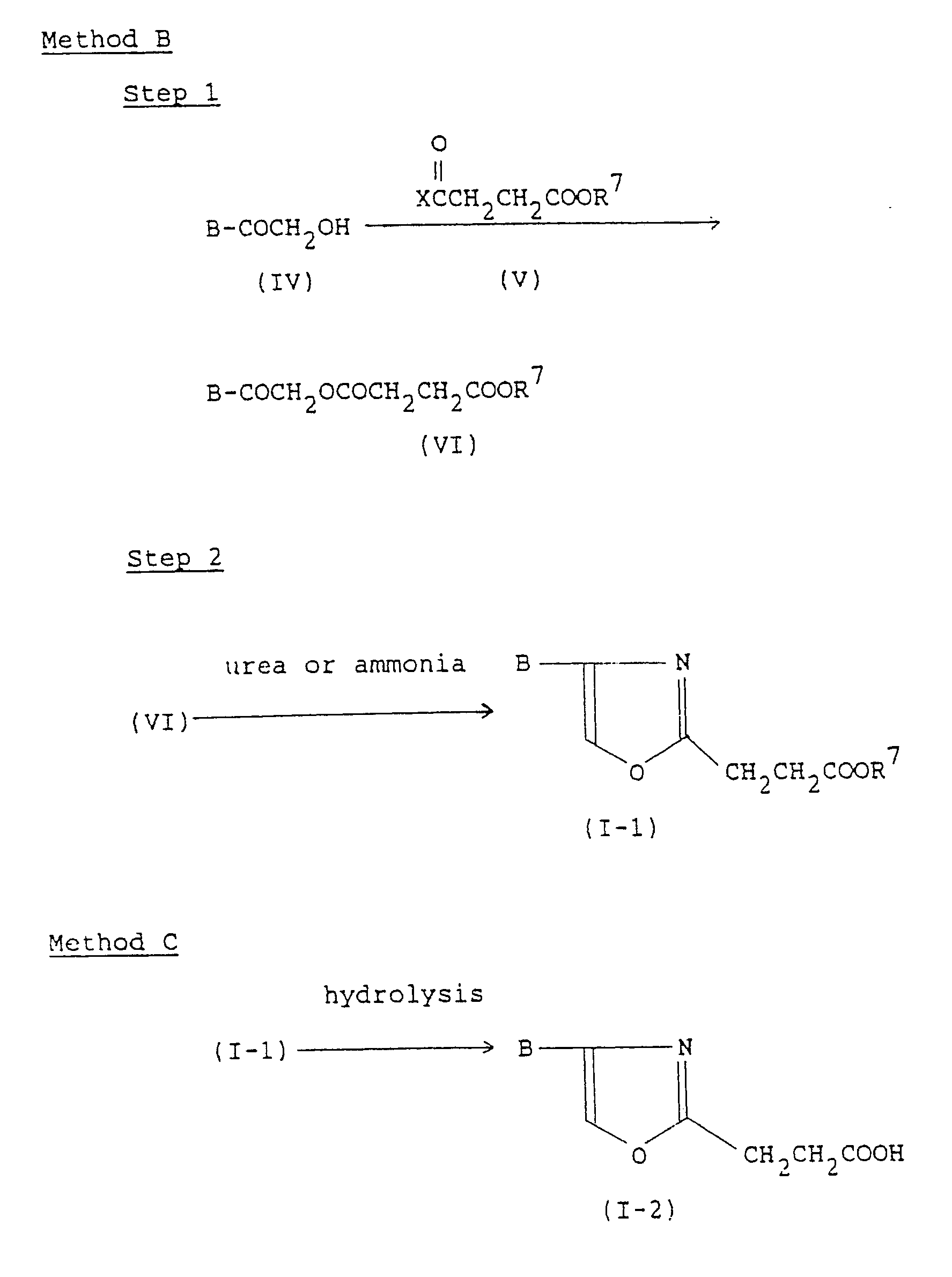


- In the formula, B has the same meaning as defined above and R⁸ is a hydrocarbon residue.

- In the above formulae of Methods B - G, I, J, the symbols are as defined before.
- In the above formula, the hydrocarbon residues of R⁸ mean the same ones as illustrated with respect to the above R³, R⁴, R⁵ and R⁶. The leaving groups of X may be a halogen (e.g., chlorine, bromine or iodine) or substituted sulfonyloxy (e.g., mesyloxy, tosyloxy or benzenesulfonyloxy). The lower alkyl groups of R⁷ may be methyl, ethyl, propyl or butyl
- Details of each the methods are as follows.
- The compound (II) or salt thereof is reacted with a succinamic acid ester (III) to afford the compound (I-1) or salt thereof. The reaction can be conducted without solvent or in the presence of an inert solvent. Examples of the inert solvents are toluene, xylene, pyridine, 1,2-dichloroethane, 1,1,2,2-tetrachloroethane, N,N-dimethylformamide or dimethyl sulfoxide.
- The reaction temperature is about 30 - 200°C, preferably 60 - 150°C and the reaction time is during about 30 minute to 10 hours. The compound (III) is used in about 1 to 10 moles, preferably about 1.5 - 4 moles, to one mole of the compound (II) or salt thereof.
- Firstly, the compound (IV) or salt thereof is acylated with a succinic acid monohalide (V) to afford the compound (IV) or salt thereof. The acylation can be conducted in accordance with a method known per se. For instance, it can be conducted in the presence of a base in an inert solvent. Examples of the inert solvents are chloroform, dichloromethane, ethyl acetate, tetrahydrofuran, water or a mixture thereof. Examples of the bases are triethylamine, pyridine, N-methylmorpholine, sodium hydrogen carbonate, potassium hydrogen carbonate, sodium carbonate or potassium carbonate. Such triethylamine or pyridine can be served as the solvent.
- The reaction temperature is about -10 - +50°C and the reaction time is about 10 minutes - 5 hours. The compound (V) or salt thereof is used in about 1 - 1.2 moles, to one mole of the compound (IV).
- The compound (VI) or salt thereof is subjected to a cyclization to convert into the compound (I-1) or salt thereof. The compound (I-1) or salt thereof is prepared by cyclizing the compound (VI) or salt thereof with a nitrogen-containing cyclizing agent, e.g., urea or ammonia [see J. Org. Chem., Vol 25, p.1151]. In case of using ammonia, it is preferably in the form of ammonium salt such as ammonium acetate in acetic acid. The reaction can be conducted in an inert solvent as described in Step 1. The nitrogen-containing clyclizing agent is used in about 0.5 - 10 mole, to one mole fo the compound (VI) or salt thereof. The reaction temperature is about 10 - 150°C, and the reaction time is about 30 minutes to 6 hours.
- The compound (I-2) or salt thereof can be prepared by hydrolyzing the compound (I-1) or salt thereof which was prepared by Methods A and B. The hydrolysis can be conducted in the presence of an acid or base in an aqueous solvent, in accordance with the conventional methods.
- Examples of the solvents to be usable include a mixture of water with an organic solvent, e.g., alcohols such as methanol or ethanol; ethers such as tetrahydrofuran or dioxane; N,N-dimethylformamide, dimethylsulfoxide or acetone.
- Examples of the bases include potassium carbonate, sodium carbonate, sodium methoxide, sodium ethoxide, potassium tert-butoxide, sodium hydroxide, potassium hydroxide or lithium hydroxide. Examples of the acids are hydrochloric acid, sulfuric acid, acetic acid or hydrobromic acid. The acid or base is preferably used in an excess amount, about 1.2 - 6 equivalents of base or about 2 - 50 equivalents of acid to the compound (I-1) or salt thereof. Usually, the reaction temperature is about -20°C - +150°C, preferably about -10°C - +100°C and the reaction time is about 10 minutes to 20 hours.
- The compound (I-3) or salt thereof can be prepared by esterification of the compound (I-2) or salt thereof. The esterification can be conducted in accordance with the method known per se. For example, the compound (I-2) or salt thereof is directly reacted with an alcohol (R⁴OH) in the presence of an acid or with R⁴X in the presence of a base. Alternatively, a reactive derivative of the compound (I-2) e.g., the acid anhydride, acid halide (such as acid chloride or acid bromide), imidazolide or mixed anhydride (such as anhydride with methyl carbonate, ethyl carbonate or isobutyl carbonate) is reacted with the alcohol (R⁴OH). The acids or bases as mentioned in Method C are applicable to the above reaction. The reaction can be conducted in a similar way to Method E mentioned below (a method for using acid halide). Furthermore, the compound (I-3) or salt thereof can be also prepared by reacting the compound (I-2) or salt thereof with a diazo compound (e.g., diazomethane or diphenyldiazomethane).
- The compound (I-4) or salt thereof can be prepared by amidating the compound (I-1), (I-2) or (I-3), or salt thereof. The amidation can be conducted by reacting the compound (I-1) or (I-3) or salt thereof with an amine derivative (VII) or salt thereof in an inert solvent (e.g., ethanol, propanol, toluene, xylene, pyridine, 1,2-dichloroethane, 1,1,2,2-tetrachloroethane, N,N-dimethylformamide, or dimethyl sulfoxide) or in the absence of any solvent. The reaction temperature is about 20 - 200°C, and the reaction time is about 10 minutes to 10 hours. The amine derivative (VII) or salt thereof is preferably used in an excess amount, to the compound (I-1) or (I-3) or salt thereof. The reaction of the compound (I-2) or salt thereof with the amine derivative (VII) can be conducted by the methods known per se. For instance, there are a method for directly condensing the compound (I-2) or salt thereof and the amine derivative (VII) or salt thereof in the presence of dicyclohexylcarbodiimide or the like, or a method for reacting a reactive derivative of the compound (I-2) or salt thereof (e.g., acid anhydride, acid halide such as acid chloride or acid bromide, imidazolide or mixed anhydride such as anhydride with methyl carbonate, ethyl carbonate or isobutyl carbonate), with the amine derivative (VII) or salt thereof. Among these methods, the most convenient one is to use an acid halide or mixed anhydride of the compound (I-2). In case of using the acid halide, the reaction is preferably conducted in a conventional solvent (e.g., chloroform, dichloromethane, ethyl acetate, tetrahydrofuran or water, or mixture thereof) in the presence of a base (e.g.,triethylamine, N-methylmorpholine, sodium hydrogen carbonate, potassium hydrogen carbonate, sodium carbonate or potassium carbonate. The amine derivative (VII) or salt thereof is used in about 1 - 1.2 moles, to one mole of the compound (I-2) or salt thereof. The reaction temperature is preferably -10°C - +30°C, and the reaction time is about 30 minutes to 10 hours. In case of using the mixed anhydride, the compound(I-2) or salt thereof is reacted with a chlorocarbonate (e.g., methyl chlorocarbonate, ethyl chlorocarbonate or isobutyl chlorocarbonate) in the presence of a base (e.g., triethylamine, N-methylmorpholine, sodium hydrogen carbonate, potassium hydrogen carbonate, sodium carbonate or potassium carbonate). The reaction is conducted in an inert solvent (e.g., chloroform, dichloromethane, ethyl acetate, tetrahydrofuran, water or mixture thereof). The reaction temperature is preferably -10°C - +30°C. The amine derivative (VII) is used in about 1 - 1.2 moles, to one mole of the compound (I-2).
- The reduction can be conducted in accordance with the methods known per se, e.g., the reduction with a metallic hydride compound, a metallic hydrogen complex, diborane or a substituted diborane, or a catalytic hydrogenation. (refer to "SHIN JIKKENKAGAKUKOZA (New Experimental Chemistry Handbook)" Vol.15 (II) (1976) edited by The Chemical Society of Japan and issued by Maruzen Publishing Co., Ltd of Japan)
- That is, the reaction is conducted by treating the compound (I-1), (I-2) or (I-3), or salt thereof with a reducing agent.
- Suitable examples of the reducing agents are metallic hydride complexes such as alkali metal boron hydrides (e.g., sodium borohydride or lithium borohydride) or lithium aluminum hydride; metal hydride compounds such as sodium hydride; metals or metal salts such as organic tin compounds (e.g., triphenyltin hydride), nickel compounds or zinc compounds; catalytic reducing agents using transition metal catalysts and hydrogen, and diborane compounds.
- The reduction is conducted in an organic solvent which does not impede it. Examples of the solvents are aromatic hydrocarbons such as benzene, toluene or xylene; halogenated hydrocarbons such as chloroform, dichloromethane, 1,2-dichloroethane or 1,1,2,2-tetrachloroethane; ethers such as diethyl ether, dioxane, tetrahydrofuran or ethylene glycol monomethylether; alcohols such as methanol, ethanol or propanol; amides such as dimethylformamide, or mixture thereof, which are suitably selected in accordance with the kind of the reducing agent.
- The reaction temperature is about 0 - 130°C, especially 10 - 100°C, and the reaction time is about 1 - 24 hours.
- The oxidation can be conducted in accordance with the methods known per se, e.g., the oxidation with manganese dioxide, chromic acid (e.g., chromium oxide (VI)-pyridine) or dimethyl sulfoxide (refer to "SHIN JIKKENKAGAKU KOZA (New Experimental Chemistry Handbook)", Vol. 15 (I-1) and (I-2) (1976) edited by The Chemical Society of Japan and issued by Maruzen Publishing Co., Ltd. of Japan).
- For instance, the oxidation with dimethyl sulfoxide is conducted in an inert solvent such as chloroform, dichloromethane, benzene or toluene in the coexistence of an electrophilic agent such as acetic anhydride, phosphoric anhydride, dicyclohexylcarbodiimide or chlorine. Dimethyl sulfoxide is used in 1 - 5 equivalents, preferably 1 - 2 equivalents, to the compound (I-5). The electrophilic agent is used in an equivalent, to dimethyl sulfoxide. The reaction temperature is about -20 - +60°C, preferably about 0 - 40°C. The reaction time is about 0.5 - 50 hours, preferably about 1 - 20 hours.
- The acylation can be conducted by the methods known per se, e.g., to react the compound (I-5) directly with the carboxylic acid (R⁸ - COOH) in the presence of a condensing agent (e.g., cyclohexylcarbodiimide) or to react the compound (I-5) with a reactive derivative of the carboxylic acid (R⁸-COOH) such as the acid anhydride, acid halide (e.g., acid chloride or acid bromide), imidazolide or mixed anhydride (e.g., anhydride with methyl carbonate, ethyl carbonate or isobutyl carbonate). The most convenient method is to use the acid halide or mixed anhydride of R⁸-COOH.
- In case of the acid halide, the reaction is usually conducted in a solvent (e.g., chloroform, dichloromethane, ethyl acetate, tetrahydrofuran, or water, or mixture thereof) in the presence of a base (e.g., triethylamine, N-methylmorpholine, sodium hydrogen carbonate, potassium hydrogen carbonate, sodium carbonate or potassium carbonate). The reaction temperature is about -10 - +50°C. The carboxylic acid (R⁸-COOH) is used in 1 - 1.2 moles to one mole of the compound (I-5) or salt thereof.
- In case of the mixed anhydride, it is formed by reacting R⁸-COOH with a chlorocarbonate (e.g., methyl chlorocarbonate, ethyl chlorocarbonate or isobutyl chlorocarbonate), in the presence of a base (e.g., triethylamine, N-methylmorpholine, sodium hydrogen carbonate, potassium hydrogen carbonate, sodium carbonate or potassium carbonate). The reaction is conducted in an inert solvent (e.g., chloroform, dichloromethane, ethyl acetate, tetrahydrofuran, water or mixture thereof). The reaction temperature is about -10 - +30°C, and the reaction time is about 0.5 - 50 hours. The carboxylic acid (R⁸-COOH) is used in about 1 - 1.2 moles, to one mole of the compound (I-5).
- In this method, the compound (I-5) or salt thereof is reacted with R³-X in the presence of a base (e.g., sodium hydride, potassium hydride, sodium amide, triethylamine, N-methylmorpholine, sodium hydrogen carbonate, potassium hydrogen carbonate, sodium carbonate or potassium carbonate), thereby affording the compound (I-8). The reaction is conducted in an inert solvent (e.g., tetrahydrofuran, dioxane, diethyl ether, toluene, xylene, benzene, 1,2-dichloroethane, 1,1,2,2-tetrachloroethane, N,N-dimethylformamide or dimethyl sulfoxide). The reaction temperature is about -20 - 100°C, preferably -10 - 50°C, and the reaction time is about 0.5 - 20 hours. R³-X is used in an excess amount, to the compound (I-5) or salt thereof.
- The compound (VIII) is prepared by reacting the compound (I-5) or salt thereof with a halogenating agent or a sulfonylating agent. Suitable examples of the halogenating agents are thionyl chloride or phosphorus tribromide. The use of such halogenating agent can produce the compound (VIII) of X being chlorine or bromine, or salt thereof. The halogenation is conducted in an inert solvent (e.g., benzene, toluene, xylene, chloroform or dichloromethane) or using an excess amount of the halogenating agent to serve as solvent. The reaction temperature is about 10 - 80°C. The halogenating agent is used in about 1 - 20 moles, to one mole of the compound (I-5) or salt thereof. Suitable examples of the sulfonylating agents are mesyl chloride, tosyl chloride or benzenesulfonyl chloride, thereby affording the compound (VIII) of X being mesyloxy, tosyloxy or benzensulfonyoxy, respectively, or salt thereof. The sulfonylation is conducted in an inert solvent (e.g., benzene, toluene, xylene, diethylether, ethyl acetate, tetrahydrofuran, chloroform or dichloromethane), preferably in the presence of a base (e.g., triethylamine, N-methylmorpholine, sodium hydrogen carbonate, potassium hydrogen carbonate, sodium carbonate or potassium carbonate). The reaction temperature is about 0 - 130°C, preferably 10 - 100°C. The reaction time is about 10 minutes to 5 hours. Each of the sulfonylating agent and the base is used in about 1 - 1.2 moles, to one mole of the compound (I-5) or salt thereof. The compound (VIII) of X being iodine, or salt thereof can be prepared by reacting one mole of the compound (VIII) of X being bromine, iodine or sulfonyloxy, or salt thereof as thus obtained, with 1 - 3 moles of sodium iodide or potassium iodide. For this reaction, such solvent as acetone, methylethyl ketone, diethyl ether, tetrahydrofuran or dioxane is usable. The reaction temperature is about 20 - 80°C.
- Subsequently, the compound (VIII) or salt thereof is reacted with an alcohol (R³-OH) to prepare the compound (I-8) or salt thereof. The reaction is usually conducted in an inert solvent (e.g., diethyl ether, chloroform, dichloromethane, ethyl acetate, tetrahydrofuran, dioxane or N,N-dimethylformamide) in the presence of a base (e.g., triethylamine, N-methyl morpholine, sodium hydrogen carbonate, potassium hydrogen carbonate, sodium carbonate or potassium carbonate). The reaction temperature is about 0 - 100°C, and the reaction time is about 5 minutes to 10 hours. The alcohol (R³-OH) is used in about 1 - 3 moles, to one mole of the compound (VIII) or salt thereof.
- The salts of the compounds to be employed in the above mentioned Methods A - J are similar ones to the salts of the compounds (I) and (I′).
- The compounds or their salts thus obtained can be isolated and purified, e.g., by a conventional method such as filtration, concentration, concentration under reduced pressure, extraction with solvent, redistribution, change of basicity, crystallization, recrystallization, distillation, sublimation, salting out or chromatography.
- When the compound (I) or (I′) has an acidic functional group (e.g., free carboxyl group), its salt with a pharmaceutically acceptable base may be formed in accordance with the conventional method. Examples of such salts are the sodium, potassium, aluminum and calcium salts. When the compound (I) or (I′) has a basic functional group, its salt with a pharmaceutically acceptable acid may be formed in accordance with the conventional method. Examples of such salts are the hydrochloric acid, sulfuric acid, acetic acid and fumaric acid salts.
- As for toxicity of the compounds (I) and (I′), and salt thereof, no death was observed on the compounds prepared e.g., by Examples 37 and 39 when orally administered in 300mg/kg to mouse.
- The compounds (I) and (I′) and salts thereof possess blood sugar lowering activity or glucose tolerance improving activity in mammals (e.g., mouse, rat, rabbit, dog, cat, cow, pig and human being) and their toxicity is very low. Thus, they can used as therapeutic agent for diabetes of mammals (e.g., mouse, rat, rabbit, dog, cat, cow, pig and human being).
- The compounds of the invention can be administered to human being through any of oral or parental route.
- Compositions for oral administration may be solid or liquid forms, specially tablets (including sugar coated tablets and film coated tablets), pills, granules, powders, capsules (including soft capsules), syrups, emulsions and suspensions. Such compositions will contain conventional carriers or excipients and can be prepared by known methods. Examples of carriers or excipients for tablets are lactose, starch, sucrose and magnesium stearate.
- Compositions for parental administration are e.g., injections and suppositories, the former of which includes subcutaneous, intracutaneous, intramuscular or like injections. Such injections can be prepared by dissolving, suspending or emulsifying the compound (I) or (I′), or salt thereof in or with sterile aqueous or oily liquids which are usually employed in injections, in accordance with the methods known in the art. Examples of the aqueous liquids for injections are physiological saline and isotonic solution, which may be used together with a suitable suspending agent such as sodium carboxy methylcellulose or a nonionic surfactant upon circumstances. Examples of the oily liquids are sesame oil and soybean oil, which may be used together with a solubilizing agent such as benzyl benzoate or benzyl alcohol. The injections thus prepared are usually put into ampules.
- The oral dosage of the compounds (I) or (I′), or salts thereof when used as therapeutic agent for diabetes is 1 - 500 mg/day/adult, preferably 10 - 150 mg.
- The invention is further illustrated by examples, test examples and preparation examples, by which no limitation shall be given.
- A mixture of 3,5-ditrifluoromethylphenacyl bromide (3.1g) and ethyl succinamate (5.4g) was heated for 2 hours at 130°C. The reaction mixture was poured into water. The precipitated crystals were collected by filtration to obtain ethyl 4-(3,5-ditrifluoromethylphenyl)-2-oxazolepropionate (1.7g, 47%). Recrystallization from hexane gave colorless prism crystals of mp 70 - 71°C.
Elementary analysis for C₁₆H₁₃NO₃F₆
Calcd. (%) : C, 50.40 ; H, 3.44 ; N, 3.67
Found (%) : C, 50.62 ; H, 3.40 ; N, 3.70 - By the method of Example 1, the compounds listed in Table 2 were obtained.
- To a solution of 4-chloro-α-hydroxyacetophenone (4.84g) in pyridine (50ml) was added ethyl succinyl chloride (4.8ml) at room temperature, followed by stirring for 2 hours. The reaction mixture was poured into water and extracted with ethyl acetate. The ethyl acetate layer was washed successively with 6N-HCl and water, and dried over MgSO₄. After distilling off the solvent, the oily residue was subjected to a silica gel column chromatography. Crystals (7.85g, 93%) of 2-(4-chlorophenyl)-2-oxoethyl ethyl succinate were obtained from the fraction eluted with ethyl acetate-hexane (1:2, V/V). Recrystallization from ether-hexane gave colorless needle crystals of mp 50 - 51°C.
Elementary analysis for C₁₄H₁₅O₅Cl
Calcd. : C, 56.29 ; H, 5.06
Found : C, 56.55 ; H, 5.08 - A mixture of 2-(4-chlorophenyl)-2-oxoethyl ethyl succinate (7.6g), ammonium acetate (9.8g) and acetic acid (80ml) was stirred for an hour at 110°C and refluxed for 2 hours. The solvent was distilled off. The residue was diluted with water, made basic by addition of aqueous sodium hydrogen carbonate solution and then extracted with ethyl acetate. The ethyl acetate layer was washed with water, and dried over MgSO₄. After removal of the solvent, the oily residue was subjected to a silica gel column chromatography. Crystals of ethyl 4-(4-chlorophenyl)-2-oxazolepropionate (2.23g, 31%) were obtained from the fraction eluted with ethyl acetate-hexane (1:3, V/V). Recrystallization from ethyl acetate-hexane gave colorless plate crystals of mp 65 - 66°C.
Elementary analysis for C₁₄H₁₄NO₃Cl
Calcd. (%) : C, 60.11; H, 5.04; N, 5.01
Found (%) : C, 59.96; H, 5.07; N, 5.01 - Ethyl 4-(3,5-ditrifluoromethylphenyl)-2-oxazolepropionate (1.6g) was dissolved in methanol (20ml), to which 10% NaOH (10ml) was added. After stirring for 10 minutes at room temperature, the mixture was poured into water. The resultant was extracted with ether. The aqueous layer was made acidic with 2N-HCl and the precipitated crystals of 4-(3,5-ditrifluoromethylphenyl)-2-oxazolepropionic acid (1.3g, 87%) were collected by filtration. Recrytallization from ether-hexane gave colorless prism crystals of mp 130 - 131°C.
Elementary analysis for C₁₄H₉NO₃F₆
Calc. (%) : C, 47.61 ; H, 2.57 ; N, 3.97
Found (%) : C, 47.38 ; H, 2.53 ; N, 3.97 - By the method of Example 12, the compounds listed in Table 3 were obtained.
- To a mixture of 4-(4-chlorophenyl)-2-oxazolepropionic acid (0.5g) and isopropanol (30ml) was added conc. sulfuric acid (0.3ml), and the resultant was refluxed for 5 hours. The reaction mixture was poured into water and extracted with ether. The ether layer was washed succesively with a saturated sodium hydrogen carbonate aqueous solution and water, and dried over MgSO₄. The ether was distilled off to give crystals of isopropyl 4-(4-chlorophenyl)-2-oxazolepropionate (530mg, 91%). Recrystallization from hexane gave colorless prism crystals of mp 30 - 31°C.
Elementary analysis for C₁₅H₁₆NO₃Cl
Calc. (%) : C, 61.33 ; H, 5.49; N, 4.77
Found (%) : C, 61.18; H, 5.49; N, 4.77 - A mixture of 4-(4-chlorophenyl)-2-oxazolepropionic acid (0.5g), benzyl bromide (0.25ml), potassium carbonate (0.33g) and dimethylformamide (DMF)(10ml) was stirred for 3 hours at room temperature. The reaction mixture was poured into water to obtain crystals of benzyl 4-(4-chlorophenyl)-2-oxazolepropionate (0.664g, 98%). Recrystallization from ether-hexane gave colorless prism crystals of mp 66 - 67°C.
Elementary analysis for C₁₉H₁₆NO₃Cl
Calc. (%) : C, 66.77; H, 4.72; N, 4.10
Found (%) : C, 66.91; H, 4,69; N, 4.02 - By the method of Example 24, the compounds listed in Table 4 were obtained.
- To a solution of 4-(4-chlorophenyl)-2-oxazolepropionic acid (0.7g) in tetrahydrofuran (THF)(20ml), were added oxalyl chloride (0.27ml) and DMF (one drop) at 0°C. After stirring for 2 hours at room temperature, the solvent was distilled off. The oily residue was dissolved in THF (10ml), to which 3,4,5-trimethoxybenzyl alcohol (1.1g) and triethylamine (1.2ml) were added in that order. After stirring for 4 hours at room temperature, the mixture was poured into water and then extracted with ether. The ether layer was washed with water and dried over MgSO₄. After distilling off the solvent, the oily residue was subjected to a silica gel column chromatography. Crystals of 3,4,5-trimethoxybenzyl 4-(4-chlorophenyl)-2-oxazolepropionate (0.743g, 62%) were obtained from the fraction eluted with ethyl acetate-hexane. Recrystallization from dichloromethane-hexane gave colorless prism crystals of mp 86 - 87°C.
Elementary analysis for C₂₂H₂₂NO₆Cl
Calc. (%) : C, 61.19; H, 5.13; N, 3.24
Found (%) : C, 61.29; H, 5.12; N, 3.33 - By the method of Example 28, the compounds listed in Table 5 were obtained.
- 4-Methoxybenzyl 4-(4-chlorophenyl)-2-oxazolepropionate was obtained by the same method as in Example 24. Recrystallization from diethyl ether-hexane gave colorless prism crystals of mp 69 - 70°C.
- To a solution of 4-(4-chlorophenyl)-2-oxazolepropionic acid (0.5g) in dichloromethane (20ml) was added diphenyldiazomethane (0.425g). After stirring for 4 hours at room temperature, acetic acid (0.5ml) was added to the mixture. The reaction mixture was washed with a saturated sodium hydrogen carbonate aqueous solution and water, and then dried over MgSO₄. The solvent was distilled off and then the oily residue was subjected to a silica gel column chromatography. Crystals of diphenylmethyl 4-(4-chlorophenyl)-2-oxazolepropionate (0.759g, 91%) were obtained from the fraction eluted with ether-hexane (1:3, V/V). Recrystallization from ether-hexane gave colorless prism crystals of mp 94 - 95°C.
Elementary analysis for C₂₅H₂₀NO₃Cl
Calc. (%): C, 71.85; H, 4.82; N, 3.35
Found (%): C, 71.83; H, 4.79; N, 3.38 - To a solution of 4-(4-Chlorophenyl)-2-oxazolepropionic acid (0.5g) in acetonitrile (20ml) were added 2-phenyl-2-propanol (0.325g), dicyclohexylcarbodiimide (0.49g) and 4-dimethylaminopyridine (0.025g), followed by stirring for 65 hours at room temperature. 2-Phenyl-2-propanol (0.325g), dicyclohexylcarbodiimide (0.49g) and 4-dimethylaminopyridine (0.025g) were further added to the reaction mixture, followed by stirring for 2 hours at 50°C. The reaction mixture was filtered to remove an insoluble substance, and the filtrate was then concentrated. The oily residue was subjected to a silica gel column chromatography. Crystals of 1-methyl-1-phenylethyl 4-(4-chlorophenyl)-2-oxazolepropionate (0.297g, 38%) were obtained from the fraction eluted with ethyl acetate-hexane (1:4, V/V). Recrystallization from hexane gave colorless prism crystals of mp 94 - 95°C.
Elementary analysis for C₂₁H₂₀NO₃Cl
Calc. (%): C, 68.20; H, 5.45; N, 3.79
Found (%): C, 68.04; H, 5.47; N, 3.82 - To a solution of 4-(4-chlorophenyl)-2-oxazolepropionic acid (0.4g) in THF (20ml) were added triethylamine (0.33ml) and ethyl chlorocarbonate (0.23ml) at -30°C, followed by stirring for 30 minutes at the same temperature. The mixture was poured into 30% methylamine aqueous solution (10ml), and the resultant was stirred for 15 minutes at room temperature. The reaction mixture was poured into water and extracted with ethyl acetate. The ethyl acetate layer was washed with water, dried over MgSO₄ and concentrated to obtain crystals of N-methyl-4-(4-chlorophenyl)-2-oxazolepropionamide (0.375g, 89%). Recrystallization from dichloromethane-ethanol gave colorless prism crystals of mp 169 - 170°C.
Elementary analysis for C₁₃H₁₃N₂O₂Cl
Calc. (%): C, 58.99; H, 4.95; N, 10.58
Found (%): C, 58.73; H, 4.84; N, 10.46 - By the method of Example 35, crystals of N-benzyl-N-methyl-4-(4-chlorophenyl)-2-oxazolepropionamide (yield: 71%) was obtained. Recrystallization from dicloromethane-ethanol gave colorless prism crystals of mp 99 - 100°C.
Elementary analysis for C₂₀H₁₉N₂O₂Cl
Calc. (%): C, 67.70; H, 5.40; N, 7.89
Found (%): C, 67.82; H, 5.38; N, 7.84 - To a solution of 4-(4-chlorophenyl)-2-oxazolepropionic acid (1.5g) in THF (20ml) was added lithium aluminum hydride (0.27g), followed by stirring for 3 hours at room temperature. Water (3ml) was added to the reaction mixture. The resultant was extracted with ethyl acetate. The ethyl acetate layer was washed with 2N-HCl and water, dried over MgSO₄, and distilled to remove the solvent. The oily residue was subjected to a silica gel chromatography. Crystals of 3-[4-(4-chlorophenyl)-2-oxazolyl]propanol (1.11g, 78%) were obtained from the fraction eluted with ethyl acetate-hexane (2:1, V/V). Recrystallization from ether-hexane gave colorless prism crystals of mp 43 - 44°C.
Elementary analysis for C₁₂H₁₂NO₂Cl
Calc. (%): C, 60.64: H, 5.09: N, 5.89
Found (%): C, 60.44; H, 5.06; N, 5.82 - By the method of Example 37, the compounds listed in Table 6 were obtained.
- To a solution of ethyl 4-phenyl-2-oxazole propionate (1.4g) in THF (20ml) was added sodium borohydride (0.86g). Methanol (4ml) was dropwise added to the mixture over a period of 10 minutes under reflux. The reaction mixture was refluxed for further 30 minutes, concentrated, made acidic and then extracted with ethyl acetate. The ethyl acetate layer was washed with water, dried over MgSO₄, and distilled to obtain crystals of 3-(4-phenyl-2-oxazolyl)propanol (1.07g, 92%). Recrystallization from ether-hexane gave colorless prism crystals of mp 55 - 56°C.
Elementary analysis for C₁₂H₁₃NO₂
Calc. (%): C, 70.92; H, 6.45; N, 6.89
Found (%): C, 70.65; H, 6.35; N, 6.67 - To a solution of 3-[4-(4-chlorophenyl)-2-oxazolyl]propanol (1.0g) in dichloromethane (10ml) were added dimethylsulfoxide (0.6ml) and phosphoric anhydride (1.1g) in that order. After stirring for 10 minutes at room temperature, the resultant was cooled to 0°C, to which triethylamine (2ml) was added. The mixture was stirred for 40 minutes at room temperature, poured into 2N-HCl and extracted with dichloromethane. The dichloromethane layer was washed with water, dried over MgSO₄, and distilled to remove the solvent. The oily residue was subjected to a silica gel column chromatography. Crystals of 3-[4-(4-chlorophenyl)-2-oxazolyl]propanal (0.698g, 70%) were obtained from the fraction eluted with ethyl acetate-hexane (1:3, V/V). Recrystallization from hexane gave colorless prism crystals of mp 41 - 42°C.
Elementary analysis for C₁₂H₁₀NO₂Cl
Calc. (%): C, 61.16; H, 4.28; N, 5.94
Found (%): C, 61.10; H, 4.21; N, 5.91 - To a solution 3-[4-(4-chlorophenyl)-2-oxazolyl] propanol (0.5g) in pyridine (5ml) was added acetic anhydride (1.0ml), followed by stirring for 30 minutes at 50 to 60°C. The reaction mixture was poured into water. The precipitated crystals were collected by filtration to obtain 3-[4-(4-chlorophenyl)-2-oxazolyl]propyl acetate (0.535g, 91%). Recrystallization from ether-hexane gave colorless prism crystals of mp 37 - 37.5°C.
Elementary analysis for C₁₄H₁₄NO₃Cl
Calc. (%): C, 60.11; H, 5.04; N, 5.01
Found (%): C, 60.12; H, 5.06; N, 5.18 - To a solution of 3-[4-(4-chlorophenyl)-2-oxazolyl] propanol (0.5g) in pyridine (2ml) was added benzoyl chloride (0.29ml), followed by stirring for an hour at room temperature. The reaction mixture was poured into water and extracted with ethyl acetate. The ethyl acetate layer was washed succesively with an aqueous sodium hydrogen carbonate solution, 2N-HCl and water, dried over MgSO₄, and distilled to remove the solvent. The precipitated crystals were collected by filtration to give 3-[4-(4-chlorophenyl)-2-oxazolyl]propyl benzoate (0.687g, 96%). Recrystallization from ether-hexane gave colorless prism crystals of mp 47 - 47.5°C.
Elementary analysis for C₁₄H₁₄NO₃Cl
Calc. (%): C, 66.77; H, 4.72; N, 4.10
Found (%): C, 66.72; H, 4.70; N, 3.98 - To a solution of 3-[4-(4-chlorophenyl)-2-oxazolyl] propanol (0.6g) in DMF (10ml) were added 60% (W/W) sodium hydride in oil (0.12g) and benzyl bromide (0.3ml), followed by stirring for 3 hours at room temperature. After additional stirring for an hour at 30°C, the reaction mixture was poured into water and then extracted with ether. The ether layer was washed with water, dried over MgSO₄, and distilled to remove the solvent. The oily residue was subjected to a silica gel column chromatography. Oily 3-[4-(4- chlorophenyl)-2-oxazolyl]propyl benzyl ether (0.512g, 62%) was obtained from the fraction eluted with ether-hexane (1:4, V/V).
NMR (δppm, CDCl₃): 1.9 - 2.3(2H, m), 2.93(2H, t, J = 7.5Hz), 3.57(2H, t, J=6.5Hz), 4.52(2H, s), 7.35(5H, s), 7.37(2H, d, J=9Hz), 7.67(2H, d, J=9Hz), 7.80(1H, s).
Elementary analysis for C₁₉H₁₈NO₂Cl
Calc. (%): C, 69.62; H, 5.53; N, 4.27
Found (%): C, 69.84; H, 5.48; N, 4.03 - 3-[4-(4-chlorophenyl)-2-oxazolyl]propanol (5.21g) and triethylamine (4ml) were dissolved in dichloromethane (50ml), to which methanesufonyl chloride (2.2ml) was dropwise added under ice-cooling and stirred for 2 hours at the same temperature. The reaction mixture was poured into water and then extracted with dichloromethane. The dichloromethane layer was washed with water, dried over MgSO₄ and distilled to remove the solvent. The oily residue was dissolved in acetone (100ml), to which sodium iodide (6.6g) was added and refluxed for 2 hours. The solvent was distilled off. The residue was poured into water and extracted with ether. The ether layer was washed with an aqueous Na₂SO₃ solution and then water, and dried over MgSO₄. The solvent was distilled off to obtain 4-(4-chlorophenyl)-2-(3-iodopropyl)oxazole (6.6g, 87%). Recrystallization from ether-hexane gave colorless prism crystals of mp 49 - 50°C.
Elementary analysis for C₁₂H₁₁NOClI
Calc. (%): C, 41.47; H, 3.19; N, 4.03
Found (%): C, 41.46; H, 3.06; N, 4.03 - A mixture of 4-(4-chlorophenyl)-2-(3-iodopropyl)oxazole (0.5g), guaiacol (0.19ml), potassium carbonate (0.24g) and N,N-dimethylformamide (5ml) was stirred for 30 minutes at 60 to 65°C and poured into water. The precipitated crystals were collected by filtration to obtain 4-(4-chlorophenyl)-2-[3-(2-methoxyphenoxy) propyl]oxazole (0.445g, 90%). Recrystallization from ether-hexane gave colorless prism crystals of mp 94 - 95°C.
Elementary analysis for C₁₉H₁₈NO₃Cl
Calc. (%): C, 66.38; H, 5.28; N, 4.07
Found (%): C, 66.01; H, 5.20; N, 3.96 - By the method of Example 46, the compounds listed in Table 7 were obtained.
- By the method of Example 1, the compounds listed in Table 2 were obtained.
- By the method of Example 12, the compounds listed in Table 3 were obtained.
- By the method of Example 24, the compounds listed in Table 4 were obtained.
- By the method of Example 37, the compounds listed in Table 6 were obtained.
- By the method of Example 40, the compounds listed in Table 6 were obtained.
- By the method of Example 46, the compounds listed in Table 7 were obtained.
- In the following test examples, the results of the pharmacological test which show the usefulness of the compounds of the present invention are described.
-
- Blood glucose lowering activity of the compounds of the present invention in fasted test subjects was examined using male KKAy mice with hereditary obese diabetes (ten-week old, one group consisting of five mice). A suspension of the test compound in a 5% gum arabic solution (30mg/kg) was forcedly and orally administered to KKAy mice which had been fasted for 20 hours beforehand. Sixty minutes and 120 minutes later, blood was drawn from the orbital sinus of each mouse and the blood glucose value was measured by the glucose oxidase method. The intensity of the activity of the test compound was indicated as a lowering ratio (%) of the blood glucose value of the group of mice administered a test compound relative to that of the control group of mice not administered it.
- The test results are shown in Table 1
Table 1 Compound Blood glucose lowering ratio (%) (Example No.) After 60 minutes After 120 minutes 6 34 36 11 39 42 14 31 23 15 32 35 21 30 33 23 32 31 24 21 21 34 22 24 35 25 18 37 33 35 40 20 24 41 26 21 42 30 21 43 24 21 46 24 29 - It is apparent from the results in Table 1 that the compounds of the present invention exhibit an excellent blood glucose lowering activity.
- Glucose tolerance activity of the compounds was tested using male GK rats with spontaneously occurring diabetes and glucose intolerance (9-week old, one group consisting of five rats). The rats were fasted for 20 hours and received an oral administration of 30mg/kg of the test compound (Compound No. 37 suspended in 5% gum arabic solution). Sixty minutes later, 40% glucose solution (2g/kg) was orally administered. Immediately before and, 15, 30, 60 and 120 minutes after the administration of glucose, blood was drawn from the orbital sinus of each rat. The values of blood glucose and plasma insulin were measured.
- The blood glucose reaction in the rat group received the test compound was significantly lower in comparison with that in the control rat group. Namely, the blood glucose values of the test rat group measured immediately before and, 15, 30, 60 and 120 minutes after the glucose administration lowered to 69, 79, 71, 56 and 39% of those of the control rat group, respectively. On the other hand, plasma insulin secreting response of the test group was higher in comparison with that of the control group. Namely, the plasma insulin values measured immediately before and, 15, 30, 60 and 120 minutes after the glucose administration increased to 128, 210 179, 131 and 104% of those of the control group, respectively.
- It is apparent from the above results that the compound of the present invention exhibits a glucose tolerance improving property.
Preparation Example 1 Tablet Components a tablet (1) Compound (as obtained by Example 41) 50 mg (2) Cornstarch 30 mg (3) Lactose 113.4 mg (4) Hydroxypropyl cellulose 6 mg (5) Water (0.03ml) (6) Magnesium stearate 0.6 mg Total 200 mg - The components (1), (2), (3) and (4) were mixed. After adding water, the mixture was kneaded, dried under vacuum for 16 hours at 40°C and grounded in a mortar. The resultant was sieved through a 16-mesh sieve to obtain granules. The component (6) was added to the granules and mixed. The resulting mixture was made to tablets of 200mg per tablet, using a rotary-type tablet machine (Kikusui Seisakusho in Japan).
Preparation Example 2 (1) Compound (as obtained by Example 37) 50 mg (2) Cornstarch 30 mg (3) Lactose 113.4 mg (4) Hydroxypropyl cellulose 6 mg (5) Water (0.03 ml) (6) Magnesium stearate 0.6 mg (7) Cellulose acetate phthalate 10 mg (8) Acetone (0.2 ml) Total 210 mg - From the components (1), (2), (3), (4), (5) and (6), tablets were prepared by the same method as in Preparation Example 1. These tablets were film-coated by use of a solution of the component (7) in acetone in a half coater (Freunt Co., Ltd) to give entric tablets of 210 mg per tablet.
Preparation Example 3 Components of a capsule (1) Compound C (as obtained by Example 24) 30 mg (2) Cornstarch 40 mg (3) Lactose 74 mg (4) Hydroxypropyl cellulose 6 mg (5) Water 0.02 mg Total 150 mg - The components (1), (2), (3) and (4) were mixed, to which water was added. The mixture was kneaded, dried under vacuum for 16 hours at 40°C and grounded in a mortar. The resultant was sieved through a 16-mesh sieve to obtain granules. The granules were packed in No. 3 gelatin capsules with a capsule packing machine (Zanasi Italy) to obtain capsules.
Preparation Example 4 (1) Compound (as obtained in Example 14) 5 mg (2) Sodium salicylate 50 mg (3) Sodium chloride 180 mg (4) Sodium metabisulfite 20 mg (5) Methylparaben 36 mg (6) Propylparaben 4 mg (7) Distilled water for injection (2 ml) Total 295 mg - The components (2), (3), (4), (5) and (6) were dissolved in about one half of the above mentioned volume of distilled water under stirring at 80°C. The solution thus obtained was cooled to 40°C, to which the compound of the present invention was dissolved. The remaining distilled water was added to the solution so that a final volume can be obtained. The resultant was sterilized through an appropriate filter paper, to obtain the injection.
- From the results shown by the above Test Examples, the compounds (I) or (I′) of the present invention have blood glucose lowering activity and glucose tolerance improving activity in mammals (for example, mouse, rat, rabbit, dog, cat, bovine, swine, human, etc.) and in addition have low toxicity.
- Accordingly, the compounds (I) and (I′) of the present invention or salts thereof can be used for a remedy for diabetes of mammals.

- Note 1) NMR(δ ppm, CDCl₃):1.25(3H,t,J=7.5Hz), 2.7-3.3(4H,m), 4.17(2H,q,J=7.5Hz), 7.2-7.55(3H,m), 7.6-7.8(2H,m), 7.81 (1H,s).
- Note 2) NMR(δ ppm, CDCl₃):1.25(3H,t,J=7.5Hz), 2.7∼3.3(1H,m), 4.17(2H,q,J=7.5Hz), 6.95∼7.3(3H,m), 7.77(1H,s).
- Note 3) NMR(δ ppm, CDCl₃):1.24(3H,t,J=7.5Hz), 2.34(3H,s), 2.7-3.3(4H,m), 4.16(2H,q, J=7.5Hz), 7.17(2H,d,J=8.5Hz), 7.57 (2H,d,J=8.5Hz), 7.75(1H,s).
- Note 4) NMR(δ ppm, CDCl₃):1.24(3H,t,J=7.0Hz), 2.7-3.3(4H,m), 4.15(2H,q,J=7.0Hz), 7.2-7.5(2H,m), 8.05(1H,d,J=9.0Hz), 8.23(1H,s).
- Note 5) NMR(δ ppm, CDCl₃):1.24(6H,t,J=7.0Hz), 2.5-3.3(6H,m), 4.15(2H,q,J=7.0Hz), 7.22(2H,d,J=9.0Hz), 7.62(2H,d,J=9.0Hz), 7.77(1H,s).
- Note 6) NMR(δ ppm, CDCl₃):1.26(3H,t,J=7.0Hz), 2.7-3.3(4H,m), 1.18(2H,q,J=7.0Hz), 7.3-8.1(5H,m).


Claims (12)
1. An oxazole compound having the formula (I):

in which A is a group of the formula -CH₂OR³ (R³ is a hydrogen atom, an optionally substituted hydrocarbon residue, an optionally substituted heterocyclic group or an acyl group), or an aldehyde group and B is an optionally substituted phenyl group, or its salt.
2. A compound as claimed in claim 1 wherein R³ is
(1) a hydrogen atom;
(2) a C₁₋₁₀alkyl group which is unsubstituted or substituted by the same or different, one to three substituents selected from the group of a halogen, hydroxy, a C₁₋₆alkoxy, an amino optionally substituted by a C₁₋₆alkyl or a C₁₋₁₀acyl, a carbamoyl optionally substituted by a C₁₋₆alkyl, a 5 - 7 membered heterocycle containing one sulfur, nitrogen or oxygen atom, a 5 or 6 membered heterocycle containing two to four nitrogen atoms and a 5 or 6 membered heterocycle containing one or two nitrogen atoms and one sulfur or oxygen atom;
(3) a phenyl C₁₋₄alkyl group which is unsubstituted or substituted by the same or different, one to three substituents selected from the group of a halogen, a C₁₋₆alkoxy, a C₁₋₆alkyl, a C₁₋₆haloalkyl, an amino optionally substituted by a C₁₋₆alkyl or a C₁₋₁₀acyl;
(4) a C₂₋₁₀alkenyl group;
(5) a C₆₋₁₄aryl group which is unsubstituted or substituted by the same or different, one to three substituents selected from the group of a halogen, a C₁₋₆alkyl, a C₁₋₆haloalkyl, hydroxy, a C₁₋₆alkoxy, a C₁₋₁₀acyl, an amino optionally substituted by a C₁₋₆alkyl or a C₁₋₁₀acyl, a carbamoyl optionally substituted by a C₁₋₆alkyl, a C₁₋₆alkoxycarbonyl, a 5 - 7 membered heterocycle containing one sulfur, nitrogen or oxygen atom, a 5 or 6 membered heterocycle containing two to four nitrogen atoms and a 5 or 6 membered heterocycle containing one or two nitrogen atoms and one sulfur or oxygen atom;
(6) a heterocyclic group which is unsubstituted or substituted by the same or different, one to three substituents selected from the group of a halogen, a C₁₋₆alkyl, a C₁₋₆haloalkyl, hydroxy, a C₁₋₆alkoxy, a C₁₋₁₀acyl, an amino optionally substituted by a C₁₋₆alkyl or a C₁₋₁₀acyl, a carbamoyl optionally substituted by a C₁₋₆alkyl, a C₁₋₆alkoxycarbonyl, a 5 - 7 membered heterocycle containing one sulfur, nitrogen or oxygen atom, a 5 or 6 membered heterocycle containing two to four nitrogen atoms and a 5 or 6 membered heterocycle containing one or two nitrogen atoms and one sulfur or oxygen atom;
(7) an acyl group formed from a carbonyl or sulfonyl and a group shown by the above (2) to (5); B is a phenyl group which is unsubstituted or substituted by the same or different, one to four substitutents selected from the group of a halogen, nitro, cyano, an optionally substituted alkoxy and an optionally substituted alkyl.
3. A compound as claimed in claim 1, which is 3-[4-(4-chlorophenyl)-2-oxazolyl]propanol.
4. A compound as claimed in claim 1, which is benzyl 4-(4-chlorophenyl)-2-oxazolepropionate.
5. A compound as claimed in claim 1, which is 1-methyl-1-phenylethyl 4-(4-chlorophenyl)-2-oxazolepropionate.
6. A compound as claimed in claim 1, which is N-methyl-4-(4-chlorophenyl)-2-oxazole-propionic acid amide.
7. A compound as claimed in claim 1, which is 3-(4-phenyl-2-oxazolyl)propanol.
8. A compound as claimed in claim 1, which is 3-[4-(4-chlorophenyl)-2-oxazolyl]propyl benzoate.
9. A use of an oxazole compound having the formula (I′):

in which A′ is a group of the formula -CH₂OR3′ (R3′ is hydrogen atom, an optionally substituted hydrocarbon residue, an optionally substituted heterocyclic group or an acyl group), an aldehyde group or an optionally esterified or amidated carboxyl group, and B is an optionally substituted phenyl group, or its salt in the preparation of an antidiabetic agent.
10. The use of a compound (I′) as claimed in claim 9 or its salt wherein R3′ is
(1) a hydrogen atom;
(2) a C₁₋₁₀alkyl group which is unsubstituted or substituted by the same or different, one to three substituents selected from the group of a halogen, hydroxy, a C₁₋₆alkoxy, an amino optionally substituted by a C₁₋₆alkyl or a C₁₋₁₀acyl, a carbamoyl optionally substituted by a C₁₋₆alkyl, a 5 - 7 membered heterocycle containing one sulfur, nitrogen or oxygen atom, a 5 or 6 membered heterocycle containing two to four nitrogen atoms and a 5 or 6 memebered heterocycle containing one or two nitrogen atoms and one sulfur or oxygen atom;
(3) a phenyl C₁₋₄alkyl group which is unsubstituted or substituted by the same or different, one to three substituents selected from the group of a halogen, a C₁₋₆alkoxy, a C₁₋₆alkyl, a C₁₋₆haloalkyl, an amino optionally substituted by a C₁₋₆alkyl or a C₁₋₁₀acyl;
(4) a C₂₋₁₀alkenyl group;
(5) a C₆₋₁₄aryl group which is unsubstituted or substituted by the same or different, one to three substituents selected from the group of a halogen, a C₁₋₆alkyl, a C₁₋₆haloalkyl, hydroxy, a C₁₋₆alkoxy, a C₁₋₁₀acyl, an amino optionally substituted by a C₁₋₆alkyl or a C₁₋₁₀acyl, a carbamoyl optionally substituted by a C₁₋₆alkyl, a C₁₋₆alkoxycarbonyl, a 5 - 7 membered heterocycle containing one sulfur, nitrogen or oxygen atom, a 5 or 6 membered heterocycle containing two to four nitrogen atoms and a 5 or 6 membered heterocycle containing one or two nitrogen atoms and one sulfur or oxygen atom;
(6) a heterocyclic group which is unsubstituted or substituted by the same or different, one to three substituents selected from the group of a halogen, a C₁₋₆alkyl, a C₁₋₆haloalkyl, hydroxy, a C₁₋₆alkoxy, a C₁₋₁₀acyl, an amino optionally substituted by a C₁₋₆alkyl or a C₁₋₁₀acyl, a carbamoyl optionally substituted by a C₁₋₆alkyl, a C₁₋₆alkoxycarbonyl, a 5 - 7 membered heterocycle containing one sulfur, nitrogen or oxygen atom, a 5 or 6 membered heterocycle containing two to four nitrogen atoms and a 5 or 6 membered heterocycle containing one or two nitrogen atoms and one sulfur or oxygen atom;
(7) an acyl group formed from a carbonyl or sulfonyl and a group shown by the above (2) to (5);
B is a phenyl group which is unsubstituted or substituted by the same or different, one to four substitutents selected from the group of a halogen, nitro, cyano, an optionally substituted alkoxy or an optionally substituted alkyl;
and the optionally esterified or amidated carboxyl group is the formula -COOR⁴ or -CON(R⁵)(R⁶) in which R⁴, R⁵ and R⁶ are
(1) a hydrogen atom;
(2) a C₁₋₁₀alkyl group which is unsubstituted or substituted by the same or different, one to three substituents selected from the group of a halogen, hydroxy, a C₁₋₆alkoxy, an amino optionally substituted by a C₁₋₆alkyl or a C₁₋₁₀acyl, a carbamoyl optionally substituted by a C₁₋₆alkyl, a 5 - 7 membered heterocycle containing one sulfur, nitrogen or oxygen atom, a 5 or 6 membered heterocycle containing two to four nitrogen atoms and a 5 or 6 memebered heterocycle containing one or two nitrogen atoms and one sulfur or oxygen atom;
(3) a phenyl C₁₋₄alkyl group which is unsubstituted or substituted by the same or different, one to three substituents selected from the group of a halogen, a C₁₋₆alkoxy, a C₁₋₆alkyl, a C₁₋₆haloalkyl, an amino optionally substituted by a C₁₋₆alkyl or a C₁₋₁₀acyl;
(4) a C₂₋₁₀alkenyl group;
(5) a C₆₋₁₄aryl group which is unsubstituted or substituted by the same or different, one to three substituents selected from the group of a halogen, a C₁₋₆alkyl, a C₁₋₆haloalkyl, hydroxy, a C₁₋₆alkoxy, a C₁₋₁₀acyl, an amino optionally substituted by a C₁₋₆alkyl or a C₁₋₁₀acyl, a carbamoyl optionally substituted by a C₁₋₆alkyl, a C₁₋₆alkoxycarbonyl, a 5 - 7 membered heterocycle containing one sulfur, nitrogen or oxygen atom, a 5 or 6 membered heterocycle containing two to four nitrogen atoms and a 5 or 6 membered heterocycle containing one or two nitrogen atoms and one sulfur or oxygen atom;
(6) a heterocyclic group which is unsubstituted or substituted by the same or different, one to three substituents selected from the group of a halogen, a C₁₋₆alkyl, a C₁₋₆haloalkyl, hydroxy, a C₁₋₆alkoxy, a C₁₋₁₀acyl, an amino optionally substituted by a C₁₋₆alkyl or a C₁₋₁₀acyl, a carbamoyl optionally substituted by a C₁₋₆alkyl, a C₁₋₆alkoxycarbonyl, a 5 - 7 membered heterocycle containing one sulfur, nitrogen or oxygen atom, a 5 or 6 membered heterocycle containing two to four nitrogen atoms and a 5 or 6 membered heterocycle containing one or two nitrogen atoms and one sulfur or oxygen atom;
(7) an acyl group formed from a carbonyl or sulfonyl and a group shown by the above (2) to (5);
B is a phenyl group which is unsubstituted or substituted by the same or different, one to four substitutents selected from the group of a halogen, nitro, cyano, an optionally substituted alkoxy or an optionally substituted alkyl;
and the optionally esterified or amidated carboxyl group is the formula -COOR⁴ or -CON(R⁵)(R⁶) in which R⁴, R⁵ and R⁶ are
(1) a hydrogen atom;
(2) a C₁₋₁₀alkyl group which is unsubstituted or substituted by the same or different, one to three substituents selected from the group of a halogen, hydroxy, a C₁₋₆alkoxy, an amino optionally substituted by a C₁₋₆alkyl or a C₁₋₁₀acyl, a carbamoyl optionally substituted by a C₁₋₆alkyl, a 5 - 7 membered heterocycle containing one sulfur, nitrogen or oxygen atom, a 5 or 6 membered heterocycle containing two to four nitrogen atoms and a 5 or 6 memebered heterocycle containing one or two nitrogen atoms and one sulfur or oxygen atom;
(3) a phenyl C₁₋₄alkyl group which is unsubstituted or substituted by the same or different, one to three substituents selected from the group of a halogen, a C₁₋₆alkoxy, a C₁₋₆alkyl, a C₁₋₆haloalkyl, an amino optionally substituted by a C₁₋₆alkyl or a C₁₋₁₀acyl;
(4) a C₂₋₁₀alkenyl group;
(5) a C₆₋₁₄aryl group which is unsubstituted or substituted by the same or different, one to three substituents selected from the group of a halogen, a C₁₋₆alkyl, a C₁₋₆haloalkyl, hydroxy, a C₁₋₆alkoxy, a C₁₋₁₀acyl, an amino optionally substituted by a C₁₋₆alkyl or a C₁₋₁₀acyl, a carbamoyl optionally substituted by a C₁₋₆alkyl, a C₁₋₆alkoxycarbonyl, a 5 - 7 membered heterocycle containing one sulfur, nitrogen or oxygen atom, a 5 or 6 membered heterocycle containing two to four nitrogen atoms and a 5 or 6 membered heterocycle containing one or two nitrogen atoms and one sulfur or oxygen atom;
(6) a heterocyclic group which is unsubstituted or substituted by the same or different, one to three substituents selected from the group of a halogen, a C₁₋₆alkyl, a C₁₋₆haloalkyl, hydroxy, a C₁₋₆alkoxy, a C₁₋₁₀acyl, an amino optionally substituted by C₁₋₆alkyl or C₁₋₁₀ acyl, a carbamoyl optionally substituted by a C₁₋₆alkyl, a C₁₋₆alkoxycarbonyl, a 5 - 7 membered heterocycle containing one sulfur, nitrogen or oxygen atom, a 5 or 6 membered heterocycle containing two to four nitrogen atoms and a 5 or 6 membered heterocycle containing one or two nitrogen atoms and one sulfur or oxygen atom.
11. The use of oxazole compounds as claimed in claims 3 - 8 or salts thereof for the preparation of an antidiabetic agent.
12. A process for preparing an oxazole compound of the formula (I)

in which A is a group of the formula -CH₂OR³ (R³ is a hydrogen atom, an optionally substituted hydrocarbon residue, an optionally substituted heterocyclic group or an acyl group), or an aldehyde group and B is an optionally substituted phenyl group, or its salt
,which comprises conducting any one of the following steps:
,which comprises conducting any one of the following steps:
A) reducing a compound of the formula (I-3)

,wherein R⁴ is an ester residue,
or its salt to afford a compound of the formula 
,wherein B is as defined above,
or its salt;
or its salt to afford a compound of the formula
or its salt;
B) oxidizing a compound of the formula (I-5) or its salt to afford a compound of the formula (I-6)

, wherein B is as defined above,
or its salt;
or its salt;
C) reacting a compound of the formula (I-5) or its salt with a compound of the formula: R⁸COOH or its reactive derivative to afford a compound of the formula (I-7)

,wherein B is as defined above and R⁸ is a hydrocarbon residue,
or its salt;
or its salt;
D) reacting a compound of the formula (I-5) or its salt with a compound of the formula : R³X to afford a compound of the formula (I-8)

or its salt
,wherein R³ and B are defined above,and X is a leaving group; and
,wherein R³ and B are defined above,and X is a leaving group; and
E) reacting a compound of the formula (I-5) or its salt with a halogenating or sulfonylating agent and then reacting the resulting compound of the formula (VIII)

or its salt with an alcohol : R³OH to afford a compound of the formula (I-8) or its salt
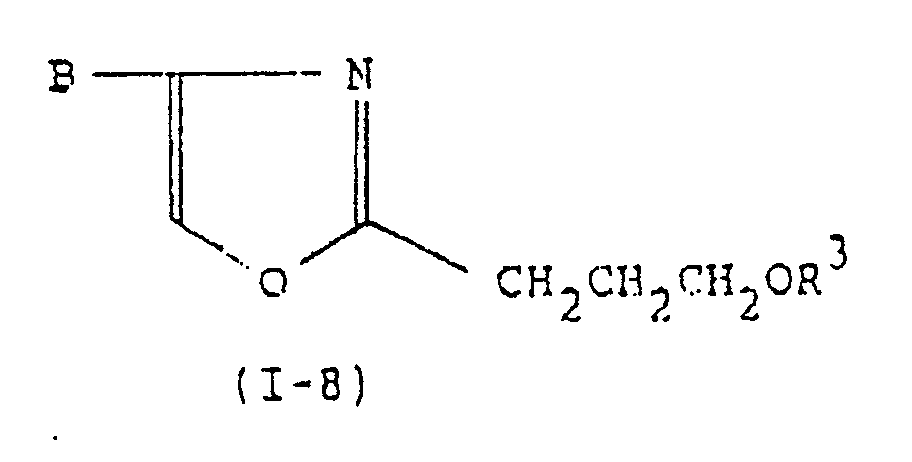
,wherein B, X and R³ are as defined above.
Applications Claiming Priority (2)
| Application Number | Priority Date | Filing Date | Title |
|---|---|---|---|
| JP2920389 | 1989-02-08 | ||
| JP29203/89 | 1989-02-08 |
Publications (1)
| Publication Number | Publication Date |
|---|---|
| EP0382199A1 true EP0382199A1 (en) | 1990-08-16 |
Family
ID=12269636
Family Applications (1)
| Application Number | Title | Priority Date | Filing Date |
|---|---|---|---|
| EP19900102435 Ceased EP0382199A1 (en) | 1989-02-08 | 1990-02-07 | Oxazole compounds and their use |
Country Status (3)
| Country | Link |
|---|---|
| EP (1) | EP0382199A1 (en) |
| JP (1) | JP2874779B2 (en) |
| CA (1) | CA2009470A1 (en) |
Cited By (9)
| Publication number | Priority date | Publication date | Assignee | Title |
|---|---|---|---|---|
| US5239080A (en) * | 1989-02-08 | 1993-08-24 | Takeda Chemical Industries, Ltd. | Oxazole compounds and their use as antidiabetic and bone-reduction inhibitory agents |
| US5371098A (en) * | 1990-02-01 | 1994-12-06 | Takeda Chemical Industries, Ltd. | Use of oxazole compounds to treat osteoporosis |
| WO1997036882A1 (en) * | 1996-04-03 | 1997-10-09 | Takeda Chemical Industries, Ltd. | Oxazole derivatives, their production and use |
| WO1998015274A1 (en) * | 1996-10-07 | 1998-04-16 | Eli Lilly And Company | Novel compounds useful as neuro-protective agents |
| WO1999058511A1 (en) * | 1998-05-12 | 1999-11-18 | American Home Products Corporation | Oxazole-aryl-carboxylic acids useful in the treatment of insulin resistance and hyperglycemia |
| US6448396B2 (en) | 1997-10-06 | 2002-09-10 | Eli Lilly And Company | Compounds useful as neuro-protective agents |
| US6472387B1 (en) | 1996-10-07 | 2002-10-29 | Eli Lilly And Company | Methods of using compounds as neuro-protective agents |
| US6699896B1 (en) | 1998-05-12 | 2004-03-02 | Wyeth | Oxazole-aryl-carboxylic acids useful in the treatment of insulin resistance and hyperglycemia |
| US8188291B2 (en) | 2006-12-27 | 2012-05-29 | Sanofi-Aventis | Heteroaryl-substituted carboxamides and their use as pharmaceuticals |
Families Citing this family (1)
| Publication number | Priority date | Publication date | Assignee | Title |
|---|---|---|---|---|
| AU4982293A (en) * | 1993-03-02 | 1994-09-26 | Fujisawa Pharmaceutical Co., Ltd. | Novel heterocyclic compound |
-
1990
- 1990-02-07 CA CA002009470A patent/CA2009470A1/en not_active Abandoned
- 1990-02-07 EP EP19900102435 patent/EP0382199A1/en not_active Ceased
- 1990-02-08 JP JP2029848A patent/JP2874779B2/en not_active Expired - Fee Related
Non-Patent Citations (4)
| Title |
|---|
| CHEMICAL ABSTRACTS, Vol. 73, No. 3, July 20, 1970, Columbus, Ohio, USA BROWN, KEVAN "Antiinflammatory Phenyl-2-Oxazolepropionic Acids" page 367, column 1, Abstract-No. 14 833t & S. African 68 01,726, 18 November 1969 * |
| CHEMICAL ABSTRACTS, Vol. 81, No. 17, October 28, 1974, Columbus, Ohio, USA MEYERS, A.I. et al. "Oxazolines. X. Synthesis of gamma-Butyrolactones" page 460, column 2, Abstract-No. 104 700s & J. Org. Chem. 1974, 39(18) 2783-7 * |
| CHEMICAL ABSTRACTS, Vol. 86, No. 21, May 23, 1977, Columbus, Ohio, USA LOCKENSGARD, JERROLD P. et al. "Preparation of 2-Oxazolines from Lactones" page 463, column 1, Abstract-No. 155 552f & J. Org. Chem. 1977, 42(8), 1467-8 * |
| CHEMICAL ABSTRACTS, Vol. 95, No. 13, September 28, 1981, Columbus, Ohio, USA WASSERMANN, HARRY H. "Activated Carboxylates from the Photooxygenation of Oxazoles. Application to the * |
Cited By (17)
| Publication number | Priority date | Publication date | Assignee | Title |
|---|---|---|---|---|
| US5239080A (en) * | 1989-02-08 | 1993-08-24 | Takeda Chemical Industries, Ltd. | Oxazole compounds and their use as antidiabetic and bone-reduction inhibitory agents |
| US5371098A (en) * | 1990-02-01 | 1994-12-06 | Takeda Chemical Industries, Ltd. | Use of oxazole compounds to treat osteoporosis |
| US6177452B1 (en) | 1996-04-03 | 2001-01-23 | Takeda Chemical Industries, Ltd. | Oxazole derivatives, their production and use |
| WO1997036882A1 (en) * | 1996-04-03 | 1997-10-09 | Takeda Chemical Industries, Ltd. | Oxazole derivatives, their production and use |
| US6472387B1 (en) | 1996-10-07 | 2002-10-29 | Eli Lilly And Company | Methods of using compounds as neuro-protective agents |
| AU721355B2 (en) * | 1996-10-07 | 2000-06-29 | Eli Lilly And Company | Novel compounds useful as neuro-protective agents |
| US6156748A (en) * | 1996-10-07 | 2000-12-05 | Eli Lilly And Company | Compounds useful as neuro-protective agents |
| US6166216A (en) * | 1996-10-07 | 2000-12-26 | Eli Lilly And Company | Compounds useful as neuro-protective agents |
| US6380213B1 (en) | 1996-10-07 | 2002-04-30 | Eli Lilly And Company | Compounds useful as neuro-protective agents |
| US6423709B1 (en) | 1996-10-07 | 2002-07-23 | Eli Lilly And Company | Methods of using novel compounds as neuro-protective agents |
| WO1998015274A1 (en) * | 1996-10-07 | 1998-04-16 | Eli Lilly And Company | Novel compounds useful as neuro-protective agents |
| US6579871B2 (en) | 1996-10-07 | 2003-06-17 | Eli Lilly And Company | Methods of using novel compounds as neuro-protective agents |
| US6448396B2 (en) | 1997-10-06 | 2002-09-10 | Eli Lilly And Company | Compounds useful as neuro-protective agents |
| WO1999058511A1 (en) * | 1998-05-12 | 1999-11-18 | American Home Products Corporation | Oxazole-aryl-carboxylic acids useful in the treatment of insulin resistance and hyperglycemia |
| US6699896B1 (en) | 1998-05-12 | 2004-03-02 | Wyeth | Oxazole-aryl-carboxylic acids useful in the treatment of insulin resistance and hyperglycemia |
| US7141672B2 (en) | 1998-05-12 | 2006-11-28 | Wyeth | Oxazole-aryl-carboxylic acids useful in the treatment of insulin resistance and hyperglycemia |
| US8188291B2 (en) | 2006-12-27 | 2012-05-29 | Sanofi-Aventis | Heteroaryl-substituted carboxamides and their use as pharmaceuticals |
Also Published As
| Publication number | Publication date |
|---|---|
| JP2874779B2 (en) | 1999-03-24 |
| CA2009470A1 (en) | 1990-08-08 |
| JPH02289556A (en) | 1990-11-29 |
Similar Documents
| Publication | Publication Date | Title |
|---|---|---|
| AU2004251830B2 (en) | Pyrido[2, 1-A]-isoquinoline derivatives as DPP-IV inhibitors | |
| US6310069B1 (en) | Heterocyclic compounds, process for their preparation and pharmaceutical compositions containing them and their use in the treatment of diabetes and related diseases | |
| NO313699B1 (en) | New heterocyclic compounds, their preparation, pharmaceutical compositions containing the compounds and intermediates for use in the preparation | |
| EP0674641A1 (en) | Pyrrolopyrimidines as crf antagonists | |
| AU2004212435A1 (en) | Process for preparing pyrrolotriazine kinase inhibitors | |
| US5239080A (en) | Oxazole compounds and their use as antidiabetic and bone-reduction inhibitory agents | |
| EP0382199A1 (en) | Oxazole compounds and their use | |
| JPS635035B2 (en) | ||
| KR19980703476A (en) | Pyrrolidinyl hydroxamic acid compound and its preparation method | |
| JP2690329B2 (en) | Isoxazole-β-carboline-derivative, process for producing the same and central nervous system agent containing the same | |
| JPH0825877B2 (en) | Ophthalmic composition | |
| JP3044055B2 (en) | 1,2-ethanediol derivatives and salts thereof | |
| US7057036B2 (en) | Pyrrolothiazine and pyrrolothiazepine compounds having serotonin-2 receptor antagonistic and alpha-1-blocking action | |
| EP0440183A1 (en) | Oxazole compounds, their production and use | |
| KR900002755B1 (en) | N- (pyrrole-1-yl) pyridinamine and its preparation method | |
| EP1299389B1 (en) | A process for preparing pyrazolopyrimidinone derivatives for the treatment of impotence | |
| JP3140155B2 (en) | N, N'-disubstituted amide derivatives | |
| AU616608B2 (en) | 4,5,6,7-tetrasubstituted benzoxazolones | |
| KR20000075642A (en) | Pyrrolothiazine and pyrrolothiazepine compounds having serotonin-2 receptor antagonistic and alpha 1-blocking action | |
| AU2001258896A1 (en) | A process for preparing pyrazolopyrimidinone derivatives for the treatment of impotence | |
| KR20010072408A (en) | N-Substituted Azabicycloheptane Derivatives, Production and Use Thereof | |
| US6624313B2 (en) | Process for preparing hydroxypyrrolidinyl ethylamine compounds useful as kappa agonists | |
| JP2024502364A (en) | Method for producing pyrrolopyridine derivatives | |
| JPH04356460A (en) | Optically active bicyclo(2,2,1)heptane-2,3-dicarboxylic acid derivative | |
| KR20010072407A (en) | N-Substituted Azabicycloheptane Derivatives, Production and Use Thereof |
Legal Events
| Date | Code | Title | Description |
|---|---|---|---|
| PUAI | Public reference made under article 153(3) epc to a published international application that has entered the european phase |
Free format text: ORIGINAL CODE: 0009012 |
|
| AK | Designated contracting states |
Kind code of ref document: A1 Designated state(s): AT BE CH DE DK ES FR GB GR IT LI LU NL SE |
|
| 17P | Request for examination filed |
Effective date: 19910102 |
|
| RAP3 | Party data changed (applicant data changed or rights of an application transferred) |
Owner name: TAKEDA CHEMICAL INDUSTRIES, LTD. |
|
| 17Q | First examination report despatched |
Effective date: 19930210 |
|
| STAA | Information on the status of an ep patent application or granted ep patent |
Free format text: STATUS: THE APPLICATION HAS BEEN REFUSED |
|
| 18R | Application refused |
Effective date: 19940306 |