EP0379940B1 - Glycidyl derivatives of 2,6-dibromo-3,5-dialkyl-4-hydroxybenzyl ethers - Google Patents
Glycidyl derivatives of 2,6-dibromo-3,5-dialkyl-4-hydroxybenzyl ethers Download PDFInfo
- Publication number
- EP0379940B1 EP0379940B1 EP90100860A EP90100860A EP0379940B1 EP 0379940 B1 EP0379940 B1 EP 0379940B1 EP 90100860 A EP90100860 A EP 90100860A EP 90100860 A EP90100860 A EP 90100860A EP 0379940 B1 EP0379940 B1 EP 0379940B1
- Authority
- EP
- European Patent Office
- Prior art keywords
- carbon atoms
- suitably
- group
- zero
- represented
- Prior art date
- Legal status (The legal status is an assumption and is not a legal conclusion. Google has not performed a legal analysis and makes no representation as to the accuracy of the status listed.)
- Expired - Lifetime
Links
- 0 C*(CC*(CC1)*C(C2CC2)C1(C)C1)CC1OC Chemical compound C*(CC*(CC1)*C(C2CC2)C1(C)C1)CC1OC 0.000 description 3
Classifications
-
- C—CHEMISTRY; METALLURGY
- C07—ORGANIC CHEMISTRY
- C07C—ACYCLIC OR CARBOCYCLIC COMPOUNDS
- C07C43/00—Ethers; Compounds having groups, groups or groups
- C07C43/02—Ethers
- C07C43/20—Ethers having an ether-oxygen atom bound to a carbon atom of a six-membered aromatic ring
- C07C43/23—Ethers having an ether-oxygen atom bound to a carbon atom of a six-membered aromatic ring containing hydroxy or O-metal groups
-
- C—CHEMISTRY; METALLURGY
- C07—ORGANIC CHEMISTRY
- C07D—HETEROCYCLIC COMPOUNDS
- C07D303/00—Compounds containing three-membered rings having one oxygen atom as the only ring hetero atom
- C07D303/02—Compounds containing oxirane rings
- C07D303/12—Compounds containing oxirane rings with hydrocarbon radicals, substituted by singly or doubly bound oxygen atoms
- C07D303/18—Compounds containing oxirane rings with hydrocarbon radicals, substituted by singly or doubly bound oxygen atoms by etherified hydroxyl radicals
- C07D303/20—Ethers with hydroxy compounds containing no oxirane rings
- C07D303/22—Ethers with hydroxy compounds containing no oxirane rings with monohydroxy compounds
- C07D303/23—Oxiranylmethyl ethers of compounds having one hydroxy group bound to a six-membered aromatic ring, the oxiranylmethyl radical not being further substituted, i.e.
-
- C—CHEMISTRY; METALLURGY
- C08—ORGANIC MACROMOLECULAR COMPOUNDS; THEIR PREPARATION OR CHEMICAL WORKING-UP; COMPOSITIONS BASED THEREON
- C08G—MACROMOLECULAR COMPOUNDS OBTAINED OTHERWISE THAN BY REACTIONS ONLY INVOLVING UNSATURATED CARBON-TO-CARBON BONDS
- C08G59/00—Polycondensates containing more than one epoxy group per molecule; Macromolecules obtained by polymerising compounds containing more than one epoxy group per molecule using curing agents or catalysts which react with the epoxy groups
- C08G59/02—Polycondensates containing more than one epoxy group per molecule
- C08G59/04—Polycondensates containing more than one epoxy group per molecule of polyhydroxy compounds with epihalohydrins or precursors thereof
- C08G59/06—Polycondensates containing more than one epoxy group per molecule of polyhydroxy compounds with epihalohydrins or precursors thereof of polyhydric phenols
- C08G59/066—Polycondensates containing more than one epoxy group per molecule of polyhydroxy compounds with epihalohydrins or precursors thereof of polyhydric phenols with chain extension or advancing agents
-
- C—CHEMISTRY; METALLURGY
- C08—ORGANIC MACROMOLECULAR COMPOUNDS; THEIR PREPARATION OR CHEMICAL WORKING-UP; COMPOSITIONS BASED THEREON
- C08G—MACROMOLECULAR COMPOUNDS OBTAINED OTHERWISE THAN BY REACTIONS ONLY INVOLVING UNSATURATED CARBON-TO-CARBON BONDS
- C08G59/00—Polycondensates containing more than one epoxy group per molecule; Macromolecules obtained by polymerising compounds containing more than one epoxy group per molecule using curing agents or catalysts which react with the epoxy groups
- C08G59/18—Macromolecules obtained by polymerising compounds containing more than one epoxy group per molecule using curing agents or catalysts which react with the epoxy groups ; e.g. general methods of curing
- C08G59/20—Macromolecules obtained by polymerising compounds containing more than one epoxy group per molecule using curing agents or catalysts which react with the epoxy groups ; e.g. general methods of curing characterised by the epoxy compounds used
- C08G59/22—Di-epoxy compounds
- C08G59/30—Di-epoxy compounds containing atoms other than carbon, hydrogen, oxygen and nitrogen
Definitions
- the present invention concerns derivatives of 2,6-dibromo-3,5-dialkyl-4-hydroxybenzyl ether such as epoxy resins prepared therefrom and other reaction products of 2,6-dibromo-3,5-dialkyl-4-hydroxybenzyl ethers.
- the present invention also concerns cured products thereof.
- EP-A-0 334 195 which constitutes prior art pursuant to Article 54(3) and (4) EPC refers to the hydrolysis of 4-halomethyl-3,5-dihalo-2,6-dialkylphenol by contact with water to form a 4-hydroxymethyl-3,5-dihalo-2,6-dialkylphenol under conditions to minimize formation of the corresponding bis-(4-hydroxy-3,5-dialkyl-2,6-dihalobenzyl)ether.
- EP-A-0 214 722 discloses ring-brominated derivatives of tetraalkyl dihydroxy diaromatic compounds which are prepared by contacting a tetraalkyl dihydroxydiaromatic compound with a brominating agent in the presence of a reaction medium.
- halogenated aromatic epoxy resins are known wherein the halogen atoms are in the meta position with respect to the glycidyl ether groups attached to an aromatic ring.
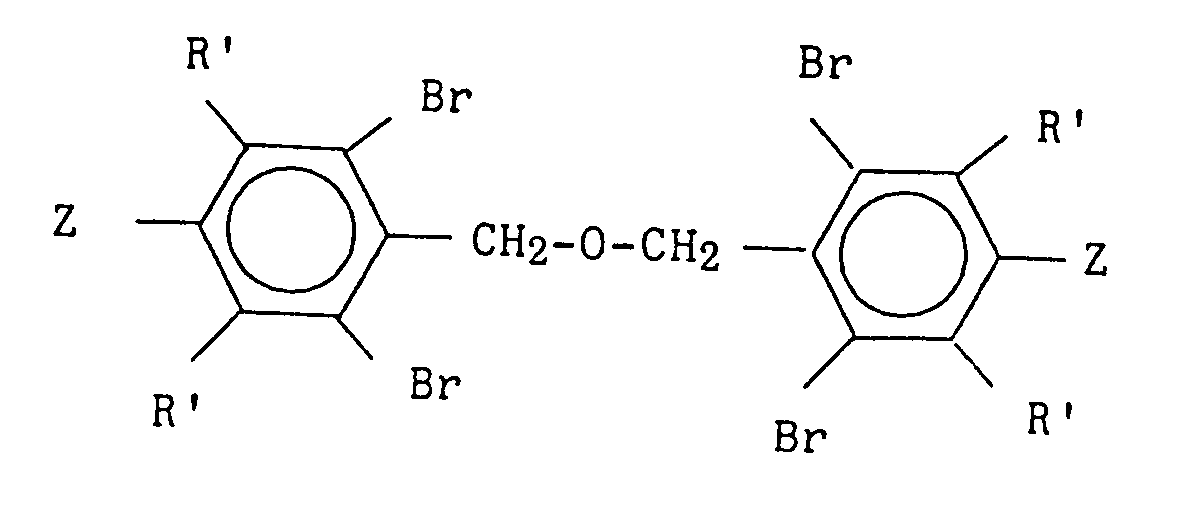
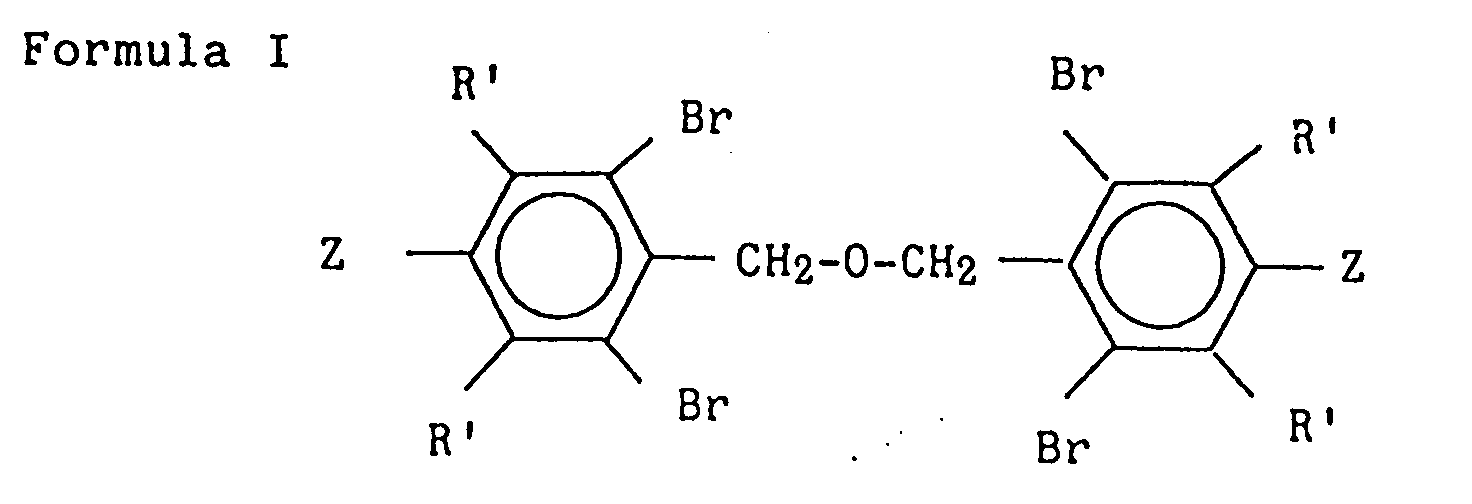
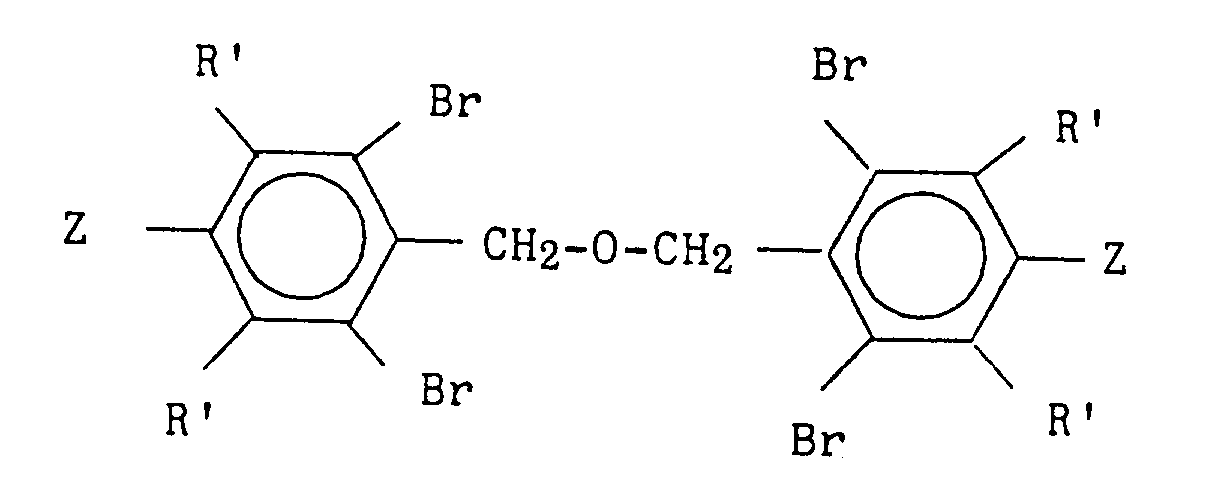
- One aspect of the present invention pertains to a diglycidyl ether of 2,6-dibromo-3,5 dialkyl-4-hydroxybenzyl ether or a mixture of any two or more of such diglycidyl ethers represented by the following formula I: wherein each R' is independently an alkyl group having from 1 to 10 carbon atoms and each Z is a glycidyl ether group represented by the following formula XIX: wherein each R is independently hydrogen or a lower alkyl group having from 1 to 3 carbon atoms.
- Another aspect of the present invention pertains to a process for preparation of a diglycidyl ether of 2,6-dibromo-3,5-dialkyl-4-hydroxybenzyl ether of formula I as defined in Claim 1 comprising:
- Another aspect of the present invention pertains to a mixture comprising
- Another aspect of the present invention pertains to an advanced resin produced by reacting in presence of a suitable advancement catalyst
- Another aspect of the present invention pertains to a process for preparing phenolic hydroxyl containing compounds represented by the formulas VII, VIII, IX, X or XI: wherein each A is independently a divalent hydrocarbyl group having from 1 to 12 carbon atoms; each A' is independently a divalent hydrocarbyl group having from 1 to 10 carbon atoms; each Q is independently hydrogen or an alkyl group having from 1 to 4 carbon atoms; each R is independently hydrogen or an alkyl group having from 1 to 3 carbon atoms; each X is independently hydrogen, a hydrocarbyl or hydrocarbyloxy group having from 1 to 12 carbon atoms or a halogen atom; each Y is independently hydrogen or a group represented by the following formula XII: wherein R' is an alkyl group having from 1 to 10 carbon atoms with the proviso that at least one Y group is a group represented by the aforementioned formula XII; m has an average value from 0.01 to 8; m'
- Another aspect of the present invention pertains to curable compositions comprising one or more diglycidyl ethers of 2,6-dibromo-3,5-dialkyl-4-hydroxybenzyl ethers and a curing amount of one or more suitable curing agents or curing catalysts and the products resulting from curing such curable compositions.
- curable compositions comprising mixtures of at least one diglycidyl ether of a 2,6-dibromo-3,5-dialkyl-4-hydroxybenzyl ether and at least one different epoxy resin having an average of more than one vicinal epoxide group per molecule and a curing amount of one or more suitable curing agents or curing catalysts therefor as well as the products resulting from curing such curable compositions. product to the glycidyl ether with one or more suitable curing agents.
- the 2,6-dibromo-3,5-dialkyl-4-hydroxybenzyl ethers are prepared by hydrolyzing 4-bromomethyl-3,5-dibromo-2,6-dialkylphenol with water in the presence of one or more suitable solvent(s) at a temperature from 30°C to 100°C, suitably from 45°C to 90°C, more suitably from 60°C to 70°C for a time sufficient to complete the reaction, suitably from 1 to 10, more suitably from 2 to 8, most suitably from 3 to 6 hours.
- suitable solvent(s) at a temperature from 30°C to 100°C, suitably from 45°C to 90°C, more suitably from 60°C to 70°C for a time sufficient to complete the reaction, suitably from 1 to 10, more suitably from 2 to 8, most suitably from 3 to 6 hours.
- suitable solvent(s) at a temperature from 30°C to 100°C, suitably from 45°C to 90°C, more suitably from 60°C to 70°C for a time
- the reactants are suitably employed in quantities which provide a weight ratio of water to 4-bromomethyl-3,5-dibromo-2,6-dialkylphenol suitably from 0.1:1 to 1:1, more suitably from 0.2:1 to 0.8:1, most suitably from 0.5:1 to 0.7:1. At ratios below 0.1:1, the reaction is very slow. At ratios above 1:1, the main product is 3,5-dibromo-4-hydroxymethyl-2,6-dialkyl phenol rather than the desired 2,6-dibromo-3,5-dialkyl-4-hydroxybenzyl ether.
- Suitable solvents which can be employed in the preparation of 2,6-dibromo-3,5-dialkyl-4-hydroxybenzyl ether include, for example, aliphatic ketones, aliphatic carboxylic acids, polar aprotic solvents, ethers, glycol ethers, water and combinations thereof.
- Particularly suitable such solvents include, for example, acetone, methyl ethyl ketone, methyl isobutyl ketone, cyclohexanone, acetic acid, dimethyl formamide, dimethyl acetamide, dimethyl sulfoxide, N-methylpyrrolidone, 2-methoxyethyl acetate, ethylene glycol dimethyl ether, dioxane, tetrahydrofuran and combinations thereof.
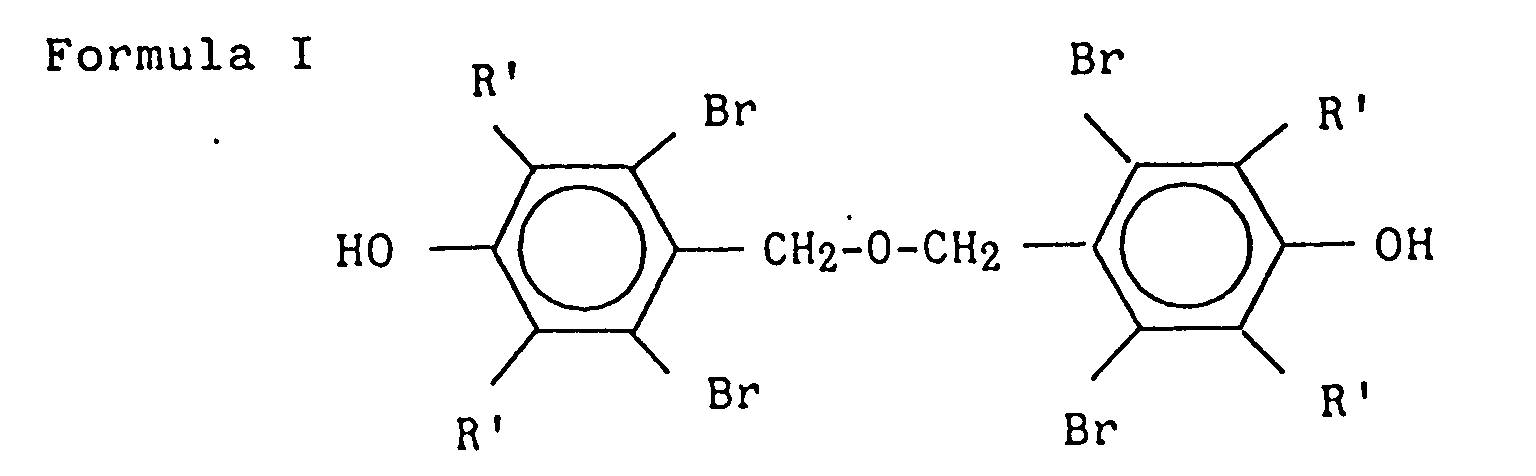
- the 2,6-dibromo-3,5-dialkyl-4-hydroxybenzyl ethers employed in the present invention are represented by the following formula I: wherein each R' is independently an alkyl group having from 1 to 10, more suitably from 1 to 6, most suitably from 1 to 3 carbon atoms and each Z is a hydroxyl group.
- the diglycidyl ethers of 2,6-dibromo-3,5-dialkyl-4-hydroxybenzyl ethers are prepared by reacting the corresponding 2,6-dibromo-3,5-dialkyl-4-hydroxybenzyl ethers with an excess of an epihalohydrin such as, for example, epichlorohydrin, epibromohydrin or epiiodohydrin or lower alkyl derivatives thereof in the presence of a suitable catalyst and dehydrohalogenating the resulting halohydrin product with a basic acting compound.
- an epihalohydrin such as, for example, epichlorohydrin, epibromohydrin or epiiodohydrin or lower alkyl derivatives thereof in the presence of a suitable catalyst and dehydrohalogenating the resulting halohydrin product with a basic acting compound.
- Suitable methods used herein for preparing the diglycidyl ethers of 2,6-dibromo-3,5-dialkyl-4-hydroxybenzyl ethers are more fully disclosed by Wang et al. in U.S. Patent no. 4,585,838, by Chang et al. in U.S. Patent No. 4,582,892, by Wang et al. in U.S. Patent No. 4,499,255, and by Wang et al. in U.S. Patent No. 4,778,863.
- the diglycidyl ethers of 2,6-dibromo-3,5-dialkyl-4-hydroxybenzyl ethers can be represented by the aforementioned formula I wherein each Z is a glycidyl ether group represented by the following formula XIX: wherein each R is independently hydrogen or a lower alkyl group having from 1 to 3 carbon atoms.
- One or more of the diglycidyl ethers of 2,6-dibromo-3,5-dimethyl-4-hydroxybenzyl ethers of the present invention can be mixed with one or more other epoxy resins which are different from the diglycidyl ethers of 2,6-dibromo-3,5-dimethyl-4-hydroxybenzyl ethers of the present invention.
- the mixture can contain suitably from 1 to 99, more suitably from 5 to 50, most suitably from 10 to 25 percent by weight of the diglycidyl ethers of 2,6-dibromo-3,5-dimethyl-4-hydroxybenzyl ethers of the present invention and suitably from 99 to 1, more suitably from 95 to 50, most suitably from 90 to 75 percent by weight of the other epoxy resin(s); the weights being based upon the combined weight of all of the epoxy resins present in the mixture.
- Suitable epoxy resins which can be blended with the diglycidyl ethers of 2,6-dibromo-3,5-dimethyl-4-hydroxybenzyl ethers of the present invention include, for example, the di- or polyglycidyl ethers of a compound having two or more aliphatic or aromatic hydroxyl groups per molecule, such as dihydric phenols, alkyl or alkoxy or halogen substituted dihydric phenols, bisphenols, alkyl or alkoxy or halogen substituted bisphenols, trisphenols, alkyl or alkoxy or halogen substituted trisphenols, phenol-aldehyde novolac resins, alkyl or alkoxy or halogen substituted phenol-aldehyde novolac resins, glycols, polyglycols, reaction products of an alkylene oxide such as ethylene oxide, propylene oxide or butylene oxide with a compound containing two or more aromatic hydroxyl groups per molecule and combinations
- Particularly suitable epoxy resins which can be blended with the diglycidyl ethers of 2,6-dibromo-3,5-dimethyl-4-hydroxybenzyl ethers of the present invention include, for example, those epoxy resins described by Hefner, Jr. in U.S. Patent No. 4,668,745 and by Wang et al. in U.S. Patent No. 4,684,701.
- epoxy resins which can be blended with the diglycidyl ethers of 2,6-dibromo-3,5-dimethyl-4-hydroxybenzyl ethers include, for example, the diglycidyl ethers of resorcinol, hydroquinone, catechol, dihydroxybiphenyl, bisphenol A, bisphenol F, bisphenol K, bisphenol S and the polyglycidyl ethers of phenol-formaldehyde novolac resins, cresol-formaldehyde novolac resins and combinations thereof.
- epoxy resins used for blending with the diglycidyl ether of 2,6-dibromo-3,5-dimethyl-4-hydroxybenzyl ethers of the present invention include, for example, the halogenated, particularly the brominated, derivatives of the diglycidyl ethers and polyglycidyl ethers enumerated above.
- the advancement reaction can be conducted in the presence of a suitable advancement catalyst, for example, phosphines, quaternary ammonium compounds, phosphonium compounds and tertiary amines.
- a suitable advancement catalyst for example, phosphines, quaternary ammonium compounds, phosphonium compounds and tertiary amines.
- Particularly suitable advancement catalysts used herein include, for example, ethyltriphenylphosphonium chloride, ethyltriphenylphosphonium bromide, ethyltriphenylphosphonium iodide, ethyltriphenylphosphonium diacetate (ethyltriphenylphosphonium acetate ⁇ acetic acid complex), ethyltriphenylphosphonium phosphate, tetrabutylphosphonium chloride, tetrabutylphosphonium bromide, tetrabutylphosphonium iodide, te
- the amount of advancement catalyst employed herein depends, of course, upon the particular reactants and advancement catalyst employed; however, the advancement catalyst is usually employed in quantities of from 0.03 to 3, preferably from 0.3 to 1.5, most preferably from 0.05 to 1.5 percent by weight based upon the weight of the epoxy-containing compound.
- the advancement catalyst can, if desired, be employed in a solvent.
- the advancement reaction can be conducted in the presence of a solvent.
- solvents employed herein include, for example, alcohols, ketones, glycol ethers, aliphatic and aromatic hydrocarbons, halogenated aliphatic hydrocarbons, glycols, polyglycols, cyclic or acyclic ethers and combinations thereof.
- solvents employed herein include, methanol, ethanol, isopropanol, acetone methyl ethyl ketone, methyl isobutyl ketone, hexane, heptane, octane, nonane, decane, benzene, toluene, xylene, propylene glycol methyl ether, dipropylene glycol methyl ether, ethylene glycol n-butyl ether, propanol, n-butanol, polyoxyethylene glycol, dioxane and combinations thereof.
- reaction products of 2,6-dibromo-3,5-dialkyl-4-hydroxybenzyl ether and a phenolic hydroxylcontaining compound as defined above are prepared by conducting the reaction at a temperature suitably from 50°C to 150°C, more suitably from 60°C to 120°C, most suitably from 70°C to 90°C for a time sufficient to complete the reaction, suitably from 2 to 12, more suitably from 3 to 10, most suitably from 4 to 8 hours.
- the lower temperatures require longer reaction times whereas the higher temperatures require shorter reaction times.
- temperatures below 50°C the reaction proceeds very slowly.
- splitting of 2,6-dimethyl-3,5-dibromophenol will occur.
- the reactants are suitably employed in quantities which provide a ratio of phenolic hydroxyl groups from the 2,6-dibromo-3,5-dialkyl-4-hydroxybenzyl ether to aromatic rings from the phenolic hydroxyl-containing compound suitably from 0.05:1 to 0.5:1, more suitably from 0.05:1 to 0.3:1, most suitably from 0.05:1 to 0.2:1. At ratios below 0.05:1, there is not enough bromine introduced into the system to achieve fire retardancy. At ratios above 0.5:1, a very high molecular weight product will form.
- hydrocarbyl as employed herein means any aliphatic, cycloaliphatic, aromatic, aryl substituted aliphatic or cycloaliphatic, or aliphatic or cycloaliphatic substituted aromatic group.
- hydrocarbyloxy means a hydrocarbyl group having an oxygen linkage between it and the element to which it is attached.
- divalent hydrocarbyl group refers to the aforementioned hydrocarbyl group minus an additional hydrogen atom.
- the diglycidyl ether of 2,6-dibromo-3,5-dialkyl-4-hydroxybenzyl ether can, if desired, be blended with other epoxy resins such as those which are represented by the aforementioned formulas II-VI wherein the aromatic hydroxyl groups have been replaced with glycidyl ether groups.
- reaction products of 2,6-dibromo-3,5-dialkyl-4-hydroxybenzyl ether with the phenolic hydroxyl-containing compounds as defined above can be represented by the following formulas VII, VIII, IX, X and XI: wherein each A is independently a divalent hydrocarbyl group having suitably from 1 to 12, more suitably from 1 to 6, most suitably from 1 to 4 carbon atoms; each A′ is independently a divalent hydrocarbyl group having from 1 to 10, more suitably from 1 to 4, most suitably from 1 to 2 carbon atoms; each Q is independently hydrogen or an alkyl group having from 1 to 4 carbon atoms; each R is independently hydrogen or an alkyl group having from 1 to 3 carbon atoms; each X is independently hydrogen, a hydrocarbyl or hydrocarbyloxy group having suitably from 1 to 12, more suitably from 1 to 6, most suitably from 1 to 4 carbon atoms or a halogen atom, preferably chlorine or bromine; each Y is independently hydrogen or a group
- the epoxy resins prepared by reacting the product resulting from reacting the 2,6-dibromo-3,5-dialkyl-4-hydroxybenzyl ethers with phenolic hydroxyl-containing compounds having an average of more than one phenolic hydroxyl group per molecule with an epihalohydrin and converting the intermediate halohydrin product to the glycidyl ether can be represented by the following formulas XIII, XIV, XV, XVI and XVII: wherein each A is independently a divalent hydrocarbyl group having suitably from 1 to 12, more suitably from 1 to 6, most suitably from 1 to 4 carbon atoms; each A′ is independently a divalent hydrocarbyl group having from 1 to 10, more suitably from 1 to 4, most suitably from 1 to 2 carbon atoms; each Q is independently hydrogen or an alkyl group having from 1 to 4 carbon atoms; each R is independently hydrogen or an alkyl group having from 1 to 3 carbon atoms; each X is independently hydrogen, a
- the epoxy resins of the present invention can be cured with any suitable curing agent for epoxy resins including, for example, primary and secondary aliphatic and aromatic polyamines, carboxylic acids and anhydrides thereof, phenolic hydroxyl-containing compounds having an average of two or more phenolic hydroxyl groups per molecule, guanidines, biguanides, urea-aldehyde resins, melamine-aldehyde resins, alkoxylated urea-aldehyde resins, alkoxylated melamine-aldehyde resins, phenol- or substituted phenol-aldehyde novolac resins and combinations thereof.
- suitable curing agent for epoxy resins including, for example, primary and secondary aliphatic and aromatic polyamines, carboxylic acids and anhydrides thereof, phenolic hydroxyl-containing compounds having an average of two or more phenolic hydroxyl groups per molecule, guanidines, biguanides, urea-aldehyde
- Particularly suitable curing agents employed herein include, for example, bis-(4-aminophenyl)sulfone, dicyandiamide, m-phenylenediamine, bis-(4-aminophenyl)methane, phthalic anhydride, maleic anhydride, phenol-formaldehyde novolac resins, cresol-formaldehyde novolac resins and combinations thereof.
- the curing agents are employed herein in an amount which will effectively cure the composition containing the epoxy resin.
- curing agent employed herein will depend upon the particular modified epoxy resin and curing agent employed; however, suitable curing agent amounts include, for example, from 0.0001 to 1, more suitably from 0.001 to 1, most suitably from 0.01 to 1 equivalents of curing agent per epoxide equivalent for those curing agents which cure by reacting with the epoxy group of the epoxy resin or per hydroxyl group for those curing agents which cure by reacting with the aliphatic hydroxyl groups along the backbone of the epoxy resin.
- the Handbook of Epoxy Resins by Lee and Neville, McGraw-Hill, 1967 contains various discussions concerning the curing of epoxy resins as well as a compilation of suitable curing agents.
- the epoxy resins of the present invention can be blended with other materials or additives such as solvents or diluents, fillers, pigments, dyes, flow modifiers, thickeners, reinforcing agents, wetting agents, leveling agents, flame retardant agents, plasticizers, mold releasing agents and extenders.
- the materials or additives are added in functionally equivalent amounts, e.g., the pigments and/or dyes are added in quantities which will provide the composition with the desired color; however, the pigments and/or dyes are suitably employed herein in amounts of from 0.1 to 10, more suitably from 0.1 to 1, most suitably from 0.2 to 0.5 percent by weight based upon the weight of the total formulation.
- the total formulation consists of epoxy resin(s), curing agent(s), filler(s), pigment(s), accelerator(s) and additives.
- modifiers such as thickeners and flow modifiers can be suitably employed herein in amounts of from 0.1 to 10, more suitably from 0.1 to 1, most suitably from 0.1 to 0.5 percent by weight based upon the weight of the total formulation.
- the fillers can be employed herein in amounts suitably from 1 to 95, more suitably from 10 to 90, most suitably from 50 to 80 percent by weight based upon the weight of the total formulation.
- the meta halogenated phenolic hydroxyl-containing compositions of the present invention can be employed to cure the epoxy resins of the present invention or other epoxy resins or combinations thereof.
- the epoxy resins of the present invention can be employed in the preparation of compositions suitable for such applications as coatings, castings, moldings, encapsulants, laminates, composites and potting compounds.
- the water was removed by codistilling with epichlorohydrin and solvent.
- the distillate was condensed, thereby forming two distinct phases, an aqueous phase (top) and an organic epichlorohydrin solvent phase (bottom).
- the organic phase was continuously returned to the reactor.
- the reaction mixture was maintained at a temperature of 55°C and a pressure of 105 mm Hg absolute for an additional 30 minutes.
- the resulting glycidyl ether was distilled under full vacuum and at a temperature of up to 160°C to generally remove all unreacted epichlorohydrin and 1-methoxy-2-hydroxypropane.
- the molten glycidyl ether product was diluted to 50 percent resin concentration with a 75/25 methyl ethyl ketone/toluene solvent mixture.
- the mixture was heated to 85°C for 2 hours with 0.7 g of 45 percent aqueous potassium hydroxide.
- the reaction mixture was further diluted to 20 percent resin concentration with a 75/25 methyl ethyl ketone/toluene solvent mixture, and the thus diluted product was washed with deionized water several times to remove salt.
- the organic phase from the water washes was placed on a rotary evaporator under a vacuum and at a temperature of 160°C to remove the solvent.
- the resulting polyglycidyl ether had an epoxide content of 20.83 percent and contained 7.28 percent bromine, and had a Mettler softening point of 80°C.
- This epoxy resin was particularly suitable for use in electronic encapsulation formulations.
- the organic phase from the water washes was placed on a rotary evaporator under a full vacuum at 160°C to remove the solvent.
- a yellow, solid resin having a Mettler softening point of 79°C, an EEW of 242, a viscosity of 227 centistokes (227 x 10 -6 m 2 /s) at 150°C containing 642 ppm of total aliphatic chloride and 7.5 percent bromine was obtained.
- reaction mixture was maintained at a temperature of 45°C and a pressure of 65 mm Hg absolute for an additional one hour.
- the diglycidyl ether of 2,6-dibromo-3,5-dimethyl-4-hydroxybenzyl ether was not soluble in the organic solvent and precipitated from the reaction mixture. It was filtered from the reaction mixture and redissolved in methylene chloride. The methylene chloride solution was washed several times with deionized water to remove the residual sodium chloride. The organic phase from the water washes was placed in a vacuum oven under a vacuum at 160°C to remove solvent completely. 210 g of yellowish white solid was obtained.
- Epoxy Resin I is a cresol epoxy novolac resin having an epoxide equivalent weight (eq. wt.) of about 195 and a viscosity of about 420 centistokes at 150°C, commercially available from The Dow Chemical Company as QUATREXTM 3430.
- Epoxy Resin II is as listed in Table I.
- the control epoxy resin is a solid, generally ortho-brominated epoxy resin having an epoxide equivalent weight (eq. wt.) of about 465, a viscosity of about 200 centistokes at 150°C, and a bromine content of 47.6 percent by weight, commercially available from The Dow Chemical Company as QUATREXTM 6410.
- the curing agent is a phenol-formaldehyde novolac resin with an average hydroxyl functionality of 6 and a phenolic hydroxyl equiv. wt. of about 104 commercially available from Schenectady Chemical as HRJ-2210.
- the fused silica is GP-7I commercially available from Harbison-Walker Corporation.
- the mold release agents are refined Montan waxes commercially available from Hoechst as OP and E. A 1:1 mixture by weight of OP to E was used in the present invention.
- the carbon black is Lampblack 101 commercially available from Degussa Corporation.
- the epoxy silane is Z-6040 commercially available from Dow Corning Corporation.
- the device testing was determined by a highly accelerated stress test, which involves the following conditions: 121°C, 15 psig steam, and 25 volts bias.
- the device was a 14-pin LM 324 quad operational amplifier with a single passivation layer.
- the percentage of devices that fail as a function of time are given in the following Table II.
Landscapes
- Chemical & Material Sciences (AREA)
- Organic Chemistry (AREA)
- Health & Medical Sciences (AREA)
- Chemical Kinetics & Catalysis (AREA)
- Medicinal Chemistry (AREA)
- Polymers & Plastics (AREA)
- Epoxy Resins (AREA)
- Epoxy Compounds (AREA)
- Compositions Of Macromolecular Compounds (AREA)
- Organic Low-Molecular-Weight Compounds And Preparation Thereof (AREA)
- Pharmaceuticals Containing Other Organic And Inorganic Compounds (AREA)
Abstract
Description
- The present invention concerns derivatives of 2,6-dibromo-3,5-dialkyl-4-hydroxybenzyl ether such as epoxy resins prepared therefrom and other reaction products of 2,6-dibromo-3,5-dialkyl-4-hydroxybenzyl ethers. The present invention also concerns cured products thereof.
- One of the most frequent failures encountered in encapsulated micro devices is the so-called open circuit which results from a break of the bonding wire between the circuitry. The breakage is primarily due to corrosion. This corrosion is initiated by the impurities in epoxy resins, such as halogen, which upon exposure to heat and moisture generate a corrosive acid.
- Since the introduction of the low chloride epoxy resins, the wire bond failure due to the chloride impurities in the resin has become much less prominent than that due to the bromine from the fire retardant in the encapsulation formulation. Water extracts of molding compounds after high temperature storage have been found to contain bromide ion levels directly proportional to the bromine content in the molding compounds. A direct relationship between failure rate and bromine content in the molding compound has also been established.
- EP-A-0 334 195 which constitutes prior art pursuant to Article 54(3) and (4) EPC refers to the hydrolysis of 4-halomethyl-3,5-dihalo-2,6-dialkylphenol by contact with water to form a 4-hydroxymethyl-3,5-dihalo-2,6-dialkylphenol under conditions to minimize formation of the corresponding bis-(4-hydroxy-3,5-dialkyl-2,6-dihalobenzyl)ether.
- EP-A-0 214 722 discloses ring-brominated derivatives of tetraalkyl dihydroxy diaromatic compounds which are prepared by contacting a tetraalkyl dihydroxydiaromatic compound with a brominating agent in the presence of a reaction medium.
- From US-A-4,727,119 halogenated aromatic epoxy resins are known wherein the halogen atoms are in the meta position with respect to the glycidyl ether groups attached to an aromatic ring.
- It would therefore be desirable to have available epoxy resins which, when employed in curable formulations, would have good thermal and hydrolytic stability to the molding formulation while providing fire retardancy properties.
- One aspect of the present invention pertains to a diglycidyl ether of 2,6-dibromo-3,5 dialkyl-4-hydroxybenzyl ether or a mixture of any two or more of such diglycidyl ethers represented by the following formula I:wherein each R' is independently an alkyl group having from 1 to 10 carbon atoms and each Z is a glycidyl ether group represented by the following formula XIX:
 wherein each R is independently hydrogen or a lower alkyl group having from 1 to 3 carbon atoms.
- Another aspect of the present invention pertains to a process for preparation of a diglycidyl ether of 2,6-dibromo-3,5-dialkyl-4-hydroxybenzyl ether of formula I as defined in Claim 1 comprising:
- a) hydrolyzing a 4-bromomethyl-3,5-dibromo-2,6-dialkylphenol with water in the presence of one or more solvent(s) at a temperature from 30°C to 100°C whereby the reactants are employed in quantities which provide a weight ratio of water to 4-bromomethyl-3,5-dibromo-2,6-dialkylphenol from 0.1:1 to 1:1.
- b) reacting the 2,6-dibromo-3,5-dialkyl-4-hydroxybenzyl ether
of step a) represented by the following formula
wherein each R' is in dependently an alkyl group having from 1 to 10, more suitably from 1 to 6, most suitably from 1 to 3 carbon atoms and each Z is a hydroxyl group with an excess of an epihalohydrin in the presence of a suitable catalyst and dehydrohalogenating the resulting halohydrin product with a basic acting compound.
-
- Another aspect of the present invention pertains to a mixture comprising
- (A) one or more diglycidyl ethers of 2,6-dibromo-3,5-dialkyl-4-hydroxybenzyl
ethers
or a mixture of any two or more of such
diglycidyl ethers represented by the
following formula I:
wherein each R' is independently an alkyl group having from 1 to 10 carbon atoms and each Z is a glycidyl ether group represented by the following formula XIX:
 wherein each R is independently hydrogen or a lower alkyl group having from 1 to 3 carbon atoms; and
- (B) one or more epoxy resins having an average of
more than one vicinal epoxy groups per molecule
and which are different from the epoxy resins
of component A; and
wherein component (A) is present in an amount of from 1 to 99 percent by weight based on the combined weight of components (A) and (B) and component (B) is present in an amount of from 99 to 1 percent by weight based on the combined weight of components (A) and (B). -
- Another aspect of the present invention pertains to an advanced resin produced by reacting in presence of a suitable advancement catalyst
- (A) a 2,6-dibromo-3,5-dialkyl-4-hydroxybenzyl
ether or a mixture of any two or more of
such ethers represented by the following
formula I:
wherein each R' is independently an alkyl group having from 1 to 3 carbon atoms; and
- (B) one or more compounds having an average of
more than one glycidyl ether group per
molecule represented by the following
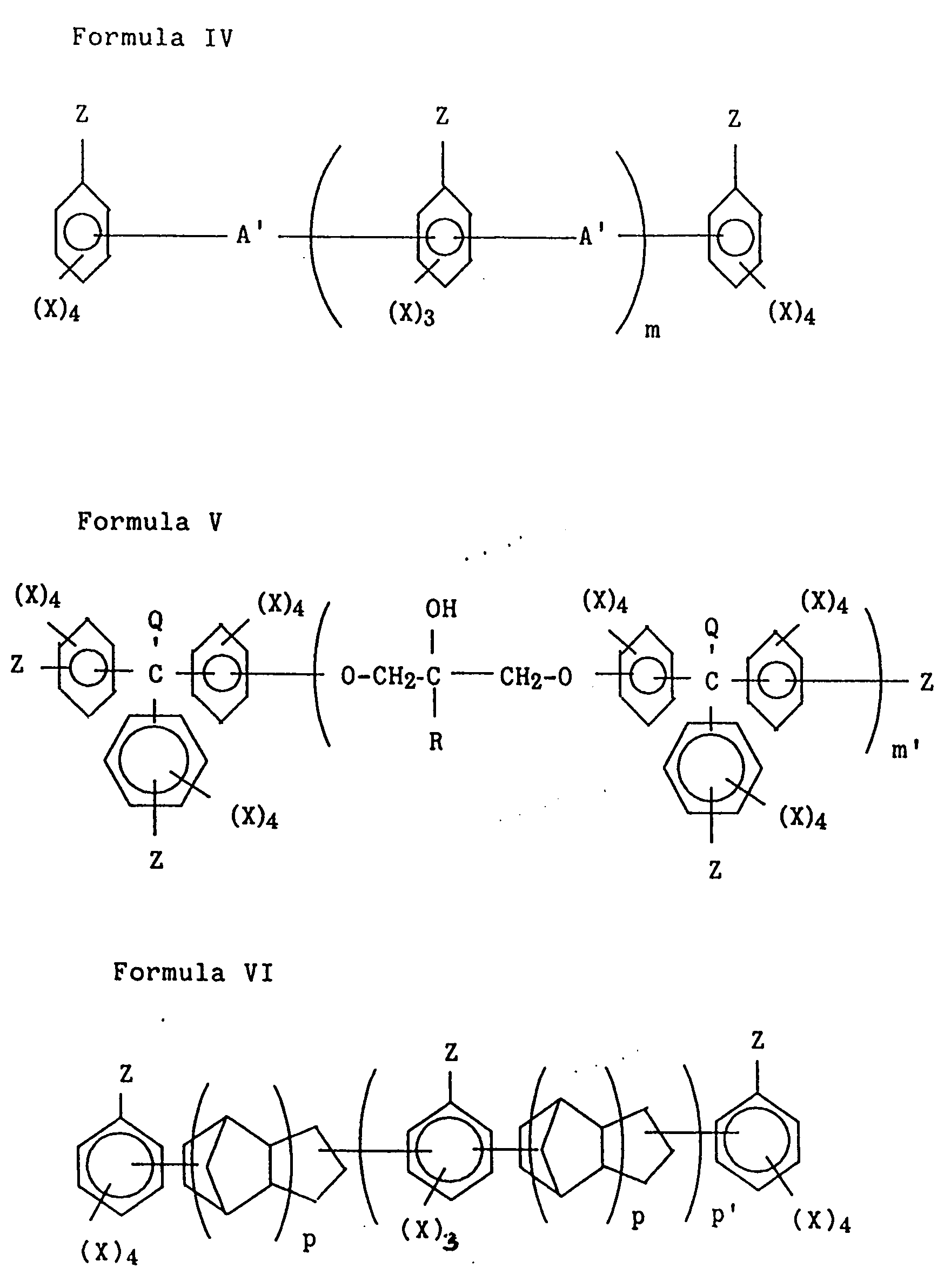
formulas I, II, III, IV, V or VI:
 wherein each A is independently a divalent hydrocarbyl group having from 1 to 12 carbon atoms; each A' is independently a divalent hydrocarbyl group having from 1 to 10 carbon atoms; each Q is independently hydrogen or an alkyl group having from 1 to 4 carbon atoms; each R is independently hydrogen or an alkyl group having from 1 to 3 carbon atoms; each X is independently hydrogen, a hydrocarbyl or hydrocarbyloxy group having from 1 to 12 carbon atoms or a halogen atom; Z is a glycidyl ether group represented by the following formula XIX:
 wherein each R is independently hydrogen or a lower alkyl group having from 1 to 3 carbon atoms; m has an average value from 0.01 to 8; m' has an average value from zero to 10; n has a value of zero or 1; n' has an average value from zero to 3; each p has a value from zero to 10; and each p' has an average value from zero to 8;
and wherein components (A) and (B) are employed in quantities which provide a ratio of phenolic hydroxyl groups per epoxy group of from 0.05:1 to 0.5:1. -
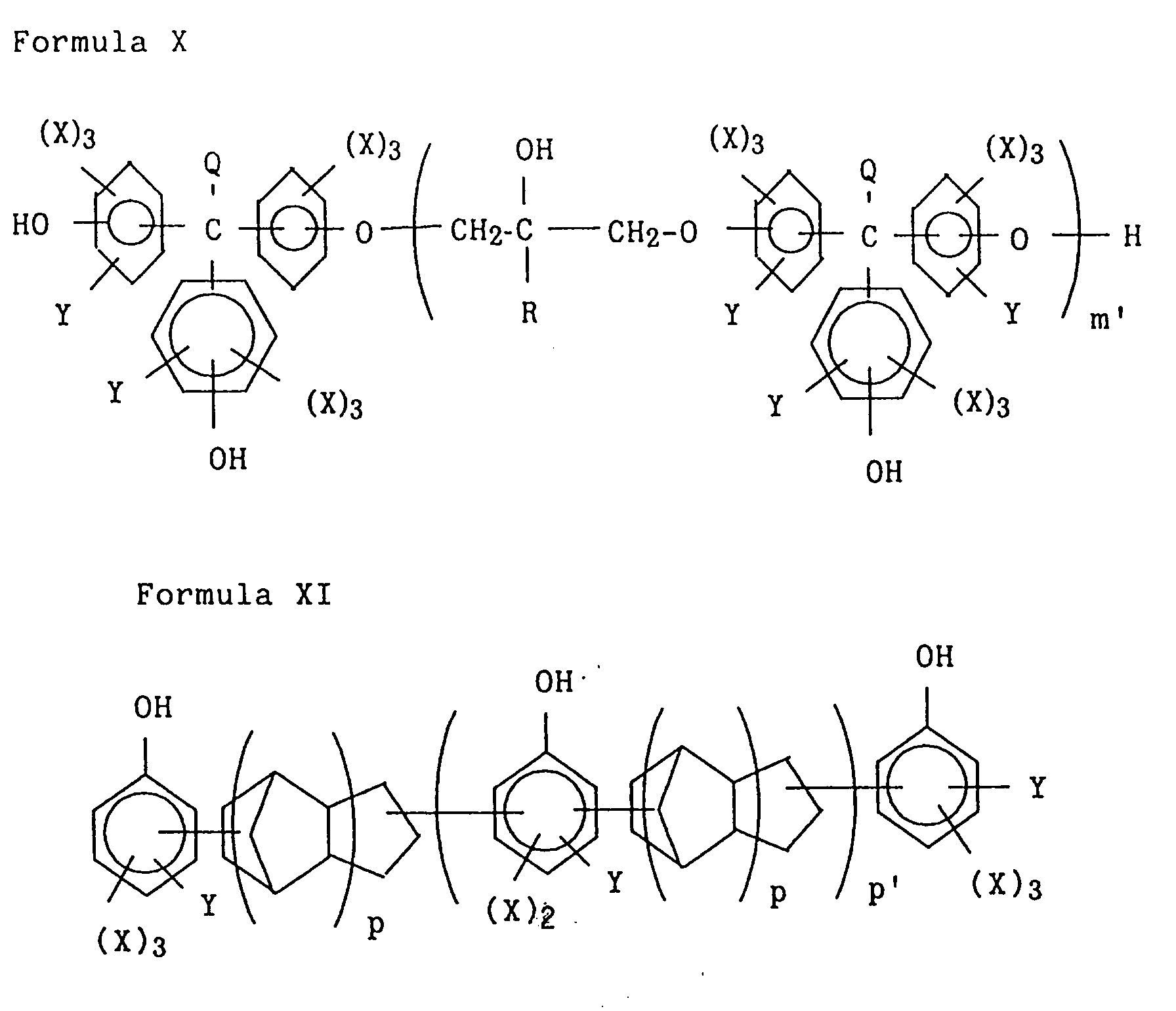
- Another aspect of the present invention pertains to a process for preparing phenolic hydroxyl containing compounds represented by the formulas VII, VIII, IX, X or XI:
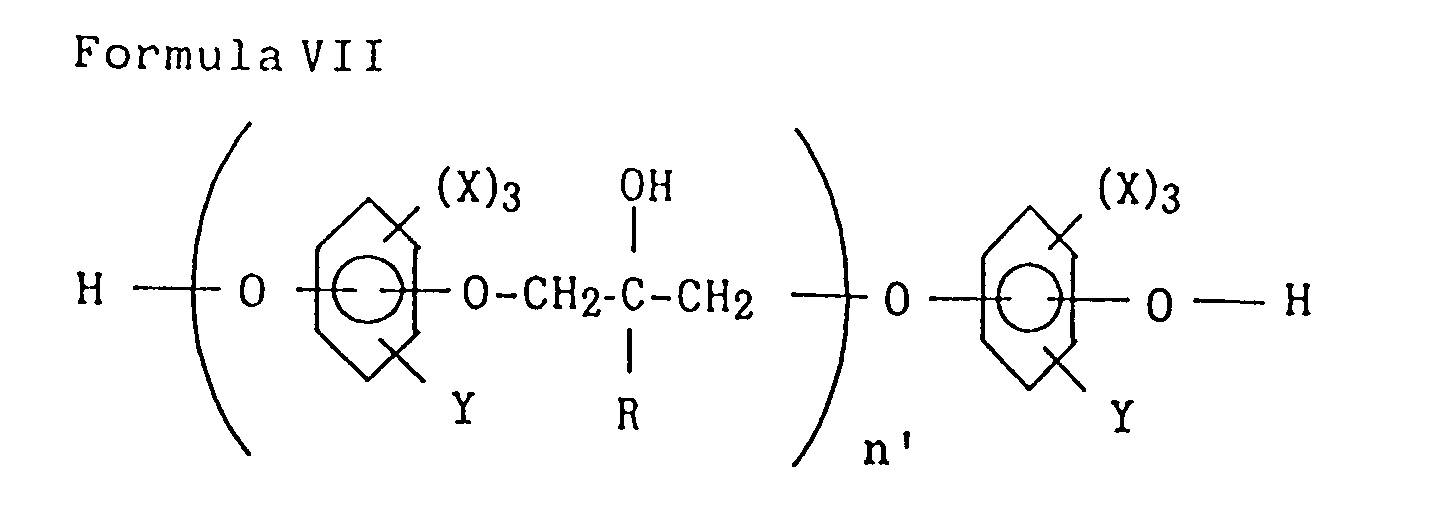 wherein each A is independently a divalent hydrocarbyl group having from 1 to 12 carbon atoms; each A' is independently a divalent hydrocarbyl group having from 1 to 10 carbon atoms; each Q is independently hydrogen or an alkyl group having from 1 to 4 carbon atoms; each R is independently hydrogen or an alkyl group having from 1 to 3 carbon atoms; each X is independently hydrogen, a hydrocarbyl or hydrocarbyloxy group having from 1 to 12 carbon atoms or a halogen atom; each Y is independently hydrogen or a group represented by the following formula XII:
 wherein R' is an alkyl group having from 1 to 10 carbon atoms with the proviso that at least one Y group is a group represented by the aforementioned formula XII; m has an average value from 0.01 to 8; m' has an average value from zero to 10; n has a value of zero or 1; n' has an average value from zero to 3; each p has a value from zero to 10; and each p' has an average value from zero to 8; which process comprises reacting
- (A) one or more 2,6-dibromo-3,5-dialkyl-4-hydroxybenzyl
ethers represented by the
following formula I:
wherein each R' is independently an alkyl group having from 1 to 10 carbon atoms and each Z is a hydroxyl group; with
- (B) one or more phenolic hydroxyl-containing
compounds having an average of more than
one phenolic hydroxyl group per molecule
represented by the following formulas II,
III, IV, V or VI:
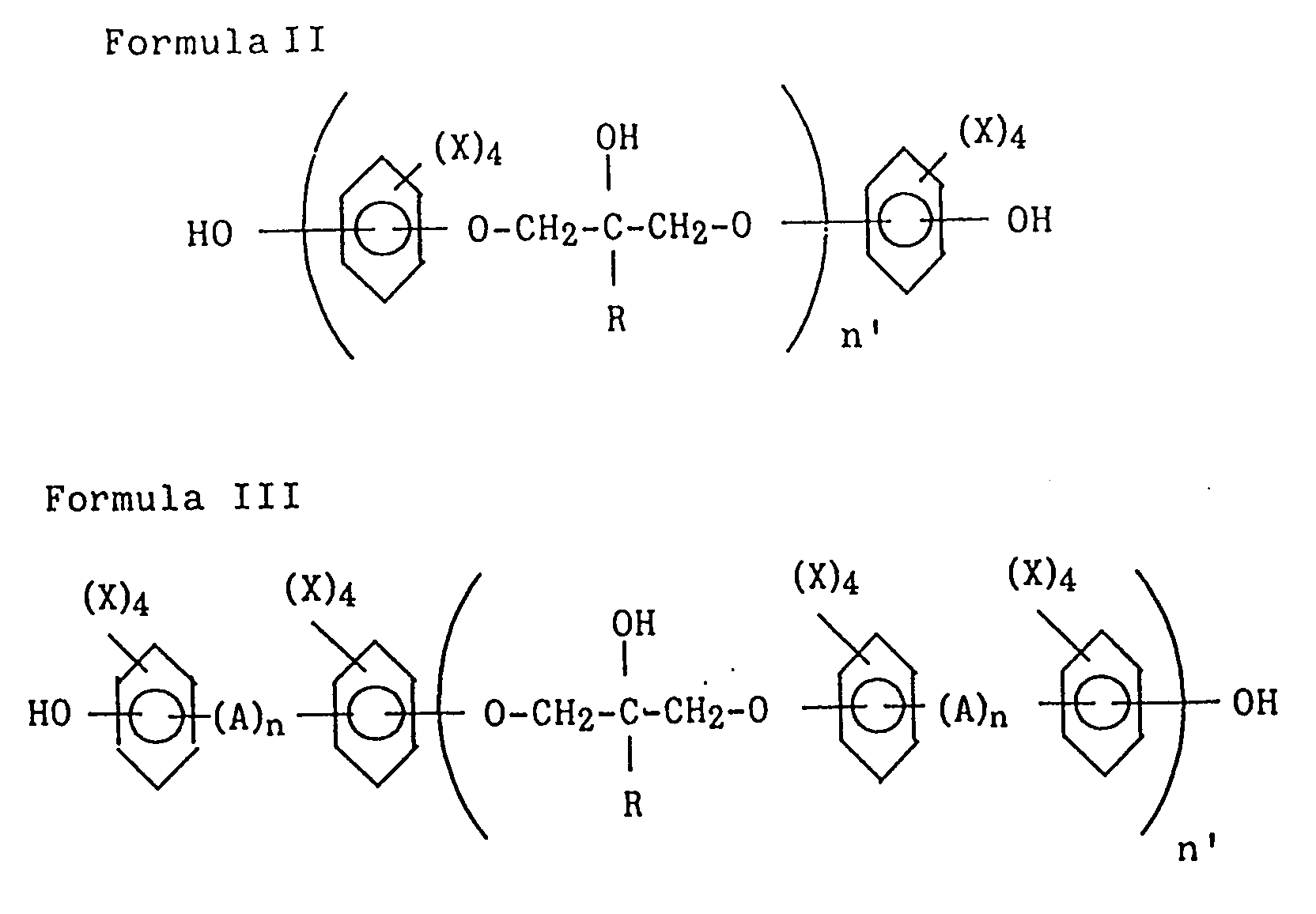 wherein each A is independently a divalent hydrocarbyl group having from 1 to 12 carbon atoms; each A' is independently a divalent hydrocarbyl group having from 1 to 10 carbon atoms; each Q is independently hydrogen or an alkyl group having from 1 to 4 carbon atoms; each R is independently hydrogen or an alkyl group having from 1 to 3 carbon atoms; and each X is independently hydrogen, a hydrocarbyl or hydrocarbyloxy group having from 1 to 12 carbon atoms or a halogen atom; and
wherein components (A) and (B) are employed in quantities which provide a ratio of phenolic hydroxyl groups from 2,6-dibromo-3,5-dialkyl-4-hydroxybenzyl ether to aromatic rings from the phenolic hydroxyl containing compound of from 0.05:1 to 0.5:1. -
- Another aspect of the present invention pertains to curable compositions comprising one or more diglycidyl ethers of 2,6-dibromo-3,5-dialkyl-4-hydroxybenzyl ethers and a curing amount of one or more suitable curing agents or curing catalysts and the products resulting from curing such curable compositions.
- Another aspect of the present invention pertains to curable compositions comprising mixtures of at least one diglycidyl ether of a 2,6-dibromo-3,5-dialkyl-4-hydroxybenzyl ether and at least one different epoxy resin having an average of more than one vicinal epoxide group per molecule and a curing amount of one or more suitable curing agents or curing catalysts therefor as well as the products resulting from curing such curable compositions. product to the glycidyl ether with one or more suitable curing agents.
- The 2,6-dibromo-3,5-dialkyl-4-hydroxybenzyl ethers are prepared by hydrolyzing 4-bromomethyl-3,5-dibromo-2,6-dialkylphenol with water in the presence of one or more suitable solvent(s) at a temperature from 30°C to 100°C, suitably from 45°C to 90°C, more suitably from 60°C to 70°C for a time sufficient to complete the reaction, suitably from 1 to 10, more suitably from 2 to 8, most suitably from 3 to 6 hours. The lower temperatures require longer reaction times whereas the higher temperatures require shorter reaction times. At temperatures below about 50°C, the reaction is slow. At temperatures above about 70°C, a pressure vessel is required since the most preferred solvent system (acetone-water) mixture boils below 70°C.
- The reactants are suitably employed in quantities which provide a weight ratio of water to 4-bromomethyl-3,5-dibromo-2,6-dialkylphenol suitably from 0.1:1 to 1:1, more suitably from 0.2:1 to 0.8:1, most suitably from 0.5:1 to 0.7:1. At ratios below 0.1:1, the reaction is very slow. At ratios above 1:1, the main product is 3,5-dibromo-4-hydroxymethyl-2,6-dialkyl phenol rather than the desired 2,6-dibromo-3,5-dialkyl-4-hydroxybenzyl ether.
- Suitable solvents which can be employed in the preparation of 2,6-dibromo-3,5-dialkyl-4-hydroxybenzyl ether include, for example, aliphatic ketones, aliphatic carboxylic acids, polar aprotic solvents, ethers, glycol ethers, water and combinations thereof. Particularly suitable such solvents include, for example, acetone, methyl ethyl ketone, methyl isobutyl ketone, cyclohexanone, acetic acid, dimethyl formamide, dimethyl acetamide, dimethyl sulfoxide, N-methylpyrrolidone, 2-methoxyethyl acetate, ethylene glycol dimethyl ether, dioxane, tetrahydrofuran and combinations thereof.
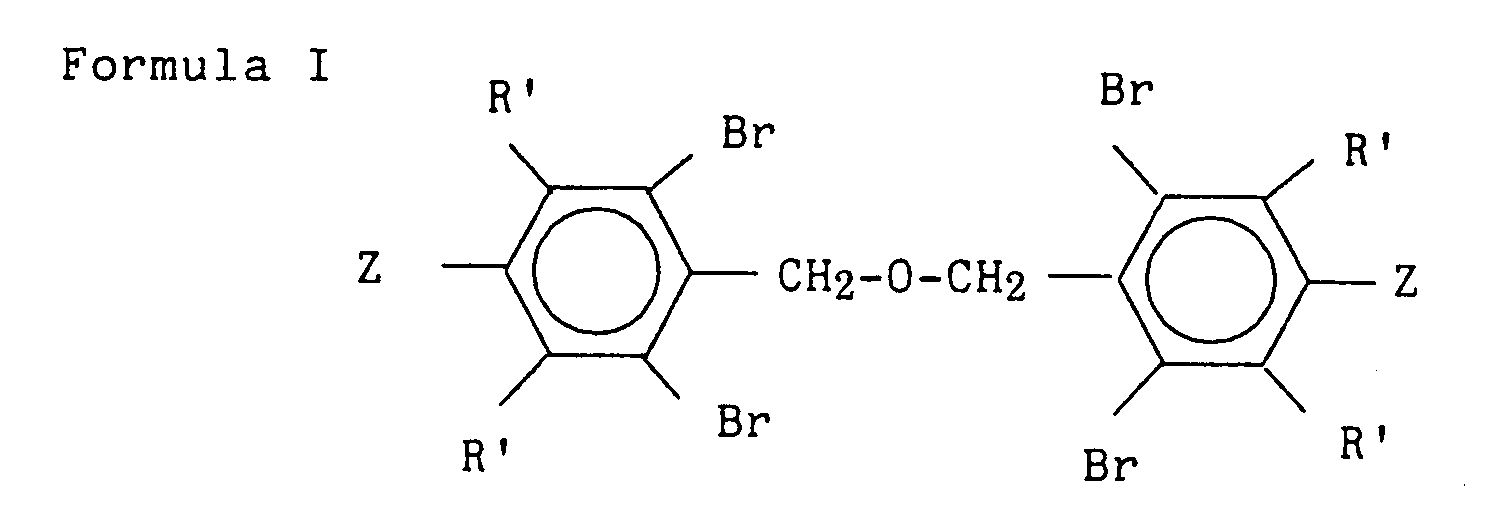
- The 2,6-dibromo-3,5-dialkyl-4-hydroxybenzyl ethers employed in the present invention are represented by the following formula I:wherein each R' is independently an alkyl group having from 1 to 10, more suitably from 1 to 6, most suitably from 1 to 3 carbon atoms and each Z is a hydroxyl group.
- The diglycidyl ethers of 2,6-dibromo-3,5-dialkyl-4-hydroxybenzyl ethers are prepared by reacting the corresponding 2,6-dibromo-3,5-dialkyl-4-hydroxybenzyl ethers with an excess of an epihalohydrin such as, for example, epichlorohydrin, epibromohydrin or epiiodohydrin or lower alkyl derivatives thereof in the presence of a suitable catalyst and dehydrohalogenating the resulting halohydrin product with a basic acting compound. Suitable methods used herein for preparing the diglycidyl ethers of 2,6-dibromo-3,5-dialkyl-4-hydroxybenzyl ethers are more fully disclosed by Wang et al. in U.S. Patent no. 4,585,838, by Chang et al. in U.S. Patent No. 4,582,892, by Wang et al. in U.S. Patent No. 4,499,255, and by Wang et al. in U.S. Patent No. 4,778,863.
- The diglycidyl ethers of 2,6-dibromo-3,5-dialkyl-4-hydroxybenzyl ethers can be represented by the aforementioned formula I wherein each Z is a glycidyl ether group represented by the following formula XIX:wherein each R is independently hydrogen or a lower alkyl group having from 1 to 3 carbon atoms.

- One or more of the diglycidyl ethers of 2,6-dibromo-3,5-dimethyl-4-hydroxybenzyl ethers of the present invention can be mixed with one or more other epoxy resins which are different from the diglycidyl ethers of 2,6-dibromo-3,5-dimethyl-4-hydroxybenzyl ethers of the present invention. The mixture can contain suitably from 1 to 99, more suitably from 5 to 50, most suitably from 10 to 25 percent by weight of the diglycidyl ethers of 2,6-dibromo-3,5-dimethyl-4-hydroxybenzyl ethers of the present invention and suitably from 99 to 1, more suitably from 95 to 50, most suitably from 90 to 75 percent by weight of the other epoxy resin(s); the weights being based upon the combined weight of all of the epoxy resins present in the mixture.
- Suitable epoxy resins which can be blended with the diglycidyl ethers of 2,6-dibromo-3,5-dimethyl-4-hydroxybenzyl ethers of the present invention include, for example, the di- or polyglycidyl ethers of a compound having two or more aliphatic or aromatic hydroxyl groups per molecule, such as dihydric phenols, alkyl or alkoxy or halogen substituted dihydric phenols, bisphenols, alkyl or alkoxy or halogen substituted bisphenols, trisphenols, alkyl or alkoxy or halogen substituted trisphenols, phenol-aldehyde novolac resins, alkyl or alkoxy or halogen substituted phenol-aldehyde novolac resins, glycols, polyglycols, reaction products of an alkylene oxide such as ethylene oxide, propylene oxide or butylene oxide with a compound containing two or more aromatic hydroxyl groups per molecule and combinations thereof. Particularly suitable epoxy resins which can be blended with the diglycidyl ethers of 2,6-dibromo-3,5-dimethyl-4-hydroxybenzyl ethers of the present invention include, for example, those epoxy resins described by Hefner, Jr. in U.S. Patent No. 4,668,745 and by Wang et al. in U.S. Patent No. 4,684,701. Most particularly suitable epoxy resins which can be blended with the diglycidyl ethers of 2,6-dibromo-3,5-dimethyl-4-hydroxybenzyl ethers include, for example, the diglycidyl ethers of resorcinol, hydroquinone, catechol, dihydroxybiphenyl, bisphenol A, bisphenol F, bisphenol K, bisphenol S and the polyglycidyl ethers of phenol-formaldehyde novolac resins, cresol-formaldehyde novolac resins and combinations thereof. Also particularly suitable epoxy resins used for blending with the diglycidyl ether of 2,6-dibromo-3,5-dimethyl-4-hydroxybenzyl ethers of the present invention, include, for example, the halogenated, particularly the brominated, derivatives of the diglycidyl ethers and polyglycidyl ethers enumerated above.
- The advancement reaction can be conducted in the presence of a suitable advancement catalyst, for example, phosphines, quaternary ammonium compounds, phosphonium compounds and tertiary amines. Particularly suitable advancement catalysts used herein include, for example, ethyltriphenylphosphonium chloride, ethyltriphenylphosphonium bromide, ethyltriphenylphosphonium iodide, ethyltriphenylphosphonium diacetate (ethyltriphenylphosphonium acetate·acetic acid complex), ethyltriphenylphosphonium phosphate, tetrabutylphosphonium chloride, tetrabutylphosphonium bromide, tetrabutylphosphonium iodide, tetrabutylphosphonium diacetate (tetrabutylphosphonium acetate·acetic acid complex), butyltriphenylphosphonium tetrabromobisphenate, butyltriphenylphosphonium bisphenate, butyltriphenylphosphonium bicarbonate, benzyltrimethylammonium chloride, tetramethylammonium hydroxide, triethylamine, tripropylamine, tributylamine, 2-methylimidazole, benzyldimethylamine and mixtures thereof. Many of the aforementioned advancement catalysts are described in U.S. Patent Nos. 3,306,872; 3,341,580; 3,379,684; 3,477,990; 3,547,881; 3,637,590; 3,843,605; 3,948,855; 3,956,237; 4,048,141; 4,093,650; 4,131,633; 4,132,706; 4,171,420; 4,177,216 and 4,366,295.
- The amount of advancement catalyst employed herein depends, of course, upon the particular reactants and advancement catalyst employed; however, the advancement catalyst is usually employed in quantities of from 0.03 to 3, preferably from 0.3 to 1.5, most preferably from 0.05 to 1.5 percent by weight based upon the weight of the epoxy-containing compound. The advancement catalyst can, if desired, be employed in a solvent.
- If desired, the advancement reaction can be conducted in the presence of a solvent. Suitable such solvents employed herein include, for example, alcohols, ketones, glycol ethers, aliphatic and aromatic hydrocarbons, halogenated aliphatic hydrocarbons, glycols, polyglycols, cyclic or acyclic ethers and combinations thereof. Particularly suitable such solvents employed herein include, methanol, ethanol, isopropanol, acetone methyl ethyl ketone, methyl isobutyl ketone, hexane, heptane, octane, nonane, decane, benzene, toluene, xylene, propylene glycol methyl ether, dipropylene glycol methyl ether, ethylene glycol n-butyl ether, propanol, n-butanol, polyoxyethylene glycol, dioxane and combinations thereof.
- The reaction products of 2,6-dibromo-3,5-dialkyl-4-hydroxybenzyl ether and a phenolic hydroxylcontaining compound as defined above are prepared by conducting the reaction at a temperature suitably from 50°C to 150°C, more suitably from 60°C to 120°C, most suitably from 70°C to 90°C for a time sufficient to complete the reaction, suitably from 2 to 12, more suitably from 3 to 10, most suitably from 4 to 8 hours. The lower temperatures require longer reaction times whereas the higher temperatures require shorter reaction times. At temperatures below 50°C, the reaction proceeds very slowly. At temperatures above 150°C, splitting of 2,6-dimethyl-3,5-dibromophenol will occur.
- The reactants are suitably employed in quantities which provide a ratio of phenolic hydroxyl groups from the 2,6-dibromo-3,5-dialkyl-4-hydroxybenzyl ether to aromatic rings from the phenolic hydroxyl-containing compound suitably from 0.05:1 to 0.5:1, more suitably from 0.05:1 to 0.3:1, most suitably from 0.05:1 to 0.2:1. At ratios below 0.05:1, there is not enough bromine introduced into the system to achieve fire retardancy. At ratios above 0.5:1, a very high molecular weight product will form.
- The 2,6-dibromo-3,5-dialkyl-4-hydroxybenzyl ether is reacted with phenolic hydroxyl-containing compound having an average of more than one phenolic hydroxyl group per molecule represented by the following formulas II, III, IV, V or VI:
 wherein each A is independently a divalent hydrocarbyl group having suitably from 1 to 12, more suitably from 1 to 6, most suitably from 1 to 4 carbon atoms; each A' is independently a divalent hydrocarbyl group having from 1 to 10, more suitably from 1 to 4, most suitably from 1 to 2 carbon atoms; each Q is independently hydrogen or an alkyl group having from 1 to 4 carbon atoms; each R is independently hydrogen or an alkyl group having from 1 to 3 carbon atoms; each X is independently hydrogen, a hydrocarbyl or hydrocarbyloxy group having suitably from 1 to 12, more suitably from 1 to 6, most suitably from 1 to 4 carbon atoms or a halogen atom, preferably chlorine or bromine; m has an average value suitably from 0.01 to 8, more suitably from 1 to 6, most suitably from 2 to 4; m′ has an average value suitably from zero to 10, more suitably from zero to 6, most suitably from zero to 3; n has a value of zero or 1; n′ has an average value suitably from zero to 3, more suitably from zero to 2, most suitably from zero to 1; each p suitably has a value from zero to 10, more suitably from zero to 6, most suitably from zero to 3; and each p′ suitably has an average value from zero to 8, more suitably from 1 to 6, most suitably from 2 to 4.
- The term "hydrocarbyl" as employed herein means any aliphatic, cycloaliphatic, aromatic, aryl substituted aliphatic or cycloaliphatic, or aliphatic or cycloaliphatic substituted aromatic group. Likewise, the term "hydrocarbyloxy" means a hydrocarbyl group having an oxygen linkage between it and the element to which it is attached. The term "divalent hydrocarbyl group" refers to the aforementioned hydrocarbyl group minus an additional hydrogen atom.
- The diglycidyl ether of 2,6-dibromo-3,5-dialkyl-4-hydroxybenzyl ether can, if desired, be blended with other epoxy resins such as those which are represented by the aforementioned formulas II-VI wherein the aromatic hydroxyl groups have been replaced with glycidyl ether groups.
- The reaction products of 2,6-dibromo-3,5-dialkyl-4-hydroxybenzyl ether with the phenolic hydroxyl-containing compounds as defined above can be represented by the following formulas VII, VIII, IX, X and XI:
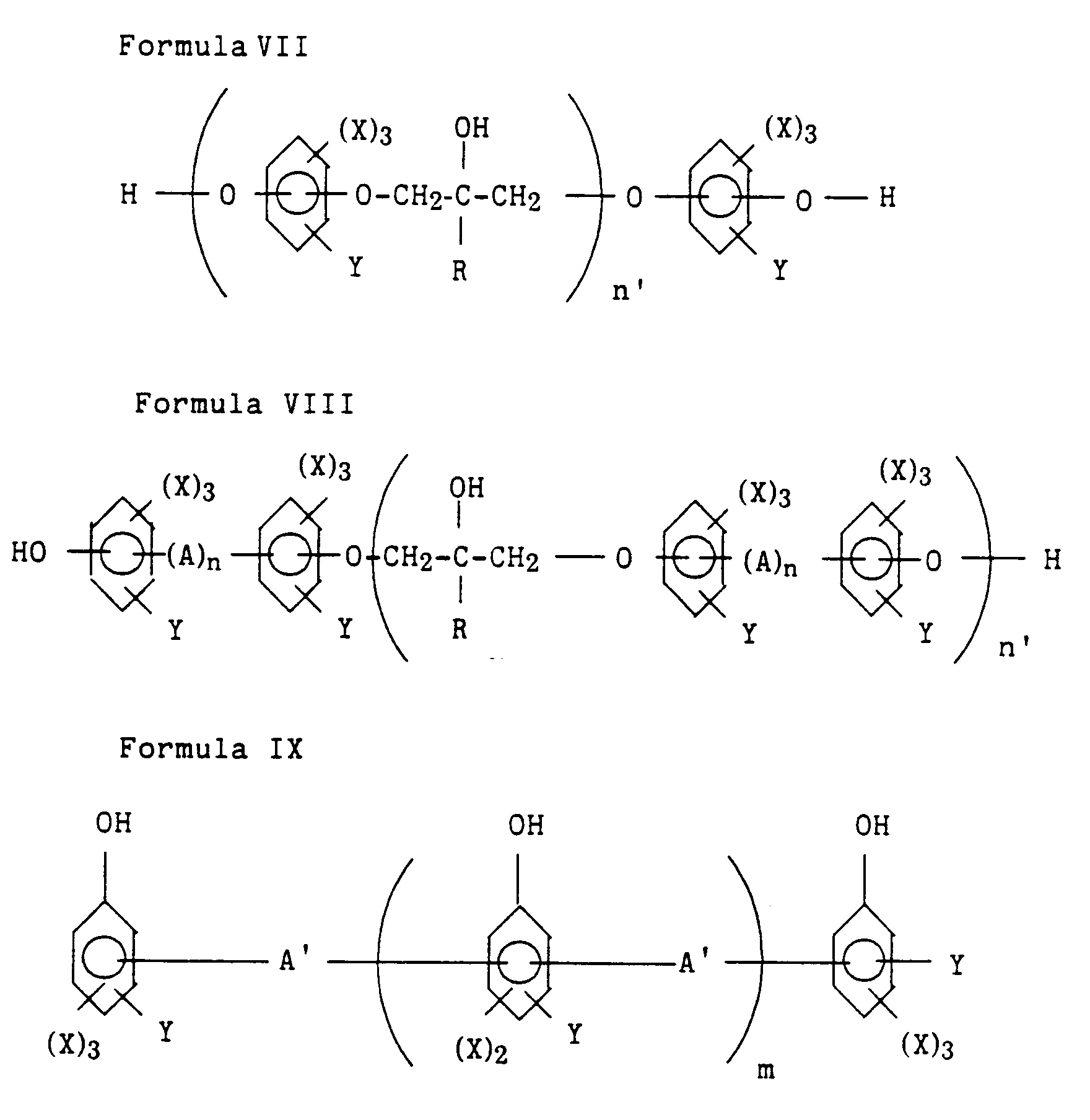 wherein each A is independently a divalent hydrocarbyl group having suitably from 1 to 12, more suitably from 1 to 6, most suitably from 1 to 4 carbon atoms; each A′ is independently a divalent hydrocarbyl group having from 1 to 10, more suitably from 1 to 4, most suitably from 1 to 2 carbon atoms; each Q is independently hydrogen or an alkyl group having from 1 to 4 carbon atoms; each R is independently hydrogen or an alkyl group having from 1 to 3 carbon atoms; each X is independently hydrogen, a hydrocarbyl or hydrocarbyloxy group having suitably from 1 to 12, more suitably from 1 to 6, most suitably from 1 to 4 carbon atoms or a halogen atom, preferably chlorine or bromine; each Y is independently hydrogen or a group represented by the following formula XII:
 wherein R′ is an alkyl group having from 1 to 10, preferably from 1 to 5, most preferably from 1 to 3 carbon atoms with the proviso that at least one Y group is a group represented by the aforementioned formula XII; m has an average value suitably from 0.01 to 8, more suitably from 1 to 6, most suitably from 2 to 4; m′ has an average value suitably from zero to 10, more suitably from zero to 6, most suitably from zero to 3; n has a value of zero or 1; n′ has an average value from zero to 3, more suitably from zero to 2, most suitably from zero to 1; each p suitably has a value from zero to 10, more suitably from zero to 6, most suitably from zero to 3; and each p′ suitably has an average value from zero to 8, more suitably from 1 to 6, most suitably from 2 to 4.
- The epoxy resins prepared by reacting the product resulting from reacting the 2,6-dibromo-3,5-dialkyl-4-hydroxybenzyl ethers with phenolic hydroxyl-containing compounds having an average of more than one phenolic hydroxyl group per molecule with an epihalohydrin and converting the intermediate halohydrin product to the glycidyl ether can be represented by the following formulas XIII, XIV, XV, XVI and XVII:

 wherein each A is independently a divalent hydrocarbyl group having suitably from 1 to 12, more suitably from 1 to 6, most suitably from 1 to 4 carbon atoms; each A′ is independently a divalent hydrocarbyl group having from 1 to 10, more suitably from 1 to 4, most suitably from 1 to 2 carbon atoms; each Q is independently hydrogen or an alkyl group having from 1 to 4 carbon atoms; each R is independently hydrogen or an alkyl group having from 1 to 3 carbon atoms; each X is independently hydrogen, a hydrocarbyl or hydrocarbyloxy group having suitably from 1 to 12, more suitably from 1 to 6, most suitably from 1 to 4 carbon atoms or a halogen atom, preferably chlorine or bromine; each Y is independently hydrogen or a group represented by the following formula XVIII:
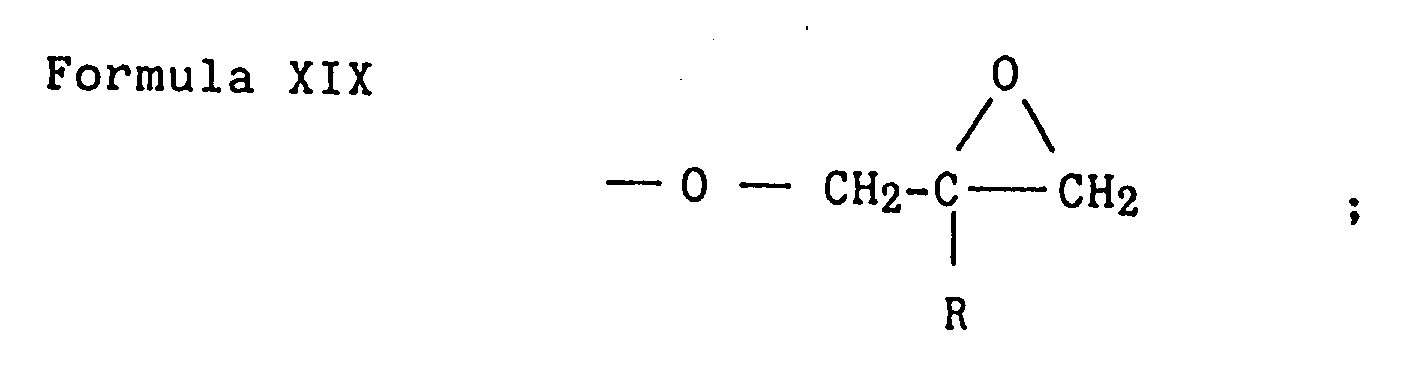
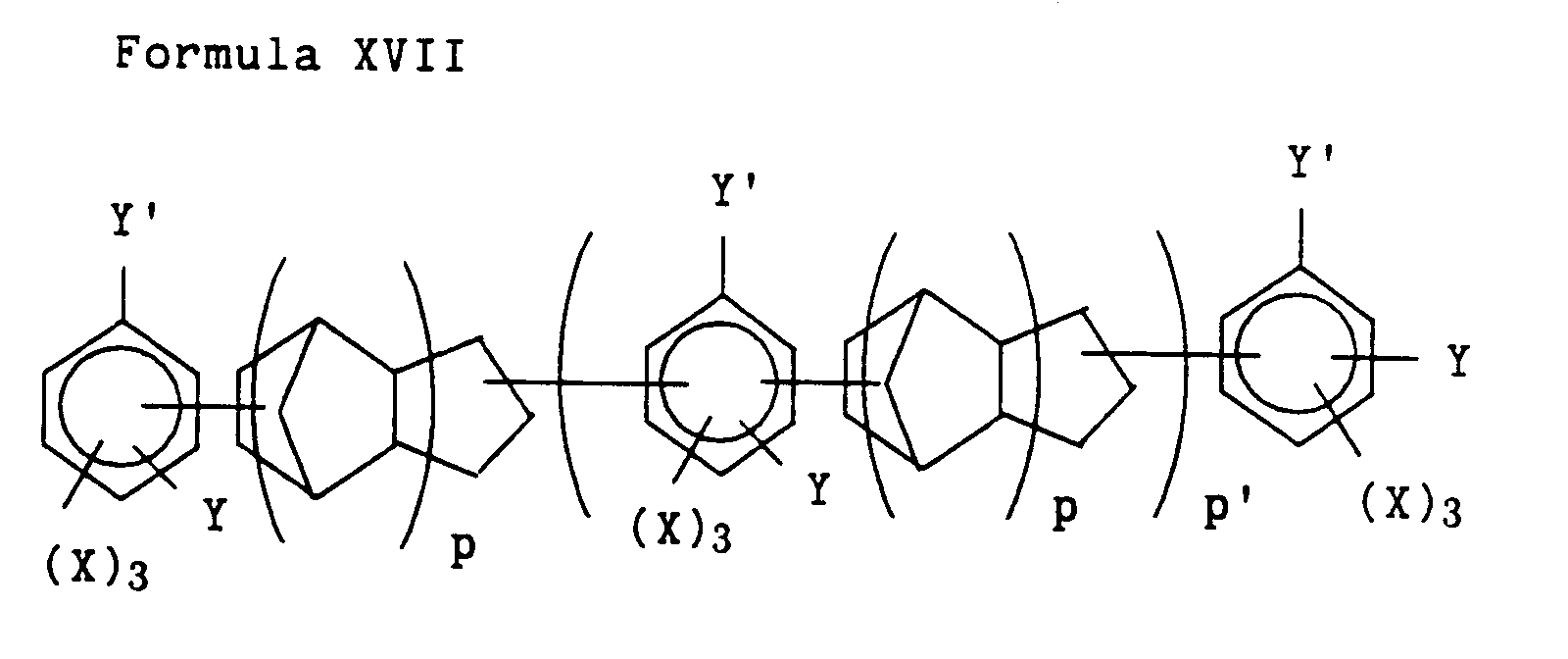 wherein each R′ is an alkyl group having from 1 to 10, preferably from 1 to 5, more preferably from 1 to 3 carbon atoms with the proviso that at least one Y group is a group represented by the aforementioned formula XVIII; each Y′ is represented by the following formula XIX:
 each Y'' is represented by the following formula XX:
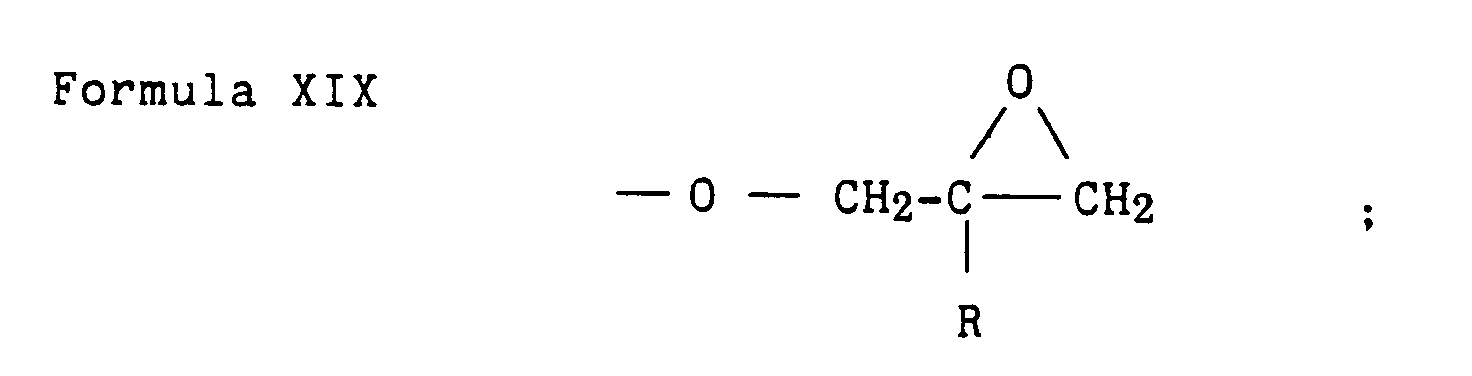 m has an average value suitably from 0.01 to 8, more suitably from 1 to 6, most suitably from 2 to 4; m′ has an average value suitably from zero to 10, more suitably from zero to 6, most suitably from zero to 3; n has a value of zero or 1; n′ has an average value suitably from zero to 3, more suitably from zero to 2, most suitably from zero to 1; each p suitably has a value from zero to 10, more suitably from zero to 3, most suitably from zero to 3; and each p′ suitably has an average value from zero to 8, more suitably from 1 to 6, most suitably from 2 to 4.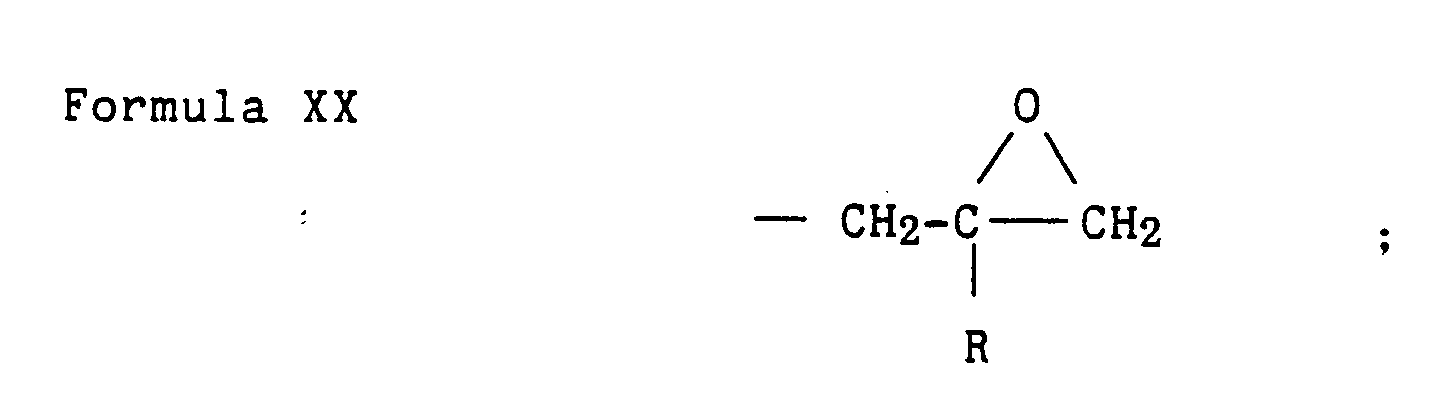
- The epoxy resins of the present invention can be cured with any suitable curing agent for epoxy resins including, for example, primary and secondary aliphatic and aromatic polyamines, carboxylic acids and anhydrides thereof, phenolic hydroxyl-containing compounds having an average of two or more phenolic hydroxyl groups per molecule, guanidines, biguanides, urea-aldehyde resins, melamine-aldehyde resins, alkoxylated urea-aldehyde resins, alkoxylated melamine-aldehyde resins, phenol- or substituted phenol-aldehyde novolac resins and combinations thereof. Particularly suitable curing agents employed herein include, for example, bis-(4-aminophenyl)sulfone, dicyandiamide, m-phenylenediamine, bis-(4-aminophenyl)methane, phthalic anhydride, maleic anhydride, phenol-formaldehyde novolac resins, cresol-formaldehyde novolac resins and combinations thereof. The curing agents are employed herein in an amount which will effectively cure the composition containing the epoxy resin. The amount of curing agent employed herein will depend upon the particular modified epoxy resin and curing agent employed; however, suitable curing agent amounts include, for example, from 0.0001 to 1, more suitably from 0.001 to 1, most suitably from 0.01 to 1 equivalents of curing agent per epoxide equivalent for those curing agents which cure by reacting with the epoxy group of the epoxy resin or per hydroxyl group for those curing agents which cure by reacting with the aliphatic hydroxyl groups along the backbone of the epoxy resin. The Handbook of Epoxy Resins by Lee and Neville, McGraw-Hill, 1967 contains various discussions concerning the curing of epoxy resins as well as a compilation of suitable curing agents.
- The epoxy resins of the present invention can be blended with other materials or additives such as solvents or diluents, fillers, pigments, dyes, flow modifiers, thickeners, reinforcing agents, wetting agents, leveling agents, flame retardant agents, plasticizers, mold releasing agents and extenders.
- The materials or additives are added in functionally equivalent amounts, e.g., the pigments and/or dyes are added in quantities which will provide the composition with the desired color; however, the pigments and/or dyes are suitably employed herein in amounts of from 0.1 to 10, more suitably from 0.1 to 1, most suitably from 0.2 to 0.5 percent by weight based upon the weight of the total formulation. The total formulation consists of epoxy resin(s), curing agent(s), filler(s), pigment(s), accelerator(s) and additives.
- The modifiers such as thickeners and flow modifiers can be suitably employed herein in amounts of from 0.1 to 10, more suitably from 0.1 to 1, most suitably from 0.1 to 0.5 percent by weight based upon the weight of the total formulation.
- The fillers can be employed herein in amounts suitably from 1 to 95, more suitably from 10 to 90, most suitably from 50 to 80 percent by weight based upon the weight of the total formulation.
- In addition to being employed to prepare epoxy resins therefrom, the meta halogenated phenolic hydroxyl-containing compositions of the present invention can be employed to cure the epoxy resins of the present invention or other epoxy resins or combinations thereof.
- The epoxy resins of the present invention can be employed in the preparation of compositions suitable for such applications as coatings, castings, moldings, encapsulants, laminates, composites and potting compounds.
- A 373 g (1.0 mole) portion of 4-bromomethyl-3,5-dibromo-2,6-dimethylphenol was dissolved in 750 ml of acetone. The solution was heated to reflux and 250 ml of water was added. A clear solution was obtained. The solution was refluxed for five hours. A white precipitate forms during the refluxing period. The hot slurry was filtered to afford 184 g of white solid containing 97 percent ether and 3 percent 3,5-dibromo-2,6-dimethyl-4-hydroxymethylphenol by liquid chromatography. The solid was further purified by slurrying in 800 ml of acetone and 200 ml of water and refluxing for one-half hour. Hot filtration of the slurry produced a solid of 98+ percent purity with a melting point of 240-241°C. The proton nuclear magnetic resonance spectrum had the following signals: (*DMSO d6) δ;2.26 (s, 6H), 4.75 (s, 2H).
- To a one-liter reaction vessel equipped with temperature control and indicating means and reflux condenser, were added 292.6 g (2.52 eq.) of cresol formaldehyde novolac resin (softening point = 94.3°C and average phenolic hydroxyl functionality = 5), 65.4 g (0.217 eq.) of 2,6-dibromo-3,5-dimethyl-4-hydroxybenzyl ether and 80 g of methyl ethyl ketone. Upon stirring at room temperature and atmospheric pressure to thoroughly mix the contents, the temperature was raised to 80°C and 2.0 g of p-toluenesulfonic acid was added as a catalyst. The mixture was allowed to stir at 80°C until the slurry reaction mixture turned clear indicating all 2,6-dibromo-3,5-dimethyl-4-hydroxylbenzyl ether was reacted.
- To a 5-liter reaction vessel which was equipped with temperature and pressure control and indicating means, a means for the continuous addition of aqueous sodium hydroxide, a means for condensing and separating water from a codistillate mixture of water, solvent and epichlorohydrin and means for returning the solvent and epichlorohydrin to the reaction vessel, was added the above alkylation mixture, 2200 g (23.78 eq.) of epichlorohydrin and 390 g of the methyl ether of propylene glycol (1-methoxy-2-hydroxypropane) as a solvent. Upon stirring at room temperature and atmospheric pressure to thoroughly mix the contents, the temperature was raised to 55°C and the pressure was reduced to 105 mm Hg absolute. To the resulting solution was continuously added 188.7 g (2.358 eq.) of 50 percent aqueous sodium hydroxide solution at a constant rate over a period of 3 hours.
- During the addition of the sodium hydroxide, the water was removed by codistilling with epichlorohydrin and solvent. The distillate was condensed, thereby forming two distinct phases, an aqueous phase (top) and an organic epichlorohydrin solvent phase (bottom). The organic phase was continuously returned to the reactor. Upon completion of the sodium hydroxide addition, the reaction mixture was maintained at a temperature of 55°C and a pressure of 105 mm Hg absolute for an additional 30 minutes. The resulting glycidyl ether was distilled under full vacuum and at a temperature of up to 160°C to generally remove all unreacted epichlorohydrin and 1-methoxy-2-hydroxypropane. The molten glycidyl ether product was diluted to 50 percent resin concentration with a 75/25 methyl ethyl ketone/toluene solvent mixture. The mixture was heated to 85°C for 2 hours with 0.7 g of 45 percent aqueous potassium hydroxide. The reaction mixture was further diluted to 20 percent resin concentration with a 75/25 methyl ethyl ketone/toluene solvent mixture, and the thus diluted product was washed with deionized water several times to remove salt. The organic phase from the water washes was placed on a rotary evaporator under a vacuum and at a temperature of 160°C to remove the solvent. The resulting polyglycidyl ether had an epoxide content of 20.83 percent and contained 7.28 percent bromine, and had a Mettler softening point of 80°C. This epoxy resin was particularly suitable for use in electronic encapsulation formulations.
- 500 g (2.5 eq.) of a cresol/formaldehyde epoxy novolac resin having a EEW of 183 and an average epoxide functionality of 6, a Kinematic viscosity of 125 centistokes (125 x 10-6 m2/s) at 150°C and containing 975 ppm total aliphatic chloride was dissolved in 500 g of a 75/25 percent by weight mixture of methyl ethyl ketone and toluene in a 2-liter flask equipped with thermowell, reflux condenser and stirrer. 83.6 g (0.287 eq.) of 2,6-dibromo-3,5-dimethyl-4-hydroxybenzyl ether was added to the epoxy resin solution and the resultant solution was heated to 85°C with stirring. 2.1 g (1.2 eq. per eq. of total aliphatic chloride contained in the epoxy resin) of 45 percent aqueous potassium hydroxide was added all at once and the reaction mixture was maintained at 85°C for 3 hours. The reaction mixture was diluted to 20 percent solids concentration with a 75/25 percent by weight methyl ethyl ketone/toluene solvent mixture, neutralized with carbon dioxide and washed with deionized water several times to remove the residual potassium chloride. The organic phase from the water washes was placed on a rotary evaporator under a full vacuum at 160°C to remove the solvent. A yellow, solid resin having a Mettler softening point of 79°C, an EEW of 242, a viscosity of 227 centistokes (227 x 10-6 m2/s) at 150°C containing 642 ppm of total aliphatic chloride and 7.5 percent bromine was obtained.
- To a 2-liter reaction vessel equipped with a temperature and pressure control and indicating means, means for continuous addition of aqueous sodium hydroxide, a means for condensing and separating water from a codistillate mixture of water, solvent and epichlorohydrin and means for returning the solvent and epichlorohydrin to the reaction vessel was added 190.6 g (0.634 eq.) of 2,6-dibromo-3,5-dimethyl-4-hydroxybenzyl ether, 586.1 g (6.34 eq.) of epichlorohydrin and 103.4 g of the methyl ether of propylene glycol (1-methoxy-2-hydroxypropane) as a solvent. After stirring at room temperature (∼25°C) and atmospheric pressure to thoroughly mix the contents, the temperature was raised to 45°C and the pressure was reduced to 65 mm Hg absolute. To the resulting solution was continuously added 50.7 g (0.634 eq.) of 50 percent aqueous sodium hydroxide solution at a constant rate over a period of 7 hours. During the addition of the sodium hydroxide, the water was removed by codistillation with epichlorohydrin and solvent. The distillate was condensed thereby forming two distinct phases, an aqueous phase (top) and an organic epichlorohydrin-solvent phase (bottom). The organic phase was continuously returned to the reactor. After completion of the sodium hydroxide addition, the reaction mixture was maintained at a temperature of 45°C and a pressure of 65 mm Hg absolute for an additional one hour. The diglycidyl ether of 2,6-dibromo-3,5-dimethyl-4-hydroxybenzyl ether was not soluble in the organic solvent and precipitated from the reaction mixture. It was filtered from the reaction mixture and redissolved in methylene chloride. The methylene chloride solution was washed several times with deionized water to remove the residual sodium chloride. The organic phase from the water washes was placed in a vacuum oven under a vacuum at 160°C to remove solvent completely. 210 g of yellowish white solid was obtained.
- 74 g (0.207 eq.) of the diglycidyl ether of 3,5-dimethyl-4-hydroxybenzyl ether prepared in A above and 346 g (1.725 eq.) of a cresol/formaldehyde epoxy novolac resin having a EEW of 191, an average epoxide functionality of 6, a Kinematic viscosity of 313 centistokes (313 10-6 m2/s) at 150°C and containing 622 ppm total aliphatic chloride were placed in a 1-liter flask on a rotary evaporator at 160°C and a full vacuum until the two epoxy resins were completely mixed. The resultant mixture, 420 g of product, had an EEW of 211, a viscosity of 292 centistokes (292 x 10-6 m2/s) at 150°C and contained 7.5 percent bromine by weight.
- Each of the products of Examples 2, 3 and 4 and a control resin were formulated into an electrical encapsulation formulation. The encapsulation formulations were each cured at 175°C for 4 hours. The encapsulation formulations are described in Table I as A, B, C and D*.
ENCAPSULATION FORMULATION COMPONENT A B C D Epoxy Resin I, g 21.4 34.4 27.5 168.8 Epoxy Resin II Type/g Ex. 2/171.7 Ex. 3/166.7 Ex. 4/166.7 Control/26.3 Curing Agent, g 97.9 89.9 96.8 95.9 Triphenylphosphine, g 2.0 2.0 2.0 2.0 Mold release agent, g 4.0 4.0 4.0 4.0 Epoxy silane, g 4.0 4.0 4.0 4.0 Fused silica, g 685.0 685.0 685.0 685.0 Antimony oxide (Sb2O3), g 10.0 10.0 10.0 10.0 Carbon black, g 4.0 4.0 4.0 4.0 % Bromine in Formulation 1.25 1.25 1.25 1.25 - The following descriptions are for the components listed in Table I.
- Epoxy Resin I is a cresol epoxy novolac resin having an epoxide equivalent weight (eq. wt.) of about 195 and a viscosity of about 420 centistokes at 150°C, commercially available from The Dow Chemical Company as QUATREX™ 3430.
- Epoxy Resin II is as listed in Table I.
- The control epoxy resin is a solid, generally ortho-brominated epoxy resin having an epoxide equivalent weight (eq. wt.) of about 465, a viscosity of about 200 centistokes at 150°C, and a bromine content of 47.6 percent by weight, commercially available from The Dow Chemical Company as QUATREX™ 6410.
- The curing agent is a phenol-formaldehyde novolac resin with an average hydroxyl functionality of 6 and a phenolic hydroxyl equiv. wt. of about 104 commercially available from Schenectady Chemical as HRJ-2210.
- The fused silica is GP-7I commercially available from Harbison-Walker Corporation.
- The mold release agents are refined Montan waxes commercially available from Hoechst as OP and E. A 1:1 mixture by weight of OP to E was used in the present invention.
- The carbon black is Lampblack 101 commercially available from Degussa Corporation.
- The epoxy silane is Z-6040 commercially available from Dow Corning Corporation.
- All of the above formulations passed UL-94 VO flame retardancy test using castings of 1/16 inch thickness.
- The device testing was determined by a highly accelerated stress test, which involves the following conditions: 121°C, 15 psig steam, and 25 volts bias. The device was a 14-pin LM 324 quad operational amplifier with a single passivation layer. The percentage of devices that fail as a function of time are given in the following Table II.
- Failure: each device was electrically tested for the necessary output voltage and currents as well as power dissipation. Any device which failed to meet these electrical parameters was considered a failure.
DEVICE RELIABILITY Sample Number % Device Failure 400 hours 600 hours 800 hours A 3 7 28 B 5 10 40 C 2 6 21 D 25 75 100 - Thus, it can be seen from Table II that stable meta-bromine-containing formulations of the present invention give substantially better performances than conventional systems.
Claims (18)
- A diglycidyl ether of 2,6-dibromo-3,5-dialkyl-4-hydroxybenzyl ether or a mixture of any two or more of such diglycidyl ethers represented by the following formula I:wherein each R' is independently an alkyl group having from 1 to 10 carbon atoms and each Z is a glycidyl ether group represented by the following formula XIX:
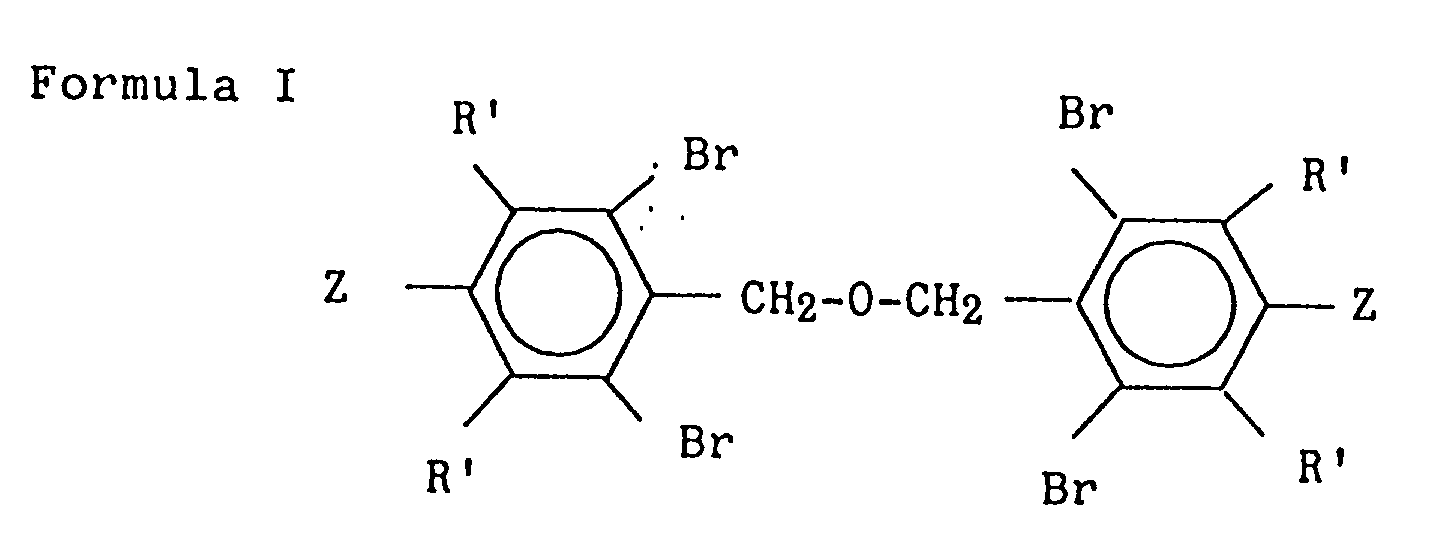 wherein each R is independently hydrogen or a lower alkyl group having from 1 to 3 carbon atoms.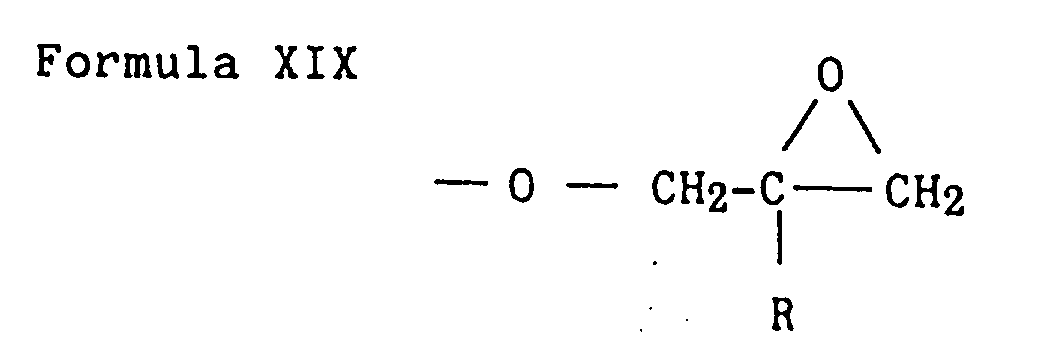
- The diglycidyl ether of 2,6-dibromo-3,5-dimethyl-4-hydroxybenzyl ether.
- Process for preparation of a diglycidyl ether of 2,6-dibromo-3,5-dialkyl-4-hydroxybenzyl ether of formula I as defined in Claim 1 comprising:a) hydrolyzing a 4-bromomethyl-3,5-dibromo-2,6-dialkylphenol with water in the presence of one or more solvent(s) at a temperature from 30°C to 100°C whereby the reactants are employed in quantities which provide a weight ratio of water to 4-bromomethyl-3,5-dibromo-2,6-dialkylphenol from 0.1:1 to 1:1,b) reacting the 2,6-dibromo-3,5-dialkyl-4-hydroxybenzyl ether of step a) represented by the following formulawherein each R' is in dependently an alkyl group having from 1 to 10, more suitably from 1 to 6, most suitably from 1 to 3 carbon atoms and each Z is a hydroxyl group with an excess of an epihalohydrin in the presence of a suitable catalyst and dehydrohalogenating the resulting halohydrin product with a basic acting compound.
- A mixture comprising(A) one or more diglycidyl ethers of 2,6-dibromo-3,5-dialkyl-4-hydroxybenzyl ethers or a mixture of any two or more of such diglycidyl ethers represented by the following formula I:wherein each R' is independently an alkyl group having from 1 to 10 carbon atoms and each Z is a glycidyl ether group represented by the following formula XIX:
 wherein each R is independently hydrogen or a lower alkyl group having from 1 to 3 carbon atoms; and
 (B) one or more epoxy resins having an average of more than one vicinal epoxy groups per molecule and which are different from the epoxy resins of component A; and
wherein component (A) is present in an amount of from 1 to 99 percent by weight based on the combined weight of components (A) and (B) and component (B) is present in an amount of from 99 to 1 percent by weight based on the combined weight of components (A) and (B). - An epoxy resin mixture of Claim 4 wherein component (A) is diglycidyl ether of 2,6-dibromo-3,5-dimethyl-4-hydroxybenzyl ether.
- An epoxy resin mixture of Claim 4 or Claim 5, wherein component (A) is present in an amount of from 10 to 25 percent by weight based on the combined weight of components (A) and (B) and component (B) is present in an amount of from 90 to 75 percent by weight based on the combined weight of components (A) and (B).
- An advanced resin produced by reacting in presence of a suitable advancement catalyst(A) a 2,6-dibromo-3,5-dialkyl-4-hydroxybenzyl ether or a mixture of any two or more of such ethers represented by the following formula I:wherein each R' is independently an alkyl group having from 1 to 3 carbon atoms; and
 (B) one or more compounds having an average of more than one glycidyl ether group per molecule represented by the following formulas I, II, III, IV, V or VI:
 wherein each A is independently a divalent hydrocarbyl group having from 1 to 12 carbon atoms; each A' is independently a divalent hydrocarbyl group having from 1 to 10 carbon atoms; each Q is independently hydrogen or an alkyl group having from 1 to 4 carbon atoms; each R is independently hydrogen or an alkyl group having from 1 to 3 carbon atoms; each X is independently hydrogen, a hydrocarbyl or hydrocarbyloxy group having from 1 to 12 carbon atoms or a halogen atom; Z is a glycidyl ether group represented by the following formula XIX:
 wherein each R is independently hydrogen or a lower alkyl group having from 1 to 3 carbon atoms; m has an average value from 0.01 to 8; m' has an average value from zero to 10; n has a value of zero or 1; n' has an average value from zero to 3; each p has a value from zero to 10; and each p' has an average value from zero to 8;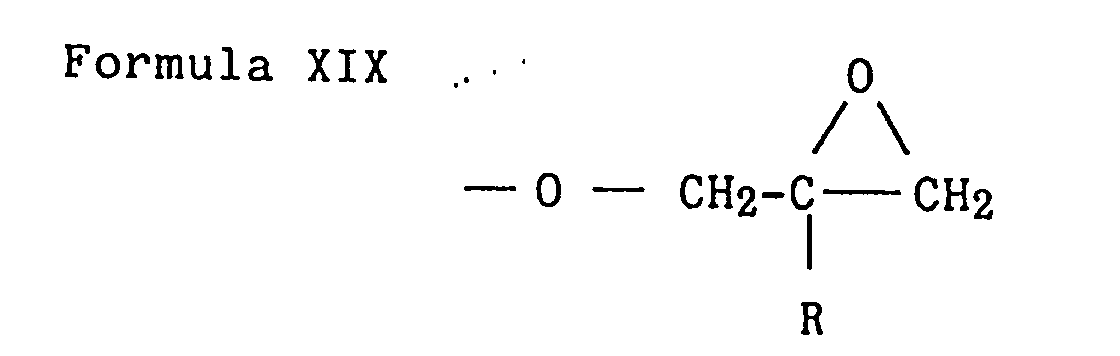
and wherein components (A) and (B) are employed in quantities which provide a ratio of phenolic hydroxyl groups per epoxy group of from 0.05:1 to 0.5:1. - An advanced resin of Claim 7 wherein(a) component A is 2,6-dibromo-3,5-dimethyl-4-hydroxybenzyl ether; and(b) component (B) is represented by formulas I, II or III.
- A process for preparing phenolic hydroxyl-containing compounds represented by the formulas VII, VIII, IX, X or XI:
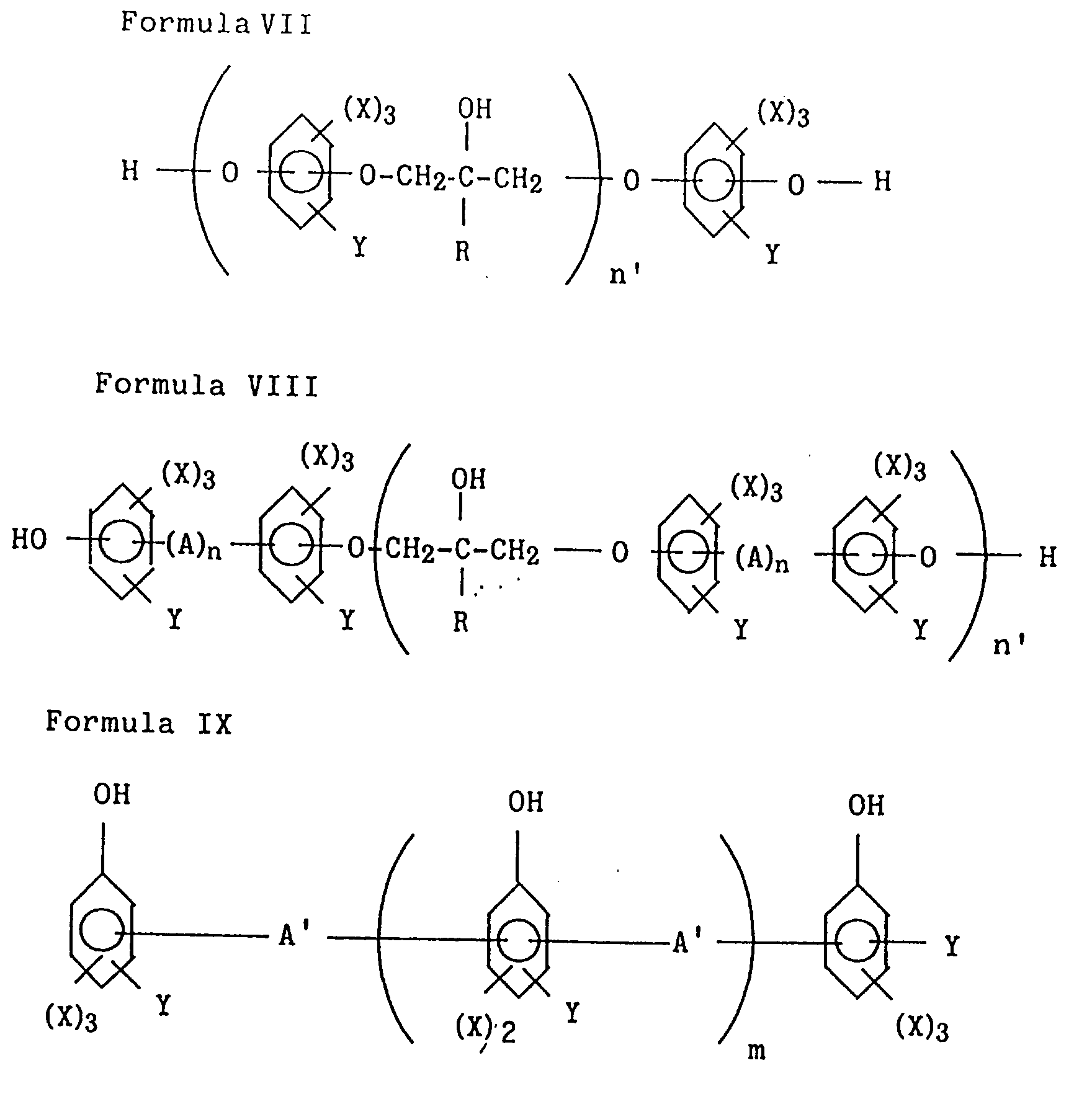 wherein each A is independently a divalent hydrocarbyl group having from 1 to 12 carbon atoms; each A' is independently a divalent hydrocarbyl group having from 1 to 10 carbon atoms; each Q is independently hydrogen or an alkyl group having from 1 to 4 carbon atoms; each R is independently hydrogen or an alkyl group having from 1 to 3 carbon atoms; each X is independently hydrogen, a hydrocarbyl or hydrocarbyloxy group having from 1 to 12 carbon atoms or a halogen atom; each Y is independently hydrogen or a group represented by the following formula XII:
 wherein R' is an alkyl group having from 1 to 10 carbon atoms with the proviso that at least one Y group is a group represented by the aforementioned formula XII; m has an average value from 0.01 to 8; m' has an average value from zero to 10; n has a value of zero or 1; n' has an average value from zero to 3; each p has a value from zero to 10; and each p' has an average value from zero to 8; which process comprises reacting
 (A) one or more 2,6-dibromo-3,5-dialkyl-4-hydroxybenzyl ethers represented by the following formula I:wherein each R' is independently an alkyl group having from 1 to 10 carbon atoms and each Z is a hydroxyl group; with
 (B) one or more phenolic hydroxyl-containing compounds having an average of more than one phenolic hydroxyl group per molecule represented by the following formulas II, III, IV, V or VI:
 wherein each A is independently a divalent hydrocarbyl group having from 1 to 12 carbon atoms; each A' is independently a divalent hydrocarbyl group having from 1 to 10 carbon atoms; each Q is independently hydrogen or an alkyl group having from 1 to 4 carbon atoms; each R is independently hydrogen or an alkyl group having from 1 to 3 carbon atoms; and each X is independently hydrogen, a hydrocarbyl or hydrocarbyloxy group having from 1 to 12 carbon atoms or a halogen atom; and
wherein components (A) and (B) are employed in quantities which provide a ratio of phenolic hydroxyl groups from 2,6-dibromo-3,5-dialkyl-4-hydroxybenzyl ether to aromatic rings from the phenolic hydroxyl containing compound of from 0.05:1 to 0.5:1. - A process of Claim 9 wherein(a) component (A) is 2,6-dibromo-3,5-dimethyl-4-hydroxybenzyl ether; and(b) component (B) is represented by formulas II or III.
- A compound or mixture of compounds represented by the following formulas VII, VIII, IX, X or XI:
 wherein each A is independently a divalent hydrocarbyl group having from 1 to 12 carbon atoms; each A' is independently a divalent hydrocarbyl group having from 1 to 10 carbon atoms; each Q is independently hydrogen or an alkyl group having from 1 to 4 carbon atoms; each R is independently hydrogen or an alkyl group having from 1 to 3 carbon atoms; each X is independently hydrogen, a hydrocarbyl or hydrocarbyloxy group having from 1 to 12 carbon atoms or a halogen atom; each Y is independently hydrogen or a group represented by the following formula XII:
 wherein R' is an alkyl group having from 1 to 10 carbon atoms with the proviso that at least one Y group is a group represented by the aforementioned formula XII; m has an average value from 0.01 to 8; m' has an average value from zero to 10; n has a value of zero or 1; n' has an average value from zero to 3; each p has a value from zero to 10; and each p' has an average value from zero to 8.
- Epoxy resins represented by the following formulas XIII, XIV, XV, XVI and XVII:

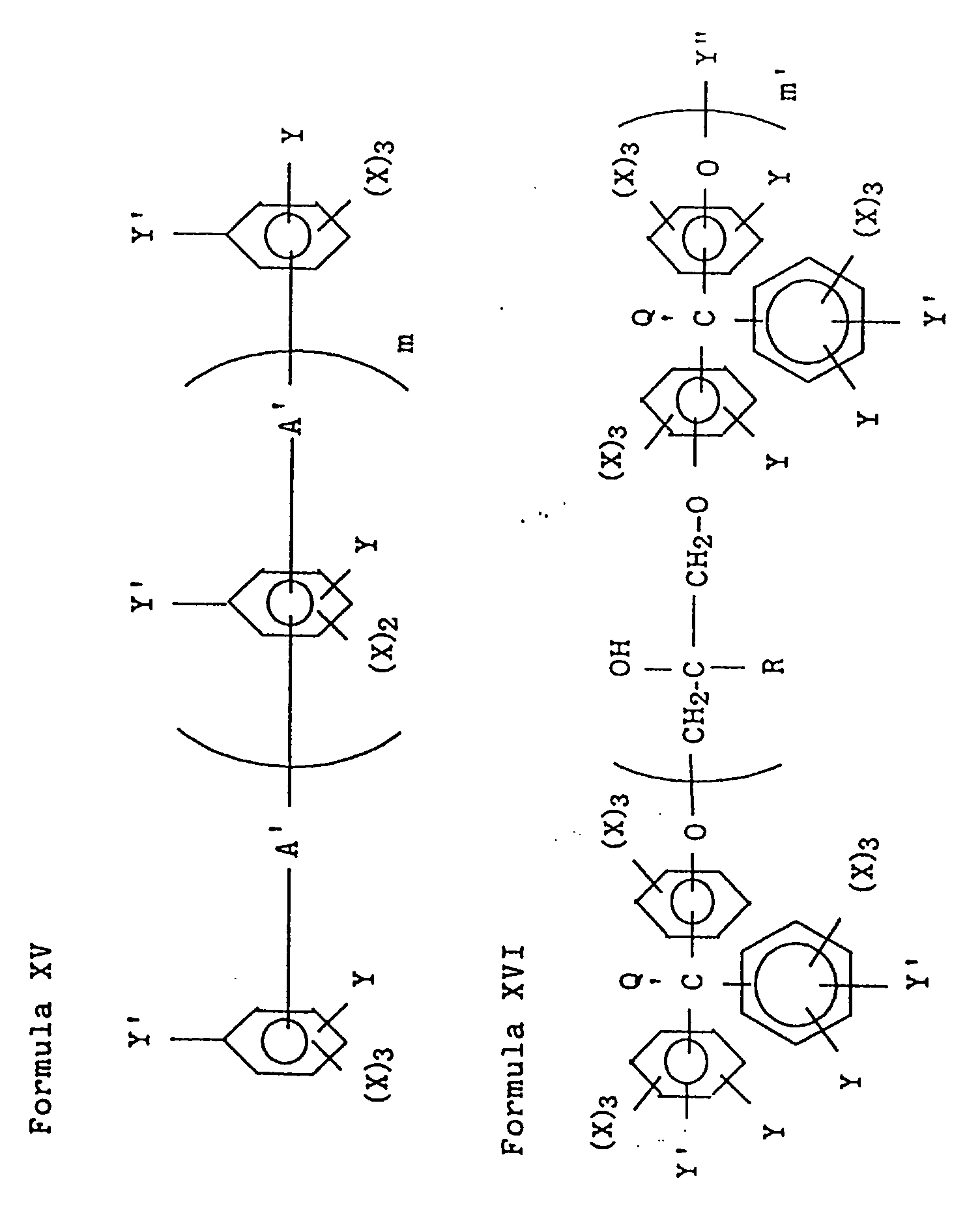 wherein each A is independently a divalent hydrocarbyl group having suitably from 1 to 12, more suitably from 1 to 6, most suitably from 1 to 4 carbon atoms; each A' is independently a divalent hydrocarbyl group having from 1 to 10, more suitably from 1 to 4, most suitably from 1 to 2 carbon atoms; each Q is independently hydrogen or an alkyl group having from 1 to 4 carbon atoms; each R is independently hydrogen or an alkyl group having from 1 to 3 carbon atoms; each X is independently hydrogen, a hydrocarbyl or hydrocarbyloxy group having suitably from 1 to 12, more suitably from 1 to 6, most suitably from 1 to 4 carbon atoms or a halogen atom, preferably chlorine or bromine; each Y is independently hydrogen or a group represented by the following formula XVIII:
 wherein each R' is an alkyl group having from 1 to 10, preferably from 1 to 5, more preferably from 1 to 3 carbon atoms with the proviso that at least one Y group is a group represented by the aforementioned formula XVIII; each Y' is represented by the following formula XIX:
 each Y'' is represented by the following formula XX:
 m has an average value suitably from 0.01 to 8, more suitably from 1 to 6, most suitably from 2 to 4; m' has an average value suitably from zero to 10, more suitably from zero to 6, most suitably from zero to 3; n has a value of zero or 1; n' has an average value suitably from zero to 3, more suitably from zero to 2, most suitably from zero to 1; each p suitably has a value from zero to 10, more suitably from zero to 3, most suitably from zero to 3; and each p' suitably has an average value from zero to 8, more suitably from 1 to 6, most suitably from 2 to 4.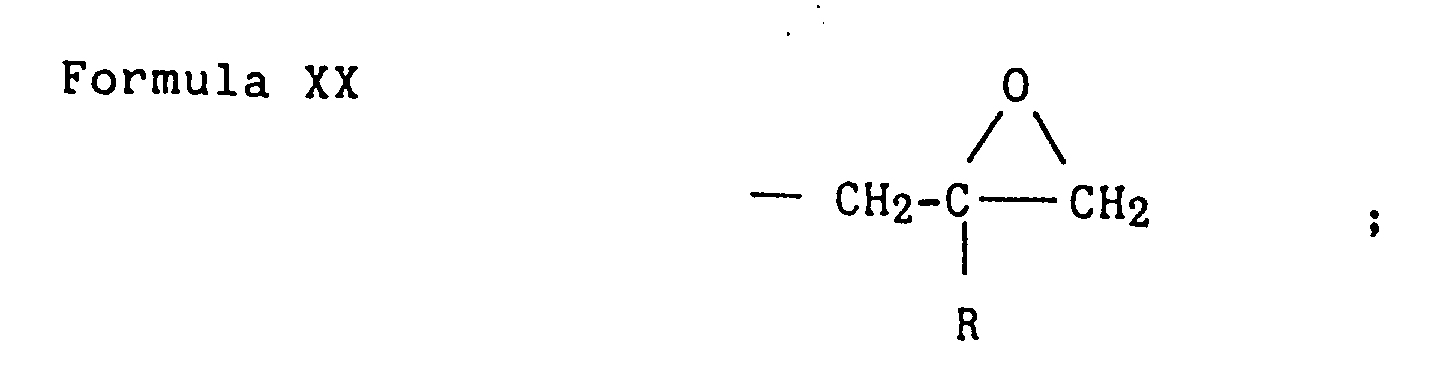
- A curable composition comprising (1) a composition of Claim 1, 2, 4, 5, 6, 7, 8 or 12 and (2) a curing amount of a curing agent or curing catalyst for component (1).
- A curable composition of Claim 13 wherein said curing agent is a phenol-aldehyde novolac resin, substituted phenol-aldehyde novolac resin, a biguanide, a guanadine, a dicarboxylic acid anhydride, an aromatic amine, or any combination thereof.
- A curable composition of Claim 14 wherein said curing agent is a phenol-formaldehyde novolac resin, cresol-formaldehyde novolac resin, bis-(4-aminophenyl)sulfone, bis-(4-aminophenyl)methane, dicyandiamide, phthalic anhydride, or maleic anhydride combination thereof.
- A curable composition of any of Claims 13-15 which additionally contains a reinforcing agent.
- A curable composition of Claim 16 wherein said reinforcing agent is glass, graphite or boron fiber in monofilament, multifilament, mat or woven form.
- An article resulting from curing the curable composition of Claims 13-17.
Applications Claiming Priority (2)
| Application Number | Priority Date | Filing Date | Title |
|---|---|---|---|
| US07/300,460 US4892925A (en) | 1989-01-23 | 1989-01-23 | Process for preparing phenolic hydroxyl-containing compounds from 2,6-dibromo-3,5-dialkyl-4-hydroxybenzyl ethers |
| US300460 | 1989-01-23 |
Publications (3)
| Publication Number | Publication Date |
|---|---|
| EP0379940A2 EP0379940A2 (en) | 1990-08-01 |
| EP0379940A3 EP0379940A3 (en) | 1991-09-25 |
| EP0379940B1 true EP0379940B1 (en) | 1999-03-03 |
Family
ID=23159190
Family Applications (1)
| Application Number | Title | Priority Date | Filing Date |
|---|---|---|---|
| EP90100860A Expired - Lifetime EP0379940B1 (en) | 1989-01-23 | 1990-01-17 | Glycidyl derivatives of 2,6-dibromo-3,5-dialkyl-4-hydroxybenzyl ethers |
Country Status (10)
| Country | Link |
|---|---|
| US (1) | US4892925A (en) |
| EP (1) | EP0379940B1 (en) |
| JP (1) | JP2968546B2 (en) |
| KR (1) | KR900011750A (en) |
| AT (1) | ATE177090T1 (en) |
| BR (1) | BR9000277A (en) |
| CA (1) | CA2008236A1 (en) |
| DE (1) | DE69032962T2 (en) |
| ES (1) | ES2129389T3 (en) |
| MY (1) | MY104860A (en) |
Families Citing this family (5)
| Publication number | Priority date | Publication date | Assignee | Title |
|---|---|---|---|---|
| US4827482A (en) * | 1988-03-21 | 1989-05-02 | Massachusetts Institute Of Technology | Phase-locked semiconductor laser arrays |
| BRPI0418907A (en) * | 2004-05-20 | 2007-11-27 | Albemarle Corp | unchanged brominated anionic styrene polymer agglomerates and preparation method |
| US7623487B2 (en) * | 2006-05-24 | 2009-11-24 | Nortel Networks Limited | OFDM system and method for supporting a wide range of mobility speeds |
| US20080039595A1 (en) * | 2006-06-07 | 2008-02-14 | Joseph Gan | Oligomeric halogenated chain extenders for preparing epoxy resins |
| US7919567B2 (en) * | 2006-06-07 | 2011-04-05 | Dow Global Technologies Llc | Oligomeric halogenated chain extenders for preparing epoxy resins |
Family Cites Families (9)
| Publication number | Priority date | Publication date | Assignee | Title |
|---|---|---|---|---|
| CA742755A (en) * | 1966-09-13 | H. Reinking Norman | Modified thermoplastic polyhydroxyethers | |
| US3989531A (en) * | 1971-08-05 | 1976-11-02 | General Electric Company | Fire-retardant polymeric compositions containing brominated biphenols |
| US4170711A (en) * | 1974-03-12 | 1979-10-09 | General Electric Company | Brominated biphenol derivatives |
| US4661644A (en) * | 1985-09-09 | 1987-04-28 | The Dow Chemical Company | Brominated epoxyaromatic compounds |
| CA1272345A (en) * | 1986-02-24 | 1990-07-31 | The Dow Chemical Company | Curable compositions containing a polyepoxide and a halogenated bisphenol |
| US4731423A (en) * | 1986-08-13 | 1988-03-15 | The Dow Chemical Company | Meta-halo-phenolic alkylation products and epoxy systems |
| US4727119A (en) * | 1986-09-15 | 1988-02-23 | The Dow Chemical Company | Halogenated epoxy resins |
| US4783363A (en) * | 1986-09-24 | 1988-11-08 | The Dow Chemical Company | Curable compositions containing a polyepoxide and a halogenated bisphenol |
| US4849548A (en) * | 1988-03-21 | 1989-07-18 | The Dow Chemical Company | Hydrolysis of halo- and alkyl-substituted phenols |
-
1989
- 1989-01-23 US US07/300,460 patent/US4892925A/en not_active Expired - Lifetime
-
1990
- 1990-01-08 JP JP2000725A patent/JP2968546B2/en not_active Expired - Fee Related
- 1990-01-17 AT AT90100860T patent/ATE177090T1/en not_active IP Right Cessation
- 1990-01-17 EP EP90100860A patent/EP0379940B1/en not_active Expired - Lifetime
- 1990-01-17 DE DE69032962T patent/DE69032962T2/en not_active Expired - Fee Related
- 1990-01-17 ES ES90100860T patent/ES2129389T3/en not_active Expired - Lifetime
- 1990-01-19 BR BR909000277A patent/BR9000277A/en unknown
- 1990-01-22 KR KR1019900000693A patent/KR900011750A/en not_active Withdrawn
- 1990-01-22 CA CA002008236A patent/CA2008236A1/en not_active Abandoned
- 1990-01-22 MY MYPI90000105A patent/MY104860A/en unknown
Also Published As
| Publication number | Publication date |
|---|---|
| MY104860A (en) | 1994-06-30 |
| CA2008236A1 (en) | 1990-07-23 |
| US4892925A (en) | 1990-01-09 |
| DE69032962T2 (en) | 1999-10-07 |
| ATE177090T1 (en) | 1999-03-15 |
| JPH02233672A (en) | 1990-09-17 |
| ES2129389T3 (en) | 1999-06-16 |
| KR900011750A (en) | 1990-08-02 |
| BR9000277A (en) | 1990-11-20 |
| DE69032962D1 (en) | 1999-04-08 |
| JP2968546B2 (en) | 1999-10-25 |
| EP0379940A3 (en) | 1991-09-25 |
| EP0379940A2 (en) | 1990-08-01 |
Similar Documents
| Publication | Publication Date | Title |
|---|---|---|
| JP4285491B2 (en) | Epoxy resin composition, cured product thereof, novel epoxy resin, novel phenol resin, and semiconductor sealing material | |
| US6291626B1 (en) | Phosphorus-containing dihydric phenol or naphthol-advanced epoxy resin or cured | |
| US6797821B2 (en) | Phosphorus-containing flame-retardant hardeners, epoxy resins, advanced epoxy resins and cured epoxy resins | |
| US6784228B2 (en) | Epoxy resin composition, cured article thereof, novel epoxy resin, novel phenol compound, and process for preparing the same | |
| US6660811B2 (en) | Epoxy resin composition and curing product thereof | |
| JP4259536B2 (en) | Method for producing phenol resin and method for producing epoxy resin | |
| JP3206778B2 (en) | Cyclic phosphazene compound, resin composition and cured product thereof | |
| KR100611733B1 (en) | High purity epoxy resin manufacturing method and epoxy resin composition | |
| CA1335402C (en) | Halogen-containing advanced epoxy resins | |
| US4895755A (en) | Halogenated advanced epoxy resins | |
| KR900008962B1 (en) | Advanced epoxy resins prepared from triglycidyl ethers and dihydri phenols | |
| US4892925A (en) | Process for preparing phenolic hydroxyl-containing compounds from 2,6-dibromo-3,5-dialkyl-4-hydroxybenzyl ethers | |
| KR100724996B1 (en) | Epoxy Resin, Manufacturing Method thereof, Epoxy Resin Composition and Cured Product | |
| US4663400A (en) | Epoxy resins prepared from trisphenols and dicyclopentadiene | |
| JP3451104B2 (en) | Epoxy resin composition | |
| JP2004346115A (en) | Epoxy resin, epoxy resin composition and cured product | |
| EP0458417A2 (en) | Adducts of phenolic compounds and cyclic terpenes and derivatives of said adducts | |
| JP3446164B2 (en) | Epoxy resin and method for producing the same | |
| JPH11140162A (en) | Modified epoxy resin, epoxy resin composition, and cured article prepared therefrom | |
| JP3436794B2 (en) | Epoxy resin, epoxy resin composition and cured product thereof | |
| JP2006097012A (en) | Polyvalent hydroxy compound, epoxy resin, and production method thereof, epoxy resin composition and cured product | |
| JPH07109338A (en) | Phenol-dicyclopentadiene cocondensed resin and epoxy resin containing the same | |
| EP0400948A2 (en) | Heat-resistant, flame-retardant epoxy resin compositions | |
| WO2008072668A1 (en) | Phenol resin, epoxy resin, curable resin composition, cured product of the composition, and method for producing phenol resin |
Legal Events
| Date | Code | Title | Description |
|---|---|---|---|
| PUAI | Public reference made under article 153(3) epc to a published international application that has entered the european phase |
Free format text: ORIGINAL CODE: 0009012 |
|
| AK | Designated contracting states |
Kind code of ref document: A2 Designated state(s): AT BE CH DE ES FR GB IT LI NL SE |
|
| PUAL | Search report despatched |
Free format text: ORIGINAL CODE: 0009013 |
|
| AK | Designated contracting states |
Kind code of ref document: A3 Designated state(s): AT BE CH DE ES FR GB IT LI NL SE |
|
| 17P | Request for examination filed |
Effective date: 19920316 |
|
| 17Q | First examination report despatched |
Effective date: 19951206 |
|
| RAP3 | Party data changed (applicant data changed or rights of an application transferred) |
Owner name: THE DOW CHEMICAL COMPANY |
|
| RAP1 | Party data changed (applicant data changed or rights of an application transferred) |
Owner name: CIBA SPECIALTY CHEMICALS HOLDING INC. |
|
| GRAG | Despatch of communication of intention to grant |
Free format text: ORIGINAL CODE: EPIDOS AGRA |
|
| GRAG | Despatch of communication of intention to grant |
Free format text: ORIGINAL CODE: EPIDOS AGRA |
|
| GRAH | Despatch of communication of intention to grant a patent |
Free format text: ORIGINAL CODE: EPIDOS IGRA |
|
| GRAH | Despatch of communication of intention to grant a patent |
Free format text: ORIGINAL CODE: EPIDOS IGRA |
|
| GRAA | (expected) grant |
Free format text: ORIGINAL CODE: 0009210 |
|
| ITF | It: translation for a ep patent filed | ||
| AK | Designated contracting states |
Kind code of ref document: B1 Designated state(s): AT BE CH DE ES FR GB IT LI NL SE |
|
| REF | Corresponds to: |
Ref document number: 177090 Country of ref document: AT Date of ref document: 19990315 Kind code of ref document: T |
|
| REG | Reference to a national code |
Ref country code: CH Ref legal event code: EP |
|
| REF | Corresponds to: |
Ref document number: 69032962 Country of ref document: DE Date of ref document: 19990408 |
|
| ET | Fr: translation filed | ||
| REG | Reference to a national code |
Ref country code: ES Ref legal event code: FG2A Ref document number: 2129389 Country of ref document: ES Kind code of ref document: T3 |
|
| PLBE | No opposition filed within time limit |
Free format text: ORIGINAL CODE: 0009261 |
|
| STAA | Information on the status of an ep patent application or granted ep patent |
Free format text: STATUS: NO OPPOSITION FILED WITHIN TIME LIMIT |
|
| 26N | No opposition filed | ||
| REG | Reference to a national code |
Ref country code: CH Ref legal event code: PUE Owner name: CIBA SPECIALTY CHEMICALS HOLDING INC. TRANSFER- VA |
|
| REG | Reference to a national code |
Ref country code: GB Ref legal event code: 732E |
|
| NLS | Nl: assignments of ep-patents |
Owner name: VANTICO AG |
|
| REG | Reference to a national code |
Ref country code: GB Ref legal event code: IF02 |
|
| REG | Reference to a national code |
Ref country code: FR Ref legal event code: TP |
|
| PGFP | Annual fee paid to national office [announced via postgrant information from national office to epo] |
Ref country code: CH Payment date: 20021218 Year of fee payment: 14 |
|
| PGFP | Annual fee paid to national office [announced via postgrant information from national office to epo] |
Ref country code: NL Payment date: 20021227 Year of fee payment: 14 Ref country code: GB Payment date: 20021227 Year of fee payment: 14 |
|
| PGFP | Annual fee paid to national office [announced via postgrant information from national office to epo] |
Ref country code: AT Payment date: 20030102 Year of fee payment: 14 |
|
| PGFP | Annual fee paid to national office [announced via postgrant information from national office to epo] |
Ref country code: SE Payment date: 20030109 Year of fee payment: 14 |
|
| PGFP | Annual fee paid to national office [announced via postgrant information from national office to epo] |
Ref country code: FR Payment date: 20030110 Year of fee payment: 14 |
|
| PGFP | Annual fee paid to national office [announced via postgrant information from national office to epo] |
Ref country code: BE Payment date: 20030122 Year of fee payment: 14 |
|
| PGFP | Annual fee paid to national office [announced via postgrant information from national office to epo] |
Ref country code: ES Payment date: 20030123 Year of fee payment: 14 |
|
| PGFP | Annual fee paid to national office [announced via postgrant information from national office to epo] |
Ref country code: DE Payment date: 20030124 Year of fee payment: 14 |
|
| PG25 | Lapsed in a contracting state [announced via postgrant information from national office to epo] |
Ref country code: GB Free format text: LAPSE BECAUSE OF NON-PAYMENT OF DUE FEES Effective date: 20040117 Ref country code: AT Free format text: LAPSE BECAUSE OF NON-PAYMENT OF DUE FEES Effective date: 20040117 |
|
| PG25 | Lapsed in a contracting state [announced via postgrant information from national office to epo] |
Ref country code: SE Free format text: LAPSE BECAUSE OF NON-PAYMENT OF DUE FEES Effective date: 20040118 |
|
| PG25 | Lapsed in a contracting state [announced via postgrant information from national office to epo] |
Ref country code: ES Free format text: LAPSE BECAUSE OF NON-PAYMENT OF DUE FEES Effective date: 20040119 |
|
| PG25 | Lapsed in a contracting state [announced via postgrant information from national office to epo] |
Ref country code: LI Free format text: LAPSE BECAUSE OF NON-PAYMENT OF DUE FEES Effective date: 20040131 Ref country code: CH Free format text: LAPSE BECAUSE OF NON-PAYMENT OF DUE FEES Effective date: 20040131 Ref country code: BE Free format text: LAPSE BECAUSE OF NON-PAYMENT OF DUE FEES Effective date: 20040131 |
|
| BERE | Be: lapsed |
Owner name: *VANTICO A.G. Effective date: 20040131 |
|
| PG25 | Lapsed in a contracting state [announced via postgrant information from national office to epo] |
Ref country code: NL Free format text: LAPSE BECAUSE OF NON-PAYMENT OF DUE FEES Effective date: 20040801 |
|
| PG25 | Lapsed in a contracting state [announced via postgrant information from national office to epo] |
Ref country code: DE Free format text: LAPSE BECAUSE OF NON-PAYMENT OF DUE FEES Effective date: 20040803 |
|
| EUG | Se: european patent has lapsed | ||
| GBPC | Gb: european patent ceased through non-payment of renewal fee |
Effective date: 20040117 |
|
| REG | Reference to a national code |
Ref country code: CH Ref legal event code: PL |
|
| PG25 | Lapsed in a contracting state [announced via postgrant information from national office to epo] |
Ref country code: FR Free format text: LAPSE BECAUSE OF NON-PAYMENT OF DUE FEES Effective date: 20040930 |
|
| NLV4 | Nl: lapsed or anulled due to non-payment of the annual fee |
Effective date: 20040801 |
|
| REG | Reference to a national code |
Ref country code: FR Ref legal event code: ST |
|
| PG25 | Lapsed in a contracting state [announced via postgrant information from national office to epo] |
Ref country code: IT Free format text: LAPSE BECAUSE OF NON-PAYMENT OF DUE FEES Effective date: 20050117 |
|
| REG | Reference to a national code |
Ref country code: ES Ref legal event code: FD2A Effective date: 20040119 |