EP0379806A2 - Pyrimidines and their pharmaceutical acceptable salts, and their use as medicines - Google Patents
Pyrimidines and their pharmaceutical acceptable salts, and their use as medicines Download PDFInfo
- Publication number
- EP0379806A2 EP0379806A2 EP89313595A EP89313595A EP0379806A2 EP 0379806 A2 EP0379806 A2 EP 0379806A2 EP 89313595 A EP89313595 A EP 89313595A EP 89313595 A EP89313595 A EP 89313595A EP 0379806 A2 EP0379806 A2 EP 0379806A2
- Authority
- EP
- European Patent Office
- Prior art keywords
- group
- formula
- lower alkyl
- toluenesulfonate
- hydrogen atom
- Prior art date
- Legal status (The legal status is an assumption and is not a legal conclusion. Google has not performed a legal analysis and makes no representation as to the accuracy of the status listed.)
- Granted
Links
- 0 ***NC1NCCCN1 Chemical compound ***NC1NCCCN1 0.000 description 12
- ATBLZCRLXWUKBE-UHFFFAOYSA-N O=C1N(CI)c2nc(N(CC3)CCC3I)ncc2C1 Chemical compound O=C1N(CI)c2nc(N(CC3)CCC3I)ncc2C1 ATBLZCRLXWUKBE-UHFFFAOYSA-N 0.000 description 1
Classifications
-
- C—CHEMISTRY; METALLURGY
- C07—ORGANIC CHEMISTRY
- C07D—HETEROCYCLIC COMPOUNDS
- C07D213/00—Heterocyclic compounds containing six-membered rings, not condensed with other rings, with one nitrogen atom as the only ring hetero atom and three or more double bonds between ring members or between ring members and non-ring members
- C07D213/02—Heterocyclic compounds containing six-membered rings, not condensed with other rings, with one nitrogen atom as the only ring hetero atom and three or more double bonds between ring members or between ring members and non-ring members having three double bonds between ring members or between ring members and non-ring members
- C07D213/04—Heterocyclic compounds containing six-membered rings, not condensed with other rings, with one nitrogen atom as the only ring hetero atom and three or more double bonds between ring members or between ring members and non-ring members having three double bonds between ring members or between ring members and non-ring members having no bond between the ring nitrogen atom and a non-ring member or having only hydrogen or carbon atoms directly attached to the ring nitrogen atom
- C07D213/60—Heterocyclic compounds containing six-membered rings, not condensed with other rings, with one nitrogen atom as the only ring hetero atom and three or more double bonds between ring members or between ring members and non-ring members having three double bonds between ring members or between ring members and non-ring members having no bond between the ring nitrogen atom and a non-ring member or having only hydrogen or carbon atoms directly attached to the ring nitrogen atom with hetero atoms or with carbon atoms having three bonds to hetero atoms with at the most one bond to halogen, e.g. ester or nitrile radicals, directly attached to ring carbon atoms
- C07D213/72—Nitrogen atoms
- C07D213/75—Amino or imino radicals, acylated by carboxylic or carbonic acids, or by sulfur or nitrogen analogues thereof, e.g. carbamates
-
- C—CHEMISTRY; METALLURGY
- C07—ORGANIC CHEMISTRY
- C07D—HETEROCYCLIC COMPOUNDS
- C07D239/00—Heterocyclic compounds containing 1,3-diazine or hydrogenated 1,3-diazine rings
- C07D239/02—Heterocyclic compounds containing 1,3-diazine or hydrogenated 1,3-diazine rings not condensed with other rings
- C07D239/24—Heterocyclic compounds containing 1,3-diazine or hydrogenated 1,3-diazine rings not condensed with other rings having three or more double bonds between ring members or between ring members and non-ring members
- C07D239/28—Heterocyclic compounds containing 1,3-diazine or hydrogenated 1,3-diazine rings not condensed with other rings having three or more double bonds between ring members or between ring members and non-ring members with hetero atoms or with carbon atoms having three bonds to hetero atoms with at the most one bond to halogen, directly attached to ring carbon atoms
-
- C—CHEMISTRY; METALLURGY
- C07—ORGANIC CHEMISTRY
- C07D—HETEROCYCLIC COMPOUNDS
- C07D239/00—Heterocyclic compounds containing 1,3-diazine or hydrogenated 1,3-diazine rings
- C07D239/02—Heterocyclic compounds containing 1,3-diazine or hydrogenated 1,3-diazine rings not condensed with other rings
- C07D239/24—Heterocyclic compounds containing 1,3-diazine or hydrogenated 1,3-diazine rings not condensed with other rings having three or more double bonds between ring members or between ring members and non-ring members
- C07D239/28—Heterocyclic compounds containing 1,3-diazine or hydrogenated 1,3-diazine rings not condensed with other rings having three or more double bonds between ring members or between ring members and non-ring members with hetero atoms or with carbon atoms having three bonds to hetero atoms with at the most one bond to halogen, directly attached to ring carbon atoms
- C07D239/46—Two or more oxygen, sulphur or nitrogen atoms
- C07D239/48—Two nitrogen atoms
-
- C—CHEMISTRY; METALLURGY
- C07—ORGANIC CHEMISTRY
- C07D—HETEROCYCLIC COMPOUNDS
- C07D401/00—Heterocyclic compounds containing two or more hetero rings, having nitrogen atoms as the only ring hetero atoms, at least one ring being a six-membered ring with only one nitrogen atom
- C07D401/02—Heterocyclic compounds containing two or more hetero rings, having nitrogen atoms as the only ring hetero atoms, at least one ring being a six-membered ring with only one nitrogen atom containing two hetero rings
- C07D401/04—Heterocyclic compounds containing two or more hetero rings, having nitrogen atoms as the only ring hetero atoms, at least one ring being a six-membered ring with only one nitrogen atom containing two hetero rings directly linked by a ring-member-to-ring-member bond
-
- C—CHEMISTRY; METALLURGY
- C07—ORGANIC CHEMISTRY
- C07D—HETEROCYCLIC COMPOUNDS
- C07D401/00—Heterocyclic compounds containing two or more hetero rings, having nitrogen atoms as the only ring hetero atoms, at least one ring being a six-membered ring with only one nitrogen atom
- C07D401/02—Heterocyclic compounds containing two or more hetero rings, having nitrogen atoms as the only ring hetero atoms, at least one ring being a six-membered ring with only one nitrogen atom containing two hetero rings
- C07D401/12—Heterocyclic compounds containing two or more hetero rings, having nitrogen atoms as the only ring hetero atoms, at least one ring being a six-membered ring with only one nitrogen atom containing two hetero rings linked by a chain containing hetero atoms as chain links
-
- C—CHEMISTRY; METALLURGY
- C07—ORGANIC CHEMISTRY
- C07D—HETEROCYCLIC COMPOUNDS
- C07D403/00—Heterocyclic compounds containing two or more hetero rings, having nitrogen atoms as the only ring hetero atoms, not provided for by group C07D401/00
- C07D403/02—Heterocyclic compounds containing two or more hetero rings, having nitrogen atoms as the only ring hetero atoms, not provided for by group C07D401/00 containing two hetero rings
- C07D403/04—Heterocyclic compounds containing two or more hetero rings, having nitrogen atoms as the only ring hetero atoms, not provided for by group C07D401/00 containing two hetero rings directly linked by a ring-member-to-ring-member bond
-
- C—CHEMISTRY; METALLURGY
- C07—ORGANIC CHEMISTRY
- C07D—HETEROCYCLIC COMPOUNDS
- C07D405/00—Heterocyclic compounds containing both one or more hetero rings having oxygen atoms as the only ring hetero atoms, and one or more rings having nitrogen as the only ring hetero atom
- C07D405/14—Heterocyclic compounds containing both one or more hetero rings having oxygen atoms as the only ring hetero atoms, and one or more rings having nitrogen as the only ring hetero atom containing three or more hetero rings
-
- C—CHEMISTRY; METALLURGY
- C07—ORGANIC CHEMISTRY
- C07D—HETEROCYCLIC COMPOUNDS
- C07D409/00—Heterocyclic compounds containing two or more hetero rings, at least one ring having sulfur atoms as the only ring hetero atoms
- C07D409/02—Heterocyclic compounds containing two or more hetero rings, at least one ring having sulfur atoms as the only ring hetero atoms containing two hetero rings
- C07D409/12—Heterocyclic compounds containing two or more hetero rings, at least one ring having sulfur atoms as the only ring hetero atoms containing two hetero rings linked by a chain containing hetero atoms as chain links
-
- C—CHEMISTRY; METALLURGY
- C07—ORGANIC CHEMISTRY
- C07D—HETEROCYCLIC COMPOUNDS
- C07D453/00—Heterocyclic compounds containing quinuclidine or iso-quinuclidine ring systems, e.g. quinine alkaloids
- C07D453/02—Heterocyclic compounds containing quinuclidine or iso-quinuclidine ring systems, e.g. quinine alkaloids containing not further condensed quinuclidine ring systems
-
- C—CHEMISTRY; METALLURGY
- C07—ORGANIC CHEMISTRY
- C07D—HETEROCYCLIC COMPOUNDS
- C07D487/00—Heterocyclic compounds containing nitrogen atoms as the only ring hetero atoms in the condensed system, not provided for by groups C07D451/00 - C07D477/00
- C07D487/02—Heterocyclic compounds containing nitrogen atoms as the only ring hetero atoms in the condensed system, not provided for by groups C07D451/00 - C07D477/00 in which the condensed system contains two hetero rings
- C07D487/04—Ortho-condensed systems
Definitions
- This invention relates to novel pyrimidines or their pharmaceutically acceptable salts, and novel therapeutic agents for neurological diseases of the peripheral and central nervous systems of animals containing the above compounds as active ingredients.
- Japanese Patent Publication No. 23,394/1971 discloses that aminopyrimidines represented by the following formula wherein A represents an alkylene group having up to 16 carbon atoms, or a lower alkylene group substituted by an amino group or a C 2 -s acylamino group, M represents H, Na, K, NH 4 , Mg, Ca or an organic basic ammonium salt, and n is a value equal to the atomic valency of M, have interesting therapeutic activity, particularly as an anti-melanchoric agent and psychoanaleptic agent in the field of psychosis.
- Japanese Patent Publication No. 22044/1976 discloses that dichloro-lower aliphatic carboxylic acid salts of 2-isopropylaminopyrimidine, such as 2-isopropylaminopyrimidine dichloroacetate, are useful as a therapeutic agent for a neurological disease.
- Patent Publication No. 28548/1984 discloses that 2-isopropylaminopyrimidine phosphate is useful as a therapeutic agent for a neurological disease.
- Japanese Patent Publication No. 157575/1979 discloses a process for producing 2-chloropyrimidine in a high yield.
- a working example in this patent publication describes the preparation of 2-chloropyrimidine in a yield of 69 %.
- Japanese Laid-Open Patent Publication No. 393/1980 discloses a process for producing 2-isopropylaminopyrimidine in a high yield.
- a working example of this patent publication describes the preparation of 2-isopropylaminopyrimidine in a yield of 60 %.
- Japanese Laid-Open Patent Publication No. 122768/1980 discloses that a hydroxy derivative of 2-isopropylaminopyrimidine represented by the following formula wherein A4, A 5 and A 6 each represent H or OH, and at least one of them represents OH, is useful in the field of nerve regeneration and for treatment of myodystrophy.
- Japanese Laid-Open Patent Publication No. 145670/1980 discloses that 2-isopropylaminohalogenopyrimidines represented by the following formula wherein A 4 ', A 5 ' and A 6 ' each represent H or a halogen atom, and at least one of them is a halogen atom, are useful for treatment of various neurological diseases and myodystrophy.
- Japanese Laid-Open Patent Publication No. 145,671/1980 discloses a process for producing a hydroxy derivative of 2-isopropylaminopyrimidine.
- Japanese Laid-Open Patent Publication No. 151,571/1980 discloses that 2-isopropylamino-5- halogenopyrimidines are interesting in the treatment of neurological diseases.
- Japanese Laid-Open Patent Publication No. 10177/1981 discloses a process for producing 2-isopropylaminopyrimidine substantially in a quantitative yield by aminolyzing 2-methylsulfonylpyrimidine with isopropylamine.
- Japanese Laid-Open Patent Publication No. 26880/1981 discloses a process for producing 2-isopropylaminopyrimidine which comprises reacting bis(isopropylguanidine) sulfate with 1,1,3,3-tetraethox- ypropane.
- Japanese Laid-Open Patent Publication No. 90,013/1981 describes a therapeutic agent for myodystropy, myopathy, muscle rigidity and/or dysfunction of neuro-musclar transmission comprising substituted derivative of pyrimidine or its therapeutically acceptable salt or its metabolite as an active ingredient.
- substituted derivative of pyrimidine or its therapeutically acceptable salt or its metabolite as an active ingredient.
- various salts such as an orthophosphate, of 2-isopropylaminopyrimidine as an active compound.
- Japanese Laid-Open Patent Publication No. 65873/1986 discloses that 2-piperazinopyrimidines of the following formula wherein R 1 is H or aralkyl, and Y is a divalent organic group defined in the claim of this patent publication, are useful as a herbicide for paddies and upland farms.
- the present inventors previously provided a novel therapeutic agent for treatment of neurological diseases comprising a specific 2-piperazinopyrimidine derivative or its pharmaceutically acceptable salt (International Laid-Open No. W087/04928).
- Another object of this invention is to provide therapeutic agents for neurological diseases and spinal breakdown comprising the above novel compounds.
- Another object of this invention is to provide a novel therapeutic agent for neurological diseases having the effect of regenerating and repairing nerve cells.
- Another object of this invention is to provide a novel therapeutic agent for neurological diseases which can be applied to disorders of peripheral nerves, cerebrospinal injury, etc.
- Another object of this invention is to provide a novel therapeutic agent for neurological diseases which can be applied to diseases of central nerves which are different from psycosis and in which abnormality in the operating system or the metabolic system of chemical transmitters is regarded as being primarily involved.
- Another object of this invention is to provide a novel therapeutic agent for cerebral diseases which has the effect of improving and restoring learning and memory.
- Another object of this invention is to provide a novel therapeutic agent for neurological diseases or cerebral diseases, which comprises a comprehensively excellent and useful compound having pharmacological actions suitable for treatment of neurological diseases or cerebral diseases with little side effects such as liver trouble.
- a pyrimidine represented by the following formula (1), or its pharmaceutically acceptable salt wherein R' represents a hydrogen atom or a lower alkyl group;
- X represents a group of the formula a group of the formula in which R 2 represents a hydrogen atom, a lower alkyl group, a phenyl group, a benzyl group or an alpha-(p-chlorophenyl)benzyl group, a group of the formula in which R 3 corresponds to one or at least two identical or different substituents replacing one or at least two hydrogen atoms of identical or different methylene groups, and represents a lower alkyl group, a hydroxyl group, a phenyl group optionally substituted by nitro, a benzyl group, a benzoyloxy group, a benzoylamino group, a lower alkylamino group, a di-lower alkylamino group, the HO(C 6 H 5 ) 2 C- group;
- R 1 is a hydrogen atom or a lower alkyl group.
- the lower alkyl group may be linear or branched, and preferably has 1 to 4 carbon atoms. Examples include methyl, ethyl, n-propyl, isopropyl n-butyl, sec-butyl, isobutyl and t-butyl groups.
- X represents a group of the formula
- R 2 represents a hydrogen atom, a lower alkyl group, phenyl group, benzyl group or an alpha-(p-chlorophenyl)benzyl group.
- Examples of the lower alkyl group may be the same as those exemplified for R 1.
- R 3 corresponds to a substituent replacing the hydrogen atom of the methylene group, and represents a lower alkyl group, a hydroxyl group, a phenyl group optionally substituted by nitro, a benzyl group, a benzoyloxy group, a benzoylamino group, a lower alkylamino group, a di-lower alkylamino group, the HO-(C 6 Hs) 2 C-group, a piperidino group, a hydroxy(lower alkyl) group, the C 6 H 5 SO 2 O- group, a benzoyl group optionally substituted by halogen, a lower alkylsulfonylamide group, or a lower alkoxycarbonyl group.
- n is a number of 4, 5, 6 or 7. Examples of the lower alkyl groups may be the same as those exemplified above with regard to R 1 .
- R 4 represents a hydrogen atom, a lower alkyl group or a benzyl group
- R 5 represents a lower alkyl group, a lower acyl group, a 2-furoyl group, a benzyl group, a 4-piperidyl group optionally substituted by benzoyl, a phenethyl group or the group or a benzoyl group optionally substituted by halogen or nitro.
- Examples of the lower alkyl groups for R 4 and R 5 may be the same as those R S .
- the alkyl moiety of the lower acyl group for R 5 may be linear or branched.
- Acyl groups having 2 to 6 carbon atoms are preferred, and examples include acetyl, propionyl, butyryl, isobutyryl, valeryl, isovaleryl and hexanoyl groups.
- Y represents a group of the formula
- R 9 represents a hydrogen atom, a lower alkyl group, a lower alkoxy group, a lower alkylthio group, or a di-lower alkylamino group.
- R 6 represents a hydrogen atom, a lower alkyl group, a phenyl group, a benzyl group, a lower alkoxy group or a 2-(N,N-dimethylamino)ethyl group.
- R 7 represents a lower alkyl group, a lower acyl group, a cyclohexylcarbonyl group, a 2-furoyl group, a lower alkoxycarbonyl group, a cinnamoyl group, a benzyl group, a benzylcarbonyl group, a tosyl group, a phenoxyacetyl group, a di-lower alkylcarbamoyl group, a 2-thienyl group, a group of the formula a group of the formula a group of the formula , a group of the formula a 4-lower alkylpiperazyl group, or a benzoyl group which may be substituted by halogen, lower alkoxy, nitro, amino, benzoylamino or phenyl.
- R 9 , R 6 and R 7 examples of the lower alkyl groups for R 9 , R 6 and R 7 may be the same as those exemplified with respect to R 1.
- Examples of the lower acyl group for R 7 may be the same as those exemplified above for R S.
- halogen and lower alkoxy group as substituent for the benzoyl group R 7 are fluorine, chlorine, bromine and iodine, and alkoxy groups having 1 to 4 carbon atoms such as methoxy, ethoxy, propoxy, isopropoxy, butoxy, isobutoxy and sec-butoxy.
- R 6 is a hydrogen atom
- R 7 is a benzoyl group.
- Z represents a hydrogen atom, a halogen atom, a lower alkoxycarbonyl group or a lower alkyl group.
- halogen atom examples include fluorine, chlorine, bromine and iodine.
- lower alkyl group may be the same as those exemplified with respect to R'.
- R 11 represents a lower alkyl group;
- R" is a lower alkyl group.
- R 12 represents a phenyl group optionally substituted by halogen, lower alkyl or lower alkoxy, a 2-furyl group or a 2-thienyl group.
- Examples of the lower alkyl groups for R" and R 12 may be the same as those exemplified above with regard to R 1 .
- R 21 represents a group of the formula (a) wherein R 23 represents a hydrogen atom, a lower alkyl group, a lower alkoxy group or a phenyl group and R 24 represents a hydrogen atom, a lower alkyl group, a cyclohexyl group, a phenyl group, a 4- halogenophenyl group, a p-diphenyl group, a 2-pyridyl group or a 2-thiophenyl group, provided that R 23 and R 24 are not hydrogen atoms at the same time; or a group of the formula (b) which is a 9-fluorenyl group or a triphenylmethyl group; R 22 represents a lower alkyl group; and t is a number of 0 or 1.
- A represents a group of the formula
- R 21 represents a group of the following formula (a) or a group of the following formula (b) which is a 9-fluorenyl or triphenylmethyl group.
- R 23 in formula (a) is a hydrogen atom, a lower alkyl group, a lower alkoxy group or a phenyl group
- R 24 represents a hydrogen atom, a lower alkyl group, a cyclohexyl group, a phenyl group, a 4- halogenophenyl group, a p-diphenyl group, a 2-pyridyl group, or a 2-thiophenyl group.
- R 23 and R 24 and are not hydrogen atoms at the same time.
- the lower alkyl groups for R 23 and R 24 may be linear or branched and preferably contain 1 to 4 carbon atoms. Examples are methyl, ethyl, n-propyl, isopropyl, n-butyl, sec-butyl and isobutyl groups.
- the lower alkoxy group for R 23 may be linear or branched, and those having 1 to 4 carbon atoms are preferred. Examples include methoxy, ethoxy, n-propoxy, isopropoxy, n-butoxy, sec-butoxy, isobutoxy and t-butoxy groups. Examples of the 4-halogenophenyl group for R 24 are 4-fluorophenyl, 4-chlorophenyl or 4-bromophenyl.
- R 22 is a lower alkyl group examples of which may be same as those given for R 23 .
- 1 is a number of 0 or 1.
- the compounds of formulae (1), (2) and (3) may be produced by known methods, particularly the methods described in Japanese Laid-Open Patent Publication Nos. 140568/1986 and 87627/1986, or by treating the intermediates obtained by these methods in accordance with known methods (for example, the elimination of the protecting group by reduction). Examples 1 to 9 given hereinafter describe the production of these compounds in detail.
- compounds of formula (I) in which Y is and -NR 6 R 7 and R 6 is other than hydrogen may be produced by the following reaction scheme 1.
- the starting compounds of formulae (II) and (III) in the reaction schemes 1 and 2 may be produced by the method described at J. Chem. Soc., 1965, pages 755-761, from as a starting material.
- the reactions in the reaction schemes 1 and 2 are conveniently carried out at a temperature of 20 to 150 °C in a solvent such as toluene, dioxane, pyridine or water in the presence of, as required, a basic compound.
- the basic compound may conveniently be, for example, an organic base (such as triethylamine, pyridine and 4-dimethylaminopyridine), and an inorganic base (such as sodium carbonate and potassium carbonate).
- Compound (VI) may be prepared in the same way as in [Production Method No. 7] of Japanese Laid-Open Patent Publication No. 65873/1986 except that X is used instead of benzylpiperazine.
- Compounds of formula (I) in which Y is CH 2 R 9 and Z is COOR 10 are obtained by reacting compound (VI) with R 9 H in the presence of an organic base and as pyridine or triethylamine, or an inorganic base such as potassium carbonate, sodium carbonate, potassium hydroxide, sodium hydroxide, potassium hydride or sodium hydride in the presence of an inert solvent such as toluene or tetrahydrofuran or in the absence of solvent.
- the compounds of general formula (2) can be synthesized by the same methods as in the synthesis of the compound of general formula (1).
- the compounds of general formula (3) can be produced by the methods shown in the following schemes 5 and 6.
- the starting material (VII) may be produced by the method described in J. A. C. S., 71, 2731 (1949).
- An inorganic base such as sodium carbonate or potassium carbonate, or an organic base such as triethylamine or pyridine may be used as the basic compound.
- Compound (III) is then hydrolyzed in the presence of an acid or an alkali to yield compound (IV).
- the hydrolysis is carried out in a solvent such as water, methanol or ethanol at a temperature of 0 to 150 C, preferably 20 to 100 °C.
- Compounds of formula (3) are produced from compound (IV) or (X) in accordance with scheme 5 by known methods, particularly the methods described in Japanese Laid-Open Patent Publications Nos. 140568/1986 and 87627/1986 or by treating the intermediates obtained by these methods in accordance with known methods (for example, the reductive elimination of the protective group).
- Examples 7 to 9 given below illustrate the production of the compounds of formula (3) in detail.
- the compounds of formulae (1), (2) and (3) are normally used in the form of a pharmaceutical composition, and are administered by various routes (e.g., oral, subcutaneous, intramuscular, intravenous, intrarhinal, skin permeation and through the rectum).
- routes e.g., oral, subcutaneous, intramuscular, intravenous, intrarhinal, skin permeation and through the rectum.
- the present invention also embraces a pharmaceutical preparation comprising a compound of general formula (1 (2) or (3) or its pharmaceutically acceptable salt.
- the pharmaceutically acceptable salt includes, for example, acid addition salts and quaternary ammonium (or amine) salts.
- Examples of the pharmaceutically acceptable salts of the compounds (1), (2) and (3) include salts formed from acids capable of forming pharmaceutically acceptable non-toxic acid-addition salts containing anions, such as hydrochlorides, hydrobromides, sulfates, bisulfites, phosphates, acid phosphates, acetates, maleates, fumarates, succinates, lactates, tartrates, benzoates, citrates, gluconates, glucanates, methanesulfonates, p-toluenesulfonates and naphthalenesulfonates or their hydrates, and quaternary ammonium (or amine) salts or their hydrates.
- acids capable of forming pharmaceutically acceptable non-toxic acid-addition salts containing anions such as hydrochlorides, hydrobromides, sulfates, bisulfites, phosphates, acid phosphates, acetates, maleates, fumarates, succ
- composition of this invention may be formulated into tablets, capsules, powders, granules, troches, cachet wafer capsules, elixirs, emulsions, solutions, syrups, suspensions, aerosols, ointments, aseptic injectables, molded cataplasmas, tapes, soft and hard gelatin capsules, suppositories, and aseptic packed powders.
- Examples of the pharmaceutically acceptable carrier include lactose, glucose, sucrose, sorbitol, mannitol, corn starch, crystalline cellulose, gum arabic, calcium phosphate, alginates, calcium silicate, microcrystalline cellulose, polyvinyl pyrrolidone, tragacanth gum, gelatin, syrup, methyl cellulose, carboxymethyl cellulose, methylhydroxybenzoic acid esters, propylhydroxybenzoic acid esters, talc, magnesium stearates, inert polymers, water and mineral oils.
- Both solid and liquid compositions may contain the aforesaid fillers, binders, lubricants, wetting agents, disintegrants, emulsifying agents, suspending agents, preservatives, sweetening agents and flavoring agents.
- the composition of this invention may be formulated such that after administration to a patient, the active compound is released rapidly, continuously or slowly.
- the compound of formula (1), (2) or (3) is mixed with a carrier or diluent and formed into tablets, capsules, etc.
- the active ingredient is dissolved in a 10 % aqueous solution of glucose, isotonic salt water, sterilized water or a like liquid, and enclosed in vials or ampoules for intravenous instillation or injection or intramuscular injection.
- a dissolution aid, a local anesthetic agent, a preservative and a buffer may also be included into the medium.
- Another example of parenteral administration is the administration of the pharmaceutical composition through the skin as an ointment or a cataplasm. In this case, a molded cataplasm or a tape is advantageous.
- composition of this invention contains 0.1 to 2000 mg, more generally 0.5 to 1000 mg, of the active component for each unit dosage form.
- the compound of formula (1), (2) or (3) is effective over a wide dosage range.
- the amount of the compound administered for one day usually falls within the range of 0.03 mg/kg to 100 mg/kg.
- the amount of the compound to be actually administered is determined by a physician depending, for example, upon the type of the compound administered, and the age, body weight, reaction condition, etc. of the patient and the administration route.
- the above dosage range does not limit the scope of the invention.
- the suitable number of administrations is 1 to 6, usually 1 to 4, daily.
- the compound of formula (1), (2) or (3) by itself is an effective therapeutic agent for disorders of the peripheral nervous system and the central nervous system. If required, it may be administered in combination with at least one other equally effective drug. Examples of such an additional drug are gangliosides, mecobalamin and isaxonine.
- Tablets each containing 10 mg of an active ingredient were prepared by the following procedure.
- the active ingredient, corn starch and crystalline cellulose were passed through an 80-mesh sieve and thoroughly mixed.
- the mixed powder was granulated together with the polyvinyl pyrrolidone solution, and passed through an 18-mesh sieve.
- the resulting granules were dried at 50 to 60 C and again passed through an 18-mesh sieve to adjust their sizes.
- the carboxymethyl cellulose calcium, magnesium stearate and talc which had been passed through an 80-mesh sieve, were added to the granules. They were mixed and tableted by a tableting machine to produce tablets each having a weight of 120 mg.
- Tablets each containing 200 mg of an active ingredient were produced by the following procedure.
- the above components were passed through an 80-mesh sieve and thoroughly mixed.
- the resulting mixed powder was compression-molded to produce tablets each having a weight of 300 mg.
- Capsules each containing 100 mg of an active ingredient were produced by the following procedure.
- the above components were mixed, passed through an 80-mesh sieve, and thoroughly mixed.
- the resulting mixed powder was filled into capsules in an amount of 150 mg for each.
- Injectable preparations in vials each containing 5 mg of an active ingredient were produced by the following procedure.
- Injectable preparations in ampoules each containing 50 mg of an active ingredients were produced in accordance with the following recipe.
- An adhesive patch containing 17.5 mg of an active ingredient was produced by the following procedure.
- An adhesive patch containing 10 mg of an active ingredient was produced by the following procedure.
- An aqueous sol is prepared from 100 parts of poly(sodium acrylate), 100 parts of glycerin, 150 parts of water, 0.2 part of triepoxypropyl isocyanurate, 100 parts of ethanol, 25 parts of isopropyl myristate, 25 parts of propylene glycol and 15 parts of the active ingredient.
- the sol was then coated to a thickness of 100 micrometers on the non-woven fabric surface of a composite film composed of a rayon non-woven fabric and a polyethylene film to form an adhesive layer containing the drug.
- the amount of the release aids (isopropyl myristate and propylene glycol) contained in this layer was about 30 % by weight.
- the adhesive layer was then crosslinked at 25 ° C for 24 hours, and a releasing film was bonded to the adhesive layer surface. The entire film was then cut into pieces each having an area of 35 cm 2.
- the biological activities in vitro of the compounds of formula (1), (2) or (3) on cells of the nervous system were tested.
- the cells tested were mouse neuroblastoma cell line neuro-2a (Dainippon Pharmaceutical Co., Ltd.), NS-20Y, etc. which have been established as the cells of the nervous system.
- the above nerve cells were grown in an incubator at 37 ° C in the presence of 5 % carbon dioxide gas exponentially, and then cultivated for a certain period of time together with the compounds of the invention.
- the results demonstrate that the compounds of the invention have nerve cell growth promoting activity and neurite formation and sprouting promoting activity which are markedly higher with a significance than a control, and are equal to, or higher than, isaxonine as a control drug (the compound described in Japanese Patent Publication No. 28548/1984).
- Rats having crushed sciatic nerves were prepared as a model of peripheral nervous disorder, and the effects of the compounds of this invention on it were tested. It was made clear that the compounds of the present invention have an effect of promoting recovery of the interdigit distance and the weight of the soleus muscle to normal values.
- Rat and mouse models of central nervous disorders were prepared, and the pharmacological effects of the compounds of this invention were tested.
- nigral dopamine cells of the rat brain were chemically destroyed by injecting a very small amount of 6-hydroxydopamine to induce motor imbalance.
- dopamine cells of fetal brain were transplanted into the lesioned side of the caudate nucleus of the rat brain and an attempt was made to improve the motor trouble.
- the compound of the invention was intraperitoneally administered every day over 2 weeks, and the activity of the compounds of the invention on the improvement of the motor imbalance and the growth of the transplanted cells were examined. It was found that the compounds of the invention have a promoting effect on the improvement of the motor trouble.
- Rats and mice having a nerve trouble by mercury poisoning were prepared and the activity of the compounds of the invention was tested.
- the compounds of the invention were found to have a promoting effect on the improvement of the condition and recovery to a normal condition, a curative effect on chemical-induced disorders and an effect of improving and recovering learning and memory.
- the compounds of this invention are useful as agents for improving or curing various neurological diseases of mammals, such as troubles in peripheral and central nerves, and also as agents for improving learning and memory.
- neuropathy including, for example, various peripheral nerve disorders accompanied by motorgenic, seonsory or objective flex retardation, and alcohol-induced or drug-induced, diabetic and meta bolic, or idiopathic peripheral nerve disorders, including traumatic, inflammatory or immunological nerve root lesions may be cited as such neurological diseases.
- More specific examples include facial palsy, sciatic nerve paralysis, spinal muscular atrophy, muscular dystrophy, myasthenia gravis, multiple sclerosis, amyotrophic lateral sclerosis, acute disseminated cerebromyelitis, Guillan-Barre syndrome, postvaccinal encephalomyelitis, SMON disease, dementia, Alzheimer syndrome, a condition after cranial injury, cerebral ischemia, sequela of cerebral infarction or cerebral hemorrhage, cerebrospinal injury and rheumatism. These examples are not limitative.
- the compounds of this invention were found to have only weak toxicity and side effects, and be used as safe and useful medicines.
- Mouse neuroblastoma cells NS-20Y were similarly cultured in a dish coated with polyornithine, and the effects of the compounds were examined. The results obtained after 24 hours and 48 hours from the start of culturing are shown in Table 13.
- the therapeutic effect of the compound of the invention was tested on rats having crushed sciatic nerves as a model of peripheral nervous disorder using (1) a change in the action of the hind paw with the crushed sciatic nerves and (2) a change in the weight of the muscle as an index of the course of degeneration and regeneration of peripheral nerves.
- the left side sciatic nerve was exposed at the femur, and a specific site of the exposed sciatic nerve was crushed for 30 seconds by using a hemostat. After the crushing, the opetation site was immediately sutured. Thereafter, vincristine known to retard the regeneration of the peripheral nerve was intraperitoneally administered in a dose of 100 g/kg once a week.
- Compounds of the invention were selected as test drugs, and administered intraperitoneally once a day from the day of crushing to 30th day from then. To a control group, only 0.9 % saline was administered.
- Twitch tension which is a transient tension incident to contraction of the dominated muscles that occurs by electrical stimulation or the like of motor nerves, as is the case with the interdigit distance to be described, is considered to reflect functional changes of the nerves and muscles.
- the twitch tension of rats was measured by the method of Kern et al. [J. Neurosci. Methods, 19, 259 (1987)]. Specifically, the hair on the hind paw of rats was shaven, and coated with Cardiocream (a product of Nihon Denko K.K.). Then, to the skin of the hind paw, electrodes with an alligator were attached. The cathode was attached to the rear portion of the trochiter, and the anode, to a site 1 cm rearwardly of the anode electrode and 1 cm toward its back.
- the rat was fixed on its back, and the hind paw to be measured was fixed perpendicularly.
- a silk yarn about 20 cm long, was connected at one end to the third efferent toe joint of the hind paw to be measured and at the other end to a tension transducer. Isotonic contractions of the third muscle digitus flexus were recorded on a polygraph. Electrical stimulation was effected at a voltage of 100 V for a continuous duration of 1 msec. with rectangular waves at a frequency of 2 Hz. The static tension was 15 to 30 g, and 10 stimulations were repeated 3 times with intervals of 15 seconds. The contracting force was expressed as tension (g). From the measured values of both paws, the recovery ratio (%, left/right) of the contracting force of the paw with crushed nerves was calculated. The results are shown in Tables 14 and 15.
- test compounds evidently increased the recovery of twitch tension, which is an electrophysiological index, and improved symptom, over the control group.
- the distance between digits was measured because this is a good index which functionally shows the degeneration and regeneration of the nerve and its change can be measured with the lapse of time.
- the ratio of the measured distance to the interdigit distance in a normal hind paw was calculated and expressed in percentage (%).
- the interdigit distance of the hind paw with crushed nerves was less than 50 % of that in a normal hind paw immediately after the crushing.
- Recovery of the interdigit distance began 12 to 16 days later, and in drug-administered groups, there was evidently a tendency to accelerated recovery in comparison with the control group from about 17th day to the final day (26th).
- test compounds in comparison with the control, evidently increased the weight % of muscle extensor digitorum longus.
- test compounds are useful as improvers and therapeutic agents for peripheral nerve disorders.
- Nigral dopaminergic nerve cells at the left side of the brain of 4-week old female Wistar rats were lesioned by injecting a very small quantity of 6-hydroxydopamine.
- the rats showed a tendency to rotate spontaneously in a direction opposite to the lesioned side for several days, but no apparent abnormal action was observed after that.
- methamphethamine 5 mg/kg, i.p.
- they began rotational movement toward the lesioned side.
- portions of the truncus corporis callosi containing dopamine cells i. e., substantia nigra and the tagmentum at the abdomen side
- dopamine cells i. e., substantia nigra and the tagmentum at the abdomen side
- the extracted tissues were incubated at 37° C for 30 minutes, and the tissues were subjected to pipetting to form a suspension. Five microliters of the suspension was transplanted each into two sites of the caudate nucleus of the lesioned side (10 microliters in total, about 10 5 cells).
- Compound No. 168 of the invention was administered in a dose of 156 mg/kg (i.p.) for 4 days from the day of transplantation, then with a suspension of 7 days, for 10 days in a dose of 50 mg/kg (i.p.) from the 11th day.
- Compound No. 296 was administered in a dose of 153 mg/kg, and then 50 mg/kg, in accordance with the same schedule.
- Compound No. 3144 was also administered in accordance with the same schedule in a dose of 135 mg/kg, and then 45 mg/kg.
- the rotational movements induced by administra tion of methamphetamine were examined 2 weeks and 1 week before, and 2 (or 3), 4, 6 and 8 weeks after, the transplantation and the administration of the drug.
- the number of rotational movements for the first one minute was counted at intervals of 10 minutes after the administration of methamphetamine, and the total number of rotational movements counted six times was averaged to find a mean number of the rotational movements.
- test compounds are useful as improvers and therapeutic agents for cental nerve disorders.
- mice Male BalbC strain mice, 7 weeks old, were first caused to learn a T-shaped maze three times in a week so that they run straight from a starting point to a safety area. Then, methylmercury chloride (MMC for short) was administered orally in a dose of 6 mg/kg/day for 6 days to male Balb C strain mice (7 weeks old). A group of mice to which saline was administered in a dose of 0.1 ml/10 g/day was used as a control group. Beginning with the day next to the day of administering MMC, compounds of the invention were intraperitoneally administered over 10 days.
- MMC methylmercury chloride
- the acute toxicity of the compounds of the invention was examined by the following method.
- mice Male ddy-strain 5-week old mice, 4-6 per group, were used as experimental animals. Each of the compounds was intraperitoneally (i.p.), and the toxicity of the compound was assessed 24 hours after the administration. The results are shown in Table 19.
- the compounds of general formulae (1), (2) and (3) provided by this invention have a promoting effect on the proliferation of nerve cells and the formation and sprouting of neurites and a nerve regenerating effect and a motor function recovering effect in rats and mice having nerve disorders, and can be used suitably for improving and curing neurological diseases such as disorders of peripheral nerves or central nerves and dementia. They are expected to be used also suitably for the recovery, improving and curing of neurological diseases caused by nervous tissues and cells which have to do with perceptive and sensory functions and an autonomic function.
- the compounds of the invention have biological activities equal to, or higher than, those of isaxonine and mecobalamin as a control as shown in Experimental Examples 1 to 4 and Tables 12 to 19.
- the toxicity of the compounds of this invention are generally weak as shown in Experimental Example 5.
- the compounds of this invention are generally considered to be highly active and highly safe drugs and very useful with weak toxicity.
Landscapes
- Chemical & Material Sciences (AREA)
- Organic Chemistry (AREA)
- Pharmaceuticals Containing Other Organic And Inorganic Compounds (AREA)
- Nitrogen Condensed Heterocyclic Rings (AREA)
Abstract
Description
- This invention relates to novel pyrimidines or their pharmaceutically acceptable salts, and novel therapeutic agents for neurological diseases of the peripheral and central nervous systems of animals containing the above compounds as active ingredients.
- Japanese Patent Publication No. 23,394/1971 discloses that aminopyrimidines represented by the following formula

- Japanese Patent Publication No. 22044/1976 discloses that dichloro-lower aliphatic carboxylic acid salts of 2-isopropylaminopyrimidine, such as 2-isopropylaminopyrimidine dichloroacetate, are useful as a therapeutic agent for a neurological disease.
- Japanese Laid-Open Patent Publication No. 100477/1977 (Patent Publication No. 28548/1984) discloses that 2-isopropylaminopyrimidine phosphate is useful as a therapeutic agent for a neurological disease.
- Japanese Patent Publication No. 157575/1979 discloses a process for producing 2-chloropyrimidine in a high yield. A working example in this patent publication describes the preparation of 2-chloropyrimidine in a yield of 69 %.
- Japanese Laid-Open Patent Publication No. 393/1980 discloses a process for producing 2-isopropylaminopyrimidine in a high yield. A working example of this patent publication describes the preparation of 2-isopropylaminopyrimidine in a yield of 60 %.
- Japanese Laid-Open Patent Publication No. 122768/1980 discloses that a hydroxy derivative of 2-isopropylaminopyrimidine represented by the following formula

- Japanese Laid-Open Patent Publication No. 145670/1980 discloses that 2-isopropylaminohalogenopyrimidines represented by the following formula

- Japanese Laid-Open Patent Publication No. 145,671/1980 discloses a process for producing a hydroxy derivative of 2-isopropylaminopyrimidine.
- Japanese Laid-Open Patent Publication No. 151,571/1980 discloses that 2-isopropylamino-5- halogenopyrimidines are interesting in the treatment of neurological diseases.
- Japanese Laid-Open Patent Publication No. 10177/1981 discloses a process for producing 2-isopropylaminopyrimidine substantially in a quantitative yield by aminolyzing 2-methylsulfonylpyrimidine with isopropylamine.
- Japanese Laid-Open Patent Publication No. 26880/1981 discloses a process for producing 2-isopropylaminopyrimidine which comprises reacting bis(isopropylguanidine) sulfate with 1,1,3,3-tetraethox- ypropane.
- Japanese Laid-Open Patent Publication No. 90,013/1981 describes a therapeutic agent for myodystropy, myopathy, muscle rigidity and/or dysfunction of neuro-musclar transmission comprising substituted derivative of pyrimidine or its therapeutically acceptable salt or its metabolite as an active ingredient. However, it merely discloses various salts such as an orthophosphate, of 2-isopropylaminopyrimidine as an active compound.
- Japanese Laid-Open Patent Publication No. 65873/1986 discloses that 2-piperazinopyrimidines of the following formula

- The present inventors previously provided a novel therapeutic agent for treatment of neurological diseases comprising a specific 2-piperazinopyrimidine derivative or its pharmaceutically acceptable salt (International Laid-Open No. W087/04928).
- It is an object of this invention to provide novel pyrimidines and their pharmaceutically acceptable salts.
- Another object of this invention is to provide therapeutic agents for neurological diseases and spinal breakdown comprising the above novel compounds.
- Another object of this invention is to provide a novel therapeutic agent for neurological diseases having the effect of regenerating and repairing nerve cells.
- Another object of this invention is to provide a novel therapeutic agent for neurological diseases which can be applied to disorders of peripheral nerves, cerebrospinal injury, etc.
- Another object of this invention is to provide a novel therapeutic agent for neurological diseases which can be applied to diseases of central nerves which are different from psycosis and in which abnormality in the operating system or the metabolic system of chemical transmitters is regarded as being primarily involved.
- Another object of this invention is to provide a novel therapeutic agent for cerebral diseases which has the effect of improving and restoring learning and memory.
- Another object of this invention is to provide a novel therapeutic agent for neurological diseases or cerebral diseases, which comprises a comprehensively excellent and useful compound having pharmacological actions suitable for treatment of neurological diseases or cerebral diseases with little side effects such as liver trouble.
- Further objects of this invention along with its advantages will become apparent from the following description.
- According to this invention, there is first provided a pyrimidine represented by the following formula (1), or its pharmaceutically acceptable salt


wherein R9 represents a hydrogen atom, a lower alkyl group, a lower alkoxy group, a lower alkylthio group, or a di-lower alkylamino group, a group of the formula


- In formula (1), R1 is a hydrogen atom or a lower alkyl group. The lower alkyl group may be linear or branched, and preferably has 1 to 4 carbon atoms. Examples include methyl, ethyl, n-propyl, isopropyl n-butyl, sec-butyl, isobutyl and t-butyl groups.
- In formula (I), X represents a group of the formula
-


- In the above formulae, R2 represents a hydrogen atom, a lower alkyl group, phenyl group, benzyl group or an alpha-(p-chlorophenyl)benzyl group. Examples of the lower alkyl group may be the same as those exemplified for R1.
- R3 corresponds to a substituent replacing the hydrogen atom of the methylene group, and represents a lower alkyl group, a hydroxyl group, a phenyl group optionally substituted by nitro, a benzyl group, a benzoyloxy group, a benzoylamino group, a lower alkylamino group, a di-lower alkylamino group, the HO-(C6Hs)2C-group, a piperidino group, a hydroxy(lower alkyl) group, the C6H5SO2O- group, a benzoyl group optionally substituted by halogen, a lower alkylsulfonylamide group, or a lower alkoxycarbonyl group. n is a number of 4, 5, 6 or 7. Examples of the lower alkyl groups may be the same as those exemplified above with regard to R1.
- R4 represents a hydrogen atom, a lower alkyl group or a benzyl group, and R5 represents a lower alkyl group, a lower acyl group, a 2-furoyl group, a benzyl group, a 4-piperidyl group optionally substituted by benzoyl, a phenethyl group or the group

- Examples of the lower alkyl groups for R4 and R5 may be the same as those RS.
- The alkyl moiety of the lower acyl group for R5 may be linear or branched.
- Acyl groups having 2 to 6 carbon atoms are preferred, and examples include acetyl, propionyl, butyryl, isobutyryl, valeryl, isovaleryl and hexanoyl groups.
- In formula (I), Y represents a group of the formula





- Examples of the lower alkyl groups for R9, R6 and R7 may be the same as those exemplified with respect to R1.
- Examples of the lower acyl group for R7 may be the same as those exemplified above for RS.
- Examples of the halogen and lower alkoxy group as substituent for the benzoyl group R7 are fluorine, chlorine, bromine and iodine, and alkoxy groups having 1 to 4 carbon atoms such as methoxy, ethoxy, propoxy, isopropoxy, butoxy, isobutoxy and sec-butoxy. When R6 is a hydrogen atom, R7 is a benzoyl group.
- Furthermore, in formula (1), Z represents a hydrogen atom, a halogen atom, a lower alkoxycarbonyl group or a lower alkyl group.
- Examples of the halogen atom are fluorine, chlorine, bromine and iodine. Examples of the lower alkyl group may be the same as those exemplified with respect to R'.
- According to this invention, there is further provided a compound represented by the following formula (2), or its pharmaceutically acceptable salt,


- In formula (2), R" is a lower alkyl group. R12 represents a phenyl group optionally substituted by halogen, lower alkyl or lower alkoxy, a 2-furyl group or a 2-thienyl group.
- Examples of the lower alkyl groups for R" and R12 may be the same as those exemplified above with regard to R1.
- A1 is = CH- or = N-, and A2 is = CH-, -N = , or


- According to still another aspect, there is also provided a novel compound of the following formula (3) having the same pharmacological efficacy.
- A pyrimidine of formula (3), or its pharmaceutically acceptable salt,


or a group of the formula (b)
- In formula (3), A represents a group of the formula


- R23 in formula (a) is a hydrogen atom, a lower alkyl group, a lower alkoxy group or a phenyl group, and R24 represents a hydrogen atom, a lower alkyl group, a cyclohexyl group, a phenyl group, a 4- halogenophenyl group, a p-diphenyl group, a 2-pyridyl group, or a 2-thiophenyl group. R23 and R24 and are not hydrogen atoms at the same time.
- The lower alkyl groups for R23 and R24, independently from each other, may be linear or branched and preferably contain 1 to 4 carbon atoms. Examples are methyl, ethyl, n-propyl, isopropyl, n-butyl, sec-butyl and isobutyl groups.
- The lower alkoxy group for R23 may be linear or branched, and those having 1 to 4 carbon atoms are preferred. Examples include methoxy, ethoxy, n-propoxy, isopropoxy, n-butoxy, sec-butoxy, isobutoxy and t-butoxy groups. Examples of the 4-halogenophenyl group for R24 are 4-fluorophenyl, 4-chlorophenyl or 4-bromophenyl.
- In formula (3), R22 is a lower alkyl group examples of which may be same as those given for R23. 1 is a number of 0 or 1.
- Examples of formulae (1), (2) and (3) provided by this invention are given below.
-


- (112) p-Toluenesulfonate of (108)

- (120) p-Toluenesulfonate of (116)

- (128) p-Toluenesulfonate of (124)

- (136) p-Toluenesulfonate of (132)

- (138) p-Toluenesulfonate of (137)

- (144) p-Toluenesulfonate of (140)

- (150) p-Toluenesulfonate of (149)

- (152) p-Toluenesulfonate of (148)
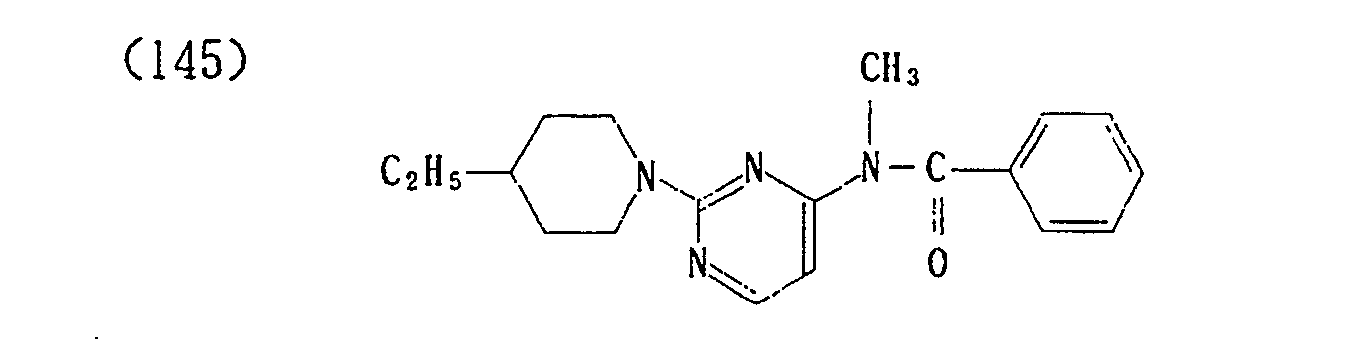
- (146) p-Toluenesulfonate of (145)

- (147-1) p-Toluenesulfonate of (147)

- (154) p-Toluenesulfonate of (153)

- (154-2) p-Toluenesulfonate of (154-1)

- (160) p-Toluenesulfonate of (156)

- (165) Sulfate of (164)
- (166) Phosphate of (164)
- (167) Maleate of (164)
- (169) Naphthalenesulfonate of (164)
- (171) Citrate of (164)
- (171-1) Tartarate of (164)
- (171-1-1) Fumarate of (164)
- (168) p-Toluenesulfonate of (164)
- (170) Hydrochloride of (164)

- (170-2) p-Toluenesulfonate of (170-1)

- (171-3) p-Toluenesulfonate of (171-2)

- (171-5) p-Toluenesulfonate of (171-4)

- (171-7) p-Toluenesulfonate of (171-6)

- (171-9) p-Toluenesulfonate of (171-8)

- (171-11) p-Toluenesulfonate of (171-10)

- (171-13) p-Toluenesulfonate of (171-12)

- (176) p-Toluenesulfonate of (172)

- (184) p-Toluenesulfonate of (180)

- (192) p-Toluenesulfonate of (188)

- (200) p-Toluenesulfonate of (196)

- (208) p-Toluenesulfonate of (204)

- (216) p-Toluenesulfonate of (212)

- (224) p-Toluenesulfonate of (220)

- (232) p-Toluenesulfonate of (228)
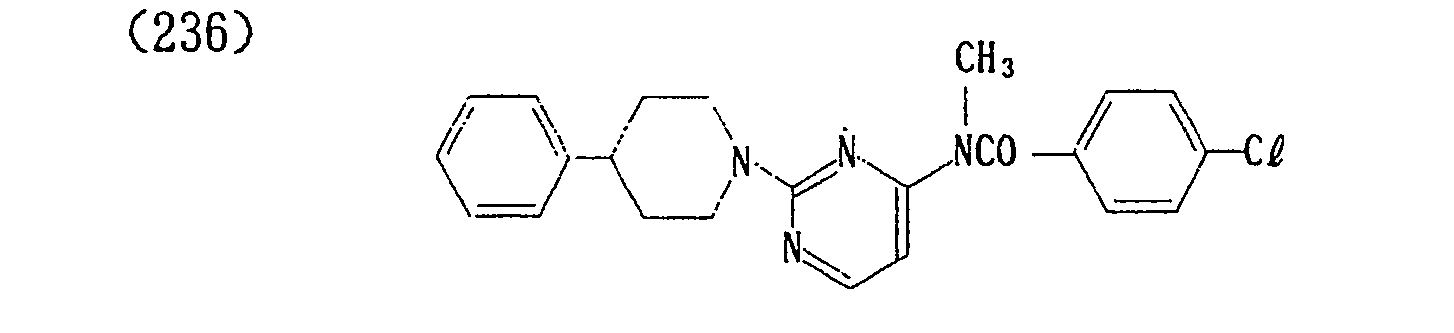
- (240) p-Toluenesulfonate of (236)

- (242) p-Toluenesulfonate of (241)

- (248) p-Toluenesulfonate of (244)

- (256) p-Toluenesulfonate of (252)

- (264) p-Toluenesulfonate of (260)

- (272) p-Toluenesulfonate of (268)

- (280) p-Toluenesulfonate of (276)

- (288) p-Toluenesulfonate of (284)
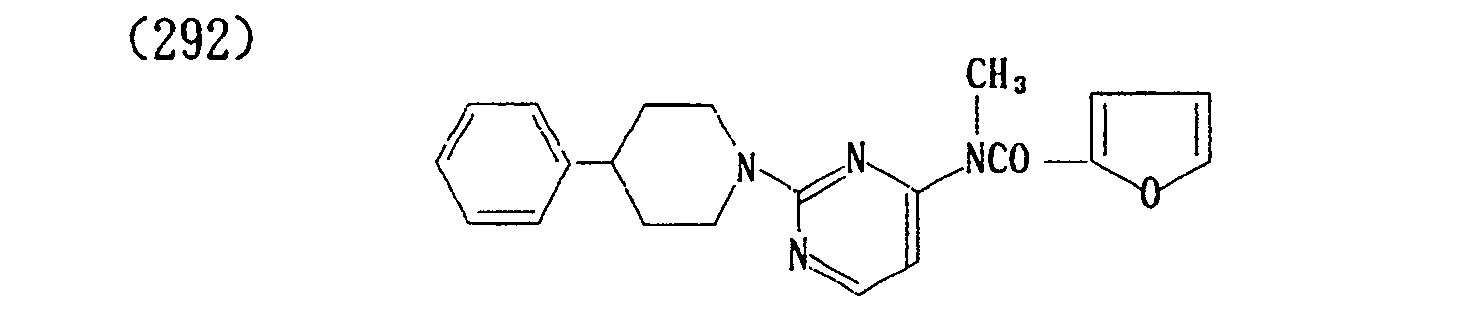
- (296) p-Toluenesulfonate of (292)
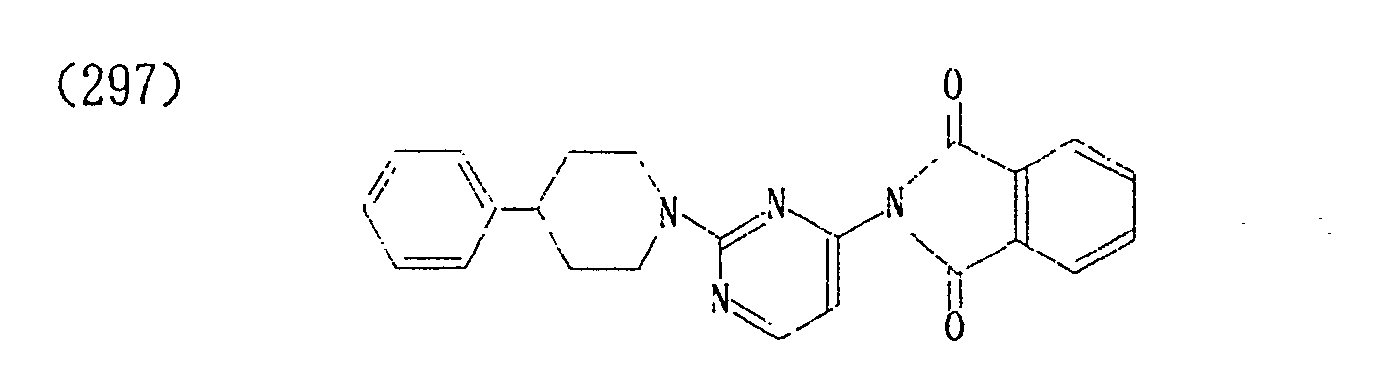
- (298) p-Toluenesulfonate of (297)

- (304) p-Toluenesulfonate of (300)

- (306) p-Toluenesulfonate of (305)

- (307-1) Hydrochloride of (307)

- (312) p-Toluenesulfonate of (308)

- (320) p-Toluenesulfonate of (316)

- (328) p-Toluenesulfonate of (324)

- (336) p-Toluenesulfonate of (332)

- (344) p-Toluenesulfonate of (340)

- (352) p-Toluenesulfonate of (348)
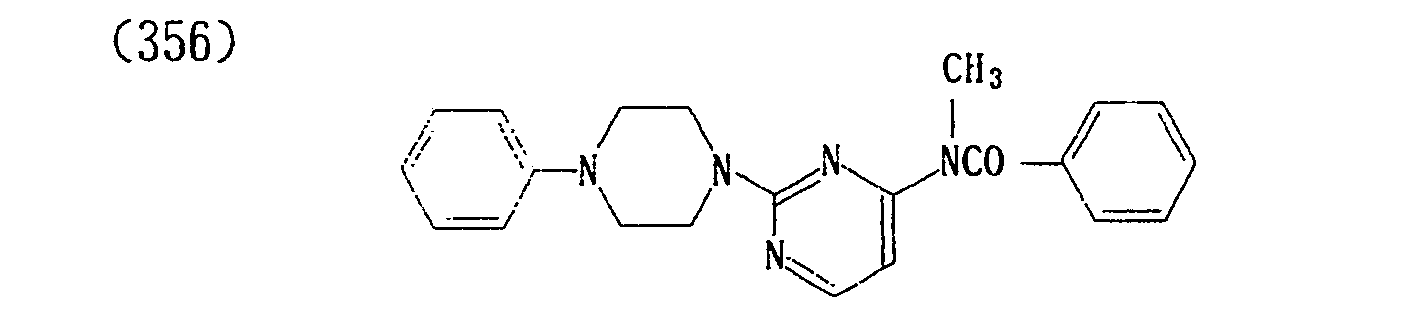
- (360) p-Toluenesulfonate of (356)

- (368) p-Toluenesulfonate of (364)

- (376) p-Toluenesulfonate of (372)

- (384) p-Toluenesulfonate of (380)
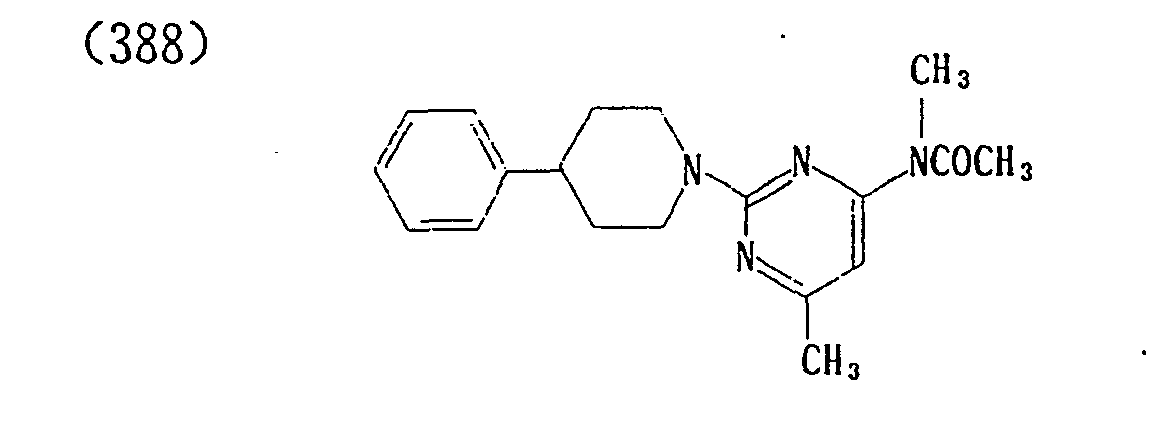
- (392) p-Toluenesulfonate of (388)

- (400) p-Toluenesulfonate of (396)
-

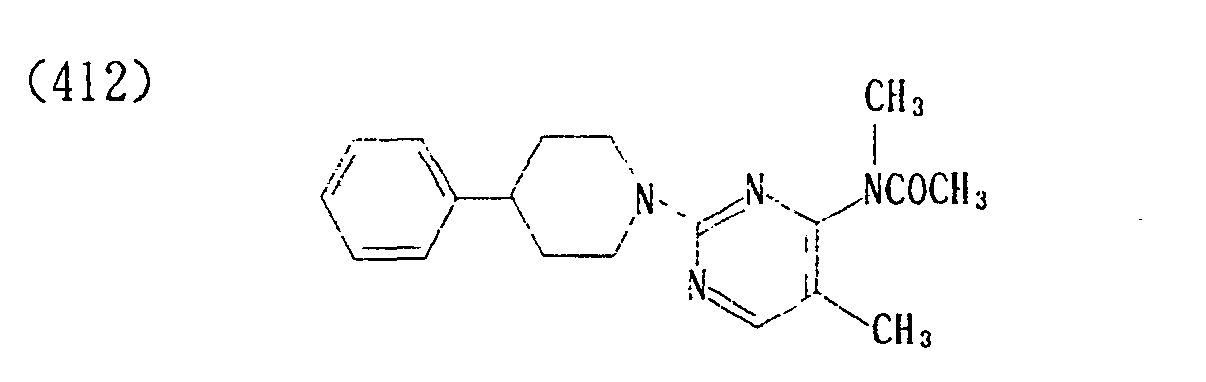
- (416) p-Toluenesulfonate of (412)

- (424) p-Toluenesulfonate of (420)

- (432) p-Toluenesulfonate of (428)

- (604) p-Toluenesulfonate of (600)

- (612) p-Toluenesulfonate of (608)

- (620) p-Toluenesulfonate of (616)

- (628) p-Toluenesulfonate of (624)

- (636) p-Toluenesulfonate of (632)

- (644) p-Toluenesulfonate of (640)

- (652) p-Toluenesulfonate of (648)

- (660) p-Toluenesulfonate of (656)

- (662) Hydrochloride of (661)

- (668) p-Toluenesulfonate of (664)

- (676) p-Toluenesulfonate of (672)
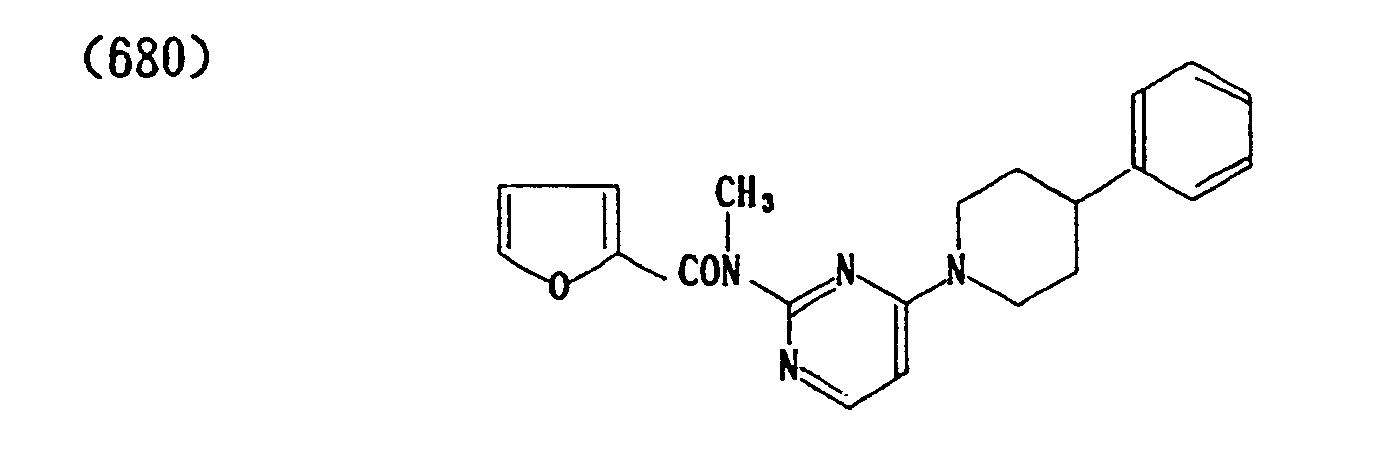
- (684) p-Toluenesulfonate of (680)

- (692) p-Toluenesulfonate of (688)

- (700) p-Toluenesulfonate of (696)

- (804) Maleate of (800)
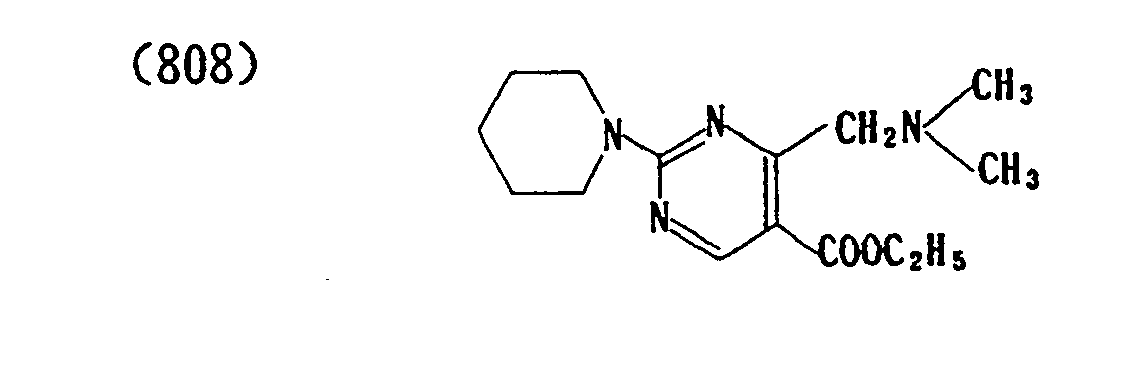
- (812) Maleate of (808)


- (828) Maleate of (824)

- (2004) p-Toluenesulfonate of (2000)

- (2012) p-Toluenesulfonate of (2008)

- (2020) p-Toluenesulfonate of (2016)

- (2022-1) p-Toluenesulfonate of (2022)

- (2023-1) p-Toluenesulfonate of (2023)

- (2028) p-Toluenesulfonate of (2024)

- (2036) Di-p-toluenesulfonate of (2032)

- (2044) p-Toluenesulfonate of (2040)

- (2052) Dihydrochloride of (2048)

- (2060) Hydrochloride of (2056)

- (2070) Hydrochloride of (2064)

- (2076) Hydrochloride of (2074)

- (2084) Hydrochloride of (2080)

- (2092) Hydrochloride of (2088)

- (2100) Hydrochloride of (2096)

- (2108) Hydrochloride of (2104)

- (2116) p-Toluenesulfonate of (2112)
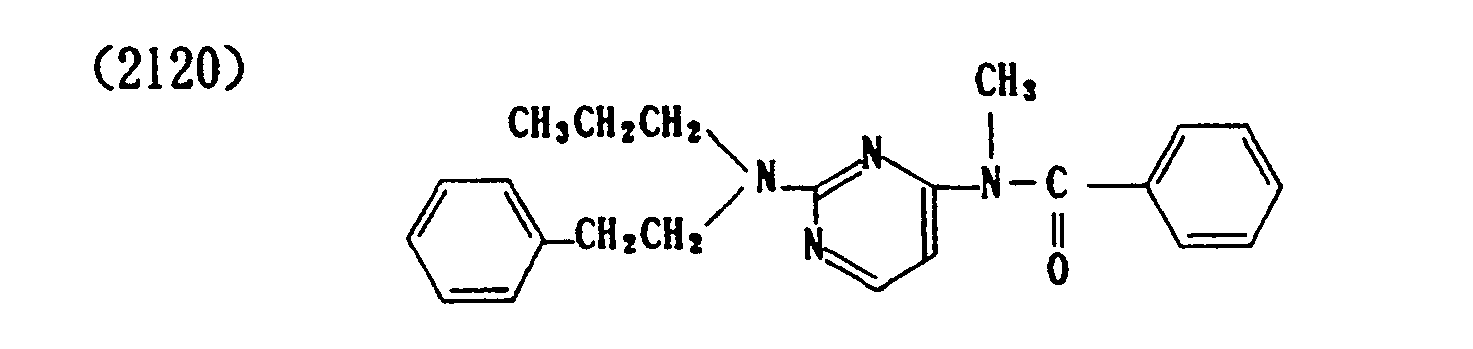
- (2124) p-Toluenesulfonate of (2120)

- (2132) p-Toluenesulfonate of (2128)

- (2140) Di-p-toluenesulfonate of (2136)

- (2148) Dihydrochloride of (2144)

- (2156) Hydrochloride of (2152)

- (2164) Dihydrochloride of (2160)

- (2174) p-Toluenesulfonate of (2170)

- (2182) p-Toluenesulfonate of (2178)

- (2188) p-Toluenesulfonate of (2184)

- (2194) p-Toluenesulfonate of (2192)

- (2202) p-Toluenesulfonate of (2198)

- (2210) p-Toluenesulfonate of (2206)

- (2218) p-Toluenesulfonate of (2214)

- (2226) Hydrochloride of (2222)

- (2234) Di-p-toluenesulfonate of (2230)

- (2242) p-Toluenesulfonate of (2238)

- (2250) p-Toluenesulfonate of (2246)
-


- (2270) p-Toluenesulfonate of (2264)

- (2278) p-Toluenesulfonate of (2274)

- (2286) p-Toluenesulfonate of (2282)

- (2294) p-Toluenesulfonate of (2290)

- (2302) p-Toluenesulfonate of (2298)

- (2310) p-Toluenesulfonate of (2306)

- (2318) p-Toluenesulfonate of (2314)

- (2326) p-Toluenesulfonate of (2322)

- (2334) p-Toluenesulfonate of (2330)

- (2342) Dihydrochloride of (2338)

- (2350) Hydrochloride of (2346)

- (3104) Hydrochloride of (3100)

- (3112) p-Toluenesulfonate of (3108)


- (3128) Hydrochloride of (3124)
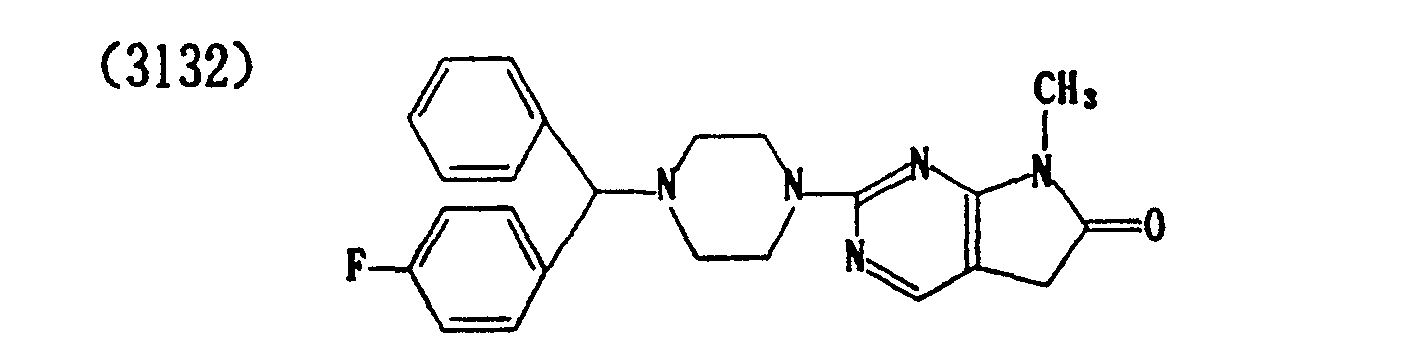
- (3136) Hydrochloride of (3132)

- (3144) Hydrochloride of (3140)

- (3152) p-Toluenesulfonate of (3148)


- (3176) p-Toluenesulfonate of (3172)

- (3184) p-Toluenesulfonate of (3180)

- (3192) p-Toluenesulfonate of (3188)

- (3200) Hydrochloride of (3196)

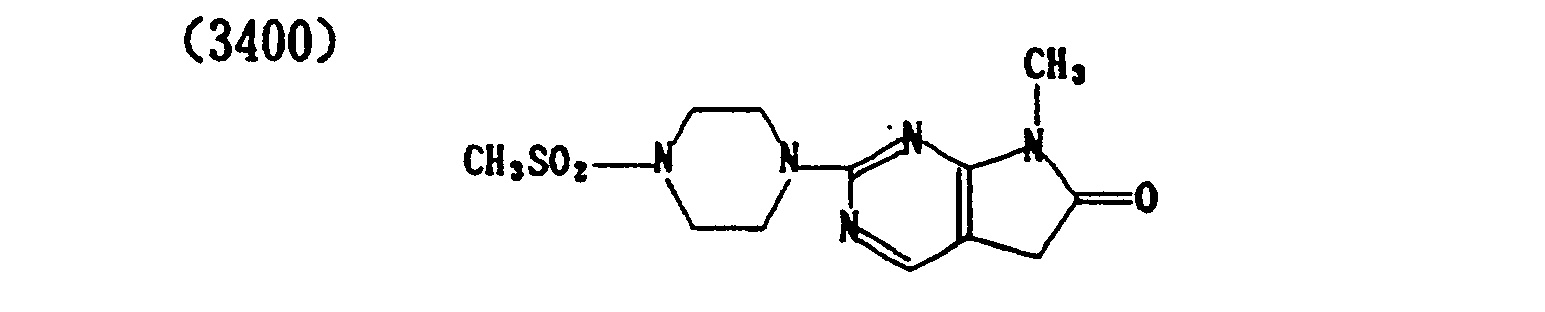
- (3404) p-Toluenesulfonate of (3400)

- (3412) Hydrochloride of (3408)

- (3420) Hydrochloride of (3416)
- The compounds of formulae (1), (2) and (3) may be produced by known methods, particularly the methods described in Japanese Laid-Open Patent Publication Nos. 140568/1986 and 87627/1986, or by treating the intermediates obtained by these methods in accordance with known methods (for example, the elimination of the protecting group by reduction). Examples 1 to 9 given hereinafter describe the production of these compounds in detail.
- For example, compounds of formula (I) in which Y is and -NR6R7 and R6 is other than hydrogen may be produced by the following reaction scheme 1.

- Compounds of general formula (1) in which X is -NR4R5 may be produced by the following reaction scheme 2.

- The starting compounds of formulae (II) and (III) in the reaction schemes 1 and 2 may be produced by the method described at J. Chem. Soc., 1965, pages 755-761, from

- Compounds of general formula (1) in which Y is CH2R9, R9 is hydrogen or a lower alkyl group and Z is a lower alkoxycarbonyl group may be produced in accordance with the following reaction scheme 3.

- Specifically, by reacting compounds (IV) with (V) at a temperature of 20 to 100 C in a reaction medium such as water, methanol, ethanol, THF and DMF, compounds of formula (I) In which Y=R10, and Z=COOR13 are obtained.
- Compounds of general formula (I) in which Y is CH2R9, R9 is other than hydrogen and lower alkyl group and Z is a lower alkoxycarbonyl group may be produced in accordance with the reaction scheme 4.

- Compound (VI) may be prepared in the same way as in [Production Method No. 7] of Japanese Laid-Open Patent Publication No. 65873/1986 except that X is used instead of benzylpiperazine. Compounds of formula (I) in which Y is CH2R9 and Z is COOR10 are obtained by reacting compound (VI) with R9H in the presence of an organic base and as pyridine or triethylamine, or an inorganic base such as potassium carbonate, sodium carbonate, potassium hydroxide, sodium hydroxide, potassium hydride or sodium hydride in the presence of an inert solvent such as toluene or tetrahydrofuran or in the absence of solvent.
- The compounds of general formula (2) can be synthesized by the same methods as in the synthesis of the compound of general formula (1).
- The compounds of general formula (3) can be produced by the methods shown in the following schemes 5 and 6.

- The starting material (VII) may be produced by the method described in J. A. C. S., 71, 2731 (1949). The reaction of the compound (VII) with N-formylpiperazine in a solvent such as acetonitrile or dimethylformamide or in the absence of solvent, optionally in the presence of a basic compound, at a temperature of 20 to 150 C, preferably 20 to 100 °C, to form the compound (VIII). An inorganic base such as sodium carbonate or potassium carbonate, or an organic base such as triethylamine or pyridine may be used as the basic compound. Compound (III) is then hydrolyzed in the presence of an acid or an alkali to yield compound (IV). The hydrolysis is carried out in a solvent such as water, methanol or ethanol at a temperature of 0 to 150 C, preferably 20 to 100 °C.

- Compounds of formula (3) are produced from compound (IV) or (X) in accordance with scheme 5 by known methods, particularly the methods described in Japanese Laid-Open Patent Publications Nos. 140568/1986 and 87627/1986 or by treating the intermediates obtained by these methods in accordance with known methods (for example, the reductive elimination of the protective group). Examples 7 to 9 given below illustrate the production of the compounds of formula (3) in detail.
- Investigations of the present inventors show that the compounds of formulae (1), (2) and (3) are useful as therapeutic agents for treatment of neurological diseases.
- The compounds of formulae (1), (2) and (3) are normally used in the form of a pharmaceutical composition, and are administered by various routes (e.g., oral, subcutaneous, intramuscular, intravenous, intrarhinal, skin permeation and through the rectum).
- The present invention also embraces a pharmaceutical preparation comprising a compound of general formula (1 (2) or (3) or its pharmaceutically acceptable salt. The pharmaceutically acceptable salt includes, for example, acid addition salts and quaternary ammonium (or amine) salts.
- Examples of the pharmaceutically acceptable salts of the compounds (1), (2) and (3) include salts formed from acids capable of forming pharmaceutically acceptable non-toxic acid-addition salts containing anions, such as hydrochlorides, hydrobromides, sulfates, bisulfites, phosphates, acid phosphates, acetates, maleates, fumarates, succinates, lactates, tartrates, benzoates, citrates, gluconates, glucanates, methanesulfonates, p-toluenesulfonates and naphthalenesulfonates or their hydrates, and quaternary ammonium (or amine) salts or their hydrates.
- The composition of this invention may be formulated into tablets, capsules, powders, granules, troches, cachet wafer capsules, elixirs, emulsions, solutions, syrups, suspensions, aerosols, ointments, aseptic injectables, molded cataplasmas, tapes, soft and hard gelatin capsules, suppositories, and aseptic packed powders. Examples of the pharmaceutically acceptable carrier include lactose, glucose, sucrose, sorbitol, mannitol, corn starch, crystalline cellulose, gum arabic, calcium phosphate, alginates, calcium silicate, microcrystalline cellulose, polyvinyl pyrrolidone, tragacanth gum, gelatin, syrup, methyl cellulose, carboxymethyl cellulose, methylhydroxybenzoic acid esters, propylhydroxybenzoic acid esters, talc, magnesium stearates, inert polymers, water and mineral oils.
- Both solid and liquid compositions may contain the aforesaid fillers, binders, lubricants, wetting agents, disintegrants, emulsifying agents, suspending agents, preservatives, sweetening agents and flavoring agents. The composition of this invention may be formulated such that after administration to a patient, the active compound is released rapidly, continuously or slowly.
- In the case of oral administration, the compound of formula (1), (2) or (3) is mixed with a carrier or diluent and formed into tablets, capsules, etc. In the case of parenteral administration, the active ingredient is dissolved in a 10 % aqueous solution of glucose, isotonic salt water, sterilized water or a like liquid, and enclosed in vials or ampoules for intravenous instillation or injection or intramuscular injection. Advantageously, a dissolution aid, a local anesthetic agent, a preservative and a buffer may also be included into the medium. To increase stability, it is possible to lyophilize the present composition after introduction into a vial or ampoule. Another example of parenteral administration is the administration of the pharmaceutical composition through the skin as an ointment or a cataplasm. In this case, a molded cataplasm or a tape is advantageous.
- The composition of this invention contains 0.1 to 2000 mg, more generally 0.5 to 1000 mg, of the active component for each unit dosage form.
- The compound of formula (1), (2) or (3) is effective over a wide dosage range. For example, the amount of the compound administered for one day usually falls within the range of 0.03 mg/kg to 100 mg/kg. The amount of the compound to be actually administered is determined by a physician depending, for example, upon the type of the compound administered, and the age, body weight, reaction condition, etc. of the patient and the administration route.
- The above dosage range, therefore, does not limit the scope of the invention. The suitable number of administrations is 1 to 6, usually 1 to 4, daily.
- The compound of formula (1), (2) or (3) by itself is an effective therapeutic agent for disorders of the peripheral nervous system and the central nervous system. If required, it may be administered in combination with at least one other equally effective drug. Examples of such an additional drug are gangliosides, mecobalamin and isaxonine.
- The formulations of the compounds (1), (2) and (3) in accordance with this invention and their biological activities will be illustrated in detail by a series of Examples B and Examples given below. It should be understood however that they do not limit the scope of the invention. Each of the following examples showing the composition of the invention uses one of the compounds described hereinabove or one of other pharmaceutically active compounds encompassed within general formula (1), (2) and (3).
- To a solution of 17.0 g (0.11 mole) of 2,4-dichloropyrimidine in 150 ml of dichloromethane was added methylamine (0.25 mole, 20 ml of 40 % methanol solution) at such a rate that the temperature of the solution was maintained at 5 °C. After the addition, the solution was stirred at room temperature for 12 hours. The reaction mixture was concentrated under reduced pressure, and extracted with dichloromethane. The dichloromethane layer was dried over an anhydrous sodium sulfate, and concentrated under reduced pressure to give 14.0 g (purity 80 %) of 2-chloro-4-methylaminopyrimidine.
- Two hundred milliliters of n-butanol was added to 3.0 g (0.02 mole) of 2-chloro-4-methylaminopyrimidine and 8.4 g (0.05 mole) of 4-phenylpiperidine, and the mixture was heated at 130 C for 1 hour. The reaction mixture was concentrated under reduced pressure, and extracted with dichloromethane. The dichloromethane layer was dried over anhydrous sodium sulfate, and concentrated under reduced pressure. The residue was purified by silica gel column chromatography to give 4.0 g (yield 71 %) of the desired compound as an oil.
- IH-NMR spectrum (deuterochloroform, 6 ppm):
- 1.4-2.0(5H, m), 2.93(3H, d, J = 5.2Hz), 2.6-3.1 (2H, m), 4.60(1 H, m), 4.92(2H, br. d, J=12.6Hz), 5.67(1 H, d,
- J = 7.2Hz), 7.28(5H, s), 7.93(1 H, d, J = 7.2 Hz).
- In a similar manner, the following compounds were produced.
-


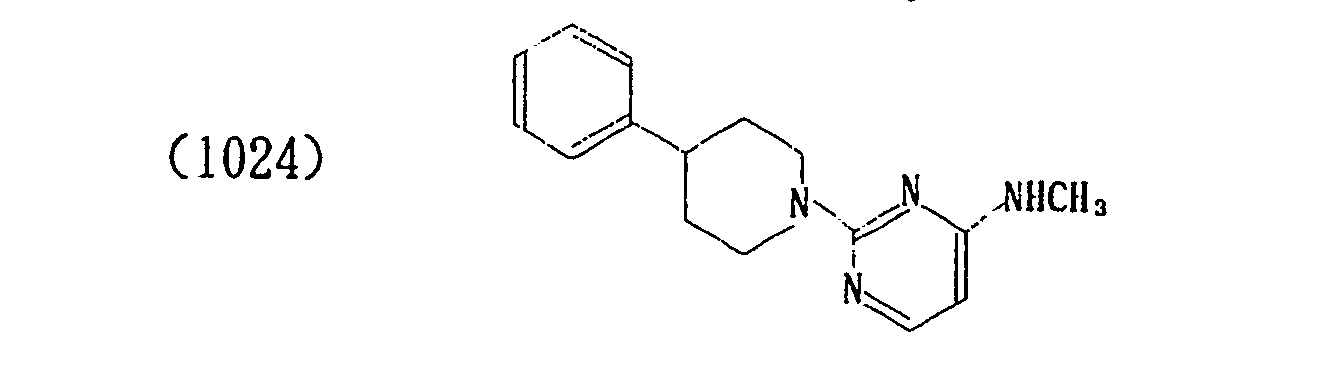
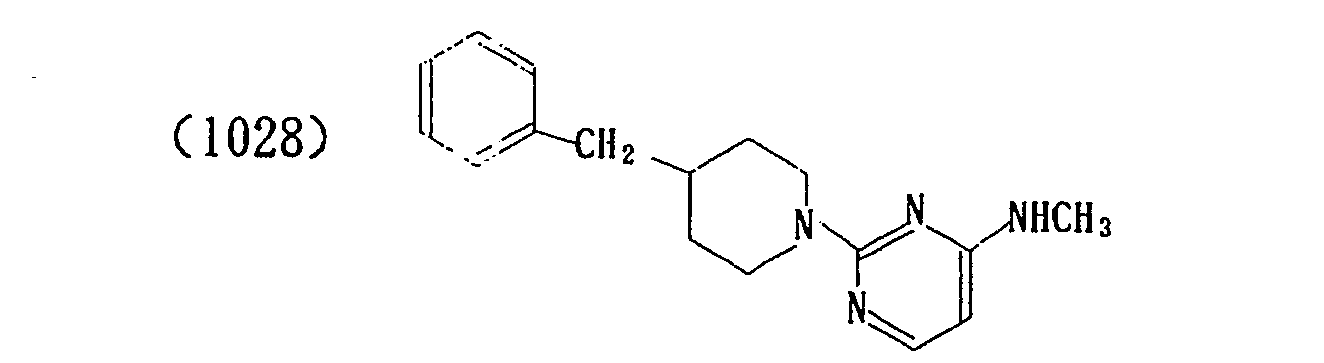


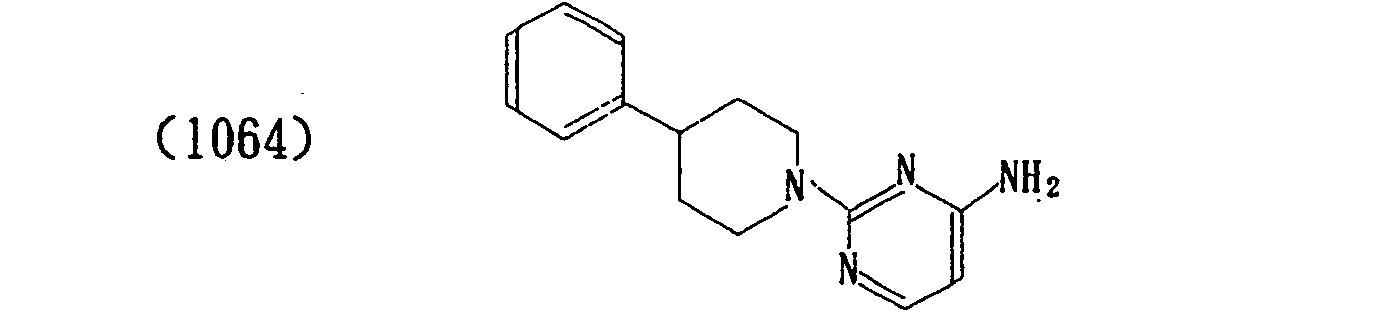


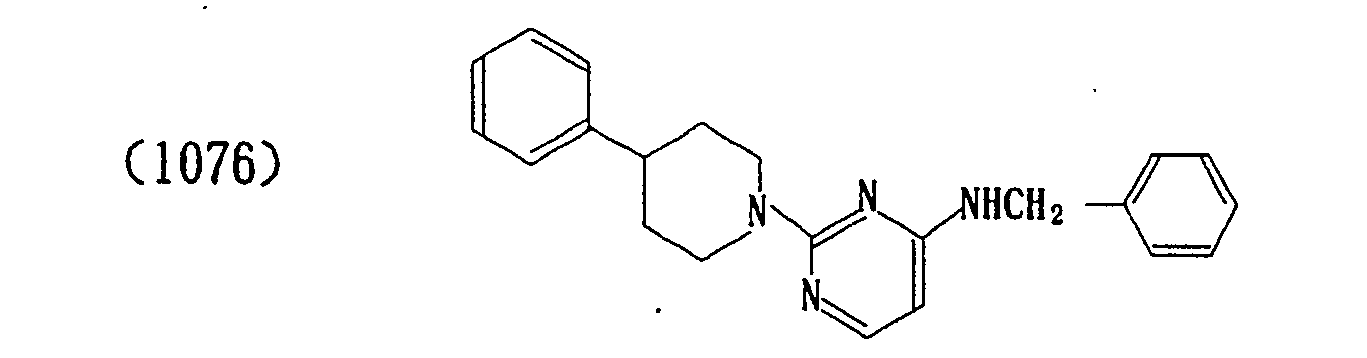
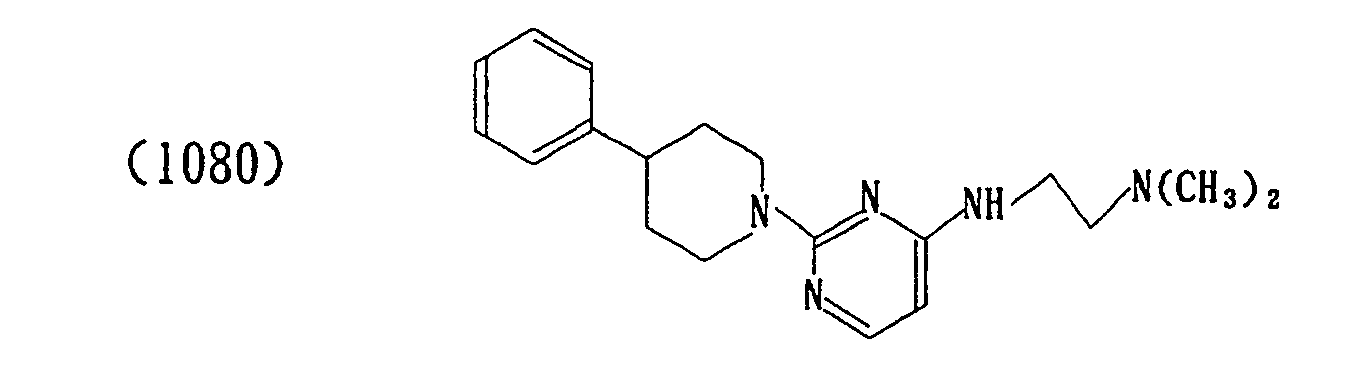


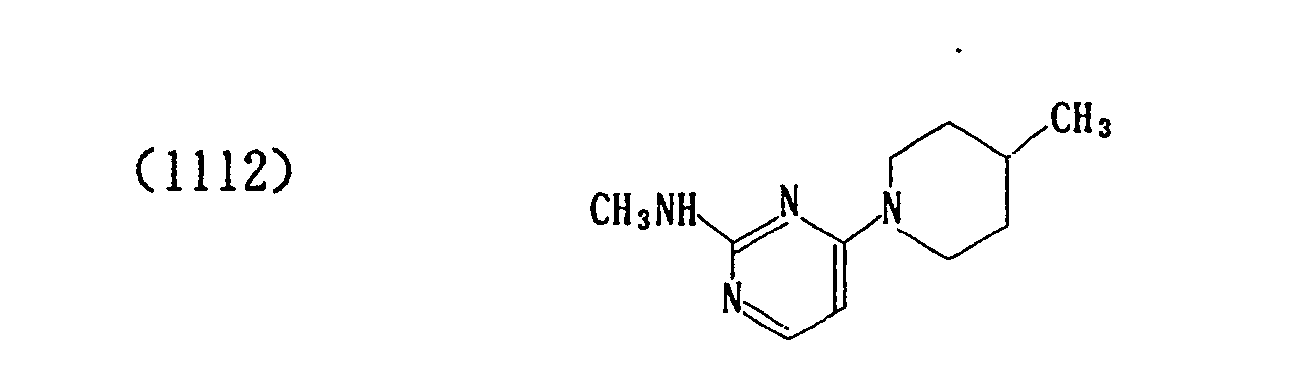


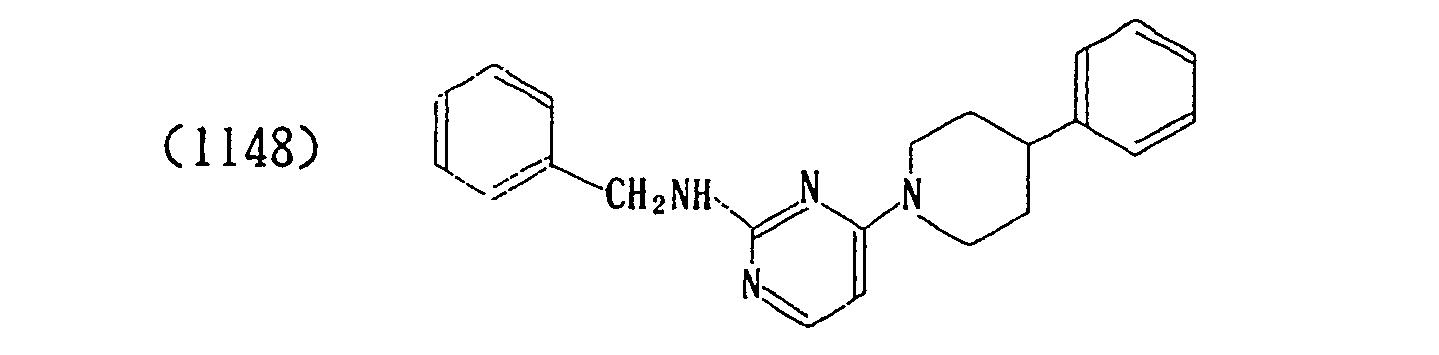


- The properties of the compounds (intermediate) are shown in Table 1 below.
-


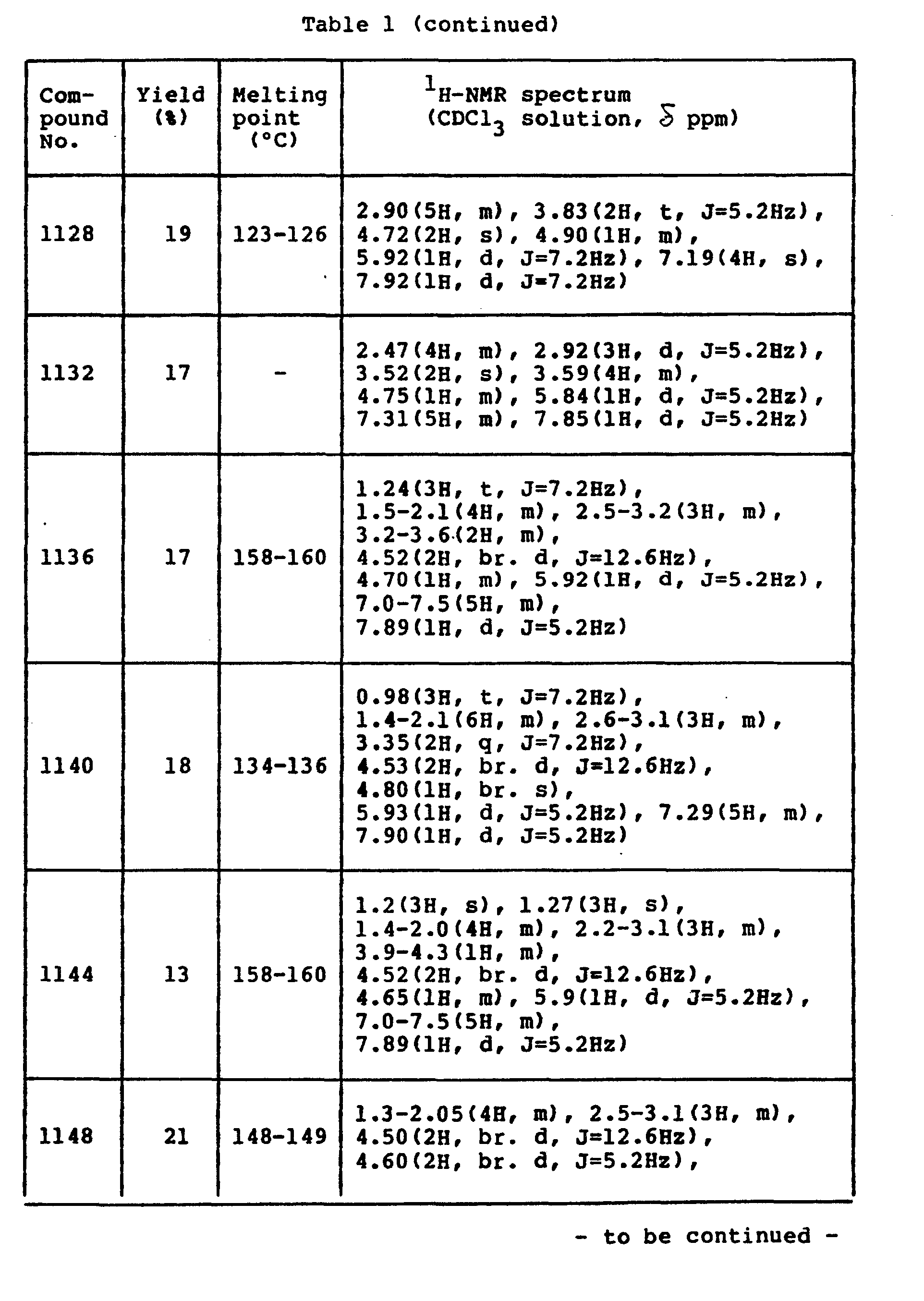

- A solution of 0.43 g (3.73 mmoles) of maleic acid in 10 ml of methanol was added to a solution of 1.0 g (3.73 mmoles) of 4-methylamino-2-(4-phenylpiperidino)pyrimidine in 10 ml of methanol, and the mixture was stirred at room temperature for 1 hour. The mixed solution was concentrated under reduced pressure and washed with ether to give 1.25 g (yield 87 %) of the desired product.
- Melting point: 163-166 C.
- 1H-NMR spectrum (CDCl3 solution, δ ppm):
- 1.6-2.2(4H, m), 2.6-3.3(5H, m), 3.04(3H, d, J=5.2Hz), 4.74(1H, br. d, J=12.6Hz), 6.30(1H, d, J=7.2Hz), 7.30(5H, m), 7.71 (1 H, d, J = 7.2Hz), 8.40(1 H, m).
- Similarly, the folllowing compounds were produced.
- (1014): maleate of (1012)
- (1026): maleate of (1024)
- (1034): maleate of (1032)
- (1038): maleate of (1036)
- (1086): maleate of (1084)
- (1090): maleate of (1088)
- (1094): maleate of (1092)
- (1098): maleate of (1096)
- (1102): maleate of (1100)
- (1110): maleate of (1108)
- (1122): maleate of (1120)
- (1130) maleate of (1128)
- (1158): maleate of (1156)
- (1162): maleate of (1160)
- The data of these compounds are given in Table 2 below.


- 11.2 g (98 mmoles) of 1-formylpiperazine was added to 10 g (49 mmoles) of chlorodiphenylmethnae, and the solution was stirred at room temperature for 48 hours, and the mixture was extracted with water and methylene chloride. The organic layer was dried over anhydrous magnesium sulfate, and the solvent was evaporated under reduced pressure. The residue was purified by silica gel column chromatography, and 8.9 g (31.9 mmoles) of the resulting formyl compound was dissolved in 100 ml of ethanol, and 6.5 g (64 mmoles) of conc. hydrochloric acid was added, and the solution was refluxed for 1 hour. Then, the solvent was evaporated under reduced pressure, and the residue was extracted with K2C03/water/CH2CI2. The organic layer was dried over anhydrous magnesium sulfate, and the solvent was evaporated under reduced pressure to give 6.8 g (yield 55 %) of the desired product.
- Melting point: 93-95 C.
- 1H-NMR spectrum (CDCl3 solution, 6 ppm):
- 2.33(4H, m), 2.87(4H, m), 4.19(1H, s), 7.1-7.5 (10H, m).
- A solution of 5.2 g (0.037 mole) of benzoyl chloride in 50 ml of tetrahydrofuran was added at room temperature over 30 minutes to a solution of 9.0 g (0.034 mole) of 4-methylamino-2-(4-phenylpiperidino)-pyrimidine in 90 ml of tetrahydrofuran and 5 ml of triethylamine. TWo hours after the end of the addition, 1 ml of pyridine was added. The mixture was then stirred for 2 days. The reaction mixture was extracted with dichloromethane. The dicloromethane layer was dried over anhydrous sodium sulfate, and concentrated under reduced pressure. The residue was purified by silica gel column chromatography to give 8.8 g (yield 70 %) of the desired compound as an oil.
- IH-NMR spectrum (deuterochloroform, 6 ppm):
- 1.4-2.0(4H, m), 2.5-3.0(3H, m), 3.55(3H, s), 4.62(2H, br. d, J=12.6Hz), 6.14(1 H, d, J=7.2Hz), 7.1-7.6(10H, m), 8.06(1 H,d,J=7.2Hz).
- Data of compounds produced in the same way as above are shown in Table 3 below.
-


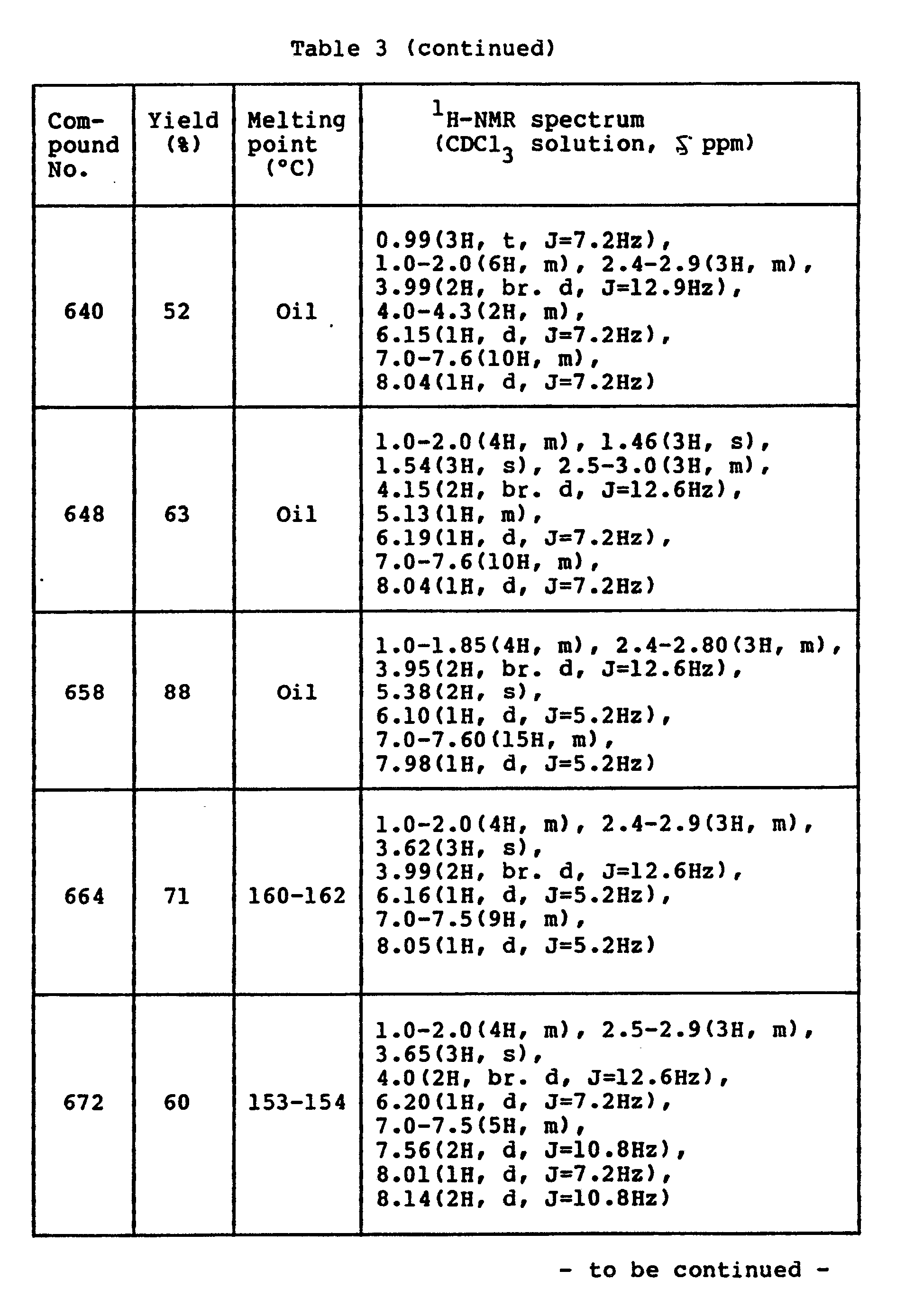

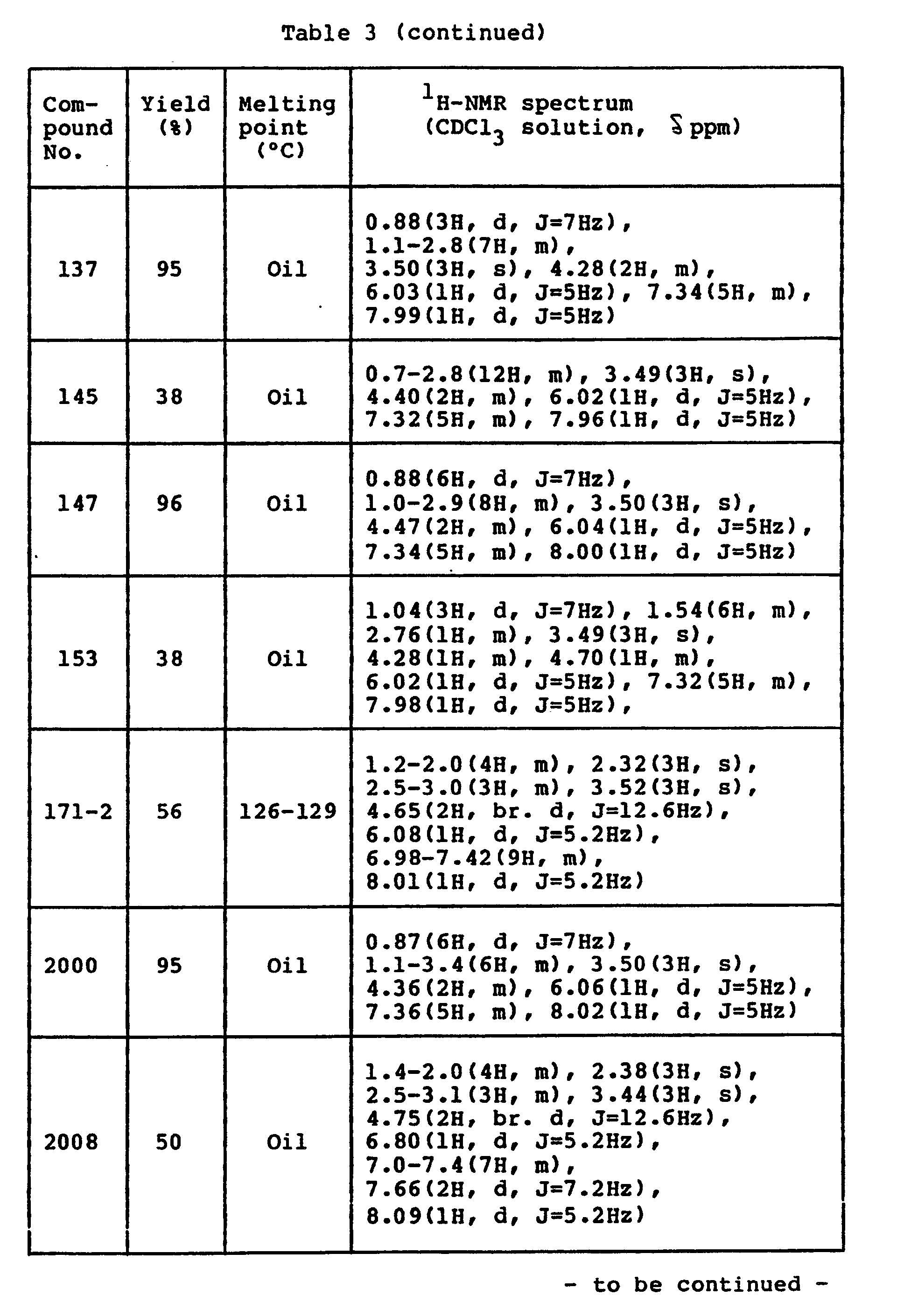

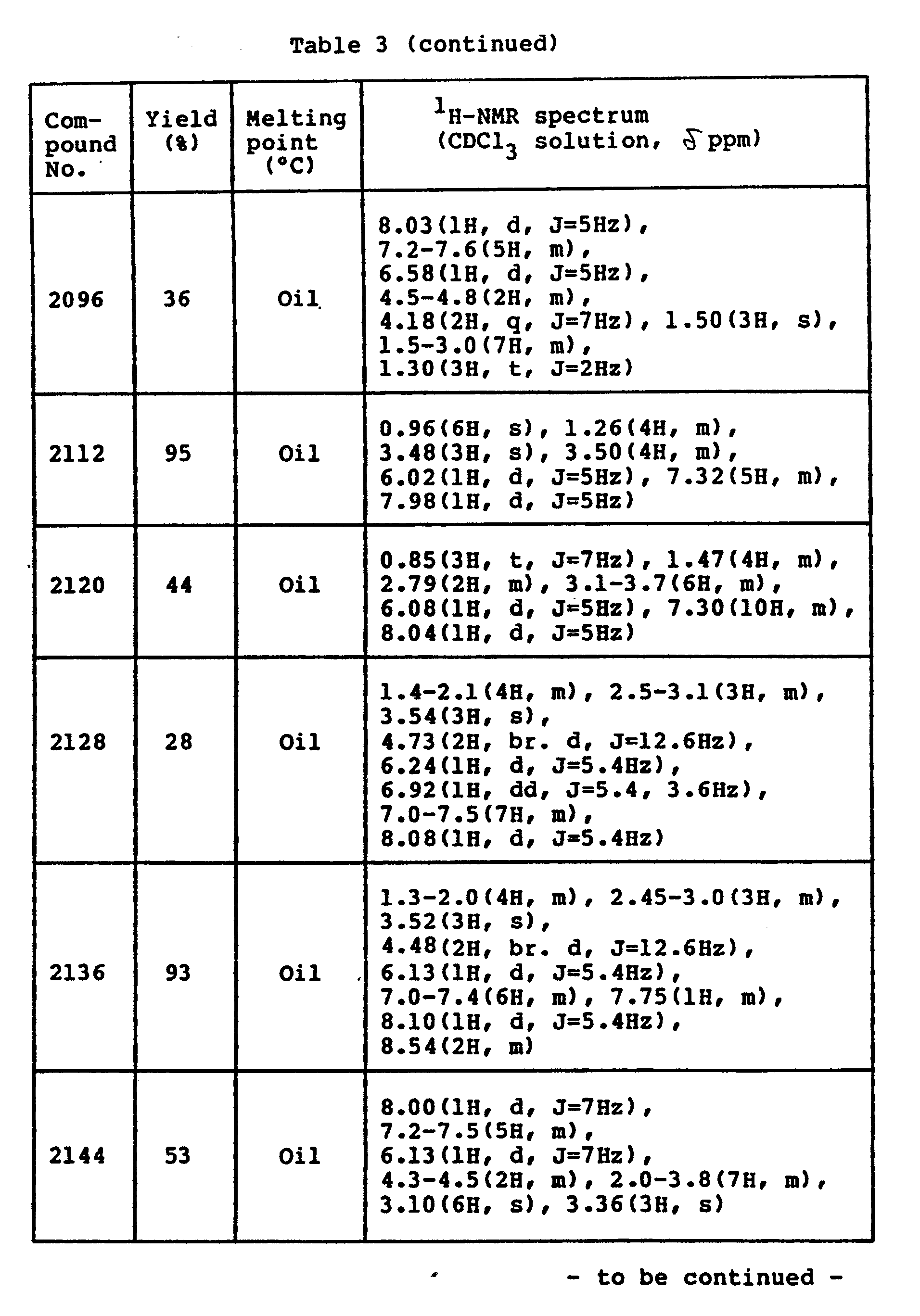

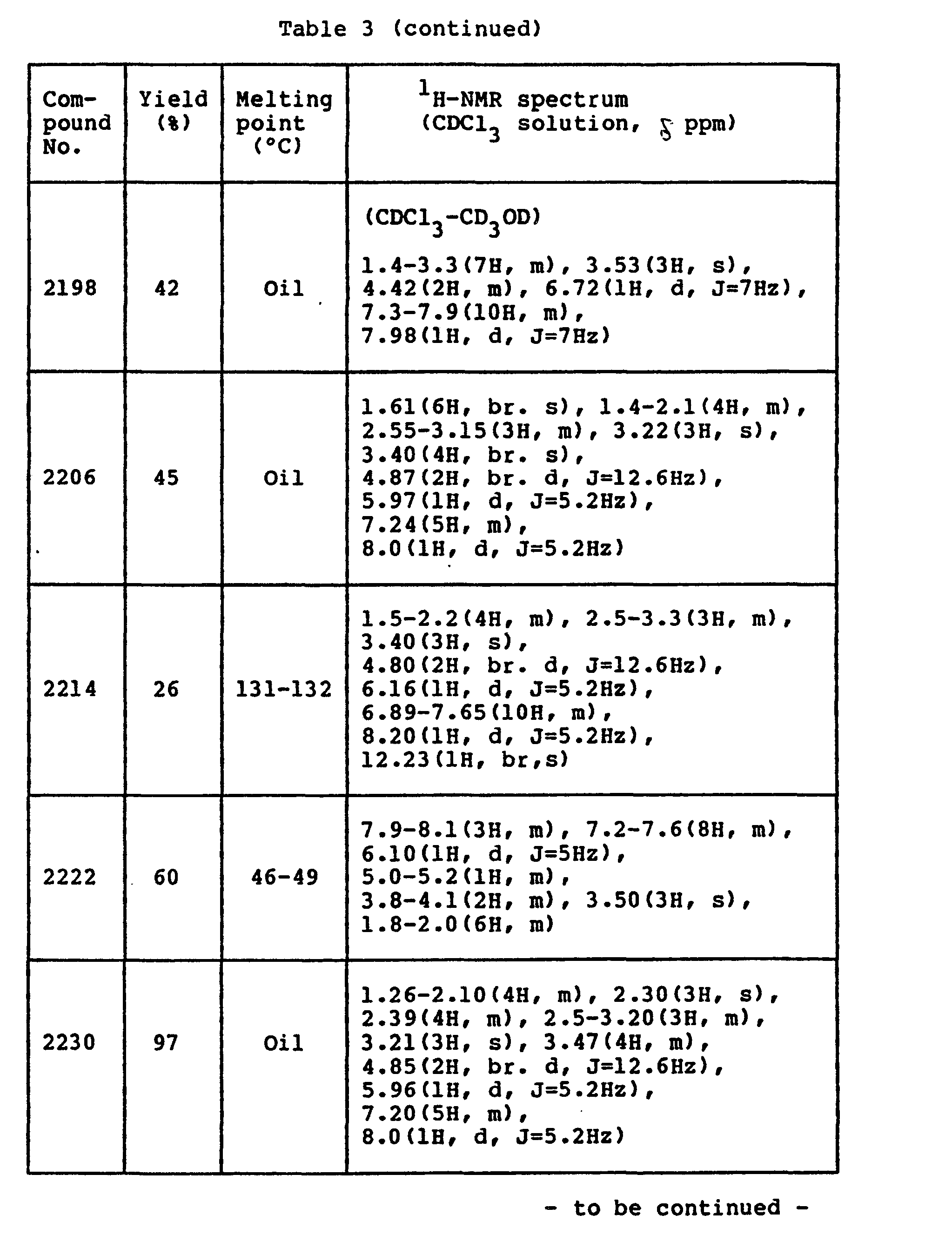


- A solution of 3.0 g (0.022 mole) of p-toluenesulfonic acid monohydrate in 300 ml of ethyl acetate was slowly added at room temperature to a solution of 6.0 g (0.022 mole) of 4-(N-methylbenzamino)-2-(4-phenylpiperidino)pyrimidine in 100 ml of ethyl acetate. As soon as the addition was effected, a suspension was formed. After the end of the addition, the suspension was stirred for 10 minutes. The resulting solid was separated by filtration, washed with ethyl acetate and ether, and dried to give 6.8 g (yield 83 %) of the desired compound.
- Melting point: 180-182 C.
- 1H-NMR spectrum (deuterochloroform, δ ppm):
- 1.4-2.1 (4H, m), 2.35(3H, s), 2.6-3.3(3H, m), 3.56(3H, s), 4.55(2H, br. d, J = 12.6 Hz), 6.60(1 H, d, J = 7.2 Hz), 7.0-7.9(14H, m), 8.36 (1 H, d, J = 7.2Hz).
- In the same way as above, the following compounds were produced and thier data are shown in Table 4.
-


- A solution of 0.27 g (0.0027 mole) of concentrated hydrochloric acid in 2 ml of CH30H was slowly added to a solution of 1.0 g (0.0027 mole) of 4-(N-methylbenzamino)-2-(4-phenylpiperidino)pyrimidine in 10 ml of chloroform. After the addition, the mixture was concentrated under reduced pressure to give 1.1 g (yield 100 %) of the desired product.
- Melting point: 80-84 °C.
- 1H-NMR spectrum (deuterochloroform, δ ppm)
- 1.4-22(4H, m), 2.6-3.4(3H, m), 3.56(3H, s), 2.2(2H, m), 6.69(1 H, d, J=7.2Hz), 7.0-7.7(10H, m), 8.1(1H, d, J=7.2Hz).
- In the same way as above, the following compounds were produced, and their data are given in Table 5.


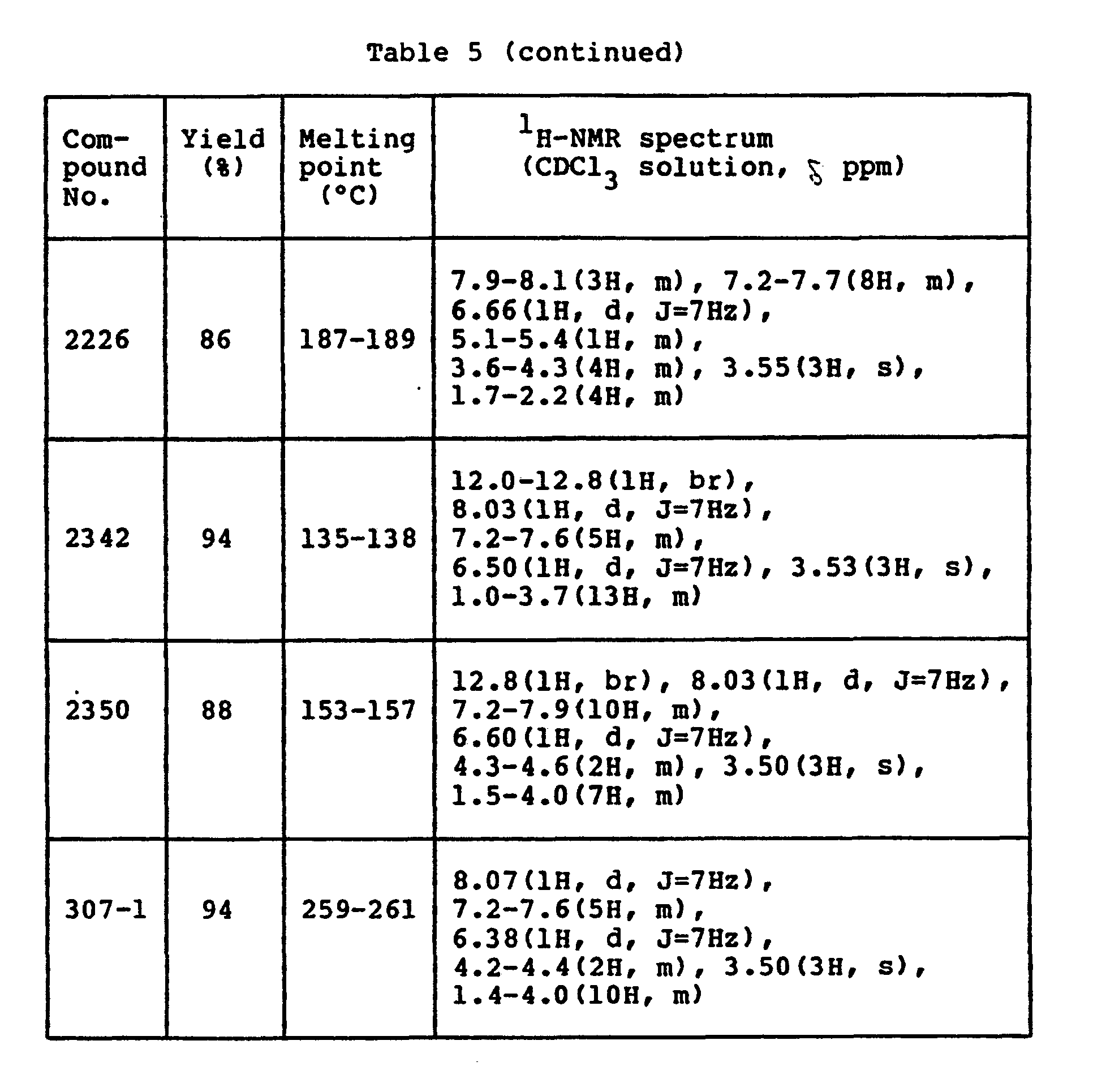
- The following compounds were obtained by the same method as in Example 3 except that sulfuric acid, phosphoric acid, etc. were used instead of hydrochloric acid.


- 18.2 g (0.12 mole) of 1-amidinoisopropylamine sulfate was added to a solution of 13.0 g (0.12 mole) of potassium t-butoxide in 200 ml of methanol, and the mixture was stirred at room temperature for 30 minutes. Then, 18.5 g (0.12 mole) of ethyl 2-methoxymethyleneacetoacetate was added at 0 °C over 30 minutes, and the mixture was stirred for 3 hours. The solvent was evaporated, and the residue was extracted with ether and purified by silica gel column chromatography to give 10.6 g (yield 44 %) of the desired product as a yellow solid.
- Melting point: 118-119 °C.
- 'H-NMR spectrum (deuterochloroform, 0 ppm)
- 1.26(6H, d, J = 7Hz), 2.66(3H, s), 3.87(3H, s), 4.25(1 H, sex, J = 7Hz), 5.40(1 H, br. s), 8.80(1 H, s).
- Sodium hydride (0.19 g; 7.8 mmoles) was added to 50 ml of methanol, and 2.1 g (7.8 mmoles) of 2-piperidino-4-chloromethyl-5-methoxycarbonylpyrimidine was added at room temperature. The mixture was stirred for 3 hours. After the solvent was evaporated, water was added to the residue and the mixture was extracted with ethyl acetate. The ethyl acetate layer was dried over anhydrous sodium sulfate and concentrated under reduced pressure. The residue was purified by silica gel chromatography to give 0.90 g (yield 44 %) of the desired product as a white solid.
- Melting point: 89-92 °C.
- 1H-NMR spectrum (deuterochloroform, δ ppm):
- 1.70(6H, m), 3.54(3H, s), 3.86(3H, s), 3.92(4H, m), 4.83(2H, s), 8.82(1 H, s).
- In the same way as above, the following compounds were obtained.

- 2.48 g (11.9 mmoles) of 2-isopropylamino-4-methyl-5-methoxycarbonylpyrimidine and 1.38 g (11.9 mmoles) of maleic acid were dissolved in a mixture of 20 ml of ethanol and 20 ml of chloroform, and the solution was stirred for 3 hours. The solvents were evaporated, and ether was added for crystallization at 0 °C. The desired product was obtained in an amount of 3.21 g (yield 83 %) as pale yellow crystals. Melting point: 75-79 ° C.
- 1H-NMR spectrum (deuterochloroform, δ ppm):
- 1.33(6H, d, J = 7Hz), 2.85(3H, s), 3.95(3H, s), 4.36(1 H, sex, J = 7Hz), 6.40(2H, s), 9.08(1 H, br, s).
- In the same way as above, the following compounds were produced.

- 1.9 g (7.5 mmoles) of 1-diphenylmethylpiperazine and 1.7 g (7.5 mmoles) of ethyl (2-methylthio-4-hydroxypyrimidin-5-yl)acetate were added to 60 ml of n-amyl alcohol, and the mixture was stirred at 170 °C for 20 hours. The solvent was then evaporated under reduced pressure. Ten milliliters of phosphorus oxychloride was added to the residue, and reacted at 100 °C for 2 hours. After the reaction, the mixture was gradually added to an aqueous solution of potassium carbonate, and extracted with methylene chloride. The organic layer was dried over anhydrous magnesium sulfate, and the solvent was evaporated under reduced pressure. The residue, 15 ml of ethanol and a 40 % methanol solution of methylamine was put in a pressure vessel, and reacted at 140 C for 10 hours. Then, the solvent was evaporated, and the residue was purified by silica gel column chromatography to give 0.9 g (yield 30 %) of the desired product. Melting point: 75-80 C.
- 1H-NMR spectrum (CDCl3 solution, δ ppm):
- 2.43(4H, m), 3.13(3H, s), 3.37(2H, s), 3.80(4H, m), 4.23(1 H, s), 7.08-7.52(10H, m), 7.82(1 H, s).
- The following compounds were produced in the same way as above, and their data are shown in Table 9.


- Concentrated hydrochloric acid (0.23 g; 2.2 mmoles) was added to an ethanol/methylene chloride solution of 2-(4-diphenylmethylpiperazino)-5,6-dihydro-7-methyl-6-oxo(7H)pyrrolo[2,3-d]pyrimidine, and the solution was stirred at room temperature for 1 hour. The solvent was then evaporated under reduced pressure. The residue was washed with ether to give 0.88 g (yield 90 %).
- Melting point: 217-222 °C.
- 1H-NMR spectrum (CDCl3, 6 ppm):
- 3.18(3H, s), 3.20(4H, m), 3.52(2H, s), 4.40(4H, m), 5.20(1 H, s), 7.2-7.9 (1 H, m).
- In the same way as above, the following compounds were produced, and their data are shown in Table 10.

- An ethyl acetate/methanol solution of 0.13 g (0.75 mmole) of p-toluenesulfonic acid was added to an ethyl acetate/methanol solution of 0.31 g (0.75 mmole) of 2-(4-(a-(4-methylphenyl)benzyl)piperazino)-5,6-dihydro-7-methyl-6-oxo(7H)pyrrolo[2,3-d]pyrimidine, and the mixture was stirred at room temperature for 1 hour. The solvents were then evaporated under reduced pressure, and the residue was washed with hexane to give 0.36 g (yield 81 %) of the desired compound.
- Melting point: 150-155 °C.
- 1H-NMR spectrum (CDCl3 solution, δ ppm):
- 2.28(3H, s), 2.34(3H, s), 3.00(4H, m), 3.11(3H, s), 3.39(2H, s), 4.14(4H, m), 4.73 (1H, s), 7.0-7.8(13H, m), 7.93(1 H, s).
- In the same way as abvove, the following compounds were produced, and their data are shown in Table 11.

- Tablets each containing 10 mg of an active ingredient were prepared by the following procedure.

- The active ingredient, corn starch and crystalline cellulose were passed through an 80-mesh sieve and thoroughly mixed. The mixed powder was granulated together with the polyvinyl pyrrolidone solution, and passed through an 18-mesh sieve. The resulting granules were dried at 50 to 60 C and again passed through an 18-mesh sieve to adjust their sizes. The carboxymethyl cellulose calcium, magnesium stearate and talc, which had been passed through an 80-mesh sieve, were added to the granules. They were mixed and tableted by a tableting machine to produce tablets each having a weight of 120 mg.
- Tablets each containing 200 mg of an active ingredient were produced by the following procedure.
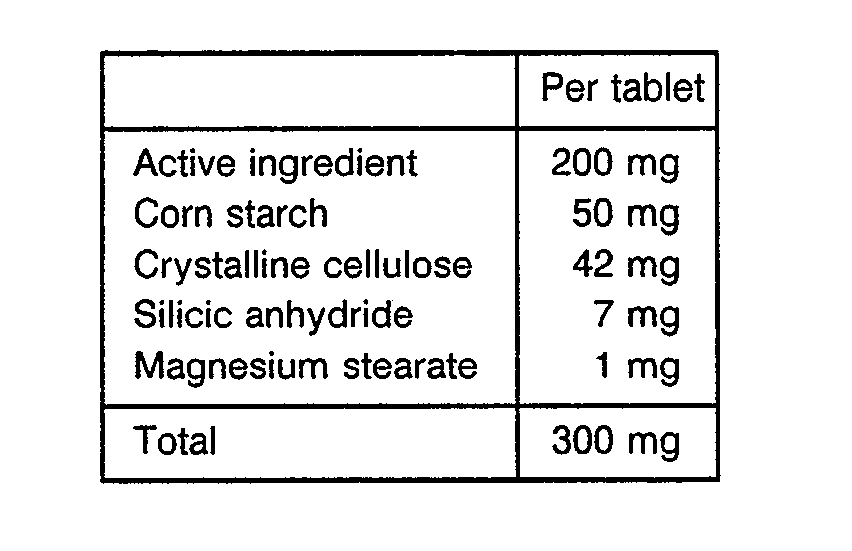
- The above components were passed through an 80-mesh sieve and thoroughly mixed. The resulting mixed powder was compression-molded to produce tablets each having a weight of 300 mg.
- Capsules each containing 100 mg of an active ingredient were produced by the following procedure.

- The above components were mixed, passed through an 80-mesh sieve, and thoroughly mixed. The resulting mixed powder was filled into capsules in an amount of 150 mg for each.
- Injectable preparations in vials each containing 5 mg of an active ingredient were produced by the following procedure.

- Just prior to use, these compounds were dissolved in 1 ml of distilled water for injection, and administered.
- Injectable preparations in ampoules each containing 50 mg of an active ingredients were produced in accordance with the following recipe.

- An adhesive patch containing 17.5 mg of an active ingredient was produced by the following procedure.
- Ten parts of poly(ammonium acrylate) was dissolved in 60 parts of water. Two parts of glycerin diglycidyl ether was dissolved under heat in 10 parts of water. Furthermore, 10 parts of polyethylene glycol (grade 400), 10 parts of water and 1 part of an active ingredient were stirred to form a solution. While the aqueous solution of poly(ammonium acrylate) was stirred, the aqueous solution of glycerin diglycidiyl ether and the solution containing the active ingredient, polyethylene glycol and water were added and mixed. The resulting solution for hydrogel was coated on a pliable plastic film so that the rate of the active ingredent was 0.5 mg per cm2. The surface was covered with releasing paper and cut to a size of 35 cm2 to form an adhesive patch.
- An adhesive patch containing 10 mg of an active ingredient was produced by the following procedure.
- An aqueous sol is prepared from 100 parts of poly(sodium acrylate), 100 parts of glycerin, 150 parts of water, 0.2 part of triepoxypropyl isocyanurate, 100 parts of ethanol, 25 parts of isopropyl myristate, 25 parts of propylene glycol and 15 parts of the active ingredient. The sol was then coated to a thickness of 100 micrometers on the non-woven fabric surface of a composite film composed of a rayon non-woven fabric and a polyethylene film to form an adhesive layer containing the drug. The amount of the release aids (isopropyl myristate and propylene glycol) contained in this layer was about 30 % by weight. The adhesive layer was then crosslinked at 25 ° C for 24 hours, and a releasing film was bonded to the adhesive layer surface. The entire film was then cut into pieces each having an area of 35 cm2.
- The biological activities in vitro of the compounds of formula (1), (2) or (3) on cells of the nervous system were tested. The cells tested were mouse neuroblastoma cell line neuro-2a (Dainippon Pharmaceutical Co., Ltd.), NS-20Y, etc. which have been established as the cells of the nervous system. The above nerve cells were grown in an incubator at 37 ° C in the presence of 5 % carbon dioxide gas exponentially, and then cultivated for a certain period of time together with the compounds of the invention. The results demonstrate that the compounds of the invention have nerve cell growth promoting activity and neurite formation and sprouting promoting activity which are markedly higher with a significance than a control, and are equal to, or higher than, isaxonine as a control drug (the compound described in Japanese Patent Publication No. 28548/1984).
- The biological activities of the compounds of the invention on rat PC-12 pheochromocytoma cell line were also tested. When NGF is added to PC-12 cells, the neurites sprout. It was shown that when the compound of this invention is added at this time, the binding of NGF to the PC-12 cells and the up-take of NGF into the cells increased, and that the sprouting of the neurites also increased.
- When the effect of the compounds of this invention on the binding of NGF to rabbit superior cervical ganglion was examined, they were found to promote the NGF binding.
- Rats having crushed sciatic nerves were prepared as a model of peripheral nervous disorder, and the effects of the compounds of this invention on it were tested. It was made clear that the compounds of the present invention have an effect of promoting recovery of the interdigit distance and the weight of the soleus muscle to normal values.
- Rat and mouse models of central nervous disorders were prepared, and the pharmacological effects of the compounds of this invention were tested. Specifically, nigral dopamine cells of the rat brain were chemically destroyed by injecting a very small amount of 6-hydroxydopamine to induce motor imbalance. Two weeks later, dopamine cells of fetal brain were transplanted into the lesioned side of the caudate nucleus of the rat brain and an attempt was made to improve the motor trouble. Specifically, beginning on the day of transplantation, the compound of the invention was intraperitoneally administered every day over 2 weeks, and the activity of the compounds of the invention on the improvement of the motor imbalance and the growth of the transplanted cells were examined. It was found that the compounds of the invention have a promoting effect on the improvement of the motor trouble.
- Rats and mice having a nerve trouble by mercury poisoning were prepared and the activity of the compounds of the invention was tested. The compounds of the invention were found to have a promoting effect on the improvement of the condition and recovery to a normal condition, a curative effect on chemical-induced disorders and an effect of improving and recovering learning and memory.
- Thus, it has been made clear that the compounds of this invention are useful as agents for improving or curing various neurological diseases of mammals, such as troubles in peripheral and central nerves, and also as agents for improving learning and memory.
- Various types of neuropathy including, for example, various peripheral nerve disorders accompanied by motorgenic, seonsory or objective flex retardation, and alcohol-induced or drug-induced, diabetic and meta bolic, or idiopathic peripheral nerve disorders, including traumatic, inflammatory or immunological nerve root lesions may be cited as such neurological diseases. More specific examples include facial palsy, sciatic nerve paralysis, spinal muscular atrophy, muscular dystrophy, myasthenia gravis, multiple sclerosis, amyotrophic lateral sclerosis, acute disseminated cerebromyelitis, Guillan-Barre syndrome, postvaccinal encephalomyelitis, SMON disease, dementia, Alzheimer syndrome, a condition after cranial injury, cerebral ischemia, sequela of cerebral infarction or cerebral hemorrhage, cerebrospinal injury and rheumatism. These examples are not limitative.
- By a toxicity test, the compounds of this invention were found to have only weak toxicity and side effects, and be used as safe and useful medicines.
- The effects of the compounds of this invention on neuroblastoma cells were examined by the following method.
- Mouse neuro 2a cells in the logarithmic growth period in the Dulbecco's modified Eagle's medium [DMEM, containing 100 units/ml of penicillin G sodium and 100 micrograms/ml of streptomycin sulfate] containing 10 % of FCS were seeded in a 48-well plate so that the number of cells was 1,000 cells/well, and cultured for one day in 0.25 ml of the culture fluid in each well in an incubator containing 5 % of carbon dioxide gas in air at 37 ° C. Then, a 4 % aqueous glutaraldehyde solution in the same amount as a medium (0.25 ml) was added, and the culture fluid was left to stand at room temperature for 2 hours to fix the cells. After washing with water, a 0.05 % aqueous solution of methylene blue was added to stain the cells. Under a microscope, the number of cells containing outgrown neurites (cells having at least one neurite with a length of at least two times as large as the long diameter of the cell) was counted visually, and the proportion of these cells in the entire cells was calculated. The well was observed over 5 or more visual fields (at least 2 % of the entire surface area of the well) continuous to the left and right from a mark put at the center of the well, and more than 200 cells was counted. One drug compound was used in 6 different concentrations at most, and three runs were conducted for each concentrations. The results were expressed as a mean ±S.D., and the results are shown in Table 12.
- Mouse neuroblastoma cells NS-20Y were similarly cultured in a dish coated with polyornithine, and the effects of the compounds were examined. The results obtained after 24 hours and 48 hours from the start of culturing are shown in Table 13.
-


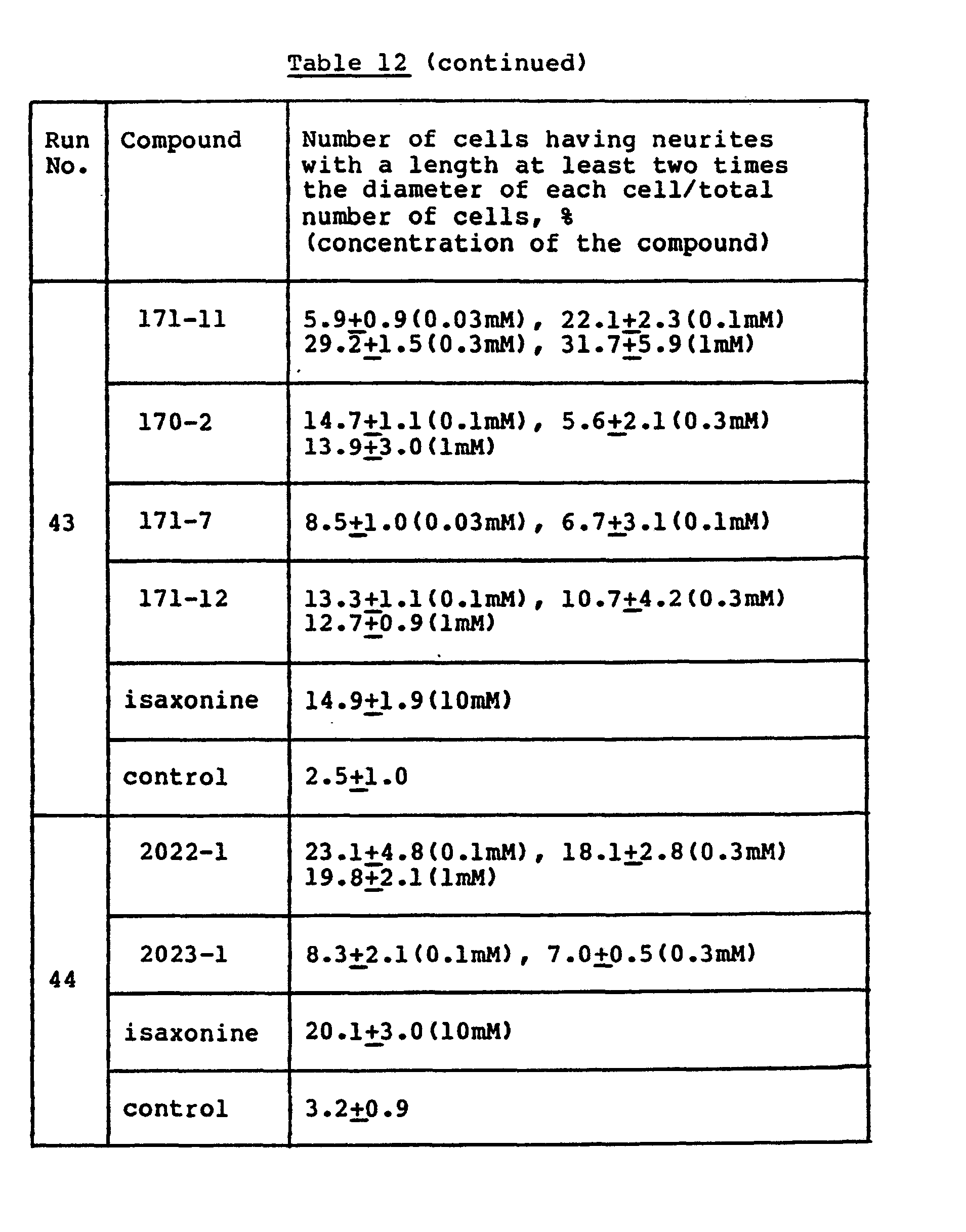


- The therapeutic effect of the compound of the invention was tested on rats having crushed sciatic nerves as a model of peripheral nervous disorder using (1) a change in the action of the hind paw with the crushed sciatic nerves and (2) a change in the weight of the muscle as an index of the course of degeneration and regeneration of peripheral nerves.
- In the experiment, male Wistar rats (6 weeks old), seven per group, were used. The sciatic nerves were crushed by a method similar to the method of Yamatsu et al. (see Kiyomi Yamatsu, Takenori Kaneko, Akifumi Kitahara and Isao Ohkawa, Journal of Japanese Pharmacological Society, 72, 259-268 (1976) and the method of Hasegawa et al. (see Kazuo Hasegawa, Naoji Mikuni and Yutaka Sakai, Journal of Japanese Pharmacological Society, 74, 721-734 (1978). Specifically, under anesthesia with pentobarbital (40 mg/kg, i.p.), the left side sciatic nerve was exposed at the femur, and a specific site of the exposed sciatic nerve was crushed for 30 seconds by using a hemostat. After the crushing, the opetation site was immediately sutured. Thereafter, vincristine known to retard the regeneration of the peripheral nerve was intraperitoneally administered in a dose of 100 g/kg once a week.
- Compounds of the invention were selected as test drugs, and administered intraperitoneally once a day from the day of crushing to 30th day from then. To a control group, only 0.9 % saline was administered.
- Twitch tension, which is a transient tension incident to contraction of the dominated muscles that occurs by electrical stimulation or the like of motor nerves, as is the case with the interdigit distance to be described, is considered to reflect functional changes of the nerves and muscles.
- Thus, 30 days later, under aesthesia with chloral hydrate (400 mg/kg, i.p.), the twitch tension of rats was measured by the method of Kern et al. [J. Neurosci. Methods, 19, 259 (1987)]. Specifically, the hair on the hind paw of rats was shaven, and coated with Cardiocream (a product of Nihon Denko K.K.). Then, to the skin of the hind paw, electrodes with an alligator were attached. The cathode was attached to the rear portion of the trochiter, and the anode, to a site 1 cm rearwardly of the anode electrode and 1 cm toward its back. The rat was fixed on its back, and the hind paw to be measured was fixed perpendicularly. A silk yarn, about 20 cm long, was connected at one end to the third efferent toe joint of the hind paw to be measured and at the other end to a tension transducer. Isotonic contractions of the third muscle digitus flexus were recorded on a polygraph. Electrical stimulation was effected at a voltage of 100 V for a continuous duration of 1 msec. with rectangular waves at a frequency of 2 Hz. The static tension was 15 to 30 g, and 10 stimulations were repeated 3 times with intervals of 15 seconds. The contracting force was expressed as tension (g). From the measured values of both paws, the recovery ratio (%, left/right) of the contracting force of the paw with crushed nerves was calculated. The results are shown in Tables 14 and 15.


- The test compounds evidently increased the recovery of twitch tension, which is an electrophysiological index, and improved symptom, over the control group.
- The distance between digits was measured because this is a good index which functionally shows the degeneration and regeneration of the nerve and its change can be measured with the lapse of time.
- By a method similar to the method of Hasegawa [Hasegawa, K., Experientia, 34, 750-751 (1978)], the distance between the first and fifth digits of the hind paw was measured.
- The ratio of the measured distance to the interdigit distance in a normal hind paw was calculated and expressed in percentage (%). The interdigit distance of the hind paw with crushed nerves was less than 50 % of that in a normal hind paw immediately after the crushing. Recovery of the interdigit distance began 12 to 16 days later, and in drug-administered groups, there was evidently a tendency to accelerated recovery in comparison with the control group from about 17th day to the final day (26th).
- One example is shown in Table 16.

- It is known that removal of a nerve or its disorder causes atrophy of the muscle which is under its control, and the atrophy is gradually cured by re-control by the nerve. For this reason, a change in the weight of the muscle, which is quantitative, was selected as an index. Thirty days after the operation, the muscles extensor digitorum longus of both hind paws which are muscles under the control of sciatic nerves were extracted under anesthesia, and their weights were measured. The ratio of the weight of the muscle extensor digitorum longus on the crushed side to that of normal side was calculated and expressed in percentage (%). The results are shown in Table 17.

- The results show that the test compounds, in comparison with the control, evidently increased the weight % of muscle extensor digitorum longus.
- Accordingly, these test compounds are useful as improvers and therapeutic agents for peripheral nerve disorders.
- Nigral dopaminergic nerve cells at the left side of the brain of 4-week old female Wistar rats (body weight 100 g) were lesioned by injecting a very small quantity of 6-hydroxydopamine. The rats showed a tendency to rotate spontaneously in a direction opposite to the lesioned side for several days, but no apparent abnormal action was observed after that. Upon administration of methamphethamine (5 mg/kg, i.p.) to the rats having the lesioned nigral dopaminergic nerve cells, they began rotational movement toward the lesioned side.
- After two weeks from the destruction by the administration of the drug, portions of the truncus corporis callosi containing dopamine cells (i. e., substantia nigra and the tagmentum at the abdomen side) were cut from the brain of a fetal rat of 14 to 17 days of age, cut finely, and treated with trypsin. Then, the extracted tissues were incubated at 37° C for 30 minutes, and the tissues were subjected to pipetting to form a suspension. Five microliters of the suspension was transplanted each into two sites of the caudate nucleus of the lesioned side (10 microliters in total, about 105 cells).
- Compound No. 168 of the invention was administered in a dose of 156 mg/kg (i.p.) for 4 days from the day of transplantation, then with a suspension of 7 days, for 10 days in a dose of 50 mg/kg (i.p.) from the 11th day. Compound No. 296 was administered in a dose of 153 mg/kg, and then 50 mg/kg, in accordance with the same schedule.
- Compound No. 3144 was also administered in accordance with the same schedule in a dose of 135 mg/kg, and then 45 mg/kg.
- The rotational movements induced by administra tion of methamphetamine were examined 2 weeks and 1 week before, and 2 (or 3), 4, 6 and 8 weeks after, the transplantation and the administration of the drug. The number of rotational movements for the first one minute was counted at intervals of 10 minutes after the administration of methamphetamine, and the total number of rotational movements counted six times was averaged to find a mean number of the rotational movements.
- The results are shown in Table 18.
- The results show that the test compounds are useful as improvers and therapeutic agents for cental nerve disorders.

- Male BalbC strain mice, 7 weeks old, were first caused to learn a T-shaped maze three times in a week so that they run straight from a starting point to a safety area. Then, methylmercury chloride (MMC for short) was administered orally in a dose of 6 mg/kg/day for 6 days to male Balb C strain mice (7 weeks old). A group of mice to which saline was administered in a dose of 0.1 ml/10 g/day was used as a control group. Beginning with the day next to the day of administering MMC, compounds of the invention were intraperitoneally administered over 10 days. On the sixth day after administration of the drug (namely, on the 12th day after start of the experiment), learning of the T-shaped maze was resumed, and the running behaviors of the mice were observed. The number of mice which could be experimented in the T-shaped maze on the 10th and 11th days after the resumption (21st and 22nd days after the start of the experiment) was counted and expressed as a denominator. The number of mice which ran to the safety area within 5 seconds at least 8 times out of ten trial runnings was counted and expressed as a numerator. The decrease in the number of the test animals was due to death by MMC poisoning. The time (seconds) required for the animals to run to the safety area was measured, and the mean ± standard error (SE) was calculated.
- The results demonstrate the effect of the compounds of the invention to improve learning and momory of the mice and their recovery effect.
- The acute toxicity of the compounds of the invention was examined by the following method.
- Male ddy-strain 5-week old mice, 4-6 per group, were used as experimental animals. Each of the compounds was intraperitoneally (i.p.), and the toxicity of the compound was assessed 24 hours after the administration. The results are shown in Table 19.


- The compounds of general formulae (1), (2) and (3) provided by this invention have a promoting effect on the proliferation of nerve cells and the formation and sprouting of neurites and a nerve regenerating effect and a motor function recovering effect in rats and mice having nerve disorders, and can be used suitably for improving and curing neurological diseases such as disorders of peripheral nerves or central nerves and dementia. They are expected to be used also suitably for the recovery, improving and curing of neurological diseases caused by nervous tissues and cells which have to do with perceptive and sensory functions and an autonomic function.
- It has been found that the compounds of the invention have biological activities equal to, or higher than, those of isaxonine and mecobalamin as a control as shown in Experimental Examples 1 to 4 and Tables 12 to 19. The toxicity of the compounds of this invention are generally weak as shown in Experimental Example 5. Thus, the compounds of this invention are generally considered to be highly active and highly safe drugs and very useful with weak toxicity.
Claims (9)


a group of the formula

a group of the formula


wherein R9 represents a hydrogen atom, a lower alkyl group, a lower alkoxy group, a lower alkylthio group, or a di-lower alkylamino group,
a group of the formula


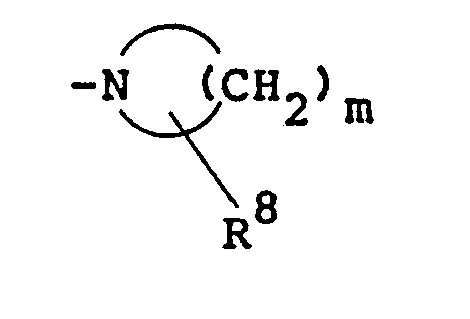


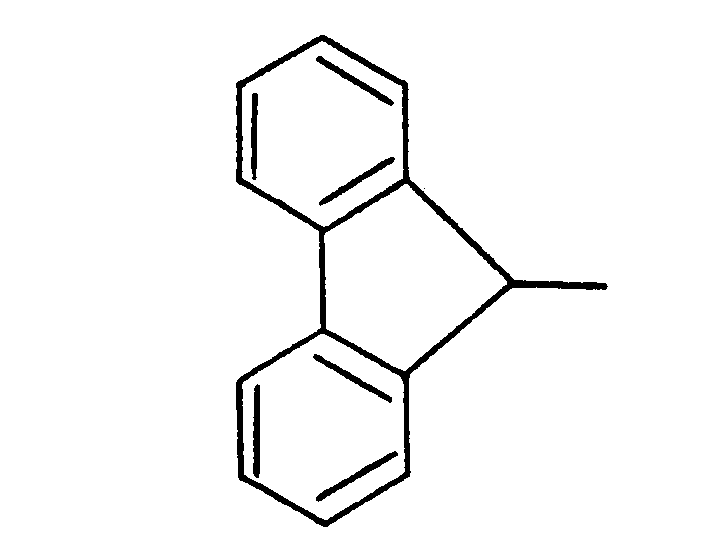
Priority Applications (1)
| Application Number | Priority Date | Filing Date | Title |
|---|---|---|---|
| EP94105018A EP0612746A1 (en) | 1988-12-29 | 1989-12-27 | Pyrimidines and their pharmaceutical acceptable salts and their use as medicines |
Applications Claiming Priority (6)
| Application Number | Priority Date | Filing Date | Title |
|---|---|---|---|
| JP333670/88 | 1988-12-29 | ||
| JP33367088 | 1988-12-29 | ||
| JP1041729A JPH02221275A (en) | 1989-02-23 | 1989-02-23 | Pyrimidines and their pharmacologically permissible salts |
| JP4172889 | 1989-02-23 | ||
| JP41729/89 | 1989-02-23 | ||
| JP41728/89 | 1989-02-23 |
Related Child Applications (2)
| Application Number | Title | Priority Date | Filing Date |
|---|---|---|---|
| EP94105018.9 Division-Into | 1989-12-27 | ||
| EP94105018A Division EP0612746A1 (en) | 1988-12-29 | 1989-12-27 | Pyrimidines and their pharmaceutical acceptable salts and their use as medicines |
Publications (3)
| Publication Number | Publication Date |
|---|---|
| EP0379806A2 true EP0379806A2 (en) | 1990-08-01 |
| EP0379806A3 EP0379806A3 (en) | 1991-05-29 |
| EP0379806B1 EP0379806B1 (en) | 1996-04-10 |
Family
ID=27290931
Family Applications (2)
| Application Number | Title | Priority Date | Filing Date |
|---|---|---|---|
| EP89313595A Expired - Lifetime EP0379806B1 (en) | 1988-12-29 | 1989-12-27 | Pyrimidines and their pharmaceutical acceptable salts, and their use as medicines |
| EP94105018A Withdrawn EP0612746A1 (en) | 1988-12-29 | 1989-12-27 | Pyrimidines and their pharmaceutical acceptable salts and their use as medicines |
Family Applications After (1)
| Application Number | Title | Priority Date | Filing Date |
|---|---|---|---|
| EP94105018A Withdrawn EP0612746A1 (en) | 1988-12-29 | 1989-12-27 | Pyrimidines and their pharmaceutical acceptable salts and their use as medicines |
Country Status (9)
| Country | Link |
|---|---|
| US (1) | US5147876A (en) |
| EP (2) | EP0379806B1 (en) |
| KR (1) | KR920003129B1 (en) |
| CN (2) | CN1037513C (en) |
| AT (1) | ATE136542T1 (en) |
| AU (1) | AU629595B2 (en) |
| CA (1) | CA2006944A1 (en) |
| DE (1) | DE68926232T2 (en) |
| HU (1) | HU206337B (en) |
Cited By (34)
| Publication number | Priority date | Publication date | Assignee | Title |
|---|---|---|---|---|
| EP0372934A3 (en) * | 1988-12-07 | 1992-07-15 | The Wellcome Foundation Limited | Pharmacologically active cns compounds |
| WO1992018498A1 (en) * | 1991-04-17 | 1992-10-29 | Pfizer Inc. | Pyrimidine derivatives for enhancing antitumor activity |
| EP0489925A4 (en) * | 1990-07-03 | 1993-01-20 | Mitsui Petrochemical Industries, Ltd. | Pyrimidine compound and pharmaceutically acceptable salt thereof |
| WO1995018795A1 (en) * | 1994-01-07 | 1995-07-13 | Dowelanco | N-(4-pyrimidinyl)amide pesticides |
| US5491234A (en) * | 1992-03-30 | 1996-02-13 | Pfizer Inc. | Pyrimidine derivatives for enhancing antitumor activity |
| WO1997043279A1 (en) * | 1996-05-10 | 1997-11-20 | Janssen Pharmaceutica N.V. | 2,4-diaminopyrimidine derivates as dopamine d4 receptor antagonists |
| WO1998043968A1 (en) * | 1997-03-27 | 1998-10-08 | Yuhan Corporation | Novel pyrimidine derivatives and processes for the preparation thereof |
| WO2003032994A3 (en) * | 2001-10-17 | 2003-06-12 | Boehringer Ingelheim Pharma | Novel tri-substituted pyrimidines, method for production and use thereof as medicament |
| US6593326B1 (en) | 1998-12-24 | 2003-07-15 | Astrazeneca Ab | 2,4-diamino pyrimidine compounds having anti-cell proliferative activity |
| US6632820B1 (en) | 1998-08-29 | 2003-10-14 | Astrazeneca Ab | Pyrimidine compounds |
| US6649608B2 (en) | 2000-03-01 | 2003-11-18 | Astrazeneca Ab | 2,4-di(hetero-)arylamino (oxy)-5-substituted pyrimidines as antineoplastic agents |
| US6670368B1 (en) | 1999-04-06 | 2003-12-30 | Astrazeneca Ab | Pyrimidine compounds with pharmaceutical activity |
| US6710052B2 (en) | 2000-03-01 | 2004-03-23 | Astrazeneca | Pyrimidine compounds |
| WO2005105757A1 (en) * | 2004-04-22 | 2005-11-10 | The Procter & Gamble Company | Tri-substituted ureas as cytokine inhibitors |
| WO2006000371A2 (en) | 2004-06-28 | 2006-01-05 | F.Hoffmann-La Roche Ag | Pyrimidine derivatives as 11beta-hsd1 inhibitors |
| US7173028B2 (en) | 2001-10-17 | 2007-02-06 | Boehringer Ingelheim Pharma Gmbh & Co. Kg | Pyrimidine derivatives |
| US7176212B2 (en) | 1998-08-29 | 2007-02-13 | Astrazeneca Ab | 2,4-diamino pyrimidine compounds having anti-cell proliferative activity |
| WO2007109045A1 (en) * | 2006-03-16 | 2007-09-27 | Novartis Ag | Heterocyclic organic compounds for the treatment of in particular melanoma |
| US7375043B2 (en) | 2003-06-06 | 2008-05-20 | Schott Ag | UV-radiation absorbing glass with reduced absorption of visible light and methods of making and using same |
| US7427626B2 (en) | 2003-05-16 | 2008-09-23 | Astrazeneca Ab | 2-Anilino-4-(imidazol-5-yl)-pyrimidine derivatives and their use as cdk (cdk2) inhibitors |
| US7442697B2 (en) | 2002-03-09 | 2008-10-28 | Astrazeneca Ab | 4-imidazolyl substituted pyrimidine derivatives with CDK inhibitory activity |
| US7446105B2 (en) | 2002-03-09 | 2008-11-04 | Astrazeneca Ab | Pyrimidine compounds |
| US7579344B2 (en) | 2003-05-16 | 2009-08-25 | Astrazeneca Ab | Pyrimidine derivatives possessing cell-cycle inhibitors activity |
| US7655652B2 (en) | 2004-02-03 | 2010-02-02 | Astrazeneca Ab | Imidazolo-5-yl-2-anilinopyrimidines as agents for the inhibition of cell proliferation |
| US7745428B2 (en) | 2005-09-30 | 2010-06-29 | Astrazeneca Ab | Imidazo[1,2-A]pyridine having anti-cell-proliferation activity |
| EP1571146A4 (en) * | 2002-12-10 | 2010-09-01 | Ono Pharmaceutical Co | Nitrogen-containing heterocyclic compounds and medicinal use thereof |
| US20130065923A1 (en) * | 2010-05-11 | 2013-03-14 | Sanofi | Substituted n-heteroaryl bipyrrolidine carboxamides, preparation and therapeutic use thereof |
| WO2014089112A1 (en) * | 2012-12-04 | 2014-06-12 | Rigel Pharmaceuticals, Inc. | Protein kinase c inhibitors and uses thereof |
| US9708315B2 (en) | 2013-09-06 | 2017-07-18 | Janssen Pharmaceutica Nv | 1,2,4-triazolo[4,3-a]pyridine compounds and their use as positive allosteric modulators of MGLUR2 receptors |
| US9737533B2 (en) | 2009-05-12 | 2017-08-22 | Janssen Pharmaceuticals. Inc. | 1,2,4-triazolo [4,3-A] pyridine derivatives and their use for the treatment of prevention of neurological and psychiatric disorders |
| US10106542B2 (en) | 2013-06-04 | 2018-10-23 | Janssen Pharmaceutica Nv | Substituted 6,7-dihydropyrazolo[1,5-a]pyrazines as negative allosteric modulators of mGluR2 receptors |
| US10537573B2 (en) | 2014-01-21 | 2020-01-21 | Janssen Pharmaceutica Nv | Combinations comprising positive allosteric modulators or orthosteric agonists of metabotropic glutamatergic receptor subtype 2 and their use |
| US11071729B2 (en) | 2007-09-14 | 2021-07-27 | Addex Pharmaceuticals S.A. | 1′,3′-disubstituted-4-phenyl-3,4,5,6-tetrahydro-2H,1′H-[1,4′]bipyridinyl-2′-ones |
| US11369606B2 (en) | 2014-01-21 | 2022-06-28 | Janssen Pharmaceutica Nv | Combinations comprising positive allosteric modulators or orthosteric agonists of metabotropic glutamatergic receptor subtype 2 and their use |
Families Citing this family (85)
| Publication number | Priority date | Publication date | Assignee | Title |
|---|---|---|---|---|
| EP0310550B1 (en) * | 1987-09-28 | 1993-05-26 | Ciba-Geigy Ag | Pesticide |
| GB8929022D0 (en) * | 1989-12-22 | 1990-02-28 | Ici Plc | Diazine derivatives |
| DK0520882T3 (en) * | 1991-06-27 | 1995-12-11 | Synthelabo | Derivatives of 2-aminopyrimidine-4-carboxamide, their preparation and their therapeutic use |
| US5958934A (en) * | 1996-05-23 | 1999-09-28 | Syntex (U.S.A.) Inc. | Aryl pyrimidine derivatives and uses thereof |
| TW440563B (en) * | 1996-05-23 | 2001-06-16 | Hoffmann La Roche | Aryl pyrimidine derivatives and a pharmaceutical composition thereof |
| US5952331A (en) * | 1996-05-23 | 1999-09-14 | Syntex (Usa) Inc. | Aryl pyrimidine derivatives |
| EA200000840A1 (en) | 1998-02-17 | 2001-02-26 | Туларик, Инк. | ANTI-VIRUS DERIVATIVES OF PYRIMIDINE |
| CA2340445A1 (en) * | 1998-05-04 | 1999-11-11 | The University Of Connecticut | Novel analgesic and immunomodulatory cannabinoids |
| US7897598B2 (en) * | 1998-06-09 | 2011-03-01 | Alexandros Makriyannis | Inhibitors of the anandamide transporter |
| US7589220B2 (en) * | 1998-06-09 | 2009-09-15 | University Of Connecticut | Inhibitors of the anandamide transporter |
| US7276613B1 (en) | 1998-11-24 | 2007-10-02 | University Of Connecticut | Retro-anandamides, high affinity and stability cannabinoid receptor ligands |
| US7161016B1 (en) | 1998-11-24 | 2007-01-09 | University Of Connecticut | Cannabimimetic lipid amides as useful medications |
| GB9905075D0 (en) | 1999-03-06 | 1999-04-28 | Zeneca Ltd | Chemical compounds |
| GB9919778D0 (en) | 1999-08-21 | 1999-10-27 | Zeneca Ltd | Chemical compounds |
| MXPA02003436A (en) | 1999-10-07 | 2002-08-20 | Amgen Inc | Triazine kinase inhibitors. |
| US7741365B2 (en) * | 1999-10-18 | 2010-06-22 | University Of Connecticut | Peripheral cannabinoid receptor (CB2) selective ligands |
| US6900236B1 (en) | 1999-10-18 | 2005-05-31 | University Of Connecticut | Cannabimimetic indole derivatives |
| US6943266B1 (en) * | 1999-10-18 | 2005-09-13 | University Of Connecticut | Bicyclic cannabinoid agonists for the cannabinoid receptor |
| US7119108B1 (en) | 1999-10-18 | 2006-10-10 | University Of Connecticut | Pyrazole derivatives as cannabinoid receptor antagonists |
| US7393842B2 (en) * | 2001-08-31 | 2008-07-01 | University Of Connecticut | Pyrazole analogs acting on cannabinoid receptors |
| CA2387764A1 (en) | 1999-10-18 | 2001-04-26 | University Of Connecticut | Peripheral cannabinoid receptor (cb2) selective ligands |
| US8084467B2 (en) * | 1999-10-18 | 2011-12-27 | University Of Connecticut | Pyrazole derivatives as cannabinoid receptor antagonists |
| US6410726B1 (en) | 2000-01-12 | 2002-06-25 | Tularik Inc. | Arylsulfonic acid salts of pyrimidine-based antiviral |
| AU3704101A (en) | 2000-02-17 | 2001-08-27 | Amgen Inc | Kinase inhibitors |
| GB0004887D0 (en) | 2000-03-01 | 2000-04-19 | Astrazeneca Uk Ltd | Chemical compounds |
| GB0004888D0 (en) | 2000-03-01 | 2000-04-19 | Astrazeneca Uk Ltd | Chemical compounds |
| GB0007371D0 (en) | 2000-03-28 | 2000-05-17 | Astrazeneca Uk Ltd | Chemical compounds |
| GB0016877D0 (en) | 2000-07-11 | 2000-08-30 | Astrazeneca Ab | Chemical compounds |
| GB0021726D0 (en) | 2000-09-05 | 2000-10-18 | Astrazeneca Ab | Chemical compounds |
| US6670362B2 (en) | 2000-09-20 | 2003-12-30 | Pfizer Inc. | Pyridazine endothelin antagonists |
| EP1361876A4 (en) * | 2001-01-26 | 2004-03-31 | Univ Connecticut | NEW CANNABIMIMETIC LIGANDS |
| DE60237431D1 (en) | 2001-01-29 | 2010-10-07 | Univ Connecticut | RECEPTOR-SELECTIVE CANNABIMIMETIC AMINO ALKYLINDOLE |
| GB0103926D0 (en) | 2001-02-17 | 2001-04-04 | Astrazeneca Ab | Chemical compounds |
| GB0113041D0 (en) | 2001-05-30 | 2001-07-18 | Astrazeneca Ab | Chemical compounds |
| US6825198B2 (en) * | 2001-06-21 | 2004-11-30 | Pfizer Inc | 5-HT receptor ligands and uses thereof |
| JP4312594B2 (en) * | 2001-07-13 | 2009-08-12 | ユニバーシティ オブ コネチカット | Novel bicyclic and tricyclic cannabinoids |
| US6939874B2 (en) | 2001-08-22 | 2005-09-06 | Amgen Inc. | Substituted pyrimidinyl derivatives and methods of use |
| US7115617B2 (en) | 2001-08-22 | 2006-10-03 | Amgen Inc. | Amino-substituted pyrimidinyl derivatives and methods of use |
| US7666867B2 (en) * | 2001-10-26 | 2010-02-23 | University Of Connecticut | Heteroindanes: a new class of potent cannabimimetic ligands |
| US6977265B2 (en) * | 2001-11-30 | 2005-12-20 | Roche Palo Alto Llc | Piperidine CCR-3 receptor antagonists |
| EP1453804B1 (en) * | 2001-11-30 | 2007-08-22 | F. Hoffmann-La Roche AG | Ccr-3 receptor antagonists vii |
| SE0104140D0 (en) * | 2001-12-07 | 2001-12-07 | Astrazeneca Ab | Novel Compounds |
| AU2003202988A1 (en) | 2002-01-14 | 2003-07-30 | The Board Of Trustees Of The University Of Illinois | Use of modified pyrimidine compounds to promote stem cell migration and proliferation |
| TWI329105B (en) | 2002-02-01 | 2010-08-21 | Rigel Pharmaceuticals Inc | 2,4-pyrimidinediamine compounds and their uses |
| GB0205693D0 (en) | 2002-03-09 | 2002-04-24 | Astrazeneca Ab | Chemical compounds |
| GB0205688D0 (en) | 2002-03-09 | 2002-04-24 | Astrazeneca Ab | Chemical compounds |
| CA2475766C (en) * | 2002-03-13 | 2012-06-05 | Janssen Pharmaceutica N.V. | Piperazinyl-, piperidinyl- and morpholinyl-derivatives as novel inhibitors of histone deacetylase |
| MXPA04008797A (en) | 2002-03-13 | 2004-11-26 | Janssen Pharmaceutica Nv | Inhibitors of histone deacetylase. |
| HRP20040805A2 (en) | 2002-03-13 | 2005-04-30 | Janssen Pharmaceutica N.V. | Carbonylamino derivatives as novel inhibitors histone deacetylase |
| EA007099B1 (en) | 2002-03-13 | 2006-06-30 | Янссен Фармацевтика Н. В. | Sulfonylamino-derivatives as inhibitors of histone deacetylase |
| HRP20050089B1 (en) | 2002-07-29 | 2015-06-19 | Rigel Pharmaceuticals | Methods of treating or preventing autoimmune diseases with 2,4-pyrimidinediamine compounds |
| AU2003265663A1 (en) | 2002-08-23 | 2004-03-11 | University Of Connecticut | Keto cannabinoids with therapeutic indications |
| WO2005012294A1 (en) | 2003-07-30 | 2005-02-10 | Rigel Pharmaceuticals, Inc. | 2,4-pyrimidinediamine compounds for use in the treatment or prevention of autoimmune diseases |
| JP2007507529A (en) * | 2003-09-30 | 2007-03-29 | サイオス・インコーポレーテツド | Heterocyclic amides and sulfonamides |
| KR101261305B1 (en) | 2004-07-28 | 2013-05-08 | 얀센 파마슈티카 엔.브이. | Substituted indolyl alkyl amino derivatives as novel inhibitors of histone deacetylase |
| SI1814878T1 (en) | 2004-11-24 | 2012-06-29 | Rigel Pharmaceuticals Inc | Spiro-2, 4-pyrimidinediamine compounds and their uses |
| SI1853588T1 (en) | 2005-02-16 | 2008-10-31 | Astrazeneca Ab | Chemical compounds |
| EP1883302A4 (en) * | 2005-05-03 | 2009-05-20 | Rigel Pharmaceuticals Inc | Jak kinase inhibitors and their uses |
| US20080287437A1 (en) * | 2005-05-16 | 2008-11-20 | Astrazeneca Ab | Pyrazolylaminopyrimidine Derivatives Useful as Tyrosine Kinase Inhibitors |
| ES2553178T3 (en) | 2005-05-18 | 2015-12-04 | Janssen Pharmaceutica N.V. | Substituted derivatives of aminopropenyl piperidine or morpholine as new histone deacetylase inhibitors |
| JP2009513615A (en) * | 2005-10-28 | 2009-04-02 | アストラゼネカ アクチボラグ | 4- (3-Aminopyrazole) pyrimidine derivatives for use as tyrosine kinase inhibitors in the treatment of cancer |
| WO2007082874A1 (en) * | 2006-01-19 | 2007-07-26 | Janssen Pharmaceutica N.V. | Pyridine and pyrimidine derivatives as inhibitors of histone deacetylase |
| CA2631876C (en) * | 2006-01-19 | 2014-05-27 | Janssen Pharmaceutica N.V. | Aminophenyl derivatives as inhibitors of histone deacetylase |
| WO2007082876A1 (en) * | 2006-01-19 | 2007-07-26 | Janssen Pharmaceutica N.V. | Pyridine and pyrimidine derivatives as inhibitors of histone deacetylase |
| EP1981875B1 (en) * | 2006-01-19 | 2014-04-16 | Janssen Pharmaceutica N.V. | Substituted indolyl-alkyl-amino-derivatives as inhibitors of histone deacetylase |
| AR059898A1 (en) | 2006-03-15 | 2008-05-07 | Janssen Pharmaceutica Nv | DERIVATIVES OF 3-CIANO-PIRIDONA 1,4-DISUSTITUTED AND ITS USE AS ALLOSTERIC MODULATORS OF MGLUR2 RECEIVERS |
| EP2032554A1 (en) * | 2006-05-30 | 2009-03-11 | F. Hoffmann-Roche AG | Piperidinyl pyrimidine derivatives |
| TW200845978A (en) | 2007-03-07 | 2008-12-01 | Janssen Pharmaceutica Nv | 3-cyano-4-(4-tetrahydropyran-phenyl)-pyridin-2-one derivatives |
| TW200900065A (en) | 2007-03-07 | 2009-01-01 | Janssen Pharmaceutica Nv | 3-cyano-4-(4-pyridinyloxy-phenyl)-pyridin-2-one derivatives |
| US20080269266A1 (en) * | 2007-03-27 | 2008-10-30 | Astrazeneca Ab | Novel compounds 747 |
| JP2010524911A (en) * | 2007-04-18 | 2010-07-22 | アストラゼネカ アクチボラグ | 5-Aminopyrazol-3-yl-3H-imidazo [4,5-b] pyridine derivatives and their use for the treatment of cancer |
| WO2008135786A1 (en) * | 2007-05-04 | 2008-11-13 | Astrazeneca Ab | Amino-thiazolyl- pyrimidine derivatives and their use for the treatment of cancer |
| UA99459C2 (en) * | 2007-05-04 | 2012-08-27 | Астразенека Аб | 9-(pyrazol-3-yl)- 9h-purine-2-amine and 3-(pyraz0l-3-yl)-3h-imidazo[4,5-b]pyridin-5-amine derivatives and their use for the treatment of cancer |
| KR20110017445A (en) * | 2008-06-11 | 2011-02-21 | 아스트라제네카 아베 | Tricyclic 2,4-diamino-L, 3,5-triazine derivatives useful in the treatment of cancer and myeloproliferative disorders |
| MX2010013726A (en) | 2008-06-12 | 2011-01-14 | Janssen Pharmaceutica Nv | Diamino-pyridine, pyrimidine, and pyridazine modulators of the histamine h4 receptor. |
| EP2344470B1 (en) | 2008-09-02 | 2013-11-06 | Janssen Pharmaceuticals, Inc. | 3-azabicyclo[3.1.0]hexyl derivatives as modulators of metabotropic glutamate receptors |
| BRPI0919488A2 (en) * | 2008-09-30 | 2015-12-01 | Astrazeneca Ab | compound, use of a compound, method for treating cancer in a warm-blooded animal, pharmaceutical composition, and process for preparing a compound |
| JP5690277B2 (en) | 2008-11-28 | 2015-03-25 | ジャンセン ファーマシューティカルズ, インコーポレイテッド. | Indole and benzoxazine derivatives as modulators of metabotropic glutamate receptors |
| BRPI1010831A2 (en) | 2009-05-12 | 2016-04-05 | Addex Pharmaceuticals Sa | 1,2,4-triazolo [4,3-a] pyridine derivatives and their as positive allosteric modulators of mglur2 receptors |
| MY153913A (en) | 2009-05-12 | 2015-04-15 | Janssen Pharmaceuticals Inc | 7-aryl-1,2,4-triazolo[4,3-a]pyridine derivatives and their use as positive allosteric modulators of mglur2 receptors |
| US9271967B2 (en) | 2010-11-08 | 2016-03-01 | Janssen Pharmaceuticals, Inc. | 1,2,4-triazolo[4,3-a]pyridine derivatives and their use as positive allosteric modulators of mGluR2 receptors |
| AU2011328203B2 (en) | 2010-11-08 | 2015-03-19 | Janssen Pharmaceuticals, Inc. | 1,2,4-triazolo[4,3-a]pyridine derivatives and their use as positive allosteric modulators of mGluR2 receptors |
| ES2536433T3 (en) | 2010-11-08 | 2015-05-25 | Janssen Pharmaceuticals, Inc. | 1,2,4-Triazolo [4,3-a] pyridine derivatives and their use as positive allosteric modulators of mGluR2 receptors |
| CN104370897A (en) * | 2013-01-24 | 2015-02-25 | 韩冰 | Protease inhibitor and preparing method and use thereof |
| CN104370888A (en) * | 2013-01-24 | 2015-02-25 | 韩冰 | Neuroprotective effect compound and preparation method and use thereof |
Family Cites Families (18)
| Publication number | Priority date | Publication date | Assignee | Title |
|---|---|---|---|---|
| GB1259685A (en) * | 1969-04-03 | 1972-01-12 | Soc D Etudes Prod Chimique | Amino-pyrimidine derivatives |
| US3984414A (en) * | 1971-10-09 | 1976-10-05 | Societe D'etudes De Produits Chimiques | Dichloroacetate salt of 2-isopropylamino pyrimidine |
| JPS5122044A (en) * | 1974-08-19 | 1976-02-21 | Nissin Electric Co Ltd | KYORIKEIDENSOCHI |
| GB1525995A (en) * | 1976-02-18 | 1978-09-27 | Soc D Etudes Prod Chimique | Aminopyrimidine salt |
| JPS54157575A (en) * | 1978-05-31 | 1979-12-12 | Expansia Sa | Manufacture of 22chloropyrimidine |
| IL57352A0 (en) * | 1978-06-16 | 1979-09-30 | Expansia Sa | Preparation of 2-isopropylamino-pyrimidine |
| IN153791B (en) * | 1979-03-10 | 1984-08-18 | Soc D Etudes Prod Chimique | |
| ZA801960B (en) * | 1979-04-30 | 1981-04-29 | Soc D Etudes Prod Chimique | Preparation of isopropylamino-pyrimidine hydroxy derivatives(hydrogen reduction route) |
| BE882836A (en) * | 1979-05-15 | 1980-08-18 | Soc D Etudes Prod Chimique | NOVEL HALOGEN DERIVATIVES OF ISOPROPYLAMINO PYRIMIDINE, THEIR PREPARATION AND THEIR THERAPEUTIC USE |
| ZA803340B (en) * | 1979-07-04 | 1981-05-27 | Soc D Etudes Prod Chimique | Synthesis of 2-isopropylamino-pyrimidine |
| FI66355C (en) * | 1979-08-09 | 1984-10-10 | Soc D Etudes Prod Chimique | PROCEDURE FOR FRAMSTATION OF AV 2-ISOPROPYLAMINOPYRIMIDINE |
| BE885851A (en) * | 1979-11-02 | 1981-02-16 | Soc D Etudes Prod Chimique | THERAPEUTIC COMPOSITION FOR THE TREATMENT OF MUSCULAR DUSTROPHY, MYOPATHY AND MYOTONIA |
| US4416885A (en) * | 1979-11-02 | 1983-11-22 | Huve Pierre M | Use of isopropylaminopyrimidine in the chemotherapy of muscular dystrophy, myopathy and myotonia |
| FR2539414A1 (en) * | 1983-01-14 | 1984-07-20 | Sanofi Sa | Pyrimidine derivatives, process for their preparation and the medicaments having an activity on the central nervous system which contain them |
| JPS6165873A (en) * | 1984-09-07 | 1986-04-04 | Mitsui Petrochem Ind Ltd | 2-piperazinopyrimidine derivative |
| JPS6281375A (en) * | 1985-10-04 | 1987-04-14 | Teikoku Chem Ind Corp Ltd | Production of 4-amino-2-piperazinylpyrimidine |
| WO1987004928A1 (en) * | 1986-02-24 | 1987-08-27 | Mitsui Petrochemical Industries, Ltd. | Agents for treating neurophathy |
| DK368687A (en) * | 1986-11-21 | 1988-05-22 | Cheminova As | AMINOALCYLED HYDROXY COMPOUNDS AND THEIR USE AS FUNGICIDES |
-
1989
- 1989-12-22 HU HU896762A patent/HU206337B/en not_active IP Right Cessation
- 1989-12-27 EP EP89313595A patent/EP0379806B1/en not_active Expired - Lifetime
- 1989-12-27 DE DE68926232T patent/DE68926232T2/en not_active Expired - Fee Related
- 1989-12-27 AT AT89313595T patent/ATE136542T1/en not_active IP Right Cessation
- 1989-12-27 EP EP94105018A patent/EP0612746A1/en not_active Withdrawn
- 1989-12-28 AU AU47329/89A patent/AU629595B2/en not_active Ceased
- 1989-12-29 CN CN89109731A patent/CN1037513C/en not_active Expired - Fee Related
- 1989-12-29 US US07/459,376 patent/US5147876A/en not_active Expired - Fee Related
- 1989-12-29 KR KR1019890020122A patent/KR920003129B1/en not_active Expired
- 1989-12-29 CA CA002006944A patent/CA2006944A1/en not_active Abandoned
-
1993
- 1993-10-21 CN CN93119388A patent/CN1090846A/en active Pending
Cited By (61)
| Publication number | Priority date | Publication date | Assignee | Title |
|---|---|---|---|---|
| EP0727214A3 (en) * | 1988-12-07 | 1997-10-01 | Wellcome Found | Substituted phenylpyrimidine derivatives useful in the treatment or prevention of diseases of the central nervous system |
| EP1681058A3 (en) * | 1988-12-07 | 2008-04-16 | The Wellcome Foundation Limited | Substituted phenylpyrimidine derivatives useful in the treatment or prevention of CNS disorders |
| US5684005A (en) * | 1988-12-07 | 1997-11-04 | Glaxo Wellcome Inc. | Pharmacologically active CNS compounds |
| EP0372934A3 (en) * | 1988-12-07 | 1992-07-15 | The Wellcome Foundation Limited | Pharmacologically active cns compounds |
| US5712276A (en) * | 1988-12-07 | 1998-01-27 | Glaxo Wellcome Inc. | 2-(n-alkylpiperazino or morpholino)-4-amino-5-aryl-pyrimidines |
| US5591746A (en) * | 1988-12-07 | 1997-01-07 | Glaxo Wellcome Inc | Treatment of damage from a stroke using 4-amino(4-methylpiperazin-1-yl)-5-(2,3,5-trichlorophenyl)pyrimidine |
| US5597827A (en) * | 1988-12-07 | 1997-01-28 | Glaxo Wellcome Inc | Treatment of injury of the spinal cord or brain using 4-amino-2-(4-methylpiperazin-1-yl)-5-(2,3,5-trichlorophenyl)pyrimidine |
| US5635507A (en) * | 1988-12-07 | 1997-06-03 | Glaxo Wellcome Inc. | Pharmacologically active CNS compounds |
| EP0727213A3 (en) * | 1988-12-07 | 1997-09-10 | Wellcome Found | Substituted phenylpyrimidine derivatives useful in the treatment or prevention of diseases of the central nervous system |
| EP0727212A3 (en) * | 1988-12-07 | 1997-10-01 | Wellcome Found | Substituted phenylpyrimidine derivatives, useful in the treatment or prevention of diseases of the central nervous system |
| EP0713703A3 (en) * | 1988-12-07 | 1997-10-01 | Wellcome Found | Substituted phenylpyrimidine derivatives useful in the treatment or prevention of diseases of the central nervous system |
| EP0715851A3 (en) * | 1988-12-07 | 1997-10-01 | Wellcome Found | Substituted phenylpyrimidine derivatives useful in the treatment or prevention of diseases of the central nervous system |
| EP0489925A4 (en) * | 1990-07-03 | 1993-01-20 | Mitsui Petrochemical Industries, Ltd. | Pyrimidine compound and pharmaceutically acceptable salt thereof |
| WO1992018498A1 (en) * | 1991-04-17 | 1992-10-29 | Pfizer Inc. | Pyrimidine derivatives for enhancing antitumor activity |
| US5491234A (en) * | 1992-03-30 | 1996-02-13 | Pfizer Inc. | Pyrimidine derivatives for enhancing antitumor activity |
| WO1995018795A1 (en) * | 1994-01-07 | 1995-07-13 | Dowelanco | N-(4-pyrimidinyl)amide pesticides |
| WO1997043279A1 (en) * | 1996-05-10 | 1997-11-20 | Janssen Pharmaceutica N.V. | 2,4-diaminopyrimidine derivates as dopamine d4 receptor antagonists |
| US6159982A (en) * | 1996-05-10 | 2000-12-12 | Janssen Pharmaceutica N. V. | 2,4-diaminopyrimidine derivates as dopamine D4 receptor antagonist |
| US6395742B1 (en) | 1996-05-10 | 2002-05-28 | Janssen Pharmaceutica N.V. | 2,4-diaminopyrimidine derivatives |
| CN1118464C (en) * | 1997-03-27 | 2003-08-20 | 株式会社柳韩洋行 | Noval pyrimidine derivatives and process and preparing thereof |
| WO1998043968A1 (en) * | 1997-03-27 | 1998-10-08 | Yuhan Corporation | Novel pyrimidine derivatives and processes for the preparation thereof |
| US6632820B1 (en) | 1998-08-29 | 2003-10-14 | Astrazeneca Ab | Pyrimidine compounds |
| US7176212B2 (en) | 1998-08-29 | 2007-02-13 | Astrazeneca Ab | 2,4-diamino pyrimidine compounds having anti-cell proliferative activity |
| US6593326B1 (en) | 1998-12-24 | 2003-07-15 | Astrazeneca Ab | 2,4-diamino pyrimidine compounds having anti-cell proliferative activity |
| US6670368B1 (en) | 1999-04-06 | 2003-12-30 | Astrazeneca Ab | Pyrimidine compounds with pharmaceutical activity |
| US6649608B2 (en) | 2000-03-01 | 2003-11-18 | Astrazeneca Ab | 2,4-di(hetero-)arylamino (oxy)-5-substituted pyrimidines as antineoplastic agents |
| US6710052B2 (en) | 2000-03-01 | 2004-03-23 | Astrazeneca | Pyrimidine compounds |
| US7166599B2 (en) | 2001-10-17 | 2007-01-23 | Boehringer Ingelheim Pharma Gmbh & Co. Kg | Trisubstituted pyrimidines |
| US8420630B2 (en) | 2001-10-17 | 2013-04-16 | Boehringer Ingelheim Pharma Gmbh & Co. Kg | Pyrimidine derivatives |
| US7173028B2 (en) | 2001-10-17 | 2007-02-06 | Boehringer Ingelheim Pharma Gmbh & Co. Kg | Pyrimidine derivatives |
| US7709480B2 (en) | 2001-10-17 | 2010-05-04 | Boehringer Ingelheim Pharma Gmbh & Co. Kg | Pyrimidine derivatives |
| WO2003032994A3 (en) * | 2001-10-17 | 2003-06-12 | Boehringer Ingelheim Pharma | Novel tri-substituted pyrimidines, method for production and use thereof as medicament |
| US7442697B2 (en) | 2002-03-09 | 2008-10-28 | Astrazeneca Ab | 4-imidazolyl substituted pyrimidine derivatives with CDK inhibitory activity |
| US7446105B2 (en) | 2002-03-09 | 2008-11-04 | Astrazeneca Ab | Pyrimidine compounds |
| US8153625B2 (en) | 2002-12-10 | 2012-04-10 | Ono Pharmaceutical Co., Ltd. | Nitrogen-containing heterocyclic compounds and medicinal use thereof |
| EP1571146A4 (en) * | 2002-12-10 | 2010-09-01 | Ono Pharmaceutical Co | Nitrogen-containing heterocyclic compounds and medicinal use thereof |
| US7427626B2 (en) | 2003-05-16 | 2008-09-23 | Astrazeneca Ab | 2-Anilino-4-(imidazol-5-yl)-pyrimidine derivatives and their use as cdk (cdk2) inhibitors |
| US7579344B2 (en) | 2003-05-16 | 2009-08-25 | Astrazeneca Ab | Pyrimidine derivatives possessing cell-cycle inhibitors activity |
| US7375043B2 (en) | 2003-06-06 | 2008-05-20 | Schott Ag | UV-radiation absorbing glass with reduced absorption of visible light and methods of making and using same |
| US7655652B2 (en) | 2004-02-03 | 2010-02-02 | Astrazeneca Ab | Imidazolo-5-yl-2-anilinopyrimidines as agents for the inhibition of cell proliferation |
| WO2005105757A1 (en) * | 2004-04-22 | 2005-11-10 | The Procter & Gamble Company | Tri-substituted ureas as cytokine inhibitors |
| US7507733B2 (en) | 2004-06-28 | 2009-03-24 | Hoffmann-La Roche Inc. | 11b-HSD1 inhibitors for the treatment of diabetes |
| WO2006000371A3 (en) * | 2004-06-28 | 2006-04-27 | Hoffmann La Roche | Pyrimidine derivatives as 11beta-hsd1 inhibitors |
| WO2006000371A2 (en) | 2004-06-28 | 2006-01-05 | F.Hoffmann-La Roche Ag | Pyrimidine derivatives as 11beta-hsd1 inhibitors |
| US7745428B2 (en) | 2005-09-30 | 2010-06-29 | Astrazeneca Ab | Imidazo[1,2-A]pyridine having anti-cell-proliferation activity |
| WO2007109045A1 (en) * | 2006-03-16 | 2007-09-27 | Novartis Ag | Heterocyclic organic compounds for the treatment of in particular melanoma |
| US11071729B2 (en) | 2007-09-14 | 2021-07-27 | Addex Pharmaceuticals S.A. | 1′,3′-disubstituted-4-phenyl-3,4,5,6-tetrahydro-2H,1′H-[1,4′]bipyridinyl-2′-ones |
| US10071095B2 (en) | 2009-05-12 | 2018-09-11 | Janssen Pharmaceuticals, Inc. | 1,2,4-triazolo [4,3-A] pyridine derivatives and their use for the treatment of neurological and psychiatric disorders |
| US9737533B2 (en) | 2009-05-12 | 2017-08-22 | Janssen Pharmaceuticals. Inc. | 1,2,4-triazolo [4,3-A] pyridine derivatives and their use for the treatment of prevention of neurological and psychiatric disorders |
| US20130065923A1 (en) * | 2010-05-11 | 2013-03-14 | Sanofi | Substituted n-heteroaryl bipyrrolidine carboxamides, preparation and therapeutic use thereof |
| US8859588B2 (en) * | 2010-05-11 | 2014-10-14 | Sanofi | Substituted N-heteroaryl bipyrrolidine carboxamides, preparation and therapeutic use thereof |
| US9062068B2 (en) | 2012-12-04 | 2015-06-23 | Rigel Pharmaceuticals, Inc. | Protein kinase C inhibitors and uses thereof |
| US9913843B2 (en) | 2012-12-04 | 2018-03-13 | Rigel Pharmaceuticals, Inc. | Protein kinase C inhibitors and uses thereof |
| WO2014089112A1 (en) * | 2012-12-04 | 2014-06-12 | Rigel Pharmaceuticals, Inc. | Protein kinase c inhibitors and uses thereof |
| US10106542B2 (en) | 2013-06-04 | 2018-10-23 | Janssen Pharmaceutica Nv | Substituted 6,7-dihydropyrazolo[1,5-a]pyrazines as negative allosteric modulators of mGluR2 receptors |
| US10584129B2 (en) | 2013-06-04 | 2020-03-10 | Janssen Pharmaceuticals Nv | Substituted 6,7-dihydropyrazolo[1,5-a]pyrazines as negative allosteric modulators of mGluR2 receptors |
| US9708315B2 (en) | 2013-09-06 | 2017-07-18 | Janssen Pharmaceutica Nv | 1,2,4-triazolo[4,3-a]pyridine compounds and their use as positive allosteric modulators of MGLUR2 receptors |
| US10537573B2 (en) | 2014-01-21 | 2020-01-21 | Janssen Pharmaceutica Nv | Combinations comprising positive allosteric modulators or orthosteric agonists of metabotropic glutamatergic receptor subtype 2 and their use |
| US11103506B2 (en) | 2014-01-21 | 2021-08-31 | Janssen Pharmaceutica Nv | Combinations comprising positive allosteric modulators or orthosteric agonists of metabotropic glutamatergic receptor subtype 2 and their use |
| US11369606B2 (en) | 2014-01-21 | 2022-06-28 | Janssen Pharmaceutica Nv | Combinations comprising positive allosteric modulators or orthosteric agonists of metabotropic glutamatergic receptor subtype 2 and their use |
| US12048696B2 (en) | 2014-01-21 | 2024-07-30 | Janssen Pharmaceutica Nv | Combinations comprising positive allosteric modulators or orthosteric agonists of metabotropic glutamatergic receptor subtype 2 and their use |
Also Published As
| Publication number | Publication date |
|---|---|
| ATE136542T1 (en) | 1996-04-15 |
| EP0379806B1 (en) | 1996-04-10 |
| CA2006944A1 (en) | 1990-06-29 |
| EP0379806A3 (en) | 1991-05-29 |
| HU206337B (en) | 1992-10-28 |
| DE68926232T2 (en) | 1996-10-17 |
| US5147876A (en) | 1992-09-15 |
| AU629595B2 (en) | 1992-10-08 |
| CN1090846A (en) | 1994-08-17 |
| HUT52769A (en) | 1990-08-28 |
| KR900009625A (en) | 1990-07-05 |
| HU896762D0 (en) | 1990-03-28 |
| EP0612746A1 (en) | 1994-08-31 |
| DE68926232D1 (en) | 1996-05-15 |
| CN1045390A (en) | 1990-09-19 |
| AU4732989A (en) | 1990-07-05 |
| KR920003129B1 (en) | 1992-04-20 |
| CN1037513C (en) | 1998-02-25 |
Similar Documents
| Publication | Publication Date | Title |
|---|---|---|
| EP0379806B1 (en) | Pyrimidines and their pharmaceutical acceptable salts, and their use as medicines | |
| EP0257102B1 (en) | Agents for treating neurophathy | |
| US4279911A (en) | Amine derivatives and pharmaceutical compositions containing them | |
| AU680037B2 (en) | Piperazine derivatives as alpha1a-adrenergic receptor antagonists | |
| US5304555A (en) | Pyrimidines and pharmaceutically acceptable salts thereof useful in treatment of neurological disorders | |
| CA1114379A (en) | Piperidino-phthalazines | |
| CA2050962A1 (en) | Aryl-fused and hetaryl-fused-2,4 diazepine and 2,4-diazocine antiarrhythmic agents | |
| EP0305184B1 (en) | Pyrimidines or their pharmaceutically acceptable salts thereof | |
| EP0489925B1 (en) | Pyrimidine compound and pharmaceutically acceptable salt thereof | |
| EP0319170B1 (en) | Acyl derivatives of hydroxy pyrimidines | |
| US5264435A (en) | Pyrimidines and their pharmaceutical acceptable salts, and their use as medicines | |
| JP2744663B2 (en) | Pyrimidines and their pharmaceutically acceptable salts | |
| US5703224A (en) | Antiviral c-nucleoside derivatives | |
| JP2005502700A (en) | CCR-3 receptor antagonist V | |
| JP2628707B2 (en) | Pyrimidines and their pharmaceutically acceptable salts | |
| RU2036924C1 (en) | Method of synthesis of imidazo-(1,2-b)-pyridazine or their salts and imidazo-(1,2-b)-pyridazine derivatives or their salts | |
| KR920003130B1 (en) | Pyrimidines and their pharmacologically acceptable salts and uses thereof | |
| JP3115575B2 (en) | Imidazopyridazine derivatives, their uses and production methods | |
| CA1305142C (en) | Therapeutic agent of neurological diseases | |
| KR920003128B1 (en) | Pyrimidines and their pharmacologically acceptable salts and uses thereof | |
| EP0578419A1 (en) | Pyridine derivatives and pharmaceutical compositions containing them | |
| HK1011351A1 (en) | Quinoline derivatives | |
| HK1011351B (en) | Quinoline derivatives |
Legal Events
| Date | Code | Title | Description |
|---|---|---|---|
| PUAI | Public reference made under article 153(3) epc to a published international application that has entered the european phase |
Free format text: ORIGINAL CODE: 0009012 |
|
| AK | Designated contracting states |
Kind code of ref document: A2 Designated state(s): AT BE CH DE ES FR GB GR IT LI LU NL SE |
|
| PUAL | Search report despatched |
Free format text: ORIGINAL CODE: 0009013 |
|
| AK | Designated contracting states |
Kind code of ref document: A3 Designated state(s): AT BE CH DE ES FR GB GR IT LI LU NL SE |
|
| 17P | Request for examination filed |
Effective date: 19910726 |
|
| 17Q | First examination report despatched |
Effective date: 19930706 |
|
| GRAA | (expected) grant |
Free format text: ORIGINAL CODE: 0009210 |
|
| AK | Designated contracting states |
Kind code of ref document: B1 Designated state(s): AT BE CH DE ES FR GB GR IT LI LU NL SE |
|
| PG25 | Lapsed in a contracting state [announced via postgrant information from national office to epo] |
Ref country code: NL Free format text: LAPSE BECAUSE OF FAILURE TO SUBMIT A TRANSLATION OF THE DESCRIPTION OR TO PAY THE FEE WITHIN THE PRESCRIBED TIME-LIMIT Effective date: 19960410 Ref country code: LI Effective date: 19960410 Ref country code: GR Free format text: LAPSE BECAUSE OF FAILURE TO SUBMIT A TRANSLATION OF THE DESCRIPTION OR TO PAY THE FEE WITHIN THE PRESCRIBED TIME-LIMIT Effective date: 19960410 Ref country code: ES Free format text: THE PATENT HAS BEEN ANNULLED BY A DECISION OF A NATIONAL AUTHORITY Effective date: 19960410 Ref country code: CH Effective date: 19960410 Ref country code: BE Effective date: 19960410 Ref country code: AT Effective date: 19960410 |
|
| REF | Corresponds to: |
Ref document number: 136542 Country of ref document: AT Date of ref document: 19960415 Kind code of ref document: T |
|
| XX | Miscellaneous (additional remarks) |
Free format text: TEILANMELDUNG 94105018.9 EINGEREICHT AM 27/12/89. |
|
| ET | Fr: translation filed | ||
| REF | Corresponds to: |
Ref document number: 68926232 Country of ref document: DE Date of ref document: 19960515 |
|
| ITF | It: translation for a ep patent filed | ||
| PG25 | Lapsed in a contracting state [announced via postgrant information from national office to epo] |
Ref country code: SE Effective date: 19960710 |
|
| NLV1 | Nl: lapsed or annulled due to failure to fulfill the requirements of art. 29p and 29m of the patents act | ||
| REG | Reference to a national code |
Ref country code: CH Ref legal event code: PL |
|
| PG25 | Lapsed in a contracting state [announced via postgrant information from national office to epo] |
Ref country code: LU Free format text: LAPSE BECAUSE OF NON-PAYMENT OF DUE FEES Effective date: 19961231 |
|
| PLBE | No opposition filed within time limit |
Free format text: ORIGINAL CODE: 0009261 |
|
| STAA | Information on the status of an ep patent application or granted ep patent |
Free format text: STATUS: NO OPPOSITION FILED WITHIN TIME LIMIT |
|
| 26N | No opposition filed | ||
| PGFP | Annual fee paid to national office [announced via postgrant information from national office to epo] |
Ref country code: FR Payment date: 19971209 Year of fee payment: 9 |
|
| PGFP | Annual fee paid to national office [announced via postgrant information from national office to epo] |
Ref country code: GB Payment date: 19971218 Year of fee payment: 9 |
|
| PGFP | Annual fee paid to national office [announced via postgrant information from national office to epo] |
Ref country code: DE Payment date: 19980105 Year of fee payment: 9 |
|
| PG25 | Lapsed in a contracting state [announced via postgrant information from national office to epo] |
Ref country code: GB Free format text: LAPSE BECAUSE OF NON-PAYMENT OF DUE FEES Effective date: 19981227 |
|
| GBPC | Gb: european patent ceased through non-payment of renewal fee |
Effective date: 19981227 |
|
| PG25 | Lapsed in a contracting state [announced via postgrant information from national office to epo] |
Ref country code: FR Free format text: LAPSE BECAUSE OF NON-PAYMENT OF DUE FEES Effective date: 19990831 |
|
| REG | Reference to a national code |
Ref country code: FR Ref legal event code: ST |
|
| PG25 | Lapsed in a contracting state [announced via postgrant information from national office to epo] |
Ref country code: DE Free format text: LAPSE BECAUSE OF NON-PAYMENT OF DUE FEES Effective date: 19991001 |
|
| PG25 | Lapsed in a contracting state [announced via postgrant information from national office to epo] |
Ref country code: IT Free format text: LAPSE BECAUSE OF NON-PAYMENT OF DUE FEES;WARNING: LAPSES OF ITALIAN PATENTS WITH EFFECTIVE DATE BEFORE 2007 MAY HAVE OCCURRED AT ANY TIME BEFORE 2007. THE CORRECT EFFECTIVE DATE MAY BE DIFFERENT FROM THE ONE RECORDED. Effective date: 20051227 |