EP0377960A2 - Phosphate-containing ceramic structures for catalyst support and fluid filtering - Google Patents
Phosphate-containing ceramic structures for catalyst support and fluid filtering Download PDFInfo
- Publication number
- EP0377960A2 EP0377960A2 EP89312464A EP89312464A EP0377960A2 EP 0377960 A2 EP0377960 A2 EP 0377960A2 EP 89312464 A EP89312464 A EP 89312464A EP 89312464 A EP89312464 A EP 89312464A EP 0377960 A2 EP0377960 A2 EP 0377960A2
- Authority
- EP
- European Patent Office
- Prior art keywords
- weight
- alumina
- titania
- metal oxide
- porous metal
- Prior art date
- Legal status (The legal status is an assumption and is not a legal conclusion. Google has not performed a legal analysis and makes no representation as to the accuracy of the status listed.)
- Withdrawn
Links
- 239000012530 fluid Substances 0.000 title claims abstract description 5
- 239000003054 catalyst Substances 0.000 title claims description 15
- 239000000919 ceramic Substances 0.000 title abstract description 30
- 239000010452 phosphate Substances 0.000 title abstract description 27
- 229910019142 PO4 Inorganic materials 0.000 title abstract description 26
- NBIIXXVUZAFLBC-UHFFFAOYSA-K phosphate Chemical compound [O-]P([O-])([O-])=O NBIIXXVUZAFLBC-UHFFFAOYSA-K 0.000 title abstract description 26
- 238000001914 filtration Methods 0.000 title description 2
- 239000000463 material Substances 0.000 claims abstract description 120
- GWEVSGVZZGPLCZ-UHFFFAOYSA-N Titan oxide Chemical compound O=[Ti]=O GWEVSGVZZGPLCZ-UHFFFAOYSA-N 0.000 claims abstract description 71
- PNEYBMLMFCGWSK-UHFFFAOYSA-N aluminium oxide Inorganic materials [O-2].[O-2].[O-2].[Al+3].[Al+3] PNEYBMLMFCGWSK-UHFFFAOYSA-N 0.000 claims abstract description 48
- MCMNRKCIXSYSNV-UHFFFAOYSA-N Zirconium dioxide Chemical compound O=[Zr]=O MCMNRKCIXSYSNV-UHFFFAOYSA-N 0.000 claims abstract description 36
- 229910044991 metal oxide Inorganic materials 0.000 claims abstract description 36
- 150000004706 metal oxides Chemical class 0.000 claims abstract description 36
- 230000003197 catalytic effect Effects 0.000 claims abstract description 22
- 239000000203 mixture Substances 0.000 claims description 33
- 238000010304 firing Methods 0.000 claims description 20
- DLYUQMMRRRQYAE-UHFFFAOYSA-N phosphorus pentoxide Inorganic materials O1P(O2)(=O)OP3(=O)OP1(=O)OP2(=O)O3 DLYUQMMRRRQYAE-UHFFFAOYSA-N 0.000 claims description 19
- 229910052751 metal Inorganic materials 0.000 claims description 13
- 239000002184 metal Substances 0.000 claims description 13
- 239000002243 precursor Substances 0.000 claims description 13
- 229910010293 ceramic material Inorganic materials 0.000 claims description 10
- 238000000034 method Methods 0.000 claims description 10
- 150000002739 metals Chemical class 0.000 claims description 7
- XEEYBQQBJWHFJM-UHFFFAOYSA-N Iron Chemical compound [Fe] XEEYBQQBJWHFJM-UHFFFAOYSA-N 0.000 claims description 6
- KDLHZDBZIXYQEI-UHFFFAOYSA-N Palladium Chemical compound [Pd] KDLHZDBZIXYQEI-UHFFFAOYSA-N 0.000 claims description 6
- 229910000147 aluminium phosphate Inorganic materials 0.000 claims description 6
- MNNHAPBLZZVQHP-UHFFFAOYSA-N diammonium hydrogen phosphate Chemical compound [NH4+].[NH4+].OP([O-])([O-])=O MNNHAPBLZZVQHP-UHFFFAOYSA-N 0.000 claims description 6
- BASFCYQUMIYNBI-UHFFFAOYSA-N platinum Chemical compound [Pt] BASFCYQUMIYNBI-UHFFFAOYSA-N 0.000 claims description 6
- 239000011164 primary particle Substances 0.000 claims description 5
- 229910052723 transition metal Inorganic materials 0.000 claims description 5
- 150000003624 transition metals Chemical class 0.000 claims description 5
- NBIIXXVUZAFLBC-UHFFFAOYSA-N Phosphoric acid Chemical compound OP(O)(O)=O NBIIXXVUZAFLBC-UHFFFAOYSA-N 0.000 claims description 4
- HCHKCACWOHOZIP-UHFFFAOYSA-N Zinc Chemical compound [Zn] HCHKCACWOHOZIP-UHFFFAOYSA-N 0.000 claims description 4
- WPBNNNQJVZRUHP-UHFFFAOYSA-L manganese(2+);methyl n-[[2-(methoxycarbonylcarbamothioylamino)phenyl]carbamothioyl]carbamate;n-[2-(sulfidocarbothioylamino)ethyl]carbamodithioate Chemical compound [Mn+2].[S-]C(=S)NCCNC([S-])=S.COC(=O)NC(=S)NC1=CC=CC=C1NC(=S)NC(=O)OC WPBNNNQJVZRUHP-UHFFFAOYSA-L 0.000 claims description 4
- 229910052725 zinc Inorganic materials 0.000 claims description 4
- 239000011701 zinc Substances 0.000 claims description 4
- RYGMFSIKBFXOCR-UHFFFAOYSA-N Copper Chemical compound [Cu] RYGMFSIKBFXOCR-UHFFFAOYSA-N 0.000 claims description 3
- ZOKXTWBITQBERF-UHFFFAOYSA-N Molybdenum Chemical compound [Mo] ZOKXTWBITQBERF-UHFFFAOYSA-N 0.000 claims description 3
- 150000001875 compounds Chemical class 0.000 claims description 3
- 229910052802 copper Inorganic materials 0.000 claims description 3
- 239000010949 copper Substances 0.000 claims description 3
- 229910052742 iron Inorganic materials 0.000 claims description 3
- 229910052750 molybdenum Inorganic materials 0.000 claims description 3
- 239000011733 molybdenum Substances 0.000 claims description 3
- 229910052763 palladium Inorganic materials 0.000 claims description 3
- 229910052697 platinum Inorganic materials 0.000 claims description 3
- WFKWXMTUELFFGS-UHFFFAOYSA-N tungsten Chemical compound [W] WFKWXMTUELFFGS-UHFFFAOYSA-N 0.000 claims description 3
- 229910052721 tungsten Inorganic materials 0.000 claims description 3
- 239000010937 tungsten Substances 0.000 claims description 3
- 229910052720 vanadium Inorganic materials 0.000 claims description 3
- GPPXJZIENCGNKB-UHFFFAOYSA-N vanadium Chemical compound [V]#[V] GPPXJZIENCGNKB-UHFFFAOYSA-N 0.000 claims description 3
- 229940116349 dibasic ammonium phosphate Drugs 0.000 claims description 2
- RGPUVZXXZFNFBF-UHFFFAOYSA-K diphosphonooxyalumanyl dihydrogen phosphate Chemical compound [Al+3].OP(O)([O-])=O.OP(O)([O-])=O.OP(O)([O-])=O RGPUVZXXZFNFBF-UHFFFAOYSA-K 0.000 claims description 2
- 238000005245 sintering Methods 0.000 abstract description 12
- 230000015556 catabolic process Effects 0.000 abstract description 2
- 238000006731 degradation reaction Methods 0.000 abstract description 2
- 230000014759 maintenance of location Effects 0.000 abstract description 2
- 235000010215 titanium dioxide Nutrition 0.000 description 27
- XLYOFNOQVPJJNP-UHFFFAOYSA-N water Substances O XLYOFNOQVPJJNP-UHFFFAOYSA-N 0.000 description 20
- 239000012153 distilled water Substances 0.000 description 15
- 241000264877 Hippospongia communis Species 0.000 description 14
- 239000000243 solution Substances 0.000 description 12
- 239000011230 binding agent Substances 0.000 description 11
- CPLXHLVBOLITMK-UHFFFAOYSA-N Magnesium oxide Chemical compound [Mg]=O CPLXHLVBOLITMK-UHFFFAOYSA-N 0.000 description 10
- VXUYXOFXAQZZMF-UHFFFAOYSA-N titanium(IV) isopropoxide Chemical compound CC(C)O[Ti](OC(C)C)(OC(C)C)OC(C)C VXUYXOFXAQZZMF-UHFFFAOYSA-N 0.000 description 10
- 239000002245 particle Substances 0.000 description 9
- -1 rare earth metals) Chemical class 0.000 description 9
- VYPSYNLAJGMNEJ-UHFFFAOYSA-N Silicium dioxide Chemical compound O=[Si]=O VYPSYNLAJGMNEJ-UHFFFAOYSA-N 0.000 description 8
- 229910052566 spinel group Inorganic materials 0.000 description 8
- 239000000725 suspension Substances 0.000 description 8
- 229920003091 Methocel™ Polymers 0.000 description 7
- 238000001354 calcination Methods 0.000 description 7
- 229910052878 cordierite Inorganic materials 0.000 description 7
- JSKIRARMQDRGJZ-UHFFFAOYSA-N dimagnesium dioxido-bis[(1-oxido-3-oxo-2,4,6,8,9-pentaoxa-1,3-disila-5,7-dialuminabicyclo[3.3.1]nonan-7-yl)oxy]silane Chemical compound [Mg++].[Mg++].[O-][Si]([O-])(O[Al]1O[Al]2O[Si](=O)O[Si]([O-])(O1)O2)O[Al]1O[Al]2O[Si](=O)O[Si]([O-])(O1)O2 JSKIRARMQDRGJZ-UHFFFAOYSA-N 0.000 description 7
- 238000002156 mixing Methods 0.000 description 7
- 239000002002 slurry Substances 0.000 description 7
- 239000007787 solid Substances 0.000 description 7
- VEXZGXHMUGYJMC-UHFFFAOYSA-N Hydrochloric acid Chemical compound Cl VEXZGXHMUGYJMC-UHFFFAOYSA-N 0.000 description 6
- XLOMVQKBTHCTTD-UHFFFAOYSA-N Zinc monoxide Chemical compound [Zn]=O XLOMVQKBTHCTTD-UHFFFAOYSA-N 0.000 description 6
- NUJOXMJBOLGQSY-UHFFFAOYSA-N manganese dioxide Chemical compound O=[Mn]=O NUJOXMJBOLGQSY-UHFFFAOYSA-N 0.000 description 6
- 239000004615 ingredient Substances 0.000 description 5
- 239000000395 magnesium oxide Substances 0.000 description 5
- 235000012245 magnesium oxide Nutrition 0.000 description 5
- OKTJSMMVPCPJKN-UHFFFAOYSA-N Carbon Chemical compound [C] OKTJSMMVPCPJKN-UHFFFAOYSA-N 0.000 description 4
- 239000006105 batch ingredient Substances 0.000 description 4
- 229910052593 corundum Inorganic materials 0.000 description 4
- 229910000388 diammonium phosphate Inorganic materials 0.000 description 4
- 235000019838 diammonium phosphate Nutrition 0.000 description 4
- 238000010438 heat treatment Methods 0.000 description 4
- UQSXHKLRYXJYBZ-UHFFFAOYSA-N iron oxide Inorganic materials [Fe]=O UQSXHKLRYXJYBZ-UHFFFAOYSA-N 0.000 description 4
- NDLPOXTZKUMGOV-UHFFFAOYSA-N oxo(oxoferriooxy)iron hydrate Chemical compound O.O=[Fe]O[Fe]=O NDLPOXTZKUMGOV-UHFFFAOYSA-N 0.000 description 4
- 239000011148 porous material Substances 0.000 description 4
- 239000011369 resultant mixture Substances 0.000 description 4
- 239000000126 substance Substances 0.000 description 4
- 239000000758 substrate Substances 0.000 description 4
- 229910001845 yogo sapphire Inorganic materials 0.000 description 4
- QTBSBXVTEAMEQO-UHFFFAOYSA-N Acetic acid Chemical compound CC(O)=O QTBSBXVTEAMEQO-UHFFFAOYSA-N 0.000 description 3
- HEMHJVSKTPXQMS-UHFFFAOYSA-M Sodium hydroxide Chemical compound [OH-].[Na+] HEMHJVSKTPXQMS-UHFFFAOYSA-M 0.000 description 3
- 229910052782 aluminium Inorganic materials 0.000 description 3
- LFVGISIMTYGQHF-UHFFFAOYSA-N ammonium dihydrogen phosphate Chemical compound [NH4+].OP(O)([O-])=O LFVGISIMTYGQHF-UHFFFAOYSA-N 0.000 description 3
- 239000004927 clay Substances 0.000 description 3
- 239000002131 composite material Substances 0.000 description 3
- LVYZJEPLMYTTGH-UHFFFAOYSA-H dialuminum chloride pentahydroxide dihydrate Chemical compound [Cl-].[Al+3].[OH-].[OH-].[Al+3].[OH-].[OH-].[OH-].O.O LVYZJEPLMYTTGH-UHFFFAOYSA-H 0.000 description 3
- 238000001704 evaporation Methods 0.000 description 3
- FAHBNUUHRFUEAI-UHFFFAOYSA-M hydroxidooxidoaluminium Chemical compound O[Al]=O FAHBNUUHRFUEAI-UHFFFAOYSA-M 0.000 description 3
- 235000001055 magnesium Nutrition 0.000 description 3
- 229910052749 magnesium Inorganic materials 0.000 description 3
- 239000011777 magnesium Substances 0.000 description 3
- 229940091250 magnesium supplement Drugs 0.000 description 3
- 150000004682 monohydrates Chemical class 0.000 description 3
- 238000001556 precipitation Methods 0.000 description 3
- 230000000717 retained effect Effects 0.000 description 3
- 239000000377 silicon dioxide Substances 0.000 description 3
- 238000003756 stirring Methods 0.000 description 3
- 239000004408 titanium dioxide Substances 0.000 description 3
- 239000011787 zinc oxide Substances 0.000 description 3
- 229910000505 Al2TiO5 Inorganic materials 0.000 description 2
- VHUUQVKOLVNVRT-UHFFFAOYSA-N Ammonium hydroxide Chemical compound [NH4+].[OH-] VHUUQVKOLVNVRT-UHFFFAOYSA-N 0.000 description 2
- SMZOGRDCAXLAAR-UHFFFAOYSA-N aluminium isopropoxide Chemical compound [Al+3].CC(C)[O-].CC(C)[O-].CC(C)[O-] SMZOGRDCAXLAAR-UHFFFAOYSA-N 0.000 description 2
- 239000000908 ammonium hydroxide Substances 0.000 description 2
- 239000007864 aqueous solution Substances 0.000 description 2
- 230000015572 biosynthetic process Effects 0.000 description 2
- 238000005119 centrifugation Methods 0.000 description 2
- 238000006243 chemical reaction Methods 0.000 description 2
- 239000008119 colloidal silica Substances 0.000 description 2
- 239000000470 constituent Substances 0.000 description 2
- 239000006185 dispersion Substances 0.000 description 2
- 238000009826 distribution Methods 0.000 description 2
- 238000001035 drying Methods 0.000 description 2
- 238000001125 extrusion Methods 0.000 description 2
- 239000010419 fine particle Substances 0.000 description 2
- ZXEKIIBDNHEJCQ-UHFFFAOYSA-N isobutanol Chemical compound CC(C)CO ZXEKIIBDNHEJCQ-UHFFFAOYSA-N 0.000 description 2
- KZNNRLXBDAAMDZ-UHFFFAOYSA-N oxo(oxoalumanyloxy)alumane trihydrate Chemical compound O.O.O.O=[Al]O[Al]=O KZNNRLXBDAAMDZ-UHFFFAOYSA-N 0.000 description 2
- 239000000843 powder Substances 0.000 description 2
- 238000002360 preparation method Methods 0.000 description 2
- AABBHSMFGKYLKE-SNAWJCMRSA-N propan-2-yl (e)-but-2-enoate Chemical compound C\C=C\C(=O)OC(C)C AABBHSMFGKYLKE-SNAWJCMRSA-N 0.000 description 2
- 229910052761 rare earth metal Inorganic materials 0.000 description 2
- 150000002910 rare earth metals Chemical class 0.000 description 2
- 239000006104 solid solution Substances 0.000 description 2
- 229910052596 spinel Inorganic materials 0.000 description 2
- 239000011029 spinel Substances 0.000 description 2
- AKMXMQQXGXKHAN-UHFFFAOYSA-N titanium;hydrate Chemical compound O.[Ti] AKMXMQQXGXKHAN-UHFFFAOYSA-N 0.000 description 2
- 230000007704 transition Effects 0.000 description 2
- 229910052726 zirconium Inorganic materials 0.000 description 2
- DMYOHQBLOZMDLP-UHFFFAOYSA-N 1-[2-(2-hydroxy-3-piperidin-1-ylpropoxy)phenyl]-3-phenylpropan-1-one Chemical compound C1CCCCN1CC(O)COC1=CC=CC=C1C(=O)CCC1=CC=CC=C1 DMYOHQBLOZMDLP-UHFFFAOYSA-N 0.000 description 1
- 239000005995 Aluminium silicate Substances 0.000 description 1
- LFQSCWFLJHTTHZ-UHFFFAOYSA-N Ethanol Chemical compound CCO LFQSCWFLJHTTHZ-UHFFFAOYSA-N 0.000 description 1
- BRDWIEOJOWJCLU-LTGWCKQJSA-N GS-441524 Chemical compound C=1C=C2C(N)=NC=NN2C=1[C@]1(C#N)O[C@H](CO)[C@@H](O)[C@H]1O BRDWIEOJOWJCLU-LTGWCKQJSA-N 0.000 description 1
- 229910000502 Li-aluminosilicate Inorganic materials 0.000 description 1
- FYYHWMGAXLPEAU-UHFFFAOYSA-N Magnesium Chemical compound [Mg] FYYHWMGAXLPEAU-UHFFFAOYSA-N 0.000 description 1
- 229920003108 Methocel™ A4M Polymers 0.000 description 1
- 229920001079 Thiokol (polymer) Polymers 0.000 description 1
- QCWXUUIWCKQGHC-UHFFFAOYSA-N Zirconium Chemical compound [Zr] QCWXUUIWCKQGHC-UHFFFAOYSA-N 0.000 description 1
- 239000002253 acid Substances 0.000 description 1
- 239000004480 active ingredient Substances 0.000 description 1
- 239000011149 active material Substances 0.000 description 1
- 230000002411 adverse Effects 0.000 description 1
- 150000004645 aluminates Chemical class 0.000 description 1
- 235000012211 aluminium silicate Nutrition 0.000 description 1
- 239000007900 aqueous suspension Substances 0.000 description 1
- 238000006555 catalytic reaction Methods 0.000 description 1
- 238000004814 ceramic processing Methods 0.000 description 1
- 238000012993 chemical processing Methods 0.000 description 1
- 229910052570 clay Inorganic materials 0.000 description 1
- 238000000975 co-precipitation Methods 0.000 description 1
- 239000011248 coating agent Substances 0.000 description 1
- 238000000576 coating method Methods 0.000 description 1
- 229910017052 cobalt Inorganic materials 0.000 description 1
- 239000010941 cobalt Substances 0.000 description 1
- GUTLYIVDDKVIGB-UHFFFAOYSA-N cobalt atom Chemical compound [Co] GUTLYIVDDKVIGB-UHFFFAOYSA-N 0.000 description 1
- 238000007796 conventional method Methods 0.000 description 1
- 238000000280 densification Methods 0.000 description 1
- 230000001419 dependent effect Effects 0.000 description 1
- 230000008021 deposition Effects 0.000 description 1
- KZHJGOXRZJKJNY-UHFFFAOYSA-N dioxosilane;oxo(oxoalumanyloxy)alumane Chemical compound O=[Si]=O.O=[Si]=O.O=[Al]O[Al]=O.O=[Al]O[Al]=O.O=[Al]O[Al]=O KZHJGOXRZJKJNY-UHFFFAOYSA-N 0.000 description 1
- 238000003618 dip coating Methods 0.000 description 1
- 230000000694 effects Effects 0.000 description 1
- 125000001495 ethyl group Chemical group [H]C([H])([H])C([H])([H])* 0.000 description 1
- 239000007789 gas Substances 0.000 description 1
- 239000000499 gel Substances 0.000 description 1
- 239000011521 glass Substances 0.000 description 1
- 239000002241 glass-ceramic Substances 0.000 description 1
- 238000001746 injection moulding Methods 0.000 description 1
- 239000011872 intimate mixture Substances 0.000 description 1
- NLYAJNPCOHFWQQ-UHFFFAOYSA-N kaolin Chemical compound O.O.O=[Al]O[Si](=O)O[Si](=O)O[Al]=O NLYAJNPCOHFWQQ-UHFFFAOYSA-N 0.000 description 1
- 239000007788 liquid Substances 0.000 description 1
- ZLNQQNXFFQJAID-UHFFFAOYSA-L magnesium carbonate Chemical compound [Mg+2].[O-]C([O-])=O ZLNQQNXFFQJAID-UHFFFAOYSA-L 0.000 description 1
- 239000001095 magnesium carbonate Substances 0.000 description 1
- 229910000021 magnesium carbonate Inorganic materials 0.000 description 1
- VTHJTEIRLNZDEV-UHFFFAOYSA-L magnesium dihydroxide Chemical compound [OH-].[OH-].[Mg+2] VTHJTEIRLNZDEV-UHFFFAOYSA-L 0.000 description 1
- 239000000347 magnesium hydroxide Substances 0.000 description 1
- 229910001862 magnesium hydroxide Inorganic materials 0.000 description 1
- 229960000869 magnesium oxide Drugs 0.000 description 1
- 238000004519 manufacturing process Methods 0.000 description 1
- 239000011159 matrix material Substances 0.000 description 1
- 150000002736 metal compounds Chemical class 0.000 description 1
- 229910001463 metal phosphate Inorganic materials 0.000 description 1
- 239000003863 metallic catalyst Substances 0.000 description 1
- 229920000609 methyl cellulose Polymers 0.000 description 1
- 239000001923 methylcellulose Substances 0.000 description 1
- 235000010981 methylcellulose Nutrition 0.000 description 1
- 229910052863 mullite Inorganic materials 0.000 description 1
- 230000003647 oxidation Effects 0.000 description 1
- 238000007254 oxidation reaction Methods 0.000 description 1
- RVTZCBVAJQQJTK-UHFFFAOYSA-N oxygen(2-);zirconium(4+) Chemical compound [O-2].[O-2].[Zr+4] RVTZCBVAJQQJTK-UHFFFAOYSA-N 0.000 description 1
- 239000004014 plasticizer Substances 0.000 description 1
- 238000012545 processing Methods 0.000 description 1
- 238000003672 processing method Methods 0.000 description 1
- 239000000047 product Substances 0.000 description 1
- XPGAWFIWCWKDDL-UHFFFAOYSA-N propan-1-olate;zirconium(4+) Chemical compound [Zr+4].CCC[O-].CCC[O-].CCC[O-].CCC[O-] XPGAWFIWCWKDDL-UHFFFAOYSA-N 0.000 description 1
- 238000007493 shaping process Methods 0.000 description 1
- 150000004760 silicates Chemical class 0.000 description 1
- RYYKJJJTJZKILX-UHFFFAOYSA-M sodium octadecanoate Chemical compound [Na+].CCCCCCCCCCCCCCCCCC([O-])=O RYYKJJJTJZKILX-UHFFFAOYSA-M 0.000 description 1
- 238000005507 spraying Methods 0.000 description 1
- 229910002076 stabilized zirconia Inorganic materials 0.000 description 1
- 239000013589 supplement Substances 0.000 description 1
- 239000004094 surface-active agent Substances 0.000 description 1
- 239000000454 talc Substances 0.000 description 1
- 229910052623 talc Inorganic materials 0.000 description 1
- 239000010936 titanium Substances 0.000 description 1
- 229910052719 titanium Inorganic materials 0.000 description 1
- OGIDPMRJRNCKJF-UHFFFAOYSA-N titanium oxide Inorganic materials [Ti]=O OGIDPMRJRNCKJF-UHFFFAOYSA-N 0.000 description 1
- 239000003039 volatile agent Substances 0.000 description 1
- 238000013396 workstream Methods 0.000 description 1
- 229910001928 zirconium oxide Inorganic materials 0.000 description 1
- ATYZRBBOXUWECY-UHFFFAOYSA-N zirconium;hydrate Chemical compound O.[Zr] ATYZRBBOXUWECY-UHFFFAOYSA-N 0.000 description 1
Images

Classifications
-
- C—CHEMISTRY; METALLURGY
- C04—CEMENTS; CONCRETE; ARTIFICIAL STONE; CERAMICS; REFRACTORIES
- C04B—LIME, MAGNESIA; SLAG; CEMENTS; COMPOSITIONS THEREOF, e.g. MORTARS, CONCRETE OR LIKE BUILDING MATERIALS; ARTIFICIAL STONE; CERAMICS; REFRACTORIES; TREATMENT OF NATURAL STONE
- C04B35/00—Shaped ceramic products characterised by their composition; Ceramics compositions; Processing powders of inorganic compounds preparatory to the manufacturing of ceramic products
- C04B35/01—Shaped ceramic products characterised by their composition; Ceramics compositions; Processing powders of inorganic compounds preparatory to the manufacturing of ceramic products based on oxide ceramics
- C04B35/46—Shaped ceramic products characterised by their composition; Ceramics compositions; Processing powders of inorganic compounds preparatory to the manufacturing of ceramic products based on oxide ceramics based on titanium oxides or titanates
-
- C—CHEMISTRY; METALLURGY
- C04—CEMENTS; CONCRETE; ARTIFICIAL STONE; CERAMICS; REFRACTORIES
- C04B—LIME, MAGNESIA; SLAG; CEMENTS; COMPOSITIONS THEREOF, e.g. MORTARS, CONCRETE OR LIKE BUILDING MATERIALS; ARTIFICIAL STONE; CERAMICS; REFRACTORIES; TREATMENT OF NATURAL STONE
- C04B35/00—Shaped ceramic products characterised by their composition; Ceramics compositions; Processing powders of inorganic compounds preparatory to the manufacturing of ceramic products
- C04B35/01—Shaped ceramic products characterised by their composition; Ceramics compositions; Processing powders of inorganic compounds preparatory to the manufacturing of ceramic products based on oxide ceramics
- C04B35/10—Shaped ceramic products characterised by their composition; Ceramics compositions; Processing powders of inorganic compounds preparatory to the manufacturing of ceramic products based on oxide ceramics based on aluminium oxide
- C04B35/111—Fine ceramics
-
- C—CHEMISTRY; METALLURGY
- C04—CEMENTS; CONCRETE; ARTIFICIAL STONE; CERAMICS; REFRACTORIES
- C04B—LIME, MAGNESIA; SLAG; CEMENTS; COMPOSITIONS THEREOF, e.g. MORTARS, CONCRETE OR LIKE BUILDING MATERIALS; ARTIFICIAL STONE; CERAMICS; REFRACTORIES; TREATMENT OF NATURAL STONE
- C04B35/00—Shaped ceramic products characterised by their composition; Ceramics compositions; Processing powders of inorganic compounds preparatory to the manufacturing of ceramic products
- C04B35/01—Shaped ceramic products characterised by their composition; Ceramics compositions; Processing powders of inorganic compounds preparatory to the manufacturing of ceramic products based on oxide ceramics
- C04B35/48—Shaped ceramic products characterised by their composition; Ceramics compositions; Processing powders of inorganic compounds preparatory to the manufacturing of ceramic products based on oxide ceramics based on zirconium or hafnium oxides, zirconates, zircon or hafnates
- C04B35/486—Fine ceramics
-
- C—CHEMISTRY; METALLURGY
- C04—CEMENTS; CONCRETE; ARTIFICIAL STONE; CERAMICS; REFRACTORIES
- C04B—LIME, MAGNESIA; SLAG; CEMENTS; COMPOSITIONS THEREOF, e.g. MORTARS, CONCRETE OR LIKE BUILDING MATERIALS; ARTIFICIAL STONE; CERAMICS; REFRACTORIES; TREATMENT OF NATURAL STONE
- C04B35/00—Shaped ceramic products characterised by their composition; Ceramics compositions; Processing powders of inorganic compounds preparatory to the manufacturing of ceramic products
- C04B35/622—Forming processes; Processing powders of inorganic compounds preparatory to the manufacturing of ceramic products
- C04B35/626—Preparing or treating the powders individually or as batches ; preparing or treating macroscopic reinforcing agents for ceramic products, e.g. fibres; mechanical aspects section B
- C04B35/63—Preparing or treating the powders individually or as batches ; preparing or treating macroscopic reinforcing agents for ceramic products, e.g. fibres; mechanical aspects section B using additives specially adapted for forming the products, e.g.. binder binders
- C04B35/6303—Inorganic additives
- C04B35/6306—Binders based on phosphoric acids or phosphates
-
- Y—GENERAL TAGGING OF NEW TECHNOLOGICAL DEVELOPMENTS; GENERAL TAGGING OF CROSS-SECTIONAL TECHNOLOGIES SPANNING OVER SEVERAL SECTIONS OF THE IPC; TECHNICAL SUBJECTS COVERED BY FORMER USPC CROSS-REFERENCE ART COLLECTIONS [XRACs] AND DIGESTS
- Y10—TECHNICAL SUBJECTS COVERED BY FORMER USPC
- Y10T—TECHNICAL SUBJECTS COVERED BY FORMER US CLASSIFICATION
- Y10T428/00—Stock material or miscellaneous articles
- Y10T428/24—Structurally defined web or sheet [e.g., overall dimension, etc.]
- Y10T428/24149—Honeycomb-like
Definitions
- This invention is directed to high surface area monolithic structures composed of sintered ceramic oxide materials which have high porosity.
- the structures are useful as filters for fluids and as catalytic substrates in that they provide high surface area for particular filtration or for deposition of catalytic material.
- the invention is more particularly directed to structures in which the ceramic material is primarily alumina, titania, or zirconia which has been modified, prior to firing or sintering, by admixture with a phosphate material that generates P2O5 upon heating.
- the structures are particularly useful as catalyst supports in the conversion of automotive exhausts and in reduction of NOx emissions from industrial sources, and as fluid filters, such as those used in diesel engines.
- Conventional monolithic ceramic catalyst supports consist of an underlying ceramic support material with a coating of high surface area material upon which the catalyst itself is actually deposited.
- the ceramic support is prepared by sintering a mold of clay or other ceramic oxide (alumina, titania, cordierite, etc.) at a temperature sufficiently high to densify and strengthen the material. Temperatures high enough to result in effective sintering, however, also cause pore shrinkage and other microstructural changes that result in the sintered material's having a very low surface area. Consequently, the sintered ceramic must be coated with another material having a higher surface area, often a ceramic material itself that has not been sintered or pre-reacted, on which to actually deposit the catalyst. This procedure of applying a high surface area "wash-coat" on the low surface area ceramic wall is disclosed, for example, in U.S. Patent Nos. 2,742,437 and 3,824,196.
- catalyst support structures can also be exposed to elevated temperatures in service.
- the surface area of a wash-coat can be substantially degraded, and the surface area of the underlying ceramic may also further be reduced in some instances, because of the high service temperatures, such as those of automotive exhaust gases, to which they are exposed.
- One such material is a mixture of 50-93% by weight alumina and 7-50% by weight silica as disclosed in U.S. Patent No. 4,631,269 (Lachman et al, issued December 23, 1986).
- the present invention provides an improved monolithic structure, useful as a filter or catalyst support, comprising (1) a sintered ceramic phase of a porous metal oxide, at least 50% by weight of which is alumina, titania, and/or zirconia, and (2) about 0.5-35% by weight of P2O5 (based on the total weight of the P2O5 and the alumina, titania, and/or zirconia) substantially dispersed throughout the porous metal oxide phase.
- the monolith further contains catalytic metals, such as transition metals (including rare earth metals), or their oxides, distributed throughout the sintered ceramic phase of porous metal oxide or on the surfaces of the porous metal oxide.
- the combination of P2O5 with ceramic oxide material as described herein provides a supporting substrate for catalyst that retains high surface area and effective pore size distribution despite being subjected to the elevated temperatures of ceramic firing and catalytic service. Efficient catalytic activity, which is dependent on surface area and porosity, can therefore be maintained over longer service periods.
- a sintered monolithic structure which comprises a high surface area of porous ceramic metal oxide, at least 50% by weight of which is alumina, titania, and/or zirconia, and about 0.5-35% by weight of P2O5 or equivalent phosphate-containing compound dispersed substantially throughout the porous metal oxide material.
- the structure is prepared by admixing the porous oxide material and a phosphate material capable of generating P2O5 at or below the firing temperature, forming the admixture into a desired shape, and firing the shape according to conventional techniques of the ceramic arts to form a structure having substantial strength and high surface area. It has been found that the presence of the phosphate material, in intimate mixture with the ceramic porous oxide material, permits the oxide to be fired to an effective level of strength while retaining an acceptable surface area and catalytically-effective pore size distribution.
- the porous oxide materials suitable for use are those which, after calcining, have a surface area of at least 20 square meters per gram, preferably at least 100 square meters per gram, and most preferably at least 200 square meters per gram.
- “calcining” means heating a material to a temperature sufficiently high to substantially eliminate volatiles but below the temperature at which the material begins to densify.
- At least 50% by weight of the porous oxide material is alumina, titania, zirconia, or a mixture of these three.
- the balance, if any, of the porous oxide material can be any other ceramic material that has commonly been used as a catalyst support in the past and which has the above-described characteristics.
- the porous oxide material is at least 75-80% by weight of alumina, titania, and/or zirconia (hereinafter, the "core metal oxides"). In particularly preferred embodiments, substantially all the porous oxide material is one or more of these core metal oxides.
- the aluminas useful as the porous metal oxide are those which, upon calcining or firing, provide gamma-alumina or other transition aluminas having the specified surface area.
- Colloidal gamma-alumina can be used directly or materials which generate a transition alumina upon calcining, such as alpha-alumina monohydrate or alumina trihydrate, can also be used.
- the colloidal gamma-alumina is generally in the form of particles of 1 micron size or less. When alpha-alumina monohydrate or alumina trihydrate is used, the particle size can be from less than 1 micron up to 100 microns, but preferably less than about 75-80 microns. Suitable commercially available materials of this kind are Kaiser SA substrate alumina, CATAPAL alumina available from Vista Chemical Company, and DISPURAL alumina monohydrate from Remet Chemical Corporation.
- the alumina component can also be introduced in the form of a precursor such as a hydrated alumina, a hydrolyzed aluminum alkoxide, or aluminum chlorohydrate.
- the hydrated aluminas are preferably in the form of an aqueous suspension and are commercially available, for example, from the Ethyl Corp.
- the most preferable aluminum alkoxide is hydrolyzed aluminum isopropoxide, which is commercially available as a dispersion in alcohol.
- a dispersion of aluminum isopropoxide, 30-35% by weight in isobutanol is available from the Alpha Products Division of Morton Thiokol Inc.
- Aluminum chlorohydrate is available in the form of an aqueous solution, for example, as CHLORHYDROL 50% or REHABOND CB-65S from Reheis Chemical Co. Aluminum chlorohydrate is also available in solid particulate form, for example as CHLORHYDROL Powder from Reheis Chemical Co.
- High surface area titanias suitable for use as the ceramic porous metal oxide of this invention are commercially available, for example, from the Degussa Corporation as P25 TiO2.
- the titania can also be introduced in the form of a precursor such as a suspension of an amorphous hydrated titanium oxide, which can be in the form of a hydrolyzed titanium alkoxide, such as titanium isopropoxide (tetraisopropyl titanate), or a slurry of titanium hydrate.
- Slurries of titanium hydrate are commercially available, for example from SCM Corp.
- the solid titania or solid portion of the titania precursor is generally in particulate form with a primary particle size less than about 100 microns, preferably less than about 75-80 microns, and more preferably less than 20 microns.
- the zirconia material useful in the practice of the invention can generally be in any form heretofore used in the ceramic arts. Generally, a pre-reacted zirconia in particulate form with a primary particle size in the same ranges as described immediately above is used.
- the zirconia can also be added in the form of a precursor.
- the preferred precursor is a suspension of an amorphous hydrated zirconium oxide, which can be in the form of a hydrolyzed zirconium alkoxide (such as zirconium n-propoxide) or a slurry of zirconium hydrate.
- the porous metal oxide material of the monolith can be composed of one or more ceramic metal oxides other than the above-described core metal oxides.
- This component of the monolith can be any of the well-known sinterable materials capable of providing mechanical strength and thermal properties in monolithic supports as heretofore prepared by those skilled in the art.
- this material is selected from cordierite, mullite, clay (preferably kaolin clay), talc, spinels, silicates such as lithium alumino-silicates, alpha alumina, aluminates, aluminum titanate, aluminum titanate solid solutions, stabilized zirconias, silica, glasses, and glass ceramics. Any mixture or combination of these materials can be used.
- Spinels useful in the present invention are the magnesium aluminate spinels heretofore used as catalyst supports, including spinel solid solutions in which magnesium is partially replaced by such other metals as manganese, cobalt, zirconium, or zinc.
- Preferred spinels are magnesium aluminate spinels having 1-7% by weight alumina in excess of 1:1 MgO.Al2O3 spinel; that is, those having about 72.0-73.5 weight percent Al2O3 (balance MgO).
- Spinels of this kind can be prepared by coprecipitation or wet-mixing of precursors of alumina and magnesia, followed by drying and calcining. Such a procedure is described in U.S. Patent No.
- calcining of the spinels should normally not exceed 1300°C for 2-2.5 hours. Calcining temperatures below 1200°C are preferred.
- Suitable alumina precursors for preparation of the spinels are hydrolyzed aluminum alkoxides or hydrated aluminas, both of which are commercially available.
- Magnesium oxide component powders found to be suitable are magnesium hydroxide slurry, about 40 weight percent MgO, available from Dow Chemical Company, or hydrated magnesium carbonate.
- High surface area silicas that can be used in the practice of the present invention are the amorphous silicas of about 1-10 microns or sub-micron particle size such as Cabosil® EH-5 colloidal silica, available from Cabot Corporation. Colloidal silica derived from gels, such as Grade 952 from the Davison Chemical Division of W. R. Grace & Co. can also be used.
- Cordierite one of the preferred ceramic materials for use as the additional substrate material herein, can be in the precursor or "raw" form which becomes true cordierite upon heating, or can be used in pre-reacted form.
- raw cordierite it is preferred that up to 10% by weight, based on cordierite weight, of B2O3 be added to the batch to initiate cordierite formation at lower than usual temperatures and to impart additional strength.
- these additional ceramic materials should be in particulate form, preferably of a size finer than 200 mesh (U.S. Standard) and more preferably finer than 325 mesh (U.S. Standard). With such characteristics, the ceramic material can be more easily sintered, during the subsequent formation of the monolith, at temperatures below those at which surface area of these materials, as well as the core metal oxides, might be adversely affected.
- the phosphate component of the invention is incorporated into the monolith by admixing into the starting batch a compound capable of generating P2O5 at or below the firing or sintering temperature to be used.
- the source of the phosphate is not critical. Phosphoric anhydride itself or phosphoric acid can be added, or a phosphate precursor, preferably one soluble in water, can be used. Preferred precursors of this kind are (NH4)2HPO4 (dibasic ammonium phosphate) and Al(H2PO4)3 (aluminum dihydrogen phosphate).
- the phosphate material is added to the batch in an amount that will provide about 0.5-35% by weight of P2O5, based on the combined weights of P2O5 and the core porous oxides.
- the final weight of P2O5 in the monolith will be about 1-25 weight percent.
- a more preferred final weight percentage of P2O5 is about 1-10%, and most preferably 3-7%.
- a more preferred final weight percentage of P2O5 is about 1.5-15%, and most preferably about 3-10%.
- substantially all of the core porous oxide is zirconia, a more preferred final weight percentage of P2O5 is about 1.5-15%.
- the monolithic structures of this invention are prepared by admixing into a substantially homogeneous batch (a) the porous metal oxide material, (b) the phosphate-generating material, and optionally (c) a temporary binder.
- a substantially homogeneous batch (a) the porous metal oxide material, (b) the phosphate-generating material, and optionally (c) a temporary binder.
- a temporary binder Preferably, 1-30% by weight of temporary binder, based on the total batch weight, is used.
- Any binder material conventionally used in ceramic catalyst support manufacture is suitable.
- Preferred are binders that are decomposed and burned-off at temperatures of about 250-600°C. Examples are disclosed in: "Ceramic Processing Before Firing," ed/by George Y. Onoda, Jr. & L.L.
- Mixing of the batch ingredients is preferably performed in a step-wise procedure in which any dry ingredients are first blended together.
- This preliminary dry-blending operation can be performed in any conventional mixing equipment, but the use of a Littleford intensive mixer is preferred.
- the dry mixture is then plasticized by being further mixed, preferably in a mix muller, with a liquid medium (preferably water) which acts as a plasticizer.
- a liquid medium preferably water
- all remaining constituents are added.
- Up to about 1% by weight, based upon total mixture weight, of a surfactant such as sodium stearate can also be added to facilitate mixing and flow for subsequent processing. Mixing of all constituents should be continued until a homogeneous or substantially homogeneous plasticized mass is obtained.
- the plasticized batch can be extruded through a "spaghetti" die one or more times.
- the batch is formed into the desired "green" shape for the monolithic structure, preferably by extrusion through a die or by injection molding.
- the material processing method of this invention is particularly well suited to the preparation of structures in the shape of thin-walled honeycombs and wagon-wheels.
- the preferred shape is that of a honeycomb having about 25-2400, more preferably 200-400, through-and-through cells per square inch of frontal surface area (equivalent to about 4-370, more preferably about 30-60, cells per square centimeter of surface area).
- the firing step generally takes place at 500-1200°C, although the use of temperatures below about 1100°C are preferred. For most ceramic materials, the temperature selected and the duration of the firing period will result in actual sintering of the material. This is preferred but not necessary. The strength requirements of the intended end use of the structure will determine for the skilled artisan whether the additional densification and hardening provided by fully sintering the material will be necessary.
- the firing/sintering step can be conducted in an inert atmosphere or in one which promotes either reduction or oxidation, depending on the presence and identity of catalytically active metal compounds in the batch, as discussed more fully below.
- the firing/sintering step can be preceded by drying the shapes at about 100-120°C, preferably by steam heat.
- the P2O5 is dispersed substantially throughout the porous metal oxide material.
- the P2O5 may not necessarily exist as a free phase but may combine with the porous metal oxide materials to form phosphate compounds or complexes.
- AlPO4 and 5TiO2 ⁇ 2P2O5 are the common result of firing a phosphate-generating material with alumina and titania, respectively.
- the final monolith consists essentially of alumina and about 4-23% by weight AlPO4.
- the final structure consists essentially of titania and about 5-12% by weight 5TiO2 ⁇ 2P2O5.
- the monolithic supports of this invention may have some catalytic activity of their own by virtue of the chemistry and structure of the high surface area phosphate-containing porous oxide phases. Nevertheless, the support structures of this invention are also intended to carry additional catalytically active ingredients on the surfaces thereof.
- the term "surfaces" refers to those surfaces of the monolithic support, including surfaces forming the pore cavities, that are normally intended to be in contact with the work stream of material to be catalyzed.
- This catalytically active material can be any of the metallic catalysts heretofore used for NOx reduction, for general chemical processing, or for automotive exhaust catalysis.
- Preferred catalytic materials are the transition metals (including the rare earth metals) and metals of Group IIB.
- the metals can be used in elemental form or in the form of their oxides.
- Preferred metals are zinc and such transition metals as tungsten, platinum, palladium, molybdenum, iron, manganese, vanadium, and copper.
- These additional catalytic ingredients can be deposited on the surfaces of the monolith by methods well known in the art, such as by preparing a solution or slurry of the materials for spraying, dip-coating, or impregnating the monolithic support.
- the additional catalytic ingredient is admixed directly into the original batch and then co-extruded and sintered with the porous metal oxide material and phosphate material.
- the catalytic material is incorporated into the batch in an amount of about 3-20 weight percent, preferably 5-10 weight percent, based on the total batch weight.
- the admixed catalytic material be in particulate form with a primary particle size no greater than about 20 microns, preferably no greater than about 2.0 microns, and most preferably no greater than about 1.5 microns.
- this reduced particle size is obtained by slurrying the oxide of the catalytic metal, or a precursor therefor, with distilled water, and then adjusting the pH and heating to dissolve the material. After all the material is dissolved, a portion of the ceramic oxide material to be used in the monolithic catalyst support is added to the solution. The resultant mixture is then neutralized, with a slight excess of the required acid or base, to precipitate very fine particles of the catalytic metal oxide so that they are substantially intimately admixed with particles of the porous ceramic oxide. The solids are separated by centrifugation and the resultant wet cake is then admixed with additional porous metal oxide material and phosphate material to prepare the monolith as earlier described.
- the wet cake remaining after centrifugation can be calcined at a temperature of about 250-300°C.
- the calcined material is then milled to a size finer than 100 mesh, preferably finer than 200 mesh.
- the material contains very fine particles (generally less than about 2.0 micron) of catalytic material intimately admixed with finely divided particles of the porous metal oxide material.
- the monolith is then prepared by admixing this calcined and milled material, as earlier described, with additional porous metal oxide material and phosphate material.
- a composite monolith in which a high surface area support phase, consisting essentially of the core metal oxides and 0.5-35% by weight of the phosphate material, is combined with a separate phase of ceramic material that, upon sintering, provides the actual structural integrity and strength to the monolith.
- a pre-formed mixture of the core porous oxide material and phosphate material is coextruded with the sinterable ceramic structural material in a single step, so that the two phases are physically integrated in their green states, but the high surface area phase remains as a separate and discrete phase within the ceramic matrix after the monolith is fired.
- Composite monoliths of this kind in which the high surface area support phase is a specific mixture of alumina and silica, are disclosed in U.S. Patent No. 4,631,269 issued December 23, 1986, to Lachman et al. The disclosures of this patent, which are hereby incorporated by reference, can be followed to prepare composite monoliths in which the high surface area support phase is the mixture of core porous metal oxide and phosphate material of the present invention.
- phosphate-containing alumina material designated below as 1A, 1B, and 1C
- one control batch (100% alumina, no phosphate addition) were prepared, extruded, shaped into honeycomb monoliths, and sintered, and their properties tested.
- the phosphate-containing monoliths were prepared from batch ingredients as follows: Composition (parts by weight) Ingredient Ex. 1A Ex. 1B Ex. 1C Al2O3 ⁇ H2O (CATAPAL-B, Vista Chem. Co.) 87.4 92.06 76.94 Al2(OH)5Cl (CHLORHYDROL 50%, aqueous solution, Reheis Chem.
- control material was prepared by forming a slurry of 83.5 parts by weight distilled water, 15 parts alumina monohydrate (DISPURAL, Remet Chem Corp.) and 1.5 parts acetic acid. 40 parts by weight of this slurry were then combined, in a mix muller, with a previously-made mixture of 100 parts by weight CATAPAL-B alumina monohydrate, 6 parts METHOCEL, and 16 parts distilled water. The batch was mixed and extruded to form a honeycomb as described above. In all cases, the honeycombs were fired at temperatures from 500-1200°C for six hours, and their surface area (m2/g) measured by BET.
- alumina material with varying amounts of phosphate material addition (designated below as Examples 2A-2F) and a control (100% alumina) were prepared by admixing the materials shown in Table 2 below and extruding the batched materials to form honeycombs.
- the indicated alumina and phosphate materials were combined in a mix muller with 6.0 parts by weight of METHOCEL and a sufficient amount of distilled water to provide plasticization.
- the "control" material was prepared and extruded as described in Example 1. The extruded honeycombs were then fired for 6 hours at 1000°C and 1200°C.
- Table 2 provides the alumina and phosphate batch ingredients as well as the composition and BET surface area of the fired material.
- Table 2 Batch Composition Fired Composition (parts by weight) (weight %)
- Examples 3A-I Batches of titania material with varying amounts of phosphate material addition (designated below as Examples 3A-I) and a control (100% titania) were prepared by admixing the materials shown in Table 3 below, according to the procedure described in Example 1.
- the indicated titania and phosphate materials were combined in a mix muller with 6.0 parts by weight of METHOCEL and a sufficient amount of distilled water to provide plasticization.
- the "control" material was prepared in similar fashion with the exception that no phosphate material was added to the batch. In all cases, the batched material was dried at 110°C and then fired for 6 hours at 800°C.
- Table 3 provides the titania and phosphate batch ingredients as well as the composition and BET surface area of the fired material.
- Table 3 Batch Composition Fired Composition (parts by weight) (weight %) Surface Area Example (NH4)2HPO4 TiO2 P2O5 TiO2 (m2/g) 3A 60 40 44.6 55.4 3.3 3B 40 60 26.4 73.6 12.4 3C 30 70 18.7 81.3 20.5 3D 20 80 11.8 88.2 25.9 3E 10 90 5.6 94.4 34.8 3F 8 92 4.5 95.5 35.3 3G 6 94 3.3 96.7 36.6 3H 4 96 2.1 97.9 36.3 3I 2 98 1.1 98.9 30.8 Control 0 100 100 0 3.0
- a suspension of 36 grams of zinc oxide in 1200 ml of distilled water was prepared. To this suspension was added 108 ml of concentrated hydrochloric acid. The resultant mixture was heated, with stirring, until all of the zinc oxide had dissolved. To this solution was then added 490.2 grams of titanium dioxide (Degussa Corp. P25) and the mixture was then neutralized with 108 ml of concentrated ammonium hydroxide, which caused a precipitation of the zinc oxide. The precipitated solution was centrifuged three times at 7000 rpm for 15 minutes, and the recovered solids material was transferred to an evaporating dish and heated at 110°C until dry.
- the dried material was calcined for 3 hours at 300°C and the calcined material then ball milled to a particle size finer than 100 mesh.
- the calcined and milled material was dry-mixed with 36 grams of METHOCEL binder and placed in a mix muller, into which was further charged a previously prepared solution of 37 grams of ammonium biphosphate dissolved in 75 ml of distilled water. Tetraisopropyl titanate, 199.8 grams, was then added to the muller, and the resulting batch was mixed in the presence of sufficient additional distilled water to plasticize the mixture.
- the plasticized material was extruded through a "spaghetti" die and then through a final die to form a honeycomb shape having 300 square cells per square centimeter of frontal surface area.
- the extruded honeycombs were dried at 60°C for 48-72 hours and then at 110°C for 24 hours, after which they were fired at 500°C for 6 hours.
- a suspension of 30 grams of ferric oxide (Fe2O3) in 1200 ml of distilled water was prepared. To this suspension was added 600 ml of concentrated hydrochloric acid. The resultant mixture was heated, with stirring, until all of the ferric oxide had dissolved. To this solution was then added 514.8 grams of titanium dioxide (Degussa Corp. P25) and the mixture was then neutralized with 600 ml of 50% sodium hydroxide (aqueous), which caused a precipita tion of the ferric oxide. The precipitated solution was centrifuged at 7000 rpm for 15 minutes. Centrifuging was repeated three times and the recovered solids material was transferred to an evaporating dish and heated at 110°C until dry.
- ferric oxide Fe2O3
- the dried material was calcined for 3 hours at 300°C and the calcined material then ball milled to a particle size finer than 100 mesh.
- the calcined and milled material was dry-mixed with 36 grams of METHOCEL binder and placed into a mix muller, into which was further charged a previously prepared solution of 37 grams ammonium biphosphate in 75 ml of distilled water. Tetraisopropyl titanate, 200 grams, was added to the muller and the resulting batch was mixed in the presence of sufficient additional distilled water to plasticize the mixture.
- the plasticized material was extruded through a "spaghetti" die and then through a final die to form a honeycomb shape having about 30 square cells per square centimeter of frontal surface area.
- the extruded honeycombs were dried at 60°C for 48-72 hours and then at 110°C for 24 hours, after which they were fired at 500°C for 6 hours.
- a suspension of 36 grams of manganese dioxide in 1200 ml of distilled water was prepared. To this suspension was added 828 ml of concentrated hydrochloric acid. The resultant mixture was heated with stirring until all of the manganese dioxide had dissolved. To this solution was then added 490.2 grams of titanium dioxide (Degussa Corp. P25) and the mixture then neutralized with 792 ml of concentrated ammonium hydroxide, which caused a precipitation of the manganese dioxide. The precipitated solution was centrifuged at 7000 rpm for 15 minutes. Centrifuging was repeated three times and the recovered solids material was transferred to an evaporating dish and heated at 110°C until dry.
- the dried material was calcined for 3 hours at 300°C and the calcined material then ball milled to a particle size finer than 100 mesh.
- the calcined and milled material was dry-mixed with 36 grams of METHOCEL binder and placed into a mix muller, into which was further charged a previously prepared solution of 37 grams ammonium biphosphate in 75 ml of distilled water. Tetraisopropyl titanate, 200 grams, was added to the muller and the resulting batch was mixed in the presence of sufficient additional distilled water to plasticize the mixture.
- the plasticized material was extruded through a "spaghetti" die and then through a final die to form a honeycomb shape having 200 square cells per square inch of frontal surface area.
- the extruded honeycombs were dried at 60°C for 48-72 hours and then at 110°C for 24 hours, after which they were fired at 500°C for 6 hours.
Landscapes
- Chemical & Material Sciences (AREA)
- Engineering & Computer Science (AREA)
- Ceramic Engineering (AREA)
- Manufacturing & Machinery (AREA)
- Organic Chemistry (AREA)
- Structural Engineering (AREA)
- Materials Engineering (AREA)
- Inorganic Chemistry (AREA)
- Composite Materials (AREA)
- Catalysts (AREA)
- Exhaust Gas Treatment By Means Of Catalyst (AREA)
- Filtering Materials (AREA)
- Porous Artificial Stone Or Porous Ceramic Products (AREA)
Abstract
Description
- This invention is directed to high surface area monolithic structures composed of sintered ceramic oxide materials which have high porosity. The structures are useful as filters for fluids and as catalytic substrates in that they provide high surface area for particular filtration or for deposition of catalytic material. The invention is more particularly directed to structures in which the ceramic material is primarily alumina, titania, or zirconia which has been modified, prior to firing or sintering, by admixture with a phosphate material that generates P₂O₅ upon heating. The structures are particularly useful as catalyst supports in the conversion of automotive exhausts and in reduction of NOx emissions from industrial sources, and as fluid filters, such as those used in diesel engines.
- Conventional monolithic ceramic catalyst supports consist of an underlying ceramic support material with a coating of high surface area material upon which the catalyst itself is actually deposited. In particular, the ceramic support is prepared by sintering a mold of clay or other ceramic oxide (alumina, titania, cordierite, etc.) at a temperature sufficiently high to densify and strengthen the material. Temperatures high enough to result in effective sintering, however, also cause pore shrinkage and other microstructural changes that result in the sintered material's having a very low surface area. Consequently, the sintered ceramic must be coated with another material having a higher surface area, often a ceramic material itself that has not been sintered or pre-reacted, on which to actually deposit the catalyst. This procedure of applying a high surface area "wash-coat" on the low surface area ceramic wall is disclosed, for example, in U.S. Patent Nos. 2,742,437 and 3,824,196.
- In addition to the exposure to high temperature during sintering, however, catalyst support structures can also be exposed to elevated temperatures in service. The surface area of a wash-coat can be substantially degraded, and the surface area of the underlying ceramic may also further be reduced in some instances, because of the high service temperatures, such as those of automotive exhaust gases, to which they are exposed. It is therefore desirable to use ceramic materials that are, or can be modified to be, resistant to loss of surface area when exposed to elevated temperatures either during firing or service. One such material is a mixture of 50-93% by weight alumina and 7-50% by weight silica as disclosed in U.S. Patent No. 4,631,269 (Lachman et al, issued December 23, 1986).
- It is an object of the present invention to provide an improved monolithic structure that can be sintered to provide structural strength and integrity without loss of appreciable surface area. It is a further object of the invention to provide a structure that resists thermal degradation of its porosity and available surface area despite exposure to elevated temperatures in catalytic conversion processes.
- The present invention provides an improved monolithic structure, useful as a filter or catalyst support, comprising (1) a sintered ceramic phase of a porous metal oxide, at least 50% by weight of which is alumina, titania, and/or zirconia, and (2) about 0.5-35% by weight of P₂O₅ (based on the total weight of the P₂O₅ and the alumina, titania, and/or zirconia) substantially dispersed throughout the porous metal oxide phase. In preferred embodiments directed to its use as a catalyst support structure, the monolith further contains catalytic metals, such as transition metals (including rare earth metals), or their oxides, distributed throughout the sintered ceramic phase of porous metal oxide or on the surfaces of the porous metal oxide.
- The combination of P₂O₅ with ceramic oxide material as described herein provides a supporting substrate for catalyst that retains high surface area and effective pore size distribution despite being subjected to the elevated temperatures of ceramic firing and catalytic service. Efficient catalytic activity, which is dependent on surface area and porosity, can therefore be maintained over longer service periods.
-
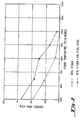
- Figure 1 is a graph depicting the surface area retained, after firing, of a P₂O₅-containing alumina material of the present invention.
- Figure 2 is a graph depicting the surface area retained, after firing, of a P₂O₅-containing titania material of the present invention.
- According to the present invention, a sintered monolithic structure is provided which comprises a high surface area of porous ceramic metal oxide, at least 50% by weight of which is alumina, titania, and/or zirconia, and about 0.5-35% by weight of P₂O₅ or equivalent phosphate-containing compound dispersed substantially throughout the porous metal oxide material. The structure is prepared by admixing the porous oxide material and a phosphate material capable of generating P₂O₅ at or below the firing temperature, forming the admixture into a desired shape, and firing the shape according to conventional techniques of the ceramic arts to form a structure having substantial strength and high surface area. It has been found that the presence of the phosphate material, in intimate mixture with the ceramic porous oxide material, permits the oxide to be fired to an effective level of strength while retaining an acceptable surface area and catalytically-effective pore size distribution.
- The porous oxide materials suitable for use are those which, after calcining, have a surface area of at least 20 square meters per gram, preferably at least 100 square meters per gram, and most preferably at least 200 square meters per gram. (As used herein, "calcining" means heating a material to a temperature sufficiently high to substantially eliminate volatiles but below the temperature at which the material begins to densify.) At least 50% by weight of the porous oxide material is alumina, titania, zirconia, or a mixture of these three. The balance, if any, of the porous oxide material can be any other ceramic material that has commonly been used as a catalyst support in the past and which has the above-described characteristics. Preferably, the porous oxide material is at least 75-80% by weight of alumina, titania, and/or zirconia (hereinafter, the "core metal oxides"). In particularly preferred embodiments, substantially all the porous oxide material is one or more of these core metal oxides.
- The aluminas useful as the porous metal oxide are those which, upon calcining or firing, provide gamma-alumina or other transition aluminas having the specified surface area. Colloidal gamma-alumina can be used directly or materials which generate a transition alumina upon calcining, such as alpha-alumina monohydrate or alumina trihydrate, can also be used. The colloidal gamma-alumina is generally in the form of particles of 1 micron size or less. When alpha-alumina monohydrate or alumina trihydrate is used, the particle size can be from less than 1 micron up to 100 microns, but preferably less than about 75-80 microns. Suitable commercially available materials of this kind are Kaiser SA substrate alumina, CATAPAL alumina available from Vista Chemical Company, and DISPURAL alumina monohydrate from Remet Chemical Corporation.
- The alumina component can also be introduced in the form of a precursor such as a hydrated alumina, a hydrolyzed aluminum alkoxide, or aluminum chlorohydrate. The hydrated aluminas are preferably in the form of an aqueous suspension and are commercially available, for example, from the Ethyl Corp. The most preferable aluminum alkoxide is hydrolyzed aluminum isopropoxide, which is commercially available as a dispersion in alcohol. For example, a dispersion of aluminum isopropoxide, 30-35% by weight in isobutanol, is available from the Alpha Products Division of Morton Thiokol Inc. Aluminum chlorohydrate is available in the form of an aqueous solution, for example, as CHLORHYDROL 50% or REHABOND CB-65S from Reheis Chemical Co. Aluminum chlorohydrate is also available in solid particulate form, for example as CHLORHYDROL Powder from Reheis Chemical Co.
- High surface area titanias suitable for use as the ceramic porous metal oxide of this invention are commercially available, for example, from the Degussa Corporation as P25 TiO₂. The titania can also be introduced in the form of a precursor such as a suspension of an amorphous hydrated titanium oxide, which can be in the form of a hydrolyzed titanium alkoxide, such as titanium isopropoxide (tetraisopropyl titanate), or a slurry of titanium hydrate. Slurries of titanium hydrate are commercially available, for example from SCM Corp. In all cases, the solid titania or solid portion of the titania precursor is generally in particulate form with a primary particle size less than about 100 microns, preferably less than about 75-80 microns, and more preferably less than 20 microns.
- The zirconia material useful in the practice of the invention can generally be in any form heretofore used in the ceramic arts. Generally, a pre-reacted zirconia in particulate form with a primary particle size in the same ranges as described immediately above is used. The zirconia can also be added in the form of a precursor. The preferred precursor is a suspension of an amorphous hydrated zirconium oxide, which can be in the form of a hydrolyzed zirconium alkoxide (such as zirconium n-propoxide) or a slurry of zirconium hydrate.
- Up to 50% by weight of the porous metal oxide material of the monolith can be composed of one or more ceramic metal oxides other than the above-described core metal oxides. This component of the monolith can be any of the well-known sinterable materials capable of providing mechanical strength and thermal properties in monolithic supports as heretofore prepared by those skilled in the art. Preferably this material is selected from cordierite, mullite, clay (preferably kaolin clay), talc, spinels, silicates such as lithium alumino-silicates, alpha alumina, aluminates, aluminum titanate, aluminum titanate solid solutions, stabilized zirconias, silica, glasses, and glass ceramics. Any mixture or combination of these materials can be used.
- Spinels useful in the present invention are the magnesium aluminate spinels heretofore used as catalyst supports, including spinel solid solutions in which magnesium is partially replaced by such other metals as manganese, cobalt, zirconium, or zinc. Preferred spinels are magnesium aluminate spinels having 1-7% by weight alumina in excess of 1:1 MgO.Al₂O₃ spinel; that is, those having about 72.0-73.5 weight percent Al₂O₃ (balance MgO). Spinels of this kind can be prepared by coprecipitation or wet-mixing of precursors of alumina and magnesia, followed by drying and calcining. Such a procedure is described in U.S. Patent No. 4,239,656, the disclosure of which is hereby incorporated by reference as filed. As a supplement to this disclosure, however, it has been found that calcining of the spinels should normally not exceed 1300°C for 2-2.5 hours. Calcining temperatures below 1200°C are preferred. Suitable alumina precursors for preparation of the spinels are hydrolyzed aluminum alkoxides or hydrated aluminas, both of which are commercially available. Magnesium oxide component powders found to be suitable are magnesium hydroxide slurry, about 40 weight percent MgO, available from Dow Chemical Company, or hydrated magnesium carbonate.
- High surface area silicas that can be used in the practice of the present invention are the amorphous silicas of about 1-10 microns or sub-micron particle size such as Cabosil® EH-5 colloidal silica, available from Cabot Corporation. Colloidal silica derived from gels, such as Grade 952 from the Davison Chemical Division of W. R. Grace & Co. can also be used.
- Cordierite, one of the preferred ceramic materials for use as the additional substrate material herein, can be in the precursor or "raw" form which becomes true cordierite upon heating, or can be used in pre-reacted form. When raw cordierite is used, it is preferred that up to 10% by weight, based on cordierite weight, of B₂O₃ be added to the batch to initiate cordierite formation at lower than usual temperatures and to impart additional strength.
- Unless otherwise specified above, these additional ceramic materials should be in particulate form, preferably of a size finer than 200 mesh (U.S. Standard) and more preferably finer than 325 mesh (U.S. Standard). With such characteristics, the ceramic material can be more easily sintered, during the subsequent formation of the monolith, at temperatures below those at which surface area of these materials, as well as the core metal oxides, might be adversely affected.
- The phosphate component of the invention is incorporated into the monolith by admixing into the starting batch a compound capable of generating P₂O₅ at or below the firing or sintering temperature to be used. The source of the phosphate is not critical. Phosphoric anhydride itself or phosphoric acid can be added, or a phosphate precursor, preferably one soluble in water, can be used. Preferred precursors of this kind are (NH₄)₂HPO₄ (dibasic ammonium phosphate) and Al(H₂PO₄)₃ (aluminum dihydrogen phosphate).
- Generally, the phosphate material is added to the batch in an amount that will provide about 0.5-35% by weight of P₂O₅, based on the combined weights of P₂O₅ and the core porous oxides. Preferably, the final weight of P₂O₅ in the monolith will be about 1-25 weight percent. When substantially all of the core porous oxide is alumina, a more preferred final weight percentage of P₂O₅ is about 1-10%, and most preferably 3-7%. When the core porous oxide is substantially all titania, a more preferred final weight percentage of P₂O₅ is about 1.5-15%, and most preferably about 3-10%. When substantially all of the core porous oxide is zirconia, a more preferred final weight percentage of P₂O₅ is about 1.5-15%.
- The monolithic structures of this invention are prepared by admixing into a substantially homogeneous batch (a) the porous metal oxide material, (b) the phosphate-generating material, and optionally (c) a temporary binder. Preferably, 1-30% by weight of temporary binder, based on the total batch weight, is used. Any binder material conventionally used in ceramic catalyst support manufacture is suitable. Preferred are binders that are decomposed and burned-off at temperatures of about 250-600°C. Examples are disclosed in: "Ceramic Processing Before Firing," ed/by George Y. Onoda, Jr. & L.L. Hench, John Wiley & Sons, New York; "Study of Several Groups of Organic Binders Under Low-Pressure Extrusion," C.C. Treischel & E.E. Emrich, Jour. Am. Cer. Soc. (29), pp. 129-132, 1946; "Organic (Temporary) Binders for Ceramic Systems," S. Levine, Ceramic Age, (75) No. 2, pp. 39+, January 1960; and "Temporary Organic Binders for Ceramic Systems" S. Levine, Ceramic Age, (75) No. 2, pp. 25+, February 1960. The most preferred binder is methyl cellulose, available as METHOCEL A4M from the Dow Chemical Co.
- Mixing of the batch ingredients is preferably performed in a step-wise procedure in which any dry ingredients are first blended together. This preliminary dry-blending operation can be performed in any conventional mixing equipment, but the use of a Littleford intensive mixer is preferred. The dry mixture is then plasticized by being further mixed, preferably in a mix muller, with a liquid medium (preferably water) which acts as a plasticizer. During this stage, all remaining constituents are added. Up to about 1% by weight, based upon total mixture weight, of a surfactant such as sodium stearate can also be added to facilitate mixing and flow for subsequent processing. Mixing of all constituents should be continued until a homogeneous or substantially homogeneous plasticized mass is obtained.
- To effect further mixing, the plasticized batch can be extruded through a "spaghetti" die one or more times. Ultimately, the batch is formed into the desired "green" shape for the monolithic structure, preferably by extrusion through a die or by injection molding. The material processing method of this invention is particularly well suited to the preparation of structures in the shape of thin-walled honeycombs and wagon-wheels. The preferred shape is that of a honeycomb having about 25-2400, more preferably 200-400, through-and-through cells per square inch of frontal surface area (equivalent to about 4-370, more preferably about 30-60, cells per square centimeter of surface area).
- Finally, the "green" structures are fired in order to harden the material. The firing step generally takes place at 500-1200°C, although the use of temperatures below about 1100°C are preferred. For most ceramic materials, the temperature selected and the duration of the firing period will result in actual sintering of the material. This is preferred but not necessary. The strength requirements of the intended end use of the structure will determine for the skilled artisan whether the additional densification and hardening provided by fully sintering the material will be necessary. The firing/sintering step can be conducted in an inert atmosphere or in one which promotes either reduction or oxidation, depending on the presence and identity of catalytically active metal compounds in the batch, as discussed more fully below. Optionally, the firing/sintering step can be preceded by drying the shapes at about 100-120°C, preferably by steam heat.
- In the fired article, the P₂O₅ is dispersed substantially throughout the porous metal oxide material. As those skilled in the art will recognize, however, the P₂O₅ may not necessarily exist as a free phase but may combine with the porous metal oxide materials to form phosphate compounds or complexes. For example, AlPO₄ and 5TiO₂·2P₂O₅ are the common result of firing a phosphate-generating material with alumina and titania, respectively. In one particularly preferred embodiment of this invention, the final monolith consists essentially of alumina and about 4-23% by weight AlPO₄. In another particularly preferred embodiment, the final structure consists essentially of titania and about 5-12% by weight 5TiO₂·2P₂O₅. The presence of P₂O₅ dispersed substantially throughout the ceramic metal oxide material aids its retention of high surface area despite elevated firing, sintering, or service temperatures. This benefit is illustrated in the Figures. With particular reference to Figure 1, there is shown a graph of temperatures versus surface area retained after a 6-hour heat soak for a batch material consisting of 100% alumina and a batch material consisting of 87% by weight alumina and 13% by weight AlPO₄. In Figure 2 there is shown a graph of temperature versus surface area retained after a 6-hour heat soak for a batch material of 100% titania and a batch material of 92% by weight titania and 8% by weight 5TiO₂·2P₂O₅. In both cases, the surface area retained after firing is shown to be greater for the phosphate-containing material than for the control.
- The monolithic supports of this invention may have some catalytic activity of their own by virtue of the chemistry and structure of the high surface area phosphate-containing porous oxide phases. Nevertheless, the support structures of this invention are also intended to carry additional catalytically active ingredients on the surfaces thereof. (As used herein, the term "surfaces" refers to those surfaces of the monolithic support, including surfaces forming the pore cavities, that are normally intended to be in contact with the work stream of material to be catalyzed.) This catalytically active material can be any of the metallic catalysts heretofore used for NOx reduction, for general chemical processing, or for automotive exhaust catalysis. Preferred catalytic materials are the transition metals (including the rare earth metals) and metals of Group IIB. The metals can be used in elemental form or in the form of their oxides. Preferred metals are zinc and such transition metals as tungsten, platinum, palladium, molybdenum, iron, manganese, vanadium, and copper. These additional catalytic ingredients can be deposited on the surfaces of the monolith by methods well known in the art, such as by preparing a solution or slurry of the materials for spraying, dip-coating, or impregnating the monolithic support.
- In a particularly preferred embodiment, however, the additional catalytic ingredient is admixed directly into the original batch and then co-extruded and sintered with the porous metal oxide material and phosphate material. Generally the catalytic material is incorporated into the batch in an amount of about 3-20 weight percent, preferably 5-10 weight percent, based on the total batch weight. In this embodiment, it is preferred that the admixed catalytic material be in particulate form with a primary particle size no greater than about 20 microns, preferably no greater than about 2.0 microns, and most preferably no greater than about 1.5 microns. In one embodiment of the invention, this reduced particle size is obtained by slurrying the oxide of the catalytic metal, or a precursor therefor, with distilled water, and then adjusting the pH and heating to dissolve the material. After all the material is dissolved, a portion of the ceramic oxide material to be used in the monolithic catalyst support is added to the solution. The resultant mixture is then neutralized, with a slight excess of the required acid or base, to precipitate very fine particles of the catalytic metal oxide so that they are substantially intimately admixed with particles of the porous ceramic oxide. The solids are separated by centrifugation and the resultant wet cake is then admixed with additional porous metal oxide material and phosphate material to prepare the monolith as earlier described. As a further alternative, the wet cake remaining after centrifugation can be calcined at a temperature of about 250-300°C. The calcined material is then milled to a size finer than 100 mesh, preferably finer than 200 mesh. In this form, the material contains very fine particles (generally less than about 2.0 micron) of catalytic material intimately admixed with finely divided particles of the porous metal oxide material. The monolith is then prepared by admixing this calcined and milled material, as earlier described, with additional porous metal oxide material and phosphate material.
- In another aspect of this invention, a composite monolith is provided in which a high surface area support phase, consisting essentially of the core metal oxides and 0.5-35% by weight of the phosphate material, is combined with a separate phase of ceramic material that, upon sintering, provides the actual structural integrity and strength to the monolith. In this embodiment, a pre-formed mixture of the core porous oxide material and phosphate material is coextruded with the sinterable ceramic structural material in a single step, so that the two phases are physically integrated in their green states, but the high surface area phase remains as a separate and discrete phase within the ceramic matrix after the monolith is fired. Composite monoliths of this kind, in which the high surface area support phase is a specific mixture of alumina and silica, are disclosed in U.S. Patent No. 4,631,269 issued December 23, 1986, to Lachman et al. The disclosures of this patent, which are hereby incorporated by reference, can be followed to prepare composite monoliths in which the high surface area support phase is the mixture of core porous metal oxide and phosphate material of the present invention.
- The following examples are illustrative, but not limiting, of the invention.
- Three batches of phosphate-containing alumina material (designated below as 1A, 1B, and 1C) and one control batch (100% alumina, no phosphate addition) were prepared, extruded, shaped into honeycomb monoliths, and sintered, and their properties tested. The phosphate-containing monoliths were prepared from batch ingredients as follows:
Composition (parts by weight) Ingredient Ex. 1A Ex. 1B Ex. 1C Al₂O₃·H₂O (CATAPAL-B, Vista Chem. Co.) 87.4 92.06 76.94 Al₂(OH)₅Cl (CHLORHYDROL 50%, aqueous solution, Reheis Chem. Co.) - - 8.16 Al(H₂PO₄)₃ solution (50% in water) 12.6 - 14.9 (NH4)2HPO4 (Baker Chem. Co.) 7.94 - METHOCEL (Dow Chem. Co.) 6.0 6.0 6.0 Distilled water 38.3 40.8 35.0 Table 1 EX. 1A EX. 1B EX. 1C Control Firing Schedule SA MOR SA MOR SA MOR SA (6 hours) (m²/g) (psi) (m²/g) (psi) (m²/g) (psi) (m²/g) 500°C 221.9 666 226.7 1930 217.1 992 190.0 750°C 200.9 560 203.6 2060 197.5 1143 139.4 1000°C 125.2 903 128.3 1540 133.1 649 84.4 1100°C 99.6 764 100.0 1860 94.7 716 6.1 1200°C 18.3 1840 15.6 5440 14.8 2203 - - Batches of alumina material with varying amounts of phosphate material addition (designated below as Examples 2A-2F) and a control (100% alumina) were prepared by admixing the materials shown in Table 2 below and extruding the batched materials to form honeycombs. In examples 2A-2F, the indicated alumina and phosphate materials were combined in a mix muller with 6.0 parts by weight of METHOCEL and a sufficient amount of distilled water to provide plasticization. The "control" material was prepared and extruded as described in Example 1. The extruded honeycombs were then fired for 6 hours at 1000°C and 1200°C. For each example, Table 2 provides the alumina and phosphate batch ingredients as well as the composition and BET surface area of the fired material.
Table 2 Batch Composition Fired Composition (parts by weight) (weight %) Example (NH₄)₂HPO₄ Al₂O₃·H₂O Al AlPO₄ 2A 2 98 97.5 2.5 2B 5 95 93.8 6.2 2C 8 92 89.9 10.1 2D 16 84 79.3 20.7 2E 24 76 68.3 31.7 2F 40 60 44.5 55.5 Control 0 100 100 0 Surface Area Surface Area (1000°C) (1200°C) Example (m²/g) (m²/g) 2A 116.1 22.4 2B 127.0 29.2 2C 136.0 29.2 2D 129.4 16.3 2E 77.1 7.9 2F 0.6 0.3 Control 86.8 6.1 - Batches of titania material with varying amounts of phosphate material addition (designated below as Examples 3A-I) and a control (100% titania) were prepared by admixing the materials shown in Table 3 below, according to the procedure described in Example 1. In Examples 3A-I, the indicated titania and phosphate materials were combined in a mix muller with 6.0 parts by weight of METHOCEL and a sufficient amount of distilled water to provide plasticization. The "control" material was prepared in similar fashion with the exception that no phosphate material was added to the batch. In all cases, the batched material was dried at 110°C and then fired for 6 hours at 800°C. For each example, Table 3 provides the titania and phosphate batch ingredients as well as the composition and BET surface area of the fired material.
Table 3 Batch Composition Fired Composition (parts by weight) (weight %) Surface Area Example (NH₄)₂HPO₄ TiO₂ P₂O₅ TiO₂ (m²/g) 3A 60 40 44.6 55.4 3.3 3B 40 60 26.4 73.6 12.4 3C 30 70 18.7 81.3 20.5 3D 20 80 11.8 88.2 25.9 3E 10 90 5.6 94.4 34.8 3F 8 92 4.5 95.5 35.3 3G 6 94 3.3 96.7 36.6 3H 4 96 2.1 97.9 36.3 3I 2 98 1.1 98.9 30.8 Control 0 100 100 0 3.0 - A suspension of 36 grams of zinc oxide in 1200 ml of distilled water was prepared. To this suspension was added 108 ml of concentrated hydrochloric acid. The resultant mixture was heated, with stirring, until all of the zinc oxide had dissolved. To this solution was then added 490.2 grams of titanium dioxide (Degussa Corp. P25) and the mixture was then neutralized with 108 ml of concentrated ammonium hydroxide, which caused a precipitation of the zinc oxide. The precipitated solution was centrifuged three times at 7000 rpm for 15 minutes, and the recovered solids material was transferred to an evaporating dish and heated at 110°C until dry. The dried material was calcined for 3 hours at 300°C and the calcined material then ball milled to a particle size finer than 100 mesh. The calcined and milled material was dry-mixed with 36 grams of METHOCEL binder and placed in a mix muller, into which was further charged a previously prepared solution of 37 grams of ammonium biphosphate dissolved in 75 ml of distilled water. Tetraisopropyl titanate, 199.8 grams, was then added to the muller, and the resulting batch was mixed in the presence of sufficient additional distilled water to plasticize the mixture. The plasticized material was extruded through a "spaghetti" die and then through a final die to form a honeycomb shape having 300 square cells per square centimeter of frontal surface area. The extruded honeycombs were dried at 60°C for 48-72 hours and then at 110°C for 24 hours, after which they were fired at 500°C for 6 hours.
- A suspension of 30 grams of ferric oxide (Fe₂O₃) in 1200 ml of distilled water was prepared. To this suspension was added 600 ml of concentrated hydrochloric acid. The resultant mixture was heated, with stirring, until all of the ferric oxide had dissolved. To this solution was then added 514.8 grams of titanium dioxide (Degussa Corp. P25) and the mixture was then neutralized with 600 ml of 50% sodium hydroxide (aqueous), which caused a precipita tion of the ferric oxide. The precipitated solution was centrifuged at 7000 rpm for 15 minutes. Centrifuging was repeated three times and the recovered solids material was transferred to an evaporating dish and heated at 110°C until dry. The dried material was calcined for 3 hours at 300°C and the calcined material then ball milled to a particle size finer than 100 mesh. The calcined and milled material was dry-mixed with 36 grams of METHOCEL binder and placed into a mix muller, into which was further charged a previously prepared solution of 37 grams ammonium biphosphate in 75 ml of distilled water. Tetraisopropyl titanate, 200 grams, was added to the muller and the resulting batch was mixed in the presence of sufficient additional distilled water to plasticize the mixture. The plasticized material was extruded through a "spaghetti" die and then through a final die to form a honeycomb shape having about 30 square cells per square centimeter of frontal surface area. The extruded honeycombs were dried at 60°C for 48-72 hours and then at 110°C for 24 hours, after which they were fired at 500°C for 6 hours.
- A suspension of 36 grams of manganese dioxide in 1200 ml of distilled water was prepared. To this suspension was added 828 ml of concentrated hydrochloric acid. The resultant mixture was heated with stirring until all of the manganese dioxide had dissolved. To this solution was then added 490.2 grams of titanium dioxide (Degussa Corp. P25) and the mixture then neutralized with 792 ml of concentrated ammonium hydroxide, which caused a precipitation of the manganese dioxide. The precipitated solution was centrifuged at 7000 rpm for 15 minutes. Centrifuging was repeated three times and the recovered solids material was transferred to an evaporating dish and heated at 110°C until dry. The dried material was calcined for 3 hours at 300°C and the calcined material then ball milled to a particle size finer than 100 mesh. The calcined and milled material was dry-mixed with 36 grams of METHOCEL binder and placed into a mix muller, into which was further charged a previously prepared solution of 37 grams ammonium biphosphate in 75 ml of distilled water. Tetraisopropyl titanate, 200 grams, was added to the muller and the resulting batch was mixed in the presence of sufficient additional distilled water to plasticize the mixture. The plasticized material was extruded through a "spaghetti" die and then through a final die to form a honeycomb shape having 200 square cells per square inch of frontal surface area. The extruded honeycombs were dried at 60°C for 48-72 hours and then at 110°C for 24 hours, after which they were fired at 500°C for 6 hours.
Claims (14)
(i) a porous metal oxide material, at least 50% by weight of which is alumina, titania, zirconia, a precursor therefor, or mixtures of these; and
(ii) P₂0₅ or a precursor therefor in an amount sufficient to provide, after firing, about 0.5-35% by weight of P₂0₅ based on the total weight of P₂0₅ plus alumina, titania, and/or zirconia;
Applications Claiming Priority (2)
| Application Number | Priority Date | Filing Date | Title |
|---|---|---|---|
| US07/295,774 US5039644A (en) | 1989-01-10 | 1989-01-10 | Phosphate-containing ceramic structures for catalyst support and fluid filtering |
| US295774 | 1989-01-10 |
Publications (2)
| Publication Number | Publication Date |
|---|---|
| EP0377960A2 true EP0377960A2 (en) | 1990-07-18 |
| EP0377960A3 EP0377960A3 (en) | 1991-03-06 |
Family
ID=23139186
Family Applications (1)
| Application Number | Title | Priority Date | Filing Date |
|---|---|---|---|
| EP19890312464 Withdrawn EP0377960A3 (en) | 1989-01-10 | 1989-11-30 | Phosphate-containing ceramic structures for catalyst support and fluid filtering |
Country Status (4)
| Country | Link |
|---|---|
| US (1) | US5039644A (en) |
| EP (1) | EP0377960A3 (en) |
| JP (1) | JPH02229773A (en) |
| CA (1) | CA2003944A1 (en) |
Cited By (3)
| Publication number | Priority date | Publication date | Assignee | Title |
|---|---|---|---|---|
| EP0469729A1 (en) * | 1990-07-30 | 1992-02-05 | Tioxide Group Services Limited | Ceramic green bodies |
| WO1995011079A1 (en) * | 1993-10-22 | 1995-04-27 | Union Oil Company Of California | Phosphorus-containing hydroprocessing catalyst and method of preparation |
| AU2008271375B2 (en) * | 2007-07-04 | 2012-12-13 | Yara International Asa | Method for producing catalysts and catalysts thereof |
Families Citing this family (29)
| Publication number | Priority date | Publication date | Assignee | Title |
|---|---|---|---|---|
| DE4201490A1 (en) * | 1992-01-21 | 1993-07-22 | Otto Feuerfest Gmbh | FIRE-RESISTANT MATERIAL FOR ELECTROLYSIS OVENS, METHOD FOR THE PRODUCTION AND USE OF THE FIRE-RESISTANT MATERIAL |
| US5303547A (en) * | 1992-04-15 | 1994-04-19 | Amoco Corporation | Emissions control system and method |
| US5260241A (en) * | 1992-08-12 | 1993-11-09 | Corning Incorporated | Controlled pore size phosphate-alumina material and method for producing same |
| CA2112190C (en) * | 1992-12-24 | 2000-02-22 | Hiroshi Miura | Process for removing nitrogen oxides from oxygen rich exhaust gas |
| EP0605991A1 (en) * | 1993-01-07 | 1994-07-13 | Ford Motor Company Limited | Base metal only catalyst system for internal combustion engines |
| DE69321093T2 (en) * | 1993-01-08 | 1999-02-25 | Ford-Werke Ag, 50735 Koeln | Two-stage catalytic converter system for an internal combustion engine |
| US5373976A (en) * | 1993-04-16 | 1994-12-20 | Vesuvius Crucible Company | Refractory zirconia mortar |
| US5919724A (en) * | 1998-03-05 | 1999-07-06 | Aluminum Company Of America | Process for making phosphate stabilized metal oxide particles |
| ID28988A (en) * | 1998-12-28 | 2001-07-19 | Corning Inc | ALUMINA CERAMICS ARE VERY HIGH SURFACE AND HIGH STRENGTH |
| PL193717B1 (en) * | 1999-06-11 | 2007-03-30 | Corning Inc | Low expansion, high porosity, high strength cordierite body and method |
| US6764672B2 (en) | 2001-04-03 | 2004-07-20 | Alcoa Inc. | Thermally stable alumina particulates |
| US6813884B2 (en) | 2002-01-29 | 2004-11-09 | Ford Global Technologies, Llc | Method of treating diesel exhaust gases |
| GB0226997D0 (en) * | 2002-11-19 | 2002-12-24 | Welding Inst | Heat resistant product |
| US7235507B2 (en) * | 2004-08-14 | 2007-06-26 | Sud-Chemie Inc. | Catalyst for purifying diesel engine exhaust emissions |
| US20070037697A1 (en) * | 2005-08-11 | 2007-02-15 | Dimascio Felice | High surface area ceramic catalysts and the manufacture thereof |
| US7713897B2 (en) * | 2007-02-27 | 2010-05-11 | Corning Incorporated | Ceramic materials for 4-way and NOx adsorber and method for making same |
| EP2176188B1 (en) * | 2007-07-31 | 2020-09-02 | Corning Incorporated | Methods for manufacturing porous ceramic filters and compositions for applying to ceramic honeycomb bodies |
| US7935248B2 (en) * | 2007-10-30 | 2011-05-03 | The University Of New Brunswick | Adsorbents for denitrogenation desulfurization of hydrocarbon oils and methods of producing |
| CN101903306A (en) * | 2007-12-17 | 2010-12-01 | 伊梅斯公司 | ceramic honeycomb structure |
| KR100979580B1 (en) | 2008-02-05 | 2010-09-01 | 에스케이에너지 주식회사 | Hydrocarbon Catalytic Cracking Catalyst for Light Olefin Production and Manufacturing Method Thereof |
| CA2719289C (en) * | 2008-03-25 | 2015-06-23 | Babcock-Hitachi Kabushiki Kaisha | Exhaust gas purification catalyst suppressing influence of iron compound |
| EP2168935A1 (en) * | 2008-09-29 | 2010-03-31 | Siemens Aktiengesellschaft | Material compound for producing a fire-retardant material and its application and fire-retardant moulding body and method for its manufacture |
| US20110160048A1 (en) * | 2009-12-29 | 2011-06-30 | Boumendjel Nariman | Coating method for structured catalysts |
| US9272956B2 (en) * | 2011-05-27 | 2016-03-01 | Corning Incorporated | Method for controlling aluminum titanate ceramic filter properties |
| US9573119B2 (en) | 2011-09-16 | 2017-02-21 | Eastman Chemical Company | Process for preparing V—Ti—P catalysts for synthesis of 2,3-unsaturated carboxylic acids |
| US8883672B2 (en) | 2011-09-16 | 2014-11-11 | Eastman Chemical Company | Process for preparing modified V-Ti-P catalysts for synthesis of 2,3-unsaturated carboxylic acids |
| US8765629B2 (en) | 2011-09-16 | 2014-07-01 | Eastman Chemical Company | Process for preparing V-Ti-P catalysts for synthesis of 2,3-unsaturated carboxylic acids |
| US8993801B2 (en) | 2011-09-16 | 2015-03-31 | Eastman Chemical Company | Process for preparing V-Ti-P catalysts for synthesis of 2,3-unsaturated carboxylic acids |
| CN111659187B (en) * | 2020-06-01 | 2022-03-01 | 南昌航空大学 | Preparation method of piezoelectric foamed ceramic filter for sewage treatment |
Family Cites Families (13)
| Publication number | Priority date | Publication date | Assignee | Title |
|---|---|---|---|---|
| DE2263554A1 (en) * | 1972-01-18 | 1974-07-04 | Feldmuehle Anlagen Prod | CATALYST CARRIER MADE OF SINTERED INORGANIC MATERIAL WITH OUTER SHEATH |
| FR2254531A1 (en) * | 1973-12-14 | 1975-07-11 | Lafarge Ciments Sa | Refractory catalyst carrier - comprising alumina, aluminium hydrate and calcium aluminate |
| US3969273A (en) * | 1975-04-24 | 1976-07-13 | W. R. Grace & Co. | Process for preparing phosphated alumina extrudates |
| US4066572A (en) * | 1976-10-12 | 1978-01-03 | Nalco Chemical Company | Phospha-alumina gel and method of preparation |
| US4132669A (en) * | 1977-10-06 | 1979-01-02 | Nalco Chemical Company | Process for preparing phosphorous-alumina catalysts using polycarboxylic acids as extrusion aids |
| JPS5689844A (en) * | 1979-12-25 | 1981-07-21 | Asahi Glass Co Ltd | Ceramic honeycomb and its production |
| DE3132014A1 (en) * | 1981-08-13 | 1983-03-03 | Basf Ag, 6700 Ludwigshafen | DEHYDRATION CATALYST, METHOD FOR PRODUCING THE SAME AND USE FOR DEHYDRATING ETHYLBENZENE TO STYRENE |
| EP0115138B1 (en) * | 1983-01-03 | 1988-11-02 | Texaco Development Corporation | Regenerative process for the preparation of linear polyethylenepolyamines using a supported catalyst |
| US4629716A (en) * | 1985-04-15 | 1986-12-16 | Shell Oil Company | Process for producing narrow-pore catalyst supports |
| DE3521766A1 (en) * | 1985-06-19 | 1987-01-02 | Basf Ag | HONEYCOMB CATALYST, ITS PRODUCTION AND USE |
| US4883781A (en) * | 1986-09-13 | 1989-11-28 | Ngk Insulators, Ltd. | Heat resisting low expansion zirconyl phosphate-zircon composite |
| JPH0669534B2 (en) * | 1987-02-12 | 1994-09-07 | 日本碍子株式会社 | Cordierite honeycomb structure |
| US4767733A (en) * | 1987-05-18 | 1988-08-30 | Mobil Oil Corporation | Amorphous refractory composition |
-
1989
- 1989-01-10 US US07/295,774 patent/US5039644A/en not_active Expired - Lifetime
- 1989-11-27 CA CA002003944A patent/CA2003944A1/en not_active Abandoned
- 1989-11-30 EP EP19890312464 patent/EP0377960A3/en not_active Withdrawn
-
1990
- 1990-01-09 JP JP2002421A patent/JPH02229773A/en active Pending
Cited By (7)
| Publication number | Priority date | Publication date | Assignee | Title |
|---|---|---|---|---|
| EP0469729A1 (en) * | 1990-07-30 | 1992-02-05 | Tioxide Group Services Limited | Ceramic green bodies |
| US5266536A (en) * | 1990-07-30 | 1993-11-30 | Tioxide Group Services Limited | Ceramic green bodies |
| WO1995011079A1 (en) * | 1993-10-22 | 1995-04-27 | Union Oil Company Of California | Phosphorus-containing hydroprocessing catalyst and method of preparation |
| US5514274A (en) * | 1993-10-22 | 1996-05-07 | Uop | Process for the use of a phosphorus-containing hydroprocessing catalyst |
| AU2008271375B2 (en) * | 2007-07-04 | 2012-12-13 | Yara International Asa | Method for producing catalysts and catalysts thereof |
| EP2164611B1 (en) * | 2007-07-04 | 2018-05-02 | YARA International ASA | Method for producing catalysts and catalysts thereof |
| EP3335781A1 (en) * | 2007-07-04 | 2018-06-20 | YARA International ASA | Method to produce catalysts and catalysts thereof |
Also Published As
| Publication number | Publication date |
|---|---|
| EP0377960A3 (en) | 1991-03-06 |
| CA2003944A1 (en) | 1990-07-10 |
| US5039644A (en) | 1991-08-13 |
| JPH02229773A (en) | 1990-09-12 |
Similar Documents
| Publication | Publication Date | Title |
|---|---|---|
| US5039644A (en) | Phosphate-containing ceramic structures for catalyst support and fluid filtering | |
| US5124302A (en) | Phosphate-containing structures with catalytic material distributed throughout | |
| EP0196768B1 (en) | Preparation of monolithic catalyst supports having an integrated high surface area phase | |
| EP0197645B2 (en) | High-strength high surface area catalyst supports and a method of producing the same | |
| EP0197644B1 (en) | Preparation of monolithic support structures containing high surface area agglomerates | |
| EP0199443B1 (en) | Preparation of monolithic catalyst support structures having an integrated high surface area phase | |
| EP2117680B1 (en) | Ceramic materials for 4-way and nox adsorber and method for making same | |
| EP0586820A1 (en) | Phosphate-alumina composition of controlled pore size for use in catalysts | |
| JPH01148771A (en) | Method for crystallizing zeolite onto surface of monolithic ceramic support | |
| JP2009233587A (en) | Diesel particulate filter with catalyst and its manufacturing method | |
| JP2002504476A (en) | Low CTE cordierite body having narrow pore size distribution and method for producing the same | |
| JP2546734B2 (en) | Method for producing alumina for catalyst | |
| JPH0640955B2 (en) | An improved monolithic catalyst support incorporating a mixture of alumina and silica as a high surface area catalyst support material. | |
| AU598734B2 (en) | Improved monolithic catalyst supports incorporating a mixture of alumina and silica as a high surface area catalyst support material | |
| JPH1085611A (en) | Method for producing honeycomb structured carrier comprising boria-silica-alumina composition | |
| KR930005310B1 (en) | Improved Monolithic Catalyst Support Material | |
| JPH0568881A (en) | Method for producing honeycomb structure catalyst carrier mainly composed of boria-alumina composition |
Legal Events
| Date | Code | Title | Description |
|---|---|---|---|
| PUAI | Public reference made under article 153(3) epc to a published international application that has entered the european phase |
Free format text: ORIGINAL CODE: 0009012 |
|
| AK | Designated contracting states |
Kind code of ref document: A2 Designated state(s): BE DE GB NL SE |
|
| RIN1 | Information on inventor provided before grant (corrected) |
Inventor name: WILLIAMS, JIMMIE LEWIS Inventor name: LACHMAN, IRWIN MORRIS Inventor name: ZAUN, KENNETH ELMER |
|
| PUAL | Search report despatched |
Free format text: ORIGINAL CODE: 0009013 |
|
| AK | Designated contracting states |
Kind code of ref document: A3 Designated state(s): BE DE GB NL SE |
|
| 17P | Request for examination filed |
Effective date: 19910813 |
|
| 17Q | First examination report despatched |
Effective date: 19920917 |
|
| STAA | Information on the status of an ep patent application or granted ep patent |
Free format text: STATUS: THE APPLICATION HAS BEEN WITHDRAWN |
|
| 18W | Application withdrawn |
Withdrawal date: 19940411 |