EP0377673B1 - Golf club - Google Patents
Golf club Download PDFInfo
- Publication number
- EP0377673B1 EP0377673B1 EP88909561A EP88909561A EP0377673B1 EP 0377673 B1 EP0377673 B1 EP 0377673B1 EP 88909561 A EP88909561 A EP 88909561A EP 88909561 A EP88909561 A EP 88909561A EP 0377673 B1 EP0377673 B1 EP 0377673B1
- Authority
- EP
- European Patent Office
- Prior art keywords
- club
- weight
- shaft
- swing
- golf club
- Prior art date
- Legal status (The legal status is an assumption and is not a legal conclusion. Google has not performed a legal analysis and makes no representation as to the accuracy of the status listed.)
- Expired - Lifetime
Links
- 230000005484 gravity Effects 0.000 claims abstract description 10
- 210000000707 wrist Anatomy 0.000 claims description 17
- 210000004247 hand Anatomy 0.000 claims description 6
- 238000000034 method Methods 0.000 claims description 5
- 238000013461 design Methods 0.000 description 13
- XEEYBQQBJWHFJM-UHFFFAOYSA-N Iron Chemical compound [Fe] XEEYBQQBJWHFJM-UHFFFAOYSA-N 0.000 description 8
- 210000003205 muscle Anatomy 0.000 description 8
- 230000001133 acceleration Effects 0.000 description 6
- 230000000694 effects Effects 0.000 description 6
- 235000000396 iron Nutrition 0.000 description 5
- 230000008901 benefit Effects 0.000 description 4
- 230000008859 change Effects 0.000 description 4
- 229910052742 iron Inorganic materials 0.000 description 4
- 239000000463 material Substances 0.000 description 4
- 229910000831 Steel Inorganic materials 0.000 description 3
- 238000005452 bending Methods 0.000 description 3
- 230000003387 muscular Effects 0.000 description 3
- 239000010959 steel Substances 0.000 description 3
- 238000012360 testing method Methods 0.000 description 3
- 239000002131 composite material Substances 0.000 description 2
- 230000007423 decrease Effects 0.000 description 2
- 230000003247 decreasing effect Effects 0.000 description 2
- 239000002184 metal Substances 0.000 description 2
- 229910052751 metal Inorganic materials 0.000 description 2
- 230000008569 process Effects 0.000 description 2
- 239000002990 reinforced plastic Substances 0.000 description 2
- 238000011160 research Methods 0.000 description 2
- 238000012163 sequencing technique Methods 0.000 description 2
- 239000002023 wood Substances 0.000 description 2
- 241000167857 Bourreria Species 0.000 description 1
- 238000004458 analytical method Methods 0.000 description 1
- 239000007799 cork Substances 0.000 description 1
- 238000011161 development Methods 0.000 description 1
- 238000004519 manufacturing process Methods 0.000 description 1
- 230000000630 rising effect Effects 0.000 description 1
- 239000007787 solid Substances 0.000 description 1
- 239000013585 weight reducing agent Substances 0.000 description 1
Images


Classifications
-
- A—HUMAN NECESSITIES
- A63—SPORTS; GAMES; AMUSEMENTS
- A63B—APPARATUS FOR PHYSICAL TRAINING, GYMNASTICS, SWIMMING, CLIMBING, OR FENCING; BALL GAMES; TRAINING EQUIPMENT
- A63B60/00—Details or accessories of golf clubs, bats, rackets or the like
- A63B60/06—Handles
- A63B60/22—Adjustable handles
- A63B60/24—Weighted handles
Definitions
- the present invention relates to sporting equipment and more particularly to improvements in or relating to the design of golf clubs, hereinafter referred to as clubs.
- US Patent No. 4,674,746 and EP 0,227,347 describe golf clubs in which weight is added in the gripping area.
- US 4,674,746 also describes a golf club in which the head weight is lightened.
- the torque T c applied to the club basically involves the first (S) and second (I) moments of the club about the golfers wrists. If these can be decreased then the torque reduces. In consequence the amateur golfer would find it much easier to control the natural uncocking of the wrists and delay this process until the correct period of the swing. In addition the professional golfer will find the club easier to manipulate for different types of shot. These moments involve the mass of the clubhead, the mass of the shaft and the length of the shaft. It is noted that the last quantity decreases for the short irons but the head weight is increased to keep the swing weight (which is in effect the first moment) constant. Assuming therefore that the shaft weight remains the same, the mass of the head would need to be reduced to reduce T c .
- Figure 1 for instance shows the percentage decrease in the ratio T c /T s for a 6 iron and a driver, for different added weights and different positions of these weights. It is concluded from this that the positon of the weight is much less important than the magnitude of the weight. Larger changes to the ratio come with larger added mass. A comparison is also shown for a lightened head. A balance has to be struck between achieving a significant change to the ratio between the torques required in each phase and the difficulty of swinging a heavy club. In essence it would be preferable therefore to keep the inertia over the first phase of the swing high whilst having a low inertia in the second phase. This can be done by combining the two changes described in Figure 1, using a light head mass and a separate added mass in or near the gripping area.
- Figure 2 plots the calculated results of doing this for a range of values of head mass and added weight.
- the lower vertical lines show the range of inertia ratios. (I + MR 2 )/I for current clubs. Within each range are ladies clubs, heavy headed gents clubs, using composite and steel shafts in a range of lengths. By decreasing head weights from the current range by between 13% and 30% and adding suitable weights in various locations around the gripping area, the inertia ratios are greatly increased.
- the vertical lines show the range achieved again using ladies clubheads, gents clubheads and composite or steel shafts of various lengths.
- the inertia for the first phase should be within ⁇ 5% of the value for the standard club and the inertia for the second phase should be reduced by at least 20%. In fact values up to30% are contained in the range.
- the weight added to the shaft of the club in the region of the gripping area is preferably greater than 50 gms and may be between 80 and 160 gms.
- the centre of gravity of the additional weight is within a distance of 300 mm from the butt end of the shaft.
- the head of the club is preferably lightened in accordance with the additional weight but by a lesser amount. In the above examples 30 gms and between 40 to 50 gms is preferably removed from the head respectively.
- Tests on clubs designed with this principle show that 75 to 150 gms added in the gripping area is able to produce good conditions for all of the golfers tested.
- tests on a professional swing show that the clubhead is easier to control. The golfer can rotate the head and bring it to square on impact much more easily than with the standard head.
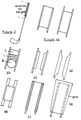
- Figure 3 Typical designs are shown in Figures 3 and 4.
- the additional weight W of at least 50 gms, is placed in or around the gripping area of the club with its centre of gravity within 300 mm of the butt end of the shaft.
- This may be distributed as a solid (Figure 4a, 4e) or hollow section ( Figures 4c, 4d) typically over 10 cms, or as a concentrated load ( Figure 4b) such as a spherical ball B placed firmly into the tube up to 300 mm from the butt end supporting lead shot L held in place by a cork C or sleeved inside and/or outside the shaft (Figure 4f) or contained within the make up of a heavy grip (Figure 4g).
- the ball fixing has the advantage that contact is made with the tapered shaft over a small area thus creating the least change to the handling characteristics of the shaft.
- the shaft may be slightly stiffened over the area of contact producing less deflection and a different flex point in the shaft. Calculations show that the stiffening effect is very small on most shafts but the same calculations can be used to redesign the shaft to have the original desirable characteristics.
- the shaft is shown made of stepped steel in the conventional way with a thicker section.
- the weight in any of the forms mentioned above, can be cast in during the manufacture of the shaft.
- the clubhead must be lighter than standard. For the wooden headed club removal of the central section of the head around the centre of gravity and the lead weight normally placed there would produce a weight reduction of 15 to 25 gms. It is essential to remove more than this, but since this is impracticable for strength reasons, a redesign of the clubhead will be required. More ideal is the metal headed wood which is cast. This clubhead can either be made from lighter material of sufficient strength or by removing metal from least sensitive stress areas. The irons can be treated similarly, using lighter materials or conventional materials of different design, perhaps with hollow sections.
Landscapes
- Health & Medical Sciences (AREA)
- General Health & Medical Sciences (AREA)
- Physical Education & Sports Medicine (AREA)
- Golf Clubs (AREA)
- Footwear And Its Accessory, Manufacturing Method And Apparatuses (AREA)
- Graft Or Block Polymers (AREA)
- Telephone Function (AREA)
- Massaging Devices (AREA)
Abstract
Description
- The present invention relates to sporting equipment and more particularly to improvements in or relating to the design of golf clubs, hereinafter referred to as clubs.
- With known designs of clubs the weight, for any given weight of club, tends to be concentrated at the head of the club and whilst for the professional player this weight is controllable during striking of the ball for the amateur player the ball is often wrongly struck.
- US Patent No. 4,674,746 and EP 0,227,347 describe golf clubs in which weight is added in the gripping area. US 4,674,746 also describes a golf club in which the head weight is lightened.
- It is an object of the present invention to provide a club with a weight distribution which enables the amateur player to strike the ball with greater accuracy by controlling the inertia in both the first and second phases of movement of the golf club during the swing.
- According to the present invention there is provided a golf club characterised as in
claim 1, - According to the present invention there is also provided a method of matching a golf club to a player as claimed in
claim 8. - Embodiments of the present invention will now be described, with reference to the accompany drawings, in which :-
- Figure 1 shows a set of tables illustrating the variation of the ratio of torque applied by the player to the torque actually applied to the club;
- Figure 2 shows the ratios of the inertia values of the club for the first and second phases of the swing;
- Figure 3 illustrates the range of positions of the added weight on the golf club; and
- Figures 4a to 4g illustrate various designs of weight for the golf club of Figure 3.
- The designs of golf clubs have changed significantly over recent years and many technological advances have been made. New materials have been used in place of the conventional iron and wood heads, new shapes of head with better aerodynamics and different weight distribution have been tried, and shafts of reinforced plastic are becoming common, particularly in the United States and Japan. However the fundamental make up of the club remains the same. Of the overall weight of 350 to 500 gms, typically 60% is in the head, 30% in the shaft and 10% in the grip.
- The dynamics of the swing of any piece of sporting equipment are complex. The equations of motion are however relatively straightforward and lead to general qualitative solutions. To specify the quantitative solutions for particular cases requires a knowledge of the forces that come into play, applied by the human frame, arms and wrists and these are not well defined. To proceed to a solution previous researchers have therefore used observations of professional swings. The constants in the equations can then be determined from these observations and the calculated patterns of the swing compare well with the actual swing.
- Two particular pieces of existing research are relevant to this invention.
- 1. Williams, D. The Dynamics of the Golf Swing. Quarterly Journ. Mech & Applied Math Vol XX
Pt 2 1967. - 2. Jorgensen T. On the dynamics of the swing of a golf club. American Journal of Physics. Vol 38 No 5 May 1970.
- Although their treatment of the equations is different they both show that there is an 'optimum' way to swing the club to achieve the maximum clubhead velocity at the impact of club and ball, for a given energy input. This maximisation of velocity is very important in that not only does it cause the ball to travel longer distances with the driver and long irons but it causes the generation of much backspin on the ball for short irons, which is essential for good shots to the green. Any deviation from the optimum swing not only reduces the velocity at impact but also significantly changes the line of the swing. The clubhead/ball impact is not square and the ball often slices away on a curve to the right (for a right-handed player). Golfers often refer to this phenomenon as hitting from the top. The significance of this phrase is the essence of this invention.
- First consider the implications of the work of Williams and Jorgensen. The optimum swing can be described, beginning from the completion of the backswing, as follows:
- The body and arms of the golfer accelerate the club from rest at about 20m/s2. The wrists remain cocked in the position attained at the top of the swing. This phase continues with the wrists still locked in position for approximately 60 to 65 degrees of rotation of the body with the acceleration rising to 300 m/s2. At this stage, and no earlier, the wrists begin to uncock. The hands continue in an arc at roughly constant velocity and the club rotates with increasing angular velocity about them. The velocity of the clubhead therefore has two components, that due to the speed of the hands and that due to the rotation of the club about them. If the swing has been timed correctly the hands will reach the bottom of the swing at the exact moment that the clubhead reaches the bottom. This is the condition that Williams and Jorgensen refer to as optimum.
- The attainment of such a swing is governed by the muscular effort of the swinger and the weight of the components he is swinging. Many muscles are used in the effort and to achieve the optimum they must be combined in a particular way. It is particularly important for the first phase of the swing (where the wrists remain cocked) to encompass the full angle mentioned above. Only then will the uncocking process of the wrists bring the clubhead square on impact and at high speed. Now all tests and research has so far been conducted mainly on professional golfers or golfers with excellent swings. These individuals have generally been brought up to play the game from an early age, or have had the benefit of a natural talent for the game or a good teacher and much practise of the correct manner of swinging. Thus the muscles, and specifically the balance between the muscles, is developed to suit the requirements of a good swing. (An obvious example of this, in another sport, is the gross development of the arm of a professional tennis player). True there are individuals who have what appear to be poor swings even in the ranks of the professional but eventually they acquire the ability to bring the clubhead square at impact. The time and effort to do this is beyond the means of the general amateur player. Most amateurs, particularly men, come to the game when their balance of muscles is very inappropriate to a good golf swing. They have strong back and leg muscles, and moderate upper arm muscles. They are able to lock the wrists in the direction of the line of the arms as would be required for lifting heavy weights, but they lack the ability and strength to control the rotation of the wrists about the arms under a large load. In the swing this load comes from the very large centrifugal accelerations generated at the clubhead during the first phase of the swing. Consider now the swing of an amateur golfer:
- The body and arms accelerate the club from rest at the top of the backswing. Being strong in the back and leg this acceleration can be as high and sometimes higher than a professional golfer achieves. However the weakness of the wrists does not allow him to complete the first phase of the swing with the wrists firmly cocked. The clubhead, under high centrifugal accelerations, begins to rotate about the arms. Because of this the clubhead moves out of the desired plane of the swing and continues to do so for the rest of the swing. Impact is often made with the clubhead moving from the outside to inside of the correct plane. Clockwise spin (looking down on top of the ball) is created on the ball which results in a curved motion of the ball in flight commonly known as a slice. In addition the maximum clubhead velocity is not achieved at impact. The combination of these failings results in a poor shot.
- One solution to the problem is to reduce the speed of the club and the arms in the first phase. If this can be made to match the resistance of the wrists at the correct angle of completion of this phase then the subsequent impact will be square. The maximum velocity of the clubhead will now occur at impact but the magnitude of this velocity will be less than the professional, with stronger wrists, can achieve. In effect the result is that the ball will travel straight and true but will carry less distance than the professional's shot produces. This is infinitely preferable to a short slice, the most common shot in golf. Armed with the correct sequencing of the shot the golfer may now, if he wishes, develop the muscles of the lower arm (and only these muscles) to enable him to produce a quicker version of his basically sound new swing thereby achieving longer distances of shot. This definition of the swing also shows why golfers find it easier to swing the 'short' irons since with these clubs the swing angle is much less and the accelerations much smaller. This ideally sequenced swing is often referred to as the grooved swing.
- The imbalance of muscular effort is also seen in the young player, particularly if they are also playing another sport more common to school activities than golf. The principles outlined here are equally applicable to this category of player.
- The golf professional, and many other knowledgeable teachers, are often heard to remark on the speed of the swing of the amateur. A slower swing is said to produce better 'timing' of the shot. The explanation given above shows why this is the case.
- For most amateurs this change to a slower swing is nearly impossible to achieve and another solution to the problem must be sought.
- From a technical appreciation of the swing, a study of an analysis of the mathematics of it and a deep knowledge of the game from the points of view of the amateur and the professional, we have invented a club which aids the amateur to generate the correctly sequenced swing. It is of benefit to all amateurs who, no matter what their standard, will hit bad shots and to professionals in that it is more controllable.
- The technical explanation of the design is as follows. Jorgensen shows that the equations of motion of the swing result in:

- Ts
- = torque applied to the system by the golfer
- Tc
- = torque applied to the club
- J
- = moment of inertia of the arms taken about an axis through the spine
- G
- = first moment about the same
- I
- = moment of inertia of the club about the golfers wrists
- S
- = first moment about the same axis
- R
- = effective length of the golfers arms
- ψ
- = angle between the club and the horizontal
- θ
- = angle of rotation of the system from the horizontal
- The torque Tc, applied to the club basically involves the first (S) and second (I) moments of the club about the golfers wrists. If these can be decreased then the torque reduces. In consequence the amateur golfer would find it much easier to control the natural uncocking of the wrists and delay this process until the correct period of the swing. In addition the professional golfer will find the club easier to manipulate for different types of shot. These moments involve the mass of the clubhead, the mass of the shaft and the length of the shaft. It is noted that the last quantity decreases for the short irons but the head weight is increased to keep the swing weight (which is in effect the first moment) constant. Assuming therefore that the shaft weight remains the same, the mass of the head would need to be reduced to reduce Tc. This can be easily done by redesigning the head accordingly. However, the same terms appear in the first equation for the torque Ts, applied by the body and legs. In essence therefore the balance has not been changed between the two components of torque and what will be achieved is merely a faster version of the incorrectly sequenced swing. This in part, explains why lightweight clubs have never been successful. If weight is now added to the club in the vicinity of the golfers hands two effects occur. First the overall weight of the club increases. This increases the torque Ts (by virtue of the term MR2) and reduces the speed with which the club is swung from the top. The torque Tc, of the second phase remains virtually unaltered since the weight is placed high on the shaft. We have therefore achieved a change to the balance of the club, and therefore the balance of muscular effort required to swing it, which can be made to match the requirements of the amateur golfer. This club design increases the inertia to maintain a slow swing from the top in the first phase which can now be completed without the wrists uncocking, thereby producing the correct sequencing of the swing.
- Figure 1 for instance shows the percentage decrease in the ratio Tc/Ts for a 6 iron and a driver, for different added weights and different positions of these weights. It is concluded from this that the positon of the weight is much less important than the magnitude of the weight. Larger changes to the ratio come with larger added mass. A comparison is also shown for a lightened head. A balance has to be struck between achieving a significant change to the ratio between the torques required in each phase and the difficulty of swinging a heavy club. In essence it would be preferable therefore to keep the inertia over the first phase of the swing high whilst having a low inertia in the second phase. This can be done by combining the two changes described in Figure 1, using a light head mass and a separate added mass in or near the gripping area.
- Figure 2 plots the calculated results of doing this for a range of values of head mass and added weight. The lower vertical lines show the range of inertia ratios.

- It should be noted that the range of ratio values is very much larger than in current clubs, enabling the designer to select clubs for the wide range of abilities of golfers.
- Another benefit of the design is also shown in Figure 2. Whereas the inertia ratio for a current driver is much less than for a current seven iron, reflecting the greater difficulty in using the driver, it is possible with the proposed invention to design clubs which have roughly constant ratios across the range of loft values.
- The weight added to the shaft of the club in the region of the gripping area is preferably greater than 50 gms and may be between 80 and 160 gms. The centre of gravity of the additional weight is within a distance of 300 mm from the butt end of the shaft.
- The head of the club is preferably lightened in accordance with the additional weight but by a lesser amount. In the above examples 30 gms and between 40 to 50 gms is preferably removed from the head respectively.
- Tests on clubs designed with this principle show that 75 to 150 gms added in the gripping area is able to produce good conditions for all of the golfers tested. In addition, tests on a professional swing show that the clubhead is easier to control. The golfer can rotate the head and bring it to square on impact much more easily than with the standard head.
- Finally, the forces causing bending of the shaft are lower. The accelerations throughout the swing are large, particularly during the important second phase. These act through the centre of gravity of the system, which for most golf clubs is offset from the line of the shaft. This offset force produces significant bending in the shaft which will be reduced if the proposed design is adopted, and there is less weight in the head. With less bending the face of the club is less angled on impact. The shaft is therefore redesigned if necessary to compensate for this.
- Most of this design method has referred exclusively to 'iron' golf clubs. It is equally applicable to the driver (Figure 2) or to the putter, although it is likely to have more effect on the swing of the former than the latter.
- Typical designs are shown in Figures 3 and 4. In Figure 3 the additional weight W, of at least 50 gms, is placed in or around the gripping area of the club with its centre of gravity within 300 mm of the butt end of the shaft. This may be distributed as a solid (Figure 4a, 4e) or hollow section (Figures 4c, 4d) typically over 10 cms, or as a concentrated load (Figure 4b) such as a spherical ball B placed firmly into the tube up to 300 mm from the butt end supporting lead shot L held in place by a cork C or sleeved inside and/or outside the shaft (Figure 4f) or contained within the make up of a heavy grip (Figure 4g). The ball fixing has the advantage that contact is made with the tapered shaft over a small area thus creating the least change to the handling characteristics of the shaft. With any of the distributed weight systems the shaft may be slightly stiffened over the area of contact producing less deflection and a different flex point in the shaft. Calculations show that the stiffening effect is very small on most shafts but the same calculations can be used to redesign the shaft to have the original desirable characteristics.
- In Figure 4d, the shaft is shown made of stepped steel in the conventional way with a thicker section. In shafts of reinforced plastic the weight, in any of the forms mentioned above, can be cast in during the manufacture of the shaft.
- The clubhead must be lighter than standard. For the wooden headed club removal of the central section of the head around the centre of gravity and the lead weight normally placed there would produce a weight reduction of 15 to 25 gms. It is essential to remove more than this, but since this is impracticable for strength reasons, a redesign of the clubhead will be required. More ideal is the metal headed wood which is cast. This clubhead can either be made from lighter material of sufficient strength or by removing metal from least sensitive stress areas. The irons can be treated similarly, using lighter materials or conventional materials of different design, perhaps with hollow sections.
Claims (8)
- A golf club comprising a grip for gripping by the player, a shaft and a head the club including an additional weight, the club having a weight of between 350 and 630g, characterised in that the weight of the head is either between 160 and 260g or is 270g and the weight of the grip with the additional weight is between 85 and 210g, in which the additional weight is distributed over the gripping area, in which the centre of gravity of the additional weight is within 300 millimetres from the butt end of the shaft and in which the centre of gravity of the additional weight is not above the intended position of the golfers hands.
- A golf club as claimed in claim 1 in which the additional weight is at least 50 g.
- A golf club as claimed in claim 1 in which the additional weight is from 80 to 160 g.
- A golf club as claimed in any one of claims 1 to 3 in which the shaft of the club is hollow and in which the additional weight is mounted inside the shaft.
- A golf club as claimed in any one of claims 1 to 3 in which the additional weight is included in the grip.
- A golf club as claimed in any one of claims 1 to 3 in which the shaft of the club is hollow and in which the additional weight is included in the shaft in the gripping area.
- A set of golf clubs, each golf club in said set being characterised as in claim 1.
- A method of matching a golf club to a player, said golf club including a head, a shaft and a grip at a butt end of the shaft comprising the steps of -selecting a golf club having for the player an inertia ratio in the range as shown in the lower part of Figure 2 and having a known weight of head, a known weight of shaft and a known weight of grip,selecting a reduction in the weight of the head of 30g or between 40g to 50g,selecting a value for an additional weight to be distributed over the gripping area, said additional weight being between 50 to 160 g such that the inertia ratio (

Applications Claiming Priority (3)
| Application Number | Priority Date | Filing Date | Title |
|---|---|---|---|
| GB878717964A GB8717964D0 (en) | 1987-07-29 | 1987-07-29 | Sporting equipment |
| GB8717964 | 1987-07-29 | ||
| PCT/GB1988/000629 WO1989000875A1 (en) | 1987-07-29 | 1988-07-29 | Golf club |
Publications (2)
| Publication Number | Publication Date |
|---|---|
| EP0377673A1 EP0377673A1 (en) | 1990-07-18 |
| EP0377673B1 true EP0377673B1 (en) | 1997-05-21 |
Family
ID=10621477
Family Applications (1)
| Application Number | Title | Priority Date | Filing Date |
|---|---|---|---|
| EP88909561A Expired - Lifetime EP0377673B1 (en) | 1987-07-29 | 1988-07-29 | Golf club |
Country Status (7)
| Country | Link |
|---|---|
| US (1) | US5152527A (en) |
| EP (1) | EP0377673B1 (en) |
| JP (1) | JP2921840B2 (en) |
| AT (1) | ATE153248T1 (en) |
| DE (1) | DE3855916T2 (en) |
| GB (2) | GB8717964D0 (en) |
| WO (1) | WO1989000875A1 (en) |
Cited By (7)
| Publication number | Priority date | Publication date | Assignee | Title |
|---|---|---|---|---|
| US6045455A (en) * | 1997-01-22 | 2000-04-04 | Callaway Golf Company | Inertially tailored golf club heads |
| US6186905B1 (en) | 1997-01-22 | 2001-02-13 | Callaway Golf Company | Methods for designing golf club heads |
| US6830093B2 (en) | 2001-12-26 | 2004-12-14 | Callaway Golf Company | Positioning tool for ceramic cores |
| US7261641B2 (en) | 2002-02-04 | 2007-08-28 | Balance-Certified Golf, Inc. | Method and apparatus for improving dynamic response of golf club |
| US7699718B2 (en) | 2004-01-06 | 2010-04-20 | Balance-Certified Golf, Inc. | Apparatus for weighting golf club shaft |
| US7704161B2 (en) | 2004-01-06 | 2010-04-27 | Balance-Certified Golf, Inc. | Apparatus for weighting golf club shaft |
| US7704160B2 (en) | 2004-01-06 | 2010-04-27 | Balance-Certified Golf, Inc. | Apparatus for weighting golf club shaft |
Families Citing this family (43)
| Publication number | Priority date | Publication date | Assignee | Title |
|---|---|---|---|---|
| GB8717964D0 (en) * | 1987-07-29 | 1987-09-03 | Nottingham University Of | Sporting equipment |
| EP0611316B1 (en) * | 1991-10-17 | 1996-04-17 | Taylor Made Golf Company, Inc. | Balanced golf club |
| US5351953A (en) * | 1993-03-18 | 1994-10-04 | Mase George T | Dynamically matched set of golf clubs and method and apparatus for designing the same using the inertia tensor |
| US5465967A (en) * | 1994-10-31 | 1995-11-14 | Boeckenhaupt; Herbert | Universal grip with adjustable backweighting capability |
| US5632691A (en) * | 1995-03-31 | 1997-05-27 | Golfology, Inc. | Golf putter |
| US5554078A (en) * | 1995-03-31 | 1996-09-10 | Golfology, Incorporated | Golf putter |
| US5653644A (en) * | 1996-01-25 | 1997-08-05 | Jaeckel; W. Jake | Golf putter shaft |
| US6190267B1 (en) | 1996-02-07 | 2001-02-20 | Copex Corporation | Golf club head controlling golf ball movement |
| WO1999002223A1 (en) * | 1997-07-09 | 1999-01-21 | Lyle Smith | Plug for stressing golf club shaft |
| US6007431A (en) * | 1997-08-07 | 1999-12-28 | Bloom, Jr.; Walter L. | Golf clubs, and matched sets thereof, with frictionally-dissipative, vibration-damping counterweights |
| US6425832B2 (en) | 1997-10-23 | 2002-07-30 | Callaway Golf Company | Golf club head that optimizes products of inertia |
| US6669580B1 (en) | 1997-10-23 | 2003-12-30 | Callaway Golf Company | Golf club head that optimizes products of inertia |
| US6966846B2 (en) | 1999-10-19 | 2005-11-22 | Bloom Jr James Pierce | Counterweighted golf club |
| US6506128B1 (en) | 1999-10-19 | 2003-01-14 | James Pierce Bloom, Jr. | Counterweighted golf club |
| US6779240B2 (en) * | 2001-05-02 | 2004-08-24 | Matthew J. Kluck | Golf shaft alteration technique |
| US7041000B1 (en) * | 2004-02-12 | 2006-05-09 | Accel Golf, Inc. | Training golf club |
| US7798912B2 (en) * | 2007-09-17 | 2010-09-21 | Eaton Corporation | Variable hardness hand grip |
| JP5311261B2 (en) * | 2010-05-13 | 2013-10-09 | 美津濃株式会社 | Golf club |
| JP5715520B2 (en) * | 2011-07-28 | 2015-05-07 | ダンロップスポーツ株式会社 | Golf club head and evaluation method thereof |
| US8608586B2 (en) | 2011-09-01 | 2013-12-17 | Richard E. Parente | Golf putter |
| US20130165249A1 (en) | 2011-12-22 | 2013-06-27 | Ryan Margoles | Golf club with improved weight distribution |
| US9079078B2 (en) | 2011-12-29 | 2015-07-14 | Taylor Made Golf Company, Inc. | Golf club head |
| US9597558B1 (en) * | 2015-06-30 | 2017-03-21 | Callaway Golf Company | Golf club head having composite tubes |
| US9814947B1 (en) * | 2012-06-27 | 2017-11-14 | Callaway Golf Company | Golf club head having composite tubes |
| AU2014265198A1 (en) * | 2013-05-17 | 2015-11-19 | Ssg International, Llc | Grip and internal weight system for shaft of golf club |
| JP5546700B1 (en) * | 2013-07-23 | 2014-07-09 | ダンロップスポーツ株式会社 | Golf club |
| US9463363B2 (en) | 2014-03-04 | 2016-10-11 | Ssg International, Llc | Grip and internal weight system for a golf club having a stopper within the grip |
| US9937397B2 (en) | 2014-03-14 | 2018-04-10 | Acushnet Company | Golf club with improved weight distribution |
| US9421421B2 (en) | 2014-03-14 | 2016-08-23 | Acushnet Company | Golf club with improved weight distribution |
| US9211456B2 (en) | 2014-03-14 | 2015-12-15 | Acushnet Company | Golf club with improved weight distribution |
| WO2015168281A1 (en) * | 2014-04-30 | 2015-11-05 | Gchd Partners Llc | Athletic performance data acquisition systems, apparatus, and methods |
| US10016662B1 (en) | 2014-05-21 | 2018-07-10 | Taylor Made Golf Company, Inc. | Golf club |
| US9757630B2 (en) | 2015-05-20 | 2017-09-12 | Taylor Made Golf Company, Inc. | Golf club heads |
| JP5826905B1 (en) * | 2014-09-10 | 2015-12-02 | ダンロップスポーツ株式会社 | Golf club |
| US9522313B2 (en) | 2014-12-22 | 2016-12-20 | Taylor Made Golf Company, Inc. | Counterbalanced putters |
| JP6480763B2 (en) * | 2015-03-06 | 2019-03-13 | 住友ゴム工業株式会社 | Printed matter, information processing apparatus, program, and plot drawing creation method |
| US9616298B1 (en) | 2015-09-24 | 2017-04-11 | Acushnet Company | Golf club with improved weighting |
| EP3544700A1 (en) | 2016-11-28 | 2019-10-02 | Winston Products LLC | Golf club grip with a weighted front portion |
| US10099101B1 (en) | 2017-12-07 | 2018-10-16 | Ssg International, Llc | Golf club grip with sensor housing |
| USD849166S1 (en) | 2017-12-07 | 2019-05-21 | Ssg International, Llc | Golf putter grip |
| KR102070521B1 (en) * | 2018-11-13 | 2020-01-28 | 채병곤 | Golf Clubs for Education |
| JP7283212B2 (en) * | 2019-04-26 | 2023-05-30 | 住友ゴム工業株式会社 | Golf club |
| JP2021102029A (en) * | 2019-12-26 | 2021-07-15 | グローブライド株式会社 | Golf club comprising golf club head |
Family Cites Families (25)
| Publication number | Priority date | Publication date | Assignee | Title |
|---|---|---|---|---|
| US1953916A (en) * | 1934-04-10 | Apparatus fob measuring moments | ||
| US1210182A (en) * | 1916-06-24 | 1916-12-26 | Patrick H Lynch | Golf-club. |
| US1516786A (en) * | 1921-04-18 | 1924-11-25 | Irving R Prentiss | Set of golf clubs |
| US1658447A (en) * | 1926-03-31 | 1928-02-07 | Benjamin O Lantz | Golf club and the like |
| US1594801A (en) * | 1926-06-12 | 1926-08-03 | Stackpole Joseph Lewis | Method of harmonizing a set of golf clubs |
| US3075768A (en) * | 1960-10-31 | 1963-01-29 | Fawick Flexi Grip Company | Weighted golf club and method of weighting same |
| US3473370A (en) * | 1967-07-10 | 1969-10-21 | Spalding A G & Bros Inc | Correlated set of golf clubs having the same moment of inertia |
| US3703824A (en) * | 1970-05-11 | 1972-11-28 | Dunlop Co Ltd | Apparatus for comparing moments of inertia of golf clubs |
| US3698239A (en) * | 1970-10-14 | 1972-10-17 | James L Everett | Dynamically matched set of golf clubs |
| US3984103A (en) * | 1974-07-29 | 1976-10-05 | Nix Jack W | Matched golf club set |
| US4058312A (en) * | 1974-09-05 | 1977-11-15 | The Square Two Golf Corporation | Golf club |
| US4128242A (en) * | 1975-11-11 | 1978-12-05 | Pratt-Read Corporation | Correlated set of golf clubs |
| GB1562097A (en) * | 1976-11-30 | 1980-03-05 | Macdougall I C | Golfclusb |
| JPS5647532Y2 (en) * | 1977-08-25 | 1981-11-06 | ||
| US4280700A (en) * | 1978-12-11 | 1981-07-28 | Motion Analysis Inc. | Golf club and golf club set |
| US4461479A (en) * | 1981-02-13 | 1984-07-24 | Mitchell Michael D | Golf club having weighted handle |
| US4415156A (en) * | 1981-08-26 | 1983-11-15 | Jorgensen Theodore P | Matched set of golf clubs |
| WO1983001578A1 (en) * | 1981-11-10 | 1983-05-11 | Gerald Frederick Hogan | Golf club and other hand-swung articles |
| US4674746A (en) * | 1984-03-27 | 1987-06-23 | Benoit William R | Golf club |
| US4600195A (en) * | 1985-03-11 | 1986-07-15 | Hunter James J | Weighted golf club handle |
| US4690407A (en) * | 1985-09-10 | 1987-09-01 | Para-Tech Industries, Inc. | Weighted golf grip |
| GB8702796D0 (en) * | 1987-02-07 | 1987-03-11 | Fry R P | Golf clubs |
| JPS63193065U (en) * | 1987-05-30 | 1988-12-13 | ||
| GB8717964D0 (en) * | 1987-07-29 | 1987-09-03 | Nottingham University Of | Sporting equipment |
| US4887815A (en) * | 1987-10-09 | 1989-12-19 | Hughes James W | Low swing weight golf club set |
-
1987
- 1987-07-29 GB GB878717964A patent/GB8717964D0/en active Pending
-
1988
- 1988-07-29 DE DE3855916T patent/DE3855916T2/en not_active Expired - Fee Related
- 1988-07-29 WO PCT/GB1988/000629 patent/WO1989000875A1/en not_active Ceased
- 1988-07-29 JP JP63507614A patent/JP2921840B2/en not_active Expired - Fee Related
- 1988-07-29 EP EP88909561A patent/EP0377673B1/en not_active Expired - Lifetime
- 1988-07-29 AT AT88909561T patent/ATE153248T1/en not_active IP Right Cessation
-
1990
- 1990-01-17 GB GB9001043A patent/GB2229638B/en not_active Expired - Lifetime
- 1990-12-28 US US07/635,356 patent/US5152527A/en not_active Expired - Fee Related
Cited By (7)
| Publication number | Priority date | Publication date | Assignee | Title |
|---|---|---|---|---|
| US6045455A (en) * | 1997-01-22 | 2000-04-04 | Callaway Golf Company | Inertially tailored golf club heads |
| US6186905B1 (en) | 1997-01-22 | 2001-02-13 | Callaway Golf Company | Methods for designing golf club heads |
| US6830093B2 (en) | 2001-12-26 | 2004-12-14 | Callaway Golf Company | Positioning tool for ceramic cores |
| US7261641B2 (en) | 2002-02-04 | 2007-08-28 | Balance-Certified Golf, Inc. | Method and apparatus for improving dynamic response of golf club |
| US7699718B2 (en) | 2004-01-06 | 2010-04-20 | Balance-Certified Golf, Inc. | Apparatus for weighting golf club shaft |
| US7704161B2 (en) | 2004-01-06 | 2010-04-27 | Balance-Certified Golf, Inc. | Apparatus for weighting golf club shaft |
| US7704160B2 (en) | 2004-01-06 | 2010-04-27 | Balance-Certified Golf, Inc. | Apparatus for weighting golf club shaft |
Also Published As
| Publication number | Publication date |
|---|---|
| JPH04500461A (en) | 1992-01-30 |
| GB9001043D0 (en) | 1990-06-20 |
| GB2229638B (en) | 1991-12-18 |
| US5152527A (en) | 1992-10-06 |
| ATE153248T1 (en) | 1997-06-15 |
| DE3855916T2 (en) | 1997-08-28 |
| JP2921840B2 (en) | 1999-07-19 |
| DE3855916D1 (en) | 1997-06-26 |
| WO1989000875A1 (en) | 1989-02-09 |
| EP0377673A1 (en) | 1990-07-18 |
| GB2229638A (en) | 1990-10-03 |
| GB8717964D0 (en) | 1987-09-03 |
Similar Documents
| Publication | Publication Date | Title |
|---|---|---|
| US5152527A (en) | Sporting equipment | |
| US5215307A (en) | Golf swing training exercise method | |
| US3219348A (en) | Golf putter | |
| US5518235A (en) | Golf club head | |
| US4679791A (en) | Set of golf clubs | |
| US3497220A (en) | Out of balance golf club for putting | |
| US6045453A (en) | Golf clubhead for putting or chipping the golfball | |
| US5409219A (en) | Weighted golf club head | |
| US5280923A (en) | Golf club design | |
| JP2006515210A (en) | Golf club with counterweight | |
| US4784390A (en) | Method of playing a matched set of gold clubs | |
| US6296577B1 (en) | Method of putting a golf ball | |
| US4200286A (en) | Set of torque-balanced golf clubs | |
| US5004236A (en) | Balance shaft | |
| Dewhurst | The science of the perfect swing | |
| US20100298060A1 (en) | Golf swing training apparatus and method | |
| US8105179B1 (en) | Golf club having improved handle configuration | |
| US5989131A (en) | Golf weight training device | |
| US4529204A (en) | Training club for golfers | |
| CN103282086B (en) | A golf club in which a fixed shaft position under the grip forms the dynamic center of gravity of the golf swing | |
| US20050124434A1 (en) | Method of improving and teaching golf swing | |
| US20060019765A1 (en) | Gravity compensated golf putter | |
| US5558586A (en) | Golf putter head and club | |
| WO1983001578A1 (en) | Golf club and other hand-swung articles | |
| US5199713A (en) | Golf swing training device |
Legal Events
| Date | Code | Title | Description |
|---|---|---|---|
| PUAI | Public reference made under article 153(3) epc to a published international application that has entered the european phase |
Free format text: ORIGINAL CODE: 0009012 |
|
| 17P | Request for examination filed |
Effective date: 19900129 |
|
| AK | Designated contracting states |
Kind code of ref document: A1 Designated state(s): AT BE CH DE FR GB IT LI NL SE |
|
| 17Q | First examination report despatched |
Effective date: 19910514 |
|
| GRAG | Despatch of communication of intention to grant |
Free format text: ORIGINAL CODE: EPIDOS AGRA |
|
| GRAH | Despatch of communication of intention to grant a patent |
Free format text: ORIGINAL CODE: EPIDOS IGRA |
|
| GRAH | Despatch of communication of intention to grant a patent |
Free format text: ORIGINAL CODE: EPIDOS IGRA |
|
| GRAA | (expected) grant |
Free format text: ORIGINAL CODE: 0009210 |
|
| AK | Designated contracting states |
Kind code of ref document: B1 Designated state(s): AT BE CH DE FR GB IT LI NL SE |
|
| PG25 | Lapsed in a contracting state [announced via postgrant information from national office to epo] |
Ref country code: IT Free format text: LAPSE BECAUSE OF FAILURE TO SUBMIT A TRANSLATION OF THE DESCRIPTION OR TO PAY THE FEE WITHIN THE PRE;WARNING: LAPSES OF ITALIAN PATENTS WITH EFFECTIVE DATE BEFORE 2007 MAY HAVE OCCURRED AT ANY TIME BEFORE 2007. THE CORRECT EFFECTIVE DATE MAY BE DIFFERENT FROM THE ONE RECORDED.SCRIBED TIME-LIMIT Effective date: 19970521 Ref country code: CH Effective date: 19970521 Ref country code: AT Effective date: 19970521 Ref country code: LI Effective date: 19970521 Ref country code: NL Free format text: LAPSE BECAUSE OF FAILURE TO SUBMIT A TRANSLATION OF THE DESCRIPTION OR TO PAY THE FEE WITHIN THE PRESCRIBED TIME-LIMIT Effective date: 19970521 Ref country code: BE Effective date: 19970521 |
|
| REF | Corresponds to: |
Ref document number: 153248 Country of ref document: AT Date of ref document: 19970615 Kind code of ref document: T |
|
| REG | Reference to a national code |
Ref country code: CH Ref legal event code: EP |
|
| REF | Corresponds to: |
Ref document number: 3855916 Country of ref document: DE Date of ref document: 19970626 |
|
| PG25 | Lapsed in a contracting state [announced via postgrant information from national office to epo] |
Ref country code: SE Effective date: 19970821 |
|
| ET | Fr: translation filed | ||
| NLV1 | Nl: lapsed or annulled due to failure to fulfill the requirements of art. 29p and 29m of the patents act | ||
| REG | Reference to a national code |
Ref country code: CH Ref legal event code: PL |
|
| PLBE | No opposition filed within time limit |
Free format text: ORIGINAL CODE: 0009261 |
|
| STAA | Information on the status of an ep patent application or granted ep patent |
Free format text: STATUS: NO OPPOSITION FILED WITHIN TIME LIMIT |
|
| 26N | No opposition filed | ||
| REG | Reference to a national code |
Ref country code: GB Ref legal event code: IF02 |
|
| PGFP | Annual fee paid to national office [announced via postgrant information from national office to epo] |
Ref country code: GB Payment date: 20020814 Year of fee payment: 15 |
|
| PGFP | Annual fee paid to national office [announced via postgrant information from national office to epo] |
Ref country code: DE Payment date: 20020816 Year of fee payment: 15 |
|
| PGFP | Annual fee paid to national office [announced via postgrant information from national office to epo] |
Ref country code: FR Payment date: 20020828 Year of fee payment: 15 |
|
| PG25 | Lapsed in a contracting state [announced via postgrant information from national office to epo] |
Ref country code: GB Free format text: LAPSE BECAUSE OF NON-PAYMENT OF DUE FEES Effective date: 20030729 |
|
| PG25 | Lapsed in a contracting state [announced via postgrant information from national office to epo] |
Ref country code: DE Free format text: LAPSE BECAUSE OF NON-PAYMENT OF DUE FEES Effective date: 20040203 |
|
| GBPC | Gb: european patent ceased through non-payment of renewal fee |
Effective date: 20030729 |
|
| PG25 | Lapsed in a contracting state [announced via postgrant information from national office to epo] |
Ref country code: FR Free format text: LAPSE BECAUSE OF NON-PAYMENT OF DUE FEES Effective date: 20040331 |
|
| REG | Reference to a national code |
Ref country code: FR Ref legal event code: ST |