EP0376301B1 - High-concentration starch adhesive - Google Patents
High-concentration starch adhesive Download PDFInfo
- Publication number
- EP0376301B1 EP0376301B1 EP89124069A EP89124069A EP0376301B1 EP 0376301 B1 EP0376301 B1 EP 0376301B1 EP 89124069 A EP89124069 A EP 89124069A EP 89124069 A EP89124069 A EP 89124069A EP 0376301 B1 EP0376301 B1 EP 0376301B1
- Authority
- EP
- European Patent Office
- Prior art keywords
- starch
- adhesive
- concentration
- temperature
- fatty acid
- Prior art date
- Legal status (The legal status is an assumption and is not a legal conclusion. Google has not performed a legal analysis and makes no representation as to the accuracy of the status listed.)
- Expired - Lifetime
Links
- 229920002472 Starch Polymers 0.000 title claims description 107
- 235000019698 starch Nutrition 0.000 title claims description 107
- 239000008107 starch Substances 0.000 title claims description 104
- 239000000853 adhesive Substances 0.000 title claims description 60
- 230000001070 adhesive effect Effects 0.000 title claims description 60
- 238000000034 method Methods 0.000 claims description 31
- 235000014113 dietary fatty acids Nutrition 0.000 claims description 12
- 239000000194 fatty acid Substances 0.000 claims description 12
- 229930195729 fatty acid Natural products 0.000 claims description 12
- LEQAOMBKQFMDFZ-UHFFFAOYSA-N glyoxal Chemical compound O=CC=O LEQAOMBKQFMDFZ-UHFFFAOYSA-N 0.000 claims description 12
- 150000001299 aldehydes Chemical class 0.000 claims description 11
- 239000002002 slurry Substances 0.000 claims description 11
- HGINCPLSRVDWNT-UHFFFAOYSA-N Acrolein Chemical compound C=CC=O HGINCPLSRVDWNT-UHFFFAOYSA-N 0.000 claims description 10
- 239000002202 Polyethylene glycol Substances 0.000 claims description 10
- NBBJYMSMWIIQGU-UHFFFAOYSA-N Propionic aldehyde Chemical compound CCC=O NBBJYMSMWIIQGU-UHFFFAOYSA-N 0.000 claims description 10
- HUMNYLRZRPPJDN-UHFFFAOYSA-N benzaldehyde Chemical compound O=CC1=CC=CC=C1 HUMNYLRZRPPJDN-UHFFFAOYSA-N 0.000 claims description 10
- ZTQSAGDEMFDKMZ-UHFFFAOYSA-N butyric aldehyde Natural products CCCC=O ZTQSAGDEMFDKMZ-UHFFFAOYSA-N 0.000 claims description 10
- 150000004665 fatty acids Chemical class 0.000 claims description 10
- 229920001223 polyethylene glycol Polymers 0.000 claims description 10
- 150000005690 diesters Chemical class 0.000 claims description 9
- 125000004432 carbon atom Chemical group C* 0.000 claims description 6
- 229940015043 glyoxal Drugs 0.000 claims description 6
- AMIMRNSIRUDHCM-UHFFFAOYSA-N Isopropylaldehyde Chemical compound CC(C)C=O AMIMRNSIRUDHCM-UHFFFAOYSA-N 0.000 claims description 5
- IKHGUXGNUITLKF-XPULMUKRSA-N acetaldehyde Chemical compound [14CH]([14CH3])=O IKHGUXGNUITLKF-XPULMUKRSA-N 0.000 claims description 5
- 125000001931 aliphatic group Chemical group 0.000 claims description 5
- MLUCVPSAIODCQM-NSCUHMNNSA-N crotonaldehyde Chemical compound C\C=C\C=O MLUCVPSAIODCQM-NSCUHMNNSA-N 0.000 claims description 5
- MLUCVPSAIODCQM-UHFFFAOYSA-N crotonaldehyde Natural products CC=CC=O MLUCVPSAIODCQM-UHFFFAOYSA-N 0.000 claims description 5
- WSFSSNUMVMOOMR-NJFSPNSNSA-N methanone Chemical compound O=[14CH2] WSFSSNUMVMOOMR-NJFSPNSNSA-N 0.000 claims description 5
- IJNJLGFTSIAHEA-UHFFFAOYSA-N prop-2-ynal Chemical compound O=CC#C IJNJLGFTSIAHEA-UHFFFAOYSA-N 0.000 claims description 5
- 229920006395 saturated elastomer Polymers 0.000 claims description 5
- HEMHJVSKTPXQMS-UHFFFAOYSA-M Sodium hydroxide Chemical compound [OH-].[Na+] HEMHJVSKTPXQMS-UHFFFAOYSA-M 0.000 description 21
- XLYOFNOQVPJJNP-UHFFFAOYSA-N water Substances O XLYOFNOQVPJJNP-UHFFFAOYSA-N 0.000 description 21
- 229920002261 Corn starch Polymers 0.000 description 8
- 239000008120 corn starch Substances 0.000 description 8
- LFQSCWFLJHTTHZ-UHFFFAOYSA-N Ethanol Chemical compound CCO LFQSCWFLJHTTHZ-UHFFFAOYSA-N 0.000 description 6
- 230000000052 comparative effect Effects 0.000 description 6
- 239000000203 mixture Substances 0.000 description 6
- 239000003513 alkali Substances 0.000 description 5
- 229920001685 Amylomaize Polymers 0.000 description 4
- 238000006243 chemical reaction Methods 0.000 description 4
- 238000001035 drying Methods 0.000 description 4
- 239000000463 material Substances 0.000 description 4
- 238000003756 stirring Methods 0.000 description 4
- 239000000725 suspension Substances 0.000 description 4
- 229920001353 Dextrin Polymers 0.000 description 3
- 239000004375 Dextrin Substances 0.000 description 3
- OKKJLVBELUTLKV-UHFFFAOYSA-N Methanol Chemical compound OC OKKJLVBELUTLKV-UHFFFAOYSA-N 0.000 description 3
- 229920000881 Modified starch Polymers 0.000 description 3
- 239000004368 Modified starch Substances 0.000 description 3
- 235000019425 dextrin Nutrition 0.000 description 3
- -1 fatty acid ester Chemical class 0.000 description 3
- 238000010438 heat treatment Methods 0.000 description 3
- 238000003475 lamination Methods 0.000 description 3
- 235000019426 modified starch Nutrition 0.000 description 3
- 239000007800 oxidant agent Substances 0.000 description 3
- 229920000856 Amylose Polymers 0.000 description 2
- VEXZGXHMUGYJMC-UHFFFAOYSA-N Hydrochloric acid Chemical compound Cl VEXZGXHMUGYJMC-UHFFFAOYSA-N 0.000 description 2
- NBIIXXVUZAFLBC-UHFFFAOYSA-N Phosphoric acid Chemical compound OP(O)(O)=O NBIIXXVUZAFLBC-UHFFFAOYSA-N 0.000 description 2
- QAOWNCQODCNURD-UHFFFAOYSA-N Sulfuric acid Chemical compound OS(O)(=O)=O QAOWNCQODCNURD-UHFFFAOYSA-N 0.000 description 2
- 238000010521 absorption reaction Methods 0.000 description 2
- 239000002253 acid Substances 0.000 description 2
- 229910021538 borax Inorganic materials 0.000 description 2
- KGBXLFKZBHKPEV-UHFFFAOYSA-N boric acid Chemical compound OB(O)O KGBXLFKZBHKPEV-UHFFFAOYSA-N 0.000 description 2
- 239000004327 boric acid Substances 0.000 description 2
- 238000001879 gelation Methods 0.000 description 2
- WQYVRQLZKVEZGA-UHFFFAOYSA-N hypochlorite Chemical compound Cl[O-] WQYVRQLZKVEZGA-UHFFFAOYSA-N 0.000 description 2
- 238000010030 laminating Methods 0.000 description 2
- 239000010410 layer Substances 0.000 description 2
- 239000007788 liquid Substances 0.000 description 2
- 238000004519 manufacturing process Methods 0.000 description 2
- 238000002156 mixing Methods 0.000 description 2
- 230000003647 oxidation Effects 0.000 description 2
- 238000007254 oxidation reaction Methods 0.000 description 2
- 239000001254 oxidized starch Substances 0.000 description 2
- 235000013808 oxidized starch Nutrition 0.000 description 2
- 238000002360 preparation method Methods 0.000 description 2
- 238000010008 shearing Methods 0.000 description 2
- 239000004328 sodium tetraborate Substances 0.000 description 2
- 235000010339 sodium tetraborate Nutrition 0.000 description 2
- 239000007787 solid Substances 0.000 description 2
- 244000017020 Ipomoea batatas Species 0.000 description 1
- 235000002678 Ipomoea batatas Nutrition 0.000 description 1
- 240000003183 Manihot esculenta Species 0.000 description 1
- 235000016735 Manihot esculenta subsp esculenta Nutrition 0.000 description 1
- UEZVMMHDMIWARA-UHFFFAOYSA-N Metaphosphoric acid Chemical compound OP(=O)=O UEZVMMHDMIWARA-UHFFFAOYSA-N 0.000 description 1
- 240000007594 Oryza sativa Species 0.000 description 1
- 235000007164 Oryza sativa Nutrition 0.000 description 1
- 244000061456 Solanum tuberosum Species 0.000 description 1
- 235000002595 Solanum tuberosum Nutrition 0.000 description 1
- 235000021355 Stearic acid Nutrition 0.000 description 1
- 235000021307 Triticum Nutrition 0.000 description 1
- 244000098338 Triticum aestivum Species 0.000 description 1
- 240000008042 Zea mays Species 0.000 description 1
- 235000005824 Zea mays ssp. parviglumis Nutrition 0.000 description 1
- 235000002017 Zea mays subsp mays Nutrition 0.000 description 1
- 239000000654 additive Substances 0.000 description 1
- 239000012790 adhesive layer Substances 0.000 description 1
- 238000007605 air drying Methods 0.000 description 1
- 125000000217 alkyl group Chemical group 0.000 description 1
- 229910000147 aluminium phosphate Inorganic materials 0.000 description 1
- 238000009835 boiling Methods 0.000 description 1
- 238000009395 breeding Methods 0.000 description 1
- 230000001488 breeding effect Effects 0.000 description 1
- 239000000969 carrier Substances 0.000 description 1
- 125000002091 cationic group Chemical group 0.000 description 1
- 239000011248 coating agent Substances 0.000 description 1
- 238000000576 coating method Methods 0.000 description 1
- 230000008602 contraction Effects 0.000 description 1
- 235000005822 corn Nutrition 0.000 description 1
- 238000000354 decomposition reaction Methods 0.000 description 1
- 230000006866 deterioration Effects 0.000 description 1
- 238000004090 dissolution Methods 0.000 description 1
- 230000000694 effects Effects 0.000 description 1
- 239000003995 emulsifying agent Substances 0.000 description 1
- 150000002148 esters Chemical class 0.000 description 1
- 238000001704 evaporation Methods 0.000 description 1
- 230000008020 evaporation Effects 0.000 description 1
- 229930182470 glycoside Natural products 0.000 description 1
- 230000002401 inhibitory effect Effects 0.000 description 1
- 239000012939 laminating adhesive Substances 0.000 description 1
- OQCDKBAXFALNLD-UHFFFAOYSA-N octadecanoic acid Natural products CCCCCCCC(C)CCCCCCCCC(O)=O OQCDKBAXFALNLD-UHFFFAOYSA-N 0.000 description 1
- JRKICGRDRMAZLK-UHFFFAOYSA-L peroxydisulfate Chemical compound [O-]S(=O)(=O)OOS([O-])(=O)=O JRKICGRDRMAZLK-UHFFFAOYSA-L 0.000 description 1
- 239000000843 powder Substances 0.000 description 1
- 125000003132 pyranosyl group Chemical group 0.000 description 1
- 235000009566 rice Nutrition 0.000 description 1
- 230000006641 stabilisation Effects 0.000 description 1
- 238000011105 stabilization Methods 0.000 description 1
- 230000000087 stabilizing effect Effects 0.000 description 1
- 239000007858 starting material Substances 0.000 description 1
- 239000008117 stearic acid Substances 0.000 description 1
- 230000008961 swelling Effects 0.000 description 1
- 238000005979 thermal decomposition reaction Methods 0.000 description 1
- 238000009736 wetting Methods 0.000 description 1
Classifications
-
- C—CHEMISTRY; METALLURGY
- C09—DYES; PAINTS; POLISHES; NATURAL RESINS; ADHESIVES; COMPOSITIONS NOT OTHERWISE PROVIDED FOR; APPLICATIONS OF MATERIALS NOT OTHERWISE PROVIDED FOR
- C09J—ADHESIVES; NON-MECHANICAL ASPECTS OF ADHESIVE PROCESSES IN GENERAL; ADHESIVE PROCESSES NOT PROVIDED FOR ELSEWHERE; USE OF MATERIALS AS ADHESIVES
- C09J103/00—Adhesives based on starch, amylose or amylopectin or on their derivatives or degradation products
- C09J103/02—Starch; Degradation products thereof, e.g. dextrin
-
- C—CHEMISTRY; METALLURGY
- C08—ORGANIC MACROMOLECULAR COMPOUNDS; THEIR PREPARATION OR CHEMICAL WORKING-UP; COMPOSITIONS BASED THEREON
- C08L—COMPOSITIONS OF MACROMOLECULAR COMPOUNDS
- C08L2666/00—Composition of polymers characterized by a further compound in the blend, being organic macromolecular compounds, natural resins, waxes or and bituminous materials, non-macromolecular organic substances, inorganic substances or characterized by their function in the composition
- C08L2666/02—Organic macromolecular compounds, natural resins, waxes or and bituminous materials
Definitions
- the present invention relates to a high-concentration starch adhesive having a high concentration of starch and having a viscosity stable over a long period of time and a process for preparing it.
- an adhesive prepared by dispersing starch in water, an alcohol or the like and gelatinizing it by heat, steam or the like is usually used. It is difficult to prepare the starch adhesive having a high concentration, because its viscosity becomes high at a low temperature. To obtain a high-concentration starch adhesive, the gelatinized solution must be kept warm or a modified starch or dextrin is necessary to be used as a carrier. To keep the starch warm requires suitable equipments, and the use of the processed starch or dextrin poses problems such as high costs and a decrease of the adhesive power.
- a laminating adhesive having a relatively high concentration used in the production of corrugated boards is prepared by the Stein-hall method (hereinafter referred to as SH method) wherein a carrier part comprising a starch paste completely gelatinized by an alkali and by heat is mixed with a main starch part which is an ungelatinized starch.
- SH method Stein-hall method
- the carrier used for maintaining the main starch part, preventing the gelation and increasing the fluidity is prepared by adding sodium hydroxide to raw starch, processed starch or high-amylose starch, the amount of sodium hydroxide being 10 to 16% by weight based on the starch, and dissolving the starch under heating at 50 to 60°C.
- a carrier concentration higher than 15% can not be obtained, because the viscosity is high, even in the presence of sodium hydroxide.
- the main starch is gradually swollen with sodium hydroxide contained in the carrier which increases the viscosity. Therefore, the main starch concentration is limited. Under these circumstances, the maximum total starch concentration of the adhesives prepared by the SH method is 25%.
- Such a low-concentration adhesive containing a high water content reduces the adhesion speed and retards the drying of the adhesive layer in the adhesion step.
- the material to be adhered such as paper is swollen by the absorption of water, which causes problems, such as warping.
- Another problem of the low-concentration adhesive is that a lot of energy is necessary for the evaporation of water.
- KOKOKU Nos.54-1575 and 56-43268 KOKOKU Nos.54-1575 and 56-43268
- a method wherein starch is oxidized with perborate to form a low-viscosity carrier Japanese Patent Unexamined Published Application (hereinafter referred to as 'J.P. KOKAI') No.56-129278].
- the viscosity of the carrier part is reduced by the oxidation or the like to increase the concentration of the adhesive.
- sodium hydroxide is used in these methods, a concentration higher than 30% cannot be obtained.
- the adhesive power is reduced by the oxidation of the carrier starch.
- DD 234 428 discloses a mixture of starch and emulgator (such as a fatty acid monoester) and water which when heated to a temperature of 90 to 120°C does not gelatinize but forms a starch which is dispersible in boiling water. It is essential for the process disclosed in this document that the starch does not gelatinize so that the temperature treatment of the starch mixture must not be above 120°C and for more than 20 minutes.
- the object of the present invention is, therefore, to provide a high-concentration starch adhesive having the following advantages: the adhesion step can be completed rapidly; the problems of the quality due to the swelling and drying of the material to be adhered caused by water can be solved; the quantity of heat necessitated in the adhesion step can be reduced; and the viscosity thereof after mixing with the main starch remains unchanged while time passes.
- a high-concentration starch adhesive obtainable by treating a starch slurry which comprises a fatty acid monoester or diester of a polyethylene glycol having the following general formula wherein n represents a numeral of 10 to 200, and R and R' each represent a saturated or unsaturated aliphatic group having 7 to 31 carbon atoms or an aldehyde selected from formaldehyde, acetaldehyde, propionaldehyde, butylaldehyde, isobutylaldehyde, glyoxal, acrolein, crotonaldehyde, propiolaldehyde and benzylaldehyde, at a temperature of 100°C or higher until a gelatinized solution is formed, and then suspending an ungelatinized starch in said gelatinised solution.
- starch slurry per se treated at 100°C or above is also useful as a high-concentration starch adhesive.
- the invention also provides a process for producing such starch adhesives.
- the starch used in the present invention may be any of those usually used in the SH method. They include, for example, corn, wheat, rice, potato, sweet potato, tapioca and sago starches as well as oxidized materials thereof, cationic starches, etherified starches and esterified ones. Water, an alcohol or a mixture of them is used for preparing the slurry of the starch.
- the alcohol is, for example, ethanol or methanol.
- the carrier concentration in the present invention can be the maximum concentration as long as the starch can be dispersed in a slurry-forming liquid such as water and as long as it can be transferred to the form of a liquid. It is, for example, 30 to 60%.
- the gelatinization temperature is 100°C or above, preferably 150°C or above but lower than 210°C. At a temperature lower than 150°C, the viscosity of the starch is lowered, whereas at 210°C or above, excess decomposition occurs.
- the starch is gelatinized with vapor of water or the like at 100 to 180°C by means of a jet cooker. The vapor is not immediately liquefied and it does not reduce the viscosity of the starch in such a case.
- the gelatinization time is usually 5 to 150 min.
- the amount of the fatty acid ester of polyethylene glycol used is preferably 0.1 to 5% by weight based on the starch. When it is less than 0.1% by weight, the stable and gelatinized carrier having a high concentration cannot be easily obtained and, on the contrary, more than 5% by weight of the ester is economically disadvantageous.
- the amount of the aldehyde to be used is preferably 0.1 to 10% by weight based on the starch.
- the viscosity is lowered and the time required for the heat treatment is shorter than the time required when they are not used.
- the fatty acid monoester or diester of polyethylene glycol and the aldehyde are preferably added to the unheated starch slurry to be used as a starting material for the carrier.
- the lowering of the viscosity can be accelerated by adding 0.01 to 2% by weight, based on the starch, of an acid such as sulfuric acid, hydrochloric acid, phosphoric acid, metaphosphoric acid or boric acid or an oxidizing agent such as a persulfate or perborate, to the starch slurry.
- an acid such as sulfuric acid, hydrochloric acid, phosphoric acid, metaphosphoric acid or boric acid
- an oxidizing agent such as a persulfate or perborate
- the gelatinized starch will have a high viscosity stability, a high fluidity and a high power of maintaining the main starch keeping capacity at a temperature widely ranging from low to high temperature.
- the concentration of the gelatinized solution (carrier) thus obtained can be increased to 60% and the viscosity thereof becomes variable over a wide range of 100 to 100,000 cps by varying the treatment temperature and time. Even when the concentration is increased to 60%, the viscosity is changeable depending on the temperature change and it does not gel or lose its fluidity even at room temperature.
- the high-concentration gelatinized solution can be used as an adhesive as it is.
- the high-concentration starch adhesive can be prepared by mixing the carrier with the medium wherein the main starch is suspended, or by directly throwing the starch powder into the carrier.
- the viscosity thereof When the carrier per se is used as an adhesive, the viscosity thereof must be reduced by heating for a relatively long period of time.
- concentration is 10 to 50%
- gelatinization temperature is 100 to 210°C and gelatinization time is 5 to 150 min. and, preferably, the concentration is 30 to 40%
- the gelatinization temperature is 150 to 210°C and the gelatinization time is 30 to 150 min.
- the viscosity is desirably 500 to 2500 cps.
- Borax, boric acid or the like can be added to the adhesive to increase green bonding or a small amount of an alkali such as sodium hydroxide can be added thereto in order to improve the paper-wetting properties or to lower the gelatinization temperature of the main starch.
- Example 2 The same procedure as that of Example 1 was repeated except that a monoester or diester shown in the following Table 2 was used as a fatty acid monoester or diester of polyethylene glycol represented by the following formula and that the conditions shown in Table 2 were employed, and the properties of the paste thus formed were examined:
- a starch adhesive was prepared by the conventional SH method and the properties thereof are also shown in Table 2.
- Example 2 The procedure of Example 2 was repeated except that an aldehyde shown in Table 3 was used and that the conditions shown in Table 3 were employed, and the properties of the paste thus formed were examined.
- a starch adhesive was prepared by the conventional SH method and the properties thereof were also determined. The results are shown in Table 3.
- Starch suspensions having a starch concentration shown in Table 4 were prepared as Examples 12 and 13 and Comparative Example 1. Then, the same procedure as that of Example 1 was repeated in Example 12 and the same procedure as that of Example 2 was repeated in Example 13 except that the gelatinization temperature was changed to 200°C to form carriers. On the other hand, a carrier was prepared in Comparative Example 1 in the same manner as that of Reference Example 1 except that the dissolution was conducted under atmospheric pressure.
- Starch Adhesive E was used for double-face laminating corrugated boards. The results are shown in Table 5. Table 5 Example 14 E Starch concentration (%) 32 Brookfield viscosity (cps) 720 Viscosity stability good Coating amount (wet) (g/m2) 12.0 Adhesive strength (kgf) (double face side) 25.7 Initial adhesive power O Warping none Drying energy (kcal/m2) 2.31 Note 1) Paper structure: K220 ⁇ SCP125 ⁇ K220 A flute Note 2) Adhesive strength: JIS Z 0402 Note 3) Initial adhesive power: determined from the double-face shearing adhesive power by peeling the boards, 20 sec. after the lamination.
- a paste having a high concentration and a low viscosity has been prepared by treatment with an oxidizing agent in the prior art.
- the molecule of the starch dissolved in water is gradually cut from its end and, therefore, the product has a quite low molecular weight and a very low adhesive power.
- Another reason is that the pyranose ring is cut.
- the adhesive power can be maintained strong in the present invention because the starch molecule is cut at any desired portion by only heat at high temperature in a short period of time and because the glycoside bond is cut by the thermal decomposition.
- the carrier having a high concentration is prepared by gelatinizing a starch at high temperature of 100°C or above and it is mixed with the main starch to form the adhesive having a viscosity which can be kept stable over a long period of time.
- the adhesive thus formed can be stored and reused conveniently.
- the present adhesion helps to achieve a rapid processing of paper or preparation of a corrugated board.
- Another advantage of the invention is that the quality problems, such as warping due to the expansion and contraction of the material to be adhered, caused by the absorption of water, can be avoided,and the quantity of heat required for the adhesion step can be greatly reduced.
Landscapes
- Chemical & Material Sciences (AREA)
- Organic Chemistry (AREA)
- Adhesives Or Adhesive Processes (AREA)
Description
- The present invention relates to a high-concentration starch adhesive having a high concentration of starch and having a viscosity stable over a long period of time and a process for preparing it.
- In the paper-converting industry, an adhesive prepared by dispersing starch in water, an alcohol or the like and gelatinizing it by heat, steam or the like is usually used. It is difficult to prepare the starch adhesive having a high concentration, because its viscosity becomes high at a low temperature. To obtain a high-concentration starch adhesive, the gelatinized solution must be kept warm or a modified starch or dextrin is necessary to be used as a carrier. To keep the starch warm requires suitable equipments, and the use of the processed starch or dextrin poses problems such as high costs and a decrease of the adhesive power.
- A laminating adhesive having a relatively high concentration used in the production of corrugated boards is prepared by the Stein-hall method (hereinafter referred to as SH method) wherein a carrier part comprising a starch paste completely gelatinized by an alkali and by heat is mixed with a main starch part which is an ungelatinized starch.
- The carrier used for maintaining the main starch part, preventing the gelation and increasing the fluidity is prepared by adding sodium hydroxide to raw starch, processed starch or high-amylose starch, the amount of sodium hydroxide being 10 to 16% by weight based on the starch, and dissolving the starch under heating at 50 to 60°C. However, a carrier concentration higher than 15% can not be obtained, because the viscosity is high, even in the presence of sodium hydroxide. Further, although a stable paste can be obtained in the initial stage of the preparation, the main starch is gradually swollen with sodium hydroxide contained in the carrier which increases the viscosity. Therefore, the main starch concentration is limited. Under these circumstances, the maximum total starch concentration of the adhesives prepared by the SH method is 25%.
- Such a low-concentration adhesive containing a high water content reduces the adhesion speed and retards the drying of the adhesive layer in the adhesion step. Thus, the material to be adhered, such as paper is swollen by the absorption of water, which causes problems, such as warping. Another problem of the low-concentration adhesive is that a lot of energy is necessary for the evaporation of water.
- Various methods were proposed for stabilizing the viscosity of the adhesives prepared by the SH method and increasing the concentration thereof. For example, a method wherein raw starch is mixed with an acid-treated starch, oxidized starch or dextrin to form a carrier part [Japanese Patent Publication for Opposition Purpose (hereinafter referred to as 'J.P. KOKOKU') No.55-35076), a method wherein an etherified starch or starch oxidized with hypochlorite is used for preparing the carrier part (J.P. KOKOKU Nos.54-1575 and 56-43268), and a method wherein starch is oxidized with perborate to form a low-viscosity carrier [Japanese Patent Unexamined Published Application (hereinafter referred to as 'J.P. KOKAI') No.56-129278]. In these methods, the viscosity of the carrier part is reduced by the oxidation or the like to increase the concentration of the adhesive. However, even when sodium hydroxide is used in these methods, a concentration higher than 30% cannot be obtained. In addition, the adhesive power is reduced by the oxidation of the carrier starch. In another method wherein a high-amylose starch is used as a carrier starch, the increase of the relative amount of amylose in the high-amylose starch is limited in view of breeding and, in addition, when the relative amount of amylose is increased, the paste is seriously gelled at a low temperature. Under these circumstances, a slightly oxidized starch or a low-viscosity high-amylose starch is frequently used as a high-concentration carrier. However, even in such a case, the addition of a strong alkali such as NaOH or KOH in a large amount is indispensable for inhibiting the gelation of the paste, to keep its fluidity and increase the main starch keeping capacity. When such an alkali is used, the ungelatinized main starch added to the carrier part is swollen with the alkali used in a large amount, to make the viscosity of the adhesive unstable. A method wherein a modified starch is formed under high pressure is disclosed in J.P. KOKAI No.51-151345. However, the product has a high viscosity even at a high temperature and it cannot be used as an adhesive at ambient temperature.
DD 234 428 discloses a mixture of starch and emulgator (such as a fatty acid monoester) and water which when heated to a temperature of 90 to 120°C does not gelatinize but forms a starch which is dispersible in boiling water. It is essential for the process disclosed in this document that the starch does not gelatinize so that the temperature treatment of the starch mixture must not be above 120°C and for more than 20 minutes. - The object of the present invention is, therefore, to provide a high-concentration starch adhesive having the following advantages: the adhesion step can be completed rapidly; the problems of the quality due to the swelling and drying of the material to be adhered caused by water can be solved; the quantity of heat necessitated in the adhesion step can be reduced; and the viscosity thereof after mixing with the main starch remains unchanged while time passes. This object is achieved by a high-concentration starch adhesive obtainable by treating a starch slurry which comprises a fatty acid monoester or diester of a polyethylene glycol having the following general formula

wherein n represents a numeral of 10 to 200, and R and R' each represent a saturated or unsaturated aliphatic group having 7 to 31 carbon atoms or an aldehyde selected from formaldehyde, acetaldehyde, propionaldehyde, butylaldehyde, isobutylaldehyde, glyoxal, acrolein, crotonaldehyde, propiolaldehyde and benzylaldehyde, at a temperature of 100°C or higher until a gelatinized solution is formed, and then suspending an ungelatinized starch in said gelatinised solution. - The inventors have further found that the starch slurry per se treated at 100°C or above is also useful as a high-concentration starch adhesive.
- The invention also provides a process for producing such starch adhesives.
- The starch used in the present invention may be any of those usually used in the SH method. They include, for example, corn, wheat, rice, potato, sweet potato, tapioca and sago starches as well as oxidized materials thereof, cationic starches, etherified starches and esterified ones. Water, an alcohol or a mixture of them is used for preparing the slurry of the starch. The alcohol is, for example, ethanol or methanol.
- The carrier concentration in the present invention can be the maximum concentration as long as the starch can be dispersed in a slurry-forming liquid such as water and as long as it can be transferred to the form of a liquid. It is, for example, 30 to 60%.
- The gelatinization temperature is 100°C or above, preferably 150°C or above but lower than 210°C. At a temperature lower than 150°C, the viscosity of the starch is lowered, whereas at 210°C or above, excess decomposition occurs. Usually, the starch is gelatinized with vapor of water or the like at 100 to 180°C by means of a jet cooker. The vapor is not immediately liquefied and it does not reduce the viscosity of the starch in such a case.
- The gelatinization time is usually 5 to 150 min.
- The amount of the fatty acid ester of polyethylene glycol used is preferably 0.1 to 5% by weight based on the starch. When it is less than 0.1% by weight, the stable and gelatinized carrier having a high concentration cannot be easily obtained and, on the contrary, more than 5% by weight of the ester is economically disadvantageous.
- From the viewpoint of the stabilization effect and economical factors, the amount of the aldehyde to be used is preferably 0.1 to 10% by weight based on the starch.
- When the above various additives are used in the present invention, the viscosity is lowered and the time required for the heat treatment is shorter than the time required when they are not used.
- The fatty acid monoester or diester of polyethylene glycol and the aldehyde are preferably added to the unheated starch slurry to be used as a starting material for the carrier.
- The lowering of the viscosity can be accelerated by adding 0.01 to 2% by weight, based on the starch, of an acid such as sulfuric acid, hydrochloric acid, phosphoric acid, metaphosphoric acid or boric acid or an oxidizing agent such as a persulfate or perborate, to the starch slurry. However, when the slurry is treated with the acid or oxidizing agent, the starch is apt to be aged, which usually leads to a deterioration of the affinity towards the paper or a decrease of the adhesive power.
- When the above-described fatty acid ester of polyethylene glycol or the aldehyde is added to the starch slurry, the gelatinized starch will have a high viscosity stability, a high fluidity and a high power of maintaining the main starch keeping capacity at a temperature widely ranging from low to high temperature.
- The concentration of the gelatinized solution (carrier) thus obtained can be increased to 60% and the viscosity thereof becomes variable over a wide range of 100 to 100,000 cps by varying the treatment temperature and time. Even when the concentration is increased to 60%, the viscosity is changeable depending on the temperature change and it does not gel or lose its fluidity even at room temperature.
- The high-concentration gelatinized solution (carrier) can be used as an adhesive as it is. Further, the high-concentration starch adhesive can be prepared by mixing the carrier with the medium wherein the main starch is suspended, or by directly throwing the starch powder into the carrier.
- When the carrier per se is used as an adhesive, the viscosity thereof must be reduced by heating for a relatively long period of time. In this case, usually the concentration is 10 to 50%, gelatinization temperature is 100 to 210°C and gelatinization time is 5 to 150 min. and, preferably, the concentration is 30 to 40%, the gelatinization temperature is 150 to 210°C and the gelatinization time is 30 to 150 min. The viscosity is desirably 500 to 2500 cps.
- Borax, boric acid or the like can be added to the adhesive to increase green bonding or a small amount of an alkali such as sodium hydroxide can be added thereto in order to improve the paper-wetting properties or to lower the gelatinization temperature of the main starch.
- The following examples will further illustrate the present invention.
- 40 parts of corn starch was mixed with 60 parts of water to form a starch suspension, which was passed through a reaction tube having a diameter of 12.7 mm and a length of 3760 mm, which tube was heated at 180°C, by means of a pump having an outlet pressure of 15 kgf/cm² and a feeding rate of 6.5 mℓ/min. for 73 min., to obtain a carrier having a concentration of 40% and a Brookfield viscosity of 2150 cps (30°C). On the other hand, 20 parts of corn starch was mixed with 30 parts of water to form a main starch having a concentration of 40%. 50 parts of the carrier prepared as described above was added thereto under stirring to obtain Starch Adhesion A having a total starch concentration of 40%.
- 40 parts of corn starch was mixed with 60 parts of water. 0.5%, based on the solid starch, of polyethylene glycol/stearic acid diester was added to the mixture to form a starch suspension, which was passed through a reaction tube having a diameter of 12.7 mm and a length of 3760 mm, which tube was heated at 180°C, by means of a pump having an outlet pressure of 12 kgf/cm² and a feeding rate of 40 mℓ/min. for 11.9 min., to obtain a carrier having a concentration of 40% and a Brookfield viscosity of 9740 cps (30°C). On the other hand, 26.7 parts of corn starch was mixed with 40 parts of water to form a main starch having a concentration of 40%. 33.3 parts of the carrier prepared as described above was added thereto under stirring to obtain Starch Adhesive C having a total starch concentration of 40%.
- 30 parts of corn starch was mixed with 70 parts of water. 1.0%, based on the solid starch, of glyoxal was added to the mixture to form a starch suspension, which was passed through a reaction tube having a diameter of 12.7 mm and a length of 3760 mm, which tube was heated at 180°C, by means of of a pump having an outlet pressure of 12 kgf/cm² and a feeding rate of 62.5 mℓ/min. for 7.6 min. to obtain a carrier having a concentration of 30% and a Brookfield viscosity of 25,700 cps (30°C). On the other hand, 33.3 parts of corn starch was mixed with 43.7 parts of water and 0.8 part of borax, to form a main. 22.2 parts of the carrier prepared as described above was added thereto under stirring to obtain Starch Adhesive D having a total starch concentration of 40%.
- Starch Adhesives C and D were used for double-face laminating corrugated boards. The results are shown in Table 1.
Table 1 Example 1 C Example 2 D SH method Starch concentration (%) 40 40 22 Brookfield viscosity (cps) 153 523 350 Viscosity stability good good bad Adhesive added (wet) (g/m²) 12.5 12.0 22.7 Adhesive strength (kgf) (double face side) 27.1 25.8 25.6 Green bonding Ⓞ Ⓞ ○ Warping good good bad Drying energy (kcal/m²) 2.23 2.24 2.47 Note 1) Combination: K220×SCP125×K220 A flute
Note 2) Adhesive strength: JIS Z 0402
Note 3) Green bonding: determined from the double-face shearing adhesive power by peeling the boards, 20 sec. after the lamination. - The same procedure as that of Example 1 was repeated except that a monoester or diester shown in the following Table 2 was used as a fatty acid monoester or diester of polyethylene glycol represented by the following formula and that the conditions shown in Table 2 were employed, and the properties of the paste thus formed were examined:

For comparison, a starch adhesive was prepared by the conventional SH method and the properties thereof are also shown in Table 2. - It is apparent from Table 2 that the adhesives of the present invention have a higher concentration and more excellent viscosity stability than those of the adhesive prepared by the SH method.
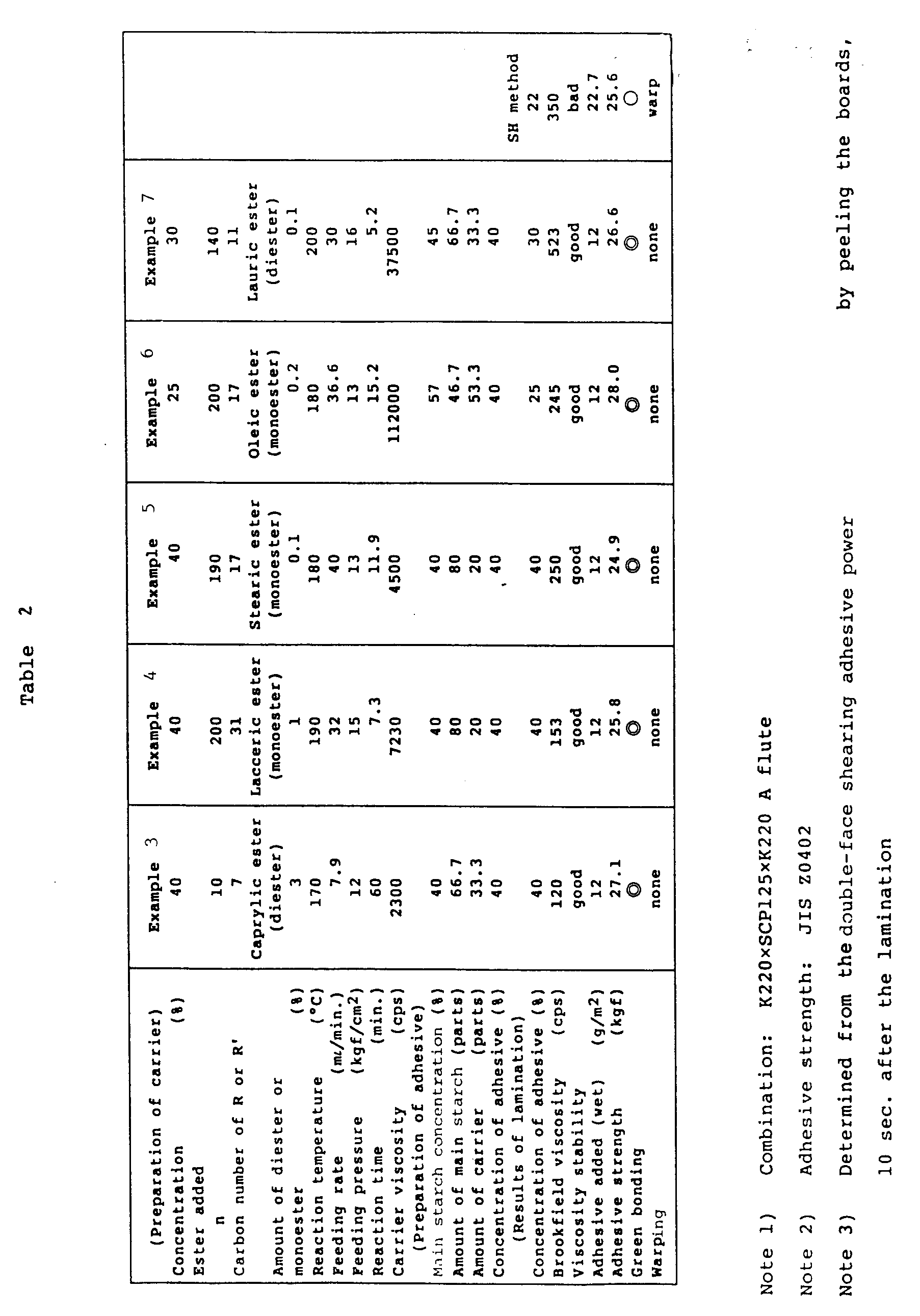
- The procedure of Example 2 was repeated except that an aldehyde shown in Table 3 was used and that the conditions shown in Table 3 were employed, and the properties of the paste thus formed were examined. For comparison, a starch adhesive was prepared by the conventional SH method and the properties thereof were also determined. The results are shown in Table 3.
- It is apparent from Table 3 that the adhesives of the present invention have a more excellent viscosity stability than that prepared by the conventional SH method, although its concentration is higher than that of the latter.

- These examples and comparative example relate to a starch adhesive comprising only a carrier.
- Starch suspensions having a starch concentration shown in Table 4 were prepared as Examples 12 and 13 and Comparative Example 1. Then, the same procedure as that of Example 1 was repeated in Example 12 and the same procedure as that of Example 2 was repeated in Example 13 except that the gelatinization temperature was changed to 200°C to form carriers. On the other hand, a carrier was prepared in Comparative Example 1 in the same manner as that of Reference Example 1 except that the dissolution was conducted under atmospheric pressure.
- The properties of the carrier adhesives thus obtained are shown in Table 4.

- By peeling the layers immediately after the lamination, it was revealed that the paper layers were deeply and firmly adhered in Examples 12 and 13. In contrast, the sample in the comparative example had a high water content and the adhesion was insufficient.
- After air-drying for two days, warping was observed in Comparative Example 1.
- 30 parts of corn starch were mixed with 70 parts of water. 0.1% of a stearic monoester (the alkyl group has 17 carbon atoms) were added to the mixture and were passed through a reaction tube having a diameter of 12.7 mm and a length of 3760 mm, which tube was heated to 130°C, by means of a pump having an outlet pressure of 10 kgf/cm² and a feeding rate of 1.1 mℓ/min. for 433 min. to obtain a carrier having a concentration of 30% and a Brookfield viscosity of 87,500 cps (30°C). On the other hand, 40 parts of corn starch were mixed with 60 parts of water to form the main starch having a concentration of 40%. 20 parts of the carrier prepared as described above was added thereto under stirring to obtain Starch Adhesive E having a total starch concentration of 32%.
- Starch Adhesive E was used for double-face laminating corrugated boards. The results are shown in Table 5.
Table 5 Example 14 E Starch concentration (%) 32 Brookfield viscosity (cps) 720 Viscosity stability good Coating amount (wet) (g/m²) 12.0 Adhesive strength (kgf) (double face side) 25.7 Initial adhesive power Ⓞ Warping none Drying energy (kcal/m²) 2.31 Note 1) Paper structure: K220×SCP125×K220 A flute
Note 2) Adhesive strength: JIS Z 0402
Note 3) Initial adhesive power: determined from the double-face shearing adhesive power by peeling the boards, 20 sec. after the lamination. - A paste having a high concentration and a low viscosity has been prepared by treatment with an oxidizing agent in the prior art. In this process, however, the molecule of the starch dissolved in water is gradually cut from its end and, therefore, the product has a quite low molecular weight and a very low adhesive power. Another reason is that the pyranose ring is cut. Although the mechanism has not been theoretically elucidated, the adhesive power can be maintained strong in the present invention because the starch molecule is cut at any desired portion by only heat at high temperature in a short period of time and because the glycoside bond is cut by the thermal decomposition.
- According to the present invention, the carrier having a high concentration is prepared by gelatinizing a starch at high temperature of 100°C or above and it is mixed with the main starch to form the adhesive having a viscosity which can be kept stable over a long period of time. The adhesive thus formed can be stored and reused conveniently. The present adhesion helps to achieve a rapid processing of paper or preparation of a corrugated board. Another advantage of the invention is that the quality problems, such as warping due to the expansion and contraction of the material to be adhered, caused by the absorption of water, can be avoided,and the quantity of heat required for the adhesion step can be greatly reduced.
Claims (16)
- A high-concentration starch adhesive obtainable by treating a starch slurry which comprises a fatty acid monoester or diester of a polyethylene glycol having the following general formula

- The adhesive of claim 1, wherein said temperature is 150 to 200°C.
- The adhesive of claim 1, wherein the starch concentration of said gelatinised solution is 30 to 60% by weight.
- The adhesive of claim 1, wherein said fatty acid monoester is contained in an amount of 0.1 to 5% by weight based on the total weight of starch.
- The adhesive of claim 1, wherein said aldehyde is contained in an amount of 0.1 to 10% by weight based on the total weight of starch.
- A high-concentration starch adhesive obtainable by treating a starch slurry which comprises a fatty acid monoester or diester of a polyethylene glycol having the following general formula

- The adhesive of claim 6, wherein said temperature is 150 to 200°C.
- The adhesive of claim 6, wherein the starch concentration of said gelatinized solution is 30 to 60% by weight.
- The adhesive of claim 6, wherein said fatty acid monoester or diester is contained in an amount of 0.1 to 5% by weight based on the total weight of starch.
- The adhesive of claim 6, wherein said aldehyde is contained in an amount of 0.1 to 10% by weight based on the total weight of starch.
- A process for producing a high-concentration starch adhesive, comprising treating a starch slurry which comprises a fatty acid monoester or diester of a polyethylene glycol having the following general formula

- The process according to claim 11 wherein the temperature is 150 to 200°C.
- The process according to claim 11 wherein the starch concentration of said gelatinized solution is 30 to 60% by weight.
- A process for producing a high-concentration starch adhesive, comprising treating a starch slurry which comprises a fatty acid monoester or diester of a polyethylene glycol having the following general formula

- The process according to claim 14 wherein the temperature is 150 to 200°C.
- The process according to claim 14 wherein the starch concentration of said gelatinized solution is 30 to 60% by weight.
Applications Claiming Priority (2)
| Application Number | Priority Date | Filing Date | Title |
|---|---|---|---|
| JP63332216A JPH0629386B2 (en) | 1988-06-06 | 1988-12-28 | High concentration starch adhesive |
| JP332216/88 | 1988-12-28 |
Publications (2)
| Publication Number | Publication Date |
|---|---|
| EP0376301A1 EP0376301A1 (en) | 1990-07-04 |
| EP0376301B1 true EP0376301B1 (en) | 1994-08-17 |
Family
ID=18252471
Family Applications (1)
| Application Number | Title | Priority Date | Filing Date |
|---|---|---|---|
| EP89124069A Expired - Lifetime EP0376301B1 (en) | 1988-12-28 | 1989-12-28 | High-concentration starch adhesive |
Country Status (3)
| Country | Link |
|---|---|
| US (1) | US5181959A (en) |
| EP (1) | EP0376301B1 (en) |
| DE (1) | DE68917577T2 (en) |
Families Citing this family (13)
| Publication number | Priority date | Publication date | Assignee | Title |
|---|---|---|---|---|
| US6221420B1 (en) | 1993-07-30 | 2001-04-24 | National Starch And Chemical Investment Holding Corporation | Foods containing thermally-inhibited starches and flours |
| US6451121B2 (en) | 1993-07-30 | 2002-09-17 | National Starch And Chemical Investment Holding Corporation | Thermally-inhibited non-pregelatinized granular starches and flours and process for their preparation |
| US5932017A (en) * | 1993-07-30 | 1999-08-03 | National Starch And Chemical Investment Holding Corporation | Thermally-inhibited non-pregelatinized granular starches and flours and process for their preparation |
| US5895545A (en) * | 1994-06-21 | 1999-04-20 | Miller; Ray R. | Method of making corrugated paper-board |
| US5718770A (en) * | 1994-08-25 | 1998-02-17 | National Starch And Chemical Investment Holding Corporation | Thermally-inhibited pregelatinized granular starches and flours and process for their production |
| US5830884A (en) * | 1995-01-18 | 1998-11-03 | National Starch And Chemical Investment Holding Corporation | Pharmaceutical products containing thermally-inhibited starches |
| EP0804140A2 (en) * | 1995-01-18 | 1997-11-05 | National Starch and Chemical Investment Holding Corporation | Cosmetics containing thermally-inhibited starches |
| JPH10503803A (en) * | 1995-01-24 | 1998-04-07 | ナショナル スターチ アンド ケミカル インベストメント ホールディング コーポレイション | Aqueous adhesive containing heat-inhibited starch |
| US6648955B1 (en) | 2000-10-25 | 2003-11-18 | National Starch And Chemical Investment Holding Corporation | Corrugating adhesive |
| FR2898897B1 (en) * | 2006-03-21 | 2012-06-15 | Roquette Freres | NOVEL METHOD AND DEVICE FOR COOKING AMYLACEOUS MATERIAL WITH HIGH DRIED MATERIALS FOR PREPARING AN ADHESIVE COMPOSITION |
| KR100777083B1 (en) * | 2007-04-26 | 2007-11-28 | 김수성 | Porous corrugated adhesive and corrugated cardboard manufacturing method using the same |
| CN109486439A (en) * | 2018-10-23 | 2019-03-19 | 青岛宏泰包装印刷有限公司 | A kind of environment-friendly type glue and its production technology |
| CN112175202A (en) * | 2020-10-17 | 2021-01-05 | 新乡市嘉数科技有限公司 | Preparation method of starch suspension |
Family Cites Families (12)
| Publication number | Priority date | Publication date | Assignee | Title |
|---|---|---|---|---|
| US3361585A (en) * | 1965-08-18 | 1968-01-02 | Nat Starch Chem Corp | Water resistant adhesives based on acetoacetate esters of starch |
| US3813906A (en) * | 1973-04-25 | 1974-06-04 | Chicago Lock Co | Axial split-pin tumbler-type lock |
| DE2512810B2 (en) * | 1975-03-22 | 1977-07-21 | Oy Vehna AB, Raisio (Finnland) | Process for the production of starch glue, in particular for gluing corrugated cardboard |
| US4073756A (en) * | 1976-04-26 | 1978-02-14 | Konishi Co., Ltd. | Solid adhesive compositions |
| US4040862A (en) * | 1976-07-02 | 1977-08-09 | Anheuser-Busch, Incorporated | Process for making a thermal converting starch by modification of oxidized starch with aluminum salts |
| US4157318A (en) * | 1977-08-02 | 1979-06-05 | International Paper Company | Starch carrier composition for adhesive containing urea as a selatinizing agent |
| US4343654A (en) * | 1980-02-08 | 1982-08-10 | Mpw Tech. Associates | Process for the production of corrugated paperboard adhesive |
| US4329181A (en) * | 1980-10-14 | 1982-05-11 | National Starch And Chemical Corporation | Method for preparing alkaline corrugating adhesive |
| CH658663A5 (en) * | 1984-02-01 | 1986-11-28 | Nestle Sa | PROCESS FOR THE PREPARATION OF A STARCH DISPERSIBLE IN BOILING WATER. |
| US4826719A (en) * | 1986-07-15 | 1989-05-02 | H. B. Fuller Company | Fast setting starch-based corrugating adhesive having fully hydrolyzed cold water insoluble polyvinyl alcohol component |
| US4814039A (en) * | 1987-10-02 | 1989-03-21 | H. B. Fuller Company | Substantially viscosity stable moisture-resistant corrugated board adhesive |
| US4855354A (en) * | 1988-01-07 | 1989-08-08 | Borden, Inc. | Aldehyde starch saturant laminating adhesives |
-
1989
- 1989-12-28 DE DE68917577T patent/DE68917577T2/en not_active Expired - Fee Related
- 1989-12-28 EP EP89124069A patent/EP0376301B1/en not_active Expired - Lifetime
- 1989-12-28 US US07/458,179 patent/US5181959A/en not_active Expired - Fee Related
Non-Patent Citations (1)
| Title |
|---|
| DERWENT ACCESSION NO. 83-738 933, Questel Telesystems (WPIL), DERWENT PUBLICATIONS LTD., London; & JP-A-58 117 267 * |
Also Published As
| Publication number | Publication date |
|---|---|
| DE68917577T2 (en) | 1994-12-15 |
| EP0376301A1 (en) | 1990-07-04 |
| US5181959A (en) | 1993-01-26 |
| DE68917577D1 (en) | 1994-09-22 |
Similar Documents
| Publication | Publication Date | Title |
|---|---|---|
| EP1090040B2 (en) | Dextrinization of starch | |
| EP0162682B1 (en) | Fast setting starch-based corrugating adhesive and use thereof in manufacture of corrugated board | |
| US5181959A (en) | High-concentration starch adhesive | |
| US5433775A (en) | Adhesive stick based on starch ethers | |
| EP0383214B1 (en) | Starch-based corrugating adhesive having a polyvinyl alcohol component | |
| US4374217A (en) | Cold-setting starch adhesive | |
| EP0438101B1 (en) | Use of water-resistant formaldehyde-free corrugating adhesive compositions | |
| EP3818122B1 (en) | Microfibrillated cellulose for controlling viscosity and gel temperature in starch-based adhesives | |
| US3944428A (en) | Alkaline curing corrugating adhesive | |
| EP0253643B1 (en) | Fast setting starch-based corrugating adhesive | |
| CN1239315C (en) | Method for production of corrugated board and product obtained thereof | |
| KR20130096684A (en) | Aqueous adhesive composition containing a mixture based on legume starch | |
| CA1148308A (en) | Method for preparing alkaline corrugating adhesive | |
| JP2583498B2 (en) | Fast-curing starch-based corrugate adhesive containing partially hydrolyzed water-soluble polyvinyl alcohol component | |
| EP0409240B2 (en) | Aqueous starch slurry adhesive | |
| FI114727B (en) | Process for making cardboard and cardboard product | |
| EP0672693A2 (en) | Aldehyde resins with reduced and stabilized free-formaldehyde content | |
| EP0346752B1 (en) | Improved starch based corrugating adhesives | |
| EP1474492B1 (en) | Novel starch-based adhesives | |
| GB1571336A (en) | Starch-based adhesive composition | |
| JPH0123515B2 (en) | ||
| EP0467568B1 (en) | Starch-based adhesive | |
| JP4380824B2 (en) | Corrugated adhesive | |
| JPH0629386B2 (en) | High concentration starch adhesive | |
| US3746699A (en) | Dextrin and starch ethers |
Legal Events
| Date | Code | Title | Description |
|---|---|---|---|
| PUAI | Public reference made under article 153(3) epc to a published international application that has entered the european phase |
Free format text: ORIGINAL CODE: 0009012 |
|
| AK | Designated contracting states |
Kind code of ref document: A1 Designated state(s): DE FR GB |
|
| 17P | Request for examination filed |
Effective date: 19901228 |
|
| 17Q | First examination report despatched |
Effective date: 19920113 |
|
| GRAA | (expected) grant |
Free format text: ORIGINAL CODE: 0009210 |
|
| AK | Designated contracting states |
Kind code of ref document: B1 Designated state(s): DE FR GB |
|
| REF | Corresponds to: |
Ref document number: 68917577 Country of ref document: DE Date of ref document: 19940922 |
|
| ET | Fr: translation filed | ||
| PLBE | No opposition filed within time limit |
Free format text: ORIGINAL CODE: 0009261 |
|
| STAA | Information on the status of an ep patent application or granted ep patent |
Free format text: STATUS: NO OPPOSITION FILED WITHIN TIME LIMIT |
|
| 26N | No opposition filed | ||
| REG | Reference to a national code |
Ref country code: GB Ref legal event code: IF02 |
|
| PGFP | Annual fee paid to national office [announced via postgrant information from national office to epo] |
Ref country code: FR Payment date: 20031210 Year of fee payment: 15 |
|
| PGFP | Annual fee paid to national office [announced via postgrant information from national office to epo] |
Ref country code: GB Payment date: 20031224 Year of fee payment: 15 |
|
| PGFP | Annual fee paid to national office [announced via postgrant information from national office to epo] |
Ref country code: DE Payment date: 20040108 Year of fee payment: 15 |
|
| PG25 | Lapsed in a contracting state [announced via postgrant information from national office to epo] |
Ref country code: GB Free format text: LAPSE BECAUSE OF NON-PAYMENT OF DUE FEES Effective date: 20041228 |
|
| PG25 | Lapsed in a contracting state [announced via postgrant information from national office to epo] |
Ref country code: DE Free format text: LAPSE BECAUSE OF NON-PAYMENT OF DUE FEES Effective date: 20050701 |
|
| GBPC | Gb: european patent ceased through non-payment of renewal fee |
Effective date: 20041228 |
|
| PG25 | Lapsed in a contracting state [announced via postgrant information from national office to epo] |
Ref country code: FR Free format text: LAPSE BECAUSE OF NON-PAYMENT OF DUE FEES Effective date: 20050831 |
|
| REG | Reference to a national code |
Ref country code: FR Ref legal event code: ST |