EP0375292B1 - Thermal transfer receiver - Google Patents
Thermal transfer receiver Download PDFInfo
- Publication number
- EP0375292B1 EP0375292B1 EP19890313139 EP89313139A EP0375292B1 EP 0375292 B1 EP0375292 B1 EP 0375292B1 EP 19890313139 EP19890313139 EP 19890313139 EP 89313139 A EP89313139 A EP 89313139A EP 0375292 B1 EP0375292 B1 EP 0375292B1
- Authority
- EP
- European Patent Office
- Prior art keywords
- film
- dye
- receiver sheet
- undersheet
- receiver
- Prior art date
- Legal status (The legal status is an assumption and is not a legal conclusion. Google has not performed a legal analysis and makes no representation as to the accuracy of the status listed.)
- Expired - Lifetime
Links
Images
Classifications
-
- B—PERFORMING OPERATIONS; TRANSPORTING
- B41—PRINTING; LINING MACHINES; TYPEWRITERS; STAMPS
- B41M—PRINTING, DUPLICATING, MARKING, OR COPYING PROCESSES; COLOUR PRINTING
- B41M5/00—Duplicating or marking methods; Sheet materials for use therein
-
- B—PERFORMING OPERATIONS; TRANSPORTING
- B41—PRINTING; LINING MACHINES; TYPEWRITERS; STAMPS
- B41M—PRINTING, DUPLICATING, MARKING, OR COPYING PROCESSES; COLOUR PRINTING
- B41M5/00—Duplicating or marking methods; Sheet materials for use therein
- B41M5/26—Thermography ; Marking by high energetic means, e.g. laser otherwise than by burning, and characterised by the material used
- B41M5/40—Thermography ; Marking by high energetic means, e.g. laser otherwise than by burning, and characterised by the material used characterised by the base backcoat, intermediate, or covering layers, e.g. for thermal transfer dye-donor or dye-receiver sheets; Heat, radiation filtering or absorbing means or layers; combined with other image registration layers or compositions; Special originals for reproduction by thermography
- B41M5/41—Base layers supports or substrates
-
- B—PERFORMING OPERATIONS; TRANSPORTING
- B41—PRINTING; LINING MACHINES; TYPEWRITERS; STAMPS
- B41M—PRINTING, DUPLICATING, MARKING, OR COPYING PROCESSES; COLOUR PRINTING
- B41M2205/00—Printing methods or features related to printing methods; Location or type of the layers
- B41M2205/32—Thermal receivers
-
- Y—GENERAL TAGGING OF NEW TECHNOLOGICAL DEVELOPMENTS; GENERAL TAGGING OF CROSS-SECTIONAL TECHNOLOGIES SPANNING OVER SEVERAL SECTIONS OF THE IPC; TECHNICAL SUBJECTS COVERED BY FORMER USPC CROSS-REFERENCE ART COLLECTIONS [XRACs] AND DIGESTS
- Y10—TECHNICAL SUBJECTS COVERED BY FORMER USPC
- Y10S—TECHNICAL SUBJECTS COVERED BY FORMER USPC CROSS-REFERENCE ART COLLECTIONS [XRACs] AND DIGESTS
- Y10S428/00—Stock material or miscellaneous articles
- Y10S428/91—Product with molecular orientation
-
- Y—GENERAL TAGGING OF NEW TECHNOLOGICAL DEVELOPMENTS; GENERAL TAGGING OF CROSS-SECTIONAL TECHNOLOGIES SPANNING OVER SEVERAL SECTIONS OF THE IPC; TECHNICAL SUBJECTS COVERED BY FORMER USPC CROSS-REFERENCE ART COLLECTIONS [XRACs] AND DIGESTS
- Y10—TECHNICAL SUBJECTS COVERED BY FORMER USPC
- Y10S—TECHNICAL SUBJECTS COVERED BY FORMER USPC CROSS-REFERENCE ART COLLECTIONS [XRACs] AND DIGESTS
- Y10S428/00—Stock material or miscellaneous articles
- Y10S428/913—Material designed to be responsive to temperature, light, moisture
-
- Y—GENERAL TAGGING OF NEW TECHNOLOGICAL DEVELOPMENTS; GENERAL TAGGING OF CROSS-SECTIONAL TECHNOLOGIES SPANNING OVER SEVERAL SECTIONS OF THE IPC; TECHNICAL SUBJECTS COVERED BY FORMER USPC CROSS-REFERENCE ART COLLECTIONS [XRACs] AND DIGESTS
- Y10—TECHNICAL SUBJECTS COVERED BY FORMER USPC
- Y10S—TECHNICAL SUBJECTS COVERED BY FORMER USPC CROSS-REFERENCE ART COLLECTIONS [XRACs] AND DIGESTS
- Y10S428/00—Stock material or miscellaneous articles
- Y10S428/914—Transfer or decalcomania
-
- Y—GENERAL TAGGING OF NEW TECHNOLOGICAL DEVELOPMENTS; GENERAL TAGGING OF CROSS-SECTIONAL TECHNOLOGIES SPANNING OVER SEVERAL SECTIONS OF THE IPC; TECHNICAL SUBJECTS COVERED BY FORMER USPC CROSS-REFERENCE ART COLLECTIONS [XRACs] AND DIGESTS
- Y10—TECHNICAL SUBJECTS COVERED BY FORMER USPC
- Y10T—TECHNICAL SUBJECTS COVERED BY FORMER US CLASSIFICATION
- Y10T428/00—Stock material or miscellaneous articles
- Y10T428/26—Web or sheet containing structurally defined element or component, the element or component having a specified physical dimension
- Y10T428/263—Coating layer not in excess of 5 mils thick or equivalent
- Y10T428/264—Up to 3 mils
-
- Y—GENERAL TAGGING OF NEW TECHNOLOGICAL DEVELOPMENTS; GENERAL TAGGING OF CROSS-SECTIONAL TECHNOLOGIES SPANNING OVER SEVERAL SECTIONS OF THE IPC; TECHNICAL SUBJECTS COVERED BY FORMER USPC CROSS-REFERENCE ART COLLECTIONS [XRACs] AND DIGESTS
- Y10—TECHNICAL SUBJECTS COVERED BY FORMER USPC
- Y10T—TECHNICAL SUBJECTS COVERED BY FORMER US CLASSIFICATION
- Y10T428/00—Stock material or miscellaneous articles
- Y10T428/26—Web or sheet containing structurally defined element or component, the element or component having a specified physical dimension
- Y10T428/263—Coating layer not in excess of 5 mils thick or equivalent
- Y10T428/264—Up to 3 mils
- Y10T428/265—1 mil or less
-
- Y—GENERAL TAGGING OF NEW TECHNOLOGICAL DEVELOPMENTS; GENERAL TAGGING OF CROSS-SECTIONAL TECHNOLOGIES SPANNING OVER SEVERAL SECTIONS OF THE IPC; TECHNICAL SUBJECTS COVERED BY FORMER USPC CROSS-REFERENCE ART COLLECTIONS [XRACs] AND DIGESTS
- Y10—TECHNICAL SUBJECTS COVERED BY FORMER USPC
- Y10T—TECHNICAL SUBJECTS COVERED BY FORMER US CLASSIFICATION
- Y10T428/00—Stock material or miscellaneous articles
- Y10T428/31504—Composite [nonstructural laminate]
- Y10T428/31786—Of polyester [e.g., alkyd, etc.]
-
- Y—GENERAL TAGGING OF NEW TECHNOLOGICAL DEVELOPMENTS; GENERAL TAGGING OF CROSS-SECTIONAL TECHNOLOGIES SPANNING OVER SEVERAL SECTIONS OF THE IPC; TECHNICAL SUBJECTS COVERED BY FORMER USPC CROSS-REFERENCE ART COLLECTIONS [XRACs] AND DIGESTS
- Y10—TECHNICAL SUBJECTS COVERED BY FORMER USPC
- Y10T—TECHNICAL SUBJECTS COVERED BY FORMER US CLASSIFICATION
- Y10T428/00—Stock material or miscellaneous articles
- Y10T428/31504—Composite [nonstructural laminate]
- Y10T428/31786—Of polyester [e.g., alkyd, etc.]
- Y10T428/3179—Next to cellulosic
Definitions
- the invention relates to thermal transfer printing, and especially to receiver sheets of novel construction and their use in dye-diffusion thermal transfer printing, using a thermal printing head.
- TTP Thermal transfer printing
- sublimation TTP has been used for printing woven and knitted textiles, and various other rough or intersticed materials, by placing over the material to be printed a sheet carrying the desired pattern in the form of sublimable dyes. These were then sublimed onto the surface of the material and into its interstices, by applying heat and gentle pressure over the whole area, typically using a plate heated to 180-220°C for a period of 30-120 s, to transfer substantially all of the dye.
- a more recent TTP process is one in which prints can be obtained on relatively smooth and coherent receiver surfaces using pixel printing equipment, such as a programmable thermal print head or laser printer, controlled by electronic signals derived from a video, computer, electronic still camera, or similar signal generating apparatus.
- pixel printing equipment such as a programmable thermal print head or laser printer
- electronic signals derived from a video, computer, electronic still camera, or similar signal generating apparatus instead of having the pattern to be printed already preformed on the dyesheet, a dyesheet is used which comprises a thin substrate supporting a dyecoat comprising a single dye or dye mixture (usually dispersed or dissolved in a binder) forming a continuous and uniform layer over an entire printing area of the dyesheet. Printing is then effected by heating selected discrete areas of the dyesheet while the dyecoat is held against a dye-receptive surface, causing dye to transfer into the corresponding areas of that receptive surface.
- the shape of the pattern transferred is determined by the number and location of the discrete areas which are subjected to heating, and the depth of shade in any discrete area is determined by the period of time for which it is heated and the temperature reached.
- the transfer mechanism appears to be one of diffusion into the dye-receptive surface, and such printing process has been referred to as dye-diffusion thermal transfer printing.
- This process can give a monochrome print in a colour determined by the dye or dye-mixture used, but full colour prints can also be produced by printing with different coloured dyecoats sequentially in like manner.
- the latter may conveniently be provided as discrete uniform print-size areas, in a repeated sequence along the same dyesheet.
- High resolution printing can be effected by making the heated areas very small and close together, to transfer correspondingly small individual pixels, or groups of such pixels, to the receiver.
- a typical thermal print head has a row of tiny heaters which print six or more pixels per millimetre, generally with two heaters per pixel.
- a typical receiver sheet consists essentially of a substrate coated with a dye-receptive layer of a composition having an affinity for the dye molecules and into which they can readily diffuse when the dyesheet is heated during printing. Such dye-receptive layers are typically around 2-6 ⁇ m thick.
- Various sheet materials have been suggested for the substrate, including for example, cellulose fibre paper, thermoplastic films such as molecularly oriented films of synthetic linear polyesters (eg biaxially oriented and heat set polyethyleneterephthalate film), and plastic films voided to give them paper-like handling qualities (hence generally referred to as "synthetic paper”).
- a typical paper receiver is about 150 ⁇ m thick.
- Paper substrates whether synthetic or cellulosic and including the above laminates, are limited in their whiteness by their inherent properties and structures, and it does not appear to be possible to obtain the high surface gloss desirable for many applications.
- stable thermoplastic films such as white molecularly oriented polyester films have been proposed for receiver substrates, a typical thickness being about 125 ⁇ m. These generally contain both voids and particulate solids such as finely divided inorganic materials and polymeric materials, for giving the opacity and whiteness.
- examples of such films include Melinex 990, this being a voided film containing finely divided barium sulphate particles, a combination which produces a particularly white and opaque film (“Melinex" is a Registered Trade Mark of Imperial Chemical Industries PLC).
- a receiver sheet for dye diffusion thermal transfer printing comprises a white molecularly oriented polyester film, supporting a layer of dye-receptive material on one surface, the other surface of the film being laminated to an undersheet of higher compliance than the film, and the thickness of the film lying within the range 10 to 50 ⁇ m.
- the interpixel spaces are caused by the low compliance of the white thermoplastic film making it highly resistant to deformation by the slight curvature of the head around each pixel's heaters.
- the area of film in contact with the print head is thus less than that obtained with a more compliant receiver, and the area of pixel transferred is correspondingly less.
- the surface into which the thermal head is pressed remains film of the same low compliance, the overall compliance of the substrate becomes surprisingly increased when the higher compliance sheet is laminated to its reverse side as an undersheet.
- the higher compliance undersheet may be a thermoplastic film, such as highly plasticised polyvinyl chloride film.
- plasticised films in general, there is the danger that plasticiser may migrate into the dye-receptive layer of an underlying receiver sheet while they are stacked awaiting use, unless there is an efficient backcoat to provide an effective barrier.
- a preferred receiver sheet is one in which the undersheet is a synthetic paper.
- Another preferred receiver sheet is one in which the undersheet is a cellulose fibre paper.
- the laminated substrate can also have further sheets (including films) added to the undersheet.
- a preferred receiver sheet is one having a thermoplastic underfilm laminated to the higher compliance undersheet on its side remote from the white film carrying the dye-receptive layer.
- These two films ie the underfilm and the film supporting the dye-receptive layer, are preferably both molecularly oriented films made of the same white polyester material giving the resulting receiver sheet a good white appearance on both sides, although this whiteness may be of less importance when the underfilm is added only for the purpose of balancing the laminate mechanically, and a clear film could equally be used to give such balance.
- This substrate i.e. comprising a core of higher compliance material sandwiched between two sheets of similarly lower compliance film, provides a balanced laminate which remains stable when ambient conditions of humidity and temperature, change.
- this sandwich of film/underlayer/film when using a paper underlayer is the reverse of the paper/film/paper substrate described in the patent referred to above, its balanced construction will likewise give good resistance to curl, but in addition the outer films will give the improved whiteness and gloss obtainable with this construction.
- the receiver sheet In addition to the various preformed laminae providing the basis of the substrate, the receiver sheet also has various applied coatings. These include the dye-receptive layer coated onto the white film, and the layers of adhesive between the laminae, bonding them together to form the laminate of the substrate. Similarly, an adhesive subbing layer may be provided between the white film and the dye-receptive layer it supports, this being applied as a coating on the white film before being overcoated in its turn with the dye-receptive coating composition. Subcoats underlying the dye-receptive layer may also be formulated to provide other useful functions, such as, for example, a dye barrier to prevent further penetration of the dye.
- One such preferred receiver sheet also has at least one backcoat on its surface remote from the receptive layer.
- Backcoats can have several useful functions, including improvements to handling and writing properties, and various examples are to be found in the literature of the art. Although these backcoats also provide a balance for the receiver coat, which is beneficial, the absence or presence of such coatings usually makes less difference to the stability of the laminate, than an effective balance in the laminated sheets.
- the thickness of the undersheet is not critical as far as achieving the benefits of the present invention is concerned, and the optimum thickness for any particular application is determined more by what thickness of complete receiver is most appropriate for that application, and by the thickness of the one or more layers of film to which it is laminated.
- an undersheet of about 150 ⁇ m would be appropriate, whereas an undersheet of about 100 ⁇ m would be more appropriate when using 50 ⁇ m thick films.
- Receiver sheets according to the first aspect of the invention can be sold and used in the configuration of long strips packaged in a cassette, or cut into individual print size portions, or otherwise adapted to suit the requirements of whatever printer they are to be used with, whether or not this incorporates a thermal print head to take full advantage of the properties provided hereby.
- a stack of print size portions of a receiver sheet according to the first aspect of the invention packaged for use in a thermal transfer printer.
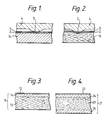
- each receiver comprises a substrate 1a, 1b supporting a dye-receptive layer 2.
- This is used in combination with a thin dyesheet 3, which overlies the receiver as the two sheets pass through the printer, the dyesheet having a dyecoat positioned against the receptive layer 2 of the receiver.
- This pair of sheets is shown inside a printer, where they are biased against the thermal print head 4.
- This head has a barely visible domed ridge 5 containing a row of tiny heaters (not shown) running perpendicular to the plane of the section.
- the substrate 1a is a sheet of low compliance white thermoplastic film
- that 1b in Figure 2 is a cellulose fibre paper of much higher compliance, the receptive layers being the same in each case.
- the receiver sheet shown in Figure 3 comprises a substrate 11 supporting a layer of dye-receptive material 12.
- the substrate is a laminate of a cellulose fibre paper 13, essentially as shown in Figure 2, and a white glossy thermoplastic film 14, essentially as shown in Figure 1, with the film interposed between the receptive layer and the paper.
- a balanced laminate sheet is shown in Figure 4.
- a substrate 21 supports a dye-receptive layer 22.
- the substrate again has an upper film 24 and an undersheet of paper 23, but differs from that in Figure 3 in having a further undersheet of white film 25.
- a sample of receiver sheet was prepared as shown in Figure 3, in which the film was white Melinex 990 film, 50 ⁇ m thick, and the paper was Yupo FPG 150 paper, 150 ⁇ m thick.
- the print quality of the laminated receiver was found to be a little better than that obtained on plain Melinex 990 film, good, with pixel size (when viewed though a microscope) being a little larger, suggesting that the during printing the receiver behaved a little more like that shown in Figure 2.
- a series of receiver sheets was prepared in the configuration shown in Figure 4.
- the compliant layer was a synthetic paper, Yupo FPG, and was used in various thicknesses, from 60-200 ⁇ m, to provide the series of different samples.
- On both sides of this paper were laminated low compliance white sheets of Melinex 990 film, 23 ⁇ m thick, one of these being coated with a dye-receptive material on its outer free surface. All the laminates were prepared using an adhesive between the sheets.
- samples of the various thickness of synthetic paper used in construction of the laminates were also measured in like manner.
- synthetic paper having a thickness of 150 ⁇ m is itself sometimes used commercially as a receiver sheet substrate.
- the white Melinex film was also separately tested, in two thickness, 125 ⁇ m and 23 ⁇ m. In the former thickness, such film can be used on its own as a receiver substrate, whereas the thinner material is preferred for the laminates, to avoid the receiver sheet becoming impracticably thick.
- a receiver was tested having a substrate laminated from three papers, all 60 ⁇ m thick.
- the outer sheets were both synthetic paper (Yupo FPG 60), and the inner sheet was a cellulose fibre paper.
- Improvement in print quality can be obtained increasingly as the compliance increases to give indentations greater than about 5 ⁇ m, when measured as above.
- Preferred substrates are those giving indentations greater than 10 ⁇ m.
- Example 6 the same tests were carried out on receivers using as the undersheet a cellulose fibre paper, Kokuyo KB, instead of the Yupo synthetic papers, although the former is retained in Example 7 as a control.
- Kokuyo KB paper was used on its own in Comparative Example H. The results were as shown in Tables IV, V and VI below.
- this cellulose fibre undersheet gave a laminate of similarly improved compliance, as is evidenced from th result above, and the improved whiteness of the laminate compared with the uncovered paper can again be seen from the much lower b* values obtained.
- the Bekk smoothness values correspond well with the gloss reading obtained above.
- Samples of Kokuyo cellulose paper gave Bekk smoothness measurements of 50 to 100 s, and samples of Yupo synthetic paper gave readings of 3,000 to 5,000 s.
- samples of all the above laminates using these papers as underlayers all gave values greater than 10,000 s.
Landscapes
- Physics & Mathematics (AREA)
- Optics & Photonics (AREA)
- Thermal Transfer Or Thermal Recording In General (AREA)
- Cooling Or The Like Of Semiconductors Or Solid State Devices (AREA)
- Laminated Bodies (AREA)
- Input Circuits Of Receivers And Coupling Of Receivers And Audio Equipment (AREA)
- Photovoltaic Devices (AREA)
- Diaphragms For Electromechanical Transducers (AREA)
Abstract
Description
- The invention relates to thermal transfer printing, and especially to receiver sheets of novel construction and their use in dye-diffusion thermal transfer printing, using a thermal printing head.
- Thermal transfer printing ("TTP") is a generic term for processes in which one or more thermally transferable dyes are caused to transfer from a dyesheet to a receiver in response to thermal stimuli. For many years, sublimation TTP has been used for printing woven and knitted textiles, and various other rough or intersticed materials, by placing over the material to be printed a sheet carrying the desired pattern in the form of sublimable dyes. These were then sublimed onto the surface of the material and into its interstices, by applying heat and gentle pressure over the whole area, typically using a plate heated to 180-220°C for a period of 30-120 s, to transfer substantially all of the dye.
- A more recent TTP process is one in which prints can be obtained on relatively smooth and coherent receiver surfaces using pixel printing equipment, such as a programmable thermal print head or laser printer, controlled by electronic signals derived from a video, computer, electronic still camera, or similar signal generating apparatus. Instead of having the pattern to be printed already preformed on the dyesheet, a dyesheet is used which comprises a thin substrate supporting a dyecoat comprising a single dye or dye mixture (usually dispersed or dissolved in a binder) forming a continuous and uniform layer over an entire printing area of the dyesheet. Printing is then effected by heating selected discrete areas of the dyesheet while the dyecoat is held against a dye-receptive surface, causing dye to transfer into the corresponding areas of that receptive surface. The shape of the pattern transferred is determined by the number and location of the discrete areas which are subjected to heating, and the depth of shade in any discrete area is determined by the period of time for which it is heated and the temperature reached. The transfer mechanism appears to be one of diffusion into the dye-receptive surface, and such printing process has been referred to as dye-diffusion thermal transfer printing.
- This process can give a monochrome print in a colour determined by the dye or dye-mixture used, but full colour prints can also be produced by printing with different coloured dyecoats sequentially in like manner. The latter may conveniently be provided as discrete uniform print-size areas, in a repeated sequence along the same dyesheet.
- High resolution printing can be effected by making the heated areas very small and close together, to transfer correspondingly small individual pixels, or groups of such pixels, to the receiver. For example, a typical thermal print head has a row of tiny heaters which print six or more pixels per millimetre, generally with two heaters per pixel. The greater the density of pixels, the greater is the potential resolution, but as presently available printers can only print one row at a time, it is desirable to print them at high speed with short hot pulses, usually from near zero up to about 10 ms, but even up to a maximum of 15 ms in some printers, with each pixel temperature typically rising to about 350°C during the longest pulses.
- A typical receiver sheet consists essentially of a substrate coated with a dye-receptive layer of a composition having an affinity for the dye molecules and into which they can readily diffuse when the dyesheet is heated during printing. Such dye-receptive layers are typically around 2-6 µm thick. Various sheet materials have been suggested for the substrate, including for example, cellulose fibre paper, thermoplastic films such as molecularly oriented films of synthetic linear polyesters (eg biaxially oriented and heat set polyethyleneterephthalate film), and plastic films voided to give them paper-like handling qualities (hence generally referred to as "synthetic paper"). A typical paper receiver is about 150 µm thick. These different sheet materials each have their individual strengths and weaknesses, it being disclosed in EP-A-234, 563, for example, that synthetic papers tend to curl when heated during printing, unless one or more other sheets are laminated to the back of the paper to balance the receptive layer on the front.
- Paper substrates, whether synthetic or cellulosic and including the above laminates, are limited in their whiteness by their inherent properties and structures, and it does not appear to be possible to obtain the high surface gloss desirable for many applications. More recently, stable thermoplastic films, such as white molecularly oriented polyester films have been proposed for receiver substrates, a typical thickness being about 125 µm. These generally contain both voids and particulate solids such as finely divided inorganic materials and polymeric materials, for giving the opacity and whiteness. Examples of such films include Melinex 990, this being a voided film containing finely divided barium sulphate particles, a combination which produces a particularly white and opaque film ("Melinex" is a Registered Trade Mark of Imperial Chemical Industries PLC). Receiver sheets using such films are described, for example, in our EP-A-292, 109, as we had found that the high gloss and improved whiteness of white molecularly oriented films, could be substantially retained during printing to give clear, bright, high-quality prints with colours enhanced by the very white background. However, we have now found that even these can be improved.
- When using microphotographic techniques to examine prints made on receivers having white polyester film substrates, we discovered that solid blocks of colour which had been transferred by some printers, would often have white gaps between adjacent pixels. In extreme cases, columns of interpixel spaces could manifest themselves as very fine white lines transverse to the direction of travel through the printer, and be clearly visible through a microscope. We have now found a way of reducing, or even avoiding, such gaps, and even though such interpixel gaps may be hardly visible to the naked eye, colours printed onto the same white and glossy surfaces without such gaps, can be noticeably enhanced.
- According to a first aspect of the present invention, a receiver sheet for dye diffusion thermal transfer printing comprises a white molecularly oriented polyester film, supporting a layer of dye-receptive material on one surface, the other surface of the film being laminated to an undersheet of higher compliance than the film, and the thickness of the film lying within the range 10 to 50 µm.
- It appears that the interpixel spaces are caused by the low compliance of the white thermoplastic film making it highly resistant to deformation by the slight curvature of the head around each pixel's heaters. The area of film in contact with the print head is thus less than that obtained with a more compliant receiver, and the area of pixel transferred is correspondingly less. Although the surface into which the thermal head is pressed, remains film of the same low compliance, the overall compliance of the substrate becomes surprisingly increased when the higher compliance sheet is laminated to its reverse side as an undersheet.
- Greater improvement in the overall compliance can be achieved by reducing the thickness of the white film still further, but below about 10 µm it becomes increasingly transparent, and the whiteness is correspondingly lost. It also becomes less effective at removing any surface texture of the undersheet. At the other end of the scale, with molecularly oriented polyester making such a stiff film, very little improvement is seen with film thicknesses greater than about 50 µm. Within this most useful range of 10 to 50 µm range, our preferred thickness for the polyester film is 20 to 30 µm, although the changes outside this range are gradual, and films of different inherent compliances will have different optimal ranges. Surface smoothness better than 1,000 s (Bekk smoothness) generally can be, and preferably is, maintained using polyester films within this range, leading to improved print quality. By comparison, synthetic and (especially cellulosic) papers generally have a greater roughness than that.
- The higher compliance undersheet may be a thermoplastic film, such as highly plasticised polyvinyl chloride film. However, with plasticised films in general, there is the danger that plasticiser may migrate into the dye-receptive layer of an underlying receiver sheet while they are stacked awaiting use, unless there is an efficient backcoat to provide an effective barrier. A preferred receiver sheet is one in which the undersheet is a synthetic paper. Another preferred receiver sheet is one in which the undersheet is a cellulose fibre paper.
- The laminated substrate can also have further sheets (including films) added to the undersheet. A preferred receiver sheet is one having a thermoplastic underfilm laminated to the higher compliance undersheet on its side remote from the white film carrying the dye-receptive layer. These two films ie the underfilm and the film supporting the dye-receptive layer, are preferably both molecularly oriented films made of the same white polyester material giving the resulting receiver sheet a good white appearance on both sides, although this whiteness may be of less importance when the underfilm is added only for the purpose of balancing the laminate mechanically, and a clear film could equally be used to give such balance.
- This substrate, i.e. comprising a core of higher compliance material sandwiched between two sheets of similarly lower compliance film, provides a balanced laminate which remains stable when ambient conditions of humidity and temperature, change. Moreover, although this sandwich of film/underlayer/film when using a paper underlayer is the reverse of the paper/film/paper substrate described in the patent referred to above, its balanced construction will likewise give good resistance to curl, but in addition the outer films will give the improved whiteness and gloss obtainable with this construction.
- In addition to the various preformed laminae providing the basis of the substrate, the receiver sheet also has various applied coatings. These include the dye-receptive layer coated onto the white film, and the layers of adhesive between the laminae, bonding them together to form the laminate of the substrate. Similarly, an adhesive subbing layer may be provided between the white film and the dye-receptive layer it supports, this being applied as a coating on the white film before being overcoated in its turn with the dye-receptive coating composition. Subcoats underlying the dye-receptive layer may also be formulated to provide other useful functions, such as, for example, a dye barrier to prevent further penetration of the dye.
- Other specialised coatings may be provided as required. One such preferred receiver sheet also has at least one backcoat on its surface remote from the receptive layer. Backcoats can have several useful functions, including improvements to handling and writing properties, and various examples are to be found in the literature of the art. Although these backcoats also provide a balance for the receiver coat, which is beneficial, the absence or presence of such coatings usually makes less difference to the stability of the laminate, than an effective balance in the laminated sheets.
- The thickness of the undersheet is not critical as far as achieving the benefits of the present invention is concerned, and the optimum thickness for any particular application is determined more by what thickness of complete receiver is most appropriate for that application, and by the thickness of the one or more layers of film to which it is laminated. Thus when aiming for a target overall receiver thickness of 200 µm,when using two films of 23 µm thickness, an undersheet of about 150 µm would be appropriate, whereas an undersheet of about 100 µm would be more appropriate when using 50 µm thick films.
- When evaluating receiver materials, we measured the compliances using standard commercial equipment, and measuring the indentation produced by a 0.395 mm diameter spherical indenter under a load of 10 g. We found that a marked improvement was obtained with receivers giving an indentation of at least 5 µm at 20°C. Whether or not this value is achieved with any particular receiver, is dependent not only on the thickness of the white film (as discussed above) but also on the compliance of the undersheet. We prefer to use as undersheet, materials having a compliance sufficiently high for the indentation produced in a free surface of the material by a 0.395 mm diameter spherical indenter sufficiently high to be at least 10 µm at 20°C. We particularly prefer to use receivers for which the indentations produced in the dye-receptive surface is also at least 10 µm at 20°C.
- Receiver sheets according to the first aspect of the invention can be sold and used in the configuration of long strips packaged in a cassette, or cut into individual print size portions, or otherwise adapted to suit the requirements of whatever printer they are to be used with, whether or not this incorporates a thermal print head to take full advantage of the properties provided hereby.
- According to a second aspect of the invention, we provide a stack of print size portions of a receiver sheet according to the first aspect of the invention, packaged for use in a thermal transfer printer.
- The invention is illustrated by reference to specific embodiments shown in the accompanying drawings, in which:
- Figure 1 is a diagrammatical representation in partial cross section of a dyesheet and low compliance receiver biased against a thermal print head,
- Figure 2 similarly shows a dyesheet and high compliance receiver biased against the print head,
- Figure 3 is a cross section through a receiver according to the invention, and
- Figure 4 is a cross section through a further receiver having a balanced laminate substrate.
- Referring first to Figures 1 and 2, these illustrate what we have found to happen when using known receivers of different compliances. Each receiver comprises a
substrate thin dyesheet 3, which overlies the receiver as the two sheets pass through the printer, the dyesheet having a dyecoat positioned against the receptive layer 2 of the receiver. This pair of sheets is shown inside a printer, where they are biased against thethermal print head 4. This head has a barely visibledomed ridge 5 containing a row of tiny heaters (not shown) running perpendicular to the plane of the section. In Figure 1 thesubstrate 1a is a sheet of low compliance white thermoplastic film, while that 1b in Figure 2 is a cellulose fibre paper of much higher compliance, the receptive layers being the same in each case. - As mentioned above, we found that the area of a pixel printed on the type of receiver shown in Figure 1 was less than the area of a pixel printed on that shown in Figure 2, other parameters being equal. The reason we believe is due to the different areas of contact between the
ridge 5 and the sheets. Figure 2 shows the more compliant receiver being distorted to allow the sheets partly to wrap around the ridge, thus presenting a greater area for heating than the narrow line of contact obtained with the less compliant receiver of Figure 1. - The receiver sheet shown in Figure 3 comprises a
substrate 11 supporting a layer of dye-receptive material 12. The substrate is a laminate of acellulose fibre paper 13, essentially as shown in Figure 2, and a white glossythermoplastic film 14, essentially as shown in Figure 1, with the film interposed between the receptive layer and the paper. - A balanced laminate sheet is shown in Figure 4. In this a
substrate 21 supports a dye-receptive layer 22. The substrate again has anupper film 24 and an undersheet ofpaper 23, but differs from that in Figure 3 in having a further undersheet ofwhite film 25. - The invention is further illustrated by the following Examples:
- A sample of receiver sheet was prepared as shown in Figure 3, in which the film was white Melinex 990 film, 50 µm thick, and the paper was Yupo FPG 150 paper, 150 µm thick. The print quality of the laminated receiver was found to be a little better than that obtained on plain Melinex 990 film, good, with pixel size (when viewed though a microscope) being a little larger, suggesting that the during printing the receiver behaved a little more like that shown in Figure 2.
- To quantify the effect of using laminated receivers, and to evaluate the effect of using an even thinner film, a series of measurements were carried out as described in the following examples.
- To compare the compliance of receivers according to the invention with unlaminated sheets, a series of receiver sheets was prepared in the configuration shown in Figure 4. The compliant layer was a synthetic paper, Yupo FPG, and was used in various thicknesses, from 60-200 µm, to provide the series of different samples. On both sides of this paper were laminated low compliance white sheets of Melinex 990 film, 23 µm thick, one of these being coated with a dye-receptive material on its outer free surface. All the laminates were prepared using an adhesive between the sheets.
- All samples were tested on a Wallace Micro Indentation Tester, type H7A. This used a 0.395 mm diameter spherical indenter, which was placed on the sample to be tested. The system was then zeroed under a light loading of 0.25 g. The test load of 10 g was then applied, and the depth of indentation determined. These tests were carried out on both the uncoated surface, and that coated with dye-receptive material, the results obtained being given in Table 1.
- For comparison, samples of the various thickness of synthetic paper used in construction of the laminates, were also measured in like manner. Of these, synthetic paper having a thickness of 150 µm, is itself sometimes used commercially as a receiver sheet substrate. The white Melinex film was also separately tested, in two thickness, 125 µm and 23 µm. In the former thickness, such film can be used on its own as a receiver substrate, whereas the thinner material is preferred for the laminates, to avoid the receiver sheet becoming impracticably thick.
- As a further comparison, a receiver was tested having a substrate laminated from three papers, all 60 µm thick. The outer sheets were both synthetic paper (Yupo FPG 60), and the inner sheet was a cellulose fibre paper.
TABLE I Example Sheet thickness µm Indentation µm paper film receiver side free side 2 60 23/23 11.5 12.5 A 60 - 13.5 3 110 23/23 10.75 14.5 B 110 - 14.75 4 150 23/23 12.5 14.25 C 150 - 16.0 5 200 23/23 10.5 11.0 D 200 - - 11.25 E - 125 - 2.5 F - 23 - 3.25 G 60/60/60 - - 12.75 - These results confirm the more subjective analysis of the prints made on receiver sheets containing cellulose fibre paper, and described above with reference to Figures 3 and 4, in that compliant papers gave similar good print quality irrespective of whether they had a superimposed thermoplastic film. These indentation tests give correspondingly similar results, and the markedly lower compliance of the straight films give much lower penetrations in Examples E and F.
- Improvement in print quality can be obtained increasingly as the compliance increases to give indentations greater than about 5 µm, when measured as above. Preferred substrates are those giving indentations greater than 10 µm.
- However, the laminates of Examples 2-5 looked much whiter than the papers, so to test this quantitatively, three representative receiver sheets were tested for whiteness and gloss as described below. The three sheets measured were the balanced laminate of Example 2, the white plastic film of Example E, and the synthetic paper of Example A.
- Whiteness: This was determined using a standard Minolta colorimeter. CIE (1976) colour difference coordinates L*, a* and b* were measured, and the results obtained are quoted in Table II below. Of these the high b* value obtained with the synthetic paper confirms its undesirable yellow appearance, which is effectively masked in the laminated receiver. Receivers having both a* and b* colour coordinate values less than 1.0, are preferred.
- Gloss: Values for the gloss of the three samples was measured on a GMX 202 glossmeter marketed by Murakami Colour Research Laboratories, and the results are similarly recorded in Table II. Values greater than 90%, are preferred for producing attractive prints, and the values recorded in the table below again confirm the earlier subjective view, that the laminated receiver sheet retains the high gloss of the white plastic films. This is in marked contrast to the much lower gloss value obtained for the synthetic paper.
TABLE II Example Substrate Whiteness Gloss L* a* b* % 2 laminate 92.44 -0.08 -0.71 101.5 E film 93.49 -1.14 -0.14 102.7 A paper 96.30 +0.39 +2.29 54.5
Inter-pixel gap: After printing a standard test pattern onto each of the same three samples using a commercially available video printer (Sharp), each print was examined by microphotography. The results are given in Table III, and a direct correlation with the compliance measurements on the same materials can be seen.TABLE III Example Substrate Interpixel gaps 2 laminate Not visible E film Clearly visible A paper Not visible - In Examples 6 and 8, the same tests were carried out on receivers using as the undersheet a cellulose fibre paper, Kokuyo KB, instead of the Yupo synthetic papers, although the former is retained in Example 7 as a control. As a further control, Kokuyo KB paper was used on its own in Comparative Example H. The results were as shown in Tables IV, V and VI below.
TABLE IV Example Substrate Indentation µm film µm paper film µm receiver side free side 6 50 Kokuyo KB 50 5.44 5.84 7 50 Yupo 60 50 5.34 6.36 8 23 Kokuyo KB 23 9.78 12.2 H - Kokuyo KB - 11.62 TABLE V Example Substrate Whiteness Gloss L* a* b* % 6 laminate 92.45 +0.25 -0.27 104.4 7 laminate 93.11 +0.05 +0.20 101.7 8 laminate 91.19 +0.09 -0.64 103.9 H paper 93.51 +0.47 +1.52 TABLE VI Example Substrate Interpixel gaps 6 laminate Visible 7 laminate Visible 8 laminate Not visible - As had been achieved with the synthetic paper undersheet, this cellulose fibre undersheet gave a laminate of similarly improved compliance, as is evidenced from th result above, and the improved whiteness of the laminate compared with the uncovered paper can again be seen from the much lower b* values obtained.
- As may be expected, the Bekk smoothness values correspond well with the gloss reading obtained above. Samples of Kokuyo cellulose paper gave Bekk smoothness measurements of 50 to 100 s, and samples of Yupo synthetic paper gave readings of 3,000 to 5,000 s. However, samples of all the above laminates using these papers as underlayers, all gave values greater than 10,000 s.
Claims (9)
- A receiver sheet for dye diffusion thermal transfer printing comprising a substrate coated with a layer of dye-receptive material, the substrate being a laminate of at least two sheets bonded together,
characterised in that
the two sheets are, respectively, a white molecularly oriented polyester film having a thickness in the range 10 to 50 µm and supporting the layer of dye receptive material on one surface, and an undersheet of higher compliance than the film being bonded on the other surface of the film to form the laminate. - A receiver sheet as claimed in claim 1, characterised in that the thickness of the polyester film lies within the range 20 to 30 µm.
- A receiver sheet as claimed in claim 1, characterised in that the undersheet is a synthetic paper.
- A receiver sheet as claimed in claim 1, characterised in that the undersheet is a cellulose fibre paper.
- A receiver sheet as claimed in claim 1, characterised in that it also has an underfilm laminated to the higher compliance undersheet on its side remote from the white film carrying the dye-receptive layer.
- A receiver sheet as claimed in claim 5, characterised in that the underfilm and the film supporting the dye-receptive layer are both molecularly oriented films made of the same white polyester material.
- A receiver sheet as claimed in claim 1, characterised in that the indentation produced in the dye-receptive surface by a 0.395 mm diameter spherical indenter under a load of 10 g, is at least 5 µm at 20°C.
- A receiver sheet as claimed in claim 7, characterised in that the undersheet is a material having a compliance sufficiently high for an indentation produced in a free surface of the material by a 0.395 mm diameter spherical indenter under a load of 10 g, is at least 10 µm at 20°C.
- A stack of print size portions of a receiver sheet as claimed in any one of the preceding claims, packaged for use in a thermal transfer printer.
Priority Applications (1)
| Application Number | Priority Date | Filing Date | Title |
|---|---|---|---|
| AT89313139T ATE96094T1 (en) | 1988-12-22 | 1989-12-15 | RECEIVER FOR THERMAL TRANSMISSION. |
Applications Claiming Priority (2)
| Application Number | Priority Date | Filing Date | Title |
|---|---|---|---|
| GB8830011A GB8830011D0 (en) | 1988-12-22 | 1988-12-22 | Thermal transfer receiver |
| GB8830011 | 1988-12-22 |
Publications (3)
| Publication Number | Publication Date |
|---|---|
| EP0375292A2 EP0375292A2 (en) | 1990-06-27 |
| EP0375292A3 EP0375292A3 (en) | 1990-09-26 |
| EP0375292B1 true EP0375292B1 (en) | 1993-10-20 |
Family
ID=10648995
Family Applications (1)
| Application Number | Title | Priority Date | Filing Date |
|---|---|---|---|
| EP19890313139 Expired - Lifetime EP0375292B1 (en) | 1988-12-22 | 1989-12-15 | Thermal transfer receiver |
Country Status (7)
| Country | Link |
|---|---|
| US (1) | US5071825A (en) |
| EP (1) | EP0375292B1 (en) |
| JP (1) | JP2881652B2 (en) |
| KR (1) | KR900009307A (en) |
| AT (1) | ATE96094T1 (en) |
| DE (1) | DE68910097T2 (en) |
| GB (2) | GB8830011D0 (en) |
Families Citing this family (3)
| Publication number | Priority date | Publication date | Assignee | Title |
|---|---|---|---|---|
| US20050238834A1 (en) * | 2004-04-21 | 2005-10-27 | Eastman Kodak Company | High modulus label with compliant carrier sheet |
| US20050276949A1 (en) * | 2004-06-15 | 2005-12-15 | Eastman Kodak Company | Optical film and method of manufacture |
| JP4932752B2 (en) * | 2008-01-28 | 2012-05-16 | 富士フイルム株式会社 | Thermal transfer image-receiving sheet |
Family Cites Families (4)
| Publication number | Priority date | Publication date | Assignee | Title |
|---|---|---|---|---|
| JP2565866B2 (en) * | 1986-02-25 | 1996-12-18 | 大日本印刷株式会社 | Heat transfer sheet |
| JPS631595A (en) * | 1986-06-20 | 1988-01-06 | Matsushita Electric Ind Co Ltd | Thermal transfer recording image receiving material |
| WO1988000139A1 (en) * | 1986-06-30 | 1988-01-14 | Dai Nippon Insatsu Kabushiki Kaisha | Sheet for receiving heat-transferred image |
| GB8709800D0 (en) * | 1987-04-24 | 1987-05-28 | Ici Plc | Thermal transfer receiver |
-
1988
- 1988-12-22 GB GB8830011A patent/GB8830011D0/en active Pending
-
1989
- 1989-12-15 AT AT89313139T patent/ATE96094T1/en not_active IP Right Cessation
- 1989-12-15 EP EP19890313139 patent/EP0375292B1/en not_active Expired - Lifetime
- 1989-12-15 DE DE89313139T patent/DE68910097T2/en not_active Expired - Fee Related
- 1989-12-18 GB GB8928549A patent/GB8928549D0/en active Pending
- 1989-12-22 KR KR1019890019327A patent/KR900009307A/en not_active Withdrawn
- 1989-12-22 JP JP33146289A patent/JP2881652B2/en not_active Expired - Lifetime
- 1989-12-22 US US07/453,322 patent/US5071825A/en not_active Expired - Lifetime
Also Published As
| Publication number | Publication date |
|---|---|
| JPH02263689A (en) | 1990-10-26 |
| GB8928549D0 (en) | 1990-02-21 |
| DE68910097T2 (en) | 1994-03-03 |
| ATE96094T1 (en) | 1993-11-15 |
| GB8830011D0 (en) | 1989-02-15 |
| DE68910097D1 (en) | 1993-11-25 |
| EP0375292A2 (en) | 1990-06-27 |
| KR900009307A (en) | 1990-07-04 |
| JP2881652B2 (en) | 1999-04-12 |
| US5071825A (en) | 1991-12-10 |
| EP0375292A3 (en) | 1990-09-26 |
Similar Documents
| Publication | Publication Date | Title |
|---|---|---|
| US5318943A (en) | Thermal transfer image receiving sheet | |
| US5654050A (en) | Laminated playing card | |
| EP0316926B1 (en) | Resin-coated paper support for receiving element used in thermal dye transfer | |
| US4664952A (en) | Recording medium and recording method utilizing the same | |
| EP1557281B1 (en) | Process for producing a thermal transfer image-receiving sheet | |
| EP0671281B1 (en) | Receiving element for use in thermal dye transfer | |
| EP0432709B1 (en) | Thermal dye transfer receiving element with subbing layer for dye image-receiving layer | |
| US5330962A (en) | Thermal dye transfer printing method for obtaining a hard copy of a medical diagnostic image | |
| EP0710571A1 (en) | Thermal transfer image-receiving sheet | |
| EP0722844B1 (en) | Thermal transfer image-receiving sheet | |
| US5071825A (en) | Thermal transfer receiver | |
| EP0432704B1 (en) | Thermal dye transfer receiving element with subbing layer for dye image-receiving layer | |
| US5100861A (en) | Thermal transfer dyesheet | |
| EP0698505B1 (en) | Receiving element subbing layer for thermal dye transfer | |
| US5858918A (en) | Thermal transfer image-receiving sheet | |
| EP0703091A1 (en) | Antistatic backing layer for transparent receiver used in thermal dye transfer | |
| EP0607191B1 (en) | Dye-image receiving element for use according to thermal dye sublimation transfer | |
| JP2770948B2 (en) | Dye sublimation transfer recording sheet | |
| EP0368552A2 (en) | Thermal transfer dyesheet | |
| JPWO1990000475A1 (en) | Thermal transfer method | |
| JPH07117365A (en) | Thermal transfer receiving sheet |
Legal Events
| Date | Code | Title | Description |
|---|---|---|---|
| PUAI | Public reference made under article 153(3) epc to a published international application that has entered the european phase |
Free format text: ORIGINAL CODE: 0009012 |
|
| AK | Designated contracting states |
Kind code of ref document: A2 Designated state(s): AT BE CH DE ES FR GB GR IT LI LU NL SE |
|
| PUAL | Search report despatched |
Free format text: ORIGINAL CODE: 0009013 |
|
| AK | Designated contracting states |
Kind code of ref document: A3 Designated state(s): AT BE CH DE ES FR GB GR IT LI LU NL SE |
|
| 17P | Request for examination filed |
Effective date: 19910227 |
|
| 17Q | First examination report despatched |
Effective date: 19921222 |
|
| GRAA | (expected) grant |
Free format text: ORIGINAL CODE: 0009210 |
|
| AK | Designated contracting states |
Kind code of ref document: B1 Designated state(s): AT BE CH DE ES FR GB GR IT LI LU NL SE |
|
| PG25 | Lapsed in a contracting state [announced via postgrant information from national office to epo] |
Ref country code: IT Free format text: LAPSE BECAUSE OF FAILURE TO SUBMIT A TRANSLATION OF THE DESCRIPTION OR TO PAY THE FEE WITHIN THE PRE;WARNING: LAPSES OF ITALIAN PATENTS WITH EFFECTIVE DATE BEFORE 2007 MAY HAVE OCCURRED AT ANY TIME BEFORE 2007. THE CORRECT EFFECTIVE DATE MAY BE DIFFERENT FROM THE ONE RECORDED.SCRIBED TIME-LIMIT Effective date: 19931020 Ref country code: NL Effective date: 19931020 Ref country code: ES Free format text: THE PATENT HAS BEEN ANNULLED BY A DECISION OF A NATIONAL AUTHORITY Effective date: 19931020 Ref country code: GR Free format text: LAPSE BECAUSE OF FAILURE TO SUBMIT A TRANSLATION OF THE DESCRIPTION OR TO PAY THE FEE WITHIN THE PRESCRIBED TIME-LIMIT Effective date: 19931020 Ref country code: AT Effective date: 19931020 Ref country code: SE Effective date: 19931020 |
|
| REF | Corresponds to: |
Ref document number: 96094 Country of ref document: AT Date of ref document: 19931115 Kind code of ref document: T |
|
| REF | Corresponds to: |
Ref document number: 68910097 Country of ref document: DE Date of ref document: 19931125 |
|
| ET | Fr: translation filed | ||
| PG25 | Lapsed in a contracting state [announced via postgrant information from national office to epo] |
Ref country code: LU Free format text: LAPSE BECAUSE OF NON-PAYMENT OF DUE FEES Effective date: 19931231 |
|
| NLV1 | Nl: lapsed or annulled due to failure to fulfill the requirements of art. 29p and 29m of the patents act | ||
| PLBE | No opposition filed within time limit |
Free format text: ORIGINAL CODE: 0009261 |
|
| STAA | Information on the status of an ep patent application or granted ep patent |
Free format text: STATUS: NO OPPOSITION FILED WITHIN TIME LIMIT |
|
| 26N | No opposition filed | ||
| PGFP | Annual fee paid to national office [announced via postgrant information from national office to epo] |
Ref country code: BE Payment date: 19961129 Year of fee payment: 8 |
|
| PGFP | Annual fee paid to national office [announced via postgrant information from national office to epo] |
Ref country code: CH Payment date: 19961203 Year of fee payment: 8 |
|
| PG25 | Lapsed in a contracting state [announced via postgrant information from national office to epo] |
Ref country code: CH Free format text: LAPSE BECAUSE OF NON-PAYMENT OF DUE FEES Effective date: 19971231 Ref country code: BE Free format text: LAPSE BECAUSE OF NON-PAYMENT OF DUE FEES Effective date: 19971231 Ref country code: LI Free format text: LAPSE BECAUSE OF NON-PAYMENT OF DUE FEES Effective date: 19971231 |
|
| BERE | Be: lapsed |
Owner name: IMPERIAL CHEMICAL INDUSTRIES P.L.C. Effective date: 19971231 |
|
| REG | Reference to a national code |
Ref country code: CH Ref legal event code: PL |
|
| PGFP | Annual fee paid to national office [announced via postgrant information from national office to epo] |
Ref country code: DE Payment date: 19991129 Year of fee payment: 11 |
|
| PG25 | Lapsed in a contracting state [announced via postgrant information from national office to epo] |
Ref country code: DE Free format text: LAPSE BECAUSE OF NON-PAYMENT OF DUE FEES Effective date: 20011002 |
|
| REG | Reference to a national code |
Ref country code: GB Ref legal event code: IF02 |
|
| REG | Reference to a national code |
Ref country code: FR Ref legal event code: CA |
|
| PGFP | Annual fee paid to national office [announced via postgrant information from national office to epo] |
Ref country code: FR Payment date: 20031110 Year of fee payment: 15 |
|
| PGFP | Annual fee paid to national office [announced via postgrant information from national office to epo] |
Ref country code: GB Payment date: 20031118 Year of fee payment: 15 |
|
| PG25 | Lapsed in a contracting state [announced via postgrant information from national office to epo] |
Ref country code: GB Free format text: LAPSE BECAUSE OF NON-PAYMENT OF DUE FEES Effective date: 20041215 |
|
| GBPC | Gb: european patent ceased through non-payment of renewal fee |
Effective date: 20041215 |
|
| PG25 | Lapsed in a contracting state [announced via postgrant information from national office to epo] |
Ref country code: FR Free format text: LAPSE BECAUSE OF NON-PAYMENT OF DUE FEES Effective date: 20050831 |
|
| REG | Reference to a national code |
Ref country code: FR Ref legal event code: ST |