EP0374357B1 - High tenacity, oblong cross-section monofilaments - Google Patents
High tenacity, oblong cross-section monofilaments Download PDFInfo
- Publication number
- EP0374357B1 EP0374357B1 EP89112949A EP89112949A EP0374357B1 EP 0374357 B1 EP0374357 B1 EP 0374357B1 EP 89112949 A EP89112949 A EP 89112949A EP 89112949 A EP89112949 A EP 89112949A EP 0374357 B1 EP0374357 B1 EP 0374357B1
- Authority
- EP
- European Patent Office
- Prior art keywords
- monofilament
- monofilaments
- tex
- poly
- tire
- Prior art date
- Legal status (The legal status is an assumption and is not a legal conclusion. Google has not performed a legal analysis and makes no representation as to the accuracy of the status listed.)
- Expired - Lifetime
Links
- 230000004048 modification Effects 0.000 claims abstract description 15
- 238000012986 modification Methods 0.000 claims abstract description 15
- 229920001169 thermoplastic Polymers 0.000 claims abstract description 4
- 239000004744 fabric Substances 0.000 claims description 41
- 229920001971 elastomer Polymers 0.000 claims description 36
- 239000005060 rubber Substances 0.000 claims description 36
- 239000000853 adhesive Substances 0.000 claims description 31
- 230000001070 adhesive effect Effects 0.000 claims description 31
- -1 poly(hexamethylene adipamide) Polymers 0.000 claims description 21
- 239000004952 Polyamide Substances 0.000 claims description 16
- 229920002647 polyamide Polymers 0.000 claims description 16
- 229920002302 Nylon 6,6 Polymers 0.000 claims description 12
- 229920000642 polymer Polymers 0.000 claims description 12
- 230000002787 reinforcement Effects 0.000 claims description 10
- 238000000576 coating method Methods 0.000 claims description 9
- 239000011324 bead Substances 0.000 claims description 8
- 239000011248 coating agent Substances 0.000 claims description 8
- 239000002344 surface layer Substances 0.000 claims description 6
- 229920000139 polyethylene terephthalate Polymers 0.000 claims description 4
- 239000005020 polyethylene terephthalate Substances 0.000 claims description 4
- 239000010410 layer Substances 0.000 claims description 3
- 239000011159 matrix material Substances 0.000 claims description 2
- 238000012360 testing method Methods 0.000 description 20
- XLYOFNOQVPJJNP-UHFFFAOYSA-N water Substances O XLYOFNOQVPJJNP-UHFFFAOYSA-N 0.000 description 20
- 238000000034 method Methods 0.000 description 18
- 229920000728 polyester Polymers 0.000 description 15
- 230000001143 conditioned effect Effects 0.000 description 11
- 230000008569 process Effects 0.000 description 11
- 238000005452 bending Methods 0.000 description 8
- 239000004677 Nylon Substances 0.000 description 7
- 229920001778 nylon Polymers 0.000 description 7
- 238000005259 measurement Methods 0.000 description 6
- BDAGIHXWWSANSR-UHFFFAOYSA-N methanoic acid Natural products OC=O BDAGIHXWWSANSR-UHFFFAOYSA-N 0.000 description 6
- 238000010276 construction Methods 0.000 description 5
- 229920001577 copolymer Polymers 0.000 description 5
- 239000006185 dispersion Substances 0.000 description 5
- 239000012948 isocyanate Substances 0.000 description 5
- 150000002513 isocyanates Chemical class 0.000 description 5
- 238000005096 rolling process Methods 0.000 description 5
- 239000002904 solvent Substances 0.000 description 5
- 238000005299 abrasion Methods 0.000 description 4
- 238000007598 dipping method Methods 0.000 description 4
- 229920001519 homopolymer Polymers 0.000 description 4
- 239000000203 mixture Substances 0.000 description 4
- 238000010791 quenching Methods 0.000 description 4
- OSWFIVFLDKOXQC-UHFFFAOYSA-N 4-(3-methoxyphenyl)aniline Chemical compound COC1=CC=CC(C=2C=CC(N)=CC=2)=C1 OSWFIVFLDKOXQC-UHFFFAOYSA-N 0.000 description 3
- YMWUJEATGCHHMB-UHFFFAOYSA-N Dichloromethane Chemical compound ClCCl YMWUJEATGCHHMB-UHFFFAOYSA-N 0.000 description 3
- WSFSSNUMVMOOMR-UHFFFAOYSA-N Formaldehyde Chemical compound O=C WSFSSNUMVMOOMR-UHFFFAOYSA-N 0.000 description 3
- 244000043261 Hevea brasiliensis Species 0.000 description 3
- 230000003750 conditioning effect Effects 0.000 description 3
- 235000019253 formic acid Nutrition 0.000 description 3
- 239000004816 latex Substances 0.000 description 3
- 229920000126 latex Polymers 0.000 description 3
- 239000000463 material Substances 0.000 description 3
- 229920003052 natural elastomer Polymers 0.000 description 3
- 229920001194 natural rubber Polymers 0.000 description 3
- 230000000717 retained effect Effects 0.000 description 3
- 238000009987 spinning Methods 0.000 description 3
- 229920003048 styrene butadiene rubber Polymers 0.000 description 3
- DGXAGETVRDOQFP-UHFFFAOYSA-N 2,6-dihydroxybenzaldehyde Chemical compound OC1=CC=CC(O)=C1C=O DGXAGETVRDOQFP-UHFFFAOYSA-N 0.000 description 2
- 241000416162 Astragalus gummifer Species 0.000 description 2
- 229920000742 Cotton Polymers 0.000 description 2
- 241000196324 Embryophyta Species 0.000 description 2
- 229910000831 Steel Inorganic materials 0.000 description 2
- 239000002174 Styrene-butadiene Substances 0.000 description 2
- 229920001615 Tragacanth Polymers 0.000 description 2
- 230000015572 biosynthetic process Effects 0.000 description 2
- 238000005520 cutting process Methods 0.000 description 2
- 239000003822 epoxy resin Substances 0.000 description 2
- 238000010438 heat treatment Methods 0.000 description 2
- 238000004519 manufacturing process Methods 0.000 description 2
- 229920000647 polyepoxide Polymers 0.000 description 2
- 238000002360 preparation method Methods 0.000 description 2
- 230000000171 quenching effect Effects 0.000 description 2
- 230000001105 regulatory effect Effects 0.000 description 2
- GHMLBKRAJCXXBS-UHFFFAOYSA-N resorcinol Chemical compound OC1=CC=CC(O)=C1 GHMLBKRAJCXXBS-UHFFFAOYSA-N 0.000 description 2
- 229920006395 saturated elastomer Polymers 0.000 description 2
- 229910001220 stainless steel Inorganic materials 0.000 description 2
- 239000010935 stainless steel Substances 0.000 description 2
- 239000010959 steel Substances 0.000 description 2
- 239000002352 surface water Substances 0.000 description 2
- 238000010998 test method Methods 0.000 description 2
- 238000004804 winding Methods 0.000 description 2
- AJDIZQLSFPQPEY-UHFFFAOYSA-N 1,1,2-Trichlorotrifluoroethane Chemical compound FC(F)(Cl)C(F)(Cl)Cl AJDIZQLSFPQPEY-UHFFFAOYSA-N 0.000 description 1
- 241000272525 Anas platyrhynchos Species 0.000 description 1
- NOWKCMXCCJGMRR-UHFFFAOYSA-N Aziridine Chemical compound C1CN1 NOWKCMXCCJGMRR-UHFFFAOYSA-N 0.000 description 1
- 229920013683 Celanese Polymers 0.000 description 1
- 239000004593 Epoxy Substances 0.000 description 1
- JOYRKODLDBILNP-UHFFFAOYSA-N Ethyl urethane Chemical compound CCOC(N)=O JOYRKODLDBILNP-UHFFFAOYSA-N 0.000 description 1
- 239000005977 Ethylene Substances 0.000 description 1
- 239000012190 activator Substances 0.000 description 1
- 230000002411 adverse Effects 0.000 description 1
- MTAZNLWOLGHBHU-UHFFFAOYSA-N butadiene-styrene rubber Chemical compound C=CC=C.C=CC1=CC=CC=C1 MTAZNLWOLGHBHU-UHFFFAOYSA-N 0.000 description 1
- 238000003490 calendering Methods 0.000 description 1
- 230000015556 catabolic process Effects 0.000 description 1
- 229920005556 chlorobutyl Polymers 0.000 description 1
- 239000002131 composite material Substances 0.000 description 1
- 238000001816 cooling Methods 0.000 description 1
- 238000012937 correction Methods 0.000 description 1
- 230000001351 cycling effect Effects 0.000 description 1
- 238000006731 degradation reaction Methods 0.000 description 1
- 230000001419 dependent effect Effects 0.000 description 1
- 238000001035 drying Methods 0.000 description 1
- 238000011067 equilibration Methods 0.000 description 1
- 238000012812 general test Methods 0.000 description 1
- 230000006872 improvement Effects 0.000 description 1
- 239000007788 liquid Substances 0.000 description 1
- 229920001707 polybutylene terephthalate Polymers 0.000 description 1
- 230000004044 response Effects 0.000 description 1
- 230000000452 restraining effect Effects 0.000 description 1
- 239000002002 slurry Substances 0.000 description 1
- 238000002791 soaking Methods 0.000 description 1
- 238000005507 spraying Methods 0.000 description 1
- 239000011115 styrene butadiene Substances 0.000 description 1
- 238000009864 tensile test Methods 0.000 description 1
- 239000004753 textile Substances 0.000 description 1
- 239000004416 thermosoftening plastic Substances 0.000 description 1
- YNJBWRMUSHSURL-UHFFFAOYSA-N trichloroacetic acid Chemical compound OC(=O)C(Cl)(Cl)Cl YNJBWRMUSHSURL-UHFFFAOYSA-N 0.000 description 1
- 238000009941 weaving Methods 0.000 description 1
- 238000005303 weighing Methods 0.000 description 1
Images
Classifications
-
- D—TEXTILES; PAPER
- D02—YARNS; MECHANICAL FINISHING OF YARNS OR ROPES; WARPING OR BEAMING
- D02G—CRIMPING OR CURLING FIBRES, FILAMENTS, THREADS, OR YARNS; YARNS OR THREADS
- D02G3/00—Yarns or threads, e.g. fancy yarns; Processes or apparatus for the production thereof, not otherwise provided for
- D02G3/44—Yarns or threads characterised by the purpose for which they are designed
-
- B—PERFORMING OPERATIONS; TRANSPORTING
- B60—VEHICLES IN GENERAL
- B60C—VEHICLE TYRES; TYRE INFLATION; TYRE CHANGING; CONNECTING VALVES TO INFLATABLE ELASTIC BODIES IN GENERAL; DEVICES OR ARRANGEMENTS RELATED TO TYRES
- B60C9/00—Reinforcements or ply arrangement of pneumatic tyres
- B60C9/0042—Reinforcements made of synthetic materials
-
- D—TEXTILES; PAPER
- D01—NATURAL OR MAN-MADE THREADS OR FIBRES; SPINNING
- D01D—MECHANICAL METHODS OR APPARATUS IN THE MANUFACTURE OF ARTIFICIAL FILAMENTS, THREADS, FIBRES, BRISTLES OR RIBBONS
- D01D5/00—Formation of filaments, threads, or the like
- D01D5/253—Formation of filaments, threads, or the like with a non-circular cross section; Spinnerette packs therefor
-
- D—TEXTILES; PAPER
- D01—NATURAL OR MAN-MADE THREADS OR FIBRES; SPINNING
- D01F—CHEMICAL FEATURES IN THE MANUFACTURE OF ARTIFICIAL FILAMENTS, THREADS, FIBRES, BRISTLES OR RIBBONS; APPARATUS SPECIALLY ADAPTED FOR THE MANUFACTURE OF CARBON FILAMENTS
- D01F6/00—Monocomponent artificial filaments or the like of synthetic polymers; Manufacture thereof
- D01F6/58—Monocomponent artificial filaments or the like of synthetic polymers; Manufacture thereof from homopolycondensation products
- D01F6/60—Monocomponent artificial filaments or the like of synthetic polymers; Manufacture thereof from homopolycondensation products from polyamides
-
- D—TEXTILES; PAPER
- D01—NATURAL OR MAN-MADE THREADS OR FIBRES; SPINNING
- D01F—CHEMICAL FEATURES IN THE MANUFACTURE OF ARTIFICIAL FILAMENTS, THREADS, FIBRES, BRISTLES OR RIBBONS; APPARATUS SPECIALLY ADAPTED FOR THE MANUFACTURE OF CARBON FILAMENTS
- D01F6/00—Monocomponent artificial filaments or the like of synthetic polymers; Manufacture thereof
- D01F6/58—Monocomponent artificial filaments or the like of synthetic polymers; Manufacture thereof from homopolycondensation products
- D01F6/62—Monocomponent artificial filaments or the like of synthetic polymers; Manufacture thereof from homopolycondensation products from polyesters
Definitions
- the present invention relates to high tenacity monofilaments suitable for a variety of applications including use as reinforcement in rubber products. More particularly, the invention relates to monofilaments with high tenacity and an oblong cross-section and a rubberized fabric containing such monofilaments.
- Nylon or polyester multifilament yarns are typically used in ropes, cables, braided structures, and industrial fabrics and for reinforcement of tires, belts, hoses and other mechanical rubber products.
- cords are produced from the multifilament yarns which are comprised of an appropriate number of singles yarns plied together to produce total linear densities (deniers) ranging from about 1660 (1500) to about 6700 dtex (6000 den) or more. In such cords, the yarns and the cord itself is twisted and has a generally round shape in cross-section.
- High tenacity monofilaments are known as an alternative to multifilament yarns.
- the use of monofilaments in tires is disclosed in US-A-4,009,551 and US-A-4,056,652 and in Product Licensing Index, April 1972.
- EP-A-0 312 038 discloses a radial tire containing monofilaments.
- known high tenacity monofilaments have not provided sufficient improvement over multifilament yarns to be employed widely.
- Other known uses of monofilaments include tennis racket strings as disclosed in US-A-4,055,941 containing from two to four monofilaments and as fishing line as disclosed in EP-A-0 312 039
- the 6-6 nylon monofilaments disclosed in US-A-4,056,652 are melt-spun through a round, an obround or a rectangular (rounded corners), relatively large, spinneret orifice and have a round or obround cross-section with a width-to-thickness ratio of 2.7. They have a linear density greater than 1100, a straight tenacity of 8.1 dN/tex. Such monofilaments have a surface layer 3.9 micrometer thick. The surface layer have an orientation lower than the core and parallel refractive index for the polymer in said surface layer of 1.565.
- the invention as claimed in claims 1 and 16 solves the problem of how to provide a filament which makes it possible to reduce the number of cords when used as rubber reinforcement, to reduce the amount of rubber required in a fabric and to improve the fatigue resistance in rubber products.
- the monofilament is "ready-for-rubber" and the surface of the monofilament has an adhesive coating of from about 0.5 to about 6.0 percent by weight based on the weight of the monofilament and the monofilament has a shrinkage of less than about 6%, most preferably less than 4.5%.
- a rubberized fabric in accordance with the invention comprises a rubber matrix containing the high strength, high modification ratio monofilaments as reinforcement, preferably with the monofilaments being substantially free of twist and arranged in the fabric in a generally parallel, generally evenly spaced-apart relationship.
- the monofilaments in accordance with the present invention have advantages in a variety of end-uses and provide for greater productivity in their manufacture when compared with multifilament cords and known monofilaments.
- monofilaments in accordance with the invention provide novel reinforced rubber fabrics with fewer cords per length than known rubberized fabrics. At the same time, the monofilaments reduce the amount of rubber required in a fabric having a given strength while providing equivalent or even better fatigue resistance.
- monofilaments of the invention provide excellent abrasion resistance and permit very high linear densities to be used with surprisingly low stiffness.
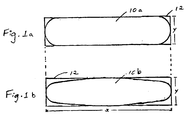
- Figures 1a and 1b are cross-sectional views of preferred monofilaments in accordance with the invention.
- Polymers useful for monofilaments in accordance with the invention include various thermoplastic homopolymers and copolymers having sufficiently high molecular weights to achieve high strength monofilaments.
- Polyamide homopolymers and copolymers having a relative viscosity of above about 50 on a formic acid basis are particularly useful.
- Polyamides for producing monofilaments of the invention include poly(hexamethylene adipamide) and poly( ⁇ -caproamide), poly(tetramethylene adipamide), etc., and their copolymers.
- the polyamide is at least about 90% of one of poly-( ⁇ -caproamide) or poly(hexamethylene adipamide).
- the polyamide is homopolymer poly(hexamethylene adipamide).
- Polyester homopolymers and copolymers having an intrinsic viscosity of above about 0.7 are also advantageously employed.
- Polyesters include poly-(ethylene terephthalate), poly-(propylene terephthalate), poly-(butylene terephthalate), poly-(ethylene 2,6 napthoate), poly-(1,4 cyclohexanedimethanol terephthalate), and their copolymers. Particularly preferred is poly(ethylene terephthalate).
- Monofilaments in accordance with the invention are produced by spinning the polymer in a process which produces high strength monofilaments.
- the process of US-A-4,009,511 is particularly preferred because the use of steam in the first stage draw produces a highly deoriented layer on the filament surface of about 3 to about 15 microns thick which has a lower orientation than the core of the filament.
- This surface layer is characterized by a parallel refractive index, n
- the deoriented surface is believed to be responsible for the superior bonding of polyamide monofilaments having such surface to rubber when an adhesive such as resorcinol formaldehyde latex (RFL) is employed.
- RTL resorcinol formaldehyde latex
- polyesters particularly poly(ethylene terephthalate)
- the process described in US-A-3,963,678 is useful for making polyester monofilaments in accordance with the invention provided that a suitable spinneret, e.g., rectangular, obround, oval, etc. is employed as will become more apparent hereinafter.
- the monofilaments 10 of the invention have an oblong cross-section.
- oblong it is intended to refer to any of a variety of elongated cross-sectional shapes which are circumscribed by a rectangle 12 as shown in Figures 1a-1b with its width (major dimension) designated in the drawing by "x” greater than its thickness (minor dimension) designated by "y”.
- the cross-section is obround as shown in Figure 1a, i.e., having a generally rectangular cross-section with rounded corners or semicircular ends and thus is produced by spinning through an obround or rectangular spinneret.
- the resulting monofilament has a cross-section which may vary somewhat from the cross-section of the spinneret and may assume some oval character and the "flat" areas may be somewhat convex.
- obround is intended to refer to obround cross-sections or those which approximate obround cross-sections.
- Other preferred embodiments include monofilaments with an oval cross-section as shown in Figure 1b.
- the width-to-thickness ratio of the monofilaments i.e., the width x of the circumscribing rectangle divided by the thickness y, is greater than about 2.0. While the advantages of the invention are realized increasingly with increasing width-to-thickness ratios, a practical upper limit for the monofilaments is ultimately reached when the intended use of the monofilaments is for rubber reinforcement. At a constant rivet area of, for example, 35% (relative space between monofilaments maintained constant at 35%), the spacing needed between adjacent cords can become so large that there will be insufficient support for the rubber between cords resulting in rubber failure.
- width-to-thickness ratio of monofilaments of the invention not to exceed about 20.
- modification ratio of monofilaments in accordance with the invention is greater than about 4.0.
- modification ratio refers to the ratio of the diameter of the smallest circumscribing circle to the diameter of the largest inscribing circle determined by the monofilament cross-sectional surface.
- the tenacity of the monofilaments in accordance with the invention is greater than about 6.6 dN/tex (7.5 g/d) and, when the polymer is a polyamide at least about 90% of which is one of poly-( ⁇ -caproamide) or poly(hexamethylene adipamide), is preferably greater than about 7.1 dN/tex (8.0 g/d).
- the modulus is above about 40 dN/tex (45 g/d) and preferably is above about 44 dN/tex (50 g/d) when the polymer is a polyamide at least about 90% of which is one of poly-( ⁇ -caproamide) or poly(hexamethylene adipamide).
- the toughness of the monofilaments is greater than about 0.6 dN-cm/tex-cm (0.7 g-cm/denier-cm). Knot strength for polyamide monofilaments is above about 4.4 dN/tex (5.0 g/d).
- the dtex (denier) of the monofilaments is above about 1100 (1,000) and can be as great as about 13,300 (12,000) or more. Since the advantages of the monofilaments of the invention are more pronounced at high linear densities, monofilaments having a dtex of greater than about 2,200 are preferred.
- the shrinkage is less than 6%, preferably less than 4.5%, otherwise the size and uniformity of tires, belts and similar products are adversely affected.
- the "ready-for-rubber" monofilaments of this invention have an adhesive coating on the filaments which facilitates the bonding of the filament to rubber.
- the most commonly used coating contains a combination of resorcinol, formaldehyde and latex, and is commonly referred to as RFL.
- Other adhesive coatings could be used as long as they promote the bonding between the monofilament and rubber. Surprisingly, low levels of RFL on the monofilaments, 0.5-6.0%, yield good adhesion to rubber.
- the adhesive coating can be applied to the monofilament by any of the typical processes for coating a monofilament, such as dipping in a bath containing a dispersion or solution of adhesive materials, spraying a dispersion or solution of adhesive materials on the filament, applying molten or neat liquid adhesive on the filament, etc.
- the untwisted monofilament is dipped in an aqueous dispersion of the adhesive, such as RFL, so that 0.5-6.0 weight percent adhesive is picked up (dry weight of adhesive on dry-weight filament basis).
- the still-wet monofilament is oven treated at 150-260°C (300-500°F) to dry and set the monofilament in one or more stages.
- the monofilament tension is controlled during the heating stages and the monofilament may be stretched or relaxed during the heating stages depending on the final cord properties desired.
- the dipping, stretching, setting conditions for the monofilament are adjusted to suit the oriented polymer of the monofilament and the end-use for which it is to be used.
- a typical precoat for polyester contains a mixture of LVBI isocyanate, gum tragacanth and epoxy resin (N.E.R.-10A) as an aqueous dispersion.
- Other epoxy, aziridine, isocyanate or urethane precoats can be used, or combinations of such precoats.
- the monofilament of this invention is ready for direct embedment in rubber.
- the product does not require any of the following steps: singles or ply twisting, weaving, adhesive dipping, stretching or setting.
- the monofilament requires no twist while it is well known that analogous multifilament yarns require singles and ply twisting to achieve the desired level of fatigue resistance in tires.
- Creel calendaring i.e., embedding a warp of nonwoven monofilament ends in rubber to produce a fabric with the monofilaments in a generally parallel and evenly spaced-apart relationship, is advantageously employed to produce rubber fabrics suitable for use in tire building.
- Monofilaments in accordance with the invention are useful for various applications where multifilament yarns and cords are now used such as rubberized and unrubberized industrial fabrics and braided products and are used similarly to such multifilament yarns and cords.
- the monofilaments are particularly well-suited for applications where high flexibility is needed along with high denier.
- multifilament yarns and cords are woven or braided into "narrow fabrics" which conventionally have relatively poor abrasion resistance.
- Narrow fabrics can be made of monofilaments in accordance with the invention which have good flexibility and also high abrasion resistance.
- Relative Viscosity of polyamides refers to the ratio of solution and solvent viscosities measured in capillary viscometer at 25°C.
- the solvent is formic acid containing 10% by weight of water.
- the solution is 8.4% by weight polyamide polymer dissolved in the solvent.
- Width and Thickness are measured with a Starrett Model 722 digital caliper or equivalent instrument. For width measurements it is convenient to fold the monofilament into a "V” and measure both sides of the "V” at the same time, being sure to keep the vertex of the "V” just outside the measured zone. This technique assures that the monofilament does not tilt between the faces of the measuring instrument giving a low reading.
- Linear density The monofilament is conditioned at 55 ⁇ 2% relative humidity, and 24 ⁇ 1°C (75 ⁇ 2°F) on the package for a specified period, usually 24 hours when the monofilament has aged more than ten days since being made. A nine meter sample of the monofilament is weighed. dtex (Denier) is calculated as the weight of a 10,000 (9000) meter sample in grams. A linear density correction for any adhesive present on cord or monofilaments is made based on the measured amount of adhesive on the filament as determined below.
- Weight % adhesive on monofilament Adhesive on monofilament is determined by weighing an adhesive treated sample that has been cut into short (2.5 cm (1 inch) or less) sections. The polymer portion of the cut sample is then dissolved in an appropriate solvent (hot formic acid for polyamide, trichloroacetic acid and methylene chloride mixture for polyester). After rinsing and drying, the weight of the undissolved adhesive is measured and the % adhesive on monofilament determined by dividing the weight of undissolved adhesive by the weight of the monofilament without adhesive and multiplying by 100.
- an appropriate solvent hot formic acid for polyamide, trichloroacetic acid and methylene chloride mixture for polyester
- Yarn shrinkage was determined by the basic method of ASTM D-885-85, Section 30.3 as described in: "1988 Annual Book of ASTM standards; Vol. 07.01; Textiles, Yarns, Fabrics and General Test Methods.” Specifically, the yarns were heated at 177°C. in hot air for two minutes at 0.05 gm. per denier restraining force. The test device was a "Testrite Thermal shrinkage Oven".
- Tensile Properties Before tensile testing of as-spun monofilaments, the monofilament is conditioned on the package for a minimum specified period at 55 ⁇ 2% relative humidity, and 24 ⁇ 1°C (75 ⁇ 2°F) (unless otherwise noted). This period is usually 24 hours when the filament has aged more than ten days since spinning.
- the denier and tensiles for any dipped cords reported herein are measured on samples relax-conditioned in skein form at the time, temperature and humidity indicated above.
- a recording Instron unit is used to characterize the stress/strain behavior of the conditioned monofilament.
- Samples are gripped in air-activated Type 4-D Instron clamps maintained at at least 280 kPa (40 psi) pressure. Samples are elongated to break while continuously recording monofilament stress as a function of strain. Initial gauge length is 25 cm (10 inches), and cross head speed is maintained at a constant 30 cm/minute (12 inches/minute). On monofilaments 24 hours old or less, tensile properties were measured at a constant crosshead speed of 15 cm/minute (6 inches/minute).
- Break Strength is the maximum load achieved prior to rupture of the sample and is expressed in Newton (pounds or kilograms).
- Tenacity is calculated from the break strength divided by the linear density (denier) (after correcting for any adhesive on the filament) and is expressed as dN/tex (grams per denier (g/d)).
- Elongation is the strain in the sample when it ruptures.
- Modulus is the slope of the tangent line to the initial straight line portion of the stress strain curve, multiplied by 100 and divided by the dip-free denier. The modulus is generally recorded at less than 2% strain.
- the knot tensiles are measured in the same manner as straight tensiles except that a simple overhand knot is tied in the monofilament at about the midpoint of the sample to be tested.
- the simple overhand knot is made by crossing a length of monofilament on itself at about the midpoint of its length and pulling one end through the loop so formed. Since the monofilament tends to assume some of the curvature of the wind-up package, the knot is tied with and against this curvature on separate samples and the two values averaged.
- Toughness is measured by dividing the area underneath the stress-strain curve by the product of the Instron gauge length and the corrected linear density.
- Fabric Bending Stiffness Fabric bending rigidity is measured by using a Mitex MK II Bending Tester manufactured by IDR, Needham, Massachusetts. In this test, a fabric sample about 5.1 cm. (2 inches) long and .95 cm (.375 inches) wide is cut from a rubberized fabric containing the test cords aligned parallel to one another and to the long (5.1 cm) dimension of the sample. This sample is inserted between pins mounted on the sample block and between the pin on the micrometer and the arm of the force transducer. Then, the pin mounted on the micrometer is adjusted to bring the fabric sample into light contact with the arm of the force transducer. The distance from the sample block pin to transducer arm is 1 inch.
- the maximum curvature is 0.59 cm ⁇ 1 (1.5 in. ⁇ 1).
- the outputs of the force transducers and a transducer which measures block rotation are fed to an X-Y recorder. Since the bending moment on the sample equals the force on the force transducer times the distance between the sample block pin and the arm of the force transducer and the curvature is proportional to the block rotation, the output plot gives the yarn moment-curvature response.
- the slope of the moment-curvature plot equals the sample rigidity and has units of force-length2.
- the instrument is calibrated before measurements are made by measuring the slope of a stainless steel strip of calculated rigidity, 0.0051 cm. (0.002 inch) thick and 1.27 cm. (0.5 inch) wide inserted in place of the fabric.
- the slope of the calibration strip plot is divided into the calibration strip's calculated rigidity to give the calibration factor.
- the rigidity of any unknown fabric sample equals its slope times the calibration factor.
- the fabric bending stiffness (cm2.N/cm (in2-lbs/in.)) is determined by dividing R by the width of the sample strip (0.952 cm (0.375 in.)).
- Flex Fatigue is measured by determining the strength loss in test cords after cycling a 2-ply rubberized strip containing the test cord over a small pulley. 2-ply strips are prepared by wrapping a 23 x 46 cm (9"x18") sheet of 0.38 mm (.015") 80:20 NR:SBR rubber on a building drum. RFL adhesive treated test cord is then wound onto the drum using a lathe to uniformly control cord spacing. End count is adjusted to provide 35% rivet area. A second layer of 0.38 mm (.015") rubber is then applied and the composite is stitched to remove entrapped air.
- the assembly is removed from the drum, cut into two 20 x 23 cm (8"x9") pieces (cord parallel to the 23 cm (9") direction), and placed on top of one another such that the cords in each ply are parallel to one another.
- a 5.1 x 20 cm (2"x8") strip of cotton duck (provides gripping surface for clamps in fatigue tester) is applied across each end of the warp and a 0.76 mm (.030") (13 x 20 cm (5"x8”)) sheet of rubber is used to fill in the area between the two cotton strips. These same materials are applied to the opposite side of the pad.
- the 2 ply pad is then cured in a platen press for 20 min at 160 °C under 62,300 N (7 tons) pressure.
- the cured pad is cooled, conditioned 8 hours at 55% RH 24°C (75 deg F), and then cut into 2.5 x 23cm (1" x 9") strips.
- the strips are then bent 180 degrees around a 1.11 cm (7/16") diameter pulley and clamped at each end in the Scott Flex tester (model Z) (manufactured by Scott Testers Inc., Buffalo, N.J.) and loaded at one end to 670 N (150 lb).
- the strip is then flexed over the pulley at a rate of 250 cycles per minute for a total of 230,000 cycles, while maintaining an ambient temperature of 100 deg C.
- Rolling Resistance was measured using the torque sensor method described by R. L. Keefe and A. S. Koralek in their paper "Precision Measurement of Tire Rolling Resistance", ACS Rubber Division Symposium: Tire Rolling resistance (October 1982), pp 78 - 104, D. J. Schuring, ed., 1983. Slip angle was adjusted to provide zero side force and rolling resistance was measured at 80 km/h (50 mph), 210 kPa (30 psi) inflation pressure and 2980 N (670 lb) load for the P155/80R13 tires.
- Cornering Coefficient is measured on the same apparatus used for the rolling resistance measurement. Tires are first exercised for 90 minutes at 117 km/h (70 mph), 100% TRA (Tire and Rim Association) rated load. After cooling, the tires are conditioned 4 hours at 24°C (75 deg F), and 180 kPa (26 psi). The tire is then warmed up for 5 minutes at 56 km/h (35 mph) at the specified test load (838 lbs for P155/80R13). Lateral force is then recorded as a function of slip angle as the tire is steered from 0 to +3 degrees and from 0 to -3 degrees, changing the slip angle at a rate of 1 1/4 degree per second. The slope of the cornering force/slip angle plot (lbs/degree) is divided by the test load on the tire to obtain the cornering coefficient.
- Tire Temperatures The temperatures of running tires were determined by inserting thermocouples into the contained air cavity of the tire during wheel testing. The thermocouples were connected to the tires via a slip-ring assembly and temperatures were monitored continuously.
- This test is designed to induce flex type failures around the turn-up area (without thermal degradation interference) through high load applications.
- the tire is mounted on an appropriate heavy-duty test rim and conditioned at 38°C (100°F) for 4 hours at 165 kPa (24 psi). The pressure is readjusted to the maximum psi allowed for the specified load range and then conditioned for another 4 hours.
- the tire is then tested at 48 km/h (30 mph) in the following sequence until failure: 90% load, 2 hours; 115% load, 2 hours; 150% load, 20 hours; 170% 20 hours; 190% load, 20 hours; and 210% load, until failure.
- Carcass Strength is calculated by multiplying the cord strength in Newton (lbs) by the number of cord ends per cm in the carcass fabric and multiplying that result by the number of carcass plies in the tire.
- This example describes the preparation of 4390 denier poly(hexamethylene adipamide) monofilament with a width-to-thickness and modification ratio of 4.8.
- High quality poly(hexamethylene adipamide) polymer is made in a continuous polymerizer having a relative viscosity of 70 and is extruded into a filament at the rate of 19.6 kg/hr (43 pounds per hour) through a rectangular spinneret orifice having rounded corners (2.24 x 12.7 mm), is passed vertically downward through an air gap of 64.8 cm (25-1/2 inches), and is quenched in water at 22°C for a distance of about 323 cm (127 inches). After water quenching, the amount of residual quench water on the filament is regulated by adjustment of the air flow in an air jet so that quantity of water on the surface of the filament is between 10 and 25% by weight water on the dry weight of the monofilament.
- the wet monofilament is then forwarded in sequence to a puller roll at 117.7 mpm (128.8 ypm), pretension rolls at 117.8 mpm (128.9 ypm), and feed rolls at 120 mpm (131 ypm).
- water is added to the monofilament by contacting the filament with felt wicks supplied at the rate of 3.03 l/h (0.8 gallon per hour) (13% water based on dry weight of the filament) and the filament is forward, into a 36 cm long steamer and treated with saturated steam at 1000 kPa (145 psig) (180°C).
- the steamer has entrance and exit steam expansion chambers connected to a vacuum source to prevent steam from leaking into the plant environment. The draw point is maintained in the entrance steam expansion chamber.
- the monofilament While still in the steamer but near the exit end, the monofilament is run through a bath about 3 cm long containing water at a temperature of about 60°C and flowing at the rate of about four gallons per hour. The surface of the monofilament is cooled in the bath before leaving the steamer. The monofilament is then forwarded to an air stripper which removes most of the surface water from the filament to a level ⁇ 2% water on weight of the dry filament. The monofilament is then forwarded to the first stage draw rolls which are heated to 155°C and running at 446 mpm (488 ypm).
- the filament is then forwarded in three passes through a radiant heater of about 127 cm (50 inches) in length at a mean temperature of about 870°C.
- Three controlled-speed change-of-direction rolls are employed to advance the monofilament through the heater and to control the amount of draw in each pass.
- the roll speed before pass 1 is 463 mpm (506 ypm) before pass 2 is 569 mpm (623 ypm), before pass 3 is 621 mpm (679 ypm), and after pass 3 is 666 mpm (735 ypm).
- the monofilament is then forwarded to second-stage draw rolls running at about 686 mpm (750 ypm), let down rolls at about 673 mpm (736 ypm) and to a wind-up package.
- the tension at wind-up is about 7.3 N (750 grams) and is adjusted to give good package formation.
- the product of the process is an obround 4.8 width-to-thickness and modification ratio monofilament of 4870 dtex (4390 denier) with properties after 24 hours of conditioning of: Tenacity (dN/tex (gpd)) 8.1 (9.2) Break Elongation (%) 18 Knot strength (dN/tex (gpd)) 4.8 (5.4) Modulus (dN/tex (gpd)) 46 (52.0) Width (cm (inches)) 0.141 (.058) Thickness (cm (inches)) 0.030 (.012) Toughness (dN-cm/tex-cm (g-cm/denier-cm)) 0.66 (.75)
- Monofilament tire cords were prepared from monofilament of this Example by the method described in Example 3 hereinafter and demonstrated the following fully conditioned properties: Dtex (fully cond.) 5040 (4540 denier) Dip Pick-Up, % 6.0 Brk. Str., N (kg) 380 (39) 177°C Shrinkage, % 4.7 Toughness (dN-cm/tex-cm) 0.72 (.82g-cm/denier-cm) Modulus (dN/tex) 0.42 (.48 gpd)
- This example describes the preparation of 6192 denier poly(hexamethylene adipamide) monofilament with a width-to-thickness and modification ratio of 4.4.
- High quality poly(hexamethylene adipamide) polymer is made in a continuous polymerizer having a relative viscosity of 70 and is extruded into a filament at the rate of 19.5 kg/hr (43 pounds per hour) through a rectangular spinneret orifice having rounded corners (2.44 x 12.7 mm), is passed vertically downward through an air gap of 64.8 cm (25-1/2 inches), and is quenched in water at 22°C for a distance of about 287 cm (113 inches). After water quenching, the amount of residual quench water on the filament is regulated by adjustment of the air flow in an air jet so that quantity of water on the surface of the filament is between 10 and 25% by weight water on the dry weight of the monofilament.
- the wet monofilament is then forwarded in sequence to a puller roll at 83.8 mpm (91.7 ypm), pretension rolls at 83.9 mpm (91.8 ypm), and feed rolls at 85.1 mpm (93.1 ypm).
- water is added to the monofilament by contacting the filament with felt wicks supplied at the rate of 3.03 l/h (0.8 gallon per hour) (13% water based on dry weight of the filament) and the filament is forwarded into a 36 cm long steamer and treated with saturated steam at 1000 kPa (145 psig) (180°C).
- the steamer has entrance and exit steam expansion chambers connected to a vacuum source to prevent steam from leaking into the plant environment. The draw point is maintained in the entrance steam expansion chamber.
- the monofilament While still in the steamer but near the exit end, the monofilament is run through a bath about 3 cm long containing water at a temperature of about 60°C and flowing at the rate or about 15 l/h (four gallons per hour). The surface of the monofilament is cooled in the bath before leaving the steamer. The monofilament is then forwarded to an air stripper which removes most of the surface water from the filament to a level ⁇ 2% water on weight of the dry filament. The monofilament is then forwarded to the first stage draw rolls which are heated to 155°C and running at 318 mpm (348 ypm).
- the filament is then forwarded in three passes through a radiant heater of about 127 cm (50 inches) in length at a mean temperature of about 870°C.
- Three controlled-speed change-of-direction rolls are employed to advance the monofilament through the heater and to control the amount of draw in each pass.
- the roll speed before pass 1 is 330 mpm (361 ypm)
- before pass 2 is 405 mpm (443 ypm)
- before pass 3 is 434 mpm (474 ypm)
- after pass 3 is 478 mpm (523 ypm).
- the monofilament is then forwarded to second-stage draw rolls running at about 488 mpm (534 ypm), let down rolls at about 479 mpm (524 ypm) and to a wind-up package.
- the tension at wind-up is about 8.8 N (900 grams) and is adjusted to give good package formation.
- the product of the process is an obround 4.4 width-to-thickness and modification ratio monofilament of 6813 dtex (6192 denier) with 24 hour conditioned properties of: Tenacity (dN/tex (gpd)) 8.0 (9.1) Knot strength (dN/tex (gpd)) 4.8 (5.5) Modulus (dN/tex (gpd)) 45 (51.0) Width (mm (inches)) 1.68 (.066) Thickness (mm (inches)) 0.38 (.015) Toughness (dN-cm/tex-cm (g-cm/denier-cm)) .72 (.82)
- Monofilament tire cords were prepared from monofilament of this Example by the method described in Example 3 hereinafter and demonstrated the following fully conditioned properties: Dtex (fully cond.) 7000 (6310 denier) Dip Pick-Up, % 5.1 Brk. Str., N (kg) 520 (53) 177°C Shrinkage, % 4.3 Toughness (dN-cm/tex-cm (gm-cm/denier-cm)) .68 (.77) Modulus (dN/tex (gpd)) 41 (46)
- control and example 3 radial tires were assembled in two stages on a radial tire manufacturing machine made by NRM, Inc., Model RF 1216.
- the assembled tires were molded and cured in a Bag-O-Matic curing press manufactured by Akron Standard Co.
- the D-417B dip bath used for the Control polyester tire cords was composed of: water (83.7 parts by weight); Gum Tragacanth, 2% solution (2.0 parts by weight); N.E.R.-010A Epoxy resin (1.4 parts by weight); and LVBI Isocyanate slurry, 25% dispersion (12.9 parts by weight).
- D-5A is a resorcinol-formaldehyde latex-based adhesive and is applied on top of isocyanate-based subcoat adhesive to promote adhesion of cord to rubber when preparing polyester tire cords. When preparing nylon monofilament tire cords, D-5A is used without the isocyanate subcoat.
- Radial passenger tires were built utilizing one ply of polyester fabric for carcass reinforcement, two plies of 1x4 x .25 steel cord for belts, and one ply of nylon fabric for a cap ply.
- the yarn utilized for the carcass cord was conventional 1100 dtex (1,000 denier), 192 filament T-900 tire yarn from Hoechst-Celanese Co. This yarn was twisted into a 1100/1/2 cord construction with 11 turns per inch twist imparted in both plying and cabling steps. This cord was then hot stretched in a two oven process using a conventional 2-step polyester adhesive dip. Specific conditions employed were 240/210°C (470/420°F), 50/80 seconds exposure time, 3/0% applied stretch, D417B/D-5A adhesive.
- the carcass fabric was then formed from a single end of cord using a drum winding process so that the resulting fabric had the cords running, in a generally evenly-spaced apart relationship.
- Two plies of 0.51 mm (20 mil) skim rubber 80% natural rubber/20% styrene butadiene rubber
- Belt plies and cap plies were formed from steel cord and 930/1/2 nylon cord respectively, using similar drum winding processes.
- P155/80R13 tires were then built from this fabric using the NRM Corp. tire building equipment.
- P155/80R13 radial passenger tires were built using a construction identical to the Radial Control except that one ply or the 5040 dtex (4540 denier) poly(hexamethylene adipamide) monofilament of Example 1 (obround cross-section with a width-to-thickness and modification ratio of 4.8, a break strength of 382 N (39 kg) and a relative viscosity of 70) was used for carcass reinforcement.
- Process conditions used to dip-stretch the monofil cord were 210°C (420°F)/60 seconds exposure/1.5% applied stretch.
- a single step adhesive (20%D-5A) was all that was required for the monofil. (See Table at end of Example 1). The number of ends of monofil in the fabric was adjusted to provide the same carcass strength as in the polyester Radial Control fabric.
- Example 3 monofilament tires exhibited clearly superior durability in bead area endurance (BAE) testing on the indoor test wheel.
- the monofilament tires were slightly cooler running as evidenced by contained air temperatures (CAT) monitored by a thermocouple during BAE testing.
- the bending stiffness of the monofilament fabric made from Example 1 and used to construct the tire carcass was significantly lower than equal carcass strength fabric made from multifilament 1100/1/2 polyester cord that had only about 1/2 the total linear density of the 4940 dtex (4450 denier) monofilament (Table 2).
Landscapes
- Engineering & Computer Science (AREA)
- Textile Engineering (AREA)
- Mechanical Engineering (AREA)
- Chemical & Material Sciences (AREA)
- Chemical Kinetics & Catalysis (AREA)
- General Chemical & Material Sciences (AREA)
- Artificial Filaments (AREA)
- Spinning Methods And Devices For Manufacturing Artificial Fibers (AREA)
- Tires In General (AREA)
- Yarns And Mechanical Finishing Of Yarns Or Ropes (AREA)
- Ropes Or Cables (AREA)
- Polyesters Or Polycarbonates (AREA)
- Addition Polymer Or Copolymer, Post-Treatments, Or Chemical Modifications (AREA)
- Multicomponent Fibers (AREA)
- Treatments For Attaching Organic Compounds To Fibrous Goods (AREA)
Abstract
Description
- The present invention relates to high tenacity monofilaments suitable for a variety of applications including use as reinforcement in rubber products. More particularly, the invention relates to monofilaments with high tenacity and an oblong cross-section and a rubberized fabric containing such monofilaments.
- Nylon or polyester multifilament yarns are typically used in ropes, cables, braided structures, and industrial fabrics and for reinforcement of tires, belts, hoses and other mechanical rubber products. For use as rubber reinforcement, cords are produced from the multifilament yarns which are comprised of an appropriate number of singles yarns plied together to produce total linear densities (deniers) ranging from about 1660 (1500) to about 6700 dtex (6000 den) or more. In such cords, the yarns and the cord itself is twisted and has a generally round shape in cross-section.
- While it is otherwise advantageous to produce multifilament cords higher in linear density to increase strength, the resulting thick, generally round cross-section cords have several disadvantages. Bending moment increases exponentially with the thickness and, consequently, there is difficulty in fabricating and manipulating articles reinforced with such cords. Due to the thickness, tires incorporating such cords require more rubber than is otherwise needed which increases the cost and results in heat build-up in the tire in use. In non-rubber applications, products containing multifilament yarns of all deniers are subject to damage by abrasion.
- High tenacity monofilaments are known as an alternative to multifilament yarns. The use of monofilaments in tires is disclosed in US-A-4,009,551 and US-A-4,056,652 and in Product Licensing Index, April 1972. EP-A-0 312 038 discloses a radial tire containing monofilaments. However, known high tenacity monofilaments have not provided sufficient improvement over multifilament yarns to be employed widely. Other known uses of monofilaments include tennis racket strings as disclosed in US-A-4,055,941 containing from two to four monofilaments and as fishing line as disclosed in EP-A-0 312 039
- The 6-6 nylon monofilaments disclosed in US-A-4,056,652 are melt-spun through a round, an obround or a rectangular (rounded corners), relatively large, spinneret orifice and have a round or obround cross-section with a width-to-thickness ratio of 2.7. They have a linear density greater than 1100, a straight tenacity of 8.1 dN/tex. Such monofilaments have a surface layer 3.9 micrometer thick. The surface layer have an orientation lower than the core and parallel refractive index for the polymer in said surface layer of 1.565.
- The invention as claimed in claims 1 and 16 solves the problem of how to provide a filament which makes it possible to reduce the number of cords when used as rubber reinforcement, to reduce the amount of rubber required in a fabric and to improve the fatigue resistance in rubber products.
- In a preferred form of the invention, the monofilament is "ready-for-rubber" and the surface of the monofilament has an adhesive coating of from about 0.5 to about 6.0 percent by weight based on the weight of the monofilament and the monofilament has a shrinkage of less than about 6%, most preferably less than 4.5%.
- A rubberized fabric in accordance with the invention comprises a rubber matrix containing the high strength, high modification ratio monofilaments as reinforcement, preferably with the monofilaments being substantially free of twist and arranged in the fabric in a generally parallel, generally evenly spaced-apart relationship.
- The monofilaments in accordance with the present invention have advantages in a variety of end-uses and provide for greater productivity in their manufacture when compared with multifilament cords and known monofilaments. In rubber reinforcement applications, monofilaments in accordance with the invention provide novel reinforced rubber fabrics with fewer cords per length than known rubberized fabrics. At the same time, the monofilaments reduce the amount of rubber required in a fabric having a given strength while providing equivalent or even better fatigue resistance. In a variety of non-rubber applications, monofilaments of the invention provide excellent abrasion resistance and permit very high linear densities to be used with surprisingly low stiffness.
- Figures 1a and 1b are cross-sectional views of preferred monofilaments in accordance with the invention.
- Polymers useful for monofilaments in accordance with the invention include various thermoplastic homopolymers and copolymers having sufficiently high molecular weights to achieve high strength monofilaments. Polyamide homopolymers and copolymers having a relative viscosity of above about 50 on a formic acid basis are particularly useful. Polyamides for producing monofilaments of the invention include poly(hexamethylene adipamide) and poly(ε-caproamide), poly(tetramethylene adipamide), etc., and their copolymers. Preferably, the polyamide is at least about 90% of one of poly-(ε-caproamide) or poly(hexamethylene adipamide). Most preferably, the polyamide is homopolymer poly(hexamethylene adipamide). Polyester homopolymers and copolymers having an intrinsic viscosity of above about 0.7 are also advantageously employed. Polyesters include poly-(ethylene terephthalate), poly-(propylene terephthalate), poly-(butylene terephthalate), poly-(
ethylene 2,6 napthoate), poly-(1,4 cyclohexanedimethanol terephthalate), and their copolymers. Particularly preferred is poly(ethylene terephthalate). - Monofilaments in accordance with the invention are produced by spinning the polymer in a process which produces high strength monofilaments. For polyamide monofilaments, the process of US-A-4,009,511 is particularly preferred because the use of steam in the first stage draw produces a highly deoriented layer on the filament surface of about 3 to about 15 microns thick which has a lower orientation than the core of the filament. This surface layer is characterized by a parallel refractive index, n||, of less than about 1.57 as determined by the method described in US-A-4,009,511. The deoriented surface is believed to be responsible for the superior bonding of polyamide monofilaments having such surface to rubber when an adhesive such as resorcinol formaldehyde latex (RFL) is employed.
- For polyesters, particularly poly(ethylene terephthalate), the process described in US-A-3,963,678 is useful for making polyester monofilaments in accordance with the invention provided that a suitable spinneret, e.g., rectangular, obround, oval, etc. is employed as will become more apparent hereinafter.
- Referring to the Figures 1a and 1b depicting preferred monofilaments in accordance with the invention, the
monofilaments 10 of the invention have an oblong cross-section. By "oblong", it is intended to refer to any of a variety of elongated cross-sectional shapes which are circumscribed by arectangle 12 as shown in Figures 1a-1b with its width (major dimension) designated in the drawing by "x" greater than its thickness (minor dimension) designated by "y". - Preferably, in a monofilament in accordance with the invention, the cross-section is obround as shown in Figure 1a, i.e., having a generally rectangular cross-section with rounded corners or semicircular ends and thus is produced by spinning through an obround or rectangular spinneret. Depending on the viscosity of polymer as extruded, the resulting monofilament has a cross-section which may vary somewhat from the cross-section of the spinneret and may assume some oval character and the "flat" areas may be somewhat convex. As used herein for cross-sections of monofilaments, obround is intended to refer to obround cross-sections or those which approximate obround cross-sections. Other preferred embodiments include monofilaments with an oval cross-section as shown in Figure 1b.
- The width-to-thickness ratio of the monofilaments, i.e., the width x of the circumscribing rectangle divided by the thickness y, is greater than about 2.0. While the advantages of the invention are realized increasingly with increasing width-to-thickness ratios, a practical upper limit for the monofilaments is ultimately reached when the intended use of the monofilaments is for rubber reinforcement. At a constant rivet area of, for example, 35% (relative space between monofilaments maintained constant at 35%), the spacing needed between adjacent cords can become so large that there will be insufficient support for the rubber between cords resulting in rubber failure. Also, in a variety of applications, as the width-to-thickness ratio becomes very large (film-like filament) high shear and bending stresses will ultimately cause filament buckling and splitting. Thus, it is generally preferable for the width-to-thickness ratio of monofilaments of the invention not to exceed about 20.
- The modification ratio of monofilaments in accordance with the invention is greater than about 4.0. Viewing the monofilaments in cross-section, modification ratio refers to the ratio of the diameter of the smallest circumscribing circle to the diameter of the largest inscribing circle determined by the monofilament cross-sectional surface.
- The tenacity of the monofilaments in accordance with the invention is greater than about 6.6 dN/tex (7.5 g/d) and, when the polymer is a polyamide at least about 90% of which is one of poly-(ε-caproamide) or poly(hexamethylene adipamide), is preferably greater than about 7.1 dN/tex (8.0 g/d). The modulus is above about 40 dN/tex (45 g/d) and preferably is above about 44 dN/tex (50 g/d) when the polymer is a polyamide at least about 90% of which is one of poly-(ε-caproamide) or poly(hexamethylene adipamide). When the monofilament is a polyamide monofilament, the toughness of the monofilaments is greater than about 0.6 dN-cm/tex-cm (0.7 g-cm/denier-cm). Knot strength for polyamide monofilaments is above about 4.4 dN/tex (5.0 g/d).
- The dtex (denier) of the monofilaments is above about 1100 (1,000) and can be as great as about 13,300 (12,000) or more. Since the advantages of the monofilaments of the invention are more pronounced at high linear densities, monofilaments having a dtex of greater than about 2,200 are preferred.
- In preferred monofilaments of the invention which are "ready-for-rubber" and can be incorporated into rubber products without operations such as stretching and dipping, the shrinkage is less than 6%, preferably less than 4.5%, otherwise the size and uniformity of tires, belts and similar products are adversely affected. The "ready-for-rubber" monofilaments of this invention have an adhesive coating on the filaments which facilitates the bonding of the filament to rubber. The most commonly used coating contains a combination of resorcinol, formaldehyde and latex, and is commonly referred to as RFL. Other adhesive coatings could be used as long as they promote the bonding between the monofilament and rubber. Surprisingly, low levels of RFL on the monofilaments, 0.5-6.0%, yield good adhesion to rubber.
- The adhesive coating can be applied to the monofilament by any of the typical processes for coating a monofilament, such as dipping in a bath containing a dispersion or solution of adhesive materials, spraying a dispersion or solution of adhesive materials on the filament, applying molten or neat liquid adhesive on the filament, etc. In a preferred process, the untwisted monofilament is dipped in an aqueous dispersion of the adhesive, such as RFL, so that 0.5-6.0 weight percent adhesive is picked up (dry weight of adhesive on dry-weight filament basis). The still-wet monofilament is oven treated at 150-260°C (300-500°F) to dry and set the monofilament in one or more stages. The monofilament tension is controlled during the heating stages and the monofilament may be stretched or relaxed during the heating stages depending on the final cord properties desired. The dipping, stretching, setting conditions for the monofilament are adjusted to suit the oriented polymer of the monofilament and the end-use for which it is to be used. For certain monofilaments, such as polyester, it is helpful to precoat the filament with an adhesion activator, prior to coating with the adhesive. A typical precoat for polyester contains a mixture of LVBI isocyanate, gum tragacanth and epoxy resin (N.E.R.-10A) as an aqueous dispersion. Other epoxy, aziridine, isocyanate or urethane precoats can be used, or combinations of such precoats.
- The monofilament of this invention, prepared with the specified properties, and adhesive coating described above, is ready for direct embedment in rubber. The product does not require any of the following steps: singles or ply twisting, weaving, adhesive dipping, stretching or setting. The monofilament requires no twist while it is well known that analogous multifilament yarns require singles and ply twisting to achieve the desired level of fatigue resistance in tires. Creel calendaring, i.e., embedding a warp of nonwoven monofilament ends in rubber to produce a fabric with the monofilaments in a generally parallel and evenly spaced-apart relationship, is advantageously employed to produce rubber fabrics suitable for use in tire building.
- Monofilaments in accordance with the invention are useful for various applications where multifilament yarns and cords are now used such as rubberized and unrubberized industrial fabrics and braided products and are used similarly to such multifilament yarns and cords. The monofilaments are particularly well-suited for applications where high flexibility is needed along with high denier. In slings, straps, unrubberized belts and similar products, multifilament yarns and cords are woven or braided into "narrow fabrics" which conventionally have relatively poor abrasion resistance. Narrow fabrics can be made of monofilaments in accordance with the invention which have good flexibility and also high abrasion resistance.
- The invention is further illustrated in the examples which follow in which the results reported are determined by the following test methods.
- Conditioning: Large denier monofilaments of this invention require up to 10 days for the moisture content to fully equilibrate with atmospheric moisture. In the testing of filaments described in the following, various periods of time less than that required to achieve full moisture regain were sometimes used. For example, a 2200 dtex (2000 denier) monofilament that is about 0.305 mm (.012") thick takes about three days to equilibrate, but a 6700 dtex (6000 denier) filament that is about 0.46 mm (.018") thick takes about five days. The actual length of time required depends on the thickness of the monofilament. Therefore, the linear densities and linear density dependent properties of the examples changed as testing in sequential steps took place. Each Table states the age/conditioning period applicable to the properties in that table. For properties set forth in the claims, measurement is intended at full moisture equilibration (when two measurements of denier 24 hours apart are the same).
- Relative Viscosity: Relative viscosity of polyamides refers to the ratio of solution and solvent viscosities measured in capillary viscometer at 25°C. The solvent is formic acid containing 10% by weight of water. The solution is 8.4% by weight polyamide polymer dissolved in the solvent.
- Width and Thickness: Width and thickness are measured with a Starrett Model 722 digital caliper or equivalent instrument. For width measurements it is convenient to fold the monofilament into a "V" and measure both sides of the "V" at the same time, being sure to keep the vertex of the "V" just outside the measured zone. This technique assures that the monofilament does not tilt between the faces of the measuring instrument giving a low reading.
- Modification Ratio: Modification Ratio is measured from a photomicrograph of a monofilament cross-section taken perpendicular to the filament axis. Using a compass, the smallest circle that can be circumscribed about the cross section and the largest circle that can be inscribed within the cross section are determined, and the diameters of these two circles measured.


- Linear density: The monofilament is conditioned at 55 ± 2% relative humidity, and 24 ± 1°C (75 ± 2°F) on the package for a specified period, usually 24 hours when the monofilament has aged more than ten days since being made. A nine meter sample of the monofilament is weighed. dtex (Denier) is calculated as the weight of a 10,000 (9000) meter sample in grams. A linear density correction for any adhesive present on cord or monofilaments is made based on the measured amount of adhesive on the filament as determined below.
- Weight % adhesive on monofilament: Adhesive on monofilament is determined by weighing an adhesive treated sample that has been cut into short (2.5 cm (1 inch) or less) sections. The polymer portion of the cut sample is then dissolved in an appropriate solvent (hot formic acid for polyamide, trichloroacetic acid and methylene chloride mixture for polyester). After rinsing and drying, the weight of the undissolved adhesive is measured and the % adhesive on monofilament determined by dividing the weight of undissolved adhesive by the weight of the monofilament without adhesive and multiplying by 100.
- Shrinkage: Yarn shrinkage was determined by the basic method of ASTM D-885-85, Section 30.3 as described in:
"1988 Annual Book of ASTM standards; Vol. 07.01; Textiles, Yarns, Fabrics and General Test Methods." Specifically, the yarns were heated at 177°C. in hot air for two minutes at 0.05 gm. per denier restraining force. The test device was a "Testrite Thermal shrinkage Oven". - Tensile Properties: Before tensile testing of as-spun monofilaments, the monofilament is conditioned on the package for a minimum specified period at 55 ± 2% relative humidity, and 24 ± 1°C (75 ± 2°F) (unless otherwise noted). This period is usually 24 hours when the filament has aged more than ten days since spinning. By contrast, the denier and tensiles for any dipped cords reported herein are measured on samples relax-conditioned in skein form at the time, temperature and humidity indicated above. A recording Instron unit is used to characterize the stress/strain behavior of the conditioned monofilament. Samples are gripped in air-activated Type 4-D Instron clamps maintained at at least 280 kPa (40 psi) pressure. Samples are elongated to break while continuously recording monofilament stress as a function of strain. Initial gauge length is 25 cm (10 inches), and cross head speed is maintained at a constant 30 cm/minute (12 inches/minute). On monofilaments 24 hours old or less, tensile properties were measured at a constant crosshead speed of 15 cm/minute (6 inches/minute).
- Break Strength is the maximum load achieved prior to rupture of the sample and is expressed in Newton (pounds or kilograms).
- Tenacity is calculated from the break strength divided by the linear density (denier) (after correcting for any adhesive on the filament) and is expressed as dN/tex (grams per denier (g/d)).
- Elongation is the strain in the sample when it ruptures.
- Modulus is the slope of the tangent line to the initial straight line portion of the stress strain curve, multiplied by 100 and divided by the dip-free denier. The modulus is generally recorded at less than 2% strain.
- The knot tensiles are measured in the same manner as straight tensiles except that a simple overhand knot is tied in the monofilament at about the midpoint of the sample to be tested. The simple overhand knot is made by crossing a length of monofilament on itself at about the midpoint of its length and pulling one end through the loop so formed. Since the monofilament tends to assume some of the curvature of the wind-up package, the knot is tied with and against this curvature on separate samples and the two values averaged.
- Toughness is measured by dividing the area underneath the stress-strain curve by the product of the Instron gauge length and the corrected linear density.
- Fabric Bending Stiffness: Fabric bending rigidity is measured by using a Mitex MK II Bending Tester manufactured by IDR, Needham, Massachusetts. In this test, a fabric sample about 5.1 cm. (2 inches) long and .95 cm (.375 inches) wide is cut from a rubberized fabric containing the test cords aligned parallel to one another and to the long (5.1 cm) dimension of the sample. This sample is inserted between pins mounted on the sample block and between the pin on the micrometer and the arm of the force transducer. Then, the pin mounted on the micrometer is adjusted to bring the fabric sample into light contact with the arm of the force transducer. The distance from the sample block pin to transducer arm is 1 inch. The sample block moves to bend the sample into circular arcs of progressively increasing curvature (


- The slope of the moment-curvature plot equals the sample rigidity and has units of force-length². The instrument is calibrated before measurements are made by measuring the slope of a stainless steel strip of calculated rigidity, 0.0051 cm. (0.002 inch) thick and 1.27 cm. (0.5 inch) wide inserted in place of the fabric. The rigidity of the stainless steel strip is calculated by the following equation:

where Rc = Rigidity of calibration strip
wc = width of calibration strip = 1.27 cm (0.5 in.)
tc = thickness of calibration strip = 0.0051 cm (0.002 in.)
Ec = Young's modulus of calibration strip = 30,000,000 psi.
therefore:

The slope of the calibration strip plot is divided into the calibration strip's calculated rigidity to give the calibration factor. The rigidity of any unknown fabric sample equals its slope times the calibration factor. - Five fabric samples from each item are measured as above and the results are averaged to give the values for R for the rubberized test fabrics.
- The fabric bending stiffness (cm².N/cm (in²-lbs/in.)) is determined by dividing R by the width of the sample strip (0.952 cm (0.375 in.)).
- Flex Fatigue: Flex fatigue is measured by determining the strength loss in test cords after cycling a 2-ply rubberized strip containing the test cord over a small pulley. 2-ply strips are prepared by wrapping a 23 x 46 cm (9"x18") sheet of 0.38 mm (.015") 80:20 NR:SBR rubber on a building drum. RFL adhesive treated test cord is then wound onto the drum using a lathe to uniformly control cord spacing. End count is adjusted to provide 35% rivet area. A second layer of 0.38 mm (.015") rubber is then applied and the composite is stitched to remove entrapped air. The assembly is removed from the drum, cut into two 20 x 23 cm (8"x9") pieces (cord parallel to the 23 cm (9") direction), and placed on top of one another such that the cords in each ply are parallel to one another. A 5.1 x 20 cm (2"x8") strip of cotton duck (provides gripping surface for clamps in fatigue tester) is applied across each end of the warp and a 0.76 mm (.030") (13 x 20 cm (5"x8")) sheet of rubber is used to fill in the area between the two cotton strips. These same materials are applied to the opposite side of the pad. The 2 ply pad is then cured in a platen press for 20 min at 160 °C under 62,300 N (7 tons) pressure. The cured pad is cooled, conditioned 8 hours at 55% RH 24°C (75 deg F), and then cut into 2.5 x 23cm (1" x 9") strips. The strips are then bent 180 degrees around a 1.11 cm (7/16") diameter pulley and clamped at each end in the Scott Flex tester (model Z) (manufactured by Scott Testers Inc., Providence, N.J.) and loaded at one end to 670 N (150 lb). The strip is then flexed over the pulley at a rate of 250 cycles per minute for a total of 230,000 cycles, while maintaining an ambient temperature of 100 deg C. The cords from the ply closest to the pulley are then removed from the pad (after soaking the pad for 24 hours in a 50/50 blend of Stoddard solvent and Freon 113) and the tensile strength is then measured on an Instron. The retained strength is compared with cord removed from an unflexed pad. Flex fatigue retained strength is determined from the equation:


- Rolling Resistance: Rolling resistance was measured using the torque sensor method described by R. L. Keefe and A. S. Koralek in their paper "Precision Measurement of Tire Rolling Resistance", ACS Rubber Division Symposium: Tire Rolling resistance (October 1982), pp 78 - 104, D. J. Schuring, ed., 1983. Slip angle was adjusted to provide zero side force and rolling resistance was measured at 80 km/h (50 mph), 210 kPa (30 psi) inflation pressure and 2980 N (670 lb) load for the P155/80R13 tires.
- Cornering Coefficient: Cornering coefficient is measured on the same apparatus used for the rolling resistance measurement. Tires are first exercised for 90 minutes at 117 km/h (70 mph), 100% TRA (Tire and Rim Association) rated load. After cooling, the tires are conditioned 4 hours at 24°C (75 deg F), and 180 kPa (26 psi). The tire is then warmed up for 5 minutes at 56 km/h (35 mph) at the specified test load (838 lbs for P155/80R13). Lateral force is then recorded as a function of slip angle as the tire is steered from 0 to +3 degrees and from 0 to -3 degrees, changing the slip angle at a rate of 1 1/4 degree per second. The slope of the cornering force/slip angle plot (lbs/degree) is divided by the test load on the tire to obtain the cornering coefficient.
- Tire Temperatures: The temperatures of running tires were determined by inserting thermocouples into the contained air cavity of the tire during wheel testing. The thermocouples were connected to the tires via a slip-ring assembly and temperatures were monitored continuously.
- Bead Area Endurance of Passenger and Truck Tires: This test is designed to induce flex type failures around the turn-up area (without thermal degradation interference) through high load applications.
- The tire is mounted on an appropriate heavy-duty test rim and conditioned at 38°C (100°F) for 4 hours at 165 kPa (24 psi). The pressure is readjusted to the maximum psi allowed for the specified load range and then conditioned for another 4 hours.
- The tire is then tested at 48 km/h (30 mph) in the following sequence until failure: 90% load, 2 hours; 115% load, 2 hours; 150% load, 20 hours; 170% 20 hours; 190% load, 20 hours; and 210% load, until failure.
- Carcass Strength: Carcass strength is calculated by multiplying the cord strength in Newton (lbs) by the number of cord ends per cm in the carcass fabric and multiplying that result by the number of carcass plies in the tire.
- Rivet Area: Rivet area is a measure of the amount of unreinforced rubber in the carcass or belt plies and is calculated from the following equation:

- This example describes the preparation of 4390 denier poly(hexamethylene adipamide) monofilament with a width-to-thickness and modification ratio of 4.8.
- High quality poly(hexamethylene adipamide) polymer is made in a continuous polymerizer having a relative viscosity of 70 and is extruded into a filament at the rate of 19.6 kg/hr (43 pounds per hour) through a rectangular spinneret orifice having rounded corners (2.24 x 12.7 mm), is passed vertically downward through an air gap of 64.8 cm (25-1/2 inches), and is quenched in water at 22°C for a distance of about 323 cm (127 inches). After water quenching, the amount of residual quench water on the filament is regulated by adjustment of the air flow in an air jet so that quantity of water on the surface of the filament is between 10 and 25% by weight water on the dry weight of the monofilament. The wet monofilament is then forwarded in sequence to a puller roll at 117.7 mpm (128.8 ypm), pretension rolls at 117.8 mpm (128.9 ypm), and feed rolls at 120 mpm (131 ypm). After the feed rolls, water is added to the monofilament by contacting the filament with felt wicks supplied at the rate of 3.03 ℓ/h (0.8 gallon per hour) (13% water based on dry weight of the filament) and the filament is forward, into a 36 cm long steamer and treated with saturated steam at 1000 kPa (145 psig) (180°C). The steamer has entrance and exit steam expansion chambers connected to a vacuum source to prevent steam from leaking into the plant environment. The draw point is maintained in the entrance steam expansion chamber.
- While still in the steamer but near the exit end, the monofilament is run through a bath about 3 cm long containing water at a temperature of about 60°C and flowing at the rate of about four gallons per hour. The surface of the monofilament is cooled in the bath before leaving the steamer. The monofilament is then forwarded to an air stripper which removes most of the surface water from the filament to a level < 2% water on weight of the dry filament. The monofilament is then forwarded to the first stage draw rolls which are heated to 155°C and running at 446 mpm (488 ypm).
- The filament is then forwarded in three passes through a radiant heater of about 127 cm (50 inches) in length at a mean temperature of about 870°C. Three controlled-speed change-of-direction rolls are employed to advance the monofilament through the heater and to control the amount of draw in each pass. The roll speed before pass 1 is 463 mpm (506 ypm) before
pass 2 is 569 mpm (623 ypm), before pass 3 is 621 mpm (679 ypm), and after pass 3 is 666 mpm (735 ypm). The monofilament is then forwarded to second-stage draw rolls running at about 686 mpm (750 ypm), let down rolls at about 673 mpm (736 ypm) and to a wind-up package. The tension at wind-up is about 7.3 N (750 grams) and is adjusted to give good package formation. - The product of the process is an obround 4.8 width-to-thickness and modification ratio monofilament of 4870 dtex (4390 denier) with properties after 24 hours of conditioning of:
Tenacity (dN/tex (gpd)) 8.1 (9.2) Break Elongation (%) 18 Knot strength (dN/tex (gpd)) 4.8 (5.4) Modulus (dN/tex (gpd)) 46 (52.0) Width (cm (inches)) 0.141 (.058) Thickness (cm (inches)) 0.030 (.012) Toughness (dN-cm/tex-cm (g-cm/denier-cm)) 0.66 (.75) - Monofilament tire cords were prepared from monofilament of this Example by the method described in Example 3 hereinafter and demonstrated the following fully conditioned properties:
Dtex (fully cond.) 5040 (4540 denier) Dip Pick-Up, % 6.0 Brk. Str., N (kg) 380 (39) 177°C Shrinkage, % 4.7 Toughness (dN-cm/tex-cm) 0.72 (.82g-cm/denier-cm) Modulus (dN/tex) 0.42 (.48 gpd) - This example describes the preparation of 6192 denier poly(hexamethylene adipamide) monofilament with a width-to-thickness and modification ratio of 4.4.
- High quality poly(hexamethylene adipamide) polymer is made in a continuous polymerizer having a relative viscosity of 70 and is extruded into a filament at the rate of 19.5 kg/hr (43 pounds per hour) through a rectangular spinneret orifice having rounded corners (2.44 x 12.7 mm), is passed vertically downward through an air gap of 64.8 cm (25-1/2 inches), and is quenched in water at 22°C for a distance of about 287 cm (113 inches). After water quenching, the amount of residual quench water on the filament is regulated by adjustment of the air flow in an air jet so that quantity of water on the surface of the filament is between 10 and 25% by weight water on the dry weight of the monofilament. The wet monofilament is then forwarded in sequence to a puller roll at 83.8 mpm (91.7 ypm), pretension rolls at 83.9 mpm (91.8 ypm), and feed rolls at 85.1 mpm (93.1 ypm). After the feed rolls, water is added to the monofilament by contacting the filament with felt wicks supplied at the rate of 3.03 ℓ/h (0.8 gallon per hour) (13% water based on dry weight of the filament) and the filament is forwarded into a 36 cm long steamer and treated with saturated steam at 1000 kPa (145 psig) (180°C). The steamer has entrance and exit steam expansion chambers connected to a vacuum source to prevent steam from leaking into the plant environment. The draw point is maintained in the entrance steam expansion chamber.
- While still in the steamer but near the exit end, the monofilament is run through a bath about 3 cm long containing water at a temperature of about 60°C and flowing at the rate or about 15 ℓ/h (four gallons per hour). The surface of the monofilament is cooled in the bath before leaving the steamer. The monofilament is then forwarded to an air stripper which removes most of the surface water from the filament to a level < 2% water on weight of the dry filament. The monofilament is then forwarded to the first stage draw rolls which are heated to 155°C and running at 318 mpm (348 ypm).
- The filament is then forwarded in three passes through a radiant heater of about 127 cm (50 inches) in length at a mean temperature of about 870°C. Three controlled-speed change-of-direction rolls are employed to advance the monofilament through the heater and to control the amount of draw in each pass. The roll speed before pass 1 is 330 mpm (361 ypm), before
pass 2 is 405 mpm (443 ypm), before pass 3 is 434 mpm (474 ypm), and after pass 3 is 478 mpm (523 ypm). The monofilament is then forwarded to second-stage draw rolls running at about 488 mpm (534 ypm), let down rolls at about 479 mpm (524 ypm) and to a wind-up package. The tension at wind-up is about 8.8 N (900 grams) and is adjusted to give good package formation. - The product of the process is an obround 4.4 width-to-thickness and modification ratio monofilament of 6813 dtex (6192 denier) with 24 hour conditioned properties of:
Tenacity (dN/tex (gpd)) 8.0 (9.1) Knot strength (dN/tex (gpd)) 4.8 (5.5) Modulus (dN/tex (gpd)) 45 (51.0) Width (mm (inches)) 1.68 (.066) Thickness (mm (inches)) 0.38 (.015) Toughness (dN-cm/tex-cm (g-cm/denier-cm)) .72 (.82) - Monofilament tire cords were prepared from monofilament of this Example by the method described in Example 3 hereinafter and demonstrated the following fully conditioned properties:
Dtex (fully cond.) 7000 (6310 denier) Dip Pick-Up, % 5.1 Brk. Str., N (kg) 520 (53) 177°C Shrinkage, % 4.3 Toughness (dN-cm/tex-cm (gm-cm/denier-cm)) .68 (.77) Modulus (dN/tex (gpd)) 41 (46) - The control and example 3 radial tires were assembled in two stages on a radial tire manufacturing machine made by NRM, Inc., Model RF 1216. The assembled tires were molded and cured in a Bag-O-Matic curing press manufactured by Akron Standard Co.
- The D-417B dip bath used for the Control polyester tire cords was composed of: water (83.7 parts by weight); Gum Tragacanth, 2% solution (2.0 parts by weight); N.E.R.-010A Epoxy resin (1.4 parts by weight); and LVBI Isocyanate slurry, 25% dispersion (12.9 parts by weight).
- D-5A is a resorcinol-formaldehyde latex-based adhesive and is applied on top of isocyanate-based subcoat adhesive to promote adhesion of cord to rubber when preparing polyester tire cords. When preparing nylon monofilament tire cords, D-5A is used without the isocyanate subcoat.
- Radial passenger tires were built utilizing one ply of polyester fabric for carcass reinforcement, two plies of 1x4 x .25 steel cord for belts, and one ply of nylon fabric for a cap ply. The yarn utilized for the carcass cord was conventional 1100 dtex (1,000 denier), 192 filament T-900 tire yarn from Hoechst-Celanese Co. This yarn was twisted into a 1100/1/2 cord construction with 11 turns per inch twist imparted in both plying and cabling steps. This cord was then hot stretched in a two oven process using a conventional 2-step polyester adhesive dip. Specific conditions employed were 240/210°C (470/420°F), 50/80 seconds exposure time, 3/0% applied stretch, D417B/D-5A adhesive. The carcass fabric was then formed from a single end of cord using a drum winding process so that the resulting fabric had the cords running, in a generally evenly-spaced apart relationship. Two plies of 0.51 mm (20 mil) skim rubber (80% natural rubber/20% styrene butadiene rubber) were used in preparing the carcass fabric. Belt plies and cap plies were formed from steel cord and 930/1/2 nylon cord respectively, using similar drum winding processes. P155/80R13 tires were then built from this fabric using the NRM Corp. tire building equipment. Other components used in constructing the tire were tread and sidewall sections extruded from styrene-butadiene/natural rubber blends, a 1.3 mm (50 mil) thick sheet of chlorobutyl/natural rubber innerliner, a 0.51 (20 mil) cushion of carcass stock inserted between the innerliner and carcass, and a pair of rubber wrapped 4-wire/4-turn beads. The ends of the carcass ply were turned up over the tire beads, with the end of the ply extending about 5.1 cm (2 inches) above the bead. The green tire was cured at about 146°C (295°F) in the Bag-O-Matic tire curing press using a commercial P155/80R13 tire mold. Additional details of tire construction and radial tire test results are given in Table 1.
- P155/80R13 radial passenger tires were built using a construction identical to the Radial Control except that one ply or the 5040 dtex (4540 denier) poly(hexamethylene adipamide) monofilament of Example 1 (obround cross-section with a width-to-thickness and modification ratio of 4.8, a break strength of 382 N (39 kg) and a relative viscosity of 70) was used for carcass reinforcement. Process conditions used to dip-stretch the monofil cord were 210°C (420°F)/60 seconds exposure/1.5% applied stretch. A single step adhesive (20%D-5A) was all that was required for the monofil. (See Table at end of Example 1). The number of ends of monofil in the fabric was adjusted to provide the same carcass strength as in the polyester Radial Control fabric.
- Tire testing was conducted on two tires per item and the average results are compared in Table 1. The Example 3 monofilament tires exhibited clearly superior durability in bead area endurance (BAE) testing on the indoor test wheel. The monofilament tires were slightly cooler running as evidenced by contained air temperatures (CAT) monitored by a thermocouple during BAE testing. The bending stiffness of the monofilament fabric made from Example 1 and used to construct the tire carcass was significantly lower than equal carcass strength fabric made from multifilament 1100/1/2 polyester cord that had only about 1/2 the total linear density of the 4940 dtex (4450 denier) monofilament (Table 2).
Table 1 TIRE CONSTRUCTION - 1-PLY CARCASS (P155/80R13) Carcass Radial Control Tires Example 10 Tire Polyester Multifilament Polyamide Monofilament (Ex. 5) Construction 1110/1/2 (1000/1/2) 4940 dtex (4450d)* No. Plies 1 1 Cord Gauge, mm (Inches) 0.53 (.021) 0.30x1.5 (.012x.058) Ends per cm (Epi) 9.8 (25) 3.5 (9) Rivet Area, % 47 47 Cord Strength, N (lbs) 130 (30) 380 (85) Carcass Strength, N/cm (lbs/in) 1310 (750) 1340 (765) Plys width, cm (in) 46 (18 1/8) 46 (18 1/8) Drum Set, cm (in) 29 (11-3/8) 29 (11-3/8) Belt 2.5x10.2x0.63 cm (1x4x0.25) wire 2.5x10.2x0.63 cm (1x4x0.25 wire) Ends per cm (epi) 9.8 (25) 9.8 (25) cutting angle 68° 68° width cm (inch) 11.75 (4 5/8") 11.75 (4 5/8") Cap Ply 930/1/2 (840/1/2 nylon) 930/1/2 (840/1/2 nylon) Ends per cm (epi) 9.4 (24) 9.4 (24) cutting angle 0° 0° width cm (inch) 13.1 (5 1/8") 13.1 (5 1/8") Treatment Cure "C" "C" Post Inflation None None Tire Performance Rolling resistance, N (lbs.) 36 (8.1) 34 (7.7) Cornering coefficient N/deg. (lb/deg.) 0.76 (.17) 0.71 (.16) Bead area endurance test -CAT @150% load °C, (°F) 73 (164) 73 (163) -load at failure, % 210 210 -km (miles) at failure 3025 (1880) 4360 (2710) * Fully Conditioned 
Claims (16)
- A monofilament of oriented thermoplastic polymer selected from the class consisting of polyamides comprising at least 90% of at least one of poly(ε-caproamide) or poly(hexamethylene adipamide), said monofilament having an oblong cross-section with a width-to-thickness ratio greater than 2.0 said monofilament having a linear density of greater than 1111 dtex (1000 d), a tenacity of greater than 6.6 dN/tex (7.5 g/d) and a modulus greater than 40 dN/tex (45 g/d), said monofilament having a surface layer at least 3 and less than 15 »m thick, said layer having an orientation lower than the core and a parallel refractive index for the polymer in said surface layer of less then 1.57, characterized by a modification ratio, which refers to the ratio of the diameter of the smallest circumscribing circle to the diameter of the largest inscribing circle determined by the monofilament cross-sectional surface, greater than 4.0.
- The monofilament of claim 1 wherein said thermoplastic polymer is poly(hexamethylene adipamide).
- The monofilament of claim 1 wherein said monofilament has a tenacity of above 7.1 dN/tex (8.0 g/d) and a modulus of greater than 4.4 dN/tex (50 g/d).
- The monofilament of claim 1 wherein said polyamide has a relative viscosity of greater than 50.
- The monofilament of claim 1 wherein said monofilament has a toughness of greater than 0.62 dN-cm/tex-cm (0.7 g-cm/denier-cm).
- The monofilament of claim 1 having a knot strength of greater than 4.4 dN/tex (5.0 g/d).
- The monofilament of claim 1 wherein said cross-section of said monofilament is obround.
- The monofilament of claim 1 having a linear density of greater than 2222 dtex (2000 den).
- The monofilament of claim 1 wherein said width-to-thickness ratio is less than 20.
- A rubberized fabric comprising a rubber matrix containing monofilaments of claim 1 as reinforcement.
- The rubberized fabric of claim 10 wherein said monofilaments are free of twist and are arranged in said fabric in a parallel and evenly spaced-apart relationship.
- The monofilament of any one of claims 1 to 11 wherein the shrinkage of said monofilaments is less than 6% and surface of said monofilament has an adhesive coating of from 0.5 to 6 percent by weight based on the weight of the monofilament.
- The monofilament of claim 12 wherein said shrinkage is less than 4.5%.
- A tire comprising at least one pair of bead portions and at least one carcass ply wrapped around said bead portions wherein each carcass ply comprises a rubberized fabric containing monofilaments as set forth in any one of claims 1 to 9.
- The tire of claim 14 wherein said monofilaments are free of twist and are arranged in said fabric in a parallel and evenly spaced-apart relationship.
- A monofilament of oriented poly(ethylene terephthalate) having an oblong cross-section with a width-to-thickness ratio greater than 2.0 and a modification ratio greater than 4.0, said monofilament having a linear density of greater than 1111 dtex (1000 den), a tenacity of greater than 6.6 dN/tex (7.5 g/d) and a modulus greater than 40 dN/tex (45 g/d).
Applications Claiming Priority (2)
| Application Number | Priority Date | Filing Date | Title |
|---|---|---|---|
| US28875088A | 1988-12-22 | 1988-12-22 | |
| US288750 | 1988-12-22 |
Publications (3)
| Publication Number | Publication Date |
|---|---|
| EP0374357A2 EP0374357A2 (en) | 1990-06-27 |
| EP0374357A3 EP0374357A3 (en) | 1991-07-10 |
| EP0374357B1 true EP0374357B1 (en) | 1995-04-26 |
Family
ID=23108492
Family Applications (1)
| Application Number | Title | Priority Date | Filing Date |
|---|---|---|---|
| EP89112949A Expired - Lifetime EP0374357B1 (en) | 1988-12-22 | 1989-07-14 | High tenacity, oblong cross-section monofilaments |
Country Status (9)
| Country | Link |
|---|---|
| EP (1) | EP0374357B1 (en) |
| JP (1) | JP3013045B2 (en) |
| KR (1) | KR900010103A (en) |
| CN (1) | CN1043757A (en) |
| AT (1) | ATE121807T1 (en) |
| AU (1) | AU618821B2 (en) |
| BR (1) | BR8903508A (en) |
| DE (1) | DE68922380T2 (en) |
| TR (1) | TR26309A (en) |
Cited By (1)
| Publication number | Priority date | Publication date | Assignee | Title |
|---|---|---|---|---|
| US20210323354A1 (en) * | 2020-04-17 | 2021-10-21 | The Goodyear Tire & Rubber Company | Tire with cut protector belt structure |
Families Citing this family (14)
| Publication number | Priority date | Publication date | Assignee | Title |
|---|---|---|---|---|
| US5082611A (en) * | 1988-07-15 | 1992-01-21 | E. I. Du Pont De Nemours And Company | Process for spinning and drawing monofilaments with high tenacity and high tensile uniformity |
| AU619569B2 (en) * | 1988-12-22 | 1992-01-30 | E.I. Du Pont De Nemours And Company | Tire cord monofilaments |
| DE69009855T2 (en) * | 1989-05-01 | 1994-12-08 | Goodyear Tire & Rubber | Radial pneumatic tire. |
| BR9102420A (en) * | 1990-06-14 | 1992-01-14 | Du Pont | POLYESTER MONOFILAMENTS TO REINFORCE TIRES |
| US5173136A (en) * | 1990-10-19 | 1992-12-22 | The Goodyear Tire & Rubber Company | Cut resistant tire with embedded oblong fibers |
| JPH0967732A (en) * | 1995-09-01 | 1997-03-11 | Bridgestone Corp | Polyester monofilament for rubber reinforcement and pneumatic radial tire using the same |
| US6010789A (en) * | 1997-05-05 | 2000-01-04 | E. I. Du Pont De Nemours And Company | Polyester staple fiber |
| DE19732377A1 (en) * | 1997-07-25 | 1999-02-04 | Kirschbaum Sportartikel Gmbh | String for a ball game racket |
| FR3013625B1 (en) * | 2013-11-28 | 2016-06-24 | Michelin & Cie | REINFORCING ELEMENT A SECTION APLATIE |
| FR3013622B1 (en) | 2013-11-28 | 2016-06-24 | Michelin & Cie | PROCESS FOR TREATING AN APLATIE SECTION REINFORCING ELEMENT |
| KR102498390B1 (en) * | 2015-04-22 | 2023-02-13 | 데이진 아라미드 비.브이. | Cord Comprising Multifilament Para-Aramid Yarn Containing Non-Circular Filaments |
| IT201900022524A1 (en) * | 2019-11-29 | 2021-05-29 | Bridgestone Europe Nv Sa | METHOD FOR TREATMENT OF ROPES FOR TIRE REINFORCEMENT LAYERS |
| KR102832225B1 (en) | 2020-09-25 | 2025-07-08 | 코오롱인더스트리 주식회사 | Rubber reinforcing material with reduced weight, method of preparing the same and tire comprising the same |
| US20220176745A1 (en) * | 2020-12-03 | 2022-06-09 | The Goodyear Tire & Rubber Company | Fabric structure for a tire |
Citations (4)
| Publication number | Priority date | Publication date | Assignee | Title |
|---|---|---|---|---|
| EP0350945A2 (en) * | 1988-07-15 | 1990-01-17 | E.I. Du Pont De Nemours And Company | Process for making monofilaments with high tenacity and high tensile uniformity |
| EP0350944A2 (en) * | 1988-07-15 | 1990-01-17 | E.I. Du Pont De Nemours And Company | Monofilament for embedding in rubber |
| EP0356159A2 (en) * | 1988-08-23 | 1990-02-28 | Bridgestone Corporation | Pneumatic tires |
| EP0374356A2 (en) * | 1988-12-22 | 1990-06-27 | E.I. Du Pont De Nemours And Company | Tire cord monofilaments |
Family Cites Families (7)
| Publication number | Priority date | Publication date | Assignee | Title |
|---|---|---|---|---|
| US3298417A (en) * | 1962-12-26 | 1967-01-17 | Du Pont | Pneumatic tire |
| US3650884A (en) * | 1967-02-17 | 1972-03-21 | Du Pont | Polyamide monofilament having a microporous surface layer |
| US4056652A (en) * | 1973-07-04 | 1977-11-01 | E. I. Du Pont De Nemours And Company | Monofilament of polyhexamethylene adipamide having a surface layer of reduced orientation relative to the orientation of the core |
| GB1430449A (en) * | 1973-07-04 | 1976-03-31 | Du Pont | Heavy denier polyamide monofilament and process for the preparation thereof |
| US4055941A (en) * | 1976-12-09 | 1977-11-01 | E. I. Du Pont De Nemours And Company | Integrated string |
| JPS57128212A (en) * | 1981-01-26 | 1982-08-09 | Showa Denko Kk | High-density and high-tenacity polyethylene yarn |
| JPS5988942A (en) * | 1982-11-08 | 1984-05-23 | 東レ株式会社 | Polyamide tire cord and production thereof |
-
1989
- 1989-07-13 AU AU38073/89A patent/AU618821B2/en not_active Ceased
- 1989-07-14 EP EP89112949A patent/EP0374357B1/en not_active Expired - Lifetime
- 1989-07-14 AT AT89112949T patent/ATE121807T1/en not_active IP Right Cessation
- 1989-07-14 DE DE68922380T patent/DE68922380T2/en not_active Expired - Fee Related
- 1989-07-15 JP JP1181665A patent/JP3013045B2/en not_active Expired - Fee Related
- 1989-07-15 KR KR1019890010099A patent/KR900010103A/en not_active Withdrawn
- 1989-07-15 CN CN89106558A patent/CN1043757A/en active Pending
- 1989-07-17 BR BR898903508A patent/BR8903508A/en unknown
- 1989-09-06 TR TR89/0696A patent/TR26309A/en unknown
Patent Citations (4)
| Publication number | Priority date | Publication date | Assignee | Title |
|---|---|---|---|---|
| EP0350945A2 (en) * | 1988-07-15 | 1990-01-17 | E.I. Du Pont De Nemours And Company | Process for making monofilaments with high tenacity and high tensile uniformity |
| EP0350944A2 (en) * | 1988-07-15 | 1990-01-17 | E.I. Du Pont De Nemours And Company | Monofilament for embedding in rubber |
| EP0356159A2 (en) * | 1988-08-23 | 1990-02-28 | Bridgestone Corporation | Pneumatic tires |
| EP0374356A2 (en) * | 1988-12-22 | 1990-06-27 | E.I. Du Pont De Nemours And Company | Tire cord monofilaments |
Cited By (1)
| Publication number | Priority date | Publication date | Assignee | Title |
|---|---|---|---|---|
| US20210323354A1 (en) * | 2020-04-17 | 2021-10-21 | The Goodyear Tire & Rubber Company | Tire with cut protector belt structure |
Also Published As
| Publication number | Publication date |
|---|---|
| TR26309A (en) | 1994-02-10 |
| BR8903508A (en) | 1990-09-25 |
| KR900010103A (en) | 1990-07-06 |
| AU3807389A (en) | 1990-06-28 |
| JPH02175909A (en) | 1990-07-09 |
| DE68922380T2 (en) | 1995-10-26 |
| CN1043757A (en) | 1990-07-11 |
| AU618821B2 (en) | 1992-01-09 |
| EP0374357A2 (en) | 1990-06-27 |
| JP3013045B2 (en) | 2000-02-28 |
| EP0374357A3 (en) | 1991-07-10 |
| DE68922380D1 (en) | 1995-06-01 |
| ATE121807T1 (en) | 1995-05-15 |
Similar Documents
| Publication | Publication Date | Title |
|---|---|---|
| EP0461900B1 (en) | Process for preparing polyester monofilaments | |
| EP2171139B1 (en) | Drawn poly(ethyleneterephthalate) fiber, poly(ethyleneterephthalate) tire-cord, their preparation method and tire comprising the same | |
| EP0374356B1 (en) | Tire cord monofilaments | |
| AU618821B2 (en) | High tenacity, oblong cross-section monofilaments | |
| EP0541133B1 (en) | Monofilaments with high tenacity and high tensile uniformity | |
| KR101869147B1 (en) | Hybrid cord and tire using the same | |
| US5427165A (en) | Reinforcement assemblages with monofilaments of liquid crystal organic polymers | |
| US5240772A (en) | High tenacity, oblong cross-section monofilaments having a modification ratio of at least 4.4 | |
| EP2171140B1 (en) | Drawn poly(ethyleneterephthalate) fiber, poly(ethyleneterephthalate) tire-cord, their preparation method and tire comprising the same | |
| EP0350944B1 (en) | Monofilament for embedding in rubber | |
| US4715418A (en) | Pneumatic tires having high uniformity | |
| US5223187A (en) | Process of making polyester monofilaments for reinforcing tires | |
| US20090151842A1 (en) | Pneumatic run-flat radial tire | |
| US4858666A (en) | Radial tire | |
| JP4569259B2 (en) | Manufacturing method of pneumatic radial tire | |
| JPH09268471A (en) | Polyamide yarn for rubber product reinforcement and method for producing the same | |
| JP4572657B2 (en) | Manufacturing method of pneumatic radial tire | |
| JPH06294072A (en) | Rubber-reinforcing fiber material, pneumatic tire using the same as a reinforcing material, and manufacturing method thereof | |
| JPS60148701A (en) | Pneumatic radial tyre | |
| JPS61132403A (en) | Pneumatic tire for automobile |
Legal Events
| Date | Code | Title | Description |
|---|---|---|---|
| PUAI | Public reference made under article 153(3) epc to a published international application that has entered the european phase |
Free format text: ORIGINAL CODE: 0009012 |
|
| AK | Designated contracting states |
Kind code of ref document: A2 Designated state(s): AT BE DE ES FR GB IT LU NL SE |
|
| 17P | Request for examination filed |
Effective date: 19901227 |
|
| PUAL | Search report despatched |
Free format text: ORIGINAL CODE: 0009013 |
|
| AK | Designated contracting states |
Kind code of ref document: A3 Designated state(s): AT BE DE ES FR GB IT LU NL SE |
|
| 17Q | First examination report despatched |
Effective date: 19920603 |
|
| GRAA | (expected) grant |
Free format text: ORIGINAL CODE: 0009210 |
|
| AK | Designated contracting states |
Kind code of ref document: B1 Designated state(s): AT BE DE ES FR GB IT LU NL SE |
|
| PG25 | Lapsed in a contracting state [announced via postgrant information from national office to epo] |
Ref country code: ES Free format text: THE PATENT HAS BEEN ANNULLED BY A DECISION OF A NATIONAL AUTHORITY Effective date: 19950426 Ref country code: AT Effective date: 19950426 Ref country code: BE Effective date: 19950426 |
|
| REF | Corresponds to: |
Ref document number: 121807 Country of ref document: AT Date of ref document: 19950515 Kind code of ref document: T |
|
| ET | Fr: translation filed | ||
| REF | Corresponds to: |
Ref document number: 68922380 Country of ref document: DE Date of ref document: 19950601 |
|
| ITF | It: translation for a ep patent filed | ||
| PG25 | Lapsed in a contracting state [announced via postgrant information from national office to epo] |
Ref country code: SE Effective date: 19950726 |
|
| PG25 | Lapsed in a contracting state [announced via postgrant information from national office to epo] |
Ref country code: LU Free format text: LAPSE BECAUSE OF NON-PAYMENT OF DUE FEES Effective date: 19950731 |
|
| PLBE | No opposition filed within time limit |
Free format text: ORIGINAL CODE: 0009261 |
|
| STAA | Information on the status of an ep patent application or granted ep patent |
Free format text: STATUS: NO OPPOSITION FILED WITHIN TIME LIMIT |
|
| 26N | No opposition filed | ||
| REG | Reference to a national code |
Ref country code: GB Ref legal event code: IF02 |
|
| REG | Reference to a national code |
Ref country code: GB Ref legal event code: 732E |
|
| REG | Reference to a national code |
Ref country code: GB Ref legal event code: 732E |
|
| PGFP | Annual fee paid to national office [announced via postgrant information from national office to epo] |
Ref country code: NL Payment date: 20050703 Year of fee payment: 17 |
|
| PGFP | Annual fee paid to national office [announced via postgrant information from national office to epo] |
Ref country code: DE Payment date: 20050707 Year of fee payment: 17 |
|
| PGFP | Annual fee paid to national office [announced via postgrant information from national office to epo] |
Ref country code: FR Payment date: 20050708 Year of fee payment: 17 |
|
| PGFP | Annual fee paid to national office [announced via postgrant information from national office to epo] |
Ref country code: GB Payment date: 20050713 Year of fee payment: 17 |
|
| PG25 | Lapsed in a contracting state [announced via postgrant information from national office to epo] |
Ref country code: IT Free format text: LAPSE BECAUSE OF NON-PAYMENT OF DUE FEES;WARNING: LAPSES OF ITALIAN PATENTS WITH EFFECTIVE DATE BEFORE 2007 MAY HAVE OCCURRED AT ANY TIME BEFORE 2007. THE CORRECT EFFECTIVE DATE MAY BE DIFFERENT FROM THE ONE RECORDED. Effective date: 20050714 |
|
| PG25 | Lapsed in a contracting state [announced via postgrant information from national office to epo] |
Ref country code: GB Free format text: LAPSE BECAUSE OF NON-PAYMENT OF DUE FEES Effective date: 20060714 |
|
| PG25 | Lapsed in a contracting state [announced via postgrant information from national office to epo] |
Ref country code: NL Free format text: LAPSE BECAUSE OF NON-PAYMENT OF DUE FEES Effective date: 20070201 Ref country code: DE Free format text: LAPSE BECAUSE OF NON-PAYMENT OF DUE FEES Effective date: 20070201 |
|
| GBPC | Gb: european patent ceased through non-payment of renewal fee |
Effective date: 20060714 |
|
| NLV4 | Nl: lapsed or anulled due to non-payment of the annual fee |
Effective date: 20070201 |
|
| REG | Reference to a national code |
Ref country code: FR Ref legal event code: ST Effective date: 20070330 |
|
| PG25 | Lapsed in a contracting state [announced via postgrant information from national office to epo] |
Ref country code: FR Free format text: LAPSE BECAUSE OF NON-PAYMENT OF DUE FEES Effective date: 20060731 |