EP0371640B1 - A compound containing an oxamic acid group, a process for producing the compound, and a resin composition containing the compound - Google Patents
A compound containing an oxamic acid group, a process for producing the compound, and a resin composition containing the compound Download PDFInfo
- Publication number
- EP0371640B1 EP0371640B1 EP89311622A EP89311622A EP0371640B1 EP 0371640 B1 EP0371640 B1 EP 0371640B1 EP 89311622 A EP89311622 A EP 89311622A EP 89311622 A EP89311622 A EP 89311622A EP 0371640 B1 EP0371640 B1 EP 0371640B1
- Authority
- EP
- European Patent Office
- Prior art keywords
- resin
- group
- oxamic acid
- compound
- acid
- Prior art date
- Legal status (The legal status is an assumption and is not a legal conclusion. Google has not performed a legal analysis and makes no representation as to the accuracy of the status listed.)
- Expired - Lifetime
Links
- 0 C*(C(CC(C)(C)C1)CC1(*)C=I)O Chemical compound C*(C(CC(C)(C)C1)CC1(*)C=I)O 0.000 description 1
Classifications
-
- C—CHEMISTRY; METALLURGY
- C08—ORGANIC MACROMOLECULAR COMPOUNDS; THEIR PREPARATION OR CHEMICAL WORKING-UP; COMPOSITIONS BASED THEREON
- C08G—MACROMOLECULAR COMPOUNDS OBTAINED OTHERWISE THAN BY REACTIONS ONLY INVOLVING UNSATURATED CARBON-TO-CARBON BONDS
- C08G69/00—Macromolecular compounds obtained by reactions forming a carboxylic amide link in the main chain of the macromolecule
- C08G69/48—Polymers modified by chemical after-treatment
-
- C—CHEMISTRY; METALLURGY
- C07—ORGANIC CHEMISTRY
- C07C—ACYCLIC OR CARBOCYCLIC COMPOUNDS
- C07C233/00—Carboxylic acid amides
- C07C233/01—Carboxylic acid amides having carbon atoms of carboxamide groups bound to hydrogen atoms or to acyclic carbon atoms
- C07C233/56—Carboxylic acid amides having carbon atoms of carboxamide groups bound to hydrogen atoms or to acyclic carbon atoms having carbon atoms of carboxamide groups bound to carbon atoms of carboxyl groups, e.g. oxamides
-
- C—CHEMISTRY; METALLURGY
- C07—ORGANIC CHEMISTRY
- C07C—ACYCLIC OR CARBOCYCLIC COMPOUNDS
- C07C271/00—Derivatives of carbamic acids, i.e. compounds containing any of the groups, the nitrogen atom not being part of nitro or nitroso groups
- C07C271/06—Esters of carbamic acids
- C07C271/08—Esters of carbamic acids having oxygen atoms of carbamate groups bound to acyclic carbon atoms
- C07C271/10—Esters of carbamic acids having oxygen atoms of carbamate groups bound to acyclic carbon atoms with the nitrogen atoms of the carbamate groups bound to hydrogen atoms or to acyclic carbon atoms
- C07C271/12—Esters of carbamic acids having oxygen atoms of carbamate groups bound to acyclic carbon atoms with the nitrogen atoms of the carbamate groups bound to hydrogen atoms or to acyclic carbon atoms to hydrogen atoms or to carbon atoms of unsubstituted hydrocarbon radicals
-
- C—CHEMISTRY; METALLURGY
- C08—ORGANIC MACROMOLECULAR COMPOUNDS; THEIR PREPARATION OR CHEMICAL WORKING-UP; COMPOSITIONS BASED THEREON
- C08C—TREATMENT OR CHEMICAL MODIFICATION OF RUBBERS
- C08C19/00—Chemical modification of rubber
- C08C19/22—Incorporating nitrogen atoms into the molecule
-
- C—CHEMISTRY; METALLURGY
- C08—ORGANIC MACROMOLECULAR COMPOUNDS; THEIR PREPARATION OR CHEMICAL WORKING-UP; COMPOSITIONS BASED THEREON
- C08F—MACROMOLECULAR COMPOUNDS OBTAINED BY REACTIONS ONLY INVOLVING CARBON-TO-CARBON UNSATURATED BONDS
- C08F12/00—Homopolymers and copolymers of compounds having one or more unsaturated aliphatic radicals, each having only one carbon-to-carbon double bond, and at least one being terminated by an aromatic carbocyclic ring
- C08F12/02—Monomers containing only one unsaturated aliphatic radical
- C08F12/04—Monomers containing only one unsaturated aliphatic radical containing one ring
- C08F12/14—Monomers containing only one unsaturated aliphatic radical containing one ring substituted by hetero atoms or groups containing heteroatoms
- C08F12/26—Nitrogen
-
- C—CHEMISTRY; METALLURGY
- C08—ORGANIC MACROMOLECULAR COMPOUNDS; THEIR PREPARATION OR CHEMICAL WORKING-UP; COMPOSITIONS BASED THEREON
- C08F—MACROMOLECULAR COMPOUNDS OBTAINED BY REACTIONS ONLY INVOLVING CARBON-TO-CARBON UNSATURATED BONDS
- C08F20/00—Homopolymers and copolymers of compounds having one or more unsaturated aliphatic radicals, each having only one carbon-to-carbon double bond, and only one being terminated by only one carboxyl radical or a salt, anhydride, ester, amide, imide or nitrile thereof
- C08F20/02—Monocarboxylic acids having less than ten carbon atoms, Derivatives thereof
- C08F20/10—Esters
- C08F20/34—Esters containing nitrogen, e.g. N,N-dimethylaminoethyl (meth)acrylate
- C08F20/36—Esters containing nitrogen, e.g. N,N-dimethylaminoethyl (meth)acrylate containing oxygen in addition to the carboxy oxygen, e.g. 2-N-morpholinoethyl (meth)acrylate or 2-isocyanatoethyl (meth)acrylate
-
- C—CHEMISTRY; METALLURGY
- C08—ORGANIC MACROMOLECULAR COMPOUNDS; THEIR PREPARATION OR CHEMICAL WORKING-UP; COMPOSITIONS BASED THEREON
- C08F—MACROMOLECULAR COMPOUNDS OBTAINED BY REACTIONS ONLY INVOLVING CARBON-TO-CARBON UNSATURATED BONDS
- C08F20/00—Homopolymers and copolymers of compounds having one or more unsaturated aliphatic radicals, each having only one carbon-to-carbon double bond, and only one being terminated by only one carboxyl radical or a salt, anhydride, ester, amide, imide or nitrile thereof
- C08F20/02—Monocarboxylic acids having less than ten carbon atoms, Derivatives thereof
- C08F20/52—Amides or imides
- C08F20/54—Amides, e.g. N,N-dimethylacrylamide or N-isopropylacrylamide
- C08F20/60—Amides, e.g. N,N-dimethylacrylamide or N-isopropylacrylamide containing nitrogen in addition to the carbonamido nitrogen
-
- C—CHEMISTRY; METALLURGY
- C08—ORGANIC MACROMOLECULAR COMPOUNDS; THEIR PREPARATION OR CHEMICAL WORKING-UP; COMPOSITIONS BASED THEREON
- C08F—MACROMOLECULAR COMPOUNDS OBTAINED BY REACTIONS ONLY INVOLVING CARBON-TO-CARBON UNSATURATED BONDS
- C08F8/00—Chemical modification by after-treatment
- C08F8/30—Introducing nitrogen atoms or nitrogen-containing groups
-
- C—CHEMISTRY; METALLURGY
- C08—ORGANIC MACROMOLECULAR COMPOUNDS; THEIR PREPARATION OR CHEMICAL WORKING-UP; COMPOSITIONS BASED THEREON
- C08F—MACROMOLECULAR COMPOUNDS OBTAINED BY REACTIONS ONLY INVOLVING CARBON-TO-CARBON UNSATURATED BONDS
- C08F8/00—Chemical modification by after-treatment
- C08F8/44—Preparation of metal salts or ammonium salts
-
- C—CHEMISTRY; METALLURGY
- C08—ORGANIC MACROMOLECULAR COMPOUNDS; THEIR PREPARATION OR CHEMICAL WORKING-UP; COMPOSITIONS BASED THEREON
- C08G—MACROMOLECULAR COMPOUNDS OBTAINED OTHERWISE THAN BY REACTIONS ONLY INVOLVING UNSATURATED CARBON-TO-CARBON BONDS
- C08G18/00—Polymeric products of isocyanates or isothiocyanates
- C08G18/06—Polymeric products of isocyanates or isothiocyanates with compounds having active hydrogen
- C08G18/28—Polymeric products of isocyanates or isothiocyanates with compounds having active hydrogen characterised by the compounds used containing active hydrogen
- C08G18/40—High-molecular-weight compounds
- C08G18/64—Macromolecular compounds not provided for by groups C08G18/42 - C08G18/63
- C08G18/6415—Macromolecular compounds not provided for by groups C08G18/42 - C08G18/63 having nitrogen
- C08G18/643—Reaction products of epoxy resins with at least equivalent amounts of amines
-
- C—CHEMISTRY; METALLURGY
- C08—ORGANIC MACROMOLECULAR COMPOUNDS; THEIR PREPARATION OR CHEMICAL WORKING-UP; COMPOSITIONS BASED THEREON
- C08G—MACROMOLECULAR COMPOUNDS OBTAINED OTHERWISE THAN BY REACTIONS ONLY INVOLVING UNSATURATED CARBON-TO-CARBON BONDS
- C08G59/00—Polycondensates containing more than one epoxy group per molecule; Macromolecules obtained by polymerising compounds containing more than one epoxy group per molecule using curing agents or catalysts which react with the epoxy groups
- C08G59/14—Polycondensates modified by chemical after-treatment
- C08G59/1433—Polycondensates modified by chemical after-treatment with organic low-molecular-weight compounds
- C08G59/1477—Polycondensates modified by chemical after-treatment with organic low-molecular-weight compounds containing nitrogen
-
- C—CHEMISTRY; METALLURGY
- C08—ORGANIC MACROMOLECULAR COMPOUNDS; THEIR PREPARATION OR CHEMICAL WORKING-UP; COMPOSITIONS BASED THEREON
- C08G—MACROMOLECULAR COMPOUNDS OBTAINED OTHERWISE THAN BY REACTIONS ONLY INVOLVING UNSATURATED CARBON-TO-CARBON BONDS
- C08G63/00—Macromolecular compounds obtained by reactions forming a carboxylic ester link in the main chain of the macromolecule
- C08G63/91—Polymers modified by chemical after-treatment
-
- C—CHEMISTRY; METALLURGY
- C08—ORGANIC MACROMOLECULAR COMPOUNDS; THEIR PREPARATION OR CHEMICAL WORKING-UP; COMPOSITIONS BASED THEREON
- C08G—MACROMOLECULAR COMPOUNDS OBTAINED OTHERWISE THAN BY REACTIONS ONLY INVOLVING UNSATURATED CARBON-TO-CARBON BONDS
- C08G73/00—Macromolecular compounds obtained by reactions forming a linkage containing nitrogen with or without oxygen or carbon in the main chain of the macromolecule, not provided for in groups C08G12/00 - C08G71/00
- C08G73/02—Polyamines
- C08G73/0206—Polyalkylene(poly)amines
-
- C—CHEMISTRY; METALLURGY
- C08—ORGANIC MACROMOLECULAR COMPOUNDS; THEIR PREPARATION OR CHEMICAL WORKING-UP; COMPOSITIONS BASED THEREON
- C08G—MACROMOLECULAR COMPOUNDS OBTAINED OTHERWISE THAN BY REACTIONS ONLY INVOLVING UNSATURATED CARBON-TO-CARBON BONDS
- C08G77/00—Macromolecular compounds obtained by reactions forming a linkage containing silicon with or without sulfur, nitrogen, oxygen or carbon in the main chain of the macromolecule
- C08G77/04—Polysiloxanes
- C08G77/38—Polysiloxanes modified by chemical after-treatment
- C08G77/382—Polysiloxanes modified by chemical after-treatment containing atoms other than carbon, hydrogen, oxygen or silicon
- C08G77/388—Polysiloxanes modified by chemical after-treatment containing atoms other than carbon, hydrogen, oxygen or silicon containing nitrogen
-
- C—CHEMISTRY; METALLURGY
- C09—DYES; PAINTS; POLISHES; NATURAL RESINS; ADHESIVES; COMPOSITIONS NOT OTHERWISE PROVIDED FOR; APPLICATIONS OF MATERIALS NOT OTHERWISE PROVIDED FOR
- C09D—COATING COMPOSITIONS, e.g. PAINTS, VARNISHES OR LACQUERS; FILLING PASTES; CHEMICAL PAINT OR INK REMOVERS; INKS; CORRECTING FLUIDS; WOODSTAINS; PASTES OR SOLIDS FOR COLOURING OR PRINTING; USE OF MATERIALS THEREFOR
- C09D5/00—Coating compositions, e.g. paints, varnishes or lacquers, characterised by their physical nature or the effects produced; Filling pastes
- C09D5/44—Coating compositions, e.g. paints, varnishes or lacquers, characterised by their physical nature or the effects produced; Filling pastes for electrophoretic applications
- C09D5/4419—Coating compositions, e.g. paints, varnishes or lacquers, characterised by their physical nature or the effects produced; Filling pastes for electrophoretic applications with polymers obtained otherwise than by polymerisation reactions only involving carbon-to-carbon unsaturated bonds
- C09D5/443—Polyepoxides
- C09D5/4434—Polyepoxides characterised by the nature of the epoxy binder
-
- C—CHEMISTRY; METALLURGY
- C09—DYES; PAINTS; POLISHES; NATURAL RESINS; ADHESIVES; COMPOSITIONS NOT OTHERWISE PROVIDED FOR; APPLICATIONS OF MATERIALS NOT OTHERWISE PROVIDED FOR
- C09K—MATERIALS FOR MISCELLANEOUS APPLICATIONS, NOT PROVIDED FOR ELSEWHERE
- C09K23/00—Use of substances as emulsifying, wetting, dispersing, or foam-producing agents
- C09K23/007—Organic compounds containing halogen
-
- C—CHEMISTRY; METALLURGY
- C09—DYES; PAINTS; POLISHES; NATURAL RESINS; ADHESIVES; COMPOSITIONS NOT OTHERWISE PROVIDED FOR; APPLICATIONS OF MATERIALS NOT OTHERWISE PROVIDED FOR
- C09K—MATERIALS FOR MISCELLANEOUS APPLICATIONS, NOT PROVIDED FOR ELSEWHERE
- C09K23/00—Use of substances as emulsifying, wetting, dispersing, or foam-producing agents
- C09K23/16—Amines or polyamines
-
- C—CHEMISTRY; METALLURGY
- C09—DYES; PAINTS; POLISHES; NATURAL RESINS; ADHESIVES; COMPOSITIONS NOT OTHERWISE PROVIDED FOR; APPLICATIONS OF MATERIALS NOT OTHERWISE PROVIDED FOR
- C09K—MATERIALS FOR MISCELLANEOUS APPLICATIONS, NOT PROVIDED FOR ELSEWHERE
- C09K23/00—Use of substances as emulsifying, wetting, dispersing, or foam-producing agents
- C09K23/54—Silicon compounds
Definitions
- the present invention relates to a compound containing an oxamic acid group which has both the properties of high reactivity and high stability to water and, in particular, to a compound containing an oxamic acid group which is, as a material having a new function, usable as paints, adhesive agents, plastic materials, and the like in a form of reaction material or resin, in addition, to a process for producing the compound, and to a resin composition containing the compound.
- the dissolving and/or dispersing of the resin in an organic system are possible by a quality improvement ( character change ) of the resin with introduction of a hydrophilic group and/or an ionic functional group in a part of the resin molecule and/or by dispersion of the resin with use of a surface active substance having a hydrophilic and/or an ionic functional group, but there has been widely used a method where the ionic functional group is introduced in a part of the resin.
- This ionic functional group contributes for dispersion and stabilization of the resin into water in a stage where the resin is in a paint condition, as described above, and then in a process of coating followed by resin-hardening, sometimes displays a function of an acid catalyst for hardening and, furthermore, can give a crosslinking structure by reacting with a functional group of other hardening agents.
- the functional group remaining in a hardened paint film causes lowering in water-resisting and anticorrosion properties and in durability of the paint film.
- an ionic functional group such as a carboxyl group shows an anionic character and contributes for stabilization of a resin-dispersing solution, it contributes for separating resin on a plate by being neutralized on turning of an electric current.
- the remainder of said carboxyl group etc. lowers anticorrosion and water-resisting properties of the paint film.
- a carboxyl group etc. remaining during hardening since it has an anionic character may lower reactivity of the agent in a case where a hardening agent such as an isocyanate etc. is used.
- a functional group which remains as an ionic group in a paint ( a solution ) condition but after transforming into a film or a paint film loses the ionic character.
- a functional group of ionic character if it acts as an ionic group itself or by neutralization with an alkali, but loses the ionic character by thermal decomposition with heating during a process of conversion into a paint film, that is, if it is an ionic group of an ion-disappearing type.
- the first object of the present invention is to provide a high molecular weight compound which, is stable in water, has a functional group which disappears with heating, shows superiority in such properties as affinity and mutual solubility with other organic compounds and resins and as solubility for solvents, and may be used as a composition.
- the second object of this invention is to provide a low molecular weight compound which has a functional group of ionic character which diappears with heating and is able to be favorably used for synthesis of said high molecular weight compound.
- the third object of this invention is to provide a composition which transforms into a material of hardening character or a paint by using said high molecular weight compound as a component.
- the present inventors looked for an ionic functional group disappearing with heat, to achieve these objects.
- the following oxamic acid group is -NHCOCOOH a stable functional group, and it disappears causing decarboxylation with heating.
- this high molecular weight compound is called a resin modified with oxamic acid .
- the inventors attempted to introduce an oxamic acid group into a part of a low molecular weight compound in order to get profitably a high molecular weight compound of the above kind and, in addition, to invent a production process to get a low molecular weight compound of this kind with facility.
- the low molecular weight compound is called a monomer containing an oxamic acid group .
- the monomer containing an oxamic acid group and the oxamic acid group in a resin molecule modified with oxamic acid, relating to the present invention show strong acidity of a proton-releasing type in an aqueous solution and are a functional group of high stability to water. Therefore, the monomer containing an oxamic acid group and the resin modified with oxamic acid relating to this invention and containing one or more of the oxamic acid group in the molecule are needless to say soluble in organic solvents and also dispersion and disolution in water are possible with forming salts by an alkali neutralization, although there is a case insoluble by themselves.
- a salt with amines ( shown as NR3 ) is as follows. ⁇ N'-CO-COO ⁇ NHR3+
- the group is nucleophilic in reaction, so that it easily reacts with an electrophilic functional group with heating and so on.
- an addition reaction takes place as follows.
- the oxamic acid group shows high reactivity with an active hydrogen atom and, for example, undergoes condensation reaction with an amino group ( H- N ⁇ ) as follows.
- the monomer containing an oxamic acid group and the resin modified with oxamic acid relating to this invention have both kinds of reactivity with an electrophilic compound and/or resin, and in active hydrogen-containing compound and/or resin and, therefore, they have various kinds of utility as a crosslinking or hardening agent with use of such reactivities.
- use for resin-hardening is mentioned due to high reactivity of the oxamic acid group.
- the monomer containing an oxamic acid group relating to the invention involes a group of radical polymerization character in the molecule and, due to this group, radical polymerization is possible, for example, by performing homopolymerization as the need arises or by performing copolymerization with other monomers of addition polymerization character, converting it into a high molecular weight compound, and furthermore, by introducing a resin residue, it is possible to afford an ability to form a film.
- the oxamic acid group also has properties of decomposition and disappearance. As described below, it converts into a formamide group by decarboxylation at low temperature (with heating for 0.5 ⁇ a few hours at about 150 ⁇ 200 °C ), which has been comfirmed by acid value (AV ), IR, and NMR, and also, into a nitrile group by decarboxylation, decarbonylation, and dehydrogenation at high temperature ( with heating for a few seconds at 300°C or higher ), which has been comfirmed by PGC-MS gas chromatography with thermal decomposition and mass spectrum ).
- the resin modified with oxamic acid relating to the invention can be given a paint film of a high degree in properties such as water-resistant and alkali-resistant properties.
- the monomer containing an oxamic acid group and the resin modified with oxamic acid can be used as an acid catalyst not lowering water-resistant and anticorrosion properties.
- a compound containing an oxamic acid group in the molecule corresponding to the following general formula (I): in which A is selected from a group consisting of the following formulae (A-1), (A-2), (A-3), (A-4), and (A-5): in which R' is a hydrogen atom or a methyl group, Y is an alkylene group of from 1 to 8 carbon atoms, and R is a hydrogen atom, an alkyl group of from 1 to 5 carbon atoms or a benzyl group, a portion of carbon atoms in Y may be replaced by an oxygen atom and R may have a hydroxyl group as a substituent.
- A is selected from a group consisting of the following formulae (A-1), (A-2), (A-3), (A-4), and (A-5): in which R' is a hydrogen atom or a methyl group, Y is an alkylene group of from 1 to 8 carbon atoms, and R is a hydrogen atom, an alkyl group
- the organic group Y combining a group of radical polymerization character A with an oxamic acid group should be the one having carbon number of more than one.
- said monomer containing an oxamic acid is useful for other purposes besides the use for synthesis of the resin modified with oxamic acid in this invention, if the molecular weight of monomers containing an oxamic acid group is too small or too large, in a case of that the monomers containing an oxamic acid group are mixed with an optional composition as an acid catalyst or a hardening agent, the mutual solubility and affinity with other organic compounds and resins become poor and the stability and dispersing character in the composition also become poor and, as a result, various kinds of addition effects one would expect for the oxamic acid group as an acid catalyst and as a hardening agent are not displayed. Not only this problem, but also other problems are evident in practical use.
- the synthetic method for the monomers containing said oxamic acid group is not especially limited, one example is to use a reaction between an amino group and an oxalic acid ester to give an oxamic acid ester which is hydrolyzed yielding an oxamic acid group and, in this case, a synthesis is treatment of an amino compound having a group of radical polymerization character with an equivalent mole or an excess of an oxalic acid ester such as dimethyl oxalate and diethyl oxalate followed by hydrolysis of the produced ester.
- amino compounds having a group of radical polymerization character are exemplified, for example, polymerizable amines such as N-( 6-aminohexyl )methacrylamide etc., but there is no limitation with this compound.
- the conditions for the reaction between said amino compound and an oxalic acid ester are not especially limited, but proper setting is preferred depending upon the kind of starting material etc.
- an amino compound diluted with an optional solvent is added dropwise maintaining reaction temperature at 20 ⁇ 30 °C during 1.5 ⁇ 3 hours into a definite amount of diethyl oxalate and then, further stirring of the obtained mixture is recommended to proceed the reaction.
- the reaction temperature is too high or the reaction progress is too fast, it is afraid that two moles of the amine react with one mole of diethyl oxalate, so a high molecular weight compound may be produced.
- a diluting agent a low class of alcohols such as ethanol and isopropanol etc., aromatic hydrocarbons such as benzene and xylene etc., aliphatic hydrocarbons such as hexane and pentane etc., and ethers such as diethyl ether and tetrahydrofuran etc.
- Hydrolysis of the obtained oxamic acid esters can be carried out at 20 ⁇ 30 °C with adding a required amount of water and by using an amine ( triethylamine etc. ) as a catalyst.
- an amine isolated with hydrolysis reacts with another oxamic acid ester or an oxamic acid salt and, for example, forms a bond ⁇ NCO-CON ⁇ , which may lead to a high molecular weight compound.
- Alcolhols forming during reaction and excess amines may be removed by heating under reduced pressure etc.
- the required monomer containing an oxamic acid group is obtained in a form being dissolved and dispersed in water as an ammonium salt, but if neutralized by an acid, it can be isolated as water insoluble crystals. It was confirmed by NMR and IR that the hydrolysis from the oxamic acid ester into the forementioned oxamic acid has taken place in the C-O bond, and its percentage reaction yield is more than 80 %.
- the below-described 1 shows an example for the forementioned synthesis, in which at first methacrylamide is obtained and this amide treated with an oxalic acid ester leading to an ester compound that is hydrolyzed.
- X represents hydrogen, halogen, or a monovalent hydrocarbon group substituted with a functional group or unsubstituted, etc.
- R represents a hydrocarbon group substituted with a functional group or unsubstituted, etc.
- the monomer [ X represents hydrogen, halogen, a hydrocarbon substituted with a functional group or unsubstituted, and an optional functional group etc.] containing an oxamic acid group has a hydroxyl group besides the oxamic acid group, the reactivity is better and, as a result, for example, a paint film of improved crosslinking density and stronger hardness can be obtained.
- Said monomers containing an oxamic acid group can be prepared by adding a required amount of water to a morpholine-2,3-dione group substituted with an appropriate organic group having the below-described ethylenic unsaturated bond: and then, by performing hydrolysis under presence of an amino compound to open the morpholine group.
- said morpholinedione can be prepared, for example, from a reaction of the below-described N-hydroxyethylmorpholinedione: with a compound having a polymerizable unsaturated bond. Besides, the morpholinedione is obtained from a reaction of diethyl oxalate with diethanolamine.
- the compound having a polymerizable unsaturated bond is not especially limited, are cited, for example, acryloyl chloride, methacryloyl chloride, isocyanatoethyl methacrylate, methacryloyl isocyanate, methyl methacrylate, ethyl methacrylate, ethyl acrylate, butyl acrylate, m-isopropenyl- ⁇ , ⁇ -dimethylbenzyl isocyanate.
- Resins modified with oxamic acid are explained. These are compounds containing an oxamic acid group shown by the general formula ( II ) below.
- P represents a polymer residue having a molecular weight of 1000 or more
- R represents a hydrogen atom, an alkyl group of carbon atom 1 ⁇ 5, or a benzyl group
- n represents a positive integral number. But R may have a hydroxyl group as a substituent.
- the resins modified with oxamic acid are those chemically modified with an oxamic acid group by introducing one or more of an oxamic acid group into an optional position in a main or a side chain of resins such as acryl resin, polyester resin, polyamide resin, epoxy resin, amino resin, polyethylenimine resin, hydrocarbon resin, silicone resin, fluororesin, and their modified resins etc., and the bonding position and the bonding number are not limited.
- the position of introduction and number of the oxamic acid groups can be optionally combined with each other, for example, at an end position of the main chain and both ends, a specified position midway in the main chain or an unspecified position, an end position of the side chain, and a specified position midway in the side chain or an unspecified position.
- acryl resin for said acryl resin are cited, as good examples, the copolymers between an optional polymerizable monomer and a monomer in an acryl series containing a hydroxy group or a monomer in acryl series containing an epoxy group.
- acrylic acid esters such as methyl acrylate, ethyl acrylate, and n-butyl acrylate etc.
- methacryl acid esters such as methyl methacrylate, ethyl methacrylate, and n-butyl methacrylate etc.
- acid or amide monomers in an acryl series such as acrylic, methacrylic, and itaconic acids, and acrylamide and diacetoneacrylamide etc.
- optional monomers such as styrene and vinylstyrene etc.
- polyester resins can be used the resins obtained from thermal polymerization condensation of polyvalent carboxyl acids represented by, for example, 2-valent carboxyl acids such as phthalic anhydride, isophthalic acid, terephthalic acid, succinic anhydride, adipic acid, azelaic acid, hexahydrophthalic anhydride, maleic anhydride, and fumaric acid etc., or 3-valent or 4-valent carboxyl acids such as trimellitic anhydride and pyromellitic anhydride etc.
- polyvalent carboxyl acids represented by, for example, 2-valent carboxyl acids such as phthalic anhydride, isophthalic acid, terephthalic acid, succinic anhydride, adipic acid, azelaic acid, hexahydrophthalic anhydride, maleic anhydride, and fumaric acid etc.
- 3-valent or 4-valent carboxyl acids such as trimellitic anhydride and pyromellitic anhydride etc.
- hydroxyl and carboxyl groups can be used for introduction of an oxamic acid group. Besides, it is favorable that these have a hydroxyl value in a range of 5 ⁇ 150, an acid value in a range of 5 ⁇ 150, and a molecular weight in a range of 1,000 ⁇ 100,000, but that is not specially limited within the values.
- polyamide resins are given compounds represented by the following formula: [ in the formula, R1 and R2 independently represent an alkylene, alkenylene, alkynylene, cycloalkylene, or arylene group, and n is a positive integral number. ] As a commercially available product is favored ' Normex ' produced from DuPONT Co.
- the amino group in the resins can be used for introduction of an oxamic acid group.
- the molecular weight is preferred to be in a range of 200 ⁇ 100,000, but there is no problem even if it is deviated from the range.
- epoxy resins are favored the resins containing an epoxy group in a main and/or side chains and having epoxy equivalents of 180 ⁇ 10,000.
- an epoxy resin of an epi-bis type an epoxy resin of a novolac type, an epoxy resin of a resorcinol type, an epoxy resin of a polyglycohol type ( a glycohol ether type ), and an epoxy resin of a cyclic oxirane type, all of which can be obtained from bisphenol A and epichlorohydrin.
- Introduction of an oxamic acid group is carried out by being derived from the epoxy group in these resins.
- amino resins are favorably used the etherized amino resin etc. which are obtained with addition condensation of melamine guanamine, urea, and these derivatives etc. with formaldehyde followed by modification with alcohol. More concretely, are cited, as good examples, methylated melamine resin, butylated melamine resin, methylated and butylated melamine resins, and benzoguanamine resin etc.
- a melamine resin J-820-60 molecular weight of 1240 averaged by number made by Dainippon Inki Kagaku Kogyo Co.
- a melamine resin J-830-60 ( molecular weight of 1120 averaged by number ) made by the same company and a guanamine resin BL-60 ( acid value of 0.5 or less ) and BX-3900 ( acid value of 0.5 or less ), both of which are made by Sanwa Chemical Co.
- the imino and methylol groups in these resins can be used for introduction of an oxamic group.
- the molecular weight is not especially limited, but a preferred range is in 200 ⁇ 100,000.
- Epomine SP-103 molecular weight of 250
- Epomine SP-200 molecular weight of 10,000
- Epomine P-1000 molecular weight of 70,000
- Epomine SP-018 molecular weight of 1,800
- silicone resins are favorably used the silicone resins, as shown with the following formula, having an amino group at both ( or one ) end positions: [ in the formula, R and R′ independently represent an alkylene, alkenylene, alkynylene, cycloalkylene, or arylene group substituted by a functional group of carbon number 1 ⁇ 20 or unsubstituted, and X1 ⁇ X4 independently represent hydrogen, or an aryloxy, an alkoxy group of carbon number 1 ⁇ 20, or an aryl, or an ester bond or an urethane bond, or an alkyl group of carbon number 1 ⁇ 400 which is able to involve a carboxylic acid group, and n represents a positive integral number of 2 or more.
- the end amino group can be used for introduction of an oxamic acid group.
- the molecular weight is preferred to be in a range of 200 ⁇ 500,000
- hydrocarbon resins are exemplified the resins in a butadiene series.
- the butadiene resins are preferable for use the polybutadienes of a 1,4 type or 1,2 type (the contents of each structure are optional ), and it is recommended that at least an end functional group is a hydroxyl, an epoxy, an amino, and an isocyanate ( -NCO ) group etc.
- a polybutadiene having a hydroxyl group at an end position R-45 EPI and a polybutadiene having a NCO group at the end position HTP-5MLD both of which are made from Idemitsu Sekiyu Kagaku Co.
- the molecular weight is preferred to be in a range of 150 ⁇ 50,000, but it is not limited in the range.
- fluororesins are favorably used the copolymer etc. of fluorinated modified resins such as a fluorinated acrylic acid esters and fluorinated methacrylic acid esters (for examples, 2,2,2-trifluoroethyl acrylate, 1,1,1,3,3,3-hexafluoroisopropyl acrylate, and 2,2,2-trifluoroethyl methacrylate etc. ) or fluorinated styrene (for an example, 2,3,4,5,6-pentafluorostyrene etc.) with an acrylic acid or an methacrylic acid ester monomer containing a hydroxyl or an epoxy group.
- the hydroxyl or epoxy group can be used for introduction of an oxamic acid group.
- the ratio of said fluorinated modified monomer against other monomers in an acryl series is 1 ⁇ 99 / 99 ⁇ 1 and the molecular weight is preferred to be in a range of 500 ⁇ 1,000,000.
- the acid value of these oxamic acid-modified resins is required to be 2 or more from a point of affinity for water. More concretely, it is preferred that the acid value is about 5 ⁇ 500 and most preferred to be about 5 ⁇ 150. As the acid value increases, the solubility in water or dispersion ability in water increases, so that it becomes possible to use those as water-soluble coating resin or coating resin for electrodeposition.
- a resin modified with oxamic acid can be synthesized by introducing an oxamic acid group as described below.
- the modification can be carried out whereby the functional group itself is allowed to react with an oxalic acid ester and then, the oxamic acid ester part is hydrolyzed.
- said functional group is a hydroxyl group or a carboxyl group
- the oxamic acid group can be introduced whereby a compound half-blocked by a monooxalic acid ester, which is obtained by treating a reaction product between hydroxylamine and diethyloxalic acid with diisocyanate, is subjected to react with said functional group in the resin.
- the reaction is shown as follows.
- R1 and R2 independently represent an alkylene group of carbon number 1 to 20, an alkenylene, an alkynylene, a cycloalkylene, or an arylene group].
- the synthetic method for the resin modified with oxamic acid in this invention is not limited by the introduction of an oxamic acid group into the resin residue as mentioned above, and for example, a method is also adapted that in a monomer stage an introduction of the oxamic acid group is carried out to synthesize said oxamic acid monomer and then, this monomer alone or together with other polymerizable monomers ( vinylic compound etc. ) is polymerized.
- an acryl resin modified with oxamic acid are at first synthesized an acrylic acid or a methacrylic acid derivative (an oxamic acid monomer ), and one kind or more of the derivatives is polymerized or copolymerized with a monomer in an acrylic acid series or methacrylic acid series not containing an oxamic acid group, leading to a synthesis of an acryl resin modified with oxamic acid.
- a modified resin can be obtained by copolymerizing the oxamic acid monomer with a polymerizable monomer ( butadiene and styrene etc. ) other than the monomer in the acrylic acid series.
- said resins modified with oxamic acid relating to this invention may be the compounds containing at least one oxamic acid group combined with a 1-substituted or unsubstituted 2-hydroxyethyl group at the nitrogen atom. Since the resins modified with oxamic acid of this type have a hydroxyl group besides the oxamic acid group, can make a paint film of strong hardness.
- Said resins modified with oxamic acid having an oxamic acid group substituted with a hydroxylethyl group can be synthesized by a method similar to that used for the monomer containing an oxamic acid group, that is, hydrolysis of a substituted morpholinedione containing intramolecularly a resin residue followed by ring cleavage of the morpholine-2,3-dione.
- said morpholinedione substituted with a resin residue can be obtained by chemical modification of the resin resulting from said morpholinedione substituted with an organic group and, for this, an optional reactive functional group, if necessary, is previously introduced into the morpholinedione substituted with an organic group and/or the resin.
- the oxamic acid since the oxamic acid has nucleophilic reactivity, it can be used as a hardening agent for a resin of electrophilic character and, on the other hand, from a point of high reactivity of the oxamic acid group with an active hydrogen, can be used as a hardening agent for a resin having an active hydrogen as represented by melamine resin etc.
- a resin composition of a hardening type can be prepared by distributing for the above monomers or resins a proper hardening resin and, if necessary, an addition agent such as a diluting solvent, a filling agent, and a coloring agent etc.
- a paint film of strong hardness can be obtained by applying the composition for a surface of proper board material followed by hardening with heating.
- any resin modified with an oxamic acid easily reacts with an active hydrogen, it can be used as a hardening resin at low temperature, where an active hydrogen-containing compound such as a kind of amine or a melamine resin is used as a hardening agent, and so it can be put to practical use as a resin for coating or a resin for paint.
- a resin modified with oxamic acid in this invention by adding an organic solvent and/or water to a resin modified with oxamic acid in this invention and, if necessary, by adding a basic compound such as an amino compound or a compound capable of a reaction of a mutual type ( crosslinking ) and, if further necessary, by adding an optional additive for paint such as an organic or an inorganic sealing agent, a coloring agent ( an organic, an inorganic, or a metal pigment or dye etc. ), a viscosity-lowering agent, a leveling agent, an antifoaming agent, and a surface-adjusting agent etc., a resin composition for paint is prepared, from which a film of high hardness can be obtained in a similar way as described above.
- a basic compound such as an amino compound or a compound capable of a reaction of a mutual type ( crosslinking )
- an optional additive for paint such as an organic or an inorganic sealing agent, a coloring agent (an organic, an inorganic, or
- a compound capable of mutually reacting with the resin modified with oxamic acid is, for example, that at least a group chosen from a hydroxyl, an amino, and an epoxy group is involved in the molecule. Since the oxamic acid group has a property of facile decomposition and disappearance with heating, the resin modified with oxamic acid can be used as a water-resistant and alkali-resisting, water-soluble resin for paint. Furthermore, from a point of a superior water-dispersing and water-soluble character (for example, an amine salt of oxamic acid etc. ), the resin modified with oxamic acid in this invention is very useful as a resin for water paint and electrodeposition paint.
- the resins modified with oxamic acid in this invention having superior dispersing and soluble characters in water can be used as a surface-active agent for an optional resin.
- an optional resin for example, by combining the resin modified with oxamic acid with at least one or more kinds of an oxamic acid derivative combined with an organic acid chosen from acrylic resin, polyester resin, polyamide resin, epoxy resin, amino resin, polyethyleneimine resin, silicone resin, resin in a butadiene series, fluororesin, and their modified resin, is prepared a resin composition of high dispersing character.
- the oxamic acid group shows a strong acidity by releasing a proton in a water
- the monomers containing an oxamic acid group and the resins modified with oxamic acid can be used as an acid catalyst for hardening of an appropriate resin.
- the oxamic acid group disappears after hardening, for example, there is no need to worry about a remainder in a hardened paint film which causes lowering film capacity.
- the forementioned are representative examples for use, and the use of the monomers containing an oxamic acid group and the resins modified with oxamic acid is not limited within the forementioned and, for example, needless to say, use as an electrification-protecting agent is possible.
- the hardening resin composition which contains a resin having an active hydrogen or a resin of electrophilic character and contains a monomer having an oxamic acid group or a resin modified with oxamic acid in this invention having two or more oxamic acid groups in the molecule, the reactivity of the oxamic acid group with an active hydrogen or an electrophilic functional group does not limit combination of the above both.
- one hand is a monomer containing an oxamic acid group and the other hand is a resin and, for example, a paint film of strong hardness can be made by that an active hydrogen-containing compound, which is represented by a polyamine ( diethylenetriamine ), is allowed to react with a monomer containing an oxamic acid group in this invention having two or more oxamic acid groups in the molecule.
- an active hydrogen-containing compound which is represented by a polyamine ( diethylenetriamine )
- an electrophilic compound containing intramolecularly an epoxy group etc. is the same.
- an identification method for oxamic acid derivatives in this invention there are cited a structure analysis by instruments such as IR, NMR, and GC-MS; molecular weight measurements by GPC ( gel permeation chromatography ) ; and physical properties measurements such as, for example, solubility, SP value, viscosity, hydroxyl group value, and acid value etc. ; and formation and disappearance of the oxamic acid group and identification of a resin residue and other functional groups can be carried out by performing qualitative and quantitative analysis in combination with the above.
- instruments such as IR, NMR, and GC-MS
- molecular weight measurements by GPC gel permeation chromatography
- physical properties measurements such as, for example, solubility, SP value, viscosity, hydroxyl group value, and acid value etc.
- formation and disappearance of the oxamic acid group and identification of a resin residue and other functional groups can be carried out by performing qualitative and quantitative analysis in combination with the above.
- This modified resin was obtained by introducing an oxamic acid group into an epoxy resin material; the commercial name of YD-011 ( YD-011, a commertially available epoxy resin of an epi-bis type having epoxy equivalents of 450 made by Touto Kasei Co. ) as the below and had a structure form of triethylammonium salt derivative.
- reaction solution containing an amine-modified epoxy resin obtained as the above was added dropwise during 1.5 hours maintaining the reaction temperature at 30°C to 58 g ( 0.4 moles ) of diethyloxalate placed in a flask equipped with a stirrer, a thermometer, a dropping funnel, and a reflux condenser flask. After the dropping finished, stirring was further continued for 1 hour at 25 °C and then, crystals separated were taken by filtration.
- the monomers containing an oxamic acid group and the resins modified with oxamic acid relating to this invention involve an oxamic acid group in the molecule, they show very high stability in water and strong acidity and can be dissolved or dispersed in water by forming a salt with an amine etc.
- the oxamic acid group responsible for this speciality easily disappears by heating and converts into a functional group of non-ionic character.
- said monomers containing an oxamic acid group and the resins modified with an oxamic acid have high reactivity for an active hydrogen and a functional group of electrophilic character and, in addition, if necessary, can contain a resin residue or a functional group which is able to lead to a high molecular weight compound.
- said monomers containing an oxamic acid group and the resins modified with oxamic acid show a superior affinity with other compounds and resins, so that they can make various kinds of composition having superior dispersing property. Therefore, by using the monomers containing an oxamic acid group and the resins modified with an oxamic acid as a hardening agent or an acid catalyser for an active hydrogen-containing resin or a resin of electrophilic character, and by using the the resins modified with oxamic acid as a hardening resin for various kinds of paints, they can make, for example, a paint film of a high anticorrosion property etc, where the oxamic acid group has disappeared after hardening.
- example 3 except that 105.1 g ( 1 mole of 2-( 2-aminoethoxy )ethanol was used instead of ethanolamine, the same procedure as for example 3 was carried out to get methacryloyloxyethyl carbamoyloxyethyloxyethyloxamic acid of the following structure.
- This ammonium salt was completely soluble in water and identified by IR, which showed absorption bands at 1720 cm ⁇ 1 for an ester, 1610 cm ⁇ 1 for a carboxylic acid, and 2400 ⁇ 2800 cm ⁇ 1 for a triethylammonium salt, an acid value of 169 ( calcd. 162 ), and a molecular weight of 332.
- a reaction similar to said example 11 was carried out with 20 ml of cellosolve acetate, 10.2 g ( 0.04 moles ) of the monomer containing an oxamic acid group 9 obtained from said example 9, 3.8 g ( 0.04 moles ) of methyl methacrylate, 5.8 g ( 0.05 moles ) of n-butyl acrylate, and 0.9 g of AIBN to get an oxamic acid copolymer in a methacrylamide series containing 50 % of an unvolatile component, which showed a water-soluble property by neutralizing with TEA.
- a polymerization reaction was carried out in a way similar to example 11 with 34.5 ml of cellosolve acetate, 23 g (0.1 mole ) of 2-(1-morpholyl-2,3-dione ) ethyl methacrylate obtained from said example 10, and 0.35 g of AIBN to get a morpholinedione polymer in a methacryl acid ester series containing 40 % of unvolatile component.
- the polymer and 100 ml of water were placed in a flask and in a similar way as in said example 10, a hydrolysis reaction was carried out during 10 minutes at 25°C with 10 g ( 0.1 mole ) of TEA yielding a trimethylammonium salt of an oxamic acid polymer in a methacrylic acid ester series, wherein the acid polymer showed an acid value of 150 and a molecular weight of 4500 averaged by weight, and the trimethylammonium salt showed a water-dispersion property.
- a reaction was carried out in a way similar to example 11 with 45 ml of cellosolve acetate, 6.8 g ( 0.03 moles ) of 2-( 1-morpholyl-2,3-dione )ethyl methacrylate obtained from said example 10, 10.0 g ( 0.1 mole ) of methyl methacrylate, 15.4 g ( 0.12 moles ) of n-butyl acrylate, 10.4 g ( 0.1 mole ) of styrene, and 1.1 g of AIBN to obtain a morpholinedione copolymer in a methacrylic acid ester series containing 50 % of an unvolatile component.
- reaction product obtained was treated with 1.0 g ( 0.01 mole ) of TEA and subsequently, with 0.86 ml of concentrated hydrochloric acid in the same procedure as that for said example 9 to get an aimed chain-elongated polymer of the compound containing an oxamic acid group, which was as carried out for example 9 identified by IR and showed an acid value of 40 and a molecular weight of 2780 averaged by weight.
- the reaction product obtained was treated with 2.0 g ( 0.02 moles ) of TEA and subsequently, with 1.7 ml of concentrated hydrochloric acid in the same procedure as that for said example 9 to get an aimed epoxy resin polymer containing the below-described repeating structure unit: Identification was carried out in the same way as for example 9 by IR and an acid value of 5 and a molecular weight of 11220 averaged by weight were indicated.
- reaction solution containing an amine-modified epoxy resin A which was obtained after hydrolysis of the ketimine in said example 16, was added dropwise during 1 hour maintaining the reaction temperature at 30 °C to 58 g ( 0.4 moles ) of diethyloxalate placed in another flask. After the dropping finished, stirring was further continued for ) hour at 25 °C and then, under reduced pressure, MIBK was removed. Then, the thus-obtained reaction product and 300 ml of water were placed in a flask and a hydrolysis reaction was carried out by adding dropwise 23 g of TEA ( 0.22 moles ) during 30 minutes.
- Identification was carried out by IR, where showed absorption bands at 2400 ⁇ 2800 cm ⁇ 1 for a triethylammonium salt, 1700 cm ⁇ 1 for an urethane, and 1620 cm ⁇ 1 for a carboxylic acid. There were shown an acid value of 58 ( calcd. 72 ) and a molecular weight of 3110 averaged by weight.
- a reaction apparatus similar to that for example 9 was used. In a flask were placed 105 g of a polyester resin, which showed a hydroxyl group value of 220 and a molecular weight of 2100, 91.4 g ( 0.41 moles ) of isophoronediisocyanate, and 300 ml of acetone and, furthermore, added 1 g of DBTL and the mixture was allowed to react at 60°C for 1 hour.
- the reaction product obtained was added dropwise to a mixture solution composed of 100ml of acetone, 20 g of sulfuric acid, and 50 g of water during 30 minutes and, after addition, allowed to react for further 1 hour to obtain a solution of polyester resin modified with an amine, in which the amine moiety had a sulfuric acid salt form. Then, to this solution was added a mixture solution of 15.6 g of calcium hydroxide and 150 g of water and the mixture obtained was allowed to react at 60°C for 2 hours and treated with solvent removal yielding 128 g of a polyester resin modified with an amine, which showed an amine value of 160 and had a molecular weight of 3700 averaged by weight.
- This resin was dissolved in 200 ml of ethanol and this solution was added dropwise in the way same as used for example 9 into a flask, where 292 g ( 2.0 moles ) of diethyl oxalate were placed, and the mixture was allowed to react yielding an oxamic acid ester and then, treated with 37 g ( 0.37 moles ) of TEA, water, and 30.8 ml of concentrated hydrochloric acid to get an aimed polyester resin modified with oxamic acid, which was identified by IR and had an acid value of 145.
- the epoxy resin modified with oxamic acid ( I ), 10 g, obtained from said example 17, 6.3 g of blockisocyanate prepared from 3 mole equivalents of trilenediisocyanate and 1 mole equivalent of trimethylolpropane, and 1.5 g of TEA were dissolved into 18 ml of water.
- This solution was applied on a tinplate and warmed at 190 °C for 30 minutes to get a film having a thickness of 20 ⁇ m.
- a part of this film was taken for IR measurement, where the carboxylic acid absorption at about 1760 cm ⁇ 1 and the carbonyl absorption at about 1680 cm ⁇ 1 observed before heating disappeared and, instead, a new absorption was observed at 1630 cm ⁇ 1 assignable for a formamide group.
- This result indicates that the oxamic acid, that is an ionic group, disappeared from the film after the thermal treatment.
- Blockisocyanate, 9.8 g, same as that used for said example 26, and 20 g of the epoxy resin modified with oxamic acid ( II ) obtained from said example 18 were dissolved in 20 ml of water and the procedure same as for example 26 gave a film having a thickness of 20 ⁇ m. A part of the film was taken for IR measurement, where the carboxylic acid absorption at about 1620 cm ⁇ 1 observed before heating disappeared and a new absorption was observed at 1660 cm ⁇ 1 assignable for a formamide group. This result indicates that the oxamic acid, that is an ionic group, disappeared from the film after the thermal treatment.
- a resin composition of an organic solvent form was obtained by dissolving into 40 parts of an organic solvent ( N,N-dimethylformamide ) 30 parts of an epoxy resin polymer modified with oxamic acid, which was obtained from said example 16 and had a molecular weight of 11220 and an acid value of 5, and 10 parts of a methylated and butylated melamine resin ( Nikarakku MX 40 made from Nippon Carbide Kogyo Co., LTD ).
- Said composition was applied to a plate treated with zinc phosphate so as to make a film of thickness 20 ⁇ m.
- a hardened film ( pencil hardness of 2 H ) was obtained by baking it at 150°C for 30 minutes. Water-resistant and anticorrosion properties for this film was examined. The water-resistant property was evaluated by examining the presence or absence of chalking and swelling for a film treated with soaking in water of 50 °C for 48 hours. The anticorrision property was evaluated by examining exfoliated width due to a tape exfoliation from a cutting part after a salt spray examination was carried out for 150 hours. The results indicate that there is no chalking and swelling for the film after soaking in warm water for 48 hours and that the exfoliated width due to tape exfoliation was 3 mm after salt-spray examination during 150 hours.
- the film obtained has a sufficient crosslinking density and superior water-resistant and anticorrosion properties.
- said resin-dispersed solution was placed in a stainless steel beaker ( an anode ) and, using as a cathode a test panel plate ( a cold rolling steel plate ) deoiled with xylene, an electrodeposition experiment was carried out with 100 voltage and, as a result, a water-insoluble product was separated out on the cathode. Futhermore, the separated resin was heated for hardening for 30 minutes at 190 °C to obtain an uniformly electrodeposited film having a thickness of 25 ⁇ m. The pencil hardness for this film was 2 H and the results from capacity experiments carried out similarly to the case of said example 29 showed superior water-resistant, anticorrosion, and solvent-resisting properties.
- An epoxy resin ( epoxy equivalent of 185 ), 9.3 g, was dissolved in 15 g of MIBK with a 40 % solution of 32 g of a homopolymer of the monomer containing an oxamic acid group 9 , obtained from example 11, in cellosolve acetate. This solution was applied on a tinplate and warmed at 140 °C for 3 hours to get a paint film of thickness 20 ⁇ m. The results obtained from a pencil hardness examination for the paint film comfirmed formation of a strong film of pencil hardness 2 H.
- a polymer of a monomer containing an oxamic acid group can be used as a hardening agent for an active hydrogen-containing resin.
- part a clear lacquer for finishing for metallics composed of 30 weight parts ( hereinafter, referred to as part ) of an acryl resin of a thermally hardening type ( molecular weight of 8000, an acid value of 10, hydroxl group value of 80 ), 10 parts of methylated and butylated melamine resin ( same as for example 29 ), and 60 parts of an organic solvent ( a mixture solution of xylene and isobutyl alcohol ) was added a 40 % cellosolve solution of 1.5 parts of a homopolymer ammonium salt of the monomer containing an oxamic acid group 9 , obtained from example 11, to get a resin composition of an organic solvent type.
- an organic solvent a mixture solution of xylene and isobutyl alcohol
- the composition was applied on an iron plate treated with zinc phosphate to make a film of thickness 20 ⁇ m and baked at 150 °C for 30 minutes to form a hardened paint film.
- the paint film where the oxamic acid derivatives were used as an acid hardening catalyst, has sufficient crosslinking density and superior water-resistant and anticorrosion properties.
- the paint film in comparison example although chalking and swelling were not observed in the film after treatment with soaking in warm water, delustering was found and the exfoliated width due to tape exfoliation after treatment with salt-spraying was so big as 6 mm and, therefore, it was clarified that, although the paint film was sufficiently crosslinked, the water-resistant and anticorrosion properties were lowered due to the fact that the acid catalyst was remaining in the paint film.
Landscapes
- Chemical & Material Sciences (AREA)
- Organic Chemistry (AREA)
- Chemical Kinetics & Catalysis (AREA)
- Health & Medical Sciences (AREA)
- Medicinal Chemistry (AREA)
- Polymers & Plastics (AREA)
- General Chemical & Material Sciences (AREA)
- Engineering & Computer Science (AREA)
- Materials Engineering (AREA)
- Life Sciences & Earth Sciences (AREA)
- Molecular Biology (AREA)
- Wood Science & Technology (AREA)
- Paints Or Removers (AREA)
- Organic Low-Molecular-Weight Compounds And Preparation Thereof (AREA)
Description
- The present invention relates to a compound containing an oxamic acid group which has both the properties of high reactivity and high stability to water and, in particular, to a compound containing an oxamic acid group which is, as a material having a new function, usable as paints, adhesive agents, plastic materials, and the like in a form of reaction material or resin, in addition, to a process for producing the compound, and to a resin composition containing the compound.
- In a case whereby coating by a resin in an organic solvent is carried out in a water emulsion, it is required to lower viscosity of a solution of the resin to facilitate coating by a physical method and thus, a technique to dissolve or disperse the resin in an organic system becomes important.
- The dissolving and/or dispersing of the resin in an organic system are possible by a quality improvement ( character change ) of the resin with introduction of a hydrophilic group and/or an ionic functional group in a part of the resin molecule and/or by dispersion of the resin with use of a surface active substance having a hydrophilic and/or an ionic functional group, but there has been widely used a method where the ionic functional group is introduced in a part of the resin.
- This ionic functional group contributes for dispersion and stabilization of the resin into water in a stage where the resin is in a paint condition, as described above, and then in a process of coating followed by resin-hardening, sometimes displays a function of an acid catalyst for hardening and, furthermore, can give a crosslinking structure by reacting with a functional group of other hardening agents. However, the functional group remaining in a hardened paint film causes lowering in water-resisting and anticorrosion properties and in durability of the paint film.
- If an example is cited, in an anionic resin for electrodeposition, while an ionic functional group such as a carboxyl group shows an anionic character and contributes for stabilization of a resin-dispersing solution, it contributes for separating resin on a plate by being neutralized on turning of an electric current. However, in a stage of a paint film having been hardened with heating, the remainder of said carboxyl group etc. lowers anticorrosion and water-resisting properties of the paint film. Furthermore, a carboxyl group etc. remaining during hardening since it has an anionic character, may lower reactivity of the agent in a case where a hardening agent such as an isocyanate etc. is used.
- Under these situations, it is at present desirable to get a functional group which remains as an ionic group in a paint ( a solution ) condition, but after transforming into a film or a paint film loses the ionic character. More desirable is a functional group of ionic character if it acts as an ionic group itself or by neutralization with an alkali, but loses the ionic character by thermal decomposition with heating during a process of conversion into a paint film, that is, if it is an ionic group of an ion-disappearing type.
- Accordingly, the first object of the present invention is to provide a high molecular weight compound which, is stable in water, has a functional group which disappears with heating, shows superiority in such properties as affinity and mutual solubility with other organic compounds and resins and as solubility for solvents, and may be used as a composition.
- The second object of this invention is to provide a low molecular weight compound which has a functional group of ionic character which diappears with heating and is able to be favorably used for synthesis of said high molecular weight compound.
- The third object of this invention is to provide a composition which transforms into a material of hardening character or a paint by using said high molecular weight compound as a component.
- The present inventors looked for an ionic functional group disappearing with heat, to achieve these objects.
- Hitherto, as a functional group which varies character with heating and undergoes decarboxylation, for example, is known the following ethoxalylamide ( refer to Japanese Official Patent Provisional Publication, showa 63-45246, and Japanese Official Patent Provisional Publication, showa 63-46209 ),
-CONHCOCOOR ( R = a hydrocarbon group )
but this functional group shows poor stability to water and is easily hydrolyzed, even if a small amount of water is added, transforming it into an amide group ( -CONH₂ ), so that it can not be a stable ionic group as itself. - Also, the compounds having an oxamic acid ester group analogous to the above have been reported in US Patent 4,684,710
-NHCOCOOR ( R = a hydrocarbon group )
as a hardening agent for compounds containing an amino group, but this functional group itself is not an ionic functional group. - On the other hand, the following oxamic acid group is
-NHCOCOOH
a stable functional group, and it disappears causing decarboxylation with heating. - On a basis of knowlege of this kind, the present inventors attempted to introduce an oxamic acid group in a part of a high molecular weight compound. Hereinafter, this high molecular weight compound is called aresin modified with oxamic acid
 . Futhermore, the inventors attempted to introduce an oxamic acid group into a part of a low molecular weight compound in order to get profitably a high molecular weight compound of the above kind and, in addition, to invent a production process to get a low molecular weight compound of this kind with facility. Hereinafter, the low molecular weight compound is called a
 monomer containing an oxamic acid group
 .
.
- The monomer containing an oxamic acid group and the oxamic acid group in a resin molecule modified with oxamic acid, relating to the present invention, show strong acidity of a proton-releasing type in an aqueous solution and are a functional group of high stability to water. Therefore, the monomer containing an oxamic acid group and the resin modified with oxamic acid relating to this invention and containing one or more of the oxamic acid group in the molecule are needless to say soluble in organic solvents and also dispersion and disolution in water are possible with forming salts by an alkali neutralization, although there is a case insoluble by themselves. For example, a salt with amines ( shown as NR₃ ) is as follows.
〉N'-CO-COO⁻ NHR₃⁺
Also, as described above, since the oxamic acid group is strongly acidic and has an active hydrogen atom in the carboxylic acid moiety, the group is nucleophilic in reaction, so that it easily reacts with an electrophilic functional group with heating and so on. For example, with an epoxy group an addition reaction takes place as follows.
Furthermore, the oxamic acid group shows high reactivity with an active hydrogen atom and, for example, undergoes condensation reaction with an amino group ( H-N〈 ) as follows.
〉NCOCOOH + HN〈 → 〉NCOCON〈
Like this, the monomer containing an oxamic acid group and the resin modified with oxamic acid relating to this invention have both kinds of reactivity with an electrophilic compound and/or resin, and in active hydrogen-containing compound and/or resin and, therefore, they have various kinds of utility as a crosslinking or hardening agent with use of such reactivities. Particularly, use for resin-hardening is mentioned due to high reactivity of the oxamic acid group. - Besides, since the monomer containing an oxamic acid group relating to the invention involes a group of radical polymerization character in the molecule and, due to this group, radical polymerization is possible, for example, by performing homopolymerization as the need arises or by performing copolymerization with other monomers of addition polymerization character, converting it into a high molecular weight compound, and furthermore, by introducing a resin residue, it is possible to afford an ability to form a film.
- The oxamic acid group also has properties of decomposition and disappearance. As described below, it converts into a formamide group by decarboxylation at low temperature ( with heating for 0.5∼ a few hours at about 150 ∼ 200 °C ), which has been comfirmed by acid value ( AV ), IR, and NMR, and also, into a nitrile group by decarboxylation, decarbonylation, and dehydrogenation at high temperature ( with heating for a few seconds at 300°C or higher ), which has been comfirmed by PGC-MS gas chromatography with thermal decomposition and mass spectrum ).
at low temperature : - NHCOCOOH → -NHCHO
at high temperature: - CH₂NHCOCOOH → -C≡N
Accordingly, in a case where the resin modified with oxamic acid relating to the invention is used as a coating material, can be given a paint film of a high degree in properties such as water-resistant and alkali-resistant properties. Similarly, due to a property of thermal decomposition, the monomer containing an oxamic acid group and the resin modified with oxamic acid can be used as an acid catalyst not lowering water-resistant and anticorrosion properties. - Hereinafter, the present invention is explained in detail.
- A compound containing an oxamic acid group in the molecule, corresponding to the following general formula (I):

in which A is selected from a group consisting of the following formulae (A-1), (A-2), (A-3), (A-4), and (A-5):
in which R' is a hydrogen atom or a methyl group, Y is an alkylene group of from 1 to 8 carbon atoms, and R is a hydrogen atom, an alkyl group of from 1 to 5 carbon atoms or a benzyl group, a portion of carbon atoms in Y may be replaced by an oxygen atom and R may have a hydroxyl group as a substituent. - As seen above, in the monomer containing an oxamic acid group in this invention the organic group Y combining a group of radical polymerization character A with an oxamic acid group should be the one having carbon number of more than one. Although there has been reported a compound containing an oxamic acid group in the literature, Makromolekular Chemie 1970, 131, pp. 247 - 257,

this compound has not the above-mentioned organic group Y and solubility for organic solvents is very poor. - Disclosed in SU-A-172,758 are two examples of compounds having the general formula

wherein R is H or CH₃. - However, these compounds do not have a functional group having a conjugated double bond at the terminal position.
- Although said monomer containing an oxamic acid is useful for other purposes besides the use for synthesis of the resin modified with oxamic acid in this invention, if the molecular weight of monomers containing an oxamic acid group is too small or too large, in a case of that the monomers containing an oxamic acid group are mixed with an optional composition as an acid catalyst or a hardening agent, the mutual solubility and affinity with other organic compounds and resins become poor and the stability and dispersing character in the composition also become poor and, as a result, various kinds of addition effects one would expect for the oxamic acid group as an acid catalyst and as a hardening agent are not displayed. Not only this problem, but also other problems are evident in practical use.
- Although the synthetic method for the monomers containing said oxamic acid group is not especially limited, one example is to use a reaction between an amino group and an oxalic acid ester to give an oxamic acid ester which is hydrolyzed yielding an oxamic acid group and, in this case, a synthesis is treatment of an amino compound having a group of radical polymerization character with an equivalent mole or an excess of an oxalic acid ester such as dimethyl oxalate and diethyl oxalate followed by hydrolysis of the produced ester.
- Here, as the amino compounds having a group of radical polymerization character are exemplified, for example, polymerizable amines such as N-( 6-aminohexyl )methacrylamide etc., but there is no limitation with this compound.
- The conditions for the reaction between said amino compound and an oxalic acid ester are not especially limited, but proper setting is preferred depending upon the kind of starting material etc. For example, an amino compound diluted with an optional solvent is added dropwise maintaining reaction temperature at 20∼ 30 °C during 1.5 ∼ 3 hours into a definite amount of diethyl oxalate and then, further stirring of the obtained mixture is recommended to proceed the reaction. In this case, if the reaction temperature is too high or the reaction progress is too fast, it is afraid that two moles of the amine react with one mole of diethyl oxalate, so a high molecular weight compound may be produced. Besides, as a diluting agent are cited a low class of alcohols such as ethanol and isopropanol etc., aromatic hydrocarbons such as benzene and xylene etc., aliphatic hydrocarbons such as hexane and pentane etc., and ethers such as diethyl ether and tetrahydrofuran etc.
- Hydrolysis of the obtained oxamic acid esters, for example, can be carried out at 20 ∼ 30 °C with adding a required amount of water and by using an amine ( triethylamine etc. ) as a catalyst. In this case also, if the reaction temperature is too high, an amine isolated with hydrolysis reacts with another oxamic acid ester or an oxamic acid salt and, for example, forms a bond 〉NCO-CON〈, which may lead to a high molecular weight compound. Alcolhols forming during reaction and excess amines may be removed by heating under reduced pressure etc. Also, when hydrolysis is carried out with addition of a large amount of water, the required monomer containing an oxamic acid group is obtained in a form being dissolved and dispersed in water as an ammonium salt, but if neutralized by an acid, it can be isolated as water insoluble crystals. It was confirmed by NMR and IR that the hydrolysis from the oxamic acid ester into the forementioned oxamic acid has taken place in the C-O bond, and its percentage reaction yield is more than 80 %.
- The below-described ① shows an example for the forementioned synthesis, in which at first methacrylamide is obtained and this amide treated with an oxalic acid ester leading to an ester compound that is hydrolyzed.
- However, the synthesis of a monomer containing an oxamic acid group is not limited with this example and also, the below-described methods such as ② ∼ ④ can be applied.


[ in the formulas, X represents hydrogen, halogen, or a monovalent hydrocarbon group substituted with a functional group or unsubstituted, etc.; R represents a hydrocarbon group substituted with a functional group or unsubstituted, etc. ] - Hereinafter, novel examples of the monomers containing an oxamic acid group relating to this invention are explained. That is, in said monomers containing an oxamic acid group, is explained a monomer containing an oxamic acid group, in which at least one 1-substituted ( unsubstituted )-2-hydroxyethyl group is combined with a nitrogen atom of at least one oxamic acid group. Since the monomer

[ X represents hydrogen, halogen, a hydrocarbon substituted with a functional group or unsubstituted, and an optional functional group etc.]
containing an oxamic acid group has a hydroxyl group besides the oxamic acid group, the reactivity is better and, as a result, for example, a paint film of improved crosslinking density and stronger hardness can be obtained. - Said monomers containing an oxamic acid group can be prepared by adding a required amount of water to a morpholine-2,3-dione group substituted with an appropriate organic group having the below-described ethylenic unsaturated bond:

and then, by performing hydrolysis under presence of an amino compound to open the morpholine group. - Here, said morpholinedione can be prepared, for example, from a reaction of the below-described N-hydroxyethylmorpholinedione:

with a compound having a polymerizable unsaturated bond. Besides, the morpholinedione is obtained from a reaction of diethyl oxalate with diethanolamine. Although the compound having a polymerizable unsaturated bond is not especially limited, are cited, for example, acryloyl chloride, methacryloyl chloride, isocyanatoethyl methacrylate, methacryloyl isocyanate, methyl methacrylate, ethyl methacrylate, ethyl acrylate, butyl acrylate, m-isopropenyl- α, α-dimethylbenzyl isocyanate. - Hydrolysis of the obtained morpholinedione substituted with an organic group and ring cleavage of the morpholinedione can be carried out in the same way as for hydrolysis of said oxamic acid ester. By the way, regarding the ring cleavage reaction of substituted morpholinediones, there has been reported in US Patent 4118422 a synthesis of polyols by a reaction of said morpholine with polyoxypropylamine having a primary amine.
- Resins modified with oxamic acid are explained. These are compounds containing an oxamic acid group shown by the general formula ( II ) below.

[ in the formula ( II ), P represents a polymer residue having a molecular weight of 1000 or more, R represents a hydrogen atom, an alkyl group of carbon atom 1 ∼ 5, or a benzyl group, and n represents a positive integral number. But R may have a hydroxyl group as a substituent.] - That is, the resins modified with oxamic acid are those chemically modified with an oxamic acid group by introducing one or more of an oxamic acid group into an optional position in a main or a side chain of resins such as acryl resin, polyester resin, polyamide resin, epoxy resin, amino resin, polyethylenimine resin, hydrocarbon resin, silicone resin, fluororesin, and their modified resins etc., and the bonding position and the bonding number are not limited. Concretely, the position of introduction and number of the oxamic acid groups can be optionally combined with each other, for example, at an end position of the main chain and both ends, a specified position midway in the main chain or an unspecified position, an end position of the side chain, and a specified position midway in the side chain or an unspecified position.
- For said acryl resin are cited, as good examples, the copolymers between an optional polymerizable monomer and a monomer in an acryl series containing a hydroxy group or a monomer in acryl series containing an epoxy group. As the former polymerizable monomers are cited optional acrylic acid esters such as methyl acrylate, ethyl acrylate, and n-butyl acrylate etc.; methacryl acid esters such as methyl methacrylate, ethyl methacrylate, and n-butyl methacrylate etc.; acid or amide monomers in an acryl series such as acrylic, methacrylic, and itaconic acids, and acrylamide and diacetoneacrylamide etc.; optional monomers such as styrene and vinylstyrene etc. As the latter monomers in a hydroxyl group-containing acryl series are cited 2-hydroxyethyl acrylate and 2-hydroxyethyl methacrylate etc., and as the monomers in an epoxy group-containing acryl series are cited glycidyl methacrylate etc. The hydroxy and epoxy groups etc. in said resins can be used for introduction of an oxamic acid group. It is proper that the hydroxy group values of these resins are in a range of 5∼ 100 and the acid values in a range of 2 ∼ 150, and the molecular weight in a range of 1,000∼ 1,000,000, but the values are not limited within the ranges.
- As said polyester resins can be used the resins obtained from thermal polymerization condensation of polyvalent carboxyl acids represented by, for example, 2-valent carboxyl acids such as phthalic anhydride, isophthalic acid, terephthalic acid, succinic anhydride, adipic acid, azelaic acid, hexahydrophthalic anhydride, maleic anhydride, and fumaric acid etc., or 3-valent or 4-valent carboxyl acids such as trimellitic anhydride and pyromellitic anhydride etc. with polyalcohols such as ethyleneglycohol, propyleneglycohol, 1,6-hexanediol, diethyleneglycohol, triethyleneglycohol glycerol, trimethylolpropane, pentaerythritol, and dipentaerythrite etc. The hydroxyl and carboxyl groups can be used for introduction of an oxamic acid group. Besides, it is favorable that these have a hydroxyl value in a range of 5∼ 150, an acid value in a range of 5 ∼ 150, and a molecular weight in a range of 1,000 ∼ 100,000, but that is not specially limited within the values.
- As examples for polyamide resins are given compounds represented by the following formula:

[ in the formula, R¹ and R² independently represent an alkylene, alkenylene, alkynylene, cycloalkylene, or arylene group, and n is a positive integral number. ]
As a commercially available product is favored ' Normex ' produced from DuPONT Co. The amino group in the resins can be used for introduction of an oxamic acid group. Also, the molecular weight is preferred to be in a range of 200∼ 100,000, but there is no problem even if it is deviated from the range. - As epoxy resins are favored the resins containing an epoxy group in a main and/or side chains and having epoxy equivalents of 180 ∼ 10,000. For examples, are cited an epoxy resin of an epi-bis type, an epoxy resin of a novolac type, an epoxy resin of a resorcinol type, an epoxy resin of a polyglycohol type ( a glycohol ether type ), and an epoxy resin of a cyclic oxirane type, all of which can be obtained from bisphenol A and epichlorohydrin. Introduction of an oxamic acid group is carried out by being derived from the epoxy group in these resins.
- As amino resins are favorably used the etherized amino resin etc. which are obtained with addition condensation of melamine guanamine, urea, and these derivatives etc. with formaldehyde followed by modification with alcohol. More concretely, are cited, as good examples, methylated melamine resin, butylated melamine resin, methylated and butylated melamine resins, and benzoguanamine resin etc. As commercially available products are preferred a melamine resinJ-820-60
 ( molecular weight of 1240 averaged by number made by Dainippon Inki Kagaku Kogyo Co. , a melamine resin
 J-830-60
 ( molecular weight of 1120 averaged by number ) made by the same company and a guanamine resin
 BL-60
BL-60 ( acid value of 0.5 or less ) and
 BX-3900
 ( acid value of 0.5 or less ), both of which are made by Sanwa Chemical Co. The imino and methylol groups in these resins can be used for introduction of an oxamic group. Also, the molecular weight is not especially limited, but a preferred range is in 200∼ 100,000.
- As polyethyleneimine resins are, for example, the compounds shown by the following general formula,

[ in the formula, R =
a = 1 ∼ 100, and b = 1 ∼ 100 )
and so on can be used and, furthermore, compounds are preferred, for which the amine values of a primary amine and a secondary amine are 5 or more and the molecular weight is in a range of 600∼ 100,000. As commercially available products are exemplifiedEpomine SP-103 ( molecular weight of 250 ),
 Epomine SP-200
 ( molecular weight of 10,000 ),
 Epomine P-1000
 ( molecular weight of 70,000 ), and
 Epomine SP-018
 ( molecular weight of 1,800 ), all of which were made from Nippon Shokubai Kagaku Kogyo Co.
- As silicone resins , are favorably used the silicone resins, as shown with the following formula, having an amino group at both ( or one ) end positions:

[ in the formula, R and R′ independently represent an alkylene, alkenylene, alkynylene, cycloalkylene, or arylene group substituted by a functional group of carbon number 1 ∼ 20 or unsubstituted, and X¹ ∼ X⁴ independently represent hydrogen, or an aryloxy, an alkoxy group of carbon number 1 ∼ 20, or an aryl, or an ester bond or an urethane bond, or an alkyl group of carbon number 1 ∼ 400 which is able to involve a carboxylic acid group, and n represents a positive integral number of 2 or more. Here, the end amino group can be used for introduction of an oxamic acid group. The molecular weight is preferred to be in a range of 200 ∼ 500,000 - As hydrocarbon resins are exemplified the resins in a butadiene series. As the butadiene resins are preferable for use the polybutadienes of a 1,4 type or 1,2 type ( the contents of each structure are optional ), and it is recommended that at least an end functional group is a hydroxyl, an epoxy, an amino, and an isocyanate ( -NCO ) group etc. As commercially available products can be used, for example, a polybutadiene having a hydroxyl group at an end positionR-45 EPI
 and a polybutadiene having a NCO group at the end position
 HTP-5MLD
 , both of which are made from Idemitsu Sekiyu Kagaku Co. Also, the molecular weight is preferred to be in a range of 150 ∼ 50,000, but it is not limited in the range.
- As fluororesins are favorably used the copolymer etc. of fluorinated modified resins such as a fluorinated acrylic acid esters and fluorinated methacrylic acid esters ( for examples, 2,2,2-trifluoroethyl acrylate, 1,1,1,3,3,3-hexafluoroisopropyl acrylate, and 2,2,2-trifluoroethyl methacrylate etc. ) or fluorinated styrene ( for an example, 2,3,4,5,6-pentafluorostyrene etc.) with an acrylic acid or an methacrylic acid ester monomer containing a hydroxyl or an epoxy group. The hydroxyl or epoxy group can be used for introduction of an oxamic acid group. Also, the ratio of said fluorinated modified monomer against other monomers in an acryl series is 1 ∼ 99 / 99 ∼ 1 and the molecular weight is preferred to be in a range of 500 ∼ 1,000,000.
- The acid value of these oxamic acid-modified resins is required to be 2 or more from a point of affinity for water. More concretely, it is preferred that the acid value is about 5∼ 500 and most preferred to be about 5 ∼ 150. As the acid value increases, the solubility in water or dispersion ability in water increases, so that it becomes possible to use those as water-soluble coating resin or coating resin for electrodeposition.
- Using the resin residue having a functional group ( -OH, -COOH, and -NH₂ etc. ) to introduce an oxamic acid group as mentioned above, a resin modified with oxamic acid can be synthesized by introducing an oxamic acid group as described below.
- At first, if the functional group to introduce an oxamic acid group is an amino group, the modification can be carried out whereby the functional group itself is allowed to react with an oxalic acid ester and then, the oxamic acid ester part is hydrolyzed. If said functional group is a hydroxyl group or a carboxyl group, the oxamic acid group can be introduced whereby a compound half-blocked by a monooxalic acid ester, which is obtained by treating a reaction product between hydroxylamine and diethyloxalic acid with diisocyanate, is subjected to react with said functional group in the resin. For example, for a hydroxyl group in an optional resin, the reaction is shown as follows.
HO-R′-NH₂ + (CO₂Et)₂ → HO-R¹-NHCOCOOEt

[ in the formulae, R¹ and R² independently represent an alkylene group of carbon number 1 to 20, an alkenylene, an alkynylene, a cycloalkylene, or an arylene group]. - Futhermore, for a glycidyl group in a resin an amination is carried out by using a ketimine etc. and then, an oxamic acid group can be introduced. Hereinafter, taking an epoxyresin ( Ep ) as an example, one example for the synthetic process is shown with chemical reaction formulae ( only an end position or a part of the resin is shown in detail here ).

[ in the formulae, X is the same as above, and R¹, R², and R³ independently represent a hydrocarbon group etc. substituted with a functional group or unsubstituted. ] - Also, if said amino-modified epoxy resin A is treated with an equivalent mole of diethyl oxalate, there is obtained an epoxy resin modified with oxamic acid having a repeating unit, as shown below, on the way of the chain.

[ in the formula, R¹, X, and n are the same as above. ] - Besides, the synthetic method for the resin modified with oxamic acid in this invention is not limited by the introduction of an oxamic acid group into the resin residue as mentioned above, and for example, a method is also adapted that in a monomer stage an introduction of the oxamic acid group is carried out to synthesize said oxamic acid monomer and then, this monomer alone or together with other polymerizable monomers ( vinylic compound etc. ) is polymerized. Concretely, in a case of an acryl resin modified with oxamic acid, are at first synthesized an acrylic acid or a methacrylic acid derivative ( an oxamic acid monomer ), and one kind or more of the derivatives is polymerized or copolymerized with a monomer in an acrylic acid series or methacrylic acid series not containing an oxamic acid group, leading to a synthesis of an acryl resin modified with oxamic acid. Also, a modified resin can be obtained by copolymerizing the oxamic acid monomer with a polymerizable monomer ( butadiene and styrene etc. ) other than the monomer in the acrylic acid series.
- Furthermore, said resins modified with oxamic acid relating to this invention, like said novel monomer containing an oxamic acid monomer, may be the compounds containing at least one oxamic acid group combined with a 1-substituted or unsubstituted 2-hydroxyethyl group at the nitrogen atom. Since the resins modified with oxamic acid of this type have a hydroxyl group besides the oxamic acid group, can make a paint film of strong hardness.
- Said resins modified with oxamic acid having an oxamic acid group substituted with a hydroxylethyl group can be synthesized by a method similar to that used for the monomer containing an oxamic acid group, that is, hydrolysis of a substituted morpholinedione containing intramolecularly a resin residue followed by ring cleavage of the morpholine-2,3-dione. Besides, said morpholinedione substituted with a resin residue can be obtained by chemical modification of the resin resulting from said morpholinedione substituted with an organic group and, for this, an optional reactive functional group, if necessary, is previously introduced into the morpholinedione substituted with an organic group and/or the resin.
- For the forementioned monomers containing an oxamic acid group and the resins modified with oxamic acid, although various uses can be considered with no special limitation, the below-described use can be considered by using several kinds of properties being involved in the oxamic acid group.
- At first, since the oxamic acid has nucleophilic reactivity, it can be used as a hardening agent for a resin of electrophilic character and, on the other hand, from a point of high reactivity of the oxamic acid group with an active hydrogen, can be used as a hardening agent for a resin having an active hydrogen as represented by melamine resin etc. For use of those kinds, among said monomers containing an oxamic acid group and the resins modified with oxamic acid, the compounds containing intramolecularly two or more of the oxamic acid group are suitable and, a resin composition of a hardening type can be prepared by distributing for the above monomers or resins a proper hardening resin and, if necessary, an addition agent such as a diluting solvent, a filling agent, and a coloring agent etc. A paint film of strong hardness can be obtained by applying the composition for a surface of proper board material followed by hardening with heating.
- Since any resin modified with an oxamic acid easily reacts with an active hydrogen, it can be used as a hardening resin at low temperature, where an active hydrogen-containing compound such as a kind of amine or a melamine resin is used as a hardening agent, and so it can be put to practical use as a resin for coating or a resin for paint. For example, by adding an organic solvent and/or water to a resin modified with oxamic acid in this invention and, if necessary, by adding a basic compound such as an amino compound or a compound capable of a reaction of a mutual type ( crosslinking ) and, if further necessary, by adding an optional additive for paint such as an organic or an inorganic sealing agent, a coloring agent ( an organic, an inorganic, or a metal pigment or dye etc. ), a viscosity-lowering agent, a leveling agent, an antifoaming agent, and a surface-adjusting agent etc., a resin composition for paint is prepared, from which a film of high hardness can be obtained in a similar way as described above. Besides, in that case a composition ratio between the resin modified with oxamic acid ( x ) and a compound capable of mutually reacting with x, is nor especially limited, but

the ratio shown by this equation is preferred. - A compound capable of mutually reacting with the resin modified with oxamic acid is, for example, that at least a group chosen from a hydroxyl, an amino, and an epoxy group is involved in the molecule. Since the oxamic acid group has a property of facile decomposition and disappearance with heating, the resin modified with oxamic acid can be used as a water-resistant and alkali-resisting, water-soluble resin for paint. Furthermore, from a point of a superior water-dispersing and water-soluble character ( for example, an amine salt of oxamic acid etc. ), the resin modified with oxamic acid in this invention is very useful as a resin for water paint and electrodeposition paint.
- Similarly, the resins modified with oxamic acid in this invention having superior dispersing and soluble characters in water can be used as a surface-active agent for an optional resin. For example, by combining the resin modified with oxamic acid with at least one or more kinds of an oxamic acid derivative combined with an organic acid chosen from acrylic resin, polyester resin, polyamide resin, epoxy resin, amino resin, polyethyleneimine resin, silicone resin, resin in a butadiene series, fluororesin, and their modified resin, is prepared a resin composition of high dispersing character.
- Moreover, since the oxamic acid group shows a strong acidity by releasing a proton in a water, for example, the monomers containing an oxamic acid group and the resins modified with oxamic acid can be used as an acid catalyst for hardening of an appropriate resin. In this case, since the oxamic acid group disappears after hardening, for example, there is no need to worry about a remainder in a hardened paint film which causes lowering film capacity.
- The forementioned are representative examples for use, and the use of the monomers containing an oxamic acid group and the resins modified with oxamic acid is not limited within the forementioned and, for example, needless to say, use as an electrification-protecting agent is possible. Also, although an explanation was previously given for the hardening resin composition, which contains a resin having an active hydrogen or a resin of electrophilic character and contains a monomer having an oxamic acid group or a resin modified with oxamic acid in this invention having two or more oxamic acid groups in the molecule, the reactivity of the oxamic acid group with an active hydrogen or an electrophilic functional group does not limit combination of the above both. That is, it is not necessary that one hand is a monomer containing an oxamic acid group and the other hand is a resin and, for example, a paint film of strong hardness can be made by that an active hydrogen-containing compound, which is represented by a polyamine ( diethylenetriamine ), is allowed to react with a monomer containing an oxamic acid group in this invention having two or more oxamic acid groups in the molecule. For a reaction with an electrophilic compound containing intramolecularly an epoxy group etc. is the same.
- Next, with respect to an identification method for oxamic acid derivatives in this invention, there are cited a structure analysis by instruments such as IR, NMR, and GC-MS; molecular weight measurements by GPC ( gel permeation chromatography ) ; and physical properties measurements such as, for example, solubility, SP value, viscosity, hydroxyl group value, and acid value etc. ; and formation and disappearance of the oxamic acid group and identification of a resin residue and other functional groups can be carried out by performing qualitative and quantitative analysis in combination with the above.
- Hereinafter, as a example, identification results of epoxy resin modified with oxamic acid by using ¹³C-NMR and IR are described. This modified resin was obtained by introducing an oxamic acid group into an epoxy resin material; the commercial name of YD-011 ( YD-011, a commertially available epoxy resin of an epi-bis type having epoxy equivalents of 450 made by Touto Kasei Co. ) as the below and had a structure form of triethylammonium salt derivative.
- In a flask equipped with a stirrer, a thermometer, a nitrogen-inlet tube, and a reflux condenser were placed 90 g of an epoxy resin material, and then, added 60 g of methyl isobutyl ketone to obtain a solution, which was warmed up to 120°C under nitrogen atmosphere and to which was added 52 g of a ketimine material obtained from a reaction of diethylenetriamine with methyl isobutyl ketone. The mixture was subjected to a reaction at 120°C for 1.5 hours and, after the reaction finished, cooled to 25 °C, and hydrolysis of the ketimine was carried out with addition of 5.8 g of water to obtain an epoxy resin modified by an amine. Next, the reaction solution containing an amine-modified epoxy resin obtained as the above was added dropwise during 1.5 hours maintaining the reaction temperature at 30°C to 58 g ( 0.4 moles ) of diethyloxalate placed in a flask equipped with a stirrer, a thermometer, a dropping funnel, and a reflux condenser flask. After the dropping finished, stirring was further continued for 1 hour at 25 °C and then, crystals separated were taken by filtration. Then, the thus-obtained reaction product and 300 mℓ of water were placed in a flask and a hydrolysis reaction was carried out by adding dropwise 23 g of triethylamine ( 0.22 moles ) during 30 minutes to obtain triethylammonium salt of an epoxy resin modified with an oxamic acid.
- Assignments of major chemical shifts, δ ( ppm ) in ¹³C-NMR, are 166.2 and 163.3 for C=O in an oxamic acid group; 158.3, 142.7, 127.4, and 113.9 for a benzene ring in bisphenol A; 59.0 for - CH₂O-, 〉CH-OH, 41.1 for -CH₂NH-; 30.8 for 〉 C 〈 in bisphenol A; and 14.1 for -CH₃ in bisphenol A.
- Assignments of major IR absorption spectra ( wave number, cm⁻¹ ) are 3400 for O-H stretching vibration in -COOH; 1660 for C=O stretching vibration in -COOH; 1630 for C=O stretching vibration in -NHCO- ; 1600, 1510, and 1460 for C=C stretching vibration of a benzene ring in bisphenol A; and 1580 for -NH-deformation vibration.
- Furthermore, hereinafter is shown identification results for the below-described ethylenedioxamic acid, HOCOCONHCH₂CH₂NHCOCOOH , by means of ¹³C-NMR and IR.
- Assignments of major chemical shifts, δ ( ppm ) in ¹³C-NMR, are 162.0 and 159.6 for C=O in an oxamic acid group and 38.5 for -CH₂-.
- Assignments of major IR absorption spectra ( wave number, cm⁻¹ ) are 3200 for O-H stretching vibration in -COOH; 1760 for C=O stretching vibration in -COOH; 1680 for C=O stretching vibration in -NHCO-; and 1560 for -NH- deformation vibration.
- Since the monomers containing an oxamic acid group and the resins modified with oxamic acid relating to this invention involve an oxamic acid group in the molecule, they show very high stability in water and strong acidity and can be dissolved or dispersed in water by forming a salt with an amine etc. The oxamic acid group responsible for this speciality easily disappears by heating and converts into a functional group of non-ionic character.
- Also, said monomers containing an oxamic acid group and the resins modified with an oxamic acid have high reactivity for an active hydrogen and a functional group of electrophilic character and, in addition, if necessary, can contain a resin residue or a functional group which is able to lead to a high molecular weight compound.
- Furthermore, said monomers containing an oxamic acid group and the resins modified with oxamic acid show a superior affinity with other compounds and resins, so that they can make various kinds of composition having superior dispersing property. Therefore, by using the monomers containing an oxamic acid group and the resins modified with an oxamic acid as a hardening agent or an acid catalyser for an active hydrogen-containing resin or a resin of electrophilic character, and by using the the resins modified with oxamic acid as a hardening resin for various kinds of paints, they can make, for example, a paint film of a high anticorrosion property etc, where the oxamic acid group has disappeared after hardening.
- Concrete examples of this invention are hereafter explained in combination with comparison examples in the following order.
- ① synthesis of the monomers containing an oxamic acid group
- ② polymerization of the monomers containing an oxamic acid group
- ③ synthesis of the compounds containing an oxamic acid group and transformed into high molecular weight compounds
- ④ synthesis of the resins modified with oxamic acid
- ⑤ compositions containing an oxamic acid group-containing compound
- To 730.7 g ( 5 moles of diethyl oxalate was added dropwise at room temperature a solution of 61.1 g ( 1 mole ) of ethanolamine in 500 ml of acetone and, after the addition finished, treatment of the mixture by distillation under reduced pressure to remove the formed ethanol and the acetone and an excess amount of diethyl oxalate yielded ethyl 2-hydroxyethyloxamate. A mixture of 80.5 g ( 0.5 moles ) of this ethyl 2-hydroxyethyloxamate, 50.6 g ( 0.5 moles ) of triethylamine ( hereinafter, referred to asTEA
 ), 20.0 g of water, and 1000 ml of dioxane was warmed under reflux for 8 hours and treated with solvent removal followed by dehydration yielded a triethylamine salt of 2-hydroxyethyloxamic acid. A mixture of 11.7 g ( 0.05 moles ) of this triethylamine salt of 2-hydroxyethyloxamic acid and 5.1 g ( 0.05 moles ) of TEA was treated with dehydration by molecular sieve and then, dissolved with warming into 300 ml of THF. To this THF solution was added dropwise under a refuxing condition during 0.5 hours a solution of 5.2 g ( 0.05 moles ) of methacrylic acid chloride in 30 ml of THF and, after the addition finished, the mixture was further stirred under the condition for 6 hours and treated with fractional extraction to get methacryloyloxyet hyloxamic acid of the following structure:

Besides, identification of the methacrylolyloxyethyloxamic acid 1 was carried out with ¹³C-NMR spectra analysis ( ppm, in CDCL₃ ) and the results were 17.93 for ( 2 ), 38.86 for ( 6 ), 62.35 for ( 5 ), 120.59 for ( 1 ), 138.86 for ( 3 ), 158.01 for ( 7 ), 160.56 for ( 8 ), and 167.06 for ( 4 ). - In example 1, when the reaction of a triethylamine salt of 2-hydroxyethyloxamic acid with methacrylic acid chloride was performed, 5.5 g ( 0.05 moles ) of methacryloylisocyanate were used instead of methacrylic acid chloride with no use of TEA and the reaction was carried out at room temperature. Except the forementioned, the same procedure as for example 1 was carried out to get methacryloylcarbamoyloxyethyloxamic acid of the following structure.

- In example 1, when the reaction of a triethylamine salt of 2-hydroxyethyloxamic acid with methacrylic acid chloride was performed, 7.8 g ( 0.05 moles ) of isocyanatethyl methacrylate were used instead of methacrylic acid chloride, TEA was not used, and 0.01 g of di-n-butyltin dilaurate ( hereinafter, referred to asDBTL
 ) was used as a reaction catalyst. Except the forementioned, the same procedure as for example 1 was carried out to get methacryloyloxyethyl carbamoyloxyethyloxamic acid.

- In example 3, except that 10.1 g ( 0.05 moles ) of m-isopropenyl- α, α-dimethylbenzylisocyanate was used instead of isocyanatethyl methacrylate, the same procedure as for example 3 was carried out to get [ N′-( m-isopropenyl- α, α-dimethylbenzyl ) carbamoyloxyethyl] oxamic acid of the following structure.

- In example 1, except that 105.1 g ( 1.0 mole ) of 2-( 2-aminoethoxy )ethanol was used instead of ethanolamine, the same procedure as for example 1 was carried out to get methacryloyloxyethyl oxyethyloxamic acid of the following structure.

- In example 2, except that 105.1 g ( 1.0 mole ) of 2-( 2-aminoethoxy )ethanol was used instead of ethanolamine, the same procedure as for example 2 was carried out to get methacryloylcarbamoy loxyethyloxyehyloxamic acid of the following structure.

- In example 3, except that 105.1 g ( 1 mole of 2-( 2-aminoethoxy )ethanol was used instead of ethanolamine, the same procedure as for example 3 was carried out to get methacryloyloxyethyl carbamoyloxyethyloxyethyloxamic acid of the following structure.

- In example 4, except that 105.1 g ( 1.0 mole ) of 2-( 2-aminoethoxy )ethanol was used instead of ethanolamine, the same procedure as for example 4 was carried out to get [ N′-( m-isopropenyl-α, α-dimethylbenzyl )carbamoyloxyethyloxyethyl] oxamic acid of the following structure.

- In a flask equipped with a stirrer, a thermometer, a dropping funnel, and a reflux condenser were placed 43 g ( 0.5 moles) of metacrylic acid and 300 mℓ of dichloromethane and to this mixture cooled with ice was added 103.5 g ( 0.5 moles ) of dicyclohexylcarbodiimide during 15 minutes. After stirring for another 15 minutes, this mixture was added dropwise during 1 hour into a dichloroethane solution of 58 g of 1,6-hexamethylenediamine ( 0.5 moles, 50 % by weight ), and the reaction mixture obtained was warmed to 25 °C with stirring, filtrated to remove floating solid, and added into 300 mℓ of chilled water. Separation of an organic layer followed by distillation under reduced pressure to remove solvent yielded crystaline N-( 6-aminohexyl)methacrylamide. A solution prepared by dissolving the crystals into 100 mℓ of ethanol was added dropwise during 2 hours maintaining the reaction temperature at 30°C into 292 g ( 2 moles ) of diethyl oxalate. After the addition finished, the stirring was continued at 25°C for further 1 hour and then crystals separated were taken by filtration. The obtained crystals and 150 mℓ of water were placed in a flask, and hydrolysis was carried out with addition of 51 g ( 0.5 mole ) of TEA into the aqueous sulution during 30 minutes. To the resulting aqueous solution 41 mℓ of concentrated hydrochloric acid was added and then crystals separated was taken by filtration to obtain 6-methacryloylaminohexyloxamic acid 9.

Identification was carried out with IR, which showed absorptions for carboxylic acid at 1760 cm ⁻¹, for carbonyl at 1680 cm ⁻¹ and for amide at 1560 cm ⁻¹. The acid value and molecular weight were, respectively, 215 ( calcd. 223 ) and 252. -
- In a flask similar to that used for example 9 was placed 146 g ( 1.0 mole ) of diethyl oxalate , and to this flask was added dropwise 26 g ( 0.25 moles ) of diethanolamine maintaining reaction temperature at 30 °C during 1 hour. After the dropping finished, the stirring was continued at 25 °C for further 2 hours and then crystals separated were taken by filtration to obtain N-hydroxyethylmorpholine-2,3-dione.
- Next, in a flask equipped with a stirrer, a thermometer, a decanter, a nitrogen gas-inlet tube, and a reflux condenser were placed 50 g ( 0.58 moles ) of methacrylic acid, 0.1 g ( 0.1 % by weight ) of hydroquinone, and 200 mℓ of methyl isobutyl ketone ( hereinafter, referred to asMIBK
 ) and to this mixture was added 54 g ( 0.58 moles ) of N-hydroxyethylmorpholine-2,3-dione, which was prepared in a way as above. Then, the mixture was warmed at 120 °C and the reaction continued for 2 hours by removing water being formed during the reaction by the decanter by means of azeotropic distillation. Return of the solution temperature to room temperature followed by removal of MIBK under reduced pressure gave 2-( 1-morpholyl-2,3- dione)ethyl methacylate, which was placed with 120 mℓ of water in a flask and hydrolyzed by adding dropwise 59 g ( 0.58 moles ) of TEA at 25 °C during 10 minutes to obtain a triethylammonium salt of (2-methacryloyloxyethyl)2-hydroxyethyoxamic acid 10.

This ammonium salt was completely soluble in water and identified by IR, which showed absorption bands at 1720 cm⁻¹ for an ester, 1610 cm ⁻¹ for a carboxylic acid, and 2400∼ 2800 cm⁻¹ for a triethylammonium salt, an acid value of 169 ( calcd. 162 ), and a molecular weight of 332. - In a flask similar to that used for example 9 were placed 30 mℓ of cellosolve acetate, being warmed at 100 °C. To this flask were added dropwise 20 g ( 0.08 moles ) of the monomer containing an oxamic acid group in the methacrylamide series 9, obtained from said example 9, and 0.3 g of azobisisobutyronitrile ( hereinafter, referred to asAIBN
 during 3 hours. Then, further reaction was carried out for 1.5 hours maintaining the reaction temperature at 100 °C yielding an oxamic acid polymer in a methacrylamide series containing 40 % of an unvolatile component. The polymer showed a water-soluble property by neutralizing with TEA.
- A reaction similar to said example 11 was carried out with 20 mℓ of cellosolve acetate, 10.2 g ( 0.04 moles ) of the monomer containing an oxamic acid group 9 obtained from said example 9, 3.8 g ( 0.04 moles ) of methyl methacrylate, 5.8 g ( 0.05 moles ) of n-butyl acrylate, and 0.9 g of AIBN to get an oxamic acid copolymer in a methacrylamide series containing 50 % of an unvolatile component, which showed a water-soluble property by neutralizing with TEA.
- A polymerization reaction was carried out in a way similar to example 11 with 34.5 mℓ of cellosolve acetate, 23 g (0.1 mole ) of 2-(1-morpholyl-2,3-dione ) ethyl methacrylate obtained from said example 10, and 0.35 g of AIBN to get a morpholinedione polymer in a methacryl acid ester series containing 40 % of unvolatile component. The polymer and 100 mℓ of water were placed in a flask and in a similar way as in said example 10, a hydrolysis reaction was carried out during 10 minutes at 25°C with 10 g ( 0.1 mole ) of TEA yielding a trimethylammonium salt of an oxamic acid polymer in a methacrylic acid ester series, wherein the acid polymer showed an acid value of 150 and a molecular weight of 4500 averaged by weight, and the trimethylammonium salt showed a water-dispersion property.
- A reaction was carried out in a way similar to example 11 with 45 mℓ of cellosolve acetate, 6.8 g ( 0.03 moles ) of 2-( 1-morpholyl-2,3-dione )ethyl methacrylate obtained from said example 10, 10.0 g ( 0.1 mole ) of methyl methacrylate, 15.4 g ( 0.12 moles ) of n-butyl acrylate, 10.4 g ( 0.1 mole ) of styrene, and 1.1 g of AIBN to obtain a morpholinedione copolymer in a methacrylic acid ester series containing 50 % of an unvolatile component. To this solution were added 50 mℓ of water and 3 g ( 0.03 moles ) of TEA to carry out a hydrolysis reaction and to get a triethylammonium salt of an oxamic acid copolymer in a methacrylic acid ester series, wherein the acid copolymer showed an acid value of 12 and a molecular weight of 8600 averaged by weight, and the triethylammonium salt was not soluble in water.
- In a flask similar to that used for said example 9 were placed 14.6 g ( 0.1 mole ) of diethyl oxalate and to this was added at a time a 50 % by weight solution of 11.6 g ( 0.1 mole ) of 1,6 hexamethylenediamine in ethanol and the mixture was stirred until the reaction temperature came to room temperature and then, was allowed to react at room temperature for further 1 hour. After removal of ethanol under reduced pressure, the same procedure as used for example 9 gave a reaction product, which was treated with 5.1 g ( 0.05 moles ) of TEA and subsquently, with 4.3 of concentrated hydrochloric acid to lead to an aimed, below-described polymer of the compound containing an oxamic acid group, which was identified as performed for example 9 by IR. An acid value of 32 and a molecular weight of 1753 averaged by weight were shown.

-X = -H or -COCOOH
- Into 17.5 g of dimethyl formamide were dissolved 17.5 g ( 0.01 mole ) of said obtained polymer of the compound containing an oxamic acid group and to the solution obtained were added at a time 2.9 g ( 0.02 moles ) of diethyl oxalate. The reaction mixture was stirred until the reaction temperature came to room temperature and allowed to react at room temperature for further 1 hour. After removal of dimethylformamide under reduced pressure, the reaction product obtained was treated with 1.0 g ( 0.01 mole ) of TEA and subsequently, with 0.86 mℓ of concentrated hydrochloric acid in the same procedure as that for said example 9 to get an aimed chain-elongated polymer of the compound containing an oxamic acid group, which was as carried out for example 9 identified by IR and showed an acid value of 40 and a molecular weight of 2780 averaged by weight.
- In a flask equipped with a stirrer, a thermometer, a nitrogen-inlet tube, and a reflux condenser were placed 90 g of an epoxy resin ( epoxy equivalent is 450 ) obtained from a reaction of bisphenol A with epichlorohydrin and then, added 60 g of MIBK to get a solution, which was warmed up to 120 °C under nitrogen atmosphere and to which was added 52 g of a ketimine material obtained from a reaction of diethylenetriamine with MIBK. The mixture was subjected to a reaction at 120 °C for 1.5 hours and, after the reaction finished, cooled, and hydrolysis of the ketimine was carried out with addition of 5.8 g of water to obtain an epoxy resin modified by an amine A.
- Next, using a reaction apparatus similar to that used for said example 9, both compounds of 33 g ( 0.03 moles ) of an amine-modified epoxy resin A, obtained in a way as above, and 4.4 g ( 0.03 moles ) of diethyl oxalate were added at a time and allowed to react for 1 hour at room temperature. The reaction product obtained was treated with 2.0 g ( 0.02 moles ) of TEA and subsequently, with 1.7 mℓ of concentrated hydrochloric acid in the same procedure as that for said example 9 to get an aimed epoxy resin polymer containing the below-described repeating structure unit:

Identification was carried out in the same way as for example 9 by IR and an acid value of 5 and a molecular weight of 11220 averaged by weight were indicated. - The reaction solution containing an amine-modified epoxy resin A, which was obtained after hydrolysis of the ketimine in said example 16, was added dropwise during 1 hour maintaining the reaction temperature at 30 °C to 58 g ( 0.4 moles ) of diethyloxalate placed in another flask. After the dropping finished, stirring was further continued for ) hour at 25 °C and then, under reduced pressure, MIBK was removed. Then, the thus-obtained reaction product and 300 mℓ of water were placed in a flask and a hydrolysis reaction was carried out by adding dropwise 23 g of TEA ( 0.22 moles ) during 30 minutes. To this aqueous solution was added 23 mℓ of concentrated hydrochloric acid to perform reaction and an water-insoluble product formed was taken by decantation as a wanted product, that is an epoxy resin modified by oxamic acid ( I ) having the below-described structure moiety:

This modified resin ( I ) was neutralized with 50 % TEA and, as a result, showed a water-soluble character. Identification was carried out with IR and NMR, where IR showed absorption bands at 1760 cm⁻¹ for a carboxylic acid, at 1680 cm⁻¹ for a carbonyl substituent and at 1560 cm⁻¹ for an amide and NMR signals appeared at 163.34 ppm and 166.17 ppm for a carbonyl carbon. There was shown an acid value of 171 ( calcd. 160 ) and a molecular weight of 1392 avaraged by weight. - To 80 mℓ of MIBK were disolved 150 g of the same epoxy resin as used for said example 16 in the same way and the solution was warmed up to 80 °C under nitrogen atmosphere. Then, to this solution were added dropwise during 10 minutes 35 g ( 0.33 moles ) of diethanolamine. This reaction mixture was subjected to further reaction for 3 hours at 80 °C to obtain the modified epoxy resin B which has a primary hydroxyl group at a terminal carbon of the epoxy resin.
- Separately, in another flask same as used for said example 9 were placed 148 g of isophoronediisocyanate ( 0.67 moles ), 5.1 g of DBTL, and 65 mℓ of MIBK, and the mixture obtained was warmed up to 80°C under nitrogen atmosphere, to which was added dropwise during 1 hour a solution of 106 g of N-hydroxyethylmorpholin e-2,3-dione, which was obtained in the same procedure as that for example 10, in hot MIBK, and it was further subjected to reaction for 5 hours at 80 °C. Then, into the MIBK solution of above-prepared modified epoxy resin B was added dropwise during 30 minutes at 80 °C said reaction solution of morpholine compound and the mixture thus-prepared was allowed to react for 2 hours at 100°C and then, treated with distillation under reduced pressure to remove solvent and hydrolyzed with addition of 68 g ( 0.67 moles ) of TEA and 2 liters of water to obtain a triethylammonium salt of the water-soluble epoxy resin modified with oxamic acid having the below-described modified structure moiety (II). Identification was carried out by IR, where showed absorption bands at 2400 ∼ 2800 cm⁻¹ for a triethylammonium salt, 1700 cm⁻¹ for an urethane, and 1620 cm⁻¹ for a carboxylic acid. There were shown an acid value of 58 ( calcd. 72 ) and a molecular weight of 3110 averaged by weight.
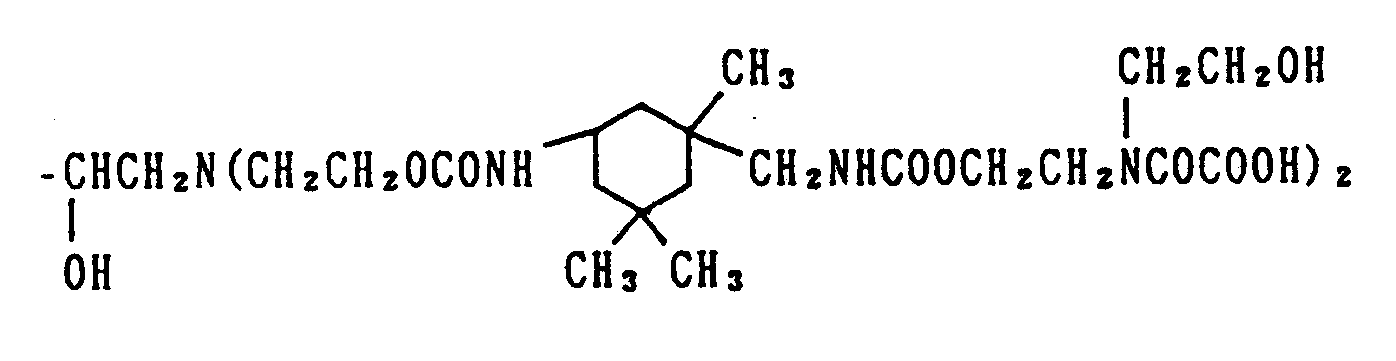
- Using an apparatus similar to that used for example 9, into a flask placed with 73 g ( 0.5 moles ) of diethyl oxalate was added dropwise during 1.5 hours an ethanol solution of 380 g of silicone oil ( KF 864 made from Sinetsu Silicone Co., LTD. ) maintaing reaction temperature at 30 °C and then, the reaction mixture was stirred for 1 hour at 25 °C to get a resin modified with an oxamic acid ester. To this ester was added 30 mℓ of water and dropped 10.2 g ( 0.1 mol ) of TEA during 30 minutes to carry out a hydrolysis reaction. The aqueous solution thus-obtained was treated with 8.3 mℓ of concentrated hydrochloric acid getting a wanted silicone resin modified with oxamic acid. Identification was carried out in the same way as described in example 9. The acid value was 10.
- In a similar way as used for said example 19, a reaction of 146 g ( 1.0 mole ) of diethyl oxalate with 89 g of a melamine resin ( J-820-60 produced from Dainippon Inki Kagaku Kogyo Co., Ltd., molecular weight of 1960 ) was carried out to get a resin modified with an oxamic acid ester, which was treated with 20.4 g ( 0.2 moles ) of TEA, water, and 16.6 mℓ of concentrated hydrochloric acid to obtain an aimed amino resin modified with oxamic acid. Identification was carried out by IR and the acid value was 134.
- A reaction apparatus similar to that for example 9 was used. In a flask were placed 105 g of a polyester resin, which showed a hydroxyl group value of 220 and a molecular weight of 2100, 91.4 g ( 0.41 moles ) of isophoronediisocyanate, and 300 mℓ of acetone and, furthermore, added 1 g of DBTL and the mixture was allowed to react at 60°C for 1 hour. The reaction product obtained was added dropwise to a mixture solution composed of 100mℓ of acetone, 20 g of sulfuric acid, and 50 g of water during 30 minutes and, after addition, allowed to react for further 1 hour to obtain a solution of polyester resin modified with an amine, in which the amine moiety had a sulfuric acid salt form. Then, to this solution was added a mixture solution of 15.6 g of calcium hydroxide and 150 g of water and the mixture obtained was allowed to react at 60°C for 2 hours and treated with solvent removal yielding 128 g of a polyester resin modified with an amine, which showed an amine value of 160 and had a molecular weight of 3700 averaged by weight. This resin was dissolved in 200 mℓ of ethanol and this solution was added dropwise in the way same as used for example 9 into a flask, where 292 g ( 2.0 moles ) of diethyl oxalate were placed, and the mixture was allowed to react yielding an oxamic acid ester and then, treated with 37 g ( 0.37 moles ) of TEA, water, and 30.8 mℓ of concentrated hydrochloric acid to get an aimed polyester resin modified with oxamic acid, which was identified by IR and had an acid value of 145.
- In the same way as for said example 19, a reaction was carried out between 73 g ( 0.5 moles ) of diethyl oxalate and 30 g of a polybutadiene resin modified with an amine, which had an amine value of 187 and a molecular weight of 1200, to obtain a resin modified with an oxamic acid ester, which was treated with 10.2 g ( 0.1 mole ) of TEA, water, and 8.3 g of concentrated hydrochloric acid leading to an aimed polybutadiene resin modified with oxamic acid, that was identified by IR and had an acid value of 180.
- In the same way as for said example 19, a reaction was carried out between 73 g ( 0.5 moles ) of diethyl oxalate and 40 g of polyethyleneimine resin ( EPOMIN P-1000 produced from Nippon Shokubai Kagaku Kogyo Co., Ltd. and molecular weight of 70,000 ) to obtain a resin modified with an oxamic acid ester, which was treated with 20.4 g ( 0.2 moles ) of TEA, water, and 16.6 mℓ of concentrated hydrochloric acid to obtain an aimed polyethyleneimine resin modified with oxamic acid, that was identified by IR and had an acid value of 275.
- In the same way as for said example 19, a reaction was carried out between 173 g ( 1.2 moles ) of diethyl oxalate and 90 g of a polyamide resin ( molecular weight of 4500 ) to obtain a resin modified with an oxamic acid ester, which was similarly treated with 5.1 g ( 0.05 moles ) of TEA, water, and 3.5 mℓ of concentrated hydrochloric acid to obtain an aimed polyamide resin modified with oxamic acid, that was identified by IR and had an acid value of 30.
- Except that 60 g of a fluororesin modified with acrylamide ( molecular weight 2,000 ) was used instead of the polyamide resin, the procedure same as used for example 24 gave an aimed fluororesin modified with oxamic acid, that was identified by IR and had an acid value of 40 ).
- The epoxy resin modified with oxamic acid ( I ), 10 g, obtained from said example 17, 6.3 g of blockisocyanate prepared from 3 mole equivalents of trilenediisocyanate and 1 mole equivalent of trimethylolpropane, and 1.5 g of TEA were dissolved into 18 mℓ of water. This solution was applied on a tinplate and warmed at 190 °C for 30 minutes to get a film having a thickness of 20 µm. A part of this film was taken for IR measurement, where the carboxylic acid absorption at about 1760 cm⁻¹ and the carbonyl absorption at about 1680 cm⁻¹ observed before heating disappeared and, instead, a new absorption was observed at 1630 cm⁻¹ assignable for a formamide group. This result indicates that the oxamic acid, that is an ionic group, disappeared from the film after the thermal treatment.
- Blockisocyanate, 9.8 g, same as that used for said example 26, and 20 g of the epoxy resin modified with oxamic acid ( II ) obtained from said example 18 were dissolved in 20 mℓ of water and the procedure same as for example 26 gave a film having a thickness of 20 µm. A part of the film was taken for IR measurement, where the carboxylic acid absorption at about 1620 cm⁻¹ observed before heating disappeared and a new absorption was observed at 1660 cm⁻¹ assignable for a formamide group. This result indicates that the oxamic acid, that is an ionic group, disappeared from the film after the thermal treatment.
- A mixture of 15 g of an oxamic acid copolymer in a methacrylamide series, obtained from said example 12, and 2.1 g of diethylenetriamine was applied on a tinplate and warmed for 20 minutes at 50°C to get a film having a thickness of 20 µm A pencil hardness examination for this film was carried out and the result indicates formation of a strong, solid film of pencil hardness H.
- A resin composition of an organic solvent form was obtained by dissolving into 40 parts of an organic solvent ( N,N-dimethylformamide ) 30 parts of an epoxy resin polymer modified with oxamic acid, which was obtained from said example 16 and had a molecular weight of 11220 and an acid value of 5, and 10 parts of a methylated and butylated melamine resin ( Nikarakku MX 40 made from Nippon Carbide Kogyo Co., LTD ).
- Said composition was applied to a plate treated with zinc phosphate so as to make a film of thickness 20 µm. A hardened film ( pencil hardness of 2 H ) was obtained by baking it at 150°C for 30 minutes. Water-resistant and anticorrosion properties for this film was examined. The water-resistant property was evaluated by examining the presence or absence of chalking and swelling for a film treated with soaking in water of 50 °C for 48 hours. The anticorrision property was evaluated by examining exfoliated width due to a tape exfoliation from a cutting part after a salt spray examination was carried out for 150 hours. The results indicate that there is no chalking and swelling for the film after soaking in warm water for 48 hours and that the exfoliated width due to tape exfoliation was 3 mm after salt-spray examination during 150 hours.
- Accordingly, it was found that the film obtained has a sufficient crosslinking density and superior water-resistant and anticorrosion properties.
- In a flask equipped with a stirrer, a thermometer, a dropping funnel, and a reflux condenser were placed 50 g of the epoxy resin modified with oxamic acid ( I ), obtained from said example 17, 31.5 g of blockisocyanate as a hardening agent which was similar to example 26, 0.1 g of dibutyltin-oxide, and 7.5 g of TEA, and to this mixture was added dropwise 504 g of water during 1 hour at 80°C to get a resin-dispersed solution for electrodeposition coating. This resin-dispersed solution did not show, after standing for 1 month at room temperature, abnormalities such as viscosity increase and separation and also, still had superior dispersion stability.
- Next, said resin-dispersed solution was placed in a stainless steel beaker ( an anode ) and, using as a cathode a test panel plate ( a cold rolling steel plate ) deoiled with xylene, an electrodeposition experiment was carried out with 100 voltage and, as a result, a water-insoluble product was separated out on the cathode. Futhermore, the separated resin was heated for hardening for 30 minutes at 190 °C to obtain an uniformly electrodeposited film having a thickness of 25 µm. The pencil hardness for this film was 2 H and the results from capacity experiments carried out similarly to the case of said example 29 showed superior water-resistant, anticorrosion, and solvent-resisting properties.
- An epoxy resin ( epoxy equivalent of 185 ), 9.3 g, was dissolved in 15 g of MIBK with a 40 % solution of 32 g of a homopolymer of the monomer containing an oxamic acid group 9 , obtained from example 11, in cellosolve acetate. This solution was applied on a tinplate and warmed at 140 °C for 3 hours to get a paint film of thickness 20 µm. The results obtained from a pencil hardness examination for the paint film comfirmed formation of a strong film of pencil hardness 2 H.
- Thus, it was confirmed that a polymer of a monomer containing an oxamic acid group can be used as a hardening agent for an active hydrogen-containing resin.
- To a clear lacquer for finishing for metallics composed of 30 weight parts ( hereinafter, referred to aspart
 ) of an acryl resin of a thermally hardening type ( molecular weight of 8000, an acid value of 10, hydroxl group value of 80 ), 10 parts of methylated and butylated melamine resin ( same as for example 29 ), and 60 parts of an organic solvent ( a mixture solution of xylene and isobutyl alcohol ) was added a 40 % cellosolve solution of 1.5 parts of a homopolymer ammonium salt of the monomer containing an oxamic acid group 9, obtained from example 11, to get a resin composition of an organic solvent type.
- The composition was applied on an iron plate treated with zinc phosphate to make a film of thickness 20 µm and baked at 150 °C for 30 minutes to form a hardened paint film.
- The pencil hardness and the water-resistant and anticorrosion properties for this paint film obtained were evaluated as for said example 29.
- In example 32, except that 0.5 parts of an acid hardening catalyst of an ammonium salt type of dodecylbenzenesulfonic acid was used instead of an oxamic acid derivative, a similar procedure gave a resin composition of an organic solvent type.
- Furthermore, in a similar way to the above, a paint film was formed from the composition, and property examination was similarly carried out for the film. Results obtained are shown in Table 1.
Table 1 Example 32 Comparison Example Pencil hardness 2H 2H After soaking in warm water no change delustering observed Tape-exfoliated width 2 mm 6 mm - As seen in Table 1, it was observed that the paint film, where the oxamic acid derivatives were used as an acid hardening catalyst, has sufficient crosslinking density and superior water-resistant and anticorrosion properties. In contrast, regarding the paint film in comparison example, although chalking and swelling were not observed in the film after treatment with soaking in warm water, delustering was found and the exfoliated width due to tape exfoliation after treatment with salt-spraying was so big as 6 mm and, therefore, it was clarified that, although the paint film was sufficiently crosslinked, the water-resistant and anticorrosion properties were lowered due to the fact that the acid catalyst was remaining in the paint film.
Claims (13)
- A compound containing an oxamic acid group in the molecule, corresponding to the following general formula (I):


- A compound as claimed in Claim 1, wherein R is a hydroxyethyl group.
- A process for producing a compound as claimed in Claim 2, comprising the steps of:
adding a required amount of water in the presence of an amine compound to a substituted morpholinedione containing one or more of the below described morpholine-2,3-dione group intramolecularly, wherein said morpholinedione is hydrolysed with ring-cleavage of the morpholinedione group to obtain an ammonium salt: and neutralizing said ammonium salt with an acid.
- A compound containing an oxamic acid group denoted by the following general formula (II):

- A compound as claimed in Claim 4, wherein P is a resin residue selected from the group consisting of an acryl resin, a polyester resin, a polyamide resin, an epoxy resin, an amino resin, a polyethyleneimine resin, a resin in a hydrocarbon series, a silicone resin, a fluororesin, and resins modified therefrom.
- A hardening resin composition containing a compound as claimed in Claim 4 which contains two or more oxamic acid groups in the molecule, and a compound which shows mutual reactivity with the oxamic acid group.
- A composition as claimed in Claim 6, wherein the compound containing an oxamic acid group involves a resin residue selected from the group consisting of an acryl resin, a polyester resin, an epoxy resin, a polyamide resin, and an amino resin.
- A composition as claimed in Claim 6, wherein the compound showing mutual reactivity with an oxamic acid group involves at least one group selected from the group consisting of a hydroxyl group, an amino group, and an epoxy group.
- A resin composition containing at least a compound as claimed in Claim 4, a basic compound, and water.
- A composition as claimed in Claim 9, wherein the compound containing an oxamic acid group involves a resin residue selected from the group consisting of an resin, a polyester resin, a polyamide resin, an epoxy resin, an amino resin, a polyethyleneimine resin, a silicone resin, a fluororesin, and a resin in a butadiene series.
- A composition as claimed in Claim 9, wherein the basic compound is an amine compound.
- A surface-active agent which is composed of a compound containing an oxamic acid group as claimed in Claim 4.
- A surface-active agent as claimed in Claim 12, wherein the compound containing an oxamic acid group involves a resin residue selected from the group consisting of a resin in a hydrocarbon series, a fluororesin, and a silicone resin.
Applications Claiming Priority (2)
| Application Number | Priority Date | Filing Date | Title |
|---|---|---|---|
| JP28630888 | 1988-11-11 | ||
| JP286308/88 | 1988-11-11 |
Publications (2)
| Publication Number | Publication Date |
|---|---|
| EP0371640A1 EP0371640A1 (en) | 1990-06-06 |
| EP0371640B1 true EP0371640B1 (en) | 1993-07-28 |
Family
ID=17702698
Family Applications (1)
| Application Number | Title | Priority Date | Filing Date |
|---|---|---|---|
| EP89311622A Expired - Lifetime EP0371640B1 (en) | 1988-11-11 | 1989-11-09 | A compound containing an oxamic acid group, a process for producing the compound, and a resin composition containing the compound |
Country Status (4)
| Country | Link |
|---|---|
| US (1) | US5663262A (en) |
| EP (1) | EP0371640B1 (en) |
| JP (1) | JPH02262549A (en) |
| DE (1) | DE68907866T2 (en) |
Families Citing this family (20)
| Publication number | Priority date | Publication date | Assignee | Title |
|---|---|---|---|---|
| NL9200186A (en) * | 1992-02-03 | 1993-09-01 | Dsm Nv | IONOGENIC DISPENSER APPLICABLE IN AQUEOUS DISPERSIONS. |
| SG100706A1 (en) | 2000-05-18 | 2003-12-26 | Nat Starch Chem Invest | Curable electron donor compounds |
| US7183360B2 (en) * | 2001-10-05 | 2007-02-27 | Basf Aktiengesellschaft | Method for crosslinking hydrogels with morpholine-2,3-diones |
| US6919004B2 (en) * | 2002-07-02 | 2005-07-19 | E. I. Du Pont De Nemours And Company | Cathodic electrocoating composition containing a morpholine dione crosslinking agent |
| US6908539B2 (en) * | 2002-07-02 | 2005-06-21 | E.I. Du Pont De Nemours And Company | Cathodic electrocoating composition containing morpholine dione blocked polyisocyanate crosslinking agent |
| JP2008150292A (en) * | 2005-03-31 | 2008-07-03 | Kansai Paint Co Ltd | Alpha-oxoamide group-containing compound, method for producing the same and polymer thereof |
| EP1963897B1 (en) * | 2005-12-23 | 2015-01-21 | 3M Innovative Properties Company | Multilayer films including thermoplastic silicone block copolymers |
| EP1963899B1 (en) | 2005-12-23 | 2013-08-28 | 3M Innovative Properties Company | Films including thermoplastic silicone block copolymers |
| US7501184B2 (en) | 2005-12-23 | 2009-03-10 | 3M Innovative Properties Company | Polydiorganosiloxane polyoxamide copolymers |
| US7371464B2 (en) * | 2005-12-23 | 2008-05-13 | 3M Innovative Properties Company | Adhesive compositions |
| US20070149745A1 (en) * | 2005-12-23 | 2007-06-28 | 3M Innovative Properties Company | Polydiorganosiloxane-containing materials with oxalylamino groups |
| US7705103B2 (en) * | 2007-06-22 | 2010-04-27 | 3M Innovative Properties Company | Polydiorganosiloxane polyoxamide copolymers |
| US8063166B2 (en) | 2007-06-22 | 2011-11-22 | 3M Innovative Properties Company | Polydiorganosiloxane polyamide copolymers having organic soft segments |
| US7507849B2 (en) * | 2007-06-22 | 2009-03-24 | 3M Innovative Properties Company | Cyclic silazanes containing an oxamido ester group and methods of making these compounds |
| US7705101B2 (en) * | 2007-06-22 | 2010-04-27 | 3M Innovative Properties Company | Branched polydiorganosiloxane polyamide copolymers |
| US20080318065A1 (en) | 2007-06-22 | 2008-12-25 | Sherman Audrey A | Mixtures of polydiorganosiloxane polyamide-containing components and organic polymers |
| US8431671B2 (en) * | 2008-03-26 | 2013-04-30 | 3M Innovative Properties Company | Structured polydiorganosiloxane polyamide containing devices and methods |
| EP2883699B1 (en) | 2013-12-11 | 2017-05-03 | Agfa Graphics Nv | A lithographic printing plate precursor and monomer |
| CN112041375B (en) * | 2018-07-30 | 2022-03-29 | 瓦克化学股份公司 | Method for producing oxamide-functional siloxanes |
| US10793667B2 (en) | 2019-02-07 | 2020-10-06 | Covestro Deutschland Ag | Curable compositions, products and articles formed therefrom, and methods of forming the same |
Family Cites Families (2)
| Publication number | Priority date | Publication date | Assignee | Title |
|---|---|---|---|---|
| CA1289571C (en) * | 1986-04-25 | 1991-09-24 | Satoshi Urano | Acrylamide derivatives and their polymers |
| US4684710A (en) * | 1986-08-04 | 1987-08-04 | Ppg Industries, Inc. | Half-amide reaction products of dioxalates and amino group containing materials |
-
1989
- 1989-11-07 JP JP1287870A patent/JPH02262549A/en active Pending
- 1989-11-08 US US07/433,097 patent/US5663262A/en not_active Expired - Fee Related
- 1989-11-09 DE DE89311622T patent/DE68907866T2/en not_active Expired - Fee Related
- 1989-11-09 EP EP89311622A patent/EP0371640B1/en not_active Expired - Lifetime
Also Published As
| Publication number | Publication date |
|---|---|
| DE68907866T2 (en) | 1994-04-14 |
| JPH02262549A (en) | 1990-10-25 |
| US5663262A (en) | 1997-09-02 |
| EP0371640A1 (en) | 1990-06-06 |
| DE68907866D1 (en) | 1993-09-02 |
Similar Documents
| Publication | Publication Date | Title |
|---|---|---|
| US5663262A (en) | Compound containing an oxamic acid group, a process for producing the compound, and a resin composition containing the compound | |
| EP0004090B1 (en) | Water-dispersed coating composition suitable for electrocoating processes | |
| CA2037364C (en) | Polymers | |
| CA1334237C (en) | Polymers containing amino groups, their preparation and their use | |
| US4001156A (en) | Method of producing epoxy group-containing, quaternary ammonium salt-containing resins | |
| CA1079440A (en) | Process for producing binders for electrodeposition | |
| CA1124939A (en) | Process for producing cathodically depositable electrodeposition coating compositions and the compositions | |
| US3937679A (en) | Electrodepositable compositions | |
| EP0218436A2 (en) | Acrylic pigment dispersant made by group transfer polymerization | |
| NL7906711A (en) | PAINT PREPARATION FOR CATHODICALLY ELECTROLYTIC COATING. | |
| JPS61291662A (en) | Aqueous paint composition and pigment composition | |
| AU678805B2 (en) | Oligomeric sterically hindered polyamide crosslinkers and coating compositions containing the same | |
| US20050154121A1 (en) | Poly(ethylene-butylene) (meth)acrylates and related compositions | |
| US4349655A (en) | Water-dilutable binders carrying oxazolidine groups | |
| JPH07149872A (en) | Solvent-free synthetic resin aqueous dispersion | |
| US5104737A (en) | Water-dispersable air-drying coatings | |
| CA2165903A1 (en) | Curable crosslinking system with monobenzaldimine as crosslinker | |
| US4912154A (en) | Water-dispersible air-drying coatings containing 2-oxazoline groups | |
| JPH0393868A (en) | Method of using acrylate copolymer as additive for water-base cationic paint system | |
| JPH03140381A (en) | Preparation of water-diluted modified epoxy-amino rubber adduct | |
| KR20090010233A (en) | Use of Copolymer as Paint Adhesion Promoter | |
| KR910008621B1 (en) | Hardening resin composition | |
| EP1156085A1 (en) | Binders for use in cathodic electrodeposition coatings, process for their preparation and cathodic electrodeposition coating compositions containing same | |
| US4530978A (en) | Surface coating binder containing blocked isocyanate groups | |
| KR100568913B1 (en) | Manufacturing method of urethane acryl hybrid resin for metal coating |
Legal Events
| Date | Code | Title | Description |
|---|---|---|---|
| PUAI | Public reference made under article 153(3) epc to a published international application that has entered the european phase |
Free format text: ORIGINAL CODE: 0009012 |
|
| AK | Designated contracting states |
Kind code of ref document: A1 Designated state(s): DE FR GB |
|
| 17P | Request for examination filed |
Effective date: 19900523 |
|
| 17Q | First examination report despatched |
Effective date: 19911108 |
|
| GRAA | (expected) grant |
Free format text: ORIGINAL CODE: 0009210 |
|
| AK | Designated contracting states |
Kind code of ref document: B1 Designated state(s): DE FR GB |
|
| REF | Corresponds to: |
Ref document number: 68907866 Country of ref document: DE Date of ref document: 19930902 |
|
| ET | Fr: translation filed | ||
| PLBE | No opposition filed within time limit |
Free format text: ORIGINAL CODE: 0009261 |
|
| STAA | Information on the status of an ep patent application or granted ep patent |
Free format text: STATUS: NO OPPOSITION FILED WITHIN TIME LIMIT |
|
| 26N | No opposition filed | ||
| PGFP | Annual fee paid to national office [announced via postgrant information from national office to epo] |
Ref country code: GB Payment date: 19971031 Year of fee payment: 9 |
|
| PGFP | Annual fee paid to national office [announced via postgrant information from national office to epo] |
Ref country code: FR Payment date: 19971112 Year of fee payment: 9 |
|
| PGFP | Annual fee paid to national office [announced via postgrant information from national office to epo] |
Ref country code: DE Payment date: 19971114 Year of fee payment: 9 |
|
| PG25 | Lapsed in a contracting state [announced via postgrant information from national office to epo] |
Ref country code: GB Free format text: LAPSE BECAUSE OF NON-PAYMENT OF DUE FEES Effective date: 19981109 |
|
| GBPC | Gb: european patent ceased through non-payment of renewal fee |
Effective date: 19981109 |
|
| PG25 | Lapsed in a contracting state [announced via postgrant information from national office to epo] |
Ref country code: FR Free format text: LAPSE BECAUSE OF NON-PAYMENT OF DUE FEES Effective date: 19990730 |
|
| REG | Reference to a national code |
Ref country code: FR Ref legal event code: ST |
|
| PG25 | Lapsed in a contracting state [announced via postgrant information from national office to epo] |
Ref country code: DE Free format text: LAPSE BECAUSE OF NON-PAYMENT OF DUE FEES Effective date: 19990901 |