EP0370238B1 - Method of preparing samples for the analysis of particulate compounds in a liquid - Google Patents
Method of preparing samples for the analysis of particulate compounds in a liquid Download PDFInfo
- Publication number
- EP0370238B1 EP0370238B1 EP89119587A EP89119587A EP0370238B1 EP 0370238 B1 EP0370238 B1 EP 0370238B1 EP 89119587 A EP89119587 A EP 89119587A EP 89119587 A EP89119587 A EP 89119587A EP 0370238 B1 EP0370238 B1 EP 0370238B1
- Authority
- EP
- European Patent Office
- Prior art keywords
- container
- liquid
- particulate compounds
- filter
- water
- Prior art date
- Legal status (The legal status is an assumption and is not a legal conclusion. Google has not performed a legal analysis and makes no representation as to the accuracy of the status listed.)
- Expired - Lifetime
Links
Images
Classifications
-
- G—PHYSICS
- G01—MEASURING; TESTING
- G01N—INVESTIGATING OR ANALYSING MATERIALS BY DETERMINING THEIR CHEMICAL OR PHYSICAL PROPERTIES
- G01N1/00—Sampling; Preparing specimens for investigation
- G01N1/28—Preparing specimens for investigation including physical details of (bio-)chemical methods covered elsewhere, e.g. G01N33/50, C12Q
- G01N1/40—Concentrating samples
- G01N1/4077—Concentrating samples by other techniques involving separation of suspended solids
-
- B—PERFORMING OPERATIONS; TRANSPORTING
- B01—PHYSICAL OR CHEMICAL PROCESSES OR APPARATUS IN GENERAL
- B01D—SEPARATION
- B01D29/00—Filters with filtering elements stationary during filtration, e.g. pressure or suction filters, not covered by groups B01D24/00 - B01D27/00; Filtering elements therefor
- B01D29/01—Filters with filtering elements stationary during filtration, e.g. pressure or suction filters, not covered by groups B01D24/00 - B01D27/00; Filtering elements therefor with flat filtering elements
-
- G—PHYSICS
- G21—NUCLEAR PHYSICS; NUCLEAR ENGINEERING
- G21F—PROTECTION AGAINST X-RADIATION, GAMMA RADIATION, CORPUSCULAR RADIATION OR PARTICLE BOMBARDMENT; TREATING RADIOACTIVELY CONTAMINATED MATERIAL; DECONTAMINATION ARRANGEMENTS THEREFOR
- G21F9/00—Treating radioactively contaminated material; Decontamination arrangements therefor
- G21F9/04—Treating liquids
-
- B—PERFORMING OPERATIONS; TRANSPORTING
- B01—PHYSICAL OR CHEMICAL PROCESSES OR APPARATUS IN GENERAL
- B01D—SEPARATION
- B01D29/00—Filters with filtering elements stationary during filtration, e.g. pressure or suction filters, not covered by groups B01D24/00 - B01D27/00; Filtering elements therefor
- B01D29/76—Handling the filter cake in the filter for purposes other than for regenerating
- B01D29/78—Handling the filter cake in the filter for purposes other than for regenerating for washing
-
- B—PERFORMING OPERATIONS; TRANSPORTING
- B01—PHYSICAL OR CHEMICAL PROCESSES OR APPARATUS IN GENERAL
- B01D—SEPARATION
- B01D29/00—Filters with filtering elements stationary during filtration, e.g. pressure or suction filters, not covered by groups B01D24/00 - B01D27/00; Filtering elements therefor
- B01D29/76—Handling the filter cake in the filter for purposes other than for regenerating
- B01D29/80—Handling the filter cake in the filter for purposes other than for regenerating for drying
- B01D29/84—Handling the filter cake in the filter for purposes other than for regenerating for drying by gases or by heating
- B01D29/843—Handling the filter cake in the filter for purposes other than for regenerating for drying by gases or by heating by direct contact with a fluid
-
- G—PHYSICS
- G01—MEASURING; TESTING
- G01N—INVESTIGATING OR ANALYSING MATERIALS BY DETERMINING THEIR CHEMICAL OR PHYSICAL PROPERTIES
- G01N1/00—Sampling; Preparing specimens for investigation
- G01N1/28—Preparing specimens for investigation including physical details of (bio-)chemical methods covered elsewhere, e.g. G01N33/50, C12Q
- G01N1/44—Sample treatment involving radiation, e.g. heat
-
- Y—GENERAL TAGGING OF NEW TECHNOLOGICAL DEVELOPMENTS; GENERAL TAGGING OF CROSS-SECTIONAL TECHNOLOGIES SPANNING OVER SEVERAL SECTIONS OF THE IPC; TECHNICAL SUBJECTS COVERED BY FORMER USPC CROSS-REFERENCE ART COLLECTIONS [XRACs] AND DIGESTS
- Y10—TECHNICAL SUBJECTS COVERED BY FORMER USPC
- Y10T—TECHNICAL SUBJECTS COVERED BY FORMER US CLASSIFICATION
- Y10T436/00—Chemistry: analytical and immunological testing
- Y10T436/11—Automated chemical analysis
-
- Y—GENERAL TAGGING OF NEW TECHNOLOGICAL DEVELOPMENTS; GENERAL TAGGING OF CROSS-SECTIONAL TECHNOLOGIES SPANNING OVER SEVERAL SECTIONS OF THE IPC; TECHNICAL SUBJECTS COVERED BY FORMER USPC CROSS-REFERENCE ART COLLECTIONS [XRACs] AND DIGESTS
- Y10—TECHNICAL SUBJECTS COVERED BY FORMER USPC
- Y10T—TECHNICAL SUBJECTS COVERED BY FORMER US CLASSIFICATION
- Y10T436/00—Chemistry: analytical and immunological testing
- Y10T436/25—Chemistry: analytical and immunological testing including sample preparation
- Y10T436/25375—Liberation or purification of sample or separation of material from a sample [e.g., filtering, centrifuging, etc.]
- Y10T436/255—Liberation or purification of sample or separation of material from a sample [e.g., filtering, centrifuging, etc.] including use of a solid sorbent, semipermeable membrane, or liquid extraction
Definitions
- the invention relates to a method for analysis of particulate compounds in a liquid, preferably in a flow of liquid according to the precharacterising part of claim 1.
- Nuclear power plants and other heat-generating power plants such as coal, oil, and gas power plants, are normally equipped with a circulation system for water, in which steam which is generated in a reactor vessel or in a steam generator connected to the circulation system is passed to a steam turbine and from there to a condenser.
- the condensate formed in the condenser is cleaned, preheated, and then returned to the reactor vessel or the steam generator.
- different corrosion products are formed in the circulation system, inter alia in the form of oxides containing one or more metals of the kinds included in construction parts forming the circulation system such as, above all, iron and further, inter alia, nickel, cobalt, chromium, manganese, titanium, molybdenum, zinc and zirconium.
- the corrosion products occur both as ionic dissolved compounds and as particulate undissolved compounds. In those cases where a nuclear reactor vessel is part of the circulation system, the corrosion products will become radioactive. Besides being influenced by the temperature, the amount and the nature of the corrosion products are influenced especially by the pH-value of the water and the concentration of hydrogen and oxygen dissolved in the water.
- the corrosion products are therefore indicators of important properties of the water.
- changes in the corrosion environment have occurred which require action regarding the operation of the power plant to eliminate the cause of the changes, such as, inter alia, changes of the pH-value of the water and, if a nuclear reactor vessel is included in the circulation system, inter alia the degree of radioactive contamination in the circulation system and the degree of oxide growth of cladding material for the fuel and of box material.
- a nuclear reactor vessel is included in the circulation system
- the degree of radioactive contamination in the circulation system and the degree of oxide growth of cladding material for the fuel and of box material.
- the contents in the solution can be increased by using for analyses a larger water sample and hence a longer filtering time (enrichment time). Determination methods for solid samples for direct measurement of the particulate compounds on the filter are not applicable to water in water circulation systems of the kind described because of insufficient sensitivity.
- the invention aims at developing a simple method for analysis of particulate compounds in a liquid, which method enables to determine particulate compounds in the water in water circulation systems in a reliable and on-line usable manner.
- the invention suggests a method for analysis of particulate compounds in a liquid according to the introductory part of claim 1, which is characterized by the features of the characterizing part of claim 1.
- particulate compounds can be determined automatically in a sampling system in a reliable and simple manner, which includes a filtering of samples from the water in water circulation systems of the above-described kind or of liquid flows of another kind as well as dissolution of the particulate compounds, collected on the filter, in a solvent and determination of the nature and content of one or more of the particulate compounds obtained in the solution.
- a sampling system in a reliable and simple manner, which includes a filtering of samples from the water in water circulation systems of the above-described kind or of liquid flows of another kind as well as dissolution of the particulate compounds, collected on the filter, in a solvent and determination of the nature and content of one or more of the particulate compounds obtained in the solution.
- dissolution known solvents for the particulate particles in question are used, and for analysis of the solution known analysis methods are used.
- the invention is applicable not only to the analysis of particulate compounds contained in water flowing in water circulation systems in power plants of the kinds described above, but also to the determination of particulate compounds in water of another kind and in liquids of another kind, such as spirit solutions and solutions of organic solvents, to the extent that these contain particulate compounds.
- the filter consists of a material which is resistant to the liquid to be analyzed and to the used solvent.
- suitable materials may be mentioned polytetrafluoroethylene and other fluorinated hydrocarbon polymers, for example polychlorotrifluoroethylene, as well as other resistant resins; further, inter alia, porcelain filters and sintered resistant particulate materials, for example sintered glass filters.
- the hole-size of the filter is chosen in view of the size of the particulate compounds in the liquid flow. In most cases a hole-size within the interval 0.2 - 1.0 ⁇ m is suitable.
- the material used for the container is permeable to microwaves and resistant to the liquid to be analyzed and to the used solvent.
- suitable materials may be mentioned polytetrafluoroethylene and other fluorinated hydrocarbon polymers, for example polychlorotrifluoroethylene and glass.
- the volume of the container may suitably be in the range of 5-50 ml.
- the particulate compounds are collected on the filter for a certain period to time.
- This time interval is chosen in dependence on the particle content in such a way that a suitable amount of particles are collected on the filter. This amount should be such that it is suitable for analysis of the solution of the dissolved particulate compounds.
- the solvents which are used for dissolution of the particulate compounds collected on the filter are, of course, dependent on the nature of the particulate compounds.
- mixtures of acids may be used, preferably mixtures of oxidizing acids, as well as formers of chelate complexes.
- Mixtures of acids can be used for decomposition of most types of corrosion products of the kind described, whereas chelate formers are more specific.
- the chelate solutions usually have an optimum pH-value for dissolution in the interval 2-8.
- useful mixtures of acids may be mentioned mixtures of at least two of the following acids: hydrochloric acid, nitric acid, and perchloric acid.
- useful formers of chelate complexes may be mentioned ethylenediaminotetra acetic acid, citric acid and thioglycolic acid (HS-CH2-COOH). The latter is particularly effective in mixtures with hydrochloric acid.
- the time for dissolving a sample of particulate compounds varies with the sample quantity, the sample composition, the sample structure, the degree of atomization, the temperature, as well as with the strength, pH-value and composition of the mixture of acids or the chelate solution.
- the required dissolution time may be greatly reduced, from the order of magnitude of hours without microwave heating to the order of magnitude of minutes with microwave heating.
- the increased dissolution rate is assumed to be due to an increased convection in the solution and to an absorption of energy directly and locally in the grains of the particulate material.
- the analysis of the solution of the particulate compounds is performed with known methods, for example by ion chromatography or by atom absorbing spectrometry.
- the method according to the invention operates on line, i.e. the sampling equipment used is connected to the liquid flow in which the nature and content of the particulate compounds are to be analyzed. All measures, such as opening and closing of valves, heating processes and times for different operations, are controlled by automatic control, preferably by computer control, for example comprising the use of microprocessors. In this way, a series of results is obtained from each sample taken batchwise from the liquid flow, thus obtaining an automatic determination of the particulate compounds for the whole of the time during which the determination is carried out.
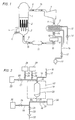
- the boiling water reactor shown in Figure 1 has a reactor vessel 1 with fuel elements 2, control rods 3 and main circulation systems 4, one of which is shown in Figure 1 and each of which comprises a pump 5.
- the main circulation pumps 5 ensure that the reactor core is sufficiently cooled.
- the reactor vessel is part of a water circulation system 6, which also comprises a steam turbine 7, a condenser 8, a condensate cleaning filter 9, pumps 10 and 14 and a preheater 11.
- the cladding material of the fuel elements consists of a zirconium alloy, for example Zircaloy-2. Steam generated in the reactor core gives its energy to the rotor of the turbine and is condensed, after passage of the turbine, in the condenser, which is provided with a coolant circuit 12 comprising a pump 13.
- the condensate cleaning filter comprises an ion-exchange filter with an ion-exchange compound in the form of a mixture of an anion-exchange compound (polystyrene with quaternary ammonium groups cross-linked with divinyl benzene) and a cation-exchange compound (sulphonated polystyrene cross-linked with divinyl benzene).
- samples of the water 15, the reactor water (in the illustrated case in the form of feed water), are taken batchwise from the circulation system 6 via the conduit 16 and the valve 17 to a sampling system, as shown in Figure 2.
- the sampling system exemplified in Figure 2 includes a sealable container 19 of polytetrafluoroethylene with a volume of 25 ml. Only this part of the sampling system is shown in Figure 1.
- the lower part of the container is provided with a filter 20 of polytetrafluoroethylene, the through-holes of which have a size of 0.45 ⁇ m.
- Via conduit 21 with a valve 22 the container is connected to a tank 23 with nitrogen gas being pressurized at around 0.5 MPa.
- the container 19 Via another conduit 24 with a valve 25 the container 19 is connected to a tank 26 with solvent in the form of a mixture of 4 parts by volume concentrated hydrochloric acid and 1 part by volume thioglycolic acid, and via a conduit 27 with a valve 28 the container 19 is connected to a tank 29 holding high purity water. Via a conduit 30 with a valve 31 the container 19 is connected to a discharge 32 and via a conduit 33 with a valve 34 to an apparatus 35 for analysis of the solution of particulate compounds, contained in the reactor water and collected on the filter, by ion chromatography. Finally the container 19 is connected via a conduit 36 with a valve 37 to an apparatus 38 for analysis of ionic dissolved compounds in the reactor water, also by ion chromatography. All the valves 17, 22, 25, 28, 31, 34 and 37, are openable and closable. The container 19 is placed in a microwave oven 40, which is schematically illustrated by dashed lines in Figure 2.
- a specified amount of the reactor water 15 is led via the conduit 16 to the container 19, through the filter 20 and via the conduit 30 to the discharge 32, particulate compounds present in the reactor water being collected on the filter.
- the valves 17 and 31 are held open whereas the other valves are closed.
- the amount of reactor water or the time for its supply and passage through the container is adapted such that a quantity of particulate compounds, suitable for analysis, is collected on the filter.
- valve 17 When the specified amount of reactor water has traversed the container 19, the valve 17 is closed and the valve 22 is opened to empty the container of all possibly remaining liquid with a flow of pressurized nitrogen gas from the tank 23.
- the valve After closing the valve 22 and the valve 31, the valve is opened and a specified quantity of solvent is supplied to the container 19 from the tank 26 via the conduit 24, so that most of the volume of the container is filled with solvent.
- the remaining volume, consisting of nitrogen gas functions as a pressure-equalizing gas volume.
- the valve 25 After the supply of this quantity of solvent, the valve 25 is closed. Then the container is heated by the microwave oven 40 for a definite period of time to a temperature high enough to ensure the dissolution of the particulate compounds collected on the filter.
- valves 22 and 34 are opened, the container 19, through the pressurized gas, being emptied of the solution of the particulate compounds present therein while the solution is being transported to the apparatus 35 for analysis by ion chromatography.
- the valves 22 and 34 are closed.
- a chromatogram is taken up in a conventional manner, which shows the nature and the content of the elements included in the particulate compounds and hence the quantity of these particulate compounds in the batch of the reactor water taken out via the conduit 16.
- the container 19 is washed with water from the storage 29 by operating the valves 28 and 31.
- the whole process described above is repeated, which is thus started by supplying a new batch of reactor water to the container 19 while keeping the valves 17 and 31 open for a specified time and keeping the other valves closed.
- Opening and closing of all valves in the illustrated device, as well as the microwave heating, are controlled by automatic control, preferably by computer control comprising microprocessors.
- the exemplified device can also be used for analysis of ionic compounds in the reactor water.
- the withdrawn sample of the reactor water which has passed through the filter 20 in the container 19, is passed via the conduit 36 to the analysis apparatus 38 instead of via the conduit 30 to the discharge 32.
- the valve 37 is kept open and the valve 31 is kept shut.
Landscapes
- Chemical & Material Sciences (AREA)
- Physics & Mathematics (AREA)
- Chemical Kinetics & Catalysis (AREA)
- Immunology (AREA)
- Analytical Chemistry (AREA)
- Biochemistry (AREA)
- General Health & Medical Sciences (AREA)
- General Physics & Mathematics (AREA)
- Life Sciences & Earth Sciences (AREA)
- Pathology (AREA)
- Health & Medical Sciences (AREA)
- Engineering & Computer Science (AREA)
- General Engineering & Computer Science (AREA)
- High Energy & Nuclear Physics (AREA)
- Sampling And Sample Adjustment (AREA)
- Automatic Analysis And Handling Materials Therefor (AREA)
Description
- The invention relates to a method for analysis of particulate compounds in a liquid, preferably in a flow of liquid according to the precharacterising part of claim 1.
- Nuclear power plants and other heat-generating power plants such as coal, oil, and gas power plants, are normally equipped with a circulation system for water, in which steam which is generated in a reactor vessel or in a steam generator connected to the circulation system is passed to a steam turbine and from there to a condenser. The condensate formed in the condenser is cleaned, preheated, and then returned to the reactor vessel or the steam generator.
- In operation of power plants of the above-mentioned kinds different corrosion products are formed in the circulation system, inter alia in the form of oxides containing one or more metals of the kinds included in construction parts forming the circulation system such as, above all, iron and further, inter alia, nickel, cobalt, chromium, manganese, titanium, molybdenum, zinc and zirconium. The corrosion products occur both as ionic dissolved compounds and as particulate undissolved compounds. In those cases where a nuclear reactor vessel is part of the circulation system, the corrosion products will become radioactive. Besides being influenced by the temperature, the amount and the nature of the corrosion products are influenced especially by the pH-value of the water and the concentration of hydrogen and oxygen dissolved in the water. The corrosion products are therefore indicators of important properties of the water. By continuously investigating the corrosion products, it can be determined whether changes in the corrosion environment have occurred which require action regarding the operation of the power plant to eliminate the cause of the changes, such as, inter alia, changes of the pH-value of the water and, if a nuclear reactor vessel is included in the circulation system, inter alia the degree of radioactive contamination in the circulation system and the degree of oxide growth of cladding material for the fuel and of box material. It is, of course, of decisive importance for the operation of a power plant of the above-mentioned kinds that the water in the circulation system is as clean as possible to counteract the occurrence of corrosive coatings and the ensuing deteriorated economy.
- When it comes to determining the chemical composition and the content of ionic dissolved compounds in water flowing in circlation systems of the kind described, automatic sampling systems have been developed with the aid of which the nature and content of ionic compounds can be continuously followed during operation of the power plant. For analysis of particulate compounds, no corresponding automatic technique has been available so far. It has been necessary to separate the particulate compound from samples taken of the water on filters and then to determine the compounds by conventional methods by measuring directly on the filter or by dissolving the compounds in a solvent in a separate operation and analyzing the solution thus obtained in another separate operation. For analysis of the solution, a great number of methods can be used. In those cases where the analysis sensitivity is too low, the contents in the solution can be increased by using for analyses a larger water sample and hence a longer filtering time (enrichment time). Determination methods for solid samples for direct measurement of the particulate compounds on the filter are not applicable to water in water circulation systems of the kind described because of insufficient sensitivity.
- The invention aims at developing a simple method for analysis of particulate compounds in a liquid, which method enables to determine particulate compounds in the water in water circulation systems in a reliable and on-line usable manner.
- To achieve this aim the invention suggests a method for analysis of particulate compounds in a liquid according to the introductory part of claim 1, which is characterized by the features of the characterizing part of claim 1.
- Further developments of the invention are characterized by the features of the additional claims.
- According to the invention, particulate compounds can be determined automatically in a sampling system in a reliable and simple manner, which includes a filtering of samples from the water in water circulation systems of the above-described kind or of liquid flows of another kind as well as dissolution of the particulate compounds, collected on the filter, in a solvent and determination of the nature and content of one or more of the particulate compounds obtained in the solution. For the dissolution known solvents for the particulate particles in question are used, and for analysis of the solution known analysis methods are used.
- The invention is applicable not only to the analysis of particulate compounds contained in water flowing in water circulation systems in power plants of the kinds described above, but also to the determination of particulate compounds in water of another kind and in liquids of another kind, such as spirit solutions and solutions of organic solvents, to the extent that these contain particulate compounds.
- The filter consists of a material which is resistant to the liquid to be analyzed and to the used solvent. Among suitable materials may be mentioned polytetrafluoroethylene and other fluorinated hydrocarbon polymers, for example polychlorotrifluoroethylene, as well as other resistant resins; further, inter alia, porcelain filters and sintered resistant particulate materials, for example sintered glass filters. The hole-size of the filter is chosen in view of the size of the particulate compounds in the liquid flow. In most cases a hole-size within the interval 0.2 - 1.0 µm is suitable.
- The material used for the container is permeable to microwaves and resistant to the liquid to be analyzed and to the used solvent. Among suitable materials may be mentioned polytetrafluoroethylene and other fluorinated hydrocarbon polymers, for example polychlorotrifluoroethylene and glass. The volume of the container may suitably be in the range of 5-50 ml.
- The particulate compounds are collected on the filter for a certain period to time. This time interval is chosen in dependence on the particle content in such a way that a suitable amount of particles are collected on the filter. This amount should be such that it is suitable for analysis of the solution of the dissolved particulate compounds.
- The solvents which are used for dissolution of the particulate compounds collected on the filter are, of course, dependent on the nature of the particulate compounds. For dissolution of corrosion products in water in a water circulation system in a nuclear power plant, as well as in other power plants of the kind described above, mixtures of acids may be used, preferably mixtures of oxidizing acids, as well as formers of chelate complexes. Mixtures of acids can be used for decomposition of most types of corrosion products of the kind described, whereas chelate formers are more specific. The chelate solutions usually have an optimum pH-value for dissolution in the interval 2-8. As examples of useful mixtures of acids may be mentioned mixtures of at least two of the following acids: hydrochloric acid, nitric acid, and perchloric acid. As examples of useful formers of chelate complexes may be mentioned ethylenediaminotetra acetic acid, citric acid and thioglycolic acid (HS-CH₂-COOH). The latter is particularly effective in mixtures with hydrochloric acid.
- The time for dissolving a sample of particulate compounds varies with the sample quantity, the sample composition, the sample structure, the degree of atomization, the temperature, as well as with the strength, pH-value and composition of the mixture of acids or the chelate solution. By heating the sample by microwaves, the required dissolution time may be greatly reduced, from the order of magnitude of hours without microwave heating to the order of magnitude of minutes with microwave heating. The increased dissolution rate is assumed to be due to an increased convection in the solution and to an absorption of energy directly and locally in the grains of the particulate material.
- The analysis of the solution of the particulate compounds is performed with known methods, for example by ion chromatography or by atom absorbing spectrometry.
- The method according to the invention operates on line, i.e. the sampling equipment used is connected to the liquid flow in which the nature and content of the particulate compounds are to be analyzed. All measures, such as opening and closing of valves, heating processes and times for different operations, are controlled by automatic control, preferably by computer control, for example comprising the use of microprocessors. In this way, a series of results is obtained from each sample taken batchwise from the liquid flow, thus obtaining an automatic determination of the particulate compounds for the whole of the time during which the determination is carried out.
- The invention will be explained in greater detail, by way of examples, with reference to the accompanying drawing, wherein
- Figure 1 schematically shows a boiling water reactor for a nuclear power plant with a water circulation system and
- Figure 2 schematically shows, on an enlarged scale, a sampling system for carrying out the method according to the present invention.
- The boiling water reactor shown in Figure 1 has a reactor vessel 1 with
fuel elements 2,control rods 3 and main circulation systems 4, one of which is shown in Figure 1 and each of which comprises apump 5. Themain circulation pumps 5 ensure that the reactor core is sufficiently cooled. The reactor vessel is part of awater circulation system 6, which also comprises a steam turbine 7, a condenser 8, a condensate cleaning filter 9,pumps preheater 11. The cladding material of the fuel elements consists of a zirconium alloy, for example Zircaloy-2. Steam generated in the reactor core gives its energy to the rotor of the turbine and is condensed, after passage of the turbine, in the condenser, which is provided with acoolant circuit 12 comprising apump 13. The condensate from the condenser 8 is transported by thecondensate pump 14 through the condensate cleaning filter 9, and the condensate cleaned therein is fed, after preheating inpreheater 11, into the reactor vessel by thefeed pump 10. In the exemplified case the condensate cleaning filter comprises an ion-exchange filter with an ion-exchange compound in the form of a mixture of an anion-exchange compound (polystyrene with quaternary ammonium groups cross-linked with divinyl benzene) and a cation-exchange compound (sulphonated polystyrene cross-linked with divinyl benzene). According to the invention, samples of thewater 15, the reactor water (in the illustrated case in the form of feed water), are taken batchwise from thecirculation system 6 via theconduit 16 and thevalve 17 to a sampling system, as shown in Figure 2. - The sampling system exemplified in Figure 2 includes a
sealable container 19 of polytetrafluoroethylene with a volume of 25 ml. Only this part of the sampling system is shown in Figure 1. The lower part of the container is provided with afilter 20 of polytetrafluoroethylene, the through-holes of which have a size of 0.45 µm. Viaconduit 21 with avalve 22 the container is connected to atank 23 with nitrogen gas being pressurized at around 0.5 MPa. Via anotherconduit 24 with avalve 25 thecontainer 19 is connected to atank 26 with solvent in the form of a mixture of 4 parts by volume concentrated hydrochloric acid and 1 part by volume thioglycolic acid, and via aconduit 27 with avalve 28 thecontainer 19 is connected to atank 29 holding high purity water. Via aconduit 30 with avalve 31 thecontainer 19 is connected to adischarge 32 and via aconduit 33 with avalve 34 to anapparatus 35 for analysis of the solution of particulate compounds, contained in the reactor water and collected on the filter, by ion chromatography. Finally thecontainer 19 is connected via aconduit 36 with avalve 37 to anapparatus 38 for analysis of ionic dissolved compounds in the reactor water, also by ion chromatography. All thevalves container 19 is placed in amicrowave oven 40, which is schematically illustrated by dashed lines in Figure 2. - In the application of the method according to the invention in the exemplified case, a specified amount of the
reactor water 15 is led via theconduit 16 to thecontainer 19, through thefilter 20 and via theconduit 30 to thedischarge 32, particulate compounds present in the reactor water being collected on the filter. During this process thevalves - When the specified amount of reactor water has traversed the
container 19, thevalve 17 is closed and thevalve 22 is opened to empty the container of all possibly remaining liquid with a flow of pressurized nitrogen gas from thetank 23. After closing thevalve 22 and thevalve 31, the valve is opened and a specified quantity of solvent is supplied to thecontainer 19 from thetank 26 via theconduit 24, so that most of the volume of the container is filled with solvent. The remaining volume, consisting of nitrogen gas, functions as a pressure-equalizing gas volume. After the supply of this quantity of solvent, thevalve 25 is closed. Then the container is heated by themicrowave oven 40 for a definite period of time to a temperature high enough to ensure the dissolution of the particulate compounds collected on the filter. After this operation, thevalves container 19, through the pressurized gas, being emptied of the solution of the particulate compounds present therein while the solution is being transported to theapparatus 35 for analysis by ion chromatography. After emptying the container, thevalves conduit 16. After closing of thevalves container 19 is washed with water from thestorage 29 by operating thevalves valve 28 and opening of thevalve 17, the whole process described above is repeated, which is thus started by supplying a new batch of reactor water to thecontainer 19 while keeping thevalves - By repeatedly withdrawing batches of water from the reactor in the manner described, preferably with the same time intervals during operation of the reactor, it is possible continuously to follow the composition and content of the particulate compounds in the reactor water and then to determine whether changes of the reactor water have occurred which necessitate taking measures regarding the operation of the reactor to eliminate the cause of the changes.
- Opening and closing of all valves in the illustrated device, as well as the microwave heating, are controlled by automatic control, preferably by computer control comprising microprocessors.
- The exemplified device can also be used for analysis of ionic compounds in the reactor water. In such a case the withdrawn sample of the reactor water, which has passed through the
filter 20 in thecontainer 19, is passed via theconduit 36 to theanalysis apparatus 38 instead of via theconduit 30 to thedischarge 32. During this process thevalve 37 is kept open and thevalve 31 is kept shut.
Claims (6)
- Method of determining the chemical composition and the content of one or several particulate compounds in a liquid, preferably in a flowing liquid (15), whereby samples of the liquid are taken out from the liquid and particulate compounds in the sample taken are collected on a filter through which the liquid in the sample is caused to pass, whereafter the collected particulate compounds are dissolved in a solvent and the solution thus obtained is then subjected to chemical analysis to determine the chemical composition and the amount of one or more of the particulate compounds, characterized in that the filter (20) is arranged in a closable container (19) of a material permeable to microwaves, that samples of a fixed size of the liquid in the flow are supplied batchwise to the container on one side of the filter via an openable and a closable connection (16, 17) between the liquid flow and the container 19), that liquid, having passed through the filter, from each liquid sample supplied batchwise is discharged from the container via an openable and closable outlet (30, 31) on the other side of the filter, that after interrupting the connection between the liquid flow and the container (19) and closing the outlet (30, 31) for the liquid having passed through the filter, a fixed amount of the solvent for the particulate compounds is supplied via an openable inlet (24, 25) to the container (19) to dissolve the particulate compounds of the actual liquid sample collected on the filter (29) while heating the contents of the container by a microwave field from a microwave oven (40) in which the container is arranged, and that the solution of the particulate compounds, thus obtained for the actual liquid sample is discharged via an openable and a closable outlet (33, 34) to an analysis apparatus (35) in which the composition and the content of one or more of the particulate compounds is/are determined.
- Method according to claim 1, characterized in that the container is connected to a pressure source (23) by an openable and a closable connection (21, 22) and that this connection is opened to empty the container (19) of liquid originating from the actual liquid sample or the solution of the particulate compounds.
- Method according to claim 1 or 2, characterized in that the container (19) is connected by an openable and a closable connection (27, 28) to a storage (29) of water in order to remove residues of the solution, after emptying the container of the solution of the particulate compounds.
- Method according to any of the claims 1 and 2, characterized in that as material in the filter (20) and the container (19), polytetrafluoroethylene or another fluorinated hydrocarbon polymer is used.
- Method according to any of claims 1-4, characterized in that it is used for determining the chemical composition and the content of the corrosion products in water (15), particularly in reactor water, which is transported in a nuclear reactor in a water circulation system (6), in which the reactor vessel (1) of the nuclear reactor is included.
- Method according to claim 5, characterized in that the solvent is a mixture of hydrochloric acid and thioglycolic acid.
Applications Claiming Priority (2)
| Application Number | Priority Date | Filing Date | Title |
|---|---|---|---|
| SE8803840 | 1988-10-27 | ||
| SE8803840A SE462303B (en) | 1988-10-27 | 1988-10-27 | PREPARED TEST PREPARATION BY ANALYSIS OF PARTICULATE SOCIETIES IN A FLOW OF WATER |
Publications (2)
| Publication Number | Publication Date |
|---|---|
| EP0370238A1 EP0370238A1 (en) | 1990-05-30 |
| EP0370238B1 true EP0370238B1 (en) | 1993-03-10 |
Family
ID=20373752
Family Applications (1)
| Application Number | Title | Priority Date | Filing Date |
|---|---|---|---|
| EP89119587A Expired - Lifetime EP0370238B1 (en) | 1988-10-27 | 1989-10-21 | Method of preparing samples for the analysis of particulate compounds in a liquid |
Country Status (5)
| Country | Link |
|---|---|
| US (1) | US5013522A (en) |
| EP (1) | EP0370238B1 (en) |
| DE (1) | DE68905301T2 (en) |
| ES (1) | ES2039799T3 (en) |
| SE (1) | SE462303B (en) |
Families Citing this family (11)
| Publication number | Priority date | Publication date | Assignee | Title |
|---|---|---|---|---|
| DE4041433A1 (en) * | 1990-12-21 | 1992-06-25 | Siemens Ag | Multiphase sample mixt. prepn. appts. - includes back-flushable cross-flow filter |
| JP3687829B2 (en) * | 1998-06-04 | 2005-08-24 | 株式会社荏原製作所 | Condensate treatment method and condensate demineralizer |
| JP2001215294A (en) * | 1999-11-22 | 2001-08-10 | Japan Organo Co Ltd | Condensate demineralizer |
| US6803237B2 (en) | 2000-01-25 | 2004-10-12 | Woods Hole Oceanographic Institution | Sequential processing reaction vessel for chemical fractionation and analysis |
| ATE460968T1 (en) * | 2007-01-22 | 2010-04-15 | Milestone Srl | MICROWAVE HYDRODIFFUSION FOR INSULATION OF NATURAL PRODUCTS |
| WO2010080236A1 (en) * | 2008-12-19 | 2010-07-15 | 3M Innovative Properties Company | System and method for processing samples |
| BRPI0918358A2 (en) | 2008-12-19 | 2015-12-15 | 3M Innovative Properties Co | system and method for sample concentration |
| CN102564838A (en) * | 2010-12-28 | 2012-07-11 | 中国航空工业标准件制造有限责任公司 | Test sample preparation method utilizing spectrometer to detect content of high-silicon aluminum alloy |
| EP2726843B1 (en) | 2011-06-30 | 2016-03-02 | 3M Innovative Properties Company | Systems and methods for detecting an analyte of interest in a sample using filters and microstructured surfaces |
| CN103608658B (en) | 2011-06-30 | 2017-06-09 | 3M创新有限公司 | Using the system and method for the analyte of interest in microstructured surface detection sample |
| CN110249021B (en) | 2017-03-03 | 2021-09-21 | 哈利伯顿能源服务公司 | Chemically tagged drilling fluid additives |
Family Cites Families (7)
| Publication number | Priority date | Publication date | Assignee | Title |
|---|---|---|---|---|
| GB1589466A (en) * | 1976-07-29 | 1981-05-13 | Atomic Energy Authority Uk | Treatment of substances |
| US4554132A (en) * | 1979-03-19 | 1985-11-19 | Cem Corporation | Analytical apparatus for determining volatiles, solids, and solvent extractables in a sample |
| SE430127B (en) * | 1979-08-24 | 1983-10-24 | Asea Atom Ab | NUCLEAR REACTOR REFRIGERATOR INCLUDING FILTER |
| US4753889A (en) * | 1982-11-29 | 1988-06-28 | Cem Corporation | Analytical method for determining volatiles, solids and solvent extractables |
| US4608153A (en) * | 1984-07-30 | 1986-08-26 | Exxon Research And Engineering Co. | Process for the removal of polynuclear aromatic hydrocarbon compounds from admixtures of liquid hydrocarbon compounds |
| US4699718A (en) * | 1986-01-21 | 1987-10-13 | Millipore Corporation | Ion chromatography method and apparatus |
| US4801551A (en) * | 1986-10-06 | 1989-01-31 | Westinghouse Electric Corp. | Rugged dissolved carbon dioxide monitor for high purity water |
-
1988
- 1988-10-27 SE SE8803840A patent/SE462303B/en not_active IP Right Cessation
-
1989
- 1989-10-21 EP EP89119587A patent/EP0370238B1/en not_active Expired - Lifetime
- 1989-10-21 ES ES198989119587T patent/ES2039799T3/en not_active Expired - Lifetime
- 1989-10-21 DE DE89119587T patent/DE68905301T2/en not_active Expired - Fee Related
- 1989-10-27 US US07/427,483 patent/US5013522A/en not_active Expired - Fee Related
Also Published As
| Publication number | Publication date |
|---|---|
| SE8803840L (en) | 1990-04-28 |
| DE68905301D1 (en) | 1993-04-15 |
| US5013522A (en) | 1991-05-07 |
| DE68905301T2 (en) | 1993-09-30 |
| SE8803840D0 (en) | 1988-10-27 |
| EP0370238A1 (en) | 1990-05-30 |
| SE462303B (en) | 1990-05-28 |
| ES2039799T3 (en) | 1993-10-01 |
Similar Documents
| Publication | Publication Date | Title |
|---|---|---|
| US7037381B2 (en) | Method for removing ceramic coatings from component surfaces | |
| US5013522A (en) | Method for analysis of particulate compounds | |
| Jones | Selected measurement methods for plutonium and uranium in the nuclear fuel cycle | |
| US5208165A (en) | Method for testing the soluble contents of nuclear reactor coolant water | |
| EP0090512A1 (en) | Process for treatment of oxide films prior to chemical cleaning | |
| Howells et al. | The chemical processing of irradiated fuels from thermal reactors | |
| Funke et al. | Iodine-steel reactions under severe accident conditions in light-water reactors | |
| Faix et al. | Determination of particle-bound trace metals in high purity hydrogen chloride | |
| Davidson et al. | The fast oxide breeder-the fuel cycle | |
| US5151244A (en) | Apparatus for filtering and adjusting the pH of nuclear reactor coolant water for the testing of soluble contents therefor | |
| Benedict et al. | Small-scale irradiated fuel electrorefining | |
| Clark et al. | Pressurized aqueous combustion of alpha-contaminated waste. Final program status report | |
| Degueldre et al. | Investigation of the colloid characteristics in the water of boiling water reactors | |
| Bower | CHEMICAL PROCESSING TECHNOLOGY QUARTERLY PROGRESS REPORT, JANUARY-MARCH 1961 | |
| Perona | The Effects of Internal Heat Generation on Pot Calcination Rates for Radioactive Wastes | |
| Schneider | A Study of the Feasibility of a Small Scale Reprocessing Plant for the Dresden Nuclear Power Station | |
| Rudisill et al. | Solvent Recovery and Management at the Savannah River Site H-Canyon Facility | |
| Anstine | Dilute chemical decontamination program. Quarterly report 3, April 1-June 30, 1978. Report NEDC-12705-3 | |
| Bower | CHEMICAL AND PROCESS DEVELOPMENT BRANCH ANNUAL REPORT, FISCAL YEAR 1965 | |
| Stevenson | IDAHO CHEMICAL PROCESSING PLANT TECHNICAL PROGRESS REPORT FOR JULY THROUGH SEPTEMBER 1957 | |
| Lambright et al. | Cladding hull decontamination and densification process. Part 1. The prototype cladding hull decontamination system | |
| Hylton et al. | Dissolution of Light Curium Oxide with a Catalyzed Electrolytic Process | |
| Welch et al. | Sodium technology: Task 1, sodium removal and decontamination of components | |
| Davies et al. | Impurity monitoring and analysis in PFR | |
| Powell | Nuclear waste treatment program. Annual report for FY 1985 |
Legal Events
| Date | Code | Title | Description |
|---|---|---|---|
| PUAI | Public reference made under article 153(3) epc to a published international application that has entered the european phase |
Free format text: ORIGINAL CODE: 0009012 |
|
| AK | Designated contracting states |
Kind code of ref document: A1 Designated state(s): CH DE ES LI |
|
| 17P | Request for examination filed |
Effective date: 19901020 |
|
| 17Q | First examination report despatched |
Effective date: 19920415 |
|
| GRAA | (expected) grant |
Free format text: ORIGINAL CODE: 0009210 |
|
| AK | Designated contracting states |
Kind code of ref document: B1 Designated state(s): CH DE ES LI |
|
| REF | Corresponds to: |
Ref document number: 68905301 Country of ref document: DE Date of ref document: 19930415 |
|
| REG | Reference to a national code |
Ref country code: ES Ref legal event code: FG2A Ref document number: 2039799 Country of ref document: ES Kind code of ref document: T3 |
|
| PLBE | No opposition filed within time limit |
Free format text: ORIGINAL CODE: 0009261 |
|
| STAA | Information on the status of an ep patent application or granted ep patent |
Free format text: STATUS: NO OPPOSITION FILED WITHIN TIME LIMIT |
|
| 26N | No opposition filed | ||
| PGFP | Annual fee paid to national office [announced via postgrant information from national office to epo] |
Ref country code: DE Payment date: 19961025 Year of fee payment: 8 |
|
| PGFP | Annual fee paid to national office [announced via postgrant information from national office to epo] |
Ref country code: ES Payment date: 19961030 Year of fee payment: 8 |
|
| PGFP | Annual fee paid to national office [announced via postgrant information from national office to epo] |
Ref country code: CH Payment date: 19961104 Year of fee payment: 8 |
|
| PG25 | Lapsed in a contracting state [announced via postgrant information from national office to epo] |
Ref country code: ES Free format text: LAPSE BECAUSE OF THE APPLICANT RENOUNCES Effective date: 19971022 |
|
| PG25 | Lapsed in a contracting state [announced via postgrant information from national office to epo] |
Ref country code: LI Free format text: LAPSE BECAUSE OF NON-PAYMENT OF DUE FEES Effective date: 19971031 Ref country code: CH Free format text: LAPSE BECAUSE OF NON-PAYMENT OF DUE FEES Effective date: 19971031 |
|
| REG | Reference to a national code |
Ref country code: CH Ref legal event code: PL |
|
| PG25 | Lapsed in a contracting state [announced via postgrant information from national office to epo] |
Ref country code: DE Free format text: LAPSE BECAUSE OF NON-PAYMENT OF DUE FEES Effective date: 19980701 |
|
| REG | Reference to a national code |
Ref country code: ES Ref legal event code: FD2A Effective date: 20001009 |