EP0369398B1 - Polyphosphazene derivatives containing carbonyl groups suitable for photoreticulation processes - Google Patents
Polyphosphazene derivatives containing carbonyl groups suitable for photoreticulation processes Download PDFInfo
- Publication number
- EP0369398B1 EP0369398B1 EP89121063A EP89121063A EP0369398B1 EP 0369398 B1 EP0369398 B1 EP 0369398B1 EP 89121063 A EP89121063 A EP 89121063A EP 89121063 A EP89121063 A EP 89121063A EP 0369398 B1 EP0369398 B1 EP 0369398B1
- Authority
- EP
- European Patent Office
- Prior art keywords
- substituents
- polyphosphazene
- compounds
- integer
- groups
- Prior art date
- Legal status (The legal status is an assumption and is not a legal conclusion. Google has not performed a legal analysis and makes no representation as to the accuracy of the status listed.)
- Expired - Lifetime
Links
- 238000000034 method Methods 0.000 title claims abstract description 26
- 229920002627 poly(phosphazenes) Polymers 0.000 title claims abstract description 25
- 230000008569 process Effects 0.000 title claims abstract description 22
- 125000002915 carbonyl group Chemical group [*:2]C([*:1])=O 0.000 title claims abstract description 7
- 125000001424 substituent group Chemical group 0.000 claims abstract description 31
- 125000004435 hydrogen atom Chemical group [H]* 0.000 claims abstract description 7
- 125000002887 hydroxy group Chemical group [H]O* 0.000 claims abstract description 4
- 150000001875 compounds Chemical class 0.000 claims description 22
- 238000002360 preparation method Methods 0.000 claims description 14
- 239000003153 chemical reaction reagent Substances 0.000 claims description 13
- -1 tetraalkylammonium halide Chemical class 0.000 claims description 13
- YMWUJEATGCHHMB-UHFFFAOYSA-N Dichloromethane Chemical compound ClCCl YMWUJEATGCHHMB-UHFFFAOYSA-N 0.000 claims description 12
- 238000006243 chemical reaction Methods 0.000 claims description 11
- WYURNTSHIVDZCO-UHFFFAOYSA-N Tetrahydrofuran Chemical compound C1CCOC1 WYURNTSHIVDZCO-UHFFFAOYSA-N 0.000 claims description 9
- 150000003512 tertiary amines Chemical class 0.000 claims description 8
- RYHBNJHYFVUHQT-UHFFFAOYSA-N 1,4-Dioxane Chemical compound C1COCCO1 RYHBNJHYFVUHQT-UHFFFAOYSA-N 0.000 claims description 7
- 125000003118 aryl group Chemical group 0.000 claims description 7
- 125000004356 hydroxy functional group Chemical group O* 0.000 claims description 7
- UHOVQNZJYSORNB-UHFFFAOYSA-N Benzene Chemical compound C1=CC=CC=C1 UHOVQNZJYSORNB-UHFFFAOYSA-N 0.000 claims description 6
- SJRJJKPEHAURKC-UHFFFAOYSA-N N-Methylmorpholine Chemical compound CN1CCOCC1 SJRJJKPEHAURKC-UHFFFAOYSA-N 0.000 claims description 6
- YXFVVABEGXRONW-UHFFFAOYSA-N Toluene Chemical compound CC1=CC=CC=C1 YXFVVABEGXRONW-UHFFFAOYSA-N 0.000 claims description 6
- ZMANZCXQSJIPKH-UHFFFAOYSA-N Triethylamine Chemical compound CCN(CC)CC ZMANZCXQSJIPKH-UHFFFAOYSA-N 0.000 claims description 6
- 150000001412 amines Chemical class 0.000 claims description 6
- 125000003277 amino group Chemical group 0.000 claims description 6
- 125000004432 carbon atom Chemical group C* 0.000 claims description 6
- 125000001309 chloro group Chemical group Cl* 0.000 claims description 6
- 239000003960 organic solvent Substances 0.000 claims description 6
- 229910000104 sodium hydride Inorganic materials 0.000 claims description 6
- KEAYESYHFKHZAL-UHFFFAOYSA-N Sodium Chemical compound [Na] KEAYESYHFKHZAL-UHFFFAOYSA-N 0.000 claims description 5
- 125000000217 alkyl group Chemical group 0.000 claims description 5
- 239000012312 sodium hydride Substances 0.000 claims description 5
- 159000000000 sodium salts Chemical class 0.000 claims description 5
- HEDRZPFGACZZDS-UHFFFAOYSA-N Chloroform Chemical compound ClC(Cl)Cl HEDRZPFGACZZDS-UHFFFAOYSA-N 0.000 claims description 4
- JUJWROOIHBZHMG-UHFFFAOYSA-N Pyridine Chemical compound C1=CC=NC=C1 JUJWROOIHBZHMG-UHFFFAOYSA-N 0.000 claims description 4
- QVGXLLKOCUKJST-UHFFFAOYSA-N atomic oxygen Chemical compound [O] QVGXLLKOCUKJST-UHFFFAOYSA-N 0.000 claims description 4
- 125000002496 methyl group Chemical group [H]C([H])([H])* 0.000 claims description 4
- 239000001301 oxygen Substances 0.000 claims description 4
- 229910052760 oxygen Inorganic materials 0.000 claims description 4
- GETQZCLCWQTVFV-UHFFFAOYSA-N trimethylamine Chemical compound CN(C)C GETQZCLCWQTVFV-UHFFFAOYSA-N 0.000 claims description 4
- CTQNGGLPUBDAKN-UHFFFAOYSA-N O-Xylene Chemical compound CC1=CC=CC=C1C CTQNGGLPUBDAKN-UHFFFAOYSA-N 0.000 claims description 3
- 125000001495 ethyl group Chemical group [H]C([H])([H])C([H])([H])* 0.000 claims description 3
- 125000001436 propyl group Chemical group [H]C([*])([H])C([H])([H])C([H])([H])[H] 0.000 claims description 3
- 239000012429 reaction media Substances 0.000 claims description 3
- OXHNLMTVIGZXSG-UHFFFAOYSA-N 1-Methylpyrrole Chemical compound CN1C=CC=C1 OXHNLMTVIGZXSG-UHFFFAOYSA-N 0.000 claims description 2
- 125000000484 butyl group Chemical group [H]C([*])([H])C([H])([H])C([H])([H])C([H])([H])[H] 0.000 claims description 2
- SBZXBUIDTXKZTM-UHFFFAOYSA-N diglyme Chemical group COCCOCCOC SBZXBUIDTXKZTM-UHFFFAOYSA-N 0.000 claims description 2
- 125000003187 heptyl group Chemical group [H]C([*])([H])C([H])([H])C([H])([H])C([H])([H])C([H])([H])C([H])([H])C([H])([H])[H] 0.000 claims description 2
- 125000000623 heterocyclic group Chemical group 0.000 claims description 2
- 125000004051 hexyl group Chemical group [H]C([H])([H])C([H])([H])C([H])([H])C([H])([H])C([H])([H])C([H])([H])* 0.000 claims description 2
- 125000002347 octyl group Chemical group [H]C([*])([H])C([H])([H])C([H])([H])C([H])([H])C([H])([H])C([H])([H])C([H])([H])C([H])([H])[H] 0.000 claims description 2
- 125000001147 pentyl group Chemical group C(CCCC)* 0.000 claims description 2
- UMJSCPRVCHMLSP-UHFFFAOYSA-N pyridine Natural products COC1=CC=CN=C1 UMJSCPRVCHMLSP-UHFFFAOYSA-N 0.000 claims description 2
- IMFACGCPASFAPR-UHFFFAOYSA-N tributylamine Chemical compound CCCCN(CCCC)CCCC IMFACGCPASFAPR-UHFFFAOYSA-N 0.000 claims description 2
- YFNKIDBQEZZDLK-UHFFFAOYSA-N triglyme Chemical compound COCCOCCOCCOC YFNKIDBQEZZDLK-UHFFFAOYSA-N 0.000 claims description 2
- YFTHZRPMJXBUME-UHFFFAOYSA-N tripropylamine Chemical compound CCCN(CCC)CCC YFTHZRPMJXBUME-UHFFFAOYSA-N 0.000 claims description 2
- 239000008096 xylene Substances 0.000 claims description 2
- RKBCYCFRFCNLTO-UHFFFAOYSA-N triisopropylamine Chemical compound CC(C)N(C(C)C)C(C)C RKBCYCFRFCNLTO-UHFFFAOYSA-N 0.000 claims 1
- 125000002924 primary amino group Chemical group [H]N([H])* 0.000 abstract description 3
- 229920000642 polymer Polymers 0.000 description 15
- NPFYZDNDJHZQKY-UHFFFAOYSA-N 4-Hydroxybenzophenone Chemical compound C1=CC(O)=CC=C1C(=O)C1=CC=CC=C1 NPFYZDNDJHZQKY-UHFFFAOYSA-N 0.000 description 14
- 229920001577 copolymer Polymers 0.000 description 14
- 239000010408 film Substances 0.000 description 10
- YQUQWHNMBPIWGK-UHFFFAOYSA-N 4-isopropylphenol Chemical compound CC(C)C1=CC=C(O)C=C1 YQUQWHNMBPIWGK-UHFFFAOYSA-N 0.000 description 8
- 230000015572 biosynthetic process Effects 0.000 description 7
- 239000000203 mixture Substances 0.000 description 7
- 230000005855 radiation Effects 0.000 description 7
- 239000002904 solvent Substances 0.000 description 7
- 238000003786 synthesis reaction Methods 0.000 description 7
- IMNFDUFMRHMDMM-UHFFFAOYSA-N N-Heptane Chemical compound CCCCCCC IMNFDUFMRHMDMM-UHFFFAOYSA-N 0.000 description 5
- 239000000047 product Substances 0.000 description 5
- 238000006467 substitution reaction Methods 0.000 description 5
- 239000000725 suspension Substances 0.000 description 5
- 239000000463 material Substances 0.000 description 4
- 238000010992 reflux Methods 0.000 description 4
- 239000010409 thin film Substances 0.000 description 4
- OKKJLVBELUTLKV-UHFFFAOYSA-N Methanol Chemical compound OC OKKJLVBELUTLKV-UHFFFAOYSA-N 0.000 description 3
- 239000000460 chlorine Substances 0.000 description 3
- 229910052801 chlorine Inorganic materials 0.000 description 3
- 125000004122 cyclic group Chemical group 0.000 description 3
- 238000002474 experimental method Methods 0.000 description 3
- GKTNLYAAZKKMTQ-UHFFFAOYSA-N n-[bis(dimethylamino)phosphinimyl]-n-methylmethanamine Chemical class CN(C)P(=N)(N(C)C)N(C)C GKTNLYAAZKKMTQ-UHFFFAOYSA-N 0.000 description 3
- 238000003756 stirring Methods 0.000 description 3
- JRMUNVKIHCOMHV-UHFFFAOYSA-M tetrabutylammonium bromide Chemical compound [Br-].CCCC[N+](CCCC)(CCCC)CCCC JRMUNVKIHCOMHV-UHFFFAOYSA-M 0.000 description 3
- AZQWKYJCGOJGHM-UHFFFAOYSA-N 1,4-benzoquinone Chemical compound O=C1C=CC(=O)C=C1 AZQWKYJCGOJGHM-UHFFFAOYSA-N 0.000 description 2
- KBPLFHHGFOOTCA-UHFFFAOYSA-N 1-Octanol Chemical compound CCCCCCCCO KBPLFHHGFOOTCA-UHFFFAOYSA-N 0.000 description 2
- BBMCTIGTTCKYKF-UHFFFAOYSA-N 1-heptanol Chemical compound CCCCCCCO BBMCTIGTTCKYKF-UHFFFAOYSA-N 0.000 description 2
- MEEKGULDSDXFCN-UHFFFAOYSA-N 2-pentylphenol Chemical class CCCCCC1=CC=CC=C1O MEEKGULDSDXFCN-UHFFFAOYSA-N 0.000 description 2
- TXFPEBPIARQUIG-UHFFFAOYSA-N 4'-hydroxyacetophenone Chemical compound CC(=O)C1=CC=C(O)C=C1 TXFPEBPIARQUIG-UHFFFAOYSA-N 0.000 description 2
- ZUTYZAFDFLLILI-UHFFFAOYSA-N 4-sec-Butylphenol Chemical compound CCC(C)C1=CC=C(O)C=C1 ZUTYZAFDFLLILI-UHFFFAOYSA-N 0.000 description 2
- RTZKZFJDLAIYFH-UHFFFAOYSA-N Diethyl ether Chemical compound CCOCC RTZKZFJDLAIYFH-UHFFFAOYSA-N 0.000 description 2
- LFQSCWFLJHTTHZ-UHFFFAOYSA-N Ethanol Chemical compound CCO LFQSCWFLJHTTHZ-UHFFFAOYSA-N 0.000 description 2
- LRHPLDYGYMQRHN-UHFFFAOYSA-N N-Butanol Chemical compound CCCCO LRHPLDYGYMQRHN-UHFFFAOYSA-N 0.000 description 2
- OJGMBLNIHDZDGS-UHFFFAOYSA-N N-Ethylaniline Chemical compound CCNC1=CC=CC=C1 OJGMBLNIHDZDGS-UHFFFAOYSA-N 0.000 description 2
- AMQJEAYHLZJPGS-UHFFFAOYSA-N N-Pentanol Chemical compound CCCCCO AMQJEAYHLZJPGS-UHFFFAOYSA-N 0.000 description 2
- ISWSIDIOOBJBQZ-UHFFFAOYSA-N Phenol Chemical compound OC1=CC=CC=C1 ISWSIDIOOBJBQZ-UHFFFAOYSA-N 0.000 description 2
- 125000004104 aryloxy group Chemical group 0.000 description 2
- HQABUPZFAYXKJW-UHFFFAOYSA-N butan-1-amine Chemical compound CCCCN HQABUPZFAYXKJW-UHFFFAOYSA-N 0.000 description 2
- MWKFXSUHUHTGQN-UHFFFAOYSA-N decan-1-ol Chemical compound CCCCCCCCCCO MWKFXSUHUHTGQN-UHFFFAOYSA-N 0.000 description 2
- 239000011521 glass Substances 0.000 description 2
- 150000004820 halides Chemical class 0.000 description 2
- ZSIAUFGUXNUGDI-UHFFFAOYSA-N hexan-1-ol Chemical compound CCCCCCO ZSIAUFGUXNUGDI-UHFFFAOYSA-N 0.000 description 2
- 238000004377 microelectronic Methods 0.000 description 2
- 238000001393 microlithography Methods 0.000 description 2
- ZWRUINPWMLAQRD-UHFFFAOYSA-N nonan-1-ol Chemical compound CCCCCCCCCO ZWRUINPWMLAQRD-UHFFFAOYSA-N 0.000 description 2
- 229920006254 polymer film Polymers 0.000 description 2
- 238000006116 polymerization reaction Methods 0.000 description 2
- 230000000063 preceeding effect Effects 0.000 description 2
- 230000035484 reaction time Effects 0.000 description 2
- 230000004044 response Effects 0.000 description 2
- 229910052709 silver Inorganic materials 0.000 description 2
- 239000004332 silver Substances 0.000 description 2
- 230000003595 spectral effect Effects 0.000 description 2
- 239000000126 substance Substances 0.000 description 2
- 239000000758 substrate Substances 0.000 description 2
- XLYOFNOQVPJJNP-UHFFFAOYSA-N water Substances O XLYOFNOQVPJJNP-UHFFFAOYSA-N 0.000 description 2
- RBKHNGHPZZZJCI-UHFFFAOYSA-N (4-aminophenyl)-phenylmethanone Chemical compound C1=CC(N)=CC=C1C(=O)C1=CC=CC=C1 RBKHNGHPZZZJCI-UHFFFAOYSA-N 0.000 description 1
- ZXTNGZQLBXHQOE-UHFFFAOYSA-N (4-hydroxyphenyl)-phenylmethanone;sodium Chemical compound [Na].C1=CC(O)=CC=C1C(=O)C1=CC=CC=C1 ZXTNGZQLBXHQOE-UHFFFAOYSA-N 0.000 description 1
- GPRYKVSEZCQIHD-UHFFFAOYSA-N 1-(4-aminophenyl)ethanone Chemical compound CC(=O)C1=CC=C(N)C=C1 GPRYKVSEZCQIHD-UHFFFAOYSA-N 0.000 description 1
- PEJQKHLWXHKKGS-UHFFFAOYSA-N 2,2,4,4,6,6,8,8-octachloro-1,3,5,7-tetraza-2$l^{5},4$l^{5},6$l^{5},8$l^{5}-tetraphosphacycloocta-1,3,5,7-tetraene Chemical compound ClP1(Cl)=NP(Cl)(Cl)=NP(Cl)(Cl)=NP(Cl)(Cl)=N1 PEJQKHLWXHKKGS-UHFFFAOYSA-N 0.000 description 1
- XSXWOBXNYNULJG-UHFFFAOYSA-N 2-(2,4,4-trimethylpentan-2-yl)phenol Chemical compound CC(C)(C)CC(C)(C)C1=CC=CC=C1O XSXWOBXNYNULJG-UHFFFAOYSA-N 0.000 description 1
- IXQGCWUGDFDQMF-UHFFFAOYSA-N 2-Ethylphenol Chemical class CCC1=CC=CC=C1O IXQGCWUGDFDQMF-UHFFFAOYSA-N 0.000 description 1
- SJODITPGMMSNRF-UHFFFAOYSA-N 2-aminofluoren-9-one Chemical compound C1=CC=C2C(=O)C3=CC(N)=CC=C3C2=C1 SJODITPGMMSNRF-UHFFFAOYSA-N 0.000 description 1
- GJYCVCVHRSWLNY-UHFFFAOYSA-N 2-butylphenol Chemical class CCCCC1=CC=CC=C1O GJYCVCVHRSWLNY-UHFFFAOYSA-N 0.000 description 1
- LJDJBBQTXASCSG-UHFFFAOYSA-N 2-hydroxyfluoren-1-one Chemical compound C1=CC=C2C3=CC=C(O)C(=O)C3=CC2=C1 LJDJBBQTXASCSG-UHFFFAOYSA-N 0.000 description 1
- DUIOKRXOKLLURE-UHFFFAOYSA-N 2-octylphenol Chemical class CCCCCCCCC1=CC=CC=C1O DUIOKRXOKLLURE-UHFFFAOYSA-N 0.000 description 1
- LCHYEKKJCUJAKN-UHFFFAOYSA-N 2-propylphenol Chemical class CCCC1=CC=CC=C1O LCHYEKKJCUJAKN-UHFFFAOYSA-N 0.000 description 1
- FSWXOANXOQPCFF-UHFFFAOYSA-N 4'-aminopropiophenone Chemical compound CCC(=O)C1=CC=C(N)C=C1 FSWXOANXOQPCFF-UHFFFAOYSA-N 0.000 description 1
- 229940073735 4-hydroxy acetophenone Drugs 0.000 description 1
- BFPGHQLMXCDMGY-UHFFFAOYSA-N 4-hydroxy-1-phenylpentan-1-one Chemical compound CC(O)CCC(=O)C1=CC=CC=C1 BFPGHQLMXCDMGY-UHFFFAOYSA-N 0.000 description 1
- ISAVYTVYFVQUDY-UHFFFAOYSA-N 4-tert-Octylphenol Chemical compound CC(C)(C)CC(C)(C)C1=CC=C(O)C=C1 ISAVYTVYFVQUDY-UHFFFAOYSA-N 0.000 description 1
- ZAMOUSCENKQFHK-UHFFFAOYSA-N Chlorine atom Chemical compound [Cl] ZAMOUSCENKQFHK-UHFFFAOYSA-N 0.000 description 1
- UFHFLCQGNIYNRP-UHFFFAOYSA-N Hydrogen Chemical compound [H][H] UFHFLCQGNIYNRP-UHFFFAOYSA-N 0.000 description 1
- 241000143252 Idaea infirmaria Species 0.000 description 1
- 229930194542 Keto Natural products 0.000 description 1
- OAICVXFJPJFONN-UHFFFAOYSA-N Phosphorus Chemical compound [P] OAICVXFJPJFONN-UHFFFAOYSA-N 0.000 description 1
- 239000002313 adhesive film Substances 0.000 description 1
- 125000001931 aliphatic group Chemical group 0.000 description 1
- 125000003545 alkoxy group Chemical group 0.000 description 1
- XLSMFKSTNGKWQX-UHFFFAOYSA-N alpha-hydroxyacetone Natural products CC(=O)CO XLSMFKSTNGKWQX-UHFFFAOYSA-N 0.000 description 1
- 238000013459 approach Methods 0.000 description 1
- 150000004982 aromatic amines Chemical class 0.000 description 1
- 230000008901 benefit Effects 0.000 description 1
- 239000003054 catalyst Substances 0.000 description 1
- 150000001896 cresols Chemical class 0.000 description 1
- 125000004177 diethyl group Chemical group [H]C([H])([H])C([H])([H])* 0.000 description 1
- 125000000118 dimethyl group Chemical group [H]C([H])([H])* 0.000 description 1
- 238000001035 drying Methods 0.000 description 1
- 238000011156 evaluation Methods 0.000 description 1
- 238000001704 evaporation Methods 0.000 description 1
- 230000008020 evaporation Effects 0.000 description 1
- 125000004428 fluoroalkoxy group Chemical group 0.000 description 1
- BCDGQXUMWHRQCB-UHFFFAOYSA-N glycine methyl ketone Natural products CC(=O)CN BCDGQXUMWHRQCB-UHFFFAOYSA-N 0.000 description 1
- 238000010438 heat treatment Methods 0.000 description 1
- 239000001257 hydrogen Substances 0.000 description 1
- 229910052739 hydrogen Inorganic materials 0.000 description 1
- 229920000592 inorganic polymer Polymers 0.000 description 1
- 125000001449 isopropyl group Chemical group [H]C([H])([H])C([H])(*)C([H])([H])[H] 0.000 description 1
- 125000000468 ketone group Chemical group 0.000 description 1
- 229920002521 macromolecule Polymers 0.000 description 1
- WGYKZJWCGVVSQN-UHFFFAOYSA-N mono-n-propyl amine Natural products CCCN WGYKZJWCGVVSQN-UHFFFAOYSA-N 0.000 description 1
- ITZRXIUZHKBNJA-UHFFFAOYSA-N n,n-diethylethanamine;n,n-di(propan-2-yl)propan-2-amine Chemical compound CCN(CC)CC.CC(C)N(C(C)C)C(C)C ITZRXIUZHKBNJA-UHFFFAOYSA-N 0.000 description 1
- VSHTWPWTCXQLQN-UHFFFAOYSA-N n-butylaniline Chemical compound CCCCNC1=CC=CC=C1 VSHTWPWTCXQLQN-UHFFFAOYSA-N 0.000 description 1
- CDZOGLJOFWFVOZ-UHFFFAOYSA-N n-propylaniline Chemical compound CCCNC1=CC=CC=C1 CDZOGLJOFWFVOZ-UHFFFAOYSA-N 0.000 description 1
- 239000012299 nitrogen atmosphere Substances 0.000 description 1
- 125000004433 nitrogen atom Chemical group N* 0.000 description 1
- 229910017464 nitrogen compound Inorganic materials 0.000 description 1
- 230000003287 optical effect Effects 0.000 description 1
- RARSHUDCJQSEFJ-UHFFFAOYSA-N p-Hydroxypropiophenone Chemical compound CCC(=O)C1=CC=C(O)C=C1 RARSHUDCJQSEFJ-UHFFFAOYSA-N 0.000 description 1
- ISWSIDIOOBJBQZ-UHFFFAOYSA-M phenolate Chemical compound [O-]C1=CC=CC=C1 ISWSIDIOOBJBQZ-UHFFFAOYSA-M 0.000 description 1
- 229940031826 phenolate Drugs 0.000 description 1
- 150000002989 phenols Chemical class 0.000 description 1
- 125000004437 phosphorous atom Chemical group 0.000 description 1
- 229910052698 phosphorus Inorganic materials 0.000 description 1
- 239000011574 phosphorus Substances 0.000 description 1
- 239000002244 precipitate Substances 0.000 description 1
- 150000003139 primary aliphatic amines Chemical class 0.000 description 1
- BDERNNFJNOPAEC-UHFFFAOYSA-N propan-1-ol Chemical compound CCCO BDERNNFJNOPAEC-UHFFFAOYSA-N 0.000 description 1
- 230000001681 protective effect Effects 0.000 description 1
- 238000000746 purification Methods 0.000 description 1
- 238000011403 purification operation Methods 0.000 description 1
- 239000010453 quartz Substances 0.000 description 1
- 230000009257 reactivity Effects 0.000 description 1
- 150000005619 secondary aliphatic amines Chemical class 0.000 description 1
- 238000007086 side reaction Methods 0.000 description 1
- VYPSYNLAJGMNEJ-UHFFFAOYSA-N silicon dioxide Inorganic materials O=[Si]=O VYPSYNLAJGMNEJ-UHFFFAOYSA-N 0.000 description 1
- 239000007787 solid Substances 0.000 description 1
- 238000002798 spectrophotometry method Methods 0.000 description 1
- 125000005415 substituted alkoxy group Chemical group 0.000 description 1
- NHGXDBSUJJNIRV-UHFFFAOYSA-M tetrabutylammonium chloride Chemical compound [Cl-].CCCC[N+](CCCC)(CCCC)CCCC NHGXDBSUJJNIRV-UHFFFAOYSA-M 0.000 description 1
- DPKBAXPHAYBPRL-UHFFFAOYSA-M tetrabutylazanium;iodide Chemical compound [I-].CCCC[N+](CCCC)(CCCC)CCCC DPKBAXPHAYBPRL-UHFFFAOYSA-M 0.000 description 1
- YLQBMQCUIZJEEH-UHFFFAOYSA-N tetrahydrofuran Natural products C=1C=COC=1 YLQBMQCUIZJEEH-UHFFFAOYSA-N 0.000 description 1
- 238000012719 thermal polymerization Methods 0.000 description 1
- 150000004992 toluidines Chemical class 0.000 description 1
- KJIOQYGWTQBHNH-UHFFFAOYSA-N undecanol Chemical compound CCCCCCCCCCCO KJIOQYGWTQBHNH-UHFFFAOYSA-N 0.000 description 1
- 229910052724 xenon Inorganic materials 0.000 description 1
- FHNFHKCVQCLJFQ-UHFFFAOYSA-N xenon atom Chemical compound [Xe] FHNFHKCVQCLJFQ-UHFFFAOYSA-N 0.000 description 1
Images


Classifications
-
- C—CHEMISTRY; METALLURGY
- C08—ORGANIC MACROMOLECULAR COMPOUNDS; THEIR PREPARATION OR CHEMICAL WORKING-UP; COMPOSITIONS BASED THEREON
- C08G—MACROMOLECULAR COMPOUNDS OBTAINED OTHERWISE THAN BY REACTIONS ONLY INVOLVING UNSATURATED CARBON-TO-CARBON BONDS
- C08G79/00—Macromolecular compounds obtained by reactions forming a linkage containing atoms other than silicon, sulfur, nitrogen, oxygen, and carbon with or without the latter elements in the main chain of the macromolecule
- C08G79/02—Macromolecular compounds obtained by reactions forming a linkage containing atoms other than silicon, sulfur, nitrogen, oxygen, and carbon with or without the latter elements in the main chain of the macromolecule a linkage containing phosphorus
- C08G79/025—Polyphosphazenes
-
- G—PHYSICS
- G03—PHOTOGRAPHY; CINEMATOGRAPHY; ANALOGOUS TECHNIQUES USING WAVES OTHER THAN OPTICAL WAVES; ELECTROGRAPHY; HOLOGRAPHY
- G03F—PHOTOMECHANICAL PRODUCTION OF TEXTURED OR PATTERNED SURFACES, e.g. FOR PRINTING, FOR PROCESSING OF SEMICONDUCTOR DEVICES; MATERIALS THEREFOR; ORIGINALS THEREFOR; APPARATUS SPECIALLY ADAPTED THEREFOR
- G03F7/00—Photomechanical, e.g. photolithographic, production of textured or patterned surfaces, e.g. printing surfaces; Materials therefor, e.g. comprising photoresists; Apparatus specially adapted therefor
- G03F7/004—Photosensitive materials
- G03F7/0042—Photosensitive materials with inorganic or organometallic light-sensitive compounds not otherwise provided for, e.g. inorganic resists
-
- G—PHYSICS
- G03—PHOTOGRAPHY; CINEMATOGRAPHY; ANALOGOUS TECHNIQUES USING WAVES OTHER THAN OPTICAL WAVES; ELECTROGRAPHY; HOLOGRAPHY
- G03F—PHOTOMECHANICAL PRODUCTION OF TEXTURED OR PATTERNED SURFACES, e.g. FOR PRINTING, FOR PROCESSING OF SEMICONDUCTOR DEVICES; MATERIALS THEREFOR; ORIGINALS THEREFOR; APPARATUS SPECIALLY ADAPTED THEREFOR
- G03F7/00—Photomechanical, e.g. photolithographic, production of textured or patterned surfaces, e.g. printing surfaces; Materials therefor, e.g. comprising photoresists; Apparatus specially adapted therefor
- G03F7/004—Photosensitive materials
- G03F7/038—Macromolecular compounds which are rendered insoluble or differentially wettable
Definitions
- the present invention relates to polyphosphazene derivatives apt to undergo rapid photoreticulation processes when irradiated as thin films with UV and visibile radiations.
- polyphosphazene derivatives having a general structure of type (I) in which y and z are 0, that is containing only keto-(aliphatic, aromatic or alkyl aromatic) or quino groups.
- the present invention relates to polyphosphazene compounds containing carbonyl groups, which are apt to undergo photoreticulation processes when exposed, as films, to UV and visible radiations, said compounds having the general Formula (I) in which: X represents substituents bound to the polyphosphazene chain through oxygen or amine linkage, and containing carbonyl groups; X' represents additional substituents bound to the polyphosphazene chains by means of oxygen or amine linkage and containing one or more easily abstractable hydrogen atoms; (w + y + z) is an integer between 20 and 15.000, w and z are integers higher than or equal to 0 and in any case lower than 15.000; y is an integer comprised between 20 and 15.000.
- X represents substituents bound to the polyphosphazene chain through oxygen or amine linkage, and containing carbonyl groups
- X' represents additional substituents bound to the polyphosphazene chains by means of oxygen or amine linkage and containing one or more easily abstract
- the y/(y+w+z) ratio has a value as near as possible to one, to the end of having a product with maximum efficiency in the photoreticulation process.
- the derivatives according to the present invention are prepared by a process which uses, as reagents to obtain the X and X' substituents, compounds containing hydroxy or amino groups, and is characterized in that, when said compounds contain hydroxy groups, said compounds dissolved in an organic solvent are reacted with sodium hydride in a stoichiometric ratio and the obtained sodium salts are reacted with polydichlorophosphazenes of general formula (NPCl2) n where n is an integer comprised between 20 and 15.000, possibly in the presence of a tetraalkylammonium halide and, when such compounds contain hydroxy or amino groups they are reacted with the polydichlorophosphazene in the presence of a tertiary amine, in a reaction medium consisting of an organic solvent in which the initial reagents and the final polyphosphazene derivatives are both soluble.
- NPCl2 polydichlorophosphazenes of general formula (NPCl
- Said derivatives have the general formula (I) in which: X represents substituents deriving from hydroxy or amino-substituted carbonyl compounds having the following formulae in which: Y represents -O- or -NH-; R represents a linear or branched alkyl group containing between 1 and 30 carbon atoms, or an aryl group; R' represents CH2 or an aromatic or heterocyclic group; m is an integer between 0 and 5; X' represents additional substituents having one or more easily abstractable hydrogen atoms, deriving from aliphatic alcohols or amines having linear or branched chains containing between 1 and 30 carbon atoms, of general formula: H-(CH2) k -Y-H in which k is an integer between 1 and 30; Y represents -O- or -NH-; or from aromatic phenols or amines, variously substituted in the ring by groups suitable to easily supply hydrogen atoms, such as alkyl groups of various nature and magnitude, of general formula:
- polyphosphazene derivatives For the preparation of polyphosphazene derivatives according to the invention, said compounds are reacted directly or, in case said compounds are the ones with hydroxy functions, preferably after reaction with sodium hydride, with polydichlorophosphazenes of general formula: (NPCl2) n where n is an integer comprised between 20 and 15.000.
- the polyphosphazene compounds of the present invention are synthesized in such a way as to have the maximum possible value for y and the lowest possible values for w and z, in order to have the maximum efficiency in the photoreticulation process.
- the preferred value of y/(y + w + z) is near 1.
- the order in which the reagents apt to give X and X' substituents are reacted with the polydichlorophosphazene is determined by the basicity of the substituents themselves.
- one reacts first the more basic substituent, leaving as second the one of lower basicity.
- This method is employed to the end of avoiding an exchange reaction between a lower basicity substituent made to react first and already bound to the phosphazene chain, with one of higher basicity which enters into the molecule later.
- the reaction conditions and the ratios between the employed reagents may vary widely depending on factors such as the reactivity of the compounds which yield the X and X' substituents, the type of employed tertiary amine, and the desired substitution degree in the final polymer.
- reaction temperature may vary between 25 and 250°C and the time necessary for the complete substitution of the chlorine in the polydichlorophosphazene between 1 and 7 days; low reaction temperatures request longer reaction times, and viceversa higher reaction temperatures allow shorter reaction times.
- the reaction is carried out in an organic solvent or in a mixture of organic solvents.
- the solvents employed in the reaction must be solvents for the polydichlorophosphazene, for the compounds which yield the X and X' substituents containing hydroxy functions, for their sodium salts, for the compounds which yield the X and X' substituents containing amino groups, for the tertiary amines and furthermore for the obtained polyphosphazene derivative.
- the solvents normally employed are: diglyme, triglyme, methylene chloride, chloroform, tetrahydrofuran, dioxane, benzene, toluene and xylene.
- the amount of solvent is not critical, and any amount sufficient to completely solubilize the reagent substances may be employed.
- the solvents must be completely anhydrous.
- the amount of hydroxy-or amino-substituted aliphatic, aromatic, alkyl aromatic ketone or quinone as well as the quantity of additional reagents apt to yield X' employed in the synthesis must be at least equivalent to the number of chlorine atoms available in the starting polymer; however, if desired, one can employ an excess of keto-or quino-compounds in order to obtain a complete substitution of the chlorine atoms.
- a polymer is employed having an essentially linear structure indicated as polydichlorophosphazene (NPCl2) n where "n" is an integer between 20 and 15.000.
- Polydichlorophosphazene is a highly reactive, rubbery polymeric product, which is unstable in the presence of humidity, which is generally prepared by bulk thermal polymerization, under reduced pressure, starting from low molecular weight cyclic oligomers, such as, for instance, hexachlorocyclophosphazene (NPCl2)3 and octachlorocyclotetraphosphazene (NPCl2)4 or a mixture of both.
- NPCl2 hexachlorocyclophosphazene
- NPCl2 octachlorocyclotetraphosphazene
- tertiary amines employed in the preparation of the polyphosphazene derivatives of the present invention are those represented by the general formula: where R1, R2, R3 are each an alkyl group containing between 1 and 8 carbon atoms, such as trimethylamine, triethylamine triisopropylamine, tri-n-propylamine, tri-n-butylamine; however one can also employ N-methyl morpholine, N-methylpyrrol and furthermore tertiary amines such as pyridine, and those containing diamino groups.
- the tertiary amine preferably employed is triethylamine.
- tetrabutylammonium halides act as catalysts in the substitution reaction of polydichlorophosphazene (NPCl2) n with the various reagents.
- the employed halides are tetrabutylammonium iodide, -bromide and -chloride.
- the most preferably employed halide is tetrabutylammonium bromide.
- keto or quino compounds employed in the reaction with the chlorophosphazene to yield the X substituents are preferably: ⁇ -amino- and ⁇ -hydroxy-acetone, 4-amino-or 4-hydroxy-benzophenone, 4-amino- or 4-hydroxy acetophenone, 4-amino-or 4-hydroxy-propiophenone, 4-amino or 4-hydroxy-valero phenone, 2-amino-and 2-hydroxy fluorenone, 2-hydroxymethyl antraquinone, 1-or 2-aminoantraquinone, 2-hydroxy naphtoquinone.
- the additional reagents yielding the X' substituents are preferably aliphatic alcohols having linear or branched chains, containing between 1 and 30 carbon atoms (such as methanol, ethanol, propanol, butanol, pentanol, hexanol, heptanol, octanol, nonanol, decanol and undecanol), aromatic alcohols such as phenols, variously substituted in the rings with alkyl groups of various nature and complexity (such as cresols, xylols, ethyl phenols, propyl phenols, butyl phenols, pentyl phenols, amyl phenols and octyl phenols), primary and secondary aliphatic amines (methyl, ethyl, dimethyl, diethyl, propyl, and butyl amine), substituted aromatic amines such as toluidine, ethyl aniline, prop
- polyphosphazene derivatives according to the present invention present, with respect to the known products presently employed in common industrial applications, the advantage that it is possible to easily modify, within very wide limits, their physico-chemical properties and therefore also their photoreactivity, operating in the following ways:
- phosphazene copolymers according to the present invention may be used as flexible, elastic and adhesive films, which are spread on glass or quartz substrates, and successively irradiated for variable times with UV or visible radiations.
- the polymeric film in the surface area exposed to the incident radiation, undergoes a reticulation process induced by the light, the duration of which may vary from a few seconds to a few minutes, which leads to a very high (in some cases total) reticulation of the polymer.
- Said process of photoreticulation of the phosphazene copolymers of the present invention may be employed in the photographic field as a non conventional system (that is not based on the use of silver halides) of reproduction of images.
- the film portion protected by said mask keeps unchanged its initial solubility, while the remaining film portion reticulates.
- the film portion which remains soluble may then be dissolved with suitable solvents and removed from the substrate, leaving on it an image which exactly reproduces the employed protective mask.
- Photoreticulation processes of this type may find application also in the microelectronic technique for the preparation of printed circuits and in microlithography.
- the phenolate is then filtered very slowly and in a nitrogen atmosphere directly into the polydichlorophosphazene solution.
- the solution is kept under stirring on reflux for 24 hours.
- the sodium salt of 4-hydroxybenzophenone is prepared: this preparation is carried out 24 hours in advance, so that both the polymer partially substituted with 4-isopropylphenol and the sodium salt of 4-hydroxybenzophenone be ready at the same moment.
- the polymer is cooled and poured in an excess of water.
- a white solid precipitates which is dissolved in THF and precipitated again in water two more times, dissolved again twice in THF and re-precipitated in n-heptane; dissolved again in THF and re-precipitated in a ethyl ether/n heptane 50% mixture.
- a white, gummy polymer is obtained, which is dried under reduced pressure for 2 days.
- the preparation is carried out following the procedure of example 1 operating in darkness during the synthesis as well as during the purification of the copolymer.
- This copolymer is irradiated as a thin film spread on glass, using a cut-off filter in order to eliminate incident radiations having wave lenghts below 340 nm, operating as follows.
- a thin film is prepared by slow evaporation in air of a solution of the polymer dissolved in dichloromethane and drying under vacuum for 2 days.
- the film is then irradiated with a 900 W Xenon lamp, placing it at a distance of about 30 cm from the light source, inserting the cut-off filters between the film and the lamp.
- the irradiated polymeric film is then put into dichloromethane and left under stirring for several days.
- the reticulation degree of the irradiated polymer is determined by measuring the percentage of gel formed under the irradiation.
- the polymer of example 1, spread in a thin film as described in example 4, is irradiated for equal times (5 minutes) using in the various experiments cut-off filters of variable wave lenghts, in order to check the spectral response of this material.
Landscapes
- Chemical & Material Sciences (AREA)
- Physics & Mathematics (AREA)
- Organic Chemistry (AREA)
- General Physics & Mathematics (AREA)
- Health & Medical Sciences (AREA)
- Chemical Kinetics & Catalysis (AREA)
- Medicinal Chemistry (AREA)
- Polymers & Plastics (AREA)
- Spectroscopy & Molecular Physics (AREA)
- Polymers With Sulfur, Phosphorus Or Metals In The Main Chain (AREA)
- Compositions Of Macromolecular Compounds (AREA)
- Non-Silver Salt Photosensitive Materials And Non-Silver Salt Photography (AREA)
Abstract
Description
- The present invention relates to polyphosphazene derivatives apt to undergo rapid photoreticulation processes when irradiated as thin films with UV and visibile radiations.
- Methods for the preparation of polyphosphazene derivatives containing substituted and non substituted alkoxy, fluoroalkoxy, aryloxy and amino groups bound to the phosphorus atoms, have been described in prior publications, as for instance:
- a) H.R. Allcock "Phoshorus-Nitrogen Compounds", Academic Press, New York, 1972;
- b) H.R. Allcock, "Poly(organophosphazenes) - Unusual New High Polymers. ", Angew. Chem. Int. Ed. Engl. 16,147(1977)
- c) H.R. Allcock, "Poly(organophosphazenes)", Chem. Tech. 19, 1979;
- d) H.R. Allcock, "Polymerization of Cyclic Phosphazenes", Polymer 21,673 (1980);
- e) H.R. Allcock, "Polyphosphazenes, and the Inorganic Approach to the Polymer Chemistry", Sci. Prog.Oxf. 66,355 (1980);
- f) H.R. Allcock, "Controlled Synthesis of Organic-Inorganic Polymers that possess a backbone of phosphorus and nitrogen Atoms". Makromol. Chem. Suppl.4,3 (1981);
- g) G.L. Hagnauer, "Polydichlorophosphazene Polymerization Studies", J. Macromol. Sci.Chem. A16, 385 (1981);
- h) H.R. Allcock, "Inorganic Macromolecules", Chem. Eng.News 22(1985).
- Such publications illustrate furthermore, the very wide possibilities of practical industrial and commercial use of cyclic and polymeric phosphazene derivatives.
- In some of said publications the synthesis of polyphosphazene derivatives is described having a general structure of type (I) in which y and z are 0, that is containing only keto-(aliphatic, aromatic or alkyl aromatic) or quino groups.
- Up to now, however, no publication describes or suggests the synthesis of polyphosphazene materials of general formula (I) in which y and z are different from 0 and the keto- or quino groups represented by the X substituents are present in the phosphazene nucleus together with other substituent groups of alkoxy, aryloxy or amino type containing easily abstractable hydrogen atoms, represented in the formula by the X' substituents.
- Furthermore, no publication describes or suggests the use of polyphosphazene compounds represented by the general formula (I) as materials apt to undergo rapid and efficient photoreticulation processes and presenting as such potential use as non conventional systems (systems, that is, non based on the use of silver halides) for the reproduction of images or potential application in microelectronic uses for the preparation of printed circuits and in microlithography.
- The present invention relates to polyphosphazene compounds containing carbonyl groups, which are apt to undergo photoreticulation processes when exposed, as films, to UV and visible radiations, said compounds having the general Formula (I)
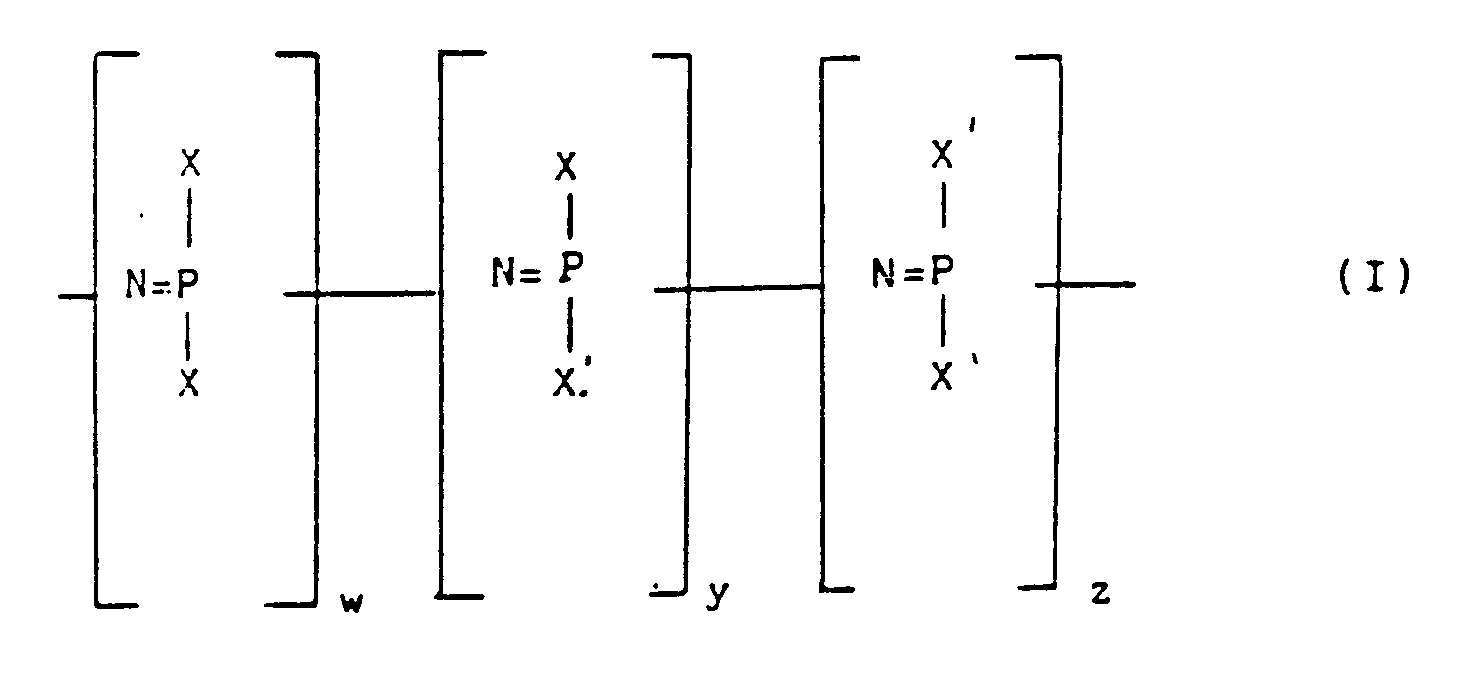
in which:
X represents substituents bound to the polyphosphazene chain through oxygen or amine linkage, and containing carbonyl groups;
X' represents additional substituents bound to the polyphosphazene chains by means of oxygen or amine linkage and containing one or more easily abstractable hydrogen atoms;

w and z are integers higher than or equal to 0 and in any case lower than 15.000;
y is an integer comprised between 20 and 15.000. - The

- The derivatives according to the present invention are prepared by a process which uses, as reagents to obtain the X and X' substituents, compounds containing hydroxy or amino groups, and is characterized in that, when said compounds contain hydroxy groups, said compounds dissolved in an organic solvent are reacted with sodium hydride in a stoichiometric ratio and the obtained sodium salts are reacted with polydichlorophosphazenes of general formula
(NPCl₂)n
where
n is an integer comprised between 20 and 15.000, possibly in the presence of a tetraalkylammonium halide and, when such compounds contain hydroxy or amino groups they are reacted with the polydichlorophosphazene in the presence of a tertiary amine, in a reaction medium consisting of an organic solvent in which the initial reagents and the final polyphosphazene derivatives are both soluble. - The characteristics of the polyphosphazene derivatives according to the invention and of the process for their preparation will be put in evidence with more detail in the following detailed description.
- Said derivatives have the general formula (I)
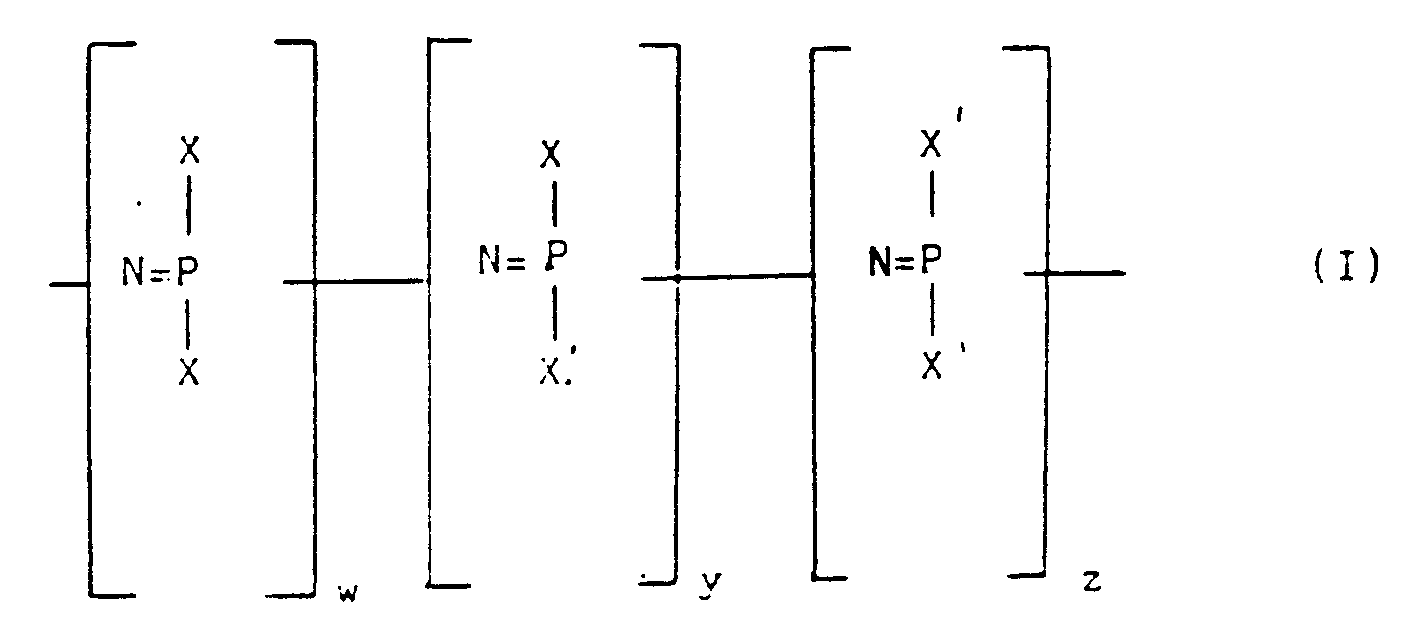
in which:
X represents substituents deriving from hydroxy or amino-substituted carbonyl compounds having the following formulae
in which:
Y represents -O- or -NH-;
R represents a linear or branched alkyl group containing between 1 and 30 carbon atoms, or an aryl group;
R' represents CH₂ or an aromatic or heterocyclic group;
m is an integer between 0 and 5;
X' represents additional substituents having one or more easily abstractable hydrogen atoms, deriving from aliphatic alcohols or amines having linear or branched chains containing between 1 and 30 carbon atoms, of general formula:
H-(CH₂)k-Y-H
in which
k is an integer between 1 and 30;
Y represents -O- or -NH-;
or from aromatic phenols or amines, variously substituted in the ring by groups suitable to easily supply hydrogen atoms, such as alkyl groups of various nature and magnitude, of general formula:
where:
R'' represents a linear or branched radical such as methyl, ethyl, propyl, butyl, pentyl, hexyl, heptyl, octyl, with linear or branched chain
and
Y represents -O- or NH-;

w and z are integers higher than or equal to 0 and in any case lower than 15.000;
y is an integer having a value comprised between 20 and 15.000. - For the preparation of polyphosphazene derivatives according to the invention, said compounds are reacted directly or, in case said compounds are the ones with hydroxy functions, preferably after reaction with sodium hydride, with polydichlorophosphazenes of general formula:
(NPCl₂)n
where
n is an integer comprised between 20 and 15.000. - The polyphosphazene compounds of the present invention are synthesized in such a way as to have the maximum possible value for y and the lowest possible values for w and z, in order to have the maximum efficiency in the photoreticulation process.
- The preferred value of

- The order in which the reagents apt to give X and X' substituents are reacted with the polydichlorophosphazene is determined by the basicity of the substituents themselves.
- In particular, one reacts first the more basic substituent, leaving as second the one of lower basicity.
- This method is employed to the end of avoiding an exchange reaction between a lower basicity substituent made to react first and already bound to the phosphazene chain, with one of higher basicity which enters into the molecule later.
- Furthermore the substituent which is reacted first is employed in a quantity exactly equivalent to the theoretical quantity of chlorine which has to be substituted, which normally is 50% of the one originally available in the polydichlorophosphazene, while the one reacting second has to be used in a large excess (up to 100%) of the theoretical quantity in order to have the maximum possible chlorine substitution.
- In case both groups X and X' have equivalent basicity the corresponding compounds may also be dissolved in a single solvent in equimolar quantities and made to react together.
- For the preparation of the polyphosphazene derivatives according to the present invention, the reaction conditions and the ratios between the employed reagents may vary widely depending on factors such as the reactivity of the compounds which yield the X and X' substituents, the type of employed tertiary amine, and the desired substitution degree in the final polymer.
- In general, the reaction temperature may vary between 25 and 250°C and the time necessary for the complete substitution of the chlorine in the polydichlorophosphazene between 1 and 7 days; low reaction temperatures request longer reaction times, and viceversa higher reaction temperatures allow shorter reaction times.
- The reaction is carried out in an organic solvent or in a mixture of organic solvents.
- The solvents employed in the reaction must be solvents for the polydichlorophosphazene, for the compounds which yield the X and X' substituents containing hydroxy functions, for their sodium salts, for the compounds which yield the X and X' substituents containing amino groups, for the tertiary amines and furthermore for the obtained polyphosphazene derivative.
- The solvents normally employed are: diglyme, triglyme, methylene chloride, chloroform, tetrahydrofuran, dioxane, benzene, toluene and xylene.
- The amount of solvent is not critical, and any amount sufficient to completely solubilize the reagent substances may be employed.
- Furthermore, in order to eliminate undesired side reactions by the chlorine atoms of the starting polydichlorophosphazene, the solvents must be completely anhydrous.
- In general the amount of hydroxy-or amino-substituted aliphatic, aromatic, alkyl aromatic ketone or quinone as well as the quantity of additional reagents apt to yield X' employed in the synthesis must be at least equivalent to the number of chlorine atoms available in the starting polymer; however, if desired, one can employ an excess of keto-or quino-compounds in order to obtain a complete substitution of the chlorine atoms.
- As chlorophosphazene to be employed in the preparations of the derivatives according to the invention, a polymer is employed having an essentially linear structure indicated as polydichlorophosphazene (NPCl₂)n where "n" is an integer between 20 and 15.000.
- Polydichlorophosphazene is a highly reactive, rubbery polymeric product, which is unstable in the presence of humidity, which is generally prepared by bulk thermal polymerization, under reduced pressure, starting from low molecular weight cyclic oligomers, such as, for instance, hexachlorocyclophosphazene (NPCl₂)₃ and octachlorocyclotetraphosphazene (NPCl₂)₄ or a mixture of both.
- Among the tertiary amines employed in the preparation of the polyphosphazene derivatives of the present invention, are those represented by the general formula:

where R₁, R₂, R₃ are each an alkyl group containing between 1 and 8 carbon atoms, such as trimethylamine, triethylamine triisopropylamine, tri-n-propylamine, tri-n-butylamine; however one can also employ N-methyl morpholine, N-methylpyrrol and furthermore tertiary amines such as pyridine, and those containing diamino groups. - The tertiary amine preferably employed is triethylamine.
- The tetrabutylammonium halides act as catalysts in the substitution reaction of polydichlorophosphazene (NPCl₂)n with the various reagents.
- The employed halides are tetrabutylammonium iodide, -bromide and -chloride.
- The most preferably employed halide is tetrabutylammonium bromide.
- The keto or quino compounds employed in the reaction with the chlorophosphazene to yield the X substituents are preferably:
α-amino- and α-hydroxy-acetone, 4-amino-or 4-hydroxy-benzophenone, 4-amino- or 4-hydroxy acetophenone, 4-amino-or 4-hydroxy-propiophenone, 4-amino or 4-hydroxy-valero phenone, 2-amino-and 2-hydroxy fluorenone, 2-hydroxymethyl antraquinone, 1-or 2-aminoantraquinone, 2-hydroxy naphtoquinone. - The additional reagents yielding the X' substituents are preferably aliphatic alcohols having linear or branched chains, containing between 1 and 30 carbon atoms (such as methanol, ethanol, propanol, butanol, pentanol, hexanol, heptanol, octanol, nonanol, decanol and undecanol), aromatic alcohols such as phenols, variously substituted in the rings with alkyl groups of various nature and complexity (such as cresols, xylols, ethyl phenols, propyl phenols, butyl phenols, pentyl phenols, amyl phenols and octyl phenols), primary and secondary aliphatic amines (methyl, ethyl, dimethyl, diethyl, propyl, and butyl amine), substituted aromatic amines such as toluidine, ethyl aniline, propyl aniline and butyl aniline.
- The polyphosphazene derivatives according to the present invention present, with respect to the known products presently employed in common industrial applications, the advantage that it is possible to easily modify, within very wide limits, their physico-chemical properties and therefore also their photoreactivity, operating in the following ways:
- a) suitably varying the X substituents selecting them in a suitable way among the above indicated classes of compounds;
- b) suitably varying the X' substituents selecting them in a suitable way among the above indicated classes of compounds;
- c) suitably varying the
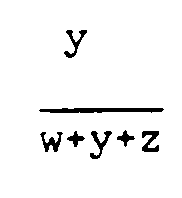
- In this way one obtains phosphazene copolymers having different characteristics and properties suitable for various experimental situations, capable of reticulating with variable efficiency and rapidity.
- As far as the use of the phosphazene copolymers according to the present invention is concerned, they may be used as flexible, elastic and adhesive films, which are spread on glass or quartz substrates, and successively irradiated for variable times with UV or visible radiations.
- The polymeric film, in the surface area exposed to the incident radiation, undergoes a reticulation process induced by the light, the duration of which may vary from a few seconds to a few minutes, which leads to a very high (in some cases total) reticulation of the polymer.
- Said process of photoreticulation of the phosphazene copolymers of the present invention may be employed in the photographic field as a non conventional system (that is not based on the use of silver halides) of reproduction of images.
- In fact, in case the surface of the polymeric film exposed to the light radiations is partially covered by a mask non transparent to the incident radiations, the film portion protected by said mask keeps unchanged its initial solubility, while the remaining film portion reticulates.
- The film portion which remains soluble may then be dissolved with suitable solvents and removed from the substrate, leaving on it an image which exactly reproduces the employed protective mask.
- Photoreticulation processes of this type may find application also in the microelectronic technique for the preparation of printed circuits and in microlithography.
- The following examples are reported to illustrate the invention without any limitation.
-
- 4-
hydroxybenzophenone 50%, 4-isopropylphenol 50%
{NP[O-C₆H₄-CO-C₆H₅]₁ [O-C₆H₄-CH(CH₃)₂]₁}n
8.8 g (= 7,586.10⁻² mol = 0.1517 eq) polydichlorophosphazene are charged into a three neck 1000 ml flask and are dissolved under mild heating in about 100 ml anhydrous dioxane. - In another 1000 ml flask are charged 5.5 g of 60% sodium hydride suspended in aproximately 60 ml dioxane. A 4-isopropylphenol solution (10.39 g = 7586.10⁻² mol) in 70 ml anhydrous dioxane separatly prepared in a funnel is added dropwise to this suspension. At the end of the addition the suspension is heated on reflux for about 4 hours in order to have a complete reaction of the phenol.
- The phenolate is then filtered very slowly and in a nitrogen atmosphere directly into the polydichlorophosphazene solution. The solution is kept under stirring on reflux for 24 hours.
- At the beginning of this 24 hours period the sodium salt of 4-hydroxybenzophenone is prepared: this preparation is carried out 24 hours in advance, so that both the polymer partially substituted with 4-isopropylphenol and the sodium salt of 4-hydroxybenzophenone be ready at the same moment.
- 12.4 g (0.3034 mol) 60% NaH and 2 g tetrabutylammonium bromide are charged in a three neck 2000 ml flask and are suspended in about 100 ml anhydrous dioxane.
- 58 g 4-hydroxybenzophenone are separately weighed in a charging funnel, dissolved in 300 ml dioxane and added drop by drop, very slowly, to the sodium hydride suspension.
- Hydrogen is developed. At the end of the addition the suspension is heated on reflux for about 24 hours. At the end of this period the solution of the partially substituted polymer is added very slowly and under stirring to the 4-hydroxybenzophenone sodium salt suspension and the mixture is kept on mild reflux for 5 days.
- At the end of this time, the polymer is cooled and poured in an excess of water. A white solid precipitates which is dissolved in THF and precipitated again in water two more times, dissolved again twice in THF and re-precipitated in n-heptane; dissolved again in THF and re-precipitated in a ethyl ether/
n heptane 50% mixture. - A white, gummy polymer is obtained, which is dried under reduced pressure for 2 days.
- All the synthesis and purification operations of this copolymer have to be made in darkness or under red light, in order to avoid fortuitous photoreactions during the operations.
- 4-
hydroxybenzophenone 50%, 4-sec-butylphenol 50%
{NP[O-C₆H₄-CO-C₆H₅]₁ [O-C₆H₄-CH(CH₃)(C₂H₅)]₁}n
The preparation of this copolymer is carried out as described in example 1, employing 4-sec-butylphenol instead of 4-isopropylphenol, taking the same precautions in as far as the conditions of darkness are concerned. - 4-
hydroxybenzophenone 50%, 4-tert-octylphenol 50%
{NP[O-C₆H₄-CO-C₆-H₅]₁ [O-C₆H₄-C(CH₃)₂-CH₂-C(CH₃)₃]₁}n
In the X' substituent (tert-octylphenol) of this copolymer, differently from preceeding examples 1 and 2, no easily extractable hydrogen atoms bound to tertiary carbon atoms are contained; however a long aliphatic chain branched in the 4 position is present in the aromatic phenol ring. - Also in this case the preparation is carried out following the procedure of example 1 operating in darkness during the synthesis as well as during the purification of the copolymer.
- Photoreticulation of the product of example 1 with cut-off filters.
- This copolymer is irradiated as a thin film spread on glass, using a cut-off filter in order to eliminate incident radiations having wave lenghts below 340 nm, operating as follows.
- A thin film is prepared by slow evaporation in air of a solution of the polymer dissolved in dichloromethane and drying under vacuum for 2 days.
- The film is then irradiated with a 900 W Xenon lamp, placing it at a distance of about 30 cm from the light source, inserting the cut-off filters between the film and the lamp.
- It is important to note that, on the basis of spectrophotometric measurements made on the polymer film prior to and after the irradiation, no appreciable variations of the optical density are observed for all the experimented exposure times (up to 10 minutes).
- The irradiated polymeric film is then put into dichloromethane and left under stirring for several days.
- The reticulation degree of the irradiated polymer is determined by measuring the percentage of gel formed under the irradiation.
- All the operation and storage of the phosphazene copolymer solutions as well as of the films to be irradiated are carried out in darkness or under red light, to the end of preserving this material from accidental photoreticulation processes during the operations.
- The results obtained with this polymer are illustrated in figure 1 (curve 1) from which one can see that a very high reticulation of this copolymer may be obtained with an irradiation of a few seconds.
- Photoreticulation of the product of example 1, without cut off filters.
- The experiment described in the preceeding example is repeated except that in this case no cut-off filter is inserted between the polymer film and the light source.
- As can be seen from figure 1 (curve 2) the reticulation process takes place in a time even shorter than in example n. 4.
- Evaluation of the entity of the photoreticulation process as a function of the irradiation wave length.
- The polymer of example 1, spread in a thin film as described in example 4, is irradiated for equal times (5 minutes) using in the various experiments cut-off filters of variable wave lenghts, in order to check the spectral response of this material.
- The gel percentage obtained in these experiments, as a function of the irradiations wave length, is reported in figure 2, from which one can see that the spectral response of this copolymer varies from the extreme ultraviolet up to about 380-390 nm.
Claims (12)
- Process for the preparation of polyphosphazene derivatives containing carbonyl groups, having the general formula (I)

X represents substituents bound to the polyphosphazene chains through an oxygen or amine linkage, and containing carbonyl groups;
X' represents additional substituents bound to the polyphosphazene chains through an oxygen or amine linkage and containing 1 or more easily abstractable hydrogen atoms;

y is an integer comprised between 20 and 15.000,
employing as reagents yielding the X and X' substituents compounds containing hydroxy and amino groups, characterized in that, when said compounds contain hydroxy groups, these compounds, dissolved in an organic solvent, are reacted with sodium hydride and the obtained sodium salts are reacted with a polydichlorphosphazene of general formula:
(NPCl₂)n
where n is an integer comprised between 20 and 15.000, possibly in the presence of a tetraalkylammonium halide, and when said compounds contain hydroxy and/or amino groups, they are reacted with the polydichlorophosphazene in the presence of a tertiary amine, in a reaction medium consisting of an organic solvent in which both the initial reagents and the final polyphosphazene derivatives are soluble, said compounds employed to yield the X substituents being:
Y represents -O- or -NH-;
R represents a linear or branched alkyl group, containing from 1 to 30 carbon atoms, or an aryl group;
R' represents CH₂ or an aromatic or heterocyclic group;
m is an integer between 0 and 5, and
compounds employed to yield the X' substituents being:
k represents an integer between 1 and 30;
R'' represents a methyl, ethyl, propyl, butyl, pentyl, hexyl, heptyl, octyl having linear or branched chains and
Y represents -O- or -NH-. - A process according to claim 1, characterized in that the addition of said reagents for the introduction of the X and X' substituents in the (NPCl₂)n molecule may be carried out at the same time for X and X' groups having comparable basicity.
- A process according to claim 1, characterized in that the addition of said reagents for introducing the X and X' substituents into the (NPCl₂)n molecule is carried out according to a sequence determined by the basicity of the entering groups, the more basic substituent being always substituted first and the less basic second.
- A process according to claim 1, characterized in that the quantity of said reagents for the introduction of X and X' into the (NPCl₂)n molecule is equivalent at least to the number of chlorine atoms available in the starting polydichlorophosphazene.
- A process according to claim 1, characterized in that the reaction with polydichlorophosphazene is carried out at a temperature comprised between 25 and 250°C for a time comprised between 1 and 7 days.
- A process according to claim 1, characterized in that the reaction medium is selected from diglyme, triglyme, methylene chloride, chloroform, tetrahydrofurane, dioxane, benzene, toluene and xylene.
- A process according to claim 1, characterized in that said tertiary amines are trimethylamine, triethylamine, tri-isopropyl amine, tri-n-propylamine, tri-n-butylamine, N-methylmorpholine, N-methylpyrrol, pyridine.
Applications Claiming Priority (2)
| Application Number | Priority Date | Filing Date | Title |
|---|---|---|---|
| IT8822631A IT1230648B (en) | 1988-11-16 | 1988-11-16 | POLYPHOSPHAZENIC DERIVATIVES CONTAINING CARBONYL GROUPS SUITABLE FOR PHOTORETICULATION PROCESSES |
| IT2263188 | 1988-11-16 |
Publications (3)
| Publication Number | Publication Date |
|---|---|
| EP0369398A2 EP0369398A2 (en) | 1990-05-23 |
| EP0369398A3 EP0369398A3 (en) | 1991-06-12 |
| EP0369398B1 true EP0369398B1 (en) | 1995-09-06 |
Family
ID=11198643
Family Applications (1)
| Application Number | Title | Priority Date | Filing Date |
|---|---|---|---|
| EP89121063A Expired - Lifetime EP0369398B1 (en) | 1988-11-16 | 1989-11-14 | Polyphosphazene derivatives containing carbonyl groups suitable for photoreticulation processes |
Country Status (6)
| Country | Link |
|---|---|
| US (1) | US5041524A (en) |
| EP (1) | EP0369398B1 (en) |
| JP (1) | JPH02209880A (en) |
| AT (1) | ATE127492T1 (en) |
| DE (1) | DE68924130T2 (en) |
| IT (1) | IT1230648B (en) |
Families Citing this family (6)
| Publication number | Priority date | Publication date | Assignee | Title |
|---|---|---|---|---|
| US5175241A (en) * | 1989-12-28 | 1992-12-29 | The Dexter Corporation | Polyimide with reduced anhydride content |
| US5248585A (en) * | 1991-12-18 | 1993-09-28 | Hoechst Celanese Corporation | Polyphosphazene binder resins for photoresists comprising as photosensitizers o-quinone diazide esters |
| DE19611262A1 (en) * | 1996-03-22 | 1997-09-25 | Basf Lacke & Farben | Multi-layer recording element suitable for the production of flexographic printing plates by digital information transmission |
| JP4184158B2 (en) * | 2003-06-05 | 2008-11-19 | 旭化成ケミカルズ株式会社 | Method for producing phosphonitrile ester |
| GB0421167D0 (en) * | 2004-09-23 | 2004-10-27 | Sec Dep For Defence Awe The | Novel energetic polyphosphazenes |
| CN101245147B (en) * | 2008-03-12 | 2010-12-01 | 李晓辉 | Composition and synthesis method of a biodegradable amphiphilic polyphosphazene as carrier of hydrophobic drug nano-preparation |
Family Cites Families (5)
| Publication number | Priority date | Publication date | Assignee | Title |
|---|---|---|---|---|
| US4242499A (en) * | 1979-07-27 | 1980-12-30 | The Firestone Tire & Rubber Company | Colored polymers comprising poly(organophosphazenes) with chromophores as substituent groups |
| US4558103A (en) * | 1985-01-22 | 1985-12-10 | The Firestone Tire & Rubber Company | Polyphosphazene polymers containing diallyamino substituents |
| IT1183333B (en) * | 1985-02-11 | 1987-10-22 | Consiglio Nazionale Ricerche | PHOSFAZENIC COPOLYMERS HAVING 2-OXYCARBAZOL OR ITS N-DERIVATIVES AS SUBSTITUTES |
| EP0200854A3 (en) * | 1985-02-11 | 1989-04-26 | Consiglio Nazionale Delle Ricerche | Phosphazene homopolymers and copolymers having hydroxylated or amino derivatives of carbazole or of naphthalene as substituents |
| US4806322A (en) * | 1987-11-16 | 1989-02-21 | The Firestone Tire & Rubber Company | Process for the production of linear polyphosphazenes |
-
1988
- 1988-11-16 IT IT8822631A patent/IT1230648B/en active
-
1989
- 1989-11-14 EP EP89121063A patent/EP0369398B1/en not_active Expired - Lifetime
- 1989-11-14 DE DE68924130T patent/DE68924130T2/en not_active Expired - Fee Related
- 1989-11-14 AT AT89121063T patent/ATE127492T1/en not_active IP Right Cessation
- 1989-11-16 JP JP1298744A patent/JPH02209880A/en active Pending
- 1989-11-16 US US07/437,352 patent/US5041524A/en not_active Expired - Fee Related
Also Published As
| Publication number | Publication date |
|---|---|
| DE68924130T2 (en) | 1996-02-01 |
| DE68924130D1 (en) | 1995-10-12 |
| EP0369398A3 (en) | 1991-06-12 |
| ATE127492T1 (en) | 1995-09-15 |
| US5041524A (en) | 1991-08-20 |
| IT1230648B (en) | 1991-10-28 |
| EP0369398A2 (en) | 1990-05-23 |
| IT8822631A0 (en) | 1988-11-16 |
| JPH02209880A (en) | 1990-08-21 |
Similar Documents
| Publication | Publication Date | Title |
|---|---|---|
| Allcock et al. | Phosphonitrilic compounds. VI. High molecular weight poly (alkoxy-and aryloxyphosphazenes) | |
| O'Brien et al. | Photolysis of Poly (alkoxy-and aryloxyphosphazenes),[NP (OR) 2] n | |
| EP1161480A1 (en) | Biodegradable and thermosensitive polyphosphazenes and their preparation method | |
| Allcock et al. | Phosphazene high polymers with bioactive substituent groups: prospective anesthetic aminophosphazenes | |
| Ni et al. | Synthesis, glass transition behavior, and solution characterization of poly [(aryloxy) thionylphosphazenes] with halogen substituents at sulfur | |
| US5041524A (en) | Polyphosphazene derivatives containing carbonyl groups suitable for photoreticulation processes | |
| JPS63135426A (en) | Acryloxy-containing organopolysiloxane and its production and use | |
| Ni et al. | Polymers with sulfur (VI)− nitrogen− phosphorus backbones: synthesis, characterization, and properties of atactic poly [(amino) thionylphosphazenes] | |
| US4242499A (en) | Colored polymers comprising poly(organophosphazenes) with chromophores as substituent groups | |
| KR20000053225A (en) | Polyhalophosphazene solutions stable against gelation | |
| EP0410287B1 (en) | Polyphosphazene derivatives containing carbonyl groups and variously alkylated tertiary amino groups | |
| US8129498B2 (en) | Polymeric medium | |
| White et al. | Synthesis of polyarylaminophosphazenes | |
| Allcock et al. | Organosiloxyphosphazene polymers: synthesis via aminosiloxane reagents | |
| US5747604A (en) | Polyphosphazenes with unsaturated side groups useful as reaction intermediates, cross-linkable polymers, and as components of interpenetrating polymer networks | |
| JP2633639B2 (en) | Photographic element containing polyphosphazene antistatic composition | |
| US4412066A (en) | Polymer bound dyes prepared by diazo coupling reactions with poly(organophosphazenes) | |
| Gleria et al. | Photochemical behavior of poly (organophosphazenes). X. Photo-cross-linking phenomena in poly [bis (4-isopropylphenoxy) 0.8 (4-benzoylphenoxy) 1.2 phosphazene] | |
| Allcock et al. | Poly (monophosphazophosphazenes): New polymers with N: PR3 side groups | |
| US4657993A (en) | Phosphazene homopolymers and copolymers having hydroxylated or amino derivatives of carbazole or of naphthalene as substituents | |
| Ahn et al. | Photocurable system of polythiol and polyphosphazene-containing allyl groups | |
| SE443985B (en) | POLY (ORGANOPHOSPHOSPHENES) CONTAINING CHROMOPHORA GROUPS AND PROCEDURES FOR PREPARING THEREOF | |
| Maciejewski et al. | Compounds of [btilde]-Cyclodextrin and Organosilicon Oligomers | |
| US5861469A (en) | Photoluminescent bicyclic polydislacyclobutanes | |
| US4816532A (en) | Acrylate cured polyphosphazenes |
Legal Events
| Date | Code | Title | Description |
|---|---|---|---|
| PUAI | Public reference made under article 153(3) epc to a published international application that has entered the european phase |
Free format text: ORIGINAL CODE: 0009012 |
|
| AK | Designated contracting states |
Kind code of ref document: A2 Designated state(s): AT BE CH DE ES FR GB GR IT LI LU NL SE |
|
| PUAL | Search report despatched |
Free format text: ORIGINAL CODE: 0009013 |
|
| AK | Designated contracting states |
Kind code of ref document: A3 Designated state(s): AT BE CH DE ES FR GB GR IT LI LU NL SE |
|
| 17P | Request for examination filed |
Effective date: 19911204 |
|
| 17Q | First examination report despatched |
Effective date: 19930519 |
|
| GRAA | (expected) grant |
Free format text: ORIGINAL CODE: 0009210 |
|
| AK | Designated contracting states |
Kind code of ref document: B1 Designated state(s): AT BE CH DE ES FR GB GR IT LI LU NL SE |
|
| PG25 | Lapsed in a contracting state [announced via postgrant information from national office to epo] |
Ref country code: IT Free format text: LAPSE BECAUSE OF FAILURE TO SUBMIT A TRANSLATION OF THE DESCRIPTION OR TO PAY THE FEE WITHIN THE PRE;WARNING: LAPSES OF ITALIAN PATENTS WITH EFFECTIVE DATE BEFORE 2007 MAY HAVE OCCURRED AT ANY TIME BEFORE 2007. THE CORRECT EFFECTIVE DATE MAY BE DIFFERENT FROM THE ONE RECORDED.SCRIBED TIME-LIMIT Effective date: 19950906 Ref country code: GR Free format text: LAPSE BECAUSE OF FAILURE TO SUBMIT A TRANSLATION OF THE DESCRIPTION OR TO PAY THE FEE WITHIN THE PRESCRIBED TIME-LIMIT Effective date: 19950906 Ref country code: AT Effective date: 19950906 Ref country code: ES Free format text: THE PATENT HAS BEEN ANNULLED BY A DECISION OF A NATIONAL AUTHORITY Effective date: 19950906 |
|
| REF | Corresponds to: |
Ref document number: 127492 Country of ref document: AT Date of ref document: 19950915 Kind code of ref document: T |
|
| REF | Corresponds to: |
Ref document number: 68924130 Country of ref document: DE Date of ref document: 19951012 |
|
| PG25 | Lapsed in a contracting state [announced via postgrant information from national office to epo] |
Ref country code: LU Free format text: LAPSE BECAUSE OF NON-PAYMENT OF DUE FEES Effective date: 19951130 |
|
| PGFP | Annual fee paid to national office [announced via postgrant information from national office to epo] |
Ref country code: CH Payment date: 19951130 Year of fee payment: 7 |
|
| PG25 | Lapsed in a contracting state [announced via postgrant information from national office to epo] |
Ref country code: SE Effective date: 19951206 |
|
| ET | Fr: translation filed | ||
| REG | Reference to a national code |
Ref country code: CH Ref legal event code: PL |
|
| PLBE | No opposition filed within time limit |
Free format text: ORIGINAL CODE: 0009261 |
|
| STAA | Information on the status of an ep patent application or granted ep patent |
Free format text: STATUS: NO OPPOSITION FILED WITHIN TIME LIMIT |
|
| 26N | No opposition filed | ||
| PG25 | Lapsed in a contracting state [announced via postgrant information from national office to epo] |
Ref country code: LI Free format text: LAPSE BECAUSE OF FAILURE TO SUBMIT A TRANSLATION OF THE DESCRIPTION OR TO PAY THE FEE WITHIN THE PRESCRIBED TIME-LIMIT Effective date: 19961130 Ref country code: CH Free format text: LAPSE BECAUSE OF FAILURE TO SUBMIT A TRANSLATION OF THE DESCRIPTION OR TO PAY THE FEE WITHIN THE PRESCRIBED TIME-LIMIT Effective date: 19961130 |
|
| PGFP | Annual fee paid to national office [announced via postgrant information from national office to epo] |
Ref country code: BE Payment date: 19991220 Year of fee payment: 11 |
|
| PGFP | Annual fee paid to national office [announced via postgrant information from national office to epo] |
Ref country code: FR Payment date: 20001023 Year of fee payment: 12 Ref country code: GB Payment date: 20001023 Year of fee payment: 12 |
|
| PGFP | Annual fee paid to national office [announced via postgrant information from national office to epo] |
Ref country code: NL Payment date: 20001026 Year of fee payment: 12 |
|
| PGFP | Annual fee paid to national office [announced via postgrant information from national office to epo] |
Ref country code: DE Payment date: 20001027 Year of fee payment: 12 |
|
| PG25 | Lapsed in a contracting state [announced via postgrant information from national office to epo] |
Ref country code: BE Free format text: LAPSE BECAUSE OF NON-PAYMENT OF DUE FEES Effective date: 20001130 |
|
| BERE | Be: lapsed |
Owner name: CONSIGLIO NAZIONALE DELLE RICERCHE Effective date: 20001130 |
|
| PG25 | Lapsed in a contracting state [announced via postgrant information from national office to epo] |
Ref country code: GB Free format text: LAPSE BECAUSE OF NON-PAYMENT OF DUE FEES Effective date: 20011114 |
|
| REG | Reference to a national code |
Ref country code: GB Ref legal event code: IF02 |
|
| PG25 | Lapsed in a contracting state [announced via postgrant information from national office to epo] |
Ref country code: NL Free format text: LAPSE BECAUSE OF NON-PAYMENT OF DUE FEES Effective date: 20020601 |
|
| PG25 | Lapsed in a contracting state [announced via postgrant information from national office to epo] |
Ref country code: DE Free format text: LAPSE BECAUSE OF NON-PAYMENT OF DUE FEES Effective date: 20020702 |
|
| PG25 | Lapsed in a contracting state [announced via postgrant information from national office to epo] |
Ref country code: FR Free format text: LAPSE BECAUSE OF NON-PAYMENT OF DUE FEES Effective date: 20020730 |
|
| NLV4 | Nl: lapsed or anulled due to non-payment of the annual fee |
Effective date: 20020601 |
|
| REG | Reference to a national code |
Ref country code: FR Ref legal event code: ST |
|
| REG | Reference to a national code |
Ref country code: FR Ref legal event code: ST |