EP0368749A1 - Substituted carboxylic acid, and their production and use - Google Patents
Substituted carboxylic acid, and their production and use Download PDFInfo
- Publication number
- EP0368749A1 EP0368749A1 EP89403063A EP89403063A EP0368749A1 EP 0368749 A1 EP0368749 A1 EP 0368749A1 EP 89403063 A EP89403063 A EP 89403063A EP 89403063 A EP89403063 A EP 89403063A EP 0368749 A1 EP0368749 A1 EP 0368749A1
- Authority
- EP
- European Patent Office
- Prior art keywords
- methyl
- group
- ethyl
- formula
- propyl
- Prior art date
- Legal status (The legal status is an assumption and is not a legal conclusion. Google has not performed a legal analysis and makes no representation as to the accuracy of the status listed.)
- Granted
Links
- 0 CC(*(*)*=C1C)=C1[N+](C)[O-] Chemical compound CC(*(*)*=C1C)=C1[N+](C)[O-] 0.000 description 3
Classifications
-
- C—CHEMISTRY; METALLURGY
- C07—ORGANIC CHEMISTRY
- C07D—HETEROCYCLIC COMPOUNDS
- C07D307/00—Heterocyclic compounds containing five-membered rings having one oxygen atom as the only ring hetero atom
- C07D307/77—Heterocyclic compounds containing five-membered rings having one oxygen atom as the only ring hetero atom ortho- or peri-condensed with carbocyclic rings or ring systems
- C07D307/78—Benzo [b] furans; Hydrogenated benzo [b] furans
- C07D307/79—Benzo [b] furans; Hydrogenated benzo [b] furans with only hydrogen atoms, hydrocarbon or substituted hydrocarbon radicals, directly attached to carbon atoms of the hetero ring
-
- A—HUMAN NECESSITIES
- A01—AGRICULTURE; FORESTRY; ANIMAL HUSBANDRY; HUNTING; TRAPPING; FISHING
- A01N—PRESERVATION OF BODIES OF HUMANS OR ANIMALS OR PLANTS OR PARTS THEREOF; BIOCIDES, e.g. AS DISINFECTANTS, AS PESTICIDES OR AS HERBICIDES; PEST REPELLANTS OR ATTRACTANTS; PLANT GROWTH REGULATORS
- A01N43/00—Biocides, pest repellants or attractants, or plant growth regulators containing heterocyclic compounds
- A01N43/48—Biocides, pest repellants or attractants, or plant growth regulators containing heterocyclic compounds having rings with two nitrogen atoms as the only ring hetero atoms
- A01N43/56—1,2-Diazoles; Hydrogenated 1,2-diazoles
-
- C—CHEMISTRY; METALLURGY
- C07—ORGANIC CHEMISTRY
- C07D—HETEROCYCLIC COMPOUNDS
- C07D405/00—Heterocyclic compounds containing both one or more hetero rings having oxygen atoms as the only ring hetero atoms, and one or more rings having nitrogen as the only ring hetero atom
- C07D405/02—Heterocyclic compounds containing both one or more hetero rings having oxygen atoms as the only ring hetero atoms, and one or more rings having nitrogen as the only ring hetero atom containing two hetero rings
- C07D405/12—Heterocyclic compounds containing both one or more hetero rings having oxygen atoms as the only ring hetero atoms, and one or more rings having nitrogen as the only ring hetero atom containing two hetero rings linked by a chain containing hetero atoms as chain links
Definitions
- the present invention relates to substituted carboxylic acid derivatives (hereinafter referred to as the present compound) having the formula: wherein R1 is a methyl or trifluoromethyl group; R2 is a halogen atom; R3 and R4 are, same or different, a methyl or ethyl group; R5 is an ethyl, propyl, butyl group or hydrogen atom.
- the halogen atoms are, for example, a fluorine, chlorine, bromine and iodine atom.
- substituted carboxylic acid derivatives having the formula (I) preferred are those wherein R1 is a methyl or trifluoromethyl group; R2 is a chlorine atom; R3 and R4 are, same or different, a methyl or ethyl group; R5 is an ethyl, n-propyl, n-butyl group or hydrogen atom.
- the present compound has preventive, curative and systemic controlling effects on various plant microbes, especially on plant diseases caused by microbes belonging to Basidiomycetes and gives almost no adverse influence to environment.
- Rhizoctonia solani and Rhizoctonia oryzae Rhizoctonia oryzae, R. solani IIIB on rice plant
- Puccinia striiformis P. graminis, P. recondita, P. hordei, Typhula incarnata, T. ishikariensis, Ustilago tritici and U.
- Rhizoctonia solani and Corticium rolfsii on various crops
- Rhizoctonia solani on potato and beet on various crops
- Rhizoctonia solani on potato and beet on various crops
- Rhizoctonia solani on potato and beet on various crops
- Rhizoctonia solani on potato and beet on various crops
- Rhizoctonia solani on potato and beet on various crops
- Gymnosporangium haraeanum on pear Gymnosporangium haraeanum on pear
- Venturia inaequalis on apple Rhizoctonia solani, Corticium rolfsii, Uromyces trifolii and Typhula incarnata, T. ishikariensis on pasture and lawn.
- the present compound a substituted carboxylic acid derivative having the formula: wherein R1 and R2 are each as defined above, is prepared by allowing a pyrazole carboxylic acid having the formula: wherein R1 and R2 are each as defined above, or its reactive derivative to react with a substituted 4-amino-2-oxaindan derivative having the formula wherein R3, R4 and R5 are each as defined above.
- the reaction is usually conducted in the presence of solvent which is not always necessary.
- the solvents are, for example, hydrocarbons such as benzene, toluene and xylene, halogenated hydrocarbons such as chlorobenzene, methylene chloride, chloroform and carbon tetrachloride, ethers such as diisopropyl ether, tetrahydrofuran and dioxane, ketones such as acetone and methyl ethyl ketone, esters such as ethyl acetate, nitriles such as acetonitrile, dimethylsulfoxide, dimethylformamide, water, etc., preferably tetrahydrofuran.
- hydrocarbons such as benzene, toluene and xylene
- halogenated hydrocarbons such as chlorobenzene, methylene chloride, chloroform and carbon tetrachloride
- ethers such as diisoprop
- Amounts of the reagents used in said reaction are 0.4 - 1.5 equivalents, preferably 0.5 - 1.1 equivalents of the substituted pyrazole carboxylic acid represented by the formula (II) or its reactive derivative thereof per equivalent of the substituted 4-amino-2-oxaindan derivative represented by the formula (III).
- the reaction is carried out at optional temperature from the freezing point to the boiling point of the solvent, preferably from 0°C to the boiling point of the solvent.
- the reaction is usually carried out for 0.5 - 20 hours.
- the substituted pyrazole carboxylic acid represented by the formula (II) or its reactive derivative thereof includes the corresponding carboxylic acids, acid anhydrides, acid chlorides, acid bromides, carboxylic esters, etc.
- the reaction may be conducted in the presence of a reaction assistant depending on the substituted pyrazole carboxylic acids represented by the formula (II) or its reactive derivatives thereof.
- the reaction assistant is, for example, 1-(3-dimethylaminopropyl)-3-ethylcarbodiimidemethiodide and dicyclohexylcarbodiimide when carboxylic acid is used, sodium hydride, sodium methylate, sodium ethylate, etc. when carboxylic ester is used, and sodium hydroxide, potassium hydroxide, triethylamine, N-methylmorpholine, pyridine etc., when acid halide or acid anhydride is used.
- the reaction assistant is usually used in an amount of less than 2 equivalents, preferably 0.95 - 1.1 equivalents per equivalent of the substituted pyrazole carboxylic acid represented by the formula (II) or its reactive derivative.
- reaction assistant or reaction products thereof are removed by filtration or washing with water.
- the solvent is removed by distillation to give the desired substituted pyrazole carboxylic acid derivatives of the formula (I). If necessary, the product is further subjected to chromatography, recrystallization, etc. in order to purify the same.
- 4-acetaminophthalide is allowed to react with an ethyl Grignard reagent such as ethylmagnesium bromide (4 - 12 equivalents) in an ether solvent such as diethyl ether and tetrahydrofuran at a temperature from -10°C to room temperature, until diol (a) is obtained.
- the diol (a) is allowed to react with activated manganese dioxide (5 - 20 equivalents) in an ether solvent such as dioxane and tetrahydrofuran or a halogenated hydrocarbon solvent such as chloroform and dichloroethane under refluxing to obtain lactone (b).
- the lactone (b) is allowed to react with methyllithium or ethyllithium (2 - 4 equivalents) in an ether solvent such as diethyl ether and tetrahydrofuran at a temperature from -30°C to room temperature until acetal (c) is obtained.
- the acetal (c) is allowed to react with hydrogen in an alcohol solvent such as methanol and ethanol at room temperature in the presence of catalytic amounts of palladium carbon and hydrochloric acid until anilide (d) is obtained.
- the anilide (d) is then allowed to react with alkali metal hydroxide such as sodium hydroxide and potassium hydroxide (5 - 20 equivalents) in an ethylene glycol and water solvent under refluxing, until substituted 4-amino-2-oxaindan derivative (IV) is obtained.
- alkali metal hydroxide such as sodium hydroxide and potassium hydroxide (5 - 20 equivalents)
- 3-acetaminophthalide anhydride is allowed to react with malonic acid or ⁇ -alkyl (C1 - C3) malonic acid (1 - 5 equivalents) in pyridine under heating, until carboxylic acid (e) is obtained.
- the carboxylic acid (e) is allowed to react with an alkylating reagent such as alkyl halide and dialkyl sulfate (1 - 2 equivalents) in the presence of a base such as potassium carbonate (1 - 2 equivalents) under heating until ester (f) is obtained.
- the ester (f) is allowed to react with methylmagnesium bromide or ethylmagnesium bromide (4 - 10 equivalents) in an ether solvent such as diethyl ether and tetrahydrofuran at a temperature from -10°C to 10°C until acetal (g) is obtained.
- the acetal (g) is allowed to react with hydrogen in an alcohol solvent such as methanol and ethanol at room temperature in the presence of catalytic amounts of palladium carbon and hydrochloric acid until anilide (h) is obtained.
- the anilide (h) is then allowed to react with alkali metal hydroxide such as sodium hydroxide and potassium hydroxide (5 - 20 equivalents) in an ethylene glycol and water solvent under refluxing, until its substituted 4-amino-2-oxaindan derivative (V) is obtained.
- alkali metal hydroxide such as sodium hydroxide and potassium hydroxide (5 - 20 equivalents)
- 3-acetaminophthalide anhydride is allowed to react with malonic acid or ⁇ -alkyl (C1 - C3) malonic acid (1 - 5 equivalents) in pyridine under heating, until carboxylic acid (i) is obtained.
- the carboxylic acid (i) is allowed to react with an alkylating reagent such as alkyl halide and dialkyl sulfate (1 - 2 equivalents) in the presence of a base such as potassium carbonate (1 - 2 equivalents) under heating until ester (j) is obtained.
- the ester (j) is allowed to react with sodium brohydride (1 - 4 equivalents) in an aqueous alcohol at a temperature from 0°C to room temperature until lactone (k) is obtained.
- the lactone (k) is then allowed to react with methyllithium or ethyllithium (2 - 4 equivalents) in an ether solvent such as diethyl ether and tetrahydrofuran at a temperature from -30°C to room temperature until acetal (1) is obtained.
- the acetal (1) is allowed to react with hydrogen in an alcohol solvent such as methanol and ethanol at room temperature in the presence of catalytic amounts of palladium carbon and hydrochloric acid until anilide (m) is obtained.
- the anilide (m) is then allowed to react with alkali metal hydroxide such as sodium hydroxide and potassium hydroxide (5 - 20 equivalents) in an ethylene glycol and water solvent under refluxing, until substituted 4-amino-2-oxaindan derivative (VI) is obtained.
- alkali metal hydroxide such as sodium hydroxide and potassium hydroxide (5 - 20 equivalents)
- the present compound When used as an active ingredient of fungicides, it may be used without adding any other components, but usually, it is formulated into emulsifiable concentrates, wettable powders, suspension formulations, granules, dusts, liquids and the like by mixing with a solid or liquid carrier, a surface active agent and other auxiliaries for formulation.
- the content of the present compound as an active ingredient in these formulations is 0.1 to 99.9 %, preferably 0.2 to 80 % by weight.
- the solid carriers include, for example, fine powders or granules of kaolin clay, attapulgite clay, bentonite, acid clay, pyrophyllite, talc, diatomaceous earth, calcite, corn starch powder, walnut shell powder, urea, ammonium sulfate, synthetic hydrated silicon dioxide and the like.
- the liquid carrier includes, for example, aromatic hydrocarbons such as xylene, methylnaphthalene and the like, alcohols such as isopropanol, ethylene glycol, cellosolve and the like, ketones such as acetone, cyclohexanone, isophorone and the like, vegetable oils such as soybean oil, cotton seed oil and the like, dimethyl sulfoxide, acetonitrile, water and the like.
- aromatic hydrocarbons such as xylene, methylnaphthalene and the like
- alcohols such as isopropanol, ethylene glycol, cellosolve and the like
- ketones such as acetone, cyclohexanone, isophorone and the like
- vegetable oils such as soybean oil, cotton seed oil and the like, dimethyl sulfoxide, acetonitrile, water and the like.
- the surface active agents used for emulsification, dispersion, wetting, etc. include, for example, anionic surface active agents such as salts of alkyl sulfate, alkyl or aryl sulfonates, dialkyl-sulfosuccinates, salts of polyoxyethylene alkylaryl ether phosphoric acid esters, naphtalene-sulfonic acid/formalin condensates, etc. and nonionic surfate active agents such as polyoxyethylene alkyl ether, polyoxyethylene polyoxypropylene block copolymers,sorbitan fatty acid esters, polyoxyethylene sorbitan fatty acid esters, etc.
- the auxiliaries for formulation include, for example, lignosulfonates, alginates, polyvinyl alcohol, gum arabic, CMC (carboxymethyl cellulose), PAP (acid isopropyl phosphate), etc.
- formulations as such or diluted with, for example, water are applied to soil or directly to plants and used for submerged application, too.
- they are used in various forms, e.g., spraying or dusting on plants or spraying, dusting or granule-sprinkling onto soil surface, paddy field surface or if necessary, subsequent further soil incorporation.
- seed treating agents seeds are covered therewith or dipped therein.
- These formulations may also be used in admixture with other fungicides, insecticides, acaricides, nematocides, herbicides, plant growth regulating agents, fertilizers, soil improvers and the like.
- the present compounds are used as an active ingredient of fungicides to be used for paddy field, plowland, orchard, tea garden, pasture, turf and the like.
- the present compound When the present compound is used as an active ingredient of fungicide, its dosage is usually 0.5 to 100 g, preferably 1 to 50 g per are, although it depends on weather conditions, form of formulations, time, method and place of application, diseases to be controlled, crops to be treated, etc.
- the emulsifiable concentrate, wettable powder, suspension formulation, liquid formulation, etc. are diluted with water for use, the concentration is 0.0001 % to 1 %, preferably 0.0005 % to 0.5 %.
- Granule and dust are used as they are without any dilution.
- the present compound is able to be used as an active ingredient of fungicides for various kinds of applications, since the present compound is remarkably active against various plant diseases, particularly those by microorganisms belonging to Basidiomycetes .
- the controlling effect is determined by observing with the naked eye the condition of disease of test plants on examination, namely, the degree of fungus colony and infected area of leaf and stem and grading the condition of diseases into the following six indices 0, 1, 2, 3, 4 and 5:
Landscapes
- Organic Chemistry (AREA)
- Chemical & Material Sciences (AREA)
- Life Sciences & Earth Sciences (AREA)
- Dentistry (AREA)
- Health & Medical Sciences (AREA)
- Engineering & Computer Science (AREA)
- Plant Pathology (AREA)
- General Health & Medical Sciences (AREA)
- Wood Science & Technology (AREA)
- Zoology (AREA)
- Environmental Sciences (AREA)
- Pest Control & Pesticides (AREA)
- Agronomy & Crop Science (AREA)
- Agricultural Chemicals And Associated Chemicals (AREA)
- Plural Heterocyclic Compounds (AREA)
Abstract
Description
- The present invention relates to substituted carboxylic acid derivatives (hereinafter referred to as the present compound) having the formula:

- The halogen atoms are, for example, a fluorine, chlorine, bromine and iodine atom.
- According to the present invention, processes for preparing the present compound and agricultural or horticultural fungicides containing the present compound as an active ingredient are provided, too.
- Fungicidal activity of some carboxylic acid derivatives is reported in e.g., Japanese Patent Kokai Nos. 52-87168 (USP-4134987) and 60-34949. However, chemicals have been demanded which have higher fungicidal activity, since those known compounds are not satisfactory in activity.
- After extensive research on compounds having high fungicidal activity, the present inventors have found substituted carboxylic acid derivatives having the formula (I).
- Among the substituted carboxylic acid derivatives having the formula (I), preferred are those wherein R₁ is a methyl or trifluoromethyl group; R₂ is a chlorine atom; R₃ and R₄ are, same or different, a methyl or ethyl group; R₅ is an ethyl, n-propyl, n-butyl group or hydrogen atom.
- The present compound has preventive, curative and systemic controlling effects on various plant microbes, especially on plant diseases caused by microbes belonging to Basidiomycetes and gives almost no adverse influence to environment.
- The following are plant diseases on which the present compound has an excellent controlling effect; Rhizoctonia solani and Rhizoctonia oryzae, R. solani IIIB on rice plant; Puccinia striiformis, P. graminis, P. recondita, P. hordei, Typhula incarnata, T. ishikariensis, Ustilago tritici and U. nuda on wheat and barley; Rhizoctonia solani and Corticium rolfsii on various crops; Rhizoctonia solani on potato and beet; Gymnosporangium haraeanum on pear; Venturia inaequalis on apple; Rhizoctonia solani, Corticium rolfsii, Uromyces trifolii and Typhula incarnata, T. ishikariensis on pasture and lawn.
- Method for preparing the present compound will be explained in detail below.
- The present compound, a substituted carboxylic acid derivative having the formula:


- The reaction is usually conducted in the presence of solvent which is not always necessary. The solvents are, for example, hydrocarbons such as benzene, toluene and xylene, halogenated hydrocarbons such as chlorobenzene, methylene chloride, chloroform and carbon tetrachloride, ethers such as diisopropyl ether, tetrahydrofuran and dioxane, ketones such as acetone and methyl ethyl ketone, esters such as ethyl acetate, nitriles such as acetonitrile, dimethylsulfoxide, dimethylformamide, water, etc., preferably tetrahydrofuran.
- Amounts of the reagents used in said reaction are 0.4 - 1.5 equivalents, preferably 0.5 - 1.1 equivalents of the substituted pyrazole carboxylic acid represented by the formula (II) or its reactive derivative thereof per equivalent of the substituted 4-amino-2-oxaindan derivative represented by the formula (III).
- The reaction is carried out at optional temperature from the freezing point to the boiling point of the solvent, preferably from 0°C to the boiling point of the solvent.
- The reaction is usually carried out for 0.5 - 20 hours.
- The substituted pyrazole carboxylic acid represented by the formula (II) or its reactive derivative thereof includes the corresponding carboxylic acids, acid anhydrides, acid chlorides, acid bromides, carboxylic esters, etc.
- The reaction may be conducted in the presence of a reaction assistant depending on the substituted pyrazole carboxylic acids represented by the formula (II) or its reactive derivatives thereof. The reaction assistant is, for example, 1-(3-dimethylaminopropyl)-3-ethylcarbodiimidemethiodide and dicyclohexylcarbodiimide when carboxylic acid is used, sodium hydride, sodium methylate, sodium ethylate, etc. when carboxylic ester is used, and sodium hydroxide, potassium hydroxide, triethylamine, N-methylmorpholine, pyridine etc., when acid halide or acid anhydride is used. The reaction assistant is usually used in an amount of less than 2 equivalents, preferably 0.95 - 1.1 equivalents per equivalent of the substituted pyrazole carboxylic acid represented by the formula (II) or its reactive derivative.
- After the reaction is over, the reaction assistant or reaction products thereof are removed by filtration or washing with water. The solvent is removed by distillation to give the desired substituted pyrazole carboxylic acid derivatives of the formula (I). If necessary, the product is further subjected to chromatography, recrystallization, etc. in order to purify the same.
- Some of representative compounds of the present invention which are able to be produced by these methods are shown in Table 1.

- Substituted 4-amino-2-oxaindan derivative having the formula (IV):


- That is, 4-acetaminophthalide is allowed to react with an ethyl Grignard reagent such as ethylmagnesium bromide (4 - 12 equivalents) in an ether solvent such as diethyl ether and tetrahydrofuran at a temperature from -10°C to room temperature, until diol (a) is obtained. The diol (a) is allowed to react with activated manganese dioxide (5 - 20 equivalents) in an ether solvent such as dioxane and tetrahydrofuran or a halogenated hydrocarbon solvent such as chloroform and dichloroethane under refluxing to obtain lactone (b). Then, the lactone (b) is allowed to react with methyllithium or ethyllithium (2 - 4 equivalents) in an ether solvent such as diethyl ether and tetrahydrofuran at a temperature from -30°C to room temperature until acetal (c) is obtained. The acetal (c) is allowed to react with hydrogen in an alcohol solvent such as methanol and ethanol at room temperature in the presence of catalytic amounts of palladium carbon and hydrochloric acid until anilide (d) is obtained. The anilide (d) is then allowed to react with alkali metal hydroxide such as sodium hydroxide and potassium hydroxide (5 - 20 equivalents) in an ethylene glycol and water solvent under refluxing, until substituted 4-amino-2-oxaindan derivative (IV) is obtained.
- Substituted 4-amino-2-oxaindan derivative having the formula (V):


- That is, 3-acetaminophthalide anhydride is allowed to react with malonic acid or α-alkyl (C₁ - C₃) malonic acid (1 - 5 equivalents) in pyridine under heating, until carboxylic acid (e) is obtained. The carboxylic acid (e) is allowed to react with an alkylating reagent such as alkyl halide and dialkyl sulfate (1 - 2 equivalents) in the presence of a base such as potassium carbonate (1 - 2 equivalents) under heating until ester (f) is obtained. The ester (f) is allowed to react with methylmagnesium bromide or ethylmagnesium bromide (4 - 10 equivalents) in an ether solvent such as diethyl ether and tetrahydrofuran at a temperature from -10°C to 10°C until acetal (g) is obtained. The acetal (g) is allowed to react with hydrogen in an alcohol solvent such as methanol and ethanol at room temperature in the presence of catalytic amounts of palladium carbon and hydrochloric acid until anilide (h) is obtained. The anilide (h) is then allowed to react with alkali metal hydroxide such as sodium hydroxide and potassium hydroxide (5 - 20 equivalents) in an ethylene glycol and water solvent under refluxing, until its substituted 4-amino-2-oxaindan derivative (V) is obtained.
- Substituted 4-amino-2-oxaindan derivative having the formula (VI):


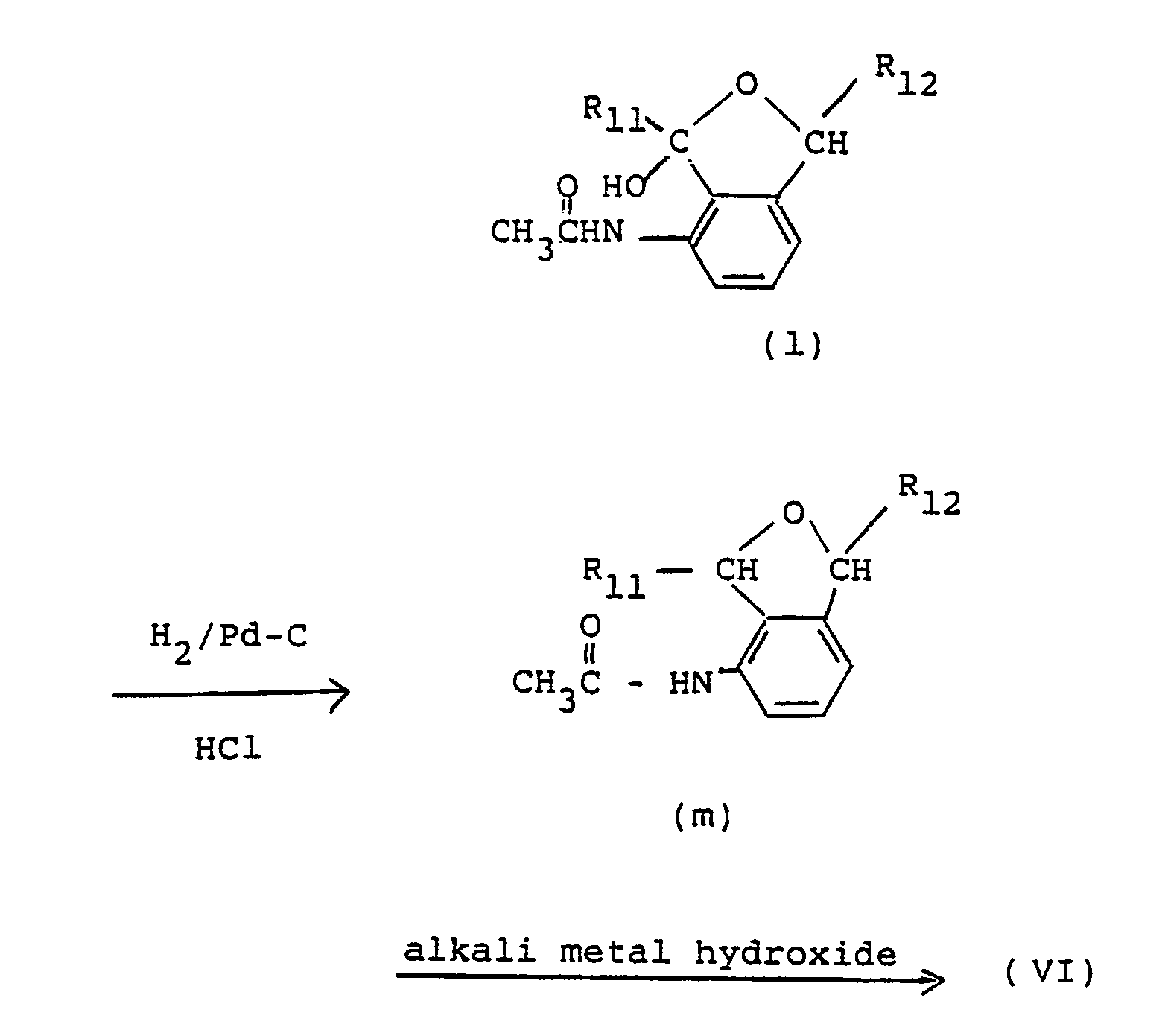
- That is, 3-acetaminophthalide anhydride is allowed to react with malonic acid or α-alkyl (C₁ - C₃) malonic acid (1 - 5 equivalents) in pyridine under heating, until carboxylic acid (i) is obtained. The carboxylic acid (i) is allowed to react with an alkylating reagent such as alkyl halide and dialkyl sulfate (1 - 2 equivalents) in the presence of a base such as potassium carbonate (1 - 2 equivalents) under heating until ester (j) is obtained. The ester (j) is allowed to react with sodium brohydride (1 - 4 equivalents) in an aqueous alcohol at a temperature from 0°C to room temperature until lactone (k) is obtained. The lactone (k) is then allowed to react with methyllithium or ethyllithium (2 - 4 equivalents) in an ether solvent such as diethyl ether and tetrahydrofuran at a temperature from -30°C to room temperature until acetal (1) is obtained. The acetal (1) is allowed to react with hydrogen in an alcohol solvent such as methanol and ethanol at room temperature in the presence of catalytic amounts of palladium carbon and hydrochloric acid until anilide (m) is obtained. The anilide (m) is then allowed to react with alkali metal hydroxide such as sodium hydroxide and potassium hydroxide (5 - 20 equivalents) in an ethylene glycol and water solvent under refluxing, until substituted 4-amino-2-oxaindan derivative (VI) is obtained.
- When the present compound is used as an active ingredient of fungicides, it may be used without adding any other components, but usually, it is formulated into emulsifiable concentrates, wettable powders, suspension formulations, granules, dusts, liquids and the like by mixing with a solid or liquid carrier, a surface active agent and other auxiliaries for formulation.
- The content of the present compound as an active ingredient in these formulations is 0.1 to 99.9 %, preferably 0.2 to 80 % by weight.
- The solid carriers include, for example, fine powders or granules of kaolin clay, attapulgite clay, bentonite, acid clay, pyrophyllite, talc, diatomaceous earth, calcite, corn starch powder, walnut shell powder, urea, ammonium sulfate, synthetic hydrated silicon dioxide and the like. The liquid carrier includes, for example, aromatic hydrocarbons such as xylene, methylnaphthalene and the like, alcohols such as isopropanol, ethylene glycol, cellosolve and the like, ketones such as acetone, cyclohexanone, isophorone and the like, vegetable oils such as soybean oil, cotton seed oil and the like, dimethyl sulfoxide, acetonitrile, water and the like.
- The surface active agents used for emulsification, dispersion, wetting, etc. include, for example, anionic surface active agents such as salts of alkyl sulfate, alkyl or aryl sulfonates, dialkyl-sulfosuccinates, salts of polyoxyethylene alkylaryl ether phosphoric acid esters, naphtalene-sulfonic acid/formalin condensates, etc. and nonionic surfate active agents such as polyoxyethylene alkyl ether, polyoxyethylene polyoxypropylene block copolymers,sorbitan fatty acid esters, polyoxyethylene sorbitan fatty acid esters, etc. The auxiliaries for formulation include, for example, lignosulfonates, alginates, polyvinyl alcohol, gum arabic, CMC (carboxymethyl cellulose), PAP (acid isopropyl phosphate), etc.
- These formulations as such or diluted with, for example, water are applied to soil or directly to plants and used for submerged application, too. In more detail, they are used in various forms, e.g., spraying or dusting on plants or spraying, dusting or granule-sprinkling onto soil surface, paddy field surface or if necessary, subsequent further soil incorporation. Furthermore, when they are used as seed treating agents, seeds are covered therewith or dipped therein. These formulations may also be used in admixture with other fungicides, insecticides, acaricides, nematocides, herbicides, plant growth regulating agents, fertilizers, soil improvers and the like.
- The present compounds are used as an active ingredient of fungicides to be used for paddy field, plowland, orchard, tea garden, pasture, turf and the like.
- When the present compound is used as an active ingredient of fungicide, its dosage is usually 0.5 to 100 g, preferably 1 to 50 g per are, although it depends on weather conditions, form of formulations, time, method and place of application, diseases to be controlled, crops to be treated, etc. When the emulsifiable concentrate, wettable powder, suspension formulation, liquid formulation, etc. are diluted with water for use, the concentration is 0.0001 % to 1 %, preferably 0.0005 % to 0.5 %. Granule and dust are used as they are without any dilution.
- The present compound is able to be used as an active ingredient of fungicides for various kinds of applications, since the present compound is remarkably active against various plant diseases, particularly those by microorganisms belonging to Basidiomycetes.
- The present invention will be explained in more detail by the following synthesis examples, reference examples, formulation examples and text examples. And besides, the present invention is not limited of the above examples.
- To a solution of 80 mg of 1,3-dimethyl-1-n-propyl-2-oxa-4-aminoindan and 48 mg of triethylamine in 5 ml of tetrahydrofuran was added dropwise with stirring below 5°C of inner temperature under ice cooling, a solution of 76 mg of 5-chloro-1,3-dimethyl pyrazole-4-carbonyl chloride in 2 ml of tetrahydrofuran, followed by stirring at room temperature overnight. The reaction mixture was extracted with water and chloroform. The organic layer was washed with water, dried and concentrated. The residue was purified by silica gel thin layer chromatography to obtain 121 mg of N-(1,3-dimethyl-1-n-propyl-2-oxa-4-indanyl)-5-chloro-1,3-dimethyl pyrazole-4-carboxamide.
- Some of representative compounds of the present invention which were produced by these methods are shown in Table 2.

- To a mixture of 9.5 g of metallic magnesium and 60 ml of diethyl ether was slowly added with stirring a solution of 43 g of ethyl bromide in 120 ml of diethyl ether. The mixed solution was heated for 15 minutes under refluxing and left to stand for cooling. The solution of ethylmagnesium bromide thus prepared above in ether was slowly added with stirring at inner temperature of below 10°C to a solution of 7.5 g of 4-acetaminophthalide in 120 ml of tetrahydrofuran, followed by stirring at room temperature overnight. After the reaction was over, the reaction mixture was poured into aqueous ammonium chloride solution (saturated) under ice cooling and extracted twice with 400 ml of ethyl acetate. The combined extracts were concentrated to obtain an oily substance. The oily substance was purified by silica gel column chromatography to obtain 8.0 g of α,α-diethyl-2-hydroxymethyl-3-acetaminobenzyl alcohol in the colorness oily substance.
¹H-NMR (CDCl₃) δ ppm
1.6 (6H, t, J=6.0Hz), 2.1 (3H, s), 3.6 (2H, br. s), 5.0 (2H, s), 7.2 - 7.8 (3H, m), 8.7 (1H, br. s) - To a solution of 8.0 g of α,α-diethyl-2-hydroxymethyl-3-acetaminobenzyl alcohol in 300 ml of tetrahydrofuran was added 32 g of activated manganese dioxide and the mixture was allowed to react for 6 hours under refluxing. After the reaction was over, the reaction mixture was left to stand for cooling and filtered on a glass filter having a bed of celite. The residue was washed with 100 ml of tetrahydrofuran. The filtrate and the washed solution were combined and concentrated to obtain an oily substance. The oily substance was purified by silica gel column chromatography to obtain 4.9 g of 3,3-diethyl-7-acetaminophthalide in the colorless oily substance.
n
¹H-NMR (CDCl₃) δ ppm
0.75 (6H, t, J=6.0Hz), 1.8 - 2.3 (4H, m), 2.3 (3H, s), 7.0 (1H, d, J=8.0Hz), 7.6 (1H, t, J=8.0Hz), 8.5 (1H, d, J=8.0 Hz), 9.7 (1H, br. s) - To a solution of 4.9 g of 3,3-diethyl-7-acetaminophthalide in 80 ml of tetrahydrofuran was slowly added dropwise 43 ml of a solution of methyllithium in ether (1.4 M) at -20°C, followed by stirring at the same temperature for 20 minutes. After the reaction was over, the reaction mixture was poured into aqueous ammonium chloride solution (saturated) under ice cooling and extracted twice with 200 ml of ethyl acetate. The combined extracts were concentrated to obtain 5.3 g of 1,1-diethyl-3-methyl-3-hydroxy-2-oxa-4-acetaminoindan as an oily substance.
¹H-NMR (CDCl₃) δ ppm
0.75 (3H, t, J=6.0Hz), 0.8 (3H, t, J=6.0 Hz), 1.8 (3H, s), 1.4 - 2.1 (4H, m), 2.15 (3H, s), 4.5 (1H, br. s), 6.8 (1H, d, J=8.0Hz), 7.3 (1H, t, J=8.0Hz), 7.95 (1H, d, J=8.0Hz), 8.0 (1H, s) - To a solution of 5.3 g of 1,1-diethyl-3-methyl-3-hydroxy-2-oxa-4-acetaminoindan in 120 ml of ethanol was added catalytic amounts of conc. hydrochloric acid and palladium carbon, and vigorously stirred for 6 hours at room temperature under a hydrogen atmosphere. After the reaction was over, the reaction mixture was filtered on a glass filter having a bed of celite and the residue was washed with 60 ml of ethyl acetate. The filtrate and the washed solution were combined and concentrated to obtain 4.8 g of 1,1-diethyl-3-methyl-2-oxa-4-acetaminoindan in the oily substance form.
¹H-NMR (CDCl₃) δ ppm
0.7 (3H, t, J=6.0Hz), 0.8 (3H, t, J=6.0 Hz), 1.5 (3H, d, J=6.0Hz), 1.3 - 2.0 (4H, m), 2.1 (3H, s), 5.4 (1H, g, J=6.0Hz), 6.7 - 7.4 (3H, m), 8.1 (1H, s) - To a solution of 4.8 g of 1,1-diethyl-3-methyl-2-oxa-4-acetaminoindan in 60 ml of ethylene glycol and 30 ml of water was added 11 g of potassium hydroxide and the mixture was heated under refluxing for 8 hours under a nitrogen atmosphere. After the reaction was over, the reaction mixture was left to stand for cooling, diluted with 60 ml of water and extracted with 60 ml of chloroform four times. The combined extracts were washed with water three times, and concentrated. The oily substance obtained was purified by silica gel thin layer chromatography to obtain 2.3 g of 1,1-diethyl-3-methyl-2-oxa-4-aminoindan in the colorless oily substance. n

¹H-NMR (CDCl₃) δ ppm
0.7 (3H, t, J=6.0Hz), 0.8 (3H, t, J=6.0 Hz), 1.55 (3H, d, J=6.0Hz), 1.5 - 2.1 (4H, m), 3.5 (2H, br. s), 5.35 (1H, q, J=6.0Hz), 6.3 - 6.7 (2H, m), 7.1 (1H, dd, each J=6.0Hz) - The following are synthesis examples of substituted 4-amino-2-oxaindan derivative having the formula (V).
- The mixture of 6.0 g of 3-acetaminophthalide anhydride and 6.0 g of malonic acid in 5 ml of pyridine was heated with stirring at 90 - 100°C for 3 hours. After the reaction was over, the reaction mixture was poured into dil. hydrochloric acid under ice cooling and extracted with ethyl acetate. The obtained extracts were concentrated. To the residue was added water to obtain crystal form. The crystal was filtered and dried to obtain 5.5 g of 2-acetyl-6-acetaminobenzoic acid.
Yield 85 %, mp 130.8°C
¹H-NMR (CDCl₃) δ ppm
1.85 (3H, s), 2.16 (3H, s), 4.3 - 5.1 (1H, br. s), 7.20 (1H, d, J=7.8Hz), 7.55 (1H, dd, J=7.8, 8.0Hz), 8.17 (1H, d, J= 8.0Hz), 9.2-9.6 (1H, br. s) - The mixture of 4.0 g of 2-acetyl-6-acetaminobenzoic acid, 3.1 g of diethyl sulfate and 2.8 g of potassium carbonate in 40 ml of acetone was allowed to react under stirring under refluxing for 5 hours. After the reaction was over, the reaction mixture was poured into ice water and extracted with ethyl acetate. The extract was washed with water and concentrated to obtain 4.1 g of ethyl 2-acetyl-6-acetaminobenzoate.
Yield 91 %, mp 88.0°C
¹H-NMR (CDCl₃) δ ppm
1.34 (3H, t, J=7.0Hz), 2.20 (3H, s), 2.50 (3H, s), 4.32 (2H, g, J=7.0Hz), 7.07 (1H, d, J=7.0Hz), 7.46 (1H, dd, J=7.0, 8.0Hz), 8.50 (1H, d, J=8.0Hz), 9.6 - 10.1 (1H, br. s) - To a solution of 0.71 g of ethyl 2-acetyl-6-acetaminobenzoate in 20 ml of tetrahydrofuran was added dropwise 15 ml of a solution of 13.4 mmol of ethyl magnesium bromide below 5°C, followed by stirring at room temperature overnight. The reaction mixture was poured into aqueous ammonium chloride and extracted with ethyl acetate. The obtained extract was concentrated. To the residue dissolved in ethanol was added catalylic amounts of conc. hydrochloric acid and palladium carbon under a hydrogen atmosphere. After the reaction was over, the palladium carbon was removed by filtration and the filtrate was concentrated. The residue was purified by silica gel thin layer chromatography (solvent system; n-hexane: ethyl acetate = 1 : 1 v/v) to obtain 0.20 g of 1,3-diethyl-1-methyl-2-oxa-4-acetaminoindan.
Yield 30 %
¹H-NMR (CDCl₃) δ ppm
0.6 - 1.3 (6H, m), 1.34 (3H, s), 1.3 - 2.1 (4H, m), 2.02 (3H, s), 5.1 - 5.5 (1H, m), 6.7 - 7.5 (3H, m), 7.8 - 8.4 (1H, br. s) - To a solution of 1.5 g of 1,3-diethyl-1-methyl-2-oxa-4-acetaminoindan in 2 ml of water and 6 ml of ethylene glycol was added 1.7 g of potassium hydroxide and the mixture was heated under refluxing for 8 hours. After the reaction was over, the reaction mixture was poured into water and extracted with ethyl acetate. The extract was concentrated. The residue was purified by silica gel thin layer chromatography (solvent system; n-hexane : ethyl acetate = 1 : 1 v/v) to obtain 0.83 g of 1,3-diethyl-1-methyl-2-oxa-4-aminoindan.
Yield 67 %, n
¹H-NMR (CDCl₃) δ ppm
1.42 (3H, t, J=6.4Hz), 1.54 (3H, t, J=7.0 Hz), 1.38, 1.49 (total 3H, each s), 1.3 - 2.2 (4H, m), 3.3 - 3.8 (2H, br. s), 5.0 - 5.4 (1H, m), 6.46 (1H, d, J=7.0 Hz), 6.49 (1H, d, J=7.4Hz), 7.56 (1H, dd, J=7.0, 7.4Hz) - The following compounds were produced by the same methods.
1, 3-Dimethyl-1-ethyl-2-oxa-4-aminoindan n
¹H-NMR (CDCl₃) δ ppm
0.83 (3H, t, J=7.6Hz), 1.36, 1.47 (total 3H, each s), 1.52 (3H, d, J=6.0Hz), 1.4-2.1 (2H, m), 3.2 - 4.0 (2H, br. s), 5.27 (1H, q, J=6.0Hz), 6.43 (1H, d, J=8.0 Hz), 6.48 (1H, d, J=8.0Hz), 7.04 (1H, dd, each 8.0 Hz)
1,3-Dimethyl-1-n-propyl-2-oxa-4-aminoindan n
¹H-NMR (CDCl₃) δ ppm
0.5 - 1.1 (3H, br. t), 1.37, 1.48 (total 3H, each s), 1.53 (3H, d, J=6.2Hz), 1.3 - 2.0 (4H, m), 3.1 - 3.8 (2H, br. s), 5.27 (1H, q, J=6.2 Hz), 6.45 (1H, d, J=8.0Hz), 6.50 (1H, d, J=8.0Hz), 7.06 (1H, dd, J=8.0, 8.0Hz)
1,3-Diethyl-1-methyl-2-oxa-4-aminoindan n
¹H-NMR (CDCl₃) δ ppm
1.42(3H, t, J=6.4Hz), 1.54 (3H, t, J=7.0 Hz). 1.38, 1.49 (total 3H, each s), 1.3 - 2.2 (4H, m), 3.3 - 3.8 (2H, br. s), 5.0 - 5.4 (1H, m), 6.46 (1H, d, J=7.0Hz), 6.49 (1H, d, J=7.4Hz), 7.56 (1H, dd, J=7.0, 7.4 Hz) - The following are synthesis examples of substituted 4-amino-2-oxaindan derivative having the formula (VI).
- To a solution of 1.4 g of ethyl 2-acetyl-6-acetoaminobenzoate in 10 ml of ethanol and 2 ml water was slowly added 0.72 g of sodium borohydride at 0°C. After being stirred at room temperature for a hour, the reaction mixture was poured into 5 % aqueous hydrochloric acid, left to stand at room temperature for a hour and then extracted with ethyl acetate. The extract was concentrated. The residue was purified by silica gel thin layer chromatography to obtain 0.80 g of 3-methyl-7-acetaminophthalide in the white crystal form.
mp 112.1°C
¹H-NMR (CDCl₃) δ ppm
1.65 (3H, d, J=6.0Hz), 2.25 (3H, s), 5.5 (1H, q, J=6.0Hz), 6.95 (1H, d, J=6.0Hz), 7.55 (1H, t, J=6.0Hz), 8.4 (1H, d, J=6.0Hz), 9.5 (1H, br. s) - To a solution of 0.8 g of 3-methyl-7-acetaminophthalide in 10 ml of tetrahydrofuran was added dropwise 9.8 ml of a solution of methyllithium in ether (1.19 M) at -20°C, followed by stirring at the same temperature for 30 minutes. After the reaction was over, the reaction mixture was poured into aqueous ammonium chloride solution and extracted with ethyl acetate. The obtained extract was concentrated and then to the residue dissolved in ethanol was added catalylic amounts of hydrochloric acid and palladium carbon under a hydrogen atmosphere. After the reaction was over, the palladium carbon was removed by filtration and the filtrate was concentrated. The residue was purified by silica gel thin layer chromatography (solvent system; n-hexane: ethyl acetate = 1 : 1 v/v) to obtain 0.72 g of 1,3-dimethyl-2-oxa-4-acetaminoindan.
Yield 90 % mp 184.1°C
¹H-NMR (CDCl₃) δ ppm
1.45 (3H, d, J=6.0Hz), 1.5 (3H, d, J=6.0Hz), 2.1 (3H, s), 5.0 - 5.6 (2H, m), 6.8 - 7.9 (4H, m) - To a solution of 0.7 g of 1,3-dimethyl-2-oxa-4-acetoaminoindan in 2 ml of water and 6 ml of ethylene glycol was added 1.9 g of potassium hydroxide and the mixture was heated under refluxing for 8 hours. After the reaction was over, the reaction mixture was poured into water and extracted with ethyl acetate. The extract was concentrated. The residue was purified by silica gel thin layer chromatography to obtain 0.46 g of 1,3-dimethyl-2-oxa-4-aminoindan.
Yield 84 %, mp 94.1°C
¹H-NMR (CDCl₃) δ ppm
1.5 (3H, d, J=6.0Hz), 1.55 (3H, d, J=6.0Hz), 3.6 (2H, br. s), 5.0 - 5.5 (2H, m), 6.55 (2H, br. d, J=8.0Hz), 7.1 (1H, br. t, J=8.0Hz) - The following compounds was produced by the same methods.
1-Ethyl-3-methyl-2-oxa-4-aminoindan
mp 54.1°C
¹H-NMR
1.0(3H, d, J=6.0Hz), 1.55 (3H, d, J=6.0Hz), 1.3 - 2.0 (2H, m), 3.6 (2H, br. s), 4.8 - 5.4 (2H, m), 6.55 (2H, br. d, J=8.0Hz), 7.1 (1H, br. t, J=8.0Hz) - The following are formulation examples where the present compounds used are indicated by the numbers given in Table 1 and Synthesis examples and parts are by weight.
- Fifty parts of each of the present compounds (1) - (9), 3 parts of calcium lignosulfonate, 2 parts of sodium lauryl sulfate and 45 parts of synthetic hydrated silicon dioxide are thoroughly pulverized and mixed to obtain a wettable powder containing an active ingredient concentration of 50 %.
- Ten parts of each of the present compounds (1) - (9), 14 parts of polyoxyethylenestyrylphenyl ehter, 6 parts of calcium dodecylbenzenesulfonate and 70 parts of xylene are thoroughly mixed to obtain an emulsifiable concentrate containing an active ingredient concentration of 10 %.
- Two parts of each of the present compounds (1) - (9), 1 part of synthetic hydrated silicon dioxide, 2 parts of calcium lignosulfonate, 30 parts of bentonite and 65 parts of kaolin clay are thoroughly pulverized and mixed, well kneaded with water, then granulated and dried to obtain a granule containing an active ingredient concentration of 2 %.
- Twenty five parts of each of the present compounds (1) - (9), 3 parts of polyoxyethylene sorbitan monooleate, 3 parts of CMC and 69 parts of water are mixed and wet-pulverized to particle size of not more than 5 microns to obtain a suspension formulation containing an active ingredient concentration of 25 %.
- Two parts of each of the present compounds (1) - (9), 88 parts of kaolin clay and 10 parts of talc are thoroughly pulverized and mixed to obtain a dust containing an active ingredient concentration of 2 %.
- Ten parts of each of the present compounds (1) - (9), 1 part of polyoxyethylenestyrylphenylether and 89 parts of water are mixed to obtain a liquid containing an active ingredient concentration of 10 %.
- The effect of the present compounds as an active ingredient of fungicides will be shown by the following test examples. The present compounds used are indicated by the compound number given in Table 2 and Synthesis Examples and the compounds used for comparison are indicated by the compounds given in Table 3.

- The controlling effect is determined by observing with the naked eye the condition of disease of test plants on examination, namely, the degree of fungus colony and infected area of leaf and stem and grading the condition of diseases into the following six indices 0, 1, 2, 3, 4 and 5:
- The above grading is applied to all of the following test examples.
- Sandy loam was filled in a plastic pot and rice (var.: Kinki No. 33) was sowed and cultivated in a greenhouse for 20 days to grow to seedlings in the 4 - 5 leaf stages. The test compounds were formulated into emulsifiable concentrates in accordance with the Formulation Example 2 and they were diluted with water to a given concentration. These were foliar-sprayed onto the seedlings to allow them to thoroughly deposit on the leaf surface. After 4 hours from the spraying, the seedlings were inoculated with agar piece containing Rhizoctonia solani. After inoculation, the seedlings were grown at 28°C for 4 days under highly humid condition and the controlling effects were observed. The results are shown in Table 4.
Table 4 Test compounds Concentration of active ingredient (ppm) Controlling effect (1) 50 5 25 5 (2) 50 5 25 5 (3) 50 5 25 5 (6) 50 5 25 5 (7) 50 5 25 5 (8) 50 5 25 5 A 50 3 25 0 -
- Sandy loam was filled in a 130 ml plastic pot and rice (var.: Kinki No. 33) was sowed and cultivated in a greenhouse for 3 weeks to grow to seedlings in the 4 - 5 leaf stages. The test compounds formulated into wettable powders in accordance with Formulation Example 1 and they were diluted with water and drenched in a given amount to the soil. After drench, the seedlings were grown in a greenhouse for 7 days and inoculated with agar piece containing Rhizoctonia solani. After inoculation, the seedlings were grown at 28°C for 4 days under a highly humid condition and the controlling effect was observed. The results are shown in Table 5.
Table 5 Test compounds Dosage of active ingredient (g/10a) Controlling effect (1) 100 4 (2) 100 5 (3) 100 5 (6) 100 5 (7) 100 4 (8) 100 4 A 100 0 - Sandy loam well mixed with Corticium rolfsii which was previously cultured in bran medium was filled in a 250 ml plastic pot and kidney beam (var.: Taishokintoki) was sowed. The test compounds were formulated into wettable powders in accordance with Formulation Example 1 and diluted with water. A given amount of the test compound was drenched into the soil. After the drench, cultivation was made for 3 weeks in a greenhouse and controlling effect was examined by observing the degree of disease of the stem in the vicinity of the soil surface. The results are shown in Table 6.
Table 6 Test compounds Dosage of active ingredient (g/10a) Controlling effect (2) 200 5 (3) 200 5 (6) 200 5 A 500 3 - Sandy loam was filled in a plastic pot and wheat (var.: Norin No. 73) was sowed and grown in a greenhouse for 10 days to seedlings of the 2 - 3 leaf stages, which were inoculated with spores of Puccinia recondita. After inoculation, the seedlings were grown at 23°C for one day under a highly humid condition and onto these seedlings was foliar-sprayed the test compound formulated into emulsifiable concentrate in accordance with Formulation Example 2 and diluted with water to a given concentration, so that the compound was thoroughly deposited on the leaf surface. After spraying, the seedlings were cultivated at 23°C for 7 days under illumination and the controlling effect was observed. The results are shown in Table 7.
Table 7 Test Compounds Concentration of active ingredient(ppm) Controlling effect (2) 500 5 (3) 500 5 (6) 500 5
Claims (11)


Applications Claiming Priority (4)
| Application Number | Priority Date | Filing Date | Title |
|---|---|---|---|
| JP28530488A JPH02131477A (en) | 1988-11-10 | 1988-11-10 | Production of substituted 2-oxa-4-aminoindane |
| JP285304/88 | 1988-11-10 | ||
| JP30666588A JP2639025B2 (en) | 1988-12-02 | 1988-12-02 | Substituted pyrazole carboxylic acid derivatives and agricultural and horticultural fungicides containing the same as active ingredients |
| JP306665/88 | 1988-12-02 |
Publications (2)
| Publication Number | Publication Date |
|---|---|
| EP0368749A1 true EP0368749A1 (en) | 1990-05-16 |
| EP0368749B1 EP0368749B1 (en) | 1994-01-05 |
Family
ID=26555828
Family Applications (1)
| Application Number | Title | Priority Date | Filing Date |
|---|---|---|---|
| EP89403063A Expired - Lifetime EP0368749B1 (en) | 1988-11-10 | 1989-11-07 | Substituted carboxylic acid, and their production and use |
Country Status (3)
| Country | Link |
|---|---|
| US (1) | US5049575A (en) |
| EP (1) | EP0368749B1 (en) |
| DE (1) | DE68912083T2 (en) |
Cited By (4)
| Publication number | Priority date | Publication date | Assignee | Title |
|---|---|---|---|---|
| WO1993011117A1 (en) * | 1991-12-06 | 1993-06-10 | Monsanto Company | Pyrazole carboxanilide fungicides |
| KR100420657B1 (en) * | 1995-12-01 | 2004-07-14 | 바이엘 악티엔게젤샤프트 | Preparation of 1,3-dimethyl-5-fluoro-pyrazole-4-carboxanilide |
| US7598395B2 (en) | 2002-10-18 | 2009-10-06 | Syngenta Crop Protection, Inc. | Heterocyclocarboxamide derivatives |
| EP2662370A1 (en) | 2012-05-09 | 2013-11-13 | Bayer CropScience AG | 5-Halogenopyrazole benzofuranyl carboxamides |
Citations (3)
| Publication number | Priority date | Publication date | Assignee | Title |
|---|---|---|---|---|
| DE2701091A1 (en) * | 1976-01-14 | 1977-07-28 | Commw Scient Ind Res Org | FUNGICIDAL COMPOSITIONS AND COMPOUNDS |
| US4521241A (en) * | 1983-09-19 | 1985-06-04 | E. I. Du Pont De Nemours And Company | Herbicidal benzenesulfonamides |
| EP0315502A1 (en) * | 1987-11-06 | 1989-05-10 | Sumitomo Chemical Company, Limited | Substituted carboxylic acid derivatives, processes for preparing the same and agricultural or horticultural fungicides containing the same |
Family Cites Families (2)
| Publication number | Priority date | Publication date | Assignee | Title |
|---|---|---|---|---|
| BR8506974A (en) * | 1984-10-29 | 1986-12-23 | Sumitomo Chemical Co | PIRAZOLCARBOXAMIDE DERIVATIVE, PROCESS FOR ITS PREPARATION AND FUNGICIDE CONTAINING THE SAME AS AN ACTIVE SUBSTANCE |
| US4837242A (en) * | 1987-01-20 | 1989-06-06 | Sumitomo Chemical Company, Limited | Thiazoles and pyrazoles as fungicides |
-
1989
- 1989-11-03 US US07/431,668 patent/US5049575A/en not_active Expired - Fee Related
- 1989-11-07 EP EP89403063A patent/EP0368749B1/en not_active Expired - Lifetime
- 1989-11-07 DE DE89403063T patent/DE68912083T2/en not_active Expired - Fee Related
Patent Citations (3)
| Publication number | Priority date | Publication date | Assignee | Title |
|---|---|---|---|---|
| DE2701091A1 (en) * | 1976-01-14 | 1977-07-28 | Commw Scient Ind Res Org | FUNGICIDAL COMPOSITIONS AND COMPOUNDS |
| US4521241A (en) * | 1983-09-19 | 1985-06-04 | E. I. Du Pont De Nemours And Company | Herbicidal benzenesulfonamides |
| EP0315502A1 (en) * | 1987-11-06 | 1989-05-10 | Sumitomo Chemical Company, Limited | Substituted carboxylic acid derivatives, processes for preparing the same and agricultural or horticultural fungicides containing the same |
Non-Patent Citations (4)
| Title |
|---|
| CHEMICAL ABSTRACTS, vol. 107, no. 7, August 17, 1987, Columbus, Ohio, USA KISHIDA, HIROSHI et al. "Benzanilide derivatives as agrochemical fungicides" page 700, column 1, Abstract- -no. 58 665q * |
| CHEMICAL ABSTRACTS, vol. 109, no. 15, October 10, 1988, Columbus, Ohio, USA OGAWA, YOSHIMITSU et al. "Preparation of phthalide derivatives as blood viscosity reducing agents" page 672, column 1, Abstract- -no. 128 818j * |
| CHEMICAL ABSTRACTS, vol. 67, no. 21, November 20, 1967, Columbus, Ohio, USA JACOB FINKELSTEIN et al. "Ring-chain tautomers of 6-substituted 2-acetylben- zoic acids" page 9377, column 2, Abstract-no. 99 813k * |
| CHEMICAL ABSTRACTS, vol. 91, no. 19, November 5, 1979, Columbus, Ohio, USA ISLAM, A.M. et al. "Benzal- phthalimidines and related compounds. Part VI. Reactions of 3-(alpha-cyanoarylidene) phthalides with amino com- pounds" page 622, column 1, Abstract- -no. 157 543f * |
Cited By (7)
| Publication number | Priority date | Publication date | Assignee | Title |
|---|---|---|---|---|
| WO1993011117A1 (en) * | 1991-12-06 | 1993-06-10 | Monsanto Company | Pyrazole carboxanilide fungicides |
| TR26592A (en) * | 1991-12-06 | 1995-03-15 | Monsanto Co | PIRAZOL CARBOXANILID FUNGICIDES (MUSHROOM KILLERS) |
| KR100420657B1 (en) * | 1995-12-01 | 2004-07-14 | 바이엘 악티엔게젤샤프트 | Preparation of 1,3-dimethyl-5-fluoro-pyrazole-4-carboxanilide |
| US7598395B2 (en) | 2002-10-18 | 2009-10-06 | Syngenta Crop Protection, Inc. | Heterocyclocarboxamide derivatives |
| US7994093B2 (en) | 2002-10-18 | 2011-08-09 | Syngenta Crop Protection, Inc. | Heterocyclocarboxamide derivatives |
| EP2662370A1 (en) | 2012-05-09 | 2013-11-13 | Bayer CropScience AG | 5-Halogenopyrazole benzofuranyl carboxamides |
| US9375006B2 (en) | 2012-05-09 | 2016-06-28 | Bayer Cropscience Ag | 5- halogenopyrazole benzofuranyl carboxamides |
Also Published As
| Publication number | Publication date |
|---|---|
| EP0368749B1 (en) | 1994-01-05 |
| US5049575A (en) | 1991-09-17 |
| DE68912083T2 (en) | 1994-04-28 |
| DE68912083D1 (en) | 1994-02-17 |
Similar Documents
| Publication | Publication Date | Title |
|---|---|---|
| EP0315502B1 (en) | Substituted carboxylic acid derivatives, processes for preparing the same and agricultural or horticultural fungicides containing the same | |
| US4837242A (en) | Thiazoles and pyrazoles as fungicides | |
| EP0199822B1 (en) | Pyrazolecarboxamide derivatives, process for their preparation, and bactericides containing them as effective ingredients | |
| US5178663A (en) | 3-alkoxyalkanoic acid derivative, process for preparing the same and herbicide using the same | |
| CA1295335C (en) | Fluorophthalimides | |
| EP0368749B1 (en) | Substituted carboxylic acid, and their production and use | |
| EP0726266A1 (en) | Indazole compounds and the use thereof as fungicides, insecticides and miticides | |
| JPH06157469A (en) | Pyrazole carbonyl urea derivative, its manufacturing method and pest control agent | |
| JP2638968B2 (en) | Substituted pyrazolecarboxylic acid derivatives, agricultural and horticultural fungicides and intermediates containing the same as active ingredients | |
| JP2639025B2 (en) | Substituted pyrazole carboxylic acid derivatives and agricultural and horticultural fungicides containing the same as active ingredients | |
| CA1327583C (en) | Substituted carboxylic acid derivatives, processes for preparing the same and agricultural or horticultural fungicides containing the same | |
| EP0429281A2 (en) | Guanidine derivatives and fungicides for agriculture and horticulture containing the same | |
| IE60893B1 (en) | Substituted carboxylic acid derivatives | |
| US4920142A (en) | Fungicidal imidazole derivatives | |
| JP2516345B2 (en) | Imidazole derivative | |
| US5110827A (en) | Imidazole compounds having fungicidal activity | |
| KR970011303B1 (en) | Substituted carboxylic acid derivatives, process for preparing the same and agricultural or horiticultural fungicides containing the same | |
| JP2803076B2 (en) | Phenoxyalkylamine derivatives, their preparation and pest control agents | |
| JPH01211568A (en) | N-((3r)-1,1,3-trimethyl-4-indanyl)-2-methylnicotinic acid amide and production thereof | |
| KR100392075B1 (en) | Oxazole Derivatives with Fungicidal Activity | |
| JPH08295674A (en) | Cyclic urea compound substituted with alkyl and herbicide | |
| JPH05117265A (en) | Pyridylpyrimidine derivative, method for producing the same, and fungicide containing the same as an active ingredient | |
| JPH03130266A (en) | Substituted phenylalkylimidazole derivative | |
| JPH01275574A (en) | Substituted dihydropyrancarboxylic acid derivative, production thereof and agricultural and horticultural germicide containing said derivative as active ingredient | |
| JPS62169778A (en) | Pyridylpyrimidine derivative, its preparation and plant disease-controlling agent containing same as active ingredient |
Legal Events
| Date | Code | Title | Description |
|---|---|---|---|
| PUAI | Public reference made under article 153(3) epc to a published international application that has entered the european phase |
Free format text: ORIGINAL CODE: 0009012 |
|
| AK | Designated contracting states |
Kind code of ref document: A1 Designated state(s): BE CH DE FR GB LI NL |
|
| 17P | Request for examination filed |
Effective date: 19900919 |
|
| 17Q | First examination report despatched |
Effective date: 19920911 |
|
| GRAA | (expected) grant |
Free format text: ORIGINAL CODE: 0009210 |
|
| AK | Designated contracting states |
Kind code of ref document: B1 Designated state(s): BE CH DE FR GB LI NL |
|
| REF | Corresponds to: |
Ref document number: 68912083 Country of ref document: DE Date of ref document: 19940217 |
|
| ET | Fr: translation filed | ||
| PLBE | No opposition filed within time limit |
Free format text: ORIGINAL CODE: 0009261 |
|
| STAA | Information on the status of an ep patent application or granted ep patent |
Free format text: STATUS: NO OPPOSITION FILED WITHIN TIME LIMIT |
|
| 26N | No opposition filed | ||
| PGFP | Annual fee paid to national office [announced via postgrant information from national office to epo] |
Ref country code: GB Payment date: 19951030 Year of fee payment: 7 |
|
| PGFP | Annual fee paid to national office [announced via postgrant information from national office to epo] |
Ref country code: FR Payment date: 19951109 Year of fee payment: 7 |
|
| PGFP | Annual fee paid to national office [announced via postgrant information from national office to epo] |
Ref country code: DE Payment date: 19951113 Year of fee payment: 7 |
|
| PGFP | Annual fee paid to national office [announced via postgrant information from national office to epo] |
Ref country code: CH Payment date: 19951122 Year of fee payment: 7 |
|
| PGFP | Annual fee paid to national office [announced via postgrant information from national office to epo] |
Ref country code: NL Payment date: 19951129 Year of fee payment: 7 |
|
| PGFP | Annual fee paid to national office [announced via postgrant information from national office to epo] |
Ref country code: BE Payment date: 19960109 Year of fee payment: 7 |
|
| PG25 | Lapsed in a contracting state [announced via postgrant information from national office to epo] |
Ref country code: GB Effective date: 19961107 |
|
| PG25 | Lapsed in a contracting state [announced via postgrant information from national office to epo] |
Ref country code: LI Effective date: 19961130 Ref country code: CH Effective date: 19961130 Ref country code: BE Effective date: 19961130 |
|
| BERE | Be: lapsed |
Owner name: SUMITOMO CHEMICAL CY LTD Effective date: 19961130 |
|
| PG25 | Lapsed in a contracting state [announced via postgrant information from national office to epo] |
Ref country code: NL Effective date: 19970601 |
|
| GBPC | Gb: european patent ceased through non-payment of renewal fee |
Effective date: 19961107 |
|
| REG | Reference to a national code |
Ref country code: CH Ref legal event code: PL |
|
| PG25 | Lapsed in a contracting state [announced via postgrant information from national office to epo] |
Ref country code: FR Effective date: 19970731 |
|
| NLV4 | Nl: lapsed or anulled due to non-payment of the annual fee |
Effective date: 19970601 |
|
| PG25 | Lapsed in a contracting state [announced via postgrant information from national office to epo] |
Ref country code: DE Effective date: 19970801 |
|
| REG | Reference to a national code |
Ref country code: FR Ref legal event code: ST |