EP0367583A2 - Fluorinated, acrylamide-functional monomers - Google Patents
Fluorinated, acrylamide-functional monomers Download PDFInfo
- Publication number
- EP0367583A2 EP0367583A2 EP89311277A EP89311277A EP0367583A2 EP 0367583 A2 EP0367583 A2 EP 0367583A2 EP 89311277 A EP89311277 A EP 89311277A EP 89311277 A EP89311277 A EP 89311277A EP 0367583 A2 EP0367583 A2 EP 0367583A2
- Authority
- EP
- European Patent Office
- Prior art keywords
- vinyl
- oxazolin
- fluorinated
- group
- acrylamide
- Prior art date
- Legal status (The legal status is an assumption and is not a legal conclusion. Google has not performed a legal analysis and makes no representation as to the accuracy of the status listed.)
- Granted
Links
Classifications
-
- C—CHEMISTRY; METALLURGY
- C07—ORGANIC CHEMISTRY
- C07C—ACYCLIC OR CARBOCYCLIC COMPOUNDS
- C07C311/00—Amides of sulfonic acids, i.e. compounds having singly-bound oxygen atoms of sulfo groups replaced by nitrogen atoms, not being part of nitro or nitroso groups
- C07C311/01—Sulfonamides having sulfur atoms of sulfonamide groups bound to acyclic carbon atoms
- C07C311/02—Sulfonamides having sulfur atoms of sulfonamide groups bound to acyclic carbon atoms of an acyclic saturated carbon skeleton
- C07C311/03—Sulfonamides having sulfur atoms of sulfonamide groups bound to acyclic carbon atoms of an acyclic saturated carbon skeleton having the nitrogen atoms of the sulfonamide groups bound to hydrogen atoms or to acyclic carbon atoms
-
- C—CHEMISTRY; METALLURGY
- C07—ORGANIC CHEMISTRY
- C07C—ACYCLIC OR CARBOCYCLIC COMPOUNDS
- C07C233/00—Carboxylic acid amides
- C07C233/01—Carboxylic acid amides having carbon atoms of carboxamide groups bound to hydrogen atoms or to acyclic carbon atoms
- C07C233/45—Carboxylic acid amides having carbon atoms of carboxamide groups bound to hydrogen atoms or to acyclic carbon atoms having the nitrogen atom of at least one of the carboxamide groups bound to a carbon atom of a hydrocarbon radical substituted by carboxyl groups
- C07C233/46—Carboxylic acid amides having carbon atoms of carboxamide groups bound to hydrogen atoms or to acyclic carbon atoms having the nitrogen atom of at least one of the carboxamide groups bound to a carbon atom of a hydrocarbon radical substituted by carboxyl groups with the substituted hydrocarbon radical bound to the nitrogen atom of the carboxamide group by an acyclic carbon atom
- C07C233/49—Carboxylic acid amides having carbon atoms of carboxamide groups bound to hydrogen atoms or to acyclic carbon atoms having the nitrogen atom of at least one of the carboxamide groups bound to a carbon atom of a hydrocarbon radical substituted by carboxyl groups with the substituted hydrocarbon radical bound to the nitrogen atom of the carboxamide group by an acyclic carbon atom having the carbon atom of the carboxamide group bound to a carbon atom of an acyclic unsaturated carbon skeleton
-
- C—CHEMISTRY; METALLURGY
- C08—ORGANIC MACROMOLECULAR COMPOUNDS; THEIR PREPARATION OR CHEMICAL WORKING-UP; COMPOSITIONS BASED THEREON
- C08F—MACROMOLECULAR COMPOUNDS OBTAINED BY REACTIONS ONLY INVOLVING CARBON-TO-CARBON UNSATURATED BONDS
- C08F20/00—Homopolymers and copolymers of compounds having one or more unsaturated aliphatic radicals, each having only one carbon-to-carbon double bond, and only one being terminated by only one carboxyl radical or a salt, anhydride, ester, amide, imide or nitrile thereof
- C08F20/02—Monocarboxylic acids having less than ten carbon atoms, Derivatives thereof
- C08F20/52—Amides or imides
- C08F20/54—Amides, e.g. N,N-dimethylacrylamide or N-isopropylacrylamide
- C08F20/58—Amides, e.g. N,N-dimethylacrylamide or N-isopropylacrylamide containing oxygen in addition to the carbonamido oxygen, e.g. N-methylolacrylamide, N-acryloylmorpholine
-
- C—CHEMISTRY; METALLURGY
- C07—ORGANIC CHEMISTRY
- C07C—ACYCLIC OR CARBOCYCLIC COMPOUNDS
- C07C2601/00—Systems containing only non-condensed rings
- C07C2601/12—Systems containing only non-condensed rings with a six-membered ring
- C07C2601/14—The ring being saturated
Definitions
- This invention relates to novel fluorinated, acrylamide-functional monomers and a process therefor.
- this invention provides homo- and co-polymers of the fluorinated, acrylamide-functional monomers.
- Polymers derived from the novel acrylamide monomers of the invention find utility, for example, in stain resistant coatings.
- Fluorinated (meth)acrylamide monomers have been described in several patents.
- U.S. Patent Nos. 2,743,297; 2,957,914; and 3,997,604 disclose fluorinated (meth)acrylamide monomers prepared by the reaction of fluorinated secondary or primary amines and (meth)acryloyl chloride; a complication in the synthesis is removal of the hydrogen chloride by-product.
- 3,475,434 teaches the reaction of a stoichiometric excess (about 300 percent) of a short chain diamine with a perfluorinated acylating agent, isolation and purification of the monoperfluoroamide, and (meth)acryloylation of the remaining amine function with the appropriate acid chloride; here again hydrogen chloride is a troublesome byproduct, and the complexity of the synthesis is self-evident.
- U.S. Patent No. 3,655,732 teaches a multi-step synthesis of fluorinated acrylamides which possess a heteroatom, typically sulfur, as part of a five atom linking group between the acrylamide and perfluorinated moieties.
- 2-Alkenyl azlactones are known to react with certain nucleophiles such as primary amines and alcohols to afford (meth)acrylamide-functional products.
- nucleophiles such as primary amines and alcohols
- the interested reader is referred to our recent review article entitled "Polyazlactones" which is contained in the Encyclopedia of Polymer Science and Engineering , Volume 11, 2nd edition, 1988.
- the reaction product of 2-vinyl-4,4-dimethylazlactone and 2,2,2-trifluoroethylamine is a high melting solid (m.p. 135-136°C), having been reported by L.D. Taylor, et al., J. Polymer Sci. Polymer Lett. , 7 , 597 (1969).
- 4,447,493 discloses the reaction product of a 2-alkenyl azlactone and poly-(perfluorooxyalkylene) polyols, but these materials contain main chain heteroatoms (oxygen) and often yield highly colored reaction products which can be undesirable; additionally, the highly oxygenated, relatively high molecular weight reaction products tend to be less compatible with other necessary additives such as monomers, crosslinking agents, and photoinitiators.
- the present invention provides novel fluorinated acrylamide monomers and homo- and copolymers prepared therefrom.
- the fluorinated acrylamide monomers are prepared by the reaction of 2-alkenyl azlactones and fluorinated alcohols. The reaction is facilitated by the lack of formation of any product other than the fluorinated acrylamide monomer and is therefore extremely efficacious from a synthesis viewpoint. As expected, the novel acrylamide monomers polymerize at high rates, and the resulting polymers are environmentally quite stable. An unexpected and significant benefit observed with the instant polymers is improved toughness.
- acrylamide and “acrylate” mean both so-called acryloyl, i.e., 2-propenoyl, and methacryloyl, i.e., 2-methyl-2-propenoyl, amine and alcohol derivatives;
- substantially perfluorinated means hydrocarbon groups in which at least 50 percent of the hydrogen atoms have been replaced by fluorine;
- alkyl and “alkylene” mean the monovalent and divalent residues remaining after removal of one and two hydrogen atoms, respectively, from a linear or branched chain hydrocarbon having 1 to 20 carbon atoms;
- lower alkyl means C1 to C4 alkyl;
- aryl means the monovalent residue remaining after removal of a hydrogen atom from an aromatic compound (single ring and multi- and fused-ring) having 5 to 12 ring atoms and includes substituted aromatics such as lower alkaryl and aralkyl, lower C1 to C4 alkoxy, N,N-di(
- the monomers of the present invention exhibit high rates of free radical homo- and copolymerization and yield toughened polymers compared to those resulting from acrylate- or methacrylate-functional monomers.
- a significant advantage of using the 2-alkenyl azlactone as an acylating agent in the present invention method instead of acryloyl chloride as in the prior art method is that the azlactone/nucleophile reaction involves ring-opening addition; no smaller by-product molecule (such as hydrogen chloride) is displaced or generated in the reaction.
- the acrylamide functionality can offer certain advantages as a polymerizable group over the acrylate.
- the amide group is known to be more difficult to hydrolyze than the ester group, and amide-functional polymers should therefore be more environmentally stable. Additionally, according to information published in the Polymer Handbook , 2nd edition, edited by J. Brandrup and E.H. Immergut, Wiley-Interscience, New York, 1975, pp. II 47-49, acrylamides enjoy rates of free radical polymerization substantially faster than corresponding acrylates or methacrylates.
- N,N-Dimethylacrylamide exhibits a rate of bulk polymerization (k p 2/k t ) AT 50°C 1142 times faster than methyl acrylate and 457 times faster than methyl methacrylate.
- k p 2/k t rate of bulk polymerization
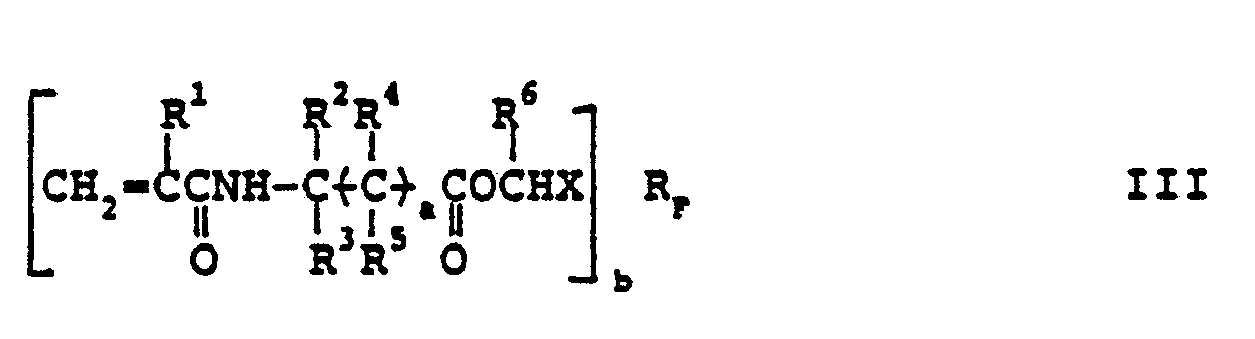
- the present invention provides a new class of fluorinated, acrylamide monomers having the general Formula III: wherein R1 and R6 are independently hydrogen or methyl; R2 and R3 independently can be an alkyl, cycloalkyl, or aryl group, or R2 and R3 taken together with the carbon to which they are joined can form a carbocyclic ring containing 4 to 12 ring atoms; R4 and R5 are independently hydrogen or lower alkyl; a is 0 or 1; b is 1 or 2; X is a single bond, CH2, CH2OCH2, and CH2CH2OCH2; and R F is a substantially perfluorinated alkyl, cycloalkyl, or aryl group when b is 1 and perfluorinated alkylene when b is 2.
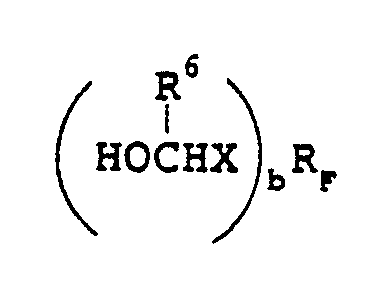
- novel fluorinated, acrylamide monomers of Formula III are prepared by reaction of 2-alkenyl azlactones having the general Formula IV (wherein R1, R2, R3, R4, R5 and a are as previously defined) with a fluorinated alcohol having the general Formula V: (wherein b, X, R6, and R F are previously defined)
- 2-Alkenyl azlactones are well-known and their synthesis, physical and chemical properties, homo- and copolymerization behavior, and applications are discussed in our recent review entitled "Polyazlactones" previously cited.
- Useful 2-alkenyl azlactones for the present invention include 2-vinyl-4,4-dimethyl-2-oxazolin-5-one, 2-isopropenyl-4,4-dimethyl-2-oxazolin-5-one, 2-vinyl-4-ethyl-4-methyl-2-oxazolin-5-one, 2-vinyl-4,4-diethyl-2-oxazolin-5-one, 2-vinyl-4-methyl-4-phenyl-2-oxazolin-5-one, 2-isopropenyl-4,4-tetramethylene-2-oxazolin-5-one, 2-vinyl-4,4-pentamethylene-2-oxazolin-5-one, and 2-vinyl-4,4-
- the preferred 2-alkenyl azlactone because of its reactivity and commercial availability is 2-vinyl-4,4-dimethyl-2-oxazolin-5-one (SNPE, Paris, France).
- SNPE 2-vinyl-4,4-dimethyl-2-oxazolin-5-one
- Useful fluorinated alcohols of the present invention which are commercially available include 1H,1H,7H-dodecafluoro-1-heptanol, perfluorocyclohexyl-1H,1H-methanol, 2,2,3,3,4,4,5,5,6,6-decafluoro-1-methylheptanol-1, 1H,1H,11H-eicosafluoro-1-undecanol, 1H,1H-heptafluoro-1-butanol, 1H,1H,9H-hexadecafluoro-1-nonanol, hexafluoroisopropanol, 1H,1H,5Hoctafluoro-1-pentanol, 1H,1H-pentadecafluorooctanol, pentafluorobenzyl alcohol, 1H,1H-pentafluoropropanol, 1H,1H,2H,2
- fluorinated alcohols useful in the invention are those described in our copending patent application entitled "O-Hydroxyalkylation of 1,1-Dihydroperfluorinated Alcohols", U.S.S.N. 267,035.
- catalysts include 1,8-diazabicyclo[5.4.0]undec-7-ene (DBU), 1,5-diazabicyclo[4.3.0]non-5-ene (DBN), triethylamine, 1,4-diazabicyclo[2.2.2]octane (DABCO), trioctylphosphine, and tributylphosphine in molar concentrations of from 0.1 to 20 weight percent, preferably 0.25-5.0 weight percent, and most preferably 0.5-2.0 weight percent based on the azlactone reactant; DBU, DBN, and trioctylphosphine are preferred.
- DBU 1,8-diazabicyclo[5.4.0]undec-7-ene
- DBN 1,5-diazabicyclo[4.3.0]non-5-ene
- DABCO 1,4-diazabicyclo[2.2.2]octane
- trioctylphosphine 1,4-diazabicy
- a free radical stabilizer such as phenothiazine or 2,6-di-t-butyl-p-cresol in concentrations by weight based on reaction product of from 0.01 to 1.0 percent, preferrably 0.05-0.15 percent.
- Suitable warming conditions are from 40-80°C, preferably 40-65°C for a period of 0.5-12 hours, preferably 0.5-2 hours.
- the fluorinated, acrylamide monomers of the invention can be polymerized by standard thermally- or photochemically-initiated free radical addition polymerization procedures. Also apparent is that copolymers can be prepared from the instant monomers and essentially any free radically polymerizable olefin by employing standard techniques. The polymerizations can be effected in the absence of solvents, if the monomer formulations are liquid at the polymerization temperatures, or in solution, and several useful, non-reactive solvents have been specified above. Polymers and copolymers can have molecular weights in the range of approximately 20,000 to 5,000,000.
- olefinic monomers for use in preparing copolymers of the invention is contained in C.E. Schildknecht's text "Vinyl and Related Polymers", Wiley, N.Y., 1959.
- Examples include : the vinyl aromatic monomers such as styrene, ⁇ -methylstyrene, and 2-and 4-vinylpyridine; ⁇ , ⁇ -unsaturated carboxylic acids such as acrylic acid, methacrylic acid, itaconic acid, maleic acid, fumaric acid, and crotonic acid; ⁇ , ⁇ -unsaturated carboxylic acid derivatives such as methyl methacrylate, butyl methacrylate, 2-ethylhexyl methacrylate, ethyl acrylate, butyl acrylate, isooctyl acrylate, octadecyl acrylate, cyclohexyl acrylate, tetrahydrofurfuryl acrylate,
- a surprising feature of the polymers prepared from the fluorinated, acrylamide monomers of the invention is their superior toughness (i.e., at least 25 percent greater) relative to corresponding acrylate polymers which contain the same fluorinated group. This is especially surprising in light of previous work (S.M. Heilmann and H.K. Smith II, J. Appl. Polymer Sci. , 24, 1551 (1979)) conducted on pressure sensitive adhesives. In that work it was well established that a secondary amide group (-CONH-) immediately pendant from a polymer main-chain was sterically incapable of participating in hydrogen bonding between polymer chains (necessary for building cohesion). This was so primarily because of the group's immediate proximity to the very large and bulky polymer main-chain.
- the same immediately pendant secondary amide groups somehow cause a substantial toughening to occur. While not wishing to be bound by any explanation and yet to explain our invention as fully as possible, it is felt that the toughening effect can be attributed to increased double bond character of the carbon-nitrogen amide bond.
- the secondary amide bond functions as a rigid, orientating side group relative to the carbon-oxygen ester bond in acrylates and, in this fashion, is better able to absorb and dissipate mechanical stress, thereby exerting a toughening influence.
- the fluorinated, acrylamide monomers of the invention intrinsically possess low surface energies, as do the polymers and copolymers produced from them.
- the monomers find use as components in stain resistant coatings for surfaces.
- stain resistant coating for fabric is exemplified below.
- the fluorinated, acrylamide monomer of Example 6 containing 0.5 weight percent of a photoinitiator (DarocurTM 1116, Merck, Darmstadt, West Germany) was coated onto a silicone treated paper backing at a thickness of 1.9 mm (75 mils).
- the coating was exposed to a lamp emitting radiation with wavelengths between 300 and 400 nm (BlacklightTM, Sylvania) in a nitrogen atmosphere for 30 minutes.
- 1,1-Dihydroperfluorooctyl acrylate (Monomer-Polymer & Dajac, Trevose, PA) (viscosity about 1 cps) and the Darocur were irradiated in bulk in a Pyrex® vessel with Blacklight to obtain a thickened coatable syrup (viscosity about 1500 cps). This syrup was then coated at 1.9 mm (75 mils) and polymerized as described above. The stress-strain relationships of 1.27 cm (0.5 inch) wide samples of the two non-tacky, conformable polymer films were recorded using a Universal Test Machine (available from Instron Corp., Canton, MA; crosshead rate: 2 cm/min).
- the poly(fluorinated, acrylamide monomer) exhibited a toughness (at yield) of 3313 cm-g/mL (47 in-lbs/in3), while the poly(1,1-dihydroperfluorooctyl acrylate) gave a toughness value of 2115 cm-g/mL (30 in-lbs/in3).
- the charge solution was degassed briefly with nitrogen in a four ounce bottle.
- the bottle was sealed and heated with agitation at 55°C for 22 hours. At that point the copolymer solution was clear and very viscous; the copolymer weight percent solids was 29.2 percent, indicating greater than 97 percent conversion of monomers to copolymer.
Landscapes
- Chemical & Material Sciences (AREA)
- Organic Chemistry (AREA)
- Health & Medical Sciences (AREA)
- Chemical Kinetics & Catalysis (AREA)
- Medicinal Chemistry (AREA)
- Polymers & Plastics (AREA)
- Addition Polymer Or Copolymer, Post-Treatments, Or Chemical Modifications (AREA)
- Organic Low-Molecular-Weight Compounds And Preparation Thereof (AREA)
- Low-Molecular Organic Synthesis Reactions Using Catalysts (AREA)
Abstract
R² and R³ independently can be an alkyl, cycloalkyl, or aryl group, or R² and R³ taken together with the carbon to which they are joined can form a carbocyclic ring containing 4 to 12 ring atoms;
R⁴ and R⁵ are independently hydrogen or lower alkyl;
a is 0 or 1;
b is 1 or 2;
X is a single bond, CH₂, CH₂OCH₂, and CH₂CH₂OCH₂; and
RF is a substantially perfluorinated alkyl, cycloalkyl, or aryl group when b is 1 and perfluorinated alkylene when b is 2.
Description
- This invention relates to novel fluorinated, acrylamide-functional monomers and a process therefor. In another aspect, this invention provides homo- and co-polymers of the fluorinated, acrylamide-functional monomers. Polymers derived from the novel acrylamide monomers of the invention find utility, for example, in stain resistant coatings.
- Substitution of fluorine for hydrogen in polymers and coatings is often desirable to impart useful properties such as lower surface energy which is necessary for stain resistance. Typically, the incorporation of fluorine into polymers and coatings has been made by copolymerizing (meth)acrylate monomers derived from (meth)acrylic acid and highly fluorinated alcohols. These fluorinated (meth)acrylate monomers are available commercially from several sources. Despite their general availability, however, (meth)acrylates often polymerize at slow rates and provide polymers which possess inadequate thermal and hydrolytic stabilities.
- Fluorinated (meth)acrylamide monomers have been described in several patents. U.S. Patent Nos. 2,743,297; 2,957,914; and 3,997,604 disclose fluorinated (meth)acrylamide monomers prepared by the reaction of fluorinated secondary or primary amines and (meth)acryloyl chloride; a complication in the synthesis is removal of the hydrogen chloride by-product. U.S. Patent No. 3,475,434 teaches the reaction of a stoichiometric excess (about 300 percent) of a short chain diamine with a perfluorinated acylating agent, isolation and purification of the monoperfluoroamide, and (meth)acryloylation of the remaining amine function with the appropriate acid chloride; here again hydrogen chloride is a troublesome byproduct, and the complexity of the synthesis is self-evident. U.S. Patent No. 3,655,732 teaches a multi-step synthesis of fluorinated acrylamides which possess a heteroatom, typically sulfur, as part of a five atom linking group between the acrylamide and perfluorinated moieties.
- 2-Alkenyl azlactones are known to react with certain nucleophiles such as primary amines and alcohols to afford (meth)acrylamide-functional products. The interested reader is referred to our recent review article entitled "Polyazlactones" which is contained in the Encyclopedia of Polymer Science and Engineering, Volume 11, 2nd edition, 1988. The reaction product of 2-vinyl-4,4-dimethylazlactone and 2,2,2-trifluoroethylamine is a high melting solid (m.p. 135-136°C), having been reported by L.D. Taylor, et al., J. Polymer Sci. Polymer Lett., 7, 597 (1969). U.S. Patent No. 4,447,493 discloses the reaction product of a 2-alkenyl azlactone and poly-(perfluorooxyalkylene) polyols, but these materials contain main chain heteroatoms (oxygen) and often yield highly colored reaction products which can be undesirable; additionally, the highly oxygenated, relatively high molecular weight reaction products tend to be less compatible with other necessary additives such as monomers, crosslinking agents, and photoinitiators.
- Briefly, the present invention provides novel fluorinated acrylamide monomers and homo- and copolymers prepared therefrom.
- The fluorinated acrylamide monomers are prepared by the reaction of 2-alkenyl azlactones and fluorinated alcohols. The reaction is facilitated by the lack of formation of any product other than the fluorinated acrylamide monomer and is therefore extremely efficacious from a synthesis viewpoint. As expected, the novel acrylamide monomers polymerize at high rates, and the resulting polymers are environmentally quite stable. An unexpected and significant benefit observed with the instant polymers is improved toughness.
- In this application:
"acrylamide" and "acrylate" mean both so-called acryloyl, i.e., 2-propenoyl, and methacryloyl, i.e., 2-methyl-2-propenoyl, amine and alcohol derivatives;
"substantially perfluorinated" means hydrocarbon groups in which at least 50 percent of the hydrogen atoms have been replaced by fluorine;
"alkyl" and "alkylene" mean the monovalent and divalent residues remaining after removal of one and two hydrogen atoms, respectively, from a linear or branched chain hydrocarbon having 1 to 20 carbon atoms;
"lower alkyl" means C₁ to C₄ alkyl;
"aryl" means the monovalent residue remaining after removal of a hydrogen atom from an aromatic compound (single ring and multi- and fused-ring) having 5 to 12 ring atoms and includes substituted aromatics such as lower alkaryl and aralkyl, lower C₁ to C₄ alkoxy, N,N-di(lower alkyl)amino, nitro, cyano, halo, and lower alkyl carboxylic ester, wherein "lower" means C₁ to C₄;
"azlactone" means 2-oxazolin-5-one groups of Formula 1 and 2-oxazin-6-one groups of Formula II:
- The monomers of the present invention exhibit high rates of free radical homo- and copolymerization and yield toughened polymers compared to those resulting from acrylate- or methacrylate-functional monomers.
- A significant advantage of using the 2-alkenyl azlactone as an acylating agent in the present invention method instead of acryloyl chloride as in the prior art method is that the azlactone/nucleophile reaction involves ring-opening addition; no smaller by-product molecule (such as hydrogen chloride) is displaced or generated in the reaction.
- The acrylamide functionality can offer certain advantages as a polymerizable group over the acrylate. The amide group is known to be more difficult to hydrolyze than the ester group, and amide-functional polymers should therefore be more environmentally stable. Additionally, according to information published in the Polymer Handbook, 2nd edition, edited by J. Brandrup and E.H. Immergut, Wiley-Interscience, New York, 1975, pp. II 47-49, acrylamides enjoy rates of free radical polymerization substantially faster than corresponding acrylates or methacrylates. N,N-Dimethylacrylamide, for example, exhibits a rate of bulk polymerization (kp²/kt) AT 50°C 1142 times faster than methyl acrylate and 457 times faster than methyl methacrylate. Despite these potential advantages, however, there are presently no fluorinated acrylamide monomers that are commercially available.
- The present invention provides a new class of fluorinated, acrylamide monomers having the general Formula III:

R² and R³ independently can be an alkyl, cycloalkyl, or aryl group, or R² and R³ taken together with the carbon to which they are joined can form a carbocyclic ring containing 4 to 12 ring atoms;
R⁴ and R⁵ are independently hydrogen or lower alkyl;
a is 0 or 1;
b is 1 or 2;
X is a single bond, CH₂, CH₂OCH₂, and CH₂CH₂OCH₂; and
RF is a substantially perfluorinated alkyl, cycloalkyl, or aryl group when b is 1 and perfluorinated alkylene when b is 2. - The novel fluorinated, acrylamide monomers of Formula III are prepared by reaction of 2-alkenyl azlactones having the general Formula IV


- 2-Alkenyl azlactones are well-known and their synthesis, physical and chemical properties, homo- and copolymerization behavior, and applications are discussed in our recent review entitled "Polyazlactones" previously cited. Useful 2-alkenyl azlactones for the present invention include 2-vinyl-4,4-dimethyl-2-oxazolin-5-one, 2-isopropenyl-4,4-dimethyl-2-oxazolin-5-one, 2-vinyl-4-ethyl-4-methyl-2-oxazolin-5-one, 2-vinyl-4,4-diethyl-2-oxazolin-5-one, 2-vinyl-4-methyl-4-phenyl-2-oxazolin-5-one, 2-isopropenyl-4,4-tetramethylene-2-oxazolin-5-one, 2-vinyl-4,4-pentamethylene-2-oxazolin-5-one, and 2-vinyl-4,4-dimethyl-2-oxazin-6-one.
- The preferred 2-alkenyl azlactone because of its reactivity and commercial availability is 2-vinyl-4,4-dimethyl-2-oxazolin-5-one (SNPE, Paris, France). In certain applications that employ radiation curing or photopolymerization situations in which no solvent is present, however, it is extremely desirable that the fluorinated, acrylamide monomer be a liquid at room temperature or slightly above. In those instances the melting point of the fluorinated, acrylamide monomer product can be lowered (relative to R¹ = H; R² = R³ = methyl; and a = 0) by utilizing an alkenyl azlactone which contains an asymmetric carbon atom at position-4 or a six-membered azlactone compound. In those instances, 2-vinyl-4-ethyl-4-methyl-2-oxazolin-5-one and 2-vinyl-4,4-dimethyl-2-oxazin-6-one are preferred, and references for their synthesis are given in our "Polyazlactones" review, supra.
- Useful fluorinated alcohols of the present invention which are commercially available include 1H,1H,7H-dodecafluoro-1-heptanol, perfluorocyclohexyl-1H,1H-methanol, 2,2,3,3,4,4,5,5,6,6-decafluoro-1-methylheptanol-1, 1H,1H,11H-eicosafluoro-1-undecanol, 1H,1H-heptafluoro-1-butanol, 1H,1H,9H-hexadecafluoro-1-nonanol, hexafluoroisopropanol, 1H,1H,5Hoctafluoro-1-pentanol, 1H,1H-pentadecafluorooctanol, pentafluorobenzyl alcohol, 1H,1H-pentafluoropropanol, 1H,1H,2H,2H-perfluorodecanol-1, 1H,1H,2H,2H-perfluorododecanol-1, 1H,1H,3H-tetrafluoro-1-propanol, 2,2,2-trifluoroethanol, 2,2,3,3-tetrafluoro-1,4-butanediol, 2,2,3,3,4,4-hexafluoro-1,5-pentanediol, and 2,2,3,3,4,4,5,5-octafluoro-1,6-hexanediol.
- Other fluorinated alcohols useful in the invention, especially when low melting acrylamide reaction products are desired, are those described in our copending patent application entitled "O-Hydroxyalkylation of 1,1-Dihydroperfluorinated Alcohols", U.S.S.N. 267,035.
- The reaction of the 2-alkenyl azlactone and the fluorinated alcohol is facilitated by the presence of a catalyst. Useful catalysts include
1,8-diazabicyclo[5.4.0]undec-7-ene (DBU), 1,5-diazabicyclo[4.3.0]non-5-ene (DBN), triethylamine, 1,4-diazabicyclo[2.2.2]octane (DABCO), trioctylphosphine, and tributylphosphine in molar concentrations of from 0.1 to 20 weight percent, preferably 0.25-5.0 weight percent, and most preferably 0.5-2.0 weight percent based on the azlactone reactant; DBU, DBN, and trioctylphosphine are preferred. In a typical procedure, equal molar quantities of 2-alkenyl azlactone and fluorinated alcohol are mixed with the catalyst in the absence of solvent. Alternatively, solvents may be employed with the provision that they not react with the azlactone or catalyst under the reaction conditions. Suitable organic solvents include ethyl acetate, toluene, tetrahydrofuran, and fluorinated solvents such as Freon™ 113 (Du Pont). Especially with the preferred catalysts and a solvent-free reaction solution, a mildly exothermic reaction will ensue, and the reaction is generally complete as determined by infrared spectroscopy when the reaction temperature returns to ambient. At this point the fluorinated, acrylamide monomer product is either a crystalline solid or a viscous liquid, and for most purposes further purification is unnecessary. - With other catalysts and when solvents are employed, warming the reaction mixture will hasten completion of reaction. It is generally advisable to add a free radical stabilizer such as phenothiazine or 2,6-di-t-butyl-p-cresol in concentrations by weight based on reaction product of from 0.01 to 1.0 percent, preferrably 0.05-0.15 percent. Suitable warming conditions are from 40-80°C, preferably 40-65°C for a period of 0.5-12 hours, preferably 0.5-2 hours.
- As is apparent to one skilled in the art, the fluorinated, acrylamide monomers of the invention can be polymerized by standard thermally- or photochemically-initiated free radical addition polymerization procedures. Also apparent is that copolymers can be prepared from the instant monomers and essentially any free radically polymerizable olefin by employing standard techniques. The polymerizations can be effected in the absence of solvents, if the monomer formulations are liquid at the polymerization temperatures, or in solution, and several useful, non-reactive solvents have been specified above. Polymers and copolymers can have molecular weights in the range of approximately 20,000 to 5,000,000.
- Polymers and copolymers of the invention contain structural units of Formula VI (when b=1) or VII (when b=2), respectively, which are as follows:

- An excellent discussion of suitable olefinic monomers for use in preparing copolymers of the invention is contained in C.E. Schildknecht's text "Vinyl and Related Polymers", Wiley, N.Y., 1959. Examples include : the vinyl aromatic monomers such as styrene, α-methylstyrene, and 2-and 4-vinylpyridine; α,β-unsaturated carboxylic acids such as acrylic acid, methacrylic acid, itaconic acid, maleic acid, fumaric acid, and crotonic acid; α,β-unsaturated carboxylic acid derivatives such as methyl methacrylate, butyl methacrylate, 2-ethylhexyl methacrylate, ethyl acrylate, butyl acrylate, isooctyl acrylate, octadecyl acrylate, cyclohexyl acrylate, tetrahydrofurfuryl acrylate, phenyl acrylate, phenethyl acrylate, benzyl acrylate, cyanoethyl acrylate, diethyl itaconate, acrylamide, acrylonitrile, N,N-dimethylacrylamide, and N-butylacrylamide; vinyl esters of carboxylic acids such as vinyl acetate, and vinyl 2-ethylhexanoate; vinyl halides such as vinyl chloride and vinylidene chloride; vinyl ethers such as methyl vinyl ether, 2-ethylhexyl vinyl ether, and butyl vinyl ether; olefins such as ethylene; N-vinyl compounds such as N-vinylpyrrolidone and N-vinylcarbazole; vinyl ketones such as methyl vinyl ketone; and vinyl aldehydes such as acrolein and methacrolein. The preferred monomers for the purposes of the present invention are the α,β-unsaturated carboxylic acid derivatives.
- A surprising feature of the polymers prepared from the fluorinated, acrylamide monomers of the invention is their superior toughness (i.e., at least 25 percent greater) relative to corresponding acrylate polymers which contain the same fluorinated group. This is especially surprising in light of previous work (S.M. Heilmann and H.K. Smith II, J. Appl. Polymer Sci., 24, 1551 (1979)) conducted on pressure sensitive adhesives. In that work it was well established that a secondary amide group (-CONH-) immediately pendant from a polymer main-chain was sterically incapable of participating in hydrogen bonding between polymer chains (necessary for building cohesion). This was so primarily because of the group's immediate proximity to the very large and bulky polymer main-chain. Yet in the present invention, as is exemplified below, the same immediately pendant secondary amide groups somehow cause a substantial toughening to occur. While not wishing to be bound by any explanation and yet to explain our invention as fully as possible, it is felt that the toughening effect can be attributed to increased double bond character of the carbon-nitrogen amide bond. The secondary amide bond functions as a rigid, orientating side group relative to the carbon-oxygen ester bond in acrylates and, in this fashion, is better able to absorb and dissipate mechanical stress, thereby exerting a toughening influence.
- The fluorinated, acrylamide monomers of the invention intrinsically possess low surface energies, as do the polymers and copolymers produced from them. The monomers find use as components in stain resistant coatings for surfaces. One such application as a stain resistant coating for fabric is exemplified below.
- Objects and advantages of this invention are further illustrated by the following examples, but the particular materials and amounts thereof recited in these examples, as well as other conditions and details, should not be construed to unduly limit this invention.
- 1H,1H,2H,2H-Perfluoro-1-decanol (available from Strem Chemicals, Inc., Newburyport, MA) (13.28 grams, 0.028 mole) and 2-vinyl-4,4-dimethylazlactone (VDM) (available from SNPE, Inc., Princeton, NJ) (3.98 grams, 0.028 mole) were mixed and warmed to melt the fluorinated alcohol and facilitate dissolution. To this solution cooled to room temperature was added 1,8-diazabicyclo[5.4.0]undec-7-ene (DBU) (available from Aldrich Chemical Co., Milwaukee, WI) (0.08 gram, 0.00056 mole) which caused a warming of the reaction solution to about 40°C. When the reaction solution had cooled to room temperature, an infrared spectrum showed characteristic absorptions for the acrylamide product: 3.05 (NH stretch), 5.75 (ester C=0), 6.05 (amide C=0), 6.15 (C=C), and 6.50 (amide II) microns. Upon standing overnight, the reaction product crystallized and melted at 30-35°C.
- Employing the procedure of EXAMPLE 1, several fluorinated acrylamide monomers of Formula III which possess the specific structures indicated in Table 1 were prepared.

TABLE I Example R¹ R² R³ a R⁴ R⁵ R⁶ X b R F m.p.(°C)* 2 H Mef Me 0 -- -- H sbd 1 CF₃(CF₂)₂ 45 3 Me Phg Ph 0 -- -- H sb 1 CF₃(CF₂)₂ 79 4 H Me Me 0 -- -- H sb 1 H(CF₂)₄ 48 5 H Me Me 0 -- -- H sb 1 H(CF₂)₆ 52 6e H Me Me 0 -- -- H sb 1 CF₃(CF₂)₆ 53 7 H Me Me 0 -- -- Me CH₂OCH₂ 1 CF₃(CF₂)₆ <22 8 H Me Me 0 -- -- H sb 1 c-C₆F₁₁ 99 9 H Me Me 0 -- -- H CH₂ 1 NSO₂(CF₂)₇CF₃ 103 Et 10 H Me Eth 0 -- -- H sb 1 CF₃(CF₂)₆ <22 11 H Me Me 1 H H H sb 1 CF₃(CF₂)₆ <22 12 H Me Me 0 -- -- H CH₂OCH₂ 1 CF₃(CF₂)₆ <22 13 Me Me Me 0 -- -- H sb 1 CF₃(CF₂)₆ 72 14 H Me Me 0 -- -- H sb 2 (CF₂)₄ 145 15 H Me Et 0 -- -- H sb 2 (CF₂)₄ 146 16 H Me Et 0 -- -- H sb 2 (CF₂)₃ 95 17 H Me Et 0 -- -- H sb 2 (CF₂)₂ 151 18 H Me Et 0 -- -- H CH₂ 1 CF₃(CF₂)₇ <22 19 H Me Me 1 H H H CH₂ 1 CF₃(CF₂)₇ 25 20 H Me Me 1 H H H sb 2 (CF₂)₂ 105 21 H Me Me 1 H H H sb 2 (CF₂)₃ <22 22 H Me Me 1 H H H sb 1 H(CF₂)₆ <22 23 H Me Et 0 -- -- H sb 1 H(CF₂)₆ <22 * Melt temperatures were measured on unrecrystallized samples. The upper temperature of the melting range is recorded at which a clear melt is present. d sb means single bond e This Example was conducted using trioctylphosphine (2 mol %) instead of DBU as catalyst. f Me=Methyl g Ph=phenyl h Et=ethyl - This example illustrates theimproved toughness observed in polymers prepared withthe novel fluorinated, acrylamide monomers of the invention compared to corresponding poly(acrylates).
- The fluorinated, acrylamide monomer of Example 6 containing 0.5 weight percent of a photoinitiator (Darocur™ 1116, Merck, Darmstadt, West Germany) was coated onto a silicone treated paper backing at a thickness of 1.9 mm (75 mils). The coating was exposed to a lamp emitting radiation with wavelengths between 300 and 400 nm (Blacklight™, Sylvania) in a nitrogen atmosphere for 30 minutes. 1,1-Dihydroperfluorooctyl acrylate (Monomer-Polymer & Dajac, Trevose, PA) (viscosity about 1 cps) and the Darocur were irradiated in bulk in a Pyrex® vessel with Blacklight to obtain a thickened coatable syrup (viscosity about 1500 cps). This syrup was then coated at 1.9 mm (75 mils) and polymerized as described above. The stress-strain relationships of 1.27 cm (0.5 inch) wide samples of the two non-tacky, conformable polymer films were recorded using a Universal Test Machine (available from Instron Corp., Canton, MA; crosshead rate: 2 cm/min). The poly(fluorinated, acrylamide monomer) exhibited a toughness (at yield) of 3313 cm-g/mL (47 in-lbs/in³), while the poly(1,1-dihydroperfluorooctyl acrylate) gave a toughness value of 2115 cm-g/mL (30 in-lbs/in³).
- This example teaches the use of a fluorinated, acrylamide monomer of the invention in a stain resistant preparation for fabrics.
Preparation of the Stain Resistant Polymer Charge: 1H,1H,2H,2H-perfluorodecyl 2-acrylamido-2-methylpropionate (Example 1) 13.89 grams n-butyl acrylate 7.48 grams 1,1,1-trichloroethane 49.86 grams azobis(iso-butyronitrile) 0.11 grams - The charge solution was degassed briefly with nitrogen in a four ounce bottle. The bottle was sealed and heated with agitation at 55°C for 22 hours. At that point the copolymer solution was clear and very viscous; the copolymer weight percent solids was 29.2 percent, indicating greater than 97 percent conversion of monomers to copolymer.
- A portion of the above copolymer solution was diluted with additional 1,1,1-trichloroethane to 0.7 percent solids. The stain resistant properties of the instant copolymer were compared both to untreated fabrics and fabrics treated in analogous fashion with 3M's SCOTCHGARD fabric protector. The evaluation procedure was that reported by C.L. Steel, Book Pap. - Int. Conf. Exhib., AATCC, 237-247 (1986). The fabrics evaluated and results obtained are shown in TABLE II below:
TABLE II Fabric Number Description 1 rayon face velvet - lt. green 2 nylon flat upholstery - ready for printing, scoured and rubberized 3 100% cotton woven print 4 nylon taffeta, lt. wt. single ply, uncoated 5 12 oz. wool woven worsted gabardine, off-white 6 cotton sheeting - white, bleached, and mercerized Fabric Oil e Water f Spray g Abrasion h Soil i UNTREATED RESULTS: 1 0 0 0 0 3 2 0 0 0 0 2 3 0 0 0 0 3 4 0 0 0 0 3 5 0 1 70 0 2 6 0 0 0 0 2.5 EXAMPLE 25 RESULTS: 1 5 6 70 2 3 2 4 6 70 3 1.5 3 3 4 80 2 2.5 4 3 5 70 2 2.5 5 6 6 100 2 2.5 6 2 5 80 2 1.5 SCOTCHGARD RESULTS: 1 5 7 70 2 3.5 2 5 5 80 5 2.5 3 6 8 80 5 4 4 4 5 70 3 3 5 6 8 100 3 2.5 6 5 4 70 4 3 e = oil repellency; scale 0-8; 8 = best f = water/alcohol resistance; scale F-10; 10 = best g = spray rating; scale 0-100; 100 = best h = abrasion resistance scale 0-8; 8 = best i = soil resistance; scale 0-5; 5 = best - The above results with the various fabrics and stain preparations indicate that the copolymer of Example 25 is far superior to no treatment and compares favorably with a commercial fabric protection product.
- Various modifications and alterations of this invention will become apparent to those skilled in the art without departing from the scope and spirit of this invention, and it should be understood that this invention is not to be unduly limited to the illustrative embodiments set forth herein.
Claims (10)

R² and R³ independently are alkyl, cycloalkyl, or aryl group, or R² and R³ taken together with the carbon to which they are form a carbocyclic ring containing 4 to 12 ring atoms;
R⁴ and R⁵ are independently hydrogen or lower alkyl;
a is 0 or 1;
b is 1 or 2;
X is a single bond, CH₂, CH₂OCH₂, or CH₂CH₂OCH₂; and
RF is a substantially perfluorinated alkyl, cycloalkyl, or aryl group when b is 1 and perfluorinated alkylene when b is 2.


2-vinyl-4,4-dimethyl-2-oxazolin-5-one,
2-isopropenyl-4,4-dimethyl-2-oxazolin-5-one,
2-vinyl-4-ethyl-4-methyl-2-oxazolin-5-one,
2-vinyl-4,4-diethyl-2-oxazolin-5-one,
2-vinyl-4-methyl-4-phenyl-2-oxazolin 5-one,
2-isopropenyl-4,4-tetramethylene-2-oxazolin-5-one,
2-vinyl-4,4-pentamethylene-2-oxazolin-5-one, and
2-vinyl-4,4-dimethyl-2-oxazin-6-one.
1H,1H,7H-dodecafluoro-1-heptanol,
perfluorocyclohexyl-1H,1H-methanol,
2,2,3,3,4,4,5,5,6,6-decafluoro-1-methylheptanol-1,
1H,1H,11H-eicosafluoro-1-undecanol,
1H,1H-heptafluoro-1-butanol,
1H,1H,9H-hexadecafluoro-1-nonanol,
hexafluoroisopropanol,
1H,1H,5H-octafluoro-1-pentanol,
1H,1H-pentadecafluorooctanol,
pentafluorobenzyl alcohol,
1H,1H-pentafluoropropanol,
1H,1H,2H,2H-perfluorodecanol-1,
1H,1H,2H,2H-perfluorododecanol-1,
1H,1H,3H-tetrafluoro-1-propanol,
2,2,2-trifluoroethanol,
2,2,3,3-tetrafluoro-1,4-butanediol,
2,2,3,3,4,4-hexafluoro-1,5-pentanediol, and
2,2,3,3,4,4,5,5-octafluoro-1,6-hexanediol.
1,8-diazabicyclo[5.4.0]undec-7-ene (DBU),
1,5-diazabicyclo[4.3.0]non-5-ene (DBN),
triethylamine,
1,4-diazabicyclo[2.2.2]octane (DABCO),
trioctylphosphine, and tributylphosphine.
Applications Claiming Priority (2)
| Application Number | Priority Date | Filing Date | Title |
|---|---|---|---|
| US267186 | 1988-11-04 | ||
| US07/267,186 US4931582A (en) | 1988-11-04 | 1988-11-04 | Fluorinated, acrylamide-functional monomers |
Publications (3)
| Publication Number | Publication Date |
|---|---|
| EP0367583A2 true EP0367583A2 (en) | 1990-05-09 |
| EP0367583A3 EP0367583A3 (en) | 1991-01-23 |
| EP0367583B1 EP0367583B1 (en) | 1993-08-04 |
Family
ID=23017675
Family Applications (1)
| Application Number | Title | Priority Date | Filing Date |
|---|---|---|---|
| EP89311277A Expired - Lifetime EP0367583B1 (en) | 1988-11-04 | 1989-11-01 | Fluorinated, acrylamide-functional monomers |
Country Status (5)
| Country | Link |
|---|---|
| US (2) | US4931582A (en) |
| EP (1) | EP0367583B1 (en) |
| JP (1) | JP2548408B2 (en) |
| CA (1) | CA1335295C (en) |
| DE (1) | DE68908083T2 (en) |
Cited By (8)
| Publication number | Priority date | Publication date | Assignee | Title |
|---|---|---|---|---|
| EP0425305A3 (en) * | 1989-10-26 | 1991-10-09 | Minnesota Mining And Manufacturing Company | Radiation curable cladding compositions |
| EP0529895A1 (en) * | 1991-08-26 | 1993-03-03 | Minnesota Mining And Manufacturing Company | Fluorinated acrylamide silane monomers and polymers |
| WO1993004132A1 (en) * | 1991-08-26 | 1993-03-04 | Minnesota Mining And Manufacturing Company | Low loss high numerical aperture cladded optical fibers |
| FR2706455A1 (en) * | 1993-06-18 | 1994-12-23 | Rhone Poulenc Agrochimie | Optically active fungicidal 2-imidazolin-5-one and 2-imidazoline-5-thione derivatives |
| US5637729A (en) * | 1991-12-20 | 1997-06-10 | Rhone-Poulenc Agrochimie | Fungicidal 2-imidazolin-5-ones and 2-imidazoline-5-thiones |
| US5650519A (en) * | 1992-12-21 | 1997-07-22 | Rhone-Poulenc Agrochimie | Optically active 5, 5-disubstituted-3-(mono- or disubstituted amino)-2-thiohydantoin intermediates to fungicidal 2-imidazolin-5-ones |
| US6008370A (en) * | 1992-11-25 | 1999-12-28 | Rhone-Poulenc Agrochimie | Fungicidal-2-alkoxy/haloalkoxy-1-(mono- or disubstituted)amino-4,4-disubstituted-2-imidazolin-5-ones |
| EP2468778A4 (en) * | 2009-08-20 | 2014-05-28 | Agc Seimi Chemical Co Ltd | N-SUBSTITUTED FLUOROALKYL GROUP CONTENT (METH) ACRYLAMIDE COMPOUND, POLYMER THEREOF AND USE THEREOF |
Families Citing this family (8)
| Publication number | Priority date | Publication date | Assignee | Title |
|---|---|---|---|---|
| USRE34348E (en) * | 1988-11-04 | 1993-08-17 | Minnesota Mining And Manufacturing Company | Fluorinated polymers derived from acrylamide-functional monomers |
| DE69520434T2 (en) | 1994-07-29 | 2001-10-18 | Minnesota Mining And Mfg. Co., Saint Paul | ACRYLIC SYRUP, WHICH CAN BE TRANSFORMED BY CURING INTO A CROSSLINKED VISCOELASTIC MATERIAL |
| US5714632A (en) * | 1995-11-13 | 1998-02-03 | Minnesota Mining And Manufacturing Company | Azlactone-based surfactants |
| US5840106A (en) * | 1995-11-13 | 1998-11-24 | Minnesota Mining And Manufacturing Company | Water-based pigmented inks |
| CA2322815C (en) * | 1998-03-05 | 2007-03-13 | Omnova Solutions Inc. | Easily cleanable polymer laminates |
| JP4012239B2 (en) * | 2006-01-11 | 2007-11-21 | 生化学工業株式会社 | Oxazolone derivatives |
| CN103339216B (en) * | 2011-02-18 | 2015-07-29 | Agc清美化学股份有限公司 | Tensio-active agent, containing the composition of this tensio-active agent, the purposes of this tensio-active agent and fluorochemicals |
| CN103998414B (en) * | 2011-12-15 | 2016-01-20 | 旭硝子株式会社 | Liquid-repellent compound, polymer, composition, article, and manufacturing method thereof |
Family Cites Families (10)
| Publication number | Priority date | Publication date | Assignee | Title |
|---|---|---|---|---|
| US2743297A (en) * | 1954-02-08 | 1956-04-24 | Minnesota Mining & Mfg | N-substituted amide derivatives of 1, 1-dihydroperfluoroalkylamines |
| US2957914A (en) * | 1954-12-28 | 1960-10-25 | Monomer Polymer Inc | N-alkylated fluorinated acrylamide monomers |
| US3475434A (en) * | 1966-08-22 | 1969-10-28 | Geigy Chem Corp | N - perfluoroalkanoylamino- and n - perfluoroalkanoylaminoalkyl acrylamides |
| US3997604A (en) * | 1967-01-02 | 1976-12-14 | Produits Chimiques Ugine Kuhlmann | Mixtures of perfluoroaliphatic substituted amino compounds and the method for preparing the same |
| US3655732A (en) * | 1967-05-16 | 1972-04-11 | Du Pont | Fluorinated acrylic monomers containing hetero atoms and their polymers |
| US4021224A (en) * | 1971-12-09 | 1977-05-03 | Stauffer Chemical Company | Herbicide compositions |
| US4447493A (en) * | 1982-07-26 | 1984-05-08 | Minnesota Mining And Manufacturing Company | Vibration-damping constrained-layer constructions |
| DE3644009A1 (en) * | 1986-12-22 | 1988-06-30 | Lentia Gmbh | N-SUBSTITUTED, ESTER GROUPS CONTAINING ACRYLAMIDS |
| US5045615A (en) * | 1988-11-04 | 1991-09-03 | Minnesota Mining And Manufacturing Company | Fluorinated polymers derived from acrylamide-functional monomers |
| US4906792A (en) * | 1988-11-04 | 1990-03-06 | Minnesota Mining And Manufacturing Company | O-hydroxyalkylation of 1,1-dihydroperfluorinated alcohols |
-
1988
- 1988-11-04 US US07/267,186 patent/US4931582A/en not_active Ceased
-
1989
- 1989-09-27 CA CA000613775A patent/CA1335295C/en not_active Expired - Fee Related
- 1989-11-01 DE DE89311277T patent/DE68908083T2/en not_active Expired - Fee Related
- 1989-11-01 EP EP89311277A patent/EP0367583B1/en not_active Expired - Lifetime
- 1989-11-01 JP JP1286014A patent/JP2548408B2/en not_active Expired - Fee Related
-
1992
- 1992-06-03 US US07/892,575 patent/USRE34652E/en not_active Expired - Lifetime
Cited By (13)
| Publication number | Priority date | Publication date | Assignee | Title |
|---|---|---|---|---|
| EP0425305A3 (en) * | 1989-10-26 | 1991-10-09 | Minnesota Mining And Manufacturing Company | Radiation curable cladding compositions |
| EP0529895A1 (en) * | 1991-08-26 | 1993-03-03 | Minnesota Mining And Manufacturing Company | Fluorinated acrylamide silane monomers and polymers |
| WO1993004132A1 (en) * | 1991-08-26 | 1993-03-04 | Minnesota Mining And Manufacturing Company | Low loss high numerical aperture cladded optical fibers |
| US5210248A (en) * | 1991-08-26 | 1993-05-11 | Minnesota Mining And Manufacturing Company | Fluorinated acrylamide silane monomers and polymers |
| US5314975A (en) * | 1991-08-26 | 1994-05-24 | Minnesota Mining And Manufacturing Company | Fluorinated acrylamide silane monomers and polymers |
| US5637729A (en) * | 1991-12-20 | 1997-06-10 | Rhone-Poulenc Agrochimie | Fungicidal 2-imidazolin-5-ones and 2-imidazoline-5-thiones |
| US6002016A (en) * | 1991-12-20 | 1999-12-14 | Rhone-Poulenc Agrochimie | Fungicidal 2-imidazolin-5-ones and 2-imidazoline-5-thiones |
| US6008370A (en) * | 1992-11-25 | 1999-12-28 | Rhone-Poulenc Agrochimie | Fungicidal-2-alkoxy/haloalkoxy-1-(mono- or disubstituted)amino-4,4-disubstituted-2-imidazolin-5-ones |
| US5650519A (en) * | 1992-12-21 | 1997-07-22 | Rhone-Poulenc Agrochimie | Optically active 5, 5-disubstituted-3-(mono- or disubstituted amino)-2-thiohydantoin intermediates to fungicidal 2-imidazolin-5-ones |
| US6018052A (en) * | 1992-12-21 | 2000-01-25 | Rhone-Poulenc Agrochimie | Fungicidal optically active 1-(mono-or substituted amino)-2-substituted-4,4-disubstituted-2-imidazolin-5-ones and 5- thiones corresponding |
| US6344564B1 (en) | 1992-12-21 | 2002-02-05 | Rhone-Poulenc, Inc. | Fungicidal 2-imidazolin-5-ones and 2-imidazoline-5-thiones |
| FR2706455A1 (en) * | 1993-06-18 | 1994-12-23 | Rhone Poulenc Agrochimie | Optically active fungicidal 2-imidazolin-5-one and 2-imidazoline-5-thione derivatives |
| EP2468778A4 (en) * | 2009-08-20 | 2014-05-28 | Agc Seimi Chemical Co Ltd | N-SUBSTITUTED FLUOROALKYL GROUP CONTENT (METH) ACRYLAMIDE COMPOUND, POLYMER THEREOF AND USE THEREOF |
Also Published As
| Publication number | Publication date |
|---|---|
| USRE34652E (en) | 1994-06-28 |
| JPH02188561A (en) | 1990-07-24 |
| US4931582A (en) | 1990-06-05 |
| EP0367583B1 (en) | 1993-08-04 |
| CA1335295C (en) | 1995-04-18 |
| EP0367583A3 (en) | 1991-01-23 |
| JP2548408B2 (en) | 1996-10-30 |
| DE68908083T2 (en) | 1994-01-27 |
| DE68908083D1 (en) | 1993-09-09 |
Similar Documents
| Publication | Publication Date | Title |
|---|---|---|
| EP0367583B1 (en) | Fluorinated, acrylamide-functional monomers | |
| US4151142A (en) | Wet adhesion emulsions of polymer resins systems employed in water-based paint and coating compositions comprising as a component thereof monomer containing an ethylenic double bond and a ureido group polymerized therein | |
| US4056543A (en) | Process of preparing substituted acrylates | |
| US3975422A (en) | Preparation of bis (2-cyanoacrylate)monomers | |
| CN1090032C (en) | Adhesive | |
| CA2212866C (en) | Process for preparing solvent-type acrylic pressure-sensitive adhesives and medical pressure-sensitive adhesive | |
| US3527737A (en) | Adhesive compositions | |
| US4081308A (en) | Rapid curing two part adhesives | |
| CA1090940A (en) | Two-part anaerobic acrylic-based adhesive | |
| JPS61293960A (en) | (meth)acrylic acid esters | |
| CA1264394A (en) | Copolymerisable surfactants, adhesive copolymers thereof and their manufacture | |
| JPH03210374A (en) | Copolymer based on activated ester monomer and coated compound | |
| US5045615A (en) | Fluorinated polymers derived from acrylamide-functional monomers | |
| USRE34348E (en) | Fluorinated polymers derived from acrylamide-functional monomers | |
| KR940002555B1 (en) | Alpha-alkylacrylamide derivatives and polymers thereof | |
| CA1283907C (en) | Self-and diol reactive formaldehyde-free crosslinking monomers and their derived polymers | |
| Taylor et al. | United States Patent | |
| EP0683183B1 (en) | Michael adducts of n-vinylformamide and acrylic and methacrylic esters | |
| Krepski et al. | Heilmann et al.[45] Date of Patent: Sep. 3, 1991 | |
| Krepski et al. | 1IIIIIIIIIIIII III 111111l1111111111111111111111111111IIIII111111 III 111111111 | |
| US3639361A (en) | Fluorocyanoacrylates | |
| JPH02283706A (en) | New polymerizable cyclic urea derivative and polymer having pendant cyclic urea group | |
| US3825580A (en) | Heat-resistant adhesive compositions containing radical polymerizable alpha-cyanoacrylates | |
| JPS6236405A (en) | Polymer derived from self- and diol reactive formaldehyde free crosslinkable monomer | |
| JP3377812B2 (en) | New polymerizable monomer |
Legal Events
| Date | Code | Title | Description |
|---|---|---|---|
| PUAI | Public reference made under article 153(3) epc to a published international application that has entered the european phase |
Free format text: ORIGINAL CODE: 0009012 |
|
| AK | Designated contracting states |
Kind code of ref document: A2 Designated state(s): BE DE FR GB IT NL |
|
| PUAL | Search report despatched |
Free format text: ORIGINAL CODE: 0009013 |
|
| AK | Designated contracting states |
Kind code of ref document: A3 Designated state(s): BE DE FR GB IT NL |
|
| 17P | Request for examination filed |
Effective date: 19910102 |
|
| 17Q | First examination report despatched |
Effective date: 19920218 |
|
| ITF | It: translation for a ep patent filed | ||
| GRAA | (expected) grant |
Free format text: ORIGINAL CODE: 0009210 |
|
| AK | Designated contracting states |
Kind code of ref document: B1 Designated state(s): BE DE FR GB IT NL |
|
| REF | Corresponds to: |
Ref document number: 68908083 Country of ref document: DE Date of ref document: 19930909 |
|
| ET | Fr: translation filed | ||
| PLBE | No opposition filed within time limit |
Free format text: ORIGINAL CODE: 0009261 |
|
| STAA | Information on the status of an ep patent application or granted ep patent |
Free format text: STATUS: NO OPPOSITION FILED WITHIN TIME LIMIT |
|
| 26N | No opposition filed | ||
| PGFP | Annual fee paid to national office [announced via postgrant information from national office to epo] |
Ref country code: NL Payment date: 19991027 Year of fee payment: 11 |
|
| PGFP | Annual fee paid to national office [announced via postgrant information from national office to epo] |
Ref country code: BE Payment date: 19991103 Year of fee payment: 11 |
|
| PGFP | Annual fee paid to national office [announced via postgrant information from national office to epo] |
Ref country code: DE Payment date: 20001019 Year of fee payment: 12 |
|
| PG25 | Lapsed in a contracting state [announced via postgrant information from national office to epo] |
Ref country code: BE Free format text: LAPSE BECAUSE OF NON-PAYMENT OF DUE FEES Effective date: 20001130 |
|
| BERE | Be: lapsed |
Owner name: MINNESOTA MINING AND MFG CY Effective date: 20001130 |
|
| PG25 | Lapsed in a contracting state [announced via postgrant information from national office to epo] |
Ref country code: NL Free format text: LAPSE BECAUSE OF NON-PAYMENT OF DUE FEES Effective date: 20010601 |
|
| NLV4 | Nl: lapsed or anulled due to non-payment of the annual fee |
Effective date: 20010601 |
|
| PGFP | Annual fee paid to national office [announced via postgrant information from national office to epo] |
Ref country code: GB Payment date: 20011018 Year of fee payment: 13 Ref country code: FR Payment date: 20011018 Year of fee payment: 13 |
|
| REG | Reference to a national code |
Ref country code: GB Ref legal event code: IF02 |
|
| PG25 | Lapsed in a contracting state [announced via postgrant information from national office to epo] |
Ref country code: DE Free format text: LAPSE BECAUSE OF NON-PAYMENT OF DUE FEES Effective date: 20020702 |
|
| PG25 | Lapsed in a contracting state [announced via postgrant information from national office to epo] |
Ref country code: GB Free format text: LAPSE BECAUSE OF NON-PAYMENT OF DUE FEES Effective date: 20021101 |
|
| GBPC | Gb: european patent ceased through non-payment of renewal fee | ||
| PG25 | Lapsed in a contracting state [announced via postgrant information from national office to epo] |
Ref country code: FR Free format text: LAPSE BECAUSE OF NON-PAYMENT OF DUE FEES Effective date: 20030731 |
|
| REG | Reference to a national code |
Ref country code: FR Ref legal event code: ST |
|
| PG25 | Lapsed in a contracting state [announced via postgrant information from national office to epo] |
Ref country code: IT Free format text: LAPSE BECAUSE OF NON-PAYMENT OF DUE FEES;WARNING: LAPSES OF ITALIAN PATENTS WITH EFFECTIVE DATE BEFORE 2007 MAY HAVE OCCURRED AT ANY TIME BEFORE 2007. THE CORRECT EFFECTIVE DATE MAY BE DIFFERENT FROM THE ONE RECORDED. Effective date: 20051101 |