EP0367478A1 - One component polyurea - Google Patents
One component polyurea Download PDFInfo
- Publication number
- EP0367478A1 EP0367478A1 EP89310953A EP89310953A EP0367478A1 EP 0367478 A1 EP0367478 A1 EP 0367478A1 EP 89310953 A EP89310953 A EP 89310953A EP 89310953 A EP89310953 A EP 89310953A EP 0367478 A1 EP0367478 A1 EP 0367478A1
- Authority
- EP
- European Patent Office
- Prior art keywords
- jeffamine
- mixture
- react
- amine
- reaction
- Prior art date
- Legal status (The legal status is an assumption and is not a legal conclusion. Google has not performed a legal analysis and makes no representation as to the accuracy of the status listed.)
- Withdrawn
Links
- 229920002396 Polyurea Polymers 0.000 title description 4
- 239000000203 mixture Substances 0.000 claims abstract description 35
- 150000001412 amines Chemical class 0.000 claims abstract description 27
- 238000006243 chemical reaction Methods 0.000 claims abstract description 25
- 229920001228 polyisocyanate Polymers 0.000 claims abstract description 16
- 239000005056 polyisocyanate Substances 0.000 claims abstract description 16
- UPMLOUAZCHDJJD-UHFFFAOYSA-N 4,4'-Diphenylmethane Diisocyanate Chemical compound C1=CC(N=C=O)=CC=C1CC1=CC=C(N=C=O)C=C1 UPMLOUAZCHDJJD-UHFFFAOYSA-N 0.000 claims description 30
- 238000000034 method Methods 0.000 claims description 10
- SIZPGZFVROGOIR-UHFFFAOYSA-N 1,4-diisocyanatonaphthalene Chemical compound C1=CC=C2C(N=C=O)=CC=C(N=C=O)C2=C1 SIZPGZFVROGOIR-UHFFFAOYSA-N 0.000 claims description 2
- DTZHXCBUWSTOPO-UHFFFAOYSA-N 1-isocyanato-4-[(4-isocyanato-3-methylphenyl)methyl]-2-methylbenzene Chemical compound C1=C(N=C=O)C(C)=CC(CC=2C=C(C)C(N=C=O)=CC=2)=C1 DTZHXCBUWSTOPO-UHFFFAOYSA-N 0.000 claims description 2
- 229920000538 Poly[(phenyl isocyanate)-co-formaldehyde] Polymers 0.000 claims description 2
- 239000002253 acid Substances 0.000 claims description 2
- 239000007859 condensation product Substances 0.000 claims description 2
- 125000000217 alkyl group Chemical group 0.000 claims 2
- 238000002156 mixing Methods 0.000 abstract description 6
- 239000000376 reactant Substances 0.000 abstract description 4
- 239000000853 adhesive Substances 0.000 abstract description 3
- 230000001070 adhesive effect Effects 0.000 abstract description 3
- 239000000565 sealant Substances 0.000 abstract description 3
- 230000003028 elevating effect Effects 0.000 abstract 1
- WTFAGPBUAGFMQX-UHFFFAOYSA-N 1-[2-[2-(2-aminopropoxy)propoxy]propoxy]propan-2-amine Chemical compound CC(N)COCC(C)OCC(C)OCC(C)N WTFAGPBUAGFMQX-UHFFFAOYSA-N 0.000 description 30
- 239000012948 isocyanate Substances 0.000 description 30
- 150000002513 isocyanates Chemical class 0.000 description 22
- 239000000047 product Substances 0.000 description 18
- -1 Aliphatic amines Chemical class 0.000 description 13
- 239000007788 liquid Substances 0.000 description 13
- 239000006260 foam Substances 0.000 description 10
- 239000004615 ingredient Substances 0.000 description 10
- UHOVQNZJYSORNB-UHFFFAOYSA-N c1ccccc1 Chemical compound c1ccccc1 UHOVQNZJYSORNB-UHFFFAOYSA-N 0.000 description 9
- 125000002887 hydroxy group Chemical group [H]O* 0.000 description 8
- 239000000463 material Substances 0.000 description 7
- 229920000642 polymer Polymers 0.000 description 7
- 229920006389 polyphenyl polymer Polymers 0.000 description 7
- 239000000126 substance Substances 0.000 description 7
- CSCPPACGZOOCGX-UHFFFAOYSA-N Acetone Chemical compound CC(C)=O CSCPPACGZOOCGX-UHFFFAOYSA-N 0.000 description 6
- YXFVVABEGXRONW-UHFFFAOYSA-N Toluene Chemical compound CC1=CC=CC=C1 YXFVVABEGXRONW-UHFFFAOYSA-N 0.000 description 6
- 239000003054 catalyst Substances 0.000 description 6
- 229920000570 polyether Polymers 0.000 description 6
- 238000003756 stirring Methods 0.000 description 6
- 229920005862 polyol Polymers 0.000 description 5
- 150000003077 polyols Chemical class 0.000 description 5
- XLYOFNOQVPJJNP-UHFFFAOYSA-N water Substances O XLYOFNOQVPJJNP-UHFFFAOYSA-N 0.000 description 5
- LFQSCWFLJHTTHZ-UHFFFAOYSA-N Ethanol Chemical compound CCO LFQSCWFLJHTTHZ-UHFFFAOYSA-N 0.000 description 4
- IAYPIBMASNFSPL-UHFFFAOYSA-N Ethylene oxide Chemical compound C1CO1 IAYPIBMASNFSPL-UHFFFAOYSA-N 0.000 description 4
- GWEVSGVZZGPLCZ-UHFFFAOYSA-N Titan oxide Chemical compound O=[Ti]=O GWEVSGVZZGPLCZ-UHFFFAOYSA-N 0.000 description 4
- WNLRTRBMVRJNCN-UHFFFAOYSA-N adipic acid Chemical compound OC(=O)CCCCC(O)=O WNLRTRBMVRJNCN-UHFFFAOYSA-N 0.000 description 4
- 238000010438 heat treatment Methods 0.000 description 4
- PAYRUJLWNCNPSJ-UHFFFAOYSA-N Aniline Chemical compound NC1=CC=CC=C1 PAYRUJLWNCNPSJ-UHFFFAOYSA-N 0.000 description 3
- WSFSSNUMVMOOMR-UHFFFAOYSA-N Formaldehyde Chemical compound O=C WSFSSNUMVMOOMR-UHFFFAOYSA-N 0.000 description 3
- 239000004721 Polyphenylene oxide Substances 0.000 description 3
- 238000005576 amination reaction Methods 0.000 description 3
- 230000003111 delayed effect Effects 0.000 description 3
- 238000002474 experimental method Methods 0.000 description 3
- 229920000768 polyamine Polymers 0.000 description 3
- 229920001296 polysiloxane Polymers 0.000 description 3
- PISLZQACAJMAIO-UHFFFAOYSA-N 2,4-diethyl-6-methylbenzene-1,3-diamine Chemical compound CCC1=CC(C)=C(N)C(CC)=C1N PISLZQACAJMAIO-UHFFFAOYSA-N 0.000 description 2
- KUBDPQJOLOUJRM-UHFFFAOYSA-N 2-(chloromethyl)oxirane;4-[2-(4-hydroxyphenyl)propan-2-yl]phenol Chemical compound ClCC1CO1.C=1C=C(O)C=CC=1C(C)(C)C1=CC=C(O)C=C1 KUBDPQJOLOUJRM-UHFFFAOYSA-N 0.000 description 2
- VEXZGXHMUGYJMC-UHFFFAOYSA-N Hydrochloric acid Chemical compound Cl VEXZGXHMUGYJMC-UHFFFAOYSA-N 0.000 description 2
- UFHFLCQGNIYNRP-UHFFFAOYSA-N Hydrogen Chemical compound [H][H] UFHFLCQGNIYNRP-UHFFFAOYSA-N 0.000 description 2
- GOOHAUXETOMSMM-UHFFFAOYSA-N Propylene oxide Chemical compound CC1CO1 GOOHAUXETOMSMM-UHFFFAOYSA-N 0.000 description 2
- 239000001361 adipic acid Substances 0.000 description 2
- 235000011037 adipic acid Nutrition 0.000 description 2
- 125000002947 alkylene group Chemical group 0.000 description 2
- 125000005442 diisocyanate group Chemical group 0.000 description 2
- 239000000945 filler Substances 0.000 description 2
- 238000005187 foaming Methods 0.000 description 2
- 239000011521 glass Substances 0.000 description 2
- 239000008241 heterogeneous mixture Substances 0.000 description 2
- 229910052739 hydrogen Inorganic materials 0.000 description 2
- 239000001257 hydrogen Substances 0.000 description 2
- 239000012263 liquid product Substances 0.000 description 2
- 239000000178 monomer Substances 0.000 description 2
- 229920001451 polypropylene glycol Polymers 0.000 description 2
- 239000007787 solid Substances 0.000 description 2
- 239000004094 surface-active agent Substances 0.000 description 2
- 239000004408 titanium dioxide Substances 0.000 description 2
- DVKJHBMWWAPEIU-UHFFFAOYSA-N toluene 2,4-diisocyanate Chemical compound CC1=CC=C(N=C=O)C=C1N=C=O DVKJHBMWWAPEIU-UHFFFAOYSA-N 0.000 description 2
- IMNIMPAHZVJRPE-UHFFFAOYSA-N triethylenediamine Chemical compound C1CN2CCN1CC2 IMNIMPAHZVJRPE-UHFFFAOYSA-N 0.000 description 2
- RXYPXQSKLGGKOL-UHFFFAOYSA-N 1,4-dimethylpiperazine Chemical compound CN1CCN(C)CC1 RXYPXQSKLGGKOL-UHFFFAOYSA-N 0.000 description 1
- HGXVKAPCSIXGAK-UHFFFAOYSA-N 2,4-diethyl-6-methylbenzene-1,3-diamine;4,6-diethyl-2-methylbenzene-1,3-diamine Chemical compound CCC1=CC(CC)=C(N)C(C)=C1N.CCC1=CC(C)=C(N)C(CC)=C1N HGXVKAPCSIXGAK-UHFFFAOYSA-N 0.000 description 1
- 0 C**c1ccccc1 Chemical compound C**c1ccccc1 0.000 description 1
- ZPBOKLUTEXEZFG-UHFFFAOYSA-N CN(C(N1)=N)C1=O Chemical compound CN(C(N1)=N)C1=O ZPBOKLUTEXEZFG-UHFFFAOYSA-N 0.000 description 1
- 239000009261 D 400 Substances 0.000 description 1
- RPNUMPOLZDHAAY-UHFFFAOYSA-N Diethylenetriamine Chemical compound NCCNCCN RPNUMPOLZDHAAY-UHFFFAOYSA-N 0.000 description 1
- KMTRUDSVKNLOMY-UHFFFAOYSA-N Ethylene carbonate Chemical compound O=C1OCCO1 KMTRUDSVKNLOMY-UHFFFAOYSA-N 0.000 description 1
- MDBAAYRCFODAFZ-UHFFFAOYSA-N N=C=Nc1ccccc1 Chemical compound N=C=Nc1ccccc1 MDBAAYRCFODAFZ-UHFFFAOYSA-N 0.000 description 1
- IGFHQQFPSIBGKE-UHFFFAOYSA-N Nonylphenol Natural products CCCCCCCCCC1=CC=C(O)C=C1 IGFHQQFPSIBGKE-UHFFFAOYSA-N 0.000 description 1
- 239000011398 Portland cement Substances 0.000 description 1
- DKGAVHZHDRPRBM-UHFFFAOYSA-N Tert-Butanol Chemical compound CC(C)(C)O DKGAVHZHDRPRBM-UHFFFAOYSA-N 0.000 description 1
- WYURNTSHIVDZCO-UHFFFAOYSA-N Tetrahydrofuran Chemical compound C1CCOC1 WYURNTSHIVDZCO-UHFFFAOYSA-N 0.000 description 1
- XSTXAVWGXDQKEL-UHFFFAOYSA-N Trichloroethylene Chemical compound ClC=C(Cl)Cl XSTXAVWGXDQKEL-UHFFFAOYSA-N 0.000 description 1
- UKLDJPRMSDWDSL-UHFFFAOYSA-L [dibutyl(dodecanoyloxy)stannyl] dodecanoate Chemical compound CCCCCCCCCCCC(=O)O[Sn](CCCC)(CCCC)OC(=O)CCCCCCCCCCC UKLDJPRMSDWDSL-UHFFFAOYSA-L 0.000 description 1
- 230000002378 acidificating effect Effects 0.000 description 1
- 239000000956 alloy Substances 0.000 description 1
- 229910045601 alloy Inorganic materials 0.000 description 1
- 125000003277 amino group Chemical group 0.000 description 1
- 229910052925 anhydrite Inorganic materials 0.000 description 1
- 150000004982 aromatic amines Chemical class 0.000 description 1
- 125000003118 aryl group Chemical group 0.000 description 1
- 230000015572 biosynthetic process Effects 0.000 description 1
- 238000009835 boiling Methods 0.000 description 1
- OSGAYBCDTDRGGQ-UHFFFAOYSA-L calcium sulfate Chemical compound [Ca+2].[O-]S([O-])(=O)=O OSGAYBCDTDRGGQ-UHFFFAOYSA-L 0.000 description 1
- 150000001735 carboxylic acids Chemical class 0.000 description 1
- 239000012612 commercial material Substances 0.000 description 1
- 239000012975 dibutyltin dilaurate Substances 0.000 description 1
- 239000003085 diluting agent Substances 0.000 description 1
- 239000000539 dimer Substances 0.000 description 1
- 239000012971 dimethylpiperazine Substances 0.000 description 1
- SZXQTJUDPRGNJN-UHFFFAOYSA-N dipropylene glycol Chemical compound OCCCOCCCO SZXQTJUDPRGNJN-UHFFFAOYSA-N 0.000 description 1
- 229920001971 elastomer Polymers 0.000 description 1
- 239000000806 elastomer Substances 0.000 description 1
- 238000009472 formulation Methods 0.000 description 1
- 238000013038 hand mixing Methods 0.000 description 1
- 239000004619 high density foam Substances 0.000 description 1
- 239000003999 initiator Substances 0.000 description 1
- 229910052500 inorganic mineral Inorganic materials 0.000 description 1
- 125000000325 methylidene group Chemical group [H]C([H])=* 0.000 description 1
- 239000011707 mineral Substances 0.000 description 1
- SNQQPOLDUKLAAF-UHFFFAOYSA-N nonylphenol Chemical compound CCCCCCCCCC1=CC=CC=C1O SNQQPOLDUKLAAF-UHFFFAOYSA-N 0.000 description 1
- 239000003960 organic solvent Substances 0.000 description 1
- 239000000049 pigment Substances 0.000 description 1
- 229920000139 polyethylene terephthalate Polymers 0.000 description 1
- 239000005020 polyethylene terephthalate Substances 0.000 description 1
- 150000003142 primary aromatic amines Chemical class 0.000 description 1
- RUOJZAUFBMNUDX-UHFFFAOYSA-N propylene carbonate Chemical compound CC1COC(=O)O1 RUOJZAUFBMNUDX-UHFFFAOYSA-N 0.000 description 1
- 230000009257 reactivity Effects 0.000 description 1
- 230000003014 reinforcing effect Effects 0.000 description 1
- 150000003839 salts Chemical class 0.000 description 1
- 239000004576 sand Substances 0.000 description 1
- 229920002545 silicone oil Polymers 0.000 description 1
- 239000002904 solvent Substances 0.000 description 1
- AGGKEGLBGGJEBZ-UHFFFAOYSA-N tetramethylenedisulfotetramine Chemical class C1N(S2(=O)=O)CN3S(=O)(=O)N1CN2C3 AGGKEGLBGGJEBZ-UHFFFAOYSA-N 0.000 description 1
- 230000008719 thickening Effects 0.000 description 1
- 125000000391 vinyl group Chemical group [H]C([*])=C([H])[H] 0.000 description 1
- 229920002554 vinyl polymer Polymers 0.000 description 1
Classifications
-
- C—CHEMISTRY; METALLURGY
- C08—ORGANIC MACROMOLECULAR COMPOUNDS; THEIR PREPARATION OR CHEMICAL WORKING-UP; COMPOSITIONS BASED THEREON
- C08G—MACROMOLECULAR COMPOUNDS OBTAINED OTHERWISE THAN BY REACTIONS ONLY INVOLVING UNSATURATED CARBON-TO-CARBON BONDS
- C08G18/00—Polymeric products of isocyanates or isothiocyanates
- C08G18/06—Polymeric products of isocyanates or isothiocyanates with compounds having active hydrogen
- C08G18/28—Polymeric products of isocyanates or isothiocyanates with compounds having active hydrogen characterised by the compounds used containing active hydrogen
- C08G18/40—High-molecular-weight compounds
- C08G18/48—Polyethers
- C08G18/50—Polyethers having heteroatoms other than oxygen
- C08G18/5021—Polyethers having heteroatoms other than oxygen having nitrogen
- C08G18/5024—Polyethers having heteroatoms other than oxygen having nitrogen containing primary and/or secondary amino groups
-
- C—CHEMISTRY; METALLURGY
- C08—ORGANIC MACROMOLECULAR COMPOUNDS; THEIR PREPARATION OR CHEMICAL WORKING-UP; COMPOSITIONS BASED THEREON
- C08G—MACROMOLECULAR COMPOUNDS OBTAINED OTHERWISE THAN BY REACTIONS ONLY INVOLVING UNSATURATED CARBON-TO-CARBON BONDS
- C08G18/00—Polymeric products of isocyanates or isothiocyanates
- C08G18/06—Polymeric products of isocyanates or isothiocyanates with compounds having active hydrogen
- C08G18/28—Polymeric products of isocyanates or isothiocyanates with compounds having active hydrogen characterised by the compounds used containing active hydrogen
- C08G18/30—Low-molecular-weight compounds
- C08G18/32—Polyhydroxy compounds; Polyamines; Hydroxyamines
- C08G18/3225—Polyamines
- C08G18/3228—Polyamines acyclic
-
- C—CHEMISTRY; METALLURGY
- C08—ORGANIC MACROMOLECULAR COMPOUNDS; THEIR PREPARATION OR CHEMICAL WORKING-UP; COMPOSITIONS BASED THEREON
- C08G—MACROMOLECULAR COMPOUNDS OBTAINED OTHERWISE THAN BY REACTIONS ONLY INVOLVING UNSATURATED CARBON-TO-CARBON BONDS
- C08G18/00—Polymeric products of isocyanates or isothiocyanates
- C08G18/06—Polymeric products of isocyanates or isothiocyanates with compounds having active hydrogen
- C08G18/28—Polymeric products of isocyanates or isothiocyanates with compounds having active hydrogen characterised by the compounds used containing active hydrogen
- C08G18/40—High-molecular-weight compounds
- C08G18/60—Polyamides or polyester-amides
- C08G18/603—Polyamides
-
- C—CHEMISTRY; METALLURGY
- C09—DYES; PAINTS; POLISHES; NATURAL RESINS; ADHESIVES; COMPOSITIONS NOT OTHERWISE PROVIDED FOR; APPLICATIONS OF MATERIALS NOT OTHERWISE PROVIDED FOR
- C09J—ADHESIVES; NON-MECHANICAL ASPECTS OF ADHESIVE PROCESSES IN GENERAL; ADHESIVE PROCESSES NOT PROVIDED FOR ELSEWHERE; USE OF MATERIALS AS ADHESIVES
- C09J175/00—Adhesives based on polyureas or polyurethanes; Adhesives based on derivatives of such polymers
- C09J175/02—Polyureas
-
- C—CHEMISTRY; METALLURGY
- C08—ORGANIC MACROMOLECULAR COMPOUNDS; THEIR PREPARATION OR CHEMICAL WORKING-UP; COMPOSITIONS BASED THEREON
- C08G—MACROMOLECULAR COMPOUNDS OBTAINED OTHERWISE THAN BY REACTIONS ONLY INVOLVING UNSATURATED CARBON-TO-CARBON BONDS
- C08G2101/00—Manufacture of cellular products
-
- C—CHEMISTRY; METALLURGY
- C08—ORGANIC MACROMOLECULAR COMPOUNDS; THEIR PREPARATION OR CHEMICAL WORKING-UP; COMPOSITIONS BASED THEREON
- C08G—MACROMOLECULAR COMPOUNDS OBTAINED OTHERWISE THAN BY REACTIONS ONLY INVOLVING UNSATURATED CARBON-TO-CARBON BONDS
- C08G2190/00—Compositions for sealing or packing joints
-
- C—CHEMISTRY; METALLURGY
- C08—ORGANIC MACROMOLECULAR COMPOUNDS; THEIR PREPARATION OR CHEMICAL WORKING-UP; COMPOSITIONS BASED THEREON
- C08G—MACROMOLECULAR COMPOUNDS OBTAINED OTHERWISE THAN BY REACTIONS ONLY INVOLVING UNSATURATED CARBON-TO-CARBON BONDS
- C08G2270/00—Compositions for creating interpenetrating networks
Definitions
- the invention is a one component polyurea forming mixture which is stable at ambient temperature*1 and comprises a liquid mixture of an aromatic isocyanate and a tri- or higher functionality polyoxyalkyleneamine which are not reactive with each other at ambient temperature.
- the invention is also a method for curing the above mixture by raising its temperature until reaction proceeds.
- ambient temperature is from about 10°C to about 30°C.
- Our invention describes a unique combination of polyoxyalkylenepolyamines and aromatic isocyanates which do not react to form polymeric molecules rapidly at ambient temperatures and thus remain storage stable.
- polyoxyalkylenepolyamines useful in our invention are those which are not miscible with the aromatic isocyanates to be used.
- Polyoxyalkylene amines of tri- or higher functionality are useful.
- Triamines of less than about 1000 molecular weight as described below are useful as are higher functionality amines depending on their miscibility characteristics with the isocyanate.
- Preferred amines have structures as follows: where a, b, c are 1-3 where R is CH3, C2H5 - etc.
- condensation products of I with dibasic carboxylic acids are also useful.
- the amine terminated polyethers in this invention are polyethers made from an appropriate initiator to which lower alkylene oxides such as ethylene oxide, propylene oxide, butylene oxide or mixtures thereof are added with the resulting hydroxyl terminated polyol then being aminated. When two or more oxides are used, they may be present as random mixtures or as blocks of one or the other polyether.
- the terminal hydroxyl groups in the polyol be essentially all secondary hydroxyl groups for ease of amination. Normally, the amination step does not completely replace all of the hydroxyl groups. However, the majority of hydroxyl groups are replaced by amine groups.
- ethylene oxide it is desirable to cap the hydroxyl terminated polyol with a small amount of higher alkylene oxide to ensure that the terminal hydroxyl groups are essentially all secondary hydroxyl groups.
- the polyols so prepared are then reductively aminated as outlined in U.S. Pat. No. 3,654,370.
- polyaromatic polyisocyanates may be used here.
- Typical aromatic polyisocyanates include polymethylene polyphenylisocyanate, naphthalene-1,4-diisocyanate, bis(4-isocyanatophenyl)methane, (bis(3-methyl-4-isocyanatophenyl)methane, and 4,4- ⁇ diphenylpropane diisocyanate.
- Isocyanates such as: and derivatives are useful. Although TDI could possibly be useful, its volatility and faster reactivity may limit its usefulness.
- polyaromatic polyisocyanates used in the practice of the invention are methylene-bridged polyphenyl polyisocyanate mixtures which have a functionality of from about 2 to about 4. These latter isocyanate compounds are generally produced by the phosgenation of corresponding methylene bridged polyphenyl polyamines, which are conventionally produced by the reaction of formaldehyde and primary aromatic amines, such as aniline, in the presence of hydrochloric acid and/or other acidic catalysts.
- Known processes for preparing polyamines and corresponding methylene-bridged polyphenyl polyisocyanates therefrom are described in the literature and in many patents, for example, U.S. Pat. Nos. 2,683,730; 2,950,263; 3,012,008; 3,344,162 and 3,362,979.
- methylene-bridged polyphenyl polyisocyanate mixtures contain about 20 to about 100 weight percent methylene diphenyldiisocyanate isomers, with the remainder being polymethylene polyphenyl diisocyanates having higher functionalities and higher molucular weights.
- Typical of these are polyphenyl polyisocyanate mixtures containing about 20 to 100 weight percent methylene diphenyldiisocyanate isomers, of which 20 to about 95 weight percent thereof is the 4,4′-isomer with the remainder being polymethylene polyphenyl polyisocyanates of higher molucular weight and functionality that have an average functionality of from about 2.1 to about 3.5.
- isocyanate mixtures are known, commercially available materials and can be prepared by the process described in U. S. Pat. No. 3,362,979, issued Jan. 9, 1968 to Floyd E. Bentley.
- polyaromatic polyisocyanate is methylene bis(4-phenylisocyanate) or MDI.
- Pure MDI, quasi-prepolymers of MDI, modified pure MDI, etc. Materials of this type may be used to prepare suitable RIM elastomers.
- pure MDI is a solid and, thus, often inconvenient to use, liquid products based on MDI are often used and are included in the scope of the terms MDI or methylene bis(4-phenylisocyanate) used herein.
- U.S. Pat. No. 3,394,164 is an example of a liquid MDI product. More generally uretonimine modified pure MDI is included also. This product is made by heating pure distilled MDI in the presence of a catalyst.
- the liquid product is a mixture of pure MDI and modified MDI: Examples of commercial materials of this type are Upjohn's ISONATE® 125M (pure MDI) and ISONATE 143L ("liquid MDI).
- the amount of isocyanates used is the stoichiometric amount based on all the ingredients in the formulation or greater than the stoichiometric amount, if desired.
- polyisocyanate also includes quasi-prepolymers of these polyisocyanates with active hydrogen containing materials where the isocyanate is in stoichiometric excess to the active hydrogen containing material. Where these quasi-prepolymers are miscible or partially miscible with the amine terminated polyethers of this invention a partial reaction may take place.
- this reaction forms a gel which progressively gets harder at ambient temperature and is, therefore, not stable, the mixture is not preferred.
- the reaction only proceeds to a limited extent at ambient temperature and the mixture ceases the thickening process while the material is still workable and useful as a gel or thickened liquid, the system is still useful since the reaction proceeding to final hardening requires added heat.
- Example 1 Sakrete 30 grams (Portland Cement and Sand) Jeffamine® T-403 13.3 grams (a homologue of T-5000 with a molecular weight of 400 instead of 5000) Water 2.5 grams Silicone Oil 0.5 grams (DC-193-Dow Corning) Mondur MR 13.3 grams (Mobay)
- JEFFAMINE® T-403 did not react with stirring at room temperature with Isocyanate ISONATE 143-L on a prepolymer of isocyanate Isonate 143-L and THANOL SF-5505.
- Isonate 143-L is a polyarylisocyanate obtained from Upjohn and THANOL SF-5505 is a 5500 molecular weight triol obtained from Texaco Chemical Company.
- JEFFAMINE T-403 amine did react with aliphatic diisocyanates and with toluene diisocyanate. The observation was made that there was a compatibility problem with polyaromatic isocyanates such as Mondur MR and Isonate 143L and JEFFAMINE® T-403.
- JEFFAMINE® T-703 was mixed with a quasi-prepolymer made from JEFFAMINE T-5000 and Isonate 143L (e.w. 310) 7.51g. This would be an all polyurea delayed action system. There was no reaction after stirring at room temperature and two layers separated. After heating at 100°C and one hour it was almost all cured. At 150°C and 1.5 hours it was all cured except for a small amount of liquid.
- a tetrafunctional amine was made by condensing T-403 with adipic acid as follows:
- This tetrafunctional amine did not react at room temperature with the isocyanates described in 8A to 8D. In general, this tetramine showed more reluctance to react at 100°C than T-703. After one hour at 100°C the mixtures generally set to a gel but did not set to a hard polymer. At 150°C the products set to a hard polymer with some foaming. This indicates the formation of delayed action foams.
- JEFFAMINE® T-403 was allowed to react by mixing with the isocyanates in 8A-8D in the presence of catalysts. The results were as if no catalysts were used.
- JEFFAMINE® T-403 (26.8g) was allowed to react by mixing with a quasi-prepolymer made from Isonate 143L and PPG-2000 (53.8g) in the presence of 5.4g of water. A hard foam was obtained after about 2.5 hours at room temperature.
- T-403 14.6 g Acetone 20.6 g Rimtex 50.02 25.8 g
- T-403 14.6 g Acetone 20.6 g Rimtex 50.02 25.8 g
- a ball formed around the blade after the Rimtex isocyanate was added. The ball grew and cured in about 15 minutes.
- T-403 13.8 g Rimtex 50.02 27.0 g Titanium dioxide 3.3 g
- the above mixture was stable at room temperature. After one hour at 150°C a very hard foam was obtained. Since no attempt was made to dry the filler, the expansion was about 5 times the original volume.
- T-403 13.4 g Rimtex 50.02 25.8 g Toluene 22.3 g A heterogeneous mixture formed and after one day the above mixture was still heterogeneous. After the toluene evaporated from the open vessel the product started to cure from the reaction of water vapor in the air.
- JEFFAMINE° T-403 did not react with Rimtex 50.02 in the presence of propylene carbonate. Some titanium dioxide was added and there was curing at 150°C after one hour.
- T-403, Rimtex 50.02 and adipic acid formed a heterogeneous mixture.
- a foam formed after one hour at 150°C.
- T-403, Rimtex 50.02 and dimer acid also formed a mixture that was difficult to mix due to the immiscibility of the ingredients.
- the products of this invention will be especially useful in preparing one component caulks, sealants, adhesives, etc.
- other polymers can be mixed with the isocyanate and polyamines to make alloys and interpenetrating polymers.
- Monomers such as vinyl monomers can also be used with isocyanates and amines and the whole batch polymerized at will.
- Water can be added to make foamed articles. The density of the foams can be reduced considerably by the addition of low boiling organic solvents. Fillers can be added to reduce the cost and add some reinforcing properties.
- Polyoxyethylenediamine of approximately 900 molecular weight A product of Texaco Chemical Company.
- a 5000 molecular weight polyol which is principally propylene oxide with an ethylene oxide cap.
- a product of ARCO Chemical Company A product of ARCO Chemical Company.
- Polypropylene glycol of about 2000 molecular weight.
- Silicone Surfactant Product of Union Carbide.
Landscapes
- Chemical & Material Sciences (AREA)
- Organic Chemistry (AREA)
- Health & Medical Sciences (AREA)
- Chemical Kinetics & Catalysis (AREA)
- Medicinal Chemistry (AREA)
- Polymers & Plastics (AREA)
- Polyurethanes Or Polyureas (AREA)
Abstract
Polyurea-forming compositions which are useful as one-component caulking compositions, sealants and adhesives are provided by mixtures of polyaromatic polyisocyanates and polyoxyalkyiene amines having a functionality of three or more and a molecular weight of less than 1000 which do not react with one another, or which react to only a limited extent, at ambient temperature (e.g. 10 to 30oC). The polyurea-forming reaction takes place on elevating the temperature, with optional mixing of immiscible reactants.
Description
- It is generally accepted that amines react almost instantaneously with isocyanates. Aliphatic amines usually react more rapidly than aromatic amines with isocyanates and aromatic isocyanates usually react more rapidly with amines than aliphatic isocyanates. Prior to the development of polyurea RIM technology as exemplified by U.S. Patent 4,433,067 the reaction of amines and isocyanates was thought to be so rapid as to prevent many uses.
- We have made a discovery which contradicts these accepted observations in some cases and which provides highly useful produces.
- The invention is a one component polyurea forming mixture which is stable at ambient temperature*¹ and comprises a liquid mixture of an aromatic isocyanate and a tri- or higher functionality polyoxyalkyleneamine which are not reactive with each other at ambient temperature. The invention is also a method for curing the above mixture by raising its temperature until reaction proceeds.
- (¹ *As used in this application ambient temperature is from about 10°C to about 30°C.)
- Our invention describes a unique combination of polyoxyalkylenepolyamines and aromatic isocyanates which do not react to form polymeric molecules rapidly at ambient temperatures and thus remain storage stable.
- The polyoxyalkylenepolyamines useful in our invention are those which are not miscible with the aromatic isocyanates to be used. Polyoxyalkylene amines of tri- or higher functionality are useful.
- Triamines of less than about 1000 molecular weight as described below are useful as are higher functionality amines depending on their miscibility characteristics with the isocyanate.
- Preferred amines have structures as follows:
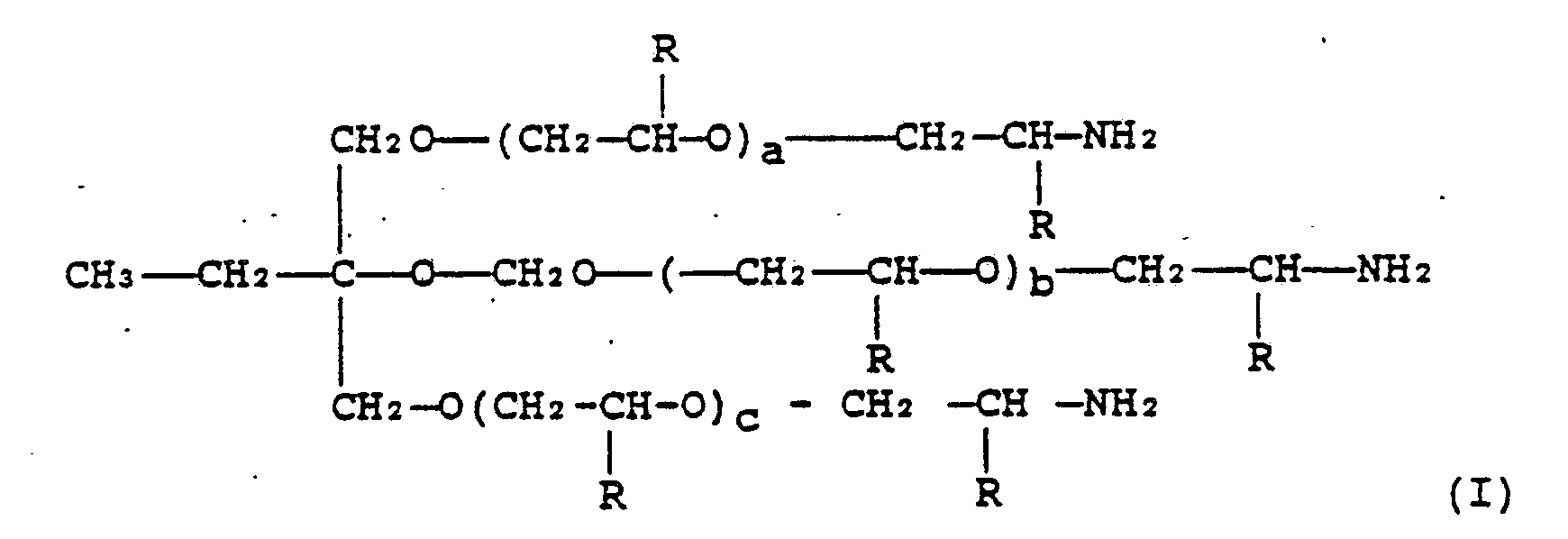
where R is CH₃, C₂H₅ - etc. - Also useful are condensation products of I with dibasic carboxylic acids.
- Also useful are:

R is CH₃, C₂H₅ etc. are mixtures thereof and
- The amine terminated polyethers in this invention are polyethers made from an appropriate initiator to which lower alkylene oxides such as ethylene oxide, propylene oxide, butylene oxide or mixtures thereof are added with the resulting hydroxyl terminated polyol then being aminated. When two or more oxides are used, they may be present as random mixtures or as blocks of one or the other polyether. In the amination step it is highly desirable that the terminal hydroxyl groups in the polyol be essentially all secondary hydroxyl groups for ease of amination. Normally, the amination step does not completely replace all of the hydroxyl groups. However, the majority of hydroxyl groups are replaced by amine groups. If ethylene oxide is used it is desirable to cap the hydroxyl terminated polyol with a small amount of higher alkylene oxide to ensure that the terminal hydroxyl groups are essentially all secondary hydroxyl groups. The polyols so prepared are then reductively aminated as outlined in U.S. Pat. No. 3,654,370.
- A wide variety of polyaromatic polyisocyanates may be used here. Typical aromatic polyisocyanates include polymethylene polyphenylisocyanate, naphthalene-1,4-diisocyanate, bis(4-isocyanatophenyl)methane, (bis(3-methyl-4-isocyanatophenyl)methane, and 4,4-́diphenylpropane diisocyanate.
- Isocyanates such as:

- Other polyaromatic polyisocyanates used in the practice of the invention are methylene-bridged polyphenyl polyisocyanate mixtures which have a functionality of from about 2 to about 4. These latter isocyanate compounds are generally produced by the phosgenation of corresponding methylene bridged polyphenyl polyamines, which are conventionally produced by the reaction of formaldehyde and primary aromatic amines, such as aniline, in the presence of hydrochloric acid and/or other acidic catalysts. Known processes for preparing polyamines and corresponding methylene-bridged polyphenyl polyisocyanates therefrom are described in the literature and in many patents, for example, U.S. Pat. Nos. 2,683,730; 2,950,263; 3,012,008; 3,344,162 and 3,362,979.
- Usually methylene-bridged polyphenyl polyisocyanate mixtures contain about 20 to about 100 weight percent methylene diphenyldiisocyanate isomers, with the remainder being polymethylene polyphenyl diisocyanates having higher functionalities and higher molucular weights. Typical of these are polyphenyl polyisocyanate mixtures containing about 20 to 100 weight percent methylene diphenyldiisocyanate isomers, of which 20 to about 95 weight percent thereof is the 4,4′-isomer with the remainder being polymethylene polyphenyl polyisocyanates of higher molucular weight and functionality that have an average functionality of from about 2.1 to about 3.5. These isocyanate mixtures are known, commercially available materials and can be prepared by the process described in U. S. Pat. No. 3,362,979, issued Jan. 9, 1968 to Floyd E. Bentley.
- By far the most preferred polyaromatic polyisocyanate is methylene bis(4-phenylisocyanate) or MDI. Pure MDI, quasi-prepolymers of MDI, modified pure MDI, etc. Materials of this type may be used to prepare suitable RIM elastomers. Since pure MDI is a solid and, thus, often inconvenient to use, liquid products based on MDI are often used and are included in the scope of the terms MDI or methylene bis(4-phenylisocyanate) used herein. U.S. Pat. No. 3,394,164 is an example of a liquid MDI product. More generally uretonimine modified pure MDI is included also. This product is made by heating pure distilled MDI in the presence of a catalyst. The liquid product is a mixture of pure MDI and modified MDI:

- Of course, the term polyisocyanate also includes quasi-prepolymers of these polyisocyanates with active hydrogen containing materials where the isocyanate is in stoichiometric excess to the active hydrogen containing material. Where these quasi-prepolymers are miscible or partially miscible with the amine terminated polyethers of this invention a partial reaction may take place.
- As the examples will show even where a polyaromatic isocyanate is stable and remains liquid at ambient temperatures with an amine terminated polyether of this invention, a quasi-prepolymer of the same isocyanate may react to some appreciable degree with the amine terminated polyether.
- If this reaction forms a gel which progressively gets harder at ambient temperature and is, therefore, not stable, the mixture is not preferred. However, in another embodiment of our invention, if the reaction only proceeds to a limited extent at ambient temperature and the mixture ceases the thickening process while the material is still workable and useful as a gel or thickened liquid, the system is still useful since the reaction proceeding to final hardening requires added heat.
- The following examples show the practice of the invention and demonstrate the usefulness thereof.
- In the examples an initial attempt was made to mix the ingredients by low speed power mixing or hand mixing. Where the reaction was slow or not apparent at room temperature, the liquid ingredients were not miscible. Where the liquid reactants were miscible at room temperature reaction took place.
Example 1 Sakrete 30 grams (Portland Cement and Sand) Jeffamine® T-403 13.3 grams (a homologue of T-5000 with a molecular weight of 400 instead of 5000) Water 2.5 grams Silicone Oil 0.5 grams (DC-193-Dow Corning) Mondur MR 13.3 grams (Mobay) - There was no reaction on stirring of this mixture at room temperature. The same experiment was repeated with a different lot of T-403. The same results were obtained.

Example 3 Sakrete 30g JEFFAMINE ED-900 49g Water 9g Mondur MR 6.75g 
- We subsequently found that JEFFAMINE® T-403 did not react with stirring at room temperature with Isocyanate ISONATE 143-L on a prepolymer of isocyanate Isonate 143-L and THANOL SF-5505. Isonate 143-L is a polyarylisocyanate obtained from Upjohn and THANOL SF-5505 is a 5500 molecular weight triol obtained from Texaco Chemical Company. JEFFAMINE T-403 amine did react with aliphatic diisocyanates and with toluene diisocyanate. The observation was made that there was a compatibility problem with polyaromatic isocyanates such as Mondur MR and Isonate 143L and JEFFAMINE® T-403.
- To a small paper cup was added log of JEFFAMINE® T-3000 amine and 1.34 grams of Mondur MR isocyanate. On stirring with a tongue depressor the materials reacted and congealed. However, not all of the T-3000 reacted. There was liquid and a ball. Additional Mondur MR resulted in complete reaction.
- To a small cup was added 4.68g of JEFFAMINE® T-703 amine (a 700 molecular weight homologue of T-403) and 2.6g of Mondur MR. No heat was given off and a brown liquid (isocyanate) settled to the bottom. Excess isocyanate was added and there was still no reaction. Liquid amine was still present.
- To a small cup was added 3g of Mondur MR and 7.46g of JEFFAMINE® T-1003. There was some reaction but the reaction was far from complete. Still a lot of amine was left and that which did react was soft and not hard as in the case of the T-3000. After the unusual results obtained in experiments 1-7 we attempted to find the conditions under which the Tri-amines of low molecular weight would react.
- 4.68g of JEFFAMINE® T-703 amine was mixed with 2.86g of Isonate 143L. A somewhat heterogeneous solution was formed on stirring but there was no reaction. On heating for one hour at 100°C it was almost all cured (congealed). At 150°C after one hour a hard polymer was obtained. This proves the utility as a delayed action polymer for use as sealants, caulks and adhesives.
- 5.70g of JEFFAMINE® T-703 was mixed with a quasi-prepolymer made from JEFFAMINE T-5000 and Isonate 143L (e.w. 310) 7.51g. This would be an all polyurea delayed action system. There was no reaction after stirring at room temperature and two layers separated. After heating at 100°C and one hour it was almost all cured. At 150°C and 1.5 hours it was all cured except for a small amount of liquid.
- 4.68g of JEFFAMINE T-703 was mixed with a quasi-prepolymer of Isonate 143L and PPG-2000 (e.w. 269) (6303-81A). No reaction occurred at room temperature and two layers separated. At 100°C it was almost all cured (congealed) while at 150°C it was all cured.
- 4.68g of JEFFAMINE T-703 and a prepolymer of THANOL SF-5505 (5.16g, e.w. 258) were mixed but did not react at room temperature. After one hour at 100°C it was almost all cured. At 150°C and 1.5 hours in an oven it was all cured.
- JEFFAMINE T-403 amine was substituted for T-703 in experiments like 8A-8D. The same observations were made as in the case of T-703.
- A tetrafunctional amine was made by condensing T-403 with adipic acid as follows:

- This tetrafunctional amine did not react at room temperature with the isocyanates described in 8A to 8D. In general, this tetramine showed more reluctance to react at 100°C than T-703. After one hour at 100°C the mixtures generally set to a gel but did not set to a hard polymer. At 150°C the products set to a hard polymer with some foaming. This indicates the formation of delayed action foams.
- JEFFAMINE® T-403 was allowed to react by mixing with the isocyanates in 8A-8D in the presence of catalysts. The results were as if no catalysts were used. The catalysts tried included triethylene diamine in dipropylene glycol (THANCAT TD-33A), dimethylpiperazine and dibutyl tin dilaurate.
- JEFFAMINE® T-403 (26.8g) was allowed to react by mixing with a quasi-prepolymer made from Isonate 143L and PPG-2000 (53.8g) in the presence of 5.4g of water. A hard foam was obtained after about 2.5 hours at room temperature.
- The following ingredients were mixed:
T-403 13.4 g DETDA 8.9g (diethyltoluenediamine) RIMTEX 50.02 5.16g (quasi-prepolymer SF-5505 & Isonate 143L) - The following ingredients were mixed:
JEFFAMINE D-400 20g JEFFAMINE T-403 13.4g RIMTEX 50.02 51.6g - The following ingredients were mixed:
JEFFAMINE D-230 11.5 JEFFAMINE T-403 13.4g RIMTEX 50.02 51.6g - The following ingredients were mixed:

- After five seconds at room temperature the mixture gelled. This shows that aliphatic isocyanates react immediately with trifunctional polyoxyalkylene amines.
- The following ingredients were mixed:
A. JEFFAMINE T-403 26.8g TDI/SF-5505 quasi-prepolymer 36.6g(toluene diisocyanate) - There is some reaction on being stirred at room temperature. At 100°C for 30 minutes it is completely cured.
B. JEFFAMINE T-403 26.8g TDI 17.4g - At room temperature it did not react immediately but congealed eventually.
- Acetone was added to T-403, then isocyanate was added.
T-403 14.6 g Acetone 20.6 g Rimtex 50.02 25.8 g - About the same results were obtained when prepolymer 6303-81A was used. Apparently acetone serves as a partial mutual solvent for the isocyanate and amine.
-
T-403 14.3 g Rimtex 50.02 25.8 g Cab-o-sil 1.2 g - The above mixture was stable at room temperature. After mixing for one hour at 150°C, hard foam was obtained.
-
T-403 13.8 g Rimtex 50.02 27.0 g Titanium dioxide 3.3 g -
T-403 13.4 g Rimtex 50.02 25.8 g Toluene 22.3 g - Tertiary butyl alcohol was used as a diluent for the mixture of 18-A-5. Results were the same as above.
- JEFFAMINE° T-403 did not react with Rimtex 50.02 in the presence of propylene carbonate. Some titanium dioxide was added and there was curing at 150°C after one hour.
-
T-403 13.8 g Rimtex 50.02 25.8 g CaSO₄ 3.0 g - After the ingredients were exposed to moisture in the air and allowed to stand overnight, there was some gelling. The mixture formed a very hard product after being heated at 150°C for one hour.
-
T-403 13.4 g Rimtex 50.02 25.8 g Flaked glass 5.1 g - The contents formed a very hard product after curing at 150°C for one hour. Mixture did gel to some extent when exposed to moisture after 12 hours at room temperature.
-
T-403 13.4 g Rimtex 50.02 25.8 Polyethylene terephthalate 4.3 g Ethylene carbonate 4.4 g -
T-403 13.4 g Rimtex 50.02 25.8 g SURFONIC® N-95 1.0 g (nonylphenol 9.5 mole ethylene oxide adduct) - T-403, Rimtex 50.02 and adipic acid formed a heterogeneous mixture. A foam formed after one hour at 150°C.
- T-403, Rimtex 50.02 and dimer acid also formed a mixture that was difficult to mix due to the immiscibility of the ingredients.
-
T-403 6.7 g DETA 8.9 g (Diethyl toluene diamine) Rimtex 50.02 25.8 g Flaked glass 5.0 g -
T-403 13.4 g Epon 828 1.7 g Rimtex 50.02 25.8 g -
T-403 13.4 g Rimtex 50.02 25.8 g Silicone DC-193 1.0 g (Dow Corning) - Same as above when 1.0 g of Silwet L-711 (Carbide) was used.
-
T-403 13.4 g Epon 828 1.7 g Rimtex 50.02 25.8 g DC-193 1.0 g - Same as above when L-711 was used.
- The products of this invention will be especially useful in preparing one component caulks, sealants, adhesives, etc. In addition, other polymers can be mixed with the isocyanate and polyamines to make alloys and interpenetrating polymers. Monomers such as vinyl monomers can also be used with isocyanates and amines and the whole batch polymerized at will. Water can be added to make foamed articles. The density of the foams can be reduced considerably by the addition of low boiling organic solvents. Fillers can be added to reduce the cost and add some reinforcing properties.
- This is a simple way also of encapsulating materials such as catalysts, pigments, minerals, inorganic salts, etc.
- These products are polyoxyalkylenetriamines with the approximate molecular weight designated by the number. Products of Texaco Chemical Company.
- These products are polyoxyalkylenediamines with the approximate molecular weight indicated by the number. Products of Texaco Chemical Company.
- Polyoxyethylenediamine of approximately 900 molecular weight. A product of Texaco Chemical Company.
- A 5000 molecular weight polyol which is principally propylene oxide with an ethylene oxide cap. A product of ARCO Chemical Company.
- Polypropylene glycol of about 2000 molecular weight.
- Polyaromatic polyisocyanates.
- Silicone Surfactant. Product of Union Carbide.
- Silicone Surfactant. Product of Dow Corning.
Claims (6)
1. A method for curing a mixture of a polyaromatic polyisocyanate and a tri- or higher functionality polyoxyalkyleneamine of less than 1000 molecular weight which are not reactive with each other at ambient temperature or are reactive with each other to only a limited extent at ambient temperature, characterized by raising the temperature of the mixture until reaction proceeds.
2. A method according to Claim 1 characterized in that the polyisocyanate and the polyoxyalkylene amine are immiscible with one another.
3. A method according to Claim 1 or 2 characterized in that the polyisocyanate is polymethylene polyphenyl isocyanate, naphthalene-1 , 4-diisocyanate, bis (4-isocyanatophenyl) methane, bis(3-methyl-4-isocyanatophenyl) methane or 4,4′-diphenyl propane diisocyanate.
4. A method according to any one of Claims 1 to 3 characterized in that the polyoxyalkylene amine has the formula:

wherein R is alkyl, and a, b and c are each 1 to 3, or a condensation product thereof with a dibasic acid.
5. A method according to any one of Claims 1 to 3 characterized in that the polypoxyalkylene amine has the formula:

wherein R is alkyl, and a, b, c and d are each 1 to 4.
6. A method according to any one of Claims 1 to 3 characterized in that the polyoxyalkylene amine has the formula:

wherein a, b, c, d, e and f are each 1 to 6.
Applications Claiming Priority (2)
| Application Number | Priority Date | Filing Date | Title |
|---|---|---|---|
| US07/265,081 US4897430A (en) | 1988-10-31 | 1988-10-31 | One Component polyurea |
| US265081 | 1994-06-23 |
Publications (1)
| Publication Number | Publication Date |
|---|---|
| EP0367478A1 true EP0367478A1 (en) | 1990-05-09 |
Family
ID=23008885
Family Applications (1)
| Application Number | Title | Priority Date | Filing Date |
|---|---|---|---|
| EP89310953A Withdrawn EP0367478A1 (en) | 1988-10-31 | 1989-10-24 | One component polyurea |
Country Status (3)
| Country | Link |
|---|---|
| US (1) | US4897430A (en) |
| EP (1) | EP0367478A1 (en) |
| JP (1) | JPH02170817A (en) |
Cited By (4)
| Publication number | Priority date | Publication date | Assignee | Title |
|---|---|---|---|---|
| EP0556969A1 (en) * | 1992-02-21 | 1993-08-25 | Huntsman Corporation | Polyurea elastomers made using polyoxyalkylene tetra- or higher functional amine chain extenders |
| WO2007003392A1 (en) * | 2005-07-05 | 2007-01-11 | Delo Industrieklebstoffe Gmbh & Co. Kg | Thermosetting solvent-free single-component substances and use thereof |
| DE102019000395A1 (en) | 2019-01-15 | 2020-07-16 | Johann Lang | Relief compound, for industrial and private jewelry or decoration production, which is formed with a certain technology from a difficult-to-dilute fluid with very good adhesive properties and high viscosity by heat treatment. |
| EP4089129A1 (en) * | 2021-05-12 | 2022-11-16 | Covestro Deutschland AG | Storage-stable polyester polyol formulations containing terephthalic acid based polyester |
Families Citing this family (5)
| Publication number | Priority date | Publication date | Assignee | Title |
|---|---|---|---|---|
| US5198196A (en) * | 1989-06-07 | 1993-03-30 | Chemical Research & Licensing Company | Method for removing and replacing catalyst in a distillation column reactor |
| DE59109176D1 (en) * | 1991-03-19 | 2000-02-17 | Huntsman International Trading | Process for the production of foamed masses based on polyurea elastomers |
| WO2002102869A1 (en) * | 2001-06-15 | 2002-12-27 | Huntsman Petrochemical Corporation | Synergistic amine chain-extenders in polyurea spray elastomers |
| US20060211840A1 (en) * | 2005-03-20 | 2006-09-21 | Aspen Aerogels Inc. | Polyurea aerogels |
| CN114106290A (en) * | 2021-12-28 | 2022-03-01 | 巩义市泛锐熠辉复合材料有限公司 | Single-component heat-cured polyurea and preparation method thereof |
Citations (2)
| Publication number | Priority date | Publication date | Assignee | Title |
|---|---|---|---|---|
| US4433067A (en) * | 1982-04-23 | 1984-02-21 | Texaco Inc. | Reaction injection molded elastomers prepared from amine terminated polyethers, amine terminated chain extender and aromatic polyisocyanate |
| EP0268385A1 (en) * | 1986-11-06 | 1988-05-25 | Texaco Development Corporation | A reaction injection molded elastomer |
Family Cites Families (15)
| Publication number | Priority date | Publication date | Assignee | Title |
|---|---|---|---|---|
| US3236895A (en) * | 1960-12-12 | 1966-02-22 | Dow Chemical Co | Polyoxyalkylenepolyamines |
| NL122820C (en) * | 1960-12-19 | |||
| US3979364A (en) * | 1974-09-23 | 1976-09-07 | Jefferson Chemical Company, Inc. | Polyurethane elastomers having improved sag resistance |
| US3963680A (en) * | 1975-03-17 | 1976-06-15 | Minnesota Mining And Manufacturing Company | One-part, room-temperature latent, curable isocyanate compositions |
| US4178427A (en) * | 1976-05-05 | 1979-12-11 | Texaco Development Corp. | Polyether urea epoxy curing agent |
| DE3230757A1 (en) * | 1982-08-18 | 1984-02-23 | Bayer Ag, 5090 Leverkusen | METHOD FOR THE PRODUCTION OF STABILIZED POLYISOCYANATES, STABILIZED POLYISOCYANATES OF RETARDED REACTIVITY AND THEIR USE FOR THE PRODUCTION OF POLYURETHANE |
| US4474901A (en) * | 1983-06-08 | 1984-10-02 | Texaco Inc. | Reaction injection molded elastomers made using high molecular weight amine terminated polyethers and small amounts of low molecular weight amine terminated polyethers |
| DE3333464A1 (en) * | 1983-09-16 | 1985-04-11 | Bayer Ag, 5090 Leverkusen | METHOD FOR PRODUCING MICROCELLULAR OR FOAMED MOLDED BODIES AND COMPOUNDS SUITABLE FOR CARRYING OUT THIS METHOD WITH GROUPS REACTIVE TO ISOCYANATE GROUPS |
| DE3403499A1 (en) * | 1984-02-02 | 1985-08-08 | Bayer Ag, 5090 Leverkusen | USE OF HEAT-CURABLE POLYURETHANE RESIN REACTIVE ADHESIVES |
| US4581386A (en) * | 1985-05-23 | 1986-04-08 | Mobay Chemical Corporation | Internal mold release agent for use in reaction injection molding |
| US4631298A (en) * | 1985-12-16 | 1986-12-23 | Ethyl Corporation | Mixed diamine chain extender |
| US4748192A (en) * | 1986-03-24 | 1988-05-31 | Urylon Development, Inc. | Aliphatic polyurethane sprayable coating compositions and method of preparation |
| US4705814A (en) * | 1986-11-06 | 1987-11-10 | Texaco Inc. | Reaction product of polyoxyalkylene polyamine and an aliphatic isocyanate |
| US4767836A (en) * | 1987-05-18 | 1988-08-30 | Texaco Inc. | Storage stable polyurethane coating |
| US4761465A (en) * | 1987-07-27 | 1988-08-02 | Texaco Inc. | Difunctional isocyanate-terminated polyoxyalkylene diamine prepolymers and polymer coatings applications |
-
1988
- 1988-10-31 US US07/265,081 patent/US4897430A/en not_active Expired - Lifetime
-
1989
- 1989-10-24 EP EP89310953A patent/EP0367478A1/en not_active Withdrawn
- 1989-10-31 JP JP1282094A patent/JPH02170817A/en active Pending
Patent Citations (2)
| Publication number | Priority date | Publication date | Assignee | Title |
|---|---|---|---|---|
| US4433067A (en) * | 1982-04-23 | 1984-02-21 | Texaco Inc. | Reaction injection molded elastomers prepared from amine terminated polyethers, amine terminated chain extender and aromatic polyisocyanate |
| EP0268385A1 (en) * | 1986-11-06 | 1988-05-25 | Texaco Development Corporation | A reaction injection molded elastomer |
Cited By (5)
| Publication number | Priority date | Publication date | Assignee | Title |
|---|---|---|---|---|
| EP0556969A1 (en) * | 1992-02-21 | 1993-08-25 | Huntsman Corporation | Polyurea elastomers made using polyoxyalkylene tetra- or higher functional amine chain extenders |
| WO2007003392A1 (en) * | 2005-07-05 | 2007-01-11 | Delo Industrieklebstoffe Gmbh & Co. Kg | Thermosetting solvent-free single-component substances and use thereof |
| US8480845B2 (en) | 2005-07-05 | 2013-07-09 | Delo Industrieklebstoffe Gmbh & Co. Kg | Thermosetting solvent-free single-component compositions and their use |
| DE102019000395A1 (en) | 2019-01-15 | 2020-07-16 | Johann Lang | Relief compound, for industrial and private jewelry or decoration production, which is formed with a certain technology from a difficult-to-dilute fluid with very good adhesive properties and high viscosity by heat treatment. |
| EP4089129A1 (en) * | 2021-05-12 | 2022-11-16 | Covestro Deutschland AG | Storage-stable polyester polyol formulations containing terephthalic acid based polyester |
Also Published As
| Publication number | Publication date |
|---|---|
| JPH02170817A (en) | 1990-07-02 |
| US4897430A (en) | 1990-01-30 |
Similar Documents
| Publication | Publication Date | Title |
|---|---|---|
| CA1111186A (en) | Process for producing a liquid isocyanate prepolymer composition | |
| US3425999A (en) | Tetrahydrofuran-ethylene oxide polyether urethane-urea polymers | |
| US2830038A (en) | Poly (polyalkylene ether urethane) polymers containing terminal epoxide groups | |
| US4126742A (en) | High-modulus polyisocyanurate elastomers | |
| CA1327670C (en) | Polyureas prepared from a mixture of polyamines and a polyisocyanate | |
| CA2253903A1 (en) | Process for producing elastic polyurethane mouldings with compact surfaces and cellular cores | |
| JPS63135411A (en) | Reactive injection molded elastomer | |
| EP0283216A2 (en) | Improved prepolymer compositions for polyurea reaction injection molding | |
| CA1270847A (en) | Thermoset molding compositions | |
| US4590224A (en) | Siloxane-containing polyisocyanurate | |
| US4435527A (en) | Polyester polymer polyols made with polyester polycarbonates and polyurethanes therefrom | |
| US4849460A (en) | Process for preparing polyurea and polyurea/polyurethane polymers from polymeric polyamine | |
| US4897430A (en) | One Component polyurea | |
| CA2059321A1 (en) | Preparation of foams using polyfunctional organic acids | |
| CA1309528C (en) | Polymer polyols with high solids content | |
| EP0656882A1 (en) | Polyols useful for preparing polyurethane foams having improved retention of insulative properties, polyurethane foams prepared therewith and methods for the preparation thereof | |
| US4485031A (en) | Compatible mixtures of aminated polyether polyols and low molecular weight glycols | |
| EP0211864B1 (en) | Active hydrogen-containing compositions containing a secondary amine-terminated adduct of a primary amine compound and a polyepoxide and polyurea-containing polymers prepared therefrom | |
| US3892713A (en) | Cure of polyurethanes with mixed curatives comprising hydroxy tertiary amines | |
| US3786030A (en) | Catalyst for trimerizing polyisocyanates | |
| EP0439264A2 (en) | Reaction injection moulded polyurea elastomers | |
| PT95675A (en) | PROCESS FOR THE PREPARATION OF REACTIVE COMPOSITIONS WITH ISOCYANATES | |
| JPS6116763B2 (en) | ||
| Frisch et al. | Isocyanurate-containing polyurethanes | |
| US3622542A (en) | Method of producing polyurethanes |
Legal Events
| Date | Code | Title | Description |
|---|---|---|---|
| PUAI | Public reference made under article 153(3) epc to a published international application that has entered the european phase |
Free format text: ORIGINAL CODE: 0009012 |
|
| AK | Designated contracting states |
Kind code of ref document: A1 Designated state(s): DE GB |
|
| 17P | Request for examination filed |
Effective date: 19900615 |
|
| 17Q | First examination report despatched |
Effective date: 19920113 |
|
| STAA | Information on the status of an ep patent application or granted ep patent |
Free format text: STATUS: THE APPLICATION IS DEEMED TO BE WITHDRAWN |
|
| 18D | Application deemed to be withdrawn |
Effective date: 19940201 |