EP0361347B1 - Lubricating oil for traction drives - Google Patents
Lubricating oil for traction drives Download PDFInfo
- Publication number
- EP0361347B1 EP0361347B1 EP89117634A EP89117634A EP0361347B1 EP 0361347 B1 EP0361347 B1 EP 0361347B1 EP 89117634 A EP89117634 A EP 89117634A EP 89117634 A EP89117634 A EP 89117634A EP 0361347 B1 EP0361347 B1 EP 0361347B1
- Authority
- EP
- European Patent Office
- Prior art keywords
- traction
- lubricating oil
- methane
- traction drives
- traction coefficient
- Prior art date
- Legal status (The legal status is an assumption and is not a legal conclusion. Google has not performed a legal analysis and makes no representation as to the accuracy of the status listed.)
- Expired - Lifetime
Links
- 0 CC1C(C)CC(*C2C(C)CC(C)C(C)C2)C(C)C1 Chemical compound CC1C(C)CC(*C2C(C)CC(C)C(C)C2)C(C)C1 0.000 description 1
Images

Classifications
-
- C—CHEMISTRY; METALLURGY
- C10—PETROLEUM, GAS OR COKE INDUSTRIES; TECHNICAL GASES CONTAINING CARBON MONOXIDE; FUELS; LUBRICANTS; PEAT
- C10M—LUBRICATING COMPOSITIONS; USE OF CHEMICAL SUBSTANCES EITHER ALONE OR AS LUBRICATING INGREDIENTS IN A LUBRICATING COMPOSITION
- C10M171/00—Lubricating compositions characterised by purely physical criteria, e.g. containing as base-material, thickener or additive, ingredients which are characterised exclusively by their numerically specified physical properties, i.e. containing ingredients which are physically well-defined but for which the chemical nature is either unspecified or only very vaguely indicated
- C10M171/002—Traction fluids
-
- C—CHEMISTRY; METALLURGY
- C10—PETROLEUM, GAS OR COKE INDUSTRIES; TECHNICAL GASES CONTAINING CARBON MONOXIDE; FUELS; LUBRICANTS; PEAT
- C10M—LUBRICATING COMPOSITIONS; USE OF CHEMICAL SUBSTANCES EITHER ALONE OR AS LUBRICATING INGREDIENTS IN A LUBRICATING COMPOSITION
- C10M105/00—Lubricating compositions characterised by the base-material being a non-macromolecular organic compound
- C10M105/02—Well-defined hydrocarbons
- C10M105/04—Well-defined hydrocarbons aliphatic
-
- C—CHEMISTRY; METALLURGY
- C10—PETROLEUM, GAS OR COKE INDUSTRIES; TECHNICAL GASES CONTAINING CARBON MONOXIDE; FUELS; LUBRICANTS; PEAT
- C10M—LUBRICATING COMPOSITIONS; USE OF CHEMICAL SUBSTANCES EITHER ALONE OR AS LUBRICATING INGREDIENTS IN A LUBRICATING COMPOSITION
- C10M2203/00—Organic non-macromolecular hydrocarbon compounds and hydrocarbon fractions as ingredients in lubricant compositions
- C10M2203/02—Well-defined aliphatic compounds
-
- C—CHEMISTRY; METALLURGY
- C10—PETROLEUM, GAS OR COKE INDUSTRIES; TECHNICAL GASES CONTAINING CARBON MONOXIDE; FUELS; LUBRICANTS; PEAT
- C10M—LUBRICATING COMPOSITIONS; USE OF CHEMICAL SUBSTANCES EITHER ALONE OR AS LUBRICATING INGREDIENTS IN A LUBRICATING COMPOSITION
- C10M2203/00—Organic non-macromolecular hydrocarbon compounds and hydrocarbon fractions as ingredients in lubricant compositions
- C10M2203/02—Well-defined aliphatic compounds
- C10M2203/022—Well-defined aliphatic compounds saturated
-
- C—CHEMISTRY; METALLURGY
- C10—PETROLEUM, GAS OR COKE INDUSTRIES; TECHNICAL GASES CONTAINING CARBON MONOXIDE; FUELS; LUBRICANTS; PEAT
- C10M—LUBRICATING COMPOSITIONS; USE OF CHEMICAL SUBSTANCES EITHER ALONE OR AS LUBRICATING INGREDIENTS IN A LUBRICATING COMPOSITION
- C10M2203/00—Organic non-macromolecular hydrocarbon compounds and hydrocarbon fractions as ingredients in lubricant compositions
- C10M2203/02—Well-defined aliphatic compounds
- C10M2203/024—Well-defined aliphatic compounds unsaturated
-
- C—CHEMISTRY; METALLURGY
- C10—PETROLEUM, GAS OR COKE INDUSTRIES; TECHNICAL GASES CONTAINING CARBON MONOXIDE; FUELS; LUBRICANTS; PEAT
- C10M—LUBRICATING COMPOSITIONS; USE OF CHEMICAL SUBSTANCES EITHER ALONE OR AS LUBRICATING INGREDIENTS IN A LUBRICATING COMPOSITION
- C10M2203/00—Organic non-macromolecular hydrocarbon compounds and hydrocarbon fractions as ingredients in lubricant compositions
- C10M2203/04—Well-defined cycloaliphatic compounds
-
- C—CHEMISTRY; METALLURGY
- C10—PETROLEUM, GAS OR COKE INDUSTRIES; TECHNICAL GASES CONTAINING CARBON MONOXIDE; FUELS; LUBRICANTS; PEAT
- C10M—LUBRICATING COMPOSITIONS; USE OF CHEMICAL SUBSTANCES EITHER ALONE OR AS LUBRICATING INGREDIENTS IN A LUBRICATING COMPOSITION
- C10M2207/00—Organic non-macromolecular hydrocarbon compounds containing hydrogen, carbon and oxygen as ingredients in lubricant compositions
- C10M2207/02—Hydroxy compounds
- C10M2207/023—Hydroxy compounds having hydroxy groups bound to carbon atoms of six-membered aromatic rings
- C10M2207/026—Hydroxy compounds having hydroxy groups bound to carbon atoms of six-membered aromatic rings with tertiary alkyl groups
-
- C—CHEMISTRY; METALLURGY
- C10—PETROLEUM, GAS OR COKE INDUSTRIES; TECHNICAL GASES CONTAINING CARBON MONOXIDE; FUELS; LUBRICANTS; PEAT
- C10M—LUBRICATING COMPOSITIONS; USE OF CHEMICAL SUBSTANCES EITHER ALONE OR AS LUBRICATING INGREDIENTS IN A LUBRICATING COMPOSITION
- C10M2207/00—Organic non-macromolecular hydrocarbon compounds containing hydrogen, carbon and oxygen as ingredients in lubricant compositions
- C10M2207/28—Esters
-
- C—CHEMISTRY; METALLURGY
- C10—PETROLEUM, GAS OR COKE INDUSTRIES; TECHNICAL GASES CONTAINING CARBON MONOXIDE; FUELS; LUBRICANTS; PEAT
- C10M—LUBRICATING COMPOSITIONS; USE OF CHEMICAL SUBSTANCES EITHER ALONE OR AS LUBRICATING INGREDIENTS IN A LUBRICATING COMPOSITION
- C10M2209/00—Organic macromolecular compounds containing oxygen as ingredients in lubricant compositions
- C10M2209/02—Macromolecular compounds obtained by reactions only involving carbon-to-carbon unsaturated bonds
- C10M2209/08—Macromolecular compounds obtained by reactions only involving carbon-to-carbon unsaturated bonds containing monomers having an unsaturated radical bound to a carboxyl radical, e.g. acrylate type
- C10M2209/084—Acrylate; Methacrylate
-
- C—CHEMISTRY; METALLURGY
- C10—PETROLEUM, GAS OR COKE INDUSTRIES; TECHNICAL GASES CONTAINING CARBON MONOXIDE; FUELS; LUBRICANTS; PEAT
- C10M—LUBRICATING COMPOSITIONS; USE OF CHEMICAL SUBSTANCES EITHER ALONE OR AS LUBRICATING INGREDIENTS IN A LUBRICATING COMPOSITION
- C10M2215/00—Organic non-macromolecular compounds containing nitrogen as ingredients in lubricant Compositions
- C10M2215/02—Amines, e.g. polyalkylene polyamines; Quaternary amines
-
- C—CHEMISTRY; METALLURGY
- C10—PETROLEUM, GAS OR COKE INDUSTRIES; TECHNICAL GASES CONTAINING CARBON MONOXIDE; FUELS; LUBRICANTS; PEAT
- C10M—LUBRICATING COMPOSITIONS; USE OF CHEMICAL SUBSTANCES EITHER ALONE OR AS LUBRICATING INGREDIENTS IN A LUBRICATING COMPOSITION
- C10M2219/00—Organic non-macromolecular compounds containing sulfur, selenium or tellurium as ingredients in lubricant compositions
- C10M2219/04—Organic non-macromolecular compounds containing sulfur, selenium or tellurium as ingredients in lubricant compositions containing sulfur-to-oxygen bonds, i.e. sulfones, sulfoxides
- C10M2219/046—Overbased sulfonic acid salts
-
- C—CHEMISTRY; METALLURGY
- C10—PETROLEUM, GAS OR COKE INDUSTRIES; TECHNICAL GASES CONTAINING CARBON MONOXIDE; FUELS; LUBRICANTS; PEAT
- C10M—LUBRICATING COMPOSITIONS; USE OF CHEMICAL SUBSTANCES EITHER ALONE OR AS LUBRICATING INGREDIENTS IN A LUBRICATING COMPOSITION
- C10M2223/00—Organic non-macromolecular compounds containing phosphorus as ingredients in lubricant compositions
- C10M2223/02—Organic non-macromolecular compounds containing phosphorus as ingredients in lubricant compositions having no phosphorus-to-carbon bonds
- C10M2223/04—Phosphate esters
- C10M2223/045—Metal containing thio derivatives
-
- C—CHEMISTRY; METALLURGY
- C10—PETROLEUM, GAS OR COKE INDUSTRIES; TECHNICAL GASES CONTAINING CARBON MONOXIDE; FUELS; LUBRICANTS; PEAT
- C10M—LUBRICATING COMPOSITIONS; USE OF CHEMICAL SUBSTANCES EITHER ALONE OR AS LUBRICATING INGREDIENTS IN A LUBRICATING COMPOSITION
- C10M2229/00—Organic macromolecular compounds containing atoms of elements not provided for in groups C10M2205/00, C10M2209/00, C10M2213/00, C10M2217/00, C10M2221/00 or C10M2225/00 as ingredients in lubricant compositions
- C10M2229/02—Unspecified siloxanes; Silicones
-
- C—CHEMISTRY; METALLURGY
- C10—PETROLEUM, GAS OR COKE INDUSTRIES; TECHNICAL GASES CONTAINING CARBON MONOXIDE; FUELS; LUBRICANTS; PEAT
- C10M—LUBRICATING COMPOSITIONS; USE OF CHEMICAL SUBSTANCES EITHER ALONE OR AS LUBRICATING INGREDIENTS IN A LUBRICATING COMPOSITION
- C10M2229/00—Organic macromolecular compounds containing atoms of elements not provided for in groups C10M2205/00, C10M2209/00, C10M2213/00, C10M2217/00, C10M2221/00 or C10M2225/00 as ingredients in lubricant compositions
- C10M2229/04—Siloxanes with specific structure
- C10M2229/05—Siloxanes with specific structure containing atoms other than silicon, hydrogen, oxygen or carbon
-
- C—CHEMISTRY; METALLURGY
- C10—PETROLEUM, GAS OR COKE INDUSTRIES; TECHNICAL GASES CONTAINING CARBON MONOXIDE; FUELS; LUBRICANTS; PEAT
- C10N—INDEXING SCHEME ASSOCIATED WITH SUBCLASS C10M RELATING TO LUBRICATING COMPOSITIONS
- C10N2010/00—Metal present as such or in compounds
- C10N2010/04—Groups 2 or 12
-
- C—CHEMISTRY; METALLURGY
- C10—PETROLEUM, GAS OR COKE INDUSTRIES; TECHNICAL GASES CONTAINING CARBON MONOXIDE; FUELS; LUBRICANTS; PEAT
- C10N—INDEXING SCHEME ASSOCIATED WITH SUBCLASS C10M RELATING TO LUBRICATING COMPOSITIONS
- C10N2040/00—Specified use or application for which the lubricating composition is intended
- C10N2040/08—Hydraulic fluids, e.g. brake-fluids
Definitions
- the present invention relates to a lubricating oil for traction drives. More particularly, the present invention relates to a lubricating oil which has a high traction coefficient and a low viscosity over a wide temperature range from low temperatures to high temperatures, excellent stability to heat and oxidation, and excellent resistance to corrosion.
- the selection of a lubricating oil is very important because power is transmitted via an oil film present in the contact area between rotating members. Since power is transmitted by shearing of the oil film which becomes very viscous due to the high pressure at the contact area, it is preferred that the lubricating oil used in traction drives have a high shear resistance to obtain a high power transmitting performance.
- the traction coefficient which the ratio of the tangential force to the perpendicular load. Also, low viscosity is preferred in order to minimize losses in power transmission due to resistance to agitation.
- the preferred lubricating oils for traction drive are naphthenic hydrocarbons and many are disclosed e.g., in JP-B-46-338, JP-B-46-339, JP-B-47-35763, JP-B-48-42067, JP-B-48-42068, JP-B-61-15918, JP-B-61-15919 and JP-B-61-15920 (the term "JP-B" as used herein means an "examined Japanese patent publication").
- the disclosed lubricating oils are not fully satisfactory in performance because many of them have shortcomings, e.g., even if a high traction coefficient is exhibited at near room temperature, it decreases as the temperature rises or its efficiency is lowered due to high viscosity.
- the objective of the present invention is to provide a lubricating oil for traction drives. More particularly, the present invention relates to a lubricating oil which has a high traction coefficient and low viscosity over a wide temperature range from low temperatures to high temperatures, excellent stability to heat and oxidation, and excellent corrosion resistance.
- the present invention provides a lubricating oil for traction drives mainly composed of a naphthenic hydrocarbon having 19 carbon atoms made by linking, via a methylene group, two cyclohexane rings which have methyl-substitutions at the 1, 2 and 4 positions thereof.
- the Figure presents a comparison between the traction coefficients of the Example of the present invention and those of Comparative Examples at various temperatures.
- naphthenic hydrocarbons is a mixture composed of bis(2,3,5-trimethylcyclohexyl)methane; bis(3,4,6-trimethylcyclohexyl)methane; bis(2,3,6-trimethylcyclohexyl)methane; 2,3,5-trimethylcyclohexyl-2′,3′,6′-trimethylcyclohexyl methane; 2,3,5-trimethylcyclohexyl-3′,4′,6′-trimethylcyclohexyl methane; and 2,3,6-trimethylcyclohexyl-3′,4′,6′-trimethylcyclohexyl methane;
- the purpose of the present invention is not hindered by the presence of a small amount of the by-product or by-products which is/are generated in the process of making the above compounds and in the process of hydrogenating the rings.
- the presence of a large amount of aromatic compounds or of compounds having double bonds is not preferred.
- the hydrogenation ratio is at least 90%, preferably not less than 95%.
- the naphthenic lubricating oils obtained in the above manner exhibit excellent performance as lubricating oils for traction drives, and therefore can be used alone or in combination with not more than equivalent amounts of other lubricating oils, preferably naphthenic lubricating oils.
- additives for ordinary lubricating oils such as antioxidants, agents for increasing the viscosity index, corrosion inhibitors, detergents, defoamers and so forth are added as necessary.
- antioxidants such as 2,6-di-tertiary butyl p-cresol or sulfur-phosphorus compounds such as zinc dialkyl dithiophosphate as anitioxidants, amines, esters or metallic salts as corrosion inhibitors, polymethacrylates as agents for increasing the viscosity index, calcium sulfonate as detergents and silicone polymers as defoamers.
- a roller tester For measuring the traction coefficient, a roller tester is normally used, but in the present invention use was made of a 4-roller rolling friction tester which provides higher accuracy. Using this apparatus, one can measure the traction which is present at the three contact positions formed with a central inner roller and three outer rollers arranged at intervals of 120° under a predetermined load, temperature, peripheral speed and slip ratio.
- rollers were of high carbon chromium bearing steel type 2 and had been heat treated to a Vickers hardness of 760-800.
- the outer rollers each had diameter of 40 mm and a length of 10 mm, whereas the inner roller had diameter of 40 mm and length of 5 mm.
- the procedure for the experiments was as follows: the rotating speeds of all the rollers were increased to the predetermined ones; in the meantime, heat the each entire roller with infrared rays so that the temperatures of the feed oil and the surface of the rollers were in the predetermined temperature range; apply the load; decrease the speed of the inner roller and increase the speed of the outer rollers while maintaining the average speed of the two at a constant value to thereby provide the desired slip; and continuously obtain the various values of the traction coefficient versus the slip ratio.
- the traction coefficients obtained under the above conditions first linearly increased with the increase in the slip ratio, then gradually leveled off at a peak, and then decreased.
- the practically important region lies in the region up near the peak of the curve where the heat generated by the shearing of the oil film is not large. Therefore, the traction coefficient at slip ratio of 5% was chosen as the object.
- reaction mixture was heated to 100-110°C by the use of an oil bath, and the reaction mixture was kept at that temperature under vigorous agitation for 3 hours. After completion of the reaction and cooling the reaction mixture to room temperature, the reaction mixture was transferred to a funnel and left to stand. The lower layer which separated consisted of a sulfuric acid solution and was removed. To the remainder, there were added 100 ml of n-butanol and 200 ml of water. Then the whole mixture was well agitated and thereafter left to stand. As an oily layer and a water layer clearly separated, the water layer was discarded. Subsequently, water washing of the oily layer was repeated 2-3 times until the washings had a pH value of 7.
- the oily layer was then transferred to a distillation flask for vacuum distillation.
- the vacuum distillation which was started at a pressure of 1333,2 Pa (10 mm Hg) and ended at a pressure of 133,32 Pa (1 mm Hg), yielded 68 g of an aromatic compound consisting of two 1,2,4-methyl substituted benzene rings linked by a methylene group and having a melting point of 91°C.
- the aromatic compound was charged into an autoclave together with 10 g of a nickel catalyst and 200 g of cyclohexane as a solvent, and then hydrogenation was conducted after hermetically closing the autoclave.
- the conditions of the hydrogenation ware such that the initial hydrogen pressure was 70 kg/cm2, the temperature was 200°C, and the reaction time was 6 hours. Subsequent processing consisting of cooling, filtering off the catalyst and solvent removal using a rotary evaporator gave 67 g of a naphthenic hydrocarbon consisting of two 1,2,4-methyl substituted cyclohexane rings linked by a methylene group. Table 2 gives the representative characteristics thereof.
- Example 1 The procedure of Example 1 was repeated except that 240 g of commercially available 1,3,5-trimethyl benzene was used. Vacuum distillation gave 70 g of bis(2,4,6-trimethylphenyl)methane which corresponded to a distillate at 460°C or below when converted to normal pressure.
- the change in the traction coefficient of the above compound is also given in the Figure.
- the above compound is a ring isomer of the compound of the present invention, and there is a high similarity in chemical structure between the two.
- the compound of Comparative Example 1 had a very low traction coefficient and a high fluid point.
- Example 2 The procedure of Example 1 was repeated except that 240 g of commercially available methyl ethyl benzene was used. Vacuum distillation gave 87 g of bis(methyl ethyl phenyl)methane which corresponded to a distillate at 460°C or below when converted to normal pressure.
- the change in the traction coefficient of the above compound is given in the Figure.
- the above compound has the same number of carbon atoms as the compound of the present invention, and there is a similarity in chemical structure between the two. However, as it is obvious from the Figure, the compound of Comparative Example 2 had a very low traction coefficient.
- Example 1 The procedure of Example 1 was repeated except that 240 g of commercially available xylene was used. Vacuum distillation gave 30 g of bis(xylyl)methane which corresponded to a distillate at 460°C or below when converted to normal pressure.
- Example 2 The procedure of Example 1 was repeated except that 240 g of commercially available diethyl benzene was used. Vacuum distillation gave 24 g of bis(diethyl phenyl)methane which corresponded to a distillate at 460°C or below when converted to normal pressure.
- the lubricating oil for traction drives of the present invention will always provide stable power transmission and enhanced efficiency because the lubricating oil for traction drives of the present invention always has a higher traction coefficient over a wide temperature range (from high temperature to low temperature) and, at the same time, has a low viscosity and because it is excellent in such properties as stability to heat and oxidation, corrosion resistance, etc., relative to the conventional lubricating oils for traction drives whose traction coefficient (the ratio of the tangential force to perpendicular load) markedly decreases as the temperature rises even though it is adequate at near room temperature or where their high viscosity cause efficiency to decrease.
Landscapes
- Chemical & Material Sciences (AREA)
- Oil, Petroleum & Natural Gas (AREA)
- Chemical Kinetics & Catalysis (AREA)
- General Chemical & Material Sciences (AREA)
- Organic Chemistry (AREA)
- Engineering & Computer Science (AREA)
- Lubricants (AREA)
Description
- The present invention relates to a lubricating oil for traction drives. More particularly, the present invention relates to a lubricating oil which has a high traction coefficient and a low viscosity over a wide temperature range from low temperatures to high temperatures, excellent stability to heat and oxidation, and excellent resistance to corrosion.
- For the purpose of power transmission, gear devices and pressure oil devices have been widely used. There is also known a method involving a traction drive which comprises transmitting power via an oil film between steel rotating members. Traction drives have also been used in industrial machinery because of the advantages that they generate little vibration and noise during operation (due to the absence of interlocking gears) and that they permits a continuously variable transmission. A study is underway to adopt traction drives to automobiles and agricultural tractors because traction drives provide energy transmission which results in energy saving.
- In traction drives, the selection of a lubricating oil is very important because power is transmitted via an oil film present in the contact area between rotating members. Since power is transmitted by shearing of the oil film which becomes very viscous due to the high pressure at the contact area, it is preferred that the lubricating oil used in traction drives have a high shear resistance to obtain a high power transmitting performance.
- As a measure of power transmitting performance, generally use is made of the traction coefficient which the ratio of the tangential force to the perpendicular load. Also, low viscosity is preferred in order to minimize losses in power transmission due to resistance to agitation.
- When traction drives are used in areas where the heat load is high, such as in the transmission of an automobile, the oil temperature rises to as high as 100°C or more. The problem is then encountered of a decrease in the traction coefficient due to the increased temperature. It is important to minimize the decrease in the traction coefficient following such an increase in temperature.
- The preferred lubricating oils for traction drive are naphthenic hydrocarbons and many are disclosed e.g., in JP-B-46-338, JP-B-46-339, JP-B-47-35763, JP-B-48-42067, JP-B-48-42068, JP-B-61-15918, JP-B-61-15919 and JP-B-61-15920 (the term "JP-B" as used herein means an "examined Japanese patent publication").
- The disclosed lubricating oils, however, are not fully satisfactory in performance because many of them have shortcomings, e.g., even if a high traction coefficient is exhibited at near room temperature, it decreases as the temperature rises or its efficiency is lowered due to high viscosity.
- The objective of the present invention is to provide a lubricating oil for traction drives. More particularly, the present invention relates to a lubricating oil which has a high traction coefficient and low viscosity over a wide temperature range from low temperatures to high temperatures, excellent stability to heat and oxidation, and excellent corrosion resistance.
- The present invention provides a lubricating oil for traction drives mainly composed of a naphthenic hydrocarbon having 19 carbon atoms made by linking, via a methylene group, two cyclohexane rings which have methyl-substitutions at the 1, 2 and 4 positions thereof.
- The Figure presents a comparison between the traction coefficients of the Example of the present invention and those of Comparative Examples at various temperatures.
- An example of the naphthenic hydrocarbons is a mixture composed of bis(2,3,5-trimethylcyclohexyl)methane;


2,3,6-trimethylcyclohexyl-3′,4′,6′-trimethylcyclohexyl methane;
- Separation of the above mixture into single compounds at an industrial scale is not only difficult but also unnecessary for carrying out the purpose of the present invention.
- The purpose of the present invention is not hindered by the presence of a small amount of the by-product or by-products which is/are generated in the process of making the above compounds and in the process of hydrogenating the rings. However, the presence of a large amount of aromatic compounds or of compounds having double bonds is not preferred. When hydrogenating the aromatic hydrocarbons, the hydrogenation ratio is at least 90%, preferably not less than 95%.
- The naphthenic lubricating oils obtained in the above manner exhibit excellent performance as lubricating oils for traction drives, and therefore can be used alone or in combination with not more than equivalent amounts of other lubricating oils, preferably naphthenic lubricating oils.
- When using the lubricating oils for traction drives of the present invention for traction driving, additives for ordinary lubricating oils such as antioxidants, agents for increasing the viscosity index, corrosion inhibitors, detergents, defoamers and so forth are added as necessary. For example, there may be used alkyl phenols such as 2,6-di-tertiary butyl p-cresol or sulfur-phosphorus compounds such as zinc dialkyl dithiophosphate as anitioxidants, amines, esters or metallic salts as corrosion inhibitors, polymethacrylates as agents for increasing the viscosity index, calcium sulfonate as detergents and silicone polymers as defoamers.
- For measuring the traction coefficient, a roller tester is normally used, but in the present invention use was made of a 4-roller rolling friction tester which provides higher accuracy. Using this apparatus, one can measure the traction which is present at the three contact positions formed with a central inner roller and three outer rollers arranged at intervals of 120° under a predetermined load, temperature, peripheral speed and slip ratio.
- All the rollers were of high carbon chromium bearing
steel type 2 and had been heat treated to a Vickers hardness of 760-800.
- With respect to dimensions, the outer rollers each had diameter of 40 mm and a length of 10 mm, whereas the inner roller had diameter of 40 mm and length of 5 mm. The roughness of the rolling surface was reduced by finish cutting to a mean center line roughness of Ra = 0.05 µm by cylindrical grinding. Table 1 shows the test conditions.
- The procedure for the experiments was as follows:
the rotating speeds of all the rollers were increased to the predetermined ones; in the meantime, heat the each entire roller with infrared rays so that the temperatures of the feed oil and the surface of the rollers were in the predetermined temperature range; apply the load; decrease the speed of the inner roller and increase the speed of the outer rollers while maintaining the average speed of the two at a constant value to thereby provide the desired slip; and continuously obtain the various values of the traction coefficient versus the slip ratio. - The traction coefficients obtained under the above conditions first linearly increased with the increase in the slip ratio, then gradually leveled off at a peak, and then decreased.
- The practically important region lies in the region up near the peak of the curve where the heat generated by the shearing of the oil film is not large. Therefore, the traction coefficient at slip ratio of 5% was chosen as the object.
- The following components were added into a 4-necked flask, 240 g of commercially available 1,2,4-trimethyl benzene and 20 g of industrial grade 92% paraformaldehyde. Then, under mild agitation, 75 g of commercially available 75% dilute sulfuric acid was dropwise added thereto.
- After the addition was completed, the reaction mixture was heated to 100-110°C by the use of an oil bath, and the reaction mixture was kept at that temperature under vigorous agitation for 3 hours. After completion of the reaction and cooling the reaction mixture to room temperature, the reaction mixture was transferred to a funnel and left to stand. The lower layer which separated consisted of a sulfuric acid solution and was removed. To the remainder, there were added 100 ml of n-butanol and 200 ml of water. Then the whole mixture was well agitated and thereafter left to stand. As an oily layer and a water layer clearly separated, the water layer was discarded. Subsequently, water washing of the oily layer was repeated 2-3 times until the washings had a pH value of 7. The oily layer was then transferred to a distillation flask for vacuum distillation. The vacuum distillation, which was started at a pressure of 1333,2 Pa (10 mm Hg) and ended at a pressure of 133,32 Pa (1 mm Hg), yielded 68 g of an aromatic compound consisting of two 1,2,4-methyl substituted benzene rings linked by a methylene group and having a melting point of 91°C. The aromatic compound was charged into an autoclave together with 10 g of a nickel catalyst and 200 g of cyclohexane as a solvent, and then hydrogenation was conducted after hermetically closing the autoclave. The conditions of the hydrogenation ware such that the initial hydrogen pressure was 70 kg/cm², the temperature was 200°C, and the reaction time was 6 hours. Subsequent processing consisting of cooling, filtering off the catalyst and solvent removal using a rotary evaporator gave 67 g of a naphthenic hydrocarbon consisting of two 1,2,4-methyl substituted cyclohexane rings linked by a methylene group. Table 2 gives the representative characteristics thereof.

- The change in the traction coefficient of the above compound given indicated in the Figure.
- The procedure of Example 1 was repeated except that 240 g of commercially available 1,3,5-trimethyl benzene was used. Vacuum distillation gave 70 g of bis(2,4,6-trimethylphenyl)methane which corresponded to a distillate at 460°C or below when converted to normal pressure.
- The hydrogenation, separation of the catalyst, and removal of solvent were under the same conditions as in Example 1. The yield was 69 g of bis(2,4,6-trimethyl cyclohexyl)methane. Table 3 gives the representative characteristics thereof.

- The change in the traction coefficient of the above compound is also given in the Figure. The above compound is a ring isomer of the compound of the present invention, and there is a high similarity in chemical structure between the two. However, as it is obvious from the Figure, the compound of Comparative Example 1 had a very low traction coefficient and a high fluid point.
- The procedure of Example 1 was repeated except that 240 g of commercially available methyl ethyl benzene was used. Vacuum distillation gave 87 g of bis(methyl ethyl phenyl)methane which corresponded to a distillate at 460°C or below when converted to normal pressure.
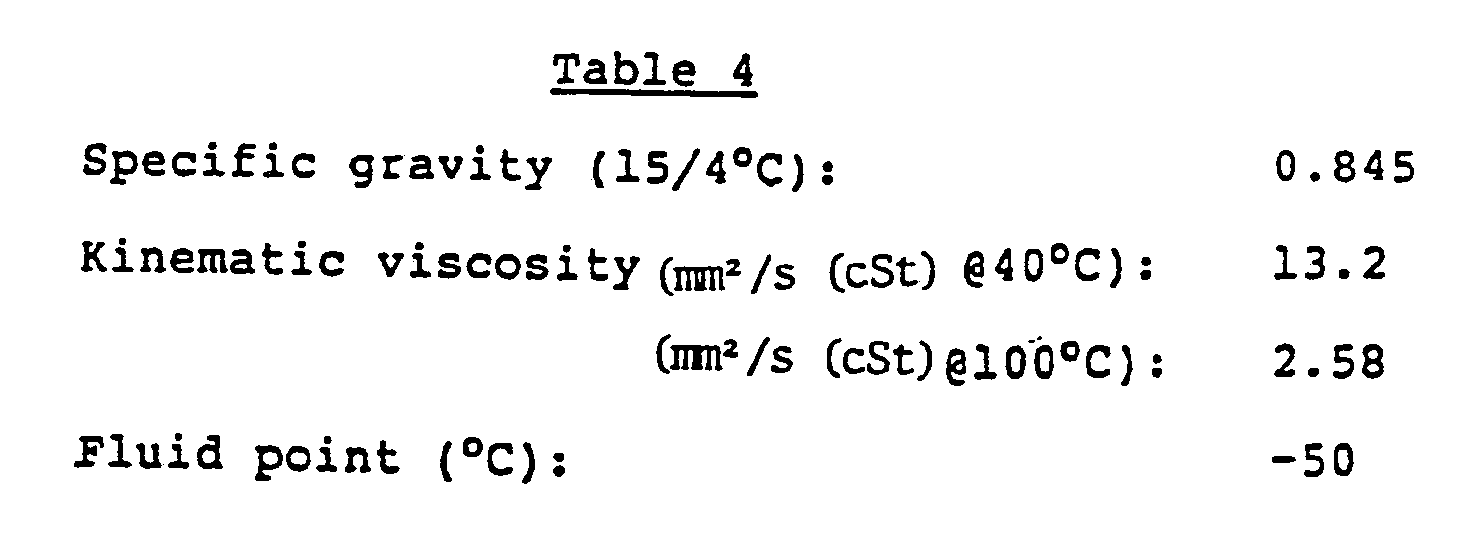
- The hydrogenation, separation of the catalyst, and removal of solvent were under the same conditions as in Example 1 to give 85 g of bis(methyl ethyl cyclohexyl)methane. Table 4 gives the representative characteristics thereof.
- The change in the traction coefficient of the above compound is given in the Figure. The above compound has the same number of carbon atoms as the compound of the present invention, and there is a similarity in chemical structure between the two. However, as it is obvious from the Figure, the compound of Comparative Example 2 had a very low traction coefficient.
- The procedure of Example 1 was repeated except that 240 g of commercially available xylene was used. Vacuum distillation gave 30 g of bis(xylyl)methane which corresponded to a distillate at 460°C or below when converted to normal pressure.
- The hydrogenation, separation of the catalyst, and removal of solvent were under the same conditions as in Example 1 to give 30 g of bis(dimethyl cyclohexyl)methane. Table 5 gives the representative characteristics thereof.

- The change in the traction coefficient of the above compound is given in the Figure. The number of carbon atoms of the substituents of the above compound is slightly different (2 less) than those of the compound of the present invention, and there is a similarity in the chemical structure between the two.
- However, as it is obvious from the Figure, the compound of Comparative Example 3 had a very low traction coefficient.
- The procedure of Example 1 was repeated except that 240 g of commercially available diethyl benzene was used. Vacuum distillation gave 24 g of bis(diethyl phenyl)methane which corresponded to a distillate at 460°C or below when converted to normal pressure.
- The hydrogenation, separation of the catalyst, and removal of solvent were under the same conditions as in Example 1 to give 24 g of bis(diethyl cyclohexyl)methane. Table 6 gives the representative characteristics thereof.

- The change in the traction coefficient of the above compound is given in the Figure. Although there is a similarity in the chemical structure between the above compound and that of the present invention, the compound of Comparative Example 4 had a very low traction coefficient, as it is obvious from the Figure.
- Based on the above description, the lubricating oil for traction drives of the present invention will always provide stable power transmission and enhanced efficiency because the lubricating oil for traction drives of the present invention always has a higher traction coefficient over a wide temperature range (from high temperature to low temperature) and, at the same time, has a low viscosity and because it is excellent in such properties as stability to heat and oxidation, corrosion resistance, etc., relative to the conventional lubricating oils for traction drives whose traction coefficient (the ratio of the tangential force to perpendicular load) markedly decreases as the temperature rises even though it is adequate at near room temperature or where their high viscosity cause efficiency to decrease.
Claims (1)
Applications Claiming Priority (2)
| Application Number | Priority Date | Filing Date | Title |
|---|---|---|---|
| JP239061/88 | 1988-09-26 | ||
| JP63239061A JPH0288697A (en) | 1988-09-26 | 1988-09-26 | Lubricating oil for traction drive |
Publications (2)
| Publication Number | Publication Date |
|---|---|
| EP0361347A1 EP0361347A1 (en) | 1990-04-04 |
| EP0361347B1 true EP0361347B1 (en) | 1991-09-25 |
Family
ID=17039283
Family Applications (1)
| Application Number | Title | Priority Date | Filing Date |
|---|---|---|---|
| EP89117634A Expired - Lifetime EP0361347B1 (en) | 1988-09-26 | 1989-09-25 | Lubricating oil for traction drives |
Country Status (4)
| Country | Link |
|---|---|
| US (1) | US5043497A (en) |
| EP (1) | EP0361347B1 (en) |
| JP (1) | JPH0288697A (en) |
| DE (1) | DE68900286D1 (en) |
Families Citing this family (15)
| Publication number | Priority date | Publication date | Assignee | Title |
|---|---|---|---|---|
| US6372696B1 (en) | 1999-11-09 | 2002-04-16 | The Lubrizol Corporation | Traction fluid formulation |
| AU2001281146B2 (en) * | 2000-10-23 | 2006-06-15 | The Lubrizol Corporation | Method for lubricating a continuously variable transmission |
| WO2002097016A1 (en) * | 2001-05-29 | 2002-12-05 | Idemitsu Kosan Co., Ltd. | Lube base oil composition |
| US7402715B2 (en) * | 2001-08-08 | 2008-07-22 | Idemitsu Kosan Co., Ltd. | Fluids for traction drive |
| EP2439254A3 (en) * | 2002-03-06 | 2012-06-20 | ExxonMobil Chemical Patents Inc. | Improved hydrocarbon fluids |
| US7045488B2 (en) * | 2002-05-16 | 2006-05-16 | The Lubrizol Corporation | Cylic oligomer traction fluid |
| CN100448964C (en) * | 2006-01-27 | 2009-01-07 | 中国石油化工股份有限公司 | A kind of continuously variable transmission transmission fluid composition |
| BRPI0808844A2 (en) * | 2007-03-13 | 2018-10-23 | Lubrizol Corp | lubricant composition suitable for lubricating a transmission and method for lubricating it |
| US7932217B2 (en) * | 2007-08-28 | 2011-04-26 | Chevron U.S.A., Inc. | Gear oil compositions, methods of making and using thereof |
| US20090062163A1 (en) * | 2007-08-28 | 2009-03-05 | Chevron U.S.A. Inc. | Gear Oil Compositions, Methods of Making and Using Thereof |
| US20090088355A1 (en) * | 2007-09-27 | 2009-04-02 | Chevron U.S.A. Inc. | Gear Oil Compositions, Methods of Making and Using Thereof |
| US20090088356A1 (en) * | 2007-09-27 | 2009-04-02 | Chevron U.S.A. Inc. | Gear Oil Compositions, Methods of Making and Using Thereof |
| US20090298732A1 (en) * | 2008-05-29 | 2009-12-03 | Chevron U.S.A. Inc. | Gear oil compositions, methods of making and using thereof |
| DE102008031226B3 (en) * | 2008-07-03 | 2010-04-08 | Rohs, Ulrich, Dr. Ing. | bevel friction ring gearing |
| CA3126759A1 (en) | 2019-01-17 | 2020-07-23 | The Lubrizol Corporation | Traction fluids |
Family Cites Families (5)
| Publication number | Priority date | Publication date | Assignee | Title |
|---|---|---|---|---|
| SE352372B (en) * | 1967-11-01 | 1972-12-27 | Sun Research Development | |
| DE3151938A1 (en) * | 1981-12-30 | 1983-07-07 | Optimol Oelwerke Gmbh | TRACTION FLUID |
| US4556503A (en) * | 1983-09-09 | 1985-12-03 | Idemitsu Kosan Company Limited | Traction drive fluids |
| DE3507175A1 (en) * | 1985-03-01 | 1986-09-04 | Basf Ag, 6700 Ludwigshafen | DICYCLOHEXYL ALKANES, THEIR PRODUCTION, THE CONTAINING COSMETIC AND PHARMACEUTICAL PREPARATIONS AND THEIR USE AS OIL COMPONENTS |
| US5107041A (en) * | 1988-09-30 | 1992-04-21 | Idemitsu Kosan Co., Ltd. | 1,1-dicyclohexyl cycloalkane derivative, method for the preparation thereof and traction-drive fluid containing the same |
-
1988
- 1988-09-26 JP JP63239061A patent/JPH0288697A/en active Pending
-
1989
- 1989-09-25 DE DE8989117634T patent/DE68900286D1/en not_active Expired - Lifetime
- 1989-09-25 EP EP89117634A patent/EP0361347B1/en not_active Expired - Lifetime
- 1989-09-26 US US07/412,748 patent/US5043497A/en not_active Expired - Fee Related
Also Published As
| Publication number | Publication date |
|---|---|
| US5043497A (en) | 1991-08-27 |
| EP0361347A1 (en) | 1990-04-04 |
| DE68900286D1 (en) | 1991-10-31 |
| JPH0288697A (en) | 1990-03-28 |
Similar Documents
| Publication | Publication Date | Title |
|---|---|---|
| US5043497A (en) | Lubricating oil for traction drives | |
| EP2163601B1 (en) | Base oil | |
| JPS63267769A (en) | Terpene derivative of 2,5-dimercapto-1,3,4- thiadiazole and lubricating composition containing same | |
| US4609481A (en) | Process for improving traction coefficient of traction drive fluid at high temperatures | |
| JP3401349B2 (en) | Lubricating oil composition | |
| EP0220426B2 (en) | Lubricant composition for transmission of power | |
| JPS648625B2 (en) | ||
| JPS62153393A (en) | Traction fluid | |
| EP0230920B1 (en) | Fluid for traction drive | |
| US4755317A (en) | Working fluid for traction drive | |
| EP0275314B1 (en) | Method for transmitting power | |
| US3577361A (en) | Synthetic power transmission fluids | |
| AU665148B2 (en) | Method for lubricating metal-metal contact systems in metalworking operations with cyclohexyl esters | |
| EP0037194B1 (en) | Method for transmitting power by traction utilising borate esters as traction fluids | |
| EP0269020B1 (en) | Use of a composition containing o-tercyclohexyl compounds as a fluid for traction drives | |
| EP0748863A2 (en) | Traction drive fluid composition | |
| JPS6043391B2 (en) | Lubricating oil for power transmission equipment | |
| US5006270A (en) | Mixed resorcinol-hydroxyester borates as antioxidants | |
| JP2016030803A (en) | Lubricant | |
| JPS6363789A (en) | Fluid for traction drive | |
| US2315544A (en) | Addition agent for lubricating oil and method of making same | |
| JPH01149895A (en) | Fluid composition for traction drive | |
| JPH0531915B2 (en) | ||
| FR2508461A1 (en) | MULTIFUNCTIONAL ADDITIVES FOR LUBRICANTS | |
| CA1287617C (en) | Traction fluid |
Legal Events
| Date | Code | Title | Description |
|---|---|---|---|
| PUAI | Public reference made under article 153(3) epc to a published international application that has entered the european phase |
Free format text: ORIGINAL CODE: 0009012 |
|
| AK | Designated contracting states |
Kind code of ref document: A1 Designated state(s): DE GB |
|
| 17P | Request for examination filed |
Effective date: 19900521 |
|
| 17Q | First examination report despatched |
Effective date: 19901126 |
|
| RAP1 | Party data changed (applicant data changed or rights of an application transferred) |
Owner name: MITSUBISHI OIL COMPANY, LIMITED |
|
| GRAA | (expected) grant |
Free format text: ORIGINAL CODE: 0009210 |
|
| AK | Designated contracting states |
Kind code of ref document: B1 Designated state(s): DE GB |
|
| REF | Corresponds to: |
Ref document number: 68900286 Country of ref document: DE Date of ref document: 19911031 |
|
| PLBE | No opposition filed within time limit |
Free format text: ORIGINAL CODE: 0009261 |
|
| STAA | Information on the status of an ep patent application or granted ep patent |
Free format text: STATUS: NO OPPOSITION FILED WITHIN TIME LIMIT |
|
| 26N | No opposition filed | ||
| PGFP | Annual fee paid to national office [announced via postgrant information from national office to epo] |
Ref country code: GB Payment date: 19990827 Year of fee payment: 11 |
|
| PGFP | Annual fee paid to national office [announced via postgrant information from national office to epo] |
Ref country code: DE Payment date: 19991019 Year of fee payment: 11 |
|
| REG | Reference to a national code |
Ref country code: GB Ref legal event code: 732E |
|
| PG25 | Lapsed in a contracting state [announced via postgrant information from national office to epo] |
Ref country code: GB Free format text: LAPSE BECAUSE OF NON-PAYMENT OF DUE FEES Effective date: 20000925 |
|
| GBPC | Gb: european patent ceased through non-payment of renewal fee |
Effective date: 20000925 |
|
| PG25 | Lapsed in a contracting state [announced via postgrant information from national office to epo] |
Ref country code: DE Free format text: LAPSE BECAUSE OF NON-PAYMENT OF DUE FEES Effective date: 20010601 |