EP0361234B1 - Process and apparatus for preparing samples for ion analysis - Google Patents
Process and apparatus for preparing samples for ion analysis Download PDFInfo
- Publication number
- EP0361234B1 EP0361234B1 EP89117115A EP89117115A EP0361234B1 EP 0361234 B1 EP0361234 B1 EP 0361234B1 EP 89117115 A EP89117115 A EP 89117115A EP 89117115 A EP89117115 A EP 89117115A EP 0361234 B1 EP0361234 B1 EP 0361234B1
- Authority
- EP
- European Patent Office
- Prior art keywords
- ion
- donating
- solution
- sample
- polymer
- Prior art date
- Legal status (The legal status is an assumption and is not a legal conclusion. Google has not performed a legal analysis and makes no representation as to the accuracy of the status listed.)
- Expired - Lifetime
Links
- 238000000034 method Methods 0.000 title claims description 41
- 230000008569 process Effects 0.000 title claims description 35
- 238000004458 analytical method Methods 0.000 title description 16
- 150000002500 ions Chemical class 0.000 claims description 91
- 239000012510 hollow fiber Substances 0.000 claims description 39
- 239000012528 membrane Substances 0.000 claims description 35
- XLYOFNOQVPJJNP-UHFFFAOYSA-N water Substances O XLYOFNOQVPJJNP-UHFFFAOYSA-N 0.000 claims description 23
- 229920000642 polymer Polymers 0.000 claims description 17
- 150000001450 anions Chemical class 0.000 claims description 13
- -1 hydrogen ions Chemical class 0.000 claims description 13
- 229920003303 ion-exchange polymer Polymers 0.000 claims description 13
- 150000001768 cations Chemical class 0.000 claims description 11
- 238000005406 washing Methods 0.000 claims description 8
- 229910052739 hydrogen Inorganic materials 0.000 claims description 7
- 239000001257 hydrogen Substances 0.000 claims description 7
- 239000012633 leachable Substances 0.000 claims description 6
- XLYOFNOQVPJJNP-UHFFFAOYSA-M hydroxide Chemical compound [OH-] XLYOFNOQVPJJNP-UHFFFAOYSA-M 0.000 claims description 5
- 229910001413 alkali metal ion Inorganic materials 0.000 claims description 3
- GPRLSGONYQIRFK-UHFFFAOYSA-N hydron Chemical compound [H+] GPRLSGONYQIRFK-UHFFFAOYSA-N 0.000 claims description 3
- 229910052751 metal Inorganic materials 0.000 claims description 3
- 239000002184 metal Substances 0.000 claims description 3
- 229910052723 transition metal Inorganic materials 0.000 claims description 3
- 150000003624 transition metals Chemical class 0.000 claims description 3
- 229910052768 actinide Inorganic materials 0.000 claims description 2
- 150000001255 actinides Chemical class 0.000 claims description 2
- DSAJWYNOEDNPEQ-UHFFFAOYSA-N barium atom Chemical compound [Ba] DSAJWYNOEDNPEQ-UHFFFAOYSA-N 0.000 claims description 2
- JCXGWMGPZLAOME-UHFFFAOYSA-N bismuth atom Chemical compound [Bi] JCXGWMGPZLAOME-UHFFFAOYSA-N 0.000 claims description 2
- 229910052747 lanthanoid Inorganic materials 0.000 claims description 2
- 150000002602 lanthanoids Chemical class 0.000 claims description 2
- 229910052788 barium Inorganic materials 0.000 claims 1
- 229910052797 bismuth Inorganic materials 0.000 claims 1
- 239000000835 fiber Substances 0.000 description 43
- 238000005342 ion exchange Methods 0.000 description 29
- 239000000243 solution Substances 0.000 description 24
- 239000008367 deionised water Substances 0.000 description 17
- 229910021641 deionized water Inorganic materials 0.000 description 17
- QAOWNCQODCNURD-UHFFFAOYSA-N Sulfuric acid Chemical compound OS(O)(=O)=O QAOWNCQODCNURD-UHFFFAOYSA-N 0.000 description 11
- 239000007788 liquid Substances 0.000 description 11
- 229920000557 Nafion® Polymers 0.000 description 8
- DGAQECJNVWCQMB-PUAWFVPOSA-M Ilexoside XXIX Chemical compound C[C@@H]1CC[C@@]2(CC[C@@]3(C(=CC[C@H]4[C@]3(CC[C@@H]5[C@@]4(CC[C@@H](C5(C)C)OS(=O)(=O)[O-])C)C)[C@@H]2[C@]1(C)O)C)C(=O)O[C@H]6[C@@H]([C@H]([C@@H]([C@H](O6)CO)O)O)O.[Na+] DGAQECJNVWCQMB-PUAWFVPOSA-M 0.000 description 7
- 239000012535 impurity Substances 0.000 description 7
- YMWUJEATGCHHMB-UHFFFAOYSA-N Dichloromethane Chemical compound ClCCl YMWUJEATGCHHMB-UHFFFAOYSA-N 0.000 description 6
- HEMHJVSKTPXQMS-UHFFFAOYSA-M Sodium hydroxide Chemical compound [OH-].[Na+] HEMHJVSKTPXQMS-UHFFFAOYSA-M 0.000 description 6
- 239000011324 bead Substances 0.000 description 6
- BVKZGUZCCUSVTD-UHFFFAOYSA-L Carbonate Chemical compound [O-]C([O-])=O BVKZGUZCCUSVTD-UHFFFAOYSA-L 0.000 description 5
- 238000002360 preparation method Methods 0.000 description 5
- 229910052708 sodium Inorganic materials 0.000 description 5
- 239000011734 sodium Substances 0.000 description 5
- QAOWNCQODCNURD-UHFFFAOYSA-L Sulfate Chemical compound [O-]S([O-])(=O)=O QAOWNCQODCNURD-UHFFFAOYSA-L 0.000 description 4
- 239000002253 acid Substances 0.000 description 4
- 230000008859 change Effects 0.000 description 4
- 239000000463 material Substances 0.000 description 4
- HRQDCDQDOPSGBR-UHFFFAOYSA-M sodium;octane-1-sulfonate Chemical compound [Na+].CCCCCCCCS([O-])(=O)=O HRQDCDQDOPSGBR-UHFFFAOYSA-M 0.000 description 4
- WEVYAHXRMPXWCK-UHFFFAOYSA-N Acetonitrile Chemical compound CC#N WEVYAHXRMPXWCK-UHFFFAOYSA-N 0.000 description 3
- VEXZGXHMUGYJMC-UHFFFAOYSA-M Chloride anion Chemical compound [Cl-] VEXZGXHMUGYJMC-UHFFFAOYSA-M 0.000 description 3
- KCXVZYZYPLLWCC-UHFFFAOYSA-N EDTA Chemical compound OC(=O)CN(CC(O)=O)CCN(CC(O)=O)CC(O)=O KCXVZYZYPLLWCC-UHFFFAOYSA-N 0.000 description 3
- NHNBFGGVMKEFGY-UHFFFAOYSA-N Nitrate Chemical compound [O-][N+]([O-])=O NHNBFGGVMKEFGY-UHFFFAOYSA-N 0.000 description 3
- 229910019142 PO4 Inorganic materials 0.000 description 3
- 230000002378 acidificating effect Effects 0.000 description 3
- 150000001412 amines Chemical group 0.000 description 3
- 239000002585 base Substances 0.000 description 3
- KRKNYBCHXYNGOX-UHFFFAOYSA-N citric acid Chemical compound OC(=O)CC(O)(C(O)=O)CC(O)=O KRKNYBCHXYNGOX-UHFFFAOYSA-N 0.000 description 3
- 239000000470 constituent Substances 0.000 description 3
- 230000000694 effects Effects 0.000 description 3
- 239000003014 ion exchange membrane Substances 0.000 description 3
- 239000003456 ion exchange resin Substances 0.000 description 3
- WLGDAKIJYPIYLR-UHFFFAOYSA-N octane-1-sulfonic acid Chemical compound CCCCCCCCS(O)(=O)=O WLGDAKIJYPIYLR-UHFFFAOYSA-N 0.000 description 3
- 235000021317 phosphate Nutrition 0.000 description 3
- 239000008399 tap water Substances 0.000 description 3
- 235000020679 tap water Nutrition 0.000 description 3
- NWUYHJFMYQTDRP-UHFFFAOYSA-N 1,2-bis(ethenyl)benzene;1-ethenyl-2-ethylbenzene;styrene Chemical compound C=CC1=CC=CC=C1.CCC1=CC=CC=C1C=C.C=CC1=CC=CC=C1C=C NWUYHJFMYQTDRP-UHFFFAOYSA-N 0.000 description 2
- OYPRJOBELJOOCE-UHFFFAOYSA-N Calcium Chemical compound [Ca] OYPRJOBELJOOCE-UHFFFAOYSA-N 0.000 description 2
- FYYHWMGAXLPEAU-UHFFFAOYSA-N Magnesium Chemical compound [Mg] FYYHWMGAXLPEAU-UHFFFAOYSA-N 0.000 description 2
- 229910002651 NO3 Inorganic materials 0.000 description 2
- 239000003929 acidic solution Substances 0.000 description 2
- 150000007513 acids Chemical class 0.000 description 2
- 230000002411 adverse Effects 0.000 description 2
- 150000001340 alkali metals Chemical group 0.000 description 2
- 239000003637 basic solution Substances 0.000 description 2
- 229910052791 calcium Inorganic materials 0.000 description 2
- 239000011575 calcium Substances 0.000 description 2
- 238000005341 cation exchange Methods 0.000 description 2
- 238000011109 contamination Methods 0.000 description 2
- 230000007717 exclusion Effects 0.000 description 2
- 125000002887 hydroxy group Chemical group [H]O* 0.000 description 2
- NBZBKCUXIYYUSX-UHFFFAOYSA-N iminodiacetic acid Chemical compound OC(=O)CNCC(O)=O NBZBKCUXIYYUSX-UHFFFAOYSA-N 0.000 description 2
- 238000002347 injection Methods 0.000 description 2
- 239000007924 injection Substances 0.000 description 2
- 238000004255 ion exchange chromatography Methods 0.000 description 2
- 229910052749 magnesium Inorganic materials 0.000 description 2
- 239000011777 magnesium Substances 0.000 description 2
- 230000007246 mechanism Effects 0.000 description 2
- 230000005012 migration Effects 0.000 description 2
- 238000013508 migration Methods 0.000 description 2
- NBIIXXVUZAFLBC-UHFFFAOYSA-K phosphate Chemical compound [O-]P([O-])([O-])=O NBIIXXVUZAFLBC-UHFFFAOYSA-K 0.000 description 2
- 239000010452 phosphate Substances 0.000 description 2
- 238000011084 recovery Methods 0.000 description 2
- 239000012508 resin bead Substances 0.000 description 2
- 230000000007 visual effect Effects 0.000 description 2
- KEQGZUUPPQEDPF-UHFFFAOYSA-N 1,3-dichloro-5,5-dimethylimidazolidine-2,4-dione Chemical compound CC1(C)N(Cl)C(=O)N(Cl)C1=O KEQGZUUPPQEDPF-UHFFFAOYSA-N 0.000 description 1
- FTLHHXWHJBVMJR-UHFFFAOYSA-N 2-[(4-anilinophenyl)diazenyl]benzenesulfonic acid Chemical compound N(C1=CC=CC=C1)C1=CC=C(C=C1)N=NC1=C(C=CC=C1)S(=O)(=O)O FTLHHXWHJBVMJR-UHFFFAOYSA-N 0.000 description 1
- LXEMVZAXEIKMOU-UHFFFAOYSA-N 4-[(4-anilinophenyl)diazenyl]benzenesulfonic acid Chemical compound C1=CC(S(=O)(=O)O)=CC=C1N=NC(C=C1)=CC=C1NC1=CC=CC=C1 LXEMVZAXEIKMOU-UHFFFAOYSA-N 0.000 description 1
- CPELXLSAUQHCOX-UHFFFAOYSA-M Bromide Chemical compound [Br-] CPELXLSAUQHCOX-UHFFFAOYSA-M 0.000 description 1
- KRHYYFGTRYWZRS-UHFFFAOYSA-M Fluoride anion Chemical compound [F-] KRHYYFGTRYWZRS-UHFFFAOYSA-M 0.000 description 1
- UFHFLCQGNIYNRP-UHFFFAOYSA-N Hydrogen Chemical compound [H][H] UFHFLCQGNIYNRP-UHFFFAOYSA-N 0.000 description 1
- XEEYBQQBJWHFJM-UHFFFAOYSA-N Iron Chemical group [Fe] XEEYBQQBJWHFJM-UHFFFAOYSA-N 0.000 description 1
- 238000005481 NMR spectroscopy Methods 0.000 description 1
- IOVCWXUNBOPUCH-UHFFFAOYSA-M Nitrite anion Chemical compound [O-]N=O IOVCWXUNBOPUCH-UHFFFAOYSA-M 0.000 description 1
- BPQQTUXANYXVAA-UHFFFAOYSA-N Orthosilicate Chemical compound [O-][Si]([O-])([O-])[O-] BPQQTUXANYXVAA-UHFFFAOYSA-N 0.000 description 1
- 239000004698 Polyethylene Substances 0.000 description 1
- 239000004743 Polypropylene Substances 0.000 description 1
- BQCADISMDOOEFD-UHFFFAOYSA-N Silver Chemical group [Ag] BQCADISMDOOEFD-UHFFFAOYSA-N 0.000 description 1
- FKNQFGJONOIPTF-UHFFFAOYSA-N Sodium cation Chemical compound [Na+] FKNQFGJONOIPTF-UHFFFAOYSA-N 0.000 description 1
- QQGLQYQXUKHWPX-BXLHIMNRSA-N [(2s,3r,4s,5s,6r)-3,4,5-trihydroxy-6-(hydroxymethyl)oxan-2-yl] (1e)-2-phenyl-n-sulfooxyethanimidothioate Chemical compound O[C@@H]1[C@@H](O)[C@H](O)[C@@H](CO)O[C@H]1S\C(=N\OS(O)(=O)=O)CC1=CC=CC=C1 QQGLQYQXUKHWPX-BXLHIMNRSA-N 0.000 description 1
- 150000001298 alcohols Chemical class 0.000 description 1
- 150000001299 aldehydes Chemical class 0.000 description 1
- 229910052783 alkali metal Inorganic materials 0.000 description 1
- 238000005349 anion exchange Methods 0.000 description 1
- 230000003466 anti-cipated effect Effects 0.000 description 1
- 230000008901 benefit Effects 0.000 description 1
- QQGLQYQXUKHWPX-SUYBVFMFSA-N benzyl glucosinolate Natural products S(=O)(=O)(O/N=C(/S[C@@H]1[C@@H](O)[C@H](O)[C@@H](O)[C@H](CO)O1)\Cc1ccccc1)O QQGLQYQXUKHWPX-SUYBVFMFSA-N 0.000 description 1
- 150000007942 carboxylates Chemical class 0.000 description 1
- 229920002301 cellulose acetate Polymers 0.000 description 1
- 239000013522 chelant Substances 0.000 description 1
- XTHPWXDJESJLNJ-UHFFFAOYSA-N chlorosulfonic acid Substances OS(Cl)(=O)=O XTHPWXDJESJLNJ-UHFFFAOYSA-N 0.000 description 1
- ZCDOYSPFYFSLEW-UHFFFAOYSA-N chromate(2-) Chemical compound [O-][Cr]([O-])(=O)=O ZCDOYSPFYFSLEW-UHFFFAOYSA-N 0.000 description 1
- 238000013375 chromatographic separation Methods 0.000 description 1
- 238000004440 column chromatography Methods 0.000 description 1
- 239000002131 composite material Substances 0.000 description 1
- 239000012141 concentrate Substances 0.000 description 1
- 125000005265 dialkylamine group Chemical group 0.000 description 1
- 238000010828 elution Methods 0.000 description 1
- 150000002169 ethanolamines Chemical group 0.000 description 1
- 239000007789 gas Substances 0.000 description 1
- 238000001631 haemodialysis Methods 0.000 description 1
- 229910052736 halogen Inorganic materials 0.000 description 1
- 150000002367 halogens Chemical class 0.000 description 1
- 230000000322 hemodialysis Effects 0.000 description 1
- XMBWDFGMSWQBCA-UHFFFAOYSA-N hydrogen iodide Chemical compound I XMBWDFGMSWQBCA-UHFFFAOYSA-N 0.000 description 1
- 230000006872 improvement Effects 0.000 description 1
- 238000002354 inductively-coupled plasma atomic emission spectroscopy Methods 0.000 description 1
- 230000002452 interceptive effect Effects 0.000 description 1
- 125000003010 ionic group Chemical group 0.000 description 1
- 150000002576 ketones Chemical class 0.000 description 1
- 150000002605 large molecules Chemical class 0.000 description 1
- 230000002045 lasting effect Effects 0.000 description 1
- 238000004811 liquid chromatography Methods 0.000 description 1
- 229920002521 macromolecule Polymers 0.000 description 1
- 230000014759 maintenance of location Effects 0.000 description 1
- 239000011159 matrix material Substances 0.000 description 1
- 150000002739 metals Chemical class 0.000 description 1
- STZCRXQWRGQSJD-GEEYTBSJSA-M methyl orange Chemical compound [Na+].C1=CC(N(C)C)=CC=C1\N=N\C1=CC=C(S([O-])(=O)=O)C=C1 STZCRXQWRGQSJD-GEEYTBSJSA-M 0.000 description 1
- 229940012189 methyl orange Drugs 0.000 description 1
- 239000000203 mixture Substances 0.000 description 1
- 229920000620 organic polymer Polymers 0.000 description 1
- 239000003960 organic solvent Substances 0.000 description 1
- 238000010979 pH adjustment Methods 0.000 description 1
- 230000035515 penetration Effects 0.000 description 1
- 239000012466 permeate Substances 0.000 description 1
- 150000003013 phosphoric acid derivatives Chemical class 0.000 description 1
- 229920000573 polyethylene Polymers 0.000 description 1
- 229920001155 polypropylene Polymers 0.000 description 1
- 229920001343 polytetrafluoroethylene Polymers 0.000 description 1
- 239000011148 porous material Substances 0.000 description 1
- 230000009467 reduction Effects 0.000 description 1
- 238000001223 reverse osmosis Methods 0.000 description 1
- 238000000926 separation method Methods 0.000 description 1
- 229910001415 sodium ion Inorganic materials 0.000 description 1
- 159000000000 sodium salts Chemical class 0.000 description 1
- MLVYOYVMOZFHIU-UHFFFAOYSA-M sodium;4-[(4-anilinophenyl)diazenyl]benzenesulfonate Chemical compound [Na+].C1=CC(S(=O)(=O)[O-])=CC=C1N=NC(C=C1)=CC=C1NC1=CC=CC=C1 MLVYOYVMOZFHIU-UHFFFAOYSA-M 0.000 description 1
- 238000001179 sorption measurement Methods 0.000 description 1
- 238000002336 sorption--desorption measurement Methods 0.000 description 1
- 239000012086 standard solution Substances 0.000 description 1
- 239000000126 substance Substances 0.000 description 1
- BDHFUVZGWQCTTF-UHFFFAOYSA-M sulfonate Chemical compound [O-]S(=O)=O BDHFUVZGWQCTTF-UHFFFAOYSA-M 0.000 description 1
- 238000006277 sulfonation reaction Methods 0.000 description 1
- PRZSXZWFJHEZBJ-UHFFFAOYSA-N thymol blue Chemical compound C1=C(O)C(C(C)C)=CC(C2(C3=CC=CC=C3S(=O)(=O)O2)C=2C(=CC(O)=C(C(C)C)C=2)C)=C1C PRZSXZWFJHEZBJ-UHFFFAOYSA-N 0.000 description 1
- 238000011144 upstream manufacturing Methods 0.000 description 1
Images






Classifications
-
- G—PHYSICS
- G01—MEASURING; TESTING
- G01N—INVESTIGATING OR ANALYSING MATERIALS BY DETERMINING THEIR CHEMICAL OR PHYSICAL PROPERTIES
- G01N1/00—Sampling; Preparing specimens for investigation
- G01N1/28—Preparing specimens for investigation including physical details of (bio-)chemical methods covered elsewhere, e.g. G01N33/50, C12Q
- G01N1/40—Concentrating samples
- G01N1/405—Concentrating samples by adsorption or absorption
-
- G—PHYSICS
- G01—MEASURING; TESTING
- G01N—INVESTIGATING OR ANALYSING MATERIALS BY DETERMINING THEIR CHEMICAL OR PHYSICAL PROPERTIES
- G01N30/00—Investigating or analysing materials by separation into components using adsorption, absorption or similar phenomena or using ion-exchange, e.g. chromatography or field flow fractionation
- G01N30/02—Column chromatography
- G01N30/04—Preparation or injection of sample to be analysed
- G01N30/06—Preparation
- G01N30/14—Preparation by elimination of some components
-
- G—PHYSICS
- G01—MEASURING; TESTING
- G01N—INVESTIGATING OR ANALYSING MATERIALS BY DETERMINING THEIR CHEMICAL OR PHYSICAL PROPERTIES
- G01N30/00—Investigating or analysing materials by separation into components using adsorption, absorption or similar phenomena or using ion-exchange, e.g. chromatography or field flow fractionation
- G01N30/02—Column chromatography
-
- G—PHYSICS
- G01—MEASURING; TESTING
- G01N—INVESTIGATING OR ANALYSING MATERIALS BY DETERMINING THEIR CHEMICAL OR PHYSICAL PROPERTIES
- G01N33/00—Investigating or analysing materials by specific methods not covered by groups G01N1/00 - G01N31/00
- G01N33/18—Water
-
- Y—GENERAL TAGGING OF NEW TECHNOLOGICAL DEVELOPMENTS; GENERAL TAGGING OF CROSS-SECTIONAL TECHNOLOGIES SPANNING OVER SEVERAL SECTIONS OF THE IPC; TECHNICAL SUBJECTS COVERED BY FORMER USPC CROSS-REFERENCE ART COLLECTIONS [XRACs] AND DIGESTS
- Y10—TECHNICAL SUBJECTS COVERED BY FORMER USPC
- Y10T—TECHNICAL SUBJECTS COVERED BY FORMER US CLASSIFICATION
- Y10T436/00—Chemistry: analytical and immunological testing
- Y10T436/25—Chemistry: analytical and immunological testing including sample preparation
- Y10T436/25375—Liberation or purification of sample or separation of material from a sample [e.g., filtering, centrifuging, etc.]
-
- Y—GENERAL TAGGING OF NEW TECHNOLOGICAL DEVELOPMENTS; GENERAL TAGGING OF CROSS-SECTIONAL TECHNOLOGIES SPANNING OVER SEVERAL SECTIONS OF THE IPC; TECHNICAL SUBJECTS COVERED BY FORMER USPC CROSS-REFERENCE ART COLLECTIONS [XRACs] AND DIGESTS
- Y10—TECHNICAL SUBJECTS COVERED BY FORMER USPC
- Y10T—TECHNICAL SUBJECTS COVERED BY FORMER US CLASSIFICATION
- Y10T436/00—Chemistry: analytical and immunological testing
- Y10T436/25—Chemistry: analytical and immunological testing including sample preparation
- Y10T436/25375—Liberation or purification of sample or separation of material from a sample [e.g., filtering, centrifuging, etc.]
- Y10T436/255—Liberation or purification of sample or separation of material from a sample [e.g., filtering, centrifuging, etc.] including use of a solid sorbent, semipermeable membrane, or liquid extraction
Definitions
- This invention relates to a process and apparatus for preparing samples to be analyzed for ionic species such as by liquid column chromatography.
- ion exchange resin beads to remove undesired ions is an improvement in that it eliminates the addition of excessive counter ions as these counterions are covalently bound to the bead.
- the sample volume selected for analysis is passed through, on or over the polymeric like structure which includes counterions bonded to either a silicate or an organic polymer bead.
- the potentially interfering counterions are sufficiently bonded to the beads as to preclude direct analytical interference.
- the beads are themselves a source of organic and inorganic contamination. Even a repeated and very extensive precleaning of the ion exchange resin beads does not prevent sample contamination at the levels detectable by presently available ion chromatography apparatus.
- the resin beads have adsorption-desorption capacity so that a portion of the ions being analyzed are adsorbed into the pores of the resin beads.
- the net effect is the possibility of skewing and/or loss of the resultant data during the analytical process thereby negating any anticipated advantage by selecting these materials as a means for improving the chromatographic analytical process.
- a hollow fiber is defined as a seamless thin walled member of essentially tubular geometry with an inlet and outlet means where the constitutent to be purified or reacted upon is communicated into the center of the tubular membrane system through the inlet, subsequently acted upon in a chemical manner by the tubular portion itself and/or by other reacting mechanism(s) present during the time the constituent is residing in the tubular portion of the fiber and subsequently removed through or passed from the tubular geometry by or through the outlet means.
- Such hollow fiber systems may be of singular or multiple path geometries and may also be immersed in solutions and/or gasses or connected with systems designed to promote the exchange process.
- An example is the use of sulfuric acid surrounding a hollow fiber to promote the exchange of protons across the hollow fiber tubular member portion.
- Such an added solution to a hollow fiber system component in this way is defined as a counter ion donating solution or CIDS.
- the solution comprising the source of regenerated ions can penetrate the hollow fibers such that the proton donator, e.g., sulfuric acid, contaminates the liquid by passing sulfate ions through the hollow fiber.
- US-PS-4 474 664 discloses an ion analysis method applicable for samples containing high ion concentrations, wherein a sample is (a) first eluted through a separating medium, and (b) thereafter the effluent eluting from this medium is brought into contact with a ion-exchange membrane.
- the hollow fiber membrane which may be used in this method is made by sulfonating polyethylene fibres with the aid of chlorosulfonic acid in methylene chloride. After sulfonation, the fibers are retrieved and placed in methylene chloride. Then, the fibers are soaked in deionized water for 24 hours. The finished fibers are then made into the suppressor devices.
- the present invention is based upon the discovery that ion exchange hollow fibers or membranes capable of passing ions therethrough while preventing larger undesirable molecules and certain charged ions from passing therethrough can be treated to be rendered capable of removing unwanted ions from a liquid sample or of a pH adjustment of a liquid sample without introducing impurities into the liquid sample which adversely affect subsequent ion analysis of the liquid sample.
- the polymer is functionalized with the appropriate ion or ions and can be immersed in an environment such as a solution which provides a source of additional appropriate ion or ions.
- the liquid sample, thus treated, can be introduced into any conventional ion analysis system for analysis without introducing impurities into the analysis system or adversely reducing the usefulness of the ion analysis system by virtue of the presence of excess undesired ions.
- the ion exchange fibers or membranes utilized in the present invention are washed for a period of time lasting only about several seconds up to a minute such as in deionized water or in a preliminary volume portion of the sample in a one step or two step washing procedure. Thereafter, the ion-exchange fiber or membrane is utilized to pre-treat a sample in accordance with this invention.
- the ion exchange fibers or membranes which have been treated by washing can be immersed in an ion donating solution without migration of that part of the donor molecule that carries the same type of charge as the ionic groups of the polymer molecule into the liquid sample being processed with the fiber or membrane.
- the ion exchange membrane also can be modified to include a color indicator which effects a color change when the fiber or membrane is depleted of donating cation or anion.
- subject of the present invention is a process for analyzing a sample containing ion species according to claim 1.
- Figs 1a-1c are ion chromatograms of a deionized water sample passed through a sulfonated perfluorinated polymeric ion exchange hollow fiber immersed in deionized water.
- Figs 2a-2c are ion chromatograms of a deionized water sample passed through a sulfonated perfluorinated polymeric ion exchange hollow fiber immersed in 0.025 N sulfuric acid.
- Figs. 3a-3c are ion chromatograms of a pure matrix solution (10 mN NaOH) (3a) and of a standard dissolved in 10 mN NaOH obtained before (3b) and after (3c) they were passed through a sulfonated perfluorinated polymeric ion exchange hollow fiber immersed.
- Figs 4a-4c are ion chromatograms of an aqueous standard solution passed through a sulfonated perfluorinated polymeric ion exchange hollow fiber immersed in 0.025 N sulfuric acid.
- Figs 5a-5c are ion chromatograms of tap water passed through two sulfonated perfluorinated polymeric ion exchange hollow fibers in series immersed in 25 mM octane sulfonic acid and then 50 mM sodium octane sulfonate and that of untreated tap water.
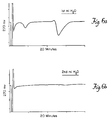
- Figs 6a and 6b are ion chromatograms of deionized water passed through a sulfonated perfluorinated polymeric ion exchange hollow fiber immersed in 50 mM sodium octane sulfonate.
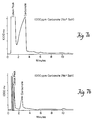
- Figs 7a and 7b are ion chromatograms showing carbonate ion reduction in a sample in accordance with this invention.
- Fig. 8 shows the apparatus which can be used according to this invention, which utilizes a color indicator to show whether a hollow fiber is depleted of donating ion.
- Fig. 9 is a cross-sectional representation of a preferred embodiment of a device utilizing a hollow ion exchange fiber component immersed in a counter-ion donating environment.
- Fig. 10 is a close-up detail showing a typical ionic exchange mechanism utilizing a hollow ion exchange fiber component immersed in a counter-ion donating environment.
- sample means a small randomly selected homogenous portion of a larger entity utilized to evaluate and/or to ascertain the constituent components of the larger entity. It is a direct correlatable representation of the overall composition of the larger entity.
- ion exchange hollow fibers or membranes are treated by washing such as in deionized water in order to render them useful for the pretreatment of samples to be analyzed subsequently by ion analysis such as liquid chromatography, inductively coupled plasma atomic emission spectroscopy, nuclear magnetic resonance or the like.
- the ion exchange resins which are not useful in the present invention can not be rendered free of impurities by washing in deionized water even when the washing is effected for hours. Ion exclusion processes cause loss of certain ions due to adsorption.
- the ion exchange fibers or membranes useful in the present invention can be rendered free of impurities that are leached into a liquid sample by washing with deionized water or with a volume of the sample in a matter of only several seconds either in a one or two step process along with the minimization of exclusion effects. That is, the fibers are substantially free of water leachable species to the extent that there is no interference to a subsequently employed analytical process.
- membranes were used to prevent migration of large molecules from one compartment to another.
- molecular size is the only important parameter.
- suitable membranes are capable of excluding ions carrying certain charge from penetration while at the same time ions carrying the opposite charge to those ions being excluded are allowed to permeate freely through the membrane material.
- ion exchange fibers or membranes in the present invention include perfluorinated ion exchange polymers such as those in the sulfonated or aminated form sold under the tradename, Nafion by E.I. du-Pont de Nemours and Company,ion exchange functionalized cellulose acetate, ion exchange functionalized polytetrafluoroethylenes and the like ion exchange functionalized polymers.
- the ion exchange fibers or membranes useful in the present invention are capable of exchanging cations such as sodium, calcium or magnesium in the sample or the like with hydrogen ions of the membrane or of exchanging anions such as hydroxide for anions in the sample such as chloride, nitrate or sulfate.
- the ion exchange fibers or membranes of the present invention are capable of exchanging an alkali metal ion, for excess hydrogen ion in the sample in order to increase pH of the sample prior to introduction of the sample into an ion analysis process.
- the ion exchange fibers or membranes are washed in a solution such as deionized water or an initial portion of a sample. Washing beyond about 1 minute is unnecessary in order to reduce the impurities in the ion exchange fibers or membranes to a suitable level in accordance with this invention.
- the ion analysis apparatus is not undesirably affected by anomalies of excess concentrations of these ions.
- the hollow fiber or flat sheet membrane is immersed in an ion donating solution in order to maintain the desired levels of donor ion into the sample such as hydrogen ion or sodium ion.
- Suitable ion donating solutions for providing hydrogen ions include acids such as octane sulfonic acid.
- Suitable ion donating solutions for providing an alkali metal ion in order to increase the pH of the sample include alkali metal sulfonates.
- the pH of the sample can be raised or lowered.
- Representative ionic function for cation exchange polymer include sulfonate, carboxylate and immobilized iminodiacetic acid (IDA) or ethylenediaminetetraacetic acid (EDTA) such as in the proton form or in the alkali metal form.
- IDA immobilized iminodiacetic acid
- EDTA ethylenediaminetetraacetic acid
- the latter can be utilized to chelate metals from the sample such as transition metals.
- Representative cations which can be removed from the sample include group IA and II A cations, transition metals, lanthanides; actinides; mono-, di-, tri- and quaternary amines, ethanolamines and some positively charged cation complexes.
- the polymer also can be converted to a form other than a proton form or alkali metal form.
- the silver form can be utilized to precipitate chloride or other halogens as Ag-halides.
- the barium form can be utilized to precipitate sulfate.
- the lead form can be utilized to precipitate chromate.
- the bismuth form can be utilized to preciptiate phosphate.
- the iron form can be utilized to complex with phosphates or with some chelating species, e.g., tartaric, citric acid or EDTA.
- Representative ionic functions for anion exchange polymers include amine, dialkylamine, quaternary amine or the like. These fibers are capable of exchanging a bound hydroxyl group for an anion in solution which can contain acids or bases, organic solvents, dissolved polymers or complexed metallics. These fibers also can be immersed in a counter ion donating solution for donating anions, e.g., hydroxy. Also, a plurality of fibers can be utilized in series, e.g., one donating an hydroxyl ion, e.g., to raise pH and e.g., a second donating a nitrate ion, e.g., to lower pH. In order to determine whether a CID solution has been depleted, a standard indication, such as a color indicator can be utilized to signal when replenishment or disposal should be effected.
- a standard indication such as a color indicator can be utilized to signal when replenishment or disposal should be effected.
- the process of this invention also can be utilized to precondition non aqueous samples, such as alcohols, ketones, aldehydes, acetonitrile or the like.
- the process of this invention can be utilized to concentrate samples by retention of a particular ionic species on the polymer surface followed by elution with an acid or base when the polymer is not immersed in an ion donation solution (dry).
- the ion exchange membrane or hollow fiber is coated with a color indicator composite which changes color when the ion donated by the membrane or fiber is depleted and is not available for introduction into the sample.
- a color indicator composite which changes color when the ion donated by the membrane or fiber is depleted and is not available for introduction into the sample.
- Only color indicators capable of being adsorbed by the membrane material and which change color upon ion depletion can be utilized.
- a representative example of a color indicator includes Orange IV(4-anilino-phenylazobenzenesulfonic acid) or tropaeolin 00 which changes color from dark red or violet at pH 1.3 or lower to a clear yellow at a weakly acidic or alkaline pH. At interim pH the color comprises various shades of orange red to orange yellow. Thus, this indicator can be used to show depletion of hydrogen ions.
- the membrane or fiber including the donating ion is coated with a color indicator by immersing it in a solution of the color indicator until the membrane or fiber changes a color associated with the pH value for the fiber.
- the membrane or fiber is removed from solution and dried.
- Other representative suitable color indicators include methyl orange and thymol blue which change color from red to yellow to the degree that its sulfonic groups are converted from the hydrogen to another form.
- Figure 1a shows the ion concentration in the first milliliter of deionized water.
- Figure 1b shows the ion concentrations in the second milliliter of deionized water.
- Figure 1c shows the ion concentrations in the third milliliter of deionized water. Injection volume for all three chromatographs was 100 ul. As shown in Figures 1a-1c, only two milliliters of deionized water are required to remove leachable impurities from the sulfonated form of perfluorinated ion exchange Nafion ion exchange fiber.
- Figures 3a and 3b show typical distortions caused by excess sodium and hydroxyl ions.
- Figure 3b is a chromatogram of a 9 anion standard sample plus excess sodium and hydroxyl ions.
- Figure 3c shows a typical undistorted chromatogram of the 9 anion standard obtained after passing the sample from Figure 3b through a H+ form cation exchange fiber immersed in a CID solution. As shown in Figures 3a-3c, it is necessary to remove excess sodium and hydroxyl ion in order to minimize or prevent distortion of an ion chromatographic recording.
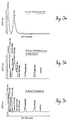
- FIG. 5b the results obtained by passing a tap water sample collected from the city of Santa Cruz, California are shown.
- Figure 5b the ion chromatographic separation obtained with untreated city water is shown.
- Shown in Figure 5a is the chromatogram of a sample treated by passing a water sample through a proton form of a Nafion fiber immersed in octane sulfonic acid followed through a sodium form of a Nafion fiber immersed in sodium octane sulfonate and having an outer diameter of 20 thousandths of 2.54 cm (1 inch) and an inner diameter of 14 thousandths of 2.54 cm (1 inch).
- a very clean separation is obtained after a second step in which a sodium containing CID solution was applied.
- ion chromatograms are shown to illustrate that the sodium form of a sulfonated Nafion fiber immersed in sodium octane sulfonate can be washed with only 1 ml deionized water or sample in order to remove leachable components in the fiber.
- Figs. 7a and 7b show that carbonate ion concentration in a sample containing 1000 ppm carbonate as the sodium salt is reduced by passing the sample through the sulfonated form (H+) of a Nafion hollow fiber.
- an untreated sample is dispensed from syringe 10 into a fiber 12 coated with 4-p-anilino-phenylazobenzenesulfonic acid.
- the fiber section 14 is yellow showing that it is depleted of hydrogen ions while the fiber section 16 is red/purple showing that it is not depleted of hydrogen ions.
- the fiber 12 is provided with an exit port 18 for removal of treated sample from fiber 12.
- the apparatus is comprised of hollow body 11, with end caps 12 and 13 respectively, hollow fiber 15 attached to connectors 14 and 16 immersed in counter ion donating solution 20. Also shown is a standard connector 14 on body component 11 and sample 25 inside syringe 17 preferably at least a portion of the hollow body is transparent so that fiber 15 can easily be viewed. Alternatively, a lid on the top of hollow body 11 adjacent to the inlet 14 can be provided to view the CIDS.
- the hollow fiber 15 is attached to female connector 14 and male connector 16 such that the internal path of the fiber allows the sample 25 to proceed through the central space of the hollow fiber 15 immersed in CIDS 20 yet sample 25 is precluded from direct contact with CIDS 20 by the seamless sealed tubular structure of hollow fiber 15, and attached to connectors 14 and 16.
- Figure 10 shows a close-up of the hollow fiber 15, CIDS 20 and sample 25 in the hollow fiber undergoing a typical ion exchange process 26.
- Syringe 17 with the sample to be processed 25 is attached to female luer locking port 14 by the syringe male connection member internal portion of hollow fiber 15 residing in the internal space of port 14.
- the CIDS is introduced into hollow body 10 and then closing the end cap.
- the sample 25 is processed by hollow fiber 15 surrounded by the CIDS environment 20 within the device 10 structure as in Fig. 10.
- the injected sample 25 after having undergone ionic exchange 26 exits the device 10 at hollow fiber male luer lock termination 16.
- CID solution 20 may also have additional components added 30 which may provide a visual indication as to the status of the CIDS 20.
- additional components added 30 may provide a visual indication as to the status of the CIDS 20.
- visual indicator 30 undergoes a shift in color to indicate the absence of available donator ions in CIDS 20.
- Device components hollow body 11 with hollow fiber terminations 14 and 16, end caps 12 and 13 may be comprised of inert non ionic polymeric materials such as polypropylene to provide a rigid, clean seated, ion free supporting structure to house hollow fiber 15, CIDS 20 and indicator 30.
- Outlet port 16 is structured to provide a standard make luer lock geometry to facilitate attachment to numerous accessories such as extension tethers, filters, pipette adaptors, and the like to aid in device use and attachment to various configurations of chromatographic equipment.
- the present invention also can utilize an arrangement of flat membranes closely positioned to each other with spaces between adjacent membranes for passage of sample therethrough.
- the membranes are enclosed by a housing of appropriate design with inlet and outlets being provided at opposite ends of the spaces thereby to properly direct the sample through the sample treatment apparatus.
- the membrane also can include a color indicator in the manner set forth above.
- the process of this invention can be utilized in a batch mode wherein samples are injected in series into the hollow fiber, manually or automatically such as by using conventional robotics apparatus.
Landscapes
- Physics & Mathematics (AREA)
- Health & Medical Sciences (AREA)
- Life Sciences & Earth Sciences (AREA)
- Chemical & Material Sciences (AREA)
- Analytical Chemistry (AREA)
- Biochemistry (AREA)
- General Health & Medical Sciences (AREA)
- General Physics & Mathematics (AREA)
- Immunology (AREA)
- Pathology (AREA)
- Sampling And Sample Adjustment (AREA)
- Separation Using Semi-Permeable Membranes (AREA)
- Investigating Or Analyzing Non-Biological Materials By The Use Of Chemical Means (AREA)
Description
- This invention relates to a process and apparatus for preparing samples to be analyzed for ionic species such as by liquid column chromatography.
- At the present time, it is known that several typical liquid samples containing ionic species cause serious problems when analyzed by ion chromatography apparatus. Included in these samples are those having a pH value greater than
pH 10 or lower thanpH 4, samples with high carbonate concentration and samples containing high concentrations of divalent cations such as calcium and/or magnesium. Presently these samples are prepared for subsequent analysis by adding thereto acidic or basic solutions in order to permit identification of the ionic species for which the analysis is being made without interference by other ionic species in solution. These sample preparation processes are undesirable since they introduce significant interference from the counter ions from the added acid (anions) or base (cations). This can cause considerable interference which can limit the capability of the analysis apparatus to properly determine the individual constituents and their amounts in the sample. - Attempts to utilize ion exchange resin beads to remove undesired ions is an improvement in that it eliminates the addition of excessive counter ions as these counterions are covalently bound to the bead. In this process, the sample volume selected for analysis is passed through, on or over the polymeric like structure which includes counterions bonded to either a silicate or an organic polymer bead. The potentially interfering counterions are sufficiently bonded to the beads as to preclude direct analytical interference. However, the beads are themselves a source of organic and inorganic contamination. Even a repeated and very extensive precleaning of the ion exchange resin beads does not prevent sample contamination at the levels detectable by presently available ion chromatography apparatus. In addition, the resin beads have adsorption-desorption capacity so that a portion of the ions being analyzed are adsorbed into the pores of the resin beads. The net effect is the possibility of skewing and/or loss of the resultant data during the analytical process thereby negating any anticipated advantage by selecting these materials as a means for improving the chromatographic analytical process.
- It has been known prior to this invention to utilize hollow fibers having an ion exchange capacity to purify a continuous stream of a gas passing therethrough.
- A hollow fiber is defined as a seamless thin walled member of essentially tubular geometry with an inlet and outlet means where the constitutent to be purified or reacted upon is communicated into the center of the tubular membrane system through the inlet, subsequently acted upon in a chemical manner by the tubular portion itself and/or by other reacting mechanism(s) present during the time the constituent is residing in the tubular portion of the fiber and subsequently removed through or passed from the tubular geometry by or through the outlet means. Such hollow fiber systems may be of singular or multiple path geometries and may also be immersed in solutions and/or gasses or connected with systems designed to promote the exchange process. An example is the use of sulfuric acid surrounding a hollow fiber to promote the exchange of protons across the hollow fiber tubular member portion. Such an added solution to a hollow fiber system component in this way is defined as a counter ion donating solution or CIDS. However, it is also known that the solution comprising the source of regenerated ions can penetrate the hollow fibers such that the proton donator, e.g., sulfuric acid, contaminates the liquid by passing sulfate ions through the hollow fiber.
- US-PS-4 474 664 discloses an ion analysis method applicable for samples containing high ion concentrations, wherein a sample is (a) first eluted through a separating medium, and (b) thereafter the effluent eluting from this medium is brought into contact with a ion-exchange membrane. The hollow fiber membrane which may be used in this method is made by sulfonating polyethylene fibres with the aid of chlorosulfonic acid in methylene chloride. After sulfonation, the fibers are retrieved and placed in methylene chloride. Then, the fibers are soaked in deionized water for 24 hours. The finished fibers are then made into the suppressor devices.
- Accordingly, it would be desirable to provide a method for effecting sample preparation for ion analysis without the need for adding an acidic or basic solution to the sample since such prior art methods introduce significant interferences into the sample. In addition,it would be desirable to provide such a method wherein impurities from the ion exchange medium into the sample are eliminated. Furthermore, it would be desirable to provide such a sample preparation means which can be used with a wide variety of liquid samples. In addition, it would be desirable to provide a sample preparation means which can rapidly process a large number of samples before being replaced. Also, it would be desirable to provide a sample preparation means which provides a simple means by which the operator can replace depleted ion exchange polymer.
- The present invention is based upon the discovery that ion exchange hollow fibers or membranes capable of passing ions therethrough while preventing larger undesirable molecules and certain charged ions from passing therethrough can be treated to be rendered capable of removing unwanted ions from a liquid sample or of a pH adjustment of a liquid sample without introducing impurities into the liquid sample which adversely affect subsequent ion analysis of the liquid sample. The polymer is functionalized with the appropriate ion or ions and can be immersed in an environment such as a solution which provides a source of additional appropriate ion or ions. The liquid sample, thus treated, can be introduced into any conventional ion analysis system for analysis without introducing impurities into the analysis system or adversely reducing the usefulness of the ion analysis system by virtue of the presence of excess undesired ions. In accordance with this invention, the ion exchange fibers or membranes utilized in the present invention are washed for a period of time lasting only about several seconds up to a minute such as in deionized water or in a preliminary volume portion of the sample in a one step or two step washing procedure. Thereafter, the ion-exchange fiber or membrane is utilized to pre-treat a sample in accordance with this invention. The ion exchange fibers or membranes which have been treated by washing can be immersed in an ion donating solution without migration of that part of the donor molecule that carries the same type of charge as the ionic groups of the polymer molecule into the liquid sample being processed with the fiber or membrane. The ion exchange membrane also can be modified to include a color indicator which effects a color change when the fiber or membrane is depleted of donating cation or anion.
- Therefore, subject of the present invention is a process for analyzing a sample containing ion species according to
claim 1. - Figs 1a-1c are ion chromatograms of a deionized water sample passed through a sulfonated perfluorinated polymeric ion exchange hollow fiber immersed in deionized water.
- Figs 2a-2c are ion chromatograms of a deionized water sample passed through a sulfonated perfluorinated polymeric ion exchange hollow fiber immersed in 0.025 N sulfuric acid.
- Figs. 3a-3c are ion chromatograms of a pure matrix solution (10 mN NaOH) (3a) and of a standard dissolved in 10 mN NaOH obtained before (3b) and after (3c) they were passed through a sulfonated perfluorinated polymeric ion exchange hollow fiber immersed.
- Figs 4a-4c are ion chromatograms of an aqueous standard solution passed through a sulfonated perfluorinated polymeric ion exchange hollow fiber immersed in 0.025 N sulfuric acid.
- Figs 5a-5c are ion chromatograms of tap water passed through two sulfonated perfluorinated polymeric ion exchange hollow fibers in series immersed in 25 mM octane sulfonic acid and then 50 mM sodium octane sulfonate and that of untreated tap water.
- Figs 6a and 6b are ion chromatograms of deionized water passed through a sulfonated perfluorinated polymeric ion exchange hollow fiber immersed in 50 mM sodium octane sulfonate.
- Figs 7a and 7b are ion chromatograms showing carbonate ion reduction in a sample in accordance with this invention.
- Fig. 8 shows the apparatus which can be used according to this invention, which utilizes a color indicator to show whether a hollow fiber is depleted of donating ion.
- Fig. 9 is a cross-sectional representation of a preferred embodiment of a device utilizing a hollow ion exchange fiber component immersed in a counter-ion donating environment.
- Fig. 10 is a close-up detail showing a typical ionic exchange mechanism utilizing a hollow ion exchange fiber component immersed in a counter-ion donating environment.
- As used herein the term "sample" means a small randomly selected homogenous portion of a larger entity utilized to evaluate and/or to ascertain the constituent components of the larger entity. It is a direct correlatable representation of the overall composition of the larger entity.
- In accordance with the present invention, ion exchange hollow fibers or membranes are treated by washing such as in deionized water in order to render them useful for the pretreatment of samples to be analyzed subsequently by ion analysis such as liquid chromatography, inductively coupled plasma atomic emission spectroscopy, nuclear magnetic resonance or the like. The ion exchange resins which are not useful in the present invention can not be rendered free of impurities by washing in deionized water even when the washing is effected for hours. Ion exclusion processes cause loss of certain ions due to adsorption. In contrast, the ion exchange fibers or membranes useful in the present invention can be rendered free of impurities that are leached into a liquid sample by washing with deionized water or with a volume of the sample in a matter of only several seconds either in a one or two step process along with the minimization of exclusion effects. That is, the fibers are substantially free of water leachable species to the extent that there is no interference to a subsequently employed analytical process.
- Previously membranes were used to prevent migration of large molecules from one compartment to another. In these prior applications (reverse osmosis, hemodialysis) molecular size is the only important parameter. In this invention, suitable membranes are capable of excluding ions carrying certain charge from penetration while at the same time ions carrying the opposite charge to those ions being excluded are allowed to permeate freely through the membrane material.
- Representative suitable ion exchange fibers or membranes in the present invention include perfluorinated ion exchange polymers such as those in the sulfonated or aminated form sold under the tradename, Nafion by E.I. du-Pont de Nemours and Company,ion exchange functionalized cellulose acetate, ion exchange functionalized polytetrafluoroethylenes and the like ion exchange functionalized polymers. The ion exchange fibers or membranes useful in the present invention are capable of exchanging cations such as sodium, calcium or magnesium in the sample or the like with hydrogen ions of the membrane or of exchanging anions such as hydroxide for anions in the sample such as chloride, nitrate or sulfate. Furthermore, the ion exchange fibers or membranes of the present invention are capable of exchanging an alkali metal ion, for excess hydrogen ion in the sample in order to increase pH of the sample prior to introduction of the sample into an ion analysis process.
- In the present invention, the ion exchange fibers or membranes are washed in a solution such as deionized water or an initial portion of a sample. Washing beyond about 1 minute is unnecessary in order to reduce the impurities in the ion exchange fibers or membranes to a suitable level in accordance with this invention.
- By reducing the undesired ion concentration of the sample which may be analyzed by ion analysis, the ion analysis apparatus is not undesirably affected by anomalies of excess concentrations of these ions. In one aspect of this invention, the hollow fiber or flat sheet membrane is immersed in an ion donating solution in order to maintain the desired levels of donor ion into the sample such as hydrogen ion or sodium ion. Suitable ion donating solutions for providing hydrogen ions include acids such as octane sulfonic acid. Suitable ion donating solutions for providing an alkali metal ion in order to increase the pH of the sample include alkali metal sulfonates. Thus the pH of the sample can be raised or lowered.
- Representative ionic function for cation exchange polymer include sulfonate, carboxylate and immobilized iminodiacetic acid (IDA) or ethylenediaminetetraacetic acid (EDTA) such as in the proton form or in the alkali metal form. The latter can be utilized to chelate metals from the sample such as transition metals. Representative cations which can be removed from the sample include group IA and II A cations, transition metals, lanthanides; actinides; mono-, di-, tri- and quaternary amines, ethanolamines and some positively charged cation complexes. The polymer also can be converted to a form other than a proton form or alkali metal form. Thus the silver form can be utilized to precipitate chloride or other halogens as Ag-halides. The barium form can be utilized to precipitate sulfate. The lead form can be utilized to precipitate chromate. The bismuth form can be utilized to preciptiate phosphate. The iron form can be utilized to complex with phosphates or with some chelating species, e.g., tartaric, citric acid or EDTA.
- Representative ionic functions for anion exchange polymers include amine, dialkylamine, quaternary amine or the like. These fibers are capable of exchanging a bound hydroxyl group for an anion in solution which can contain acids or bases, organic solvents, dissolved polymers or complexed metallics. These fibers also can be immersed in a counter ion donating solution for donating anions, e.g., hydroxy. Also, a plurality of fibers can be utilized in series, e.g., one donating an hydroxyl ion, e.g., to raise pH and e.g., a second donating a nitrate ion, e.g., to lower pH. In order to determine whether a CID solution has been depleted, a standard indication, such as a color indicator can be utilized to signal when replenishment or disposal should be effected.
- The process of this invention also can be utilized to precondition non aqueous samples, such as alcohols, ketones, aldehydes, acetonitrile or the like. In addition, the process of this invention can be utilized to concentrate samples by retention of a particular ionic species on the polymer surface followed by elution with an acid or base when the polymer is not immersed in an ion donation solution (dry).
- In one aspect of this invention, the ion exchange membrane or hollow fiber is coated with a color indicator composite which changes color when the ion donated by the membrane or fiber is depleted and is not available for introduction into the sample. Only color indicators capable of being adsorbed by the membrane material and which change color upon ion depletion can be utilized. A representative example of a color indicator includes Orange IV(4-anilino-phenylazobenzenesulfonic acid) or tropaeolin 00 which changes color from dark red or violet at pH 1.3 or lower to a clear yellow at a weakly acidic or alkaline pH. At interim pH the color comprises various shades of orange red to orange yellow. Thus, this indicator can be used to show depletion of hydrogen ions. Since depletion of the donating ion will occur upstream within the treating apparatus, that portion of the membrane or fiber which first contacts the sample will change color first. The membrane or fiber including the donating ion is coated with a color indicator by immersing it in a solution of the color indicator until the membrane or fiber changes a color associated with the pH value for the fiber. The membrane or fiber is removed from solution and dried. Other representative suitable color indicators include methyl orange and thymol blue which change color from red to yellow to the degree that its sulfonic groups are converted from the hydrogen to another form.
- Referring to Figures 1a, 1b and 1c, the chromatographic results are shown. Figure 1a shows the ion concentration in the first milliliter of deionized water. Figure 1b shows the ion concentrations in the second milliliter of deionized water. Figure 1c shows the ion concentrations in the third milliliter of deionized water. Injection volume for all three chromatographs was 100 ul. As shown in Figures 1a-1c, only two milliliters of deionized water are required to remove leachable impurities from the sulfonated form of perfluorinated ion exchange Nafion ion exchange fiber.
- Referring to Figures 2a, 2b and 2c, the results of rinsing of the ion exchange hollow Nafion fiber described above which is immersed in a 0.025 N sulfuric acid proton donor solution are shown. Deionized water is introduced in three 1 ml steps. From each one of these three
steps 100 ul fractions were injected into ion chromatograph. As shown in Figures 2a, 2b and 2c, the fiber is free of leachable ion after having passed therethrough only 2 ml of deionized water. - Figures 3a and 3b show typical distortions caused by excess sodium and hydroxyl ions. Figure 3b is a chromatogram of a 9 anion standard sample plus excess sodium and hydroxyl ions. Figure 3c shows a typical undistorted chromatogram of the 9 anion standard obtained after passing the sample from Figure 3b through a H+ form cation exchange fiber immersed in a CID solution. As shown in Figures 3a-3c, it is necessary to remove excess sodium and hydroxyl ion in order to minimize or prevent distortion of an ion chromatographic recording.
- Referring to Figures 4a, 4b and 4c, ion chromatograms are shown for samples which are passed through a sulfonated perfluorinated(i.e., Nafion) ion exchange fiber which was washed by the procedure set forth above and immersed in an ion donation solution of 0.025 N sulfuric acid wherein the sample is the 9 anion ppm standard, the recovery results are shown in Table I.
TABLE I Anion ppm % Recovery 2nd ml 3rd ml 1. Fluoride 1 110 120 2. Carbonate 5 13 15 3. Chloride 2 96 100 4. Nitrite 4 88 92 5. Bromide 4 96 105 6. Nitrate 4 104 108 7. Phosphate 6 97 107 8. Sulfate 4 177* 113 9. Iodide 4 99 83 - Utilizing the process of this invention, the results obtained by passing a tap water sample collected from the city of Santa Cruz, California are shown. In Figure 5b, the ion chromatographic separation obtained with untreated city water is shown. Shown in Figure 5a, is the chromatogram of a sample treated by passing a water sample through a proton form of a Nafion fiber immersed in octane sulfonic acid followed through a sodium form of a Nafion fiber immersed in sodium octane sulfonate and having an outer diameter of 20 thousandths of 2.54 cm (1 inch) and an inner diameter of 14 thousandths of 2.54 cm (1 inch). A very clean separation is obtained after a second step in which a sodium containing CID solution was applied.
- Referring to Figures 6a and 6b, ion chromatograms are shown to illustrate that the sodium form of a sulfonated Nafion fiber immersed in sodium octane sulfonate can be washed with only 1 ml deionized water or sample in order to remove leachable components in the fiber.
- Figs. 7a and 7b show that carbonate ion concentration in a sample containing 1000 ppm carbonate as the sodium salt is reduced by passing the sample through the sulfonated form (H⁺) of a Nafion hollow fiber.
- Referring to Figure 8, an untreated sample is dispensed from
syringe 10 into afiber 12 coated with 4-p-anilino-phenylazobenzenesulfonic acid. Thefiber section 14 is yellow showing that it is depleted of hydrogen ions while thefiber section 16 is red/purple showing that it is not depleted of hydrogen ions. Thefiber 12 is provided with anexit port 18 for removal of treated sample fromfiber 12. - Referring to Figure 9, the apparatus is comprised of hollow body 11, with
end caps hollow fiber 15 attached toconnectors ion donating solution 20. Also shown is astandard connector 14 on body component 11 andsample 25 insidesyringe 17 preferably at least a portion of the hollow body is transparent so thatfiber 15 can easily be viewed. Alternatively, a lid on the top of hollow body 11 adjacent to theinlet 14 can be provided to view the CIDS. - The
hollow fiber 15 is attached tofemale connector 14 andmale connector 16 such that the internal path of the fiber allows thesample 25 to proceed through the central space of thehollow fiber 15 immersed inCIDS 20 yetsample 25 is precluded from direct contact withCIDS 20 by the seamless sealed tubular structure ofhollow fiber 15, and attached toconnectors - Figure 10 shows a close-up of the
hollow fiber 15,CIDS 20 andsample 25 in the hollow fiber undergoing a typicalion exchange process 26. -
Syringe 17 with the sample to be processed 25 is attached to femaleluer locking port 14 by the syringe male connection member internal portion ofhollow fiber 15 residing in the internal space ofport 14. The CIDS is introduced intohollow body 10 and then closing the end cap. - The
sample 25 is processed byhollow fiber 15 surrounded by theCIDS environment 20 within thedevice 10 structure as in Fig. 10. The injectedsample 25 after having undergoneionic exchange 26 exits thedevice 10 at hollow fiber maleluer lock termination 16. -
CID solution 20 may also have additional components added 30 which may provide a visual indication as to the status of theCIDS 20. When theCIDS 20 becomes exhausted as after multiple injections of samples similar to sample 25, and can no longer provide additional ions to hollowfiber 15,visual indicator 30 undergoes a shift in color to indicate the absence of available donator ions inCIDS 20. - Device components, hollow body 11 with
hollow fiber terminations hollow fiber 15,CIDS 20 andindicator 30.Outlet port 16 is structured to provide a standard make luer lock geometry to facilitate attachment to numerous accessories such as extension tethers, filters, pipette adaptors, and the like to aid in device use and attachment to various configurations of chromatographic equipment. - The present invention also can utilize an arrangement of flat membranes closely positioned to each other with spaces between adjacent membranes for passage of sample therethrough. The membranes are enclosed by a housing of appropriate design with inlet and outlets being provided at opposite ends of the spaces thereby to properly direct the sample through the sample treatment apparatus. The membrane also can include a color indicator in the manner set forth above.
- The process of this invention can be utilized in a batch mode wherein samples are injected in series into the hollow fiber, manually or automatically such as by using conventional robotics apparatus.
Claims (19)
- A process for analyzing a sample containing ion species with an ion concentration lying in the ppm range in a solution including the steps of washing a membrane or hollow fiber formed from an ion exchange polymer to remove substantially all water leachable species from said polymer and to form a washed ion exchange polymer, said washed ion exchange polymer being capable of exchanging a bound ion for an ion in solution while substantially avoiding the introduction of water leachable species in solution, passing said solution into contact with one surface of said washed ion exchange polymer, said washed ion exchange polymer being in contact on its other surface with a counter ion donating solution for donating bound ions while avoiding contact of said sample with said counter ion donating solution, and afterwards introducing the solution contacted with said polymer into an ion chromatographic system.
- The process of claim 1 wherein said ion is a cation.
- The process of claim 1 wherein said ion is a anion.
- The process of claim 2 wherein said cation is a hydrogen ion.
- The process of claim 2 wherein said anion is a hydroxyl ion.
- The process of claim 2 wherein said washed ion exchange polymer is immersed in a counter ion donating solution for donating alkali metal ions or hydrogen ions.
- The process of claim 3 wherein said washed ion exchange polymer is immersed in a counter ion donating solution for donating hydroxyl ions.
- The process of claim 3 wherein said membrane or hollow fiber is immersed in a counter ion donating solution containing a water soluble sulfonated or or carboxylated polymer.
- The process of claim 1 wherein two ion exchange polymers are arranged in series, one of said polymers being immersed in a counter ion donating solution for donating a first ion and the other of polymers being immersed in a counter ion donating solution for donating a second ion.
- The process of claim 9 wherein said first ion is a proton and said second ion is a metal cation.
- The process of claim 9 wherein said first ion is a hydroxyl ion and said second ion is an anion.
- The process of claim 1 wherein said bound ion is a transition metal.
- The process of claim 1 wherein said bound ion is a barium or any other alkaline earth cation.
- The process of claim 1 wherein said bound ion is lead.
- The process of claim 1 wherein said bound ion is bismuth.
- The process of claim 1 wherein said bound ion is a metal of lanthanide or actinide series.
- The process of any of the preceding claims wherein said membrane or hollow fiber forming polymer is aminated.
- The process of any of the preceding claims wherein said membrane or hollow fiber forming polymer has sulfonic groups.
- The process of any of the preceding claims wherein said membrane or hollow fiber forming polymer has carboxylic groups.
Applications Claiming Priority (4)
| Application Number | Priority Date | Filing Date | Title |
|---|---|---|---|
| US24901188A | 1988-09-26 | 1988-09-26 | |
| US31803489A | 1989-03-02 | 1989-03-02 | |
| US318034 | 1989-03-02 | ||
| US249011 | 1999-02-12 |
Publications (3)
| Publication Number | Publication Date |
|---|---|
| EP0361234A2 EP0361234A2 (en) | 1990-04-04 |
| EP0361234A3 EP0361234A3 (en) | 1990-04-25 |
| EP0361234B1 true EP0361234B1 (en) | 1995-05-10 |
Family
ID=26939752
Family Applications (1)
| Application Number | Title | Priority Date | Filing Date |
|---|---|---|---|
| EP89117115A Expired - Lifetime EP0361234B1 (en) | 1988-09-26 | 1989-09-15 | Process and apparatus for preparing samples for ion analysis |
Country Status (4)
| Country | Link |
|---|---|
| US (1) | US5279972A (en) |
| EP (1) | EP0361234B1 (en) |
| JP (1) | JPH02163652A (en) |
| DE (1) | DE68922562T2 (en) |
Families Citing this family (16)
| Publication number | Priority date | Publication date | Assignee | Title |
|---|---|---|---|---|
| US6537827B1 (en) * | 1990-04-02 | 2003-03-25 | Janusz B. Pawliszyn | Method and device for solid phase microextraction and desorption |
| EP0605714B1 (en) * | 1992-07-27 | 1998-11-25 | Dionex Corporation | Electrochemical pretreatment system for liquid sample analysis |
| DE4234728A1 (en) * | 1992-10-15 | 1994-04-21 | Peter Prof Dr Bartholmes | Process for the recovery and the buffering and / or concentration of dissolved macromolecules of a macromolecule mixture |
| IL115941A (en) * | 1995-11-09 | 1998-10-30 | Weizmann Kiryat Membrane Prod | Multi-stage membrane system and process |
| EP0820804B1 (en) * | 1996-07-26 | 2005-12-14 | Metrohm Ag | Method and apparatus for preparing samples |
| US5961834A (en) * | 1996-12-23 | 1999-10-05 | Bio-Rad Laboratories, Inc. | Simple micro method for concentration and desalting utilizing a hollow fiber, with special reference to capillary electrophoresis |
| GB2350802A (en) * | 1999-06-08 | 2000-12-13 | Anglia Polytechnic University | Sample pre-treatment |
| JP3642730B2 (en) * | 2000-11-29 | 2005-04-27 | 株式会社荏原製作所 | Plating apparatus and plating solution composition management method |
| US20040211444A1 (en) * | 2003-03-14 | 2004-10-28 | Taylor Charles E. | Robot vacuum with particulate detector |
| US7801645B2 (en) * | 2003-03-14 | 2010-09-21 | Sharper Image Acquisition Llc | Robotic vacuum cleaner with edge and object detection system |
| US20050010331A1 (en) * | 2003-03-14 | 2005-01-13 | Taylor Charles E. | Robot vacuum with floor type modes |
| US20040200505A1 (en) * | 2003-03-14 | 2004-10-14 | Taylor Charles E. | Robot vac with retractable power cord |
| US7805220B2 (en) * | 2003-03-14 | 2010-09-28 | Sharper Image Acquisition Llc | Robot vacuum with internal mapping system |
| US20060020369A1 (en) * | 2004-03-11 | 2006-01-26 | Taylor Charles E | Robot vacuum cleaner |
| US8216515B2 (en) | 2004-09-16 | 2012-07-10 | Dionex Corporation | Capillary ion chromatography |
| CN111751355B (en) * | 2020-07-22 | 2022-05-24 | 攀钢集团研究院有限公司 | Method for determining content of ferrous iron ions in Fe (II) -EDTA (ethylene diamine tetraacetic acid) complex denitration liquid |
Family Cites Families (10)
| Publication number | Priority date | Publication date | Assignee | Title |
|---|---|---|---|---|
| US4474664A (en) * | 1980-01-16 | 1984-10-02 | The Dow Chemical Company | Ion analysis method and apparatus |
| JPH0239742B2 (en) * | 1980-09-02 | 1990-09-06 | Dow Chemical Co | |
| US4549965A (en) * | 1980-09-02 | 1985-10-29 | The Dow Chemical Company | Liquid chromatographic method and apparatus with membrane for post-column derivatization |
| US4672042A (en) * | 1981-12-21 | 1987-06-09 | Orion Research Puerto Rico, Inc. | Method of and apparatus for chromatographic analysis |
| JPS58135455A (en) * | 1982-02-05 | 1983-08-12 | Yokogawa Hokushin Electric Corp | Method and apparatus for analysis of anion |
| US4837157A (en) * | 1982-07-20 | 1989-06-06 | Coventry Health Authority | Sample preparation method for liquid chromatography |
| US4647380A (en) * | 1982-09-22 | 1987-03-03 | Dasgupta Purnendu K | Annular dual membrane permselective device and method |
| CA1220053A (en) * | 1983-10-01 | 1987-04-07 | Toyo Soda Manufacturing Co., Ltd. | Method for chromatographic analysis and apparatus therefor |
| JP2533778B2 (en) * | 1987-06-19 | 1996-09-11 | 旭化成工業株式会社 | Reinforced ion exchange membrane and method for producing the same |
| US4775476A (en) * | 1987-11-02 | 1988-10-04 | The Dow Chemical Company | Method for membrane assisted liquid chromatography |
-
1989
- 1989-09-15 EP EP89117115A patent/EP0361234B1/en not_active Expired - Lifetime
- 1989-09-15 DE DE68922562T patent/DE68922562T2/en not_active Expired - Fee Related
- 1989-09-25 JP JP1246615A patent/JPH02163652A/en active Pending
-
1992
- 1992-01-28 US US07/827,190 patent/US5279972A/en not_active Expired - Fee Related
Non-Patent Citations (2)
| Title |
|---|
| Carl Mahr:"Anorganisches Grundpraktikum", 4th edition, 1970, Verlag Chemie GmbH, Weinheim, DE, p.229 * |
| DIN-Taschenbuch 12:"Wasserversorgung 1", Normen, 8th edition, 1989, DIN 19633, January 1986, p.258-261, Beuth-Verlag GmbH, Berlin, DE * |
Also Published As
| Publication number | Publication date |
|---|---|
| EP0361234A2 (en) | 1990-04-04 |
| JPH02163652A (en) | 1990-06-22 |
| US5279972A (en) | 1994-01-18 |
| EP0361234A3 (en) | 1990-04-25 |
| DE68922562T2 (en) | 1996-01-04 |
| DE68922562D1 (en) | 1995-06-14 |
Similar Documents
| Publication | Publication Date | Title |
|---|---|---|
| US5279972A (en) | Process for analyzing samples for ion analysis | |
| Jezorek et al. | Metal-ion chelation chromatography on silica-immobilized 8-hydroxyquinoline | |
| Mackey | Metal-organic complexes in seawater—An investigation of naturally occurring complexes of Cu, Zn, Fe, Mg, Ni, Cr, Mn and Cd using high-performance liquid chromatography with atomic fluorescence detection | |
| US4699718A (en) | Ion chromatography method and apparatus | |
| JPH0344670B2 (en) | ||
| Yoshimura | Application of ion-exchanger phase absorptiometry to flow analysis. Determination of trace amounts of chromium (VI) in water | |
| EP0385797A2 (en) | A method and apparatus for detecting transition and rare earth elements in a matrix | |
| JPS6229024B2 (en) | ||
| Björklund et al. | Determination of copper speciation in freshwater samples through SPE-spectrophotometry | |
| US4672042A (en) | Method of and apparatus for chromatographic analysis | |
| US4816161A (en) | Isopotential available ion extractor | |
| Lundgren et al. | Analytical studies and applications of ferroin type chromogens immobilized by adsorption on a styrene-divinylbenzene copolymer | |
| Jones et al. | Elimination of matrix interferences in ion chromatographic analysis of difficult aqueous samples | |
| Hoshi et al. | Simple and rapid spectrophotometric determination of iron after preconcentration as its 1, 10-phenanthroline complex on the natural polymer “chitin” | |
| Zech et al. | Selective Sample Handling and Detection in High-Performance Liquid Chromatography | |
| Nietzel et al. | Ion exchange-spectrophotometric determination of thorium | |
| US20060039827A1 (en) | Concentrating column and sample processing device useful for elemental analysis of trace metals | |
| US5244634A (en) | System for detecting transition and rare earth elements in a matrix | |
| Vespalec et al. | Behaviour of dihyroxynaphtalenes in a reversed-phase chromatographic system | |
| Sarzanini | High-performance liquid chromatography: trace metal determination and speciation | |
| Wang et al. | Determination of lead, cadmium, and mercury by on-line enrichment followed by RP-HPLC | |
| Beckett et al. | Trace metal determinations by liquid chromatography and fluorescence detection | |
| Porta et al. | Ion-pair liquid—solid extraction for the preconcentration of trace metal ions Optimization of experimental conditions | |
| Chen et al. | Simultaneous Determination of Tin, Nickel, Lead, Cadmium and Mercury in Tobacco and Tobacco Additives by Microwave Digestion and RP‐HPLC Followed by On‐Line Column Enrichment | |
| Kongasseri et al. | Amide-decorated reusable C18 silica-packed columns for the rapid, efficient and sequential separation of lanthanoids using reversed phase-high performance liquid chromatography |
Legal Events
| Date | Code | Title | Description |
|---|---|---|---|
| PUAI | Public reference made under article 153(3) epc to a published international application that has entered the european phase |
Free format text: ORIGINAL CODE: 0009012 |
|
| PUAL | Search report despatched |
Free format text: ORIGINAL CODE: 0009013 |
|
| AK | Designated contracting states |
Kind code of ref document: A2 Designated state(s): DE FR GB IT NL SE |
|
| AK | Designated contracting states |
Kind code of ref document: A3 Designated state(s): DE FR GB IT NL SE |
|
| 17P | Request for examination filed |
Effective date: 19900625 |
|
| 17Q | First examination report despatched |
Effective date: 19910920 |
|
| RAP1 | Party data changed (applicant data changed or rights of an application transferred) |
Owner name: WATERS INVESTMENTS LIMITED |
|
| GRAA | (expected) grant |
Free format text: ORIGINAL CODE: 0009210 |
|
| AK | Designated contracting states |
Kind code of ref document: B1 Designated state(s): DE FR GB IT NL SE |
|
| PG25 | Lapsed in a contracting state [announced via postgrant information from national office to epo] |
Ref country code: IT Free format text: LAPSE BECAUSE OF FAILURE TO SUBMIT A TRANSLATION OF THE DESCRIPTION OR TO PAY THE FEE WITHIN THE PRE;WARNING: LAPSES OF ITALIAN PATENTS WITH EFFECTIVE DATE BEFORE 2007 MAY HAVE OCCURRED AT ANY TIME BEFORE 2007. THE CORRECT EFFECTIVE DATE MAY BE DIFFERENT FROM THE ONE RECORDED.SCRIBED TIME-LIMIT Effective date: 19950510 |
|
| REF | Corresponds to: |
Ref document number: 68922562 Country of ref document: DE Date of ref document: 19950614 |
|
| PG25 | Lapsed in a contracting state [announced via postgrant information from national office to epo] |
Ref country code: SE Effective date: 19950810 |
|
| PGFP | Annual fee paid to national office [announced via postgrant information from national office to epo] |
Ref country code: SE Payment date: 19950811 Year of fee payment: 7 |
|
| ET | Fr: translation filed | ||
| PLBE | No opposition filed within time limit |
Free format text: ORIGINAL CODE: 0009261 |
|
| STAA | Information on the status of an ep patent application or granted ep patent |
Free format text: STATUS: NO OPPOSITION FILED WITHIN TIME LIMIT |
|
| 26N | No opposition filed | ||
| PGFP | Annual fee paid to national office [announced via postgrant information from national office to epo] |
Ref country code: FR Payment date: 19980820 Year of fee payment: 10 |
|
| PGFP | Annual fee paid to national office [announced via postgrant information from national office to epo] |
Ref country code: NL Payment date: 19980825 Year of fee payment: 10 |
|
| PGFP | Annual fee paid to national office [announced via postgrant information from national office to epo] |
Ref country code: GB Payment date: 19980826 Year of fee payment: 10 Ref country code: DE Payment date: 19980826 Year of fee payment: 10 |
|
| PG25 | Lapsed in a contracting state [announced via postgrant information from national office to epo] |
Ref country code: GB Free format text: LAPSE BECAUSE OF NON-PAYMENT OF DUE FEES Effective date: 19990915 |
|
| PG25 | Lapsed in a contracting state [announced via postgrant information from national office to epo] |
Ref country code: NL Free format text: LAPSE BECAUSE OF NON-PAYMENT OF DUE FEES Effective date: 20000401 |
|
| GBPC | Gb: european patent ceased through non-payment of renewal fee |
Effective date: 19990915 |
|
| PG25 | Lapsed in a contracting state [announced via postgrant information from national office to epo] |
Ref country code: FR Free format text: LAPSE BECAUSE OF NON-PAYMENT OF DUE FEES Effective date: 20000531 |
|
| NLV4 | Nl: lapsed or anulled due to non-payment of the annual fee |
Effective date: 20000401 |
|
| PG25 | Lapsed in a contracting state [announced via postgrant information from national office to epo] |
Ref country code: DE Free format text: LAPSE BECAUSE OF NON-PAYMENT OF DUE FEES Effective date: 20000701 |
|
| REG | Reference to a national code |
Ref country code: FR Ref legal event code: ST |