EP0359729B1 - Encryption with subsequent source coding - Google Patents
Encryption with subsequent source coding Download PDFInfo
- Publication number
- EP0359729B1 EP0359729B1 EP19890850278 EP89850278A EP0359729B1 EP 0359729 B1 EP0359729 B1 EP 0359729B1 EP 19890850278 EP19890850278 EP 19890850278 EP 89850278 A EP89850278 A EP 89850278A EP 0359729 B1 EP0359729 B1 EP 0359729B1
- Authority
- EP
- European Patent Office
- Prior art keywords
- encryption
- information
- source coding
- picture
- coder
- Prior art date
- Legal status (The legal status is an assumption and is not a legal conclusion. Google has not performed a legal analysis and makes no representation as to the accuracy of the status listed.)
- Expired - Lifetime
Links
Images


Classifications
-
- G—PHYSICS
- G09—EDUCATION; CRYPTOGRAPHY; DISPLAY; ADVERTISING; SEALS
- G09C—CIPHERING OR DECIPHERING APPARATUS FOR CRYPTOGRAPHIC OR OTHER PURPOSES INVOLVING THE NEED FOR SECRECY
- G09C5/00—Ciphering apparatus or methods not provided for in the preceding groups, e.g. involving the concealment or deformation of graphic data such as designs, written or printed messages
-
- H—ELECTRICITY
- H04—ELECTRIC COMMUNICATION TECHNIQUE
- H04L—TRANSMISSION OF DIGITAL INFORMATION, e.g. TELEGRAPHIC COMMUNICATION
- H04L9/00—Cryptographic mechanisms or cryptographic arrangements for secret or secure communications; Network security protocols
- H04L9/34—Bits, or blocks of bits, of the telegraphic message being interchanged in time
-
- H—ELECTRICITY
- H04—ELECTRIC COMMUNICATION TECHNIQUE
- H04N—PICTORIAL COMMUNICATION, e.g. TELEVISION
- H04N19/00—Methods or arrangements for coding, decoding, compressing or decompressing digital video signals
-
- H—ELECTRICITY
- H04—ELECTRIC COMMUNICATION TECHNIQUE
- H04N—PICTORIAL COMMUNICATION, e.g. TELEVISION
- H04N7/00—Television systems
- H04N7/16—Analogue secrecy systems; Analogue subscription systems
- H04N7/167—Systems rendering the television signal unintelligible and subsequently intelligible
Definitions
- the invention relates to a process for encryption with subsequent source coding of a sequence of information, in respect particularly of moving pictures.
- Encryption means that the information which exists is concealed, while source coding means that the quantity of data which is required in order to represent the information is reduced.
- Predictive DPCM coding Differential pulse code modulation
- DPCM coding differential pulse code modulation
- the transmitter there is a predictor which predicts, forecasts, using the previous picture, how the next picture will look. A difference is formed and only the prediction error needs to be transmitted to the receiver, which contains a similar predictor for reconstruction of the original picture.
- the picture is divided into blocks of, for example, 8 x 8 or 16 x 16 image points, also referred to as picture elements or PELS.
- the picture content is transformed mathematically into so-called transformation coefficients which are subsequently quantized.
- the coefficients for gray areas become zero according to this process and do not need to be transmitted along the telephone lines.
- DPCM coding and transformation coding can be combined into a third method, referred to in this application as hybrid coding (actually hybrid DPCM transformation coding), which accordingly makes use of both prediction and transformation.
- hybrid coding actually hybrid DPCM transformation coding
- a block is transformed from its PEL domain or the time plane to its transformation domain or the frequency plane by means of, for example, a discrete cosine transformation (DCT).
- DCT discrete cosine transformation
- the transformation coefficients are quantized and the prediction takes place in the transformation domain with a similar loop to in DPCM coding. It is also possible to reverse the order, so that the transformation takes place inside the prediction loop and the prediction in the PEL domain.
- the transformation coefficients which can now accept discrete values between between -128 and +127 for example, are then scanned in the frequency plane, the information-carrying coefficients being concentrated at the beginning of the block.
- the information is first source coded in order to then be encrypted since the encryption destroys what the source coder uses to reduce the quantity of data which the information requires.
- encryption and source coding are carried out in this order, it is possible to use a suitable source coder, with regard to the nature of the information, and a suitable encryption method, with regard to how strongly the information is to be concealed.
- the object of the invention is to carry out encryption first and source coding subsequently.
- the encryption operations are carried out so that they do not influence the characteristics in the information which the source coder uses to reduce the quantity of data.
- a stronger encryption can be achieved if the encryption is allowed to influence the characteristics which the source coder uses to reduce the quantity of data. This leads to stronger encryption but makes it more difficult for the source coder to reduce the quantity of data for the information.
- Fig. 1 is a block diagram of the process according to the invention.
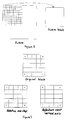
- Fig. 2 describes the division of the picture into blocks (transformation blocks).
- Fig. 3 describes the encryption operations rotation and reflection.
- Fig. 4 describes permutation of bit planes.
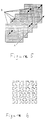
- Fig. 5 shows a picture sequence in hybrid coding.
- Fig. 6 shows an example of an area-filling curve.
- Fig. 1 is a block diagram which shows in which order the different steps are carried out according to a preferred exemplary embodiment.
- the source of information generates the quantity of data which represents the information which is to be transmitted.
- the encryption changes the representation of the quantity of data in such a manner that unauthorized persons cannot read the information without knowledge of the encryption process and the encryption code.
- the source coding reduces the quantity of data which is required to represent the information. This takes place by means of, for example, transformation coding, hybrid coding or DPCM coding.
- the channel is the part in data transmission which carries out the physical transmission. Source code decoding and decryption perform inverse functions to source coding and encryption.
- One embodiment of the invention relates to encryption of pictures intended to be transformation coded, that is to say the picture is divided first into blocks, as shown in Fig. 2.
- This encryption is based upon a global and a local encryption.
- the global encryption comprises permutations of transformation blocks within the picture, and this can take place in B! different ways if the picture contains B blocks.
- the local encryption means operations within transformation blocks. These operations are rotations, reflections, inversions, linear shifts and bit plane permutation.
- Inversion means that the image point values are converted to 2 n - 1 - x, where n is the number of bits which is used to represent the image point and x is the previous value of the image point.
- Bit plane permutation Fig. 4, means that two blocks are divided up into two parts in the same manner and that these parts are then permuted. This division varies with blocks.
- the local encryption operations are to make it difficult for an unauthorized reader to decrypt the picture. Encrypting with the maximum number of permutation possibilities produces a good encryption together with the global encryption. This is dependent upon the local encryption making it more difficult to break the global encryption. Increasing the strength of the encryption by increasing the number of encryption operations leads to the dependence which exists between the bit levels and picture elements disappearing, which leads to a more difficult situation for the transformation coder. In order to obtain a good compression with the transformation coder, it is required that the dependence within transformation blocks is retained. This dependence is not changed by the operations rotation, reflection and inversion (16 operations). An increase in the number of operations beyond this leads to a reduced compression possibility for the transformation coder.
- Another embodiment of the invention relates to encryption of pictures intended to be hybrid coded.
- hybrid coding also, as mentioned above, use is made of the temporal dependence in the sequence of pictures. Carrying out a new permutation (which the hybrid coder does not know) for each new picture destroys this dependence.
- the hybrid coder can make use of the temporal dependence. If, on the other hand, the permutation is changed for each picture, the coder tries to use a temporal dependence between transformation blocks, that is to say it tries to act as if in A while blocks lie as in B. Such a dependence does not exist, whereupon the coder makes an incorrect approximation. Holding the global encryption fixed for a number of picture sequences leads to it being equally difficult to break a picture in this sequence as to break the whole sequence, if the remaining pictures in the sequence do not give any further information for breaking. This means a weakening of the encryption.
- both the local and the global encryption destroy the possibility of predicting this; the global by permuting transformation blocks in the picture and the local by permuting picture elements and the bit levels in the transformation block.
- the operations which it is possible to use are rotations, reflections and inversions of the whole picture. These operations should only be changed upon changes of scene so as not to make it more difficult for the hybrid coder. This leads to a very weak encryption.
- the possibility of increasing these operations is small. One way would be to sub-sample picture element by picture element in temporal order and permute the amplitude between the sub-samples. However, this produces a limited number of extra encryption operations.
- a further manner of encrypting pictures according to the present invention is to read off the picture along a curve which covers the whole or almost the whole picture. This curve winds forward in the picture, from each image point to one of its closest neighbors. The quantity of such curves is very large, which affords possibilities for strong encryption.
- This curve should not, however, be used in encryption since it looks the same over the whole picture. Instead the curve is generated by an algorithm which is controlled by a pseudo-random sequence, making it possible to recreate the scanning pattern. It is not necessary that all points are scanned through for every picture. It is permissible that a small number of points are not scanned through, provided it is known that these points are scanned through by almost all curves and that the curves are changed often. Using a scanning method like this leads to an ordinary scalar source coding, for example DPCM or delta modulation. A picture scanning such as this affords no possibilities of making use of movement estimation since the curve is changed often and the source coding is assumed not to know which it is.
Landscapes
- Engineering & Computer Science (AREA)
- Signal Processing (AREA)
- Multimedia (AREA)
- Computer Security & Cryptography (AREA)
- General Physics & Mathematics (AREA)
- Theoretical Computer Science (AREA)
- Physics & Mathematics (AREA)
- Computer Networks & Wireless Communication (AREA)
- Compression Or Coding Systems Of Tv Signals (AREA)
- Facsimile Transmission Control (AREA)
- Storage Device Security (AREA)
- Compression, Expansion, Code Conversion, And Decoders (AREA)
- Compression Of Band Width Or Redundancy In Fax (AREA)
- Two-Way Televisions, Distribution Of Moving Picture Or The Like (AREA)
Description
- The invention relates to a process for encryption with subsequent source coding of a sequence of information, in respect particularly of moving pictures. Encryption means that the information which exists is concealed, while source coding means that the quantity of data which is required in order to represent the information is reduced.
- In transmission of information it is important in many connections to retain this information on its own or within a small group. This means that the information must be concealed in such a manner that an unauthorized person who reads the quantity of data which is being transmitted must not be able to appropriate the information which exists therein. This can be carried out in many different ways, known as encryption methods.
- In transmission and storage of information it is important that the quantity of data which is to be transmitted or stored is small. Reducing the amount of data which is required in order to transmit or store respectively a certain amount of information is called source coding. In transmission of information relating to moving pictures, three methods are used primarily. Predictive DPCM coding (differential pulse code modulation) is such a method of compressing the picture information. In this case, use has been made of the knowledge that often only small differences occur between two pictures which follow one another. In the transmitter there is a predictor which predicts, forecasts, using the previous picture, how the next picture will look. A difference is formed and only the prediction error needs to be transmitted to the receiver, which contains a similar predictor for reconstruction of the original picture.
- In transformation coding, the picture is divided into blocks of, for example, 8 x 8 or 16 x 16 image points, also referred to as picture elements or PELS. The picture content is transformed mathematically into so-called transformation coefficients which are subsequently quantized. The coefficients for gray areas become zero according to this process and do not need to be transmitted along the telephone lines.
- DPCM coding and transformation coding can be combined into a third method, referred to in this application as hybrid coding (actually hybrid DPCM transformation coding), which accordingly makes use of both prediction and transformation. In this connection, therefore, a block is transformed from its PEL domain or the time plane to its transformation domain or the frequency plane by means of, for example, a discrete cosine transformation (DCT). Then the transformation coefficients are quantized and the prediction takes place in the transformation domain with a similar loop to in DPCM coding. It is also possible to reverse the order, so that the transformation takes place inside the prediction loop and the prediction in the PEL domain. The transformation coefficients, which can now accept discrete values between between -128 and +127 for example, are then scanned in the frequency plane, the information-carrying coefficients being concentrated at the beginning of the block.
- The three methods above are described in greater detail in Televerkets Tekniska Tidskrift {Televerket's technical periodical}, Tele, volume 91, no. 4, 1985, pages 1-7, and the periodical Elteknik, no. 14, 1986, pages 48-52.
- In conventional transmission, the information is first source coded in order to then be encrypted since the encryption destroys what the source coder uses to reduce the quantity of data which the information requires. When encryption and source coding are carried out in this order, it is possible to use a suitable source coder, with regard to the nature of the information, and a suitable encryption method, with regard to how strongly the information is to be concealed.
- In many connections, however, it is important to carry out the encryption first and then carry out the source coding, for example when the transmission takes place via a network with a low transmission rate between two local networks which have a high transmission rate. In such an application, it is important to be able to encrypt the information locally within the high speed network. If it is then required to transmit information between high speed networks, the information will not need to be decrypted at the boundary between low and high speed networks, since the information will be encrypted the whole way, that is to say between the end stations. This is desirable from the point of view of security. With conventional encryption methods, this leads to the encryption destroying what the source coder uses to reduce the quantity of data which is required in order to represent the information.
- Conventional methods of encryption can be divided into block encryption and encryption with running code. The methods which are used here can be said to be a combination of the two basic methods. Sequences of pictures are divided into blocks, in which each block constitutes a picture or a part of a picture. Within each block, encryption takes place either with a code (which changes from block to block) or with a running code within the block. The latter principle is used in a method with a scanning pattern in the form of a curve which winds forward through the picture.
- For many of the proposed encryption methods, a code generator is required which, starting from a fixed code, produces a sequence of codes. This is a common process within encryption technology. There are descriptions in, for example, Henry Beker & Fred Piper: Cipher systems, Northwood Books, London 1982.
- The object of the invention is to carry out encryption first and source coding subsequently.
- In order to carry out an encryption which does not influence the source coding, the encryption operations are carried out so that they do not influence the characteristics in the information which the source coder uses to reduce the quantity of data. A stronger encryption can be achieved if the encryption is allowed to influence the characteristics which the source coder uses to reduce the quantity of data. This leads to stronger encryption but makes it more difficult for the source coder to reduce the quantity of data for the information.
- The object of the invention is achieved according to the process according to the accompanying claims.
- Fig. 1 is a block diagram of the process according to the invention.
- Fig. 2 describes the division of the picture into blocks (transformation blocks).
- Fig. 3 describes the encryption operations rotation and reflection.
- Fig. 4 describes permutation of bit planes.
- Fig. 5 shows a picture sequence in hybrid coding.
- Fig. 6 shows an example of an area-filling curve.
- Fig. 1 is a block diagram which shows in which order the different steps are carried out according to a preferred exemplary embodiment. The source of information generates the quantity of data which represents the information which is to be transmitted. The encryption changes the representation of the quantity of data in such a manner that unauthorized persons cannot read the information without knowledge of the encryption process and the encryption code. The source coding reduces the quantity of data which is required to represent the information. This takes place by means of, for example, transformation coding, hybrid coding or DPCM coding. The channel is the part in data transmission which carries out the physical transmission. Source code decoding and decryption perform inverse functions to source coding and encryption.
- One embodiment of the invention relates to encryption of pictures intended to be transformation coded, that is to say the picture is divided first into blocks, as shown in Fig. 2. This encryption is based upon a global and a local encryption. The global encryption comprises permutations of transformation blocks within the picture, and this can take place in B! different ways if the picture contains B blocks. The local encryption means operations within transformation blocks. These operations are rotations, reflections, inversions, linear shifts and bit plane permutation.
- Rotation and reflection are described in Fig. 3. Inversion means that the image point values are converted to 2n - 1 - x, where n is the number of bits which is used to represent the image point and x is the previous value of the image point. Bit plane permutation, Fig. 4, means that two blocks are divided up into two parts in the same manner and that these parts are then permuted. This division varies with blocks.
- These operations increase the possibility of encrypting locally with maximally a factor 2⁸, which is obtained when all possible combinations are used. These operations make it more difficult for the transformation coder to compress the picture because the dependence which exists between bit planes is destroyed when they are changed.
- The local encryption operations are to make it difficult for an unauthorized reader to decrypt the picture. Encrypting with the maximum number of permutation possibilities produces a good encryption together with the global encryption. This is dependent upon the local encryption making it more difficult to break the global encryption. Increasing the strength of the encryption by increasing the number of encryption operations leads to the dependence which exists between the bit levels and picture elements disappearing, which leads to a more difficult situation for the transformation coder. In order to obtain a good compression with the transformation coder, it is required that the dependence within transformation blocks is retained. This dependence is not changed by the operations rotation, reflection and inversion (16 operations). An increase in the number of operations beyond this leads to a reduced compression possibility for the transformation coder.
- Another embodiment of the invention relates to encryption of pictures intended to be hybrid coded. In hybrid coding also, as mentioned above, use is made of the temporal dependence in the sequence of pictures. Carrying out a new permutation (which the hybrid coder does not know) for each new picture destroys this dependence.
- It is possible to avoid this if the permutation is changed upon changes of scene or is held fixed for a number of picture sequences. This is illustrated by A in Fig. 5. By holding the global permutation fixed for a number of pictures, the hybrid coder can make use of the temporal dependence. If, on the other hand, the permutation is changed for each picture, the coder tries to use a temporal dependence between transformation blocks, that is to say it tries to act as if in A while blocks lie as in B. Such a dependence does not exist, whereupon the coder makes an incorrect approximation. Holding the global encryption fixed for a number of picture sequences leads to it being equally difficult to break a picture in this sequence as to break the whole sequence, if the remaining pictures in the sequence do not give any further information for breaking. This means a weakening of the encryption.
- If the hybrid coder also takes into consideration the movements which exist in the picture, both the local and the global encryption destroy the possibility of predicting this; the global by permuting transformation blocks in the picture and the local by permuting picture elements and the bit levels in the transformation block. This makes the possibility of encrypting before a hybrid coder small. The operations which it is possible to use are rotations, reflections and inversions of the whole picture. These operations should only be changed upon changes of scene so as not to make it more difficult for the hybrid coder. This leads to a very weak encryption. The possibility of increasing these operations is small. One way would be to sub-sample picture element by picture element in temporal order and permute the amplitude between the sub-samples. However, this produces a limited number of extra encryption operations.
- A further manner of encrypting pictures according to the present invention is to read off the picture along a curve which covers the whole or almost the whole picture. This curve winds forward in the picture, from each image point to one of its closest neighbors. The quantity of such curves is very large, which affords possibilities for strong encryption.
- In order to obtain a good source coding, it is desirable that the area-filling curve turns often, in order to exploit the fact that the dependence in the picture is greatest in a small area around a given point. An example of such a curve is the Peano-Hilbert curve in Fig. 6.
- This curve should not, however, be used in encryption since it looks the same over the whole picture. Instead the curve is generated by an algorithm which is controlled by a pseudo-random sequence, making it possible to recreate the scanning pattern. It is not necessary that all points are scanned through for every picture. It is permissible that a small number of points are not scanned through, provided it is known that these points are scanned through by almost all curves and that the curves are changed often. Using a scanning method like this leads to an ordinary scalar source coding, for example DPCM or delta modulation. A picture scanning such as this affords no possibilities of making use of movement estimation since the curve is changed often and the source coding is assumed not to know which it is. On the other hand, it is possible to make use of temporal dependence if the curve is held fixed between changes of scene or is held fixed for a number of picture sequences. The practically area-filling curve is used advantageously on moving pictures while the area-filling curve can be used on both moving pictures and still pictures.
- In transformation coding the possibility of compressing is correspondingly reduced when the number of encryption operations increases. Even a small number of operations, as far as encryption is concerned, produces a considerably worse compression possibility for the transformation coder, because the encryption quickly destroys the information which the transformation coder uses. In order to obtain a moderately strong encryption, the number of operations would be so large that the compression possibilities are considerably worse than without encryption. In more complex methods (the hybrid coder) there is an even smaller possibility of carrying out encryption operations since these require that almost all dependence in the picture is retained. With the encryption operations rotation, reflection and inversion, no worsened data compression possibility is obtained. With bit plane permutations, a worse data reduction is obtained. With area-filling curves, a good encryption can be obtained without the source coding being worsened appreciably, compared with another scanning and scalar source coding.
Claims (8)
- A process comprising encryption and subsequent source coding of a sequence of information about moving pictures, wherein the encryption involves steps of concealing the information essentially without influencing the temporal characteristics of the sequence which characteristics are used by the source coding to reduce the quantity of data which is required to represent the information.
- The process as claimed in Claim 1, wherein the sequence of information is divided into blocks and wherein the encryption takes place by global permutation of blocks and/or local rotation, reflection and inversion of blocks.
- The process as claimed in Claim 1 or 2, wherein the encryption takes place by permutations within blocks.
- The process as claimed in Claim 1, 2 or 3, wherein the source coding is carried out with a transformation coder or a hybrid coder.
- The process as claimed in Claim 4, wherein the encryption is held fixed between changes of scene and wherein the source coding is carried out with a hybrid coder.
- The process as claimed in Claim 5, wherein the source coding includes movement compensation.
- The process as claimed in Claim 1, wherein the encryption takes place by means of an area-filling or practically area-filling curve formed by means of a pseudo-random sequence and wherein the source coding takes place with a source coder of DPCM type.
- The process as claimed in Claim 7, wherein the encryption is held fixed between changes of scene.
Applications Claiming Priority (2)
| Application Number | Priority Date | Filing Date | Title |
|---|---|---|---|
| SE8803264A SE503549C2 (en) | 1988-09-15 | 1988-09-15 | Encryption with subsequent source encoding |
| SE8803264 | 1988-09-15 |
Publications (3)
| Publication Number | Publication Date |
|---|---|
| EP0359729A2 EP0359729A2 (en) | 1990-03-21 |
| EP0359729A3 EP0359729A3 (en) | 1991-11-21 |
| EP0359729B1 true EP0359729B1 (en) | 1995-04-12 |
Family
ID=20373342
Family Applications (1)
| Application Number | Title | Priority Date | Filing Date |
|---|---|---|---|
| EP19890850278 Expired - Lifetime EP0359729B1 (en) | 1988-09-15 | 1989-08-29 | Encryption with subsequent source coding |
Country Status (3)
| Country | Link |
|---|---|
| EP (1) | EP0359729B1 (en) |
| DE (1) | DE68922166T2 (en) |
| SE (2) | SE503549C2 (en) |
Cited By (5)
| Publication number | Priority date | Publication date | Assignee | Title |
|---|---|---|---|---|
| DE19932769A1 (en) * | 1999-07-14 | 2001-03-08 | Roellgen Bernd | Cryptographic method that can be changed during runtime |
| US6389562B1 (en) | 1999-06-29 | 2002-05-14 | Sony Corporation | Source code shuffling to provide for robust error recovery |
| US6473876B1 (en) | 1999-06-29 | 2002-10-29 | Sony Corporation | Method and apparatus for encoding of bitstreams using rotation |
| US6493842B1 (en) | 1999-06-29 | 2002-12-10 | Sony Corporation | Time-varying randomization for data synchronization and implicit information transmission |
| US6539517B1 (en) | 1999-11-09 | 2003-03-25 | Sony Corporation | Data transformation for explicit transmission of control information |
Families Citing this family (10)
| Publication number | Priority date | Publication date | Assignee | Title |
|---|---|---|---|---|
| TW223690B (en) * | 1991-02-13 | 1994-05-11 | Ampex | |
| CA2077576A1 (en) * | 1992-09-04 | 1994-03-05 | Gera J. Roth | Encryption template |
| AU693432B2 (en) * | 1992-09-04 | 1998-07-02 | 998358 Ontario Inc. Doing Business As Rotocode International | Encryption template |
| US6263468B1 (en) | 1997-10-23 | 2001-07-17 | Sony Corporation | Apparatus and method for partial buffering transmitted data to provide robust error recovery in a lossy transmission environment |
| FR2771581B1 (en) * | 1997-11-26 | 1999-12-17 | Thomson Multimedia Sa | SCALING METHOD AND SCALING METHOD OF DIGITAL VIDEO DATA AND DEVICES IMPLEMENTING THE METHODS |
| US6535148B1 (en) | 1999-02-12 | 2003-03-18 | Sony Corporation | Method and apparatus for truncated decoding |
| US6505299B1 (en) * | 1999-03-01 | 2003-01-07 | Sharp Laboratories Of America, Inc. | Digital image scrambling for image coding systems |
| FR2805066B1 (en) * | 2000-02-15 | 2003-12-05 | Sagem | METHOD FOR ENCODING A DETECTED IMAGE OF A BIOMETRIC CHARACTERISTIC OF A PERSON, SECURE AUTHENTICATION METHOD FOR ACCESS AUTHORIZATION USING THE SAME, IMPLEMENTING DEVICES THEREOF |
| US7372975B2 (en) * | 2004-12-06 | 2008-05-13 | Mitsubishi Electric Research Laboratory, Inc. | Method for secure background modeling in images |
| US7742597B2 (en) * | 2007-12-28 | 2010-06-22 | Lewis James M | Exclusive encryption system |
Family Cites Families (5)
| Publication number | Priority date | Publication date | Assignee | Title |
|---|---|---|---|---|
| US4636851A (en) * | 1982-04-23 | 1987-01-13 | Independent Broadcasting Authority | Signal coding for secure transmission |
| JPS59111441A (en) * | 1982-12-17 | 1984-06-27 | Sony Corp | Privacy telephone system of sound signal |
| US4575754A (en) * | 1983-01-06 | 1986-03-11 | Rca Corporation | Video scrambler system |
| IL83549A (en) * | 1987-08-16 | 1992-08-18 | Yossi Matias | Video scrambling apparatus and method based on space filling curves |
| DE3731532A1 (en) * | 1987-09-18 | 1989-03-30 | Siemens Ag | Process for transmitting encoded picture signals |
-
1988
- 1988-09-15 SE SE8803264A patent/SE503549C2/en not_active IP Right Cessation
-
1989
- 1989-08-29 DE DE1989622166 patent/DE68922166T2/en not_active Expired - Fee Related
- 1989-08-29 EP EP19890850278 patent/EP0359729B1/en not_active Expired - Lifetime
- 1989-11-06 SE SE8903694A patent/SE465051B/en not_active IP Right Cessation
Cited By (6)
| Publication number | Priority date | Publication date | Assignee | Title |
|---|---|---|---|---|
| US6389562B1 (en) | 1999-06-29 | 2002-05-14 | Sony Corporation | Source code shuffling to provide for robust error recovery |
| US6473876B1 (en) | 1999-06-29 | 2002-10-29 | Sony Corporation | Method and apparatus for encoding of bitstreams using rotation |
| US6493842B1 (en) | 1999-06-29 | 2002-12-10 | Sony Corporation | Time-varying randomization for data synchronization and implicit information transmission |
| US6553381B2 (en) | 1999-06-29 | 2003-04-22 | Sony Corporation | Time-varying randomization for data synchronization and implicit information transmission |
| DE19932769A1 (en) * | 1999-07-14 | 2001-03-08 | Roellgen Bernd | Cryptographic method that can be changed during runtime |
| US6539517B1 (en) | 1999-11-09 | 2003-03-25 | Sony Corporation | Data transformation for explicit transmission of control information |
Also Published As
| Publication number | Publication date |
|---|---|
| DE68922166T2 (en) | 1995-08-10 |
| SE8803264L (en) | 1990-03-16 |
| SE8803264D0 (en) | 1988-09-15 |
| EP0359729A3 (en) | 1991-11-21 |
| SE8903694L (en) | 1989-11-06 |
| EP0359729A2 (en) | 1990-03-21 |
| SE503549C2 (en) | 1996-07-01 |
| DE68922166D1 (en) | 1995-05-18 |
| SE465051B (en) | 1991-07-15 |
| SE8903694D0 (en) | 1989-11-06 |
Similar Documents
| Publication | Publication Date | Title |
|---|---|---|
| US5682425A (en) | Information signal transmission system | |
| EP0359729A2 (en) | Encryption with subsequent source coding | |
| US5208857A (en) | Method and device for scrambling-unscrambling digital image data | |
| US7787621B2 (en) | Secure transmission using adaptive transformation and plural channels | |
| Hartung et al. | Watermarking of MPEG-2 encoded video without decoding and reencoding | |
| US6519341B1 (en) | Method and apparatus for outputting a high definition image | |
| JP3686583B2 (en) | Apparatus and method for entropy coding | |
| US7571316B2 (en) | Method and device for transforming a digital signal | |
| JPH11513205A (en) | Video coding device | |
| JPS59500694A (en) | Signal coding equipment for reliable signal transmission | |
| Socek et al. | Digital video encryption algorithms based on correlation-preserving permutations | |
| JP3478019B2 (en) | Image encoded data creation method and image encoded data decoding method | |
| CN115567650B (en) | Data management method for boiler intelligent operation monitoring cloud platform | |
| US20030185455A1 (en) | Digital image processor | |
| Lee et al. | An Efficient Encoding of DCT Blocks with Block-Adaptive Scanning | |
| JPH1118070A (en) | Image compression device, image decompression device, and transmission device | |
| Lv et al. | Integration of data compression and cryptography: Another way to increase the information security | |
| JP3848002B2 (en) | Image data transmission device | |
| GB2378072A (en) | Dividing image data into irregular shaped blocks for coding | |
| JPH10326077A (en) | Encryption coding device | |
| JPH06339036A (en) | Ciphering device and method for facsimile equipment | |
| JPH0654325A (en) | Picture encipherment transmitting system | |
| Al Jabri et al. | Secure progressive transmission of compressed images | |
| JPH07184188A (en) | Compressed video information encryption device | |
| JP3739548B2 (en) | Image encoding apparatus and decoding apparatus |
Legal Events
| Date | Code | Title | Description |
|---|---|---|---|
| PUAI | Public reference made under article 153(3) epc to a published international application that has entered the european phase |
Free format text: ORIGINAL CODE: 0009012 |
|
| AK | Designated contracting states |
Kind code of ref document: A2 Designated state(s): BE CH DE FR GB LI |
|
| PUAL | Search report despatched |
Free format text: ORIGINAL CODE: 0009013 |
|
| AK | Designated contracting states |
Kind code of ref document: A3 Designated state(s): BE CH DE FR GB LI |
|
| 17P | Request for examination filed |
Effective date: 19920307 |
|
| 17Q | First examination report despatched |
Effective date: 19940208 |
|
| RAP1 | Party data changed (applicant data changed or rights of an application transferred) |
Owner name: TELIA AB |
|
| GRAA | (expected) grant |
Free format text: ORIGINAL CODE: 0009210 |
|
| AK | Designated contracting states |
Kind code of ref document: B1 Designated state(s): BE CH DE FR GB LI |
|
| REF | Corresponds to: |
Ref document number: 68922166 Country of ref document: DE Date of ref document: 19950518 |
|
| ET | Fr: translation filed | ||
| PLBE | No opposition filed within time limit |
Free format text: ORIGINAL CODE: 0009261 |
|
| STAA | Information on the status of an ep patent application or granted ep patent |
Free format text: STATUS: NO OPPOSITION FILED WITHIN TIME LIMIT |
|
| 26N | No opposition filed | ||
| PGFP | Annual fee paid to national office [announced via postgrant information from national office to epo] |
Ref country code: GB Payment date: 19990601 Year of fee payment: 11 |
|
| PGFP | Annual fee paid to national office [announced via postgrant information from national office to epo] |
Ref country code: FR Payment date: 19990611 Year of fee payment: 11 |
|
| PGFP | Annual fee paid to national office [announced via postgrant information from national office to epo] |
Ref country code: CH Payment date: 19990722 Year of fee payment: 11 |
|
| PGFP | Annual fee paid to national office [announced via postgrant information from national office to epo] |
Ref country code: BE Payment date: 19990818 Year of fee payment: 11 |
|
| PGFP | Annual fee paid to national office [announced via postgrant information from national office to epo] |
Ref country code: DE Payment date: 19991020 Year of fee payment: 11 |
|
| PG25 | Lapsed in a contracting state [announced via postgrant information from national office to epo] |
Ref country code: GB Free format text: LAPSE BECAUSE OF NON-PAYMENT OF DUE FEES Effective date: 20000829 |
|
| PG25 | Lapsed in a contracting state [announced via postgrant information from national office to epo] |
Ref country code: LI Free format text: LAPSE BECAUSE OF NON-PAYMENT OF DUE FEES Effective date: 20000831 Ref country code: CH Free format text: LAPSE BECAUSE OF NON-PAYMENT OF DUE FEES Effective date: 20000831 Ref country code: BE Free format text: LAPSE BECAUSE OF NON-PAYMENT OF DUE FEES Effective date: 20000831 |
|
| BERE | Be: lapsed |
Owner name: TELIA A.B. Effective date: 20000831 |
|
| REG | Reference to a national code |
Ref country code: CH Ref legal event code: PL |
|
| GBPC | Gb: european patent ceased through non-payment of renewal fee |
Effective date: 20000829 |
|
| PG25 | Lapsed in a contracting state [announced via postgrant information from national office to epo] |
Ref country code: FR Free format text: LAPSE BECAUSE OF NON-PAYMENT OF DUE FEES Effective date: 20010430 |
|
| PG25 | Lapsed in a contracting state [announced via postgrant information from national office to epo] |
Ref country code: DE Free format text: LAPSE BECAUSE OF NON-PAYMENT OF DUE FEES Effective date: 20010601 |
|
| REG | Reference to a national code |
Ref country code: FR Ref legal event code: ST |