EP0359649B1 - Procédé de régénération électrochimique de cofacteurs pyridiniques - Google Patents
Procédé de régénération électrochimique de cofacteurs pyridiniques Download PDFInfo
- Publication number
- EP0359649B1 EP0359649B1 EP89402477A EP89402477A EP0359649B1 EP 0359649 B1 EP0359649 B1 EP 0359649B1 EP 89402477 A EP89402477 A EP 89402477A EP 89402477 A EP89402477 A EP 89402477A EP 0359649 B1 EP0359649 B1 EP 0359649B1
- Authority
- EP
- European Patent Office
- Prior art keywords
- nad
- enzyme
- nadh
- regeneration
- electrode
- Prior art date
- Legal status (The legal status is an assumption and is not a legal conclusion. Google has not performed a legal analysis and makes no representation as to the accuracy of the status listed.)
- Expired - Lifetime
Links
- 238000000034 method Methods 0.000 title claims abstract description 33
- 238000011069 regeneration method Methods 0.000 title abstract description 28
- 230000008929 regeneration Effects 0.000 title abstract description 27
- 230000008569 process Effects 0.000 title abstract description 20
- JUJWROOIHBZHMG-UHFFFAOYSA-N Pyridine Chemical compound C1=CC=NC=C1 JUJWROOIHBZHMG-UHFFFAOYSA-N 0.000 title abstract description 14
- UMJSCPRVCHMLSP-UHFFFAOYSA-N pyridine Natural products COC1=CC=CN=C1 UMJSCPRVCHMLSP-UHFFFAOYSA-N 0.000 title abstract description 7
- 108010020056 Hydrogenase Proteins 0.000 claims abstract description 22
- 230000001086 cytosolic effect Effects 0.000 claims abstract description 9
- 238000005868 electrolysis reaction Methods 0.000 claims abstract description 9
- 239000012429 reaction media Substances 0.000 claims abstract description 3
- 102000004190 Enzymes Human genes 0.000 claims description 32
- 108090000790 Enzymes Proteins 0.000 claims description 32
- 229930027945 nicotinamide-adenine dinucleotide Natural products 0.000 claims description 28
- BAWFJGJZGIEFAR-NNYOXOHSSA-O NAD(+) Chemical compound NC(=O)C1=CC=C[N+]([C@H]2[C@@H]([C@H](O)[C@@H](COP(O)(=O)OP(O)(=O)OC[C@@H]3[C@H]([C@@H](O)[C@@H](O3)N3C4=NC=NC(N)=C4N=C3)O)O2)O)=C1 BAWFJGJZGIEFAR-NNYOXOHSSA-O 0.000 claims description 26
- 230000009467 reduction Effects 0.000 claims description 19
- BASFCYQUMIYNBI-UHFFFAOYSA-N platinum Chemical compound [Pt] BASFCYQUMIYNBI-UHFFFAOYSA-N 0.000 claims description 11
- 230000002255 enzymatic effect Effects 0.000 claims description 9
- 241000252867 Cupriavidus metallidurans Species 0.000 claims description 8
- 238000003786 synthesis reaction Methods 0.000 claims description 8
- 229910052697 platinum Inorganic materials 0.000 claims description 5
- 239000010970 precious metal Substances 0.000 claims description 2
- BOPGDPNILDQYTO-NNYOXOHSSA-N nicotinamide-adenine dinucleotide Chemical compound C1=CCC(C(=O)N)=CN1[C@H]1[C@H](O)[C@H](O)[C@@H](COP(O)(=O)OP(O)(=O)OC[C@@H]2[C@H]([C@@H](O)[C@@H](O2)N2C3=NC=NC(N)=C3N=C2)O)O1 BOPGDPNILDQYTO-NNYOXOHSSA-N 0.000 claims 2
- 230000001172 regenerating effect Effects 0.000 claims 1
- BAWFJGJZGIEFAR-NNYOXOHSSA-N NAD zwitterion Chemical compound NC(=O)C1=CC=C[N+]([C@H]2[C@@H]([C@H](O)[C@@H](COP([O-])(=O)OP(O)(=O)OC[C@@H]3[C@H]([C@@H](O)[C@@H](O3)N3C4=NC=NC(N)=C4N=C3)O)O2)O)=C1 BAWFJGJZGIEFAR-NNYOXOHSSA-N 0.000 description 26
- 229950006238 nadide Drugs 0.000 description 26
- 239000000243 solution Substances 0.000 description 25
- 238000006243 chemical reaction Methods 0.000 description 22
- 238000006722 reduction reaction Methods 0.000 description 19
- 239000000758 substrate Substances 0.000 description 12
- 229910019142 PO4 Inorganic materials 0.000 description 10
- NBIIXXVUZAFLBC-UHFFFAOYSA-K phosphate Chemical compound [O-]P([O-])([O-])=O NBIIXXVUZAFLBC-UHFFFAOYSA-K 0.000 description 10
- 239000010452 phosphate Substances 0.000 description 10
- 230000007246 mechanism Effects 0.000 description 9
- DHMQDGOQFOQNFH-UHFFFAOYSA-N Glycine Chemical compound NCC(O)=O DHMQDGOQFOQNFH-UHFFFAOYSA-N 0.000 description 8
- 230000015572 biosynthetic process Effects 0.000 description 8
- JVTAAEKCZFNVCJ-UHFFFAOYSA-M Lactate Chemical compound CC(O)C([O-])=O JVTAAEKCZFNVCJ-UHFFFAOYSA-M 0.000 description 6
- 238000002474 experimental method Methods 0.000 description 6
- 238000012546 transfer Methods 0.000 description 6
- 101000950981 Bacillus subtilis (strain 168) Catabolic NAD-specific glutamate dehydrogenase RocG Proteins 0.000 description 5
- 102000016901 Glutamate dehydrogenase Human genes 0.000 description 5
- UFHFLCQGNIYNRP-UHFFFAOYSA-N Hydrogen Chemical compound [H][H] UFHFLCQGNIYNRP-UHFFFAOYSA-N 0.000 description 5
- WHUUTDBJXJRKMK-VKHMYHEASA-N L-glutamic acid Chemical compound OC(=O)[C@@H](N)CCC(O)=O WHUUTDBJXJRKMK-VKHMYHEASA-N 0.000 description 5
- 229930195712 glutamate Natural products 0.000 description 5
- 229910052739 hydrogen Inorganic materials 0.000 description 5
- 239000001257 hydrogen Substances 0.000 description 5
- JORABGDXCIBAFL-UHFFFAOYSA-M iodonitrotetrazolium chloride Chemical compound [Cl-].C1=CC([N+](=O)[O-])=CC=C1N1[N+](C=2C=CC(I)=CC=2)=NC(C=2C=CC=CC=2)=N1 JORABGDXCIBAFL-UHFFFAOYSA-M 0.000 description 5
- 101710088194 Dehydrogenase Proteins 0.000 description 4
- 239000004471 Glycine Substances 0.000 description 4
- OAKJQQAXSVQMHS-UHFFFAOYSA-N Hydrazine Chemical compound NN OAKJQQAXSVQMHS-UHFFFAOYSA-N 0.000 description 4
- 102000003855 L-lactate dehydrogenase Human genes 0.000 description 4
- 108700023483 L-lactate dehydrogenases Proteins 0.000 description 4
- PXHVJJICTQNCMI-UHFFFAOYSA-N Nickel Chemical compound [Ni] PXHVJJICTQNCMI-UHFFFAOYSA-N 0.000 description 4
- LCTONWCANYUPML-UHFFFAOYSA-M Pyruvate Chemical compound CC(=O)C([O-])=O LCTONWCANYUPML-UHFFFAOYSA-M 0.000 description 4
- 239000003153 chemical reaction reagent Substances 0.000 description 4
- 239000000539 dimer Substances 0.000 description 4
- 238000006911 enzymatic reaction Methods 0.000 description 4
- 210000003205 muscle Anatomy 0.000 description 4
- VMGAPWLDMVPYIA-HIDZBRGKSA-N n'-amino-n-iminomethanimidamide Chemical compound N\N=C\N=N VMGAPWLDMVPYIA-HIDZBRGKSA-N 0.000 description 4
- BOLDJAUMGUJJKM-LSDHHAIUSA-N renifolin D Natural products CC(=C)[C@@H]1Cc2c(O)c(O)ccc2[C@H]1CC(=O)c3ccc(O)cc3O BOLDJAUMGUJJKM-LSDHHAIUSA-N 0.000 description 4
- 101001083553 Homo sapiens Hydroxyacyl-coenzyme A dehydrogenase, mitochondrial Proteins 0.000 description 3
- 102100030358 Hydroxyacyl-coenzyme A dehydrogenase, mitochondrial Human genes 0.000 description 3
- ZLMJMSJWJFRBEC-UHFFFAOYSA-N Potassium Chemical compound [K] ZLMJMSJWJFRBEC-UHFFFAOYSA-N 0.000 description 3
- 238000003556 assay Methods 0.000 description 3
- QVGXLLKOCUKJST-UHFFFAOYSA-N atomic oxygen Chemical compound [O] QVGXLLKOCUKJST-UHFFFAOYSA-N 0.000 description 3
- 238000011161 development Methods 0.000 description 3
- 230000018109 developmental process Effects 0.000 description 3
- 230000000694 effects Effects 0.000 description 3
- 238000005259 measurement Methods 0.000 description 3
- 229910052760 oxygen Inorganic materials 0.000 description 3
- 239000001301 oxygen Substances 0.000 description 3
- 238000001179 sorption measurement Methods 0.000 description 3
- 241000894006 Bacteria Species 0.000 description 2
- BVKZGUZCCUSVTD-UHFFFAOYSA-L Carbonate Chemical compound [O-]C([O-])=O BVKZGUZCCUSVTD-UHFFFAOYSA-L 0.000 description 2
- 241000283986 Lepus Species 0.000 description 2
- 241000283973 Oryctolagus cuniculus Species 0.000 description 2
- 241000282898 Sus scrofa Species 0.000 description 2
- GSEJCLTVZPLZKY-UHFFFAOYSA-N Triethanolamine Chemical compound OCCN(CCO)CCO GSEJCLTVZPLZKY-UHFFFAOYSA-N 0.000 description 2
- 238000002835 absorbance Methods 0.000 description 2
- OJFDKHTZOUZBOS-CITAKDKDSA-N acetoacetyl-CoA Chemical compound O[C@@H]1[C@H](OP(O)(O)=O)[C@@H](COP(O)(=O)OP(O)(=O)OCC(C)(C)[C@@H](O)C(=O)NCCC(=O)NCCSC(=O)CC(=O)C)O[C@H]1N1C2=NC=NC(N)=C2N=C1 OJFDKHTZOUZBOS-CITAKDKDSA-N 0.000 description 2
- 235000021336 beef liver Nutrition 0.000 description 2
- 230000008034 disappearance Effects 0.000 description 2
- 230000005684 electric field Effects 0.000 description 2
- 230000002349 favourable effect Effects 0.000 description 2
- 239000012528 membrane Substances 0.000 description 2
- 229910052759 nickel Inorganic materials 0.000 description 2
- 238000005457 optimization Methods 0.000 description 2
- 229910052700 potassium Inorganic materials 0.000 description 2
- 239000011591 potassium Substances 0.000 description 2
- TYJJADVDDVDEDZ-UHFFFAOYSA-M potassium hydrogencarbonate Chemical compound [K+].OC([O-])=O TYJJADVDDVDEDZ-UHFFFAOYSA-M 0.000 description 2
- 238000010405 reoxidation reaction Methods 0.000 description 2
- 238000002798 spectrophotometry method Methods 0.000 description 2
- 239000000126 substance Substances 0.000 description 2
- XDIYNQZUNSSENW-UUBOPVPUSA-N (2R,3S,4R,5R)-2,3,4,5,6-pentahydroxyhexanal Chemical compound OC[C@@H](O)[C@@H](O)[C@H](O)[C@@H](O)C=O.OC[C@@H](O)[C@@H](O)[C@H](O)[C@@H](O)C=O XDIYNQZUNSSENW-UUBOPVPUSA-N 0.000 description 1
- KPGXRSRHYNQIFN-UHFFFAOYSA-L 2-oxoglutarate(2-) Chemical compound [O-]C(=O)CCC(=O)C([O-])=O KPGXRSRHYNQIFN-UHFFFAOYSA-L 0.000 description 1
- 241001250069 Achromobacter ruhlandii Species 0.000 description 1
- OKTJSMMVPCPJKN-UHFFFAOYSA-N Carbon Chemical compound [C] OKTJSMMVPCPJKN-UHFFFAOYSA-N 0.000 description 1
- 241001415961 Gaviidae Species 0.000 description 1
- 108010050375 Glucose 1-Dehydrogenase Proteins 0.000 description 1
- 241000589779 Pelomonas saccharophila Species 0.000 description 1
- 241001524101 Rhodococcus opacus Species 0.000 description 1
- AUNGANRZJHBGPY-SCRDCRAPSA-N Riboflavin Chemical compound OC[C@@H](O)[C@@H](O)[C@@H](O)CN1C=2C=C(C)C(C)=CC=2N=C2C1=NC(=O)NC2=O AUNGANRZJHBGPY-SCRDCRAPSA-N 0.000 description 1
- 241001639412 Verres Species 0.000 description 1
- 241001148470 aerobic bacillus Species 0.000 description 1
- 239000000956 alloy Substances 0.000 description 1
- 229910045601 alloy Inorganic materials 0.000 description 1
- 238000004458 analytical method Methods 0.000 description 1
- 229910052799 carbon Inorganic materials 0.000 description 1
- 238000010924 continuous production Methods 0.000 description 1
- 238000007796 conventional method Methods 0.000 description 1
- 230000036425 denaturation Effects 0.000 description 1
- 238000004925 denaturation Methods 0.000 description 1
- 230000001419 dependent effect Effects 0.000 description 1
- 238000010586 diagram Methods 0.000 description 1
- BNIILDVGGAEEIG-UHFFFAOYSA-L disodium hydrogen phosphate Chemical compound [Na+].[Na+].OP([O-])([O-])=O BNIILDVGGAEEIG-UHFFFAOYSA-L 0.000 description 1
- 229910000397 disodium phosphate Inorganic materials 0.000 description 1
- 235000019800 disodium phosphate Nutrition 0.000 description 1
- 238000006073 displacement reaction Methods 0.000 description 1
- 239000012153 distilled water Substances 0.000 description 1
- 238000002848 electrochemical method Methods 0.000 description 1
- 230000005518 electrochemistry Effects 0.000 description 1
- 239000008151 electrolyte solution Substances 0.000 description 1
- AZHSSKPUVBVXLK-UHFFFAOYSA-N ethane-1,1-diol Chemical compound CC(O)O AZHSSKPUVBVXLK-UHFFFAOYSA-N 0.000 description 1
- 239000000284 extract Substances 0.000 description 1
- 150000002211 flavins Chemical class 0.000 description 1
- 239000011521 glass Substances 0.000 description 1
- 239000008103 glucose Substances 0.000 description 1
- PCHJSUWPFVWCPO-UHFFFAOYSA-N gold Chemical compound [Au] PCHJSUWPFVWCPO-UHFFFAOYSA-N 0.000 description 1
- 229910052737 gold Inorganic materials 0.000 description 1
- 239000010931 gold Substances 0.000 description 1
- 150000002431 hydrogen Chemical class 0.000 description 1
- 150000002500 ions Chemical class 0.000 description 1
- 229910052741 iridium Inorganic materials 0.000 description 1
- GKOZUEZYRPOHIO-UHFFFAOYSA-N iridium atom Chemical compound [Ir] GKOZUEZYRPOHIO-UHFFFAOYSA-N 0.000 description 1
- 238000004519 manufacturing process Methods 0.000 description 1
- QSHDDOUJBYECFT-UHFFFAOYSA-N mercury Chemical compound [Hg] QSHDDOUJBYECFT-UHFFFAOYSA-N 0.000 description 1
- 229910052753 mercury Inorganic materials 0.000 description 1
- 239000000203 mixture Substances 0.000 description 1
- 229910000402 monopotassium phosphate Inorganic materials 0.000 description 1
- 235000019796 monopotassium phosphate Nutrition 0.000 description 1
- 239000007800 oxidant agent Substances 0.000 description 1
- 230000033116 oxidation-reduction process Effects 0.000 description 1
- 230000001590 oxidative effect Effects 0.000 description 1
- FIKAKWIAUPDISJ-UHFFFAOYSA-L paraquat dichloride Chemical compound [Cl-].[Cl-].C1=C[N+](C)=CC=C1C1=CC=[N+](C)C=C1 FIKAKWIAUPDISJ-UHFFFAOYSA-L 0.000 description 1
- 229910052698 phosphorus Inorganic materials 0.000 description 1
- LWIHDJKSTIGBAC-UHFFFAOYSA-K potassium phosphate Substances [K+].[K+].[K+].[O-]P([O-])([O-])=O LWIHDJKSTIGBAC-UHFFFAOYSA-K 0.000 description 1
- 239000002243 precursor Substances 0.000 description 1
- 238000002360 preparation method Methods 0.000 description 1
- 238000006479 redox reaction Methods 0.000 description 1
- 238000011946 reduction process Methods 0.000 description 1
- KLHKNYVUTZICKN-GRFIIANRSA-N s-[2-[3-[[(2r)-4-[[[(2r,3s,4r,5r)-5-(6-aminopurin-9-yl)-4-hydroxy-3-phosphonooxyoxolan-2-yl]methoxy-hydroxyphosphoryl]oxy-hydroxyphosphoryl]oxy-2-hydroxy-3,3-dimethylbutanoyl]amino]propanoylamino]ethyl] 2-hydroxyethanethioate Chemical compound O[C@@H]1[C@H](OP(O)(O)=O)[C@@H](COP(O)(=O)OP(O)(=O)OCC(C)(C)[C@@H](O)C(=O)NCCC(=O)NCCSC(=O)CO)O[C@H]1N1C2=NC=NC(N)=C2N=C1 KLHKNYVUTZICKN-GRFIIANRSA-N 0.000 description 1
- 150000003839 salts Chemical class 0.000 description 1
- 238000005070 sampling Methods 0.000 description 1
- 239000001488 sodium phosphate Substances 0.000 description 1
- 239000002904 solvent Substances 0.000 description 1
- 238000004611 spectroscopical analysis Methods 0.000 description 1
- 238000001228 spectrum Methods 0.000 description 1
- 230000000087 stabilizing effect Effects 0.000 description 1
- 229910052717 sulfur Inorganic materials 0.000 description 1
- 238000001308 synthesis method Methods 0.000 description 1
- 238000012360 testing method Methods 0.000 description 1
- 230000017105 transposition Effects 0.000 description 1
- WFKWXMTUELFFGS-UHFFFAOYSA-N tungsten Chemical compound [W] WFKWXMTUELFFGS-UHFFFAOYSA-N 0.000 description 1
- 229910052721 tungsten Inorganic materials 0.000 description 1
- 239000010937 tungsten Substances 0.000 description 1
- 230000007306 turnover Effects 0.000 description 1
- 241001148471 unidentified anaerobic bacterium Species 0.000 description 1
- XLYOFNOQVPJJNP-UHFFFAOYSA-N water Chemical compound O XLYOFNOQVPJJNP-UHFFFAOYSA-N 0.000 description 1
Images
Classifications
-
- C—CHEMISTRY; METALLURGY
- C12—BIOCHEMISTRY; BEER; SPIRITS; WINE; VINEGAR; MICROBIOLOGY; ENZYMOLOGY; MUTATION OR GENETIC ENGINEERING
- C12P—FERMENTATION OR ENZYME-USING PROCESSES TO SYNTHESISE A DESIRED CHEMICAL COMPOUND OR COMPOSITION OR TO SEPARATE OPTICAL ISOMERS FROM A RACEMIC MIXTURE
- C12P1/00—Preparation of compounds or compositions, not provided for in groups C12P3/00 - C12P39/00, by using microorganisms or enzymes
Definitions
- the present invention relates to a process for the electrochemical regeneration of pyridine cofactors used in the processes of enzymatic synthesis of organic products.
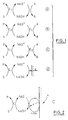
- Mechanism a illustrates chemical regeneration; the molecule ensuring regeneration directly reduces NAD+ to NADH.
- Hydrogen used under pressure, was proposed as a reducing molecule (Biotechnology and Bioengineering, Vol. 7 No. 9 1985 pp. 1277-1281), but his job laying out and setting security problems.
- Mechanism b illustrates an enzymatic regeneration with an enzyme that accepts several substrates: the same enzyme catalyzes the synthesis and regeneration reactions.
- Mechanism c illustrates a synthesis and regeneration process, each involving a different enzyme and substrate.
- the mechanism illustrates an electrochemical regeneration.
- Electrochemical processes seem attractive at least theoretically because they make it very easy to fix the rate of regeneration by choosing the electrode potential and to avoid the use of the reagent and the regeneration enzyme (fig. 1) . Furthermore, they offer the possibility of easy control of the reaction by measuring the electrolysis intensity over time.
- the advantages are limited by the incompatibility of certain reagents capable of reacting directly on the electrode brought to the reduction potential; pollution of the electrode by adsorbable products and reagents and lack of selectivity are other major drawbacks. This latter difficulty is particularly sensitive for reduction due to the formation by monoelectronic transfer of the radical intermediate NAD . likely to dimerize quickly.
- the radical appears on the electrodes whatever their nature.
- the present invention aims to overcome the above drawbacks by proposing an electrochemical regeneration process of the pyridine cofactor, NADH in the presence of a hydrogenase enzyme, the regeneration reaction and the synthesis reaction being carried out in the same medium and the same apparatus. .
- the subject of the invention is a process for the electrochemical regeneration of pyridine cofactors used in enzymatic synthesis processes by reduction of NAD+ to NADH characterized in that it is carried out by electrolysis on an electrode in the presence of a cytoplasmic hydrogenase enzyme.
- Aerobic bacteria capable of oxidizing hydrogen generally comprise a soluble hydrogenase, called cytoplasmic hydrogenase, which reduces NAD+ and a hydrogenase strongly bound on the membrane, incapable of reducing NAD+, but whose role is to provide electrons for the generation of energy in a chain of electron transporters.
- the cytoplasmic hydrogenase extracted from a bacterium comprising it will be used in the process of the invention.
- bacteria comprising this type of enzyme
- the cytoplasmic hydrogenase of Alcaligenes eutrophus is preferably used.
- the soluble hydrogenase of Alcaligenes eutrophus has redox centers containing 2 mononucleotide flavins, 2 clusters 4Fe-4S and 2 clusters 2Fe-2S with apparent normal potentials (pH 7) respectively equal to -0.445 and -0.325 V as well as nickel. It differs from the soluble hydrogenases of anaerobic bacteria by its high molecular weight, its complex structure and its relative tolerance towards oxygen.
- the flavin of the hydrogenase undoubtedly plays an important role in this transfer by ensuring the electronic relay between the electrode and the Fe-S clusters which are reduced as indicated by the evolution of the spectra.
- the reduction of the enzyme by electrochemistry can be demonstrated by spectroscopy at the potential of -0.65 volts; reoxidation begins at - 0.5 volts and is completed at + 0.1 volts.
- the enzyme therefore plays a role of redox mediator between the electrode and NAD+ and no denaturation of NAD+ or NADH only appears when these molecules are put into an electric field. Furthermore, unlike direct reduction experiments, the dimer has never been demonstrated. We can probably explain a bielectronic transfer facilitated by the formation of the enzyme-NAD+ complex in which the cofactor is in the most favorable structure to accept two electrons, the enzyme serving as an electronic relay. The formation of the dimer does not take place because the adsorption of NAD+ or NAD on the electrode is probably prevented by a stronger adsorption of the enzyme.
- any unassailable electrode that is to say electrode remaining in its original state in the presence of the solvent of the medium, containing or not containing oxygen, and therefore unable to form ions with said medium likely to go into solution.
- electrodes that can be used include electrodes made of precious metals, gold, platinum, iridium (or their alloys), electrodes made of carbon, tungsten or nickel. The platinum electrodes should preferably be used.
- the operating conditions temperature pH of the process of the invention are closely linked to the main synthesis reaction while ensuring for it the stability of the enzymes and a maximum yield.
- the temperature will generally be between 0 and 40 ° C and the pH between 5 and 10.
- the sensitive point of the process is to properly regulate the potential of electrolysis. It will generally be between - 0.5 and - 0.9 volts and preferably between - 0.65 and - 0.75 volts. It is important to avoid lowering this potential too much, which could lead to the release of hydrogen and therefore an increase in the pH which could denature the enzymes. and / or the substrate and impair the reaction rate.
- the process of the invention is general in scope, that is to say, it can be used for a wide range of enzymatic redox reactions. This versatility will be illustrated in the examples given below for several different reactions.
- the bioelectrocatalytic regeneration of NADH is carried out by reduction of NAD+ in the presence of hydrogenase, coupled with an enzymatic reduction reaction according to the diagram in FIG. 2.
- the cofactor is generally added to the medium in the oxidized form NAD+.
Landscapes
- Organic Chemistry (AREA)
- Chemical & Material Sciences (AREA)
- Life Sciences & Earth Sciences (AREA)
- Zoology (AREA)
- Engineering & Computer Science (AREA)
- Wood Science & Technology (AREA)
- Chemical Kinetics & Catalysis (AREA)
- Bioinformatics & Cheminformatics (AREA)
- General Chemical & Material Sciences (AREA)
- Biotechnology (AREA)
- Mycology (AREA)
- Health & Medical Sciences (AREA)
- Biochemistry (AREA)
- Microbiology (AREA)
- General Engineering & Computer Science (AREA)
- General Health & Medical Sciences (AREA)
- Genetics & Genomics (AREA)
- Preparation Of Compounds By Using Micro-Organisms (AREA)
- Electrolytic Production Of Metals (AREA)
- Pyridine Compounds (AREA)
- Electrolytic Production Of Non-Metals, Compounds, Apparatuses Therefor (AREA)
- Secondary Cells (AREA)
Description
- La présente invention a pour objet un procédé de régénération électrochimique de cofacteurs pyridiniques utilisés dans les procédés de synthèse enzymatique de produits organiques.
- L'étude de l'utilisation des enzymes d'oxydo-réduction en synthèse organique se développe rapidement. Ces procédés de synthèse enzymatique mettent en oeuvre des cofacteurs pyridiniques tels que le NADH (nicotinamide adénine dinucléotide) impliqués dans le mécanisme d'oxydation réduction. Toutefois, la transposition des résultats obtenus en laboratoire à une plus grande échelle nécessite la régénération des cofacteurs pyridiniques beaucoup trop chers pour être utilisés en quantités stoechiométriques. Il semble d'ailleurs que l'absence de méthodes suffisamment efficaces empêche le développement à l'échelle industrielle de procédés de préparation de produits commerciaux. C'est la raison pour laquelle on assiste au développement de nombreux travaux pour la recherche des conditions optimales de régénération de ces cofacteurs. Celle-ci peut être réalisée par voie chimique, enzymatique ou électrochimique. L'analyse des avantages et inconvénients de ces diverses voies montre qu'aucune technique générale de régénération ne donne entière satisfaction et il convient dans chaque cas particulier d'envisager l'optimisation de l'ensemble réaction directe régénération (Applied Biochemistry and Biotechnology, Vol. 14, 1987 pp. 147-197).
- Les méthodes de régénération de NADH c'est-à-dire la réduction de la forme NAD⁺ résultant de processus de réduction du substrat à transformer sont illustrées en figure 1 dans laquelle :
- . S désigne le substrat à transformer
- . P désigne le produit de synthèse à obtenir
- . E₁ E₂ désignent les enzymes impliquées dans le mécanisme A et B les substrats et produits secondaires impliqués dans la régénération.
- Le mécanisme a illustre une régénération chimique; la molécule assurant la régénération réduit directement NAD⁺ en NADH. L'hydrogène, utilisée sous pression, a été proposée comme une molécule réductrice (Biotechnology and bioengineering, Vol. 7 no 9 1985, pp. 1277-1281) mais son emploi pose des problèmes de mise en oeuvre et de sécurité.
- Le mécanisme b illustre une régénération enzymatique avec une enzyme qui accepte plusieurs substrats: la même enzyme catalyse les réactions de synthèse et de régénération.
- Le mécanisme c illustre un processus de synthèse et de régénération mettant chacun en jeu une enzyme et un substrat différents.
- Le mécanisme d illustre une régénération électrochimique.
- Dans le cas de la réduction de NAD⁺, les méthodes enzymatiques ont donné les meilleurs résultats. Parmi les systèmes enzymatiques utilisés, on peut citer les couples substrats-enzymes suivants : formiate-formiate déshydrogénase, glucose 6.phosphate-glucose 6.phosphate déshydrogénase, glucose-glucose déshydrogénase, éthanol-alcool déshydrogénase, hydrogène-hydrogénase.
- Il a été proposé (Biotechnology letters 1983, 5(7), 463-468) d'utiliser des enzymes telles que l'hydrogénase d'Alcaligenes eutrophus pour réduire NAD⁺ en NADH par l'hydrogène. Cependant, la stabilité de l'enzyme fixée était très faible, notamment en raison de l'oxygène ou d'oxydants divers, interdisant la mise au point d'un procédé efficace qui, par ailleurs, n'envisage en aucun cas une mise en oeuvre de type électrochimique.
- Les procédés électrochimiques semblent attractifs au moins théoriquement parce qu'ils permettent de fixer très facilement la vitesse de régénération par le choix du potentiel d'électrode et d'éviter l'emploi du réactif et de l'enzyme de régénération (fig.1). Par ailleurs, ils offrent la possibilité d'un contrôle facile de la réaction par la mesure de l'intensité d'électrolyse au cours du temps. Toutefois, les avantages sont limités par l'incompatibilité de certains réactifs susceptibles de réagir directement sur l'électrode portée au potentiel de réduction ; la pollution de l'électrode par les produits et les réactifs adsorbables et le manque de sélectivité sont d'autres inconvénients majeurs. Cette dernière difficulté est particulièrement sensible pour la réduction en raison de la formation par transfert monoélectronique de l'intermédiaire radicalaire NAD. susceptible de se dimériser rapidement. Le radical apparaît sur les électrodes quelle que soit leur nature.
- Certains essais ont été effectués pour contourner cette difficulté par la modification des surfaces par des médiateurs chimiques fixés ainsi que par l'emploi de médiateurs en solution. Ces tentatives n'ont pas encore permis de trouver une sélectivité suffisante et de ce fait, la réduction électrochimique directe ou indirecte de NAD⁺ ne s'est pas développée.
- La réduction électrochimique de NAD⁺ a surtout été envisagée sur électrode de mercure sur laquelle apparaît essentiellement le dimère (NAD)₂ et NADH dans quelques cas particuliers. L'accent est mis surtout sur l'aspect mécanistique et sur les phénomènes d'adsorption.
- Sur électrode de platine nue, la réduction de NAD⁺ donne un mélange de NADH et (NAD)₂ ; elle se produit dans la zone de potentiel où se dégage l'hydrogène gazeux. La réduction est fortement dépendante de l'état de surface de l'électrode.
- Il a également été proposé (Journal of Biotechnology, vol. 1 1984 pp. 95-109) d'utiliser des médiateurs comme le méthylviologène, souvent associé à des cellules entières ou à des extraits cellulaires. Dans le mécanisme, le médiateur sert de relais dans le transfert d'électrons entre l'électrode et NAD⁺ et intervient dans une réaction catalysée par le biosystème. Il faut remarquer que l'apparition d'intermédiaires radicalaires pénalise le rendement ; de plus, la biocompatibilité médiateur biosystème est réduite.
- La présente invention a pour but de pallier les inconvénients précédents en proposant un procédé de régénération électrochimique du cofacteur pyridinique, NADH en présence d'une enzyme hydrogénase, la réaction de régénération et la réaction de synthèse étant réalisées dans le même milieu et le même appareillage.
- L'invention a pour objet un procédé de régénération électrochimique de cofacteurs pyridiniques utilisés dans les procédés de synthèse enzymatiques par réduction de NAD⁺ en NADH caractérisé en ce qu'il est réalisé par électrolyse sur une électrode en présence d'une enzyme hydrogénase cytoplasmique.
- Les bactéries aérobies capables d'oxyder l'hydrogène comportent en général une hydrogénase soluble, dénommée hydrogénase cytoplasmique, qui réduit NAD⁺ et une hydrogénase fortement liée sur la membrane, incapable de réduire NAD⁺, mais dont le rôle est de fournir des électrons pour la génération d'énergie dans une chaîne de transporteurs d'électrons.
- On utilisera dans le procédé de l'invention l'hydrogénase cytoplasmique extraite d'une bactérie la comportant. A titre d'exemple de bactéries comportant ce type d'enzyme, on peut citer Nocardia opaca (qui ne comporte pas d'hydrogénase membranaire) Alcaligenes eutrophus, Pseudomonas ruhlandii et Pseudomonas saccharophila ces dernières contenant les deux types d'enzymes. On utilisera de préférence l'hydrogénase cytoplasmique d'Alcaligenes eutrophus.
- L'hydrogénase soluble d'Alcaligenes eutrophus possède des centres redox contenant 2 flavines mononucléotides, 2 clusters 4Fe-4S et 2 clusters 2Fe-2S de potentiels normaux apparents (pH 7) respectivement égaux à -0.445 et -0.325 V ainsi que du nickel. Elle diffère des hydrogénases solubles des bactéries anaérobies par son poids moléculaire élevé, sa structure complexe et sa relative tolérance vis-à-vis de l'oxygène.
- Ces propriétés font de cette enzyme un cas particulier dans le domaine des hydrogénases en raison des mécanismes complexes de son fonctionnement qui permet son emploi dans le domaine de la biotechnologie pour la régénération de NADH.
- Il semble que ce mécanisme de fonctionnement permette un transfert électronique direct électrode-enzyme (hydrogénase) particulièrement favorable à la réduction du NAD⁺ sans création des radicaux NAD. précurseurs du (NAD)₂.
- La flavine de l'hydrogénase joue sans doute un rôle important dans ce transfert en assurant le relais électronique entre l'électrode et les clusters Fe-S qui se réduisent comme l'indique l'évolution des spectres.
- Le schéma de régénération électrochimique utilisant l'hydrogénase cytoplasmique est illustré figure 2 dans laquelle :
- . Hase désigne : l'hydrogénase d'Alcaligenes eutrophus
- . E désigne : l'enzyme qui catalyse la réaction chimique ayant lieu en solution
- . S et P désignent : le substrat et le produit participant à la réaction chimique
- . C désigne : l'électrode, cathode au niveau de laquelle est engendré l'électron.
- La réduction de l'enzyme par électrochimie peut être mise en évidence par spectroscopie au potentiel de -0,65 volt ; la réoxydation s'amorce à - 0,5 volt et se complète à + 0,1 volt.
- La mesure de l'activité enzymatique effectuée sur la solution prélevée après plusieurs réductions et réoxydations indique que le transfert électronique n'entraîne pas de perte d'activité. Au contraire dans les premiers instants après l'arrêt de l'électrolyse on observe une légère augmentation de cette valeur.
- L'enzyme joue donc un rôle de médiateur d'oxydo-réduction entre l'électrode et NAD⁺ et aucune dénaturation de NAD⁺ ou NADH n'apparaît lorsque ces molécules sont mises dans un champ électrique. Par ailleurs, contrairement aux expériences de réduction directe, le dimère n'a jamais été mis en évidence. On peut sans doute expliquer un transfert biélectronique facilité par la formation du complexe enzyme-NAD⁺ dans lequel le cofacteur est dans la structure la plus favorable pour accepter deux électrons, l'enzyme servant de relai électronique. La formation du dimère n'a pas lieu car l'adsorption de NAD⁺ ou NAD sur l'électrode est probablement empêchée par une plus forte adsorption de l'enzyme.
- Dans le procédé de l'invention on pourra utiliser toute électrode inattaquable c'est-à-dire restant dans son état originel en présence du solvant du milieu, contenant ou non de l'oxygène, et donc ne pouvant former avec ledit milieu des ions susceptibles de passer en solution. A titre d'exemples d'électrodes utilisables on peut citer les électrodes en métaux précieux or, platine, iridium (ou leurs alliages), les électrodes au carbone, au tungstène ou au nickel. On utilisera de préférence les électrodes en platine.
- Les conditions opératoires température pH du procédé de l'invention sont étroitement liées à la réaction de synthèse principale en assurant pour celle-ci la stabilité des enzymes et un rendement maximal. La température sera généralement comprise entre 0 et 40°C et le pH compris entre 5 et 10.
- Le point sensible de procédé est de bien réguler le potentiel de l'électrolyse. Il sera en général compris entre - 0,5 et - 0,9 volt et de préférence entre - 0,65 et - 0,75 volt. Il importe d'éviter de trop abaisser ce potentiel qui risquerait d'entraîner un dégagement d'hydrogène et donc une augmentation du pH susceptible de dénaturer les enzymes et/ou le substrat et de porter atteinte à la vitesse de réaction.
- Le procédé de l'invention est de portée générale, c'est-à-dire, qu'il est utilisable pour une large gamme de réactions d'oxydo-réduction enzymatiques. Cette polyvalence sera illustrée dans les exemples donnés ci-après pour plusieurs réactions différentes.
- Les conditions opératoires précises de mise en oeuvre du procédé : potentiel, pH du milieu, teneur, sont déterminées cas par cas selon la réaction enzymatique directe à réaliser et cela par des techniques bien connues.
- La régénération bioélectrocatalytique de NADH s'effectue par réduction de NAD⁺ en présence d'hydrogénase, couplée à une réaction de réduction enzymatique suivant le schéma de la figure 2.
- Sur un plan pratique, une étude préliminaire doit être réalisée consistant à vérifier que, lorsque l'électrode est portée au potentiel de réduction de l'hydrogénase et de formation de NADH
- le substrat n'est pas réduit directement
- le substrat et le produit sont stables
- l'enzyme E ne perd pas son activité dans le champ électrique.
- Le procédé de l'invention est illustré par les exemples 1 à 3 ci-après visant la régénération de NADH utilisée pour la mise en oeuvre des réactions 1 à 3.


Ces réactions sont respectivement catalysées par : - une large lactate déshydrogénase de muscle de lapin (LDH)
- une hydroxyacylcoenzyme A déshydrogénase de coeur de porc (HyACoADH)
- une glutamate déshydrogénase de foie de boeuf (G1DH)
- Ces expériences de régénération couplées à une réaction enzymatique consistent en des électrolyses à un potentiel déterminé précédemment de manière conventionnelle. Le substrat, le cofacteur et les deux enzymes en solution dans le milieu approprié à la réaction sont introduits dans la couche mince ; après une réduction de 90 min., la solution est prélevée et la mesure des concentrations du produit et du cofacteur restant est effectuée.
- Les solutions électrolytiques sont préparées à partir d'eau distillée et de sels de grande pureté. Les différentes solutions utilisées sont réalisées de la façon suivante :
- pH 6.5 et 7 : solution de phosphate monopotassique et disodique 0.2 M en phosphate ou solution de triéthanolamine 0.05 M, HCl
- pH 8 : solution phosphate 0.2 M
- pH 9 : solution de carbonate de potassium 0.1 M ou solution de glycine 0.6 M, hydrazine 0.5 M
- pH 10 : solution de carbonate de potassium 0.1 M
- Les différents dosages, spectrophotométriques, sont réalisés en mettant en oeuvre les réactions indiquées ci-dessus et ne nécessitent que quelques microlitres de solution.
- Exemple 1 : lactate et pyruvate : on met en oeuvre la réaction 1 et le dosage spectrophotométrique de NADH à 340 nm. Pour le lactate le pH de la solution est égal à 9 en milieu glycine, la réaction est relativement lente. Le dosage du pyruvate a lieu en milieu phosphate à pH 8 pour lequel la réaction est rapide.
- Exemple 2 : acétoacétylCoA : on utilise pour le dosage du réactif et du produit la réaction 2 favorisée dans le sens a à pH 7 dans le sens b à pH 10 ; dans les deux cas, on peut suivre la disparition ou l'apparition de NADH par spectrophotométrie à la longueur d'onde de 340 nm.
- Exemple 3 : -cétoglutarate : le dosage est réalisé en milieu triéthanolamine ou en milieu phosphate, le pH de la solution étant égal à 7. Sont ajoutés NH₄ ⁺ 0.1 M, NADH 0.27 mM, la glutamate déshydrogénase et la disparition de NADH au cours de la réaction 3 est suivie au cours du temps.
- glutamate : la solution a un pH égal à 8.6 ; on utilise la réaction 3 dans le sens b couplée à la réaction NADH + INT + N⁺ ---> NAD⁺ + formazan qui favorise le déplacement de l'équilibre 3 dans le sens b (INT est l'iodonitrotétrazolium). Le formazan est dosé spectrophotométriquement à la longueur d'onde de 492 nm.
- Les conditions générales de ces essais et les résultats obtenus sont résumés dans le tableau 1 ci-dessous qui concernent la régénération du cofacteur par réduction de NAD⁺.

- Pour ces expériences, le temps d'électrolyse a été normalisé à 90 mn. Le total turnover (TTN), c'est-à-dire le rapport du nombre de mole de produit formé au nombre de mole de cofacteur, a été déterminé à partir du bilan effectué sur les concentrations de substrat et de produit au moment du prélévement, ce qui permet de vérifier que l'enzyme joue son rôle normal dans la réaction étudiée. Les résultats présentés sont la moyenne de 5 à 10 expériences pour chaque substrat. Ils aménent quelques commentaires :
- la valeur du TTN prouve la régénération du cofacteur et son faible niveau ne provient que de la géométrie de la cellule et des conditions expérimentales non optimisées de mise en oeuvre de la régénération.
- NAD⁺ se retrouve en totalité à l'état natif à la fin de l'expérience, sans traces détectables de dimère (NAD)₂. Le procédé peut s'étendre à d'autres réactions enzymatiques et se révèle original car il semble que ce soit le premier exemple d'emploi d'une enzyme comme relai électrochimique direct entre une électrode et NAD⁺. Sa mise en oeuvre passe par une optimisation du réacteur électrochimique qui, en particulier, doit être en atmosphère inerte. D'autre part, la précision du contrôle du potentiel de l'électrode de travail fait de la méthode électrochimique un outil plus simple et plus sélectif que la réduction par l'hydrogène moléculaire qui utiliserait la même enzyme.
- Dans le processus industriel, le cofacteur est généralement ajouté au milieu sous la forme oxydée NAD⁺.
- Il est alors très avantageux d'ajouter au milieu, à côté de NAD⁺ des traces de NADH, ce qui permet de mieux initier la réaction, et de maintenir ce léger excès de NADH durant le processus en continu.
Claims (8)
- Procédé de régénération par réduction d'un cofacteur pyridinique de type NAD⁺/NADH utilisé dans une réaction enzymatique de synthèse organique caractérisé en ce qu'il est réalisé au sein du milieu réactionnel au moyen d'une électrode en présence d'une enzyme hydrogénase cytoplasmique.
- Procédé selon la revendication 1 caractérisé en ce que l'enzyme est l'hydrogénase cytoplasmique d'Alcaligenes eutrophus.
- Procédé selon une des revendications 1 ou 2 caractérisé en ce que l'électrode est constitué d'un métal précieux.
- Procédé selon la revendication 3 caractérisé en ce que l'électrode est en platine.
- Procédé selon l'une des revendications 1 à 4 caractérisé en ce que le potentiel de l'électrolyse est compris entre - 0,5 et - 0,9 volt.
- Procédé selon la revendication 5 caractérisé en ce que le potentiel est compris entre - 0,65 et - 0,75 volt.
- Procédé selon l'une des revendications 1 à 6 caractérisé en ce que le pH est compris entre 5 et 10.
- Procédé selon l'une des revendications 1 à 7 caractérisé en ce que des traces de NADH sont ajoutés au milieu en même temps que le cofacteur sous forme de NAD⁺.
Priority Applications (1)
| Application Number | Priority Date | Filing Date | Title |
|---|---|---|---|
| AT89402477T ATE97694T1 (de) | 1988-09-13 | 1989-09-12 | Verfahren zur elektrochemischen regeneration von pyridin-cofaktoren. |
Applications Claiming Priority (2)
| Application Number | Priority Date | Filing Date | Title |
|---|---|---|---|
| FR8811933 | 1988-09-13 | ||
| FR8811933A FR2636344B1 (fr) | 1988-09-13 | 1988-09-13 | Procede de regeneration electrochimique de cofacteurs pyridiniques |
Publications (2)
| Publication Number | Publication Date |
|---|---|
| EP0359649A1 EP0359649A1 (fr) | 1990-03-21 |
| EP0359649B1 true EP0359649B1 (fr) | 1993-11-24 |
Family
ID=9369946
Family Applications (1)
| Application Number | Title | Priority Date | Filing Date |
|---|---|---|---|
| EP89402477A Expired - Lifetime EP0359649B1 (fr) | 1988-09-13 | 1989-09-12 | Procédé de régénération électrochimique de cofacteurs pyridiniques |
Country Status (5)
| Country | Link |
|---|---|
| EP (1) | EP0359649B1 (fr) |
| JP (1) | JPH02142488A (fr) |
| AT (1) | ATE97694T1 (fr) |
| DE (1) | DE68910914T2 (fr) |
| FR (1) | FR2636344B1 (fr) |
Families Citing this family (1)
| Publication number | Priority date | Publication date | Assignee | Title |
|---|---|---|---|---|
| DE102008030036B4 (de) * | 2008-06-18 | 2013-04-11 | Technische Universität Dresden | Verfahren für enzymkatalysierte Synthesen, zur Optimierung biotechnologischer und biosensorischer Prozesse und zur Regeneration von Cofaktoren |
-
1988
- 1988-09-13 FR FR8811933A patent/FR2636344B1/fr not_active Expired - Fee Related
-
1989
- 1989-09-12 DE DE68910914T patent/DE68910914T2/de not_active Expired - Fee Related
- 1989-09-12 EP EP89402477A patent/EP0359649B1/fr not_active Expired - Lifetime
- 1989-09-12 AT AT89402477T patent/ATE97694T1/de not_active IP Right Cessation
- 1989-09-13 JP JP1235868A patent/JPH02142488A/ja active Pending
Also Published As
| Publication number | Publication date |
|---|---|
| ATE97694T1 (de) | 1993-12-15 |
| FR2636344B1 (fr) | 1990-10-12 |
| EP0359649A1 (fr) | 1990-03-21 |
| DE68910914T2 (de) | 1994-05-19 |
| FR2636344A1 (fr) | 1990-03-16 |
| DE68910914D1 (de) | 1994-01-05 |
| JPH02142488A (ja) | 1990-05-31 |
Similar Documents
| Publication | Publication Date | Title |
|---|---|---|
| US5538867A (en) | Process for the electrochemical regeneration of pyridine cofactors | |
| Cass et al. | Ferricinium ion as an electron acceptor for oxido-reductases | |
| Lindgren et al. | Direct electron transfer between the heme of cellobiose dehydrogenase and thiol modified gold electrodes | |
| Ogino et al. | Reactions between diaphorase and quinone compounds in bioelectrocatalytic redox reactions of NADH and NAD+ | |
| Shleev et al. | Direct heterogeneous electron transfer reactions of Trametes hirsuta laccase at bare and thiol‐modified gold electrodes | |
| JP5207576B2 (ja) | 燃料電池、ポータブル電源及び電子機器 | |
| Schröder et al. | In situ NAD+ regeneration using 2, 2′-azinobis (3-ethylbenzothiazoline-6-sulfonate) as an electron transfer mediator | |
| Kulys et al. | Study of the new electron transfer mediators in glucose oxidase catalysis | |
| Okawa et al. | Tethered mediator biosensor. Mediated electron transfer between redox enzyme and electrode via ferrocene anchored to electrode surface with long poly (oxyethylene) chain | |
| JPH07506675A (ja) | 過酸化水素の検出用電極及び方法 | |
| Lobo-Castanon et al. | A bienzyme-poly-(o-phenylenediamine)-modified carbon paste electrode for the amperometric detection of L-lactate | |
| Shumyantseva et al. | Electrochemical reduction of flavocytochromes 2B4 and 1A2 and their catalytic activity | |
| Shul'ga et al. | Glucose-sensitive enzyme field effect transistor using potassium ferricyanide as an oxidizing substrate | |
| Tzang et al. | Voltammetric biosensors for the determination of formate and glucose-6-phosphate based on the measurement of dehydrogenase-generated NADH and NADPH | |
| Takeda et al. | The two-step electrochemical oxidation of alcohols using a novel recombinant PQQ alcohol dehydrogenase as a catalyst for a bioanode | |
| Ikeda et al. | Enzyme-catalysed electrochemical oxidation of D-gluconate at electrodes coated with D-gluconate dehydrogenase, a membrane-bound flavohemoprotein | |
| Hasebe et al. | Highly sensitive flow detection of uric acid based on an intermediate regeneration of uricase | |
| Kulys | Amperometric enzyme electrodes in analytical chemistry | |
| EP0359649A1 (fr) | Procédé de régénération électrochimique de cofacteurs pyridiniques | |
| Kulys et al. | Recombinant Microdochium nivale carbohydrate oxidase and its application in an amperometric glucose sensor | |
| Gajdzik et al. | Electrochemical screening of redox mediators for electrochemical regeneration of NADH | |
| Nedoluzhko et al. | Enzymatic oxidation of cadmium and lead metals photodeposited on cadmium sulfide | |
| EP0388267A1 (fr) | Procédé de régénération par réduction électrochimique d'un cofacteur pyridinique | |
| US20070009983A1 (en) | Pyridine nucleotide dehydrogenase based biosensor electrodes | |
| Tetianec et al. | Characterization of methylated azopyridine as a potential electron transfer mediator for electroenzymatic systems |
Legal Events
| Date | Code | Title | Description |
|---|---|---|---|
| PUAI | Public reference made under article 153(3) epc to a published international application that has entered the european phase |
Free format text: ORIGINAL CODE: 0009012 |
|
| 17P | Request for examination filed |
Effective date: 19890915 |
|
| AK | Designated contracting states |
Kind code of ref document: A1 Designated state(s): AT BE CH DE ES FR GB IT LI NL SE |
|
| 17Q | First examination report despatched |
Effective date: 19930505 |
|
| GRAA | (expected) grant |
Free format text: ORIGINAL CODE: 0009210 |
|
| AK | Designated contracting states |
Kind code of ref document: B1 Designated state(s): AT BE CH DE ES FR GB IT LI NL SE |
|
| PG25 | Lapsed in a contracting state [announced via postgrant information from national office to epo] |
Ref country code: SE Effective date: 19931124 Ref country code: ES Free format text: THE PATENT HAS BEEN ANNULLED BY A DECISION OF A NATIONAL AUTHORITY Effective date: 19931124 |
|
| REF | Corresponds to: |
Ref document number: 97694 Country of ref document: AT Date of ref document: 19931215 Kind code of ref document: T |
|
| REF | Corresponds to: |
Ref document number: 68910914 Country of ref document: DE Date of ref document: 19940105 |
|
| ITF | It: translation for a ep patent filed | ||
| GBT | Gb: translation of ep patent filed (gb section 77(6)(a)/1977) |
Effective date: 19940224 |
|
| PLBE | No opposition filed within time limit |
Free format text: ORIGINAL CODE: 0009261 |
|
| STAA | Information on the status of an ep patent application or granted ep patent |
Free format text: STATUS: NO OPPOSITION FILED WITHIN TIME LIMIT |
|
| 26N | No opposition filed | ||
| PG25 | Lapsed in a contracting state [announced via postgrant information from national office to epo] |
Ref country code: FR Effective date: 19950531 |
|
| REG | Reference to a national code |
Ref country code: FR Ref legal event code: ST |
|
| PGFP | Annual fee paid to national office [announced via postgrant information from national office to epo] |
Ref country code: GB Payment date: 19980827 Year of fee payment: 10 Ref country code: DE Payment date: 19980827 Year of fee payment: 10 Ref country code: CH Payment date: 19980827 Year of fee payment: 10 |
|
| PGFP | Annual fee paid to national office [announced via postgrant information from national office to epo] |
Ref country code: NL Payment date: 19980828 Year of fee payment: 10 |
|
| PGFP | Annual fee paid to national office [announced via postgrant information from national office to epo] |
Ref country code: AT Payment date: 19980831 Year of fee payment: 10 |
|
| PGFP | Annual fee paid to national office [announced via postgrant information from national office to epo] |
Ref country code: BE Payment date: 19981008 Year of fee payment: 10 |
|
| PG25 | Lapsed in a contracting state [announced via postgrant information from national office to epo] |
Ref country code: GB Free format text: LAPSE BECAUSE OF NON-PAYMENT OF DUE FEES Effective date: 19990912 Ref country code: AT Free format text: LAPSE BECAUSE OF NON-PAYMENT OF DUE FEES Effective date: 19990912 |
|
| PG25 | Lapsed in a contracting state [announced via postgrant information from national office to epo] |
Ref country code: LI Free format text: LAPSE BECAUSE OF NON-PAYMENT OF DUE FEES Effective date: 19990930 Ref country code: CH Free format text: LAPSE BECAUSE OF NON-PAYMENT OF DUE FEES Effective date: 19990930 Ref country code: BE Free format text: LAPSE BECAUSE OF NON-PAYMENT OF DUE FEES Effective date: 19990930 |
|
| BERE | Be: lapsed |
Owner name: SOC. NATIONALE ELF AQUITAINE Effective date: 19990930 |
|
| PG25 | Lapsed in a contracting state [announced via postgrant information from national office to epo] |
Ref country code: NL Free format text: LAPSE BECAUSE OF NON-PAYMENT OF DUE FEES Effective date: 20000401 |
|
| GBPC | Gb: european patent ceased through non-payment of renewal fee |
Effective date: 19990912 |
|
| REG | Reference to a national code |
Ref country code: CH Ref legal event code: PL |
|
| NLV4 | Nl: lapsed or anulled due to non-payment of the annual fee |
Effective date: 20000401 |
|
| PG25 | Lapsed in a contracting state [announced via postgrant information from national office to epo] |
Ref country code: DE Free format text: LAPSE BECAUSE OF NON-PAYMENT OF DUE FEES Effective date: 20000701 |
|
| PG25 | Lapsed in a contracting state [announced via postgrant information from national office to epo] |
Ref country code: IT Free format text: LAPSE BECAUSE OF NON-PAYMENT OF DUE FEES;WARNING: LAPSES OF ITALIAN PATENTS WITH EFFECTIVE DATE BEFORE 2007 MAY HAVE OCCURRED AT ANY TIME BEFORE 2007. THE CORRECT EFFECTIVE DATE MAY BE DIFFERENT FROM THE ONE RECORDED. Effective date: 20050912 |