EP0357508A1 - Use of improved lubricant for the production of seamless steel pipes - Google Patents
Use of improved lubricant for the production of seamless steel pipes Download PDFInfo
- Publication number
- EP0357508A1 EP0357508A1 EP89402368A EP89402368A EP0357508A1 EP 0357508 A1 EP0357508 A1 EP 0357508A1 EP 89402368 A EP89402368 A EP 89402368A EP 89402368 A EP89402368 A EP 89402368A EP 0357508 A1 EP0357508 A1 EP 0357508A1
- Authority
- EP
- European Patent Office
- Prior art keywords
- lubricant
- fine
- salt
- water
- resins
- Prior art date
- Legal status (The legal status is an assumption and is not a legal conclusion. Google has not performed a legal analysis and makes no representation as to the accuracy of the status listed.)
- Granted
Links
Images

Classifications
-
- C—CHEMISTRY; METALLURGY
- C10—PETROLEUM, GAS OR COKE INDUSTRIES; TECHNICAL GASES CONTAINING CARBON MONOXIDE; FUELS; LUBRICANTS; PEAT
- C10M—LUBRICATING COMPOSITIONS; USE OF CHEMICAL SUBSTANCES EITHER ALONE OR AS LUBRICATING INGREDIENTS IN A LUBRICATING COMPOSITION
- C10M3/00—Liquid compositions essentially based on lubricating components other than mineral lubricating oils or fatty oils and their use as lubricants; Use as lubricants of single liquid substances
-
- C—CHEMISTRY; METALLURGY
- C10—PETROLEUM, GAS OR COKE INDUSTRIES; TECHNICAL GASES CONTAINING CARBON MONOXIDE; FUELS; LUBRICANTS; PEAT
- C10M—LUBRICATING COMPOSITIONS; USE OF CHEMICAL SUBSTANCES EITHER ALONE OR AS LUBRICATING INGREDIENTS IN A LUBRICATING COMPOSITION
- C10M173/00—Lubricating compositions containing more than 10% water
- C10M173/02—Lubricating compositions containing more than 10% water not containing mineral or fatty oils
-
- C—CHEMISTRY; METALLURGY
- C10—PETROLEUM, GAS OR COKE INDUSTRIES; TECHNICAL GASES CONTAINING CARBON MONOXIDE; FUELS; LUBRICANTS; PEAT
- C10M—LUBRICATING COMPOSITIONS; USE OF CHEMICAL SUBSTANCES EITHER ALONE OR AS LUBRICATING INGREDIENTS IN A LUBRICATING COMPOSITION
- C10M125/00—Lubricating compositions characterised by the additive being an inorganic material
- C10M125/02—Carbon; Graphite
-
- C—CHEMISTRY; METALLURGY
- C10—PETROLEUM, GAS OR COKE INDUSTRIES; TECHNICAL GASES CONTAINING CARBON MONOXIDE; FUELS; LUBRICANTS; PEAT
- C10M—LUBRICATING COMPOSITIONS; USE OF CHEMICAL SUBSTANCES EITHER ALONE OR AS LUBRICATING INGREDIENTS IN A LUBRICATING COMPOSITION
- C10M129/00—Lubricating compositions characterised by the additive being an organic non-macromolecular compound containing oxygen
- C10M129/02—Lubricating compositions characterised by the additive being an organic non-macromolecular compound containing oxygen having a carbon chain of less than 30 atoms
- C10M129/26—Carboxylic acids; Salts thereof
- C10M129/56—Acids of unknown or incompletely defined constitution
-
- C—CHEMISTRY; METALLURGY
- C10—PETROLEUM, GAS OR COKE INDUSTRIES; TECHNICAL GASES CONTAINING CARBON MONOXIDE; FUELS; LUBRICANTS; PEAT
- C10M—LUBRICATING COMPOSITIONS; USE OF CHEMICAL SUBSTANCES EITHER ALONE OR AS LUBRICATING INGREDIENTS IN A LUBRICATING COMPOSITION
- C10M135/00—Lubricating compositions characterised by the additive being an organic non-macromolecular compound containing sulfur, selenium or tellurium
- C10M135/08—Lubricating compositions characterised by the additive being an organic non-macromolecular compound containing sulfur, selenium or tellurium containing a sulfur-to-oxygen bond
- C10M135/10—Sulfonic acids or derivatives thereof
-
- C—CHEMISTRY; METALLURGY
- C10—PETROLEUM, GAS OR COKE INDUSTRIES; TECHNICAL GASES CONTAINING CARBON MONOXIDE; FUELS; LUBRICANTS; PEAT
- C10M—LUBRICATING COMPOSITIONS; USE OF CHEMICAL SUBSTANCES EITHER ALONE OR AS LUBRICATING INGREDIENTS IN A LUBRICATING COMPOSITION
- C10M143/00—Lubricating compositions characterised by the additive being a macromolecular hydrocarbon or such hydrocarbon modified by oxidation
-
- C—CHEMISTRY; METALLURGY
- C10—PETROLEUM, GAS OR COKE INDUSTRIES; TECHNICAL GASES CONTAINING CARBON MONOXIDE; FUELS; LUBRICANTS; PEAT
- C10M—LUBRICATING COMPOSITIONS; USE OF CHEMICAL SUBSTANCES EITHER ALONE OR AS LUBRICATING INGREDIENTS IN A LUBRICATING COMPOSITION
- C10M145/00—Lubricating compositions characterised by the additive being a macromolecular compound containing oxygen
-
- C—CHEMISTRY; METALLURGY
- C10—PETROLEUM, GAS OR COKE INDUSTRIES; TECHNICAL GASES CONTAINING CARBON MONOXIDE; FUELS; LUBRICANTS; PEAT
- C10M—LUBRICATING COMPOSITIONS; USE OF CHEMICAL SUBSTANCES EITHER ALONE OR AS LUBRICATING INGREDIENTS IN A LUBRICATING COMPOSITION
- C10M159/00—Lubricating compositions characterised by the additive being of unknown or incompletely defined constitution
- C10M159/02—Natural products
- C10M159/04—Petroleum fractions, e.g. tars, solvents
-
- C—CHEMISTRY; METALLURGY
- C10—PETROLEUM, GAS OR COKE INDUSTRIES; TECHNICAL GASES CONTAINING CARBON MONOXIDE; FUELS; LUBRICANTS; PEAT
- C10M—LUBRICATING COMPOSITIONS; USE OF CHEMICAL SUBSTANCES EITHER ALONE OR AS LUBRICATING INGREDIENTS IN A LUBRICATING COMPOSITION
- C10M2201/00—Inorganic compounds or elements as ingredients in lubricant compositions
- C10M2201/02—Water
-
- C—CHEMISTRY; METALLURGY
- C10—PETROLEUM, GAS OR COKE INDUSTRIES; TECHNICAL GASES CONTAINING CARBON MONOXIDE; FUELS; LUBRICANTS; PEAT
- C10M—LUBRICATING COMPOSITIONS; USE OF CHEMICAL SUBSTANCES EITHER ALONE OR AS LUBRICATING INGREDIENTS IN A LUBRICATING COMPOSITION
- C10M2201/00—Inorganic compounds or elements as ingredients in lubricant compositions
- C10M2201/04—Elements
- C10M2201/041—Carbon; Graphite; Carbon black
-
- C—CHEMISTRY; METALLURGY
- C10—PETROLEUM, GAS OR COKE INDUSTRIES; TECHNICAL GASES CONTAINING CARBON MONOXIDE; FUELS; LUBRICANTS; PEAT
- C10M—LUBRICATING COMPOSITIONS; USE OF CHEMICAL SUBSTANCES EITHER ALONE OR AS LUBRICATING INGREDIENTS IN A LUBRICATING COMPOSITION
- C10M2201/00—Inorganic compounds or elements as ingredients in lubricant compositions
- C10M2201/04—Elements
- C10M2201/041—Carbon; Graphite; Carbon black
- C10M2201/042—Carbon; Graphite; Carbon black halogenated, i.e. graphite fluoride
-
- C—CHEMISTRY; METALLURGY
- C10—PETROLEUM, GAS OR COKE INDUSTRIES; TECHNICAL GASES CONTAINING CARBON MONOXIDE; FUELS; LUBRICANTS; PEAT
- C10M—LUBRICATING COMPOSITIONS; USE OF CHEMICAL SUBSTANCES EITHER ALONE OR AS LUBRICATING INGREDIENTS IN A LUBRICATING COMPOSITION
- C10M2203/00—Organic non-macromolecular hydrocarbon compounds and hydrocarbon fractions as ingredients in lubricant compositions
- C10M2203/10—Petroleum or coal fractions, e.g. tars, solvents, bitumen
-
- C—CHEMISTRY; METALLURGY
- C10—PETROLEUM, GAS OR COKE INDUSTRIES; TECHNICAL GASES CONTAINING CARBON MONOXIDE; FUELS; LUBRICANTS; PEAT
- C10M—LUBRICATING COMPOSITIONS; USE OF CHEMICAL SUBSTANCES EITHER ALONE OR AS LUBRICATING INGREDIENTS IN A LUBRICATING COMPOSITION
- C10M2203/00—Organic non-macromolecular hydrocarbon compounds and hydrocarbon fractions as ingredients in lubricant compositions
- C10M2203/10—Petroleum or coal fractions, e.g. tars, solvents, bitumen
- C10M2203/102—Aliphatic fractions
-
- C—CHEMISTRY; METALLURGY
- C10—PETROLEUM, GAS OR COKE INDUSTRIES; TECHNICAL GASES CONTAINING CARBON MONOXIDE; FUELS; LUBRICANTS; PEAT
- C10M—LUBRICATING COMPOSITIONS; USE OF CHEMICAL SUBSTANCES EITHER ALONE OR AS LUBRICATING INGREDIENTS IN A LUBRICATING COMPOSITION
- C10M2203/00—Organic non-macromolecular hydrocarbon compounds and hydrocarbon fractions as ingredients in lubricant compositions
- C10M2203/10—Petroleum or coal fractions, e.g. tars, solvents, bitumen
- C10M2203/104—Aromatic fractions
-
- C—CHEMISTRY; METALLURGY
- C10—PETROLEUM, GAS OR COKE INDUSTRIES; TECHNICAL GASES CONTAINING CARBON MONOXIDE; FUELS; LUBRICANTS; PEAT
- C10M—LUBRICATING COMPOSITIONS; USE OF CHEMICAL SUBSTANCES EITHER ALONE OR AS LUBRICATING INGREDIENTS IN A LUBRICATING COMPOSITION
- C10M2203/00—Organic non-macromolecular hydrocarbon compounds and hydrocarbon fractions as ingredients in lubricant compositions
- C10M2203/10—Petroleum or coal fractions, e.g. tars, solvents, bitumen
- C10M2203/106—Naphthenic fractions
-
- C—CHEMISTRY; METALLURGY
- C10—PETROLEUM, GAS OR COKE INDUSTRIES; TECHNICAL GASES CONTAINING CARBON MONOXIDE; FUELS; LUBRICANTS; PEAT
- C10M—LUBRICATING COMPOSITIONS; USE OF CHEMICAL SUBSTANCES EITHER ALONE OR AS LUBRICATING INGREDIENTS IN A LUBRICATING COMPOSITION
- C10M2203/00—Organic non-macromolecular hydrocarbon compounds and hydrocarbon fractions as ingredients in lubricant compositions
- C10M2203/10—Petroleum or coal fractions, e.g. tars, solvents, bitumen
- C10M2203/108—Residual fractions, e.g. bright stocks
-
- C—CHEMISTRY; METALLURGY
- C10—PETROLEUM, GAS OR COKE INDUSTRIES; TECHNICAL GASES CONTAINING CARBON MONOXIDE; FUELS; LUBRICANTS; PEAT
- C10M—LUBRICATING COMPOSITIONS; USE OF CHEMICAL SUBSTANCES EITHER ALONE OR AS LUBRICATING INGREDIENTS IN A LUBRICATING COMPOSITION
- C10M2205/00—Organic macromolecular hydrocarbon compounds or fractions, whether or not modified by oxidation as ingredients in lubricant compositions
-
- C—CHEMISTRY; METALLURGY
- C10—PETROLEUM, GAS OR COKE INDUSTRIES; TECHNICAL GASES CONTAINING CARBON MONOXIDE; FUELS; LUBRICANTS; PEAT
- C10M—LUBRICATING COMPOSITIONS; USE OF CHEMICAL SUBSTANCES EITHER ALONE OR AS LUBRICATING INGREDIENTS IN A LUBRICATING COMPOSITION
- C10M2205/00—Organic macromolecular hydrocarbon compounds or fractions, whether or not modified by oxidation as ingredients in lubricant compositions
- C10M2205/02—Organic macromolecular hydrocarbon compounds or fractions, whether or not modified by oxidation as ingredients in lubricant compositions containing acyclic monomers
-
- C—CHEMISTRY; METALLURGY
- C10—PETROLEUM, GAS OR COKE INDUSTRIES; TECHNICAL GASES CONTAINING CARBON MONOXIDE; FUELS; LUBRICANTS; PEAT
- C10M—LUBRICATING COMPOSITIONS; USE OF CHEMICAL SUBSTANCES EITHER ALONE OR AS LUBRICATING INGREDIENTS IN A LUBRICATING COMPOSITION
- C10M2205/00—Organic macromolecular hydrocarbon compounds or fractions, whether or not modified by oxidation as ingredients in lubricant compositions
- C10M2205/02—Organic macromolecular hydrocarbon compounds or fractions, whether or not modified by oxidation as ingredients in lubricant compositions containing acyclic monomers
- C10M2205/022—Ethene
-
- C—CHEMISTRY; METALLURGY
- C10—PETROLEUM, GAS OR COKE INDUSTRIES; TECHNICAL GASES CONTAINING CARBON MONOXIDE; FUELS; LUBRICANTS; PEAT
- C10M—LUBRICATING COMPOSITIONS; USE OF CHEMICAL SUBSTANCES EITHER ALONE OR AS LUBRICATING INGREDIENTS IN A LUBRICATING COMPOSITION
- C10M2205/00—Organic macromolecular hydrocarbon compounds or fractions, whether or not modified by oxidation as ingredients in lubricant compositions
- C10M2205/04—Organic macromolecular hydrocarbon compounds or fractions, whether or not modified by oxidation as ingredients in lubricant compositions containing aromatic monomers, e.g. styrene
-
- C—CHEMISTRY; METALLURGY
- C10—PETROLEUM, GAS OR COKE INDUSTRIES; TECHNICAL GASES CONTAINING CARBON MONOXIDE; FUELS; LUBRICANTS; PEAT
- C10M—LUBRICATING COMPOSITIONS; USE OF CHEMICAL SUBSTANCES EITHER ALONE OR AS LUBRICATING INGREDIENTS IN A LUBRICATING COMPOSITION
- C10M2205/00—Organic macromolecular hydrocarbon compounds or fractions, whether or not modified by oxidation as ingredients in lubricant compositions
- C10M2205/14—Synthetic waxes, e.g. polythene waxes
-
- C—CHEMISTRY; METALLURGY
- C10—PETROLEUM, GAS OR COKE INDUSTRIES; TECHNICAL GASES CONTAINING CARBON MONOXIDE; FUELS; LUBRICANTS; PEAT
- C10M—LUBRICATING COMPOSITIONS; USE OF CHEMICAL SUBSTANCES EITHER ALONE OR AS LUBRICATING INGREDIENTS IN A LUBRICATING COMPOSITION
- C10M2207/00—Organic non-macromolecular hydrocarbon compounds containing hydrogen, carbon and oxygen as ingredients in lubricant compositions
- C10M2207/10—Carboxylix acids; Neutral salts thereof
-
- C—CHEMISTRY; METALLURGY
- C10—PETROLEUM, GAS OR COKE INDUSTRIES; TECHNICAL GASES CONTAINING CARBON MONOXIDE; FUELS; LUBRICANTS; PEAT
- C10M—LUBRICATING COMPOSITIONS; USE OF CHEMICAL SUBSTANCES EITHER ALONE OR AS LUBRICATING INGREDIENTS IN A LUBRICATING COMPOSITION
- C10M2207/00—Organic non-macromolecular hydrocarbon compounds containing hydrogen, carbon and oxygen as ingredients in lubricant compositions
- C10M2207/10—Carboxylix acids; Neutral salts thereof
- C10M2207/12—Carboxylix acids; Neutral salts thereof having carboxyl groups bound to acyclic or cycloaliphatic carbon atoms
- C10M2207/121—Carboxylix acids; Neutral salts thereof having carboxyl groups bound to acyclic or cycloaliphatic carbon atoms having hydrocarbon chains of seven or less carbon atoms
- C10M2207/123—Carboxylix acids; Neutral salts thereof having carboxyl groups bound to acyclic or cycloaliphatic carbon atoms having hydrocarbon chains of seven or less carbon atoms polycarboxylic
-
- C—CHEMISTRY; METALLURGY
- C10—PETROLEUM, GAS OR COKE INDUSTRIES; TECHNICAL GASES CONTAINING CARBON MONOXIDE; FUELS; LUBRICANTS; PEAT
- C10M—LUBRICATING COMPOSITIONS; USE OF CHEMICAL SUBSTANCES EITHER ALONE OR AS LUBRICATING INGREDIENTS IN A LUBRICATING COMPOSITION
- C10M2207/00—Organic non-macromolecular hydrocarbon compounds containing hydrogen, carbon and oxygen as ingredients in lubricant compositions
- C10M2207/10—Carboxylix acids; Neutral salts thereof
- C10M2207/12—Carboxylix acids; Neutral salts thereof having carboxyl groups bound to acyclic or cycloaliphatic carbon atoms
- C10M2207/129—Carboxylix acids; Neutral salts thereof having carboxyl groups bound to acyclic or cycloaliphatic carbon atoms having hydrocarbon chains of thirty or more carbon atoms
-
- C—CHEMISTRY; METALLURGY
- C10—PETROLEUM, GAS OR COKE INDUSTRIES; TECHNICAL GASES CONTAINING CARBON MONOXIDE; FUELS; LUBRICANTS; PEAT
- C10M—LUBRICATING COMPOSITIONS; USE OF CHEMICAL SUBSTANCES EITHER ALONE OR AS LUBRICATING INGREDIENTS IN A LUBRICATING COMPOSITION
- C10M2207/00—Organic non-macromolecular hydrocarbon compounds containing hydrogen, carbon and oxygen as ingredients in lubricant compositions
- C10M2207/10—Carboxylix acids; Neutral salts thereof
- C10M2207/22—Acids obtained from polymerised unsaturated acids
-
- C—CHEMISTRY; METALLURGY
- C10—PETROLEUM, GAS OR COKE INDUSTRIES; TECHNICAL GASES CONTAINING CARBON MONOXIDE; FUELS; LUBRICANTS; PEAT
- C10M—LUBRICATING COMPOSITIONS; USE OF CHEMICAL SUBSTANCES EITHER ALONE OR AS LUBRICATING INGREDIENTS IN A LUBRICATING COMPOSITION
- C10M2209/00—Organic macromolecular compounds containing oxygen as ingredients in lubricant compositions
-
- C—CHEMISTRY; METALLURGY
- C10—PETROLEUM, GAS OR COKE INDUSTRIES; TECHNICAL GASES CONTAINING CARBON MONOXIDE; FUELS; LUBRICANTS; PEAT
- C10M—LUBRICATING COMPOSITIONS; USE OF CHEMICAL SUBSTANCES EITHER ALONE OR AS LUBRICATING INGREDIENTS IN A LUBRICATING COMPOSITION
- C10M2209/00—Organic macromolecular compounds containing oxygen as ingredients in lubricant compositions
- C10M2209/02—Macromolecular compounds obtained by reactions only involving carbon-to-carbon unsaturated bonds
-
- C—CHEMISTRY; METALLURGY
- C10—PETROLEUM, GAS OR COKE INDUSTRIES; TECHNICAL GASES CONTAINING CARBON MONOXIDE; FUELS; LUBRICANTS; PEAT
- C10M—LUBRICATING COMPOSITIONS; USE OF CHEMICAL SUBSTANCES EITHER ALONE OR AS LUBRICATING INGREDIENTS IN A LUBRICATING COMPOSITION
- C10M2209/00—Organic macromolecular compounds containing oxygen as ingredients in lubricant compositions
- C10M2209/02—Macromolecular compounds obtained by reactions only involving carbon-to-carbon unsaturated bonds
- C10M2209/08—Macromolecular compounds obtained by reactions only involving carbon-to-carbon unsaturated bonds containing monomers having an unsaturated radical bound to a carboxyl radical, e.g. acrylate type
- C10M2209/082—Macromolecular compounds obtained by reactions only involving carbon-to-carbon unsaturated bonds containing monomers having an unsaturated radical bound to a carboxyl radical, e.g. acrylate type monocarboxylic
-
- C—CHEMISTRY; METALLURGY
- C10—PETROLEUM, GAS OR COKE INDUSTRIES; TECHNICAL GASES CONTAINING CARBON MONOXIDE; FUELS; LUBRICANTS; PEAT
- C10M—LUBRICATING COMPOSITIONS; USE OF CHEMICAL SUBSTANCES EITHER ALONE OR AS LUBRICATING INGREDIENTS IN A LUBRICATING COMPOSITION
- C10M2209/00—Organic macromolecular compounds containing oxygen as ingredients in lubricant compositions
- C10M2209/02—Macromolecular compounds obtained by reactions only involving carbon-to-carbon unsaturated bonds
- C10M2209/08—Macromolecular compounds obtained by reactions only involving carbon-to-carbon unsaturated bonds containing monomers having an unsaturated radical bound to a carboxyl radical, e.g. acrylate type
- C10M2209/084—Acrylate; Methacrylate
-
- C—CHEMISTRY; METALLURGY
- C10—PETROLEUM, GAS OR COKE INDUSTRIES; TECHNICAL GASES CONTAINING CARBON MONOXIDE; FUELS; LUBRICANTS; PEAT
- C10M—LUBRICATING COMPOSITIONS; USE OF CHEMICAL SUBSTANCES EITHER ALONE OR AS LUBRICATING INGREDIENTS IN A LUBRICATING COMPOSITION
- C10M2209/00—Organic macromolecular compounds containing oxygen as ingredients in lubricant compositions
- C10M2209/02—Macromolecular compounds obtained by reactions only involving carbon-to-carbon unsaturated bonds
- C10M2209/08—Macromolecular compounds obtained by reactions only involving carbon-to-carbon unsaturated bonds containing monomers having an unsaturated radical bound to a carboxyl radical, e.g. acrylate type
- C10M2209/086—Macromolecular compounds obtained by reactions only involving carbon-to-carbon unsaturated bonds containing monomers having an unsaturated radical bound to a carboxyl radical, e.g. acrylate type polycarboxylic, e.g. maleic acid
-
- C—CHEMISTRY; METALLURGY
- C10—PETROLEUM, GAS OR COKE INDUSTRIES; TECHNICAL GASES CONTAINING CARBON MONOXIDE; FUELS; LUBRICANTS; PEAT
- C10M—LUBRICATING COMPOSITIONS; USE OF CHEMICAL SUBSTANCES EITHER ALONE OR AS LUBRICATING INGREDIENTS IN A LUBRICATING COMPOSITION
- C10M2209/00—Organic macromolecular compounds containing oxygen as ingredients in lubricant compositions
- C10M2209/10—Macromolecular compoundss obtained otherwise than by reactions only involving carbon-to-carbon unsaturated bonds
-
- C—CHEMISTRY; METALLURGY
- C10—PETROLEUM, GAS OR COKE INDUSTRIES; TECHNICAL GASES CONTAINING CARBON MONOXIDE; FUELS; LUBRICANTS; PEAT
- C10M—LUBRICATING COMPOSITIONS; USE OF CHEMICAL SUBSTANCES EITHER ALONE OR AS LUBRICATING INGREDIENTS IN A LUBRICATING COMPOSITION
- C10M2217/00—Organic macromolecular compounds containing nitrogen as ingredients in lubricant compositions
- C10M2217/02—Macromolecular compounds obtained from nitrogen containing monomers by reactions only involving carbon-to-carbon unsaturated bonds
- C10M2217/024—Macromolecular compounds obtained from nitrogen containing monomers by reactions only involving carbon-to-carbon unsaturated bonds containing monomers having an unsaturated radical bound to an amido or imido group
-
- C—CHEMISTRY; METALLURGY
- C10—PETROLEUM, GAS OR COKE INDUSTRIES; TECHNICAL GASES CONTAINING CARBON MONOXIDE; FUELS; LUBRICANTS; PEAT
- C10M—LUBRICATING COMPOSITIONS; USE OF CHEMICAL SUBSTANCES EITHER ALONE OR AS LUBRICATING INGREDIENTS IN A LUBRICATING COMPOSITION
- C10M2217/00—Organic macromolecular compounds containing nitrogen as ingredients in lubricant compositions
- C10M2217/02—Macromolecular compounds obtained from nitrogen containing monomers by reactions only involving carbon-to-carbon unsaturated bonds
- C10M2217/026—Macromolecular compounds obtained from nitrogen containing monomers by reactions only involving carbon-to-carbon unsaturated bonds containing monomers having an unsaturated radical bound to a nitrile group
-
- C—CHEMISTRY; METALLURGY
- C10—PETROLEUM, GAS OR COKE INDUSTRIES; TECHNICAL GASES CONTAINING CARBON MONOXIDE; FUELS; LUBRICANTS; PEAT
- C10M—LUBRICATING COMPOSITIONS; USE OF CHEMICAL SUBSTANCES EITHER ALONE OR AS LUBRICATING INGREDIENTS IN A LUBRICATING COMPOSITION
- C10M2217/00—Organic macromolecular compounds containing nitrogen as ingredients in lubricant compositions
- C10M2217/06—Macromolecular compounds obtained by functionalisation op polymers with a nitrogen containing compound
-
- C—CHEMISTRY; METALLURGY
- C10—PETROLEUM, GAS OR COKE INDUSTRIES; TECHNICAL GASES CONTAINING CARBON MONOXIDE; FUELS; LUBRICANTS; PEAT
- C10M—LUBRICATING COMPOSITIONS; USE OF CHEMICAL SUBSTANCES EITHER ALONE OR AS LUBRICATING INGREDIENTS IN A LUBRICATING COMPOSITION
- C10M2219/00—Organic non-macromolecular compounds containing sulfur, selenium or tellurium as ingredients in lubricant compositions
- C10M2219/04—Organic non-macromolecular compounds containing sulfur, selenium or tellurium as ingredients in lubricant compositions containing sulfur-to-oxygen bonds, i.e. sulfones, sulfoxides
- C10M2219/044—Sulfonic acids, Derivatives thereof, e.g. neutral salts
-
- C—CHEMISTRY; METALLURGY
- C10—PETROLEUM, GAS OR COKE INDUSTRIES; TECHNICAL GASES CONTAINING CARBON MONOXIDE; FUELS; LUBRICANTS; PEAT
- C10N—INDEXING SCHEME ASSOCIATED WITH SUBCLASS C10M RELATING TO LUBRICATING COMPOSITIONS
- C10N2040/00—Specified use or application for which the lubricating composition is intended
- C10N2040/20—Metal working
- C10N2040/24—Metal working without essential removal of material, e.g. forming, gorging, drawing, pressing, stamping, rolling or extruding; Punching metal
-
- C—CHEMISTRY; METALLURGY
- C10—PETROLEUM, GAS OR COKE INDUSTRIES; TECHNICAL GASES CONTAINING CARBON MONOXIDE; FUELS; LUBRICANTS; PEAT
- C10N—INDEXING SCHEME ASSOCIATED WITH SUBCLASS C10M RELATING TO LUBRICATING COMPOSITIONS
- C10N2040/00—Specified use or application for which the lubricating composition is intended
- C10N2040/20—Metal working
- C10N2040/241—Manufacturing joint-less pipes
-
- C—CHEMISTRY; METALLURGY
- C10—PETROLEUM, GAS OR COKE INDUSTRIES; TECHNICAL GASES CONTAINING CARBON MONOXIDE; FUELS; LUBRICANTS; PEAT
- C10N—INDEXING SCHEME ASSOCIATED WITH SUBCLASS C10M RELATING TO LUBRICATING COMPOSITIONS
- C10N2040/00—Specified use or application for which the lubricating composition is intended
- C10N2040/20—Metal working
- C10N2040/242—Hot working
-
- C—CHEMISTRY; METALLURGY
- C10—PETROLEUM, GAS OR COKE INDUSTRIES; TECHNICAL GASES CONTAINING CARBON MONOXIDE; FUELS; LUBRICANTS; PEAT
- C10N—INDEXING SCHEME ASSOCIATED WITH SUBCLASS C10M RELATING TO LUBRICATING COMPOSITIONS
- C10N2040/00—Specified use or application for which the lubricating composition is intended
- C10N2040/20—Metal working
- C10N2040/243—Cold working
-
- C—CHEMISTRY; METALLURGY
- C10—PETROLEUM, GAS OR COKE INDUSTRIES; TECHNICAL GASES CONTAINING CARBON MONOXIDE; FUELS; LUBRICANTS; PEAT
- C10N—INDEXING SCHEME ASSOCIATED WITH SUBCLASS C10M RELATING TO LUBRICATING COMPOSITIONS
- C10N2040/00—Specified use or application for which the lubricating composition is intended
- C10N2040/20—Metal working
- C10N2040/244—Metal working of specific metals
-
- C—CHEMISTRY; METALLURGY
- C10—PETROLEUM, GAS OR COKE INDUSTRIES; TECHNICAL GASES CONTAINING CARBON MONOXIDE; FUELS; LUBRICANTS; PEAT
- C10N—INDEXING SCHEME ASSOCIATED WITH SUBCLASS C10M RELATING TO LUBRICATING COMPOSITIONS
- C10N2040/00—Specified use or application for which the lubricating composition is intended
- C10N2040/20—Metal working
- C10N2040/244—Metal working of specific metals
- C10N2040/245—Soft metals, e.g. aluminum
-
- C—CHEMISTRY; METALLURGY
- C10—PETROLEUM, GAS OR COKE INDUSTRIES; TECHNICAL GASES CONTAINING CARBON MONOXIDE; FUELS; LUBRICANTS; PEAT
- C10N—INDEXING SCHEME ASSOCIATED WITH SUBCLASS C10M RELATING TO LUBRICATING COMPOSITIONS
- C10N2040/00—Specified use or application for which the lubricating composition is intended
- C10N2040/20—Metal working
- C10N2040/244—Metal working of specific metals
- C10N2040/246—Iron or steel
-
- C—CHEMISTRY; METALLURGY
- C10—PETROLEUM, GAS OR COKE INDUSTRIES; TECHNICAL GASES CONTAINING CARBON MONOXIDE; FUELS; LUBRICANTS; PEAT
- C10N—INDEXING SCHEME ASSOCIATED WITH SUBCLASS C10M RELATING TO LUBRICATING COMPOSITIONS
- C10N2040/00—Specified use or application for which the lubricating composition is intended
- C10N2040/20—Metal working
- C10N2040/244—Metal working of specific metals
- C10N2040/247—Stainless steel
-
- C—CHEMISTRY; METALLURGY
- C10—PETROLEUM, GAS OR COKE INDUSTRIES; TECHNICAL GASES CONTAINING CARBON MONOXIDE; FUELS; LUBRICANTS; PEAT
- C10N—INDEXING SCHEME ASSOCIATED WITH SUBCLASS C10M RELATING TO LUBRICATING COMPOSITIONS
- C10N2050/00—Form in which the lubricant is applied to the material being lubricated
- C10N2050/01—Emulsions, colloids, or micelles
Definitions
- This invention relates to a water-dispersion-type hot-rolling lubricant for the production of seamless steel pipes, and especially to an improvement in a lubricant for a mandrel bar upon formation of pipes on a mandrel mill.
- the present invention is concerned with a lubricant for mandrel bars, which can form a uniform and thick film in a high temperature range (i.e., 100-400°C) when spray-coated and can provide a dry film having excellent water resistance and impact resistance and capable of exhibiting good lubrication.
- a lubricant for mandrel bars which can form a uniform and thick film in a high temperature range (i.e., 100-400°C) when spray-coated and can provide a dry film having excellent water resistance and impact resistance and capable of exhibiting good lubrication.
- this invention is useful in the lubricant industry and seamless steel pipe manufacturing industry.
- oil-type lubricants formed of an oil (for example, heavy oil, waste oil or the like) and graphite powder mixed therein and so-called water-dispersion-type lubricants formed of water and graphite powder dispersed therein.
- Oil-type lublicants give off a lot of smoke or flame, so that they deteriorate working environments and are fire hazards. To improve such problems of oil-type lubricants, water-dispersion-type lubricants have been developed.
- Water-dispersion-type lubricants reported so far include compositions in which graphite has been dispersed in water by means of a dispersant (Japanese Patent Publication No. 17639/1987), compositions making use of a synthetic resin as a binder for graphite (Japanese Patent Application Laid-Open No. 138795/1983, Japanese Patent Publication No. 37317/1984, and Japanese Patent Publication No. 34357/1987), and compositions in which gilsonite powder has been added to improve the adhesion of a film to the surface of a mandrel bar (U.S. Patent Specification No. 4,711,733, which corresponds to Japanese Patent Application Laid-Open No. 240796/1985, now, Japanese Patent Publication No. 34356/1987).
- water-dispersion-type lubricants are accompanied by the drawback that when spray-coated onto a mandrel bar having a surface temperature in the high temperature range (i.e., 100-400°C), they do not have adhesion high enough to provide a uniform and thick film and hence to exhibit sufficient lubrication effects.
- the lubricant of Japanese Patent Application Laid-Open No. 185393/1982 comprises graphite, gilsonite and a synthetic resin. Its lubricity is however reduced when the temperature of a mandrel bar rises to or beyond 250°C.
- An object of this invention is to solve the drawbacks of the conventional water-dispersion-type lubricants and to provide a lubricant for the production of seamless steel pipes, said lubricant being capable of forming a uniform and thick film on the surface of a mandrel bar to show excellent hot-rolling lubrication performance even when the surface temperature of the mandrel bar is in the high temperature range of 100-400°C.
- the present inventors have found that the above object can be attained by incorporating a salt of a specific polybasic high-molecular acid in a lubricant.
- the lubricant with the salt of the specific polybasic high-molecular acid incorporated therein has been found to form a uniform and thick lubrication film on the surface of a mandrel bar and to show excellent hot-rolling lubrication performance even when the surface temperature of the mandrel bar is in the high temperature range (i.e., 100-400°C). Therefore, the lubricant has been found to be extremely good as a lubricant for the production of seamless steel pipes.
- this invention provides an improved lubricant for the production of seamless steel pipes.
- the lubricant comprises fine graphite powder, a water-insoluble fine particulate synthetic resin and water as principal components.
- the lubricant further comprises a salt of a polybasic high molecular acid.
- Suitable examples of the salt of the polybasic high-molecular acid employed in this invention include the sodium, potassium, calcium, magnesium, ammonium and amine salts of humic, nitrohumic and lignin sulfonic acids.
- Alkanolamines such as monoisopropanolamine, diethanolamine, triethanolamine and triisopropanolamine may be mentioned as amines suitable for the formation of the amine salts.
- These salts may be used either singly or in combination. It is suitable to add one or more of these salts in an amount such that the total concentration falls within a range of 0.01-5 wt.% in the resulting water dispersion. Amounts smaller than 0.01 wt.% are too little to draw out the effects of the present invention.
- any fine graphite powder is usable in this invention whether it is of a natural origin or is a synthesized product or whether it is in a amorphous form or in a flake-like form.
- the average particle size is desirably not greater than 100 ⁇ m from the standpoint of the dispersion stability of graphite and the maintenance and control of a lubricant applicator.
- Fine gilsonite powder can also be used in this invention if desired.
- the use of other asphalt however results in reduced adhesion at the time of film formation, especially in extreme deteriorations of the adhered amount and adhesion strength when recoated.
- Fine gilsonite powder may desirably have an average particle size not greater than 100 ⁇ m in view of the dispersion stability of gilsonite and the maintenance and control of the lubricant applicator. Fine gilsonite powder may be added suitably in an amount such that its concentration ranges from 5 wt.% to 30 wt.% in a lubricant for the production of seamless steel pipes.
- fine particulate synthetic resin employed in this invention it is possible to use any one of fine particulate synthetic resins routinely used as lubricant components.
- Illustrative examples include polyacrylic resins, polyvinyl acetate resins, poly(modified vinyl acetate) resins, polystyrene resins, polyethylene resins, polyepoxy resins, etc.
- Suitable polyacrylic resins may be homopolymers and copolymers of lower alkanol esters of acrylic acid and methacrylic acid. Lower alkanols having 1-4 carbon atoms are appropriate as the lower alkanols for the esters.
- suitable copolymers of lower alkanol esters of acrylic acid or methacrylic acid may include copolymers of these esters and vinyl acetate, copolymers of these esters and styrene, copolymers of these esters and acrylonitrile, copolymers of these esters and acryloamide, and copolymers of these esters and acrylic acid.
- Suitable vinyl acetate resins may include homopolymer of vinyl acetate, copolymers of vinyl acetate and maleic acid, copolymers of vinyl acetate and fumaric acid, and copolymers of vinyl acetate and ethylene.
- the lubricant of this invention is basically of fine graphite powder, fine powder of a water-insoluble synthetic resin, water and a salt of a a polybasic high-molecular acid. Fine gilsonite may also be added if necessary. It should however be noted that the effects of this invention will not be reduced by the addition of other component or components, for example, one or more of surfactants, polymer dispersants, pH adjustors, thickening agents, etc. It is therefore possible to optionally add one or more of surfactants, polymer dispersants, pH adjustors, thickening agents and the like as needed with a view toward converting the above basic components into a stable water dispersion.
- the lubricant of this invention can be use in a form diluted with water.
- the preferable degree of dilution varies depending on the processing conditions and coating conditions.
- the lubricant of this invention can be used by diluting it to such a degree that the total amount of its essential components, namely, fine graphite powder, fine powder of the water-insoluble synthetic resin and the salt of the polybasic high-molecular acid, plus fine gilsonite powder and auxiliary components if any may account for 30-70 wt.% of the resulting diluted coating formulation.
- the lubricant of this invention for the production of seamless steel pipes namely, the lubricant for the production of seamless steel pipes - said lubricant containing one or more salts selected, for example, from salts of humic acid, nitrohumic acid and lignin sulfonic acid - can form a uniform and thick dry film and can exhibit good rolling lubrication performance.
- the use of the lubricant of this invention therefore makes it possible to save the mill-driving power consumption and also to stabilize rolling operations.
- lubricants for the production of seamless steel pipes which contains graphite powder and a fine particulate synthetic resin as principal components or graphite powder, gilsonite and a fine particulate synthetic resin as principal components but do not contain any salt of polybasic high-molecular acid unlike the present invention, have poor adhesion when the surface temperature of a mandrel bar is high, especially, 150°C or higher, whereby they cannot provide any uniform dry film.
- the coating a mandrel bar with each lubricant was conducted upon movement of the mandrel bar.
- the moving speed of the mandrel was 1-4 m/sec.
- an adhesion experiment was conducted under the following dynamic test conditions.
- the above composition was added with water to form a dispersion.
- the concentration of the above composition in the dispersion was 45 wt.%.
- the dispersion was continuously applied during the hot-rolling of 200 seamless steel pipes on a mandrel mill.
- a mandrel bar which was moving at a speed of 2.0 m/sec was coated with the lubricant by means of the airless sprayer. During that time, the surface temperature of the mandrel bar ranged from 100°C to 250°C.
- the resultant films of the lubricant were all uniform and adhered firmly. They had a thickness of from 30 ⁇ m to 40 ⁇ m. Compared with the conventional lubricant as Comparative Example A, more uniform and thicker films were formed.
- Example 2 (Sample No. 2) (Lubricant composition) Parts by weight Natural graphite (crystalline) 65 Polyvinyl acetate resin 35 Sodium salt of humic acid 0.05
- the above composition was added with water to form a dispersion.
- the concentration of the above composition in the dispersion was 45 wt.%.
- the dispersion was continuously applied during the hot-rolling of 300 seamless steel pipes on a mandrel mill.
- a mandrel bar which was moving at a speed of 2.0 m/sec was coated with the lubricant by means of the airless sprayer. During that time, the surface temperature of the mandrel bar ranged from 150°C to 350°C.
- the resultant films of the lubricant were all uniform and adhered firmly. They had a thickness of from 40 ⁇ m to 50 ⁇ m. Compared with the conventional lubricant as Comparative Example B, more uniform and thicker films were formed.
- Example 3 (Sample No. 3) (Lubricant composition) Parts by weight Natural graphite (crystalline) 65 Polyvinyl acetate resin 34.5 Ammonium salt of nitrohumic acid 0.5
- the above composition was added with water to form a dispersion.
- the concentration of the above composition in the dispersion was 45 wt.%.
- the dispersion was continuously applied during the hot-rolling of 400 seamless steel pipes on a mandrel mill.
- a mandrel bar which was moving at a speed of 2.0 m/sec was coated with the lubricant by means of the airless sprayer. During that time, the surface temperature of the mandrel bar ranged from 150°C to 350°C.
- the resultant films of the lubricant were all uniform and adhered firmly. They had a thickness of from 40 ⁇ m to 55 ⁇ m. Compared with the conventional lubricant as Comparative Example B, more uniform and thicker films were formed.
- Example 4 (Sample No. 4) (Lubricant composition) Parts by weight Natural graphite (crystalline) 65 Polyacrylic resin 34 Sodium salt of lignin sulfonic acid 1
- the above composition was added with water to form a dispersion.
- the concentration of the above composition in the dispersion was 45 wt.%.
- the dispersion was continuously applied during the hot-rolling of 350 seamless steel pipes on a mandrel mill.
- a mandrel bar which was moving at a speed of 2.0 m/sec was coated with the lubricant by means of the airless sprayer. During that time, the surface temperature of the mandrel bar ranged from 150°C to 350°C.
- the resultant films of the lubricant were all uniform and adhered firmly. They had a thickness of from 45 ⁇ m to 55 ⁇ m. Compared with the conventional lubricant as Comparative Example A, more uniform and thicker films were formed.
- Example 5 (Sample No. 5) (Lubricant composition) Parts by weight Natural graphite (crystalline) 65 Polyacrylic resin 31 Ammonium salt of humic acid 3 Sodium salt of lignin sulfonic acid 1
- the above composition was added with water to form a dispersion.
- the concentration of the above composition in the dispersion was 45 wt.%.
- the dispersion was continuously applied during the hot-rolling of 400 seamless steel pipes on a mandrel mill.
- a mandrel bar which was moving at a speed of 2.0 m/sec was coated with the lubricant by means of the airless sprayer. During that time, the surface temperature of the mandrel bar ranged from 150°C to 350°C.
- the resultant films of the lubricant were all uniform and adhered firmly. They had a thickness of from 45 ⁇ m to 55 ⁇ m. Compared with the conventional lubricant as Comparative Example A, more uniform and thicker films were formed.
- the coefficient of friction was as small as 70% or less compared with the comparative example, leading to improvements such that the mill-driving power consumption was reduced by about 20% and the rolling operation was stabilized.
- Sample D is one of the examples of Japanese Patent Publication No. 34356/1987.
- Samples 6-10 are lubricants according to this invention.
- the proportions are expressed in terms of parts by weight.
- Tg is an abbreviation of glass transition point.
- Curves 5, 6, 7 and 8 correspond to Sample Nos. 7, 6, D and C, respectively.
- Table 4 Uniformity of Coated Films Temperature of steel pipe (°C) Sample No.
- Example 6 (Sample No. 6) (Lubricant composition) Parts by weight Natural graphite (amorphous) 70 Gilsonite 10 Polyacrylic resin 20 Ammonium salt of humic acid 0.02
- a dispersion which had been prepared by adding water to the above composition to give a concentration of 45 wt.% was continuously applied during the hot-rolling of 200 seamless steel pipes on a mandrel mill.
- a mandrel bar which was moving at a speed of 2.0 m/sec was coated with the lubricant by means of the airless sprayer. During that time, the surface temperature of the mandrel bar ranged from 100°C to 250°C.
- the resultant films of the lubricant were all uniform and adhered firmly. They had a thickness of from 30 ⁇ m to 40 ⁇ m. Compared with the conventional lubricant as Comparative Example D, more uniform and thicker films were formed.
- Example 7 (Sample No. 7) (Lubricant composition) Parts by weight Natural graphite (amorphous) 70 Gilsonite 10 Polyvinyl acetate resin 20 Sodium salt of humic acid 0.05
- a dispersion which had been prepared by adding water to the above composition to give a concentration of 45 wt.% was continuously applied during the hot-rolling of 300 seamless steel pipes on a mandrel mill.
- a mandrel bar which was moving at a speed of 2.0 m/sec was coated with the lubricant by means of the airless sprayer. During the operation, the surface temperature of the mandrel bar ranged from 150°C to 350°C.
- the resultant films of the lubricant were all uniform and adhered firmly. They had a thickness of from 40 ⁇ m to 50 ⁇ m. Compared with the conventional lubricant as Comparative Example C, more uniform and thicker films were formed.
- Example 8 (Sample No. 8) (Lubricant composition) Parts by weight Natural graphite (amorphous) 70 Gilsonite 10 Polyvinyl acetate resin 19.5 Ammonium salt of nitrohumic acid 0.5
- a dispersion which had been prepared by adding water to the above composition to give a concentration of 45 wt.% was continuously applied during the hot-rolling of 400 seamless steel pipes on a mandrel mill.
- a mandrel bar which was moving at a speed of 2.0 m/sec was coated with the lubricant by means of the airless sprayer. During the operation, the surface temperature of the mandrel bar ranged from 150°C to 350°C.
- the resultant films of the lubricant were all uniform and adhered firmly. They had a thickness of from 40 ⁇ m to 55 ⁇ m. Compared with the conventional lubricant as Comparative Example C, more uniform and thicker films were formed.
- Example 9 (Sample No. 9) (Lubricant composition) Parts by weight Natural graphite (amorphous) 70 Gilsonite 10 Polyacrylic resin 19 Sodium salt of lignin sulfonic acid 1
- a dispersion which had been prepared by adding water to the above composition to give a concentration of 45 wt.% was continuously applied during the hot-rolling of 400 seamless steel pipes on a mandrel mill.
- a mandrel bar which was moving at a speed of 2.0 m/sec was coated with the lubricant by means of the airless sprayer. During the operation, the surface temperature of the mandrel bar ranged from 150°C to 300°C.
- the resultant films of the lubricant were all uniform and adhered firmly. They had a thickness of from 45 ⁇ m to 55 ⁇ m. Compared with the conventional lubricant as Comparative Example D, more uniform and thicker films were formed.
- Example 10 (Sample No. 10) (Lubricant composition) Parts by weight Natural graphite (amorphous) 70 Gilsonite 10 Polyacrylic resin 17 Ammonium salt of humic acid 2 Sodium salt of lignin sulfonic acid 1
- a dispersion which had been prepared by adding water to the above composition to give a concentration of 45 wt.% was continuously applied during the hot-rolling of 400 seamless steel pipes on a mandrel mill.
- a mandrel bar which was moving at a speed of 2.0 m/sec was coated with the lubricant by means of the airless sprayer. During the operation, the surface temperature of the mandrel bar ranged from 150°C to 350°C.
- the resultant films of the lubricant were all uniform and adhered firmly. They had a thickness of from 45 ⁇ m to 55 ⁇ m.
- Comparative Example D more uniform and thicker films were formed.
- the coefficient of friction was as small as 70% or less compared with the compara tive example, leading to improvements such that the mill-driving power consumption by about 20% and the rolling operation was stabilized.
Landscapes
- Chemical & Material Sciences (AREA)
- Oil, Petroleum & Natural Gas (AREA)
- Chemical Kinetics & Catalysis (AREA)
- General Chemical & Material Sciences (AREA)
- Organic Chemistry (AREA)
- Engineering & Computer Science (AREA)
- Inorganic Chemistry (AREA)
- Lubricants (AREA)
Abstract
Description
- This invention relates to a water-dispersion-type hot-rolling lubricant for the production of seamless steel pipes, and especially to an improvement in a lubricant for a mandrel bar upon formation of pipes on a mandrel mill.
- More specifically, the present invention is concerned with a lubricant for mandrel bars, which can form a uniform and thick film in a high temperature range (i.e., 100-400°C) when spray-coated and can provide a dry film having excellent water resistance and impact resistance and capable of exhibiting good lubrication.
- Accordingly, this invention is useful in the lubricant industry and seamless steel pipe manufacturing industry.
- As lubricants for the production of seamless steel pipes, there are generally used so-called oil-type lubricants formed of an oil (for example, heavy oil, waste oil or the like) and graphite powder mixed therein and so-called water-dispersion-type lubricants formed of water and graphite powder dispersed therein.
- Oil-type lublicants give off a lot of smoke or flame, so that they deteriorate working environments and are fire hazards. To improve such problems of oil-type lubricants, water-dispersion-type lubricants have been developed.
- Water-dispersion-type lubricants reported so far include compositions in which graphite has been dispersed in water by means of a dispersant (Japanese Patent Publication No. 17639/1987), compositions making use of a synthetic resin as a binder for graphite (Japanese Patent Application Laid-Open No. 138795/1983, Japanese Patent Publication No. 37317/1984, and Japanese Patent Publication No. 34357/1987), and compositions in which gilsonite powder has been added to improve the adhesion of a film to the surface of a mandrel bar (U.S. Patent Specification No. 4,711,733, which corresponds to Japanese Patent Application Laid-Open No. 240796/1985, now, Japanese Patent Publication No. 34356/1987).
- However, these water-dispersion-type lubricants are accompanied by the drawback that when spray-coated onto a mandrel bar having a surface temperature in the high temperature range (i.e., 100-400°C), they do not have adhesion high enough to provide a uniform and thick film and hence to exhibit sufficient lubrication effects.
- U.S. Patent Specification No. 4,001,125 discloses a lubricant comprising graphite and gilsonite. When the surface temperature of a mandrel bar is relatively low, for example, 100°C or lower, this lubricant however has low adhesion to the mandrel bar so that the resulting film has poor water resistance and cannot exhibit lubrication effects.
- The lubricant of Japanese Patent Application Laid-Open No. 185393/1982 comprises graphite, gilsonite and a synthetic resin. Its lubricity is however reduced when the temperature of a mandrel bar rises to or beyond 250°C.
- An object of this invention is to solve the drawbacks of the conventional water-dispersion-type lubricants and to provide a lubricant for the production of seamless steel pipes, said lubricant being capable of forming a uniform and thick film on the surface of a mandrel bar to show excellent hot-rolling lubrication performance even when the surface temperature of the mandrel bar is in the high temperature range of 100-400°C.
- The present inventors have found that the above object can be attained by incorporating a salt of a specific polybasic high-molecular acid in a lubricant. The lubricant with the salt of the specific polybasic high-molecular acid incorporated therein has been found to form a uniform and thick lubrication film on the surface of a mandrel bar and to show excellent hot-rolling lubrication performance even when the surface temperature of the mandrel bar is in the high temperature range (i.e., 100-400°C). Therefore, the lubricant has been found to be extremely good as a lubricant for the production of seamless steel pipes.
- Namely, this invention provides an improved lubricant for the production of seamless steel pipes. The lubricant comprises fine graphite powder, a water-insoluble fine particulate synthetic resin and water as principal components. The lubricant further comprises a salt of a polybasic high molecular acid.
-
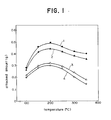
- FIG. 1 diagrammatically illustrates the adhesion of the lubricants of Invention Examples 1 and 5 and the lubricants of Comparative Examples A and B; and
- FIG. 2 diagrammatically shows the adhesion of the lubricants of Invention Examples 6 and 10 and the lubricants of Comparative Examples C and D.
- Features of the present invention will hereinafter be described in detail.
- Suitable examples of the salt of the polybasic high-molecular acid employed in this invention include the sodium, potassium, calcium, magnesium, ammonium and amine salts of humic, nitrohumic and lignin sulfonic acids.
- Alkanolamines such as monoisopropanolamine, diethanolamine, triethanolamine and triisopropanolamine may be mentioned as amines suitable for the formation of the amine salts.
- These salts may be used either singly or in combination. It is suitable to add one or more of these salts in an amount such that the total concentration falls within a range of 0.01-5 wt.% in the resulting water dispersion. Amounts smaller than 0.01 wt.% are too little to draw out the effects of the present invention.
- Any fine graphite powder is usable in this invention whether it is of a natural origin or is a synthesized product or whether it is in a amorphous form or in a flake-like form. However, the average particle size is desirably not greater than 100 µm from the standpoint of the dispersion stability of graphite and the maintenance and control of a lubricant applicator.
- Fine gilsonite powder can also be used in this invention if desired. The use of other asphalt however results in reduced adhesion at the time of film formation, especially in extreme deteriorations of the adhered amount and adhesion strength when recoated.
- Fine gilsonite powder may desirably have an average particle size not greater than 100 µm in view of the dispersion stability of gilsonite and the maintenance and control of the lubricant applicator. Fine gilsonite powder may be added suitably in an amount such that its concentration ranges from 5 wt.% to 30 wt.% in a lubricant for the production of seamless steel pipes.
- As the fine particulate synthetic resin employed in this invention, it is possible to use any one of fine particulate synthetic resins routinely used as lubricant components. Illustrative examples include polyacrylic resins, polyvinyl acetate resins, poly(modified vinyl acetate) resins, polystyrene resins, polyethylene resins, polyepoxy resins, etc.
- Suitable polyacrylic resins may be homopolymers and copolymers of lower alkanol esters of acrylic acid and methacrylic acid. Lower alkanols having 1-4 carbon atoms are appropriate as the lower alkanols for the esters.
- Further, suitable copolymers of lower alkanol esters of acrylic acid or methacrylic acid may include copolymers of these esters and vinyl acetate, copolymers of these esters and styrene, copolymers of these esters and acrylonitrile, copolymers of these esters and acryloamide, and copolymers of these esters and acrylic acid.
- Suitable vinyl acetate resins may include homopolymer of vinyl acetate, copolymers of vinyl acetate and maleic acid, copolymers of vinyl acetate and fumaric acid, and copolymers of vinyl acetate and ethylene.
- As has been described above, the lubricant of this invention is basically of fine graphite powder, fine powder of a water-insoluble synthetic resin, water and a salt of a a polybasic high-molecular acid. Fine gilsonite may also be added if necessary. It should however be noted that the effects of this invention will not be reduced by the addition of other component or components, for example, one or more of surfactants, polymer dispersants, pH adjustors, thickening agents, etc. It is therefore possible to optionally add one or more of surfactants, polymer dispersants, pH adjustors, thickening agents and the like as needed with a view toward converting the above basic components into a stable water dispersion.
- Upon application of the lubricant of this invention, it can be use in a form diluted with water. The preferable degree of dilution varies depending on the processing conditions and coating conditions. In general, the lubricant of this invention can be used by diluting it to such a degree that the total amount of its essential components, namely, fine graphite powder, fine powder of the water-insoluble synthetic resin and the salt of the polybasic high-molecular acid, plus fine gilsonite powder and auxiliary components if any may account for 30-70 wt.% of the resulting diluted coating formulation.
- The lubricant of this invention for the production of seamless steel pipes, namely, the lubricant for the production of seamless steel pipes - said lubricant containing one or more salts selected, for example, from salts of humic acid, nitrohumic acid and lignin sulfonic acid - can form a uniform and thick dry film and can exhibit good rolling lubrication performance. The use of the lubricant of this invention therefore makes it possible to save the mill-driving power consumption and also to stabilize rolling operations.
- In contrast, lubricants for the production of seamless steel pipes, which contains graphite powder and a fine particulate synthetic resin as principal components or graphite powder, gilsonite and a fine particulate synthetic resin as principal components but do not contain any salt of polybasic high-molecular acid unlike the present invention, have poor adhesion when the surface temperature of a mandrel bar is high, especially, 150°C or higher, whereby they cannot provide any uniform dry film.
- To further facilitate the understanding of this invention, some experiments and examples of this invention will hereinafter be described. It should however be borne in mind that the present invention is not necessarily limited to or by the following experiments and examples.
-
- Regarding the compositions given in Table 1, their adhesion, namely, amounts adhered and uniformity of films were investigated. The results are shown in FIG. 1 and Table 2.
- The coating a mandrel bar with each lubricant was conducted upon movement of the mandrel bar. The moving speed of the mandrel was 1-4 m/sec. In view of this, an adhesion experiment was conducted under the following dynamic test conditions.
- After spray-coating with a sample lubricant a steel pipe of 90 mm across, 4 mm thick and 150 mm long which was moving at a speed of 2.0 m/sec and had been heated to a predetermined temperature, the amount (g) of the film adhered on the surface of the steel pipe and the uniformity of the film were investigated.
- The following spraying conditions were employed:
Pump: Airless Pump 206T (trade name, manufactured by Graco Inc.), compression ratio: 10:1.
Spray gun: Automatic Gun 24AUA (trade name, manufactured by Spraying Systems Co.)
Nozzle diameter: 0.61 mm.
Spray distance: 200 mm.
Discharge pressure: 40 kgf/cm².
Discharge: 30 g/s.
Temperature of steel pipe: 60-400°C.
Dilution: Each sample lubricant was spray-coated as a 45 wt.% water dispersion.
Adhered amount (g): Average of five runs.Table 1 Compositions of Sample Lubricants Example Comp. Ex. Sample No. 1 2 3 4 5 A B Natural graphite (crystalline) 65 65 65 65 65 65 65 Polyacrylic resin 35 34 31 35 Polyvinyl acetate resin 35 34.5 35 Ammonium salt of humic acid 0.02 3 Sodium salt of humic acid 0.05 Ammonium salt of nitrohumic acid 0.5 Sodium salt of of lignin sulfonic acid 1 1 Remarks: 1) Samples A and B are conventional lubricants. 2) Samples 1-5 are lubricants according to this invention. 3) The proportions are expressed in terms of parts by weight. 4) The polyacrylic resin is a copolymer of 27 parts by weight of butyl methacrylate and 73 parts by weight of methyl methacrylate. 5) The polyvinyl acetate resin is a copolymer of 80 parts by weight of vinyl acetate and 20 parts by weight of ethylene. 6) In FIG. 1, Curves 1, 2, 3 and 4 correspond to Sample Nos. 2, 1, B and A, respectively. Table 2 Uniformity of Coated Films Temperature of steel pipe (°C) Sample No. 1 2 3 4 5 A B 60 B B B B B B B 100 B B B B B B B 150 A A A A A C C 200 A A A A A C C 250 A A A A A C C 300 A A A A A C C 350 A A A A A C C 400 A A A A A C C Remarks: A: Very dense dry film was formed. B: Undried film was formed. C: Extremely non-uniform film was formed. Example 1: (Sample No. 1) (Lubricant composition) Parts by weight Natural graphite (crystalline) 65 Polyacrylic resin 35 Ammonium salt of humic acid 0.02 - The above composition was added with water to form a dispersion. The concentration of the above composition in the dispersion was 45 wt.%. The dispersion was continuously applied during the hot-rolling of 200 seamless steel pipes on a mandrel mill. A mandrel bar which was moving at a speed of 2.0 m/sec was coated with the lubricant by means of the airless sprayer. During that time, the surface temperature of the mandrel bar ranged from 100°C to 250°C. The resultant films of the lubricant were all uniform and adhered firmly. They had a thickness of from 30 µm to 40 µm. Compared with the conventional lubricant as Comparative Example A, more uniform and thicker films were formed.
- As a result, the coefficient of friction was as small as 80% or less compared with the comparative example, leading to improvements such that the mill-driving power consumption was reduced by about 15% and the rolling operation was stabilized.
Example 2: (Sample No. 2) (Lubricant composition) Parts by weight Natural graphite (crystalline) 65 Polyvinyl acetate resin 35 Sodium salt of humic acid 0.05 - The above composition was added with water to form a dispersion. The concentration of the above composition in the dispersion was 45 wt.%. The dispersion was continuously applied during the hot-rolling of 300 seamless steel pipes on a mandrel mill. A mandrel bar which was moving at a speed of 2.0 m/sec was coated with the lubricant by means of the airless sprayer. During that time, the surface temperature of the mandrel bar ranged from 150°C to 350°C. The resultant films of the lubricant were all uniform and adhered firmly. They had a thickness of from 40 µm to 50 µm. Compared with the conventional lubricant as Comparative Example B, more uniform and thicker films were formed.
- As a result, the coefficient of friction was as small as 75% or less compared with the comparative example, leading to improvements such that the mill-driving power consumption was reduced by about 20% and the rolling operation was stabilized.
Example 3: (Sample No. 3) (Lubricant composition) Parts by weight Natural graphite (crystalline) 65 Polyvinyl acetate resin 34.5 Ammonium salt of nitrohumic acid 0.5 - The above composition was added with water to form a dispersion. The concentration of the above composition in the dispersion was 45 wt.%. The dispersion was continuously applied during the hot-rolling of 400 seamless steel pipes on a mandrel mill. A mandrel bar which was moving at a speed of 2.0 m/sec was coated with the lubricant by means of the airless sprayer. During that time, the surface temperature of the mandrel bar ranged from 150°C to 350°C. The resultant films of the lubricant were all uniform and adhered firmly. They had a thickness of from 40 µm to 55 µm. Compared with the conventional lubricant as Comparative Example B, more uniform and thicker films were formed.
- As a result, the coefficient of friction was as small as 75% or less compared with the comparative example, leading to improvements such that the mill-driving power consumption was reduced by about 20% and the rolling operation was stabilized.
Example 4: (Sample No. 4) (Lubricant composition) Parts by weight Natural graphite (crystalline) 65 Polyacrylic resin 34 Sodium salt of lignin sulfonic acid 1 - The above composition was added with water to form a dispersion. The concentration of the above composition in the dispersion was 45 wt.%. The dispersion was continuously applied during the hot-rolling of 350 seamless steel pipes on a mandrel mill. A mandrel bar which was moving at a speed of 2.0 m/sec was coated with the lubricant by means of the airless sprayer. During that time, the surface temperature of the mandrel bar ranged from 150°C to 350°C. The resultant films of the lubricant were all uniform and adhered firmly. They had a thickness of from 45 µm to 55 µm. Compared with the conventional lubricant as Comparative Example A, more uniform and thicker films were formed.
- As a result, the coefficient of friction was as small as 70% or less compared with the comparative example, leading to improvements such that the mill-driving power consumption was reduced by about 20% and the rolling operation was stabilized.
Example 5: (Sample No. 5) (Lubricant composition) Parts by weight Natural graphite (crystalline) 65 Polyacrylic resin 31 Ammonium salt of humic acid 3 Sodium salt of lignin sulfonic acid 1 - The above composition was added with water to form a dispersion. The concentration of the above composition in the dispersion was 45 wt.%. The dispersion was continuously applied during the hot-rolling of 400 seamless steel pipes on a mandrel mill. A mandrel bar which was moving at a speed of 2.0 m/sec was coated with the lubricant by means of the airless sprayer. During that time, the surface temperature of the mandrel bar ranged from 150°C to 350°C. The resultant films of the lubricant were all uniform and adhered firmly. They had a thickness of from 45 µm to 55 µm. Compared with the conventional lubricant as Comparative Example A, more uniform and thicker films were formed.
- As a result, the coefficient of friction was as small as 70% or less compared with the comparative example, leading to improvements such that the mill-driving power consumption was reduced by about 20% and the rolling operation was stabilized.
- Regarding the compositions given in Table 3, their adhesion, namely, adhered amounts and uniformity of films were investigated. The results are shown in FIG. 2 and Table 4.
- The experiment was conducted in the same manner as in Experiment 1.
Table 3 Compositions of Sample Lubricants Example Comp. Ex. Sample No. 6 7 8 9 10 C D Natural graphite (amorphous) 70 70 70 70 70 60 80 Gilsonite 10 10 10 10 10 20 10 Polyacrylic resin (Tg:65°C) 20 19 17 10 Polyvinyl acetate resin (Tg:30°C) 20 19.5 20 Ammonium salt of humic acid 0.02 2 Sodium salt of humic acid 0.05 Ammonium salt of nitrohumic acid 0.5 Sodium salt of lignin sulfonic acid 1 1 Remarks: 1) Sample C is one of the examples of U.S. Patent Specification No. 4,711,733, while Sample D is one of the examples of Japanese Patent Publication No. 34356/1987. 2) Samples 6-10 are lubricants according to this invention. 3) The proportions are expressed in terms of parts by weight. 4) Tg is an abbreviation of glass transition point. 5) In FIG. 2, Curves 5, 6, 7 and 8 correspond to Sample Nos. 7, 6, D and C, respectively. Table 4 Uniformity of Coated Films Temperature of steel pipe (°C) Sample No. 6 7 8 9 10 C D 60 B B B B B B B 100 B B B B B B B 150 A A A A A C C 200 A A A A A C C 250 A A A A A C C 300 A A A A A C C 350 A A A A A C C 400 A A A A A C C Remarks: A: Very dense and uniform dry film was formed. B: Undried film was formed. C: Extremely non-uniform film was formed. Example 6: (Sample No. 6) (Lubricant composition) Parts by weight Natural graphite (amorphous) 70 Gilsonite 10 Polyacrylic resin 20 Ammonium salt of humic acid 0.02 - A dispersion which had been prepared by adding water to the above composition to give a concentration of 45 wt.% was continuously applied during the hot-rolling of 200 seamless steel pipes on a mandrel mill. A mandrel bar which was moving at a speed of 2.0 m/sec was coated with the lubricant by means of the airless sprayer. During that time, the surface temperature of the mandrel bar ranged from 100°C to 250°C. The resultant films of the lubricant were all uniform and adhered firmly. They had a thickness of from 30 µm to 40 µm. Compared with the conventional lubricant as Comparative Example D, more uniform and thicker films were formed. As a result, the coefficient of friction was as small as 80% or less compared with the comparative example, leading to improvements such that the mill-driving power consumption by about 15% and the rolling operation was stabilized.
Example 7: (Sample No. 7) (Lubricant composition) Parts by weight Natural graphite (amorphous) 70 Gilsonite 10 Polyvinyl acetate resin 20 Sodium salt of humic acid 0.05 - A dispersion which had been prepared by adding water to the above composition to give a concentration of 45 wt.% was continuously applied during the hot-rolling of 300 seamless steel pipes on a mandrel mill. A mandrel bar which was moving at a speed of 2.0 m/sec was coated with the lubricant by means of the airless sprayer. During the operation, the surface temperature of the mandrel bar ranged from 150°C to 350°C. The resultant films of the lubricant were all uniform and adhered firmly. They had a thickness of from 40 µm to 50 µm. Compared with the conventional lubricant as Comparative Example C, more uniform and thicker films were formed. As a result, the coefficient of friction was as small as 75% or less compared with the comparative example, leading to improvements such that the mill-driving power consumption by about 20% and the rolling operation was stabilized.
Example 8: (Sample No. 8) (Lubricant composition) Parts by weight Natural graphite (amorphous) 70 Gilsonite 10 Polyvinyl acetate resin 19.5 Ammonium salt of nitrohumic acid 0.5 - A dispersion which had been prepared by adding water to the above composition to give a concentration of 45 wt.% was continuously applied during the hot-rolling of 400 seamless steel pipes on a mandrel mill. A mandrel bar which was moving at a speed of 2.0 m/sec was coated with the lubricant by means of the airless sprayer. During the operation, the surface temperature of the mandrel bar ranged from 150°C to 350°C. The resultant films of the lubricant were all uniform and adhered firmly. They had a thickness of from 40 µm to 55 µm. Compared with the conventional lubricant as Comparative Example C, more uniform and thicker films were formed. As a result, the coefficient of friction was as small as 75% or less compared with the comparative example, leading to improvements such that the mill-driving power consumption by about 20% and the rolling operation was stabilized.
Example 9: (Sample No. 9) (Lubricant composition) Parts by weight Natural graphite (amorphous) 70 Gilsonite 10 Polyacrylic resin 19 Sodium salt of lignin sulfonic acid 1 - A dispersion which had been prepared by adding water to the above composition to give a concentration of 45 wt.% was continuously applied during the hot-rolling of 400 seamless steel pipes on a mandrel mill. A mandrel bar which was moving at a speed of 2.0 m/sec was coated with the lubricant by means of the airless sprayer. During the operation, the surface temperature of the mandrel bar ranged from 150°C to 300°C. The resultant films of the lubricant were all uniform and adhered firmly. They had a thickness of from 45 µm to 55 µm. Compared with the conventional lubricant as Comparative Example D, more uniform and thicker films were formed. As a result, the coefficient of friction was as small as 70% or less compared with the compara tive example, leading to improvements such that the mill-driving power consumption by about 20% and the rolling operation was stabilized.
Example 10: (Sample No. 10) (Lubricant composition) Parts by weight Natural graphite (amorphous) 70 Gilsonite 10 Polyacrylic resin 17 Ammonium salt of humic acid 2 Sodium salt of lignin sulfonic acid 1 - A dispersion which had been prepared by adding water to the above composition to give a concentration of 45 wt.% was continuously applied during the hot-rolling of 400 seamless steel pipes on a mandrel mill. A mandrel bar which was moving at a speed of 2.0 m/sec was coated with the lubricant by means of the airless sprayer. During the operation, the surface temperature of the mandrel bar ranged from 150°C to 350°C. The resultant films of the lubricant were all uniform and adhered firmly. They had a thickness of from 45 µm to 55 µm. Compared with the conventional lubricant as Comparative Example D, more uniform and thicker films were formed. As a result, the coefficient of friction was as small as 70% or less compared with the compara tive example, leading to improvements such that the mill-driving power consumption by about 20% and the rolling operation was stabilized.
Claims (10)
Applications Claiming Priority (4)
| Application Number | Priority Date | Filing Date | Title |
|---|---|---|---|
| JP213622/88 | 1988-08-30 | ||
| JP213623/88 | 1988-08-30 | ||
| JP21362288A JPH0264195A (en) | 1988-08-30 | 1988-08-30 | Seamless steel pipe-producing lubricant containing gilsonite fine powder |
| JP21362388A JPH0264196A (en) | 1988-08-30 | 1988-08-30 | Lubricant for seamless steel pipe construction |
Publications (2)
| Publication Number | Publication Date |
|---|---|
| EP0357508A1 true EP0357508A1 (en) | 1990-03-07 |
| EP0357508B1 EP0357508B1 (en) | 1993-10-20 |
Family
ID=26519893
Family Applications (1)
| Application Number | Title | Priority Date | Filing Date |
|---|---|---|---|
| EP89402368A Expired - Lifetime EP0357508B1 (en) | 1988-08-30 | 1989-08-30 | Use of improved lubricant for the production of seamless steel pipes |
Country Status (5)
| Country | Link |
|---|---|
| US (1) | US5030367A (en) |
| EP (1) | EP0357508B1 (en) |
| KR (1) | KR900003344A (en) |
| CA (1) | CA1329802C (en) |
| DE (1) | DE68910059T2 (en) |
Cited By (3)
| Publication number | Priority date | Publication date | Assignee | Title |
|---|---|---|---|---|
| EP0841388A1 (en) * | 1996-11-07 | 1998-05-13 | Sumitomo Metal Industries, Ltd. | Steel-pipe having a organic resin outer surface coating for improved hydroforming |
| WO2008043656A3 (en) * | 2006-10-09 | 2008-07-10 | Chem Fab Budenheim Kg | Graphite-containing high-temperature lubricant for high-grade steels and carbon steels |
| EP1707618A4 (en) * | 2003-12-10 | 2010-05-26 | Sumitomo Metal Ind | LUBRICATING COMPOSITION FOR HOT FORMATION |
Families Citing this family (8)
| Publication number | Priority date | Publication date | Assignee | Title |
|---|---|---|---|---|
| US5476580A (en) * | 1993-05-17 | 1995-12-19 | Electrochemicals Inc. | Processes for preparing a non-conductive substrate for electroplating |
| US6710259B2 (en) | 1993-05-17 | 2004-03-23 | Electrochemicals, Inc. | Printed wiring boards and methods for making them |
| US6171468B1 (en) | 1993-05-17 | 2001-01-09 | Electrochemicals Inc. | Direct metallization process |
| US6303181B1 (en) | 1993-05-17 | 2001-10-16 | Electrochemicals Inc. | Direct metallization process employing a cationic conditioner and a binder |
| US5690805A (en) * | 1993-05-17 | 1997-11-25 | Electrochemicals Inc. | Direct metallization process |
| US5725807A (en) * | 1993-05-17 | 1998-03-10 | Electrochemicals Inc. | Carbon containing composition for electroplating |
| US6623787B2 (en) | 2001-07-26 | 2003-09-23 | Electrochemicals Inc. | Method to improve the stability of dispersions of carbon |
| JP7821553B2 (en) * | 2022-01-27 | 2026-02-27 | 株式会社Adeka | grease |
Citations (4)
| Publication number | Priority date | Publication date | Assignee | Title |
|---|---|---|---|---|
| FR2274570A1 (en) * | 1974-06-12 | 1976-01-09 | Acheson Ind Inc | COATING COMPOSITIONS BASED ON PIGMENT AND ALUMINUM PHOSPHATE FOR SURFACES USED IN PARTICULAR IN THE MOLDING OF GLASS AND PROCESS FOR PREPARING THESE COATED SURFACES |
| US4001125A (en) * | 1975-06-09 | 1977-01-04 | Grafo Colloids Corporation | Lubricant for mandrels, forging dies, molds and the like |
| FR2441657A1 (en) * | 1978-11-15 | 1980-06-13 | Dow Corning Gmbh | AQUEOUS COMPOSITION FOR THE PRODUCTION OF LUBRICANTS IN THE FORM OF DRY FILM |
| US4711733A (en) * | 1984-05-15 | 1987-12-08 | Nippon Kokan Kabushiki Kaisha | Lubricant for the production of seamless tubes |
Family Cites Families (12)
| Publication number | Priority date | Publication date | Assignee | Title |
|---|---|---|---|---|
| GB1438215A (en) * | 1974-05-08 | 1976-06-03 | Lonz Ltd | High temperature lubricant |
| SU540906A1 (en) * | 1975-11-17 | 1976-12-30 | Предприятие П/Я В-8739 | Lubricant for hot metal forming |
| SU586195A1 (en) * | 1976-05-19 | 1977-12-30 | Институт Химии Высокомолекулярных Соединений Ан Украинской Сср | "spga-1" lubricant for cold plastic working of metals |
| JPS57185393A (en) * | 1981-05-11 | 1982-11-15 | Nippon Kokan Kk <Nkk> | Lubricating agent for hot plastic working of steel |
| US4401579A (en) * | 1981-09-03 | 1983-08-30 | Acheson Industries, Inc. | Water-based metal forming lubricant composition and process |
| JPS58138795A (en) * | 1982-02-10 | 1983-08-17 | Nippon Kokuen Kogyo Kk | Lubricating agent for mandrel bar |
| JPS5937317A (en) * | 1982-08-27 | 1984-02-29 | Mitsubishi Heavy Ind Ltd | Divided bearing |
| SE456944B (en) * | 1985-06-18 | 1988-11-14 | Icor Ab | DEVICE FOR Saturation of the content of a given gas component in a gas mixture |
| JP2589463B2 (en) * | 1985-08-08 | 1997-03-12 | パイオニア株式会社 | Multi disk player |
| JP2678434B2 (en) * | 1985-08-08 | 1997-11-17 | パイオニア株式会社 | Multi-disc player |
| CH665847A5 (en) * | 1985-10-02 | 1988-06-15 | Lonza Ag | METHOD FOR SUSPENDING SOLID LUBRICANTS. |
| CH669129A5 (en) * | 1986-04-04 | 1989-02-28 | Lonza Ag | LUBRICANT SYSTEM FOR SHEET AND PROFILE ROLLING MILLS. |
-
1989
- 1989-08-22 CA CA000608941A patent/CA1329802C/en not_active Expired - Fee Related
- 1989-08-25 KR KR1019890012164A patent/KR900003344A/en not_active Withdrawn
- 1989-08-30 US US07/400,918 patent/US5030367A/en not_active Expired - Fee Related
- 1989-08-30 DE DE89402368T patent/DE68910059T2/en not_active Expired - Fee Related
- 1989-08-30 EP EP89402368A patent/EP0357508B1/en not_active Expired - Lifetime
Patent Citations (4)
| Publication number | Priority date | Publication date | Assignee | Title |
|---|---|---|---|---|
| FR2274570A1 (en) * | 1974-06-12 | 1976-01-09 | Acheson Ind Inc | COATING COMPOSITIONS BASED ON PIGMENT AND ALUMINUM PHOSPHATE FOR SURFACES USED IN PARTICULAR IN THE MOLDING OF GLASS AND PROCESS FOR PREPARING THESE COATED SURFACES |
| US4001125A (en) * | 1975-06-09 | 1977-01-04 | Grafo Colloids Corporation | Lubricant for mandrels, forging dies, molds and the like |
| FR2441657A1 (en) * | 1978-11-15 | 1980-06-13 | Dow Corning Gmbh | AQUEOUS COMPOSITION FOR THE PRODUCTION OF LUBRICANTS IN THE FORM OF DRY FILM |
| US4711733A (en) * | 1984-05-15 | 1987-12-08 | Nippon Kokan Kabushiki Kaisha | Lubricant for the production of seamless tubes |
Cited By (11)
| Publication number | Priority date | Publication date | Assignee | Title |
|---|---|---|---|---|
| EP0841388A1 (en) * | 1996-11-07 | 1998-05-13 | Sumitomo Metal Industries, Ltd. | Steel-pipe having a organic resin outer surface coating for improved hydroforming |
| US6009913A (en) * | 1996-11-07 | 2000-01-04 | Sumitomo Metal Industries, Ltd | Lubricant surface-treated steel pipe for hydroforming use |
| EP1113066A1 (en) * | 1996-11-07 | 2001-07-04 | Sumitomo Metal Industries, Ltd. | Steel pipe having an organic resin outer surface coating for improved hydroforming |
| EP1707618A4 (en) * | 2003-12-10 | 2010-05-26 | Sumitomo Metal Ind | LUBRICATING COMPOSITION FOR HOT FORMATION |
| US7816306B2 (en) | 2003-12-10 | 2010-10-19 | Sumitomo Metal Industries, Ltd. | Lubricant composition for hot forming |
| US8288325B2 (en) | 2003-12-10 | 2012-10-16 | Sumitomo Metal Industries, Ltd. | Lubricant composition for hot forming |
| EP2514810A1 (en) * | 2003-12-10 | 2012-10-24 | Sumitomo Metal Industries, Ltd. | Lubricant composition for hot forming |
| WO2008043656A3 (en) * | 2006-10-09 | 2008-07-10 | Chem Fab Budenheim Kg | Graphite-containing high-temperature lubricant for high-grade steels and carbon steels |
| RU2454452C2 (en) * | 2006-10-09 | 2012-06-27 | Хемише Фабрик Буденхайм Кг | Graphite-containing high-temperature lubricant for use in hot treatment of high-quality and carbon steel with pressure |
| US8440597B2 (en) | 2006-10-09 | 2013-05-14 | Chemische Fabril Budenheim KG | Graphite-containing high-temperature lubricant for high-grade steels and carbon steels |
| CN101535459B (en) * | 2006-10-09 | 2013-09-25 | 化学制造布敦海姆两合公司 | Graphite-containing high-temperature lubricant for high-grade steels and carbon steels |
Also Published As
| Publication number | Publication date |
|---|---|
| CA1329802C (en) | 1994-05-24 |
| EP0357508B1 (en) | 1993-10-20 |
| US5030367A (en) | 1991-07-09 |
| KR900003344A (en) | 1990-03-26 |
| DE68910059T2 (en) | 1994-05-05 |
| DE68910059D1 (en) | 1993-11-25 |
Similar Documents
| Publication | Publication Date | Title |
|---|---|---|
| EP0357508B1 (en) | Use of improved lubricant for the production of seamless steel pipes | |
| US8507416B2 (en) | Water-based lubricant for plastic processing having excellent corrosion resistance and metal material having excellent plastic processability | |
| CA2284545C (en) | Metal forming lubricant with differential solid lubricants | |
| KR890002834B1 (en) | Metal Rolled Oil Composition | |
| US4826902A (en) | Coating composition with improved rust-preventing properties for use in preparing lubricated steel products | |
| US20030055142A1 (en) | Powder coating additive, powder coating composition containing said additive, and method for coating a substrate using said powder coating composition | |
| CN1197927C (en) | Water-based metal antirust protective agent | |
| US4664823A (en) | Metal-working oil composition | |
| US4016087A (en) | Surface treating agent for processing of metals | |
| EP0700957A1 (en) | Plasticizer composition | |
| DE3340551A1 (en) | WATER-SOLUBLE METAL WORKING LUBRICANTS AND METHOD FOR DELIVERING THE SAME | |
| EP1038933A4 (en) | Coating composition and lubricated metal sheets | |
| US4711733A (en) | Lubricant for the production of seamless tubes | |
| US6255260B1 (en) | Metal forming lubricant with differential solid lubricants | |
| US20010005549A1 (en) | Rust-preventing lubricated steel materials and coating compositions therefor | |
| US5348672A (en) | Water-soluble lubricants for hot plastic working | |
| EP0224522A1 (en) | Method for metal forming without cutting. | |
| EP0358385A2 (en) | Polymeric thickeners | |
| JPH0536479B2 (en) | ||
| EP1698682A1 (en) | Water-base lubricant for plastic forming | |
| JPH0536478B2 (en) | ||
| WO2025043590A1 (en) | Sprayable aqueous acoustic damping compositions, and articles therefrom | |
| JPS6234356B2 (en) | ||
| EP1350867B1 (en) | A coating solution for metals and metal alloys | |
| JPH0539458A (en) | Resin-coated steel plate having excellent pressformability, paintability and corrosion resistance |
Legal Events
| Date | Code | Title | Description |
|---|---|---|---|
| PUAI | Public reference made under article 153(3) epc to a published international application that has entered the european phase |
Free format text: ORIGINAL CODE: 0009012 |
|
| AK | Designated contracting states |
Kind code of ref document: A1 Designated state(s): CH DE FR GB IT LI |
|
| 17P | Request for examination filed |
Effective date: 19900809 |
|
| 17Q | First examination report despatched |
Effective date: 19910306 |
|
| GRAA | (expected) grant |
Free format text: ORIGINAL CODE: 0009210 |
|
| AK | Designated contracting states |
Kind code of ref document: B1 Designated state(s): CH DE FR GB IT LI |
|
| ITF | It: translation for a ep patent filed | ||
| REF | Corresponds to: |
Ref document number: 68910059 Country of ref document: DE Date of ref document: 19931125 |
|
| ET | Fr: translation filed | ||
| PLBE | No opposition filed within time limit |
Free format text: ORIGINAL CODE: 0009261 |
|
| STAA | Information on the status of an ep patent application or granted ep patent |
Free format text: STATUS: NO OPPOSITION FILED WITHIN TIME LIMIT |
|
| PG25 | Lapsed in a contracting state [announced via postgrant information from national office to epo] |
Ref country code: GB Effective date: 19940830 |
|
| PG25 | Lapsed in a contracting state [announced via postgrant information from national office to epo] |
Ref country code: LI Effective date: 19940831 Ref country code: CH Effective date: 19940831 |
|
| 26N | No opposition filed | ||
| GBPC | Gb: european patent ceased through non-payment of renewal fee |
Effective date: 19940830 |
|
| PG25 | Lapsed in a contracting state [announced via postgrant information from national office to epo] |
Ref country code: FR Effective date: 19950428 |
|
| REG | Reference to a national code |
Ref country code: CH Ref legal event code: PL |
|
| PG25 | Lapsed in a contracting state [announced via postgrant information from national office to epo] |
Ref country code: DE Effective date: 19950503 |
|
| REG | Reference to a national code |
Ref country code: FR Ref legal event code: ST |
|
| PG25 | Lapsed in a contracting state [announced via postgrant information from national office to epo] |
Ref country code: IT Free format text: LAPSE BECAUSE OF NON-PAYMENT OF DUE FEES;WARNING: LAPSES OF ITALIAN PATENTS WITH EFFECTIVE DATE BEFORE 2007 MAY HAVE OCCURRED AT ANY TIME BEFORE 2007. THE CORRECT EFFECTIVE DATE MAY BE DIFFERENT FROM THE ONE RECORDED. Effective date: 20050830 |