EP0357061A1 - Angiogenesis inhibitory agent - Google Patents
Angiogenesis inhibitory agent Download PDFInfo
- Publication number
- EP0357061A1 EP0357061A1 EP19890116053 EP89116053A EP0357061A1 EP 0357061 A1 EP0357061 A1 EP 0357061A1 EP 19890116053 EP19890116053 EP 19890116053 EP 89116053 A EP89116053 A EP 89116053A EP 0357061 A1 EP0357061 A1 EP 0357061A1
- Authority
- EP
- European Patent Office
- Prior art keywords
- substituted
- fumagillol
- group
- pharmaceutical composition
- composition according
- Prior art date
- Legal status (The legal status is an assumption and is not a legal conclusion. Google has not performed a legal analysis and makes no representation as to the accuracy of the status listed.)
- Granted
Links
- 0 CC(C)*C[C@]1(C)OC1(C)C([C@@](C)CC[C@@]1O)[C@@]1C=O Chemical compound CC(C)*C[C@]1(C)OC1(C)C([C@@](C)CC[C@@]1O)[C@@]1C=O 0.000 description 5
- AOZXWHQRCJYOPD-KNVOCYPGSA-N C[C@H]1[IH][C@@H](C)CCC1 Chemical compound C[C@H]1[IH][C@@H](C)CCC1 AOZXWHQRCJYOPD-KNVOCYPGSA-N 0.000 description 1
- QEXITHJGFXLHEA-UHFFFAOYSA-N [O-][NH+](CC1)CC1I Chemical compound [O-][NH+](CC1)CC1I QEXITHJGFXLHEA-UHFFFAOYSA-N 0.000 description 1
Classifications
-
- C—CHEMISTRY; METALLURGY
- C07—ORGANIC CHEMISTRY
- C07D—HETEROCYCLIC COMPOUNDS
- C07D303/00—Compounds containing three-membered rings having one oxygen atom as the only ring hetero atom
- C07D303/02—Compounds containing oxirane rings
- C07D303/12—Compounds containing oxirane rings with hydrocarbon radicals, substituted by singly or doubly bound oxygen atoms
- C07D303/18—Compounds containing oxirane rings with hydrocarbon radicals, substituted by singly or doubly bound oxygen atoms by etherified hydroxyl radicals
- C07D303/20—Ethers with hydroxy compounds containing no oxirane rings
- C07D303/22—Ethers with hydroxy compounds containing no oxirane rings with monohydroxy compounds
-
- A—HUMAN NECESSITIES
- A61—MEDICAL OR VETERINARY SCIENCE; HYGIENE
- A61K—PREPARATIONS FOR MEDICAL, DENTAL OR TOILETRY PURPOSES
- A61K31/00—Medicinal preparations containing organic active ingredients
- A61K31/33—Heterocyclic compounds
- A61K31/335—Heterocyclic compounds having oxygen as the only ring hetero atom, e.g. fungichromin
-
- C—CHEMISTRY; METALLURGY
- C07—ORGANIC CHEMISTRY
- C07D—HETEROCYCLIC COMPOUNDS
- C07D231/00—Heterocyclic compounds containing 1,2-diazole or hydrogenated 1,2-diazole rings
- C07D231/02—Heterocyclic compounds containing 1,2-diazole or hydrogenated 1,2-diazole rings not condensed with other rings
- C07D231/10—Heterocyclic compounds containing 1,2-diazole or hydrogenated 1,2-diazole rings not condensed with other rings having two or three double bonds between ring members or between ring members and non-ring members
- C07D231/12—Heterocyclic compounds containing 1,2-diazole or hydrogenated 1,2-diazole rings not condensed with other rings having two or three double bonds between ring members or between ring members and non-ring members with only hydrogen atoms, hydrocarbon or substituted hydrocarbon radicals, directly attached to ring carbon atoms
-
- C—CHEMISTRY; METALLURGY
- C07—ORGANIC CHEMISTRY
- C07D—HETEROCYCLIC COMPOUNDS
- C07D233/00—Heterocyclic compounds containing 1,3-diazole or hydrogenated 1,3-diazole rings, not condensed with other rings
- C07D233/54—Heterocyclic compounds containing 1,3-diazole or hydrogenated 1,3-diazole rings, not condensed with other rings having two double bonds between ring members or between ring members and non-ring members
- C07D233/56—Heterocyclic compounds containing 1,3-diazole or hydrogenated 1,3-diazole rings, not condensed with other rings having two double bonds between ring members or between ring members and non-ring members with only hydrogen atoms or radicals containing only hydrogen and carbon atoms, attached to ring carbon atoms
-
- C—CHEMISTRY; METALLURGY
- C07—ORGANIC CHEMISTRY
- C07D—HETEROCYCLIC COMPOUNDS
- C07D249/00—Heterocyclic compounds containing five-membered rings having three nitrogen atoms as the only ring hetero atoms
- C07D249/02—Heterocyclic compounds containing five-membered rings having three nitrogen atoms as the only ring hetero atoms not condensed with other rings
- C07D249/08—1,2,4-Triazoles; Hydrogenated 1,2,4-triazoles
-
- C—CHEMISTRY; METALLURGY
- C07—ORGANIC CHEMISTRY
- C07D—HETEROCYCLIC COMPOUNDS
- C07D405/00—Heterocyclic compounds containing both one or more hetero rings having oxygen atoms as the only ring hetero atoms, and one or more rings having nitrogen as the only ring hetero atom
- C07D405/14—Heterocyclic compounds containing both one or more hetero rings having oxygen atoms as the only ring hetero atoms, and one or more rings having nitrogen as the only ring hetero atom containing three or more hetero rings
-
- C—CHEMISTRY; METALLURGY
- C07—ORGANIC CHEMISTRY
- C07D—HETEROCYCLIC COMPOUNDS
- C07D407/00—Heterocyclic compounds containing two or more hetero rings, at least one ring having oxygen atoms as the only ring hetero atoms, not provided for by group C07D405/00
- C07D407/14—Heterocyclic compounds containing two or more hetero rings, at least one ring having oxygen atoms as the only ring hetero atoms, not provided for by group C07D405/00 containing three or more hetero rings
-
- C—CHEMISTRY; METALLURGY
- C07—ORGANIC CHEMISTRY
- C07D—HETEROCYCLIC COMPOUNDS
- C07D417/00—Heterocyclic compounds containing two or more hetero rings, at least one ring having nitrogen and sulfur atoms as the only ring hetero atoms, not provided for by group C07D415/00
- C07D417/14—Heterocyclic compounds containing two or more hetero rings, at least one ring having nitrogen and sulfur atoms as the only ring hetero atoms, not provided for by group C07D415/00 containing three or more hetero rings
Definitions
- This invention relates to novel O-substituted fumagillol derivatives or salts thereof, which have angiogenesis inhibitory activity and are effective in the treatment and prevention of various inflammatory diseases (rheumatism, psoriasis, etc.), diabetic retinopathy and cancer, among others.
- Angiogenesis is deeply concerned in the course of manifestation or progress of various diseases, for example various inflammatory diseases (rheumatism, psoriasis, etc.), diabetic retinopathy, and cancer. Therefore, to inhibit angiogenesis is considered to contribute to the treatment and prevention of such diseases.
- various groups of researchers have so far searched for angiogenesis inhibitory substances.
- Taylor et al. (Taylor, S. et al., Nature, 297 , 307 (1982)] on the applicability of protamine and the study by Folkman et al. [Folkman, J.
- the present inventors searched for and evaluated various compounds in an attempt to achieve the above object and, as a result, found that O-substituted derivatives of fumagillol, a hydrolyzate of fumagillin so far known as an antimicrobial and antiprotozoal agent, have potent angiogenesis inhibitory activity. Based on this finding, they have now completed the present invention.
- the invention relates to O-substituted fumagillol derivatives (hereinafter sometimes referred to as compounds (I) for short) of the formula wherein R1 is a 2-methyl-1-propenyl or isobutyl group which may be substituted and R2 is (1) a substituted alkanoyl group, (2) a substituted aroyl group having at least one substituent selected from the group consisting of C2 ⁇ 6 alkyl, amino, halogen, hydroxyl, lower alkoxy, cyano, carbamoyl and carboxyl, (3) an aromatic heterocycle-carbonyl, which may optionally be substituted, (4) a carbamoyl group, which may optionally be substituted, (5) an alkyl group, which may optionally be substituted, (6) a benzenesulfonyl group, which may optionally be substituted, (7) an alkylsulfonyl group, which may optionally be substituted (8) a sulfamoyl
- the substituent on the optionally substituted 2-methyl-1-propenyl or isobutyl group represented by R1 includes, among others, hydroxyl, amino, lower (C1 ⁇ 3) alkylamino (e.g. methylamino, ethylamino, isopropylamino), di-lower (C1 ⁇ 3) alkylamino (e.g. dimethylamino, diethylamino) and a 5- or 6-membered heterocyclic ring containing nitrogen atom (e.g.
- pyrroridin-1-yl piperidino, morpholino, piperazin-1-yl, 4-methylpiperozin-1-yl, 4-ethylpiperazin-1-yl), particularly preferred among them are hydroxyl and dimethylamino.
- the substituted alkanoyl group represented by R2 includes, among others, alkanoyl groups (preferably containing 1 to 20 carbon atoms; examples in the unsubstituted form: formyl, acetyl, propionyl, isopropionyl, butyryl, pentanoyl, hexanoyl, heptanoyl, octanoyl, nonanoyl, lauroyl, undecanoyl, myristoyl, palmitoyl, stearoyl, arachinoyl, etc.) having at least one, preferably one to three substituents each selected from among amino, lower alkylamino (e.g.
- di-(lower alkyl) amino e.g. dimethylamino, diethylamino, etc.
- halogen e.g. fluorine, chlorine, bromine, iodine, etc.
- hydroxyl e.g. methoxy, ethoxy, etc.
- cyano carbamoyl, carboxyl, lower alkoxycarbonyl (e.g. methoxycarbonyl, ethoxycarbonyl, etc.), carboxy-lower alkoxy (e.g.
- aromatic heterocyclic group preferably 5- or 6-membered aromatic heterocyclic group containing one to four hetero atoms each selected from among nitrogen, oxygen, sulfur and so on; e.g. 2-furyl, 2-thienyl, 4-thiazolyl, 4-imidazolyl, 4-pyridyl, etc.
- Particularly preferred among them are 3-carboxypropionyl and 4-carboxybutyryl.
- benzoyl 1-naphthoyl and 2-naphthoyl each having at least one, preferably one to three substituents each selected from among (C2 ⁇ 6 lower alkyl, such as ethyl or propyl, amino, halogen (e.g. fluorine, chlorine, bromine, etc.), hydroxyl, lower alkoxy (e.g. methoxy, ethoxy, etc.) cyano, carbamoyl, carboxyl and other substituents. Particularly preferred among them is 2-carboxybenzoyl.
- substituents on the optionally substituted aromatic heterocycle-carbonyl group represented by R2 there may be mentioned those substituents mentioned above referring to the substituted aroyl group.
- aromatic heterocycle-carbonyl are 5- or 6-membered ones containing one to four heteroatoms each selected from among nitrogen, oxygen, sulfur and so on. Preferred among others are 2-furoyl, 2-thenoyl, nicotinoyl, isonicotinoyl and imidazole-1-carbonyl.
- the carbamoyl group which may optionally be substituted, represented by R2 includes carbamoyl, monosubstituted carbamoyl and disubstituted carbamoyl.
- substituents there may be mentioned, for example, lower alkyl (e.g. methyl, ethyl, propyl, butyl, etc.), lower alkanoyl (preferably containing 1 to 6 carbon atoms; e.g. acetyl, propionyl, acryloyl, methacroyl etc.), chloroacetyl, dichloroacetyl, trichloroacetyl, lower alkoxycarbonylmethyl, (e.g.
- the substituent of carbamoyl further includes halogenated lower alkyl (e.g. 2-chloroethyl, 2-bromoethyl, 3-chloropropyl), di-lower alkylamino-lower alkyl (e.g. 2-dimethylaminoethyl, 2-diethylaminoethyl, 3-dimethylaminopropyl), lower alkanoyloxy-lower alkanoyl (e.g. acetoxyacetyl, propionyloxyacetyl), lower alkanoylthio-lower alkanoyl (e.g.
- halogenated lower alkyl e.g. 2-chloroethyl, 2-bromoethyl, 3-chloropropyl
- di-lower alkylamino-lower alkyl e.g. 2-dimethylaminoethyl, 2-diethylaminoethyl, 3-di
- acetylthioacetyl, propionylthioacetyl lower alkylthio-lower alkanoyl (e.g. methylthioacetyl, ethylthiopropionyl), arylthio-lower alkanoyl (e.g. phenylthioacetyl, naphthylthioacetyl), aromatic heterocyclicthio-lower alkanoyl (e.g.
- N-oxy-2-pyridylthioacetyl N-lower alkyl-4-pyridiniothio-lower alkanoyl ⁇ halide (e.g. N-methyl-4-pyridinoacetyl ⁇ iodide), dilower alkylamino-lower alkanoyl (e.g. dimethylaminoacetyl, diethylaminoacetyl), ammonio-lower alkanoyl ⁇ halide (e.g. trimethylammonioacetyl ⁇ iodide, N-methylpyrrolidinoacetyl ⁇ chloride), aromatic heterocyclic-carbonyl (e.g.
- substituent e.g. benzensulfonyl, toluensulfonyl
- di(lower alkyl)sulfonio-lower alkanoyl ⁇ halide e.g. dimethylsulfonioacetyl ⁇ iodide
- alkyl group which may optionally be substituted, represented by R2
- straight or branched C1 ⁇ 20 alkyl groups which may optionally have one to three substituents each selected from among, for example, those substituents mentioned above for the substituted alkanoyl group.
- Said alkyl group may be epoxidized at any optional position. Methyl, ethyl, benzyl and the like are preferred among others.
- substituent or substituents on the optionally substituted benzenesulfonyl group represented by R2
- R2 there may be mentioned, for example, lower alkyl (e.g. methyl, ethyl, etc.) and halogen (e.g. fluorine, chlorine, bromine, etc.).
- halogen e.g. fluorine, chlorine, bromine, etc.
- One to three such substituents may be present on the benzene ring at any optional position or positions.
- alkylsulfonyl group which may optionally be substituted, represented by R2
- C1 ⁇ 6 lower alkylsulfonyl groups which may have one to three substituents each selected from among, for example, those substituents mentioned above for the substituted alkanoyl group.
- Preferred among them are methylsulfonyl and ethylsulfonyl.
- substituent or substituents on the optionally substituted sulfamoyl group represented by R2 there may be mentioned, for example, lower alkyl (e.g. methyl, ethyl, propyl, isopropyl, isobutyl, etc.), phenyl and substituted phenyl.
- the sulfamoyl group may have either one substituent or two substituents which are the same or different.
- alkoxycarbonyl group which may optionally be substituted, represented by R2
- R2 there may be mentioned straight or branched lower alkoxycarbonyl groups, which may optionally have one or three substituents each selected from among those substituents mentioned above, for instance. Preferred among them are methoxycarbonyl, ethoxycarbonyl, propoxycarbonyl, butoxycarbonyl, isobutoxycarbonyl, 1-chloroethoxycarbonyl, and the like.
- the substituent or substituents on the optionally substituted phenoxycarbonyl group represented by R2 may be the same as those mentioned above for the optionally substituted benzenesulfonyl group.
- the phenoxy group may have one to three such substituents at any optional position or positions.
- substituent or substituents on each optionally "substituted phenyl" group include, among others, lower alkyl (e.g. methyl, ethyl, propyl, butyl, etc.), lower alkoxy (e.g. methoxy, ethoxy, propoxy, etc.), halogen (e.g. fluorine, chlorine, bromine, etc.), haloalkyl (e.g. trifluoromethyl, chloromethyl, bromomethyl, etc.) and nitro.
- the phenyl ring may have one to five such substituents at any optional position or positions.
- lower alkyl or “lower alkyl group” means a straight or branched alkyl group containing 1 to 6 carbon atoms and the term “lower alkoxy” or “lower alkoxy group” means an alkoxy group containing 1 to 6 carbon atoms, preferably 1 to 3 carbon atoms.
- the compounds (I) according to the invention may be used in the form of pharmaceutically acceptable salts if they have an acidic substituent (e.g. carboxyl etc.) or a basic substituent (e.g. amino, lower alkylamino, di-lower alkylamino, etc.).
- Said pharmaceutically acceptable salts may include salts with inorganic bases, salts with organic bases, salts with inorganic acids, salts with organic acids and salts with basic or acidic amino acids, among others. Available for the formation of such salts are such inorganic bases as alkali metals (e.g. sodium, potassium, etc.) and alkaline earth metals (e.g.
- organic bases such organic bases as trimethylamine, triethylamine, pyridine, picoline, N,N-dibenzylethylenediamine, ethanolamine, diethanolamine, trishydroxymethylaminomethane and dicyclohexylamine
- organic acids such inorganic acids as hydrochloric acid, hydrobromic acid, sulfuric acid, nitric acid and phosphoric acid
- organic acids such organic acids as formic acid, acetic acid, trifluoroacetic acid, oxalic acid, tartaric acid, fumaric acid, maleic acid, methanesulfonic acid, benzenesulfonic acid and p-toluenesulfonic acid
- basic or acidic amino acids as arginine, lysine, ornithine, aspartic acid and glutamic acid.
- the salts with bases are those salts in which the carboxyl group contained in a substituent in compounds (I) is involved in the salt formation while, in the salts with acids (i.e. salts with inorganic acids, salts with organic acids and salts with acidic amino acids), an amino, lower alkylamino or di-lower alkylamino group, among others, contained in a substituent in compounds (I) is involved in the salt formation.
- the O-substituted fumagillol derivatives in which R1 in formula (I) is a 2-methyl-1-propenyl group can be produced by subjecting fumagillol [Tarbell, D. S. et al., J. Am. Chem. Soc., 83 , 3096 (1961)], which is a hydrolyzate of fumagillin produced by microorganisms, to acylation, carbamoylation, alkylation or sulfonylation using an acylating, carbamoylating, alkylating or sulfonylating agent in the manner mentioned below, or by isolating intermediates in such a reaction.
- O-substituted dihydrofumagillol derivatives in which, in formula (I), R1 is an isobutyl group can be produced by subjecting 4′,5′-dihydrofumagillol (II), which is obtainable by catalytically reducing fumagillol under ordinary conditions (e.g. using 5% palladium-carbon in a methanol solution; cf. Reference Example 1), to the same reaction as mentioned above.
- II 4′,5′-dihydrofumagillol
- R2 is a group inert to catalytic reduction
- R1 is a 2-methyl-1-propenyl group
- R1 is an isobutyl group
- O-substituted fumagillol derivatives of formula (I) in which R1 is a hydroxy-substituted 2-methyl-1-propenyl or isobutyl group can be produced by subjecting fumagillol whose 6-position hydroxyl may be protected to oxidation for introduction of a hydroxy group thereinto, and then subjecting the oxidation product, after deprotection of the 6-position hydroxyl as necessary, to acylation, carbamoylation, alkylation or sulfonylation, or by isolating the respective reaction intermediates.
- the reaction can proceed advantageously when the hydroxyl group introduced into R1 is protected as necessary.
- the O-substituted fumagillol derivatives just mentioned above can be produced also by subjecting those O-substituted fumagillol derivatives of formula (I) in which R1 is a 2-methyl-1-propenyl or isobutyl group directly to oxidation.
- O-substituted fumagillol derivatives of formula (I) in which R1 is an amino-, lower alkylamino or di-lower alkylamino-substituted or 5 or 6-membered nitrogen-containing heterocycle-substituted 2-methyl-1-propenyl or isobutyl group can be produced by subjecting the above-mentioned fumagillol derivatives having a hydroxyl group introduced in the 4-position side chain moiety, 2-methyl-1-propenyl or isobutyl group, by the above-mentioned oxidation, the 6-position hydroxyl of which may be protected, to amination and then subjecting the amination product, after deprotection of the 6-position hydroxyl, to acylation, carbamoylation, alkylation or sulfonylation, or by isolating the respective reaction intermediates.
- the reaction can proceed with advantage when the amino, lower alkylamino or nitrogen-containing heterocyclic group introduced into R1 is protected as necessary.
- the O-substituted fumgillol derivatives just mentioned above can be produced also by subjecting an O-substituted fumagillol derivative of formula (I) in which R1 is a hydroxyl-substituted 2-methyl-1-propenyl or isobutyl group to amination.
- O-substituted fumagillol derivatives of formula (I) in which R1 is a hydroxy-, amino-, lower alkylamino-, di-lower alkylamino- or 5- or 6-membered nitrogen-containing heterocycle-substituted isobutyl group can be produced by subjecting a fumagillol derivative having a hydroxyl, amino, lower alkylamino, di-lower alkylamino or 5- or 6-membered nitrogen-containing heterocyclic group introduced in the 4-position side chain moiety 2-methyl-1-propenyl group, the 6-position hydroxyl of which may be protected, to catalytic reduction and then subjecting the reduction product, after deprotection of the 6-position hydroxyl as necessary, to acylation, carbamoylation, alkylation or sulfonylation, or by isolating the respective reaction intermediates.
- the reaction intermediates in the step of acylation, carbamoylation, alkylation or sulfon
- the O-substituted fumagillol derivatives just mentioned above can be produced also by subjecting those O-substituted fumagillol derivatives of formula (I) in which R1 is a 3-hydroxy-2-methyl-1-propenyl group directly to catalytic reduction.
- the protection and deprotection of the 6-position hydroxyl and of the hydroxyl, amino, lower alkylamino and nitrogen-containing heterocycle in R1 can be carried out by an appropriate per se known method [cf. Greene, T. W., "Protective Groups in Organic Synthesis", John Wiley & Sons, New York (1981)].
- such substituent should preferably be protected by an appropriate protective group selected on the basis of the stability of the product.
- an appropriate protective group there may be mentioned 4-nitrobenzyloxycarbonyl and 2-trimethylsilylethoxycarbonyl for amino protection, 4-nitrobenzyl and t-butyldimethylsilyl for hydroxyl protection, and 4-nitrobenzyl for carboxyl protection.
- Deprotection can be effected by a conventional method, for example by catalytic reduction or reaction with the fluoride ion.
- Said acylation is carried out by bringing fumagillol or dihydrofumagillol (hereinafter referred to as "starting alcohol") into contact with an activated, reactive derivative of a carboxylic acid, for example an acid anhydride or an acid halide (e.g. acid chloride, acid bromide, etc.).
- starting alcohol fumagillol or dihydrofumagillol
- an activated, reactive derivative of a carboxylic acid for example an acid anhydride or an acid halide (e.g. acid chloride, acid bromide, etc.).
- R3 is (1) a substituted alkanoyl group, (2) a substituted aroyl group having at least one substituent selected from the group consisting of C2 ⁇ 6 alkyl, amino, halogen, hydroxy, lower alkoxy, cyano, carbamoyl and carboxyl, or (3) an aromatic heterocycle-carbonyl group, which may optionally be substituted, as defined with respect to R2.
- Said reactive derivative of carboxylic acid is used generally in an amount of about 1 to 10 moles, preferably 1 to 5 moles, per mole of the starting alcohol.
- the reaction is carried out generally in the presence of a base.
- a base Usable as said base are tertiary amines, such as diisopropylethylamine, triethylamine, pyridine and N,N-dimethylaminopyridine, alkali metal hydrogen carbonates, such as sodium hydrogen carbonate and potassium hydrogen carbonate, alkali metal carbonates, such as potassium carbonate and sodium carbonate, alkali metal hydrides, such as sodium hydride and potassium hydride, and organometals, such as butyllithium and lithium diisopropylamide.
- the base is used generally in an amount of about 1 to 10 moles per mole of the starting alcohol.
- This reaction is carried out generally in an organic solvent which will not interfere with the reaction.
- inert organic solvent are, for example, amides, such as dimethylformamide and dimethylacetamide, halogenated hydrocarbons, such as dichloromethane, chloroform and 1,2-dichloroethane, ethers, such as diethyl ether, tetrahydrofuran and dioxane, esters, such as methyl acetate, ethyl acetate, isobutyl acetate and methyl propionate, nitriles, such as acetonitrile and propionitrile, nitro compounds, such as nitromethane and nitroethane, ketones, such as acetone and methyl ethyl ketone, and aromatic hydrocarbons, such as benzene and toluene. These may be used either alone or in the form of a mixture of two or more of them mixed together in an appropriate ratio. When a tertiary
- the optimal reaction temperature may vary depending on the carboxylic acid derivative, base and solvent and amounts thereof, among others but can be found within the range of -80°C to 100°C, preferably 0°C to room temperature (the term "room temperature” means a temperature of about 20° to 35°C; unless otherwise specified, the same shall apply hereinafter).
- the reaction time required is about 30 minutes to 5 days.
- Said alkylation is effected by reacting the starting alcohol with an alkylating agent, for example an alkyl halide or a dialkyl sulfate (e.g. dimethyl sulfate, diethyl sulfate, etc.), representable by the formula R4Y [wherein R4 is (5) an alkyl group, which may optionally be substituted, as defined with respect to R2, and Y is a leaving group (e.g. halogen (chlorine, bromine, iodine, etc.))].
- Said alkylating agent is used generally in an amount of about 1 to 5 moles per mole of the starting alchohol.
- the reaction is carried out generally in the presence of a base.
- a base Usable as said base are, for example, those alkali metal hydrogen carbonates, alkali metal carbonates, alkali metal hydrides and organometals mentioned above.
- the base is used generally in an amount of about 1 to 5 moles per mole of the starting alcohol.
- This reaction is carried out generally in an organic solvent which will not interfere with the reaction.
- inert organic solvent are those amides, halogenated hydrocarbons, ethers, esters, nitriles, nitro compounds, ketones and aromatic hydrocarbons mentioned above. These may be used either singly or in the form of a mixture of two or more of them mixed together in an appropriate ratio.
- the optimal reaction temperature may depend on the alkylating agent, base and solvent and amounts thereof but is generally within the range of -80°C to 100°C, preferably from 0°C to room temperature.
- the reaction time amounts to about 20 minutes to 5 days.
- R5 is lower alkyl, lower alkanoyl, chloroacetyl or the like substituent on the optionally substituted carbamoyl represented by R2.
- Said isocyanate is used generally in an amount of about 1 to 5 moles per mole of the starting alcohol.
- This reaction is carried out generally in the presence of a base.
- a base Usable as said base are, for example, those tertiary amines, alkali metal hydrogen carbonates, alkali metal carbonates, alkali metal hydrides and organometals mentioned above.
- the level of addition of said base is generally about 1 to 5 moles per mole of the starting alcohol.
- This reaction is carried out generally in an organic solvent which will not interfere with the reaction.
- inert organic solvent are those amides, halogenated hydrocarbons, ethers, esters, nitriles, nitro compounds, ketones and aromatic hydrocarbons mentioned above. These may be used either singly or in the form of a mixture or two or more of them mixed together in an appropriate ratio.
- a tertiary amine is used as the base, said tertiary amine as such may also serve as a solvent.
- the optimal reaction temperature may depend on the isocyanate, base and solvent and amounts thereof but is generally within the range of -80°C to 100°C, preferably from 0°C to room temperature.
- the reaction time required amounts to about 1 hour to 5 days.
- those compounds having a chloroacetylcarbamoyl or trichloroacetylcarbamoyl group may be converted to the corresponding compounds having an unsubstituted carbamoyl group by eliminating the chloroacetyl or trichloroacetyl group by a conventional method (e.g. under basic conditions at room temperature or with heating).
- Said carbamoylation may also be effected by reacting the starting alcohol with a carbamoyl halide.
- Said carbamoyl halide is used generally in an amount of about 1 to 5 moles per mole of the starting alcohol.
- This reaction is carried out generally in the presence of a base.
- a base Usable as the base are those tertiary amines, alkali metal hydrogen carbonates, alkali metal carbonates, alkali metal hydrides and organoalkali metals mentioned above.
- the level of addition of said base is generally about 1 to 5 moles per mole of the starting alcohol.
- This reaction is carried out generally in an organic solvent which will not interfere with the reaction.
- inert organic solvent are those amides, halogenated hydrocarbons, ethers, esters, nitriles, nitro compounds, ketones and aromatic hydrocarbons mentioned above. These may be used either singly or in the form of a mixture, in an appropriate mixing ratio, of two or more of them.
- a tertiary amine is used as the base, said tertiary amine as such may also serve as a solvent.
- the optimal reaction temperature may vary depending on the carbamoyl halide, base and solvent and amounts thereof. Generally, however, the reaction is carried out at a temperature from about 0°C to a temperature approximately equal to the refluxing temperature of the reaction medium, preferably from about 25°C to the refluxing temperature.
- said carbamoylation can be effected by reacting the starting alcohol with a chloroformate ester (e.g. phenyl chloroformate, ethyl chloroformate, isobutyl chloroformate, 1-chloroethyl chloroformate, etc.) or 1,1-carbonyldiimidazole and then reacting the resulting active ester with a primary or secondary amine.
- a chloroformate ester e.g. phenyl chloroformate, ethyl chloroformate, isobutyl chloroformate, 1-chloroethyl chloroformate, etc.
- Said chloroformate ester, 1,1-carbonyldiimidazole or amine is used generally in an amount of about 1 to 5 moles per mole of the starting alcohol.
- the reaction of the starting alcohol with a chloroformate ester is carried out generally in the presence of a base.
- a base Usable as said base are those tertiary amines, alkali metal hydrogen carbonates, alkali metal carbonates, alkali metal hydrides and organoalkali metals mentioned above.
- the level of addition of the base is generally about 1 to 5 moles per mole of the starting alcohol.
- This reaction is carried out generally in an organic solvent which will not interfere with the reaction.
- inert organic solvent are the amides, halogenated hydrocarbons, ethers, esters, nitriles, nitro compounds, ketones and aromatic hydrocarbons mentioned above. These may be used either singly or in the form of a mixture, in an appropriate mixing ratio, of two or more of them.
- the optimal reaction temperature may vary depending on species of chloroformate ester, base, amine and solvent and amounts thereof, among others. Generally, however, the reaction is carried out at a temperature from -20°C to the refluxing temperature of the reaction medium, preferably at a temperature of 0°C to 50°C.
- the active esters obtainable as intermediates are also included within the scope of the objective compounds (I) of the invention.
- those having a substituted lower alkanoylcarbamoyl group can be produced also by reacting a corresponding compound having a chloroacetylcarbamoyl group with a nucleophilic reagent.
- the nucleophilic reagent to be used is a lower carboxylic acid, lower thiocarboxylic acid, thiol, amine or the like, or a metal salt thereof.
- This reaction is generally carried out in an organic solvent which will not interfere with the reaction.
- organic solvent which will not interfere with the reaction.
- saturated aliphatic hydrocarbons, alcohols, amides, halogenated hydrocarbons, ethers, esters, nitriles, nitro compounds, ketones and aromatic hydrocarbons, for instance, can be used as such organic solvent inert to the reaction. These may be used either singly or in the form of a mixture of two or more in an appropriate mixing ratio.
- this reaction is carried out in the presence of a base.
- a base Usable as said base are, for example, the above-mentioned tertiary amines, alkali metal hydrogen carbonates, alkali metal carbonates, alkali metal hydrides and organoalkali metal compounds.
- the base is added to the reaction system generally in an amount of about 1 to 5 moles per mole of the starting material.
- the optimal reaction temperature may vary depending on the nucleophilic reagent, base and solvent, the quantities thereof and other factors. Generally, however, the reaction is carried out at -80°C to 100°C, preferably at 0°C to room temperature. The reaction period is about 20 minutes to 5 days.
- the sulfonylation is effected by reacting the starting alcohol with an activated sulfonic acid derivative such as a sulfonic anhydride or a sulfonic halide (e.g. sulfonyl chloride, sulfonyl bromide, etc.), or an activated sulfamic acid derivative such as a sulfamoyl halide (e.g. sulfamoyl chloride, sulfamoyl bromide, etc.).
- an activated sulfonic acid derivative such as a sulfonic anhydride or a sulfonic halide (e.g. sulfonyl chloride, sulfonyl bromide, etc.)
- an activated sulfamic acid derivative such as a sulfamoyl halide (e.g. sulfamoyl chloride, sulfamoy
- R6 is (6) a benzenesulfonyl group, which may optionally be substituted, (7) an alkylsulfonyl group, which may optionally be substituted or (8) a sulfamoyl group, which may optionally be substituted, as defined with respect to R2.
- Said reactive derivative of sulfonic acid is used generally in an amount of about 1 to 5 moles per mole of the starting alcohol.
- This reaction is carried out generally in the presence of a base.
- a base Usable as said base are those tertiary amines, alkali metal hydrogen carbonates, alkali metal carbonates, alkali methal hydrides and organometals mentioned above.
- the level of addition thereof is generally about 1 to 10 moles per mole of the starting alcohol.
- This reaction is carried out generally in an organic solvent which will not interfere with the reaction.
- inert organic solvent are those amides, halogenated hydrocarbons, ethers, esters, nitriles, nitro compounds, ketones and aromatic hydrocarbons mentioned above. These may be used either singly or in the form of a mixture of two or more of them mixed together in an appropriate mixing ratio.
- a tertiary amine is used as the base, said tertiary amine as such may serve also as a solvent.
- the optimal reaction temperature may vary depending on the sulfonic or sulfamic acid derivative, base and solvent and amounts thereof. Generally, however, the reaction is carried out at -80°C to 100°C, preferably at 0°C to room temperature. the reaction time amount to about 10 minutes to 5 days.
- Said oxidation is effected by reacting an oxidizing agent with fumagillol, whose 6-position hydroxyl may be protected, or an O-substituted fumagillol derivative of formula (I) in which R1 is a substituted or unsubstituted 2-methyl-1-propenyl or isobutyl group and the 6-position hydroxyl of which may be protected.
- oxidizing agents are selenium dioxide, osmium tetroxide, aqueous hydrogen peroxide, organic peroxides (e.g. t-butyl hydroperoxide etc.), organic peracids (e.g. performic acid, peracetic acid, trifluoroperacetic acid, perbenzoic acid, m-chloroperbenzoic acid, etc.) and so forth. It is also possible to use two or more of these in combination in an appropriate mixing ratio. Generally, the oxidizing agent is used in an amount of about 1 to 5 moles per mole of the starting material.
- This reaction is generally carried out in a solvent which will not interfere with the invention.
- solvent inert to the reaction are water, saturated aliphatic hydrocarbons, such as hexane, heptane, etc., alcohols, such as methanol, ethanol etc., and the above-mentioned halogenated hydrocarbons, ethers and aromatic hydrocarbons. These may be used either singly or in the form of a mixture of two or more of them in an appropriate mixing ratio.
- the optimal reaction temperature may vary depending on the oxidizing agent and solvent, the quantities thereof and other factors. Generally, however, the reaction is carried out at -80°C to 100°C, preferably at 0°C to room temperature. The reaction period is about 20 minutes to 5 days.
- the amination is conducted for conversion of the hydroxyl group of the fumagillol derivatives having a hydroxyl group introduced in the 4-position side chain, 2-methyl-1-propenyl or isobutyl group, as a result of the above oxidation reaction, the 6-position hydroxyl of which may be protected, or of those O-substituted fumagillol derivatives of general formula (I) in which R1 is a hydroxy-substituted 2-methyl-1-propenyl or isobutyl group by the method of converting hydroxyl directly to amino by taking advantage of the Mitunobu reaction (cf.
- an imide such as phthalimide or succinimide
- aqueous ammonia, gaseous ammonia or liquid ammonia may be used as ammonia and the amine to be used is a primary amine (e.g. methylamine, ethylamine, isopropylamine, etc.) a secondary amine (e.g. dimethylamine, diethylamine, etc.) or a 5- or 6-membered nitrogen-containing heterocyclic compound (e.g. pyrrolidine, piperidine, morpholine, piperazine, N-methylpiperazine, N-ethylpiperazine, etc.).
- a primary amine e.g. methylamine, ethylamine, isopropylamine, etc.
- a secondary amine e.g. dimethylamine, diethylamine, etc.
- a 5- or 6-membered nitrogen-containing heterocyclic compound e.g. pyrrolidine, piperidine, morpholine, piperazine, N-methylpiperazine, N-eth
- this reaction is carried out using ammonia or said amine in an amount of about 1 to 20 moles, preferably 2 to 10 moles per mole of the starting material in a solvent which will not adversely affect the reaction.
- the ammonia or amine itself may be used as the solvent.
- Useful as the solvent which will not adversely affect the reaction are, for example, water and such saturated aliphatic hydrocarbons, alcohols, amides, halogenated hydrocarbons, ethers, esters, nitriles, nitro compounds, ketones and aromatic hydrocarbons as mentioned above. These may be used either singly or in the form of a mixture of two or more in an appropriate mixing ratio.
- This reaction may also be carried out in the presence of a base, such as an alkali metal hydrogen carbonate or an alkali metal carbonate.
- a base such as an alkali metal hydrogen carbonate or an alkali metal carbonate.
- the optimal reaction temperature may vary depending on the reactant (ammonia or amine), base and solvent, the quantities thereof and other factors. Generally, however, the reaciton is carried out at -80°C to 100°C, preferably at 0°C to room temperature. The reaction period is about 20 minutes to 5 days.
- O-substituted fumagillol derivatives (I) thus produced can be isolated by per se known means of separation and purification (e.g. chromatography, crystallization) or by other appropriate means.
- the compounds (I) have asymmetric centers within their molecules and accordingly are optically active. Their absolute configuration comes from the starting material fumagillol. Therefore, it is to be noted that the compounds (I) have the same absolute configuration that fumagillol has.
- the compounds according to the invention exhibit angiogenesis inhibitory activity and are useful as therapeutic and prophylactic agents for various inflammatory diseases (rheumatism, psoriasis), diabetic retinopathy, or cancer. They can be safely administered either orally or nonorally as such or in the form of pharmaceutical preparations [e.g. tablets, capsules (inclusive of soft capsules and microcapsules), solutions, injections, suppositories] prepared by admixing with per se known pharmaceutically acceptable carriers or excipients or the like.
- the dose may vary depending on the target of administration, route of administration, symptoms and other factors. Generally, however, in adults, they are used, for example, at a dose of about 0.1 mg/kg to 40 mg/kg body weight, preferably about 0.5 mg/kg to 20 mg/kg body weight.
- the product compound (I) obtained in the examples given below were evaluated for angiogenesis inhibitory activity by the rat cornea micropocket method.
- the data obtained are summarized in the table given below.
- the cornea was incised to a length of about 2 mm at about 2mm inside from the corneal circumference by means of an injection needle, and a sustained release pellet containing basic fibroblast growth factor (bFGF; bovine brain-derived, purified product; R & D) and a sustained release pellet containing the test sample were inserted side by side into the incision so that the bFGF pellet was located on the central side in the cornea.
- bFGF basic fibroblast growth factor
- R & D basic fibroblast growth factor
- the sustained release pellets were prepared in the following manner.
- An ethylene-vinyl acetate copolymer (Takeda Chemical Industries) was dissolved in dichloromethane to a concentration of 8%.
- a 3- ⁇ l portion of the solution was air-dried on a glass dish, an aqueous solution of bFGF (250 ng) was then placed thereon and air-dried and, finally 3 ⁇ l of the above ethylene-vinyl acetate copolymer solution was placed further thereon and air-dried to give a laminate consisting of two copolymer layers and a bFGF layer sandwiched therebetween. This sandwich sheet was made round into a bFGF pellet.
- test sample pellets were prepared by dissolving each sample in ethanol in a concentration of 20 ⁇ g/2 ⁇ l, mixing the solution (2 ⁇ l) with 6 ⁇ l of an ethylene-vinyl acetate copolymer solution, air-drying the mixed solution on a glass dish and making the thus-obtained sheet round.
- the inhibition rate is the ratio of the number of rats in which angiogenesis inhibitory activity was observed to the number of rats tested.
- room temperature means about 15-25°C.
- the melting point and temperature data are all given on the Celsius scale.
- Fumagillol (133 mg) and dimethylaminopyridine (115 mg) were dissolved in dichloromethane (3 ml), followed by addition of phenyl chloroformate (111 mg). The mixture was stirred at room temperature for 30 minutes. After addition of water, the mixture was diluted with dichloromethane (30 ml), washed with water and saturated aqueous sodium chloride solution and dried over anhydrous magnesium sulfate.
- O-Chloroacetylcarbamoylfumagillol (170 mg) and N-methylpyrrolidine (1 ml) were stirred in ether (3 ml) at room temperature for 1 week. The resultant precipitate was recovered by filtration, washed with ether and dried in vacuo. The procedure gave colorless, powdery O-[(N-methylpyrrolidin-1-ylium)acetylcarbamoyl]fumagillol chloride (170 mg) (82% yield).
- 3-Furancarboxamide (167 mg) was suspended in dichloromethane (10 ml), followed by addition of oxalyl chloride (0.20 ml) under ice-cooling, and the temperature of the reaction mixture was raised to room temperature The reaction mixture was refluxed for 10 hours and the solvent was distilled off to give crude 3-furoyl isocyanate.
- the above product was reacted with fumagillol (213 mg) with stirring at room temperature for 30 minutes.
- O-Carbamoylfumagillol 200 mg was dissolved in dichloromethane (4 ml) followed by addition of chloroacetyl isocyanate (0.10 mg) and the mixture was stirred for 4 hours.
- the reaction mixture was diluted with ethyl acetate (50 ml), washed with saturated aqueous sodium hydrogen carbonate solution and saturated aqueous sodium chloride solution and dried over anhydrous magnesium sulfate.
- O-Acetyl-6′b-hydroxyfumagillol (469 mg) was dissolved in dichloromethane (5 ml) and, under ice-cooling, triethylamine (0.13 ml) and methanesulfonyl chloride (0.38 ml) were added to the solution. The mixture was stirred for 15 minutes. The reaction mixture was diluted with ethyl acetate (50 ml), washed with saturated aqueous sodium chloride solution and dried over anhydrous magnesium sulfate. The solvent was distilled off under reduced pressure and the residue was dissolved in dimethylformamide (5 ml).
- O-Acetyl-6′b-dimethylaminofumagillol (118 mg) was dissolved in methanol (2 ml), and 1 N aqueous sodium hydroxide solution (1 ml) was added to the solution. The mixture was stirred for 15 minutes. The reaction mixture was diluted with ethyl acetate (50 ml), washed with saturated aqueous sodium chloride solution and dried over anhydrous magnesium sulfate.
- HUVE Human umbilical vein endothelial cells
- GIT medium Diago Eiyou Kagaku, Co., Japan
- rbFGF human basic fibroblast growth factor
- HUVE were plated on 96-well microtiter plates (Nunc, 1-67008) at the cell density of 2 x 10³/100 ⁇ l of medium.
- the tumor used in this assay was mouse reticulum cell sarcoma (M 5076), maintained by intraperitoneal transplantation into male C57BL/6N mice.
- the tumor cells in ascites were collected by centrifugation, and suspended in saline.
- the cell suspension (2 x 10⁶ cells/100 ⁇ l/mouse) was inoculated into right flanks of mice.
- Tumor-bearing mice were subcutaneously treated with the compound (I) (shown by Example Numbers) suspended in 5% arabic gum solution containing 1% of ethanol, for 12 days beginning one day after tumor inoculation (10 injections).
- the tumor growth was determined by measuring tumor size in two directions with calipers at intervals of a few days.
- Tumor volume (mm3) length x (width)2 + 2.
- Table 3 Compound (I) 30 mg/day T/C (%) (Example No.) 8 14 51 22 76 29
- AGM-1470 fumagillol derivative compound described in Example 8 above was further evaluated for angiogenesis inhibitory activity.
- the Boyden chamber assay was carried out using a modification of the method of Falk et al., J. Immunol. Meth., 33:239-247 (1980) as follows: Bovine capillary endothelial cells were plated at 1.5 x 10⁴ cells per well in serum-free DMEM (Dulbecco's Modified Eagle's Medium) on one side of nucleopore filters pre-coated with fibronectin (7.3 ⁇ g fibronectin/ml PBS). AGM-1470 was dissolved in ethanol and diluted in DMEM so that the final concentration of ethanol did not exceed 0.01%.
- DMEM Dens Modified Eagle's Medium
- the shell-less chorioallantoic membrane (CAM) assay was carried out by the method of Folkman et al. (R.Crum. S.Szabo and J.Folkman; Science. 230 . 1375 (1985)) as follows: three-day chick embryos were removed from their shells to petri dishes (Falcon 1005) under sterile hood and cultured for further 3 days.
- AGM-1470 was dissolved to a 0.45% methylcellulose aqueous solution and aliquots of 10 ⁇ l were pipetted onto Teflon rods. After the solution had dried, the methylcellulose disks (about 2 mm in diameter) containing the compound were implanted on the CAM of 6-day embryos.
- An avascular zone represents a region in which regression of pre-existing vessels has occured.
- Percent of avascular zones was calculated by counting the disks forming avascular zones per the total disks tested. In each group there were 12 to 16 embryos.
- AGM-1470 showed strong angiogenesis inhibitory activity by the CAM assay.
- Table 4 Dose in ⁇ g/10 ⁇ l methylcellulose percent of avascular zones 1 33 10 62 25 100
- AGM-1470 was Using the B16 Mouse Melanoma model described in Folkman et al., Science, 221:719-725 (1983), the angiogenesis inhibitory activity of AGM-1470 was further evaluated.
- Treatment usually started when tumors were approximately 70-100 mm3, approximately 9 to 10 days after inoculation. Tumors were matched for size before inclusion in treated and untreated groups.
- AGM-1470 was dissolved in isotonic solution by incubating with glass beads and vigorously shaking overnight at 4°C. This preparation was administered subcutaneously at 30 mg/kg every other day.
- T/C ratio Tumor growth is presented as a T/C ratio, as defined below. In essence, a ratio equal to "+ 1" means no inhibition, a ratio equal to "0" means complete suppression of growth, and a negative ratio indicates tumor regression.
- Table 5 B16 Melanoma Model T/C Time of Rx: 2 wk 3 wk AGM-1470 0.47 0.20 Day 37 100% untreated dead 50% AGM-1470 treated dead (50% of treated remained alive past day 55)
- AGM-1470 exerts its inhibitory effects with little or no toxicity; the animals remain active, do not lose weight, and consistently remain free from infection.
Landscapes
- Chemical & Material Sciences (AREA)
- Organic Chemistry (AREA)
- Health & Medical Sciences (AREA)
- Animal Behavior & Ethology (AREA)
- Epidemiology (AREA)
- Life Sciences & Earth Sciences (AREA)
- Pharmacology & Pharmacy (AREA)
- General Health & Medical Sciences (AREA)
- Public Health (AREA)
- Veterinary Medicine (AREA)
- Medicinal Chemistry (AREA)
- Pharmaceuticals Containing Other Organic And Inorganic Compounds (AREA)
- Medicines Containing Material From Animals Or Micro-Organisms (AREA)
- Epoxy Compounds (AREA)
- Acyclic And Carbocyclic Compounds In Medicinal Compositions (AREA)
Abstract
Description
- This invention relates to novel O-substituted fumagillol derivatives or salts thereof, which have angiogenesis inhibitory activity and are effective in the treatment and prevention of various inflammatory diseases (rheumatism, psoriasis, etc.), diabetic retinopathy and cancer, among others.
- Angiogenesis is deeply concerned in the course of manifestation or progress of various diseases, for example various inflammatory diseases (rheumatism, psoriasis, etc.), diabetic retinopathy, and cancer. Therefore, to inhibit angiogenesis is considered to contribute to the treatment and prevention of such diseases. In fact, several groups of researchers have so far searched for angiogenesis inhibitory substances. As examples, there may be mentioned the study by Taylor et al. [Taylor, S. et al., Nature, 297, 307 (1982)] on the applicability of protamine and the study by Folkman et al. [Folkman, J. et al., Science, 221, 719 (1983)] on the combined use of heparin and cortisone. Furthermore, patent applications have been filed alleging, for example, that ascorbic acid ethers and related compounds (Japanese Kokai Tokkyo Koho No. 58-131978) and the sulfated polysaccharide DS4152 (Japanese Kokai Tokkyo Koho No. 63-119500) show angiogenesis inhibitory activity. However, such substances are not yet fully satisfactory from the activity viewpoint. The advent of compounds superior in activity is waited for.
- Accordingly, it is an object of the invention to provide novel compounds having angiogenesis inhibitory activity.
- The present inventors searched for and evaluated various compounds in an attempt to achieve the above object and, as a result, found that O-substituted derivatives of fumagillol, a hydrolyzate of fumagillin so far known as an antimicrobial and antiprotozoal agent, have potent angiogenesis inhibitory activity. Based on this finding, they have now completed the present invention. Thus, the invention relates to O-substituted fumagillol derivatives (hereinafter sometimes referred to as compounds (I) for short) of the formula

- Referring to the above formula, the substituent on the optionally substituted 2-methyl-1-propenyl or isobutyl group represented by R¹ includes, among others, hydroxyl, amino, lower (C₁₋₃) alkylamino (e.g. methylamino, ethylamino, isopropylamino), di-lower (C₁₋₃) alkylamino (e.g. dimethylamino, diethylamino) and a 5- or 6-membered heterocyclic ring containing nitrogen atom (e.g. pyrroridin-1-yl, piperidino, morpholino, piperazin-1-yl, 4-methylpiperozin-1-yl, 4-ethylpiperazin-1-yl), particularly preferred among them are hydroxyl and dimethylamino.
- Referring to the above formula, the substituted alkanoyl group represented by R² includes, among others, alkanoyl groups (preferably containing 1 to 20 carbon atoms; examples in the unsubstituted form: formyl, acetyl, propionyl, isopropionyl, butyryl, pentanoyl, hexanoyl, heptanoyl, octanoyl, nonanoyl, lauroyl, undecanoyl, myristoyl, palmitoyl, stearoyl, arachinoyl, etc.) having at least one, preferably one to three substituents each selected from among amino, lower alkylamino (e.g. methylamino, ethylamino, isopropylamino, etc.) di-(lower alkyl) amino (e.g. dimethylamino, diethylamino, etc.), nitro, halogen (e.g. fluorine, chlorine, bromine, iodine, etc.), hydroxyl, lower alkoxy (e.g. methoxy, ethoxy, etc.), cyano, carbamoyl, carboxyl, lower alkoxycarbonyl (e.g. methoxycarbonyl, ethoxycarbonyl, etc.), carboxy-lower alkoxy (e.g. carboxymethoxy, 2-carboxyethoxy, etc.), phenyl which may optionally be substituted, aromatic heterocyclic group (preferably 5- or 6-membered aromatic heterocyclic group containing one to four hetero atoms each selected from among nitrogen, oxygen, sulfur and so on; e.g. 2-furyl, 2-thienyl, 4-thiazolyl, 4-imidazolyl, 4-pyridyl, etc.) and other substituents. Particularly preferred among them are 3-carboxypropionyl and 4-carboxybutyryl.
- As the substituted aroyl group represented by R², there may be mentioned benzoyl, 1-naphthoyl and 2-naphthoyl each having at least one, preferably one to three substituents each selected from among (C₂₋₆ lower alkyl, such as ethyl or propyl, amino, halogen (e.g. fluorine, chlorine, bromine, etc.), hydroxyl, lower alkoxy (e.g. methoxy, ethoxy, etc.) cyano, carbamoyl, carboxyl and other substituents. Particularly preferred among them is 2-carboxybenzoyl.
- As the substituent or substituents on the optionally substituted aromatic heterocycle-carbonyl group represented by R², there may be mentioned those substituents mentioned above referring to the substituted aroyl group. Usable as the aromatic heterocycle-carbonyl are 5- or 6-membered ones containing one to four heteroatoms each selected from among nitrogen, oxygen, sulfur and so on. Preferred among others are 2-furoyl, 2-thenoyl, nicotinoyl, isonicotinoyl and imidazole-1-carbonyl.
- The carbamoyl group, which may optionally be substituted, represented by R² includes carbamoyl, monosubstituted carbamoyl and disubstituted carbamoyl. As the substituents, there may be mentioned, for example, lower alkyl (e.g. methyl, ethyl, propyl, butyl, etc.), lower alkanoyl (preferably containing 1 to 6 carbon atoms; e.g. acetyl, propionyl, acryloyl, methacroyl etc.), chloroacetyl, dichloroacetyl, trichloroacetyl, lower alkoxycarbonylmethyl, (e.g. methoxycarbonylmethyl, ethoxycarbonylmethyl, etc.), carboxymethyl, amino, phenyl which may optionally be substituted, naphthyl, benzoyl, and substituents forming, together with the carbamoyl nitrogen atom, cyclic amino groups (e.g. pyrrolidin-1-yl, piperidino, morpholino, piperazin-1-yl, 4-methylpiperazin-1-yl, 4-ethylpiperazin-1-yl, 4-phenylpiperazin-1-yl, imidazol-1-yl, etc.). Preferred among them are chloroacetyl, phenyl, benzoyl and the like.
- The substituent of carbamoyl further includes halogenated lower alkyl (e.g. 2-chloroethyl, 2-bromoethyl, 3-chloropropyl), di-lower alkylamino-lower alkyl (e.g. 2-dimethylaminoethyl, 2-diethylaminoethyl, 3-dimethylaminopropyl), lower alkanoyloxy-lower alkanoyl (e.g. acetoxyacetyl, propionyloxyacetyl), lower alkanoylthio-lower alkanoyl (e.g. acetylthioacetyl, propionylthioacetyl), lower alkylthio-lower alkanoyl (e.g. methylthioacetyl, ethylthiopropionyl), arylthio-lower alkanoyl (e.g. phenylthioacetyl, naphthylthioacetyl), aromatic heterocyclicthio-lower alkanoyl (e.g. 4-pyridylthioacetyl), 2-pyridylthioacetyl, 2-benzothiazolythioacetyl, 2-benzoxazolylthioacetyl, 2-benzoimidazolylthioacetyl, 8-quinolylthioacetyl, [1-(2-dimethylaminoethyl)tetrazol]-5-ylthioacetyl, 2-methyl-1,3,4-thiadiazol-5-ylthioacetyl, 1-methyl-2-methoxycarbonyl-1,3,4-triazol-5-ylthioacetyl), N-oxy-2-pyridylthio-lower alkanoyl (e.g. N-oxy-2-pyridylthioacetyl), N-lower alkyl-4-pyridiniothio-lower alkanoyl·halide (e.g. N-methyl-4-pyridinoacetyl·iodide), dilower alkylamino-lower alkanoyl (e.g. dimethylaminoacetyl, diethylaminoacetyl), ammonio-lower alkanoyl·halide (e.g. trimethylammonioacetyl·iodide, N-methylpyrrolidinoacetyl·chloride), aromatic heterocyclic-carbonyl (e.g. 3-furoyl, nicotinoyl, 2-thenoyl), lower alkoxycarbonyl (e.g. methoxycarbonyl, ethoxycarbonyl), phenoxycarbonyl, chloroacetylcarbamoyl, benzoylcarbamoyl, phenylsulfonyl which may have substituent (e.g. benzensulfonyl, toluensulfonyl) and di(lower alkyl)sulfonio-lower alkanoyl·halide (e.g. dimethylsulfonioacetyl·iodide).
- As the alkyl group, which may optionally be substituted, represented by R², there may be mentioned straight or branched C₁₋₂₀ alkyl groups, which may optionally have one to three substituents each selected from among, for example, those substituents mentioned above for the substituted alkanoyl group. Said alkyl group may be epoxidized at any optional position. Methyl, ethyl, benzyl and the like are preferred among others.
- As the substituent or substituents on the optionally substituted benzenesulfonyl group, represented by R², there may be mentioned, for example, lower alkyl (e.g. methyl, ethyl, etc.) and halogen (e.g. fluorine, chlorine, bromine, etc.). One to three such substituents may be present on the benzene ring at any optional position or positions.
- As the alkylsulfonyl group, which may optionally be substituted, represented by R², there may be mentioned, among others, C₁₋₆ lower alkylsulfonyl groups, which may have one to three substituents each selected from among, for example, those substituents mentioned above for the substituted alkanoyl group. Preferred among them are methylsulfonyl and ethylsulfonyl.
- As the substituent or substituents on the optionally substituted sulfamoyl group represented by R², there may be mentioned, for example, lower alkyl (e.g. methyl, ethyl, propyl, isopropyl, isobutyl, etc.), phenyl and substituted phenyl. The sulfamoyl group may have either one substituent or two substituents which are the same or different.
- As the alkoxycarbonyl group, which may optionally be substituted, represented by R², there may be mentioned straight or branched lower alkoxycarbonyl groups, which may optionally have one or three substituents each selected from among those substituents mentioned above, for instance. Preferred among them are methoxycarbonyl, ethoxycarbonyl, propoxycarbonyl, butoxycarbonyl, isobutoxycarbonyl, 1-chloroethoxycarbonyl, and the like.
- The substituent or substituents on the optionally substituted phenoxycarbonyl group represented by R² may be the same as those mentioned above for the optionally substituted benzenesulfonyl group. The phenoxy group may have one to three such substituents at any optional position or positions.
- In this specification, the substituent or substituents on each optionally "substituted phenyl" group include, among others, lower alkyl (e.g. methyl, ethyl, propyl, butyl, etc.), lower alkoxy (e.g. methoxy, ethoxy, propoxy, etc.), halogen (e.g. fluorine, chlorine, bromine, etc.), haloalkyl (e.g. trifluoromethyl, chloromethyl, bromomethyl, etc.) and nitro. The phenyl ring may have one to five such substituents at any optional position or positions.
- In this specification, unless otherwise specified, the term "lower alkyl" or "lower alkyl group" means a straight or branched alkyl group containing 1 to 6 carbon atoms and the term "lower alkoxy" or "lower alkoxy group" means an alkoxy group containing 1 to 6 carbon atoms, preferably 1 to 3 carbon atoms.
- The compounds (I) according to the invention may be used in the form of pharmaceutically acceptable salts if they have an acidic substituent (e.g. carboxyl etc.) or a basic substituent (e.g. amino, lower alkylamino, di-lower alkylamino, etc.). Said pharmaceutically acceptable salts may include salts with inorganic bases, salts with organic bases, salts with inorganic acids, salts with organic acids and salts with basic or acidic amino acids, among others. Available for the formation of such salts are such inorganic bases as alkali metals (e.g. sodium, potassium, etc.) and alkaline earth metals (e.g. calcium, magnesium, etc.) such organic bases as trimethylamine, triethylamine, pyridine, picoline, N,N-dibenzylethylenediamine, ethanolamine, diethanolamine, trishydroxymethylaminomethane and dicyclohexylamine, such inorganic acids as hydrochloric acid, hydrobromic acid, sulfuric acid, nitric acid and phosphoric acid, such organic acids as formic acid, acetic acid, trifluoroacetic acid, oxalic acid, tartaric acid, fumaric acid, maleic acid, methanesulfonic acid, benzenesulfonic acid and p-toluenesulfonic acid, and such basic or acidic amino acids as arginine, lysine, ornithine, aspartic acid and glutamic acid. Among these salts, the salts with bases (i.e. salts with inorganic bases, salts with organic bases and salts with basic amino acids) are those salts in which the carboxyl group contained in a substituent in compounds (I) is involved in the salt formation while, in the salts with acids (i.e. salts with inorganic acids, salts with organic acids and salts with acidic amino acids), an amino, lower alkylamino or di-lower alkylamino group, among others, contained in a substituent in compounds (I) is involved in the salt formation.
- The O-substituted fumagillol derivatives in which R¹ in formula (I) is a 2-methyl-1-propenyl group can be produced by subjecting fumagillol [Tarbell, D. S. et al., J. Am. Chem. Soc., 83, 3096 (1961)], which is a hydrolyzate of fumagillin produced by microorganisms, to acylation, carbamoylation, alkylation or sulfonylation using an acylating, carbamoylating, alkylating or sulfonylating agent in the manner mentioned below, or by isolating intermediates in such a reaction.
- The O-substituted dihydrofumagillol derivatives in which, in formula (I), R¹ is an isobutyl group can be produced by subjecting 4′,5′-dihydrofumagillol (II), which is obtainable by catalytically reducing fumagillol under ordinary conditions (e.g. using 5% palladium-carbon in a methanol solution; cf. Reference Example 1), to the same reaction as mentioned above.

- In cases where R² is a group inert to catalytic reduction, it is also possible to convert the O-substituted fumagillol derivatives in which R¹ is a 2-methyl-1-propenyl group to the O-substituted dihydrofumagillol derivatives in which R¹ is an isobutyl group by catalytic reduction.
- Those O-substituted fumagillol derivatives of formula (I) in which R¹ is a hydroxy-substituted 2-methyl-1-propenyl or isobutyl group can be produced by subjecting fumagillol whose 6-position hydroxyl may be protected to oxidation for introduction of a hydroxy group thereinto, and then subjecting the oxidation product, after deprotection of the 6-position hydroxyl as necessary, to acylation, carbamoylation, alkylation or sulfonylation, or by isolating the respective reaction intermediates. In the step of the above-mentioned acylation, carbamoylation, alkylation or sulfonylation, the reaction can proceed advantageously when the hydroxyl group introduced into R¹ is protected as necessary.
- In cases where R² is a group inert to oxidation, the O-substituted fumagillol derivatives just mentioned above can be produced also by subjecting those O-substituted fumagillol derivatives of formula (I) in which R¹ is a 2-methyl-1-propenyl or isobutyl group directly to oxidation.
- Those O-substituted fumagillol derivatives of formula (I) in which R¹ is an amino-, lower alkylamino or di-lower alkylamino-substituted or 5 or 6-membered nitrogen-containing heterocycle-substituted 2-methyl-1-propenyl or isobutyl group can be produced by subjecting the above-mentioned fumagillol derivatives having a hydroxyl group introduced in the 4-position side chain moiety, 2-methyl-1-propenyl or isobutyl group, by the above-mentioned oxidation, the 6-position hydroxyl of which may be protected, to amination and then subjecting the amination product, after deprotection of the 6-position hydroxyl, to acylation, carbamoylation, alkylation or sulfonylation, or by isolating the respective reaction intermediates. In the step of the above-mentioned acylation, carbamoylation, alkylation or sulfonylation, the reaction can proceed with advantage when the amino, lower alkylamino or nitrogen-containing heterocyclic group introduced into R¹ is protected as necessary.
- In cases where R² is a group inert or resistant to amination, the O-substituted fumgillol derivatives just mentioned above can be produced also by subjecting an O-substituted fumagillol derivative of formula (I) in which R¹ is a hydroxyl-substituted 2-methyl-1-propenyl or isobutyl group to amination.
- Those O-substituted fumagillol derivatives of formula (I) in which R¹ is a hydroxy-, amino-, lower alkylamino-, di-lower alkylamino- or 5- or 6-membered nitrogen-containing heterocycle-substituted isobutyl group can be produced by subjecting a fumagillol derivative having a hydroxyl, amino, lower alkylamino, di-lower alkylamino or 5- or 6-membered nitrogen-containing heterocyclic group introduced in the 4-position side chain moiety 2-methyl-1-propenyl group, the 6-position hydroxyl of which may be protected, to catalytic reduction and then subjecting the reduction product, after deprotection of the 6-position hydroxyl as necessary, to acylation, carbamoylation, alkylation or sulfonylation, or by isolating the respective reaction intermediates. In the step of acylation, carbamoylation, alkylation or sulfonylation, the reaction can proceed with advantage when the hydroxyl, amino, lower alkylamino or nitrogen-containing heterocyclic group in R¹ is protected as necessary.
- In cases where R² is a group inert to catalytic reduction, the O-substituted fumagillol derivatives just mentioned above can be produced also by subjecting those O-substituted fumagillol derivatives of formula (I) in which R¹ is a 3-hydroxy-2-methyl-1-propenyl group directly to catalytic reduction.
- The protection and deprotection of the 6-position hydroxyl and of the hydroxyl, amino, lower alkylamino and nitrogen-containing heterocycle in R¹ can be carried out by an appropriate per se known method [cf. Greene, T. W., "Protective Groups in Organic Synthesis", John Wiley & Sons, New York (1981)].
- In cases where such a substituent as amino, hydroxyl, or carboxyl is present in the acylating, carbamoylating, alkylating or sulfonylating agnet, such substituent should preferably be protected by an appropriate protective group selected on the basis of the stability of the product. As examples of preferred protective groups, there may be mentioned 4-nitrobenzyloxycarbonyl and 2-trimethylsilylethoxycarbonyl for amino protection, 4-nitrobenzyl and t-butyldimethylsilyl for hydroxyl protection, and 4-nitrobenzyl for carboxyl protection. Deprotection can be effected by a conventional method, for example by catalytic reduction or reaction with the fluoride ion. In the case of carbamoylation or alkylation, it is also possible to use a lower alkyl group, such as methyl or ethyl, as the carboxyl-protecting group so that postreaction deprotection can be effected by hydrolysis under mild alkaline conditions.
- Said acylation is carried out by bringing fumagillol or dihydrofumagillol (hereinafter referred to as "starting alcohol") into contact with an activated, reactive derivative of a carboxylic acid, for example an acid anhydride or an acid halide (e.g. acid chloride, acid bromide, etc.).
- Thus, the reaction proceeds according to the equation: Reactive derivative of R³OH + Starting alcohol
Compound (I) [R² = R³]
In the above equation, R³ is (1) a substituted alkanoyl group, (2) a substituted aroyl group having at least one substituent selected from the group consisting of C₂₋₆ alkyl, amino, halogen, hydroxy, lower alkoxy, cyano, carbamoyl and carboxyl, or (3) an aromatic heterocycle-carbonyl group, which may optionally be substituted, as defined with respect to R². - Said reactive derivative of carboxylic acid is used generally in an amount of about 1 to 10 moles, preferably 1 to 5 moles, per mole of the starting alcohol.
- The reaction is carried out generally in the presence of a base. Usable as said base are tertiary amines, such as diisopropylethylamine, triethylamine, pyridine and N,N-dimethylaminopyridine, alkali metal hydrogen carbonates, such as sodium hydrogen carbonate and potassium hydrogen carbonate, alkali metal carbonates, such as potassium carbonate and sodium carbonate, alkali metal hydrides, such as sodium hydride and potassium hydride, and organometals, such as butyllithium and lithium diisopropylamide. The base is used generally in an amount of about 1 to 10 moles per mole of the starting alcohol.
- This reaction is carried out generally in an organic solvent which will not interfere with the reaction. Usable as such inert organic solvent are, for example, amides, such as dimethylformamide and dimethylacetamide, halogenated hydrocarbons, such as dichloromethane, chloroform and 1,2-dichloroethane, ethers, such as diethyl ether, tetrahydrofuran and dioxane, esters, such as methyl acetate, ethyl acetate, isobutyl acetate and methyl propionate, nitriles, such as acetonitrile and propionitrile, nitro compounds, such as nitromethane and nitroethane, ketones, such as acetone and methyl ethyl ketone, and aromatic hydrocarbons, such as benzene and toluene. These may be used either alone or in the form of a mixture of two or more of them mixed together in an appropriate ratio. When a tertiary amine is used as the base, said amine as such may serve also as a solvent.
- The optimal reaction temperature may vary depending on the carboxylic acid derivative, base and solvent and amounts thereof, among others but can be found within the range of -80°C to 100°C, preferably 0°C to room temperature (the term "room temperature" means a temperature of about 20° to 35°C; unless otherwise specified, the same shall apply hereinafter). The reaction time required is about 30 minutes to 5 days.
- Said alkylation is effected by reacting the starting alcohol with an alkylating agent, for example an alkyl halide or a dialkyl sulfate (e.g. dimethyl sulfate, diethyl sulfate, etc.), representable by the formula R⁴Y [wherein R⁴ is (5) an alkyl group, which may optionally be substituted, as defined with respect to R², and Y is a leaving group (e.g. halogen (chlorine, bromine, iodine, etc.))]. Said alkylating agent is used generally in an amount of about 1 to 5 moles per mole of the starting alchohol.
- The reaction is carried out generally in the presence of a base. Usable as said base are, for example, those alkali metal hydrogen carbonates, alkali metal carbonates, alkali metal hydrides and organometals mentioned above. The base is used generally in an amount of about 1 to 5 moles per mole of the starting alcohol.
- This reaction is carried out generally in an organic solvent which will not interfere with the reaction. Usable as such inert organic solvent are those amides, halogenated hydrocarbons, ethers, esters, nitriles, nitro compounds, ketones and aromatic hydrocarbons mentioned above. These may be used either singly or in the form of a mixture of two or more of them mixed together in an appropriate ratio.
- The optimal reaction temperature may depend on the alkylating agent, base and solvent and amounts thereof but is generally within the range of -80°C to 100°C, preferably from 0°C to room temperature. The reaction time amounts to about 20 minutes to 5 days.
- The carbamoylation reaction for the introduction of a monosubstituted carbamoyl group is carried out generally by bringing the starting alcohol into contact with an isocyanate, for example according to the following equation:
R⁵NCO + Starting alcohol → Compound (I) [R² = R⁵NHCO] In the above equation, R⁵ is lower alkyl, lower alkanoyl, chloroacetyl or the like substituent on the optionally substituted carbamoyl represented by R². Said isocyanate is used generally in an amount of about 1 to 5 moles per mole of the starting alcohol. - This reaction is carried out generally in the presence of a base. Usable as said base are, for example, those tertiary amines, alkali metal hydrogen carbonates, alkali metal carbonates, alkali metal hydrides and organometals mentioned above. The level of addition of said base is generally about 1 to 5 moles per mole of the starting alcohol.
- This reaction is carried out generally in an organic solvent which will not interfere with the reaction. Usable as such inert organic solvent are those amides, halogenated hydrocarbons, ethers, esters, nitriles, nitro compounds, ketones and aromatic hydrocarbons mentioned above. These may be used either singly or in the form of a mixture or two or more of them mixed together in an appropriate ratio. When a tertiary amine is used as the base, said tertiary amine as such may also serve as a solvent.
- The optimal reaction temperature may depend on the isocyanate, base and solvent and amounts thereof but is generally within the range of -80°C to 100°C, preferably from 0°C to room temperature. The reaction time required amounts to about 1 hour to 5 days.
- Among the monosubstituted carbamoyl group-containing compounds thus obtained, those compounds having a chloroacetylcarbamoyl or trichloroacetylcarbamoyl group, for instance, may be converted to the corresponding compounds having an unsubstituted carbamoyl group by eliminating the chloroacetyl or trichloroacetyl group by a conventional method (e.g. under basic conditions at room temperature or with heating).
- Said carbamoylation may also be effected by reacting the starting alcohol with a carbamoyl halide.
- Said carbamoyl halide is used generally in an amount of about 1 to 5 moles per mole of the starting alcohol.
- This reaction is carried out generally in the presence of a base. Usable as the base are those tertiary amines, alkali metal hydrogen carbonates, alkali metal carbonates, alkali metal hydrides and organoalkali metals mentioned above. The level of addition of said base is generally about 1 to 5 moles per mole of the starting alcohol.
- This reaction is carried out generally in an organic solvent which will not interfere with the reaction. Usable as such inert organic solvent are those amides, halogenated hydrocarbons, ethers, esters, nitriles, nitro compounds, ketones and aromatic hydrocarbons mentioned above. These may be used either singly or in the form of a mixture, in an appropriate mixing ratio, of two or more of them. When a tertiary amine is used as the base, said tertiary amine as such may also serve as a solvent.
- The optimal reaction temperature may vary depending on the carbamoyl halide, base and solvent and amounts thereof. Generally, however, the reaction is carried out at a temperature from about 0°C to a temperature approximately equal to the refluxing temperature of the reaction medium, preferably from about 25°C to the refluxing temperature.
- Further, said carbamoylation can be effected by reacting the starting alcohol with a chloroformate ester (e.g. phenyl chloroformate, ethyl chloroformate, isobutyl chloroformate, 1-chloroethyl chloroformate, etc.) or 1,1-carbonyldiimidazole and then reacting the resulting active ester with a primary or secondary amine. Said chloroformate ester, 1,1-carbonyldiimidazole or amine is used generally in an amount of about 1 to 5 moles per mole of the starting alcohol.
- In the process mentioned just above, the reaction of the starting alcohol with a chloroformate ester is carried out generally in the presence of a base. Usable as said base are those tertiary amines, alkali metal hydrogen carbonates, alkali metal carbonates, alkali metal hydrides and organoalkali metals mentioned above. The level of addition of the base is generally about 1 to 5 moles per mole of the starting alcohol.
- This reaction is carried out generally in an organic solvent which will not interfere with the reaction. Usable as such inert organic solvent are the amides, halogenated hydrocarbons, ethers, esters, nitriles, nitro compounds, ketones and aromatic hydrocarbons mentioned above. These may be used either singly or in the form of a mixture, in an appropriate mixing ratio, of two or more of them. The optimal reaction temperature may vary depending on species of chloroformate ester, base, amine and solvent and amounts thereof, among others. Generally, however, the reaction is carried out at a temperature from -20°C to the refluxing temperature of the reaction medium, preferably at a temperature of 0°C to 50°C. The active esters obtainable as intermediates are also included within the scope of the objective compounds (I) of the invention.
- Among the compounds having a mono-substituted carbamoyl group, those having a substituted lower alkanoylcarbamoyl group can be produced also by reacting a corresponding compound having a chloroacetylcarbamoyl group with a nucleophilic reagent.
- The nucleophilic reagent to be used is a lower carboxylic acid, lower thiocarboxylic acid, thiol, amine or the like, or a metal salt thereof.
- This reaction is generally carried out in an organic solvent which will not interfere with the reaction. The above-mentioned saturated aliphatic hydrocarbons, alcohols, amides, halogenated hydrocarbons, ethers, esters, nitriles, nitro compounds, ketones and aromatic hydrocarbons, for instance, can be used as such organic solvent inert to the reaction. These may be used either singly or in the form of a mixture of two or more in an appropriate mixing ratio.
- Generally, this reaction is carried out in the presence of a base. Usable as said base are, for example, the above-mentioned tertiary amines, alkali metal hydrogen carbonates, alkali metal carbonates, alkali metal hydrides and organoalkali metal compounds. The base is added to the reaction system generally in an amount of about 1 to 5 moles per mole of the starting material.
- The optimal reaction temperature may vary depending on the nucleophilic reagent, base and solvent, the quantities thereof and other factors. Generally, however, the reaction is carried out at -80°C to 100°C, preferably at 0°C to room temperature. The reaction period is about 20 minutes to 5 days.
- The sulfonylation is effected by reacting the starting alcohol with an activated sulfonic acid derivative such as a sulfonic anhydride or a sulfonic halide (e.g. sulfonyl chloride, sulfonyl bromide, etc.), or an activated sulfamic acid derivative such as a sulfamoyl halide (e.g. sulfamoyl chloride, sulfamoyl bromide, etc.).
- Thus, the above process may be illustrated by the following equation:
Reactive derivative of R⁶OH + Starting alcohol → Compound (I) [R² = R⁶]
In the above equation, R⁶ is (6) a benzenesulfonyl group, which may optionally be substituted, (7) an alkylsulfonyl group, which may optionally be substituted or (8) a sulfamoyl group, which may optionally be substituted, as defined with respect to R². - Said reactive derivative of sulfonic acid is used generally in an amount of about 1 to 5 moles per mole of the starting alcohol.
- This reaction is carried out generally in the presence of a base. Usable as said base are those tertiary amines, alkali metal hydrogen carbonates, alkali metal carbonates, alkali methal hydrides and organometals mentioned above. The level of addition thereof is generally about 1 to 10 moles per mole of the starting alcohol.
- This reaction is carried out generally in an organic solvent which will not interfere with the reaction. Usable as such inert organic solvent are those amides, halogenated hydrocarbons, ethers, esters, nitriles, nitro compounds, ketones and aromatic hydrocarbons mentioned above. These may be used either singly or in the form of a mixture of two or more of them mixed together in an appropriate mixing ratio. When a tertiary amine is used as the base, said tertiary amine as such may serve also as a solvent.
- The optimal reaction temperature may vary depending on the sulfonic or sulfamic acid derivative, base and solvent and amounts thereof. Generally, however, the reaction is carried out at -80°C to 100°C, preferably at 0°C to room temperature. the reaction time amount to about 10 minutes to 5 days.
- Said oxidation is effected by reacting an oxidizing agent with fumagillol, whose 6-position hydroxyl may be protected, or an O-substituted fumagillol derivative of formula (I) in which R¹ is a substituted or unsubstituted 2-methyl-1-propenyl or isobutyl group and the 6-position hydroxyl of which may be protected.
- Usable oxidizing agents are selenium dioxide, osmium tetroxide, aqueous hydrogen peroxide, organic peroxides (e.g. t-butyl hydroperoxide etc.), organic peracids (e.g. performic acid, peracetic acid, trifluoroperacetic acid, perbenzoic acid, m-chloroperbenzoic acid, etc.) and so forth. It is also possible to use two or more of these in combination in an appropriate mixing ratio. Generally, the oxidizing agent is used in an amount of about 1 to 5 moles per mole of the starting material.
- This reaction is generally carried out in a solvent which will not interfere with the invention. Useful examples of such solvent inert to the reaction are water, saturated aliphatic hydrocarbons, such as hexane, heptane, etc., alcohols, such as methanol, ethanol etc., and the above-mentioned halogenated hydrocarbons, ethers and aromatic hydrocarbons. These may be used either singly or in the form of a mixture of two or more of them in an appropriate mixing ratio.
- The optimal reaction temperature may vary depending on the oxidizing agent and solvent, the quantities thereof and other factors. Generally, however, the reaction is carried out at -80°C to 100°C, preferably at 0°C to room temperature. The reaction period is about 20 minutes to 5 days.
- The amination is conducted for conversion of the hydroxyl group of the fumagillol derivatives having a hydroxyl group introduced in the 4-position side chain, 2-methyl-1-propenyl or isobutyl group, as a result of the above oxidation reaction, the 6-position hydroxyl of which may be protected, or of those O-substituted fumagillol derivatives of general formula (I) in which R¹ is a hydroxy-substituted 2-methyl-1-propenyl or isobutyl group by the method of converting hydroxyl directly to amino by taking advantage of the Mitunobu reaction (cf. Mitunobu, O., Synthesis, 1981, 1) which uses an imide, such as phthalimide or succinimide, the method which comprises converting said hydroxyl to methanesulfonyloxy or toluenesulfonyloxy and then covering the latter to an amino, lower alkylamino, di-(lower alkyl)amino or nitrogen-containing heterocyclic group by reaction with ammonia or the corresponding amine, or some other appropriate method.
- For the reaction of the sulfonyloxy derivative with ammonia or an amine, aqueous ammonia, gaseous ammonia or liquid ammonia may be used as ammonia and the amine to be used is a primary amine (e.g. methylamine, ethylamine, isopropylamine, etc.) a secondary amine (e.g. dimethylamine, diethylamine, etc.) or a 5- or 6-membered nitrogen-containing heterocyclic compound (e.g. pyrrolidine, piperidine, morpholine, piperazine, N-methylpiperazine, N-ethylpiperazine, etc.).
- Generally, this reaction is carried out using ammonia or said amine in an amount of about 1 to 20 moles, preferably 2 to 10 moles per mole of the starting material in a solvent which will not adversely affect the reaction. The ammonia or amine itself may be used as the solvent. Useful as the solvent which will not adversely affect the reaction are, for example, water and such saturated aliphatic hydrocarbons, alcohols, amides, halogenated hydrocarbons, ethers, esters, nitriles, nitro compounds, ketones and aromatic hydrocarbons as mentioned above. These may be used either singly or in the form of a mixture of two or more in an appropriate mixing ratio.
- This reaction may also be carried out in the presence of a base, such as an alkali metal hydrogen carbonate or an alkali metal carbonate. Those alkali metal hydrogen carbonates and alkali metal carbonates mentioned above referring to the alkylation can be used also for this reaction.
- The optimal reaction temperature may vary depending on the reactant (ammonia or amine), base and solvent, the quantities thereof and other factors. Generally, however, the reaciton is carried out at -80°C to 100°C, preferably at 0°C to room temperature. The reaction period is about 20 minutes to 5 days.
- It is also possible to N-alkylate the amino or lower alkylamino introduced by the above-mentioned method according to a per se known method [cf.Sutherland, I. O. (ed.), "Comprehensive Organic Chemistry", vol. 2, pages 4-11, Pergamon Press (1979)] to give those fumagillol derivatives which have a lower alkylamino or di-(lower alkyl)amino group introduced in the 4-position side chain, 2-methyl-1-propenyl or isobutyl group, and whose 6-position hydroxyl may be protected or those O-substituted fumagillol derivatives of general formula (I) in which R¹ is a lower alkylamino- or di-(lower alkyl)amino-substituted 2-methyl-1-propenyl or isobutyl group.
- The O-substituted fumagillol derivatives (I) thus produced can be isolated by per se known means of separation and purification (e.g. chromatography, crystallization) or by other appropriate means.
- The compounds (I) have asymmetric centers within their molecules and accordingly are optically active. Their absolute configuration comes from the starting material fumagillol. Therefore, it is to be noted that the compounds (I) have the same absolute configuration that fumagillol has.
- The compounds according to the invention exhibit angiogenesis inhibitory activity and are useful as therapeutic and prophylactic agents for various inflammatory diseases (rheumatism, psoriasis), diabetic retinopathy, or cancer. They can be safely administered either orally or nonorally as such or in the form of pharmaceutical preparations [e.g. tablets, capsules (inclusive of soft capsules and microcapsules), solutions, injections, suppositories] prepared by admixing with per se known pharmaceutically acceptable carriers or excipients or the like. The dose may vary depending on the target of administration, route of administration, symptoms and other factors. Generally, however, in adults, they are used, for example, at a dose of about 0.1 mg/kg to 40 mg/kg body weight, preferably about 0.5 mg/kg to 20 mg/kg body weight.
- The product compound (I) obtained in the examples given below were evaluated for angiogenesis inhibitory activity by the rat cornea micropocket method. The data obtained are summarized in the table given below.
- Essentially the method of Gimbrone et al. [J. National Cancer Institute, 52, 413-419 (1974)] was followed. Thus, adult male Sprague-Dawley rats (11 to 16 weeks of age) were anesthetized with nembutal and locally anesthetized by instillation of xylocaine eyedrops onto the eyeball. The cornea was incised to a length of about 2 mm at about 2mm inside from the corneal circumference by means of an injection needle, and a sustained release pellet containing basic fibroblast growth factor (bFGF; bovine brain-derived, purified product; R & D) and a sustained release pellet containing the test sample were inserted side by side into the incision so that the bFGF pellet was located on the central side in the cornea. In the control group, the bFGF pellet and a sample-free pellet were inserted into the cornea. After 7 days and after 10 days, the cornea was observed under a stereoscopic microscope. When the sample administration resulted in retardation or reduction of bFGF-induced angiogenesis, the sample was judged to have inhibitory activity.
- The sustained release pellets were prepared in the following manner. An ethylene-vinyl acetate copolymer (Takeda Chemical Industries) was dissolved in dichloromethane to a concentration of 8%. A 3-µl portion of the solution was air-dried on a glass dish, an aqueous solution of bFGF (250 ng) was then placed thereon and air-dried and, finally 3 µl of the above ethylene-vinyl acetate copolymer solution was placed further thereon and air-dried to give a laminate consisting of two copolymer layers and a bFGF layer sandwiched therebetween. This sandwich sheet was made round into a bFGF pellet. The test sample pellets were prepared by dissolving each sample in ethanol in a concentration of 20 µg/2 µl, mixing the solution (2 µl) with 6 µl of an ethylene-vinyl acetate copolymer solution, air-drying the mixed solution on a glass dish and making the thus-obtained sheet round.


- In the above table, the inhibition rate is the ratio of the number of rats in which angiogenesis inhibitory activity was observed to the number of rats tested.
- The following reference examples and examples are further illustrative of the present invention but are by no means limitative of the scope of the invention.
- In the following reference examples and examples, elution in column chromatography (the eluent being given in the parentheses) was performed under TLC (thin layer chromatography) observation. In TLC observation, Merck kieselgel 60F₂₅₀ (70-230 mesh) was used for preparing TLC plates and the solvent used as the eluent in column chromatography was used also as the developing solvent. For detection, a UV detector or coloration with phosphomolybdic acid, for example, was used. Merck kieselgel 60 (70-230 mesh) was used also as the column packing silica gel. Each NMR spectrum is a proton NMR (¹H-NMR) spectrum measured on a Varian model Gemini 200 NMR spectrometer with tetramethylsilane as an internal or external standard and reported in terms of δ values in ppm.
- In the reference examples and examples, the following abbreviations are used:
s: singlet; br: broad; d: doublet; dd: double doublet; ddd: doublet doublet doublet; t: triplet; q: quartet; m: multiplet; ABq: AB quartet; J: coupling constant; Hz: hertz; CDCl₃: deuteriochloroform; d₆-DMSO: deuterated dimethyl sulfoxide; %: % by weight. - In the following reference examples and examples, the term "room temperature" means about 15-25°C. The melting point and temperature data are all given on the Celsius scale.
-

- A solution of fumagillol (1.12 g) in ethanol (13 ml) was subjected to catalytic reduction at atmospheric pressure and room temperature for 1 hour, using 5% palladium-on-carbon (120 mg) as the catalyst. The reaction mixture was filtered, the filtrate was concentrated under reduced pressure, and the residue was purified by silica gel chromatography (eluent: n-hexane-ethyl acetate = 2:1) to give 871 mg (77% yield) of dihydrofumagillol, a compound described in J. Am. Chem. Soc., 78, 4675 (1956).
-

- To a solution of fumagillol (240 mg) and dimethylaminopyridine (100 mg) in anhydrous pyridine (1 ml) was added succinic anhydride (250 mg) and the mixture was stirred at room temperature for 3 days. The reaction mixture was concentrated under reduced pressure, and the residue was dissolved in ethyl acetate and washed with water. Then, the organic layer was extracted with saturated aqueous sodium hydrogen carbonate solution. The water layer was adjusted to pH 4 with diluted hydrochloric acid and reextracted with ethyl acetate. The extract was dried over anhydrous magnesium sulfate and the solvent was distilled off under reduced pressure to give colorless, syrupy O-(3-carboxypropionyl)fumagillol (252 mg) (78% yield).
¹H-NMR (CDCl₃) δ: 1.08 (1H, m), 1.20 (3H, s), 1.65 (3H, s), 1.75 (3H, s), 1.6-2.2 (5H, m), 2.39 (1H, m), 2.56 (1H, d, J=4.2 Hz) 2.65 (5H, m), 2.98 (1H, d, J=4.2 Hz), 3.40 (3H, s), 3.63 (1H, dd, J=11.2 Hz, J=2.8 Hz), 5.22 (1H, m) 5.68 (1H, br s), 7.10 (br s). -

- To O-(3-carboxypropionyl)fumagillol (612 mg) was added water (2 ml), followed by portionwise addition of sodium hydrogen carbonate (135 mg) for dissolving the starting material. The solvent was then distilled off under reduced pressure to give colorless, crystalline sodium salt of O-(3-carboxypropionyl)fumagillol (614 mg) (95% yield).
m.p.: gradual decomposition above 120°C
¹H-NMR (D₂O) δ: 1.08 (1H, m), 1.23 (3H, s), 1.67 (3H, s), 1.78 (3H, s), 1.6-2.7 (10H, m), 2.77 (1H, d, J=3.8 Hz), 2.90 (1H, t, J=6.2 Hz), 3.10 (1H, d, J=3.8 Hz), 3.41 (3H, s), 3.85 (1H, dd, J=11.0 Hz, J=2.6 Hz), 5.27 (1H, m), 5.62 (1H, br s). -

- In the same manner as in Example 1, fumagillol (200 mg) was reacted with glutaric anhydride (260 mg) with stirring at room temperature for 24 hours to give colorless, syrupy O-(4-carboxybutanoyl)fumagillol (235 mg) (84% yield).
¹H-NMR (CDCl₃) δ: 1.08 (1H, m), 1.21 (3H, s), 1.65 (3H, s), 1.75 (3H, s), 1.7-2.6 (12H, m), 2.58 (1H, d, J=4.2 Hz), 2.63 (1H, t, J=6.4 Hz), 2.99 (1H, d, J=4.2 Hz), 3.43 (3H, s), 3.65 (1H, dd, J=11.0 Hz, J=2.6 Hz), 5.20 (1H, m), 5.67 (1H, br s), 8.60 (1H, br s). -

- In the same manner as in Example 2, O-(4-carboxybutanoyl)fumagillol (604 mg) was treated with sodium hydrogen carbonate (128 mg) to give colorless, crystalline sodium salt of O-(4-carboxybutanoyl)fumagillol (565 mg) (89% yield).
m.p.: gradual decomposition above 120°C
¹H-NMR (D₂O) δ: 1.10 (1H, m), 1.23 (3H, s), 1.67 (3H, s), 1.77 (3H, s), 1.7-2.55 (12H, m), 2.78 (1H, d, J=3.4 Hz), 2.88 (1H, t, J=6.4 Hz), 3.09 (1H, d, J=3.4 Hz), 3.41 (3H, s), 3.84 (1H, dd, J=11.2 Hz, J=2.8 Hz), 5.28 (1H, m), 5.64 (1H, br s). -

- In the same manner as in Example 1, fumagillol (205 mg) was reacted with diglycollic anhydride (255 mg) with stirring at room temperature for 20 hours to give colorless, syrupy O-carboxymethoxyacetylfumagillol (205 mg) (71% yield).
¹H-NMR (CDCl₃) δ: 1.10 (1H, m), 1.21 (3H, s), 1.63 (3H, s), 1.72 (3H, s), 1.6-2.6 (8H, m), 2.94 (1H, d, J=4.2 Hz),3.41 (3H, s), 3.63 (1H, dd, J=11.2 Hz, J=2.8 Hz), 4.25 (2H, s), 4.30 (2H, s), 5.21 (1H, m), 5.73 (1H, br s), 8.22 (1H, br s). -

- In the same manner as in Example 1, fumagillol (187 mg) was reacted with phthalic anhydride (147 mg) with stirring at room temperature for 3 days. Purification by silica gel column chromatography (ethyl acetate) gave colorless, powdery O-(2-carboxybenzoyl)fumagillol (190 mg) (67% yield).
¹H-NMR (CDCl₃) δ: 1.08 (1H, m), 1.24 (3H, s), 1.68 (3H, s), 1.77 (3H, s), 1.9-2.5 (5H, m), 2.35 (1H, d, J=11.6 Hz),2.60 (1H, d, J=4.1 Hz), 2.94 (1H, d, J=4.1 Hz), 3.16 (1H, dd, J=7.8 Hz, J=5.6 Hz), 3.50 (3H, s), 3.75 (1H, dd, J=11.6 Hz, J=2.3 Hz), 5.22 (1H, m), 5.99 (1H, d, J=2.3 Hz), 7.45-7.65 (3H, m), 7.8-7.9 (1H, m). -

- To a solution of fumagillol (500 mg) and dimethylaminopyridine (870 mg) in anhydrous dichloromethane (15 ml) was added nicotinoyl chloride hydrochloride (470 mg) and the mixture was stirred at room temperature for 30 minutes. The reaction mixture was diluted with ethyl acetate, washed with water, saturated aqueous sodium hydrogen carbonate solution and saturated aqueous sodium chloride solution and dried over anhydrous magnesium sulfate. The solvent was distilled off under reduced pressure and the residue was subjected to silica gel column chromatography. The ethyl acetate eluate was concentrated under reduced pressure to give colorless, oily O-nicotinoylfumagillol (629 mg) (92% yield).
¹H-NMR (CDCl₃) δ: 1.20 (1H, m), 1.24 (3H, s), 1.67 (3H, s), 1.76 (3H, s), 2.04 (1H, d, J=11.0 Hz), 1.95-2.47 (5H, m), 2.61 (1H, d, J=4.2 Hz), 2.63 (1H, t, J=6.4 Hz), 3.05 (1H, d, J=4.2 Hz), 3.50 (3H, s), 3.77 (1H, dd, J=11.0 Hz, J=2.8 Hz), 5.22 (1H, m), 5.95 (1H, m), 7.39 (1H, ddd, J=7.9 Hz, J=4.9 Hz, J=1.0 Hz), 8.29 (1H, dt, J=7.9 Hz, J=2.0 Hz), 8.78 (1H, dd, J=4.9 Hz, J=2.0 Hz), 9.22 (1H, dd, J=1.0 Hz J=2.0 Hz). -

- To a solution of fumagillol (314 mg) in dichloromethane (5 ml) was added dropwise chloroacetyl isocyanate (160 mg) under ice cooling, following by addition of dimethylaminopyridine (130 mg). The mixture was stirred at 0°C for 2 hours. To this reaction mixture was added water and the mixture was extracted with dichloromethane. The organic layer was washed with saturated aqueous sodium chloride solution and dried over anhydrous magnesium sulfate. The solvent was distilled off under reduced pressure and the residue was subjected to silica gel column chromatography. The eluate obtained with a mixture of n-hexane and ethyl acetate (3:1) was concentrated under reduced pressure to give colorless, powder O-chloroacetylcarbamoylfumagillol (318 mg) (71% yield).
¹H-NMR (CDCl₃) δ: 1.10 (1H, m), 1.21 (3H, s), 1.66 (3H, s), 1.75 (3H, s), 1.93 (1H, d, J=11.4 Hz), 1.8-2.5 (5H, m), 2.57 (1H, d, J=4.2 Hz), 2.58 (1H, m) 2.99 (1H, d, J=4.2 Hz), 3.47 (3H, s), 3.68 (1H, dd, J=11.4 Hz, J=2.8 Hz), 4.44 (2H, s), 5.20 (1H, m), 5.61 (1H, m), 8.33 (1H, br s). -

- In the same manner as in Example 8, fumagillol (200 mg) was reacted with n-propyl isocyanate (180 mg) with stirring at room temperature for 3 days. Purification by silica gel column chromatography (n-hexane:ethyl acetate = 4:1) gave colorless, powdery O-(n-propylcarbamoyl)fumagillol (128 mg) (49% yield).
¹H-NMR (CDCl₃) δ: 0.92 (3H, t, J=7.4 Hz), 1.07 (1H, m), 1.21 (3H, s), 1.4-2.5 (8H, m), 1.66 (3H, s), 1.75 (3H, s), 2.55 (1H, d, J=4.2 Hz), 2.57 (1H, t, J=6.4 Hz), 2.98 (1H, d, J=4.2 Hz), 3.13 (2H, q, J=6.8 Hz), 3.45 (3H, s), 3.64 (1H, dd, J=11.2 Hz, J=2.8 Hz), 4.79 (1H, m), 5.21 (1H, m), 5.48 (1H, br s). -
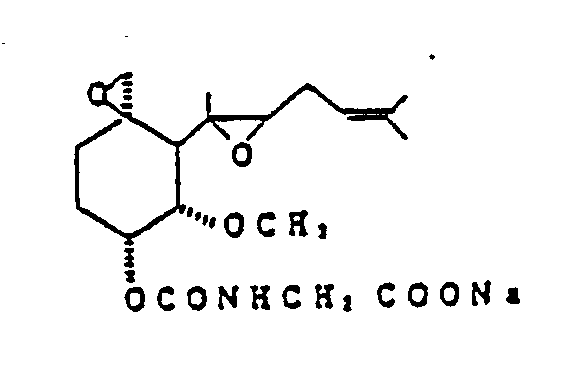
- In the same manner as in Example 8, fumagillol (242 mg) was reacted with ethyl isocyanatoacetate (135 mg) with stirring at room temperature for 24 hours. Purification by silica gel column chromatography (n-hexane:ethyl acetate = 3:1) gave colorless, oily O-ethoxycarbonylmethylcarbamoylfumagillol.
¹H-NMR (CDCl₃) δ: 1.08 (1H, m), 1.21 (3H, s), 1.29 (3H, t, J=7.2 Hz), 1.65 (3H, s), 1.74 (3H, s), 1.5-2.5 (6H, m), 2.55 (1H, d, J=4.2 Hz), 2.58 (1H, t, J=6.7 Hz), 2.98 (1H, d, J=4.2 Hz), 3.45 (3H, s), 3.63 (1H, dd, J=11.2 Hz, J=2.6 Hz), 3.87 (1H, dd, J=18.6 Hz, J=4.8 Hz), 4.06 (1H, dd, J=18.6 Hz, J=6.0 Hz), 4.22 (2H, q, J=7.2 Hz), 5.15-5.35 (2H, m), 6.00 (1H, m). - To a solution of O-ethoxycarbonylmethylcarbamoylfumagillol in ethanol (3 ml) was added 1 N sodium hydroxide (2 ml) and the mixture was stirred at room temperature for 2 hours. The reaction mixture was concentrated under reduced pressure, water was added to the residue and the mixture was washed with ethyl acetate. The aqueous layer was adjusted to pH 3 with oxalic acid and extracted with ethyl acetate. The extract was dried over anhydrous magnesium sulfate. Then the solvent was distilled off under reduced pressure to give light yellow, powdery O-carboxymethylcarbamoylfumagillol (251 mg) (76% yield).
¹H-NMR (CDCl₃) δ: 1.07 (1H, m), 1.22 (3H, s), 1.64 (3H, s), 1.75 (3H, s), 1.5-2.5 (6H, m), 2.56 (1H, d, J=4.2 Hz), 2.68 (1H, m), 2.97 (1H, d, J=4.2 Hz), 3.44 (3H, s), 3.68 (1H, dd, J=11.2 Hz, J=2.6 Hz), 3.99 (2H, m), 5.19 (1H, m), 5.47 (1H, m), 5.62 (1H, m) - To O-carboxymethylcarbamoylfumagillol (130 mg) was added water (1 ml), followed by portionwise addition of sodium hydrogen carbonate (40 mg) for dissolving the starting material. The solvent was distilled off under reduced pressure to give colorless, powdery sodium salt of O-carboxymethylcarbamoylfumagillol (135 mg) (98% yield).
m.p.: gradual decomposition above 200°C
¹H-NMR (D₂O) δ: 1.10 (1H, m), 1.23 (3H, s), 1.68 (3H, s), 1.77 (3H, s), 1.5-2.5 (6H, m), 2.78 (1H, d, J=3.2 Hz), 2.90 (1H, m), 3.12 (1H, d, J=3.2 Hz), 3.45 (3H, s), 3.70 (2H, s), 2.84 (1H, dd, J=11.5 Hz, J=2.6 Hz), 5.29 (1H, m), 5.49 (1H, m). -

- In the same manner as in Example 8, fumagillol (568 mg) was reacted with phenyl isocyanate (600 mg) with stirring at room temperature for 10 hours. Purification by silica gel column chromatography (n-hexane:ethyl acetate = 4:1) gave colorless, powdery O-phenylcarbamoylfumagillol (310 mg) (39% yield).
¹H-NMR (CDCl₃) δ: 1.10 (1H, m), 1.23 (3H, s), 1.66 (3H, s), 1.75 (3H, s), 1.6-2.4 (6H, m), 2.56 (1H, d, J=4.2 Hz), 2.58 (1H, t, J=6.0 Hz), 3.00 (1H, d, J=4.2 Hz), 3.45 (3H, s), 3.70 (1H, dd, J=11.2 Hz, J=2.8 Hz), 5.21 (1H, m), 5.57 (1H, br s), 7.0-7.6 (6H, m). -

- In the same manner as in Example 8, fumagillol (208 mg) was reacted with m-trifluoromethylphenyl isocyanate (207 mg) with stirring at room temperature for 15 hours. Purification by silica gel column chromatography (n-hexane: ethyl acetate = 4:1) gave colorless, powdery O-(m-trifluoromethylphenylcarbamoyl)fumagillol (285 mg) (82% yield).
¹H-NMR (CDCl₃) δ: 1.12 (1H, m), 1.23 (3H, s), 1.67 (3H, s), 1.75 (3H, s), 1.99 (1H, d, J=11.2 Hz), 1.8-2.5 (5H, m), 2.59 (2H, m), 3.00 (1H, d, J=4.2 Hz), 3.48 (3H, s), 3.71 (1H, dd, J=11.2 Hz, J=2.7 Hz), 5.21 (1H, m), 5.60 (1H, m), 7.00 (1H, br s), 7.25-7.60 (3H, m), 7.76 (1H, br s). -

- In the same manner as in Example 8, fumagillol (220 mg) was reacted with 1-naphtyl isocyanate (135 mg) with stirring at room temperature for 15 hours. Purification by silica gel column chromatography (n-hexane:ethyl acetate = 9:1) gave colorless, powdery O-[N-(1-naphtylcarbamoyl)-N-(1-naphtyl)carbamoyl]fumagillol (215 mg) (44% yield).
¹H-NMR (CDCl₃) δ: 0.50 (1H, m), 0.90 (1H, m), 0.97 (3H x


- The subsequent elution from the silica gel column with n-hexane-ethyl acetate (4:1) gave colorless, powdery O-(1-naphtylcarbamoyl)fumagillol (161 mg) (46% yield).
¹H-NMR (CDCl₃) δ: 1.10 (1H, m), 1.24 (3H, s), 1.67 (3H, s), 1.75 (3H, s), 1.6-2.5 (6H, m), 2.55 (1H, d, J=4.2 Hz), 2.59 (1H, m), 2.99 (1H, d, J=4.2 Hz), 3.47 (3H, s), 3.70 (1H, dd, J=11.2 Hz, J=2.6 Hz), 5.22 (1H, m), 5.63 (1H, br s), 7.19 (1H, br s), 7.4-8.0 (7H, m). -

- To a solution of fumgillol (233 mg) in anhydrous THF (1.5 ml) and anhydrous DMF (1.5 ml) was added 60% sodium hydride (70 mg) under ice cooling, followed by slow dropwise addition of methyl iodide (230 mg) and, after completion of the dropping, the mixture was stirred at 0°C for 20 minutes. To the reaction mixture was added water and the mixture was extracted with ether. The organic layer was washed with saturated aqueous sodium chloride solution and dried over anhydrous magnesium sulfate. The solvent was distilled off under reduced pressure and the residue was subjected to silica gel colum chromatography. The eluate obtained with the mixture of n-hexane and ethyl acetate (2:1) was concentrated under reduced pressure to give colorless, oily O-methylfumagillol (281 mg) (95% yield).
¹H-NMR (CDCl₃) δ: 1.00 (1H, m), 1.21 (3H, s), 1.65 (3H, s), 1.74 (3H, s), 1.5-1.8 (1H, m), 2.04 (1H, d, J=11.2 Hz), 1.95-2.25 (3H, m), 2.3-2.5 (1H, m) 2.52 (1H, d, J=4.4 Hz), 2.55 (1H, t, J=5.8 Hz), 2.96 (1H, d, J=4.4 Hz), 3.44 (3H, s), 3.47 (3H, s), 3.59 (1H, dd, J=11.2 Hz, J=2.6 Hz), 3.93 (1H, m), 5.21 (1H, m). -

- In the same manner as in Example 14, fumagillol (100 mg) was reacted with octadecyl iodide (160 mg) with stirring at room temperature for 2 days. Purification by silica gel column chromatography (dichloromethane) gave crystals, which were recrystallized from methanol-water to give colorless, crystalline O-octadecylfumagillol (85 mg) (45% yield).
m.p.: 58-59°C
¹H-NMR (CDCl₃) δ: 0.88 (3H, t, J=6.5 Hz), 1.00 (1H, m), 1.21 (3H, s), 1.25 (30H, s), 1.5-1.7 (3H, m), 1.63 (3H, s) 1.73 (3H, s), 1.9-2.4 (5H, m), 2.49 (1H, d, J=4.2 Hz), 2.56 (1H, t, J=5.8 Hz), 2.94 (1H, d, J=4.2 Hz), 3.45 (3H, s), 3.4-3.6 (3H, m), 3.98 (1H, m), 5.21 (1H, m). -

- In the same manner as in Example 14, fumagillol (211 mg) was reacted with bromoacetic acid (135 mg) at room temperature for 2 hours. To the reaction mixture was added water and the mixture was washed with ether. The aqueous layer was adjusted to pH 4 with diluted hydrochloric acid and extracted with ether. The extract was dried over anhydrous magnesium sulfate and the solvent was distilled off under reduced pressure to give colorless, oily O-carboxymethylfumagillol (191 mg) (75% yield).
¹H-NMR (CDCl₃) δ: 1.03 (1H, m), 1.24 (3H, s), 1.66 (3H, s), 1.76 (3H, s), 1.7-2.4 (6H, m), 2.57 (1H, d, J=4.2 Hz), 2.60 (1H, t, J=5.8 Hz), 2.95 (1H, d, J=4.2 Hz), 3.58 (3H, s), 3.70 (1H, dd, J=11.2 Hz, J=2.6 Hz), 3.97 (1H, br s), 4.05 (1H, d, J=17.5 Hz), 4.30 (1H, d, J=17.5 Hz), 5.20 (1H, m). -

- In the same manner as in Example 14, fumagillol (119 mg) was reacted with benzyl bromide (110 mg) at 0°C for 30 minutes. Purification by silica gel column chromatography (n-hexane:ethyl acetate =5.1) gave colorless, oily O-benzylfumagillol (151 mg) (96% yield).
¹H-NMR (CDCl₃) δ: 1.02 (1H, m), 1.22 (3H, s), 1.68 (3H, s), 1.69 (1H, m), 1.75 (3H, s), 2.00 (1H, m), 2.1-2.25 (3H, m), 2.45 (1H, m), 2.50 (1H, d, J=4.2 Hz), 2.57 (1H, t, J=5.8 Hz), 2.98 (1H, d, J=4.2 Hz), 3.41 (3H, s), 3.59 (1H, dd, J=11.2 Hz, J=2.6 Hz), 4.10 (1H, br s), 4.72 (2H, ABq, J=13 Hz), 5.23 (1H, m), 7.2-7.45 (5H, m). -
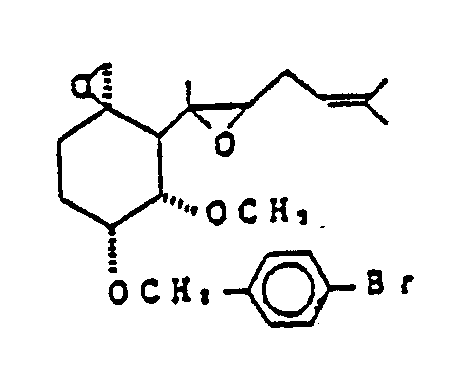
- In the same manner as in Example 14, fumagillol (100 mg) was reacted with p-bromobenzyl bromide (354 mg) at 0°C for 1 hour. Purification by silica gel column chromatography (n-hexane:ethyl acetate = 5:1) gave colorless, oily O-(p-bromobenzyl)fumagillol (135 mg) (84% yield).
¹H-NMR (CDCl₃) δ: 1.01 (1H, m), 1.21 (3H, s), 1.65 (3H, s), 1.74 (3H, s), 1.55-1.7 (1H, m), 1.9-2.5 (4H, m), 2.12 (1H, d, J=11.0 Hz), 2.52 (1H, d, J=4.4 Hz), 2.57 (1H, t, J=6.2 Hz), 2.96 (1H, d, J=4.4 Hz), 3.41 (3H, s), 3.58 (1H, dd, J=11.0 Hz, J=2.4 Hz), 4.09 (1H, m), 4.65 (2H, ABq, J=12.8 Hz), 5.21 (1H, m), 7.27 (2H, d, J=8.6 Hz), 7.45 (2H, d, J=8.6 Hz). -

- In the same manner as in Example 14, fumagillol (215 mg) was reacted with epibromohydrin (125 mg) at room temperature for 5 hours. Purification by silica gel column chromatography (n-hexane:ethyl acetate = 2.1) gave colorless, oily O-(2,3-epoxypropyl)fumagillol (225 mg) (87% yield).
¹H-NMR (CDCl₃) δ: 0.98 (1H, m), 1.22 (3H, s), 1.63 (3H, x ½, s), 1.65 (3H x ½, s), 1.75 (3H, s), 1.6-1.7 (1H, m), 1.9-2.4 (5H, m), 2.5-2.65 (3H, m), 2.77 (1H, m), 2.96 (1H, d, J=4.2 Hz), 3.17 (1H, m), 3.47 (3H, x ½, s), 3.50 (3H x ½, s), 3.35-4.05 (2H, m), 4.02 (1H x ½, br s), 4.07 (1H x ½, br s), 5.21 (1H, m). -

- To a solution of fumagillol (3.00 g) and dimethylaminopyridine (3.24 g) in anhydrous dichloromethane (30 ml) was added p-toluenesulfonyl chloride (3.04 g) and the mixture was stirred overnight at room temperature. The reaction mixture was diluted with dichloromethane, washed with saturated aqueous sodium chloride solution and dried over anhydrous magnesium sulfate. The solvent was distilled off under reduced pressure and the residue was subjected to silica gel column chromatography using n-hexane-ethyl acetate (4:1) as an eluent. The eluate was concentrated under reduced pressure and the resulting crude crystals were recrystallized from diisopropyl ether to give colorless, crystalline O-(p-toluenesulfonyl)fumagillol (2.88 g).
m.p.: 123-124°C
¹H-NMR (CDCl₃) δ: 1.14 (1H, m), 1.16 (3H, s), 1.67 (3H, s), 1.70 (3H, s), 1.84 (1H, m), 1.95 (1H, d, J=10.7 Hz), 2.04-2.47 (4H, m), 2.44 (3H, s), 2.55 (1H, d, J=4.3 Hz), 2.56 (1H, t, J=6.4 Hz), 2.94 (1H, d, J=4.3 Hz), 3.02 (3H, s), 3.50 (1H, dd, J=10.7 Hz, J=2.5 Hz), 5.07 (1H, m), 5.19 (1H, m), 7.33 (2H, d, J=8.2 Hz), 7.87 (2H, d, J=8.2 Hz). -

- To a solution of fumagillol (500 mg) and dimethylaminopyridine (541 mg) in anhydrous dichloromethane (5 ml) was added dropwise methanesulfonyl chloride (0.21 ml) under ice cooling and the mixture was stirred at room temperature for 1 hour. The reaction mixture was diluted with ethyl acetate, washed with water and saturated aqueous sodium chloride solution and dried over anhydrous magnesium sulfate. The solvent was distilled off under reduced pressure and the residue was subjected to silica gel column chromatography using n-hexane-ethyl acetate (2:1) as an eluent. The eluate was concentrated under reduced pressure to give O-methylsulfonylfumagillol as a colorless oil (561 mg).
¹H-NMR (CDCl₃) δ: 1.12 (1H, m), 1.20 (3H, s), 1.66 (3H, s), 1.75 (3H, s), 1.93 (1H, d, J=11.4 Hz), 1.85-2.45 (4H, m), 2.58 (1H, t, J=6.4 Hz), 2.59 (1H, d, J=4.2 Hz), 2.99 (1H, d, J=4.2 Hz), 3.14 (3H, s), 3.53 (3H, s), 3.65 (1H, dd, J=2.4 Hz), J=11.4 Hz), 5.20 (1H, m), 5.39 (1H, m). -

- Fumagillol (133 mg) and dimethylaminopyridine (115 mg) were dissolved in dichloromethane (3 ml), followed by addition of phenyl chloroformate (111 mg). The mixture was stirred at room temperature for 30 minutes. After addition of water, the mixture was diluted with dichloromethane (30 ml), washed with water and saturated aqueous sodium chloride solution and dried over anhydrous magnesium sulfate. The solvent was distilled off under reduced pressure and the residue was subjected to silica gel column chromatography (eluent: n-hexane-ethyl acetate = 5:1) to give colorless, oily O-phenoxycarbonylfumagillol (174 mg) (92% yield).
¹H-NMR (CDCl₃) δ: 1.10 (1H, m), 1.22 (3H, s), 1.66 (3H, s), 1.75 (3H, s), 1.8-2.45 (6H, m), 2.56 (1H, d, J=4.4 Hz), 2.59 (1H, t, J=6.4 Hz), 2.99 (1H, d, J=4.4 Hz), 3.50 (3H, s), 3.69 (1H, dd, J=11.2 Hz, J=2.6 Hz), 5.18 (1H, m), 5.58 (1H, br s), 7.15-7.45 (5H, m). -

- O-Phenoxycarbonylfumagillol (402 mg) was dissolved in ethanol (5 ml), followed by addition of concentrated aqueous ammonia (3 ml). The mixture was sitrred at room temperature for 3 hours. The solvent was distilled off under reduced pressure and the residue was subjected to silica gel column chromatography (eluent: n-hexane-ethyl acetate = 1:1) to give colorless, powdery O-carbamoylfumagillol (273 mg) (84% yield).
m.p.: 125-126°C
¹H-NMR (CDCl₃) δ: 1.07 (1H, m), 1.21 (3H, s), 1.66 (3H, s), 1.75 (3H, s), 1.6-2.5 (6H, m), 2.55 (1H, d, J=4.4 Hz), 2.57 (1H, t, J=7.4 Hz), 2.98 (1H, d, J=4.4 Hz), 3.45 (3H, s), 3.65 (1H, dd, J=11.4 Hz, J=2.8 Hz), 5.09 (2H, br s), 5.21 (1H, br t, J=7.6 Hz), 5.46 (1H, br s). -

- In the same manner as in Example 23, O-phenoxycarbonylfumagillol (173 mg) was reacted with morpholine (200 mg) with stirring at room temperature for 20 hours. Purification by silica gel column chromatography (eluent: n-hexane-ethyl acetate = 1:1) gave colorless, oily O-morpholinocarbonylfumagillol (148 mg) (87% yield).
¹H-NMR (CDCl₃) δ: 1.11 (1H, m), 1.21 (3H, s), 1.66 (3H, s), 1.74 (3H, s), 1.6-2.5 (6H, m), 2.55 (1H, d, J=4.2 Hz), 2.57 (1H, t, J=5.6 Hz), 2.99 (1H, d, J=4.2 Hz), 3.46 (3H, s), 3.47 (4H, m), 3.68 (5H, m), 5.21 (1H, m), 5.57 (1H, br s). -

- In the same manner as in Example 23, O-phenoxycarbonylfumagillol (193 mg) was reacted with piperidine (222 mg) with stirring at room temperature for 6 hours. Purification by silica gel column chromatography (eluent: n-hexane-ethyl acetate = 4:1) gave colorless, oily O-piperidinocarbonylfumagillol (187 mg) (99% yield).
¹H-NMR (CDCl₃) δ: 1.10 (1H, m), 1.22 (3H, s), 1.57 (6H, m), 1.66 (3H, s), 1.74 (3H, s), 1.8-2.5 (6H, m), 2.55 (1H, d, J=4.2 Hz), 2.59 (1H, t, J=6.4 Hz), 2.99 (1H, d, J=4.2 Hz), 3.42 (4H, m), 3.46 (3H, s), 3.64 (1H, dd, J=11.0 Hz, J=2.8 Hz), 5.22 (1H, m), 5.56 (1H, br s). -

- In the same manner as in Example 23, O-phenoxycarbonylfumagillol (400 mg) was reacted with hydrazine (120 mg) with stirring at room temperature for 1 hour. Purification by silica gel column chromatography (eluent: n-hexane-ethyl acetate = 1:2) gave light yellow, powdery O-carbazoylfumagillol (169 mg) (50% yield).
¹H-NMR (CDCl₃) δ: 1.07 (1H, m), 1.21 (3H, s), 1.65 (3H, s), 1.74 (3H, s), 1.6-2.5 (6H, m), 2.55 (1H, d, J=4.2 Hz), 2.56 (1H, t, J=6.4 Hz), 2.98 (1H, d, J=4.2 Hz), 3.47 (3H, s), 3.65 (1H, dd, J=11.2 Hz, J=2.8 Hz), 3.70 (2H, br s), 5.20 (1H, m), 5.55 (1H, m), 6.19 (1H, br s). -

- To a solution of fumagillol (236 mg) in dichloromethane (5 ml) was added 1,1′-carbonyldiimidazole (410 mg) and the mixture was stirred at room temperature for 1 day. The reaction mixture was concentrated under reduced pressure and the residue was subjected to silica gel column chromatography (eluent: n-hexane-ethyl acetate = 3:2) to give colorless, oily O-(1-imidazolylcarbonyl)fumagillol (275 mg) (90% yield).
¹H-NMR (CDCl₃) δ: 1.20 (1H, m), 1.23 (3H, s), 1.67 (3H, s), 1.75 (3H, s), 1.91 (1H, d, J=11.2 Hz), 1.8-2.5 (5H, m), 2.62 (1H, t, J=6.4 Hz), 2.62 (1H, d, J=4.2 Hz), 3.04 (1H, d, J=4.2 Hz), 3.52 (3H, s), 3.77 (1H, dd, J=11.2 Hz, J=2.6 Hz), 5.21 (1H, m), 5.83 (1H, br s), 7.06 (1H, d, J=1.4 Hz), 7.41 (1H, t, J=1.4 Hz), 8.12 (1H, s). -

- To a solution of O-(1-imidazolylcarbonyl)fumagillol (270 mg) in dichloromethane (3 ml) was added 2-dimethylaminoethylamine (90 mg) and the mixture was sitrred at room temperature for 1 day. The reaction mixture was diluted with ethyl acetate, washed with saturated aqueous sodium hydrogen carbonate solution, water and saturated aqueous sodium chloride solution and dried over anhydrous magnesium sulfate. The solvent was distilled off under reduced pressure and the residue was subjected to silica gel column chromatography (eluent: chloroform-methanol = 20:1) to give colorless, powdery O-(2-dimethylaminoethylcarbamoyl)fumagillol (139 mg) (53% yield).
¹H-NMR (CDCl₃) δ: 1.08 (1H, m), 1.22 (3H, s), 1.66 (3H, s), 1.75 (3H, s), 2.23 (6H, m), 1.6-2.5 (6H, m), 2.41 (2H, t, J=6.0 Hz), 2.55 (1H, d, J=4.4 Hz), 2.58 (1H, t, J=6.6 Hz), 2.98 (1H, d, J=4.4 Hz), 3.23 (2H, m), 3.46 (3H, s), 3.65 (1H, dd, J=11.2 Hz, J=2.8 Hz), 5.21 (1H, m), 5.39 (1H, br t), 5.50 (1H, br s). -

- In the same manner as in Example 8, fumagillol (700 mg) was reacted with acetyl isocyanate (500 mg) with stirring at room temperature for 10 minutes. Purification by silica gel column chromatography (eluent: n-hexaneethyl acetate = 2:1) gave colorless, syrupy O-acetylcarbamoylfumagillol (825 mg) (91% yield).
¹H-NMR (CDCl₃) δ: 1.10 (1H, m), 1.21 (3H, s), 1.66 (3H, s), 1.75 (3H, s), 1.8-2.5 (6H, m), 2.39 (3H, s), 2.57 (1H, t, J=6.8 Hz), 2.58 (1H, d, J=4.2 Hz), 2.99 (1H, d, J=4.2 Hz), 3.47 (3H, s), 3.68 (1H, dd, J=11.4 Hz, J=2.8 Hz), 5.20 (1H, m), 5.57 (1H, br s), 8.03 (1H, br s). -

- In the same manner as in Example 8, fumagillol (570 mg) was reacted with dichloroacetyl isocyanate (500 mg) with stirring at room temperature for 10 minutes. Purification by silica gel column chromatography (eluent: n-hexane-ethyl acetate = 3:1) gave colorless, syrupy O-dichloroacetylcarbamoylfumagillol (789 mg) (90% yield).
¹H-NMR (CDCl₃) δ: 1.11 (1H, m), 1.22 (3H, s), 1.67 (3H, s), 1.75 (3H, s), 1.96 (1H, d, J=11.2 Hz), 1.6-2.6 (6H, m), 2.58 (1H, d, J=4.2 Hz), 2.99 (1H, d, J=4.2 Hz), 3.48 (3H, s), 3.71 (1H, dd, J=11.2 Hz, J=2.8 Hz), 5.20 (1H, m), 5.64 (1H, m), 6.38 (1H, s), 8.50 (1H, s). -

- In the same manner as in Example 8, fumagillol (355 mg) was reacted with trichloroacetyl isocyanate (355 mg) with stirring at room temperature for 10 minutes. Purification by silica gel column chromatography (eluent: n-hexane-ethyl acetate = 7:2) gave colorless, powdery O-trichloroacetylcarbamoylfumagillol (258 mg) (44% yield).
¹H-NMR (CDCl₃) δ: 1.11 (1H, m), 1.22 (3H, s), 1.66 (3H, s), 1.75 (3H, s), 2.00 (1H, d, J=11.4 Hz), 1.6-2.7 (6H, m), 2.58 (1H, d, J=4.2 Hz), 3.01 (1H, d, J=4.2 Hz), 3.50 (3H, s), 3.73 (1H, dd, J=11.4 Hz, J=2.8 Hz), 5.20 (1H, m), 5.71 (1H, m), 8.68 (1H, br s). -

- In the same manner as in Example 8, fumagillol (510 mg) was reacted with benzoyl isocyanate (530 mg) with stirring at room temperature for 30 minutes. Purification by silica gel column chromatography (eluent: n-hexane-ethyl acetate = 3:1) gave colorless, powdery O-benzoylcarbamoylfumagillol (450 mg) (58% yield).
¹H-NMR (CDCl₃) δ: 1.09 (1H, m), 1.20 (3H, s), 1.65 (3H, s), 1.74 (3H, s), 1.6-2.45 (6H, m), 2.55 (1H, d, J=4.2 Hz), 2.56 (1H, t, J=7.0 Hz), 2.97 (1H, d, J=4.2 Hz), 3.42 (3H, s), 3.68 (1H, dd, J=11.4 Hz, J=2.6 Hz), 5.19 (1H, br t, J=7.4 Hz), 6.65 (1H, br s), 7.4-7.6 (3H, m), 7.89 (2H, dd, J=7.0 Hz, J=1.4 Hz), 8.88 (1H, br s). -
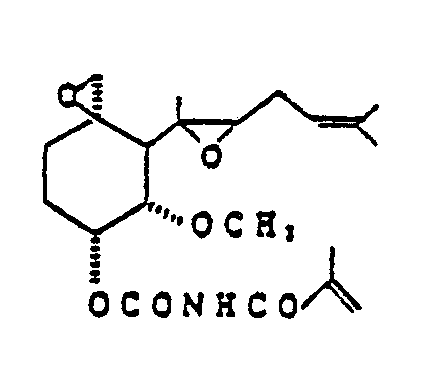
- In the same manner as in Example 8, fumagillol (1 g) was reacted with methacryloyl isocyanate (900 mg) with stirring at room temperature for 10 minutes. Purification by silica gel column chromatography (eluent: n-hexane-ethyl acetate = 2:1) gave colorless, powdery O-methacryloylcarbamoylfumagillol (511 mg) (37% yield).
m.p.: 48°C
¹H-NMR (CDCl₃) δ: 1.10 (1H, m), 1.22 (3H, s), 1.66 (3H, s), 1.76 (3H, s), 2.00 (3H, s), 1.6-2.5 (6H, m), 2.57 (1H, d, J=4.4 Hz), 2.60 (1H, t, J=6.0 Hz), 2.99 (1H, d, J=4.4 Hz), 3.47 (3H, s), 3.70 (1H, dd, J=11.4 Hz, J=2.8 Hz), 5.21 (1H, m), 5.58 (1H, d, J=1.6 Hz), 5.64 (1H, d, J=2.6 Hz), 5.79 (1H, s), 7.94 (1H, br s). -

- In the same manner as in Example 8, fumagillol (263 mg) was reacted with 2-chloroethyl isocyanate (150 mg) with stirring at room temperature for 1 day. Purification by silica gel column chromatography (eluent: n-hexane-ethyl acetate = 3:1) gave colorless, powdery O-(2-chloroethylcarbamoyl)fumagillol (100 mg) (29% yield).
¹H-NMR (CDCl₃) δ: 1.08 (1H, m), 1.21 (3H, s), 1.66 (3H, s), 1.75 (3H, s), 1.6-2.5 (6H, m), 2.56 (1H, d, J=4.4 Hz), 2.57 (1H, t, J=6.0 Hz), 2.98 (1H, d, J=4.4 Hz), 3.46 (3H, s), 3.4-3.7 (5H, m), 5.20 (2H, m), 5.50 (1H, br s). -
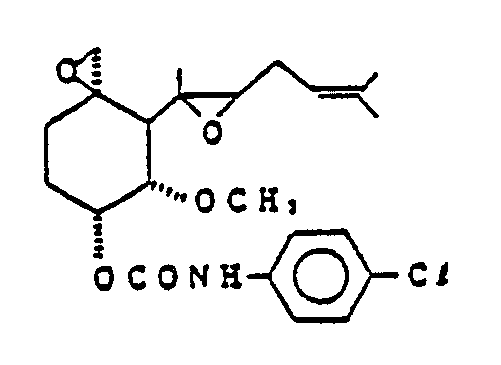
- In the same manner as in Example 8, fumagillol (248 mg) was reacted with p-chlorophenyl isocyanate (200 mg) with stirring at room temperature for 1.5 hours. Purification by silica gel column chromatography (eluent: n-hexane-ethyl acetate = 5:1) gave colorless, powdery O-(p-chlorophenylcarbamoyl)fumagillol (298 mg) (78% yield).
¹H-NMR (CDCl₃) δ: 1.09 (1H, m), 1.24 (3H, s), 1.66 (3H, s), 1.75 (3H, s), 1.6-2.5 (6H, m), 2.56 (1H, t, J=6.4 Hz), 2.57 (1H, d, J=4.2 Hz), 2.99 (1H, d, J=4.2 Hz), 3.40 (3H, s), 3.69 (1H, dd, J=11.2 Hz, J=2.6 Hz), 5.20 (1H, m), 5.57 (1H, br s), 7.24 (2H, d, J=9.0 Hz), 7.32 (1H, br s), 7.37 (2H, d, J=9.0 Hz). -

- In the same manner as in Example 8, fumagillol (290 mg) was reacted with p-nitrophenyl isocyanate (500 mg) with stirring at room temperature for 20 hours. Purification by silica gel column chromatography (eluent: n-hexane-ethyl acetate = 5:1) gave light yellow, powdery O-(p-nitrophenylcarbamoyl)fumagillol (255 mg) (56% yield).
¹H-NMR (CDCl₃) δ: 1.01 (1H, m), 1.29 (3H, s), 1.65 (3H, s), 1.75 (3H, s), 1.8-2.5 (6H, m), 2.58 (1H, t, J=6.2 Hz), 2.61 (1H, d, J=4.2 Hz), 3.01 (1H, d, J=4.2 Hz), 3.39 (3H, s), 3.75 (1H, dd, J=11.2 Hz, J=2.6 Hz), 5.20 (1H, m), 5.64 (1H, br s), 7.62 (2H, d, J=9.2 Hz), 8.15 (2H, d, J=9.2 Hz), 8.29 (1H, s). -

- In the same manner as in Example 8, fumagillol (250 mg) was reacted with 2,4-difluorophenyl isocyanate (250 mg) was stirring at room temperature for 2 hours. Purification by silica gel column chromatography (eluent: n-hexane-ethyl acetate = 4:1) gave colorless, powdery O-(2,4-difluorophenylcarbamoyl)fumagillol (246 mg) (63% yield).
¹H-NMR (CDCl₃) δ: 1.11 (1H, m), 1.23 (3H, s), 1.66 (3H, s), 1.75 (3H, s), 1.6-2.5 (6H, m), 2.58 (2H, m), 3.00 (1H, d, J=4.0 Hz), 3.49 (3H, s), 3.70 (1H, dd, J=11.4 Hz, J=2.8 Hz), 5.22 (1H, br t, J=7.4 Hz), 5.60 (1H, br s), 6.8-7.0 (3H, m), 8.05 (1H, br q, J=7.0 Hz). -

- In the same manner as in Example 8, fumagillol (213 mg) was reacted with p-toluenesulfonyl isocyanate (250 mg) with stirring at room temperature for 2 hours. Purification by silica gel column chromatography (eluent: n-hexane-ethyl acetate = 2:1) gave colorless, powdery O-(p-toluenesulfonylcarbamoyl)fumagillol (247 mg) (68% yield).
¹H-NMR (CDCl₃) δ: 1.08 (1H, m), 1.18 (3H, s), 1.66 (3H, s), 1.75 (3H, s), 2.44 (3H, s), 1.6-2.6 (6H, m), 2.55 (1H, d, J=4.2 Hz), 2.57 (1H, t, J=6.3 Hz), 3.26 (3H, s), 3.60 (1H, dd, J=11.2 Hz, J=2.6 Hz), 5.19 (1H, m), 5.42 (1H, br s), 7.34 (2H, d, J=8.0 Hz), 7.94 (2H, d, J=8.0 Hz), 8.60 (1H, br s). -

- To a solution of fumagillol (235 mg) and dimethylaminopyridine (425 mg) in dichloromethane (3 ml) was added 1-(4-ethylpiperazinyl)carbonyl chloride (325 mg) and the mixture was stirred at room temperature for 3 hours. The reaction mixture was diluted with ethyl acetate, washed with water and saturated aqueous sodium chloride solution and dried over anhydrous magnesium sulfate. The solvent was distilled off under reduced pressure and the residue was purified by silica gel column chromatography (eluent: n-hexane-ethyl acetate = 5:1) to give colorless, powdery O-[1-(4-ethylpiperazinyl)carbonyl]famagillol (134 mg) (38% yield).
¹H-NMR (CDCl₃) δ: 1.05 (1H, m), 1.19 (3H, s), 1.22 (3H, t, J=7.2 Hz), 1.66 (3H, s), 1.75 (3H, s), 1.6-2.7 (12H, m), 2.24 (1H, d, J=4.2 Hz), 2.62 (1H, t, J=6.2 Hz), 2.98 (1H, d, J=4.2 Hz), 3.49 (3H, s), 3.69 (1H, dd, J=11.2 Hz, J=2.4 Hz), 3.4-4.2 (4H, m), 5.20 (1H, m), 5.70 (1H, br s). -

- To a solution of O-chloroacetylcarbamoylfumagillol (201 mg) in dimethylformamide (3 ml) was added sodium acetate (200 mg) and the mixture was stirred at 60°C for 1 hour. The reaction mixture was diluted with ethyl acetate, washed with water and saturated aqueous sodium chloride solution and dried over anhydrous magnesium sulfate. The solvent was distilled off under reduced pressure and the residue was purified by silica gel column chromatography (eluent: n-hexane-ethyl acetate = 2:1) to give colorless, powdery O-acetoxyacetylcarbamoylfumagillol (165 mg) (77% yield).
¹H-NMR (CDCl₃) δ: 1.10 (1H, m), 1.21 (3H, s), 1.65 (3H, s), 1.74 (3H, s), 1.6-2.5 (6H, m), 2.18 (3H, s), 2.56 (2H, m), 2.99 (1H, d, J=4.0 Hz), 3.45 (3H, s), 3.67 (1H, dd, J=11.0 Hz, J=2.4 Hz), 4.96 (1H, d, J=17.4 Hz), 5.06 (1H, d, J=17.4 Hz), 5.19 (1H, br t, J=7.0 Hz), 5.56 (1H, br s), 8.55 (1H, s). -

- To a solution of O-chloroacetylcarbamoylfumagillol (155 mg) in dimethylformamide (2 ml) was added potassium thioacetate (70 mg) and the mixture was stirred at room temperature for 1 minute. The reaction mixture was diluted with ethyl acetate, washed with water and saturated aqueous sodium chloride solution and dried over anhydrous magnesium sulfate. The solvent was distilled off under reduced pressure and the residue was purified by silica gel column chromatography (eluent: n-hexane-ethyl acetate = 2:1) to give colorless, powdery O-acetylthioacetylcarbamoylfumagillol (156 mg) (92% yield)
¹H-NMR (CDCl₃) δ: 1.10 (1H, m), 1.22 (3H, s), 1.67 (3H, s), 1.76 (3H, s), 1.8-2.5 (6H, m), 2.43 (3H, s), 2.43 (3H, s), 2.59 (1H, d, J=4.2 Hz), 2.60 (1H, t, J=6.7 Hz), 3.00 (1H, d, J=4.2 Hz), 3.48 (3H, s), 3.69 (1H, dd, J=11.2 Hz, J=2.6 Hz), 3.97 (1H, d, J=16.2 Hz), 4.07 (1H, d, J=16.2 Hz), 5.21 (1H, m), 5.63 (1H, m), 8.32 (1H, br s). -

- To a solution of O-chloroacetylcarbamoylfumagillol (160 mg) in dimethylformamide (2 ml) was added 2-mercaptobenzothiazole sodium (95 mg) and the mixture was stirred at room temperature for 1.5 hours. The reaction mixture was diluted with ethyl acetate, washed with water and saturated aqueous sodium chloride solution and dried over anhydrous magnesium sulfate. The solvent was distilled off under reduced pressure and the residue was purified by silica gel column chromatography (eluent: n-hexane-ethylacetate = 3:1) to give colorless, powdery O-(2-benzothiazolylthioacetylcarbamoyl)fumagillol (152 mg) (72% yield).
¹H-NMR (CDCl₃) δ: 1.00 (1H, m), 1.20 (3H, s), 1.68 (3H, s), 1.78 (3H, s), 1.6-2.5 (7H, m), 2.51 (1H, d, J=4.2 Hz), 2.96 (1H, d, J=4.2 Hz), 3.48 (3H, s), 3.66 (1H, dd, J=11.4 Hz, J=2.8 Hz), 4.05 (1H, d, J=14.8 Hz), 4.24 (1H, d, J=14.8 Hz), 5.22 (1H, m), 5.65 (1H, br s), 7.3-7.5 (2H, m), 7.79 (1H, dd, J=7.2 Hz, J=1.4 Hz), 7.88 (1H, dd, J=7.2 Hz, J=1.4 Hz), 10.24 (1H, br s). -

- In the same manner as in Example 42, O-chloroacetylcarbamoylfumagillol (144 mg) was reached with sodium pyridine-N-oxide-2-thiolate (60 mg) with stirring at room temperature for 10 minutes. Purification by silica gel column chromatography (eluent: chloroform-methanol = 20:1) gave colorless, powdery O-[(pyridine-N-oxide-2-yl)thioacetylcarbamoyl]fumagillol (150 mg) (85% yield).
¹H-NMR (CDCl₃) δ: 1.07 (1H, m), 1.21 (3H, s), 1.65 (3H, s), 1.74 (3H, s), 1.8-2.4 (6H, m), 2.55 (1H, d, J=4.4 Hz), 2.57 (1H, t, J=6.5 Hz), 2.98 (1H, d, J=4.4 Hz), 3.46 (3H, s), 3.68 (1H, dd, J=11.4 Hz, J=2.6 Hz), 3.94 (1H, d, J=15.4 Hz), 4.13 (1H, d, J=15.4 Hz), 5.19 (1H, m), 5.60 (1H, m), 7.1-7.35 (2H, m), 7.50 (1H, d, J=7.2 Hz), 8.33 (1H, d, J=6.2 Hz), 9.29 (1H, br s). -

- To a solution of O-chloroacetylcarbamoylfumagillol (154 mg) and triethylamine (35 mg) in toluene (2 ml) was added diethylamine (70 mg) and the mixture was stirred at room temperature for 1 day. The reaction mixture was diluted with ethyl acetate, washed with water and saturated aqueous sodium chloride solution and dried over anhydrous magnesium sulfate. The solvent was distilled off under reduced pressure and the residue was purified by silica gel column chromatography (eluent: n-hexane-ethyl acetate = 2:1) to give colorless, syrupy O-diethylaminoacetylcarbamoylfumagillol (85 mg) (51% yeild).
¹H-NMR (CDCl₃) δ: 1.06 (6H, t, J=7.2 Hz), 1.10 (1H, m), 1.22 (3H, s), 1.66 (3H, s), 1.74 (3H, s), 1.5-2.7 (12H, m), 2.99 (2H, d, J=4.2 Hz), 3.15 (2H, t, J=7.5 Hz), 3.48 (3H, s), 3.68 (1H, dd, J=11.2 Hz, J=4.6 Hz), 5.20 (1H, m), 5.67 (1H, m), 55 (1H, br s). -
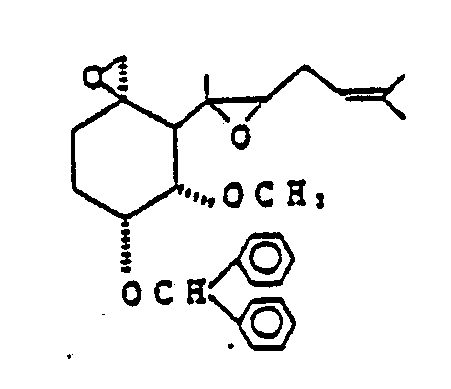
- In the same manner as in Example 14, fumagillol (221 mg) was reacted with diphenylmethyl bromide (290 mg) with stirring at room temperature for 3 hours. Purification by silica gel column chromatography (eluent: n-hexane-ethyl-acetate = 10:1) gave colorless, oily O-diphenylmethylfumagillol (100 mg) (28% yield).
¹H-NMR (CDCl₃) δ: 0.98 (1H, m), 1.19 (3H, s), 1.58 (1H, m), 1.65 (3H, s), 1.73 (3H, s), 1.9-2.4 (5H, m), 2.49 (1H, d, J=4.2 Hz), 2.57 (1H, t, J=6.4 Hz), 2.96 (1H, d, J=4.2 Hz), 3.22 (3H, s), 3.51 (1H, dd, J=11.2 Hz, J=2.4 Hz), 4.12 (1H, br s), 5.21 (1H, m), 5.67 (1H, s), 7.1-7.5 (10H, m). -
-

- In the same manner as in Example 14, fumagillol (221 mg) was reacted with 1-chloromethylnaphthalene (215 mg) with stirring at room temperature for 2 hours. Purification by silica gel column chromatography (eluent: n-hexane-ethyl acetate = 10:1) gave colorless, crystalline O-(1-naphtylmethyl)fumagillol (269 mg) (78% yield).
m.p.: 70-71°C
¹H-NMR (CDCl₃) δ: 0.95 (1H, m), 1.22 (3H, s), 1.65 (3H, s), 1.74 (3H, s), 1.5-2.5 (6H, m), 2.49 (1H, d, J=4.4 Hz), 2.57 (1H, t, J=6.4 Hz), 2.94 (1H, d, J=4.4 Hz), 3.42 (3H, s), 3.59 (1H, dd, J=11.0 Hz, J=2.4 Hz), 4.20 (1H, m), 5.03 (1H, d, J=11.4 Hz), 5.21 (1H, m), 5.28 (1H, d, J=11.4 Hz), 7.4-7.6 (4H, m), 7.8-7.9 (2H, m), 8.23 (1H, m). -

- In the same manner as in Example 14, fumagillol (272 mg) was reacted with 4-picolyl chloride hydrochloride (240 mg) with stirring at room temperature for 2 hours. Purification by silica gel column chromatography (eluent: n-hexane-ethyl acetate = 1:1) gave colorless, oily O-(4-picolyl)fumagillol (308 mg) (85% yield).
¹H-NMR (CDCl₃) δ: 1.05 (1H, m), 1.22 (3H, s), 1.66 (3H, s), 1.74 (3H, s), 1.75 (1H, m), 1.95-2.45 (5H, m), 2.55 (1H, d, J=4.2 Hz), 2.59 (1H, t, J=6.4 Hz), 2.98 (1H, d, J=4.2 Hz), 3.46 (3H, s), 3.63 (1H, dd, J=11.2 Hz, J=2.4 Hz), 4.14 (1H, m), 4.67 (1H, d, J=13.8 Hz), 4.81 (1H, d, J=13.8 Hz), 5.21 (1H, m), 7.31 (2H, d, J=5.8 Hz), 8.56 (2H, d, J=5.8 Hz). -

- In the same manner as in Example 14, fumagillol (264 mg) was reacted with 1,2-dibromomethylbenzene (297 mg) with stirring at room temperature for 20 minutes. Purification by silica gel column chromatography (eluent: n-hexane-ethyl acetate = 5:1) gave colorless, oily O-(O-bromomethylbenzyl)fumagillol (145 mg) (33% yield).
¹H-NMR (CDCl₃) δ: 1.01 (1H, m), 1.21 (3H, s), 1.65 (3H, s), 1.66 (1H, s), 1.74 (3H, s), 2.0-2.4 (5H, m), 2.52 (1H, d, J=4.2 Hz), 2.55 (1H, t, J=6.4 Hz), 2.95 (1H, d, J=4.2 Hz), 3.41 (3H, s), 3.59 (1H, dd, J=11.2 Hz, J=2.6 Hz), 4.17 (1H, m), 4.68 (1H, d, J=10.2 Hz), 4.74 (1H, d, J=8.8 Hz), 4.80 (1H, d, J=8.8 Hz), 4.85 (1H, d, J=10.2 Hz), 7.2-7.45 (4H, m). -

- To a solution of fumagillol (300 mg) and dimethylaminopyridine (260 mg) in anhydrous dichloromethane (5 ml) was added dropwise 4-chlorobutyryl chloride (0.14 ml) under ice cooling and the mixture was stirred at room temperature for 1 hour. The reaction mixture was diluted with ethyl acetate, washed with saturated aqueous sodium hydrogen carbonate solution and saturated aqueous sodium chloride solution and drived over anhydrous magnesium sulfate. The solvent was distilled off under reduced pressure and the residue was subjected to silica gel column chromatography, elution being carried out with a mixture of n-hexane and ethyl acetate (1:4). The eluate was concentrated under reduced pressure to give O-(4-chlorobutyryl)fumagillol (311 mg) as a colorless oil.
¹H-NMR (CDCl₃) δ: 1.10 (1H, s), 1.21 (3H, s), 1.66 (3H, s), 1.75 (3H, s), 1.80-2.45 (7H, m), 2.58 (4H, m), 2.99 (1H, d, J=4.2 Hz), 3.43 (3H, s), 3.61 (2H, t, J=6.4 Hz), 3.64 (1H, dd, J=2.8 Hz, J=11.4 Hz), 5.21 (1H, m), 5.68 (1H, m). -

- To a solution of fumagillol (300 mg) and dimethylaminopyridine (400 mg) in anhydrous dichloromethane (2 ml) was added dropwise N-methylsulfamoyl chloride (0.30 ml) and the mixture was stirred at room temperature for 20 minutes. The reaction mixture was diluted with ethyl acetate, washed with saturated aqueous sodium hydrogen carbonate solution and saturated aqueous sodium chloride solution and dried over anhydrous magnesium sulfate. The solvent was distilled off under reduced pressure and the residue was subjected to silica gel column chromatography, elution being carried out with a mixture of n-hexane and ethyl acetate (1:2). The eluate was concentrated under reduced pressure to give O-(N-methylsulfamoyl)fumagillol (367 mg) as colorless crystals. A portion of the above crop of crystals was recrystallized from isopropyl ether for melting point determination.
m.p.: 108-109°C
¹H-NMR (CDCl₃) δ: 1.12 (1H, s), 1.20 (3H, s), 1.66 (3H, s), 1.75 (3H, s), 1.95(1H, d, J=11.4 Hz), 1.85-2.45 (4H, m), 2.58 (1H, t, J=6.6 Hz), 2.60 (1H, d, J=4.0 Hz), 2.80 (3H, d, J=5.2 Hz), 2.99 (1H, d, J=4.0 Hz), 3.56 (3H, s), 3.68 (1H, dd, J=2.0 Hz, J=11.4 Hz), 5.15-5.30 (3H, m). -

- O-Chloroacetylcarbamoyldihydrofumagillol (173 mg) (81% yield) was derived from dihydrofumagillol (150 mg) in the same manner as in Example 8.
¹H-NMR (CDCl₃) δ: 0.91 (6H, d, J=6.6 Hz), 1.13 (1H, m), 1.18 (3H, s), 1.2-2.2 (9H, m), 2.57 (1H, dd, J=7.2 Hz, J=4.6 Hz), 2.63 (1H, d, J=4.2 Hz), 2.91 (1H, d, J=4.2 Hz), 3.47 (3H, s) 3.69 (1H, dd, J=11.4 Hz, J=2.6 Hz), 4.44 (2H, s), 5.62 (1H, br s), 8.36 (1H, br s). -

- In the same manner as in Example 42, O-chloroacetylcarbamoylfumagillol (195 mg) was reacted with 1-(2-dimethylaminoethyl)-5-mercaptotetrazole sodium (113 mg) with stirring at room temperature for 1 hour. Purification by silica gel column chromatography (eluent: ethyl acetate) gave colorless, powdery O-[[1-(2-dimethylaminoethyl)tetrazol]-5-yl-thioacetylcarbamoyl]fumagillol (217 mg) (83% yield).
¹H-NMR (CDCl₃) δ: 1.10 (1H, m), 1.20 (3H, s), 1.66 (3H, s), 1.75 (3H, s), 1.8-2.45 (6H, m), 2.59 (2H, m), 2.77 (2H, t, J=6.2 Hz), 2.99 (1H, d, J=4.2 Hz, 3.47 (3H, s), 3.67 (1H, dd, J=11.4 Hz, J=2.6 Hz), 4.37 (4H, m), 5.20 (1H, m), 5.62 (1H, m), 8.99 (1H, br s). -

- In the same manner as in Example 42, O-chloroacetylcarbamoylfumagillol (283 mg) was reacted with sodium 2-methyl-1,3,4-thiadiazole-5-thiolate (130 mg) with stirring at room temperature for 30 minutes. Purification by silica gel column chromatography (eluent: n-hexane-ethyl acetate = 1:1) gave colorless, powdery O-[(2-methyl-1,3,4- thiadiazol-5-yl)thioacetylcarbamoyl]fumagillol (293 mg) (84% yield).
¹H-NMR (CDCl₃) δ: 1.09 (1H, m), 1.20 (3H, s), 1.66 (3H, s), 1.75 (3H, s), 1.6-2.4 (6H, m), 2.57 (2H, m), 2.73 (3H, s), 2.98 (1H, d, J=4.2 Hz), 3.45 (3H, s), 3.67 (1H, dd, J=11.2 Hz, J=2.6 Hz), 4.32 (1H, d, J=16.2 Hz), 4.44 (1H, d, J=16.2 Hz), 5.21 (1H, m), 5.61 (1H, br s), 9.43 (1H, br s). -

- In the same manner as in Example 42, O-chloroacetylcarbamoylfumagillol (159 mg) was reacted with sodium naphthalenethiolate (188 mg) with stirring at room temperature for 5 minutes. Purification by silica gel column chromatography (eluent: n-hexane-ethyl acetate = 3:1) gave colorless, powdery O-(1-naphthalenethioacetylcarbamoyl)fumagillol (160 mg) (81% yield).
¹H-NMR (CDCl₃) δ: 1.08 (1H, m), 1.20 (3H, s), 1.66 (3H, s), 1.75 (3H, s), 1.89 (1H, d, J=11.2 Hz), 1.6-2.45 (5H, m), 2.54 (2H, m), 2.73 (3H, s), 2.98 (1H, d, J=4.2 Hz), 3.45 (3H, s), 3.66 (1H, dd, J=11.2 Hz, J=2.6 Hz), 3.96 (1H, d, J=15.4 Hz), 4.07 (1H, d, J=15.4 Hz), 5.20 (1H, m), 5.57 (1H, m), 7.35-7.9 (6H, m), 8.11 (1H, br s), 8.40 (1H, d, J=7.8 Hz). -

- O-Chloroacetylcarbamoylfumagillol (170 mg) and N-methylpyrrolidine (1 ml) were stirred in ether (3 ml) at room temperature for 1 week. The resultant precipitate was recovered by filtration, washed with ether and dried in vacuo. The procedure gave colorless, powdery O-[(N-methylpyrrolidin-1-ylium)acetylcarbamoyl]fumagillol chloride (170 mg) (82% yield).
¹H-NMR (CDCl₃) δ: 0.97 (1H, m), 1.16 (3H, s), 1.63 (3H, s), 1.73 (3H, s), 1.4-2.7 (1H, m), 2.53 (1H, d, J=4.2 Hz), 2.66 (1H, t, J=6.2 Hz), 2.94 (1H, d, J=4.2 Hz), 3.41 (3H, s), 3.42 (2H, s), 3.64 (1H, dd, J=11.4 Hz, J=2.6 Hz), 3.8-4.1 (4H, m), 4.70 (1H, d, J=16.8 Hz), 5.14 (1H, m), 5.40 (1H, d, J=16.8 Hz), 5.60. -

- O-(2-Dimethylaminoethylcarbamoyl)fumagillol (81 mg) and methyl iodide (0.5 ml) were stirred in dichloromethane (1 ml) at room temperature for 15 hours. The solvent was distilled off under reduced pressure and the residue was washed with ether to give colorless, powdery O-[2-(N,N,N-trimethylammonio)ethylcarbamoyl]fumagillol iodide (105 mg) (95% yield).
m.p.: 94-95°C
¹H-NMR (CDCl₃) δ: 1.03 (1H, m), 1.17 (3H, s), 1.66 (3H, s), 1.75 (3H, s), 1.5-2.4 (6H, m), 2.57 (1H, d, J=4.2 Hz), 2.68 (1H, t, J=6.6 Hz), 2.97 (1H, d, J=4.2 Hz), 3.44 (12H, s), 3.3-3.9 (5H, m), 5.18(1H, m), 5.50 (1H, m) 6.80 (1H, m). -

- To a solution of O-(2-dimethylaminoethylcarbamoyl)fumagillol (145 mg) and triethylamine (0.5 ml) in dichloromethane (2 ml) was added acetic anhydride (0.3 ml) and the mixture was stirred at room temperature for 1 day. The reaction mixture was diluted with ethyl acetate, washed with water and saturated aqueous sodium chloride solution and dried over anhydrous magnesium sulfate. The solvent was distilled off under reduced pressure and the residue was purified by silica gel column chromatography (eluent: dichloromethane-methanol = 20:1) to give colorless, oily O-[N-acetyl-(2-dimethylaminoethylcarbamoyl]fumagillol (113 mg) (73% yield).
¹H-NMR (CDCl₃) δ: 1.15 (1H, m), 1.20 (3H, s), 1.65 (3H, s), 1.74 (3H, s), 1.95 (3H, s), 1.9-2.6 (7H, m), 2.50 (3H, s), 2.53 (3H, s), 2.60 (1H, d, J=4.4 Hz), 2.78 (1H, t, J=6.4 Hz), 2.86 (1H, m), 3.02 (1H, t, J=6.4 Hz), 3.45 (3H, s), 3.69 (1H, dd, J=11.4 Hz, J=2.8 Hz), 4.03 (2H, m), 5.20 (1H, m), 5.71 (1H, m). -

- In the same manner as in Example 8, fumagillol (220 mg) was reacted with acryloyl isocyanate (200 mg) with stirring at room temperature for 30 minutes. Purification by silica gel column chromatography (eluent: n-hexane-ethyl acetate = 3:1) gave colorless, powdery O-acryloylcarbamoylfumagillol (60 mg) (21% yield).
¹H-NMR (CDCl₃) δ: 1.10 (1H, m), 1.21 (3H, s), 1.66 (3H, s), 1.75 (3H, s), 1.6-2.5 (6H, m), 2.58 (1H, d, J=4.2 Hz), 2.59 (1H, m), 2.99 (1H, d, J=4.2 Hz), 3.47 (3H, s), 3.69 (1H, dd, J=11.2 Hz, J=2.6 Hz), 5.21 (1H, m), 5.60 (1H, m), 5.88 (1H, dd, J=10.4 Hz, J=1.6 Hz), 6.51 (1H, dd, J=17.0 Hz, J=1.6 Hz), 6.92 (1H, dd, J=17.0 Hz, J=1.6 Hz), 6.92 (1H, dd, J=17.0 Hz, J=10.4 Hz), 7.78 (1H, br s). -

- In the same manner as in Example 42, O-chloroacetylcarbamoylfumagillol (270 mg) was reacted with sodium 1-methyl-2-methoxycarbonoyl-1,3,4-triazole-5-thiolate (164 mg) with stirring at room temperature for 30 minutes. Purification by silica gel column chromatography (eluent: n-hexane-ethyl acetate = 1:4) gave colorless, powdery O-[(1-methyl-2-methoxycarbonyl-1,3,4-triazol-5-yl)thioacetylcarbamoyl]fumagillol (288 mg) (80% yield).
¹H-NMR (CDCl₃) δ: 1.07 (1H, m), 1.18 (3H, s), 1.65 (3H, s), 1.75 (3H, s), 1.6-2.4 (6H, m), 2.54 (2H, m), 2.96 (1H, d, J=4.2 Hz), 3.44 (3H, s), 3.64 (1H, dd, J=11.4 Hz, J=2.4 Hz), 3.91 (3H, s), 3.99 (3H, s) 4.30 (1H, d, J=15.8 Hz), 4.41 (1H, d, J=15.8 Hz), 5.19 (1H, m), 5.59 (1H, m), 9.96 (1H, br s). -

- In the same manner as in Example 42, O-chloroacetylcarbamoylfumagillol (230 mg) was reacted with 2-mercaptobenzoxazole sodium salt (119 mg) with stirring at room temperature for 30 minutes. Purification by silica gel column chromatography (eluent: n-hexane-ethyl acetate = 3:1) gave colorless, powdery O-[(2-benzoxazolyl)thioacetylcarbamoyl]fumagillol (269 mg) (91% yield).
¹H-NMR (CDCl₃) δ: 1.04 (1H, m), 1.20 (3H, s), 1.66 (3H, s), 1.75 (3H, s), 1.8-2.6 (8H, m), 2.97 (1H, d, J=4.4 Hz), 3.47 (3H, s), 3.67 (1H, dd, J=11.2 Hz, J=2.6 Hz), 4.31 (2H, s), 5.20 (1H, m), 5.63 (1H, m), 7.2-7.3 (2H, m), 7.47 (1H, m), 7.58 (1H, m), 9.49 (1H, br s). -

- In the same manner as in Example 42, O-chloroacetylcarbamoylfumagillol (257 mg) was reacted with 2-mercaptobenzoimidazole sodium salt (132 mg) with stirring at room temperature for 30 minutes. Purification by silica gel column chromatography (eluent: n-hexane-ethyl acetate = 1:1) gave colorless, powdery O-[(2-benzoimidazolyl)thioacetylcarbamoyl]fumagillol (297 mg) (90% yield).
¹H-NMR (CDCl₃) δ: 1.03 (1H, m), 1.19 (3H, s), 1.71 (3H, s), 1.83 (3H, s), 1.6-2.4 (7H, m), 2.57 (1H, d, J=4.4 Hz), 2.96 (1H, d, J=4.4 Hz), 3.46 (3H, s), 3.68 (1H, dd, J=11.6 Hz, J=2.2 Hz), 3.74 (1H, d, J=14.2 Hz), 3.87 (1H, d, J=14.2 Hz), 5.25 (1H, m), 5.69 (1H, m), 7.10 (2H, m), 7.3-7.5 (2H, m), 11.01 (1H, br s), 12.60 (1H, br s). -

- In the same manner as in Example 42, O-chloroacetylcarbamoylfumagillol (289 mg) was reacted with 8-mercaptoquinoline sodium salt (208 mg) with stirring at room temperature for 30 minutes. Purification by silica gel column chromatography (eluent: n-hexane-ethyl acetate = 7:3) gave colorless, powdery O-[(8-quinolyl)thioacetylcarbamoyl]fumagillol (382 mg) (99% yield).
¹H-NMR (CDCl₃) δ: 1.07 (1H, m), 1.25 (3H, s), 1.65 (3H, s), 1.75 (3H, s), 1.6-2.55 (8H, m), 2.95 (1H, d, J=4.2 Hz), 3.51 (3H, s), 3.74 (1H, dd, J=11.4 Hz, J=2.8 Hz), 3.77 (1H, d, J=15.4 Hz), 3.92 (1H, d, J=15.4 Hz), 5.19 (1H, m), 5.67 (1H, m), 7.50 (1H, t, J=7.8 Hz), 7.60 (1H, dd, J=8.4 Hz, J=4.4 Hz), 7.82 (1H, d, J= 7.8 Hz), 7.91 (1H, d, J=7.2 Hz), 8.26 (1H, dd, J=8.4 Hz, J=1.6 Hz), 9.20 (1H, dd, J=4.4 Hz, J=1.6 Hz), 11.84 (1H, br s). -

- In the same manner as in Example 42, O-chloroacetylcarbamoylfumagillol (292 mg) was reacted with 2-pyridinethiol sodium salt (116 mg) with stirring at room temperature for 30 minutes. Purification by silica gel column chromatography (eluent: n-hexane-ethyl acetate = 2:1) gave colorless, powdery O-[(2-pyridyl)thioacetylcarbamoyl]fumagillol (325 mg) (94% yield).
¹H-NMR (CDCl₃) δ: 1.08 (1H, m), 1.21 (3H, s), 1.67 (3H, s), 1.76 (3H, s), 1.6-2.6 (8H, m), 2.98 (1H, d, J=4.2 Hz), 3.47 (3H, s), 3.66 (1H, dd, J=11.2 Hz, J=2.6 Hz), 3.77 (1H, d, J=14.8 Hz), 3.93 (1H, d, J=14.8 Hz), 5.23 (1H, m), 5.60 (1H, m), 7.11 (1H, m), 7.31 (1H, d, J=8.8 Hz), 7.59 (1H, m), 8.45 (1H, d, J=5.0 Hz) 10.67 (1H, br s). -

- In the same manner as in Example 42, O-chloroacetylcarbamoylfumagillol (290 mg) was reacted with 4-pyridinethiol sodium salt (115 mg) with stirring at room temperature for 30 minutes. Purifications by silica gel column chromatography (eluent: n-hexane-ethyl acetate = 1:2) gave colorless, powdery O-[(4-pyridyl)thioacetylcarbamoyl]fumagillol (314 mg) (91% yield).
¹H-NMR (CDCl₃) δ: 1.10 (1H, m), 1.21 (3H, s), 1.66 (3H, s), 1.75 (3H, s), 1.6-2.6 (6H, m), 2.54 (1H, t, J=6.2 Hz), 2.57 (1H, d, J=4.4 Hz), 2.98 (1H, d, J=4.4 Hz), 3.48 (3H, s), 3.69 (1H, dd, J=11.2 Hz, J=2.4 Hz), 4.13 (1H, d, J=15.8 Hz), 4.22 (1H, d, J=15.8 Hz), 5.20 (1H, m), 5.61 (1H, m), 7.22 (2H, dd, J=5.0 Hz, J=1.4 Hz), 8.43 (2H, d, J=6.0 Hz), 8.82 (1H, br s). -
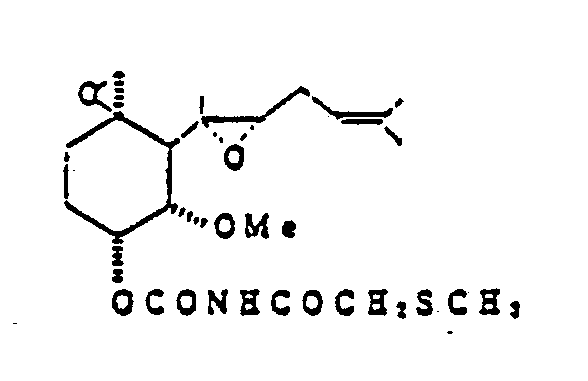
- In the same manner as in Example 42, O-chloroacetylcarbamoylfumagillol (107 mg) was reacted with methanethiol sodium salt (225 mg) with stirring at 10°C for 1 hour. Purification by silica gel column chromatography (eluent: n-hexane-ethyl acetate = 3:1) gave colorless, powdery O-(methylthioacetylcarbamoyl)fumagillol (500 mg) (45% yield).
¹H-NMR (CDCl₃) δ: 1.10 (1H, m), 1.21 (3H, s), 1.66 (3H, s), 1.75 (3H, s), 1.75 (3H, s), 1.93 (1H, d, J=11.2 Hz), 2.18 (3H, s), 1.7-2.45 (5H, m), 2.58 (2H, m), 2.99 (1H, d, J=4.2 Hz), 3.47 (3H, s), 3.48 (1H, d, J=16.8 Hz), 3.55 (1H, d, J=16.8 Hz), 3.68 (1H, dd, J=11.2 Hz, J=2.8 Hz), 5.20 (1H, m), 5.61 (1H, m), 8.12 (1H, br s). -
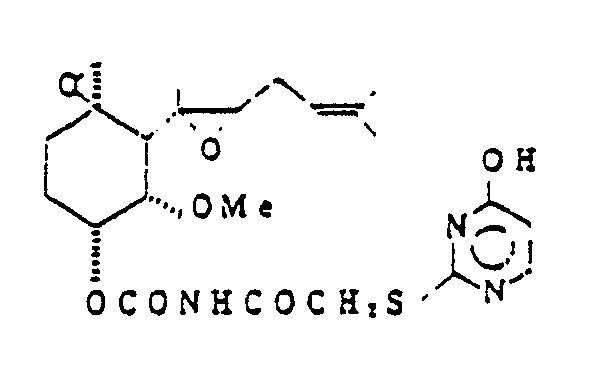
- In the same manner as in Example 42, O-chloroacetylcarbamoylfumagillol (239 mg) was reacted with thiouracil sodium salt (123 mg) with stirring at room temperature for 30 minutes. Purification by silica gel column chromatography (eluent: n-hexane-ethyl acetate = 1:5) gave colorless, powdery O-[(4-hydroxypyrimidin-2-yl)thioacetylcarbamoyl]fumagillol (208 mg) (71% yield).
¹H-NMR (CDCl₃) δ: 1.09 (1H, m), 1.22 (3H, s), 1.66 (3H, s), 1.75 (3H, s), 1.5-2.6 (7H, m), 2.58 (1H, d, J=4.2 Hz), 2.99 (1H, d, J=4.2 Hz), 3.47 (3H, s), 3.68 (1H, dd, J=11.2 Hz, J=2.4 Hz), 4.08 (1H, d, J=15.8 Hz), 4.20 (1H, d, J=15.8 Hz), 5.21 (1H, m), 5.61 (1H, m), 6.27 (1H, d, J=6.6 Hz), 7.88 (1H, d, J=6.6 Hz), 9.07 (1H, br s). -

- In the same manner as in Example 42, O-chloroacetylcarbamoylfumagillol (249 mg) was reacted with 5-mercapto-1,2,3-triazole sodium alt (118 mg) with stirring at room temperature for 1 hour. Purification by silica gel column chromatography (eluent: n-hexane-ethyl acetate = 3:2) gave colorless, powdery O-[(1,2,3-triazol-5-yl)thioacetylcarbamoyl]fumagillol (206 mg) (71% yield).
¹H-NMR (CDCl₃) δ: 1.07 (1H, m), 1.27 (3H, s), 1.67 (3H, s), 1.76 (3H, s), 1.7-2.6 (6H, m), 2.59 (1H, d, J=4.2 Hz), 2.79 (1H, t, J=6.2 Hz), 2.99 (1H, d, J=4.2 Hz), 3.41 (3H, s), 3.69 (1H, dd, J=11.2 Hz, J=2.6 Hz), 3.3-3.9 (2H, m), 5.20 (1H, m), 5.59 (1H, m), 7.71 (1H, s), 8.90 (1H, br s). -

- O-(Methylthioacetylcarbamoyl)fumagillol (167 mg) and methyl iodide (1 ml) were stirred in acetonitrile (1 ml) at room temperature overnight. The solvent was distilled off under reduced pressure and ether was added to the residue. The resulting precipitate was collected by filtration, washed with ether and dried under reduced pressure to give colorless, powdery O-[(dimethylsulfonio)acetylcarbamoyl]fumagillol iodide (79 mg) (35% yield).
¹H-NMR (d₆-DMSO) δ: 1.09 (3H, s), 1.32 (1H, m), 1.62 (3H, s), 1.72 (3H, s), 1.6-2.95 (10H, m), 2.92 (6H, s), 3.34 (3H, s), 3.66 (1H, m), 4.90 (2H, s), 5.21 (1H, m), 5.49 (1H, m). -

- O-[(4-Pyridyl)thioacetylcarbamoyl]fumagillol (113 mg) and methyl iodide (1 ml) were dissolved in dichloromethane (2 ml) and the solution was stirred at room temperature overnight. The solvent was distilled off under reduced pressure and ether was added to the residue. the resulting precipitate was collected by filtration and washed with ether to give colorless, powdery O-[(N-methylpyridin-4-ylium)thioacetylcarbamoyl]fumagillol iodide (127 mg) (87% yield).
¹H-NMR (CDCl₃) δ: 1.05 (1H, m), 1.21 (3H, s), 1.65 (3H, s), 1.74 (3H, s), 1.5-2.65 (7H, m), 2.92 (1H, t, J=6.2 Hz), 2.98 (1H, d, J=4.0 Hz), 3.49 (3H, s), 3.71 (1H, dd, J=11.2 Hz, J=2.4 Hz), 4.32 (2H, m), 4.37 (3H, s), 5.19 (1H, m), 5.64 (1H, m), 7.90 (2H, d, J=6.8 Hz), 3.76 (2H, d, J=6.8 Hz), 10 12 (1H, br s). -

- In the same manner as in Example 8, fumagillol (350 mg) was reacted with ethoxycarbonyl isocyanate (200 mg) with stirring at room temperature for 30 minutes. Purification by silica gel column chromatography (eluent: n-hexane-ethyl acetate = 3:1) gave colorless, powdery O-[N-(ethoxycarbonyl)carbamoyl]fumagillol (370 mg) (75% yield).
¹H-NMR (CDCl₃) δ: 1.08 (1H, m), 1.21 (3H, s), 1.30 (3H, t, J=7.0 Hz), 1.66 (3H, s), 1.75 (3H, s), 1.8-2.45 (6H, m), 2.56 (1H, d, J=4.2 Hz), 2.57 (1H, m), 2.98 (1H, d, J=4.2 Hz), 3.46 (3H, s), 3.67 (1H, dd, J=11.4 Hz, J=2.8 Hz), 4.23 (2H, q, J=7.0 Hz), 5.21 (1H, m), 5.62 (1H, m), 7.21 (1H, br s). -

- In dichloromethane (15 ml) was dissolved 3-furancarboxylic acid (397 mg) followed by addition of oxalyl chloride (0.62 ml) and the mixture was refluxed for 1 hour. After cooling, the solvent was distilled off under reduced pressure to give crude 3-furancarbonyl chloride. In dichloromethane (2 ml) were dissolved fumagillol (500 mg) and dimethylaminopyridine (433 mg), and under ice-cooling, a solution of the above 3-furanecarbonyl chloride in dichloromethane (5 ml) was added dropwise. Then, at room temperature, the mixture was stirred for 30 minutes. Thereafter, the reaction mixture was diluted with ethyl acetate (50 ml), then washed successively with 10% aqueous citric acid solution, saturated aqueous sodium chloride solution, saturated aqueous sodium hydrogen carbonate solution and saturated aqueous sodium chloride solution, and dried over anhydrous magnesium sulfate. Finally, the solvent was distilled off under reduced pressure and the residue was purified by silica gel column chromatography (eluent: n-hexane-ethyl acetate = 1:1) to give 187 mg of O-(3-furoyl)fumagillol as colorless oil (28% yield).
¹H-NMR (CDCl₃) δ: 1.25 (1H, m), 1.23 (3H, s), 1.66 (3H, s), 1.75 (3H, s), 1.8-2.5 (5H, m), 1.98 (1H, d, J=11 Hz), 2.58 (1H, d, J=4 Hz), 2.61 (1H, t, J=7 Hz), 3.02 (1H, d, J=4 Hz), 3.47 (3H, s), 3.72 (1H, dd, J=3 Hz, J=11 Hz), 5.21 (1H, m), 5.81 (1H, m), 6.72 (1H m), 7.41 (1H, m), 8.00 (1H, m). -

- 3-Furancarboxamide (167 mg) was suspended in dichloromethane (10 ml), followed by addition of oxalyl chloride (0.20 ml) under ice-cooling, and the temperature of the reaction mixture was raised to room temperature The reaction mixture was refluxed for 10 hours and the solvent was distilled off to give crude 3-furoyl isocyanate. In the same manner as in Example 8, the above product was reacted with fumagillol (213 mg) with stirring at room temperature for 30 minutes. Purification by silica gel column chromatography (eluent: n-hexane-ethyl acetate = 2:1) gave colorless, powdery O-[N-(3-furoyl) carbamoyl]fumagillol (120 mg) (38% yield).
¹H-NMR (CDCl₃) δ: 1.11 (1H, m), 1.22 (3H, s), 1.66 (3H, s), 1.75 (3H, s), 1.8-2.5 (5H, m), 2.00 (1H, d, J=11.2 Hz), 2.57 (1H, d, J=4.0 Hz), 2.61 (1H, t, J=6.6 Hz), 2.99 (1H, d, J-4.0 Hz), 3.44 (4H, m), 3.70 (1H, dd, J=11.2 Hz, J-=2.8 Hz), 5.20 (1H, m), 5.63 (1H, m), 6.80 (1H, m), 7.47 (1H, m), 8.16 (1H, m), 8.26 (1h br s). -

- In the same manner as in Example 8, fumagillol (200 mg) was reacted with phenoxycarbonyl isocyanate (231 mg) with stirring at room temperature for 4 hours. Purification by silica gel column chromatography (eluent: n-hexane-ethyl acetate = 2:1) gave colorless, powdery O-[N-(phenoxycarbonyl)carbamoyl]fumagillol (125 mg) (39% yield).
¹H-NMR (CDCl₃) δ: 1.09 (1H, m), 1.21 (3H, s), 1.65 (3H, s), 1.74 (3H, s), 1.5-2.5 (6H, m), 2.55 (1H, d, J=4.1 Hz), (2.57 (1H, t, J=6.5 Hz), 2.98 (1H, d, J=4.1 Hz), 3.50 (3H, s), 3.69 (1H, dd, J=1.4 Hz, J=11.2 Hz), 5.20 (1H, m), 5.70 (1H, m), 7.1-7.4 (5H, m), 7.66 (1H, br s). -

- O-Carbamoylfumagillol (200 mg) was dissolved in dichloromethane (4 ml) followed by addition of chloroacetyl isocyanate (0.10 mg) and the mixture was stirred for 4 hours. The reaction mixture was diluted with ethyl acetate (50 ml), washed with saturated aqueous sodium hydrogen carbonate solution and saturated aqueous sodium chloride solution and dried over anhydrous magnesium sulfate. The solvent was distilled off under reduced pressure and the residue was purified by silica gel column chromatography (eluent: n-hexane-ethyl acetate = 1:1) to give colorless, powdery O-(N′-chloroacetylallophanoyl)fumagillol (230 mg) (84% yield).
¹H-NMR (CDCl₃) δ: 1.12 (1H, m), 1.21 (3H, s), 1.66 (3H, s), 1.75 (3H, s), 1.8-2.5 (6H, m), 1.92 (1H, d, J=11.2 Hz), 2.57 (1H, d, J=4.2 Hz), 2.59 (1H, t, J=6.8 Hz), 2.99 (1H, d, J=4.2 Hz), 3.48 (3H, s), 3.68 (1H, dd, J-11.4 Hz, J=2.8 Hz), 4.39 (2H, s), 5.20 (1H, m), 5.65 (1H, m). -

- In the same manner as in Example 74, O-carbamoylfumagillol (200 mg) was reacted with benzoyl isocyanate (0.51 ml) with stirring at room temperature for 2 days. Purification by silica gel column chromatography (eluent: n-hexane-ethyl acetate = 3:2) gave colorless, powdery O-(N′-benzoylallophanoyl)fumagillol (100 mg) (34% yield).
¹H-NMR (CDCl₃) δ: 1.12 (1H, m), 1.22 (1H, m), 1.23 (3H, s), 1.66 (3H, s), 1.75 (3H, s), 1.97 (1H, d, J=11.0 Hz), 1.8-2.5 (5H, m), 2.58 (1H, d, J=4.2 Hz), 2.62 (1H, t, J=6.8 Hz), 3.00 (1H, d, J=4.2 Hz), 3.50 (3H, s), 3.69 (1H, dd, J=11.0 Hz, J=2.6 Hz), 5.20 (1H, m), 5.72 (1H, br s), 7.5-7.7 (3H, m), 7.91 (2H, m) -

- Selenium dioxide (295 mg) was added to a 95% solution of O-chloroacetylcarbamoylfumagillol (711 mg) in ethanol (30 ml) and the mixture was refluxed for 5 hours. The solvent was distilled off under reduced pressure. The residue was dissolved in ethyl acetate, washed with saturated aqueous sodium hydrogen carbonate solution and saturated aqueous sodium chloride solution and dried over anhydrous magnesium sulfate. The solvent was distilled off under reduced pressure and the residue was purified by silica gel column chromatography to give colorless, powdery O-chloroacetylcarbamoyl-6′b-hydroxyfumagillol (190 mg) (26% yield).
¹H-NMR (CDCl₃) δ: 1.13 (1H, m), 1.22 (3H, s), 1.70 (3H, s), 1.6-2.5 (5H, m), 1.93 (1H, d, J=11.2 Hz), 2.60 (2H, d, J=4.2 Hz), 2.63 (1H, t, J=6.3 Hz), 2.94 (1H, d, J=4.2 Hz), 3.47 (3H, s), 3.69 (1H, dd, J=11.2 Hz, J=2.8 Hz), 4.05 (2H, d, J=5.8 Hz), 5.53 (1H, m), 5.61 (1H, m), 8.18 (1H, brs). -

- In the same manner as in Example 76, O-acetylfumagillol (1.00 g) was oxidized with selenium dioxide (0.68 g) and the oxidation product was purified by silica gel column chromatography (eluent: n-hexane-ethyl acetate = 1:2) to give colorless, oily O-acetyl-6′b-hydroxyfumagillol (300 mg) (29% yield).
¹H-NMR (CDCl₃) δ: 1.12 (1H, m), 1.23 (3H, s), 1.71 (3H, s), 1.8-2.4 (5H, m), 1.95 (1H, d, J=11.2 Hz), 2.10 (3H, s), 2.57 (1H, d, J=4.2 Hz), 2.64 (1H, t, J=6.4 Hz), 2.93 (1H, d, J=4.2 Hz), 3.43 (3H, s), 3.64 (1H, dd, J=11.2 Hz, J=2.8 Hz), 4.05 (2H, brs), 5.54 (1H, m), 5.64 (1H, m). -

- O-Acetyl-6′b-hydroxyfumagillol (469 mg) was dissolved in dichloromethane (5 ml) and, under ice-cooling, triethylamine (0.13 ml) and methanesulfonyl chloride (0.38 ml) were added to the solution. The mixture was stirred for 15 minutes. The reaction mixture was diluted with ethyl acetate (50 ml), washed with saturated aqueous sodium chloride solution and dried over anhydrous magnesium sulfate. The solvent was distilled off under reduced pressure and the residue was dissolved in dimethylformamide (5 ml). Uner ice-cooling, anhydrous potassium carbonate (0.95 g) and dimethylamine hydrochloride (1.12 g) were added thereto. The temperature of the mixture was raised to room temperature and the mixture was stirred for 1 hour. The reaction mixture was diluted with ether (50 ml), washed with saturated aqueous sodium chloride solution and dried over anhydrous magnesium sulfate. The solvent was distilled off under reudced pressure and the residue was purified by silica gel column chromatography (eluent: chloroform-methanol-aqueous ammonia = 20:1:0.1) to give colorless, oily O-acetyl-6′b-dimethylaminofumagillol (118 mg) (23% yield).
¹H-NMR (CDCl₃) δ: 1.08 (1H, m), 1.22 (3H, s), 1.71 (3H, s), 1.6-2.6 (5H, m), 1.96 (1H, d, J=11.2 Hz), 2.10 (3H, s), 2.18 (6H, s), 2.55 (1H, d, J=4.4 Hz), 2.62 (1H, t, J=6.4 Hz), 2.81 (2H, br s), 2.95 (1H, d, J=4.4 Hz), 3.44 (3H, s), 3.65 (1H, dd, J=11.2 Hz, J-2.8 Hz), 5.41 (1H, m), 5.65 (1H, m). -

- O-Acetyl-6′b-dimethylaminofumagillol (118 mg) was dissolved in methanol (2 ml), and 1 N aqueous sodium hydroxide solution (1 ml) was added to the solution. The mixture was stirred for 15 minutes. The reaction mixture was diluted with ethyl acetate (50 ml), washed with saturated aqueous sodium chloride solution and dried over anhydrous magnesium sulfate. The solvent was distilled off under reduced pressure and the residue was purified by silica gel column chromatography (eluent: chloroform-methanol-aqueous ammonia = 20:1:0.1) to give colorless, oily 6′b-dimethylaminofumagillol (102 mg) (97% yield).
¹H-NMR (CDCl₃) δ: 0.99 (1H, m), 1.23 (3H, s), 1.70 (3H, s), 1.6-2.5 (5H, m), 1.94 (1H, d, J=11.2 Hz), 2.17 (6H, s), 2.54 (1H, d, J=4.4 Hz), 2.62 (1H, t, J=6.4 Hz), 2.80 (2H, br s), 2.90 (1H, d, J=4.4 Hz), 3.50 (3H, s), 3.63 (1H, dd, J=11.2 Hz, J=2.8 Hz), 5.38 (1H, m), 5.40 (1H, m). -

- In the same manner as in Example 8, 6′b-dimethylaminofumagillol (152 mg) was reacted with chloroacetyl isocyanate (67 mg) with stirring at room temperature for 1 hour. Purification by silica gel column chromatography (eluent: chloroform-methanol-aqueous ammonia = 20:1:1.0) gave colorless, powdery O-Chloroacetylcarbamoyl-6′b-dimetylaminofumagillol (96 mg) (46% yield).
¹H-NMR (CDCl₃) δ: 1.12 (1H, m), 1.22 (3H, s), 1.70 (3H, s), 1.6-2.6 (6H, m), 2.58 (1H, d, J=4.2 Hz), 2.61 (1H, t, J=6.5 Hz), 2.18 (6H, s), 2.81 (2H, br s), 2.95 (1H, d, J=4.2 Hz), 3.47 (3H, s), 3.70 (1H, dd, J=11.2 Hz, J=2.8 Hz), 4.14 (2H, s), 5.40 (1H, m), 5.62 (1H, m). - Human umbilical vein endothelial cells (HUVE) were isolated by perfusion of an umbilical vein with a trypsin-containing medium. HUVE were cultured in GIT medium (Diago Eiyou Kagaku, Co., Japan) supplemented with 2.5% fetal bovine serum and 2.0 ng/ml of recombinant human basic fibroblast growth factor (rbFGF, Biotechnology Research Laboratories, Takeda, Osaka, Japan) at 37°C under 5% CO₂ and 7% O₂. HUVE were plated on 96-well microtiter plates (Nunc, 1-67008) at the cell density of 2 x 10³/100 µl of medium. The following day, 100 µl of medium containing rbFGF (2 ng/ml at the final concentration) and each compound (I) (shown by Example Numbers) at various concentrations were added to each well. The compounds (I) were dissolved in dimethylsulfoxide (DMSO) and then diluted with culture medium so that the final DMSO concentration does not exceed 0.25%. After 5 day culture, medium was removed, 100 µl of 1 mg/ml of MTT (3-(4,5-dimethyl-2-thiazolyl)- 2,4-diphenyl-2H-tetrazolium bromide) solution was added to wells, and microtiters were kept at 37°C for 4 hours. Then, 100 µl of 10% sodium dodecyl sulfate (SDS) solution was added to wells, microtiters were kept at 37° for 5-6 hours. To determine the effects on cell number, the optical density (590 µm) of each well was measured using an optical densitometer. The concentration that exhibited 50% maximal inhibitory activity (IC₅₀) was calculated using the optical density of control wells as 100%.
Table 2 Compounds (I) (IC₅₀) (Example No.) (ng/ml) 8 0.01 51 0.14 76 0.12 - The tumor used in this assay was mouse reticulum cell sarcoma (M 5076), maintained by intraperitoneal transplantation into male C57BL/6N mice. The tumor cells in ascites were collected by centrifugation, and suspended in saline. The cell suspension (2 x 10⁶ cells/100 µl/mouse) was inoculated into right flanks of mice. Tumor-bearing mice were subcutaneously treated with the compound (I) (shown by Example Numbers) suspended in 5% arabic gum solution containing 1% of ethanol, for 12 days beginning one day after tumor inoculation (10 injections). The tumor growth was determined by measuring tumor size in two directions with calipers at intervals of a few days. Results of tumor volumes one day after the final injection are shown in Table 3. The tumor volumes were calculated by the following formula. Tumor volume (mm³) = length x (width)² + 2.

Table 3 Compound (I) 30 mg/day T/C (%) (Example No.) 8 14 51 22 76 29 - In the following Experimental Examples 4 - 6, the fumagillol derivative compound (hereinafter "AGM-1470") described in Example 8 above was further evaluated for angiogenesis inhibitory activity.
- The Boyden chamber assay was carried out using a modification of the method of Falk et al., J. Immunol. Meth., 33:239-247 (1980) as follows: Bovine capillary endothelial cells were plated at 1.5 x 10⁴ cells per well in serum-free DMEM (Dulbecco's Modified Eagle's Medium) on one side of nucleopore filters pre-coated with fibronectin (7.3 µg fibronectin/ml PBS). AGM-1470 was dissolved in ethanol and diluted in DMEM so that the final concentration of ethanol did not exceed 0.01%. Cells were exposed to endothelial mitogen (Biomedical Technologies, Massachusetts) at 200 µg/ml and different concentrations of the AGM-1470 in serum-free DMEM for 4 hours at 37°C. At the end of this incubation, the number of cells that migrated through 8µ pores in the filters was determined by counting cells with an ocular grid at 100 X in quadruplicate.
- AGM-1470 completely inhibited cell migration in this assay when administered at a dose of 100 µg/ml. Significant inhibition of migration is observed at doses as low as 10 femptograms/ml. Half maximal inhibition of endothelial mitogen-induced migration = approximately 100 pg/ml.
- The shell-less chorioallantoic membrane (CAM) assay was carried out by the method of Folkman et al. (R.Crum. S.Szabo and J.Folkman; Science. 230. 1375 (1985)) as follows: three-day chick embryos were removed from their shells to petri dishes (Falcon 1005) under sterile hood and cultured for further 3 days.
- AGM-1470 was dissolved to a 0.45% methylcellulose aqueous solution and aliquots of 10 µl were pipetted onto Teflon rods. After the solution had dried, the methylcellulose disks (about 2 mm in diameter) containing the compound were implanted on the CAM of 6-day embryos.
- After culturing for 48 - 72 hours, formation of avascular zones around the disks was observed with a stereoscope. An avascular zone represents a region in which regression of pre-existing vessels has occured.
- Percent of avascular zones was calculated by counting the disks forming avascular zones per the total disks tested. In each group there were 12 to 16 embryos.
- As shown in Table 4, AGM-1470 showed strong angiogenesis inhibitory activity by the CAM assay.
Table 4 Dose in µg/10 µl methylcellulose percent of avascular zones 1 33 10 62 25 100 - Using the B16 Mouse Melanoma model described in Folkman et al., Science, 221:719-725 (1983), the angiogenesis inhibitory activity of AGM-1470 was further evaluated. Treatment (Rx) usually started when tumors were approximately 70-100 mm³, approximately 9 to 10 days after inoculation. Tumors were matched for size before inclusion in treated and untreated groups. AGM-1470 was dissolved in isotonic solution by incubating with glass beads and vigorously shaking overnight at 4°C. This preparation was administered subcutaneously at 30 mg/kg every other day.
- Tumor growth is presented as a T/C ratio, as defined below. In essence, a ratio equal to "+ 1" means no inhibition, a ratio equal to "0" means complete suppression of growth, and a negative ratio indicates tumor regression.

Table 5 B16 Melanoma Model T/C Time of Rx: 2 wk 3 wk AGM-1470 0.47 0.20 Day 37 100% untreated dead 50% AGM-1470 treated dead (50% of treated remained alive past day 55) - It was found that the AGM-1470 exerts its inhibitory effects with little or no toxicity; the animals remain active, do not lose weight, and consistently remain free from infection.
Claims (17)

O-carbamoylfumagillol.
O-chloroacetylcarbamoyldihydrofumagillol, and
O-chloroacetylcarbamoyl-6′b-hydroxyfumagillol.
Applications Claiming Priority (6)
| Application Number | Priority Date | Filing Date | Title |
|---|---|---|---|
| JP219287/88 | 1988-09-01 | ||
| JP21928788 | 1988-09-01 | ||
| JP5353789 | 1989-03-06 | ||
| JP53537/89 | 1989-03-06 | ||
| US39198089A | 1989-08-10 | 1989-08-10 | |
| US391980 | 1989-08-10 |
Publications (2)
| Publication Number | Publication Date |
|---|---|
| EP0357061A1 true EP0357061A1 (en) | 1990-03-07 |
| EP0357061B1 EP0357061B1 (en) | 1994-06-08 |
Family
ID=27294982
Family Applications (1)
| Application Number | Title | Priority Date | Filing Date |
|---|---|---|---|
| EP89116053A Expired - Lifetime EP0357061B1 (en) | 1988-09-01 | 1989-08-31 | Angiogenesis inhibitory agent |
Country Status (6)
| Country | Link |
|---|---|
| EP (1) | EP0357061B1 (en) |
| KR (1) | KR0141692B1 (en) |
| AT (1) | ATE106726T1 (en) |
| CA (1) | CA1329771C (en) |
| DE (1) | DE68915900T2 (en) |
| ES (1) | ES2053890T3 (en) |
Cited By (40)
| Publication number | Priority date | Publication date | Assignee | Title |
|---|---|---|---|---|
| EP0582459A2 (en) | 1992-08-07 | 1994-02-09 | Takeda Chemical Industries, Ltd. | Production of microcapsules of water-soluble drugs |
| WO1994025501A1 (en) * | 1993-04-30 | 1994-11-10 | The Dow Chemical Company | Epoxy resins containing thiadiazole and/or oxadiazole moieties |
| EP0608419A4 (en) * | 1991-09-18 | 1995-01-11 | Fujisawa Pharmaceutical Co | Transocular preparation. |
| LT3277B (en) | 1990-10-16 | 1995-05-25 | Takeda Chemical Industries Ltd | Prolonged release pharmaceutical preparation, polymeric composition as base for it and process for preparing thereof |
| EP0682020A1 (en) * | 1988-09-01 | 1995-11-15 | Takeda Chemical Industries, Ltd. | Fumagillol derivatives useful as angiogenesis inhibitors |
| EP0709085A1 (en) | 1994-09-30 | 1996-05-01 | Takeda Chemical Industries, Ltd. | Sustained-release preparation |
| EP0732122A1 (en) | 1995-03-17 | 1996-09-18 | Takeda Chemical Industries, Ltd. | Stabilized interface for iontophoresis |
| EP0739887A1 (en) * | 1995-04-27 | 1996-10-30 | Adir Et Compagnie | Cyclohexane compounds, process for their preparation and pharmaceutical compositions containing them |
| WO1996033999A1 (en) * | 1995-04-27 | 1996-10-31 | Adir Et Compagnie | NOVEL SUBSTITUTED TETRAHYDROPYRANO[3,2-d]OXAZOLONES, METHOD FOR THEIR PREPARATION AND PHARMACEUTICAL COMPOSITIONS CONTAINING THEM |
| EP0730863A3 (en) * | 1995-03-06 | 1998-01-07 | Senju Pharmaceutical Co., Ltd. | A corneal opacification inhibitory composition comprising a fumagillol derivative |
| EP0819430A1 (en) * | 1996-07-17 | 1998-01-21 | Takeda Chemical Industries, Ltd. | Inhibitor of tumor metastasis or recurrence |
| WO1998005323A3 (en) * | 1996-08-02 | 1998-05-07 | Childrens Medical Center | Method of regulating the female reproductive system through angiogenesis inhibitors |
| WO1999059986A1 (en) * | 1998-05-15 | 1999-11-25 | Chong Kun Dang Pharmaceutical Corp. | Fumagillol derivatives and processes for preparing the same |
| WO1999059987A1 (en) * | 1998-05-15 | 1999-11-25 | Chong Kun Dang Pharmaceutical Corp. | 5-demethoxyfumagillol derivatives and processes for preparing the same |
| US6086865A (en) * | 1992-02-07 | 2000-07-11 | Children's Medical Center Corporation | Methods of treating angiogenesis-induced diseases and pharmaceutical compositions thereof |
| EP0519428B1 (en) * | 1991-06-21 | 2000-09-20 | Takeda Chemical Industries, Ltd. | Cyclodextrin compositions with fumagillol derivates |
| EP1080731A2 (en) | 1999-09-01 | 2001-03-07 | Hisamitsu Pharmaceutical Co. Inc. | Composition and device structure for iontophoresis |
| WO2002042295A3 (en) * | 2000-11-01 | 2003-02-20 | Praecis Pharm Inc | Peptides as met-ap2 inhibitors |
| WO2003040119A1 (en) * | 2001-11-09 | 2003-05-15 | Galderma Research & Development, S.N.C. | Angiogenesis inhibitors |
| US6803382B2 (en) | 2001-11-09 | 2004-10-12 | Galderma Research & Development, S.N.C. | Angiogenesis inhibitors and pharmaceutical and cosmetic use thereof |
| KR100455900B1 (en) * | 2001-09-27 | 2004-11-12 | 주식회사 아이디알 | Novel fumagillol derivatives and preparing method thereof |
| US6903084B2 (en) | 1991-08-28 | 2005-06-07 | Sterix Limited | Steroid sulphatase inhibitors |
| EP1586322A2 (en) | 1996-11-05 | 2005-10-19 | The Children's Medical Center Corporation | Compositions for inhibition of anglogenesis |
| US7037890B2 (en) | 2000-11-01 | 2006-05-02 | Praecis Pharmaceuticals, Inc. | Therapeutic agents and methods of use thereof for the modulation of angiogenesis |
| US7087768B2 (en) | 2001-09-27 | 2006-08-08 | Equispharm Co., Ltd. | Fumagillol derivatives and preparing method thereof |
| US7105482B2 (en) | 2000-11-01 | 2006-09-12 | Praecis Pharmaceuticals, Inc. | Methionine aminopeptidase-2 inhibitors and methods of use thereof |
| US7112602B2 (en) | 1998-05-11 | 2006-09-26 | The Children's Medical Center Corporation | Methods of treating undesired angiogenesis with 2-methyl-EM-138 |
| US7335650B2 (en) | 2000-01-14 | 2008-02-26 | Sterix Limited | Composition |
| EP1503749A4 (en) * | 2002-05-02 | 2008-04-09 | Praecis Pharm Inc | Methionine aminopeptidase-2 inhibitors and methods of use thereof |
| USRE40360E1 (en) * | 1993-03-01 | 2008-06-03 | The Children's Medical Center Corporation | Methods for inhibition of angiogenesis with a composition comprising 3-hydroxythalidomide |
| US7524865B2 (en) | 1993-03-01 | 2009-04-28 | Celgene Corporation | Methods and compositions for treating an ocular neovascular disease |
| US7723361B2 (en) | 1993-03-01 | 2010-05-25 | Celgene Corporation | Methods for inhibiting undesired angiogenesis in patients having tumors with thalidomide |
| US8143283B1 (en) | 1993-03-01 | 2012-03-27 | The Children's Medical Center Corporation | Methods for treating blood-born tumors with thalidomide |
| US20150150857A1 (en) * | 2008-12-04 | 2015-06-04 | Zafgen, Inc. | Methods of Treating an Overweight or Obese Subject |
| WO2019071123A1 (en) | 2017-10-06 | 2019-04-11 | Tesaro, Inc. | Combination therapies and uses thereof |
| WO2019118612A1 (en) * | 2017-12-12 | 2019-06-20 | Zafgen, Inc. | Targeting compounds |
| US11622961B2 (en) | 2017-05-18 | 2023-04-11 | Tesaro, Inc. | Combination therapies for treating cancer |
| US11661453B2 (en) | 2017-09-30 | 2023-05-30 | Tesaro, Inc. | Combination therapies for treating cancer with niraparib and PD-1 inhibitors |
| WO2023156996A1 (en) * | 2022-02-16 | 2023-08-24 | Yissum Research Development Company Of The Hebrew University Of Jerusalem Ltd. | Metap2 inhibitors and uses thereof |
| US12156872B2 (en) | 2017-05-09 | 2024-12-03 | Tesaro, Inc. | Combination therapies for treating cancer |
Families Citing this family (11)
| Publication number | Priority date | Publication date | Assignee | Title |
|---|---|---|---|---|
| PH26256A (en) * | 1988-08-12 | 1992-04-01 | Fujisawa Pharmaceutical Co | Oxaspiro [2,5] octane derivative |
| TW282399B (en) * | 1990-05-25 | 1996-08-01 | Takeda Pharm Industry Co Ltd | |
| DE69114782T2 (en) * | 1990-08-08 | 1996-04-18 | Takeda Chemical Industries Ltd | Intravascular embolizing agent containing an angiogenesis inhibitor. |
| US6011024A (en) | 1991-08-28 | 2000-01-04 | Imperial College Of Science Technology & Medicine | Steroid sulphatase inhibitors |
| US6476011B1 (en) | 1991-08-28 | 2002-11-05 | Sterix Limited | Methods for introducing an estrogenic compound |
| DE69311278T2 (en) * | 1992-12-16 | 1997-10-30 | Takeda Chemical Industries Ltd | Stable pharmaceutical preparation with fumagillol derivatives |
| US5387657A (en) * | 1993-09-10 | 1995-02-07 | The Dow Chemical Company | Epoxy resins containing thiadiazole and/or oxadiazole moieties |
| AU3533395A (en) * | 1994-09-30 | 1996-04-26 | Takeda Chemical Industries Ltd. | Oral sustained-release preparation |
| US6346510B1 (en) | 1995-10-23 | 2002-02-12 | The Children's Medical Center Corporation | Therapeutic antiangiogenic endostatin compositions |
| EP0813887A3 (en) * | 1996-06-20 | 1999-11-03 | Hisamitsu Pharmaceutical Co. Inc. | A device structure for iontophoresis |
| NZ526683A (en) | 2000-11-30 | 2008-03-28 | Childrens Medical Center | Synthesis of 4-amino-thalidomide and its enantiomers that are suitable for inhibiting angiogenesis |
Citations (1)
| Publication number | Priority date | Publication date | Assignee | Title |
|---|---|---|---|---|
| EP0325199A2 (en) * | 1988-01-19 | 1989-07-26 | Takeda Chemical Industries, Ltd. | Fumagillin as angiostatic agent |
-
1989
- 1989-08-31 KR KR1019890012555A patent/KR0141692B1/en not_active Expired - Fee Related
- 1989-08-31 ES ES89116053T patent/ES2053890T3/en not_active Expired - Lifetime
- 1989-08-31 DE DE68915900T patent/DE68915900T2/en not_active Expired - Lifetime
- 1989-08-31 CA CA000610069A patent/CA1329771C/en not_active Expired - Lifetime
- 1989-08-31 EP EP89116053A patent/EP0357061B1/en not_active Expired - Lifetime
- 1989-08-31 AT AT89116053T patent/ATE106726T1/en not_active IP Right Cessation
Patent Citations (1)
| Publication number | Priority date | Publication date | Assignee | Title |
|---|---|---|---|---|
| EP0325199A2 (en) * | 1988-01-19 | 1989-07-26 | Takeda Chemical Industries, Ltd. | Fumagillin as angiostatic agent |
Non-Patent Citations (2)
| Title |
|---|
| CHEMICAL ABSTRACTS, vol. 106, no. 21, 25th May 1987, page 706, abstract no. 176153y, Columbus, Ohio, US; & JP-A-62 00 476 (FUJISAWA PHARMACEUTICAL CO., LTD) 06-01-1987 * |
| CHEMICAL ABSTRACTS, vol. 70, no. 9, 3rd March 1969, page 206, abstract no. 36365g, Columbus, Ohio, US; M.M. MAEVSKII et al.: "Antitumor antibiotic, fumagillin, and its administration during treatment of experimental malignant tumors", & TR. S'EZDA ONKOL. UKR. SSR, 3rd 1963 (Pub. 1967), 186-7 * |
Cited By (54)
| Publication number | Priority date | Publication date | Assignee | Title |
|---|---|---|---|---|
| EP0682020A1 (en) * | 1988-09-01 | 1995-11-15 | Takeda Chemical Industries, Ltd. | Fumagillol derivatives useful as angiogenesis inhibitors |
| LT3277B (en) | 1990-10-16 | 1995-05-25 | Takeda Chemical Industries Ltd | Prolonged release pharmaceutical preparation, polymeric composition as base for it and process for preparing thereof |
| EP0519428B1 (en) * | 1991-06-21 | 2000-09-20 | Takeda Chemical Industries, Ltd. | Cyclodextrin compositions with fumagillol derivates |
| US6903084B2 (en) | 1991-08-28 | 2005-06-07 | Sterix Limited | Steroid sulphatase inhibitors |
| US7098199B2 (en) | 1991-08-29 | 2006-08-29 | Sterix Limited | Steroid sulphatase inhibitors |
| EP0608419A4 (en) * | 1991-09-18 | 1995-01-11 | Fujisawa Pharmaceutical Co | Transocular preparation. |
| US6086865A (en) * | 1992-02-07 | 2000-07-11 | Children's Medical Center Corporation | Methods of treating angiogenesis-induced diseases and pharmaceutical compositions thereof |
| EP0582459A2 (en) | 1992-08-07 | 1994-02-09 | Takeda Chemical Industries, Ltd. | Production of microcapsules of water-soluble drugs |
| US8143283B1 (en) | 1993-03-01 | 2012-03-27 | The Children's Medical Center Corporation | Methods for treating blood-born tumors with thalidomide |
| USRE40360E1 (en) * | 1993-03-01 | 2008-06-03 | The Children's Medical Center Corporation | Methods for inhibition of angiogenesis with a composition comprising 3-hydroxythalidomide |
| US7524865B2 (en) | 1993-03-01 | 2009-04-28 | Celgene Corporation | Methods and compositions for treating an ocular neovascular disease |
| US7723361B2 (en) | 1993-03-01 | 2010-05-25 | Celgene Corporation | Methods for inhibiting undesired angiogenesis in patients having tumors with thalidomide |
| US8012996B2 (en) | 1993-03-01 | 2011-09-06 | Children's Medical Center Corporation | Methods and composition for inhibition of angiogenesis |
| WO1994025501A1 (en) * | 1993-04-30 | 1994-11-10 | The Dow Chemical Company | Epoxy resins containing thiadiazole and/or oxadiazole moieties |
| EP0709085A1 (en) | 1994-09-30 | 1996-05-01 | Takeda Chemical Industries, Ltd. | Sustained-release preparation |
| EP0730863A3 (en) * | 1995-03-06 | 1998-01-07 | Senju Pharmaceutical Co., Ltd. | A corneal opacification inhibitory composition comprising a fumagillol derivative |
| EP0732122A1 (en) | 1995-03-17 | 1996-09-18 | Takeda Chemical Industries, Ltd. | Stabilized interface for iontophoresis |
| FR2733498A1 (en) * | 1995-04-27 | 1996-10-31 | Adir | NOVEL CYCLOHEXANIC COMPOUNDS, PROCESS FOR THEIR PREPARATION AND PHARMACEUTICAL COMPOSITIONS CONTAINING THEM |
| FR2733499A1 (en) * | 1995-04-27 | 1996-10-31 | Adir | NOVEL SUBSTITUTED TETRAHYDROPYRANO (3,2-D) OXAZOLONES, PROCESS FOR PREPARING THEM AND PHARMACEUTICAL COMPOSITIONS CONTAINING SAME |
| WO1996033999A1 (en) * | 1995-04-27 | 1996-10-31 | Adir Et Compagnie | NOVEL SUBSTITUTED TETRAHYDROPYRANO[3,2-d]OXAZOLONES, METHOD FOR THEIR PREPARATION AND PHARMACEUTICAL COMPOSITIONS CONTAINING THEM |
| EP0739887A1 (en) * | 1995-04-27 | 1996-10-30 | Adir Et Compagnie | Cyclohexane compounds, process for their preparation and pharmaceutical compositions containing them |
| EP0819430A1 (en) * | 1996-07-17 | 1998-01-21 | Takeda Chemical Industries, Ltd. | Inhibitor of tumor metastasis or recurrence |
| WO1998005323A3 (en) * | 1996-08-02 | 1998-05-07 | Childrens Medical Center | Method of regulating the female reproductive system through angiogenesis inhibitors |
| EP2143444A1 (en) | 1996-11-05 | 2010-01-13 | The Children's Medical Center Corporation | Compositions for inhibition of anglogenesis |
| EP1920773A1 (en) | 1996-11-05 | 2008-05-14 | The Children's Medical Center Corporation | Compositions for inhibition of anglogenesis |
| EP1586322A2 (en) | 1996-11-05 | 2005-10-19 | The Children's Medical Center Corporation | Compositions for inhibition of anglogenesis |
| US8039488B2 (en) | 1996-11-05 | 2011-10-18 | Children's Medical Center Corporation | Methods and compositions for inhibition of angiogenesis |
| EP2298300A1 (en) | 1996-11-05 | 2011-03-23 | The Children's Medical Center Corporation | Compositions for inhibition of anglogenesis comprising thalidomide and aspirin |
| US7435745B2 (en) | 1996-11-05 | 2008-10-14 | Celgene Corporation | Methods and compositions for inhibition of angiogenesis |
| US7112602B2 (en) | 1998-05-11 | 2006-09-26 | The Children's Medical Center Corporation | Methods of treating undesired angiogenesis with 2-methyl-EM-138 |
| WO1999059986A1 (en) * | 1998-05-15 | 1999-11-25 | Chong Kun Dang Pharmaceutical Corp. | Fumagillol derivatives and processes for preparing the same |
| WO1999059987A1 (en) * | 1998-05-15 | 1999-11-25 | Chong Kun Dang Pharmaceutical Corp. | 5-demethoxyfumagillol derivatives and processes for preparing the same |
| EP1080731A2 (en) | 1999-09-01 | 2001-03-07 | Hisamitsu Pharmaceutical Co. Inc. | Composition and device structure for iontophoresis |
| US7335650B2 (en) | 2000-01-14 | 2008-02-26 | Sterix Limited | Composition |
| WO2002042295A3 (en) * | 2000-11-01 | 2003-02-20 | Praecis Pharm Inc | Peptides as met-ap2 inhibitors |
| US7037890B2 (en) | 2000-11-01 | 2006-05-02 | Praecis Pharmaceuticals, Inc. | Therapeutic agents and methods of use thereof for the modulation of angiogenesis |
| US7084108B2 (en) | 2000-11-01 | 2006-08-01 | Praecis Pharmaceuticals, Inc. | Therapeutic agents and methods of use thereof for the modulation of angiogenesis |
| US7105482B2 (en) | 2000-11-01 | 2006-09-12 | Praecis Pharmaceuticals, Inc. | Methionine aminopeptidase-2 inhibitors and methods of use thereof |
| KR100455900B1 (en) * | 2001-09-27 | 2004-11-12 | 주식회사 아이디알 | Novel fumagillol derivatives and preparing method thereof |
| US7087768B2 (en) | 2001-09-27 | 2006-08-08 | Equispharm Co., Ltd. | Fumagillol derivatives and preparing method thereof |
| WO2003040119A1 (en) * | 2001-11-09 | 2003-05-15 | Galderma Research & Development, S.N.C. | Angiogenesis inhibitors |
| US6803382B2 (en) | 2001-11-09 | 2004-10-12 | Galderma Research & Development, S.N.C. | Angiogenesis inhibitors and pharmaceutical and cosmetic use thereof |
| FR2832149A1 (en) * | 2001-11-09 | 2003-05-16 | Galderma Res & Dev | NOVEL INHIBITORS OF ANGIOGENESIS AND THEIR PHARMACEUTICAL AND COSMETIC USE |
| EP1503749A4 (en) * | 2002-05-02 | 2008-04-09 | Praecis Pharm Inc | Methionine aminopeptidase-2 inhibitors and methods of use thereof |
| US9701651B2 (en) | 2008-12-04 | 2017-07-11 | Zafgen, Inc. | Methods of treating an overweight or obese subject |
| US9656979B2 (en) * | 2008-12-04 | 2017-05-23 | Zafgen, Inc. | Methods of treating an overweight or obese subject |
| US20150150857A1 (en) * | 2008-12-04 | 2015-06-04 | Zafgen, Inc. | Methods of Treating an Overweight or Obese Subject |
| US12156872B2 (en) | 2017-05-09 | 2024-12-03 | Tesaro, Inc. | Combination therapies for treating cancer |
| US11622961B2 (en) | 2017-05-18 | 2023-04-11 | Tesaro, Inc. | Combination therapies for treating cancer |
| US11661453B2 (en) | 2017-09-30 | 2023-05-30 | Tesaro, Inc. | Combination therapies for treating cancer with niraparib and PD-1 inhibitors |
| WO2019071123A1 (en) | 2017-10-06 | 2019-04-11 | Tesaro, Inc. | Combination therapies and uses thereof |
| US11801240B2 (en) | 2017-10-06 | 2023-10-31 | Tesaro, Inc. | Combination therapies and uses thereof |
| WO2019118612A1 (en) * | 2017-12-12 | 2019-06-20 | Zafgen, Inc. | Targeting compounds |
| WO2023156996A1 (en) * | 2022-02-16 | 2023-08-24 | Yissum Research Development Company Of The Hebrew University Of Jerusalem Ltd. | Metap2 inhibitors and uses thereof |
Also Published As
| Publication number | Publication date |
|---|---|
| DE68915900D1 (en) | 1994-07-14 |
| DE68915900T2 (en) | 1994-11-24 |
| KR900004333A (en) | 1990-04-12 |
| KR0141692B1 (en) | 1998-06-01 |
| ATE106726T1 (en) | 1994-06-15 |
| CA1329771C (en) | 1994-05-24 |
| ES2053890T3 (en) | 1994-08-01 |
| EP0357061B1 (en) | 1994-06-08 |
Similar Documents
| Publication | Publication Date | Title |
|---|---|---|
| EP0357061B1 (en) | Angiogenesis inhibitory agent | |
| US5698586A (en) | Angiogenesis inhibitory agent | |
| US5290807A (en) | Method for regressing angiogenesis using o-substituted fumagillol derivatives | |
| US6017954A (en) | Method of treating tumors using O-substituted fumagillol derivatives | |
| US5166172A (en) | Fumagillol derivatives and pharmaceutical compositions thereof | |
| US5164410A (en) | Fumagillol derivatives and pharmaceutical compositions thereof | |
| US5180738A (en) | Fumagillol derivatives and pharmaceutical compositions thereof | |
| EP0387650B1 (en) | 6-epifumagillols, production and use thereof | |
| US6040337A (en) | 5-demethoxyfumagillol derivatives and processes for preparing the same | |
| KR101749232B1 (en) | Compounds useful for treating AIDS | |
| EP1077964B1 (en) | Fumagillol derivatives and processes for preparing the same | |
| FI78479C (en) | A FRAMEWORK FOR THERAPEUTIC USE OF THERAPEUTIC MEASURE ARYLOXI-HYDROXIPROPYLENPIPERAZINYLACETANILIDER. | |
| US5180735A (en) | Cyclohexanol derivatives, production and use thereof | |
| KR100304210B1 (en) | Protein Kinase C Inhibitor | |
| EP1841761A1 (en) | Fumagillol derivatives or method for preparation of fumagillol derivatives, and pharmaceutical compositions comprising the same | |
| EP0354767B1 (en) | Cyclohexane derivative | |
| EP0386667B1 (en) | 6-Amino-6-desoxyfumagillols, production and use thereof | |
| NZ195195A (en) | 1-hydrocarbyl-3,5-diglycidyl-hexahydro-s-triazine-2,4,6-triones | |
| US20030171341A1 (en) | Modulators of Rho C activity | |
| JPH037270A (en) | O-substituted fumagillol derivative | |
| Zhu et al. | Discovery of novel β-elemene hybrids with hydrogen sulfide-releasing moiety possessing cardiovascular protective activity for the treatment of atherosclerosis | |
| US6710049B2 (en) | Azole compounds as anti-fungal agents | |
| JPH06256331A (en) | Neovascularization inhibitor | |
| JP2857575B2 (en) | O-substituted fumagillol derivatives | |
| JPH037222A (en) | Arterialization inhibitor |
Legal Events
| Date | Code | Title | Description |
|---|---|---|---|
| PUAI | Public reference made under article 153(3) epc to a published international application that has entered the european phase |
Free format text: ORIGINAL CODE: 0009012 |
|
| AK | Designated contracting states |
Kind code of ref document: A1 Designated state(s): AT BE CH DE ES FR GB GR IT LI LU NL SE |
|
| 17P | Request for examination filed |
Effective date: 19900814 |
|
| 17Q | First examination report despatched |
Effective date: 19901026 |
|
| RAP3 | Party data changed (applicant data changed or rights of an application transferred) |
Owner name: TAKEDA CHEMICAL INDUSTRIES, LTD. Owner name: CHILDREN'S MEDICAL CENTER CORPORATION |
|
| GRAA | (expected) grant |
Free format text: ORIGINAL CODE: 0009210 |
|
| AK | Designated contracting states |
Kind code of ref document: B1 Designated state(s): AT BE CH DE ES FR GB GR IT LI LU NL SE |
|
| REF | Corresponds to: |
Ref document number: 106726 Country of ref document: AT Date of ref document: 19940615 Kind code of ref document: T |
|
| ITF | It: translation for a ep patent filed | ||
| ET | Fr: translation filed | ||
| REF | Corresponds to: |
Ref document number: 68915900 Country of ref document: DE Date of ref document: 19940714 |
|
| REG | Reference to a national code |
Ref country code: ES Ref legal event code: FG2A Ref document number: 2053890 Country of ref document: ES Kind code of ref document: T3 |
|
| REG | Reference to a national code |
Ref country code: GR Ref legal event code: FG4A Free format text: 3012877 |
|
| EAL | Se: european patent in force in sweden |
Ref document number: 89116053.3 |
|
| PLBE | No opposition filed within time limit |
Free format text: ORIGINAL CODE: 0009261 |
|
| STAA | Information on the status of an ep patent application or granted ep patent |
Free format text: STATUS: NO OPPOSITION FILED WITHIN TIME LIMIT |
|
| 26N | No opposition filed | ||
| REG | Reference to a national code |
Ref country code: GB Ref legal event code: IF02 |
|
| REG | Reference to a national code |
Ref country code: CH Ref legal event code: PFA Owner name: THE CHILDREN'S MEDICAL CENTER CORPORATION Free format text: THE CHILDREN'S MEDICAL CENTER CORPORATION#55 SHATTUCK STREET#BOSTON/MA (US) $ TAKEDA CHEMICAL INDUSTRIES, LTD#1-1, DOSHOMACHI 4-CHOME#CHUO-KU/OSAKA (JP) -TRANSFER TO- THE CHILDREN'S MEDICAL CENTER CORPORATION#55 SHATTUCK STREET#BOSTON/MA (US) $ TAKEDA PHARMACEUTICAL COMPANY LIMITED#1-1, DOSHOMACHI 4-CHOME CHUO-KU#OSAKA (JP) |
|
| NLT1 | Nl: modifications of names registered in virtue of documents presented to the patent office pursuant to art. 16 a, paragraph 1 |
Owner name: TAKEDA PHARMACEUTICAL COMPANY LIMITED Owner name: CHILDREN'S MEDICAL CENTER CORPORATION |
|
| REG | Reference to a national code |
Ref country code: ES Ref legal event code: PC2A |
|
| REG | Reference to a national code |
Ref country code: CH Ref legal event code: PFA Owner name: THE CHILDREN'S MEDICAL CENTER CORPORATION Free format text: THE CHILDREN'S MEDICAL CENTER CORPORATION#55 SHATTUCK STREET#BOSTON/MA (US) $ TAKEDA PHARMACEUTICAL COMPANY LIMITED#1-1, DOSHOMACHI 4-CHOME CHUO-KU#OSAKA (JP) -TRANSFER TO- THE CHILDREN'S MEDICAL CENTER CORPORATION#55 SHATTUCK STREET#BOSTON/MA (US) $ TAKEDA PHARMACEUTICAL COMPANY LIMITED#1-1, DOSHOMACHI 4-CHOME CHUO-KU#OSAKA (JP) |
|
| PGFP | Annual fee paid to national office [announced via postgrant information from national office to epo] |
Ref country code: NL Payment date: 20080824 Year of fee payment: 20 Ref country code: LU Payment date: 20080829 Year of fee payment: 20 Ref country code: CH Payment date: 20080825 Year of fee payment: 20 Ref country code: ES Payment date: 20080826 Year of fee payment: 20 |
|
| PGFP | Annual fee paid to national office [announced via postgrant information from national office to epo] |
Ref country code: IT Payment date: 20080827 Year of fee payment: 20 Ref country code: AT Payment date: 20080820 Year of fee payment: 20 Ref country code: FR Payment date: 20080818 Year of fee payment: 20 |
|
| PGFP | Annual fee paid to national office [announced via postgrant information from national office to epo] |
Ref country code: GB Payment date: 20080827 Year of fee payment: 20 |
|
| PGFP | Annual fee paid to national office [announced via postgrant information from national office to epo] |
Ref country code: DE Payment date: 20080930 Year of fee payment: 20 |
|
| PGFP | Annual fee paid to national office [announced via postgrant information from national office to epo] |
Ref country code: BE Payment date: 20080922 Year of fee payment: 20 Ref country code: SE Payment date: 20080827 Year of fee payment: 20 |
|
| PGFP | Annual fee paid to national office [announced via postgrant information from national office to epo] |
Ref country code: GR Payment date: 20080827 Year of fee payment: 20 |
|
| BE20 | Be: patent expired |
Owner name: *TAKEDA PHARMACEUTICAL CY LTD Effective date: 20090831 Owner name: *CHILDREN'S MEDICAL CENTER CORP. Effective date: 20090831 |
|
| REG | Reference to a national code |
Ref country code: CH Ref legal event code: PL |
|
| REG | Reference to a national code |
Ref country code: GB Ref legal event code: PE20 Expiry date: 20090830 |
|
| REG | Reference to a national code |
Ref country code: ES Ref legal event code: FD2A Effective date: 20090901 |
|
| NLV7 | Nl: ceased due to reaching the maximum lifetime of a patent |
Effective date: 20090831 |
|
| EUG | Se: european patent has lapsed | ||
| PG25 | Lapsed in a contracting state [announced via postgrant information from national office to epo] |
Ref country code: NL Free format text: LAPSE BECAUSE OF EXPIRATION OF PROTECTION Effective date: 20090831 Ref country code: GB Free format text: LAPSE BECAUSE OF EXPIRATION OF PROTECTION Effective date: 20090830 |
|
| PG25 | Lapsed in a contracting state [announced via postgrant information from national office to epo] |
Ref country code: ES Free format text: LAPSE BECAUSE OF EXPIRATION OF PROTECTION Effective date: 20090901 |