EP0356210B1 - Method of enhancing fabric rewettability - Google Patents
Method of enhancing fabric rewettability Download PDFInfo
- Publication number
- EP0356210B1 EP0356210B1 EP89308519A EP89308519A EP0356210B1 EP 0356210 B1 EP0356210 B1 EP 0356210B1 EP 89308519 A EP89308519 A EP 89308519A EP 89308519 A EP89308519 A EP 89308519A EP 0356210 B1 EP0356210 B1 EP 0356210B1
- Authority
- EP
- European Patent Office
- Prior art keywords
- silicone polymer
- fabrics
- alkyl
- rewettability
- branched
- Prior art date
- Legal status (The legal status is an assumption and is not a legal conclusion. Google has not performed a legal analysis and makes no representation as to the accuracy of the status listed.)
- Expired - Lifetime
Links
- 239000004744 fabric Substances 0.000 title claims description 54
- 238000000034 method Methods 0.000 title claims description 25
- 230000002708 enhancing effect Effects 0.000 title claims description 10
- 239000000203 mixture Substances 0.000 claims description 70
- 229920005573 silicon-containing polymer Polymers 0.000 claims description 40
- 239000000839 emulsion Substances 0.000 claims description 39
- YXFVVABEGXRONW-UHFFFAOYSA-N Toluene Chemical compound CC1=CC=CC=C1 YXFVVABEGXRONW-UHFFFAOYSA-N 0.000 claims description 30
- 229920000642 polymer Polymers 0.000 claims description 21
- -1 polydimethylsiloxane Polymers 0.000 claims description 20
- 230000003750 conditioning effect Effects 0.000 claims description 15
- 230000002209 hydrophobic effect Effects 0.000 claims description 15
- 229920000435 poly(dimethylsiloxane) Polymers 0.000 claims description 14
- 125000002091 cationic group Chemical group 0.000 claims description 12
- 238000004900 laundering Methods 0.000 claims description 10
- IJGRMHOSHXDMSA-UHFFFAOYSA-N Atomic nitrogen Chemical compound N#N IJGRMHOSHXDMSA-UHFFFAOYSA-N 0.000 claims description 9
- 239000004215 Carbon black (E152) Substances 0.000 claims description 9
- 229930195733 hydrocarbon Natural products 0.000 claims description 9
- 150000001412 amines Chemical class 0.000 claims description 8
- 239000004205 dimethyl polysiloxane Substances 0.000 claims description 8
- 238000000605 extraction Methods 0.000 claims description 8
- 150000003242 quaternary ammonium salts Chemical class 0.000 claims description 8
- 150000001875 compounds Chemical class 0.000 claims description 7
- 230000005661 hydrophobic surface Effects 0.000 claims description 7
- 150000001767 cationic compounds Chemical class 0.000 claims description 6
- 229910052757 nitrogen Inorganic materials 0.000 claims description 6
- 125000004435 hydrogen atom Chemical group [H]* 0.000 claims description 5
- 125000002496 methyl group Chemical group [H]C([H])([H])* 0.000 claims description 5
- 125000004178 (C1-C4) alkyl group Chemical group 0.000 claims description 4
- UFHFLCQGNIYNRP-UHFFFAOYSA-N Hydrogen Chemical compound [H][H] UFHFLCQGNIYNRP-UHFFFAOYSA-N 0.000 claims description 4
- 239000002253 acid Substances 0.000 claims description 4
- 150000007513 acids Chemical class 0.000 claims description 4
- 125000003178 carboxy group Chemical group [H]OC(*)=O 0.000 claims description 4
- 150000002148 esters Chemical class 0.000 claims description 4
- 150000002430 hydrocarbons Chemical group 0.000 claims description 4
- 229910052739 hydrogen Inorganic materials 0.000 claims description 4
- 239000001257 hydrogen Substances 0.000 claims description 4
- 125000005375 organosiloxane group Chemical group 0.000 claims description 4
- 229920001296 polysiloxane Polymers 0.000 description 30
- XLYOFNOQVPJJNP-UHFFFAOYSA-N water Substances O XLYOFNOQVPJJNP-UHFFFAOYSA-N 0.000 description 28
- 238000011282 treatment Methods 0.000 description 19
- 235000013870 dimethyl polysiloxane Nutrition 0.000 description 12
- KPUWHANPEXNPJT-UHFFFAOYSA-N disiloxane Chemical class [SiH3]O[SiH3] KPUWHANPEXNPJT-UHFFFAOYSA-N 0.000 description 12
- 239000002979 fabric softener Substances 0.000 description 12
- VEXZGXHMUGYJMC-UHFFFAOYSA-M Chloride anion Chemical compound [Cl-] VEXZGXHMUGYJMC-UHFFFAOYSA-M 0.000 description 11
- 239000003760 tallow Substances 0.000 description 11
- 239000003599 detergent Substances 0.000 description 10
- HEMHJVSKTPXQMS-UHFFFAOYSA-M Sodium hydroxide Chemical compound [OH-].[Na+] HEMHJVSKTPXQMS-UHFFFAOYSA-M 0.000 description 9
- 239000004902 Softening Agent Substances 0.000 description 9
- 239000006185 dispersion Substances 0.000 description 7
- NBIIXXVUZAFLBC-UHFFFAOYSA-N Phosphoric acid Chemical compound OP(O)(O)=O NBIIXXVUZAFLBC-UHFFFAOYSA-N 0.000 description 6
- 238000001816 cooling Methods 0.000 description 6
- 238000004132 cross linking Methods 0.000 description 6
- 150000003856 quaternary ammonium compounds Chemical class 0.000 description 6
- 238000003756 stirring Methods 0.000 description 6
- 239000012530 fluid Substances 0.000 description 5
- 239000000463 material Substances 0.000 description 5
- BFXIKLCIZHOAAZ-UHFFFAOYSA-N methyltrimethoxysilane Chemical group CO[Si](C)(OC)OC BFXIKLCIZHOAAZ-UHFFFAOYSA-N 0.000 description 5
- 238000012360 testing method Methods 0.000 description 5
- 125000000217 alkyl group Chemical group 0.000 description 4
- 238000009472 formulation Methods 0.000 description 4
- 238000010348 incorporation Methods 0.000 description 4
- 238000002360 preparation method Methods 0.000 description 4
- 239000004094 surface-active agent Substances 0.000 description 4
- 238000005406 washing Methods 0.000 description 4
- MPNXSZJPSVBLHP-UHFFFAOYSA-N 2-chloro-n-phenylpyridine-3-carboxamide Chemical compound ClC1=NC=CC=C1C(=O)NC1=CC=CC=C1 MPNXSZJPSVBLHP-UHFFFAOYSA-N 0.000 description 3
- LFQSCWFLJHTTHZ-UHFFFAOYSA-N Ethanol Chemical compound CCO LFQSCWFLJHTTHZ-UHFFFAOYSA-N 0.000 description 3
- 229920003171 Poly (ethylene oxide) Polymers 0.000 description 3
- 229910000147 aluminium phosphate Inorganic materials 0.000 description 3
- IQDGSYLLQPDQDV-UHFFFAOYSA-N dimethylazanium;chloride Chemical compound Cl.CNC IQDGSYLLQPDQDV-UHFFFAOYSA-N 0.000 description 3
- 238000001035 drying Methods 0.000 description 3
- JZMJDSHXVKJFKW-UHFFFAOYSA-M methyl sulfate(1-) Chemical compound COS([O-])(=O)=O JZMJDSHXVKJFKW-UHFFFAOYSA-M 0.000 description 3
- 125000001400 nonyl group Chemical group [H]C([*])([H])C([H])([H])C([H])([H])C([H])([H])C([H])([H])C([H])([H])C([H])([H])C([H])([H])C([H])([H])[H] 0.000 description 3
- HMMGMWAXVFQUOA-UHFFFAOYSA-N octamethylcyclotetrasiloxane Chemical compound C[Si]1(C)O[Si](C)(C)O[Si](C)(C)O[Si](C)(C)O1 HMMGMWAXVFQUOA-UHFFFAOYSA-N 0.000 description 3
- JPMIIZHYYWMHDT-UHFFFAOYSA-N octhilinone Chemical compound CCCCCCCCN1SC=CC1=O JPMIIZHYYWMHDT-UHFFFAOYSA-N 0.000 description 3
- 239000003755 preservative agent Substances 0.000 description 3
- 230000002335 preservative effect Effects 0.000 description 3
- NLXLAEXVIDQMFP-UHFFFAOYSA-N Ammonia chloride Chemical compound [NH4+].[Cl-] NLXLAEXVIDQMFP-UHFFFAOYSA-N 0.000 description 2
- 229920000742 Cotton Polymers 0.000 description 2
- RPNUMPOLZDHAAY-UHFFFAOYSA-N Diethylenetriamine Chemical compound NCCNCCN RPNUMPOLZDHAAY-UHFFFAOYSA-N 0.000 description 2
- FAPWRFPIFSIZLT-UHFFFAOYSA-M Sodium chloride Chemical compound [Na+].[Cl-] FAPWRFPIFSIZLT-UHFFFAOYSA-M 0.000 description 2
- 239000004480 active ingredient Substances 0.000 description 2
- RBRXPPLNXDVMKG-GMFCBQQYSA-M bis(2-hydroxyethyl)-methyl-[(z)-octadec-9-enyl]azanium;chloride Chemical compound [Cl-].CCCCCCCC\C=C/CCCCCCCC[N+](C)(CCO)CCO RBRXPPLNXDVMKG-GMFCBQQYSA-M 0.000 description 2
- 238000009833 condensation Methods 0.000 description 2
- 230000005494 condensation Effects 0.000 description 2
- 229920001971 elastomer Polymers 0.000 description 2
- 239000000806 elastomer Substances 0.000 description 2
- 238000011156 evaluation Methods 0.000 description 2
- GRVDJDISBSALJP-UHFFFAOYSA-N methyloxidanyl Chemical compound [O]C GRVDJDISBSALJP-UHFFFAOYSA-N 0.000 description 2
- 238000013508 migration Methods 0.000 description 2
- 230000005012 migration Effects 0.000 description 2
- 230000000704 physical effect Effects 0.000 description 2
- 229920000728 polyester Polymers 0.000 description 2
- 238000006116 polymerization reaction Methods 0.000 description 2
- 150000003839 salts Chemical class 0.000 description 2
- 125000001424 substituent group Chemical group 0.000 description 2
- 239000004753 textile Substances 0.000 description 2
- 125000005387 trisiloxy group Chemical group 0.000 description 2
- MXENEYUMNQACKP-UHFFFAOYSA-M 15-(2-dodecylphenyl)hentriacontan-15-yl-ethyl-dimethylazanium;chloride Chemical compound [Cl-].CCCCCCCCCCCCCCCCC(CCCCCCCCCCCCCC)([N+](C)(C)CC)C1=CC=CC=C1CCCCCCCCCCCC MXENEYUMNQACKP-UHFFFAOYSA-M 0.000 description 1
- OKTJSMMVPCPJKN-UHFFFAOYSA-N Carbon Chemical group [C] OKTJSMMVPCPJKN-UHFFFAOYSA-N 0.000 description 1
- OAICVXFJPJFONN-UHFFFAOYSA-N Phosphorus Chemical compound [P] OAICVXFJPJFONN-UHFFFAOYSA-N 0.000 description 1
- 229920005830 Polyurethane Foam Polymers 0.000 description 1
- VBIIFPGSPJYLRR-UHFFFAOYSA-M Stearyltrimethylammonium chloride Chemical compound [Cl-].CCCCCCCCCCCCCCCCCC[N+](C)(C)C VBIIFPGSPJYLRR-UHFFFAOYSA-M 0.000 description 1
- XBEJXDLWOYAEDW-UHFFFAOYSA-M [Cl-].C(CCCCCCCCCCC)C1=C(C([N+](Cl)(Cl)CCCCCCCCCCCCCC)(C)C)C=CC=C1 Chemical compound [Cl-].C(CCCCCCCCCCC)C1=C(C([N+](Cl)(Cl)CCCCCCCCCCCCCC)(C)C)C=CC=C1 XBEJXDLWOYAEDW-UHFFFAOYSA-M 0.000 description 1
- 238000012644 addition polymerization Methods 0.000 description 1
- 239000000654 additive Substances 0.000 description 1
- 238000013019 agitation Methods 0.000 description 1
- 235000019270 ammonium chloride Nutrition 0.000 description 1
- 150000003868 ammonium compounds Chemical class 0.000 description 1
- SUZSZZWHCFLFSP-UHFFFAOYSA-M bis(2-hydroxyethyl)-methyl-octadecylazanium;chloride Chemical compound [Cl-].CCCCCCCCCCCCCCCCCC[N+](C)(CCO)CCO SUZSZZWHCFLFSP-UHFFFAOYSA-M 0.000 description 1
- 239000007844 bleaching agent Substances 0.000 description 1
- 229910052799 carbon Inorganic materials 0.000 description 1
- WOWHHFRSBJGXCM-UHFFFAOYSA-M cetyltrimethylammonium chloride Chemical compound [Cl-].CCCCCCCCCCCCCCCC[N+](C)(C)C WOWHHFRSBJGXCM-UHFFFAOYSA-M 0.000 description 1
- 238000006243 chemical reaction Methods 0.000 description 1
- 230000000052 comparative effect Effects 0.000 description 1
- 238000007796 conventional method Methods 0.000 description 1
- 238000005336 cracking Methods 0.000 description 1
- 229920006037 cross link polymer Polymers 0.000 description 1
- 230000001419 dependent effect Effects 0.000 description 1
- 235000014113 dietary fatty acids Nutrition 0.000 description 1
- CTPDSMOETWSFPN-UHFFFAOYSA-M dimethyl-(1-phenyltridecyl)-tetradecylazanium;chloride Chemical compound [Cl-].CCCCCCCCCCCCCC[N+](C)(C)C(CCCCCCCCCCCC)C1=CC=CC=C1 CTPDSMOETWSFPN-UHFFFAOYSA-M 0.000 description 1
- DDXLVDQZPFLQMZ-UHFFFAOYSA-M dodecyl(trimethyl)azanium;chloride Chemical compound [Cl-].CCCCCCCCCCCC[N+](C)(C)C DDXLVDQZPFLQMZ-UHFFFAOYSA-M 0.000 description 1
- 238000001704 evaporation Methods 0.000 description 1
- 239000000194 fatty acid Substances 0.000 description 1
- 229930195729 fatty acid Natural products 0.000 description 1
- 229910052736 halogen Inorganic materials 0.000 description 1
- 150000002367 halogens Chemical class 0.000 description 1
- XCGSNJUANWIGAK-UHFFFAOYSA-M hexadecyl-dimethyl-(1-phenylpentadecyl)azanium;chloride Chemical compound [Cl-].CCCCCCCCCCCCCCCC[N+](C)(C)C(CCCCCCCCCCCCCC)C1=CC=CC=C1 XCGSNJUANWIGAK-UHFFFAOYSA-M 0.000 description 1
- LTOZARLKQPFEOG-UHFFFAOYSA-M hexadecyl-dimethyl-(13-phenylheptacosan-13-yl)azanium;chloride Chemical compound [Cl-].CCCCCCCCCCCCCCCC[N+](C)(C)C(CCCCCCCCCCCC)(CCCCCCCCCCCCCC)C1=CC=CC=C1 LTOZARLKQPFEOG-UHFFFAOYSA-M 0.000 description 1
- BHEPBYXIRTUNPN-UHFFFAOYSA-N hydridophosphorus(.) (triplet) Chemical compound [PH] BHEPBYXIRTUNPN-UHFFFAOYSA-N 0.000 description 1
- 230000007062 hydrolysis Effects 0.000 description 1
- 238000006460 hydrolysis reaction Methods 0.000 description 1
- RNYJXPUAFDFIQJ-UHFFFAOYSA-N hydron;octadecan-1-amine;chloride Chemical compound [Cl-].CCCCCCCCCCCCCCCCCC[NH3+] RNYJXPUAFDFIQJ-UHFFFAOYSA-N 0.000 description 1
- 125000002887 hydroxy group Chemical group [H]O* 0.000 description 1
- MTNDZQHUAFNZQY-UHFFFAOYSA-N imidazoline Chemical group C1CN=CN1 MTNDZQHUAFNZQY-UHFFFAOYSA-N 0.000 description 1
- 239000004615 ingredient Substances 0.000 description 1
- 239000007788 liquid Substances 0.000 description 1
- 238000004519 manufacturing process Methods 0.000 description 1
- 238000002844 melting Methods 0.000 description 1
- 230000008018 melting Effects 0.000 description 1
- 238000012986 modification Methods 0.000 description 1
- 230000004048 modification Effects 0.000 description 1
- 239000012768 molten material Substances 0.000 description 1
- MUMVIYLVHVCYGI-UHFFFAOYSA-N n,n,n',n',n",n"-hexamethylmethanetriamine Chemical compound CN(C)C(N(C)C)N(C)C MUMVIYLVHVCYGI-UHFFFAOYSA-N 0.000 description 1
- 125000004433 nitrogen atom Chemical group N* 0.000 description 1
- 229910052698 phosphorus Inorganic materials 0.000 description 1
- 239000011574 phosphorus Substances 0.000 description 1
- 229920001281 polyalkylene Polymers 0.000 description 1
- 229920000768 polyamine Polymers 0.000 description 1
- 239000011496 polyurethane foam Substances 0.000 description 1
- 125000001453 quaternary ammonium group Chemical group 0.000 description 1
- 125000004469 siloxy group Chemical group [SiH3]O* 0.000 description 1
- 239000011780 sodium chloride Substances 0.000 description 1
- 230000003381 solubilizing effect Effects 0.000 description 1
- SFVFIFLLYFPGHH-UHFFFAOYSA-M stearalkonium chloride Chemical compound [Cl-].CCCCCCCCCCCCCCCCCC[N+](C)(C)CC1=CC=CC=C1 SFVFIFLLYFPGHH-UHFFFAOYSA-M 0.000 description 1
- 239000000126 substance Substances 0.000 description 1
- 238000010998 test method Methods 0.000 description 1
- 238000012546 transfer Methods 0.000 description 1
Classifications
-
- D—TEXTILES; PAPER
- D06—TREATMENT OF TEXTILES OR THE LIKE; LAUNDERING; FLEXIBLE MATERIALS NOT OTHERWISE PROVIDED FOR
- D06M—TREATMENT, NOT PROVIDED FOR ELSEWHERE IN CLASS D06, OF FIBRES, THREADS, YARNS, FABRICS, FEATHERS OR FIBROUS GOODS MADE FROM SUCH MATERIALS
- D06M15/00—Treating fibres, threads, yarns, fabrics, or fibrous goods made from such materials, with macromolecular compounds; Such treatment combined with mechanical treatment
- D06M15/19—Treating fibres, threads, yarns, fabrics, or fibrous goods made from such materials, with macromolecular compounds; Such treatment combined with mechanical treatment with synthetic macromolecular compounds
- D06M15/37—Macromolecular compounds obtained otherwise than by reactions only involving carbon-to-carbon unsaturated bonds
- D06M15/643—Macromolecular compounds obtained otherwise than by reactions only involving carbon-to-carbon unsaturated bonds containing silicon in the main chain
-
- C—CHEMISTRY; METALLURGY
- C11—ANIMAL OR VEGETABLE OILS, FATS, FATTY SUBSTANCES OR WAXES; FATTY ACIDS THEREFROM; DETERGENTS; CANDLES
- C11D—DETERGENT COMPOSITIONS; USE OF SINGLE SUBSTANCES AS DETERGENTS; SOAP OR SOAP-MAKING; RESIN SOAPS; RECOVERY OF GLYCEROL
- C11D3/00—Other compounding ingredients of detergent compositions covered in group C11D1/00
- C11D3/16—Organic compounds
- C11D3/37—Polymers
- C11D3/3703—Macromolecular compounds obtained otherwise than by reactions only involving carbon-to-carbon unsaturated bonds
- C11D3/373—Macromolecular compounds obtained otherwise than by reactions only involving carbon-to-carbon unsaturated bonds containing silicones
- C11D3/3742—Nitrogen containing silicones
-
- C—CHEMISTRY; METALLURGY
- C11—ANIMAL OR VEGETABLE OILS, FATS, FATTY SUBSTANCES OR WAXES; FATTY ACIDS THEREFROM; DETERGENTS; CANDLES
- C11D—DETERGENT COMPOSITIONS; USE OF SINGLE SUBSTANCES AS DETERGENTS; SOAP OR SOAP-MAKING; RESIN SOAPS; RECOVERY OF GLYCEROL
- C11D3/00—Other compounding ingredients of detergent compositions covered in group C11D1/00
- C11D3/0005—Other compounding ingredients characterised by their effect
- C11D3/001—Softening compositions
- C11D3/0015—Softening compositions liquid
-
- C—CHEMISTRY; METALLURGY
- C11—ANIMAL OR VEGETABLE OILS, FATS, FATTY SUBSTANCES OR WAXES; FATTY ACIDS THEREFROM; DETERGENTS; CANDLES
- C11D—DETERGENT COMPOSITIONS; USE OF SINGLE SUBSTANCES AS DETERGENTS; SOAP OR SOAP-MAKING; RESIN SOAPS; RECOVERY OF GLYCEROL
- C11D3/00—Other compounding ingredients of detergent compositions covered in group C11D1/00
- C11D3/16—Organic compounds
- C11D3/37—Polymers
- C11D3/3703—Macromolecular compounds obtained otherwise than by reactions only involving carbon-to-carbon unsaturated bonds
- C11D3/373—Macromolecular compounds obtained otherwise than by reactions only involving carbon-to-carbon unsaturated bonds containing silicones
Definitions
- a fabric softener is a dilute solution or dispersion of a quaternary ammonium derivative used to treat fabrics in the final rinse of a laundering process in order to make the fabrics feel softer.
- fabric softeners are known to also provide fluffiness control. Because of the affinity of quaternary ammonium compounds for negatively charged surfaces, their single largest market has been as fabric softeners.
- Commercial fabric softeners generally include about a four to eight percent dispersion of quaternary ammonium compound which is added to the rinse cycle of the washing process. The quaternary ammonium compound can also be applied to a nonwoven sheet or a polyurethane foam which is added with wet clothes in a dryer.
- Such sheets contain a fatty acid ester which allows the quaternary ammonium compound to transfer from the sheet to the clothes in the dryer during the drying cycle.
- a fatty acid ester which allows the quaternary ammonium compound to transfer from the sheet to the clothes in the dryer during the drying cycle.
- Modern washing machines work automatically and the operator places the laundry in the machine, pours in the detergent and sets the controls.
- One set of controls determines whether the machine employs hot, warm, or cold water. Water enters the machine through hoses connected to the hot and cold water pipes. The operator also sets controls in order to select the length of washing and rinsing time and the amount of water that enters the machine.
- the machine is powered by an electric motor and includes a filter that removes lint and automatic dispensers for bleach and fabric softeners.
- a wash cycle typically includes four stages. In the wash cycle, after water fills the wash tub, an agitator reverses direction alternately and moves the laundry through the water and detergent and forces water through the items of laundry.
- the washer is then emptied of all of the wash liquor in the spin cycle and the clothes are spun to remove excess water.
- clean water is added along with the fabric softener and the clothes are again agitated.
- the washer is emptied of rinse liquor and the clothes are spun in a final spin cycle during which time excess water is removed and pumped out of the machine through a drain hose.
- the clothing is then ready to be removed from the machine and dried in a dryer or hung on a clothesline until dry.
- Silicone polymers can be classified as being linear, branched or crosslinked. This classification is commonly accepted and is used in the silicone industry. Branched or crosslinked silicone polymers are prepared by the incorporation of an alkyl trisiloxy unit into the siloxane polymer chain. Crosslinking results when two alkyl trisiloxy units are connected by a segment of the polymer chain during the polymerization process. The number of polymer branches which react with another polymer (or a different alkyl trisiloxy unit on the same polymer) to form crosslinks is a function of the amount of alkyl trisiloxy units present and the reaction conditions.
- alkyl trisoloxy units will lead to branching and crosslinking when polydiorganosiloxane is prepared via addition polymerization. Because of the random nature of this polymerization, however, alkyl trisiloxy groups will not be incorporated into all of the polymer chains; some linear polymers will normally be present in such systems. Incorporation of a methyl trisiloxy unit into a polydimethylsiloxane results in a branched and crosslinked siloxane and not a linear siloxane.
- Linear polydimethylsiloxanes are liquids which exhibit viscous flow, even at high molecular weights.
- Branched or crosslinked polydimethylsiloxanes of comparable molecular weight are elastomers.
- the properties of the silicone polymer in a water-based emulsion is conveniently determined by "breaking" the emulsion by adding large amounts of salt or alcohol, or evaporating the water and examining the residue. Since the two classes of siloxane polymers have such significant differences in physical properties, it would not be obvious to substitute a branched and crosslinked siloxane for a linear siloxane in fabric softener applications.
- a branched and crosslinked silicone emulsion is employed in contrast to the linear material of the prior art. More importantly, it has been found that the use of an emulsion of nonlinear silicone provides certain advantages neither taught nor previously appreciated. For example, softener treated fabrics in accordance with the present invention possess enhanced rewettability or improved water absorbency, in addition to softness. Thus, while there has been previously observed a series of benefits resulting from the incorporation in the softener formulation of a linear silicone material, the rewettability property of the present invention was not one of the benefits discovered, nor the feature of branching or crosslinking in general.
- This invention relates to a method of enhancing the rewettability of fabrics treated in a laundering operation by contacting the fabrics with a mixture including a rinse cycle fabric softening conditioning composition capable of producing on the fabrics a hydrophobic surface and a hydrophobic cationic emulsion of a silicone polymer as defined in the claims.
- the invention also relates to a method of enhancing the rewettability or water absorbency of fabrics treated in a laundering operation by contacting the fabrics with a hydrophobic cationic emulsion of a silicone polymer, the silicone polymer including highly branched and crosslinked polydimethylsiloxane fluids.
- the invention further relates to a fabric softening composition for enhancing the rewettability of fabrics treated in a laundering operation which is a mixture including a rinse cycle conditioning composition capable of producing on the fabrics a hydrophobic surface and a hydrophobic cationic emulsion of a branched and crosslinked silicone polymer.
- the rinse cycle conditioning composition includes a cationic compound selected from the group consisting of quaternary ammonium salts and organic based compounds having C12 to C18 hydrocarbon chain molecules of amines, esters, acids or amine oxides.
- the branched and crosslinked silicone polymer is a highly branched and crosslinked polydimethylsiloxane and the branched and crosslinked silicone polymer includes less than about forty percent of linear silicone polymer as determined by extraction with toluene.
- the cationic compound of the rinse cycle conditioning composition preferably constitutes from about four percent to about eight percent by weight of the rinse cycle conditioning composition and the mixture contains from about one-half of one percent to about six percent by weight of the silicone polymer emulsion.
- the emulsion of the silicone polymer contains about thirty-five percent by weight of active ingredient, and the cationic compound of the rinse cycle conditioning composition is dihydrogenated-tallow dimethyl ammonium chloride in a specific embodiment.
- the emulsion of the silicone polymer is preferably aqueous.
- the object of the present invention to not only treat fabrics such as towels, for example, in order to make them feel softer and fluffier, but in addition, to enhance the rewettability of the towel so that the towel will be capable of absorbing more water at the conclusion of the treating and drying cycles normally encountered in their routine daily usage.
- Ammonium compounds in which all of the hydrogen atoms have been substituted by alkyl groups are called quaternary ammonium salts. These compounds may be represented in a general sense by the formula:
- the nitrogen atom includes four covalently bonded substituents that provide a cationic charge.
- the R groups can be any organic substituent that provides for a carbon and nitrogen bond with similar and dissimilar R groups.
- the counterion X is typically halogen.
- Use of quaternary ammonium compounds is based on the lipophilic portion of the molecule which bears a positive charge. Since most surfaces are negatively charged, solutions of these cationic surface active agents are readily adsorbed to the negatively charged surface.
- the hydrophobic softening agent can include quaternary ammonium salts and specifically any of the cationic compounds described in British Patent No. 1,549,180, such as quaternary mono-ammonium compounds having either two C12-C20 alkyl chains or one C18-C24 alkyl chain; quaternary imidazolinium textile softeners; polyammonium compounds; fabric softening polyamine salts; fully substituted polyquaternary compounds; and polyalkylene imine salts.
- quaternary ammonium salts and specifically any of the cationic compounds described in British Patent No. 1,549,180, such as quaternary mono-ammonium compounds having either two C12-C20 alkyl chains or one C18-C24 alkyl chain; quaternary imidazolinium textile softeners; polyammonium compounds; fabric softening polyamine salts; fully substituted polyquaternary compounds; and polyalkylene imine salts.
- Particular quaternary ammonium compounds suitable for use herein may include, for example, trimethyltallowammonium chloride, trimethylsoyaammonium chloride, trimethylcocoammonium chloride, dimethyldicocoammonium chloride, dimethyldi(hydrogenated tallow)ammonium chloride, trimethyldodecylammonium chloride, trimethyloctadecylammonium chloride, trimethylhexadecylammonium chloride, dimethylalkylbenzylammonium chloride, 1:1 mixture of trimethyltallowammonium chloride and dimethyldicocoammonium chloride, N,N,N′,N′,N′-pentamethyl-N-tallow-1,3-propanediammonium dichloride, methylbis(2-hydroxyethyl)cocoammonium chloride, methylpolyoxyethylene cocoammonium chloride, methylbis(2-hydroxyethyl)oleylammonium chloride, methyl
- the silicone compositions of the present invention that enhance the rewettability of fabrics treated in a laundry operation are primarily highly branched and crosslinked polydimethylsiloxanes and substituted derivatives, such as organofunctional silicones.
- the resulting enhanced rewettability is independent of the siloxane molecular weight.
- the silicone polymer is substituted with organofunctional groups, the resulting polymer must be hydrophobic to improve rewettability.
- the hydrophobic silicones are delivered to the fabric as an emulsion.
- the silicone emulsions can be used alone or formulated into a fabric conditioning composition, such as a rinse cycle fabric softener.
- the quaternary ammonium salt based type of rinse cycle fabric softeners are preferred.
- the silicone compositions will improve water absorbancy when used in combination with any organic based fabric conditioning composition that produces a hydrophobic surface, such as organic conditioning compositions comprised of long hydrocarbon C12-C18 chain molecules of amines, esters, acids, amine oxides and derivatives thereof.
- the polydimethylsiloxanes used herein are high molecular weight branched and crosslinked polymers having a molecular weight of at least 100,000 and a viscosity above 50,000 centistokes.
- the viscosity of such a polydimethylsiloxane is highly dependent on the degree of branching and crosslinking present in the polymer.
- the ratio of alkyl trisiloxy units to dimethyl siloxy units exceeds about 1:100, the polymer can no longer be considered a fluid with a measurable viscosity; it is an elastomer.
- the siloxane polymers of the present invention are terminated by a hydroxyl group.
- Endblocking species such as trimethyl siloxy units are not included in the compositions of the present invention because this would prevent the polymer from reaching the desired molecular weight.
- the polymers can be prepared by various techniques such as the hydrolysis and subsequent condensation of dimethyldihalosilanes, or by the cracking and subsequent condensation of dimethylcyclosiloxanes.
- the polymer can be based on a branched and cross linked silicone made by the addition of branching units of methyl trimethoxysilane to polydimethylsiloxane by conventional techniques, in a preferred mode.
- Towels were prepared for treatment by removing the mill textile conditioners applied at the mill during manufacture of the towels. The process was conducted at a commercial laundromat. Bundles of 86:14 cotton polyester terry towels were washed three times with a 9.8% phosphorous containing Tide® detergent followed by three washes with a 0.5% phosphorus containing Tide®. Tide® is an anionic detergent and a trademark of the Procter & Gamble Company, Cincinnati, Ohio. The towels were subjected to a final wash and rinse cycle from which detergent was omitted, in order to remove any residual detergent. The treatments were conducted in a Whirlpool Imperial Seventy washing machine. The Cycle Setting was Heavy/14 minutes. The Cloth to Liquor Ratio was 1:23.
- the Wash Temperature was Warm (32°C.).
- the Rinse Temperature was Cold (11°C.).
- the Detergent Concentration was 0.14% detergent by weight of wash liquor.
- the Dryer was a Whirlpool model with a Dryer Setting of Permanent Press-High Drying, at a time of 55 minutes.
- the test used to measure softness was a panel test in which ten people were asked to rank several towels in order of softness, one being a control towel which had not been treated with a softening agent.
- the towels were treated by the method described above. Following treatment, the towels were placed in a constant temperature and humidity room over night and tested the following day. Ten people were asked to evaluate the towels by feeling the towels and choosing the harshest towel, the softest towel and placing the remaining towels in order of increasing softness. The towels were assigned a numerical ranking with the highest value corresponding to the softest towel. Since the softness of a towel increases with repeated handling, a new surface of each towel was exposed for each panel member and each towel was replaced after evaluation by three people. The resulting rankings were averaged to provide a single integer for each treatment.
- the rewettability or water absorbency of the treated towels was determined by the wicking method in which strips of fabric are suspended in a solution of water soluble dye and the height of migration of the dye solution is measured over a specified time. The greater height of migration of the dye solution up the fabric is indicative of better rewet properties.
- the height to which the dye solution had risen was measured after the strip had been immersed for four minutes and the variability of the test method was +/- 6.9 mm.
- Fabric softener formulations containing varying amounts of an emulsion of highly branched and crosslinked silicone polymer were evaluated for softening and rewettability.
- terry towels of 86:14 cotton/polyester were treated with detergent and softeners were added in the rinse cycle at a softener/fabric weight ratio of 1:30.
- Each of the formulations employed included five percent dihydrogenated tallow dimethylammonium chloride(DTDMAC), the active ingredient of a quaternary ammonium salt commercial fabric softener dispersion, manufactured by Sherex Chemical Company, Dublin, Ohio, as ADOGEN® 442, a trademark of that company; together with varying amounts of the composition of the present invention in amounts of one, two, four and six percent concentrations, respectively.
- DTDMAC dihydrogenated tallow dimethylammonium chloride
- DTDMAC without the composition of the present invention was employed for comparative purposes.
- the five percent DTDMAC quaternary ammonium salt softener was prepared by melting dihydrogenated tallow dimethylammonium chloride and adding the molten material to hot water under agitation. The softener was stirred until cool. Sodium chloride was included in order to lower the viscosity and ethanol was added in order to assist in solubilizing the softener.
- the composition of the present invention included therein was a thirty-five percent aqueous hydrophobic cationic emulsion of a highly branched and crosslinked polydimethylsiloxane fluid including less than about forty percent of linear silicone polymer.
- Example I was repeated except that the softener DTDMAC was replaced by a commercial grade rinse cycle fabric softening product.
- the product was an aqueous dispersion of fabric softening agents including about five percent DTDMAC as the active softening agent.
- the branched and crosslinked composition of the present invention employed in Example I was again used in this example. The results are set forth in Table III.
- Example II was repeated again using the commercial grade rinse cycle fabric softening product of Example II which was an aqueous dispersion of fabric softening agents including five percent DTDMAC as the active softening agent.
- a series of emulsions of silicone compositions having varying amounts of linear siloxane content were added to the commercial softener at a level of two percent by weight.
- the silicone emulsions contained mixtures of linear and nonlinear siloxanes with the percentage of linear polymers ranging from about twelve percent to about thirty-five percent indicating a branched and crosslinked siloxane content ranging from about sixty-five percent to as high as eighty-eight percent.
- branched and crosslinked silicone polymers employed herein and methods for their preparation are described in more or less detail in U.S. Patent No. 2,891,920, issued June 23, 1959.
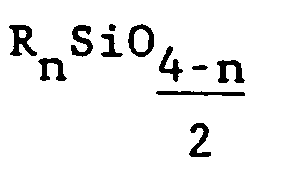
- These materials can be any organosiloxane of the formula: in which R is selected from the group consisting of monovalent hydrocarbon radicals, halogenated monovalent hydrocarbon radicals and hydrogen atoms; and in which n is an integer having an average value of from one to less than three.
- R is selected from the group consisting of monovalent hydrocarbon radicals, halogenated monovalent hydrocarbon radicals and hydrogen atoms
- n is an integer having an average value of from one to less than three.
- Example IV is specific to methyl trimethoxysilane
- branching may also be obtained with materials such as (CH3O)3Si(CH2)3NHCH2CH2NH2 and (CH3O)3Si(CH2)3N ⁇ (CH3)2(CH2)17CH3Cl ⁇ .
Landscapes
- Chemical & Material Sciences (AREA)
- Engineering & Computer Science (AREA)
- Chemical Kinetics & Catalysis (AREA)
- Life Sciences & Earth Sciences (AREA)
- Oil, Petroleum & Natural Gas (AREA)
- Wood Science & Technology (AREA)
- Organic Chemistry (AREA)
- Textile Engineering (AREA)
- Treatments For Attaching Organic Compounds To Fibrous Goods (AREA)
- Detergent Compositions (AREA)
- Silicon Polymers (AREA)
Description
- A fabric softener is a dilute solution or dispersion of a quaternary ammonium derivative used to treat fabrics in the final rinse of a laundering process in order to make the fabrics feel softer. In addition to softness, fabric softeners are known to also provide fluffiness control. Because of the affinity of quaternary ammonium compounds for negatively charged surfaces, their single largest market has been as fabric softeners. Commercial fabric softeners generally include about a four to eight percent dispersion of quaternary ammonium compound which is added to the rinse cycle of the washing process. The quaternary ammonium compound can also be applied to a nonwoven sheet or a polyurethane foam which is added with wet clothes in a dryer. Such sheets contain a fatty acid ester which allows the quaternary ammonium compound to transfer from the sheet to the clothes in the dryer during the drying cycle. Recently, there have been devised combined detergent and softener formulations which allow introduction of all additives in the wash cycle.
- Modern washing machines work automatically and the operator places the laundry in the machine, pours in the detergent and sets the controls. One set of controls determines whether the machine employs hot, warm, or cold water. Water enters the machine through hoses connected to the hot and cold water pipes. The operator also sets controls in order to select the length of washing and rinsing time and the amount of water that enters the machine. The machine is powered by an electric motor and includes a filter that removes lint and automatic dispensers for bleach and fabric softeners. A wash cycle typically includes four stages. In the wash cycle, after water fills the wash tub, an agitator reverses direction alternately and moves the laundry through the water and detergent and forces water through the items of laundry. The washer is then emptied of all of the wash liquor in the spin cycle and the clothes are spun to remove excess water. In the rinse cycle, clean water is added along with the fabric softener and the clothes are again agitated. The washer is emptied of rinse liquor and the clothes are spun in a final spin cycle during which time excess water is removed and pumped out of the machine through a drain hose. The clothing is then ready to be removed from the machine and dried in a dryer or hung on a clothesline until dry.
- Silicone polymers can be classified as being linear, branched or crosslinked. This classification is commonly accepted and is used in the silicone industry. Branched or crosslinked silicone polymers are prepared by the incorporation of an alkyl trisiloxy unit into the siloxane polymer chain. Crosslinking results when two alkyl trisiloxy units are connected by a segment of the polymer chain during the polymerization process. The number of polymer branches which react with another polymer (or a different alkyl trisiloxy unit on the same polymer) to form crosslinks is a function of the amount of alkyl trisiloxy units present and the reaction conditions. It is generally accepted in the industry that the inclusion of alkyl trisoloxy units will lead to branching and crosslinking when polydiorganosiloxane is prepared via addition polymerization. Because of the random nature of this polymerization, however, alkyl trisiloxy groups will not be incorporated into all of the polymer chains; some linear polymers will normally be present in such systems. Incorporation of a methyl trisiloxy unit into a polydimethylsiloxane results in a branched and crosslinked siloxane and not a linear siloxane. The use of the branched and crosslinked fluids in a rinse cycle fabric softener is not taught in the prior art since the incorporation of a trisiloxy unit into the linear siloxane polymer chain creates a branched and crosslinked siloxane that has significantly different properties. For example, linear siloxanes are soluble in toluene whereas branched and crosslinked siloxanes are not. Thus, a toluene solubility test provides a simple method to distinguish between linear and nonlinear polydimethylsiloxanes. In addition to differences in solubility, linear and nonlinear polydimethylsiloxanes exhibit different physical properties. Linear polydimethylsiloxanes are liquids which exhibit viscous flow, even at high molecular weights. Branched or crosslinked polydimethylsiloxanes of comparable molecular weight are elastomers. The properties of the silicone polymer in a water-based emulsion is conveniently determined by "breaking" the emulsion by adding large amounts of salt or alcohol, or evaporating the water and examining the residue. Since the two classes of siloxane polymers have such significant differences in physical properties, it would not be obvious to substitute a branched and crosslinked siloxane for a linear siloxane in fabric softener applications.
- In accordance with the present invention, therefore, a branched and crosslinked silicone emulsion is employed in contrast to the linear material of the prior art. More importantly, it has been found that the use of an emulsion of nonlinear silicone provides certain advantages neither taught nor previously appreciated. For example, softener treated fabrics in accordance with the present invention possess enhanced rewettability or improved water absorbency, in addition to softness. Thus, while there has been previously observed a series of benefits resulting from the incorporation in the softener formulation of a linear silicone material, the rewettability property of the present invention was not one of the benefits discovered, nor the feature of branching or crosslinking in general. In the present invention, therefore, water absorptivity or rewettability of fabrics treated with hydrophobic softening agents is significantly improved, as is softening by the use of branched and crosslinked silicone fluid emulsions. The use of hydrophobic silicones as taught herein to improve water absorbency of treated fabrics is unexpected since silicones are considered to provide water repellency properties to fabrics rather than enhanced rewettability. Thus, the opposite result would be expected. Accordingly, the present invention provides compositions and methods of fabric treatment possessing significant advantages over prior art materials and processes.
- This invention relates to a method of enhancing the rewettability of fabrics treated in a laundering operation by contacting the fabrics with a mixture including a rinse cycle fabric softening conditioning composition capable of producing on the fabrics a hydrophobic surface and a hydrophobic cationic emulsion of a silicone polymer as defined in the claims.
- The invention also relates to a method of enhancing the rewettability or water absorbency of fabrics treated in a laundering operation by contacting the fabrics with a hydrophobic cationic emulsion of a silicone polymer, the silicone polymer including highly branched and crosslinked polydimethylsiloxane fluids.
- The invention further relates to a fabric softening composition for enhancing the rewettability of fabrics treated in a laundering operation which is a mixture including a rinse cycle conditioning composition capable of producing on the fabrics a hydrophobic surface and a hydrophobic cationic emulsion of a branched and crosslinked silicone polymer. In preferred embodiments, the rinse cycle conditioning composition includes a cationic compound selected from the group consisting of quaternary ammonium salts and organic based compounds having C₁₂ to C₁₈ hydrocarbon chain molecules of amines, esters, acids or amine oxides. As noted above, the branched and crosslinked silicone polymer is a highly branched and crosslinked polydimethylsiloxane and the branched and crosslinked silicone polymer includes less than about forty percent of linear silicone polymer as determined by extraction with toluene. The cationic compound of the rinse cycle conditioning composition preferably constitutes from about four percent to about eight percent by weight of the rinse cycle conditioning composition and the mixture contains from about one-half of one percent to about six percent by weight of the silicone polymer emulsion. The emulsion of the silicone polymer contains about thirty-five percent by weight of active ingredient, and the cationic compound of the rinse cycle conditioning composition is dihydrogenated-tallow dimethyl ammonium chloride in a specific embodiment. The emulsion of the silicone polymer is preferably aqueous.
- It is, therefore, the object of the present invention to not only treat fabrics such as towels, for example, in order to make them feel softer and fluffier, but in addition, to enhance the rewettability of the towel so that the towel will be capable of absorbing more water at the conclusion of the treating and drying cycles normally encountered in their routine daily usage.
- These and other features, objects and advantages, of the herein described present invention will become apparent when considered in conjunction with the following detailed description of the present invention.
- Ammonium compounds in which all of the hydrogen atoms have been substituted by alkyl groups are called quaternary ammonium salts. These compounds may be represented in a general sense by the formula:

The nitrogen atom includes four covalently bonded substituents that provide a cationic charge. The R groups can be any organic substituent that provides for a carbon and nitrogen bond with similar and dissimilar R groups. The counterion X is typically halogen. Use of quaternary ammonium compounds is based on the lipophilic portion of the molecule which bears a positive charge. Since most surfaces are negatively charged, solutions of these cationic surface active agents are readily adsorbed to the negatively charged surface. - In accordance with the present invention, the hydrophobic softening agent can include quaternary ammonium salts and specifically any of the cationic compounds described in British Patent No. 1,549,180, such as quaternary mono-ammonium compounds having either two C₁₂-C₂₀ alkyl chains or one C₁₈-C₂₄ alkyl chain; quaternary imidazolinium textile softeners; polyammonium compounds; fabric softening polyamine salts; fully substituted polyquaternary compounds; and polyalkylene imine salts. Particular quaternary ammonium compounds suitable for use herein may include, for example, trimethyltallowammonium chloride, trimethylsoyaammonium chloride, trimethylcocoammonium chloride, dimethyldicocoammonium chloride, dimethyldi(hydrogenated tallow)ammonium chloride, trimethyldodecylammonium chloride, trimethyloctadecylammonium chloride, trimethylhexadecylammonium chloride, dimethylalkylbenzylammonium chloride, 1:1 mixture of trimethyltallowammonium chloride and dimethyldicocoammonium chloride, N,N,N′,N′,N′-pentamethyl-N-tallow-1,3-propanediammonium dichloride, methylbis(2-hydroxyethyl)cocoammonium chloride, methylpolyoxyethylene cocoammonium chloride, methylbis(2-hydroxyethyl)oleylammonium chloride, methylpolyoxyethylene oleyammonium chloride, methylbis(2-hydroxyethyl)oleylammonium chloride, methylbis(2-hydroxyethyl)octadecylammonium chloride, methylpolyoxyethylene octadecylammonium chloride, n-dodecyl tetradecyl dimethylbenzylammonium chloride, n-tetradecyl hexadecyl dimethylbenzylammonium chloride, n-dodecyl tetradecyl dimethyldichlorobenzylammonium chloride, n-octadecyldimethylbenzylammonium chloride, dialkylmethylbenzylammonium chloride, n-dodecyl tetradecyl hexadecyl dimethylbenzylammonium chloride, n-dodecyl tetradecyl hexadecyl dimethylethylbenzylammonium chloride, methyl sulfate quaternary of ethyoxylated tallow diethylenetriamine condensate, methyl sulfate quaternary of propoxylated tallow diethylenetriamine condensate and 1-(tallow amidoethylene)-2-n(tallow alkyl)2-imidazolinium, methyl sulfate quaternary.
- The silicone compositions of the present invention that enhance the rewettability of fabrics treated in a laundry operation are primarily highly branched and crosslinked polydimethylsiloxanes and substituted derivatives, such as organofunctional silicones. The resulting enhanced rewettability is independent of the siloxane molecular weight. If the silicone polymer is substituted with organofunctional groups, the resulting polymer must be hydrophobic to improve rewettability. The hydrophobic silicones are delivered to the fabric as an emulsion. The silicone emulsions can be used alone or formulated into a fabric conditioning composition, such as a rinse cycle fabric softener. The quaternary ammonium salt based type of rinse cycle fabric softeners are preferred.
- While the following examples are combinations of quaternary based softeners with silicone emulsions, the silicone compositions will improve water absorbancy when used in combination with any organic based fabric conditioning composition that produces a hydrophobic surface, such as organic conditioning compositions comprised of long hydrocarbon C₁₂-C₁₈ chain molecules of amines, esters, acids, amine oxides and derivatives thereof.
- The polydimethylsiloxanes used herein are high molecular weight branched and crosslinked polymers having a molecular weight of at least 100,000 and a viscosity above 50,000 centistokes. The viscosity of such a polydimethylsiloxane is highly dependent on the degree of branching and crosslinking present in the polymer. When the ratio of alkyl trisiloxy units to dimethyl siloxy units exceeds about 1:100, the polymer can no longer be considered a fluid with a measurable viscosity; it is an elastomer. The siloxane polymers of the present invention are terminated by a hydroxyl group. Endblocking species such as trimethyl siloxy units are not included in the compositions of the present invention because this would prevent the polymer from reaching the desired molecular weight. The polymers can be prepared by various techniques such as the hydrolysis and subsequent condensation of dimethyldihalosilanes, or by the cracking and subsequent condensation of dimethylcyclosiloxanes. The polymer can be based on a branched and cross linked silicone made by the addition of branching units of methyl trimethoxysilane to polydimethylsiloxane by conventional techniques, in a preferred mode.
- Towels were prepared for treatment by removing the mill textile conditioners applied at the mill during manufacture of the towels. The process was conducted at a commercial laundromat. Bundles of 86:14 cotton polyester terry towels were washed three times with a 9.8% phosphorous containing Tide® detergent followed by three washes with a 0.5% phosphorus containing Tide®. Tide® is an anionic detergent and a trademark of the Procter & Gamble Company, Cincinnati, Ohio. The towels were subjected to a final wash and rinse cycle from which detergent was omitted, in order to remove any residual detergent. The treatments were conducted in a Whirlpool Imperial Seventy washing machine. The Cycle Setting was Heavy/14 minutes. The Cloth to Liquor Ratio was 1:23. The Wash Temperature was Warm (32°C.). The Rinse Temperature was Cold (11°C.). The Detergent Concentration was 0.14% detergent by weight of wash liquor. The Dryer was a Whirlpool model with a Dryer Setting of Permanent Press-High Drying, at a time of 55 minutes.
- The test used to measure softness was a panel test in which ten people were asked to rank several towels in order of softness, one being a control towel which had not been treated with a softening agent. The towels were treated by the method described above. Following treatment, the towels were placed in a constant temperature and humidity room over night and tested the following day. Ten people were asked to evaluate the towels by feeling the towels and choosing the harshest towel, the softest towel and placing the remaining towels in order of increasing softness. The towels were assigned a numerical ranking with the highest value corresponding to the softest towel. Since the softness of a towel increases with repeated handling, a new surface of each towel was exposed for each panel member and each towel was replaced after evaluation by three people. The resulting rankings were averaged to provide a single integer for each treatment.
- The rewettability or water absorbency of the treated towels was determined by the wicking method in which strips of fabric are suspended in a solution of water soluble dye and the height of migration of the dye solution is measured over a specified time. The greater height of migration of the dye solution up the fabric is indicative of better rewet properties.
- The height to which the dye solution had risen was measured after the strip had been immersed for four minutes and the variability of the test method was +/- 6.9 mm.
- Fabric softener formulations containing varying amounts of an emulsion of highly branched and crosslinked silicone polymer were evaluated for softening and rewettability. As noted above, terry towels of 86:14 cotton/polyester were treated with detergent and softeners were added in the rinse cycle at a softener/fabric weight ratio of 1:30. Each of the formulations employed included five percent dihydrogenated tallow dimethylammonium chloride(DTDMAC), the active ingredient of a quaternary ammonium salt commercial fabric softener dispersion, manufactured by Sherex Chemical Company, Dublin, Ohio, as ADOGEN® 442, a trademark of that company; together with varying amounts of the composition of the present invention in amounts of one, two, four and six percent concentrations, respectively. One control of DTDMAC without the composition of the present invention was employed for comparative purposes. The five percent DTDMAC quaternary ammonium salt softener was prepared by melting dihydrogenated tallow dimethylammonium chloride and adding the molten material to hot water under agitation. The softener was stirred until cool. Sodium chloride was included in order to lower the viscosity and ethanol was added in order to assist in solubilizing the softener. The composition of the present invention included therein was a thirty-five percent aqueous hydrophobic cationic emulsion of a highly branched and crosslinked polydimethylsiloxane fluid including less than about forty percent of linear silicone polymer. A series of five treatments were conducted and evaluations were made following the first, third and fifth treatments. Average softness rankings are set forth in Table I.
TABLE I COMPOSITION TREATMENT % Softener* Silicone % No. I No. III No. V 100 --- 1.9 1.2 1.0 99 1.0 3.0 2.6 2.3 98 2.0 3.2 3.7 3.7 96 4.0 3.6 4.5 4.0 94 6.0 3.3 3.0 4.0 * = 5% DTDMAC - It should be apparent from Table I that the softener ingredient containing the higher levels of the compositions of the present invention imparted the best softness. The rewettability of each of the foregoing is set forth in Table II and it should be pointed out, that the average rewettability imparted to each fabric was enhanced by the softeners including the compositions of the present invention.
TABLE II COMPOSITION REWETTABILITY mm/4 minutes % Softener* Silicone % 100 --- 42 99 1.0 53 98 2.0 55 96 4.0 57 94 6.0 58 * = 5% DTDMAC - Example I was repeated except that the softener DTDMAC was replaced by a commercial grade rinse cycle fabric softening product. The product was an aqueous dispersion of fabric softening agents including about five percent DTDMAC as the active softening agent. The branched and crosslinked composition of the present invention employed in Example I was again used in this example. The results are set forth in Table III.
TABLE III COMPOSITION TREATMENT % Softener* Silicone % No. I No. III No. V 100 --- 3.3 2.6 4.1 99.5 0.5 3.9 2.4 1.8 99 1.0 2.3 3.5 3.6 98 2.0 2.9 4.7 4.8 96 4.0 5.1 4.7 3.0 * = Dispersion which contains 5% DTDMAC as the active softening agent. - The rewettability of each of the foregoing is set forth in Table IV and it should be pointed out, that the average rewettability imparted to each fabric was enhanced by the softeners including the compositions of the present invention.
TABLE IV COMPOSITION REWETTABILITY mm/4 minutes % Softener* Silicone % 100 --- 37 99.5 0.5 49 99 1.0 47 98 2.0 58 96 4.0 58 * = See Table III. - Example II was repeated again using the commercial grade rinse cycle fabric softening product of Example II which was an aqueous dispersion of fabric softening agents including five percent DTDMAC as the active softening agent. For purposes of comparison, there was employed a series of emulsions of silicone compositions having varying amounts of linear siloxane content. These emulsions were added to the commercial softener at a level of two percent by weight. The silicone emulsions contained mixtures of linear and nonlinear siloxanes with the percentage of linear polymers ranging from about twelve percent to about thirty-five percent indicating a branched and crosslinked siloxane content ranging from about sixty-five percent to as high as eighty-eight percent. The linear polymer content for the emulsions was determined by toluene extraction of dried samples of emulsion. The results are set forth in Tables V and VI.
TABLE V COMPOSITION TREATMENT %Silicone %Softener* %Branching/Crosslinking No. I No. III No. V 2 98 --- 4.0 2.9 2.5 2 98 65 3.5 3.2 3.1 2 98 65 3.8 4.2 4.6 2 98 88 2.7 4.2 3.9 2 98 65 5.2 3.8 3.7 * = See Table III - The rewettability of each of the foregoing is set forth in Table VI and it should be pointed out, that the average rewettability imparted to each fabric was enhanced by the softeners including the branched and crosslinked compositions of the present invention.
TABLE VI COMPOSITION REWETTABILITY mm/4 minutes %Silicone %Softener* %Branching/Crosslinking 2 98 --- 43 2 98 65 56 2 98 65 58 2 98 88 59 2 98 65 51 * = See Table III. - The branched and crosslinked silicone polymers employed herein and methods for their preparation are described in more or less detail in U.S. Patent No. 2,891,920, issued June 23, 1959. These materials can be any organosiloxane of the formula:

in which R is selected from the group consisting of monovalent hydrocarbon radicals, halogenated monovalent hydrocarbon radicals and hydrogen atoms; and in which n is an integer having an average value of from one to less than three. However, for purposes of illustration, a procedure for the preparation of a representative branched and cross linked silicone polymer of the present invention is set forth in the following examples. - 88 grams of a 27% water solution of tallow trimethyl ammonium chloride was added to 535 grams of water until a uniform mixture was obtained. To this mixture was added 350 grams of octamethylcyclotetrasiloxane and 6.5 grams of methyl trimethoxysilane followed by vigorous stirring. The resulting emulsion was passed twice through a homogenizer set at 7500 psig. The emulsion was then made alkaline by the addition of 1 gram of a 50% sodium hydroxide solution. The emulsion was heated at 85°C. for 9 hours. After cooling to 40°C., 1.5 grams of 85% phosphoric acid was added and stirred for 5 minutes followed by the addition of MAKON® 10, a nonyl phenoxy-polyethylene oxide surfactant. The emulsion was allowed to stir for 1 hour at 40°C. Upon cooling to room temperature, 0.5 grams of KATHON® CG/ICP, a preservative, was added.
- Whereas Example IV is specific to methyl trimethoxysilane, branching may also be obtained with materials such as (CH₃O)₃Si(CH₂)₃NHCH₂CH₂NH₂ and
(CH₃O)₃Si(CH₂)₃N⊕(CH₃)₂(CH₂)₁₇CH₃Cl⊖. - Compositions prepared in accordance with Example IV, when tested in accordance with the procedures of Example II, yielded the following rewettability data.
TABLE VII TREATMENTS REWETTABILITY mm/4 minutes 1 62 2 42 3 56 4 58 5 58 6 62 - Additional compositions prepared as in Example IV were further tested in accordance with the procedure of Example II except that instead of employing the aqueous dispersion of softening agents including 5% DTDMAC, there was used two commercial rinse cycle fabric softening products marketed for home use. Both products are manufactured by Lever Brothers Company, New York, New York and sold under the trademarks SNUGGLE® and FINAL TOUCH®. Data from these tests are set forth hereinbelow.
TABLE VIII COMPOSITION TREATMENT % Softener* Silicone % No. I No. III 100 --- 4.5 4.0 99.5 0.5 3.8 4.8 99 1.0 3.1 2.7 98 2.0 4.6 4.5 96 4.0 3.8 4.0 * = FINAL TOUCH® -
TABLE IX COMPOSITION TREATMENT % Softener* Silicone % No. I No. III 100 --- 4.1 3.75 99.5 0.5 3.2 3.75 99 1.0 5.3 4.17 98 2.0 2.8 3.5 96 4.0 4.6 4.83 * = SNUGGLE® -
TABLE X COMPOSITION REWETTABILITY mm/4 Minutes % Softener* Silicone % TREATMENT No. I No. III 100 --- 48 37 99.5 0.5 48.5 51 99 1.0 50 54 98 2.0 48 55 96 4.0 51 54.5 * = FINAL TOUCH® -
TABLE XI COMPOSITION REWETTABILITY mm/4 Minutes % Softener* Silicone % TREATMENT No. I No. III 100 --- 31 31.5 99.5 0.5 40 44 99 1.0 47.5 51.5 98 2.0 48 51.5 96 4.0 50 52 * = SNUGGLE® - A procedure for the preparation of another representative branched and crosslinked silicone polymer of the present invention is set forth in the following examples.
- 88 grams of a 27% water solution of tallow trimethyl ammonium chloride was added to 535 grams of water until a uniform mixture was obtained. To this mixture was added 350 grams of octamethylcyclotetrasiloxane and 7.5 grams of methyl trimethoxysilane followed by vigorous stirring. The resulting emulsion was passed twice through a homogenizer set at 7500 psig. The emulsion was then made alkaline by the addition of 1 gram of a 50% sodium hydroxide solution. The emulsion was heated at 85°C. for 9 hours. After cooling to 40°C., 1.5 grams of 85% phosphoric acid was added and stirred for 5 minutes followed by the addition of MAKON® 10, a nonyl phenoxy-polyethylene oxide surfactant. The emulsion was allowed to stir for 1 hour at 40°C. Upon cooling to room temperature, 0.5 grams of KATHON® CG/ICP, a preservative, was added.
- Compositions prepared in accordance with Example V, were tested in accordance with the procedures of Example II, except that SNUGGLE® was again employed and such tests yielded the following data.
TABLE XII COMPOSITION TREATMENT % Softener* Silicone % No. I No. III 100 --- 3.55 3.0 98 2.0 3.82 3.8 * = SNUGGLE® -
TABLE XIII COMPOSITION REWETTABILITY mm/4 Minutes % Softener* Silicone % TREATMENT No. I No. III 100 --- 35 40.5 98 2.0 53 51 * = SNUGGLE® - A further procedure for the preparation of an additional representative branched and crosslinked silicone polymer of the present invention is set forth in the following examples.
- 88 grams of a 27% water solution of tallow trimethyl ammonium chloride was added to 535 grams of water until a uniform mixture was obtained. To this mixture was added 350 grams of octamethylcyclotetrasiloxane and 35.0 grams of methyl trimethoxysilane followed by vigorous stirring. The resulting emulsion was passed twice through a homogenizer set at 7500 psig. The emulsion was then made alkaline by the addition of 1 gram of a 50% sodium hydroxide solution. The emulsion was heated at 85°C. for 9 hours. After cooling to 40°C., 1.5 grams of 85% phosphoric acid was added and stirred for 5 minutes followed by the addition of MAKON® 10, a nonyl phenoxy-polyethylene oxide surfactant. The emulsion was allowed to stir for 1 hour at 40°C. Upon cooling to room temperature, 0.5 grams of KATHON® CG/ICP, a preservative, was added.
- Compositions prepared in accordance with Example VI, were tested in accordance with the procedures of Example II, again using SNUGGLE® and yielded the following data.
TABLE XIV COMPOSITION TREATMENT % Softener* Silicone % No. I No. III 100 --- 3.55 3.0 98 2.0 3.55 3.4 * = SNUGGLE® -
TABLE XV COMPOSITION REWETTABILITY mm/4 Minutes % Softener* Silicone % TREATMENT No. I No. III 100 --- 35 40.5 98 2.0 48 54 * = SNUGGLE® - Generically, the branched and crosslinked siloxanes set forth in the foregoing examples are of the general formula:

wherein:
Me is methyl;
x and z have values of 3 to 100,000;
y has a value of 1 to 10,000;
R is (CH₂)nZ;
R˝ is hydrogen or
n has a value of 1 to 10;
Z is
whereby X and Y are selected independently, -H; -C₁₋₃₀-alkyl; -C₆-aryl; -C₅₋₆-cycloalkyl; -C₁₋₆-NH₂; -CO-R′; with the proviso that the nitrogen can be quaternized such as to represent
whereby W can be selected from X or Y; or Z is
whereby P and M are -COOH; -CO-NR'₂; or C₁₋₂-alkyl; where R′=C₁₋₄ alkyl. - It will be apparent from the foregoing that many other variations and modifications may be made in the structures, compounds, compositions and methods described herein without departing substantially from the essential features and concepts of the present invention. Accordingly, it should be clearly understood that the forms of the invention described herein are exemplary only and are not intended as limitations on the scope of the present invention.
Claims (8)
- The method of enhancing the rewettability of fabrics treated in a laundering operation comprising contacting the fabrics with a mixture including a rinse cycle fabric softening conditioning composition capable of producing a hydrophobic surface on the fabrics and a hydrophobic cationic emulsion of a highly branched and crosslinked silicone polymer, the polymer being a a hydroxy-terminated organosiloxane of the formula:

- The method of claim 1 in which the fabric softening conditioning composition includes a cationic compound selected from the group consisting of quaternary ammonium salts and organic based compounds having C₁₂ to C₁₈ hydrocarbon chain molecules of amines, esters, acids or amine oxides.
- The method of enhancing the rewettability of fabrics treated in a laundering operation comprising contacting the fabrics with a hydrophobic cationic emulsion of a highly branched and crosslinked silicone polymer, the polymer being a hydroxy-terminated organosiloxane of the formula:

- A fabric softening composition having rewet properties for enhancing the rewettability of fabrics treated in a laundering operation comprising a mixture including a rinse cycle conditioning composition capable of producing on the fabrics a hydrophobic surface and a hydrophobic cationic emulsion of a highly branched and cross linked silicone polymer, the polymer being a hydroxy-terminated organosiloxane of the formula:
- The composition of claim 4 in which the rinse cycle conditioning composition includes a cationic compound selected from the group consisting of quaternary ammonium salts and organic based compounds having C₁₂ to C₁₈ hydrocarbon chain molecules of amines, esters, acids or amine oxides.
- The method of enhancing the rewettability of fabrics treated in a laundering operation comprising contacting the fabrics with a mixture including a rinse cycle fabric softening conditioning composition capable of producing on the fabrics a hydrophobic surface and a hydrophobic cationic emulsion of a highly branched and crosslinked silicone polymer having the general formula:

Me is methyl;
x and z have values of 3 to 100,000;
y has a value of 1 to 10,000;
R is (CH₂)nZ;
R'' is hydrogen or
Z is


- The method of enhancing the rewettability of fabrics treated in a laundering operation comprising contacting the fabrics with a hydrophobic cationic emulsion of a silicone polymer, the silicone polymer being a highly branched and crosslinked polydimethylsiloxane having the general formula:

Me is methyl;
x and z have values of 3 to 100,000;
y has a value of 1 to 10,000;
R is (CH₂)nZ;
R'' is hydrogen or
Z is


the silicone polymer including less than 40% of linear silicone polymer as determined by extraction with toluene. - A fabric softening composition having rewet properties for enhancing the rewettability of fabrics treated in a laundering operation comprising a mixture including a rinse cycle conditioning composition capable of producing on the fabrics a hydrophobic surface and a hydrophobic cationic emulsion of a highly branched and crosslinked silicone polymer having the general formula:

Me is methyl;
x and z have values of 3 to 100,000;
y has a value of 1 to 10,000;
R is (CH₂)nZ;
R'' is hydrogen or
Z is


the silicone polymer including less than 40% of linear silicone polymer as determined by extraction with toluene.
Applications Claiming Priority (4)
| Application Number | Priority Date | Filing Date | Title |
|---|---|---|---|
| US312158 | 1981-10-16 | ||
| US236864 | 1988-08-26 | ||
| US23686488A | 1988-10-26 | 1988-10-26 | |
| US07/312,158 US4908140A (en) | 1989-02-21 | 1989-02-21 | Method of enhancing fabric rewettability with an aqueous emulsion of branched and cross-linked polydimethylsiloxane |
Publications (3)
| Publication Number | Publication Date |
|---|---|
| EP0356210A2 EP0356210A2 (en) | 1990-02-28 |
| EP0356210A3 EP0356210A3 (en) | 1990-05-30 |
| EP0356210B1 true EP0356210B1 (en) | 1995-09-13 |
Family
ID=26930177
Family Applications (1)
| Application Number | Title | Priority Date | Filing Date |
|---|---|---|---|
| EP89308519A Expired - Lifetime EP0356210B1 (en) | 1988-08-26 | 1989-08-23 | Method of enhancing fabric rewettability |
Country Status (7)
| Country | Link |
|---|---|
| EP (1) | EP0356210B1 (en) |
| JP (1) | JPH0299670A (en) |
| KR (1) | KR970001843B1 (en) |
| AU (1) | AU614175B2 (en) |
| CA (1) | CA1340040C (en) |
| DE (1) | DE68924225T2 (en) |
| ES (1) | ES2079381T3 (en) |
Families Citing this family (14)
| Publication number | Priority date | Publication date | Assignee | Title |
|---|---|---|---|---|
| US5145596A (en) * | 1989-08-07 | 1992-09-08 | Dow Corning Corporation | Antimicrobial rinse cycle additive |
| US5057240A (en) * | 1989-10-10 | 1991-10-15 | Dow Corning Corporation | Liquid detergent fabric softening laundering composition |
| US5049377A (en) * | 1990-03-02 | 1991-09-17 | Dow Corning Corporation | Hair-care composition and methods of treating hair |
| US5254268A (en) * | 1991-11-19 | 1993-10-19 | Rohm And Haas Company | Anti-static rinse added fabric softener |
| GB9602608D0 (en) | 1996-02-09 | 1996-04-10 | Unilever Plc | Fabric softening composition |
| ATE500378T1 (en) * | 1999-05-21 | 2011-03-15 | Unilever Nv | PLASTICIZER COMPOSITIONS FOR TEXTILES |
| CA2387582A1 (en) * | 1999-10-05 | 2001-04-12 | Ciba Specialty Chemicals Holding Inc. | Fabric softener compositions |
| DK1581590T3 (en) * | 2002-12-11 | 2006-08-14 | Corovin Gmbh | Hydrophilic polyolefin materials and process for their preparation |
| US12534576B2 (en) | 2015-01-28 | 2026-01-27 | Dow Silicones Corporation | Elastomeric compositions and their applications |
| CA2975175C (en) | 2015-01-28 | 2020-01-28 | Dow Corning Corporation | Elastomeric compositions and their applications |
| GB201613399D0 (en) * | 2016-08-03 | 2016-09-14 | Dow Corning | Cosmetic composition comprising silicone materials |
| GB201613397D0 (en) | 2016-08-03 | 2016-09-14 | Dow Corning | Cosmetic composition comprising silicone materials |
| GB201707439D0 (en) | 2017-05-09 | 2017-06-21 | Dow Corning | Lamination Process |
| GB201707437D0 (en) | 2017-05-09 | 2017-06-21 | Dow Corning | Lamination adhesive compositions and their applications |
Family Cites Families (8)
| Publication number | Priority date | Publication date | Assignee | Title |
|---|---|---|---|---|
| US2891920A (en) * | 1955-01-26 | 1959-06-23 | Dow Corning | Polymerization of organopolysiloxanes in aqueous emulsion |
| DE2631419A1 (en) * | 1975-07-16 | 1977-02-03 | Procter & Gamble Europ | COMPOSITIONS FOR TEXTILE TREATMENT |
| GR75649B (en) * | 1980-07-28 | 1984-08-02 | Procter & Gamble | |
| GB8400899D0 (en) * | 1984-01-13 | 1984-02-15 | Procter & Gamble | Granular detergent compositions |
| DE3427496A1 (en) * | 1984-07-26 | 1986-01-30 | Henkel KGaA, 4000 Düsseldorf | METHOD FOR PRODUCING A POLYSILOXANE BLOCK POLYMERISATE |
| US4661577A (en) * | 1985-10-01 | 1987-04-28 | General Electric Company | Aminofunctional polysiloxanes |
| DE3542725A1 (en) * | 1985-12-03 | 1987-06-04 | Hoffmann Staerkefabriken Ag | LAUNDRY TREATMENT AGENT |
| GB2188653A (en) * | 1986-04-02 | 1987-10-07 | Procter & Gamble | Biodegradable fabric softeners |
-
1989
- 1989-08-03 CA CA000607444A patent/CA1340040C/en not_active Expired - Fee Related
- 1989-08-23 EP EP89308519A patent/EP0356210B1/en not_active Expired - Lifetime
- 1989-08-23 ES ES89308519T patent/ES2079381T3/en not_active Expired - Lifetime
- 1989-08-23 DE DE68924225T patent/DE68924225T2/en not_active Expired - Fee Related
- 1989-08-24 JP JP1216167A patent/JPH0299670A/en active Pending
- 1989-08-25 KR KR1019890012113A patent/KR970001843B1/en not_active Expired - Fee Related
- 1989-08-25 AU AU40233/89A patent/AU614175B2/en not_active Ceased
Also Published As
| Publication number | Publication date |
|---|---|
| JPH0299670A (en) | 1990-04-11 |
| EP0356210A3 (en) | 1990-05-30 |
| DE68924225D1 (en) | 1995-10-19 |
| CA1340040C (en) | 1998-09-15 |
| ES2079381T3 (en) | 1996-01-16 |
| AU614175B2 (en) | 1991-08-22 |
| KR970001843B1 (en) | 1997-02-17 |
| DE68924225T2 (en) | 1996-05-02 |
| EP0356210A2 (en) | 1990-02-28 |
| AU4023389A (en) | 1990-03-01 |
| KR900003476A (en) | 1990-03-26 |
Similar Documents
| Publication | Publication Date | Title |
|---|---|---|
| US4908140A (en) | Method of enhancing fabric rewettability with an aqueous emulsion of branched and cross-linked polydimethylsiloxane | |
| US4846982A (en) | Particulate fabric laundering composition | |
| EP0422787B1 (en) | Liquid detergent fabric softening laundering composition | |
| US5091105A (en) | Liquid detergent fabric softening laundering composition | |
| EP0255711B1 (en) | Article for conditioning fabrics in a laundry dryer | |
| CA2348551C (en) | Wrinkle reduction laundry product compositions | |
| CA1340040C (en) | Method of enhancing fabric rewettability | |
| US4624794A (en) | Compositions and process for treating textiles | |
| EP0450816B1 (en) | Softening compositions including quaternary ammonium functional siloxanes | |
| CN102260603B (en) | Liquid laundry compositions comprising silicone additives | |
| WO2011005963A1 (en) | Method for reducing wrinkles using a fabric care composition | |
| JPS62133177A (en) | Method for washing fabric | |
| EP0317135B1 (en) | Fabric conditioners | |
| WO2004025017A1 (en) | Liquid fabric softener composition | |
| CA2505401C (en) | Compositions useful as rinse cycle fabric softeners | |
| GB2223768A (en) | Softening compositions | |
| GB2230787A (en) | Aqueous polysiloxane compositions and process for the treatment of textiles | |
| JPH0450374A (en) | Liquid softening finish | |
| JP2851686B2 (en) | Liquid soft finish | |
| JPH03269168A (en) | Liquid soft finishing agent | |
| JPS6170073A (en) | Softener composition |
Legal Events
| Date | Code | Title | Description |
|---|---|---|---|
| PUAI | Public reference made under article 153(3) epc to a published international application that has entered the european phase |
Free format text: ORIGINAL CODE: 0009012 |
|
| AK | Designated contracting states |
Kind code of ref document: A2 Designated state(s): BE DE ES FR GB NL |
|
| PUAL | Search report despatched |
Free format text: ORIGINAL CODE: 0009013 |
|
| AK | Designated contracting states |
Kind code of ref document: A3 Designated state(s): BE DE ES FR GB NL |
|
| 17P | Request for examination filed |
Effective date: 19900621 |
|
| 17Q | First examination report despatched |
Effective date: 19930329 |
|
| GRAA | (expected) grant |
Free format text: ORIGINAL CODE: 0009210 |
|
| AK | Designated contracting states |
Kind code of ref document: B1 Designated state(s): BE DE ES FR GB NL |
|
| REF | Corresponds to: |
Ref document number: 68924225 Country of ref document: DE Date of ref document: 19951019 |
|
| ET | Fr: translation filed | ||
| REG | Reference to a national code |
Ref country code: ES Ref legal event code: FG2A Ref document number: 2079381 Country of ref document: ES Kind code of ref document: T3 |
|
| PLBE | No opposition filed within time limit |
Free format text: ORIGINAL CODE: 0009261 |
|
| STAA | Information on the status of an ep patent application or granted ep patent |
Free format text: STATUS: NO OPPOSITION FILED WITHIN TIME LIMIT |
|
| 26N | No opposition filed | ||
| PGFP | Annual fee paid to national office [announced via postgrant information from national office to epo] |
Ref country code: NL Payment date: 20000808 Year of fee payment: 12 |
|
| PGFP | Annual fee paid to national office [announced via postgrant information from national office to epo] |
Ref country code: ES Payment date: 20000908 Year of fee payment: 12 |
|
| PG25 | Lapsed in a contracting state [announced via postgrant information from national office to epo] |
Ref country code: ES Free format text: LAPSE BECAUSE OF NON-PAYMENT OF DUE FEES Effective date: 20010824 |
|
| REG | Reference to a national code |
Ref country code: GB Ref legal event code: IF02 |
|
| PG25 | Lapsed in a contracting state [announced via postgrant information from national office to epo] |
Ref country code: NL Free format text: LAPSE BECAUSE OF NON-PAYMENT OF DUE FEES Effective date: 20020301 |
|
| NLV4 | Nl: lapsed or anulled due to non-payment of the annual fee |
Effective date: 20020301 |
|
| PGFP | Annual fee paid to national office [announced via postgrant information from national office to epo] |
Ref country code: DE Payment date: 20030630 Year of fee payment: 15 |
|
| PGFP | Annual fee paid to national office [announced via postgrant information from national office to epo] |
Ref country code: FR Payment date: 20030701 Year of fee payment: 15 |
|
| PGFP | Annual fee paid to national office [announced via postgrant information from national office to epo] |
Ref country code: GB Payment date: 20030709 Year of fee payment: 15 |
|
| PGFP | Annual fee paid to national office [announced via postgrant information from national office to epo] |
Ref country code: BE Payment date: 20030911 Year of fee payment: 15 |
|
| REG | Reference to a national code |
Ref country code: ES Ref legal event code: FD2A Effective date: 20020911 |
|
| PG25 | Lapsed in a contracting state [announced via postgrant information from national office to epo] |
Ref country code: GB Free format text: LAPSE BECAUSE OF NON-PAYMENT OF DUE FEES Effective date: 20040823 |
|
| PG25 | Lapsed in a contracting state [announced via postgrant information from national office to epo] |
Ref country code: BE Free format text: LAPSE BECAUSE OF NON-PAYMENT OF DUE FEES Effective date: 20040831 |
|
| BERE | Be: lapsed |
Owner name: *DOW CORNING CORP. Effective date: 20040831 |
|
| PG25 | Lapsed in a contracting state [announced via postgrant information from national office to epo] |
Ref country code: DE Free format text: LAPSE BECAUSE OF NON-PAYMENT OF DUE FEES Effective date: 20050301 |
|
| GBPC | Gb: european patent ceased through non-payment of renewal fee |
Effective date: 20040823 |
|
| PG25 | Lapsed in a contracting state [announced via postgrant information from national office to epo] |
Ref country code: FR Free format text: LAPSE BECAUSE OF NON-PAYMENT OF DUE FEES Effective date: 20050429 |
|
| REG | Reference to a national code |
Ref country code: FR Ref legal event code: ST |
|
| BERE | Be: lapsed |
Owner name: *DOW CORNING CORP. Effective date: 20040831 |