EP0355573A2 - Coil winding machine and coil winding method using the same - Google Patents
Coil winding machine and coil winding method using the same Download PDFInfo
- Publication number
- EP0355573A2 EP0355573A2 EP89114665A EP89114665A EP0355573A2 EP 0355573 A2 EP0355573 A2 EP 0355573A2 EP 89114665 A EP89114665 A EP 89114665A EP 89114665 A EP89114665 A EP 89114665A EP 0355573 A2 EP0355573 A2 EP 0355573A2
- Authority
- EP
- European Patent Office
- Prior art keywords
- bobbin
- take
- spinner
- optical fiber
- spindles
- Prior art date
- Legal status (The legal status is an assumption and is not a legal conclusion. Google has not performed a legal analysis and makes no representation as to the accuracy of the status listed.)
- Granted
Links
Images


Classifications
-
- G—PHYSICS
- G02—OPTICS
- G02B—OPTICAL ELEMENTS, SYSTEMS OR APPARATUS
- G02B6/00—Light guides; Structural details of arrangements comprising light guides and other optical elements, e.g. couplings
- G02B6/44—Mechanical structures for providing tensile strength and external protection for fibres, e.g. optical transmission cables
- G02B6/4479—Manufacturing methods of optical cables
-
- B—PERFORMING OPERATIONS; TRANSPORTING
- B65—CONVEYING; PACKING; STORING; HANDLING THIN OR FILAMENTARY MATERIAL
- B65H—HANDLING THIN OR FILAMENTARY MATERIAL, e.g. SHEETS, WEBS, CABLES
- B65H54/00—Winding, coiling, or depositing filamentary material
- B65H54/02—Winding and traversing material on to reels, bobbins, tubes, or like package cores or formers
- B65H54/10—Winding and traversing material on to reels, bobbins, tubes, or like package cores or formers for making packages of specified shapes or on specified types of bobbins, tubes, cores, or formers
-
- B—PERFORMING OPERATIONS; TRANSPORTING
- B65—CONVEYING; PACKING; STORING; HANDLING THIN OR FILAMENTARY MATERIAL
- B65H—HANDLING THIN OR FILAMENTARY MATERIAL, e.g. SHEETS, WEBS, CABLES
- B65H54/00—Winding, coiling, or depositing filamentary material
- B65H54/02—Winding and traversing material on to reels, bobbins, tubes, or like package cores or formers
- B65H54/28—Traversing devices; Package-shaping arrangements
- B65H54/2896—Flyers
-
- B—PERFORMING OPERATIONS; TRANSPORTING
- B65—CONVEYING; PACKING; STORING; HANDLING THIN OR FILAMENTARY MATERIAL
- B65H—HANDLING THIN OR FILAMENTARY MATERIAL, e.g. SHEETS, WEBS, CABLES
- B65H55/00—Wound packages of filamentary material
- B65H55/04—Wound packages of filamentary material characterised by method of winding
-
- G—PHYSICS
- G02—OPTICS
- G02B—OPTICAL ELEMENTS, SYSTEMS OR APPARATUS
- G02B6/00—Light guides; Structural details of arrangements comprising light guides and other optical elements, e.g. couplings
- G02B6/44—Mechanical structures for providing tensile strength and external protection for fibres, e.g. optical transmission cables
- G02B6/4439—Auxiliary devices
- G02B6/4457—Bobbins; Reels
Definitions
- the present invention relates to a coil winding machine for winding a wire or the like onto a take-up bobbin to fabricate a coil. More particularly, the invention pertains to a coil winding machine for fabricating an optical fiber coil and a coil winding method using the winding machine.
- a sensing coil of a fiber optic gyro is usually formed by a multilayer coil so as to provide for enhanced sensitivity.
- this multilayer coil has a solenoid-like configuration in which an optical fiber is wound in the opposite direction for each layer as shown in Fig. 1, in which an optical fiber 2 from the one end 2r to the other 2l thereof is wound onto a take-up bobbin B, with a first layer wound from one end to the other of the bobbin B in its axial direction Z as indicated by the arrow 3a, a second layer in the opposite direction as indicated by the arrow 3b... .
- thermometric conductivity variations produce an error in the output of the fiber optic gyro which is expressed by where n is the refractive index of the optical fiber, N the number of turns, ⁇ n 0 the product of the temperature coefficient of the refractive index and the temperature changing ratio, and m the number of layers of the coil.
- a sensing coil of a structure in which the one half and the other half of the optical fiber --split in the middle--are alternately wound onto a single take-up bobbin in such a manner that their individual parts symmetrical with respect to the middle or intermediate point of the fiber are disposed spatially close or adjacent to each other and are subjected to similar temperature changes, thereby reducing the contributing factor to the output error.
- a variety of coil structures have been proposed to implement such a coil.
- a typical one of them is such a multilayer coil as depicted in Fig. 2, in which two substantially equal halves of the optical fiber, i.e. the one half portion 2R of the optical fiber 2 from its intermediate point 2c to the one end 2r and the other half portion 2L from the intermediate point 2c to the other end 2l, are alternately wound around the takep-up bobbin B repeatedly in units of four layers, with the intermediate point 2c held at the innermost position on the bobbin B.
- a first layer of the coil is formed by winding a part of the one half portion 2R, which is the closest to the intermediate point 2c, around the take-up bobbin B from its one end to the other in its axial direction Z as indicated by the arrow 3c; a second layer is formed by winding a part of the other half portion 2L, which is the closest to the intermediate point 2c, around the bobbin B in the same direction as in the case of the first layer, as indicated by the arrow 3d; a third layer is formed by winding another part of the other half portion 2L, which is the second closest to the intermediate point 2c, around the bobbin B from the other end to the one end in its axial direction Z as indicated by the arrow 3e; a fourth layer is formed by winding another part of the one half portion 2R, which is the second closest to the intermediate point 2c, around the bobbin B in the same direction as in the case of the third layer, as indicated by the arrow 3f; a fifth layer is formed by winding another part of
- the conventional winding machine is designed exclusively for fabricating the solenoid-like multilayer as depicted in Fig. 1, and hence it cannot be utilized for producing the multilayer coil such as shown in Fig. 2.
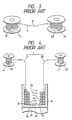
- the one half 2R of the optical fiber 2 from one end 2r to the middle or intermediate point 2c thereof and the other half 2L from the other end 2l to the middle point 2c are wound onto a pair of supply bobbins 4R and 4L through use of a winding machine as shown in Fig. 3, then the middle point 2c of the optical fiber 2 is disposed at the innermost position in the take-up bobbin B, and as shown in Fig. 4, the one half and the other half portions 2R and 2L of the optical fiber 2 are manually wound onto the take-up bobbin B from the supply bobbins 4R and 4L in the sequence and manner described previously with respect to Fig. 2.
- the optical fiber coil winding machine of the present invention includes a pair of spindles holding therebetween a take-up bobbin and a plurality of rotary mechanisms which individually support a plurality of supply bobbins each having prestored thereon a part of or whole optical fiber.
- the rotary mechanisms can be mounted on the spindles concentrically therewith.
- the coil winding operation by the machine of the present invention starts with instaliing the take-up bobbin between the spindles and then mounting the supply bobbins on the corresponding rotary machanisms, followed by driving the spindles and the rotary mechanisms in accordance with a preset procedure, whereby one or more optical fibers stored on the supply bobbins can be wound onto the single take-up bobbin in a predetermined sequence and manner.
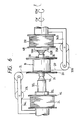
- Figs. 5 and 6 illustrate an embodiment of the coil winding machine of the present invention, in which a pair of rotary mechanisms 30L and 30R, which individually support a pair of supply bobbins 4L and 4R, are mounted on a pair of spindles 10L and 10R concentrically therewith, the spindles holding therebetween a take-up bobbin B.
- a bobbin adapter 20 loaded with the take-up bobbin B is held between a pair of axially aligned spindles 10L and 10R with their inner end portions 11L and 11R spaced a predetermined distance apart.
- the bobbin adapter 20 has a construction in which an inner tubular center 22 having fixed thereto one end of a spring 21 is housed in an outer tubular center 23; the spring 21 is fixed at the other end to the outer tubular center 23; a screw 24 is secured to the inner tubular center 22 for preventing it from coming off; a flange 25 is attached to one end of the outer tubular center 23 by means of a screw 26; the take-up bobbin B is mounted about the outer tubular center 23; and a flange 27 is attached to the other end of the outer tubular center 23 by screws 28.
- the bobbin adapter 20 is inserted between the inner end portions 11L and 11R of the spindles 10L and 10R, with the inner tubular center 22 pressed into the outer one 23 against the force of the spring 21, and then the force applied to the inner tubular center 22 is removed.
- the inner tubular center 22 partly projects out of the outer one 23 by the force of the spring 21 and the bobbin adapter 20 is resiliently held by the spindles 10L and 10R between their inner end portions 11L and 11R applying constant pressures to the adapter 20.
- Pulleys 12L and 12R are installed on the spindles 10L and 10R at the other ends thereof respectively. By driving the pulleys 12L and 12R at the same speed in the same direction. the spindles 10L and 10R and the bobbin adapter 20 loaded with the take-up bobbin B are rotated as one body.
- a rotary mechanism 30L on the spindle 10L which carries the one supply bobbin 4L, includes; an index 32L having a flange 31L and mounted on the spindle 10L; a spinner 35L having a flange 33L and an arm 34L and mounted on the index 32L; a flange 33L slidably coupled with the flange 31L by a guide 36L; a guide pulley 37L attached to the tip of the arm 34L; and a pulley 38L installed on the index 32L at its one end near the other end of the spindle 10L.
- the supply bobbin 4L is put on the spinner 35L from the side of the one end portion 11L of the spindle 10L prior to the loading of the bobbin adapter 20 between the spindles 10L and 10R.
- the index 32L and the spinner 35L are rotated as one piece.
- bearings 39L which permit the bobbin 4L to freely rotate relative to the index 32L and the spinner 35L.
- the spinner 35L is coupled to the index 32L through the guide 36L and the supply bobbin 4L is mounted on the spinner 35L, so that the spinner 35L and the bobbin 4L are movable relative to the index 32L and the spindle 10L, within a predetermined range in their axial directions, respectively.
- a translation mechanism 40L is to translate the spinner 35L and the supply bobbin 4L, without impeding their rotation, relative to the index 32L and the spindle 10L in their axial directions, respectively.
- the translation mechanism 40L comprises a traverser 41L secured to the flange 33L of the spinner 35L, a feed screw 42L coupled to the traverser 41L, and a pulley 43L installed on the feed screw 42L.
- the traverser 4L, the spinner 35L and the supply bobbin 4L move as one body toward the take-up bobbin B, whereas when the pulley 43L is driven in the other direction, the traverser 41L, the spinner 35L and the bobbin 4L move away from the bobbin B.
- the pulleys 12L, 12R, 38L, 38R, 43L and 43R include drive means therefor.
- a rotary mechanism 30R on the spindle 10R, which supports the other supply bobbin 4R, is symmetrical in configuration with the rotary mechanism 30L on the spindle 10L.
- a translation mechanism 40R for the supply bobbin 4R is also symmetrical in configuration with the translation mechanism 40L for the supply bobbin 4L. Accordingly, the parts of the rotary mechanism 30R and the translation mechanism 40R which correspond to the respective parts of the rotary and translation mechanisms 30L and 40L are identified by the same reference numerals with Rs in place of Ls.
- the illustrated example is intended for fabricating the multilayer coil of the structure depicted in Fig. 2.
- the one half portion of the optical fiber 2 from its one end 2r to the vicinity of the intermediate portion 2c and the other half portion from the other end 2l to the vicinity of the intermediate point 2c are previously wound in a solenoid form on the supply bobbins 4L and 4R, respectively, by use of a conventional winding machine as shown in Fig. 3.
- the intermediate portion of the optical fiber 2 in the vicinity of its intermediate point 2c is wound several turns around the take-up bobbin B mounted on the bobbin adapter 20 (see Fig. 6).
- the supply bobbin 4L is put on the spinner 35L and the portion of the optical fiber 2 between the supply bobbin 4L and the take-up bobbin B is drawn across the guide pulley 37L.
- the supply bobbin 4R is put on the spinner 35R and the portion of the optical fiber 2 between the supply bobbin 4R and the take-up bobbin B is drawn across the guide pulley 37R.
- the bobbin adapter 20 loaded with the take-up bobbin B is installed between the spindles 10L and 10R.
- the portion of the optical fiber 2 in the neighborhood of its intermediate portion 2c is wound around the take-up bobbin B at one end thereof near the supply bobbin 4L, the spinner 35L and the supply bobbin 4L are placed at their outermost position or fartherest from the take-up bobbin B, and the spinner 35R and the supply bobbin 4R are placed at their innermost position or closest to the take-up bobbin B.
- the pulleys 12L, 12R, 38L, 38R and 43L, 43R are driven by a drive means (not shown) following the steps described below for driving the spindles 10L, 10R, the indexes 32L, 32R, and the feed screws 42L, 42R to rotate the take-up bobbin B and the spinners 35L, 35R by which the optical fiber 2 is wound onto the take-up bobbin B from the supply bobbins 4L and 4R.
- Step 1 The index 32R and the spinner 35L are not rotated but the spindles 10L and 10R, the take-up bobbin B, the index 32L, and the spinner 35L are rotated at the same speed in the counterclockwise direction as viewed from the right-hand side in Figs. 5 and 6, as indicated by the arrow CCW in Fig. 6.
- the spinner 35R Since the spinner 35R remains stationary during the counterclockwise rotation of the take-up bobbin B and the spinner 35L at the same speed, the spinner 35R rotates relative to the take-up bobbin B in the clockwise direction as viewed from the right-hand side in Figs. 5 and 6, as indicated by the arrow CW in Fig. 6, while the spinner 35L is at a standstill relative to the take-up bobbin B. Consequently, the portion 2R of the optical fiber 2 in the vicinity of the intermediate point 2c is wound onto the take-up bobbin B from the supply bobbin 4R.
- the supply bobbin 4R rotates relative to the spinner 35R in a manner to let out the portion 2R of the optical fiber 2 to the take-up bobbin B, whereas the supply bobbin 4L rotates together with the spinner 35L while remaining at a standstill relative to the take-up bobbin B.
- the feed screw 42R is rotated in a direction in which to move the spinner 35R and the supply bobbin 4R away from the take-up bobbin B at a speed at which they are fed by a distance corresponding to the diameter of the optical fiber 2 for each rotation of the take-up bobbin B.
- the portion 2R of the optical fiber 2 is wound side by side onto the take-up bobbin B in its axial direction Z. While the spinner 35R and the supply bobbin B are fed to their outermost position fartherest from the take-up bobbin B, that part of the portion 2R of the optical fiber 2 which is the closest to the intermediate point 2c is wound, as the first layer, onto the take-up bobbin B from its one end to the other in its axial direction Z as indicated by the arrow 3c in Fig. 2.
- Step 2 The index 32L and the spinner 35L are not rotated but the spindles 10L and 10R, the take-up bobbin B, the index 32R and the spinner 35R are driven at the same speed in the clockwise direction as viewed from the right-hand side in Figs. 5 and 6.
- the spinner 35L Since the spinner 35L remains stationary during the clockwise rotation of the take-up bobbin B and the spinner 35R at the same speed, the spinner 35L roates relative to the take-up bobbin B in the counterclockwise direction as viewed from the right-hand side in Figs. 5 and 6, while the spinner 35R is at a standstill relative to the take-up bobbin B. Consequently, the portion 2L of the optical fiber 2 in the neighborhood of the intermediate point 2c is wound onto the take-up bobbin B from the supply bobbin 4L.
- the supply bobbin 4L rotates relative to the spinner 35L in a manner to let out the portion 2L of the optical fiber 2 to the take-up bobbin B, whereas the supply bobbin 4R rotates together with the spinner 35R while remaining at a standstill relative to the take-up bobbin B.
- the feed screw 42L is rotated in a direction in which to move the spinner 35L and the supply bobbin 4L toward the take-up bobbin B at a speed at which they are fed by a distance corresponding to the diameter of the optical fiber 2 for each rotation of the take-up bobbin B.
- the portion 2L of the optical fiber 2 is wound side by side onto the take-up bobbin B in its axial direction Z. While the spinner 35R and the supply bobbin 4L are fed to their innermost position closest to the take-up bobbin B, that part of the portion 2L of the optical fiber 2 which is the closest to the intermediate point 2c is wound, as the second layer, onto the take-up bobbin B from its one end to the other in its axial direction Z as indicated by the arrow 3d in Fig. 2.
- Step 3 As in Step 2, the index 32L and the spinner 35L are not rotated but the spindles 10L and 10R, the take-up bobbin B. the index 35R and the spinner 35R are rotated at the same speed in the clockwise direction as viewed from the right-hand side in Figs. 5 and 6. Consequently, the portion 2L of the optical fiber 2 is wound onto the take-up bobbin B from the supply bobbin 4L.
- the feed screw 42L is rotated in the direction opposite from that in Step 2, by which the spinner 35L and the supply bobbin 4L are moved away from the take-up bobbin B at the afore-mentioned speed.
- Step 4 As in Step 1, the index 32R and the spinner 35R are not rotated but the spindles 10L and 10R, the take-up bobbin B, the index 32L and the spinner 35L are rotated at the same speed in the counterclockwise direction as viewed from the right-hand side in Figs. 5 and 6. Consequently, the portion 2R of the optical fiber 2 is wound onto the take-up bobbin B from the supply bobbin 4R.
- the feed screw 42R is rotated in the direction opposite from that in Step 1, by which the spinner 35R and the supply bobbin 4R are moved toward the take-up bobbin B at the afore-mentioned speed.
- Steps 1 to 4 described above are repeated.
- the multilayer coil of the structure shown in Fig. 2 is obtained.
- the bobbin adapter 20 is dismounted from between the spindles 10L and 10R, the flange 27 is detached from the tubular center 23, and then the take-up bobbin B carrying the multilayer coil is removed from the tubular center 23.
- the spatial coordinate position (x, y, z) where the optical fiber 2 being wound onto the take-up bobbin B is tangent thereto shifts in the Z-axis direction but remains substantially stationary in the X- and the Y-axis direction. This facilitates the operator's monitoring of the state of the optical fiber 2 being wound onto the take-up bobbin B.
- the coil winding machine can be formed simple and small.
- rotary shafts of the pair of rotary mechanisms may also be provided in parallel or at right angles to the spindles carrying the take-up bobbin.
- the present invention is applicable as well to the case where a part of an optical fiber or one optical fiber is prestored on each of three or more supply bobbins, the respective parts or the respective optical fibers are wound onto a take-up bobbin in a predetermined sequence and manner, and they are connected as required, thereby obtaining a multilayer coil of a predetermined structure.
- spindles for holding therebetween a take-up bobbin and a plurality of rotary mechanisms for individually carrying a plurality of supply bobbins, each having prestored thereon a part of an optical fiber or one optical fiber, are provided, by which the respective parts of the optical fiber or the respective optical fibers can be wound onto the take-up bobbin in a predetermined sequence and manner, providing a multilayer coil of a desired structure in uniform quality without involving large amounts of time and labor.
- the entire structure of the coil winding machine can be made simple and small in the case where the rotary mechanisms each carrying one of the supply bobbins are mounted on the spindles concentrically therewith.
Landscapes
- Physics & Mathematics (AREA)
- General Physics & Mathematics (AREA)
- Optics & Photonics (AREA)
- Engineering & Computer Science (AREA)
- Manufacturing & Machinery (AREA)
- Winding Filamentary Materials (AREA)
- Coil Winding Methods And Apparatuses (AREA)
Abstract
Description
- The present invention relates to a coil winding machine for winding a wire or the like onto a take-up bobbin to fabricate a coil. More particularly, the invention pertains to a coil winding machine for fabricating an optical fiber coil and a coil winding method using the winding machine.
- A sensing coil of a fiber optic gyro is usually formed by a multilayer coil so as to provide for enhanced sensitivity. Conventionally, this multilayer coil has a solenoid-like configuration in which an optical fiber is wound in the opposite direction for each layer as shown in Fig. 1, in which an
optical fiber 2 from the oneend 2r to the other 2ℓ thereof is wound onto a take-up bobbin B, with a first layer wound from one end to the other of the bobbin B in its axial direction Z as indicated by the arrow 3a, a second layer in the opposite direction as indicated by thearrow 3b... . - However, as set forth in N. J. Frigo, SPIE, Vol. 412, pp268-271, 1983, for example, when the sensing coil formed by such a solenoid-like multilayer coil is subjected to a temperature change, its thermometric conductivity variations produce an error in the output of the fiber optic gyro which is expressed by

- With a view to minimizing the output error of the fiber optic gyro, there has been proposed a sensing coil of a structure in which the one half and the other half of the optical fiber --split in the middle--are alternately wound onto a single take-up bobbin in such a manner that their individual parts symmetrical with respect to the middle or intermediate point of the fiber are disposed spatially close or adjacent to each other and are subjected to similar temperature changes, thereby reducing the contributing factor to the output error.
- A variety of coil structures have been proposed to implement such a coil. A typical one of them is such a multilayer coil as depicted in Fig. 2, in which two substantially equal halves of the optical fiber, i.e. the one
half portion 2R of theoptical fiber 2 from itsintermediate point 2c to the oneend 2r and theother half portion 2L from theintermediate point 2c to theother end 2ℓ, are alternately wound around the takep-up bobbin B repeatedly in units of four layers, with theintermediate point 2c held at the innermost position on the bobbin B. A first layer of the coil is formed by winding a part of the onehalf portion 2R, which is the closest to theintermediate point 2c, around the take-up bobbin B from its one end to the other in its axial direction Z as indicated by thearrow 3c; a second layer is formed by winding a part of theother half portion 2L, which is the closest to theintermediate point 2c, around the bobbin B in the same direction as in the case of the first layer, as indicated by thearrow 3d; a third layer is formed by winding another part of theother half portion 2L, which is the second closest to theintermediate point 2c, around the bobbin B from the other end to the one end in its axial direction Z as indicated by thearrow 3e; a fourth layer is formed by winding another part of the onehalf portion 2R, which is the second closest to theintermediate point 2c, around the bobbin B in the same direction as in the case of the third layer, as indicated by thearrow 3f; a fifth layer is formed by winding another part of the onehalf portion 2R, which is the third closest to theintermediate point 2c, around the bobbin B from the one end to the other in its axial direction Z as indicated by thearrow 3g; and the subsequent layers are also formed in the same manner as described above. - With the use of such a multilayer coil, the output error of the fiber optic gyro is markedly reduced as compared with the output error suffered in the case of employing the solenoid-like multi-layer coil shown in Fig. 1, as expressed by

- Incidentally, the conventional winding machine is designed exclusively for fabricating the solenoid-like multilayer as depicted in Fig. 1, and hence it cannot be utilized for producing the multilayer coil such as shown in Fig. 2.
- According to a conventional method for the manufacture of the multilayer coil depicted in Fig. 2, the one
half 2R of theoptical fiber 2 from oneend 2r to the middle orintermediate point 2c thereof and theother half 2L from theother end 2ℓ to themiddle point 2c are wound onto a pair ofsupply bobbins middle point 2c of theoptical fiber 2 is disposed at the innermost position in the take-up bobbin B, and as shown in Fig. 4, the one half and theother half portions optical fiber 2 are manually wound onto the take-up bobbin B from thesupply bobbins - However, this prior art method involves handwork as mentioned above, and hence is very time- and labor-consuming. In addition, since the manual winding of the
optical fiber 2 onto the take-up bobbin B is subject to each worker's individual difference in skill and concentration on the work, it is difficult to obtain multilayer coils in uniform quality. - It is therefore an object of the present invention to provide an optical fiber coil winding machine and method by which one or more optical fibers prestored on a plurality of supply bobbins are wound onto a single take-up bobbin in a desired sequence and manner so that multilayer coils of a desired structure can be obtained in uniform quality without involving large amounts of time and labor.
- The optical fiber coil winding machine of the present invention includes a pair of spindles holding therebetween a take-up bobbin and a plurality of rotary mechanisms which individually support a plurality of supply bobbins each having prestored thereon a part of or whole optical fiber.
- The rotary mechanisms can be mounted on the spindles concentrically therewith.
- The coil winding operation by the machine of the present invention starts with instaliing the take-up bobbin between the spindles and then mounting the supply bobbins on the corresponding rotary machanisms, followed by driving the spindles and the rotary mechanisms in accordance with a preset procedure, whereby one or more optical fibers stored on the supply bobbins can be wound onto the single take-up bobbin in a predetermined sequence and manner.
-
- Fig. 1 is a sectional view showing, by way of example, an optical fiber coil which is intended to be fabricated by the coil winding machine of the present invention;
- Fig. 2 is a sectional view showing a usual solenoid-like multilayer coil;
- Fig. 3 is a diagram showing the state in which two substantially equal halves of an optical fibers are wound onto a pair of supply bobbins;
- Fig. 4 is a diagram showing a conventional method for manufacturing the multilayer coil of the structure shown in Fig. 1;
- Fig. 5 is a sectional view illustrating an embodiment of the coil winding machine of the present invention; and
- Fig. 6 is a front view illustrating its principal part.
- Figs. 5 and 6 illustrate an embodiment of the coil winding machine of the present invention, in which a pair of
rotary mechanisms supply bobbins spindles - As shown in Figs. 5 and 6, a
bobbin adapter 20 loaded with the take-up bobbin B is held between a pair of axially alignedspindles inner end portions - The
bobbin adapter 20 has a construction in which an innertubular center 22 having fixed thereto one end of aspring 21 is housed in an outertubular center 23; thespring 21 is fixed at the other end to the outertubular center 23; ascrew 24 is secured to the innertubular center 22 for preventing it from coming off; aflange 25 is attached to one end of the outertubular center 23 by means of ascrew 26; the take-up bobbin B is mounted about the outertubular center 23; and aflange 27 is attached to the other end of the outertubular center 23 byscrews 28. Thebobbin adapter 20 is inserted between theinner end portions spindles tubular center 22 pressed into the outer one 23 against the force of thespring 21, and then the force applied to the innertubular center 22 is removed. In consequence, the innertubular center 22 partly projects out of the outer one 23 by the force of thespring 21 and thebobbin adapter 20 is resiliently held by thespindles inner end portions adapter 20. - Pulleys 12L and 12R are installed on the
spindles pulleys spindles bobbin adapter 20 loaded with the take-up bobbin B are rotated as one body. - A
rotary mechanism 30L on thespindle 10L, which carries the onesupply bobbin 4L, includes; anindex 32L having aflange 31L and mounted on thespindle 10L; aspinner 35L having aflange 33L and anarm 34L and mounted on theindex 32L; aflange 33L slidably coupled with theflange 31L by aguide 36L; aguide pulley 37L attached to the tip of thearm 34L; and apulley 38L installed on theindex 32L at its one end near the other end of thespindle 10L. Thesupply bobbin 4L is put on thespinner 35L from the side of the oneend portion 11L of thespindle 10L prior to the loading of thebobbin adapter 20 between thespindles pulley 38L theindex 32L and thespinner 35L are rotated as one piece. In that portion of thespinner 35L where thesupply bobbin 4L is mounted there are providedbearings 39L which permit thebobbin 4L to freely rotate relative to theindex 32L and thespinner 35L. - The
spinner 35L is coupled to theindex 32L through theguide 36L and thesupply bobbin 4L is mounted on thespinner 35L, so that thespinner 35L and thebobbin 4L are movable relative to theindex 32L and thespindle 10L, within a predetermined range in their axial directions, respectively. - A
translation mechanism 40L is to translate thespinner 35L and thesupply bobbin 4L, without impeding their rotation, relative to theindex 32L and thespindle 10L in their axial directions, respectively. Thetranslation mechanism 40L comprises atraverser 41L secured to theflange 33L of thespinner 35L, afeed screw 42L coupled to thetraverser 41L, and apulley 43L installed on thefeed screw 42L. With the rotation of thepulley 43L in one direction, thetraverser 4L, thespinner 35L and thesupply bobbin 4L move as one body toward the take-up bobbin B, whereas when thepulley 43L is driven in the other direction, thetraverser 41L, thespinner 35L and thebobbin 4L move away from the bobbin B. For the convenience of illustration, let it be assumed that thepulleys - A
rotary mechanism 30R on thespindle 10R, which supports theother supply bobbin 4R, is symmetrical in configuration with therotary mechanism 30L on thespindle 10L. Atranslation mechanism 40R for thesupply bobbin 4R is also symmetrical in configuration with thetranslation mechanism 40L for thesupply bobbin 4L. Accordingly, the parts of therotary mechanism 30R and thetranslation mechanism 40R which correspond to the respective parts of the rotary andtranslation mechanisms - The illustrated example is intended for fabricating the multilayer coil of the structure depicted in Fig. 2. In this case, the one half portion of the
optical fiber 2 from its oneend 2r to the vicinity of theintermediate portion 2c and the other half portion from theother end 2ℓ to the vicinity of theintermediate point 2c are previously wound in a solenoid form on thesupply bobbins optical fiber 2 in the vicinity of itsintermediate point 2c is wound several turns around the take-up bobbin B mounted on the bobbin adapter 20 (see Fig. 6). Thereafter thesupply bobbin 4L is put on thespinner 35L and the portion of theoptical fiber 2 between thesupply bobbin 4L and the take-up bobbin B is drawn across theguide pulley 37L. At the same time, thesupply bobbin 4R is put on thespinner 35R and the portion of theoptical fiber 2 between thesupply bobbin 4R and the take-up bobbin B is drawn across theguide pulley 37R. Finally, thebobbin adapter 20 loaded with the take-up bobbin B is installed between thespindles optical fiber 2 in the neighborhood of itsintermediate portion 2c is wound around the take-up bobbin B at one end thereof near thesupply bobbin 4L, thespinner 35L and thesupply bobbin 4L are placed at their outermost position or fartherest from the take-up bobbin B, and thespinner 35R and thesupply bobbin 4R are placed at their innermost position or closest to the take-up bobbin B. - The
pulleys spindles indexes feed screws spinners optical fiber 2 is wound onto the take-up bobbin B from thesupply bobbins - Step 1: The
index 32R and thespinner 35L are not rotated but thespindles index 32L, and thespinner 35L are rotated at the same speed in the counterclockwise direction as viewed from the right-hand side in Figs. 5 and 6, as indicated by the arrow CCW in Fig. 6. - Since the
spinner 35R remains stationary during the counterclockwise rotation of the take-up bobbin B and thespinner 35L at the same speed, thespinner 35R rotates relative to the take-up bobbin B in the clockwise direction as viewed from the right-hand side in Figs. 5 and 6, as indicated by the arrow CW in Fig. 6, while thespinner 35L is at a standstill relative to the take-up bobbin B. Consequently, theportion 2R of theoptical fiber 2 in the vicinity of theintermediate point 2c is wound onto the take-up bobbin B from thesupply bobbin 4R. At this time, thesupply bobbin 4R rotates relative to thespinner 35R in a manner to let out theportion 2R of theoptical fiber 2 to the take-up bobbin B, whereas thesupply bobbin 4L rotates together with thespinner 35L while remaining at a standstill relative to the take-up bobbin B. - At the same time, the
feed screw 42R is rotated in a direction in which to move thespinner 35R and thesupply bobbin 4R away from the take-up bobbin B at a speed at which they are fed by a distance corresponding to the diameter of theoptical fiber 2 for each rotation of the take-up bobbin B. - By such feeding of the
spinner 35R and thesupply bobbin 4R, theportion 2R of theoptical fiber 2 is wound side by side onto the take-up bobbin B in its axial direction Z. While thespinner 35R and the supply bobbin B are fed to their outermost position fartherest from the take-up bobbin B, that part of theportion 2R of theoptical fiber 2 which is the closest to theintermediate point 2c is wound, as the first layer, onto the take-up bobbin B from its one end to the other in its axial direction Z as indicated by thearrow 3c in Fig. 2. - Step 2: The
index 32L and thespinner 35L are not rotated but thespindles index 32R and thespinner 35R are driven at the same speed in the clockwise direction as viewed from the right-hand side in Figs. 5 and 6. - Since the
spinner 35L remains stationary during the clockwise rotation of the take-up bobbin B and thespinner 35R at the same speed, thespinner 35L roates relative to the take-up bobbin B in the counterclockwise direction as viewed from the right-hand side in Figs. 5 and 6, while thespinner 35R is at a standstill relative to the take-up bobbin B. Consequently, theportion 2L of theoptical fiber 2 in the neighborhood of theintermediate point 2c is wound onto the take-up bobbin B from thesupply bobbin 4L. At this time, thesupply bobbin 4L rotates relative to thespinner 35L in a manner to let out theportion 2L of theoptical fiber 2 to the take-up bobbin B, whereas thesupply bobbin 4R rotates together with thespinner 35R while remaining at a standstill relative to the take-up bobbin B. - At the same time, the
feed screw 42L is rotated in a direction in which to move thespinner 35L and thesupply bobbin 4L toward the take-up bobbin B at a speed at which they are fed by a distance corresponding to the diameter of theoptical fiber 2 for each rotation of the take-up bobbin B. - By such feeding of the
spinner 35L and thesupply bobbin 4L, theportion 2L of theoptical fiber 2 is wound side by side onto the take-up bobbin B in its axial direction Z. While thespinner 35R and thesupply bobbin 4L are fed to their innermost position closest to the take-up bobbin B, that part of theportion 2L of theoptical fiber 2 which is the closest to theintermediate point 2c is wound, as the second layer, onto the take-up bobbin B from its one end to the other in its axial direction Z as indicated by thearrow 3d in Fig. 2. - Step 3: As in
Step 2, theindex 32L and thespinner 35L are not rotated but thespindles index 35R and thespinner 35R are rotated at the same speed in the clockwise direction as viewed from the right-hand side in Figs. 5 and 6. Consequently, theportion 2L of theoptical fiber 2 is wound onto the take-up bobbin B from thesupply bobbin 4L. - At the same time, the
feed screw 42L is rotated in the direction opposite from that inStep 2, by which thespinner 35L and thesupply bobbin 4L are moved away from the take-up bobbin B at the afore-mentioned speed. - In consequence, while the
spinner 35L and the supply bobbin B move to the outermost position fartherest from the take-up bobbin B, that part of theportion 2L of theoptical fiber 2 which is the second closest to theintermediate point 2c is wound, as the third layer, side by side onto the take-up bobbin B from the other end to the one end in its axial direction Z as indicated by thearrow 3e in Fig. 2. - Step 4: As in Step 1, the
index 32R and thespinner 35R are not rotated but thespindles index 32L and thespinner 35L are rotated at the same speed in the counterclockwise direction as viewed from the right-hand side in Figs. 5 and 6. Consequently, theportion 2R of theoptical fiber 2 is wound onto the take-up bobbin B from thesupply bobbin 4R. - At the same time, the
feed screw 42R is rotated in the direction opposite from that in Step 1, by which thespinner 35R and thesupply bobbin 4R are moved toward the take-up bobbin B at the afore-mentioned speed. - As a result of this, while the
spinner 35R and thesupply bobbin 4R move to their innermost position closest to the take-up bobbin B, that part of theportion 2R of theoptical fiber 2 which is the second closest to theintermediate point 2c is wound side by side, as the fourth layer, onto the take-up bobbin B from the other end to the one end in its axial direction Z as indicated by thearrow 3f in Fig. 2. - In the subsequent steps, Steps 1 to 4 described above are repeated. Thus the multilayer coil of the structure shown in Fig. 2 is obtained. After winding of the multilayer coil, the
bobbin adapter 20 is dismounted from between thespindles flange 27 is detached from thetubular center 23, and then the take-up bobbin B carrying the multilayer coil is removed from thetubular center 23. - The embodiment depicted in Figs. 5 and 6 has been described in connection with the case where the
spinner 35R (or 35L) on the part from which theoptical fiber 2 is currently wound onto the take-up bobbin B is not rotated but instead thespinner 35L (or 35R) on the part from which theoptical fiber 2 is not currently wound onto the take-up bobbin B and the take-up bobbin B are driven at the same speed in the same direction. According to this winding method, theguide pulley 37R (or 37L) which currently guides theoptical fiber 2 being wound onto the take-up bobbin B is held at a standstill. Lettig the axis of rotation of the bobbin B be represented by Z and mutually orthogonal axes perpendicular to the Z axis be represented by X and Y, respectively, the spatial coordinate position (x, y, z) where theoptical fiber 2 being wound onto the take-up bobbin B is tangent thereto shifts in the Z-axis direction but remains substantially stationary in the X- and the Y-axis direction. This facilitates the operator's monitoring of the state of theoptical fiber 2 being wound onto the take-up bobbin B. - When there is no need of monitoring the state of the
optical fiber 2 being wound onto the take-up bobbin B as in the case where the coil winding machine is so designed as to permit automatic control of the number of turns of theoptical fiber 2, only thespindle 35R (or 35L) on the part from which theoptical fiber 2 is currently wound onto the take-up bobbin B needs to be driven, with the bobbin B held stationary at all times. In such a case, thepulleys hand portions optical fiber 2 is wound onto the take-up bobbn B, the bobbin B is rotated, whereas when the other is wound onto the take-up bobbin B, the bobbin B is held stationary and thecorresponding spinner - In the case where the
rotary mechanisms supply bobbins spindles - Yet, rotary shafts of the pair of rotary mechanisms may also be provided in parallel or at right angles to the spindles carrying the take-up bobbin.
- It is also possible to adopt an arrangement in which one optical fiber is wound in the solenoid form onto each of a pair of supply bobbins in advance, the two fibers are wound onto the take-up bobbin in the same manner as that used for winding the
portions optical fiber 2 in the above-described embodiment, and then the optical fibers thus wound onto the take-up bobbin are connected together, obtaining the multilayer coil of the structure depicted in Fig. 2. - The present invention is applicable as well to the case where a part of an optical fiber or one optical fiber is prestored on each of three or more supply bobbins, the respective parts or the respective optical fibers are wound onto a take-up bobbin in a predetermined sequence and manner, and they are connected as required, thereby obtaining a multilayer coil of a predetermined structure.
- As described above, according to the present invention, spindles for holding therebetween a take-up bobbin and a plurality of rotary mechanisms for individually carrying a plurality of supply bobbins, each having prestored thereon a part of an optical fiber or one optical fiber, are provided, by which the respective parts of the optical fiber or the respective optical fibers can be wound onto the take-up bobbin in a predetermined sequence and manner, providing a multilayer coil of a desired structure in uniform quality without involving large amounts of time and labor.
- Furthermore, the entire structure of the coil winding machine can be made simple and small in the case where the rotary mechanisms each carrying one of the supply bobbins are mounted on the spindles concentrically therewith.
- It will be apparent that many modifications and variations may be effected without departing from the scope of the novel concepts of the present invention.
Claims (7)
spindle means for carrying a take-up bobbin;
winding means each rotatably mounted on said spindle means, for rotatably holding one of a plurality of supply bobbins each having prestored thereon an optical fiber; and
driving means for rotating said winding means relative to said spindle means.
first and second spindles axially aligned but spaced apart from each other, for holding therebetween a take-up bobbin;
first and second spinner means rotatably mounted about said first and second spindles, respectively, for roatably holding first and second supply bobbins having prestored thereon an optical fiber;
first and second driving means for rotating said first and second spinner means relative to said first and second spindles, respectively; and
first and second guide means mounted on said first and second spinner means, respectively, whereby said optical fiber supplied from said first and second supply bobbins is guided laterally in the radial direction of said take-up bobbin.
Step 1: wherein said first spinner is driven to move away from said second spinner, with said first index held stationary, and at the same time, said first and second spindles and said second index are rotated clockwise at the same speed by a first predetermined number of times so that said take-up bobbin is rotated by said first predetermined number of times while being held stationary relative to said second supply bobbin, whereby said optical fiber supplied from said first supply bobbin is wound onto said take-up bobbin by said first predetermined number of times;
Step 2: wherein said second spinner is driven to approach said first spinner, with said second index held stationary, and at the same time, said first and second spindles and said first index are rotated counterclockwise at the same speed by a second predetermined number of times so that said take-up bobbin is rotated by said second predetermined number of times while being held stationary relative to said first supply bobbin, whereby said optical fiber supplied from said second supply bobbin is wound onto said take-up bobbin by said second predetermined number of times;
Step 3: wherein said second spinner is driven to move away from said first spinner, with said second index held stationary, and at the same time, said first and second spindles and second first index are rotated counterclockwise at the same speed by a third predetermined number of times so that said take-up bobbin is rotated by said third predetermined number of times while being held stationary relative to said first supply bobbin, whereby said optical fiber supplied from said second supply bobbin is wound onto said take- up bobbin by said third predetermined number of times;
Step 4: wherein said second spinner is driven to approach said first spinner, with said first index held stationary, and at the same time, said first and second spindles and said first index rotated clockwise at the same speed by a fourth predetermined number of times so that said take-up bobbin is rotated by said fourth predetermined number of times while being held stationary relative to said second supply bobbin, whereby said optical fiber supplied from said first supply bobbin is wound onto said take-up bobbin by said fourth preditermined number of times; and
Step 5: wherein said Steps 1 through 4 are repeated a plurality of times.
Applications Claiming Priority (2)
| Application Number | Priority Date | Filing Date | Title |
|---|---|---|---|
| JP212717/88 | 1988-08-26 | ||
| JP63212717A JP2547343B2 (en) | 1988-08-26 | 1988-08-26 | Winding machine |
Publications (3)
| Publication Number | Publication Date |
|---|---|
| EP0355573A2 true EP0355573A2 (en) | 1990-02-28 |
| EP0355573A3 EP0355573A3 (en) | 1991-07-03 |
| EP0355573B1 EP0355573B1 (en) | 1994-11-02 |
Family
ID=16627264
Family Applications (1)
| Application Number | Title | Priority Date | Filing Date |
|---|---|---|---|
| EP89114665A Expired - Lifetime EP0355573B1 (en) | 1988-08-26 | 1989-08-08 | Coil winding machine and coil winding method using the same |
Country Status (4)
| Country | Link |
|---|---|
| US (1) | US4928894A (en) |
| EP (1) | EP0355573B1 (en) |
| JP (1) | JP2547343B2 (en) |
| DE (1) | DE68919162T2 (en) |
Cited By (6)
| Publication number | Priority date | Publication date | Assignee | Title |
|---|---|---|---|---|
| EP0663364A3 (en) * | 1994-01-14 | 1996-09-04 | Litton Systems Inc | Robotic fiber optic quadrupole coil winder. |
| WO2001050485A1 (en) * | 1999-12-30 | 2001-07-12 | Honeywell Inc. | Methods and apparatus for an axially adjustable coil winding mandrel |
| CN104555622A (en) * | 2014-12-29 | 2015-04-29 | 大连理工大学 | Optical fiber winding machine suitable for manufacturing optical fiber coils with different diameters |
| EP3054049A1 (en) * | 2015-02-04 | 2016-08-10 | Euroalpha S.R.L. | Cable stranding machine |
| CN111487732A (en) * | 2020-04-15 | 2020-08-04 | 王加齐 | Multifunctional high-capacity optical fiber integrated tray |
| EP4130830A1 (en) * | 2018-12-24 | 2023-02-08 | Kawamasa Industry Inc. | Optical fiber winding mechanism and method for manufacturing optical path for optical fiber gyro |
Families Citing this family (24)
| Publication number | Priority date | Publication date | Assignee | Title |
|---|---|---|---|---|
| US5221879A (en) * | 1990-09-21 | 1993-06-22 | Bando Chemical Industries, Ltd. | Method and apparatus for winding a cord continuously in dip treating apparatus |
| RU94027291A (en) * | 1991-11-25 | 1996-06-20 | Ханивелл Инк. (Us) | Fiber-optic coil, method of its winding and multilayer coil |
| US5301884A (en) * | 1991-12-16 | 1994-04-12 | Litton Systems, Inc. | Automatic fiber optic quadrupole coil winding machine |
| US5351900A (en) * | 1992-10-21 | 1994-10-04 | Optelecom, Inc. | Method of manufacture of quadrupole-wound fiber optic sensing coil |
| US5841932A (en) * | 1996-06-21 | 1998-11-24 | Honeywell Inc. | Optical fiber coil and method of winding |
| EP0736189B1 (en) * | 1993-12-22 | 2002-05-15 | Honeywell Inc. | Optical fiber coil and method of winding |
| US5781301A (en) * | 1997-03-31 | 1998-07-14 | The United States Of America As Represented By The Secretary Of The Army | Thermally symmetric, crossover-free fiber optic sensor coils and method for winding them |
| EP0878898A1 (en) * | 1997-05-16 | 1998-11-18 | Zihlmann Wickeltechnik AG | Method and apparatus for winding coils in axial slots of rotationally symmetric bodies of electrical devices |
| DE19853971B4 (en) | 1998-11-23 | 2011-06-16 | Fraunhofer-Gesellschaft zur Förderung der angewandten Forschung e.V. | Inorganic / organic polysiloxane hybrid polymers and their use |
| KR100515799B1 (en) * | 2002-12-10 | 2005-09-21 | 한국과학기술원 | Apparatus and method of winding optical fiber sensing coil for fiber optic gyroscope |
| KR100473793B1 (en) * | 2003-06-24 | 2005-03-14 | 한국표준과학연구원 | A Winding Device Of Solenoid Bobbin |
| CN102009871B (en) * | 2010-11-15 | 2015-11-11 | 江苏康莱特科技有限公司 | A kind of winding method of wire looping device |
| JP5858575B2 (en) * | 2012-02-09 | 2016-02-10 | 日特エンジニアリング株式会社 | Multiple coil winding apparatus and multiple coil winding method |
| CN102914300B (en) * | 2012-09-28 | 2016-08-24 | 武汉长盈通光电技术有限公司 | A kind of rotation ring winding machine structure |
| CN102980568B (en) * | 2012-11-28 | 2015-07-01 | 武汉长盈通光电技术有限公司 | Multi-stage sleeve shaft transmission device |
| USD709029S1 (en) | 2013-03-11 | 2014-07-15 | Regal Beloit America, Inc. | Electrical coil |
| US9230735B2 (en) | 2013-03-11 | 2016-01-05 | Regal Beloit America, Inc. | Electrical coil forming apparatus and methods of assembling electrical coils |
| CN103968820A (en) * | 2013-08-27 | 2014-08-06 | 江阴宝隆信息技术有限公司 | Device for winding fiber-optic ring of fiber-optic gyroscope and method of device |
| CN103674069A (en) * | 2013-12-20 | 2014-03-26 | 河北汉光重工有限责任公司 | Manufacturing method of skeleton-free fiber loop |
| US11878892B2 (en) | 2015-09-22 | 2024-01-23 | Infinity Physics, Llc | Linear media handling system and devices produced using the same |
| EP3353794B1 (en) | 2015-09-22 | 2023-12-06 | Infinity Physics, LLC | Linear media handling system and devices produced using the same |
| CN112936933B (en) * | 2021-01-22 | 2023-02-03 | 西安英利科电气科技有限公司 | Winding method for manufacturing optical fiber coil and guiding optical fiber coil |
| US12603563B2 (en) | 2021-01-26 | 2026-04-14 | Electric Mayhem, Llc | Superconducting motors and components thereof |
| CN113200404B (en) * | 2021-06-09 | 2024-09-10 | 佛山市石牛机械有限公司 | Wire rod packing line |
Family Cites Families (8)
| Publication number | Priority date | Publication date | Assignee | Title |
|---|---|---|---|---|
| FR1073542A (en) * | 1953-01-20 | 1954-09-27 | App Electr Etoile Soc D | Machine for winding rotors of electric machines with semi-closed slots |
| DE1614559A1 (en) * | 1967-07-11 | 1970-08-20 | Siemens Ag | Winding machine for layer-by-layer two-strand winding of electrical coils |
| US4520965A (en) * | 1982-08-07 | 1985-06-04 | Hitachi Koki Company, Limited | Apparatus for winding coils in electric machinery |
| JPS601818A (en) * | 1983-06-17 | 1985-01-08 | Kiyoshi Momose | Coil and manufacture thereof |
| JPS60132174U (en) * | 1984-02-15 | 1985-09-04 | 丸山 景司 | Coil winding machine |
| JPS61230103A (en) * | 1985-04-03 | 1986-10-14 | Electric Power Dev Co Ltd | Method for winding optical cable around aerial wire |
| DE3533687A1 (en) * | 1985-09-21 | 1987-03-26 | Teldix Gmbh | DEVICE FOR MEASURING THE SPEED |
| JPS62154611A (en) * | 1985-12-26 | 1987-07-09 | Makoto Tanaka | Coil manufacturing apparatus |
-
1988
- 1988-08-26 JP JP63212717A patent/JP2547343B2/en not_active Expired - Fee Related
-
1989
- 1989-08-08 EP EP89114665A patent/EP0355573B1/en not_active Expired - Lifetime
- 1989-08-08 US US07/390,787 patent/US4928894A/en not_active Expired - Lifetime
- 1989-08-08 DE DE68919162T patent/DE68919162T2/en not_active Expired - Fee Related
Cited By (6)
| Publication number | Priority date | Publication date | Assignee | Title |
|---|---|---|---|---|
| EP0663364A3 (en) * | 1994-01-14 | 1996-09-04 | Litton Systems Inc | Robotic fiber optic quadrupole coil winder. |
| WO2001050485A1 (en) * | 1999-12-30 | 2001-07-12 | Honeywell Inc. | Methods and apparatus for an axially adjustable coil winding mandrel |
| CN104555622A (en) * | 2014-12-29 | 2015-04-29 | 大连理工大学 | Optical fiber winding machine suitable for manufacturing optical fiber coils with different diameters |
| EP3054049A1 (en) * | 2015-02-04 | 2016-08-10 | Euroalpha S.R.L. | Cable stranding machine |
| EP4130830A1 (en) * | 2018-12-24 | 2023-02-08 | Kawamasa Industry Inc. | Optical fiber winding mechanism and method for manufacturing optical path for optical fiber gyro |
| CN111487732A (en) * | 2020-04-15 | 2020-08-04 | 王加齐 | Multifunctional high-capacity optical fiber integrated tray |
Also Published As
| Publication number | Publication date |
|---|---|
| EP0355573A3 (en) | 1991-07-03 |
| DE68919162T2 (en) | 1995-06-14 |
| JP2547343B2 (en) | 1996-10-23 |
| JPH0260114A (en) | 1990-02-28 |
| US4928894A (en) | 1990-05-29 |
| DE68919162D1 (en) | 1994-12-08 |
| EP0355573B1 (en) | 1994-11-02 |
Similar Documents
| Publication | Publication Date | Title |
|---|---|---|
| US4928894A (en) | Coil winding machine and coil winding method using the same | |
| US5301884A (en) | Automatic fiber optic quadrupole coil winding machine | |
| US7477806B2 (en) | Crossover-free fiber optic coil sensor and winding method | |
| KR100761194B1 (en) | Method and apparatus for tensile testing and rethreading optical fiber during fiber draw | |
| US5087110A (en) | Optical fiber cable and manufacture of optical fiber cable | |
| EP0316798B1 (en) | Apparatus for inserting optical fibers into a spacer having spiral grooves | |
| US4620412A (en) | Process and apparatus for inserting optical fibers in helical grooves of a cable core | |
| US7090162B2 (en) | Apparatus and method of winding optical fiber sensor coil for fiber optic gyroscope | |
| GB2040063A (en) | A fibre optic cable and its method of manufacture | |
| DE69415291T2 (en) | Robotized machine for quadrupole winding of optical fibers | |
| US5826419A (en) | Apparatus and method for manufacturing fiber optic cable | |
| US20030010066A1 (en) | Method and apparatus for manufacturing optical fiber | |
| JP2806327B2 (en) | Wire bobbin and wire rod processing method | |
| JPS60143935A (en) | Wind-up machine for forming cylindrical structure by windingup synthetic substance reinforced by fiber | |
| JP2780336B2 (en) | Yarn winding body manufacturing equipment | |
| EP0549843B1 (en) | Apparatus for manufacturing slot-spacer type optical cable | |
| DE4301480C1 (en) | Optical fibre coil winding system for gyroscope - has successive complete winding layers provided by paying out optical fibre length from 2 supply reels in alternation | |
| JP2627976B2 (en) | Optical fiber cable and slot rod | |
| CN101548210A (en) | Crossover-free fiber optic coil sensor and winding method | |
| GB2217681A (en) | Winding filament on a mandrel | |
| GB2089846A (en) | Spool-changing on a spinning frame | |
| JPH093743A (en) | Yarn winder for partial warper | |
| JPS5830562B2 (en) | Manufacturing method of optical fiber cable | |
| JPH0425803A (en) | Production of spacer type optical fiber cable | |
| JPH05190368A (en) | Troidal coil winding machine |
Legal Events
| Date | Code | Title | Description |
|---|---|---|---|
| PUAI | Public reference made under article 153(3) epc to a published international application that has entered the european phase |
Free format text: ORIGINAL CODE: 0009012 |
|
| 17P | Request for examination filed |
Effective date: 19890808 |
|
| AK | Designated contracting states |
Kind code of ref document: A2 Designated state(s): DE FR GB |
|
| PUAL | Search report despatched |
Free format text: ORIGINAL CODE: 0009013 |
|
| AK | Designated contracting states |
Kind code of ref document: A3 Designated state(s): DE FR GB |
|
| 17Q | First examination report despatched |
Effective date: 19930316 |
|
| GRAA | (expected) grant |
Free format text: ORIGINAL CODE: 0009210 |
|
| AK | Designated contracting states |
Kind code of ref document: B1 Designated state(s): DE FR GB |
|
| REF | Corresponds to: |
Ref document number: 68919162 Country of ref document: DE Date of ref document: 19941208 |
|
| ET | Fr: translation filed | ||
| PLBE | No opposition filed within time limit |
Free format text: ORIGINAL CODE: 0009261 |
|
| STAA | Information on the status of an ep patent application or granted ep patent |
Free format text: STATUS: NO OPPOSITION FILED WITHIN TIME LIMIT |
|
| 26N | No opposition filed | ||
| REG | Reference to a national code |
Ref country code: GB Ref legal event code: IF02 |
|
| PGFP | Annual fee paid to national office [announced via postgrant information from national office to epo] |
Ref country code: DE Payment date: 20070824 Year of fee payment: 19 |
|
| PGFP | Annual fee paid to national office [announced via postgrant information from national office to epo] |
Ref country code: GB Payment date: 20070809 Year of fee payment: 19 |
|
| PGFP | Annual fee paid to national office [announced via postgrant information from national office to epo] |
Ref country code: FR Payment date: 20070618 Year of fee payment: 19 |
|
| GBPC | Gb: european patent ceased through non-payment of renewal fee |
Effective date: 20080808 |
|
| REG | Reference to a national code |
Ref country code: FR Ref legal event code: ST Effective date: 20090430 |
|
| PG25 | Lapsed in a contracting state [announced via postgrant information from national office to epo] |
Ref country code: DE Free format text: LAPSE BECAUSE OF NON-PAYMENT OF DUE FEES Effective date: 20090303 Ref country code: FR Free format text: LAPSE BECAUSE OF NON-PAYMENT OF DUE FEES Effective date: 20080901 |
|
| PG25 | Lapsed in a contracting state [announced via postgrant information from national office to epo] |
Ref country code: GB Free format text: LAPSE BECAUSE OF NON-PAYMENT OF DUE FEES Effective date: 20080808 |