EP0354595B1 - Disaccharides - Google Patents
Disaccharides Download PDFInfo
- Publication number
- EP0354595B1 EP0354595B1 EP89117874A EP89117874A EP0354595B1 EP 0354595 B1 EP0354595 B1 EP 0354595B1 EP 89117874 A EP89117874 A EP 89117874A EP 89117874 A EP89117874 A EP 89117874A EP 0354595 B1 EP0354595 B1 EP 0354595B1
- Authority
- EP
- European Patent Office
- Prior art keywords
- disaccharide
- composition
- hair
- composition according
- effective amount
- Prior art date
- Legal status (The legal status is an assumption and is not a legal conclusion. Google has not performed a legal analysis and makes no representation as to the accuracy of the status listed.)
- Expired - Lifetime
Links
- 150000002016 disaccharides Chemical class 0.000 title claims description 59
- 239000002253 acid Substances 0.000 claims abstract description 14
- 239000000203 mixture Substances 0.000 claims description 69
- 210000004209 hair Anatomy 0.000 claims description 37
- 230000003779 hair growth Effects 0.000 claims description 17
- 239000002304 perfume Substances 0.000 claims description 17
- 238000000034 method Methods 0.000 claims description 16
- 230000000699 topical effect Effects 0.000 claims description 14
- 230000000694 effects Effects 0.000 claims description 12
- 239000003623 enhancer Substances 0.000 claims description 11
- 201000004384 Alopecia Diseases 0.000 claims description 10
- 230000003676 hair loss Effects 0.000 claims description 9
- 230000012010 growth Effects 0.000 claims description 8
- 239000006210 lotion Substances 0.000 claims description 8
- 125000000217 alkyl group Chemical group 0.000 claims description 7
- 230000003659 hair regrowth Effects 0.000 claims description 7
- 238000002360 preparation method Methods 0.000 claims description 6
- 239000006071 cream Substances 0.000 claims description 5
- 150000005840 aryl radicals Chemical class 0.000 claims description 4
- 150000001457 metallic cations Chemical class 0.000 claims description 4
- 150000002892 organic cations Chemical class 0.000 claims description 4
- 230000001737 promoting effect Effects 0.000 claims description 3
- 238000006243 chemical reaction Methods 0.000 claims description 2
- 125000003132 pyranosyl group Chemical group 0.000 claims 4
- 150000008273 hexosamines Chemical group 0.000 claims 2
- 230000002708 enhancing effect Effects 0.000 claims 1
- 229920001542 oligosaccharide Polymers 0.000 abstract description 11
- 150000002482 oligosaccharides Chemical class 0.000 abstract description 11
- MSWZFWKMSRAUBD-UHFFFAOYSA-N 2-Amino-2-Deoxy-Hexose Chemical group NC1C(O)OC(CO)C(O)C1O MSWZFWKMSRAUBD-UHFFFAOYSA-N 0.000 abstract description 10
- 229920002683 Glycosaminoglycan Polymers 0.000 abstract description 5
- 239000000126 substance Substances 0.000 abstract description 3
- 238000003776 cleavage reaction Methods 0.000 abstract description 2
- 238000009833 condensation Methods 0.000 abstract description 2
- 230000005494 condensation Effects 0.000 abstract description 2
- 230000007017 scission Effects 0.000 abstract description 2
- 125000000600 disaccharide group Chemical group 0.000 abstract 1
- 230000003648 hair appearance Effects 0.000 abstract 1
- 239000003981 vehicle Substances 0.000 description 23
- 210000003491 skin Anatomy 0.000 description 20
- 210000004761 scalp Anatomy 0.000 description 15
- XLYOFNOQVPJJNP-UHFFFAOYSA-N water Chemical compound O XLYOFNOQVPJJNP-UHFFFAOYSA-N 0.000 description 15
- LFQSCWFLJHTTHZ-UHFFFAOYSA-N Ethanol Chemical compound CCO LFQSCWFLJHTTHZ-UHFFFAOYSA-N 0.000 description 14
- BXWNKGSJHAJOGX-UHFFFAOYSA-N hexadecan-1-ol Chemical compound CCCCCCCCCCCCCCCCO BXWNKGSJHAJOGX-UHFFFAOYSA-N 0.000 description 11
- PUPZLCDOIYMWBV-UHFFFAOYSA-N (+/-)-1,3-Butanediol Chemical compound CC(O)CCO PUPZLCDOIYMWBV-UHFFFAOYSA-N 0.000 description 10
- 229920001287 Chondroitin sulfate Polymers 0.000 description 8
- -1 alkyl radical Chemical class 0.000 description 8
- 238000009472 formulation Methods 0.000 description 8
- 239000007787 solid Substances 0.000 description 8
- WNWNYJSOBYTXFA-IJYCYIJYSA-N Chondrosine Chemical compound OC[C@@H](O)[C@H](O)[C@@H]([C@H](C=O)N)O[C@@H]1O[C@H](C(O)=O)[C@@H](O)[C@H](O)[C@H]1O WNWNYJSOBYTXFA-IJYCYIJYSA-N 0.000 description 7
- WFDIJRYMOXRFFG-UHFFFAOYSA-N Acetic anhydride Chemical compound CC(=O)OC(C)=O WFDIJRYMOXRFFG-UHFFFAOYSA-N 0.000 description 6
- UHOVQNZJYSORNB-UHFFFAOYSA-N Benzene Chemical compound C1=CC=CC=C1 UHOVQNZJYSORNB-UHFFFAOYSA-N 0.000 description 6
- DNIAPMSPPWPWGF-UHFFFAOYSA-N Propylene glycol Chemical compound CC(O)CO DNIAPMSPPWPWGF-UHFFFAOYSA-N 0.000 description 6
- 235000019441 ethanol Nutrition 0.000 description 6
- 239000012071 phase Substances 0.000 description 6
- 235000015961 tonic Nutrition 0.000 description 6
- 230000001256 tonic effect Effects 0.000 description 6
- 239000004358 Butane-1, 3-diol Substances 0.000 description 5
- 229920003171 Poly (ethylene oxide) Polymers 0.000 description 5
- 230000003698 anagen phase Effects 0.000 description 5
- 235000019437 butane-1,3-diol Nutrition 0.000 description 5
- 229960000541 cetyl alcohol Drugs 0.000 description 5
- MMVCEIQLWBYBJB-UHFFFAOYSA-N chondrosine Natural products NC1C(O)OC(CO)C(O)C1OC1C(O)C(O)C(O)C(C(O)=O)O1 MMVCEIQLWBYBJB-UHFFFAOYSA-N 0.000 description 5
- 150000001875 compounds Chemical class 0.000 description 5
- 210000003780 hair follicle Anatomy 0.000 description 5
- 239000004615 ingredient Substances 0.000 description 5
- HEDRZPFGACZZDS-UHFFFAOYSA-N Chloroform Chemical compound ClC(Cl)Cl HEDRZPFGACZZDS-UHFFFAOYSA-N 0.000 description 4
- RTZKZFJDLAIYFH-UHFFFAOYSA-N Diethyl ether Chemical compound CCOCC RTZKZFJDLAIYFH-UHFFFAOYSA-N 0.000 description 4
- KFZMGEQAYNKOFK-UHFFFAOYSA-N Isopropanol Chemical compound CC(C)O KFZMGEQAYNKOFK-UHFFFAOYSA-N 0.000 description 4
- LJORHONFMDUUHP-XQLAHFFZSA-N N-Acetylchondrosine Chemical compound CC(=O)N[C@H]1C(O)O[C@H](CO)[C@H](O)[C@@H]1O[C@H]1[C@H](O)[C@@H](O)[C@H](O)[C@@H](C(O)=O)O1 LJORHONFMDUUHP-XQLAHFFZSA-N 0.000 description 4
- WYURNTSHIVDZCO-UHFFFAOYSA-N Tetrahydrofuran Chemical compound C1CCOC1 WYURNTSHIVDZCO-UHFFFAOYSA-N 0.000 description 4
- 239000008346 aqueous phase Substances 0.000 description 4
- 239000007864 aqueous solution Substances 0.000 description 4
- 230000036621 balding Effects 0.000 description 4
- 230000031774 hair cycle Effects 0.000 description 4
- 210000003128 head Anatomy 0.000 description 4
- IPCSVZSSVZVIGE-UHFFFAOYSA-N hexadecanoic acid Chemical compound CCCCCCCCCCCCCCCC(O)=O IPCSVZSSVZVIGE-UHFFFAOYSA-N 0.000 description 4
- 239000000463 material Substances 0.000 description 4
- 239000002736 nonionic surfactant Substances 0.000 description 4
- 239000000843 powder Substances 0.000 description 4
- 239000003755 preservative agent Substances 0.000 description 4
- 239000000047 product Substances 0.000 description 4
- QTDIEDOANJISNP-UHFFFAOYSA-N 2-dodecoxyethyl hydrogen sulfate Chemical compound CCCCCCCCCCCCOCCOS(O)(=O)=O QTDIEDOANJISNP-UHFFFAOYSA-N 0.000 description 3
- CSCPPACGZOOCGX-UHFFFAOYSA-N Acetone Chemical compound CC(C)=O CSCPPACGZOOCGX-UHFFFAOYSA-N 0.000 description 3
- YMWUJEATGCHHMB-UHFFFAOYSA-N Dichloromethane Chemical compound ClCCl YMWUJEATGCHHMB-UHFFFAOYSA-N 0.000 description 3
- LCGLNKUTAGEVQW-UHFFFAOYSA-N Dimethyl ether Chemical compound COC LCGLNKUTAGEVQW-UHFFFAOYSA-N 0.000 description 3
- PEDCQBHIVMGVHV-UHFFFAOYSA-N Glycerine Chemical compound OCC(O)CO PEDCQBHIVMGVHV-UHFFFAOYSA-N 0.000 description 3
- ZMXDDKWLCZADIW-UHFFFAOYSA-N N,N-Dimethylformamide Chemical compound CN(C)C=O ZMXDDKWLCZADIW-UHFFFAOYSA-N 0.000 description 3
- 125000003047 N-acetyl group Chemical group 0.000 description 3
- 235000021314 Palmitic acid Nutrition 0.000 description 3
- 239000004146 Propane-1,2-diol Substances 0.000 description 3
- 235000021355 Stearic acid Nutrition 0.000 description 3
- 239000003792 electrolyte Substances 0.000 description 3
- 239000000839 emulsion Substances 0.000 description 3
- 239000007788 liquid Substances 0.000 description 3
- 239000002480 mineral oil Substances 0.000 description 3
- 235000010446 mineral oil Nutrition 0.000 description 3
- GSGDTSDELPUTKU-UHFFFAOYSA-N nonoxybenzene Chemical compound CCCCCCCCCOC1=CC=CC=C1 GSGDTSDELPUTKU-UHFFFAOYSA-N 0.000 description 3
- QIQXTHQIDYTFRH-UHFFFAOYSA-N octadecanoic acid Chemical compound CCCCCCCCCCCCCCCCCC(O)=O QIQXTHQIDYTFRH-UHFFFAOYSA-N 0.000 description 3
- 239000003921 oil Substances 0.000 description 3
- 230000035515 penetration Effects 0.000 description 3
- 230000002335 preservative effect Effects 0.000 description 3
- 229960004063 propylene glycol Drugs 0.000 description 3
- 235000013772 propylene glycol Nutrition 0.000 description 3
- 239000002453 shampoo Substances 0.000 description 3
- 239000000243 solution Substances 0.000 description 3
- 239000002904 solvent Substances 0.000 description 3
- 229910021653 sulphate ion Inorganic materials 0.000 description 3
- 239000000230 xanthan gum Substances 0.000 description 3
- 229920001285 xanthan gum Polymers 0.000 description 3
- 235000010493 xanthan gum Nutrition 0.000 description 3
- 229940082509 xanthan gum Drugs 0.000 description 3
- VBICKXHEKHSIBG-UHFFFAOYSA-N 1-monostearoylglycerol Chemical compound CCCCCCCCCCCCCCCCCC(=O)OCC(O)CO VBICKXHEKHSIBG-UHFFFAOYSA-N 0.000 description 2
- XDOFQFKRPWOURC-UHFFFAOYSA-N 16-methylheptadecanoic acid Chemical compound CC(C)CCCCCCCCCCCCCCC(O)=O XDOFQFKRPWOURC-UHFFFAOYSA-N 0.000 description 2
- 239000005995 Aluminium silicate Substances 0.000 description 2
- CURLTUGMZLYLDI-UHFFFAOYSA-N Carbon dioxide Chemical compound O=C=O CURLTUGMZLYLDI-UHFFFAOYSA-N 0.000 description 2
- FBPFZTCFMRRESA-FSIIMWSLSA-N D-Glucitol Natural products OC[C@H](O)[C@H](O)[C@@H](O)[C@H](O)CO FBPFZTCFMRRESA-FSIIMWSLSA-N 0.000 description 2
- FBPFZTCFMRRESA-JGWLITMVSA-N D-glucitol Chemical compound OC[C@H](O)[C@@H](O)[C@H](O)[C@H](O)CO FBPFZTCFMRRESA-JGWLITMVSA-N 0.000 description 2
- 229920002971 Heparan sulfate Polymers 0.000 description 2
- 239000004354 Hydroxyethyl cellulose Substances 0.000 description 2
- 229920000663 Hydroxyethyl cellulose Polymers 0.000 description 2
- DGAQECJNVWCQMB-PUAWFVPOSA-M Ilexoside XXIX Chemical compound C[C@@H]1CC[C@@]2(CC[C@@]3(C(=CC[C@H]4[C@]3(CC[C@@H]5[C@@]4(CC[C@@H](C5(C)C)OS(=O)(=O)[O-])C)C)[C@@H]2[C@]1(C)O)C)C(=O)O[C@H]6[C@@H]([C@H]([C@@H]([C@H](O6)CO)O)O)O.[Na+] DGAQECJNVWCQMB-PUAWFVPOSA-M 0.000 description 2
- ZFMITUMMTDLWHR-UHFFFAOYSA-N Minoxidil Chemical compound NC1=[N+]([O-])C(N)=CC(N2CCCCC2)=N1 ZFMITUMMTDLWHR-UHFFFAOYSA-N 0.000 description 2
- LRHPLDYGYMQRHN-UHFFFAOYSA-N N-Butanol Chemical compound CCCCO LRHPLDYGYMQRHN-UHFFFAOYSA-N 0.000 description 2
- GQPLMRYTRLFLPF-UHFFFAOYSA-N Nitrous Oxide Chemical compound [O-][N+]#N GQPLMRYTRLFLPF-UHFFFAOYSA-N 0.000 description 2
- ATUOYWHBWRKTHZ-UHFFFAOYSA-N Propane Chemical compound CCC ATUOYWHBWRKTHZ-UHFFFAOYSA-N 0.000 description 2
- JUJWROOIHBZHMG-UHFFFAOYSA-N Pyridine Chemical compound C1=CC=NC=C1 JUJWROOIHBZHMG-UHFFFAOYSA-N 0.000 description 2
- VYPSYNLAJGMNEJ-UHFFFAOYSA-N Silicium dioxide Chemical compound O=[Si]=O VYPSYNLAJGMNEJ-UHFFFAOYSA-N 0.000 description 2
- CDBYLPFSWZWCQE-UHFFFAOYSA-L Sodium Carbonate Chemical compound [Na+].[Na+].[O-]C([O-])=O CDBYLPFSWZWCQE-UHFFFAOYSA-L 0.000 description 2
- UIIMBOGNXHQVGW-UHFFFAOYSA-M Sodium bicarbonate Chemical compound [Na+].OC([O-])=O UIIMBOGNXHQVGW-UHFFFAOYSA-M 0.000 description 2
- FAPWRFPIFSIZLT-UHFFFAOYSA-M Sodium chloride Chemical compound [Na+].[Cl-] FAPWRFPIFSIZLT-UHFFFAOYSA-M 0.000 description 2
- QAOWNCQODCNURD-UHFFFAOYSA-N Sulfuric acid Chemical compound OS(O)(=O)=O QAOWNCQODCNURD-UHFFFAOYSA-N 0.000 description 2
- XLOMVQKBTHCTTD-UHFFFAOYSA-N Zinc monoxide Chemical compound [Zn]=O XLOMVQKBTHCTTD-UHFFFAOYSA-N 0.000 description 2
- 125000002777 acetyl group Chemical group [H]C([H])([H])C(*)=O 0.000 description 2
- 238000005903 acid hydrolysis reaction Methods 0.000 description 2
- 229910052783 alkali metal Inorganic materials 0.000 description 2
- 150000001340 alkali metals Chemical class 0.000 description 2
- 235000012211 aluminium silicate Nutrition 0.000 description 2
- WPYMKLBDIGXBTP-UHFFFAOYSA-N benzoic acid Chemical compound OC(=O)C1=CC=CC=C1 WPYMKLBDIGXBTP-UHFFFAOYSA-N 0.000 description 2
- 230000015572 biosynthetic process Effects 0.000 description 2
- 239000007853 buffer solution Substances 0.000 description 2
- 239000004359 castor oil Substances 0.000 description 2
- 235000019438 castor oil Nutrition 0.000 description 2
- DTPCFIHYWYONMD-UHFFFAOYSA-N decaethylene glycol Polymers OCCOCCOCCOCCOCCOCCOCCOCCOCCOCCO DTPCFIHYWYONMD-UHFFFAOYSA-N 0.000 description 2
- SASYSVUEVMOWPL-NXVVXOECSA-N decyl oleate Chemical compound CCCCCCCCCCOC(=O)CCCCCCC\C=C/CCCCCCCC SASYSVUEVMOWPL-NXVVXOECSA-N 0.000 description 2
- 210000004207 dermis Anatomy 0.000 description 2
- DOIRQSBPFJWKBE-UHFFFAOYSA-N dibutyl phthalate Chemical compound CCCCOC(=O)C1=CC=CC=C1C(=O)OCCCC DOIRQSBPFJWKBE-UHFFFAOYSA-N 0.000 description 2
- 239000003085 diluting agent Substances 0.000 description 2
- 230000002500 effect on skin Effects 0.000 description 2
- 239000003974 emollient agent Substances 0.000 description 2
- 238000004108 freeze drying Methods 0.000 description 2
- 125000000524 functional group Chemical group 0.000 description 2
- 125000005456 glyceride group Chemical group 0.000 description 2
- ZEMPKEQAKRGZGQ-XOQCFJPHSA-N glycerol triricinoleate Natural products CCCCCC[C@@H](O)CC=CCCCCCCCC(=O)OC[C@@H](COC(=O)CCCCCCCC=CC[C@@H](O)CCCCCC)OC(=O)CCCCCCCC=CC[C@H](O)CCCCCC ZEMPKEQAKRGZGQ-XOQCFJPHSA-N 0.000 description 2
- 239000003906 humectant Substances 0.000 description 2
- 235000019447 hydroxyethyl cellulose Nutrition 0.000 description 2
- 230000000977 initiatory effect Effects 0.000 description 2
- NNPPMTNAJDCUHE-UHFFFAOYSA-N isobutane Chemical compound CC(C)C NNPPMTNAJDCUHE-UHFFFAOYSA-N 0.000 description 2
- NLYAJNPCOHFWQQ-UHFFFAOYSA-N kaolin Chemical compound O.O.O=[Al]O[Si](=O)O[Si](=O)O[Al]=O NLYAJNPCOHFWQQ-UHFFFAOYSA-N 0.000 description 2
- JVTAAEKCZFNVCJ-UHFFFAOYSA-N lactic acid Chemical compound CC(O)C(O)=O JVTAAEKCZFNVCJ-UHFFFAOYSA-N 0.000 description 2
- 238000004519 manufacturing process Methods 0.000 description 2
- 125000002496 methyl group Chemical group [H]C([H])([H])* 0.000 description 2
- 229960003632 minoxidil Drugs 0.000 description 2
- 238000002156 mixing Methods 0.000 description 2
- GLDOVTGHNKAZLK-UHFFFAOYSA-N octadecan-1-ol Chemical compound CCCCCCCCCCCCCCCCCCO GLDOVTGHNKAZLK-UHFFFAOYSA-N 0.000 description 2
- 239000012188 paraffin wax Substances 0.000 description 2
- 230000037368 penetrate the skin Effects 0.000 description 2
- 229920001983 poloxamer Polymers 0.000 description 2
- 229920001467 poly(styrenesulfonates) Polymers 0.000 description 2
- 230000008569 process Effects 0.000 description 2
- BDERNNFJNOPAEC-UHFFFAOYSA-N propan-1-ol Chemical compound CCCO BDERNNFJNOPAEC-UHFFFAOYSA-N 0.000 description 2
- 239000003380 propellant Substances 0.000 description 2
- 150000003214 pyranose derivatives Chemical group 0.000 description 2
- 229910052708 sodium Inorganic materials 0.000 description 2
- 239000011734 sodium Substances 0.000 description 2
- 239000000600 sorbitol Substances 0.000 description 2
- 238000003756 stirring Methods 0.000 description 2
- 239000001117 sulphuric acid Substances 0.000 description 2
- 235000011149 sulphuric acid Nutrition 0.000 description 2
- 238000003786 synthesis reaction Methods 0.000 description 2
- 239000000454 talc Substances 0.000 description 2
- 229910052623 talc Inorganic materials 0.000 description 2
- 230000003797 telogen phase Effects 0.000 description 2
- 238000012360 testing method Methods 0.000 description 2
- YLQBMQCUIZJEEH-UHFFFAOYSA-N tetrahydrofuran Natural products C=1C=COC=1 YLQBMQCUIZJEEH-UHFFFAOYSA-N 0.000 description 2
- 229960000716 tonics Drugs 0.000 description 2
- 238000005406 washing Methods 0.000 description 2
- FPJHWYCPAOPVIV-VOZMEZHOSA-N (2R,3S,4R,5R,6R)-6-[(2R,3R,4R,5R,6R)-5-acetamido-2-(hydroxymethyl)-6-methoxy-3-sulfooxyoxan-4-yl]oxy-4,5-dihydroxy-3-methoxyoxane-2-carboxylic acid Chemical compound CO[C@@H]1O[C@H](CO)[C@H](OS(O)(=O)=O)[C@H](O[C@@H]2O[C@H]([C@@H](OC)[C@H](O)[C@H]2O)C(O)=O)[C@H]1NC(C)=O FPJHWYCPAOPVIV-VOZMEZHOSA-N 0.000 description 1
- KIUKXJAPPMFGSW-DNGZLQJQSA-N (2S,3S,4S,5R,6R)-6-[(2S,3R,4R,5S,6R)-3-Acetamido-2-[(2S,3S,4R,5R,6R)-6-[(2R,3R,4R,5S,6R)-3-acetamido-2,5-dihydroxy-6-(hydroxymethyl)oxan-4-yl]oxy-2-carboxy-4,5-dihydroxyoxan-3-yl]oxy-5-hydroxy-6-(hydroxymethyl)oxan-4-yl]oxy-3,4,5-trihydroxyoxane-2-carboxylic acid Chemical compound CC(=O)N[C@H]1[C@H](O)O[C@H](CO)[C@@H](O)[C@@H]1O[C@H]1[C@H](O)[C@@H](O)[C@H](O[C@H]2[C@@H]([C@@H](O[C@H]3[C@@H]([C@@H](O)[C@H](O)[C@H](O3)C(O)=O)O)[C@H](O)[C@@H](CO)O2)NC(C)=O)[C@@H](C(O)=O)O1 KIUKXJAPPMFGSW-DNGZLQJQSA-N 0.000 description 1
- ALSTYHKOOCGGFT-KTKRTIGZSA-N (9Z)-octadecen-1-ol Chemical compound CCCCCCCC\C=C/CCCCCCCCO ALSTYHKOOCGGFT-KTKRTIGZSA-N 0.000 description 1
- BOSAWIQFTJIYIS-UHFFFAOYSA-N 1,1,1-trichloro-2,2,2-trifluoroethane Chemical compound FC(F)(F)C(Cl)(Cl)Cl BOSAWIQFTJIYIS-UHFFFAOYSA-N 0.000 description 1
- BAMUEXIPKSRTBS-UHFFFAOYSA-N 1,1-dichloro-1,2,2,2-tetrafluoroethane Chemical compound FC(F)(F)C(F)(Cl)Cl BAMUEXIPKSRTBS-UHFFFAOYSA-N 0.000 description 1
- ZORQXIQZAOLNGE-UHFFFAOYSA-N 1,1-difluorocyclohexane Chemical compound FC1(F)CCCCC1 ZORQXIQZAOLNGE-UHFFFAOYSA-N 0.000 description 1
- QMMJWQMCMRUYTG-UHFFFAOYSA-N 1,2,4,5-tetrachloro-3-(trifluoromethyl)benzene Chemical compound FC(F)(F)C1=C(Cl)C(Cl)=CC(Cl)=C1Cl QMMJWQMCMRUYTG-UHFFFAOYSA-N 0.000 description 1
- RYHBNJHYFVUHQT-UHFFFAOYSA-N 1,4-Dioxane Chemical compound C1COCCO1 RYHBNJHYFVUHQT-UHFFFAOYSA-N 0.000 description 1
- AZUXKVXMJOIAOF-UHFFFAOYSA-N 1-(2-hydroxypropoxy)propan-2-ol Chemical compound CC(O)COCC(C)O AZUXKVXMJOIAOF-UHFFFAOYSA-N 0.000 description 1
- LGEZTMRIZWCDLW-UHFFFAOYSA-N 14-methylpentadecyl octadecanoate Chemical compound CCCCCCCCCCCCCCCCCC(=O)OCCCCCCCCCCCCCC(C)C LGEZTMRIZWCDLW-UHFFFAOYSA-N 0.000 description 1
- HDIFHQMREAYYJW-FMIVXFBMSA-N 2,3-dihydroxypropyl (e)-12-hydroxyoctadec-9-enoate Chemical compound CCCCCCC(O)C\C=C\CCCCCCCC(=O)OCC(O)CO HDIFHQMREAYYJW-FMIVXFBMSA-N 0.000 description 1
- FLPJVCMIKUWSDR-UHFFFAOYSA-N 2-(4-formylphenoxy)acetamide Chemical compound NC(=O)COC1=CC=C(C=O)C=C1 FLPJVCMIKUWSDR-UHFFFAOYSA-N 0.000 description 1
- ZNQVEEAIQZEUHB-UHFFFAOYSA-N 2-ethoxyethanol Chemical compound CCOCCO ZNQVEEAIQZEUHB-UHFFFAOYSA-N 0.000 description 1
- MBIQENSCDNJOIY-UHFFFAOYSA-N 2-hydroxy-2-methylbutyric acid Chemical compound CCC(C)(O)C(O)=O MBIQENSCDNJOIY-UHFFFAOYSA-N 0.000 description 1
- RFVNOJDQRGSOEL-UHFFFAOYSA-N 2-hydroxyethyl octadecanoate Chemical compound CCCCCCCCCCCCCCCCCC(=O)OCCO RFVNOJDQRGSOEL-UHFFFAOYSA-N 0.000 description 1
- OJIBJRXMHVZPLV-UHFFFAOYSA-N 2-methylpropyl hexadecanoate Chemical compound CCCCCCCCCCCCCCCC(=O)OCC(C)C OJIBJRXMHVZPLV-UHFFFAOYSA-N 0.000 description 1
- HIQIXEFWDLTDED-UHFFFAOYSA-N 4-hydroxy-1-piperidin-4-ylpyrrolidin-2-one Chemical compound O=C1CC(O)CN1C1CCNCC1 HIQIXEFWDLTDED-UHFFFAOYSA-N 0.000 description 1
- AMEMLELAMQEAIA-UHFFFAOYSA-N 6-(tert-butyl)thieno[3,2-d]pyrimidin-4(3H)-one Chemical compound N1C=NC(=O)C2=C1C=C(C(C)(C)C)S2 AMEMLELAMQEAIA-UHFFFAOYSA-N 0.000 description 1
- VQJYUJBFMXLGJB-UHFFFAOYSA-N CCC(C)C(C)C(C)C(C)(C)C1CCCC1 Chemical compound CCC(C)C(C)C(C)C(C)(C)C1CCCC1 VQJYUJBFMXLGJB-UHFFFAOYSA-N 0.000 description 1
- VOPWNXZWBYDODV-UHFFFAOYSA-N Chlorodifluoromethane Chemical compound FC(F)Cl VOPWNXZWBYDODV-UHFFFAOYSA-N 0.000 description 1
- 102000011413 Chondroitinases and Chondroitin Lyases Human genes 0.000 description 1
- 108010023736 Chondroitinases and Chondroitin Lyases Proteins 0.000 description 1
- 235000013162 Cocos nucifera Nutrition 0.000 description 1
- 244000060011 Cocos nucifera Species 0.000 description 1
- 102000008186 Collagen Human genes 0.000 description 1
- 108010035532 Collagen Proteins 0.000 description 1
- 229920000045 Dermatan sulfate Polymers 0.000 description 1
- PYGXAGIECVVIOZ-UHFFFAOYSA-N Dibutyl decanedioate Chemical compound CCCCOC(=O)CCCCCCCCC(=O)OCCCC PYGXAGIECVVIOZ-UHFFFAOYSA-N 0.000 description 1
- 239000004338 Dichlorodifluoromethane Substances 0.000 description 1
- IAZDPXIOMUYVGZ-UHFFFAOYSA-N Dimethylsulphoxide Chemical compound CS(C)=O IAZDPXIOMUYVGZ-UHFFFAOYSA-N 0.000 description 1
- 239000004150 EU approved colour Substances 0.000 description 1
- 102000004190 Enzymes Human genes 0.000 description 1
- 108090000790 Enzymes Proteins 0.000 description 1
- 108010010803 Gelatin Proteins 0.000 description 1
- CMBYOWLFQAFZCP-UHFFFAOYSA-N Hexyl dodecanoate Chemical compound CCCCCCCCCCCC(=O)OCCCCCC CMBYOWLFQAFZCP-UHFFFAOYSA-N 0.000 description 1
- 108010003272 Hyaluronate lyase Proteins 0.000 description 1
- 102000009066 Hyaluronoglucosaminidase Human genes 0.000 description 1
- 229910021578 Iron(III) chloride Inorganic materials 0.000 description 1
- 239000004166 Lanolin Substances 0.000 description 1
- 241000124008 Mammalia Species 0.000 description 1
- 239000004368 Modified starch Substances 0.000 description 1
- 229920000881 Modified starch Polymers 0.000 description 1
- 241000772415 Neovison vison Species 0.000 description 1
- 241000283973 Oryctolagus cuniculus Species 0.000 description 1
- 239000002202 Polyethylene glycol Substances 0.000 description 1
- 229910006146 SO3M1 Inorganic materials 0.000 description 1
- 229920002125 Sokalan® Polymers 0.000 description 1
- 229920002472 Starch Polymers 0.000 description 1
- QAOWNCQODCNURD-UHFFFAOYSA-L Sulfate Chemical compound [O-]S([O-])(=O)=O QAOWNCQODCNURD-UHFFFAOYSA-L 0.000 description 1
- DKGAVHZHDRPRBM-UHFFFAOYSA-N Tert-Butanol Chemical compound CC(C)(C)O DKGAVHZHDRPRBM-UHFFFAOYSA-N 0.000 description 1
- GSEJCLTVZPLZKY-UHFFFAOYSA-N Triethanolamine Chemical compound OCCN(CCO)CCO GSEJCLTVZPLZKY-UHFFFAOYSA-N 0.000 description 1
- DPXJVFZANSGRMM-UHFFFAOYSA-N acetic acid;2,3,4,5,6-pentahydroxyhexanal;sodium Chemical compound [Na].CC(O)=O.OCC(O)C(O)C(O)C(O)C=O DPXJVFZANSGRMM-UHFFFAOYSA-N 0.000 description 1
- 229940048299 acetylated lanolin alcohols Drugs 0.000 description 1
- 238000006640 acetylation reaction Methods 0.000 description 1
- 239000004480 active ingredient Substances 0.000 description 1
- 239000000443 aerosol Substances 0.000 description 1
- 150000001298 alcohols Chemical class 0.000 description 1
- 229910000323 aluminium silicate Inorganic materials 0.000 description 1
- 206010068168 androgenetic alopecia Diseases 0.000 description 1
- 238000010171 animal model Methods 0.000 description 1
- 230000002421 anti-septic effect Effects 0.000 description 1
- 239000003963 antioxidant agent Substances 0.000 description 1
- 229940064004 antiseptic throat preparations Drugs 0.000 description 1
- 239000012223 aqueous fraction Substances 0.000 description 1
- 150000001540 azides Chemical class 0.000 description 1
- RQPZNWPYLFFXCP-UHFFFAOYSA-L barium dihydroxide Chemical class [OH-].[OH-].[Ba+2] RQPZNWPYLFFXCP-UHFFFAOYSA-L 0.000 description 1
- 210000002469 basement membrane Anatomy 0.000 description 1
- 230000009286 beneficial effect Effects 0.000 description 1
- 239000008280 blood Substances 0.000 description 1
- 210000004369 blood Anatomy 0.000 description 1
- 239000004327 boric acid Substances 0.000 description 1
- 239000001273 butane Substances 0.000 description 1
- WERYXYBDKMZEQL-UHFFFAOYSA-N butane-1,4-diol Chemical compound OCCCCO WERYXYBDKMZEQL-UHFFFAOYSA-N 0.000 description 1
- DHAZIUXMHRHVMP-UHFFFAOYSA-N butyl tetradecanoate Chemical compound CCCCCCCCCCCCCC(=O)OCCCC DHAZIUXMHRHVMP-UHFFFAOYSA-N 0.000 description 1
- 150000001720 carbohydrates Chemical class 0.000 description 1
- 235000014633 carbohydrates Nutrition 0.000 description 1
- 239000001569 carbon dioxide Substances 0.000 description 1
- 229910002092 carbon dioxide Inorganic materials 0.000 description 1
- 239000001768 carboxy methyl cellulose Substances 0.000 description 1
- 229960001777 castor oil Drugs 0.000 description 1
- 230000003778 catagen phase Effects 0.000 description 1
- 150000001768 cations Chemical class 0.000 description 1
- 230000004663 cell proliferation Effects 0.000 description 1
- 239000001913 cellulose Substances 0.000 description 1
- 229920002678 cellulose Polymers 0.000 description 1
- 229940074979 cetyl palmitate Drugs 0.000 description 1
- 239000003153 chemical reaction reagent Substances 0.000 description 1
- 230000015271 coagulation Effects 0.000 description 1
- 238000005345 coagulation Methods 0.000 description 1
- 229920001436 collagen Polymers 0.000 description 1
- 229940075614 colloidal silicon dioxide Drugs 0.000 description 1
- 238000006482 condensation reaction Methods 0.000 description 1
- 239000002537 cosmetic Substances 0.000 description 1
- HPXRVTGHNJAIIH-UHFFFAOYSA-N cyclohexanol Chemical compound OC1CCCCC1 HPXRVTGHNJAIIH-UHFFFAOYSA-N 0.000 description 1
- 238000009795 derivation Methods 0.000 description 1
- 239000003599 detergent Substances 0.000 description 1
- GUJOJGAPFQRJSV-UHFFFAOYSA-N dialuminum;dioxosilane;oxygen(2-);hydrate Chemical class O.[O-2].[O-2].[O-2].[Al+3].[Al+3].O=[Si]=O.O=[Si]=O.O=[Si]=O.O=[Si]=O GUJOJGAPFQRJSV-UHFFFAOYSA-N 0.000 description 1
- PXBRQCKWGAHEHS-UHFFFAOYSA-N dichlorodifluoromethane Chemical compound FC(F)(Cl)Cl PXBRQCKWGAHEHS-UHFFFAOYSA-N 0.000 description 1
- 235000019404 dichlorodifluoromethane Nutrition 0.000 description 1
- 229940028356 diethylene glycol monobutyl ether Drugs 0.000 description 1
- XXJWXESWEXIICW-UHFFFAOYSA-N diethylene glycol monoethyl ether Chemical compound CCOCCOCCO XXJWXESWEXIICW-UHFFFAOYSA-N 0.000 description 1
- 229940075557 diethylene glycol monoethyl ether Drugs 0.000 description 1
- 238000010790 dilution Methods 0.000 description 1
- 239000012895 dilution Substances 0.000 description 1
- 239000004205 dimethyl polysiloxane Substances 0.000 description 1
- 235000013870 dimethyl polysiloxane Nutrition 0.000 description 1
- 229960001760 dimethyl sulfoxide Drugs 0.000 description 1
- 150000002009 diols Chemical class 0.000 description 1
- 239000002270 dispersing agent Substances 0.000 description 1
- 239000012153 distilled water Substances 0.000 description 1
- QQQMUBLXDAFBRH-UHFFFAOYSA-N dodecyl 2-hydroxypropanoate Chemical compound CCCCCCCCCCCCOC(=O)C(C)O QQQMUBLXDAFBRH-UHFFFAOYSA-N 0.000 description 1
- QVBODZPPYSSMEL-UHFFFAOYSA-N dodecyl sulfate;2-hydroxyethylazanium Chemical compound NCCO.CCCCCCCCCCCCOS(O)(=O)=O QVBODZPPYSSMEL-UHFFFAOYSA-N 0.000 description 1
- 229940079593 drug Drugs 0.000 description 1
- 239000003814 drug Substances 0.000 description 1
- 238000010828 elution Methods 0.000 description 1
- 239000003995 emulsifying agent Substances 0.000 description 1
- 229940088598 enzyme Drugs 0.000 description 1
- 125000004185 ester group Chemical group 0.000 description 1
- 238000002474 experimental method Methods 0.000 description 1
- 239000004744 fabric Substances 0.000 description 1
- 229910000286 fullers earth Inorganic materials 0.000 description 1
- 229910021485 fumed silica Inorganic materials 0.000 description 1
- 239000000499 gel Substances 0.000 description 1
- 239000008273 gelatin Substances 0.000 description 1
- 229920000159 gelatin Polymers 0.000 description 1
- 235000019322 gelatine Nutrition 0.000 description 1
- 235000011852 gelatine desserts Nutrition 0.000 description 1
- 150000004676 glycans Chemical class 0.000 description 1
- 235000011187 glycerol Nutrition 0.000 description 1
- 229940075507 glyceryl monostearate Drugs 0.000 description 1
- 238000010438 heat treatment Methods 0.000 description 1
- KWLMIXQRALPRBC-UHFFFAOYSA-L hectorite Chemical compound [Li+].[OH-].[OH-].[Na+].[Mg+2].O1[Si]2([O-])O[Si]1([O-])O[Si]([O-])(O1)O[Si]1([O-])O2 KWLMIXQRALPRBC-UHFFFAOYSA-L 0.000 description 1
- 229910000271 hectorite Inorganic materials 0.000 description 1
- 108010083213 heparitinsulfate lyase Proteins 0.000 description 1
- PXDJXZJSCPSGGI-UHFFFAOYSA-N hexadecanoic acid hexadecyl ester Natural products CCCCCCCCCCCCCCCCOC(=O)CCCCCCCCCCCCCCC PXDJXZJSCPSGGI-UHFFFAOYSA-N 0.000 description 1
- OHMBHFSEKCCCBW-UHFFFAOYSA-N hexane-2,5-diol Chemical compound CC(O)CCC(C)O OHMBHFSEKCCCBW-UHFFFAOYSA-N 0.000 description 1
- 229940100463 hexyl laurate Drugs 0.000 description 1
- 229920002674 hyaluronan Polymers 0.000 description 1
- 229960003160 hyaluronic acid Drugs 0.000 description 1
- 229960002773 hyaluronidase Drugs 0.000 description 1
- 125000004435 hydrogen atom Chemical group [H]* 0.000 description 1
- 239000000413 hydrolysate Substances 0.000 description 1
- 230000007062 hydrolysis Effects 0.000 description 1
- 238000006460 hydrolysis reaction Methods 0.000 description 1
- 230000006872 improvement Effects 0.000 description 1
- 230000003752 improving hair Effects 0.000 description 1
- 238000011065 in-situ storage Methods 0.000 description 1
- 229910052500 inorganic mineral Inorganic materials 0.000 description 1
- RBTARNINKXHZNM-UHFFFAOYSA-K iron trichloride Chemical compound Cl[Fe](Cl)Cl RBTARNINKXHZNM-UHFFFAOYSA-K 0.000 description 1
- 239000001282 iso-butane Substances 0.000 description 1
- 229940078545 isocetyl stearate Drugs 0.000 description 1
- 229940093629 isopropyl isostearate Drugs 0.000 description 1
- 229940033357 isopropyl laurate Drugs 0.000 description 1
- 229940074928 isopropyl myristate Drugs 0.000 description 1
- XUGNVMKQXJXZCD-UHFFFAOYSA-N isopropyl palmitate Chemical compound CCCCCCCCCCCCCCCC(=O)OC(C)C XUGNVMKQXJXZCD-UHFFFAOYSA-N 0.000 description 1
- 229940075495 isopropyl palmitate Drugs 0.000 description 1
- 229940089456 isopropyl stearate Drugs 0.000 description 1
- 229940039717 lanolin Drugs 0.000 description 1
- 235000019388 lanolin Nutrition 0.000 description 1
- 229940057995 liquid paraffin Drugs 0.000 description 1
- 239000012263 liquid product Substances 0.000 description 1
- 238000012423 maintenance Methods 0.000 description 1
- 229910052751 metal Inorganic materials 0.000 description 1
- 239000002184 metal Substances 0.000 description 1
- 235000013336 milk Nutrition 0.000 description 1
- 239000008267 milk Substances 0.000 description 1
- 210000004080 milk Anatomy 0.000 description 1
- 239000011707 mineral Substances 0.000 description 1
- 235000010755 mineral Nutrition 0.000 description 1
- 230000011278 mitosis Effects 0.000 description 1
- 235000019426 modified starch Nutrition 0.000 description 1
- 239000001788 mono and diglycerides of fatty acids Substances 0.000 description 1
- 229940078812 myristyl myristate Drugs 0.000 description 1
- WQEPLUUGTLDZJY-UHFFFAOYSA-N n-Pentadecanoic acid Natural products CCCCCCCCCCCCCCC(O)=O WQEPLUUGTLDZJY-UHFFFAOYSA-N 0.000 description 1
- IJDNQMDRQITEOD-UHFFFAOYSA-N n-butane Chemical compound CCCC IJDNQMDRQITEOD-UHFFFAOYSA-N 0.000 description 1
- GOQYKNQRPGWPLP-UHFFFAOYSA-N n-heptadecyl alcohol Natural products CCCCCCCCCCCCCCCCCO GOQYKNQRPGWPLP-UHFFFAOYSA-N 0.000 description 1
- OFBQJSOFQDEBGM-UHFFFAOYSA-N n-pentane Natural products CCCCC OFBQJSOFQDEBGM-UHFFFAOYSA-N 0.000 description 1
- 238000006386 neutralization reaction Methods 0.000 description 1
- FEMOMIGRRWSMCU-UHFFFAOYSA-N ninhydrin Chemical compound C1=CC=C2C(=O)C(O)(O)C(=O)C2=C1 FEMOMIGRRWSMCU-UHFFFAOYSA-N 0.000 description 1
- QJGQUHMNIGDVPM-UHFFFAOYSA-N nitrogen group Chemical group [N] QJGQUHMNIGDVPM-UHFFFAOYSA-N 0.000 description 1
- LYGJENNIWJXYER-UHFFFAOYSA-N nitromethane Chemical compound C[N+]([O-])=O LYGJENNIWJXYER-UHFFFAOYSA-N 0.000 description 1
- 239000001272 nitrous oxide Substances 0.000 description 1
- OXGBCSQEKCRCHN-UHFFFAOYSA-N octadecan-2-ol Chemical compound CCCCCCCCCCCCCCCCC(C)O OXGBCSQEKCRCHN-UHFFFAOYSA-N 0.000 description 1
- OQCDKBAXFALNLD-UHFFFAOYSA-N octadecanoic acid Natural products CCCCCCCC(C)CCCCCCCCC(O)=O OQCDKBAXFALNLD-UHFFFAOYSA-N 0.000 description 1
- 229940060184 oil ingredients Drugs 0.000 description 1
- 229940055577 oleyl alcohol Drugs 0.000 description 1
- XMLQWXUVTXCDDL-UHFFFAOYSA-N oleyl alcohol Natural products CCCCCCC=CCCCCCCCCCCO XMLQWXUVTXCDDL-UHFFFAOYSA-N 0.000 description 1
- 239000003605 opacifier Substances 0.000 description 1
- 229940006093 opthalmologic coloring agent diagnostic Drugs 0.000 description 1
- JCGNDDUYTRNOFT-UHFFFAOYSA-N oxolane-2,4-dione Chemical compound O=C1COC(=O)C1 JCGNDDUYTRNOFT-UHFFFAOYSA-N 0.000 description 1
- 238000005192 partition Methods 0.000 description 1
- GTCCGKPBSJZVRZ-UHFFFAOYSA-N pentane-2,4-diol Chemical compound CC(O)CC(C)O GTCCGKPBSJZVRZ-UHFFFAOYSA-N 0.000 description 1
- 239000003208 petroleum Substances 0.000 description 1
- 239000008194 pharmaceutical composition Substances 0.000 description 1
- 229920000435 poly(dimethylsiloxane) Polymers 0.000 description 1
- 229920001495 poly(sodium acrylate) polymer Polymers 0.000 description 1
- 229920001223 polyethylene glycol Polymers 0.000 description 1
- 229920005862 polyol Polymers 0.000 description 1
- 150000003077 polyols Chemical class 0.000 description 1
- 229920001282 polysaccharide Polymers 0.000 description 1
- 239000005017 polysaccharide Substances 0.000 description 1
- 239000013641 positive control Substances 0.000 description 1
- XEIOPEQGDSYOIH-MURFETPASA-N propan-2-yl (9z,12z)-octadeca-9,12-dienoate Chemical compound CCCCC\C=C/C\C=C/CCCCCCCC(=O)OC(C)C XEIOPEQGDSYOIH-MURFETPASA-N 0.000 description 1
- NEOZOXKVMDBOSG-UHFFFAOYSA-N propan-2-yl 16-methylheptadecanoate Chemical compound CC(C)CCCCCCCCCCCCCCC(=O)OC(C)C NEOZOXKVMDBOSG-UHFFFAOYSA-N 0.000 description 1
- ZPWFUIUNWDIYCJ-UHFFFAOYSA-N propan-2-yl octadecanoate Chemical compound CCCCCCCCCCCCCCCCCC(=O)OC(C)C ZPWFUIUNWDIYCJ-UHFFFAOYSA-N 0.000 description 1
- 239000001294 propane Substances 0.000 description 1
- UMJSCPRVCHMLSP-UHFFFAOYSA-N pyridine Natural products COC1=CC=CN=C1 UMJSCPRVCHMLSP-UHFFFAOYSA-N 0.000 description 1
- 238000010992 reflux Methods 0.000 description 1
- 238000011160 research Methods 0.000 description 1
- 239000011347 resin Substances 0.000 description 1
- 229920005989 resin Polymers 0.000 description 1
- 230000000284 resting effect Effects 0.000 description 1
- 150000003839 salts Chemical class 0.000 description 1
- 238000012216 screening Methods 0.000 description 1
- 150000004666 short chain fatty acids Chemical class 0.000 description 1
- 235000021391 short chain fatty acids Nutrition 0.000 description 1
- 235000017557 sodium bicarbonate Nutrition 0.000 description 1
- 229910000030 sodium bicarbonate Inorganic materials 0.000 description 1
- 235000017550 sodium carbonate Nutrition 0.000 description 1
- 229910000029 sodium carbonate Inorganic materials 0.000 description 1
- 235000019812 sodium carboxymethyl cellulose Nutrition 0.000 description 1
- 229920001027 sodium carboxymethylcellulose Polymers 0.000 description 1
- 239000011780 sodium chloride Substances 0.000 description 1
- NNMHYFLPFNGQFZ-UHFFFAOYSA-M sodium polyacrylate Chemical compound [Na+].[O-]C(=O)C=C NNMHYFLPFNGQFZ-UHFFFAOYSA-M 0.000 description 1
- CRPCXAMJWCDHFM-UHFFFAOYSA-M sodium;5-oxopyrrolidine-2-carboxylate Chemical compound [Na+].[O-]C(=O)C1CCC(=O)N1 CRPCXAMJWCDHFM-UHFFFAOYSA-M 0.000 description 1
- 239000001593 sorbitan monooleate Substances 0.000 description 1
- 235000011069 sorbitan monooleate Nutrition 0.000 description 1
- 229940035049 sorbitan monooleate Drugs 0.000 description 1
- 241000894007 species Species 0.000 description 1
- 238000004611 spectroscopical analysis Methods 0.000 description 1
- 239000007921 spray Substances 0.000 description 1
- 235000019698 starch Nutrition 0.000 description 1
- 239000008107 starch Substances 0.000 description 1
- 239000008117 stearic acid Substances 0.000 description 1
- 229960004274 stearic acid Drugs 0.000 description 1
- 230000000638 stimulation Effects 0.000 description 1
- BDHFUVZGWQCTTF-UHFFFAOYSA-N sulfonic acid Chemical compound OS(=O)=O BDHFUVZGWQCTTF-UHFFFAOYSA-N 0.000 description 1
- 239000006188 syrup Substances 0.000 description 1
- 235000020357 syrup Nutrition 0.000 description 1
- BORJONZPSTVSFP-UHFFFAOYSA-N tetradecyl 2-hydroxypropanoate Chemical compound CCCCCCCCCCCCCCOC(=O)C(C)O BORJONZPSTVSFP-UHFFFAOYSA-N 0.000 description 1
- DZKXJUASMGQEMA-UHFFFAOYSA-N tetradecyl tetradecanoate Chemical compound CCCCCCCCCCCCCCOC(=O)CCCCCCCCCCCCC DZKXJUASMGQEMA-UHFFFAOYSA-N 0.000 description 1
- 239000002562 thickening agent Substances 0.000 description 1
- 210000001519 tissue Anatomy 0.000 description 1
- JOXIMZWYDAKGHI-UHFFFAOYSA-N toluene-4-sulfonic acid Chemical compound CC1=CC=C(S(O)(=O)=O)C=C1 JOXIMZWYDAKGHI-UHFFFAOYSA-N 0.000 description 1
- 230000009466 transformation Effects 0.000 description 1
- 238000002054 transplantation Methods 0.000 description 1
- CYRMSUTZVYGINF-UHFFFAOYSA-N trichlorofluoromethane Chemical compound FC(Cl)(Cl)Cl CYRMSUTZVYGINF-UHFFFAOYSA-N 0.000 description 1
- 229940029284 trichlorofluoromethane Drugs 0.000 description 1
- ZIBGPFATKBEMQZ-UHFFFAOYSA-N triethylene glycol Chemical compound OCCOCCOCCO ZIBGPFATKBEMQZ-UHFFFAOYSA-N 0.000 description 1
- 239000007762 w/o emulsion Substances 0.000 description 1
- 239000011787 zinc oxide Substances 0.000 description 1
Classifications
-
- C—CHEMISTRY; METALLURGY
- C07—ORGANIC CHEMISTRY
- C07H—SUGARS; DERIVATIVES THEREOF; NUCLEOSIDES; NUCLEOTIDES; NUCLEIC ACIDS
- C07H13/00—Compounds containing saccharide radicals esterified by carbonic acid or derivatives thereof, or by organic acids, e.g. phosphonic acids
- C07H13/02—Compounds containing saccharide radicals esterified by carbonic acid or derivatives thereof, or by organic acids, e.g. phosphonic acids by carboxylic acids
- C07H13/04—Compounds containing saccharide radicals esterified by carbonic acid or derivatives thereof, or by organic acids, e.g. phosphonic acids by carboxylic acids having the esterifying carboxyl radicals attached to acyclic carbon atoms
-
- A—HUMAN NECESSITIES
- A61—MEDICAL OR VETERINARY SCIENCE; HYGIENE
- A61K—PREPARATIONS FOR MEDICAL, DENTAL OR TOILETRY PURPOSES
- A61K8/00—Cosmetics or similar toiletry preparations
- A61K8/18—Cosmetics or similar toiletry preparations characterised by the composition
- A61K8/30—Cosmetics or similar toiletry preparations characterised by the composition containing organic compounds
- A61K8/60—Sugars; Derivatives thereof
-
- A—HUMAN NECESSITIES
- A61—MEDICAL OR VETERINARY SCIENCE; HYGIENE
- A61P—SPECIFIC THERAPEUTIC ACTIVITY OF CHEMICAL COMPOUNDS OR MEDICINAL PREPARATIONS
- A61P17/00—Drugs for dermatological disorders
-
- A—HUMAN NECESSITIES
- A61—MEDICAL OR VETERINARY SCIENCE; HYGIENE
- A61Q—SPECIFIC USE OF COSMETICS OR SIMILAR TOILETRY PREPARATIONS
- A61Q7/00—Preparations for affecting hair growth
-
- C—CHEMISTRY; METALLURGY
- C07—ORGANIC CHEMISTRY
- C07H—SUGARS; DERIVATIVES THEREOF; NUCLEOSIDES; NUCLEOTIDES; NUCLEIC ACIDS
- C07H11/00—Compounds containing saccharide radicals esterified by inorganic acids; Metal salts thereof
-
- C—CHEMISTRY; METALLURGY
- C07—ORGANIC CHEMISTRY
- C07H—SUGARS; DERIVATIVES THEREOF; NUCLEOSIDES; NUCLEOTIDES; NUCLEIC ACIDS
- C07H15/00—Compounds containing hydrocarbon or substituted hydrocarbon radicals directly attached to hetero atoms of saccharide radicals
- C07H15/02—Acyclic radicals, not substituted by cyclic structures
- C07H15/04—Acyclic radicals, not substituted by cyclic structures attached to an oxygen atom of the saccharide radical
-
- C—CHEMISTRY; METALLURGY
- C07—ORGANIC CHEMISTRY
- C07H—SUGARS; DERIVATIVES THEREOF; NUCLEOSIDES; NUCLEOTIDES; NUCLEIC ACIDS
- C07H3/00—Compounds containing only hydrogen atoms and saccharide radicals having only carbon, hydrogen, and oxygen atoms
- C07H3/06—Oligosaccharides, i.e. having three to five saccharide radicals attached to each other by glycosidic linkages
Definitions
- the invention relates to novel oligosaccharides, particularly to esterified disaccharides containing a uronic acid residue and a hexosamine residue joined through a glycosidic linkage.
- the invention also relates to the use of these esterified disaccharides, particularly in cosmetic and pharmaceutical compositions.
- ⁇ -1,4 esterified disaccharides together with their synthesis and use in controlling the coagulation of blood, are described by Choay S.A. in EP-A-0 064 012. These ⁇ -1,4 disaccharides are said to have the structure: where
- hair growth cycle can be divided into three main stages, namely:
- Shansho Seijaku in JA-59/186911 describe a shampoo containing a mucopolysaccharide such as chondroitin sulphate.
- a method for increasing the rate of terminal hair growth in mammalian species which comprises applying to mammalian skin in the region of terminal hair, an effective amount of a composition comprising a disaccharide including a uronic acid residue having the structure: and a hexosamine residue having the structure: where
- the invention also extends to the use of a disaccharide as defined above in the preparation of a composition for the treatment of baldness.
- this invention provides a composition suitable for topical application to mammalian skin for promoting or enhacing the growth of hair, said composition comprising an effective amount of a disaccharide including a uronic acid residue and a hexosamine residue having the structures (50) and (51) defined above, but excluding disaccharides of the structure:
- oligosaccharides which are esterified to an extent that will reduce their molecular charge.
- the preferred disaccharides that are selected for optimum penetration of the skin of the scalp are those which have at least 2, most preferably at least 6 ester groups per molecule.
- the topical composition is a topical composition.
- composition is preferably one comprising a solid, semi-solid or liquid physiologically acceptable vehicle.
- vehicle employed in the preparation of any particular composition will depend on the method intended for administration of that composition.
- vehicle can be inert or can possess physiological or pharmaceutical benefits of its own.
- the relative amounts of the disaccharide, and the vehicle is unimportant, as all that is necessary is the supply of an effective amount of the disaccharide for the purpose for which it is administered, the vehicle merely acting as a carrier or diluent of these materials.
- the disaccharides include those disclosed in EP-A-0 064 012 to Choay S.A., but with a disclosed utility other than for the promotion of hair growth or regrowth.
- a generic structure of a known disaccharide based on those disclosed in EP-A-0 064 012 to Choay S.A. is:
- esterified disaccharide (52) have the structures shown as (53) to (59).
- oligosaccharides produced by chemical cleavage of glycosaminoglycans especially chondrosine, having the structure (30) which can be obtained by acid hydrolysis of chondroitin sulphate, and its N-acetyl, and its N-acetyl, O-sulpho derivatives, having the structures (31) and (32) respectively.
- the disaccharide chondrosine (30) was obtained from chondroitin sulphate by acid hydrolysis. 10g of chondroitin sulphate was hydrolysed with 200ml of 2N sulphuric acid by refluxing at 100°C for 4 hours. The resulting hydrolysate was chromatographed on Dowex 50W-X8 (200-400 mesh) resin in the hydrogen form. The column was eluted with 0.2N sulphuric acid and all fractions were tested with ninhydrin/ferric chloride reagent. The first large, broad peak gave a yield of chondrosine after neutralisation with saturated barium hydroxide and lyophilisation to a dry powder.
- N-acetylchondrosine (31) was prepared by selective N-acetylation of chondrosine using acetic anhydride.
- 500mg chondrosine was dissolved in 500 ml of bicarbonate buffer and cooled to 0-5°C.
- Bicarbonate buffer was prepared by mixing 10ml 0.1M Na2CO3 and 90ml 0.1M NaHCO3 having a pH value of 9. To this was added 0.22ml of acetic anhydride with stirring. The mixture was then left standing at 0°C overnight. It was then added to a Dowex (Registered Trade Mark) 50W-X8 (200-400) column in the acid form. Elution with three bed volumes of distilled water and lyophilisation of the aqueous eluate produced a white fluffy solid which was characterised as N-acetylchondrosine by I.R. and N.M.R. spectroscopy.
- compositions according to the invention are low molecular weight limit digests of heparan sulphate, hyaluronic acid and chondroitin sulphate produced by the relevant enzyme, namely heparitinase, hyaluronidase and chondroitinase.
- hyalobiouronic acid having the structure:
- the amount of the disaccharide to be incorporated with a suitable vehicle into compositions for topical use can vary widely, but in general, an amount of from 0.01 to 10%, preferably from 0.1 to 5% by weight of the composition will provide an adequate dose to the skin after topical application.
- one possible route for synthesising disaccharides is by subjecting intact glycosaminoglycan chains to partial hydrolysis to yield oligosaccharides comprising at least one disaccharide having a uronic acid residue linked to a hexosamine residue. Such disaccharides can then be modified.
- Disaccharides having at least one uronic acid residue linked in the ⁇ configuration through the C-1 position to a hexosamine residue can be prepared by condensation of relevant uronic acid and hexosamine residues.
- composition should also comprise a cosmetically or physiologically acceptable vehicle to enable the disaccharide to be conveyed to the skin in an appropriate dilution.
- a vehicle for this purpose presents a wide range of possibilities depending on the required product form of the composition. Suitable vehicles can be classified as described hereinafter.
- compositions according to this invention can include water as a vehicle, and/or at least one cosmetically acceptable vehicle other than water.
- Vehicles other than water that can be used in compositions according to the invention can include solids or liquids such as emollients, solvents, humectants, thickeners and powders.
- Emollients such as stearyl alcohol, glyceryl monoricinoleate, glyceryl monostearate, propane-1,2-diol, butane-1,3-diol, mink oil, cetyl alcohol, isopropyl isostearate, stearic acid, isobutyl palmitate, isocetyl stearate, oleyl alcohol, isopropyl laurate, hexyl laurate, decyl oleate, octadecan-2-ol, isocetyl alcohol, cetyl palmitate, dimethylpolysiloxane, di-n-butyl sebacate,
- the amount of vehicle in the composition should preferably be sufficient to carry at east a portion of the disaccharide to the skin in an amount which is sufficient effectively to enhance hair growth.
- the amount of the vehicle can comprise the balance of the composition, particularly where little or no other ingredients are present in the composition can accordingly comprise from 10 to 99.99%, preferably from 50 to 99.5% and ideally from 90 to 99% by weight of the vehicle or vehicles.
- composition according to the invention can also optionally comprise a perfume in an amount sufficient to make the composition acceptable to the consumer and pleasant to use.
- the perfume will form from 0.01 to 10% by weight of the composition.
- composition according to the invention can also optionally comprise an activity enhancer whose presence further improves the delivery to the skin of the disaccharide.
- the activity enhancer accordingly effectively increases the partition of the esterified oligosaccharide into the skin from the composition when applied topically.
- non-electrolytes While screening a series of non-electrolytes for their ability to function as activity enhancers, it was observed that they were all compounds which were capable of substantially increasing the cloud point temperature of nonionic surfactants. Such compounds included short chain alkanols, diols and short chain fatty acids. By contrast, other non-electrolytes which reduce the cloud point temperature of nonionic surfactants, such as long chain alcohols, for example, butan-1-ol and cyclohexanol; polyols, for example sorbitol and propan-1,2,3-triol, do not function as activity enhancers.
- long chain alcohols for example, butan-1-ol and cyclohexanol
- polyols for example sorbitol and propan-1,2,3-triol
- An activity enhancer is accordingly defined as a non-electrolyte which is capable, at a concentration of 5% by weight of increasing the cloud point temperature of a 0.025M aqueous solution of polyoxyethylene(8)nonylphenyl ether by at least 10°C.
- the activity enhancer is one which is capable of increasing the cloud point temperature by at least 15°C, most preferably by at least 20°C.
- the "cloud point” is a measure of the inverse solubility of a nonionic surfactant with temperature and can be determined by heating a standard clear aqueous solution of the nonionic surfactant until the solution becomes visibly cloudy and then measuring the temperature.
- the cloud point temperature can conveniently be determined automatically using the equipment and method described by Baum et al in Mat. Res. Std. 4 26 (1964).
- composition optionally can contain ingredients other than those already mentioned depending on the form of the intended product. It is, for example, possible to include antiseptics, preservatives, antioxidants, emulsifiers, colouring agents and detergents. It is also possible to include other materials which inluence hair regrowth such as minoxidil and derivatives thereof.
- composition can also be employed as a vehicle for a wide variety of cosmetically or pharmaceutically active ingredients, particularly ingredients which have some beneficial effect when applied to the skin other than the promotion of hair growth.
- the total amount of optional ingredients can form the balance of up to 84.99% by weight of the composition.
- the invention also provides a process for the preparation of a composition suitable for topical application to mammalian skin, particularly to the hair and/or scalp of the human subject which comprises mixing a disaccharide as specified above with a suitable cosmetically or physiologically acceptable vehicle, to provide a composition containing the oligosacchharide at a concentration of from 0.01 to 10% by weight.
- the composition can be formulated as liquids, for example as a lotion, shampoo, milk or cream for use in conjunction with an applicator such as a roll-ball applicator, or a spray device such as an aerosol can containing propellant, or a container fitted with a pump to dispense the liquid product.
- an applicator such as a roll-ball applicator
- a spray device such as an aerosol can containing propellant
- a container fitted with a pump to dispense the liquid product Alternatively, the composition of the invention can be solid or semi-solid, for example sticks, creams or gels, for use in conjunction with a suitable applicator or simply a tube, bottle or lidded jar, or as a liquid-impregnated fabric, such as a tissue wipe.
- the invention accordingly also provides a closed container containing a composition as herein defined.
- the invention also provides for the use of a disaccharide in the topical treatment of baldness.
- compositions according to the invention are primarily intended for topical application to mammalian skin, particularly to the scalp of the human subject, especially where the head is already bald or balding.
- the compositions can also be applied prophilactically to the hair and hence the scalp to reduce or prevent the onset of baldness.
- the amount of the composition and the frequency of application to the hair and/or scalp can vary widely, depending on personal needs, but it is suggested as an example that topical application of from 1 to 5g daily containing from 0.001 to 1g of a selected esterified oligosaccharide over the period of at least six months will in most cases result in an improvement in hair growth.
- compositions according to the invention were examined using the rat as an animal model, in order to assess both the duration and amount of hair growth, following daily administration of such compositions.
- hair was clipped from the treatment area at regular intervals and weighed as an index of hair production.
- the increased duration of anagen phase was apparent from growth curves obtained by plotting weight of hair recovered from clippings against duration of the experiment.
- This Example illustrates a lotion according to the invention which is suitable for topical application to the scalp in order to promote hair growth.
- the lotion has the following formulation: % w/w disaccharide structure (53) 0.1 ethanol 99.995 perfume q.s.
- This Example illustrates a hair tonic which is suitable for application to hair or scalp.
- the hair tonic has the following formulation: % w/w disaccharide : structure (54) 0.8 ethanol 50 water 49 perfume q.s.
- This Example also illustrates a lotion which is suitable for topical application to the scalp.
- the lotion has the following formulation: % w/w disaccharide : structure (55) 1.5 propan-2-ol 10 ethanol 88.5 perfume q.s.
- This Example also illustrates a hair tonic which is suitable for application to hair or scalp.
- the hair tonic has the following formulation: % w/w disaccharide : structure (56) 0.2 ethanol 40 water 59.80 perfume q.s.
- the following formulations represent lotions which can be used topically in the treatment of bald or balding male or female heads.
- % w/w 5 6 7 8 Hydroxyethyl cellulose 0.4 - 0.4 - Absolute ethanol 25 25 25 25 25 25 Propane-1,2-diol - - 38.4 38.4 Butane-1,3-diol 38.4 38.8 - - Paramethyl benzoate 0.2 0.2 0.2 0.2 0.2 0.2 Disaccharide structure (57) 5 - - - Disaccharide structure (58) - 1 - - Disaccharide structure (59) - - 0.8 - Disaccharide structure (60) - - - 0.6 Perfume 1 1 1 1 Water to 100 100 100 100 100 100 100 100 100 100 100 100 100
- the following formulations represent creams which can be used in the treatment of baldness.
- This Example illustrates a water-in-oil high internal phase emulsion containing a disaccharide.
- the emulsion consisted of 10% by volume oily phase and 90% by weight aqueous phase.
- the oily phase and the aqueous phase had the following consitution: % w/w Oily phase Sorbitan monooleate 20 Quartenium-18 hectorite 5 Liquid paraffin 75 Aqueous phase Disaccharide : 0.5 Xanthan gum 1 Preservative 0.3 Perfume q.s. Sodium chloride (1% w/w solution) to 100
- the emulsion was prepared by taking 10 parts by volume of the oily phase and to it adding slowly with stirring 90 parts by volume of the aqueous phase.
- the high internal phase water-in-oil emulsion so formed can be applied topically to the scalp, to improve hair growth and regrowth.
- the following formulations represent lotions which can be used topically in the treatment of bald or balding male or female heads.
- the following formulations represent creams which can be used in the treatment of baldness. % w/w 18 19 20 21 Cetyl alcohol polyoxyethylene (10) 4 4 4 4 Cetyl alcohol 4 4 4 4 Mineral oil 4 2 - - Paraffin wax - 2 4 - Partial glyceride of palmitic and stearic acids - - - 4 Disaccharide 6 6.5 4 4.5 Triethanolamine 0.75 0.75 0.75 0.75 0.75 0.75 0.75 0.75 Butane-1,3-diol 3 3 3 3 3 3 3 3 3 3 Xanthan gum 0.3 0.3 0.3 0.3 0.3 0.3 Preservative 0.4 0.4 0.4 0.4 0.4 0.4 Perfume q.s. q.s. q.s. Water to 100 100 100 100 100 100 100 100 100 100 100 100 100 100 100 100 100 100 100 100 100 100 100 100 100 100 100 100 100 100 100 100 100 100 100 100 100 100 100 100 100 100 100 100 100 100 100 100 100 100 100 100 100 100 100 100 100 100 100 100
- Examples 43 to 47 illustrate powder compositions according to the invention which can be applied topically to the scalp.
- % w/w 25 26 27 28 29 Chemically modified starch 5 - 5 - 5 Chemically modified cellulose - 5 - 5 - Boric acid 10 10 10 10 10 10 Zinc oxide 5 5 5 5 5 5 5 5 Disaccharide : structure (59) 5 - - - - Disaccharide : structure (60) - 10 - - - Disaccharide : structure (61) - - 2 - - Disaccharide : structure (62) - - - 4 - Disaccharide : structure (63) - - - - 1 Perfume q.s. q.s. q.s. q.s. q.s. Chalk 10 10 10 10 10 10 Talc to 100 100 100 100 100 100 100 100 100 100 100 100 100 100 100 100 100 100 100 100 100 100 100 100 100 100 100 100 100 100 100 100 100 100 100 100 100 100 100 100 100 100
Landscapes
- Chemical & Material Sciences (AREA)
- Health & Medical Sciences (AREA)
- Organic Chemistry (AREA)
- Life Sciences & Earth Sciences (AREA)
- General Health & Medical Sciences (AREA)
- Engineering & Computer Science (AREA)
- Biochemistry (AREA)
- Molecular Biology (AREA)
- Genetics & Genomics (AREA)
- Biotechnology (AREA)
- Veterinary Medicine (AREA)
- Animal Behavior & Ethology (AREA)
- Public Health (AREA)
- Dermatology (AREA)
- Epidemiology (AREA)
- Birds (AREA)
- Crystallography & Structural Chemistry (AREA)
- General Chemical & Material Sciences (AREA)
- Chemical Kinetics & Catalysis (AREA)
- Bioinformatics & Cheminformatics (AREA)
- Medicinal Chemistry (AREA)
- Nuclear Medicine, Radiotherapy & Molecular Imaging (AREA)
- Pharmacology & Pharmacy (AREA)
- Saccharide Compounds (AREA)
- Cosmetics (AREA)
- Pharmaceuticals Containing Other Organic And Inorganic Compounds (AREA)
- Polysaccharides And Polysaccharide Derivatives (AREA)
- Treatment And Processing Of Natural Fur Or Leather (AREA)
Abstract
Description
- The invention relates to novel oligosaccharides, particularly to esterified disaccharides containing a uronic acid residue and a hexosamine residue joined through a glycosidic linkage. The invention also relates to the use of these esterified disaccharides, particularly in cosmetic and pharmaceutical compositions.
- Certain α-1,4 esterified disaccharides, together with their synthesis and use in controlling the coagulation of blood, are described by Choay S.A. in EP-A-0 064 012. These α-1,4 disaccharides are said to have the structure:

where - Z
- represents a functional nitrogen group, such as an azide or a group having the structure -NHB, in which B represents -H or a functional group such as acetyl or sulphate as a salt with an organic or mineral cation;
- M
- represents -H or -SO₃M₁, where M₁ is an organic or metallic cation, particularly an alkali metal; or an acetyl group;
- R
- represents a C₁ to C₄ alkyl radical, especially methyl; or an aryl radical;
- A
- represents a functional group such as an acid or -COOR₁, where R₁ represents -H or a C₁ to C₄ alkyl radical, especially methyl; or a metal, especially an alkali metal.
- It should be explained that in most mammals, hair does not grow continuously, but undergoes a cycle of activity involving alternate periods of growth and rest. The hair growth cycle can be divided into three main stages, namely:
- i) the growth phase known as anagen, during which the hair follicle penetrates deep into the dermis with the cells of the bulb dividing rapidly and differentiating to form the hair,
- ii) the transitional stage known as catagen which is heralded by the cessation of mitosis, and during which the follicle regresses upwards through the dermis and hair growth ceases,
- iii) the resting stage known as telogen in which the regressed follicle contains a small secondary germ with an underlying ball of tightly packed dermal papilla cells.
- The initiation of a new anagen phase is revealed by rapid cell proliferation in the germ, expansion of the dermal papilla and elaboration of basement membrane components. The hair cycle is then repeated many times until, most of the hair follicles spend an increasing proportion of their time in the telogen stage, and the hairs produced become finer, shorter and less visible; this is known as terminal to vellus transformation. In the human male subject this consequence is seen as the onset of male pattern baldness.
- Although there have been many claims in the scientific literature to the promotion or maintenance of hair growth or regrowth, by the topical application of hair tonics and the like, particularly in the human male subject, none has yet been widely accepted by the consumer as being both safe and effective. Perhaps the only means which has met with partial success for growing hair on the bald or balding human head is by transplantation of hair to the bald areas. This is however an extremely painful operation and is not always successful. Furthermore, it is immediately apparent to the casual observer that the subject has received a hair transplant, and it may take many months or even years before hair regrowth, following this operation, assumes an appearance which resembles that of the original naturally growing hair.
- Among the many hair regrowth studies that have been reported in the literature, the work of Meyer et al (1961) in the Proceedings of the Society of Experimental and Biological Medicine, 108, 59-63, is worthy of mention. Meyer and his co-workers repeatedly injected acid mucopolysaccharides intracutaneously into the skin of shaved rabbits and reportedly observed initiation of the hair growth cycle with stimulation of hair growth which in some instances appeared to be thicker than usual. They found that heparitin (also known as heparan) sulphate was particularly active, while dermatan sulphate and chondroitin-6-sulphate were also active in this respect, but to a lesser extent.
- It has also been reported by Frajdenrajch in EP-A-0 035 919 to include chondroitin sulphate in a hair composition in order to prevent loss and encourage growth of the hair.
- Also, Shansho Seijaku in JA-59/186911 describe a shampoo containing a mucopolysaccharide such as chondroitin sulphate.
- There are other references, mainly of Japanese origin, which claim the use of chondroitin sulphate in preparations for topical application to human skin, particularly as hair tonics.
- It is believed that molecules having a molecular weight of greater than about 1500 are unlikely to penetrate skin to any significant extent when applied topically, and accordingly, it is unlikely that polysaccharides such as chondroitin sulphate having a molecular weight of many thousands could penetrate the skin of the scalp, following topical application, and diffuse into the immediate environment of the hair follicle in order to initiate or enhance hair growth. It has however now been discovered that oligosaccharides of smaller molecular weight, including certain disaccharides which are known for use in compositions other than for the treatment of baldness, can diffuse through the outer layers of the skin to the immediate environment of the hair follicle, where they can positively increase hair growth.
- It has accordingly been shown that application of these materials to mammalian skin in the region of vellus hair can convert vellus hair to growth as terminal hair. It has also been shown that the rate of terminal hair growth in mammalian skin can be increased by applying these materials to mammalian skin in the region of terminal hair.
- According to a first aspect of this invention there is provided a method for increasing the rate of terminal hair growth in mammalian species, which comprises applying to mammalian skin in the region of terminal hair, an effective amount of a composition comprising a disaccharide including a uronic acid residue having the structure:

and a hexosamine residue having the structure:
where - X is
- - H, C₁ to C₄ alkyl, -CO(CH₂)mCH₃, -SO₃M, or an aryl radical,
- X' is
- - H, -CO(CH₂)mCH₃, or - SO₃M,
- Y is
- - H, C₁ to C₄ alkyl or M, and
- M is
- - H or a metallic or organic cation, and
- m is
- O or the integer 1 or 2;
- The invention also extends to the use of a disaccharide as defined above in the preparation of a composition for the treatment of baldness.
- In a second aspect this invention provides a composition suitable for topical application to mammalian skin for promoting or enhacing the growth of hair, said composition comprising an effective amount of a disaccharide including a uronic acid residue and a hexosamine residue having the structures (50) and (51) defined above, but excluding disaccharides of the structure:

- We have found that the molecular charge and polarity of an oligosaccharide will influence its skin penetration. The more polar or highly charged the oligosaccharide, the less likely it is to penetrate the skin, and for this reason it is advantageous to employ oligosaccharides which are esterified to an extent that will reduce their molecular charge. The preferred disaccharides that are selected for optimum penetration of the skin of the scalp are those which have at least 2, most preferably at least 6 ester groups per molecule.
- The composition is preferably one comprising a solid, semi-solid or liquid physiologically acceptable vehicle. The nature of the vehicle employed in the preparation of any particular composition will depend on the method intended for administration of that composition. The vehicle can be inert or can possess physiological or pharmaceutical benefits of its own.
- The relative amounts of the disaccharide, and the vehicle is unimportant, as all that is necessary is the supply of an effective amount of the disaccharide for the purpose for which it is administered, the vehicle merely acting as a carrier or diluent of these materials.
- The disaccharides include those disclosed in EP-A-0 064 012 to Choay S.A., but with a disclosed utility other than for the promotion of hair growth or regrowth.
- Particularly preferred examples of known disaccharides which can be used in the method of the invention have the following structures where the designation of X, X', Y and M are as hereinbefore defined.
- A generic structure of a known disaccharide based on those disclosed in EP-A-0 064 012 to Choay S.A. is:

- Specific examples of the esterified disaccharide (52) have the structures shown as (53) to (59).


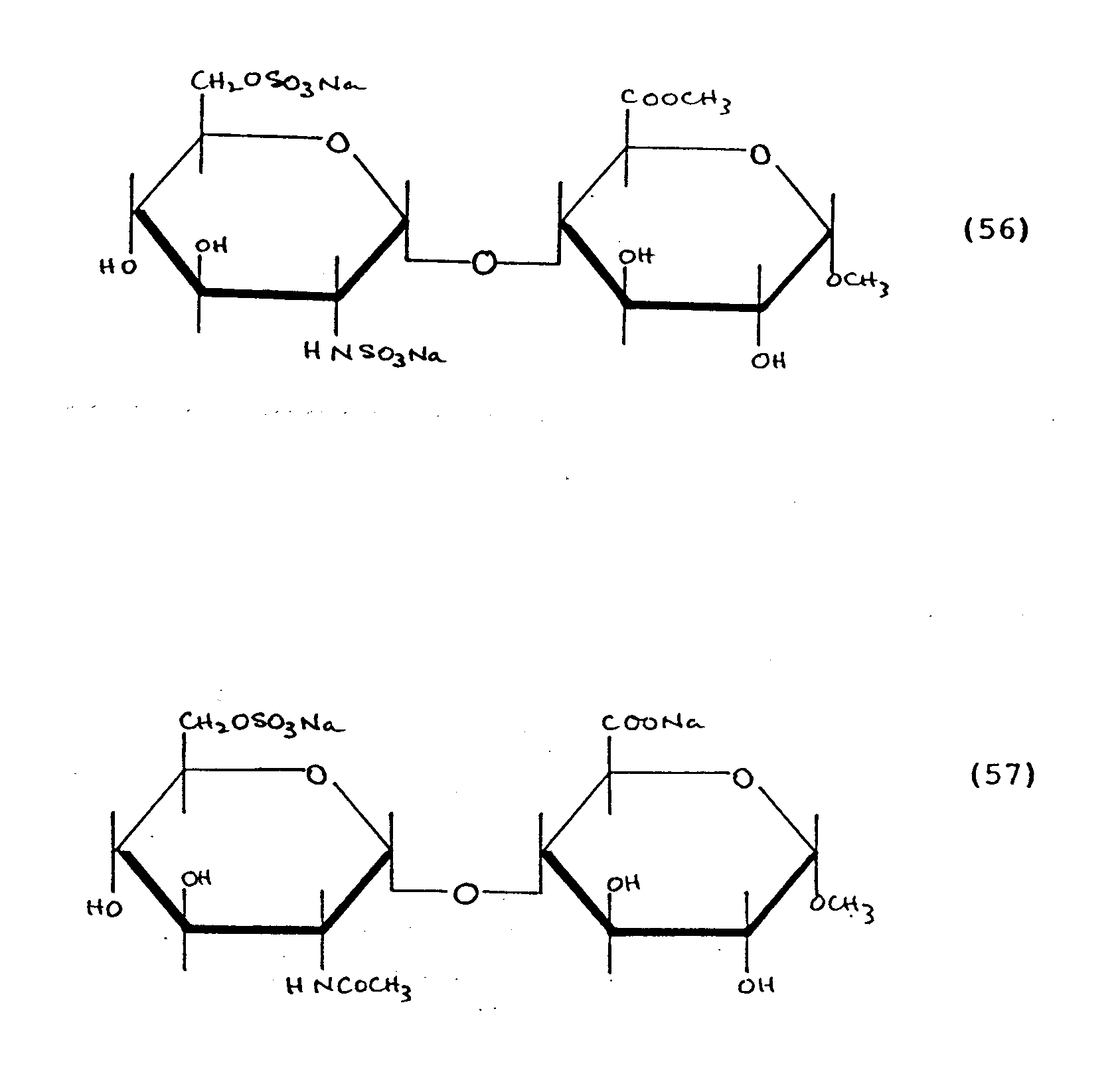

- Specific examples of further esterified disaccharides similar to but not included in the disclosure of EP-A-0 064 012 to Choay S.A., have the structures shown on (60) to (63):


- Also suitable for use in methods according to the invention are oligosaccharides produced by chemical cleavage of glycosaminoglycans especially chondrosine, having the structure (30) which can be obtained by acid hydrolysis of chondroitin sulphate, and its N-acetyl, and its N-acetyl, O-sulpho derivatives, having the structures (31) and (32) respectively.
- The derivation of these compounds will now be described by way of illustration.
- The disaccharide chondrosine (30) was obtained from chondroitin sulphate by acid hydrolysis. 10g of chondroitin sulphate was hydrolysed with 200ml of 2N sulphuric acid by refluxing at 100°C for 4 hours. The resulting hydrolysate was chromatographed on Dowex 50W-X8 (200-400 mesh) resin in the hydrogen form. The column was eluted with 0.2N sulphuric acid and all fractions were tested with ninhydrin/ferric chloride reagent. The first large, broad peak gave a yield of chondrosine after neutralisation with saturated barium hydroxide and lyophilisation to a dry powder.
- The method employed was that described by Olavesen & Davidson, J.Biol.Chem. 240(3), 992-996 (1965).

- N-acetylchondrosine (31) was prepared by selective N-acetylation of chondrosine using acetic anhydride. 500mg chondrosine was dissolved in 500 ml of bicarbonate buffer and cooled to 0-5°C. (Bicarbonate buffer was prepared by mixing 10ml 0.1M Na₂CO₃ and 90ml 0.1M NaHCO₃ having a pH value of 9. To this was added 0.22ml of acetic anhydride with stirring. The mixture was then left standing at 0°C overnight. It was then added to a Dowex (Registered Trade Mark) 50W-X8 (200-400) column in the acid form. Elution with three bed volumes of distilled water and lyophilisation of the aqueous eluate produced a white fluffy solid which was characterised as N-acetylchondrosine by I.R. and N.M.R. spectroscopy.
- The method employed was that described by Olavesen & Davidson, Ibid.

- Sulphation of the product in the C-6 position of the hexosamine moiety was achieved by using triethylamine-N-sulphonic acid. To a mixture of 5ml dimethylformamide, 7.5ml benzene and 0.5ml pyridine was added 500mg of N-acetylchondrosine after it had been evaporated several times from dry benzene. 9.12mg of triethylamine-N-sulphonic acid was added and the reaction vessel shaken for 26 hours at room temperature. The resulting solution was evaporated at reduced pressure to a yellow syrup (bath temp. <50°C) which was extracted with 2 x 5ml ether. The resulting oil was extracted with 10ml chloroform to remove any residual sulphonic acid. Chloroform washings and insoluble solids were washed in situ with 4 x 5ml water. The water fractions were combined and lyophilised to give N-acetyl chondrosine-6-O-sulphate (32), as a white fluffy solid which was characterised by I.R. and N.M.R. and by T.L.C.
- The method employed was that described by Olavesen & Davidson, Biochim. Biophys. Acta., 101, 245-251 (1965).

- Also suitable for use in compositions according to the invention are low molecular weight limit digests of heparan sulphate, hyaluronic acid and chondroitin sulphate produced by the relevant enzyme, namely heparitinase, hyaluronidase and chondroitinase.
- Also suitable for use in methods according to the invention is hyalobiouronic acid having the structure:

- The amount of the disaccharide to be incorporated with a suitable vehicle into compositions for topical use can vary widely, but in general, an amount of from 0.01 to 10%, preferably from 0.1 to 5% by weight of the composition will provide an adequate dose to the skin after topical application.
- As already indicated, one possible route for synthesising disaccharides is by subjecting intact glycosaminoglycan chains to partial hydrolysis to yield oligosaccharides comprising at least one disaccharide having a uronic acid residue linked to a hexosamine residue. Such disaccharides can then be modified.
- Disaccharides having at least one uronic acid residue linked in the β configuration through the C-1 position to a hexosamine residue, or certain olisaccharides having at least one hexosamine residue linked in the α or β configuration through the C-1 position to a uronic acid residue, can be prepared by condensation of relevant uronic acid and hexosamine residues.
- A relevant condensation reaction carried out in the presence of nitromethane and p-toluenesulphonic acid is desribed by David & Veyrieres in Carbohydrate Research 40, 23 (1975).
- The composition should also comprise a cosmetically or physiologically acceptable vehicle to enable the disaccharide to be conveyed to the skin in an appropriate dilution.
- The selection of a vehicle for this purpose presents a wide range of possibilities depending on the required product form of the composition. Suitable vehicles can be classified as described hereinafter.
- It should be explained that vehicles are substances which can act as diluents, dispersants, or solvents for the disaccharide and which therefore ensure that it can be applied to and distributed evenly over the hair and/or scalp at an appropriate concentration. The vehicle is preferably one which can aid penetration of the disaccharide into the skin to reach the immediate environment of the hair follicle. Compositions according to this invention can include water as a vehicle, and/or at least one cosmetically acceptable vehicle other than water.
- Vehicles other than water that can be used in compositions according to the invention can include solids or liquids such as emollients, solvents, humectants, thickeners and powders. Examples of each of these types of vehicles, which can be used singly or as mixtures of one or more vehicles, are as follows:
Emollients, such as stearyl alcohol, glyceryl monoricinoleate, glyceryl monostearate, propane-1,2-diol, butane-1,3-diol, mink oil, cetyl alcohol, isopropyl isostearate, stearic acid, isobutyl palmitate, isocetyl stearate, oleyl alcohol, isopropyl laurate, hexyl laurate, decyl oleate, octadecan-2-ol, isocetyl alcohol, cetyl palmitate, dimethylpolysiloxane, di-n-butyl sebacate, isopropyl myristate, isopropyl palmitate, isopropyl stearate, butyl stearate, polyethylene glycol, triethylene glycol, lanolin, castor oil, acetylated lanolin alcohols, petroleum, mineral oil, butyl myristate, isostearic acid, palmitic acid, isopropyl linoleate, lauryl lactate, myristyl lactate, decyl oleate, myristylmyristate;
Propellants, such as trichlorofluoromethane, dichlorodifluoromethane, dichlorotetrafluorethane, monochlorodifluoromethane, trichlorotrifluorethane, propane, butane, isobutane, dimethyl ether, carbon dioxide, nitrous oxide;
Solvents, such as ethyl alcohol, methylene chloride, isopropanol, castor oil, ethylene glycol monoethyl ether, diethylene glycol monobutyl ether, diethylene glycol monoethyl ether, dimethyl sulphoxide, tetrahydrofuran;
Humectants, such as glycerin, sorbitol, sodium 2-pyrrolidone-5-carboxylate, soluble collagen, dibutyl phthalate, gelatin;
Powders, such as chalk, talc, fullers earth, kaolin, starch, gums, colloidal silicon dioxide, sodium polyacrylate, tetra alkyl and/or trialkyl aryl ammonium smectites, chemically modified magnesium aluminium silicate, organically modified montmorillonite clay, hydrated aluminium silicate, fumed silica, carboxyvinyl polymer, sodium carboxymethyl cellulose, ethylene glycol monostearate. - The amount of vehicle in the composition, including water if present, should preferably be sufficient to carry at east a portion of the disaccharide to the skin in an amount which is sufficient effectively to enhance hair growth. The amount of the vehicle can comprise the balance of the composition, particularly where little or no other ingredients are present in the composition can accordingly comprise from 10 to 99.99%, preferably from 50 to 99.5% and ideally from 90 to 99% by weight of the vehicle or vehicles.
- The composition according to the invention can also optionally comprise a perfume in an amount sufficient to make the composition acceptable to the consumer and pleasant to use. Usually, the perfume will form from 0.01 to 10% by weight of the composition.
- The composition according to the invention can also optionally comprise an activity enhancer whose presence further improves the delivery to the skin of the disaccharide. The activity enhancer accordingly effectively increases the partition of the esterified oligosaccharide into the skin from the composition when applied topically.
- While screening a series of non-electrolytes for their ability to function as activity enhancers, it was observed that they were all compounds which were capable of substantially increasing the cloud point temperature of nonionic surfactants. Such compounds included short chain alkanols, diols and short chain fatty acids. By contrast, other non-electrolytes which reduce the cloud point temperature of nonionic surfactants, such as long chain alcohols, for example, butan-1-ol and cyclohexanol; polyols, for example sorbitol and propan-1,2,3-triol, do not function as activity enhancers.
- An activity enhancer is accordingly defined as a non-electrolyte which is capable, at a concentration of 5% by weight of increasing the cloud point temperature of a 0.025M aqueous solution of polyoxyethylene(8)nonylphenyl ether by at least 10°C. Preferably the activity enhancer is one which is capable of increasing the cloud point temperature by at least 15°C, most preferably by at least 20°C.
- It should be explained that the "cloud point" is a measure of the inverse solubility of a nonionic surfactant with temperature and can be determined by heating a standard clear aqueous solution of the nonionic surfactant until the solution becomes visibly cloudy and then measuring the temperature.
- The cloud point temperature can conveniently be determined automatically using the equipment and method described by Baum et al in Mat. Res. Std. 4 26 (1964).
- Examples of suitable compounds functioning as activity enhancers, together with the respective elevated cloud point temperature obtained in each case when using the standard test defined hereinbefore are listed below in Table 1. "Synperonic" mentioned there is a Registered Trade Mark.
Table 1 Elevation of the cloud point temperature of a 0.025M aqueous solution of polyoxyethylene(8)nonylphenyl ether in the presence of activity enhancers Activity Enhancer (5% by weight) 0.025M aqueous solution of polyoxyethylene (8) nonyl phenyl ether (SYNPERONIC NP8 ex ICI) Cloud point temperature (°C) Elevation of cloud point temperature None (control) 33.5 0 2-methyl propan-2-ol 55.0 21.5 Propan-2-ol 56.0 22.5 Ethyl-hydroxypropanoate 52.1 18.6 Hexan-2,5-diol 52.0 18.5 POE(2) ethyl ether 46.0 12.5 Di(2-hydroxypropyl) ether 44.8 11.3 Pentan-2,4-diol 48.0 14.5 Acetone 46.3 12.8 POE(2) methyl ether 43.5 10.0 2-hydroxypropionic acid 45.0 11.5 Propan-1-ol 53.0 19.5 1,4 Dioxane 44.0 10.5 Tetrahydrofuran 45.0 11.5 Butan-1,4-diol 45.0 11.5 - The composition optionally can contain ingredients other than those already mentioned depending on the form of the intended product. It is, for example, possible to include antiseptics, preservatives, antioxidants, emulsifiers, colouring agents and detergents. It is also possible to include other materials which inluence hair regrowth such as minoxidil and derivatives thereof.
- The composition can also be employed as a vehicle for a wide variety of cosmetically or pharmaceutically active ingredients, particularly ingredients which have some beneficial effect when applied to the skin other than the promotion of hair growth.
The total amount of optional ingredients can form the balance of up to 84.99% by weight of the composition. - The invention also provides a process for the preparation of a composition suitable for topical application to mammalian skin, particularly to the hair and/or scalp of the human subject which comprises mixing a disaccharide as specified above with a suitable cosmetically or physiologically acceptable vehicle, to provide a composition containing the oligosacchharide at a concentration of from 0.01 to 10% by weight.
- The composition can be formulated as liquids, for example as a lotion, shampoo, milk or cream for use in conjunction with an applicator such as a roll-ball applicator, or a spray device such as an aerosol can containing propellant, or a container fitted with a pump to dispense the liquid product. Alternatively, the composition of the invention can be solid or semi-solid, for example sticks, creams or gels, for use in conjunction with a suitable applicator or simply a tube, bottle or lidded jar, or as a liquid-impregnated fabric, such as a tissue wipe.
- The invention accordingly also provides a closed container containing a composition as herein defined.
- As mentioned, the invention also provides for the use of a disaccharide in the topical treatment of baldness.
- The compositions according to the invention are primarily intended for topical application to mammalian skin, particularly to the scalp of the human subject, especially where the head is already bald or balding. The compositions can also be applied prophilactically to the hair and hence the scalp to reduce or prevent the onset of baldness.
- The amount of the composition and the frequency of application to the hair and/or scalp can vary widely, depending on personal needs, but it is suggested as an example that topical application of from 1 to 5g daily containing from 0.001 to 1g of a selected esterified oligosaccharide over the period of at least six months will in most cases result in an improvement in hair growth.
- The efficacy of the compositions according to the invention was examined using the rat as an animal model, in order to assess both the duration and amount of hair growth, following daily administration of such compositions.
- For this purpose, hair was clipped from the treatment area at regular intervals and weighed as an index of hair production. The increased duration of anagen phase was apparent from growth curves obtained by plotting weight of hair recovered from clippings against duration of the experiment.
- This model was validated using minoxidil, a compound known to stimulate hair growth, as a positive control.
- Ability to increase hair production and ability to increase the duration of anagen phase, are both required attributes of any product for reversing baldness.
- The invention is illustrated by the following examples:
- This Example illustrates a lotion according to the invention which is suitable for topical application to the scalp in order to promote hair growth.
- The lotion has the following formulation:
% w/w disaccharide structure (53) 0.1 ethanol 99.995 perfume q.s. - This Example illustrates a hair tonic which is suitable for application to hair or scalp.
- The hair tonic has the following formulation:
% w/w disaccharide : structure (54) 0.8 ethanol 50 water 49 perfume q.s. - This Example also illustrates a lotion which is suitable for topical application to the scalp.
- The lotion has the following formulation:
% w/w disaccharide : structure (55) 1.5 propan-2-ol 10 ethanol 88.5 perfume q.s. - This Example also illustrates a hair tonic which is suitable for application to hair or scalp.
- The hair tonic has the following formulation:
% w/w disaccharide : structure (56) 0.2 ethanol 40 water 59.80 perfume q.s. - The following formulations represent lotions which can be used topically in the treatment of bald or balding male or female heads.
% w/w 5 6 7 8 Hydroxyethyl cellulose 0.4 - 0.4 - Absolute ethanol 25 25 25 25 Propane-1,2-diol - - 38.4 38.4 Butane-1,3-diol 38.4 38.8 - - Paramethyl benzoate 0.2 0.2 0.2 0.2 Disaccharide structure (57) 5 - - - Disaccharide structure (58) - 1 - - Disaccharide structure (59) - - 0.8 - Disaccharide structure (60) - - - 0.6 Perfume 1 1 1 1 Water to 100 100 100 100 - The following formulations represent creams which can be used in the treatment of baldness.
% w/w 9 10 11 12 Cetyl alcohol polyoxyethylene (10) 4 4 4 4 Cetyl alcohol 4 4 4 4 Mineral oil 4 2 - - Paraffin wax - 2 4 - Partial glyceride of palmitic and stearic acids - - - 4 Disaccharide : structure (30) 2 - - - Disaccharide : structure (61) - - - 1 Disaccharide : structure (62) - 1.5 - - Disaccharide : structure (63) - - 2 - Triethanolamine 0.75 0.75 0.75 0.75 Butane-1,3-diol 3 3 3 3 Xanthan gum 0.3 0.3 0.3 0.3 Preservative 0.4 0.4 0.4 0.4 Perfume q.s. q.s. q.s. q.s. Water to 100 100 100 100 - This Example illustrates a water-in-oil high internal phase emulsion containing a disaccharide.
- The emulsion consisted of 10% by volume oily phase and 90% by weight aqueous phase.
- The oily phase and the aqueous phase had the following consitution:
% w/w Oily phase Sorbitan monooleate 20 Quartenium-18 hectorite 5 Liquid paraffin 75 Aqueous phase Disaccharide : 0.5 Xanthan gum 1 Preservative 0.3 Perfume q.s. Sodium chloride (1% w/w solution) to 100 - The emulsion was prepared by taking 10 parts by volume of the oily phase and to it adding slowly with stirring 90 parts by volume of the aqueous phase.
- The high internal phase water-in-oil emulsion so formed can be applied topically to the scalp, to improve hair growth and regrowth.
- The following formulations represent lotions which can be used topically in the treatment of bald or balding male or female heads.
% w/w 14 15 16 17 Hydroxyethyl cellulose 0.4 - 0.4 - Absolute ethanol 25 25 25 25 Propane-1,2-diol - - 38.4 38.4 Butane-1,3-diol 38.4 38.8 - - Paramethyl benzoate 0.2 0.2 0.2 0.2 Disaccharide structure (30) 5 1 - - Disaccharide structure (31) - 1 4 - Disaccharide structure (32) - - 1 3 Disaccharide structure (33) 2 - - 3 Perfume 1 1 1 1 Water to 100 100 100 100 - The following formulations represent creams which can be used in the treatment of baldness.
% w/w 18 19 20 21 Cetyl alcohol polyoxyethylene (10) 4 4 4 4 Cetyl alcohol 4 4 4 4 Mineral oil 4 2 - - Paraffin wax - 2 4 - Partial glyceride of palmitic and stearic acids - - - 4 Disaccharide 6 6.5 4 4.5 Triethanolamine 0.75 0.75 0.75 0.75 Butane-1,3-diol 3 3 3 3 Xanthan gum 0.3 0.3 0.3 0.3 Preservative 0.4 0.4 0.4 0.4 Perfume q.s. q.s. q.s. q.s. Water to 100 100 100 100 - The following examples 22 to 29 illustrate shampoos for use in washing the hair and scalp, and for promoting hair growth on the scalp. In these examples "Briphos" and "Polyquart" are Registered Trade Marks.
-
% w/w Monoethanolamine lauryl sulphate : 100% AD 20 POLYQUART H : 50% active 3 BRIPHOS 03D 1.7 Coconut diethanolamide 5 Disaccharide : structure (56) 1 Perfume q.s. Water to 100 pH adjusted to 6.5 -
% w/w Sodium lauryl ether sulphate (3 EO) : 100% AD 12 POLYQUART H : 50% active 0.3 BRIPHOS 03D 1 Disaccharide : structure (57) 2 Perfume q.s. Water to 100 pH adjusted to 6.5 -
% w/w Sodium lauryl ether sulphate ( 2 EO) : 100% AD 12 POLYQUART H : 50% active 3 BRIPHOS 03D 1 Opacifier 9 Disaccharide : structure (58) 5 Perfume q.s. Water to 100 pH adjusted to 6.5 - The following Examples 43 to 47 illustrate powder compositions according to the invention which can be applied topically to the scalp.
% w/w 25 26 27 28 29 Chemically modified starch 5 - 5 - 5 Chemically modified cellulose - 5 - 5 - Boric acid 10 10 10 10 10 Zinc oxide 5 5 5 5 5 Disaccharide : structure (59) 5 - - - - Disaccharide : structure (60) - 10 - - - Disaccharide : structure (61) - - 2 - - Disaccharide : structure (62) - - - 4 - Disaccharide : structure (63) - - - - 1 Perfume q.s. q.s. q.s. q.s. q.s. Chalk 10 10 10 10 10 Talc to 100 100 100 100 100
Claims (16)
- A method for increasing the rate of terminal hair growth in mammalian species, which comprises applying to mammalian skin in the region of terminal hair, an effective amount of a composition comprising

 X is - H, C₁ to C₄ alkyl, -CO(CH₂)mCH₃, -SO₃M, or an aryl radical,X' is - H, -CO(CH₂)mCH₃, or - SO₃M,Y is - H, C₁ to C₄ alkyl or M, andM is - H or a metallic or organic cation, andm is 0 or the integer 1 or 2;the groups designated X being the same or different, one -OH group from each pyranose ring structure being linked by a glycosidic linkage having the configuration α -1,3, β -1,3, α -1,4 or β -1,4; and the -COOY, -CH₂OX and -OX groups being of either configuration with respect to the pyranose ring.
 - A method according to claim 1 in which the disaccharide has the structure:

- A method according to claim 2, in which the disaccharide in chosen from those having the following structures:


- A composition suitable for topical application to mammalian skin for promoting or enhancing the growth of hair, said composition comprising an effective amount of a disaccharide including a uronic acid residue having the structure:

 X is - H, C₁ to C₄ alkyl, -CO(CH₂)mCH₃, -SO₃M, or an aryl radical,X' is - H, -CO(CH₂)mCH₃, or - SO₃M,Y is - H, C₁ to C₄ alkyl or M, andM is - H or a metallic or organic cation, andm is O or the integer 1 or 2;the groups designated X being the same or different, one -OH group from each pyranose ring structure being linked by a glycosidic linkage having the configuration α -1,3, β -1,3, α -1,4 or β -1,4; and the -COOY, -CH₂OX and -OX groups being of either configuration with respect to the pyranose ring,
but excluding disaccharides of the structure:
- A composition according to claim 3 or 4, in which the disaccharide is chosen from those having the following structures:


- A composition according to any of claims 4 to 5, in which the effective amount of the disaccharide present in the composition is from 0.01 to 10% by weight.
- A composition according to any of claims 4 to 6, in which the effective amount of the disaccharide present in the composition is from 0.01 to 5% by weight.
- A composition according to any of claims 4 to 7, in which the carrier forms from 10 to 99.99% by weight.
- A composition according to any of claims 4 to 8, in which the carrier forms from 50 to 99.5% by weight.
- A composition according to any of claims 4 to 9, which additionally comprises a perfume.
- A composition according to any of claims 4 to 10, which additionally comprises an activity enhancer.
- A composition according to any of claims 4 to 11, which is in the form of a cream, a gel, a lotion or a stick.
- A method for the conversion of vellus hair to growth as terminal hair, which comprises applying to mammalian skin in the region of vellus hair, an effective amount of a composition according to any of claims 4 to 12.
- A method according to claim 1 wherein the disaccharide is as defined in claim 5.
- The use of a composition as defined in any of claims 3 to 12 in the promotion of mammalian hair growth or regrowth.
- The use of a disaccharide as defined in any of claims 1 to 5 in the preparation of a composition for the treatment of baldness.
Priority Applications (1)
| Application Number | Priority Date | Filing Date | Title |
|---|---|---|---|
| AT89117874T ATE85884T1 (en) | 1985-08-01 | 1986-07-30 | DISACCHARIDES. |
Applications Claiming Priority (2)
| Application Number | Priority Date | Filing Date | Title |
|---|---|---|---|
| GB8519416 | 1985-08-01 | ||
| GB858519416A GB8519416D0 (en) | 1985-08-01 | 1985-08-01 | Oligosaccharides |
Related Parent Applications (1)
| Application Number | Title | Priority Date | Filing Date |
|---|---|---|---|
| EP86305853.3 Division | 1986-07-30 |
Publications (2)
| Publication Number | Publication Date |
|---|---|
| EP0354595A1 EP0354595A1 (en) | 1990-02-14 |
| EP0354595B1 true EP0354595B1 (en) | 1993-02-24 |
Family
ID=10583197
Family Applications (2)
| Application Number | Title | Priority Date | Filing Date |
|---|---|---|---|
| EP89117874A Expired - Lifetime EP0354595B1 (en) | 1985-08-01 | 1986-07-30 | Disaccharides |
| EP86305853A Expired - Lifetime EP0211610B1 (en) | 1985-08-01 | 1986-07-30 | Oligosaccharides as a hair growth promotor |
Family Applications After (1)
| Application Number | Title | Priority Date | Filing Date |
|---|---|---|---|
| EP86305853A Expired - Lifetime EP0211610B1 (en) | 1985-08-01 | 1986-07-30 | Oligosaccharides as a hair growth promotor |
Country Status (11)
| Country | Link |
|---|---|
| US (1) | US4761401A (en) |
| EP (2) | EP0354595B1 (en) |
| JP (2) | JPS6236394A (en) |
| AT (2) | ATE85884T1 (en) |
| AU (1) | AU570366B2 (en) |
| BR (1) | BR8603606A (en) |
| CA (1) | CA1334656C (en) |
| DE (2) | DE3689017T2 (en) |
| GB (1) | GB8519416D0 (en) |
| IN (1) | IN165624B (en) |
| ZA (1) | ZA865732B (en) |
Families Citing this family (68)
| Publication number | Priority date | Publication date | Assignee | Title |
|---|---|---|---|---|
| US4851521A (en) * | 1985-07-08 | 1989-07-25 | Fidia, S.P.A. | Esters of hyaluronic acid |
| US5202431A (en) * | 1985-07-08 | 1993-04-13 | Fidia, S.P.A. | Partial esters of hyaluronic acid |
| DE3535720A1 (en) * | 1985-10-07 | 1987-04-09 | Hoechst Ag | SACCHAROSE TRICARBONIC ACID, METHOD FOR THE PRODUCTION THEREOF AND THEIR USE |
| GB8606368D0 (en) * | 1986-03-14 | 1986-04-23 | Unilever Plc | Skin treatment composition |
| US5264422A (en) * | 1986-06-30 | 1993-11-23 | Fidia S.P.A. | Esters of alginic acid with steroidal alcohols |
| IT1203814B (en) * | 1986-06-30 | 1989-02-23 | Fidia Farmaceutici | ESTERS OF ALGINIC ACID |
| GB8630720D0 (en) * | 1986-12-23 | 1987-02-04 | Unilever Plc | Cosmetic compositions |
| GB8630721D0 (en) * | 1986-12-23 | 1987-02-04 | Unilever Plc | Cosmetic compositions |
| US4767463A (en) * | 1987-04-15 | 1988-08-30 | Union Carbide Corporation | Glycosaminoglycan and cationic polymer combinations |
| US5079353A (en) * | 1987-12-02 | 1992-01-07 | Chembiomed, Ltd. | Sialic acid glycosides, antigens, immunoadsorbents, and methods for their preparation |
| US5344870A (en) * | 1987-12-02 | 1994-09-06 | Alberta Research Council | Sialic acid glycosides, antigens, immunoadsorbents, and methods for their preparation |
| US5185325A (en) * | 1988-06-23 | 1993-02-09 | Chesebrough-Pond's Usa Co., Division Of Conopco, Inc. | Cosmetic composition |
| US5618798A (en) * | 1989-04-20 | 1997-04-08 | Bar-Shalom; Daniel | Use of sucralfate to treat baldness |
| DK191889D0 (en) * | 1989-04-20 | 1989-04-20 | Bukh Meditec | COSMETIC AGENT |
| GB8911208D0 (en) * | 1989-05-16 | 1989-07-05 | Unilever Plc | Cosmetic composition |
| JP2965322B2 (en) * | 1990-05-31 | 1999-10-18 | サントリー株式会社 | External preparation for skin |
| LU87766A1 (en) * | 1990-07-20 | 1992-03-11 | Oreal | USE OF PYRIMIDINE 3-OXIDE DERIVATIVES FOR BRAKING HAIR LOSS AND TOPICAL COMPOSITIONS IMPLEMENTED |
| GR900100746A (en) * | 1990-10-11 | 1992-09-25 | Bukh Meditec | Cosmetic composition |
| DE4116257A1 (en) * | 1991-05-17 | 1992-11-19 | Boehringer Mannheim Gmbh | ALKYL-SUBSTITUTED ARYL SACCHARIDES, SURFACE ACTIVE AGENTS THAT CONTAIN SUCH SACCHARIDES AND THEIR USE IN DIAGNOSTIC TESTS |
| US5234914A (en) * | 1991-06-11 | 1993-08-10 | Patent Biopharmaceutics, Inc. | Methods of treating hemorrhoids and anorecial disease |
| FR2677884B1 (en) * | 1991-06-20 | 1993-07-09 | Oreal | COMPOSITION FOR BRAKING HAIR LOSS BASED ON TRISUBSTITUTED N-OXIDE PYRIMIDINES OR THEIR SULFOCONJUGAL DERIVATIVES, NOVEL PYRIMIDINE N-OXIDE COMPOUNDS OR THEIR SULFOCONJUGAL DERIVATIVES. |
| FR2680103B1 (en) | 1991-08-07 | 1993-10-29 | Oreal | USE IN COSMETICS OR IN PHARMACY OF ALKYLPOLYGLYCOSIDES AND / OR GLUCOSE O-ACYLATED DERIVATIVES FOR THE TREATMENT OF HAIR LOSS. |
| GB9117523D0 (en) * | 1991-08-14 | 1991-10-02 | Unilever Plc | Di and tri saccharides, methods of making them and hair growth compositions containing them |
| JPH05279381A (en) * | 1991-09-13 | 1993-10-26 | Dainippon Ink & Chem Inc | Sulfated oligosaccharide aromatic glycoside |
| US5459257A (en) * | 1993-01-11 | 1995-10-17 | Dainippon Ink And Chemicals, Inc. | Sulfated oligoglycoside acylate and antiviral agent containing the same as active ingredient |
| EP0747469A1 (en) * | 1995-06-08 | 1996-12-11 | The Procter & Gamble Company | Cleaning compositions comprising chondroitinase |
| US5965507A (en) * | 1995-06-08 | 1999-10-12 | Procter & Gamble Company | Cleaning compositions comprising chondroitinase |
| IT1290814B1 (en) * | 1997-03-24 | 1998-12-11 | Istituto Scient Di Chimica E B | GLYCOSAMINOGLICANS WITH HIGH ANTI-THROMBOTIC ACTIVITY |
| US6476191B1 (en) * | 1999-02-05 | 2002-11-05 | Mixture Sciences, Inc. | Volatilizable solid phase supports for compound synthesis |
| ES2167251B1 (en) * | 2000-07-13 | 2003-09-16 | Bioiberica | NEW DISCSED WITH ANTIARTROSIC ACTION. |
| JP4693014B2 (en) * | 2001-03-08 | 2011-06-01 | 蓮井 昌彦 | A method for producing glycosaminoglycan disaccharide. |
| JP2005526711A (en) * | 2002-01-18 | 2005-09-08 | バイオティ セラピィーズ コープ | Novel binding epitopes for Helicobacter pylori and their uses |
| US7763587B2 (en) | 2002-06-13 | 2010-07-27 | L'oreal S.A. | Derivative of glucose and of vitamin F, compositions comprising it, uses and preparation process |
| EP2260845A3 (en) | 2002-06-21 | 2012-08-22 | L'Oréal | Use of polyphenols for the treatment of alopecia |
| GB0610350D0 (en) | 2006-05-25 | 2006-07-05 | Univ Liverpool | prevention and/or treatment of neuodegenerative disorders |
| EP2279249A4 (en) * | 2008-05-30 | 2014-03-05 | Momenta Pharmaceuticals Inc | Saccharide structures and methods of making and using such structures |
| CZ2008705A3 (en) | 2008-11-06 | 2010-04-14 | Cpn S. R. O. | Process for preparing DTPA crosslinked derivatives of hyaluronic acid and their modifications |
| CZ301899B6 (en) * | 2009-03-17 | 2010-07-21 | Contipro C, A.S. | Process for preparing derivatives of hyaluronic acid using O-acyl-O?-alkylcarbonate in the presence of substituted pyridine |
| ES2358829B1 (en) | 2009-10-23 | 2012-06-25 | Lipotec, S.A. | USEFUL PEPTIDES IN THE TREATMENT AND / OR CARE OF SKIN, MUCOSES AND / OR HAIR AND ITS USE IN COSMETIC OR PHARMACEUTICAL COMPOSITIONS. |
| CZ302504B6 (en) | 2009-12-11 | 2011-06-22 | Contipro C A.S. | Hyaluronic acid derivative oxidized selectively in position 6 of polysaccharide glucosamine portion to aldehyde and modification process thereof |
| CZ302503B6 (en) | 2009-12-11 | 2011-06-22 | Contipro C A.S. | Process for preparing hyaluronic acid derivative oxidized in position 6 of polysaccharide glucosamine portion to aldehyde and modification process thereof |
| ES2373704B1 (en) | 2010-02-18 | 2013-01-24 | Lipotec S.A. | LIPOSOMES FOR THE TREATMENT OF TEXTILE MATERIALS. |
| ES2384060B1 (en) | 2010-03-24 | 2013-09-23 | Lipotec S.A. | LIPID NANOPARTICLES CAPSULES. |
| ES2383271B1 (en) | 2010-03-24 | 2013-08-01 | Lipotec S.A. | PROCESSING PROCESSING OF FIBERS AND / OR TEXTILE MATERIALS |
| ES2386177B1 (en) | 2010-09-21 | 2013-09-23 | Lipotec, S.A. | NANOCAPSULES CONTAINING MICROEMULSIONS |
| IT1403886B1 (en) * | 2010-12-15 | 2013-11-08 | Sigea Srl | USE OF GLYCOSAMINOGLICAN ESTERS IN TRICOLOGICAL FIELD |
| CN103122012B (en) * | 2011-11-17 | 2016-03-30 | 江苏恒瑞医药股份有限公司 | Compound for preparing fondaparinux sodium and preparation method thereof, and preparation method of fondaparinux sodium |
| CZ2012136A3 (en) | 2012-02-28 | 2013-06-05 | Contipro Biotech S.R.O. | Derivatives based on hyaluronic acid capable of forming hydrogels, process of their preparation, hydrogels based on these derivatives, process of their preparation and use |
| CZ304512B6 (en) | 2012-08-08 | 2014-06-11 | Contipro Biotech S.R.O. | Hyaluronic acid derivative, process for its preparation, modification process and use thereof |
| CZ2012842A3 (en) | 2012-11-27 | 2014-08-20 | Contipro Biotech S.R.O. | C6-C18-acylated hyaluronate-based nanomicellar composition, process for preparing C6-C18-acylated hyaluronate, process for preparing nanomicellar composition and stabilized nanomicellar composition as well as use thereof |
| CZ2014150A3 (en) | 2014-03-11 | 2015-05-20 | Contipro Biotech S.R.O. | Conjugates of hyaluronic acid oligomer or salts thereof, process of their preparation and use |
| CZ2014451A3 (en) | 2014-06-30 | 2016-01-13 | Contipro Pharma A.S. | Antitumor composition based on hyaluronic acid and inorganic nanoparticles, process of its preparation and use |
| WO2016007778A1 (en) | 2014-07-09 | 2016-01-14 | Midori Usa, Inc. | Oligosaccharide compositions and methods for producing thereof |
| EP3212688B1 (en) | 2014-10-31 | 2022-04-13 | Lubrizol Advanced Materials, Inc. | Thermoplastic polyurethane film for delivery of active agents to skin surfaces |
| EP4209130A1 (en) | 2015-01-26 | 2023-07-12 | DSM Nutritional Products, LLC | Oligosaccharide compositions for use animal feed and methods of producing thereof |
| CZ309295B6 (en) | 2015-03-09 | 2022-08-10 | Contipro A.S. | Self-supporting, biodegradable film based on hydrophobized hyaluronic acid, method of its preparation and use |
| EP3964234A1 (en) | 2015-04-23 | 2022-03-09 | Kaleido Biosciences, Inc. | Glycan therapeutics and methods of treatment |
| CZ306479B6 (en) | 2015-06-15 | 2017-02-08 | Contipro A.S. | A method of crosslinking polysaccharides by using photolabile protecting groups |
| CZ306662B6 (en) | 2015-06-26 | 2017-04-26 | Contipro A.S. | Sulphated polysaccharides derivatives, the method of their preparation, the method of their modification and the use |
| EP3371238A1 (en) | 2015-11-05 | 2018-09-12 | Lubrizol Advanced Materials, Inc. | Thermoformable dual network hydrogel compositions |
| US10688037B1 (en) | 2015-12-31 | 2020-06-23 | Nutraceutical Wellness Inc. | Compositions and method for hair regrowth |
| JP6793295B2 (en) | 2016-03-29 | 2020-12-02 | 株式会社テクノクラーツ | Motion transmission device, molding mold and machinery |
| CZ308106B6 (en) | 2016-06-27 | 2020-01-08 | Contipro A.S. | Unsaturated derivatives of polysaccharides, their preparation and their use |
| GB2572322A (en) * | 2018-03-16 | 2019-10-02 | Institute Of Tech Tralee | A hair treatment composition |
| KR20210008483A (en) | 2018-04-12 | 2021-01-22 | 루브리졸 어드밴스드 머티어리얼스, 인코포레이티드 | Hair modification composition and method thereof |
| WO2022245758A1 (en) | 2021-05-17 | 2022-11-24 | Lubrizol Advanced Materials, Inc. | Hair color compositions for mitigating color loss |
| FR3151764A1 (en) | 2023-08-01 | 2025-02-07 | L'oreal | HAIR COMPOSITION COMPRISING HYALURONIC ACID, A NON-IONIC SURFACTANT AND A PERFUME SUBSTANCE |
| US12318646B1 (en) * | 2024-07-05 | 2025-06-03 | ZF Solution Co. Ltd. | Fire extinguishing agent composition and fire extinguisher for electric vehicles containing the same |
Family Cites Families (21)
| Publication number | Priority date | Publication date | Assignee | Title |
|---|---|---|---|---|
| BE788788A (en) * | 1971-09-13 | 1973-03-13 | Treuhandvereinigung Ag | PRODUCT FOR PRESERVING, PROMOTING AND RESTORING HAIR AND METHOD OF MANUFACTURING THIS PRODUCT |
| DE2438534A1 (en) * | 1974-08-10 | 1976-02-19 | Valentin Dr Med Koehler | Scalp-care preparations contg. uronic acids - e.g. glucuronic acid or glucuronic acid gamma-lactone |
| JPS6037086B2 (en) * | 1978-09-26 | 1985-08-24 | 花王株式会社 | cosmetics |
| NL8001417A (en) * | 1979-03-17 | 1980-09-19 | Erba Farmitalia | ANTITUMORGLYCOSIDES. |
| US4391800A (en) * | 1979-04-27 | 1983-07-05 | Merck & Co., Inc. | Immunologically active peptidyl disaccharides and methods of preparation |
| JPS5629597A (en) * | 1979-08-21 | 1981-03-24 | Seikagaku Kogyo Co Ltd | Alkyl glycoside of constituent unit disaccharide of acid mucopolysaccharide and oligosaccharide consisting of said disaccharide, and preparation thereof |
| FR2477411A1 (en) * | 1980-03-05 | 1981-09-11 | Frajdenrajch Sophie | COMPOSITION FOR THE TREATMENT OF HAIR |
| US4495346A (en) * | 1981-03-30 | 1985-01-22 | Wisconsin Alumni Research Foundation | Method of preparing a disaccharide |
| FR2519987A1 (en) * | 1982-01-15 | 1983-07-22 | Choay Sa | Uronic acid derivs. - useful as glycoside intermediates or hapten(s) |
| FR2504535B1 (en) * | 1981-04-28 | 1987-08-14 | Choay Sa | DISACCHARIDES DERIVED FROM URONIC ACID AND GLUCOSAMINE AND PHARMACEUTICAL COMPOSITIONS CONTAINING THEM FOR THE CONTROL OF BLOOD COAGULATION |
| FR2564468B1 (en) * | 1984-05-16 | 1994-12-23 | Choay Sa | NOVEL OLIGOSACCHARIDES, THEIR SYNTHESIS PREPARATION AND THEIR BIOLOGICAL APPLICATIONS |
| AU563351C (en) * | 1982-01-15 | 2003-06-19 | Glaxo Group Limited | Synthesis of oligosaccharides |
| AU561067B2 (en) * | 1982-03-22 | 1987-04-30 | Biocarb Ab | Anti-bacterial composition containing an oligosaccharide |
| JPS59186911A (en) * | 1983-04-05 | 1984-10-23 | Sansho Seiyaku Kk | Hair cosmetic |
| FR2548189B1 (en) * | 1983-07-01 | 1986-04-11 | Choay Sa | NEW PRODUCTS CONTAINING OLIGOSACCHARIDES, THEIR PREPARATION AND THEIR BIOLOGICAL AND BIOCHEMICAL APPLICATIONS |
| FR2548672A1 (en) * | 1983-07-04 | 1985-01-11 | Pharmuka Lab | SULPHATE OLIGOSACCHARIDES AND THEIR USE AS MEDICAMENTS |
| US4528106A (en) * | 1983-11-14 | 1985-07-09 | Olin Corporation | Glucoside surfactants |
| JPS6168418A (en) * | 1984-09-11 | 1986-04-08 | Kanto Ishi Pharma Co Ltd | Expectorant |
| LU85777A1 (en) * | 1985-02-20 | 1986-09-02 | Oreal | UNSATURATED CYCLOALIPHATIC DERIVATIVES, PROCESSES FOR THEIR PREPARATION AND THEIR USE |
| US4612304A (en) * | 1985-06-11 | 1986-09-16 | Ss Pharmaceutical Co., Ltd. | Antitumor formulation containing lipopolysaccharide with trehalose derivatives |
| FR2584728B1 (en) * | 1985-07-12 | 1987-11-20 | Choay Sa | PROCESS FOR THE SULFATION OF GLYCOSAMINOGLYCANS AND THEIR FRAGMENTS |
-
1985
- 1985-08-01 GB GB858519416A patent/GB8519416D0/en active Pending
-
1986
- 1986-07-24 CA CA000514616A patent/CA1334656C/en not_active Expired - Fee Related
- 1986-07-29 US US06/891,940 patent/US4761401A/en not_active Expired - Lifetime
- 1986-07-30 EP EP89117874A patent/EP0354595B1/en not_active Expired - Lifetime
- 1986-07-30 EP EP86305853A patent/EP0211610B1/en not_active Expired - Lifetime
- 1986-07-30 IN IN214/BOM/86A patent/IN165624B/en unknown
- 1986-07-30 AU AU60717/86A patent/AU570366B2/en not_active Ceased
- 1986-07-30 AT AT89117874T patent/ATE85884T1/en active
- 1986-07-30 BR BR8603606A patent/BR8603606A/en not_active Application Discontinuation
- 1986-07-30 DE DE86305853T patent/DE3689017T2/en not_active Expired - Fee Related
- 1986-07-30 AT AT86305853T patent/ATE94554T1/en not_active IP Right Cessation
- 1986-07-30 DE DE8989117874T patent/DE3687841T2/en not_active Expired - Fee Related
- 1986-07-31 JP JP61181204A patent/JPS6236394A/en active Pending
- 1986-07-31 ZA ZA865732A patent/ZA865732B/en unknown
-
1990
- 1990-07-23 JP JP2194687A patent/JPH07103009B2/en not_active Expired - Lifetime
Also Published As
| Publication number | Publication date |
|---|---|
| AU570366B2 (en) | 1988-03-10 |
| AU6071786A (en) | 1987-02-05 |
| BR8603606A (en) | 1987-03-10 |
| JPS6236394A (en) | 1987-02-17 |
| DE3689017T2 (en) | 1994-01-27 |
| ATE94554T1 (en) | 1993-10-15 |
| ZA865732B (en) | 1988-04-27 |
| JPH0372412A (en) | 1991-03-27 |
| EP0211610B1 (en) | 1993-09-15 |
| DE3689017D1 (en) | 1993-10-21 |
| ATE85884T1 (en) | 1993-03-15 |
| US4761401A (en) | 1988-08-02 |
| EP0211610A2 (en) | 1987-02-25 |
| DE3687841D1 (en) | 1993-04-01 |
| JPH07103009B2 (en) | 1995-11-08 |
| EP0354595A1 (en) | 1990-02-14 |
| GB8519416D0 (en) | 1985-09-04 |
| DE3687841T2 (en) | 1993-07-01 |
| CA1334656C (en) | 1995-03-07 |
| EP0211610A3 (en) | 1988-02-24 |
| IN165624B (en) | 1989-11-25 |
Similar Documents
| Publication | Publication Date | Title |
|---|---|---|
| EP0211610B1 (en) | Oligosaccharides as a hair growth promotor | |
| CA1319889C (en) | Hair growth composition | |
| EP0335554B1 (en) | Cosmetic composition | |
| EP0334586B1 (en) | Carbohydrate lactam derivatives and their use in cosmetic compositions | |
| US4871839A (en) | Skin treatment composition | |
| EP0295092B1 (en) | Skin treatment composition | |
| EP0403238A2 (en) | Cosmetic composition | |
| EP0415598A1 (en) | Cosmetic composition | |
| US5185325A (en) | Cosmetic composition | |
| EP0348184B1 (en) | Cosmetic composition | |
| EP0490581B1 (en) | Cosmetic composition | |
| EP0572167B1 (en) | Cosmetic composition | |
| CA2016351C (en) | Cosmetic composition | |
| AU637390B2 (en) | Compositions containing hair growth promoters | |
| EP0398669B1 (en) | Cosmetic composition |
Legal Events
| Date | Code | Title | Description |
|---|---|---|---|
| PUAI | Public reference made under article 153(3) epc to a published international application that has entered the european phase |
Free format text: ORIGINAL CODE: 0009012 |
|
| 17P | Request for examination filed |
Effective date: 19890927 |
|
| AC | Divisional application: reference to earlier application |
Ref document number: 211610 Country of ref document: EP |
|
| AK | Designated contracting states |
Kind code of ref document: A1 Designated state(s): AT BE CH DE FR GB IT LI NL SE |
|
| 17Q | First examination report despatched |
Effective date: 19910322 |
|
| RAP3 | Party data changed (applicant data changed or rights of an application transferred) |
Owner name: UNILEVER N.V. Owner name: UNILEVER PLC |
|
| GRAA | (expected) grant |
Free format text: ORIGINAL CODE: 0009210 |
|
| AC | Divisional application: reference to earlier application |
Ref document number: 211610 Country of ref document: EP |
|
| AK | Designated contracting states |
Kind code of ref document: B1 Designated state(s): AT BE CH DE FR GB IT LI NL SE |
|
| REF | Corresponds to: |
Ref document number: 85884 Country of ref document: AT Date of ref document: 19930315 Kind code of ref document: T |
|
| REF | Corresponds to: |
Ref document number: 3687841 Country of ref document: DE Date of ref document: 19930401 |
|
| ITF | It: translation for a ep patent filed | ||
| ET | Fr: translation filed | ||
| PLBE | No opposition filed within time limit |
Free format text: ORIGINAL CODE: 0009261 |
|
| STAA | Information on the status of an ep patent application or granted ep patent |
Free format text: STATUS: NO OPPOSITION FILED WITHIN TIME LIMIT |
|
| 26N | No opposition filed | ||
| EAL | Se: european patent in force in sweden |
Ref document number: 89117874.1 |
|
| PGFP | Annual fee paid to national office [announced via postgrant information from national office to epo] |
Ref country code: FR Payment date: 19960610 Year of fee payment: 11 |
|
| PGFP | Annual fee paid to national office [announced via postgrant information from national office to epo] |
Ref country code: SE Payment date: 19960614 Year of fee payment: 11 Ref country code: AT Payment date: 19960614 Year of fee payment: 11 |
|
| PGFP | Annual fee paid to national office [announced via postgrant information from national office to epo] |
Ref country code: BE Payment date: 19960624 Year of fee payment: 11 |
|
| PGFP | Annual fee paid to national office [announced via postgrant information from national office to epo] |
Ref country code: GB Payment date: 19960626 Year of fee payment: 11 Ref country code: DE Payment date: 19960626 Year of fee payment: 11 |
|
| PGFP | Annual fee paid to national office [announced via postgrant information from national office to epo] |
Ref country code: CH Payment date: 19960702 Year of fee payment: 11 |
|
| PGFP | Annual fee paid to national office [announced via postgrant information from national office to epo] |
Ref country code: NL Payment date: 19960718 Year of fee payment: 11 |
|
| PG25 | Lapsed in a contracting state [announced via postgrant information from national office to epo] |
Ref country code: GB Free format text: LAPSE BECAUSE OF NON-PAYMENT OF DUE FEES Effective date: 19970730 Ref country code: AT Free format text: LAPSE BECAUSE OF NON-PAYMENT OF DUE FEES Effective date: 19970730 |
|
| PG25 | Lapsed in a contracting state [announced via postgrant information from national office to epo] |
Ref country code: SE Effective date: 19970731 Ref country code: LI Free format text: LAPSE BECAUSE OF NON-PAYMENT OF DUE FEES Effective date: 19970731 Ref country code: CH Free format text: LAPSE BECAUSE OF NON-PAYMENT OF DUE FEES Effective date: 19970731 Ref country code: BE Free format text: LAPSE BECAUSE OF NON-PAYMENT OF DUE FEES Effective date: 19970731 |
|
| BERE | Be: lapsed |
Owner name: UNILEVER N.V. Effective date: 19970731 |
|
| PG25 | Lapsed in a contracting state [announced via postgrant information from national office to epo] |
Ref country code: NL Free format text: LAPSE BECAUSE OF NON-PAYMENT OF DUE FEES Effective date: 19980201 |
|
| REG | Reference to a national code |
Ref country code: CH Ref legal event code: PL |
|
| GBPC | Gb: european patent ceased through non-payment of renewal fee |
Effective date: 19970730 |
|
| PG25 | Lapsed in a contracting state [announced via postgrant information from national office to epo] |
Ref country code: FR Free format text: LAPSE BECAUSE OF NON-PAYMENT OF DUE FEES Effective date: 19980331 |
|
| NLV4 | Nl: lapsed or anulled due to non-payment of the annual fee |
Effective date: 19980201 |
|
| PG25 | Lapsed in a contracting state [announced via postgrant information from national office to epo] |
Ref country code: DE Free format text: LAPSE BECAUSE OF NON-PAYMENT OF DUE FEES Effective date: 19980401 |
|
| EUG | Se: european patent has lapsed |
Ref document number: 89117874.1 |
|
| REG | Reference to a national code |
Ref country code: FR Ref legal event code: ST |
|
| PG25 | Lapsed in a contracting state [announced via postgrant information from national office to epo] |
Ref country code: IT Free format text: LAPSE BECAUSE OF NON-PAYMENT OF DUE FEES;WARNING: LAPSES OF ITALIAN PATENTS WITH EFFECTIVE DATE BEFORE 2007 MAY HAVE OCCURRED AT ANY TIME BEFORE 2007. THE CORRECT EFFECTIVE DATE MAY BE DIFFERENT FROM THE ONE RECORDED. Effective date: 20050730 |