EP0353372B1 - Antischizophrenic-S-N-(1-azabicyclo[2.2.2.]oct-3-yl) benzamides and thiobenzamides - Google Patents
Antischizophrenic-S-N-(1-azabicyclo[2.2.2.]oct-3-yl) benzamides and thiobenzamides Download PDFInfo
- Publication number
- EP0353372B1 EP0353372B1 EP88402042A EP88402042A EP0353372B1 EP 0353372 B1 EP0353372 B1 EP 0353372B1 EP 88402042 A EP88402042 A EP 88402042A EP 88402042 A EP88402042 A EP 88402042A EP 0353372 B1 EP0353372 B1 EP 0353372B1
- Authority
- EP
- European Patent Office
- Prior art keywords
- oct
- azabicyclo
- chloro
- amino
- general formula
- Prior art date
- Legal status (The legal status is an assumption and is not a legal conclusion. Google has not performed a legal analysis and makes no representation as to the accuracy of the status listed.)
- Expired - Lifetime
Links
- 229940054066 benzamide antipsychotics Drugs 0.000 title description 9
- 150000003936 benzamides Chemical class 0.000 title description 7
- 150000001875 compounds Chemical class 0.000 claims abstract description 79
- 150000003839 salts Chemical class 0.000 claims abstract description 33
- 230000002932 anti-schizophrenic effect Effects 0.000 claims abstract description 10
- -1 amino, methylamino Chemical group 0.000 claims abstract description 9
- 229910052739 hydrogen Inorganic materials 0.000 claims abstract description 9
- 239000001257 hydrogen Substances 0.000 claims abstract description 9
- NINIDFKCEFEMDL-UHFFFAOYSA-N Sulfur Chemical group [S] NINIDFKCEFEMDL-UHFFFAOYSA-N 0.000 claims abstract description 8
- 125000004178 (C1-C4) alkyl group Chemical group 0.000 claims abstract description 7
- UFHFLCQGNIYNRP-UHFFFAOYSA-N Hydrogen Chemical compound [H][H] UFHFLCQGNIYNRP-UHFFFAOYSA-N 0.000 claims abstract description 6
- 125000005843 halogen group Chemical group 0.000 claims abstract description 6
- 125000001997 phenyl group Chemical group [H]C1=C([H])C([H])=C(*)C([H])=C1[H] 0.000 claims abstract description 6
- 150000001204 N-oxides Chemical class 0.000 claims abstract description 5
- 239000005864 Sulphur Chemical group 0.000 claims abstract description 5
- 239000000164 antipsychotic agent Substances 0.000 claims abstract description 5
- 229910052760 oxygen Inorganic materials 0.000 claims abstract description 5
- 229910052736 halogen Inorganic materials 0.000 claims abstract description 4
- 125000000229 (C1-C4)alkoxy group Chemical group 0.000 claims abstract description 3
- 125000004209 (C1-C8) alkyl group Chemical group 0.000 claims abstract description 3
- 125000003545 alkoxy group Chemical group 0.000 claims abstract description 3
- 125000004448 alkyl carbonyl group Chemical group 0.000 claims abstract description 3
- QVGXLLKOCUKJST-UHFFFAOYSA-N atomic oxygen Chemical group [O] QVGXLLKOCUKJST-UHFFFAOYSA-N 0.000 claims abstract description 3
- 125000002147 dimethylamino group Chemical group [H]C([H])([H])N(*)C([H])([H])[H] 0.000 claims abstract description 3
- 239000001301 oxygen Substances 0.000 claims abstract description 3
- 125000000714 pyrimidinyl group Chemical group 0.000 claims abstract description 3
- 238000002360 preparation method Methods 0.000 claims description 21
- 125000001495 ethyl group Chemical group [H]C([H])([H])C([H])([H])* 0.000 claims description 3
- 125000002496 methyl group Chemical group [H]C([H])([H])* 0.000 claims description 3
- 150000002431 hydrogen Chemical class 0.000 claims description 2
- FEROPKNOYKURCJ-UHFFFAOYSA-N 4-amino-N-(1-azabicyclo[2.2.2]octan-3-yl)-5-chloro-2-methoxybenzamide Chemical compound COC1=CC(N)=C(Cl)C=C1C(=O)NC1C(CC2)CCN2C1 FEROPKNOYKURCJ-UHFFFAOYSA-N 0.000 claims 1
- 150000002367 halogens Chemical class 0.000 abstract description 3
- OKKJLVBELUTLKV-UHFFFAOYSA-N Methanol Chemical compound OC OKKJLVBELUTLKV-UHFFFAOYSA-N 0.000 description 84
- 239000000243 solution Substances 0.000 description 53
- 239000000203 mixture Substances 0.000 description 46
- LFQSCWFLJHTTHZ-UHFFFAOYSA-N Ethanol Chemical compound CCO LFQSCWFLJHTTHZ-UHFFFAOYSA-N 0.000 description 40
- 238000000034 method Methods 0.000 description 37
- VEXZGXHMUGYJMC-UHFFFAOYSA-N Hydrochloric acid Chemical compound Cl VEXZGXHMUGYJMC-UHFFFAOYSA-N 0.000 description 31
- VZCYOOQTPOCHFL-OWOJBTEDSA-N Fumaric acid Chemical compound OC(=O)\C=C\C(O)=O VZCYOOQTPOCHFL-OWOJBTEDSA-N 0.000 description 30
- YMWUJEATGCHHMB-UHFFFAOYSA-N Dichloromethane Chemical compound ClCCl YMWUJEATGCHHMB-UHFFFAOYSA-N 0.000 description 27
- REUAXQZIRFXQML-UHFFFAOYSA-N 1-azabicyclo[2.2.2]octan-3-amine Chemical compound C1CC2C(N)CN1CC2 REUAXQZIRFXQML-UHFFFAOYSA-N 0.000 description 26
- HEDRZPFGACZZDS-UHFFFAOYSA-N Chloroform Chemical compound ClC(Cl)Cl HEDRZPFGACZZDS-UHFFFAOYSA-N 0.000 description 24
- 239000007787 solid Substances 0.000 description 23
- XLYOFNOQVPJJNP-UHFFFAOYSA-N water Substances O XLYOFNOQVPJJNP-UHFFFAOYSA-N 0.000 description 23
- VZCYOOQTPOCHFL-UHFFFAOYSA-N trans-butenedioic acid Natural products OC(=O)C=CC(O)=O VZCYOOQTPOCHFL-UHFFFAOYSA-N 0.000 description 21
- RTZKZFJDLAIYFH-UHFFFAOYSA-N Diethyl ether Chemical compound CCOCC RTZKZFJDLAIYFH-UHFFFAOYSA-N 0.000 description 19
- HEMHJVSKTPXQMS-UHFFFAOYSA-M Sodium hydroxide Chemical compound [OH-].[Na+] HEMHJVSKTPXQMS-UHFFFAOYSA-M 0.000 description 18
- 239000000047 product Substances 0.000 description 18
- 238000002844 melting Methods 0.000 description 17
- 230000008018 melting Effects 0.000 description 17
- KWTSXDURSIMDCE-QMMMGPOBSA-N (S)-amphetamine Chemical compound C[C@H](N)CC1=CC=CC=C1 KWTSXDURSIMDCE-QMMMGPOBSA-N 0.000 description 16
- WYURNTSHIVDZCO-UHFFFAOYSA-N Tetrahydrofuran Chemical compound C1CCOC1 WYURNTSHIVDZCO-UHFFFAOYSA-N 0.000 description 16
- KFZMGEQAYNKOFK-UHFFFAOYSA-N Isopropanol Chemical compound CC(C)O KFZMGEQAYNKOFK-UHFFFAOYSA-N 0.000 description 15
- 229940025084 amphetamine Drugs 0.000 description 15
- 238000001914 filtration Methods 0.000 description 15
- CSCPPACGZOOCGX-UHFFFAOYSA-N Acetone Chemical compound CC(C)=O CSCPPACGZOOCGX-UHFFFAOYSA-N 0.000 description 14
- 239000002253 acid Substances 0.000 description 13
- 235000019441 ethanol Nutrition 0.000 description 13
- 239000002244 precipitate Substances 0.000 description 13
- IJGRMHOSHXDMSA-UHFFFAOYSA-N Atomic nitrogen Chemical compound N#N IJGRMHOSHXDMSA-UHFFFAOYSA-N 0.000 description 12
- UHOVQNZJYSORNB-UHFFFAOYSA-N Benzene Chemical compound C1=CC=CC=C1 UHOVQNZJYSORNB-UHFFFAOYSA-N 0.000 description 12
- CSNNHWWHGAXBCP-UHFFFAOYSA-L Magnesium sulfate Chemical compound [Mg+2].[O-][S+2]([O-])([O-])[O-] CSNNHWWHGAXBCP-UHFFFAOYSA-L 0.000 description 12
- 239000012458 free base Substances 0.000 description 12
- RAXXELZNTBOGNW-UHFFFAOYSA-N imidazole Natural products C1=CNC=N1 RAXXELZNTBOGNW-UHFFFAOYSA-N 0.000 description 12
- 238000004458 analytical method Methods 0.000 description 11
- MVKDKUUCCOPJSG-UHFFFAOYSA-N n-(1-azabicyclo[2.2.2]octan-3-yl)benzamide Chemical class C1N(CC2)CCC2C1NC(=O)C1=CC=CC=C1 MVKDKUUCCOPJSG-UHFFFAOYSA-N 0.000 description 11
- PFKFTWBEEFSNDU-UHFFFAOYSA-N carbonyldiimidazole Chemical compound C1=CN=CN1C(=O)N1C=CN=C1 PFKFTWBEEFSNDU-UHFFFAOYSA-N 0.000 description 10
- 239000000706 filtrate Substances 0.000 description 10
- 238000011282 treatment Methods 0.000 description 10
- PMZURENOXWZQFD-UHFFFAOYSA-L Sodium Sulfate Chemical compound [Na+].[Na+].[O-]S([O-])(=O)=O PMZURENOXWZQFD-UHFFFAOYSA-L 0.000 description 9
- SNIABFMMCKVXSY-UHFFFAOYSA-N benzoylazanium;chloride Chemical compound Cl.NC(=O)C1=CC=CC=C1 SNIABFMMCKVXSY-UHFFFAOYSA-N 0.000 description 9
- VNWKTOKETHGBQD-UHFFFAOYSA-N methane Natural products C VNWKTOKETHGBQD-UHFFFAOYSA-N 0.000 description 9
- 239000011541 reaction mixture Substances 0.000 description 9
- CURLTUGMZLYLDI-UHFFFAOYSA-N Carbon dioxide Chemical compound O=C=O CURLTUGMZLYLDI-UHFFFAOYSA-N 0.000 description 8
- 238000010992 reflux Methods 0.000 description 8
- YLQBMQCUIZJEEH-UHFFFAOYSA-N tetrahydrofuran Natural products C=1C=COC=1 YLQBMQCUIZJEEH-UHFFFAOYSA-N 0.000 description 8
- CDBYLPFSWZWCQE-UHFFFAOYSA-L Sodium Carbonate Chemical compound [Na+].[Na+].[O-]C([O-])=O CDBYLPFSWZWCQE-UHFFFAOYSA-L 0.000 description 7
- 239000001530 fumaric acid Substances 0.000 description 7
- 235000011167 hydrochloric acid Nutrition 0.000 description 7
- 208000013403 hyperactivity Diseases 0.000 description 7
- 230000004044 response Effects 0.000 description 7
- ZKMZPXWMMSBLNO-UHFFFAOYSA-N 1-azabicyclo[2.2.2]octan-3-one Chemical compound C1CC2C(=O)CN1CC2 ZKMZPXWMMSBLNO-UHFFFAOYSA-N 0.000 description 6
- PBIUDEUWYGBHDW-UHFFFAOYSA-N 2-chloro-1-pyridin-3-ylethanone;hydrochloride Chemical compound Cl.ClCC(=O)C1=CC=CN=C1 PBIUDEUWYGBHDW-UHFFFAOYSA-N 0.000 description 6
- RVEATKYEARPWRE-UHFFFAOYSA-N 4-amino-5-chloro-2-methoxybenzoic acid Chemical compound COC1=CC(N)=C(Cl)C=C1C(O)=O RVEATKYEARPWRE-UHFFFAOYSA-N 0.000 description 6
- KDLHZDBZIXYQEI-UHFFFAOYSA-N Palladium Chemical compound [Pd] KDLHZDBZIXYQEI-UHFFFAOYSA-N 0.000 description 6
- 241000700159 Rattus Species 0.000 description 6
- 239000002585 base Substances 0.000 description 6
- KXDAEFPNCMNJSK-UHFFFAOYSA-N benzene carboxamide Natural products NC(=O)C1=CC=CC=C1 KXDAEFPNCMNJSK-UHFFFAOYSA-N 0.000 description 6
- 230000002146 bilateral effect Effects 0.000 description 6
- VYFYYTLLBUKUHU-UHFFFAOYSA-N dopamine Chemical compound NCCC1=CC=C(O)C(O)=C1 VYFYYTLLBUKUHU-UHFFFAOYSA-N 0.000 description 6
- 238000002347 injection Methods 0.000 description 6
- 239000007924 injection Substances 0.000 description 6
- 229910052943 magnesium sulfate Inorganic materials 0.000 description 6
- 235000019341 magnesium sulphate Nutrition 0.000 description 6
- 229910052757 nitrogen Inorganic materials 0.000 description 6
- 238000001953 recrystallisation Methods 0.000 description 6
- 230000009467 reduction Effects 0.000 description 6
- 238000006722 reduction reaction Methods 0.000 description 6
- 235000011121 sodium hydroxide Nutrition 0.000 description 6
- 229910052938 sodium sulfate Inorganic materials 0.000 description 6
- 235000011152 sodium sulphate Nutrition 0.000 description 6
- BGRJTUBHPOOWDU-NSHDSACASA-N (S)-(-)-sulpiride Chemical compound CCN1CCC[C@H]1CNC(=O)C1=CC(S(N)(=O)=O)=CC=C1OC BGRJTUBHPOOWDU-NSHDSACASA-N 0.000 description 5
- LULAYUGMBFYYEX-UHFFFAOYSA-N 3-chlorobenzoic acid Chemical class OC(=O)C1=CC=CC(Cl)=C1 LULAYUGMBFYYEX-UHFFFAOYSA-N 0.000 description 5
- 238000009835 boiling Methods 0.000 description 5
- 239000003814 drug Substances 0.000 description 5
- 125000002924 primary amino group Chemical group [H]N([H])* 0.000 description 5
- 238000003756 stirring Methods 0.000 description 5
- QCQCHGYLTSGIGX-GHXANHINSA-N 4-[[(3ar,5ar,5br,7ar,9s,11ar,11br,13as)-5a,5b,8,8,11a-pentamethyl-3a-[(5-methylpyridine-3-carbonyl)amino]-2-oxo-1-propan-2-yl-4,5,6,7,7a,9,10,11,11b,12,13,13a-dodecahydro-3h-cyclopenta[a]chrysen-9-yl]oxy]-2,2-dimethyl-4-oxobutanoic acid Chemical compound N([C@@]12CC[C@@]3(C)[C@]4(C)CC[C@H]5C(C)(C)[C@@H](OC(=O)CC(C)(C)C(O)=O)CC[C@]5(C)[C@H]4CC[C@@H]3C1=C(C(C2)=O)C(C)C)C(=O)C1=CN=CC(C)=C1 QCQCHGYLTSGIGX-GHXANHINSA-N 0.000 description 4
- UHIFYTZYZNCZMH-UHFFFAOYSA-N 4-amino-5-chloro-2-methoxybenzoyl chloride Chemical compound COC1=CC(N)=C(Cl)C=C1C(Cl)=O UHIFYTZYZNCZMH-UHFFFAOYSA-N 0.000 description 4
- ZAFNJMIOTHYJRJ-UHFFFAOYSA-N Diisopropyl ether Chemical compound CC(C)OC(C)C ZAFNJMIOTHYJRJ-UHFFFAOYSA-N 0.000 description 4
- 241001465754 Metazoa Species 0.000 description 4
- 238000005481 NMR spectroscopy Methods 0.000 description 4
- UIIMBOGNXHQVGW-UHFFFAOYSA-M Sodium bicarbonate Chemical compound [Na+].OC([O-])=O UIIMBOGNXHQVGW-UHFFFAOYSA-M 0.000 description 4
- 230000003042 antagnostic effect Effects 0.000 description 4
- 239000001569 carbon dioxide Substances 0.000 description 4
- 229910002092 carbon dioxide Inorganic materials 0.000 description 4
- 238000001816 cooling Methods 0.000 description 4
- 238000001035 drying Methods 0.000 description 4
- 238000001704 evaporation Methods 0.000 description 4
- 239000000284 extract Substances 0.000 description 4
- IXCSERBJSXMMFS-UHFFFAOYSA-N hydrogen chloride Substances Cl.Cl IXCSERBJSXMMFS-UHFFFAOYSA-N 0.000 description 4
- 229910000041 hydrogen chloride Inorganic materials 0.000 description 4
- RHMQNXNXUZLEIY-UHFFFAOYSA-N methanol;2-propan-2-yloxypropane Chemical compound OC.CC(C)OC(C)C RHMQNXNXUZLEIY-UHFFFAOYSA-N 0.000 description 4
- 238000002156 mixing Methods 0.000 description 4
- 239000012074 organic phase Substances 0.000 description 4
- 239000003960 organic solvent Substances 0.000 description 4
- 201000000980 schizophrenia Diseases 0.000 description 4
- 239000002904 solvent Substances 0.000 description 4
- 229960004940 sulpiride Drugs 0.000 description 4
- 238000012360 testing method Methods 0.000 description 4
- VHUUQVKOLVNVRT-UHFFFAOYSA-N Ammonium hydroxide Chemical compound [NH4+].[OH-] VHUUQVKOLVNVRT-UHFFFAOYSA-N 0.000 description 3
- ZAMOUSCENKQFHK-UHFFFAOYSA-N Chlorine atom Chemical compound [Cl] ZAMOUSCENKQFHK-UHFFFAOYSA-N 0.000 description 3
- FEWJPZIEWOKRBE-JCYAYHJZSA-N Dextrotartaric acid Chemical compound OC(=O)[C@H](O)[C@@H](O)C(O)=O FEWJPZIEWOKRBE-JCYAYHJZSA-N 0.000 description 3
- QOSSAOTZNIDXMA-UHFFFAOYSA-N Dicylcohexylcarbodiimide Chemical compound C1CCCCC1N=C=NC1CCCCC1 QOSSAOTZNIDXMA-UHFFFAOYSA-N 0.000 description 3
- XEKOWRVHYACXOJ-UHFFFAOYSA-N Ethyl acetate Chemical compound CCOC(C)=O XEKOWRVHYACXOJ-UHFFFAOYSA-N 0.000 description 3
- PLDUPXSUYLZYBN-UHFFFAOYSA-N Fluphenazine Chemical compound C1CN(CCO)CCN1CCCN1C2=CC(C(F)(F)F)=CC=C2SC2=CC=CC=C21 PLDUPXSUYLZYBN-UHFFFAOYSA-N 0.000 description 3
- KWYUFKZDYYNOTN-UHFFFAOYSA-M Potassium hydroxide Chemical compound [OH-].[K+] KWYUFKZDYYNOTN-UHFFFAOYSA-M 0.000 description 3
- 208000028017 Psychotic disease Diseases 0.000 description 3
- YXFVVABEGXRONW-UHFFFAOYSA-N Toluene Chemical compound CC1=CC=CC=C1 YXFVVABEGXRONW-UHFFFAOYSA-N 0.000 description 3
- 206010047700 Vomiting Diseases 0.000 description 3
- 150000007513 acids Chemical class 0.000 description 3
- 239000000908 ammonium hydroxide Substances 0.000 description 3
- 230000000561 anti-psychotic effect Effects 0.000 description 3
- 230000000949 anxiolytic effect Effects 0.000 description 3
- 230000015572 biosynthetic process Effects 0.000 description 3
- 238000006243 chemical reaction Methods 0.000 description 3
- 239000000460 chlorine Substances 0.000 description 3
- 229910052801 chlorine Inorganic materials 0.000 description 3
- 229960003638 dopamine Drugs 0.000 description 3
- 238000000921 elemental analysis Methods 0.000 description 3
- 230000008020 evaporation Effects 0.000 description 3
- 229960002690 fluphenazine Drugs 0.000 description 3
- FEWJPZIEWOKRBE-LWMBPPNESA-N levotartaric acid Chemical compound OC(=O)[C@@H](O)[C@H](O)C(O)=O FEWJPZIEWOKRBE-LWMBPPNESA-N 0.000 description 3
- NFCKUDVYRHEVOM-UHFFFAOYSA-N n-(1-azabicyclo[2.2.2]octan-3-yl)-3-chlorobenzamide Chemical compound ClC1=CC=CC(C(=O)NC2C3CCN(CC3)C2)=C1 NFCKUDVYRHEVOM-UHFFFAOYSA-N 0.000 description 3
- 125000000449 nitro group Chemical group [O-][N+](*)=O 0.000 description 3
- 210000001009 nucleus accumben Anatomy 0.000 description 3
- 150000002923 oximes Chemical class 0.000 description 3
- DPLVEEXVKBWGHE-UHFFFAOYSA-N potassium sulfide Chemical compound [S-2].[K+].[K+] DPLVEEXVKBWGHE-UHFFFAOYSA-N 0.000 description 3
- 229910000029 sodium carbonate Inorganic materials 0.000 description 3
- 238000003786 synthesis reaction Methods 0.000 description 3
- RQEUFEKYXDPUSK-SSDOTTSWSA-N (1R)-1-phenylethanamine Chemical compound C[C@@H](N)C1=CC=CC=C1 RQEUFEKYXDPUSK-SSDOTTSWSA-N 0.000 description 2
- STZHBULOYDCZET-UHFFFAOYSA-N 1-azabicyclo[2.2.2]octan-3-amine;hydron;dichloride Chemical compound Cl.Cl.C1CC2C(N)CN1CC2 STZHBULOYDCZET-UHFFFAOYSA-N 0.000 description 2
- GPVDHNVGGIAOQT-UHFFFAOYSA-N 2,4-dimethoxybenzoic acid Chemical compound COC1=CC=C(C(O)=O)C(OC)=C1 GPVDHNVGGIAOQT-UHFFFAOYSA-N 0.000 description 2
- KVIUXRJCBBXEGJ-UHFFFAOYSA-N 2,4-dimethoxybenzoyl chloride Chemical compound COC1=CC=C(C(Cl)=O)C(OC)=C1 KVIUXRJCBBXEGJ-UHFFFAOYSA-N 0.000 description 2
- WKBOTKDWSSQWDR-UHFFFAOYSA-N Bromine atom Chemical compound [Br] WKBOTKDWSSQWDR-UHFFFAOYSA-N 0.000 description 2
- 238000001061 Dunnett's test Methods 0.000 description 2
- MHAJPDPJQMAIIY-UHFFFAOYSA-N Hydrogen peroxide Chemical compound OO MHAJPDPJQMAIIY-UHFFFAOYSA-N 0.000 description 2
- WTDHULULXKLSOZ-UHFFFAOYSA-N Hydroxylamine hydrochloride Chemical compound Cl.ON WTDHULULXKLSOZ-UHFFFAOYSA-N 0.000 description 2
- DGAQECJNVWCQMB-PUAWFVPOSA-M Ilexoside XXIX Chemical compound C[C@@H]1CC[C@@]2(CC[C@@]3(C(=CC[C@H]4[C@]3(CC[C@@H]5[C@@]4(CC[C@@H](C5(C)C)OS(=O)(=O)[O-])C)C)[C@@H]2[C@]1(C)O)C)C(=O)O[C@H]6[C@@H]([C@H]([C@@H]([C@H](O6)CO)O)O)O.[Na+] DGAQECJNVWCQMB-PUAWFVPOSA-M 0.000 description 2
- ZLMJMSJWJFRBEC-UHFFFAOYSA-N Potassium Chemical compound [K] ZLMJMSJWJFRBEC-UHFFFAOYSA-N 0.000 description 2
- JUJWROOIHBZHMG-UHFFFAOYSA-N Pyridine Chemical compound C1=CC=NC=C1 JUJWROOIHBZHMG-UHFFFAOYSA-N 0.000 description 2
- 239000007868 Raney catalyst Substances 0.000 description 2
- 229910000564 Raney nickel Inorganic materials 0.000 description 2
- NPXOKRUENSOPAO-UHFFFAOYSA-N Raney nickel Chemical compound [Al].[Ni] NPXOKRUENSOPAO-UHFFFAOYSA-N 0.000 description 2
- WQDUMFSSJAZKTM-UHFFFAOYSA-N Sodium methoxide Chemical compound [Na+].[O-]C WQDUMFSSJAZKTM-UHFFFAOYSA-N 0.000 description 2
- QAOWNCQODCNURD-UHFFFAOYSA-L Sulfate Chemical compound [O-]S([O-])(=O)=O QAOWNCQODCNURD-UHFFFAOYSA-L 0.000 description 2
- 230000009471 action Effects 0.000 description 2
- 239000013543 active substance Substances 0.000 description 2
- 125000003277 amino group Chemical group 0.000 description 2
- 230000008485 antagonism Effects 0.000 description 2
- 230000003474 anti-emetic effect Effects 0.000 description 2
- 239000002249 anxiolytic agent Substances 0.000 description 2
- 229940005530 anxiolytics Drugs 0.000 description 2
- 239000012298 atmosphere Substances 0.000 description 2
- WPYMKLBDIGXBTP-UHFFFAOYSA-N benzoic acid Chemical compound OC(=O)C1=CC=CC=C1 WPYMKLBDIGXBTP-UHFFFAOYSA-N 0.000 description 2
- GDTBXPJZTBHREO-UHFFFAOYSA-N bromine Substances BrBr GDTBXPJZTBHREO-UHFFFAOYSA-N 0.000 description 2
- 229910052794 bromium Inorganic materials 0.000 description 2
- 150000001718 carbodiimides Chemical class 0.000 description 2
- 239000000969 carrier Substances 0.000 description 2
- 239000003054 catalyst Substances 0.000 description 2
- 239000003795 chemical substances by application Substances 0.000 description 2
- DQLATGHUWYMOKM-UHFFFAOYSA-L cisplatin Chemical compound N[Pt](N)(Cl)Cl DQLATGHUWYMOKM-UHFFFAOYSA-L 0.000 description 2
- 229960004316 cisplatin Drugs 0.000 description 2
- 230000008878 coupling Effects 0.000 description 2
- 239000007822 coupling agent Substances 0.000 description 2
- 238000010168 coupling process Methods 0.000 description 2
- 238000005859 coupling reaction Methods 0.000 description 2
- 229960001270 d- tartaric acid Drugs 0.000 description 2
- 229940079593 drug Drugs 0.000 description 2
- 230000000694 effects Effects 0.000 description 2
- 238000002474 experimental method Methods 0.000 description 2
- BHEPBYXIRTUNPN-UHFFFAOYSA-N hydridophosphorus(.) (triplet) Chemical compound [PH] BHEPBYXIRTUNPN-UHFFFAOYSA-N 0.000 description 2
- 238000007327 hydrogenolysis reaction Methods 0.000 description 2
- 150000002466 imines Chemical class 0.000 description 2
- 208000002551 irritable bowel syndrome Diseases 0.000 description 2
- 229960004145 levosulpiride Drugs 0.000 description 2
- HQKMJHAJHXVSDF-UHFFFAOYSA-L magnesium stearate Chemical compound [Mg+2].CCCCCCCCCCCCCCCCCC([O-])=O.CCCCCCCCCCCCCCCCCC([O-])=O HQKMJHAJHXVSDF-UHFFFAOYSA-L 0.000 description 2
- GBMDVOWEEQVZKZ-UHFFFAOYSA-N methanol;hydrate Chemical compound O.OC GBMDVOWEEQVZKZ-UHFFFAOYSA-N 0.000 description 2
- 125000000250 methylamino group Chemical group [H]N(*)C([H])([H])[H] 0.000 description 2
- UMDACOINPWBUCY-UHFFFAOYSA-N n-(1-azabicyclo[2.2.2]octan-3-yl)-5-chloro-2-methoxybenzamide Chemical compound COC1=CC=C(Cl)C=C1C(=O)NC1C(CC2)CCN2C1 UMDACOINPWBUCY-UHFFFAOYSA-N 0.000 description 2
- JMSVSYGBFAMFEG-GFCCVEGCSA-N n-[(1r)-1-phenylethyl]-1-azabicyclo[2.2.2]octan-3-imine Chemical compound C1([C@H](N=C2C3CCN(CC3)C2)C)=CC=CC=C1 JMSVSYGBFAMFEG-GFCCVEGCSA-N 0.000 description 2
- 230000000701 neuroleptic effect Effects 0.000 description 2
- 231100000252 nontoxic Toxicity 0.000 description 2
- 230000003000 nontoxic effect Effects 0.000 description 2
- 125000004430 oxygen atom Chemical group O* 0.000 description 2
- 238000007911 parenteral administration Methods 0.000 description 2
- 239000000546 pharmaceutical excipient Substances 0.000 description 2
- CYQAYERJWZKYML-UHFFFAOYSA-N phosphorus pentasulfide Chemical compound S1P(S2)(=S)SP3(=S)SP1(=S)SP2(=S)S3 CYQAYERJWZKYML-UHFFFAOYSA-N 0.000 description 2
- BASFCYQUMIYNBI-UHFFFAOYSA-N platinum Chemical compound [Pt] BASFCYQUMIYNBI-UHFFFAOYSA-N 0.000 description 2
- 239000011591 potassium Substances 0.000 description 2
- 229910052700 potassium Inorganic materials 0.000 description 2
- 239000000843 powder Substances 0.000 description 2
- 230000008569 process Effects 0.000 description 2
- OVARTBFNCCXQKS-UHFFFAOYSA-N propan-2-one;hydrate Chemical compound O.CC(C)=O OVARTBFNCCXQKS-UHFFFAOYSA-N 0.000 description 2
- 239000012429 reaction media Substances 0.000 description 2
- QZAYGJVTTNCVMB-UHFFFAOYSA-N serotonin Chemical compound C1=C(O)C=C2C(CCN)=CNC2=C1 QZAYGJVTTNCVMB-UHFFFAOYSA-N 0.000 description 2
- 235000017557 sodium bicarbonate Nutrition 0.000 description 2
- 229910000030 sodium bicarbonate Inorganic materials 0.000 description 2
- 229910021653 sulphate ion Inorganic materials 0.000 description 2
- 235000011149 sulphuric acid Nutrition 0.000 description 2
- 238000001356 surgical procedure Methods 0.000 description 2
- 238000007492 two-way ANOVA Methods 0.000 description 2
- 239000003981 vehicle Substances 0.000 description 2
- NCZFQQXXZDXWSD-UHFFFAOYSA-N (2,4-dimethoxyphenyl)-imidazol-1-ylmethanone Chemical compound COC1=CC(OC)=CC=C1C(=O)N1C=NC=C1 NCZFQQXXZDXWSD-UHFFFAOYSA-N 0.000 description 1
- 0 *C1N(CC2)CC*2C1*C([Al])=* Chemical compound *C1N(CC2)CC*2C1*C([Al])=* 0.000 description 1
- RYHBNJHYFVUHQT-UHFFFAOYSA-N 1,4-Dioxane Chemical compound C1COCCO1 RYHBNJHYFVUHQT-UHFFFAOYSA-N 0.000 description 1
- NGNBDVOYPDDBFK-UHFFFAOYSA-N 2-[2,4-di(pentan-2-yl)phenoxy]acetyl chloride Chemical compound CCCC(C)C1=CC=C(OCC(Cl)=O)C(C(C)CCC)=C1 NGNBDVOYPDDBFK-UHFFFAOYSA-N 0.000 description 1
- NAMYKGVDVNBCFQ-YYWVXINBSA-N 2-bromo-1,1,1,2,3,3,3-heptadeuteriopropane Chemical compound [2H]C([2H])([2H])C([2H])(Br)C([2H])([2H])[2H] NAMYKGVDVNBCFQ-YYWVXINBSA-N 0.000 description 1
- RZNHSEZOLFEFGB-UHFFFAOYSA-N 2-methoxybenzoyl chloride Chemical compound COC1=CC=CC=C1C(Cl)=O RZNHSEZOLFEFGB-UHFFFAOYSA-N 0.000 description 1
- NIBLFQFBAYHCQS-UHFFFAOYSA-N 2-methyl-1-azabicyclo[2.2.2]octan-3-amine Chemical compound C1CN2C(C)C(N)C1CC2 NIBLFQFBAYHCQS-UHFFFAOYSA-N 0.000 description 1
- CXKCZFDUOYMOOP-UHFFFAOYSA-N 3,5-dichlorobenzoic acid Chemical compound OC(=O)C1=CC(Cl)=CC(Cl)=C1 CXKCZFDUOYMOOP-UHFFFAOYSA-N 0.000 description 1
- GGHLXLVPNZMBQR-UHFFFAOYSA-N 3,5-dichlorobenzoyl chloride Chemical compound ClC(=O)C1=CC(Cl)=CC(Cl)=C1 GGHLXLVPNZMBQR-UHFFFAOYSA-N 0.000 description 1
- WHIHIKVIWVIIER-UHFFFAOYSA-N 3-chlorobenzoyl chloride Chemical compound ClC(=O)C1=CC=CC(Cl)=C1 WHIHIKVIWVIIER-UHFFFAOYSA-N 0.000 description 1
- NHQDETIJWKXCTC-UHFFFAOYSA-N 3-chloroperbenzoic acid Chemical compound OOC(=O)C1=CC=CC(Cl)=C1 NHQDETIJWKXCTC-UHFFFAOYSA-N 0.000 description 1
- VFJOJJWSUHOTSF-UHFFFAOYSA-N 3-methoxynaphthalene-2-carbonyl chloride Chemical compound C1=CC=C2C=C(C(Cl)=O)C(OC)=CC2=C1 VFJOJJWSUHOTSF-UHFFFAOYSA-N 0.000 description 1
- IVLICPVPXWEGCA-UHFFFAOYSA-N 3-quinuclidinol Chemical class C1C[C@@H]2C(O)C[N@]1CC2 IVLICPVPXWEGCA-UHFFFAOYSA-N 0.000 description 1
- YBCOOGQGBVDQSB-UHFFFAOYSA-N 4-acetamido-5-chloro-2-methoxybenzoyl chloride Chemical compound COC1=CC(NC(C)=O)=C(Cl)C=C1C(Cl)=O YBCOOGQGBVDQSB-UHFFFAOYSA-N 0.000 description 1
- HLVKYCVRADASML-UHFFFAOYSA-N 4-acetamido-n-(1-azabicyclo[2.2.2]octan-3-yl)-5-chloro-2-methoxybenzamide;hydrochloride Chemical compound Cl.COC1=CC(NC(C)=O)=C(Cl)C=C1C(=O)NC1C(CC2)CCN2C1 HLVKYCVRADASML-UHFFFAOYSA-N 0.000 description 1
- VFMOALNFJXDNSO-UHFFFAOYSA-N 4-amino-3-chloro-5-(trifluoromethyl)benzoyl chloride Chemical compound NC1=C(Cl)C=C(C(Cl)=O)C=C1C(F)(F)F VFMOALNFJXDNSO-UHFFFAOYSA-N 0.000 description 1
- UVJOFJBHOZFKQM-UHFFFAOYSA-N 4-amino-n-(1-azabicyclo[2.2.2]octan-3-yl)-3-chloro-5-(trifluoromethyl)benzamide Chemical compound C1=C(C(F)(F)F)C(N)=C(Cl)C=C1C(=O)NC1C(CC2)CCN2C1 UVJOFJBHOZFKQM-UHFFFAOYSA-N 0.000 description 1
- FVSJNUDCASWJPZ-WLHGVMLRSA-N 4-amino-n-(1-azabicyclo[2.2.2]octan-3-yl)-5-chloro-2-methoxybenzamide;(e)-but-2-enedioic acid Chemical compound OC(=O)\C=C\C(O)=O.COC1=CC(N)=C(Cl)C=C1C(=O)NC1C(CC2)CCN2C1 FVSJNUDCASWJPZ-WLHGVMLRSA-N 0.000 description 1
- XRHGYUZYPHTUJZ-UHFFFAOYSA-N 4-chlorobenzoic acid Chemical compound OC(=O)C1=CC=C(Cl)C=C1 XRHGYUZYPHTUJZ-UHFFFAOYSA-N 0.000 description 1
- RKIDDEGICSMIJA-UHFFFAOYSA-N 4-chlorobenzoyl chloride Chemical compound ClC(=O)C1=CC=C(Cl)C=C1 RKIDDEGICSMIJA-UHFFFAOYSA-N 0.000 description 1
- TXJMYISJXPBNCC-UHFFFAOYSA-N 5-chloro-2-methoxy-4-(methylamino)benzoic acid Chemical compound CNC1=CC(OC)=C(C(O)=O)C=C1Cl TXJMYISJXPBNCC-UHFFFAOYSA-N 0.000 description 1
- ZCYVEMRRCGMTRW-UHFFFAOYSA-N 7553-56-2 Chemical compound [I] ZCYVEMRRCGMTRW-UHFFFAOYSA-N 0.000 description 1
- 229920001817 Agar Polymers 0.000 description 1
- GUBGYTABKSRVRQ-XLOQQCSPSA-N Alpha-Lactose Chemical compound O[C@@H]1[C@@H](O)[C@@H](O)[C@@H](CO)O[C@H]1O[C@@H]1[C@@H](CO)O[C@H](O)[C@H](O)[C@H]1O GUBGYTABKSRVRQ-XLOQQCSPSA-N 0.000 description 1
- 208000019901 Anxiety disease Diseases 0.000 description 1
- 235000003911 Arachis Nutrition 0.000 description 1
- 244000105624 Arachis hypogaea Species 0.000 description 1
- 239000005711 Benzoic acid Substances 0.000 description 1
- NQYDBYGQBOBTGW-UHFFFAOYSA-N ClC1=CC=CC(C(=O)NC2C3CCN(CC3)C2)=C1.ClC1=CC=CC(C(=O)NC2C3CCN(CC3)C2)=C1 Chemical compound ClC1=CC=CC(C(=O)NC2C3CCN(CC3)C2)=C1.ClC1=CC=CC(C(=O)NC2C3CCN(CC3)C2)=C1 NQYDBYGQBOBTGW-UHFFFAOYSA-N 0.000 description 1
- 229920002261 Corn starch Polymers 0.000 description 1
- 241000557626 Corvus corax Species 0.000 description 1
- PXGOKWXKJXAPGV-UHFFFAOYSA-N Fluorine Chemical compound FF PXGOKWXKJXAPGV-UHFFFAOYSA-N 0.000 description 1
- 108010010803 Gelatin Proteins 0.000 description 1
- 241000282414 Homo sapiens Species 0.000 description 1
- AVXURJPOCDRRFD-UHFFFAOYSA-N Hydroxylamine Chemical compound ON AVXURJPOCDRRFD-UHFFFAOYSA-N 0.000 description 1
- 208000001953 Hypotension Diseases 0.000 description 1
- GUBGYTABKSRVRQ-QKKXKWKRSA-N Lactose Natural products OC[C@H]1O[C@@H](O[C@H]2[C@H](O)[C@@H](O)C(O)O[C@@H]2CO)[C@H](O)[C@@H](O)[C@H]1O GUBGYTABKSRVRQ-QKKXKWKRSA-N 0.000 description 1
- 235000010643 Leucaena leucocephala Nutrition 0.000 description 1
- 240000007472 Leucaena leucocephala Species 0.000 description 1
- 235000019759 Maize starch Nutrition 0.000 description 1
- 239000007832 Na2SO4 Substances 0.000 description 1
- 229920005439 Perspex® Polymers 0.000 description 1
- KEAYESYHFKHZAL-UHFFFAOYSA-N Sodium Chemical compound [Na] KEAYESYHFKHZAL-UHFFFAOYSA-N 0.000 description 1
- 235000002595 Solanum tuberosum Nutrition 0.000 description 1
- 244000061456 Solanum tuberosum Species 0.000 description 1
- 235000021355 Stearic acid Nutrition 0.000 description 1
- 206010042008 Stereotypy Diseases 0.000 description 1
- 229930006000 Sucrose Natural products 0.000 description 1
- CZMRCDWAGMRECN-UGDNZRGBSA-N Sucrose Chemical compound O[C@H]1[C@H](O)[C@@H](CO)O[C@@]1(CO)O[C@@H]1[C@H](O)[C@@H](O)[C@H](O)[C@@H](CO)O1 CZMRCDWAGMRECN-UGDNZRGBSA-N 0.000 description 1
- QAOWNCQODCNURD-UHFFFAOYSA-N Sulfuric acid Chemical compound OS(O)(=O)=O QAOWNCQODCNURD-UHFFFAOYSA-N 0.000 description 1
- FEWJPZIEWOKRBE-UHFFFAOYSA-N Tartaric acid Natural products [H+].[H+].[O-]C(=O)C(O)C(O)C([O-])=O FEWJPZIEWOKRBE-UHFFFAOYSA-N 0.000 description 1
- QIOZLISABUUKJY-UHFFFAOYSA-N Thiobenzamide Chemical compound NC(=S)C1=CC=CC=C1 QIOZLISABUUKJY-UHFFFAOYSA-N 0.000 description 1
- 125000000738 acetamido group Chemical group [H]C([H])([H])C(=O)N([H])[*] 0.000 description 1
- 239000004480 active ingredient Substances 0.000 description 1
- 239000008272 agar Substances 0.000 description 1
- 235000010419 agar Nutrition 0.000 description 1
- 238000013019 agitation Methods 0.000 description 1
- 150000001299 aldehydes Chemical class 0.000 description 1
- 150000001412 amines Chemical class 0.000 description 1
- MDFFNEOEWAXZRQ-UHFFFAOYSA-N aminyl Chemical compound [NH2] MDFFNEOEWAXZRQ-UHFFFAOYSA-N 0.000 description 1
- 239000005557 antagonist Substances 0.000 description 1
- 230000002082 anti-convulsion Effects 0.000 description 1
- 230000000026 anti-ulcerogenic effect Effects 0.000 description 1
- 229940125683 antiemetic agent Drugs 0.000 description 1
- 239000002111 antiemetic agent Substances 0.000 description 1
- 239000002246 antineoplastic agent Substances 0.000 description 1
- 229940041181 antineoplastic drug Drugs 0.000 description 1
- 230000036506 anxiety Effects 0.000 description 1
- 239000008346 aqueous phase Substances 0.000 description 1
- 239000007864 aqueous solution Substances 0.000 description 1
- 238000011914 asymmetric synthesis Methods 0.000 description 1
- ZUDYPQRUOYEARG-UHFFFAOYSA-L barium(2+);dihydroxide;octahydrate Chemical compound O.O.O.O.O.O.O.O.[OH-].[OH-].[Ba+2] ZUDYPQRUOYEARG-UHFFFAOYSA-L 0.000 description 1
- 150000003935 benzaldehydes Chemical class 0.000 description 1
- FXCLIEYDXXVEAI-UHFFFAOYSA-N benzene;dichloromethane Chemical compound ClCCl.C1=CC=CC=C1 FXCLIEYDXXVEAI-UHFFFAOYSA-N 0.000 description 1
- HUMNYLRZRPPJDN-UHFFFAOYSA-N benzenecarboxaldehyde Natural products O=CC1=CC=CC=C1 HUMNYLRZRPPJDN-UHFFFAOYSA-N 0.000 description 1
- 235000010233 benzoic acid Nutrition 0.000 description 1
- 150000001558 benzoic acid derivatives Chemical class 0.000 description 1
- PASDCCFISLVPSO-UHFFFAOYSA-N benzoyl chloride Chemical compound ClC(=O)C1=CC=CC=C1 PASDCCFISLVPSO-UHFFFAOYSA-N 0.000 description 1
- 230000000903 blocking effect Effects 0.000 description 1
- 125000000484 butyl group Chemical group [H]C([*])([H])C([H])([H])C([H])([H])C([H])([H])[H] 0.000 description 1
- OSGAYBCDTDRGGQ-UHFFFAOYSA-L calcium sulfate Chemical compound [Ca+2].[O-]S([O-])(=O)=O OSGAYBCDTDRGGQ-UHFFFAOYSA-L 0.000 description 1
- 239000002775 capsule Substances 0.000 description 1
- 125000004432 carbon atom Chemical group C* 0.000 description 1
- 239000008231 carbon dioxide-free water Substances 0.000 description 1
- 150000003857 carboxamides Chemical class 0.000 description 1
- 238000010531 catalytic reduction reaction Methods 0.000 description 1
- 238000011109 contamination Methods 0.000 description 1
- 238000002425 crystallisation Methods 0.000 description 1
- 230000008025 crystallization Effects 0.000 description 1
- 230000007812 deficiency Effects 0.000 description 1
- 230000008021 deposition Effects 0.000 description 1
- 238000011161 development Methods 0.000 description 1
- SWXVUIWOUIDPGS-UHFFFAOYSA-N diacetone alcohol Natural products CC(=O)CC(C)(C)O SWXVUIWOUIDPGS-UHFFFAOYSA-N 0.000 description 1
- 208000037265 diseases, disorders, signs and symptoms Diseases 0.000 description 1
- 208000035475 disorder Diseases 0.000 description 1
- 239000012153 distilled water Substances 0.000 description 1
- 239000002552 dosage form Substances 0.000 description 1
- 239000003937 drug carrier Substances 0.000 description 1
- OYJXTOVLKZDGFK-UHFFFAOYSA-N ethanol;2-propan-2-yloxypropane Chemical compound CCO.CC(C)OC(C)C OYJXTOVLKZDGFK-UHFFFAOYSA-N 0.000 description 1
- IDGUHHHQCWSQLU-UHFFFAOYSA-N ethanol;hydrate Chemical compound O.CCO IDGUHHHQCWSQLU-UHFFFAOYSA-N 0.000 description 1
- MDKXBBPLEGPIRI-UHFFFAOYSA-N ethoxyethane;methanol Chemical compound OC.CCOCC MDKXBBPLEGPIRI-UHFFFAOYSA-N 0.000 description 1
- 229910052731 fluorine Inorganic materials 0.000 description 1
- 239000011737 fluorine Substances 0.000 description 1
- 230000006870 function Effects 0.000 description 1
- 230000000574 ganglionic effect Effects 0.000 description 1
- 230000005176 gastrointestinal motility Effects 0.000 description 1
- 210000001035 gastrointestinal tract Anatomy 0.000 description 1
- 239000008273 gelatin Substances 0.000 description 1
- 229920000159 gelatin Polymers 0.000 description 1
- 235000019322 gelatine Nutrition 0.000 description 1
- 235000011852 gelatine desserts Nutrition 0.000 description 1
- 238000007429 general method Methods 0.000 description 1
- 230000003370 grooming effect Effects 0.000 description 1
- 150000004820 halides Chemical class 0.000 description 1
- 125000003187 heptyl group Chemical group [H]C([*])([H])C([H])([H])C([H])([H])C([H])([H])C([H])([H])C([H])([H])C([H])([H])[H] 0.000 description 1
- 125000004051 hexyl group Chemical group [H]C([H])([H])C([H])([H])C([H])([H])C([H])([H])C([H])([H])C([H])([H])* 0.000 description 1
- DKAGJZJALZXOOV-UHFFFAOYSA-N hydrate;hydrochloride Chemical compound O.Cl DKAGJZJALZXOOV-UHFFFAOYSA-N 0.000 description 1
- 150000004677 hydrates Chemical class 0.000 description 1
- 125000004435 hydrogen atom Chemical group [H]* 0.000 description 1
- 230000007062 hydrolysis Effects 0.000 description 1
- 238000006460 hydrolysis reaction Methods 0.000 description 1
- 230000003301 hydrolyzing effect Effects 0.000 description 1
- BLNWTAHYTCHDJH-UHFFFAOYSA-O hydroxy(oxo)azanium Chemical compound O[NH+]=O BLNWTAHYTCHDJH-UHFFFAOYSA-O 0.000 description 1
- 208000021822 hypotensive Diseases 0.000 description 1
- 230000001077 hypotensive effect Effects 0.000 description 1
- 238000002513 implantation Methods 0.000 description 1
- 239000012535 impurity Substances 0.000 description 1
- 239000002198 insoluble material Substances 0.000 description 1
- 238000007918 intramuscular administration Methods 0.000 description 1
- 238000007912 intraperitoneal administration Methods 0.000 description 1
- 238000001990 intravenous administration Methods 0.000 description 1
- 239000011630 iodine Substances 0.000 description 1
- 229910052740 iodine Inorganic materials 0.000 description 1
- 125000001449 isopropyl group Chemical group [H]C([H])([H])C([H])(*)C([H])([H])[H] 0.000 description 1
- 239000008101 lactose Substances 0.000 description 1
- 239000007788 liquid Substances 0.000 description 1
- 230000006742 locomotor activity Effects 0.000 description 1
- 235000019359 magnesium stearate Nutrition 0.000 description 1
- 238000004519 manufacturing process Methods 0.000 description 1
- 239000000463 material Substances 0.000 description 1
- 238000005259 measurement Methods 0.000 description 1
- 230000003278 mimic effect Effects 0.000 description 1
- 150000007522 mineralic acids Chemical class 0.000 description 1
- 239000012452 mother liquor Substances 0.000 description 1
- 230000004899 motility Effects 0.000 description 1
- RAWMIERDKUXAKC-UHFFFAOYSA-N n-(1-azabicyclo[2.2.2]octan-3-yl)-2-methoxy-5-sulfamoylbenzamide Chemical compound COC1=CC=C(S(N)(=O)=O)C=C1C(=O)NC1C(CC2)CCN2C1 RAWMIERDKUXAKC-UHFFFAOYSA-N 0.000 description 1
- JMSVSYGBFAMFEG-UHFFFAOYSA-N n-(1-phenylethyl)-1-azabicyclo[2.2.2]octan-3-imine Chemical compound C1N(CC2)CCC2C1=NC(C)C1=CC=CC=C1 JMSVSYGBFAMFEG-UHFFFAOYSA-N 0.000 description 1
- XCAYUNJSPOEITF-UHFFFAOYSA-N n-[(3-methoxyphenyl)methyl]-1-phenylmethanamine Chemical compound COC1=CC=CC(CNCC=2C=CC=CC=2)=C1 XCAYUNJSPOEITF-UHFFFAOYSA-N 0.000 description 1
- 125000000740 n-pentyl group Chemical group [H]C([H])([H])C([H])([H])C([H])([H])C([H])([H])C([H])([H])* 0.000 description 1
- ITNXJLXLFAFOHO-UHFFFAOYSA-N n-piperidin-1-ylbenzamide Chemical class C=1C=CC=CC=1C(=O)NN1CCCCC1 ITNXJLXLFAFOHO-UHFFFAOYSA-N 0.000 description 1
- 230000003533 narcotic effect Effects 0.000 description 1
- 239000003176 neuroleptic agent Substances 0.000 description 1
- 150000002828 nitro derivatives Chemical class 0.000 description 1
- 230000003287 optical effect Effects 0.000 description 1
- 150000007524 organic acids Chemical class 0.000 description 1
- MUMZUERVLWJKNR-UHFFFAOYSA-N oxoplatinum Chemical compound [Pt]=O MUMZUERVLWJKNR-UHFFFAOYSA-N 0.000 description 1
- QNGNSVIICDLXHT-UHFFFAOYSA-N para-ethylbenzaldehyde Natural products CCC1=CC=C(C=O)C=C1 QNGNSVIICDLXHT-UHFFFAOYSA-N 0.000 description 1
- 239000001814 pectin Substances 0.000 description 1
- 235000010987 pectin Nutrition 0.000 description 1
- 229920001277 pectin Polymers 0.000 description 1
- 150000004965 peroxy acids Chemical class 0.000 description 1
- 239000003208 petroleum Substances 0.000 description 1
- 239000008194 pharmaceutical composition Substances 0.000 description 1
- 235000011007 phosphoric acid Nutrition 0.000 description 1
- 150000003016 phosphoric acids Chemical class 0.000 description 1
- 229910052697 platinum Inorganic materials 0.000 description 1
- 229910003446 platinum oxide Inorganic materials 0.000 description 1
- 239000004926 polymethyl methacrylate Substances 0.000 description 1
- 239000001267 polyvinylpyrrolidone Substances 0.000 description 1
- 229920000036 polyvinylpyrrolidone Polymers 0.000 description 1
- 235000013855 polyvinylpyrrolidone Nutrition 0.000 description 1
- 229920001592 potato starch Polymers 0.000 description 1
- 238000011321 prophylaxis Methods 0.000 description 1
- 125000001436 propyl group Chemical group [H]C([*])([H])C([H])([H])C([H])([H])[H] 0.000 description 1
- 208000020016 psychiatric disease Diseases 0.000 description 1
- UMJSCPRVCHMLSP-UHFFFAOYSA-N pyridine Natural products COC1=CC=CN=C1 UMJSCPRVCHMLSP-UHFFFAOYSA-N 0.000 description 1
- 125000000719 pyrrolidinyl group Chemical group 0.000 description 1
- 150000008584 quinuclidines Chemical class 0.000 description 1
- 238000011084 recovery Methods 0.000 description 1
- 206010039083 rhinitis Diseases 0.000 description 1
- 238000000926 separation method Methods 0.000 description 1
- 229940076279 serotonin Drugs 0.000 description 1
- 125000005624 silicic acid group Chemical class 0.000 description 1
- 235000012239 silicon dioxide Nutrition 0.000 description 1
- QDRKDTQENPPHOJ-UHFFFAOYSA-N sodium ethoxide Chemical compound [Na+].CC[O-] QDRKDTQENPPHOJ-UHFFFAOYSA-N 0.000 description 1
- 238000000638 solvent extraction Methods 0.000 description 1
- 238000010183 spectrum analysis Methods 0.000 description 1
- 238000012453 sprague-dawley rat model Methods 0.000 description 1
- 239000007858 starting material Substances 0.000 description 1
- 230000000638 stimulation Effects 0.000 description 1
- 238000007920 subcutaneous administration Methods 0.000 description 1
- 239000005720 sucrose Substances 0.000 description 1
- 239000001117 sulphuric acid Substances 0.000 description 1
- 208000024891 symptom Diseases 0.000 description 1
- 238000010189 synthetic method Methods 0.000 description 1
- 239000000454 talc Substances 0.000 description 1
- 235000012222 talc Nutrition 0.000 description 1
- 229910052623 talc Inorganic materials 0.000 description 1
- 229960001367 tartaric acid Drugs 0.000 description 1
- 235000002906 tartaric acid Nutrition 0.000 description 1
- 239000011975 tartaric acid Substances 0.000 description 1
- 230000001225 therapeutic effect Effects 0.000 description 1
Images

Classifications
-
- A—HUMAN NECESSITIES
- A61—MEDICAL OR VETERINARY SCIENCE; HYGIENE
- A61K—PREPARATIONS FOR MEDICAL, DENTAL OR TOILETRY PURPOSES
- A61K31/00—Medicinal preparations containing organic active ingredients
- A61K31/33—Heterocyclic compounds
- A61K31/395—Heterocyclic compounds having nitrogen as a ring hetero atom, e.g. guanethidine or rifamycins
- A61K31/435—Heterocyclic compounds having nitrogen as a ring hetero atom, e.g. guanethidine or rifamycins having six-membered rings with one nitrogen as the only ring hetero atom
- A61K31/44—Non condensed pyridines; Hydrogenated derivatives thereof
- A61K31/445—Non condensed piperidines, e.g. piperocaine
- A61K31/45—Non condensed piperidines, e.g. piperocaine having oxo groups directly attached to the heterocyclic ring, e.g. cycloheximide
-
- A—HUMAN NECESSITIES
- A61—MEDICAL OR VETERINARY SCIENCE; HYGIENE
- A61K—PREPARATIONS FOR MEDICAL, DENTAL OR TOILETRY PURPOSES
- A61K31/00—Medicinal preparations containing organic active ingredients
- A61K31/33—Heterocyclic compounds
- A61K31/395—Heterocyclic compounds having nitrogen as a ring hetero atom, e.g. guanethidine or rifamycins
- A61K31/435—Heterocyclic compounds having nitrogen as a ring hetero atom, e.g. guanethidine or rifamycins having six-membered rings with one nitrogen as the only ring hetero atom
-
- A—HUMAN NECESSITIES
- A61—MEDICAL OR VETERINARY SCIENCE; HYGIENE
- A61K—PREPARATIONS FOR MEDICAL, DENTAL OR TOILETRY PURPOSES
- A61K31/00—Medicinal preparations containing organic active ingredients
- A61K31/33—Heterocyclic compounds
- A61K31/395—Heterocyclic compounds having nitrogen as a ring hetero atom, e.g. guanethidine or rifamycins
- A61K31/495—Heterocyclic compounds having nitrogen as a ring hetero atom, e.g. guanethidine or rifamycins having six-membered rings with two or more nitrogen atoms as the only ring heteroatoms, e.g. piperazine or tetrazines
- A61K31/505—Pyrimidines; Hydrogenated pyrimidines, e.g. trimethoprim
-
- A—HUMAN NECESSITIES
- A61—MEDICAL OR VETERINARY SCIENCE; HYGIENE
- A61P—SPECIFIC THERAPEUTIC ACTIVITY OF CHEMICAL COMPOUNDS OR MEDICINAL PREPARATIONS
- A61P25/00—Drugs for disorders of the nervous system
- A61P25/18—Antipsychotics, i.e. neuroleptics; Drugs for mania or schizophrenia
Definitions
- the present invention relates to the use of certain optical isomers of N-(3-quinuclidinyl)benzamides and thiobenzamides, namely S -N-(3-quinuclidinyl)-benzamides and thiobenzamides, otherwise known as S -N-(1-azabicyclo[2.2.2]oct-3-yl)-benzamides and thiobenzamides, which have been observed to exhibit antischizophrenic and/or antipsychotic properties in warm blooded animals.
- substituted benzamides are a class of drugs known to be effective in psychiatry and gastroenterology (Sulpiride and other Benzamides; International Workshop on Sulpiride and other benzamides, Florence, Feb. 17-18 (1978), Raven Press].
- S -N-(1-azabicyclo[2.2.2]oct-3-yl)-benzamides used in this invention have now been found to have marked antischizophrenic properties.
- EP-A-0099789 and FR-A-2529548 disclose racemic mixtures of N-(1-azabicyclo[2.2.2]oct-3-yl) benzamides and their use as gastrointestinal motility accelerators.
- US-A-4593034 and EP-A-0158532 disclose the treatment of emesis caused by the administration of platinum anticancer drugs (such as cisplatin) by the use of racemic mixtures of 2-alkoxy-N-(1-azabicyclo[2.2.2]oct-3-yl) benzamides or thiobenzamides.
- platinum anticancer drugs such as cisplatin
- EP-A-0201165 describes a large class of compounds, covering certain racemic mixtures of N-(1-azabicyclo[2.2.2]oct-3-yl) benzamides and reports that they are useful in the treatment of emesis, anxiety and/or irritable bowel syndrome (IBS).
- IBS irritable bowel syndrome
- EP-A-0190920 discloses the enhancement of memory or the treatment of memory deficiency by the administration of certain racemic mixtures of arylamido- and arylthioamido-azabicycloalkanes including racemic mixtures of N-(1-azabicyclo[2.2.2]oct-3-yl) benzamides.
- GB-A-2193633 discloses a large class of compounds, including N-(1-azabicyclo[2.2.2]oct-3-yl) benzamides for the treatment of stress-related psychiatric disorders, for increasing vigilance, for the treatment of rhinitis or serotonin-induced disorders, for increasing the bioavailability of other active agents and for nasal administration.
- FR-A0-8701355 (filed 4th February 1987) discloses that S -enantiomers of the compounds disclosed in EP-A-0099789 increase the motility of certain areas of the gastrointestinal tract and inhibit emesis, particularly that induced by cisplatin.
- EP-A-311 724.1 (filed 16th October 1987) discloses that R -enantiomers of N-(1-azabicyclo[2.2.2]oct-3-yl) benzamides have anxiolytic activity.
- WO-A-8 400 166 discloses a large class of compounds, including certain racemic mixtures of N-(1-azabicyclo[2.2.2]oct-3-yl) benzamides and reports that they show a serotonin-M antagonistic action.
- EP-A-0 272 052 discloses racemic mixtures of N-(1-azabicyclo [2.2.2]oct-3-yl) benzamides and their use as anxiolytics.
- a compound of general formula I wherein: X represents oxygen or sulphur; each of R1 and R3 independently represents hydrogen or a C1-C4 alkyl group; Ar represents: a phenyl ring optionally substituted by one, two or three C1-C4 alkoxy groups and/or by one or two halogen atoms; a phenyl ring of the general formula wherein R2 represents halogen, 4,5-benzo, C1-C8 alkoxy, C1-C4 alkylcarbonyl or Am, wherein Am represents amino, methylamino or dimethylamino, R4 represents C1-C8 alkyl, n is 1 or 2; or a pyrimidinyl moiety of the general formula wherein R5 is C1-C4 alkyl; or an N-oxide and/or pharmaceutically acceptable salt thereof, with the proviso that the compound wherin R1-R3 are both H, X is O and Ar
- the compound will generally be substantially free of the R -enantiomer.
- Preferred compounds useful in the invention include those having one or more of the following features:
- a particularly preferred compound useful in the invention is S -(+)-4-amino-N-(1-azabicyclo[2.2.2]oct-3-yl)-5-chloro-2-methoxybenzamide whether as the free base or a salt (for example fumarate or hydrochloride).
- C1-C8alkyl as used herein includes straight and branched chain radicals of up to eight carbons inclusive and is exemplified by such groups as methyl, ethyl, propyl, isopropyl, butyl, amyl, hexyl, heptyl, and octyl radicals.
- C1-C8alkoxyl has the formula -O-C1-C8alkyl.
- C1-C4alkyl and “C1-C4alkoxyl” are to be construed as containing up to four carbon atoms accordingly.
- halo or “halogen” when referred to herein include fluorine, chlorine, bromine and iodine unless otherwise stated. Chlorine and bromine are preferred.
- “Pharmaceutically acceptable salts” include the acid addition salts, hydrates, alcoholates and salts of the compounds, which salts are physiologically compatible in warm blooded animals.
- the acid addition salts may be formed by either strong or weak acids. Representative of strong acids are hydrochloric, sulphuric and phosphoric acids. Representative of weak acids are fumaric, maleic, succinic, oxalic, citric, tartaric, and cyclohexamic.
- Protected amino groups used in synthesis are acetylamino or benzoylamino radicals on the benzamide moiety mentioned hereinbelow in synthetic methods.
- optically active compounds (which term includes salts where the context so admits) useful in the invention may broadly speaking be prepared either by separation from racemates or other mixtures with the corresponding R -enantiomer or by asymmetric synthesis, as in EP-A0-87402321.1.
- a process for the preparation of a compound of general formula I therefore comprises either
- N-oxides can be prepared by treatment with a peracid such as m-chloroperbenzoic acid or hydrogen peroxide in an organic solvent such as methylene chloride at room temperature. Salts can be prepared as described above.
- Process (1) may be achieved for example by recrystallisation of a salt formed with an optically active acid (for example an enantiomer of tartaric acid).
- an optically active acid for example an enantiomer of tartaric acid.
- the following protocol may be followed for the resolution of N-(3-quinuclidinyl)-3-chlorobenzamide (N-(1-azabicyclo[2.2.2]oct-3-yl)-3-chlorobenzamide).
- the solution is basified by means of sodium carbonate, extracted with chloroform and the extract is dried on sodium or magnesium sulphate. It is then filtered and the filtrate is then evaporated leaving a residue which is dissolved in acetone and hydrochloric ethanol (about 6N). The precipitate obtained is filtered and recrystallized in ethanol. In this way, the laevorotatory isomer is obtained.
- Racemates of compounds of Formula I and the corresponding R - or S -isomers are preparable by reacting a suitably activated benzoic acid derivative with 3-aminoquinuclidine to form the corresponding benzamide under a variety of conditions.
- Two general methods, A and B, are illustrated in the following equations:
- Suitable solvents are organic solvents or a mixture of organic solvents and water; examples of organic solvents include chloroform and diethyl ether.
- Method A is illustrated by Examples 5, 6, 7 and 9.
- Method B is illustrated in Examples 1, 3 and 8 and 14.
- R2 is primary amino
- Methods A or B wherein R2 is nitro by catalytic reduction of the nitro compound.
- compounds wherein R2 is amino may be prepared by procedures of Method A utilizing a starting benzoyl halide wherein the amino group has been protected, or they may be prepared from compounds prepared in Method A or B wherein R2 is nitro and reducing the nitro radical to an amino radical.
- the compounds wherein R2 is amino or methylamino are prepared by Method B.
- the free base of any compound of Formula I from its acid addition salt may be regenerated by usual procedures of partitioning between dilute aqueous base and a suitable solvent, separating the solvent layer, drying and evaporating.
- the preparation of the thiobenzamido compounds of Formula I' may be accomplished by mixing and reacting a benzamido compound of Formula I with a mixture of phosphorus pentasulphide (P2S5) and potassium sulphide (K2S) or by mixing and reacting 3-aminoquinuclidine with an appropriately substituted benzaldehyde and sulphur.
- P2S5 phosphorus pentasulphide
- K2S potassium sulphide
- a preferred group of compounds encompassed by Formula I have the formula: wherein Am is amino (i.e., -NH2) or methylamino. As will be recognized from the above description, these compounds (Ic) are preferably prepared by Method B.
- the coupling may be effected by means of a carbodiimide such as dicyclohexylcarbodiimide or 1,1'-carbonyldiimidazole.
- a carbodiimide such as dicyclohexylcarbodiimide or 1,1'-carbonyldiimidazole.
- the leaving group L may be a halogen atom (such as chlorine) in which case the compound of general formula (IIIa) will be an acid halide.
- step 2.1.3 the conversion of a compound of general formula (I) where X is an oxygen atom to a compound of general formula (I) where X is a sulphur atom may be effected by mixing and reacting with a mixture of phosphorus pentasulphide and potassium sulphide.
- An S -3-aminoquinuclidine of general formula (II) may be prepared by a number of different ways as follows. Although the following description is given primarily with reference to the case when R3 is hydrogen (that is, when the 3-aminoquinuclidine moiety is otherwise unsubstituted), it is to be understood that it is equally applicable to cases where R3 is an alkyl radical.
- Compounds of general formula (II) can be prepared by the reduction of the oxime of the corresponding 3-quinuclidinone by treatment with hydrogen and Raney nickel. The oximes in turn are preparable by treatment of the corresponding 3-quinuclidinones with hydroxylamine hydrochloride in the presence of base.
- the 2-alkyl-3-quinuclidinones can be prepared by reduction with palladium-on-carbon; their production is described in J. Het. Chem. 3 109 (1966).
- a compound of general formula (II) may be obtained by hydrolysing an optionally substituted benzamide such as an S -N-(3-quinuclidinyl)-3-chlorobenzamide of general formula (IV):
- Hydrolysis may be achieved by dilute acid, such as dilute hydrochloric acid, in which case the dihydrochloride salt of compound (II) will result.
- S -N-(3-quinuclidinyl)-3-chlorobenzamides of general formula (IV) may be separated from a racemic mixture by crystallization of the diastereoisomeric salts obtained by the action of L-tartaric acid. Treatment of the appropriately separated salt with base yields the free S -N-(3-quinuclidinyl)-3-chlorobenzamide.
- a racemic mixture of R - and S -N-(3-quinuclidinyl)-3-chlorobenzamides may be obtained by condensing a racemic 3-aminoquinuclidine with a reactive derivative of 3-chlorobenzoic acid or with 3-chlorobenzoic acid itself and a coupling agent such as a carbodiimide.
- Racemic 3-aminoquinuclidines may be obtained by the action of hydroxylamine or hydrochloride followed by base (such as sodium ethoxide) on 3-quinuclidinones and reduction of the corresponding oxime with hydrogen and Raney nickel, as an example. If necessary 3-quinuclidinones may be prepared by oxidising 3-quinuclidinols, whose preparation is described in J. Am. Chem. Soc 74 , 2215 (1952).
- a compound of general formula (II) may be produced by debenzylating R -N-(alpha-methylbenzyl)- S -3-aminoquinuclidine by hydrogenolysis in an acid medium in the presence of a catalyst such as palladium on carbon.
- R -N-(alpha-methylbenzyl)- S -3-aminoquinuclidine may be obtained by the reduction of R -N-(alpha-methylbenzyl)-3-quinuclidinimine by hydrogenolysis in the presence of a catalyst such as platinum oxide or by a borohydride such as potassium borohydride.
- the R -N-(alpha-methylbenzyl)-3-quinuclidinimine may be obtained by treating 3-quinuclidinone with R -alpha-methylbenzylamine.
- a compound of general formula I may therefore be used in pharmaceutical and/or veterinary medicine, in the treatment or prophylaxis of schizophrenia and/or psychoses.
- Compounds of general formula I will frequently be used in a pharmaceutical and/or veterinary composition comprising (a) a compound of general formula I and (b) a suitable carrier therefor.
- the antischizophrenic activity was determined by the method of Costall et al details of which are to be found in the pharmacology examples later in this specification. In brief, the method involves seeing whether the compound under test antagonises the response of the rat to intracerebrally injected amphetamine.
- a still further object is to provide means for treating schizophrenia and/or psychosis.
- N-(3-quinuclidinyl)-3-chlorobenzamide (52.5 g) in solution in methanol is added to a solution of D-tartaric acid (29.7 g) in methanol.
- the precipitate obtained is recovered by filtration and treated twice with methanol at reflux.
- the salt thus purified is decomposed by an aqueous caustic soda solution and the product extracted with chloroform. After drying and evaporation of the organic phase the base obtained is treated in acetone with an ethanolic hydrochloric acid solution.
- the hydrochloride which precipitates is recovered by filtration and recrystallised from ethanol.
- rats were placed in individual, screened perspex cages (25 x 15 x 15 cm high), each fitted with one photocell unit placed off centre, and hyperactivity measured as the numbers of interruptions of the photocell beams per 5 min. Rats were also visually observed to eliminate any non-specific effects (e.g. grooming, stereotypies) which may interfere with the measurement of locomotor activity. Experiments were carried out between 08.00am and 12.00am.
- Intra-accumbens fluphenazine 0.5 - 10 ng
- (-) sulpiride 0.1 - 1.2 5 ng
- 10 ug amphetamine 10 ug amphetamine
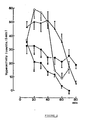
- the compound of Comparison Example 1 failed to modify the amphetamine hyperactivity, but this was completely antagonised by the compound of Example 14 (S isomer) (Fig. 2).
- schizophrenia and/or psychosis can be treated by means of this invention by administering internally to warm blooded animals including human beings certain S (-)-N-(1-azabicyclo[2.2.2]oct-3-yl)benzamides and thiobenzamides of Formula I, preferably Formula Ic, or a non-toxic organic or inorganic acid addition salt thereof in a wide variety of pharmaceutical forms well known in the art, preferably with a non-toxic pharmaceutical carrier such as is described below in an antischizophrenic and/or antipsychotic amount.
- the active agent is administered orally, subcutaneously, intravenously or intramuscularly or parenterally and, if necessary, in repeated doses until satisfactory response is obtained.
- the daily dosage is from 0.2 ⁇ g to 10 mg of active medication, advantageously from 1 ⁇ g to 1.0 mg.
- compositions may contain 0.2 ⁇ g to 10 mg active medicament per unit dose.
- the compositions may contain from 1 ⁇ g to 10 mg of medicament, advantageously from 1 ⁇ g to 1.0 mg per unit dose.
- the compounds may thus be presented in a therapeutic composition suitable for oral, parenteral, subcutaneous, intramuscular, intraperitoneal or intravenous administration.
- oral administration can take the form of elixirs, capsules, tablets or coated tablets containing carriers conveniently used in the pharmaceutical art.
- Exemplary of solid carriers including tableting and capsulating excipients are lactose, sucrose, potato and maize starches, talc, gelatin, agar, pectin or acacia, stearic and silicic acids, magnesium stearate, terra alba and polyvinyl pyrrolidone.
- the carrier or excipient can be comprised of a sterile parenterally acceptable liquid; e.g., water or arachis oil contained in ampoules.
- compositions may be formulated to contain from about 0.2 ⁇ g/ml to 10.0 mg/ml, preferably 10 ⁇ g/ml or less. It is only necessary that the active ingredient of Formula I constitute an effective amount. In all of the above, it is only necessary that a suitable effective dosage will be consistent with the dosage form employed. The exact individual dosages, as well as daily dosages, will of course be determined according to standard medical principles under the direction of a physician or veterinarian.
Landscapes
- Health & Medical Sciences (AREA)
- Animal Behavior & Ethology (AREA)
- Public Health (AREA)
- Veterinary Medicine (AREA)
- General Health & Medical Sciences (AREA)
- Life Sciences & Earth Sciences (AREA)
- Medicinal Chemistry (AREA)
- Chemical & Material Sciences (AREA)
- Pharmacology & Pharmacy (AREA)
- Epidemiology (AREA)
- Engineering & Computer Science (AREA)
- Bioinformatics & Cheminformatics (AREA)
- Organic Chemistry (AREA)
- Neurosurgery (AREA)
- General Chemical & Material Sciences (AREA)
- Psychiatry (AREA)
- Neurology (AREA)
- Nuclear Medicine, Radiotherapy & Molecular Imaging (AREA)
- Biomedical Technology (AREA)
- Chemical Kinetics & Catalysis (AREA)
- Pharmaceuticals Containing Other Organic And Inorganic Compounds (AREA)
- Nitrogen Condensed Heterocyclic Rings (AREA)
- Acyclic And Carbocyclic Compounds In Medicinal Compositions (AREA)
Abstract
Description
- The present invention relates to the use of certain optical isomers of N-(3-quinuclidinyl)benzamides and thiobenzamides, namely S-N-(3-quinuclidinyl)-benzamides and thiobenzamides, otherwise known as S-N-(1-azabicyclo[2.2.2]oct-3-yl)-benzamides and thiobenzamides, which have been observed to exhibit antischizophrenic and/or antipsychotic properties in warm blooded animals.
- Quinuclidine analogues of sulpiride were prepared and studied by Mikhlina, E. E. et al as reported in Khim-Farmatsevt. Zh. 10, No. 11, 56-60 (1976); C.A. 85: 155489r exemplified by the compound: 5-aminosulphonyl-N-(1-azabicyclo[2.2.2]oct-3-yl)-2-methoxybenzamide. This compound and others in the series were reported by the authors not to have antiemetic activity. The above named compound was reported in USSR Patent SU-A-414261 to have neuroleptic activity.
- Syntheses of 4-amino-N-(1-azabicyclo[2.2.2]oct-3-yl ) benzamide and N-(1-azabicyclo[2.2.2]oct-3-yl)benzamide were reported by Mikhlina, E. E. et al in Khim-Farmatsevt. Zh. 7, 20-24 (1974); C.A. 79, 146458a and the latter in Khim.Geterosikl. Soedin., Akad. Nauk. Latv. SSR 243-9 (1966); C.A. 65: 2220b. These compounds were reported to exhibit hypotensive, narcotic and ganglionic stimulation and blocking activities.
- Synthesis of 4-amino-N-(1-azabicyclo[2.2.2]oct-3-yl)-3-chloro-5-trifluoromethylbenzamide was reported in DE-A-2548968; C.A. 87, 68001c and in equivalently related US-A-4093734 from 4-amino-3-chloro-5-trifluoromethyl benzoic acid chloride and 3-aminoquinuclidine. The compound is in a class among pyrrolidinyl and piperidinyl benzamides which are said to be useful as anxiolytics, anticonvulsives, antiemetics and antiulcerogenics.
- It is widely recognized that substituted benzamides are a class of drugs known to be effective in psychiatry and gastroenterology (Sulpiride and other Benzamides; International Workshop on Sulpiride and other benzamides, Florence, Feb. 17-18 (1978), Raven Press]. However, the S-N-(1-azabicyclo[2.2.2]oct-3-yl)-benzamides used in this invention have now been found to have marked antischizophrenic properties.
- EP-A-0099789 and FR-A-2529548 disclose racemic mixtures of N-(1-azabicyclo[2.2.2]oct-3-yl) benzamides and their use as gastrointestinal motility accelerators.
- US-A-4593034 and EP-A-0158532 disclose the treatment of emesis caused by the administration of platinum anticancer drugs (such as cisplatin) by the use of racemic mixtures of 2-alkoxy-N-(1-azabicyclo[2.2.2]oct-3-yl) benzamides or thiobenzamides.
- EP-A-0201165 describes a large class of compounds, covering certain racemic mixtures of N-(1-azabicyclo[2.2.2]oct-3-yl) benzamides and reports that they are useful in the treatment of emesis, anxiety and/or irritable bowel syndrome (IBS).
- EP-A-0190920 discloses the enhancement of memory or the treatment of memory deficiency by the administration of certain racemic mixtures of arylamido- and arylthioamido-azabicycloalkanes including racemic mixtures of N-(1-azabicyclo[2.2.2]oct-3-yl) benzamides.
- GB-A-2193633 discloses a large class of compounds, including N-(1-azabicyclo[2.2.2]oct-3-yl) benzamides for the treatment of stress-related psychiatric disorders, for increasing vigilance, for the treatment of rhinitis or serotonin-induced disorders, for increasing the bioavailability of other active agents and for nasal administration.
- FR-A0-8701355 (filed 4th February 1987) discloses that S-enantiomers of the compounds disclosed in EP-A-0099789 increase the motility of certain areas of the gastrointestinal tract and inhibit emesis, particularly that induced by cisplatin.
- EP-A-311 724.1 (filed 16th October 1987) discloses that R-enantiomers of N-(1-azabicyclo[2.2.2]oct-3-yl) benzamides have anxiolytic activity.
- WO-A-8 400 166 discloses a large class of compounds, including certain racemic mixtures of N-(1-azabicyclo[2.2.2]oct-3-yl) benzamides and reports that they show a serotonin-M antagonistic action.
- EP-A-0 272 052 discloses racemic mixtures of N-(1-azabicyclo [2.2.2]oct-3-yl) benzamides and their use as anxiolytics.
- It has now unexpectedly been discovered that the S-enantiomers of various N-(1-azabicyclo[2.2.2]oct-3-yl)benzamides exhibit antischizophrenic and/or antipsychotic activity in warm blooded animals.
- According to the present invention, there is provided the use of a compound of general formula I

wherein:
X represents oxygen or sulphur;
each of R¹ and R³ independently represents hydrogen or a C₁-C₄ alkyl group;
Ar represents:
a phenyl ring optionally substituted by one, two or three C₁-C₄ alkoxy groups and/or by one or two halogen atoms;
a phenyl ring of the general formula
wherein R² represents halogen, 4,5-benzo, C₁-C₈ alkoxy, C₁-C₄ alkylcarbonyl or Am, wherein Am represents amino, methylamino or dimethylamino,
R⁴ represents C₁-C₈ alkyl,
n is 1 or 2; or
a pyrimidinyl moiety of the general formula
wherein R⁵ is C₁-C₄ alkyl;
or an N-oxide and/or pharmaceutically acceptable salt thereof, with the proviso that the compound wherin R¹-R³ are both H, X is O and Ar is 5-chloro-2-methoxy-4-methylamino-phenyl can not be used.
in the preparation of an antischizophrenic and/or antipsychotic agent. - The compound will generally be substantially free of the R-enantiomer.
- Preferred compounds useful in the invention include those having one or more of the following features:
- each of R¹ and R³ independently represents hydrogen, methyl or ethyl
- Ar represents 4-Am-5-chloro-2-methoxyphenyl.
- A particularly preferred compound useful in the invention is S-(+)-4-amino-N-(1-azabicyclo[2.2.2]oct-3-yl)-5-chloro-2-methoxybenzamide whether as the free base or a salt (for example fumarate or hydrochloride).
- In the further definition of symbols in the formulae hereof and where they appear elsewhere throughout this specification and the claims, terms have the following significance.
- The term "C₁-C₈alkyl" as used herein includes straight and branched chain radicals of up to eight carbons inclusive and is exemplified by such groups as methyl, ethyl, propyl, isopropyl, butyl, amyl, hexyl, heptyl, and octyl radicals. The term "C₁-C₈alkoxyl" has the formula -O-C₁-C₈alkyl. The terms "C₁-C₄alkyl" and "C₁-C₄alkoxyl" are to be construed as containing up to four carbon atoms accordingly.
- The terms "halo" or "halogen" when referred to herein include fluorine, chlorine, bromine and iodine unless otherwise stated. Chlorine and bromine are preferred. "Pharmaceutically acceptable salts" include the acid addition salts, hydrates, alcoholates and salts of the compounds, which salts are physiologically compatible in warm blooded animals. The acid addition salts may be formed by either strong or weak acids. Representative of strong acids are hydrochloric, sulphuric and phosphoric acids. Representative of weak acids are fumaric, maleic, succinic, oxalic, citric, tartaric, and cyclohexamic.
- Protected amino groups used in synthesis are acetylamino or benzoylamino radicals on the benzamide moiety mentioned hereinbelow in synthetic methods.
- The optically active compounds (which term includes salts where the context so admits) useful in the invention may broadly speaking be prepared either by separation from racemates or other mixtures with the corresponding R-enantiomer or by asymmetric synthesis, as in EP-A0-87402321.1.
- A process for the preparation of a compound of general formula I therefore comprises either
- (1) separating a compound of general formula I from a mixture with its corresponding R-enantiomer; or
- (2.1.1) coupling a 3-aminoquinuclidine of absolute configuration S of general formula (II)


- (2.1.2) reacting an S-3-aminoquinuclidine of general formula (II) with an acid derivative of general formula (IIIa)

- (2.1.3) optionally after step 2.1.1 or 2.1.2 converting a compound of general formula (I) so formed in which X represents an oxygen atom into a compound of general formula (I) in which X represents a sulphur atom; or
- (2.2) when X represents a sulphur atom reacting an S-3-aminoquinuclidine of general formula (II) with an aldehyde ArCHO wherein Ar is as defined for general formula (I) and sulphur; or
- (2.3) for an amino-substituted compound of general formula (I) reducing a corresponding nitro-substituted compound, and
- (2.4) optionally after any of steps 1, 2.1.1, 2.1.2, 2.1.3, 2.2 and 2.3 converting a compound of general formula (I) so formed into another compound of general formula (I) or an N-oxide and/or salt thereof.
- N-oxides can be prepared by treatment with a peracid such as m-chloroperbenzoic acid or hydrogen peroxide in an organic solvent such as methylene chloride at room temperature. Salts can be prepared as described above.
- Process (1) may be achieved for example by recrystallisation of a salt formed with an optically active acid (for example an enantiomer of tartaric acid). By way of illustration, the following protocol may be followed for the resolution of N-(3-quinuclidinyl)-3-chlorobenzamide (N-(1-azabicyclo[2.2.2]oct-3-yl)-3-chlorobenzamide).
- To the racemate in base form is added a solution of dextrorotatory L tartaric acid in methanol. The mixture obtained is brought to reflux, filtered when hot and left to cool. The precipitate is filtered and redissolved in boiling methanol. After cooling and filtration, the precipitate is dissolved in boiling methanol again. After cooling and filtration, the compound obtained is dissolved in water; the resulting aqueous solution is basified by means of sodium carbonate, extracted with chloroform, dried on sodium sulphate and filtered. The filtrate is evaporated. The product obtained is dissolved in acetone and hydrochloric ethanol (about 6N) is added; the precipitate obtained is filtered and recrystallized in ethanol. Thus, the dextrorotatory isomer is obtained.
- The mother liquor of the first three recrystallizations in methanol and combined and evaporated. The residue is taken in water, and the resulting mixture is basified by means of sodium carbonate and then extracted with chloroform. The extract is dried on sodium or magnesium sulphate and filtered. The filtrate is evaporated. To the product is added a solution of laevorotatory D-tartaric acid in methanol. The mixture is brought to reflux, filtered when hot and the filtrate is cooled. The precipitate obtained is then filtered. This precipitate is dissolved in boiling methanol and the solution is filtered when hot. After the filtrate has cooled, the precipitate obtained is filtered. A precipitate is obtained which is dissolved in water. The solution is basified by means of sodium carbonate, extracted with chloroform and the extract is dried on sodium or magnesium sulphate. It is then filtered and the filtrate is then evaporated leaving a residue which is dissolved in acetone and hydrochloric ethanol (about 6N). The precipitate obtained is filtered and recrystallized in ethanol. In this way, the laevorotatory isomer is obtained.
- Racemates of compounds of Formula I and the corresponding R- or S-isomers are preparable by reacting a suitably activated benzoic acid derivative with 3-aminoquinuclidine to form the corresponding benzamide under a variety of conditions. Two general methods, A and B, are illustrated in the following equations:
-

(a) Suitable solvents are organic solvents or a mixture of organic solvents and water; examples of organic solvents include chloroform and diethyl ether. - Method A is illustrated by Examples 5, 6, 7 and 9.
-

- (a) e.g., tetrahydrofuran
- (b) e.g., dicyclohexylcarbodiimide or 1,1'-carbonyldiimidazole
- Method B is illustrated in Examples 1, 3 and 8 and 14.
- Compounds wherein R₂ is primary amino may also be prepared from a compound prepared by Methods A or B, wherein R₂ is nitro by catalytic reduction of the nitro compound.
- Alternatively, compounds wherein R₂ is amino may be prepared by procedures of Method A utilizing a starting benzoyl halide wherein the amino group has been protected, or they may be prepared from compounds prepared in Method A or B wherein R₂ is nitro and reducing the nitro radical to an amino radical.
- Preferably, the compounds wherein R₂ is amino or methylamino are prepared by Method B.
- The free base of any compound of Formula I from its acid addition salt may be regenerated by usual procedures of partitioning between dilute aqueous base and a suitable solvent, separating the solvent layer, drying and evaporating.
- The preparation of the thiobenzamido compounds of Formula I' may be accomplished by mixing and reacting a benzamido compound of Formula I with a mixture of phosphorus pentasulphide (P₂S₅) and potassium sulphide (K₂S) or by mixing and reacting 3-aminoquinuclidine with an appropriately substituted benzaldehyde and sulphur. The reaction sequences are illustrated by the following:

- In these methods, compounds wherein R₂ is nitro may be reduced to compounds wherein R₂ is amino.
- A preferred group of compounds encompassed by Formula I have the formula:
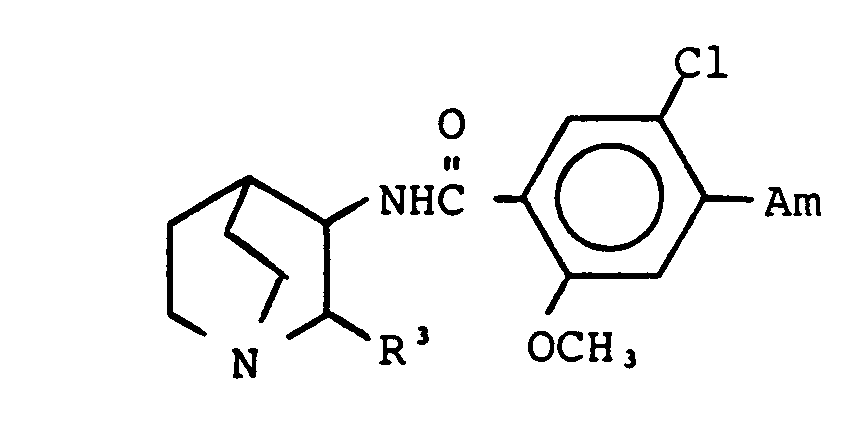
wherein Am is amino (i.e., -NH₂) or methylamino. As will be recognized from the above description, these compounds (Ic) are preferably prepared by Method B. - In process step 2.1.1 the coupling may be effected by means of a carbodiimide such as dicyclohexylcarbodiimide or 1,1'-carbonyldiimidazole.
- In process step 2.1.2 the leaving group L may be a halogen atom (such as chlorine) in which case the compound of general formula (IIIa) will be an acid halide.
- In process step 2.1.3 the conversion of a compound of general formula (I) where X is an oxygen atom to a compound of general formula (I) where X is a sulphur atom may be effected by mixing and reacting with a mixture of phosphorus pentasulphide and potassium sulphide.
- An S-3-aminoquinuclidine of general formula (II) may be prepared by a number of different ways as follows. Although the following description is given primarily with reference to the case when R³ is hydrogen (that is, when the 3-aminoquinuclidine moiety is otherwise unsubstituted), it is to be understood that it is equally applicable to cases where R³ is an alkyl radical. Compounds of general formula (II) can be prepared by the reduction of the oxime of the corresponding 3-quinuclidinone by treatment with hydrogen and Raney nickel. The oximes in turn are preparable by treatment of the corresponding 3-quinuclidinones with hydroxylamine hydrochloride in the presence of base. The 2-alkyl-3-quinuclidinones can be prepared by reduction with palladium-on-carbon; their production is described in J. Het. Chem. 3 109 (1966).
- First, a compound of general formula (II) may be obtained by hydrolysing an optionally substituted benzamide such as an S-N-(3-quinuclidinyl)-3-chlorobenzamide of general formula (IV):

- Hydrolysis may be achieved by dilute acid, such as dilute hydrochloric acid, in which case the dihydrochloride salt of compound (II) will result.
- S-N-(3-quinuclidinyl)-3-chlorobenzamides of general formula (IV) may be separated from a racemic mixture by crystallization of the diastereoisomeric salts obtained by the action of L-tartaric acid. Treatment of the appropriately separated salt with base yields the free S-N-(3-quinuclidinyl)-3-chlorobenzamide.
- A racemic mixture of R- and S-N-(3-quinuclidinyl)-3-chlorobenzamides may be obtained by condensing a racemic 3-aminoquinuclidine with a reactive derivative of 3-chlorobenzoic acid or with 3-chlorobenzoic acid itself and a coupling agent such as a carbodiimide. Racemic 3-aminoquinuclidines may be obtained by the action of hydroxylamine or hydrochloride followed by base (such as sodium ethoxide) on 3-quinuclidinones and reduction of the corresponding oxime with hydrogen and Raney nickel, as an example. If necessary 3-quinuclidinones may be prepared by oxidising 3-quinuclidinols, whose preparation is described in J. Am. Chem. Soc 74, 2215 (1952).
- Secondly, a compound of general formula (II) may be produced by debenzylating R-N-(alpha-methylbenzyl)-S-3-aminoquinuclidine by hydrogenolysis in an acid medium in the presence of a catalyst such as palladium on carbon.

- R-N-(alpha-methylbenzyl)-S-3-aminoquinuclidine may be obtained by the reduction of R-N-(alpha-methylbenzyl)-3-quinuclidinimine by hydrogenolysis in the presence of a catalyst such as platinum oxide or by a borohydride such as potassium borohydride.

- In turn, the R-N-(alpha-methylbenzyl)-3-quinuclidinimine may be obtained by treating 3-quinuclidinone with R-alpha-methylbenzylamine.

- A compound of general formula I may therefore be used in pharmaceutical and/or veterinary medicine, in the treatment or prophylaxis of schizophrenia and/or psychoses.
- Compounds of general formula I will frequently be used in a pharmaceutical and/or veterinary composition comprising (a) a compound of general formula I and (b) a suitable carrier therefor.
- The antischizophrenic activity was determined by the method of Costall et al details of which are to be found in the pharmacology examples later in this specification. In brief, the method involves seeing whether the compound under test antagonises the response of the rat to intracerebrally injected amphetamine.
- A still further object is to provide means for treating schizophrenia and/or psychosis.
- The invention will now be illustrated by the following examples.
- In a closed system equipped with an oil bubbler, 30ml of tetrahydrofuran was added to a mixture of 4-amino-5-chloro-2-methoxybenzoic acid, 2.02g, (0.010 mole) and 1,1'-carbonyldiimidazole, 1.62g (0.010 mole) with stirring. When evolution of carbon dioxide ceased, nitrogen was bubbled through the reaction mixture for 1 hr. A solution of 3-aminoquinuclidine, 1.26g, (0.010 mole) in 10ml tetrahydrofuran was added dropwise to the stirred reaction mixture and stirring at room temperature continued for 3 hrs. TLC analysis (3% conc. ammonium hydroxide solution in methanol) showed some product formation. The mixture was heated at reflux temperature for 18 hours and then concentrated to an oil. TLC analysis showed the prsence of the product, imidazole, and 3-aminoquinuclidine. The oil was dissolved in methylene chloride (75ml) and washed twice with 50ml protions of aqueous sodium bicarbonate solution. The methylene chloride layer was dried over anhydrous magnesium sulphate and concentrated to yield 2.0g (67%) of a glassy amorphous solid, the free base of the title compound.
- In another reaction on a 0.020 mole scale, 5.18g (83.8%) of the product as the free base was obtained.
- The products were combined, dissolved in methanol (20ml) and the solution and treated with a solution of fumaric acid (2.73g) in methanol (50ml). Absolute ether was added to precipitate the salt which was collected by filtration and recrystallized from methanol-water (200:20) with isopropyl ether added to the point of incipient cloudiness. The recrystallized salt (5.38g) melted at 223-225°C.
Analysis: Calculated for C₁₉H₂₄N₃O₆Cl: C,53.59; H,5.68; N,9.89 Found : C,53.35; H,5.72; N,9.95
From the racemate, the R(+) isomer and the S(-) isomer are separated. - To an isopropyl alcohol solution of the free base of the title compound such as was obtained by the procedure of Example 1 is added an equal molar amount of 37% (conc.) hydrochloric acid. The crude salt is separated by filtration and recrystallized from acetone-water to give the title compound, m.p. 158-160°C. From the racemate, the S(-) isomer is separated.
- To a mixture of 1,1'-carbonyldiimidazole, 1.23g (0.00756 mole) and 5-chloro-2-methoxy-4-methylaminobenzoic acid, 1.63g (0.00756 mole) was added 50ml of tetrahydrofuran. Nitrogen was bubbled into the solution for 30 minutes to remove any carbon dioxide that was present. To the solution was added 3-aminoquinuclidine, 0.95g, (0.00756 mole) in one portion, and the reaction mixture was stirred at ambient temperature for 16 hours. The reaction mixture was concentrated to an oil which was shown to be 1:1 mixture of the free base of the product and imidazole. The mixture was dissolved in 20ml methanol and treated with a solution containing 0.47g fumaric acid in 20ml of hot methanol. Upon cooling, 1.52g of white solid formed. Recrystallization from water-methanol gave 0.84g of the product as a white solid; m.p. 237-238°C.
Analysis: Calculated for C₂₀H₂₆N₃O₆Cl: C,54.61; H,5.96; N,9.55 Found : C,54.61; H,5.98; N,9.51
From the racemate, the S isomer is separated. - To an isopropyl alcohol solution of the free base of the title compound, such as was obtained by the procedure of Example 3, is added an equal molar amount of 37% (conc.) hydrochloric acid. The crude salt is separated by filtration and recrystallized from ethanol-water to give the title compound, m.p. 255-258°C. From the racemate, the S isomer is separated.
- In a closed system equipped with an oil bubbler, a solution of 2-methoxybenzoyl chloride, 2.76g (0.0016 mole) in 50ml absolute ether was added dropwise over 10 min to a stirred solution of 3-aminoquinuclidine, 1.81g (0.0144 mole) in 100ml absolute ether. After the addition was completed, the mixture was stirred at room temperature for an additional 2 hrs. The solid hydrochloride salt was collected by filtration under nitrogen. The salt (3.83g) was dissolved in sodium bicarbonate solution and extracted twice with 25ml portions of methylene chloride. The extract was dried over magnesium sulphate and concentrated to yield 1.25g clear oil (33.3%). TLC analysis (3% conc. ammonium hydroxide in methanol) showed the free base to be pure. A solution of 1.17g of the free base in 5ml methanol was treated with a solution of 0.52g fumaric acid in 10ml methanol. Isopropyl ether was added to give approximately 100ml of solution from which the fumarate salt precipitated. The salt was collected under nitrogen and dried in a vacuum oven at 60°C overnight. NMR and elemental analyses showed that the product was a hemihydrate.
Analysis: Calculated for C₁₉H₂₅N₂O6.5: C,59.21; H,6.54; N,7.27 Found : C,59.18; H,6.30 N,7.25
From the racemate, the S isomer is separated. - A mixture of 3-aminoquinuclidine dihydrochloride, 6.95g, (0.0349), 2,4-dimethoxybenzoyl chloride, 700g, (0.0349 mole), anhydrous sodium carbonate, 36.99g, (0.349 mile), 175ml water, and 175ml chloroform was stirred rapidly to achieve good mixing of the 2 layers for 20 hrs. The chloroform layer was then separated, washed with water, dried over anhydrous magnesium sulphate, and concentrated to an impure oil. The oil was triturated twice with 20ml portions of petroleum ether to remove some impurities. The oil was then dissolved in ether and filtered to remove a small amount of insoluble material. The filtrate was treated with ethereal hydrogen chloride and the resulting salt collected to yield 2.70g (23.7% yield) white solid. The salt was recrystallized from ethanol-isopropyl ether. Further recrystallization from methanol-ethyl ether yielded a white solid, m.p. 211-212°C. The NMR analysis was satisfactory.
Analysis: Calculated for C₁₆H₂₃N₂O₃Cl: C,58.80; H,7.09; N,8.57 Found : C,58.38; H,7.13; N,8.44
From the racemate, the S isomer is separated. - In a closed system equipped with an oil bubbler, a solution of 2,4-dimethoxybenzoyl chloride, 13.08g, (0.0652 mole) in 200ml absolute ether was added dropwise over 30 minutes to a stirred solution of 3-aminoquinuclidine, 7.80g, (0.0619 mole) in 200ml absolute ether. The mixture was stirred overnight, and the solid hydrochloride salt of the product was filtered under nitrogen. The material was dried in a vacuum oven at 40°C to give 18.70g (92%). A 2.94g (0.009 mole) portion of the hydrochloride salt in 20ml methanol was treated with a solution of sodium methoxide prepared from 0.23g (0.010 mole) sodium metal and 10ml methanol. After standing a few minutes, the mixture was filtered and the filtrate concentrated on a rotary evaporator, and the residue was triturated with 75ml methylene chloride. After filtering to remove some insoluble solids, the filtrate was concentrated to yield 2.53g of the free base of the title compound (97% recovery from the hydrochloride salt). The free base was dissolved in 100ml acetone and concentrated sulphuric acid (0.483ml) added dropwise with stirring. The solid that formed was collected under nitrogen to give 2.76g of the salt which recrystallized from methanol-isopropyl ether and dried in a vacuum oven at 60°C for 2 hrs and then overnight at 78°C; m.p. 223-225°C.
Analysis: Calculated for C₁₆H₂₄N₂O₇S: C,49.47; H,6.23; N,7.23 Found : C,49.41; H,6.30; N,7.25
From the racemate, the S isomer is separated. - In a closed system equipped with an oil bubbler, tetrahydrofuran, 100ml, was added to a mixture of 2,4-dimethoxybenzoic acid, 3.64g (0.020 mole) and 1,1'-carbonyldiimidazole, 3.24g (0.020 mole). No evolution of carbon dioxide was observed and after stirring for 3 hrs, TLC (ethyl acetate) and mass spectral analysis showed that the starting material had reacted to form N-(2,4-dimethoxybenzoyl)imidazole and imidazole. A solution of 3-aminoquinuclidine, 2.52g (0.020 mole) in 10ml tetrahydrofuran was added to the mixture, and the solution was heated to reflux temperature for 1 hr and then allowed to stand overnight at room temperature. A solution of fumaric acid, 2.32g (0.020 mole) in 50ml methanol was added to the reaction mixture. Tetrahydrofuran was added until the solution became slightly turbid. The solution was chilled in a refrigerator. The solid which precipitated from solution was collected by filtration and found to be a fumarate salt of 3-aminoquinuclidine. The filtrate was concentrated to an oil and triturated with tetrahydrofuran. The solid precipitate which formed on standing was filtered and shown by TLC (3% concentrated ammonium hydroxide in methanol) to be the desired product plus traces of imidazole and 3-aminoquinuclidine. Recrystallization from methanol-isopropyl ether gave 5.41g white crystalline solid (67% yield calculated as the monofumarate). NMR and elemental analysis showed the salt to contain less than one equivalent of fumaric acid. The salt was dissolved in boiling methanol (50ml) and treated with an additional 0.77g (0.0066 mole) fumaric acid in 10ml hot methanol. Isopropyl ether was added until the hot solution became turbid. The solid obtained on cooling was collected, recrystallized from methanol-isopropyl ether and dried in a vacuum oven at 78°C overnight. NMR and elemental analysis showed the salt to be a 1.5 fumarate, m.p. 192-192.5°C.
Analysis: Calculated for C₂₂H₂₈N₂O₉: C,56.89; H,6.08; N,6.03 Found : C,56.81; H,6.13; N,6.04
From the racemate, the S isomer is separated. - To a solution of 3.82g (0.0192 mole) of 3-aminoquinuclidine dihydrochloride in about 25ml of carbon dioxide-free water was added 8g (0.025 mole) of barium hydroxide octahydrate. The mixture was warmed for 5 minutes and then dried to a powder on a rotary evaporator. While protecting from contamination with carbon dioxide in the atmosphere, the powder was extracted in sequence with hot benzene and a 1:1 mixture of benzene-methylene chloride solution. The combined extracts were dried over magnesium sulphate and the mixture filtered. To the filtrate with agitation was added dropwise a solution of 3.4g (0.0171 mole) of 2-propoxybenzoyl chloride in 50ml of methylene chloride. The mixture was warmed on a steam bath to evaporate about 75% of the methylene chloride. Ligroin (60-110) was added and the mixture solidified. The solid was recrystallized from anhydrous ethyl alcohol to give 3.9g (62.0%), m.p. 210-211°C.
Analysis: Calculated for C₁₇H₂₅N₂O₂Cl: C,62.86; H,7.75; N,8.62 Found : C,62.62; H,7.59; N,8.54
From the racemate, the S isomer is separated. - A solution of 1.69g (0.00768 mole) of 3-methoxy-2-naphthoic acid chloride in 15ml of methylene chloride was added dropwise to a stirred solution of 0.97g (0.00768 mole) of 3-aminoquinuclidine in 25ml of methylene chloride in a closed system equipped with an oil bubbler. The reaction mixture was stirred overnight at ambient temperature, and then concentrated to give an off-white glassy solid. Two recrystallizations from methanol-isopropyl ether gave 1.95g (73.4%) of the product as an off-white solid which was vacuum dried at ambient temperature, m.p. 248-252°C.
analysis: Calculated for C₁₉H₂₃N₂O₂Cl: C,65.79; H,6.68; N,8.08 Found : C,65.40; H,6.72; N,8.01
From the racemate, the S isomer is separated. - One half mole of 4-amino-N-(1-azabicyclo[2.2.2]oct-3-yl)-5-chloro-2-methoxybenzamide fumarate is partitioned between dilute sodium hydroxide and 400ml of benzene. The benzene solution is dried with sodium sulphate and distilled to a volume of 250ml. To this is added a finely-ground mixture of 9g of phosphorous pentasulphide and 9g of potassium sulphide. The mixture is refluxed for 4 hr and an additional 9g of phosphorous pentasulphide is added and reflux continued for 2 hr. The benzene is decanted off. The solid is dissolved in a suitable solvent and reacted with fumaric acid to give the title compound. From the racemate the 3-S isomers are separated.
- Following the general procedure of Example 1, but instead of the 3-aminoquinuclidine, using 0.010 moles of 3-amino-2-methylquinuclidine, the title compound was prepared. From the racemate, the 3-S isomers were separated.
- To an isopropyl alcohol solution of the free base of the title compound such as was obtained by the procedure of Example 1 is added an equal molar amount of 37% (conc.) hydrochloric acid. The crude salt is separated by filtration and recrystallised from acetone-water to give the title compound. From the racemate, the 3-S isomers were separated.
- N-(3-quinuclidinyl)-3-chlorobenzamide (52.5 g) in solution in methanol is added to a solution of D-tartaric acid (29.7 g) in methanol. The precipitate obtained is recovered by filtration and treated twice with methanol at reflux. The salt thus purified is decomposed by an aqueous caustic soda solution and the product extracted with chloroform. After drying and evaporation of the organic phase the base obtained is treated in acetone with an ethanolic hydrochloric acid solution. The hydrochloride which precipitates is recovered by filtration and recrystallised from ethanol. 9.4 g of optically pure S(-)-N-(3-quinuclidinyl)-3-chlorobenzamide, hydrochloride (S(-)-N-(1-azabicyclo[2.2.2]oct-3-yl)-5-chloro-2-methoxybenzamide, hydrochloride) are obtained.
Melting point: 244° - 247°C.
[alpha]
- The hydrochloride obtained in the preceding step (9 g) is treated with concentrated hydrochloric acid at reflux for 3
hours 30 minutes. The reaction mixture is treated with absolute alcohol and the S(-)-3-aminoquinuclidine, dihydrochloride (S(-)-1-azabicyclo[2.2.2]oct-3-ylamine, dihydrochloride) which crystallises is recovered by filtration.
Melting point: >260°C
[alpha]
- 3-Quinuclidinone (80 g) in 800 ml toluene was refluxed in the presence of R-alpha-methylbenzylamine (77.4 g) for 24 hours, the water formed being eliminated by means of a Dean-Stark trap. The reaction mixture is then concentrated to dryness and the resulting imine (130 g) is distilled.
Yield: 89%
Boiling point: 140° - 150°C (0.05 mm Hg)
[alpha]
- The imine (129.5 g) obtained in the preceding step is dissolved in methanol and potassium borohydride (30.6 g) is added in small portions at between 10° and 20°C. After one hour the mixture is evaporated to dryness under reduced pressure. The residue is dissolved in a mixture of acetone and isopropyl alcohol (2:1). The expected amine is precipitated in the form of the dihydrochloride by the addition of an ethanolic hydrogen chloride solution. The product is recrystallised twice in an ethanol/methanol mixture (1:1) to yield optically pure R-N-(alpha-methylbenzyl)-S-3-aminoquinuclidine, dihydrochloride (81 g).
Yield: 47%
Melting point >260°C
[alpha]
- The product obtained in the preceding step (64.4 g) is dissolved in ethanol with 2 equivalents of a solution of hydrochloric acid (1 N) and palladium on carbon, 50% H₂O (12.8 g). The reaction mixture is stirred for 18 hours under a hydrogen atmosphere, filtered then evaporated to dryness under reduced pressure. S(-)-3-aminoquinuclidine, dihydrochloride is crystallised in an ethanol:ether (1:1) mixture.
[alpha]
- Following the procedure of Preparation 1, but using instead L-tartaric acid, the corresponding R enantiomer was obtained.
Melting point: >260°C
[alpha]
- Following the procedure of Preparation 2, but using instead S-N-alpha-methylbenzylamine, the corresponding R enantiomer was obtained.
Melting point: >260°C
[alpha]
- S(-)-3-aminoquinuclidine dihydrochloride (40 g: 0.2 mole) is dissolved in an aqueous caustic soda solution (2.5 N). To this solution, cooled in an ice bath, is added 4-amino-5-chloro-2-methoxy benzoic acid (44.5 g) in solution in 300 ml of pyridine. Dicyclohexylcarbodiimide (85 g) is added in two portions. The mixture is vigorously stirred for 18 hours at ambient temperature. The medium is then diluted with 150 ml of water. Insoluble matter is removed by filtration and washed with water. The aqueous phase is brought to
pH 10 by a 10 N solution of caustic soda and extracted by chloroform. After drying (over Na₂SO₄) and evaporation of the organic phase, the residue is crystallised in isopropyl ether. - The solid thus obtained (56 g) is dissolved in 280 ml isopropyl alcohol and the solution acidified by 5 N HCl. The hydrochloride which precipitates is recovered by filtration and recrystallised in 99% ethanol. The target product is obtained with a yield of 60%.
Melting point: 232-234°C
[alpha]
- Following the procedure of Example 14 but using instead R(+)-3-aminoquinuclidine as prepared in Comparison Preparation 1 or 2, the corresponding R enantiomer is obtained.
Melting point: 233-235°C
[alpha]
- S(-)-3-aminoquinuclidine (1.9 g) is dissolved in 33.5 ml of an aqueous 1 N caustic soda solution. To this solution is added drop by drop 4-acetamido-5-chloro-2-methoxybenzoyl chloride (3.75 g) in solution in 70 ml dioxane. After 15 minutes stirring, the reaction medium is acidified, washed with chloroform, basified with a concentrated aqueous caustic soda solution and the product extracted with chloroform. The organic phase is dried (over sodium sulphate) and then evaporated. The oily residue is dissolved in ethanol and ethanol/HCl is added to an acid pH. The 4-acetamido-5-chloro-2-methoxy-N-(3-quinuclidinyl)-benzamide hydrochloride so formed precipitates (quantitative yield) and is recovered by filtration.
- The product is subsequently deacylated by refluxing for 30 minutes in a 5% solution of potassium hydroxide in ethanol. The reaction medium is then dissolved in water and extracted with chloroform. After drying and evaporation of the organic phase, the target hydrochloride is prepared and isolated as described in Example 14.
Melting point: 232-234°C
[alpha]
- Following the procedure of Example 15 but using instead R(+)-3-aminoquinuclidine as prepared in Comparison Preparation 1 or 2, the corresponding R enantiomer is obtained.
Melting point: 233-235°C
[alpha]
- Following the procedure of Example 14 but using benzoic acid in place of the 4-amino-5-chloro-2-methoxybenzoic acid, the title compound was prepared.
Melting point: 245°C
[alpha]
- Following the procedure of Example 15 but using benzoyl chloride in place of the 4-amino-5-chloro-2-methoxybenzoyl chloride, the title compound was prepared.
Melting point: 245°C
[alpha]
- Following the procedure of Example 14 but using 3-chlorobenzoic acid in place of the 4-amino-5-chloro-2-methoxybenzoic acid, the title compound was prepared.
Melting point: 244°C
[alpha]
- Following the procedure of Example 15 but using 3-chlorobenzoyl chloride in place of the 4-amino-5-chloro-2-methoxybenzoyl chloride, the title compound was prepared.
Melting point: 244°C
[alpha]
- Following the procedure of Example 14 but using 4-chlorobenzoic acid in place of the 4-amino-5-chloro-2-methoxybenzoic acid, the title compound was prepared.
Melting point: >260°C
[alpha]
- Following the procedure of Example 15 but using 4-chlorobenzoyl chloride in place of the 4-amino-5-chloro-2-methoxybenzoyl chloride, the title compound was prepared.
Melting point: >260°C
[alpha]
- Following the procedure of Example 14 but using 3,5-dichlorobenzoic acid in place of the 4-amino-5-chloro-2-methoxybenzoic acid, the title compound was prepared.
Melting point: >260°C
[alpha]
- Following the procedure of Example 15 but using 3,5-dichlorobenzoyl chloride in place of the 4-amino-5-chloro-2-methoxybenzoyl chloride, the title compound was prepared.
Melting point: >260°C
[alpha]
- The dopamine hypothesis of schizophrenia attributes some of the symptoms of this illness to a raised mesolimbic dopamine function. In order to mimic the discrete nature of this disturbance, stereotaxic surgery was used to aim dopamine or amphetamine at a discrete mesolimbic nucleus.
Male Sprague-Dawley (CD, Bradford strain) rats (250-300g) were subject to standard stereotaxic techniques for the implantation of chronically indwelling bilateral guide cannulae for subsequent injections at the centre of the nucleus accumbens (Ant. 9.4, Vert. 0.0, Lat. ±1.6, atlas of De Groot). Rats were used 14 days after surgery, and on one occasion only. - Ability of known antischizophrenic agents to antagonise hyperactivity caused by intra-accumbens amphetamine was established using fluphenazine and sulpiride. These agents, the compound of Comparison Example 1, the compound of Example 14 and a racemic mixture of the compounds of Comparison Example 1 and Example 14 were prepared in distilled water for bilateral injection into the nucleus accumbens (1 µl over 5s, with a further 55s for deposition, rats manually restrained) 30 min before (+)amphetamine was also administered bilaterally into the nucleus accumbens, in a dose of 10 µg. This dose of amphetamine was shown in preliminary experiments to give a marked but submaximal hyperactivity response with an onset apparent within 5 min of injection, maximum intensity obtained 20-40 min after injection, and with a duration of 85-100 min.
- Immediately after amphetamine injection, rats were placed in individual, screened perspex cages (25 x 15 x 15 cm high), each fitted with one photocell unit placed off centre, and hyperactivity measured as the numbers of interruptions of the photocell beams per 5 min. Rats were also visually observed to eliminate any non-specific effects (e.g. grooming, stereotypies) which may interfere with the measurement of locomotor activity. Experiments were carried out between 08.00am and 12.00am.
- The results are shown with reference to the drawings, in which:
- FIGURE 1 shows the abilities of bilateral intra-accumbens fluphenazine and (-) sulpiride, (solid circles, ng doses indicated) to antagonise the hyperactivity caused by intra-accumbens amphetamine (10 µg bilateral, open circles, amphetamine response, plus vehicle for 'neuroleptic'); the potential antagonists were given 30 min before amphetamine; n = 5-10; S.E.M.s <12.6%; significant reduction in the amphetamine response is indicated as *P<0.01 - P<0.001 (two-way ANOVA with Dunnett's test); and
- FIGURE 2 shows the abilities of bilateral intra-accumbens Example 14 compound (S isomer), solid squares, Comparison Example 1 compound (R isomer) solid triangles and racemate (solid circles), each given at a dose of 10 ng, to antagonise the hyperactivity caused by intra-accumbens amphetamine (10 µg bilateral, open circles, amphetamine response, plus vehicle for compounds under test; the compounds under test were given 30 min before amphetamine; n = 5. S.E.M.s given; significant reduction in the amphetamine response is indicated as *P<0.001 (two-way ANOVA with Dunnett's test).
- Intra-accumbens fluphenazine (0.5 - 10 ng) and (-) sulpiride (0.1 - 1.2 5 ng) were shown to dose-dependently antagonise the hyperactivity development to a subsequent intra-accumbens injection of 10 ug amphetamine (Fig. 1). At 10 ng the compound of Comparison Example 1 (R isomer) failed to modify the amphetamine hyperactivity, but this was completely antagonised by the compound of Example 14 (S isomer) (Fig. 2). The antagonistic action of the racemate, at the same dose of 10 ng, fell between that of its two isomers, although significant antagonism was clear (Fig. 2).
- In conclusion, in a test system which is sensitive to the antagonistic actions of known antipsychotic agents, at a fixed dose the R isomer (Comparison Example 1) is shown to be without effect whilst the S isomer (Example 14) caused maximum antagonism. The antagonistic action of the racemate, whilst significant, was less than that achieved by the same dose of its S isomer.
- Generally, schizophrenia and/or psychosis can be treated by means of this invention by administering internally to warm blooded animals including human beings certain S(-)-N-(1-azabicyclo[2.2.2]oct-3-yl)benzamides and thiobenzamides of Formula I, preferably Formula Ic, or a non-toxic organic or inorganic acid addition salt thereof in a wide variety of pharmaceutical forms well known in the art, preferably with a non-toxic pharmaceutical carrier such as is described below in an antischizophrenic and/or antipsychotic amount.
- The active agent is administered orally, subcutaneously, intravenously or intramuscularly or parenterally and, if necessary, in repeated doses until satisfactory response is obtained. The daily dosage is from 0.2 µg to 10 mg of active medication, advantageously from 1 µg to 1.0 mg.
- The compositions may contain 0.2 µg to 10 mg active medicament per unit dose. Preferably, the compositions contain from 1 µg to 10 mg of medicament, advantageously from 1 µg to 1.0 mg per unit dose. The compounds may thus be presented in a therapeutic composition suitable for oral, parenteral, subcutaneous, intramuscular, intraperitoneal or intravenous administration. Thus, for example oral administration can take the form of elixirs, capsules, tablets or coated tablets containing carriers conveniently used in the pharmaceutical art. Exemplary of solid carriers including tableting and capsulating excipients are lactose, sucrose, potato and maize starches, talc, gelatin, agar, pectin or acacia, stearic and silicic acids, magnesium stearate, terra alba and polyvinyl pyrrolidone.
- For parenteral administration, the carrier or excipient can be comprised of a sterile parenterally acceptable liquid; e.g., water or arachis oil contained in ampoules.
- The pharmaceutical compositions may be formulated to contain from about 0.2 µg/ml to 10.0 mg/ml, preferably 10 µg/ml or less. It is only necessary that the active ingredient of Formula I constitute an effective amount.
In all of the above, it is only necessary that a suitable effective dosage will be consistent with the dosage form employed. The exact individual dosages, as well as daily dosages, will of course be determined according to standard medical principles under the direction of a physician or veterinarian.
Claims (4)
- The use of a compound of general formula I

X represents oxygen or sulphur;
each of R¹ and R³ independently represents hydrogen or a C₁-C₄ alkyl group;
Ar represents:
a phenyl ring optionally substituted by one, two or three C₁-C₄ alkoxy groups and/or by one or two halogen atoms;
a phenyl ring of the general formula
R⁴ represents C₁-C₈ alkyl,
n is 1 or 2; or
a pyrimidinyl moiety of the general formula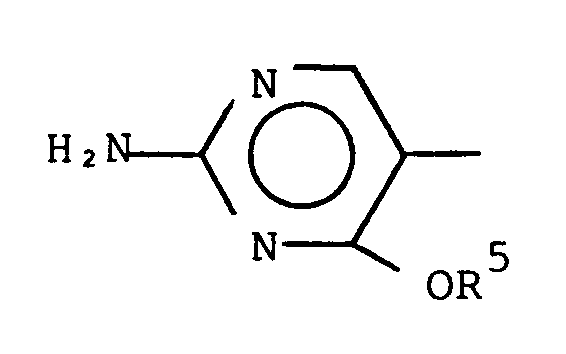
or an N-oxide and/or pharmaceutically acceptable salt thereof with the proviso that the compound wherein R¹ and R³ are both H, X is O and Ar is 5-chloro-2-methoxy-4-methylamino-phenyl can not be used.
in the preparation of an antischizophrenic and/or antipsychotic agent. - The use as claimed in claim 1, wherein each of R¹ and R³ independently represents hydrogen, methyl or ethyl.
- The use as claimed in claim 1 or 2, wherein Ar represents 4-Am-5-chloro-2-methoxyphenyl.
- The use as claimed in claim 1, of S(-)-4-amino-N-(1-azabicyclo[2.2.2]oct-3-yl)-5-chloro-2-methoxybenzamide or a salt thereof in the preparation of an antischizophrenic and/or antipsychotic agent.
Priority Applications (11)
| Application Number | Priority Date | Filing Date | Title |
|---|---|---|---|
| DE8888402042T DE3878235T2 (en) | 1988-08-04 | 1988-08-04 | ANTISCHIZOPHREN EFFECTIVE S-N- (1-AZABICYCLO (2.2.2.) OCT-3-YL) BENZAMIDES AND THIOBENZAMIDES. |
| AT88402042T ATE85217T1 (en) | 1988-08-04 | 1988-08-04 | ANTI-SCHIZOPHRENIC S-N-(1-AZABICYCLO (2.2.2.>OCT-3-YL)BENZAMIDES AND THIOBENZAMIDES. |
| EP88402042A EP0353372B1 (en) | 1988-08-04 | 1988-08-04 | Antischizophrenic-S-N-(1-azabicyclo[2.2.2.]oct-3-yl) benzamides and thiobenzamides |
| ZA895842A ZA895842B (en) | 1988-08-04 | 1989-07-31 | Antischizophrenic-s-n-(1-azabicyclo(2.2.2)oct-3-yl)benzamides and thiobenzamides |
| AU39178/89A AU615323B2 (en) | 1988-08-04 | 1989-08-01 | Antischizophrenic-s-n-(1-azabicyclo(2.2.2)oct-3-yl) benzamides and thiobenzamides |
| PH39032A PH25426A (en) | 1988-08-04 | 1989-08-01 | Antischizoprenic-s-n(1-azabicyclo£2.2.2|oct-3-yl)benzamides, thiobenzamides |
| KR1019890011092A KR900002777A (en) | 1988-08-04 | 1989-08-03 | Schizophrenia and psychosis treatment or prevention |
| US07/389,364 US5025022A (en) | 1988-08-04 | 1989-08-03 | Method of treating or preventing schizophrenia and/or psychosis using S-N-(1-azabicyclo[2.2.2]oct-3-yl)benzamides and thiobenzamides |
| DK382089A DK382089A (en) | 1988-08-04 | 1989-08-03 | benzamide |
| JP1202711A JPH02104529A (en) | 1988-08-04 | 1989-08-04 | Antipsychhotic and/or anti-schizophrenia drug containing s-n-(1-azabicyclo(2. 2. 2)oct-3-yl) benzamides and thiobenzamides as effective components |
| IL91217A IL91217A0 (en) | 1988-08-04 | 1989-08-04 | Pharmaceutical compositions for treating or preventing schizophrenia and/or psychosis containing quinuclidine derivatives |
Applications Claiming Priority (1)
| Application Number | Priority Date | Filing Date | Title |
|---|---|---|---|
| EP88402042A EP0353372B1 (en) | 1988-08-04 | 1988-08-04 | Antischizophrenic-S-N-(1-azabicyclo[2.2.2.]oct-3-yl) benzamides and thiobenzamides |
Publications (2)
| Publication Number | Publication Date |
|---|---|
| EP0353372A1 EP0353372A1 (en) | 1990-02-07 |
| EP0353372B1 true EP0353372B1 (en) | 1993-02-03 |
Family
ID=8200415
Family Applications (1)
| Application Number | Title | Priority Date | Filing Date |
|---|---|---|---|
| EP88402042A Expired - Lifetime EP0353372B1 (en) | 1988-08-04 | 1988-08-04 | Antischizophrenic-S-N-(1-azabicyclo[2.2.2.]oct-3-yl) benzamides and thiobenzamides |
Country Status (11)
| Country | Link |
|---|---|
| US (1) | US5025022A (en) |
| EP (1) | EP0353372B1 (en) |
| JP (1) | JPH02104529A (en) |
| KR (1) | KR900002777A (en) |
| AT (1) | ATE85217T1 (en) |
| AU (1) | AU615323B2 (en) |
| DE (1) | DE3878235T2 (en) |
| DK (1) | DK382089A (en) |
| IL (1) | IL91217A0 (en) |
| PH (1) | PH25426A (en) |
| ZA (1) | ZA895842B (en) |
Cited By (1)
| Publication number | Priority date | Publication date | Assignee | Title |
|---|---|---|---|---|
| US7683075B2 (en) | 2003-05-12 | 2010-03-23 | Novartis Ag | Isoquinoline-3-carboxylic acid amides and pharmaceutical uses thereof |
Families Citing this family (19)
| Publication number | Priority date | Publication date | Assignee | Title |
|---|---|---|---|---|
| EP0353371A1 (en) * | 1988-08-04 | 1990-02-07 | Synthelabo | Memory enhancing-R-N-(1-azabicyclo[2.2.2] oct-3-yl) benzamides and thiobenzamides |
| US5723103A (en) * | 1994-12-09 | 1998-03-03 | Vanderbilt University | Substituted benzamides and radioligand analogs and methods of use |
| US6492385B2 (en) | 2000-08-18 | 2002-12-10 | Pharmacia & Upjohn Company | Quinuclidine-substituted heteroaryl moieties for treatment of disease |
| EP1381603A2 (en) | 2000-08-18 | 2004-01-21 | PHARMACIA & UPJOHN COMPANY | Quinuclidine-substituedaryl moieties for treatment of disease ( nicotinic acetylcholine receptor ligands ) |
| US6486172B2 (en) | 2000-08-18 | 2002-11-26 | Pharmacia & Upjohn Company | Quinuclidine-substituted aryl compounds for treatment of disease |
| AU2001284646A1 (en) | 2000-08-21 | 2002-03-04 | Pharmacia And Upjohn Company | Quinuclidine-substituted heteroaryl moieties for treatment of disease |
| US6500840B2 (en) | 2000-08-21 | 2002-12-31 | Pharmacia & Upjohn Company | Quinuclidine-substituted heteroaryl moieties for treatment of disease |
| PE20021019A1 (en) | 2001-04-19 | 2002-11-13 | Upjohn Co | SUBSTITUTED AZABYCLE GROUPS |
| BR0212123A (en) * | 2001-08-24 | 2004-07-20 | Upjohn Co | 7-aza [2.2.1] aryl substituted bicycloheptanes for the treatment of disease |
| MXPA04004464A (en) * | 2001-11-08 | 2004-08-11 | Upjohn Co | Azabicyclic-substituted-heteroaryl compounds for the treatment of disease. |
| JP2005522456A (en) | 2002-02-15 | 2005-07-28 | ファルマシア・アンド・アップジョン・カンパニー・エルエルシー | Azabicyclosubstituted benzoylamides and thioamides for the treatment of CNS related disorders |
| WO2003072578A1 (en) * | 2002-02-20 | 2003-09-04 | Pharmacia & Upjohn Company | Azabicyclic compounds with alfa7 nicotinic acetylcholine receptor activity |
| US7176198B2 (en) | 2002-08-01 | 2007-02-13 | Pfizer Inc. | 1H-pyrazole and 1H-pyrrole-azabicyclic compounds for the treatment of disease |
| WO2010042799A2 (en) | 2008-10-09 | 2010-04-15 | Howard Hughes Medical Institute | Novel chimeric ligand-gated ion channels and methods of use thereof |
| MA37975B2 (en) | 2012-09-11 | 2021-03-31 | Genzyme Corp | Glucosylceramide synthase inhibitors |
| CN104418851A (en) * | 2013-09-02 | 2015-03-18 | 上海龙翔生物医药开发有限公司 | Preparation method and purification method of quinuclidine derivatives |
| US12527776B2 (en) | 2019-02-04 | 2026-01-20 | Genzyme Corporation | Treatment of ciliopathies using inhibitors of glucosylceramide synthase (GCS) |
| EP4100009A1 (en) | 2020-02-03 | 2022-12-14 | Genzyme Corporation | Methods for treating neurological symptoms associated with lysosomal storage diseases |
| KR20230043024A (en) | 2020-07-24 | 2023-03-30 | 젠자임 코포레이션 | Pharmaceutical composition comprising benglustat |
Family Cites Families (8)
| Publication number | Priority date | Publication date | Assignee | Title |
|---|---|---|---|---|
| FR2531083B1 (en) * | 1982-06-29 | 1986-11-28 | Sandoz Sa | NOVEL PIPERIDINE DERIVATIVES, THEIR PREPARATION AND THEIR USE AS MEDICINES |
| FR2529548A1 (en) * | 1982-07-02 | 1984-01-06 | Delalande Sa | NOVEL DERIVATIVES OF AMINO-3 QUINUCLIDINE, THEIR PROCESS AND THEIR THERAPEUTIC APPLICATION |
| GB8515845D0 (en) * | 1985-06-22 | 1985-07-24 | Beecham Group Plc | Treatment |
| EP0235878A3 (en) * | 1986-01-16 | 1989-06-14 | Beecham Group Plc | Novel compounds |
| EP0272052B1 (en) * | 1986-12-16 | 1992-07-08 | A.H. ROBINS COMPANY, INCORPORATED (a Delaware corporation) | Anxiolytic-N-(1-Azabicyclo[2.2.2]Oct-3-yl) Benzamides and Thobenzamides |
| GB8720805D0 (en) * | 1987-09-04 | 1987-10-14 | Naylor R J | 2-alkoxy-n-(1-azabicyclo(2 2 2)oct-3-yl)benzamides & thiobenzamides |
| US4857517A (en) * | 1988-02-04 | 1989-08-15 | Rorer Pharmaceutical Corporation | Quinuclidyl benzoxepins as 5-HT3 antagonists |
| EP0353371A1 (en) * | 1988-08-04 | 1990-02-07 | Synthelabo | Memory enhancing-R-N-(1-azabicyclo[2.2.2] oct-3-yl) benzamides and thiobenzamides |
-
1988
- 1988-08-04 DE DE8888402042T patent/DE3878235T2/en not_active Expired - Fee Related
- 1988-08-04 AT AT88402042T patent/ATE85217T1/en not_active IP Right Cessation
- 1988-08-04 EP EP88402042A patent/EP0353372B1/en not_active Expired - Lifetime
-
1989
- 1989-07-31 ZA ZA895842A patent/ZA895842B/en unknown
- 1989-08-01 AU AU39178/89A patent/AU615323B2/en not_active Ceased
- 1989-08-01 PH PH39032A patent/PH25426A/en unknown
- 1989-08-03 DK DK382089A patent/DK382089A/en not_active Application Discontinuation
- 1989-08-03 US US07/389,364 patent/US5025022A/en not_active Expired - Fee Related
- 1989-08-03 KR KR1019890011092A patent/KR900002777A/en not_active Withdrawn
- 1989-08-04 IL IL91217A patent/IL91217A0/en unknown
- 1989-08-04 JP JP1202711A patent/JPH02104529A/en active Pending
Non-Patent Citations (3)
| Title |
|---|
| An introduction to psychopharmacology, Rech and Moore, Raven Press New York , pages 290, 308 and 315 * |
| Les psychotropes, 2nd edition, Simon, p. 92-93 * |
| Pharmacology Biochemistry and Behavior, vol. 37, p. 717-727, 1990 * |
Cited By (1)
| Publication number | Priority date | Publication date | Assignee | Title |
|---|---|---|---|---|
| US7683075B2 (en) | 2003-05-12 | 2010-03-23 | Novartis Ag | Isoquinoline-3-carboxylic acid amides and pharmaceutical uses thereof |
Also Published As
| Publication number | Publication date |
|---|---|
| AU615323B2 (en) | 1991-09-26 |
| KR900002777A (en) | 1990-03-23 |
| DK382089D0 (en) | 1989-08-03 |
| ZA895842B (en) | 1991-03-27 |
| DK382089A (en) | 1990-02-05 |
| PH25426A (en) | 1991-07-01 |
| AU3917889A (en) | 1990-02-08 |
| EP0353372A1 (en) | 1990-02-07 |
| ATE85217T1 (en) | 1993-02-15 |
| DE3878235D1 (en) | 1993-03-18 |
| DE3878235T2 (en) | 1993-06-03 |
| JPH02104529A (en) | 1990-04-17 |
| IL91217A0 (en) | 1990-07-12 |
| US5025022A (en) | 1991-06-18 |
Similar Documents
| Publication | Publication Date | Title |
|---|---|---|
| US4593034A (en) | 2-alkoxy-N-(1-azabicyclo[2.2.2]oct-3-yl)benzamides and thiobenzamides | |
| US5025022A (en) | Method of treating or preventing schizophrenia and/or psychosis using S-N-(1-azabicyclo[2.2.2]oct-3-yl)benzamides and thiobenzamides | |
| EP0353371A1 (en) | Memory enhancing-R-N-(1-azabicyclo[2.2.2] oct-3-yl) benzamides and thiobenzamides | |
| EP0272052B1 (en) | Anxiolytic-N-(1-Azabicyclo[2.2.2]Oct-3-yl) Benzamides and Thobenzamides | |
| EP0190920B1 (en) | Method of enhancing memory or correcting memory deficiency with arylamido (and arylthioamido)azabicycloalkanes | |
| US5084460A (en) | Methods of therapeutic treatment with N-(3-ouinuclidinyl)-2-hydroxybenzamides and thiobenzamides | |
| US4717563A (en) | 2-alkoxy-N-(1-azabicyclo(2.2.2)oct-3-yl) benzamides and thiobenzamides in a method for alleviating emesis caused by non-platinum anticancer drugs | |
| US5206246A (en) | Anxiolytic-R-n(1-azabicyclo[2.2.2]oct-3-yl) benzamides and thiobenzamides | |
| JPS6016977A (en) | Aromatic compound, manufacture and medicinal composition | |
| EP0306345B1 (en) | 2-alkoxy-n-(1-azabicyclo(2.2.2)-oct-3-yl) benzamides and thiobenzamides having an antischizophrenic activity | |
| CA1322552C (en) | Anxiolytic-r-n(1-azabicyclo[2.2.2)oct-3-yl) benzamides and thiobenzamides | |
| US4722834A (en) | Method of using 2-alkoxy-N-(1-azabicyclo[2.2.2]oct-3-yl)benzamide-N-oxides to control emesis caused by anticancer drugs | |
| JPH0681754B2 (en) | Process for producing enantiomers having absolute configuration S or R of 3-aminoquinuclidine | |
| JPS62169791A (en) | Pyrrolo[1,2-a][4,1]benzoxazepine derivatives | |
| WO1993007122A1 (en) | 4-diphenylacetoxy-n-substituted piperidines with antimuscarinic activity | |
| JPH02247183A (en) | Heterocyclic spiro compound | |
| JPS63215678A (en) | Antianxiety n-(1-azabicyclo(2,2,2)-3-octyl) benzamide and thiobenzamide | |
| JPH0232077A (en) | Benzofuran and benzopyran compound |
Legal Events
| Date | Code | Title | Description |
|---|---|---|---|
| PUAI | Public reference made under article 153(3) epc to a published international application that has entered the european phase |
Free format text: ORIGINAL CODE: 0009012 |
|
| AK | Designated contracting states |
Kind code of ref document: A1 Designated state(s): AT BE CH DE ES FR GB GR IT LI LU NL SE |
|
| 17P | Request for examination filed |
Effective date: 19900710 |
|
| 17Q | First examination report despatched |
Effective date: 19901015 |
|
| GRAA | (expected) grant |
Free format text: ORIGINAL CODE: 0009210 |
|
| RAP1 | Party data changed (applicant data changed or rights of an application transferred) |
Owner name: SYNTHELABO |
|
| AK | Designated contracting states |
Kind code of ref document: B1 Designated state(s): AT BE CH DE ES FR GB GR IT LI LU NL SE |
|
| PG25 | Lapsed in a contracting state [announced via postgrant information from national office to epo] |
Ref country code: GR Free format text: LAPSE BECAUSE OF FAILURE TO SUBMIT A TRANSLATION OF THE DESCRIPTION OR TO PAY THE FEE WITHIN THE PRESCRIBED TIME-LIMIT Effective date: 19930203 Ref country code: ES Free format text: THE PATENT HAS BEEN ANNULLED BY A DECISION OF A NATIONAL AUTHORITY Effective date: 19930203 |
|
| REF | Corresponds to: |
Ref document number: 85217 Country of ref document: AT Date of ref document: 19930215 Kind code of ref document: T |
|
| REF | Corresponds to: |
Ref document number: 3878235 Country of ref document: DE Date of ref document: 19930318 |
|
| ET | Fr: translation filed | ||
| ITF | It: translation for a ep patent filed | ||
| PGFP | Annual fee paid to national office [announced via postgrant information from national office to epo] |
Ref country code: GB Payment date: 19930727 Year of fee payment: 6 |
|
| PG25 | Lapsed in a contracting state [announced via postgrant information from national office to epo] |
Ref country code: AT Effective date: 19930804 |
|
| PG25 | Lapsed in a contracting state [announced via postgrant information from national office to epo] |
Ref country code: SE Effective date: 19930805 |
|
| PGFP | Annual fee paid to national office [announced via postgrant information from national office to epo] |
Ref country code: CH Payment date: 19930816 Year of fee payment: 6 |
|
| PGFP | Annual fee paid to national office [announced via postgrant information from national office to epo] |
Ref country code: LU Payment date: 19930823 Year of fee payment: 6 Ref country code: DE Payment date: 19930823 Year of fee payment: 6 |
|
| PGFP | Annual fee paid to national office [announced via postgrant information from national office to epo] |
Ref country code: FR Payment date: 19930825 Year of fee payment: 6 |
|
| PGFP | Annual fee paid to national office [announced via postgrant information from national office to epo] |
Ref country code: NL Payment date: 19930831 Year of fee payment: 6 |
|
| PGFP | Annual fee paid to national office [announced via postgrant information from national office to epo] |
Ref country code: BE Payment date: 19930928 Year of fee payment: 6 |
|
| PLBE | No opposition filed within time limit |
Free format text: ORIGINAL CODE: 0009261 |
|
| STAA | Information on the status of an ep patent application or granted ep patent |
Free format text: STATUS: NO OPPOSITION FILED WITHIN TIME LIMIT |
|
| EPTA | Lu: last paid annual fee | ||
| 26N | No opposition filed | ||
| PG25 | Lapsed in a contracting state [announced via postgrant information from national office to epo] |
Ref country code: LU Free format text: LAPSE BECAUSE OF NON-PAYMENT OF DUE FEES Effective date: 19940804 Ref country code: GB Effective date: 19940804 |
|
| PG25 | Lapsed in a contracting state [announced via postgrant information from national office to epo] |
Ref country code: LI Effective date: 19940831 Ref country code: CH Effective date: 19940831 Ref country code: BE Effective date: 19940831 |
|
| EUG | Se: european patent has lapsed |
Ref document number: 88402042.1 Effective date: 19940310 |
|
| BERE | Be: lapsed |
Owner name: SYNTHELABO Effective date: 19940831 |
|
| PG25 | Lapsed in a contracting state [announced via postgrant information from national office to epo] |
Ref country code: NL Effective date: 19950301 |
|
| GBPC | Gb: european patent ceased through non-payment of renewal fee |
Effective date: 19940804 |
|
| NLV4 | Nl: lapsed or anulled due to non-payment of the annual fee | ||
| PG25 | Lapsed in a contracting state [announced via postgrant information from national office to epo] |
Ref country code: FR Effective date: 19950428 |
|
| REG | Reference to a national code |
Ref country code: CH Ref legal event code: PL |
|
| PG25 | Lapsed in a contracting state [announced via postgrant information from national office to epo] |
Ref country code: DE Effective date: 19950503 |
|
| REG | Reference to a national code |
Ref country code: FR Ref legal event code: ST |
|
| PG25 | Lapsed in a contracting state [announced via postgrant information from national office to epo] |
Ref country code: IT Free format text: LAPSE BECAUSE OF NON-PAYMENT OF DUE FEES;WARNING: LAPSES OF ITALIAN PATENTS WITH EFFECTIVE DATE BEFORE 2007 MAY HAVE OCCURRED AT ANY TIME BEFORE 2007. THE CORRECT EFFECTIVE DATE MAY BE DIFFERENT FROM THE ONE RECORDED. Effective date: 20050804 |