EP0353317B1 - Tripeptides of n3-4-methoxyfumaryl-l-2,3-diaminopropanoic acid and the method of their obtaining - Google Patents
Tripeptides of n3-4-methoxyfumaryl-l-2,3-diaminopropanoic acid and the method of their obtaining Download PDFInfo
- Publication number
- EP0353317B1 EP0353317B1 EP88112455A EP88112455A EP0353317B1 EP 0353317 B1 EP0353317 B1 EP 0353317B1 EP 88112455 A EP88112455 A EP 88112455A EP 88112455 A EP88112455 A EP 88112455A EP 0353317 B1 EP0353317 B1 EP 0353317B1
- Authority
- EP
- European Patent Office
- Prior art keywords
- methoxyfumaroyl
- acid
- diaminopropanoic acid
- residue
- methionine
- Prior art date
- Legal status (The legal status is an assumption and is not a legal conclusion. Google has not performed a legal analysis and makes no representation as to the accuracy of the status listed.)
- Expired - Lifetime
Links
- 238000000034 method Methods 0.000 title claims description 18
- XLYOFNOQVPJJNP-UHFFFAOYSA-N water Substances O XLYOFNOQVPJJNP-UHFFFAOYSA-N 0.000 claims description 25
- QXZIXAVMTMOACI-SZKDQXIBSA-N 2-[[(2s)-2-amino-3-[[(e)-4-methoxy-4-oxobut-2-enoyl]amino]propanoyl]amino]acetic acid Chemical compound COC(=O)\C=C\C(=O)NC[C@H](N)C(=O)NCC(O)=O QXZIXAVMTMOACI-SZKDQXIBSA-N 0.000 claims description 21
- 239000000203 mixture Substances 0.000 claims description 19
- 108010016626 Dipeptides Proteins 0.000 claims description 16
- 229930182817 methionine Natural products 0.000 claims description 16
- SNDPXSYFESPGGJ-BYPYZUCNSA-N L-2-aminopentanoic acid Chemical compound CCC[C@H](N)C(O)=O SNDPXSYFESPGGJ-BYPYZUCNSA-N 0.000 claims description 15
- QNAYBMKLOCPYGJ-REOHCLBHSA-N L-alanine Chemical compound C[C@H](N)C(O)=O QNAYBMKLOCPYGJ-REOHCLBHSA-N 0.000 claims description 15
- FFEARJCKVFRZRR-BYPYZUCNSA-N L-methionine Chemical compound CSCC[C@H](N)C(O)=O FFEARJCKVFRZRR-BYPYZUCNSA-N 0.000 claims description 15
- SNDPXSYFESPGGJ-UHFFFAOYSA-N L-norVal-OH Natural products CCCC(N)C(O)=O SNDPXSYFESPGGJ-UHFFFAOYSA-N 0.000 claims description 15
- KZSNJWFQEVHDMF-BYPYZUCNSA-N L-valine Chemical compound CC(C)[C@H](N)C(O)=O KZSNJWFQEVHDMF-BYPYZUCNSA-N 0.000 claims description 15
- KZSNJWFQEVHDMF-UHFFFAOYSA-N Valine Natural products CC(C)C(N)C(O)=O KZSNJWFQEVHDMF-UHFFFAOYSA-N 0.000 claims description 15
- 235000004279 alanine Nutrition 0.000 claims description 15
- 239000004474 valine Substances 0.000 claims description 15
- ROHFNLRQFUQHCH-YFKPBYRVSA-N L-leucine Chemical compound CC(C)C[C@H](N)C(O)=O ROHFNLRQFUQHCH-YFKPBYRVSA-N 0.000 claims description 14
- ROHFNLRQFUQHCH-UHFFFAOYSA-N Leucine Natural products CC(C)CC(N)C(O)=O ROHFNLRQFUQHCH-UHFFFAOYSA-N 0.000 claims description 14
- WYURNTSHIVDZCO-UHFFFAOYSA-N Tetrahydrofuran Chemical compound C1CCOC1 WYURNTSHIVDZCO-UHFFFAOYSA-N 0.000 claims description 14
- 235000001014 amino acid Nutrition 0.000 claims description 14
- 150000001413 amino acids Chemical class 0.000 claims description 14
- 239000002253 acid Substances 0.000 claims description 11
- 239000003495 polar organic solvent Substances 0.000 claims description 11
- OGNSCSPNOLGXSM-UHFFFAOYSA-N 2,4-diaminobutyric acid Chemical compound NCCC(N)C(O)=O OGNSCSPNOLGXSM-UHFFFAOYSA-N 0.000 claims description 10
- FSYKKLYZXJSNPZ-UHFFFAOYSA-N sarcosine Chemical compound C[NH2+]CC([O-])=O FSYKKLYZXJSNPZ-UHFFFAOYSA-N 0.000 claims description 10
- 150000002148 esters Chemical class 0.000 claims description 9
- PECYZEOJVXMISF-UHFFFAOYSA-N 3-aminoalanine Chemical compound [NH3+]CC(N)C([O-])=O PECYZEOJVXMISF-UHFFFAOYSA-N 0.000 claims description 8
- DNIAPMSPPWPWGF-GSVOUGTGSA-N (R)-(-)-Propylene glycol Chemical compound C[C@@H](O)CO DNIAPMSPPWPWGF-GSVOUGTGSA-N 0.000 claims description 6
- NQTADLQHYWFPDB-UHFFFAOYSA-N N-Hydroxysuccinimide Chemical compound ON1C(=O)CCC1=O NQTADLQHYWFPDB-UHFFFAOYSA-N 0.000 claims description 6
- 230000003213 activating effect Effects 0.000 claims description 6
- 239000003795 chemical substances by application Substances 0.000 claims description 6
- 239000012467 final product Substances 0.000 claims description 6
- 150000003839 salts Chemical class 0.000 claims description 6
- YLQBMQCUIZJEEH-UHFFFAOYSA-N tetrahydrofuran Natural products C=1C=COC=1 YLQBMQCUIZJEEH-UHFFFAOYSA-N 0.000 claims description 6
- AHLPHDHHMVZTML-BYPYZUCNSA-N L-Ornithine Chemical compound NCCC[C@H](N)C(O)=O AHLPHDHHMVZTML-BYPYZUCNSA-N 0.000 claims description 5
- KDXKERNSBIXSRK-YFKPBYRVSA-N L-lysine Chemical compound NCCCC[C@H](N)C(O)=O KDXKERNSBIXSRK-YFKPBYRVSA-N 0.000 claims description 5
- KDXKERNSBIXSRK-UHFFFAOYSA-N Lysine Natural products NCCCCC(N)C(O)=O KDXKERNSBIXSRK-UHFFFAOYSA-N 0.000 claims description 5
- 239000004472 Lysine Substances 0.000 claims description 5
- AHLPHDHHMVZTML-UHFFFAOYSA-N Orn-delta-NH2 Natural products NCCCC(N)C(O)=O AHLPHDHHMVZTML-UHFFFAOYSA-N 0.000 claims description 5
- UTJLXEIPEHZYQJ-UHFFFAOYSA-N Ornithine Natural products OC(=O)C(C)CCCN UTJLXEIPEHZYQJ-UHFFFAOYSA-N 0.000 claims description 5
- 108010077895 Sarcosine Proteins 0.000 claims description 5
- 125000003277 amino group Chemical group 0.000 claims description 5
- 125000004435 hydrogen atom Chemical group [H]* 0.000 claims description 5
- 229960003646 lysine Drugs 0.000 claims description 5
- 229960003104 ornithine Drugs 0.000 claims description 5
- 229940043230 sarcosine Drugs 0.000 claims description 5
- 125000002887 hydroxy group Chemical group [H]O* 0.000 claims description 3
- 229910052739 hydrogen Inorganic materials 0.000 claims 1
- 239000001257 hydrogen Substances 0.000 claims 1
- XEKOWRVHYACXOJ-UHFFFAOYSA-N Ethyl acetate Chemical compound CCOC(C)=O XEKOWRVHYACXOJ-UHFFFAOYSA-N 0.000 description 21
- VEXZGXHMUGYJMC-UHFFFAOYSA-N Hydrochloric acid Chemical compound Cl VEXZGXHMUGYJMC-UHFFFAOYSA-N 0.000 description 17
- OKKJLVBELUTLKV-UHFFFAOYSA-N Methanol Chemical compound OC OKKJLVBELUTLKV-UHFFFAOYSA-N 0.000 description 15
- 229960004452 methionine Drugs 0.000 description 15
- 239000002904 solvent Substances 0.000 description 11
- RTZKZFJDLAIYFH-UHFFFAOYSA-N Diethyl ether Chemical compound CCOCC RTZKZFJDLAIYFH-UHFFFAOYSA-N 0.000 description 10
- 238000002844 melting Methods 0.000 description 10
- 230000008018 melting Effects 0.000 description 10
- 235000006109 methionine Nutrition 0.000 description 10
- ZMANZCXQSJIPKH-UHFFFAOYSA-N Triethylamine Chemical compound CCN(CC)CC ZMANZCXQSJIPKH-UHFFFAOYSA-N 0.000 description 9
- 229960003767 alanine Drugs 0.000 description 9
- VLKZOEOYAKHREP-UHFFFAOYSA-N n-Hexane Chemical compound CCCCCC VLKZOEOYAKHREP-UHFFFAOYSA-N 0.000 description 9
- 229960004295 valine Drugs 0.000 description 9
- 235000014393 valine Nutrition 0.000 description 9
- CSNNHWWHGAXBCP-UHFFFAOYSA-L Magnesium sulfate Chemical compound [Mg+2].[O-][S+2]([O-])([O-])[O-] CSNNHWWHGAXBCP-UHFFFAOYSA-L 0.000 description 8
- 229940024606 amino acid Drugs 0.000 description 8
- 229960003136 leucine Drugs 0.000 description 8
- 235000005772 leucine Nutrition 0.000 description 8
- 241000222122 Candida albicans Species 0.000 description 6
- RYHBNJHYFVUHQT-UHFFFAOYSA-N 1,4-Dioxane Chemical compound C1COCCO1 RYHBNJHYFVUHQT-UHFFFAOYSA-N 0.000 description 5
- PECYZEOJVXMISF-REOHCLBHSA-N 3-amino-L-alanine Chemical class [NH3+]C[C@H](N)C([O-])=O PECYZEOJVXMISF-REOHCLBHSA-N 0.000 description 5
- 241000222120 Candida <Saccharomycetales> Species 0.000 description 5
- IXCSERBJSXMMFS-UHFFFAOYSA-N hydrogen chloride Substances Cl.Cl IXCSERBJSXMMFS-UHFFFAOYSA-N 0.000 description 5
- 229910000041 hydrogen chloride Inorganic materials 0.000 description 5
- 239000000243 solution Substances 0.000 description 5
- UIIMBOGNXHQVGW-UHFFFAOYSA-M Sodium bicarbonate Chemical compound [Na+].OC([O-])=O UIIMBOGNXHQVGW-UHFFFAOYSA-M 0.000 description 4
- 229940095731 candida albicans Drugs 0.000 description 4
- 239000007795 chemical reaction product Substances 0.000 description 4
- 229910052943 magnesium sulfate Inorganic materials 0.000 description 4
- 235000019341 magnesium sulphate Nutrition 0.000 description 4
- 239000012044 organic layer Substances 0.000 description 4
- NMHMNPHRMNGLLB-UHFFFAOYSA-N phloretic acid Chemical compound OC(=O)CCC1=CC=C(O)C=C1 NMHMNPHRMNGLLB-UHFFFAOYSA-N 0.000 description 4
- 241000699670 Mus sp. Species 0.000 description 3
- 230000000843 anti-fungal effect Effects 0.000 description 3
- 230000000694 effects Effects 0.000 description 3
- 150000002500 ions Chemical class 0.000 description 3
- 230000001225 therapeutic effect Effects 0.000 description 3
- IJGRMHOSHXDMSA-UHFFFAOYSA-N Atomic nitrogen Chemical compound N#N IJGRMHOSHXDMSA-UHFFFAOYSA-N 0.000 description 2
- XDTMQSROBMDMFD-UHFFFAOYSA-N Cyclohexane Chemical compound C1CCCCC1 XDTMQSROBMDMFD-UHFFFAOYSA-N 0.000 description 2
- 101000599862 Homo sapiens Intercellular adhesion molecule 3 Proteins 0.000 description 2
- 102100037871 Intercellular adhesion molecule 3 Human genes 0.000 description 2
- HNDVDQJCIGZPNO-YFKPBYRVSA-N L-histidine Chemical compound OC(=O)[C@@H](N)CC1=CN=CN1 HNDVDQJCIGZPNO-YFKPBYRVSA-N 0.000 description 2
- 230000010933 acylation Effects 0.000 description 2
- 238000005917 acylation reaction Methods 0.000 description 2
- 238000000338 in vitro Methods 0.000 description 2
- 238000001727 in vivo Methods 0.000 description 2
- 230000002401 inhibitory effect Effects 0.000 description 2
- 210000003734 kidney Anatomy 0.000 description 2
- 239000003960 organic solvent Substances 0.000 description 2
- 239000000047 product Substances 0.000 description 2
- 230000001681 protective effect Effects 0.000 description 2
- 235000017557 sodium bicarbonate Nutrition 0.000 description 2
- 229910000030 sodium bicarbonate Inorganic materials 0.000 description 2
- 241000894007 species Species 0.000 description 2
- QIVBCDIJIAJPQS-UHFFFAOYSA-N tryptophan Chemical compound C1=CC=C2C(CC(N)C(O)=O)=CNC2=C1 QIVBCDIJIAJPQS-UHFFFAOYSA-N 0.000 description 2
- 229920001817 Agar Polymers 0.000 description 1
- 241000228212 Aspergillus Species 0.000 description 1
- 239000004470 DL Methionine Substances 0.000 description 1
- 241000206672 Gelidium Species 0.000 description 1
- WQZGKKKJIJFFOK-GASJEMHNSA-N Glucose Natural products OC[C@H]1OC(O)[C@H](O)[C@@H](O)[C@@H]1O WQZGKKKJIJFFOK-GASJEMHNSA-N 0.000 description 1
- 102000003939 Membrane transport proteins Human genes 0.000 description 1
- 108090000301 Membrane transport proteins Proteins 0.000 description 1
- JHKXZYLNVJRAAJ-WDSKDSINSA-N Met-Ala Chemical compound CSCC[C@H](N)C(=O)N[C@@H](C)C(O)=O JHKXZYLNVJRAAJ-WDSKDSINSA-N 0.000 description 1
- 241000699666 Mus <mouse, genus> Species 0.000 description 1
- -1 N-hydroxysuccinoimide ester Chemical class 0.000 description 1
- 235000010419 agar Nutrition 0.000 description 1
- BFNBIHQBYMNNAN-UHFFFAOYSA-N ammonium sulfate Chemical compound N.N.OS(O)(=O)=O BFNBIHQBYMNNAN-UHFFFAOYSA-N 0.000 description 1
- 229910052921 ammonium sulfate Inorganic materials 0.000 description 1
- 239000001166 ammonium sulphate Substances 0.000 description 1
- 235000011130 ammonium sulphate Nutrition 0.000 description 1
- 230000000845 anti-microbial effect Effects 0.000 description 1
- 230000004071 biological effect Effects 0.000 description 1
- 230000037396 body weight Effects 0.000 description 1
- 201000003984 candidiasis Diseases 0.000 description 1
- 238000006243 chemical reaction Methods 0.000 description 1
- 150000001875 compounds Chemical class 0.000 description 1
- PXEDJBXQKAGXNJ-QTNFYWBSSA-L disodium L-glutamate Chemical compound [Na+].[Na+].[O-]C(=O)[C@@H](N)CCC([O-])=O PXEDJBXQKAGXNJ-QTNFYWBSSA-L 0.000 description 1
- IIEWJVIFRVWJOD-UHFFFAOYSA-N ethyl cyclohexane Natural products CCC1CCCCC1 IIEWJVIFRVWJOD-UHFFFAOYSA-N 0.000 description 1
- 125000004494 ethyl ester group Chemical group 0.000 description 1
- 238000011156 evaluation Methods 0.000 description 1
- 244000053095 fungal pathogen Species 0.000 description 1
- BLBBMBKUUHYSMI-UHFFFAOYSA-N furan-2,3,4,5-tetrol Chemical compound OC=1OC(O)=C(O)C=1O BLBBMBKUUHYSMI-UHFFFAOYSA-N 0.000 description 1
- 239000008103 glucose Substances 0.000 description 1
- 229960002885 histidine Drugs 0.000 description 1
- VNWKTOKETHGBQD-UHFFFAOYSA-N methane Chemical compound C VNWKTOKETHGBQD-UHFFFAOYSA-N 0.000 description 1
- FFEARJCKVFRZRR-UHFFFAOYSA-N methionine Chemical compound CSCCC(N)C(O)=O FFEARJCKVFRZRR-UHFFFAOYSA-N 0.000 description 1
- 244000005700 microbiome Species 0.000 description 1
- 235000013923 monosodium glutamate Nutrition 0.000 description 1
- 238000010172 mouse model Methods 0.000 description 1
- 229910052757 nitrogen Inorganic materials 0.000 description 1
- 125000002924 primary amino group Chemical group [H]N([H])* 0.000 description 1
- 108090000765 processed proteins & peptides Proteins 0.000 description 1
- 102000004196 processed proteins & peptides Human genes 0.000 description 1
- 238000011158 quantitative evaluation Methods 0.000 description 1
- 239000011541 reaction mixture Substances 0.000 description 1
- 238000013207 serial dilution Methods 0.000 description 1
- 229940073490 sodium glutamate Drugs 0.000 description 1
- 239000007787 solid Substances 0.000 description 1
- 230000002269 spontaneous effect Effects 0.000 description 1
- 239000000758 substrate Substances 0.000 description 1
Classifications
-
- C—CHEMISTRY; METALLURGY
- C07—ORGANIC CHEMISTRY
- C07K—PEPTIDES
- C07K5/00—Peptides containing up to four amino acids in a fully defined sequence; Derivatives thereof
- C07K5/04—Peptides containing up to four amino acids in a fully defined sequence; Derivatives thereof containing only normal peptide links
- C07K5/08—Tripeptides
- C07K5/0802—Tripeptides with the first amino acid being neutral
- C07K5/0804—Tripeptides with the first amino acid being neutral and aliphatic
- C07K5/0806—Tripeptides with the first amino acid being neutral and aliphatic the side chain containing 0 or 1 carbon atoms, i.e. Gly, Ala
-
- C—CHEMISTRY; METALLURGY
- C07—ORGANIC CHEMISTRY
- C07K—PEPTIDES
- C07K5/00—Peptides containing up to four amino acids in a fully defined sequence; Derivatives thereof
- C07K5/04—Peptides containing up to four amino acids in a fully defined sequence; Derivatives thereof containing only normal peptide links
- C07K5/08—Tripeptides
- C07K5/0802—Tripeptides with the first amino acid being neutral
- C07K5/0804—Tripeptides with the first amino acid being neutral and aliphatic
- C07K5/0808—Tripeptides with the first amino acid being neutral and aliphatic the side chain containing 2 to 4 carbon atoms, e.g. Val, Ile, Leu
-
- C—CHEMISTRY; METALLURGY
- C07—ORGANIC CHEMISTRY
- C07K—PEPTIDES
- C07K5/00—Peptides containing up to four amino acids in a fully defined sequence; Derivatives thereof
- C07K5/04—Peptides containing up to four amino acids in a fully defined sequence; Derivatives thereof containing only normal peptide links
- C07K5/08—Tripeptides
- C07K5/0802—Tripeptides with the first amino acid being neutral
- C07K5/0804—Tripeptides with the first amino acid being neutral and aliphatic
- C07K5/081—Tripeptides with the first amino acid being neutral and aliphatic the side chain containing O or S as heteroatoms, e.g. Cys, Ser
-
- C—CHEMISTRY; METALLURGY
- C07—ORGANIC CHEMISTRY
- C07K—PEPTIDES
- C07K5/00—Peptides containing up to four amino acids in a fully defined sequence; Derivatives thereof
- C07K5/04—Peptides containing up to four amino acids in a fully defined sequence; Derivatives thereof containing only normal peptide links
- C07K5/08—Tripeptides
- C07K5/0815—Tripeptides with the first amino acid being basic
Definitions
- the method of obtaining tripeptides of N3-4-methoxyfumaroyl-L-2,3-diaminopropanoic acid of the general formula where R is a hydrogen atom and R1 is the dipeptide residue containing the residue of alanine, methionine, valine, leucine, or norvaline involves converting of N2-tertbutoxycarbonyl, N3-4-methoxyfumaroyl-L-2,3-diaminopropanoic to an active ester which is used for acylation of the dipeptide in the medium of a polar organic solvent or its mixture with water, whereas the final product in the form of a salt is isolated by being crystallised or converted into a free acid.
- Tetrahydroxyfuran or a mixture of a monohydroxy aliphatic alcohol with a C1-C5 chain length and water is used as an organic solvent.
- N-hydroxysuccinimide is the agent activating the N-protected monoaminomonocarboxylic aminoacid.
- Tetrahydrofuran or a mixture of monohydroxy aliphatic alcohol with a C1-C5 chain length and water is used as a polar organic solvent.
- the compounds in question show an antimicrobial activity, patricularly an antifungal activity relating to pathogenic fungi, such as Candida albicans, Cryptococus neoformans and Aspergillus spp., whereas their essential advantage is the observed lower frequency of occurrence of spontaneous mutants, microorganisms resistant to the action of tripeptides in comparison to the mutants resistant to the action of dipeptides.
- the antifungal activity has been evaluated, by the example of N2-L-methionyl-L-norvalyl-N3-4-methoxyfumaroyl-L-2,3-diaminopropropanoic acid during the in vitro acid in vivo tests conducted on experimentally infected mouse models.
- the table presented below shows the activity of N2/-L-methionyl-L-norvalyl/N3-/4-methoxyfumaroyl/-L-2,3-diaminopropanoic acid for 167 strains of the genus Candida isolated from patients. /48h - 37° C/ Species Number of strains Substrate MIC value range, mg/litre G MIC MIC50 MIC90 C. albicans 50 YNB 0.006-100 39.5 120.1 180.6 YNB w/O + AN 0.006-100 3.3 0.6 149.8 Candida spp.
Landscapes
- Chemical & Material Sciences (AREA)
- Organic Chemistry (AREA)
- Genetics & Genomics (AREA)
- Biochemistry (AREA)
- Biophysics (AREA)
- General Health & Medical Sciences (AREA)
- Health & Medical Sciences (AREA)
- Medicinal Chemistry (AREA)
- Molecular Biology (AREA)
- Proteomics, Peptides & Aminoacids (AREA)
- Life Sciences & Earth Sciences (AREA)
- Peptides Or Proteins (AREA)
- Medicines That Contain Protein Lipid Enzymes And Other Medicines (AREA)
- Organic Low-Molecular-Weight Compounds And Preparation Thereof (AREA)
Description
- The subject of this present invention is tripeptides of N³-4-methoxyfumaroyl-L-2,3-diaminopropanoic acid of the general formula
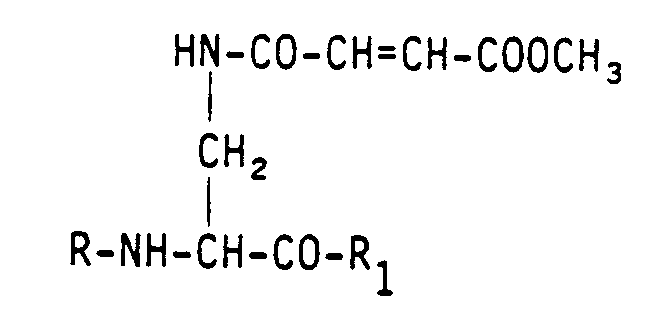
where R is a hydrogen atom when R₁ is a dipeptide residue containing a residue of alanine, methionine, valine, leucine, norvaline, or R and R₁ have the same meaning and mean the residues of monoaminomonocarboxylic aminoacid, such as that of alanine, methionine, valine, leucine, norvaline, or R is the residue of dipeptide containing the residues of alanine, methionine, valine, norvaline, lysine, ornithine, sarcosine, 2,4-diaminobutanoic acid and 2,3-diaminopropionic acid and R₁ is a hydroxyl group, and the method of their obtaining. - Dipeptides containing derivatives of L-2,3-diaminopropanoic acid are known until now and the method of their obtaining involves acylation of N³-4-methoxyfumaroyl-L-2,3-diaminopropanionic acid with an active ester of N-protected aminoacid, the reaction taking place in the medium of an organic solvent at room temperature R. Andruszkiewicz, H. Chmara, S. Milewski and E. Borowski, J. Med. Chem., 30. 17-15-1719/1987/.
- On the other hand, tripeptides are not known which show high antifungal activity and contain derivatives of L-2,3-diaminopropanoic acid. The essence of this present invention are tripeptides of N³-4-methoxyfumaryl-L-2,3-diaminopropanoic acid of the general formula

where R is a hydrogen atom when R₁ is a dipeptide resiude containing the residue of alanine, methionine, valine, leucine, norvaline, or R and R₁ have the same meaning and mean the amino residue of monoaminomonocarboxylic amino acid, such as those of alanine, methionine, valine, leucine, norvaline, or R means the dipeptide residue containing the residue of alanine, methionine, valine, leucine, norvaline, lysine, ornithine, sarcosine, 2,4-diaminobutanoic acid and 2,3-dipropanoic acid and R₁ means a hydroxy group. - According to this present invention the method of obtaining tripeptides of N³-4-methoxyfumaroyl-L-2,3-diaminopropanoic acid of the general formula

where R is a hydrogen atom and R₁ is the dipeptide residue containing the residue of alanine, methionine, valine, leucine, or norvaline involves converting of N²-tertbutoxycarbonyl, N³-4-methoxyfumaroyl-L-2,3-diaminopropanoic to an active ester which is used for acylation of the dipeptide in the medium of a polar organic solvent or its mixture with water, whereas the final product in the form of a salt is isolated by being crystallised or converted into a free acid. - N-hydroxysuccinimide is the agent activating N²-tertbutoxycarbonyl, N³-4-methoxyfumaroyl-L-2,3-diaminopropionic acid.
- Tetrahydroxyfuran or a mixture of a monohydroxy aliphatic alcohol with a C1-C5 chain length and water is used as an organic solvent.
- According to this present invention, the method of obtaining tripeptides of N³-4-methoxyfumaroyl-L-2,3-diaminopropionic acid of the general formula

where R₁ and R are the residue of monoaminomonocarboxylic amino acid, such as these of alanine, methionine, valine, leucine or norvaline involves converting N²-tert-butoxycarbonyl, N³-4-methoxyfumaroyl-L-2,3-diaminopropionic acid into an active ester which is used for acylating monoaminomonocarboxylic aminoacid whereafter the protection of the amino group is removed and the letter is acylated with an active ester of N-protected monoaminomonocarboxylic aminoacid in the medium of a polar organic solvent, or its mixture with water, whereas the final product in the form of a salt is isolated by being crystallised and, possibly, converted into a free acid. - N-hydroxysuccinimide is an agent activating N²-tert-butoxycarbonyl, N³-4-methoxyfumaroyl-L-2,3-diaminopropionic acid and N-protected monoaminocarboxylic amino acid.
- Tetrahydrofuran or a mixture of monohydroxy aliphatic alcohol with a C1-C5 chain length and water is used as a polar organic solvent.
- According to this present invention, the method of obtaining tripeptides of N³-4-methoxyfumaryl-L-2,3-diaminopropionic acid of the general formula

where R is the dipeptide residue containing the residue of alanine, methionine, valine, leucine, norvaline, lysine, ornithine, sarcosine, 2,4-diaminobutanoic acid and 2,3-diaminopropanoic acid and R₁ is a hydroxide group involves acylating N³-4-methoxyfumaroyl-L-2,3-diaminopropionic acid with an active ester of N-protected dipeptide in the medium of a polar organic solvent or its mixture with meter, whereafter the amine group protection is removed from the tripeptide thus obtained and the final product in the form of a salt is isolated by being crystallised and, possibly, being converted into a free acid. N-hydroxysuccinimide is the agent activating the N-protected monoaminomonocarboxylic aminoacid. Tetrahydrofuran or a mixture of monohydroxy aliphatic alcohol with a C1-C5 chain length and water is used as a polar organic solvent. The compounds in question show an antimicrobial activity, patricularly an antifungal activity relating to pathogenic fungi, such as Candida albicans, Cryptococus neoformans and Aspergillus spp., whereas their essential advantage is the observed lower frequency of occurrence of spontaneous mutants, microorganisms resistant to the action of tripeptides in comparison to the mutants resistant to the action of dipeptides. - The above has been assumed to be related to the difference in the specificity of action of the so-called permeases transporting peptides to cells of microrganisms.
- The antifungal activity has been evaluated, by the example of N²-L-methionyl-L-norvalyl-N³-4-methoxyfumaroyl-L-2,3-diaminopropropanoic acid during the in vitro acid in vivo tests conducted on experimentally infected mouse models. The in vitro activity has been evaluated by the method of serial dilutions in parallel on solid YNB medium and on YNB w/o + AN medium, where the abbreviation AN means 200 mg of sodium glutamate, 10 mg of L-histidine, 20 mg of DL-methionine, 20 mg of DL-tryptophane, 10 g of glucose and 15 g of agar-agar per 1 litre of the YNB medium. The application of the medium modified in such a manner was made necessary by the known phenomenon of lower biological activity in the media containing ammonium sulphate as a source of nitrogen.
- In evaluating the activity allowance has been made for the value ranges of the minimum inhibitory concentrations the growth of strains /MIC in mg/litre/, the cummulative percentages of the strains hampered by a definite mean geometric concentration of the value of MIC /GMIC/, the values of the concentrations hampering the growth of 50 and 90 per cent of the tested strains /MIC₅₀ and MIC₉₀/ representing the species Can dida albicans /n=50/, other species of the genus Candida Candida spp., n=117/ and the entire genus Candida /n=167/.
- 167 strains of the genus Candida have been freshly isolated from hospitalised patients.
- The table presented below shows the activity of N²/-L-methionyl-L-norvalyl/N³-/4-methoxyfumaroyl/-L-2,3-diaminopropanoic acid for 167 strains of the genus Candida isolated from patients.
/48h - 37° C/ Species Number of strains Substrate MIC value range, mg/litre GMIC MIC₅₀ MIC₉₀ C. albicans 50 YNB 0.006-100 39.5 120.1 180.6 YNB w/O + AN 0.006-100 3.3 0.6 149.8 Candida spp. 117 YNB 0.006-100 68.9 127.5 182.8 YNB w/O + AN 0.006-100 6.9 2.9 162.3 Total 167 YNB 0.006-100 58.3 125.4 182.2 YNB w/O + AN 0.006-100 5.5 1.4 159.4 - For one of the selected strains of Candida albicans ATCC 26278, the minimum inhibitory concentration, MIC, amounted to 0.4 mg/litre in the case of N²/L-methionyl-L-norvalyl/, N³-4-methoxyfumaroyl-L-2,3-diaminopropanoic acid and to 0.02 mg/litre for N²/-L-lysyl-L-norvalyl/, N³-4-methoxyfumaryl-L-2,3-diaminopropanoic acid.
- The derivatives show a high therapeutic efficiency. The therapeutic efficiency was evaluated by the example of N²/-L-methionyl-L-norvalyl/, N³-4-methoxyfumaroyl-L-2,3-diaminopropanoic acid Met-Nva-FMDP/.
- During the in vivo tests was used of the model of generalised candidiosis with the Swiss mouse. The mice were infected intravenously with the strain Candida albicans 162. The infecting dose amounted to 2x10⁷ cfu per 1 gm of body weight. The therapeutic efficiency was evaluated by mathematically determining protective doses PD₅₀/, curative doses CD₅₀/, and by quantitative mycological evaluation of the kidneys of the Swiss mice infected with experimental candidiase.
- By way of example, a protective dose PD₅₀, of 0.374 mg/kg has been determined for the Met-Nva-FMDP tripeptide for 5-9 days of observation, whereas curative doses, CD₅₀, determined for 9 and 16 days of observation amounted to 0.499 and 1 062 mg/kg, respectively.
- The quantitative evaluation of the kidneys of the mice infected and cured with a dose of 10xCD₅₀/g, i.e. 4.99 mg/kg, of the Met-Nva-FMDP triceptide showed that the number of the cells of Candida albicans was markedly reduced on the 6th day as compared with a control group.
- Tripeptides of N³-4-methoxyfumaroyl-L-2,3-diaminopropionic acid and the method of their obtaining are illustrated by the examples provided below
-
- a/ 2.065 g /5 mM/ of N-hydroxysuccinimide ester of N²-t-butoxycarbonyl, N³-4-methoxyfumaroyl-L-2,3-diaminopropanoic acid in 10 ml of tetrafuran are added to a solution of 1.1 g /5 mM/ L-methionyl-L-alanine and 0.42 g /5 mM/ of sodium hydrogen carbonate in 15 ml of water under intensive mixing and are allowed to stand for 6 hours. Next, the solvent is evaporated, the residue dissolved in 10 ml of water and acidified with 1 N hydrochloric acid to pH=2 and the reaction product is taken up several times with ethyl acetate. The organic layer is washed with water, dried over anhydrous magnesium sulphate and evaporated. The residue is crystallised from ethyl acetate and hexane. The above results in 2.27 g of N²-t-butoxycar bonyl, N³-4-methoxyfumaroyl-L-2,3-diaminopropanoyl-L-methionyl-L-alanine with a melting point of 108-110° C being obtained, which amounts to 88 per cent of the theoretical yield.
- b/ 1.056 g /2 mM/ of N²-t-butoxycarbonyl, N³-4-methoxyfumaroyl-L-2,3-diaminopropanoyl-L-methionyl-L-alanine are dissolved in 10 ml of 4N hydrogen chloride in dioxan and allowed to stand for 5 hours. Next, the solvents are evaporated and the residue is crystallised from a mixture of methanol and ethyl ether. 0.863 g of N³-4-methoxyfumaroyl-L-2,3-diaminopropanoyl-L-methionyl-L-aniline of a melting point of 178-180° C is obtained, which amounts to 99 per cent of the theoretical yield. MIC=0.1 ug/ml
- Just as in Example I, the following derivatives of L-2,3-diaminopropanoic acid of the tripeptide structure have been obtained, as presented in the table below.
Table 1 Example Name of derivative mass ion, m/z II N³-4-methoxyfumaroyl-L-2,3-diaminopropanoyl-L-alanyl-L-alanine hydrochloride 358 III N³-4-methoxyfumaroyl-L-2,3-diaminopropanoyl-L-methionyl-L-methionine hydrochloride 478 IV N³-4-methoxyfumaroyl-L-2,3-diaminopropanoyl-L-valyl-L-alanine hydrochloride 386 V N³-4-methoxyfumaroyl-L-2,3-diaminopropanoyl-L-leucyl-L-leucine-hydrochloride 442 VI N³-4-methoxyfumaroyl-L-2,3-diaminopropanoyl-L-methionyl-L-valine hydrochloride 446 VII N³-4-methoxyfumaroyl-L-2,3-diaminopropanoyl-L-alanyl-L-methionine hydrochloride 418 -
- a/ 2.065 g 5 mM/ N-hydroxysuccinimide ester N²-t-butoxycarbonyl, N³-4-methoxyfumaroyl-L-2,3-diaminopropanoic acid in 10 ml of tetrafuran are added under intensive mixed to a cooled solution of 0.74 g 5 mM/ of L-methio nine and 0.42 g of 5 mM/ of sodium hydrogen carbonate in 10 ml of water and allowed to stand for 10 hours. Next, the solvent is evaporated, the residue dissolved in 10 ml of water and acidified with 1 N hydrochloric acid to a pH-value of 2, and the reaction product is several times extracted with ethyl acetate.
The organic layer is washed with water, dried over anhydrous magnesium sulphate and evaporated. The resiude is crystallised from ethyl acetate and hexane.
1.96 g of N²-t-butoxycarbonyl, N³-4-methoxyfumaryol-L-2,3-diaminopropanoyl-L-methionine with a melting point of 84-86° C are obtained, which accounts for 89 per cent of the theoretical yield. - b/ 0.89 g /2 mM/ of N²-t-butoxycarbonyl, N³-4-methoxyfumaryl-L-2,3 diaminopropanoyl-L-methionine is dissolved in 10 ml of 4N hydrogen chloride in dioxan and is allowed to stand for 3 hours at room temperature. Next, the solvents are evaporated and the residue crystallised from a mixture of methanol and ethyl ester. 0.714 g of N³-4-methoxyfumaryl-L-2,3-diaminopropanoyl-L-methionine hydrochloride with a melting point of 184-186° C is obtained, which amounts to 94 per cent of the theoretical yield
- c/ 0.381 g /1 mM/ N³-4-methoxyfumaryl-L-2,3-diaminopropanoyl-L-methionine hydrochloride is dissolved in 10 ml of methanol cooled down to a temperature of 0° C and 0.3 ml of triethylamine is added. 0.346 g /1 mM/ of N-hydroxysuccinimide ester of N-t-butoxycarbonyl-L-methionine dissolved in 10 ml of tetrahydrofuran is added to that solution under intensive mixing and the reaction mixture is allowed to stand for 5 hours. The further procedure is the same as in Example I. 0.485 g of N²-/N-t-butoxycarbonyl-L-methionyl/, N³-4-methoxyfumaroyl-L-2,3-diaminopropanoyl-L-methionine with a melting point of 148-150° C is obtained, which amounts to 84 per cent of the theoretical yield.
- d/ 0.298 g /0.5 mM/ N²--/N-t-butoxycarbonyl-L-methionyl/, N³-4-methoxyfumaroyl-L-2,3-diaminopropanoyl-L-metnionine is dissolved in 10 ml of 4N hydrogen chloride in dioxan and is allowed to stand for 4 hours at room temperature. Thereafter, the solvents are evaporated and the residue is crystallised from a mixture of methanol and ethyl ether. 0.246 g of N²-L-methionyl, N³-4-methoxyfumaroyl-L-2,3-diaminopropanoyl-L-methonine hydrochloride with a melting point of 205-207° C is obtained, which amounts to 96 per cent of the theoretical yield.
The MIC is 0.8 µg/ml. - Just as in Example XIII the following derivatives of L-2,3-diaminopropionic acid, having the tripeptide structure and presented in Table 2, have been obtained.
Table 2 Example Name of derivatives mass ion, m/z IX N²-L-alanyl-, N³-4-methoxyfumaroyl-L-2,3-diaminopropanoyl-L-methionine hydrochloride 418 X N²-L-alanyl, N³-4-methoxyfumaroyl-L-2,3-diaminopropanoyl-L-alanine hydrochloride 358 XI N²-L-methionyl, N³-4-methoxyfumaroyl-L-2,3-diaminopropanoyl-L-alanine hydrochloride 418 XII N²-L-valyl, N³-4-methoxyfumaroyl-L-2,3-diaminopropanoyl-L-valine-hydrochloride 414 XIII N²-L-leucyl, N³-4-methoxyfumaroyl-L-2,3-diaminopropanoyl-L-alanine hydrochloride 400 XIV N²-L-methionyl, N³-4-methoxyfumaroyl-L-2,3-diaminopropanoyl-L-leucine hydrochloride 460 XV N²-L-norvalyl,-N³-4-methoxyfumaroyl-L-2,3-diaminopropanoyl-L-norvaline hydrochloride 414 -
- a/ 0.7 ml of triethylamine and 1.27 g 5 mM/ of N³-4-methoxyfumaroyl-L-2,3-diaminopropanoic hydrochloride dissolved in 5 ml of water is added to a cooled solution of 1.57 g/5 mM/ of N-hydroxysuccinimide ester of N-tert-butoxycarbonyl-L-norvaline in 20 ml of tetrahydrofurane under intensive mixing. The whole is mixed for 4 hours and the solvent is evaporated. The residue is dissolved in 10 ml of water, 1N hydrochloric acid is added until a pH-value of 2 has been obtained and the reaction product is extracted several times with ethyl acetate. The organic layer is washed with water, dried over anhydrous magnesium sulphate and the solvent is evaporated. The product is crystallised from a mixture of ethyl acetate and hexane.
1.7 g of N²-t-butoxy carbonyl-L-norvalyl, N³-4-methoxyfumaroyl-L-2,3-diaminopropanoic acid of melting point of 68-70° C is obtained, which amounts to 83 per cent of the theoretical yield. - b/ 0.83 g of /2 mM/ of N²-t-butoxycarbonyl-L-norvalyl, N³-4-methoxyfumaroyl-L-2,3-diaminopropanoic acid is dissolved in 10 ml of 4N hydrogen chloride in dioxan and allowed to stand for 4 hours at room temperature. Thereafter, the solvent is evaporated under reduced pressure and the residue is crystallised from a mixture of methan ol and ethyl ether.
0.65 g of N²-L-norvalyl, N³-4-methoxyfumaroyl-L-2,3-diaminopropanoicacidhydrochloride with a melting point of 188-190° C is obtained, which amounts to 93 per cent of the theoretical yield. - c/ 0.3 ml of triethylamine and 0.351 g of /1 mM/ N²-L-norvalyl, N³-4-methoxyfumaroyl-L-2,3-diaminopropanoic hydrochloride dissolved in 10 ml of water are added to a cooled solution of 0.346 g /1 mM/ N-hydroxysuccinoimide ester of N-t-butoxycarbonyl-L-methionine in 10 ml of tetrahydrofuran. The whole is mixed for 4-6 hours and the solvent is evaporated. The residue is dissolved in 10 ml of water, 1N hydrochloric acid is added until pH=2 has been obtained and the reaction product is extracted with ethyl acetate. The organic layer is washed with water, dryed over magnesium sulphate and the solvent is evaporated. The product is crystallised from a mixture of ethyl ether and cyclohexane.
0.415 g of N²-/N-t-butoxycarbonyl-L-methionyl-L-norvalyl/, N³-4-methoxyfumaroyl-L-2,3-diaminopropanoic acid with a melting point of 118-120° C is obtained, which amounts to 76 per cent of the theoretical yield. - d/ 0.273 g /o.5 mM/ N²-/N-t-butoxycarbonyl-L-methionyl-L-norvalyl/, N³-4-methoxyfumaroyl-L- 2,3-diaminopropanoic acid is dissolved in 5 ml of 4 N hydrogen chloride in dioxan and is allowed to stand at room temperature. Thereafter, the solvent is evaporated under reduced pressure and the residue is crystallised from a mixture of methanol and ethyl ether.
0.23 g of N²-L-methionyl-L-norvalyl, N³-4-methoxyfumaroyl-L-2,3-diaminopropanoic acid hydrochloride with a melting point of 190-192° C is obteined, which amounts to 95 per cent of the theoretical yield.
The MIC is 0.8 µg/ml. - Just as in Example XV the following derivatives of L-2,3-diaminopropanoic acid, having the structure of tripeptides and presented in the table below, have been obtained.
Example Name of derivative Mass ion m/z XVII N²-L-methionyl-L-alanyl, N³-4-methoxy fumaroyl-L-2,3-diaminopropanoic acid hydrochloride 418 XVIII N²-sarcosyl-L-norvalyl, N³-4-methoxyfumaroyl-L-2,3-diaminopropanoic acid hydrochloride 404 XIX N²-L-leucyl-L-alanyl, N³-4-methoxyfumaroyl-L-2,3-diaminopropanoic acid hydrochloride 400 XX N²-L-valyl-L-methionyl, N³-4-methoxyfumaroyl-L-2,3-diaminopropanoic acid hydrochloride 446 XXI R²-L-norvalyl-L-norvalyl, R³-4-methoxyfumaroyl-L-2,3-diaminopropanoic acid hydrochloride 414 XXII N²-L-lysyl-L-norvalyl-N³-4-methoxyfumaroyl-L-2,3-diaminopropanoic acid dihydrochloride 443 XXIII N²-L-ornithyl-L-norvylyl-N³-4-methoxyfumaryl-L-2,3-diaminopropanoic acid dihydrochloride 429 XXIV N²-L-2,4-diaminobutanoyl-L-norvalyl-N³-4-methoxyfumaroyl-L-2,3-diaminopropanoic acid dihydrochloride 415 XXV N²-L-2,3-diaminopropanoyl-L-norvalyl-N³-4-methoxyfumaroyl-L-2,3-diaminopropanoic acid dihydrochloride 401
Claims (10)
- Tripeptides of N³-4-methoxyfumaroyl-L-2,3-diaminopropanoic acid of the general formula

- A method of obtaining tripeptides of N³-4-methoxyfumaroyl-2,3-diaminopropanoic acid of the general formula

- A method as per Claim 2, characterised in that N-hydroxysuccinimide is the agent activating N²-tertbutoxycarbonyl, N³-4-methoxyfumaroyl-L-2,3-diaminopropanoic acid.
- A method as per Claim 2, characterised in that tetrahydrofuran or a mixture of a monohydroxyl aliphatic alcohol with a C1-C5 chain length and water is used as a polar organic solvent.
- A method for obtaining tripeptides of N³-4-methoxyfumaroyl-L-2,3-diaminopropanoic acid of the general formula

- A method as per Claim 5, characterised in that N-hydroxysuccinoimide is an agent activating N²-tert-butoxycarbonyl, N³-4-methoxyfumaroyl-L-2,3-diaminopropanoic acid and N²-protected monoaminomonocarboxylic aminoacid.
- A method as per Claim 5, characterised in that tetrahydrofuran or a mixture of a monohydroxyl aliphatic alcohol with a C1-C5 chain length and water is used a a polar organic solvent.
- A method of obtaining tripeptides of N³-4-methoxyfumaroyl-L-2,3-diaminopropanoic acid of the general formula

- A method as per Claim 8, characterised in that N-hydroxysuccinimide is agent activating N-protected monoaminomonocarboxylic aminoacid.
- A method as per Claim 8, characterised in that tetrahydrofurane or a mixture of a monohydroxy aliphatic alcohol with a C1-C5 chain length and water is used as a polar organic solvent.
Priority Applications (4)
| Application Number | Priority Date | Filing Date | Title |
|---|---|---|---|
| PL1984250068A PL144744B1 (en) | 1984-10-16 | 1984-10-16 | Method of obtaining novel derivatives of l-2,3-diaminopropanic acid exhibiting dipeptide structure |
| US07/222,190 US4923965A (en) | 1984-10-16 | 1988-07-21 | Tripeptides of N3 -4-methoxyfumaryl-L-2,3-diaminopropanoic acid |
| DE88112455T DE3884798T2 (en) | 1984-10-16 | 1988-08-01 | Tripeptides of N-3-4-methoxyfumaryl-L-2,3-diamino-propanoic acid and method for their preparation. |
| EP88112455A EP0353317B1 (en) | 1984-10-16 | 1988-08-01 | Tripeptides of n3-4-methoxyfumaryl-l-2,3-diaminopropanoic acid and the method of their obtaining |
Applications Claiming Priority (2)
| Application Number | Priority Date | Filing Date | Title |
|---|---|---|---|
| PL1984250068A PL144744B1 (en) | 1984-10-16 | 1984-10-16 | Method of obtaining novel derivatives of l-2,3-diaminopropanic acid exhibiting dipeptide structure |
| EP88112455A EP0353317B1 (en) | 1984-10-16 | 1988-08-01 | Tripeptides of n3-4-methoxyfumaryl-l-2,3-diaminopropanoic acid and the method of their obtaining |
Publications (2)
| Publication Number | Publication Date |
|---|---|
| EP0353317A1 EP0353317A1 (en) | 1990-02-07 |
| EP0353317B1 true EP0353317B1 (en) | 1993-10-06 |
Family
ID=39689260
Family Applications (1)
| Application Number | Title | Priority Date | Filing Date |
|---|---|---|---|
| EP88112455A Expired - Lifetime EP0353317B1 (en) | 1984-10-16 | 1988-08-01 | Tripeptides of n3-4-methoxyfumaryl-l-2,3-diaminopropanoic acid and the method of their obtaining |
Country Status (4)
| Country | Link |
|---|---|
| US (1) | US4923965A (en) |
| EP (1) | EP0353317B1 (en) |
| DE (1) | DE3884798T2 (en) |
| PL (1) | PL144744B1 (en) |
Families Citing this family (3)
| Publication number | Priority date | Publication date | Assignee | Title |
|---|---|---|---|---|
| PL176383B1 (en) * | 1993-10-07 | 1999-05-31 | British Tech Group | Novel derivatives of d-trans-2,3-epoxysusscinamoil-l-2,3-diaminopropanic acid of novel peptide structure and method of obtaining them |
| GB0022556D0 (en) * | 2000-09-14 | 2000-11-01 | Oxoid Ltd | Improvements in or relating to selective agents for biological cultures |
| AU2002219236B2 (en) * | 2001-01-12 | 2006-02-09 | Biogen International Gmbh | Fumaric acid amides |
Family Cites Families (1)
| Publication number | Priority date | Publication date | Assignee | Title |
|---|---|---|---|---|
| US4727062A (en) * | 1986-03-17 | 1988-02-23 | Merck & Co., Inc. | 3-Halovinylglycine antibacterial agents |
-
1984
- 1984-10-16 PL PL1984250068A patent/PL144744B1/en unknown
-
1988
- 1988-07-21 US US07/222,190 patent/US4923965A/en not_active Expired - Fee Related
- 1988-08-01 DE DE88112455T patent/DE3884798T2/en not_active Expired - Fee Related
- 1988-08-01 EP EP88112455A patent/EP0353317B1/en not_active Expired - Lifetime
Also Published As
| Publication number | Publication date |
|---|---|
| DE3884798T2 (en) | 1994-05-11 |
| PL250068A1 (en) | 1986-07-29 |
| DE3884798D1 (en) | 1993-11-11 |
| US4923965A (en) | 1990-05-08 |
| PL144744B1 (en) | 1988-06-30 |
| EP0353317A1 (en) | 1990-02-07 |
Similar Documents
| Publication | Publication Date | Title |
|---|---|---|
| US6569834B1 (en) | Elucidation and synthesis of antineoplastic tetrapeptide w-aminoalkyl-amides | |
| US4595677A (en) | Substituted tetrapeptides | |
| US6187568B1 (en) | Macrocyclic lactone compounds and their production process | |
| DD140142A5 (en) | PROCESS FOR THE PREPARATION OF CYCLOPEPTIDES | |
| DD155985A5 (en) | PROCESS FOR PREPARING CYCLIC R OCTAPEPTIDE | |
| US6156724A (en) | Uses of didemnins as immunomodulating agents | |
| CA1340447C (en) | Pipecolic acid-containing peptolides, their preparation and pharmaceutical compositions containing them | |
| US4176116A (en) | Dipeptide derivatives | |
| EP0353317A1 (en) | Tripeptides of N3-4-methoxyfumaryl-L-2,3-diaminopropanoic acid and the method of their obtaining | |
| US3770715A (en) | Acth active peptides having d serine as first aminoacid from n terminus and l ornithine as11 aminoacid | |
| US5698670A (en) | Aureobasidins | |
| EP0584360B1 (en) | Wf11243 substance | |
| JPS63101398A (en) | Oligopeptide antibiotic, its production and drug containing said antibiotic | |
| CA1247084A (en) | Peptide process for preparation thereof and use thereof | |
| US6686445B1 (en) | Synthetic antineoplastic agents derived from dolastatin 15 and methods of making same | |
| US6730776B1 (en) | WF14573 or its salt, production thereof and use thereof | |
| CA2298639C (en) | Synthetic antineoplastic agents derived from dolastatin 15 and methods of making same | |
| US6221844B1 (en) | Antifungal peptides from scleroderma texense | |
| US6818614B2 (en) | Compounds having antifungal activity | |
| US3948876A (en) | Process for the purification of synthetic calcitonins | |
| EP0057419B1 (en) | New peptide, process for preparation thereof and use thereof | |
| CA2396174C (en) | Aerothricin analogs, their preparation and use | |
| US5863937A (en) | Pharmaceutical compositions | |
| HK1044800A1 (en) | Novel compound f-15078 | |
| JPH0248599A (en) | Tripeptides of N↑3-4-methoxyfumaroyl-L-2,3-diaminopropanoic acid and their production method |
Legal Events
| Date | Code | Title | Description |
|---|---|---|---|
| PUAI | Public reference made under article 153(3) epc to a published international application that has entered the european phase |
Free format text: ORIGINAL CODE: 0009012 |
|
| AK | Designated contracting states |
Kind code of ref document: A1 Designated state(s): BE CH DE FR GB IT LI |
|
| 17P | Request for examination filed |
Effective date: 19900625 |
|
| 17Q | First examination report despatched |
Effective date: 19920430 |
|
| GRAA | (expected) grant |
Free format text: ORIGINAL CODE: 0009210 |
|
| AK | Designated contracting states |
Kind code of ref document: B1 Designated state(s): BE CH DE FR GB IT LI |
|
| PG25 | Lapsed in a contracting state [announced via postgrant information from national office to epo] |
Ref country code: LI Effective date: 19931006 Ref country code: CH Effective date: 19931006 |
|
| REF | Corresponds to: |
Ref document number: 3884798 Country of ref document: DE Date of ref document: 19931111 |
|
| ITF | It: translation for a ep patent filed | ||
| REG | Reference to a national code |
Ref country code: CH Ref legal event code: PL |
|
| ET | Fr: translation filed | ||
| PLBE | No opposition filed within time limit |
Free format text: ORIGINAL CODE: 0009261 |
|
| STAA | Information on the status of an ep patent application or granted ep patent |
Free format text: STATUS: NO OPPOSITION FILED WITHIN TIME LIMIT |
|
| 26N | No opposition filed | ||
| REG | Reference to a national code |
Ref country code: GB Ref legal event code: 732E |
|
| REG | Reference to a national code |
Ref country code: FR Ref legal event code: TP |
|
| ITPR | It: changes in ownership of a european patent |
Owner name: CESSIONE;BRITISH TECHNOLOGY GROUP LIMITED |
|
| PGFP | Annual fee paid to national office [announced via postgrant information from national office to epo] |
Ref country code: GB Payment date: 19990713 Year of fee payment: 12 |
|
| PGFP | Annual fee paid to national office [announced via postgrant information from national office to epo] |
Ref country code: DE Payment date: 19990721 Year of fee payment: 12 |
|
| PGFP | Annual fee paid to national office [announced via postgrant information from national office to epo] |
Ref country code: FR Payment date: 19990726 Year of fee payment: 12 |
|
| PGFP | Annual fee paid to national office [announced via postgrant information from national office to epo] |
Ref country code: BE Payment date: 19990729 Year of fee payment: 12 |
|
| PG25 | Lapsed in a contracting state [announced via postgrant information from national office to epo] |
Ref country code: GB Free format text: LAPSE BECAUSE OF NON-PAYMENT OF DUE FEES Effective date: 20000801 |
|
| PG25 | Lapsed in a contracting state [announced via postgrant information from national office to epo] |
Ref country code: BE Free format text: LAPSE BECAUSE OF NON-PAYMENT OF DUE FEES Effective date: 20000831 |
|
| BERE | Be: lapsed |
Owner name: BRITISH TECHNOLOGY GROUP LTD Effective date: 20000831 |
|
| GBPC | Gb: european patent ceased through non-payment of renewal fee |
Effective date: 20000801 |
|
| PG25 | Lapsed in a contracting state [announced via postgrant information from national office to epo] |
Ref country code: FR Free format text: LAPSE BECAUSE OF NON-PAYMENT OF DUE FEES Effective date: 20010430 |
|
| PG25 | Lapsed in a contracting state [announced via postgrant information from national office to epo] |
Ref country code: DE Free format text: LAPSE BECAUSE OF NON-PAYMENT OF DUE FEES Effective date: 20010501 |
|
| REG | Reference to a national code |
Ref country code: FR Ref legal event code: ST |
|
| PG25 | Lapsed in a contracting state [announced via postgrant information from national office to epo] |
Ref country code: IT Free format text: LAPSE BECAUSE OF NON-PAYMENT OF DUE FEES;WARNING: LAPSES OF ITALIAN PATENTS WITH EFFECTIVE DATE BEFORE 2007 MAY HAVE OCCURRED AT ANY TIME BEFORE 2007. THE CORRECT EFFECTIVE DATE MAY BE DIFFERENT FROM THE ONE RECORDED. Effective date: 20050801 |