EP0352799B1 - A process for preparing alkyl halides - Google Patents
A process for preparing alkyl halides Download PDFInfo
- Publication number
- EP0352799B1 EP0352799B1 EP89113900A EP89113900A EP0352799B1 EP 0352799 B1 EP0352799 B1 EP 0352799B1 EP 89113900 A EP89113900 A EP 89113900A EP 89113900 A EP89113900 A EP 89113900A EP 0352799 B1 EP0352799 B1 EP 0352799B1
- Authority
- EP
- European Patent Office
- Prior art keywords
- reactor
- alcohol
- halide
- stream
- hydrogen halide
- Prior art date
- Legal status (The legal status is an assumption and is not a legal conclusion. Google has not performed a legal analysis and makes no representation as to the accuracy of the status listed.)
- Expired
Links
- 150000001350 alkyl halides Chemical class 0.000 title claims description 28
- 238000004519 manufacturing process Methods 0.000 title description 3
- 229910000039 hydrogen halide Inorganic materials 0.000 claims description 38
- 239000012433 hydrogen halide Substances 0.000 claims description 38
- LFQSCWFLJHTTHZ-UHFFFAOYSA-N Ethanol Chemical compound CCO LFQSCWFLJHTTHZ-UHFFFAOYSA-N 0.000 claims description 37
- 238000006243 chemical reaction Methods 0.000 claims description 31
- XLYOFNOQVPJJNP-UHFFFAOYSA-N water Substances O XLYOFNOQVPJJNP-UHFFFAOYSA-N 0.000 claims description 26
- 239000007788 liquid Substances 0.000 claims description 21
- 238000000034 method Methods 0.000 claims description 16
- 239000000203 mixture Substances 0.000 claims description 7
- 238000002360 preparation method Methods 0.000 claims description 6
- 239000003054 catalyst Substances 0.000 claims description 5
- 239000012736 aqueous medium Substances 0.000 claims description 3
- 238000004064 recycling Methods 0.000 claims description 3
- 125000000217 alkyl group Chemical group 0.000 claims description 2
- 125000004432 carbon atom Chemical group C* 0.000 claims description 2
- 125000005843 halogen group Chemical group 0.000 claims description 2
- OKKJLVBELUTLKV-UHFFFAOYSA-N Methanol Chemical compound OC OKKJLVBELUTLKV-UHFFFAOYSA-N 0.000 description 72
- VEXZGXHMUGYJMC-UHFFFAOYSA-N Hydrochloric acid Chemical compound Cl VEXZGXHMUGYJMC-UHFFFAOYSA-N 0.000 description 44
- IXCSERBJSXMMFS-UHFFFAOYSA-N hydrogen chloride Substances Cl.Cl IXCSERBJSXMMFS-UHFFFAOYSA-N 0.000 description 31
- 229910000041 hydrogen chloride Inorganic materials 0.000 description 31
- NEHMKBQYUWJMIP-UHFFFAOYSA-N chloromethane Chemical compound ClC NEHMKBQYUWJMIP-UHFFFAOYSA-N 0.000 description 24
- 239000006227 byproduct Substances 0.000 description 13
- 229940050176 methyl chloride Drugs 0.000 description 12
- 239000000047 product Substances 0.000 description 11
- 239000000376 reactant Substances 0.000 description 9
- 150000001983 dialkylethers Chemical class 0.000 description 7
- 239000007791 liquid phase Substances 0.000 description 7
- 125000003158 alcohol group Chemical group 0.000 description 5
- 238000004821 distillation Methods 0.000 description 5
- LCGLNKUTAGEVQW-UHFFFAOYSA-N Dimethyl ether Chemical compound COC LCGLNKUTAGEVQW-UHFFFAOYSA-N 0.000 description 4
- 238000004458 analytical method Methods 0.000 description 4
- 239000007789 gas Substances 0.000 description 4
- 238000000926 separation method Methods 0.000 description 4
- 238000010438 heat treatment Methods 0.000 description 3
- CPELXLSAUQHCOX-UHFFFAOYSA-N Hydrogen bromide Chemical compound Br CPELXLSAUQHCOX-UHFFFAOYSA-N 0.000 description 2
- LRHPLDYGYMQRHN-UHFFFAOYSA-N N-Butanol Chemical compound CCCCO LRHPLDYGYMQRHN-UHFFFAOYSA-N 0.000 description 2
- DKGAVHZHDRPRBM-UHFFFAOYSA-N Tert-Butanol Chemical compound CC(C)(C)O DKGAVHZHDRPRBM-UHFFFAOYSA-N 0.000 description 2
- 239000007864 aqueous solution Substances 0.000 description 2
- 230000008901 benefit Effects 0.000 description 2
- GZUXJHMPEANEGY-UHFFFAOYSA-N bromomethane Chemical compound BrC GZUXJHMPEANEGY-UHFFFAOYSA-N 0.000 description 2
- BTANRVKWQNVYAZ-UHFFFAOYSA-N butan-2-ol Chemical compound CCC(C)O BTANRVKWQNVYAZ-UHFFFAOYSA-N 0.000 description 2
- NEHMKBQYUWJMIP-NJFSPNSNSA-N chloro(114C)methane Chemical compound [14CH3]Cl NEHMKBQYUWJMIP-NJFSPNSNSA-N 0.000 description 2
- 238000001816 cooling Methods 0.000 description 2
- 239000000463 material Substances 0.000 description 2
- 238000002156 mixing Methods 0.000 description 2
- BDERNNFJNOPAEC-UHFFFAOYSA-N propan-1-ol Chemical compound CCCO BDERNNFJNOPAEC-UHFFFAOYSA-N 0.000 description 2
- 238000005086 pumping Methods 0.000 description 2
- 238000011084 recovery Methods 0.000 description 2
- 239000004576 sand Substances 0.000 description 2
- KRHYYFGTRYWZRS-UHFFFAOYSA-N Fluorane Chemical compound F KRHYYFGTRYWZRS-UHFFFAOYSA-N 0.000 description 1
- KFZMGEQAYNKOFK-UHFFFAOYSA-N Isopropanol Chemical compound CC(C)O KFZMGEQAYNKOFK-UHFFFAOYSA-N 0.000 description 1
- QCWXUUIWCKQGHC-UHFFFAOYSA-N Zirconium Chemical compound [Zr] QCWXUUIWCKQGHC-UHFFFAOYSA-N 0.000 description 1
- PNEYBMLMFCGWSK-UHFFFAOYSA-N aluminium oxide Inorganic materials [O-2].[O-2].[O-2].[Al+3].[Al+3] PNEYBMLMFCGWSK-UHFFFAOYSA-N 0.000 description 1
- 230000015572 biosynthetic process Effects 0.000 description 1
- 238000009835 boiling Methods 0.000 description 1
- 238000004364 calculation method Methods 0.000 description 1
- 239000000919 ceramic Substances 0.000 description 1
- HRYZWHHZPQKTII-UHFFFAOYSA-N chloroethane Chemical compound CCCl HRYZWHHZPQKTII-UHFFFAOYSA-N 0.000 description 1
- 238000007865 diluting Methods 0.000 description 1
- 238000006073 displacement reaction Methods 0.000 description 1
- 239000012153 distilled water Substances 0.000 description 1
- DQYBDCGIPTYXML-UHFFFAOYSA-N ethoxyethane;hydrate Chemical compound O.CCOCC DQYBDCGIPTYXML-UHFFFAOYSA-N 0.000 description 1
- 229960003750 ethyl chloride Drugs 0.000 description 1
- UHCBBWUQDAVSMS-UHFFFAOYSA-N fluoroethane Chemical compound CCF UHCBBWUQDAVSMS-UHFFFAOYSA-N 0.000 description 1
- 238000004817 gas chromatography Methods 0.000 description 1
- 229910000042 hydrogen bromide Inorganic materials 0.000 description 1
- 229910000040 hydrogen fluoride Inorganic materials 0.000 description 1
- XMBWDFGMSWQBCA-UHFFFAOYSA-N hydrogen iodide Chemical compound I XMBWDFGMSWQBCA-UHFFFAOYSA-N 0.000 description 1
- 229910000043 hydrogen iodide Inorganic materials 0.000 description 1
- 125000000959 isobutyl group Chemical group [H]C([H])([H])C([H])(C([H])([H])[H])C([H])([H])* 0.000 description 1
- 229910001507 metal halide Inorganic materials 0.000 description 1
- 229940102396 methyl bromide Drugs 0.000 description 1
- SNMVRZFUUCLYTO-UHFFFAOYSA-N n-propyl chloride Chemical compound CCCCl SNMVRZFUUCLYTO-UHFFFAOYSA-N 0.000 description 1
- PVWOIHVRPOBWPI-UHFFFAOYSA-N n-propyl iodide Chemical compound CCCI PVWOIHVRPOBWPI-UHFFFAOYSA-N 0.000 description 1
- 239000002994 raw material Substances 0.000 description 1
- 238000005070 sampling Methods 0.000 description 1
- 239000000243 solution Substances 0.000 description 1
- NBRKLOOSMBRFMH-UHFFFAOYSA-N tert-butyl chloride Chemical compound CC(C)(C)Cl NBRKLOOSMBRFMH-UHFFFAOYSA-N 0.000 description 1
- 238000004448 titration Methods 0.000 description 1
- 239000012808 vapor phase Substances 0.000 description 1
- 229910052726 zirconium Inorganic materials 0.000 description 1
Images

Classifications
-
- C—CHEMISTRY; METALLURGY
- C07—ORGANIC CHEMISTRY
- C07C—ACYCLIC OR CARBOCYCLIC COMPOUNDS
- C07C17/00—Preparation of halogenated hydrocarbons
- C07C17/093—Preparation of halogenated hydrocarbons by replacement by halogens
- C07C17/16—Preparation of halogenated hydrocarbons by replacement by halogens of hydroxyl groups
Definitions
- alkyl halides particularly methyl chloride from the reaction of the corresponding alcohol with a hydrogen halide
- the by-products of the reaction are water and the corresponding dialkyl ether.
- Most known processes carry out the reaction with a stoichiometric excess of the hydrogen halide relative to the alcohol. As such, unreacted hydrogen halide must be discarded to the environment or recovered and recycled to the process.
- the recovery of the hydrogen halide, particularly hydrogen chloride (HC1) creates many processing difficulties. To begin with, HC1 forms a minimum boiling azeotrope with water. Recovery and recycle of HC1 is complicated by this azeotrope. Additionally, the very corrosive nature of aqueous HC1 dictates that handling of this stream be held to a minimum. Finally, many known processes utilize catalysts to promote the reaction.
- Figure 1 is a representation of one embodiment of the instant invention.
- Figure 1 outlines the process in which aqueous hydrogen chloride and a stoichiometric excess of methanol are contacted in a liquid phase in a plug-flow reactor in which backmixing of reactants, product methyl chloride and by-product water is minimized.
- the desired methyl chloride product is separated and isolated; by-product water is separated from excess methanol, the water being discarded; and the excess methanol is recovered and recycled to the reactor.
- 1 is the aqueous hydrogen chloride (HC1) feed to the reactor.
- 2 is a heat exchanger in which stream 1 is heated.
- 3 is the methanol feed to the reactor.
- 4 is a heat exchanger in which stream 3 is heated.
- 5 is a packed column in which the aqueous HC1, methanol, the product methyl chloride and the by-product water flow upward through the reactor in a co-current, plug flow configuration.
- the heat input into heat exchangers 2 and 4 controls the temperature of the reactor 5 .
- the temperature and pressure within the reactor 5 are controlled so that the reactants within the reactor are in a liquid, aqueous environment.
- Stream 6 is a vapor effluent from the reactor 5 which consists essentially of methyl chloride, methanol and by-product dimethyl ether.
- Stream 7 is a liquid effluent from the reactor 5 which comprises mainly methanol, water and a small amount of HC1.
- 8 is a distillation column in which methanol and methyl chloride are recovered as an overhead product stream 9 .
- Stream 10 is a combination of the water fed with the aqueous HC1 and by-product water and a small amount of HC1.
- Stream 10 is discarded.
- 11 is a condenser in which stream 9 is cooled.
- Streams 6 and 9 are fed to a distillation column 12 in which product methyl chloride is recovered as an overhead product stream 13 . Excess methanol is recovered as a bottoms stream 14 from the distillation column 12 . The recovered methanol stream 14 is recycled to the reactor.
- the objective of the instant invention is the preparation of an alkyl halide from the reaction of the corresponding alcohol and a hydrogen halide in which conversion of the hydrogen halide is maximized in a single pass through the reactor, eliminating the need for recovering and recycling hydrogen halide.
- the alcohol utilized in the instant invention can be, for example, methanol, ethanol, n-propanol, i-propanol, n-butanol, sec-butanol or t-butanol.
- the alcohol can be brought to the reactor as a liquid by known means such as pumping.
- the alcohol may also be vaporized by conventional means and fed to the reactor as a vapor.
- the alcohol can be fed to the reactor as a vapor or liquid at multiple feed points or at just one point.
- the hydrogen halide utilized in the instant invention, can be, for example, hydrogen fluoride, hydrogen chloride, hydrogen bromide or hydrogen iodide. Hydrogen chloride is the preferred hydrogen halide.
- the hydrogen halide can be fed as an aqueous solution or as an anhydrous gas.
- Aqueous hydrogen halide can be fed to the reactor by conventional means for transporting liquids such as pumping.
- the anhydrous HC1 can be fed to the reactor by conventional means for transporting gases.
- the term "essentially anhydrous hydrogen halide" refers to a stream with only trace amounts of water, as, for example, in the range 1000 ppm water or less.
- the product alkyl halide can be, for example, methyl chloride, methyl bromide, ethyl fluoride, ethyl chloride, n-propyl chloride, n-propyl iodide, i-butyl chloride or t-butyl chloride.
- reaction of the alcohol and the hydrogen halide to produce the alkyl halide is effected in the absence of any catalyst, as for example, metal halide salts, activated alumina, etc.
- the alcohol and the hydrogen halide are contacted in a plug-flow reactor (PFR) in which the flow of reactants and subsequent products and by-products is co-current.
- PFR plug-flow reactor
- the flow of reactants and subsequent products and by-products is co-current.
- CSTR continuous stirred tank reactor
- the PFR can be, for example, known reactor configurations such as a packed bed, a tray-type column or a series of small CSTR's with separation between reactors.
- the use of a stoichiometric excess of alcohol, as described above, facilitates improved conversion of hydrogen halide to the desired alkyl halide. Conversion of hydrogen halide is complete enough so that what hydrogen halide remains can be discarded without significant economic penalty. Thus, the desired conversion of the hydrogen halide is effected in a single-pass through the plug-flow reactor.
- the reaction of the alcohol with the hydrogen halide should be carried out under conditions in which a liquid, aqueous medium exists within the reactor. It is preferred that the temperature within the reactor be in a range from 100° to 200°C. It is further preferred that the pressure within the reactor system be in a range from 15 to 150 pounds per square inch, gauge (psig).
- the residence time of the liquid mixture in the reactor should be in a range from 30 to 200 minutes. It is understood that residence times less than about 30 minutes can be used; however, reaction may not be complete. Residence times longer than 200 minutes can be utilized; however, the generation of by-product dialkyl ether would increase. Generally shorter residence times are preferred.
- Isolating and separating the alkyl halide can involve, for example,
- the alkyl halide can be further handled by such known techniques as compressing and cooling to recover the alkyl halide as a liquified gas or liquid.
- the alkyl halide can be further processed by known means for removing dialkyl ethers.
- a plug-flow reactor was constructed from 1.6-inch diameter zirconium pipe constructed in several sections, connected by flanged connections. Short spool sections at top and bottom enabled connections for inlet and outlet process streams and thermowells. The reactor was packed with 0.25 inch ceramic saddles to a depth of approximately 4 feet. The reactor was placed in a vertical position. Direction of the flow of materials was from the bottom of the reactor to the top. The reactor was wrapped with electrical heating tape.
- Methanol and hydrochloric acid were fed as liquids from separate reservoirs. Methanol and hydrochloric acid feed were effected by separate positive displacement pumps. Both materials were fed separately to coils within a heated fluidized sand bath. Methanol was intended to be totally vaporized. Temperature within the reactor was controlled by the electrical input to both the sand bath and the heating tape. The heating tape balanced heat loss to assure adiobatic operation. Temperature and pressure of the reactor were monitored by conventional means. Product methyl chloride (MeC1), by-produced water and dimethyl ether (Me2O), unreacted methanol (MeOH) and hydrogen chloride (HC1) exited the top of the reactor as a mixture of vapor and liquid.
- MeC1 Product methyl chloride
- Me2O unreacted methanol
- HC1 hydrogen chloride
- the mixture of vapor and liquid exiting the reactor passed through an air-cooled coil.
- the cooled stream then went to a chamber, approximately 2 liters in volume, in which the vapor and liquid were separated.
- Reactor pressure was maintained with a pressure control valve downstream from the separation chamber.
- the liquid phase and the vapor phase were sampled at this point.
- the vapor stream passed through a water scrubber and then to the atmosphere.
- the concentrated hydrochloric acid used was commercially available 37 weight percent HC1. Reactor temperature was maintained at about 160°C. and reactor pressure was maintained at about 100 psig.
- Table 2 is a summary of the results of these runs. The notation utilized in Example 1 as applied here. Additionally, in Table 2 the Me2O content of the product MeC1 is designated "%Me2O".
Landscapes
- Chemical & Material Sciences (AREA)
- Organic Chemistry (AREA)
- Organic Low-Molecular-Weight Compounds And Preparation Thereof (AREA)
Description
- The preparation of alkyl halides, particularly methyl chloride from the reaction of the corresponding alcohol with a hydrogen halide is known in the art. The by-products of the reaction are water and the corresponding dialkyl ether. Most known processes carry out the reaction with a stoichiometric excess of the hydrogen halide relative to the alcohol. As such, unreacted hydrogen halide must be discarded to the environment or recovered and recycled to the process. The recovery of the hydrogen halide, particularly hydrogen chloride (HC1) creates many processing difficulties. To begin with, HC1 forms a minimum boiling azeotrope with water. Recovery and recycle of HC1 is complicated by this azeotrope. Additionally, the very corrosive nature of aqueous HC1 dictates that handling of this stream be held to a minimum. Finally, many known processes utilize catalysts to promote the reaction.
- The drawing in Figure 1 is a representation of one embodiment of the instant invention. Figure 1 outlines the process in which aqueous hydrogen chloride and a stoichiometric excess of methanol are contacted in a liquid phase in a plug-flow reactor in which backmixing of reactants, product methyl chloride and by-product water is minimized. The desired methyl chloride product is separated and isolated; by-product water is separated from excess methanol, the water being discarded; and the excess methanol is recovered and recycled to the reactor.
- In Figure 1, 1 is the aqueous hydrogen chloride (HC1) feed to the reactor. 2 is a heat exchanger in which stream 1 is heated. 3 is the methanol feed to the reactor. 4 is a heat exchanger in which
stream 3 is heated. 5 is a packed column in which the aqueous HC1, methanol, the product methyl chloride and the by-product water flow upward through the reactor in a co-current, plug flow configuration. The heat input into heat exchangers 2 and 4 controls the temperature of the reactor 5. The temperature and pressure within the reactor 5 are controlled so that the reactants within the reactor are in a liquid, aqueous environment.Stream 6 is a vapor effluent from the reactor 5 which consists essentially of methyl chloride, methanol and by-product dimethyl ether. Stream 7 is a liquid effluent from the reactor 5 which comprises mainly methanol, water and a small amount of HC1. 8 is a distillation column in which methanol and methyl chloride are recovered as an overhead product stream 9.Stream 10 is a combination of the water fed with the aqueous HC1 and by-product water and a small amount of HC1.Stream 10 is discarded. 11 is a condenser in which stream 9 is cooled.Streams 6 and 9 are fed to adistillation column 12 in which product methyl chloride is recovered as anoverhead product stream 13. Excess methanol is recovered as abottoms stream 14 from thedistillation column 12. The recoveredmethanol stream 14 is recycled to the reactor. - The objective of the instant invention is the preparation of an alkyl halide from the reaction of the corresponding alcohol and a hydrogen halide in which conversion of the hydrogen halide is maximized in a single pass through the reactor, eliminating the need for recovering and recycling hydrogen halide.
- It has been found that high first-pass conversion of hydrogen halide at high rates of production can be achieved by using a reactor in which the reactants are fed co-currently into a plug-flow reactor configuration in which backmixing is minimized. Further, the reaction takes place in an aqueous environment without a catalyst. The excess alcohol can be recovered and recycled to the reactor and a very dilute stream of aqueous hydrogen halide is discarded.
- In accordance with the instant invention, there is provided a process for the preparation of an alkyl halide from the corresponding alcohol and a hydrogen halide under conditions that will be delineated herein. What is described, therefore, is a process for preparation of an alkyl halide, RX, from reaction between the corresponding alcohol, ROH and a hydrogen halide, HX, in the absence of a catalyst, said process improving conversion of the hydrogen halide to the alkyl halide in a single pass through a reactor, wherein R is an alkyl group containing from 1 to 4 carbon atoms; and wherein X is a halogen atom; said process comprising
- (A) contacting and reacting the hydrogen halide with a stoichiometric excess of the alcohol in a plug-flow reactor in which flow of a mixture comprising unreacted alcohol, unreacted hydrogen halide, the alkyl halide and water is co-current; wherein the temperature within the reactor is greater than about 100°C., and the pressure within the reactor is in a range from about 15 to 150 psig (1,03-10,3 bar) to maintain a liquid, aqueous medium in the reactor; and
- (B) isolating and separating the alkyl halide.
- The reaction of an alcohol with a hydrogen halide can be represented as,


- The alcohol utilized in the instant invention can be, for example, methanol, ethanol, n-propanol, i-propanol, n-butanol, sec-butanol or t-butanol. The alcohol can be brought to the reactor as a liquid by known means such as pumping. The alcohol may also be vaporized by conventional means and fed to the reactor as a vapor. The alcohol can be fed to the reactor as a vapor or liquid at multiple feed points or at just one point.
- The hydrogen halide, utilized in the instant invention, can be, for example, hydrogen fluoride, hydrogen chloride, hydrogen bromide or hydrogen iodide. Hydrogen chloride is the preferred hydrogen halide. The hydrogen halide can be fed as an aqueous solution or as an anhydrous gas. Aqueous hydrogen halide can be fed to the reactor by conventional means for transporting liquids such as pumping. The anhydrous HC1 can be fed to the reactor by conventional means for transporting gases. For the purposes of the instant invention, the term "essentially anhydrous hydrogen halide" refers to a stream with only trace amounts of water, as, for example, in the range 1000 ppm water or less.
- The product alkyl halide can be, for example, methyl chloride, methyl bromide, ethyl fluoride, ethyl chloride, n-propyl chloride, n-propyl iodide, i-butyl chloride or t-butyl chloride.
- Unlike much of the prior art, the reaction of the alcohol and the hydrogen halide to produce the alkyl halide is effected in the absence of any catalyst, as for example, metal halide salts, activated alumina, etc.
- The alcohol and the hydrogen halide are contacted in a plug-flow reactor (PFR) in which the flow of reactants and subsequent products and by-products is co-current. As known in the art, in a PFR there is essentially no mixing in the direction of flow, but with some mixing in the transverse direction. Therefore, there is a concentration gradient of reactants between the feed end and exit end of the reactor. In comparison, in a back-mixed reactor or continuous stirred tank reactor (CSTR), used extensively in the preparation of alkyl halides, the reactants, products and by-products are totally mixed and essentially no concentration gradient exists in the reactor. Reaction rate generally depends upon concentration of reactants. The PFR configuration takes advantage of the higher rates corresponding to the higher concentration of reactants at the feed end of the reactor. Therefore, the PFR will require a smaller reactor volume, shorter residence time, than that required for the more conventional CSTR.
- The PFR can be, for example, known reactor configurations such as a packed bed, a tray-type column or a series of small CSTR's with separation between reactors.
- It has been found that feeding a stoichiometric excess of an alcohol relative to a hydrogen halide significantly improved the conversion of the hydrogen halide to the desired alkyl halide. It is preferred that the stoichiometric excess of the alcohol relative to the hydrogen halide be greater than about 10 mole percent to gain benefit from the instant invention. It is more preferred that the stoichiometric excess of the alcohol be in a range from 20 to 200 mole percent. This preferred range gives a satisfactory balance between increased conversion of hydrogen halide to alkyl halide and the generation of by-product dialkyl ether. Hydrogen halide conversion to the desired alkyl halide has been found to increase from about 70 percent to as much as 95 percent. It is understood that lower stoichiometric excesses of alcohol approaching a stoichiometric balance can be utilized, however, with minimum increase in hydrogen halide conversion. It is further understood that stoichiometric excesses greater than 200 mole percent can be utilized, however, with potentially significant increases in the production of by-product dialkyl ether. However, it has been found that within the preferred range of stoichiometric excess of the alcohol and the reaction conditions disclosed by the instant invention the formation of dialkyl ether is acceptable and does not cause a significant raw material utilization or cost penalty.
- Thus, the use of a stoichiometric excess of alcohol, as described above, facilitates improved conversion of hydrogen halide to the desired alkyl halide. Conversion of hydrogen halide is complete enough so that what hydrogen halide remains can be discarded without significant economic penalty. Thus, the desired conversion of the hydrogen halide is effected in a single-pass through the plug-flow reactor.
- The reaction of the alcohol with the hydrogen halide should be carried out under conditions in which a liquid, aqueous medium exists within the reactor. It is preferred that the temperature within the reactor be in a range from 100° to 200°C. It is further preferred that the pressure within the reactor system be in a range from 15 to 150 pounds per square inch, gauge (psig).
- The residence time of the liquid mixture in the reactor should be in a range from 30 to 200 minutes. It is understood that residence times less than about 30 minutes can be used; however, reaction may not be complete. Residence times longer than 200 minutes can be utilized; however, the generation of by-product dialkyl ether would increase. Generally shorter residence times are preferred.
- Isolating and separating the alkyl halide can involve, for example,
- (C) separating a vapor stream and a liquid stream from the mixture flowing through the reactor;
- (D) separating alkyl halide from the vapor stream while recovering a first portion of unreacted alcohol; and
- (E) separating water from the liquid stream while recovering a second portion of unreacted alcohol;
- (F) combining and recycling the first portion and the second portion of unreacted alcohol to the reactor; and
- (G) discarding a stream comprising water.
- The alkyl halide can be further handled by such known techniques as compressing and cooling to recover the alkyl halide as a liquified gas or liquid. The alkyl halide can be further processed by known means for removing dialkyl ethers.
- So that those skilled in the art may better understand and appreciate the instant invention, the following examples are presented.
- A plug-flow reactor was constructed from 1.6-inch diameter zirconium pipe constructed in several sections, connected by flanged connections. Short spool sections at top and bottom enabled connections for inlet and outlet process streams and thermowells. The reactor was packed with 0.25 inch ceramic saddles to a depth of approximately 4 feet. The reactor was placed in a vertical position. Direction of the flow of materials was from the bottom of the reactor to the top. The reactor was wrapped with electrical heating tape.
- Methanol and hydrochloric acid were fed as liquids from separate reservoirs. Methanol and hydrochloric acid feed were effected by separate positive displacement pumps. Both materials were fed separately to coils within a heated fluidized sand bath. Methanol was intended to be totally vaporized. Temperature within the reactor was controlled by the electrical input to both the sand bath and the heating tape. The heating tape balanced heat loss to assure adiobatic operation. Temperature and pressure of the reactor were monitored by conventional means. Product methyl chloride (MeC1), by-produced water and dimethyl ether (Me₂O), unreacted methanol (MeOH) and hydrogen chloride (HC1) exited the top of the reactor as a mixture of vapor and liquid. The mixture of vapor and liquid exiting the reactor passed through an air-cooled coil. The cooled stream then went to a chamber, approximately 2 liters in volume, in which the vapor and liquid were separated. Reactor pressure was maintained with a pressure control valve downstream from the separation chamber. The liquid phase and the vapor phase were sampled at this point. The vapor stream passed through a water scrubber and then to the atmosphere.
- In each run made, the system was operated until temperature and pressure reached an essentially steady state condition. Once an essentially steady state condition was reached, the system was allowed to run for about 1.5 hours before sampling. Performance was monitored at steady state conditions by analyzing samples of the liquid and vapor streams after the water-cooled condenser. For the liquid stream, HC1 was analyzed by conventional titration with base; MeOH content was determined by gas chromatographic (GC) analysis. For the vapor stream, analysis was effected by GC analysis. Typically, three samples of each stream were taken and the average of the results of analyses were taken. Analysis showed that essentially all the water which was fed with the aqueous HC1 feed and all the water which formed as a by-product was in the liquid phase. Thus, an HC1/water balance of the liquid phase allowed calculation of the conversion of HC1 to mecl. A similar mass balance was performed to calculate Me₂O levels.
- Three runs were made in which an aqueous solution of 17.7 weight percent HC1 was used as the HC1 feed. This solution was prepared by diluting commercially available concentrated hydrochloric acid with distilled water. The stoichiometric ratio of MeOH to HC1 was varied from a ratio of about 1.0 to 1.5. These runs are designated as Samples A, B and C. Temperature in the reactor for these runs was held at about 160° to 165°C. Reactor pressure was maintained at about 100 pounds per square inch, gauge (psig) (6,9 bar). Table 1 is a summary of the results of these three runs. In Table 1, the feed rates of aqueous HC1 and MeOH, in kg/hr, are designated as "HC1" and "MeOH", respectively; the calculated residence time of the reactants within the reactor, in minutes, is designated "R.T."; the molar ratio of MeOH to HC1 is designated as "Ratio"; the HC1 content of the liquid phase, in weight percent, is designated "%HC1"; and the calculated conversion of HC1 to MeC1, in percent conversion, is designated "C1 Conv".
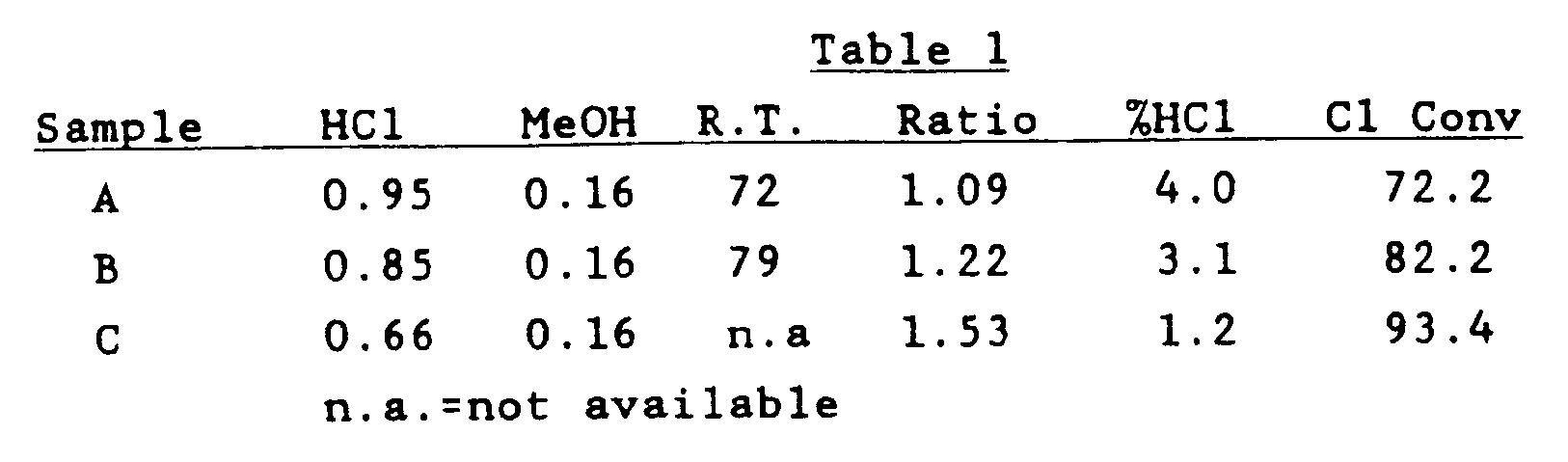
- The above results demonstrate that under the conditions of the above plug-flow reactor system, excess methanol significantly increases the conversion of hydrogen chloride to methyl chloride.
- Using procedures and equipment similar to those utilized in Example 1, a series of runs was made to study the impact of MeOH to HC1 ratio when utilizing concentrated hydrochloric acid. These runs are designated as Samples D, E and F, respectively.
- The concentrated hydrochloric acid used was commercially available 37 weight percent HC1. Reactor temperature was maintained at about 160°C. and reactor pressure was maintained at about 100 psig.
- Table 2 is a summary of the results of these runs. The notation utilized in Example 1 as applied here. Additionally, in Table 2 the Me₂O content of the product MeC1 is designated "%Me₂O".

- The above results further demonstrate that excess methanol improves the conversion of hydrogen chloride to methyl chloride using a plug-flow reactor configuration.
Claims (2)
wherein R is an alkyl group containing from 1 to 4 carbon atoms; and wherein X is a halogen atom; said process comprising
Applications Claiming Priority (2)
| Application Number | Priority Date | Filing Date | Title |
|---|---|---|---|
| US07/225,496 US4935564A (en) | 1988-07-28 | 1988-07-28 | Process for preparing alkyl halides |
| US225496 | 1988-07-28 |
Publications (2)
| Publication Number | Publication Date |
|---|---|
| EP0352799A1 EP0352799A1 (en) | 1990-01-31 |
| EP0352799B1 true EP0352799B1 (en) | 1992-03-18 |
Family
ID=22845115
Family Applications (1)
| Application Number | Title | Priority Date | Filing Date |
|---|---|---|---|
| EP89113900A Expired EP0352799B1 (en) | 1988-07-28 | 1989-07-27 | A process for preparing alkyl halides |
Country Status (6)
| Country | Link |
|---|---|
| US (1) | US4935564A (en) |
| EP (1) | EP0352799B1 (en) |
| JP (1) | JP2642746B2 (en) |
| CA (1) | CA1323041C (en) |
| DE (1) | DE68901017D1 (en) |
| ES (1) | ES2013966A6 (en) |
Families Citing this family (14)
| Publication number | Priority date | Publication date | Assignee | Title |
|---|---|---|---|---|
| US5349099A (en) * | 1993-12-13 | 1994-09-20 | Schering Corporation | Process for preparing intermediates for the synthesis of antifungal agents |
| EP0860425B1 (en) * | 1996-07-23 | 2000-11-02 | Tokuyama Corporation | Process for the preparation of aqueous solutions of tetraalkylammonium hydroxides |
| US6111153A (en) * | 1999-06-01 | 2000-08-29 | Dow Corning Corporation | Process for manufacturing methyl chloride |
| DE10247497B4 (en) * | 2002-10-11 | 2008-08-21 | Evonik Degussa Gmbh | Process for the continuous production of acyclic C4 to C6 mono- and di-chlorohydrocarbons |
| CN101657400B (en) * | 2007-04-12 | 2013-07-03 | 陶氏环球技术公司 | Method and apparatus for the preparation of chlorohydrins |
| JP2011516552A (en) * | 2008-04-09 | 2011-05-26 | ダウ グローバル テクノロジーズ リミティド ライアビリティ カンパニー | Method and apparatus for efficient recovery of dichlorohydrins |
| EP2403628B1 (en) * | 2009-03-05 | 2017-09-27 | Blue Cube IP LLC | Method for the hydrochlorination of alkanols to alkyl halides |
| US20100234653A1 (en) * | 2009-03-12 | 2010-09-16 | Chemtura Corporation | Processes for making alkyl halides |
| TW201204684A (en) | 2010-06-23 | 2012-02-01 | Asahi Glass Co Ltd | Process for producing 2,3,3,3-tetrafluoropropene |
| CN102947255B (en) | 2010-06-23 | 2016-04-06 | 旭硝子株式会社 | The manufacture method of 2,3,3,3-tetrafluoeopropene |
| JP2013544765A (en) | 2010-09-23 | 2013-12-19 | アイシーエル−アイピー アメリカ インコーポレイテッド | Monohydroxy cyclic phosphonate substantially free of polyhydroxyphosphonate, process for producing the same and flame retardant flexible polyurethane foam obtained therefrom |
| KR101894778B1 (en) * | 2016-03-11 | 2018-09-04 | 서강대학교산학협력단 | Method for preparing alkyl halides |
| CN113501744A (en) * | 2021-07-09 | 2021-10-15 | 岳阳隆兴实业有限公司 | Synthesis method of chloro-sec-butyl alkane |
| CN113480401A (en) * | 2021-07-09 | 2021-10-08 | 岳阳隆兴实业有限公司 | Synthesis method of chloro-n-pentane |
Family Cites Families (3)
| Publication number | Priority date | Publication date | Assignee | Title |
|---|---|---|---|---|
| US1918371A (en) * | 1927-01-18 | 1933-07-18 | Ig Farbenindustrie Ag | Preparation of methyl chloride and methylene chloride |
| US2570495A (en) * | 1946-08-08 | 1951-10-09 | Du Pont | Production of organic chlorides |
| US3981938A (en) * | 1974-07-08 | 1976-09-21 | The Dow Chemical Company | Method for producing dry alkyl halides |
-
1988
- 1988-07-28 US US07/225,496 patent/US4935564A/en not_active Expired - Lifetime
-
1989
- 1989-05-31 CA CA000601363A patent/CA1323041C/en not_active Expired - Fee Related
- 1989-07-26 ES ES8902647A patent/ES2013966A6/en not_active Expired - Lifetime
- 1989-07-26 JP JP1191610A patent/JP2642746B2/en not_active Expired - Fee Related
- 1989-07-27 DE DE8989113900T patent/DE68901017D1/en not_active Expired - Fee Related
- 1989-07-27 EP EP89113900A patent/EP0352799B1/en not_active Expired
Also Published As
| Publication number | Publication date |
|---|---|
| ES2013966A6 (en) | 1990-06-01 |
| CA1323041C (en) | 1993-10-12 |
| JPH0273024A (en) | 1990-03-13 |
| DE68901017D1 (en) | 1992-04-23 |
| US4935564A (en) | 1990-06-19 |
| JP2642746B2 (en) | 1997-08-20 |
| EP0352799A1 (en) | 1990-01-31 |
Similar Documents
| Publication | Publication Date | Title |
|---|---|---|
| US4935564A (en) | Process for preparing alkyl halides | |
| EP1057802B1 (en) | Process for manufacturing methyl chloride | |
| JP3632243B2 (en) | Method for producing difluoroacetic acid fluoride and difluoroacetic acid ester | |
| JPH0118061B2 (en) | ||
| US6111148A (en) | Process for producing tertiary butyl alcohol | |
| EP0878455B1 (en) | Preparation of methyl chloride | |
| JPWO1999033775A1 (en) | Method for producing tertiary butyl alcohol | |
| US4351970A (en) | Method of preparing alcohols having two to four carbon atoms by catalytic hydration of olefins | |
| GB2053915A (en) | Process for the conversion of methanol to other organic compounds | |
| EP3583106B1 (en) | Process for preparing 2-exo-(2-methylbenzyloxy)-1-methyl-4-isopropyl-7-oxabicyclo[2.2.1]heptane | |
| EP0168803B1 (en) | Method for producing p-isobutylstyrene | |
| EP0640580B1 (en) | Preparation of 3-pentenoic acid and a catalyst therefor | |
| EP0501501A1 (en) | Method for the preparation of methyl chloride from carbon tetrachloride and methyl alcohol | |
| EP0460589B1 (en) | Method for the preparation of cyclopentyl Trichlorosilane | |
| US5633413A (en) | Continuous process for the production of vinylidene chloride telomers | |
| JPS6212211B2 (en) | ||
| US4143078A (en) | Fluorination of methyl ketones | |
| GB2077263A (en) | Process for production of 2-mercaptoethanol using liquid ethylene glycol and gaseous hydrogen sulphide | |
| JPS6049636B2 (en) | Method for producing epoxide from alkylene carbonate | |
| US2921967A (en) | Method for the halogenation of unsaturated hydrocarbons | |
| KR960004873B1 (en) | Method for preparing unsaturated bromide | |
| JPS58188836A (en) | Manufacture of isobutyric acid fluoride or isobutyric acid | |
| EP0213215B1 (en) | Chlorosilane disproportionation catalyst and method for producing a silane compound by means of the catalyst | |
| WO1992018452A1 (en) | Preparation of trialkylacetic acids, particularly of pivalic acid, using lewis acid catalysis | |
| JP2523936B2 (en) | Method for producing dicarbonyl fluoride |
Legal Events
| Date | Code | Title | Description |
|---|---|---|---|
| PUAI | Public reference made under article 153(3) epc to a published international application that has entered the european phase |
Free format text: ORIGINAL CODE: 0009012 |
|
| AK | Designated contracting states |
Kind code of ref document: A1 Designated state(s): DE FR GB |
|
| 17P | Request for examination filed |
Effective date: 19900315 |
|
| 17Q | First examination report despatched |
Effective date: 19910809 |
|
| GRAA | (expected) grant |
Free format text: ORIGINAL CODE: 0009210 |
|
| AK | Designated contracting states |
Kind code of ref document: B1 Designated state(s): DE FR GB |
|
| REF | Corresponds to: |
Ref document number: 68901017 Country of ref document: DE Date of ref document: 19920423 |
|
| ET | Fr: translation filed | ||
| PLBE | No opposition filed within time limit |
Free format text: ORIGINAL CODE: 0009261 |
|
| STAA | Information on the status of an ep patent application or granted ep patent |
Free format text: STATUS: NO OPPOSITION FILED WITHIN TIME LIMIT |
|
| 26N | No opposition filed | ||
| REG | Reference to a national code |
Ref country code: GB Ref legal event code: IF02 |
|
| PGFP | Annual fee paid to national office [announced via postgrant information from national office to epo] |
Ref country code: GB Payment date: 20020618 Year of fee payment: 14 |
|
| PG25 | Lapsed in a contracting state [announced via postgrant information from national office to epo] |
Ref country code: GB Free format text: LAPSE BECAUSE OF NON-PAYMENT OF DUE FEES Effective date: 20030727 |
|
| GBPC | Gb: european patent ceased through non-payment of renewal fee |
Effective date: 20030727 |
|
| PGFP | Annual fee paid to national office [announced via postgrant information from national office to epo] |
Ref country code: DE Payment date: 20070719 Year of fee payment: 19 |
|
| PGFP | Annual fee paid to national office [announced via postgrant information from national office to epo] |
Ref country code: FR Payment date: 20070710 Year of fee payment: 19 |
|
| PG25 | Lapsed in a contracting state [announced via postgrant information from national office to epo] |
Ref country code: DE Free format text: LAPSE BECAUSE OF NON-PAYMENT OF DUE FEES Effective date: 20090203 |
|
| REG | Reference to a national code |
Ref country code: FR Ref legal event code: ST Effective date: 20090331 |
|
| PG25 | Lapsed in a contracting state [announced via postgrant information from national office to epo] |
Ref country code: FR Free format text: LAPSE BECAUSE OF NON-PAYMENT OF DUE FEES Effective date: 20080731 |