EP0351828B1 - Antimicrobial antifoam compositions - Google Patents
Antimicrobial antifoam compositions Download PDFInfo
- Publication number
- EP0351828B1 EP0351828B1 EP89113266A EP89113266A EP0351828B1 EP 0351828 B1 EP0351828 B1 EP 0351828B1 EP 89113266 A EP89113266 A EP 89113266A EP 89113266 A EP89113266 A EP 89113266A EP 0351828 B1 EP0351828 B1 EP 0351828B1
- Authority
- EP
- European Patent Office
- Prior art keywords
- silica
- antifoam
- carbon atoms
- antimicrobial
- agent
- Prior art date
- Legal status (The legal status is an assumption and is not a legal conclusion. Google has not performed a legal analysis and makes no representation as to the accuracy of the status listed.)
- Expired - Lifetime
Links
- 239000002518 antifoaming agent Substances 0.000 title claims description 60
- 239000000203 mixture Substances 0.000 title claims description 48
- 230000000845 anti-microbial effect Effects 0.000 title description 12
- 239000004599 antimicrobial Substances 0.000 claims description 34
- -1 alkyl radical Chemical class 0.000 claims description 33
- 125000002496 methyl group Chemical group [H]C([H])([H])* 0.000 claims description 26
- 239000003795 chemical substances by application Substances 0.000 claims description 21
- 239000004094 surface-active agent Substances 0.000 claims description 20
- XLYOFNOQVPJJNP-UHFFFAOYSA-N water Substances O XLYOFNOQVPJJNP-UHFFFAOYSA-N 0.000 claims description 20
- 125000004432 carbon atom Chemical group C* 0.000 claims description 19
- 239000006260 foam Substances 0.000 claims description 18
- 150000001282 organosilanes Chemical class 0.000 claims description 10
- 239000011236 particulate material Substances 0.000 claims description 8
- QTBSBXVTEAMEQO-UHFFFAOYSA-M Acetate Chemical compound CC([O-])=O QTBSBXVTEAMEQO-UHFFFAOYSA-M 0.000 claims description 6
- 125000002947 alkylene group Chemical group 0.000 claims description 6
- QUPDWYMUPZLYJZ-UHFFFAOYSA-N ethyl Chemical compound C[CH2] QUPDWYMUPZLYJZ-UHFFFAOYSA-N 0.000 claims description 6
- JOXIMZWYDAKGHI-UHFFFAOYSA-N toluene-4-sulfonic acid Chemical compound CC1=CC=C(S(O)(=O)=O)C=C1 JOXIMZWYDAKGHI-UHFFFAOYSA-N 0.000 claims description 6
- CPELXLSAUQHCOX-UHFFFAOYSA-M Bromide Chemical compound [Br-] CPELXLSAUQHCOX-UHFFFAOYSA-M 0.000 claims description 5
- KRHYYFGTRYWZRS-UHFFFAOYSA-M Fluoride anion Chemical compound [F-] KRHYYFGTRYWZRS-UHFFFAOYSA-M 0.000 claims description 5
- UFHFLCQGNIYNRP-UHFFFAOYSA-N Hydrogen Chemical compound [H][H] UFHFLCQGNIYNRP-UHFFFAOYSA-N 0.000 claims description 5
- 239000001257 hydrogen Substances 0.000 claims description 5
- 229910052739 hydrogen Inorganic materials 0.000 claims description 5
- XMBWDFGMSWQBCA-UHFFFAOYSA-N hydrogen iodide Chemical compound I XMBWDFGMSWQBCA-UHFFFAOYSA-N 0.000 claims description 5
- 125000001797 benzyl group Chemical group [H]C1=C([H])C([H])=C(C([H])=C1[H])C([H])([H])* 0.000 claims description 4
- 150000001805 chlorine compounds Chemical group 0.000 claims description 4
- 230000000368 destabilizing effect Effects 0.000 claims description 4
- VEXZGXHMUGYJMC-UHFFFAOYSA-M Chloride anion Chemical compound [Cl-] VEXZGXHMUGYJMC-UHFFFAOYSA-M 0.000 claims description 2
- VYPSYNLAJGMNEJ-UHFFFAOYSA-N Silicium dioxide Chemical compound O=[Si]=O VYPSYNLAJGMNEJ-UHFFFAOYSA-N 0.000 description 177
- 239000000377 silicon dioxide Substances 0.000 description 82
- 230000002209 hydrophobic effect Effects 0.000 description 20
- 229920001296 polysiloxane Polymers 0.000 description 20
- 238000000034 method Methods 0.000 description 19
- 239000000463 material Substances 0.000 description 18
- 239000000758 substrate Substances 0.000 description 18
- 238000012360 testing method Methods 0.000 description 18
- 239000013530 defoamer Substances 0.000 description 16
- 239000000243 solution Substances 0.000 description 16
- 150000004756 silanes Chemical class 0.000 description 15
- 239000000839 emulsion Substances 0.000 description 13
- GRVDJDISBSALJP-UHFFFAOYSA-N methyloxidanyl Chemical compound [O]C GRVDJDISBSALJP-UHFFFAOYSA-N 0.000 description 12
- UDSAIICHUKSCKT-UHFFFAOYSA-N bromophenol blue Chemical compound C1=C(Br)C(O)=C(Br)C=C1C1(C=2C=C(Br)C(O)=C(Br)C=2)C2=CC=CC=C2S(=O)(=O)O1 UDSAIICHUKSCKT-UHFFFAOYSA-N 0.000 description 11
- 238000009472 formulation Methods 0.000 description 11
- 235000013870 dimethyl polysiloxane Nutrition 0.000 description 10
- 229920000435 poly(dimethylsiloxane) Polymers 0.000 description 10
- 239000004205 dimethyl polysiloxane Substances 0.000 description 9
- 239000012530 fluid Substances 0.000 description 9
- 229910000077 silane Inorganic materials 0.000 description 9
- 238000004519 manufacturing process Methods 0.000 description 8
- 238000011282 treatment Methods 0.000 description 8
- BLRPTPMANUNPDV-UHFFFAOYSA-N Silane Chemical compound [SiH4] BLRPTPMANUNPDV-UHFFFAOYSA-N 0.000 description 7
- 125000002091 cationic group Chemical group 0.000 description 7
- 150000001875 compounds Chemical class 0.000 description 7
- 244000005700 microbiome Species 0.000 description 7
- 230000008569 process Effects 0.000 description 7
- 239000000725 suspension Substances 0.000 description 7
- OKKJLVBELUTLKV-UHFFFAOYSA-N Methanol Chemical compound OC OKKJLVBELUTLKV-UHFFFAOYSA-N 0.000 description 6
- DBMJMQXJHONAFJ-UHFFFAOYSA-M Sodium laurylsulphate Chemical compound [Na+].CCCCCCCCCCCCOS([O-])(=O)=O DBMJMQXJHONAFJ-UHFFFAOYSA-M 0.000 description 6
- XJWSAJYUBXQQDR-UHFFFAOYSA-M dodecyltrimethylammonium bromide Chemical compound [Br-].CCCCCCCCCCCC[N+](C)(C)C XJWSAJYUBXQQDR-UHFFFAOYSA-M 0.000 description 6
- 238000005187 foaming Methods 0.000 description 6
- 239000000123 paper Substances 0.000 description 6
- 239000003755 preservative agent Substances 0.000 description 6
- 230000002335 preservative effect Effects 0.000 description 6
- 230000009467 reduction Effects 0.000 description 6
- 238000002834 transmittance Methods 0.000 description 6
- 230000001580 bacterial effect Effects 0.000 description 5
- 230000008901 benefit Effects 0.000 description 5
- 239000012153 distilled water Substances 0.000 description 5
- 150000002148 esters Chemical class 0.000 description 5
- 229910021485 fumed silica Inorganic materials 0.000 description 5
- 230000012010 growth Effects 0.000 description 5
- 229930195733 hydrocarbon Natural products 0.000 description 5
- 150000002430 hydrocarbons Chemical class 0.000 description 5
- 230000007062 hydrolysis Effects 0.000 description 5
- 238000006460 hydrolysis reaction Methods 0.000 description 5
- 239000002245 particle Substances 0.000 description 5
- 229920000642 polymer Polymers 0.000 description 5
- 241000894006 Bacteria Species 0.000 description 4
- 239000004215 Carbon black (E152) Substances 0.000 description 4
- 239000003945 anionic surfactant Substances 0.000 description 4
- 239000003093 cationic surfactant Substances 0.000 description 4
- WSFMFXQNYPNYGG-UHFFFAOYSA-M dimethyl-octadecyl-(3-trimethoxysilylpropyl)azanium;chloride Chemical compound [Cl-].CCCCCCCCCCCCCCCCCC[N+](C)(C)CCC[Si](OC)(OC)OC WSFMFXQNYPNYGG-UHFFFAOYSA-M 0.000 description 4
- 230000000694 effects Effects 0.000 description 4
- 150000002191 fatty alcohols Chemical class 0.000 description 4
- 239000002736 nonionic surfactant Substances 0.000 description 4
- 239000003921 oil Substances 0.000 description 4
- 229920005989 resin Polymers 0.000 description 4
- 239000011347 resin Substances 0.000 description 4
- 229920002050 silicone resin Polymers 0.000 description 4
- 238000003860 storage Methods 0.000 description 4
- XDTMQSROBMDMFD-UHFFFAOYSA-N C1CCCCC1 Chemical compound C1CCCCC1 XDTMQSROBMDMFD-UHFFFAOYSA-N 0.000 description 3
- DCERHCFNWRGHLK-UHFFFAOYSA-N C[Si](C)C Chemical compound C[Si](C)C DCERHCFNWRGHLK-UHFFFAOYSA-N 0.000 description 3
- WSFSSNUMVMOOMR-UHFFFAOYSA-N Formaldehyde Chemical compound O=C WSFSSNUMVMOOMR-UHFFFAOYSA-N 0.000 description 3
- 241000588747 Klebsiella pneumoniae Species 0.000 description 3
- 229920004890 Triton X-100 Polymers 0.000 description 3
- 239000004480 active ingredient Substances 0.000 description 3
- 125000000217 alkyl group Chemical group 0.000 description 3
- 239000007864 aqueous solution Substances 0.000 description 3
- 239000003125 aqueous solvent Substances 0.000 description 3
- 150000001768 cations Chemical class 0.000 description 3
- 238000009833 condensation Methods 0.000 description 3
- 230000005494 condensation Effects 0.000 description 3
- 239000000470 constituent Substances 0.000 description 3
- 230000006866 deterioration Effects 0.000 description 3
- KPUWHANPEXNPJT-UHFFFAOYSA-N disiloxane Chemical class [SiH3]O[SiH3] KPUWHANPEXNPJT-UHFFFAOYSA-N 0.000 description 3
- 125000001495 ethyl group Chemical group [H]C([H])([H])C([H])([H])* 0.000 description 3
- 239000002054 inoculum Substances 0.000 description 3
- 239000004816 latex Substances 0.000 description 3
- 229920000126 latex Polymers 0.000 description 3
- 238000011169 microbiological contamination Methods 0.000 description 3
- 235000019198 oils Nutrition 0.000 description 3
- 150000003856 quaternary ammonium compounds Chemical class 0.000 description 3
- 150000003242 quaternary ammonium salts Chemical class 0.000 description 3
- 230000001105 regulatory effect Effects 0.000 description 3
- 239000002904 solvent Substances 0.000 description 3
- 239000003381 stabilizer Substances 0.000 description 3
- 239000012086 standard solution Substances 0.000 description 3
- 239000004753 textile Substances 0.000 description 3
- SVTBMSDMJJWYQN-UHFFFAOYSA-N 2-methylpentane-2,4-diol Chemical compound CC(O)CC(C)(C)O SVTBMSDMJJWYQN-UHFFFAOYSA-N 0.000 description 2
- 229920001817 Agar Polymers 0.000 description 2
- VTYYLEPIZMXCLO-UHFFFAOYSA-L Calcium carbonate Chemical compound [Ca+2].[O-]C([O-])=O VTYYLEPIZMXCLO-UHFFFAOYSA-L 0.000 description 2
- OKTJSMMVPCPJKN-UHFFFAOYSA-N Carbon Chemical group [C] OKTJSMMVPCPJKN-UHFFFAOYSA-N 0.000 description 2
- 241000233866 Fungi Species 0.000 description 2
- WQZGKKKJIJFFOK-GASJEMHNSA-N Glucose Natural products OC[C@H]1OC(O)[C@H](O)[C@@H](O)[C@@H]1O WQZGKKKJIJFFOK-GASJEMHNSA-N 0.000 description 2
- UQSXHKLRYXJYBZ-UHFFFAOYSA-N Iron oxide Chemical compound [Fe]=O UQSXHKLRYXJYBZ-UHFFFAOYSA-N 0.000 description 2
- LRHPLDYGYMQRHN-UHFFFAOYSA-N N-Butanol Chemical compound CCCCO LRHPLDYGYMQRHN-UHFFFAOYSA-N 0.000 description 2
- 229910020175 SiOH Inorganic materials 0.000 description 2
- 239000004965 Silica aerogel Substances 0.000 description 2
- XUIMIQQOPSSXEZ-UHFFFAOYSA-N Silicon Chemical compound [Si] XUIMIQQOPSSXEZ-UHFFFAOYSA-N 0.000 description 2
- CDBYLPFSWZWCQE-UHFFFAOYSA-L Sodium Carbonate Chemical class [Na+].[Na+].[O-]C([O-])=O CDBYLPFSWZWCQE-UHFFFAOYSA-L 0.000 description 2
- GWEVSGVZZGPLCZ-UHFFFAOYSA-N Titan oxide Chemical compound O=[Ti]=O GWEVSGVZZGPLCZ-UHFFFAOYSA-N 0.000 description 2
- XLOMVQKBTHCTTD-UHFFFAOYSA-N Zinc monoxide Chemical compound [Zn]=O XLOMVQKBTHCTTD-UHFFFAOYSA-N 0.000 description 2
- MCMNRKCIXSYSNV-UHFFFAOYSA-N Zirconium dioxide Chemical compound O=[Zr]=O MCMNRKCIXSYSNV-UHFFFAOYSA-N 0.000 description 2
- 238000002835 absorbance Methods 0.000 description 2
- 230000009471 action Effects 0.000 description 2
- 239000000853 adhesive Substances 0.000 description 2
- 230000001070 adhesive effect Effects 0.000 description 2
- 239000008272 agar Substances 0.000 description 2
- 238000013019 agitation Methods 0.000 description 2
- 230000002581 algistatic effect Effects 0.000 description 2
- 125000003545 alkoxy group Chemical group 0.000 description 2
- 125000000129 anionic group Chemical group 0.000 description 2
- 230000003385 bacteriostatic effect Effects 0.000 description 2
- TZCXTZWJZNENPQ-UHFFFAOYSA-L barium sulfate Chemical compound [Ba+2].[O-]S([O-])(=O)=O TZCXTZWJZNENPQ-UHFFFAOYSA-L 0.000 description 2
- 239000012490 blank solution Substances 0.000 description 2
- 239000000872 buffer Substances 0.000 description 2
- 230000008859 change Effects 0.000 description 2
- 238000001311 chemical methods and process Methods 0.000 description 2
- IJOOHPMOJXWVHK-UHFFFAOYSA-N chlorotrimethylsilane Chemical compound C[Si](C)(C)Cl IJOOHPMOJXWVHK-UHFFFAOYSA-N 0.000 description 2
- 239000004927 clay Substances 0.000 description 2
- 229910052570 clay Inorganic materials 0.000 description 2
- 238000000576 coating method Methods 0.000 description 2
- 238000011109 contamination Methods 0.000 description 2
- 238000010790 dilution Methods 0.000 description 2
- 239000012895 dilution Substances 0.000 description 2
- 235000021186 dishes Nutrition 0.000 description 2
- 239000003995 emulsifying agent Substances 0.000 description 2
- 239000004744 fabric Substances 0.000 description 2
- 150000002193 fatty amides Chemical class 0.000 description 2
- 238000000855 fermentation Methods 0.000 description 2
- 230000004151 fermentation Effects 0.000 description 2
- 238000001914 filtration Methods 0.000 description 2
- 235000013305 food Nutrition 0.000 description 2
- 230000001408 fungistatic effect Effects 0.000 description 2
- 239000008103 glucose Substances 0.000 description 2
- 229910052736 halogen Inorganic materials 0.000 description 2
- 150000002367 halogens Chemical class 0.000 description 2
- FFUAGWLWBBFQJT-UHFFFAOYSA-N hexamethyldisilazane Chemical compound C[Si](C)(C)N[Si](C)(C)C FFUAGWLWBBFQJT-UHFFFAOYSA-N 0.000 description 2
- 239000004615 ingredient Substances 0.000 description 2
- 230000002401 inhibitory effect Effects 0.000 description 2
- 239000007788 liquid Substances 0.000 description 2
- 238000005555 metalworking Methods 0.000 description 2
- VNWKTOKETHGBQD-UHFFFAOYSA-N methane Chemical compound C VNWKTOKETHGBQD-UHFFFAOYSA-N 0.000 description 2
- 229920000609 methyl cellulose Polymers 0.000 description 2
- 239000001923 methylcellulose Substances 0.000 description 2
- 238000002156 mixing Methods 0.000 description 2
- 229910052757 nitrogen Inorganic materials 0.000 description 2
- 235000015097 nutrients Nutrition 0.000 description 2
- 239000003973 paint Substances 0.000 description 2
- 239000003208 petroleum Substances 0.000 description 2
- 239000004033 plastic Substances 0.000 description 2
- 229920003023 plastic Polymers 0.000 description 2
- 238000002360 preparation method Methods 0.000 description 2
- 238000004321 preservation Methods 0.000 description 2
- 125000001453 quaternary ammonium group Chemical group 0.000 description 2
- 239000004576 sand Substances 0.000 description 2
- 125000005372 silanol group Chemical group 0.000 description 2
- 229910052710 silicon Inorganic materials 0.000 description 2
- 239000002002 slurry Substances 0.000 description 2
- 159000000000 sodium salts Chemical class 0.000 description 2
- 239000007787 solid Substances 0.000 description 2
- 239000000126 substance Substances 0.000 description 2
- 125000001424 substituent group Chemical group 0.000 description 2
- 239000000454 talc Substances 0.000 description 2
- 229910052623 talc Inorganic materials 0.000 description 2
- 239000012085 test solution Substances 0.000 description 2
- 239000012137 tryptone Substances 0.000 description 2
- 239000002023 wood Substances 0.000 description 2
- JNYAEWCLZODPBN-JGWLITMVSA-N (2r,3r,4s)-2-[(1r)-1,2-dihydroxyethyl]oxolane-3,4-diol Chemical class OC[C@@H](O)[C@H]1OC[C@H](O)[C@H]1O JNYAEWCLZODPBN-JGWLITMVSA-N 0.000 description 1
- WRIDQFICGBMAFQ-UHFFFAOYSA-N (E)-8-Octadecenoic acid Natural products CCCCCCCCCC=CCCCCCCC(O)=O WRIDQFICGBMAFQ-UHFFFAOYSA-N 0.000 description 1
- 125000000954 2-hydroxyethyl group Chemical group [H]C([*])([H])C([H])([H])O[H] 0.000 description 1
- LQJBNNIYVWPHFW-UHFFFAOYSA-N 20:1omega9c fatty acid Natural products CCCCCCCCCCC=CCCCCCCCC(O)=O LQJBNNIYVWPHFW-UHFFFAOYSA-N 0.000 description 1
- OXYZDRAJMHGSMW-UHFFFAOYSA-N 3-chloropropyl(trimethoxy)silane Chemical compound CO[Si](OC)(OC)CCCCl OXYZDRAJMHGSMW-UHFFFAOYSA-N 0.000 description 1
- QSBYPNXLFMSGKH-UHFFFAOYSA-N 9-Heptadecensaeure Natural products CCCCCCCC=CCCCCCCCC(O)=O QSBYPNXLFMSGKH-UHFFFAOYSA-N 0.000 description 1
- 240000002470 Amphicarpaea bracteata Species 0.000 description 1
- 235000000073 Amphicarpaea bracteata Nutrition 0.000 description 1
- 241000219310 Beta vulgaris subsp. vulgaris Species 0.000 description 1
- 239000005046 Chlorosilane Substances 0.000 description 1
- 241000195493 Cryptophyta Species 0.000 description 1
- 239000005909 Kieselgur Substances 0.000 description 1
- 229920003091 Methocel™ Polymers 0.000 description 1
- 239000004677 Nylon Substances 0.000 description 1
- 239000005642 Oleic acid Substances 0.000 description 1
- ZQPPMHVWECSIRJ-UHFFFAOYSA-N Oleic acid Natural products CCCCCCCCC=CCCCCCCCC(O)=O ZQPPMHVWECSIRJ-UHFFFAOYSA-N 0.000 description 1
- 240000007594 Oryza sativa Species 0.000 description 1
- 235000007164 Oryza sativa Nutrition 0.000 description 1
- 241000589517 Pseudomonas aeruginosa Species 0.000 description 1
- 241000589540 Pseudomonas fluorescens Species 0.000 description 1
- 241000589776 Pseudomonas putida Species 0.000 description 1
- 240000004808 Saccharomyces cerevisiae Species 0.000 description 1
- 229910020388 SiO1/2 Inorganic materials 0.000 description 1
- 229920002323 Silicone foam Polymers 0.000 description 1
- 229920002472 Starch Polymers 0.000 description 1
- 235000021536 Sugar beet Nutrition 0.000 description 1
- 241000700605 Viruses Species 0.000 description 1
- YKTSYUJCYHOUJP-UHFFFAOYSA-N [O--].[Al+3].[Al+3].[O-][Si]([O-])([O-])[O-] Chemical compound [O--].[Al+3].[Al+3].[O-][Si]([O-])([O-])[O-] YKTSYUJCYHOUJP-UHFFFAOYSA-N 0.000 description 1
- 239000008186 active pharmaceutical agent Substances 0.000 description 1
- 150000001298 alcohols Chemical class 0.000 description 1
- 230000002353 algacidal effect Effects 0.000 description 1
- 150000003868 ammonium compounds Chemical class 0.000 description 1
- 150000001450 anions Chemical class 0.000 description 1
- 239000003242 anti bacterial agent Substances 0.000 description 1
- 230000000844 anti-bacterial effect Effects 0.000 description 1
- 229940088710 antibiotic agent Drugs 0.000 description 1
- 239000010426 asphalt Substances 0.000 description 1
- 230000000386 athletic effect Effects 0.000 description 1
- 230000003115 biocidal effect Effects 0.000 description 1
- 239000003139 biocide Substances 0.000 description 1
- 230000002599 biostatic effect Effects 0.000 description 1
- 230000015572 biosynthetic process Effects 0.000 description 1
- 239000007853 buffer solution Substances 0.000 description 1
- 229910000019 calcium carbonate Inorganic materials 0.000 description 1
- 229910052799 carbon Inorganic materials 0.000 description 1
- 239000006229 carbon black Substances 0.000 description 1
- 239000000969 carrier Substances 0.000 description 1
- 230000015556 catabolic process Effects 0.000 description 1
- 238000006555 catalytic reaction Methods 0.000 description 1
- 239000004568 cement Substances 0.000 description 1
- 150000008280 chlorinated hydrocarbons Chemical class 0.000 description 1
- KOPOQZFJUQMUML-UHFFFAOYSA-N chlorosilane Chemical compound Cl[SiH3] KOPOQZFJUQMUML-UHFFFAOYSA-N 0.000 description 1
- 238000004140 cleaning Methods 0.000 description 1
- 239000011248 coating agent Substances 0.000 description 1
- 230000000536 complexating effect Effects 0.000 description 1
- 239000008162 cooking oil Substances 0.000 description 1
- 238000001816 cooling Methods 0.000 description 1
- 239000000498 cooling water Substances 0.000 description 1
- 239000007799 cork Substances 0.000 description 1
- 239000002537 cosmetic Substances 0.000 description 1
- 230000008878 coupling Effects 0.000 description 1
- 238000010168 coupling process Methods 0.000 description 1
- 238000005859 coupling reaction Methods 0.000 description 1
- 238000005336 cracking Methods 0.000 description 1
- 238000006731 degradation reaction Methods 0.000 description 1
- 239000000645 desinfectant Substances 0.000 description 1
- 230000001066 destructive effect Effects 0.000 description 1
- MROCJMGDEKINLD-UHFFFAOYSA-N dichlorosilane Chemical class Cl[SiH2]Cl MROCJMGDEKINLD-UHFFFAOYSA-N 0.000 description 1
- 235000005911 diet Nutrition 0.000 description 1
- 230000000378 dietary effect Effects 0.000 description 1
- 235000014113 dietary fatty acids Nutrition 0.000 description 1
- 125000000118 dimethyl group Chemical group [H]C([H])([H])* 0.000 description 1
- 239000006185 dispersion Substances 0.000 description 1
- 238000004043 dyeing Methods 0.000 description 1
- 230000007717 exclusion Effects 0.000 description 1
- 230000001747 exhibiting effect Effects 0.000 description 1
- 239000000194 fatty acid Substances 0.000 description 1
- 229930195729 fatty acid Natural products 0.000 description 1
- 150000004665 fatty acids Chemical class 0.000 description 1
- 239000003337 fertilizer Substances 0.000 description 1
- 235000013312 flour Nutrition 0.000 description 1
- 229920002313 fluoropolymer Polymers 0.000 description 1
- 230000000855 fungicidal effect Effects 0.000 description 1
- 239000003365 glass fiber Substances 0.000 description 1
- 239000010439 graphite Substances 0.000 description 1
- 229910002804 graphite Inorganic materials 0.000 description 1
- 239000005337 ground glass Substances 0.000 description 1
- 229910001385 heavy metal Inorganic materials 0.000 description 1
- 229940051250 hexylene glycol Drugs 0.000 description 1
- 229920006158 high molecular weight polymer Polymers 0.000 description 1
- 125000004435 hydrogen atom Chemical group [H]* 0.000 description 1
- 125000002887 hydroxy group Chemical group [H]O* 0.000 description 1
- 235000019239 indanthrene blue RS Nutrition 0.000 description 1
- UHOKSCJSTAHBSO-UHFFFAOYSA-N indanthrone blue Chemical group C1=CC=C2C(=O)C3=CC=C4NC5=C6C(=O)C7=CC=CC=C7C(=O)C6=CC=C5NC4=C3C(=O)C2=C1 UHOKSCJSTAHBSO-UHFFFAOYSA-N 0.000 description 1
- 235000021539 instant coffee Nutrition 0.000 description 1
- 230000002452 interceptive effect Effects 0.000 description 1
- QXJSBBXBKPUZAA-UHFFFAOYSA-N isooleic acid Natural products CCCCCCCC=CCCCCCCCCC(O)=O QXJSBBXBKPUZAA-UHFFFAOYSA-N 0.000 description 1
- 235000015110 jellies Nutrition 0.000 description 1
- 239000003350 kerosene Substances 0.000 description 1
- 150000002576 ketones Chemical class 0.000 description 1
- 230000002147 killing effect Effects 0.000 description 1
- 239000012633 leachable Substances 0.000 description 1
- 239000010985 leather Substances 0.000 description 1
- 231100000518 lethal Toxicity 0.000 description 1
- 230000001665 lethal effect Effects 0.000 description 1
- 239000010687 lubricating oil Substances 0.000 description 1
- 239000000395 magnesium oxide Substances 0.000 description 1
- CPLXHLVBOLITMK-UHFFFAOYSA-N magnesium oxide Inorganic materials [Mg]=O CPLXHLVBOLITMK-UHFFFAOYSA-N 0.000 description 1
- AXZKOIWUVFPNLO-UHFFFAOYSA-N magnesium;oxygen(2-) Chemical compound [O-2].[Mg+2] AXZKOIWUVFPNLO-UHFFFAOYSA-N 0.000 description 1
- 239000002075 main ingredient Substances 0.000 description 1
- 239000002609 medium Substances 0.000 description 1
- 238000002844 melting Methods 0.000 description 1
- 230000008018 melting Effects 0.000 description 1
- 230000004060 metabolic process Effects 0.000 description 1
- UIUXUFNYAYAMOE-UHFFFAOYSA-N methylsilane Chemical class [SiH3]C UIUXUFNYAYAMOE-UHFFFAOYSA-N 0.000 description 1
- 239000010445 mica Substances 0.000 description 1
- 229910052618 mica group Inorganic materials 0.000 description 1
- 230000002906 microbiologic effect Effects 0.000 description 1
- 239000012229 microporous material Substances 0.000 description 1
- 239000002480 mineral oil Substances 0.000 description 1
- PSZYNBSKGUBXEH-UHFFFAOYSA-N naphthalene-1-sulfonic acid Chemical class C1=CC=C2C(S(=O)(=O)O)=CC=CC2=C1 PSZYNBSKGUBXEH-UHFFFAOYSA-N 0.000 description 1
- 239000003345 natural gas Substances 0.000 description 1
- IJGRMHOSHXDMSA-UHFFFAOYSA-N nitrogen Chemical group N#N IJGRMHOSHXDMSA-UHFFFAOYSA-N 0.000 description 1
- 125000004433 nitrogen atom Chemical group N* 0.000 description 1
- 231100000989 no adverse effect Toxicity 0.000 description 1
- 239000004745 nonwoven fabric Substances 0.000 description 1
- 229920001778 nylon Polymers 0.000 description 1
- 239000003129 oil well Substances 0.000 description 1
- ZQPPMHVWECSIRJ-KTKRTIGZSA-N oleic acid Chemical compound CCCCCCCC\C=C/CCCCCCCC(O)=O ZQPPMHVWECSIRJ-KTKRTIGZSA-N 0.000 description 1
- 239000003960 organic solvent Substances 0.000 description 1
- TWNQGVIAIRXVLR-UHFFFAOYSA-N oxo(oxoalumanyloxy)alumane Chemical compound O=[Al]O[Al]=O TWNQGVIAIRXVLR-UHFFFAOYSA-N 0.000 description 1
- 239000013618 particulate matter Substances 0.000 description 1
- 239000008363 phosphate buffer Substances 0.000 description 1
- 238000007747 plating Methods 0.000 description 1
- 239000002798 polar solvent Substances 0.000 description 1
- 229920002635 polyurethane Polymers 0.000 description 1
- 239000004814 polyurethane Substances 0.000 description 1
- 239000000843 powder Substances 0.000 description 1
- 230000035755 proliferation Effects 0.000 description 1
- 125000001436 propyl group Chemical group [H]C([*])([H])C([H])([H])C([H])([H])[H] 0.000 description 1
- QQONPFPTGQHPMA-UHFFFAOYSA-N propylene Natural products CC=C QQONPFPTGQHPMA-UHFFFAOYSA-N 0.000 description 1
- 125000004805 propylene group Chemical group [H]C([H])([H])C([H])([*:1])C([H])([H])[*:2] 0.000 description 1
- 239000010453 quartz Substances 0.000 description 1
- 230000002829 reductive effect Effects 0.000 description 1
- 238000010992 reflux Methods 0.000 description 1
- 238000009877 rendering Methods 0.000 description 1
- 230000004044 response Effects 0.000 description 1
- 230000000717 retained effect Effects 0.000 description 1
- 235000009566 rice Nutrition 0.000 description 1
- 150000004819 silanols Chemical class 0.000 description 1
- 239000010703 silicon Substances 0.000 description 1
- 235000012239 silicon dioxide Nutrition 0.000 description 1
- 239000013514 silicone foam Substances 0.000 description 1
- 229920002545 silicone oil Polymers 0.000 description 1
- 238000006884 silylation reaction Methods 0.000 description 1
- 238000004513 sizing Methods 0.000 description 1
- 239000000344 soap Substances 0.000 description 1
- 235000014214 soft drink Nutrition 0.000 description 1
- 238000000638 solvent extraction Methods 0.000 description 1
- 238000002798 spectrophotometry method Methods 0.000 description 1
- 230000001647 sporostatic effect Effects 0.000 description 1
- 239000008107 starch Substances 0.000 description 1
- 235000019698 starch Nutrition 0.000 description 1
- 229920003051 synthetic elastomer Polymers 0.000 description 1
- 229920002994 synthetic fiber Polymers 0.000 description 1
- 239000012209 synthetic fiber Substances 0.000 description 1
- 239000005061 synthetic rubber Substances 0.000 description 1
- 239000008399 tap water Substances 0.000 description 1
- 235000020679 tap water Nutrition 0.000 description 1
- 125000000383 tetramethylene group Chemical group [H]C([H])([*:1])C([H])([H])C([H])([H])C([H])([H])[*:2] 0.000 description 1
- 238000004227 thermal cracking Methods 0.000 description 1
- 239000005051 trimethylchlorosilane Substances 0.000 description 1
- 125000000026 trimethylsilyl group Chemical group [H]C([H])([H])[Si]([*])(C([H])([H])[H])C([H])([H])[H] 0.000 description 1
- 239000006150 trypticase soy agar Substances 0.000 description 1
- 230000001549 tubercolostatic effect Effects 0.000 description 1
- 239000000814 tuberculostatic agent Substances 0.000 description 1
- 238000005292 vacuum distillation Methods 0.000 description 1
- 235000015112 vegetable and seed oil Nutrition 0.000 description 1
- 239000008158 vegetable oil Substances 0.000 description 1
- 238000011514 vinification Methods 0.000 description 1
- 125000000391 vinyl group Chemical group [H]C([*])=C([H])[H] 0.000 description 1
- 229920002554 vinyl polymer Polymers 0.000 description 1
- 230000003253 viricidal effect Effects 0.000 description 1
- 238000005406 washing Methods 0.000 description 1
- 238000004065 wastewater treatment Methods 0.000 description 1
- XOSXWYQMOYSSKB-LDKJGXKFSA-L water blue Chemical compound CC1=CC(/C(\C(C=C2)=CC=C2NC(C=C2)=CC=C2S([O-])(=O)=O)=C(\C=C2)/C=C/C\2=N\C(C=C2)=CC=C2S([O-])(=O)=O)=CC(S(O)(=O)=O)=C1N.[Na+].[Na+] XOSXWYQMOYSSKB-LDKJGXKFSA-L 0.000 description 1
- 239000001993 wax Substances 0.000 description 1
- 238000005303 weighing Methods 0.000 description 1
- 239000012224 working solution Substances 0.000 description 1
- 210000000707 wrist Anatomy 0.000 description 1
- 239000011787 zinc oxide Substances 0.000 description 1
- NWONKYPBYAMBJT-UHFFFAOYSA-L zinc sulfate Chemical compound [Zn+2].[O-]S([O-])(=O)=O NWONKYPBYAMBJT-UHFFFAOYSA-L 0.000 description 1
- 229960001763 zinc sulfate Drugs 0.000 description 1
- 229910000368 zinc sulfate Inorganic materials 0.000 description 1
- GFQYVLUOOAAOGM-UHFFFAOYSA-N zirconium(iv) silicate Chemical compound [Zr+4].[O-][Si]([O-])([O-])[O-] GFQYVLUOOAAOGM-UHFFFAOYSA-N 0.000 description 1
Images


Classifications
-
- B—PERFORMING OPERATIONS; TRANSPORTING
- B01—PHYSICAL OR CHEMICAL PROCESSES OR APPARATUS IN GENERAL
- B01D—SEPARATION
- B01D19/00—Degasification of liquids
- B01D19/02—Foam dispersion or prevention
- B01D19/04—Foam dispersion or prevention by addition of chemical substances
- B01D19/0404—Foam dispersion or prevention by addition of chemical substances characterised by the nature of the chemical substance
- B01D19/0409—Foam dispersion or prevention by addition of chemical substances characterised by the nature of the chemical substance compounds containing Si-atoms
-
- A—HUMAN NECESSITIES
- A61—MEDICAL OR VETERINARY SCIENCE; HYGIENE
- A61P—SPECIFIC THERAPEUTIC ACTIVITY OF CHEMICAL COMPOUNDS OR MEDICINAL PREPARATIONS
- A61P17/00—Drugs for dermatological disorders
Definitions
- Antimicrobial agents are chemical compositions that are used to prevent microbiological contamination and deterioration of products, materials and systems. Particular areas of application of antimicrobial agents and compositions are, for example, cosmetics, disinfectants, sanitizers, wood preservation, food, animal feed, cooling water, metalworking fluids, hospital and medical uses, plastics and resins, petroleum, pulp and paper, textiles, latex, adhesives, leather and hides and paint slurries. Of the diverse categories of antimicrobial agents and compositions, quaternary ammonium compounds represent one of the largest of the classes of antimicrobial agents in use.
- quaternary ammonium type antimicrobial agents are bacteriostatic, fungistatic, algistatic, sporostatic and tuberculostatic. At medium concentrations, they are bactericidal, fungicidal, algicidal and viricidal against lipophilic viruses. Silicone quaternary ammonium salt compounds are well known and the use of such compounds as antimicrobial agents is taught in a wide variety of patents.
- a defoamer or antifoam agent is a material which, when added in low concentration to a foaming liquid, controls the foam problem.
- the defoamer equilibriates the rate of foam collapse with the rate of foam formation.
- Such materials remove unsightly and troublesome surface foam, improve filtration, watering, washing and drainage, of various types of suspensions, mixtures and slurries.
- Defoamers have found application traditionally in such areas of use as the pulp and paper industry, paints and latex, coating processes, fertilizers, textiles, fermentation processes, metal working, adhesive, caulk and polymer manufacture, the sugar beet industry, oil well cement, cleaning compounds, cooling towers and in chemical processes of varied description such as municipal and industrial primary and secondary waste water treatment facilities.
- the components of a defoamer generally consist of primary and secondary antifoam agents, a carrier, an emulsifier and, optionally, a stabilizing agent.
- the primary antifoam agent is the main ingredient of the defoamer and includes materials such as hydrophobic silica treated silica, fatty amides, hydrocarbon waxes and fatty acids and esters.
- hydrophobic silica is finely divided silica coated with chemisorbed silica.
- the silica is dispersed in hydrocarbon oil and the hydrophobic silica particles present a low energy silicon surface to the foamed environment. In the absence of the hydrocarbon oil, hydrophobic silica itself has no defoaming capacity.
- the secondary antifoam agent acts synergistically with the primary antifoam agent and includes such materials as silicones and fatty alcohols and esters. Carriers frequently comprise hydrocarbon oils, water, fatty alcohols and esters and solvents. Emulsifiers such as esters, ethoxylated compounds, sorbitan esters, silicones and alcohol sulfates, function to spread or introduce the primary and secondary antifoam agents and the carrier into the system.
- Dispersion defoamers are finely divided particulates in insoluble vehicles such as mineral oils, kerosene, fatty alcohols and silicone oils.
- the dispersed particulate has a high surface area such as silica, talc, clay, fatty amides, heavy metal soaps and high melting point polymeric materials.
- Such particulates are treated with silicones, for example, to render them hydrophobic.
- Finely divided particles of silica may also be dispersed in polydimethylsiloxane and similar type silicones.
- the defoamers of the prior art have often required the addition to drums and shipping containers of a preservative such as a biocide in order to prevent bacterial spoilage.
- a preservative such as a biocide
- This additional and separate step in the process has often proved to be cumbersome and expensive and has not altogether been effective in that it so often overlooked entirely resulting in large batches of spoiled materials.
- This invention seeks to overcome such difficulties by providing an all inclusive defoamer that requires no separate step of preservative addition to drums, shipping and storage containers, but which improved defoamer includes in the defoamer composition itself, an antimicrobial agent in order to prevent microbiological contamination and deterioration of drums, shipping containers and storage containers, of defoamer material due to bacterial spoilage.
- the defoamer of the present invention includes a biologically active and bactericidally active component which will combat microorganisms by either destroying all of the microbes present or preventing their proliferation to numbers that would be significantly destructive to the system sought to be protected.
- the defoamer of the present invention will not only perform its defoaming function but will in addition dispose of organic growths, microbes, microorganisms, bacteria and fungi, by interfering with the metabolic process of such organisms typically found in defoamer drums, shipping containers and storage containers, to provide lethal exposure and an inhibiting and killing action of the bacteria responsible for spoilage of such products.
- the invention relates to an antifoam composition for destabilizing foams produced by surfactants
- a primary antifoam agent including a particulate material having a high surface area
- a secondary antifoam agent for acting synergistically with the primary antifoam agent and an antimicrobial agent being fixed and adhered to the surface of the particulate material
- the antimicrobial agent being an organosilane having the general formula selected from the group consisting of wherein, in each formula,
- a process for destabilizing foams produced by cationic, anionic and nonionic surfactants comprises adding to the system producing the foams an effective amount of an antifoam composition including a primary antifoam agent comprised of a particulate material having a high surface area, a secondary antifoam agent for acting synergistically with the primary antifoam agent and an antimicrobial agent being fixed and adhered to the surface of the particulate material, the antimicrobial agent being an organosilane having the general formula selected from the group consisting of wherein, in each formula,
- the silica is hydrophilic when the organosilane antimicrobial agent is present in a first amount, whereas in a second amount the silica is hydrophobic.
- the silica is hydrophilic when the ratio of the organosilane antimicrobial agent and silica is about 0.1, the silica is hydrophilic. At ratios of about 0.25 and above, however, the silica is hydrophobic.
- the hydrophobicity of the silica changes with and is a function of the surface coverage of the organosilane antimicrobial agent. This is a distinct advantage since silica is typically hydrophobed by tumble blending the silica in hexamethyldisilazane.
- the tumble blending technique is a non-aqueous solvent type of treatment, however it has also been noted that the silica can be hydrophobed with either aqueous or non-aqueous solvent treatment methods. Because an aqueous system is safer, less flammable and environmentally more acceptable, than organic solvent systems, for example, the benefits of the method can be appreciated.
- the silane modified silica surfaces provided in accordance with the concepts of the herein described invention are also durable and non-leachable.
- the surfaces In addition to being antimicrobially active, the surfaces, as noted above, have characteristics of hydrophobicity-hydrophilicity that is variable. In contrast to traditional processes for rendering such surface hydrophobic, the present treatment process is less complex and the silica produced thereby is at least equal to if not superior in performance to otherwise standard varieties of hydrophobic silicas.
- TMS organosilane antimicrobial agent
- an object of the present invention to provide a new type of defoaming agent in which a separate ingredient of a preservative to prevent bacterial spoilage may be dispensed with and wherein the particulate of the defoamer composition has adhered thereto an antimicrobial agent which otherwise acts as the preservative of the composition.
- compositions of the present invention act in preventing microbiological contamination and deterioration of products, materials and systems.
- 3-(trimethoxysilyl)propyldimethyloctadecylammonium chloride hereinafter referred to as TMS
- TMS 3-(trimethoxysilyl)propyldimethyloctadecylammonium chloride
- TMS 3-(trimethoxysilyl)propyldimethyloctadecylammonium chloride
- TMS 3-(trimethoxysilyl)propyldimethyloctadecylammonium chloride
- TMS 3-(trimethoxysilyl)propyldimethyloctadecylammonium chloride
- the compositions set forth in the present invention possess unique features and advantages over state of the art defoamers in that they are capable of not only destabilizing surfactant foams but also prevent spoilage of such systems because of biological contamination.
- Figure 1 in the drawings is a graphical representation of the foaming characteristics of one percent by weight aqueous solutions of three untreated surfactants.
- the foam height in cm (inches) for each surfactant is plotted against time in minutes.
- the surfactants are TRITON® X-100, a registered trademark for a material marketed by Rohm & Haas, Philadelphia, Pennsylvania, a nonionic surfactant of the formula C8H17C6H4O(CH2CH2O)10OH, hereinafter referred to as TX100; sodium dodecyl sulfate an anionic surfactant of the formula CH3(CH2)11SO4Na, hereinafter referred to as SDS; and dodecyltrimethylammonium bromide a cationic surfactant of the formula CH3(CH2)11N(CH3)3Br, hereinafter referred to as DTAB.
- Figure 2 is a graphical representation similar to Figure 1 except that DTAB is shown separately and including the the antifoam emulsion of the present invention showing the effect of the addition of the antifoam.
- the antifoam was added in a concentration of 0.5 parts per million based on the weight of silica and polydimethylsiloxane constituents in the antifoam formulation.
- the four differently shaded bars indicate formulations wherein the content of the antimicrobial agent of the present invention was varied.
- the first set of numbers reading 0.5 corresponds to the concentration of the antifoam referred to above
- the second set of numbers reading 1, 0.5, 0.25 and 0.1 correspond to the ratio of the antimicrobial agent and silica set forth in Table I in the specification.
- Figures 3 and 4 are the same as Figure 2 except that Figures 3 and 4 are specific to TX100 and SDS, respectively.
- Ammonium compounds in which all of the hydrogen atoms have been substituted by alkyl groups are called quaternary ammonium salts. These compounds may be represented in a general sense by the formula:
- the nitrogen atom includes four covalently bonded substituents that provide a cationic charge.
- the R groups can be any organic substituent that provides for a carbon and nitrogen bond with similar and dissimilar R groups.
- the counterion X is typically halogen.
- Use of quaternary ammonium compounds is based on the lipophilic portion of the molecule which bears a positive charge. Since most surfaces are negatively charged, solutions of these cationic surface active agents are readily adsorbed to the negatively charged surface.
- This affinity for negatively charged surfaces is exhibited by 3-(trimethoxysilyl)propyldimethyloctadecyl ammonium chloride of the formula:
- this antimicrobial agent imparts a durable, wash resistant, broad spectrum biostatic surface antimicrobial finish to a substrate.
- the organosilicon quaternary ammonium compound is leach resistant, nonmigrating and is not consumed by microorganisms. It is effective against gram positive and gram negative bacteria, fungi algae, yeasts, mold, rot, mildew and malodor.
- the silicone quaternary ammonium salt provides durable, bacteriostatic, fungistatic and algistatic surfaces.
- alkoxysilane After the alkoxysilane is applied to a surface, it is chemically bonded to the substrate by condensation of the silanol groups at the surface.
- the compound is a low viscosity, light to dark amber liquid, soluble in water, alcohols, ketones, esters, hydrocarbons and chlorinated hydrocarbons.
- the compound has been used in applications such as, for example, socks, filtration media, bed sheets, blankets, bedspreads, carpet, draperies, fire hose fabric materials, humidifier belts, mattress pads, mattress ticking, underwear, nonwoven disposable diapers, nonwoven fabrics, outerwear fabrics, nylon hosiery, vinyl paper, wallpaper, polyurethane cushions, roofing materials, sand bags, tents, tarpaulins, sails, rope, athletic and casual shoes, shoe insoles, shower curtains, toilet tanks, toilet seat covers, throw rugs, towels, umbrellas, upholstery fiberfill, intimate apparel, wiping cloths and medical devices.
- applications such as, for example, socks, filtration media, bed sheets, blankets, bedspreads, carpet, draperies, fire hose fabric materials, humidifier belts, mattress pads, mattress ticking, underwear, nonwoven disposable diapers, nonwoven fabrics, outerwear fabrics, nylon hosiery, vinyl paper, wallpaper, polyurethane cushions, roofing materials, sand bags, tents, tarpaul
- the antifoams of the present invention were prepared in accordance with examples set forth hereinbelow.
- the antimicrobial composition identified as TMS refers to a product manufactured by the Dow Corning Corporation, Midland, Michigan, as an antimicrobial agent. This compound is 3-(trimethoxysilyl)-propyldimethyloctadecyl ammonium chloride referred to above diluted to forty-two percent active ingredients by weight with methanol.
- the antifoams of the present invention were prepared by using quaternary ammonium silane functionalized silicas.
- the silica employed to prepare the antifoams was QUSO® G35, a silica distributed by North American Silica Company, Teterboro, New Jersey.
- the silicas were prepared by refluxing in a polar solvent resulting in a silylation reaction shown below: where
- the antifoam formulation of the present invention was prepared by combining one gram of silica, nine grams of polydimethylsiloxane fluid of a viscosity of about three hundred-fifty mm2/sec (centistokes), one hundred-eighty grams of water and ten grams of METHOCEL®, a product and trademark of The Dow Chemical Company, Midland, Michigan, for methylcellulose.
- the silica used was QUSO® G 35.
- the content of the silica and polydimethylsiloxane fluid was used for calculations relating to parts per million solids, to the exclusion of the water and methylcellulose content in the antifoam formulation.
- the TMS antimicrobial agent content in the antifoam emulsion formulation can be seen by reference to Table I. TABLE I Ratio of TMS/Silica Concentration of TMS (parts per million) 0.10 125 0.25 250 0.50 500 1.00 500 2.00 500 4.00 500
- Silicas used in the preparation of the antifoam emulsions were tested in accordance with a series of procedures set forth hereinbelow.
- the anion of an aqueous sodium salt of bromphenol blue can be complexed with the cation of polymerized silanes of this invention while on a substrate.
- the blue colored complex substantive to a water rinse, is qualitatively indicative of the presence of the cation on the substrate thus indicating the extent of antimicrobial agent on a given substrate.
- a comparison of the intensity of retained blue color to a color standard is used as a check to determine if the treatment has been applied properly and durably.
- the method consists of preparing a 0.02 to 0.04 weight percent solution of bromphenol blue in distilled water. This solution is made alkaline using a few drops of saturated Na2CO3 solution per 100 milliliters of the solution. Two to three drops of this solution are placed on the treated substrate and allowed to stand for two minutes. The substrate is then rinsed with copious amounts of tap water and the substrate is observed for a blue stain and it is compared to a color standard.
- the sodium salt of bromphenol blue is depleted from a standard solution by complexing with the cations on a treated substrate.
- the change in bromphenol blue concentration is determined spectrophotometrically or by comparison with color standards whereby the level of substrate treatment by the cationic silane is determinable.
- the method consists of preparing a 0.02 weight percent standard solution of bromphenol blue in distilled water. It is made alkaline with a few drops of saturated Na2CO3 solution per 100 milliliters of bromphenol blue solution. The color of this solution is purple.
- the blank solution is adjusted to yield a 10 to 12% transmittance reading when measured in 1 cm cells using a spectrophotometer set at 589 nm by the following method.
- the samples of treated substrate are tested by placing 0.5 gram samples of the substrate standards in a flask large enough for substantial agitation of the sample and the test solution. Add 50 ml of the working solution. Agitate for 20 minutes on a wrist-action shaker. Fill the test curvette with the test solution. Centrifuge if particulate matter is present. Measure the % transmittance at the wavelength set forth above. The transmittance is compared against a standard curve prepared by preparing several substrate samples of known concentration of the cationic silane. For example, samples containing a known amount of cationic silane at, for example, 0%, 0.25%, 0.50%, 0.75% and 1% are read spectrophotometrically and a curve is plotted.
- silanes useful in this invention have the general formula It should be noted that generically, these materials are quaternary ammonium salts of silanes. Most of the silanes falling within the scope of this invention are known silanes and references disclosing such silanes are numerous.
- the silanes can be used neat or they can be used in solvent or aqueous-solvent solutions.
- the inventive process is preferably carried out in a system in which some small amount of water is present. If it is not possible to have a system with some small amount of water present, then a water soluble or water-dispersable, low molecular weight hydrolyzate of the silane may be used. What is important is the fact that the durability of any effect produced by the silane as part of a product requires that the silane molecule react with a surface to a certain extent.
- the most reactive species, as far as the silanes are concerned, is the ⁇ SiOH that is formed by hydrolysis of the alkoxy groups present on the silane.
- the ⁇ SiOH groups tend to react with the surface and bind the silanes to the surface. It is believed by the inventor even though the prime mode of coupling to the surface system is by the route described above, it is also believed by the inventor that the alkoxy groups on the silicon atom may also participate in their own right to bind to the surface.
- Preferred for this invention is a reactive surface containing some small amount of water.
- reactive it is meant that the surface must contain some groups which will react with some of the silanols generated by hydrolysis of the silanes of this invention.
- R in the silanes of this invention are alkyl groups of 1 to 4 carbon atoms.
- useful as R in this invention are the methyl, ethyl, propyl and butyl radicals.
- RO can also be R.
- R can also be hydrogen thus indicating the silanol form, i.e. the hydrolyzate.
- the value of a is 0, 1 or 2 and R' is a methyl or ethyl radical.
- R'' for purposes of this invention is an alkylene group of 1 to 4 carbon atoms.
- R'' can be alkylene groups such as methylene, ethylene, propylene and butylene.
- R''', R'''' and R v are each independently selected from a group which consists of alkyl radicals of 1 to 18 carbons, -CH2C6H5 , -CH2CH2OH, -CH2OH and -(CH2) x NHC(O)R vi .
- x has a value of from 2 to 10 and R vi is a perfluoroalkyl radical having from 1 to 12 carbon atoms.
- X is chloride, bromide, fluoride, iodide, acetate or tosylate.
- Preferred for this invention are the silanes of the general formula wherein R is methyl or ethyl; a has a value of zero; R'' is propylene; R''' is methyl or ethyl; R''' and R v are selected from alkyl groups containing 1 to 18 carbon atoms wherein at least one such group is larger than eight carbon atoms and x is either chloride, acetate or tosylate.
- silanes having the formula (CH3O)3Si(CH2)3N ⁇ (CH3)2C18H37Cl ⁇ and (CH3O)3Si(CH2)3 - N ⁇ CH3(C10H21)2Cl ⁇ .
- silanes within the scope of the invention are represented by the formulae: (CH3O)3Si(CH2)3N+(CH3)2C18H37Cl ⁇ , (CH3O)3Si(CH2)3N+(CH3)2C18H37Br ⁇ , (CH3O)3Si(CH2)3N+(C10H21)2CH3Cl ⁇ , (CH3O)3Si(CH2)3N+(C10H21)2CH3Br ⁇ , (CH3O)3Si(CH2)3N+(CH3)3Cl ⁇ , (CH3)3Si(CH2)3N+(CH3)2C12H25Cl ⁇ , (CH3)3Si(CH2)3N+(C10H21)2CH3Cl ⁇ , (CH3)3Si(CH2)3N+(CH3)2C18H37Cl ⁇ , (CH3O)3Si(CH2)3N+(CH3)2C4H9Cl ⁇ , (C2H5O)3Si(
- hydrophobic silica is a component of antifoam agents.
- the silica surface is hydrophobed by treatment with dimethysiloxanes.
- silica is treated with the TMS antimicrobial agent and the treated silica can be substituted for the silica of standard and typical antifoam formulations containing dimethylsiloxane, water and silica.
- the polydimethylsiloxanes used herein can be high molecular weight polymers having a molecular weight in the range from about 200 to about 200,000 and have a kinematic viscosity in the range from about 20 to 2,000,000 mm2/s, preferably from about 500 to 50,000 mm2/s, more preferably from about 3,000 to about 30,000 mm2/s at 25°C.
- the siloxane polymer is generally end-blocked either with trimethylsilyl or hydroxyl groups but other end-blocking groups are also suitable.
- the polymer can be prepared by various techniques such as the hydrolysis and subsequent condensation of dimethyldihalosilanes or by the cracking and subsequent condensation of dimethylcyclosiloxanes.
- the polydimethylsiloxane is present in combination with particulate silica.
- Such combinations of silicone and silica can be prepared by affixing the silicone to the surface of silica, for example, by means of the catalytic reaction disclosed in U.S. Patent No. 3,235,509.
- Foam regulating agents comprising mixtures of silicone and silica prepared in this manner preferably comprise silicone and silica in a silicone:silica ratio of from 20:1 to 200:1, preferably about 25:1 to about 100:1.
- the silica can be chemically and/or physically bound to the silicone in an amount which is preferably about 0.5% to 5% by weight, based on the silicone.
- the particle size of the silica employed in such silica/silicone foam regulating agents should preferably be not more than 100 millimicrons preferably from 10 millimicrons to 20 millimicrons and the specific surface area of the silica should exceed about 50 m2/g.
- silicone and silica can be prepared by admixing a silicone fluid of the type herein disclosed with a hydrophobic silica having a particle size and surface area in the range disclosed above.
- a hydrophobic silica which can be employed herein in combination with a silicone as the foam regulating agent.
- a fumed silica can be reacted with a trialkyl chlorosilane (i.e., "silanated") to affix hydrophobic trialkylsilane groups on the surface of the silica.
- fumed silica is contacted with trimethylchlorosilane.
- a preferred material comprises a hydrophobic silanated (most preferably trimethylsilanated) silica having a particle size in the range from about 10 millimicrons to 20 millimicrons and a specific surface area above about 50 m2/g intimately admixed with a dimethyl silicone fluid having a molecular weight in the range of from about 500 to about 200,000, at a weight ratio of silicone to silanated silica of from about 20:1 to about 200:1, preferably from about 20:1 to about 100:1.
- a hydrophobic silanated (most preferably trimethylsilanated) silica having a particle size in the range from about 10 millimicrons to 20 millimicrons and a specific surface area above about 50 m2/g intimately admixed with a dimethyl silicone fluid having a molecular weight in the range of from about 500 to about 200,000, at a weight ratio of silicone to silanated silica of from about 20:1 to about 200:1, preferably from about 20:1 to
- silicone resin used in such compositions can be any alkylated silicone resins, but are usually those prepared from methylsilanes. Silicone resins are commonly described as "three-dimensional” polymers arising from the hydrolysis of alkyl trichlorosilanes, whereas the silicone fluids are "two-dimensional” polymers prepared from the hydrolysis of dichlorosilanes.
- the silica components of such compositions are the microporous materials such as the fumed silica aerogels and xerogels having the particle sizes and surface areas herein above disclosed.
- the mixed polydimethylsiloxane fluid/silicone resin/silica materials useful in the present compositions can be prepared in the manner disclosed in U.S. Patent No. 3,455,839.
- Preferred materials of this type comprise:
- Antifoam compositions prepared in accordance with the present invention were tested in order to demonstrate their defoaming capabilities and to determine the effectiveness of the antifoam compositions in inhibiting biological degradation.
- the selected surfactants are TRITON® X-100, a registered trademark for a material marketed by Rohm & Haas, Philadelphia, Pennsylvania, a nonionic surfactant of the formula C8H17C6H4O(CH2CH2O)10OH, hereinafter referred to as TX100; sodium dodecyl sulfate an anionic surfactant of the formula CH3(CH2)11SO4Na, hereinafter referred to as SDS; and dodecyltrimethylammonium bromide, a cationic surfactant of the formula CH3(CH2)11N(CH3)3Br, hereinafter referred to as DTAB.
- each surfactant was mixed with varying amounts of the antifoam emulsion of the present invention and the defoaming capabilities of the antifoam emulsions of the present invention is graphically depicted in Figures 2-4.
- Figure 2 is similar to Figure 1 except that the surfactant DTAB is shown separately as well as the effect on foaming of the addition of the antifoam composition of the present invention.
- the antifoam is added in a concentration of 0.5 parts per million based on the weight of silica and polydimethylsiloxane constituents in the antifoam formulation and this integer appears in the legend as representative of the antifoam concentration for each shaded area.
- the four shaded bars in the legend also indicate concentrations of the antimicrobial agent in the antifoam formulation wherein it can be seen that the content of the TMS antimicrobial agent of the present invention was varied.
- the integers ranging from .25 to 1 are representative of the TMS/Silica ratios shown in Table I.
- Figures 3 and 4 are the same as Figure 2 except that Figures 3 and 4 are specific to TX100 and SDS, respectively.
- the antifoam composition of the present invention broke the foam at a rapid rate and in addition, the antifoam composition of the present invention possesses the added benefit in that it is antimicrobial in nature as shown below.
- the antimicrobial activity of a treated surface is evaluated by shaking a sample weighing 0.75 grams in a 750,000 to 1,500,000 count Klebsiella pneumoniae suspension for a one hour contact time.
- the suspension is serially diluted, both before and after contact and cultured.
- the number of viable organisms in the suspensions is determined.
- the percent reduction based on the original count is determined.
- the method is intended for those surfaces having a reduction capability of 75 to 100% for the specified contact time. The results are reported as the percent reduction.
- Media used in this test are nutrient broth, catalog No. 0003-01-6 and tryptone glucose extract agar, catalog No. 0002-01-7 both available from Difco Laboratories, Detroit, Michigan, U.S.A.
- the microorganism used is Klebsiella pneumoniae American Type Culture Collection; Rockville, Md. U.S.A., catalog No. 4352.
- the procedure used for determining the zero contact time counts is carried out by utilizing two sterile 250 ml. screw-cap Erlenmeyer flasks for each sample. To each flask is added 70 ml of sterile buffer solution. To each flask is added, aseptically, 5 ml of the organism inoculum. The flasks are capped and placed on a wrist action shaker. They are shaken at maximum speed for 1 minute. Each flask is considered to be at zero contact time and is immediately subsampled by transferring 1 ml of each solution to a separate test tube containing 9 ml of sterile buffer.
- the tubes are agitated with a vortex mixer and then 1 ml of each solution is transferred to a second test tube containing 9 ml of sterile buffer. Then, after agitation of the tubes, 1 ml of each tube is transferred to a separate sterile petri dish.
- Duplicates are also prepared. Sixteen ml of molten (42°C.) tryptone glucose extract agar is added to each dish. The dishes are each rotated ten times clockwise and ten times counterclockwise. The dishes are then incubated at 37°C. for 24 to 36 hours. The colonies are counted considering only those between 30 and 300 count as significant. Duplicate samples are averaged.
- Percent reduction is calculated by the formula where A is the count per milliliter for the flask containing the treated substrate; B is zero contact time count per milliliter for the flask used to determine "A" before the addition of the treated substrate and C is zero contact time count per milliliter for the untreated control substrate.
- the microbiological efficacy of the TMS treated silica compositions of the present invention was determined as outlined above.
- the antimicrobial activity was evaluated by shaking samples in Klebsiella pneumoniae suspension for a one hour contact time. The suspension was serially diluted both before and after contact and cultured. The number of viable organisms in the suspensions was determined. The percent reduction based on the original count was also determined.
- the results of the antimicrobial activity dynamic surface testing indicated that the compositions are antimicrobially active in their nature and function and the microorganisms were substantially reduced in number. The results are shown in Table 3.
- TABLE III Sample Percent Reduction Untreated 0 1 part silica 0.1 part TMS 100 1 part silica 0.25 parts TMS 100 1 part silica 0.5 parts TMS 100 1 part silica 1.0 parts TMS 100
- the particulate material of the antifoam composition of the present invention has been illustrated by means of silica, but it should be understood that other equivalent particulate materials may be used in accordance with the present invention.
- high surface area particulates such as crushed quartz, aluminum oxide, zirconium silicate, aluminum silicate, magnesium oxide, zinc oxide, talc, diatomaceous earth, iron oxide, calcium carbonate, clay, titania, zirconia, mica, ground glass, glass fiber, sand, carbon black, graphite, barium sulfate, zinc sulfate, wood flour, cork, fluorocarbon polymer powder, rice hulls and ground peanut shells.
- silica as used herein is intended to include, for example, silica such as fumed silica, precipitated silica and treated silica such as fumed silica and precipitated silica that has been reacted with an organohalosilane, a disiloxane or disilizane.
- antifoam compositions of the present invention are of general utility, there may be specifically mentioned by way of application their use in the petroleum and petrochemical industry such as in gas-oil separators, atmospheric and vacuum distillation units, thermal cracking operations, natural gas treatments, solvent extraction processes, lubricating oils and asphalt.
- the antifoams find application in resin manufacture, synthetic rubber manufacture, vegetable oil processing starch manufacture, plastics manufacture and fermentation processes.
- synthetic fiber manufacture, dyeing baths, sizing baths and latex backing The food industry includes jams and jellies, cooking oils, dietetic soft drinks, instant coffee and winemaking.
- the antifoams are applicable in the manufacture of antibiotics and in the paper industry find utility in pulp manufacture, paper making and paper coating.
Landscapes
- Health & Medical Sciences (AREA)
- Chemical & Material Sciences (AREA)
- Chemical Kinetics & Catalysis (AREA)
- Public Health (AREA)
- Toxicology (AREA)
- Bioinformatics & Cheminformatics (AREA)
- General Chemical & Material Sciences (AREA)
- Medicinal Chemistry (AREA)
- Nuclear Medicine, Radiotherapy & Molecular Imaging (AREA)
- Organic Chemistry (AREA)
- Pharmacology & Pharmacy (AREA)
- Life Sciences & Earth Sciences (AREA)
- Animal Behavior & Ethology (AREA)
- General Health & Medical Sciences (AREA)
- Engineering & Computer Science (AREA)
- Veterinary Medicine (AREA)
- Dermatology (AREA)
- Dispersion Chemistry (AREA)
- Agricultural Chemicals And Associated Chemicals (AREA)
- Compositions Of Macromolecular Compounds (AREA)
- Paints Or Removers (AREA)
- Pharmaceuticals Containing Other Organic And Inorganic Compounds (AREA)
- Emulsifying, Dispersing, Foam-Producing Or Wetting Agents (AREA)
- Chemical Or Physical Treatment Of Fibers (AREA)
- Treatments For Attaching Organic Compounds To Fibrous Goods (AREA)
- Fodder In General (AREA)
- Cosmetics (AREA)
- Degasification And Air Bubble Elimination (AREA)
Description
- Antimicrobial agents are chemical compositions that are used to prevent microbiological contamination and deterioration of products, materials and systems. Particular areas of application of antimicrobial agents and compositions are, for example, cosmetics, disinfectants, sanitizers, wood preservation, food, animal feed, cooling water, metalworking fluids, hospital and medical uses, plastics and resins, petroleum, pulp and paper, textiles, latex, adhesives, leather and hides and paint slurries. Of the diverse categories of antimicrobial agents and compositions, quaternary ammonium compounds represent one of the largest of the classes of antimicrobial agents in use. At low concentrations, quaternary ammonium type antimicrobial agents are bacteriostatic, fungistatic, algistatic, sporostatic and tuberculostatic. At medium concentrations, they are bactericidal, fungicidal, algicidal and viricidal against lipophilic viruses. Silicone quaternary ammonium salt compounds are well known and the use of such compounds as antimicrobial agents is taught in a wide variety of patents.
- A defoamer or antifoam agent is a material which, when added in low concentration to a foaming liquid, controls the foam problem. The defoamer equilibriates the rate of foam collapse with the rate of foam formation. Such materials, in addition, remove unsightly and troublesome surface foam, improve filtration, watering, washing and drainage, of various types of suspensions, mixtures and slurries. Defoamers have found application traditionally in such areas of use as the pulp and paper industry, paints and latex, coating processes, fertilizers, textiles, fermentation processes, metal working, adhesive, caulk and polymer manufacture, the sugar beet industry, oil well cement, cleaning compounds, cooling towers and in chemical processes of varied description such as municipal and industrial primary and secondary waste water treatment facilities. It is essential for a defoamer that it be inert and not capable of reacting with the product or system in which it is used and that it have no adverse effect on the product or system. The components of a defoamer generally consist of primary and secondary antifoam agents, a carrier, an emulsifier and, optionally, a stabilizing agent. The primary antifoam agent is the main ingredient of the defoamer and includes materials such as hydrophobic silica treated silica, fatty amides, hydrocarbon waxes and fatty acids and esters. In particular, hydrophobic silica is finely divided silica coated with chemisorbed silica. The silica is dispersed in hydrocarbon oil and the hydrophobic silica particles present a low energy silicon surface to the foamed environment. In the absence of the hydrocarbon oil, hydrophobic silica itself has no defoaming capacity. The secondary antifoam agent acts synergistically with the primary antifoam agent and includes such materials as silicones and fatty alcohols and esters. Carriers frequently comprise hydrocarbon oils, water, fatty alcohols and esters and solvents. Emulsifiers such as esters, ethoxylated compounds, sorbitan esters, silicones and alcohol sulfates, function to spread or introduce the primary and secondary antifoam agents and the carrier into the system. Shelf life of defoamers can be improved by stabilizing agents and often in water-based defoamers, a preservative is added to prevent bacterial spoilage in the drum or shipping container. Such stabilizing agents have consisted of, for example, oleic acid, hexylene glycol, fatty alcohols, naphthalene sulfonates, butyl alcohol and formaldehyde. Dispersion defoamers are finely divided particulates in insoluble vehicles such as mineral oils, kerosene, fatty alcohols and silicone oils. The dispersed particulate has a high surface area such as silica, talc, clay, fatty amides, heavy metal soaps and high melting point polymeric materials. Such particulates are treated with silicones, for example, to render them hydrophobic. Finely divided particles of silica may also be dispersed in polydimethylsiloxane and similar type silicones.
- The defoamers of the prior art have often required the addition to drums and shipping containers of a preservative such as a biocide in order to prevent bacterial spoilage. This additional and separate step in the process has often proved to be cumbersome and expensive and has not altogether been effective in that it so often overlooked entirely resulting in large batches of spoiled materials. This invention seeks to overcome such difficulties by providing an all inclusive defoamer that requires no separate step of preservative addition to drums, shipping and storage containers, but which improved defoamer includes in the defoamer composition itself, an antimicrobial agent in order to prevent microbiological contamination and deterioration of drums, shipping containers and storage containers, of defoamer material due to bacterial spoilage. Thus, the defoamer of the present invention includes a biologically active and bactericidally active component which will combat microorganisms by either destroying all of the microbes present or preventing their proliferation to numbers that would be significantly destructive to the system sought to be protected. Hence, the defoamer of the present invention will not only perform its defoaming function but will in addition dispose of organic growths, microbes, microorganisms, bacteria and fungi, by interfering with the metabolic process of such organisms typically found in defoamer drums, shipping containers and storage containers, to provide lethal exposure and an inhibiting and killing action of the bacteria responsible for spoilage of such products.
- The invention relates to an antifoam composition for destabilizing foams produced by surfactants comprising a primary antifoam agent including a particulate material having a high surface area, a secondary antifoam agent for acting synergistically with the primary antifoam agent and an antimicrobial agent being fixed and adhered to the surface of the particulate material, the antimicrobial agent being an organosilane having the general formula selected from the group consisting of

wherein, in each formula, - R
- is an alkyl radical of 1 to 4 carbon atoms or hydrogen;
- a
- has a value of 0, 1 or 2;
- R'
- is a methyl or ethyl radical;
- R''
- is an alkylene group of 1 to 4 carbon atoms;
- R''', R'''' and Rv
- are each independently selected from a group consisting of alkyl radicals of 1 to 18 carbon atoms, -CH₂C₆H₅, -CH₂CH₂OH, -CH₂OH and -(CH₂)xNHC(O)Rvi, wherein x has a value of from 2 to 10 and Rvi is a perfluoroalkyl radical having from 1 to 12 carbon atoms;
- X
- is chloride, bromide, fluoride, iodide, acetate or tosylate.
- A process for destabilizing foams produced by cationic, anionic and nonionic surfactants is now described which comprises adding to the system producing the foams an effective amount of an antifoam composition including a primary antifoam agent comprised of a particulate material having a high surface area, a secondary antifoam agent for acting synergistically with the primary antifoam agent and an antimicrobial agent being fixed and adhered to the surface of the particulate material, the antimicrobial agent being an organosilane having the general formula selected from the group consisting of

wherein, in each formula, - Y
- is R or RO where R is an alkyl radical of 1 to 4 carbon atoms or hydrogen;
- a
- has a value of 0, 1 or 2;
- R'
- is a methyl or ethyl radical;
- R''
- is an alkylene group of 1 to 4 carbon atoms;
- R''', R'''' and Rv
- are each independently selected from a group consisting of alkyl radicals of 1 to 18 carbon atoms, -CH₂C₆H₅, -CH₂CH₂OH, -CH₂OH and -(CH₂)xNHC(O)Rvi, wherein x has a value of from 2 to 10 and Rvi is a perfluoroalkyl radical having from 1 to 12 carbon atoms;
- X
- is chloride, bromide, fluoride, iodide, acetate or tosylate.
- It has further been noted that it is possible to vary the hydrophobicity of particulate silica by treating the silica with the above referred to organosilane antimicrobial agent in varying amounts in order to fix and adhere to the surface of the particulate silica the organosilane antimicrobial agent. Thus, the silica is hydrophilic when the organosilane antimicrobial agent is present in a first amount, whereas in a second amount the silica is hydrophobic. For example, when the ratio of the organosilane antimicrobial agent and silica is about 0.1, the silica is hydrophilic. At ratios of about 0.25 and above, however, the silica is hydrophobic. The hydrophobicity of the silica changes with and is a function of the surface coverage of the organosilane antimicrobial agent. This is a distinct advantage since silica is typically hydrophobed by tumble blending the silica in hexamethyldisilazane. The tumble blending technique is a non-aqueous solvent type of treatment, however it has also been noted that the silica can be hydrophobed with either aqueous or non-aqueous solvent treatment methods. Because an aqueous system is safer, less flammable and environmentally more acceptable, than organic solvent systems, for example, the benefits of the method can be appreciated. The silane modified silica surfaces provided in accordance with the concepts of the herein described invention are also durable and non-leachable. In addition to being antimicrobially active, the surfaces, as noted above, have characteristics of hydrophobicity-hydrophilicity that is variable. In contrast to traditional processes for rendering such surface hydrophobic, the present treatment process is less complex and the silica produced thereby is at least equal to if not superior in performance to otherwise standard varieties of hydrophobic silicas. The change in hydrophobicity of the silica in response to the surface coverage of the organosilane antimicrobial agent hereinafter referred to as TMS, is more readily apparent from a consideration of the Table A set forth hereinbelow:
TABLE A Ratio of TMS/Silica (Percent by Weight) Hydrophobic/Hydrophilic 0.0 Hydrophilic 0.1 Hydrophilic 0.25 Hydrophobic 0.5 Hydrophobic 1.0 Hydrophobic 2.0 Hydrophobic 4.0 Hydrophobic - It is, therefore, an object of the present invention to provide a new type of defoaming agent in which a separate ingredient of a preservative to prevent bacterial spoilage may be dispensed with and wherein the particulate of the defoamer composition has adhered thereto an antimicrobial agent which otherwise acts as the preservative of the composition.
- It is also an object of the present invention to provide a defoamer composition which will not only handle the foaming problem effectively, but which will in addition act to prevent system spoilage due to the action of bacteria.
- It is further an object of the present invention to provide an antifoam agent that will destabilize foams produced from cationic, anionic and nonionic surfactants and which antifoam agent does not require the separate addition to the system of another antimicrobial composition in order to survive in a system contaminated with microorganisms.
- The compositions of the present invention act in preventing microbiological contamination and deterioration of products, materials and systems. For example, 3-(trimethoxysilyl)propyldimethyloctadecylammonium chloride, hereinafter referred to as TMS, is an effective antimicrobial agent in which the active ingredient hydroylzes in water and reacts with substrates with which it is brought into contact. These substrates demonstrate nonleaching broad spectrum antimicrobial activity. By including such an antimicrobial component in the antifoam composition, the benefits of both types of compositions are realized as against both functioning independently one from the other. Hence, the compositions set forth in the present invention possess unique features and advantages over state of the art defoamers in that they are capable of not only destabilizing surfactant foams but also prevent spoilage of such systems because of biological contamination.
- Figure 1 in the drawings is a graphical representation of the foaming characteristics of one percent by weight aqueous solutions of three untreated surfactants. The foam height in cm (inches) for each surfactant is plotted against time in minutes. The surfactants are TRITON® X-100, a registered trademark for a material marketed by Rohm & Haas, Philadelphia, Pennsylvania, a nonionic surfactant of the formula C₈H₁₇C₆H₄O(CH₂CH₂O)₁₀OH, hereinafter referred to as TX100; sodium dodecyl sulfate an anionic surfactant of the formula CH₃(CH₂)₁₁SO₄Na, hereinafter referred to as SDS; and dodecyltrimethylammonium bromide a cationic surfactant of the formula CH₃(CH₂)₁₁N(CH₃)₃Br, hereinafter referred to as DTAB.
- Figure 2 is a graphical representation similar to Figure 1 except that DTAB is shown separately and including the the antifoam emulsion of the present invention showing the effect of the addition of the antifoam. The antifoam was added in a concentration of 0.5 parts per million based on the weight of silica and polydimethylsiloxane constituents in the antifoam formulation. The four differently shaded bars indicate formulations wherein the content of the antimicrobial agent of the present invention was varied. In the legend, the first set of numbers reading 0.5 corresponds to the concentration of the antifoam referred to above, whereas the second set of numbers reading 1, 0.5, 0.25 and 0.1, correspond to the ratio of the antimicrobial agent and silica set forth in Table I in the specification.
- Figures 3 and 4 are the same as Figure 2 except that Figures 3 and 4 are specific to TX100 and SDS, respectively.
- Ammonium compounds in which all of the hydrogen atoms have been substituted by alkyl groups are called quaternary ammonium salts. These compounds may be represented in a general sense by the formula:

The nitrogen atom includes four covalently bonded substituents that provide a cationic charge. The R groups can be any organic substituent that provides for a carbon and nitrogen bond with similar and dissimilar R groups. The counterion X is typically halogen. Use of quaternary ammonium compounds is based on the lipophilic portion of the molecule which bears a positive charge. Since most surfaces are negatively charged, solutions of these cationic surface active agents are readily adsorbed to the negatively charged surface. This affinity for negatively charged surfaces is exhibited by 3-(trimethoxysilyl)propyldimethyloctadecyl ammonium chloride of the formula:
In the presence of moisture, this antimicrobial agent imparts a durable, wash resistant, broad spectrum biostatic surface antimicrobial finish to a substrate. The organosilicon quaternary ammonium compound is leach resistant, nonmigrating and is not consumed by microorganisms. It is effective against gram positive and gram negative bacteria, fungi algae, yeasts, mold, rot, mildew and malodor. The silicone quaternary ammonium salt provides durable, bacteriostatic, fungistatic and algistatic surfaces. It can be applied to organic or inorganic surfaces as a dilute aqueous or solvent solution of 0.1-1.5 percent by weight of active ingredient. After the alkoxysilane is applied to a surface, it is chemically bonded to the substrate by condensation of the silanol groups at the surface. The compound is a low viscosity, light to dark amber liquid, soluble in water, alcohols, ketones, esters, hydrocarbons and chlorinated hydrocarbons. The compound has been used in applications such as, for example, socks, filtration media, bed sheets, blankets, bedspreads, carpet, draperies, fire hose fabric materials, humidifier belts, mattress pads, mattress ticking, underwear, nonwoven disposable diapers, nonwoven fabrics, outerwear fabrics, nylon hosiery, vinyl paper, wallpaper, polyurethane cushions, roofing materials, sand bags, tents, tarpaulins, sails, rope, athletic and casual shoes, shoe insoles, shower curtains, toilet tanks, toilet seat covers, throw rugs, towels, umbrellas, upholstery fiberfill, intimate apparel, wiping cloths and medical devices. - The antifoams of the present invention were prepared in accordance with examples set forth hereinbelow. In the examples as well as in the tables, the antimicrobial composition identified as TMS refers to a product manufactured by the Dow Corning Corporation, Midland, Michigan, as an antimicrobial agent. This compound is 3-(trimethoxysilyl)-propyldimethyloctadecyl ammonium chloride referred to above diluted to forty-two percent active ingredients by weight with methanol.
- The antifoams of the present invention were prepared by using quaternary ammonium silane functionalized silicas. The silica employed to prepare the antifoams was QUSO® G35, a silica distributed by North American Silica Company, Teterboro, New Jersey. The silicas were prepared by refluxing in a polar solvent resulting in a silylation reaction shown below:


where - R
- = C₁₈H₃₇, and
- X
- = halogen.
- The antifoam formulation of the present invention was prepared by combining one gram of silica, nine grams of polydimethylsiloxane fluid of a viscosity of about three hundred-fifty mm²/sec (centistokes), one hundred-eighty grams of water and ten grams of METHOCEL®, a product and trademark of The Dow Chemical Company, Midland, Michigan, for methylcellulose. The silica used was QUSO® G 35. The content of the silica and polydimethylsiloxane fluid was used for calculations relating to parts per million solids, to the exclusion of the water and methylcellulose content in the antifoam formulation. The TMS antimicrobial agent content in the antifoam emulsion formulation can be seen by reference to Table I.
TABLE I Ratio of TMS/Silica Concentration of TMS (parts per million) 0.10 125 0.25 250 0.50 500 1.00 500 2.00 500 4.00 500 - Silicas used in the preparation of the antifoam emulsions were tested in accordance with a series of procedures set forth hereinbelow.
- The anion of an aqueous sodium salt of bromphenol blue can be complexed with the cation of polymerized silanes of this invention while on a substrate. The blue colored complex, substantive to a water rinse, is qualitatively indicative of the presence of the cation on the substrate thus indicating the extent of antimicrobial agent on a given substrate. A comparison of the intensity of retained blue color to a color standard is used as a check to determine if the treatment has been applied properly and durably.
- The method consists of preparing a 0.02 to 0.04 weight percent solution of bromphenol blue in distilled water. This solution is made alkaline using a few drops of saturated Na₂CO₃ solution per 100 milliliters of the solution. Two to three drops of this solution are placed on the treated substrate and allowed to stand for two minutes. The substrate is then rinsed with copious amounts of tap water and the substrate is observed for a blue stain and it is compared to a color standard.
- For a spectrophotometric determination, the following test is used.
- The sodium salt of bromphenol blue is depleted from a standard solution by complexing with the cations on a treated substrate. The change in bromphenol blue concentration is determined spectrophotometrically or by comparison with color standards whereby the level of substrate treatment by the cationic silane is determinable.
- The method consists of preparing a 0.02 weight percent standard solution of bromphenol blue in distilled water. It is made alkaline with a few drops of saturated Na₂CO₃ solution per 100 milliliters of bromphenol blue solution. The color of this solution is purple.
- The blank solution is adjusted to yield a 10 to 12% transmittance reading when measured in 1 cm cells using a spectrophotometer set at 589 nm by the following method.
- Fill a
container 3/4 full of distilled water and add 2 ml of the 0.02% standard bromphenol blue solution for every 50 ml of distilled water. Add 0.5 ml of a 1% Triton® X-100 surfactant (manufactured by Rohm and Haas, Philadelphia, PA, USA) aqueous solution for every 50 ml of water. Mix and, using the spectrophotometer, determine the maximum absorbance. Adjust the upper zero to 100% transmittance with distilled water. Check the percent transmittance of the working bromphenol blue solution at the maximum absorbance setting. Adjust the blank solution to 10 to 12% transmittance with either water or bromphenol blue standard solution as necessary. - The samples of treated substrate are tested by placing 0.5 gram samples of the substrate standards in a flask large enough for substantial agitation of the sample and the test solution. Add 50 ml of the working solution. Agitate for 20 minutes on a wrist-action shaker. Fill the test curvette with the test solution. Centrifuge if particulate matter is present. Measure the % transmittance at the wavelength set forth above. The transmittance is compared against a standard curve prepared by preparing several substrate samples of known concentration of the cationic silane. For example, samples containing a known amount of cationic silane at, for example, 0%, 0.25%, 0.50%, 0.75% and 1% are read spectrophotometrically and a curve is plotted.
- The foregoing bromophenol blue test was conducted using TMS treated silica and the test results can be seen in Table II. In Table II, it can be seen that the TMS was effectively bound to the treated silica.
TABLE II SAMPLE BROMOPHENOL BLUE % T Color Intensity¹ Untreated 23 W 1 part silica 0.1 part TMS 92 P 1 part silica 0.25 parts TMS 96 P 1 part silica 0.5 parts TMS 97 MB 1 part silica 1.0 parts TMS 92 MB 1= Depth of Blue: P= purple; DB= dark blue; MB= medium blue; LB= light blue; and W= white. - The silanes useful in this invention have the general formula

It should be noted that generically, these materials are quaternary ammonium salts of silanes. Most of the silanes falling within the scope of this invention are known silanes and references disclosing such silanes are numerous. - For purposes of this invention, the silanes can be used neat or they can be used in solvent or aqueous-solvent solutions. When the silanes are used neat, the inventive process is preferably carried out in a system in which some small amount of water is present. If it is not possible to have a system with some small amount of water present, then a water soluble or water-dispersable, low molecular weight hydrolyzate of the silane may be used. What is important is the fact that the durability of any effect produced by the silane as part of a product requires that the silane molecule react with a surface to a certain extent. The most reactive species, as far as the silanes are concerned, is the ≡SiOH that is formed by hydrolysis of the alkoxy groups present on the silane. The ≡SiOH groups tend to react with the surface and bind the silanes to the surface. It is believed by the inventor even though the prime mode of coupling to the surface system is by the route described above, it is also believed by the inventor that the alkoxy groups on the silicon atom may also participate in their own right to bind to the surface.
- Preferred for this invention is a reactive surface containing some small amount of water. By "reactive", it is meant that the surface must contain some groups which will react with some of the silanols generated by hydrolysis of the silanes of this invention.
- R in the silanes of this invention are alkyl groups of 1 to 4 carbon atoms. Thus, useful as R in this invention are the methyl, ethyl, propyl and butyl radicals. In the above formulas RO can also be R. R can also be hydrogen thus indicating the silanol form, i.e. the hydrolyzate. The value of a is 0, 1 or 2 and R' is a methyl or ethyl radical.
- R'' for purposes of this invention is an alkylene group of 1 to 4 carbon atoms. Thus, R'' can be alkylene groups such as methylene, ethylene, propylene and butylene. R''', R'''' and Rv are each independently selected from a group which consists of alkyl radicals of 1 to 18 carbons, -CH₂C₆H₅ , -CH₂CH₂OH, -CH₂OH and -(CH₂)xNHC(O)Rvi. x has a value of from 2 to 10 and Rvi is a perfluoroalkyl radical having from 1 to 12 carbon atoms. X is chloride, bromide, fluoride, iodide, acetate or tosylate.
- Preferred for this invention are the silanes of the general formula

wherein R is methyl or ethyl; a has a value of zero; R'' is propylene;
R''' is methyl or ethyl; R'''' and Rv are selected from alkyl groups containing 1 to 18 carbon atoms wherein at least one such group is larger than eight carbon atoms and x is either chloride, acetate or tosylate. - Most preferred for this invention are those silanes having the formula
(CH₃O)₃Si(CH₂)₃N⊕(CH₃)₂C₁₈H₃₇Cl⁻ and (CH₃O)₃Si(CH₂)₃ - N⊕CH₃(C₁₀H₂₁)₂Cl⁻. - Specific silanes within the scope of the invention are represented by the formulae:
(CH₃O)₃Si(CH₂)₃N⁺(CH₃)₂C₁₈H₃₇Cl⁻,
(CH₃O)₃Si(CH₂)₃N⁺(CH₃)₂C₁₈H₃₇Br⁻,
(CH₃O)₃Si(CH₂)₃N⁺(C₁₀H₂₁)₂CH₃Cl⁻,
(CH₃O)₃Si(CH₂)₃N⁺(C₁₀H₂₁)₂CH₃Br⁻,
(CH₃O)₃Si(CH₂)₃N⁺(CH₃)₃Cl⁻,
(CH₃)₃Si(CH₂)₃N⁺(CH₃)₂C₁₂H₂₅Cl⁻,
(CH₃)₃Si(CH₂)₃N⁺(C₁₀H₂₁)₂CH₃Cl⁻,
(CH₃)₃Si(CH₂)₃N⁺(CH₃)₂C₁₈H₃₇Cl⁻,
(CH₃O)₃Si(CH₂)₃N⁺(CH₃)₂C₄H₉Cl⁻,
(C₂H₅O)₃Si(CH₂)₃N⁺(CH₃)₂C₁₈H₃₇Cl⁻,
(CH₃O)₃Si(CH₂)₃N⁺(CH₃)₂CH₂C₆H₅Cl⁻,
(CH₃O)₃Si(CH₂)₃N⁺(CH₃)₂CH₂CH₂OHCl⁻,
(CH₃O)₃Si(CH₂)₃N⁺(CH₃)₂(CH₂)NHC(O)(CF₂)₆CF₃Cl⁻,
(CH₃O)₃Si(CH₂)₃N⁺(C₂H₅)₃Cl⁻. - As noted hereinbefore, hydrophobic silica is a component of antifoam agents. The silica surface is hydrophobed by treatment with dimethysiloxanes. In accordance with the present invention, silica is treated with the TMS antimicrobial agent and the treated silica can be substituted for the silica of standard and typical antifoam formulations containing dimethylsiloxane, water and silica.
- The polydimethylsiloxanes used herein can be high molecular weight polymers having a molecular weight in the range from about 200 to about 200,000 and have a kinematic viscosity in the range from about 20 to 2,000,000 mm²/s, preferably from about 500 to 50,000 mm²/s, more preferably from about 3,000 to about 30,000 mm²/s at 25°C. The siloxane polymer is generally end-blocked either with trimethylsilyl or hydroxyl groups but other end-blocking groups are also suitable. The polymer can be prepared by various techniques such as the hydrolysis and subsequent condensation of dimethyldihalosilanes or by the cracking and subsequent condensation of dimethylcyclosiloxanes.
- The polydimethylsiloxane is present in combination with particulate silica. Such combinations of silicone and silica can be prepared by affixing the silicone to the surface of silica, for example, by means of the catalytic reaction disclosed in U.S. Patent No. 3,235,509. Foam regulating agents comprising mixtures of silicone and silica prepared in this manner preferably comprise silicone and silica in a silicone:silica ratio of from 20:1 to 200:1, preferably about 25:1 to about 100:1. The silica can be chemically and/or physically bound to the silicone in an amount which is preferably about 0.5% to 5% by weight, based on the silicone. The particle size of the silica employed in such silica/silicone foam regulating agents should preferably be not more than 100 millimicrons preferably from 10 millimicrons to 20 millimicrons and the specific surface area of the silica should exceed about 50 m²/g.
- Alternatively, silicone and silica can be prepared by admixing a silicone fluid of the type herein disclosed with a hydrophobic silica having a particle size and surface area in the range disclosed above. Any of several known methods may be used for making a hydrophobic silica which can be employed herein in combination with a silicone as the foam regulating agent. For example, a fumed silica can be reacted with a trialkyl chlorosilane (i.e., "silanated") to affix hydrophobic trialkylsilane groups on the surface of the silica. In a preferred and well known process, fumed silica is contacted with trimethylchlorosilane.
- A preferred material comprises a hydrophobic silanated (most preferably trimethylsilanated) silica having a particle size in the range from about 10 millimicrons to 20 millimicrons and a specific surface area above about 50 m²/g intimately admixed with a dimethyl silicone fluid having a molecular weight in the range of from about 500 to about 200,000, at a weight ratio of silicone to silanated silica of from about 20:1 to about 200:1, preferably from about 20:1 to about 100:1.
- Yet another type of material suitable herein comprises polydimethylsiloxane fluid, a silicone resin and silica. The silicone "resins" used in such compositions can be any alkylated silicone resins, but are usually those prepared from methylsilanes. Silicone resins are commonly described as "three-dimensional" polymers arising from the hydrolysis of alkyl trichlorosilanes, whereas the silicone fluids are "two-dimensional" polymers prepared from the hydrolysis of dichlorosilanes. The silica components of such compositions are the microporous materials such as the fumed silica aerogels and xerogels having the particle sizes and surface areas herein above disclosed.
- The mixed polydimethylsiloxane fluid/silicone resin/silica materials useful in the present compositions can be prepared in the manner disclosed in U.S. Patent No. 3,455,839. Preferred materials of this type comprise:
- (a) from about 10 parts to about 100 parts by weight of a polydimethylsiloxane fluid having a viscosity in the range from 20 to 30,000 mm²/s at 25°C.:
- (b) 5 to 30 parts by weight of a siloxane resin composed of (CH₃)₃SiO1/2 units and SiO₂ units in which the ratio of the (CH₃)₃ SiO1/2 units to the SiO₂ units is within the range of from 0.6/1 to 1.2/1: and
- (c) 0.5 to 5 parts by weight of a silica aerogel.
- In any event and in accordance with the present invention, what is provided is a basic defoamer formulation as outlined above, with the novel addition of an antimicrobial agent fixed and adhered to the surface of the silica. With such an antimicrobial agent in place on the silica, the preservative of prior art defoamer formulations may be eliminated and the defoamers of the present invention will destabilize foams produced from surfactants but without the necessity of the addition of an antimicrobial agent to the system as a separate ingredient in order to protect the system from contamination by microorganisms.
- Antifoam compositions prepared in accordance with the present invention were tested in order to demonstrate their defoaming capabilities and to determine the effectiveness of the antifoam compositions in inhibiting biological degradation.
- In the defoaming tests, three surfactants were selected and the foaming characteristics of each of the selected surfactants was determined initially without treatment with the antifoam emulsion of the present invention and then each of the selected surfactants was tested separately including the antifoam emulsion of the present invention. The data from these tests is presented in Figure 1, which is a graphical representation of the foaming characteristics of one percent aqueous solutions of the three selected untreated surfactants. The foam height in cm (inches) for each surfactant is plotted against time in minutes. The selected surfactants are TRITON® X-100, a registered trademark for a material marketed by Rohm & Haas, Philadelphia, Pennsylvania, a nonionic surfactant of the formula C₈H₁₇C₆H₄O(CH₂CH₂O)₁₀OH, hereinafter referred to as TX100; sodium dodecyl sulfate an anionic surfactant of the formula CH₃(CH₂)₁₁SO₄Na, hereinafter referred to as SDS; and dodecyltrimethylammonium bromide, a cationic surfactant of the formula CH₃(CH₂)₁₁N(CH₃)₃Br, hereinafter referred to as DTAB. Following testing of the individual untreated surfactants, each surfactant was mixed with varying amounts of the antifoam emulsion of the present invention and the defoaming capabilities of the antifoam emulsions of the present invention is graphically depicted in Figures 2-4. Figure 2 is similar to Figure 1 except that the surfactant DTAB is shown separately as well as the effect on foaming of the addition of the antifoam composition of the present invention. The antifoam is added in a concentration of 0.5 parts per million based on the weight of silica and polydimethylsiloxane constituents in the antifoam formulation and this integer appears in the legend as representative of the antifoam concentration for each shaded area. The four shaded bars in the legend also indicate concentrations of the antimicrobial agent in the antifoam formulation wherein it can be seen that the content of the TMS antimicrobial agent of the present invention was varied. The integers ranging from .25 to 1 are representative of the TMS/Silica ratios shown in Table I. Figures 3 and 4 are the same as Figure 2 except that Figures 3 and 4 are specific to TX100 and SDS, respectively.
- The data used to compile Figures 1-4 in the drawing were obtained by a shake test employing a mechanical shaker. One hundred milliliters of a one percent by weight solution of surfactant was placed in a five hundred milliliter bottle and the desired amount of antifoam was added, typically in the parts per million range. The bottle was shaken for five minutes and the foam measured visually with a ruler, both initially and at five minute intervals thereafter for one hour. The same test was used in order to determine the foam heights in Figure 1 for the untreated surfactants, in which case, no antifoam was added to the bottle.
- It can be seen from Figures 1-4 that the antifoam composition of the present invention broke the foam at a rapid rate and in addition, the antifoam composition of the present invention possesses the added benefit in that it is antimicrobial in nature as shown below.
- The antimicrobial activity of a treated surface is evaluated by shaking a sample weighing 0.75 grams in a 750,000 to 1,500,000 count Klebsiella pneumoniae suspension for a one hour contact time. The suspension is serially diluted, both before and after contact and cultured. The number of viable organisms in the suspensions is determined. The percent reduction based on the original count is determined. The method is intended for those surfaces having a reduction capability of 75 to 100% for the specified contact time. The results are reported as the percent reduction.
- Media used in this test are nutrient broth, catalog No. 0003-01-6 and tryptone glucose extract agar, catalog No. 0002-01-7 both available from Difco Laboratories, Detroit, Michigan, U.S.A. The microorganism used is Klebsiella pneumoniae American Type Culture Collection; Rockville, Md. U.S.A., catalog No. 4352.
- The procedure used for determining the zero contact time counts is carried out by utilizing two sterile 250 ml. screw-cap Erlenmeyer flasks for each sample. To each flask is added 70 ml of sterile buffer solution. To each flask is added, aseptically, 5 ml of the organism inoculum. The flasks are capped and placed on a wrist action shaker. They are shaken at maximum speed for 1 minute. Each flask is considered to be at zero contact time and is immediately subsampled by transferring 1 ml of each solution to a separate test tube containing 9 ml of sterile buffer. The tubes are agitated with a vortex mixer and then 1 ml of each solution is transferred to a second test tube containing 9 ml of sterile buffer. Then, after agitation of the tubes, 1 ml of each tube is transferred to a separate sterile petri dish. Duplicates are also prepared. Sixteen ml of molten (42°C.) tryptone glucose extract agar is added to each dish. The dishes are each rotated ten times clockwise and ten times counterclockwise. The dishes are then incubated at 37°C. for 24 to 36 hours. The colonies are counted considering only those between 30 and 300 count as significant. Duplicate samples are averaged. The procedure used for determining the bacterial count after 1 hour is essentially the same as that used to determine the count at the zero contact time. The only difference is that pour plating is performed at the 10⁰ and 10⁻¹ dilutions as well as at the 10⁻² dilution. "Percent reduction" is calculated by the formula
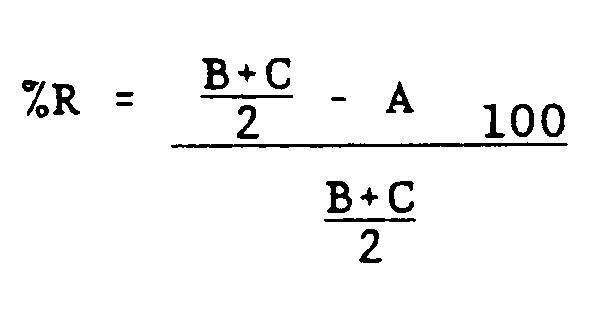
where A is the count per milliliter for the flask containing the treated substrate; B is zero contact time count per milliliter for the flask used to determine "A" before the addition of the treated substrate and C is zero contact time count per milliliter for the untreated control substrate. - The microbiological efficacy of the TMS treated silica compositions of the present invention was determined as outlined above. The antimicrobial activity was evaluated by shaking samples in Klebsiella pneumoniae suspension for a one hour contact time. The suspension was serially diluted both before and after contact and cultured. The number of viable organisms in the suspensions was determined. The percent reduction based on the original count was also determined. The results of the antimicrobial activity dynamic surface testing indicated that the compositions are antimicrobially active in their nature and function and the microorganisms were substantially reduced in number. The results are shown in Table 3.
TABLE III Sample Percent Reduction Untreated 0 1 part silica 0.1 part TMS 100 1 part silica 0.25 parts TMS 100 1 part silica 0.5 parts TMS 100 1 part silica 1.0 parts TMS 100 - In order to demonstrate the biological efficacy of the antifoam emulsions, a separate test was conducted in order to confirm their activity, in addition to and in contrast to the foregoing test on the TMS treated silica which is a constituent of the antifoam emulsion. In the antifoam emulsion test, silica with saturation coverage of TMS was used at a level of 0.5% by weight based on the total antifoam emulsion formulation. The emulsion was tested by a repeated insult antimicrobial test used to evaluate "in-can" storage preservation of the antifoam emulsion. The inoculum was a mixture of 24 hour shake cultures at 32°C. in nutrient broth of Pseudomonas aeruginosa, Pseudomonas fluorescens and Pseudomonas putida. These organisms were fresh isolates from field contaminated antifoams. They were identified by API 20E®, Analytical Products, Plainview, New York. The mixed culture was diluted in phosphate buffer to deliver a concentration of 10⁸/milliliter of organisms in fifty milliliter aliquots of test antifoams. These were shaken and incubated at 32°C. At the end of twenty-four hours, swab streaks of the samples were made on tryptic soy agar plates. These plates were incubated at 32°C. and read for growth at twenty-four and forty-eight hour intervals. The above inoculum preparation and insult protocols were repeated at three day intervals for three repetitions per sample and the results are shown in Table IV, indicating no growth on the treated antifoam.
TABLE IV SAMPLE INSULT A 1 2 3 Treated antifoam - - - Untreated antifoam + + + A:
- = no growth
+ = growth - While the foregoing is set forth as specific to TMS, it should be apparent that other derivative compositions exhibiting antimicrobial activity are effective for the purposes of the present invention including, for example, mixtures in methanol of 3-chloropropyltrimethoxysilane and 3-(trimethoxysilyl)-propyloctadecyldimethyl ammonium chloride.
- The particulate material of the antifoam composition of the present invention has been illustrated by means of silica, but it should be understood that other equivalent particulate materials may be used in accordance with the present invention. Thus, for example, there can be used in place of or in addition to silica, high surface area particulates such as crushed quartz, aluminum oxide, zirconium silicate, aluminum silicate, magnesium oxide, zinc oxide, talc, diatomaceous earth, iron oxide, calcium carbonate, clay, titania, zirconia, mica, ground glass, glass fiber, sand, carbon black, graphite, barium sulfate, zinc sulfate, wood flour, cork, fluorocarbon polymer powder, rice hulls and ground peanut shells. The term "silica" as used herein is intended to include, for example, silica such as fumed silica, precipitated silica and treated silica such as fumed silica and precipitated silica that has been reacted with an organohalosilane, a disiloxane or disilizane.
- While the antifoam compositions of the present invention are of general utility, there may be specifically mentioned by way of application their use in the petroleum and petrochemical industry such as in gas-oil separators, atmospheric and vacuum distillation units, thermal cracking operations, natural gas treatments, solvent extraction processes, lubricating oils and asphalt. In the chemical process industry, the antifoams find application in resin manufacture, synthetic rubber manufacture, vegetable oil processing starch manufacture, plastics manufacture and fermentation processes. In the textile industry there may be mentioned synthetic fiber manufacture, dyeing baths, sizing baths and latex backing. The food industry includes jams and jellies, cooking oils, dietetic soft drinks, instant coffee and winemaking. The antifoams are applicable in the manufacture of antibiotics and in the paper industry find utility in pulp manufacture, paper making and paper coating.
Claims (3)
- An antifoam composition for destabilizing foams produced by surfactants comprising a primary antifoam agent including a particulate material having a high surface area, a secondary antifoam agent for acting synergistically with the primary antifoam agent and an antimicrobial agent being fixed and adhered to the surface of the particulate material, the antimicrobial agent being an organosilane having the general formula selected from the group consisting of
 R is an alkyl radical of 1 to 4 carbon atoms or hydrogen;a has a value of 0, 1 or 2;R' is a methyl or ethyl radical;R'' is an alkylene group of 1 to 4 carbon atoms;R''', R'''' and Rv are each independently selected from a group consisting of alkyl radicals of 1 to 18 carbon atoms, -CH₂C₆H₅, -CH₂CH₂OH, -CH₂OH and -(CH₂)xNHC(O)Rvi, wherein x has a value of from 2 to 10 and Rvi is a perfluoroalkyl radical having from 1 to 12 carbon atoms;X is chloride, bromide, fluoride, iodide, acetate or tosylate,.
 - The antifoam of claim 1 including water as a carrier.
- A composition as claimed in claim 1 wherein the organosilane has the formula

Applications Claiming Priority (2)
| Application Number | Priority Date | Filing Date | Title |
|---|---|---|---|
| US22158188A | 1988-07-20 | 1988-07-20 | |
| US221581 | 1988-07-20 |
Publications (3)
| Publication Number | Publication Date |
|---|---|
| EP0351828A2 EP0351828A2 (en) | 1990-01-24 |
| EP0351828A3 EP0351828A3 (en) | 1990-06-06 |
| EP0351828B1 true EP0351828B1 (en) | 1994-01-19 |
Family
ID=22828392
Family Applications (1)
| Application Number | Title | Priority Date | Filing Date |
|---|---|---|---|
| EP89113266A Expired - Lifetime EP0351828B1 (en) | 1988-07-20 | 1989-07-19 | Antimicrobial antifoam compositions |
Country Status (4)
| Country | Link |
|---|---|
| EP (1) | EP0351828B1 (en) |
| JP (1) | JP2737112B2 (en) |
| CA (1) | CA1331333C (en) |
| DE (1) | DE68912439T2 (en) |
Cited By (4)
| Publication number | Priority date | Publication date | Assignee | Title |
|---|---|---|---|---|
| US6156808A (en) * | 1999-01-04 | 2000-12-05 | Halliburton Energy Services, Inc. | Defoaming compositions and methods |
| US6417142B1 (en) | 2001-10-02 | 2002-07-09 | Halliburton Energy Services, Inc. | Defoaming methods and compositions |
| US7273103B2 (en) | 2005-06-03 | 2007-09-25 | Halliburtoncenergy Services, Inc. | Cement compositions comprising environmentally compatible defoaming agents and methods of use |
| US7670423B2 (en) | 2005-06-03 | 2010-03-02 | Halliburton Energy Services, Inc. | Cement composition comprising environmentally compatible defoaming agents and methods of use |
Families Citing this family (16)
| Publication number | Priority date | Publication date | Assignee | Title |
|---|---|---|---|---|
| DE10134723A1 (en) * | 2001-07-17 | 2003-02-06 | Bode Chemie Gmbh & Co Kg | Disinfectant concentrates based on quaternary ammonium compounds and the use thereof for machine instrument disinfection |
| DE102004026938A1 (en) * | 2004-06-01 | 2005-12-22 | Bayer Cropscience Gmbh | Low-foam aqueous formulations for crop protection |
| US20080167390A1 (en) * | 2006-06-01 | 2008-07-10 | James Archer | Defoamer composition for suppressing oil-based and water-based foams |
| US20100135949A1 (en) * | 2008-12-01 | 2010-06-03 | Becton, Dickinson And Company | Antimicrobial compositions |
| MY154021A (en) * | 2008-12-22 | 2015-04-30 | Ranka Seema Ajay | Asphalt-mineral compositions |
| WO2012174405A1 (en) * | 2011-06-17 | 2012-12-20 | Kemira Oyj | Powder defoaming compositions and methods of reducing gas entrainment in fluids |
| US9352119B2 (en) | 2012-05-15 | 2016-05-31 | Becton, Dickinson And Company | Blood control IV catheter with antimicrobial properties |
| US9750928B2 (en) | 2013-02-13 | 2017-09-05 | Becton, Dickinson And Company | Blood control IV catheter with stationary septum activator |
| US9695323B2 (en) | 2013-02-13 | 2017-07-04 | Becton, Dickinson And Company | UV curable solventless antimicrobial compositions |
| US9789279B2 (en) | 2014-04-23 | 2017-10-17 | Becton, Dickinson And Company | Antimicrobial obturator for use with vascular access devices |
| US10376686B2 (en) | 2014-04-23 | 2019-08-13 | Becton, Dickinson And Company | Antimicrobial caps for medical connectors |
| US9675793B2 (en) | 2014-04-23 | 2017-06-13 | Becton, Dickinson And Company | Catheter tubing with extraluminal antimicrobial coating |
| US10232088B2 (en) | 2014-07-08 | 2019-03-19 | Becton, Dickinson And Company | Antimicrobial coating forming kink resistant feature on a vascular access device |
| US10493244B2 (en) | 2015-10-28 | 2019-12-03 | Becton, Dickinson And Company | Extension tubing strain relief |
| CN111974031A (en) * | 2020-09-07 | 2020-11-24 | 安徽銮威化工科技开发有限公司 | Anti-corrosion antibacterial defoaming agent and preparation method thereof |
| CN120618163B (en) * | 2025-08-12 | 2025-10-17 | 西安紫光环保科技有限公司 | A VOCs tail gas treatment method with high efficiency recovery |
Family Cites Families (4)
| Publication number | Priority date | Publication date | Assignee | Title |
|---|---|---|---|---|
| CA1010782A (en) * | 1973-02-20 | 1977-05-24 | Charles A. Roth | Articles exhibiting antimicrobial properties |
| JPS5748307A (en) * | 1980-09-05 | 1982-03-19 | Toray Silicone Co Ltd | Composition of defoaming agent |
| CA1210019A (en) * | 1982-03-24 | 1986-08-19 | Alan J. Isquith | Insoluble polymeric contact preservatives |
| CA1245400A (en) * | 1984-03-12 | 1988-11-22 | David R. Battice | Antimicrobially effective organic foams and methods for their preparation |
-
1989
- 1989-06-14 CA CA000602720A patent/CA1331333C/en not_active Expired - Fee Related
- 1989-07-19 EP EP89113266A patent/EP0351828B1/en not_active Expired - Lifetime
- 1989-07-19 DE DE68912439T patent/DE68912439T2/en not_active Expired - Fee Related
- 1989-07-20 JP JP1186229A patent/JP2737112B2/en not_active Expired - Lifetime
Cited By (5)
| Publication number | Priority date | Publication date | Assignee | Title |
|---|---|---|---|---|
| US6156808A (en) * | 1999-01-04 | 2000-12-05 | Halliburton Energy Services, Inc. | Defoaming compositions and methods |
| US6297202B1 (en) | 1999-01-04 | 2001-10-02 | Halliburton Energy Services, Inc. | Defoaming compositions and methods |
| US6417142B1 (en) | 2001-10-02 | 2002-07-09 | Halliburton Energy Services, Inc. | Defoaming methods and compositions |
| US7273103B2 (en) | 2005-06-03 | 2007-09-25 | Halliburtoncenergy Services, Inc. | Cement compositions comprising environmentally compatible defoaming agents and methods of use |
| US7670423B2 (en) | 2005-06-03 | 2010-03-02 | Halliburton Energy Services, Inc. | Cement composition comprising environmentally compatible defoaming agents and methods of use |
Also Published As
| Publication number | Publication date |
|---|---|
| JPH0299105A (en) | 1990-04-11 |
| JP2737112B2 (en) | 1998-04-08 |
| DE68912439D1 (en) | 1994-03-03 |
| CA1331333C (en) | 1994-08-09 |
| DE68912439T2 (en) | 1994-05-19 |
| EP0351828A3 (en) | 1990-06-06 |
| EP0351828A2 (en) | 1990-01-24 |
Similar Documents
| Publication | Publication Date | Title |
|---|---|---|
| US5073298A (en) | Antimicrobial antifoam compositions and methods | |
| US5169561A (en) | Antimicrobial antifoam compositions and methods | |
| CA1331333C (en) | Antimicrobial antifoam compositions and methods | |
| CA2021018C (en) | Antimicrobial rinse cycle additive | |
| AU624134B2 (en) | Synergistic antimicrobial compositions | |
| US4921701A (en) | Antimicrobial water soluble substrates | |
| CA2028163C (en) | Solid antimicrobial | |
| US5079004A (en) | Antimicrobial superabsorbent compositions and method | |
| US4985023A (en) | Antimicrobial superabsorbent articles | |
| US4865844A (en) | Method of treating tinea pedis and related dermatophytic infections | |
| US4259103A (en) | Method of reducing the number of microorganisms in a media and a method of preservation | |
| US4978471A (en) | Dispersible silicone wash and rinse cycle antifoam formulations | |
| US7732395B2 (en) | Water-stabilized antimicrobial organosilane products, compositions, and methods for using the same | |
| Speier et al. | Destruction of microorganisms by contact with solid surfaces | |
| WO2004105687A2 (en) | Antimicrobial quaternary ammonium organosilane coatings | |
| EP0378147A2 (en) | Skin treatment method | |
| US5061487A (en) | Antimicrobial superabsorbent compositions and methods | |
| US5169625A (en) | Antimicrobial water soluble substrates | |
| EP0155155B1 (en) | Antimicrobially effective organic foams and methods for their preparation | |
| US4898957A (en) | Organosilicon diamine antimicrobial compound |
Legal Events
| Date | Code | Title | Description |
|---|---|---|---|
| PUAI | Public reference made under article 153(3) epc to a published international application that has entered the european phase |
Free format text: ORIGINAL CODE: 0009012 |
|
| AK | Designated contracting states |
Kind code of ref document: A2 Designated state(s): DE FR GB |
|
| PUAL | Search report despatched |
Free format text: ORIGINAL CODE: 0009013 |
|
| AK | Designated contracting states |
Kind code of ref document: A3 Designated state(s): DE FR GB |
|
| 17P | Request for examination filed |
Effective date: 19900801 |
|
| 17Q | First examination report despatched |
Effective date: 19910103 |
|
| GRAA | (expected) grant |
Free format text: ORIGINAL CODE: 0009210 |
|
| AK | Designated contracting states |
Kind code of ref document: B1 Designated state(s): DE FR GB |
|
| REF | Corresponds to: |
Ref document number: 68912439 Country of ref document: DE Date of ref document: 19940303 |
|
| ET | Fr: translation filed | ||
| PLBE | No opposition filed within time limit |
Free format text: ORIGINAL CODE: 0009261 |
|
| STAA | Information on the status of an ep patent application or granted ep patent |
Free format text: STATUS: NO OPPOSITION FILED WITHIN TIME LIMIT |
|
| 26N | No opposition filed | ||
| PGFP | Annual fee paid to national office [announced via postgrant information from national office to epo] |
Ref country code: DE Payment date: 19970605 Year of fee payment: 9 |
|
| PGFP | Annual fee paid to national office [announced via postgrant information from national office to epo] |
Ref country code: FR Payment date: 19970609 Year of fee payment: 9 |
|
| PGFP | Annual fee paid to national office [announced via postgrant information from national office to epo] |
Ref country code: GB Payment date: 19970612 Year of fee payment: 9 |
|
| PG25 | Lapsed in a contracting state [announced via postgrant information from national office to epo] |
Ref country code: GB Free format text: LAPSE BECAUSE OF NON-PAYMENT OF DUE FEES Effective date: 19980719 |
|
| GBPC | Gb: european patent ceased through non-payment of renewal fee |
Effective date: 19980719 |
|
| PG25 | Lapsed in a contracting state [announced via postgrant information from national office to epo] |
Ref country code: FR Free format text: LAPSE BECAUSE OF NON-PAYMENT OF DUE FEES Effective date: 19990331 |
|
| PG25 | Lapsed in a contracting state [announced via postgrant information from national office to epo] |
Ref country code: DE Free format text: LAPSE BECAUSE OF NON-PAYMENT OF DUE FEES Effective date: 19990501 |
|
| REG | Reference to a national code |
Ref country code: FR Ref legal event code: ST |