EP0349072A1 - A device for fixing or transferring and fixing powder containing thermoplastic resin on to a receiving material - Google Patents
A device for fixing or transferring and fixing powder containing thermoplastic resin on to a receiving material Download PDFInfo
- Publication number
- EP0349072A1 EP0349072A1 EP89201664A EP89201664A EP0349072A1 EP 0349072 A1 EP0349072 A1 EP 0349072A1 EP 89201664 A EP89201664 A EP 89201664A EP 89201664 A EP89201664 A EP 89201664A EP 0349072 A1 EP0349072 A1 EP 0349072A1
- Authority
- EP
- European Patent Office
- Prior art keywords
- groups
- silicone rubber
- fixing
- outer covering
- bears
- Prior art date
- Legal status (The legal status is an assumption and is not a legal conclusion. Google has not performed a legal analysis and makes no representation as to the accuracy of the status listed.)
- Granted
Links
- 239000000843 powder Substances 0.000 title claims abstract description 36
- 239000000463 material Substances 0.000 title claims abstract description 23
- 229920005992 thermoplastic resin Polymers 0.000 title claims abstract description 9
- 229920002379 silicone rubber Polymers 0.000 claims abstract description 42
- 239000004945 silicone rubber Substances 0.000 claims abstract description 41
- 125000000391 vinyl group Chemical group [H]C([*])=C([H])[H] 0.000 claims abstract description 8
- 229910020485 SiO4/2 Inorganic materials 0.000 claims abstract description 6
- 229910020487 SiO3/2 Inorganic materials 0.000 claims abstract description 5
- 229920000642 polymer Polymers 0.000 claims abstract description 4
- 125000002496 methyl group Chemical group [H]C([H])([H])* 0.000 claims description 40
- 239000000203 mixture Substances 0.000 claims description 23
- 238000010438 heat treatment Methods 0.000 claims description 8
- 238000006243 chemical reaction Methods 0.000 claims description 2
- 239000007795 chemical reaction product Substances 0.000 abstract description 2
- 239000010410 layer Substances 0.000 description 14
- 229910020388 SiO1/2 Inorganic materials 0.000 description 13
- YMWUJEATGCHHMB-UHFFFAOYSA-N Dichloromethane Chemical compound ClCCl YMWUJEATGCHHMB-UHFFFAOYSA-N 0.000 description 12
- BASFCYQUMIYNBI-UHFFFAOYSA-N platinum Chemical compound [Pt] BASFCYQUMIYNBI-UHFFFAOYSA-N 0.000 description 12
- 229920001971 elastomer Polymers 0.000 description 11
- 239000005060 rubber Substances 0.000 description 11
- 239000003054 catalyst Substances 0.000 description 7
- 239000007788 liquid Substances 0.000 description 6
- 238000000034 method Methods 0.000 description 6
- 229910052697 platinum Inorganic materials 0.000 description 6
- WGTYBPLFGIVFAS-UHFFFAOYSA-M tetramethylammonium hydroxide Chemical compound [OH-].C[N+](C)(C)C WGTYBPLFGIVFAS-UHFFFAOYSA-M 0.000 description 6
- QYLFHLNFIHBCPR-UHFFFAOYSA-N 1-ethynylcyclohexan-1-ol Chemical compound C#CC1(O)CCCCC1 QYLFHLNFIHBCPR-UHFFFAOYSA-N 0.000 description 5
- 239000000654 additive Substances 0.000 description 5
- 230000008569 process Effects 0.000 description 5
- 239000011541 reaction mixture Substances 0.000 description 5
- XLYOFNOQVPJJNP-UHFFFAOYSA-N water Substances O XLYOFNOQVPJJNP-UHFFFAOYSA-N 0.000 description 5
- HMMGMWAXVFQUOA-UHFFFAOYSA-N octamethylcyclotetrasiloxane Chemical compound C[Si]1(C)O[Si](C)(C)O[Si](C)(C)O[Si](C)(C)O1 HMMGMWAXVFQUOA-UHFFFAOYSA-N 0.000 description 4
- 238000002360 preparation method Methods 0.000 description 4
- 239000000047 product Substances 0.000 description 4
- 239000000758 substrate Substances 0.000 description 4
- QAOWNCQODCNURD-UHFFFAOYSA-N Sulfuric acid Chemical compound OS(O)(=O)=O QAOWNCQODCNURD-UHFFFAOYSA-N 0.000 description 3
- 238000013019 agitation Methods 0.000 description 3
- 238000002156 mixing Methods 0.000 description 3
- 229920002545 silicone oil Polymers 0.000 description 3
- 239000001117 sulphuric acid Substances 0.000 description 3
- 235000011149 sulphuric acid Nutrition 0.000 description 3
- VTYYLEPIZMXCLO-UHFFFAOYSA-L Calcium carbonate Chemical compound [Ca+2].[O-]C([O-])=O VTYYLEPIZMXCLO-UHFFFAOYSA-L 0.000 description 2
- OKTJSMMVPCPJKN-UHFFFAOYSA-N Carbon Chemical compound [C] OKTJSMMVPCPJKN-UHFFFAOYSA-N 0.000 description 2
- VEXZGXHMUGYJMC-UHFFFAOYSA-N Hydrochloric acid Chemical compound Cl VEXZGXHMUGYJMC-UHFFFAOYSA-N 0.000 description 2
- UQSXHKLRYXJYBZ-UHFFFAOYSA-N Iron oxide Chemical compound [Fe]=O UQSXHKLRYXJYBZ-UHFFFAOYSA-N 0.000 description 2
- CSNNHWWHGAXBCP-UHFFFAOYSA-L Magnesium sulfate Chemical compound [Mg+2].[O-][S+2]([O-])([O-])[O-] CSNNHWWHGAXBCP-UHFFFAOYSA-L 0.000 description 2
- VYPSYNLAJGMNEJ-UHFFFAOYSA-N Silicium dioxide Chemical compound O=[Si]=O VYPSYNLAJGMNEJ-UHFFFAOYSA-N 0.000 description 2
- BOTDANWDWHJENH-UHFFFAOYSA-N Tetraethyl orthosilicate Chemical compound CCO[Si](OCC)(OCC)OCC BOTDANWDWHJENH-UHFFFAOYSA-N 0.000 description 2
- GWEVSGVZZGPLCZ-UHFFFAOYSA-N Titan oxide Chemical compound O=[Ti]=O GWEVSGVZZGPLCZ-UHFFFAOYSA-N 0.000 description 2
- 229910052799 carbon Inorganic materials 0.000 description 2
- 239000000945 filler Substances 0.000 description 2
- UQEAIHBTYFGYIE-UHFFFAOYSA-N hexamethyldisiloxane Chemical compound C[Si](C)(C)O[Si](C)(C)C UQEAIHBTYFGYIE-UHFFFAOYSA-N 0.000 description 2
- 229940073561 hexamethyldisiloxane Drugs 0.000 description 2
- 229910052739 hydrogen Inorganic materials 0.000 description 2
- 239000000126 substance Substances 0.000 description 2
- 125000003698 tetramethyl group Chemical group [H]C([H])([H])* 0.000 description 2
- 238000012546 transfer Methods 0.000 description 2
- BPMGYFSWCJZSBA-UHFFFAOYSA-N C[SiH](C)O[SiH3] Chemical compound C[SiH](C)O[SiH3] BPMGYFSWCJZSBA-UHFFFAOYSA-N 0.000 description 1
- 229910020447 SiO2/2 Inorganic materials 0.000 description 1
- 239000004809 Teflon Substances 0.000 description 1
- 229920006362 Teflon® Polymers 0.000 description 1
- 230000000996 additive effect Effects 0.000 description 1
- 125000000217 alkyl group Chemical group 0.000 description 1
- 125000004429 atom Chemical group 0.000 description 1
- FSIJKGMIQTVTNP-UHFFFAOYSA-N bis(ethenyl)-methyl-trimethylsilyloxysilane Chemical compound C[Si](C)(C)O[Si](C)(C=C)C=C FSIJKGMIQTVTNP-UHFFFAOYSA-N 0.000 description 1
- 229910000019 calcium carbonate Inorganic materials 0.000 description 1
- 239000007809 chemical reaction catalyst Substances 0.000 description 1
- QABCGOSYZHCPGN-UHFFFAOYSA-N chloro(dimethyl)silicon Chemical compound C[Si](C)Cl QABCGOSYZHCPGN-UHFFFAOYSA-N 0.000 description 1
- IJOOHPMOJXWVHK-UHFFFAOYSA-N chlorotrimethylsilane Chemical compound C[Si](C)(C)Cl IJOOHPMOJXWVHK-UHFFFAOYSA-N 0.000 description 1
- 239000011248 coating agent Substances 0.000 description 1
- 238000000576 coating method Methods 0.000 description 1
- 230000001609 comparable effect Effects 0.000 description 1
- 239000000470 constituent Substances 0.000 description 1
- 238000001816 cooling Methods 0.000 description 1
- 238000004132 cross linking Methods 0.000 description 1
- 238000011161 development Methods 0.000 description 1
- BUMGIEFFCMBQDG-UHFFFAOYSA-N dichlorosilicon Chemical compound Cl[Si]Cl BUMGIEFFCMBQDG-UHFFFAOYSA-N 0.000 description 1
- 230000005684 electric field Effects 0.000 description 1
- 239000004744 fabric Substances 0.000 description 1
- 239000008240 homogeneous mixture Substances 0.000 description 1
- 125000004435 hydrogen atom Chemical group [H]* 0.000 description 1
- 230000007062 hydrolysis Effects 0.000 description 1
- 238000006460 hydrolysis reaction Methods 0.000 description 1
- 230000003301 hydrolyzing effect Effects 0.000 description 1
- 239000003112 inhibitor Substances 0.000 description 1
- 229910052943 magnesium sulfate Inorganic materials 0.000 description 1
- 235000019341 magnesium sulphate Nutrition 0.000 description 1
- QSHDDOUJBYECFT-UHFFFAOYSA-N mercury Chemical compound [Hg] QSHDDOUJBYECFT-UHFFFAOYSA-N 0.000 description 1
- 229910052753 mercury Inorganic materials 0.000 description 1
- 230000007935 neutral effect Effects 0.000 description 1
- 230000000149 penetrating effect Effects 0.000 description 1
- 125000001997 phenyl group Chemical group [H]C1=C([H])C([H])=C(*)C([H])=C1[H] 0.000 description 1
- 229920000728 polyester Polymers 0.000 description 1
- 230000000379 polymerizing effect Effects 0.000 description 1
- 238000003825 pressing Methods 0.000 description 1
- 238000012545 processing Methods 0.000 description 1
- 239000002683 reaction inhibitor Substances 0.000 description 1
- 239000000377 silicon dioxide Substances 0.000 description 1
- 229920002050 silicone resin Polymers 0.000 description 1
- 239000002344 surface layer Substances 0.000 description 1
- 238000012360 testing method Methods 0.000 description 1
- 239000004408 titanium dioxide Substances 0.000 description 1
- 125000004950 trifluoroalkyl group Chemical group 0.000 description 1
- 238000005292 vacuum distillation Methods 0.000 description 1
- 238000005406 washing Methods 0.000 description 1
Classifications
-
- G—PHYSICS
- G03—PHOTOGRAPHY; CINEMATOGRAPHY; ANALOGOUS TECHNIQUES USING WAVES OTHER THAN OPTICAL WAVES; ELECTROGRAPHY; HOLOGRAPHY
- G03G—ELECTROGRAPHY; ELECTROPHOTOGRAPHY; MAGNETOGRAPHY
- G03G15/00—Apparatus for electrographic processes using a charge pattern
- G03G15/20—Apparatus for electrographic processes using a charge pattern for fixing, e.g. by using heat
- G03G15/2003—Apparatus for electrographic processes using a charge pattern for fixing, e.g. by using heat using heat
- G03G15/2014—Apparatus for electrographic processes using a charge pattern for fixing, e.g. by using heat using heat using contact heat
- G03G15/2053—Structural details of heat elements, e.g. structure of roller or belt, eddy current, induction heating
- G03G15/2057—Structural details of heat elements, e.g. structure of roller or belt, eddy current, induction heating relating to the chemical composition of the heat element and layers thereof
-
- C—CHEMISTRY; METALLURGY
- C08—ORGANIC MACROMOLECULAR COMPOUNDS; THEIR PREPARATION OR CHEMICAL WORKING-UP; COMPOSITIONS BASED THEREON
- C08L—COMPOSITIONS OF MACROMOLECULAR COMPOUNDS
- C08L83/00—Compositions of macromolecular compounds obtained by reactions forming in the main chain of the macromolecule a linkage containing silicon with or without sulfur, nitrogen, oxygen or carbon only; Compositions of derivatives of such polymers
- C08L83/04—Polysiloxanes
-
- E—FIXED CONSTRUCTIONS
- E02—HYDRAULIC ENGINEERING; FOUNDATIONS; SOIL SHIFTING
- E02F—DREDGING; SOIL-SHIFTING
- E02F9/00—Component parts of dredgers or soil-shifting machines, not restricted to one of the kinds covered by groups E02F3/00 - E02F7/00
- E02F9/20—Drives; Control devices
- E02F9/22—Hydraulic or pneumatic drives
- E02F9/2221—Control of flow rate; Load sensing arrangements
- E02F9/2225—Control of flow rate; Load sensing arrangements using pressure-compensating valves
-
- G—PHYSICS
- G03—PHOTOGRAPHY; CINEMATOGRAPHY; ANALOGOUS TECHNIQUES USING WAVES OTHER THAN OPTICAL WAVES; ELECTROGRAPHY; HOLOGRAPHY
- G03G—ELECTROGRAPHY; ELECTROPHOTOGRAPHY; MAGNETOGRAPHY
- G03G15/00—Apparatus for electrographic processes using a charge pattern
- G03G15/14—Apparatus for electrographic processes using a charge pattern for transferring a pattern to a second base
- G03G15/16—Apparatus for electrographic processes using a charge pattern for transferring a pattern to a second base of a toner pattern, e.g. a powder pattern, e.g. magnetic transfer
- G03G15/1665—Apparatus for electrographic processes using a charge pattern for transferring a pattern to a second base of a toner pattern, e.g. a powder pattern, e.g. magnetic transfer by introducing the second base in the nip formed by the recording member and at least one transfer member, e.g. in combination with bias or heat
- G03G15/167—Apparatus for electrographic processes using a charge pattern for transferring a pattern to a second base of a toner pattern, e.g. a powder pattern, e.g. magnetic transfer by introducing the second base in the nip formed by the recording member and at least one transfer member, e.g. in combination with bias or heat at least one of the recording member or the transfer member being rotatable during the transfer
- G03G15/1685—Structure, details of the transfer member, e.g. chemical composition
-
- C—CHEMISTRY; METALLURGY
- C08—ORGANIC MACROMOLECULAR COMPOUNDS; THEIR PREPARATION OR CHEMICAL WORKING-UP; COMPOSITIONS BASED THEREON
- C08G—MACROMOLECULAR COMPOUNDS OBTAINED OTHERWISE THAN BY REACTIONS ONLY INVOLVING UNSATURATED CARBON-TO-CARBON BONDS
- C08G77/00—Macromolecular compounds obtained by reactions forming a linkage containing silicon with or without sulfur, nitrogen, oxygen or carbon in the main chain of the macromolecule
- C08G77/04—Polysiloxanes
- C08G77/12—Polysiloxanes containing silicon bound to hydrogen
-
- C—CHEMISTRY; METALLURGY
- C08—ORGANIC MACROMOLECULAR COMPOUNDS; THEIR PREPARATION OR CHEMICAL WORKING-UP; COMPOSITIONS BASED THEREON
- C08G—MACROMOLECULAR COMPOUNDS OBTAINED OTHERWISE THAN BY REACTIONS ONLY INVOLVING UNSATURATED CARBON-TO-CARBON BONDS
- C08G77/00—Macromolecular compounds obtained by reactions forming a linkage containing silicon with or without sulfur, nitrogen, oxygen or carbon in the main chain of the macromolecule
- C08G77/04—Polysiloxanes
- C08G77/20—Polysiloxanes containing silicon bound to unsaturated aliphatic groups
-
- G—PHYSICS
- G03—PHOTOGRAPHY; CINEMATOGRAPHY; ANALOGOUS TECHNIQUES USING WAVES OTHER THAN OPTICAL WAVES; ELECTROGRAPHY; HOLOGRAPHY
- G03G—ELECTROGRAPHY; ELECTROPHOTOGRAPHY; MAGNETOGRAPHY
- G03G2215/00—Apparatus for electrophotographic processes
- G03G2215/20—Details of the fixing device or porcess
- G03G2215/2003—Structural features of the fixing device
- G03G2215/2048—Surface layer material
- G03G2215/2051—Silicone rubber
-
- G—PHYSICS
- G03—PHOTOGRAPHY; CINEMATOGRAPHY; ANALOGOUS TECHNIQUES USING WAVES OTHER THAN OPTICAL WAVES; ELECTROGRAPHY; HOLOGRAPHY
- G03G—ELECTROGRAPHY; ELECTROPHOTOGRAPHY; MAGNETOGRAPHY
- G03G2215/00—Apparatus for electrophotographic processes
- G03G2215/20—Details of the fixing device or porcess
- G03G2215/2003—Structural features of the fixing device
- G03G2215/2048—Surface layer material
- G03G2215/2054—Inorganic filler, e.g. silica powder
-
- Y—GENERAL TAGGING OF NEW TECHNOLOGICAL DEVELOPMENTS; GENERAL TAGGING OF CROSS-SECTIONAL TECHNOLOGIES SPANNING OVER SEVERAL SECTIONS OF THE IPC; TECHNICAL SUBJECTS COVERED BY FORMER USPC CROSS-REFERENCE ART COLLECTIONS [XRACs] AND DIGESTS
- Y10—TECHNICAL SUBJECTS COVERED BY FORMER USPC
- Y10S—TECHNICAL SUBJECTS COVERED BY FORMER USPC CROSS-REFERENCE ART COLLECTIONS [XRACs] AND DIGESTS
- Y10S428/00—Stock material or miscellaneous articles
- Y10S428/913—Material designed to be responsive to temperature, light, moisture
-
- Y—GENERAL TAGGING OF NEW TECHNOLOGICAL DEVELOPMENTS; GENERAL TAGGING OF CROSS-SECTIONAL TECHNOLOGIES SPANNING OVER SEVERAL SECTIONS OF THE IPC; TECHNICAL SUBJECTS COVERED BY FORMER USPC CROSS-REFERENCE ART COLLECTIONS [XRACs] AND DIGESTS
- Y10—TECHNICAL SUBJECTS COVERED BY FORMER USPC
- Y10T—TECHNICAL SUBJECTS COVERED BY FORMER US CLASSIFICATION
- Y10T428/00—Stock material or miscellaneous articles
- Y10T428/13—Hollow or container type article [e.g., tube, vase, etc.]
-
- Y—GENERAL TAGGING OF NEW TECHNOLOGICAL DEVELOPMENTS; GENERAL TAGGING OF CROSS-SECTIONAL TECHNOLOGIES SPANNING OVER SEVERAL SECTIONS OF THE IPC; TECHNICAL SUBJECTS COVERED BY FORMER USPC CROSS-REFERENCE ART COLLECTIONS [XRACs] AND DIGESTS
- Y10—TECHNICAL SUBJECTS COVERED BY FORMER USPC
- Y10T—TECHNICAL SUBJECTS COVERED BY FORMER US CLASSIFICATION
- Y10T428/00—Stock material or miscellaneous articles
- Y10T428/13—Hollow or container type article [e.g., tube, vase, etc.]
- Y10T428/131—Glass, ceramic, or sintered, fused, fired, or calcined metal oxide or metal carbide containing [e.g., porcelain, brick, cement, etc.]
- Y10T428/1317—Multilayer [continuous layer]
- Y10T428/1321—Polymer or resin containing [i.e., natural or synthetic]
Definitions
- the invention relates to a device for fixing or transferring and fixing a powder containing a thermoplastic resin on to a receiving material under the influence of pressure and heat, comprising cooperating fixing members which form a pressure zone in which the powder is pressed against the receiving material and heating means for heating at least one of the fixing members, at least that fixing member which in the pressure zone is in contact with the thermoplastic resin being provided with an outer covering of silicone rubber.
- a powder image is formed on a re-usable image registration medium, by means of toner powder containing thermoplastic resin, and this powder image is then transferred and fixed on a receiving material, such as ordinary paper.
- the transfer of the powder image to the receiving material can be effected by bringing the powder image bearing image registration medium into pressure contact with a fixing member, the surface of which consists of silicone rubber having a low affinity for the softened powder.
- the powder image transferred on the fixing member as a result of the pressure exerted is then transferred to the receiving material, again by pressure, the powder being softened by heating before and/or during passage through the pressure zone, so that it becomes so viscous that it forms a cohesive layer in response to the pressure exerted, such layer penetrating at least partially into the receiving material.
- the image is permanently bonded to the image receiving material.
- Heating of the powder image is effected by heating the fixing member, which functions as a temporary receiving support for the powder image, and possibly the receiving material itself.
- Image transfer processes of this kind are described, inter alia, in US Patents 3 554 836, 3 893 761 and UK Patent 1 279 687.
- Image-forming processes are also known in which the powder image is transferred from the image registration medium directly, e.g. in response to an electric field, to the receiving material and is then fixed by passing the receiving material through a pressure zone of two co-operating fixing members, that fixing member which presses against the image being provided with a layer of silicone rubber, and at least one of the fixing members being heated to soften the powder image. Since both fixing members may come into contact with the thermoplastic resin, e.g. when the image receiving material is printed on both sides, it is usual for both fixing members to be provided with an outer covering of silicone rubber.
- RTV or HTV silicone rubbers are used as outer covering for fixing members. They are obtained by cross-linking into an elastomeric composition polyorganosiloxane mixtures which bear reactive groups, under the influence of a suitable catalyst, at room temperature or at elevated temperature.
- the silicone rubber covering may also contain additives to improve its properties such as mechanical strength, thermal conductivity and antistatic behaviour.
- Typical additives are fillers such as silica, titanium dioxide, calcium carbonate, iron oxide, teflon and carbon.
- the amount of additive in the covering may be 60% by weight or even more and is often between 40 and 50% by weight.
- Typical rubber compositions for forming a covering for fixing members which can be used as a temporary support for a powder image are described in UK patent No. 1 279 687 and Example 1 of European patent application No. 146 980.
- the rubber coverings present on fixing members should have a wide working range, i.e. there should be a wide temperature range within which the softened toner powder does not stick to the silicone rubber covering on leaving the pressure zone in which the powder image is fixed on tie receiving material
- This working range must also be situated at a temperature level at which sufficient fixing of the toner powder on the receiving material is obtained in the pressure zone.
- the working range of the silicone rubber coverings gradually reduces during operation of the fixing devices, the top limit of the working range in particular falling. A situation is gradually reached in which there is no longer any practical working range and the fixing member has to be replaced.
- the development of ever-faster copying machines and the continual search for components having a longer life mean that there is continuous demand for improved covering materials for fixing members.
- the fixing members according to the invention provided with a silicone rubber covering are particulary suitable for use in image-forming processes in which a powder image is transferred to the fixing member by pressure and is then transferred to and fixed on a receiving material under pressure and heat.
- the fixing members according to the invention are distinguished from the prior art fixing members in that the top limit of the working range is at a significantly higher temperature and remains substantially constant for a long time (expressed as the number of copies). Thus a longer life is obtained for the fixing members.
- V-component contains on average less than 40 monomeric units a rather brittle covering is obtained, which has insufficient resilient properties and insufficient mechanical strength. If it contains on average more than 1000 monomeric units then a rubber composition is obtained which generally is very sticky.
- V-components not satisfying the demands by themselves can still be used by mixing them with another V-component, in such a manner that the mixture of in-components does satisfy upon the demands as defined before for the average.
- a V-component is used which contains on average two terminal vinyl groups per polymer chain.
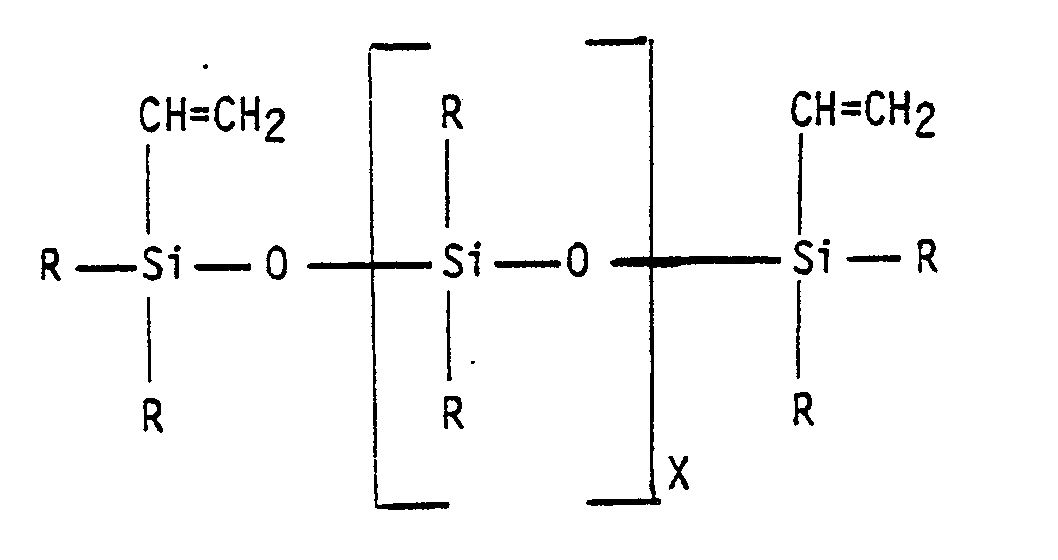
- V-components containing no SiO3/2 or SiO4/2 groups (respectively referred to as T and Q units hereinafter) and satisfying the general formula: where R denotes the organic radical (or radicals) conventional in polyorganosiloxanes, such as an alkyl, phenyl, or trifluoroalkyl group, more particularly a methyl group, and X is an integer between 100 and 450, more particularly between 250 and 350.
- Polyorganosilixanes according to the above general formula are linear products which can be prepared easily and reproducibly.
- the component bearing reactive Si-H groups (hereinafter referred to as the H-component) is selected from the H-components known for the RTV rubber preparation.
- an H-component is used which contains between 6000 and 11000 m.mol/kg reactive hydrogen groups.
- Linear H-components are very attractive because they can be obtained easily and reproducibly.
- R denotes the organic radical conventional in polyorganosiloxanes, as described hereinbefore, more particularly a methyl group
- the total m + n is between 5 and 40 while the ratio m:n is between 1.5 - 2.5 : 1.
- the silicone rubber covering is obtained by mixing the V-component with the H-component in the presence of a suitable reaction catalyst, such as a platinum catalyst known for this purpose, and applying the homogeneous mixture in the required layer thickness to a suitable support or substrate.
- the silicone rubber outer covering is preferably formed from a mixture of V and H components in which the Si-H groups are present in an excess of 40 to 60%. In other circumstances the excess of Si-H groups may even amount to 400%.
- the silicone rubber covering may consist completely of the silicone rubber described hereinbefore, but it can also contain the additives known for such coverings, e.g. fillers, silicone resins and antistatic substances, the total of such additives however being at most 20% by weight and preferably not more than 10% by weight.
- the covering liquid from which the layer is formed may contain a reaction inhibitor in order to bring to the required level the time during which the liquid can be processed.
- the thickness of the silicone rubber covering on the fixing members is preferably between 10 and 250 micrometers.
- the silicone rubber covering is preferably applied on a rubber substrate which may also consists of silicone rubber and may have a thickness ranging from a few hundred micrometers to some millimeters.
- the choice of the rubber composition for the substrate is not critical. Of course a rubber composition should be selected in which the top layer adheres rigidly and which is also strong enough to withstand the pressure applied.
- Suitable substrates are, for example, silicone rubbers as described in the patents referred to hereinbefore.
- the silicone rubbers used according to the invention as outer covering for fixing members acting as a temporary receiving support for a powder image may have a hardness of between 20 and 30° Shore A. They therefore are much softer than the silicone rubbers previously used in practice for this purpose and which have a hardness of between 40 and 55° Shore A.
- the fixing members according to the invention provided that the surface layer is not too thick ( ⁇ 500 micrometers) - have a good mechanical strength, comparable to that of the fixing members used heretofore.
- a fabric belt woven from polyester yarn was provided with an approximately 500 micrometer thick layer of silicone rubber of type RTV 200/201 made by Messrs Possehl, West Germany.
- An approximately 70 micrometre thick silicone rubber layer was applied over this rubber layer by coating with a liquid of the following composition: 10 g of the V-component described hereinafter 1.9 g of the H-component described hereinafter 5 ppm of a conventional platinum catalyst 40 ppm of 1-ethynyl-1-cyclohexanol (inhibitor)
- the resulting layer was hardened by holding the belt at a temperature of about 120°C for about 20 hours.
- the resulting fixing member was used in a copying machine of the Océ 1950 type, in which a powder image was formed on a photoconductive image registration element, the powder image was transferred to the rubber surface of the heated fixing member by pressure, and the softened image was finally transferred to a sheet of paper pressed against the fixing member in a pressure zone.
- the working range of the fixing member was 103-142°C. After 300 000 copies (A4 size) the working range was still unchanged.
- the working range was 101-128°C, while after 100 000 copies that working range had dropped to 101-112°C.
- reaction mixture was agitated for another hour and a half at a temperature between 10°C and 20°C and then poured into a mixture of 2000 ml of water and 2000 ml of methylene chloride.
- the methylene chloride phase was separated and washed with water until the washing water was neutral.
- the amount of reactive Si-H groups in the resulting product was 9500 m.mol/kg.
- reaction mixture was agitated at ⁇ 85°C until there was no further increase in viscosity. This situation was obtained after about 11 ⁇ 2 hours.
- the reaction mixture was then held at 150°C for one hour with agitation and then heated to 170°C. It was then distilled in vacuo until all the volatile constituents had been eliminated from the reaction mixture. The residue was then filtered.
- a fixing member was made in the manner described in Example 1, the silicone rubber outer covering being formed by means of a liquid of the following composition: 100 g of V-component in accordance with Example 1 1.6 g of H-component of the formula [SiO4/2]10-[SiO1/2(CH3)2H]24 5 ppm of platinum catalyst 40 ppm of 1-ethynyl-1-cyclohexanol 5 g of carbon
- the outer covering had a thickness of 120 micrometres.
- the working range of the fixing member in an Océ 1950 copying machine was 102 to 135°C. After 250 000 copies (A4 size) the working range was 103 - 134°C.
- the H-component used was prepared by adding 36.3 ml concentrated hydrochloric acid dropwise at a temperature of between 5 and 30°C to a solution of 51.3g of tetraethoxy-silane and 50 g of dimethyl chlorohydrosilane in 250 ml of methylene chloride. The reaction mixture was then agitated for 3 hours at the same temperature and then poured in water. The remaining processing was as described in Example 1.
- the H-component contained 10400 m.mol/kg reactive Si-H groups.
- the V-component was prepared in the manner as described in Example 1, starting however from 532 g of octamethyl cyclotetrasiloxane, 2.1 g of tetravinyl dimethyl disiloxane and 0.1 g of tetramethyl ammonium hydroxide.
- the resulting fixing member had a working range of 104 to 139°C and 104 138°C after 300 000 copies.
- Both H-components were prepared in the manner described in Example 1, the first H-component being based on 871.5 g of tetramethyl tetrahydro-cyclotetrasiloxane, 444.6 g of octamethyl cyclotetrasiloxane, 81.1 g of hexamethyl disiloxane and 65.1 g of concentrated sulphuric acid.
- This H-component contained 10400 m.mol/kg reactive Si-H groups.
- This H-component contained 6900 m.mol/kg reactive Si-H groups.
- the fixing member receiving the powder image from the photoconductive image registration element was made as described in Example 1.
- the second fixing member, pressing against the rearside of the image receiving material in the pressure zone where the powder image is transferred to and fixed on to the image receiving material was constructed as a belt, of which the support and the first rubber layer were composed as described in Example 1.
Landscapes
- Physics & Mathematics (AREA)
- General Physics & Mathematics (AREA)
- Chemical & Material Sciences (AREA)
- Engineering & Computer Science (AREA)
- Health & Medical Sciences (AREA)
- Medicinal Chemistry (AREA)
- Structural Engineering (AREA)
- Civil Engineering (AREA)
- Mining & Mineral Resources (AREA)
- Fluid Mechanics (AREA)
- Chemical Kinetics & Catalysis (AREA)
- General Engineering & Computer Science (AREA)
- Polymers & Plastics (AREA)
- Organic Chemistry (AREA)
- Fixing For Electrophotography (AREA)
- Compositions Of Macromolecular Compounds (AREA)
- Laminated Bodies (AREA)
- Developing Agents For Electrophotography (AREA)
- Processes Of Treating Macromolecular Substances (AREA)
Abstract
Description
- The invention relates to a device for fixing or transferring and fixing a powder containing a thermoplastic resin on to a receiving material under the influence of pressure and heat, comprising cooperating fixing members which form a pressure zone in which the powder is pressed against the receiving material and heating means for heating at least one of the fixing members, at least that fixing member which in the pressure zone is in contact with the thermoplastic resin being provided with an outer covering of silicone rubber.
- In many modern reproduction and printing techniques, e.g. electrophotography, electrostatography and magnetography, a powder image is formed on a re-usable image registration medium, by means of toner powder containing thermoplastic resin, and this powder image is then transferred and fixed on a receiving material, such as ordinary paper. The transfer of the powder image to the receiving material can be effected by bringing the powder image bearing image registration medium into pressure contact with a fixing member, the surface of which consists of silicone rubber having a low affinity for the softened powder. The powder image transferred on the fixing member as a result of the pressure exerted is then transferred to the receiving material, again by pressure, the powder being softened by heating before and/or during passage through the pressure zone, so that it becomes so viscous that it forms a cohesive layer in response to the pressure exerted, such layer penetrating at least partially into the receiving material. After cooling, the image is permanently bonded to the image receiving material. Heating of the powder image is effected by heating the fixing member, which functions as a temporary receiving support for the powder image, and possibly the receiving material itself. Image transfer processes of this kind are described, inter alia, in US Patents 3 554 836, 3 893 761 and UK Patent 1 279 687. Image-forming processes are also known in which the powder image is transferred from the image registration medium directly, e.g. in response to an electric field, to the receiving material and is then fixed by passing the receiving material through a pressure zone of two co-operating fixing members, that fixing member which presses against the image being provided with a layer of silicone rubber, and at least one of the fixing members being heated to soften the powder image. Since both fixing members may come into contact with the thermoplastic resin, e.g. when the image receiving material is printed on both sides, it is usual for both fixing members to be provided with an outer covering of silicone rubber.
- RTV or HTV silicone rubbers are used as outer covering for fixing members. They are obtained by cross-linking into an elastomeric composition polyorganosiloxane mixtures which bear reactive groups, under the influence of a suitable catalyst, at room temperature or at elevated temperature. The silicone rubber covering may also contain additives to improve its properties such as mechanical strength, thermal conductivity and antistatic behaviour. Typical additives are fillers such as silica, titanium dioxide, calcium carbonate, iron oxide, teflon and carbon. The amount of additive in the covering may be 60% by weight or even more and is often between 40 and 50% by weight. Typical rubber compositions for forming a covering for fixing members which can be used as a temporary support for a powder image are described in UK patent No. 1 279 687 and Example 1 of European patent application No. 146 980.
- In addition to good mechanical strength required for long life, the rubber coverings present on fixing members should have a wide working range, i.e. there should be a wide temperature range within which the softened toner powder does not stick to the silicone rubber covering on leaving the pressure zone in which the powder image is fixed on tie receiving material This working range must also be situated at a temperature level at which sufficient fixing of the toner powder on the receiving material is obtained in the pressure zone. The working range of the silicone rubber coverings gradually reduces during operation of the fixing devices, the top limit of the working range in particular falling. A situation is gradually reached in which there is no longer any practical working range and the fixing member has to be replaced. The development of ever-faster copying machines and the continual search for components having a longer life mean that there is continuous demand for improved covering materials for fixing members.
- Although it has been possible considerably to lengthen the life of the silicone rubber covering by continuously providing the covering with a thin layer of silicone oil at the fixing device in use, the disadvantage of this solution is that silicone oil is transferred to the receiving material so that its writability deteriorates. In imageforming processes in which a powder image is transferred by pressure from an image registration element to the silicone rubber covering of a fixing member, the application of silicone oil cannot be carried out because then the image registration element would be soiled by the oil and would become unsuitable for further use.
- According to the invention, a fixing device according to the introduction is provided, which is characterised in that the outer covering of the fixing member consists mainly of silicone rubber obtained by reaction of polyorganosiloxane bearing Si-H groups with polyorganosiloxane which bears Si-(CH=CH₂) groups and which contains on average between 40 and 1000 monomeric units per polymer chain, bears 1.5-4 terminal vinyl groups, bears at most one non-terminal vinyl group per 80 monomeric units and contains at most 2% Si atoms in the form of SiO3/2 or SiO4/2 units. The fixing members according to the invention provided with a silicone rubber covering are particulary suitable for use in image-forming processes in which a powder image is transferred to the fixing member by pressure and is then transferred to and fixed on a receiving material under pressure and heat. The fixing members according to the invention are distinguished from the prior art fixing members in that the top limit of the working range is at a significantly higher temperature and remains substantially constant for a long time (expressed as the number of copies). Thus a longer life is obtained for the fixing members. The silicone rubber used according to the invention is an addition-hardening RTV rubber derived from polyorganosiloxane bearing Si-(CH=CH₂) groups (hereinafter referred to as the V-component), and having the above-defined characteristics. If the V-component contains on average less than 40 monomeric units a rather brittle covering is obtained, which has insufficient resilient properties and insufficient mechanical strength. If it contains on average more than 1000 monomeric units then a rubber composition is obtained which generally is very sticky. V-components not satisfying the demands by themselves, can still be used by mixing them with another V-component, in such a manner that the mixture of in-components does satisfy upon the demands as defined before for the average. Preferably, a V-component is used which contains on average two terminal vinyl groups per polymer chain.
- Very suitable according to the invention are V-components containing no SiO3/2 or SiO4/2 groups (respectively referred to as T and Q units hereinafter) and satisfying the general formula:
- Polyorganosilixanes according to the above general formula are linear products which can be prepared easily and reproducibly.
- The component bearing reactive Si-H groups (hereinafter referred to as the H-component) is selected from the H-components known for the RTV rubber preparation. Preferably, an H-component is used which contains between 6000 and 11000 m.mol/kg reactive hydrogen groups.
- Linear H-components, more particularly those in accordance with the following general formula, are very attractive because they can be obtained easily and reproducibly.

- In this formula, R denotes the organic radical conventional in polyorganosiloxanes, as described hereinbefore, more particularly a methyl group, and the total m + n is between 5 and 40 while the ratio m:n is between 1.5 - 2.5 : 1.
The silicone rubber covering is obtained by mixing the V-component with the H-component in the presence of a suitable reaction catalyst, such as a platinum catalyst known for this purpose, and applying the homogeneous mixture in the required layer thickness to a suitable support or substrate. The ratio between the in and H components is so selected that there is an excess of reactive Si-H groups with respect to Si-(CH=CH₂)-groups. Upon using the fixing member in image forming proccesses in which the fixing member itself acts as a temporary receiving support for a powder image, the silicone rubber outer covering is preferably formed from a mixture of V and H components in which the Si-H groups are present in an excess of 40 to 60%. In other circumstances the excess of Si-H groups may even amount to 400%. - In the fixing members according to the invention, the silicone rubber covering may consist completely of the silicone rubber described hereinbefore, but it can also contain the additives known for such coverings, e.g. fillers, silicone resins and antistatic substances, the total of such additives however being at most 20% by weight and preferably not more than 10% by weight. Also, the covering liquid from which the layer is formed may contain a reaction inhibitor in order to bring to the required level the time during which the liquid can be processed.
- According to the invention, the thickness of the silicone rubber covering on the fixing members is preferably between 10 and 250 micrometers. When the fixing member is used in image-forming processes, as described in the introduction, in which the fixing member operates as a temporary support for the powder image, the silicone rubber covering is preferably applied on a rubber substrate which may also consists of silicone rubber and may have a thickness ranging from a few hundred micrometers to some millimeters. The choice of the rubber composition for the substrate is not critical. Of course a rubber composition should be selected in which the top layer adheres rigidly and which is also strong enough to withstand the pressure applied. Suitable substrates are, for example, silicone rubbers as described in the patents referred to hereinbefore.
- The silicone rubbers used according to the invention as outer covering for fixing members acting as a temporary receiving support for a powder image may have a hardness of between 20 and 30° Shore A. They therefore are much softer than the silicone rubbers previously used in practice for this purpose and which have a hardness of between 40 and 55° Shore A. Despite the smaller hardness, the fixing members according to the invention - provided that the surface layer is not too thick (<500 micrometers) - have a good mechanical strength, comparable to that of the fixing members used heretofore.
- The invention will now be explained in detail with reference to some examples.
- A fabric belt woven from polyester yarn was provided with an approximately 500 micrometer thick layer of silicone rubber of type RTV 200/201 made by Messrs Possehl, West Germany. An approximately 70 micrometre thick silicone rubber layer was applied over this rubber layer by coating with a liquid of the following composition:
10 g of the V-component described hereinafter 1.9 g of the H-component described hereinafter 5 ppm of a conventional platinum catalyst 40 ppm of 1-ethynyl-1-cyclohexanol (inhibitor) - A mixture of:
810 g of tetramethyl tetrahydro-cyclotetrasiloxane 499.5 g of octamethyl cyclotetrasiloxane 64.5 g of hexamethyldisiloxane - After all the sulphuric acid had been added, the reaction mixture was agitated for another hour and a half at a temperature between 10°C and 20°C and then poured into a mixture of 2000 ml of water and 2000 ml of methylene chloride. The methylene chloride phase was separated and washed with water until the washing water was neutral.
- After being dried over magnesium sulphate for about 15 hours, the methylene chloride phase was filtered and subjected to vacuum distillation, the undesired fractions distilling over at 70° to 100°C and 14 mm mercury. The residue was an H-component having the average formula:
[(CH₃)₃SiO1/2]-[(CH₃)₂SiO2/2]₉.₅-[H(CH₃)SiO2/2]₁₉-[(CH₃)₃SiO1/2] - The amount of reactive Si-H groups in the resulting product was 9500 m.mol/kg.
- A mixture of:
532 g of octamethyl cyclotetrasiloxane and 5.1 g of divinyl tetramethyl-disiloxane - The reaction mixture was agitated at ± 85°C until there was no further increase in viscosity. This situation was obtained after about 1½ hours. The reaction mixture was then held at 150°C for one hour with agitation and then heated to 170°C. It was then distilled in vacuo until all the volatile constituents had been eliminated from the reaction mixture. The residue was then filtered.
- The resulting V-component had the average formula:
[(CH₃)₂(CH=CH₂)SiO1/2]-[(CH₃)₂SiO2/2]₁₈₀-[(CH₃)₂(CH=CH₂)SiO1/2]
- The quantity of Si-(CH=CH₂) groups in the product was 120 m.mol/kg.
- A fixing member was made in the manner described in Example 1, the silicone rubber outer covering being formed by means of a liquid of the following composition:
100 g of V-component in accordance with Example 1 1.6 g of H-component of the formula [SiO4/2]₁₀-[SiO1/2(CH₃)₂H]₂₄ 5 ppm of platinum catalyst 40 ppm of 1-ethynyl-1-cyclohexanol 5 g of carbon - The H-component used was prepared by adding 36.3 ml concentrated hydrochloric acid dropwise at a temperature of between 5 and 30°C to a solution of 51.3g of tetraethoxy-silane and 50 g of dimethyl chlorohydrosilane in 250 ml of methylene chloride. The reaction mixture was then agitated for 3 hours at the same temperature and then poured in water. The remaining processing was as described in Example 1. The H-component contained 10400 m.mol/kg reactive Si-H groups. Practically the same result as just described was obtained with a silicone rubber outer covering formed by means of the following composition:
79 g of V-component of the formula [(CH₃)₂(CH=CH₂)SiO1/2][(CH₃)₂SiO2/2]₈₀-[(CH₃)₂(CH=CH₂)SiO1/2] 21 g of V-component of the formula [(CH₃)₂(CH=CH₂)SiO1/2][(CH₃)₂SiO2/2]₁₃₀₀-[(CH₃)₂(CH=CH₂)SiO1/2] 6 g of H-component in accordance with Example 2 4 ppm of platinum catalyst 40 ppm of 1-ethynyl-1-cyclohexanol - A fixing member was made as described in Example 1, the silicone rubber outer covering having a layer thickness of 100 micrometres and being formed by means of a liquid of the following composition:
100 g of V-component of the formula [(CH=CH₂)₂-(CH₃)SiO1/2]-[(CH₃)₂SiO2/2]₅₄₀-[(CH=CH₂)₂(CH₃)SiO1/2] 1.35 g of H-component in accordance with Example 1 5 ppm of platinum catalyst 40 ppm of 1-ethynyl-1-cyclohexanol - If 1.61 g of H-component were used in the above composition, the resulting fixing member had a working range of 104 to 139°C and 104 138°C after 300 000 copies.
- If 100 g of V-component of the average formula
[(CH=CH₂)(CH₃)₂SiO1/2]₂-[(CH₃)₂SiO2/2]₂₀₀-[(CH₃)SiO3/2]0.5-[SiO4/2]₃
were used in the above composition, the working range of the fixing member was 103 to 136°C. The latter V-component was prepared starting with (CH=CH₂)(CH₃)SiCl, (CH₃)₂ SiCl₂, (CH₃)₃SiCl and (C₂H₅O)₄Si, by mixing these substances in the molar ratio indicated, hydrolizing with water, extracting the reaction products from the hydrolysis liquid and then polymerizing by addition of a small quantity of tetramethyl ammonium hydroxide. - Two fixing members were made in accordance with Example 1, the following being used respectively in the composition for forming the silicone rubber outer covering:
1.63 g of H-component of the formula [(CH₃)₃SiO1/2]-[(CH₃)HSiO2/2]₂₅-[(CH₃]₂SiO2/2]₁₀-[(CH₃)₃SiO1/2], and 2.52 g of H-component of the formula [(CH₃)₃SiO1/2]-[(CH₃)HSiO2/2]4.5-[(CH₃]₂SiO2/2]₃-[(CH₃)₃SiO1/2]. - For the preparation of the second H-component the same starting products were used, but now in the following quantities respectively: 510.3 g, 371.1 g, 486.6g and 63.6 g. This H-component contained 6900 m.mol/kg reactive Si-H groups.
- In a copying machine of the Océ 1950 type, the fixing member receiving the powder image from the photoconductive image registration element, was made as described in Example 1.
The second fixing member, pressing against the rearside of the image receiving material in the pressure zone where the powder image is transferred to and fixed on to the image receiving material was constructed as a belt, of which the support and the first rubber layer were composed as described in Example 1. The silicone rubber outer covering of this belt had a thickness of 150 micrometer and was made by means of the following composition:67 g of V-component of the average formula [(CH₃)₂(CH=CH₂)SiO1/2]-[(CH₃)₂SiO2/2]₈₀-[(CH₃)₂(CH=CH₂)SiO1/2] 23 g of V-component of the average formula [(CH₃)₂(CH=CH₂)SiO1/2]-[(CH₃)₂SiO2/2]₃₀₀-[(CH₃)₂(CH=CH₂)SiO1/2] 4.4 g of H-component of the average formula [(CH₃)₃SiO1/2]-[(CH₃)₂SiO2/2]9.4-[(CH₃)HSiO2/2]18.5-[(CH₃)₃SiO1/2] (Reactive Si-H groups: 9240 m.mol/kg) 5 ppm of platinum catalyst 40 ppm of 1-ethynyl-1-cyclohexanol
At the end of the test both fixing members still had a wide working range.
Claims (10)


Applications Claiming Priority (2)
| Application Number | Priority Date | Filing Date | Title |
|---|---|---|---|
| NL8801669A NL8801669A (en) | 1988-07-01 | 1988-07-01 | Device for fixing or transferring and fixing of thermoplastic resin containing powder on a receiving material. |
| NL8801669 | 1988-07-01 |
Publications (2)
| Publication Number | Publication Date |
|---|---|
| EP0349072A1 true EP0349072A1 (en) | 1990-01-03 |
| EP0349072B1 EP0349072B1 (en) | 1997-09-10 |
Family
ID=19852555
Family Applications (1)
| Application Number | Title | Priority Date | Filing Date |
|---|---|---|---|
| EP89201664A Expired - Lifetime EP0349072B1 (en) | 1988-07-01 | 1989-06-23 | A device for transferring and fixing electrophotographic toner powder containing thermoplastic resin on to a receiving material |
Country Status (7)
| Country | Link |
|---|---|
| US (1) | US4971844A (en) |
| EP (1) | EP0349072B1 (en) |
| JP (1) | JP2914678B2 (en) |
| AT (1) | ATE158093T1 (en) |
| AU (1) | AU618606B2 (en) |
| DE (1) | DE68928309T2 (en) |
| NL (1) | NL8801669A (en) |
Cited By (5)
| Publication number | Priority date | Publication date | Assignee | Title |
|---|---|---|---|---|
| EP0530502A1 (en) * | 1991-08-01 | 1993-03-10 | Canon Kabushiki Kaisha | Elastic body, elastic roller and fixing device |
| EP0510643A3 (en) * | 1991-04-24 | 1993-03-10 | Canon Kabushiki Kaisha | Charging member and device using the same |
| FR2717916A1 (en) * | 1994-03-25 | 1995-09-29 | Canon Kk | Rotating fixing element and fixing device. |
| EP1091263A3 (en) * | 1999-10-04 | 2002-03-20 | Xerox Corporation | Fuser belt |
| EP1632821A1 (en) | 2004-09-01 | 2006-03-08 | Océ-Technologies B.V. | Intermediate transfer member with a cleaning member |
Families Citing this family (7)
| Publication number | Priority date | Publication date | Assignee | Title |
|---|---|---|---|---|
| US5834584A (en) * | 1991-11-12 | 1998-11-10 | Sumitomo Rubber Industries Ltd. | Silicone rubber roller for electrophotography and method of producing the same |
| EP0542522B1 (en) * | 1991-11-12 | 1996-03-13 | Sumitomo Rubber Industries Limited | Silicone rubber roller for electrophotography |
| US5770267A (en) * | 1996-04-05 | 1998-06-23 | J. M. Huber Corporation | Method and apparatus for smoothing substrate surfaces |
| US5981131A (en) * | 1998-07-27 | 1999-11-09 | Mitsubishi Chemical America, Inc. | Electrostatic toner composition to enhance copy quality by rejection of ghosting and method of manufacturing same |
| US6902266B2 (en) * | 2001-08-06 | 2005-06-07 | Konica Corporation | Fixing belt, fixing roller, production method thereof, fixing apparatus and image fixing method utilizing the apparatus |
| EP1387224A3 (en) * | 2002-08-02 | 2011-11-16 | Eastman Kodak Company | Fuser member, apparatus and method for electrostatographic reproduction |
| JP5652611B2 (en) | 2011-03-02 | 2015-01-14 | 株式会社リコー | Fixing member, fixing device, and image forming apparatus |
Citations (2)
| Publication number | Priority date | Publication date | Assignee | Title |
|---|---|---|---|---|
| GB2081646A (en) * | 1980-07-18 | 1982-02-24 | Konishiroku Photo Ind | Intermediate transfer member for transferring toner image on a carrier |
| EP0062408A1 (en) * | 1981-03-05 | 1982-10-13 | Toray Silicone Company Limited | A curable organopolysiloxane composition for heat fixing rolls |
Family Cites Families (10)
| Publication number | Priority date | Publication date | Assignee | Title |
|---|---|---|---|---|
| US3554836A (en) * | 1968-07-19 | 1971-01-12 | Minnesota Mining & Mfg | Transfer process |
| US3893761A (en) * | 1972-11-02 | 1975-07-08 | Itek Corp | Electrophotographic toner transfer and fusing apparatus |
| GB2049717B (en) * | 1979-04-04 | 1983-08-03 | Gen Electric | Silicone composition |
| US4264181A (en) * | 1979-04-04 | 1981-04-28 | Xerox Corporation | Metal-filled nucleophilic addition cured elastomer fuser member |
| US4257699A (en) * | 1979-04-04 | 1981-03-24 | Xerox Corporation | Metal filled, multi-layered elastomer fuser member |
| US4272179A (en) * | 1979-04-04 | 1981-06-09 | Xerox Corporation | Metal-filled elastomer fuser member |
| JPS59209129A (en) * | 1983-05-12 | 1984-11-27 | Kinyoushiya:Kk | Fixing roll |
| NL8304098A (en) * | 1983-11-30 | 1985-06-17 | Oce Nederland Bv | METHOD FOR FORMING FIXED IMAGES |
| JPH0695259B2 (en) * | 1985-10-23 | 1994-11-24 | 富士通株式会社 | Transfer fixing device |
| JPH0673049B2 (en) * | 1986-08-11 | 1994-09-14 | 信越化学工業株式会社 | Fusing roll manufacturing method |
-
1988
- 1988-07-01 NL NL8801669A patent/NL8801669A/en not_active Application Discontinuation
-
1989
- 1989-06-13 AU AU36300/89A patent/AU618606B2/en not_active Expired
- 1989-06-23 AT AT89201664T patent/ATE158093T1/en not_active IP Right Cessation
- 1989-06-23 EP EP89201664A patent/EP0349072B1/en not_active Expired - Lifetime
- 1989-06-23 DE DE68928309T patent/DE68928309T2/en not_active Expired - Lifetime
- 1989-06-27 US US07/372,282 patent/US4971844A/en not_active Expired - Lifetime
- 1989-06-30 JP JP1169720A patent/JP2914678B2/en not_active Expired - Fee Related
Patent Citations (2)
| Publication number | Priority date | Publication date | Assignee | Title |
|---|---|---|---|---|
| GB2081646A (en) * | 1980-07-18 | 1982-02-24 | Konishiroku Photo Ind | Intermediate transfer member for transferring toner image on a carrier |
| EP0062408A1 (en) * | 1981-03-05 | 1982-10-13 | Toray Silicone Company Limited | A curable organopolysiloxane composition for heat fixing rolls |
Non-Patent Citations (4)
| Title |
|---|
| PATENT ABSTRACTS OF JAPAN, vol. 12, no. 132 (C-490)[2979], 22nd April 1988, page 94 C 490; & JP-A-62 252 457 (TOSHIBA SILICONE CO. LTD) 04-11-1987 * |
| PATENT ABSTRACTS OF JAPAN, vol. 12, no. 133 (P-693)[2980], 22nd April 1988, page 130 P 693; & JP-A-62 255 982 (FUJI XEROX CO. LTD) 07-11-1987 * |
| PATENT ABSTRACTS OF JAPAN, vol. 12, no. 139 (C-491)[2986], 27th April 1988, page 107 C 491; & JP-A-62 256 863 (TOSHIBA SILICONE CO. LTD) 09-11-1987 * |
| PATENT ABSTRACTS OF JAPAN, vol. 5, no. 175 (P-88)[847], 11th November 1981, page 13 P 88; & JP-A-56 102 880 (SHINETSU POLYMER K.K.) 17-08-1981 * |
Cited By (8)
| Publication number | Priority date | Publication date | Assignee | Title |
|---|---|---|---|---|
| EP0510643A3 (en) * | 1991-04-24 | 1993-03-10 | Canon Kabushiki Kaisha | Charging member and device using the same |
| US5270768A (en) * | 1991-04-24 | 1993-12-14 | Canon Kabushiki Kaisha | Charging member containing reduced titanium oxide and device using same |
| EP0530502A1 (en) * | 1991-08-01 | 1993-03-10 | Canon Kabushiki Kaisha | Elastic body, elastic roller and fixing device |
| US5327202A (en) * | 1991-08-01 | 1994-07-05 | Canon Kabushiki Kaisha | Elastic body of an addition reaction type silicone rubber elastic material used in elastic roller and fixing device |
| FR2717916A1 (en) * | 1994-03-25 | 1995-09-29 | Canon Kk | Rotating fixing element and fixing device. |
| EP0674245A3 (en) * | 1994-03-25 | 1998-11-25 | Canon Kabushiki Kaisha | Rotatable member for fixing and fixing device |
| EP1091263A3 (en) * | 1999-10-04 | 2002-03-20 | Xerox Corporation | Fuser belt |
| EP1632821A1 (en) | 2004-09-01 | 2006-03-08 | Océ-Technologies B.V. | Intermediate transfer member with a cleaning member |
Also Published As
| Publication number | Publication date |
|---|---|
| JPH0259781A (en) | 1990-02-28 |
| DE68928309D1 (en) | 1997-10-16 |
| US4971844A (en) | 1990-11-20 |
| AU3630089A (en) | 1990-01-04 |
| DE68928309T2 (en) | 1998-03-12 |
| AU618606B2 (en) | 1992-01-02 |
| ATE158093T1 (en) | 1997-09-15 |
| NL8801669A (en) | 1990-02-01 |
| EP0349072B1 (en) | 1997-09-10 |
| JP2914678B2 (en) | 1999-07-05 |
Similar Documents
| Publication | Publication Date | Title |
|---|---|---|
| US4763158A (en) | Boron nitride filled fuser rolls | |
| EP0640888B1 (en) | Stainproofing oil for a heat fixing roller | |
| EP0581365B1 (en) | Apparatus for transferring a toner image from an image-forming medium to a receiving material | |
| US5464703A (en) | Tin oxide filled dimethylsiloxane-fluoroalkylsiloxane fuser roll for fixing toner to a substrate | |
| EP0903645B1 (en) | Fuser member with polymer and zinc compound layer | |
| US5582917A (en) | Fluorocarbon-silicone coated articles useful as toner fusing members | |
| EP0349072B1 (en) | A device for transferring and fixing electrophotographic toner powder containing thermoplastic resin on to a receiving material | |
| US6515069B1 (en) | Polydimethylsiloxane and fluorosurfactant fusing release agent | |
| US6225409B1 (en) | Fluorosilicone interpenetrating network and methods of preparing same | |
| US7208258B2 (en) | Blended amino functional siloxane release agents for fuser members | |
| US6297302B1 (en) | Stabilized fluorosilicone materials | |
| US20060008727A1 (en) | Amino-functional siloxane copolymer release agents for fuser members | |
| JP2937622B2 (en) | Fixing roll | |
| US6312817B1 (en) | Fuser assembly with controlled polymeric release agent swell intermediate layer | |
| EP0798343A2 (en) | Silicone rubber composition for fluorocarbon resin-coated fixing rolls and fluorocarbon resin-coated fixing rolls | |
| JPH11194643A (en) | Roll for fixing low hardness silicone rubber | |
| US7186462B2 (en) | T-type amino functional release agent for fuser members | |
| JPH0216161A (en) | Polyorganosiloxane composition | |
| US6365279B1 (en) | Fusing member for hot pressure fixing of toner particles and for transfusing toner particles | |
| JP4369646B2 (en) | Conductive silicone rubber composition | |
| JPH11222558A (en) | Liquid addition-curable silicone rubber composition for fluorine-based resin-coated fixing roll and fluorine-based resin-coated fixing roll | |
| EP1014220A1 (en) | A fusing member for hot pressure fixing of toner particles and for transfusing toner particles | |
| JPH04283267A (en) | silicone rubber composition | |
| EP0761762A1 (en) | High resiliency fluorosilicone dispersion | |
| Webster et al. | Gervasi et al. |
Legal Events
| Date | Code | Title | Description |
|---|---|---|---|
| PUAI | Public reference made under article 153(3) epc to a published international application that has entered the european phase |
Free format text: ORIGINAL CODE: 0009012 |
|
| AK | Designated contracting states |
Kind code of ref document: A1 Designated state(s): AT CH DE FR GB IT LI NL SE |
|
| 17P | Request for examination filed |
Effective date: 19900618 |
|
| 17Q | First examination report despatched |
Effective date: 19920518 |
|
| GRAG | Despatch of communication of intention to grant |
Free format text: ORIGINAL CODE: EPIDOS AGRA |
|
| GRAH | Despatch of communication of intention to grant a patent |
Free format text: ORIGINAL CODE: EPIDOS IGRA |
|
| GRAH | Despatch of communication of intention to grant a patent |
Free format text: ORIGINAL CODE: EPIDOS IGRA |
|
| GRAA | (expected) grant |
Free format text: ORIGINAL CODE: 0009210 |
|
| AK | Designated contracting states |
Kind code of ref document: B1 Designated state(s): AT CH DE FR GB IT LI NL SE |
|
| REF | Corresponds to: |
Ref document number: 158093 Country of ref document: AT Date of ref document: 19970915 Kind code of ref document: T |
|
| REG | Reference to a national code |
Ref country code: CH Ref legal event code: EP |
|
| RAP2 | Party data changed (patent owner data changed or rights of a patent transferred) |
Owner name: OCE-TECHNOLOGIES B.V. |
|
| REG | Reference to a national code |
Ref country code: CH Ref legal event code: NV Representative=s name: RITSCHER & SEIFERT PATENTANWAELTE VSP |
|
| REF | Corresponds to: |
Ref document number: 68928309 Country of ref document: DE Date of ref document: 19971016 |
|
| NLT2 | Nl: modifications (of names), taken from the european patent patent bulletin |
Owner name: OCE-TECHNOLOGIES B.V. |
|
| ITF | It: translation for a ep patent filed | ||
| ET | Fr: translation filed | ||
| PLBE | No opposition filed within time limit |
Free format text: ORIGINAL CODE: 0009261 |
|
| STAA | Information on the status of an ep patent application or granted ep patent |
Free format text: STATUS: NO OPPOSITION FILED WITHIN TIME LIMIT |
|
| 26N | No opposition filed | ||
| REG | Reference to a national code |
Ref country code: GB Ref legal event code: IF02 |
|
| PGFP | Annual fee paid to national office [announced via postgrant information from national office to epo] |
Ref country code: SE Payment date: 20040521 Year of fee payment: 16 |
|
| PG25 | Lapsed in a contracting state [announced via postgrant information from national office to epo] |
Ref country code: IT Free format text: LAPSE BECAUSE OF NON-PAYMENT OF DUE FEES;WARNING: LAPSES OF ITALIAN PATENTS WITH EFFECTIVE DATE BEFORE 2007 MAY HAVE OCCURRED AT ANY TIME BEFORE 2007. THE CORRECT EFFECTIVE DATE MAY BE DIFFERENT FROM THE ONE RECORDED. Effective date: 20050623 |
|
| PG25 | Lapsed in a contracting state [announced via postgrant information from national office to epo] |
Ref country code: SE Free format text: LAPSE BECAUSE OF NON-PAYMENT OF DUE FEES Effective date: 20050624 |
|
| EUG | Se: european patent has lapsed | ||
| PGFP | Annual fee paid to national office [announced via postgrant information from national office to epo] |
Ref country code: NL Payment date: 20080620 Year of fee payment: 20 Ref country code: DE Payment date: 20080710 Year of fee payment: 20 Ref country code: CH Payment date: 20080717 Year of fee payment: 20 |
|
| PGFP | Annual fee paid to national office [announced via postgrant information from national office to epo] |
Ref country code: AT Payment date: 20080710 Year of fee payment: 20 |
|
| PGFP | Annual fee paid to national office [announced via postgrant information from national office to epo] |
Ref country code: GB Payment date: 20080722 Year of fee payment: 20 |
|
| REG | Reference to a national code |
Ref country code: CH Ref legal event code: PL |
|
| REG | Reference to a national code |
Ref country code: GB Ref legal event code: PE20 Expiry date: 20090622 |
|
| PG25 | Lapsed in a contracting state [announced via postgrant information from national office to epo] |
Ref country code: NL Free format text: LAPSE BECAUSE OF EXPIRATION OF PROTECTION Effective date: 20090623 |
|
| NLV7 | Nl: ceased due to reaching the maximum lifetime of a patent |
Effective date: 20090623 |
|
| PG25 | Lapsed in a contracting state [announced via postgrant information from national office to epo] |
Ref country code: GB Free format text: LAPSE BECAUSE OF EXPIRATION OF PROTECTION Effective date: 20090622 |
|
| PGFP | Annual fee paid to national office [announced via postgrant information from national office to epo] |
Ref country code: FR Payment date: 20080830 Year of fee payment: 20 |