EP0348800B1 - Process for preparation of modified methacrylic resin molding material - Google Patents
Process for preparation of modified methacrylic resin molding material Download PDFInfo
- Publication number
- EP0348800B1 EP0348800B1 EP89111228A EP89111228A EP0348800B1 EP 0348800 B1 EP0348800 B1 EP 0348800B1 EP 89111228 A EP89111228 A EP 89111228A EP 89111228 A EP89111228 A EP 89111228A EP 0348800 B1 EP0348800 B1 EP 0348800B1
- Authority
- EP
- European Patent Office
- Prior art keywords
- polymer
- molding material
- preparation
- resin molding
- methacrylic resin
- Prior art date
- Legal status (The legal status is an assumption and is not a legal conclusion. Google has not performed a legal analysis and makes no representation as to the accuracy of the status listed.)
- Revoked
Links
Images

Classifications
-
- C—CHEMISTRY; METALLURGY
- C08—ORGANIC MACROMOLECULAR COMPOUNDS; THEIR PREPARATION OR CHEMICAL WORKING-UP; COMPOSITIONS BASED THEREON
- C08J—WORKING-UP; GENERAL PROCESSES OF COMPOUNDING; AFTER-TREATMENT NOT COVERED BY SUBCLASSES C08B, C08C, C08F, C08G or C08H
- C08J3/00—Processes of treating or compounding macromolecular substances
- C08J3/005—Processes for mixing polymers
-
- B—PERFORMING OPERATIONS; TRANSPORTING
- B29—WORKING OF PLASTICS; WORKING OF SUBSTANCES IN A PLASTIC STATE IN GENERAL
- B29C—SHAPING OR JOINING OF PLASTICS; SHAPING OF MATERIAL IN A PLASTIC STATE, NOT OTHERWISE PROVIDED FOR; AFTER-TREATMENT OF THE SHAPED PRODUCTS, e.g. REPAIRING
- B29C48/00—Extrusion moulding, i.e. expressing the moulding material through a die or nozzle which imparts the desired form; Apparatus therefor
- B29C48/25—Component parts, details or accessories; Auxiliary operations
- B29C48/36—Means for plasticising or homogenising the moulding material or forcing it through the nozzle or die
- B29C48/50—Details of extruders
- B29C48/76—Venting, drying means; Degassing means
-
- C—CHEMISTRY; METALLURGY
- C08—ORGANIC MACROMOLECULAR COMPOUNDS; THEIR PREPARATION OR CHEMICAL WORKING-UP; COMPOSITIONS BASED THEREON
- C08F—MACROMOLECULAR COMPOUNDS OBTAINED BY REACTIONS ONLY INVOLVING CARBON-TO-CARBON UNSATURATED BONDS
- C08F6/00—Post-polymerisation treatments
- C08F6/06—Treatment of polymer solutions
- C08F6/10—Removal of volatile materials, e.g. solvents
-
- B—PERFORMING OPERATIONS; TRANSPORTING
- B29—WORKING OF PLASTICS; WORKING OF SUBSTANCES IN A PLASTIC STATE IN GENERAL
- B29C—SHAPING OR JOINING OF PLASTICS; SHAPING OF MATERIAL IN A PLASTIC STATE, NOT OTHERWISE PROVIDED FOR; AFTER-TREATMENT OF THE SHAPED PRODUCTS, e.g. REPAIRING
- B29C48/00—Extrusion moulding, i.e. expressing the moulding material through a die or nozzle which imparts the desired form; Apparatus therefor
- B29C48/03—Extrusion moulding, i.e. expressing the moulding material through a die or nozzle which imparts the desired form; Apparatus therefor characterised by the shape of the extruded material at extrusion
-
- B—PERFORMING OPERATIONS; TRANSPORTING
- B29—WORKING OF PLASTICS; WORKING OF SUBSTANCES IN A PLASTIC STATE IN GENERAL
- B29C—SHAPING OR JOINING OF PLASTICS; SHAPING OF MATERIAL IN A PLASTIC STATE, NOT OTHERWISE PROVIDED FOR; AFTER-TREATMENT OF THE SHAPED PRODUCTS, e.g. REPAIRING
- B29C48/00—Extrusion moulding, i.e. expressing the moulding material through a die or nozzle which imparts the desired form; Apparatus therefor
- B29C48/25—Component parts, details or accessories; Auxiliary operations
- B29C48/285—Feeding the extrusion material to the extruder
- B29C48/29—Feeding the extrusion material to the extruder in liquid form
-
- B—PERFORMING OPERATIONS; TRANSPORTING
- B29—WORKING OF PLASTICS; WORKING OF SUBSTANCES IN A PLASTIC STATE IN GENERAL
- B29K—INDEXING SCHEME ASSOCIATED WITH SUBCLASSES B29B, B29C OR B29D, RELATING TO MOULDING MATERIALS OR TO MATERIALS FOR MOULDS, REINFORCEMENTS, FILLERS OR PREFORMED PARTS, e.g. INSERTS
- B29K2105/00—Condition, form or state of moulded material or of the material to be shaped
- B29K2105/0005—Condition, form or state of moulded material or of the material to be shaped containing compounding ingredients
Definitions
- the present invention relates to a process for preparing a modified molding material by blending a methacrylic polymer Composition with a modifying polymer in an extruder.
- a process comprising blending a methacrylic polymer composition with a modifying polymer by a Henschel mixer, a tumbling mixer or the like and extruding the blend is generally known.
- This process has a problem in that, when a modifying polymer is blended into a methacrylic polymer composition containing a large quantity of a volatile component and the blend is extruded, the modifying polymer is deposited on the wall surface of an apparatus or bridging of polymer particles occurs in a hopper, and therefore, it is difficult to stably supply polymers at a constant rate.
- Japanese Unexamined Patent Publication No. 50-43166 proposes a vented extruder suitable for incorporating an additive such as an antioxidant or an ultraviolet absorber into a methacrylic resin flowing through the vented extruder.
- an additive-inlet is provided in a barrel between a final vent hole and an extrusion die.
- U.S. Patent 3,751,527 has proposed a process for removing a large part of water of a polymer latex and water-soluble contaminants. In this patent, however, the water and the water-soluble contaminants are removed from the polymer in the latex by expressing the liquid phase by a screw.
- U.S. patent 3,751,527 also proposes a blend of polymers, but in the process of this patent, the polymers to be blended are all supplied to an extruder as a latex or dispersion.
- the primary object of the present invention is to provide a process in which removal of a volatile component from a volatile component-containing methacrylic polymer composition and addition and kneading of a modifying polymer into this polymer composition can be performed at a high efficiency and industrially advantageously, and a high-quality methacrylic resin molding material having a reduced degree of coloration can be obtained without problems such as a deposition of the modifying polymer on the inner wall surface of an apparatus.
- a process for the preparation of a modified methacrylic resin molding material which comprises feeding a mixture of a methacrylic polymer and volatile components comprising at least one member selected from the group consisting of unreacted monomers, a solvent and by-products through a flash nozzle 3 into a volatile component-removing extruder 5, removing the volatile components from the methacrylic polymer, and adding a modifying polymer to the methacrylic polymer to prepare a polymer mixture, wherein the volatile component-removing extruder 5 comprises a plurality of vent zones 6,7,8 and a modifying polymer supply mechanism 19,20,22 arranged of a final vent zone 9, the majority of the volatile components is removed in the first vent zone (6), the modifying polymer is fed from the modifying polymer supplying mechanism 19,20,22 and incorporated into the methacrylate polymer continuously flowing in the volatile component-removing extruder 5, remaining volatile components are removed from the polymer mixture in the final vent zone 9 and the obtained modified molding
- Figure 1 is a schematic conceptual diagram illustrating an example of a volatile component-removing kneading extruder preferably used in the process of the present invention
- Fig. 2 is a sectional view illustrating a nozzle for supplying a methacrylic polymer composition
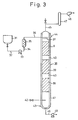
- Fig. 3 is a sectional view showing the dissolved oxygen-removing column used in Example 3.
- the content of the volatile component in the methacrylic polymer composition flowing in the volatile component-removing extruder is controlled below 5% by weight.
- the methacrylic polymer composition containing a volatile component composed of an unreacted monomer, a solvent and/or a by-product, which is supplied in the present invention is a composition comprising a homopolymer of an alkyl methacrylate, especially methyl methacrylate, or a copolymer of at least two alkyl methacrylates or a copolymer of an alkyl methacrylate with a vinyl compound such as an alkyl acrylate, styrene, butadiene or acrylonitrile and containing, in general 15 to 60% by weight of a volatile component as mentioned above.
- This composition is prepared by removing a part of a volatile component from a bulk polymerization product or solution polymerization product.
- modifying polymer to be added to the above-mentioned methacrylic resin composition there can be mentioned an impact-resistant modifying polymer and a thermal deformation-resistant modifying polymer, although the modifying polymer is not limited, to these polymers.
- the impact-resistant modifying polymer there can be mentioned a polymer obtained by graft-polymerizing a vinyl monomer to an acrylic rubber and a polymer obtained by graft-polymerizing a vinyl monomer to a homopolymer or copolymer of butadiene as a rubber source.
- a specific example of the acrylic rubber is a homopolymer or copolymer of an acrylic acid ester having a glass transition temperature not higher than 0°C.
- a multi-stage polymer obtained by graft-polymerizing at least one vinyl monomer to this acrylic rubber as a rubber source so that the glass transition temperature of the grafted portion is not lower than 50°C can be mentioned.
- the amount of the impact-resistant modifying polymer incorporated is 5 to 80% by weight based on the methacrylic polymer. If the amount of the impact-resistant modifying polymer is smaller than 5% by weight, in general, manifestation of the impact resistance is poor. If the amount of the impact-resistant modifying polymer incorporated exceeds 80% by weight, the thermal deformation resistance and rigidity are often reduced. More preferably, the impact-resistant modifying polymer is incorporated in an amount of 10 to 60% by weight.
- thermal deformation-resistant modifying polymer there can be mentioned a quadripolymer comprising methyl methacrylate as a main component and styrene, ⁇ -methylstyrene and maleic anhydride as comonomers; a terpolymer comprising methyl methacrylate as a main component and ⁇ -methylstyrene and cyclohexylmaleimide as comonomers; a methyl methacrylate/cyclohexylmaleimide copolymer; and a methyl methacrylate/N-phenylmaleimide copolymer.
- the amount of the thermal deformation-resistant modifying polymer incorporated is 10 to 85% by weight based on the methacrylic polymer. If the amount of the thermal deformation-resistant modifying polymer incorporated is smaller than 10% by weight, the thermal deformation resistance is improved only to a minor extent, and if the amount of the thermal deformation-resistant modifying polymer incorporated exceeds 85% by weight, the coloration and brittleness are increased. More preferably the thermal deformation-resistant modifying polymer is incorporated in an amount of 20 to 80% by weight.
- An additive such as an ultraviolet absorber, a release agent, a coloring dye or a pigment can be incorporated into the methacrylic resin composition to be modified by the process of the present invention, if necessary.
- FIG. 1 is a schematic conceptual diagram illustrating an example of a volatile component-removing kneading extruder suitably used in carrying out the process of the present invention.
- a methacrylic polymer composition containing a volatile component composed of an unreacted monomer, a solvent and/or a by-product is fed at a constant rate to a heater 2 by a metering pump 1 and is heated at 110 to 250°C under a pressure of 9.8 to 98 bar (10 to 100 kg/cm2).
- the heated methacrylic polymer composition is passed through a flash nozzle 3 having a needle valve or an orifice or fine-width slit and supplied into a first vent zone defined by a screw 4 and a barrel of a volatile component kneading extruder 5, where the volatile component is separated.
- Figure 2 is a sectional view showing a nozzle for supplying a methacrylic polymer composition, which has a needle valve 21.
- the polymer composition is passed through a narrow cylindrical space around the needle valve 21 and is extruded into a first vent zone defined by a barrel of an extruder 5′ and a screw 23 (a twin-screw extruder 5 having a screw 4 is shown in Fig. 1 but a single-screw extruder 5′ having a single screw 4′ is shown in Fig. 2).
- the first vent zone is maintained at a temperature of about 100 to about 250°C and a pressure of about 500 to about 1,066.6 hPa (800 Torr), and the majority of the volatile component composed of an unreacted monomer, a solvent and/or a by-product is removed in the first vent zone and is discharged through a vent hole of a discharge pipe 6.
- the discharged volatile component is substantially condensed in a condenser 10 and recovered in a receiver 16 while the uncondensed portion is sucked by a vacuum pump 13.
- the methacrylic polymer composition is fed into a second vent zone and a third vent zone where the majority of the residual volatile component is removed under conditions of a temperature of about 220 to about 280°C and a pressure lower than 933 hPa (700 Torr).
- the removed volatile component is introduced into discharge systems through vent hole-provided discharge pipes 7 and 8 of the second vent zone and third vent zone, respectively.
- the discharge systems have condensers 10 and 11, receivers 16 and 17, and pumps 13 and 14, respectively.
- the modifying polymer is fed to a polymer-supplying twin-screw feeder comprising a screw 19 and a barrel 20 from a supply opening 22, and then the modifying polymer is forcibly pushed at a constant rate into the twin-screw extruder 5 in which the methacrylic polymer composition is being travelled, whereby the modifying polymer is integrally kneaded with the methacrylic polymer composition.
- a fourth vent zone the residual volatile component is removed from the kneaded mixture.
- the removed volatile component is introduced through a discharge pipe 9 a into a discharge system comprising a condenser 12, a receiver 18 and a pump 15.
- the kneaded mixture which has passed through the fourth vent zone is extruded from an extrusion nozzle (not shown).
- the number of the vent zones in the volatile component-removing extruder is not limited to the number in the above-mentioned embodiment, but can be increased or decreased as occasion demands.
- the number of the vent zones is preferably 2 to 6.
- the supply mechanism for the modifying polymer must be disposed upstream of the final vent zone of the volatile component-removing extruder, but is preferably disposed down-stream of the vent zone adjacent to the final vent zone, i.e., at a position intermediate between the final vent zone and the vent zone located upstream of the final vent zone and closest to the final vent zone.
- the supply mechanism for the modifying polymer is disposed at this position, removal of the volatile component from the methacrylic polymer composition and kneading of the methacrylic polymer composition with the modifying polymer can be efficiently accomplished, and a high-quality methacrylic resin molding material having a reduced degree of coloration can be obtained without problems such as a deposition of the modifying polymer on the inner wall surface of the apparatus, reduction of the thermal deformation temperature, and formation of silver streaks at the injection molding.
- the content of the volatile component in the methacrylic polymer composition is controlled below 5% by weight.
- a polymer mixture comprising 60% by weight of a methyl methacrylate/methyl acrylate copolymer (the content of methyl acrylate was 4% by weight), 20% by weight of toluene and 20% by weight of unreacted monomers and impurities, which was prepared by the solution polymerization process, was heated at 180°C under an elevated pressure of 14.7 bar (15 kg/cm2) by using a heater and a metering pump, and the mixture was fed at a rate of 500 kg/h to the volatile component-removing extruder through a flash nozzle having an orifice having an inner diameter of 7.0 mm and a length of 20 mm.
- the first vent zone was maintained at a temperature of 220°C and a pressure of 866.6 hPa (650 Torr)
- the second vent zone was maintained at a temperature of 240°C and a pressure of 800 hPa (600 Torr)
- the third vent zone was maintained at a temperature of 250°C and a pressure of 40 hPa (30 Torr), whereby the residual volatile component was removed.
- a polymer obtained by graft-polymerizing a monomer mixture comprising methyl methacrylate as a main component to a butyl acrylate copolymer as a rubber source was fed at a rate of 150 kg/h from the side of the extruder by using a screw feeder and mixed with the polymer mixture in the extruder.
- the residual volatile component was removed again under conditions of a temperature of 270°C and a pressure of 40 hPa (30 Torr).
- the blend was extruded form the nozzle, cooled to 55°C, and cut to a length of 3 mm to form a pellet.
- the residual monomer content in the obtained pellet was lower than 0.2% by weight.
- the Izod impact strength (ASTM D-256) of the obtained pellet was as high as 29.4 N.cm/cm (3.0 kg ⁇ cm/cm), and this value was not substantially different from that of a commercially available preblend product.
- the coloration degree of the obtained resin composition was very good, and the YI value (JIS K-7105) of a plate (2 mm X 110 mm X 110 mm) molded at 250°C was 0.5. Deposition of the modifying polymer onto the inner wall surface of the apparatus was not observed.
- a polymer composition prepared by the bulk polymerization process using the dissolved oxygen-removed methyl methacrylate which comprised 60 parts by weight of a methyl methacrylate polymer, 40 parts by weight of a methyl methacrylate monomer, 0.3 part by weight of n-octylmercaptan, and 0.4 part by weight of impurities, was heated at 240°C while elevating the pressure to 37.3 bar (38 kg/cm2), and the polymer composition was fed at a rate of 150 kg/h to the volatile component-removing extruder through a pipe having an inner diameter of 5 mm.
- the first vent zone was maintained at 230°C and 933 hPa (700 Torr), the second vent zone was maintained at 240°C and 666 hPa (500 Torr), and the third vent zone was maintained at 240°C and 66.6 hPa (50 Torr).
- a polymer obtained by graft-polymerizing a monomer mixture comprising methyl methacrylate as a main component to a butyl acrylate copolymer as a rubber component (Acrypet IR supplied by Mitsubishi Rayon) was supplied at a rate of 360 kg/h from the modifying polymer supply mechanism and blended into the polymer composition in the extruder.
- the residual volatile component was removed in the fourth vent zone maintained at 270°C and 40 hPa (30 Torr), and the blend was extruded to form a pellet.
- the residual monomer content in the obtained pellet was lower than 0.1% by weight.
- the Izod impact strength (ASTM D-256) of the obtained pellet was as high as 68.7 N ⁇ cm/cm (7.0 kg ⁇ cm/cm).
- the YI value (JIS K-7105) of a plane plate obtained by injection molding at 250°C was as good as 0.9.
- a methyl methacrylate monomer containing dissolved oxygen is passed through a supply line 32 from a reservoir 31 and fed into a cooler 35 through a line 34 by a pump 33.
- the temperature of the methyl methacrylate monomer is controlled to a predetermined level in the cooler 35, and the methyl methacrylate monomer is passed through a line 36 and caused to flow down in a packed column 38 from distributing pipes 37 arranged in the upper portion of the column 38.
- the packed column 38 is provided with a jacket 41, and a cooling medium is introduced into the jacket 41 from an inlet 43, circulated in the jacket 41 and discharged from a discharge opening 44.
- a packed layer 39 divided into a plurality of portions, space portions 40 and an inert gas supply pipe 42 are arranged in the packed column 38.
- Dissolved oxygen contained in the methyl methacrylate monomer and the supplied inert gas are discharged to the outside through an exhaust pipe 45 arranged at the top of the packed column 38.
- a condenser 47 and a vacuum pump 48 are attached to the exhaust pipe 45.
- the methyl methacrylate monomer, from which dissolved oxygen has been removed, is continuously discharged from the bottom of the packed column 38 through a line 46 by a pump 49.
- a polymer composition prepared by the bulk polymerization process which comprised 60 parts by weight of a methyl methacrylate/methyl acrylate copolymer (the methyl acrylate content was 0.5% by weight), 40 parts by weight of a methyl methacrylate/methyl acrylate mixed monomer, 0.3 part by weight of n-octylmercaptan, and 0.4 part by weight of impurities, was heated at 180°C while elevating the pressure to 14.7 bar (15 kg/cm2), and the polymer composition was fed at a rate of 333 kg/h to the volatile component-removing extruder through five orifices having an inner diameter of 7 mm.
- the first vent zone was maintained at 220°C and 733 hPa (550 Torr), the second vent zone was maintained at 245°C and 666 hPa (500 Torr), and the third vent zone was maintained at 240°C and 66.6 hPa (50 Torr).
- a heat-resistant methyl methacrylate/ ⁇ -methylstyrene/styrene/maleic anhydride copolymer (Acrypet ST supplied by Mitsubishi Rayon) was fed at a rate of 200 kg/h from the modifying polymer supply mechanism and blended into the polymer composition in the extruder.
- the fourth vent zone the residual volatile component was removed under conditions of a temperature of 270°C and a pressure of 26.6 hPa (20 Torr), and the blend was extruded to form a pellet.
- the residual monomer content in the obtained pellet was lower than 0.2% by weight, the heat distortion temperature (ASTM D-648) of the pellet was 112°C, and the YI value (JIS K-7105) of a plane plate molded at 250°C was 0.9.
- a modified methacrylic resin molding material was prepared in the same manner as described in Example 1 except that the fourth vent zone was omitted from the apparatus used in Example 1.
- the residual monomer content in the obtained pellet was 0.7% by weight, and the Izod impact strength (ASTM D-256) of the pellet was 27.5 N ⁇ cm/cm (2.8 kg ⁇ cm/cm).
- the YI value (JIS K-7105) of a plane plate (2 mm x 110 mm x 110 mm) molded at 250°C was 2.5 and the plate had a yellow color, and defects such as silver streaks were found in the molded plate.
- the heat distortion temperature (ASTM D-648) of the molded article was as low as 85°C.
Landscapes
- Chemical & Material Sciences (AREA)
- Health & Medical Sciences (AREA)
- Chemical Kinetics & Catalysis (AREA)
- Medicinal Chemistry (AREA)
- Polymers & Plastics (AREA)
- Organic Chemistry (AREA)
- Engineering & Computer Science (AREA)
- Mechanical Engineering (AREA)
- Processing And Handling Of Plastics And Other Materials For Molding In General (AREA)
- Addition Polymer Or Copolymer, Post-Treatments, Or Chemical Modifications (AREA)
- Processes Of Treating Macromolecular Substances (AREA)
- Compositions Of Macromolecular Compounds (AREA)
- Extrusion Moulding Of Plastics Or The Like (AREA)
Description
- The present invention relates to a process for preparing a modified molding material by blending a methacrylic polymer Composition with a modifying polymer in an extruder.
- A process comprising blending a methacrylic polymer composition with a modifying polymer by a Henschel mixer, a tumbling mixer or the like and extruding the blend is generally known. This process however, has a problem in that, when a modifying polymer is blended into a methacrylic polymer composition containing a large quantity of a volatile component and the blend is extruded, the modifying polymer is deposited on the wall surface of an apparatus or bridging of polymer particles occurs in a hopper, and therefore, it is difficult to stably supply polymers at a constant rate.
- Japanese Unexamined Patent Publication No. 50-43166 proposes a vented extruder suitable for incorporating an additive such as an antioxidant or an ultraviolet absorber into a methacrylic resin flowing through the vented extruder. In this extruder, an additive-inlet is provided in a barrel between a final vent hole and an extrusion die.
- U.S. Patent 3,751,527 has proposed a process for removing a large part of water of a polymer latex and water-soluble contaminants. In this patent, however, the water and the water-soluble contaminants are removed from the polymer in the latex by expressing the liquid phase by a screw. U.S. patent 3,751,527 also proposes a blend of polymers, but in the process of this patent, the polymers to be blended are all supplied to an extruder as a latex or dispersion.
- The primary object of the present invention is to provide a process in which removal of a volatile component from a volatile component-containing methacrylic polymer composition and addition and kneading of a modifying polymer into this polymer composition can be performed at a high efficiency and industrially advantageously, and a high-quality methacrylic resin molding material having a reduced degree of coloration can be obtained without problems such as a deposition of the modifying polymer on the inner wall surface of an apparatus.
- In accordance with the present invention, there is provided a process for the preparation of a modified methacrylic resin molding material, which comprises feeding a mixture of a methacrylic polymer and volatile components comprising at least one member selected from the group consisting of unreacted monomers, a solvent and by-products through a
flash nozzle 3 into a volatile component-removingextruder 5, removing the volatile components from the methacrylic polymer, and adding a modifying polymer to the methacrylic polymer to prepare a polymer mixture,
wherein the volatile component-removingextruder 5 comprises a plurality ofvent zones polymer supply mechanism final vent zone 9,
the majority of the volatile components is removed in the first vent zone (6),
the modifying polymer is fed from the modifyingpolymer supplying mechanism extruder 5,
remaining volatile components are removed from the polymer mixture in thefinal vent zone 9 and the obtained modified molding material is then extruded from theextruder 5. - Figure 1 is a schematic conceptual diagram illustrating an example of a volatile component-removing kneading extruder preferably used in the process of the present invention; Fig. 2 is a sectional view illustrating a nozzle for supplying a methacrylic polymer composition; and Fig. 3 is a sectional view showing the dissolved oxygen-removing column used in Example 3.
- Preferably, at the step of incorporating the modifying polymer, the content of the volatile component in the methacrylic polymer composition flowing in the volatile component-removing extruder is controlled below 5% by weight.
- The methacrylic polymer composition containing a volatile component composed of an unreacted monomer, a solvent and/or a by-product, which is supplied in the present invention, is a composition comprising a homopolymer of an alkyl methacrylate, especially methyl methacrylate, or a copolymer of at least two alkyl methacrylates or a copolymer of an alkyl methacrylate with a vinyl compound such as an alkyl acrylate, styrene, butadiene or acrylonitrile and containing, in general 15 to 60% by weight of a volatile component as mentioned above. This composition is prepared by removing a part of a volatile component from a bulk polymerization product or solution polymerization product.
- As typical examples of the modifying polymer to be added to the above-mentioned methacrylic resin composition, there can be mentioned an impact-resistant modifying polymer and a thermal deformation-resistant modifying polymer, although the modifying polymer is not limited, to these polymers.
- As the impact-resistant modifying polymer, there can be mentioned a polymer obtained by graft-polymerizing a vinyl monomer to an acrylic rubber and a polymer obtained by graft-polymerizing a vinyl monomer to a homopolymer or copolymer of butadiene as a rubber source. A specific example of the acrylic rubber is a homopolymer or copolymer of an acrylic acid ester having a glass transition temperature not higher than 0°C. For example, a multi-stage polymer obtained by graft-polymerizing at least one vinyl monomer to this acrylic rubber as a rubber source so that the glass transition temperature of the grafted portion is not lower than 50°C, can be mentioned.
- Preferably, the amount of the impact-resistant modifying polymer incorporated is 5 to 80% by weight based on the methacrylic polymer. If the amount of the impact-resistant modifying polymer is smaller than 5% by weight, in general, manifestation of the impact resistance is poor. If the amount of the impact-resistant modifying polymer incorporated exceeds 80% by weight, the thermal deformation resistance and rigidity are often reduced. More preferably, the impact-resistant modifying polymer is incorporated in an amount of 10 to 60% by weight.
- As the thermal deformation-resistant modifying polymer, there can be mentioned a quadripolymer comprising methyl methacrylate as a main component and styrene, α-methylstyrene and maleic anhydride as comonomers; a terpolymer comprising methyl methacrylate as a main component and α-methylstyrene and cyclohexylmaleimide as comonomers; a methyl methacrylate/cyclohexylmaleimide copolymer; and a methyl methacrylate/N-phenylmaleimide copolymer.
- Preferably, the amount of the thermal deformation-resistant modifying polymer incorporated is 10 to 85% by weight based on the methacrylic polymer. If the amount of the thermal deformation-resistant modifying polymer incorporated is smaller than 10% by weight, the thermal deformation resistance is improved only to a minor extent, and if the amount of the thermal deformation-resistant modifying polymer incorporated exceeds 85% by weight, the coloration and brittleness are increased. More preferably the thermal deformation-resistant modifying polymer is incorporated in an amount of 20 to 80% by weight.
- An additive such as an ultraviolet absorber, a release agent, a coloring dye or a pigment can be incorporated into the methacrylic resin composition to be modified by the process of the present invention, if necessary.
- The process of the present invention will now be described in detail with reference to the accompanying drawings.
- Figure 1 is a schematic conceptual diagram illustrating an example of a volatile component-removing kneading extruder suitably used in carrying out the process of the present invention. Referring to Fig. 1, a methacrylic polymer composition containing a volatile component composed of an unreacted monomer, a solvent and/or a by-product is fed at a constant rate to a
heater 2 by ametering pump 1 and is heated at 110 to 250°C under a pressure of 9.8 to 98 bar (10 to 100 kg/cm²). The heated methacrylic polymer composition is passed through aflash nozzle 3 having a needle valve or an orifice or fine-width slit and supplied into a first vent zone defined by a screw 4 and a barrel of a volatilecomponent kneading extruder 5, where the volatile component is separated. - Figure 2 is a sectional view showing a nozzle for supplying a methacrylic polymer composition, which has a
needle valve 21. The polymer composition is passed through a narrow cylindrical space around theneedle valve 21 and is extruded into a first vent zone defined by a barrel of anextruder 5′ and a screw 23 (a twin-screw extruder 5 having a screw 4 is shown in Fig. 1 but a single-screw extruder 5′ having a single screw 4′ is shown in Fig. 2). - The first vent zone is maintained at a temperature of about 100 to about 250°C and a pressure of about 500 to about 1,066.6 hPa (800 Torr), and the majority of the volatile component composed of an unreacted monomer, a solvent and/or a by-product is removed in the first vent zone and is discharged through a vent hole of a discharge pipe 6. The discharged volatile component is substantially condensed in a
condenser 10 and recovered in areceiver 16 while the uncondensed portion is sucked by avacuum pump 13. - To further reduce the amount of the volatile component in the methacrylic polymer composition, the methacrylic polymer composition is fed into a second vent zone and a third vent zone where the majority of the residual volatile component is removed under conditions of a temperature of about 220 to about 280°C and a pressure lower than 933 hPa (700 Torr). The removed volatile component is introduced into discharge systems through vent hole-provided
discharge pipes condensers receivers pumps 13 and 14, respectively. - The modifying polymer is fed to a polymer-supplying twin-screw feeder comprising a
screw 19 and abarrel 20 from a supply opening 22, and then the modifying polymer is forcibly pushed at a constant rate into the twin-screw extruder 5 in which the methacrylic polymer composition is being travelled, whereby the modifying polymer is integrally kneaded with the methacrylic polymer composition. In a fourth vent zone, the residual volatile component is removed from the kneaded mixture. The removed volatile component is introduced through a discharge pipe 9 a into a discharge system comprising acondenser 12, areceiver 18 and apump 15. The kneaded mixture which has passed through the fourth vent zone is extruded from an extrusion nozzle (not shown). - The number of the vent zones in the volatile component-removing extruder is not limited to the number in the above-mentioned embodiment, but can be increased or decreased as occasion demands. The number of the vent zones is preferably 2 to 6. Nevertheless, the supply mechanism for the modifying polymer must be disposed upstream of the final vent zone of the volatile component-removing extruder, but is preferably disposed down-stream of the vent zone adjacent to the final vent zone, i.e., at a position intermediate between the final vent zone and the vent zone located upstream of the final vent zone and closest to the final vent zone.
- Where the supply mechanism for the modifying polymer is disposed at this position, removal of the volatile component from the methacrylic polymer composition and kneading of the methacrylic polymer composition with the modifying polymer can be efficiently accomplished, and a high-quality methacrylic resin molding material having a reduced degree of coloration can be obtained without problems such as a deposition of the modifying polymer on the inner wall surface of the apparatus, reduction of the thermal deformation temperature, and formation of silver streaks at the injection molding.
- Preferably, at the step of mixing the modifying polymer into the methacrylic polymer composition, the content of the volatile component in the methacrylic polymer composition is controlled below 5% by weight.
- The process of the present invention will now be described in detail with reference to the following examples.
- Removal of a volatile component form a methacrylic polymer and modification thereof were carried out by using the volatile component-removing extruder shown in Fig. 1.
- A polymer mixture comprising 60% by weight of a methyl methacrylate/methyl acrylate copolymer (the content of methyl acrylate was 4% by weight), 20% by weight of toluene and 20% by weight of unreacted monomers and impurities, which was prepared by the solution polymerization process, was heated at 180°C under an elevated pressure of 14.7 bar (15 kg/cm²) by using a heater and a metering pump, and the mixture was fed at a rate of 500 kg/h to the volatile component-removing extruder through a flash nozzle having an orifice having an inner diameter of 7.0 mm and a length of 20 mm. In the volatile component-removing extruder, the first vent zone was maintained at a temperature of 220°C and a pressure of 866.6 hPa (650 Torr), the second vent zone was maintained at a temperature of 240°C and a pressure of 800 hPa (600 Torr), and the third vent zone was maintained at a temperature of 250°C and a pressure of 40 hPa (30 Torr), whereby the residual volatile component was removed. Then a polymer obtained by graft-polymerizing a monomer mixture comprising methyl methacrylate as a main component to a butyl acrylate copolymer as a rubber source (Acrypet IR supplied by Mitsubishi Rayon) was fed at a rate of 150 kg/h from the side of the extruder by using a screw feeder and mixed with the polymer mixture in the extruder. In the fourth vent zone, the residual volatile component was removed again under conditions of a temperature of 270°C and a pressure of 40 hPa (30 Torr). The blend was extruded form the nozzle, cooled to 55°C, and cut to a length of 3 mm to form a pellet.
- The residual monomer content in the obtained pellet was lower than 0.2% by weight. The Izod impact strength (ASTM D-256) of the obtained pellet was as high as 29.4 N.cm/cm (3.0 kg·cm/cm), and this value was not substantially different from that of a commercially available preblend product. The coloration degree of the obtained resin composition was very good, and the YI value (JIS K-7105) of a plate (2 mm X 110 mm X 110 mm) molded at 250°C was 0.5. Deposition of the modifying polymer onto the inner wall surface of the apparatus was not observed.
- Removal of a volatile component from a methacrylic polymer and modification thereof were carried out by using the volatile component-removing extruder shown in Fig. 1. In this example, methyl methacrylate, from which dissolved oxygen had been removed according to a process shown in Fig. 3, was used for the preparation of the starting methacrylic polymer.
- A polymer composition prepared by the bulk polymerization process using the dissolved oxygen-removed methyl methacrylate, which comprised 60 parts by weight of a methyl methacrylate polymer, 40 parts by weight of a methyl methacrylate monomer, 0.3 part by weight of n-octylmercaptan, and 0.4 part by weight of impurities, was heated at 240°C while elevating the pressure to 37.3 bar (38 kg/cm²), and the polymer composition was fed at a rate of 150 kg/h to the volatile component-removing extruder through a pipe having an inner diameter of 5 mm. The first vent zone was maintained at 230°C and 933 hPa (700 Torr), the second vent zone was maintained at 240°C and 666 hPa (500 Torr), and the third vent zone was maintained at 240°C and 66.6 hPa (50 Torr). A polymer obtained by graft-polymerizing a monomer mixture comprising methyl methacrylate as a main component to a butyl acrylate copolymer as a rubber component (Acrypet IR supplied by Mitsubishi Rayon) was supplied at a rate of 360 kg/h from the modifying polymer supply mechanism and blended into the polymer composition in the extruder. The residual volatile component was removed in the fourth vent zone maintained at 270°C and 40 hPa (30 Torr), and the blend was extruded to form a pellet.
- The residual monomer content in the obtained pellet was lower than 0.1% by weight. The Izod impact strength (ASTM D-256) of the obtained pellet was as high as 68.7 N·cm/cm (7.0 kg·cm/cm). The YI value (JIS K-7105) of a plane plate obtained by injection molding at 250°C was as good as 0.9.
- The process for continuously removing dissolved oxygen, which was adopted for preparing the starting methyl methacrylate used in this example, will now be described with reference to Fig. 3.
- A methyl methacrylate monomer containing dissolved oxygen is passed through a
supply line 32 from areservoir 31 and fed into a cooler 35 through aline 34 by apump 33. The temperature of the methyl methacrylate monomer is controlled to a predetermined level in the cooler 35, and the methyl methacrylate monomer is passed through aline 36 and caused to flow down in a packedcolumn 38 from distributingpipes 37 arranged in the upper portion of thecolumn 38. The packedcolumn 38 is provided with ajacket 41, and a cooling medium is introduced into thejacket 41 from aninlet 43, circulated in thejacket 41 and discharged from adischarge opening 44. A packedlayer 39 divided into a plurality of portions,space portions 40 and an inertgas supply pipe 42 are arranged in the packedcolumn 38. Dissolved oxygen contained in the methyl methacrylate monomer and the supplied inert gas are discharged to the outside through anexhaust pipe 45 arranged at the top of the packedcolumn 38. Acondenser 47 and avacuum pump 48 are attached to theexhaust pipe 45. The methyl methacrylate monomer, from which dissolved oxygen has been removed, is continuously discharged from the bottom of the packedcolumn 38 through aline 46 by apump 49. - Removal of a volatile component from a methacrylic polymer and modification thereof were carried out by using the volatile component-removing extruder shown in Fig. 1.
- More specifically, a polymer composition prepared by the bulk polymerization process, which comprised 60 parts by weight of a methyl methacrylate/methyl acrylate copolymer (the methyl acrylate content was 0.5% by weight), 40 parts by weight of a methyl methacrylate/methyl acrylate mixed monomer, 0.3 part by weight of n-octylmercaptan, and 0.4 part by weight of impurities, was heated at 180°C while elevating the pressure to 14.7 bar (15 kg/cm²), and the polymer composition was fed at a rate of 333 kg/h to the volatile component-removing extruder through five orifices having an inner diameter of 7 mm. The first vent zone was maintained at 220°C and 733 hPa (550 Torr), the second vent zone was maintained at 245°C and 666 hPa (500 Torr), and the third vent zone was maintained at 240°C and 66.6 hPa (50 Torr). A heat-resistant methyl methacrylate/α-methylstyrene/styrene/maleic anhydride copolymer (Acrypet ST supplied by Mitsubishi Rayon) was fed at a rate of 200 kg/h from the modifying polymer supply mechanism and blended into the polymer composition in the extruder. In the fourth vent zone, the residual volatile component was removed under conditions of a temperature of 270°C and a pressure of 26.6 hPa (20 Torr), and the blend was extruded to form a pellet.
- The residual monomer content in the obtained pellet was lower than 0.2% by weight, the heat distortion temperature (ASTM D-648) of the pellet was 112°C, and the YI value (JIS K-7105) of a plane plate molded at 250°C was 0.9.
- A modified methacrylic resin molding material was prepared in the same manner as described in Example 1 except that the fourth vent zone was omitted from the apparatus used in Example 1.
- The residual monomer content in the obtained pellet was 0.7% by weight, and the Izod impact strength (ASTM D-256) of the pellet was 27.5 N·cm/cm (2.8 kg·cm/cm). However, the YI value (JIS K-7105) of a plane plate (2 mm x 110 mm x 110 mm) molded at 250°C was 2.5 and the plate had a yellow color, and defects such as silver streaks were found in the molded plate. The heat distortion temperature (ASTM D-648) of the molded article was as low as 85°C.
Claims (8)
- A process for the preparation of a modified methacrylic resin molding material, which comprises feeding a mixture of a methacrylic polymer and volatile components comprising at least one member selected from the group consisting of unreacted monomers, a solvent and by-products through a flash nozzle (3) into a volatile component-removing extruder (5), removing the volatile components from the methacrylic polymer, and adding a modifying polymer to the methacrylic polymer to prepare a polymer mixture,
wherein the volatile component-removing extruder (5) comprises a plurality of vent zones (6,7,8) and a modifying polymer supply mechanism (19,20,22) arranged upstream of the final vent zone (9),
the majority of the volatile components is removed in the first vent zone (6),
the modifying polymer is fed from the modifying polymer supplying mechanism (19,20,22) and incorporated into the methacrylic polymer continuously flowing in the volatile component-removing extruder (5),
the remaining volatile components are removed from the polymer mixture in the final vent zone (9) and
the obtained modified molding material is then extruded from the extruder (5). - A process for the preparation of a modified methacrylic resin molding material according to claim 1, wherein at the step of incorporating the modifying polymer, the content of the volatile component in the methacrylic polymer composition is controlled below 5% by weight.
- A process for the preparation of a modified methacrylic resin molding material according to claim 1, wherein the modifying polymer is a multi-stage polymer obtained by graft-polymerizing a vinyl monomer to an acrylic rubber.
- A process for the preparation of a modified methacrylic resin molding material according to claim 1, wherein the modifying polymer is a polymer obtained by graft-polymerizing a vinyl monomer to a homopolymer or copolymer of butadiene as a rubber source.
- A process for the preparation of a modified methacrylic resin molding material according to claim 1, wherein the modifying polymer is at least one member selected from the group consisting of a quadripolymer comprising methyl methacrylate as a main component and styrene, α-methylstyrene and maleic anhydride as comonomer components, a terpolymer comprising methyl methacrylate as a main component and α-methylstyrene and cyclohexylmaleimide as comonomer components, a methyl methacrylate/cyclohexylmaleimide copolymer, and a methyl methacrylate/N-phenylmaleimide copolymer.
- A process for the preparation of a modified methacrylic resin molding material according to claim 1, wherein the number of the vent zones is 2 to 6.
- A process for the preparation of a modified methacrylic resin molding material according to claim 1, wherein the modifying polymer supply mechanism is arranged downstream of the vent zone adjacent to the final vent zone.
- A process for the preparation of a modified methacrylic resin molding material according to claim 1, wherein the modifying polymer supply mechanism is a screw type feeder.
Applications Claiming Priority (2)
| Application Number | Priority Date | Filing Date | Title |
|---|---|---|---|
| JP63156022A JPH0676448B2 (en) | 1988-06-25 | 1988-06-25 | Method for producing modified methacrylic resin molding material |
| JP156022/89 | 1988-06-25 |
Publications (2)
| Publication Number | Publication Date |
|---|---|
| EP0348800A1 EP0348800A1 (en) | 1990-01-03 |
| EP0348800B1 true EP0348800B1 (en) | 1993-11-03 |
Family
ID=15618604
Family Applications (1)
| Application Number | Title | Priority Date | Filing Date |
|---|---|---|---|
| EP89111228A Revoked EP0348800B1 (en) | 1988-06-25 | 1989-06-20 | Process for preparation of modified methacrylic resin molding material |
Country Status (4)
| Country | Link |
|---|---|
| US (1) | US5047188A (en) |
| EP (1) | EP0348800B1 (en) |
| JP (1) | JPH0676448B2 (en) |
| DE (1) | DE68910394T2 (en) |
Families Citing this family (12)
| Publication number | Priority date | Publication date | Assignee | Title |
|---|---|---|---|---|
| US5266256A (en) * | 1993-02-16 | 1993-11-30 | Rohm And Haas Company | Extruder and process modifying residence time distribution |
| US5372765A (en) * | 1993-06-01 | 1994-12-13 | Chi Mei Corporation | Continuous process for extrusion of thermoplastic resin |
| US5541240A (en) * | 1994-03-15 | 1996-07-30 | Hoechst Celanese Corp. | Method for making blends of liquid crystalline and isotropic polymers |
| US5442041A (en) * | 1995-01-19 | 1995-08-15 | Arco Chemical Technology, L.P. | Removal of volatile substances from thermoplastic resins |
| JPH08318529A (en) * | 1995-05-26 | 1996-12-03 | Idemitsu Petrochem Co Ltd | Manufacture of styrenic resin |
| DE19537114C2 (en) * | 1995-10-05 | 1998-11-12 | Bayer Ag | Process for drying polymer powders and agglomerates |
| DE19638994B4 (en) | 1996-09-23 | 2009-02-26 | Bühler AG | Apparatus for homogenizing, mixing and / or granulating chemical substances |
| US5980790A (en) * | 1997-03-04 | 1999-11-09 | Mitsubishi Gas Chemical Company, Inc. | Process for producing a copolymer |
| US6409949B1 (en) * | 1999-03-29 | 2002-06-25 | Kabushiki Kaisha Kobe Seiko Sho (Kobe Steel, Ltd.) | Method for thickening a polyester resin |
| JP4208517B2 (en) * | 2002-08-07 | 2009-01-14 | 富士フイルム株式会社 | Polymer solution concentration method and apparatus |
| KR20160079767A (en) * | 2013-10-28 | 2016-07-06 | 주식회사 쿠라레 | Method for producing methacrylic resin composition |
| JP6741124B1 (en) * | 2019-06-18 | 2020-08-19 | 日本ゼオン株式会社 | Acrylic rubber manufacturing method |
Family Cites Families (12)
| Publication number | Priority date | Publication date | Assignee | Title |
|---|---|---|---|---|
| BE638575A (en) * | 1962-10-12 | 1900-01-01 | ||
| US3642752A (en) * | 1969-08-08 | 1972-02-15 | American Cyanamid Co | Apparatus and process for producing novel extruded acrylic sheet |
| BE790700A (en) * | 1971-11-18 | 1973-04-27 | Rohm & Haas | IMPROVEMENTS IN PROCESSES FOR PURIFYING AND MIXING POLYMERS |
| GB1423288A (en) * | 1972-08-15 | 1976-02-04 | Mitsubishi Rayon Co | Process for the production of methacrylate polymer moulding materials |
| US3825515A (en) * | 1973-06-13 | 1974-07-23 | American Cyanamid Co | Process for improving the property profile of rubber-polymer systems |
| DE2461104C3 (en) * | 1973-12-28 | 1980-09-18 | Mitsubishi Rayon Co. Ltd., Tokio | Process for removing heat during methyl methacrylate bulk polymerization and apparatus for carrying out the process |
| JPS5442035B2 (en) * | 1974-02-04 | 1979-12-12 | ||
| NL7503986A (en) * | 1974-04-11 | 1975-10-14 | Basf Ag | METHOD FOR THE INCLUSION OF ADDITIVES IN PLASTICS WITH SIMULTANEOUS REMOVAL OF VOLATILE COMPONENTS. |
| US3992500A (en) * | 1974-06-07 | 1976-11-16 | Koehring Company | Vented extruder |
| US4324868A (en) * | 1979-06-19 | 1982-04-13 | Mitsubishi Rayon Co., Ltd. | Process and apparatus for preparation of vinyl polymers |
| JPS58211434A (en) * | 1982-06-03 | 1983-12-08 | Japan Steel Works Ltd:The | Deairing extruder |
| JPS6140327A (en) * | 1984-07-31 | 1986-02-26 | Toray Silicone Co Ltd | Production liquid silicone rubber base |
-
1988
- 1988-06-25 JP JP63156022A patent/JPH0676448B2/en not_active Expired - Lifetime
-
1989
- 1989-06-20 EP EP89111228A patent/EP0348800B1/en not_active Revoked
- 1989-06-20 DE DE68910394T patent/DE68910394T2/en not_active Revoked
- 1989-06-21 US US07/369,017 patent/US5047188A/en not_active Expired - Lifetime
Also Published As
| Publication number | Publication date |
|---|---|
| JPH0676448B2 (en) | 1994-09-28 |
| JPH026505A (en) | 1990-01-10 |
| US5047188A (en) | 1991-09-10 |
| EP0348800A1 (en) | 1990-01-03 |
| DE68910394T2 (en) | 1994-05-19 |
| DE68910394D1 (en) | 1993-12-09 |
Similar Documents
| Publication | Publication Date | Title |
|---|---|---|
| US5047188A (en) | Process for preparation of modified methacrylic resin molding material | |
| EP0033220B1 (en) | The preparation of graft copolymers, poly (vinyl chloride) compositions containing them and reactors useful in preparing them | |
| JP2539578B2 (en) | Direct extrusion molding of thermoplastic resin | |
| US5096968A (en) | Methacrylimide-containing polymer and resin composition containing said polymer | |
| US5852113A (en) | Preparation of thermoplastics | |
| US5708133A (en) | Process for purifying polymer | |
| US6870003B2 (en) | Process for production of modified thermoplastic resin and modified thermoplastic resins | |
| EP0096555B1 (en) | Rubber-modified thermoplastic resins and production thereof | |
| JPS6289710A (en) | Production of methacrylic resin | |
| KR100324986B1 (en) | Purification Method of Polymer | |
| US4619959A (en) | Continuous production process of styrene-base resin | |
| JP3269033B2 (en) | Method for producing maleimide-based copolymer | |
| JPH0517516A (en) | Method for removing voltage substance from polymer solution | |
| JP3078652B2 (en) | Maleimide copolymer | |
| CN1050087C (en) | Direct Extrusion Molding Manufacturing Method of Thermoplastic Resin | |
| JPH048754A (en) | Production of thermoplastic resin and apparatus therefor | |
| US20240017443A1 (en) | Device for degassing of a two-component multiphase polymer-monomer material and use thereof in a degassing extruder | |
| JP3155090B2 (en) | Method for producing maleimide-based copolymer pellets | |
| Craig | Application of an enhanced flash‐tank devolatilization system to a degassing extruder | |
| JPS60260609A (en) | Continuous production of rubber-modified styrene/ acrylonitrile copolymer resin of improved moldability | |
| WO2021107533A1 (en) | Graft copolymer and method for preparing same | |
| JPH06285848A (en) | Manufacture of thermoplastic resin composition | |
| JPS638982B2 (en) | ||
| KR20210070079A (en) | Method and apparatus for preparing aromatic vinyl based copolymer | |
| JPH08127618A (en) | Method for purifying polymerization reaction product |
Legal Events
| Date | Code | Title | Description |
|---|---|---|---|
| PUAI | Public reference made under article 153(3) epc to a published international application that has entered the european phase |
Free format text: ORIGINAL CODE: 0009012 |
|
| AK | Designated contracting states |
Kind code of ref document: A1 Designated state(s): DE FR GB NL |
|
| 17P | Request for examination filed |
Effective date: 19900115 |
|
| 17Q | First examination report despatched |
Effective date: 19910607 |
|
| GRAA | (expected) grant |
Free format text: ORIGINAL CODE: 0009210 |
|
| AK | Designated contracting states |
Kind code of ref document: B1 Designated state(s): DE FR GB NL |
|
| REF | Corresponds to: |
Ref document number: 68910394 Country of ref document: DE Date of ref document: 19931209 |
|
| ET | Fr: translation filed | ||
| PLBI | Opposition filed |
Free format text: ORIGINAL CODE: 0009260 |
|
| 26 | Opposition filed |
Opponent name: ROEHM GMBH Effective date: 19940802 |
|
| NLR1 | Nl: opposition has been filed with the epo |
Opponent name: ROEHM GMBH |
|
| PGFP | Annual fee paid to national office [announced via postgrant information from national office to epo] |
Ref country code: GB Payment date: 19960611 Year of fee payment: 8 Ref country code: FR Payment date: 19960611 Year of fee payment: 8 |
|
| PGFP | Annual fee paid to national office [announced via postgrant information from national office to epo] |
Ref country code: NL Payment date: 19960626 Year of fee payment: 8 |
|
| PGFP | Annual fee paid to national office [announced via postgrant information from national office to epo] |
Ref country code: DE Payment date: 19960627 Year of fee payment: 8 |
|
| RDAH | Patent revoked |
Free format text: ORIGINAL CODE: EPIDOS REVO |
|
| RDAG | Patent revoked |
Free format text: ORIGINAL CODE: 0009271 |
|
| STAA | Information on the status of an ep patent application or granted ep patent |
Free format text: STATUS: PATENT REVOKED |
|
| GBPR | Gb: patent revoked under art. 102 of the ep convention designating the uk as contracting state |
Free format text: 960803 |
|
| 27W | Patent revoked |
Effective date: 19960803 |
|
| NLR2 | Nl: decision of opposition |