EP0347672A1 - Benzazepine derivatives - Google Patents
Benzazepine derivatives Download PDFInfo
- Publication number
- EP0347672A1 EP0347672A1 EP89110490A EP89110490A EP0347672A1 EP 0347672 A1 EP0347672 A1 EP 0347672A1 EP 89110490 A EP89110490 A EP 89110490A EP 89110490 A EP89110490 A EP 89110490A EP 0347672 A1 EP0347672 A1 EP 0347672A1
- Authority
- EP
- European Patent Office
- Prior art keywords
- bridge
- hydrogen
- hydroxy
- benzazepines
- benzazepine
- Prior art date
- Legal status (The legal status is an assumption and is not a legal conclusion. Google has not performed a legal analysis and makes no representation as to the accuracy of the status listed.)
- Granted
Links
- 150000008038 benzoazepines Chemical class 0.000 title claims description 36
- 150000001875 compounds Chemical class 0.000 claims abstract description 49
- 229910052739 hydrogen Inorganic materials 0.000 claims abstract description 33
- 239000001257 hydrogen Substances 0.000 claims abstract description 29
- 229910052736 halogen Inorganic materials 0.000 claims abstract description 15
- 125000003545 alkoxy group Chemical group 0.000 claims abstract description 13
- 150000002367 halogens Chemical class 0.000 claims abstract description 13
- 125000004435 hydrogen atom Chemical group [H]* 0.000 claims abstract description 13
- 125000000217 alkyl group Chemical group 0.000 claims abstract description 10
- 125000002887 hydroxy group Chemical group [H]O* 0.000 claims abstract description 10
- 238000002360 preparation method Methods 0.000 claims abstract description 10
- UFHFLCQGNIYNRP-UHFFFAOYSA-N Hydrogen Chemical compound [H][H] UFHFLCQGNIYNRP-UHFFFAOYSA-N 0.000 claims abstract description 9
- 150000002431 hydrogen Chemical group 0.000 claims abstract description 7
- MWVMYAWMFTVYED-UHFFFAOYSA-N 2,3,4,5-tetrahydro-1h-3-benzazepine Chemical class C1CNCCC2=CC=CC=C21 MWVMYAWMFTVYED-UHFFFAOYSA-N 0.000 claims abstract description 5
- 125000006273 (C1-C3) alkyl group Chemical group 0.000 claims abstract description 4
- 125000006272 (C3-C7) cycloalkyl group Chemical group 0.000 claims abstract description 4
- 210000003169 central nervous system Anatomy 0.000 claims abstract description 4
- 235000013350 formula milk Nutrition 0.000 claims description 48
- 238000000034 method Methods 0.000 claims description 20
- 150000003839 salts Chemical class 0.000 claims description 11
- 239000002253 acid Substances 0.000 claims description 9
- DQFQCHIDRBIESA-UHFFFAOYSA-N 1-benzazepine Chemical compound N1C=CC=CC2=CC=CC=C12 DQFQCHIDRBIESA-UHFFFAOYSA-N 0.000 claims description 7
- 229910052799 carbon Inorganic materials 0.000 claims description 6
- XZPSYCOYKJRHKE-UHFFFAOYSA-N 5-(2,3-dihydro-1-benzofuran-7-yl)-3-methyl-8-nitro-1,2,4,5-tetrahydro-3-benzazepin-7-ol Chemical compound C1N(C)CCC2=CC([N+]([O-])=O)=C(O)C=C2C1C1=CC=CC2=C1OCC2 XZPSYCOYKJRHKE-UHFFFAOYSA-N 0.000 claims description 4
- 239000008194 pharmaceutical composition Substances 0.000 claims description 4
- 102000004076 Dopamine D1 Receptors Human genes 0.000 claims description 3
- 108090000511 Dopamine D1 Receptors Proteins 0.000 claims description 3
- 150000001412 amines Chemical class 0.000 claims description 3
- 125000004432 carbon atom Chemical group C* 0.000 claims description 3
- 238000006396 nitration reaction Methods 0.000 claims description 3
- 208000020925 Bipolar disease Diseases 0.000 claims description 2
- 230000010933 acylation Effects 0.000 claims description 2
- 238000005917 acylation reaction Methods 0.000 claims description 2
- 125000005842 heteroatom Chemical group 0.000 claims 2
- 239000004480 active ingredient Substances 0.000 claims 1
- 230000002152 alkylating effect Effects 0.000 claims 1
- 125000004429 atom Chemical group 0.000 claims 1
- 230000000802 nitrating effect Effects 0.000 claims 1
- 201000000980 schizophrenia Diseases 0.000 claims 1
- 208000037265 diseases, disorders, signs and symptoms Diseases 0.000 abstract description 2
- 208000035475 disorder Diseases 0.000 abstract description 2
- QTBSBXVTEAMEQO-UHFFFAOYSA-N Acetic acid Chemical compound CC(O)=O QTBSBXVTEAMEQO-UHFFFAOYSA-N 0.000 description 24
- YMWUJEATGCHHMB-UHFFFAOYSA-N Dichloromethane Chemical compound ClCCl YMWUJEATGCHHMB-UHFFFAOYSA-N 0.000 description 18
- 239000000203 mixture Substances 0.000 description 17
- OKKJLVBELUTLKV-UHFFFAOYSA-N Methanol Chemical compound OC OKKJLVBELUTLKV-UHFFFAOYSA-N 0.000 description 16
- 125000001424 substituent group Chemical group 0.000 description 10
- 230000000144 pharmacologic effect Effects 0.000 description 7
- 239000011541 reaction mixture Substances 0.000 description 7
- XLYOFNOQVPJJNP-UHFFFAOYSA-N water Substances O XLYOFNOQVPJJNP-UHFFFAOYSA-N 0.000 description 7
- CSCPPACGZOOCGX-UHFFFAOYSA-N Acetone Chemical compound CC(C)=O CSCPPACGZOOCGX-UHFFFAOYSA-N 0.000 description 6
- XEKOWRVHYACXOJ-UHFFFAOYSA-N Ethyl acetate Chemical compound CCOC(C)=O XEKOWRVHYACXOJ-UHFFFAOYSA-N 0.000 description 6
- KDLHZDBZIXYQEI-UHFFFAOYSA-N Palladium Chemical compound [Pd] KDLHZDBZIXYQEI-UHFFFAOYSA-N 0.000 description 6
- HEMHJVSKTPXQMS-UHFFFAOYSA-M Sodium hydroxide Chemical compound [OH-].[Na+] HEMHJVSKTPXQMS-UHFFFAOYSA-M 0.000 description 6
- ILAHWRKJUDSMFH-UHFFFAOYSA-N boron tribromide Chemical compound BrB(Br)Br ILAHWRKJUDSMFH-UHFFFAOYSA-N 0.000 description 6
- HQKMJHAJHXVSDF-UHFFFAOYSA-L magnesium stearate Chemical compound [Mg+2].CCCCCCCCCCCCCCCCCC([O-])=O.CCCCCCCCCCCCCCCCCC([O-])=O HQKMJHAJHXVSDF-UHFFFAOYSA-L 0.000 description 6
- GRYLNZFGIOXLOG-UHFFFAOYSA-N Nitric acid Chemical compound O[N+]([O-])=O GRYLNZFGIOXLOG-UHFFFAOYSA-N 0.000 description 5
- 238000004440 column chromatography Methods 0.000 description 5
- 239000004615 ingredient Substances 0.000 description 5
- 239000002904 solvent Substances 0.000 description 5
- VYPSYNLAJGMNEJ-UHFFFAOYSA-N Silicium dioxide Chemical compound O=[Si]=O VYPSYNLAJGMNEJ-UHFFFAOYSA-N 0.000 description 4
- 239000002775 capsule Substances 0.000 description 4
- 125000001309 chloro group Chemical group Cl* 0.000 description 4
- 230000000875 corresponding effect Effects 0.000 description 4
- 229940073584 methylene chloride Drugs 0.000 description 4
- 239000007787 solid Substances 0.000 description 4
- 239000007858 starting material Substances 0.000 description 4
- 239000000725 suspension Substances 0.000 description 4
- 239000003826 tablet Substances 0.000 description 4
- 238000012360 testing method Methods 0.000 description 4
- GOTMKOSCLKVOGG-OAHLLOKOSA-N (5R)-8-chloro-3-methyl-5-phenyl-1,2,4,5-tetrahydro-3-benzazepin-7-ol Chemical compound C1([C@@H]2C3=CC(O)=C(Cl)C=C3CCN(C2)C)=CC=CC=C1 GOTMKOSCLKVOGG-OAHLLOKOSA-N 0.000 description 3
- WFDIJRYMOXRFFG-UHFFFAOYSA-N Acetic anhydride Chemical compound CC(=O)OC(C)=O WFDIJRYMOXRFFG-UHFFFAOYSA-N 0.000 description 3
- VEXZGXHMUGYJMC-UHFFFAOYSA-N Hydrochloric acid Chemical compound Cl VEXZGXHMUGYJMC-UHFFFAOYSA-N 0.000 description 3
- DUGOZIWVEXMGBE-UHFFFAOYSA-N Methylphenidate Chemical compound C=1C=CC=CC=1C(C(=O)OC)C1CCCCN1 DUGOZIWVEXMGBE-UHFFFAOYSA-N 0.000 description 3
- 241000699670 Mus sp. Species 0.000 description 3
- ZMXDDKWLCZADIW-UHFFFAOYSA-N N,N-Dimethylformamide Chemical compound CN(C)C=O ZMXDDKWLCZADIW-UHFFFAOYSA-N 0.000 description 3
- 241000700159 Rattus Species 0.000 description 3
- 230000015572 biosynthetic process Effects 0.000 description 3
- 125000001246 bromo group Chemical group Br* 0.000 description 3
- 239000000969 carrier Substances 0.000 description 3
- 238000006243 chemical reaction Methods 0.000 description 3
- 239000013078 crystal Substances 0.000 description 3
- 239000003937 drug carrier Substances 0.000 description 3
- 230000002349 favourable effect Effects 0.000 description 3
- 239000007903 gelatin capsule Substances 0.000 description 3
- 230000035929 gnawing Effects 0.000 description 3
- 239000007788 liquid Substances 0.000 description 3
- 235000019359 magnesium stearate Nutrition 0.000 description 3
- VNWKTOKETHGBQD-UHFFFAOYSA-N methane Natural products C VNWKTOKETHGBQD-UHFFFAOYSA-N 0.000 description 3
- 229960001344 methylphenidate Drugs 0.000 description 3
- 238000002156 mixing Methods 0.000 description 3
- 238000000746 purification Methods 0.000 description 3
- 238000003756 stirring Methods 0.000 description 3
- 238000003786 synthesis reaction Methods 0.000 description 3
- KWTSXDURSIMDCE-QMMMGPOBSA-N (S)-amphetamine Chemical compound C[C@H](N)CC1=CC=CC=C1 KWTSXDURSIMDCE-QMMMGPOBSA-N 0.000 description 2
- VBICKXHEKHSIBG-UHFFFAOYSA-N 1-monostearoylglycerol Chemical compound CCCCCCCCCCCCCCCCCC(=O)OCC(O)CO VBICKXHEKHSIBG-UHFFFAOYSA-N 0.000 description 2
- IZHVBANLECCAGF-UHFFFAOYSA-N 2-hydroxy-3-(octadecanoyloxy)propyl octadecanoate Chemical compound CCCCCCCCCCCCCCCCCC(=O)OCC(O)COC(=O)CCCCCCCCCCCCCCCCC IZHVBANLECCAGF-UHFFFAOYSA-N 0.000 description 2
- IYEONNAQPKSZJI-UHFFFAOYSA-N 5-(2,3-dihydro-1-benzofuran-7-yl)-3-methyl-1,2,4,5-tetrahydro-3-benzazepin-7-ol Chemical compound C1N(C)CCC2=CC=C(O)C=C2C1C1=CC=CC2=C1OCC2 IYEONNAQPKSZJI-UHFFFAOYSA-N 0.000 description 2
- OCDRRGPUGNYRKW-UHFFFAOYSA-N 5-(2,3-dihydro-1-benzofuran-7-yl)-3-methyl-8-nitro-1,2,4,5-tetrahydro-3-benzazepin-7-ol;hydrobromide Chemical compound Br.C1N(C)CCC2=CC([N+]([O-])=O)=C(O)C=C2C1C1=CC=CC2=C1OCC2 OCDRRGPUGNYRKW-UHFFFAOYSA-N 0.000 description 2
- PYLKKAOWTAKVHY-UHFFFAOYSA-N 5-(2,3-dihydro-1h-inden-5-yl)-3-methyl-8-nitro-1,2,4,5-tetrahydro-3-benzazepin-7-ol Chemical compound C1N(C)CCC2=CC([N+]([O-])=O)=C(O)C=C2C1C1=CC=C(CCC2)C2=C1 PYLKKAOWTAKVHY-UHFFFAOYSA-N 0.000 description 2
- GUBGYTABKSRVRQ-XLOQQCSPSA-N Alpha-Lactose Chemical compound O[C@@H]1[C@@H](O)[C@@H](O)[C@@H](CO)O[C@H]1O[C@@H]1[C@@H](CO)O[C@H](O)[C@H](O)[C@H]1O GUBGYTABKSRVRQ-XLOQQCSPSA-N 0.000 description 2
- 229910015845 BBr3 Inorganic materials 0.000 description 2
- 241000282472 Canis lupus familiaris Species 0.000 description 2
- 229920002261 Corn starch Polymers 0.000 description 2
- LFQSCWFLJHTTHZ-UHFFFAOYSA-N Ethanol Chemical compound CCO LFQSCWFLJHTTHZ-UHFFFAOYSA-N 0.000 description 2
- GUBGYTABKSRVRQ-QKKXKWKRSA-N Lactose Natural products OC[C@H]1O[C@@H](O[C@H]2[C@H](O)[C@@H](O)C(O)O[C@@H]2CO)[C@H](O)[C@@H](O)[C@H]1O GUBGYTABKSRVRQ-QKKXKWKRSA-N 0.000 description 2
- VMHLLURERBWHNL-UHFFFAOYSA-M Sodium acetate Chemical compound [Na+].CC([O-])=O VMHLLURERBWHNL-UHFFFAOYSA-M 0.000 description 2
- QAOWNCQODCNURD-UHFFFAOYSA-N Sulfuric acid Chemical compound OS(O)(=O)=O QAOWNCQODCNURD-UHFFFAOYSA-N 0.000 description 2
- DTQVDTLACAAQTR-UHFFFAOYSA-N Trifluoroacetic acid Chemical compound OC(=O)C(F)(F)F DTQVDTLACAAQTR-UHFFFAOYSA-N 0.000 description 2
- 229940025084 amphetamine Drugs 0.000 description 2
- 230000008485 antagonism Effects 0.000 description 2
- -1 antiaggressive Substances 0.000 description 2
- 229940005529 antipsychotics Drugs 0.000 description 2
- XYOVOXDWRFGKEX-UHFFFAOYSA-N azepine Chemical compound N1C=CC=CC=C1 XYOVOXDWRFGKEX-UHFFFAOYSA-N 0.000 description 2
- 238000007796 conventional method Methods 0.000 description 2
- 239000008120 corn starch Substances 0.000 description 2
- 239000003085 diluting agent Substances 0.000 description 2
- VYFYYTLLBUKUHU-UHFFFAOYSA-N dopamine Chemical compound NCCC1=CC=C(O)C(O)=C1 VYFYYTLLBUKUHU-UHFFFAOYSA-N 0.000 description 2
- 239000003210 dopamine receptor blocking agent Substances 0.000 description 2
- 230000000694 effects Effects 0.000 description 2
- 239000012065 filter cake Substances 0.000 description 2
- 125000005843 halogen group Chemical group 0.000 description 2
- 239000000543 intermediate Substances 0.000 description 2
- 238000001990 intravenous administration Methods 0.000 description 2
- 239000008101 lactose Substances 0.000 description 2
- 229960001375 lactose Drugs 0.000 description 2
- 239000000463 material Substances 0.000 description 2
- 125000002496 methyl group Chemical group [H]C([H])([H])* 0.000 description 2
- 239000001788 mono and diglycerides of fatty acids Substances 0.000 description 2
- 125000000449 nitro group Chemical group [O-][N+](*)=O 0.000 description 2
- 229910052757 nitrogen Inorganic materials 0.000 description 2
- 230000003287 optical effect Effects 0.000 description 2
- 239000002244 precipitate Substances 0.000 description 2
- 239000001632 sodium acetate Substances 0.000 description 2
- 235000017281 sodium acetate Nutrition 0.000 description 2
- 238000006467 substitution reaction Methods 0.000 description 2
- 239000001117 sulphuric acid Substances 0.000 description 2
- 235000011149 sulphuric acid Nutrition 0.000 description 2
- 239000006188 syrup Substances 0.000 description 2
- 235000020357 syrup Nutrition 0.000 description 2
- 238000002560 therapeutic procedure Methods 0.000 description 2
- NNJPGOLRFBJNIW-HNNXBMFYSA-N (-)-demecolcine Chemical compound C1=C(OC)C(=O)C=C2[C@@H](NC)CCC3=CC(OC)=C(OC)C(OC)=C3C2=C1 NNJPGOLRFBJNIW-HNNXBMFYSA-N 0.000 description 1
- DNNMNDDMPUSDQC-QGZVFWFLSA-N (5r)-3-methyl-5-phenyl-1,2,4,5-tetrahydro-3-benzazepin-7-ol Chemical compound C1([C@@H]2C3=CC(O)=CC=C3CCN(C2)C)=CC=CC=C1 DNNMNDDMPUSDQC-QGZVFWFLSA-N 0.000 description 1
- HLEJTTRHDWZALE-OAHLLOKOSA-N (5r)-3-methyl-8-nitro-5-phenyl-1,2,4,5-tetrahydro-3-benzazepin-7-ol Chemical compound C1([C@@H]2C3=CC(O)=C(C=C3CCN(C2)C)[N+]([O-])=O)=CC=CC=C1 HLEJTTRHDWZALE-OAHLLOKOSA-N 0.000 description 1
- MZBVNYACSSGXID-UHFFFAOYSA-N 2,3,4,5-tetrahydro-1h-1-benzazepine Chemical class N1CCCCC2=CC=CC=C21 MZBVNYACSSGXID-UHFFFAOYSA-N 0.000 description 1
- GFUQDCOAXBVONK-UHFFFAOYSA-N 3-methyl-5-(2-methylphenyl)-8-nitro-1,2,4,5-tetrahydro-3-benzazepin-7-ol Chemical compound C1N(C)CCC2=CC([N+]([O-])=O)=C(O)C=C2C1C1=CC=CC=C1C GFUQDCOAXBVONK-UHFFFAOYSA-N 0.000 description 1
- NUYLUSWZHNCLLJ-UHFFFAOYSA-N 3-methyl-5-[3-(trifluoromethyl)phenyl]-1,2,4,5-tetrahydro-3-benzazepin-7-ol Chemical compound C1N(C)CCC2=CC=C(O)C=C2C1C1=CC=CC(C(F)(F)F)=C1 NUYLUSWZHNCLLJ-UHFFFAOYSA-N 0.000 description 1
- KZVBBHPFVNWHPJ-UHFFFAOYSA-N 3-methyl-7-nitro-5-[3-(trifluoromethyl)phenyl]-1,2,4,5-tetrahydro-3-benzazepin-8-ol Chemical compound C1N(C)CCC2=CC(O)=C([N+]([O-])=O)C=C2C1C1=CC=CC(C(F)(F)F)=C1 KZVBBHPFVNWHPJ-UHFFFAOYSA-N 0.000 description 1
- SWXCWPSVVWPTBI-UHFFFAOYSA-N 3-methyl-8-nitro-5-[3-(trifluoromethyl)phenyl]-1,2,4,5-tetrahydro-3-benzazepin-7-ol Chemical compound C1N(C)CCC2=CC([N+]([O-])=O)=C(O)C=C2C1C1=CC=CC(C(F)(F)F)=C1 SWXCWPSVVWPTBI-UHFFFAOYSA-N 0.000 description 1
- LAOXYTYNIBPSIQ-UHFFFAOYSA-N 5-(2,3-dihydro-1h-inden-5-yl)-3-methyl-1,2,4,5-tetrahydro-3-benzazepin-7-ol Chemical compound C1N(C)CCC2=CC=C(O)C=C2C1C1=CC=C(CCC2)C2=C1 LAOXYTYNIBPSIQ-UHFFFAOYSA-N 0.000 description 1
- JHLANMHXDKCDMI-UHFFFAOYSA-N 5-(2-fluorophenyl)-3-methyl-1,2,4,5-tetrahydro-3-benzazepin-7-ol Chemical compound C1N(C)CCC2=CC=C(O)C=C2C1C1=CC=CC=C1F JHLANMHXDKCDMI-UHFFFAOYSA-N 0.000 description 1
- YDDKEUGEKUUICE-UHFFFAOYSA-N 5-(2-fluorophenyl)-3-methyl-8-nitro-1,2,4,5-tetrahydro-3-benzazepin-7-ol Chemical compound C1N(C)CCC2=CC([N+]([O-])=O)=C(O)C=C2C1C1=CC=CC=C1F YDDKEUGEKUUICE-UHFFFAOYSA-N 0.000 description 1
- JZUQBQLVBVNPRT-UHFFFAOYSA-N 5-(2-fluorophenyl)-3-methyl-8-nitro-2,3,4,5-tetrahydro-1h-1-benzazepin-7-ol Chemical compound C1C(C)CNC2=CC([N+]([O-])=O)=C(O)C=C2C1C1=CC=CC=C1F JZUQBQLVBVNPRT-UHFFFAOYSA-N 0.000 description 1
- MEXPXLPUVFBQGJ-UHFFFAOYSA-N 5-phenyl-2,3,4,5-tetrahydro-1h-3-benzazepine Chemical compound C1NCCC2=CC=CC=C2C1C1=CC=CC=C1 MEXPXLPUVFBQGJ-UHFFFAOYSA-N 0.000 description 1
- FIWSUJYZTISVMA-UHFFFAOYSA-N 7-methoxy-3-methyl-5-(2-methylphenyl)-1,2,4,5-tetrahydro-3-benzazepine Chemical compound C12=CC(OC)=CC=C2CCN(C)CC1C1=CC=CC=C1C FIWSUJYZTISVMA-UHFFFAOYSA-N 0.000 description 1
- IBZLPBSAVXWLIG-UHFFFAOYSA-N 7-methoxy-3-methyl-5-(2-methylphenyl)-8-nitro-1,2,4,5-tetrahydro-3-benzazepine Chemical compound C1N(C)CCC=2C=C([N+]([O-])=O)C(OC)=CC=2C1C1=CC=CC=C1C IBZLPBSAVXWLIG-UHFFFAOYSA-N 0.000 description 1
- SKMVRXPBCSTNKE-UHFFFAOYSA-N 8-chloro-5-(2,3-dihydro-1-benzofuran-7-yl)-3-methyl-1,2,4,5-tetrahydro-3-benzazepin-7-ol Chemical compound C1N(C)CCC2=CC(Cl)=C(O)C=C2C1C1=CC=CC2=C1OCC2 SKMVRXPBCSTNKE-UHFFFAOYSA-N 0.000 description 1
- MFYPZCDHLZLMLO-UHFFFAOYSA-N 8-chloro-5-(2-fluorophenyl)-3-methyl-1,2,4,5-tetrahydro-3-benzazepin-7-ol Chemical compound C1N(C)CCC2=CC(Cl)=C(O)C=C2C1C1=CC=CC=C1F MFYPZCDHLZLMLO-UHFFFAOYSA-N 0.000 description 1
- 229920001817 Agar Polymers 0.000 description 1
- VEXZGXHMUGYJMC-UHFFFAOYSA-M Chloride anion Chemical compound [Cl-] VEXZGXHMUGYJMC-UHFFFAOYSA-M 0.000 description 1
- 108010010803 Gelatin Proteins 0.000 description 1
- 240000007472 Leucaena leucocephala Species 0.000 description 1
- 235000010643 Leucaena leucocephala Nutrition 0.000 description 1
- AFVFQIVMOAPDHO-UHFFFAOYSA-N Methanesulfonic acid Chemical compound CS(O)(=O)=O AFVFQIVMOAPDHO-UHFFFAOYSA-N 0.000 description 1
- 235000019483 Peanut oil Nutrition 0.000 description 1
- 208000036366 Sensation of pressure Diseases 0.000 description 1
- 235000021355 Stearic acid Nutrition 0.000 description 1
- CZMRCDWAGMRECN-UGDNZRGBSA-N Sucrose Chemical compound O[C@H]1[C@H](O)[C@@H](CO)O[C@@]1(CO)O[C@@H]1[C@H](O)[C@@H](O)[C@H](O)[C@@H](CO)O1 CZMRCDWAGMRECN-UGDNZRGBSA-N 0.000 description 1
- 229930006000 Sucrose Natural products 0.000 description 1
- FEWJPZIEWOKRBE-UHFFFAOYSA-N Tartaric Acid Chemical class [H+].[H+].[O-]C(=O)C(O)C(O)C([O-])=O FEWJPZIEWOKRBE-UHFFFAOYSA-N 0.000 description 1
- 230000002378 acidificating effect Effects 0.000 description 1
- 150000007513 acids Chemical class 0.000 description 1
- 230000007059 acute toxicity Effects 0.000 description 1
- 231100000403 acute toxicity Toxicity 0.000 description 1
- 239000008272 agar Substances 0.000 description 1
- 235000010419 agar Nutrition 0.000 description 1
- 239000005557 antagonist Substances 0.000 description 1
- 230000002539 anti-aggressive effect Effects 0.000 description 1
- 230000001430 anti-depressive effect Effects 0.000 description 1
- 230000001090 anti-dopaminergic effect Effects 0.000 description 1
- 230000000648 anti-parkinson Effects 0.000 description 1
- 230000000561 anti-psychotic effect Effects 0.000 description 1
- 239000000939 antiparkinson agent Substances 0.000 description 1
- 239000000164 antipsychotic agent Substances 0.000 description 1
- QVGXLLKOCUKJST-UHFFFAOYSA-N atomic oxygen Chemical compound [O] QVGXLLKOCUKJST-UHFFFAOYSA-N 0.000 description 1
- 230000006399 behavior Effects 0.000 description 1
- 230000037396 body weight Effects 0.000 description 1
- OSGAYBCDTDRGGQ-UHFFFAOYSA-L calcium sulfate Chemical compound [Ca+2].[O-]S([O-])(=O)=O OSGAYBCDTDRGGQ-UHFFFAOYSA-L 0.000 description 1
- 238000009903 catalytic hydrogenation reaction Methods 0.000 description 1
- 239000007795 chemical reaction product Substances 0.000 description 1
- 230000001143 conditioned effect Effects 0.000 description 1
- 230000000332 continued effect Effects 0.000 description 1
- 239000012043 crude product Substances 0.000 description 1
- 125000004122 cyclic group Chemical group 0.000 description 1
- 230000020176 deacylation Effects 0.000 description 1
- 238000005947 deacylation reaction Methods 0.000 description 1
- 238000006900 dealkylation reaction Methods 0.000 description 1
- 230000001419 dependent effect Effects 0.000 description 1
- 229960003638 dopamine Drugs 0.000 description 1
- 239000002552 dosage form Substances 0.000 description 1
- 229940079593 drug Drugs 0.000 description 1
- 239000003814 drug Substances 0.000 description 1
- 239000000839 emulsion Substances 0.000 description 1
- 125000001301 ethoxy group Chemical group [H]C([H])([H])C([H])([H])O* 0.000 description 1
- 125000001495 ethyl group Chemical group [H]C([H])([H])C([H])([H])* 0.000 description 1
- 238000001704 evaporation Methods 0.000 description 1
- 230000001747 exhibiting effect Effects 0.000 description 1
- 238000002474 experimental method Methods 0.000 description 1
- 239000000706 filtrate Substances 0.000 description 1
- 125000001153 fluoro group Chemical group F* 0.000 description 1
- 230000037406 food intake Effects 0.000 description 1
- 238000001640 fractional crystallisation Methods 0.000 description 1
- 239000008273 gelatin Substances 0.000 description 1
- 229920000159 gelatin Polymers 0.000 description 1
- 235000019322 gelatine Nutrition 0.000 description 1
- 235000011852 gelatine desserts Nutrition 0.000 description 1
- 229940074045 glyceryl distearate Drugs 0.000 description 1
- 229940075507 glyceryl monostearate Drugs 0.000 description 1
- 239000008187 granular material Substances 0.000 description 1
- 125000000623 heterocyclic group Chemical group 0.000 description 1
- 239000005457 ice water Substances 0.000 description 1
- 230000002401 inhibitory effect Effects 0.000 description 1
- 229940102223 injectable solution Drugs 0.000 description 1
- 238000011835 investigation Methods 0.000 description 1
- 125000002346 iodo group Chemical group I* 0.000 description 1
- 125000001449 isopropyl group Chemical group [H]C([H])([H])C([H])(*)C([H])([H])[H] 0.000 description 1
- 239000006194 liquid suspension Substances 0.000 description 1
- 239000007937 lozenge Substances 0.000 description 1
- 125000000956 methoxy group Chemical group [H]C([H])([H])O* 0.000 description 1
- 150000007522 mineralic acids Chemical class 0.000 description 1
- 210000001577 neostriatum Anatomy 0.000 description 1
- 239000003176 neuroleptic agent Substances 0.000 description 1
- 230000000701 neuroleptic effect Effects 0.000 description 1
- 229910017604 nitric acid Inorganic materials 0.000 description 1
- 231100000252 nontoxic Toxicity 0.000 description 1
- 230000003000 nontoxic effect Effects 0.000 description 1
- QIQXTHQIDYTFRH-UHFFFAOYSA-N octadecanoic acid Chemical compound CCCCCCCCCCCCCCCCCC(O)=O QIQXTHQIDYTFRH-UHFFFAOYSA-N 0.000 description 1
- OQCDKBAXFALNLD-UHFFFAOYSA-N octadecanoic acid Natural products CCCCCCCC(C)CCCCCCCCC(O)=O OQCDKBAXFALNLD-UHFFFAOYSA-N 0.000 description 1
- 239000004006 olive oil Substances 0.000 description 1
- 235000008390 olive oil Nutrition 0.000 description 1
- 150000007524 organic acids Chemical class 0.000 description 1
- 235000005985 organic acids Nutrition 0.000 description 1
- 239000012044 organic layer Substances 0.000 description 1
- 239000012074 organic phase Substances 0.000 description 1
- 229910052760 oxygen Inorganic materials 0.000 description 1
- 239000001301 oxygen Substances 0.000 description 1
- 229940096717 pamine Drugs 0.000 description 1
- 239000000312 peanut oil Substances 0.000 description 1
- 239000001814 pectin Substances 0.000 description 1
- 235000010987 pectin Nutrition 0.000 description 1
- 229920001277 pectin Polymers 0.000 description 1
- 239000008188 pellet Substances 0.000 description 1
- 239000008024 pharmaceutical diluent Substances 0.000 description 1
- 239000012071 phase Substances 0.000 description 1
- 125000001997 phenyl group Chemical group [H]C1=C([H])C([H])=C(*)C([H])=C1[H] 0.000 description 1
- 210000002381 plasma Anatomy 0.000 description 1
- 230000036470 plasma concentration Effects 0.000 description 1
- 239000001267 polyvinylpyrrolidone Substances 0.000 description 1
- 229920000036 polyvinylpyrrolidone Polymers 0.000 description 1
- 235000013855 polyvinylpyrrolidone Nutrition 0.000 description 1
- 239000000843 powder Substances 0.000 description 1
- 239000000047 product Substances 0.000 description 1
- 125000001436 propyl group Chemical group [H]C([*])([H])C([H])([H])C([H])([H])[H] 0.000 description 1
- 125000006239 protecting group Chemical group 0.000 description 1
- 208000020016 psychiatric disease Diseases 0.000 description 1
- 239000002994 raw material Substances 0.000 description 1
- 102000005962 receptors Human genes 0.000 description 1
- 108020003175 receptors Proteins 0.000 description 1
- 239000013558 reference substance Substances 0.000 description 1
- 238000011160 research Methods 0.000 description 1
- 230000004044 response Effects 0.000 description 1
- 238000006798 ring closing metathesis reaction Methods 0.000 description 1
- 239000000741 silica gel Substances 0.000 description 1
- 229910002027 silica gel Inorganic materials 0.000 description 1
- 229960001866 silicon dioxide Drugs 0.000 description 1
- 238000010561 standard procedure Methods 0.000 description 1
- 239000008117 stearic acid Substances 0.000 description 1
- 239000000758 substrate Substances 0.000 description 1
- 239000005720 sucrose Substances 0.000 description 1
- 239000012730 sustained-release form Substances 0.000 description 1
- 239000000454 talc Substances 0.000 description 1
- 229910052623 talc Inorganic materials 0.000 description 1
- 235000012222 talc Nutrition 0.000 description 1
- 235000002906 tartaric acid Nutrition 0.000 description 1
- 125000000999 tert-butyl group Chemical group [H]C([H])([H])C(*)(C([H])([H])[H])C([H])([H])[H] 0.000 description 1
- 230000001225 therapeutic effect Effects 0.000 description 1
- 230000032258 transport Effects 0.000 description 1
- 230000002792 vascular Effects 0.000 description 1
- 238000005406 washing Methods 0.000 description 1
Classifications
-
- C—CHEMISTRY; METALLURGY
- C07—ORGANIC CHEMISTRY
- C07D—HETEROCYCLIC COMPOUNDS
- C07D223/00—Heterocyclic compounds containing seven-membered rings having one nitrogen atom as the only ring hetero atom
- C07D223/14—Heterocyclic compounds containing seven-membered rings having one nitrogen atom as the only ring hetero atom condensed with carbocyclic rings or ring systems
- C07D223/16—Benzazepines; Hydrogenated benzazepines
-
- A—HUMAN NECESSITIES
- A61—MEDICAL OR VETERINARY SCIENCE; HYGIENE
- A61P—SPECIFIC THERAPEUTIC ACTIVITY OF CHEMICAL COMPOUNDS OR MEDICINAL PREPARATIONS
- A61P25/00—Drugs for disorders of the nervous system
-
- A—HUMAN NECESSITIES
- A61—MEDICAL OR VETERINARY SCIENCE; HYGIENE
- A61P—SPECIFIC THERAPEUTIC ACTIVITY OF CHEMICAL COMPOUNDS OR MEDICINAL PREPARATIONS
- A61P25/00—Drugs for disorders of the nervous system
- A61P25/18—Antipsychotics, i.e. neuroleptics; Drugs for mania or schizophrenia
-
- A—HUMAN NECESSITIES
- A61—MEDICAL OR VETERINARY SCIENCE; HYGIENE
- A61P—SPECIFIC THERAPEUTIC ACTIVITY OF CHEMICAL COMPOUNDS OR MEDICINAL PREPARATIONS
- A61P25/00—Drugs for disorders of the nervous system
- A61P25/24—Antidepressants
-
- A—HUMAN NECESSITIES
- A61—MEDICAL OR VETERINARY SCIENCE; HYGIENE
- A61P—SPECIFIC THERAPEUTIC ACTIVITY OF CHEMICAL COMPOUNDS OR MEDICINAL PREPARATIONS
- A61P25/00—Drugs for disorders of the nervous system
- A61P25/26—Psychostimulants, e.g. nicotine, cocaine
-
- C—CHEMISTRY; METALLURGY
- C07—ORGANIC CHEMISTRY
- C07D—HETEROCYCLIC COMPOUNDS
- C07D223/00—Heterocyclic compounds containing seven-membered rings having one nitrogen atom as the only ring hetero atom
- C07D223/14—Heterocyclic compounds containing seven-membered rings having one nitrogen atom as the only ring hetero atom condensed with carbocyclic rings or ring systems
-
- C—CHEMISTRY; METALLURGY
- C07—ORGANIC CHEMISTRY
- C07D—HETEROCYCLIC COMPOUNDS
- C07D405/00—Heterocyclic compounds containing both one or more hetero rings having oxygen atoms as the only ring hetero atoms, and one or more rings having nitrogen as the only ring hetero atom
- C07D405/02—Heterocyclic compounds containing both one or more hetero rings having oxygen atoms as the only ring hetero atoms, and one or more rings having nitrogen as the only ring hetero atom containing two hetero rings
- C07D405/04—Heterocyclic compounds containing both one or more hetero rings having oxygen atoms as the only ring hetero atoms, and one or more rings having nitrogen as the only ring hetero atom containing two hetero rings directly linked by a ring-member-to-ring-member bond
Definitions
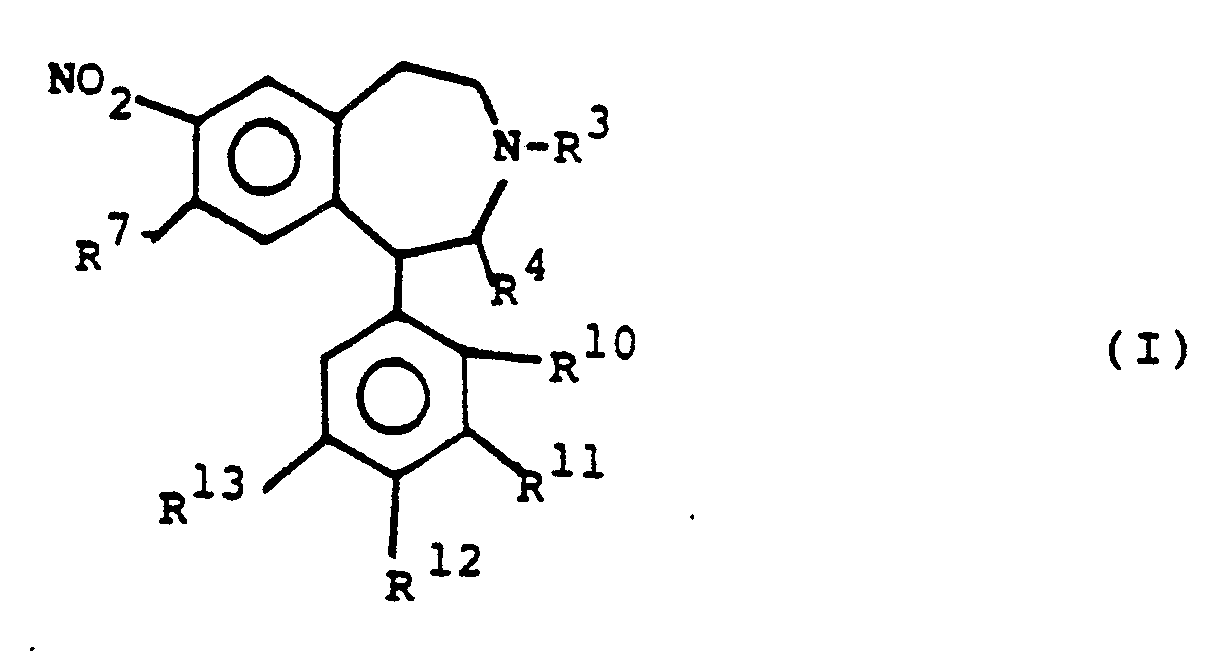
- This invention relates to novel 2,3,4,5-tetrahydro-1H-3-benzazepines and pharmaceutically acceptable acid addition salt thereof, to methods for their preparation, to pharmaceutical compositions containing them, and to their use in the treatment of certain disorders in the central nervous system.
- benzazepines In the last decade, intensive pharmacological research concerning benzazepines has taken place.
- the pharmacological properties of benzazepines depend to a large extent on the substituents.
- substituted benzazepines exhibiting neuroleptic, antiaggressive, antiparkinson and certain vascular effects, are known.
- one object of the present invention is to provide compounds which are dopamine antagonists.
- a second object of the present invention is to provide compounds which are useful as neuroleptics.
- a third object of the present invention is to provide compounds which can be used for the treatment of various mental disorders, e.g. manic-depressive disorders.
- a fourth object of the present invention is to provide substituted benzazepines which have a favourable bioavailability after oral ingestion.
- R3 represents H, C1 ⁇ 3-alkyl or C3 ⁇ 7-cycloalkyl
- R7 represents hydroxy or lower alkoxy
- the compounds of formula I exhibit a strong antidopaminergic effect. Thus, they potently inhibit stereotyped gnawing behaviour in mice induced by methylphenidate (testing performed as previously described in Acta Pharmacol. Toxicol . 31 (1972) 488), and they also inhibit conditioned avoidance response and amphetamine cue in rats.
- the benzazepine derivative SCH 23390 has been reported to exhibit a poor bioavailability after oral administration and a short duration of action ( vide Life Sci . 34 (1984) 1529).
- the compounds of formula I exhibit a favourable bioavailability.
- the compounds of formula I may be present as a mixture of optical isomers which may be resolved into the individual pure isomers. This resolution may conveniently be accomplished by fractional crystallization, from appropriate solvents, of the salts of the compounds of formula I with optically active acids. When the optical isomers are resolved the desired pharmacological activity usually predominates in one of them. Therefore, this invention includes all isomers, whether resolved or mixtures thereof.
- alkyl when used alone or in a combination like alkoxy represents a straight or branched chain with not more than four carbon atoms, for example methyl, ethyl, propyl, isopropyl and tert- butyl.
- alkoxy is preferably intended methoxy and ethoxy.
- Halogen is fluoro, chloro, bromo and iodo, preferably chloro and bromo.
- the substituents designated R4, R10, R11, and R12 may be involved in the formation of bridges.
- R4 forms a bridge together with R10
- R11 forms a bridge together with R12
- R12 so that a pentacyclic system of ortho-fused ring results.
- Particularly valuable embodiments of this invention are non-toxic, pharmaceutically acceptable acid addition salts of benzazepines of formula I.
- Such salts include those derived from inorganic and organic acids such as hydrochloride, hydrobromic, sulphuric, phosphoric, methane-sulphonic, acetic, lactic, maleic, phthalic and tartaric acids. They may be prepared by standard procedures, such as mixing a solution of the base in acetone or in a lower alcohol with the stoichiometrical amount of the acid in a solvent, such as acetone or a lower alcohol, and evaporating the solvent to leave the desired salt as a residue.
- R3 is methyl
- R4 is hydrogen or R4 together with R10 is a bridge of the formula -O-CH2- which is oriented so that the carbon atom is linked to the benzazepine nucleus or R4 together with R10 is a bridge of the formula -CH2-CH2-.
- R7 is hydroxy
- R10 together with R11 is a bridge of the formula -O-CH2-CH2 CH2- or -CH2-CH2-CH2-CH2- with the group comprising both possible orientations of the oxygen containing bridge.
- R11 is hydrogen
- R12 is hydrogen
- R13 is hydrogen or chloro.
- the 2,3,4,5-tetrahydrobenzazepines of the general formula I can be prepared by one or more of the following methods A-D.
- the starting materials for which the preparation is not described herein are either known compounds or compounds which may be prepared in analogy with the preparation of known compounds or in analogy with known methods.
- the solvents preferred are water at high pH (pH 9-13) or dimethylformamide or acetic acid and sodium acetate, however, other solvents may also be used.
- the dehalogenated compounds have the general formula V in which the substituents R3, R4 and R7′ are as defined above and the substituents R10 ⁇ , R11 ⁇ , R12 ⁇ and R13 ⁇ each are identical independently representing hydrogen, alkyl or alkoxy, except that where an optional further halogen in the starting material has been exchanged with hydrogen the corresponding double primed substituent in formula V designates hydrogen.
- nitrated compounds can be used as such for therapeutic purposes or as intermediates for the synthesis of other benzazepines.
- Compounds of the general formula IV or V in which the substituent R7′ is alkoxy can be O -dealkylated by generally known methods to yield the corresponding 7-hydroxy compounds, for example by treating a solution of the substrate in methylene chloride with boron tribromide at low temperature, e.g. -70 o C to 30 o C, preferably -25 o C to 0 o C (see, for example, Theodora W. Greene: Protective Groups in Organic Synthesis , John Wiley, New York, 1981).
- the succession of the reactions may be different from the one described here.
- the O -dealkylation may be carried out before the nitration.
- the benzazepines of formula I are useful because of their pharmacological activity.
- the compounds of formula I can be useful as antipsychotics.
- the benzazepines of formula I are administered in an effective amount to a host in need of treatment.
- the benzazepines of the general formula I with R8 representing halogen have a low oral bioavailability.
- the increased bioavailability of the benzazepines according to the present invention compared to the corresponding benzazepines wherein R8 is halogen can be demonstrated either by comparing the ratio between the ED50 by peroral and intraveneous administration in inhibiting amphetamine in rats or by comparing the absolute oral bioavailability for the compounds in question as measured in mongrel dogs.
- the benzazepines are administered orally to dogs and subsequently samples of their blood plasma are analysed for the compound by a specific HPLC-method.
- the area under the curve showing the oral plasma concentration versus time is calculated. This area is designated AUC i.v.
- the absolute oral bioavailability, F is calculated as the ratio between the area representing the oral dose and the area for the intravenous dose according to the formula
- the acute toxicity of the compounds investigated is low.
- dosage of the compounds of the invention when employed in therapy will depend on the particular benzazepine of formula I in question, on the mode of administration and on the therapy desired. However, in general, satisfactory results may be obtained with a daily dosage of from 0,005 mg to about 5 mg per kg body weight, conveniently given in divided doses 2 to 5 times a day or in sustained release form.
- dosage forms suitable for oral administration comprise from about 0.5 mg to about 250 mg of the benzazepine of formula I admixed with a pharmaceutical carrier or diluent.
- the benzazepines of formula I may be administered in the form of a pharmaceutically acceptable acid addition salt.
- the invention also relates to pharmaceutical compositions comprising a benzazepine of formula I or a pharmaceutically acceptable salt thereof and, usually such compositions also contain a pharmaceutical carrier or diluent.
- the compositions of this invention may be prepared by conventional techniques to be in conventional forms, for example, capsules or tablets.
- the pharmaceutical carriers employed can be conventional solid or liquid carriers.
- solid carriers are lactose, terra alba, sucrose, talc, gelatin, agar, pectin, acacia, magnesium stearate and stearic acid.
- liquid carriers are syrup, peanut oil, olive oil and water.
- the carrier or diluent may include any time delay material well known to the art, such as glyceryl monostearate or glyceryl distearate alone or together with a wax.
- the preparation can be tableted, placed in a hard gelatin capsule in powder or pellet form or in the form of a troche or lozenge.
- the amount of solid carrier will vary widely but will usually be from about 25 mg to about 1 g.
- the preparation may, for example, be in the form of a syrup, an emulsion, a soft gelatin capsule, a sterile, injectable solution or an aqueous or non-aqueous liquid suspension.
- compositions of this invention may be made following the conventional techniques of the pharmaceutical chemist involving mixing, granulating and compressing or variously mixing and dissolving the ingredients as appropriate to give the desired end product.
- the route of administration may be any route which effective severelyly transports the active compound to the desired place, such as oral or parenteral, the oral route being preferred.
- (+)-5-benzofuran-7-yl)-8-chloro-7-hydroxy-3-methyl-2,3,4,5-tetrahydro-1H-3-benzazepine was dissolved in 1.0 N sodium hydroxide (100 ml, 0.100 mol) and water (100 ml). 10% palladium-on-carbon (3.0 g) was added, and the resulting suspension was stirred under hydrogen at 20 o C and 100 kPa for 5 days. The reaction mixture was filtered and the filtercake was thoroughly washed with 0.3 N hydrochloric acid (70 ml) and methanol (135 ml).
- the benzazepine was thoroughly mixed with two thirds of the corn starch and granualted. The granules obtained were dried, mixed with the remaining ingredients and compressed into tablets.
Landscapes
- Chemical & Material Sciences (AREA)
- Organic Chemistry (AREA)
- Health & Medical Sciences (AREA)
- Engineering & Computer Science (AREA)
- Bioinformatics & Cheminformatics (AREA)
- Pharmacology & Pharmacy (AREA)
- Animal Behavior & Ethology (AREA)
- Chemical Kinetics & Catalysis (AREA)
- General Chemical & Material Sciences (AREA)
- Medicinal Chemistry (AREA)
- Nuclear Medicine, Radiotherapy & Molecular Imaging (AREA)
- Neurology (AREA)
- Biomedical Technology (AREA)
- Life Sciences & Earth Sciences (AREA)
- Neurosurgery (AREA)
- General Health & Medical Sciences (AREA)
- Public Health (AREA)
- Veterinary Medicine (AREA)
- Psychiatry (AREA)
- Pain & Pain Management (AREA)
- Pharmaceuticals Containing Other Organic And Inorganic Compounds (AREA)
- Plural Heterocyclic Compounds (AREA)
- Nitrogen Condensed Heterocyclic Rings (AREA)
- Other In-Based Heterocyclic Compounds (AREA)
- Heterocyclic Carbon Compounds Containing A Hetero Ring Having Oxygen Or Sulfur (AREA)
Abstract

R⁷ represents hydroxy, lower alkoxy;
R¹⁰, R¹¹, R¹² independently represent hydrogen or halogen or alkyl or R¹⁰ together with R⁴ represents a bridge as described in connection with the definition of R⁴; or R¹⁰ together with R¹¹ represents a bridge or R¹¹ together with R¹² represents a bridge, the bridge in both cases being chosen among
-O-CH₂-CH₂-, -O-CH₂-CH₂-CH₂-, -O-CH=CH-, -CH₂-CH₂-CH₂-, -CH₂-CH=CH- or -CH₂-CH₂-CH₂ CH₂-;
R¹³ represents hydrogen, halogen or lower alkyl.
Description
- This invention relates to novel 2,3,4,5-tetrahydro-1H-3-benzazepines and pharmaceutically acceptable acid addition salt thereof, to methods for their preparation, to pharmaceutical compositions containing them, and to their use in the treatment of certain disorders in the central nervous system.
- In the last decade, intensive pharmacological research concerning benzazepines has taken place. The pharmacological properties of benzazepines depend to a large extent on the substituents. For example, substituted benzazepines exhibiting neuroleptic, antiaggressive, antiparkinson and certain vascular effects, are known.
- In US patent specification No. 3,393,192 (Schering) derivatives of 5-phenyl-2,3,4,5-tetrahydro-1H-3-benzazepine having, inter alia, hydroxy, lower alkoxy or halogen in the 7- and/or 8-position are described.
- In European patent applications publication Nos. 5,298 and 5,299 (Scherico) the corresponding 7-hydroxy derivatives are described.
- In European patent application publication No. 200,455 (NOVO) 2,3,4,5-tetrahydro-1H-3-benzazepines having a heterocyclic or an ortho-fused heterocyclic ringsystem in the 5-position are described. These compounds are claimed to have antipsychotic and antidepressive effects.
- Furthermore, it has been reported in Eur.J.Pharmacol. 91 (1983) 153 et seq., that (R)-8-chloro-7-hydroxy-2,3,4,5-tetrahydro-3-methyl-5-phenyl-1H-3-benzazepine (designated SCH 23390) is a selective D1 dopamine antagonist (see also European patent application publication No. 5,300 (Scherico)).
- A common drawback which seriously limits the use of the above-mentioned benzazepines is their low bioavailability after oral administration.
- Thus, one object of the present invention is to provide compounds which are dopamine antagonists.
- A second object of the present invention is to provide compounds which are useful as neuroleptics.
- A third object of the present invention is to provide compounds which can be used for the treatment of various mental disorders, e.g. manic-depressive disorders.
- A fourth object of the present invention is to provide substituted benzazepines which have a favourable bioavailability after oral ingestion.
- It has now been found that novel 2,3,4,5-tetrahydro-1H-3-benzazepines of the general formula I

-O-CH₂-CH₂-, -O-CH₂CH₂-CH₂-, -O-CH=CH-, -CH₂-CH₂-CH₂-, -CH₂-CH=CH- or -CH₂-CH₂-CH₂-CH₂-;
R¹³ represents hydrogen, halogen or lower alkyl and pharmaceutically acceptable acid addition salts thereof, exhibit useful pharmacological properties, especially on the central nervous system, and that they have a surprisingly favourable bioavailability after oral administration. - The prior art does not suggest that a particular pharmacological advantage can be expected as a result of the specific substitution pattern present in the structures of the benzazepines of this invention.
- The compounds of formula I exhibit a strong antidopaminergic effect. Thus, they potently inhibit stereotyped gnawing behaviour in mice induced by methylphenidate (testing performed as previously described in Acta Pharmacol. Toxicol. 31 (1972) 488), and they also inhibit conditioned avoidance response and amphetamine cue in rats.
- The benzazepine derivative SCH 23390 has been reported to exhibit a poor bioavailability after oral administration and a short duration of action (vide Life Sci. 34 (1984) 1529). The compounds of formula I exhibit a favourable bioavailability.
- The compounds of formula I may be present as a mixture of optical isomers which may be resolved into the individual pure isomers. This resolution may conveniently be accomplished by fractional crystallization, from appropriate solvents, of the salts of the compounds of formula I with optically active acids. When the optical isomers are resolved the desired pharmacological activity usually predominates in one of them. Therefore, this invention includes all isomers, whether resolved or mixtures thereof.
- Throughout this specification, the term alkyl when used alone or in a combination like alkoxy represents a straight or branched chain with not more than four carbon atoms, for example methyl, ethyl, propyl, isopropyl and tert- butyl. By the term alkoxy is preferably intended methoxy and ethoxy. Halogen is fluoro, chloro, bromo and iodo, preferably chloro and bromo.
- According to the above definitions, the substituents designated R⁴, R¹⁰, R¹¹, and R¹² may be involved in the formation of bridges. Thus, when R⁴ forms a bridge together with R¹⁰ a tetracyclic, ortho-fused ring system is obtained except when R¹¹ at the same time forms a bridge together with R¹² so that a pentacyclic system of ortho-fused ring results.
- Particularly valuable embodiments of this invention are non-toxic, pharmaceutically acceptable acid addition salts of benzazepines of formula I. Such salts include those derived from inorganic and organic acids such as hydrochloride, hydrobromic, sulphuric, phosphoric, methane-sulphonic, acetic, lactic, maleic, phthalic and tartaric acids. They may be prepared by standard procedures, such as mixing a solution of the base in acetone or in a lower alcohol with the stoichiometrical amount of the acid in a solvent, such as acetone or a lower alcohol, and evaporating the solvent to leave the desired salt as a residue.
- In one group of preferred benzazepines of formuia I, R³ is methyl.
- In a second group of preferred benzazepines of formula I, R⁴ is hydrogen or R⁴ together with R¹⁰ is a bridge of the formula -O-CH₂- which is oriented so that the carbon atom is linked to the benzazepine nucleus or R⁴ together with R¹⁰ is a bridge of the formula -CH₂-CH₂-.
- In a third group of preferred benzazepines of formula I, R⁷ is hydroxy.
- In a fourth group of preferred benzazepines of formula I, R¹⁰ together with R¹¹ is a bridge of the formula -O-CH₂-CH₂- or -O-CH=CH- with the group comprising both possible orientations of the bridges.
- In a fifth group of preferred benzazepines of formula I, R¹⁰ together with R¹¹ is a bridge of the formula -O-CH₂-CH₂ CH₂- or -CH₂-CH₂-CH₂-CH₂- with the group comprising both possible orientations of the oxygen containing bridge.
- In a sixth group of preferred benzazepines of formula I, R¹⁰ together with R¹¹ is a bridge of the formual -CH₂-CH₂ -CH₂- or -CH₂-CH=CH- with the group comprising both possible orientations of the double bond.
- In a seventh group of preferred benzazepines of formula I, R¹¹ is hydrogen.
- In an eighth group of preferred benzazepines of formula I, R¹² is hydrogen.
- In a nineth group of preferred benzazepines of formula I, R¹¹ together with R¹² is a bridge of the formula -O-CH₂-CH₂-, -O-CH=CH-, -CH₂-CH₂-CH₂- or -CH₂-CH=CH- with the group comprising both possible orientations of the asymmetric bridges.
- In a tenth group of preferred benzazepines of formula I, R¹³ is hydrogen or chloro.
- The 2,3,4,5-tetrahydrobenzazepines of the general formula I can be prepared by one or more of the following methods A-D.
- The starting materials for which the preparation is not described herein, are either known compounds or compounds which may be prepared in analogy with the preparation of known compounds or in analogy with known methods.
- Compounds of the general formula III in which


- This method is analogous to the method described in European patent application publication No. 200,455. All compounds of formula IV can be used as intermediates for the synthesis of benzazepines of formula I.
- Compounds of the general formula IV in which R⁸′ is halogen and R⁷′ is hydroxy or alkoxy and the rest of the substituents are as defined above can be dehalogenated in the 8-position by catalytic hydrogenation e.g. palladium on carbon, as well at atmospheric pressure as at elevated pressure. Also, other halogens optionally present in the starting material may at the same time, depending on the specific compound and on the reaction conditions, be exchanged with hydrogen.
- The solvents preferred are water at high pH (pH 9-13) or dimethylformamide or acetic acid and sodium acetate, however, other solvents may also be used. The dehalogenated compounds have the general formula V

- Compounds of the general formula V in which R⁷′ is hydroxy or alkoxy, with the proviso when R³ is hydrogen the amine has to be protected by acylation, can be nitrated by generally known methods (see, for example, Jerry March: Advanced Organic Chemistry 3rd ed., McGraw-Hill, New York, 1985) e.g. by treating a solution of a compound of the general formula V in acetic acid or in a mixture of acetic acid and methylene chloride with fuming nitric acid at temperatures from -10oC to 10oC. The products obtained will predominantly be mononitrated with the nitro group in the 8-position. In case R³ is hydrogen the protected amine can be converted to a compound of formula V by deacylation per se.
- The nitrated compounds can be used as such for therapeutic purposes or as intermediates for the synthesis of other benzazepines.
- Compounds of the general formula IV or V in which the substituent R⁷′ is alkoxy can be O-dealkylated by generally known methods to yield the corresponding 7-hydroxy compounds, for example by treating a solution of the substrate in methylene chloride with boron tribromide at low temperature, e.g. -70oC to 30oC, preferably -25oC to 0oC (see, for example, Theodora W. Greene: Protective Groups in Organic Synthesis, John Wiley, New York, 1981).
- In some cases the succession of the reactions may be different from the one described here. For example the O-dealkylation may be carried out before the nitration.
- The benzazepines of formula I are useful because of their pharmacological activity. In particular, the compounds of formula I can be useful as antipsychotics. The benzazepines of formula I are administered in an effective amount to a host in need of treatment.
- Compounds of formula I were tested for their binding to dopamine D1 receptor in homogenates from rat striatum using the method described (Life Science vol. 37, p. 1971 (1985) P. Andersen et.al.) and the results appear from table I, where the compounds of formula I tested are the (+) enantiomere or racemic mixtures. Ki is the affinity of tested compounds for the dopamine D1 receptor.
TABLE I Test Compound Ki nM Dopamine D1 receptor Example 1 42 Example 3 28 Example 4 13 Example 5 11 Example 6 88 Example 7 169 - As already mentioned, the benzazepines of the general formula I with R⁸ representing halogen have a low oral bioavailability. The increased bioavailability of the benzazepines according to the present invention compared to the corresponding benzazepines wherein R⁸ is halogen can be demonstrated either by comparing the ratio between the ED₅₀ by peroral and intraveneous administration in inhibiting amphetamine in rats or by comparing the absolute oral bioavailability for the compounds in question as measured in mongrel dogs. Some test results are stated in the following.
- Following the method of Pedersen, V. and Christensen, A.V.: "Antagonism of methylphenidate-induced stereotyped gnawing in mice", Acta Pharmacol. et Toxicol. 31: 488-496, 1972, antagonism of dopamine-dependent, methyl-phenidate-induced gnawing behaviour of mice, was used to assess the effects of the present D-1 antagonists. Further, the ratio of ED₅₀ values obtained using i.v. administration and oral administration, respectively, was taken as an index of the bioavailability of the test drugs. It was found that the pre sence of a nitrogroup in the 8th position plays a crucial role for the p.o./i.v. effect ratio and, hence, for the bioavailability.
- The following values were obtained:

- The benzazepines are administered orally to dogs and subsequently samples of their blood plasma are analysed for the compound by a specific HPLC-method. The area under the curve showing the oral plasma concentration versus time is calculated. This area is designated AUC i.v.
- The absolute oral bioavailability, F, is calculated as the ratio between the area representing the oral dose and the area for the intravenous dose according to the formula

- The results are shown in Table III.
TABLE III Absolute bioavailability, F (%) Substance F (%) 8-chloro-7-hydroxy-3-methyl-5-(2,3-dihydrobenzofuran-7-yl)-2,3,4,5-tetrahydro-1H-3-benzazepine (note 1) 5.5 (+)-7-hydroxy-3-methyl-8-nitro-5-(2,3-dihydrobenzofuran-7-yl)-2,3,4,5-tetrahydro-1H-3-benzazepine (note 2) 65 note 1: reference substance, compound g) of example 5 in US patent 4,751,222 (NOVO) note 2: the compound according to example 5 of the present specification - The acute toxicity of the compounds investigated is low.
- The dosage of the compounds of the invention when employed in therapy will depend on the particular benzazepine of formula I in question, on the mode of administration and on the therapy desired. However, in general, satisfactory results may be obtained with a daily dosage of from 0,005 mg to about 5 mg per kg body weight, conveniently given in divided doses 2 to 5 times a day or in sustained release form. Usually, dosage forms suitable for oral administration comprise from about 0.5 mg to about 250 mg of the benzazepine of formula I admixed with a pharmaceutical carrier or diluent.
- The benzazepines of formula I may be administered in the form of a pharmaceutically acceptable acid addition salt. The invention also relates to pharmaceutical compositions comprising a benzazepine of formula I or a pharmaceutically acceptable salt thereof and, usually such compositions also contain a pharmaceutical carrier or diluent. The compositions of this invention may be prepared by conventional techniques to be in conventional forms, for example, capsules or tablets.
- The pharmaceutical carriers employed can be conventional solid or liquid carriers. Examples of solid carriers are lactose, terra alba, sucrose, talc, gelatin, agar, pectin, acacia, magnesium stearate and stearic acid. Examples of liquid carriers are syrup, peanut oil, olive oil and water. Similarly, the carrier or diluent may include any time delay material well known to the art, such as glyceryl monostearate or glyceryl distearate alone or together with a wax.
- If a solid carrier for oral administration is used, the preparation can be tableted, placed in a hard gelatin capsule in powder or pellet form or in the form of a troche or lozenge. The amount of solid carrier will vary widely but will usually be from about 25 mg to about 1 g. If a liquid carrier is used, the preparation may, for example, be in the form of a syrup, an emulsion, a soft gelatin capsule, a sterile, injectable solution or an aqueous or non-aqueous liquid suspension.
- The pharmaceuticai compositions of this invention may be made following the conventional techniques of the pharmaceutical chemist involving mixing, granulating and compressing or variously mixing and dissolving the ingredients as appropriate to give the desired end product.
- The route of administration may be any route which effectively transports the active compound to the desired place, such as oral or parenteral, the oral route being preferred.
- The nomenclature used herein on the whole complies with the IUPAC nomenclature, one of the main deviations being that in an attempt to facilitate the reading of this specification, herein the position of the benzazepine nucleus to which the phenyl group carrying the substituents R¹⁰-R¹³ is linked is always designated number 5. According to the IUPAC nomenclature this position has the number 1 or 5, depending on the further substituents in the benzazepine nucleus. Further, in order to facilitate the comparison of different series of substitution patterns the substituents are not always arranged in alphabetical order in the names of the compounds.
- The features disclosed in the foregoing description and in the following examples and claims may, both separately and in any combination thereof, be material for realizing the invention in diverse forms thereof.
- The invention is further illustrated by the following examples which, however, are not to be construed as limiting.
- The starting material for which the preparation is not desribed herein is described in European Patent Application publication No. 200,455 (NOVO) and in European Patent Application publication No. 023 0270.
- 10.0 g 8-chloro-5-(2-fluorophenyl)-7-hydroxy-3-methyl-2,3,4,5-tetrahydro-1H-3-benzazepine was dissolved in 500 ml acetic acid containing sodium acetate. Palladium-on-carbon was added and the suspension was heated to 60oC. Under vigorous stirring hydrogen was led through the suspension giving after 48 h 7,9 g crystalline compound. Yield 72%.
NMR: >CH-OH 4,45 dd, C₆H 5,95 d, C₈H 6,45 d, C₇OH 8,75 s ppm. respectively. - This compound was used for the next step without further purification.
-
- 5.0 g 5-(2-fluorophenyl)-7-hydroxy-3-methyl-2,3,4,5-tetrahydro-1H-3-benzazepine was dissolved in 90 ml of a mixture of acetic acid and cooled in ice-water bath 0oC. Under stirring was added 1,7 ml fuming nitric acid and the mixture was stirred in the cold for 1 h. The reaction mixture was neutralized (pH 7.9) and the precipitate was extracted with ethyl acetate, dried and evaporated. After column chromatography (kieselgel/CH₂Cl₂: CH₃OH 95: 5) was isolated yellow crystals. M.p. 90-94oC(dec). NMR: C₅H 4.61d; C₆H g 41% 6 s and C₉H 7.88 s ppm. respectively.
- A) 7-hydroxy-3-methyl-5-(3-trifluoromethylphenyl)-2,3,4,5-tetrahydro-1H-3-benzazepine was prepared in analogy with the method A in example 1. Yield 2,5 g, 81%. NMR: C₅H 4,25 dd: C₆H 5,dd: C₈H 6,5 dd; C₉H 7,0 d ppm. respectively.
- This compound was used for the next step without further purification.
- B) 7-hydroxy-3-methyl-8-nitro-(3-trifluoromethylphenyl)-2,3,4,5-tetrahydro-1H-3-benzazepine is prepared in analogy with method B in example 1 giving 0.4 g (14%). M.p. 205-210oC (dec). NMR. C₅H 5,08d: C₆H 6,5 s: C₉H 7.88s ppm. respectively.
- A) 1 g of 7-methoxy-3-methyl-5-(2-methyl-phenyl)-2,3,4,5-tetrahydro-1H-3-benzazepine was dissolved in a mixture of acetic acid (5 ml) and acetic anhydride (5 ml). To this mixture was added fuming nitric acid and the reaction mixture was stirred at room temperature for 2 h. Crushed ice was added to the reaction mixture and sodium hydroxide solution (6 N) was added slowly to pH 7.5. This mixture was extracted with ethyl acetate, the combined organic layer was dried and evaporated giving a solid which was purified by column chromatography (kieselgel: CH₂Cl₂/CH₃OH 98/2). Yield: 300 mg (27%). NMR: C₅H 4.58d: C₆H 6.11s: C₉H 7.64s ppm. respectively.
- This compound was used directly for the next step.
- B) 300 mg 7-methoxy-3-methyl-8-nitro-5(2′-methylphenyl)-2,3,4,5-tetrahydro-1H-3-benzazepine was dissolved in MeOH and cooled to -70oC. 1 g BBr₃ was added slowly and the mixture was stirred for 1 h at -70oC, and stirring was continued for 1 h. Methanol was slowly added to distroy the excess of BBr₃ and the mixture was evaporated to dryness. The raw material was purified by column chromatography (kieselgel, CH₂Cl₂/CH₃OH: 98/2) giving 110 mg of the desired compound. M.p. 59-61 NMR: C₅H 5.10d: C₆H 6.20S: C₉H 8.05s ppm. respectively.
- (R)-7-hydroxy-3-methyl-5-phenyl-2,3,4,5-tetrahydro-1H-3-benzazepine was prepared in analogy with the method described in example 1B giving 1.5 g (42%). M.p. 90-92 oC. NMR: C₅H 4.37d: C₆H 6.46s: C₉H 7.88s ppm. respectively.
- 6.55 g, (0.020 mol)) (+)-5-benzofuran-7-yl)-8-chloro-7-hydroxy-3-methyl-2,3,4,5-tetrahydro-1H-3-benzazepine was dissolved in 1.0 N sodium hydroxide (100 ml, 0.100 mol) and water (100 ml). 10% palladium-on-carbon (3.0 g) was added, and the resulting suspension was stirred under hydrogen at 20oC and 100 kPa for 5 days. The reaction mixture was filtered and the filtercake was thoroughly washed with 0.3 N hydrochloric acid (70 ml) and methanol (135 ml). The pH of the combined filtrate and washings was brought to 8.0 and the resulting suspension was filtered. The filtercake was washed with water/methanol (1/1) and dried in vacuo at 40oC to give 3.45 g (76% of the theoretical yield) of the desired compound as white crystals.) M.p. 227-30oC.
- was dissolved in a mixture of methylene chloride (25 ml) and acetic acid (75 ml) at 10oC and fuming nitric acid (0.5 ml) was added. The reaction mixture was stirred for 2 h at 10-15oC. Then the reaction mixture was evaporated to about 20 ml and diluted with water (100 ml). pH was adjusted to 8.5 and the water phase was extracted twice with methylene chloride. The combined organic phases were dried and evaporated to give 2.1 g of crude product.
- Purification by column chromatography (methylene chloride/methanol 9/1) gave 1.9 g of (+)-5-(2,3-dihydrobenzofuran-7-yl)-7-hydroxy-3-methyl-8-nitro-2,3,4,5-tetrahydro-1H-3-benzazepine as white crystals. M.p. 122-3oC.
Calc.: 67.0% C, 5.9% H, 8.2% N Found: 66.8% C, 6.1% H, 8.1% N - A) 7-hydroxy-5-(5-indanyl)-3-methyl-2,3,4,5-tetrahydro-1H-3-benzazepine was prepared in analogy with example 1 A. Yield: 1.05 g (92%). M.p. 213-22oC (dec). NMR: C₅H 4.6d: C₆H 5.65d: C₈H 6.4dd: C₉H 6.9d ppm. respectively.
- B) 7-hydroxy-5-(5-indanyl)-3-methyl-8-nitro-2,3,4,5-tetrahydro-1H-3-benzazepine was prepared in analogy with example 1B. Yield: 0.45 g (39%). M.p. 58-63oC. NMR: C₅H 4.66d: C₆H 6.06s, C₉H 7.8s ppm. respectively.
Calc.: 70.99% C, 6.55% H, 7.67% N Found: 70.43% C, 6.94% H, 7.77% N - trans-[6,7,7a,8,9,13b]-hexahydro-2-hydroxy-7-methyl-5H-benzo[d]naphto[2,1-b]azepine (642 mg) was dissolved in a mixture of 40 ml acetic acid and 4 ml of water, cooled to about 5oC and treated with 0.5 ml of concentrated nitric acid. After 1 h the reaction mixture was neutralized to pH 7.8. The precipitate was collected and purified by column chromatography (silicagel; THF + 1% TEA) giving 95 mg (15% th). M.p. 115-20oC. NMR: C₁H: 6.06 s: C₄H 7.8s: C13bH 4.75d ppm. respectively.
-
Ingredients mg per capsule (+)-7-hydroxy-3-methyl-8-nitro-5-(2,3-dihydrobenzofuran-7-yl)-2,3,4,5-tetrahydro-1H-3-benzazepine hydrobromide 125 magnesium stearate 2 lactose 200 - The above ingredients were thoroughly mixed and placed into hard gelatin capsules. Such capsules were administered orally to subjects in need of treatment one or more times daily.
-
Ingredients mg per tablet (+)-7-hydroxy-3-methyl-8-nitro-5-(2,3-dihydrobenzofuran-7-yl)-2,3,4,5-tetrahydro-1H-3-benzazepine hydrobromide 200 corn starch 46 polyvinyl pyrrolidone 12 magnesium stearate 1 - The benzazepine was thoroughly mixed with two thirds of the corn starch and granualted. The granules obtained were dried, mixed with the remaining ingredients and compressed into tablets.
Claims (11)

R⁷ represents hydroxy, lower alkoxy;
R¹⁰, R¹¹, R¹² independently represent hydrogen or halogen or alkyl or R¹⁰ together with R⁴ represents a bridge as described in connection with the definition of R⁴; or R¹⁰ together with R¹¹ represents a bridge or R¹¹ together with R¹² represents a bridge, the bridge in both cases being chosen among
-O-CH₂-CH -, -O-CH₂-CH₂-CH₂, -O-CH=CH-, -CH₂-CH₂-CH₂-, -CH₂-CH=CH- or -CH₂-CH₂-CH₂-CH₂-;
R¹³ represents hydrogen, halogen or lower alkyl, with the proviso that R¹⁰, R¹¹, R¹² and R¹³ at the same time canot be hydrogen, and pharmaceutically acceptable acid addition salts.


R⁷ represents hydroxy, lower alkoxy;
R¹⁰, R¹¹, R¹² independently represent hydrogen or halogen or alkyl or alkoxy or R¹⁰ together with R⁴ represents a bridge as described in connection with the definition of R⁴ or R¹⁰ together with R¹¹ represents a bridge or R¹¹ together with R¹² represents a bridge, the bridge in both cases being chosen among
-O-CH₂-CH -, -O-CH₂-CH₂-CH₂-, -O-CH=CH-, -CH₂-CH₂-CH₂-, -CH₂-CH=CH- or -CH₂-CH₂-CH₂-CH₂-; R¹³ represents hydrogen, halogen or lower alkyl.
Priority Applications (1)
| Application Number | Priority Date | Filing Date | Title |
|---|---|---|---|
| AT89110490T ATE102188T1 (en) | 1988-06-15 | 1989-06-09 | BENZAZEPINE DERIVATIVES. |
Applications Claiming Priority (2)
| Application Number | Priority Date | Filing Date | Title |
|---|---|---|---|
| DK325188A DK325188D0 (en) | 1988-06-15 | 1988-06-15 | BENZAZEPINE DERIVATIVES UNKNOWN |
| DK3251/88 | 1988-06-15 |
Publications (2)
| Publication Number | Publication Date |
|---|---|
| EP0347672A1 true EP0347672A1 (en) | 1989-12-27 |
| EP0347672B1 EP0347672B1 (en) | 1994-03-02 |
Family
ID=8120790
Family Applications (1)
| Application Number | Title | Priority Date | Filing Date |
|---|---|---|---|
| EP89110490A Expired - Lifetime EP0347672B1 (en) | 1988-06-15 | 1989-06-09 | Benzazepine derivatives |
Country Status (15)
| Country | Link |
|---|---|
| US (2) | US5010074A (en) |
| EP (1) | EP0347672B1 (en) |
| JP (1) | JP2769718B2 (en) |
| AT (1) | ATE102188T1 (en) |
| AU (1) | AU622911B2 (en) |
| CA (1) | CA1317938C (en) |
| DE (1) | DE68913367T2 (en) |
| DK (1) | DK325188D0 (en) |
| ES (1) | ES2061794T3 (en) |
| FI (1) | FI93354C (en) |
| IE (1) | IE891932L (en) |
| IL (1) | IL90533A (en) |
| NO (1) | NO173865C (en) |
| NZ (1) | NZ229521A (en) |
| PT (1) | PT90883B (en) |
Cited By (5)
| Publication number | Priority date | Publication date | Assignee | Title |
|---|---|---|---|---|
| WO1993017012A1 (en) * | 1992-02-24 | 1993-09-02 | Novo Nordisk A/S | 2,3,4,5-tetrahydro-1h-3-benzazepines and pharmaceutically acceptable acid addition salts thereof |
| US5470850A (en) * | 1992-02-24 | 1995-11-28 | Novo Nordisk A/S | 2,3,4,5-tetrahydro-1H-3-benzazepines |
| WO1998040072A1 (en) * | 1997-03-12 | 1998-09-17 | Cenes Limited | Use of 2,3,4,5-tetrahydro-1h-3-benzazepines for the manufacture of a pharmaceutical composition for the treatment of sleep disorders |
| WO2003053936A1 (en) * | 2001-12-20 | 2003-07-03 | Shire Pharmaceutical Development Ltd | Dopamine d1 receptor agonist pro-drug compounds & derivatives |
| US7696193B2 (en) | 2002-12-20 | 2010-04-13 | Glaxo Group Limited | Benzazepine derivatives for the treatment of neurological disorders |
Families Citing this family (5)
| Publication number | Priority date | Publication date | Assignee | Title |
|---|---|---|---|---|
| DK67489D0 (en) * | 1989-02-14 | 1989-02-14 | Novo Industri As | NEW BENZAZEPINE DERIVATIVES |
| US5158948A (en) * | 1990-11-16 | 1992-10-27 | Abbott Laboratories | Tetracyclic spirobenzazepine dopamine antagonists |
| US6277844B1 (en) | 1998-09-14 | 2001-08-21 | Sydney Spector | Compound for selective treatment of malignant cells by inhibiting cell cycle progression, decreasing Bcl2, and increasing apoptosis |
| EP1537115B1 (en) * | 2002-08-29 | 2008-05-28 | Schering Corporation | Selective d1/d5 receptor antagonists for the treatment of obesity and cns disorders |
| CA2526017A1 (en) * | 2003-05-22 | 2005-04-21 | Schering Corporation | 5-h-benzo[d]naphth[2,1-b]azepine derivative as selective d1/d5 receptor antagonists for the treatment of obesity and cns disorders |
Citations (3)
| Publication number | Priority date | Publication date | Assignee | Title |
|---|---|---|---|---|
| GB1268243A (en) * | 1968-03-11 | 1972-03-22 | Wallace & Tiernan Inc | 0,2,4,5,-tetrahydro-3h,3-benzazepines |
| EP0005300A1 (en) * | 1978-05-08 | 1979-11-14 | Technobiotic Ltd. | Substituted 8-hydroxy-1-phenyl-2,3,4,5-tetrahydro-1H-3-benzazepines, process for the preparation thereof, and pharmaceutical compositions containing them |
| EP0033632A2 (en) * | 1980-01-31 | 1981-08-12 | Smithkline Beckman Corporation | 7,8-Amino, hydroxy-1-phenyl-2,3,4,5-tetrahydro-1H-3-benzazepines, process for their preparation and pharmaceutical compositions containing them |
Family Cites Families (5)
| Publication number | Priority date | Publication date | Assignee | Title |
|---|---|---|---|---|
| US4210749A (en) * | 1974-11-12 | 1980-07-01 | Pennwalt Corporation | Substituted 1,2,4,5-tetrahydro-3H,3 benzazepines |
| US4327023A (en) * | 1980-01-31 | 1982-04-27 | Smithkline Corporation | Intermediates for preparing 7,8-amino, hydroxy-1-phenyl-2,3,4,5-tetrahydro-1H-3-benzazepines |
| DK180485D0 (en) * | 1985-04-22 | 1985-04-23 | Novo Industri As | NITROGEN CONTAINING COMPOUNDS |
| KR900007781B1 (en) * | 1986-01-16 | 1990-10-20 | 쉐링 코포레이션 | Fused benzaepins |
| EP0244088A3 (en) * | 1986-04-03 | 1989-03-15 | Smithkline Beecham Corporation | 1-phenyl-3-benzazepine compounds and medicaments containing these compounds for treating gastrointestinal motility disorders |
-
1988
- 1988-06-15 DK DK325188A patent/DK325188D0/en not_active Application Discontinuation
-
1989
- 1989-06-05 IL IL9053389A patent/IL90533A/en unknown
- 1989-06-09 AT AT89110490T patent/ATE102188T1/en not_active IP Right Cessation
- 1989-06-09 EP EP89110490A patent/EP0347672B1/en not_active Expired - Lifetime
- 1989-06-09 ES ES89110490T patent/ES2061794T3/en not_active Expired - Lifetime
- 1989-06-09 DE DE68913367T patent/DE68913367T2/en not_active Expired - Lifetime
- 1989-06-12 US US07/365,250 patent/US5010074A/en not_active Expired - Lifetime
- 1989-06-13 CA CA000602684A patent/CA1317938C/en not_active Expired - Lifetime
- 1989-06-13 NZ NZ229521A patent/NZ229521A/en unknown
- 1989-06-14 NO NO892476A patent/NO173865C/en not_active IP Right Cessation
- 1989-06-14 AU AU36359/89A patent/AU622911B2/en not_active Expired
- 1989-06-15 IE IE891932A patent/IE891932L/en not_active IP Right Cessation
- 1989-06-15 PT PT90883A patent/PT90883B/en not_active IP Right Cessation
- 1989-06-15 JP JP1150662A patent/JP2769718B2/en not_active Expired - Lifetime
- 1989-06-15 FI FI892946A patent/FI93354C/en active IP Right Grant
-
1990
- 1990-02-07 US US07/477,450 patent/US5025009A/en not_active Expired - Lifetime
Patent Citations (3)
| Publication number | Priority date | Publication date | Assignee | Title |
|---|---|---|---|---|
| GB1268243A (en) * | 1968-03-11 | 1972-03-22 | Wallace & Tiernan Inc | 0,2,4,5,-tetrahydro-3h,3-benzazepines |
| EP0005300A1 (en) * | 1978-05-08 | 1979-11-14 | Technobiotic Ltd. | Substituted 8-hydroxy-1-phenyl-2,3,4,5-tetrahydro-1H-3-benzazepines, process for the preparation thereof, and pharmaceutical compositions containing them |
| EP0033632A2 (en) * | 1980-01-31 | 1981-08-12 | Smithkline Beckman Corporation | 7,8-Amino, hydroxy-1-phenyl-2,3,4,5-tetrahydro-1H-3-benzazepines, process for their preparation and pharmaceutical compositions containing them |
Cited By (9)
| Publication number | Priority date | Publication date | Assignee | Title |
|---|---|---|---|---|
| WO1993017012A1 (en) * | 1992-02-24 | 1993-09-02 | Novo Nordisk A/S | 2,3,4,5-tetrahydro-1h-3-benzazepines and pharmaceutically acceptable acid addition salts thereof |
| US5470850A (en) * | 1992-02-24 | 1995-11-28 | Novo Nordisk A/S | 2,3,4,5-tetrahydro-1H-3-benzazepines |
| WO1998040072A1 (en) * | 1997-03-12 | 1998-09-17 | Cenes Limited | Use of 2,3,4,5-tetrahydro-1h-3-benzazepines for the manufacture of a pharmaceutical composition for the treatment of sleep disorders |
| US6211173B1 (en) | 1997-03-12 | 2001-04-03 | Cenes Limited | Use of 2,3,4,5-tetrahydro-1H-3-benzazepines for the manufacture of a pharmaceutical composition for the treatment of sleep disorders |
| WO2003053936A1 (en) * | 2001-12-20 | 2003-07-03 | Shire Pharmaceutical Development Ltd | Dopamine d1 receptor agonist pro-drug compounds & derivatives |
| US7696193B2 (en) | 2002-12-20 | 2010-04-13 | Glaxo Group Limited | Benzazepine derivatives for the treatment of neurological disorders |
| US7704994B2 (en) | 2002-12-20 | 2010-04-27 | Glaxo Group Limited | Benzazepine derivatives for the treatment of neurological disorders |
| US7799773B2 (en) | 2002-12-20 | 2010-09-21 | Glaxo Group Limited | Benzazepine derivatives for the treatment of neurological disorders |
| US8207331B2 (en) | 2002-12-20 | 2012-06-26 | Glaxo Group Limited | Benzazepine derivatives for the treatment of neurological disorders |
Also Published As
| Publication number | Publication date |
|---|---|
| AU622911B2 (en) | 1992-04-30 |
| NO892476L (en) | 1989-12-18 |
| IL90533A0 (en) | 1990-01-18 |
| FI93354C (en) | 1995-03-27 |
| US5010074A (en) | 1991-04-23 |
| IL90533A (en) | 1994-05-30 |
| IE891932L (en) | 1989-12-15 |
| US5025009A (en) | 1991-06-18 |
| DK325188D0 (en) | 1988-06-15 |
| JP2769718B2 (en) | 1998-06-25 |
| EP0347672B1 (en) | 1994-03-02 |
| ES2061794T3 (en) | 1994-12-16 |
| ATE102188T1 (en) | 1994-03-15 |
| NZ229521A (en) | 1991-12-23 |
| FI93354B (en) | 1994-12-15 |
| DE68913367T2 (en) | 1994-06-01 |
| AU3635989A (en) | 1989-12-21 |
| NO173865C (en) | 1994-02-16 |
| FI892946A0 (en) | 1989-06-15 |
| JPH0240364A (en) | 1990-02-09 |
| FI892946A7 (en) | 1989-12-16 |
| DE68913367D1 (en) | 1994-04-07 |
| NO892476D0 (en) | 1989-06-14 |
| PT90883B (en) | 1994-12-30 |
| NO173865B (en) | 1993-11-08 |
| PT90883A (en) | 1989-12-29 |
| CA1317938C (en) | 1993-05-18 |
Similar Documents
| Publication | Publication Date | Title |
|---|---|---|
| EP0492485B1 (en) | N-Acyl-2,3-benzodiazepine derivatives, pharmaceutical compositions containing them and process for preparing same | |
| EP0170213B1 (en) | Glutarimide antianxiety and antihypertensive agents | |
| US4556653A (en) | Pyrido[1,5]benzodiazepinone derivatives and pharmacological activities thereof | |
| KR20130046436A (en) | Cyclic n,n'-diarylthioureas and n,n'-diarylureas as androgen receptor antagonists, anti-cancer agent, method for producing and using same | |
| US4210648A (en) | II-Aminoacyl-5,11-dihydro-6H-pyrido(2,3-B) (1,4)benzodiazepin-6-ones and salts thereof | |
| Chapleo et al. | Heteroaromatic analogs of the. alpha. 2-adrenoreceptor partial agonist clonidine | |
| EP0347672B1 (en) | Benzazepine derivatives | |
| EP0216247A2 (en) | Use of alpha 2 adrenergic receptor antagonists for the production of pharmaceutical compositions for treating colonic spasm, irritable bowel syndrome and constipation and process for preparing such pharmaceutical compositions | |
| US5498628A (en) | Naphthamide derivatives | |
| KR860001819B1 (en) | Process for the preparing of hexahydro-trans-pyridoindole derivatives | |
| US4612312A (en) | Glutarimide antianxiety and antihypertensive agents | |
| JPH0441149B2 (en) | ||
| CA2513059A1 (en) | Novel tricyclic azepine derivatives, method for production therof and pharmaceutical compositions comprising the same | |
| EP0628039B1 (en) | 2,3,4,5-tetrahydro-1h-3-benzazepines and pharmaceutically acceptable acid addition salts thereof | |
| HK24194A (en) | Pyrrolo[1,2-a][4,1]benzoxazepines, process for their preparation, pharmaceutical compositions containing these compounds and therapeutical use | |
| US4925848A (en) | Derivative of codeine useful as an agonist and process for the preparation of it | |
| US4013679A (en) | Substituted 6,7-dihydro [1,7-ab](1) benzazepine compounds | |
| KR850001038B1 (en) | Process for preparing allophanoylpiperazine compounds | |
| EP0383247B1 (en) | Benzazepines with antidopaminergic activity | |
| DK163993B (en) | 5,7,8-Substituted 2,3,4,5-tetrahydro-1H-3-benzadepines, preparing these compounds, and pharmaceutical preparations which comprise them | |
| EP0326066A2 (en) | Condensed diazepinones, process for their preparation and medicaments containing them | |
| US3705245A (en) | 7-amino - 2-chloro-11-(4-methyl-1-piperazinyl)dibenz(b,f)(1,4)oxazepines acting on the central nervous system | |
| JPS62249984A (en) | D-nor-7-ergoline derivative, manufacture, drug composition and use | |
| DE4341749A1 (en) | 3- (Phenylalkylaminoalkyloxy) -5-phenylpyrazole compounds and methods and intermediates for their preparation and medicaments containing these compounds | |
| JPS6183171A (en) | Dibebzo (b,f) (1,5) oxazocin derivative, its preparation and pharmaceutical containing said derivative as active component |
Legal Events
| Date | Code | Title | Description |
|---|---|---|---|
| PUAI | Public reference made under article 153(3) epc to a published international application that has entered the european phase |
Free format text: ORIGINAL CODE: 0009012 |
|
| AK | Designated contracting states |
Kind code of ref document: A1 Designated state(s): AT BE CH DE ES FR GB GR IT LI LU NL SE |
|
| 17P | Request for examination filed |
Effective date: 19900312 |
|
| RAP1 | Party data changed (applicant data changed or rights of an application transferred) |
Owner name: NOVO-NORDISK A/S |
|
| RAP1 | Party data changed (applicant data changed or rights of an application transferred) |
Owner name: NOVO NORDISK A/S |
|
| 17Q | First examination report despatched |
Effective date: 19911126 |
|
| GRAA | (expected) grant |
Free format text: ORIGINAL CODE: 0009210 |
|
| AK | Designated contracting states |
Kind code of ref document: B1 Designated state(s): AT BE CH DE ES FR GB GR IT LI LU NL SE |
|
| REF | Corresponds to: |
Ref document number: 102188 Country of ref document: AT Date of ref document: 19940315 Kind code of ref document: T |
|
| REF | Corresponds to: |
Ref document number: 68913367 Country of ref document: DE Date of ref document: 19940407 |
|
| ITF | It: translation for a ep patent filed | ||
| ET | Fr: translation filed | ||
| EPTA | Lu: last paid annual fee | ||
| REG | Reference to a national code |
Ref country code: GR Ref legal event code: FG4A Free format text: 3012025 |
|
| REG | Reference to a national code |
Ref country code: ES Ref legal event code: FG2A Ref document number: 2061794 Country of ref document: ES Kind code of ref document: T3 |
|
| PLBE | No opposition filed within time limit |
Free format text: ORIGINAL CODE: 0009261 |
|
| STAA | Information on the status of an ep patent application or granted ep patent |
Free format text: STATUS: NO OPPOSITION FILED WITHIN TIME LIMIT |
|
| EAL | Se: european patent in force in sweden |
Ref document number: 89110490.3 |
|
| 26N | No opposition filed | ||
| REG | Reference to a national code |
Ref country code: GB Ref legal event code: 732E |
|
| REG | Reference to a national code |
Ref country code: CH Ref legal event code: PUE Owner name: NOVO NORDISK A/S TRANSFER- CENES LIMITED |
|
| NLS | Nl: assignments of ep-patents |
Owner name: CENES LIMITED |
|
| REG | Reference to a national code |
Ref country code: FR Ref legal event code: TP |
|
| REG | Reference to a national code |
Ref country code: GB Ref legal event code: IF02 |
|
| REG | Reference to a national code |
Ref country code: GB Ref legal event code: 732E |
|
| REG | Reference to a national code |
Ref country code: CH Ref legal event code: PUE Owner name: ADDEX PHARMACEUTICALS SA Free format text: CENES LIMITED#COMPASS HOUSE, VISION PARK, CHIVERS WAY, HISTON#CAMBRIDGE CB4 9ZR (GB) -TRANSFER TO- ADDEX PHARMACEUTICALS SA#12 CHEMIN DES AULX#1228 PLAN-LES-OUATES (CH) Ref country code: CH Ref legal event code: NV Representative=s name: PATMED AG |
|
| NLS | Nl: assignments of ep-patents |
Owner name: - ADDEX PHARMACEUTICALS SA |
|
| REG | Reference to a national code |
Ref country code: ES Ref legal event code: PC2A |
|
| REG | Reference to a national code |
Ref country code: FR Ref legal event code: TP |
|
| PGFP | Annual fee paid to national office [announced via postgrant information from national office to epo] |
Ref country code: CH Payment date: 20080611 Year of fee payment: 20 Ref country code: LU Payment date: 20080618 Year of fee payment: 20 |
|
| PGFP | Annual fee paid to national office [announced via postgrant information from national office to epo] |
Ref country code: AT Payment date: 20080612 Year of fee payment: 20 |
|
| PGFP | Annual fee paid to national office [announced via postgrant information from national office to epo] |
Ref country code: IT Payment date: 20080625 Year of fee payment: 20 |
|
| PGFP | Annual fee paid to national office [announced via postgrant information from national office to epo] |
Ref country code: SE Payment date: 20080609 Year of fee payment: 20 Ref country code: DE Payment date: 20080612 Year of fee payment: 20 Ref country code: ES Payment date: 20080717 Year of fee payment: 20 Ref country code: NL Payment date: 20080630 Year of fee payment: 20 |
|
| PGFP | Annual fee paid to national office [announced via postgrant information from national office to epo] |
Ref country code: FR Payment date: 20080617 Year of fee payment: 20 |
|
| PGFP | Annual fee paid to national office [announced via postgrant information from national office to epo] |
Ref country code: GB Payment date: 20080611 Year of fee payment: 20 |
|
| PGFP | Annual fee paid to national office [announced via postgrant information from national office to epo] |
Ref country code: BE Payment date: 20080813 Year of fee payment: 20 |
|
| PGFP | Annual fee paid to national office [announced via postgrant information from national office to epo] |
Ref country code: GR Payment date: 20080515 Year of fee payment: 20 |
|
| REG | Reference to a national code |
Ref country code: CH Ref legal event code: PL |
|
| BE20 | Be: patent expired |
Owner name: S.A. *ADDEX PHARMACEUTICALS Effective date: 20090609 |
|
| REG | Reference to a national code |
Ref country code: GB Ref legal event code: PE20 Expiry date: 20090608 |
|
| PG25 | Lapsed in a contracting state [announced via postgrant information from national office to epo] |
Ref country code: NL Free format text: LAPSE BECAUSE OF EXPIRATION OF PROTECTION Effective date: 20090609 |
|
| NLV7 | Nl: ceased due to reaching the maximum lifetime of a patent |
Effective date: 20090609 |
|
| EUG | Se: european patent has lapsed | ||
| REG | Reference to a national code |
Ref country code: ES Ref legal event code: FD2A Effective date: 20090610 |
|
| PG25 | Lapsed in a contracting state [announced via postgrant information from national office to epo] |
Ref country code: ES Free format text: LAPSE BECAUSE OF EXPIRATION OF PROTECTION Effective date: 20090610 |
|
| PG25 | Lapsed in a contracting state [announced via postgrant information from national office to epo] |
Ref country code: GB Free format text: LAPSE BECAUSE OF EXPIRATION OF PROTECTION Effective date: 20090608 |