EP0347252B1 - Method of treating cachexia and certain new compounds for use in this method - Google Patents
Method of treating cachexia and certain new compounds for use in this method Download PDFInfo
- Publication number
- EP0347252B1 EP0347252B1 EP89306147A EP89306147A EP0347252B1 EP 0347252 B1 EP0347252 B1 EP 0347252B1 EP 89306147 A EP89306147 A EP 89306147A EP 89306147 A EP89306147 A EP 89306147A EP 0347252 B1 EP0347252 B1 EP 0347252B1
- Authority
- EP
- European Patent Office
- Prior art keywords
- group
- groups
- substituents
- unsubstituted
- hydrogen atom
- Prior art date
- Legal status (The legal status is an assumption and is not a legal conclusion. Google has not performed a legal analysis and makes no representation as to the accuracy of the status listed.)
- Expired - Lifetime
Links
- 150000001875 compounds Chemical class 0.000 title claims abstract description 106
- 206010006895 Cachexia Diseases 0.000 title claims abstract description 24
- 238000000034 method Methods 0.000 title description 16
- 125000000217 alkyl group Chemical group 0.000 claims abstract description 63
- 125000003118 aryl group Chemical group 0.000 claims abstract description 45
- 125000002887 hydroxy group Chemical group [H]O* 0.000 claims abstract description 30
- 125000003710 aryl alkyl group Chemical group 0.000 claims abstract description 21
- 125000000753 cycloalkyl group Chemical group 0.000 claims abstract description 20
- 150000003839 salts Chemical class 0.000 claims abstract description 17
- 125000003342 alkenyl group Chemical group 0.000 claims abstract description 15
- 229910052736 halogen Inorganic materials 0.000 claims abstract description 10
- 150000002367 halogens Chemical class 0.000 claims abstract description 10
- 238000011282 treatment Methods 0.000 claims abstract description 7
- 125000000304 alkynyl group Chemical group 0.000 claims abstract description 4
- 238000011321 prophylaxis Methods 0.000 claims abstract description 3
- 239000001257 hydrogen Substances 0.000 claims abstract 7
- 229910052739 hydrogen Inorganic materials 0.000 claims abstract 7
- 125000001424 substituent group Chemical group 0.000 claims description 103
- -1 sulphamoyl groups Chemical group 0.000 claims description 102
- 125000004432 carbon atom Chemical group C* 0.000 claims description 80
- 125000004435 hydrogen atom Chemical group [H]* 0.000 claims description 62
- 125000005843 halogen group Chemical group 0.000 claims description 43
- 125000003545 alkoxy group Chemical group 0.000 claims description 37
- 125000001997 phenyl group Chemical group [H]C1=C([H])C([H])=C(*)C([H])=C1[H] 0.000 claims description 33
- IJGRMHOSHXDMSA-UHFFFAOYSA-N nitrogen Substances N#N IJGRMHOSHXDMSA-UHFFFAOYSA-N 0.000 claims description 30
- 125000006527 (C1-C5) alkyl group Chemical group 0.000 claims description 28
- 229910052757 nitrogen Inorganic materials 0.000 claims description 27
- 125000000623 heterocyclic group Chemical group 0.000 claims description 24
- 125000006273 (C1-C3) alkyl group Chemical group 0.000 claims description 22
- 230000000694 effects Effects 0.000 claims description 21
- 125000002496 methyl group Chemical group [H]C([H])([H])* 0.000 claims description 18
- 125000001231 benzoyloxy group Chemical group C(C1=CC=CC=C1)(=O)O* 0.000 claims description 15
- 125000002837 carbocyclic group Chemical group 0.000 claims description 15
- 125000006413 ring segment Chemical group 0.000 claims description 15
- 125000004433 nitrogen atom Chemical group N* 0.000 claims description 12
- 125000003236 benzoyl group Chemical group [H]C1=C([H])C([H])=C(C([H])=C1[H])C(*)=O 0.000 claims description 11
- 125000000951 phenoxy group Chemical group [H]C1=C([H])C([H])=C(O*)C([H])=C1[H] 0.000 claims description 11
- 125000004663 dialkyl amino group Chemical group 0.000 claims description 10
- GDTBXPJZTBHREO-UHFFFAOYSA-N bromine Chemical group BrBr GDTBXPJZTBHREO-UHFFFAOYSA-N 0.000 claims description 8
- 239000011203 carbon fibre reinforced carbon Substances 0.000 claims description 8
- 125000004430 oxygen atom Chemical group O* 0.000 claims description 8
- 125000004400 (C1-C12) alkyl group Chemical group 0.000 claims description 7
- 125000004070 6 membered heterocyclic group Chemical group 0.000 claims description 7
- 229910052760 oxygen Inorganic materials 0.000 claims description 7
- 239000001301 oxygen Substances 0.000 claims description 7
- WKBOTKDWSSQWDR-UHFFFAOYSA-N Bromine atom Chemical group [Br] WKBOTKDWSSQWDR-UHFFFAOYSA-N 0.000 claims description 6
- 229910052801 chlorine Chemical group 0.000 claims description 6
- 125000001559 cyclopropyl group Chemical group [H]C1([H])C([H])([H])C1([H])* 0.000 claims description 6
- 125000003396 thiol group Chemical group [H]S* 0.000 claims description 6
- 125000001494 2-propynyl group Chemical group [H]C#CC([H])([H])* 0.000 claims description 5
- 229910052794 bromium Inorganic materials 0.000 claims description 5
- 125000006732 (C1-C15) alkyl group Chemical group 0.000 claims description 4
- 125000006376 (C3-C10) cycloalkyl group Chemical group 0.000 claims description 4
- MPQKNMPDQMUAQM-UHFFFAOYSA-N 8-benzyl-7,8-dihydro-5-methyl-6h-pyrazolo[1,5-a]pyrrolo[3,2-e]pyrimidine Chemical compound C1CC=2C(C)=NC3=CC=NN3C=2N1CC1=CC=CC=C1 MPQKNMPDQMUAQM-UHFFFAOYSA-N 0.000 claims description 4
- 125000000582 cycloheptyl group Chemical group [H]C1([H])C([H])([H])C([H])([H])C([H])([H])C([H])(*)C([H])([H])C1([H])[H] 0.000 claims description 4
- 239000003814 drug Substances 0.000 claims description 4
- 125000001153 fluoro group Chemical group F* 0.000 claims description 4
- 125000003903 2-propenyl group Chemical group [H]C([*])([H])C([H])=C([H])[H] 0.000 claims description 3
- NJJPSFAJAKVSST-UHFFFAOYSA-N bumepidil Chemical compound CC1=NC2=NC=NN2C2=C1CCN2C(C)(C)C NJJPSFAJAKVSST-UHFFFAOYSA-N 0.000 claims description 3
- PJXXCDPSXVODME-UHFFFAOYSA-N chembl174523 Chemical compound C1=CC(C)=CC=C1CN1C(N2C(=NC=N2)N=C2C)=C2CC1 PJXXCDPSXVODME-UHFFFAOYSA-N 0.000 claims description 3
- 125000005113 hydroxyalkoxy group Chemical group 0.000 claims description 3
- RMOZTEAMUBOYGD-UHFFFAOYSA-N methyl 4-[(5-methyl-6,7-dihydro-8h-pyrrolo[3,2-e][1,2,4]triazolo[1,5-a]pyrimidin-8-yl)methyl]phenyl ether Chemical compound C1=CC(OC)=CC=C1CN1C(N2C(=NC=N2)N=C2C)=C2CC1 RMOZTEAMUBOYGD-UHFFFAOYSA-N 0.000 claims description 3
- VGZCNIZVKVCWCR-UHFFFAOYSA-N 7-methyl-3-(2-methylbutan-2-yl)-1,3,8,10,12-pentazatricyclo[7.3.0.02,6]dodeca-2(6),7,9,11-tetraene Chemical compound N12N=CN=C2N=C(C)C2=C1N(C(C)(C)CC)CC2 VGZCNIZVKVCWCR-UHFFFAOYSA-N 0.000 claims description 2
- OCZAOAMWNFRMJR-UHFFFAOYSA-N 8-cycloheptyl-6,7-dihydro-5-methyl-8h-pyrrolo[3,2-e]-s-triazolo[1,5-a]pyrimidine Chemical compound C1CC=2C(C)=NC3=NC=NN3C=2N1C1CCCCCC1 OCZAOAMWNFRMJR-UHFFFAOYSA-N 0.000 claims description 2
- WZUGTNAUUYWHMN-UHFFFAOYSA-N 8-cyclooctyl-6,7-dihydro-5-methyl-8h-pyrrolo[3,2-e]-s-triazolo[1,5-a]pyrimidine Chemical compound C1CC=2C(C)=NC3=NC=NN3C=2N1C1CCCCCCC1 WZUGTNAUUYWHMN-UHFFFAOYSA-N 0.000 claims description 2
- KKSUMVRDVWJPTF-UHFFFAOYSA-N 8-n-butyl-6,7-dihydro-5-methyl-8h-pyrrolo[3,2-e]-s-triazolo[1,5-a]pyrimidin Chemical compound N12N=CN=C2N=C(C)C2=C1N(CCCC)CC2 KKSUMVRDVWJPTF-UHFFFAOYSA-N 0.000 claims description 2
- CREMABGTGYGIQB-UHFFFAOYSA-N carbon carbon Chemical compound C.C CREMABGTGYGIQB-UHFFFAOYSA-N 0.000 claims description 2
- HGNWRAYNBJSDCA-UHFFFAOYSA-N chembl172420 Chemical compound CC(C)(C)N1CCC2=C1N1N=CN=C1N=C2C1CC1 HGNWRAYNBJSDCA-UHFFFAOYSA-N 0.000 claims description 2
- ZOPDZFDHCTUFJN-UHFFFAOYSA-N chembl172445 Chemical compound C1CC(C(=NC2=NC=NN22)C)=C2N1C(C)COC1=CC=CC=C1 ZOPDZFDHCTUFJN-UHFFFAOYSA-N 0.000 claims description 2
- KLHJCRXZKQLXFF-UHFFFAOYSA-N chembl263989 Chemical compound C1CC(C(=NC2=NC=NN22)C)=C2N1C(C)C1=CC=CC=C1 KLHJCRXZKQLXFF-UHFFFAOYSA-N 0.000 claims description 2
- WNBJXKIOPGEPQN-UHFFFAOYSA-N chembl369232 Chemical compound N12N=CN=C2N=C(C)C2=C1N(CCCCCCC)CC2 WNBJXKIOPGEPQN-UHFFFAOYSA-N 0.000 claims description 2
- 238000004519 manufacturing process Methods 0.000 claims description 2
- 125000001309 chloro group Chemical group Cl* 0.000 claims 3
- 125000000956 methoxy group Chemical group [H]C([H])([H])O* 0.000 claims 3
- 125000003884 phenylalkyl group Chemical group 0.000 claims 2
- 125000004178 (C1-C4) alkyl group Chemical group 0.000 claims 1
- CZPWVGJYEJSRLH-UHFFFAOYSA-N Pyrimidine Chemical compound C1=CN=CN=C1 CZPWVGJYEJSRLH-UHFFFAOYSA-N 0.000 claims 1
- 125000000547 substituted alkyl group Chemical group 0.000 abstract description 2
- 150000002431 hydrogen Chemical class 0.000 abstract 4
- UFHFLCQGNIYNRP-UHFFFAOYSA-N Hydrogen Chemical compound [H][H] UFHFLCQGNIYNRP-UHFFFAOYSA-N 0.000 abstract 1
- OUUQCZGPVNCOIJ-UHFFFAOYSA-N hydroperoxyl Chemical compound O[O] OUUQCZGPVNCOIJ-UHFFFAOYSA-N 0.000 abstract 1
- 238000006243 chemical reaction Methods 0.000 description 49
- HEDRZPFGACZZDS-UHFFFAOYSA-N Chloroform Chemical compound ClC(Cl)Cl HEDRZPFGACZZDS-UHFFFAOYSA-N 0.000 description 32
- 239000002904 solvent Substances 0.000 description 22
- UHOVQNZJYSORNB-UHFFFAOYSA-N Benzene Chemical compound C1=CC=CC=C1 UHOVQNZJYSORNB-UHFFFAOYSA-N 0.000 description 21
- 206010028980 Neoplasm Diseases 0.000 description 20
- HEDRZPFGACZZDS-MICDWDOJSA-N Trichloro(2H)methane Chemical compound [2H]C(Cl)(Cl)Cl HEDRZPFGACZZDS-MICDWDOJSA-N 0.000 description 20
- YXFVVABEGXRONW-UHFFFAOYSA-N Toluene Chemical compound CC1=CC=CC=C1 YXFVVABEGXRONW-UHFFFAOYSA-N 0.000 description 18
- 108010013563 Lipoprotein Lipase Proteins 0.000 description 16
- 102000043296 Lipoprotein lipases Human genes 0.000 description 16
- 201000011510 cancer Diseases 0.000 description 16
- YMWUJEATGCHHMB-UHFFFAOYSA-N Dichloromethane Chemical compound ClCCl YMWUJEATGCHHMB-UHFFFAOYSA-N 0.000 description 15
- 230000008018 melting Effects 0.000 description 15
- 238000002844 melting Methods 0.000 description 15
- 241000699670 Mus sp. Species 0.000 description 14
- 239000000203 mixture Substances 0.000 description 13
- LFQSCWFLJHTTHZ-UHFFFAOYSA-N Ethanol Chemical compound CCO LFQSCWFLJHTTHZ-UHFFFAOYSA-N 0.000 description 12
- WYURNTSHIVDZCO-UHFFFAOYSA-N Tetrahydrofuran Chemical compound C1CCOC1 WYURNTSHIVDZCO-UHFFFAOYSA-N 0.000 description 12
- 239000003153 chemical reaction reagent Substances 0.000 description 12
- 238000000655 nuclear magnetic resonance spectrum Methods 0.000 description 11
- 239000011541 reaction mixture Substances 0.000 description 10
- VZGDMQKNWNREIO-UHFFFAOYSA-N tetrachloromethane Chemical compound ClC(Cl)(Cl)Cl VZGDMQKNWNREIO-UHFFFAOYSA-N 0.000 description 10
- XEKOWRVHYACXOJ-UHFFFAOYSA-N Ethyl acetate Chemical compound CCOC(C)=O XEKOWRVHYACXOJ-UHFFFAOYSA-N 0.000 description 9
- ZMXDDKWLCZADIW-UHFFFAOYSA-N N,N-Dimethylformamide Chemical compound CN(C)C=O ZMXDDKWLCZADIW-UHFFFAOYSA-N 0.000 description 9
- KWYUFKZDYYNOTN-UHFFFAOYSA-M Potassium hydroxide Chemical compound [OH-].[K+] KWYUFKZDYYNOTN-UHFFFAOYSA-M 0.000 description 9
- 102000004190 Enzymes Human genes 0.000 description 8
- 108090000790 Enzymes Proteins 0.000 description 8
- PCLIMKBDDGJMGD-UHFFFAOYSA-N N-bromosuccinimide Chemical compound BrN1C(=O)CCC1=O PCLIMKBDDGJMGD-UHFFFAOYSA-N 0.000 description 8
- PMZURENOXWZQFD-UHFFFAOYSA-L Sodium Sulfate Chemical compound [Na+].[Na+].[O-]S([O-])(=O)=O PMZURENOXWZQFD-UHFFFAOYSA-L 0.000 description 8
- FAPWRFPIFSIZLT-UHFFFAOYSA-M Sodium chloride Chemical compound [Na+].[Cl-] FAPWRFPIFSIZLT-UHFFFAOYSA-M 0.000 description 8
- 210000001789 adipocyte Anatomy 0.000 description 8
- 239000002253 acid Substances 0.000 description 7
- 150000004945 aromatic hydrocarbons Chemical class 0.000 description 7
- 238000004440 column chromatography Methods 0.000 description 7
- XLYOFNOQVPJJNP-UHFFFAOYSA-N water Substances O XLYOFNOQVPJJNP-UHFFFAOYSA-N 0.000 description 7
- RYHBNJHYFVUHQT-UHFFFAOYSA-N 1,4-Dioxane Chemical compound C1COCCO1 RYHBNJHYFVUHQT-UHFFFAOYSA-N 0.000 description 6
- QTBSBXVTEAMEQO-UHFFFAOYSA-N Acetic acid Chemical compound CC(O)=O QTBSBXVTEAMEQO-UHFFFAOYSA-N 0.000 description 6
- 102000004882 Lipase Human genes 0.000 description 6
- 108090001060 Lipase Proteins 0.000 description 6
- OKKJLVBELUTLKV-UHFFFAOYSA-N Methanol Chemical compound OC OKKJLVBELUTLKV-UHFFFAOYSA-N 0.000 description 6
- JRNVZBWKYDBUCA-UHFFFAOYSA-N N-chlorosuccinimide Chemical compound ClN1C(=O)CCC1=O JRNVZBWKYDBUCA-UHFFFAOYSA-N 0.000 description 6
- CTQNGGLPUBDAKN-UHFFFAOYSA-N O-Xylene Chemical compound CC1=CC=CC=C1C CTQNGGLPUBDAKN-UHFFFAOYSA-N 0.000 description 6
- MUBZPKHOEPUJKR-UHFFFAOYSA-N Oxalic acid Chemical compound OC(=O)C(O)=O MUBZPKHOEPUJKR-UHFFFAOYSA-N 0.000 description 6
- OFOBLEOULBTSOW-UHFFFAOYSA-N Propanedioic acid Natural products OC(=O)CC(O)=O OFOBLEOULBTSOW-UHFFFAOYSA-N 0.000 description 6
- ZMANZCXQSJIPKH-UHFFFAOYSA-N Triethylamine Chemical compound CCN(CC)CC ZMANZCXQSJIPKH-UHFFFAOYSA-N 0.000 description 6
- 238000009835 boiling Methods 0.000 description 6
- KRKNYBCHXYNGOX-UHFFFAOYSA-N citric acid Chemical compound OC(=O)CC(O)(C(O)=O)CC(O)=O KRKNYBCHXYNGOX-UHFFFAOYSA-N 0.000 description 6
- 150000002170 ethers Chemical class 0.000 description 6
- 150000008282 halocarbons Chemical class 0.000 description 6
- 235000019626 lipase activity Nutrition 0.000 description 6
- 231100000989 no adverse effect Toxicity 0.000 description 6
- 239000000243 solution Substances 0.000 description 6
- YLQBMQCUIZJEEH-UHFFFAOYSA-N tetrahydrofuran Natural products C=1C=COC=1 YLQBMQCUIZJEEH-UHFFFAOYSA-N 0.000 description 6
- 239000008096 xylene Substances 0.000 description 6
- 125000002373 5 membered heterocyclic group Chemical group 0.000 description 5
- 239000004367 Lipase Substances 0.000 description 5
- 150000001338 aliphatic hydrocarbons Chemical class 0.000 description 5
- 125000001495 ethyl group Chemical group [H]C([H])([H])C([H])([H])* 0.000 description 5
- 238000001704 evaporation Methods 0.000 description 5
- 230000008020 evaporation Effects 0.000 description 5
- 235000019421 lipase Nutrition 0.000 description 5
- 238000002360 preparation method Methods 0.000 description 5
- 150000003141 primary amines Chemical class 0.000 description 5
- 238000010992 reflux Methods 0.000 description 5
- 210000002966 serum Anatomy 0.000 description 5
- 208000016261 weight loss Diseases 0.000 description 5
- 230000004580 weight loss Effects 0.000 description 5
- PLOBBOZDZAWWCR-UHFFFAOYSA-N 7-chloro-6-(2-chloroethyl)-5-methylpyrazolo[1,5-a]pyrimidine Chemical compound ClC1=C(CCCl)C(C)=NC2=CC=NN21 PLOBBOZDZAWWCR-UHFFFAOYSA-N 0.000 description 4
- VEXZGXHMUGYJMC-UHFFFAOYSA-N Hydrochloric acid Chemical compound Cl VEXZGXHMUGYJMC-UHFFFAOYSA-N 0.000 description 4
- KFZMGEQAYNKOFK-UHFFFAOYSA-N Isopropanol Chemical compound CC(C)O KFZMGEQAYNKOFK-UHFFFAOYSA-N 0.000 description 4
- 108090001030 Lipoproteins Proteins 0.000 description 4
- 102000004895 Lipoproteins Human genes 0.000 description 4
- NBIIXXVUZAFLBC-UHFFFAOYSA-N Phosphoric acid Chemical compound OP(O)(O)=O NBIIXXVUZAFLBC-UHFFFAOYSA-N 0.000 description 4
- VYPSYNLAJGMNEJ-UHFFFAOYSA-N Silicium dioxide Chemical compound O=[Si]=O VYPSYNLAJGMNEJ-UHFFFAOYSA-N 0.000 description 4
- CDBYLPFSWZWCQE-UHFFFAOYSA-L Sodium Carbonate Chemical compound [Na+].[Na+].[O-]C([O-])=O CDBYLPFSWZWCQE-UHFFFAOYSA-L 0.000 description 4
- UIIMBOGNXHQVGW-UHFFFAOYSA-M Sodium bicarbonate Chemical compound [Na+].OC([O-])=O UIIMBOGNXHQVGW-UHFFFAOYSA-M 0.000 description 4
- 150000007513 acids Chemical class 0.000 description 4
- 150000001408 amides Chemical class 0.000 description 4
- 239000007864 aqueous solution Substances 0.000 description 4
- 125000004429 atom Chemical group 0.000 description 4
- WPYMKLBDIGXBTP-UHFFFAOYSA-N benzoic acid Chemical compound OC(=O)C1=CC=CC=C1 WPYMKLBDIGXBTP-UHFFFAOYSA-N 0.000 description 4
- 125000000484 butyl group Chemical group [H]C([*])([H])C([H])([H])C([H])([H])C([H])([H])[H] 0.000 description 4
- 239000000460 chlorine Substances 0.000 description 4
- 235000014113 dietary fatty acids Nutrition 0.000 description 4
- 238000002474 experimental method Methods 0.000 description 4
- 239000000194 fatty acid Substances 0.000 description 4
- 229930195729 fatty acid Natural products 0.000 description 4
- 238000011534 incubation Methods 0.000 description 4
- 125000001147 pentyl group Chemical group C(CCCC)* 0.000 description 4
- 125000001436 propyl group Chemical group [H]C([*])([H])C([H])([H])C([H])([H])[H] 0.000 description 4
- 229920006395 saturated elastomer Polymers 0.000 description 4
- 239000000741 silica gel Substances 0.000 description 4
- 229910002027 silica gel Inorganic materials 0.000 description 4
- 239000011780 sodium chloride Substances 0.000 description 4
- 229910052938 sodium sulfate Inorganic materials 0.000 description 4
- 235000011152 sodium sulphate Nutrition 0.000 description 4
- 238000003756 stirring Methods 0.000 description 4
- 125000000999 tert-butyl group Chemical group [H]C([H])([H])C(*)(C([H])([H])[H])C([H])([H])[H] 0.000 description 4
- 229920002134 Carboxymethyl cellulose Polymers 0.000 description 3
- ZAFNJMIOTHYJRJ-UHFFFAOYSA-N Diisopropyl ether Chemical compound CC(C)OC(C)C ZAFNJMIOTHYJRJ-UHFFFAOYSA-N 0.000 description 3
- 241000283973 Oryctolagus cuniculus Species 0.000 description 3
- QAOWNCQODCNURD-UHFFFAOYSA-N Sulfuric acid Chemical compound OS(O)(=O)=O QAOWNCQODCNURD-UHFFFAOYSA-N 0.000 description 3
- 125000004423 acyloxy group Chemical group 0.000 description 3
- 210000000577 adipose tissue Anatomy 0.000 description 3
- 150000001298 alcohols Chemical class 0.000 description 3
- 239000002585 base Substances 0.000 description 3
- 239000002775 capsule Substances 0.000 description 3
- 239000001768 carboxy methyl cellulose Substances 0.000 description 3
- 235000010948 carboxy methyl cellulose Nutrition 0.000 description 3
- 239000008112 carboxymethyl-cellulose Substances 0.000 description 3
- 239000003795 chemical substances by application Substances 0.000 description 3
- 125000000113 cyclohexyl group Chemical group [H]C1([H])C([H])([H])C([H])([H])C([H])(*)C([H])([H])C1([H])[H] 0.000 description 3
- 125000001511 cyclopentyl group Chemical group [H]C1([H])C([H])([H])C([H])([H])C([H])(*)C1([H])[H] 0.000 description 3
- 238000006356 dehydrogenation reaction Methods 0.000 description 3
- 208000037265 diseases, disorders, signs and symptoms Diseases 0.000 description 3
- 230000008451 emotion Effects 0.000 description 3
- 239000002158 endotoxin Substances 0.000 description 3
- 150000004665 fatty acids Chemical class 0.000 description 3
- 238000001914 filtration Methods 0.000 description 3
- 238000009472 formulation Methods 0.000 description 3
- 230000002140 halogenating effect Effects 0.000 description 3
- 230000001965 increasing effect Effects 0.000 description 3
- 239000012442 inert solvent Substances 0.000 description 3
- INQOMBQAUSQDDS-UHFFFAOYSA-N iodomethane Chemical compound IC INQOMBQAUSQDDS-UHFFFAOYSA-N 0.000 description 3
- 125000000959 isobutyl group Chemical group [H]C([H])([H])C([H])(C([H])([H])[H])C([H])([H])* 0.000 description 3
- 125000001449 isopropyl group Chemical group [H]C([H])([H])C([H])(*)C([H])([H])[H] 0.000 description 3
- VLKZOEOYAKHREP-UHFFFAOYSA-N n-Hexane Chemical compound CCCCCC VLKZOEOYAKHREP-UHFFFAOYSA-N 0.000 description 3
- XHXFXVLFKHQFAL-UHFFFAOYSA-N phosphoryl trichloride Chemical compound ClP(Cl)(Cl)=O XHXFXVLFKHQFAL-UHFFFAOYSA-N 0.000 description 3
- 125000002914 sec-butyl group Chemical group [H]C([H])([H])C([H])([H])C([H])(*)C([H])([H])[H] 0.000 description 3
- 239000001117 sulphuric acid Substances 0.000 description 3
- 235000011149 sulphuric acid Nutrition 0.000 description 3
- 230000004083 survival effect Effects 0.000 description 3
- 208000024891 symptom Diseases 0.000 description 3
- VZCYOOQTPOCHFL-UHFFFAOYSA-N trans-butenedioic acid Natural products OC(=O)C=CC(O)=O VZCYOOQTPOCHFL-UHFFFAOYSA-N 0.000 description 3
- UFTFJSFQGQCHQW-UHFFFAOYSA-N triformin Chemical compound O=COCC(OC=O)COC=O UFTFJSFQGQCHQW-UHFFFAOYSA-N 0.000 description 3
- 210000003462 vein Anatomy 0.000 description 3
- AOFUBOWZWQFQJU-SNOJBQEQSA-N (2r,3s,4s,5r)-2,5-bis(hydroxymethyl)oxolane-2,3,4-triol;(2s,3r,4s,5s,6r)-6-(hydroxymethyl)oxane-2,3,4,5-tetrol Chemical compound OC[C@H]1O[C@](O)(CO)[C@@H](O)[C@@H]1O.OC[C@H]1O[C@H](O)[C@H](O)[C@@H](O)[C@@H]1O AOFUBOWZWQFQJU-SNOJBQEQSA-N 0.000 description 2
- BJEPYKJPYRNKOW-REOHCLBHSA-N (S)-malic acid Chemical compound OC(=O)[C@@H](O)CC(O)=O BJEPYKJPYRNKOW-REOHCLBHSA-N 0.000 description 2
- GQHTUMJGOHRCHB-UHFFFAOYSA-N 2,3,4,6,7,8,9,10-octahydropyrimido[1,2-a]azepine Chemical compound C1CCCCN2CCCN=C21 GQHTUMJGOHRCHB-UHFFFAOYSA-N 0.000 description 2
- BMYNFMYTOJXKLE-UHFFFAOYSA-N 3-azaniumyl-2-hydroxypropanoate Chemical compound NCC(O)C(O)=O BMYNFMYTOJXKLE-UHFFFAOYSA-N 0.000 description 2
- MWZBJXMGNRTMOV-UHFFFAOYSA-N 3-bromo-7,8-dihydro-8-ethyl-5-methyl-6h-pyrazolo[1,5-a]pyrrolo[3,2-e]pyrimidine Chemical compound N12N=CC(Br)=C2N=C(C)C2=C1N(CC)CC2 MWZBJXMGNRTMOV-UHFFFAOYSA-N 0.000 description 2
- IXHLVCJGNOXUDQ-UHFFFAOYSA-N 3-bromo-8-ethyl-5-methyl-8h-pyrazolo[1,5-a]pyrrolo[3,2-e]pyrimidine Chemical compound CC1=NC2=C(Br)C=NN2C2=C1C=CN2CC IXHLVCJGNOXUDQ-UHFFFAOYSA-N 0.000 description 2
- CIWBSHSKHKDKBQ-JLAZNSOCSA-N Ascorbic acid Chemical compound OC[C@H](O)[C@H]1OC(=O)C(O)=C1O CIWBSHSKHKDKBQ-JLAZNSOCSA-N 0.000 description 2
- 239000005711 Benzoic acid Substances 0.000 description 2
- 239000004342 Benzoyl peroxide Substances 0.000 description 2
- OMPJBNCRMGITSC-UHFFFAOYSA-N Benzoylperoxide Chemical compound C=1C=CC=CC=1C(=O)OOC(=O)C1=CC=CC=C1 OMPJBNCRMGITSC-UHFFFAOYSA-N 0.000 description 2
- KZBUYRJDOAKODT-UHFFFAOYSA-N Chlorine Chemical compound ClCl KZBUYRJDOAKODT-UHFFFAOYSA-N 0.000 description 2
- ZAMOUSCENKQFHK-UHFFFAOYSA-N Chlorine atom Chemical compound [Cl] ZAMOUSCENKQFHK-UHFFFAOYSA-N 0.000 description 2
- RGHNJXZEOKUKBD-SQOUGZDYSA-N D-gluconic acid Chemical compound OC[C@@H](O)[C@@H](O)[C@H](O)[C@@H](O)C(O)=O RGHNJXZEOKUKBD-SQOUGZDYSA-N 0.000 description 2
- FEWJPZIEWOKRBE-JCYAYHJZSA-N Dextrotartaric acid Chemical compound OC(=O)[C@H](O)[C@@H](O)C(O)=O FEWJPZIEWOKRBE-JCYAYHJZSA-N 0.000 description 2
- SNRUBQQJIBEYMU-UHFFFAOYSA-N Dodecane Natural products CCCCCCCCCCCC SNRUBQQJIBEYMU-UHFFFAOYSA-N 0.000 description 2
- VZCYOOQTPOCHFL-OWOJBTEDSA-N Fumaric acid Chemical compound OC(=O)\C=C\C(O)=O VZCYOOQTPOCHFL-OWOJBTEDSA-N 0.000 description 2
- HTTJABKRGRZYRN-UHFFFAOYSA-N Heparin Chemical compound OC1C(NC(=O)C)C(O)OC(COS(O)(=O)=O)C1OC1C(OS(O)(=O)=O)C(O)C(OC2C(C(OS(O)(=O)=O)C(OC3C(C(O)C(O)C(O3)C(O)=O)OS(O)(=O)=O)C(CO)O2)NS(O)(=O)=O)C(C(O)=O)O1 HTTJABKRGRZYRN-UHFFFAOYSA-N 0.000 description 2
- CSNNHWWHGAXBCP-UHFFFAOYSA-L Magnesium sulfate Chemical compound [Mg+2].[O-][S+2]([O-])([O-])[O-] CSNNHWWHGAXBCP-UHFFFAOYSA-L 0.000 description 2
- AFVFQIVMOAPDHO-UHFFFAOYSA-N Methanesulfonic acid Chemical compound CS(O)(=O)=O AFVFQIVMOAPDHO-UHFFFAOYSA-N 0.000 description 2
- 241000699666 Mus <mouse, genus> Species 0.000 description 2
- FXHOOIRPVKKKFG-UHFFFAOYSA-N N,N-Dimethylacetamide Chemical compound CN(C)C(C)=O FXHOOIRPVKKKFG-UHFFFAOYSA-N 0.000 description 2
- AGOSKYWJAPWFEA-UHFFFAOYSA-N O=C1C(CCO)=C(C)NC2=CC=NN21 Chemical compound O=C1C(CCO)=C(C)NC2=CC=NN21 AGOSKYWJAPWFEA-UHFFFAOYSA-N 0.000 description 2
- KDLHZDBZIXYQEI-UHFFFAOYSA-N Palladium Chemical compound [Pd] KDLHZDBZIXYQEI-UHFFFAOYSA-N 0.000 description 2
- 206010035039 Piloerection Diseases 0.000 description 2
- JUJWROOIHBZHMG-UHFFFAOYSA-N Pyridine Chemical compound C1=CC=NC=C1 JUJWROOIHBZHMG-UHFFFAOYSA-N 0.000 description 2
- KDYFGRWQOYBRFD-UHFFFAOYSA-N Succinic acid Natural products OC(=O)CCC(O)=O KDYFGRWQOYBRFD-UHFFFAOYSA-N 0.000 description 2
- FEWJPZIEWOKRBE-UHFFFAOYSA-N Tartaric acid Natural products [H+].[H+].[O-]C(=O)C(O)C(O)C([O-])=O FEWJPZIEWOKRBE-UHFFFAOYSA-N 0.000 description 2
- 102000018594 Tumour necrosis factor Human genes 0.000 description 2
- 108050007852 Tumour necrosis factor Proteins 0.000 description 2
- 229960000583 acetic acid Drugs 0.000 description 2
- 230000007059 acute toxicity Effects 0.000 description 2
- 231100000403 acute toxicity Toxicity 0.000 description 2
- BJEPYKJPYRNKOW-UHFFFAOYSA-N alpha-hydroxysuccinic acid Natural products OC(=O)C(O)CC(O)=O BJEPYKJPYRNKOW-UHFFFAOYSA-N 0.000 description 2
- PNEYBMLMFCGWSK-UHFFFAOYSA-N aluminium oxide Inorganic materials [O-2].[O-2].[O-2].[Al+3].[Al+3] PNEYBMLMFCGWSK-UHFFFAOYSA-N 0.000 description 2
- 229910000147 aluminium phosphate Inorganic materials 0.000 description 2
- 238000003556 assay Methods 0.000 description 2
- 229960004365 benzoic acid Drugs 0.000 description 2
- 235000010233 benzoic acid Nutrition 0.000 description 2
- 235000019400 benzoyl peroxide Nutrition 0.000 description 2
- 125000001797 benzyl group Chemical group [H]C1=C([H])C([H])=C(C([H])=C1[H])C([H])([H])* 0.000 description 2
- WGQKYBSKWIADBV-UHFFFAOYSA-N benzylamine Chemical compound NCC1=CC=CC=C1 WGQKYBSKWIADBV-UHFFFAOYSA-N 0.000 description 2
- GZUXJHMPEANEGY-UHFFFAOYSA-N bromomethane Chemical compound BrC GZUXJHMPEANEGY-UHFFFAOYSA-N 0.000 description 2
- KDYFGRWQOYBRFD-NUQCWPJISA-N butanedioic acid Chemical compound O[14C](=O)CC[14C](O)=O KDYFGRWQOYBRFD-NUQCWPJISA-N 0.000 description 2
- VLZNZZFUEODXFY-UHFFFAOYSA-N chembl171686 Chemical compound C1CC=2C(C)=NC3=NC=NN3C=2N1CC1=CC=C(Cl)C=C1 VLZNZZFUEODXFY-UHFFFAOYSA-N 0.000 description 2
- 235000015165 citric acid Nutrition 0.000 description 2
- 239000013078 crystal Substances 0.000 description 2
- 125000001995 cyclobutyl group Chemical group [H]C1([H])C([H])([H])C([H])(*)C1([H])[H] 0.000 description 2
- 230000034994 death Effects 0.000 description 2
- 231100000517 death Toxicity 0.000 description 2
- 125000002704 decyl group Chemical group [H]C([H])([H])C([H])([H])C([H])([H])C([H])([H])C([H])([H])C([H])([H])C([H])([H])C([H])([H])C([H])([H])C([H])([H])* 0.000 description 2
- 201000010099 disease Diseases 0.000 description 2
- 125000003438 dodecyl group Chemical group [H]C([H])([H])C([H])([H])C([H])([H])C([H])([H])C([H])([H])C([H])([H])C([H])([H])C([H])([H])C([H])([H])C([H])([H])C([H])([H])C([H])([H])* 0.000 description 2
- 239000008187 granular material Substances 0.000 description 2
- 229960002897 heparin Drugs 0.000 description 2
- 229920000669 heparin Polymers 0.000 description 2
- 125000003187 heptyl group Chemical group [H]C([*])([H])C([H])([H])C([H])([H])C([H])([H])C([H])([H])C([H])([H])C([H])([H])[H] 0.000 description 2
- 125000004051 hexyl group Chemical group [H]C([H])([H])C([H])([H])C([H])([H])C([H])([H])C([H])([H])C([H])([H])* 0.000 description 2
- 230000006698 induction Effects 0.000 description 2
- 208000015181 infectious disease Diseases 0.000 description 2
- 238000011081 inoculation Methods 0.000 description 2
- 125000001972 isopentyl group Chemical group [H]C([H])([H])C([H])(C([H])([H])[H])C([H])([H])C([H])([H])* 0.000 description 2
- JVTAAEKCZFNVCJ-UHFFFAOYSA-N lactic acid Chemical compound CC(O)C(O)=O JVTAAEKCZFNVCJ-UHFFFAOYSA-N 0.000 description 2
- 230000002366 lipolytic effect Effects 0.000 description 2
- VZCYOOQTPOCHFL-UPHRSURJSA-N maleic acid Chemical compound OC(=O)\C=C/C(O)=O VZCYOOQTPOCHFL-UPHRSURJSA-N 0.000 description 2
- 239000011976 maleic acid Substances 0.000 description 2
- 239000001630 malic acid Substances 0.000 description 2
- 235000011090 malic acid Nutrition 0.000 description 2
- 229940099690 malic acid Drugs 0.000 description 2
- NUJOXMJBOLGQSY-UHFFFAOYSA-N manganese dioxide Chemical compound O=[Mn]=O NUJOXMJBOLGQSY-UHFFFAOYSA-N 0.000 description 2
- 230000004060 metabolic process Effects 0.000 description 2
- 150000007522 mineralic acids Chemical class 0.000 description 2
- 125000001624 naphthyl group Chemical group 0.000 description 2
- 125000002347 octyl group Chemical group [H]C([*])([H])C([H])([H])C([H])([H])C([H])([H])C([H])([H])C([H])([H])C([H])([H])C([H])([H])[H] 0.000 description 2
- 235000006408 oxalic acid Nutrition 0.000 description 2
- 125000004115 pentoxy group Chemical group [*]OC([H])([H])C([H])([H])C([H])([H])C(C([H])([H])[H])([H])[H] 0.000 description 2
- 230000005371 pilomotor reflex Effects 0.000 description 2
- BWHMMNNQKKPAPP-UHFFFAOYSA-L potassium carbonate Chemical compound [K+].[K+].[O-]C([O-])=O BWHMMNNQKKPAPP-UHFFFAOYSA-L 0.000 description 2
- 239000000843 powder Substances 0.000 description 2
- 239000000047 product Substances 0.000 description 2
- 150000003242 quaternary ammonium salts Chemical class 0.000 description 2
- 229910000030 sodium bicarbonate Inorganic materials 0.000 description 2
- 235000017557 sodium bicarbonate Nutrition 0.000 description 2
- 229910000029 sodium carbonate Inorganic materials 0.000 description 2
- 230000001629 suppression Effects 0.000 description 2
- 230000009885 systemic effect Effects 0.000 description 2
- 239000011975 tartaric acid Substances 0.000 description 2
- 235000002906 tartaric acid Nutrition 0.000 description 2
- 125000001973 tert-pentyl group Chemical group [H]C([H])([H])C([H])([H])C(*)(C([H])([H])[H])C([H])([H])[H] 0.000 description 2
- 231100000419 toxicity Toxicity 0.000 description 2
- 230000001988 toxicity Effects 0.000 description 2
- YWBFPKPWMSWWEA-UHFFFAOYSA-O triazolopyrimidine Chemical class BrC1=CC=CC(C=2N=C3N=CN[N+]3=C(NCC=3C=CN=CC=3)C=2)=C1 YWBFPKPWMSWWEA-UHFFFAOYSA-O 0.000 description 2
- 210000004881 tumor cell Anatomy 0.000 description 2
- 239000002699 waste material Substances 0.000 description 2
- QBYIENPQHBMVBV-HFEGYEGKSA-N (2R)-2-hydroxy-2-phenylacetic acid Chemical compound O[C@@H](C(O)=O)c1ccccc1.O[C@@H](C(O)=O)c1ccccc1 QBYIENPQHBMVBV-HFEGYEGKSA-N 0.000 description 1
- 125000004972 1-butynyl group Chemical group [H]C([H])([H])C([H])([H])C#C* 0.000 description 1
- 125000000530 1-propynyl group Chemical group [H]C([H])([H])C#C* 0.000 description 1
- 125000004214 1-pyrrolidinyl group Chemical group [H]C1([H])N(*)C([H])([H])C([H])([H])C1([H])[H] 0.000 description 1
- YIGZUVRETNYYMA-UHFFFAOYSA-N 10-bromo-3-[(4-methoxyphenyl)methyl]-7-methyl-1,3,8,12-tetrazatricyclo[7.3.0.02,6]dodeca-2(6),7,9,11-tetraene Chemical compound C1=CC(OC)=CC=C1CN1C(N2C(=C(Br)C=N2)N=C2C)=C2CC1 YIGZUVRETNYYMA-UHFFFAOYSA-N 0.000 description 1
- XEAXAQQAFGXCFS-UHFFFAOYSA-N 10-bromo-3-cycloheptyl-7-methyl-1,3,8,12-tetrazatricyclo[7.3.0.02,6]dodeca-2(6),7,9,11-tetraene Chemical compound C1CC=2C(C)=NC3=C(Br)C=NN3C=2N1C1CCCCCC1 XEAXAQQAFGXCFS-UHFFFAOYSA-N 0.000 description 1
- JVVRJMXHNUAPHW-UHFFFAOYSA-N 1h-pyrazol-5-amine Chemical compound NC=1C=CNN=1 JVVRJMXHNUAPHW-UHFFFAOYSA-N 0.000 description 1
- 125000000453 2,2,2-trichloroethyl group Chemical group [H]C([H])(*)C(Cl)(Cl)Cl 0.000 description 1
- 125000006280 2-bromobenzyl group Chemical group [H]C1=C([H])C(Br)=C(C([H])=C1[H])C([H])([H])* 0.000 description 1
- 125000004974 2-butenyl group Chemical group C(C=CC)* 0.000 description 1
- 125000000069 2-butynyl group Chemical group [H]C([H])([H])C#CC([H])([H])* 0.000 description 1
- 125000006282 2-chlorobenzyl group Chemical group [H]C1=C([H])C(Cl)=C(C([H])=C1[H])C([H])([H])* 0.000 description 1
- 125000004847 2-fluorobenzyl group Chemical group [H]C1=C([H])C(F)=C(C([H])=C1[H])C([H])([H])* 0.000 description 1
- 125000000954 2-hydroxyethyl group Chemical group [H]C([*])([H])C([H])([H])O[H] 0.000 description 1
- 125000001622 2-naphthyl group Chemical group [H]C1=C([H])C([H])=C2C([H])=C(*)C([H])=C([H])C2=C1[H] 0.000 description 1
- 125000000094 2-phenylethyl group Chemical group [H]C1=C([H])C([H])=C(C([H])=C1[H])C([H])([H])C([H])([H])* 0.000 description 1
- 125000005806 3,4,5-trimethoxybenzyl group Chemical group [H]C1=C(OC([H])([H])[H])C(OC([H])([H])[H])=C(OC([H])([H])[H])C([H])=C1C([H])([H])* 0.000 description 1
- 125000005809 3,4,5-trimethoxyphenyl group Chemical group [H]C1=C(OC([H])([H])[H])C(OC([H])([H])[H])=C(OC([H])([H])[H])C([H])=C1* 0.000 description 1
- 125000002774 3,4-dimethoxybenzyl group Chemical group [H]C1=C([H])C(=C([H])C(OC([H])([H])[H])=C1OC([H])([H])[H])C([H])([H])* 0.000 description 1
- 125000003762 3,4-dimethoxyphenyl group Chemical group [H]C1=C([H])C(OC([H])([H])[H])=C(OC([H])([H])[H])C([H])=C1* 0.000 description 1
- UTGBNMTUCNEAHA-UHFFFAOYSA-N 3,7-dibromo-8-ethyl-5-methyl-8h-pyrazolo[1,5-a]pyrrolo-[3,2-e]pyrimidine Chemical compound CC1=NC2=C(Br)C=NN2C2=C1C=C(Br)N2CC UTGBNMTUCNEAHA-UHFFFAOYSA-N 0.000 description 1
- SLMQJPYEAFAQBY-UHFFFAOYSA-N 3,7-dichloro-6-(2-chloroethyl)-5-methylpyrazolo[1,5-a]pyrimidine Chemical compound ClC1=C(CCCl)C(C)=NC2=C(Cl)C=NN21 SLMQJPYEAFAQBY-UHFFFAOYSA-N 0.000 description 1
- OMQHDIHZSDEIFH-UHFFFAOYSA-N 3-Acetyldihydro-2(3H)-furanone Chemical compound CC(=O)C1CCOC1=O OMQHDIHZSDEIFH-UHFFFAOYSA-N 0.000 description 1
- HKICVUORSJHROF-UHFFFAOYSA-N 3-bromo-7-chloro-6-(2-chloroethyl)-5-methylpyrazolo[1,5-a]pyrimidine Chemical compound ClC1=C(CCCl)C(C)=NC2=C(Br)C=NN21 HKICVUORSJHROF-UHFFFAOYSA-N 0.000 description 1
- 125000004975 3-butenyl group Chemical group C(CC=C)* 0.000 description 1
- 125000000474 3-butynyl group Chemical group [H]C#CC([H])([H])C([H])([H])* 0.000 description 1
- PNDUMMUMRFENAK-UHFFFAOYSA-N 3-ethyl-7-methyl-11-phenyl-1,3,8,12-tetrazatricyclo[7.3.0.02,6]dodeca-2(6),4,7,9,11-pentaene Chemical compound N=1N2C=3N(CC)C=CC=3C(C)=NC2=CC=1C1=CC=CC=C1 PNDUMMUMRFENAK-UHFFFAOYSA-N 0.000 description 1
- WAGJAERQDVKBRI-UHFFFAOYSA-N 3-ethyl-7-methyl-11-phenyl-1,3,8,12-tetrazatricyclo[7.3.0.02,6]dodeca-2(6),7,9,11-tetraene Chemical compound CCN1CCC(C(=NC2=C3)C)=C1N2N=C3C1=CC=CC=C1 WAGJAERQDVKBRI-UHFFFAOYSA-N 0.000 description 1
- QOXOZONBQWIKDA-UHFFFAOYSA-N 3-hydroxypropyl Chemical group [CH2]CCO QOXOZONBQWIKDA-UHFFFAOYSA-N 0.000 description 1
- PZGAZTYAYJKFRS-UHFFFAOYSA-N 3-tert-butyl-10-chloro-7-methyl-1,3,8,12-tetrazatricyclo[7.3.0.02,6]dodeca-2(6),7,9,11-tetraene Chemical compound CC1=NC2=C(Cl)C=NN2C2=C1CCN2C(C)(C)C PZGAZTYAYJKFRS-UHFFFAOYSA-N 0.000 description 1
- 125000004800 4-bromophenyl group Chemical group [H]C1=C([H])C(*)=C([H])C([H])=C1Br 0.000 description 1
- 125000000242 4-chlorobenzoyl group Chemical group ClC1=CC=C(C(=O)*)C=C1 0.000 description 1
- 125000006283 4-chlorobenzyl group Chemical group [H]C1=C([H])C(=C([H])C([H])=C1Cl)C([H])([H])* 0.000 description 1
- 125000004860 4-ethylphenyl group Chemical group [H]C1=C([H])C(=C([H])C([H])=C1*)C([H])([H])C([H])([H])[H] 0.000 description 1
- 125000001255 4-fluorophenyl group Chemical group [H]C1=C([H])C(*)=C([H])C([H])=C1F 0.000 description 1
- 125000006042 4-hexenyl group Chemical group 0.000 description 1
- SXIFAEWFOJETOA-UHFFFAOYSA-N 4-hydroxy-butyl Chemical group [CH2]CCCO SXIFAEWFOJETOA-UHFFFAOYSA-N 0.000 description 1
- 125000004217 4-methoxybenzyl group Chemical group [H]C1=C([H])C(=C([H])C([H])=C1OC([H])([H])[H])C([H])([H])* 0.000 description 1
- 125000004172 4-methoxyphenyl group Chemical group [H]C1=C([H])C(OC([H])([H])[H])=C([H])C([H])=C1* 0.000 description 1
- 125000006181 4-methyl benzyl group Chemical group [H]C1=C([H])C(=C([H])C([H])=C1C([H])([H])[H])C([H])([H])* 0.000 description 1
- 125000000590 4-methylphenyl group Chemical group [H]C1=C([H])C(=C([H])C([H])=C1*)C([H])([H])[H] 0.000 description 1
- ABYYEXQIOMXQMN-UHFFFAOYSA-N 7-chloro-6-(2-chloroethyl)-5-methyl-2-phenylpyrazolo[1,5-a]pyrimidine Chemical compound N=1N2C(Cl)=C(CCCl)C(C)=NC2=CC=1C1=CC=CC=C1 ABYYEXQIOMXQMN-UHFFFAOYSA-N 0.000 description 1
- 102000000452 Acetyl-CoA carboxylase Human genes 0.000 description 1
- 108010016219 Acetyl-CoA carboxylase Proteins 0.000 description 1
- 241000894006 Bacteria Species 0.000 description 1
- BVKZGUZCCUSVTD-UHFFFAOYSA-M Bicarbonate Chemical class OC([O-])=O BVKZGUZCCUSVTD-UHFFFAOYSA-M 0.000 description 1
- 108010018763 Biotin carboxylase Proteins 0.000 description 1
- 108091011896 CSF1 Proteins 0.000 description 1
- 208000017667 Chronic Disease Diseases 0.000 description 1
- 108010004103 Chylomicrons Proteins 0.000 description 1
- 206010053567 Coagulopathies Diseases 0.000 description 1
- 208000035473 Communicable disease Diseases 0.000 description 1
- RGHNJXZEOKUKBD-UHFFFAOYSA-N D-gluconic acid Natural products OCC(O)C(O)C(O)C(O)C(O)=O RGHNJXZEOKUKBD-UHFFFAOYSA-N 0.000 description 1
- IAZDPXIOMUYVGZ-WFGJKAKNSA-N Dimethyl sulfoxide Chemical class [2H]C([2H])([2H])S(=O)C([2H])([2H])[2H] IAZDPXIOMUYVGZ-WFGJKAKNSA-N 0.000 description 1
- 241000588724 Escherichia coli Species 0.000 description 1
- 206010019280 Heart failures Diseases 0.000 description 1
- 206010071250 Infectious thyroiditis Diseases 0.000 description 1
- 102000008070 Interferon-gamma Human genes 0.000 description 1
- 108010074328 Interferon-gamma Proteins 0.000 description 1
- 102000000589 Interleukin-1 Human genes 0.000 description 1
- 108010002352 Interleukin-1 Proteins 0.000 description 1
- 108090000364 Ligases Proteins 0.000 description 1
- 102000003960 Ligases Human genes 0.000 description 1
- 102100028123 Macrophage colony-stimulating factor 1 Human genes 0.000 description 1
- 241000124008 Mammalia Species 0.000 description 1
- 241001465754 Metazoa Species 0.000 description 1
- GRYLNZFGIOXLOG-UHFFFAOYSA-N Nitric acid Chemical compound O[N+]([O-])=O GRYLNZFGIOXLOG-UHFFFAOYSA-N 0.000 description 1
- IWYDHOAUDWTVEP-UHFFFAOYSA-N R-2-phenyl-2-hydroxyacetic acid Natural products OC(=O)C(O)C1=CC=CC=C1 IWYDHOAUDWTVEP-UHFFFAOYSA-N 0.000 description 1
- 241000700159 Rattus Species 0.000 description 1
- 208000004756 Respiratory Insufficiency Diseases 0.000 description 1
- GLNADSQYFUSGOU-GPTZEZBUSA-J Trypan blue Chemical compound [Na+].[Na+].[Na+].[Na+].C1=C(S([O-])(=O)=O)C=C2C=C(S([O-])(=O)=O)C(/N=N/C3=CC=C(C=C3C)C=3C=C(C(=CC=3)\N=N\C=3C(=CC4=CC(=CC(N)=C4C=3O)S([O-])(=O)=O)S([O-])(=O)=O)C)=C(O)C2=C1N GLNADSQYFUSGOU-GPTZEZBUSA-J 0.000 description 1
- 108060008682 Tumor Necrosis Factor Proteins 0.000 description 1
- 102000000852 Tumor Necrosis Factor-alpha Human genes 0.000 description 1
- 108010062497 VLDL Lipoproteins Proteins 0.000 description 1
- MZVQCMJNVPIDEA-UHFFFAOYSA-N [CH2]CN(CC)CC Chemical group [CH2]CN(CC)CC MZVQCMJNVPIDEA-UHFFFAOYSA-N 0.000 description 1
- 125000005041 acyloxyalkyl group Chemical group 0.000 description 1
- 208000009956 adenocarcinoma Diseases 0.000 description 1
- 230000002411 adverse Effects 0.000 description 1
- 229910000288 alkali metal carbonate Inorganic materials 0.000 description 1
- 150000008041 alkali metal carbonates Chemical class 0.000 description 1
- 150000001350 alkyl halides Chemical class 0.000 description 1
- 125000003277 amino group Chemical group 0.000 description 1
- 208000007502 anemia Diseases 0.000 description 1
- 208000022531 anorexia Diseases 0.000 description 1
- 229960005070 ascorbic acid Drugs 0.000 description 1
- 235000010323 ascorbic acid Nutrition 0.000 description 1
- 239000011668 ascorbic acid Substances 0.000 description 1
- 229960000190 bacillus calmette–guérin vaccine Drugs 0.000 description 1
- 150000007514 bases Chemical class 0.000 description 1
- SRSXLGNVWSONIS-UHFFFAOYSA-N benzenesulfonic acid Chemical compound OS(=O)(=O)C1=CC=CC=C1 SRSXLGNVWSONIS-UHFFFAOYSA-N 0.000 description 1
- 230000004071 biological effect Effects 0.000 description 1
- 210000004369 blood Anatomy 0.000 description 1
- 239000008280 blood Substances 0.000 description 1
- 230000037396 body weight Effects 0.000 description 1
- RDHPKYGYEGBMSE-UHFFFAOYSA-N bromoethane Chemical compound CCBr RDHPKYGYEGBMSE-UHFFFAOYSA-N 0.000 description 1
- 125000005998 bromoethyl group Chemical group 0.000 description 1
- KMGBZBJJOKUPIA-UHFFFAOYSA-N butyl iodide Chemical compound CCCCI KMGBZBJJOKUPIA-UHFFFAOYSA-N 0.000 description 1
- 125000005708 carbonyloxy group Chemical group [*:2]OC([*:1])=O 0.000 description 1
- 150000001735 carboxylic acids Chemical class 0.000 description 1
- 239000003054 catalyst Substances 0.000 description 1
- OGEBRHQLRGFBNV-RZDIXWSQSA-N chembl2036808 Chemical class C12=NC(NCCCC)=NC=C2C(C=2C=CC(F)=CC=2)=NN1C[C@H]1CC[C@H](N)CC1 OGEBRHQLRGFBNV-RZDIXWSQSA-N 0.000 description 1
- 238000002512 chemotherapy Methods 0.000 description 1
- NEHMKBQYUWJMIP-NJFSPNSNSA-N chloro(114C)methane Chemical compound [14CH3]Cl NEHMKBQYUWJMIP-NJFSPNSNSA-N 0.000 description 1
- HRYZWHHZPQKTII-UHFFFAOYSA-N chloroethane Chemical compound CCCl HRYZWHHZPQKTII-UHFFFAOYSA-N 0.000 description 1
- 125000002603 chloroethyl group Chemical group [H]C([*])([H])C([H])([H])Cl 0.000 description 1
- ZPEIMTDSQAKGNT-UHFFFAOYSA-N chlorpromazine Chemical compound C1=C(Cl)C=C2N(CCCN(C)C)C3=CC=CC=C3SC2=C1 ZPEIMTDSQAKGNT-UHFFFAOYSA-N 0.000 description 1
- 229960001076 chlorpromazine Drugs 0.000 description 1
- 238000004587 chromatography analysis Methods 0.000 description 1
- 230000001684 chronic effect Effects 0.000 description 1
- 230000035602 clotting Effects 0.000 description 1
- 238000009833 condensation Methods 0.000 description 1
- 230000005494 condensation Effects 0.000 description 1
- 230000008094 contradictory effect Effects 0.000 description 1
- 238000007796 conventional method Methods 0.000 description 1
- 125000004122 cyclic group Chemical group 0.000 description 1
- 125000006547 cyclononyl group Chemical group [H]C1([H])C([H])([H])C([H])([H])C([H])([H])C([H])([H])C([H])(*)C([H])([H])C([H])([H])C1([H])[H] 0.000 description 1
- 125000000640 cyclooctyl group Chemical group [H]C1([H])C([H])([H])C([H])([H])C([H])([H])C([H])(*)C([H])([H])C([H])([H])C1([H])[H] 0.000 description 1
- 238000000354 decomposition reaction Methods 0.000 description 1
- 230000007423 decrease Effects 0.000 description 1
- 206010061428 decreased appetite Diseases 0.000 description 1
- 125000004915 dibutylamino group Chemical group C(CCC)N(CCCC)* 0.000 description 1
- 238000010790 dilution Methods 0.000 description 1
- 239000012895 dilution Substances 0.000 description 1
- 208000035475 disorder Diseases 0.000 description 1
- 239000006185 dispersion Substances 0.000 description 1
- 239000006196 drop Substances 0.000 description 1
- 229940079593 drug Drugs 0.000 description 1
- 230000002708 enhancing effect Effects 0.000 description 1
- CCIVGXIOQKPBKL-UHFFFAOYSA-N ethanesulfonic acid Chemical compound CCS(O)(=O)=O CCIVGXIOQKPBKL-UHFFFAOYSA-N 0.000 description 1
- 125000006232 ethoxy propyl group Chemical group [H]C([H])([H])C([H])([H])OC([H])([H])C([H])([H])C([H])([H])* 0.000 description 1
- 125000005448 ethoxyethyl group Chemical group [H]C([H])([H])C([H])([H])OC([H])([H])C([H])([H])* 0.000 description 1
- 125000005745 ethoxymethyl group Chemical group [H]C([H])([H])C([H])([H])OC([H])([H])* 0.000 description 1
- 229960003750 ethyl chloride Drugs 0.000 description 1
- 230000004136 fatty acid synthesis Effects 0.000 description 1
- 239000000706 filtrate Substances 0.000 description 1
- 229910052731 fluorine Inorganic materials 0.000 description 1
- 125000005816 fluoropropyl group Chemical group [H]C([H])(F)C([H])([H])C([H])([H])* 0.000 description 1
- 239000012458 free base Substances 0.000 description 1
- 239000001530 fumaric acid Substances 0.000 description 1
- 235000011087 fumaric acid Nutrition 0.000 description 1
- 229940044627 gamma-interferon Drugs 0.000 description 1
- 239000000174 gluconic acid Substances 0.000 description 1
- 229950006191 gluconic acid Drugs 0.000 description 1
- 235000012208 gluconic acid Nutrition 0.000 description 1
- 229940093915 gynecological organic acid Drugs 0.000 description 1
- 125000001188 haloalkyl group Chemical group 0.000 description 1
- 230000002440 hepatic effect Effects 0.000 description 1
- 235000009200 high fat diet Nutrition 0.000 description 1
- 235000021070 high sugar diet Nutrition 0.000 description 1
- XMBWDFGMSWQBCA-UHFFFAOYSA-N hydrogen iodide Chemical compound I XMBWDFGMSWQBCA-UHFFFAOYSA-N 0.000 description 1
- 229940071870 hydroiodic acid Drugs 0.000 description 1
- 239000005457 ice water Substances 0.000 description 1
- 239000003112 inhibitor Substances 0.000 description 1
- 238000002347 injection Methods 0.000 description 1
- 239000007924 injection Substances 0.000 description 1
- 238000007689 inspection Methods 0.000 description 1
- 238000010255 intramuscular injection Methods 0.000 description 1
- 239000007928 intraperitoneal injection Substances 0.000 description 1
- 238000010253 intravenous injection Methods 0.000 description 1
- 229910052740 iodine Inorganic materials 0.000 description 1
- 239000011630 iodine Substances 0.000 description 1
- PNDPGZBMCMUPRI-UHFFFAOYSA-N iodine Chemical compound II PNDPGZBMCMUPRI-UHFFFAOYSA-N 0.000 description 1
- HVTICUPFWKNHNG-UHFFFAOYSA-N iodoethane Chemical compound CCI HVTICUPFWKNHNG-UHFFFAOYSA-N 0.000 description 1
- 239000004310 lactic acid Substances 0.000 description 1
- 235000014655 lactic acid Nutrition 0.000 description 1
- 229960000448 lactic acid Drugs 0.000 description 1
- 150000002596 lactones Chemical class 0.000 description 1
- 150000002632 lipids Chemical class 0.000 description 1
- 229920006008 lipopolysaccharide Polymers 0.000 description 1
- 231100000053 low toxicity Toxicity 0.000 description 1
- 230000002132 lysosomal effect Effects 0.000 description 1
- 229910052943 magnesium sulfate Inorganic materials 0.000 description 1
- 235000019341 magnesium sulphate Nutrition 0.000 description 1
- 230000014759 maintenance of location Effects 0.000 description 1
- 229960002510 mandelic acid Drugs 0.000 description 1
- 229910044991 metal oxide Inorganic materials 0.000 description 1
- 150000004706 metal oxides Chemical class 0.000 description 1
- 125000005394 methallyl group Chemical group 0.000 description 1
- 229940102396 methyl bromide Drugs 0.000 description 1
- 125000004573 morpholin-4-yl group Chemical group N1(CCOCC1)* 0.000 description 1
- 208000031225 myocardial ischemia Diseases 0.000 description 1
- 125000001421 myristyl group Chemical group [H]C([*])([H])C([H])([H])C([H])([H])C([H])([H])C([H])([H])C([H])([H])C([H])([H])C([H])([H])C([H])([H])C([H])([H])C([H])([H])C([H])([H])C([H])([H])C([H])([H])[H] 0.000 description 1
- PVWOIHVRPOBWPI-UHFFFAOYSA-N n-propyl iodide Chemical compound CCCI PVWOIHVRPOBWPI-UHFFFAOYSA-N 0.000 description 1
- 238000011587 new zealand white rabbit Methods 0.000 description 1
- 229910017604 nitric acid Inorganic materials 0.000 description 1
- 125000001400 nonyl group Chemical group [H]C([*])([H])C([H])([H])C([H])([H])C([H])([H])C([H])([H])C([H])([H])C([H])([H])C([H])([H])C([H])([H])[H] 0.000 description 1
- 235000016709 nutrition Nutrition 0.000 description 1
- 230000035764 nutrition Effects 0.000 description 1
- 238000011275 oncology therapy Methods 0.000 description 1
- 150000007524 organic acids Chemical class 0.000 description 1
- 235000005985 organic acids Nutrition 0.000 description 1
- 150000007530 organic bases Chemical class 0.000 description 1
- 239000012044 organic layer Substances 0.000 description 1
- 210000004798 organs belonging to the digestive system Anatomy 0.000 description 1
- 125000003854 p-chlorophenyl group Chemical group [H]C1=C([H])C(*)=C([H])C([H])=C1Cl 0.000 description 1
- 125000002958 pentadecyl group Chemical group [H]C([*])([H])C([H])([H])C([H])([H])C([H])([H])C([H])([H])C([H])([H])C([H])([H])C([H])([H])C([H])([H])C([H])([H])C([H])([H])C([H])([H])C([H])([H])C([H])([H])C([H])([H])[H] 0.000 description 1
- 239000008194 pharmaceutical composition Substances 0.000 description 1
- 125000004344 phenylpropyl group Chemical group 0.000 description 1
- 239000002504 physiological saline solution Substances 0.000 description 1
- 125000004193 piperazinyl group Chemical group 0.000 description 1
- 125000005936 piperidyl group Chemical group 0.000 description 1
- 229910000027 potassium carbonate Inorganic materials 0.000 description 1
- 238000012746 preparative thin layer chromatography Methods 0.000 description 1
- 125000004368 propenyl group Chemical group C(=CC)* 0.000 description 1
- UMJSCPRVCHMLSP-UHFFFAOYSA-N pyridine Natural products COC1=CC=CN=C1 UMJSCPRVCHMLSP-UHFFFAOYSA-N 0.000 description 1
- 125000000719 pyrrolidinyl group Chemical group 0.000 description 1
- 238000001959 radiotherapy Methods 0.000 description 1
- 238000001953 recrystallisation Methods 0.000 description 1
- 201000004193 respiratory failure Diseases 0.000 description 1
- 238000007363 ring formation reaction Methods 0.000 description 1
- 238000000638 solvent extraction Methods 0.000 description 1
- 238000010186 staining Methods 0.000 description 1
- 238000010254 subcutaneous injection Methods 0.000 description 1
- 239000007929 subcutaneous injection Substances 0.000 description 1
- 125000003107 substituted aryl group Chemical group 0.000 description 1
- 239000000829 suppository Substances 0.000 description 1
- 201000006489 suppurative thyroiditis Diseases 0.000 description 1
- 239000000725 suspension Substances 0.000 description 1
- 239000006188 syrup Substances 0.000 description 1
- 235000020357 syrup Nutrition 0.000 description 1
- 239000003826 tablet Substances 0.000 description 1
- 229940124597 therapeutic agent Drugs 0.000 description 1
- 238000002560 therapeutic procedure Methods 0.000 description 1
- JOXIMZWYDAKGHI-UHFFFAOYSA-N toluene-4-sulfonic acid Chemical compound CC1=CC=C(S(O)(=O)=O)C=C1 JOXIMZWYDAKGHI-UHFFFAOYSA-N 0.000 description 1
- 125000002889 tridecyl group Chemical group [H]C([*])([H])C([H])([H])C([H])([H])C([H])([H])C([H])([H])C([H])([H])C([H])([H])C([H])([H])C([H])([H])C([H])([H])C([H])([H])C([H])([H])C([H])([H])[H] 0.000 description 1
- 125000002948 undecyl group Chemical group [H]C([*])([H])C([H])([H])C([H])([H])C([H])([H])C([H])([H])C([H])([H])C([H])([H])C([H])([H])C([H])([H])C([H])([H])C([H])([H])[H] 0.000 description 1
- 238000005303 weighing Methods 0.000 description 1
Classifications
-
- C—CHEMISTRY; METALLURGY
- C07—ORGANIC CHEMISTRY
- C07D—HETEROCYCLIC COMPOUNDS
- C07D487/00—Heterocyclic compounds containing nitrogen atoms as the only ring hetero atoms in the condensed system, not provided for by groups C07D451/00 - C07D477/00
- C07D487/12—Heterocyclic compounds containing nitrogen atoms as the only ring hetero atoms in the condensed system, not provided for by groups C07D451/00 - C07D477/00 in which the condensed system contains three hetero rings
- C07D487/14—Ortho-condensed systems
-
- A—HUMAN NECESSITIES
- A61—MEDICAL OR VETERINARY SCIENCE; HYGIENE
- A61K—PREPARATIONS FOR MEDICAL, DENTAL OR TOILETRY PURPOSES
- A61K31/00—Medicinal preparations containing organic active ingredients
- A61K31/33—Heterocyclic compounds
- A61K31/395—Heterocyclic compounds having nitrogen as a ring hetero atom, e.g. guanethidine or rifamycins
- A61K31/495—Heterocyclic compounds having nitrogen as a ring hetero atom, e.g. guanethidine or rifamycins having six-membered rings with two or more nitrogen atoms as the only ring heteroatoms, e.g. piperazine or tetrazines
- A61K31/505—Pyrimidines; Hydrogenated pyrimidines, e.g. trimethoprim
-
- A—HUMAN NECESSITIES
- A61—MEDICAL OR VETERINARY SCIENCE; HYGIENE
- A61K—PREPARATIONS FOR MEDICAL, DENTAL OR TOILETRY PURPOSES
- A61K31/00—Medicinal preparations containing organic active ingredients
- A61K31/33—Heterocyclic compounds
- A61K31/395—Heterocyclic compounds having nitrogen as a ring hetero atom, e.g. guanethidine or rifamycins
- A61K31/535—Heterocyclic compounds having nitrogen as a ring hetero atom, e.g. guanethidine or rifamycins having six-membered rings with at least one nitrogen and one oxygen as the ring hetero atoms, e.g. 1,2-oxazines
-
- A—HUMAN NECESSITIES
- A61—MEDICAL OR VETERINARY SCIENCE; HYGIENE
- A61P—SPECIFIC THERAPEUTIC ACTIVITY OF CHEMICAL COMPOUNDS OR MEDICINAL PREPARATIONS
- A61P1/00—Drugs for disorders of the alimentary tract or the digestive system
-
- A—HUMAN NECESSITIES
- A61—MEDICAL OR VETERINARY SCIENCE; HYGIENE
- A61P—SPECIFIC THERAPEUTIC ACTIVITY OF CHEMICAL COMPOUNDS OR MEDICINAL PREPARATIONS
- A61P1/00—Drugs for disorders of the alimentary tract or the digestive system
- A61P1/14—Prodigestives, e.g. acids, enzymes, appetite stimulants, antidyspeptics, tonics, antiflatulents
-
- A—HUMAN NECESSITIES
- A61—MEDICAL OR VETERINARY SCIENCE; HYGIENE
- A61P—SPECIFIC THERAPEUTIC ACTIVITY OF CHEMICAL COMPOUNDS OR MEDICINAL PREPARATIONS
- A61P7/00—Drugs for disorders of the blood or the extracellular fluid
- A61P7/06—Antianaemics
Definitions
- the present invention relates to the use of a series of triazolopyrimidine and pyrazolopyrimidine derivatives as therapeutic agents for the treatment of cachexia.
- Cachexia is the name given to a generally weakened condition of the body or mind resulting from any debilitating chronic disease. The symptoms include severe weight loss, anorexia and anaemia. Cachexia is normally associated with neoplasmic diseases, chronic infectious diseases or thyroiditis, and is a particular problem when associated with cancerous conditions.
- Cancer associated cachexia which decreases the tolerance of cancer patients to chemotherapy and radiotherapy, is said to be one of the obstacles to effective cancer therapy [J.T. Dwyer, Cancer, 43 , 2077 - 2086 (1979); S.S. Donaldson et al ., Cancer, 43 , 2036 - 2052 (1979)].
- symptoms of cachexia were rarely alleviated by these regimens [M.F. Brenann, Cancer Res., 37 , 2359 - 2364 (1977); V.R. Young, Cancer Res., 37 , 2336 - 2347 (1977)].
- lipoprotein lipase is a key enzyme in cachexia therapy, and that cachexia in mammals, and hence in humans, may be alleviated by enhancing the activity of this enzyme.
- This enzyme is able to hydrolyze triglyceride in very low density lipoprotein and the chylomicron, converting circulating triglyceride to the stored form.
- the present invention provides the use for the manufacture of a medicament for the treatment, alleviation or prophylaxis of the effects of cachexia of a compound of formula (I): in which: Y represents a group of formula the dotted line represents a carbon-carbon double bond or a carbon-carbon single bond and, if necessary, a hydrogen atom at one or both of the carbon atoms which the bond links; R1 represents a hydrogen atom, a C1 - C5 alkyl group or a C6 - C10 carbocyclic aryl group which is unsubstituted or has at least one of substituents (a), defined below; R2 represents a hydrogen atom or a halogen atom; R3 represents a C1 - C5 alkyl group or a C3 - C7 cycloalkyl group; R4 represents a hydrogen atom, a C1 - C5 alkyl group or a hydroxy group, or, but only when Y represents said group of formula (III) and
- a class of compounds which may be used in the present invention, and all of which are previously known as described above, are those compounds of formula (Ia) : in which: R1 and R3 are as defined above; R 4' represents a hydrogen atom, a hydroxy group or a C1 - C5 alkyl group; R 5' represents a hydrogen atom, a hydroxy group, an oxygen atom or a C1 - C5 alkyl group; and R6 represents a hydrogen atom, a C1 - C15 alkyl group, a substituted C1 - C5 alkyl group having at least one of substituents (b), defined above, a C3 - C7 alkenyl group, a C3 - C10 cycloalkyl group, a C6 - C10 carbocyclic aryl group which is unsubstituted or has at least one of substituents (a), defined above, or an aralkyl group in which the alkyl part is C1 - C3 and
- R 4' , R 4'' , R 5' , R 5'' and R 6' correspond to the groups shown in formula (I) as R4, R5 and R6, respectively, and hereafter, where examples are given of groups which may be represented by R4, R5 and R6, these examples apply mutatis mutandis to the groups represented by R 4' , R 4'' , R 5' , R 5'' and R 6' .
- R1, R3, R4, R5, substituent (a), substituent (c) and/or the alkyl substituent on the heterocyclic carbonyloxy group included within substituent (b) represents an alkyl group
- this may be a straight or branched chain alkyl group containing from 1 to 5 carbon atoms.
- Examples of such groups include the methyl, ethyl, propyl, isopropyl, butyl, isobutyl, sec-butyl, t-butyl and pentyl groups.
- R1 and/or R3 and/or R4 should represent a methyl group and that R5 should represent a methyl or ethyl group.
- R1 and/or R6 represents an aryl group
- this is a carbocyclic aryl group containing from 6 to 10 ring carbon atoms, for example, a phenyl or naphthyl (1-or 2- naphthyl) group.
- This aryl group may be substituted or unsubstituted and, if it is substituted, the substituents are selected from substituents (a) defined above and exemplified below.
- R1 and/or R6 represents a phenyl group, which is unsubstituted or which has at least one of the following substituents: alkyl groups containing from 1 to 3 carbon atoms; halogen atoms; and straight and branched chain alkoxy groups containing from 1 to 3 carbon atoms; and sulphamoyl groups.
- R1 represents a phenyl group, which is unsubstituted or which has at least one substituent which is a halogen atom and/or a straight or branched chain alkoxy group containing from 1 to 3 carbon atoms.
- R6 most preferably represents a phenyl group, which is unsubstituted or which has at least one halogen and/or sulphamoyl substituent.
- R1 and/or R6 represents a substituted aryl group
- groups include: aryl groups substituted with a straight or branched chain alkyl group containing from 1 to 5 carbon atoms, such as the 4-methylphenyl, 4-ethylphenyl and 3-propylphenyl groups; halogen-substituted aryl groups, such as the 4-chlorophenyl, 2,6-dichlorophenyl, 4-bromophenyl and 4-fluorophenyl groups; aryl groups substituted with a straight or branched chain alkoxy group containing from 1 to 5 carbon atoms, such as the 4-methoxyphenyl, 3,4-dimethoxyphenyl, 3,4,5-trimethoxyphenyl, 4-ethoxyphenyl and 4-propoxyphenyl groups; and sulphamoyl-substituted aryl groups, such as the 4-sulphamoylphenyl and 3-sulphamoylpheny
- R2, R4 or R5 represents a halogen atom, this is preferably a chlorine, bromine, iodine or fluorine atom, more preferably a chlorine or bromine atom.
- R3 represents a cycloalkyl group, this has from 3 to 7 ring carbon atoms, and examples include the cyclopropyl, cyclobutyl, cyclopentyl, cyclohexyl and cycloheptyl groups.
- R3 preferably represents a cycloalkyl group containing from 3 to 5 carbon atoms.
- R6 represents an alkyl group
- this is a straight or branched chain alkyl group containing from 1 to 15 carbon atoms
- examples of such groups include the methyl, ethyl, propyl, isopropyl, butyl, isobutyl, sec-butyl, t-butyl, pentyl, isopentyl, t-pentyl, hexyl, 1,3-dimethylbutyl, heptyl, octyl, 1,1,3,3-tetramethylbutyl, nonyl, decyl, undecyl, dodecyl, tridecyl, tetradecyl and pentadecyl groups.
- alkyl groups having from 1 to 5 carbon atoms examples of which are as given in relation to R1, may optionally be substituted.
- the substituents are selected from substituents (b) defined above and exemplified below.
- R6 preferably represents a straight or branched chain alkyl group containing from 1 to 12 carbon atoms or a C1 - C5 alkyl group which is substituted as defined above. Where the alkyl group is substituted, it is a straight or branched chain alkyl group containing from 1 to 5 carbon atoms and preferred examples of such substituents include: the hydroxy group; the dialkylamino group; the 5- and 6-membered heterocyclic groups; the phenoxy group; the straight and branched chain alkoxy groups containing from 1 to 3 carbon atoms; the benzoyloxy group which may be optionally substituted with a halogen atom or with a straight or branched chain alkoxy group containing from 1 to 3 carbon atoms; and the saturated and unsaturated 5- and 6-membered heterocyclic acyloxy groups containing 1 or 2 nitrogen atoms.
- alkyl group is substituted, it is most preferably a straight or branched chain alkyl group containing from 1 to 5 carbon atoms and the substituent(s) are selected from the aforementioned hydroxy groups, dialkylamino groups, 5- and 6-membered heterocyclic groups, phenoxy groups, benzoyloxy groups which may optionally be substituted with a halogen atom or a straight or branched chain alkoxy group containing from 1 to 3 carbon atoms, and saturated and unsaturated 5- and 6-membered heterocyclic acyloxy groups in which the heterocyclic ring has 1 or 2 nitrogen atoms.
- R6 represents a substituted alkyl group
- alkyl groups include: the halo-substituted alkyl groups, such as the chloroethyl (1-and 2-), 2,2,2-trichloroethyl, chloropropyl (1-, 2- and 3-), bromoethyl (1- and 2-) and fluoropropyl (1-, 2- and 3-) groups; hydroxy-substituted alkyl groups, such as the 2-hydroxyethyl, 3-hydroxypropyl, 2-hydroxypropyl, 4-hydroxybutyl, 2-hydroxy-1,1-dimethylethyl and 2,3-dihydroxypropyl groups; mercapto-substituted alkyl groups, such as the 2-mercaptoethyl and 3-mercaptopropyl groups; dialkylamino-substituted alkyl groups in which either or both of the alkyl groups of the dialkylamino part may optionally be substituted, such as the dimethylaminoe
- R6 represents an alkenyl group
- this contains from 3 to 7 carbon atoms and examples of such groups include the allyl, propenyl, methallyl, 2-butenyl, 3-butenyl, 3-pentenyl, 4-hexenyl and 5-heptenyl groups; of these, those alkenyl groups containing from 3 to 5 carbon atoms are preferred.
- R6 represents an alkynyl group
- this contains from 3 to 5 carbon atoms and examples of such groups include the 1-propynyl, 2-propynyl (i.e. "propargyl"), 1-butynyl, 2-butynyl, 3-butynyl, 1-pentynyl, 2-pentynyl, 3-pentynyl and 4-pentynyl groups.
- R6 represents a cycloalkyl group
- this may have from 3 to 10 ring carbon atoms, and examples of such groups include the cyclopropyl, cyclobutyl, cyclopentyl, cyclohexyl, cycloheptyl, cyclooctyl, cyclononyl, cyclodecyl and perhydronaphthyl groups.
- R6 represents an aralkyl group
- the alkyl portion of this contains from 1 to 3 carbon atoms and the aryl portion is as generally defined above in relation to the aryl groups which may be represented by R6, and may be substituted or unsubstituted as defined in relation to such aryl groups.
- aralkyl groups include the benzyl, phenethyl, ⁇ -methylbenzyl, 2-phenyl-1-methylethyl, 1-phenyl-1-methylethyl, phenylpropyl (1-, 2- and 3-), 1-naphthylmethyl and 2-naphthylmethyl groups.
- These aralkyl groups may be unsubstituted or the aryl (e.g.
- phenyl) part thereof may have at least one of substituents (c), defined above, i.e. alkyl groups, halogen atoms and alkoxy groups; examples of these are as given in relation to the same groups which may be included in substituents (a).
- substituents (c) defined above, i.e. alkyl groups, halogen atoms and alkoxy groups; examples of these are as given in relation to the same groups which may be included in substituents (a).
- the alkyl side chain of the aralkyl group may instead or in addition be substituted with at least one, and preferably no more than one, hydroxy group.
- R6 is more preferably an aralkyl group in which the alkyl part is C1 - C3 and the aryl part is a phenyl group, which may be substituted or unsubstituted, where the substituent is at least one atom or group selected from: straight and branched chain alkyl groups containing from 1 to 3 carbon atoms; halogen atoms; and alkoxy groups containing from 1 to 3 carbon atoms.
- substituted groups include: aralkyl groups substituted with a straight or branched chain alkyl group containing from 1 to 5 carbon atoms, such as the 4-methylbenzyl, 4-ethylbenzyl and 3-propylbenzyl groups; halo-substituted aralkyl groups, such as the 2-chlorobenzyl, 4-chlorobenzyl, 2,6-dichlorobenzyl, 2-fluorobenzyl, 2-fluorophenethyl, 2-bromobenzyl and 4-bromophenethyl groups; and aralkyl groups substituted with a straight or branched chain alkoxy group containing from 1 to 5 carbon atoms, such as the 4-methoxybenzyl, 3,4-dimethoxybenzyl, 3,4,5-trimethoxybenzyl, 4-ethoxybenzyl, 4-propoxybenzyl, 4-methoxyphenethyl and 3,4-dimethoxyphenethyl groups.
- R1 represents a hydrogen atom; a straight or branched chain alkyl group containing from 1 to 5 carbon atoms; or a carbocyclic aryl group containing from 6 to 10 carbon atoms, the aryl group being unsubstituted or having at least one of substituents (a), defined and exemplified above
- R3 represents a straight or branched chain alkyl group containing from 1 to 5 carbon atoms; or a cycloalkyl group containing from 3 to 7 carbon atoms
- R 4' represents a hydrogen atom; a hydroxy group; or a straight or branched chain alkyl group containing from 1 to 5 carbon atoms
- R 5' represents a hydrogen atom; a hydroxy group; or a straight or branched chain alkyl group containing from 1 to 5 carbon atoms
- R 6' represents a hydrogen atom; a straight or branched chain alkyl group containing from 1 to 5 carbon atoms
- halogen atoms hydroxy groups, mercapto groups, dialkylamino groups in which each alkyl group has from 1 to 5 carbon atoms and is unsubstituted or has at least one hydroxy substituent, five- and six-membered heterocyclic groups which are unsubstituted or have at least one C1 - C5 alkyl substituent and which additionally contain 0, 1 or 2 nitrogen and/or oxygen atoms in the ring, phenoxy groups, alkoxy groups containing from 1 to 5 carbon atoms, benzoyl groups which are unsubstituted or have at least one of substituents (d), defined above, benzoyloxy groups which are unsubstituted or have at least one of substituents (d), defined above, and heterocyclic-carbonyloxy groups in which the heterocyclic part has 5 or 6 ring atoms of which 1 or 2 are nitrogen hetero-atoms; and pharmaceutically acceptable salts thereof.
- R1 represents a hydrogen atom, a C1 - C3 alkyl group, or a phenyl group, which is unsubstituted or has at least one of substituents (a'), defined below
- R3 represents a C1 - C3 alkyl group or a cycloalkyl group containing from 3 to 5 carbon atoms
- R 4' represents a hydrogen atom, a hydroxy group or a C1 - C3 alkyl group
- R 5' represents a hydrogen atom, a hydroxy group or a C1 - C3 alkyl group
- R 6' represents a hydrogen atom; a C1 - C12 alkyl group; a substituted C1 - C5 alkyl group having at least one of substituents (b''), defined below
- Still more preferred compounds of formula (Ia) of the present invention are those in which: R1 represents a hydrogen atom; a methyl group; a phenyl group which is unsubstituted or has at least one of substituents (a''), defined below; R3 represents a methyl group or a cyclopropyl group; R 4' represents a hydrogen atom or a methyl group; R 5' represents a hydrogen atom or a C1 - C3 alkyl group; R 6' represents a hydrogen atom; a C1 - C12 alkyl group; a substituted C1 - C5 alkyl group having at least one of substituents (b''), defined above; an alkenyl group containing from 3 to 5 carbon atoms; a cycloalkyl group containing from 5 to 8 carbon atoms; an unsubstituted phenyl group; a substituted phenyl group which has at least one halogen and/or sulphamoyl
- R1 represents a hydrogen atom or a phenyl group which is unsubstituted or has at least one C1 - C3 alkoxy substituent
- R3 represents a methyl or cyclopropyl group
- R 4' represents a hydrogen atom
- R 5' represents a hydrogen atom or a C1 - C3 alkyl group
- R 6' represents a C1 - C12 alkyl group
- a substituted C1 - C5 alkyl group having at least one of substituents (b′′′) defined below
- a cycloalkyl group containing from 5 to 8 carbon atoms or an aralkyl group in which the alkyl part is a C1 - C3 alkyl group and the aryl part is a phenyl group which is unsubstituted or has at least one of substituents (c'
- heterocyclic groups having 5 or 6 ring atoms of which 1 is a nitrogen atom through which the group is attached to the remainder of the molecule and 0, 1 or 2 are additional nitrogen and/or oxygen hetero-atoms; phenoxy groups; benzoyloxy groups which are unsubstituted or have at least one halogen and/or C1 - C3 alkoxy substituent; and heterocyclic-carbonyloxy groups in which the heterocyclic part has 5 or 6 ring atoms of which 1 or 2 are nitrogen hetero-atoms; and pharmaceutically acceptable salts thereof.
- the compounds of the present invention necessarily contain basic groups and can, therefore, form acid addition salts.
- salts and of the acids employed to form them are not critical to the invention, provided that, where the compound is intended for use therapeutically, the salt is pharmaceutically acceptable, which, as is well known, means that it does not have a lower (or significantly lower) activity or a higher (or significantly higher) toxicity than the free base.
- the salt is pharmaceutically acceptable, which, as is well known, means that it does not have a lower (or significantly lower) activity or a higher (or significantly higher) toxicity than the free base.
- the compound is intended for other uses, e.g. as an intermediate in the preparation of other compounds, even this limitation does not apply.
- acids which can form such salts include: inorganic acids, such as hydrochloric acid, hydrobromic acid, hydroiodic acid, phosphoric acid, sulphuric acid or nitric acid; organic sulphonic acids, such as methanesulphonic acid, ethanesulphonic acid, benzenesulphonic acid or p -toluenesulphonic acid; and organic carboxylic acids, such as oxalic acid, tartaric acid, citric acid, maleic acid, malonic acid, succinic acid, acetic acid, benzoic acid, mandelic acid, ascorbic acid, lactic acid, gluconic acid and malic acid.
- inorganic acids such as hydrochloric acid, hydrobromic acid, hydroiodic acid, phosphoric acid, sulphuric acid or nitric acid
- organic sulphonic acids such as methanesulphonic acid, ethanesulphonic acid, benzenesulphonic acid or p -
- Examples of the known class of compounds which may be used in the present invention are those compounds of formula (Ia) in which R1, R3, R 4' , R 5' and R 6' are as defined in the following Table 1.
- the compound is a quaternary ammonium salt, in which the methyl iodide shown in addition to the t-butyl group in the column for R 6' is the quaternizing compound.
- Examples of the new compounds which may be used in the present invention are those compounds of formula (I-2) and (I-3), shown below, in which R1, R2, R3, R 4'' , R 5'' and R6 are as defined in Tables 2 and 3, respectively.
- the compounds of the present invention can also form quaternary ammonium salts with suitable other compounds, especially alkyl halides in which the alkyl group contains from 1 to 4 carbon atoms, for example methyl chloride, methyl iodide, methyl bromide, ethyl chloride, ethyl iodide, ethyl bromide, propyl iodide and butyl iodide. They may be prepared by well known methods, e.g. as illustrated for the preparation of the methyl iodide salt in the Journal of Medicinal Chemistry, 23 , 927 - 937 (1980).
- the new compounds of the present invention can be prepared by a variety of methods well known per se , but, in general terms, they may be prepared by the following steps:
- the new compounds of the present invention can be prepared as follows:
- This consists of a ring closure reaction by condensation of a compound of formula (VIII): (in which R1 is as defined above) with a compound of formula (IX): (in which R3 is as defined above) to produce a compound of formula (X): (in which R1 and R3 are as defined above).
- the reaction is preferably effected in a solvent.
- suitable solvents include: ethers, such as tetrahydrofuran and dioxane; aromatic hydrocarbons, such as benzene, toluene and xylene; alcohols, such as methanol and ethanol; amides, especially fatty acid amides, such as dimethylformamide and dimethylacetamide. Aromatic hydrocarbons and amides are preferred, and amides are most preferred.
- the amount of the lactone of formula (IX) to be employed is preferably at least equimolar, and more preferably from 1 to 2 times equimolar, with respect to the compound of formula (VIII).
- the reaction can take place over a wide range of temperatures, and the precise reaction temperature is not critical. In general, we found it convenient to carry out the reaction at a temperature from about 50°C to the boiling point of the solvent employed.
- the time required for the reaction may also vary widely, depending on many factors, notably the reaction temperature and the nature of the reagents. However, provided that the reaction is effected under the preferred conditions outlined above, a period of from 10 minutes to 30 hours will usually suffice.
- This step consists of the reaction of the compound of formula (X) obtained as described in step (a) above with phosphorus oxychloride to produce a compound of formula (XI).
- the reaction can be carried out in the absence or presence of a solvent.
- solvents such as tetrahydrofuran or dioxane
- aromatic hydrocarbons such as benzene, toluene or xylene
- halogenated hydrocarbons especially halogenated aliphatic hydrocarbons, such as methylene chloride, chloroform or carbon tetrachloride. It is usually preferred to conduct the reaction in the absence of a solvent. The reaction can take place over a wide range of temperatures, and the precise reaction temperature is not critical.
- reaction we found it convenient to carry out the reaction at a temperature from about 50°C to the boiling point of the solvent employed.
- the time required for the reaction may also vary widely, depending on many factors, notably the reaction temperature and the nature of the reagents. However, provided that the reaction is effected under the preferred conditions outlined above, a period of from about 10 minutes to 10 hours will usually suffice.
- a compound of formula (XII) can be prepared by treating the compound of formula (XI) obtained as described in step (b) above with a halogenating agent, such as N -chlorosuccinimide or N -bromosuccinimide in the presence of an inert solvent. (in which R1 and R3 are as defined above, and R 2' represents a halogen atom).
- a halogenating agent such as N -chlorosuccinimide or N -bromosuccinimide
- solvents include: ethers, such as tetrahydrofuran or dioxane; aromatic hydrocarbons, such as benzene, toluene or xylene; and halogenated hydrocarbons, especially halogenated aliphatic hydrocarbons, such as methylene chloride, chloroform or carbon tetrachloride.
- ethers such as tetrahydrofuran or dioxane
- aromatic hydrocarbons such as benzene, toluene or xylene
- halogenated hydrocarbons especially halogenated aliphatic hydrocarbons, such as methylene chloride, chloroform or carbon tetrachloride.
- the time required for the reaction may also vary widely, depending on many factors, notably the reaction temperature and the nature of the reagents. However, provided that the reaction is effected under the preferred conditions outlined above, a period of from about 10 minutes to 10 hours will usually suffice.
- a compound of formula (V) can be prepared by treating the compound of formula (XI) or (XII), prepared as described in step (b) or (c) above, with a primary amine of formula R6NH2 in an inert solvent and, if necessary, in the presence of a base. (in which R1, R2, R3 and R6 are as defined above).
- the nature of the base which may be employed in this reaction is not critical, provided that it does not adversely affect any other part of the molecule of the compound of formula (XI) or (XII), and examples include: organic bases such as triethylamine, pyridine or 1,8-diazabicyclo[5.4.0]-7-undecene (DBU); and alkali metal carbonates and bicarbonates, such as sodium carbonate, potassium carbonate and sodium bicarbonate.
- organic bases such as triethylamine, pyridine or 1,8-diazabicyclo[5.4.0]-7-undecene (DBU)
- alkali metal carbonates and bicarbonates such as sodium carbonate, potassium carbonate and sodium bicarbonate.
- solvents include: ethers, such as tetrahydrofuran or dioxane; aromatic hydrocarbons, such as benzene, toluene or xylene; halogenated hydrocarbons, especially halogenated aliphatic hydrocarbons, such as methylene chloride, chloroform or carbon tetrachloride; alcohols, such as methanol, ethanol or isopropanol; and amides, especially fatty acid amides, such as dimethylformamide or dimethylacetamide. Alcohols are preferably employed.
- the amount of the base to be employed may vary depending upon the nature of the primary amine employed but is usually and preferably from equimolar to 3 times equimolar, with repect to the compound of formula (XI) or (XII).
- the amount of the primary amine to be employed is preferably from equimolar to 10 times equimolar, also with repect to the compound of formula (XI) or (XII).
- the reaction can take place over a wide range of temperatures, and the precise reaction temperature is not critical. In general, we found it convenient to carry out the reaction at a temperature from about 20°C to the boiling point of the solvent employed.
- the time required for the reaction may also vary widely, depending on many factors, notably the reaction temperature and the nature of the reagents. However, provided that the reaction is effected under the preferred conditions outlined above, a period of from about 10 minutes to 30 hours will usually suffice.
- step (d) above The compound of formula (V) obtained as described in step (d) above can be converted to a compound of formula (VI) by dehydrogenation. (in which R1, R2, R3 and R6 are as defined above, and the dotted line represents a carbon-carbon double bond).
- dehydrogenation agents may be used in this reaction, for example, benzoyl peroxide, metal oxides such as manganese dioxide, and dehydrogenation catalysts, such as palladium-on-carbon.
- the reaction is normally and preferably effected in the presence of a solvent.
- a solvent there is no particular restriction on the nature of the solvent to be employed, provided that it has no adverse effect on the reaction or on the reagents involved.
- suitable solvents include: ethers, such as tetrahydrofuran or dioxane; aromatic hydrocarbons, such as benzene, toluene or xylene; and halogenated hydrocarbons, especially halogenated aliphatic hydrocarbons, such as methylene chloride, chloroform or carbon tetrachloride.
- the reaction can take place over a wide range of temperatures, and the precise reaction temperature is not critical. In general, we find it convenient to carry out the reaction at a temperature from about 0°C to the boiling point of the solvent employed.
- the time required for the reaction may also vary widely, depending on many factors, notably the reaction temperature and the nature of the reagents. However, provided that the reaction is effected under the preferred conditions outlined above, a period of from about 10 minutes to 30 hours will usually suffice.
- a compound of formula (VII) can be prepared by treating the compound (VI) obtained as described in step (e) above with a halogenating agent, such as N -chlorosuccinimide or N -bromosuccinimide in the presence of an inert solvent.
- a halogenating agent such as N -chlorosuccinimide or N -bromosuccinimide in the presence of an inert solvent.
- solvents include: ethers, such as tetrahydrofuran or dioxane; aromatic hydrocarbons, such as benzene, toluene or xylene; and halogenated hydrocarbons, especially halogenated aliphatic hydrocarbons, such as methylene chloride, chloroform or carbon tetrachloride. Halogenated hydrocarbons are preferred.
- ethers such as tetrahydrofuran or dioxane
- aromatic hydrocarbons such as benzene, toluene or xylene
- halogenated hydrocarbons especially halogenated aliphatic hydrocarbons, such as methylene chloride, chloroform or carbon tetrachloride.
- halogenated hydrocarbons are preferred.
- the reaction can take place over a wide range of temperatures, and the precise reaction temperature is not critical. In general, we found it convenient to carry out the reaction at a temperature from about 0°C to the boiling point of the solvent employed.
- the time required for the reaction may also vary widely, depending on many factors, notably the reaction temperature and the nature of the reagents. However, provided that the reaction is effected under the preferred conditions outlined above, a period of from about 10 minutes to 10 hours will usually suffice.
- the desired product obtained as described in any of the above steps may be isolated and purified by conventional means, for example by solvent-extraction, dilution, recrystallization, or the various chromatography techniques, notably column chromatography and preparative thin layer chromatography.
- the basic compounds of formula (I) may easily be converted to the corresponding acid addition salts by treatment with a suitable pharmaceutically acceptable acid.
- suitable acids include: inorganic acids such as hydrochloric acid, sulphuric acid, phosphoric acid or hydrobromic acid; and organic acids such as acetic acid, oxalic acid, succinic acid, maleic acid, fumaric acid, malic acid, tartaric acid, citric acid, malonic acid, methanesulphonic acid or benzoic acid.
- the acute toxicity (LD50) in rats receiving 8-t-butyl-7,8-dihydro-5-methyl-6 H -pyrrolo[3,2-e][1,2,4]triazolo[1,5-a]pyrimidine (Compound No. 1-19) by subcutaneous injection was not less than 100 mg/kg.
- the acute toxicity (LD50) in mice receiving 8-(4-chlorobenzyl)-7,8-dihydro-5-methyl-6 H -pyrrolo[3,2-e][1,2,4]triazaolo[1,5-a]pyrimidine Compound No.
- the compounds of the present invention may be administered in various forms, as is conventional in the art. For example, they may be administered orally in the form of tablets, capsules, granules, powders, syrups or the like or parenterally in the form of injections, drops or suppositories.
- the dose may vary depending upon the symptoms, age and body weight of the patient, and the nature and severity of the cachexia to be relieved, but, in general, the compounds of the invention may be administered orally in a daily dose of from about 10 to 1,000 mg for adults, either as a single dose or as divided doses, or parenterally in a single dose of from 10 to 500 mg by hypodermic, intramuscular or intravenous injection.
- the enhancement index employed herein is calculated as follows:
- the differentiated adipocytes (3T3-L1) are incubated for 18 hours in the presence of a 2% (v/v) dispersion of serum taken from rabbits, to which the endotoxin had previously been intravenously administered.
- the serum obtained is named TNS.
- the enzyme activity of the adipocytes is determined after the incubation. The activity so determined corresponds to 5 - 15% of that activity which is determined after incubation in the presence of the serum taken from rabbits which had not been administered the endotoxin.
- the compounds employed in this invention are added in an amount of from 0.1 to 100 microgram/ml to the adipocyte culture and the culture is incubated for 18 hours in the presence of 2% of TNS, the enzyme activity is enhanced and is higher than the activity determined in the absence of the compound.
- the enhancement index of the lipoprotein lipase A/B, where:
- the enhancement index of each compound is calculated at the concentration showing the highest efficacy.
- TNS is prepared according to the methods reported by Ostrove et al . [J.M. Ostrove et al .; Proceedings of the Society for Experimental Biology and Medicine, 160 , 354-358(1979)].
- Forty mg per head of lyophilized hypodermic BCG vaccine (Japan BCG Ind., Japan) are injected into the marginal ear vein of female New Zealand white rabbits. Two weeks later, these rabbits are injected with 10 ⁇ g per head of the lipopolysaccharide (derived from E. coli 0127:B8, purchased from Difco Lab., USA) via the ear vein, and the animals are bled 1.5 - 2 hours later after the challenge.
- the blood obtained is incubated for 2 hours at 37°C to allow clotting, and then centrifuged at 3,000 rpm for 10 minutes to obtain a serum without debris.
- the serum obtained is incubated at 56°C for 30 minutes and is then sterilized by filtration through a 0.22 ⁇ m Millex-GS filter (Millipore Co., USA).
- the filtrate obtained is called TNS.
- the lipase activity of the adipocytes (3T3-L1) incubated with the compounds of the present invention was not affected by 500 ⁇ M of chlorpromazine, a specific inhibitor for lysosomal lipase [G.L. Jansen et al .; J. Biol. Chem., 255 , 11141 - 11148 (1980)]. Accordingly, it is concluded that the lipolytic activity restored by the compounds is due to lipoprotein lipase, when the activity has been suppressed by TNS.
- the compounds of the present invention are regarded as particularly useful as they each have an enhancement index of at least 2.
- the lipoprotein lipase activity was increased to 120% of that of the control, when the mice were administrated the test compound (Compund No. 1-19).
- the viable tumour cells were counted under a microscope after staining them with 0.4% of trypan blue (Sigma Co.).
- Compound No. 1-19 (hereafter called the test compound) was suspended in saline containing 0.5% CMC (carboxymethyl cellulose) at a concentration of 4 mg/ml. The suspension was administrated orally to mice on days 1-4, 7-11, 14-24 (20 times in total) after tumour inoculation. The status of the mice, such as weight loss, piloerection, depression of emotion and increase in life-span, was observed.
- CMC carboxymethyl cellulose
- a mixture of the powdered compounds 1 to 4 was added to granules prepared from a mixture of the compounds 5 to 8, and the mixture was compressed using a tablet machine to make a tablet containing 100 mg per tablet.
- the tablet may be sugar-coated, where necessary.
- the above compounds 1 to 5 were mixed and pulverized, and then mixed well through a sieve. Then, the mixture was made into capsules containing 200 mg per capsule by a conventional method.
- N -bromosuccinimide was added at room temperature to a solution of 1.675 g (6 mmoles) of 3-bromo-8-ethyl-5-methyl-8 H -pyrazolo[1,5-a]pyrrolo[3,2-e]pyrimidine (prepared as described in Example 13) dissolved in 12 ml of chloroform, and the mixture was stirred for 2 hours. At the end of this time, the reaction mixture was washed with a 2N aqueous solution of potassium hydroxide and then with water, after which it was dried over anhydrous sodium sulphate and then concentrated by evaporation under reduced pressure.
Landscapes
- Health & Medical Sciences (AREA)
- Chemical & Material Sciences (AREA)
- Organic Chemistry (AREA)
- Veterinary Medicine (AREA)
- Medicinal Chemistry (AREA)
- Pharmacology & Pharmacy (AREA)
- Life Sciences & Earth Sciences (AREA)
- Animal Behavior & Ethology (AREA)
- General Health & Medical Sciences (AREA)
- Public Health (AREA)
- Epidemiology (AREA)
- Engineering & Computer Science (AREA)
- Bioinformatics & Cheminformatics (AREA)
- Chemical Kinetics & Catalysis (AREA)
- General Chemical & Material Sciences (AREA)
- Nuclear Medicine, Radiotherapy & Molecular Imaging (AREA)
- Nutrition Science (AREA)
- Diabetes (AREA)
- Hematology (AREA)
- Pharmaceuticals Containing Other Organic And Inorganic Compounds (AREA)
- Nitrogen Condensed Heterocyclic Rings (AREA)
- Storage Of Fruits Or Vegetables (AREA)
- Acyclic And Carbocyclic Compounds In Medicinal Compositions (AREA)
Abstract
Description
- The present invention relates to the use of a series of triazolopyrimidine and pyrazolopyrimidine derivatives as therapeutic agents for the treatment of cachexia.
- Certain of the triazolopyrimidine compounds used in the present invention are disclosed in Japanese Patent Application Kokai (i.e. as laid open to public inspection prior to examination) No. Sho 51-141896 [Tokko (i.e. as published after examination) No. Sho 57-60356], Japanese Patent Application Kokai No. Sho 52-116497 (Tokko No. Sho 58-437), Japanese Patent Application Kokai No. Sho 53-53697, U.S. Patent No. 4 007 189 and the Journal of Medicinal Chemistry, 23, 927 - 937 (1980). In addition certain ketonic compounds of this type were disclosed orally at a meeting of the Pharmaceutical Society of Japan on 28 - 30 August 1979 and were reported to be of use in the treatment of ischaemic heart disease. However, it has not previously been found that any of these known compounds have properties which might render them suitable for the treatment of cachexia.
- "Cachexia" is the name given to a generally weakened condition of the body or mind resulting from any debilitating chronic disease. The symptoms include severe weight loss, anorexia and anaemia. Cachexia is normally associated with neoplasmic diseases, chronic infectious diseases or thyroiditis, and is a particular problem when associated with cancerous conditions.
- Indeed, it has been reported that a large proportion of the deaths resulting from cancer are, in fact, associated with cachexia, as also are various other problems commonly experienced by cancer patients, such as respiratory insufficiency, cardiac failure, diseases of the digestive organs, haemorrhaging and systemic infection [U. Cocchi, "Strahlentherapie", 69, 503 - 520 (1941); K. Utsumi et al., Jap. J. Cancer Clinics, 7, 271 - 283 (1961)].
- Cancer associated cachexia, which decreases the tolerance of cancer patients to chemotherapy and radiotherapy, is said to be one of the obstacles to effective cancer therapy [J.T. Dwyer, Cancer, 43, 2077 - 2086 (1979); S.S. Donaldson et al., Cancer, 43, 2036 - 2052 (1979)]. In order to overcome these problems, it used to be common for cancer patients with cachexia to receive a high fat and high sugar diet, or they used to be given high calorie nutrition intravenously. However, it has been reported that symptoms of cachexia were rarely alleviated by these regimens [M.F. Brenann, Cancer Res., 37, 2359 - 2364 (1977); V.R. Young, Cancer Res., 37, 2336 - 2347 (1977)].
- There are several papers referring to the causes of cachexia. Thus, it has been reported that, in cachexia associated with infection by bacteria or protozoa, certain humoral factors, such as cachectin/TNF (Tumour Necrosis Factor), interleukin I or γ-interferon, may suppress the activity of enzymes such as lipoprotein lipase (E.C.3.1.1.34), which is an essential enzyme for triglyceride metabolism, and acetyl CoA carboxylase and fatty acid synthetase, which are rate determining enzymes in fatty acid synthesis.
- The same paper also points out that any disorder involving the metabolism of fat may lead the patients to experience severe waste together with weight loss [M. Kawakami et al., J. Exp. Med., 154, 631 - 639 (1981); B. Beutler et al., Nature, 320, 584 - 588 (1986); B. Beutler et al., J. Immunol., 135, 3969 - 3971 (1985); R. Kurzrock et al., J. Exp. Med., 164, 1093 - 1101 (1986); P.H. Pekala et al., Proc. Natl. Acad. Sci. USA, 80, 2743 - 2747 (1983); S.R. Price et al., Arch. Biochem. Biophys., 251, 738 - 746 (1986); M. Kawakami, Med. Immunol. 14, 187 - 190 (1987); J.S. Patton et al., Proc. Natl. Acad. Sci. USA, 83, 8313 - 8317 (1986)].
- On the other hand, it is well known that cancer associated cachexia often results in the depletion of stored body-fat. This depletion is one of the major causes of systemic waste in cancer patients. It has also been suggested that this depletion of body-fat is brought about by increasing the removal of fatty acids from the adipose tissue of cancer patients [A. Theologides, Cancer, 43, 2004 - 2012 (1979)]. Another paper has reported a correlation between cachexia and a reduction in the activity of plasma lipoprotein lipase [H. Vlassara et al., Horm. Metabol. Res., 18, 698 - 703 (1986)].
- However, on the contrary, it has also been reported that there is an increase in the activity of the plasma lipoprotein lipase in cancer patients suffering from cachexia [H. Masuno et al., Jap. J. Cancer Res., 76, 202 - 207 (1985)].
- Accordingly, the relationship between cachexia and lipoprotein lipase has not so far been definitely established, and there are, indeed, contradictory indications as to whether or not it might be implicated.
- We have now discovered that lipoprotein lipase is a key enzyme in cachexia therapy, and that cachexia in mammals, and hence in humans, may be alleviated by enhancing the activity of this enzyme. This enzyme is able to hydrolyze triglyceride in very low density lipoprotein and the chylomicron, converting circulating triglyceride to the stored form. We have accordingly provided certain compounds, some of which are new and some of which are known, but all of which have not previously been known to enhance the activity of lipoprotein lipase, and which, by such enhancement, have demonstrated the ability to alleviate the effects of cachexia.
- Thus, the present invention provides the use for the manufacture of a medicament for the treatment, alleviation or prophylaxis of the effects of cachexia of a compound of formula (I):

in which:
Y represents a group of formula
the dotted line represents a carbon-carbon double bond or a carbon-carbon single bond and, if necessary, a hydrogen atom at one or both of the carbon atoms which the bond links;
R¹ represents a hydrogen atom, a C₁ - C₅ alkyl group or a C₆ - C₁₀ carbocyclic aryl group which is unsubstituted or has at least one of substituents (a), defined below;
R² represents a hydrogen atom or a halogen atom;
R³ represents a C₁ - C₅ alkyl group or a C₃ - C₇ cycloalkyl group;
R⁴ represents a hydrogen atom, a C₁ - C₅ alkyl group or a hydroxy group, or, but only when Y represents said group of formula (III) and said dotted line represents a double bond, a halogen atom;
R⁵ represents a hydrogen atom, a C₁ - C₅ alkyl group, a hydroxy group, an oxygen atom or, but only when Y represents said group of formula (III) and said dotted line represents a double bond, a halogen atom; and
R⁶ represents a hydrogen atom, a C₁ - C₁₅ alkyl group, a substituted C₁ - C₅ alkyl group having at least one of substituents (b), defined below, a C₃ - C₇ alkenyl group, a C₃ - C₅ alkynyl group, a C₃ - C₁₀ cycloalkyl group, a C₆ - C₁₀ carbocyclic aryl group which is unsubstituted or has at least one of substituents (a), defined below, or an aralkyl group in which the alkyl part is C₁ - C₃ and is unsubstituted or has at least one hydroxy substituent, and the aryl part is a C₆ - C₁₀ carbocyclic aryl group which is unsubstituted or has at least one of substituents (c), defined below; - substituents (a):
C₁ - C₅ alkyl groups, halogen atoms, C₁ - C₅ alkoxy groups and sulphamoyl groups; - substituents (b):
halogen atoms, hydroxy groups, mercapto groups, dialkylamino groups in which each alkyl part is C₁ - C₅ and is unsubstituted or has at least one hydroxy substituent, heterocyclic groups as defined below, phenoxy groups, C₁ - C₅ alkoxy groups, C₁ - C₅ hydroxyalkoxy groups, benzoyl groups, substituted benzoyl groups having at least one of substituents (d), defined below, benzoyloxy groups, substituted benzoyloxy groups having at least one of substituents (d), defined below, and heterocycliccarbonyloxy groups in which the heterocyclic part has 5 or 6 ring atoms of which 1 or 2 are nitrogen hetero-atoms; - substituents (c):
C₁ - C₅ alkyl groups, halogen atoms and C₁ - C₅ alkoxy groups; - substituents (d):
halogen atoms and C₁ - C₅ alkoxy groups; - Of the compounds listed above, those compounds are novel in which Y represents the group of formula (III). These novel compounds are claimed in a co-pending divisional application.
- A class of compounds which may be used in the present invention, and all of which are previously known as described above, are those compounds of formula (Ia) :

in which:
R¹ and R³ are as defined above;
R4' represents a hydrogen atom, a hydroxy group or a C₁ - C₅ alkyl group;
R5' represents a hydrogen atom, a hydroxy group, an oxygen atom or a C₁ - C₅ alkyl group; and
R⁶ represents a hydrogen atom, a C₁ - C₁₅ alkyl group, a substituted C₁ - C₅ alkyl group having at least one of substituents (b), defined above, a C₃ - C₇ alkenyl group, a C₃ - C₁₀ cycloalkyl group, a C₆ - C₁₀ carbocyclic aryl group which is unsubstituted or has at least one of substituents (a), defined above, or an aralkyl group in which the alkyl part is C₁ - C₃ and the aryl part is a C₆ - C₁₀ carbocyclic aryl group which is unsubstituted or has at least one of substituents (c), defined above;
and pharmaceutically acceptable salts thereof. - In the above formula (Ia), and also in following formula (Ib), the groups shown as R4' , R4'', R5', R5'' and R6' correspond to the groups shown in formula (I) as R⁴, R⁵ and R⁶, respectively, and hereafter, where examples are given of groups which may be represented by R⁴, R⁵ and R⁶, these examples apply mutatis mutandis to the groups represented by R4', R4'', R5', R5'' and R6'.
- In the compounds of the invention, where R¹, R³, R⁴, R⁵, substituent (a), substituent (c) and/or the alkyl substituent on the heterocyclic carbonyloxy group included within substituent (b) represents an alkyl group, this may be a straight or branched chain alkyl group containing from 1 to 5 carbon atoms. Examples of such groups include the methyl, ethyl, propyl, isopropyl, butyl, isobutyl, sec-butyl, t-butyl and pentyl groups. Of these, the straight and branched chain alkyl groups containing from 1 to 3 carbon atoms are preferred; and we most prefer that R¹ and/or R³ and/or R⁴ should represent a methyl group and that R⁵ should represent a methyl or ethyl group.
- Where R¹ and/or R⁶ represents an aryl group, this is a carbocyclic aryl group containing from 6 to 10 ring carbon atoms, for example, a phenyl or naphthyl (1-or 2- naphthyl) group. This aryl group may be substituted or unsubstituted and, if it is substituted, the substituents are selected from substituents (a) defined above and exemplified below.
- There is, in general, no restriction on the number of substituents, except such as may be imposed by the number of substitutable positions, although sometimes steric constraints may further limit the number of such substituents; in general, the maximum number of substituents is 5 where the aryl group is a phenyl group and 7 where the aryl group is a naphthyl group. More preferably, R¹ and/or R⁶ represents a phenyl group, which is unsubstituted or which has at least one of the following substituents: alkyl groups containing from 1 to 3 carbon atoms; halogen atoms; and straight and branched chain alkoxy groups containing from 1 to 3 carbon atoms; and sulphamoyl groups. Most preferably, R¹ represents a phenyl group, which is unsubstituted or which has at least one substituent which is a halogen atom and/or a straight or branched chain alkoxy group containing from 1 to 3 carbon atoms. R⁶ most preferably represents a phenyl group, which is unsubstituted or which has at least one halogen and/or sulphamoyl substituent. Where R¹ and/or R⁶ represents a substituted aryl group, examples of such groups include: aryl groups substituted with a straight or branched chain alkyl group containing from 1 to 5 carbon atoms, such as the 4-methylphenyl, 4-ethylphenyl and 3-propylphenyl groups; halogen-substituted aryl groups, such as the 4-chlorophenyl, 2,6-dichlorophenyl, 4-bromophenyl and 4-fluorophenyl groups; aryl groups substituted with a straight or branched chain alkoxy group containing from 1 to 5 carbon atoms, such as the 4-methoxyphenyl, 3,4-dimethoxyphenyl, 3,4,5-trimethoxyphenyl, 4-ethoxyphenyl and 4-propoxyphenyl groups; and sulphamoyl-substituted aryl groups, such as the 4-sulphamoylphenyl and 3-sulphamoylphenyl groups.
- Examples of the groups and atoms which may be included in substituents (a) include:
- (1) straight and branched chain alkyl groups containing from 1 to 5 carbon atoms, such as the methyl, ethyl, propyl, isopropyl, butyl, isobutyl, t-butyl and pentyl groups;
- (2) halogen atoms, such as the chlorine, bromine and fluorine atoms; [similar atoms may be included within substituents (d)];
- (3) straight and branched chain alkoxy groups having from 1 to 5 carbon atoms, such as the methoxy, ethoxy, propoxy, isopropoxy, butoxy and pentyloxy groups; [similar groups may be included within substituents (d)]; and
- (4) the sulphamoyl group.
- Where R², R⁴ or R⁵ represents a halogen atom, this is preferably a chlorine, bromine, iodine or fluorine atom, more preferably a chlorine or bromine atom.
- Where R³ represents a cycloalkyl group, this has from 3 to 7 ring carbon atoms, and examples include the cyclopropyl, cyclobutyl, cyclopentyl, cyclohexyl and cycloheptyl groups. R³ preferably represents a cycloalkyl group containing from 3 to 5 carbon atoms.
- Where R⁶ represents an alkyl group, this is a straight or branched chain alkyl group containing from 1 to 15 carbon atoms, and examples of such groups include the methyl, ethyl, propyl, isopropyl, butyl, isobutyl, sec-butyl, t-butyl, pentyl, isopentyl, t-pentyl, hexyl, 1,3-dimethylbutyl, heptyl, octyl, 1,1,3,3-tetramethylbutyl, nonyl, decyl, undecyl, dodecyl, tridecyl, tetradecyl and pentadecyl groups. Of these, the alkyl groups having from 1 to 5 carbon atoms, examples of which are as given in relation to R¹, may optionally be substituted. Where the alkyl group is substituted, the substituents are selected from substituents (b) defined above and exemplified below.
- The groups and atoms which may be included in substituents (b) are:
- (1) halogen atoms, such as the chlorine, bromine and fluorine atoms;
- (2) the hydroxy group;
- (3) the mercapto group;
- (4) dialkylamino groups in which each alkyl part is C₁ - C₅ and is unsubstituted or has at least one hydroxy substituent, such as the dimethylamino, diethylamino, N-methyl-N-ethylamino, di(2-hydroxyethyl)-amino, dipropylamino, N-methyl-N-propylamino, N-methyl-N-butylamino and dibutylamino groups;
- (5) five- and six-membered cyclic amino groups (i.e. heterocyclic groups joined to the remainder of the molecule via the nitrogen atom), which may optionally contain a further 1 or 2 nitrogen and/or oxygen atoms in its ring and which may be unsubstituted or may be substituted with a straight or branched chain C₁ - C₅ alkyl group, such as the 1-pyrrolidinyl, piperidino, morpholino and 4-methyl-1-piperazinyl groups;
- (6) the phenoxy group;
- (7) straight and branched chain alkoxy and hydroxyalkoxy groups containing from 1 to 5 carbon atoms, such as the methoxy, ethoxy, 2-hydroxyethoxy, hydroxymethoxy, 3-hydroxypropoxy, propoxy, isopropoxy, butoxy and pentyloxy groups;
- (8) benzoyl groups which are unsubstituted or have at least one substituent which is a halogen atom and/or a straight or branched chain alkoxy group containing from 1 to 5 carbon atoms [i.e. substituents (d)], such as the benzoyl, 4-chlorobenzoyl and 3,4,5-trimethoxybenzoyl groups;
- (9) benzoyloxy groups which are unsubstituted or have at least one substituent which is a halogen atom and/or a straight or branched chain alkoxy group containing from 1 to 5 carbon atoms [i.e. substituents (d)], such as the benzoyloxy, 4-chlorobenzoyloxy and 3,4,5-trimethoxybenzoyloxy groups; and
- (10) saturated and unsaturated five- and six-membered heterocyclic acyloxy groups in which the heterocyclic ring may contain 1 or 2 nitrogen atoms, such as the pyrrole-3-carbonyloxy, pyrrolidine-3-carbonyloxy, pyrazole-4-carbonyloxy, imidazole-4-carbonyloxy, imidazolidine-4-carbonyloxy, pyridine-3-carbonyloxy (i.e. nicotinoyloxy), pyridine-4-carbonyloxy (i.e. isonicotinoyloxy), piperidine-4-carbonyloxy and pyridazine-4-carbonyloxy groups.
- R⁶ preferably represents a straight or branched chain alkyl group containing from 1 to 12 carbon atoms or a C₁ - C₅ alkyl group which is substituted as defined above. Where the alkyl group is substituted, it is a straight or branched chain alkyl group containing from 1 to 5 carbon atoms and preferred examples of such substituents include: the hydroxy group; the dialkylamino group; the 5- and 6-membered heterocyclic groups; the phenoxy group; the straight and branched chain alkoxy groups containing from 1 to 3 carbon atoms; the benzoyloxy group which may be optionally substituted with a halogen atom or with a straight or branched chain alkoxy group containing from 1 to 3 carbon atoms; and the saturated and unsaturated 5- and 6-membered heterocyclic acyloxy groups containing 1 or 2 nitrogen atoms. Where the alkyl group is substituted, it is most preferably a straight or branched chain alkyl group containing from 1 to 5 carbon atoms and the substituent(s) are selected from the aforementioned hydroxy groups, dialkylamino groups, 5- and 6-membered heterocyclic groups, phenoxy groups, benzoyloxy groups which may optionally be substituted with a halogen atom or a straight or branched chain alkoxy group containing from 1 to 3 carbon atoms, and saturated and unsaturated 5- and 6-membered heterocyclic acyloxy groups in which the heterocyclic ring has 1 or 2 nitrogen atoms.
- Where R⁶ represents a substituted alkyl group, examples of such alkyl groups include: the halo-substituted alkyl groups, such as the chloroethyl (1-and 2-), 2,2,2-trichloroethyl, chloropropyl (1-, 2- and 3-), bromoethyl (1- and 2-) and fluoropropyl (1-, 2- and 3-) groups; hydroxy-substituted alkyl groups, such as the 2-hydroxyethyl, 3-hydroxypropyl, 2-hydroxypropyl, 4-hydroxybutyl, 2-hydroxy-1,1-dimethylethyl and 2,3-dihydroxypropyl groups; mercapto-substituted alkyl groups, such as the 2-mercaptoethyl and 3-mercaptopropyl groups; dialkylamino-substituted alkyl groups in which either or both of the alkyl groups of the dialkylamino part may optionally be substituted, such as the dimethylaminoethyl, dimethylaminopropyl, dimethylaminobutyl, diethylaminoethyl, diethylaminopropyl, diethylaminobutyl, dibutylaminoethyl, dibutylaminopropyl and di(2-hydroxyethyl)aminopropyl groups; 5- and 6-membered heterocyclic-substituted alkyl groups, in which the heterocyclic part may optionally be substituted with a straight or branched chain alkyl group containing from 1 to 5 carbon atoms or which may optionally contain 1 or 2 nitrogen or oxygen atoms in the ring, such as the 2-(1-pyrrolidinyl)ethyl, 3-(1-pyrrolidinyl)propyl, 2-piperidinoethyl, 3-piperidinopropyl, 2-morpholinoethyl, 3-morpholinopropyl, 2-(4-methyl-1-piperidinyl)ethyl and 3-(4-methyl-1-piperazinyl)propyl groups; phenoxy-substituted alkyl groups, such as the 2-phenoxyethyl, 3-phenoxypropyl and 2-phenoxy-1-methylethyl groups; alkoxy-substituted alkyl groups, in which the alkoxy group is a straight or branched chain alkoxy group having from 1 to 5 carbon atoms, such as the ethoxymethyl, ethoxyethyl (1- and 2-) and ethoxypropyl (1-, 2- and 3-) groups; hydroxyalkoxy-substituted alkyl groups, in which the alkoxy group is a straight or branched chain alkoxy group having from 1 to 5 carbon atoms, such as the 2-(2-hydroxyethoxy)ethoxy, 2-(hydroxymethoxy)ethoxy, 2-(3-hydroxypropoxy)ethoxy and 3-(3-hydroxypropoxy)propoxy groups; benzoyl-substituted alkyl groups, in which the benzoyl group may optionally be substituted with a halogen atom or with a straight or branched chain alkoxy group containing from 1 to 5 carbon atoms, such as the benzoylmethyl, benzoylethyl (1- and 2-), benzoylpropyl (1-, 2- and 3-), 4-chlorobenzoylethyl (1- and 2-) and 3,4,5-trimethoxybenzoylmethyl groups; benzoyloxy-substituted alkyl groups, in which the benzoyl group may optionally be substituted with a halogen atom or with a straight or branched chain alkoxy group containing from 1 to 5 carbon atoms, such as the benzoyloxymethyl, benzoyloxyethyl (1- and 2-), benzoyloxypropyl (1-, 2- and 3-), 4-chlorobenzoyloxyethyl (1- and 2-), 3,4,5-trimethoxybenzoyloxyethyl (1- and 2-) and 3,4,5-trimethoxybenzoyloxypropyl (1-, 2- and 3-) groups; saturated and unsaturated 5- and 6-membered heterocyclic acyloxyalkyl groups containing 1 or 2 nitrogen atoms, such as the pyrrole-3-carbonyloxyethyl, pyrrolidine-3-carbonyloxyethyl, pyrazole-4-carbonyloxypropyl, imidazole-4-carbonyloxypropyl, imidazolidine-4-carbonyloxyethyl, pyridine-3-carbonyloxyethyl, pyridine-3-carbonyloxypropyl, pyridine-4-carbonyloxyethyl, piperidine-4-carbonyloxypropyl and pyridazine-4-carbonyloxyethyl groups.
- Where R⁶ represents an alkenyl group, this contains from 3 to 7 carbon atoms and examples of such groups include the allyl, propenyl, methallyl, 2-butenyl, 3-butenyl, 3-pentenyl, 4-hexenyl and 5-heptenyl groups; of these, those alkenyl groups containing from 3 to 5 carbon atoms are preferred.
- Where R⁶ represents an alkynyl group, this contains from 3 to 5 carbon atoms and examples of such groups include the 1-propynyl, 2-propynyl (i.e. "propargyl"), 1-butynyl, 2-butynyl, 3-butynyl, 1-pentynyl, 2-pentynyl, 3-pentynyl and 4-pentynyl groups.
- Where R⁶ represents a cycloalkyl group, this may have from 3 to 10 ring carbon atoms, and examples of such groups include the cyclopropyl, cyclobutyl, cyclopentyl, cyclohexyl, cycloheptyl, cyclooctyl, cyclononyl, cyclodecyl and perhydronaphthyl groups.
- Where R⁶ represents an aralkyl group, the alkyl portion of this contains from 1 to 3 carbon atoms and the aryl portion is as generally defined above in relation to the aryl groups which may be represented by R⁶, and may be substituted or unsubstituted as defined in relation to such aryl groups. Examples of such aralkyl groups include the benzyl, phenethyl, α-methylbenzyl, 2-phenyl-1-methylethyl, 1-phenyl-1-methylethyl, phenylpropyl (1-, 2- and 3-), 1-naphthylmethyl and 2-naphthylmethyl groups. These aralkyl groups may be unsubstituted or the aryl (e.g. phenyl) part thereof may have at least one of substituents (c), defined above, i.e. alkyl groups, halogen atoms and alkoxy groups; examples of these are as given in relation to the same groups which may be included in substituents (a). The alkyl side chain of the aralkyl group may instead or in addition be substituted with at least one, and preferably no more than one, hydroxy group.
R⁶ is more preferably an aralkyl group in which the alkyl part is C₁ - C₃ and the aryl part is a phenyl group, which may be substituted or unsubstituted, where the substituent is at least one atom or group selected from: straight and branched chain alkyl groups containing from 1 to 3 carbon atoms; halogen atoms; and alkoxy groups containing from 1 to 3 carbon atoms. Examples of such substituted groups include: aralkyl groups substituted with a straight or branched chain alkyl group containing from 1 to 5 carbon atoms, such as the 4-methylbenzyl, 4-ethylbenzyl and 3-propylbenzyl groups; halo-substituted aralkyl groups, such as the 2-chlorobenzyl, 4-chlorobenzyl, 2,6-dichlorobenzyl, 2-fluorobenzyl, 2-fluorophenethyl, 2-bromobenzyl and 4-bromophenethyl groups; and aralkyl groups substituted with a straight or branched chain alkoxy group containing from 1 to 5 carbon atoms, such as the 4-methoxybenzyl, 3,4-dimethoxybenzyl, 3,4,5-trimethoxybenzyl, 4-ethoxybenzyl, 4-propoxybenzyl, 4-methoxyphenethyl and 3,4-dimethoxyphenethyl groups. - In the above exemplification of the groups which may be represented by R⁴, R⁵ and R⁶, the examples of groups referred to apply also to those groups represented by R4' , R5' , R6' , R4' and R5'', so far as the case may allow.
- In general, where substituents are referred to above, there is no restriction on the number of such substituents, except, as specifically explained in relation to substituents on aryl groups, those that might arise as a result of the number of substitutable positions on the group bearing the substituent(s), and possibly also steric constraints. Although the exact number of substituents permissible may, therefore, vary in a manner well known to those skilled in the art, as a general rule, from 1 to 3 such substituents are preferred, except where otherwise indicated herein.
- The preferred compounds of formula (Ia) of the present invention are those in which:
R¹ represents a hydrogen atom; a straight or branched chain alkyl group containing from 1 to 5 carbon atoms; or a carbocyclic aryl group containing from 6 to 10 carbon atoms, the aryl group being unsubstituted or having at least one of substituents (a), defined and exemplified above;
R³ represents a straight or branched chain alkyl group containing from 1 to 5 carbon atoms; or a cycloalkyl group containing from 3 to 7 carbon atoms;
R4' represents a hydrogen atom; a hydroxy group; or a straight or branched chain alkyl group containing from 1 to 5 carbon atoms;
R5' represents a hydrogen atom; a hydroxy group; or a straight or branched chain alkyl group containing from 1 to 5 carbon atoms;
R6' represents a hydrogen atom; a straight or branched chain alkyl group containing from 1 to 15 carbon atoms; a substituted straight or branched chain alkyl group containing from 1 to 5 carbon atoms and having at least one of substituents (b'), defined below; a cycloalkyl group containing from 3 to 10 carbon atoms; an alkenyl group containing from 3 to 7 carbon atoms; a carbocyclic aryl group containing from 6 to 10 carbon atoms which aryl group is unsubstituted or has at least one of substituents (a), defined above; or an aralkyl group in which the alkyl part is C₁ - C₃ and the aryl part is a phenyl group which is unsubstituted or has at least one of substituents (c), defined above; - halogen atoms, hydroxy groups, mercapto groups, dialkylamino groups in which each alkyl group has from 1 to 5 carbon atoms and is unsubstituted or has at least one hydroxy substituent, five- and six-membered heterocyclic groups which are unsubstituted or have at least one C₁ - C₅ alkyl substituent and which additionally contain 0, 1 or 2 nitrogen and/or oxygen atoms in the ring, phenoxy groups, alkoxy groups containing from 1 to 5 carbon atoms, benzoyl groups which are unsubstituted or have at least one of substituents (d), defined above, benzoyloxy groups which are unsubstituted or have at least one of substituents (d), defined above, and heterocyclic-carbonyloxy groups in which the heterocyclic part has 5 or 6 ring atoms of which 1 or 2 are nitrogen hetero-atoms;
and pharmaceutically acceptable salts thereof. - The more preferred compounds of formula (Ia) of the present invention are those in which:
R¹ represents a hydrogen atom, a C₁ - C₃ alkyl group, or a phenyl group, which is unsubstituted or has at least one of substituents (a'), defined below;
R³ represents a C₁ - C₃ alkyl group or a cycloalkyl group containing from 3 to 5 carbon atoms;
R4' represents a hydrogen atom, a hydroxy group or a C₁ - C₃ alkyl group;
R5' represents a hydrogen atom, a hydroxy group or a C₁ - C₃ alkyl group;
R6' represents a hydrogen atom; a C₁ - C₁₂ alkyl group; a substituted C₁ - C₅ alkyl group having at least one of substituents (b''), defined below; an alkenyl group containing from 3 to 5 carbon atoms; a cycloalkyl group containing from 5 to 8 carbon atoms; a phenyl group which is unsubstituted or has at least one of substituents (a'), defined below; or an aralkyl group in which the alkyl part is a C₁ - C₃ alkyl group and the aryl part is a phenyl group which is unsubstituted or has at least one of substituents (c'), defined below; - substituents (a')
C₁ - C₃ alkyl groups, halogen atoms, C₁ - C₃ alkoxy groups and sulphamonyl groups; - substituents (b'')
hydroxy groups; dialkylamino groups in which each alkyl part is C₁ - C₅ and is unsubstituted or has at least one hydroxy substituent; heterocyclic groups having 5 or 6 ring atoms of which 1 is a nitrogen atom through which the group is attached to the remainder of the molecule and 0, 1 or 2 are additional nitrogen and/or oxygen hetero-atoms, said group being unsubstituted or having at least one C₁ - C₅ alkyl substituent; phenoxy groups; C₁ - C₃ alkoxy groups; benzoyloxy groups which are unsubstituted or have at least one halogen and/or C₁ - C₃ alkoxy substituent; and heterocyclic-carbonyloxy groups in which the heterocyclic part has 5 or 6 ring atoms of which 1 or 2 are nitrogen hetero-atoms; - substituents (c')
C₁ - C₃ alkyl groups, halogen atoms and C₁ - C₃ alkoxy groups; - Still more preferred compounds of formula (Ia) of the present invention are those in which:
R¹ represents a hydrogen atom; a methyl group; a phenyl group which is unsubstituted or has at least one of substituents (a''), defined below;
R³ represents a methyl group or a cyclopropyl group;
R4' represents a hydrogen atom or a methyl group;
R5' represents a hydrogen atom or a C₁ - C₃ alkyl group;
R6' represents a hydrogen atom; a C₁ - C₁₂ alkyl group; a substituted C₁ - C₅ alkyl group having at least one of substituents (b''), defined above; an alkenyl group containing from 3 to 5 carbon atoms; a cycloalkyl group containing from 5 to 8 carbon atoms; an unsubstituted phenyl group; a substituted phenyl group which has at least one halogen and/or sulphamoyl substituent; or an aralkyl group in which the alkyl part is a C₁ - C₃ alkyl group and the aryl part is a phenyl group which is unsubstituted or has at least one of substituents (c'), defined above; - halogen atoms and C₁ - C₃ alkoxy groups;
and pharmaceutically acceptable salts thereof. - The most preferred compounds of formula (Ia) of the present invention are those in which:
R¹ represents a hydrogen atom or a phenyl group which is unsubstituted or has at least one C₁ - C₃ alkoxy substituent;
R³ represents a methyl or cyclopropyl group;
R4' represents a hydrogen atom;
R5' represents a hydrogen atom or a C₁ - C₃ alkyl group;
R6' represents a C₁ - C₁₂ alkyl group; a substituted C₁ - C₅ alkyl group having at least one of substituents (b‴), defined below; an alkenyl group containing from 3 to 5 carbon atoms; a cycloalkyl group containing from 5 to 8 carbon atoms; or an aralkyl group in which the alkyl part is a C₁ - C₃ alkyl group and the aryl part is a phenyl group which is unsubstituted or has at least one of substituents (c'), defined above; - hydroxy groups; heterocyclic groups having 5 or 6 ring atoms of which 1 is a nitrogen atom through which the group is attached to the remainder of the molecule and 0, 1 or 2 are additional nitrogen and/or oxygen hetero-atoms; phenoxy groups; benzoyloxy groups which are unsubstituted or have at least one halogen and/or C₁ - C₃ alkoxy substituent; and heterocyclic-carbonyloxy groups in which the heterocyclic part has 5 or 6 ring atoms of which 1 or 2 are nitrogen hetero-atoms;
and pharmaceutically acceptable salts thereof. - The compounds of the present invention necessarily contain basic groups and can, therefore, form acid addition salts.
- The nature of such salts and of the acids employed to form them is not critical to the invention, provided that, where the compound is intended for use therapeutically, the salt is pharmaceutically acceptable, which, as is well known, means that it does not have a lower (or significantly lower) activity or a higher (or significantly higher) toxicity than the free base. However, where the compound is intended for other uses, e.g. as an intermediate in the preparation of other compounds, even this limitation does not apply.
- Examples of acids which can form such salts include: inorganic acids, such as hydrochloric acid, hydrobromic acid, hydroiodic acid, phosphoric acid, sulphuric acid or nitric acid; organic sulphonic acids, such as methanesulphonic acid, ethanesulphonic acid, benzenesulphonic acid or p-toluenesulphonic acid; and organic carboxylic acids, such as oxalic acid, tartaric acid, citric acid, maleic acid, malonic acid, succinic acid, acetic acid, benzoic acid, mandelic acid, ascorbic acid, lactic acid, gluconic acid and malic acid.
- Examples of the known class of compounds which may be used in the present invention are those compounds of formula (Ia) in which R¹, R³, R4' , R5' and R6' are as defined in the following Table 1. In Compound No. 43, the compound is a quaternary ammonium salt, in which the methyl iodide shown in addition to the t-butyl group in the column for R6' is the quaternizing compound. Examples of the new compounds which may be used in the present invention are those compounds of formula (I-2) and (I-3), shown below, in which R¹, R², R³, R4'', R5'' and R⁶ are as defined in Tables 2 and 3, respectively.
- In these Tables, the following abbreviations are used:
- All
- allyl
- Boz
- benzoyl
- Bu
- butyl
- iBu
- isobutyl
- sBu
- sec-butyl
- tBu
- t-butyl
- Bz
- benzyl
- Dc
- decyl
- Ddc
- dodecyl
- Et
- ethyl
- Hp
- heptyl
- cHp
- cycloheptyl
- Hx
- hexyl
- cHx
- cyclohexyl
- Me
- methyl
- Mor
- morpholino
- Nic
- nicotinoyl
- Oc
- octyl
- Ph
- phenyl
- Pip
- piperidyl
- Piz
- piperazinyl
- Pn
- pentyl
- cPn
- cyclopentyl
- iPn
- isopentyl
- tPn
- t-pentyl
- Pr
- propyl
- cPr
- cyclopropyl
- iPr
- isopropyl
- Prg
- propargyl (= 2-propynyl)
- Pyrd
- pyrrolidinyl
- Sam
- sulphamoyl
- Of the compounds listed above, the following are preferred, that is to say Compounds No 1-3, 1-5, 1-13, 1-18, 1-19, 1-24, 1-28, 1-29, 1-30, 1-31, 1-33, 1-34, 1-35, 1-37, 1-38, 1-39, 1-41, 1-42, 1-48, 1-49, 1-53, 1-54, 1-56, 1-62, 1-63, 1-65, 1-82, 1-86, 1-89, 1-94, 1-96, 1-97, 1-98, 1-99, 2-2, 2-4, 2-9, 2-10, 2-11, 2-15, 2-20, 2-22, 3-5 and 3-28, and the following are more preferred, that is to say Compounds No 1-3, 1-13, 1-18, 1-19, 1-24, 1-28, 1-29, 1-30, 1-31, 1-33, 1-34, 1-35, 1-37, 1-38, 1-39, 1-41, 1-42, 1-48, 1-49, 1-53, 1-54, 1-56, 1-62, 1-63, 1-82, 1-89, 1-97, 1-98, 1-99, 2-2, 2-4, 2-11, 2-15, 2-22, 3-5 and 3-28.
- The following are the most preferred compounds:
1-13. 8-butyl-7,8-dihydro-5-methyl-6H-pyrrolo[3,2-e]-[1,2,4]triazolo[1,5-a]pyrimidine;
1-19. 8-t-butyl-7,8-dihydro-5-methyl-6H-pyrrolo[3,2-e]-[1,2,4]triazolo[1,5-a]pyrimidine;
1-28. 8-t-butyl-5-cyclopropyl-7,8-dihydro-6H-pyrrolo-[3,2-e][1,2,4]triazolo[1,5-a]pyrimidine;
1-31. 7,8-dihydro-5-methyl-8-t-pentyl-6H-pyrrolo-[3,2-e][1,2,4]triazolo[1,5-a]pyrimidine;
1-35. 8-heptyl-7,8-dihydro-5-methyl-6H-pyrrolo[3,2-e]-[1,2,4]triazolo[1,5-a]pyrimidine;
1-41. 8-cycloheptyl-7,8-dihydro-5-methyl-6H-pyrrolo-[3,2-e][1,2,4]triazolo[1,5-a]pyrimidine;
1-42. 8-cyclooctyl-7,8-dihydro-5-methyl-6H-pyrrolo-[3,2-e][1,2,4]triazolo[1,5-a]pyrimidine;
1-48. 7,8-dihydro-5-methyl-8-(4-methylbenzyl)-6H-pyrrolo[3,2-e][1,2,4]triazolo[1,5-a]pyrimidine;
1-49. 7,8-dihydro-8-(4-methoxybenzyl)-5-methyl-6H-pyrrolo[3,2-e][1,2,4]triazolo[1,5-a]pyrimidine;
1-54. 8-(4-chlorobenzyl)-7,8-dihydro-5-methyl-6H-pyrrolo[3,2-e][1,2,4]triazolo[1,5-a]pyrimidine;
1-62. 7,8-dihydro-5-methyl-8-(α-methylbenzyl)-6H-pyrrolo[3,2-e][1,2,4]triazolo[1,5-a]pyrimidine;
1-89. 7,8-dihydro-5-methyl-8-(1-methyl-2-phenoxyethyl)-6H-pyrrolo[3,2-e][1,2,4]triazolo[1,5-a]pyrimidine;
2-2. 8-benzyl-7,8-dihydro-5-methyl-6H-pyrazolo[1,5-a]-pyrrolo[3,2-e]pyrimidine;
and pharmaceutically acceptable salts thereof. - Of the above compounds, only Compound No. 2-2 is new.
- The compounds of the present invention can also form quaternary ammonium salts with suitable other compounds, especially alkyl halides in which the alkyl group contains from 1 to 4 carbon atoms, for example methyl chloride, methyl iodide, methyl bromide, ethyl chloride, ethyl iodide, ethyl bromide, propyl iodide and butyl iodide. They may be prepared by well known methods, e.g. as illustrated for the preparation of the methyl iodide salt in the Journal of Medicinal Chemistry, 23, 927 - 937 (1980).
- All of the compounds of formula (Ia) shown above are known compounds and their properties and preparation are described in Japanese Patent Application Kokai No. Sho 51-141896, Japanese Patent Application Kokai No. Sho 52-116497, Japanese Patent Application Kokai No. Sho 53-53697, U.S. Patent No. 4 007 189 and the Journal of Medicinal Chemistry, 23, 927 - 937 (1980).
- The new compounds of the present invention, the compounds of formula (Ib), can be prepared by a variety of methods well known per se, but, in general terms, they may be prepared by the following steps:
- (a) reacting a compound of formula (IV):


- (b) dehydrogenating said compound of formula (V), to prepare a compound of formula (VI):

- (c) halogenating said compound of formula (VI) to prepare a compound of formula (VII):
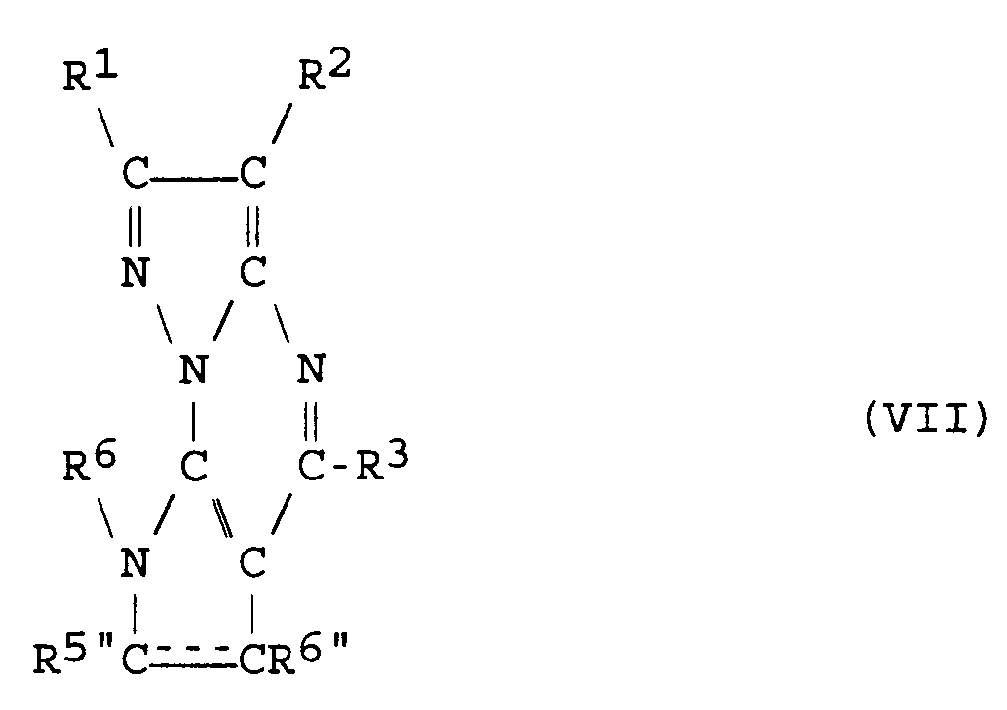
- In more detail, the new compounds of the present invention can be prepared as follows:
- This consists of a ring closure reaction by condensation of a compound of formula (VIII):


(in which R³ is as defined above) to produce a compound of formula (X):
(in which R¹ and R³ are as defined above). - The reaction is preferably effected in a solvent. There is no particular restriction on the nature of the solvent to be employed, provided that it has no adverse effect on the reaction or on the reagents involved. Examples of suitable solvents include: ethers, such as tetrahydrofuran and dioxane; aromatic hydrocarbons, such as benzene, toluene and xylene; alcohols, such as methanol and ethanol; amides, especially fatty acid amides, such as dimethylformamide and dimethylacetamide. Aromatic hydrocarbons and amides are preferred, and amides are most preferred. The amount of the lactone of formula (IX) to be employed is preferably at least equimolar, and more preferably from 1 to 2 times equimolar, with respect to the compound of formula (VIII). The reaction can take place over a wide range of temperatures, and the precise reaction temperature is not critical. In general, we found it convenient to carry out the reaction at a temperature from about 50°C to the boiling point of the solvent employed. The time required for the reaction may also vary widely, depending on many factors, notably the reaction temperature and the nature of the reagents. However, provided that the reaction is effected under the preferred conditions outlined above, a period of from 10 minutes to 30 hours will usually suffice.
- This step consists of the reaction of the compound of formula (X) obtained as described in step (a) above with phosphorus oxychloride to produce a compound of formula (XI). The reaction can be carried out in the absence or presence of a solvent.

- There is no particular restriction on the nature of the solvent which may be employed, provided that it has no adverse effect on the reaction or on the reagents involved. Examples of suitable solvents include: ethers, such as tetrahydrofuran or dioxane; aromatic hydrocarbons, such as benzene, toluene or xylene; and halogenated hydrocarbons, especially halogenated aliphatic hydrocarbons, such as methylene chloride, chloroform or carbon tetrachloride. It is usually preferred to conduct the reaction in the absence of a solvent. The reaction can take place over a wide range of temperatures, and the precise reaction temperature is not critical. In general, we found it convenient to carry out the reaction at a temperature from about 50°C to the boiling point of the solvent employed. The time required for the reaction may also vary widely, depending on many factors, notably the reaction temperature and the nature of the reagents. However, provided that the reaction is effected under the preferred conditions outlined above, a period of from about 10 minutes to 10 hours will usually suffice.
- A compound of formula (XII) can be prepared by treating the compound of formula (XI) obtained as described in step (b) above with a halogenating agent, such as N-chlorosuccinimide or N-bromosuccinimide in the presence of an inert solvent.

(in which R¹ and R³ are as defined above, and R2' represents a halogen atom). - There is no particular restriction on the nature of the solvent to be employed, provided that it has no adverse effect on the reaction or on the reagents involved. Examples of suitable solvents include: ethers, such as tetrahydrofuran or dioxane; aromatic hydrocarbons, such as benzene, toluene or xylene; and halogenated hydrocarbons, especially halogenated aliphatic hydrocarbons, such as methylene chloride, chloroform or carbon tetrachloride. The reaction can take place over a wide range of temperatures, and the precise reaction temperature is not critical. In general, we found it convenient to carry out the reaction at a temperature from about 0°C to the boiling point of the solvent employed. The time required for the reaction may also vary widely, depending on many factors, notably the reaction temperature and the nature of the reagents. However, provided that the reaction is effected under the preferred conditions outlined above, a period of from about 10 minutes to 10 hours will usually suffice.
- A compound of formula (V) can be prepared by treating the compound of formula (XI) or (XII), prepared as described in step (b) or (c) above, with a primary amine of formula R⁶NH₂ in an inert solvent and, if necessary, in the presence of a base.

(in which R¹, R², R³ and R⁶ are as defined above). - The choice of the primary amine of formula R⁶NH₂ will, of course depend solely upon the nature of the group R⁶ which it is desired to introduce into the compound.
- The nature of the base which may be employed in this reaction is not critical, provided that it does not adversely affect any other part of the molecule of the compound of formula (XI) or (XII), and examples include: organic bases such as triethylamine, pyridine or 1,8-diazabicyclo[5.4.0]-7-undecene (DBU); and alkali metal carbonates and bicarbonates, such as sodium carbonate, potassium carbonate and sodium bicarbonate.
- There is no particular restriction on the nature of the solvent to be employed, provided that it has no adverse effect on the reaction or on the reagents involved. Examples of suitable solvents include: ethers, such as tetrahydrofuran or dioxane; aromatic hydrocarbons, such as benzene, toluene or xylene; halogenated hydrocarbons, especially halogenated aliphatic hydrocarbons, such as methylene chloride, chloroform or carbon tetrachloride; alcohols, such as methanol, ethanol or isopropanol; and amides, especially fatty acid amides, such as dimethylformamide or dimethylacetamide. Alcohols are preferably employed. The amount of the base to be employed may vary depending upon the nature of the primary amine employed but is usually and preferably from equimolar to 3 times equimolar, with repect to the compound of formula (XI) or (XII). The amount of the primary amine to be employed is preferably from equimolar to 10 times equimolar, also with repect to the compound of formula (XI) or (XII). The reaction can take place over a wide range of temperatures, and the precise reaction temperature is not critical. In general, we found it convenient to carry out the reaction at a temperature from about 20°C to the boiling point of the solvent employed. The time required for the reaction may also vary widely, depending on many factors, notably the reaction temperature and the nature of the reagents. However, provided that the reaction is effected under the preferred conditions outlined above, a period of from about 10 minutes to 30 hours will usually suffice.
- The compound of formula (V) obtained as described in step (d) above can be converted to a compound of formula (VI) by dehydrogenation.

(in which R¹, R², R³ and R⁶ are as defined above, and the dotted line represents a carbon-carbon double bond). - Conventional dehydrogenation agents may be used in this reaction, for example, benzoyl peroxide, metal oxides such as manganese dioxide, and dehydrogenation catalysts, such as palladium-on-carbon.
- The reaction is normally and preferably effected in the presence of a solvent. There is no particular restriction on the nature of the solvent to be employed, provided that it has no adverse effect on the reaction or on the reagents involved. Examples of suitable solvents include: ethers, such as tetrahydrofuran or dioxane; aromatic hydrocarbons, such as benzene, toluene or xylene; and halogenated hydrocarbons, especially halogenated aliphatic hydrocarbons, such as methylene chloride, chloroform or carbon tetrachloride.
- The reaction can take place over a wide range of temperatures, and the precise reaction temperature is not critical. In general, we find it convenient to carry out the reaction at a temperature from about 0°C to the boiling point of the solvent employed. The time required for the reaction may also vary widely, depending on many factors, notably the reaction temperature and the nature of the reagents. However, provided that the reaction is effected under the preferred conditions outlined above, a period of from about 10 minutes to 30 hours will usually suffice.
- A compound of formula (VII) can be prepared by treating the compound (VI) obtained as described in step (e) above with a halogenating agent, such as N-chlorosuccinimide or N-bromosuccinimide in the presence of an inert solvent.
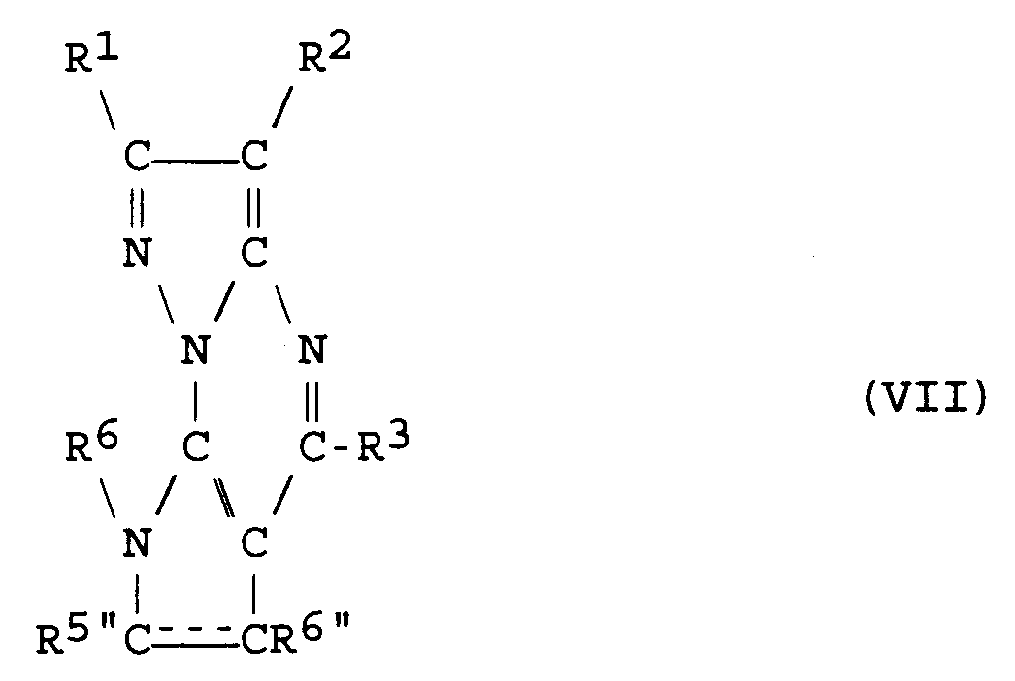
(in which R¹, R², R³ and R⁶ are as defined above, the dotted line represents a carbon-carbon double bond, and one of R5'' and R6'' represents a halogen atom and the other of R5'' and R6'' represents a halogen atom or a hydrogen atom). - There is no particular restriction on the nature of the solvent to be employed, provided that it has no adverse effect on the reaction or on the reagents involved. Examples of suitable solvents include: ethers, such as tetrahydrofuran or dioxane; aromatic hydrocarbons, such as benzene, toluene or xylene; and halogenated hydrocarbons, especially halogenated aliphatic hydrocarbons, such as methylene chloride, chloroform or carbon tetrachloride. Halogenated hydrocarbons are preferred. The reaction can take place over a wide range of temperatures, and the precise reaction temperature is not critical. In general, we found it convenient to carry out the reaction at a temperature from about 0°C to the boiling point of the solvent employed.
- The time required for the reaction may also vary widely, depending on many factors, notably the reaction temperature and the nature of the reagents. However, provided that the reaction is effected under the preferred conditions outlined above, a period of from about 10 minutes to 10 hours will usually suffice.
- The desired product obtained as described in any of the above steps may be isolated and purified by conventional means, for example by solvent-extraction, dilution, recrystallization, or the various chromatography techniques, notably column chromatography and preparative thin layer chromatography.
- The basic compounds of formula (I) may easily be converted to the corresponding acid addition salts by treatment with a suitable pharmaceutically acceptable acid. Suitable acids include: inorganic acids such as hydrochloric acid, sulphuric acid, phosphoric acid or hydrobromic acid; and organic acids such as acetic acid, oxalic acid, succinic acid, maleic acid, fumaric acid, malic acid, tartaric acid, citric acid, malonic acid, methanesulphonic acid or benzoic acid.
- All of the compounds of formula (I) employed in the present invention have shown low toxicity and high safety, with limited side effects. The acute toxicity (LD₅₀) in rats receiving 8-t-butyl-7,8-dihydro-5-methyl-6H-pyrrolo[3,2-e][1,2,4]triazolo[1,5-a]pyrimidine (Compound No. 1-19) by subcutaneous injection was not less than 100 mg/kg. The acute toxicity (LD₅₀) in mice receiving 8-(4-chlorobenzyl)-7,8-dihydro-5-methyl-6H-pyrrolo[3,2-e][1,2,4]triazaolo[1,5-a]pyrimidine (Compound No. 1-54), 8-(4-methoxybenzyl)-7,8-dihydro-5-methyl-6H-pyrrolo[3,2-e][1,2,4]triazolo[1,5-a]pyrimidine (Compound No. 1-49), 8-(4-methylbenzyl)-7,8-dihydro-5-methyl-6H-pyrrolo[3,2-e][1,2,4]triazolo[1,5-a]-pyrimidine (Compound No. 1-48) and 8-benzyl-7,8-dihydro-5-methyl-6H-pyrazolo[1,5-a]pyrrolo[3,2-e]pyrimidine (Compound No. 2-2) by intraperitoneal injection was not less than 300 mg/kg in each case.
- The compounds of the present invention may be administered in various forms, as is conventional in the art. For example, they may be administered orally in the form of tablets, capsules, granules, powders, syrups or the like or parenterally in the form of injections, drops or suppositories. The dose may vary depending upon the symptoms, age and body weight of the patient, and the nature and severity of the cachexia to be relieved, but, in general, the compounds of the invention may be administered orally in a daily dose of from about 10 to 1,000 mg for adults, either as a single dose or as divided doses, or parenterally in a single dose of from 10 to 500 mg by hypodermic, intramuscular or intravenous injection.
- The enhancement index employed herein is calculated as follows:
- Induction, suppression and assay of the lipoprotein lipase are carried out according to the methods reported by Beutler et al. [J. Immunol., 135, 3972-2977(1985)]. The differentiated adipocytes (3T3-L1) are incubated for 18 hours in the presence of a 2% (v/v) dispersion of serum taken from rabbits, to which the endotoxin had previously been intravenously administered. The serum obtained is named TNS. The enzyme activity of the adipocytes is determined after the incubation. The activity so determined corresponds to 5 - 15% of that activity which is determined after incubation in the presence of the serum taken from rabbits which had not been administered the endotoxin.
- When the compounds employed in this invention are added in an amount of from 0.1 to 100 microgram/ml to the adipocyte culture and the culture is incubated for 18 hours in the presence of 2% of TNS, the enzyme activity is enhanced and is higher than the activity determined in the absence of the compound.
- The enhancement index of the lipoprotein lipase = A/B, where:
- A:
- Heparin releasable lipoprotein lipase activity of the adipocytes after 18 hours incubation in the presence of TNS and the compounds tested, and
- B:
- Heparin releasable lipoprotein lipase activity of the adipocytes after 18 hours incubation in the presence of TNS and in the absence of the compounds.
- The enhancement index of each compound is calculated at the concentration showing the highest efficacy.
- TNS is prepared according to the methods reported by Ostrove et al. [J.M. Ostrove et al.; Proceedings of the Society for Experimental Biology and Medicine, 160, 354-358(1979)]. Forty mg per head of lyophilized hypodermic BCG vaccine (Japan BCG Ind., Japan) are injected into the marginal ear vein of female New Zealand white rabbits. Two weeks later, these rabbits are injected with 10 µg per head of the lipopolysaccharide (derived from E. coli 0127:B8, purchased from Difco Lab., USA) via the ear vein, and the animals are bled 1.5 - 2 hours later after the challenge. The blood obtained is incubated for 2 hours at 37°C to allow clotting, and then centrifuged at 3,000 rpm for 10 minutes to obtain a serum without debris. The serum obtained is incubated at 56°C for 30 minutes and is then sterilized by filtration through a 0.22 µm Millex-GS filter (Millipore Co., USA). The filtrate obtained is called TNS.
- The activity of the compounds of the present invention is illustrated by the following experiments.
- The induction, suppression and determination of lipoprotein lipase were carried out according to the methods reported by Beutler et al. as described above [J. Immunol., 135, 3972 - 3977 (1985)]. The fact that the restoration of lipolytic activity by the compounds of the present invention is due to the enhancement of the lipoprotein lipase, was ascertained as follows.
- It is known that 1.0 M of NaCℓ added to the reaction mixture for assay inhibits the activity of the lipoprotein lipase but does not also inhibit hepatic triglyceride lipase [A. Bensadoun et al.; J. Biol. Chem., 249, 2220-2227(1974), J.C. LaRosa et al.; J. Lipid Res., 13, 356-363(1972)]. The lipase activity of adipocytes incubated with the compounds of the present invention was clearly detected in the reaction mixture containing 0.1 M NaCℓ, but not in the reaction mixture containing 1.0 M NaCℓ.
- In addition, the lipase activity of the adipocytes (3T3-L1) incubated with the compounds of the present invention was not affected by 500 µM of chlorpromazine, a specific inhibitor for lysosomal lipase [G.L. Jansen et al.; J. Biol. Chem., 255, 11141 - 11148 (1980)]. Accordingly, it is concluded that the lipolytic activity restored by the compounds is due to lipoprotein lipase, when the activity has been suppressed by TNS.
- The remarkable restoration of the lipoprotein lipase by the compounds of the invention, is shown in Table 4.
- The compounds of the present invention are regarded as particularly useful as they each have an enhancement index of at least 2.


- Female mice (Balb/c, 10 weeks old, n=6, i.e. the number in each test group was 6) were injected with 9 mg/kg of the test compound (Compound No.1-19) via the tail vein. Twenty one hours later, the activities of the plasma lipoprotein lipase were determined according to Vlassara's method [Horm. Metabol. Res., 18, 698 - 703 (1986)].
- Activities of the plasma lipoprotein lipase in control mice receiving physiological saline were expressed as 100 and the relative value is shown in the following Table 5.

- A significant difference between the two groups was observed (p<0.05).
- As indicated above, the lipoprotein lipase activity was increased to 120% of that of the control, when the mice were administrated the test compound (Compund No. 1-19).
- A mouse cachexia model was made by inoculating 6 x 10⁵ viable tumour cells, adenocarcinoma C-12G, subcutaneously into the right axillary region of a CSF₁ mouse (8 - 9 weeks old, female weighing 21 - 24 g, n=10). The viable tumour cells were counted under a microscope after staining them with 0.4% of trypan blue (Sigma Co.).
- The growth of this kind of tumour, inoculated subcutaneously, causes a marked weight loss (the weight losses of mice 16 - 17 days after tumour inoculation were 4.0 - 4.5 g), piloerection and depression of emotion and finally death.
- Compound No. 1-19 (hereafter called the test compound) was suspended in saline containing 0.5% CMC (carboxymethyl cellulose) at a concentration of 4 mg/ml. The suspension was administrated orally to mice on days 1-4, 7-11, 14-24 (20 times in total) after tumour inoculation. The status of the mice, such as weight loss, piloerection, depression of emotion and increase in life-span, was observed.
- On the other hand, for a control group of mice, saline solution containing 0.5% of CMC was given orally. As a result of the oral administration of the test compound, extensive improvements in weight, hair retention and emotion were observed in the mice. As shown in Table 6 it was also found that the test compound produced an increase in life-span (ILS) compared with the control mice.


- In the above, the median survival times were measured in days.
- The preparation of pharmaceutical compositions according to the present invention is illustrated in the following Formulations.
-

- A mixture of the powdered compounds 1 to 4 was added to granules prepared from a mixture of the compounds 5 to 8, and the mixture was compressed using a tablet machine to make a tablet containing 100 mg per tablet. The tablet may be sugar-coated, where necessary.
-

- The above compounds 1 to 5 were mixed and pulverized, and then mixed well through a sieve. Then, the mixture was made into capsules containing 200 mg per capsule by a conventional method.
- The preparation of the new compounds of the present invention is illustrated by the following Examples.
- A solution of 49.86 g (0.6 mole) of 3-aminopyrazole and 84.56 g (0.66 mole) of α-acetyl-γ-butyrolactone dissolved in 60 ml of N,N-dimethylformamide was heated under reflux for 2 hours.
At the end of this time, the reaction mixture was cooled to room temperature, after which 100 ml of ethanol was added to it and the precipitated crystals were collected by filtration. They were then washed with ethanol to afford 104.9 g (yield 90%) of the title compound as prisms, melting at 225 - 226°C.
¹H-Nuclear Magnetic Resonance Spectrum (hexadeuterated dimethyl sulphoxide) δ ppm:
2.35 (3H, singlet);
2.42 - 2.82 (2H, multiplet);
3.20 - 3.70 (2H, multiplet);
4.58 (1H, triplet, J=6Hz);
6.03 (1H, doublet, J=2Hz);
7.81 (1H, doublet, J=2Hz);
12.07 (1H, broad);
12.48 (1H, broad). - Following a similar procedure to that described in Example 1, 1.72 g (yield 63.9%) of 6-(2-hydroxyethyl)-5-methyl-2-phenylpyrazolo[1,5-a]pyrimidin-7-(4H)-one was prepared as a light brown powder, melting at 284°C (with decomposition).
- A mixture of 5.80 g (30 mmoles) of 6-(2-hydroxyethyl)-5-methylpyrazolo[1,5-a]pyrimidin-7(4H)-one (prepared as described in Example 1) and 30 ml of phosphorous oxychloride was heated under reflux for 4 hours, with stirring. The reaction mixture was then poured into ice-water and extracted with chloroform.
- The extract was washed with water and dried over anhydrous magnesium sulphate, after which it was concentrated by evaporation under reduced pressure. The residue was purified by column chromatography through silica gel (eluted with chloroform) and recrystallized from hexane, to afford 5.5 g (yield 80%) of the title compound as light yellow prisms, melting at 87 - 88°C.
¹H-Nuclear Magnetic Resonance Spectrum (CDCℓ₃) δ ppm:
2.71 (3H, singlet);
3.18 - 3.50 (2H, multiplet);
3.60 - 3.97 (2H, multiplet);
6.68 (1H, doublet, J=2.5Hz);
8.17 (1H, doublet, J=2.5Hz). - Following a similar procedure to that described in Example 3, 1.77 g (yield 57.8%) of 7-chloro-6-(2-chloroethyl)-5-methyl-2-phenylpyrazolo[1,5-a]pyrimidine was prepared as yellow needles, melting at 147 - 149°C.
- 2.35 g (13.2 mmoles) of N-bromosuccinimide was added to a solution of 2.53 g (11 mmoles) of 7-chloro-6-(2-chloroethyl)-5-methylpyrazolo[1,5-a]pyrimidine (prepared as described in Example 3) dissolved in 20 ml of chloroform, and the mixture was heated under reflux, with stirring, for 30 minutes. At the end of this time, the reaction mixture was washed with a 2N aqueous solution of potassium hydroxide and then with water, after which it was dried over anhydrous sodium sulphate and then concentrated by evaporation under reduced pressure.
The residue was purified by column chromatography through alumina (eluted with chloroform) and recrystallized from diisopropyl ether to afford 3.33 g (yield 98%) of the title compound as colourless needles, melting at 128.5 - 129.5°C.
¹H-Nuclear Magnetic Resonance Spectrum (CDCℓ₃) δ ppm:
2.77 (3H, singlet);
3.20 - 3.50 (2H, multiplet);
3.63 - 3.97 (2H, multiplet);
8.18 (1H, singlet). - 1.60 g (12 mmoles) of N-chlorosuccinimide were added to a solution of 2.30 g (10 mmoles) of 7-chloro-6-(2-chloroethyl)-5-methylpyrazolo[1.5-a]pyrimidine (prepared as described in Example 3) in 10 ml of chloroform, and the resulting mixture was heated under reflux, with stirring, for one hour. At the end of this time, the reaction mixture was washed with a 2N aqueous solution of potassium hydroxide and then with water, after which it was dried over anhydrous sodium sulphate and then concentrated by evaporation under reduced pressure. The residue was purified by column chromatography through alumina (eluted with chloroform) and recrystallized from diisopropyl ether to afford 1.56 g (yield 59%) of the title compound as light yellow needles, melting at 115 - 117°C.
¹H-Nuclear Magnetic Resonance Spectrum (CDCℓ₃) δ ppm:
2.77 (3H, singlet);
3.13 - 3.52 (2H, multiplet);
3.63 - 3.98 (2H, multiplet);
8.18 (1H, singlet). - A solution of 1.15 g (5 mmoles) of 7-chloro-6-(2-chloroethyl)-5-methylpyrazolo[1,5-a]pyrimidine (prepared as described in Example 3), 643 mg (6 mmoles) of benzylamine and 2 ml of triethylamine dissolved in 5 ml of isopropanol was heated under reflux for 7 hours, with stirring. The reaction mixture was then poured into water and extracted with ethyl acetate. The organic layer was extracted with 5% by volume aqueous sulphuric acid, and the extract was made basic by the addition of sodium carbonate. The crystals which precipitated were collected by filtration and washed with water. They were then purified by column chromatography through silica gel (eluted with chloroform) and recrystallized from a mixture of ethyl acetate and chloroform, to afford 788 mg (yield 60%) of the title compound as colourless needles, melting at 130 - 130.5°C.
¹H-Nuclear Magnetic Resonance Spectrum (CDCℓ₃) δ ppm:
2.38 (3H, singlet);
2.80-3.25 (2H, multiplet);
3.40-3.81 (2H, multiplet);
6.37 (1H, doublet, J=2.5Hz);
8.01 (1H, doublet, J=2.5Hz). - Following a similar procedure to that described in Example 7, 956 mg (yield 68%) of 3-bromo-7,8-dihydro-8-ethyl-5-methyl-6H-pyrazolo[1,5-a]pyrrolo[3,2-e]pyrimidine were prepared as light yellow needles, melting at 163 - 165°C.
¹H-Nuclear Magnetic Resonance Spectrum (CDCℓ₃) δ ppm:
2.38 (3H, singlet);
3.05 (2H, triplet, J=9Hz);
3.82 (2H, triplet, J=9Hz);
7.93 (1H, singlet). - Following a similar procedure to that described in Example 7, 1.296 g (yield 49%) of 8-(t-butyl)-3-chloro-7,8-dihydro-5-methyl-6H-pyrazolo[1,5-a]pyrrolo[3,2-e]-pyrimidine was prepared as light yellow prisms, melting at 132.5 - 134°C.
¹H-Nuclear Magnetic Resonance Spectrum (CDCℓ₃) δ ppm:
2.40 (3H, singlet);
2.97 (2H, triplet, J=9Hz);
4.00 (2H, triplet, J=9Hz);
7.93 (1H, singlet). - Following a similar procedure to that described in Example 7, 1.366 g (yield 73%) of 3-bromo-7,8-dihydro-8-(4-methoxybenzyl)-5-methyl-6H-pyrazolo[1,5-a]pyrrolo-[3,2-e]pyrimidine was prepared as light yellow needles, melting at 147 - 149°C.
¹H-Nuclear Magnetic Resonance Spectrum (CDCℓ₃) δ ppm:
2.38 (3H, singlet);
3.02 (2H, multiplet);
3.68 (2H, multiplet);
8.00 (1H, singlet). - Following a similar procedure to that described in Example 7, 1.70 g (yield 32.4%) of 3-bromo-8-cycloheptyl-7,8-dihydro-5-methyl-6H-pyrazolo[1,5-a]pyrrolo-[3,2-e]pyrimidine was prepared as colourless needles, melting at 184 - 185°C.
¹H-Nuclear Magnetic Resonance Spectrum (CDCℓ₃) δ ppm:
2.36 (3H, singlet);
3.02 (2H, multiplet);
3.82 (2H, multiplet);
7.90 (1H, singlet). - Following a similar procedure to that described in Example 7, 2.57 g (yield 61.6%) of 8-ethyl-7,8-dihydro-5-methyl-2-phenyl-6H-pyrazolo[1,5-a]pyrrolo[3,2-e]-pyrimidine was prepared as light yellow needles, melting at 197 - 198.5°C.
- 2.16 g (8.92 mmoles) of benzoyl peroxide were added to a solution of 2.50 g (8.89 mmoles) of 3-bromo-7,8-dihydro-8-ethyl-5-methyl-6H-pyrazolo[1,5-a]pyrrolo-[3,2-e]pyrimidine (prepared as described in Example 8) dissolved in 30 ml of benzene, and the mixture was stirred for 2 hours. At the end of this time, the reaction mixture was washed with a 5% v/v aqueous solution of sodium bicarbonate and then with water, after which it was dried over anhydrous sodium sulphate and then concentrated by evaporation under reduced pressure. The residue was purified by column chromatography through silica gel (eluted with chloroform) and recrystallized from diisopropyl ether to afford 1.019 g (yield 41%) of the title compound as light yellow needles, melting at 113 - 114°C.
¹H-Nuclear Magnetic Resonance Spectrum (CDCℓ₃) δ ppm:
2.78 (3H, singlet);
6.61 (1H, doublet, J=3.5Hz);
6.68 (1H, doublet, J=3.5Hz);
8.02 (1H, singlet). - Following a similar procedure to that described in Example 13, 1.10 g (yield 73.8%) of 8-ethyl-5-methyl-2-phenyl-8H-pyrazolo[1,5-a]pyrrolo[3,2-e]pyrimidine was prepared as light yellow prisms, melting at 142 - 143.5°C.
- N-bromosuccinimide was added at room temperature to a solution of 1.675 g (6 mmoles) of 3-bromo-8-ethyl-5-methyl-8H-pyrazolo[1,5-a]pyrrolo[3,2-e]pyrimidine (prepared as described in Example 13) dissolved in 12 ml of chloroform, and the mixture was stirred for 2 hours. At the end of this time, the reaction mixture was washed with a 2N aqueous solution of potassium hydroxide and then with water, after which it was dried over anhydrous sodium sulphate and then concentrated by evaporation under reduced pressure. The residue was purified by column chromatography through silica gel (eluted with chloroform) and recrystallized from ethyl acetate to afford 1.72 g (yield 80%) of the title compound as colourless needles, melting at 135 - 137°C.
¹H-Nuclear Magnetic Resonance Spectrum (CDCℓ₃) δ ppm:
2.72 (3H, singlet);
6.68 (1H, singlet);
7.98 (1H, singlet).
said heterocyclic groups have 5 or 6 ring atoms of which 1 is a nitrogen atom through which the group is attached to the remainder of the molecule and 0, 1 or 2 are additional nitrogen and/or oxygen hetero-atoms, said group being unsubstituted or having at least one C₁ - C₅ alkyl substituent;
or of a pharmaceutically acceptable salt thereof.
and pharmaceutically acceptable salts thereof.


(in which R¹, R², R³ and R⁶ are as defined above, the dotted line represents a carbon-carbon double bond, and one of R5'' and R6'' represents a halogen atom and the other of R5'' and R6'' represents a halogen atom or a hydrogen atom),
and, if required, salifying the product.
Claims (10)
- The use for the manufacture of a medicament for the treatment, alleviation or prophylaxis of the effects of cachexia, of a compound of formula (I):

Y represents a group of formula
R¹ represents a hydrogen atom, a C₁ - C₅ alkyl group or a C₆ - C₁₀ carbocyclic aryl group which is unsubstituted or has at least one of substituents (a), defined below;
R² represents a hydrogen atom or a halogen atom;
R³ represents a C₁ - C₅ alkyl group or a C₃ - C₇ cycloalkyl group;
R⁴ represents a hydrogen atom, a C₁ - C₅ alkyl group or a hydroxy group, or, but only when Y represents said group of formula (III) and said dotted line represents a double bond, a halogen atom;
R⁵ represents a hydrogen atom, a C₁ - C₅ alkyl group, a hydroxy group, an oxygen atom or, but only when Y represents said group of formula (III) and said dotted line represents a double bond, a halogen atom; and
R⁶ represents a hydrogen atom, a C₁ - C₁₅ alkyl group, a substituted C₁ - C₅ alkyl group having at least one of substituents (b), defined below, a C₃ - C₇ alkenyl group, a C₃ - C₅ alkynyl group, a C₃ - C₁₀ cycloalkyl group, a C₆ - C₁₀ carbocyclic aryl group which is unsubstituted or has at least one of substituents (a), defined below, or an aralkyl group in which the alkyl part is C₁ - C₃ and is unsubstituted or has at least one hydroxy substituent, and the aryl part is a C₆ - C₁₀ carbocyclic aryl group which is unsubstituted or has at least one of substituents (c), defined below;
substituents (a):
C₁ - C₅ alkyl groups, halogen atoms, C₁ - C₅ alkoxy groups and sulphamoyl groups;
substituents (b):
halogen atoms, hydroxy groups, mercapto groups, dialkylamino groups in which each alkyl part is C₁ - C₅ and is unsubstituted or has at least one hydroxy substituent, heterocyclic groups as defined below, phenoxy groups, C₁ - C₅ alkoxy groups, C₁ - C₅ hydroxyalkoxy groups, benzoyl groups, substituted benzoyl groups having at least one of substituents (d), defined below, benzoyloxy groups, substituted benzoyloxy groups having at least one of substituents (d), defined below, and heterocyclic-carbonyloxy groups in which the heterocyclic part has 5 or 6 ring atoms of which 1 or 2 are nitrogen hetero-atoms;
substituents (c):
C₁ - C₅ alkyl groups, halogen atoms and C₁ - C₅ alkoxy groups;
substituents (d):
halogen atoms and C₁ - C₅ alkoxy groups;
said heterocyclic groups have 5 or 6 ring atoms of which 1 is a nitrogen atom through which the group is attached to the remainder of the molecule and 0, 1 or 2 are additional nitrogen and/or oxygen hetero-atoms, said group being unsubstituted or having at least one C₁ - C₅ alkyl substituent;
and of pharmaceutically acceptable salts thereof. - The use according to Claim 1, of at least one compound of formula (Ia):

R¹ and R³ are as defined in Claim 1;
R4' represents a hydrogen atom, a hydroxy group or a C₁ - C₅ alkyl group;
R5' represents a hydrogen atom, a hydroxy group, an oxygen atom or a C₁ - C₅ alkyl group; and
R6' represents a hydrogen atom, a C₁ - C₁₅ alkyl group, a substituted C₁ - C₅ alkyl group having at least one of substituents (b), defined in Claim 1, a C₃ - C₇ alkenyl group, a C₃ - C₁₀ cycloalkyl group, a C₆ - C₁₀ carbocyclic aryl group which is unsubstituted or has at least one of substituents (a), defined in Claim 1, or an aralkyl group in which the alkyl part is C₁ - C₃ and the aryl part is a C₆ - C₁₀ carbocyclic aryl group which is unsubstituted or has at least one of substituents (c), defined in Claim 1;
or of a pharmaceutically acceptable salt thereof. - The use according to Claim 1, of at least one compound of formula (Ib):
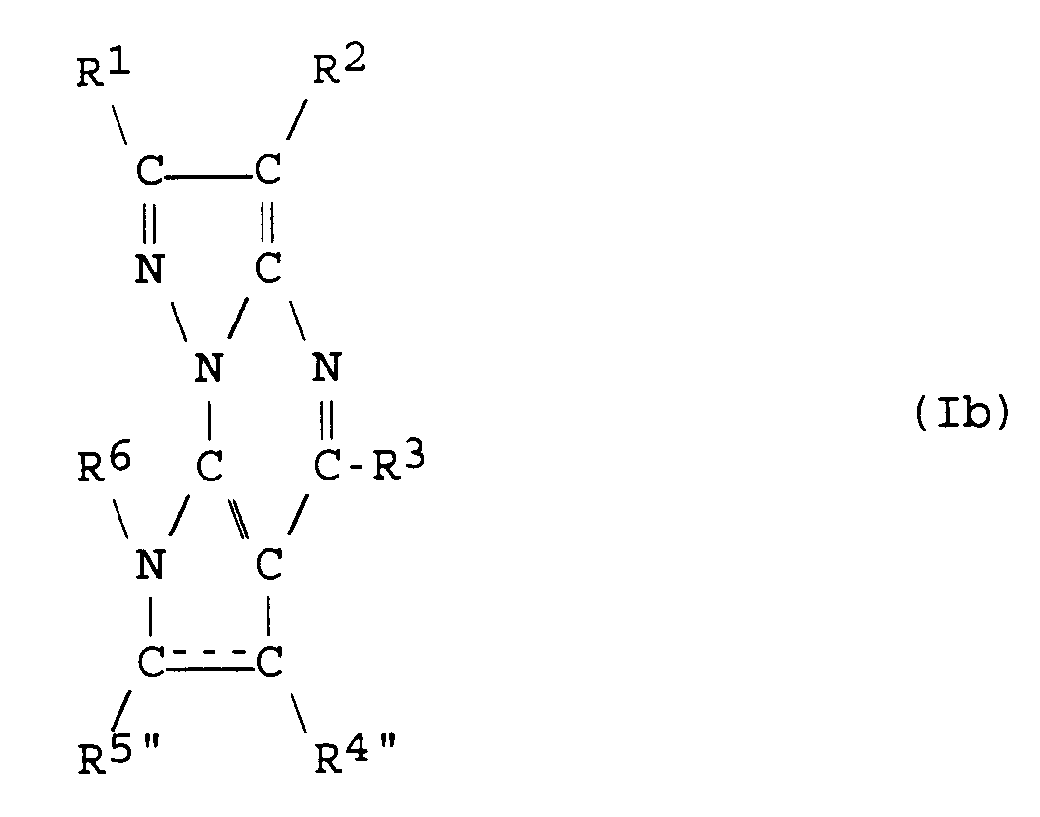
R¹, R², R³, R⁶ and the dotted line are as defined in Claim 1,
R4'' represents a hydrogen atom, or, but only when the dotted line represents a double bond, a hydrogen atom or a halogen atom; and
R5' represents a hydrogen atom, or, but only when the dotted line represents a double bond, a hydrogen atom or a halogen atom;
or of a pharmaceutically acceptable salt thereof. - The use according to Claim 2, in which:
R¹ represents a hydrogen atom; a straight or branched chain alkyl group containing from 1 to 5 carbon atoms; or a carbocyclic aryl group containing from 6 to 10 carbon atoms, the aryl group being unsubstituted or having at least one of substituents (a), defined in Claim 1;
R³ represents a straight or branched chain alkyl group containing from 1 to 5 carbon atoms; or a cycloalkyl group containing from 3 to 7 carbon atoms;
R4' represents a hydrogen atom; a hydroxy group; or a straight or branched chain alkyl group containing from 1 to 5 carbon atoms;
R5' represents a hydrogen atom; a hydroxy group; or a straight or branched chain alkyl group containing from 1 to 5 carbon atoms;
R6' represents a hydrogen atom; a straight or branched chain alkyl group containing from 1 to 15 carbon atoms; a substituted straight or branched chain alkyl group containing from 1 to 5 carbon atoms and having at least one of substituents (b'), defined below; a cycloalkyl group containing from 3 to 10 carbon atoms; an alkenyl group containing from 3 to 7 carbon atoms; a carbocyclic aryl group containing from 6 to 10 carbon atoms which aryl group is unsubstituted or has at least one of substituents (a), defined in Claim 1; or an aralkyl group in which the alkyl part is C₁ - C₃ and the aryl part is a phenyl group which is unsubstituted or has at least one of substituents (c), defined in Claim 1; and
substituents (b'):
halogen atoms, hydroxy groups, mercapto groups, dialkylamino groups in which each alkyl group has from 1 to 5 carbon atoms and is unsubstituted or has at least one hydroxy substituent, five- and six-membered heterocyclic groups which are unsubstituted or have at least one C₁ - C₅ alkyl substituent and which additionally contain 0, 1 or 2 nitrogen and/or oxygen atoms in the ring, phenoxy groups, alkoxy groups containing from 1 to 5 carbon atoms, benzoyl groups which are unsubstituted or have at least one of substituents (d), defined in Claim 1, benzoyloxy groups which are unsubstituted or have at least one of substituents (d), defined in Claim 1, and heterocyclic-carbonyloxy groups in which the heterocyclic part has 5 or 6 ring atoms of which 1 or 2 are nitrogen hetero-atoms. - The use according to Claim 2, in which:
R¹ represents a hydrogen atom, a C₁ - C₃ alkyl group, or a phenyl group, which is unsubstituted or has at least one of substituents (a'), defined below;
R³ represents a C₁ - C₃ alkyl group or a cycloalkyl group containing from 3 to 5 carbon atoms;
R4' represents a hydrogen atom, a hydroxy group or a C₁ - C₃ alkyl group;
R5' represents a hydrogen atom, a hydroxy group or a C₁ - C₃ alkyl group;
R6' represents a hydrogen atom, a C₁ - C₁₂ alkyl group, a substituted C₁ - C₅ alkyl group having at least one of substituents (b''), defined below; an alkenyl group containing from 3 to 5 carbon atoms; a cycloalkyl group containing from 5 to 8 carbon atoms; a phenyl group which is unsubstituted or has at least one of substituents (a'), defined below; or an aralkyl group in which the alkyl part is a C₁ - C₃ alkyl group and the aryl part is a phenyl group which is unsubstituted or has at least one of substituents (c'), defined below;
substituents (a')
C₁ - C₃ alkyl groups, halogen atoms, C₁ - C₃ alkoxy groups and sulphamonyl groups;
substituents (b'')
hydroxy groups; dialkylamino groups in which each alkyl part is C₁ - C₅ and is unsubstituted or has at least one hydroxy substituent; heterocyclic groups having 5 or 6 ring atoms of which 1 is a nitrogen atom through which the group is attached to the remainder of the molecule and 0, 1 or 2 are additional nitrogen and/or oxygen hetero-atoms, said group being unsubstituted or having at least one C₁ - C₅ alkyl substituent; phenoxy groups; C₁ - C₃ alkoxy groups; benzoyloxy groups which are unsubstituted or have at least one halogen and/or C₁ - C₃ alkoxy substituent; and heterocyclic-carbonyloxy groups in which the heterocyclic part has 5 or 6 ring atoms of which 1 or 2 are nitrogen hetero-atoms;
substituents (c')
C₁ - C₃ alkyl groups, halogen atoms and C₁ - C₃ alkoxy groups. - The use according to Claim 5, in which:
R¹ represents a hydrogen atom; a methyl group; a phenyl group which is unsubstituted or has at least one of substituents (a''), defined below;
R³ represents a methyl group or a cyclopropyl group;
R4' represents a hydrogen atom or a methyl group;
R5' represents a hydrogen atom or a C₁ - C₃ alkyl group;
R6' represents a hydrogen atom; a C₁ - C₁₂ alkyl group; a substituted C₁ - C₅ alkyl group having at least one of substituents (b''), defined in Claim 5; an alkenyl group containing from 3 to 5 carbon atoms; a cycloalkyl group containing from 5 to 8 carbon atoms; an unsubstituted phenyl group; a substituted phenyl group which has at least one halogen and/or sulphamoyl substituent; or an aralkyl group in which the alkyl part is a C₁ - C₃ alkyl group and the aryl part is a phenyl group which is unsubstituted or has at least one of substituents (c'), defined in Claim 5;
substituents (a'')
halogen atoms and C₁ - C₃ alkoxy groups. - The use according to Claim 5, in which:
R¹ represents a hydrogen atom or a phenyl group which is unsubstituted or has at least one C₁ - C₃ alkoxy substituent;
R³ represents a methyl or cyclopropyl group;
R4' represents a hydrogen atom;
R5' represents a hydrogen atom or a C₁ - C₃ alkyl group;
R6' represents a C₁ - C₁₂ alkyl group; a substituted C₁ - C₅ alkyl group having at least one of substituents (b‴), defined below; an alkenyl group containing from 3 to 5 carbon atoms; a cycloalkyl group containing from 5 to 8 carbon atoms; or an aralkyl group in which the alkyl part is a C₁ - C₃ alkyl group and the aryl part is a phenyl group which is unsubstituted or has at least one of substituents (c'), defined in Claim 5;
substituents (b‴)
hydroxy groups; heterocyclic groups having 5 or 6 ring atoms of which 1 is a nitrogen atom through which the group is attached to the remainder of the molecule and 0, 1 or 2 are additional nitrogen and/or oxygen hetero-atoms; phenoxy groups; benzoyloxy groups which are unsubstituted or have at least one halogen and/or C₁ - C₃ alkoxy substituent; and heterocyclic-carbonyloxy groups in which the heterocyclic part has 5 or 6 ring atoms of which 1 or 2 are nitrogen hetero-atoms. - The use according to Claim 3, in which:
R¹ represents a hydrogen atom or a phenyl group;
R² represents a hydrogen, bromine or chlorine atom;
R³ represents a methyl group;
R4'' represents a hydrogen atom, or, but only when the dotted line represents a double bond, a bromine atom;
R5'' represents a hydrogen atom, or, but only when the dotted line represents a double bond, a bromine atom; and
R⁶ represents a C₁ - C₁₂ alkyl group, a substituted C₁ - C₄ alkyl group having at least one of substituents (biv), defined below, an allyl group, a propargyl group, a C₅ - C₇ cycloalkyl group, a phenyl group, or a phenylalkyl group in which the alkyl part is C₁ - C₃ and is unsubstituted, and the phenyl part is unsubstituted or has at least one of substituents (c''), defined below;
substituents (b iv ):
halogen atoms, hydroxy groups, mercapto groups, heterocyclic groups having 5 or 6 ring atoms of which 1 is a nitrogen atom through which the group is attached to the remainder of the molecule and 0, 1 or 2 are additional nitrogen and/or oxygen hetero-atoms, said heterocyclic group being unsubstituted or having at least one C₁ - C₃ alkyl substituent, benzoyloxy groups and substituted benzoyloxy groups having at least one methoxy substituent;
substituents (c''):
methyl groups, chlorine atoms, fluorine atoms and methoxy groups. - The use according to Claim 3, in which:
R¹ represents a hydrogen atom or a phenyl group;
R² represents a hydrogen, bromine or chlorine atom;
R³ represents a methyl group;
R4'' represents a hydrogen atom;
R5'' represents a hydrogen atom, or, but only when the dotted line represents a double bond, a bromine atom; and
R⁶ represents a C₂ - C₄ alkyl group, a cycloheptyl group or a phenylalkyl group in which the alkyl part is C₁ - C₃ and is unsubstituted and the phenyl part is unsubstituted or has at least one methyl and/or methoxy substituent. - The use according to Claim 1 of:
8-butyl-7,8-dihydro-5-methyl-6H-pyrrolo[3,2-e][1,2,4]-triazolo[1,5-a]pyrimidine;
8-t-butyl-7,8-dihydro-5-methyl-6H-pyrrolo[3,2-e][1,2,4]-triazolo[1,5-a]pyrimidine;
8-t-butyl-5-cyclopropyl-7,8-dihydro-6H-pyrrolo[3,2-e]-[1,2,4]triazolo[1,5-a]pyrimidine;
7,8-dihydro-5-methyl-8-t-pentyl-6H-pyrrolo[3,2-e][1,2,4]-triazolo[1,5-a]pyrimidine;
8-heptyl-7,8-dihydro-5-methyl-6H-pyrrolo[3,2-e][1,2,4]-triazolo[1,5-a]pyrimidine;
8-cycloheptyl-7,8-dihydro-5-methyl-6H-pyrrolo[3,2-e]-[1,2,4]triazolo[1,5-a]pyrimidine;
8-cyclooctyl-7,8-dihydro-5-methyl-6H-pyrrolo[3,2-e]-[1,2,4]triazolo[1,5-a]pyrimidine;
7,8-dihydro-5-methyl-8-(4-methylbenzyl)-6H-pyrrolo-[3,2-e][1,2,4]triazolo[1,5-a]pyrimidine;
7,8-dihydro-8-(4-methoxybenzyl)-5-methyl-6H-pyrrolo-[3,2-e][1,2,4]triazolo[1,5-a]pyrimidine;
8-(4-chlorobenzyl)-7,8-dihydro-5-methyl-6H-pyrrolo-[3,2-e][1,2,4]triazolo[1;5;a]pyrimidine;
7,8-dihydro-5-methyl-8-(α-methylbenzyl)-6H-pyrrolo-[3,2-e][1,2,4]triazolo[1,5-a]pyrimidine;
7,8-dihydro-5-methyl-8-(1-methyl-2-phenoxyethyl)-6H-pyrrolo[3,2-e][1,2,4]triazolo[1,5-a]pyrimidine;
8-benzyl-7,8-dihydro-5-methyl-6H-pyrazolo[1,5-a]pyrrolo-[3,2-e]pyrimidine
or of a pharmaceutically acceptable salt thereof.
Priority Applications (2)
| Application Number | Priority Date | Filing Date | Title |
|---|---|---|---|
| AT89306147T ATE88894T1 (en) | 1988-06-16 | 1989-06-16 | METHOD OF TREATMENT OF CACHEXIA AND SPECIFIC COMPOUNDS TO BE USED FOR IT. |
| EP92201695A EP0508549B1 (en) | 1988-06-16 | 1989-06-16 | New triazolopyrimidine and pyrazolopyrimidine derivatives useful for treating cachexia |
Applications Claiming Priority (2)
| Application Number | Priority Date | Filing Date | Title |
|---|---|---|---|
| JP14913788 | 1988-06-16 | ||
| JP149137/88 | 1988-06-16 |
Related Child Applications (2)
| Application Number | Title | Priority Date | Filing Date |
|---|---|---|---|
| EP92201695A Division EP0508549B1 (en) | 1988-06-16 | 1989-06-16 | New triazolopyrimidine and pyrazolopyrimidine derivatives useful for treating cachexia |
| EP92201695.1 Division-Into | 1992-06-11 |
Publications (3)
| Publication Number | Publication Date |
|---|---|
| EP0347252A2 EP0347252A2 (en) | 1989-12-20 |
| EP0347252A3 EP0347252A3 (en) | 1991-03-27 |
| EP0347252B1 true EP0347252B1 (en) | 1993-05-05 |
Family
ID=15468558
Family Applications (2)
| Application Number | Title | Priority Date | Filing Date |
|---|---|---|---|
| EP92201695A Expired - Lifetime EP0508549B1 (en) | 1988-06-16 | 1989-06-16 | New triazolopyrimidine and pyrazolopyrimidine derivatives useful for treating cachexia |
| EP89306147A Expired - Lifetime EP0347252B1 (en) | 1988-06-16 | 1989-06-16 | Method of treating cachexia and certain new compounds for use in this method |
Family Applications Before (1)
| Application Number | Title | Priority Date | Filing Date |
|---|---|---|---|
| EP92201695A Expired - Lifetime EP0508549B1 (en) | 1988-06-16 | 1989-06-16 | New triazolopyrimidine and pyrazolopyrimidine derivatives useful for treating cachexia |
Country Status (9)
| Country | Link |
|---|---|
| US (2) | US5055479A (en) |
| EP (2) | EP0508549B1 (en) |
| JP (1) | JPH0276880A (en) |
| KR (1) | KR910000737A (en) |
| AT (2) | ATE121744T1 (en) |
| CA (1) | CA1329199C (en) |
| DE (2) | DE68922408D1 (en) |
| ES (1) | ES2057126T3 (en) |
| IE (2) | IE930392L (en) |
Families Citing this family (26)
| Publication number | Priority date | Publication date | Assignee | Title |
|---|---|---|---|---|
| CA1330079C (en) * | 1988-10-13 | 1994-06-07 | Michihiko Tsujitani | Pyrrolo (3,2-e)pyrazolo(1,5-a)pyrimidine derivative and medicine comprising the same |
| US5264220A (en) * | 1991-11-12 | 1993-11-23 | Long David M Jr | Method of extending the vascular dwell-time of particulate therapeutic and particulate diagnostic agents |
| JPH10218881A (en) * | 1997-02-03 | 1998-08-18 | Pola Chem Ind Inc | New pyrrolopyrazolopyrimidine derivative |
| TWI271406B (en) | 1999-12-13 | 2007-01-21 | Eisai Co Ltd | Tricyclic condensed heterocyclic compounds, preparation method of the same and pharmaceuticals comprising the same |
| US20020061897A1 (en) | 2000-03-30 | 2002-05-23 | Elliott Richard L. | Neuropeptide Y antagonists |
| JP2002043785A (en) | 2000-07-28 | 2002-02-08 | Murata Mfg Co Ltd | Shielding case, electronic device using the same, electronic apparatus using the same, and method of manufacturing the same |
| DZ3415A1 (en) | 2000-08-31 | 2002-03-07 | Chiron Corp | GUANIDINOBENZAMIDES AS MC4-R AGONISTS. |
| EP1767525A1 (en) | 2001-04-09 | 2007-03-28 | Novartis Vaccines and Diagnostics, Inc. | Guanidino compounds as melanocortin-4 receptor (MC4-R) agonists |
| CA2457720C (en) * | 2001-07-13 | 2010-11-02 | Tomiichiro Oda | Medicine containing pyrimidine derivative |
| US20050124652A1 (en) * | 2002-02-04 | 2005-06-09 | Rustum Boyce | Guanidino compounds |
| US20030207814A1 (en) * | 2002-02-04 | 2003-11-06 | Chiron Corporation | Novel guanidinyl derivatives |
| US20030195187A1 (en) * | 2002-02-04 | 2003-10-16 | Chiron Corporation | Guanidino compounds |
| EP1487474A4 (en) * | 2002-02-25 | 2006-11-29 | Chiron Corp | Intranasal administration of mc4-r agonists |
| DE60333937D1 (en) * | 2002-05-23 | 2010-10-07 | Novartis Vaccines & Diagnostic | SUBSTITUTED QUINAZOLINONE COMPOUNDS |
| US7051505B2 (en) * | 2002-08-21 | 2006-05-30 | Greg Brannstrom | Tomato harvester |
| US7329658B2 (en) * | 2003-02-06 | 2008-02-12 | Pfizer Inc | Cannabinoid receptor ligands and uses thereof |
| US7176210B2 (en) * | 2003-02-10 | 2007-02-13 | Pfizer Inc. | Cannabinoid receptor ligands and uses thereof |
| KR20060018217A (en) * | 2003-05-23 | 2006-02-28 | 카이론 코포레이션 | Guanidino-substituted quinazolinone compounds as Mc4-R agonists |
| US20050009919A1 (en) * | 2003-07-07 | 2005-01-13 | Clouatre Dallas L. | Treating cachexia and excessive catabolism with (-)-hydroxycitric acid |
| EP1686996A4 (en) * | 2003-11-19 | 2008-11-12 | Novartis Vaccines & Diagnostic | QUINAZOLINONE COMPOUNDS WITH REDUCED BIOACCUMULATION |
| WO2009120836A1 (en) * | 2008-03-26 | 2009-10-01 | Neurosigma, Inc. | Methods for identifying and targeting autonomic brain regions |
| SI2266990T1 (en) | 2008-04-15 | 2013-01-31 | Eisai R&D Management Co. Ltd. | 3-PHENYLPYRAZOLOS5,1-bCTHIAZOLE COMPOUND |
| GB0917775D0 (en) | 2009-10-09 | 2009-11-25 | Btg Int Ltd | Novel pharmaceutical compounds |
| GB0917774D0 (en) * | 2009-10-09 | 2009-11-25 | Senexis Ltd | Novel pharmaceutical compounds |
| WO2012027239A1 (en) * | 2010-08-23 | 2012-03-01 | Schering Corporation | NOVEL PYRAZOLO[1,5-a]PYRROLO[3,2-e]PYRIMIDINE DERIVATIVES AS mTOR INHIBITORS |
| KR20160101398A (en) | 2015-02-17 | 2016-08-25 | 순천대학교 산학협력단 | Fabrication Method of Ceramic Electrode Including barium titanate layer |
Family Cites Families (6)
| Publication number | Priority date | Publication date | Assignee | Title |
|---|---|---|---|---|
| JPS51141896A (en) * | 1975-05-31 | 1976-12-07 | Sankyo Co Ltd | Process for preparing fused ring triazoropyrimidine derivatives |
| DE2704030A1 (en) * | 1976-02-12 | 1977-08-18 | Sandoz Ag | NEW ORGANIC COMPOUNDS, THEIR PRODUCTION AND USE |
| JPS5353697A (en) * | 1976-10-20 | 1978-05-16 | Sankyo Co Ltd | Tricyclic triazolopyrimidine derivatives |
| US4619933A (en) * | 1979-09-28 | 1986-10-28 | The Upjohn Company | 6-aryl pyrimidines for treating aplastic anemia |
| DE3241827T1 (en) * | 1982-02-19 | 1984-01-12 | Mochida Pharmaceutical Co., Ltd., Tokyo | New s-Triazolo [1,5-a] pyrimidine derivatives |
| CA1330079C (en) * | 1988-10-13 | 1994-06-07 | Michihiko Tsujitani | Pyrrolo (3,2-e)pyrazolo(1,5-a)pyrimidine derivative and medicine comprising the same |
-
1989
- 1989-06-14 US US07/365,851 patent/US5055479A/en not_active Expired - Fee Related
- 1989-06-14 JP JP1149578A patent/JPH0276880A/en active Pending
- 1989-06-16 AT AT92201695T patent/ATE121744T1/en not_active IP Right Cessation
- 1989-06-16 IE IE930392A patent/IE930392L/en unknown
- 1989-06-16 IE IE196389A patent/IE62915B1/en not_active IP Right Cessation
- 1989-06-16 DE DE68922408T patent/DE68922408D1/en not_active Expired - Lifetime
- 1989-06-16 ES ES89306147T patent/ES2057126T3/en not_active Expired - Lifetime
- 1989-06-16 EP EP92201695A patent/EP0508549B1/en not_active Expired - Lifetime
- 1989-06-16 EP EP89306147A patent/EP0347252B1/en not_active Expired - Lifetime
- 1989-06-16 DE DE89306147T patent/DE68906309T2/en not_active Expired - Fee Related
- 1989-06-16 AT AT89306147T patent/ATE88894T1/en active
- 1989-06-16 CA CA000603102A patent/CA1329199C/en not_active Expired - Fee Related
- 1989-06-16 KR KR1019890008349A patent/KR910000737A/en not_active Ceased
-
1991
- 1991-04-25 US US07/691,542 patent/US5086057A/en not_active Expired - Fee Related
Non-Patent Citations (1)
| Title |
|---|
| CAN. MED. ASSOC. J., vol. 135, no. 7, 01 October 1986; J.G.WEBB et al., pp. 753-758. * |
Also Published As
| Publication number | Publication date |
|---|---|
| IE62915B1 (en) | 1995-03-08 |
| IE891963L (en) | 1989-12-16 |
| ES2057126T3 (en) | 1994-10-16 |
| EP0508549A3 (en) | 1992-11-25 |
| US5055479A (en) | 1991-10-08 |
| ATE88894T1 (en) | 1993-05-15 |
| EP0508549B1 (en) | 1995-04-26 |
| DE68922408D1 (en) | 1995-06-01 |
| ATE121744T1 (en) | 1995-05-15 |
| EP0508549A2 (en) | 1992-10-14 |
| EP0347252A2 (en) | 1989-12-20 |
| US5086057A (en) | 1992-02-04 |
| IE930392L (en) | 1989-12-16 |
| DE68906309T2 (en) | 1994-01-05 |
| CA1329199C (en) | 1994-05-03 |
| EP0347252A3 (en) | 1991-03-27 |
| KR910000737A (en) | 1991-01-30 |
| DE68906309D1 (en) | 1993-06-09 |
| JPH0276880A (en) | 1990-03-16 |
Similar Documents
| Publication | Publication Date | Title |
|---|---|---|
| EP0347252A2 (en) | Method of treating cachexia and certain new compounds for use in this method | |
| FI79312C (en) | Process for the preparation of novel therapeutically useful 2-phenyl-1H-imidazo- / 4,5-c / pyridines and N-oxides and acid addition salts thereof | |
| EP4410787A1 (en) | Pharmaceutical use and preparation method for substituted heteroaryl phthalazine derivative | |
| JP2978850B2 (en) | 2-aminobenzazepine derivatives | |
| US20080021039A1 (en) | Imidazopyridine-derivatives as inducible no-synthase inhibitors | |
| US7138399B2 (en) | Alkoxypyridine-derivatives | |
| CA2388729A1 (en) | Imidazopyridine derivatives as phosphodiesterase vii inhibitors | |
| JPH11501926A (en) | 6-Arylpyrazolo [3,4-d] pyrimidin-4-ones and compositions and uses thereof | |
| US20090036482A1 (en) | Imidazopyridine-derivatives as inductible no-synthase inhibitors | |
| US20210040102A1 (en) | Imidazo-fused heterocycles and uses thereof | |
| NO326464B1 (en) | Analogues of camptotecin, its use, and drug | |
| US5045541A (en) | Fused pyridazine compounds and their pharmaceutical use | |
| US20010001101A1 (en) | Phenanthroline derivatives | |
| EP0373663A2 (en) | Castanospermine esters in the inhibition of tumor metastasis | |
| US20080108652A1 (en) | Imidazo (4,5-B) pyridine-derivatives as inducible no-synthase inhibitors | |
| EP2563792B1 (en) | Imidazopyridazinyl compounds and their uses for cancer | |
| US6339091B1 (en) | Comptothecin analogues, preparation methods therefor, use thereof as drugs, and pharmaceutical compositions containing said analogues | |
| US20030236263A1 (en) | Chemical compounds | |
| CN121846099A (en) | Method for treating graft versus host disease after hematopoietic stem cell transplantation | |
| US7390819B2 (en) | Imidazo[4,5-b]quinoline-derivatives and their use as no-synthase inhibitors | |
| US6797715B1 (en) | Analogues of camptothecin, their use as medicaments and the pharmaceutical compositions containing them | |
| CN121758446A (en) | Imidazolone compounds, their preparation methods and applications | |
| AU656961B2 (en) | 1,3-oxathiolanes useful in the treatment of hepatitis | |
| HK1005542B (en) | 1,3-oxathiolanes useful in the treatment of hepatitis | |
| HK1069169A1 (en) | Substituted tetracyclic pyrroloquinolone derivatives useful as phosphodiesterase inhibitors |
Legal Events
| Date | Code | Title | Description |
|---|---|---|---|
| PUAI | Public reference made under article 153(3) epc to a published international application that has entered the european phase |
Free format text: ORIGINAL CODE: 0009012 |
|
| AK | Designated contracting states |
Kind code of ref document: A2 Designated state(s): AT BE CH DE ES FR GB GR IT LI LU NL SE |
|
| PUAL | Search report despatched |
Free format text: ORIGINAL CODE: 0009013 |
|
| AK | Designated contracting states |
Kind code of ref document: A3 Designated state(s): AT BE CH DE ES FR GB GR IT LI LU NL SE |
|
| 17P | Request for examination filed |
Effective date: 19910814 |
|
| 17Q | First examination report despatched |
Effective date: 19920511 |
|
| GRAA | (expected) grant |
Free format text: ORIGINAL CODE: 0009210 |
|
| AK | Designated contracting states |
Kind code of ref document: B1 Designated state(s): AT BE CH DE ES FR GB GR IT LI LU NL SE |
|
| REF | Corresponds to: |
Ref document number: 88894 Country of ref document: AT Date of ref document: 19930515 Kind code of ref document: T |
|
| XX | Miscellaneous (additional remarks) |
Free format text: TEILANMELDUNG 92201695.1 EINGEREICHT AM 16/06/89. |
|
| REF | Corresponds to: |
Ref document number: 68906309 Country of ref document: DE Date of ref document: 19930609 |
|
| ET | Fr: translation filed | ||
| ITF | It: translation for a ep patent filed | ||
| REG | Reference to a national code |
Ref country code: GR Ref legal event code: FG4A Free format text: 3008611 |
|
| PLBE | No opposition filed within time limit |
Free format text: ORIGINAL CODE: 0009261 |
|
| STAA | Information on the status of an ep patent application or granted ep patent |
Free format text: STATUS: NO OPPOSITION FILED WITHIN TIME LIMIT |
|
| 26N | No opposition filed | ||
| PGFP | Annual fee paid to national office [announced via postgrant information from national office to epo] |
Ref country code: GB Payment date: 19940607 Year of fee payment: 6 |
|
| PGFP | Annual fee paid to national office [announced via postgrant information from national office to epo] |
Ref country code: DE Payment date: 19940608 Year of fee payment: 6 |
|
| PGFP | Annual fee paid to national office [announced via postgrant information from national office to epo] |
Ref country code: FR Payment date: 19940609 Year of fee payment: 6 |
|
| PGFP | Annual fee paid to national office [announced via postgrant information from national office to epo] |
Ref country code: AT Payment date: 19940614 Year of fee payment: 6 |
|
| PGFP | Annual fee paid to national office [announced via postgrant information from national office to epo] |
Ref country code: SE Payment date: 19940615 Year of fee payment: 6 Ref country code: CH Payment date: 19940615 Year of fee payment: 6 |
|
| PGFP | Annual fee paid to national office [announced via postgrant information from national office to epo] |
Ref country code: ES Payment date: 19940627 Year of fee payment: 6 |
|
| PGFP | Annual fee paid to national office [announced via postgrant information from national office to epo] |
Ref country code: GR Payment date: 19940629 Year of fee payment: 6 |
|
| PGFP | Annual fee paid to national office [announced via postgrant information from national office to epo] |
Ref country code: NL Payment date: 19940630 Year of fee payment: 6 Ref country code: LU Payment date: 19940630 Year of fee payment: 6 |
|
| EPTA | Lu: last paid annual fee | ||
| PGFP | Annual fee paid to national office [announced via postgrant information from national office to epo] |
Ref country code: BE Payment date: 19940808 Year of fee payment: 6 |
|
| REG | Reference to a national code |
Ref country code: ES Ref legal event code: FG2A Ref document number: 2057126 Country of ref document: ES Kind code of ref document: T3 |
|
| EAL | Se: european patent in force in sweden |
Ref document number: 89306147.3 |
|
| PG25 | Lapsed in a contracting state [announced via postgrant information from national office to epo] |
Ref country code: LU Free format text: LAPSE BECAUSE OF NON-PAYMENT OF DUE FEES Effective date: 19950616 Ref country code: GB Effective date: 19950616 Ref country code: AT Effective date: 19950616 |
|
| PG25 | Lapsed in a contracting state [announced via postgrant information from national office to epo] |
Ref country code: SE Effective date: 19950617 Ref country code: ES Free format text: LAPSE BECAUSE OF THE APPLICANT RENOUNCES Effective date: 19950617 |
|
| PG25 | Lapsed in a contracting state [announced via postgrant information from national office to epo] |
Ref country code: LI Effective date: 19950630 Ref country code: CH Effective date: 19950630 Ref country code: BE Effective date: 19950630 |
|
| BERE | Be: lapsed |
Owner name: SANKYO CY LTD Effective date: 19950630 |
|
| PG25 | Lapsed in a contracting state [announced via postgrant information from national office to epo] |
Ref country code: GR Free format text: THE PATENT HAS BEEN ANNULLED BY A DECISION OF A NATIONAL AUTHORITY Effective date: 19951231 |
|
| PG25 | Lapsed in a contracting state [announced via postgrant information from national office to epo] |
Ref country code: NL Effective date: 19960101 |
|
| GBPC | Gb: european patent ceased through non-payment of renewal fee |
Effective date: 19950616 |
|
| PG25 | Lapsed in a contracting state [announced via postgrant information from national office to epo] |
Ref country code: FR Effective date: 19960229 |
|
| REG | Reference to a national code |
Ref country code: CH Ref legal event code: PL Ref country code: GR Ref legal event code: MM2A Free format text: 3008611 |
|
| NLV4 | Nl: lapsed or anulled due to non-payment of the annual fee |
Effective date: 19960101 |
|
| PG25 | Lapsed in a contracting state [announced via postgrant information from national office to epo] |
Ref country code: DE Effective date: 19960301 |
|
| EUG | Se: european patent has lapsed |
Ref document number: 89306147.3 |
|
| REG | Reference to a national code |
Ref country code: FR Ref legal event code: ST |
|
| REG | Reference to a national code |
Ref country code: ES Ref legal event code: FD2A Effective date: 19991007 |
|
| PG25 | Lapsed in a contracting state [announced via postgrant information from national office to epo] |
Ref country code: IT Free format text: LAPSE BECAUSE OF NON-PAYMENT OF DUE FEES;WARNING: LAPSES OF ITALIAN PATENTS WITH EFFECTIVE DATE BEFORE 2007 MAY HAVE OCCURRED AT ANY TIME BEFORE 2007. THE CORRECT EFFECTIVE DATE MAY BE DIFFERENT FROM THE ONE RECORDED. Effective date: 20050616 |