EP0345808A1 - 1-Indolylalkyl-4-(substituted-pyridinyl)piperazines - Google Patents
1-Indolylalkyl-4-(substituted-pyridinyl)piperazines Download PDFInfo
- Publication number
- EP0345808A1 EP0345808A1 EP89110485A EP89110485A EP0345808A1 EP 0345808 A1 EP0345808 A1 EP 0345808A1 EP 89110485 A EP89110485 A EP 89110485A EP 89110485 A EP89110485 A EP 89110485A EP 0345808 A1 EP0345808 A1 EP 0345808A1
- Authority
- EP
- European Patent Office
- Prior art keywords
- pyridinyl
- indol
- piperazine
- compound
- ethyl
- Prior art date
- Legal status (The legal status is an assumption and is not a legal conclusion. Google has not performed a legal analysis and makes no representation as to the accuracy of the status listed.)
- Granted
Links
- 150000004885 piperazines Chemical class 0.000 title 1
- 150000001875 compounds Chemical class 0.000 claims abstract description 93
- 229910052739 hydrogen Inorganic materials 0.000 claims abstract description 26
- 239000001257 hydrogen Substances 0.000 claims abstract description 17
- 125000000217 alkyl group Chemical group 0.000 claims abstract description 13
- 150000003839 salts Chemical class 0.000 claims abstract description 12
- 239000002253 acid Substances 0.000 claims abstract description 10
- UFHFLCQGNIYNRP-UHFFFAOYSA-N Hydrogen Chemical compound [H][H] UFHFLCQGNIYNRP-UHFFFAOYSA-N 0.000 claims abstract description 9
- 125000000392 cycloalkenyl group Chemical group 0.000 claims abstract description 6
- 150000002431 hydrogen Chemical group 0.000 claims abstract description 5
- 125000002496 methyl group Chemical group [H]C([H])([H])* 0.000 claims abstract description 5
- 229910052736 halogen Inorganic materials 0.000 claims abstract description 4
- 150000002367 halogens Chemical class 0.000 claims abstract description 4
- 125000003545 alkoxy group Chemical group 0.000 claims abstract description 3
- 125000002023 trifluoromethyl group Chemical group FC(F)(F)* 0.000 claims abstract description 3
- XSQUKJJJFZCRTK-UHFFFAOYSA-N Urea Chemical compound NC(N)=O XSQUKJJJFZCRTK-UHFFFAOYSA-N 0.000 claims abstract 4
- 239000004202 carbamide Substances 0.000 claims abstract 2
- 235000013877 carbamide Nutrition 0.000 claims abstract 2
- GLUUGHFHXGJENI-UHFFFAOYSA-N Piperazine Chemical compound C1CNCCN1 GLUUGHFHXGJENI-UHFFFAOYSA-N 0.000 claims description 12
- 239000003153 chemical reaction reagent Substances 0.000 claims description 8
- 239000008194 pharmaceutical composition Substances 0.000 claims description 8
- 239000003937 drug carrier Substances 0.000 claims description 5
- 125000001495 ethyl group Chemical group [H]C([H])([H])C([H])([H])* 0.000 claims description 5
- 125000004435 hydrogen atom Chemical group [H]* 0.000 claims description 5
- 125000001436 propyl group Chemical group [H]C([*])([H])C([H])([H])C([H])([H])[H] 0.000 claims description 4
- 241000124008 Mammalia Species 0.000 claims description 3
- 241000894007 species Species 0.000 claims description 3
- 238000007910 systemic administration Methods 0.000 claims description 3
- SUPZDRZHPMEMHS-UHFFFAOYSA-N 3-[2-[4-(3-methoxypyridin-2-yl)piperazin-1-yl]ethyl]-1h-indole Chemical compound COC1=CC=CN=C1N1CCN(CCC=2C3=CC=CC=C3NC=2)CC1 SUPZDRZHPMEMHS-UHFFFAOYSA-N 0.000 claims description 2
- JYFCSHXKTLRYIQ-UHFFFAOYSA-N 3-[4-[4-(6-chloropyridin-2-yl)piperazin-1-yl]cyclohexen-1-yl]-5-methoxy-1h-indole Chemical compound C12=CC(OC)=CC=C2NC=C1C(CC1)=CCC1N(CC1)CCN1C1=CC=CC(Cl)=N1 JYFCSHXKTLRYIQ-UHFFFAOYSA-N 0.000 claims description 2
- 229910052752 metalloid Inorganic materials 0.000 claims description 2
- 150000002738 metalloids Chemical class 0.000 claims description 2
- 239000000546 pharmaceutical excipient Substances 0.000 claims description 2
- ANRZQZNTSDRRCQ-UHFFFAOYSA-N 3-[2-[4-(3-methoxypyridin-2-yl)-2-methylpiperazin-1-yl]ethyl]-1h-indole Chemical compound COC1=CC=CN=C1N1CC(C)N(CCC=2C3=CC=CC=C3NC=2)CC1 ANRZQZNTSDRRCQ-UHFFFAOYSA-N 0.000 claims 2
- CJWXYHLJSQQZHK-UHFFFAOYSA-N 5,6-dimethoxy-3-[2-[4-(3-methoxypyridin-2-yl)piperazin-1-yl]ethyl]-1h-indole Chemical compound COC1=CC=CN=C1N1CCN(CCC=2C3=CC(OC)=C(OC)C=C3NC=2)CC1 CJWXYHLJSQQZHK-UHFFFAOYSA-N 0.000 claims 2
- IMNFDUFMRHMDMM-UHFFFAOYSA-N N-Heptane Chemical compound CCCCCCC IMNFDUFMRHMDMM-UHFFFAOYSA-N 0.000 claims 2
- 238000004519 manufacturing process Methods 0.000 claims 2
- UOQLGUDQIHGNBU-KKSFZXQISA-N 3-[2-[(1s,4s)-2-(3-methoxypyridin-2-yl)-2,5-diazabicyclo[2.2.1]heptan-4-yl]ethyl]-1h-indole Chemical compound COC1=CC=CN=C1N1[C@H](CN2)C[C@@]2(CCC=2C3=CC=CC=C3NC=2)C1 UOQLGUDQIHGNBU-KKSFZXQISA-N 0.000 claims 1
- HWTVOJBUGSUOGJ-HOTGVXAUSA-N 3-[2-[(1s,4s)-2-(6-chloropyridin-2-yl)-2,5-diazabicyclo[2.2.1]heptan-5-yl]ethyl]-1h-indole Chemical compound C([C@]1(N(C[C@]2([H])C1)CCC=1C3=CC=CC=C3NC=1)[H])N2C1=CC=CC(Cl)=N1 HWTVOJBUGSUOGJ-HOTGVXAUSA-N 0.000 claims 1
- CTBFCGVCDVQCOL-UHFFFAOYSA-N 3-[2-[4-(3-chloropyridin-2-yl)piperazin-1-yl]ethyl]-1h-indole Chemical compound ClC1=CC=CN=C1N1CCN(CCC=2C3=CC=CC=C3NC=2)CC1 CTBFCGVCDVQCOL-UHFFFAOYSA-N 0.000 claims 1
- AJHBPRZNMIVCSB-UHFFFAOYSA-N 3-[2-[4-(3-methoxypyridin-2-yl)piperazin-1-yl]ethyl]-1-methylindole Chemical compound COC1=CC=CN=C1N1CCN(CCC=2C3=CC=CC=C3N(C)C=2)CC1 AJHBPRZNMIVCSB-UHFFFAOYSA-N 0.000 claims 1
- ORCRRVHORDNQHO-UHFFFAOYSA-N 3-[2-[4-(5-chloropyridin-2-yl)piperazin-1-yl]ethyl]-1h-indole Chemical compound N1=CC(Cl)=CC=C1N1CCN(CCC=2C3=CC=CC=C3NC=2)CC1 ORCRRVHORDNQHO-UHFFFAOYSA-N 0.000 claims 1
- WBKKPFULBBDSDK-UHFFFAOYSA-N 3-[2-[4-(6-chloropyridin-2-yl)-2-methylpiperazin-1-yl]ethyl]-1h-indole Chemical compound C1CN(CCC=2C3=CC=CC=C3NC=2)C(C)CN1C1=CC=CC(Cl)=N1 WBKKPFULBBDSDK-UHFFFAOYSA-N 0.000 claims 1
- OSNOEIIUBDCBIH-UHFFFAOYSA-N 3-[2-[4-(6-chloropyridin-2-yl)piperazin-1-yl]ethyl]-1h-indole Chemical compound ClC1=CC=CC(N2CCN(CCC=3C4=CC=CC=C4NC=3)CC2)=N1 OSNOEIIUBDCBIH-UHFFFAOYSA-N 0.000 claims 1
- XQMNWOZLUOHJTI-UHFFFAOYSA-N 3-[2-[4-(6-chloropyridin-2-yl)piperazin-1-yl]ethyl]-5-fluoro-1h-indole Chemical compound C12=CC(F)=CC=C2NC=C1CCN(CC1)CCN1C1=CC=CC(Cl)=N1 XQMNWOZLUOHJTI-UHFFFAOYSA-N 0.000 claims 1
- YJQPVCZLFVZYPQ-UHFFFAOYSA-N 3-[2-[4-(6-chloropyridin-2-yl)piperazin-1-yl]ethyl]-5-methoxy-1h-indole Chemical compound C12=CC(OC)=CC=C2NC=C1CCN(CC1)CCN1C1=CC=CC(Cl)=N1 YJQPVCZLFVZYPQ-UHFFFAOYSA-N 0.000 claims 1
- UZYZUFQDOGZEOU-UHFFFAOYSA-N 3-[2-[4-(6-chloropyridin-2-yl)piperazin-1-yl]ethyl]-6-methoxy-1h-indole Chemical compound C=1NC2=CC(OC)=CC=C2C=1CCN(CC1)CCN1C1=CC=CC(Cl)=N1 UZYZUFQDOGZEOU-UHFFFAOYSA-N 0.000 claims 1
- NFHGOMRSBGUNBO-UHFFFAOYSA-N 3-[2-[4-(6-methoxypyridin-2-yl)piperazin-1-yl]ethyl]-1h-indole Chemical compound COC1=CC=CC(N2CCN(CCC=3C4=CC=CC=C4NC=3)CC2)=N1 NFHGOMRSBGUNBO-UHFFFAOYSA-N 0.000 claims 1
- HUJKXYXTWSEUME-UHFFFAOYSA-N 3-[2-[4-[3-(trifluoromethyl)pyridin-2-yl]piperazin-1-yl]ethyl]-1h-indole Chemical compound FC(F)(F)C1=CC=CN=C1N1CCN(CCC=2C3=CC=CC=C3NC=2)CC1 HUJKXYXTWSEUME-UHFFFAOYSA-N 0.000 claims 1
- MDSOYGZYXLQHEU-UHFFFAOYSA-N 3-[2-[4-[4-(trifluoromethyl)pyridin-2-yl]piperazin-1-yl]ethyl]-1h-indole Chemical compound FC(F)(F)C1=CC=NC(N2CCN(CCC=3C4=CC=CC=C4NC=3)CC2)=C1 MDSOYGZYXLQHEU-UHFFFAOYSA-N 0.000 claims 1
- ITFIANAVYQSDGM-UHFFFAOYSA-N 3-[2-[4-[6-(trifluoromethyl)pyridin-2-yl]piperazin-1-yl]ethyl]-1h-indole Chemical compound FC(F)(F)C1=CC=CC(N2CCN(CCC=3C4=CC=CC=C4NC=3)CC2)=N1 ITFIANAVYQSDGM-UHFFFAOYSA-N 0.000 claims 1
- WUHWWNJCLOKARD-ROUUACIJSA-N 3-[3-[(1s,4s)-2-(3-methoxypyridin-2-yl)-2,5-diazabicyclo[2.2.1]heptan-5-yl]propyl]-1h-indole Chemical compound COC1=CC=CN=C1N1[C@H](CN2CCCC=3C4=CC=CC=C4NC=3)C[C@H]2C1 WUHWWNJCLOKARD-ROUUACIJSA-N 0.000 claims 1
- XEHJYIFJHNRHNV-UHFFFAOYSA-N 3-[3-[4-(3-methoxypyridin-2-yl)piperazin-1-yl]propyl]-1-methylindole Chemical compound COC1=CC=CN=C1N1CCN(CCCC=2C3=CC=CC=C3N(C)C=2)CC1 XEHJYIFJHNRHNV-UHFFFAOYSA-N 0.000 claims 1
- CMNIQZZQCPJOGD-UHFFFAOYSA-N 3-[3-[4-(5-chloro-3-methoxypyridin-2-yl)piperazin-1-yl]propyl]-1h-indole;hydrochloride Chemical compound Cl.COC1=CC(Cl)=CN=C1N1CCN(CCCC=2C3=CC=CC=C3NC=2)CC1 CMNIQZZQCPJOGD-UHFFFAOYSA-N 0.000 claims 1
- JHTJTAYGVFRKEH-UHFFFAOYSA-N 3-[3-[4-(6-chloropyridin-2-yl)-2-methylpiperazin-1-yl]propyl]-1h-indole Chemical compound C1CN(CCCC=2C3=CC=CC=C3NC=2)C(C)CN1C1=CC=CC(Cl)=N1 JHTJTAYGVFRKEH-UHFFFAOYSA-N 0.000 claims 1
- WPDWMZUINGSSEK-UHFFFAOYSA-N 3-[3-[4-(6-chloropyridin-2-yl)piperazin-1-yl]propyl]-1-methylindole Chemical compound C12=CC=CC=C2N(C)C=C1CCCN(CC1)CCN1C1=CC=CC(Cl)=N1 WPDWMZUINGSSEK-UHFFFAOYSA-N 0.000 claims 1
- NGPSSACNDZLEJC-UHFFFAOYSA-N 3-[3-[4-(6-chloropyridin-2-yl)piperazin-1-yl]propyl]-1h-indole Chemical compound ClC1=CC=CC(N2CCN(CCCC=3C4=CC=CC=C4NC=3)CC2)=N1 NGPSSACNDZLEJC-UHFFFAOYSA-N 0.000 claims 1
- OBABCDHCFHGWQH-UHFFFAOYSA-N 3-[3-[4-[4-(trifluoromethyl)pyridin-2-yl]piperazin-1-yl]propyl]-1h-indole Chemical compound FC(F)(F)C1=CC=NC(N2CCN(CCCC=3C4=CC=CC=C4NC=3)CC2)=C1 OBABCDHCFHGWQH-UHFFFAOYSA-N 0.000 claims 1
- SDHGBZRYABHPEF-UHFFFAOYSA-N 3-[3-[4-[6-(trifluoromethyl)pyridin-2-yl]piperazin-1-yl]propyl]-1h-indole Chemical compound FC(F)(F)C1=CC=CC(N2CCN(CCCC=3C4=CC=CC=C4NC=3)CC2)=N1 SDHGBZRYABHPEF-UHFFFAOYSA-N 0.000 claims 1
- ZWYHDOCKYXHNEN-UHFFFAOYSA-N 3-[4-[4-(3-methoxypyridin-2-yl)piperazin-1-yl]butan-2-yl]-1h-indole Chemical compound COC1=CC=CN=C1N1CCN(CCC(C)C=2C3=CC=CC=C3NC=2)CC1 ZWYHDOCKYXHNEN-UHFFFAOYSA-N 0.000 claims 1
- QPCTUYWFFIHXGE-UHFFFAOYSA-N 3-[4-[4-(3-methoxypyridin-2-yl)piperazin-1-yl]butyl]-1h-indole Chemical compound COC1=CC=CN=C1N1CCN(CCCCC=2C3=CC=CC=C3NC=2)CC1 QPCTUYWFFIHXGE-UHFFFAOYSA-N 0.000 claims 1
- COPSLBVOSFSPLL-UHFFFAOYSA-N 3-[4-[4-(6-chloropyridin-2-yl)piperazin-1-yl]butan-2-yl]-1h-indole Chemical compound C=1NC2=CC=CC=C2C=1C(C)CCN(CC1)CCN1C1=CC=CC(Cl)=N1 COPSLBVOSFSPLL-UHFFFAOYSA-N 0.000 claims 1
- MOTNSPKETHSGOI-UHFFFAOYSA-N 3-[4-[4-(6-chloropyridin-2-yl)piperazin-1-yl]butyl]-1h-indole Chemical compound ClC1=CC=CC(N2CCN(CCCCC=3C4=CC=CC=C4NC=3)CC2)=N1 MOTNSPKETHSGOI-UHFFFAOYSA-N 0.000 claims 1
- YXRPYPMXECWJCP-UHFFFAOYSA-N 3-[4-[4-(6-chloropyridin-2-yl)piperazin-1-yl]cyclohexen-1-yl]-1h-indole-5-carboxamide Chemical compound C12=CC(C(=O)N)=CC=C2NC=C1C(CC1)=CCC1N(CC1)CCN1C1=CC=CC(Cl)=N1 YXRPYPMXECWJCP-UHFFFAOYSA-N 0.000 claims 1
- BINKSNLDGAPRIG-UHFFFAOYSA-N 3-[4-[4-[6-(trifluoromethyl)pyridin-2-yl]piperazin-1-yl]butyl]-1h-indole Chemical compound FC(F)(F)C1=CC=CC(N2CCN(CCCCC=3C4=CC=CC=C4NC=3)CC2)=N1 BINKSNLDGAPRIG-UHFFFAOYSA-N 0.000 claims 1
- ULRUOYUPALCUIG-UHFFFAOYSA-N 5,6-dimethoxy-3-[2-[4-[6-(trifluoromethyl)pyridin-2-yl]piperazin-1-yl]ethyl]-1h-indole Chemical compound C1=2C=C(OC)C(OC)=CC=2NC=C1CCN(CC1)CCN1C1=CC=CC(C(F)(F)F)=N1 ULRUOYUPALCUIG-UHFFFAOYSA-N 0.000 claims 1
- UZWIIJUPWXREOI-UHFFFAOYSA-N 5-chloro-3-[2-[4-(3-methoxypyridin-2-yl)piperazin-1-yl]ethyl]-1h-indole Chemical compound COC1=CC=CN=C1N1CCN(CCC=2C3=CC(Cl)=CC=C3NC=2)CC1 UZWIIJUPWXREOI-UHFFFAOYSA-N 0.000 claims 1
- MZFSNJITLWSTGF-UHFFFAOYSA-N 5-chloro-3-[2-[4-(6-chloropyridin-2-yl)piperazin-1-yl]ethyl]-1h-indole Chemical compound C12=CC(Cl)=CC=C2NC=C1CCN(CC1)CCN1C1=CC=CC(Cl)=N1 MZFSNJITLWSTGF-UHFFFAOYSA-N 0.000 claims 1
- LCORPRKTDAXMKU-UHFFFAOYSA-N 5-chloro-3-[2-[4-[6-(trifluoromethyl)pyridin-2-yl]piperazin-1-yl]ethyl]-1h-indole Chemical compound FC(F)(F)C1=CC=CC(N2CCN(CCC=3C4=CC(Cl)=CC=C4NC=3)CC2)=N1 LCORPRKTDAXMKU-UHFFFAOYSA-N 0.000 claims 1
- WLFWREPGIVPTPS-UHFFFAOYSA-N 5-fluoro-3-[2-[4-(3-methoxypyridin-2-yl)piperazin-1-yl]ethyl]-1h-indole Chemical compound COC1=CC=CN=C1N1CCN(CCC=2C3=CC(F)=CC=C3NC=2)CC1 WLFWREPGIVPTPS-UHFFFAOYSA-N 0.000 claims 1
- TVAWUOOYRIXZMD-UHFFFAOYSA-N 5-fluoro-3-[2-[4-[6-(trifluoromethyl)pyridin-2-yl]piperazin-1-yl]ethyl]-1h-indole Chemical compound C12=CC(F)=CC=C2NC=C1CCN(CC1)CCN1C1=CC=CC(C(F)(F)F)=N1 TVAWUOOYRIXZMD-UHFFFAOYSA-N 0.000 claims 1
- IKVMBVUPXQVOHS-UHFFFAOYSA-N 5-fluoro-3-[3-[4-(3-methoxypyridin-2-yl)piperazin-1-yl]propyl]-1h-indole Chemical compound COC1=CC=CN=C1N1CCN(CCCC=2C3=CC(F)=CC=C3NC=2)CC1 IKVMBVUPXQVOHS-UHFFFAOYSA-N 0.000 claims 1
- WPOKNLUWXZUYCY-UHFFFAOYSA-N 5-methoxy-3-[2-[4-(3-methoxypyridin-2-yl)piperazin-1-yl]ethyl]-1h-indole Chemical compound C12=CC(OC)=CC=C2NC=C1CCN(CC1)CCN1C1=NC=CC=C1OC WPOKNLUWXZUYCY-UHFFFAOYSA-N 0.000 claims 1
- AUJRCQJUAFWAMF-UHFFFAOYSA-N 5-methoxy-3-[2-[4-[6-(trifluoromethyl)pyridin-2-yl]piperazin-1-yl]ethyl]-1h-indole Chemical compound C12=CC(OC)=CC=C2NC=C1CCN(CC1)CCN1C1=CC=CC(C(F)(F)F)=N1 AUJRCQJUAFWAMF-UHFFFAOYSA-N 0.000 claims 1
- 239000000935 antidepressant agent Substances 0.000 abstract description 8
- 229940005513 antidepressants Drugs 0.000 abstract description 7
- WEVYAHXRMPXWCK-UHFFFAOYSA-N Acetonitrile Chemical compound CC#N WEVYAHXRMPXWCK-UHFFFAOYSA-N 0.000 description 74
- 239000000243 solution Substances 0.000 description 60
- OKKJLVBELUTLKV-UHFFFAOYSA-N Methanol Chemical compound OC OKKJLVBELUTLKV-UHFFFAOYSA-N 0.000 description 52
- 239000000203 mixture Substances 0.000 description 51
- YMWUJEATGCHHMB-UHFFFAOYSA-N Dichloromethane Chemical compound ClCCl YMWUJEATGCHHMB-UHFFFAOYSA-N 0.000 description 45
- WYURNTSHIVDZCO-UHFFFAOYSA-N Tetrahydrofuran Chemical compound C1CCOC1 WYURNTSHIVDZCO-UHFFFAOYSA-N 0.000 description 42
- XEKOWRVHYACXOJ-UHFFFAOYSA-N Ethyl acetate Chemical compound CCOC(C)=O XEKOWRVHYACXOJ-UHFFFAOYSA-N 0.000 description 41
- HEMHJVSKTPXQMS-UHFFFAOYSA-M Sodium hydroxide Chemical compound [OH-].[Na+] HEMHJVSKTPXQMS-UHFFFAOYSA-M 0.000 description 39
- 239000000047 product Substances 0.000 description 38
- 229910001868 water Inorganic materials 0.000 description 37
- BWHMMNNQKKPAPP-UHFFFAOYSA-L potassium carbonate Chemical compound [K+].[K+].[O-]C([O-])=O BWHMMNNQKKPAPP-UHFFFAOYSA-L 0.000 description 32
- XLYOFNOQVPJJNP-UHFFFAOYSA-N water Substances O XLYOFNOQVPJJNP-UHFFFAOYSA-N 0.000 description 30
- 229910000027 potassium carbonate Inorganic materials 0.000 description 27
- FAPWRFPIFSIZLT-UHFFFAOYSA-M Sodium chloride Chemical compound [Na+].[Cl-] FAPWRFPIFSIZLT-UHFFFAOYSA-M 0.000 description 24
- 238000000034 method Methods 0.000 description 24
- LFQSCWFLJHTTHZ-UHFFFAOYSA-N Ethanol Chemical compound CCO LFQSCWFLJHTTHZ-UHFFFAOYSA-N 0.000 description 23
- 238000006243 chemical reaction Methods 0.000 description 23
- IOLCXVTUBQKXJR-UHFFFAOYSA-M potassium bromide Chemical compound [K+].[Br-] IOLCXVTUBQKXJR-UHFFFAOYSA-M 0.000 description 22
- 239000000284 extract Substances 0.000 description 19
- 239000012299 nitrogen atmosphere Substances 0.000 description 19
- 239000007787 solid Substances 0.000 description 19
- 238000010992 reflux Methods 0.000 description 18
- VYPSYNLAJGMNEJ-UHFFFAOYSA-N Silicium dioxide Chemical compound O=[Si]=O VYPSYNLAJGMNEJ-UHFFFAOYSA-N 0.000 description 17
- 239000000543 intermediate Substances 0.000 description 17
- 238000010898 silica gel chromatography Methods 0.000 description 17
- CSNNHWWHGAXBCP-UHFFFAOYSA-L Magnesium sulfate Chemical compound [Mg+2].[O-][S+2]([O-])([O-])[O-] CSNNHWWHGAXBCP-UHFFFAOYSA-L 0.000 description 16
- 235000019439 ethyl acetate Nutrition 0.000 description 15
- IAZDPXIOMUYVGZ-WFGJKAKNSA-N Dimethyl sulfoxide Chemical compound [2H]C([2H])([2H])S(=O)C([2H])([2H])[2H] IAZDPXIOMUYVGZ-WFGJKAKNSA-N 0.000 description 14
- SHFJWMWCIHQNCP-UHFFFAOYSA-M hydron;tetrabutylazanium;sulfate Chemical compound OS([O-])(=O)=O.CCCC[N+](CCCC)(CCCC)CCCC SHFJWMWCIHQNCP-UHFFFAOYSA-M 0.000 description 14
- 238000005481 NMR spectroscopy Methods 0.000 description 13
- 239000000706 filtrate Substances 0.000 description 13
- 239000003921 oil Substances 0.000 description 13
- 235000019198 oils Nutrition 0.000 description 13
- 230000008569 process Effects 0.000 description 13
- IAZDPXIOMUYVGZ-UHFFFAOYSA-N Dimethylsulphoxide Chemical compound CS(C)=O IAZDPXIOMUYVGZ-UHFFFAOYSA-N 0.000 description 12
- HEDRZPFGACZZDS-MICDWDOJSA-N Trichloro(2H)methane Chemical compound [2H]C(Cl)(Cl)Cl HEDRZPFGACZZDS-MICDWDOJSA-N 0.000 description 12
- 239000012141 concentrate Substances 0.000 description 12
- 235000008504 concentrate Nutrition 0.000 description 12
- 238000002360 preparation method Methods 0.000 description 12
- 239000011541 reaction mixture Substances 0.000 description 12
- 239000011780 sodium chloride Substances 0.000 description 11
- 239000000725 suspension Substances 0.000 description 11
- YYROPELSRYBVMQ-UHFFFAOYSA-N 4-toluenesulfonyl chloride Chemical compound CC1=CC=C(S(Cl)(=O)=O)C=C1 YYROPELSRYBVMQ-UHFFFAOYSA-N 0.000 description 10
- ZMXDDKWLCZADIW-UHFFFAOYSA-N N,N-Dimethylformamide Chemical compound CN(C)C=O ZMXDDKWLCZADIW-UHFFFAOYSA-N 0.000 description 10
- -1 heterocyclic carbon compounds Chemical class 0.000 description 10
- 229910052943 magnesium sulfate Inorganic materials 0.000 description 10
- 239000012074 organic phase Substances 0.000 description 10
- SIKJAQJRHWYJAI-UHFFFAOYSA-N Indole Chemical compound C1=CC=C2NC=CC2=C1 SIKJAQJRHWYJAI-UHFFFAOYSA-N 0.000 description 9
- RWRDLPDLKQPQOW-UHFFFAOYSA-N Pyrrolidine Chemical compound C1CCNC1 RWRDLPDLKQPQOW-UHFFFAOYSA-N 0.000 description 9
- ZMANZCXQSJIPKH-UHFFFAOYSA-N Triethylamine Chemical compound CCN(CC)CC ZMANZCXQSJIPKH-UHFFFAOYSA-N 0.000 description 9
- 239000008346 aqueous phase Substances 0.000 description 9
- 239000002244 precipitate Substances 0.000 description 9
- 238000003756 stirring Methods 0.000 description 9
- KQFRTJUIRPBBAB-UHFFFAOYSA-N 1-(6-chloropyridin-2-yl)piperazine Chemical compound ClC1=CC=CC(N2CCNCC2)=N1 KQFRTJUIRPBBAB-UHFFFAOYSA-N 0.000 description 8
- CSCPPACGZOOCGX-UHFFFAOYSA-N Acetone Chemical compound CC(C)=O CSCPPACGZOOCGX-UHFFFAOYSA-N 0.000 description 8
- 239000012458 free base Substances 0.000 description 8
- VLKZOEOYAKHREP-UHFFFAOYSA-N n-Hexane Chemical class CCCCCC VLKZOEOYAKHREP-UHFFFAOYSA-N 0.000 description 8
- RTZKZFJDLAIYFH-UHFFFAOYSA-N Diethyl ether Chemical compound CCOCC RTZKZFJDLAIYFH-UHFFFAOYSA-N 0.000 description 7
- 229910000030 sodium bicarbonate Inorganic materials 0.000 description 7
- 239000000126 substance Substances 0.000 description 7
- YLQBMQCUIZJEEH-UHFFFAOYSA-N tetrahydrofuran Natural products C=1C=COC=1 YLQBMQCUIZJEEH-UHFFFAOYSA-N 0.000 description 7
- QCQCHGYLTSGIGX-GHXANHINSA-N 4-[[(3ar,5ar,5br,7ar,9s,11ar,11br,13as)-5a,5b,8,8,11a-pentamethyl-3a-[(5-methylpyridine-3-carbonyl)amino]-2-oxo-1-propan-2-yl-4,5,6,7,7a,9,10,11,11b,12,13,13a-dodecahydro-3h-cyclopenta[a]chrysen-9-yl]oxy]-2,2-dimethyl-4-oxobutanoic acid Chemical compound N([C@@]12CC[C@@]3(C)[C@]4(C)CC[C@H]5C(C)(C)[C@@H](OC(=O)CC(C)(C)C(O)=O)CC[C@]5(C)[C@H]4CC[C@@H]3C1=C(C(C2)=O)C(C)C)C(=O)C1=CN=CC(C)=C1 QCQCHGYLTSGIGX-GHXANHINSA-N 0.000 description 6
- QTBSBXVTEAMEQO-UHFFFAOYSA-N Acetic acid Chemical compound CC(O)=O QTBSBXVTEAMEQO-UHFFFAOYSA-N 0.000 description 6
- 230000001430 anti-depressive effect Effects 0.000 description 6
- 229910052681 coesite Inorganic materials 0.000 description 6
- 229910052906 cristobalite Inorganic materials 0.000 description 6
- 125000004193 piperazinyl group Chemical group 0.000 description 6
- 238000000746 purification Methods 0.000 description 6
- QZAYGJVTTNCVMB-UHFFFAOYSA-N serotonin Chemical compound C1=C(O)C=C2C(CCN)=CNC2=C1 QZAYGJVTTNCVMB-UHFFFAOYSA-N 0.000 description 6
- 229910052682 stishovite Inorganic materials 0.000 description 6
- 229910052905 tridymite Inorganic materials 0.000 description 6
- KLNMSBVPRVBART-UHFFFAOYSA-N 1-(3-methoxypyridin-2-yl)piperazine Chemical compound COC1=CC=CN=C1N1CCNCC1 KLNMSBVPRVBART-UHFFFAOYSA-N 0.000 description 5
- 239000007832 Na2SO4 Substances 0.000 description 5
- PMZURENOXWZQFD-UHFFFAOYSA-L Sodium Sulfate Chemical compound [Na+].[Na+].[O-]S([O-])(=O)=O PMZURENOXWZQFD-UHFFFAOYSA-L 0.000 description 5
- 230000000694 effects Effects 0.000 description 5
- 239000000741 silica gel Substances 0.000 description 5
- 229910002027 silica gel Inorganic materials 0.000 description 5
- 239000000377 silicon dioxide Substances 0.000 description 5
- 229910052938 sodium sulfate Inorganic materials 0.000 description 5
- UAFPTDLCLKLJKA-KOLCDFICSA-N (2s,4r)-4-hydroxy-1-(4-methylphenyl)sulfonylpyrrolidine-2-carboxylic acid Chemical compound C1=CC(C)=CC=C1S(=O)(=O)N1[C@H](C(O)=O)C[C@@H](O)C1 UAFPTDLCLKLJKA-KOLCDFICSA-N 0.000 description 4
- PDOWLYNSFYZIQX-UHFFFAOYSA-N 2-bromo-3-methoxypyridine Chemical compound COC1=CC=CN=C1Br PDOWLYNSFYZIQX-UHFFFAOYSA-N 0.000 description 4
- NTLAICDKHHQUGC-UHFFFAOYSA-N 3-(2-bromoethyl)-1h-indole Chemical compound C1=CC=C2C(CCBr)=CNC2=C1 NTLAICDKHHQUGC-UHFFFAOYSA-N 0.000 description 4
- YUBXEUBNYOBJMQ-UHFFFAOYSA-N 3-(3-bromopropyl)-1h-indole Chemical compound C1=CC=C2C(CCCBr)=CNC2=C1 YUBXEUBNYOBJMQ-UHFFFAOYSA-N 0.000 description 4
- CDBYLPFSWZWCQE-UHFFFAOYSA-L Sodium Carbonate Chemical compound [Na+].[Na+].[O-]C([O-])=O CDBYLPFSWZWCQE-UHFFFAOYSA-L 0.000 description 4
- UIIMBOGNXHQVGW-UHFFFAOYSA-M Sodium bicarbonate Chemical compound [Na+].OC([O-])=O UIIMBOGNXHQVGW-UHFFFAOYSA-M 0.000 description 4
- 238000001816 cooling Methods 0.000 description 4
- 239000003814 drug Substances 0.000 description 4
- 239000003480 eluent Substances 0.000 description 4
- OAYLNYINCPYISS-UHFFFAOYSA-N ethyl acetate;hexane Chemical compound CCCCCC.CCOC(C)=O OAYLNYINCPYISS-UHFFFAOYSA-N 0.000 description 4
- 239000012065 filter cake Substances 0.000 description 4
- PZOUSPYUWWUPPK-UHFFFAOYSA-N indole Natural products CC1=CC=CC2=C1C=CN2 PZOUSPYUWWUPPK-UHFFFAOYSA-N 0.000 description 4
- SEOVTRFCIGRIMH-UHFFFAOYSA-N indole-3-acetic acid Chemical compound C1=CC=C2C(CC(=O)O)=CNC2=C1 SEOVTRFCIGRIMH-UHFFFAOYSA-N 0.000 description 4
- RKJUIXBNRJVNHR-UHFFFAOYSA-N indolenine Natural products C1=CC=C2CC=NC2=C1 RKJUIXBNRJVNHR-UHFFFAOYSA-N 0.000 description 4
- 230000004048 modification Effects 0.000 description 4
- 238000012986 modification Methods 0.000 description 4
- 239000012044 organic layer Substances 0.000 description 4
- 229960005141 piperazine Drugs 0.000 description 4
- GZRKXKUVVPSREJ-UHFFFAOYSA-N pyridinylpiperazine Chemical compound C1CNCCN1C1=CC=CC=N1 GZRKXKUVVPSREJ-UHFFFAOYSA-N 0.000 description 4
- 239000002904 solvent Substances 0.000 description 4
- 238000003786 synthesis reaction Methods 0.000 description 4
- 239000003826 tablet Substances 0.000 description 4
- RIOQSEWOXXDEQQ-UHFFFAOYSA-N triphenylphosphine Chemical compound C1=CC=CC=C1P(C=1C=CC=CC=1)C1=CC=CC=C1 RIOQSEWOXXDEQQ-UHFFFAOYSA-N 0.000 description 4
- ZEROWSINOIDXPA-IUCAKERBSA-N (1s,4s)-2-(3-methoxypyridin-2-yl)-2,5-diazabicyclo[2.2.1]heptane Chemical compound C([C@]1(NC[C@]2([H])C1)[H])N2C1=NC=CC=C1OC ZEROWSINOIDXPA-IUCAKERBSA-N 0.000 description 3
- JPRFUVVWNBBEDI-RYUDHWBXSA-N (1s,4s)-2-benzyl-2,5-diazabicyclo[2.2.1]heptane Chemical compound C([C@]1(NC[C@]2([H])C1)[H])N2CC1=CC=CC=C1 JPRFUVVWNBBEDI-RYUDHWBXSA-N 0.000 description 3
- OILYGSQXSLUZSY-UHFFFAOYSA-N 1-(6-methoxypyridin-2-yl)piperazine Chemical compound COC1=CC=CC(N2CCNCC2)=N1 OILYGSQXSLUZSY-UHFFFAOYSA-N 0.000 description 3
- FRFKCMNQNNNZNO-UHFFFAOYSA-N 1-[3-(trifluoromethyl)pyridin-2-yl]piperazine Chemical compound FC(F)(F)C1=CC=CN=C1N1CCNCC1 FRFKCMNQNNNZNO-UHFFFAOYSA-N 0.000 description 3
- LYPSVQXMCZIRGP-UHFFFAOYSA-N 3-(1h-indol-3-yl)propan-1-ol Chemical compound C1=CC=C2C(CCCO)=CNC2=C1 LYPSVQXMCZIRGP-UHFFFAOYSA-N 0.000 description 3
- VHUUQVKOLVNVRT-UHFFFAOYSA-N Ammonium hydroxide Chemical compound [NH4+].[OH-] VHUUQVKOLVNVRT-UHFFFAOYSA-N 0.000 description 3
- UHOVQNZJYSORNB-UHFFFAOYSA-N Benzene Chemical compound C1=CC=CC=C1 UHOVQNZJYSORNB-UHFFFAOYSA-N 0.000 description 3
- 229910010084 LiAlH4 Inorganic materials 0.000 description 3
- KDLHZDBZIXYQEI-UHFFFAOYSA-N Palladium Chemical compound [Pd] KDLHZDBZIXYQEI-UHFFFAOYSA-N 0.000 description 3
- YXFVVABEGXRONW-UHFFFAOYSA-N Toluene Chemical compound CC1=CC=CC=C1 YXFVVABEGXRONW-UHFFFAOYSA-N 0.000 description 3
- 150000001408 amides Chemical class 0.000 description 3
- 150000001450 anions Chemical class 0.000 description 3
- 239000002585 base Substances 0.000 description 3
- 230000015572 biosynthetic process Effects 0.000 description 3
- 125000004432 carbon atom Chemical group C* 0.000 description 3
- 238000004587 chromatography analysis Methods 0.000 description 3
- 238000001914 filtration Methods 0.000 description 3
- 239000012634 fragment Substances 0.000 description 3
- 125000001041 indolyl group Chemical group 0.000 description 3
- 239000010410 layer Substances 0.000 description 3
- 239000012280 lithium aluminium hydride Substances 0.000 description 3
- 150000003254 radicals Chemical class 0.000 description 3
- 229920006395 saturated elastomer Polymers 0.000 description 3
- 229940076279 serotonin Drugs 0.000 description 3
- 239000002002 slurry Substances 0.000 description 3
- 230000003595 spectral effect Effects 0.000 description 3
- 239000007858 starting material Substances 0.000 description 3
- 125000001424 substituent group Chemical group 0.000 description 3
- MBBOMCVGYCRMEA-UHFFFAOYSA-N tryptophol Chemical compound C1=CC=C2C(CCO)=CNC2=C1 MBBOMCVGYCRMEA-UHFFFAOYSA-N 0.000 description 3
- LSKSZUUXYCVILZ-HOTGVXAUSA-N (1s,4s)-5-benzyl-2-(3-methoxypyridin-2-yl)-2,5-diazabicyclo[2.2.1]heptane Chemical compound COC1=CC=CN=C1N1[C@H](CN2CC=3C=CC=CC=3)C[C@H]2C1 LSKSZUUXYCVILZ-HOTGVXAUSA-N 0.000 description 2
- PFNVDPALEMCANG-ROUUACIJSA-N (1s,4s)-5-benzyl-2-(4-methylphenyl)sulfonyl-2,5-diazabicyclo[2.2.1]heptane Chemical compound C([C@]1(N(C[C@@]2(C1)[H])S(=O)(=O)C=1C=CC(C)=CC=1)[H])N2CC1=CC=CC=C1 PFNVDPALEMCANG-ROUUACIJSA-N 0.000 description 2
- FMCAFXHLMUOIGG-IWFBPKFRSA-N (2s)-2-[[(2s)-2-[[(2s)-2-[[(2r)-2-formamido-3-sulfanylpropanoyl]amino]-3-methylbutanoyl]amino]-3-(4-hydroxy-2,5-dimethylphenyl)propanoyl]amino]-4-methylsulfanylbutanoic acid Chemical compound O=CN[C@@H](CS)C(=O)N[C@@H](C(C)C)C(=O)N[C@H](C(=O)N[C@@H](CCSC)C(O)=O)CC1=CC(C)=C(O)C=C1C FMCAFXHLMUOIGG-IWFBPKFRSA-N 0.000 description 2
- NWUYHJFMYQTDRP-UHFFFAOYSA-N 1,2-bis(ethenyl)benzene;1-ethenyl-2-ethylbenzene;styrene Chemical compound C=CC1=CC=CC=C1.CCC1=CC=CC=C1C=C.C=CC1=CC=CC=C1C=C NWUYHJFMYQTDRP-UHFFFAOYSA-N 0.000 description 2
- VKRKCBWIVLSRBJ-UHFFFAOYSA-N 1,4-dioxaspiro[4.5]decan-8-one Chemical compound C1CC(=O)CCC21OCCO2 VKRKCBWIVLSRBJ-UHFFFAOYSA-N 0.000 description 2
- LDVHYJKRIKBISQ-UHFFFAOYSA-N 1-(1h-indol-3-yl)propan-2-one Chemical compound C1=CC=C2C(CC(=O)C)=CNC2=C1 LDVHYJKRIKBISQ-UHFFFAOYSA-N 0.000 description 2
- HELHJDYJXAVAHX-UHFFFAOYSA-N 1-(5-chloro-3-methoxypyridin-2-yl)piperazine Chemical compound COC1=CC(Cl)=CN=C1N1CCNCC1 HELHJDYJXAVAHX-UHFFFAOYSA-N 0.000 description 2
- FILKGCRCWDMBKA-UHFFFAOYSA-N 2,6-dichloropyridine Chemical compound ClC1=CC=CC(Cl)=N1 FILKGCRCWDMBKA-UHFFFAOYSA-N 0.000 description 2
- VRCATDJGVMANRJ-UHFFFAOYSA-N 2-(1-methylindol-3-yl)ethanol Chemical compound C1=CC=C2N(C)C=C(CCO)C2=C1 VRCATDJGVMANRJ-UHFFFAOYSA-N 0.000 description 2
- MXTYSYXDDDVPBQ-UHFFFAOYSA-N 2-(5-fluoro-1h-indol-3-yl)ethanol Chemical compound C1=C(F)C=C2C(CCO)=CNC2=C1 MXTYSYXDDDVPBQ-UHFFFAOYSA-N 0.000 description 2
- WEQNSONLVQEQGQ-UHFFFAOYSA-N 2-bromo-5-chloro-3-methoxypyridine Chemical compound COC1=CC(Cl)=CN=C1Br WEQNSONLVQEQGQ-UHFFFAOYSA-N 0.000 description 2
- CXEWQBDKAZUKBB-UHFFFAOYSA-N 2-bromo-5-chloropyridin-3-ol Chemical compound OC1=CC(Cl)=CN=C1Br CXEWQBDKAZUKBB-UHFFFAOYSA-N 0.000 description 2
- JOMNTHCQHJPVAZ-UHFFFAOYSA-N 2-methylpiperazine Chemical compound CC1CNCCN1 JOMNTHCQHJPVAZ-UHFFFAOYSA-N 0.000 description 2
- DBLCQDJUAPOYPD-UHFFFAOYSA-N 3-(1h-indol-3-yl)butan-1-ol Chemical compound C1=CC=C2C(C(CCO)C)=CNC2=C1 DBLCQDJUAPOYPD-UHFFFAOYSA-N 0.000 description 2
- GGGKTMYGNHOBHF-UHFFFAOYSA-N 3-(2-bromoethyl)-1-methylindole Chemical compound C1=CC=C2N(C)C=C(CCBr)C2=C1 GGGKTMYGNHOBHF-UHFFFAOYSA-N 0.000 description 2
- WZNJILJAGMIBPR-UHFFFAOYSA-N 4-(1h-indol-3-yl)-1-[4-(3-methoxypyridin-2-yl)piperazin-1-yl]butan-1-one Chemical compound COC1=CC=CN=C1N1CCN(C(=O)CCCC=2C3=CC=CC=C3NC=2)CC1 WZNJILJAGMIBPR-UHFFFAOYSA-N 0.000 description 2
- VHYFNPMBLIVWCW-UHFFFAOYSA-N 4-Dimethylaminopyridine Chemical compound CN(C)C1=CC=NC=C1 VHYFNPMBLIVWCW-UHFFFAOYSA-N 0.000 description 2
- IWOWQXMSMDWSDF-UHFFFAOYSA-N 4-[4-(6-chloropyridin-2-yl)piperazin-1-yl]cyclohexan-1-one Chemical compound ClC1=CC=CC(N2CCN(CC2)C2CCC(=O)CC2)=N1 IWOWQXMSMDWSDF-UHFFFAOYSA-N 0.000 description 2
- NHHGJGMXOPQMPB-UHFFFAOYSA-N 4-[4-(6-chloropyridin-2-yl)piperazin-1-yl]cyclohexan-1-one;ethene Chemical group C=C.ClC1=CC=CC(N2CCN(CC2)C2CCC(=O)CC2)=N1 NHHGJGMXOPQMPB-UHFFFAOYSA-N 0.000 description 2
- HBAQYPYDRFILMT-UHFFFAOYSA-N 8-[3-(1-cyclopropylpyrazol-4-yl)-1H-pyrazolo[4,3-d]pyrimidin-5-yl]-3-methyl-3,8-diazabicyclo[3.2.1]octan-2-one Chemical class C1(CC1)N1N=CC(=C1)C1=NNC2=C1N=C(N=C2)N1C2C(N(CC1CC2)C)=O HBAQYPYDRFILMT-UHFFFAOYSA-N 0.000 description 2
- WKBOTKDWSSQWDR-UHFFFAOYSA-N Bromine atom Chemical compound [Br] WKBOTKDWSSQWDR-UHFFFAOYSA-N 0.000 description 2
- OKTJSMMVPCPJKN-UHFFFAOYSA-N Carbon Chemical compound [C] OKTJSMMVPCPJKN-UHFFFAOYSA-N 0.000 description 2
- 208000000094 Chronic Pain Diseases 0.000 description 2
- 208000020401 Depressive disease Diseases 0.000 description 2
- ZHNUHDYFZUAESO-UHFFFAOYSA-N Formamide Chemical compound NC=O ZHNUHDYFZUAESO-UHFFFAOYSA-N 0.000 description 2
- CPELXLSAUQHCOX-UHFFFAOYSA-N Hydrogen bromide Chemical compound Br CPELXLSAUQHCOX-UHFFFAOYSA-N 0.000 description 2
- HCUARRIEZVDMPT-UHFFFAOYSA-N Indole-2-carboxylic acid Chemical compound C1=CC=C2NC(C(=O)O)=CC2=C1 HCUARRIEZVDMPT-UHFFFAOYSA-N 0.000 description 2
- 208000002193 Pain Diseases 0.000 description 2
- OFBQJSOFQDEBGM-UHFFFAOYSA-N Pentane Chemical compound CCCCC OFBQJSOFQDEBGM-UHFFFAOYSA-N 0.000 description 2
- JUJWROOIHBZHMG-UHFFFAOYSA-N Pyridine Chemical compound C1=CC=NC=C1 JUJWROOIHBZHMG-UHFFFAOYSA-N 0.000 description 2
- WQDUMFSSJAZKTM-UHFFFAOYSA-N Sodium methoxide Chemical compound [Na+].[O-]C WQDUMFSSJAZKTM-UHFFFAOYSA-N 0.000 description 2
- GWEVSGVZZGPLCZ-UHFFFAOYSA-N Titan oxide Chemical compound O=[Ti]=O GWEVSGVZZGPLCZ-UHFFFAOYSA-N 0.000 description 2
- 239000002168 alkylating agent Substances 0.000 description 2
- 229940100198 alkylating agent Drugs 0.000 description 2
- NBZANZVJRKXVBH-GYDPHNCVSA-N alpha-Cryptoxanthin Natural products O[C@H]1CC(C)(C)C(/C=C/C(=C\C=C\C(=C/C=C/C=C(\C=C\C=C(/C=C/[C@H]2C(C)=CCCC2(C)C)\C)/C)\C)/C)=C(C)C1 NBZANZVJRKXVBH-GYDPHNCVSA-N 0.000 description 2
- 239000007864 aqueous solution Substances 0.000 description 2
- WGQKYBSKWIADBV-UHFFFAOYSA-N benzylamine Chemical compound NCC1=CC=CC=C1 WGQKYBSKWIADBV-UHFFFAOYSA-N 0.000 description 2
- GDTBXPJZTBHREO-UHFFFAOYSA-N bromine Substances BrBr GDTBXPJZTBHREO-UHFFFAOYSA-N 0.000 description 2
- 229910052794 bromium Inorganic materials 0.000 description 2
- 239000002775 capsule Substances 0.000 description 2
- 229910052799 carbon Inorganic materials 0.000 description 2
- 150000003857 carboxamides Chemical class 0.000 description 2
- 239000003638 chemical reducing agent Substances 0.000 description 2
- 239000000460 chlorine Substances 0.000 description 2
- 238000009833 condensation Methods 0.000 description 2
- 230000005494 condensation Effects 0.000 description 2
- 239000010779 crude oil Substances 0.000 description 2
- 239000012043 crude product Substances 0.000 description 2
- 150000001924 cycloalkanes Chemical class 0.000 description 2
- 208000037265 diseases, disorders, signs and symptoms Diseases 0.000 description 2
- 208000035475 disorder Diseases 0.000 description 2
- 229940079593 drug Drugs 0.000 description 2
- PSLIMVZEAPALCD-UHFFFAOYSA-N ethanol;ethoxyethane Chemical compound CCO.CCOCC PSLIMVZEAPALCD-UHFFFAOYSA-N 0.000 description 2
- JLGFKONPMDVGBH-UHFFFAOYSA-N ethyl 2-(5-fluoro-1h-indol-3-yl)-2-oxoacetate Chemical compound C1=C(F)C=C2C(C(=O)C(=O)OCC)=CNC2=C1 JLGFKONPMDVGBH-UHFFFAOYSA-N 0.000 description 2
- 239000006260 foam Substances 0.000 description 2
- 238000010438 heat treatment Methods 0.000 description 2
- 238000005984 hydrogenation reaction Methods 0.000 description 2
- 239000005457 ice water Substances 0.000 description 2
- 239000003617 indole-3-acetic acid Substances 0.000 description 2
- 230000005764 inhibitory process Effects 0.000 description 2
- 229910052740 iodine Inorganic materials 0.000 description 2
- 239000003456 ion exchange resin Substances 0.000 description 2
- 229920003303 ion-exchange polymer Polymers 0.000 description 2
- 150000002576 ketones Chemical class 0.000 description 2
- JWLZLLFFFQKDHR-UHFFFAOYSA-N methyl 2-(1-methylindol-3-yl)acetate Chemical compound C1=CC=C2C(CC(=O)OC)=CN(C)C2=C1 JWLZLLFFFQKDHR-UHFFFAOYSA-N 0.000 description 2
- 230000000966 norepinephrine reuptake Effects 0.000 description 2
- 238000006053 organic reaction Methods 0.000 description 2
- CTSLXHKWHWQRSH-UHFFFAOYSA-N oxalyl chloride Chemical compound ClC(=O)C(Cl)=O CTSLXHKWHWQRSH-UHFFFAOYSA-N 0.000 description 2
- 239000000843 powder Substances 0.000 description 2
- 125000004076 pyridyl group Chemical group 0.000 description 2
- 238000000926 separation method Methods 0.000 description 2
- 230000000862 serotonergic effect Effects 0.000 description 2
- 229910000029 sodium carbonate Inorganic materials 0.000 description 2
- 239000012258 stirred mixture Substances 0.000 description 2
- 229940066771 systemic antihistamines piperazine derivative Drugs 0.000 description 2
- HJUGFYREWKUQJT-UHFFFAOYSA-N tetrabromomethane Chemical compound BrC(Br)(Br)Br HJUGFYREWKUQJT-UHFFFAOYSA-N 0.000 description 2
- 229940124597 therapeutic agent Drugs 0.000 description 2
- 230000001225 therapeutic effect Effects 0.000 description 2
- VXUYXOFXAQZZMF-UHFFFAOYSA-N titanium(IV) isopropoxide Chemical compound CC(C)O[Ti](OC(C)C)(OC(C)C)OC(C)C VXUYXOFXAQZZMF-UHFFFAOYSA-N 0.000 description 2
- JOXIMZWYDAKGHI-UHFFFAOYSA-N toluene-4-sulfonic acid Chemical compound CC1=CC=C(S(O)(=O)=O)C=C1 JOXIMZWYDAKGHI-UHFFFAOYSA-N 0.000 description 2
- ILWRPSCZWQJDMK-UHFFFAOYSA-N triethylazanium;chloride Chemical compound Cl.CCN(CC)CC ILWRPSCZWQJDMK-UHFFFAOYSA-N 0.000 description 2
- SFLSHLFXELFNJZ-QMMMGPOBSA-N (-)-norepinephrine Chemical compound NC[C@H](O)C1=CC=C(O)C(O)=C1 SFLSHLFXELFNJZ-QMMMGPOBSA-N 0.000 description 1
- SOMPEQIPSQFVMO-AQEKLAMFSA-N (1s,4s)-2-benzyl-2,5-diazabicyclo[2.2.1]heptane;dihydrobromide Chemical compound Br.Br.C([C@]1(NC[C@]2([H])C1)[H])N2CC1=CC=CC=C1 SOMPEQIPSQFVMO-AQEKLAMFSA-N 0.000 description 1
- RBSLQBNFZCEBJT-WDEREUQCSA-N (3r,5s)-5-(hydroxymethyl)-1-(4-methylphenyl)sulfonylpyrrolidin-3-ol Chemical compound C1=CC(C)=CC=C1S(=O)(=O)N1[C@H](CO)C[C@@H](O)C1 RBSLQBNFZCEBJT-WDEREUQCSA-N 0.000 description 1
- RTHCYVBBDHJXIQ-MRXNPFEDSA-N (R)-fluoxetine Chemical compound O([C@H](CCNC)C=1C=CC=CC=1)C1=CC=C(C(F)(F)F)C=C1 RTHCYVBBDHJXIQ-MRXNPFEDSA-N 0.000 description 1
- HTSGKJQDMSTCGS-UHFFFAOYSA-N 1,4-bis(4-chlorophenyl)-2-(4-methylphenyl)sulfonylbutane-1,4-dione Chemical compound C1=CC(C)=CC=C1S(=O)(=O)C(C(=O)C=1C=CC(Cl)=CC=1)CC(=O)C1=CC=C(Cl)C=C1 HTSGKJQDMSTCGS-UHFFFAOYSA-N 0.000 description 1
- DFYSQJYPMRIQNJ-UHFFFAOYSA-N 1-(3-methoxypyridin-2-yl)-2-methylpiperazine Chemical compound COC1=CC=CN=C1N1C(C)CNCC1 DFYSQJYPMRIQNJ-UHFFFAOYSA-N 0.000 description 1
- OEQVHRVTLDXPKB-UHFFFAOYSA-N 1-(6-chloropyridin-2-yl)-2-methylpiperazine Chemical compound CC1CNCCN1C1=CC=CC(Cl)=N1 OEQVHRVTLDXPKB-UHFFFAOYSA-N 0.000 description 1
- IAOMYUZAXMFANI-UHFFFAOYSA-N 1-[6-(trifluoromethyl)pyridin-2-yl]piperazine Chemical compound FC(F)(F)C1=CC=CC(N2CCNCC2)=N1 IAOMYUZAXMFANI-UHFFFAOYSA-N 0.000 description 1
- DWLVFWDCSFTDOD-UHFFFAOYSA-N 2-(1h-indol-3-yl)-2-oxoacetic acid Chemical class C1=CC=C2C(C(=O)C(=O)O)=CNC2=C1 DWLVFWDCSFTDOD-UHFFFAOYSA-N 0.000 description 1
- OTOJFEFGCPXZGW-UHFFFAOYSA-N 2-(5-fluoro-1h-indol-3-yl)-2-oxoacetyl chloride Chemical compound FC1=CC=C2NC=C(C(=O)C(Cl)=O)C2=C1 OTOJFEFGCPXZGW-UHFFFAOYSA-N 0.000 description 1
- YKHQFTANTNMYPP-UHFFFAOYSA-N 2-bromopyridin-3-ol Chemical compound OC1=CC=CN=C1Br YKHQFTANTNMYPP-UHFFFAOYSA-N 0.000 description 1
- ABFPKTQEQNICFT-UHFFFAOYSA-M 2-chloro-1-methylpyridin-1-ium;iodide Chemical compound [I-].C[N+]1=CC=CC=C1Cl ABFPKTQEQNICFT-UHFFFAOYSA-M 0.000 description 1
- RXATZPCCMYMPME-UHFFFAOYSA-N 2-chloro-3-(trifluoromethyl)pyridine Chemical compound FC(F)(F)C1=CC=CN=C1Cl RXATZPCCMYMPME-UHFFFAOYSA-N 0.000 description 1
- 125000004105 2-pyridyl group Chemical group N1=C([*])C([H])=C([H])C([H])=C1[H] 0.000 description 1
- VFTVULRWXJQVKS-UHFFFAOYSA-N 3-(1-bromoethyl)-1h-indole Chemical compound C1=CC=C2C(C(Br)C)=CNC2=C1 VFTVULRWXJQVKS-UHFFFAOYSA-N 0.000 description 1
- GOLXRNDWAUTYKT-UHFFFAOYSA-N 3-(1H-indol-3-yl)propanoic acid Chemical compound C1=CC=C2C(CCC(=O)O)=CNC2=C1 GOLXRNDWAUTYKT-UHFFFAOYSA-N 0.000 description 1
- YCHRCZKNIHSPQS-UHFFFAOYSA-N 3-(1h-indol-3-yl)butyl 4-methylbenzenesulfonate Chemical compound C=1NC2=CC=CC=C2C=1C(C)CCOS(=O)(=O)C1=CC=C(C)C=C1 YCHRCZKNIHSPQS-UHFFFAOYSA-N 0.000 description 1
- RTWYIDGAQHNTSB-UHFFFAOYSA-N 3-(2-bromoethyl)-5-fluoro-1h-indole Chemical compound FC1=CC=C2NC=C(CCBr)C2=C1 RTWYIDGAQHNTSB-UHFFFAOYSA-N 0.000 description 1
- JQNMMNRKVMRASY-UHFFFAOYSA-N 3-[1-[4-(6-chloropyridin-2-yl)piperazin-1-yl]propan-2-yl]-1h-indole Chemical compound C=1NC2=CC=CC=C2C=1C(C)CN(CC1)CCN1C1=CC=CC(Cl)=N1 JQNMMNRKVMRASY-UHFFFAOYSA-N 0.000 description 1
- WCFIHTKACPDPCA-UHFFFAOYSA-N 3-[2-[4-(6-chloropyridin-2-yl)piperazin-1-yl]ethyl]-1h-indole;hydrochloride Chemical compound Cl.ClC1=CC=CC(N2CCN(CCC=3C4=CC=CC=C4NC=3)CC2)=N1 WCFIHTKACPDPCA-UHFFFAOYSA-N 0.000 description 1
- IUDCAPISUHBFPM-UHFFFAOYSA-N 3-[2-[4-(6-methoxypyridin-2-yl)piperazin-1-yl]ethyl]-1h-indole;hydrate Chemical compound O.COC1=CC=CC(N2CCN(CCC=3C4=CC=CC=C4NC=3)CC2)=N1 IUDCAPISUHBFPM-UHFFFAOYSA-N 0.000 description 1
- VTYKEIDQYWCHHC-UHFFFAOYSA-N 3-[2-[4-[3-(trifluoromethyl)pyridin-2-yl]piperazin-1-yl]ethyl]-1h-indole;hydrochloride Chemical compound Cl.FC(F)(F)C1=CC=CN=C1N1CCN(CCC=2C3=CC=CC=C3NC=2)CC1 VTYKEIDQYWCHHC-UHFFFAOYSA-N 0.000 description 1
- BSHVTUNAKUHJAF-UHFFFAOYSA-N 3-[2-[4-[6-(trifluoromethyl)pyridin-2-yl]piperazin-1-yl]ethyl]-1h-indole;hydrochloride Chemical compound Cl.FC(F)(F)C1=CC=CC(N2CCN(CCC=3C4=CC=CC=C4NC=3)CC2)=N1 BSHVTUNAKUHJAF-UHFFFAOYSA-N 0.000 description 1
- OUMBUGJAWNNJCE-UHFFFAOYSA-N 3-[3-[4-(3-methoxypyridin-2-yl)piperazin-1-yl]propyl]-1h-indole;hydrate;dihydrochloride Chemical compound O.Cl.Cl.COC1=CC=CN=C1N1CCN(CCCC=2C3=CC=CC=C3NC=2)CC1 OUMBUGJAWNNJCE-UHFFFAOYSA-N 0.000 description 1
- AVXRUKGBCJAYJS-UHFFFAOYSA-N 3-[3-[4-(6-chloropyridin-2-yl)piperazin-1-yl]propyl]-1h-indole;hydrochloride Chemical compound Cl.ClC1=CC=CC(N2CCN(CCCC=3C4=CC=CC=C4NC=3)CC2)=N1 AVXRUKGBCJAYJS-UHFFFAOYSA-N 0.000 description 1
- WFRGZSSCJKXYQG-UHFFFAOYSA-N 3-[4-[4-(3-methoxypyridin-2-yl)piperazin-1-yl]butyl]-1h-indole;dihydrochloride Chemical compound Cl.Cl.COC1=CC=CN=C1N1CCN(CCCCC=2C3=CC=CC=C3NC=2)CC1 WFRGZSSCJKXYQG-UHFFFAOYSA-N 0.000 description 1
- BMYNFMYTOJXKLE-UHFFFAOYSA-N 3-azaniumyl-2-hydroxypropanoate Chemical compound NCC(O)C(O)=O BMYNFMYTOJXKLE-UHFFFAOYSA-N 0.000 description 1
- IEGFZSQZPPHAMY-UHFFFAOYSA-N 4-(1h-indol-3-yl)cyclohex-3-en-1-one Chemical compound C1C(=O)CCC(C=2C3=CC=CC=C3NC=2)=C1 IEGFZSQZPPHAMY-UHFFFAOYSA-N 0.000 description 1
- JDRWSFQUHCLDAE-UHFFFAOYSA-N 4-(1h-indol-3-yl)cyclohexan-1-one Chemical compound C1CC(=O)CCC1C1=CNC2=CC=CC=C12 JDRWSFQUHCLDAE-UHFFFAOYSA-N 0.000 description 1
- SMIQBKIZQFNMMA-UHFFFAOYSA-N 4-(6-methoxypyridin-2-yl)piperazine-1-carbaldehyde Chemical compound COC1=CC=CC(N2CCN(CC2)C=O)=N1 SMIQBKIZQFNMMA-UHFFFAOYSA-N 0.000 description 1
- 229960000549 4-dimethylaminophenol Drugs 0.000 description 1
- TUIDQYRZDZRHPQ-UHFFFAOYSA-N 5-chloropyridin-3-ol Chemical compound OC1=CN=CC(Cl)=C1 TUIDQYRZDZRHPQ-UHFFFAOYSA-N 0.000 description 1
- ODFFPRGJZRXNHZ-UHFFFAOYSA-N 5-fluoroindole Chemical compound FC1=CC=C2NC=CC2=C1 ODFFPRGJZRXNHZ-UHFFFAOYSA-N 0.000 description 1
- DWAQDRSOVMLGRQ-UHFFFAOYSA-N 5-methoxyindole Chemical compound COC1=CC=C2NC=CC2=C1 DWAQDRSOVMLGRQ-UHFFFAOYSA-N 0.000 description 1
- ZCYVEMRRCGMTRW-UHFFFAOYSA-N 7553-56-2 Chemical compound [I] ZCYVEMRRCGMTRW-UHFFFAOYSA-N 0.000 description 1
- 208000019901 Anxiety disease Diseases 0.000 description 1
- ZAMOUSCENKQFHK-UHFFFAOYSA-N Chlorine atom Chemical compound [Cl] ZAMOUSCENKQFHK-UHFFFAOYSA-N 0.000 description 1
- 241000557626 Corvus corax Species 0.000 description 1
- QOSSAOTZNIDXMA-UHFFFAOYSA-N Dicylcohexylcarbodiimide Chemical compound C1CCCCC1N=C=NC1CCCCC1 QOSSAOTZNIDXMA-UHFFFAOYSA-N 0.000 description 1
- VGGSQFUCUMXWEO-UHFFFAOYSA-N Ethene Chemical compound C=C VGGSQFUCUMXWEO-UHFFFAOYSA-N 0.000 description 1
- 239000005977 Ethylene Substances 0.000 description 1
- 241000400611 Eucalyptus deanei Species 0.000 description 1
- 208000019454 Feeding and Eating disease Diseases 0.000 description 1
- PXGOKWXKJXAPGV-UHFFFAOYSA-N Fluorine Chemical compound FF PXGOKWXKJXAPGV-UHFFFAOYSA-N 0.000 description 1
- VEXZGXHMUGYJMC-UHFFFAOYSA-N Hydrochloric acid Chemical compound Cl VEXZGXHMUGYJMC-UHFFFAOYSA-N 0.000 description 1
- PMMYEEVYMWASQN-DMTCNVIQSA-N Hydroxyproline Chemical compound O[C@H]1CN[C@H](C(O)=O)C1 PMMYEEVYMWASQN-DMTCNVIQSA-N 0.000 description 1
- FYYHWMGAXLPEAU-UHFFFAOYSA-N Magnesium Chemical compound [Mg] FYYHWMGAXLPEAU-UHFFFAOYSA-N 0.000 description 1
- FXHOOIRPVKKKFG-UHFFFAOYSA-N N,N-Dimethylacetamide Chemical compound CN(C)C(C)=O FXHOOIRPVKKKFG-UHFFFAOYSA-N 0.000 description 1
- LRHPLDYGYMQRHN-UHFFFAOYSA-N N-Butanol Chemical compound CCCCO LRHPLDYGYMQRHN-UHFFFAOYSA-N 0.000 description 1
- PHSPJQZRQAJPPF-UHFFFAOYSA-N N-alpha-Methylhistamine Chemical compound CNCCC1=CN=CN1 PHSPJQZRQAJPPF-UHFFFAOYSA-N 0.000 description 1
- 208000021384 Obsessive-Compulsive disease Diseases 0.000 description 1
- 235000019502 Orange oil Nutrition 0.000 description 1
- 229910019142 PO4 Inorganic materials 0.000 description 1
- ZLMJMSJWJFRBEC-UHFFFAOYSA-N Potassium Chemical compound [K] ZLMJMSJWJFRBEC-UHFFFAOYSA-N 0.000 description 1
- 229940124639 Selective inhibitor Drugs 0.000 description 1
- DBMJMQXJHONAFJ-UHFFFAOYSA-M Sodium laurylsulphate Chemical compound [Na+].CCCCCCCCCCCCOS([O-])(=O)=O DBMJMQXJHONAFJ-UHFFFAOYSA-M 0.000 description 1
- 229920002472 Starch Polymers 0.000 description 1
- QAOWNCQODCNURD-UHFFFAOYSA-L Sulfate Chemical compound [O-]S([O-])(=O)=O QAOWNCQODCNURD-UHFFFAOYSA-L 0.000 description 1
- JFBZPFYRPYOZCQ-UHFFFAOYSA-N [Li].[Al] Chemical compound [Li].[Al] JFBZPFYRPYOZCQ-UHFFFAOYSA-N 0.000 description 1
- 238000010521 absorption reaction Methods 0.000 description 1
- RAFKCLFWELPONH-UHFFFAOYSA-N acetonitrile;dichloromethane Chemical compound CC#N.ClCCl RAFKCLFWELPONH-UHFFFAOYSA-N 0.000 description 1
- 150000008065 acid anhydrides Chemical class 0.000 description 1
- 150000007513 acids Chemical class 0.000 description 1
- 239000004480 active ingredient Substances 0.000 description 1
- 239000013543 active substance Substances 0.000 description 1
- 230000004075 alteration Effects 0.000 description 1
- 230000000561 anti-psychotic effect Effects 0.000 description 1
- 239000012298 atmosphere Substances 0.000 description 1
- TZCXTZWJZNENPQ-UHFFFAOYSA-L barium sulfate Chemical compound [Ba+2].[O-]S([O-])(=O)=O TZCXTZWJZNENPQ-UHFFFAOYSA-L 0.000 description 1
- 230000003542 behavioural effect Effects 0.000 description 1
- WPYMKLBDIGXBTP-UHFFFAOYSA-N benzoic acid group Chemical group C(C1=CC=CC=C1)(=O)O WPYMKLBDIGXBTP-UHFFFAOYSA-N 0.000 description 1
- FFBHFFJDDLITSX-UHFFFAOYSA-N benzyl N-[2-hydroxy-4-(3-oxomorpholin-4-yl)phenyl]carbamate Chemical compound OC1=C(NC(=O)OCC2=CC=CC=C2)C=CC(=C1)N1CCOCC1=O FFBHFFJDDLITSX-UHFFFAOYSA-N 0.000 description 1
- 239000011230 binding agent Substances 0.000 description 1
- 230000004071 biological effect Effects 0.000 description 1
- MCQRPQCQMGVWIQ-UHFFFAOYSA-N boron;methylsulfanylmethane Chemical compound [B].CSC MCQRPQCQMGVWIQ-UHFFFAOYSA-N 0.000 description 1
- 239000012267 brine Substances 0.000 description 1
- 150000001721 carbon Chemical group 0.000 description 1
- 150000001723 carbon free-radicals Chemical class 0.000 description 1
- 239000003054 catalyst Substances 0.000 description 1
- 239000003874 central nervous system depressant Substances 0.000 description 1
- 239000003795 chemical substances by application Substances 0.000 description 1
- 229910052801 chlorine Inorganic materials 0.000 description 1
- 150000001805 chlorine compounds Chemical class 0.000 description 1
- 239000007859 condensation product Substances 0.000 description 1
- WZHCOOQXZCIUNC-UHFFFAOYSA-N cyclandelate Chemical compound C1C(C)(C)CC(C)CC1OC(=O)C(O)C1=CC=CC=C1 WZHCOOQXZCIUNC-UHFFFAOYSA-N 0.000 description 1
- 125000004122 cyclic group Chemical group 0.000 description 1
- 150000001925 cycloalkenes Chemical class 0.000 description 1
- 125000000596 cyclohexenyl group Chemical group C1(=CCCCC1)* 0.000 description 1
- 230000000994 depressogenic effect Effects 0.000 description 1
- WGLUMOCWFMKWIL-UHFFFAOYSA-N dichloromethane;methanol Chemical compound OC.ClCCl WGLUMOCWFMKWIL-UHFFFAOYSA-N 0.000 description 1
- 239000003085 diluting agent Substances 0.000 description 1
- 239000006185 dispersion Substances 0.000 description 1
- 238000006073 displacement reaction Methods 0.000 description 1
- 238000001035 drying Methods 0.000 description 1
- 238000000921 elemental analysis Methods 0.000 description 1
- 238000010828 elution Methods 0.000 description 1
- 150000002148 esters Chemical class 0.000 description 1
- DOABEWVYDYLWIK-UHFFFAOYSA-N ethyl 3-(1h-indol-3-yl)butanoate Chemical compound C1=CC=C2C(C(C)CC(=O)OCC)=CNC2=C1 DOABEWVYDYLWIK-UHFFFAOYSA-N 0.000 description 1
- 238000001704 evaporation Methods 0.000 description 1
- 230000008020 evaporation Effects 0.000 description 1
- 238000000605 extraction Methods 0.000 description 1
- 238000003818 flash chromatography Methods 0.000 description 1
- 239000011737 fluorine Substances 0.000 description 1
- 229910052731 fluorine Inorganic materials 0.000 description 1
- 229960002464 fluoxetine Drugs 0.000 description 1
- 125000000524 functional group Chemical group 0.000 description 1
- 239000007789 gas Substances 0.000 description 1
- 230000005484 gravity Effects 0.000 description 1
- 150000004795 grignard reagents Chemical class 0.000 description 1
- 150000004820 halides Chemical class 0.000 description 1
- MNWFXJYAOYHMED-UHFFFAOYSA-N heptanoic acid group Chemical group C(CCCCCC)(=O)O MNWFXJYAOYHMED-UHFFFAOYSA-N 0.000 description 1
- 238000000338 in vitro Methods 0.000 description 1
- JTEDVYBZBROSJT-UHFFFAOYSA-N indole-3-butyric acid Chemical compound C1=CC=C2C(CCCC(=O)O)=CNC2=C1 JTEDVYBZBROSJT-UHFFFAOYSA-N 0.000 description 1
- 239000012442 inert solvent Substances 0.000 description 1
- 239000004615 ingredient Substances 0.000 description 1
- 239000003112 inhibitor Substances 0.000 description 1
- 239000002198 insoluble material Substances 0.000 description 1
- 238000007918 intramuscular administration Methods 0.000 description 1
- 238000010255 intramuscular injection Methods 0.000 description 1
- 239000007927 intramuscular injection Substances 0.000 description 1
- 238000001990 intravenous administration Methods 0.000 description 1
- 238000010253 intravenous injection Methods 0.000 description 1
- 239000011630 iodine Substances 0.000 description 1
- INQOMBQAUSQDDS-UHFFFAOYSA-N iodomethane Chemical compound IC INQOMBQAUSQDDS-UHFFFAOYSA-N 0.000 description 1
- 150000002500 ions Chemical class 0.000 description 1
- 125000000959 isobutyl group Chemical group [H]C([H])([H])C([H])(C([H])([H])[H])C([H])([H])* 0.000 description 1
- 125000001449 isopropyl group Chemical group [H]C([H])([H])C([H])(*)C([H])([H])[H] 0.000 description 1
- 239000007937 lozenge Substances 0.000 description 1
- 239000011777 magnesium Substances 0.000 description 1
- 229910052749 magnesium Inorganic materials 0.000 description 1
- 230000014759 maintenance of location Effects 0.000 description 1
- 239000000463 material Substances 0.000 description 1
- 230000007246 mechanism Effects 0.000 description 1
- 238000002844 melting Methods 0.000 description 1
- 230000008018 melting Effects 0.000 description 1
- 201000003102 mental depression Diseases 0.000 description 1
- 238000005649 metathesis reaction Methods 0.000 description 1
- 125000000325 methylidene group Chemical group [H]C([H])=* 0.000 description 1
- 125000004170 methylsulfonyl group Chemical group [H]C([H])([H])S(*)(=O)=O 0.000 description 1
- 230000001730 monoaminergic effect Effects 0.000 description 1
- 125000004108 n-butyl group Chemical group [H]C([H])([H])C([H])([H])C([H])([H])C([H])([H])* 0.000 description 1
- 230000001722 neurochemical effect Effects 0.000 description 1
- 230000007935 neutral effect Effects 0.000 description 1
- 229910052757 nitrogen Inorganic materials 0.000 description 1
- 229960002748 norepinephrine Drugs 0.000 description 1
- SFLSHLFXELFNJZ-UHFFFAOYSA-N norepinephrine Natural products NCC(O)C1=CC=C(O)C(O)=C1 SFLSHLFXELFNJZ-UHFFFAOYSA-N 0.000 description 1
- 230000000269 nucleophilic effect Effects 0.000 description 1
- 230000003287 optical effect Effects 0.000 description 1
- 239000010502 orange oil Substances 0.000 description 1
- 125000002524 organometallic group Chemical group 0.000 description 1
- IPCSVZSSVZVIGE-UHFFFAOYSA-N palmitic acid group Chemical group C(CCCCCCCCCCCCCCC)(=O)O IPCSVZSSVZVIGE-UHFFFAOYSA-N 0.000 description 1
- 208000019906 panic disease Diseases 0.000 description 1
- 239000003208 petroleum Substances 0.000 description 1
- 230000000144 pharmacologic effect Effects 0.000 description 1
- NBIIXXVUZAFLBC-UHFFFAOYSA-K phosphate Chemical compound [O-]P([O-])([O-])=O NBIIXXVUZAFLBC-UHFFFAOYSA-K 0.000 description 1
- 239000010452 phosphate Substances 0.000 description 1
- 230000000704 physical effect Effects 0.000 description 1
- 239000011591 potassium Substances 0.000 description 1
- 229910052700 potassium Inorganic materials 0.000 description 1
- ZUFQCVZBBNZMKD-UHFFFAOYSA-M potassium 2-ethylhexanoate Chemical compound [K+].CCCCC(CC)C([O-])=O ZUFQCVZBBNZMKD-UHFFFAOYSA-M 0.000 description 1
- XAEFZNCEHLXOMS-UHFFFAOYSA-M potassium benzoate Chemical compound [K+].[O-]C(=O)C1=CC=CC=C1 XAEFZNCEHLXOMS-UHFFFAOYSA-M 0.000 description 1
- 238000001556 precipitation Methods 0.000 description 1
- 239000002243 precursor Substances 0.000 description 1
- 150000003138 primary alcohols Chemical class 0.000 description 1
- 229960002429 proline Drugs 0.000 description 1
- UMJSCPRVCHMLSP-UHFFFAOYSA-N pyridine Natural products COC1=CC=CN=C1 UMJSCPRVCHMLSP-UHFFFAOYSA-N 0.000 description 1
- 238000001953 recrystallisation Methods 0.000 description 1
- 125000002914 sec-butyl group Chemical group [H]C([H])([H])C([H])([H])C([H])(*)C([H])([H])[H] 0.000 description 1
- 150000003333 secondary alcohols Chemical class 0.000 description 1
- 230000000697 serotonin reuptake Effects 0.000 description 1
- 230000013275 serotonin uptake Effects 0.000 description 1
- 239000012279 sodium borohydride Substances 0.000 description 1
- 229910000033 sodium borohydride Inorganic materials 0.000 description 1
- BEOOHQFXGBMRKU-UHFFFAOYSA-N sodium cyanoborohydride Chemical compound [Na+].[B-]C#N BEOOHQFXGBMRKU-UHFFFAOYSA-N 0.000 description 1
- 235000019333 sodium laurylsulphate Nutrition 0.000 description 1
- HPALAKNZSZLMCH-UHFFFAOYSA-M sodium;chloride;hydrate Chemical compound O.[Na+].[Cl-] HPALAKNZSZLMCH-UHFFFAOYSA-M 0.000 description 1
- 239000011343 solid material Substances 0.000 description 1
- 239000012265 solid product Substances 0.000 description 1
- 239000012453 solvate Substances 0.000 description 1
- 235000019698 starch Nutrition 0.000 description 1
- 239000008107 starch Substances 0.000 description 1
- 238000007920 subcutaneous administration Methods 0.000 description 1
- 239000006188 syrup Substances 0.000 description 1
- 235000020357 syrup Nutrition 0.000 description 1
- 238000010998 test method Methods 0.000 description 1
- CZDYPVPMEAXLPK-UHFFFAOYSA-N tetramethylsilane Chemical compound C[Si](C)(C)C CZDYPVPMEAXLPK-UHFFFAOYSA-N 0.000 description 1
- 239000004408 titanium dioxide Substances 0.000 description 1
- 125000002088 tosyl group Chemical group [H]C1=C([H])C(=C([H])C([H])=C1C([H])([H])[H])S(*)(=O)=O 0.000 description 1
- 230000001988 toxicity Effects 0.000 description 1
- 231100000419 toxicity Toxicity 0.000 description 1
- FGMPLJWBKKVCDB-UHFFFAOYSA-N trans-L-hydroxy-proline Natural products ON1CCCC1C(O)=O FGMPLJWBKKVCDB-UHFFFAOYSA-N 0.000 description 1
- 238000007039 two-step reaction Methods 0.000 description 1
- 239000011345 viscous material Substances 0.000 description 1
- 239000000080 wetting agent Substances 0.000 description 1
Classifications
-
- C—CHEMISTRY; METALLURGY
- C07—ORGANIC CHEMISTRY
- C07D—HETEROCYCLIC COMPOUNDS
- C07D401/00—Heterocyclic compounds containing two or more hetero rings, having nitrogen atoms as the only ring hetero atoms, at least one ring being a six-membered ring with only one nitrogen atom
- C07D401/14—Heterocyclic compounds containing two or more hetero rings, having nitrogen atoms as the only ring hetero atoms, at least one ring being a six-membered ring with only one nitrogen atom containing three or more hetero rings
-
- C—CHEMISTRY; METALLURGY
- C07—ORGANIC CHEMISTRY
- C07D—HETEROCYCLIC COMPOUNDS
- C07D401/00—Heterocyclic compounds containing two or more hetero rings, having nitrogen atoms as the only ring hetero atoms, at least one ring being a six-membered ring with only one nitrogen atom
- C07D401/02—Heterocyclic compounds containing two or more hetero rings, having nitrogen atoms as the only ring hetero atoms, at least one ring being a six-membered ring with only one nitrogen atom containing two hetero rings
- C07D401/12—Heterocyclic compounds containing two or more hetero rings, having nitrogen atoms as the only ring hetero atoms, at least one ring being a six-membered ring with only one nitrogen atom containing two hetero rings linked by a chain containing hetero atoms as chain links
-
- A—HUMAN NECESSITIES
- A61—MEDICAL OR VETERINARY SCIENCE; HYGIENE
- A61K—PREPARATIONS FOR MEDICAL, DENTAL OR TOILETRY PURPOSES
- A61K31/00—Medicinal preparations containing organic active ingredients
- A61K31/33—Heterocyclic compounds
- A61K31/395—Heterocyclic compounds having nitrogen as a ring hetero atom, e.g. guanethidine or rifamycins
- A61K31/495—Heterocyclic compounds having nitrogen as a ring hetero atom, e.g. guanethidine or rifamycins having six-membered rings with two or more nitrogen atoms as the only ring heteroatoms, e.g. piperazine or tetrazines
-
- A—HUMAN NECESSITIES
- A61—MEDICAL OR VETERINARY SCIENCE; HYGIENE
- A61P—SPECIFIC THERAPEUTIC ACTIVITY OF CHEMICAL COMPOUNDS OR MEDICINAL PREPARATIONS
- A61P25/00—Drugs for disorders of the nervous system
- A61P25/24—Antidepressants
-
- A—HUMAN NECESSITIES
- A61—MEDICAL OR VETERINARY SCIENCE; HYGIENE
- A61P—SPECIFIC THERAPEUTIC ACTIVITY OF CHEMICAL COMPOUNDS OR MEDICINAL PREPARATIONS
- A61P25/00—Drugs for disorders of the nervous system
- A61P25/26—Psychostimulants, e.g. nicotine, cocaine
-
- C—CHEMISTRY; METALLURGY
- C07—ORGANIC CHEMISTRY
- C07D—HETEROCYCLIC COMPOUNDS
- C07D487/00—Heterocyclic compounds containing nitrogen atoms as the only ring hetero atoms in the condensed system, not provided for by groups C07D451/00 - C07D477/00
- C07D487/02—Heterocyclic compounds containing nitrogen atoms as the only ring hetero atoms in the condensed system, not provided for by groups C07D451/00 - C07D477/00 in which the condensed system contains two hetero rings
- C07D487/08—Bridged systems
-
- H—ELECTRICITY
- H01—ELECTRIC ELEMENTS
- H01M—PROCESSES OR MEANS, e.g. BATTERIES, FOR THE DIRECT CONVERSION OF CHEMICAL ENERGY INTO ELECTRICAL ENERGY
- H01M4/00—Electrodes
- H01M4/02—Electrodes composed of, or comprising, active material
- H01M4/62—Selection of inactive substances as ingredients for active masses, e.g. binders, fillers
- H01M4/621—Binders
-
- H—ELECTRICITY
- H01—ELECTRIC ELEMENTS
- H01M—PROCESSES OR MEANS, e.g. BATTERIES, FOR THE DIRECT CONVERSION OF CHEMICAL ENERGY INTO ELECTRICAL ENERGY
- H01M6/00—Primary cells; Manufacture thereof
- H01M6/04—Cells with aqueous electrolyte
- H01M6/06—Dry cells, i.e. cells wherein the electrolyte is rendered non-fluid
Definitions
- This invention generally pertains to heterocyclic carbon compounds having drug and bio-affecting properties and to their preparation and use.
- the invention is concerned with 1,4-disubstituted piperazine derivatives wherein one substituent is indol-3-yl-alkyl and the other is a substituted pyridin-2-yl moiety.
- These compounds possess a unique serotonergic profile that should make them useful in treatment of depression.
- the present invention is concerned with piperazinyl derivatives having useful antidepressant properties characterized by a compound of Formula I.
- R' and R 2 are independently selected from hydrogen or lower alkyl.
- the descriptive term "lower” is used herein to denote an organic radical containing from 1 to 4 carbon atoms.
- the symbols R 3 , R4.. R 8 and R 9 refer to moieties which are independently selected from among hydrogen, lower alkyl, lower alkoxy, carboxamide, halogen, trifluoromethyl, and thio-lower alkyl; with the proviso that both R 8 and R 9 cannot be hydrogen at the same time.
- the symbol A represents a cycloalkanyl or cycloalkenyl ring comprised of from 5 to 7 carbon atoms. These bridging rings may be 1,2-; 1,3-; or 1,4-disubstituted bridging cycloalkanes or cycloalkenes. In the cycloalkenyl ring the double bond is adjacent to the point of attachment of the 3-indolyl ring.
- the symbol A can also be the structural fragment:
- n is an integer from 1 to 3 and R 5 can be either hydrogen or lower alkyl.
- the carbon atom to which R 5 is attached is adjacent to the piperazine ring.
- R 6 and R 7 are independently selected from hydrogen or methyl, or R 6 and R 7 can be taken together as a methylene bridge.
- A is cyclic or linear in structure; the piperazine ring is bridged or unbridged.
- Preferred classes of compounds are those wherein the indolyl and piperazinyl rings are connected by a 2 or 3 carbon linking chain and wherein R 9 is other than hydrogen and is attached to the 6-position of the 2-pyridinyl ring.
- compounds of Formula I also encompass all pharmaceutically acceptable acid addition salts andior solvates thereof.
- the present invention is also considered to include stereoisomers as well as optical isomers, e.g. mixtures of enantiomers as well as individual enantiomers and diastereomers, which arise as a consequence of structural asymmetry in certain compounds of the instant series. Separation of the individual isomers is accomplished by application of various methods which are well known to practitioners in the art.
- halogen denotes fluorine, chlorine, bromine and iodine; with the term "lower alkyl” referring to both straight and branched chain carbon radicals of from 1 to 4 carbon atoms inclusive. Illustrative of these radicals are carbon chains which can be methyl, ethyl, propyl, isopropyl, 1-butyl, 1-methylpropyl and 2-methylpropyl. Carboxamide intends a 0 - CNH 2 radical.
- the pharmaceutically acceptable acid addition salts of the invention are those in which the counter-ion does not contribute significantly to the toxicity or pharmacoligical activity of the salt and, as such, they are the pharmacological equivalents of the bases of Formula I. They are generally preferred for medical usage. In some instances, they have physical properties which makes them more desirable for pharmaceutical formulation such as solubility, lack of hygroscopicity, compressibility with respect to tablet formation and compatibility with other ingredients with which the substance may be used for pharmaceutical purposes.
- the salts are routinely made by admixture of a Formula I base with the selected acid preferably by contact in solution employing an excess of commonly inert solvents such as water, ether, benzene, methanol, ethanol, ethyl acetate and acetonitrile. They may also be made by metathesis or treatment with an ion exchange resin under conditions in which the anion of one salt of the substance of the Formula I is replaced by another anion under conditions which allow for separation of the desired species such as by precipitation from solution or extraction into a solvent, or elution from or retention on an ion exchange resin.
- Pharmaceutically acceptable acids for the purposes of salt formation of the substances of Formula I include sulfuric, phosphoric, hydrochloric, hydrobromic, hydroiodic, citric, acetic, benzoic, cinnamic, mandelic, phosphoric, nitric, mucic, isethionic, palmitic, heptanoic, and others.
- the compounds of Formula I can be prepared by means of the processes shown in Scheme 1.
- R 1 through R 9 , and n are as defined hereinabove. Additional symbols appearing in Scheme 1 are f, g, M, X and Y. The symbols f and g are integers from 0 to 5 with the proviso that f+g must be equal to 3, 4 or 5.
- M represents a metalloid species such as magnesium, lithioaluminum, and the like; which, taken with R 5 are either hydride-type reducing agents such as lithium aluminum hyrides, diborane complexes, etc,; or organometallic alkylating agents such as Grignard reagents, etc.
- the reagent Y-X represents an organic leaving group reagent wherein X is the leaving group fragment such as tosyl, mesyl, halide, sulfate, phosphate and so forth; and Y is either a proton or a counter ion: e.g. XY can be HBr or tosyl chloride and the like.
- XY can be HBr or tosyl chloride and the like.
- Process #1 in Scheme 1 comprises the following steps:
- Process #2 in Scheme 1 comprises a two-step reaction sequence:
- Process #3 in Scheme 1 comprises the following sequence of steps:
- the compounds comprising the present invention inhibit the re-uptake of endogenous serotonin.
- Selective inhibitors of serotonin uptake are effective for the treatment of mental depression and have been reported to be useful for treating chronic pain (see: R.W. Fuller, "Pharmocologic Modification of Serotonergic Function: Drugs for the Study and Treatment of Psychiatric and Other Disorders", J. Clin. Psychiatry 47:4 (Suppl.) April 1986, pp. 4-8).
- Compounds of the present invention are also envisioned to be useful in the following disorders: obsessive-compulsive disorder, feeding disorders, anxiety disorders and panic disorders.
- selected compounds of the invention potently inhibit norepinephrine re-uptake and blockade of endogenous norepinephrine re-uptake is also a mechanism through which it is believed that various antidepressant agents exert their therapeutic effect (see: "Antidepressants: Neurochemical, Behavioral, and Clinical Perspectives", edited by S.J. Enna, J.B. Malick and E. Richardson, (1981), Raven Press, New York, pp. 1-12).
- Another aspect of the instant invention provides a method for treating a mammal afflicted with depression or chronic pain which comprises administering systemically to said mammal a therapeutically effective amount of a compound of Formula I or a pharmaceutically acceptable acid addition salt thereof.
- the administration and dosage regimen of compounds of Formula I is considered to be done in the same manner as for the reference compound fluoxetine, cf: Schatzberg, et al., J. Clin. Psychopharmacology 76 6 Suppl. (1987) pp. 445-495, and references therein.
- the dosage and dosage regimen must in each case be carefully adjusted, utilizing sound professional judgment and considering the age, weight and condition of the recipient, the route of administration and the nature and gravity of the illness, generally the daily dose will be from about 0.05 to about 10 mg/kg, preferably 0.1 to 2 mg/kg, when administered parenterally and from about 1 to about 50 mg/kg, preferably about 5 to 20 mg/kg, when administered orally.
- Systemic administration refers to oral, rectal and parenteral (i.e. intramuscular, intravenous and subcutaneous). Generally, it will be found that when a compound of the present invention is administered orally, a larger quantity of the active agent is required to produce the same effect as a similar quantity given parenterally. In accordance with good clinical practice, it is preferred to administer the instant compounds at a concentration level that will produce effective antidepressant effects without causing any harmful or untoward side effects.
- the compounds of the present invention may be administered for antidepressant purposes either as individual therapeutic agents or as mixtures with other therapeutic agents.
- they are generally given as pharmaceutical compositions comprised of an antidepressant amount of a compound of Formula I or a pharmaceutically acceptable salt thereof and a pharmaceutically acceptable carrier.
- Pharmaceutical compositions which provide from about 1 to 500 mg of the active ingredient per unit dose are preferred and are conventionally prepared as tablets, lozenges, capsules, powders, aqueous or oily suspensions, syrups, elixirs, and aqueous solutions.
- oral compositions may be in the form of tablets or capsules and may contain conventional excipients such as binding agents (e.g. starch) and wetting agents (e.g. sodium lauryl sulfate).
- binding agents e.g. starch
- wetting agents e.g. sodium lauryl sulfate
- Solutions or suspensions of a Formula I compound with conventional pharmaceutical vehicles are employed for parenteral compositions such as an aqueous solution for intravenous injection or an oily suspension for intramuscular injection.
- N-tosylhydroxy-L-proline methyl ester 62.20 g
- THF 600 mL
- EtOAc 4 x 300 mL
- the combined organic extracts were washed with H 2 0, dried over MgSO 4 , filtered, and concentrated under reduced pressure to give N-tosylhydroxy-L-prolinol as a white solid (50.56 g, 88.8%) which was used in the next step without further purification.
- the hydrochloride salt was prepared by treating an ethereal solution of the product with anhydrous HCI. The resulting white fluffy solid was crystallized from ethanol-ether to give the hydrochloride salt (660 mg, 85%) as a white, micro-crystalline solid: m.p. 242-244° C (dec); IR (KBr) 3430, 3190, 1590 cm -1 .
Landscapes
- Chemical & Material Sciences (AREA)
- Organic Chemistry (AREA)
- Health & Medical Sciences (AREA)
- Chemical Kinetics & Catalysis (AREA)
- General Chemical & Material Sciences (AREA)
- Engineering & Computer Science (AREA)
- Electrochemistry (AREA)
- Public Health (AREA)
- General Health & Medical Sciences (AREA)
- Animal Behavior & Ethology (AREA)
- Veterinary Medicine (AREA)
- Pharmacology & Pharmacy (AREA)
- Medicinal Chemistry (AREA)
- Life Sciences & Earth Sciences (AREA)
- Neurology (AREA)
- Nuclear Medicine, Radiotherapy & Molecular Imaging (AREA)
- Neurosurgery (AREA)
- Biomedical Technology (AREA)
- Bioinformatics & Cheminformatics (AREA)
- Psychiatry (AREA)
- Manufacturing & Machinery (AREA)
- Pain & Pain Management (AREA)
- Epidemiology (AREA)
- Pharmaceuticals Containing Other Organic And Inorganic Compounds (AREA)
- Plural Heterocyclic Compounds (AREA)
- Nitrogen Condensed Heterocyclic Rings (AREA)
Abstract
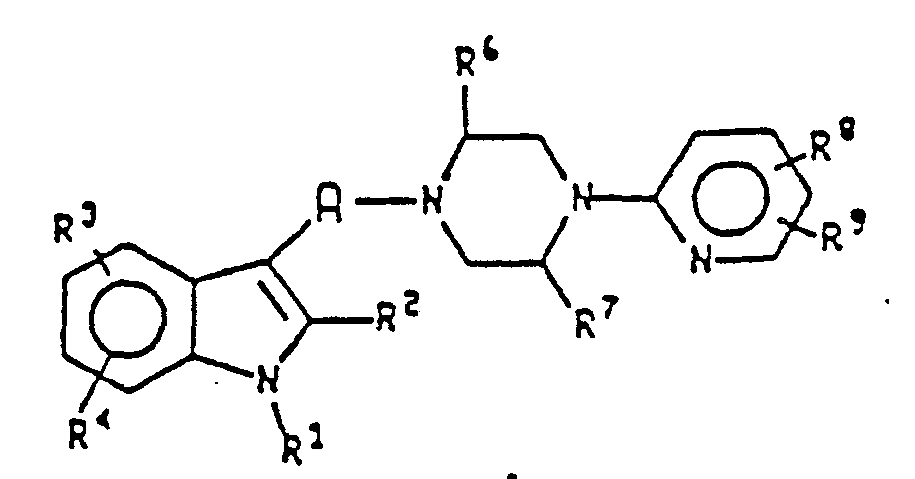
- R1 and R2 are independently selected from lower, meaning C1-4, alkyl or hydrogen;
- R3, R4, R8 and R9 are independently selected from hydrogen, lower alkyl, lower alkoxy, carbamide, halogen, trifluoromethyl and thio-lower alkyl, with the proviso that R8 and R9 cannot both be hydrogen at the same time;
- A is a Cs-7 cycloalkanyl or cycloalkenyl ring, or
- A is
- wherein n is an integer from 1 to 3 and R5 is the same as R1; and
- R6 and R7 are independently selected from hydrogen, methyl or R6 and R7 can be taken together as a methylene bridge, useful as antidepressants.
Description
- This invention generally pertains to heterocyclic carbon compounds having drug and bio-affecting properties and to their preparation and use. In particular the invention is concerned with 1,4-disubstituted piperazine derivatives wherein one substituent is indol-3-yl-alkyl and the other is a substituted pyridin-2-yl moiety. These compounds possess a unique serotonergic profile that should make them useful in treatment of depression.
- Archer disclosed a large series of CNS-depressant indolylalkylpiperazines in U.S. 3,188,313 which issued June 8, 1965. Among the large number of moieties listed for possible substituent selection on the 4-nitrogen atom of the piperazine ring was pyridyl (unsubstituted). In U.S. 3,562,278, issued February 9, 1971, Archer claimed a series of 1-(indol-3-ylethyl)-4-substituted-piperazines having psychomotor depressant activity. Among the possible 4-substituents listed was pyridyl, again unsubstituted.
- Of less relevance is U.S. 3,472,855, issued October 1969 to Archer, which discloses extension of the series to benz[g]indolyl moieties as replacements for indolyl.
- Similarly less relevant is U.S. 4,302,589, issued November 1981 to Fanshawe, et al., which discloses a series of related compounds wherein indoline has replaced the indole moiety. These compounds were disclosed as having antipsychotic properties.
- None of the aforementioned references disclose or suggest the 1-indolylalkyl-4-(substituted-pyridinyl)-piperazine derivatives and their antidepressant utility of the present invention.
- In its broadest aspect, the present invention is concerned with piperazinyl derivatives having useful antidepressant properties characterized by a compound of Formula I.

- In Formula 1; R' and R2 are independently selected from hydrogen or lower alkyl. The descriptive term "lower" is used herein to denote an organic radical containing from 1 to 4 carbon atoms. The symbols R3, R4.. R8 and R9 refer to moieties which are independently selected from among hydrogen, lower alkyl, lower alkoxy, carboxamide, halogen, trifluoromethyl, and thio-lower alkyl; with the proviso that both R8 and R9 cannot be hydrogen at the same time.
- The symbol A represents a cycloalkanyl or cycloalkenyl ring comprised of from 5 to 7 carbon atoms. These bridging rings may be 1,2-; 1,3-; or 1,4-disubstituted bridging cycloalkanes or cycloalkenes. In the cycloalkenyl ring the double bond is adjacent to the point of attachment of the 3-indolyl ring. The symbol A can also be the structural fragment:

- In this fragment linking the indole and piperazine rings, n is an integer from 1 to 3 and R5 can be either hydrogen or lower alkyl. The carbon atom to which R5 is attached is adjacent to the piperazine ring.
- Lastly, R6 and R7 are independently selected from hydrogen or methyl, or R6 and R7 can be taken together as a methylene bridge. Subclasses of compounds envisioned would be: A is cyclic or linear in structure; the piperazine ring is bridged or unbridged. Preferred classes of compounds are those wherein the indolyl and piperazinyl rings are connected by a 2 or 3 carbon linking chain and wherein R9 is other than hydrogen and is attached to the 6-position of the 2-pyridinyl ring.
- Additionally compounds of Formula I also encompass all pharmaceutically acceptable acid addition salts andior solvates thereof. The present invention is also considered to include stereoisomers as well as optical isomers, e.g. mixtures of enantiomers as well as individual enantiomers and diastereomers, which arise as a consequence of structural asymmetry in certain compounds of the instant series. Separation of the individual isomers is accomplished by application of various methods which are well known to practitioners in the art.
- It is to be understood that, as used herein, halogen denotes fluorine, chlorine, bromine and iodine; with the term "lower alkyl" referring to both straight and branched chain carbon radicals of from 1 to 4 carbon atoms inclusive. Illustrative of these radicals are carbon chains which can be methyl, ethyl, propyl, isopropyl, 1-butyl, 1-methylpropyl and 2-methylpropyl. Carboxamide intends a 0 - CNH2 radical.
- The pharmaceutically acceptable acid addition salts of the invention are those in which the counter-ion does not contribute significantly to the toxicity or pharmacoligical activity of the salt and, as such, they are the pharmacological equivalents of the bases of Formula I. They are generally preferred for medical usage. In some instances, they have physical properties which makes them more desirable for pharmaceutical formulation such as solubility, lack of hygroscopicity, compressibility with respect to tablet formation and compatibility with other ingredients with which the substance may be used for pharmaceutical purposes. The salts are routinely made by admixture of a Formula I base with the selected acid preferably by contact in solution employing an excess of commonly inert solvents such as water, ether, benzene, methanol, ethanol, ethyl acetate and acetonitrile. They may also be made by metathesis or treatment with an ion exchange resin under conditions in which the anion of one salt of the substance of the Formula I is replaced by another anion under conditions which allow for separation of the desired species such as by precipitation from solution or extraction into a solvent, or elution from or retention on an ion exchange resin. Pharmaceutically acceptable acids for the purposes of salt formation of the substances of Formula I include sulfuric, phosphoric, hydrochloric, hydrobromic, hydroiodic, citric, acetic, benzoic, cinnamic, mandelic, phosphoric, nitric, mucic, isethionic, palmitic, heptanoic, and others.
- The compounds of Formula I can be prepared by means of the processes shown in Scheme 1.


- For the three processes depicted in Scheme 1; R1 through R9, and n are as defined hereinabove. Additional symbols appearing in Scheme 1 are f, g, M, X and Y. The symbols f and g are integers from 0 to 5 with the proviso that f+g must be equal to 3, 4 or 5. M represents a metalloid species such as magnesium, lithioaluminum, and the like; which, taken with R5 are either hydride-type reducing agents such as lithium aluminum hyrides, diborane complexes, etc,; or organometallic alkylating agents such as Grignard reagents, etc. The reagent Y-X represents an organic leaving group reagent wherein X is the leaving group fragment such as tosyl, mesyl, halide, sulfate, phosphate and so forth; and Y is either a proton or a counter ion: e.g. XY can be HBr or tosyl chloride and the like. These reagents, symbolized by RS-M and Y-X, as well as other reagent acronyms, are familiar to the practitioner skilled in organic synthesis and their structure and usage would be readily understood.
- Process #1 in Scheme 1 comprises the following steps:
- 1) Treatment of an indole carboxylic acid II with R5-M, which is either a hyride reducing agent or alkylating agent depending on the selection of R5 (hydrogen or lower alkyl). This results in generation of the indolylalkanol VI which is a secondary alcohol when R5 is lower alkyl and a primary alcohol when R5 is hydrogen.
- 2) Conversion of the alcohol VI to an organic leaving group (also referred to as a nucleofuge in synthetic organic reaction terminology) by use of an appropriate Y-X reagent such as HBr or tosyl chloride to give intermediate V.
- 3) Displacement of the leaving group anion by the nucleophilic pyridinylpiperazine III to provide the desired product of formula la.
- Process #2 in Scheme 1 comprises a two-step reaction sequence:
- 1) Condensation of the indolylcarboxylic acid II with the pyridinylpiperazine III, using standard condensation agents such as acid chlorides, acid anhydrides, dicyclohexylcarbodiimide, and the like, to afford the amide intermediate IV.
- 2) Treatment of the amide IV with RS-M to reductively alkylate or reduce to the desired formula la product.
- Process #3 in Scheme 1 comprises the following sequence of steps:
- A.
- 1) The pyridinylpiperazine III is reductively alkylated with a cycloalkanedione mono-ethylene ketal X to give the ketal intermediate IX.
- 2) Deprotecting the ketal IX to produce the cycloalkanone intermediate VIII.
- 3) Condensing the cycloalkanone VIII with indole VII to yield the cycloalkenyl product Ib which can be catalytically reduced to the cycloalkanyl product Ic if desired.
- B.
- 1) The indole VII, cycloalkanedione mono-ethylene ketal X, and an acid or base catalyst (e.g. pyrrolidine) are refluxed in alcohol to give the condensation product XII.
- 2) Intermediate XII is catalytically reduced to the saturated cycloalkane ketal which is deketalized to the cycloalkanone intermediate XI.
- 3) Cycloalkanone XI is condensed with the pyridinylpiperazine III using conditions as shown to yield product lc.
- Reagents, solvents, and reaction conditions for the above described steps of the three processes would be known to one skilled in organic synthesis as all the steps comprise standard organic reactions, the details of which are readily available in the chemical literature. These processes may be adapted to variation in order to produce other compounds embraced by this invention but not specifically disclosed. Variations of the methods to produce the same compounds in somewhat different fashion will also be evident to one skilled in the art. As example of this, VI intermediate compounds wherein n is 1 are conveniently prepared by treating various substituted 3-indoleglyoxylic acid esters with LiAlH4.
- To provide greater descriptive details, representative synthetic examples are provided hereinbelow in the "Description of Specific Embodiments" section. Similarly, preparations of starting intermediate compounds such as II and III, while readily available in the chemical literature, are also described using specific examples in that section of the patent specification.
- The compounds comprising the present invention inhibit the re-uptake of endogenous serotonin. Selective inhibitors of serotonin uptake are effective for the treatment of mental depression and have been reported to be useful for treating chronic pain (see: R.W. Fuller, "Pharmocologic Modification of Serotonergic Function: Drugs for the Study and Treatment of Psychiatric and Other Disorders", J. Clin. Psychiatry 47:4 (Suppl.) April 1986, pp. 4-8). Compounds of the present invention are also envisioned to be useful in the following disorders: obsessive-compulsive disorder, feeding disorders, anxiety disorders and panic disorders.
- Additionally, selected compounds of the invention potently inhibit norepinephrine re-uptake and blockade of endogenous norepinephrine re-uptake is also a mechanism through which it is believed that various antidepressant agents exert their therapeutic effect (see: "Antidepressants: Neurochemical, Behavioral, and Clinical Perspectives", edited by S.J. Enna, J.B. Malick and E. Richardson, (1981), Raven Press, New York, pp. 1-12).
- Determination of endogenous monoaminergic re-uptake inhibition values both for serotonin and norepinephrine was accomplished using test methods described by P. Skolnick, et al., Br. J. Pharmacology (1985), 86, pp. 637-644; with only minor modifications. In vitro IC60 (nM) test values were determined for representative compounds of Formula I based on their inhibition of synaptosomal reuptake of tritiated serotonin. Test data ICso values lower than 500nM are considered to reflect activity as an inhibitor of serotonin reuptake. Compounds with IC50 values lower than 100nM comprise preferred compounds.
- Another aspect of the instant invention provides a method for treating a mammal afflicted with depression or chronic pain which comprises administering systemically to said mammal a therapeutically effective amount of a compound of Formula I or a pharmaceutically acceptable acid addition salt thereof.
- The administration and dosage regimen of compounds of Formula I is considered to be done in the same manner as for the reference compound fluoxetine, cf: Schatzberg, et al., J. Clin. Psychopharmacology 76 6 Suppl. (1987) pp. 445-495, and references therein. Although the dosage and dosage regimen must in each case be carefully adjusted, utilizing sound professional judgment and considering the age, weight and condition of the recipient, the route of administration and the nature and gravity of the illness, generally the daily dose will be from about 0.05 to about 10 mg/kg, preferably 0.1 to 2 mg/kg, when administered parenterally and from about 1 to about 50 mg/kg, preferably about 5 to 20 mg/kg, when administered orally. In some instances, a sufficient therapeutic effect can be obtained at lower doses while in others, larger doses will be required. Systemic administration refers to oral, rectal and parenteral (i.e. intramuscular, intravenous and subcutaneous). Generally, it will be found that when a compound of the present invention is administered orally, a larger quantity of the active agent is required to produce the same effect as a similar quantity given parenterally. In accordance with good clinical practice, it is preferred to administer the instant compounds at a concentration level that will produce effective antidepressant effects without causing any harmful or untoward side effects.
- The compounds of the present invention may be administered for antidepressant purposes either as individual therapeutic agents or as mixtures with other therapeutic agents. Therapeutically, they are generally given as pharmaceutical compositions comprised of an antidepressant amount of a compound of Formula I or a pharmaceutically acceptable salt thereof and a pharmaceutically acceptable carrier. Pharmaceutical compositions which provide from about 1 to 500 mg of the active ingredient per unit dose are preferred and are conventionally prepared as tablets, lozenges, capsules, powders, aqueous or oily suspensions, syrups, elixirs, and aqueous solutions.
- The nature of the pharmaceutical composition employed will, of course, depend on the desired route of administration. For example, oral compositions may be in the form of tablets or capsules and may contain conventional excipients such as binding agents (e.g. starch) and wetting agents (e.g. sodium lauryl sulfate). Solutions or suspensions of a Formula I compound with conventional pharmaceutical vehicles are employed for parenteral compositions such as an aqueous solution for intravenous injection or an oily suspension for intramuscular injection.
- The compounds which constitute this invention, their methods of preparation and their biologic actions will appear more fully from consideration of the following examples, which are given for the purpose of illustration only and are not be construed as limiting the invention in sphere or scope. In the following examples, used to illustrate the foregoing synthetic processes, temperatures are expressed in degrees Celsius and melting points are uncorrected. The nuclear magnetic resonances (NMR) spectral characteristics refer to chemical shifts (8) expressed as parts per million (ppm) versus tetramethylsilane (TMS) as reference standard. The relative area reported for the various shifts in the H NMR spectral data corresponds to the number of hydrogen atoms of a particular functional type in the molecule. The nature of the shifts as to multiplicity is reported as broad singlet (bs), singlet (s), multiplet (m) or doublet (d). Abbreviations employed are DMSO-d6 (deuterodimethylsulfoxide), CDC13 (deuterochloroform) and are otherwise conventional. The infrared (IR) spectral descriptions include only absorption wave numbers (cm-') having functional group identification value. The IR determinations were employed using potassium bromide (KBr) as diluent. The elemental analyses are reported as percent by weight and are given in Table 3.
- The following examples describe in detail the preparation of compounds of Formula I, as well as synthetic intermediates in each process. It will be apparent to those skilled in the art that modifications, both of materials and methods, will allow preparation of other compounds disclosed herein. From the foregoing description and the following examples it is believed that one skilled in the art is able to use the invention to the fullest extent.
- Some representative procedures for preparation of synthetic intermediate compounds utilized in the three processes of Scheme 1 are given hereinbelow. Most starting materials and certain intermediates (e.g. Formula II and VII compounds), are either commercially available or procedures for their synthesis are readily available in the chemical literature allowing their full utilization by one skilled in the art of organic synthetic chemistry.
- To a stirred mixture of 2-bromo-3-pyridinol (71.0 g) and pulverized KOH (77.8 g) in DMSO (500 mL) at 55-60° C and under N2 atmosphere was added dropwise a solution of CH31 (72.4 g) in DMSO (100 mL). After the addition was complete, the reaction was maintained at 55-60 C for h. The mixture was then poured into ice water (800 g) and the precipitate filtered. The precipitate was triturated with Et20 (3 x 500 mL) and the combined extracts treated in turn with 1 N NaOH (500 mL), water (500 mL), 1 N HCI (3 x 250 mL), and sat. NaCl solution (500 mL). The organic phase was dried with anhydrous MgSO4., filtered, and concentrated under reduced pressure to afford 2-bromo-3-methoxypyridine (52.3 g; 68%).
- Anhydrous piperazine (45.6 g) and 2-bromo-3-methoxy-pyridine (10.0 g) were heated neat in an autoclave at 100°C for 20 h. Upon cooling, the mixture was treated with 5% NaCO3 (20 mL) and extracted with CH2Cl2 (3 x 50 mL). The extracts were dried using anhydrous K2CO3, filtered, and concentrated under reduced pressure to yield 1-(3-methoxy-2-pyridinyl)piperazine (III; 8.43 g; 82%) after silica gel chromatography (CH2Cl2 MeOH/NH4OH; 93:7:0.7).
- A mixture of 2-chloro-3-trifluoromethyl pyridine (5.0 g), anhydrous piperazine (7.22 g), and micropulverized anhydrous K2CO3 (7.73 g) in acetonitrile (50 mL) was heated at reflux with stirring while under N2 atmosphere for 20 h. The excess acetonitrile was removed under reduced pressure arid water (15 mL) added to the concentrate. The aqueous phase was extracted with CH2Cl2 (3 x 50 mL). The combined CH2Cl2 extracts were washed with sat. NaCl solution, dried with anhydrous MgS04, and concentrated under reduced pressure. Silica gel chromatography (CH2Cl2MeOH/NH4OH; 94:6:0.6) of the residue yielded 1-(3-trifluoromethyl-2-pyridinyl)piperazine (III; 5.50 g; 85%).
- A mixture of 1-(6-chloro-2-pyridinyl)piperazine (6.0 g) and NaOMe (16.42 g) in DMF (25 mL) was heated at 100°C under nitrogen atmosphere for 20 h. The excess DMF was then removed under reduced pressure. Water (5 mL) was added to the residue and the mixture extracted with CH2Cl2. The combined organic layers were washed with sat. NaCl solution, dried with anhydrous MgS04, filtered and concentrated under reduced pressure. Silica gel chromatography (CH2Cl2/MeOH; 98:2) of the concentrate yielded the 4-(6-methoxy-2-pyridinyl)-1-piperazinecarboxaldehyde (5.13 g; 81 %).
- A mixture of the formamide intermediate, prepared above, (3.55 g) in 6 N HCI (30 mL) was heated at reflux for ½ h. The reaction was cooled to 0° C, made basic with 10 N NaOH, and extracted with CH2CI2 (3 x 50 mL). The combined organic layers were washed with sat. NaCl solution, dried with anhydrous K2CO3, filtered, and concentrated under reduced pressure to afford 1-(6-methoxy-2-pyridinyl)piperazine (2.72 g; 83%).
- A mixture of 2,6-dichloropyridine (4.0 g), anhydrous piperazine (6.97 g), and micropulverized anhydrous K2C03 (7.45 g) in acetonitrile (50 ml) was heated at reflux with stirring while under N2 atmosphere for 20 h. The excess acetonitrile was removed under reduced pressure and water (15 mL) added to the concentrate. The aqueous phase was extracted with CH2CI2 (3 x 50 mL). The combined CH2CI2 extracts were washed with sat. NaCl solution, dried with anhydrous MgSO4, and concentrated under reduced pressure. Silica gel chromatography (CH2Cl2,MeOH/NH4OH; 94:6:0.6) of the residue yielded 1-(6-chloro-2-pyridinyl)piperazine (4.80 g; 90%).
- To a solution of hydroxy-L-proline (80 g) in 2N NaOH (800 mL) was added tosyl chloride (136.1 g) in Et20 (700 mL). The reaction mixture was stirred at 0°C for 1½ h and continued for an additional 3½ h at 23° C. The aqeuous layer was separated, acidified with concentrated HCI to pH 1 and allowed to stand at -10° C for 12 h. The precipitate was filtered, washed with cold water, and concentrated in vacuo to a volume of 300 mL. The precipitate obtained was combined with the previous precipitate. The combined solids were recrystallized from ethyl acetate. Drying in vacuo at 50 C for 24 h afforded trans-4-hydroxy-1-(4-toluenesulfonyl)-L-proline (107.38 g, 62%).
- To a solution of trans-4-hydroxy-1-(4-toluenesulfonyl)-L-proline (107.38 g) in acetone (450 mL) was added potassium 2-ethyl hexanoate in BuOH (1.91 N; 189.5 mL). After standing at 23 °C for 20 min, the insoluble material was filtered and the resulting solution was concentrated to 320 mL. Et20 (1000 mL) was added to the concentrate and the solvents removed under reduced pressure yielding a solid (122.90 g). The hygroscopic product was used in the next step without further purification.
- To a solution of potassium trans-4-hydroxy-1-(4-toluenesulfonyl)-L-proline (122.90 g) in 250 mL of N,N-dimethylacetamide was added methyl iodide (24.5 mL) while under nitrogen atmosphere. The light protected mixture was stirred 16 h. The mixture was poured onto ice water and extracted with CH2CI2 (3 x 400 mL). The combined organic extracts were washed with 2% NaHC03 (400 mL), H20 (4 x 1.5 L), dried over MgSO4, filtered, and concentrated under reduced pressure to leave a viscous oil. The crude oil was triturated within petroleum ether to give N-tosylhydroxy-L-proline methyl ester as a pale yellow solid (63.20 g, 56.2%) which was used in the next step without futher purification.
- To a solution of N-tosylhydroxy-L-proline methyl ester (62.20 g) in THF (600 mL) at 0°C for 1 h and allowed to stand at 23" C for 18 h. The reaction mixture was cooled to -20° C, made neutral with 6N HCI, and concentrated under reduced pressure. The residue was treated with water (550 mL) and extracted with EtOAc (4 x 300 mL). The combined organic extracts were washed with H20, dried over MgSO4, filtered, and concentrated under reduced pressure to give N-tosylhydroxy-L-prolinol as a white solid (50.56 g, 88.8%) which was used in the next step without further purification.
- To a solution of p-toluenesulfonyl chloride (155 g) in pyridine (330 mL) at 0°C was added N-tosylhydroxy-L-prolinol (104.40 g). The reaction mixture was kept at 6° C for 72 h and then poured into cold 2N HCI (2.5 L). The aqueous layer was extracted with CH2CI2 (3 x 1000 mL). The combined organic extracts were dried over MgSO4, filtered, and concentrated under reduced pressure to give an oil. The oil was triturated with EtOH and the solid that formed was collected by filtration. The crude product was recrystallized from EtOH (3.5 L) to give tritosylhydroxy-L-prolinol (99.87 g, 44.2%, m.p. 130-132° C, [a]-

- To a suspension of tritosylhydroxy-L-prolinol (98.87 g) in toluene (350 mL) was added benzylamine (54.83 g). The resulting mixture was heated at reflux for 18 h and allowed to cool at 23 C. The reaction mixture was filtered and the solvent removed under reduced pressure. The residue was triturated with ethanol and the solid that formed was collected by filtration to give (1S,4S)-2-(4-toluenesulfonyl)-5-phenylmethyl-2,5-diazabicycloheptane (54.18 g, 93.2%) which was used in the next step without further punfication.
- A mixture of (1S,4S)-2-(4-toluenesulfonyl)-5-phenylmethyl-2,5-diazabicyclo[2.2.1]heptane (54.0 g) in acetic acid (830 mL) containing hydrobromic acid (30% wt) was heated at 70°C for 18 h. The reaction mixture was allowed to cool and concentrated under reduced pressure to a final volumen of ca. 300 mL. The precipitate that formed was filtered and washed with acetone to give (1S,4S)-N-benzyl-2,5-diazabicyclo-[2.2.1 ]heptane (50.30 g 91:3%, m.p. 272-275° C).
- By adjusting the starting materials and using the foregoing synthetic scheme the other isomer, (1 R,4R)-N-benzyl-2,5-diazabicyclo[2.2.1 ]heptane can be obtained (cf: J. Org. Chem. (1981), 46 2954-2960).
- A mixture of 2-bromo-3-methoxy pyridine (9.9 g) and (1S,4S)-N-benzyl-2,5-diazabicyclo[2.2.1]heptane (10.9 g) was heated at 100 C in a Parr bomb for 67 h. The reaction mixture was cooled to 23° C, dissolved in CH2CI2, extracted with 5% NaHC03, and finally with H20. The organic layer was dried over K2CO3, filtered, and concentrated under reduced pressure. The crude oil was purified by silica gel chromatography (CH2CI2:MeOH; 96:4) to give the desired produce (7.93 g, 51%).
- (7.88 g) in EtOH (250 mL) was acidified to a pH of 1 with ethanolic HCI. The reaction mixture was treated with 5% palladium-on-carbon (2.05 g) and hydrogenated at 50 psi at 60 C for 6 h. After this time, the heating was discontinued and the reaction mixture was allowed to cool to room temperature and the hydrogenation continued for 16 h. The reaction mixture was filtered through celite. The filtrate was concentrated under reduced pressure and the residue was made alkaline by the addition of 5N NaOH. The solution was extracted with CH2CI2 (4 x 250 mL) and combined CH2Cl2 extracts were dried over K2CO3, filtered, and concentrated under reduced pressure to give 2-(3-methoxy-2- pyridinyl)-(1S,4S)-2,5-diazabicyclo[2.2.1 ]heptane (4.67 g; 85.2%).
- To a mixture of 1-(3-methoxy-2-pyridinyl)piperazine (III; 1.28 g), 3-indolebutyric acid (1.08 g), and triethylamine (1.02 g) in CH2Cl2 (50 mL) was added 1-methyl-2-chloro-pyridinium iodide (1.62 g). The reaction was heated at reflux with stirring and under N2 atmosphere for 4 h. After cooling to ambient temperature, the solution was extracted with aqueous 5% HCI followed by aqueous 5% NaHCO3. The organic phase was dried with anhydrous K2CO3, filtered, and concentrated under reduced pressure. Silica gel chromatography (CH2Cl2,MeOH; 98:2) of the concentrate afforded the amide product (IV; 1.00 g; 50%).
- Phosphorus tribromide (17.4 g) in Et20 (30 mL) was added dropwise to a Et20 solution (100 mL) containing 3-(3-hydroxypropyl)indole (VI; 7.5 g) at 0°C with stirring and under N2 atmosphere. After the addition was complete, the reaction was allowed to warm to 23° C and continuously stirred for 16 h. At the end of this time, the reaction was cooled to 0°C and ice (ca. 25 mL) added portionwise and stirred an additional 2 h. The organic phase was separated from the aqueous phase and the aqueous layer extracted with Et20. The combined organic phases were washed with sat. NaCl solution, dried with MgSO4, filtered, and concentrated under reduced pressure to afford 3-(3-bromopropyl)indole (V; 1.51 g; 15%).
- To a solution of 5-fluoro-3-(2-hydroxyethyl)indole (10.3 g, 0.056 mol) and CBr4. (24.8 g, 0.073 mol) in 100 mL of dry acetonitrile at 0° C under Ar was added a solution of triphenylphosphine (19.6 g, 0.073 mol) in 200 mL of dry acetonitrile. The mixture was stirred at 0° C for 1 h and then at room temperature for 2 h. The resulting mixture was evaporated and the residue was chromatographed (Si02/ethyl acetate-hexane = 1:4) to give the produce (8.50 g, 61%) as a brown solid;
- IR (neat) 3440 cm-1;
- 'Hnmr (80 MHz, CDCl3)
- δ: 7.75 (br s. 1H), 7.15-6.57 (m, 4H), 3.53-3.32 (m, 2H), 3.17-2.94 (m,2H).
- To a stirred suspension of LiAIH4 (4.02 g) in THF (200 mL) at 0°C and under N2 atmosphere was added dropwise a THF solution (100 mL) containing indole-3-propanoic acid (20.0 g). After the addition was complete, the reaction was heated at reflux for 16 h, after which time the mixture was cooled to 0 C and water (4 mL) added, followed by 15% NaOH (4 mL), and finally additional water (12 mL). The reaction was filtered and the THF filtrate extracted with 5% NaOH (4 mL), and finally additional water (12 mL). The reaction was filtered and the THF filtrate extracted with 5% NaHC03 followed by a sat. NaCl solution. The organic phase was dried with anhydrous K2C03, filtered, and concentrated under reduced pressure to yield 3-(3-hydroxypropyl)indole (VI; 7.5 g; 41%).
- To a stirred suspension of LiAlH4 (3.24 g) in THF (200 mL) at 0°C and under N2 atmosphere was added dropwise a THF solution (50 mL) containing indole-3-acetic acid (10.0 g). After the addition was complete, the reaction was heated at reflux for 3 h, after which time the mixture was cooled to 0°C and water (3.3 mL) added, followed by 15% NaOH (3.3 mL), and finally additional water (9.9 mL). The reaction was filtered and the filter cake washed with Et20. The organic layers were combined, dried with anhydrous MgSO4, filtered, and concentrated under reduced pressure to yield 3-(2-hydroxyethyl)indole (VI; 7.4 g; 80%).
- To a suspension of LiAlH4 (8.60 g, 0.23 mol) in 400 mL of dry THF was added 5-fluoro-3- indoleglyoxylic acid ethyl ester (13. 50 g, 0.057 mol) portionwise at room temperature. Preparation of this ester intermediate is given hereinbelow. The mixture was heated to reflux under Ar for 1 h and was then cooled at 0° C and quenched according to the method of Fieser (Fieser and Fieser, "Reagents for Organic Synthesis", Vol. 1 pg. 584). The resulting slurry was filtered and the filter cake was washed with THF. The filtrate was dried (Na2SO4) and evaporated to give the produce (10.00 g, 100%) as a yellow oil. It was used as such without further purification;
- IR (neat) 3420 cm-1
- 'Hnmr (80 MHz, CDCl3)
- δ: 7.73 (br s, 1 H), 7.1-6.4 (m, 4H), 3.57 (t, J = 8 Hz, 2H), 2.66 (t, J = 8 Hz, 2H), 1.20 (br s, 1 H).
- To a solution of 5-fluoroindole (7.35 g, 0.054 mol) in 75 mL of anhydrous ether was added oxalyl chloride (5.60 mL, 0.064 mol) dropwise at 0 C under Ar.
- The yellow suspension was stirred at 0°C for 1 h and then the solid was collected by filtration and dried in vacuo to give 5-fluoro-3-indoleglyoxylyl chloride (12.0 g, 100%) as a yellow solid; IR (neat) 1765, 1627
cm -1 . - This solid was taken up in 160 mL of absolute ethanol and was then treated with triethylamine (8.1 mL, 0.058 mol) dropwise at 0°C under Ar. The mixture was refluxed for 4½ h and was then allowed to cool to room temperature. The resulting precipitate was filtered and then dried in vacuo to give the produce (10.8 g, 87%) as a yellow solid which was used without further purification.
- A solution of 4-[4-(6-chloro-2-pyridinyl)-1-piperazinyl]-cyclohexan-1-one ethylene ketal (IX, Example 11: 7.56 g, 22 mmole) in 10% aqueous HCI (200 mL) was refluxed for 16 h. The solution was cooled and then neutralized with 30% aqueous NaOH solution. The mixture was then extracted with ethyl acetate (3 x 75 mL) and the extracts were dried over Na2CO3. The mixture was filtered and the filtrate was concentrated in vacuo. The residue was chromatographed on silica gel using ethyl acetate as the eluent to give the desired ketone product (VIII) as an oil (5.70 g, 92%)..
- A solution of 1-(6-chloro-2-pyridinyl)-piperazine (8.00 g, 40 mmole), 1,4-cyclohexanedione mono-ethylene ketal (6.25 g, 40 mmole), and titanium(IV) isopropoxide (15 mL, 14.21 g, 50 mmole) was heated to 80°C for 30 min. The mixture was cooled and diluted with absolute ethanol (40 mL). Sodium borohydride (ten 0.4 g tablets, 0.1 mole) was added and the mixture was stirred for 4 h. Water (10 mL) was added to the solution with stirring and the solid titanium dioxide was filtered off. The filtrate was concentrated in vacuo and the residue was dissolved in CH2CI2 (75 mL). The solution was again filtered and the filtrate concentrated in vacuo. The residue was chromatographed on silica gel using ethyl acetate as the eluent to give the desired ketal produce (IX) as an oil (7.56 g, 56%).
- A mixture of 3-(2-bromoethyl)indole (2.05 g), 1-(6-chloro-2-pyridinyl)piperazine (3.61 g), micropulverized K2C03 (2.52 g) and tetrabutylammonium hydrogen sulfate (0.16 g) in acetonitrile (25 mL) was heated at reflux under N2 atmosphere for 2½ h. The excess acetonitrile was removed under reduced pressure and water (15 mL) added to the concentrate. The aqueous phase was extracted with CH2Cl2(3 x 50 mL). The combined CH2CI2 extracts were washed with sat. NaCI solution, dried with anhydrous K2C03, and concentrated under reduced pressure. Silica gel chromatography (EtOAc/Hexanes; 70:30) of the residue yielded the free base (3.10 g; 99%) which was treated with ethanolic HCI to provide the desired la product (2.63 g; 77%).

- NMR (DMSO-ds): 3.24 (8H, m); 3.72 (2H m): 4.40 (2H, m); 6.81 (1, d, 7.4 Hz); 7.02 (3H, m); 7.25 (1 H, d, 1.0 Hz); 7.39 (1 H, m); 7.64 (2H, m); 10.85 (1 H, bs); 10.98 (1 H, bs).
- IR (KBr): 750, 770, 960, 1140, 1270, 1420, 1460, 1550, 1600, 2440 and 3240 cm-1.
- A mixture of 3-(1-bromoethyl)indole (1.12 g), 1-(6-trifluoromethyl-2-pyridinyl)piperazine (2.31 g), micropulverized K2C03 (1.38 g) and tetrabutylammonium hydrogen sulfate (0.08 g) in acetonitrile (50 mL) was heated at reflux under N2 atmosphere for 2½ h. The excess acetonitrile was removed under reduced pressure and water (10 mL) added to the concentrate. The aqueous phase was extracted with CH2CI2 (3 x 50 mL). The combined CH2Cl2 extracts were washed with sat. NaCl solution, dried with anhydrous K2CO3, and concentrated under reduced pressure. Silica gel chromatography (CH2Cl2;MeOH; 98:2) of the residue yielded the free base (1.56 g; 83%) which was treated with ethanolic HCI to yield the hydrochloride salt of the desired la product (1.17 g; 68%).

- NMR (DMSO-d6): 3.25 (8H, m); 3.72 (2H, d, 13.4 Hz); 4.48 (2H, d, 13.4 Hz); 7.10 (5H, m); 7.34 (1H, d, 7.0 Hz); 7.61 (1 H, d, 7.0 Hz); 7.83 (1 H, m); 10.60 (1 H, bs); 10.95 (1 H, bs).
- IR (KBr): 740, 800, 960, 1120, 1130, 1340, 1490, 1610, 2600, 2925 and 3250 cm-1.
- A mixture of 3-(2-bromoethyl)indole (1.66 g), 1-(6-methoxy-2-pyridinyl)piperazine (2.86 g), micropulverized K2CO3 (2.04 g) and tetrabutylammonium hydrogen sulfate (0.13 g) in acetonitrile (50 mL) was heated at reflux under N2 atmosphere for 2 h. The excess acetonitrile was removed under reduced pressure and water (10 mL) added to the concentrate. The aqueous phase was extracted with CH2CI2 (3 x 50 mL). The combined CH2CI2 extracts were washed with sat. NaCl solution, dried with anhydrous K2CO3, and concentrated under reduced pressure. Silica gel chromatography (CH2CI2/MeOH; 96:4) of the residue yielded the free base of the desired la product (2.20 g; 89%).

- NMR (CDCI3): 2.70 (6H, m); 3.08 (2H, m); 3.61 (4H, m); 3.90 (3H, s); 6.11 (1 H, d, 9.5 Hz); 6.20 (1 H, d, 9.0 Hz); 7.12 (3H, m); 7.40 (2H, m); 7.68 (1 H, m); 8.00 (1 H, bs).
- IR (KBr): 745, 790, 985, 1250, 1450, 1460, 1590, 2840, 3180 and 3550 cm-1.
- A mixture of 3-(2-bromoethyl)indole (1.79 g), 1-(3-trifluoromethyl-2-pyridinyl)piperazine (1.85 g), micropulverized K2C03 (2.21 g) and tetrabutylammonium hydrogen sulfate (.014 g) in acetonitrile (50 mL) was heated at reflux under N2 atmosphere for 3 h. The excess acetonitrile was removed under reduced pressure and water (10 mL) added to the concentrate. The aqueous phase was extracted with CH2CI2 (3 x 50 mL). The combined CH2Cl2 extracts were washed with sat. NaCI solution, dried with anhydrous K2CO3, and concentrated under reduced pressure. Silica gel chromatography (CH2Cl2/MeOH; 97:3) of the residue yielded the free base (1.66 g; 56%) which was treated with ethanolic HCI to yield the hydrochloride salt of the desired la product (1.45 g; 80%).

- NMR (DMSO-d6): 3.30 (10H, m); 3.72 (2H, m); 7.08 (2H, m); 7.22 (1H, d, 4.9 Hz); 7.35 (2H, m); 7.66 (1 H, m); 8.12 (1 H, m); 8.60 (1 H, m).
- IR (KBr): 750, 1040, 1130, 1320, 1450, 1580, 1595, 2460, 2580 and 3230 cm-1.
- A mixture of 3-(2-bromoethyl)indole (2.00 g), 1-(3-methoxy-2-pyridinyl)piperazine (1.72 g), micropulverized K2C03 (2.46 g) and tetrabutylammonium hydrogen sulfate (0.15 g), in acetonitrile (50 mL) was heated at reflux under N2 atmosphere for 5 h. The excess acetonitrile was removed under reduced pressure and water (10 mL) was added to the concentrate. The aqueous phase was extracted with CH2CI2 (3 x 50 mL). The combined CH2CI2 extracts were washed with sat. NaCl solution, dried with anhydrous K2CO3, and concentrated under reduced pressure. Silica gel chromatography (CH2Cl2/MeOH; 96:4) of the residue yielded the free base of the desired la product (1.32 g; 44%).

- NMR (CDCl3): 2.80 (6H, m); 3.04 (2H, m); 3.55 (4H, m); 3.90 (3H, s); 6.86 (1H, dd, 4.8, 7.6 Hz); 7.14 (4H, m); 7.36 (1 H, m); 7.66 (1 H, m); 7.92 (1H, dd, 1.4, 4.8 Hz); 8.14 (1 H, bs).
- IR (film): 740, 1210, 1240, 1440, 1450, 1470, 1590, 2840, 2940, 3200 and 3450 cm-1.
- An acetonitrile solution (25 mL) containing 3-(3-bromopropyl)indole (V; 1.51 g), 1-(6-chloro-2-pyridinyl)-piperazine (III; 2.50 g), micropulverized K2C03 (1.75 g), and tetrabutylammonium hydrogen sulfate was heated at reflux with stirring and under N2 atmosphere for 1 h. Excess acetonitrile was removed under pressure and the remaining mixture was extracted with CH2Cl2. The solid residue was dissolved in water (10 mL) and extracted with CH2CIz. The combined organic extracts were dried with anhydrous K2C03, filtered, and concentrated under reduced pressure to afford a viscous material. Silica gel chromatography (EtOAc.CH2CI2; 4:1) yielded the free base (1.67 g; 74%) which was treated with ethanolic HCI to provide the hydrochloride salt of the desired la product (1.6 g; 87%).

- NMR (DMSO-d6): 2.14 (2H, m); 2.80 (2H, t, 6.9 Hz); 3.18 (4H; m); 3.55 (4H, m); 4.36 (2H. d, 13.6 Hz); 6.82 (1 H, d. 8.1 Hz); 6.91 (1H, d, 8.1 Hz); 7.05 (3H, m); 7.40 (1 H, d, 9.2 Hz); 7.62 (2H, m); 11.00 (1 H, bs); 11.55 (1H, bs).
- IR (KBr): 740, 785, 950, 1130. 1260, 1440, 1590. 2600, 2920 and 3150 cm-1.
- A mixture of 3-(3-bromopropyl)indole (1.55 g), 1-(3-methoxy-2-pyridinyl)piperazine (2.51 g), micropulverized K2CO3 (1.79 g) and tetrabutylammonium hydrogen sulfate (0.11 g) in acetonitrile (100 mL) was heated at reflux under N2 atmosphere for 3 h. The excess acetonitrile was removed under reduced pressure and water (15 mL) added to the concentrate. The aqueous phase was extracted with CH2CI2 (3 x 60 mL). The combined CH2CI2 extracts were washed with sat. NaCl solution, dried with anhydrous K2CO3, filtered, and concentrated under reduced pressure. Silica gel chromatography (CH2Cl2/MeOH; 95:5) of the residue yielded the free base which was treated with ethanolic HCI to yield the dihydrochloride salt of the desired la product (1.30 g; 45%).

- NMR (DMSO-d6): 2.16 (2H, m); 2.78 (2H, t, 6.7 Hz); 3.20 (6H, m) 3.57 (2H, d, 12.5 Hz); 3.85 (3H, S);
- 4.08 (2H, d, 12.5 Hz); 4.80 (3H, bs); 7.02 (4H, m); 7.39 (2H, m); 7.56 (1 H, d, 7.8 Hz); 7.81 (1 H, dd, 5.8, 0.8 Hz); 10.85 (2H, bs).
- IR (KBr): 760, 770, 1010, 1255, 1430, 1470, 1555, 1610, 2450, 2910 and 3210 cm-1.
- Borane-methyl sulfide complex (3.3 mL; 2.0 M THF soln.) was added dropwise to a THF (9 mL) solution containing 1-[4-(indol-3-yl)-1-oxobutyl]-4-(3-methoxy-2-pyridinyl)piperazine (IV; 1.0 g) at 0°C while under N2 atmosphere. After the addition was complete, the reaction was heated at reflux for 3 h. Upon cooling to 0° C, MeOH (5 mL) was added and the reaction allowed to stand 20 h at 22 C. The reaction was cooled to 0° C and HCI gas introduced until a pH<2 was attained, after which the solution was gently refluxed for 1 h. The reaction was cooled. MeOH (10 mL) added, and concentrated under reduced pressure. The residue was heated at reflux in 4 N acetic acid for 5 h. After cooling, the reaction was made basic with 10 N NaOH (pH>10) and extracted with Et20. The combined Et20 extracts were dried with anhydrous K2C03, filtered, and concentrated under reduced pressure. Silica gel chromatography (EtOAc/MeOH; 97:3) afforded the free base which was treated with ethanolic HCI to provide the dihydrochloride of the desired la product (83 mg; 8%).

- NMR (DMSO-d6): 1.73 (4H. m); 2.74 (2H, t, 6.6 Hz); 3.18 (4H, m); 3.33 (2H, m); 3.53 (2H. d, 12.0 Hz); 4.00 (v, m, bs: CH2, H+, H20); 3.85 (3H, s); 7.04 (3H, m); 7.16 (1H, d, 2.2 Hz); 7.34 (1H, d, 7.6 Hz); 7.42 (1 H, dd, 8.0, 1.2 Hz); 7.52 (1 H, d, 7.2 Hz), 7.83 (1 H, dd. 5.2, 1.2 Hz).
- IR (KBr): 740, 805, 1000, 1270, 1460, 1550, 1560, 1600, 2570, 2930 and 3250 cm-'.
- To a mixture of 1-(6-chloro-2-pyridyl)piperazine (1.418 g, 7.2 mmol), triethylamine hydrochloride (994 mg, 7.2 mmol) and NaCNBH3 (1.512 g, 24 mmol) in 12 mL of dry tetrahydrofuran was added a solution of 3-(2-oxopropyl)indole (416 mg, 2.4 mmol) in 5 mL of tetrahydrofuran. The reaction mixture was vigorously stirred at room temperature under Ar for 17 h and then it was poured into saturated aqueous NaHC03 and extracted with ethyl acetate (x3). The organic phase was washed with H20 (x2) and 0.1N HCI (25 mL) and then it was dried (Na2SO4.) and evaporated to give a gum. Chromatography (SiO2/CH2CI2-acetonitrile = 1:1) of this gum gave the product (714 mg, 84%) as a white foam.
- NMR (CDCI3)
- δ: 7.98 (br s, 1 H), 7.64-7.59 (m, 1 H), 7.43-7.343 (m, 2H), 7.24-7.08 (m, 2H), 7.06 (d, J = 2.3 Hz, 1 H), 6.59 (d, J=7.3 Hz, 1H), 6.50 (d, J=8.4 Hz, 1H), 3.62-3.57 (m, 4H), 3.18-3.09 (m, 1 H), 3.06-2.93 (m, 1H), 2.79-2.74 (m, 4H), 2.65 (dd, J = 13.5, 9.1 Hz, 1.03 (d, J = 6.5 Hz, 3H).
- The hydrochloride was prepared by treating and ethereal solution of the product with anhydrous HCI. The resulting white fluffy solid was crystallized from ethanol-ether to give the hydrochloride salt (660 mg, 85%) as a white, microcrystalline solid: m.p. 242-244° C (dec).
- A solution of 5-methoxyindole (0.26 g, 1.8 mmole), 4-[4-(6-chloro-2-pyridinyl)-1-piperazinyl]-cyclohexan-1-one (VIII; 0.50 g, 1.7 mmole), and pyrrolidine (0.5 mL) in ethanol (10 mL) was refluxed for 18 h. The solution was concentrated in vacuo and the residue chromatographed on silica gel using ethyl acetate as the eluent to give the desired product of formula Ib (0.59 g, 82%, m.p. 210-213 C).

- NMR(DMSO-d6): 1.52 (1H, m); 2.04 (1H, m), 2.22 (1H, m); 2.40 (2H, m); 2.64 (6H, m); 3.48 (4H, m); 3.75 (3H, s); 8.07 (1 H, m); 6.63 (1 H, d, 7.4 Hz); 6.75 (2H, m); 7.26 (3H, m); 7.53 (1 H, dd, 7.9, 8.1 Hz); 10.91 (1 H, bs).
- IR (KBr): 780,800. 980, 1140, 1260, 1450, 1480, 1550, 1600, 2840 and 2920 cm-1.
- Indole (1.17 g, 10 mmol), 1.4-cyclohexanedione mono-ethylene ketal (1.95 g, 12.5 mmol), and pyrrolidine (1.77 g, 25 mmol, 2.1 mL) were refluxed in ethanol (50 mL) for 3 days. The solution was concentrated in vacuo. The residue was washed with ethyl acetate (30 mL) and the solid product was collected and dried (yield: 2.05 g, 80%). The product was recrystallized from methanol (20 mL) to give compound XII as a white powder (1.75 g).
- Compound XII (1.75 g, 6.9 mmol) was hydrogenated for 18 h at 60 psi using 10% Pd/C (0.15 g). The mixture was filtered and the filtrate concentrated in vacuo. The residue was refluxed for 18 h in acetone (150 mL) with water (10 mL) and p-toluene sulfonic
cid (0 .10 g). Sodium carbonate (5.0 g) was added and the mixture refluxed for 30 min. The mixture was cooled and filtered, and the filtrate was concentrated in vacuo. The residue was chromatographed on silica gel using ethyl acetate as the eluent to give theXI desired product (1.29 g, 88%). - A mixture of compound II (10 mmol), the desired substituted-pyridinyl piperazine (III; 10 mmol), and titanium(IV) isopropoxide (3.72 mL, 12.5 mmol) would be remaining ketone band (gentle heating may be required). The viscous solution would then be diluted with ethanol (10-20 mL) and sodium cyanoborohydride (0.42 g, 6.7 mmol) added. After stirring for 20 hr, water (2 mL) would be added and the resulting inorganic precipitate filtered and washed with ethanol. The filtrate could then be concentrated in vacuo and the crude product purified by chromatography on silica gel. Alternately, cyclohexenyl products of Formula Ib may be hydrogenated to yield products of Formula Ic in cases where other substituents on the precursor molecule are stable to the hydrogenation process.
- Compound preparation data for these and other Formula I compounds, prepared in a manner similar to the above procedures, is shown in Table 1. Selection of appropriate starting materials and intermediates as well as adjustments of the procedures would be well within the skill of one skilled in the art.


- Some additional compounds of Formula I have been made, tested and found to have useful CNS properties, particularly antidepressant properties. The additional compounds were prepared by employing the synthetic processes described hereinabove, using alterations which would be apparent to a skilled chemist in order to produce the desired product compound. Some additional examples are give here for further guidance.
- Additional Intermediate Compounds.
- A mixture of 2-methylpiperazine (21.31 g), 2,6-dichloropyridine (10.0 g) and micropulverised K2C03 (27. 99 g) in CH3CN (200 mL) was heated at reflux under nitrogen atmosphere for 24 h. The reaction was filtered and the filtrate concentrated under reduced pressure. The concentrate was dissolved in CH2Cl2 and extracted with 5% NaHCOa and water. The organic phase was dried with K2CO3, filtered and concentrated under reduced pressure. Silica gel chromatography (CH2Cl2/MeOH/NHa4OH; 96:4:0.4) of the residue yielded product, (13.34 g, 93%).
- A mixture of 2-methylpiperazine (6.66 g) and 2-bromo-3-methoxypyridine (2.5 g) was heated in an autoclave at 100 C for 24 h. The reaction mixture was dissolved in CH2Cl2 and extracted with 5% NaHC03 and water. The organic phase was dried with K2CO3, filtered, and concentrated under reduced pressure. Silica gel chromatography (CHZCl2%MeOH/NHa4OH; 92:8:0.8) of the residue yielded the product (2.28 g, 83 %).
- A solution of bromine (12.35 g) in 10% NaOH (70 ml) was added dropwise with stirring to a solution of 5-chloro-3-pyridinol (10.00 g) in 10% NaOH (70 mi). After the addition was complete, the reaction was stirred at 22 C for 20 h. The reaction was cooled to 0 °C and acidified to pH 5.3 with concentrated HCI (aq). The precipitate was filtered and dried under vacuum for 60 h to afford a) (15.66 g, 97 %).
- To a stirred mixture of 2-bromo-5-chloro-3-pyridinol (15.66 g) and pulverized KOH (16.79 g) in DMSO (100 ml) at 55 - 60 °C was added dropwise a solution of CH31 (13.27 g) in DMSO (35 ml) while under nitrogen atmosphere. After the addition was complete, the reaction was maintained at 55 - 60 °C for 1 h. The reaction was extracted with Et20 (3 x 150 ml) and the combined Et20 extracts were treated in turn with 1N NaOH (150 ml), water (150 ml), 1N HCI (150 ml), water (150 ml) and a saturated NaCl solution (150 ml). The organic phase was dried with MgSO4, filtered, and concentrated under reduced pressure to yield a solid material. Recrystallization of the solid from hexane afforded b) (3.52 g, 21 %).
- Anhydrous piperazine (13.41 g) and 2-bromo-5-chloro-3-methoxypridine (3.50 g) were heated in an autoclave at 100 C for 20 h. The mixture was dissolved in water (10 mL) and extracted with CH2Cl2 (3 X 100 mL). The combined organic extracts were washed with a saturated NaCl solution, dried with K2CO3, filtered, and concentrated under reduced pressure. Silica gel chromatography (CH2Cl2/MeOH; 90:10) of the residue yielded product (1.17 g, 33%).
- A dispersion of 35% KH in oil (21.0 g, 0.18 mol) was washed free of oil with dry pentane under an Ar atmosphere. To a suspension of the resulting solid in 100 ml of dry dimethylformamide was added a solution of indole-3-acetic acid (10.5 g, 0.060 mol) in 60 ml of dimethylformamide, dropwise at -20° C under Ar. The mixture was stirred at the same temperature for 2 h and then CH31 (12.0 ml, 0.19 mol) was added dropwise. Stirring was continued at -20° to 10° C for 2 1/2 h and then the mixture was stored at 5° C for 16 h. Ether was then added and the mixture was washed (H20, brine), dried (Na2SO4) and evaporated to give an orange oil. Flash chromatography (SiO2/10-20% ethyl acetate-hexane x 2) of this oil afforded the product (5.25 g, 43%) as an oil: IR (neat) 1745 cm-1; 1Hnmr (80 MHz, CDCl3) δ7.75-7.55 (m, 1H), 7.40-7.07 (m, 4H), 3.83 (s, 2H), 3.80 (s, 3H), 3.75 (s, 3H).
- To a suspension of LiAIH4 (2.0 g, 0.052 mol) in 50 mL of dry tetrahydrofuran was added dropwise a solution of methyl 1-methylindole-3-acetate (5.25 g, 0.026 mol) in 70 mL of dry tetrahydrofuran at -10° C under Ar. The mixture was refluxed for 1 h and then it was cooled at 0 °C and quenched by the sequential addition of 2 mL of H20, 2 mL of 15% aqueous NaOH and finally 6 mL of H20. The resulting slurry was filtered and the filter cake was washed with additional tetrahydrofuran. Evaporation of the filtrate gave the product (4.0 g, 89%) as an oil which was used without further purification.
- To a solution of 1-methyl-3-(2-hydroxyethyl)indole (4.00 g, 0.023 mol) in 50 mL of acetonitrile at -20° C under Ar was added a solution of CBr4. (10.16 g, 0.031 mol) in 25 mL of acetonitrile, followed by a solution of triphenylphosphine (8.00 g, 0.031 mol) in 125 mL of acetonitrile. The mixture was stirred and allowed to warm to 0°C over 2 h. The resulting mixture was evaporated and the residue was chromatographed (SiO2,hexane, then ethyl acetate-hexane=1:4) to give the product (4.00 g, 74%) as a brown oil: IR (neat) 2940, 1617, 1552 cm-1; 'Hnmr (200 MHz, CDCI3) 7.58 (d, J=7.6 Hz, 1H), 7.33-7.09 (m, 3H), 6.95 (s, 1H), 3.77 (s, 3H), 3.62 (t, J = 7.9 Hz. 2H), 3.32 (t, J = 7.7 Hz, 2H).
- To a suspension of LiAIH4 (1.50 g, 39 mmol) in 100 mL of dry THF at -10° C under Ar was added a solution of ethyl 3-(3-indolyl)-3-methylpropionate1 (7.00 g, 30 mmol) in 50 mL of THF. The mixture was stirred at room temperature for 3 h and then it was quenched at 0° C with 2 mL of H20. The resulting slurry was filtered and the filter cake was washed with THF. The filtrate was then dried (Na2SO4) and evaporated to give the intermediate VI product, 3-(1-methyl-3-hydroxypropyl)indole (5.05 g, 88%) as an oil: IR (neat) 3420, 3300 cm-1.
- To an ice cold solution of 3-(1-methyl-3-hydroxypropyl)indole (5.00 g, 0.026 mol) in 100 mL of CH2CI2 was added triethylamine (4.1 mL, 0.03 mol), p-toluenesulfonyl chloride (5.50 g, 0.029 mol) and 4-N,N-dimethylaminopyridine (DMAP) (0.6 g). The mixture was stirred at room temperature under Ar for 18 h and then it was evaporated and the residue was chromatographed (SiO2/ethyl acetate-hexane = 1:9, then ethyl acetate) to give the product (7.75 g, 86%) as a light brown gum: IR (neat) 3420, 1357, 1175 cm-1.
- To a mixture of 1-(6-chloro-2-pyridyl)piperazine (1.418 g, 7.2 mmol), triethylamine hydrochloride (994 mg, 7.2 mmol) and NaCNCH3 (1.512 g, 24 mmol) in 12 mL of dry tetrahydrofuran was added a solution of 3-(2-oxopropyl)indole (416 mg, 2.4 mmol) in 5 mL of tetrahydrofuran. The reaction mixture was vigorously stirred at room temperature under Ar for 17 h and then it was poured into saturated aqueous NaHCO3 and extracted with ethyl acetate (x3). The organic phase was washed with H2O (x2) and 0.1 N HCL (25 mL) and then it was dried (Na2SO4) and evaporated to give a gum. Chromatography (SiO2/CH2Cl2-acetonitrile=1:1) of this gum gave the product (714 mg, 84%) as a white foam: 1Hnmr (200 MHz, CDCl3) δ 7.98 (br s, 1H), 7.64-7.59 (m, 1 H), 7.43-7.343 (m, 2H), 7.24-7.08 (m, 2H), 7.06 (d, J = 2.3 Hz, 1 H), 6.59 (d, J = 7.3 Hz, 1 H), 6.50 (d, J=8.4 Hz, 1 H), 3.62-3.57 (m, 4H), 3.18-3.09 (m, 1 H), 3.06-2.93 (m, 1 H), 2.79-2.74 (m, 4H), 2.65 (dd, J = 13.5, 9.1 Hz, 1 H), 1.03 (d, J = 6.5 Hz, 3H). The hydrochloride salt was prepared by treating an ethereal solution of the product with anhydrous HCI. The resulting white fluffy solid was crystallized from ethanol-ether to give the hydrochloride salt (660 mg, 85%) as a white, micro-crystalline solid: m.p. 242-244° C (dec); IR (KBr) 3430, 3190, 1590 cm-1.
- Additional Formula I compounds which have been prepared by appropriate modifications of the reaction schemes and procedures given hereinabove, are displayed in Table 1 A.


Claims (11)


Applications Claiming Priority (4)
| Application Number | Priority Date | Filing Date | Title |
|---|---|---|---|
| US20484588A | 1988-06-10 | 1988-06-10 | |
| US204845 | 1988-06-10 | ||
| US07/338,253 US4954502A (en) | 1988-06-10 | 1989-04-14 | 1-indolyalkyl-4-(substituted-pyridinyl)piperazines |
| US338253 | 1989-04-14 |
Publications (2)
| Publication Number | Publication Date |
|---|---|
| EP0345808A1 true EP0345808A1 (en) | 1989-12-13 |
| EP0345808B1 EP0345808B1 (en) | 1995-01-11 |
Family
ID=26899839
Family Applications (1)
| Application Number | Title | Priority Date | Filing Date |
|---|---|---|---|
| EP89110485A Expired - Lifetime EP0345808B1 (en) | 1988-06-10 | 1989-06-09 | 1-Indolylalkyl-4-(substituted-pyridinyl)piperazines |
Country Status (17)
| Country | Link |
|---|---|
| US (1) | US4954502A (en) |
| EP (1) | EP0345808B1 (en) |
| JP (1) | JP2786480B2 (en) |
| KR (1) | KR0128210B1 (en) |
| AT (1) | ATE116982T1 (en) |
| AU (1) | AU624147B2 (en) |
| CA (1) | CA1337421C (en) |
| CY (1) | CY1846A (en) |
| DE (1) | DE68920482T2 (en) |
| DK (1) | DK283589A (en) |
| ES (1) | ES2067500T3 (en) |
| FI (1) | FI95698C (en) |
| HK (1) | HK83295A (en) |
| IE (1) | IE66569B1 (en) |
| NO (1) | NO174296C (en) |
| PT (1) | PT90805B (en) |
| SG (1) | SG32583G (en) |
Cited By (29)
| Publication number | Priority date | Publication date | Assignee | Title |
|---|---|---|---|---|
| WO1991009849A1 (en) * | 1989-12-28 | 1991-07-11 | The Upjohn Company | Diaromatic substituted anti-aids compounds |
| EP0431579A3 (en) * | 1989-12-06 | 1991-12-11 | Warner-Lambert Company | Substituted cyclohexenes as central nervous system agents |
| EP0464558A1 (en) * | 1990-06-29 | 1992-01-08 | Bristol-Myers Squibb Company | Antimigraine alkoxypyrimidine derivatives |
| US5120843A (en) * | 1987-04-27 | 1992-06-09 | Upjohn | Pharmaceutically active amines |
| WO1992007832A3 (en) * | 1990-11-05 | 1992-06-11 | Warner Lambert Co | Substituted piperazines as central nervous system agents |
| US5124332A (en) * | 1991-01-28 | 1992-06-23 | Warner-Lambert Company | Substituted indoles as central nervous system agents |
| EP0509402A1 (en) * | 1991-04-17 | 1992-10-21 | Hoechst-Roussel Pharmaceuticals Incorporated | Substituted 3-(Pyridinylamino)-indoles and benzo[b]thiophenes, a process for their preparation and their use as medicaments |
| WO1993010092A1 (en) * | 1991-11-20 | 1993-05-27 | Warner-Lambert Company | 1,3-substituted cycloalkenes and cycloalkanes as central nervous system agents |
| EP0548813A1 (en) * | 1991-12-19 | 1993-06-30 | Bristol-Myers Squibb Company | Antimigraine 4-pyrimidinyl and pyridinyl derivatives of indol-3yl-alkyl piperazines |
| EP0645385A1 (en) * | 1993-09-16 | 1995-03-29 | Bristol-Myers Squibb Company | Antimigraine cyclobutenedione derivatives of indolylalkyl-pyridinyl and pyrimidinylpiperazines |
| EP0666258A1 (en) * | 1994-01-06 | 1995-08-09 | Bristol-Myers Squibb Company | Indolylcycloaklanylamin- und Indolylcycloalkenylamine derivatives, their preparation and their use as anti-migraine agents |
| AU665637B2 (en) * | 1992-10-21 | 1996-01-11 | Aventis Pharmaceuticals Inc. | Substituted (pyridinylamino)-benzisoxazoles and -benzol{b}thiophenes, a process for their preparation and their use as medicaments |
| US5489593A (en) * | 1989-12-28 | 1996-02-06 | The Upjohn Company | Anti-aids piperazines |
| WO1996016056A1 (en) * | 1994-11-23 | 1996-05-30 | Merck Sharp & Dohme Limited | Piperazine, piperidine & tetrahydropyridine derivatives useful as 5-ht1 receptor agonists |
| US5599930A (en) * | 1991-07-03 | 1997-02-04 | The Upjohn Company | Substituted indoles as anti-AIDS pharmaceuticals |
| WO1997040049A1 (en) * | 1996-04-19 | 1997-10-30 | Sanochemia Ltd. | New benzazepine derivatives, medicaments containing the same and their use to prepare medicaments |
| EP0761666A3 (en) * | 1995-08-14 | 1998-01-28 | Bristol-Myers Squibb Company | Antidepressant 1-arylalkyl-4-(alkoxypyridinyl)- or 4-(alkoxypyrimidinyl)piperazine derivatives |
| WO2000040554A1 (en) * | 1999-01-07 | 2000-07-13 | American Home Products Corporation | Arylpiperazinyl-cyclohexyl indole derivatives for the treatment of depression |
| WO2001034597A1 (en) * | 1999-11-08 | 2001-05-17 | Wyeth | N-aryl-(homopiperazinyl)-cyclohexyl amines as 5-ht transporters |
| US6313126B1 (en) * | 1999-01-07 | 2001-11-06 | American Home Products Corp | Arylpiperazinyl-cyclohexyl indole derivatives for the treatment of depression |
| EP1178048A1 (en) * | 2000-08-03 | 2002-02-06 | Pfizer Products Inc. | Azabicycloalkane derivatives for use as serotonin reuptake inhibitors and 5HT2a antagonists |
| EP1146871A4 (en) * | 1999-01-28 | 2002-04-17 | Bristol Myers Squibb Co | Antidepressant heterocyclic compounds |
| WO2002040456A1 (en) * | 2000-11-20 | 2002-05-23 | Biovitrum Ab | Piperazinylpyrazine compounds as agonist or antagonist of serotonin 5ht-2 receptor |
| US6593330B2 (en) | 2000-11-20 | 2003-07-15 | Biovitrum | Compounds and their use |
| US6809105B2 (en) | 2000-04-27 | 2004-10-26 | Abbott Laboratories | Diazabicyclic central nervous system active agents |
| US7166588B2 (en) | 2000-03-31 | 2007-01-23 | Sanochemia Pharmazeutika Aktiengesellschaft | Derivatives and analogs of galanthamine |
| US7265115B2 (en) | 1999-01-29 | 2007-09-04 | Abbott Laboratories | Diazabicyclic CNS active agents |
| WO2009112139A1 (en) * | 2008-03-14 | 2009-09-17 | Merck Patent Gmbh, | Azaindole compounds for treatment of central nervous system disorders |
| EP1608373A4 (en) * | 2003-03-19 | 2010-09-29 | Exelixis Inc | Tie-2 modulators and methods of use |
Families Citing this family (22)
| Publication number | Priority date | Publication date | Assignee | Title |
|---|---|---|---|---|
| US5077293A (en) * | 1990-06-29 | 1991-12-31 | Bristol-Myers Squibb Co. | 1-indolyalkyl-4-(alkoxypyrimidinyl)piperazines |
| US5206393A (en) * | 1991-09-30 | 1993-04-27 | Union Carbide Chemicals & Plastics Technology Corporation | Oxa-bicyclic polyfunctional compounds and preparation thereof |
| US5145973A (en) * | 1991-09-30 | 1992-09-08 | Union Carbide Chemicals & Plastics Technology Corporation | Oxa-Bicyclic polyfunctional compounds and preparation thereof |
| CA2091204C (en) * | 1992-03-11 | 1997-04-08 | Ronald J. Mattson | Antiischemic-piperazinyl and piperidinyl-cyclohexanes |
| EP0675109A1 (en) * | 1992-12-21 | 1995-10-04 | Taisho Pharmaceutical Co. Ltd | N-substituted indole derivative |
| US5391570A (en) * | 1993-10-14 | 1995-02-21 | Bristol-Myers Squibb | Aminomethyl-benzodioxane and benzopyran serotonergic agents |
| US5468767A (en) * | 1994-01-06 | 1995-11-21 | Bristol-Myers Squibb Company | Antidepressant 3-(aminocycloalkenyl)-indole-5-nitrile derivatives |
| US5618816A (en) * | 1995-03-02 | 1997-04-08 | Bristol-Myers Squibb Company | Antimigraine 1,2,5-thiadiazole derivatives of indolylalkyl-pyridnyl and pyrimidinylpiperazines |
| WO1998031679A1 (en) * | 1997-01-21 | 1998-07-23 | Yoshitomi Pharmaceutical Industries, Ltd. | Thiophene compounds and medicinal use thereof |
| US6150533A (en) * | 1998-04-08 | 2000-11-21 | American Home Products Corp. | N-aryloxyethyl-indoly-alkylamines for the treatment of depression |
| ATE227718T1 (en) * | 1998-04-08 | 2002-11-15 | Wyeth Corp | N-ARYLOXYETHYL-INDOLYL-ALKYLAMINES FOR THE TREATMENT OF DEPRESSION |
| TW520367B (en) * | 1998-04-29 | 2003-02-11 | Wyeth Corp | Indolyl derivatives as serotonergic agents |
| FR2786769B1 (en) * | 1998-12-04 | 2002-10-25 | Synthelabo | 2,5-DIAZABICYCLO [2.2.1] HEPTANE DERIVATIVES, THEIR PREPARATION AND THEIR THERAPEUTIC APPLICATION |
| WO2006072608A2 (en) * | 2005-01-03 | 2006-07-13 | Universitá Degli Studi Di Siena | Aryl piperazine derivatives for the treatment of neuropsychiatric disorders |
| US20080103312A1 (en) * | 2006-08-29 | 2008-05-01 | Kansal Vinod K | Processes for the synthesis of 5-phenyl-1-trityl-1H-tetrazole |
| CN104163813B (en) * | 2013-05-16 | 2017-02-01 | 广东东阳光药业有限公司 | Substituted indole compound, and preparation method and use thereof |
| WO2015014256A1 (en) * | 2013-07-29 | 2015-02-05 | Sunshine Lake Pharma Co., Ltd. | Substituted heteroaryl compounds and methods of use thereof |
| EP3083589B1 (en) * | 2013-12-20 | 2019-12-18 | Sunshine Lake Pharma Co., Ltd. | Substituted piperazine compounds and methods of use thereof |
| CN104725363B (en) * | 2013-12-20 | 2019-03-01 | 广东东阳光药业有限公司 | Substituted piperazine compounds and methods and uses thereof |
| US10316025B2 (en) | 2015-06-03 | 2019-06-11 | Sunshine Lake Pharma Co., Ltd. | Substituted piperazine compounds and methods of use and use thereof |
| CN106795143B (en) * | 2015-08-13 | 2019-05-24 | 广东东阳光药业有限公司 | Substituted indole compounds and methods and uses thereof |
| ES2974248T3 (en) | 2017-09-29 | 2024-06-26 | Sunshine Lake Pharma Co Ltd | Substituted pyrimidine-piperazine compound and use thereof |
Citations (1)
| Publication number | Priority date | Publication date | Assignee | Title |
|---|---|---|---|---|
| US3562278A (en) * | 1967-05-01 | 1971-02-09 | Sterling Drug Inc | 1-(2-(2-substituted-3-indolyl)ethyl)-4-substituted-piperazines |
Family Cites Families (4)
| Publication number | Priority date | Publication date | Assignee | Title |
|---|---|---|---|---|
| GB944443A (en) * | 1959-09-25 | 1900-01-01 | ||
| US3468882A (en) | 1966-10-07 | 1969-09-23 | Sterling Drug Inc | Phenylhydrazone derivatives as intermediates for preparing indoles |
| US3472855A (en) * | 1967-05-29 | 1969-10-14 | Sterling Drug Inc | 1-((benz(g)-indolyl)-lower-alkyl)-4-substituted-piperazines |
| US4302589A (en) * | 1980-05-08 | 1981-11-24 | American Cyanamid Company | Cis-mono and disubstituted-2-methyl-3-[(piperazinyl) and (piperidino)ethyl]indolines, intermediates for their preparation and methods of preparation |
-
1989
- 1989-04-14 US US07/338,253 patent/US4954502A/en not_active Expired - Lifetime
- 1989-05-30 CA CA000601179A patent/CA1337421C/en not_active Expired - Lifetime
- 1989-06-07 FI FI892787A patent/FI95698C/en active IP Right Grant
- 1989-06-09 DK DK283589A patent/DK283589A/en not_active Application Discontinuation
- 1989-06-09 AU AU36282/89A patent/AU624147B2/en not_active Expired
- 1989-06-09 AT AT89110485T patent/ATE116982T1/en not_active IP Right Cessation
- 1989-06-09 JP JP1148200A patent/JP2786480B2/en not_active Expired - Lifetime
- 1989-06-09 DE DE68920482T patent/DE68920482T2/en not_active Expired - Lifetime
- 1989-06-09 SG SG1995907465A patent/SG32583G/en unknown
- 1989-06-09 ES ES89110485T patent/ES2067500T3/en not_active Expired - Lifetime
- 1989-06-09 PT PT90805A patent/PT90805B/en not_active IP Right Cessation
- 1989-06-09 NO NO892381A patent/NO174296C/en not_active IP Right Cessation
- 1989-06-09 EP EP89110485A patent/EP0345808B1/en not_active Expired - Lifetime
- 1989-06-10 KR KR1019890008025A patent/KR0128210B1/en not_active Expired - Fee Related
- 1989-06-12 IE IE186189A patent/IE66569B1/en not_active IP Right Cessation
-
1995
- 1995-05-25 HK HK83295A patent/HK83295A/en not_active IP Right Cessation
-
1996
- 1996-03-08 CY CY184696A patent/CY1846A/en unknown
Patent Citations (1)
| Publication number | Priority date | Publication date | Assignee | Title |
|---|---|---|---|---|
| US3562278A (en) * | 1967-05-01 | 1971-02-09 | Sterling Drug Inc | 1-(2-(2-substituted-3-indolyl)ethyl)-4-substituted-piperazines |
Cited By (49)
| Publication number | Priority date | Publication date | Assignee | Title |
|---|---|---|---|---|
| US5120843A (en) * | 1987-04-27 | 1992-06-09 | Upjohn | Pharmaceutically active amines |
| EP0431579A3 (en) * | 1989-12-06 | 1991-12-11 | Warner-Lambert Company | Substituted cyclohexenes as central nervous system agents |
| WO1991009849A1 (en) * | 1989-12-28 | 1991-07-11 | The Upjohn Company | Diaromatic substituted anti-aids compounds |
| US5563142A (en) * | 1989-12-28 | 1996-10-08 | The Upjohn Company | Diaromatic substituted compounds as anti-HIV-1 agents |
| US5489593A (en) * | 1989-12-28 | 1996-02-06 | The Upjohn Company | Anti-aids piperazines |
| EP0464558A1 (en) * | 1990-06-29 | 1992-01-08 | Bristol-Myers Squibb Company | Antimigraine alkoxypyrimidine derivatives |
| WO1992007832A3 (en) * | 1990-11-05 | 1992-06-11 | Warner Lambert Co | Substituted piperazines as central nervous system agents |
| WO1992012977A1 (en) * | 1991-01-28 | 1992-08-06 | Warner-Lambert Company | Substituted indoles as central nervous system agents |
| US5124332A (en) * | 1991-01-28 | 1992-06-23 | Warner-Lambert Company | Substituted indoles as central nervous system agents |
| EP0509402A1 (en) * | 1991-04-17 | 1992-10-21 | Hoechst-Roussel Pharmaceuticals Incorporated | Substituted 3-(Pyridinylamino)-indoles and benzo[b]thiophenes, a process for their preparation and their use as medicaments |
| US5599930A (en) * | 1991-07-03 | 1997-02-04 | The Upjohn Company | Substituted indoles as anti-AIDS pharmaceuticals |
| WO1993010092A1 (en) * | 1991-11-20 | 1993-05-27 | Warner-Lambert Company | 1,3-substituted cycloalkenes and cycloalkanes as central nervous system agents |
| EP0545095A1 (en) * | 1991-11-20 | 1993-06-09 | Warner-Lambert Company | 1,3-Substituted cycloalkenes and cycloalkanes as central nervous system agents |
| US5314896A (en) * | 1991-11-20 | 1994-05-24 | Warner-Lambert Company | 1,3-substituted cycloalkenes and cycloalkanes as central nervous system agents |
| US5409931A (en) * | 1991-11-20 | 1995-04-25 | Warner-Lambert Company | 1,3-substituted cycloalkenes and cycloalkanes as central nervous system agents |
| RU2116297C1 (en) * | 1991-11-20 | 1998-07-27 | Варнер-Ламберт Компани | Derivatives of 1,3-substituted cycloalkene and cycloalkane as a mixture of isomers or individual isomers or their hydrates, or salts |
| EP0548813A1 (en) * | 1991-12-19 | 1993-06-30 | Bristol-Myers Squibb Company | Antimigraine 4-pyrimidinyl and pyridinyl derivatives of indol-3yl-alkyl piperazines |
| US5434154A (en) * | 1991-12-19 | 1995-07-18 | Bristol-Myers Squibb Company | Antimigraine 4-pyrimidinyl and pyridinyl derivatives of indol-3yl-alkylpiperazines |
| AU665637B2 (en) * | 1992-10-21 | 1996-01-11 | Aventis Pharmaceuticals Inc. | Substituted (pyridinylamino)-benzisoxazoles and -benzol{b}thiophenes, a process for their preparation and their use as medicaments |
| EP0645385A1 (en) * | 1993-09-16 | 1995-03-29 | Bristol-Myers Squibb Company | Antimigraine cyclobutenedione derivatives of indolylalkyl-pyridinyl and pyrimidinylpiperazines |
| AU673098B2 (en) * | 1993-09-16 | 1996-10-24 | Bristol-Myers Squibb Company | Antimigraine cyclobutenedione derivatives of indolylalkyl-pyridinyl and pyrimidinylpiperazines |
| EP0666258A1 (en) * | 1994-01-06 | 1995-08-09 | Bristol-Myers Squibb Company | Indolylcycloaklanylamin- und Indolylcycloalkenylamine derivatives, their preparation and their use as anti-migraine agents |
| US5854247A (en) * | 1994-11-23 | 1998-12-29 | Merck Sharp & Dohme Ltd. | Piperazine, piperidine and tetrahydropyridine derivatives useful as 5-HT1 recepter agonists |
| WO1996016056A1 (en) * | 1994-11-23 | 1996-05-30 | Merck Sharp & Dohme Limited | Piperazine, piperidine & tetrahydropyridine derivatives useful as 5-ht1 receptor agonists |
| EP0761666A3 (en) * | 1995-08-14 | 1998-01-28 | Bristol-Myers Squibb Company | Antidepressant 1-arylalkyl-4-(alkoxypyridinyl)- or 4-(alkoxypyrimidinyl)piperazine derivatives |
| CZ300211B6 (en) * | 1996-04-19 | 2009-03-18 | Sanochemia Pharmazeutika Aktiengesellschaft | Galanthamine derivative, medicament in which said derivatives are comprised and use of the derivatives for preparing the medicament |
| WO1997040049A1 (en) * | 1996-04-19 | 1997-10-30 | Sanochemia Ltd. | New benzazepine derivatives, medicaments containing the same and their use to prepare medicaments |
| US6638925B2 (en) | 1996-04-19 | 2003-10-28 | Sanochemia Ltd. | Benzazepine derivatives, medicaments containing the same and their use to prepare medicaments |
| EP1757608A1 (en) | 1996-04-19 | 2007-02-28 | Sanochemia Pharmazeutika Aktiengesellschaft | New benzazepine derivatives, medicaments containing the same and their use in the preparation of medicaments |
| US7101890B2 (en) | 1996-04-19 | 2006-09-05 | Sanochemia Ltd. | Benzazepine derivatives, drugs containing these and use of the same for producing drugs |
| WO2000040554A1 (en) * | 1999-01-07 | 2000-07-13 | American Home Products Corporation | Arylpiperazinyl-cyclohexyl indole derivatives for the treatment of depression |
| US6313126B1 (en) * | 1999-01-07 | 2001-11-06 | American Home Products Corp | Arylpiperazinyl-cyclohexyl indole derivatives for the treatment of depression |
| US6465482B2 (en) * | 1999-01-07 | 2002-10-15 | Wyeth | Arylpiperazinyl-cyclohexyl indole derivatives for the treatment of depression |
| EP1146871A4 (en) * | 1999-01-28 | 2002-04-17 | Bristol Myers Squibb Co | Antidepressant heterocyclic compounds |
| US7265115B2 (en) | 1999-01-29 | 2007-09-04 | Abbott Laboratories | Diazabicyclic CNS active agents |
| WO2001034597A1 (en) * | 1999-11-08 | 2001-05-17 | Wyeth | N-aryl-(homopiperazinyl)-cyclohexyl amines as 5-ht transporters |
| US7166588B2 (en) | 2000-03-31 | 2007-01-23 | Sanochemia Pharmazeutika Aktiengesellschaft | Derivatives and analogs of galanthamine |
| US7598236B2 (en) | 2000-04-27 | 2009-10-06 | Abbott Laboratories | Diazabicyclic central nervous system active agents |
| US7319106B2 (en) | 2000-04-27 | 2008-01-15 | Abbott Laboratories | Diazabicyclic central nervous system active agents |
| US6809105B2 (en) | 2000-04-27 | 2004-10-26 | Abbott Laboratories | Diazabicyclic central nervous system active agents |
| US8119635B2 (en) | 2000-04-27 | 2012-02-21 | Abbott Laboratories | Diazabicyclic central nervous system active agents |
| US6552015B2 (en) | 2000-08-03 | 2003-04-22 | Pfizer Inc. | Azabicycloalkane derivatives and therapeutic uses thereof |
| EP1178048A1 (en) * | 2000-08-03 | 2002-02-06 | Pfizer Products Inc. | Azabicycloalkane derivatives for use as serotonin reuptake inhibitors and 5HT2a antagonists |
| US6593330B2 (en) | 2000-11-20 | 2003-07-15 | Biovitrum | Compounds and their use |
| US7247633B2 (en) | 2000-11-20 | 2007-07-24 | Biovitrum Ab | Pyrimidine compounds and their use |
| WO2002040456A1 (en) * | 2000-11-20 | 2002-05-23 | Biovitrum Ab | Piperazinylpyrazine compounds as agonist or antagonist of serotonin 5ht-2 receptor |
| EP1608373A4 (en) * | 2003-03-19 | 2010-09-29 | Exelixis Inc | Tie-2 modulators and methods of use |
| US8013156B2 (en) | 2003-03-19 | 2011-09-06 | Exelixis, Inc. | Tie-2 modulators and methods of use |
| WO2009112139A1 (en) * | 2008-03-14 | 2009-09-17 | Merck Patent Gmbh, | Azaindole compounds for treatment of central nervous system disorders |
Also Published As
| Publication number | Publication date |
|---|---|
| IE66569B1 (en) | 1996-01-24 |
| FI892787L (en) | 1989-12-11 |
| NO174296B (en) | 1994-01-03 |
| US4954502A (en) | 1990-09-04 |
| EP0345808B1 (en) | 1995-01-11 |
| FI892787A0 (en) | 1989-06-07 |
| NO174296C (en) | 1994-04-13 |
| FI95698C (en) | 1996-03-11 |
| AU3628289A (en) | 1989-12-14 |
| JP2786480B2 (en) | 1998-08-13 |
| AU624147B2 (en) | 1992-06-04 |
| CA1337421C (en) | 1995-10-24 |
| DK283589D0 (en) | 1989-06-09 |
| ES2067500T3 (en) | 1995-04-01 |
| NO892381D0 (en) | 1989-06-09 |
| SG32583G (en) | 1995-09-01 |
| JPH0285277A (en) | 1990-03-26 |
| FI95698B (en) | 1995-11-30 |
| DE68920482D1 (en) | 1995-02-23 |
| IE891861L (en) | 1989-12-10 |
| HK83295A (en) | 1995-06-01 |
| DE68920482T2 (en) | 1995-06-01 |
| KR0128210B1 (en) | 1998-04-02 |
| ATE116982T1 (en) | 1995-01-15 |
| NO892381L (en) | 1989-12-11 |
| CY1846A (en) | 1996-03-08 |
| PT90805B (en) | 1994-10-31 |
| KR910000708A (en) | 1991-01-30 |
| PT90805A (en) | 1989-12-29 |
| DK283589A (en) | 1989-12-11 |
Similar Documents
| Publication | Publication Date | Title |
|---|---|---|
| EP0345808B1 (en) | 1-Indolylalkyl-4-(substituted-pyridinyl)piperazines | |
| AU661527B2 (en) | Antimigraine 4-pyrimidinyl and pyridinyl derivatives of indol-3yl-alkyl piperazines | |
| AU677644B2 (en) | Piperazine derivatives | |
| US5585378A (en) | Composition containing an oxoindole compound | |
| EP0414289B1 (en) | Spirocyclic antipsychotic agents | |
| US5077293A (en) | 1-indolyalkyl-4-(alkoxypyrimidinyl)piperazines | |
| EP0464558B1 (en) | Antimigraine alkoxypyrimidine derivatives | |
| HU211144A9 (en) | Cyclic amine derivatives and their pharmaceutical use | |
| US4994460A (en) | Agents for treatment of brain ischemia | |
| US5607961A (en) | Antidepressant 3-(aminocycloalkenyl)-indole-5-nitrile derivatives | |
| JPH08500121A (en) | Substituted pyrazoles as CRF antagonists | |
| IE66112B1 (en) | Piperidinyl benzimidazoles as antihistamines | |
| EP0450761A1 (en) | Spirocyclic oxytocin antagonists | |
| JPH0684370B2 (en) | Muscarinic receptor antagonist | |
| US5330986A (en) | Indole-7-carboxamide derivatives | |
| US20040053956A1 (en) | Isoquinoline derivatives useful in the treatment of cns disorders | |
| RU2136678C1 (en) | N-substituted 3-azabicyclo[32,0]heptane derivatives | |
| JPH03251576A (en) | Substituted cyclohexene as central nerve system acting drug | |
| US5472966A (en) | Antidepressant heteroarylaminoalkyl derivatives of naphthyl-monazines | |
| HUT72294A (en) | Cyclic amine derivatives, pharmaceutical compositions containing them and process for producing thereof | |
| US5059688A (en) | 1-aryloxy-2,3,4,5-tetrahydro-3-benzazepine preparation | |
| US4859700A (en) | 2-(2,3-dihydro-2-oxo-3-benzofuranyl)acetic acid compounds having antihypoxic and nootropic effects | |
| IL97852A (en) | 4-(3-(4-oxothiazolidinyl)) butynylamines, a process for their preparation and their use as medicaments | |
| US5294618A (en) | Octahydrobenzisoquinoline derivatives as antipsychotic agents | |
| US4794181A (en) | 1-aryloxy-2,3,4,5-tetrahydro-3-benzazepines |
Legal Events
| Date | Code | Title | Description |
|---|---|---|---|
| PUAI | Public reference made under article 153(3) epc to a published international application that has entered the european phase |
Free format text: ORIGINAL CODE: 0009012 |
|
| AK | Designated contracting states |
Kind code of ref document: A1 Designated state(s): AT BE CH DE ES FR GB GR IT LI LU NL SE |
|
| RAP1 | Party data changed (applicant data changed or rights of an application transferred) |
Owner name: BRISTOL-MYERS SQUIBB COMPANY |
|
| 17P | Request for examination filed |
Effective date: 19900611 |
|
| 17Q | First examination report despatched |
Effective date: 19920827 |
|
| GRAA | (expected) grant |
Free format text: ORIGINAL CODE: 0009210 |
|
| AK | Designated contracting states |
Kind code of ref document: B1 Designated state(s): AT BE CH DE ES FR GB GR IT LI LU NL SE |
|
| REF | Corresponds to: |
Ref document number: 116982 Country of ref document: AT Date of ref document: 19950115 Kind code of ref document: T |
|
| REF | Corresponds to: |
Ref document number: 68920482 Country of ref document: DE Date of ref document: 19950223 |
|
| REG | Reference to a national code |
Ref country code: GR Ref legal event code: FG4A Free format text: 3014696 |
|
| REG | Reference to a national code |
Ref country code: ES Ref legal event code: FG2A Ref document number: 2067500 Country of ref document: ES Kind code of ref document: T3 |
|
| ITF | It: translation for a ep patent filed | ||
| ET | Fr: translation filed | ||
| PLBE | No opposition filed within time limit |
Free format text: ORIGINAL CODE: 0009261 |
|
| STAA | Information on the status of an ep patent application or granted ep patent |
Free format text: STATUS: NO OPPOSITION FILED WITHIN TIME LIMIT |
|
| 26N | No opposition filed | ||
| REG | Reference to a national code |
Ref country code: GB Ref legal event code: IF02 |
|
| PGFP | Annual fee paid to national office [announced via postgrant information from national office to epo] |
Ref country code: CH Payment date: 20080611 Year of fee payment: 20 Ref country code: LU Payment date: 20080618 Year of fee payment: 20 |
|
| PGFP | Annual fee paid to national office [announced via postgrant information from national office to epo] |
Ref country code: AT Payment date: 20080612 Year of fee payment: 20 |
|
| PGFP | Annual fee paid to national office [announced via postgrant information from national office to epo] |
Ref country code: IT Payment date: 20080625 Year of fee payment: 20 |
|
| PGFP | Annual fee paid to national office [announced via postgrant information from national office to epo] |
Ref country code: ES Payment date: 20080717 Year of fee payment: 20 Ref country code: NL Payment date: 20080603 Year of fee payment: 20 Ref country code: DE Payment date: 20080612 Year of fee payment: 20 Ref country code: SE Payment date: 20080609 Year of fee payment: 20 |
|
| PGFP | Annual fee paid to national office [announced via postgrant information from national office to epo] |
Ref country code: FR Payment date: 20080617 Year of fee payment: 20 |
|
| PGFP | Annual fee paid to national office [announced via postgrant information from national office to epo] |
Ref country code: GB Payment date: 20080611 Year of fee payment: 20 |
|
| PGFP | Annual fee paid to national office [announced via postgrant information from national office to epo] |
Ref country code: BE Payment date: 20080813 Year of fee payment: 20 |
|
| PGFP | Annual fee paid to national office [announced via postgrant information from national office to epo] |
Ref country code: GR Payment date: 20080515 Year of fee payment: 20 |
|
| REG | Reference to a national code |
Ref country code: CH Ref legal event code: PL |
|
| BE20 | Be: patent expired |
Owner name: *BRISTOL-MYERS SQUIBB CY Effective date: 20090609 |
|
| REG | Reference to a national code |
Ref country code: GB Ref legal event code: PE20 Expiry date: 20090608 |
|
| PG25 | Lapsed in a contracting state [announced via postgrant information from national office to epo] |
Ref country code: NL Free format text: LAPSE BECAUSE OF EXPIRATION OF PROTECTION Effective date: 20090609 |
|
| NLV7 | Nl: ceased due to reaching the maximum lifetime of a patent |
Effective date: 20090609 |
|
| EUG | Se: european patent has lapsed | ||
| REG | Reference to a national code |
Ref country code: ES Ref legal event code: FD2A Effective date: 20090610 |
|
| PG25 | Lapsed in a contracting state [announced via postgrant information from national office to epo] |
Ref country code: ES Free format text: LAPSE BECAUSE OF EXPIRATION OF PROTECTION Effective date: 20090610 |
|
| PG25 | Lapsed in a contracting state [announced via postgrant information from national office to epo] |
Ref country code: GB Free format text: LAPSE BECAUSE OF EXPIRATION OF PROTECTION Effective date: 20090608 |