EP0342518B1 - Method and Intermediates for Preparation of bis(Aminoalkyl)Polydiorganosiloxanes - Google Patents
Method and Intermediates for Preparation of bis(Aminoalkyl)Polydiorganosiloxanes Download PDFInfo
- Publication number
- EP0342518B1 EP0342518B1 EP89108468A EP89108468A EP0342518B1 EP 0342518 B1 EP0342518 B1 EP 0342518B1 EP 89108468 A EP89108468 A EP 89108468A EP 89108468 A EP89108468 A EP 89108468A EP 0342518 B1 EP0342518 B1 EP 0342518B1
- Authority
- EP
- European Patent Office
- Prior art keywords
- platinum
- reagent
- phenyl
- atom
- formula
- Prior art date
- Legal status (The legal status is an assumption and is not a legal conclusion. Google has not performed a legal analysis and makes no representation as to the accuracy of the status listed.)
- Expired - Lifetime
Links
- 238000000034 method Methods 0.000 title claims description 44
- 238000002360 preparation method Methods 0.000 title description 10
- 239000000543 intermediate Substances 0.000 title description 3
- BASFCYQUMIYNBI-UHFFFAOYSA-N platinum Chemical compound [Pt] BASFCYQUMIYNBI-UHFFFAOYSA-N 0.000 claims description 60
- 239000003054 catalyst Substances 0.000 claims description 43
- 239000003153 chemical reaction reagent Substances 0.000 claims description 37
- 229910052697 platinum Inorganic materials 0.000 claims description 27
- 125000004122 cyclic group Chemical group 0.000 claims description 26
- 239000000203 mixture Substances 0.000 claims description 26
- 238000006243 chemical reaction Methods 0.000 claims description 25
- 239000002253 acid Substances 0.000 claims description 24
- 125000001997 phenyl group Chemical group [H]C1=C([H])C([H])=C(*)C([H])=C1[H] 0.000 claims description 20
- 239000001257 hydrogen Substances 0.000 claims description 17
- 229910052739 hydrogen Inorganic materials 0.000 claims description 17
- 238000006459 hydrosilylation reaction Methods 0.000 claims description 12
- YXFVVABEGXRONW-UHFFFAOYSA-N Toluene Natural products CC1=CC=CC=C1 YXFVVABEGXRONW-UHFFFAOYSA-N 0.000 claims description 11
- 125000004435 hydrogen atom Chemical group [H]* 0.000 claims description 11
- 125000002496 methyl group Chemical group [H]C([H])([H])* 0.000 claims description 11
- 125000000217 alkyl group Chemical group 0.000 claims description 10
- 239000003085 diluting agent Substances 0.000 claims description 10
- 229910052736 halogen Inorganic materials 0.000 claims description 9
- 150000002367 halogens Chemical class 0.000 claims description 9
- 150000001412 amines Chemical class 0.000 claims description 8
- CTQNGGLPUBDAKN-UHFFFAOYSA-N O-Xylene Chemical compound CC1=CC=CC=C1C CTQNGGLPUBDAKN-UHFFFAOYSA-N 0.000 claims description 7
- XLYOFNOQVPJJNP-UHFFFAOYSA-N water Substances O XLYOFNOQVPJJNP-UHFFFAOYSA-N 0.000 claims description 7
- VMAWODUEPLAHOE-UHFFFAOYSA-N 2,4,6,8-tetrakis(ethenyl)-2,4,6,8-tetramethyl-1,3,5,7,2,4,6,8-tetraoxatetrasilocane Chemical compound C=C[Si]1(C)O[Si](C)(C=C)O[Si](C)(C=C)O[Si](C)(C=C)O1 VMAWODUEPLAHOE-UHFFFAOYSA-N 0.000 claims description 3
- 239000012298 atmosphere Substances 0.000 claims description 3
- 150000003057 platinum Chemical class 0.000 claims description 3
- 239000008096 xylene Substances 0.000 claims description 3
- UMVBXBACMIOFDO-UHFFFAOYSA-N [N].[Si] Chemical compound [N].[Si] UMVBXBACMIOFDO-UHFFFAOYSA-N 0.000 claims description 2
- 150000001336 alkenes Chemical class 0.000 claims description 2
- 230000003197 catalytic effect Effects 0.000 claims description 2
- KPUWHANPEXNPJT-UHFFFAOYSA-N disiloxane Chemical compound [SiH3]O[SiH3] KPUWHANPEXNPJT-UHFFFAOYSA-N 0.000 claims description 2
- 229910017464 nitrogen compound Inorganic materials 0.000 claims description 2
- 125000004178 (C1-C4) alkyl group Chemical group 0.000 claims 1
- JRZJOMJEPLMPRA-UHFFFAOYSA-N olefin Natural products CCCCCCCC=C JRZJOMJEPLMPRA-UHFFFAOYSA-N 0.000 claims 1
- 125000003944 tolyl group Chemical group 0.000 claims 1
- VVJKKWFAADXIJK-UHFFFAOYSA-N Allylamine Chemical compound NCC=C VVJKKWFAADXIJK-UHFFFAOYSA-N 0.000 description 40
- 239000000047 product Substances 0.000 description 16
- VEXZGXHMUGYJMC-UHFFFAOYSA-N Hydrochloric acid Chemical compound Cl VEXZGXHMUGYJMC-UHFFFAOYSA-N 0.000 description 12
- GJWAPAVRQYYSTK-UHFFFAOYSA-N [(dimethyl-$l^{3}-silanyl)amino]-dimethylsilicon Chemical compound C[Si](C)N[Si](C)C GJWAPAVRQYYSTK-UHFFFAOYSA-N 0.000 description 12
- -1 polysiloxane Polymers 0.000 description 12
- 150000001875 compounds Chemical class 0.000 description 11
- 238000010992 reflux Methods 0.000 description 11
- 239000012299 nitrogen atmosphere Substances 0.000 description 10
- 238000004821 distillation Methods 0.000 description 7
- 239000011541 reaction mixture Substances 0.000 description 7
- GPXCORHXFPYJEH-UHFFFAOYSA-N 3-[[3-aminopropyl(dimethyl)silyl]oxy-dimethylsilyl]propan-1-amine Chemical compound NCCC[Si](C)(C)O[Si](C)(C)CCCN GPXCORHXFPYJEH-UHFFFAOYSA-N 0.000 description 6
- 238000006460 hydrolysis reaction Methods 0.000 description 6
- RMVRSNDYEFQCLF-UHFFFAOYSA-N thiophenol Chemical compound SC1=CC=CC=C1 RMVRSNDYEFQCLF-UHFFFAOYSA-N 0.000 description 6
- JOXIMZWYDAKGHI-UHFFFAOYSA-N toluene-4-sulfonic acid Chemical compound CC1=CC=C(S(O)(=O)=O)C=C1 JOXIMZWYDAKGHI-UHFFFAOYSA-N 0.000 description 6
- UFHFLCQGNIYNRP-UHFFFAOYSA-N Hydrogen Chemical compound [H][H] UFHFLCQGNIYNRP-UHFFFAOYSA-N 0.000 description 5
- 238000004458 analytical method Methods 0.000 description 5
- 230000007423 decrease Effects 0.000 description 5
- 230000000694 effects Effects 0.000 description 5
- 230000007062 hydrolysis Effects 0.000 description 5
- 230000035484 reaction time Effects 0.000 description 5
- 238000003756 stirring Methods 0.000 description 5
- 238000005481 NMR spectroscopy Methods 0.000 description 4
- 150000007513 acids Chemical class 0.000 description 4
- BFNBIHQBYMNNAN-UHFFFAOYSA-N ammonium sulfate Chemical compound N.N.OS(O)(=O)=O BFNBIHQBYMNNAN-UHFFFAOYSA-N 0.000 description 4
- 229910052921 ammonium sulfate Inorganic materials 0.000 description 4
- 235000011130 ammonium sulphate Nutrition 0.000 description 4
- QABCGOSYZHCPGN-UHFFFAOYSA-N chloro(dimethyl)silicon Chemical compound C[Si](C)Cl QABCGOSYZHCPGN-UHFFFAOYSA-N 0.000 description 4
- 229920001296 polysiloxane Polymers 0.000 description 4
- 239000000376 reactant Substances 0.000 description 4
- XUIMIQQOPSSXEZ-OUBTZVSYSA-N silicon-29 atom Chemical compound [29Si] XUIMIQQOPSSXEZ-OUBTZVSYSA-N 0.000 description 4
- 239000002904 solvent Substances 0.000 description 4
- OKTJSMMVPCPJKN-OUBTZVSYSA-N Carbon-13 Chemical compound [13C] OKTJSMMVPCPJKN-OUBTZVSYSA-N 0.000 description 3
- OKKJLVBELUTLKV-UHFFFAOYSA-N Methanol Chemical compound OC OKKJLVBELUTLKV-UHFFFAOYSA-N 0.000 description 3
- 235000013870 dimethyl polysiloxane Nutrition 0.000 description 3
- 238000004817 gas chromatography Methods 0.000 description 3
- 238000004949 mass spectrometry Methods 0.000 description 3
- 229920000435 poly(dimethylsiloxane) Polymers 0.000 description 3
- LZWXLDIWWAEHHT-UHFFFAOYSA-N 2,2,7,7-tetramethyl-1,3,2,7-oxazadisilepane Chemical compound C[Si]1(C)CCCN[Si](C)(C)O1 LZWXLDIWWAEHHT-UHFFFAOYSA-N 0.000 description 2
- MQAHXEQUBNDFGI-UHFFFAOYSA-N 5-[4-[2-[4-[(1,3-dioxo-2-benzofuran-5-yl)oxy]phenyl]propan-2-yl]phenoxy]-2-benzofuran-1,3-dione Chemical compound C1=C2C(=O)OC(=O)C2=CC(OC2=CC=C(C=C2)C(C)(C=2C=CC(OC=3C=C4C(=O)OC(=O)C4=CC=3)=CC=2)C)=C1 MQAHXEQUBNDFGI-UHFFFAOYSA-N 0.000 description 2
- IJGRMHOSHXDMSA-UHFFFAOYSA-N Atomic nitrogen Chemical compound N#N IJGRMHOSHXDMSA-UHFFFAOYSA-N 0.000 description 2
- 0 CC1C(*)(*)NS(*)([C@](*)I)OICS(*)(*)C1C Chemical compound CC1C(*)(*)NS(*)([C@](*)I)OICS(*)(*)C1C 0.000 description 2
- CURLTUGMZLYLDI-UHFFFAOYSA-N Carbon dioxide Chemical compound O=C=O CURLTUGMZLYLDI-UHFFFAOYSA-N 0.000 description 2
- 238000004566 IR spectroscopy Methods 0.000 description 2
- KFZMGEQAYNKOFK-UHFFFAOYSA-N Isopropanol Chemical compound CC(C)O KFZMGEQAYNKOFK-UHFFFAOYSA-N 0.000 description 2
- 239000002841 Lewis acid Substances 0.000 description 2
- JUJWROOIHBZHMG-UHFFFAOYSA-N Pyridine Chemical compound C1=CC=NC=C1 JUJWROOIHBZHMG-UHFFFAOYSA-N 0.000 description 2
- VYPSYNLAJGMNEJ-UHFFFAOYSA-N Silicium dioxide Chemical compound O=[Si]=O VYPSYNLAJGMNEJ-UHFFFAOYSA-N 0.000 description 2
- 230000002378 acidificating effect Effects 0.000 description 2
- 239000006227 byproduct Substances 0.000 description 2
- 239000007795 chemical reaction product Substances 0.000 description 2
- 239000000470 constituent Substances 0.000 description 2
- 239000012043 crude product Substances 0.000 description 2
- 238000002474 experimental method Methods 0.000 description 2
- 239000007789 gas Substances 0.000 description 2
- 238000010438 heat treatment Methods 0.000 description 2
- 239000003701 inert diluent Substances 0.000 description 2
- 238000012844 infrared spectroscopy analysis Methods 0.000 description 2
- 150000007517 lewis acids Chemical class 0.000 description 2
- 239000007788 liquid Substances 0.000 description 2
- 229940078552 o-xylene Drugs 0.000 description 2
- 239000003921 oil Substances 0.000 description 2
- 229920001601 polyetherimide Polymers 0.000 description 2
- 238000005292 vacuum distillation Methods 0.000 description 2
- KWEKXPWNFQBJAY-UHFFFAOYSA-N (dimethyl-$l^{3}-silanyl)oxy-dimethylsilicon Chemical compound C[Si](C)O[Si](C)C KWEKXPWNFQBJAY-UHFFFAOYSA-N 0.000 description 1
- QFUSOYKIDBRREL-NSCUHMNNSA-N (e)-but-2-en-1-amine Chemical compound C\C=C\CN QFUSOYKIDBRREL-NSCUHMNNSA-N 0.000 description 1
- KBPLFHHGFOOTCA-UHFFFAOYSA-N 1-Octanol Chemical compound CCCCCCCCO KBPLFHHGFOOTCA-UHFFFAOYSA-N 0.000 description 1
- VXDHQYLFEYUMFY-UHFFFAOYSA-N 2-methylprop-2-en-1-amine Chemical compound CC(=C)CN VXDHQYLFEYUMFY-UHFFFAOYSA-N 0.000 description 1
- ZWRBLCDTKAWRHT-UHFFFAOYSA-N 3-[[[3-aminopropyl(dimethyl)silyl]oxy-dimethylsilyl]oxy-dimethylsilyl]propan-1-amine Chemical compound NCCC[Si](C)(C)O[Si](C)(C)O[Si](C)(C)CCCN ZWRBLCDTKAWRHT-UHFFFAOYSA-N 0.000 description 1
- LJZZPDPYEQDRHD-UHFFFAOYSA-N 3-[[[[3-aminopropyl(dimethyl)silyl]oxy-dimethylsilyl]oxy-dimethylsilyl]oxy-dimethylsilyl]propan-1-amine Chemical compound NCCC[Si](C)(C)O[Si](C)(C)O[Si](C)(C)O[Si](C)(C)CCCN LJZZPDPYEQDRHD-UHFFFAOYSA-N 0.000 description 1
- PNFDKRZKNKZPMJ-UHFFFAOYSA-N 3-dimethylsilyl-N-[hydroxy(dimethyl)silyl]propan-1-amine Chemical compound C[SiH](C)CCCN[Si](C)(C)O PNFDKRZKNKZPMJ-UHFFFAOYSA-N 0.000 description 1
- 239000007848 Bronsted acid Substances 0.000 description 1
- VEXZGXHMUGYJMC-UHFFFAOYSA-M Chloride anion Chemical compound [Cl-] VEXZGXHMUGYJMC-UHFFFAOYSA-M 0.000 description 1
- IANDEEOROPTSDJ-UHFFFAOYSA-N N-[dimethylsilyloxy(dimethyl)silyl]prop-2-en-1-amine Chemical compound C[SiH](C)O[Si](C)(C)NCC=C IANDEEOROPTSDJ-UHFFFAOYSA-N 0.000 description 1
- 239000004642 Polyimide Substances 0.000 description 1
- YTEISYFNYGDBRV-UHFFFAOYSA-N [(dimethyl-$l^{3}-silanyl)oxy-dimethylsilyl]oxy-dimethylsilicon Chemical compound C[Si](C)O[Si](C)(C)O[Si](C)C YTEISYFNYGDBRV-UHFFFAOYSA-N 0.000 description 1
- 238000002479 acid--base titration Methods 0.000 description 1
- 150000008043 acidic salts Chemical class 0.000 description 1
- 125000002015 acyclic group Chemical group 0.000 description 1
- 238000005576 amination reaction Methods 0.000 description 1
- 125000003277 amino group Chemical group 0.000 description 1
- 150000008064 anhydrides Chemical class 0.000 description 1
- 230000015572 biosynthetic process Effects 0.000 description 1
- 229910052799 carbon Inorganic materials 0.000 description 1
- 239000001569 carbon dioxide Substances 0.000 description 1
- 229910002092 carbon dioxide Inorganic materials 0.000 description 1
- 238000004587 chromatography analysis Methods 0.000 description 1
- 230000000052 comparative effect Effects 0.000 description 1
- 238000001816 cooling Methods 0.000 description 1
- DDJSWKLBKSLAAZ-UHFFFAOYSA-N cyclotetrasiloxane Chemical class O1[SiH2]O[SiH2]O[SiH2]O[SiH2]1 DDJSWKLBKSLAAZ-UHFFFAOYSA-N 0.000 description 1
- 230000007812 deficiency Effects 0.000 description 1
- 150000004985 diamines Chemical class 0.000 description 1
- 239000004205 dimethyl polysiloxane Substances 0.000 description 1
- 238000000921 elemental analysis Methods 0.000 description 1
- 238000011067 equilibration Methods 0.000 description 1
- 150000002431 hydrogen Chemical group 0.000 description 1
- 229910052500 inorganic mineral Inorganic materials 0.000 description 1
- 238000002955 isolation Methods 0.000 description 1
- 238000004519 manufacturing process Methods 0.000 description 1
- 239000011707 mineral Substances 0.000 description 1
- 229910052757 nitrogen Inorganic materials 0.000 description 1
- HMMGMWAXVFQUOA-UHFFFAOYSA-N octamethylcyclotetrasiloxane Chemical compound C[Si]1(C)O[Si](C)(C)O[Si](C)(C)O[Si](C)(C)O1 HMMGMWAXVFQUOA-UHFFFAOYSA-N 0.000 description 1
- 150000007524 organic acids Chemical class 0.000 description 1
- 235000005985 organic acids Nutrition 0.000 description 1
- 150000003961 organosilicon compounds Chemical class 0.000 description 1
- 239000002574 poison Substances 0.000 description 1
- 231100000614 poison Toxicity 0.000 description 1
- 231100000572 poisoning Toxicity 0.000 description 1
- 230000000607 poisoning effect Effects 0.000 description 1
- 229920001721 polyimide Polymers 0.000 description 1
- 229920000642 polymer Polymers 0.000 description 1
- 238000003822 preparative gas chromatography Methods 0.000 description 1
- WGYKZJWCGVVSQN-UHFFFAOYSA-N propylamine Chemical group CCCN WGYKZJWCGVVSQN-UHFFFAOYSA-N 0.000 description 1
- UMJSCPRVCHMLSP-UHFFFAOYSA-N pyridine Natural products COC1=CC=CN=C1 UMJSCPRVCHMLSP-UHFFFAOYSA-N 0.000 description 1
- 238000007363 ring formation reaction Methods 0.000 description 1
- 239000000377 silicon dioxide Substances 0.000 description 1
- DRNXZGJGRSUXHW-UHFFFAOYSA-N silyl carbamate Chemical compound NC(=O)O[SiH3] DRNXZGJGRSUXHW-UHFFFAOYSA-N 0.000 description 1
- 238000004611 spectroscopical analysis Methods 0.000 description 1
- 239000007858 starting material Substances 0.000 description 1
- 150000003464 sulfur compounds Chemical class 0.000 description 1
- LMBFAGIMSUYTBN-MPZNNTNKSA-N teixobactin Chemical compound C([C@H](C(=O)N[C@@H]([C@@H](C)CC)C(=O)N[C@@H](CO)C(=O)N[C@H](CCC(N)=O)C(=O)N[C@H]([C@@H](C)CC)C(=O)N[C@@H]([C@@H](C)CC)C(=O)N[C@@H](CO)C(=O)N[C@H]1C(N[C@@H](C)C(=O)N[C@@H](C[C@@H]2NC(=N)NC2)C(=O)N[C@H](C(=O)O[C@H]1C)[C@@H](C)CC)=O)NC)C1=CC=CC=C1 LMBFAGIMSUYTBN-MPZNNTNKSA-N 0.000 description 1
- 150000005622 tetraalkylammonium hydroxides Chemical class 0.000 description 1
- 238000004448 titration Methods 0.000 description 1
- UHUUYVZLXJHWDV-UHFFFAOYSA-N trimethyl(methylsilyloxy)silane Chemical compound C[SiH2]O[Si](C)(C)C UHUUYVZLXJHWDV-UHFFFAOYSA-N 0.000 description 1
Classifications
-
- C—CHEMISTRY; METALLURGY
- C08—ORGANIC MACROMOLECULAR COMPOUNDS; THEIR PREPARATION OR CHEMICAL WORKING-UP; COMPOSITIONS BASED THEREON
- C08G—MACROMOLECULAR COMPOUNDS OBTAINED OTHERWISE THAN BY REACTIONS ONLY INVOLVING UNSATURATED CARBON-TO-CARBON BONDS
- C08G77/00—Macromolecular compounds obtained by reactions forming a linkage containing silicon with or without sulfur, nitrogen, oxygen or carbon in the main chain of the macromolecule
- C08G77/04—Polysiloxanes
- C08G77/38—Polysiloxanes modified by chemical after-treatment
- C08G77/382—Polysiloxanes modified by chemical after-treatment containing atoms other than carbon, hydrogen, oxygen or silicon
- C08G77/388—Polysiloxanes modified by chemical after-treatment containing atoms other than carbon, hydrogen, oxygen or silicon containing nitrogen
-
- C—CHEMISTRY; METALLURGY
- C08—ORGANIC MACROMOLECULAR COMPOUNDS; THEIR PREPARATION OR CHEMICAL WORKING-UP; COMPOSITIONS BASED THEREON
- C08G—MACROMOLECULAR COMPOUNDS OBTAINED OTHERWISE THAN BY REACTIONS ONLY INVOLVING UNSATURATED CARBON-TO-CARBON BONDS
- C08G77/00—Macromolecular compounds obtained by reactions forming a linkage containing silicon with or without sulfur, nitrogen, oxygen or carbon in the main chain of the macromolecule
- C08G77/48—Macromolecular compounds obtained by reactions forming a linkage containing silicon with or without sulfur, nitrogen, oxygen or carbon in the main chain of the macromolecule in which at least two but not all the silicon atoms are connected by linkages other than oxygen atoms
- C08G77/54—Nitrogen-containing linkages
Definitions
- This invention relates to the preparation of bis(aminoalkyl)polydiorganosiloxanes and intermediates convertible thereto.
- Bis(aminoalkyl)polydiorganosiloxanes are useful in many applications including the preparation of polyimides, especially polysiloxane polyetherimides such as those prepared by reaction of diamines with such anhydrides as 2,2-bis[4-(3,4-dicarboxyphenoxy)phenyl]propane dianhydride ("bisphenol A dianhydride").
- Particularly valuable bis(aminoalkyl)polydiorganosiloxanes used for this purpose are 1,9-diamino-4,4,6,6-tetramethyl-5-oxa-4,6-disilanonane, also known as bis(3-aminopropyl)tetramethyldisiloxane and bis( ⁇ -aminopropyl)tetramethyldisiloxane, and higher polydiorganosiloxane analogs thereof.
- U.S. Patent 4,584,393 describes a method for the preparation of bis(aminoalkyl)disiloxanes from acyclic olefinic silazanes by hydrosilation followed by hydrolysis. The process, however, includes numerous steps and is therefore somewhat inconvenient.
- U.S. Patent 4,631,346 describes a method for preparing the same compounds by hydrosilation-hydrolysis of a silyl carbamate formed from allylamine, dimethylchlorosilane and carbon dioxide. This process also requires many steps, including one relatively inconvenient gas addition step or the equivalent thereof.
- DD-A-111 081 discloses a process for the addition of alkyl hydrogen silicon compounds to allyl amine using H2 Pt Cl6 as a catalyst.
- organosilicon compounds containing amino groups are prepared by hydrosilation of an allylamine with a compound containing an Si-H bond, in the presence of a platinum-olefin complex and an amino compound other than the allylamine.
- this method when applied to the preparation of bis(aminoalkyl)polydiorganosiloxanes this method produces only low yields.
- the present invention is a method for preparing a silicon-nitrogen compound which comprises effecting reaction between the components of a mixture comprising
- Reagent A in the method of this invention is at least one olefinic amine of formula I.
- Suitable amines include allylamine (which is preferred), methallylamine and 2-butenylamine.
- Reagent B is at least one polydiorganosiloxane of formula II.
- the 1,1,3,3-tetraalkyldisiloxanes, and especially 1,1,3,3-tetramethyldisiloxane (hereinafter "TMDS"), are often preferred. It is, however, frequently also advantageous to use higher siloxanes, up to an average molecular weight in the range of 15,000-20,000.
- the reaction between the olefinic amine and the polydiorganosiloxane takes place in the presence of a platinum-containing hydrosilation catalyst.
- platinum-containing hydrosilation catalyst include platinum black, platinum on various supports such as silica, chloroplatinic acid-olefin complexes, and platinum complexes with olefins including olefinic polysiloxanes.
- An especially useful class of platinum-containing catalysts consists of the complexes of vinyl-substituted polydiorganosiloxanes, particularly cyclic siloxanes and most particularly cyclotetrasiloxanes.
- complexes of 1,3,5,7-tetravinyl-1,3,5,7-tetramethylcyclotetrasiloxane are advantageous since they frequently provide the desired products in especially high yields.
- the catalyst contain a low proportion of halogen. Catalysts with this property have been found to be uniquely tolerant of the conditions under which the reaction is conducted, especially the presence of excess olefinic amine. In general, therefore, the most preferred catalysts contain halogen, if any, in an amount no greater than 1 gram-atom per gram-atom of platinum. The most desirable halogen amount, particularly in the first and third embodiments of the invention described hereinafter, is less than 0.1 gram-atom per gram-atom of platinum.
- the preparation of catalysts of this type containing low proportions of halogen, if any, is disclosed in U.S. Patents 3,775,452 and 3,814,730.
- the level of acidity may be determined by acid-base titration in an organic medium, typically a mixture of a non-polar liquid such as toluene and a polar liquid such as an alkanol, with isopropanol often being preferred.
- Acidity levels depend on such factors as the method of catalyst preparation and the purity of the polydiorganosiloxane.
- TMDS may contain acid (ordinarily hydrochloric acid) in amounts on the order of 35-50 ppm.
- the reaction mixtures of the present invention contain titratable acid, if any, in an amount no greater than 0.5 equivalent per gram-atom of platinum, since if that value is exceeded catalyst activity decreases drastically. In most instances the acid level is much lower, preferably less than 10 milliequivalents per gram-atom of platinum.
- a substantially higher level of acidity at a certain stage is sometimes preferred. This may be achieved by adding acid at the point when it is needed.
- the method of this invention may be employed in several embodiments.
- contact between reagents A, B and C is effected at a temperature in the range of 80-150°C and preferably 80-125°C in the presence of a diluent.
- Inert diluents such as toluene or xylene may be used.
- the invention also includes employment of reaction product constituents, especially bis(aminoalkyl)polydiorganosiloxane, as diluent.
- the maximum percentage of combined reagents A and B in a solution in an inert diluent should be at most 40% and preferably 10-25% by weight when all reagents are initially present.
- final concentrations up to 85% and especially 65% are acceptable.
- reaction product constituents are employed as diluent, final concentrations may be up to 100%.
- the mole ratio of A to B should be at least 2:1 and preferably 2.2-2.5:1, the reaction time should be 1-6 hours and the pressure should be atmospheric.
- the proportion of catalyst (reagent C) is not critical but is generally 5-150 and preferably 5-100 ppm of platinum by weight based on the total of reagents A and B.
- the major product is a bis(aminoalkyl)polydiorganosiloxane of the formula wherein R1 and x are as previously defined.
- Cyclic disiloxazanes having formula IV are another aspect of the invention.
- Isolation of the bis(aminoalkyl)polysiloxane in this embodiment may be achieved by conventional distillation/solvent stripping operations. However, it is preferred to maintain the temperature of the mixture no higher than 160°C during stripping, to avoid formation of by-products which may interfere with product use.
- oligomers may be easily alcoholyzed to alkoxyaminoalkyltetraorganodisiloxanes of the formula wherein R3 is a C1 ⁇ 4 alkyl radical and especially methyl.
- R3 is a C1 ⁇ 4 alkyl radical and especially methyl.
- the alkoxyaminoalkylpolydiorganosiloxane typically at temperatures in the range of about 80-100°C and preferably in the presence of a strong base and especially a tetraalkylammonium hydroxide as catalyst, the desired bis(aminoalkyl)polydiorganosiloxanes are obtained.
- Alkoxyaminoalkylpolydiorganosiloxanes of formula VI are another aspect of the invention.
- a second embodiment is similar to the first except that no diluent is employed and reagent B is a compound in which x is at least 2.
- the product is then a bis(aminoalkyl)polydiorganosiloxane of formula III wherein x is greater than 1.
- the proportions and reaction conditions for this embodiment are similar to those described for the first, except that the process is not as sensitive to the halogen content of the catalyst.
- reagents A, B and C employed when x is 1, contact between reagents A, B and C (reagent C generally being employed in the above-described proportions) is effected in a system free from extraneous diluents, at a temperature initially in the range of 30-75°C and in an inert atmosphere.
- the principal initial (amination) product is then an alkenylaminodisiloxane having the formula formed with the evolution of hydrogen.
- Compounds of formula VII are still another aspect of the invention; they may be isolated by conventional means after poisoning of the catalyst with a sulfur compound such as thiophenol.
- the alkenylaminodisiloxanes of formula VII undergo intramolecular hydrosilation to form cyclic disiloxazanes of formula IV.
- the cyclization reaction is very exothermic; when molar ratios of reagent A to reagent B on the order of 1:1 are employed, the reaction may be initiated at temperatures as low as 20°C and very efficient cooling may be necessary to prevent it from getting out of control. It is generally preferred to employ reagent A in excess, typically in a molar ratio to reagent B of 2-4:1. The reaction then proceeds smoothly at temperatures in the range of 60-110°C and may often be conveniently conducted at reflux. Care must be taken, however, that reagent A not be lost by volatilization to the point where less than a 1:1 ratio remains in the reaction vessel, since a vigorous or even uncontrollable reaction may result.
- Illustrative acids are mineral acids such as hydrochloric acid, acidic salts such as ammonium sulfate, organic acids such as p-toluenesulfonic acid and Lewis acids such as dimethylchlorosilane. Only very small proportions thereof are necessary, the amounts present in the catalyst as previously described being sufficient provided said catalyst contains titratable acid. However, it is also within the scope of the invention to add a strong acid to the reaction mixture in greater amounts, typically up to 300 milliequivalents per gram-atom of platinum. (For the purposes of this invention, the equivalent weight of the acid is its molecular weight divided by the number of strongly acidic centers therein. Thus, hydrochloric acid, p-toluenesulfonic acid, ammonium sulfate and dimethylchlorosilane are all considered monobasic acids.)
- reagent A is the only amine present.
- the cyclic disiloxazanes of formula IV are convertible by hydrolysis to bis(aminoalkyl)octaorganotetrasiloxanes; that is, compounds of formula III wherein x is 3.
- Hydrolysis is conveniently effected by merely contacting the cyclic disiloxazane with an excess of water at a temperature in the range of 25-120°C, typically at reflux.
- a molar ratio of water to cyclic disiloxazane on the order of 2-4:1 is convenient.
- the final products obtained by the above-described embodiments of the invention are various isomeric bis(aminoalkyl)polydiorganosiloxanes.
- allylamine is converted principally to the bis(3-aminopropyl) compounds, with varying proportions of 1-methyl-2-aminoethyl species.
- the presence of such isomers is acceptable.
- the bis(aminoalkyl)polydiorganosiloxanes are useful for the preparation of polysiloxane polyetherimides.
- compounds of formula III wherein x has an average value in the range of 10-15 are generally preferred. They may be prepared from lower molecular weight compounds by equilibration with a cyclic polydiorganosiloxane such as octamethylcyclotetrasiloxane under basic conditions.
- the bis(aminoalkyl)tetraorganodisiloxanes and bis(aminoalkyl)octaorganotetrasiloxanes are among the compounds which may be used for this purpose, and by employing suitable proportions of reactants it is possible to convert both of these species to bis(aminoalkyl)polydiorganosiloxanes having substantially the same average molecular weight. Therefore, the tetrasiloxanes are essentially equivalent to the corresponding disiloxanes from the standpoint of utility.
- the catalyst employed in these examples was a platinum complex of 1,3,5,7-tetravinyl-1,3,5,7-tetramethylcyclotetrasiloxane having a platinum content on the order of 1.5-2.0% by weight. It contained about 20-200 ppm. of chloride (0.006-0.062 gram-atom per gram-atom of platinum) and up to about 20 ppm. (6.1 meq. per gram-atom of platinum) of hydrochloric acid. Catalyst proportions are expressed in terms of parts by weight of platinum per million parts of reagents A and B combined. Said proportions are approximations, but the use of such approximations is permissible since the amount of catalyst is not a crucial feature of the invention.
- Example 1 The procedure of Example 1 was repeated, varying the reaction temperature, reaction time and reactant concentration.
- the results are given in Table I, with 1,9-diamino-4 , 4,6,6-tetramethyl-5-oxa-4,6-disilanonane being identified as "linear” and 2,2,7,7-tetramethyl-1-oxa-3-aza-2,7-disilaheptane being identified as "cyclic". TABLE I Temperature, °C Time, hrs.
- a mixture of 71 parts by weight of 1,9-diamino-4,4,6,6-tetramethyl-5-oxa-4,6-disilanonane and 40 ppm. of catalyst is heated to 115°C in a nitrogen atmosphere, and a mixture of 32.5 parts of allylamine and 67.5 parts of TMDS (0.57 mole each) is added dropwise over 6 hours, whereby a temperature in the range of 95-110°C is maintained.
- the mixture is cooled and analyzed by infrared spectroscopy and gas chromatography, showing the absence of Si-H bonds and the presence of the disilanonane and the corresponding cyclic disiloxazane.
- the crude product is distilled at 40-100°C/66,5 Pa (0.5 torr) and hydrolyzed by addition of 50 parts of water, whereupon an exotherm carries the temperature to 85°C. Upon removal of water by distillation, the desired product is obtained in 97% yield.
- Example 6 The procedure of Example 6 was repeated except that the catalyst employed therein was replaced by an equivalent amount of an anhydrous solution in octyl alcohol of chloroplatinic acid. After a reaction period of 24 hours, the yield of product (as identified by vapor phase chromatography) was 89%.
- Example 8 A mixture of allylamine and tetramethyldisiloxane identical to that of Example 8 was prepared in a nitrogen atmosphere, and catalyst in the amount of 40 ppm. was added. Hydrogen gas evolution began immediately and lasted for about 35 minutes, after which the reaction mixture was brought to reflux at 54°C. Over the next 6 hours the temperature rose steadily to 74°C; upon analysis by gas chromatography and infrared and mass spectroscopy the only product identified was 5,5,7,7-tetramethyl-4-aza-6-oxa-5,7-disila-1-heptene.
- Example 9 The procedure of Example 9 was repeated, using catalysts with various degrees of acidity (HCl) and basicity (KOH). The results are given in Table II. TABLE II Acid or (base) conc. Cyclic % yield Ppm. based on catalyst Meq. per gram-atom Pt (7) (1.4) 59 (5) (1.0) 90.8 3 0.9 94.9 3 0.9 99.6
Landscapes
- Chemical & Material Sciences (AREA)
- Health & Medical Sciences (AREA)
- Chemical Kinetics & Catalysis (AREA)
- Medicinal Chemistry (AREA)
- Polymers & Plastics (AREA)
- Organic Chemistry (AREA)
- General Chemical & Material Sciences (AREA)
- Silicon Polymers (AREA)
Description
- This invention relates to the preparation of bis(aminoalkyl)polydiorganosiloxanes and intermediates convertible thereto.
- Bis(aminoalkyl)polydiorganosiloxanes are useful in many applications including the preparation of polyimides, especially polysiloxane polyetherimides such as those prepared by reaction of diamines with such anhydrides as 2,2-bis[4-(3,4-dicarboxyphenoxy)phenyl]propane dianhydride ("bisphenol A dianhydride"). Particularly valuable bis(aminoalkyl)polydiorganosiloxanes used for this purpose are 1,9-diamino-4,4,6,6-tetramethyl-5-oxa-4,6-disilanonane, also known as bis(3-aminopropyl)tetramethyldisiloxane and bis(γ-aminopropyl)tetramethyldisiloxane, and higher polydiorganosiloxane analogs thereof.
- Commercial utilization of these compounds has been inhibited by the lack of convenient methods for their preparation on a large scale. Recently, several more suitable methods have been developed for such preparation.
- U.S. Patent 4,584,393, for example, describes a method for the preparation of bis(aminoalkyl)disiloxanes from acyclic olefinic silazanes by hydrosilation followed by hydrolysis. The process, however, includes numerous steps and is therefore somewhat inconvenient. U.S. Patent 4,631,346 describes a method for preparing the same compounds by hydrosilation-hydrolysis of a silyl carbamate formed from allylamine, dimethylchlorosilane and carbon dioxide. This process also requires many steps, including one relatively inconvenient gas addition step or the equivalent thereof.
- DD-A-111 081 discloses a process for the addition of alkyl hydrogen silicon compounds to allyl amine using H₂ Pt Cl₆ as a catalyst.
- According to U.S. Patent 4,649,208, organosilicon compounds containing amino groups are prepared by hydrosilation of an allylamine with a compound containing an Si-H bond, in the presence of a platinum-olefin complex and an amino compound other than the allylamine. However, when applied to the preparation of bis(aminoalkyl)polydiorganosiloxanes this method produces only low yields.
- Therefore, by reason of the complexity and other deficiencies of the previously developed processes there still exists a demand for a simplified process for preparing bis(aminoalkyl)polydiorganosiloxanes. This demand is fulfilled in many respects by the present invention, which includes, in addition to said process, various intermediates prepared thereby.
- In one of its aspects, the present invention is a method for preparing a silicon-nitrogen compound which comprises effecting reaction between the components of a mixture comprising
- (A) at least one olefinic amine of the formula

- (B) at least one polydiorganosiloxane of the formula
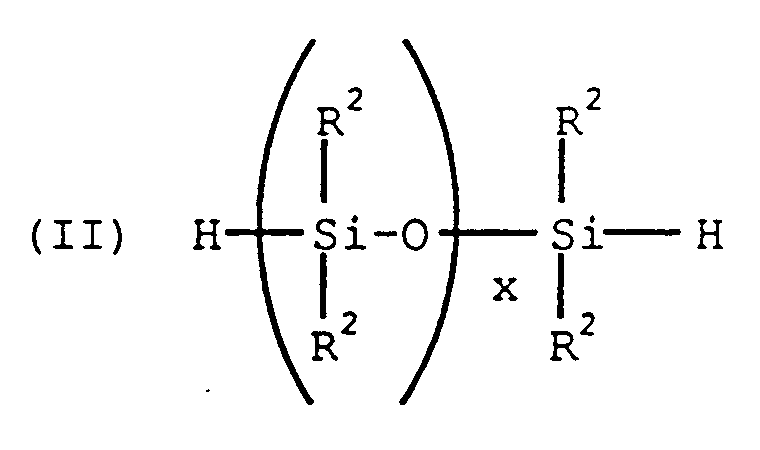
- (C) a platinum-containing hydrosilation catalyst as defined in claim 1;
said mixture containing titratable acid, if any, in an amount up to 0.5 equivalent per gram-atom of platinum. - Reagent A in the method of this invention is at least one olefinic amine of formula I. Suitable amines include allylamine (which is preferred), methallylamine and 2-butenylamine.
- Reagent B is at least one polydiorganosiloxane of formula II. The 1,1,3,3-tetraalkyldisiloxanes, and especially 1,1,3,3-tetramethyldisiloxane (hereinafter "TMDS"), are often preferred. It is, however, frequently also advantageous to use higher siloxanes, up to an average molecular weight in the range of 15,000-20,000.
- The reaction between the olefinic amine and the polydiorganosiloxane takes place in the presence of a platinum-containing hydrosilation catalyst. They include platinum black, platinum on various supports such as silica, chloroplatinic acid-olefin complexes, and platinum complexes with olefins including olefinic polysiloxanes.
- An especially useful class of platinum-containing catalysts consists of the complexes of vinyl-substituted polydiorganosiloxanes, particularly cyclic siloxanes and most particularly cyclotetrasiloxanes. In particular, complexes of 1,3,5,7-tetravinyl-1,3,5,7-tetramethylcyclotetrasiloxane are advantageous since they frequently provide the desired products in especially high yields.
- In many embodiments of the invention, it is highly preferred that the catalyst contain a low proportion of halogen. Catalysts with this property have been found to be uniquely tolerant of the conditions under which the reaction is conducted, especially the presence of excess olefinic amine. In general, therefore, the most preferred catalysts contain halogen, if any, in an amount no greater than 1 gram-atom per gram-atom of platinum. The most desirable halogen amount, particularly in the first and third embodiments of the invention described hereinafter, is less than 0.1 gram-atom per gram-atom of platinum. The preparation of catalysts of this type containing low proportions of halogen, if any, is disclosed in U.S. Patents 3,775,452 and 3,814,730.
- Another important characteristic of the catalyst, as well as the reaction mixture in which it is employed, is low acidity. The level of acidity may be determined by acid-base titration in an organic medium, typically a mixture of a non-polar liquid such as toluene and a polar liquid such as an alkanol, with isopropanol often being preferred.
- Acidity levels depend on such factors as the method of catalyst preparation and the purity of the polydiorganosiloxane. For example, TMDS may contain acid (ordinarily hydrochloric acid) in amounts on the order of 35-50 ppm. The reaction mixtures of the present invention contain titratable acid, if any, in an amount no greater than 0.5 equivalent per gram-atom of platinum, since if that value is exceeded catalyst activity decreases drastically. In most instances the acid level is much lower, preferably less than 10 milliequivalents per gram-atom of platinum.
- As explained hereinafter, a substantially higher level of acidity at a certain stage is sometimes preferred. This may be achieved by adding acid at the point when it is needed.
- The method of this invention may be employed in several embodiments. In one embodiment, which may be employed with any value of x but which is frequently preferred when x is 1, contact between reagents A, B and C is effected at a temperature in the range of 80-150°C and preferably 80-125°C in the presence of a diluent. Inert diluents such as toluene or xylene may be used. The invention also includes employment of reaction product constituents, especially bis(aminoalkyl)polydiorganosiloxane, as diluent.
- In this embodiment it is possible for all three reagents and the solvent to be initially present in the reaction vessel, but it is also within the scope of the invention to add part or all of reagents A and B to the combination of reagent C and the solvent. Reagent C may also be introduced incrementally or continuously so as to maintain a substantially constant reaction rate.
- For maximum yield of bis(aminoalkyl)polydiorganosiloxane, the maximum percentage of combined reagents A and B in a solution in an inert diluent should be at most 40% and preferably 10-25% by weight when all reagents are initially present. When reagents A and B, and optionally part of reagent C, are subsequently added to such a solution, final concentrations up to 85% and especially 65% are acceptable. When reaction product constituents are employed as diluent, final concentrations may be up to 100%.
- The mole ratio of A to B should be at least 2:1 and preferably 2.2-2.5:1, the reaction time should be 1-6 hours and the pressure should be atmospheric. The proportion of catalyst (reagent C) is not critical but is generally 5-150 and preferably 5-100 ppm of platinum by weight based on the total of reagents A and B. An inert atmosphere, such as nitrogen, is preferred.
- When this embodiment is employed, the major product is a bis(aminoalkyl)polydiorganosiloxane of the formula

wherein R¹ and x are as previously defined. A by-product generally obtained in varying amounts, often relatively high when x is 1, is a cyclic disiloxazane having the formula
which may be converted to a bis(aminoalkyl)octaorganotetrasiloxane by hydrolysis as described hereinafter. Cyclic disiloxazanes having formula IV are another aspect of the invention. - Isolation of the bis(aminoalkyl)polysiloxane in this embodiment may be achieved by conventional distillation/solvent stripping operations. However, it is preferred to maintain the temperature of the mixture no higher than 160°C during stripping, to avoid formation of by-products which may interfere with product use.
- At stripping temperatures, there is evidence for conversion of cyclic disiloxazane to oligomers wherein the structural units have the formula

Such oligomers may be easily alcoholyzed to alkoxyaminoalkyltetraorganodisiloxanes of the formula
wherein R³ is a C₁₋₄ alkyl radical and especially methyl. Upon hydrolysis of the alkoxyaminoalkylpolydiorganosiloxane, typically at temperatures in the range of about 80-100°C and preferably in the presence of a strong base and especially a tetraalkylammonium hydroxide as catalyst, the desired bis(aminoalkyl)polydiorganosiloxanes are obtained. Alkoxyaminoalkylpolydiorganosiloxanes of formula VI are another aspect of the invention. - A second embodiment is similar to the first except that no diluent is employed and reagent B is a compound in which x is at least 2. The product is then a bis(aminoalkyl)polydiorganosiloxane of formula III wherein x is greater than 1. In other respects, the proportions and reaction conditions for this embodiment are similar to those described for the first, except that the process is not as sensitive to the halogen content of the catalyst.
- In a third embodiment, employed when x is 1, contact between reagents A, B and C (reagent C generally being employed in the above-described proportions) is effected in a system free from extraneous diluents, at a temperature initially in the range of 30-75°C and in an inert atmosphere. The principal initial (amination) product is then an alkenylaminodisiloxane having the formula

formed with the evolution of hydrogen. Compounds of formula VII are still another aspect of the invention; they may be isolated by conventional means after poisoning of the catalyst with a sulfur compound such as thiophenol. - Upon continued contact with the catalyst, the alkenylaminodisiloxanes of formula VII undergo intramolecular hydrosilation to form cyclic disiloxazanes of formula IV. The cyclization reaction is very exothermic; when molar ratios of reagent A to reagent B on the order of 1:1 are employed, the reaction may be initiated at temperatures as low as 20°C and very efficient cooling may be necessary to prevent it from getting out of control. It is generally preferred to employ reagent A in excess, typically in a molar ratio to reagent B of 2-4:1. The reaction then proceeds smoothly at temperatures in the range of 60-110°C and may often be conveniently conducted at reflux. Care must be taken, however, that reagent A not be lost by volatilization to the point where less than a 1:1 ratio remains in the reaction vessel, since a vigorous or even uncontrollable reaction may result.
- Under certain conditions, and especially when the reaction mixture is acid-free at this stage, the yield of the cyclic disiloxazane of formula IV decreases sharply. There is evidence for intermolecular hydrosilation thereof, forming polymers with units of formula V, under these conditions.
- It has been discovered, however, that the polymer-forming reaction is easily reversed by maintaining the reaction mixture acidic at this stage. This is conveniently achieved by utilizing a hydrosilation catalyst which contains strong acid (in the previously described minor amounts) or by adding a strong acid to the reaction mixture after hydrosilation. Both Bronsted and Lewis acids are suitable, and the identity thereof is not particularly critical so long as it is sufficiently strong.
- Illustrative acids are mineral acids such as hydrochloric acid, acidic salts such as ammonium sulfate, organic acids such as p-toluenesulfonic acid and Lewis acids such as dimethylchlorosilane. Only very small proportions thereof are necessary, the amounts present in the catalyst as previously described being sufficient provided said catalyst contains titratable acid. However, it is also within the scope of the invention to add a strong acid to the reaction mixture in greater amounts, typically up to 300 milliequivalents per gram-atom of platinum. (For the purposes of this invention, the equivalent weight of the acid is its molecular weight divided by the number of strongly acidic centers therein. Thus, hydrochloric acid, p-toluenesulfonic acid, ammonium sulfate and dimethylchlorosilane are all considered monobasic acids.)
- According to the aforementioned U.S. Patent 4,649,208, the platinum-catalyzed hydrosilation of allylamine requires the presence of an amino compound other than the allylamine. In the present invention, no other amino compound is necessary and the employment of such an amino compound, although not harmful, usually offers no advantage. Therefore, in a preferred embodiment of the invention reagent A is the only amine present.
- The cyclic disiloxazanes of formula IV are convertible by hydrolysis to bis(aminoalkyl)octaorganotetrasiloxanes; that is, compounds of formula III wherein x is 3. Hydrolysis is conveniently effected by merely contacting the cyclic disiloxazane with an excess of water at a temperature in the range of 25-120°C, typically at reflux. In general, a molar ratio of water to cyclic disiloxazane on the order of 2-4:1 is convenient.
- The final products obtained by the above-described embodiments of the invention are various isomeric bis(aminoalkyl)polydiorganosiloxanes. For example, allylamine is converted principally to the bis(3-aminopropyl) compounds, with varying proportions of 1-methyl-2-aminoethyl species. For most purposes, the presence of such isomers is acceptable.
- As previously mentioned, the bis(aminoalkyl)polydiorganosiloxanes are useful for the preparation of polysiloxane polyetherimides. For this purpose, compounds of formula III wherein x has an average value in the range of 10-15 are generally preferred. They may be prepared from lower molecular weight compounds by equilibration with a cyclic polydiorganosiloxane such as octamethylcyclotetrasiloxane under basic conditions. The bis(aminoalkyl)tetraorganodisiloxanes and bis(aminoalkyl)octaorganotetrasiloxanes are among the compounds which may be used for this purpose, and by employing suitable proportions of reactants it is possible to convert both of these species to bis(aminoalkyl)polydiorganosiloxanes having substantially the same average molecular weight. Therefore, the tetrasiloxanes are essentially equivalent to the corresponding disiloxanes from the standpoint of utility.
- The invention is illustrated by the following examples. Unless otherwise indicated, the catalyst employed in these examples was a platinum complex of 1,3,5,7-tetravinyl-1,3,5,7-tetramethylcyclotetrasiloxane having a platinum content on the order of 1.5-2.0% by weight. It contained about 20-200 ppm. of chloride (0.006-0.062 gram-atom per gram-atom of platinum) and up to about 20 ppm. (6.1 meq. per gram-atom of platinum) of hydrochloric acid. Catalyst proportions are expressed in terms of parts by weight of platinum per million parts of reagents A and B combined. Said proportions are approximations, but the use of such approximations is permissible since the amount of catalyst is not a crucial feature of the invention.
- To a 13.5% solution in o-xylene of allylamine and TMDS in a molar ratio of 2.5:1 was added catalyst in the amount of 40 ppm. The mixture was heated in a nitrogen atmosphere under reflux (128°C) for 3 hours, after which analysis by silicon-29 nuclear magnetic resonance spectroscopy showed the product to consist entirely of 1,9-diamino-4,4,6,6-tetramethyl-5-oxa-4,6-disilanonane; no 2,2,7,7-tetramethyl-1-oxa-3-aza-2,7-disilacycloheptane (the compound of formula IV wherein R¹ is hydrogen and R² is methyl) was detected. The bis(aminoalkyl)disiloxane could be isolated by vacuum stripping of the xylene.
- The procedure of Example 1 was repeated, varying the reaction temperature, reaction time and reactant concentration. The results are given in Table I, with 1,9-diamino-4,4,6,6-tetramethyl-5-oxa-4,6-disilanonane being identified as "linear" and 2,2,7,7-tetramethyl-1-oxa-3-aza-2,7-disilaheptane being identified as "cyclic".
TABLE I Temperature, °C Time, hrs. Reactant conc., % Percent yield Linear Cyclic 123 1-1/4 20 95.7 4.3 122 2 22 88.8 11.2 123 3-3/4 23 85.4 14.6 126 5-1/4 25 84.1 15.9 118 5-1/4 30 79.2 20.8 140 1-1/2 23 77.9 22.1 - To a vessel containing 1000 parts by weight of toluene and 20 ppm. of catalyst were added under reflux over 10 hours in a nitrogen atmosphere, with stirring, 816.5 parts of allylamine, 952.6 parts of TMDS and an additional 80 ppm. of catalyst. Methanol, 226.8 parts, was added with stirring and the mixture was stripped at 140°C, first at atmospheric and then under reduced pressure after which crude product was distilled up to 140°C/1330 Pa (10 torr). An excess of water was added to the distillate which was then stripped at 160°C, to yield the desired product comprising principally 1,9-diamino-4,4,6,6,-tetramethyl-5-oxa-4,6-disilanonane in 92% yield.
- A mixture of 71 parts by weight of 1,9-diamino-4,4,6,6-tetramethyl-5-oxa-4,6-disilanonane and 40 ppm. of catalyst is heated to 115°C in a nitrogen atmosphere, and a mixture of 32.5 parts of allylamine and 67.5 parts of TMDS (0.57 mole each) is added dropwise over 6 hours, whereby a temperature in the range of 95-110°C is maintained. The mixture is cooled and analyzed by infrared spectroscopy and gas chromatography, showing the absence of Si-H bonds and the presence of the disilanonane and the corresponding cyclic disiloxazane. The crude product is distilled at 40-100°C/66,5 Pa (0.5 torr) and hydrolyzed by addition of 50 parts of water, whereupon an exotherm carries the temperature to 85°C. Upon removal of water by distillation, the desired product is obtained in 97% yield.
- A mixture of 18.75 grams (328 mmol.) of allylamine, 93.34 grams (67 mmol.) of a polydiorganosiloxane of formula II wherein R² was methyl and x had an average value of about 23, 290.4 mg. (50 ppm.) of catalyst and 448 grams of o-xylene was heated to reflux in a nitrogen atmosphere over a period of 100 minutes, whereupon infrared spectroscopic analysis showed the reaction to be complete. Upon distillation of the solvent, there was obtained a bis(aminoalkyl)polydimethylsiloxane which was shown by carbon-13 and silicon-29 nuclear magnetic resonance spectroscopy and acid titration to have formula III wherein x is about 30. The apparent increase in chain length is believed to be the result of the presence of cyclic polydimethylsiloxanes in both reactant and product, which may affect the analyses differently in the two environments.
- A mixture of 101.6 parts (1.78 moles) of allylamine, 148.4 parts (0.71 mole) of hexamethyltrisiloxane (the compound of formula II wherein each R² is methyl and x is 2) and catalyst in the amount of 50 ppm. of platinum was heated in a nitrogen atmosphere by means of an oil bath maintained at 85°C, with stirring. After about 15 minutes, an exothermic reaction occurred which caused a substantial temperature increase. After about 1-1/2 hours the mixture had stopped refluxing, and the oil bath temperature was increased to 100°C. Heating was continued for a total of 4 hours.
- Unreacted allylamine was removed by distillation at temperatures up to 140°C, and removal thereof was completed at reduced pressure. The mixture was then distilled under reduced pressure to yield the desired 1,11-diamino-4,4,6,6,8,8-hexamethyl-5,7-dioxa-4,6,8-trisilaundecane in at least 95% yield. The identity of the product was confirmed by elemental and spectroscopic analysis.
- The procedure of Example 6 was repeated except that the catalyst employed therein was replaced by an equivalent amount of an anhydrous solution in octyl alcohol of chloroplatinic acid. After a reaction period of 24 hours, the yield of product (as identified by vapor phase chromatography) was 89%.
- A mixture of 114.2 grams (2 moles) of allylamine, 134.3 grams (1 mole) of TMDS, 100 mg. of pyridine and catalyst in the amount of 40 ppm. of platinum was heated in a nitrogen atmosphere under reflux for 11 hours, during which time the pot temperature rose from 55°C to 161°C. The product was distilled under vacuum at 45°C/133 Pa (1 torr), yielding 180 grams (95% of theoretical) of 2,2,7,7-tetramethyl-1-oxa-3-aza-2,7-disilacycloheptane. The product was identified by silicon-29 and carbon-13 nuclear magnetic resonance spectroscopy and mass spectroscopy.
- A mixture of the cyclic disiloxazane and 8.57 grams of water was heated under reflux, with stirring, whereupon it turned cloudy and then clear. The product was shown by gas chromatographic analysis to be the desired 1,13-diamino-4,4,6,6,8,8,10,10-octamethyl-5,7,9-trioxa-4,6,8,10-tetrasila-tridecane.
- A mixture of allylamine and tetramethyldisiloxane identical to that of Example 8 was prepared in a nitrogen atmosphere, and catalyst in the amount of 40 ppm. was added. Hydrogen gas evolution began immediately and lasted for about 35 minutes, after which the reaction mixture was brought to reflux at 54°C. Over the next 6 hours the temperature rose steadily to 74°C; upon analysis by gas chromatography and infrared and mass spectroscopy the only product identified was 5,5,7,7-tetramethyl-4-aza-6-oxa-5,7-disila-1-heptene.
- Heating was continued for an additional 6 hours with a rise in pot temperature to a final value of 105°C. Upon analysis, it was found that the alkenylaminodisiloxane had been converted entirely to cyclic disiloxazane, which was isolated by vacuum distillation. The yield was 200 grams, or 53% of theoretical.
- Allylamine and TMDS in a 2:1 molar ratio were combined with about 8 ppm. of catalyst and the mixture was stirred overnight in a nitrogen atmosphere at room temperature, after which five drops of thiophenol was added to poison the catalyst. Unreacted starting materials were removed by vacuum stripping and the desired alkenylamin-odisiloxane was recovered by vacuum distillation at 45°C/66,5 Pa (0.5 torr). Its structure was confirmed by silicon-29 and carbon-13 nuclear magnetic resonance spectroscopy and mass spectroscopy.
- Allylamine and TMDS in a 1:1 molar ratio were combined with 40 ppm. of catalyst in a nitrogen atmosphere, whereupon hydrogen evolution was immediately observed. The mixture was heated to reflux and the pot temperature rose from 43° to 73°C over 65 minutes; an exothermic reaction then occurred which caused an immediate rise to 155°C. The mixture was cooled to 45°C and distilled under vacuum, yielding a very small proportion of cyclic disiloxazane. The distillation residue was steam distilled and shown to be a mixture of bis(3-aminopropyl)polydimethylsiloxanes.
- To a mixture of 1262.6 grams (22.11 moles) of allylamine and 742.6 grams (5.53 moles) of TMDS was added in a nitrogen atmosphere, with stirring, 40 ppm. of catalyst, whereupon the temperature of the mixture rose from 21° to 28°C and hydrogen evolution began. When hydrogen evolution slowed, the mixture was heated under reflux for 8 hours, whereupon the temperature rose to 65°C. Analysis by gas chromatography showed that all the TMDS had been converted to cyclic disiloxazane.
- The excess allylamine was distilled under atmospheric pressure and then under vacuum, after which the cyclic disiloxazane was removed by distillation. Ammonium sulfate, 200 mg., was added to the residue and distillation was continued. The total yield of cyclic disiloxazane was 95% of theoretical.
- The procedure of Example 9 was repeated, using catalysts with various degrees of acidity (HCl) and basicity (KOH). The results are given in Table II.
TABLE II Acid or (base) conc. Cyclic % yield Ppm. based on catalyst Meq. per gram-atom Pt (7) (1.4) 59 (5) (1.0) 90.8 3 0.9 94.9 3 0.9 99.6 - These results show that even a very small proportion of acid in the catalyst is effective to convert oligomer back to cyclic disiloxazane.
- Experiments were conducted in which the procedure of Example 9 was repeated, except that various acids were added when hydrosilation was complete as shown by infrared spectroscopic analysis. The results are given in Table III.
TABLE III Acid Cyclic % yield Identity Meq. per gram-atom Pt None --- 59 p-Toluenesulfonic acid 141.9 93.4 Ammonium sulfate 7.3 95.2 Dimethylchlorosilane 258 76.5 - Various experiments were conducted using the procedure of Example 13, but employing TMDS containing various proportions of hydrochloric acid. The effect on catalyst activity, reaction time and temperature are given in Table IV.
TABLE IV Run HCl concentration Catalyst activity Max temp., °C Reaction time, min. Ppm. Equivs. per gram-atom Pt 1 34.4 2.70 Slight 66 510 2 8.8 0.71 Poor 67 480 3 4.6 0.38 Fair 107 282 4 1.7 0.14 Good 115 205 5 0.7 0.05 Good 116 175 6 0 0 Good 120 146 - It will be seen that the maximum reaction temperature increases steadily with a decrease in acid concentration. This is a result of improved conversion of TMDS to alkenylaminodisiloxane, which in turn is exothermically converted to cyclic disiloxazane. Catalyst activity also increases and reaction time decreases with a decrease in acid concentration.
Claims (29)
- A method for preparing a silicon-nitrogen compound which comprises effecting reaction between the components of a mixture comprising(A) at least one olefinic amine of the formula
 (B) at least one polydiorganosiloxane of the formula
 (C) a platinum-containing hydrosilation catalyst selected from the group consisting of platinum black, platinum on support, chloroplatinic acid - olefin complexes and platinum complexes with olefins;
said mixture containing titratable acid, if any, in an amount up to 0.5 equivalent per gram-atom of platinum. - A method according to claim 1 wherein reagent C is a platinum complex of 1,3,5,7-tetravinyl-1,3,5,7-tetramethylcyclotetrasiloxane containing halogen, if any, in an amount no greater than 1 gram-atom per gram-atom of platinum.
- A method according to claim 2 wherein the reaction is conducted in an inert atmosphere.
- A method according to claim 3 wherein reagent A is the only amine present.
- A method according to claim 4 wherein the proportion of catalyst is 5-150 ppm. of platinum by weight based on the total of reagents A and B.
- A method according to claim 5 wherein the reaction is conducted at a temperature in the range of 80-125°C.
- A method according to claim 6 wherein x is 1, a diluent is employed and the product is a bis(aminoalkyl)tetraorganodisiloxane.
- A method according to claim 7 wherein reagent C contains halogen, if any, in an amount less than 0.1 gram-atom per gram-atom of platinum.
- A method according to claim 8 wherein each R¹ is hydrogen and each R² is methyl.
- A method according to claim 9 wherein reagents A and B and a portion of reagent C are added incrementally or continuously to diluent and remaining reagent C, the mole ratio of A to B is 2.2-2.5:1 and the reaction pressure is atmospheric.
- A method according to claim 10 wherein the diluent is toluene or xylene.
- A method according to claim 11 wherein the final concentration of combined reagents A and B in the solution is up to 85% by weight.
- A method according to claim 6 wherein x is greater than 1, contact between reagents A, B and C is effected in a system free from diluents and the product is a bis(aminoalkyl)polydiorganosiloxane.
- A method according to claim 13 wherein reagent C contains halogen, if any, in an amount less than 0.1 gram-atom per gram-atom of platinum.
- A method according to claim 14 wherein each R¹ is hydrogen and each R² is methyl.
- A method according to claim 15 wherein the mole ratio of A to B is 2.2-2.5:1 and the reaction pressure is atmospheric.
- A method according to claim 5 wherein x is 1 and contact between reagents A, B and C is effected in a system free from extraneous diluents and at a temperature initially in the range of 30-75°C, to afford a product initially comprising an alkenylaminodisilazane of the formula
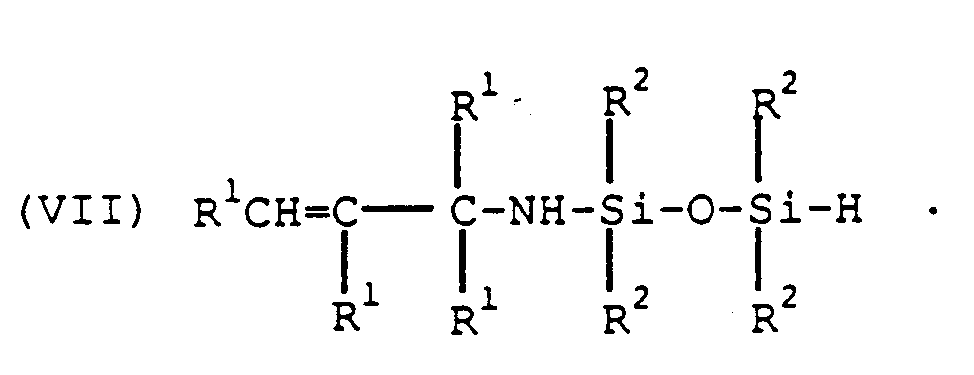
- A method according to claim 17 wherein reagent C contains halogen, if any, in an amount less than 0.1 gram-atom per gram-atom of platinum.
- A method according to claim 18 wherein said product undergoes intramolecular hydrosilation to form a cyclic disiloxazane of the formula

- A method according to claim 19 wherein each R¹ is hydrogen and each R² is methyl.
- A method according to claim 20 wherein the molar ratio of reagent A to reagent B is 2-4:1.
- A method according to claim 21 wherein the mixture contains titratable acid in an amount less than 10 milliequivalents per gram-atom of platinum.
- A method according to claim 22 wherein the product is subsequently hydrolyzed to a bis(aminoalkyl)octaorganotetrasiloxane by contact with an excess of water at a temperature in the range of 25-120°C.
- An alkenylaminodisiloxane having the formula

- An alkenylaminodisiloxane according to claim 24 wherein each R¹ is hydrogen and R² is methyl.
- A cyclic disiloxazane having the formula

- A cyclic disiloxazane according to claim 26 wherein each R¹ is hydrogen and R² is methyl.
- An alkoxyaminoalkyltetraorganodisiloxane having the formula

- A disiloxane according to claim 28 wherein each R¹ is hydrogen, each R² is methyl and R³ is methyl.
Applications Claiming Priority (4)
| Application Number | Priority Date | Filing Date | Title |
|---|---|---|---|
| US19691088A | 1988-05-20 | 1988-05-20 | |
| US196910 | 1989-04-28 | ||
| US344713 | 1989-04-28 | ||
| US07/344,713 US5026890A (en) | 1988-05-20 | 1989-04-28 | Method and intermediates for preparation of bis(aminoalkyl)polydiorganosiloxanes |
Publications (3)
| Publication Number | Publication Date |
|---|---|
| EP0342518A2 EP0342518A2 (en) | 1989-11-23 |
| EP0342518A3 EP0342518A3 (en) | 1991-06-05 |
| EP0342518B1 true EP0342518B1 (en) | 1994-11-30 |
Family
ID=26892380
Family Applications (1)
| Application Number | Title | Priority Date | Filing Date |
|---|---|---|---|
| EP89108468A Expired - Lifetime EP0342518B1 (en) | 1988-05-20 | 1989-05-11 | Method and Intermediates for Preparation of bis(Aminoalkyl)Polydiorganosiloxanes |
Country Status (5)
| Country | Link |
|---|---|
| US (1) | US5026890A (en) |
| EP (1) | EP0342518B1 (en) |
| JP (1) | JP2549172B2 (en) |
| DE (1) | DE68919530T2 (en) |
| ES (1) | ES2065936T3 (en) |
Families Citing this family (85)
| Publication number | Priority date | Publication date | Assignee | Title |
|---|---|---|---|---|
| US6464713B2 (en) * | 1990-06-28 | 2002-10-15 | Peter M. Bonutti | Body tissue fastening |
| JPH0595686U (en) * | 1992-06-04 | 1993-12-27 | 株式会社共和製作所 | Automatic parts washer |
| US5385961A (en) * | 1993-01-27 | 1995-01-31 | General Electric Company | Amino silicone/phosphite compositions |
| DE4344082C1 (en) * | 1993-12-23 | 1994-12-22 | Goldschmidt Ag Th | Process for the preparation of organopolysiloxanes containing secondary aminoalkyl groups bonded to silicon via carbon |
| DE19638125A1 (en) * | 1996-09-18 | 1998-03-19 | Wacker Chemie Gmbh | Organosilicon compounds containing amino groups, their preparation and use |
| US6846893B1 (en) | 1996-10-23 | 2005-01-25 | Minnesota Mining And Manufacturing Company | Polymer mixtures containing polydiorganosiloxane urea-containing components |
| US6007914A (en) * | 1997-12-01 | 1999-12-28 | 3M Innovative Properties Company | Fibers of polydiorganosiloxane polyurea copolymers |
| DE19754038A1 (en) * | 1997-12-05 | 1999-06-10 | Wacker Chemie Gmbh | Amino-alkylene oxide-functional organosilicon compounds, their preparation and use |
| US5892084A (en) * | 1998-02-03 | 1999-04-06 | Pcr, Inc. | Aminoorganofunctionalsiloxanes |
| US6353073B1 (en) | 2000-03-22 | 2002-03-05 | Archimica (Florida), Inc. | Poly (aminoorganofunctionaldisiloxanes) |
| US6339137B1 (en) | 2000-03-22 | 2002-01-15 | Archimica (Florida) Inc. | Poly (aminoorganofunctionalsiloxanes) |
| DE10049183C1 (en) * | 2000-10-05 | 2002-01-17 | Consortium Elektrochem Ind | New N-aminoalkylsilyl-cyclosilazanes, useful as precursors for aminoalkyl-terminated polysiloxanes, are prepared by reacting haloalkyldialkylchlorosilane and/or bishaloalkyltetraalkyldisilazane with ammonia |
| US7090922B2 (en) * | 2001-12-18 | 2006-08-15 | 3M Innovative Properties Company | Silicone priming compositions, articles, and methods |
| US6730397B2 (en) | 2001-12-18 | 2004-05-04 | 3M Innovative Properties Company | Silicone pressure sensitive adhesives, articles and methods |
| US7012110B2 (en) * | 2001-12-18 | 2006-03-14 | 3M Innovative Properties Company | Silicone pressure sensitive adhesives prepared using processing aids, articles, and methods |
| US20050038145A1 (en) * | 2003-08-11 | 2005-02-17 | General Electric Company | Flame retardant fiber reinforced composition with improved flow |
| US7649040B2 (en) * | 2002-04-11 | 2010-01-19 | Sabic Innovative Plastics Ip B.V. | Flame retardant fiber reinforced composition with improved flow |
| US7259201B2 (en) * | 2003-08-28 | 2007-08-21 | General Electric Company | Flame retardant thermoplastic films and methods of making the same |
| US7407709B2 (en) * | 2003-12-22 | 2008-08-05 | 3M Innovative Properties Company | Silicone pressure sensitive adhesive and articles |
| KR101298355B1 (en) | 2005-12-23 | 2013-08-20 | 쓰리엠 이노베이티브 프로퍼티즈 컴파니 | Films including thermoplastic silicone block copolymers |
| EP2860213B1 (en) * | 2005-12-23 | 2016-09-07 | 3M Innovative Properties Company | Multilayer films including thermoplastic silicone block copolymers |
| US20070149745A1 (en) * | 2005-12-23 | 2007-06-28 | 3M Innovative Properties Company | Polydiorganosiloxane-containing materials with oxalylamino groups |
| US7501184B2 (en) | 2005-12-23 | 2009-03-10 | 3M Innovative Properties Company | Polydiorganosiloxane polyoxamide copolymers |
| US7371464B2 (en) | 2005-12-23 | 2008-05-13 | 3M Innovative Properties Company | Adhesive compositions |
| US7560166B2 (en) * | 2005-12-28 | 2009-07-14 | 3M Innovative Properties Company | Adhesive article, composite article, and methods of making the same |
| US7687121B2 (en) * | 2006-01-20 | 2010-03-30 | Momentive Performance Materials Inc. | Insulated glass unit with sealant composition having reduced permeability to gas |
| US20070173597A1 (en) * | 2006-01-20 | 2007-07-26 | Williams David A | Sealant composition containing inorganic-organic nanocomposite filler |
| US7531613B2 (en) * | 2006-01-20 | 2009-05-12 | Momentive Performance Materials Inc. | Inorganic-organic nanocomposite |
| US8071693B2 (en) * | 2006-06-22 | 2011-12-06 | Sabic Innovative Plastics Ip B.V. | Polysiloxane/polyimide copolymers and blends thereof |
| US20080027199A1 (en) | 2006-07-28 | 2008-01-31 | 3M Innovative Properties Company | Shape memory polymer articles with a microstructured surface |
| US7951319B2 (en) | 2006-07-28 | 2011-05-31 | 3M Innovative Properties Company | Methods for changing the shape of a surface of a shape memory polymer article |
| US7847023B2 (en) * | 2007-03-12 | 2010-12-07 | Sabic Innovative Plastics Ip B.V. | Polysiloxane/polyimide copolymer blends |
| US20080236864A1 (en) * | 2007-03-28 | 2008-10-02 | General Electric Company | Cross linked polysiloxane/polyimide copolymers, methods of making, blends thereof, and articles derived therefrom |
| US8334037B2 (en) | 2007-05-11 | 2012-12-18 | 3M Innovative Properties Company | Multi-layer assembly, multi-layer stretch releasing pressure-sensitive adhesive assembly, and methods of making and using the same |
| US7705103B2 (en) * | 2007-06-22 | 2010-04-27 | 3M Innovative Properties Company | Polydiorganosiloxane polyoxamide copolymers |
| US7507849B2 (en) * | 2007-06-22 | 2009-03-24 | 3M Innovative Properties Company | Cyclic silazanes containing an oxamido ester group and methods of making these compounds |
| US7705101B2 (en) * | 2007-06-22 | 2010-04-27 | 3M Innovative Properties Company | Branched polydiorganosiloxane polyamide copolymers |
| US8063166B2 (en) | 2007-06-22 | 2011-11-22 | 3M Innovative Properties Company | Polydiorganosiloxane polyamide copolymers having organic soft segments |
| US20080318065A1 (en) * | 2007-06-22 | 2008-12-25 | Sherman Audrey A | Mixtures of polydiorganosiloxane polyamide-containing components and organic polymers |
| US8202934B2 (en) * | 2007-07-31 | 2012-06-19 | 3M Innovative Properties Company | Hot melt processable polyurea copolymers and methods of their preparation and use |
| WO2009089137A2 (en) | 2008-01-11 | 2009-07-16 | 3M Innovative Properties Company | Stretch releasing optically clear pressure sensitive adhesive |
| US7732516B2 (en) | 2008-01-31 | 2010-06-08 | Sabic Innovative Plastics Ip B.V. | Flame retardant polyimide/polyester-polycarbonate compositions, methods of manufacture, and articles formed therefrom |
| JP5529764B2 (en) | 2008-03-14 | 2014-06-25 | スリーエム イノベイティブ プロパティズ カンパニー | Stretchable and peelable adhesive tape |
| US8431671B2 (en) | 2008-03-26 | 2013-04-30 | 3M Innovative Properties Company | Structured polydiorganosiloxane polyamide containing devices and methods |
| WO2010077477A1 (en) | 2008-12-17 | 2010-07-08 | 3M Innovative Properties Company | Silicone polyoxamide process additives for high clarity applications |
| WO2010077480A1 (en) | 2008-12-17 | 2010-07-08 | 3M Innovative Properties Company | Thermoplastic silicone-based polymer process additives for injection molding applications |
| DE102009001758A1 (en) | 2009-03-23 | 2010-09-30 | Wacker Chemie Ag | Process for the synthesis of 1,3-bis (aminoalkyl) disiloxanes |
| US8124713B2 (en) * | 2009-09-21 | 2012-02-28 | 3M Innovative Properties Company | Silicone polyoxamide and silicone polyoxamide-hydrazide copolymers |
| US7981995B2 (en) * | 2009-09-21 | 2011-07-19 | 3M Innovative Properties Company | Silicone polyoxamide and silicone polyoxamide-hydrazide copolymers |
| WO2011082069A1 (en) | 2009-12-30 | 2011-07-07 | 3M Innovative Properties Company | Methods of making polydiorganosiloxane polyoxamide copolymers |
| WO2011082046A1 (en) | 2009-12-30 | 2011-07-07 | 3M Innovative Properties Company | Copolymers with perfluorpolyether segment and multiple aminooxalylamino groups |
| KR101788345B1 (en) | 2009-12-30 | 2017-10-19 | 쓰리엠 이노베이티브 프로퍼티즈 캄파니 | Moisture-curable siloxane-containing and fluorocarbon-containing compounds and polymers formed therefrom |
| CN102712750B (en) | 2009-12-30 | 2014-06-25 | 3M创新有限公司 | Perfluoropolyether-containing compounds with oxalylamino groups |
| CN102695745B (en) | 2009-12-30 | 2013-11-13 | 3M创新有限公司 | Copolymers with perfluorpolyether segment and polydiorganosiloxane segment |
| DE102010001531A1 (en) | 2010-02-03 | 2011-08-04 | Evonik Goldschmidt GmbH, 45127 | Novel organomodified siloxanes with primary amino functions, novel organomodified siloxanes with quaternary ammonium functions and the process for their preparation |
| CN101879460B (en) * | 2010-07-09 | 2012-01-11 | 中南民族大学 | Nerchinskite solid-borne platinum catalyst and preparation method and application thereof |
| US20120285721A1 (en) | 2011-05-11 | 2012-11-15 | Gallucci Robert R | Silicone polyetherimide copolymers |
| US8653190B2 (en) | 2011-08-08 | 2014-02-18 | 3M Innovative Properties Company | Curable cyclic anhydride copolymer/silicone composition |
| KR102126363B1 (en) | 2012-10-29 | 2020-06-24 | 쓰리엠 이노베이티브 프로퍼티즈 캄파니 | Pavement marking compositions |
| WO2014186328A1 (en) | 2013-05-17 | 2014-11-20 | 3M Innovative Properties Company | Reaction mixture, porous particles and methods of making |
| JP6316944B2 (en) | 2013-05-17 | 2018-04-25 | スリーエム イノベイティブ プロパティズ カンパニー | Release of bioactive agent from polymer composite particles |
| CA2925090A1 (en) | 2013-09-30 | 2015-04-02 | 3M Innovative Properties Company | Silicone-polyether copolymers, adhesives and medical articles comprising same, and methods of making same |
| EP3149070A1 (en) | 2014-04-29 | 2017-04-05 | 3M Innovative Properties Company | Copolymers of poly(ethylene-co-acrylic acid) and polydiorganosiloxanes |
| CN107001858B (en) | 2014-12-08 | 2020-05-15 | 3M创新有限公司 | Compounds comprising modified diorganosiloxane polymers |
| WO2016094082A1 (en) | 2014-12-08 | 2016-06-16 | 3M Innovative Properties Company | Fluorinated silane compounds, compositions, and articles |
| JP2018500435A (en) | 2014-12-23 | 2018-01-11 | スリーエム イノベイティブ プロパティズ カンパニー | Curable and cured epoxy resin composition |
| EP3237495A1 (en) | 2014-12-23 | 2017-11-01 | Momentive Performance Materials GmbH | Aminosiloxanes of high purity |
| JP2018524423A (en) | 2015-06-03 | 2018-08-30 | スリーエム イノベイティブ プロパティズ カンパニー | Silicone-based assembly layer for flexible display applications |
| WO2016196541A1 (en) | 2015-06-03 | 2016-12-08 | 3M Innovative Properties Company | Acrylic-based flexible assembly layer |
| CN107683313B (en) | 2015-06-03 | 2021-02-05 | 3M创新有限公司 | Component layer for flexible displays |
| JP2017105753A (en) | 2015-12-04 | 2017-06-15 | 信越化学工業株式会社 | Linear organopolysiloxane having different functional groups at both ends, and method for producing the same |
| CN106496261B (en) * | 2016-08-31 | 2019-04-05 | 成都正威新材料研发有限公司 | A kind of preparation method of silicone-containing diamines |
| WO2019005710A1 (en) | 2017-06-26 | 2019-01-03 | Dow Silicones Corporation | Method for hydrosilylation of aliphatically unsaturated alkoxysilanes and hydrogen terminated organosiloxane oligomers to prepare alkoxysilyl terminated polymers useful for functionalizing polyorganosiloxanes using a rhodium catalyst |
| EP3645608B1 (en) | 2017-06-26 | 2024-06-19 | Dow Silicones Corporation | Method for hydrosilylation of aliphatically unsaturated alkoxys i lan es and hydrogen terminated organosiloxane oligomers to prepare alkoxysilyl terminated polymers useful for functionalizing polyorganosiloxanes using a cobalt catalyst |
| EP3645607B1 (en) | 2017-06-26 | 2025-11-05 | Dow Silicones Corporation | Method for hydrosilylation of aliphatically unsaturated alkoxysilanes and hydrogen terminated organosiloxane oligomers to prepare alkoxysilyl terminated polymers useful for functionalizing polyorganosiloxanes using an iridium catalyst |
| WO2019043491A1 (en) | 2017-08-28 | 2019-03-07 | 3M Innovative Properties Company | Solid siloxane polymers as delivery agents for siloxane tackifying resins |
| WO2019043490A1 (en) | 2017-08-31 | 2019-03-07 | 3M Innovative Properties Company | Hyperbranched polydiorganosiloxane polyoxamide polymers |
| WO2019224769A1 (en) | 2018-05-25 | 2019-11-28 | 3M Innovative Properties Company | Phase separated articles |
| WO2021028821A1 (en) | 2019-08-15 | 2021-02-18 | 3M Innovative Properties Company | Core-sheath filament with a silicone-containing block copolymer core |
| WO2021108067A1 (en) | 2019-11-26 | 2021-06-03 | Dow Silicones Corporation | Hydrocarbyloxy-functional arylsilanes and their use as promoters for platinum catalyzed hydrosilylation reactions |
| CN114630857A (en) * | 2019-11-26 | 2022-06-14 | 美国陶氏有机硅公司 | Method for producing polyepoxysazanes and for producing aminofunctional polyorganosiloxanes using polyepoxysazanes |
| KR102540606B1 (en) | 2019-12-19 | 2023-06-05 | 쓰리엠 이노베이티브 프로퍼티즈 컴파니 | Silicone polyoxamide copolymer with amine-based end groups |
| JP2024518988A (en) * | 2021-05-18 | 2024-05-08 | ダウ シリコーンズ コーポレーション | Process for preparing cyclic siloxazanes and their use for the preparation of amino-functional polyorganosiloxanes - Patents.com |
| CN114292289A (en) * | 2021-12-27 | 2022-04-08 | 江西贝特利新材料有限公司 | 1, 3-bis (3-aminopropyl) -1,1,3, 3-tetramethyldisiloxane and preparation method thereof |
| CN115873199A (en) * | 2022-12-07 | 2023-03-31 | 盛鼎高新材料有限公司 | Low-temperature-resistant and impact-resistant polyurethane elastomer and processing technology thereof |
Citations (1)
| Publication number | Priority date | Publication date | Assignee | Title |
|---|---|---|---|---|
| DD111081A1 (en) * | 1973-12-21 | 1975-01-20 |
Family Cites Families (19)
| Publication number | Priority date | Publication date | Assignee | Title |
|---|---|---|---|---|
| BE503146A (en) * | 1950-06-30 | 1900-01-01 | ||
| US3044982A (en) * | 1957-11-12 | 1962-07-17 | Union Carbide Corp | Organopolysiloxanes and process for producing same |
| US3033815A (en) * | 1959-08-28 | 1962-05-08 | Union Carbide Corp | Organosilicon compounds and process for producing same |
| US3243404A (en) * | 1962-04-02 | 1966-03-29 | Gen Electric | Silyl amine processing aids for polysiloxane elastomers |
| US3239550A (en) * | 1962-05-21 | 1966-03-08 | Gen Electric | Cyclic polysiloxazanes |
| US3814730A (en) * | 1970-08-06 | 1974-06-04 | Gen Electric | Platinum complexes of unsaturated siloxanes and platinum containing organopolysiloxanes |
| US3803196A (en) * | 1971-03-01 | 1974-04-09 | Gen Electric | Aliphatically unsaturated organopolysiloxanes |
| US3775452A (en) * | 1971-04-28 | 1973-11-27 | Gen Electric | Platinum complexes of unsaturated siloxanes and platinum containing organopolysiloxanes |
| US3864373A (en) * | 1971-12-13 | 1975-02-04 | Dynamit Nobel Ag | Manufacture of trialkoxysilylamino compounds |
| BE795106A (en) * | 1972-02-07 | 1973-08-07 | Ici Ltd | NITROGEN COMPOUNDS AND THEIR USE |
| DE2408480A1 (en) * | 1974-02-22 | 1975-09-04 | Bayer Ag | Gamma-aminopropyl-alkoxysilane prepn - from allylamine and hydrogen- chlorosilanes, with hydrosilylation of prod and alcoholysis |
| US4374130A (en) * | 1980-07-30 | 1983-02-15 | Sandoz, Inc. | 4,4'-(Alkanediyl)-bis(2,2,6,6-tetraalkyl-1-oxa-4-aza-2,6-disilacyclohexanes) |
| US4471132A (en) * | 1983-05-31 | 1984-09-11 | General Electric Company | Method for making polyalkoxyaminosilanes |
| US4584393A (en) * | 1985-01-14 | 1986-04-22 | General Electric Company | Bis(aminoalkyl)disiloxanes and method and intermediates for their preparation |
| US4558146A (en) * | 1985-01-31 | 1985-12-10 | Union Carbide Corporation | Process for preparing vinylaminosilanes |
| US4631346A (en) * | 1985-03-04 | 1986-12-23 | General Electric Company | Silyl carbamates and their use in the preparation of bis (aminoalkyl) disiloxanes |
| JPS61205287A (en) * | 1985-03-08 | 1986-09-11 | Toshiba Silicone Co Ltd | Proudction of amino group-containing organic silicon compound |
| JPS62111991A (en) * | 1985-11-08 | 1987-05-22 | Shin Etsu Chem Co Ltd | Method for producing silicon-containing amino compounds |
| DE3736990A1 (en) * | 1987-10-31 | 1989-05-11 | Bayer Ag | 1,7,9,15-TETRAOXA-4,12-DIAZA-8-SILASPIRO- (7.7) -PENTADECANE, METHOD FOR THE PRODUCTION AND THEIR USE |
-
1989
- 1989-04-28 US US07/344,713 patent/US5026890A/en not_active Expired - Fee Related
- 1989-05-11 ES ES89108468T patent/ES2065936T3/en not_active Expired - Lifetime
- 1989-05-11 EP EP89108468A patent/EP0342518B1/en not_active Expired - Lifetime
- 1989-05-11 DE DE68919530T patent/DE68919530T2/en not_active Expired - Fee Related
- 1989-05-19 JP JP1124620A patent/JP2549172B2/en not_active Expired - Lifetime
Patent Citations (1)
| Publication number | Priority date | Publication date | Assignee | Title |
|---|---|---|---|---|
| DD111081A1 (en) * | 1973-12-21 | 1975-01-20 |
Also Published As
| Publication number | Publication date |
|---|---|
| JPH0249793A (en) | 1990-02-20 |
| EP0342518A2 (en) | 1989-11-23 |
| US5026890A (en) | 1991-06-25 |
| EP0342518A3 (en) | 1991-06-05 |
| DE68919530T2 (en) | 1995-07-13 |
| DE68919530D1 (en) | 1995-01-12 |
| ES2065936T3 (en) | 1995-03-01 |
| JP2549172B2 (en) | 1996-10-30 |
Similar Documents
| Publication | Publication Date | Title |
|---|---|---|
| US5026890A (en) | Method and intermediates for preparation of bis(aminoalkyl)polydiorganosiloxanes | |
| US5639845A (en) | Method for the preparation of a fluorine-containing organopolysiloxane | |
| US6008396A (en) | Hot oil process for producing isocyanato organosilanes | |
| EP0337197B1 (en) | Rhodium colloid, method of making, and use | |
| US6166238A (en) | High purity organofunctional alkyldialkoxysilanes | |
| US6858746B2 (en) | Process for the hydrosilylation of unsaturated aliphatic compounds | |
| EP0573282B1 (en) | Fluorine-containing organosilicon compounds | |
| US4950779A (en) | Nonaqueous method for making silicone oligomers | |
| US3099670A (en) | Addition of silicon hydrides to aliphatically unsaturated organic compounds | |
| US4631346A (en) | Silyl carbamates and their use in the preparation of bis (aminoalkyl) disiloxanes | |
| EP0639576A1 (en) | Organopolysiloxanes having a silanol group and process of making them | |
| US6297383B1 (en) | Silicone monomers and oligomers having a carboxyl functional group thereon | |
| US3546266A (en) | Process for the preparation of an organic silicon compound by reacting in the presence of a rhodium catalyst | |
| US3535092A (en) | Reduction of halogen-containing silicon compounds | |
| EP0586241B1 (en) | Azasilacycloalkyl functional alkoxysilanes and azasilacycloalkyl functional tetramethyldisiloxanes | |
| EP0556780A2 (en) | Organic silicon compounds | |
| EP1241171A1 (en) | Preparation of branched siloxanes | |
| EP1314736A2 (en) | Silicone monomers and oligomers having a carboxyl functional group thereon | |
| KR0159262B1 (en) | Intermediates for preparation of bis(aminoalkyl) polydiorganosiloxanes | |
| KR0159761B1 (en) | Process for preparing bis (aminoalkyl) polydiorganosiloxane and intermediates thereof | |
| KR0159263B1 (en) | Intermediates for the preparation of bis (aminoalkyl) polydiorganosiloxanes and methods for preparing the same | |
| US3718682A (en) | Process for obtaining hydrogenochlorosilanes | |
| US3806532A (en) | Silyl maleates and polysiloxane maleates | |
| US5780639A (en) | Silicone monomers and oligomers having a carboxyl functional group thereon | |
| CA2010139A1 (en) | Method and intermediates for preparation of bis(aminoalkyl)-polydiorganosiloxanes |
Legal Events
| Date | Code | Title | Description |
|---|---|---|---|
| PUAI | Public reference made under article 153(3) epc to a published international application that has entered the european phase |
Free format text: ORIGINAL CODE: 0009012 |
|
| AK | Designated contracting states |
Kind code of ref document: A2 Designated state(s): BE DE ES FR GB IT NL SE |
|
| RIN1 | Information on inventor provided before grant (corrected) |
Inventor name: LAMBERT, JAMES MICHAEL Inventor name: RITSCHARD, HANS VICTOR Inventor name: WEBB, JIMMY LYNN |
|
| PUAL | Search report despatched |
Free format text: ORIGINAL CODE: 0009013 |
|
| AK | Designated contracting states |
Kind code of ref document: A3 Designated state(s): BE DE ES FR GB IT NL SE |
|
| 17P | Request for examination filed |
Effective date: 19911129 |
|
| 17Q | First examination report despatched |
Effective date: 19930719 |
|
| GRAA | (expected) grant |
Free format text: ORIGINAL CODE: 0009210 |
|
| AK | Designated contracting states |
Kind code of ref document: B1 Designated state(s): BE DE ES FR GB IT NL SE |
|
| ET | Fr: translation filed | ||
| REF | Corresponds to: |
Ref document number: 68919530 Country of ref document: DE Date of ref document: 19950112 |
|
| ITF | It: translation for a ep patent filed | ||
| REG | Reference to a national code |
Ref country code: ES Ref legal event code: FG2A Ref document number: 2065936 Country of ref document: ES Kind code of ref document: T3 |
|
| PGFP | Annual fee paid to national office [announced via postgrant information from national office to epo] |
Ref country code: SE Payment date: 19950420 Year of fee payment: 7 |
|
| PGFP | Annual fee paid to national office [announced via postgrant information from national office to epo] |
Ref country code: BE Payment date: 19950425 Year of fee payment: 7 |
|
| PGFP | Annual fee paid to national office [announced via postgrant information from national office to epo] |
Ref country code: ES Payment date: 19950508 Year of fee payment: 7 |
|
| PGFP | Annual fee paid to national office [announced via postgrant information from national office to epo] |
Ref country code: NL Payment date: 19950531 Year of fee payment: 7 |
|
| PLBE | No opposition filed within time limit |
Free format text: ORIGINAL CODE: 0009261 |
|
| STAA | Information on the status of an ep patent application or granted ep patent |
Free format text: STATUS: NO OPPOSITION FILED WITHIN TIME LIMIT |
|
| 26N | No opposition filed | ||
| PG25 | Lapsed in a contracting state [announced via postgrant information from national office to epo] |
Ref country code: SE Effective date: 19960512 |
|
| PG25 | Lapsed in a contracting state [announced via postgrant information from national office to epo] |
Ref country code: ES Free format text: LAPSE BECAUSE OF NON-PAYMENT OF DUE FEES Effective date: 19960513 |
|
| PG25 | Lapsed in a contracting state [announced via postgrant information from national office to epo] |
Ref country code: BE Effective date: 19960531 |
|
| BERE | Be: lapsed |
Owner name: GENERAL ELECTRIC CY Effective date: 19960531 |
|
| PG25 | Lapsed in a contracting state [announced via postgrant information from national office to epo] |
Ref country code: NL Effective date: 19961201 |
|
| EUG | Se: european patent has lapsed |
Ref document number: 89108468.3 |
|
| NLV4 | Nl: lapsed or anulled due to non-payment of the annual fee |
Effective date: 19961201 |
|
| REG | Reference to a national code |
Ref country code: ES Ref legal event code: FD2A Effective date: 19990503 |
|
| PGFP | Annual fee paid to national office [announced via postgrant information from national office to epo] |
Ref country code: FR Payment date: 20000419 Year of fee payment: 12 |
|
| PGFP | Annual fee paid to national office [announced via postgrant information from national office to epo] |
Ref country code: GB Payment date: 20000420 Year of fee payment: 12 Ref country code: DE Payment date: 20000420 Year of fee payment: 12 |
|
| PG25 | Lapsed in a contracting state [announced via postgrant information from national office to epo] |
Ref country code: GB Free format text: LAPSE BECAUSE OF NON-PAYMENT OF DUE FEES Effective date: 20010511 |
|
| GBPC | Gb: european patent ceased through non-payment of renewal fee |
Effective date: 20010511 |
|
| PG25 | Lapsed in a contracting state [announced via postgrant information from national office to epo] |
Ref country code: FR Free format text: LAPSE BECAUSE OF NON-PAYMENT OF DUE FEES Effective date: 20020131 |
|
| PG25 | Lapsed in a contracting state [announced via postgrant information from national office to epo] |
Ref country code: DE Free format text: LAPSE BECAUSE OF NON-PAYMENT OF DUE FEES Effective date: 20020301 |
|
| PG25 | Lapsed in a contracting state [announced via postgrant information from national office to epo] |
Ref country code: IT Free format text: LAPSE BECAUSE OF NON-PAYMENT OF DUE FEES;WARNING: LAPSES OF ITALIAN PATENTS WITH EFFECTIVE DATE BEFORE 2007 MAY HAVE OCCURRED AT ANY TIME BEFORE 2007. THE CORRECT EFFECTIVE DATE MAY BE DIFFERENT FROM THE ONE RECORDED. Effective date: 20050511 |