EP0341767B1 - Immunoenzymatic method in homogeneous phase for the determination of anti-plasmodium falciparum-sporozoite antibodies in human blood - Google Patents
Immunoenzymatic method in homogeneous phase for the determination of anti-plasmodium falciparum-sporozoite antibodies in human blood Download PDFInfo
- Publication number
- EP0341767B1 EP0341767B1 EP89200997A EP89200997A EP0341767B1 EP 0341767 B1 EP0341767 B1 EP 0341767B1 EP 89200997 A EP89200997 A EP 89200997A EP 89200997 A EP89200997 A EP 89200997A EP 0341767 B1 EP0341767 B1 EP 0341767B1
- Authority
- EP
- European Patent Office
- Prior art keywords
- nanp
- peroxidase
- precipitate
- sample
- blood
- Prior art date
- Legal status (The legal status is an assumption and is not a legal conclusion. Google has not performed a legal analysis and makes no representation as to the accuracy of the status listed.)
- Expired - Lifetime
Links
- 238000000034 method Methods 0.000 title claims abstract description 67
- 210000004369 blood Anatomy 0.000 title claims abstract description 21
- 239000008280 blood Substances 0.000 title claims abstract description 21
- 239000000126 substance Substances 0.000 claims abstract description 17
- 230000001376 precipitating effect Effects 0.000 claims abstract description 7
- 238000002835 absorbance Methods 0.000 claims description 22
- 210000002966 serum Anatomy 0.000 claims description 21
- 239000000243 solution Substances 0.000 claims description 20
- 239000002244 precipitate Substances 0.000 claims description 19
- KQPKMEYBZUPZGK-UHFFFAOYSA-N 4-[(4-azido-2-nitroanilino)methyl]-5-(hydroxymethyl)-2-methylpyridin-3-ol Chemical compound CC1=NC=C(CO)C(CNC=2C(=CC(=CC=2)N=[N+]=[N-])[N+]([O-])=O)=C1O KQPKMEYBZUPZGK-UHFFFAOYSA-N 0.000 claims description 18
- 101001111984 Homo sapiens N-acylneuraminate-9-phosphatase Proteins 0.000 claims description 18
- 102100023906 N-acylneuraminate-9-phosphatase Human genes 0.000 claims description 18
- 239000007853 buffer solution Substances 0.000 claims description 18
- 102000003992 Peroxidases Human genes 0.000 claims description 15
- 239000003599 detergent Substances 0.000 claims description 15
- 108040007629 peroxidase activity proteins Proteins 0.000 claims description 14
- 239000000758 substrate Substances 0.000 claims description 14
- 238000001914 filtration Methods 0.000 claims description 11
- MHAJPDPJQMAIIY-UHFFFAOYSA-N Hydrogen peroxide Chemical compound OO MHAJPDPJQMAIIY-UHFFFAOYSA-N 0.000 claims description 10
- 230000015572 biosynthetic process Effects 0.000 claims description 10
- 229920004890 Triton X-100 Polymers 0.000 claims description 8
- 239000013504 Triton X-100 Substances 0.000 claims description 8
- BFNBIHQBYMNNAN-UHFFFAOYSA-N ammonium sulfate Chemical compound N.N.OS(O)(=O)=O BFNBIHQBYMNNAN-UHFFFAOYSA-N 0.000 claims description 7
- 229910052921 ammonium sulfate Inorganic materials 0.000 claims description 7
- 239000001166 ammonium sulphate Substances 0.000 claims description 7
- 235000011130 ammonium sulphate Nutrition 0.000 claims description 7
- OHDRQQURAXLVGJ-HLVWOLMTSA-N azane;(2e)-3-ethyl-2-[(e)-(3-ethyl-6-sulfo-1,3-benzothiazol-2-ylidene)hydrazinylidene]-1,3-benzothiazole-6-sulfonic acid Chemical compound [NH4+].[NH4+].S/1C2=CC(S([O-])(=O)=O)=CC=C2N(CC)C\1=N/N=C1/SC2=CC(S([O-])(=O)=O)=CC=C2N1CC OHDRQQURAXLVGJ-HLVWOLMTSA-N 0.000 claims description 7
- 210000002381 plasma Anatomy 0.000 claims description 7
- 229920001223 polyethylene glycol Polymers 0.000 claims description 7
- UAIUNKRWKOVEES-UHFFFAOYSA-N 3,3',5,5'-tetramethylbenzidine Chemical compound CC1=C(N)C(C)=CC(C=2C=C(C)C(N)=C(C)C=2)=C1 UAIUNKRWKOVEES-UHFFFAOYSA-N 0.000 claims description 6
- DCXYFEDJOCDNAF-REOHCLBHSA-N L-asparagine Chemical compound OC(=O)[C@@H](N)CC(N)=O DCXYFEDJOCDNAF-REOHCLBHSA-N 0.000 claims description 6
- DCXYFEDJOCDNAF-UHFFFAOYSA-N Asparagine Natural products OC(=O)C(N)CC(N)=O DCXYFEDJOCDNAF-UHFFFAOYSA-N 0.000 claims description 5
- QNAYBMKLOCPYGJ-REOHCLBHSA-N L-alanine Chemical compound C[C@H](N)C(O)=O QNAYBMKLOCPYGJ-REOHCLBHSA-N 0.000 claims description 5
- ONIBWKKTOPOVIA-UHFFFAOYSA-N Proline Natural products OC(=O)C1CCCN1 ONIBWKKTOPOVIA-UHFFFAOYSA-N 0.000 claims description 5
- 235000004279 alanine Nutrition 0.000 claims description 5
- 235000009582 asparagine Nutrition 0.000 claims description 5
- 229960001230 asparagine Drugs 0.000 claims description 5
- 238000005119 centrifugation Methods 0.000 claims description 4
- 238000003263 homogeneous phase assay Methods 0.000 claims description 4
- 238000009007 Diagnostic Kit Methods 0.000 claims description 3
- 239000002202 Polyethylene glycol Substances 0.000 claims description 3
- KSAVQLQVUXSOCR-UHFFFAOYSA-M sodium lauroyl sarcosinate Chemical compound [Na+].CCCCCCCCCCCC(=O)N(C)CC([O-])=O KSAVQLQVUXSOCR-UHFFFAOYSA-M 0.000 claims description 3
- 229920001213 Polysorbate 20 Polymers 0.000 claims description 2
- 229960003964 deoxycholic acid Drugs 0.000 claims description 2
- KXGVEGMKQFWNSR-LLQZFEROSA-N deoxycholic acid Chemical compound C([C@H]1CC2)[C@H](O)CC[C@]1(C)[C@@H]1[C@@H]2[C@@H]2CC[C@H]([C@@H](CCC(O)=O)C)[C@@]2(C)[C@@H](O)C1 KXGVEGMKQFWNSR-LLQZFEROSA-N 0.000 claims description 2
- SYXUBXTYGFJFEH-UHFFFAOYSA-N oat triterpenoid saponin Chemical compound CNC1=CC=CC=C1C(=O)OC1C(C=O)(C)CC2C3(C(O3)CC3C4(CCC5C(C)(CO)C(OC6C(C(O)C(OC7C(C(O)C(O)C(CO)O7)O)CO6)OC6C(C(O)C(O)C(CO)O6)O)CCC53C)C)C4(C)CC(O)C2(C)C1 SYXUBXTYGFJFEH-UHFFFAOYSA-N 0.000 claims description 2
- 239000008363 phosphate buffer Substances 0.000 claims description 2
- 239000000256 polyoxyethylene sorbitan monolaurate Substances 0.000 claims description 2
- 235000010486 polyoxyethylene sorbitan monolaurate Nutrition 0.000 claims description 2
- NRHMKIHPTBHXPF-TUJRSCDTSA-M sodium cholate Chemical group [Na+].C([C@H]1C[C@H]2O)[C@H](O)CC[C@]1(C)[C@@H]1[C@@H]2[C@@H]2CC[C@H]([C@@H](CCC([O-])=O)C)[C@@]2(C)[C@@H](O)C1 NRHMKIHPTBHXPF-TUJRSCDTSA-M 0.000 claims description 2
- 238000005406 washing Methods 0.000 claims description 2
- HNLXNOZHXNSSPN-UHFFFAOYSA-N 2-[2-[2-[2-[2-[2-[2-[4-(2,4,4-trimethylpentan-2-yl)phenoxy]ethoxy]ethoxy]ethoxy]ethoxy]ethoxy]ethoxy]ethanol Chemical compound CC(C)(C)CC(C)(C)C1=CC=C(OCCOCCOCCOCCOCCOCCOCCO)C=C1 HNLXNOZHXNSSPN-UHFFFAOYSA-N 0.000 claims 1
- PCDWFBFHIIKIPM-UHFFFAOYSA-N 3-ethyl-2h-1,3-benzothiazole-2-sulfonic acid Chemical compound C1=CC=C2N(CC)C(S(O)(=O)=O)SC2=C1 PCDWFBFHIIKIPM-UHFFFAOYSA-N 0.000 claims 1
- 229920002114 octoxynol-9 Polymers 0.000 claims 1
- 229940098514 octoxynol-9 Drugs 0.000 claims 1
- 229940068977 polysorbate 20 Drugs 0.000 claims 1
- 108700004121 sarkosyl Proteins 0.000 claims 1
- 229940045885 sodium lauroyl sarcosinate Drugs 0.000 claims 1
- 239000000427 antigen Substances 0.000 abstract description 11
- 102000036639 antigens Human genes 0.000 abstract description 10
- 108091007433 antigens Proteins 0.000 abstract description 10
- 201000004792 malaria Diseases 0.000 abstract description 9
- 238000001514 detection method Methods 0.000 abstract description 3
- 230000000078 anti-malarial effect Effects 0.000 abstract description 2
- 239000003430 antimalarial agent Substances 0.000 abstract description 2
- 238000011841 epidemiological investigation Methods 0.000 abstract description 2
- 238000011156 evaluation Methods 0.000 abstract 1
- 229960005486 vaccine Drugs 0.000 abstract 1
- 239000008055 phosphate buffer solution Substances 0.000 description 13
- 238000002965 ELISA Methods 0.000 description 11
- 102000004190 Enzymes Human genes 0.000 description 10
- 108090000790 Enzymes Proteins 0.000 description 10
- 238000012360 testing method Methods 0.000 description 10
- 108010008038 Synthetic Vaccines Proteins 0.000 description 9
- 238000006243 chemical reaction Methods 0.000 description 9
- 235000018102 proteins Nutrition 0.000 description 8
- 102000004169 proteins and genes Human genes 0.000 description 8
- 108090000623 proteins and genes Proteins 0.000 description 8
- 239000008118 PEG 6000 Substances 0.000 description 7
- 229920002584 Polyethylene Glycol 6000 Polymers 0.000 description 7
- 108090000765 processed proteins & peptides Proteins 0.000 description 7
- 238000006911 enzymatic reaction Methods 0.000 description 6
- 239000000203 mixture Substances 0.000 description 6
- 229920001184 polypeptide Polymers 0.000 description 6
- 102000004196 processed proteins & peptides Human genes 0.000 description 6
- 208000015181 infectious disease Diseases 0.000 description 5
- 229940068917 polyethylene glycols Drugs 0.000 description 4
- 239000000376 reactant Substances 0.000 description 4
- 239000011541 reaction mixture Substances 0.000 description 4
- 230000035484 reaction time Effects 0.000 description 4
- 241000224016 Plasmodium Species 0.000 description 3
- 241000223960 Plasmodium falciparum Species 0.000 description 3
- HEMHJVSKTPXQMS-UHFFFAOYSA-M Sodium hydroxide Chemical compound [OH-].[Na+] HEMHJVSKTPXQMS-UHFFFAOYSA-M 0.000 description 3
- 239000008351 acetate buffer Substances 0.000 description 3
- 230000005764 inhibitory process Effects 0.000 description 3
- 241000894007 species Species 0.000 description 3
- XZKIHKMTEMTJQX-UHFFFAOYSA-N 4-Nitrophenyl Phosphate Chemical compound OP(O)(=O)OC1=CC=C([N+]([O-])=O)C=C1 XZKIHKMTEMTJQX-UHFFFAOYSA-N 0.000 description 2
- FAPWRFPIFSIZLT-UHFFFAOYSA-M Sodium chloride Chemical compound [Na+].[Cl-] FAPWRFPIFSIZLT-UHFFFAOYSA-M 0.000 description 2
- QAOWNCQODCNURD-UHFFFAOYSA-N Sulfuric acid Chemical compound OS(O)(=O)=O QAOWNCQODCNURD-UHFFFAOYSA-N 0.000 description 2
- 238000004458 analytical method Methods 0.000 description 2
- 238000003556 assay Methods 0.000 description 2
- 238000011161 development Methods 0.000 description 2
- 238000003745 diagnosis Methods 0.000 description 2
- 238000002405 diagnostic procedure Methods 0.000 description 2
- 230000002255 enzymatic effect Effects 0.000 description 2
- 244000045947 parasite Species 0.000 description 2
- 239000000047 product Substances 0.000 description 2
- 239000007787 solid Substances 0.000 description 2
- 239000002904 solvent Substances 0.000 description 2
- 235000011149 sulphuric acid Nutrition 0.000 description 2
- QTBSBXVTEAMEQO-UHFFFAOYSA-M Acetate Chemical compound CC([O-])=O QTBSBXVTEAMEQO-UHFFFAOYSA-M 0.000 description 1
- 241000256186 Anopheles <genus> Species 0.000 description 1
- 241000283690 Bos taurus Species 0.000 description 1
- 241000255925 Diptera Species 0.000 description 1
- 238000012286 ELISA Assay Methods 0.000 description 1
- DGAQECJNVWCQMB-PUAWFVPOSA-M Ilexoside XXIX Chemical compound C[C@@H]1CC[C@@]2(CC[C@@]3(C(=CC[C@H]4[C@]3(CC[C@@H]5[C@@]4(CC[C@@H](C5(C)C)OS(=O)(=O)[O-])C)C)[C@@H]2[C@]1(C)O)C)C(=O)O[C@H]6[C@@H]([C@H]([C@@H]([C@H](O6)CO)O)O)O.[Na+] DGAQECJNVWCQMB-PUAWFVPOSA-M 0.000 description 1
- 108060003951 Immunoglobulin Proteins 0.000 description 1
- 108090000608 Phosphoric Monoester Hydrolases Proteins 0.000 description 1
- 102000004160 Phosphoric Monoester Hydrolases Human genes 0.000 description 1
- 241000223821 Plasmodium malariae Species 0.000 description 1
- 241001505293 Plasmodium ovale Species 0.000 description 1
- 241000223810 Plasmodium vivax Species 0.000 description 1
- 239000004793 Polystyrene Substances 0.000 description 1
- 229910000831 Steel Inorganic materials 0.000 description 1
- 239000002250 absorbent Substances 0.000 description 1
- 230000002745 absorbent Effects 0.000 description 1
- 238000010521 absorption reaction Methods 0.000 description 1
- FXAGBTBXSJBNMD-UHFFFAOYSA-N acetic acid;2-hydroxypropane-1,2,3-tricarboxylic acid Chemical compound CC(O)=O.OC(=O)CC(O)(C(O)=O)CC(O)=O FXAGBTBXSJBNMD-UHFFFAOYSA-N 0.000 description 1
- 239000002253 acid Substances 0.000 description 1
- 230000000903 blocking effect Effects 0.000 description 1
- 244000309464 bull Species 0.000 description 1
- 125000003178 carboxy group Chemical group [H]OC(*)=O 0.000 description 1
- 230000015556 catabolic process Effects 0.000 description 1
- 230000003197 catalytic effect Effects 0.000 description 1
- 125000003636 chemical group Chemical group 0.000 description 1
- 239000007979 citrate buffer Substances 0.000 description 1
- 230000021615 conjugation Effects 0.000 description 1
- 238000006731 degradation reaction Methods 0.000 description 1
- 239000003398 denaturant Substances 0.000 description 1
- 238000009792 diffusion process Methods 0.000 description 1
- 239000002270 dispersing agent Substances 0.000 description 1
- 239000012153 distilled water Substances 0.000 description 1
- 229940079593 drug Drugs 0.000 description 1
- 239000003814 drug Substances 0.000 description 1
- 239000006167 equilibration buffer Substances 0.000 description 1
- 230000001371 heparinic effect Effects 0.000 description 1
- 230000001900 immune effect Effects 0.000 description 1
- 102000018358 immunoglobulin Human genes 0.000 description 1
- 229940072221 immunoglobulins Drugs 0.000 description 1
- 238000011081 inoculation Methods 0.000 description 1
- 238000005259 measurement Methods 0.000 description 1
- 238000005497 microtitration Methods 0.000 description 1
- 238000002156 mixing Methods 0.000 description 1
- 229920002113 octoxynol Polymers 0.000 description 1
- 230000003617 peroxidasic effect Effects 0.000 description 1
- 229940118768 plasmodium malariae Drugs 0.000 description 1
- 238000006068 polycondensation reaction Methods 0.000 description 1
- 229920002223 polystyrene Polymers 0.000 description 1
- 239000011148 porous material Substances 0.000 description 1
- 238000002360 preparation method Methods 0.000 description 1
- 230000002285 radioactive effect Effects 0.000 description 1
- 238000011084 recovery Methods 0.000 description 1
- 239000011347 resin Substances 0.000 description 1
- 229920005989 resin Polymers 0.000 description 1
- 229940043230 sarcosine Drugs 0.000 description 1
- 238000000926 separation method Methods 0.000 description 1
- 229910052708 sodium Inorganic materials 0.000 description 1
- 239000011734 sodium Substances 0.000 description 1
- 239000011780 sodium chloride Substances 0.000 description 1
- 239000001488 sodium phosphate Substances 0.000 description 1
- 229910000162 sodium phosphate Inorganic materials 0.000 description 1
- 238000001179 sorption measurement Methods 0.000 description 1
- 210000003046 sporozoite Anatomy 0.000 description 1
- 230000006641 stabilisation Effects 0.000 description 1
- 238000011105 stabilization Methods 0.000 description 1
- 239000010959 steel Substances 0.000 description 1
- RYFMWSXOAZQYPI-UHFFFAOYSA-K trisodium phosphate Chemical compound [Na+].[Na+].[Na+].[O-]P([O-])([O-])=O RYFMWSXOAZQYPI-UHFFFAOYSA-K 0.000 description 1
- XLYOFNOQVPJJNP-UHFFFAOYSA-N water Chemical compound O XLYOFNOQVPJJNP-UHFFFAOYSA-N 0.000 description 1
Classifications
-
- G—PHYSICS
- G01—MEASURING; TESTING
- G01N—INVESTIGATING OR ANALYSING MATERIALS BY DETERMINING THEIR CHEMICAL OR PHYSICAL PROPERTIES
- G01N33/00—Investigating or analysing materials by specific methods not covered by groups G01N1/00 - G01N31/00
- G01N33/48—Biological material, e.g. blood, urine; Haemocytometers
- G01N33/50—Chemical analysis of biological material, e.g. blood, urine; Testing involving biospecific ligand binding methods; Immunological testing
- G01N33/53—Immunoassay; Biospecific binding assay; Materials therefor
- G01N33/569—Immunoassay; Biospecific binding assay; Materials therefor for microorganisms, e.g. protozoa, bacteria, viruses
- G01N33/56905—Protozoa
-
- G—PHYSICS
- G01—MEASURING; TESTING
- G01N—INVESTIGATING OR ANALYSING MATERIALS BY DETERMINING THEIR CHEMICAL OR PHYSICAL PROPERTIES
- G01N33/00—Investigating or analysing materials by specific methods not covered by groups G01N1/00 - G01N31/00
- G01N33/48—Biological material, e.g. blood, urine; Haemocytometers
- G01N33/50—Chemical analysis of biological material, e.g. blood, urine; Testing involving biospecific ligand binding methods; Immunological testing
- G01N33/53—Immunoassay; Biospecific binding assay; Materials therefor
- G01N33/536—Immunoassay; Biospecific binding assay; Materials therefor with immune complex formed in liquid phase
- G01N33/537—Immunoassay; Biospecific binding assay; Materials therefor with immune complex formed in liquid phase with separation of immune complex from unbound antigen or antibody
- G01N33/539—Immunoassay; Biospecific binding assay; Materials therefor with immune complex formed in liquid phase with separation of immune complex from unbound antigen or antibody involving precipitating reagent, e.g. ammonium sulfate
-
- Y—GENERAL TAGGING OF NEW TECHNOLOGICAL DEVELOPMENTS; GENERAL TAGGING OF CROSS-SECTIONAL TECHNOLOGIES SPANNING OVER SEVERAL SECTIONS OF THE IPC; TECHNICAL SUBJECTS COVERED BY FORMER USPC CROSS-REFERENCE ART COLLECTIONS [XRACs] AND DIGESTS
- Y02—TECHNOLOGIES OR APPLICATIONS FOR MITIGATION OR ADAPTATION AGAINST CLIMATE CHANGE
- Y02A—TECHNOLOGIES FOR ADAPTATION TO CLIMATE CHANGE
- Y02A50/00—TECHNOLOGIES FOR ADAPTATION TO CLIMATE CHANGE in human health protection, e.g. against extreme weather
- Y02A50/30—Against vector-borne diseases, e.g. mosquito-borne, fly-borne, tick-borne or waterborne diseases whose impact is exacerbated by climate change
-
- Y—GENERAL TAGGING OF NEW TECHNOLOGICAL DEVELOPMENTS; GENERAL TAGGING OF CROSS-SECTIONAL TECHNOLOGIES SPANNING OVER SEVERAL SECTIONS OF THE IPC; TECHNICAL SUBJECTS COVERED BY FORMER USPC CROSS-REFERENCE ART COLLECTIONS [XRACs] AND DIGESTS
- Y10—TECHNICAL SUBJECTS COVERED BY FORMER USPC
- Y10S—TECHNICAL SUBJECTS COVERED BY FORMER USPC CROSS-REFERENCE ART COLLECTIONS [XRACs] AND DIGESTS
- Y10S435/00—Chemistry: molecular biology and microbiology
- Y10S435/8215—Microorganisms
- Y10S435/947—Microorganisms using protozoa
-
- Y—GENERAL TAGGING OF NEW TECHNOLOGICAL DEVELOPMENTS; GENERAL TAGGING OF CROSS-SECTIONAL TECHNOLOGIES SPANNING OVER SEVERAL SECTIONS OF THE IPC; TECHNICAL SUBJECTS COVERED BY FORMER USPC CROSS-REFERENCE ART COLLECTIONS [XRACs] AND DIGESTS
- Y10—TECHNICAL SUBJECTS COVERED BY FORMER USPC
- Y10S—TECHNICAL SUBJECTS COVERED BY FORMER USPC CROSS-REFERENCE ART COLLECTIONS [XRACs] AND DIGESTS
- Y10S435/00—Chemistry: molecular biology and microbiology
- Y10S435/975—Kit
Definitions
- the present invention relates to a novel immunoenzymatic method for the diagnosis of infection by malarial parasites in man.
- the present invention relates to an immunoenzymatic method for the detection in homogeneous phase of antibodies against Plasmodium falciparum sporozoites.
- Malaria one among the most serious parasitical infections in man, is caused by a protozoan belonging to Plasmodium genus, which develops, according to a multi-step cycle, partially inside the vertebrated host (man), and partially inside the carrier, the mosquito.
- the infection arises in man with the inoculation by the anopheles mosquito of the sporozoitic form of Plasmodium.
- Plasmodium ovale The main species of Plasmodium which cause malaria in man are: Plasmodium ovale , Plasmodium malariae , Plasmodium vivax and Plasmodium falciparum .
- This latter represents not only the most diffused species, but also that species, which causes the occurrence of most cases of illness and mortality associated with said infection.
- malaria is in a step of great revival, above all in tropical regions of Asia, Africa and America, owing to the appearance and the incontrolled diffusion of drug-resistant parasites and of the degradation of the control systems, with the consequent increase in costs of fight programmes.
- a basic element in the management of an antimalarial campaign consists in obtaining information about the incidence of the infection before, during and at the end of said campaign.
- the IFA and IRMA processes suffer from the drawbacks which derive from the use of not very stable, or highly harmful, substances, such as the fluorescent substances and the radio-active isotopes.
- diagnostic methods which exclude the usage of such substances, and are essentially based on the use of enzimes which catalyse a colorimetric reaction (EIA).
- ELISA assay Enzyme Linked Immunosorbent Assay
- a natural or synthetic antigen is bound, by a covalent linkage, or by adsorption, onto a solid support, such as, eg., polystyrene, and, after blocking the residual binding sites of said support with a suitable protein, is incubated with the serum under examination.
- a solid support such as, eg., polystyrene
- the process is then continued by adding to the reaction mixture, in succession, an anti-human-immunoglobulin antibody bound to a detector enzyme; and a colorless substrate, specific for the enzyme, which, in case the serum is positive, yields a coloured product.
- the specific value obtained from the difference in absorbance between two supports, is strongly depending from the uniformity and reproducibility of the same supports, and therefore of the absorption of the antigen and of the protein.
- the ELISA test can furthemore cause a certain number of "false negative samples", whilst possible differences between the supports (wells of slabs for microtitration) corresponding to a same sample can generate "false positive samples”.
- the values of sensibility appear to be strongly influenced in said test by the fact that the reaction of formation of the antisporozoite antibody-antigen complex with the second antibody labeled with the enzyme, and the end colorimetric development are carried out in heterogeneous phase.
- Such supports as, e.g., slabs pretreated with the antigen and with the protein long before use cause problems of stability and storage.
- the present invention aims therefore at developing a simple, reproducible, fast to be carried out, sensible and economically advantageous method for detecting malaria in man.
- This objective is achieved according to the present invention by providing an immunoenzymatic method which operates in homogeneous phase and under suitable conditions, by means of the use of a synthetic antigen (P), a synthetic antigen-enzyme conjugate (P-E), and a substance capable of quantitatively precipitating the antisporozoite antibody-synthetic antigen complexes wherein the synthetic antigen is in its free form (P), and in its labeled form (P-E).
- P synthetic antigen
- P-E synthetic antigen-enzyme conjugate
- P-E synthetic antigen-enzyme conjugate
- substance capable of quantitatively precipitating the antisporozoite antibody-synthetic antigen complexes wherein the synthetic antigen is in its free form (P), and in its labeled form (P-E).
- a purpose of the present invention is an immuno-enzymatic method for the determination in homogeneous phase of anti- P. falciparum -sporozoite antibodies in a sample of human blood.
- a further purpose of the present invention is a diagnostic kit for detecting anti- P. falciparum -sporozoite antibodies in a human blood sample, comprising the necessary reactants for carrying out the method according to the present invention.
- an immunoenzymatic method for detecting and measuring anti- Plasmodium-falciparum -sporozoite antibodies in a homogeneous phase assay, in a human blood sample, selected from full blood, blood serum and blood plasma, comprising the step of:
- the sample of human blood to be analysed can be integral blood, serum or plasma.
- the suspended matters are eliminated by centrifugation or filtration, at the end of the reaction with the antigens in free and in conjugated form, or in the preceding step, by operating on the blood samples diluted with the buffer solution.
- Synthetic antigens suitable for the purposes of the present invention are sequential polypeptides capable of recognizing and specifically binding the anti- P. falciparum -sporozoite-antibodies.
- polypeptides can be defined by the aminoacidic sequence (Asn-Ala-Asn-Pro) n , wherein:
- Said polypeptide which reproduces exactly the peptidic segment of the circumsporozoitic protein (CS) of P. falciparum , can be prepared by means of a polycondensation method of such a type as disclosed in EP-A-209643.
- the conjugation of said sequential polypeptide with the enzyme can be carried out by operating according to general techniques.
- Enzymes which catalyse a colorimetric reaction can be selected from the group consisting of the enzymes which are generally used in an immunoenzymatic assay.
- the synthetic antigen (Asn-Ala-Asn-Pro)20(NANP)20 and the peroxidase enzyme are used.
- two aliquots of a same sample of blood suitably diluted in a phosphate buffer solution (PBS) at a pH value of from 6.5 to 8.00 are separately admixed with the same phosphate buffer solution containing the synthetic antigen-enzyme conjugate (P-E) at a concentration comprised within the range of from 1.0 to 2.0 ⁇ g/ml.
- PBS phosphate buffer solution
- P-E synthetic antigen-enzyme conjugate
- the buffer solution contains a non-ionic and/or weak anionic detergent (D) at an end concentration not lower than 0.05% (weight/volume or volume/volume) (W/V or V/V), or mixtures of such detergents, with a mutual ratio of about 1.
- D non-ionic and/or weak anionic detergent
- Non-ionic and weak anionic detergents can be selected from among those known in the art, and generally used in diagnostics.
- detergents examples include Tween-20, Triton X, saponine (non ionic detergents) and sodium cholate (Na-C), sodium deoxycholate (Na-Doc) or sodium lauroyl-sarcosine (Na-L-Sar) (weak anionic detergents).
- Triton X-100 is used, at a concentration of, or approximately of, 0.05%; or mixtures of Triton X-100 and sodium lauril-sarcosine are used, with a ratio of the components to each other of 1.
- one of the two aliquots of the sample is previously admixed with the unlabeled synthetic antigen (P) in a strong molar excess relatively to the P-E conjugate, so that the free antigen in competition with P-E can form with the antisporozoite antibodies (Ab) possibly present in the sample, an Ab-P complex, and completely inhibit the formation of Ab-P-E.
- P unlabeled synthetic antigen
- Ab antisporozoite antibodies
- the present Applicant found that a molar ratio of P/P-E of 100/1 totally inhibits the formation of the above-said complex.
- reaction mixtures are then incubated at a temperature comprised within the range of from 15° to 35°C, preferably of from 20° to 30°C, for a time period comprised within the range of from 15 to 30 minutes, and preferably of 20 minutes.
- the Ab-P and Ab-P-E complexes possibly formed in the (a) step are precipitated by adding to the mixtures an inert substance (neither reactive nor denaturant) selected from among ammonium sulphate or polyethylene-glycols (PEG) having a molecular weight (MW) not lower than 4,000, and at an end concentration such as to make it possible the above said complexes to precipitate quantitatively.
- an inert substance selected from among ammonium sulphate or polyethylene-glycols (PEG) having a molecular weight (MW) not lower than 4,000
- PEG-6000 is used, at an end concentration comprised within the range of from 13% to 17% (W/V).
- the process is carried out with the mixtures being kept mildly stirred, at temperatures comprised within the range of from 15°C to 35°C, preferably of from 20° to 30°C, for a time of from 40 to 60 minutes.
- PEG-6000 precipitates all the immunoglobulins present in the sample, including the Ab-P and Ab-P-E complexes, leaving in solution the unreacted antigens.
- the precipitate is separated from the reaction mixtures by centrifugation or filtration.
- the separation of the precipitate is preferably carried out by filtration, in that, by operating with small volumes (of the order of microlitres), the steps of the same process are simpler.
- filtering equipment can be used, which are available from the market, such as, e.g., the Millititer Filtration System by Millipore Corp.. Said system consists of filtering slabs with a size of the pores of 0.22 ⁇ m which, once used, can, differently from the absorbent slabs used in the ELISA test, be washed and used again for successive analyses.
- the precipitate present on the filtering slab is repeatedly washed (generally, 3-4 times), with the PBS/D buffer solution containing the precipitating substance at an end concentration comprised within the range of from 13% to 17%.
- the precipitate is dissolved by means of the addition, all at once, or as successive aliquots, of a 0.1 M acetate or acetate-citrate buffer solution at a pH value of from 4 to 5.5, containing a non-ionic and/or a weak anionic detergent at the same concentrations as reported in the (a) step, in the presence, or not, of the precipitating solution at an end concentration comprised within the range of from 3% to 5% (W/V).
- a buffer solution at a pH value of, or approximately of, 5.0 which contains PEG-6000 at 4% and 0.05% Triton X-100.
- the presence of the detergent as the dispersant proved to be particularly advantageos in the stabilization and recovery of the antibody-antigen-enzyme complex.
- the precipitating substance at the above reported concentrations performs, on the contrary, the function of lowering the aspecific background of the end enzymatic answer.
- said substance at the above reported pH values, renders insoluble most precipitated matters of non-immunoglobulinic nature having peroxidasic activity.
- this step is carried out by adding to the mixtures obtained in the (e) step a colourless substrate specific for the used enzyme.
- the specific substrate is ABTS [2,2-azino-di-(3-ethyl-benzothiazoline-sulphonate)] or TMB (3,3′,5,5′-tetramethyl-benzidine).
- the colorimetric reaction is carried out, in the presence of hydrogen peroxide, at a temperature comprised within the range of from 15° to 35°C, preferably of from 20° to 30°C, and for a suitable time period.
- a time of from 10 to 30 minutes is enough.
- TMB and H2O2 at end concentrations of respectively 0.1 mg/ml and 1.3 mM are preferably used, and the required reaction time under these conditions is of 10 minutes.
- the enzymatic reaction is stopped by means of the addition of a strong acid, such as, e.g., H2SO4 at a concentration comprised within the range of from 2 to 3 molar.
- a strong acid such as, e.g., H2SO4
- the colour intensity is then evaluated by determining the absorbance by means of a spectrophotometric reading vs. a blank - i.e., a substrate prepared as disclosed in the various steps of the present invention, in the absence of a blood sample.
- the specific value, or specific absorbance (A) relevant to the Ab-P-E complex for each sample is given by: A(sample + P-E) - A [sample + (P+P-E)], i.e., from the difference between the total absorbance (specific absorbance + aspecific absorbance) and the aspecific absorbance.
- the criterion used in order to classify the samples as "positive” or "negative” is the following:
- the sensibility of the method is such as to make it possible antisporozoite-antibodies to be detected at a concentration equal to, or approximately equal to, 0.2 ng/ ⁇ l of serum.
- the method according to the present invention shows considerable advantages as compared to the present state of the art, and, in particular, over ELISA method.
- the sensibility of the method according to the present invention is to be attributed to the fact that the reaction of formation of the complex between the antisporozoite antibodies and the synthetic antigen, and of the end colorimetric development take place in homogeneous phase, and under determined conditions.
- the method according to the present invention by being based on the inhibition of the specific value of each sample with the pure (unlabeled) antigen, supplies a specific immunodiagnostic, semiquantitative response, amplified by the greater sensibility of the same method.
- the P-E conjugate As regards the cheapness of the method of the present invention, it required, besides the synthetic antigen and the necessary reactants for the execution of the test, available from the market, the P-E conjugate, which is endowed with the advantage of being cheaper then the antibody-antihuman conjugate.
- the method thanks to its versatility, by being suitable for testing both small and large sample numbers, is also suitable for use in sanitary units with low-volume diagnostic demands.
- analytical packages are well suitable, which contain all the necessary reactants for carrying out the method according to the present invention , like, e.g., a diagnostic kit for detecting and measuring anti- Plasmodium falciparum -sporozoite antibodies in a homogeneous phase assay, in a human blood sample, selected from full blood, blood serum and blood plasma, consisting of (NANP) n , wherein N is asparagine, A is alanine and P is proline, and n is an integer from 3 to 40, a conjugate (P-E) of (NANP) n with peroxidase, a colourless substrate specific for peroxidase, buffer solutions and a substance, selected from ammonium sulphate and a polyethyl
- An analytical package of this type, or of a similar type, makes it possible anti-Plasmodium-sporozoite antibodies to be determined with a cost as low as possible.
- Example 6 is a comparison with the conventional ELISA methods.
- the slabs were maintained at room temperature for 60 minutes, and from each well 0.1 ml of sample was then drawn and transferred into the corresponding wells of a filtering slab (Millipore, STGV 096 NS 0.22 ⁇ m).
- the samples were filtered with suction and were then washed four times, each time with 0.2 ml of PEG-6000 at 15% in PBS/D.
- the precipitates on the filter were then dissolved by introducing into each well 0.150 ml of 0.1 M acetate buffer solution at pH 5.0 containing Triton X-100 (0.05% and PEG-6000 (4%) (the "a” solution).
- the slab was maintained 5 minutes, with mild shaking, at room temperature.
- TMB 3,3′,5,5′-tetramethyl-benzidine
- the enzymatic reaction was stopped by adding to each well, after 10 minutes, 25 ⁇ l of 3 M H2SO4. The absorbance of the solutions of each well was then measured at 450 nm with a slab reader Titertek Multiskan Plus.
- the absorbances were measured for each well at 405 nm, without stopping the enzymatic reaction, after 15 and 30 minutes.
- the analytical method was carried out by operating as reported in the preceding Example 1, using the (a) solution as the solvent for the precipitate; ABTS as the enzymatic substrate; and a reaction time of 30 minutes.
- Example 2 The process was carried out in the same way as disclosed in Example 2, on a sample of positive serum (KX), using the ABTS substrate, a reaction time of 30 minutes, and a PBS/D buffer solution containing different (D) detergents at different concentrations.
- the absorbance was determined at 405 nm, using 0.5 ⁇ l of sample.
- the process was carried out by operating with the positive serum KX as reported in the preceding Example 2, using, for dissolving the precipitate in the (e) step buffer solutions at different pH values and concentrations of PEG-6000.
- the antihuman-antibody-alkaline phosphatase conjugate (Ab ⁇ -PA) was then added, which, with the antisporozoite antibody (Ab) possibly present in the sample forms the P-Ab-Ab ⁇ -PA complex.
- the detection was carried out, by operating according to known techniques, by using the para-nitrophenyl-phosphate (p-NPP) substrate.
- p-NPP para-nitrophenyl-phosphate
- the enzymatic reaction was stopped after 30 minutes by means of the addition of 25 ⁇ l of 3 M NaOH.
- the absorbance was mesasured at 405 nm.
- P-E synthetic antigen-enzyme conjugate
- Ab-P-E stable antibody-synthetic antigen-enzyme complex
- the samples to be analysed were prepared as reported in the preceding Example 1, using the PBS/Triton X-100 0.05% buffer solution. After 20 minutes of reaction, the samples were transferred into the wells of a filtering slab (Millipore) containing the Sepharose-A Protein resin (2 mg of commercial freeze-dried product/well) (Pharmacia-Uppsala) equilibrated with the same buffer solution.
- the slab was incubated at room temperature for 30 minutes, and was then washed 4 times with the same equilibration buffer solution.
- the positive sera (malariated sera), and the Mab-containing sera showed a green-blue colour in the wells relevant to the reaction mixture serum + P-E, and no colour, or a slight colour only, in the wells which contained the serum + P-E+P mixture; the negative sera were colourless, or slightly coloured in a same way in the wells relevant to the two reactions.
Landscapes
- Health & Medical Sciences (AREA)
- Life Sciences & Earth Sciences (AREA)
- Immunology (AREA)
- Engineering & Computer Science (AREA)
- Molecular Biology (AREA)
- Biomedical Technology (AREA)
- Chemical & Material Sciences (AREA)
- Hematology (AREA)
- Urology & Nephrology (AREA)
- Food Science & Technology (AREA)
- Biochemistry (AREA)
- Cell Biology (AREA)
- Biotechnology (AREA)
- Medicinal Chemistry (AREA)
- Physics & Mathematics (AREA)
- Analytical Chemistry (AREA)
- Microbiology (AREA)
- General Health & Medical Sciences (AREA)
- General Physics & Mathematics (AREA)
- Pathology (AREA)
- Tropical Medicine & Parasitology (AREA)
- Virology (AREA)
- Measuring Or Testing Involving Enzymes Or Micro-Organisms (AREA)
- Medicines Containing Antibodies Or Antigens For Use As Internal Diagnostic Agents (AREA)
Abstract
Description
- The present invention relates to a novel immunoenzymatic method for the diagnosis of infection by malarial parasites in man.
- More particularly, the present invention relates to an immunoenzymatic method for the detection in homogeneous phase of antibodies against Plasmodium falciparum sporozoites.
- Malaria, one among the most serious parasitical infections in man, is caused by a protozoan belonging to Plasmodium genus, which develops, according to a multi-step cycle, partially inside the vertebrated host (man), and partially inside the carrier, the mosquito.
- The infection arises in man with the inoculation by the anopheles mosquito of the sporozoitic form of Plasmodium.
- The main species of Plasmodium which cause malaria in man are:
Plasmodium ovale, Plasmodium malariae, Plasmodium vivax and Plasmodium falciparum. - This latter, in particular, represents not only the most diffused species, but also that species, which causes the occurrence of most cases of illness and mortality associated with said infection.
- At present, malaria is in a step of great revival, above all in tropical regions of Asia, Africa and America, owing to the appearance and the incontrolled diffusion of drug-resistant parasites and of the degradation of the control systems, with the consequent increase in costs of fight programmes.
- A basic element in the management of an antimalarial campaign consists in obtaining information about the incidence of the infection before, during and at the end of said campaign.
- This requires hence the availability of a diagnostic method suitable for large-scale studies, and simultaneously endowed with a high degree of sensibility.
- In the art, methods are known for the diagnosis of malaria in man, by means of the microscopic examination of blood, or by means of immunological methods essentially based on measurements of fluorescence (IFA) (Nardin, E.H. et al. (1979) Bull WHO 57 (Suppl. 1), 211-217) and of radioactivity (IRMA) [Zavala, F. et al. (1985) Science, 228, 1436].
- Said known processes are anyway not very suitable for epidemiological investigations, in which hundreds of thousands of samples are examined, such poor suitability being due, above all, to the long execution times required.
- Furthermore, the IFA and IRMA processes suffer from the drawbacks which derive from the use of not very stable, or highly harmful, substances, such as the fluorescent substances and the radio-active isotopes.
- In the art diagnostic methods are known, which exclude the usage of such substances, and are essentially based on the use of enzimes which catalyse a colorimetric reaction (EIA).
- Among such methods, the most widely used one for the determination of malaria in man is the ELISA assay (Enzyme Linked Immunosorbent Assay), such as described, e.g., by Zavala, F. et al. (1985) Fed. Proc. 44, 980; Del Giudice, G. et al. (1987) J. Clin. Microbiol. 25, 91-96).
- More particularly, according to said known method, a natural or synthetic antigen is bound, by a covalent linkage, or by adsorption, onto a solid support, such as, eg., polystyrene, and, after blocking the residual binding sites of said support with a suitable protein, is incubated with the serum under examination.
- The process is then continued by adding to the reaction mixture, in succession, an anti-human-immunoglobulin antibody bound to a detector enzyme; and a colorless substrate, specific for the enzyme, which, in case the serum is positive, yields a coloured product.
- Said method known from the prior art, although makes it possible the problems to be overcome, which derive from IRMA and IFA techniques, is anyway not free from drawbacks which derive both from the long execution times (about 6 hours), and from the use of such reactants as anti-human-immunoglobulin-enzyme antibodies which can only be obtained by means of complex and expensive processes. Furthermore, said method, in the present state of the application, shows a limit of sensibility of about 1 ng of Ab/serum µl, and therefore it does not make it possible the positivity of many sera, with a lower antibody content, to be detected.
- In fact, in said assay, the specific value, obtained from the difference in absorbance between two supports, is strongly depending from the uniformity and reproducibility of the same supports, and therefore of the absorption of the antigen and of the protein.
- Owing to its lower sensibility, the ELISA test can furthemore cause a certain number of "false negative samples", whilst possible differences between the supports (wells of slabs for microtitration) corresponding to a same sample can generate "false positive samples".
- The values of sensibility appear to be strongly influenced in said test by the fact that the reaction of formation of the antisporozoite antibody-antigen complex with the second antibody labeled with the enzyme, and the end colorimetric development are carried out in heterogeneous phase.
- Furthermore, such supports as, e.g., slabs pretreated with the antigen and with the protein long before use cause problems of stability and storage.
- U.K. Patent Application No. 8729975 (=GB-A-2 199 140) discloses a modified ELISA method for the determination of malaria in man, which uses a synthetic antigen-enzyme conjugate, wherein the antigen is capable of reacting and specifically binding the anti-P. falciparum-sporozoite antibodies, and a protein suitably linked to a solid support, wherein said protein is capable of binding the antisporozoite antibodies of the antibody-antigen-enzyme complex.
- By operating according to the method as disclosed in said UK patent application, the execution times are advantageously reduced, but the problems remain, which derive form working in heterogeneous phase.
- The present invention aims therefore at developing a simple, reproducible, fast to be carried out, sensible and economically advantageous method for detecting malaria in man.
- This objective is achieved according to the present invention by providing an immunoenzymatic method which operates in homogeneous phase and under suitable conditions, by means of the use of a synthetic antigen (P), a synthetic antigen-enzyme conjugate (P-E), and a substance capable of quantitatively precipitating the antisporozoite antibody-synthetic antigen complexes wherein the synthetic antigen is in its free form (P), and in its labeled form (P-E).
- Therefore, a purpose of the present invention is an immuno-enzymatic method for the determination in homogeneous phase of anti-P. falciparum-sporozoite antibodies in a sample of human blood.
- A further purpose of the present invention is a diagnostic kit for detecting anti-P. falciparum-sporozoite antibodies in a human blood sample, comprising the necessary reactants for carrying out the method according to the present invention.
- Further purposes of the present invention will be clear from the reading of the specification, and of the following exaples.
- This objective is achieved according to the present invention by providing an immunoenzymatic method for detecting and measuring anti-Plasmodium-falciparum-sporozoite antibodies, in a homogeneous phase assay, in a human blood sample, selected from full blood, blood serum and blood plasma, comprising the step of:
- (a) separately incubating two aliquots of the same sample with a conjugate (P-E) of (NANP)n with peroxidase, wherein N is asparagine, A is alanine and P is proline, and n is an integer from 3 to 40, in a phosphate buffer at a pH of from 6,5 to 8,0, in the presence of a minimum amount of 0,05% (w/v or v/v) of a nonionic and/or a weakly anionic detergent, and at a temperature comprised within the range of from 15°C to 35°C, whereas one aliquot of said sample has been previously admixed with non-peroxidase-labeled (NANP)n (P) at such a concentration to exclude the formation of the complex of antisporozoite-antibody with (NANP)n and peroxidase (Ab-P-E);
- (b) adding to each of the samples exiting step (a) an inert substance selected from ammonium sulphate and a polyethyleneglycol having a minimum molecular weight of 4.000, to cause the formation of a precipitate at an end concentration comprised within the range of from 13% to 17% (w/v);
- (c) separating the precipitate as formed in step (b) by filtration or by centrifugation;
- (d) repeatedly washing the precipitate with a buffer solution containing from 13% to 17% (w/v or v/v) of a substance selected from ammonium sulphate and a polyethylenglycol having a minimum molecular weight of 4.000, to cause the formation of a precipitate;
- (e) dissolving the precipitate as formed in step (d) in a buffer solution at a pH of from 4,0 to 5,5, said buffer solution containing a minimum amount of 0,05% (w/v or v/v) of a nonionic or a weakly anionic detergent, in the optional presence of an inert precipitating substance;
- (f) adding to each solution, in presence of hydrogen peroxide, a colourless substrate specific for peroxidase, and spectrophotometrically determining the differential between the total absorbance and the aspecific absorbance of the tested samples.
- In accordance with the method of the present invention, in the (a) step the sample of human blood to be analysed can be integral blood, serum or plasma.
- In particular, when integral blood is used, the suspended matters are eliminated by centrifugation or filtration, at the end of the reaction with the antigens in free and in conjugated form, or in the preceding step, by operating on the blood samples diluted with the buffer solution.
- Synthetic antigens suitable for the purposes of the present invention are sequential polypeptides capable of recognizing and specifically binding the anti-P. falciparum-sporozoite-antibodies.
- In particular, said polypeptides can be defined by the aminoacidic sequence (Asn-Ala-Asn-Pro)n, wherein:
- Asn = asparagine,
- Ala = alanine, and
- Pro = proline,
- Said polypeptide, which reproduces exactly the peptidic segment of the circumsporozoitic protein (CS) of P. falciparum, can be prepared by means of a polycondensation method of such a type as disclosed in EP-A-209643.
- The presence in said polypeptide of only two end functional chemical groups, i.e., -NH₂ and -COOH, makes it particularly useful for the preparation of the conjugate according to the present invention, in that it makes it possible a stable covalent linkage to be formed between the polypeptide and the enzyme, without endangering the catalytic activity of the same enzyme.
- The conjugation of said sequential polypeptide with the enzyme can be carried out by operating according to general techniques.
- The conjugate is preferably prepared as reported in U.K. Patent Application No. 8729975 (=GB-A-2 199 140).
- Enzymes which catalyse a colorimetric reaction can be selected from the group consisting of the enzymes which are generally used in an immunoenzymatic assay.
- In particular, and in order to better illustrate the present invention, the synthetic antigen (Asn-Ala-Asn-Pro)₂₀(NANP)₂₀ and the peroxidase enzyme are used.
- In accordance with the method of the present invention, two aliquots of a same sample of blood, suitably diluted in a phosphate buffer solution (PBS) at a pH value of from 6.5 to 8.00 are separately admixed with the same phosphate buffer solution containing the synthetic antigen-enzyme conjugate (P-E) at a concentration comprised within the range of from 1.0 to 2.0 µg/ml.
- In particular, the buffer solution contains a non-ionic and/or weak anionic detergent (D) at an end concentration not lower than 0.05% (weight/volume or volume/volume) (W/V or V/V), or mixtures of such detergents, with a mutual ratio of about 1.
- Non-ionic and weak anionic detergents can be selected from among those known in the art, and generally used in diagnostics.
- Examples of said detergents are, respectively, Tween-20, Triton X, saponine (non ionic detergents) and sodium cholate (Na-C), sodium deoxycholate (Na-Doc) or sodium lauroyl-sarcosine (Na-L-Sar) (weak anionic detergents).
- Preferably, Triton X-100 is used, at a concentration of, or approximately of, 0.05%; or mixtures of Triton X-100 and sodium lauril-sarcosine are used, with a ratio of the components to each other of 1.
- According to the present invention, one of the two aliquots of the sample is previously admixed with the unlabeled synthetic antigen (P) in a strong molar excess relatively to the P-E conjugate, so that the free antigen in competition with P-E can form with the antisporozoite antibodies (Ab) possibly present in the sample, an Ab-P complex, and completely inhibit the formation of Ab-P-E.
- In accordance with the present invention, the present Applicant found that a molar ratio of P/P-E of 100/1 totally inhibits the formation of the above-said complex.
- The so-obtained reaction mixtures are then incubated at a temperature comprised within the range of from 15° to 35°C, preferably of from 20° to 30°C, for a time period comprised within the range of from 15 to 30 minutes, and preferably of 20 minutes.
- In the (b) step of the present method in accordance with the present invention, the Ab-P and Ab-P-E complexes possibly formed in the (a) step are precipitated by adding to the mixtures an inert substance (neither reactive nor denaturant) selected from among ammonium sulphate or polyethylene-glycols (PEG) having a molecular weight (MW) not lower than 4,000, and at an end concentration such as to make it possible the above said complexes to precipitate quantitatively.
- Preferably, PEG-6000 is used, at an end concentration comprised within the range of from 13% to 17% (W/V).
- In this step, the process is carried out with the mixtures being kept mildly stirred, at temperatures comprised within the range of from 15°C to 35°C, preferably of from 20° to 30°C, for a time of from 40 to 60 minutes.
- By operating under said preferred conditions, PEG-6000 precipitates all the immunoglobulins present in the sample, including the Ab-P and Ab-P-E complexes, leaving in solution the unreacted antigens.
- In this step, the precipitate is separated from the reaction mixtures by centrifugation or filtration.
- The separation of the precipitate is preferably carried out by filtration, in that, by operating with small volumes (of the order of microlitres), the steps of the same process are simpler.
- For that purpose, filtering equipment can be used, which are available from the market, such as, e.g., the Millititer Filtration System by Millipore Corp.. Said system consists of filtering slabs with a size of the pores of 0.22 µm which, once used, can, differently from the absorbent slabs used in the ELISA test, be washed and used again for successive analyses.
- In this step, the precipitate present on the filtering slab is repeatedly washed (generally, 3-4 times), with the PBS/D buffer solution containing the precipitating substance at an end concentration comprised within the range of from 13% to 17%.
- According to the present invention, in this step the precipitate is dissolved by means of the addition, all at once, or as successive aliquots, of a 0.1 M acetate or acetate-citrate buffer solution at a pH value of from 4 to 5.5, containing a non-ionic and/or a weak anionic detergent at the same concentrations as reported in the (a) step, in the presence, or not, of the precipitating solution at an end concentration comprised within the range of from 3% to 5% (W/V).
- Preferably, a buffer solution at a pH value of, or approximately of, 5.0 is used, which contains PEG-6000 at 4% and 0.05% Triton X-100.
- The presence of the detergent as the dispersant proved to be particularly advantageos in the stabilization and recovery of the antibody-antigen-enzyme complex. The precipitating substance at the above reported concentrations performs, on the contrary, the function of lowering the aspecific background of the end enzymatic answer.
- In fact, said substance, at the above reported pH values, renders insoluble most precipitated matters of non-immunoglobulinic nature having peroxidasic activity.
- In accordance with the process of the instant invention, this step is carried out by adding to the mixtures obtained in the (e) step a colourless substrate specific for the used enzyme.
- Preferably, when the enzyme is peroxidase (E.C. 1. 11. 1.7), the specific substrate is ABTS [2,2-azino-di-(3-ethyl-benzothiazoline-sulphonate)] or TMB (3,3′,5,5′-tetramethyl-benzidine).
- The colorimetric reaction is carried out, in the presence of hydrogen peroxide, at a temperature comprised within the range of from 15° to 35°C, preferably of from 20° to 30°C, and for a suitable time period.
- Generally, a time of from 10 to 30 minutes is enough. According to the method of the present invention, TMB and H₂O₂ at end concentrations of respectively 0.1 mg/ml and 1.3 mM are preferably used, and the required reaction time under these conditions is of 10 minutes. At the end, the enzymatic reaction is stopped by means of the addition of a strong acid, such as, e.g., H₂SO₄ at a concentration comprised within the range of from 2 to 3 molar. For each aliquot, the colour intensity is then evaluated by determining the absorbance by means of a spectrophotometric reading vs. a blank - i.e., a substrate prepared as disclosed in the various steps of the present invention, in the absence of a blood sample.
- The specific value, or specific absorbance (A) relevant to the Ab-P-E complex for each sample is given by:

i.e., from the difference between the total absorbance (specific absorbance + aspecific absorbance) and the aspecific absorbance. - According to the present invention, the criterion used in order to classify the samples as "positive" or "negative" is the following:
- a sample is regarded as "positive" when its specific (A) ["A(spec.)"] is higher than 0.100 and represents at least 30% of total A (total specific and aspecific absorbance);
- a sample is regarded as "negative" when its A(spec.) is lower than 0.100, whichever the value of % inhibition is.
- In accordance with the present invention, the sensibility of the method is such as to make it possible antisporozoite-antibodies to be detected at a concentration equal to, or approximately equal to, 0.2 ng/µl of serum.
- Furthermore it was found that the results obtained by operating in accordance with the method of the present invention at a temperature of 30°C are identical to those observed at temperatures of 20-25°C. This fact makes it possible said method to be advantageously used in tropical areas, in which malaria is more diffused.
- Summing up, the method according to the present invention shows considerable advantages as compared to the present state of the art, and, in particular, over ELISA method.
- Among them, the high sensibility and reproducibility of the results, the rapidity and precision of execution, as well as the cheapness of the same method have to be mentioned.
- The sensibility of the method according to the present invention is to be attributed to the fact that the reaction of formation of the complex between the antisporozoite antibodies and the synthetic antigen, and of the end colorimetric development take place in homogeneous phase, and under determined conditions.
- Furthermore, the method according to the present invention, by being based on the inhibition of the specific value of each sample with the pure (unlabeled) antigen, supplies a specific immunodiagnostic, semiquantitative response, amplified by the greater sensibility of the same method.
- As regards the cheapness of the method of the present invention, it required, besides the synthetic antigen and the necessary reactants for the execution of the test, available from the market, the P-E conjugate, which is endowed with the advantage of being cheaper then the antibody-antihuman conjugate.
- A considerable advantage of the process according to the present invention consists also in the possibility of a simple execution.
- Furthermore, the method, thanks to its versatility, by being suitable for testing both small and large sample numbers, is also suitable for use in sanitary units with low-volume diagnostic demands. For the determination of the anti-P. falciparum-sporozoite antibodies on samples of human blood, analytical packages are well suitable, which contain all the necessary reactants for carrying out the method according to the present invention , like, e.g., a diagnostic kit for detecting and measuring anti-Plasmodium falciparum-sporozoite antibodies in a homogeneous phase assay, in a human blood sample, selected from full blood, blood serum and blood plasma, consisting of (NANP)n, wherein N is asparagine, A is alanine and P is proline, and n is an integer from 3 to 40, a conjugate (P-E) of (NANP)n with peroxidase, a colourless substrate specific for peroxidase, buffer solutions and a substance, selected from ammonium sulphate and a polyethylenglycol having a minimum molecular weight of 4.000, to cause the complex antisporozoite-antibody with (NANP)n to precipitate.
- An analytical package of this type, or of a similar type, makes it possible anti-Plasmodium-sporozoite antibodies to be determined with a cost as low as possible.
- The following experimental examples are illustrative of the same invention.
- Example 6 is a comparison with the conventional ELISA methods.
- Sixteen sera were used, which were given the reference codes 241 - 711 and KX, of unknown origin, drawn from healthy individuals and from malariated individuals, a serum and a heparinic plasma drawn from two healthy donors, a serum from a healthy donor made positive by means of the addition of two monoclonal (Mab) anti-(NANP)₃ antibodies (1 and 2 ng/µl of integral serum).
- The samples were diluted 1:50 inside Eppendorf test tubes with the PBS/D buffer solution at pH value = 7.5 (PBS = 0.01 M sodium phosphate, 0.3 M NaCl, D = 0.05% Triton X-100, V/V and 0.05% sodium-lauroyl sarcosine, (W/V).
- In practice, 5 µl of serum, plasma and Mab/negative serum were diluted with 245 µl of PBS/D.
- Four aliquots (50 µl) of each sample, so diluted, were then charged to a series of four adjacent wells belonging to a vertical row of a 96-wells slab. Therefore, a slab results to be complete with 22 samples, with the first row being reserved to the blank, i.e., to the only substrate of the end enzymatic reaction.
- To the third and to the fourth wells relevant to each sample, 2 µl were added of a solution of the synthetic peptide (NANP)₂₀ (P) in distilled water (1 µg/µl).
- Subsequently, to all the wells with the samples, 50 µl were added of a solution of the P-E conjugate in PBS/D (2 µg/ml).
- After 20 minutes at room temperature (20-25°C), into the single wells 0.1 ml was introduced of a 30% solution of PEG-6000 (Fluka) (W/V) in PBS/D.
- Owing to the high density of this solution, a good mixing with the sample was obtained by placing inside each well a small steel ball of 3.1 mm of diameter, with the slab being then slightly rotated.
- The slabs were maintained at room temperature for 60 minutes, and from each well 0.1 ml of sample was then drawn and transferred into the corresponding wells of a filtering slab (Millipore, STGV 096 NS 0.22 µm).
- The samples were filtered with suction and were then washed four times, each time with 0.2 ml of PEG-6000 at 15% in PBS/D.
- The precipitates on the filter were then dissolved by introducing into each well 0.150 ml of 0.1 M acetate buffer solution at pH 5.0 containing Triton X-100 (0.05% and PEG-6000 (4%) (the "a" solution). The slab was maintained 5 minutes, with mild shaking, at room temperature.
- The solutions were then collected, by suction, into the underlying receiving slab.
- The suction was then repeated with 0.1 ml of the same "a" solution.
- The receiving slab was then recovered, and to each well 30 µl was added of a solution containing 3,3′,5,5′-tetramethyl-benzidine (TMB) and H₂O₂ at an end concentration of respectively 0.1 mg/ml and 1.3 mM.
- The enzymatic reaction was stopped by adding to each well, after 10 minutes, 25 µl of 3 M H₂SO₄. The absorbance of the solutions of each well was then measured at 450 nm with a slab reader Titertek Multiskan Plus.
- The results obtained are reported in Table 1:

- In the Table:
- (a)
- is the specific absorbance + the non-specific absorbance;
- (b)
- is the non-specific absorbance;
- A(spec.)
- is the specific absorbance;
- Inhibition % or specificity %
- indicates the specificity of the method.
- The process was carried out as reported in the preceding Example 1, by using:
- a solvent for the precipitate, constituted by 0.1 M acetate buffer solution at pH 5.0, containing 0.05% Triton X-100 (the "b" solution), and
- a solution (30 µl/well) containing 2,2′-azino-di-(3-ethyl-benzothiazoline)-sulphonate (ABTS) and H₂O₂ at an end concentration respectively of 1.1 mg/ml, and 1.3 mM.
- The absorbances were measured for each well at 405 nm, without stopping the enzymatic reaction, after 15 and 30 minutes.
- In Tables 2 and 3, the results are reported, which were respectively obtained with a reaction time of 15 minutes and of 30 minutes.


- The analytical method was carried out by operating as reported in the preceding Example 1, using the (a) solution as the solvent for the precipitate; ABTS as the enzymatic substrate; and a reaction time of 30 minutes.
- In following Table 4, the results obtained are reported:

- The process was carried out in the same way as disclosed in Example 2, on a sample of positive serum (KX), using the ABTS substrate, a reaction time of 30 minutes, and a PBS/D buffer solution containing different (D) detergents at different concentrations.
- The results are reported in following Table 5.
- The absorbance was determined at 405 nm, using 0.5 µl of sample.

- The process was carried out by operating with the positive serum KX as reported in the preceding Example 2, using, for dissolving the precipitate in the (e) step buffer solutions at different pH values and concentrations of PEG-6000.
- The results are reported in following Table 6:

- In this test, there were used 0.5 µl of the same samples as reported in Example 1, and two slabs pretreated as follows:
- one slab, with 0.1 µg/well of a synthetic antigen (NANP) and then with BSA (bovine seroalbumin) at 3% - PBS;
- the other one, with BSA alone.
- To each well of both slabs, the antihuman-antibody-alkaline phosphatase conjugate (Ab˝-PA) was then added, which, with the antisporozoite antibody (Ab) possibly present in the sample forms the P-Ab-Ab˝-PA complex.
- The detection was carried out, by operating according to known techniques, by using the para-nitrophenyl-phosphate (p-NPP) substrate.
- The enzymatic reaction was stopped after 30 minutes by means of the addition of 25 µl of 3 M NaOH.
- The absorbance was mesasured at 405 nm.
- The specific value [ A (spec)] is given by:
Absorbance(slab with (NANP)₄₀) - Absorbance(slab with BSA). - The results are reported in following Table 7.

- The method, disclosed in co-pending U.K. Patent Application No. 8729975 (=GB-A-2 199 140) is characterized in that it operates with the synthetic antigen-enzyme conjugate (P-E), which is capable of forming with the antisporozoite antibodies present in the sample of blood, a stable antibody-synthetic antigen-enzyme complex (Ab-P-E), which is bonded to A Protein.
- In practice, the samples to be analysed were prepared as reported in the preceding Example 1, using the PBS/Triton X-100 0.05% buffer solution. After 20 minutes of reaction, the samples were transferred into the wells of a filtering slab (Millipore) containing the Sepharose-A Protein resin (2 mg of commercial freeze-dried product/well) (Pharmacia-Uppsala) equilibrated with the same buffer solution.
- The slab was incubated at room temperature for 30 minutes, and was then washed 4 times with the same equilibration buffer solution.
- To each well, 150 µl was then charged of 0.1 M acetate buffer, pH 5.0, containing the ABTS substrate and H₂O₂ at the end concentration, respectively, of 1.1 mg/ml and 1.3 mM.
- Thirty minutes later, the positivity, or negativity, of the samples, was determined by observing the reaction colour in the individual wells.
- The positive sera (malariated sera), and the Mab-containing sera showed a green-blue colour in the wells relevant to the reaction mixture serum + P-E, and no colour, or a slight colour only, in the wells which contained the serum + P-E+P mixture; the negative sera were colourless, or slightly coloured in a same way in the wells relevant to the two reactions.
- In following Table 8, the values are reported, which were obtained for the 16 sera with the method according to the present invention P-E/PEG (1), with the ELISA method (2), and with the P-E-/S-PA method (3): besides the values of specific A [A(spec.)], the positivity (+) and the negativity (-) are displayed.
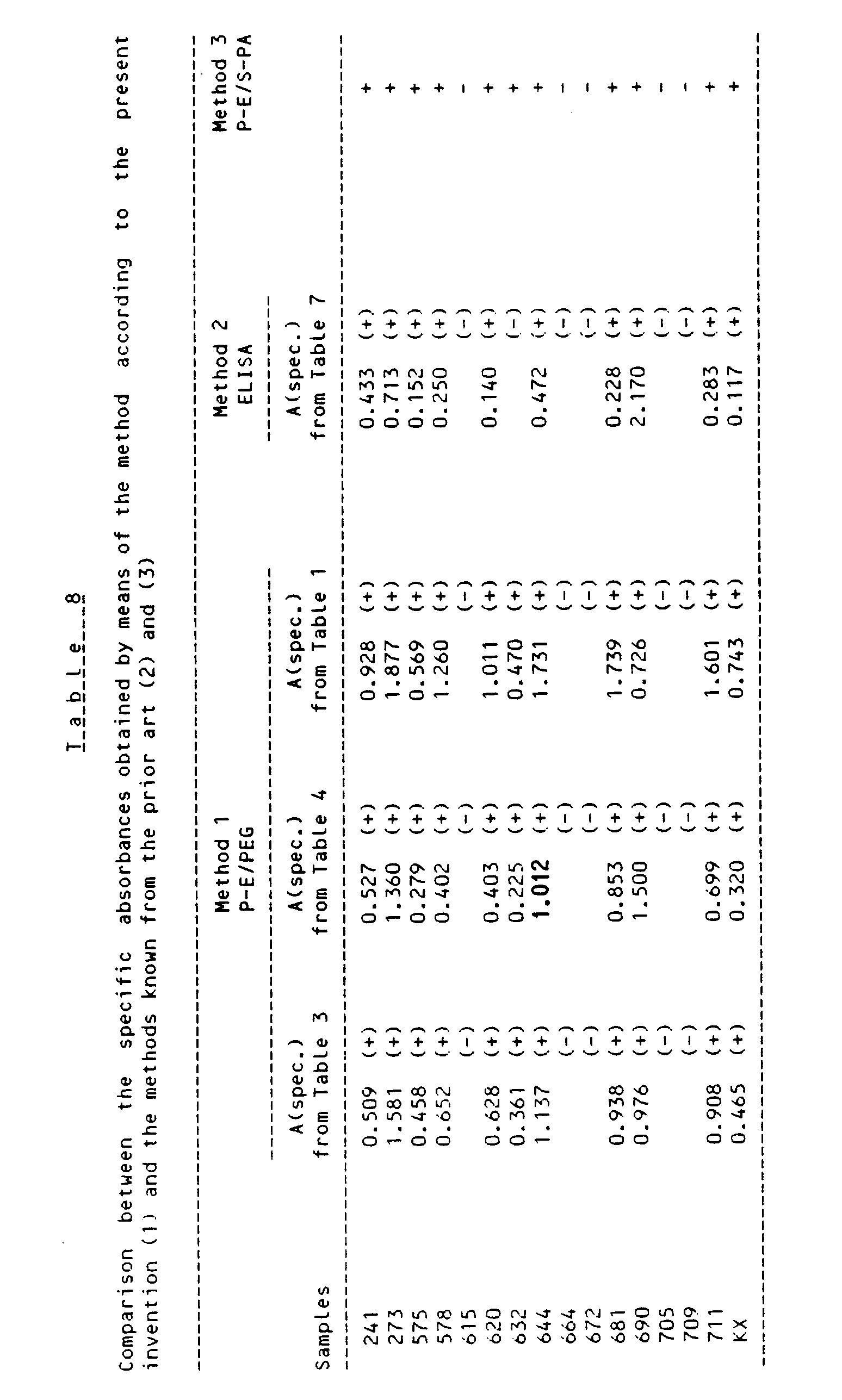
- From a comparison of the test results reported in Table 6, one can observe that:
- 1. for one only of the 16 unknown sera tested, namely, serum No. 632, a conflict exists, in that this serum results to be negative according to the ELISA test, and positive when tested according to the other two methods:
- 2. in case of positive sera, the P-E/PEG method gives, with both the ABTS and the TMB substrate, values of A(spec.) higher than ELISA, and is therefore capable of detecting the positivity of serum No. 632;
- 3. the low values of A(spec) in ELISA for sera Nos. 575, 620 and KX, should a cut-off of 0.150 be used, would cause these three sera to be classified as uncertain ("borderline"), whilst they result surely positive according to the other two methods
Claims (9)
- An immunoenzymatic method for detecting and measuring anti-Plasmodium-falciparum-sporozoite antibodies, in a homogeneous phase assay, in a human blood sample, selected from full blood, blood serum and blood plasma, comprising the step of:(a) separately incubating two aliquots of the same sample with a conjugate (P-E) of (NANP)n with peroxidase, wherein N is asparagine, A is alanine and P is proline, and n is an integer from 3 to 40, in a phosphate buffer at a pH of from 6,5 to 8,0, in the presence of a minimum amount of 0,05% (w/v or v/v) of a nonionic and/or a weakly anionic detergent, and at a temperature comprised within the range of from 15°C to 35°C, whereas one aliquot of said sample has been previously admixed with non-peroxidase-labeled (NANP)n (P) at such a concentration to exclude the formation of the complex of antisporozoite-antibody with (NANP)n and peroxidase (Ab-P-E);(b) adding to each of the samples exiting step (a) an inert substance selected from ammonium sulphate and a polyethyleneglycol having a minimum molecular weight of 4.000, to cause the formation of a precipitate at an end concentration comprised within the range of from 13% to 17% (w/v);(c) separating the precipitate as formed in step (b) by filtration or by centrifugation;(d) repeatedly washing the precipitate with a buffer solution containing from 13% to 17% (w/v or v/v) of a substance selected from ammonium sulphate and a polyethylenglycol having a minimum molecular weight of 4.000, to cause the formation of a precipitate;(e) dissolving the precipitate as formed in step (d) in a buffer solution at a pH of from 4,0 to 5,5, said buffer solution containing a minimum amount of 0,05% (w/v or v/v) of a nonionic or a weakly anionic detergent, in the optional presence of an inert precipitating substance;(f) adding to each solution, in presence of hydrogen peroxide, a colourless substrate specific for peroxidase, and spectrophotometrically determining the differential between the total absorbance and the aspecific absorbance of the tested samples.
- Method according to claim 1, wherein the (NANP)n is (NANP)₂₀.
- Method according to claim 1, wherein the colourless substrate specific for peroxidase is selected from 2,2'-azino-di(3-ethyl-benzothiazoline sulphonate) (ABTS), and 3,3',5,5'-tetramethylbenzidine (TMB).
- Method according to claim 1, wherein said nonionic detergent is selected from polysorbate 20, octoxynol-9 and saponine, and said weakly anionic detergent is selected from sodium cholate, sodium deoxycholate and sodium lauroyl-sarcosinate.
- Method according to claim 1, wherein in step (b) the polyethylene glycol has a molecular weight of 6.000 (PEG-6000).
- Method according to claim 1, wherein step (b) is carried out at a temperature of from 15°C to 35°C and for a time of from 40 min to 60 min.
- Method according to Claim 6, wherein the temperature is from 20°C to 30°C and the time is 60 min.
- Method according to claim 1, wherein the buffer solution of step (e) has a pH of 5,0, the amount of PEG-6000 is 4% (w/v) and the amount of Triton X-100 is 0,05%.
- A diagnostic kit for detecting and measuring anti-Plasmodium falciparum-sporozoite antibodies in a homogeneous phase assay, in a human blood sample, selected from full blood, blood serum and blood plasma, consisting of (NANP)n, wherein N is asparagine, A is alanine and P is proline, and n is an integer from 3 to 40, a conjugate (P-E) of (NANP)n with peroxidase, a colourless substrate specific for peroxidase, buffer solutions and a substance, selected from ammonium sulphate and a polyethylenglycol having a minimum molecular weight of 4.000, to cause the complex antisporozoite-antibody with (NANP)n to precipitate.
Priority Applications (1)
| Application Number | Priority Date | Filing Date | Title |
|---|---|---|---|
| AT89200997T ATE93324T1 (en) | 1988-05-13 | 1989-04-19 | HOMOGENE PHASE IMMUNOENZYMATIC PROCEDURE FOR THE DETERMINATION OF ANTIPLASMODIUM FALCIPARUM SPOROZOITE ANTIBODIES IN HUMAN BLOOD. |
Applications Claiming Priority (2)
| Application Number | Priority Date | Filing Date | Title |
|---|---|---|---|
| IT2056188 | 1988-05-13 | ||
| IT20561/88A IT1217582B (en) | 1988-05-13 | 1988-05-13 | HOMOGENEOUS IMMUNO-ENZYMATIC METHOD FOR THE DETERMINATION OF PLASMODIUM FALCIPARUM ANTI-SPORTS ANTIBODIES IN HUMAN BLOOD |
Publications (2)
| Publication Number | Publication Date |
|---|---|
| EP0341767A1 EP0341767A1 (en) | 1989-11-15 |
| EP0341767B1 true EP0341767B1 (en) | 1993-08-18 |
Family
ID=11168818
Family Applications (1)
| Application Number | Title | Priority Date | Filing Date |
|---|---|---|---|
| EP89200997A Expired - Lifetime EP0341767B1 (en) | 1988-05-13 | 1989-04-19 | Immunoenzymatic method in homogeneous phase for the determination of anti-plasmodium falciparum-sporozoite antibodies in human blood |
Country Status (8)
| Country | Link |
|---|---|
| US (1) | US5210018A (en) |
| EP (1) | EP0341767B1 (en) |
| JP (1) | JP2692004B2 (en) |
| AT (1) | ATE93324T1 (en) |
| CA (1) | CA1331129C (en) |
| DE (1) | DE68908466T2 (en) |
| ES (1) | ES2042966T3 (en) |
| IT (1) | IT1217582B (en) |
Families Citing this family (5)
| Publication number | Priority date | Publication date | Assignee | Title |
|---|---|---|---|---|
| US6110665A (en) * | 1995-02-14 | 2000-08-29 | University Of Kentucky Research Foundation | Sarcocystis neuronadiagnostic primer and its use in methods of equine protozoal myeloencephalitis diagnosis |
| US6153394A (en) * | 1998-09-18 | 2000-11-28 | Board Of Trustees Operating Michigan State University | Immunoassay for equine protozoal myeloencephalitis in horses |
| KR101035111B1 (en) * | 2004-06-30 | 2011-05-19 | 주식회사 엘지생명과학 | Methods of immunological measurement of malaria plasmodium falciparum and measuring means used therein |
| US9206254B2 (en) * | 2012-04-12 | 2015-12-08 | Repropharm | Method and kit for detecting the preovulatory LH peak |
| US11995833B2 (en) * | 2020-07-31 | 2024-05-28 | The Joan and Irwin Jacobs Technion-Cornell Institute | System and method for on-phase microscopy |
Family Cites Families (4)
| Publication number | Priority date | Publication date | Assignee | Title |
|---|---|---|---|---|
| EP0108136B1 (en) * | 1982-05-07 | 1987-09-02 | Sclavo, Inc. | Competitive immunofluorescence assay and test kit |
| US4855242A (en) * | 1986-04-14 | 1989-08-08 | Joslin Diabetes Center, Inc. | Method of detecting antibodies |
| IT1198225B (en) * | 1986-12-04 | 1988-12-21 | Eniricerche Spa | IMMUNOLOGICALLY ACTIVE POLYPEPTIDES USEFUL FOR THE PREPARATION OF ANIMALARY VACCINES AND DIAGNOSTIC KITS FOR THE DETERMINATION OF ANTI-SHORT ANTIBODIES |
| IT1198233B (en) * | 1986-12-23 | 1988-12-21 | Eniricerche Spa | METHOD FOR THE DETERMINATION OF ANTI-SPORTS ANTIBODIES OF P. FALCIPARUM IN HUMAN BLOOD |
-
1988
- 1988-05-13 IT IT20561/88A patent/IT1217582B/en active
-
1989
- 1989-04-19 EP EP89200997A patent/EP0341767B1/en not_active Expired - Lifetime
- 1989-04-19 AT AT89200997T patent/ATE93324T1/en not_active IP Right Cessation
- 1989-04-19 DE DE89200997T patent/DE68908466T2/en not_active Expired - Fee Related
- 1989-04-19 ES ES89200997T patent/ES2042966T3/en not_active Expired - Lifetime
- 1989-04-20 US US07/341,041 patent/US5210018A/en not_active Expired - Fee Related
- 1989-04-21 CA CA000597364A patent/CA1331129C/en not_active Expired - Fee Related
- 1989-05-11 JP JP1116229A patent/JP2692004B2/en not_active Expired - Lifetime
Non-Patent Citations (1)
| Title |
|---|
| M. & I. Ash, "CHEMICAL PRODUCTS AND DESK REFERENCE", 1990, Edward Arnold, London (GB); pp. 873, 885# * |
Also Published As
| Publication number | Publication date |
|---|---|
| CA1331129C (en) | 1994-08-02 |
| IT1217582B (en) | 1990-03-30 |
| EP0341767A1 (en) | 1989-11-15 |
| US5210018A (en) | 1993-05-11 |
| JP2692004B2 (en) | 1997-12-17 |
| ATE93324T1 (en) | 1993-09-15 |
| ES2042966T3 (en) | 1993-12-16 |
| DE68908466D1 (en) | 1993-09-23 |
| JPH01321364A (en) | 1989-12-27 |
| DE68908466T2 (en) | 1994-01-27 |
| IT8820561A0 (en) | 1988-05-13 |
Similar Documents
| Publication | Publication Date | Title |
|---|---|---|
| Newbold et al. | Plasmodium falciparum: the human agglutinating antibody response to the infected red cell surface is predominantly variant specific | |
| EP0216191B1 (en) | Immunoassay for htlv-iii antigens | |
| EP0353822B1 (en) | Immunoenzymatic single-plate elisa method with competitive inhibitition for detecting antisporozoite antibodies of plasmodium falciparum | |
| Kirchhoff et al. | Increased specificity of serodiagnosis of Chagas' disease by detection of antibody to the 72-and 90-kilodalton glycoproteins of Trypanosoma cruzi | |
| US6489129B1 (en) | Antigen-specific IgM detection | |
| CA1174971A (en) | Conjugation of lectin and a ligand | |
| Malan et al. | Serological diagnosis of Trypanosoma cruzi: evaluation of three enzyme immunoassays and an indirect immunofluorescent assay | |
| Nantulya et al. | Application of a monoclonal antibody-based antigen detection enzyme-linked immunosorbent assay (antigen ELISA) for field diagnosis of bovine trypanosomiasis at Nguruman, Kenya | |
| Escalante et al. | Evaluation of Trichinella spiralis larva group 1 antigens for serodiagnosis of human trichinellosis | |
| EP0649536B1 (en) | Assay for chagas' disease and reagents for its use | |
| US5210018A (en) | Immunoenzymatic method in homogeneous phase for the determination of anti-plasmodium falciparum-sporozoite antibodies in human blood | |
| US5302512A (en) | Agglutinant complex as blood typing reagent | |
| US4977079A (en) | Method for the determination of anti-P. falciparum sporozoite antibodies in human blood | |
| Turki et al. | Absence of asymptomatic malaria infection in endemic area of bashagard district, hormozgan province, iran | |
| CA1279818C (en) | Diagnostic testing for micro-organisms | |
| Chatterjee et al. | Diagnostic and prognostic potential of a competitive enzyme-linked immunosorbent assay for leishmaniasis in India | |
| WO1997024141A1 (en) | Monoclonal antibodies and immuno-capture method for quantitation and speciation of malaria parasites | |
| US5149623A (en) | Rapid, easy, and economical screening test for antibodies to human immunodeficiency virus | |
| CA2133772A1 (en) | Method for assaying glycoconjugate and reagent thereof | |
| CA1338528C (en) | Rapid, easy and economical screening test for antibodies to human immunodeficiency virus | |
| World Health Organization | Immunodiagnosis in malaria | |
| EP0528895A1 (en) | Simplified solid-phase immunobead assay for detection of ciguatoxin and related polyethers | |
| JPH09274039A (en) | Diagnostic device using immunological technique | |
| Small et al. | Three-dimensional immunofluorescence assay for the detection of internal antigens | |
| Figueiredo et al. | Production and Characterization of a Panel of Monoclonal Antibodies for the Identification of Antigens of Babesia bovis |
Legal Events
| Date | Code | Title | Description |
|---|---|---|---|
| PUAI | Public reference made under article 153(3) epc to a published international application that has entered the european phase |
Free format text: ORIGINAL CODE: 0009012 |
|
| AK | Designated contracting states |
Kind code of ref document: A1 Designated state(s): AT BE CH DE ES FR GB GR LI LU NL SE |
|
| 17P | Request for examination filed |
Effective date: 19900323 |
|
| 17Q | First examination report despatched |
Effective date: 19920228 |
|
| GRAA | (expected) grant |
Free format text: ORIGINAL CODE: 0009210 |
|
| AK | Designated contracting states |
Kind code of ref document: B1 Designated state(s): AT BE CH DE ES FR GB GR LI LU NL SE |
|
| REF | Corresponds to: |
Ref document number: 93324 Country of ref document: AT Date of ref document: 19930915 Kind code of ref document: T |
|
| REF | Corresponds to: |
Ref document number: 68908466 Country of ref document: DE Date of ref document: 19930923 |
|
| ET | Fr: translation filed | ||
| REG | Reference to a national code |
Ref country code: GR Ref legal event code: FG4A Free format text: 3009217 |
|
| REG | Reference to a national code |
Ref country code: ES Ref legal event code: FG2A Ref document number: 2042966 Country of ref document: ES Kind code of ref document: T3 |
|
| PLBE | No opposition filed within time limit |
Free format text: ORIGINAL CODE: 0009261 |
|
| STAA | Information on the status of an ep patent application or granted ep patent |
Free format text: STATUS: NO OPPOSITION FILED WITHIN TIME LIMIT |
|
| EPTA | Lu: last paid annual fee | ||
| 26N | No opposition filed | ||
| EAL | Se: european patent in force in sweden |
Ref document number: 89200997.8 |
|
| PGFP | Annual fee paid to national office [announced via postgrant information from national office to epo] |
Ref country code: FR Payment date: 19970409 Year of fee payment: 9 |
|
| PGFP | Annual fee paid to national office [announced via postgrant information from national office to epo] |
Ref country code: GB Payment date: 19970410 Year of fee payment: 9 |
|
| PGFP | Annual fee paid to national office [announced via postgrant information from national office to epo] |
Ref country code: AT Payment date: 19970414 Year of fee payment: 9 |
|
| PGFP | Annual fee paid to national office [announced via postgrant information from national office to epo] |
Ref country code: SE Payment date: 19970418 Year of fee payment: 9 |
|
| PGFP | Annual fee paid to national office [announced via postgrant information from national office to epo] |
Ref country code: GR Payment date: 19970422 Year of fee payment: 9 |
|
| PGFP | Annual fee paid to national office [announced via postgrant information from national office to epo] |
Ref country code: NL Payment date: 19970428 Year of fee payment: 9 Ref country code: ES Payment date: 19970428 Year of fee payment: 9 Ref country code: DE Payment date: 19970428 Year of fee payment: 9 |
|
| PGFP | Annual fee paid to national office [announced via postgrant information from national office to epo] |
Ref country code: CH Payment date: 19970512 Year of fee payment: 9 |
|
| PGFP | Annual fee paid to national office [announced via postgrant information from national office to epo] |
Ref country code: LU Payment date: 19970516 Year of fee payment: 9 |
|
| PGFP | Annual fee paid to national office [announced via postgrant information from national office to epo] |
Ref country code: BE Payment date: 19970612 Year of fee payment: 9 |
|
| PG25 | Lapsed in a contracting state [announced via postgrant information from national office to epo] |
Ref country code: LU Free format text: LAPSE BECAUSE OF NON-PAYMENT OF DUE FEES Effective date: 19980419 Ref country code: GB Free format text: LAPSE BECAUSE OF NON-PAYMENT OF DUE FEES Effective date: 19980419 Ref country code: AT Free format text: LAPSE BECAUSE OF NON-PAYMENT OF DUE FEES Effective date: 19980419 |
|
| PG25 | Lapsed in a contracting state [announced via postgrant information from national office to epo] |
Ref country code: SE Free format text: LAPSE BECAUSE OF NON-PAYMENT OF DUE FEES Effective date: 19980420 Ref country code: ES Free format text: LAPSE BECAUSE OF NON-PAYMENT OF DUE FEES Effective date: 19980420 |
|
| PG25 | Lapsed in a contracting state [announced via postgrant information from national office to epo] |
Ref country code: LI Free format text: LAPSE BECAUSE OF NON-PAYMENT OF DUE FEES Effective date: 19980430 Ref country code: GR Free format text: LAPSE BECAUSE OF NON-PAYMENT OF DUE FEES Effective date: 19980430 Ref country code: FR Free format text: THE PATENT HAS BEEN ANNULLED BY A DECISION OF A NATIONAL AUTHORITY Effective date: 19980430 Ref country code: CH Free format text: LAPSE BECAUSE OF NON-PAYMENT OF DUE FEES Effective date: 19980430 Ref country code: BE Free format text: LAPSE BECAUSE OF NON-PAYMENT OF DUE FEES Effective date: 19980430 |
|
| BERE | Be: lapsed |
Owner name: ENIRICERCHE S.P.A. Effective date: 19980430 |
|
| PG25 | Lapsed in a contracting state [announced via postgrant information from national office to epo] |
Ref country code: NL Free format text: LAPSE BECAUSE OF NON-PAYMENT OF DUE FEES Effective date: 19981101 |
|
| GBPC | Gb: european patent ceased through non-payment of renewal fee |
Effective date: 19980419 |
|
| REG | Reference to a national code |
Ref country code: CH Ref legal event code: PL |
|
| NLV4 | Nl: lapsed or anulled due to non-payment of the annual fee |
Effective date: 19981101 |
|
| EUG | Se: european patent has lapsed |
Ref document number: 89200997.8 |
|
| PG25 | Lapsed in a contracting state [announced via postgrant information from national office to epo] |
Ref country code: DE Free format text: LAPSE BECAUSE OF NON-PAYMENT OF DUE FEES Effective date: 19990202 |
|
| REG | Reference to a national code |
Ref country code: FR Ref legal event code: ST |
|
| REG | Reference to a national code |
Ref country code: ES Ref legal event code: FD2A Effective date: 20000403 |