EP0340333B1 - Novel physiologically active polypeptide and pharmaceutical composition - Google Patents
Novel physiologically active polypeptide and pharmaceutical composition Download PDFInfo
- Publication number
- EP0340333B1 EP0340333B1 EP88112143A EP88112143A EP0340333B1 EP 0340333 B1 EP0340333 B1 EP 0340333B1 EP 88112143 A EP88112143 A EP 88112143A EP 88112143 A EP88112143 A EP 88112143A EP 0340333 B1 EP0340333 B1 EP 0340333B1
- Authority
- EP
- European Patent Office
- Prior art keywords
- human tnf
- active polypeptide
- amino acid
- plasmid
- dna fragment
- Prior art date
- Legal status (The legal status is an assumption and is not a legal conclusion. Google has not performed a legal analysis and makes no representation as to the accuracy of the status listed.)
- Expired - Lifetime
Links
- 108090000765 processed proteins & peptides Proteins 0.000 title claims description 114
- 229920001184 polypeptide Polymers 0.000 title claims description 113
- 102000004196 processed proteins & peptides Human genes 0.000 title claims description 113
- 239000008194 pharmaceutical composition Substances 0.000 title claims description 11
- 239000013612 plasmid Substances 0.000 claims description 83
- 108020004414 DNA Proteins 0.000 claims description 82
- 238000000034 method Methods 0.000 claims description 77
- 239000012634 fragment Substances 0.000 claims description 63
- 150000001413 amino acids Chemical class 0.000 claims description 61
- 230000000259 anti-tumor effect Effects 0.000 claims description 20
- 244000005700 microbiome Species 0.000 claims description 17
- 239000000203 mixture Substances 0.000 claims description 15
- 102000053602 DNA Human genes 0.000 claims description 14
- 108020004682 Single-Stranded DNA Proteins 0.000 claims description 8
- 239000004480 active ingredient Substances 0.000 claims description 5
- 210000004899 c-terminal region Anatomy 0.000 claims description 4
- 230000000295 complement effect Effects 0.000 claims description 4
- 125000000896 monocarboxylic acid group Chemical group 0.000 claims description 3
- 239000007788 liquid Substances 0.000 claims description 2
- 230000008569 process Effects 0.000 claims description 2
- 125000003275 alpha amino acid group Chemical group 0.000 claims 8
- 241000588722 Escherichia Species 0.000 claims 1
- 230000001131 transforming effect Effects 0.000 claims 1
- 101000611183 Homo sapiens Tumor necrosis factor Proteins 0.000 description 92
- 102000057041 human TNF Human genes 0.000 description 75
- 101100099880 Homo sapiens TNF gene Proteins 0.000 description 50
- 241000588724 Escherichia coli Species 0.000 description 43
- 239000000499 gel Substances 0.000 description 41
- 108090000623 proteins and genes Proteins 0.000 description 41
- 108091034117 Oligonucleotide Proteins 0.000 description 39
- JLCPHMBAVCMARE-UHFFFAOYSA-N [3-[[3-[[3-[[3-[[3-[[3-[[3-[[3-[[3-[[3-[[3-[[5-(2-amino-6-oxo-1H-purin-9-yl)-3-[[3-[[3-[[3-[[3-[[3-[[5-(2-amino-6-oxo-1H-purin-9-yl)-3-[[5-(2-amino-6-oxo-1H-purin-9-yl)-3-hydroxyoxolan-2-yl]methoxy-hydroxyphosphoryl]oxyoxolan-2-yl]methoxy-hydroxyphosphoryl]oxy-5-(5-methyl-2,4-dioxopyrimidin-1-yl)oxolan-2-yl]methoxy-hydroxyphosphoryl]oxy-5-(6-aminopurin-9-yl)oxolan-2-yl]methoxy-hydroxyphosphoryl]oxy-5-(6-aminopurin-9-yl)oxolan-2-yl]methoxy-hydroxyphosphoryl]oxy-5-(6-aminopurin-9-yl)oxolan-2-yl]methoxy-hydroxyphosphoryl]oxy-5-(6-aminopurin-9-yl)oxolan-2-yl]methoxy-hydroxyphosphoryl]oxyoxolan-2-yl]methoxy-hydroxyphosphoryl]oxy-5-(5-methyl-2,4-dioxopyrimidin-1-yl)oxolan-2-yl]methoxy-hydroxyphosphoryl]oxy-5-(4-amino-2-oxopyrimidin-1-yl)oxolan-2-yl]methoxy-hydroxyphosphoryl]oxy-5-(5-methyl-2,4-dioxopyrimidin-1-yl)oxolan-2-yl]methoxy-hydroxyphosphoryl]oxy-5-(5-methyl-2,4-dioxopyrimidin-1-yl)oxolan-2-yl]methoxy-hydroxyphosphoryl]oxy-5-(6-aminopurin-9-yl)oxolan-2-yl]methoxy-hydroxyphosphoryl]oxy-5-(6-aminopurin-9-yl)oxolan-2-yl]methoxy-hydroxyphosphoryl]oxy-5-(4-amino-2-oxopyrimidin-1-yl)oxolan-2-yl]methoxy-hydroxyphosphoryl]oxy-5-(4-amino-2-oxopyrimidin-1-yl)oxolan-2-yl]methoxy-hydroxyphosphoryl]oxy-5-(4-amino-2-oxopyrimidin-1-yl)oxolan-2-yl]methoxy-hydroxyphosphoryl]oxy-5-(6-aminopurin-9-yl)oxolan-2-yl]methoxy-hydroxyphosphoryl]oxy-5-(4-amino-2-oxopyrimidin-1-yl)oxolan-2-yl]methyl [5-(6-aminopurin-9-yl)-2-(hydroxymethyl)oxolan-3-yl] hydrogen phosphate Polymers Cc1cn(C2CC(OP(O)(=O)OCC3OC(CC3OP(O)(=O)OCC3OC(CC3O)n3cnc4c3nc(N)[nH]c4=O)n3cnc4c3nc(N)[nH]c4=O)C(COP(O)(=O)OC3CC(OC3COP(O)(=O)OC3CC(OC3COP(O)(=O)OC3CC(OC3COP(O)(=O)OC3CC(OC3COP(O)(=O)OC3CC(OC3COP(O)(=O)OC3CC(OC3COP(O)(=O)OC3CC(OC3COP(O)(=O)OC3CC(OC3COP(O)(=O)OC3CC(OC3COP(O)(=O)OC3CC(OC3COP(O)(=O)OC3CC(OC3COP(O)(=O)OC3CC(OC3COP(O)(=O)OC3CC(OC3COP(O)(=O)OC3CC(OC3COP(O)(=O)OC3CC(OC3COP(O)(=O)OC3CC(OC3COP(O)(=O)OC3CC(OC3CO)n3cnc4c(N)ncnc34)n3ccc(N)nc3=O)n3cnc4c(N)ncnc34)n3ccc(N)nc3=O)n3ccc(N)nc3=O)n3ccc(N)nc3=O)n3cnc4c(N)ncnc34)n3cnc4c(N)ncnc34)n3cc(C)c(=O)[nH]c3=O)n3cc(C)c(=O)[nH]c3=O)n3ccc(N)nc3=O)n3cc(C)c(=O)[nH]c3=O)n3cnc4c3nc(N)[nH]c4=O)n3cnc4c(N)ncnc34)n3cnc4c(N)ncnc34)n3cnc4c(N)ncnc34)n3cnc4c(N)ncnc34)O2)c(=O)[nH]c1=O JLCPHMBAVCMARE-UHFFFAOYSA-N 0.000 description 34
- 229940024606 amino acid Drugs 0.000 description 33
- 235000001014 amino acid Nutrition 0.000 description 33
- 230000000694 effects Effects 0.000 description 29
- 210000004027 cell Anatomy 0.000 description 25
- FAPWRFPIFSIZLT-UHFFFAOYSA-M Sodium chloride Chemical compound [Na+].[Cl-] FAPWRFPIFSIZLT-UHFFFAOYSA-M 0.000 description 23
- 238000006243 chemical reaction Methods 0.000 description 23
- 239000013598 vector Substances 0.000 description 20
- 206010028980 Neoplasm Diseases 0.000 description 19
- 108091008146 restriction endonucleases Proteins 0.000 description 19
- LFQSCWFLJHTTHZ-UHFFFAOYSA-N Ethanol Chemical compound CCO LFQSCWFLJHTTHZ-UHFFFAOYSA-N 0.000 description 18
- 239000006166 lysate Substances 0.000 description 18
- 239000007864 aqueous solution Substances 0.000 description 17
- 239000000047 product Substances 0.000 description 17
- 102100040247 Tumor necrosis factor Human genes 0.000 description 16
- 229920002401 polyacrylamide Polymers 0.000 description 16
- 102000004169 proteins and genes Human genes 0.000 description 15
- TWRXJAOTZQYOKJ-UHFFFAOYSA-L Magnesium chloride Chemical compound [Mg+2].[Cl-].[Cl-] TWRXJAOTZQYOKJ-UHFFFAOYSA-L 0.000 description 14
- 230000029087 digestion Effects 0.000 description 14
- 241000699670 Mus sp. Species 0.000 description 13
- 235000018102 proteins Nutrition 0.000 description 13
- QKNYBSVHEMOAJP-UHFFFAOYSA-N 2-amino-2-(hydroxymethyl)propane-1,3-diol;hydron;chloride Chemical compound Cl.OCC(N)(CO)CO QKNYBSVHEMOAJP-UHFFFAOYSA-N 0.000 description 12
- 241000699666 Mus <mouse, genus> Species 0.000 description 12
- 239000000872 buffer Substances 0.000 description 12
- 239000011780 sodium chloride Substances 0.000 description 12
- CSNNHWWHGAXBCP-UHFFFAOYSA-L Magnesium sulfate Chemical compound [Mg+2].[O-][S+2]([O-])([O-])[O-] CSNNHWWHGAXBCP-UHFFFAOYSA-L 0.000 description 10
- 102000012410 DNA Ligases Human genes 0.000 description 8
- 108010061982 DNA Ligases Proteins 0.000 description 8
- 239000013613 expression plasmid Substances 0.000 description 8
- 239000002609 medium Substances 0.000 description 8
- 238000000926 separation method Methods 0.000 description 8
- MTCFGRXMJLQNBG-REOHCLBHSA-N (2S)-2-Amino-3-hydroxypropansäure Chemical compound OC[C@H](N)C(O)=O MTCFGRXMJLQNBG-REOHCLBHSA-N 0.000 description 7
- DHMQDGOQFOQNFH-UHFFFAOYSA-N Glycine Chemical compound NCC(O)=O DHMQDGOQFOQNFH-UHFFFAOYSA-N 0.000 description 7
- 108091081024 Start codon Proteins 0.000 description 7
- 108020005038 Terminator Codon Proteins 0.000 description 7
- 239000011543 agarose gel Substances 0.000 description 7
- 238000010367 cloning Methods 0.000 description 7
- 230000001665 lethal effect Effects 0.000 description 7
- 229910001629 magnesium chloride Inorganic materials 0.000 description 7
- 239000000243 solution Substances 0.000 description 7
- 235000014469 Bacillus subtilis Nutrition 0.000 description 6
- 240000004808 Saccharomyces cerevisiae Species 0.000 description 6
- 235000014680 Saccharomyces cerevisiae Nutrition 0.000 description 6
- DBMJMQXJHONAFJ-UHFFFAOYSA-M Sodium laurylsulphate Chemical compound [Na+].CCCCCCCCCCCCOS([O-])(=O)=O DBMJMQXJHONAFJ-UHFFFAOYSA-M 0.000 description 6
- 239000002246 antineoplastic agent Substances 0.000 description 6
- 238000003776 cleavage reaction Methods 0.000 description 6
- 238000001727 in vivo Methods 0.000 description 6
- 238000002264 polyacrylamide gel electrophoresis Methods 0.000 description 6
- 238000002360 preparation method Methods 0.000 description 6
- 238000000746 purification Methods 0.000 description 6
- 230000007017 scission Effects 0.000 description 6
- 235000019333 sodium laurylsulphate Nutrition 0.000 description 6
- 244000063299 Bacillus subtilis Species 0.000 description 5
- DCXYFEDJOCDNAF-REOHCLBHSA-N L-asparagine Chemical compound OC(=O)[C@@H](N)CC(N)=O DCXYFEDJOCDNAF-REOHCLBHSA-N 0.000 description 5
- AGPKZVBTJJNPAG-WHFBIAKZSA-N L-isoleucine Chemical compound CC[C@H](C)[C@H](N)C(O)=O AGPKZVBTJJNPAG-WHFBIAKZSA-N 0.000 description 5
- ROHFNLRQFUQHCH-YFKPBYRVSA-N L-leucine Chemical compound CC(C)C[C@H](N)C(O)=O ROHFNLRQFUQHCH-YFKPBYRVSA-N 0.000 description 5
- 238000000246 agarose gel electrophoresis Methods 0.000 description 5
- 229960000723 ampicillin Drugs 0.000 description 5
- AVKUERGKIZMTKX-NJBDSQKTSA-N ampicillin Chemical compound C1([C@@H](N)C(=O)N[C@H]2[C@H]3SC([C@@H](N3C2=O)C(O)=O)(C)C)=CC=CC=C1 AVKUERGKIZMTKX-NJBDSQKTSA-N 0.000 description 5
- 210000004102 animal cell Anatomy 0.000 description 5
- VHJLVAABSRFDPM-QWWZWVQMSA-N dithiothreitol Chemical compound SC[C@@H](O)[C@H](O)CS VHJLVAABSRFDPM-QWWZWVQMSA-N 0.000 description 5
- 238000011156 evaluation Methods 0.000 description 5
- 230000005918 in vitro anti-tumor Effects 0.000 description 5
- 229910052943 magnesium sulfate Inorganic materials 0.000 description 5
- 235000019341 magnesium sulphate Nutrition 0.000 description 5
- 238000001556 precipitation Methods 0.000 description 5
- 239000000126 substance Substances 0.000 description 5
- RTZKZFJDLAIYFH-UHFFFAOYSA-N Diethyl ether Chemical compound CCOCC RTZKZFJDLAIYFH-UHFFFAOYSA-N 0.000 description 4
- WQZGKKKJIJFFOK-GASJEMHNSA-N Glucose Natural products OC[C@H]1OC(O)[C@H](O)[C@@H](O)[C@@H]1O WQZGKKKJIJFFOK-GASJEMHNSA-N 0.000 description 4
- CKLJMWTZIZZHCS-REOHCLBHSA-N L-aspartic acid Chemical compound OC(=O)[C@@H](N)CC(O)=O CKLJMWTZIZZHCS-REOHCLBHSA-N 0.000 description 4
- ZDXPYRJPNDTMRX-VKHMYHEASA-N L-glutamine Chemical compound OC(=O)[C@@H](N)CCC(N)=O ZDXPYRJPNDTMRX-VKHMYHEASA-N 0.000 description 4
- AYFVYJQAPQTCCC-GBXIJSLDSA-N L-threonine Chemical compound C[C@@H](O)[C@H](N)C(O)=O AYFVYJQAPQTCCC-GBXIJSLDSA-N 0.000 description 4
- OUYCCCASQSFEME-QMMMGPOBSA-N L-tyrosine Chemical compound OC(=O)[C@@H](N)CC1=CC=C(O)C=C1 OUYCCCASQSFEME-QMMMGPOBSA-N 0.000 description 4
- 241001465754 Metazoa Species 0.000 description 4
- ISWSIDIOOBJBQZ-UHFFFAOYSA-N Phenol Chemical compound OC1=CC=CC=C1 ISWSIDIOOBJBQZ-UHFFFAOYSA-N 0.000 description 4
- 108060008682 Tumor Necrosis Factor Proteins 0.000 description 4
- 102000000852 Tumor Necrosis Factor-alpha Human genes 0.000 description 4
- 238000001042 affinity chromatography Methods 0.000 description 4
- 238000000137 annealing Methods 0.000 description 4
- 239000003795 chemical substances by application Substances 0.000 description 4
- 239000013078 crystal Substances 0.000 description 4
- 239000013604 expression vector Substances 0.000 description 4
- 239000008103 glucose Substances 0.000 description 4
- 239000001963 growth medium Substances 0.000 description 4
- 238000002347 injection Methods 0.000 description 4
- 239000007924 injection Substances 0.000 description 4
- 101150074251 lpp gene Proteins 0.000 description 4
- 238000012986 modification Methods 0.000 description 4
- 230000004048 modification Effects 0.000 description 4
- 239000008363 phosphate buffer Substances 0.000 description 4
- 239000002504 physiological saline solution Substances 0.000 description 4
- 239000011541 reaction mixture Substances 0.000 description 4
- 230000014621 translational initiation Effects 0.000 description 4
- PLVPPLCLBIEYEA-WAYWQWQTSA-N (z)-3-(1h-indol-3-yl)prop-2-enoic acid Chemical compound C1=CC=C2C(\C=C/C(=O)O)=CNC2=C1 PLVPPLCLBIEYEA-WAYWQWQTSA-N 0.000 description 3
- 108010088237 ATCGAT-specific type II deoxyribonucleases Proteins 0.000 description 3
- UXVMQQNJUSDDNG-UHFFFAOYSA-L Calcium chloride Chemical compound [Cl-].[Cl-].[Ca+2] UXVMQQNJUSDDNG-UHFFFAOYSA-L 0.000 description 3
- PEDCQBHIVMGVHV-UHFFFAOYSA-N Glycerine Chemical compound OCC(O)CO PEDCQBHIVMGVHV-UHFFFAOYSA-N 0.000 description 3
- XUJNEKJLAYXESH-REOHCLBHSA-N L-Cysteine Chemical compound SC[C@H](N)C(O)=O XUJNEKJLAYXESH-REOHCLBHSA-N 0.000 description 3
- WHUUTDBJXJRKMK-VKHMYHEASA-N L-glutamic acid Chemical compound OC(=O)[C@@H](N)CCC(O)=O WHUUTDBJXJRKMK-VKHMYHEASA-N 0.000 description 3
- COLNVLDHVKWLRT-QMMMGPOBSA-N L-phenylalanine Chemical compound OC(=O)[C@@H](N)CC1=CC=CC=C1 COLNVLDHVKWLRT-QMMMGPOBSA-N 0.000 description 3
- QIVBCDIJIAJPQS-VIFPVBQESA-N L-tryptophane Chemical compound C1=CC=C2C(C[C@H](N)C(O)=O)=CNC2=C1 QIVBCDIJIAJPQS-VIFPVBQESA-N 0.000 description 3
- OKKJLVBELUTLKV-UHFFFAOYSA-N Methanol Chemical compound OC OKKJLVBELUTLKV-UHFFFAOYSA-N 0.000 description 3
- 206010039491 Sarcoma Diseases 0.000 description 3
- KZSNJWFQEVHDMF-UHFFFAOYSA-N Valine Chemical compound CC(C)C(N)C(O)=O KZSNJWFQEVHDMF-UHFFFAOYSA-N 0.000 description 3
- 238000002835 absorbance Methods 0.000 description 3
- RJURFGZVJUQBHK-UHFFFAOYSA-N actinomycin D Natural products CC1OC(=O)C(C(C)C)N(C)C(=O)CN(C)C(=O)C2CCCN2C(=O)C(C(C)C)NC(=O)C1NC(=O)C1=C(N)C(=O)C(C)=C2OC(C(C)=CC=C3C(=O)NC4C(=O)NC(C(N5CCCC5C(=O)N(C)CC(=O)N(C)C(C(C)C)C(=O)OC4C)=O)C(C)C)=C3N=C21 RJURFGZVJUQBHK-UHFFFAOYSA-N 0.000 description 3
- 239000001110 calcium chloride Substances 0.000 description 3
- 235000011148 calcium chloride Nutrition 0.000 description 3
- 229910001628 calcium chloride Inorganic materials 0.000 description 3
- KRKNYBCHXYNGOX-UHFFFAOYSA-N citric acid Chemical compound OC(=O)CC(O)(C(O)=O)CC(O)=O KRKNYBCHXYNGOX-UHFFFAOYSA-N 0.000 description 3
- 230000001086 cytosolic effect Effects 0.000 description 3
- 238000012217 deletion Methods 0.000 description 3
- 230000037430 deletion Effects 0.000 description 3
- 238000001962 electrophoresis Methods 0.000 description 3
- 238000002523 gelfiltration Methods 0.000 description 3
- 210000004408 hybridoma Anatomy 0.000 description 3
- 238000000338 in vitro Methods 0.000 description 3
- PLVPPLCLBIEYEA-UHFFFAOYSA-N indoleacrylic acid Natural products C1=CC=C2C(C=CC(=O)O)=CNC2=C1 PLVPPLCLBIEYEA-UHFFFAOYSA-N 0.000 description 3
- 238000005304 joining Methods 0.000 description 3
- 239000001267 polyvinylpyrrolidone Substances 0.000 description 3
- 229920000036 polyvinylpyrrolidone Polymers 0.000 description 3
- 235000013855 polyvinylpyrrolidone Nutrition 0.000 description 3
- 239000012264 purified product Substances 0.000 description 3
- 238000006467 substitution reaction Methods 0.000 description 3
- 239000004094 surface-active agent Substances 0.000 description 3
- 238000013519 translation Methods 0.000 description 3
- 238000011144 upstream manufacturing Methods 0.000 description 3
- DGVVWUTYPXICAM-UHFFFAOYSA-N β‐Mercaptoethanol Chemical compound OCCS DGVVWUTYPXICAM-UHFFFAOYSA-N 0.000 description 3
- GUBGYTABKSRVRQ-XLOQQCSPSA-N Alpha-Lactose Chemical compound O[C@@H]1[C@@H](O)[C@@H](O)[C@@H](CO)O[C@H]1O[C@@H]1[C@@H](CO)O[C@H](O)[C@H](O)[C@H]1O GUBGYTABKSRVRQ-XLOQQCSPSA-N 0.000 description 2
- NLXLAEXVIDQMFP-UHFFFAOYSA-N Ammonium chloride Substances [NH4+].[Cl-] NLXLAEXVIDQMFP-UHFFFAOYSA-N 0.000 description 2
- CIWBSHSKHKDKBQ-JLAZNSOCSA-N Ascorbic acid Chemical compound OC[C@H](O)[C@H]1OC(=O)C(O)=C1O CIWBSHSKHKDKBQ-JLAZNSOCSA-N 0.000 description 2
- OYPRJOBELJOOCE-UHFFFAOYSA-N Calcium Chemical compound [Ca] OYPRJOBELJOOCE-UHFFFAOYSA-N 0.000 description 2
- CURLTUGMZLYLDI-UHFFFAOYSA-N Carbon dioxide Chemical compound O=C=O CURLTUGMZLYLDI-UHFFFAOYSA-N 0.000 description 2
- 108020004705 Codon Proteins 0.000 description 2
- 108010092160 Dactinomycin Proteins 0.000 description 2
- KCXVZYZYPLLWCC-UHFFFAOYSA-N EDTA Chemical compound OC(=O)CN(CC(O)=O)CCN(CC(O)=O)CC(O)=O KCXVZYZYPLLWCC-UHFFFAOYSA-N 0.000 description 2
- ULGZDMOVFRHVEP-RWJQBGPGSA-N Erythromycin Chemical compound O([C@@H]1[C@@H](C)C(=O)O[C@@H]([C@@]([C@H](O)[C@@H](C)C(=O)[C@H](C)C[C@@](C)(O)[C@H](O[C@H]2[C@@H]([C@H](C[C@@H](C)O2)N(C)C)O)[C@H]1C)(C)O)CC)[C@H]1C[C@@](C)(OC)[C@@H](O)[C@H](C)O1 ULGZDMOVFRHVEP-RWJQBGPGSA-N 0.000 description 2
- 239000004471 Glycine Substances 0.000 description 2
- 101100082540 Haemophilus influenzae (strain ATCC 51907 / DSM 11121 / KW20 / Rd) pcp gene Proteins 0.000 description 2
- -1 His Chemical compound 0.000 description 2
- 108060003951 Immunoglobulin Proteins 0.000 description 2
- QNAYBMKLOCPYGJ-REOHCLBHSA-N L-alanine Chemical compound C[C@H](N)C(O)=O QNAYBMKLOCPYGJ-REOHCLBHSA-N 0.000 description 2
- ODKSFYDXXFIFQN-BYPYZUCNSA-N L-arginine Chemical compound OC(=O)[C@@H](N)CCCN=C(N)N ODKSFYDXXFIFQN-BYPYZUCNSA-N 0.000 description 2
- HNDVDQJCIGZPNO-YFKPBYRVSA-N L-histidine Chemical compound OC(=O)[C@@H](N)CC1=CN=CN1 HNDVDQJCIGZPNO-YFKPBYRVSA-N 0.000 description 2
- KDXKERNSBIXSRK-YFKPBYRVSA-N L-lysine Chemical compound NCCCC[C@H](N)C(O)=O KDXKERNSBIXSRK-YFKPBYRVSA-N 0.000 description 2
- KZSNJWFQEVHDMF-BYPYZUCNSA-N L-valine Chemical compound CC(C)[C@H](N)C(O)=O KZSNJWFQEVHDMF-BYPYZUCNSA-N 0.000 description 2
- GUBGYTABKSRVRQ-QKKXKWKRSA-N Lactose Natural products OC[C@H]1O[C@@H](O[C@H]2[C@H](O)[C@@H](O)C(O)O[C@@H]2CO)[C@H](O)[C@@H](O)[C@H]1O GUBGYTABKSRVRQ-QKKXKWKRSA-N 0.000 description 2
- 241001467552 Mycobacterium bovis BCG Species 0.000 description 2
- 206010028851 Necrosis Diseases 0.000 description 2
- 108091000080 Phosphotransferase Proteins 0.000 description 2
- 241000276498 Pollachius virens Species 0.000 description 2
- 239000002202 Polyethylene glycol Substances 0.000 description 2
- 108020004511 Recombinant DNA Proteins 0.000 description 2
- 229920005654 Sephadex Polymers 0.000 description 2
- 239000012507 Sephadex™ Substances 0.000 description 2
- VMHLLURERBWHNL-UHFFFAOYSA-M Sodium acetate Chemical compound [Na+].CC([O-])=O VMHLLURERBWHNL-UHFFFAOYSA-M 0.000 description 2
- UIIMBOGNXHQVGW-UHFFFAOYSA-M Sodium bicarbonate Chemical compound [Na+].OC([O-])=O UIIMBOGNXHQVGW-UHFFFAOYSA-M 0.000 description 2
- XSQUKJJJFZCRTK-UHFFFAOYSA-N Urea Chemical compound NC(N)=O XSQUKJJJFZCRTK-UHFFFAOYSA-N 0.000 description 2
- 239000002253 acid Substances 0.000 description 2
- RJURFGZVJUQBHK-IIXSONLDSA-N actinomycin D Chemical compound C[C@H]1OC(=O)[C@H](C(C)C)N(C)C(=O)CN(C)C(=O)[C@@H]2CCCN2C(=O)[C@@H](C(C)C)NC(=O)[C@H]1NC(=O)C1=C(N)C(=O)C(C)=C2OC(C(C)=CC=C3C(=O)N[C@@H]4C(=O)N[C@@H](C(N5CCC[C@H]5C(=O)N(C)CC(=O)N(C)[C@@H](C(C)C)C(=O)O[C@@H]4C)=O)C(C)C)=C3N=C21 RJURFGZVJUQBHK-IIXSONLDSA-N 0.000 description 2
- 238000005273 aeration Methods 0.000 description 2
- 229960003767 alanine Drugs 0.000 description 2
- 230000002421 anti-septic effect Effects 0.000 description 2
- 239000011668 ascorbic acid Substances 0.000 description 2
- 229960005070 ascorbic acid Drugs 0.000 description 2
- 229960000190 bacillus calmette–guérin vaccine Drugs 0.000 description 2
- 239000011575 calcium Substances 0.000 description 2
- 229910052791 calcium Inorganic materials 0.000 description 2
- 201000011510 cancer Diseases 0.000 description 2
- 229940041514 candida albicans extract Drugs 0.000 description 2
- 150000001720 carbohydrates Chemical class 0.000 description 2
- 235000014633 carbohydrates Nutrition 0.000 description 2
- 239000001913 cellulose Substances 0.000 description 2
- 229920002678 cellulose Polymers 0.000 description 2
- 235000010980 cellulose Nutrition 0.000 description 2
- OSASVXMJTNOKOY-UHFFFAOYSA-N chlorobutanol Chemical compound CC(C)(O)C(Cl)(Cl)Cl OSASVXMJTNOKOY-UHFFFAOYSA-N 0.000 description 2
- 238000004440 column chromatography Methods 0.000 description 2
- 239000002299 complementary DNA Substances 0.000 description 2
- 239000012228 culture supernatant Substances 0.000 description 2
- OPTASPLRGRRNAP-UHFFFAOYSA-N cytosine Chemical compound NC=1C=CNC(=O)N=1 OPTASPLRGRRNAP-UHFFFAOYSA-N 0.000 description 2
- 230000001472 cytotoxic effect Effects 0.000 description 2
- 230000003013 cytotoxicity Effects 0.000 description 2
- 231100000135 cytotoxicity Toxicity 0.000 description 2
- 238000010790 dilution Methods 0.000 description 2
- 239000012895 dilution Substances 0.000 description 2
- 238000005516 engineering process Methods 0.000 description 2
- ZMMJGEGLRURXTF-UHFFFAOYSA-N ethidium bromide Chemical compound [Br-].C12=CC(N)=CC=C2C2=CC=C(N)C=C2[N+](CC)=C1C1=CC=CC=C1 ZMMJGEGLRURXTF-UHFFFAOYSA-N 0.000 description 2
- 229960005542 ethidium bromide Drugs 0.000 description 2
- 238000002474 experimental method Methods 0.000 description 2
- UYTPUPDQBNUYGX-UHFFFAOYSA-N guanine Chemical compound O=C1NC(N)=NC2=C1N=CN2 UYTPUPDQBNUYGX-UHFFFAOYSA-N 0.000 description 2
- 229940093915 gynecological organic acid Drugs 0.000 description 2
- 102000018358 immunoglobulin Human genes 0.000 description 2
- 230000005917 in vivo anti-tumor Effects 0.000 description 2
- 150000002484 inorganic compounds Chemical class 0.000 description 2
- 229910010272 inorganic material Inorganic materials 0.000 description 2
- 239000008101 lactose Substances 0.000 description 2
- 229960001375 lactose Drugs 0.000 description 2
- 238000004519 manufacturing process Methods 0.000 description 2
- 230000017074 necrotic cell death Effects 0.000 description 2
- 150000007524 organic acids Chemical class 0.000 description 2
- 235000005985 organic acids Nutrition 0.000 description 2
- 239000000546 pharmaceutical excipient Substances 0.000 description 2
- 238000006366 phosphorylation reaction Methods 0.000 description 2
- 102000020233 phosphotransferase Human genes 0.000 description 2
- 230000001766 physiological effect Effects 0.000 description 2
- 229920001223 polyethylene glycol Polymers 0.000 description 2
- 239000002157 polynucleotide Substances 0.000 description 2
- 125000002924 primary amino group Chemical group [H]N([H])* 0.000 description 2
- 230000035755 proliferation Effects 0.000 description 2
- 230000002829 reductive effect Effects 0.000 description 2
- 150000003839 salts Chemical class 0.000 description 2
- 239000006152 selective media Substances 0.000 description 2
- 210000002966 serum Anatomy 0.000 description 2
- 239000001632 sodium acetate Substances 0.000 description 2
- 235000017281 sodium acetate Nutrition 0.000 description 2
- 239000003381 stabilizer Substances 0.000 description 2
- 238000007447 staining method Methods 0.000 description 2
- 230000002194 synthesizing effect Effects 0.000 description 2
- RWQNBRDOKXIBIV-UHFFFAOYSA-N thymine Chemical compound CC1=CNC(=O)NC1=O RWQNBRDOKXIBIV-UHFFFAOYSA-N 0.000 description 2
- 239000012137 tryptone Substances 0.000 description 2
- 229960004799 tryptophan Drugs 0.000 description 2
- 210000003462 vein Anatomy 0.000 description 2
- 239000012138 yeast extract Substances 0.000 description 2
- GCJXHLAUPMDQPQ-UHFFFAOYSA-N (2,5-dimethyl-1-prop-2-enylpiperidin-4-yl) benzoate Chemical compound CC1CN(CC=C)C(C)CC1OC(=O)C1=CC=CC=C1 GCJXHLAUPMDQPQ-UHFFFAOYSA-N 0.000 description 1
- KHWCHTKSEGGWEX-RRKCRQDMSA-N 2'-deoxyadenosine 5'-monophosphate Chemical compound C1=NC=2C(N)=NC=NC=2N1[C@H]1C[C@H](O)[C@@H](COP(O)(O)=O)O1 KHWCHTKSEGGWEX-RRKCRQDMSA-N 0.000 description 1
- NCMVOABPESMRCP-SHYZEUOFSA-N 2'-deoxycytosine 5'-monophosphate Chemical compound O=C1N=C(N)C=CN1[C@@H]1O[C@H](COP(O)(O)=O)[C@@H](O)C1 NCMVOABPESMRCP-SHYZEUOFSA-N 0.000 description 1
- LTFMZDNNPPEQNG-KVQBGUIXSA-N 2'-deoxyguanosine 5'-monophosphate Chemical compound C1=2NC(N)=NC(=O)C=2N=CN1[C@H]1C[C@H](O)[C@@H](COP(O)(O)=O)O1 LTFMZDNNPPEQNG-KVQBGUIXSA-N 0.000 description 1
- NHBKXEKEPDILRR-UHFFFAOYSA-N 2,3-bis(butanoylsulfanyl)propyl butanoate Chemical compound CCCC(=O)OCC(SC(=O)CCC)CSC(=O)CCC NHBKXEKEPDILRR-UHFFFAOYSA-N 0.000 description 1
- MSWZFWKMSRAUBD-VFUOTHLCSA-N 2-amino-2-deoxy-beta-D-galactopyranose Chemical compound N[C@H]1[C@H](O)O[C@H](CO)[C@H](O)[C@@H]1O MSWZFWKMSRAUBD-VFUOTHLCSA-N 0.000 description 1
- AXAVXPMQTGXXJZ-UHFFFAOYSA-N 2-aminoacetic acid;2-amino-2-(hydroxymethyl)propane-1,3-diol Chemical compound NCC(O)=O.OCC(N)(CO)CO AXAVXPMQTGXXJZ-UHFFFAOYSA-N 0.000 description 1
- 229930024421 Adenine Natural products 0.000 description 1
- GFFGJBXGBJISGV-UHFFFAOYSA-N Adenine Chemical compound NC1=NC=NC2=C1N=CN2 GFFGJBXGBJISGV-UHFFFAOYSA-N 0.000 description 1
- 108010021809 Alcohol dehydrogenase Proteins 0.000 description 1
- 102000007698 Alcohol dehydrogenase Human genes 0.000 description 1
- USFZMSVCRYTOJT-UHFFFAOYSA-N Ammonium acetate Chemical compound N.CC(O)=O USFZMSVCRYTOJT-UHFFFAOYSA-N 0.000 description 1
- VHUUQVKOLVNVRT-UHFFFAOYSA-N Ammonium hydroxide Chemical compound [NH4+].[OH-] VHUUQVKOLVNVRT-UHFFFAOYSA-N 0.000 description 1
- 239000004382 Amylase Substances 0.000 description 1
- 108010065511 Amylases Proteins 0.000 description 1
- 102000013142 Amylases Human genes 0.000 description 1
- 101100298224 Arabidopsis thaliana POT2 gene Proteins 0.000 description 1
- 239000004475 Arginine Substances 0.000 description 1
- 241000283690 Bos taurus Species 0.000 description 1
- 108091003079 Bovine Serum Albumin Proteins 0.000 description 1
- 206010006895 Cachexia Diseases 0.000 description 1
- VEXZGXHMUGYJMC-UHFFFAOYSA-M Chloride anion Chemical compound [Cl-] VEXZGXHMUGYJMC-UHFFFAOYSA-M 0.000 description 1
- 241000725101 Clea Species 0.000 description 1
- 101100007328 Cocos nucifera COS-1 gene Proteins 0.000 description 1
- FBPFZTCFMRRESA-KVTDHHQDSA-N D-Mannitol Chemical compound OC[C@@H](O)[C@@H](O)[C@H](O)[C@H](O)CO FBPFZTCFMRRESA-KVTDHHQDSA-N 0.000 description 1
- CKLJMWTZIZZHCS-UHFFFAOYSA-N D-OH-Asp Natural products OC(=O)C(N)CC(O)=O CKLJMWTZIZZHCS-UHFFFAOYSA-N 0.000 description 1
- QNAYBMKLOCPYGJ-UHFFFAOYSA-N D-alpha-Ala Natural products CC([NH3+])C([O-])=O QNAYBMKLOCPYGJ-UHFFFAOYSA-N 0.000 description 1
- 229920002271 DEAE-Sepharose Polymers 0.000 description 1
- 101710088194 Dehydrogenase Proteins 0.000 description 1
- 229920002307 Dextran Polymers 0.000 description 1
- 108090000204 Dipeptidase 1 Proteins 0.000 description 1
- 238000002965 ELISA Methods 0.000 description 1
- 239000006145 Eagle's minimal essential medium Substances 0.000 description 1
- 108010042407 Endonucleases Proteins 0.000 description 1
- 102000004533 Endonucleases Human genes 0.000 description 1
- 241001522878 Escherichia coli B Species 0.000 description 1
- WHUUTDBJXJRKMK-UHFFFAOYSA-N Glutamic acid Natural products OC(=O)C(N)CCC(O)=O WHUUTDBJXJRKMK-UHFFFAOYSA-N 0.000 description 1
- SQUHHTBVTRBESD-UHFFFAOYSA-N Hexa-Ac-myo-Inositol Natural products CC(=O)OC1C(OC(C)=O)C(OC(C)=O)C(OC(C)=O)C(OC(C)=O)C1OC(C)=O SQUHHTBVTRBESD-UHFFFAOYSA-N 0.000 description 1
- 241000282412 Homo Species 0.000 description 1
- QNAYBMKLOCPYGJ-UWTATZPHSA-N L-Alanine Natural products C[C@@H](N)C(O)=O QNAYBMKLOCPYGJ-UWTATZPHSA-N 0.000 description 1
- CKLJMWTZIZZHCS-UWTATZPHSA-N L-Aspartic acid Natural products OC(=O)[C@H](N)CC(O)=O CKLJMWTZIZZHCS-UWTATZPHSA-N 0.000 description 1
- 235000019766 L-Lysine Nutrition 0.000 description 1
- FFEARJCKVFRZRR-UHFFFAOYSA-N L-Methionine Natural products CSCCC(N)C(O)=O FFEARJCKVFRZRR-UHFFFAOYSA-N 0.000 description 1
- ONIBWKKTOPOVIA-BYPYZUCNSA-N L-Proline Chemical compound OC(=O)[C@@H]1CCCN1 ONIBWKKTOPOVIA-BYPYZUCNSA-N 0.000 description 1
- 125000000998 L-alanino group Chemical group [H]N([*])[C@](C([H])([H])[H])([H])C(=O)O[H] 0.000 description 1
- 229930064664 L-arginine Natural products 0.000 description 1
- 235000014852 L-arginine Nutrition 0.000 description 1
- ODKSFYDXXFIFQN-BYPYZUCNSA-P L-argininium(2+) Chemical compound NC(=[NH2+])NCCC[C@H]([NH3+])C(O)=O ODKSFYDXXFIFQN-BYPYZUCNSA-P 0.000 description 1
- 239000004201 L-cysteine Substances 0.000 description 1
- 235000013878 L-cysteine Nutrition 0.000 description 1
- 229930182816 L-glutamine Natural products 0.000 description 1
- 229930182844 L-isoleucine Natural products 0.000 description 1
- 239000004395 L-leucine Substances 0.000 description 1
- 235000019454 L-leucine Nutrition 0.000 description 1
- FFEARJCKVFRZRR-BYPYZUCNSA-N L-methionine Chemical compound CSCC[C@H](N)C(O)=O FFEARJCKVFRZRR-BYPYZUCNSA-N 0.000 description 1
- 229930195722 L-methionine Natural products 0.000 description 1
- 125000000393 L-methionino group Chemical group [H]OC(=O)[C@@]([H])(N([H])[*])C([H])([H])C(SC([H])([H])[H])([H])[H] 0.000 description 1
- 229930182821 L-proline Natural products 0.000 description 1
- 125000000174 L-prolyl group Chemical group [H]N1C([H])([H])C([H])([H])C([H])([H])[C@@]1([H])C(*)=O 0.000 description 1
- 125000000510 L-tryptophano group Chemical group [H]C1=C([H])C([H])=C2N([H])C([H])=C(C([H])([H])[C@@]([H])(C(O[H])=O)N([H])[*])C2=C1[H] 0.000 description 1
- 108010013563 Lipoprotein Lipase Proteins 0.000 description 1
- 102100022119 Lipoprotein lipase Human genes 0.000 description 1
- 239000006137 Luria-Bertani broth Substances 0.000 description 1
- 239000004472 Lysine Substances 0.000 description 1
- KDXKERNSBIXSRK-UHFFFAOYSA-N Lysine Natural products NCCCCC(N)C(O)=O KDXKERNSBIXSRK-UHFFFAOYSA-N 0.000 description 1
- 239000007993 MOPS buffer Substances 0.000 description 1
- FYYHWMGAXLPEAU-UHFFFAOYSA-N Magnesium Chemical compound [Mg] FYYHWMGAXLPEAU-UHFFFAOYSA-N 0.000 description 1
- 229930195725 Mannitol Natural products 0.000 description 1
- 108091028043 Nucleic acid sequence Proteins 0.000 description 1
- 241000283973 Oryctolagus cuniculus Species 0.000 description 1
- 101150012394 PHO5 gene Proteins 0.000 description 1
- 108010087702 Penicillinase Proteins 0.000 description 1
- 108091005804 Peptidases Proteins 0.000 description 1
- 102000011755 Phosphoglycerate Kinase Human genes 0.000 description 1
- 241000235648 Pichia Species 0.000 description 1
- 206010035226 Plasma cell myeloma Diseases 0.000 description 1
- 229920003171 Poly (ethylene oxide) Polymers 0.000 description 1
- 239000004365 Protease Substances 0.000 description 1
- 102000001253 Protein Kinase Human genes 0.000 description 1
- 101100084022 Pseudomonas aeruginosa (strain ATCC 15692 / DSM 22644 / CIP 104116 / JCM 14847 / LMG 12228 / 1C / PRS 101 / PAO1) lapA gene Proteins 0.000 description 1
- 239000012980 RPMI-1640 medium Substances 0.000 description 1
- 102100037486 Reverse transcriptase/ribonuclease H Human genes 0.000 description 1
- 229920002684 Sepharose Polymers 0.000 description 1
- 101001099217 Thermotoga maritima (strain ATCC 43589 / DSM 3109 / JCM 10099 / NBRC 100826 / MSB8) Triosephosphate isomerase Proteins 0.000 description 1
- 239000004473 Threonine Substances 0.000 description 1
- QIVBCDIJIAJPQS-UHFFFAOYSA-N Tryptophan Natural products C1=CC=C2C(CC(N)C(O)=O)=CNC2=C1 QIVBCDIJIAJPQS-UHFFFAOYSA-N 0.000 description 1
- IXKSXJFAGXLQOQ-XISFHERQSA-N WHWLQLKPGQPMY Chemical compound C([C@@H](C(=O)N[C@@H](CC=1C2=CC=CC=C2NC=1)C(=O)N[C@@H](CC(C)C)C(=O)N[C@@H](CCC(N)=O)C(=O)N[C@@H](CC(C)C)C(=O)N1CCC[C@H]1C(=O)NCC(=O)N[C@@H](CCC(N)=O)C(=O)N[C@@H](CC(O)=O)C(=O)N1CCC[C@H]1C(=O)N[C@@H](CCSC)C(=O)N[C@@H](CC=1C=CC(O)=CC=1)C(O)=O)NC(=O)[C@@H](N)CC=1C2=CC=CC=C2NC=1)C1=CNC=N1 IXKSXJFAGXLQOQ-XISFHERQSA-N 0.000 description 1
- TVXBFESIOXBWNM-UHFFFAOYSA-N Xylitol Natural products OCCC(O)C(O)C(O)CCO TVXBFESIOXBWNM-UHFFFAOYSA-N 0.000 description 1
- 210000001015 abdomen Anatomy 0.000 description 1
- DPXJVFZANSGRMM-UHFFFAOYSA-N acetic acid;2,3,4,5,6-pentahydroxyhexanal;sodium Chemical compound [Na].CC(O)=O.OCC(O)C(O)C(O)C(O)C=O DPXJVFZANSGRMM-UHFFFAOYSA-N 0.000 description 1
- 150000007513 acids Chemical class 0.000 description 1
- 230000009471 action Effects 0.000 description 1
- 229960000643 adenine Drugs 0.000 description 1
- 235000004279 alanine Nutrition 0.000 description 1
- 125000000539 amino acid group Chemical group 0.000 description 1
- QGZKDVFQNNGYKY-UHFFFAOYSA-N ammonia Natural products N QGZKDVFQNNGYKY-UHFFFAOYSA-N 0.000 description 1
- 235000019270 ammonium chloride Nutrition 0.000 description 1
- 235000011114 ammonium hydroxide Nutrition 0.000 description 1
- 235000019418 amylase Nutrition 0.000 description 1
- 238000010171 animal model Methods 0.000 description 1
- 229940041181 antineoplastic drug Drugs 0.000 description 1
- 239000003963 antioxidant agent Substances 0.000 description 1
- 235000006708 antioxidants Nutrition 0.000 description 1
- ODKSFYDXXFIFQN-UHFFFAOYSA-N arginine Natural products OC(=O)C(N)CCCNC(N)=N ODKSFYDXXFIFQN-UHFFFAOYSA-N 0.000 description 1
- 235000009697 arginine Nutrition 0.000 description 1
- 235000010323 ascorbic acid Nutrition 0.000 description 1
- 229960001230 asparagine Drugs 0.000 description 1
- 229960005261 aspartic acid Drugs 0.000 description 1
- MSWZFWKMSRAUBD-UHFFFAOYSA-N beta-D-galactosamine Natural products NC1C(O)OC(CO)C(O)C1O MSWZFWKMSRAUBD-UHFFFAOYSA-N 0.000 description 1
- WQZGKKKJIJFFOK-VFUOTHLCSA-N beta-D-glucose Chemical compound OC[C@H]1O[C@@H](O)[C@H](O)[C@@H](O)[C@@H]1O WQZGKKKJIJFFOK-VFUOTHLCSA-N 0.000 description 1
- 102000006635 beta-lactamase Human genes 0.000 description 1
- 210000004369 blood Anatomy 0.000 description 1
- 239000008280 blood Substances 0.000 description 1
- 210000000988 bone and bone Anatomy 0.000 description 1
- 229940098773 bovine serum albumin Drugs 0.000 description 1
- 210000004556 brain Anatomy 0.000 description 1
- 238000011088 calibration curve Methods 0.000 description 1
- 239000004202 carbamide Substances 0.000 description 1
- 239000001569 carbon dioxide Substances 0.000 description 1
- 229910002092 carbon dioxide Inorganic materials 0.000 description 1
- 229920003123 carboxymethyl cellulose sodium Polymers 0.000 description 1
- 229940063834 carboxymethylcellulose sodium Drugs 0.000 description 1
- 239000002738 chelating agent Substances 0.000 description 1
- 238000002512 chemotherapy Methods 0.000 description 1
- 229960004926 chlorobutanol Drugs 0.000 description 1
- 238000011098 chromatofocusing Methods 0.000 description 1
- 239000007979 citrate buffer Substances 0.000 description 1
- NKLPQNGYXWVELD-UHFFFAOYSA-M coomassie brilliant blue Chemical compound [Na+].C1=CC(OCC)=CC=C1NC1=CC=C(C(=C2C=CC(C=C2)=[N+](CC)CC=2C=C(C=CC=2)S([O-])(=O)=O)C=2C=CC(=CC=2)N(CC)CC=2C=C(C=CC=2)S([O-])(=O)=O)C=C1 NKLPQNGYXWVELD-UHFFFAOYSA-M 0.000 description 1
- 229940088547 cosmegen Drugs 0.000 description 1
- 229940104302 cytosine Drugs 0.000 description 1
- GYOZYWVXFNDGLU-XLPZGREQSA-N dTMP Chemical compound O=C1NC(=O)C(C)=CN1[C@@H]1O[C@H](COP(O)(O)=O)[C@@H](O)C1 GYOZYWVXFNDGLU-XLPZGREQSA-N 0.000 description 1
- 229960000640 dactinomycin Drugs 0.000 description 1
- 230000034994 death Effects 0.000 description 1
- KHWCHTKSEGGWEX-UHFFFAOYSA-N deoxyadenylic acid Natural products C1=NC=2C(N)=NC=NC=2N1C1CC(O)C(COP(O)(O)=O)O1 KHWCHTKSEGGWEX-UHFFFAOYSA-N 0.000 description 1
- LTFMZDNNPPEQNG-UHFFFAOYSA-N deoxyguanylic acid Natural products C1=2NC(N)=NC(=O)C=2N=CN1C1CC(O)C(COP(O)(O)=O)O1 LTFMZDNNPPEQNG-UHFFFAOYSA-N 0.000 description 1
- 239000005547 deoxyribonucleotide Substances 0.000 description 1
- 125000002637 deoxyribonucleotide group Chemical group 0.000 description 1
- 238000011161 development Methods 0.000 description 1
- 230000018109 developmental process Effects 0.000 description 1
- 150000005690 diesters Chemical class 0.000 description 1
- 238000007865 diluting Methods 0.000 description 1
- BNIILDVGGAEEIG-UHFFFAOYSA-L disodium hydrogen phosphate Chemical compound [Na+].[Na+].OP([O-])([O-])=O BNIILDVGGAEEIG-UHFFFAOYSA-L 0.000 description 1
- 229910000397 disodium phosphate Inorganic materials 0.000 description 1
- 235000019800 disodium phosphate Nutrition 0.000 description 1
- 239000012153 distilled water Substances 0.000 description 1
- 239000003937 drug carrier Substances 0.000 description 1
- 239000002158 endotoxin Substances 0.000 description 1
- 239000003623 enhancer Substances 0.000 description 1
- 229960003276 erythromycin Drugs 0.000 description 1
- 235000020776 essential amino acid Nutrition 0.000 description 1
- 239000003797 essential amino acid Substances 0.000 description 1
- 238000012869 ethanol precipitation Methods 0.000 description 1
- 239000000284 extract Substances 0.000 description 1
- 201000005577 familial hyperlipidemia Diseases 0.000 description 1
- 230000002349 favourable effect Effects 0.000 description 1
- 230000001605 fetal effect Effects 0.000 description 1
- 210000002950 fibroblast Anatomy 0.000 description 1
- 230000004927 fusion Effects 0.000 description 1
- 229930182830 galactose Natural products 0.000 description 1
- 239000007789 gas Substances 0.000 description 1
- 238000012239 gene modification Methods 0.000 description 1
- 238000007429 general method Methods 0.000 description 1
- 239000011521 glass Substances 0.000 description 1
- 229960001031 glucose Drugs 0.000 description 1
- 229960002989 glutamic acid Drugs 0.000 description 1
- 229960002885 histidine Drugs 0.000 description 1
- 125000002887 hydroxy group Chemical group [H]O* 0.000 description 1
- 229940072221 immunoglobulins Drugs 0.000 description 1
- 230000001976 improved effect Effects 0.000 description 1
- 230000001939 inductive effect Effects 0.000 description 1
- 208000015181 infectious disease Diseases 0.000 description 1
- 238000001802 infusion Methods 0.000 description 1
- 230000002401 inhibitory effect Effects 0.000 description 1
- CDAISMWEOUEBRE-GPIVLXJGSA-N inositol Chemical compound O[C@H]1[C@H](O)[C@@H](O)[C@H](O)[C@H](O)[C@@H]1O CDAISMWEOUEBRE-GPIVLXJGSA-N 0.000 description 1
- 229960000367 inositol Drugs 0.000 description 1
- 238000010253 intravenous injection Methods 0.000 description 1
- 238000011835 investigation Methods 0.000 description 1
- 238000004255 ion exchange chromatography Methods 0.000 description 1
- 229960000310 isoleucine Drugs 0.000 description 1
- 231100000636 lethal dose Toxicity 0.000 description 1
- 229960003136 leucine Drugs 0.000 description 1
- 231100000053 low toxicity Toxicity 0.000 description 1
- 239000011777 magnesium Substances 0.000 description 1
- 229910052749 magnesium Inorganic materials 0.000 description 1
- 239000000594 mannitol Substances 0.000 description 1
- 235000010355 mannitol Nutrition 0.000 description 1
- 229960001855 mannitol Drugs 0.000 description 1
- 238000005259 measurement Methods 0.000 description 1
- HEBKCHPVOIAQTA-UHFFFAOYSA-N meso ribitol Natural products OCC(O)C(O)C(O)CO HEBKCHPVOIAQTA-UHFFFAOYSA-N 0.000 description 1
- 229960004452 methionine Drugs 0.000 description 1
- 229920000609 methyl cellulose Polymers 0.000 description 1
- 239000001923 methylcellulose Substances 0.000 description 1
- 235000010981 methylcellulose Nutrition 0.000 description 1
- 238000010369 molecular cloning Methods 0.000 description 1
- 229940126619 mouse monoclonal antibody Drugs 0.000 description 1
- 201000000050 myeloid neoplasm Diseases 0.000 description 1
- 230000002956 necrotizing effect Effects 0.000 description 1
- 235000015097 nutrients Nutrition 0.000 description 1
- 238000011275 oncology therapy Methods 0.000 description 1
- 230000036961 partial effect Effects 0.000 description 1
- 229950009506 penicillinase Drugs 0.000 description 1
- WVDDGKGOMKODPV-ZQBYOMGUSA-N phenyl(114C)methanol Chemical compound O[14CH2]C1=CC=CC=C1 WVDDGKGOMKODPV-ZQBYOMGUSA-N 0.000 description 1
- 229960005190 phenylalanine Drugs 0.000 description 1
- 101150009573 phoA gene Proteins 0.000 description 1
- 150000003014 phosphoric acid esters Chemical class 0.000 description 1
- OJMIONKXNSYLSR-UHFFFAOYSA-N phosphorous acid Chemical compound OP(O)O OJMIONKXNSYLSR-UHFFFAOYSA-N 0.000 description 1
- 230000026731 phosphorylation Effects 0.000 description 1
- 108010054442 polyalanine Proteins 0.000 description 1
- 229920000136 polysorbate Polymers 0.000 description 1
- 229950008882 polysorbate Drugs 0.000 description 1
- 239000002243 precursor Substances 0.000 description 1
- MFDFERRIHVXMIY-UHFFFAOYSA-N procaine Chemical compound CCN(CC)CCOC(=O)C1=CC=C(N)C=C1 MFDFERRIHVXMIY-UHFFFAOYSA-N 0.000 description 1
- 229960004919 procaine Drugs 0.000 description 1
- 229960002429 proline Drugs 0.000 description 1
- 125000006239 protecting group Chemical group 0.000 description 1
- 238000002731 protein assay Methods 0.000 description 1
- 108060006633 protein kinase Proteins 0.000 description 1
- 238000011160 research Methods 0.000 description 1
- CDAISMWEOUEBRE-UHFFFAOYSA-N scyllo-inosotol Natural products OC1C(O)C(O)C(O)C(O)C1O CDAISMWEOUEBRE-UHFFFAOYSA-N 0.000 description 1
- 229960001153 serine Drugs 0.000 description 1
- 235000017557 sodium bicarbonate Nutrition 0.000 description 1
- 229910000030 sodium bicarbonate Inorganic materials 0.000 description 1
- 239000001509 sodium citrate Substances 0.000 description 1
- NLJMYIDDQXHKNR-UHFFFAOYSA-K sodium citrate Chemical compound O.O.[Na+].[Na+].[Na+].[O-]C(=O)CC(O)(CC([O-])=O)C([O-])=O NLJMYIDDQXHKNR-UHFFFAOYSA-K 0.000 description 1
- 235000011083 sodium citrates Nutrition 0.000 description 1
- HRZFUMHJMZEROT-UHFFFAOYSA-L sodium disulfite Chemical compound [Na+].[Na+].[O-]S(=O)S([O-])(=O)=O HRZFUMHJMZEROT-UHFFFAOYSA-L 0.000 description 1
- 238000002415 sodium dodecyl sulfate polyacrylamide gel electrophoresis Methods 0.000 description 1
- 235000010262 sodium metabisulphite Nutrition 0.000 description 1
- BAZAXWOYCMUHIX-UHFFFAOYSA-M sodium perchlorate Chemical compound [Na+].[O-]Cl(=O)(=O)=O BAZAXWOYCMUHIX-UHFFFAOYSA-M 0.000 description 1
- 229910001488 sodium perchlorate Inorganic materials 0.000 description 1
- 239000001488 sodium phosphate Substances 0.000 description 1
- 229910000162 sodium phosphate Inorganic materials 0.000 description 1
- 235000011008 sodium phosphates Nutrition 0.000 description 1
- 239000007787 solid Substances 0.000 description 1
- 238000000527 sonication Methods 0.000 description 1
- 238000001179 sorption measurement Methods 0.000 description 1
- 241000894007 species Species 0.000 description 1
- 238000001228 spectrum Methods 0.000 description 1
- 210000004989 spleen cell Anatomy 0.000 description 1
- 230000006641 stabilisation Effects 0.000 description 1
- 238000011105 stabilization Methods 0.000 description 1
- 238000003756 stirring Methods 0.000 description 1
- 238000007920 subcutaneous administration Methods 0.000 description 1
- 239000000829 suppository Substances 0.000 description 1
- 239000000725 suspension Substances 0.000 description 1
- 238000001308 synthesis method Methods 0.000 description 1
- 238000003786 synthesis reaction Methods 0.000 description 1
- 238000012360 testing method Methods 0.000 description 1
- RTKIYNMVFMVABJ-UHFFFAOYSA-L thimerosal Chemical compound [Na+].CC[Hg]SC1=CC=CC=C1C([O-])=O RTKIYNMVFMVABJ-UHFFFAOYSA-L 0.000 description 1
- 229940033663 thimerosal Drugs 0.000 description 1
- 229960002898 threonine Drugs 0.000 description 1
- 229940113082 thymine Drugs 0.000 description 1
- 231100000419 toxicity Toxicity 0.000 description 1
- 230000001988 toxicity Effects 0.000 description 1
- 230000009466 transformation Effects 0.000 description 1
- 238000002054 transplantation Methods 0.000 description 1
- 101150059923 trc gene Proteins 0.000 description 1
- 150000003626 triacylglycerols Chemical class 0.000 description 1
- 150000005691 triesters Chemical class 0.000 description 1
- RYFMWSXOAZQYPI-UHFFFAOYSA-K trisodium phosphate Chemical compound [Na+].[Na+].[Na+].[O-]P([O-])([O-])=O RYFMWSXOAZQYPI-UHFFFAOYSA-K 0.000 description 1
- 101150035767 trp gene Proteins 0.000 description 1
- 210000004881 tumor cell Anatomy 0.000 description 1
- 229960004441 tyrosine Drugs 0.000 description 1
- 238000000108 ultra-filtration Methods 0.000 description 1
- 241000701161 unidentified adenovirus Species 0.000 description 1
- 229960004295 valine Drugs 0.000 description 1
- 210000003556 vascular endothelial cell Anatomy 0.000 description 1
- XLYOFNOQVPJJNP-UHFFFAOYSA-N water Chemical compound O XLYOFNOQVPJJNP-UHFFFAOYSA-N 0.000 description 1
- 239000000811 xylitol Substances 0.000 description 1
- 235000010447 xylitol Nutrition 0.000 description 1
- HEBKCHPVOIAQTA-SCDXWVJYSA-N xylitol Chemical compound OC[C@H](O)[C@@H](O)[C@H](O)CO HEBKCHPVOIAQTA-SCDXWVJYSA-N 0.000 description 1
- 229960002675 xylitol Drugs 0.000 description 1
Images


Classifications
-
- C—CHEMISTRY; METALLURGY
- C07—ORGANIC CHEMISTRY
- C07K—PEPTIDES
- C07K14/00—Peptides having more than 20 amino acids; Gastrins; Somatostatins; Melanotropins; Derivatives thereof
- C07K14/435—Peptides having more than 20 amino acids; Gastrins; Somatostatins; Melanotropins; Derivatives thereof from animals; from humans
- C07K14/52—Cytokines; Lymphokines; Interferons
- C07K14/525—Tumour necrosis factor [TNF]
-
- A—HUMAN NECESSITIES
- A61—MEDICAL OR VETERINARY SCIENCE; HYGIENE
- A61P—SPECIFIC THERAPEUTIC ACTIVITY OF CHEMICAL COMPOUNDS OR MEDICINAL PREPARATIONS
- A61P35/00—Antineoplastic agents
-
- A—HUMAN NECESSITIES
- A61—MEDICAL OR VETERINARY SCIENCE; HYGIENE
- A61K—PREPARATIONS FOR MEDICAL, DENTAL OR TOILETRY PURPOSES
- A61K38/00—Medicinal preparations containing peptides
Definitions
- This invention relates to a novel physiologically active polypeptide, a DNA fragment encoding the polypeptide, a recombinant plasmid containing the DNA fragment, a recombinant microorganism cell transformed with the plasmid, a method of producing a novel physiologically active polypeptide using the microorganism cell, and a pharmaceutical composition comprising the polypeptide as an active ingredient.
- a novel polypeptide having antitumor activity relates to a DNA fragment encoding the polypeptide, a recombinant plasmid containing the DNA fragment, a recombinant microorganism cell transformed with the plasmid, a method of producing the novel antitumorally active polypeptide using the microorganism cell, and to a pharmaceutical composition comprising the polypeptide as an active ingredient.
- amino acid sequence and the polypeptide will be described and abbreviated by the method accepted by the Committee on Biochemical Nomenclature of IUPAC-IUB, and for example, the following abbreviations are used.
- a DNA fragment will be expressed by the bases contained in deoxyribonucleotides constituting it, and for example, the following abbreviatations are used.
- (H2N)- and -(COOH) respectively show the amino-terminus and carboxy-terminus of an amino acid sequence
- (5')- and (3')- respectively show the 5'-terminus and the 3'-terminus of a DNA sequence.
- TNF tumor necrosis factor
- TNF vascular endothelial cells
- Figure 1 accompanying this application shows the essential amino acid sequence of natural-type human TNF including a partial modification by the present inventors.
- the amino acid sequence of natural-type human TNF is known, e.g. see Nature, Vo. 312, page 724 (1984). There have already been made some proposals on the modification of this human TNF protein.
- TNF in which amino acids Nos. 1 to 6 are deleted has cytotoxic activity (see Japanese Laid-Open Patent Publication No. 50923/1986); ten TNFs resulting from deleting 1 to 10 amino acids successively from amino acid residue No. 1 have cytotoxic activity, and TNFs resulting from deleting 6 to 8 amino acids have the highest specific activity (see PCT Application Laid-Open Specification WO86/02381); and TNF resulting from deleting amino acids Nos. 1 to 11 has cytotoxicity (Japanese Laid-Open Patent Publication No. 32486/1988).
- Another object of this invention is to provide a novel polypeptide having higher antitumor activity than natural-type human TNF.
- Still another object of this invention is to provide a novel physiologically active polypeptide having excellent antitumor activity with reduced side effects.
- Yet another object of this invention is to provide a DNA fragment encoding the polypeptide and a plasmid containing the DNA fragment.
- a further object of this invention is to provide a microorganism cell transformed with the plasmid, and a method of producing the polypeptide by cultivating the microorganism.
- a still further object of this invention is to provide a pharmaceutical composition useful as an antitumor agent.
- a novel physiological polypeptide represented by the following amino acid sequence (I) in which n represents 0 or 1, (NH2) represents the amino-terminus and (COOH) represents the carboxy-terminus.
- polypeptide of this invention having the above amino acid sequence (I) is basically characterized by the fact that its amino acid sequence corresponds to the amino acid sequence of natural-type human TNF shown in Figure 1 of the accompanying drawings in which ten amino acids Nos. 1 to 10 are deleted and (Met) n -Arg-Lys-Arg is added to the amino (NH2)-terminus.
- the polypeptide of this invention can be used as a practical antitumor agent because it has higher antitumor activity and less side-effects, particularly lower toxicity, than the natural-type human TNF and TNF resulting from deletion of seven amino acids Nos. 1 to 7 from the N-terminus of the natural-type human TNF.
- physiologically active polypeptide of the invention represented by the amino acid sequence (I) has about 3 to 8 times as high antitumor activity as natural-type human TNF.
- the lethal action of the polypeptide of this invention is at least 1/20 lower than that of the natural-type human TNF, and at least about 1/10 lower than that of the above human TNF resulting from deleting seven amino acids from the N-terminus of the natural-type human TNF.
- the above experimental data mean that the polypeptide of this invention is about 160 times as advantageous as the natural-type human TNF, and about 45 times as advantageous as the human TNF resulting from deleting seven amino acids from the N-terminus of the natural-type human TNF.
- polypeptide of this invention has high safety for medical use in addition to its very high antitumor activity.
- polypeptide The polypeptide, the DNA fragment encoding it, the plasmid containing the DNA fragment, the microorganism cell containing the plasmid, the process for producing the polypeptide, and the pharmaceutical composition comprising the polypeptide provided by this invention will be described below in detail.
- the polypeptide of this invention is composed of 150 or 151 amino acids represented by the above amino acid sequence (I). It should be understood that so long as the polypeptide of this invention substantially retains its antitumor activity and substantially has its low side-effects, some amino acids after the N-terminus (H2N) n -Arg-Lys-Arg may be deleted or replaced by other amino acids, or amino acids may be added.
- This modified polypeptide may be one resulting from replacing Pro *1 by His and one resulting from replacing Asp *2 and Gln *3 by Asn and Ser respectively.
- the amino acid sequence (I) in accordance with this invention may, or may not, contain Met at the amino-terminus. Met is attributed to the initiation codon inserted in the plasmid when the polypeptide is produced in accordance with the present invention. Accordingly, the resulting polypeptide may exist with Met bonded to the amino-terminus.
- amino acid sequence (I) of the invention may be modified, for example, as shown below.
- the amino acid numbers mean the numbers indicated in the above amino acid sequence (I).
- the present invention provides a DNA fragment encoding the amino acid sequence (I) given above.
- the DNA fragment may be a double-stranded DNA fragment composed of a single-stranded DNA represented by the following base sequence (II) wherein n represents 0 or 1, 5' represents the 5'-terminus and 3' represents the 3'-terminus, and a single-stranded DNA complementary to it.
- the DNA fragment (II) may also be a double-stranded DNA fragment composed of a single-stranded DNA resulting from bonding the following base sequence (II') to the 5'-terminus of the base sequence (II) and a single-stranded DNA complementary to it.
- the base sequence (II') has the function of efficiently expressing the gene of the polypeptide of this invention.
- the "DNA fragment encoding the amino acid sequence (I)" or the “double-stranded DNA fragment” in this invention does not necessarily have to contain a base sequence quite the same as the above base sequence (II) if when the plasmid contained in it is introduced into a host and the host is cultivated, the physiologically active polypeptide of the amino acid sequence (I) is expressed.
- DNA fragments e.g., intron
- other than the structural genes may be inserted in the base sequence (II).
- Vectors used for forming the plasmid containing the DNA fragment encoding the amino acid sequence (I) in this invention include, for example, vectors for Escherichia coli , vectors for Bacillus subtilis , vectors for yeasts, vectors for various cultivated animal cells, and vectors for various cultivated plant cells.
- the vectors for Escherichia coli are generally used advantageously. Examples of vectors that can be used in this invention are listed below. The parenthesized descriptions indicate the depository, the deposit number, manufacturer or the literature describing the particular vector.
- pBR322 (ATCC 31344), pBR329 (ATCC 37264), pACYC184 (ATCC 37033), pDR540 (ATCC 37282), pMB9 (ATCC 37019), pDR720 (Pharmacia), pUC9 (ATCC 37252), pUC19 (ATCC 37254), PUC13 (Pharmacia), pPL-lambda (Pharmacia), pKK223-3 (Pharmacia), pYS31N (S. Nakamura et al, J. Biotechnol., in press), and pAA41 [T. Masegi et al., Agric. Biol. Chem., 52 , 1609 (1988)]. Of these, pYS31N and pAA41 are preferred.
- pBS7 ATCC 37280
- pC194 ATCC 37034
- pE194 ATCC 37128
- YEp13 (ATCC 31125), YCp19 (ATCC 37364), YRp7 (ATCC 37060), YIp32 (ATCC 37052), and YRp17 (ATCC 37078).
- pSV2-gpt ATCC 37145
- pSV2-neo ATCC 37149
- pSV2-dhfr ATCC 37146
- pSVL Pharmacia
- pKSV-10 Pharmacia
- Examples of controlling and other functions to be inserted into the vectors include various promoters, for example, promoters of genes of Escherichia coli , such as tryptophan operon (trp), lactose operon (lac), P L , tac, trc, lpp, phoA and beta-lactamase, promoters of genes derived from Bacillus subtilis such as chloramphenicolresistant genes, erythromycin-resistant genes, amylase, penicillinase and protease, promoters of genes derived from yeast such as galactose operon, alcohol dehydrogenase, phosphoglycerate kinase, glyceraldehydrophosphate dehydrogenase, alpha-factor, pho5 and AOXI, and promoters functioning in cultivated animal cells such as SV-40, immunoglobulin and adenovirus; an initiation codon, a termination codon and a tandem termination codon; terminaters derived from E
- coli trp A gene and E . coli lpp gene and enhancers derived from SV-40 and immunoglobulins.
- enhancers derived from SV-40 and immunoglobulins are especially favorable results.
- Any host which permits expression of the polypeptide having the amino acid sequence (I) may be used in this invention.
- Escherichia coli , Bacillus subtilis , Saccharomyces cervisiae , Zygosacharomyces pombre , Pichia pastaris (K. Ogata et al., Agric. Biol. Chem., 33 , 1519, 1969), and cultivated animal cells may be used in this invention.
- Escherichia coli strains such as C600r-m-(ATCC 33525), HB101 (ATCC 33694), W3110 (ATCC 27325), DH1 (ATCC 33849) , JA221 (ATCC 33875), JM101 (ATCC 33876), 1776 (ATCC 31244), RR1 (ATCC 31343), and LE392 (ATCC 33572); Bacillus subtilis strains such as Marberg 168; Saccharomyces cervisiae strains such as SHY3 (ATCC 44771); and animal cells such as COS-1, COS-7, L, CHO, BHK and CV-1.
- Escherichia coli strains such as C600r-m-(ATCC 33525), HB101 (ATCC 33694), W3110 (ATCC 27325), DH1 (ATCC 33849) , JA221 (ATCC 33875), JM101 (ATCC 33876), 1776 (ATCC 3124
- Culture media suitable for cultivating the hosts are used as media for expressing the polypeptide of this invention using the transformants mentioned above.
- Examples of the culture media are nutrient broth, brain heart infusion and YM-broth (all of these are available from Difco Company) and L-broth, LB-broth and M9 medium described in T. Maniatis et al., ed. "Molecular Cloning", Cold Spring Harbor Laboratory (1983). Of these, the M9 medium is preferred.
- ampicillin is desirably added in an amount of 10 to 50 micrograms/ml to the medium.
- Cultivation of the transformants is carried out by aeration cultivation by usual shaking at a temperature of 25 to 40 °C, preferably about 37 °C. Addition of 3-beta-indoleacrylic acid is preferred in order to induce expression.
- a lysate of the transformants is obtained by a general method, and the polypeptide contained in the lysate is separated and purified.
- the separating and purifying method is preferably gel filtration, ion exchange chromatography, chromato-focusing, affinity chromatography or combinations of these methods. Affinity chromatography using an anti-TNF antibody is especially effective.
- the physiologically active polypeptide provided by this invention has very high antitumor activity and very little side-effects, particularly very low toxicity, it is utilized as a pharmaceutical composition for use as an antitumor agent.
- the pharmaceutical composition may comprise the physiologically active polypeptide as an active ingredient and an inert carrier.
- the polypeptide of this invention may be modified by known means, for example, by modification with polyethylene glycol (PEG), dextran or poly-DL-alanine, in order to reduce the antigenicity of the polypeptide or to enhance its physiological activity.
- the form of the pharmaceutical composition may be, for example, an injection composition or a suppository.
- an injection composition or a suppository.
- it is preferably used as a composition for intravenous injection.
- An injecting composition may comprise a mixture of a pharmaceutically effective amount of the polypeptide of the invention and a pharmaceutically acceptable carrier. It may also contain an excipient generally added to injection compositions, such as amino acids, carbohydrates, cellulose derivatives, polyvinyl pyrrolidone, organic acids and inorganic compounds.
- Specific examples include glycine, arginine, alanine and pharmaceutically acceptable salts of these as the amino acids; mannitol, inositol, xylitol, lactose and glucose as the carbohydrates; carboxymethyl cellulose sodium and methyl cellulose as the cellulose derivatives; polyvinylpyrrolidone having a molecular weight of 10,000 to 1,000,000 as the polyvinylpyrrolidone; ascorbic acid, citric acid and salts of these as the organic acids; and sodium hydrogen phosphate, sodium hydrogen carbonate and sodium acetate as the inorganic compounds.
- Distilled water, physiological saline and Ringer's solution for injection may be used to dissolve the excipient.
- a stabilizer such as sodium pyrosulfite and 2-ascorbic acid and chelating agents such as EDTA and thioglycol as the stabilizer; nonionic surface-active agents such as polysorbate and polyoxyethylene derivatives as the surface-active agent; sodium chloride as the isotonizing agent; benzyl alcohol, ridocaine and procaine as the soothing agent; parabens chlorobutanol, benzalconium chloride and thimerosal as the antiseptic; and sodium citrate, sodium acetate and sodium phosphate as the buffer.
- antioxidants such as sodium pyrosulfite and 2-ascorbic acid and chelating agents such as EDTA and thioglycol as the stabilizer
- nonionic surface-active agents such as polysorbate and polyoxyethylene derivatives as the surface-active agent
- sodium chloride as the isotonizing agent
- benzyl alcohol, ridocaine and procaine as the soothing agent
- Human TNF gene can be obtained by selecting several codons specifying the amino acids (D. Pennica et al. cited above) constituting the human TNF protein, and chemically synthesizing the human TNF protein. In designing the human TNF gene, it is desired to select codons most suited for a host cell used, and to provide sites of cleavage with suitable restriction endonucleases so as to permit easy cloning and gene modification later.
- a DNA region encoding the human TNF protein has a translation initiation codon (ATG) with the reading frame coinciding with its upstream, and a translation termination codon (TGA, TAG or TAA) with the reading frame coinciding with its downstream.
- ATG translation initiation codon
- TGA translation termination codon
- this human TNF gene can be cloned into a suitable vector.
- An example of the base sequence of this human TNF gene is shown in Figure 1.
- the human TNF gene designed as above is produced by dividing it into a plurality of oligonucleotides as shown in Figure 2 with respect to each of the upper and lower chains, chemically synthesizing these oligonucleotides, and then linking them with each other.
- Synthesis methods for the individual oligonucleotides include, for example, the diester method [H. G. Khorana, "Some Recent Developments in Chemistry of Phosphate Esters of Biological Interest", John Wiley and Sons, Inc., New York (1961)], the triester method [R. L. Letsinger et al., J. Am. Chem.
- the synthesized oligonucleotides may be purified by, for example, gel filtration, ion exchange chromatography, gel electrophoresis, and high-performance liquid chromatography on a reverse-phase column.
- the hydroxyl groups of the 5'-terminus of the synthesized oligonucleotides are phosphorylated with T4-tripolynucleotide kinase, for example. Then, the oligonucleotides are annealed, and linked with T4-DNA ligase, for example.
- T4-DNA ligase for example.
- pTNF1BR, pTNF2N and pTNF3 are preferably used as plasmids containing the DNA fragment blocks constituting the human TNF gene.
- the ligated DNA fragments may be joined to the downstream end of the promoter SD sequence to produce an expression gene.
- Usable promoters are, for example, trp promoter, lac promoter, tac promoter, P L promoter and lpp promoter.
- the trp promoter is especially preferred.
- Preferred plasmids having trp promoter are pYS31N and pAA41.
- a terminater which functions efficiently in E . coli can be attached downstream of the human TNF gene. Examples of the terminater are an lpp gene terminater and a trp gene terminater.
- the trp A terminater is especially preferred.
- pAA41 is used as a plasmid having the trp A terminater.
- a vector derived for example, from pBR322
- an expression plasmid can be prepared.
- pTNF401NN and pTNF401A are used as a plasmid expressing the human TNF gene.
- the resulting plasmid expressing the human TNF gene is digested with a suitable restriction endonuclease to remove a specific region of the human TNF gene and then by using synthetic oligonucleotides, the gene is repaired.
- This technique permits preparation of an expression plasmid containing a DNA encoding a novel antitumorally active polypeptide resulting from replacing a particular amino acid in the human TNF protein by another amino acid, deleting it, or adding another amino acid.
- Preferred plasmids expressing the novel antitumorally active polypeptide gene are, for example, pTNF471, pTNF472 and pTNF601.
- E . coli , B . subtilis and yeasts are, for example, used as microorganism hosts for expressing the human TNF gene and the novel antitumorally active polypeptide genes.
- E . coli is especially preferred.
- the above plasmid expressing the human TNF gene and the plasmid expressing the novel antitumorally active polypeptide can be introduced into microorganism hosts such as E . coli C600r-m- strain by a known method [e.g., M. V. Norgard et al., Gene, 3 , 279 (1978)].
- the resulting recombinant microorganism cells are cultivated by methods known per se .
- M9 medium containing glucose and casamino acids may, for example, be used as the culture medium.
- ampicillin for example, is desirably added.
- the cultivation is carried out under conditions suitable for the recombinant microorganism, for example with aeration and stirring at 37 °C for 24 to 36 hours.
- a chemical such as 3-beta-indoleacrylic acid may be added in order to cause the promoter to function efficiently.
- the recombinant microorganism cells are harvested by, for example, centrifugal separation, and suspended in, for example, a phosphate buffer, and subjected to, for example, sonication to rupture the recombinant microorganism cells. Subsequent centrifugal separation gives a lysate of the recombinant microorganism cells.
- the protein in the lysate is separated by electrophoresis using a polyacrylamide gel containing sodium lauryl sulfate (SDS for short), and the protein in the gel is stained by a suitable method.
- SDS sodium lauryl sulfate
- the antitumor activities of the resulting human TNF protein and novel antitumorally active polypeptide are evaluated by, for example the in vivo activity measuring method by which the effect of necrotizing Meth A sarcoma transplanted in a mouse is examined (Carswell et al., cited hereinabove), or the in vitro activity measuring method by which cytotoxicity on mouse L cells is examined [Ruff, J., Immunol., 126 , 235 (1981)].
- the separation and purification of the human TNF protein and the novel antitumorally active polypeptide from the E . coli lysates may be carried out in accordance with usually known protein separation and purification methods.
- One method which can be advantageously used in this invention is affinity column chromatography using antibody to the human TNF protein.
- affinity column chromatography using a mouse monoclonal antibody to the human TNF protein is especially preferably used.
- the side effects of the human TNF protein and the novel antitumorally active polypeptide may be evaluated by, for example, an in vitro method typified by measurement of cachectin activity or an in vivo method by which these proteins are administered to experimental animals such as mice, and the lethal doses or the degree of hypotention is measured.
- a novel physiologically active polypeptide different from known human TNF proteins can be obtained.
- a pharmaceutical composition having excellent antitumor activity can be provided.
- a human TNF gene having the base sequence shown in Figure 1 was designed.
- the base sequence of the structural gene portion of the human TNF precursor cDNA reported by Pennica et al. [D. Pennica et al. Nature, 312 , 724 (1984)] was used as a basis.
- a cleavage site by a suitable restriction endonuclease was provided at a suitable position.
- a translation initiation codon (ATG) was attached to the 5'-side and two translation termination codons (TGA and TAA), to the 3'-side of the human TNF gene respectively.
- a cleavage site by restriction endonuclease ClaI was provided upstream of the 5'-side translation initiation codon to maintain a proper distance between the translation initiation codon and the SD sequence in a suitable condition to permit joining of a promoter.
- a site of cleavage with restriction endonuclease HindIII was provided downstream of the 3'-side termination codons to permit easy joining of a vector plasmid.
- the human TNF gene designed in Example 1 was divided into 17 oligonucleotides as shown in Figure 2. These oligonucleotides were synthesized by the phosphite method using an entirely automated DNA synthesizer (Model 380A made by Applied Biosystems). The synthesized oligonucleotides were purified in accordance with the Manual of Applied Biosystems, Inc.
- an aqueous ammonia solution containing the synthetic oligonucleotides was maintained overnight at 55 °C to remove the protective groups of the DNA bases, and by gel filtration using a Sephadex G-50 fine gel (Pharmacia), high-molecular-weight synthetic oligonucleotide fractions were recovered.
- the oligonucleotide fractions were electrophoresed on a polyacrylamide gel containing 7M urea (gel concentration 20 %), and the electrophoretic patterns were observed by the ultraviolet shadowing method. Bands having the desired size were cut out.
- the polyacrylamide gel fragments were crushed finely, and 2 to 5 ml of a dissolving buffer [500 mM NH4OAc - 1mM EDTA - 0.1 % SDS (pH 7.5)] was added. The mixture was shaken overnight at 37 °C. The aqueous layer containing the desired DNA was recovered by centrifugal separation. Finally, the solution containing the synthetic oligonucleotides was charged onto a gel filtration column (Sephadex G-50) to give purified products of the synthetic oligonucleotides. As required, the polyacrylamide gel electrophoresis was repeated to increase the purity of the synthetic oligonucleotides.
- a dissolving buffer 500 mM NH4OAc - 1mM EDTA - 0.1 % SDS (pH 7.5)
- TNF-1 to TNF-17 17 synthetic oligonucleotides prepared in Example 2
- the human TNF gene was divided into three blocks and cloned.
- the 5'-terminus of 0.1 to 1.0 microgram of each of the synthetic oligonucleotides TNF-2 to TNF-6 was phosphorylated with 5 to 15 units of T4-polynucleotide kinase ( E . coli B type, produced by Takara Shuzo Co., Ltd.).
- the phosphorylation reaction was carried out in 5 to 20 microliters of an aqueous solution of 50 mM Tris-HCl (pH 9.5), 10 mM MgCl2, 5 mM dithiothreitol and 10 mM ATP at 37 °C for 30 minutes.
- the mixture was dried under reduced pressure and dissolved in 30 microliters of an aqueous solution of 66 mM Tris-HCl (pH 7.6), 6.6 mM MgCl2, 10 mM dithiothreitol and 1 mM ATP, and 300 units of T4-DNA ligase (a product of Takara Shuzo) was added.
- the ligating reaction was carried out at 11 °C for 15 hours.
- the reaction mixture was electrophoresed on a polyacrylamide gel (gel concentration 5 %), and the electrophoretic patterns were observed by the ethidium bromide staining method. Bands having the desired size (about 220 bp) were cut out, and by the method of Example 2, DNA was recovered from the polyacrylamide gel.
- the DNA was dissolved in 30 microliters of an aqueous solution containing 50 mM Tris-HCl (pH 7.4), 100 mM NaCl and 10 mM MgSO4, and 10 units of restriction enzyme SalI (a product of Takara Shuzo), and the digestion reaction was carried out at 37 °C for 1 hour. After the reaction, the reaction mixture was electrophoresed on an agarose gel (gel concentration 0.8 %), and the cleavage patterns were observed by the ethidium bromide staining method.
- a band corresponding to a DNA portion having a size of 3.7 kbp and containing most of the plasmid pBR 322 was cut out, and the agarose gel slice was dissolved in 3 times its amount (vol/wet) of an 8M aqueous solution of NaClO4.
- a DNA fragment (ClaI - SalI) having a size of about 3.7 kbp was recovered from the agarose gel by the glass filter method of Chen et al. [C. W. Chen et al. Anal, Biochem., 101 , 3339 (1980)].
- Transformation of E . coli C600r-m- strain was carried out by an improved method of the ordinary CaCl2 method (the method of M. V. Norgard et al.). Specifically, a culture medium in which E . coli C600r-m- strain had been cultivated for 18 hours was inoculated in 5 ml of L medium (1 % tryptone, 0.5 % yeast extract, 0.5 % NaCl, pH 7.2), and grown until the turbidity at 600 nm (OD600) of the culture liquid containing the cells reached 0.3.
- L medium (1 % tryptone, 0.5 % yeast extract, 0.5 % NaCl, pH 7.2
- the cells were washed twice in a cold magnesium buffer (0.1M NaCl, 5 mM MgCl2, 5 mM Tris-HCl (pH 7.0, 0 °C)], re-suspended in 2 ml of a cold calcium buffer [100 mM CaCl2, 250 mM KCl, 5 mM MgCl2, 5 mM Tris-HCl (pH 7.6, 0 °C)], and left to stand at 0 °C for 25 minutes.
- the cells were concentrated to 1/10 of this volume in the calcium buffer, and mixed with the aqueous DNA solution after the ligation in a ratio of 2:1 (vol:vol).
- the mixture was maintained at 0 °C for 60 minutes, add 1 ml of LBG medium (1 % tryptone, 0.5 % yeast extract, 1 % NaCl, 0.08 % glucose, pH 7.2), and cultivated with shaking at 37 °C for 1 hour.
- the culture broth was inoculated in selective media [L-basal plates containing 30 micrograms/ml of ampicillin (Sigma)] at a rate of 100 microliters/plate.
- the plates were cultivated at 37 °C overnight to grow the transformants.
- DNA was prepared from the resulting ampicillin-resistant colonies by a known method. By agarose gel electrophoresis, the production of the desired plasmid PTNF1BR (about 4.0 kbp) was determined.
- Figure 3 shows the method of preparing the plasmid PTNF1BR.
- plasmid pTNF2N (about 3.1 kbp) was prepared by using synthetic oligonucleotides TNF-8 to TNF-13, and plasmid pTNF3 (about 2.4 kbp) by using synthetic oligonucleotides TNF-14 to TNF-17.
- Figures 4 and 5 show methods of preparing the plasmids pTNF2N and pTNF3.
- Example 3 Ten micrograms of the plasmid PTNF1BR obtained in Example 3 was digested with restriction endonucleases ClaI and SalI as in Example 3. The digestion product was electrophoresed on a polyacrylamide gel (gel concentration 5 %). Then, in accordance with the method of Example 2, a DNA fragment (ClaI - SalI) having a size of about 220 bp and containing part of the human TNF gene was recovered from the polyacrylamide gel.
- Ten micrograms of the plasmid pTNF3 obtained in Example 3 was dissolved in 100 microliters of an aqueous solution containing 10 mM Tris-HCl (pH 7.5), 60 mM NaCl, and 7 mM MgCl2, and 40 units of restriction endonuclease PvuII and 40 units of restriction endonuclease HindIII (a product of Takara Shuzo) were added, and the digestion reaction was carried out at 37 °C for 1 hour.
- Oligonucleotides having the base sequence shown in Figure 7-A were synthesized and purified in accordance with the method of Example 2.
- the terminal of 0.5 microgram of each of the resulting two synthetic oligonucleotides was phosphorylated in accordance with the method of Example 3.
- the synthetic oligonucleotides were mixed with the DNA fragment [PvuII (2) - HindIII] having a size of about 2.7 kbp obtained previously.
- the mixture was subjected to a ligation reaction with T4-DNA ligase. After the reaction, the ligation product was introduced into E . coli C600r-m- strain in accordance with the method of Example 3.
- Clones having the desired plasmid pAA41 (about 2.7 kbp) were selected from the transformants.
- This plasmid is a high copy high efficient expression vector resulting from removing the copy number control region from the plasmid pYS31N and joining E . coli trp A terminater to the downstream of the cloning site existing downstream of trp promoter. The method of its preparation is shown in Figure 7-B.
- Two micrograms of the plasmid pAA41 was digested with restriction endonucleases ClaI and HindIII in the same way as above, and after agarose gel electrophoresis (gel concentration 0.8 %), a DNA fragment (ClaI - HindIII) having a size of about 2.7 kbp and containing most of the pAA41 was recovered from the agarose gel.
- the DNA fragment (about 2.7 kbp) containing most of the plasmid pAA41 and the DNA fragment (about 490 bp) containing the entire region of the human TNF gene obtained above were mixed, and after precipitation with ethanol, subjected to a ligating reaction with T4-DNA ligase in accordance with the method of Example 3. After the reaction, the ligation product was introduced into E . coli C600r-m- strain, clones having the desired plasmid pTNF401A (about 3.2 kbp) were selected from the transformants, in accordance with the method of Example 3. This plasmid has the ability to express the human TNF gene with good efficiency, and Figure 8 shows a method of its preparation.
- Example 4 Twenty micrograms of the plasmid pTNF401A capable of expressing the human TNF gene obtained in Example 4 was digested with restriction endonucleases ClaI and HindIII in accordance with the method of Example 4. The digestion product was subjected to polyacrylamide gel electrophoresis (gel concentration 5 %) and agarose gel electrophoresis (gel concentration 0.8 %). The resulting two DNA fragments (about 490 bp and about 2.7 kbp; both ClaI - HindIII) were recovered from the gels.
- the DNA fragment (about 490 bp) containing the entire region of the human TNF gene was dissolved in 50 microliters of an aqueous solution containing 10 mM Tris-HCl (pH 7.4), 10 mM MgSO4 and 1 mM dithiothreitol, and 10 units of restriction endonuclease HapII (a product of Takara Shuzo) was added.
- the digestion reaction was carried out at 37 °C for 1 hour.
- the reaction mixture was electrophoresed on a polyacrylamide gel (gel concentration 5 %), and in accordance with the method of Example 2, a DNA fragment (HapII - HindIII) having a size of about 390 bp and containing most of the human TNF gene was recovered from the polyacrylamide gel.
- Oligonucleotides having the base sequences shown in Figure 9 were synthesized and purified in accordance with the method of Example 4.
- the terminals of the resulting four synthetic oligonucleotides in an amount of 0.5 microgram each were phosphorylated by the method of of Example 3, and after annealing, they were ligated by using T4-DNA ligase.
- the resulting double-stranded oligonucleotide was mixed with the DNA fragment (ClaI - HindIII) having a size of about 2.7 kbp and the DNA fragment (HapII - HindIII) having a size of about 390 bp which were obtained above, and after precipitation with ethanol, the mixture was subjected to ligation with T4-DNA ligase in accordance with the method of Example 3.
- the ligation product was introduced into E . coli C600r-m- strain in accordance with the method of Example 3, and clones having the desired plasmid pTNF471 (about 3.2 kbp) were selected from the transformants.
- This plasmid is a plasmid encoding the novel antitumorally active polypeptide represented by the amino acid sequence (I) given hereinabove.
- Figure 9 shows a method of its preparation.
- E . coli C600r-m- strain having each of the expression vector pAA41 and human TNF gene expressing plasmids pTNF401NN and pTNF401A, which were obtained in Example 4, pTNF416 [the plasmid expressing human TNF with the N-terminus amino acid deleted (to be referred to as the N-terminus deleted human TNF) described in Japanese Laid-Open Patent Publication No.
- the plasmid pTNF471 expressing the novel antitumorally active polypeptide gene obtained in Example 5 was inoculated in 250 ml of M9 medium containing 30 to 50 micrograms/ml of ampicillin, 0.2 % of glucose and 4 mg/ml of casamino acid [an aqueous solution (pH 7.4) of 0.6 % Na2HPO4-0.3 % KH2PO4-0.05 % NaCl-0.1 % NH4Cl was sterilized in an autoclave, and an aqueous solution of MgSO4 and an aqueous solution of CaCl2, which had been separatedly sterilized in an autoclave were added so that their final concentrations became 2 mM and 0.1 mM respectively], and cultivated at 37 °C until the OD600 of the culture reached 0.7. Then, 3-beta-indoleacrylic acid having a final concentration of 50 micrograms/ml was addd to the culture broth, and the
- the E . coli cells were harvested by centrifugal separation, and washed with a PBS buffer (20 mM phosphate buffer containing 150 mM NaCl, pH 7.4). The washed cells were suspended in 10 ml of PBS buffer, and ruptured by using an ultrasonic generator (Model 200M, Kubota), and then the solid residues were removed by centrifugal separation.
- a PBS buffer (20 mM phosphate buffer containing 150 mM NaCl, pH 7.4
- the washed cells were suspended in 10 ml of PBS buffer, and ruptured by using an ultrasonic generator (Model 200M, Kubota), and then the solid residues were removed by centrifugal separation.
- Tris-HCl buffer pH 6.8 SDS, 2-mercaptoethanol and glycerol were added to a portion of the resulting E . coli lysate so as to provide a final concentration of 60 mM, 2 %, 4 % and 10 %, respectively, and SDS-polyacrylamide gel electrophoresis was performed [Suzuki, Iden (Genetics), 31 , 43 (1977)]. The concentration of the separating gel was adjusted to 12.5 %, and an SDS, Tris-glycine system [U. K. Laemmli, Nature, 227 , 680 (1970)] was used as an electrophoretic buffer.
- the stained gel was subjected to a chromato-scanner (Model CS-930, Shimadzu), and the proportion of the produced human TNF protein or the novel antitumorally active polypeptide in the E . coli cytoplasmic protein was calculated. It was found that in the E . coli having the human TNf gene expressing plasmid pTNF401A, about 11 %, based on the total weight of the E . coli cytoplasmic protein, of the human TNF protein was produced, and in E .
- E coli having the plasmid pTNF471 capable of expressing the novel antitumorally active polypeptide gene about 17 %, based on the total amount of the cytoplasmic protein, of the novel antitumorally active polypeptide was produced.
- the amount of the human TNF protein in E . coli having the human TNF gene expressing plasmid pTNF401NN was only about 40 % of that produced in E . coli containing pTNF401A, and this shows the usefulness of the expression vector pAA41.
- the E . coli lysate containing the novel antitumorally active polypeptide obtained in Example 6 was diluted successively with a medium [Eagle's minimum essential medium (produced by Nissui Seiyaku) containing 5 % (vol/vol) bovine fetal serum].
- the resulting sample (100 microliters) and 100 microliters of a suspension of mouse L-929 fibroblast cells (ATCC CCL-929) were mixed in a 96-well tissue-culture microtiter plate (Coaster).
- actinomycin D Cosmegen, Banyu Pharmaceutical Co., Ltd.
- the microtiter plate was cultivated at 37 °C for 18 to 20 hours in air containing 5 % carbon dioxide gas. Then, the living cells were stained with a crystal violet solution [prepared by dissolving 0.5 % (wt/vol) of crystal violet in a 5 % (vol/vol) aqueous solution of methanol]. The excess of the crystal violet solution was washed off, and the microtiter plate was dried. The remaining crystal violet was extracted with 100 microliters of a 0.5 % aqueous solution of SDS, and the absorbance of the extract at 595 nm was measured by an ELISA analyzer (model ETY-96, Toyo Sokki). This absorbance is proportional to the number of surviving cells.
- the dilution ratio of the E . coli lysate containing the human TNF protein or the novel antitumorally active polypeptide which corresponds to 50 % of the absorbance of the E . coli lysate to which no diluting solution was added, was determined from a graph (for example, Figure 11), and this dilution ratio is defined as one unit. It is clear from Figure 11 that 100 microliters of the E . coli lysate containing the human TNF protein encoded by the expression plasmid pTNF401A has an activity of about 1.5 x 10⁵ units, and 100 microliters of the E . coli lysate containing the novel antitumorally active polypeptide encoded by the expression plasmid pTNF471 has an activity of about 1.2 x 10⁶ units.
- the total amount of proteins contained in the E . coli lysate containing the human TNF protein encoded by the expression plasmid pTNF401A or the novel antitumorally active polypeptide encoded by the expression plasmid pTNF471 obtained in Example 6 was determined by using a protein assay kit (made by Bio-Rad), and calculated from a calibration curve prepared by using a bovine serum albumin. From the amounts of expression, the activity values and the amounts of proteins determined above, the specific activities of the human TNF protein and the novel antitumorally active polypeptide were calculated, and the results are shown in Table 1. Table 1 shows that the novel antitumorally active polypeptide has about 6.4 times as high a specific activity as the human TNF protein.
- Example 6 Purification of the human TNF protein from the lysate obtained in Example 6 was carried out by DEAE-Sepharose column chromatography in accordance with the method of Shirai et al. [T. Shirai et al., Nature, 313 , 830 (1985)]. The resulting coarsely purified product contained about 30 % of the human TNF protein.
- a mouse hybridoma capable of producing a monoclonal antibody against the human TNF protein was produced by the method of Koehler and Milstein [Koehler and Milstein, Nature, 256 , 495 (1975)]. Specifically, male Balb/c mice were immunized with the above coarsely purified human TNF protein. The spleen cells of the immunized mice were fused with mouse myeloma cells P3-X63-Ag8-Ul [E. E. Yelton et al., Current Topics in Microbiology and Immunology, 81 , 1 (1978)]. The fused cell mixture after fusion was cultivated in a selective medium to select only hybridoma cells. By examining the ability of the antibody in the culture supernatant to bind to the coarsely purified human TNF protein, clones producing an antibody to the human TNF protein were obtained.
- Purification of the monoclonal antibody from the culture supernatant of the mouse hybridoma capable of producing the monoclonal antibody to the human TNF protein was carried out by using protein A Sepharose column chromatography (Pharmacia).
- the resulting purified monoclonal antibody was coupled with an active-type affinity support Affigel 10 (Bio-Rad) in 0.1M MOPS buffer (pH 7.5, Nakarai Chemicals) at 4 °C for 2 hours to prepare an affinity column for purification of the human TNF protein, the N-terminus deleted human TNF protein and the novel antitumorally active polypeptide.
- the lysate containing the human TNF protein, N-terminus deleted human TNF protein or novel antitumorally active polypeptide obtained in Example 6 was charged onto the affinity column to permit specific adsorption of only the human TNF protein, the N-terminus deleted human TNF protein or the novel antitumorally active polypeptide on the column.
- the column was fully washed with PBS buffer [20 mM phosphate buffer (pH 7.4), 140 mM NaCl) and 20 mM phosphate buffer (pH 7.4) containing 500 mM NaCl, and then eluted with 0.1M citrate buffer (pH 3.0) to obtain the human TNF protein, the N-terminus deleted human TNF protein or the novel antitumorally active polypeptide.
- the eluate was concentrated by ultrafiltration, added to PBS buffer, and electrophoresed on an SDS-polyacrylamide gel (gel cocentration 15 %). After electrophoresis, protein bands in the gel were stained with a dye. One band was observed only at a position corresponding to a molecular weight of about 15,000 to 17,000. It could thus be confirmed that the human TNF protein, N-terminus deleted human TNF protein and the novel antitumorally active polypeptide having a purity of more than 98 % were obtained.
- the side-effects of the purified human TNF protein, N-terminus deleted human TNF protein and novel antitumorally active polypeptide obtained in this example were evaluated in terms of lethal action on mice. Specifically, 500 microliters of physiological saline containing a predetermined amount of the human TNF protein, the N-terminus deleted human TNF protein or the novel antitumorally active polypeptide and 18 mg of beta-D-glactosamine was intraperitoneally administered to 6-8 weeks old female C3H/HeJ mice (Clea Japan, Inc.), and after the lapse of 24 hours, the mortality of the animals was determined. The results are shown in Table 2.
- the novel antitumorally active polypeptide has a low lethal action on mice.
- the lethal action of the novel antitumorally active polypeptide was about 1/20 of that of the human TNF protein and about 1/16 of that of the N-terminus deleted human TNF protein.
- the novel antitumorally active polypeptide is about 130 times as advantageous as the human TNF protein.
- the novel antitumorally active polypeptide is about 37 times as advantageous as the N-terminus deleted human TNF protein both with regard to specific activity and lethal action.
- Table 2 Dose (microgram per head) Number mice dead/number of mice tested Human TNF protein N-terminus deleted human TNF protein Novel antitumorally active polypeptide 0.1 5/10 2/10 0/5 0.4 10/13 10/10 1/5 1.6 9/11 5/5 2/5 6.4 11/11 5/5 4/5 25.6 8/8 4/4 3/5
- the antitumor activity in vivo of the novel antitumorally active polypeptide was measured by the method of Carswell et al. cited above. Specifically, 5 x 10⁵ Meth A sarcoma cells were suspended in 50 miroliters of RPMI 1640 medium (Nissui), and transplanted into the subcutaneous area in the side part of the abdomen of BALB/C mice (6 to 8 weeks old, male, Charles River). On the 7th to 19th days after transplantation when the tumor diameter reached 6 to 10 mm, 10 micrograms of the novel physiologically active polypeptide prepared in Example 8 was administered into the tail vein. Within 24 hours after administration, a bled and necrotized pattern was observed on the surface of the tumor. This shows that the novel antitumorally active polypeptide of this invention also has marked antitumor activity in vivo . An example of the tumor carrying mouse of which tumor was bled and necrotized is shown in Figure 12.
- the black part 1 in Figure 12 shows the bled and necrotized portion.
- the tumor weight was calculated from the equation 1 ⁇ 2 x (long diameter of the tumor) x (short diameter of the tumor)2. It is seen from Figure 13 that at a dose of 2 micrograms/shot, the proliferation of the tumor was inhibited to about half, and at a dose of 10 micrograms/shot, the proliferation was inhibited nearly completely.
- the outside diameter of the tumor was measured. Actually, more than 50 % of the tumor was bled and necrotized. Hence, if the weight corresponding to the necrotized portion is subtracted from the relative tumor weight, the curative effect of the novel antitumorally active polypeptide is much higher than that shown in Figure 13.
- Expression plasmid pTNF472 was prepared in the same way as in Example 5 except that the synthetic oligonucleotides shown in Figure 14 were used instead of the synthetic oligonucleotides shown in Figure 9. This plasmid encodes a novel antitumorally active polypeptide having the following amino acid sequence.
- the plasmid pTNF401A capable of expressing the human TNF gene obtained in Example 4 (20 micrograms) was dissolved in 100 microliters of an aqueous solution containing 10 mM Tris-HCl (pH 7.4), 10 mM of MgSO4 and 1 mM dithiothreitol, and 40 units of restriction endonuclease KpnI (a product of Takara Shuzo) was added, and the digestion reaction was carried out at 37 °C for 1 hour. Furthermore, as in Example 3, digestion with restriction endonuclease ClaI was carried out, followed by polyacrylamide gel electrophoresis (gel concentration 5 %) and agarose gel electrophoresis (gel concentration 0.8 %). In accordance with the methods of Examples 2 and 3 respectively, the resulting two DNA fragments (about 160 bp and about 3.0 kbp; both were ClaI - KpnI fragments) were recovered from the gels.
- the resulting DNA fragment (about 160 bp) containing the first half of the human TNF gene was dissolved in 50 microliters of an aqueous solution containing 10 mM Tris-HCl (pH 7.4), 10 mM MgSO4 and 1 mM dithiothreitol, and 10 units of restriction endonuclease HapII (a product of Takara Shuzo) was added.
- the digestion reaction was carried out at 37 °C for 1 hour.
- the digestion product was electrophoresed on a polyacrylamide gel (gel concentration 5 %), and in accordance with the method of Example 2, a DNA fragment having a size of about 100 bp (ClaI - HapII) containing the first half of the human TNF gene was recovered from the polyacrylamide gel.
- Oligonucleotides having the base sequence shown in Figure 15 were synthesized and purified in accordance with the method of Example 2. Phosphorylation of the terminal was carried out as in Example 3 on 0.5 microgram of each of the resulting two synthetic oligonucleotides and then annealing was carried out.
- the resulting double-stranded oligonucleotides was mixed with the DNA fragment having a size of about 3.0 kbp obtained above (ClaI - KpnI) and the DNA fragment having a size of about 100 bp and containing the first half of the human TNF gene (ClaI - HapII), and after ethanol precipitation, the DNA fragments were ligated with T4-DNA ligase by the same method as in Example 3.
- the ligated DNA was introduced into E . coli C600r-m- strain as in Example 3, and clones having the desired plasmid pTNF489 (about 3.2 kbp) were selected from the transformants.
- This plasmid encodes a novel antitumorally active polypeptide having the following amino acid sequence.
- Figure 15-B shows a method of preparing it.
- the plasmid pTHF471 obtained in Example 5 was digested with the restriction endonucleases ClaI, HindIII and HapII by the method of Example 4 and the above method to give a DNA fragment having a size of about 80 bp (ClaI - HapII).
- This DNA fragment a DNA fragment (ClaI - HindIII) having a size of about 2.7 bp obtained by digesting the plasmid pTNF489 with ClaI and HindIII, and a DNA fragment (HapII - HindIII) having a size of about 390 bp obtained by digesting the plasmid pTHF489 with ClaI, HindIII and HapII were ligated and introduced into E . coli C600r-m- strain in the same way as in Example 3. Clones having the desired plasmid pTHF601 (about 3.2 kbp) were selected from the transformants. This plasmid encodes a novel antitumorally active polypeptide having the following amino acid sequence.
- Figure 16 shows a method of preparing this plasmid.
- a lysate was prepared as in Example 6 from the E . coli C600r-m- strain containing the plasmid pTNF472 or pTNF601 obtained in Example 11.
- the lysate was electrophoresed on an SDS-polyacrylamide gel, and it was confirmed that these plasmids expressed the novel antitumorally active polypeptide gene.
Landscapes
- Health & Medical Sciences (AREA)
- Chemical & Material Sciences (AREA)
- Life Sciences & Earth Sciences (AREA)
- Organic Chemistry (AREA)
- General Health & Medical Sciences (AREA)
- Medicinal Chemistry (AREA)
- Proteomics, Peptides & Aminoacids (AREA)
- Biophysics (AREA)
- Biochemistry (AREA)
- Genetics & Genomics (AREA)
- Gastroenterology & Hepatology (AREA)
- Molecular Biology (AREA)
- Zoology (AREA)
- Toxicology (AREA)
- General Chemical & Material Sciences (AREA)
- Chemical Kinetics & Catalysis (AREA)
- Nuclear Medicine, Radiotherapy & Molecular Imaging (AREA)
- Pharmacology & Pharmacy (AREA)
- Animal Behavior & Ethology (AREA)
- Public Health (AREA)
- Veterinary Medicine (AREA)
- Preparation Of Compounds By Using Micro-Organisms (AREA)
- Medicines That Contain Protein Lipid Enzymes And Other Medicines (AREA)
- Micro-Organisms Or Cultivation Processes Thereof (AREA)
- Peptides Or Proteins (AREA)
Description
- This invention relates to a novel physiologically active polypeptide, a DNA fragment encoding the polypeptide, a recombinant plasmid containing the DNA fragment, a recombinant microorganism cell transformed with the plasmid, a method of producing a novel physiologically active polypeptide using the microorganism cell, and a pharmaceutical composition comprising the polypeptide as an active ingredient.
- More specifically, it relates to a novel polypeptide having antitumor activity, a DNA fragment encoding the polypeptide, a recombinant plasmid containing the DNA fragment, a recombinant microorganism cell transformed with the plasmid, a method of producing the novel antitumorally active polypeptide using the microorganism cell, and to a pharmaceutical composition comprising the polypeptide as an active ingredient.
- In the present specification and claims, the amino acid sequence and the polypeptide will be described and abbreviated by the method accepted by the Committee on Biochemical Nomenclature of IUPAC-IUB, and for example, the following abbreviations are used.
- Ala:
- L-alanine
- Arg:
- L-arginine
- Asn:
- L-asparagine
- Asp:
- L-aspartic acid
- Cys:
- L-cysteine
- Gln:
- L-glutamine
- Glu:
- L-glutamic acid
- Gly:
- glycine
- His:
- L-histidine
- Ile:
- L-isoleucine
- Leu:
- L-leucine
- Lys:
- L-lysine
- Met:
- L-methionine
- Phe:
- L-phenylalanine
- Pro:
- L-proline
- Ser:
- L-serine
- Thr:
- L-threonine
- Trp:
- L-tryptophan
- Tyr:
- L-tyrosine
- Val:
- L-valine
- A DNA fragment will be expressed by the bases contained in deoxyribonucleotides constituting it, and for example, the following abbreviatations are used.
- A:
- adenine (representing deoxyadenylic acid)
- C:
- cytosine (representing deoxycytidylic acid)
- G:
- guanine (representing deoxyguanylic acid)
- T:
- thymine (representing deoxythymidylic acid)
- (H₂N)- and -(COOH) respectively show the amino-terminus and carboxy-terminus of an amino acid sequence, and (5')- and (3')- respectively show the 5'-terminus and the 3'-terminus of a DNA sequence.
- Carswell et al. found that a serum sample taken from a mouse stimulated with Bacillus Calmette-Guerin (BCG) and then given an endotoxin contains a substance which bleeds and necrotizes a solid tumor caused by a transplanted Meth A sarcoma; and they named this substance tumor necrosis factor (abbreviated as "TNF") [E. A. Carswell et al., Proc. Natl. Acad. Sci., U. S. A. 72, 3666 (1975)]. TNF is found in many animals such as mice, rabbits and humans. Since it acts specifically on tumor cells of any species, it is expected to be used as an antitumor agent.
- Recently, Pennica et al. disclosed the primary structure of a human TNF protein by cloning cDNA of human TNF, and reported on the expression of the human TNF gene in Escherichia coli [D. Pennica et al.: Nature, 312, 724 (1984)]. Later, Shirai et al. [T. Shirai et al.: Nature, 313, 803 (1985)], Somura et al. [Somura et al.: Cancer and Chemotherapy, 12, 160 (1985)], Wang et al. [A. M. Wang et al.: Science, 228, 149 (1985)], and Marmenout et al. [A. Marmenout et al.: Eur. J. Biochem., 152, 515 (1985)] reported the expression of human TNF genes in E. coli.
- Thus, large quantities of pure human TNF proteins have become available by using the recombinant DNA technology, and the antitumor activity and other physiological activities of TNF have been elucidated in more detail. For example, it was suggested that cachectin, a substance which is one cause of inducing cachexia in patients in the terminal stage of cancer or patients with serious infections, is very similar to TNF [B. Beulter et al.: "Nature, 316, 552 (1985)], and since cachectin has lipoprotein lipase inhibitory activity, the administration of TNF increases the amount of triglycerides in the blood, and may possibly induce sideeffects such as hyperlipemia. Elsewhere, the influence of TNF on vascular endothelial cells [J. R. Gamble et al.: J. Exp. Med., 162, 2163 (1985)], and its bone absorbing action [D. R. Beltolini et al.: Nature, 319, 516 (1986)] have been reported.
- On the other hand, the recent advance in recombinant DNA technology has made it possible to substitute an amino acid in a useful protein by another amino acid, and to add an amino acid or to delete an amino acid from it. A number of research works have been conducted for modifying a naturally occurring protein and creating proteins which meet a specific purpose.
- Figure 1 accompanying this application shows the essential amino acid sequence of natural-type human TNF including a partial modification by the present inventors. The amino acid sequence of natural-type human TNF is known, e.g. see Nature, Vo. 312, page 724 (1984). There have already been made some proposals on the modification of this human TNF protein.
- With regard to the modification of natural-type human TNF having the amino acid sequence shown in Figure 1 consisting of 157 amino acids by replacing some of its amino acids by other amino acids, the substitution of one or both of Cys⁶⁹ and Cys¹⁰¹ by other amino acids such as Ser, Thr, Gly, Ala, Val, Leu, Ile, His, Tyr, Phe, Trp and Met (see PCT Application Laid-Open Specification WO86/04606 and Japanese Laid-Open Patent Publication No. 263199/1987); the substitution of Gly¹²² by another amino acid such as Ala, Ile and Pro (see Japanese Laid-Open Patent Publications Nos. 263199/1987 and 93799/1988); and substitution of Ala¹⁸ by another amino acid such as Pro, Gly, Ser, Val, Ile, Thr and Leu (see Japanese Laid-Open Patent Publication No. 87996/1988) have been reported.
- With respect to the deletion of some amino acids on the N-terminus side in the amino acid sequence of the natural-type human TNF shown in Figure 1, it has been reported that TNF in which amino acids Nos. 1 to 6 are deleted has cytotoxic activity (see Japanese Laid-Open Patent Publication No. 50923/1986); ten TNFs resulting from deleting 1 to 10 amino acids successively from amino acid residue No. 1 have cytotoxic activity, and TNFs resulting from deleting 6 to 8 amino acids have the highest specific activity (see PCT Application Laid-Open Specification WO86/02381); and TNF resulting from deleting amino acids Nos. 1 to 11 has cytotoxicity (Japanese Laid-Open Patent Publication No. 32486/1988).
- However, these modified TNFs are still insufficient for use as an antitumor drug when their specific activity and antitumor activity spectra are considered, and it is difficult to use them as practical anti-tumor agents.
- Experiments of the present inventors have shown that natural-type TNF has high side-effects, and in an experiment on mice sensitized with beta-D-galactosamine, about 50 % of the tested animals died as a result of administering the TNF in a dose of about 0.1 microgram per mouse. In a similar test using TNF resulting from deletion of seven amino acids Nos. 1 to 7 from natural-type amino acid, about 50 % of the tested animals died as a result of administering this modified TNF in a dose of about 0.14 microgram per mouse.
- It is an object of this invention therefore to provide a novel physiologically active polypeptide having antitumor activity.
- Another object of this invention is to provide a novel polypeptide having higher antitumor activity than natural-type human TNF.
- Still another object of this invention is to provide a novel physiologically active polypeptide having excellent antitumor activity with reduced side effects.
- Yet another object of this invention is to provide a DNA fragment encoding the polypeptide and a plasmid containing the DNA fragment.
- A further object of this invention is to provide a microorganism cell transformed with the plasmid, and a method of producing the polypeptide by cultivating the microorganism.
- A still further object of this invention is to provide a pharmaceutical composition useful as an antitumor agent.
- Additional objects of this invention will become apparent from the following description.
- According to this invention, the objects of this invention are achieved by a novel physiological polypeptide represented by the following amino acid sequence (I)


in which n represents 0 or 1, (NH₂) represents the amino-terminus and (COOH) represents the carboxy-terminus. - The polypeptide of this invention having the above amino acid sequence (I) is basically characterized by the fact that its amino acid sequence corresponds to the amino acid sequence of natural-type human TNF shown in Figure 1 of the accompanying drawings in which ten amino acids Nos. 1 to 10 are deleted and (Met)n-Arg-Lys-Arg is added to the amino (NH₂)-terminus.
- The polypeptide of this invention can be used as a practical antitumor agent because it has higher antitumor activity and less side-effects, particularly lower toxicity, than the natural-type human TNF and TNF resulting from deletion of seven amino acids Nos. 1 to 7 from the N-terminus of the natural-type human TNF.
- Examples given hereinbelow show that the physiologically active polypeptide of the invention represented by the amino acid sequence (I) has about 3 to 8 times as high antitumor activity as natural-type human TNF. The lethal action of the polypeptide of this invention is at least 1/20 lower than that of the natural-type human TNF, and at least about 1/10 lower than that of the above human TNF resulting from deleting seven amino acids from the N-terminus of the natural-type human TNF. Accordingly, when the antitumor activities of these polypeptides are considered from the viewpoint of specific activity and lethal action, the above experimental data mean that the polypeptide of this invention is about 160 times as advantageous as the natural-type human TNF, and about 45 times as advantageous as the human TNF resulting from deleting seven amino acids from the N-terminus of the natural-type human TNF.
- Accordingly, the polypeptide of this invention has high safety for medical use in addition to its very high antitumor activity.
- The polypeptide, the DNA fragment encoding it, the plasmid containing the DNA fragment, the microorganism cell containing the plasmid, the process for producing the polypeptide, and the pharmaceutical composition comprising the polypeptide provided by this invention will be described below in detail.
- The polypeptide of this invention is composed of 150 or 151 amino acids represented by the above amino acid sequence (I). It should be understood that so long as the polypeptide of this invention substantially retains its antitumor activity and substantially has its low side-effects, some amino acids after the N-terminus (H₂N)n-Arg-Lys-Arg may be deleted or replaced by other amino acids, or amino acids may be added.
- Investigations of the present inventors have led to the determination that a polypeptide resulting from replacing at least one of Pro*1, Asp*2 and Gln*3 by His, Asn and Ser respectively and independently from each other in the amino acid sequence (I) equally has excellent antitumor activity. This modified polypeptide may be one resulting from replacing Pro*1 by His and one resulting from replacing Asp*2 and Gln*3 by Asn and Ser respectively.
- The amino acid sequence (I) in accordance with this invention may, or may not, contain Met at the amino-terminus. Met is attributed to the initiation codon inserted in the plasmid when the polypeptide is produced in accordance with the present invention. Accordingly, the resulting polypeptide may exist with Met bonded to the amino-terminus.
- The amino acid sequence (I) of the invention may be modified, for example, as shown below. The amino acid numbers mean the numbers indicated in the above amino acid sequence (I).


- The present invention provides a DNA fragment encoding the amino acid sequence (I) given above. The DNA fragment may be a double-stranded DNA fragment composed of a single-stranded DNA represented by the following base sequence (II)

wherein n represents 0 or 1, 5' represents the 5'-terminus and 3' represents the 3'-terminus,
and a single-stranded DNA complementary to it. - The DNA fragment (II) may also be a double-stranded DNA fragment composed of a single-stranded DNA resulting from bonding the following base sequence (II')

to the 5'-terminus of the base sequence (II) and a single-stranded DNA complementary to it. - The base sequence (II') has the function of efficiently expressing the gene of the polypeptide of this invention.
- The "DNA fragment encoding the amino acid sequence (I)" or the "double-stranded DNA fragment" in this invention does not necessarily have to contain a base sequence quite the same as the above base sequence (II) if when the plasmid contained in it is introduced into a host and the host is cultivated, the physiologically active polypeptide of the amino acid sequence (I) is expressed. For example, DNA fragments (e.g., intron) other than the structural genes may be inserted in the base sequence (II).
- Vectors used for forming the plasmid containing the DNA fragment encoding the amino acid sequence (I) in this invention include, for example, vectors for Escherichia coli, vectors for Bacillus subtilis, vectors for yeasts, vectors for various cultivated animal cells, and vectors for various cultivated plant cells. The vectors for Escherichia coli are generally used advantageously. Examples of vectors that can be used in this invention are listed below. The parenthesized descriptions indicate the depository, the deposit number, manufacturer or the literature describing the particular vector.
- pBR322 (ATCC 31344), pBR329 (ATCC 37264),
pACYC184 (ATCC 37033), pDR540 (ATCC 37282),
pMB9 (ATCC 37019), pDR720 (Pharmacia),
pUC9 (ATCC 37252), pUC19 (ATCC 37254),
PUC13 (Pharmacia), pPL-lambda (Pharmacia),
pKK223-3 (Pharmacia), pYS31N (S. Nakamura
et al, J. Biotechnol., in press), and
pAA41 [T. Masegi et al., Agric. Biol. Chem.,
52, 1609 (1988)]. Of these, pYS31N and pAA41 are preferred. - pBS7 (ATCC 37280), pC194 (ATCC 37034), and
pE194 (ATCC 37128). - YEp13 (ATCC 31125), YCp19 (ATCC 37364),
YRp7 (ATCC 37060), YIp32 (ATCC 37052), and
YRp17 (ATCC 37078). - pSV2-gpt (ATCC 37145), pSV2-neo (ATCC 37149),
pSV2-dhfr (ATCC 37146), pSVL (Pharmacia), and
pKSV-10 (Pharmacia). - Ti plasmid.
- In addition to including the DNA fragment encoding the amino acid sequence of the invention, it is possible to insert at least one gene having an expression controlling or other functions into the vectors, and this is generally preferred.
- Examples of controlling and other functions to be inserted into the vectors include various promoters, for example, promoters of genes of Escherichia coli, such as tryptophan operon (trp), lactose operon (lac), PL, tac, trc, lpp, phoA and beta-lactamase, promoters of genes derived from Bacillus subtilis such as chloramphenicolresistant genes, erythromycin-resistant genes, amylase, penicillinase and protease, promoters of genes derived from yeast such as galactose operon, alcohol dehydrogenase, phosphoglycerate kinase, glyceraldehydrophosphate dehydrogenase, alpha-factor, pho5 and AOXI, and promoters functioning in cultivated animal cells such as SV-40, immunoglobulin and adenovirus; an initiation codon, a termination codon and a tandem termination codon; terminaters derived from E. coli trp A gene and E. coli lpp gene; and enhancers derived from SV-40 and immunoglobulins. Of these, use of trp promoter, the initiation codon, tandem termination codon, and E. coli trp A gene terminater gives especially favorable results.
- Any host which permits expression of the polypeptide having the amino acid sequence (I) may be used in this invention. Generally, Escherichia coli, Bacillus subtilis, Saccharomyces cervisiae, Zygosacharomyces pombre, Pichia pastaris (K. Ogata et al., Agric. Biol. Chem., 33, 1519, 1969), and cultivated animal cells may be used in this invention. Specific examples of the hosts include Escherichia coli strains such as C600r-m-(ATCC 33525), HB101 (ATCC 33694), W3110 (ATCC 27325), DH1 (ATCC 33849) , JA221 (ATCC 33875), JM101 (ATCC 33876), 1776 (ATCC 31244), RR1 (ATCC 31343), and LE392 (ATCC 33572); Bacillus subtilis strains such as Marberg 168; Saccharomyces cervisiae strains such as SHY3 (ATCC 44771); and animal cells such as COS-1, COS-7, L, CHO, BHK and CV-1.
- Culture media suitable for cultivating the hosts are used as media for expressing the polypeptide of this invention using the transformants mentioned above. Examples of the culture media are nutrient broth, brain heart infusion and YM-broth (all of these are available from Difco Company) and L-broth, LB-broth and M9 medium described in T. Maniatis et al., ed. "Molecular Cloning", Cold Spring Harbor Laboratory (1983). Of these, the M9 medium is preferred. For stabilization of the plasmid, ampicillin is desirably added in an amount of 10 to 50 micrograms/ml to the medium.
- Cultivation of the transformants is carried out by aeration cultivation by usual shaking at a temperature of 25 to 40 °C, preferably about 37 °C. Addition of 3-beta-indoleacrylic acid is preferred in order to induce expression.
- After the cultivation, a lysate of the transformants is obtained by a general method, and the polypeptide contained in the lysate is separated and purified. The separating and purifying method is preferably gel filtration, ion exchange chromatography, chromato-focusing, affinity chromatography or combinations of these methods. Affinity chromatography using an anti-TNF antibody is especially effective.
- Since the physiologically active polypeptide provided by this invention has very high antitumor activity and very little side-effects, particularly very low toxicity, it is utilized as a pharmaceutical composition for use as an antitumor agent. The pharmaceutical composition may comprise the physiologically active polypeptide as an active ingredient and an inert carrier. In using the polypeptide of this invention as an active ingredient of the pharmaceutical composition, the polypeptide may be modified by known means, for example, by modification with polyethylene glycol (PEG), dextran or poly-DL-alanine, in order to reduce the antigenicity of the polypeptide or to enhance its physiological activity.
- The form of the pharmaceutical composition may be, for example, an injection composition or a suppository. For injection, it is preferably used as a composition for intravenous injection.
- An injecting composition may comprise a mixture of a pharmaceutically effective amount of the polypeptide of the invention and a pharmaceutically acceptable carrier. It may also contain an excipient generally added to injection compositions, such as amino acids, carbohydrates, cellulose derivatives, polyvinyl pyrrolidone, organic acids and inorganic compounds. Specific examples include glycine, arginine, alanine and pharmaceutically acceptable salts of these as the amino acids; mannitol, inositol, xylitol, lactose and glucose as the carbohydrates; carboxymethyl cellulose sodium and methyl cellulose as the cellulose derivatives; polyvinylpyrrolidone having a molecular weight of 10,000 to 1,000,000 as the polyvinylpyrrolidone; ascorbic acid, citric acid and salts of these as the organic acids; and sodium hydrogen phosphate, sodium hydrogen carbonate and sodium acetate as the inorganic compounds.
- Distilled water, physiological saline and Ringer's solution for injection may be used to dissolve the excipient.
- As required, a stabilizer, a surface-active agent, an isotonizing agent, a soothing agent, an antiseptic and a buffer may be incorporated in the injecting solution. Specific examples include antioxidants such as sodium pyrosulfite and 2-ascorbic acid and chelating agents such as EDTA and thioglycol as the stabilizer; nonionic surface-active agents such as polysorbate and polyoxyethylene derivatives as the surface-active agent; sodium chloride as the isotonizing agent; benzyl alcohol, ridocaine and procaine as the soothing agent; parabens chlorobutanol, benzalconium chloride and thimerosal as the antiseptic; and sodium citrate, sodium acetate and sodium phosphate as the buffer.
- The production of the polypeptide of this invention and evaluation of its activity will be described below in detail.
- Human TNF gene can be obtained by selecting several codons specifying the amino acids (D. Pennica et al. cited above) constituting the human TNF protein, and chemically synthesizing the human TNF protein. In designing the human TNF gene, it is desired to select codons most suited for a host cell used, and to provide sites of cleavage with suitable restriction endonucleases so as to permit easy cloning and gene modification later. Preferably, a DNA region encoding the human TNF protein has a translation initiation codon (ATG) with the reading frame coinciding with its upstream, and a translation termination codon (TGA, TAG or TAA) with the reading frame coinciding with its downstream. Preferably in order to increase the expression efficiency, two or more translation termination codons are linked in tandem. Furthermore, by using cleavage sites of endonucleases acting on its upstream and downstream sides, this human TNF gene can be cloned into a suitable vector. An example of the base sequence of this human TNF gene is shown in Figure 1.
- Desirably, the human TNF gene designed as above is produced by dividing it into a plurality of oligonucleotides as shown in Figure 2 with respect to each of the upper and lower chains, chemically synthesizing these oligonucleotides, and then linking them with each other. Synthesis methods for the individual oligonucleotides include, for example, the diester method [H. G. Khorana, "Some Recent Developments in Chemistry of Phosphate Esters of Biological Interest", John Wiley and Sons, Inc., New York (1961)], the triester method [R. L. Letsinger et al., J. Am. Chem. Soc., 89, 4801 (1967)] and the phosphite method [M. D. Matteucci et al., Tetrahedron Lett., 21, 7190 (1980)]. Synthesis by the phosphite method using an entirely automated DNA synthesizing machine is preferred from the view point of the synthesizing time, the yield and the simplicity of the operation. The synthesized oligonucleotides may be purified by, for example, gel filtration, ion exchange chromatography, gel electrophoresis, and high-performance liquid chromatography on a reverse-phase column.
- The hydroxyl groups of the 5'-terminus of the synthesized oligonucleotides are phosphorylated with T4-tripolynucleotide kinase, for example. Then, the oligonucleotides are annealed, and linked with T4-DNA ligase, for example. To synthesize the human TNF gene by linking the synthetic oligonucleotides, it is preferred to divide the oligonucleotides into some blocks, linking them in each block, clone the linked oligonucleotide blocks into a vector, and then linking the DNA fragments in these blocks. pTNF1BR, pTNF2N and pTNF3 are preferably used as plasmids containing the DNA fragment blocks constituting the human TNF gene.
- After the cloned DNA fragments in the blocks constituting the human TNF gene are linked, the ligated DNA fragments may be joined to the downstream end of the promoter SD sequence to produce an expression gene. Usable promoters are, for example, trp promoter, lac promoter, tac promoter, PL promoter and lpp promoter. The trp promoter is especially preferred. Preferred plasmids having trp promoter are pYS31N and pAA41. To increase the efficiency of expression, a terminater which functions efficiently in E. coli can be attached downstream of the human TNF gene. Examples of the terminater are an lpp gene terminater and a trp gene terminater. The trp A terminater is especially preferred. Preferably, pAA41 is used as a plasmid having the trp A terminater. By cloning this human TNF gene into a vector derived, for example, from pBR322, an expression plasmid can be prepared. Preferably, pTNF401NN and pTNF401A are used as a plasmid expressing the human TNF gene.
- The resulting plasmid expressing the human TNF gene is digested with a suitable restriction endonuclease to remove a specific region of the human TNF gene and then by using synthetic oligonucleotides, the gene is repaired. This technique permits preparation of an expression plasmid containing a DNA encoding a novel antitumorally active polypeptide resulting from replacing a particular amino acid in the human TNF protein by another amino acid, deleting it, or adding another amino acid. Preferred plasmids expressing the novel antitumorally active polypeptide gene are, for example, pTNF471, pTNF472 and pTNF601.
- E. coli, B. subtilis and yeasts are, for example, used as microorganism hosts for expressing the human TNF gene and the novel antitumorally active polypeptide genes. E. coli is especially preferred. The above plasmid expressing the human TNF gene and the plasmid expressing the novel antitumorally active polypeptide can be introduced into microorganism hosts such as E. coli C600r-m- strain by a known method [e.g., M. V. Norgard et al., Gene, 3, 279 (1978)].
- The resulting recombinant microorganism cells are cultivated by methods known per se. M9 medium containing glucose and casamino acids may, for example, be used as the culture medium. As required, ampicillin, for example, is desirably added. The cultivation is carried out under conditions suitable for the recombinant microorganism, for example with aeration and stirring at 37 °C for 24 to 36 hours. At the start of, or during, the cultivation, a chemical such as 3-beta-indoleacrylic acid may be added in order to cause the promoter to function efficiently.
- After the cultivation, the recombinant microorganism cells are harvested by, for example, centrifugal separation, and suspended in, for example, a phosphate buffer, and subjected to, for example, sonication to rupture the recombinant microorganism cells. Subsequent centrifugal separation gives a lysate of the recombinant microorganism cells. The protein in the lysate is separated by electrophoresis using a polyacrylamide gel containing sodium lauryl sulfate (SDS for short), and the protein in the gel is stained by a suitable method. By comparing the electrophoretic patterns using the lysate of the microorganism cells not containing the expression plasmid as a control, the expression of the human TNF gene or the novel antitumorally active polypeptide gene is determined.
- The antitumor activities of the resulting human TNF protein and novel antitumorally active polypeptide are evaluated by, for example the in vivo activity measuring method by which the effect of necrotizing Meth A sarcoma transplanted in a mouse is examined (Carswell et al., cited hereinabove), or the in vitro activity measuring method by which cytotoxicity on mouse L cells is examined [Ruff, J., Immunol., 126, 235 (1981)].
- The separation and purification of the human TNF protein and the novel antitumorally active polypeptide from the E. coli lysates may be carried out in accordance with usually known protein separation and purification methods. One method which can be advantageously used in this invention is affinity column chromatography using antibody to the human TNF protein. Especially preferably used is affinity column chromatography using a mouse monoclonal antibody to the human TNF protein. By using the resulting purified products of the human TNF protein and the novel antitumorally active polypeptide, in vivo antitumor activity (referred to hereinabove) and side effects can be studied.
- The side effects of the human TNF protein and the novel antitumorally active polypeptide may be evaluated by, for example, an in vitro method typified by measurement of cachectin activity or an in vivo method by which these proteins are administered to experimental animals such as mice, and the lethal doses or the degree of hypotention is measured.
- Thus, according to this invention, a novel physiologically active polypeptide different from known human TNF proteins can be obtained. By using this novel antitumorally active polypeptide, a pharmaceutical composition having excellent antitumor activity can be provided.
-
- Figure 1 shows the base sequence of a designed human TNF gene;
- Figure 2 shows the base sequences of chemically synthesized oligonucleotides;
- Figures 3, 4 and 5 respectively show methods of preparing plasmids pTNF1BR, pTNF2N and pTNF3 having part of human TNF gene;
- Figure 6 shows a method of preparing plasmid pTNF401NN capable of expressing the human TNF gene;
- Figure 7 shows a method of preparing an expression vector pAA41;
- Figure 8 shows a method of preparing a plasmid pTNF401A capable of expressing the human TNF gene;
- Figure 9 shows a method of preparing a plasmid pTNF471 capable of expressing the novel antitumorally active polypeptide gene;
- Figure 10 shows the results of determination of the expression of the human TNF gene and the novel antitumorally active polypeptide gene;
- Figure 11 shows the results of measuring the in vitro antitumor activity of the human TNF protein and the novel antitumorally active polypeptide gene;
- Figure 12 shows the results of measuring the in vivo antitumor activity of the novel antitumorally active polypeptide;
- Figure 13 shows changes with time of the relative tumor weight in a tumor-bearing mouse when the novel antitumorally active polypeptide encoded by the plasmid pTNF471 is administered to the mouse;
- Figure 14 shows the base sequences of synthetic oligonucleotides used in preparing the plasmid pTNF472 capable of expressing the novel antitumorally active polypeptide;
- Figure 15 shows a method of preparing the plasmid pTNF489 capable of expressing the novel antitumorally active polypeptide gene; and
- Figure 16 shows a method of preparing the plasmid pTNF601 capable of expressing the novel antitumorally active polypeptide.
- The following examples illustrate the present invention in greater detail. It should be understood however that the invention is not limited to these examples.
- A human TNF gene having the base sequence shown in Figure 1 was designed. The base sequence of the structural gene portion of the human TNF precursor cDNA reported by Pennica et al. [D. Pennica et al. Nature, 312, 724 (1984)] was used as a basis. A cleavage site by a suitable restriction endonuclease was provided at a suitable position. A translation initiation codon (ATG) was attached to the 5'-side and two translation termination codons (TGA and TAA), to the 3'-side of the human TNF gene respectively. A cleavage site by restriction endonuclease ClaI was provided upstream of the 5'-side translation initiation codon to maintain a proper distance between the translation initiation codon and the SD sequence in a suitable condition to permit joining of a promoter. A site of cleavage with restriction endonuclease HindIII was provided downstream of the 3'-side termination codons to permit easy joining of a vector plasmid.
- The human TNF gene designed in Example 1 was divided into 17 oligonucleotides as shown in Figure 2. These oligonucleotides were synthesized by the phosphite method using an entirely automated DNA synthesizer (Model 380A made by Applied Biosystems). The synthesized oligonucleotides were purified in accordance with the Manual of Applied Biosystems, Inc.
- Specifically, an aqueous ammonia solution containing the synthetic oligonucleotides was maintained overnight at 55 °C to remove the protective groups of the DNA bases, and by gel filtration using a Sephadex G-50 fine gel (Pharmacia), high-molecular-weight synthetic oligonucleotide fractions were recovered. The oligonucleotide fractions were electrophoresed on a polyacrylamide gel containing 7M urea (
gel concentration 20 %), and the electrophoretic patterns were observed by the ultraviolet shadowing method. Bands having the desired size were cut out. The polyacrylamide gel fragments were crushed finely, and 2 to 5 ml of a dissolving buffer [500 mM NH₄OAc - 1mM EDTA - 0.1 % SDS (pH 7.5)] was added. The mixture was shaken overnight at 37 °C. The aqueous layer containing the desired DNA was recovered by centrifugal separation. Finally, the solution containing the synthetic oligonucleotides was charged onto a gel filtration column (Sephadex G-50) to give purified products of the synthetic oligonucleotides. As required, the polyacrylamide gel electrophoresis was repeated to increase the purity of the synthetic oligonucleotides. - Using the 17 synthetic oligonucleotides (TNF-1 to TNF-17) prepared in Example 2, the human TNF gene was divided into three blocks and cloned.
- The 5'-terminus of 0.1 to 1.0 microgram of each of the synthetic oligonucleotides TNF-2 to TNF-6 was phosphorylated with 5 to 15 units of T4-polynucleotide kinase (E. coli B type, produced by Takara Shuzo Co., Ltd.). The phosphorylation reaction was carried out in 5 to 20 microliters of an aqueous solution of 50 mM Tris-HCl (pH 9.5), 10 mM MgCl₂, 5 mM dithiothreitol and 10 mM ATP at 37 °C for 30 minutes. After the reaction, all aqueous solutions of synthetic oligonucleotides were mixed, and extracted with phenol and ether to deactivate and remove T4-polynucleotide kinase. Newly, 0.1 to 1.0 microgram of synthetic oligonucleotides TNF-1 and TNF-7 were added to the synthetic oligonucleotide mixture obtained. The mixture was heated to 90 °C and then gradually cooled to room temperature to perform annealing. The mixture was dried under reduced pressure and dissolved in 30 microliters of an aqueous solution of 66 mM Tris-HCl (pH 7.6), 6.6 mM MgCl₂, 10 mM dithiothreitol and 1 mM ATP, and 300 units of T4-DNA ligase (a product of Takara Shuzo) was added. The ligating reaction was carried out at 11 °C for 15 hours. After the reaction, the reaction mixture was electrophoresed on a polyacrylamide gel (
gel concentration 5 %), and the electrophoretic patterns were observed by the ethidium bromide staining method. Bands having the desired size (about 220 bp) were cut out, and by the method of Example 2, DNA was recovered from the polyacrylamide gel. - In the meantime, 3 micrograms of plasmid pBR 322 (about 4.4 kbp) for E. coli was dissolved in 30 microliters of an aqueous solution containing 10 mM Tris-HCl (pH 7.5), 60 mM NaCl and 7 mM MgCl₂. Ten units of restriction endonuclease ClaI (a product of New England Bio-Rad) was added, and the digestion reaction was carried out at 37 °C for 1 hour. After the digestion, the reaction mixture was extracted with phenol and then ether, and precipitated from ethanol to recover DNA. The DNA was dissolved in 30 microliters of an aqueous solution containing 50 mM Tris-HCl (pH 7.4), 100 mM NaCl and 10 mM MgSO₄, and 10 units of restriction enzyme SalI (a product of Takara Shuzo), and the digestion reaction was carried out at 37 °C for 1 hour. After the reaction, the reaction mixture was electrophoresed on an agarose gel (gel concentration 0.8 %), and the cleavage patterns were observed by the ethidium bromide staining method. A band corresponding to a DNA portion having a size of 3.7 kbp and containing most of the
plasmid pBR 322 was cut out, and the agarose gel slice was dissolved in 3 times its amount (vol/wet) of an 8M aqueous solution of NaClO₄. A DNA fragment (ClaI - SalI) having a size of about 3.7 kbp was recovered from the agarose gel by the glass filter method of Chen et al. [C. W. Chen et al. Anal, Biochem., 101, 3339 (1980)]. - The terminals of the DNA fragment having a size of about 220 bp and containing part of the human TNF gene, which has been obtained previously, was phosphorylated in accordance with the method described hereinabove, and the product was mixed with an aqueous solution of DNA having a size of about 3.7 kbp and containing most of the
plasmid pBR 322. After precipitation from ethanol, the two DNA fragments were ligated by the method described above. - Transformation of E. coli C600r-m- strain was carried out by an improved method of the ordinary CaCl₂ method (the method of M. V. Norgard et al.). Specifically, a culture medium in which E. coli C600r-m- strain had been cultivated for 18 hours was inoculated in 5 ml of L medium (1 % tryptone, 0.5 % yeast extract, 0.5 % NaCl, pH 7.2), and grown until the turbidity at 600 nm (OD₆₀₀) of the culture liquid containing the cells reached 0.3. The cells were washed twice in a cold magnesium buffer (0.1M NaCl, 5 mM MgCl₂, 5 mM Tris-HCl (pH 7.0, 0 °C)], re-suspended in 2 ml of a cold calcium buffer [100 mM CaCl₂, 250 mM KCl, 5 mM MgCl₂, 5 mM Tris-HCl (pH 7.6, 0 °C)], and left to stand at 0 °C for 25 minutes. The cells were concentrated to 1/10 of this volume in the calcium buffer, and mixed with the aqueous DNA solution after the ligation in a ratio of 2:1 (vol:vol). The mixture was maintained at 0 °C for 60 minutes, add 1 ml of LBG medium (1 % tryptone, 0.5 % yeast extract, 1 % NaCl, 0.08 % glucose, pH 7.2), and cultivated with shaking at 37 °C for 1 hour. The culture broth was inoculated in selective media [L-basal plates containing 30 micrograms/ml of ampicillin (Sigma)] at a rate of 100 microliters/plate. The plates were cultivated at 37 °C overnight to grow the transformants. DNA was prepared from the resulting ampicillin-resistant colonies by a known method. By agarose gel electrophoresis, the production of the desired plasmid PTNF1BR (about 4.0 kbp) was determined. Figure 3 shows the method of preparing the plasmid PTNF1BR.
- By the same procedure as above, plasmid pTNF2N (about 3.1 kbp) was prepared by using synthetic oligonucleotides TNF-8 to TNF-13, and plasmid pTNF3 (about 2.4 kbp) by using synthetic oligonucleotides TNF-14 to TNF-17. Figures 4 and 5 show methods of preparing the plasmids pTNF2N and pTNF3.
- It was determined by the method of Maxam and Gilbert [A. M. Maxam et al.: Methods in Enzymol., 65, 499 (1980)] that the synthetic oligonucleotide portions of the plasmids pTNF1BR, pTNF2N and pTNF3 containing part of the human TNF gene obtained as above had the base sequences exactly as designed.
- Ten micrograms of the plasmid PTNF1BR obtained in Example 3 was digested with restriction endonucleases ClaI and SalI as in Example 3. The digestion product was electrophoresed on a polyacrylamide gel (
gel concentration 5 %). Then, in accordance with the method of Example 2, a DNA fragment (ClaI - SalI) having a size of about 220 bp and containing part of the human TNF gene was recovered from the polyacrylamide gel. - Then, 10 micrograms of the plasmid pTNF2 obtained in Example 3 was dissolved in 10 microliters of an aqueous solution containing 10 mM Tris-HCl (pH 7.5), 60 mM NaCl, and 7 mM MgCl₂, and 40 units of restriction endonuclease PvuII (a product of Takara Shuzo) was added. The digestion reaction was carried out at 37 °C for 1 hour. Then, in accordance with the method of Example 3, digestion with restriction endonuclease SalI and polyacrylamide gel electrophoresis (
gel concentration 5 %) were carried out. Thereafter, in accordance with the method of Example 2, a DNA fragment (SalI - PvuII) having a size of about 170 bp and containing part of the human TNF gene was recovered from the polyacrylamide gel. - Ten micrograms of the plasmid pTNF3 obtained in Example 3 was dissolved in 100 microliters of an aqueous solution containing 10 mM Tris-HCl (pH 7.5), 60 mM NaCl, and 7 mM MgCl₂, and 40 units of restriction endonuclease PvuII and 40 units of restriction endonuclease HindIII (a product of Takara Shuzo) were added, and the digestion reaction was carried out at 37 °C for 1 hour. After polyacrylamide gel electrophoresis (
gel concentration 5 %), a DNA fragment (PvuII - HindIII) having a size of about 110 bp and containing part of the human TNF gene was recovered from the polyacrylamide gel in accordance with the method of Example 2. - On the other hand, 5 micrograms of the plasmid pYS31N (about 4.7 kbp) containing E. coli trp promoter was digested as above with restriction endonucleases ClaI and HindIII. After agarose gel electrophoresis (gel concentration 0.8 %), a DNA fragment (ClaI - HindIII) having a size of about 4.7 kbp and containing most of the plasmid pYS31N was recovered from the agarose gel.
- The resulting three DNA fragments having a size of about 220 bp, about 170 bp and about 110 bp and containing part of the human TNF gene which were obtained as above were mixed with the DNA fragment (about 4.7 kbp) containing most of the plasmid pYS31N. After precipitation with ethanol, the mixture was subjected to ligating reaction with T4-DNA ligase. After the reaction, in accordance with the method of Example 3, the ligation product was introduced into E. coli C600r-m- strain, and from the transformants, clones having the desired plasmid pTNF401NN (about 6.2 kbp) capable of expressing the human TNF gene were selected. Figure 6 shows a method of preparing the plasmid pTNF401NN.
- Five micrograms of the plasmid pYS31N was partially digested with restriction endonuclease PvuII and then digested with restriction endonuclease HindIII. The digestion product was electrophoresed on an agarose gel (gel concentration 0.8 %), and in accordance with the method of Example 3, a DNA fragment [PvuII (2) - HindIII] having a size of about 2.7 kbp and containing trp promoter was recovered from the agarose gel.
- Oligonucleotides having the base sequence shown in Figure 7-A were synthesized and purified in accordance with the method of Example 2. The terminal of 0.5 microgram of each of the resulting two synthetic oligonucleotides was phosphorylated in accordance with the method of Example 3. After annealing, the synthetic oligonucleotides were mixed with the DNA fragment [PvuII (2) - HindIII] having a size of about 2.7 kbp obtained previously. After precipitation with ethanol, the mixture was subjected to a ligation reaction with T4-DNA ligase. After the reaction, the ligation product was introduced into E. coli C600r-m- strain in accordance with the method of Example 3. Clones having the desired plasmid pAA41 (about 2.7 kbp) were selected from the transformants. This plasmid is a high copy high efficient expression vector resulting from removing the copy number control region from the plasmid pYS31N and joining E. coli trp A terminater to the downstream of the cloning site existing downstream of trp promoter. The method of its preparation is shown in Figure 7-B.
- Two micrograms of the plasmid pAA41 was digested with restriction endonucleases ClaI and HindIII in the same way as above, and after agarose gel electrophoresis (gel concentration 0.8 %), a DNA fragment (ClaI - HindIII) having a size of about 2.7 kbp and containing most of the pAA41 was recovered from the agarose gel.
- Furthermore, 5 micrograms of the plasmid pTNF401NN capable of expressing the human TNF gene, which had been obtained as above, was digested with restriction endonucleases ClaI and HindIII in the same way as above. After polyacrylamide gel electrophoresis (
gel concentration 5 %), a DNA fragment (ClaI - HindIII) having a size of about 490 bp and containing the entire region of the human TNF gene was recovered from the polyacrylamide gel in accordance with the method of Example 2. - The DNA fragment (about 2.7 kbp) containing most of the plasmid pAA41 and the DNA fragment (about 490 bp) containing the entire region of the human TNF gene obtained above were mixed, and after precipitation with ethanol, subjected to a ligating reaction with T4-DNA ligase in accordance with the method of Example 3. After the reaction, the ligation product was introduced into E. coli C600r-m- strain, clones having the desired plasmid pTNF401A (about 3.2 kbp) were selected from the transformants, in accordance with the method of Example 3. This plasmid has the ability to express the human TNF gene with good efficiency, and Figure 8 shows a method of its preparation.
- Twenty micrograms of the plasmid pTNF401A capable of expressing the human TNF gene obtained in Example 4 was digested with restriction endonucleases ClaI and HindIII in accordance with the method of Example 4. The digestion product was subjected to polyacrylamide gel electrophoresis (
gel concentration 5 %) and agarose gel electrophoresis (gel concentration 0.8 %). The resulting two DNA fragments (about 490 bp and about 2.7 kbp; both ClaI - HindIII) were recovered from the gels. - The DNA fragment (about 490 bp) containing the entire region of the human TNF gene was dissolved in 50 microliters of an aqueous solution containing 10 mM Tris-HCl (pH 7.4), 10 mM MgSO₄ and 1 mM dithiothreitol, and 10 units of restriction endonuclease HapII (a product of Takara Shuzo) was added. The digestion reaction was carried out at 37 °C for 1 hour. After the reaction, the reaction mixture was electrophoresed on a polyacrylamide gel (
gel concentration 5 %), and in accordance with the method of Example 2, a DNA fragment (HapII - HindIII) having a size of about 390 bp and containing most of the human TNF gene was recovered from the polyacrylamide gel. - Oligonucleotides having the base sequences shown in Figure 9 were synthesized and purified in accordance with the method of Example 4. The terminals of the resulting four synthetic oligonucleotides in an amount of 0.5 microgram each were phosphorylated by the method of of Example 3, and after annealing, they were ligated by using T4-DNA ligase.
- After the reaction, the resulting double-stranded oligonucleotide was mixed with the DNA fragment (ClaI - HindIII) having a size of about 2.7 kbp and the DNA fragment (HapII - HindIII) having a size of about 390 bp which were obtained above, and after precipitation with ethanol, the mixture was subjected to ligation with T4-DNA ligase in accordance with the method of Example 3. After the reaction, the ligation product was introduced into E. coli C600r-m- strain in accordance with the method of Example 3, and clones having the desired plasmid pTNF471 (about 3.2 kbp) were selected from the transformants. This plasmid is a plasmid encoding the novel antitumorally active polypeptide represented by the amino acid sequence (I) given hereinabove. Figure 9 shows a method of its preparation.
- E. coli C600r-m- strain having each of the expression vector pAA41 and human TNF gene expressing plasmids pTNF401NN and pTNF401A, which were obtained in Example 4, pTNF416 [the plasmid expressing human TNF with the N-terminus amino acid deleted (to be referred to as the N-terminus deleted human TNF) described in Japanese Laid-Open Patent Publication No. 248498/1987], or the plasmid pTNF471 expressing the novel antitumorally active polypeptide gene obtained in Example 5 was inoculated in 250 ml of M9 medium containing 30 to 50 micrograms/ml of ampicillin, 0.2 % of glucose and 4 mg/ml of casamino acid [an aqueous solution (pH 7.4) of 0.6 % Na₂HPO₄-0.3 % KH₂PO₄-0.05 % NaCl-0.1 % NH₄Cl was sterilized in an autoclave, and an aqueous solution of MgSO₄ and an aqueous solution of CaCl₂, which had been separatedly sterilized in an autoclave were added so that their final concentrations became 2 mM and 0.1 mM respectively], and cultivated at 37 °C until the OD₆₀₀ of the culture reached 0.7. Then, 3-beta-indoleacrylic acid having a final concentration of 50 micrograms/ml was addd to the culture broth, and the cultivation was continued further with shaking at 37 °C for 12 hours.
- The E. coli cells were harvested by centrifugal separation, and washed with a PBS buffer (20 mM phosphate buffer containing 150 mM NaCl, pH 7.4). The washed cells were suspended in 10 ml of PBS buffer, and ruptured by using an ultrasonic generator (Model 200M, Kubota), and then the solid residues were removed by centrifugal separation.
- Tris-HCl buffer (pH 6.8) SDS, 2-mercaptoethanol and glycerol were added to a portion of the resulting E. coli lysate so as to provide a final concentration of 60 mM, 2 %, 4 % and 10 %, respectively, and SDS-polyacrylamide gel electrophoresis was performed [Suzuki, Iden (Genetics), 31, 43 (1977)]. The concentration of the separating gel was adjusted to 12.5 %, and an SDS, Tris-glycine system [U. K. Laemmli, Nature, 227, 680 (1970)] was used as an electrophoretic buffer. After the electrophoresis, the proteins in the gel were stained with Coumassie Brilliant Blue R-250 (Bio-Rad), and the expression of the human TNF gene and the novel antitumorally active polypeptide gene was determined. Some of the results were copied and shown in Figure 10.
- The stained gel was subjected to a chromato-scanner (Model CS-930, Shimadzu), and the proportion of the produced human TNF protein or the novel antitumorally active polypeptide in the E. coli cytoplasmic protein was calculated. It was found that in the E. coli having the human TNf gene expressing plasmid pTNF401A, about 11 %, based on the total weight of the E. coli cytoplasmic protein, of the human TNF protein was produced, and in E. coli having the plasmid pTNF471 capable of expressing the novel antitumorally active polypeptide gene, about 17 %, based on the total amount of the cytoplasmic protein, of the novel antitumorally active polypeptide was produced. The amount of the human TNF protein in E. coli having the human TNF gene expressing plasmid pTNF401NN was only about 40 % of that produced in E. coli containing pTNF401A, and this shows the usefulness of the expression vector pAA41.
- The in vitro antitumor activity of the novel antitumorally active polypeptide was measured in accordance with the method of Ruff et al. cited hereinabove.
- Specifically, the E. coli lysate containing the novel antitumorally active polypeptide obtained in Example 6 was diluted successively with a medium [Eagle's minimum essential medium (produced by Nissui Seiyaku) containing 5 % (vol/vol) bovine fetal serum]. The resulting sample (100 microliters) and 100 microliters of a suspension of mouse L-929 fibroblast cells (ATCC CCL-929) were mixed in a 96-well tissue-culture microtiter plate (Coaster). At this time, actinomycin D (Cosmegen, Banyu Pharmaceutical Co., Ltd.) was added to a final concentration of 1 microgram/ml. The microtiter plate was cultivated at 37 °C for 18 to 20 hours in air containing 5 % carbon dioxide gas. Then, the living cells were stained with a crystal violet solution [prepared by dissolving 0.5 % (wt/vol) of crystal violet in a 5 % (vol/vol) aqueous solution of methanol]. The excess of the crystal violet solution was washed off, and the microtiter plate was dried. The remaining crystal violet was extracted with 100 microliters of a 0.5 % aqueous solution of SDS, and the absorbance of the extract at 595 nm was measured by an ELISA analyzer (model ETY-96, Toyo Sokki). This absorbance is proportional to the number of surviving cells. The dilution ratio of the E. coli lysate containing the human TNF protein or the novel antitumorally active polypeptide, which corresponds to 50 % of the absorbance of the E. coli lysate to which no diluting solution was added, was determined from a graph (for example, Figure 11), and this dilution ratio is defined as one unit. It is clear from Figure 11 that 100 microliters of the E. coli lysate containing the human TNF protein encoded by the expression plasmid pTNF401A has an activity of about 1.5 x 10⁵ units, and 100 microliters of the E. coli lysate containing the novel antitumorally active polypeptide encoded by the expression plasmid pTNF471 has an activity of about 1.2 x 10⁶ units.
- The total amount of proteins contained in the E. coli lysate containing the human TNF protein encoded by the expression plasmid pTNF401A or the novel antitumorally active polypeptide encoded by the expression plasmid pTNF471 obtained in Example 6 was determined by using a protein assay kit (made by Bio-Rad), and calculated from a calibration curve prepared by using a bovine serum albumin. From the amounts of expression, the activity values and the amounts of proteins determined above, the specific activities of the human TNF protein and the novel antitumorally active polypeptide were calculated, and the results are shown in Table 1. Table 1 shows that the novel antitumorally active polypeptide has about 6.4 times as high a specific activity as the human TNF protein.

- Purification of the human TNF protein from the lysate obtained in Example 6 was carried out by DEAE-Sepharose column chromatography in accordance with the method of Shirai et al. [T. Shirai et al., Nature, 313, 830 (1985)]. The resulting coarsely purified product contained about 30 % of the human TNF protein.
- A mouse hybridoma capable of producing a monoclonal antibody against the human TNF protein was produced by the method of Koehler and Milstein [Koehler and Milstein, Nature, 256, 495 (1975)]. Specifically, male Balb/c mice were immunized with the above coarsely purified human TNF protein. The spleen cells of the immunized mice were fused with mouse myeloma cells P3-X63-Ag8-Ul [E. E. Yelton et al., Current Topics in Microbiology and Immunology, 81, 1 (1978)]. The fused cell mixture after fusion was cultivated in a selective medium to select only hybridoma cells. By examining the ability of the antibody in the culture supernatant to bind to the coarsely purified human TNF protein, clones producing an antibody to the human TNF protein were obtained.
- Purification of the monoclonal antibody from the culture supernatant of the mouse hybridoma capable of producing the monoclonal antibody to the human TNF protein was carried out by using protein A Sepharose column chromatography (Pharmacia). The resulting purified monoclonal antibody was coupled with an active-type affinity support Affigel 10 (Bio-Rad) in 0.1M MOPS buffer (pH 7.5, Nakarai Chemicals) at 4 °C for 2 hours to prepare an affinity column for purification of the human TNF protein, the N-terminus deleted human TNF protein and the novel antitumorally active polypeptide.
- The lysate containing the human TNF protein, N-terminus deleted human TNF protein or novel antitumorally active polypeptide obtained in Example 6 was charged onto the affinity column to permit specific adsorption of only the human TNF protein, the N-terminus deleted human TNF protein or the novel antitumorally active polypeptide on the column. The column was fully washed with PBS buffer [20 mM phosphate buffer (pH 7.4), 140 mM NaCl) and 20 mM phosphate buffer (pH 7.4) containing 500 mM NaCl, and then eluted with 0.1M citrate buffer (pH 3.0) to obtain the human TNF protein, the N-terminus deleted human TNF protein or the novel antitumorally active polypeptide. The eluate was concentrated by ultrafiltration, added to PBS buffer, and electrophoresed on an SDS-polyacrylamide gel (gel cocentration 15 %). After electrophoresis, protein bands in the gel were stained with a dye. One band was observed only at a position corresponding to a molecular weight of about 15,000 to 17,000. It could thus be confirmed that the human TNF protein, N-terminus deleted human TNF protein and the novel antitumorally active polypeptide having a purity of more than 98 % were obtained.
- The side-effects of the purified human TNF protein, N-terminus deleted human TNF protein and novel antitumorally active polypeptide obtained in this example were evaluated in terms of lethal action on mice. Specifically, 500 microliters of physiological saline containing a predetermined amount of the human TNF protein, the N-terminus deleted human TNF protein or the novel antitumorally active polypeptide and 18 mg of beta-D-glactosamine was intraperitoneally administered to 6-8 weeks old female C3H/HeJ mice (Clea Japan, Inc.), and after the lapse of 24 hours, the mortality of the animals was determined. The results are shown in Table 2.
- As shown in Table 2, the novel antitumorally active polypeptide has a low lethal action on mice. In terms of the amount which caused death of 50 % of the mice, the lethal action of the novel antitumorally active polypeptide was about 1/20 of that of the human TNF protein and about 1/16 of that of the N-terminus deleted human TNF protein.
- When these lethal actions are considered together with the specific activity values indicated in Table 1 of Example 7, the novel antitumorally active polypeptide is about 130 times as advantageous as the human TNF protein.
- Furthermore, when they are considered together with the specific activity values described in Japanese Laid-Open Patent Publication No. 248498/1987, the novel antitumorally active polypeptide is about 37 times as advantageous as the N-terminus deleted human TNF protein both with regard to specific activity and lethal action.
Table 2 Dose (microgram per head) Number mice dead/number of mice tested Human TNF protein N-terminus deleted human TNF protein Novel antitumorally active polypeptide 0.1 5/10 2/10 0/5 0.4 10/13 10/10 1/5 1.6 9/11 5/5 2/5 6.4 11/11 5/5 4/5 25.6 8/8 4/4 3/5 - The antitumor activity in vivo of the novel antitumorally active polypeptide was measured by the method of Carswell et al. cited above. Specifically, 5 x 10⁵ Meth A sarcoma cells were suspended in 50 miroliters of RPMI 1640 medium (Nissui), and transplanted into the subcutaneous area in the side part of the abdomen of BALB/C mice (6 to 8 weeks old, male, Charles River). On the 7th to 19th days after transplantation when the tumor diameter reached 6 to 10 mm, 10 micrograms of the novel physiologically active polypeptide prepared in Example 8 was administered into the tail vein. Within 24 hours after administration, a bled and necrotized pattern was observed on the surface of the tumor. This shows that the novel antitumorally active polypeptide of this invention also has marked antitumor activity in vivo. An example of the tumor carrying mouse of which tumor was bled and necrotized is shown in Figure 12.
- The
black part 1 in Figure 12 shows the bled and necrotized portion. - In the same way as above, 10 micrograms of the novel antitumorally active polypeptide, the human TNF protein, or physiological saline was administered into the tail vein of tumor-bearing mice, and the degrees of necrosis after 24 hours were compared in accordance with the method of Carswell et al. cited above. The results are shown in Table 3. It is seen from Table 3 that the novel antitumorally active polypeptide has higher activity than the human TNF protein in vivo as well as in vitro.
Table 3 Degree of necrosis (number) - + ++ +++ Control (saline) 10 0 0 0 Human TNF protein 0 5 2 0 Novel antitumorally active polypeptide 0 1 5 4 - Furthermore, 2 micrograms or 10 micrograms of the novel antitumorally active polypeptide or physiological saline was administered over 7 consecutive days once a day, and the changes of the relative tumor weight with time was examined. The results are shown in Figure 13.
- In Figure 13, the tumor weight was calculated from the equation ½ x (long diameter of the tumor) x (short diameter of the tumor)². It is seen from Figure 13 that at a dose of 2 micrograms/shot, the proliferation of the tumor was inhibited to about half, and at a dose of 10 micrograms/shot, the proliferation was inhibited nearly completely.
- In calculating the relative tumor weight, the outside diameter of the tumor was measured. Actually, more than 50 % of the tumor was bled and necrotized. Hence, if the weight corresponding to the necrotized portion is subtracted from the relative tumor weight, the curative effect of the novel antitumorally active polypeptide is much higher than that shown in Figure 13.
- Expression plasmid pTNF472 was prepared in the same way as in Example 5 except that the synthetic oligonucleotides shown in Figure 14 were used instead of the synthetic oligonucleotides shown in Figure 9. This plasmid encodes a novel antitumorally active polypeptide having the following amino acid sequence.


- The plasmid pTNF401A capable of expressing the human TNF gene obtained in Example 4 (20 micrograms) was dissolved in 100 microliters of an aqueous solution containing 10 mM Tris-HCl (pH 7.4), 10 mM of MgSO₄ and 1 mM dithiothreitol, and 40 units of restriction endonuclease KpnI (a product of Takara Shuzo) was added, and the digestion reaction was carried out at 37 °C for 1 hour. Furthermore, as in Example 3, digestion with restriction endonuclease ClaI was carried out, followed by polyacrylamide gel electrophoresis (
gel concentration 5 %) and agarose gel electrophoresis (gel concentration 0.8 %). In accordance with the methods of Examples 2 and 3 respectively, the resulting two DNA fragments (about 160 bp and about 3.0 kbp; both were ClaI - KpnI fragments) were recovered from the gels. - The resulting DNA fragment (about 160 bp) containing the first half of the human TNF gene was dissolved in 50 microliters of an aqueous solution containing 10 mM Tris-HCl (pH 7.4), 10 mM MgSO₄ and 1 mM dithiothreitol, and 10 units of restriction endonuclease HapII (a product of Takara Shuzo) was added. The digestion reaction was carried out at 37 °C for 1 hour. After the reaction, the digestion product was electrophoresed on a polyacrylamide gel (
gel concentration 5 %), and in accordance with the method of Example 2, a DNA fragment having a size of about 100 bp (ClaI - HapII) containing the first half of the human TNF gene was recovered from the polyacrylamide gel. - Oligonucleotides having the base sequence shown in Figure 15 were synthesized and purified in accordance with the method of Example 2. Phosphorylation of the terminal was carried out as in Example 3 on 0.5 microgram of each of the resulting two synthetic oligonucleotides and then annealing was carried out.
- After the reaction, the resulting double-stranded oligonucleotides was mixed with the DNA fragment having a size of about 3.0 kbp obtained above (ClaI - KpnI) and the DNA fragment having a size of about 100 bp and containing the first half of the human TNF gene (ClaI - HapII), and after ethanol precipitation, the DNA fragments were ligated with T4-DNA ligase by the same method as in Example 3. After the reaction, the ligated DNA was introduced into E. coli C600r-m- strain as in Example 3, and clones having the desired plasmid pTNF489 (about 3.2 kbp) were selected from the transformants. This plasmid encodes a novel antitumorally active polypeptide having the following amino acid sequence. Figure 15-B shows a method of preparing it.
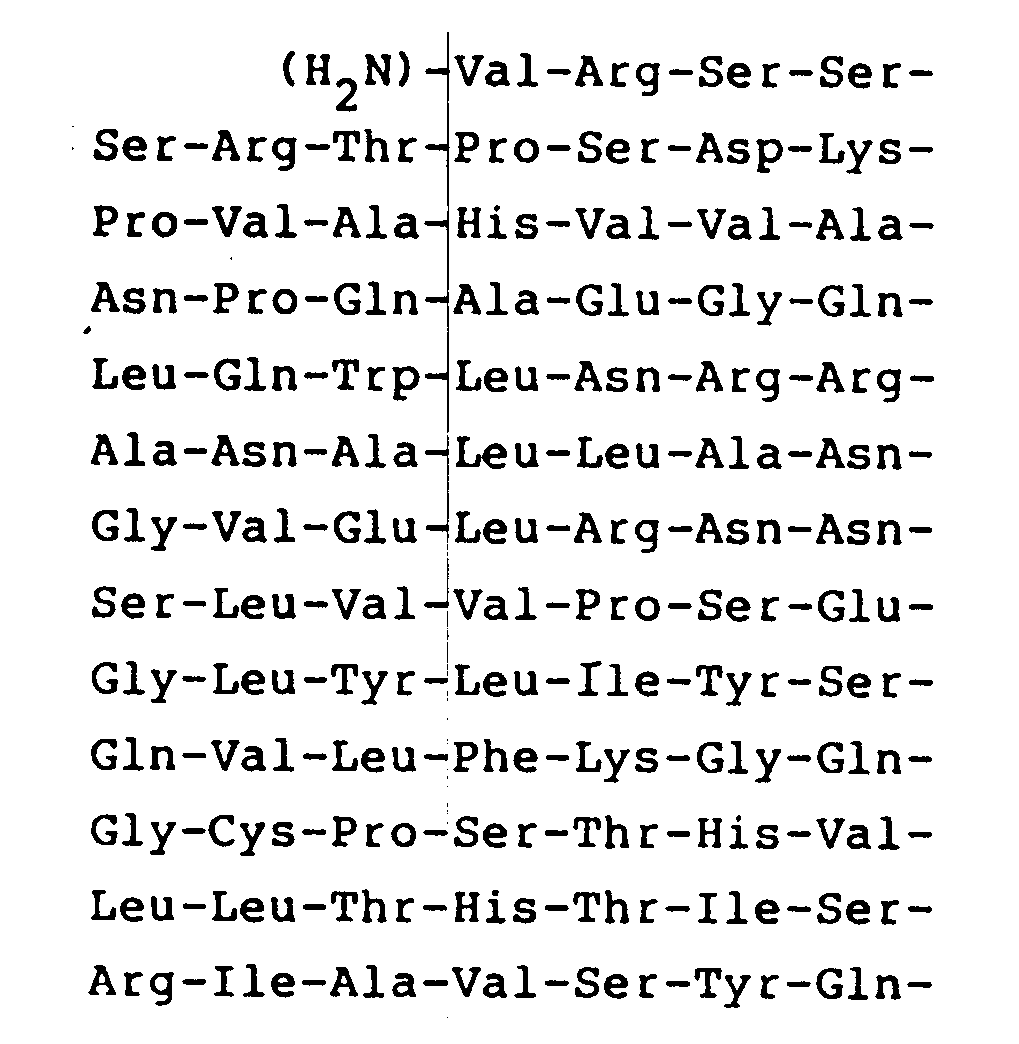

- The plasmid pTHF471 obtained in Example 5 was digested with the restriction endonucleases ClaI, HindIII and HapII by the method of Example 4 and the above method to give a DNA fragment having a size of about 80 bp (ClaI - HapII). This DNA fragment, a DNA fragment (ClaI - HindIII) having a size of about 2.7 bp obtained by digesting the plasmid pTNF489 with ClaI and HindIII, and a DNA fragment (HapII - HindIII) having a size of about 390 bp obtained by digesting the plasmid pTHF489 with ClaI, HindIII and HapII were ligated and introduced into E. coli C600r-m- strain in the same way as in Example 3. Clones having the desired plasmid pTHF601 (about 3.2 kbp) were selected from the transformants. This plasmid encodes a novel antitumorally active polypeptide having the following amino acid sequence. Figure 16 shows a method of preparing this plasmid.


- A lysate was prepared as in Example 6 from the E. coli C600r-m- strain containing the plasmid pTNF472 or pTNF601 obtained in Example 11. The lysate was electrophoresed on an SDS-polyacrylamide gel, and it was confirmed that these plasmids expressed the novel antitumorally active polypeptide gene.
- In accordance with the method of Example 7, the in vitro antitumor activity of the lysate containing the novel antitumorally active polypeptide was measured, and its specific activity was calculated. The results are shown in Table 4.
Table 4 Physiolocally active peptide Plasmid Ratio of specific activity Human TNF protein pTNF401A 1.0 Novel antitumorally active polypeptide pTNF472 3.0 pTNF601 6.7
Claims (13)
- An antitumorally active polypeptide having the following amino acid sequence (I)in which n represents 0 or 1, NH₂ represents the amino-terminus, and COOH represents the carboxy-terminus.

- A DNA fragment encoding the amino acid sequence (I) of claim 1.
- The DNA fragment of claim 2 which is a double-stranded DNA fragment composed of a single-stranded DNA having the following base sequencein which n represents 0 or 1, 5' represents the 5'-terminus, and 3' represents the 3'-terminus,

and a single-stranded DNA complementary thereto. - The DNA fragment of claim 3 which is a double-stranded DNA fragment composed of a single-stranded DNA having a base sequence consisting of the base sequence of claim 3 and joined to the 5'-terminus, a base sequence of the following formulaand a single-stranded DNA complementary thereto.

- A recombinant plasmid which contains a DNA fragment encoding the amino acid sequence (I) of claim 1.
- The recombinant plasmid of claim 5 which contains the double-stranded DNA fragment of claim 3.
- The plasmid of claim 5 which is plasmid pTHF471, as shown in Figure 9B.
- A transformant obtained by transforming a microorganism with a recombinant plasmid containing a DNA fragment encoding the amino acid sequence (I) of claim 1.
- The transformant of claim 8 in which the microorganism is of the genus Escherichia.
- A process for producing an antitumorally active polypeptide having the amino acid sequence (I), which comprises cultivating the transformant of claim 8 to produce and accumulate the antitumorally active polypeptide in the culture broth and separating the polypeptide from the culture broth.
- A pharmaceutical composition comprising an effective amount of an antitumorally active polypeptide having the amino acid sequence of claim 1 as an active ingredient.
- An antitumor injecting composition consisting essentially of an effective amount of an antitumorally active polypeptide having the amino acid sequence claim 1 and an inert liquid carrier.
- An antitumorally active polypeptide having the following amino acid sequence
 in which n represents 0 or 1, (NH₂) represents the amino-terminus, (COOH) represents the carboxy-terminus, and at least one amino acid among the asterisked amino acids are replaced independently from each other such that Pro*1 is replaced by His, Asp*2 is replaced by Asn, and Gln*3 is replaced by Ser.
Applications Claiming Priority (2)
| Application Number | Priority Date | Filing Date | Title |
|---|---|---|---|
| JP63104222A JPH0797997B2 (en) | 1988-04-28 | 1988-04-28 | Novel bioactive polypeptide |
| JP104222/88 | 1988-04-28 |
Publications (3)
| Publication Number | Publication Date |
|---|---|
| EP0340333A2 EP0340333A2 (en) | 1989-11-08 |
| EP0340333A3 EP0340333A3 (en) | 1990-08-29 |
| EP0340333B1 true EP0340333B1 (en) | 1992-09-30 |
Family
ID=14374935
Family Applications (1)
| Application Number | Title | Priority Date | Filing Date |
|---|---|---|---|
| EP88112143A Expired - Lifetime EP0340333B1 (en) | 1988-04-28 | 1988-07-27 | Novel physiologically active polypeptide and pharmaceutical composition |
Country Status (4)
| Country | Link |
|---|---|
| US (1) | US5028420A (en) |
| EP (1) | EP0340333B1 (en) |
| JP (1) | JPH0797997B2 (en) |
| DE (1) | DE3875108T2 (en) |
Families Citing this family (22)
| Publication number | Priority date | Publication date | Assignee | Title |
|---|---|---|---|---|
| EP0897987B1 (en) * | 1989-10-24 | 2001-02-28 | Chiron Corporation | Secretion of human protein linked to gamma interferon signal peptide |
| US5519119A (en) * | 1990-09-21 | 1996-05-21 | Ishihara Sangyo Kaisha Ltd. | Muteins of TNF pharmaceutical compositions and a method of making |
| US5851764A (en) | 1990-10-25 | 1998-12-22 | The Trustees Of Columbia University In The City Of New York | Human prostate tumor inducing gene-1 and uses thereof |
| ATE230024T1 (en) * | 1990-10-25 | 2003-01-15 | Univ Columbia | DEVELOPMENT OF DNA PROBE AND IMMUNOLOGICAL REAGENTS OF HUMAN TUMOR-ASSOCIATED ANTIGENS |
| US6159751A (en) * | 1990-10-25 | 2000-12-12 | The Trustees Of Columbia University In The City Of New York | Development of DNA probes and immunological reagents of human tumor associated antigens |
| US5891704A (en) * | 1992-11-19 | 1999-04-06 | Anticancer, Inc. | Method to produce high levels of methioninase |
| US6461851B1 (en) | 1992-11-19 | 2002-10-08 | Anticancer, Inc. | High expression modules containing two or more tandem copies of a methioninase encoding sequence |
| US5715835A (en) * | 1992-11-19 | 1998-02-10 | Anticancer, Inc. | Methods for treating and reducing the potential for cardiovascular disease using methioninase compositions |
| ES2184756T3 (en) * | 1992-11-19 | 2003-04-16 | Anticancer Inc | USE OF METIONINASE AS AN ANTITUMORAL AGENT IN ANTIMETIONINE CHEMOTHERAPY. |
| KR970005042B1 (en) * | 1993-02-09 | 1997-04-11 | 한일합성섬유공업 주식회사 | Tumor Necrosis Factor-Alpha Mutein |
| US5888814A (en) * | 1994-06-06 | 1999-03-30 | Chiron Corporation | Recombinant host cells encoding TNF proteins |
| US7687461B2 (en) * | 2000-03-02 | 2010-03-30 | Xencor, Inc. | Treatment of TNF-α related disorders with TNF-α variant proteins |
| US7101974B2 (en) | 2000-03-02 | 2006-09-05 | Xencor | TNF-αvariants |
| US7244823B2 (en) * | 2000-03-02 | 2007-07-17 | Xencor | TNF-alpha variants proteins for the treatment of TNF-alpha related disorders |
| US7662367B2 (en) * | 2000-03-02 | 2010-02-16 | Xencor, Inc. | Pharmaceutical compositions for the treatment of TNF-α related disorders |
| US7446174B2 (en) | 2001-03-02 | 2008-11-04 | Xencor, Inc. | Protein based TNF-α variants for the treatment of TNF-α related disorders |
| US7056695B2 (en) | 2000-03-02 | 2006-06-06 | Xencor | TNF-α variants |
| US20070172449A1 (en) * | 2000-03-02 | 2007-07-26 | Xencor, Inc. | TNF-alpha VARIANT FORMULATIONS FOR THE TREATMENT OF TNF-alpha RELATED DISORDERS |
| US20080050808A1 (en) * | 2002-10-09 | 2008-02-28 | Reed Thomas D | DNA modular cloning vector plasmids and methods for their use |
| US7785871B2 (en) * | 2002-10-09 | 2010-08-31 | Intrexon Corporation | DNA cloning vector plasmids and methods for their use |
| ATE472556T1 (en) | 2002-12-02 | 2010-07-15 | Amgen Fremont Inc | ANTIBODIES DIRECTED AGAINST THE TUMOR NECROSIS FACTOR AND THEIR USES |
| WO2014124134A1 (en) | 2013-02-07 | 2014-08-14 | The General Hospital Corporation | Methods for expansion or depletion of t-regulatory cells |
Family Cites Families (4)
| Publication number | Priority date | Publication date | Assignee | Title |
|---|---|---|---|---|
| DE3582183D1 (en) * | 1984-03-06 | 1991-04-25 | Dainippon Pharmaceutical Co | DNS ENCODING THE HUMAN TUMORNIC CROSIS FACTOR AND THE HUMAN TUMORNIC CRISIS FACTOR POLYPEPTIDE. |
| US4677063A (en) * | 1985-05-02 | 1987-06-30 | Cetus Corporation | Human tumor necrosis factor |
| FI862531A0 (en) * | 1984-10-15 | 1986-06-13 | Cetus Corp | TUMOERNEKROSISFAKTOR. |
| DE3750056T2 (en) * | 1986-06-20 | 1995-04-06 | Dainippon Pharmaceutical Co | Human TNF polypeptide mutants and DNA coding for these mutants. |
-
1988
- 1988-04-28 JP JP63104222A patent/JPH0797997B2/en not_active Expired - Lifetime
- 1988-07-26 US US07/235,576 patent/US5028420A/en not_active Expired - Fee Related
- 1988-07-27 DE DE8888112143T patent/DE3875108T2/en not_active Expired - Fee Related
- 1988-07-27 EP EP88112143A patent/EP0340333B1/en not_active Expired - Lifetime
Also Published As
| Publication number | Publication date |
|---|---|
| US5028420A (en) | 1991-07-02 |
| EP0340333A3 (en) | 1990-08-29 |
| DE3875108T2 (en) | 1993-03-04 |
| EP0340333A2 (en) | 1989-11-08 |
| JPH0797997B2 (en) | 1995-10-25 |
| DE3875108D1 (en) | 1992-11-05 |
| JPH01277488A (en) | 1989-11-07 |
Similar Documents
| Publication | Publication Date | Title |
|---|---|---|
| US5028420A (en) | Muteins of tumor necrosis factor | |
| EP0437610B1 (en) | Novel physiologically active polypeptide, recombinant plasmid, recombinant microbial cells, medicinal composition, and process for recovering purified polypeptide | |
| DE3750056T2 (en) | Human TNF polypeptide mutants and DNA coding for these mutants. | |
| FI86194C (en) | The methods for producing polypeptide homologues of tumor necrosis factors with high yield | |
| EP2552470B1 (en) | Peptides for promoting angiogenesis and an use thereof | |
| HU202921B (en) | Process for producing coding dns for human tumor necrosis factor the corresponding polypeptide with utilizing them and pharmaceutical compositions containing this polypeptide as active component | |
| JPH083061A (en) | Composition containing tumor necrosis factor | |
| WO2021027704A1 (en) | Application of polypeptide or derivative thereof | |
| JPH0866194A (en) | Gene encoding human tumor necrosis factor mutein | |
| JP5752782B2 (en) | Peptide for promoting angiogenesis and use thereof | |
| EP4574845A1 (en) | Il-15 mutant-fc/il-15r-alpha subunit-fc heterodimer and use thereof | |
| JPS63226297A (en) | Novel physiologically active polypeptide | |
| JPH0330693A (en) | New bioactive polypeptide | |
| JP2678689B2 (en) | Hepatitis preventive / therapeutic agent | |
| JPH02177896A (en) | New physiologically active polypeptide | |
| JPS62185098A (en) | Polypeptide having interleukin ii activity | |
| CN103992376A (en) | Novel small peptides inhibiting new vessels and application | |
| JPS63291590A (en) | Novel physiologically active polypeptide | |
| JPH02142493A (en) | Novel physiolgically active polypeptide | |
| JPS63188396A (en) | Novel and biologically active polypeptide | |
| JPS63188395A (en) | Novel and biologically active polypeptide | |
| JPS6393799A (en) | Novel and physiologically active polypeptide | |
| JPH0365195A (en) | Novel bioactive polypeptide | |
| JPH0817714B2 (en) | Novel bioactive polypeptide | |
| JPS63198996A (en) | Novel physiologically active polypeptide |
Legal Events
| Date | Code | Title | Description |
|---|---|---|---|
| PUAI | Public reference made under article 153(3) epc to a published international application that has entered the european phase |
Free format text: ORIGINAL CODE: 0009012 |
|
| AK | Designated contracting states |
Kind code of ref document: A2 Designated state(s): CH DE FR GB LI |
|
| PUAL | Search report despatched |
Free format text: ORIGINAL CODE: 0009013 |
|
| AK | Designated contracting states |
Kind code of ref document: A3 Designated state(s): CH DE FR GB LI |
|
| 17P | Request for examination filed |
Effective date: 19901212 |
|
| 17Q | First examination report despatched |
Effective date: 19911021 |
|
| GRAA | (expected) grant |
Free format text: ORIGINAL CODE: 0009210 |
|
| AK | Designated contracting states |
Kind code of ref document: B1 Designated state(s): CH DE FR GB LI |
|
| REF | Corresponds to: |
Ref document number: 3875108 Country of ref document: DE Date of ref document: 19921105 |
|
| ET | Fr: translation filed | ||
| PLBE | No opposition filed within time limit |
Free format text: ORIGINAL CODE: 0009261 |
|
| STAA | Information on the status of an ep patent application or granted ep patent |
Free format text: STATUS: NO OPPOSITION FILED WITHIN TIME LIMIT |
|
| 26N | No opposition filed | ||
| PGFP | Annual fee paid to national office [announced via postgrant information from national office to epo] |
Ref country code: FR Payment date: 19980619 Year of fee payment: 11 |
|
| PGFP | Annual fee paid to national office [announced via postgrant information from national office to epo] |
Ref country code: GB Payment date: 19980624 Year of fee payment: 11 |
|
| PGFP | Annual fee paid to national office [announced via postgrant information from national office to epo] |
Ref country code: CH Payment date: 19980721 Year of fee payment: 11 |
|
| PGFP | Annual fee paid to national office [announced via postgrant information from national office to epo] |
Ref country code: DE Payment date: 19980930 Year of fee payment: 11 |
|
| PG25 | Lapsed in a contracting state [announced via postgrant information from national office to epo] |
Ref country code: GB Free format text: LAPSE BECAUSE OF NON-PAYMENT OF DUE FEES Effective date: 19990727 |
|
| PG25 | Lapsed in a contracting state [announced via postgrant information from national office to epo] |
Ref country code: LI Free format text: LAPSE BECAUSE OF NON-PAYMENT OF DUE FEES Effective date: 19990731 Ref country code: FR Free format text: THE PATENT HAS BEEN ANNULLED BY A DECISION OF A NATIONAL AUTHORITY Effective date: 19990731 Ref country code: CH Free format text: LAPSE BECAUSE OF NON-PAYMENT OF DUE FEES Effective date: 19990731 |
|
| GBPC | Gb: european patent ceased through non-payment of renewal fee |
Effective date: 19990727 |
|
| REG | Reference to a national code |
Ref country code: CH Ref legal event code: PL |
|
| PG25 | Lapsed in a contracting state [announced via postgrant information from national office to epo] |
Ref country code: DE Free format text: LAPSE BECAUSE OF NON-PAYMENT OF DUE FEES Effective date: 20000503 |
|
| REG | Reference to a national code |
Ref country code: FR Ref legal event code: ST |