EP0339535B1 - Plating bath for electrodeposition of aluminum and plating process making use of the bath - Google Patents
Plating bath for electrodeposition of aluminum and plating process making use of the bath Download PDFInfo
- Publication number
- EP0339535B1 EP0339535B1 EP89107336A EP89107336A EP0339535B1 EP 0339535 B1 EP0339535 B1 EP 0339535B1 EP 89107336 A EP89107336 A EP 89107336A EP 89107336 A EP89107336 A EP 89107336A EP 0339535 B1 EP0339535 B1 EP 0339535B1
- Authority
- EP
- European Patent Office
- Prior art keywords
- aluminum
- plating
- bath
- electrodeposition
- halide
- Prior art date
- Legal status (The legal status is an assumption and is not a legal conclusion. Google has not performed a legal analysis and makes no representation as to the accuracy of the status listed.)
- Expired - Lifetime
Links
Classifications
-
- C—CHEMISTRY; METALLURGY
- C25—ELECTROLYTIC OR ELECTROPHORETIC PROCESSES; APPARATUS THEREFOR
- C25D—PROCESSES FOR THE ELECTROLYTIC OR ELECTROPHORETIC PRODUCTION OF COATINGS; ELECTROFORMING; APPARATUS THEREFOR
- C25D3/00—Electroplating: Baths therefor
- C25D3/66—Electroplating: Baths therefor from melts
- C25D3/665—Electroplating: Baths therefor from melts from ionic liquids
-
- C—CHEMISTRY; METALLURGY
- C25—ELECTROLYTIC OR ELECTROPHORETIC PROCESSES; APPARATUS THEREFOR
- C25D—PROCESSES FOR THE ELECTROLYTIC OR ELECTROPHORETIC PRODUCTION OF COATINGS; ELECTROFORMING; APPARATUS THEREFOR
- C25D3/00—Electroplating: Baths therefor
- C25D3/02—Electroplating: Baths therefor from solutions
- C25D3/42—Electroplating: Baths therefor from solutions of light metals
- C25D3/44—Aluminium
Definitions
- This invention relates to a plating bath for electrodeposition of aluminum, having a long bath life, also having a good operability in handling, and yet having a high current efficiency and conductivity, and a plating process making use of the bath.
- Plating for electrodeposition of aluminum can be carried out with difficulty using a plating bath of an aqueous solution type, because of a large affinity of aluminum for oxygen and a lower potential thereof than hydrogen. For this reason, the plating for electrodeposition of aluminum has been hitherto carried out using a plating bath of a non-aqueous solution type, in particular, a plating bath of an organic solvent type.
- This plating bath of an organic solvent type typically includes baths comprising AlCl3 and LiAlH4 or LiH dissolved in ether, and those comprising AlCl3 and LiAlH4 dissolved in tetrahydrofuran (see, for example, D.E. Couch et al. Electrochem., Vol. 99, (6), p.234).
- All of these plating baths contain very active LiAlH4 or LiH in the bath, and hence it may react with oxygen or water which may exist therein, to decompose, resulting in a lowering of current efficiency and also a shortened bath life. They also have the problem that they use organic solvents having so a low boiling point that they are highly in danger of explosion or burning.
- a plating bath has been proposed, comprising triethylaluminum and NaF dissolved in toluene (R. Suchentrunk, X. Werkstofftech., Vol. 12, p.190). In this instance also, however, there is a problem in handling the triethylaluminum, which is highly dangerous, and it is considered difficult to put the bath into practical use in an industrial scale.
- a plating bath making use of a chemical substance that can be easy to handle is known to include a molten salt bath comprised of a mixture of an aluminum halide and N-alkylpyridinium halide, as exemplified by a molten salt bath comprised of a 2:1 mixture of aluminum chloride and N-ethylpyridinium chloride (US-A-2 446 331, US-A-2 446 349 and US-A-2 446 350) and a molten salt bath comprised of 40 to 80 mol % of aluminum halide and 20 to 60 mol % of N-alkylpyridinium halide (comprising an alkyl group having 1 to 5 carbon atoms) (Japanese Laid-Open Patent Applications No. 70592/1987 and No. 70593/1987).
- a first object of the present invention is to provide a plating bath for electrodeposition of aluminum, that has a long bath life and promises the safety in handling, and a plating process making use of the bath.
- Another object of the present invention is to provide a plating bath for electrodeposition of aluminum, that has a high current efficiency and conductivity.
- the present inventors made intensive studies to develop a new plating bath for electrodeposition of aluminum and plating process making use of the bath, that can solve the problems in the prior art, and as a result found that the problems can be solved by using a plating bath comprising a molten mixture comprising an aluminum halide and a dialkyl- and/or trialkylpyridinium halide(s) (or at least one of a dialkylpyridinium halide and a trialkylpyridinium halide).
- the aluminum halide and the dialkyl- and/or trialkylpyridinium halide(s), when mixed and melted, are made into a low-melting molten salt bath that turns into a liquid even at room temperature under a wide compositional range.
- This plating bath contains no chemical substances which are chemically active, so that it can have a long bath life and can be free from dangers such as explosion and burning, resulting in a good operability in handling.
- the bath also undergoes electrolytic dissociation into di(tri)alkylpyridinium cations of quaternary ammonium ions and Al complex anions in a low-temperature molten state, showing a reasonably high ionic conductivity, so that the plating can be carried out in a high current efficiency even at a high current density of 50 A/dm2.
- the dialkyl- and/or trialkylpyridinium halide(s) used in the plating bath is a compound represented by the following general formula: wherein R1 represents an alkyl group having 1 to 12 carbon atoms, R2 represents a hydrogen atom or an alkyl group having 1 to 6 carbon atoms, R3 represents an alkyl group having 1 to 6 carbon atoms, and X represents a halogen atom; and said alkyl groups each refer to a straight-chain hydrocarbon group, a branched hydrocarbon group, an alicyclic hydrocarbon group, or any of these further partly containing an aromatic hydrocarbon group.
- di(tri)alkylpyridinium salts include 1,2-dimethylpyridinium chloride, 1-ethyl-2-methylpyridinium chloride, 1-ethyl-2-methylpyridinium bromide, 1-ethyl-2-methylpyridinium iodide, 1-ethyl-2-methylpyridinium fluoride, 1-n-butyl-2-methylpyridinium chloride, 1-isobutyl-2-methylpyridinium chloride, 1-n-octyl-2-methylpyridinium chloride, 1-benzyl-2-methylpyridinium chloride, 1-ethyl-3-methylpyridinium chloride, 1-ethyl-3 methylpyridinium bromide, 1-cyclohexyl-3-methylpyridinium bromide, 1-ethyl-2-ethylpyridinium chloride, 1-butyl-2-ethylpyridinium chloride, 1-ethyl-4-methyl
- the aluminum halide refers to a compound represented by the general formula: AlX3 (X is halogen), and specifically includes AlF3, AlCl3 AlBr3 and AlI3.
- These aluminum halide and dialkyl- and/or trialkyipyridinium halide(s) may be mixed in the proportion of from 20 to 80 mol % of the aluminum halide and from 20 to 80 mol % of the dialkyl- and/or trialkylpyridinium halide(s), thereby being made into a low-melting plating solution.
- a plating solution comprising a mixture of aluminum chloride with a 1-ethyl-3-methylpyridinium halide, it can be liquid at room temperature over the whole range of from 20 to 80 mol % of the aluminum chloride, showing a reasonably low viscosity.
- the aluminum halide may be mixed in the proportion of from 50 to 75 mol %, and more preferably from 55 to 70 mol %; and the dialkyl- and/or trialkylpyridinium halide(s), from 25 to 50 mol %, and more preferably from 30 to 45 mol %.
- a reaction presumed to be decomposition of dialkyl- and/or trialkylpyridinium cations may take place in carrying out the electroplating, and, in a system containing the aluminum halide in an excessively large proportion, the viscosity of the plating bath tends to increase, undesirably.
- the plating bath of the present invention is prepared by mixing and melting the aluminum halide and a dialkyl and/or trialkylpyridinium halide, and in this instance can be prepared through the two steps described below.
- An alkyl halide and a monoalkyl- and/or dialkylpyridine are charged together with a reaction solvent in an autoclave provided with a stirrer, and heated to 30 to 200°C, and more preferably 50 to 150°C, to carry out reaction to form them into a quaternary ammonium salt.
- the solvent and unreacted matters are removed to prepare a dialkyl- and/or trialkylpyridinium halide.
- the reaction solvent that can be used here includes hydrocarbons such as benzene, toluene and hexane, and polar solvents such as water, methanol, ethanol, tetrahydrofuran, dimethylformamide and dimethyl sulfoxide.
- dialkyl- and/or trialkylpyridinium halide prepared in the first step and an aluminum halide are mixed in the given proportion and then heated in the atmosphere of an inert gas, or mixed under heating in a state that both are suspended in a suitable solvent, followed by removal of solvent, thus making a plating solution.
- considerable heat generation accompanies the mixing of them, and hence it is necessary to take care not to cause reckless increase in temperature.
- the plating for electrodeposition of aluminum using the plating bath of the present invention is carried out in a dry, oxygen-free atmosphere from the viewpoints of maintaining the stability of the plating bath and improving plating quality.
- the plating may be carried out using direct current or pulse current at a bath temperature of from 0 to 300°C and at a current density of from 0.01 to 50 A/dm2, so that the plating can be carried out uniformly with a good current efficiency.
- An excessively low bath temperature enables no uniform plating, and an excessively high bath temperature may cause the decomposition of quaternary ammonium cations, non-uniform coatings, and further a lowering of current efficiency, undesirable.
- the Al ions can be automatically supplied in accordance with the amount of electrification, so that the Al ion concentration can be kept in a given range without supplying the aluminum halide, and also the bath composition may not lose its balance.
- an organic solvent is added to lower the viscosity of the plating bath.
- an inert solvent such as toluene, xylene, benzene or chlorobenzene may preferably be added as the organic solvent, and may be added in an amount of usually from 5 to 100 vol. %, so that the plating efficiency can be improved.
- alkali metal and/or alkaline earth metal halide(s) For the purpose of increasing the conductivity of the plating bath or making coatings uniform, it is also effective to add an alkali metal and/or alkaline earth metal halide(s).
- the alkali metal halide and alkaline earth metal halide in this instance may include LiCl, NaCl, NaF and CaCl2, and these compounds are added in the plating bath in an amount of usually from 0.1 to 30 mol %.
- 1-ethyl-3-methylpyridinium chloride was synthesized from 3-picoline and ethyl chloride (Example 2); 1-n-butyl-3-methylpyridinium chloride, from 3-picoline and n-butyl chloride (Example 3); 1-benzyl-3-methylpyridinium chloride, from 3-picoline and benzyl chloride (Example 4); 1-ethyl-3,5-dimethylpyridinium bromide, from 3,5-lutidine and ethyl bromide (Example 5); 1-ethyl-3,5-dimethylpyridinium chloride, from 3,5-lutidine and ethyl chloride (Example 6); respectively.
- di(tri)alkylpyridinium salts were mixed with aluminum chloride in the same manner as Example 1 to make plating baths for electrodeposition of aluminum, in which the molar ratio of aluminum chloride to di(tri)alkylpyridinium salts was 2. Also, using aluminum bromide in place of aluminum chloride, prepared were plating baths for electrodeposition of aluminum, in which the molar ratio of 1-ethyl-3-methylpyridinium bromide of Example 1 or 1-ethyl-3,5-dimethylpyridinium bromide of Example 5 to the aluminum bromide was 2 (Examples 7 and 8).
- the plating baths thus prepared had the conductivity as shown in Table 2.
- Table 2 Conductivity of each plating bath
- Example No. Aluminum halide Di(tri)alkylpyridinium halide Temp. (°C) Conductivity (mS/cm) 2 AlCl3 1-Ethyl-3-methylpyridinium chloride 25 11.0 50 19.8 3 AlCl3 1-n-Butyl-3-methylpyridinium chloride 25 6.7 4 AlCl3 1-Benzyl-3-methylpyridinium chloride 50 5.8 5 AlCl3 1-Ethyl-3,5-dimethylpyridinium bromide 25 7.5 50 13.6 6 AlCl3 1-Ethyl-3,5-dimethylpyridinium chloride 25 8.1 50 14.5 7 AlBr3 1-Ethyl-3-methylpyridinium bromide 50 10.1 8 AlBr3 1-Ethyl-3,5-dimethylpyridinium bromide 50 7.3 Note: The molar ratio of the aluminum
- a cold rolled sheet with a sheet thickness of 0.5 mm was subjected to solvent vapor cleaning, alkali degreasing, pickling, and so forth in conventional manners, followed by drying, and the sheet thus treated was immediately immersed in the plating bath of Examples 1 to 8 each, previously kept in an N2 atmosphere. Thereafter, the cold rolled sheet was plated with aluminum using a direct current, setting the cold rolled sheet serving as a cathode, and an aluminum sheet (purity: 99.99%; sheet thickness: 1 mm) as the anode.
- the relationship between the plating bath composition, electrolysis conditions, and the resulting aluminum-plated steel sheets is shown in Table 3.
- Example 1 In the plating bath comprising aluminum chloride and 1-ethyl-3-methylpyridinium bromide (molar ratio: 2:1), prepared in Example 1, a toluene solvent was added in the proportion of 1:1 (volume ratio) to prepare a plating bath having a lowered viscosity.
- This plating bath had a conductivity of 17.8 mS/cm (25°C), which was made 70 % larger than the conductivity of the plating bath of Example 1.
- a cold rolled sheet was electroplated with aluminum according to the plating procedures in Examples 9 to 18 under conditions of a bath temperature of 25°C, a current density of 20 A/dm2 and an electrolysis time of 2.5 minutes. As a result, a very dense coating of about 10 ⁇ m thick was formed on the surface of the cold rolled sheet, with a current efficiency of 99 %.
- Example 2 In the plating bath comprising aluminum chloride and 1-ethyl-3-methylpyridinium chloride (molar ratio: 2:1), prepared in Example 2, NaCl was added in an amount of 5 mol % based on the amount of 1-ethyl-3-methylpyridinium chloride to prepare a plating bath.
- a cold rolled sheet was electroplated with aluminum according to the plating procedures in Examples 9 to 18 under conditions of a bath temperature of 50°C, a current density of 10 A/dm2 and an electrolysis time of 5 minutes. As a result, a very dense glossy coating of about 10 ⁇ m thick was formed on the cold rolled sheet, with a current efficiency of 98 %.
Landscapes
- Chemical & Material Sciences (AREA)
- Engineering & Computer Science (AREA)
- Chemical Kinetics & Catalysis (AREA)
- Electrochemistry (AREA)
- Materials Engineering (AREA)
- Metallurgy (AREA)
- Organic Chemistry (AREA)
- Electroplating And Plating Baths Therefor (AREA)
Description
- This invention relates to a plating bath for electrodeposition of aluminum, having a long bath life, also having a good operability in handling, and yet having a high current efficiency and conductivity, and a plating process making use of the bath.
- Plating for electrodeposition of aluminum can be carried out with difficulty using a plating bath of an aqueous solution type, because of a large affinity of aluminum for oxygen and a lower potential thereof than hydrogen. For this reason, the plating for electrodeposition of aluminum has been hitherto carried out using a plating bath of a non-aqueous solution type, in particular, a plating bath of an organic solvent type.
- This plating bath of an organic solvent type typically includes baths comprising AlCl₃ and LiAlH₄ or LiH dissolved in ether, and those comprising AlCl₃ and LiAlH₄ dissolved in tetrahydrofuran (see, for example, D.E. Couch et al. Electrochem., Vol. 99, (6), p.234).
- All of these plating baths, however, contain very active LiAlH₄ or LiH in the bath, and hence it may react with oxygen or water which may exist therein, to decompose, resulting in a lowering of current efficiency and also a shortened bath life. They also have the problem that they use organic solvents having so a low boiling point that they are highly in danger of explosion or burning. As other plating baths of an organic solvent type, a plating bath has been proposed, comprising triethylaluminum and NaF dissolved in toluene (R. Suchentrunk, X. Werkstofftech., Vol. 12, p.190). In this instance also, however, there is a problem in handling the triethylaluminum, which is highly dangerous, and it is considered difficult to put the bath into practical use in an industrial scale.
- As discussed in the above, the conventional techniques have succeeded for the time being in settling the technical subject that the plating for electrodeposition of aluminum is carried out, but, because of employment of chemical substances which are difficult to handle, they all have disadvantages in the bath life and operability, leaving problems in widely and commonly using them as techniques for practical use.
- Meanwhile, a plating bath making use of a chemical substance that can be easy to handle is known to include a molten salt bath comprised of a mixture of an aluminum halide and N-alkylpyridinium halide, as exemplified by a molten salt bath comprised of a 2:1 mixture of aluminum chloride and N-ethylpyridinium chloride (US-A-2 446 331, US-A-2 446 349 and US-A-2 446 350) and a molten salt bath comprised of 40 to 80 mol % of aluminum halide and 20 to 60 mol % of N-alkylpyridinium halide (comprising an alkyl group having 1 to 5 carbon atoms) (Japanese Laid-Open Patent Applications No. 70592/1987 and No. 70593/1987).
- A first object of the present invention is to provide a plating bath for electrodeposition of aluminum, that has a long bath life and promises the safety in handling, and a plating process making use of the bath.
- Another object of the present invention is to provide a plating bath for electrodeposition of aluminum, that has a high current efficiency and conductivity.
- The present inventors made intensive studies to develop a new plating bath for electrodeposition of aluminum and plating process making use of the bath, that can solve the problems in the prior art, and as a result found that the problems can be solved by using a plating bath comprising a molten mixture comprising an aluminum halide and a dialkyl- and/or trialkylpyridinium halide(s) (or at least one of a dialkylpyridinium halide and a trialkylpyridinium halide).
- The aluminum halide and the dialkyl- and/or trialkylpyridinium halide(s), when mixed and melted, are made into a low-melting molten salt bath that turns into a liquid even at room temperature under a wide compositional range. This plating bath contains no chemical substances which are chemically active, so that it can have a long bath life and can be free from dangers such as explosion and burning, resulting in a good operability in handling. The bath also undergoes electrolytic dissociation into di(tri)alkylpyridinium cations of quaternary ammonium ions and Al complex anions in a low-temperature molten state, showing a reasonably high ionic conductivity, so that the plating can be carried out in a high current efficiency even at a high current density of 50 A/dm².
- Here, the dialkyl- and/or trialkylpyridinium halide(s) used in the plating bath is a compound represented by the following general formula:
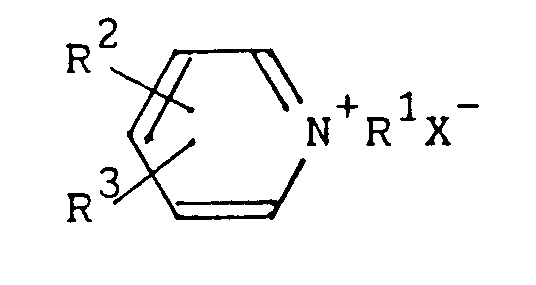
wherein R¹ represents an alkyl group having 1 to 12 carbon atoms, R² represents a hydrogen atom or an alkyl group having 1 to 6 carbon atoms, R³ represents an alkyl group having 1 to 6 carbon atoms, and X represents a halogen atom; and said alkyl groups each refer to a straight-chain hydrocarbon group, a branched hydrocarbon group, an alicyclic hydrocarbon group, or any of these further partly containing an aromatic hydrocarbon group. - To show specific examples of these di(tri)alkylpyridinium salts, they include 1,2-dimethylpyridinium chloride, 1-ethyl-2-methylpyridinium chloride, 1-ethyl-2-methylpyridinium bromide, 1-ethyl-2-methylpyridinium iodide, 1-ethyl-2-methylpyridinium fluoride, 1-n-butyl-2-methylpyridinium chloride, 1-isobutyl-2-methylpyridinium chloride, 1-n-octyl-2-methylpyridinium chloride, 1-benzyl-2-methylpyridinium chloride, 1-ethyl-3-methylpyridinium chloride, 1-ethyl-3 methylpyridinium bromide, 1-cyclohexyl-3-methylpyridinium bromide, 1-ethyl-2-ethylpyridinium chloride, 1-butyl-2-ethylpyridinium chloride, 1-ethyl-4-methylpyridinium bromide, 1-ethyl-4-phenylpyridinium bromide, 1-ethyl-2,4-dimethylpyridinium chloride, 1-ethyl-2,6-dimethylpyridinium chloride, and 1-n-butyl-2,4-dimethylpyridinium chloride.
- The aluminum halide refers to a compound represented by the general formula: AlX₃ (X is halogen), and specifically includes AlF₃, AlCl₃ AlBr₃ and AlI₃.
- These aluminum halide and dialkyl- and/or trialkyipyridinium halide(s) may be mixed in the proportion of from 20 to 80 mol % of the aluminum halide and from 20 to 80 mol % of the dialkyl- and/or trialkylpyridinium halide(s), thereby being made into a low-melting plating solution. For example, in a plating solution comprising a mixture of aluminum chloride with a 1-ethyl-3-methylpyridinium halide, it can be liquid at room temperature over the whole range of from 20 to 80 mol % of the aluminum chloride, showing a reasonably low viscosity.
- However, to efficiently carry out the plating for electrodeposition of aluminum, the aluminum halide may be mixed in the proportion of from 50 to 75 mol %, and more preferably from 55 to 70 mol %; and the dialkyl- and/or trialkylpyridinium halide(s), from 25 to 50 mol %, and more preferably from 30 to 45 mol %. In a system containing the aluminum halide in an excessively small proportion, a reaction presumed to be decomposition of dialkyl- and/or trialkylpyridinium cations may take place in carrying out the electroplating, and, in a system containing the aluminum halide in an excessively large proportion, the viscosity of the plating bath tends to increase, undesirably.
- The plating bath of the present invention is prepared by mixing and melting the aluminum halide and a dialkyl and/or trialkylpyridinium halide, and in this instance can be prepared through the two steps described below.
- An alkyl halide and a monoalkyl- and/or dialkylpyridine are charged together with a reaction solvent in an autoclave provided with a stirrer, and heated to 30 to 200°C, and more preferably 50 to 150°C, to carry out reaction to form them into a quaternary ammonium salt. After the reaction, the solvent and unreacted matters are removed to prepare a dialkyl- and/or trialkylpyridinium halide. The reaction solvent that can be used here includes hydrocarbons such as benzene, toluene and hexane, and polar solvents such as water, methanol, ethanol, tetrahydrofuran, dimethylformamide and dimethyl sulfoxide.
- The dialkyl- and/or trialkylpyridinium halide prepared in the first step and an aluminum halide are mixed in the given proportion and then heated in the atmosphere of an inert gas, or mixed under heating in a state that both are suspended in a suitable solvent, followed by removal of solvent, thus making a plating solution. In either instance, considerable heat generation accompanies the mixing of them, and hence it is necessary to take care not to cause reckless increase in temperature.
- The plating for electrodeposition of aluminum using the plating bath of the present invention is carried out in a dry, oxygen-free atmosphere from the viewpoints of maintaining the stability of the plating bath and improving plating quality. As for plating conditions, the plating may be carried out using direct current or pulse current at a bath temperature of from 0 to 300°C and at a current density of from 0.01 to 50 A/dm², so that the plating can be carried out uniformly with a good current efficiency. An excessively low bath temperature enables no uniform plating, and an excessively high bath temperature may cause the decomposition of quaternary ammonium cations, non-uniform coatings, and further a lowering of current efficiency, undesirable.
- In instances in which a strip or the like is continuously plated, it is required to supply Al ions in a bath so that the Al ion concentration in the bath may be kept in a given range. In such instances, however, if the anode is comprised of a soluble anode made of aluminum, the Al ions can be automatically supplied in accordance with the amount of electrification, so that the Al ion concentration can be kept in a given range without supplying the aluminum halide, and also the bath composition may not lose its balance.
- In instances in which the plating is carried out efficiently at low temperatures, a method is effective in which an organic solvent is added to lower the viscosity of the plating bath. In such instances, an inert solvent such as toluene, xylene, benzene or chlorobenzene may preferably be added as the organic solvent, and may be added in an amount of usually from 5 to 100 vol. %, so that the plating efficiency can be improved.
- For the purpose of increasing the conductivity of the plating bath or making coatings uniform, it is also effective to add an alkali metal and/or alkaline earth metal halide(s). The alkali metal halide and alkaline earth metal halide in this instance may include LiCl, NaCl, NaF and CaCl₂, and these compounds are added in the plating bath in an amount of usually from 0.1 to 30 mol %.
-
- In an autoclave made of stainless steel, 1.0 mol (93.1 g) of 3-picoline and 1.1 mol (119.9 g) of ethyl bromide, and 100 g of methanol as a solvent were charged, and then reacted at 100°C for 8 hours with stirring. Using a rotary evaporator, the solvent and unreacted matters were evaporated from the reaction mixture to obtain 200.1 g of a solid product. This solid product was found to be 1-ethyl-3-methylpyridinium bromide, with the reaction yield of 99 mol % based on 3-picoline.
- Next, 0.10 mol (20.2 g) of the 1-ethyl-3-methylpyridinium bromide obtained was put in a reaction vessel made of glass in a nitrogen atmosphere, into which 0.20 mol (26.67 g) of aluminum chloride was fed little by little. The feeding thereof caused reaction with the 1-ethyl-3-methylpyridinium bromide at their solid interfaces, and fusion gradually proceeded, accompanied, however, with considerable heat generation at the initial stage of the reaction, and accordingly the aluminum chloride was fed in its whole amount while taking care so as for the reaction temperature not to exceed 70°C. The resulting mixture was liquid at room temperature, and had a conductivity of 10.3 mS/cm (25°C).
- In this system, the mixing molar ratio (A/B) of aluminum chloride (A) to 1-ethyl-3-methylpyridinium bromide (B) was varied from 1 to 2, but the mixture was kept liquid at room temperature within the whole molar ratio, and showed a high conductivity at a low temperature as shown by the conductivities in Table 1. Taking account of these, the mixture can be deemed to be excellent as the plating bath for electrodeposition of aluminum.
Table 1 Relationship between molar ratio and conductivity (mS/cm, 25°C). Temperature (°C) Molar ratio 1.0 1.5 2.0 25 14.5 11.4 10.3 30 16.6 13.3 11.7 40 21.1 17.0 14.8 50 26.9 21.7 18.6 60 33.2 26.5 22.6 70 39.6 31.8 26.8 - By the same reaction procedures as Example1, 1-ethyl-3-methylpyridinium chloride was synthesized from 3-picoline and ethyl chloride (Example 2); 1-n-butyl-3-methylpyridinium chloride, from 3-picoline and n-butyl chloride (Example 3); 1-benzyl-3-methylpyridinium chloride, from 3-picoline and benzyl chloride (Example 4); 1-ethyl-3,5-dimethylpyridinium bromide, from 3,5-lutidine and ethyl bromide (Example 5); 1-ethyl-3,5-dimethylpyridinium chloride, from 3,5-lutidine and ethyl chloride (Example 6); respectively.
- These di(tri)alkylpyridinium salts were mixed with aluminum chloride in the same manner as Example 1 to make plating baths for electrodeposition of aluminum, in which the molar ratio of aluminum chloride to di(tri)alkylpyridinium salts was 2. Also, using aluminum bromide in place of aluminum chloride, prepared were plating baths for electrodeposition of aluminum, in which the molar ratio of 1-ethyl-3-methylpyridinium bromide of Example 1 or 1-ethyl-3,5-dimethylpyridinium bromide of Example 5 to the aluminum bromide was 2 (Examples 7 and 8).
- The plating baths thus prepared had the conductivity as shown in Table 2.
Table 2 Conductivity of each plating bath Example No. Aluminum halide Di(tri)alkylpyridinium halide Temp. (°C) Conductivity (mS/cm) 2 AlCl₃ 1-Ethyl-3-methylpyridinium chloride 25 11.0 50 19.8 3 AlCl₃ 1-n-Butyl-3-methylpyridinium chloride 25 6.7 4 AlCl₃ 1-Benzyl-3-methylpyridinium chloride 50 5.8 5 AlCl₃ 1-Ethyl-3,5-dimethylpyridinium bromide 25 7.5 50 13.6 6 AlCl₃ 1-Ethyl-3,5-dimethylpyridinium chloride 25 8.1 50 14.5 7 AlBr₃ 1-Ethyl-3-methylpyridinium bromide 50 10.1 8 AlBr₃ 1-Ethyl-3,5-dimethylpyridinium bromide 50 7.3 Note: The molar ratio of the aluminum halide to the di(tri)alkylpyridinium salt was 2 in each example. - A cold rolled sheet with a sheet thickness of 0.5 mm was subjected to solvent vapor cleaning, alkali degreasing, pickling, and so forth in conventional manners, followed by drying, and the sheet thus treated was immediately immersed in the plating bath of Examples 1 to 8 each, previously kept in an N₂ atmosphere. Thereafter, the cold rolled sheet was plated with aluminum using a direct current, setting the cold rolled sheet serving as a cathode, and an aluminum sheet (purity: 99.99%; sheet thickness: 1 mm) as the anode. The relationship between the plating bath composition, electrolysis conditions, and the resulting aluminum-plated steel sheets is shown in Table 3.


- In the plating bath comprising aluminum chloride and 1-ethyl-3-methylpyridinium bromide (molar ratio: 2:1), prepared in Example 1, a toluene solvent was added in the proportion of 1:1 (volume ratio) to prepare a plating bath having a lowered viscosity. This plating bath had a conductivity of 17.8 mS/cm (25°C), which was made 70 % larger than the conductivity of the plating bath of Example 1.
- Next, using this plating bath, a cold rolled sheet was electroplated with aluminum according to the plating procedures in Examples 9 to 18 under conditions of a bath temperature of 25°C, a current density of 20 A/dm² and an electrolysis time of 2.5 minutes. As a result, a very dense coating of about 10 µm thick was formed on the surface of the cold rolled sheet, with a current efficiency of 99 %.
- In the plating bath comprising aluminum chloride and 1-ethyl-3-methylpyridinium chloride (molar ratio: 2:1), prepared in Example 2, NaCl was added in an amount of 5 mol % based on the amount of 1-ethyl-3-methylpyridinium chloride to prepare a plating bath. Using this plating bath, a cold rolled sheet was electroplated with aluminum according to the plating procedures in Examples 9 to 18 under conditions of a bath temperature of 50°C, a current density of 10 A/dm² and an electrolysis time of 5 minutes. As a result, a very dense glossy coating of about 10 µm thick was formed on the cold rolled sheet, with a current efficiency of 98 %.
Claims (6)
- A plating bath for electrodeposition of aluminum, comprising a molten mixture comprising an aluminum halide and a dialkyl- and/or trialkylpyridinium halide(s) represented by the following formula:

- The plating bath for electrodeposition of aluminum according to Claim 1, wherein said plating bath comprises a molten mixture comprising from 20 to 80 mol % of the aluminum halide and from 20 to 80 mol % of the dialkyl-and/or trialkylpyridinium halide(s).
- The plating bath for electrodeposition of aluminum according to Claim 1 or 2, wherein from 0.1 to 30 mol % of an alkali metal and/or alkaline earth metal halide(s) is/are further added in said plating bath.
- The plating bath for electrodeposition of aluminum according to Claim 1, 2 or 3, wherein an organic solvent is further added.
- A plating process for electrodeposition of aluminum, comprising carrying out plating by use of the plating bath according to any one of Claims 1 to 4, in a dry oxygen-free atmosphere, using a direct current or pulse current, at a bath temperature of from 0 to 300°C and a current density of from 0.01 to 50 A/dm².
- The plating process for electrodeposition of aluminum according to Claim 5, wherein the plating is carried out by using an anode made of aluminum.
Applications Claiming Priority (4)
| Application Number | Priority Date | Filing Date | Title |
|---|---|---|---|
| JP10309988 | 1988-04-26 | ||
| JP103099/88 | 1988-04-26 | ||
| JP1037997A JP2678984B2 (en) | 1988-04-26 | 1989-02-17 | Electric aluminum plating bath and plating method using the bath |
| JP37997/89 | 1989-02-17 |
Publications (2)
| Publication Number | Publication Date |
|---|---|
| EP0339535A1 EP0339535A1 (en) | 1989-11-02 |
| EP0339535B1 true EP0339535B1 (en) | 1993-09-08 |
Family
ID=26377182
Family Applications (1)
| Application Number | Title | Priority Date | Filing Date |
|---|---|---|---|
| EP89107336A Expired - Lifetime EP0339535B1 (en) | 1988-04-26 | 1989-04-24 | Plating bath for electrodeposition of aluminum and plating process making use of the bath |
Country Status (4)
| Country | Link |
|---|---|
| US (1) | US4906342A (en) |
| EP (1) | EP0339535B1 (en) |
| JP (1) | JP2678984B2 (en) |
| DE (1) | DE68908944T2 (en) |
Families Citing this family (10)
| Publication number | Priority date | Publication date | Assignee | Title |
|---|---|---|---|---|
| DE10108893C5 (en) * | 2001-02-23 | 2011-01-13 | Rolf Prof. Dr. Hempelmann | Process for the production of metals and their alloys |
| JP2008195990A (en) * | 2007-02-09 | 2008-08-28 | Dipsol Chem Co Ltd | Electroaluminum plating bath and plating method using the same |
| JP4530111B2 (en) * | 2008-10-15 | 2010-08-25 | 日立金属株式会社 | Electro-aluminum plating solution and method for forming aluminum plating film |
| EP2623643A4 (en) * | 2010-09-30 | 2015-03-04 | Hitachi Ltd | ALUMINUM ELECTROLYTIC DEPOSITION SOLUTION |
| US9905874B2 (en) | 2011-09-22 | 2018-02-27 | Bromine Compounds Ltd. | Additives for hydrogen/bromine cells |
| US9771661B2 (en) | 2012-02-06 | 2017-09-26 | Honeywell International Inc. | Methods for producing a high temperature oxidation resistant MCrAlX coating on superalloy substrates |
| US9722272B2 (en) | 2012-05-10 | 2017-08-01 | Bromine Compounds Ltd. | Additives for zinc-bromine membraneless flow cells |
| PT2953930T (en) * | 2013-02-07 | 2017-03-01 | Bromine Compounds Ltd | PROCESSES FOR PREPARING 1-ALKYL-3-ALKYL PYRIDIENE BROMIDE AND ITS USES AS ADDITIVES IN ELECTROCHEMICAL CELLS |
| CN106661753B (en) * | 2014-04-15 | 2020-06-16 | 尼奥工业有限责任公司 | Ionic liquid electrolyte and method for electrodepositing metal |
| US10087540B2 (en) | 2015-02-17 | 2018-10-02 | Honeywell International Inc. | Surface modifiers for ionic liquid aluminum electroplating solutions, processes for electroplating aluminum therefrom, and methods for producing an aluminum coating using the same |
Family Cites Families (4)
| Publication number | Priority date | Publication date | Assignee | Title |
|---|---|---|---|---|
| US2446331A (en) * | 1944-02-14 | 1948-08-03 | William Marsh Rice Inst For Th | Electrodeposition of aluminum |
| US2446349A (en) * | 1944-02-29 | 1948-08-03 | William Marsh Rice Inst For Th | Electrodeposition of aluminum |
| US2446350A (en) * | 1944-02-29 | 1948-08-03 | William Marsh Rice Inst For Th | Electrodeposition of aluminum |
| US4747916A (en) * | 1987-09-03 | 1988-05-31 | Nisshin Steel Co., Ltd. | Plating bath for electrodeposition of aluminum and process for the same |
-
1989
- 1989-02-17 JP JP1037997A patent/JP2678984B2/en not_active Expired - Fee Related
- 1989-04-19 US US07/340,491 patent/US4906342A/en not_active Expired - Fee Related
- 1989-04-24 EP EP89107336A patent/EP0339535B1/en not_active Expired - Lifetime
- 1989-04-24 DE DE89107336T patent/DE68908944T2/en not_active Expired - Fee Related
Also Published As
| Publication number | Publication date |
|---|---|
| DE68908944T2 (en) | 1994-03-03 |
| US4906342A (en) | 1990-03-06 |
| JPH0230787A (en) | 1990-02-01 |
| JP2678984B2 (en) | 1997-11-19 |
| DE68908944D1 (en) | 1993-10-14 |
| EP0339535A1 (en) | 1989-11-02 |
Similar Documents
| Publication | Publication Date | Title |
|---|---|---|
| EP0398358B1 (en) | Aluminum electroplating method | |
| EP0339536A1 (en) | Plating bath for electrodeposition of aluminum and plating process making use of the bath | |
| EP2504468B1 (en) | New ionic liquids | |
| EP0404188B1 (en) | Non-aqueous electrolytic aluminum plating bath composition | |
| US4906342A (en) | Plating bath for electrodeposition of aluminum and plating process making use of the bath | |
| JPH02305988A (en) | Composition having low melting point and aluminum electroplating method with bath of this composition | |
| JP2918634B2 (en) | Organic aluminum electrolyte and method for electrodeposition of aluminum | |
| CZ235094A3 (en) | PROCESS FOR PREPARING 2-Y-SUBSTITUTED 3-AMINOPYRIDINES FROM 3-NITROPYRIDINES AND PROCESS FOR PREPARING PYRIDINO/3,4b/AZOLES AND DIHYDRODIPYRIDOAZEPINES | |
| JPH03134193A (en) | Low-melting point composition and electric aluminum plating method | |
| US5543522A (en) | Process for preparing an ambient temperature molten salt using thionyl chloride | |
| US4076601A (en) | Electrolytic process for the preparation of ethane-1,1,2,2-tetracarboxylate esters and related cyclic tetracarboxylate esters | |
| WO1992017626A2 (en) | Electrochemical synthesis of diaryliodonium salts | |
| US3355368A (en) | Electrodeposition of metals | |
| JPH0421794A (en) | Composition having low melting point and aluminum electroplating method | |
| JPH02305989A (en) | Composition having low melting point and aluminum electroplating method with bath of this composition | |
| US3706642A (en) | Preparation of chromium plating bath | |
| JPH0361392A (en) | Composition having low melting point and aluminum electroplating method using the same as bath | |
| JPH03134194A (en) | Low-melting point composition and electric aluminum plating method | |
| Garai | Electro-deposition of aluminium in non-aqueous solvents | |
| US3706640A (en) | Chromium plating from an organic/aqueous medium | |
| JP3061281B2 (en) | Al-Mn alloy electroplating bath | |
| US3278400A (en) | Electroforming of beryllium | |
| JPH0324291A (en) | Composition having low melting point and aluminum electroplating method with same as bath | |
| JPH04231493A (en) | Low melting composition and electrochrome plating method | |
| JPH0297691A (en) | Molybdenum electroplating bath and plating method by bath thereof |
Legal Events
| Date | Code | Title | Description |
|---|---|---|---|
| PUAI | Public reference made under article 153(3) epc to a published international application that has entered the european phase |
Free format text: ORIGINAL CODE: 0009012 |
|
| AK | Designated contracting states |
Kind code of ref document: A1 Designated state(s): DE FR NL |
|
| 17P | Request for examination filed |
Effective date: 19891207 |
|
| 17Q | First examination report despatched |
Effective date: 19910827 |
|
| GRAA | (expected) grant |
Free format text: ORIGINAL CODE: 0009210 |
|
| AK | Designated contracting states |
Kind code of ref document: B1 Designated state(s): DE FR NL |
|
| REF | Corresponds to: |
Ref document number: 68908944 Country of ref document: DE Date of ref document: 19931014 |
|
| ET | Fr: translation filed | ||
| PLBE | No opposition filed within time limit |
Free format text: ORIGINAL CODE: 0009261 |
|
| STAA | Information on the status of an ep patent application or granted ep patent |
Free format text: STATUS: NO OPPOSITION FILED WITHIN TIME LIMIT |
|
| 26N | No opposition filed | ||
| REG | Reference to a national code |
Ref country code: FR Ref legal event code: TP |
|
| NLS | Nl: assignments of ep-patents |
Owner name: MITSUBISHI CHEMICAL CORPORATION;NISSHIN STEEL CO., |
|
| PGFP | Annual fee paid to national office [announced via postgrant information from national office to epo] |
Ref country code: NL Payment date: 19990122 Year of fee payment: 11 |
|
| PGFP | Annual fee paid to national office [announced via postgrant information from national office to epo] |
Ref country code: FR Payment date: 19990127 Year of fee payment: 11 |
|
| PGFP | Annual fee paid to national office [announced via postgrant information from national office to epo] |
Ref country code: DE Payment date: 19990316 Year of fee payment: 11 |
|
| PG25 | Lapsed in a contracting state [announced via postgrant information from national office to epo] |
Ref country code: NL Free format text: LAPSE BECAUSE OF NON-PAYMENT OF DUE FEES Effective date: 20001101 |
|
| PG25 | Lapsed in a contracting state [announced via postgrant information from national office to epo] |
Ref country code: FR Free format text: LAPSE BECAUSE OF NON-PAYMENT OF DUE FEES Effective date: 20001229 |
|
| NLV4 | Nl: lapsed or anulled due to non-payment of the annual fee |
Effective date: 20001101 |
|
| PG25 | Lapsed in a contracting state [announced via postgrant information from national office to epo] |
Ref country code: DE Free format text: LAPSE BECAUSE OF NON-PAYMENT OF DUE FEES Effective date: 20010201 |
|
| REG | Reference to a national code |
Ref country code: FR Ref legal event code: ST |