EP0338504B1 - Photosensitive member for electrophotography - Google Patents
Photosensitive member for electrophotography Download PDFInfo
- Publication number
- EP0338504B1 EP0338504B1 EP89106915A EP89106915A EP0338504B1 EP 0338504 B1 EP0338504 B1 EP 0338504B1 EP 89106915 A EP89106915 A EP 89106915A EP 89106915 A EP89106915 A EP 89106915A EP 0338504 B1 EP0338504 B1 EP 0338504B1
- Authority
- EP
- European Patent Office
- Prior art keywords
- photosensitive member
- layer
- member according
- carbon atoms
- photosensitive
- Prior art date
- Legal status (The legal status is an assumption and is not a legal conclusion. Google has not performed a legal analysis and makes no representation as to the accuracy of the status listed.)
- Expired - Lifetime
Links
Images

Classifications
-
- G—PHYSICS
- G03—PHOTOGRAPHY; CINEMATOGRAPHY; ANALOGOUS TECHNIQUES USING WAVES OTHER THAN OPTICAL WAVES; ELECTROGRAPHY; HOLOGRAPHY
- G03G—ELECTROGRAPHY; ELECTROPHOTOGRAPHY; MAGNETOGRAPHY
- G03G5/00—Recording-members for original recording by exposure, e.g. to light, to heat or to electrons; Manufacture thereof; Selection of materials therefor
- G03G5/02—Charge-receiving layers
- G03G5/04—Photoconductive layers; Charge-generation layers or charge-transporting layers; Additives therefor; Binders therefor
- G03G5/06—Photoconductive layers; Charge-generation layers or charge-transporting layers; Additives therefor; Binders therefor characterised by the photoconductive material being organic
- G03G5/0601—Acyclic or carbocyclic compounds
- G03G5/062—Acyclic or carbocyclic compounds containing non-metal elements other than hydrogen, halogen, oxygen or nitrogen
-
- G—PHYSICS
- G03—PHOTOGRAPHY; CINEMATOGRAPHY; ANALOGOUS TECHNIQUES USING WAVES OTHER THAN OPTICAL WAVES; ELECTROGRAPHY; HOLOGRAPHY
- G03G—ELECTROGRAPHY; ELECTROPHOTOGRAPHY; MAGNETOGRAPHY
- G03G5/00—Recording-members for original recording by exposure, e.g. to light, to heat or to electrons; Manufacture thereof; Selection of materials therefor
- G03G5/02—Charge-receiving layers
- G03G5/04—Photoconductive layers; Charge-generation layers or charge-transporting layers; Additives therefor; Binders therefor
- G03G5/06—Photoconductive layers; Charge-generation layers or charge-transporting layers; Additives therefor; Binders therefor characterised by the photoconductive material being organic
- G03G5/0601—Acyclic or carbocyclic compounds
- G03G5/0609—Acyclic or carbocyclic compounds containing oxygen
-
- Y—GENERAL TAGGING OF NEW TECHNOLOGICAL DEVELOPMENTS; GENERAL TAGGING OF CROSS-SECTIONAL TECHNOLOGIES SPANNING OVER SEVERAL SECTIONS OF THE IPC; TECHNICAL SUBJECTS COVERED BY FORMER USPC CROSS-REFERENCE ART COLLECTIONS [XRACs] AND DIGESTS
- Y10—TECHNICAL SUBJECTS COVERED BY FORMER USPC
- Y10S—TECHNICAL SUBJECTS COVERED BY FORMER USPC CROSS-REFERENCE ART COLLECTIONS [XRACs] AND DIGESTS
- Y10S430/00—Radiation imagery chemistry: process, composition, or product thereof
- Y10S430/001—Electric or magnetic imagery, e.g., xerography, electrography, magnetography, etc. Process, composition, or product
- Y10S430/103—Radiation sensitive composition or product containing specified antioxidant
Definitions
- the present invention relates to a photosensitive member for electrophotography, particularly to a photosensitive member for electrophotography having a photosensitive layer which is capable of constantly providing high-quality images in repeated use and is excellent in durability.
- an electrophotographic photosensitive member using an organic photoconductor has a flexibility in the material design, it is expected to have an improved electrophotographic characteristic such as sensitivity and optical responsiveness. Further, the photosensitive member using the organic photoconductor also has a characteristic such that its photosensitive layer may easily be formed into a film and it may attain high productivity.
- the electrophotographic photosensitive member is repeatedly subjected to various image-forming processes in an electrophotographic apparatus and is required to show a stable electrophotographic characteristic in these processes.
- the above-mentioned electrophotographic photosensitive member using an organic photoconductor has a disadvantage such that, in repeated use, it is liable to cause image quality deterioration such as image density decrease due to a decrease in its chargeability, and image blurring due to a decrease in its surface resistance.
- An object of the present invention is to provide an electrophotographic photosensitive member which is capable of preventing its deterioration due to an active substance such as ozone, NO x and nitric acid, without impairing its electrophotographic characteristic.
- Another object of the present invention is to provide an electrophotographic photosensitive member which shows high potential-stability and is capable of constantly providing high-quality images even in repeated use.
- the photosensitive member for electrophotography is based on such a discovery and comprises: an electroconductive substrate, and a photosensitive layer disposed thereon comprising an organic photoconductor; the photosensitive layer containing, at least, a compound represented by the following formula (I): wherein X1 denotes and X2 denotes a hydrogen atom, an alkyl group having 1- 10 carbon atoms or an alkenyl group having 2 - 10 carbon atoms; and a compound represented by the following formula (II): wherein X3 and X4 respectively denote an alkyl group having 1 - 10 carbon atoms or an alkenyl group having 2 - 10 carbon atoms.
- the present invention also provides a photosensitive member for electrophotography comprising: an electroconductive substrate, and a photosensitive layer disposed thereon comprising an organic photoconductor; the photosensitive layer containing, at least, a compound represented by the following formula (I): wherein X1 denotes and X2 denotes a hydrogen atom, an alkyl group having 1 - 10 carbon atoms or an alkenyl group having 2 - 10 carbon atoms; a compound represented by the following formula (II): wherein X3 and X4 respectively denote an alkyl group having 1 - 10 carbon atoms or an alkenyl group having 2 - 10 carbon atoms; and a compound represented by the following formula (III): wherein n and m respectively denote an integer of 10 - 20, and X5 and X6 respectively denote a hydrogen atom or an alkyl group having 1 - 10 carbon atoms.
- the present invention further provides a photosensitive member for electrophotography comprising: an electroconductive substrate, and a photosensitive layer disposed thereon comprising an organic photoconductor; the photosensitive layer containing, at least, a compound represented by the following formula (I): wherein X1 denotes and X2 denotes a hydrogen atom, an alkyl group having 1 - 10 carbon atoms or an alkenyl group having 2 - 10 carbon atoms; a compound represented by the following formula (II): wherein X3 and X4 respectively denote an alkyl group having 1 - 10 carbon atoms or an alkenyl group having 2 - 10 carbon atoms; a compound represented by the following formula (III): wherein n and m respectively denote an integer of 10 - 20, and X5 and X6 respectively denote a hydrogen atom or an alkyl group having 1 - 10 carbon atoms; and a compound represented by the following formula (IV): wherein X denotes -
- Figures 1 and 2 are schematic sectional views each showing a laminar structure of an embodiment of the electrophotographic photosensitive member according to the present invention.
- the electrophotographic photosensitive member comprises an electroconductive substrate 2 and a photosensitive layer 1 comprising an organic photoconductor and at least two species of specific additives.
- a phenol derivative having three hindered phenol groups which is known as a radical scavenger or antioxidant used in plastic or rubber
- a phosphite compound which is known as a hydroperoxide-decomposing agent.
- the deterioration prevention mechanism is not necessarily clear but may be considered that these compounds show a synergistic effect on the prevention of photosensitive layer deterioration due to ozone or an active substance produced along the ozone, e.g., on the basis of the interaction between the hindered phenol group and the phosphite group.
- phenol derivative represented by the above-mentioned formula (I) used in the present invention may include: 1,3,5-trimethyl-2,4,6-tris(3,5-di-t-butyl-4-hydroxybenzyl) benzene, 1,3,5-trimethyl-2,4,6-tris(3,5-di-t-amyl-4-hydroxybenzyl) benzene, 1,3,5-trimethyl-2,4,6-tris(3-t-butyl-5-methyl-4-hydroxybenzyl) benzene, 1,3,5-trimethyl-2,4,6-tris(3-t-amyl-5-isopropyl-4-hydroxybenzyl) benzene, 1,3,5-trimethyl-2,4,6-tris(3-t-amyl-5-(1-butenyl)-4-hydroxybenzyl)benzene, etc.
- the group X2 in the formula (I) may preferably be an alkyl group having 1 - 5 carbon atoms or an alken
- phosphite compound represented by the above-mentioned formula (II) used in the present invention may include: tris(2,4-di-t-butylphenyl)phosphite, tris(2,4-di-t-amylphenyl) phosphite, tris(2-t-butyl-4-methylphenyl)phosphite, tris(2-ethyl-4-methylphenyl)phosphite, tris(2-t-amyl-4-(1-butenyl)phenyl)phosphite, etc.
- Each of the groups X3 and X4 in the formula (II) may preferably be an alkyl group having 1 - 5 carbon atoms or an alkenyl group having 2 - 5 carbon atoms, and may more preferably be
- the total addition amount of these two species of compounds may preferably be 0.5 - 20 %, more preferably 2 - 15 % based on the total weight of a photosensitive layer (not including the two species of compounds per se) to which the two species of compounds are added.
- the mixing weight ratio of (phenol compound (I)): (phosphite compound (II)) may preferably be 0.1:1 to 1:0.1, more preferably 0.3:1 to 1:0.3.
- sulfide compound (III) may include: dilauryl-3,3′-thiodipropionate, ditridecyl-3,3′-thiodipropionate, dimyristyl-3,3′-thiodipropionate, lauryl-stearyl-3,3′-thiodipropionate, distearyl-3,3′-thiodipropionate, distearyl-3,3′-methyl-3,3′-thiodipropionate, distearyl-3-ethyl-3-methyl-3,3′-thiodipropionate, etc.
- Each of the integers n and m in the formula (III) may preferably be an integer of 12 - 18, and each of the groups X5 and X6 may preferably be a hydrogen atom or an alkyl group having 1 - 4 carbon atoms.
- X5 and X6 are respectively H (a hydrogen atom)
- n and m are respectively an integer of 12, 14 or 18.
- the total addition amount of these three species of compounds may preferably be 0.5 - 20 %, more preferably 2 - 15 % based on the total weight of a photosensitive layer (not including the three species of compounds) to which the three species of compounds are added.
- the mixing weight ratio of (phenol compound (I)): (phosphite compound (II)): (sulfide compound (III)) may preferably be 1:(0.2 to 5):(0.2 to 5), more preferably 1:(0.5 to 2):(0.5 to 2).
- a pyridine compound as a basic compound represented by the above-mentioned formula (IV) is added to the photosensitive layer, in addition to the above-mentioned three species of compounds (I), (II) and (III) (i.e., the above-mentioned four species of compounds (I) (II) (III) and (IV) are simultaneously used), further preferred effect is achieved.
- the deterioration prevention mechanism is not necessarily clear at present but may be considered that these compounds show a synergistic effect on the prevention of photosensitive layer deterioration due to ozone or an active substance produced along therewith. More specifically, it may be considered that the interaction among the hindered phenol group, phosphite group and sulfide compound has an effect on a radical-type deteriorating factor such as ozone and NO x among those produced by conona discharge, and the pyridine compound as a basic compound catches an acidic substance such as HNO3 and HNO2 among the deteriorating substances.
- pyridine compound represented by the above-mentioned formula (IV) used in the present invention may include: 2,2′-bipyridyl, 4,4′-bipyridyl, 1,2-di(2-pyridyl)ethane, 1,3-di-4-pyridylpropane, di-2-pyridylsulfide, di-2-pyridyldisulfide, 1,2-di-4-pyridylethylene, 5-t-butyl-2(3′-ethyl-2′-pyridyl)pyridine, 5-methyl-2(5′-ethyl-2′-pyridyl)pyridine, 5-isopropyl-2(2′-butenyl-4′-pyridyl)pyridine, etc.
- l is an integer of 0 - 4
- p is an integer of 1 - 3
- X7 and X8 are respectively H (hydrogen atom), an alkyl group having 1 - 4 carbon atoms, or an alkenyl group having 2 - 4 carbon atoms.
- x is -(CH2) l - wherein l is an integer of 0 - 3, and X7 and X8 are respectively H (hydrogen atom).
- the total addition amount of these four species of compounds may preferably be 0.5 - 20 %, more preferably 2 - 15 % based on the total weight of a photosensitive layer (not including the four species of compounds) to which the four species of compounds are added.
- the mixing weight ratio of (phenol compound (I)): (phosphite compound (II)) (sulfide compound (III)):(pyridine compound (IV)) may preferably be 1:(0.2 to 5):(0.2 to 5):(0.05 to 2), more preferably 1:(0.5 to 2):(0.5 to 2):(0.1 to 1).
- the total addition amount exceeds 20 %, ill effect such as decrease in sensitivity and increase in residual potential is liable to occur.
- the photosensitive layer 1 comprising an organic photoconductor is disposed on an electroconductive substrate 2, as shown in Figure 1.
- the photosensitive layer 1 may take a single layer form as shown in Figure 1, or a laminate layer form as shown in Figure 2, etc.
- the photosensitive layer 1 comprises a charge-generating material 3 and a charge-transporting material (not shown) which is function-separated from the charge-generating material 3 and mixed in the same layer as the charge-generating material 3.
- the photosensitive layer 1 comprises a charge generation layer 4 comprising a charge-generating material 3, and a charge transport layer 5 comprising a charge-transporting material (not shown).
- the charge-generating material to be used in the present invention may be an organic photoconductor such as pyrylium or thiopyrylium-type dye, phthalocyanine-type pigment, anthanthrone pigment, perylene pigment, dibenzpyrene-quinone pigment, pyranthrone pigment, azo pigment, indigo pigment, and quinacridone-type pigment.
- organic photoconductor such as pyrylium or thiopyrylium-type dye, phthalocyanine-type pigment, anthanthrone pigment, perylene pigment, dibenzpyrene-quinone pigment, pyranthrone pigment, azo pigment, indigo pigment, and quinacridone-type pigment.
- the charge-transporting material to be used in the present invention may be an organic photoconductor such as pyrazoline-type compound, hydrazone-type compound, stilbene-type compound, triphenylamine-type compound, benzidine-type compound, oxazole-type compound, indole-type compound, and carbazole-type compound.
- organic photoconductor such as pyrazoline-type compound, hydrazone-type compound, stilbene-type compound, triphenylamine-type compound, benzidine-type compound, oxazole-type compound, indole-type compound, and carbazole-type compound.
- a coating liquid obtained by dissolving or dispersing the above-mentioned charge-generating material 3 and charge-transporting material in a solvent, together with an appropriate binder resin as desired, is applied onto an electroconductive substrate 2 and then dried, thereby to form the photosensitive layer 1.
- the thickness of the photosensitive layer 1 may preferably be 8 - 40 microns, more preferably 10 - 30 microns.
- the above-mentioned additives according to the present invention are contained in the single layer-type photosensitive layer 1.
- the photosensitive member according to the present invention comprises: (1) an electroconductive substrate 2, and a charge generation layer 4 and a charge transport layer 5 disposed in this order on the substrate 2 as shown in Figure 2; or (2) an electroconductive substrate, and a charge transport layer and a charge generation layer disposed in this order on the substrate (not shown).
- a coating liquid obtained by dissolving or dispersing a charge-generating material 3 in a solvent, together with a binder resin as desired, is applied onto a conductive substrate 2 and then dried, thereby to form a charge generation layer 4.
- the charge generation layer 4 may also be formed by vacuum vapor deposition such as vacuum evaporation and sputtering.
- the thickness of the charge generation layer 4 may preferably be 5 microns or below, more preferably 0.01 - 3 microns.
- the charge generation layer 4 can be formed by using an inorganic photoconductor such as selenium and amorphous silicon.
- the charge transport layer 5 may be disposed on the above-mentioned charge generation layer 4 by use of a coating liquid obtained by dissolving or dispersing the above-mentioned charge-transporting material in a solvent, together with a binder resin having a film-formability as desired.
- the thickness of the charge transport layer 5 may preferably be 5 - 40 microns, more preferably 8 - 35 microns.
- the above-mentioned additives according to the present invention may preferably be contained in the charge transport layer 5.
- these layers may be formed by the application of the above-mentioned organic photoconductor (i.e., a charge-generating material or charge-transporting material), together with a binder resin as desired.
- the charge-transporting material is also contained in the charge generation layer 4.
- the above-mentioned additives according to the present invention may preferably be contained in the charge generation layer 4 or both of the charge generation layer 4 and the charge transport layer 5.
- the electroconductive substrate or support 2 may be a known one including a member in the form of a cylinder or a belt comprising a metal such as aluminum, an aluminum alloy, iron, and copper; a member comprising such a metal and having thereon an electroconductive layer; or a member comprising a plastic film having thereon a vapor-deposited metal layer.
- an intermediate layer such as adhesive layer, barrier layer or smoothing layer may be disposed, as desired, between the conductive substrate 2 and the photosensitive layer 1.
- a lubricant including lubricant powder such as fluorine-containing resin powder, polyolefin-type resin powder, and silicone-type resin powder can be added to the photosensitive layer 1.
- lubricant powder such as fluorine-containing resin powder, polyolefin-type resin powder, and silicone-type resin powder
- the electrophotographic photosensitive member according to the present invention may be used in ordinary copying machines and may also be used as a photosensitive member in various apparatus such as laser beam printer, LED printer, LCD printer and CRT printer to which an electrophotographic process is applied.
- a 5 % solution of a polyamide resin (trade name: Amilan CM-8000, mfd. by Toray K.K.) in methanol was applied onto an electroconductive substrate of an aluminum cylinder having a diameter of 80 mm and a length of 360 mm by dip coating and then dried, thereby to form a 0.5 micron-thick primer (or undercoat) layer.
- a polyamide resin trade name: Amilan CM-8000, mfd. by Toray K.K.
- TTBZ-1 1,3,5-trimethyl-2,4,6-tris(3,5,-di-t-butyl-4-hydroxybenzyl) benzene (THBZ-1) represented by the following structural formula (trade name: Irganox 1330, mfd. by Nihon Ciba-Geigy K.K.): and tris(2,4-di-t-butylphenyl) phosphite (TBP-1) represented by the following formula (trade name: Irgafos 168, mfd. by Nihon Ciba-Geigy K.K.): were added in various addition amounts as shown in Table 1 appearing hereinafter, thereby to prepare six species of coating liquids. More specifically, the total addition amount was 0.4 part or 2 part, and the mixing ratio was 1:1, 0.5:1, and 1:0.5 with respect to the respective addition amounts.
- Each of the thus prepared six species of coating liquids was applied onto the above-mentioned charge generation layer to form a 18 micron-thick charge transport layer, whereby six species of photosensitive member Nos. 1 to 6 as shown in Table 1 were obtained.
- photosensitive member Nos. 7 - 11 as comparative samples as shown in Table 1 were prepared in the following manner. More specifically, the photosensitive member No. 7 was prepared by using no additive, the photosensitive member Nos. 8 and 9 were prepared by adding THBZ-1 alone in amounts of 0.4 part and 2 parts, respectively, and the photosensitive member Nos. 10 and 11 were prepared by adding TBP-1 alone in amounts of 0.4 part and 2 parts, respectively.
- Each of the thus prepared photosensitive member Nos. 1 - 11 was assembled in an electrophotographic copying machine (trade name: CLC 1, mfd. by Canon K.K.) and the characteristics thereof were evaluated in the following manner.
- a latent image was formed on the photosensitive member under a condition such that the dark part potential (V D ) of the photosensitive member was -650 V and the light part potential (V L ) thereof was -150 V.
- the light quantity (lux.sec) for image exposure providing such a latent image was measured and defined as "initial sensitivity”.
- the above-mentioned potentials V D and V L were measured and the decrease rate (%) in V D and increase (V) in V L on the basis of the above-mentioned initial values were determined.
- the photosensitive member was left standing in the copying machine for 10 hours, and the surface potential of the photosensitive member was measured. At this time, a portion of the photosensitive member disposed under a corona charger was marked and the difference in V D ( ⁇ V D ) between this portion and the other portion was determined.
- photosensitive member Nos. 12 - 18 were prepared by variously changing the mixing ratio and addition amount of the additives as shown in Table 2 appearing hereinafter, and the above-mentioned evaluations were conducted. The results are shown in Table 2.
- the addition amount of the additive is the weight ratio thereof to the total weight of the photosensitive layer (not including the additive per se), i.e., the weight of the charge transport layer in this instance.
- the decrease in the dark part potential is small and the effect on the prevention of deterioration is excellent, in a successive electrophotographic process.
- the deterioration in a photosensitive member portion disposed under a corona charger is very little.
- ill effect on the electrophotographic characteristic such as an increase in the light part potential is substantially none.
- the dark park potential is considerably decreased due to deterioration, and the photosensitive member portion disposed under the corona charger is also considerably deteriorated, in a successive electrophotographic process.
- the photosensitive member portion disposed under the corona charger is also considerably deteriorated, in a successive electrophotographic process.
- somewhat improvement in deterioration is effected as compared with the case of a photosensitive member containing no additive, but such improvement is not sufficient as compared with the photosensitive member according to the present invention.
- a primer layer was formed on an electroconductive substrate by coating in the same manner as in Example 1.
- the photosensitive member containing specific two species of additives according to the present invention provides a small change in the potential and is excellent in prevention of deterioration. On the contrary, when another additive or another combination of additives is used, the prevention of deterioration is not sufficient or ill effect becomes considerable.
- a primer layer was formed on an electroconductive substrate by coating in the same manner as in Example 1.
- a stilbene compound represented by the following structural formula 15 parts of a stilbene compound represented by the following structural formula, and 10 parts of a polycarbonate resin (Panlite L-1250, mfd. by Teijin Kasei K.K.) were dissolved in 50 parts of dichloromethane and 10 parts of monochlorobenzene, thereby to prepare a coating liquid for a charge transport layer.
- the thus prepared coating liquid was applied onto the primer layer to form a 15 micron-thick charge transport layer.
- the thus prepared coating liquid was then applied onto the above-mentioned charge transport layer by spraying to form a 5 micron-thick charge generation layer, whereby a photosensitive member No. 35 was prepared.
- a comparative photosensitive member No. 36 was prepared in the same manner as described above except for using no THBZ-1 or TBP-1.
- a primer layer was formed on an electroconductive substrate by coating in the same manner as in Example 1.
- a comparative photosensitive member No. 38 was prepared in the same manner as described above except for using no THBZ-3 or TBP-3.
- a photosensitive member No. 48 was prepared in the same manner as in Example 1 except that 1,3,5-trimethyl-2,4,6-tris(3,5-di-t-butyl-4-hydroxybenzyl)benzene (THBZ-1), tris(2,4-di-t-butylphenyl)phosphite (TBP-1), and distearyl-3,3′-thiodipropionate (TP-1): (Sumilizer TPS: mfd. by Sumitomo Kagaku Kogyo K.K.) were used as additives at a mixing ratio of 1:1:2 and in a total addition amount of 10 %.
- a photosensitive member No. 49 was prepared in the same manner as described above except that dimyristyl-3,3′-thiodipropionate (TP-2): (Sumilizer TPM: mfd. by Sumitomo Kagaku Kogyo K.K.) was used instead of the above-mentioned TP-1.
- TP-2 dimyristyl-3,3′-thiodipropionate
- TPM mfd. by Sumitomo Kagaku Kogyo K.K.
- a photosensitive member No. 50 was prepared in the same manner as described above except that lauryl-stearyl 3,3′-thiodipropionate (TP-3): was used instead of the above-mentioned TP-1.
- TP-3 lauryl-stearyl 3,3′-thiodipropionate
- photosensitive member Nos. 51 and 52 were prepared in the same manner as in the preparation of the photosensitive member No. 48 except that the mixing ratio of the above-mentioned three species of additives were 1:0.8:1.5, and 1:1.5:0.8, respectively.
- a 5 % solution of a polyamide resin (trade name: Amilan CM-8000, mfd. by Toray K.K.) in methanol was applied onto an electroconductive substrate of an aluminum cylinder having a diameter of 80 mm and a length of 360 mm by dip coating and then dried thereby to form a 0.5 micron-thick primer layer.
- a polyamide resin trade name: Amilan CM-8000, mfd. by Toray K.K.
- TTBZ-1 1,3,5-trimethyl-2,4,6-tris(3,5,-di-t-butyl-4-hydroxybenzyl) benzene
- TBP-1 tris(2,4-di-t butylphenyl) phosphite
- TP-1 distearyl-3,3′-thiodipropionate
- DPy-1 1,3-di-4-pyridylpropane
- Each of the thus prepared six species of coating liquids was applied onto the above-mentioned charge generation layer to form a 18 micron-thick charge transport layer, whereby six species of photosensitive member Nos. 54 to 59 as shown in Table 9 were obtained.
- photosensitive member Nos. 60 - 64 as comparative samples as shown in Table 9 were prepared in the same manner as described above except those as described below. More specifically, the photosensitive member No. 60 was prepared by using no additive, the photosensitive member Nos. 61 and 62 were prepared by adding THBZ-1, TBP-1, and TP-1 at a mixing ratio of 1:1:1 in total addition amounts of 0.4 part and 2 parts, respectively, and the photosensitive member Nos. 63 and 64 were prepared by adding DPy-1 alone in amounts of 0.4 part and 2 parts, respectively.
- Each of the thus prepared photosensitive member Nos. 54 - 64 was assembled in an electrophotographic copying machine (trade name: CLC 1, mfd. by Canon K.K.) and the characteristics thereof were evaluated in the following manner.
- a latent image was formed on the photosensitive member under a condition such that the dark part potential (V D ) of the photosensitive member was -650 V and the light part potential (V L ) thereof was -150 V.
- the light quantity (lux.sec) for image exposure providing such a latent image was measured and defined as "initial sensitivity”.
- the above-mentioned potentials V D and V L were measured and the decrease rate (%) in V D and increase (V) in V L on the basis of the above-mentioned initial values were determined.
- the photosensitive member was left standing in the copying machine for 10 hours, and the surface potential of the photosensitive member was measured. At this time, a portion of the photosensitive member disposed under a corona charger was marked and the difference in V D ( ⁇ V D ) between this portion and the other portion was determined.
- the decrease in the dark part potential is small and the effect on the prevention of deterioration is excellent, in a repeated electrophotographic process.
- the deterioration in a photosensitive member portion disposed under a corona charger is very little, even after long-term standing.
- ill effect on the electrophotographic characteristic such as an increase in the light part potential is substantially none.
- the dark park potential is considerably decreased due to deterioration, and the photosensitive member portion disposed under the corona charger is also considerably deteriorated, in a successive electrophotographic process.
- a primer layer was formed on an electroconductive substrate by coating in the same manner as in Example 8.
- photosensitive member Nos. 66 and 67 were prepared in the same manner as described above except for using these additives at mixing ratios of 1:0.5:0.5:0.1, and 1:2:2:1.
- a comparative photosensitive member No. 68 was prepared in the same manner as described above except for using none of these four species of additives.
- the photosensitive member containing specific four species of additives according to the present invention provides a small change in the potential and is excellent in prevention of deterioration.
- a primer layer was formed on an electroconductive substrate by coating in the same manner as in Example 8.
- a stilbene compound represented by the following structural formula 15 parts of a stilbene compound represented by the following structural formula, and 10 parts of a polycarbonate resin (Panlite L-1250, mfd. by Teijin Kasei K.K.) were dissolved in 50 parts of dichloromethane and 10 parts of monochlorobenzene, thereby to prepare a coating liquid for a charge transport layer.
- the thus prepared coating liquid was applied onto the primer layer to form a 15 micron-thick charge transport layer.
- the thus prepared coating liquid was then applied onto the above-mentioned charge transport layer by spraying to form a 5 micron-thick charge generation layer, whereby a photosensitive member No. 69 was prepared.
- a comparative photosensitive member No. 70 was prepared in the same manner as described above except for using none of these four species of additives.
- a primer layer was formed on an electroconductive substrate by coating in the same manner as in Example 8.
- TTBZ-3 tri
- a comparative photosensitive member No. 72 was prepared in the same manner as described above except for using none of these four species of additives.
Landscapes
- Physics & Mathematics (AREA)
- General Physics & Mathematics (AREA)
- Health & Medical Sciences (AREA)
- Emergency Medicine (AREA)
- Photoreceptors In Electrophotography (AREA)
Description
- The present invention relates to a photosensitive member for electrophotography, particularly to a photosensitive member for electrophotography having a photosensitive layer which is capable of constantly providing high-quality images in repeated use and is excellent in durability.
- In recent years, a large number of photosensitive members for electrophotography using an organic compounds as a photoconductor (or a photoconductive material) have been developed, and most of those used in practice take a form wherein the photoconductor is function-separated into a charge-generating material and a charge-transporting material.
- Because such an electrophotographic photosensitive member using an organic photoconductor has a flexibility in the material design, it is expected to have an improved electrophotographic characteristic such as sensitivity and optical responsiveness. Further, the photosensitive member using the organic photoconductor also has a characteristic such that its photosensitive layer may easily be formed into a film and it may attain high productivity.
- The electrophotographic photosensitive member is repeatedly subjected to various image-forming processes in an electrophotographic apparatus and is required to show a stable electrophotographic characteristic in these processes. However, the above-mentioned electrophotographic photosensitive member using an organic photoconductor has a disadvantage such that, in repeated use, it is liable to cause image quality deterioration such as image density decrease due to a decrease in its chargeability, and image blurring due to a decrease in its surface resistance.
- It is considered that such deterioration is largely attributable to the effect of corona discharge. More specifically, when a photosensitive member is used in a copying machine, it is continuously subjected to the atmosphere of the corona discharge. Therefore, it is considered that the organic photoconductor is deteriorated under the action of an active substance such as ozone, NOx and nitric acid produced by the corona discharge, along with repeated copying operations. Particularly, the photosensitive member using an organic photoconductor is mostly used under negative charging, and the negative corona charging produces a larger amount of ozone than that produced by the positive charging. This is one of factors by which the photosensitive member using the organic photoconductor is liable to deteriorate as compared with other photosensitive members used under the positive charging.
- Further, after the completion of copying operations, there occurs a so-called "downtime memory phenomenon" such that a portion of the photosensitive member disposed under a corona charger at the rotation stoppage thereof is deteriorated, and the chargeability of this portion is materially reduced. It is considered that such a downtime memory phenomenon is attributable to the effect of the above-mentioned active substances produced by the corona discharge.
- Hitherto, in order to prevent the above-mentioned deterioration of an electrophotographic photosensitive member, there have been proposed several methods wherein various additives such as an antioxidant, an ultraviolet absorber, and an agent for preventing light-induced deterioration, are added to the photosensitive member (Japanese Laid-Open Patent Application (KOKAI) Nos. 122444/1982, 120260/1983, 156131/1986, 105151/1987, etc.).
- However, these conventional electrophotographic photosensitive members cannot sufficiently prevent their deterioration in practice, and cannot sufficiently suppress a decrease in a dark part potential (VD), i.e., charging potential. Further, when the above mentioned additive is added to a photosensitive member, the additive per se may function as a trapping agent with respect to charge transfer to cause an increase in a light part potential (VL), whereby the electrophotographic characteristics are rather deteriorated.
- An object of the present invention is to provide an electrophotographic photosensitive member which is capable of preventing its deterioration due to an active substance such as ozone, NOx and nitric acid, without impairing its electrophotographic characteristic.
- Another object of the present invention is to provide an electrophotographic photosensitive member which shows high potential-stability and is capable of constantly providing high-quality images even in repeated use.
- As a result of our study, we have found that when at least two species of specific compounds are added to a photosensitive layer comprising an organic photoconductor, its deterioration is sufficiently prevented and the other electrophotographic characteristics are not impaired.
- The photosensitive member for electrophotography according to the present invention is based on such a discovery and comprises: an electroconductive substrate, and a photosensitive layer disposed thereon comprising an organic photoconductor; the photosensitive layer containing, at least, a compound represented by the following formula (I):

wherein X₁ denotes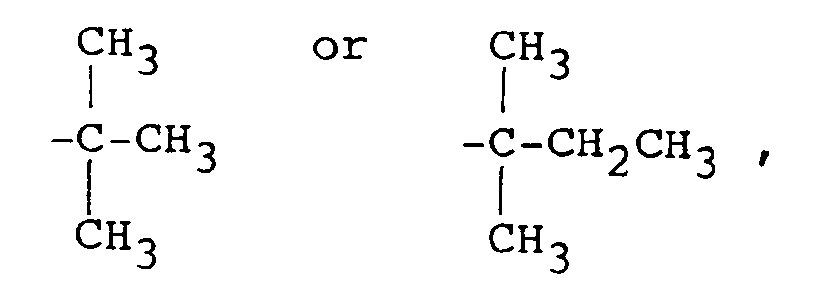
and X₂ denotes a hydrogen atom, an alkyl group having 1- 10 carbon atoms or an alkenyl group having 2 - 10 carbon atoms; and
a compound represented by the following formula (II):
wherein X₃ and X₄ respectively denote an alkyl group having 1 - 10 carbon atoms or an alkenyl group having 2 - 10 carbon atoms. - The present invention also provides a photosensitive member for electrophotography comprising: an electroconductive substrate, and a photosensitive layer disposed thereon comprising an organic photoconductor; the photosensitive layer containing, at least, a compound represented by the following formula (I):

wherein X₁ denotes
and X₂ denotes a hydrogen atom, an alkyl group having 1 - 10 carbon atoms or an alkenyl group having 2 - 10 carbon atoms;
a compound represented by the following formula (II):
wherein X₃ and X₄ respectively denote an alkyl group having 1 - 10 carbon atoms or an alkenyl group having 2 - 10 carbon atoms; and
a compound represented by the following formula (III):
wherein n and m respectively denote an integer of 10 - 20, and X₅ and X₆ respectively denote a hydrogen atom or an alkyl group having 1 - 10 carbon atoms. - The present invention further provides a photosensitive member for electrophotography comprising: an electroconductive substrate, and a photosensitive layer disposed thereon comprising an organic photoconductor; the photosensitive layer containing, at least, a compound represented by the following formula (I):
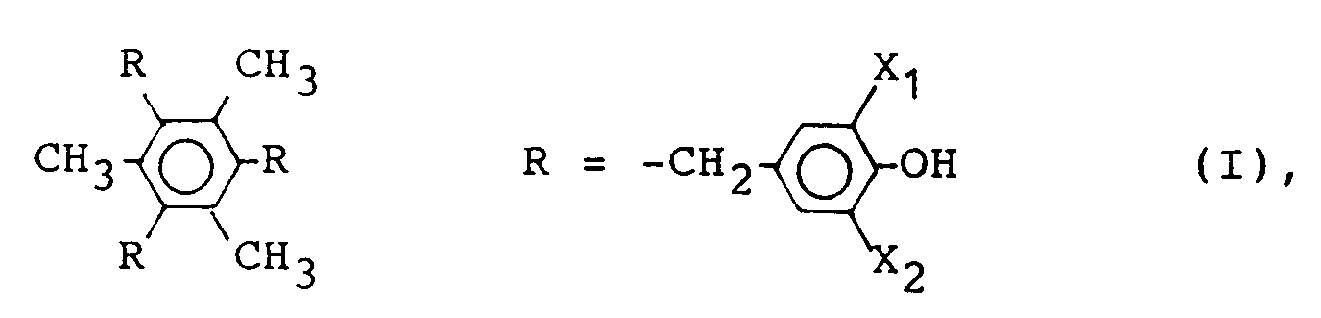
wherein X₁ denotes
and X₂ denotes a hydrogen atom, an alkyl group having 1 - 10 carbon atoms or an alkenyl group having 2 - 10 carbon atoms;
a compound represented by the following formula (II):
wherein X₃ and X₄ respectively denote an alkyl group having 1 - 10 carbon atoms or an alkenyl group having 2 - 10 carbon atoms;
a compound represented by the following formula (III):
wherein n and m respectively denote an integer of 10 - 20, and X₅ and X₆ respectively denote a hydrogen atom or an alkyl group having 1 - 10 carbon atoms; and
a compound represented by the following formula (IV):
wherein X denotes -S-, -S-S-, or -(CH₂)l or -(CH=CH)p-, wherein l denotes an integer of 0 - 10 and p denotes an integer of 1 - 5, and X₇ and X₈ respectively denote a hydrogen atom, an alkyl group having 1 - 10 carbon atoms or an alkenyl group having 2 - 10 carbon atoms. - These and other objects, features and advantages of the present invention will become more apparent upon a consideration of the following description of the preferred embodiments of the present invention taken in conjunction with the accompanying drawings.
- Figures 1 and 2 are schematic sectional views each showing a laminar structure of an embodiment of the electrophotographic photosensitive member according to the present invention.
- Hereinbelow, the present invention is described in detail.
- Referring to Figure 1, the electrophotographic photosensitive member according to the present invention comprises an
electroconductive substrate 2 and a photosensitive layer 1 comprising an organic photoconductor and at least two species of specific additives. - In the present invention, as the above-mentioned two species of additives, there are simultaneously used a phenol derivative having three hindered phenol groups which is known as a radical scavenger or antioxidant used in plastic or rubber; and a phosphite compound which is known as a hydroperoxide-decomposing agent. In a case where these two species of compounds are simultaneously used, the deterioration prevention mechanism is not necessarily clear but may be considered that these compounds show a synergistic effect on the prevention of photosensitive layer deterioration due to ozone or an active substance produced along the ozone, e.g., on the basis of the interaction between the hindered phenol group and the phosphite group.
- Specific examples of the phenol derivative represented by the above-mentioned formula (I) used in the present invention may include: 1,3,5-trimethyl-2,4,6-tris(3,5-di-t-butyl-4-hydroxybenzyl) benzene, 1,3,5-trimethyl-2,4,6-tris(3,5-di-t-amyl-4-hydroxybenzyl) benzene, 1,3,5-trimethyl-2,4,6-tris(3-t-butyl-5-methyl-4-hydroxybenzyl) benzene, 1,3,5-trimethyl-2,4,6-tris(3-t-amyl-5-isopropyl-4-hydroxybenzyl) benzene, 1,3,5-trimethyl-2,4,6-tris(3-t-amyl-5-(1-butenyl)-4-hydroxybenzyl)benzene, etc. The group X₂ in the formula (I) may preferably be an alkyl group having 1 - 5 carbon atoms or an alkenyl group having 2 - 5 carbon atoms, and may more preferably be

- Specific examples of the phosphite compound represented by the above-mentioned formula (II) used in the present invention may include: tris(2,4-di-t-butylphenyl)phosphite, tris(2,4-di-t-amylphenyl) phosphite, tris(2-t-butyl-4-methylphenyl)phosphite, tris(2-ethyl-4-methylphenyl)phosphite, tris(2-t-amyl-4-(1-butenyl)phenyl)phosphite, etc.
- Each of the groups X₃ and X₄ in the formula (II) may preferably be an alkyl group having 1 - 5 carbon atoms or an alkenyl group having 2 - 5 carbon atoms, and may more preferably be

- The total addition amount of these two species of compounds may preferably be 0.5 - 20 %, more preferably 2 - 15 % based on the total weight of a photosensitive layer (not including the two species of compounds per se) to which the two species of compounds are added. The mixing weight ratio of (phenol compound (I)): (phosphite compound (II)) may preferably be 0.1:1 to 1:0.1, more preferably 0.3:1 to 1:0.3. When the above-mentioned total addition amount is below 0.5 %, the deterioration prevention effect is not sufficient. When the total addition amount exceeds 20 %, ill effect such as decrease in sensitivity and increase in residual potential is liable to occur.
- In the present invention, when a sulfide compound represented by the above-mentioned formula (III), which is known as a hydroperoxide-decomposing agent is added to the photosensitive layer, in addition to the above-mentioned two species of compounds (I) and (II), better effect is achieved.
- Specific examples of the sulfide compound (III) may include: dilauryl-3,3′-thiodipropionate, ditridecyl-3,3′-thiodipropionate, dimyristyl-3,3′-thiodipropionate, lauryl-stearyl-3,3′-thiodipropionate, distearyl-3,3′-thiodipropionate, distearyl-3,3′-methyl-3,3′-thiodipropionate, distearyl-3-ethyl-3-methyl-3,3′-thiodipropionate, etc.
- Each of the integers n and m in the formula (III) may preferably be an integer of 12 - 18, and each of the groups X₅ and X₆ may preferably be a hydrogen atom or an alkyl group having 1 - 4 carbon atoms. In a particularly preferred embodiment, X₅ and X₆ are respectively H (a hydrogen atom), and n and m are respectively an integer of 12, 14 or 18.
- The total addition amount of these three species of compounds may preferably be 0.5 - 20 %, more preferably 2 - 15 % based on the total weight of a photosensitive layer (not including the three species of compounds) to which the three species of compounds are added. The mixing weight ratio of (phenol compound (I)): (phosphite compound (II)): (sulfide compound (III)) may preferably be 1:(0.2 to 5):(0.2 to 5), more preferably 1:(0.5 to 2):(0.5 to 2).
- In the present invention, when a pyridine compound as a basic compound represented by the above-mentioned formula (IV) is added to the photosensitive layer, in addition to the above-mentioned three species of compounds (I), (II) and (III) (i.e., the above-mentioned four species of compounds (I) (II) (III) and (IV) are simultaneously used), further preferred effect is achieved.
- In a case where these four species of compounds are simultaneously used, the deterioration prevention mechanism is not necessarily clear at present but may be considered that these compounds show a synergistic effect on the prevention of photosensitive layer deterioration due to ozone or an active substance produced along therewith. More specifically, it may be considered that the interaction among the hindered phenol group, phosphite group and sulfide compound has an effect on a radical-type deteriorating factor such as ozone and NOx among those produced by conona discharge, and the pyridine compound as a basic compound catches an acidic substance such as HNO₃ and HNO₂ among the deteriorating substances.
- Specific examples of the pyridine compound represented by the above-mentioned formula (IV) used in the present invention may include: 2,2′-bipyridyl, 4,4′-bipyridyl, 1,2-di(2-pyridyl)ethane, 1,3-di-4-pyridylpropane, di-2-pyridylsulfide, di-2-pyridyldisulfide, 1,2-di-4-pyridylethylene, 5-t-butyl-2(3′-ethyl-2′-pyridyl)pyridine, 5-methyl-2(5′-ethyl-2′-pyridyl)pyridine, 5-isopropyl-2(2′-butenyl-4′-pyridyl)pyridine, etc.
- In a preferred embodiment, in the formula (IV), l is an integer of 0 - 4, p is an integer of 1 - 3, X₇ and X₈ are respectively H (hydrogen atom), an alkyl group having 1 - 4 carbon atoms, or an alkenyl group having 2 - 4 carbon atoms. In a particularly preferred embodiment, x is -(CH₂)l- wherein l is an integer of 0 - 3, and X₇ and X₈ are respectively H (hydrogen atom).
- The total addition amount of these four species of compounds may preferably be 0.5 - 20 %, more preferably 2 - 15 % based on the total weight of a photosensitive layer (not including the four species of compounds) to which the four species of compounds are added. The mixing weight ratio of (phenol compound (I)): (phosphite compound (II)) (sulfide compound (III)):(pyridine compound (IV)) may preferably be 1:(0.2 to 5):(0.2 to 5):(0.05 to 2), more preferably 1:(0.5 to 2):(0.5 to 2):(0.1 to 1). When the above-mentioned total addition amount is below 0.5 %, the deterioration prevention effect is not sufficient. When the total addition amount exceeds 20 %, ill effect such as decrease in sensitivity and increase in residual potential is liable to occur.
- In the present invention, the photosensitive layer 1 comprising an organic photoconductor is disposed on an
electroconductive substrate 2, as shown in Figure 1. The photosensitive layer 1 may take a single layer form as shown in Figure 1, or a laminate layer form as shown in Figure 2, etc. In the embodiment shown in Figure 1, the photosensitive layer 1 comprises a charge-generatingmaterial 3 and a charge-transporting material (not shown) which is function-separated from the charge-generatingmaterial 3 and mixed in the same layer as the charge-generatingmaterial 3. In the embodiment shown in Figure 2, the photosensitive layer 1 comprises acharge generation layer 4 comprising a charge-generatingmaterial 3, and acharge transport layer 5 comprising a charge-transporting material (not shown). - The charge-generating material to be used in the present invention may be an organic photoconductor such as pyrylium or thiopyrylium-type dye, phthalocyanine-type pigment, anthanthrone pigment, perylene pigment, dibenzpyrene-quinone pigment, pyranthrone pigment, azo pigment, indigo pigment, and quinacridone-type pigment.
- The charge-transporting material to be used in the present invention may be an organic photoconductor such as pyrazoline-type compound, hydrazone-type compound, stilbene-type compound, triphenylamine-type compound, benzidine-type compound, oxazole-type compound, indole-type compound, and carbazole-type compound.
- In the case of a single layer-type photosensitive layer 1 as shown in Figure 1, a coating liquid obtained by dissolving or dispersing the above-mentioned charge-generating
material 3 and charge-transporting material in a solvent, together with an appropriate binder resin as desired, is applied onto anelectroconductive substrate 2 and then dried, thereby to form the photosensitive layer 1. In such an embodiment, the thickness of the photosensitive layer 1 may preferably be 8 - 40 microns, more preferably 10 - 30 microns. The above-mentioned additives according to the present invention are contained in the single layer-type photosensitive layer 1. - In an embodiment wherein the photosensitive layer 1 is a laminate-type comprising plural layers, the photosensitive member according to the present invention comprises: (1) an
electroconductive substrate 2, and acharge generation layer 4 and acharge transport layer 5 disposed in this order on thesubstrate 2 as shown in Figure 2; or (2) an electroconductive substrate, and a charge transport layer and a charge generation layer disposed in this order on the substrate (not shown). - In the case of (1), a coating liquid obtained by dissolving or dispersing a charge-generating
material 3 in a solvent, together with a binder resin as desired, is applied onto aconductive substrate 2 and then dried, thereby to form acharge generation layer 4. Thecharge generation layer 4 may also be formed by vacuum vapor deposition such as vacuum evaporation and sputtering. The thickness of thecharge generation layer 4 may preferably be 5 microns or below, more preferably 0.01 - 3 microns. In such an embodiment, thecharge generation layer 4 can be formed by using an inorganic photoconductor such as selenium and amorphous silicon. - The
charge transport layer 5 may be disposed on the above-mentionedcharge generation layer 4 by use of a coating liquid obtained by dissolving or dispersing the above-mentioned charge-transporting material in a solvent, together with a binder resin having a film-formability as desired. The thickness of thecharge transport layer 5 may preferably be 5 - 40 microns, more preferably 8 - 35 microns. In such an embodiment, the above-mentioned additives according to the present invention may preferably be contained in thecharge transport layer 5. - In the case of (2) wherein the
charge generation layer 4 is disposed on thecharge transport layer 5, these layers may be formed by the application of the above-mentioned organic photoconductor (i.e., a charge-generating material or charge-transporting material), together with a binder resin as desired. In such an embodiment, it is preferred that the charge-transporting material is also contained in thecharge generation layer 4. In such an embodiment, the above-mentioned additives according to the present invention may preferably be contained in thecharge generation layer 4 or both of thecharge generation layer 4 and thecharge transport layer 5. - The electroconductive substrate or
support 2 may be a known one including a member in the form of a cylinder or a belt comprising a metal such as aluminum, an aluminum alloy, iron, and copper; a member comprising such a metal and having thereon an electroconductive layer; or a member comprising a plastic film having thereon a vapor-deposited metal layer. - In the present invention, an intermediate layer such as adhesive layer, barrier layer or smoothing layer may be disposed, as desired, between the
conductive substrate 2 and the photosensitive layer 1. - In the electrophotographic photosensitive member according to the present invention, a lubricant including lubricant powder such as fluorine-containing resin powder, polyolefin-type resin powder, and silicone-type resin powder can be added to the photosensitive layer 1. In such an embodiment wherein the above-mentioned additives (i.e., compound (I) and (II)) are used in the photosensitive layer 1 in combination with the lubricant, better effect is achieved with respect to both of chemical deterioration and physical deterioration.
- The electrophotographic photosensitive member according to the present invention may be used in ordinary copying machines and may also be used as a photosensitive member in various apparatus such as laser beam printer, LED printer, LCD printer and CRT printer to which an electrophotographic process is applied.
- The present invention will be explained more specifically with reference to examples.
- A 5 % solution of a polyamide resin (trade name: Amilan CM-8000, mfd. by Toray K.K.) in methanol was applied onto an electroconductive substrate of an aluminum cylinder having a diameter of 80 mm and a length of 360 mm by dip coating and then dried, thereby to form a 0.5 micron-thick primer (or undercoat) layer.
- Next, 10 parts (parts by weight, the same in the description appearing hereinafter) of a trisazo pigment represented by the following structural formula, and 6 parts of a polyvinyl butyral resin (S-LEC BL-S, mfd. by Sekisui Kagaku K.K.) were dispersed 20 in 50 parts of cyclohexanone by means of a sand mill using glass beads.

- To the resultant dispersion, 100 parts of methyl ethyl ketone was added, and then the dispersion was applied onto the above-mentioned primer layer and dried, thereby to form a 0.2 micron-thick charge generation layer.
- Then, 10 parts of a stilbene compound represented by the following structural formula, and 10 parts of a polycarbonate resin (Panlite L-1250, mfd. by Teijin Kasei K.K.) were dissolved in 50 parts of dichloromethane and 10 parts of monochlorobenzene, thereby to prepare a coating liquid for a charge transport layer.

- To the resultant coating liquid, 1,3,5-trimethyl-2,4,6-tris(3,5,-di-t-butyl-4-hydroxybenzyl) benzene (THBZ-1) represented by the following structural formula (trade name: Irganox 1330, mfd. by Nihon Ciba-Geigy K.K.):

and tris(2,4-di-t-butylphenyl) phosphite (TBP-1) represented by the following formula (trade name: Irgafos 168, mfd. by Nihon Ciba-Geigy K.K.):
were added in various addition amounts as shown in Table 1 appearing hereinafter, thereby to prepare six species of coating liquids. More specifically, the total addition amount was 0.4 part or 2 part, and the mixing ratio was 1:1, 0.5:1, and 1:0.5 with respect to the respective addition amounts. - Each of the thus prepared six species of coating liquids was applied onto the above-mentioned charge generation layer to form a 18 micron-thick charge transport layer, whereby six species of photosensitive member Nos. 1 to 6 as shown in Table 1 were obtained.
- Further, five species of photosensitive member Nos. 7 - 11 as comparative samples as shown in Table 1 were prepared in the following manner. More specifically, the photosensitive member No. 7 was prepared by using no additive, the photosensitive member Nos. 8 and 9 were prepared by adding THBZ-1 alone in amounts of 0.4 part and 2 parts, respectively, and the photosensitive member Nos. 10 and 11 were prepared by adding TBP-1 alone in amounts of 0.4 part and 2 parts, respectively.
- Each of the thus prepared photosensitive member Nos. 1 - 11 was assembled in an electrophotographic copying machine (trade name: CLC 1, mfd. by Canon K.K.) and the characteristics thereof were evaluated in the following manner.
- Thus, a latent image was formed on the photosensitive member under a condition such that the dark part potential (VD) of the photosensitive member was -650 V and the light part potential (VL) thereof was -150 V. The light quantity (lux.sec) for image exposure providing such a latent image was measured and defined as "initial sensitivity". Then, after successive copying of 5,000 sheets, the above-mentioned potentials VD and VL were measured and the decrease rate (%) in VD and increase (V) in VL on the basis of the above-mentioned initial values were determined.
- Thereafter, the photosensitive member was left standing in the copying machine for 10 hours, and the surface potential of the photosensitive member was measured. At this time, a portion of the photosensitive member disposed under a corona charger was marked and the difference in VD (ΔVD) between this portion and the other portion was determined.
- Further, successive copying of 5,000 sheets (10,000 sheets in total) was conducted and then the above-mentioned measurements were conducted in the same manner as in the case of the successive copying of 5,000 sheets. In this case, ΔVD was measured so that the portion of the photosensitive member disposed under the corona charger was the same as that used in the case of the successive copying of 5,000 sheets. The thus obtained results are shown in the following Table 1.
- Further, photosensitive member Nos. 12 - 18 were prepared by variously changing the mixing ratio and addition amount of the additives as shown in Table 2 appearing hereinafter, and the above-mentioned evaluations were conducted. The results are shown in Table 2. In the above-mentioned Tables 1 and 2, the addition amount of the additive is the weight ratio thereof to the total weight of the photosensitive layer (not including the additive per se), i.e., the weight of the charge transport layer in this instance.


- As apparent from the above Tables 1 and 2, in the photosensitive members according to the present invention wherein the photosensitive layer contains specific two species of additives, the decrease in the dark part potential is small and the effect on the prevention of deterioration is excellent, in a successive electrophotographic process. Particularly, the deterioration in a photosensitive member portion disposed under a corona charger is very little. Further, ill effect on the electrophotographic characteristic such as an increase in the light part potential is substantially none.
- On the contrary, in the photosensitive members not containing the above-mentioned additive, the dark park potential is considerably decreased due to deterioration, and the photosensitive member portion disposed under the corona charger is also considerably deteriorated, in a successive electrophotographic process. Further, when either one of the specific two species of additives is added, somewhat improvement in deterioration is effected as compared with the case of a photosensitive member containing no additive, but such improvement is not sufficient as compared with the photosensitive member according to the present invention.
- A primer layer was formed on an electroconductive substrate by coating in the same manner as in Example 1.
- Separately, 10 parts of a disazo pigment represented by the following structural formula, and 6 parts of a polyvinyl butyral resin (S-LEC BX-1, mfd. by Sekisui Kagaku K.K.) were dispersed in 50 parts of cyclohexanone by means of a sand mill using glass beads.

- To the resultant dispersion, 100 parts of tetrahydrofuran was added, and then the dispersion was applied onto the primer layer and dried thereby to form a 0.2 micron-thick charge generation layer.
- Then, 8 parts of a benzocarbazole compound represented by the following structural formula, and 10 parts of a styrene-acrylic copolymer resin (Estyrene MS-200, mfd. by Shin-Nihon Seitetsu Kagaku K.K.),

0.36 part of 1,3,5-trimethyl 
and 0.36 part of tris(2,4-di-t-amylphenyl)phosphite (TBP-2) (i.e., total amount of additives = 0.72 part, mixing ratio = 1:1):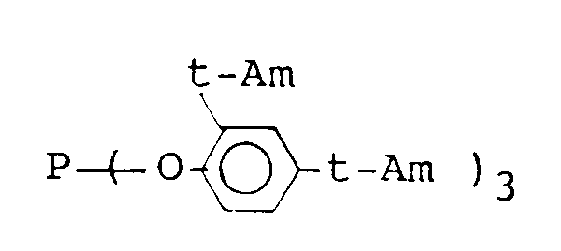
were dissolved in 15 parts of dichloromethane and 45 parts of monochlorobenzene, thereby to prepare a coating liquid for a charge transport layer. The thus prepared coating liquid was then applied onto the above-mentioned charge generation layer to form a 18 micron-thick charge transport layer, whereby a photosensitive member No. 19 was prepared. - On the other hand a comparative photosensitive member No. 20 was prepared in the same manner as described above except for using no THBZ-2 or TBP-2. Further, comparative photosensitive member Nos. 21 - 34 were prepared in the same manner as described above except for using an additive as shown in the following Table 3, singly or as a mixture (mixing ratio = 1:1).


- With respect to the thus prepared photosensitive member Nos. 21 - 34, electrophotographic characteristics were evaluated in the same manner as in Example 1. Further, the light quantity providing initial potentials of VD = -650 V and VL = -150 V was measured. The results are shown in the following Table 4.


- As shown in the above Table 4, the photosensitive member containing specific two species of additives according to the present invention provides a small change in the potential and is excellent in prevention of deterioration. On the contrary, when another additive or another combination of additives is used, the prevention of deterioration is not sufficient or ill effect becomes considerable.
- A primer layer was formed on an electroconductive substrate by coating in the same manner as in Example 1.
- Separately, 15 parts of a stilbene compound represented by the following structural formula, and 10 parts of a polycarbonate resin (Panlite L-1250, mfd. by Teijin Kasei K.K.) were dissolved in 50 parts of dichloromethane and 10 parts of monochlorobenzene, thereby to prepare a coating liquid for a charge transport layer. The thus prepared coating liquid was applied onto the primer layer to form a 15 micron-thick charge transport layer.

- Then, 4 parts of a disazo pigment represented by the following structural formula:

7 parts of the above-mentioned stilbene compound, 10 parts of the above-mentioned polycarbonate resin, 0.315 part of THBZ-1, and 0.315 part of TBP-1 (total amount of additives = 0.63 part, mixing ratio = 1:1) were dissolved or dispersed in 150 parts of dichloromethane and 50 parts of monochlorobenzene to form a coating liquid. - The thus prepared coating liquid was then applied onto the above-mentioned charge transport layer by spraying to form a 5 micron-thick charge generation layer, whereby a photosensitive member No. 35 was prepared.
- On the other hand a comparative photosensitive member No. 36 was prepared in the same manner as described above except for using no THBZ-1 or TBP-1.
- The thus prepared photosensitive members were evaluated in the same manner as described hereinabove except that evaluation conditions were set so that VD = +650 V and VL = +150 V were provided under positive charging. The results are shown in Table 5 appearing hereinafter.
- A primer layer was formed on an electroconductive substrate by coating in the same manner as in Example 1.
- Separately, 1 parts of a disazo pigment represented by the following structural formula:

10 parts of the benzocarbazole compound used in Example 2, 10 parts of a polycarbonate resin (Panlite L-1250, mfd. by Teijin Kasei K.K.), 0.15 part of 1,3,5-trimethyl-2,4,6-tris(3-t-amyl-5-t-butyl-4-hydroxybenzyl)benzene (THBZ-3):
and 0.15 part of tris(2-t-amyl-4-t-butylphenyl)phosphite (TBP-3) (i.e., total amount of additives = 0.3 part, mixing ratio = 1:1):
were dissolved or dispersed in 60 parts of dichloromethane and 20 parts of monochlorobenzene, thereby to prepare a coating liquid. The thus prepared coating liquid was then applied onto the above-mentioned primer layer to form a 16 micron-thick photosensitive layer, whereby a photosensitive member No. 37 was prepared. - On the other hand a comparative photosensitive member No. 38 was prepared in the same manner as described above except for using no THBZ-3 or TBP-3.
- The thus prepared photosensitive members were evaluated in the same manner as in Example 3. The results are shown in the following Table 5.

- Photosensitive member Nos. 39 - 47 were prepared in the same manner as in Example 1 except for using two species of additives as shown in the following Table 6 in a mixture (mixing ratio = 1:1, total addition amount = 10 %). The results are shown in Table 7 appearing hereinafter.


- A photosensitive member No. 48 was prepared in the same manner as in Example 1 except that 1,3,5-trimethyl-2,4,6-tris(3,5-di-t-butyl-4-hydroxybenzyl)benzene (THBZ-1), tris(2,4-di-t-butylphenyl)phosphite (TBP-1), and distearyl-3,3′-thiodipropionate (TP-1):

(Sumilizer TPS: mfd. by Sumitomo Kagaku Kogyo K.K.) were used as additives at a mixing ratio of 1:1:2 and in a total addition amount of 10 %. - Further, a photosensitive member No. 49 was prepared in the same manner as described above except that dimyristyl-3,3′-thiodipropionate (TP-2):

(Sumilizer TPM: mfd. by Sumitomo Kagaku Kogyo K.K.) was used instead of the above-mentioned TP-1. - Further, a photosensitive member No. 50 was prepared in the same manner as described above except that lauryl-
stearyl 
was used instead of the above-mentioned TP-1. - Further, photosensitive member Nos. 51 and 52 were prepared in the same manner as in the preparation of the photosensitive member No. 48 except that the mixing ratio of the above-mentioned three species of additives were 1:0.8:1.5, and 1:1.5:0.8, respectively.
- The thus prepared photosensitive members were evaluated in the same manner as in Example 1. The results are shown in the following Table 8. In Table 8, the results of evaluation of the photosensitive member No. 2 containing two species of additives (THBZ-1 and TBP-1), and those of a photosensitive member No. 53 containing 10 % of TP-1 alone are inclusively shown.

- As described above, when a specific additive is added to a photosensitive layer in addition to the above-mentioned two species of additives according to the present invention, the decrease in the dark part potential is further reduced and the deterioration in a photosensitive member portion disposed under a corona charger is further suppressed.
- The photosensitive member No. 2, 7 and 19 prepared in Examples 1 and 2, and the photosensitive member No. 48 prepared in Example 6, were further subjected to 40,000 sheets of copying in addition to 10,000 sheets of copying conducted in the above-mentioned evaluation.
- As a result, with respect to the photosensitive member Nos. 2, 19 and 48 containing the specific additives, even after the above-mentioned 50,000 sheets of copying, there was substantially no decrease in image quality as compared with the initial stage, and there were obtained images stably retaining a high contrast and being free of unevenness. On the other hand, with respect to the photosensitive member No. 7, the image density was remarkably decreased at the time of about 15,000 sheets of successive copying. Further, in the photosensitive member No. 7, only images with considerable unevenness were obtained due to potential decrease which was caused in downtime after completion of copying.
- A 5 % solution of a polyamide resin (trade name: Amilan CM-8000, mfd. by Toray K.K.) in methanol was applied onto an electroconductive substrate of an aluminum cylinder having a diameter of 80 mm and a length of 360 mm by dip coating and then dried thereby to form a 0.5 micron-thick primer layer.
- Next, 10 parts (parts by weight, the same in the descriptoin appearing hereinafter) of a trisazo pigment as a charge-generating material represented by the following structural formula, and 6 parts of a polyvinyl butyral resin (S-LEC BL-S, mfd. by Sekisui Kagaku K.K.) were dispersed in 50 parts of cyclohexanone by means of a sand mill using glass beads.

- To the resultant dispersion, 100 parts methyl ethyl ketone of was added, and then the dispersion was applied onto the primer layer and dried thereby to form a 0.2 micron-thick charge generation layer.
- Then, 10 parts of a stilbene compound represented by the following structural formula, and 10 parts of a polycarbonate resin (Panlite L-1250, mfd. by Teijin Kasei K.K.) were dissolved in 50 parts of dichloromethane and 10 parts of monochlorobenzene, thereby to prepare a coating liquid for a charge transport layer.

- To the resultant coating liquid, 1,3,5-trimethyl-2,4,6-tris(3,5,-di-t-butyl-4-hydroxybenzyl) benzene (THBZ-1) represented by the following structural formula (trade name: Irganox 1330, mfd. by Nihon Ciba-Geigy K.K.):
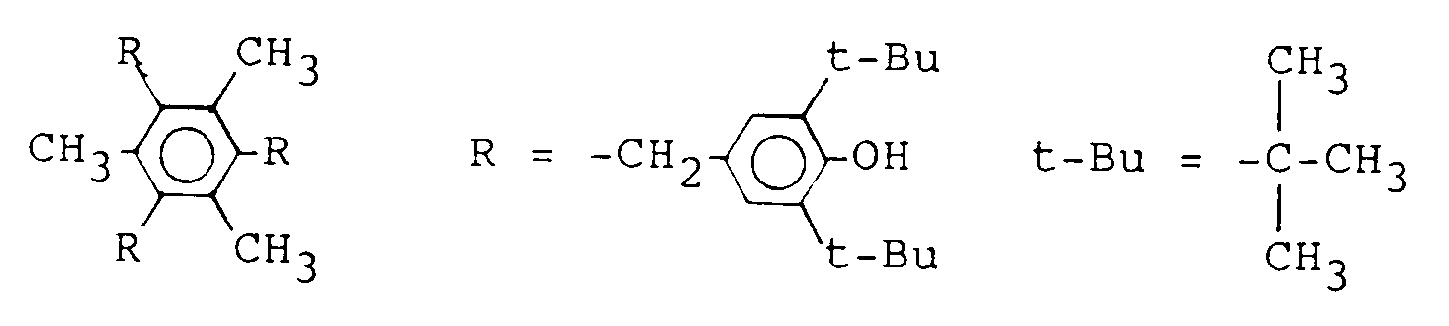
and tris(2,4-di-t butylphenyl) phosphite (TBP-1) represented by the following formula (trade name: Irgafos 168, mfd. by Nihon Ciba-Geigy K.K.):
distearyl-3,3′-thiodipropionate (TP-1):
(Sumilizer TPS: mfd. by Sumitomo Kagaku Kogyo K.K.) and 1,3-di-4-pyridylpropane (DPy-1):
were added in various addition amounts as shown in Table 9 appearing hereinafter, thereby to prepare six species of coating liquids. More specifically, the total addition amount was 0.4 part or 2 parts, and the mixing ratio was 1:1:1:0.1, 1:1:1:0.05, and 1:1:1:0.2 with respect to the respective addition amounts. - Each of the thus prepared six species of coating liquids was applied onto the above-mentioned charge generation layer to form a 18 micron-thick charge transport layer, whereby six species of photosensitive member Nos. 54 to 59 as shown in Table 9 were obtained.
- Further, five species of photosensitive member Nos. 60 - 64 as comparative samples as shown in Table 9 were prepared in the same manner as described above except those as described below. More specifically, the photosensitive member No. 60 was prepared by using no additive, the photosensitive member Nos. 61 and 62 were prepared by adding THBZ-1, TBP-1, and TP-1 at a mixing ratio of 1:1:1 in total addition amounts of 0.4 part and 2 parts, respectively, and the photosensitive member Nos. 63 and 64 were prepared by adding DPy-1 alone in amounts of 0.4 part and 2 parts, respectively.
- Each of the thus prepared photosensitive member Nos. 54 - 64 was assembled in an electrophotographic copying machine (trade name: CLC 1, mfd. by Canon K.K.) and the characteristics thereof were evaluated in the following manner.
- Thus, a latent image was formed on the photosensitive member under a condition such that the dark part potential (VD) of the photosensitive member was -650 V and the light part potential (VL) thereof was -150 V. The light quantity (lux.sec) for image exposure providing such a latent image was measured and defined as "initial sensitivity". Then, after successive copying of 5,000 sheets, the above-mentioned potentials VD and VL were measured and the decrease rate (%) in VD and increase (V) in VL on the basis of the above-mentioned initial values were determined.
- Thereafter, the photosensitive member was left standing in the copying machine for 10 hours, and the surface potential of the photosensitive member was measured. At this time, a portion of the photosensitive member disposed under a corona charger was marked and the difference in VD (ΔVD) between this portion and the other portion was determined.
- Further, successive copying of 5,000 sheets (10,000 sheets in total) was conducted and then the photosensitive member was left standing in the copying machine for one week. Thereafter, the above-mentioned measurement of surface potential was conducted in the same manner as in the case of the successive copying of 5,000 sheets. In this case, ΔVD was measured so that the portion of the photosensitive member disposed under the corona charger was the same as that used in the case of the successive copying of 5,000 sheets. The thus obtained results are shown in the following Table 9.

- As apparent from the above Table 9, in the photosensitive members according to the present invention wherein the photosensitive layer contains specific four species of additives, the decrease in the dark part potential is small and the effect on the prevention of deterioration is excellent, in a repeated electrophotographic process. Particularly, the deterioration in a photosensitive member portion disposed under a corona charger is very little, even after long-term standing. Further, ill effect on the electrophotographic characteristic such as an increase in the light part potential is substantially none.
- On the contrary, in the photosensitive members not containing the above-mentioned additive, the dark park potential is considerably decreased due to deterioration, and the photosensitive member portion disposed under the corona charger is also considerably deteriorated, in a successive electrophotographic process.
- A primer layer was formed on an electroconductive substrate by coating in the same manner as in Example 8.
- Separately, 10 parts of a disazo pigment as a charge-generating material represented by the following structural formula, and 6 parts of a polyvinyl butyral resin (S-LEC BX-1, mfd. by Sekisui Kagaku K.K.) were dispersed in 50 parts of cyclohexanone by means of a sand mill using glass beads.

- To the resultant dispersion, 100 parts of tetrahydrofuran was added, and then the dispersion was applied onto the primer layer and dried thereby to form a 0.2 micron-thick charge generation layer.
- Then, 8 parts of a benzocarbazole compound as a charge-transporting material represented by the following structural formula, and 10 parts of a styrene-acrylic copolymer resin (Estyrene MS-200, mfd. by Shin-Nihon Seitetsu Kagaku K.K.);

and four species of additives including 1,3,5-trimethyl-2,4,6-tris(3,5-di-t-amyl-5-hydroxybenzyl) benzene (THBZ-2):
tris(2,4-di-t-amylphenyl)phosphite (TBP-2)
dimyristyl-3,3′-thiodipropionate (TP-2):
(Sumilizer TPM: mfd. by Sumitomo Kagaku Kogyo K.K.) and 4,4′-bipyridyl (DPy-2):
(total amount of additives = 0.72 part, mixing ratio = 1:1:1:0.3) were dissolved in 15 parts of dichloromethane and 45 parts of monochlorobenzene, thereby to prepare a coating liquid for a charge transport layer. The thus prepared coating liquid was then applied onto the above-mentioned charge generation layer to form a 18 micron-thick charge generation layer, whereby a photosensitive member No. 65 was prepared. - Further, photosensitive member Nos. 66 and 67 were prepared in the same manner as described above except for using these additives at mixing ratios of 1:0.5:0.5:0.1, and 1:2:2:1.
- On the other hand, a comparative photosensitive member No. 68 was prepared in the same manner as described above except for using none of these four species of additives.
- The thus prepared photosensitive member Nos. 65 - 68 were evaluated in the same manner as in Example 8. The results are shown in the following Table 10.

- As shown in the above Table 10, the photosensitive member containing specific four species of additives according to the present invention provides a small change in the potential and is excellent in prevention of deterioration.
- A primer layer was formed on an electroconductive substrate by coating in the same manner as in Example 8.
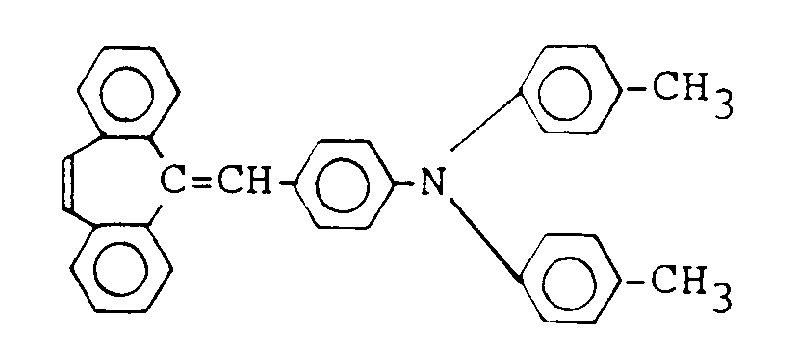
- Separately, 15 parts of a stilbene compound represented by the following structural formula, and 10 parts of a polycarbonate resin (Panlite L-1250, mfd. by Teijin Kasei K.K.) were dissolved in 50 parts of dichloromethane and 10 parts of monochlorobenzene, thereby to prepare a coating liquid for a charge transport layer. The thus prepared coating liquid was applied onto the primer layer to form a 15 micron-thick charge transport layer.
- Then, 4 parts of a disazo pigment represented by the following structural formula:

7 parts of the above-mentioned stilbene compound, 10 parts of the above-mentioned polycarbonate resin; and THBZ-1, TBP-1, TP-1 and DPy-1 (total amount of additives = 0.63 part, mixing ratio = 1:1:1:0.2) were dissolved or dispersed in 150 parts of dichloromethane and 50 parts of monochlorobenzene to prepare a coating liquid. - The thus prepared coating liquid was then applied onto the above-mentioned charge transport layer by spraying to form a 5 micron-thick charge generation layer, whereby a photosensitive member No. 69 was prepared.
- On the other hand, a comparative photosensitive member No. 70 was prepared in the same manner as described above except for using none of these four species of additives.
- The thus prepared photosensitive members were evaluated in the same manner as described above except that evaluation conditions were set so that VD = +650 V and VL = +150 V were provided under positive charging. The results are shown in Table 11 appearing hereinafter.
- A primer layer was formed on an electroconductive substrate by coating in the same manner as in Example 8.
- Separately, 1 parts of a disazo pigment represented by the following structural formula:

10 parts of the benzocarbazole compound used in Example 9, 10 parts of a polycarbonate resin (Panlite L-1250, mfd. by Teijin Kasei K.K.); and four species of additive including 1,3,5-trimethyl-2,4,6-tris(3-t-amyl-5-t-butyl-4-hydroxybenzyl)benzene (THBZ-3):
tris(2-t-amyl-4-t-butylphenyl)phosphite (TBP-3):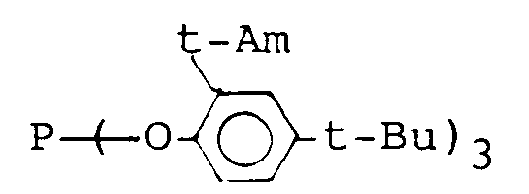
lauryl-stearyl-3,3′-thiodipropionate (TP-3):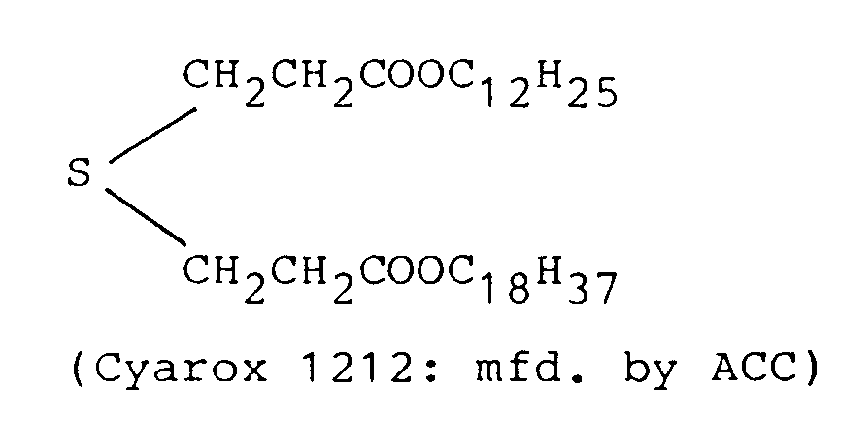
and 1,2-di(2-pyridyl)ethane (DPy-3):
(total amount of additives = 0.42 part, mixing ratio = 1:1:1:0.1) were dissolved or dispersed in 60 parts of dichloromethane and 20 parts of monochlorobenzene, thereby to prepare a coating liquid. The thus prepared coating liquid was then applied onto the above-mentioned primer layer to form a 16 micron-thick photosensitive layer, whereby a photosensitive member No. 71 was prepared. - On the other hand, a comparative photosensitive member No. 72 was prepared in the same manner as described above except for using none of these four species of additives.
- The thus prepared photosensitive members were evaluated in the same manner as in Example 10. The results are shown in the following Table 11.

- Photosensitive member Nos. 73 - 77 were prepared in the same manner as in Example 8 except for using additives used in Example 8 and those as shown in the following Table 12 in a mixture (mixing ratio = 1:1:1:0.1, total addition amount = 10 %). The results are shown in Table 13 appearing hereinafter.


- The photosensitive member Nos. 55, 60 and 65 prepared in Examples 8 and 9, and the photosensitive member No. 77 prepared in Example 12, were further subjected to 40,000 sheets of copying in addition to the 10,000 sheets of copying conducted in the above-mentioned evaluation.
- As a result, with respect to the photosensitive member Nos. 55, 65 and 77, even after the above-mentioned 50,000 sheets of copying, there was substantially no decrease in image quality as compared with the initial stage, and there were obtained images stably retaining a high contrast and being free of unevenness. On the other hand, with respect to the photosensitive member No. 60, the image density was remarkably decreased at the time of about 15,000 sheets of successive copying. Further, in the photosensitive member No. 60, only images with considerable unevenness were obtained due to potential decrease which was caused in downtime after completion of copying.
Claims (42)
- A photosensitive member for electrophotography comprising: an electroconductive substrate, and a photosensitive layer disposed thereon comprising an organic photoconductor; said photosensitive layer containing, at least, a compound represented by the following formula (I):
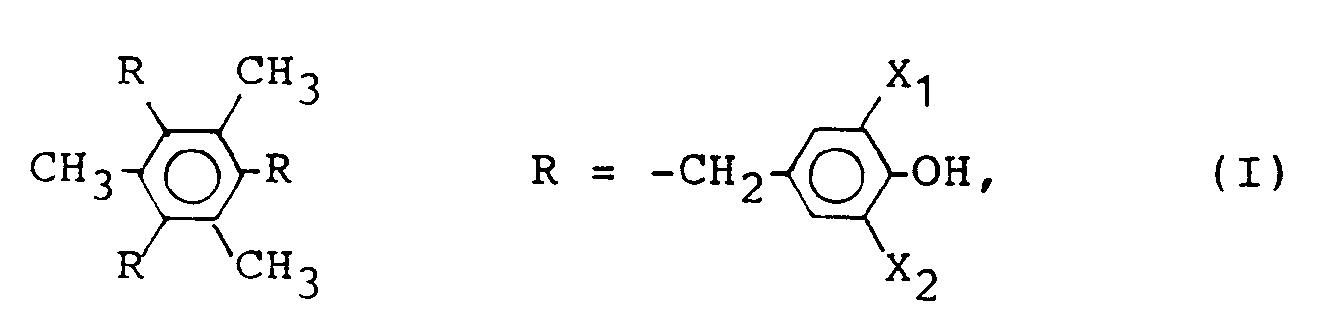

a compound represented by the following formula (II):
- A photosensitive member according to Claim 1, wherein X₂ in the formula (I) is an alkyl group having 1 - 5 carbon atoms or an alkenyl group having 2 - 5 carbon atoms, and X₃ and X₄ in the formula (II) are respectively an alkyl group having 1 - 5 carbon atoms or an alkenyl group having 2 - 5 carbon atoms.
- A photosensitive member according to Claim 1, wherein the compound represented by the formula (I) is selected from the group consisting of: 1,3,5-trimethyl-2,4,6-tris(3,5-di-t-butyl-4-hydroxybenzyl)benzene, 1,3,5-trimethyl-2,4,6-tris(3,5-di-t-amyl-4-hydroxybenzyl)benzene, 1,3,5-trimethyl-2,4,6-tris(3-t-butyl-5-methyl-4-hydroxybenzyl)benzene, 1,3,5-trimethyl-2,4,6-tris(3-t-amyl-5-isopropyl-4-hydroxybenzyl)benzene, and 1,3,5-trimethyl-2,4,6-tris(3-t-amyl-5-(1-butenyl)-4-hydroxybenzyl)benzene; and the compound represented by the formula (II) is selected from the group consisting of: tris(2,4-di-t-butylphenyl)phosphite, tris(2,4-di-t-amylphenyl)phosphite, tris(2-t-butyl-4-methylphenyl)phosphite, tris(2-ethyl-4-methylphenyl)phosphite, and tris(2-t-amyl-4-(1-butenyl)phenyl)phosphite.
- A photosensitive member according to Claim 1, wherein X₂ in the formula (I) is


- A photosensitive member according to Claim 1, wherein the total amount of the compounds (I) and (II) contained in the photosensitive layer is 0.5 - 20 wt. % based on the total weight of the photosensitive layer not including the weight of the compound (I) or (II).
- A photosensitive member according to Claim 5, wherein the total amount of the compounds (I) and (II) contained in the photosensitive layer is 2 - 15 wt. % based on the total weight of the photosensitive layer not including the weight of the compound (I) or (II).
- A photosensitive member according to Claim 1, wherein the mixing wt. ratio between the compounds (I) and (II) contained in the photosensitive layer is 0.1:1 to 1:0.1.
- A photosensitive member according to Claim 7, wherein the mixing wt. ratio between the compounds (I) and (II) contained in the photosensitive layer is 0.3:1 to 1:0.3.
- A photosensitive member according to Claim 1, wherein the photosensitive layer comprises a single layer.
- A photosensitive member according to Claim 1, wherein the photosensitive layer has a laminate structure comprising a charge generation layer and a charge transport layer.
- A photosensitive member according to Claim 10, wherein the charge transport layer is disposed on the charge generation layer, and said compounds (I) and (II) are contained in the charge transport layer.
- A photosensitive member according to Claim 10, wherein the charge generation layer is disposed on the charge transport layer, and said compounds (I) and (II) are contained in the charge generation layer.
- A photosensitive member according to Claim 1, wherein the photosensitive layer contains a lubricant.
- A photosensitive member according to Claim 1, which further comprises an intermediate layer disposed between the electroconductive substrate and the photosensitive layer.
- A photosensitive member for electrophotography comprising: an electroconductive substrate, and a photosensitive layer disposed thereon comprising an organic photoconductor; said photosensitive layer containing, at least, a compound represented by the following formula (I):


a compound represented by the following formula (II):
a compound represented by the following formula (III):
- A photosensitive member according to Claim 15, wherein X₂ in the formula (I) is an alkyl group having 1 - 5 carbon atoms or an alkenyl group having 2 - 5 carbon atoms; X₃ and X₄ in the formula (II) are respectively an alkyl group having 1 - 5 carbon atoms or an alkenyl group having 2 - 5 carbon atoms; and X₅ and X₆ in the formula (III) are respectively a hydrogen atom or an alkyl group having 1 - 4 carbon atoms, and n and m are respectively an integer of 12 - 18.
- A photosensitive member according to Claim 15, wherein the compound represented by the formula (I) is selected from the group consisting of: 1,3,5-trimethyl-2,4,6-tris(3,5-di-t-butyl-4-hydroxybenzyl)benzene, 1,3,5-trimethyl-2,4,6-tris(3,5-di-t-amyl-4-hydroxybenzyl)benzene, 1,3,5-trimethyl-2,4,6-tris(3-t-butyl-5-methyl-4-hydroxybenzyl)benzene, 1,3,5-trimethyl-2,4,6-tris(3-t-amyl-5-isopropyl-4-hydroxybenzyl)benzene, and 1,3,5-trimethyl-2,4,6-tris(3-t-amyl-5-(1-butenyl)-4-hydroxybenzyl)benzene;
the compound represented by the formula (II) is selected from the group consisting of: tris(2,4-di-t-butylphenyl)phosphite, tris(2,4-di-t-amylphenyl)phosphite, tris(2-t-butyl-4-methylphenyl)phosphite, tris(2-ethyl-4-methylphenyl)phosphite, and tris(2-t-amyl-4-(1-butenyl)phenyl)phosphite; and
the compound represented by the formula (III) is selected from the group consisting of: dilauryl-3,3′-thiodipropionate, ditridecyl-3,3′-thiodipropionate, dimyristyl-3,3′-thiodipropionate, laurylstearyl-3,3′-thiodipropionate, distearyl-3,3′-thiodipropionate, distearyl-3,3′-methyl-3,3′-thiodipropionate, and distearyl-3,ethyl-3′-methyl-3,3′-thiodipropionate. - A photosensitive member according to Claim 15, wherein X₂ in the formula (I) is


- A photosensitive member according to Claim 15, wherein the total amount of the compounds (I), (II) and (III) contained in the photosensitive layer is 0.5 - 20 wt. % based on the total weight of the photosensitive layer not including the weight of the compound (I), (II) or (III).
- A photosensitive member according to Claim 15, wherein the total amount of the compounds (I), (II) and (III) contained in the photosensitive layer is 2 - 15 wt. % based on the total weight of the photosensitive layer not including the weight of the compound (I), (II) or (III).
- A photosensitive member according to Claim 15, wherein the mixing wt. ratio among the compounds (I), (II) and (III) contained in the photosensitive layer is 1:(0.2 to 5):(0.2 to 5).
- A photosensitive member according to Claim 21, wherein the mixing wt. ratio among the compounds (I), (II) and (III) contained in the photosensitive layer is 1:(0.5 to 2):(0.5 to 2).
- A photosensitive member according to Claim 15, wherein the photosensitive layer comprises a single layer.
- A photosensitive member according to Claim 15, wherein the photosensitive layer has a laminate structure comprising a charge generation layer and a charge transport layer.
- A photosensitive member according to Claim 24, wherein the charge transport layer is disposed on the charge generation layer, and said compounds (I), (II) and (III) are contained in the charge transport layer.
- A photosensitive member according to Claim 24, wherein the charge generation layer is disposed on the charge transport layer, and said compounds (I), (II) and (III) are contained in the charge generation layer.
- A photosensitive member according to Claim 15, wherein the photosensitive layer contains a lubricant.
- A photosensitive member according to Claim 15, which further comprises an intermediate layer disposed between the electroconductive substrate and the photosensitive layer.
- A photosensitive member for electrophotography comprising: an electroconductive substrate, and a photosensitive layer disposed thereon comprising an organic photoconductor; said photosensitive layer containing, at least, a compound represented by the following formula (I):


a compound represented by the following formula (II):
a compound represented by the following formula (III):
a compound represented by the following formula (IV):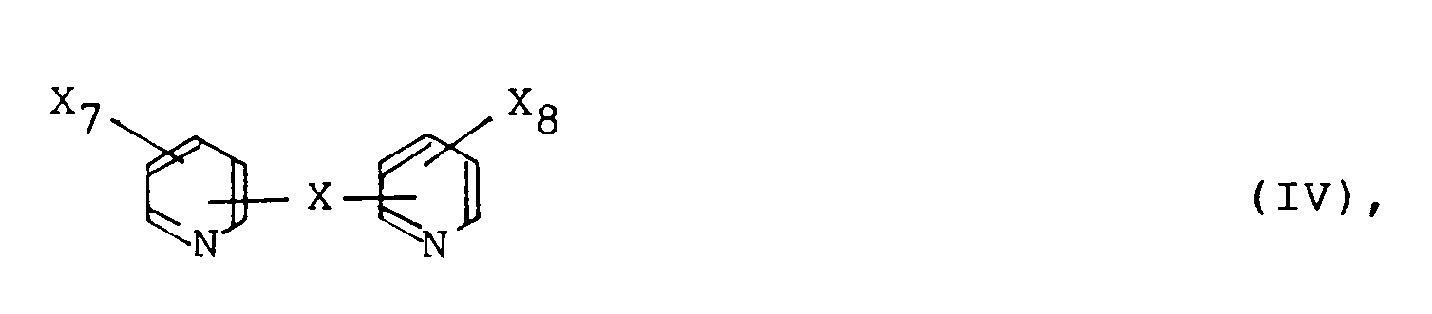
- A photosensitive member according to Claim 29, wherein X₂ in the formula (I) is an alkyl group having 1 - 5 carbon atoms or an alkenyl group having 2 - 5 carbon atoms, and X₃ and X₄ in the formula (II) are respectively an alkyl group having 1 - 5 carbon atoms or an alkenyl group having 2 - 5 carbon atoms; X₅ and X₆ in the formula (III) are respectively a hydrogen atom or an alkyl group having 1 - 4 carbon atoms, and n and m are respectively an integer of 12 - 18; and X₇ and X₈ in the formula (IV) are respectively a hydrogen atom, an alkyl group having 1 - 4 carbon atoms or an alkenyl group having 2 - 4 carbon atoms, l is an integer of 0 - 4, and p is an integer of 1 - 3.
- A photosensitive member according to Claim 29, wherein the compound represented by the formula (I) is selected from the group consisting of: 1,3,5-trimethyl-2,4,6-tris(3,5-di t-butyl-4-hydroxybenzyl)benzene, 1,3,5-trimethyl-2,4,6-tris(3,5-di-t-amyl-4-hydroxybenzyl)benzene, 1,3,5-trimethyl-2,4,6-tris(3-t-butyl-5-methyl-4-hydroxybenzyl)benzene, 1,3,5-trimethyl-2,4,6-tris(3-t-amyl-5-isopropyl-4-hydroxybenzyl)benzene, and 1,3,5-trimethyl-2,4,6-tris(3-t-amyl-5-(1-butenyl)-4-hydroxybenzyl)benzene;
the compound represented by the formula (II) is selected from the group consisting of: tris(2,4-di-t-butylphenyl)phosphite, tris(2,4-di-t-amylphenyl)phosphite, tris(2-t-butyl-4-methylphenyl)phosphite, tris(2-ethyl-4-methylphenyl)phosphite, and tris(2-t-amyl-4-(1-butenyl)phenyl)phosphite;
the compound represented by the formula (III) is selected from the group consisting of: dilauryl-3,3′-thio-dipropionate, ditridecyl-3,3′-thiodipropionate, dimyristyl-3,3′-thiodipropionate, laurylstearyl-3,3′-thiodipropionate, distearyl-3,3′-thiodipropionate, distearyl-3,3′-methyl-3,3′-thiodipropionate, and distearyl-3-ethyl-3′-methyl-3,3′-thiodipropionate; and
the compound represented by the formula (IV) is selected from the group consisting of: 2,2′-bipyridyl, 4,4′-bipyridyl, 1,2-di(2-pyridyl)ethane, 1,3-di-4-pyridylpropane, di-2-pyridylsulfide, di-2-pyridyldisulfide, 1,2-di-4-pyridylethylene, 5-t-butyl-2(3′-ethyl-2′-pyridyl)pyridine, 5-methyl-2(5′-ethyl-2′-pyridyl)pyridine, and 5-isopropyl-2(2′-butenyl-4′-pyridyl)pyridine. - A photosensitive member according to Claim 29, wherein X₂ in the formula (I) is


- A photosensitive member according to Claim 29, wherein the total amount of the compounds (I), (II), (III) and (IV) contained in the photosensitive layer is 0.5 - 20 wt. % based on the total weight of the photosensitive layer not including the weight of the compound (I), (II), (III) or (IV).
- A photosensitive member according to Claim 33, wherein the total amount of the compounds (I), (II), (III) and (IV) contained in the photosensitive layer is 2 - 15 wt. % based on the total weight of the photosensitive layer not including the weight of the compound (I), (II), (III) or (IV).
- A photosensitive member according to Claim 29, wherein the mixing wt. ratio among the compounds (I), (II), (III) and (IV) contained in the photosensitive layer is 1:(0.2 to 5):(0.2 to 5):(0.05 to 2).
- A photosensitive member according to Claim 35, wherein the mixing wt. ratio among the compounds (I), (II), (III) and (IV) contained in the photosensitive layer is 1:(0.5 to 2):(0.5 to 2):(0.1 to 2).
- A photosensitive member according to Claim 29, wherein the photosensitive layer comprises a single layer.
- A photosensitive member according to Claim 29, wherein the photosensitive layer has a laminate structure comprising a charge generation layer and a charge transport layer.
- A photosensitive member according to Claim 38, wherein the charge transport layer is disposed on the charge generation layer, and said compounds (I), (II), (III) and (IV) are contained in the charge transport layer.
- A photosensitive member according to Claim 38, wherein the charge generation layer is disposed on the charge transport layer, and said compounds (I), (II), (III) and (IV) are contained in the charge generation layer.
- A photosensitive member according to Claim 29, wherein the photosensitive layer contains a lubricant.
- A photosensitive member according to Claim 29, which further comprises an intermediate layer disposed between the electroconductive substrate and the photosensitive layer.
Applications Claiming Priority (4)
| Application Number | Priority Date | Filing Date | Title |
|---|---|---|---|
| JP95851/88 | 1988-04-18 | ||
| JP9585188A JPH01266550A (en) | 1988-04-18 | 1988-04-18 | electrophotographic photoreceptor |
| JP51729/89 | 1989-03-02 | ||
| JP1051729A JP2568269B2 (en) | 1989-03-02 | 1989-03-02 | Electrophotographic photoreceptor |
Publications (3)
| Publication Number | Publication Date |
|---|---|
| EP0338504A2 EP0338504A2 (en) | 1989-10-25 |
| EP0338504A3 EP0338504A3 (en) | 1990-12-05 |
| EP0338504B1 true EP0338504B1 (en) | 1994-08-24 |
Family
ID=26392288
Family Applications (1)
| Application Number | Title | Priority Date | Filing Date |
|---|---|---|---|
| EP89106915A Expired - Lifetime EP0338504B1 (en) | 1988-04-18 | 1989-04-18 | Photosensitive member for electrophotography |
Country Status (3)
| Country | Link |
|---|---|
| US (1) | US5008168A (en) |
| EP (1) | EP0338504B1 (en) |
| DE (1) | DE68917632T2 (en) |
Families Citing this family (5)
| Publication number | Priority date | Publication date | Assignee | Title |
|---|---|---|---|---|
| US5312709A (en) * | 1990-04-11 | 1994-05-17 | Canon Kabushiki Kaisha | Image holding member and apparatus making use of it |
| GB2286892B (en) * | 1994-02-23 | 1997-06-18 | Fuji Electric Co Ltd | Electrophotographic photoreceptor |
| AU751426B2 (en) * | 1998-02-13 | 2002-08-15 | Ciba Speciality Chemicals Pty. Ltd. | Polyamide composition |
| JP4093725B2 (en) * | 2000-04-05 | 2008-06-04 | 株式会社リコー | Electrophotographic photosensitive member, image forming method using the same, image forming apparatus, and process cartridge for image forming apparatus |
| ATE552253T1 (en) * | 2002-11-08 | 2012-04-15 | Novartis Int Pharm Ltd | 3-SUBSTITUTED-6-ARYL-PYRIDINE DERIVATIVES AS LIGANDS FOR C5A RECEPTORS |
Family Cites Families (6)
| Publication number | Priority date | Publication date | Assignee | Title |
|---|---|---|---|---|
| GB1292372A (en) * | 1969-03-04 | 1972-10-11 | Eastman Kodak Co | Electrophotographic material |
| JPS58166355A (en) * | 1982-03-29 | 1983-10-01 | Toyo Ink Mfg Co Ltd | Phthalocyanine-based photoconductor element composition and electrophotographic photoreceptor using the same |
| US4546059A (en) * | 1984-11-08 | 1985-10-08 | Xerox Corporation | Layered photoresponsive imaging members with sulfur incorporated dicyanomethylenefluorene carboxylate compositions |
| US4563408A (en) * | 1984-12-24 | 1986-01-07 | Xerox Corporation | Photoconductive imaging member with hydroxyaromatic antioxidant |
| US4741981A (en) * | 1985-07-30 | 1988-05-03 | Ricoh Co., Ltd. | Photosensitive material for electrophotography contains organic phosphite compounds |
| JPH0197964A (en) * | 1987-10-09 | 1989-04-17 | Canon Inc | Electrophotographic sensitive body |
-
1989
- 1989-04-17 US US07/338,844 patent/US5008168A/en not_active Expired - Lifetime
- 1989-04-18 DE DE68917632T patent/DE68917632T2/en not_active Expired - Fee Related
- 1989-04-18 EP EP89106915A patent/EP0338504B1/en not_active Expired - Lifetime
Also Published As
| Publication number | Publication date |
|---|---|
| DE68917632T2 (en) | 1995-01-12 |
| EP0338504A3 (en) | 1990-12-05 |
| DE68917632D1 (en) | 1994-09-29 |
| US5008168A (en) | 1991-04-16 |
| EP0338504A2 (en) | 1989-10-25 |
Similar Documents
| Publication | Publication Date | Title |
|---|---|---|
| US4346157A (en) | Complex type electrophotographic plate | |
| DE4306455A1 (en) | Electrophotographic photoconductor contg. aromatic vinylidene cpd. - as charge transport material, giving positive charge, with high sensitivity and durability | |
| JPH07168377A (en) | Electrophotographic photoreceptor | |
| JPH03282478A (en) | electrophotographic photoreceptor | |
| EP0338504A2 (en) | Photosensitive member for electrophotography | |
| JPH06123981A (en) | Single layer type electrophotographic photoreceptor | |
| US5616442A (en) | Electrophotographic photosensitive member and electrophotographic apparatus using same | |
| US20040063011A1 (en) | Imaging members | |
| JPH0756369A (en) | Electrophotographic photoreceptor | |
| US4932860A (en) | Electrophotographic photosensitive member | |
| EP0369765B1 (en) | Electrophotographic photosensitive material | |
| JPH07175249A (en) | Electrophotographic photoconductor | |
| JPH07160017A (en) | Electrophotographic photoreceptor | |
| JP2568269B2 (en) | Electrophotographic photoreceptor | |
| JP2567089B2 (en) | Electrophotographic photoreceptor | |
| JP2702176B2 (en) | Electrophotographic photoreceptor | |
| JPH0756366A (en) | Electrophotographic photoreceptor | |
| JP2637499B2 (en) | Electrophotographic photoreceptor | |
| JPH0513495B2 (en) | ||
| JPH07160022A (en) | Electrophotographic photoreceptor | |
| JPH07281461A (en) | Electrophotographic photoreceptor | |
| JPH0659487A (en) | Single layer type electrophotographic photoreceptor for positive charging | |
| JPH07333871A (en) | Single layer type electrophotographic photoreceptor | |
| JPH07175231A (en) | Single layer type electrophotographic photoreceptor | |
| JPH07175235A (en) | Single layer type electrophotographic photoreceptor |
Legal Events
| Date | Code | Title | Description |
|---|---|---|---|
| PUAI | Public reference made under article 153(3) epc to a published international application that has entered the european phase |
Free format text: ORIGINAL CODE: 0009012 |
|
| 17P | Request for examination filed |
Effective date: 19890418 |
|
| AK | Designated contracting states |
Kind code of ref document: A2 Designated state(s): DE FR GB |
|
| PUAL | Search report despatched |
Free format text: ORIGINAL CODE: 0009013 |
|
| AK | Designated contracting states |
Kind code of ref document: A3 Designated state(s): DE FR GB |
|
| 17Q | First examination report despatched |
Effective date: 19931011 |
|
| GRAA | (expected) grant |
Free format text: ORIGINAL CODE: 0009210 |
|
| AK | Designated contracting states |
Kind code of ref document: B1 Designated state(s): DE FR GB |
|
| REF | Corresponds to: |
Ref document number: 68917632 Country of ref document: DE Date of ref document: 19940929 |
|
| ET | Fr: translation filed | ||
| PLBE | No opposition filed within time limit |
Free format text: ORIGINAL CODE: 0009261 |
|
| STAA | Information on the status of an ep patent application or granted ep patent |
Free format text: STATUS: NO OPPOSITION FILED WITHIN TIME LIMIT |
|
| 26N | No opposition filed | ||
| REG | Reference to a national code |
Ref country code: GB Ref legal event code: IF02 |
|
| PGFP | Annual fee paid to national office [announced via postgrant information from national office to epo] |
Ref country code: FR Payment date: 20040408 Year of fee payment: 16 |
|
| PGFP | Annual fee paid to national office [announced via postgrant information from national office to epo] |
Ref country code: GB Payment date: 20040414 Year of fee payment: 16 |
|
| PGFP | Annual fee paid to national office [announced via postgrant information from national office to epo] |
Ref country code: DE Payment date: 20040429 Year of fee payment: 16 |
|
| PG25 | Lapsed in a contracting state [announced via postgrant information from national office to epo] |
Ref country code: GB Free format text: LAPSE BECAUSE OF NON-PAYMENT OF DUE FEES Effective date: 20050418 |
|
| PG25 | Lapsed in a contracting state [announced via postgrant information from national office to epo] |
Ref country code: DE Free format text: LAPSE BECAUSE OF NON-PAYMENT OF DUE FEES Effective date: 20051101 |
|
| GBPC | Gb: european patent ceased through non-payment of renewal fee |
Effective date: 20050418 |
|
| PG25 | Lapsed in a contracting state [announced via postgrant information from national office to epo] |
Ref country code: FR Free format text: LAPSE BECAUSE OF NON-PAYMENT OF DUE FEES Effective date: 20051230 |
|
| REG | Reference to a national code |
Ref country code: FR Ref legal event code: ST Effective date: 20051230 |