EP0337697B1 - Use of a thromboxane a2 receptor antagonist for the manufacture of a medicament for treating pulmonary hypertension caused by protamine induced neutralization of hepamin - Google Patents
Use of a thromboxane a2 receptor antagonist for the manufacture of a medicament for treating pulmonary hypertension caused by protamine induced neutralization of hepamin Download PDFInfo
- Publication number
- EP0337697B1 EP0337697B1 EP89303511A EP89303511A EP0337697B1 EP 0337697 B1 EP0337697 B1 EP 0337697B1 EP 89303511 A EP89303511 A EP 89303511A EP 89303511 A EP89303511 A EP 89303511A EP 0337697 B1 EP0337697 B1 EP 0337697B1
- Authority
- EP
- European Patent Office
- Prior art keywords
- thromboxane
- receptor antagonist
- protamine
- acid
- amino
- Prior art date
- Legal status (The legal status is an assumption and is not a legal conclusion. Google has not performed a legal analysis and makes no representation as to the accuracy of the status listed.)
- Expired - Lifetime
Links
- 102000007327 Protamines Human genes 0.000 title claims abstract description 41
- 108010007568 Protamines Proteins 0.000 title claims abstract description 41
- 229940048914 protamine Drugs 0.000 title claims abstract description 38
- 239000003769 thromboxane A2 receptor blocking agent Substances 0.000 title claims abstract description 38
- 229940123987 Thromboxane A2 receptor antagonist Drugs 0.000 title claims abstract description 37
- 208000002815 pulmonary hypertension Diseases 0.000 title claims abstract description 9
- 239000003814 drug Substances 0.000 title claims description 4
- 238000006386 neutralization reaction Methods 0.000 title claims description 4
- 238000004519 manufacturing process Methods 0.000 title claims description 3
- 229920000669 heparin Polymers 0.000 claims abstract description 25
- 229960002897 heparin Drugs 0.000 claims abstract description 24
- HTTJABKRGRZYRN-UHFFFAOYSA-N Heparin Chemical compound OC1C(NC(=O)C)C(O)OC(COS(O)(=O)=O)C1OC1C(OS(O)(=O)=O)C(O)C(OC2C(C(OS(O)(=O)=O)C(OC3C(C(O)C(O)C(O3)C(O)=O)OS(O)(=O)=O)C(CO)O2)NS(O)(=O)=O)C(C(O)=O)O1 HTTJABKRGRZYRN-UHFFFAOYSA-N 0.000 claims abstract description 23
- 125000002924 primary amino group Chemical group [H]N([H])* 0.000 claims description 14
- -1 diamide prostaglandin Chemical class 0.000 claims description 13
- 125000002496 methyl group Chemical group [H]C([H])([H])* 0.000 claims description 10
- 125000000218 acetic acid group Chemical group C(C)(=O)* 0.000 claims description 7
- DYWAPFDKPAHSED-UHFFFAOYSA-N 2-cycloheptyloxepane Chemical group C1CCCCCC1C1OCCCCC1 DYWAPFDKPAHSED-UHFFFAOYSA-N 0.000 claims description 6
- LCPDWSOZIOUXRV-UHFFFAOYSA-N phenoxyacetic acid Chemical compound OC(=O)COC1=CC=CC=C1 LCPDWSOZIOUXRV-UHFFFAOYSA-N 0.000 claims description 6
- 150000001735 carboxylic acids Chemical class 0.000 claims description 5
- 125000001495 ethyl group Chemical group [H]C([H])([H])C([H])([H])* 0.000 claims description 4
- 125000002915 carbonyl group Chemical group [*:2]C([*:1])=O 0.000 claims description 3
- 125000000717 hydrazino group Chemical group [H]N([*])N([H])[H] 0.000 claims description 3
- IULOBWFWYDMECP-UHFFFAOYSA-N 2-[4-[2-[(4-chlorophenyl)sulfonylamino]ethyl]phenyl]acetic acid Chemical compound C1=CC(CC(=O)O)=CC=C1CCNS(=O)(=O)C1=CC=C(Cl)C=C1 IULOBWFWYDMECP-UHFFFAOYSA-N 0.000 claims description 2
- VLMZAUCKMYJSGM-UHFFFAOYSA-N 2-[4-[3-(4-chlorophenyl)sulfonylpropyl]phenyl]acetic acid Chemical compound C1=CC(CC(=O)O)=CC=C1CCCS(=O)(=O)C1=CC=C(Cl)C=C1 VLMZAUCKMYJSGM-UHFFFAOYSA-N 0.000 claims description 2
- UHZXPFSCJFEFPS-UHFFFAOYSA-N 7-(cyclohepten-1-yl)-2,3,4,5-tetrahydrooxepine Chemical compound C1CCCCC=C1C1=CCCCCO1 UHZXPFSCJFEFPS-UHFFFAOYSA-N 0.000 claims description 2
- 150000003536 tetrazoles Chemical class 0.000 claims description 2
- 238000000034 method Methods 0.000 abstract description 5
- 206010067484 Adverse reaction Diseases 0.000 abstract description 3
- 230000006838 adverse reaction Effects 0.000 abstract description 3
- FAPWRFPIFSIZLT-UHFFFAOYSA-M Sodium chloride Chemical compound [Na+].[Cl-] FAPWRFPIFSIZLT-UHFFFAOYSA-M 0.000 description 9
- 230000000694 effects Effects 0.000 description 9
- 210000001147 pulmonary artery Anatomy 0.000 description 9
- 239000011780 sodium chloride Substances 0.000 description 7
- 230000036593 pulmonary vascular resistance Effects 0.000 description 6
- 239000002464 receptor antagonist Substances 0.000 description 6
- 229940044551 receptor antagonist Drugs 0.000 description 6
- 241001465754 Metazoa Species 0.000 description 5
- 102000003938 Thromboxane Receptors Human genes 0.000 description 5
- 108090000300 Thromboxane Receptors Proteins 0.000 description 5
- 230000004872 arterial blood pressure Effects 0.000 description 5
- 230000001631 hypertensive effect Effects 0.000 description 5
- 230000002685 pulmonary effect Effects 0.000 description 5
- 238000011282 treatment Methods 0.000 description 5
- 206010020772 Hypertension Diseases 0.000 description 4
- 241000282887 Suidae Species 0.000 description 4
- 239000005557 antagonist Substances 0.000 description 4
- 239000003146 anticoagulant agent Substances 0.000 description 4
- 229940127219 anticoagulant drug Drugs 0.000 description 4
- 230000003993 interaction Effects 0.000 description 4
- HQKMJHAJHXVSDF-UHFFFAOYSA-L magnesium stearate Chemical compound [Mg+2].CCCCCCCCCCCCCCCCCC([O-])=O.CCCCCCCCCCCCCCCCCC([O-])=O HQKMJHAJHXVSDF-UHFFFAOYSA-L 0.000 description 4
- 239000000203 mixture Substances 0.000 description 4
- 101150100032 Tbxa2r gene Proteins 0.000 description 3
- 208000003455 anaphylaxis Diseases 0.000 description 3
- 239000002552 dosage form Substances 0.000 description 3
- 238000009472 formulation Methods 0.000 description 3
- 241000894007 species Species 0.000 description 3
- YURNCBVQZBJDAJ-UHFFFAOYSA-N 2-heptenoic acid Chemical compound CCCCC=CC(O)=O YURNCBVQZBJDAJ-UHFFFAOYSA-N 0.000 description 2
- 206010002198 Anaphylactic reaction Diseases 0.000 description 2
- CIWBSHSKHKDKBQ-JLAZNSOCSA-N Ascorbic acid Chemical compound OC[C@H](O)[C@H]1OC(=O)C(O)=C1O CIWBSHSKHKDKBQ-JLAZNSOCSA-N 0.000 description 2
- BSYNRYMUTXBXSQ-UHFFFAOYSA-N Aspirin Chemical compound CC(=O)OC1=CC=CC=C1C(O)=O BSYNRYMUTXBXSQ-UHFFFAOYSA-N 0.000 description 2
- 229920002261 Corn starch Polymers 0.000 description 2
- 108010010803 Gelatin Proteins 0.000 description 2
- 229960001138 acetylsalicylic acid Drugs 0.000 description 2
- 239000004480 active ingredient Substances 0.000 description 2
- 239000000443 aerosol Substances 0.000 description 2
- 230000036783 anaphylactic response Effects 0.000 description 2
- 150000001875 compounds Chemical class 0.000 description 2
- 239000008120 corn starch Substances 0.000 description 2
- KPSZWAJWFMFMFF-UHFFFAOYSA-N delta-Hexylen-alpha-carbonsaeure Natural products CC=CCCCC(O)=O KPSZWAJWFMFMFF-UHFFFAOYSA-N 0.000 description 2
- KPSZWAJWFMFMFF-NSCUHMNNSA-N delta-heptenoic acid Chemical compound C\C=C\CCCC(O)=O KPSZWAJWFMFMFF-NSCUHMNNSA-N 0.000 description 2
- 229920000159 gelatin Polymers 0.000 description 2
- 239000008273 gelatin Substances 0.000 description 2
- 235000019322 gelatine Nutrition 0.000 description 2
- 235000011852 gelatine desserts Nutrition 0.000 description 2
- 229940102223 injectable solution Drugs 0.000 description 2
- 238000001361 intraarterial administration Methods 0.000 description 2
- 238000001990 intravenous administration Methods 0.000 description 2
- 210000004072 lung Anatomy 0.000 description 2
- 235000019359 magnesium stearate Nutrition 0.000 description 2
- LXCFILQKKLGQFO-UHFFFAOYSA-N methylparaben Chemical compound COC(=O)C1=CC=C(O)C=C1 LXCFILQKKLGQFO-UHFFFAOYSA-N 0.000 description 2
- 230000014508 negative regulation of coagulation Effects 0.000 description 2
- QELSKZZBTMNZEB-UHFFFAOYSA-N propylparaben Chemical compound CCCOC(=O)C1=CC=C(O)C=C1 QELSKZZBTMNZEB-UHFFFAOYSA-N 0.000 description 2
- 229950008679 protamine sulfate Drugs 0.000 description 2
- 102000004169 proteins and genes Human genes 0.000 description 2
- 108090000623 proteins and genes Proteins 0.000 description 2
- 239000000523 sample Substances 0.000 description 2
- 239000000243 solution Substances 0.000 description 2
- 238000001356 surgical procedure Methods 0.000 description 2
- 230000009885 systemic effect Effects 0.000 description 2
- RZWIIPASKMUIAC-VQTJNVASSA-N thromboxane Chemical compound CCCCCCCC[C@H]1OCCC[C@@H]1CCCCCCC RZWIIPASKMUIAC-VQTJNVASSA-N 0.000 description 2
- DSNBHJFQCNUKMA-SCKDECHMSA-N thromboxane A2 Chemical compound OC(=O)CCC\C=C/C[C@@H]1[C@@H](/C=C/[C@@H](O)CCCCC)O[C@@H]2O[C@H]1C2 DSNBHJFQCNUKMA-SCKDECHMSA-N 0.000 description 2
- XLYOFNOQVPJJNP-UHFFFAOYSA-N water Chemical compound O XLYOFNOQVPJJNP-UHFFFAOYSA-N 0.000 description 2
- 239000008215 water for injection Substances 0.000 description 2
- FMNQRUKVXAQEAZ-JNRFBPFXSA-N (5z,8s,9r,10e,12s)-9,12-dihydroxy-8-[(1s)-1-hydroxy-3-oxopropyl]heptadeca-5,10-dienoic acid Chemical compound CCCCC[C@H](O)\C=C\[C@@H](O)[C@H]([C@@H](O)CC=O)C\C=C/CCCC(O)=O FMNQRUKVXAQEAZ-JNRFBPFXSA-N 0.000 description 1
- JLPYLHLUHJOPNL-UHFFFAOYSA-N 3-[1-[(4-chlorophenyl)methyl]-5-fluoro-3-methyl-2-indolyl]-2,2-dimethylpropanoic acid Chemical compound C12=CC=C(F)C=C2C(C)=C(CC(C)(C)C(O)=O)N1CC1=CC=C(Cl)C=C1 JLPYLHLUHJOPNL-UHFFFAOYSA-N 0.000 description 1
- ZYNMHIHYGSUTLA-HAVVHWLPSA-N 5-[(e)-[pyridin-2-yl-[3-(trifluoromethyl)phenyl]methylidene]amino]oxypentanoic acid Chemical compound C=1C=CC=NC=1C(=N/OCCCCC(=O)O)/C1=CC=CC(C(F)(F)F)=C1 ZYNMHIHYGSUTLA-HAVVHWLPSA-N 0.000 description 1
- ZWAVGFSZMACJHA-PMNBYGLBSA-N 7-[2-Trifluoromethyl-4-(2-hydroxyphenyl)-1,3-dioxan-cis-5-yl]-hept-5z-enoic acid Chemical compound OC(=O)CCC\C=C/C[C@@H]1CO[C@H](C(F)(F)F)O[C@@H]1C1=CC=CC=C1O ZWAVGFSZMACJHA-PMNBYGLBSA-N 0.000 description 1
- 206010063119 Anaphylactoid shock Diseases 0.000 description 1
- 101100243025 Arabidopsis thaliana PCO2 gene Proteins 0.000 description 1
- 241000282472 Canis lupus familiaris Species 0.000 description 1
- 244000025254 Cannabis sativa Species 0.000 description 1
- 241000282693 Cercopithecidae Species 0.000 description 1
- 229940122204 Cyclooxygenase inhibitor Drugs 0.000 description 1
- FBPFZTCFMRRESA-KVTDHHQDSA-N D-Mannitol Chemical compound OC[C@@H](O)[C@@H](O)[C@H](O)[C@H](O)CO FBPFZTCFMRRESA-KVTDHHQDSA-N 0.000 description 1
- 208000037487 Endotoxemia Diseases 0.000 description 1
- 241000282326 Felis catus Species 0.000 description 1
- 241000282412 Homo Species 0.000 description 1
- OZYUPQUCAUTOBP-QXAKKESOSA-N Levallorphan Chemical compound C([C@H]12)CCC[C@@]11CCN(CC=C)[C@@H]2CC2=CC=C(O)C=C21 OZYUPQUCAUTOBP-QXAKKESOSA-N 0.000 description 1
- 229930195725 Mannitol Natural products 0.000 description 1
- 229920000168 Microcrystalline cellulose Polymers 0.000 description 1
- 206010051077 Post procedural haemorrhage Diseases 0.000 description 1
- 241000700159 Rattus Species 0.000 description 1
- DWAQJAXMDSEUJJ-UHFFFAOYSA-M Sodium bisulfite Chemical compound [Na+].OS([O-])=O DWAQJAXMDSEUJJ-UHFFFAOYSA-M 0.000 description 1
- 241000282898 Sus scrofa Species 0.000 description 1
- 229940099508 TP receptor antagonist Drugs 0.000 description 1
- XNRNNGPBEPRNAR-UHFFFAOYSA-N Thromboxane B2 Natural products CCCCCC(O)C=CC1OC(O)CC(O)C1CC=CCCCC(O)=O XNRNNGPBEPRNAR-UHFFFAOYSA-N 0.000 description 1
- 239000002253 acid Substances 0.000 description 1
- 230000007059 acute toxicity Effects 0.000 description 1
- 231100000403 acute toxicity Toxicity 0.000 description 1
- 230000002411 adverse Effects 0.000 description 1
- BHELZAPQIKSEDF-UHFFFAOYSA-N allyl bromide Chemical compound BrCC=C BHELZAPQIKSEDF-UHFFFAOYSA-N 0.000 description 1
- 150000001413 amino acids Chemical class 0.000 description 1
- 238000000540 analysis of variance Methods 0.000 description 1
- 125000000129 anionic group Chemical group 0.000 description 1
- 230000000844 anti-bacterial effect Effects 0.000 description 1
- 230000010100 anticoagulation Effects 0.000 description 1
- 239000003963 antioxidant agent Substances 0.000 description 1
- 235000006708 antioxidants Nutrition 0.000 description 1
- 239000007864 aqueous solution Substances 0.000 description 1
- 235000010323 ascorbic acid Nutrition 0.000 description 1
- 229960005070 ascorbic acid Drugs 0.000 description 1
- 239000011668 ascorbic acid Substances 0.000 description 1
- 230000001746 atrial effect Effects 0.000 description 1
- 235000015278 beef Nutrition 0.000 description 1
- 230000015572 biosynthetic process Effects 0.000 description 1
- 235000010290 biphenyl Nutrition 0.000 description 1
- 239000008280 blood Substances 0.000 description 1
- 210000004369 blood Anatomy 0.000 description 1
- 230000023555 blood coagulation Effects 0.000 description 1
- 230000036765 blood level Effects 0.000 description 1
- 239000000872 buffer Substances 0.000 description 1
- 239000004067 bulking agent Substances 0.000 description 1
- 239000002775 capsule Substances 0.000 description 1
- 210000001715 carotid artery Anatomy 0.000 description 1
- 239000012876 carrier material Substances 0.000 description 1
- 125000002091 cationic group Chemical group 0.000 description 1
- 238000006243 chemical reaction Methods 0.000 description 1
- 239000003795 chemical substances by application Substances 0.000 description 1
- 210000000038 chest Anatomy 0.000 description 1
- 230000001419 dependent effect Effects 0.000 description 1
- 238000013461 design Methods 0.000 description 1
- 229940079593 drug Drugs 0.000 description 1
- 230000002526 effect on cardiovascular system Effects 0.000 description 1
- 239000002158 endotoxin Substances 0.000 description 1
- 238000011067 equilibration Methods 0.000 description 1
- 238000002474 experimental method Methods 0.000 description 1
- 239000007789 gas Substances 0.000 description 1
- 238000005469 granulation Methods 0.000 description 1
- 230000003179 granulation Effects 0.000 description 1
- 239000002607 heparin antagonist Substances 0.000 description 1
- 238000001802 infusion Methods 0.000 description 1
- 239000004615 ingredient Substances 0.000 description 1
- 239000003983 inhalation anesthetic agent Substances 0.000 description 1
- 239000003112 inhibitor Substances 0.000 description 1
- 230000000968 intestinal effect Effects 0.000 description 1
- 210000004731 jugular vein Anatomy 0.000 description 1
- 210000005246 left atrium Anatomy 0.000 description 1
- 229960000263 levallorphan Drugs 0.000 description 1
- 239000000314 lubricant Substances 0.000 description 1
- 239000000594 mannitol Substances 0.000 description 1
- 235000010355 mannitol Nutrition 0.000 description 1
- 230000001404 mediated effect Effects 0.000 description 1
- 125000000956 methoxy group Chemical group [H]C([H])([H])O* 0.000 description 1
- 235000010270 methyl p-hydroxybenzoate Nutrition 0.000 description 1
- 239000004292 methyl p-hydroxybenzoate Substances 0.000 description 1
- 229960002216 methylparaben Drugs 0.000 description 1
- 235000019813 microcrystalline cellulose Nutrition 0.000 description 1
- 239000008108 microcrystalline cellulose Substances 0.000 description 1
- 229940016286 microcrystalline cellulose Drugs 0.000 description 1
- 244000309715 mini pig Species 0.000 description 1
- 239000006201 parenteral dosage form Substances 0.000 description 1
- 239000000546 pharmaceutical excipient Substances 0.000 description 1
- ZUOUZKKEUPVFJK-UHFFFAOYSA-N phenylbenzene Natural products C1=CC=CC=C1C1=CC=CC=C1 ZUOUZKKEUPVFJK-UHFFFAOYSA-N 0.000 description 1
- 230000002980 postoperative effect Effects 0.000 description 1
- 239000000843 powder Substances 0.000 description 1
- 239000003755 preservative agent Substances 0.000 description 1
- 235000010232 propyl p-hydroxybenzoate Nutrition 0.000 description 1
- 239000004405 propyl p-hydroxybenzoate Substances 0.000 description 1
- 229960003415 propylparaben Drugs 0.000 description 1
- 239000002599 prostaglandin synthase inhibitor Substances 0.000 description 1
- 150000003180 prostaglandins Chemical class 0.000 description 1
- 229940070353 protamines Drugs 0.000 description 1
- ZUFQODAHGAHPFQ-UHFFFAOYSA-N pyridoxine hydrochloride Chemical compound Cl.CC1=NC=C(CO)C(CO)=C1O ZUFQODAHGAHPFQ-UHFFFAOYSA-N 0.000 description 1
- 238000011160 research Methods 0.000 description 1
- 230000029058 respiratory gaseous exchange Effects 0.000 description 1
- 235000010267 sodium hydrogen sulphite Nutrition 0.000 description 1
- 230000000638 stimulation Effects 0.000 description 1
- 238000003786 synthesis reaction Methods 0.000 description 1
- 239000002396 thromboxane receptor blocking agent Substances 0.000 description 1
- 231100000331 toxic Toxicity 0.000 description 1
- 230000002588 toxic effect Effects 0.000 description 1
- 210000003437 trachea Anatomy 0.000 description 1
- 238000005303 weighing Methods 0.000 description 1
Images


Classifications
-
- A—HUMAN NECESSITIES
- A61—MEDICAL OR VETERINARY SCIENCE; HYGIENE
- A61K—PREPARATIONS FOR MEDICAL, DENTAL OR TOILETRY PURPOSES
- A61K31/00—Medicinal preparations containing organic active ingredients
- A61K31/185—Acids; Anhydrides, halides or salts thereof, e.g. sulfur acids, imidic, hydrazonic or hydroximic acids
- A61K31/19—Carboxylic acids, e.g. valproic acid
-
- A—HUMAN NECESSITIES
- A61—MEDICAL OR VETERINARY SCIENCE; HYGIENE
- A61K—PREPARATIONS FOR MEDICAL, DENTAL OR TOILETRY PURPOSES
- A61K31/00—Medicinal preparations containing organic active ingredients
-
- A—HUMAN NECESSITIES
- A61—MEDICAL OR VETERINARY SCIENCE; HYGIENE
- A61K—PREPARATIONS FOR MEDICAL, DENTAL OR TOILETRY PURPOSES
- A61K31/00—Medicinal preparations containing organic active ingredients
- A61K31/557—Eicosanoids, e.g. leukotrienes or prostaglandins
-
- A—HUMAN NECESSITIES
- A61—MEDICAL OR VETERINARY SCIENCE; HYGIENE
- A61P—SPECIFIC THERAPEUTIC ACTIVITY OF CHEMICAL COMPOUNDS OR MEDICINAL PREPARATIONS
- A61P11/00—Drugs for disorders of the respiratory system
-
- A—HUMAN NECESSITIES
- A61—MEDICAL OR VETERINARY SCIENCE; HYGIENE
- A61P—SPECIFIC THERAPEUTIC ACTIVITY OF CHEMICAL COMPOUNDS OR MEDICINAL PREPARATIONS
- A61P43/00—Drugs for specific purposes, not provided for in groups A61P1/00-A61P41/00
-
- A—HUMAN NECESSITIES
- A61—MEDICAL OR VETERINARY SCIENCE; HYGIENE
- A61P—SPECIFIC THERAPEUTIC ACTIVITY OF CHEMICAL COMPOUNDS OR MEDICINAL PREPARATIONS
- A61P9/00—Drugs for disorders of the cardiovascular system
- A61P9/12—Antihypertensives
Definitions
- the present invention provides a method for preventing, reversing or reducing pulmonary hypertension produced when protamine interacts with the anticoagulant heparin, by administering a thromboxane A2 receptor antagonist. More specifically, a thromboxane A2 receptor antagonist is used for the manufacture of a medicament for treating pulmonary hypertension caused by protamine induced neutralization of heparin in a mammalian species.
- Thromboxane A2 receptor antagonists have been found to be effective in preventing early pulmonary hypertension induced by exposure to endotoxin, Schumacher, W. A. et al., "Effect of the TxA2-receptor antagonists SQ 29,548 and SQ 28,688 on the pulmonary hypertensive response to endotoxemia in swine," Pharmacology 34:301-308, 1987.
- Protamines are simple proteins of low molecular weight that are rich in basic amino acids. Protamine is a cationic protein which is used in man to reverse the anticoagulant activity of heparin. It reacts with anionic heparin to form a complex which is inactive as an anticoagulant.
- protamine acts as a heparin antagonist and is used to neutralize heparin in surgical procedures.
- a method for preventing, reducing or reversing pulmonary hypertension caused by protamine-induced neutralization of heparin in mammalian species, wherein a therapeutically effective amount of a thromboxane A2 receptor antagonist is systemically administered, such as orally, parenterally, transdermally, or by inhalation to prevent, reverse or mitigate adverse effects of protamine.
- thromboxane A2 receptor antagonist includes compounds which are so-called thromboxane A2 receptor antagonists, thromboxane A2 antagonists, thromboxane A2/prostaglandin endoperoxide antagonists, TP-receptor antagonists, or thromboxane antagonists except insofar as the compound is an inhibitor of thromboxane synthesis but not an antagonist of thromboxane A2 receptor mediated responses.
- Thromboxane A2 receptor antagonists which may be employed herein include the 7-oxabicycloheptane and 7-oxabicycloheptene compounds disclosed in U. S. Patent. US-A-4,537,981 to Snitman et al, especially, [1S-[1 ⁇ ,2 ⁇ (5Z),3 ⁇ (1E,3R,4S),4 ⁇ ]]-7-[3-(3-hydroxy-4-phenyl-1-pentenyl)-7-oxabicyclo[2.2.1]hept-2-yl]-5-heptenoic acid; the 7-oxabicycloheptane substituted amino-prostaglandin analogs disclosed in U. S. Patent.
- Patent US-A-4,663,336 to Nakane et al especially, [1S-[1 ⁇ ,2 ⁇ (5Z),3 ⁇ ,4 ⁇ ]]-7-[3-[[[[[(1-oxoheptyl)amino]acetyl]amino]methyl]-7-oxabicyclo[2.2.1]hept-2-yl]-5-heptenoic acid and the corresponding tetrazole, and [1S-[1 ⁇ ,2 ⁇ (Z),3 ⁇ ,4 ⁇ ]]-7-[3-[[[[[(4-cyclohexyl-1-oxobutyl)amino]acetyl]amino]methyl]-7-oxabicyclo[2.2.1]hept-2-yl]5-heptenoic acid; the phenoxyalkyl carboxylic acids disclosed in U.
- thromboxane A2 receptor antagonists suitable for use herein include, but are not limited to (E)-5-[[[(pyridinyl)[3-(trifluoromethyl)phenyl]methylene]amino]oxy]pentanoic acid also referred to as R68,070 - Janssen Research Laboratories, 3-[1-(4-chlorophenylmethyl)-5-fluoro-3-methylindol-2-yl]-2,2-dimethylpropanoic acid [(L-655240 Merck-Frosst) Eur. J. Pharmacol. 135(2):193, 17 Mar.
- the thromboxane A2 receptor antagonist may be administered systemically, such as orally or parenterally or transdermally, to mammalian species, such as monkeys, dogs, cats, rats, humans.
- the thromboxane A2 receptor antagonist may be administered, for example, orally, intravenously, intrapulmonary arterially, intraarterially, transdermally, or by inhalation to provide a dosage of from 10 ⁇ g/kg to 10 mg/kg and preferably from 0.1 mg/kg to 5 mg/kg.
- the thromboxane antagonist may be administered (1) before administering protamine, (2) with protamine, (3) with heparin or (4) within several minutes after administering protamine.
- the thromboxane A2 receptor antagonist may be incorporated in a conventional dosage form, such as a tablet, capsule, elixir or injectable.
- a conventional dosage form such as a tablet, capsule, elixir or injectable.
- the above dosage forms will also include the necessary carrier material, excipient, lubricant, buffer, antibacterial, bulking agent (such as mannitol) or anti-oxidants (ascorbic acid or sodium bisulfite).
- Parenteral dosage forms are preferred, although oral, transdermal, and aerosol forms are quite satisfactory as well.
- single or divided doses of from 0.5 to 2500 mg, preferably from 5 to 2000 mg/one to four times daily, may be administered in systemic dosage forms as described above.
- the thromboxane A2 receptor antagonist may be administered throughout the period of administering protamine or may be administered to treat the adverse reactions caused by protamine for a period until such conditions are reversed.
- Figures 1, 2, and 3 illustrate the effect of the thromboxane A2 receptor antagonist on the pulmonary hypertensive response to protamine reversal of heparin in anesthetized pigs.
- An injectable solution of thromboxane A2 receptor antagonist for intravenous or intraarterial use in preventing or reversing the effects of protamine is produced as follows: [1S-[1 ⁇ ,2 ⁇ (5Z),3 ⁇ ,4 ⁇ ]]-7-[3-[[2-(phenylamino)carbonyl]hydrazino]methyl]-7-oxabicyclo[2.2.1]hept-2-yl]-5-heptenoic acid (SQ 29,548) 2500 mg Methyl paraben 5 mg Propyl paraben 1 mg Sodium chloride 25 g Water for injection qs. 5 l.
- the thromboxane A2 receptor antagonist, preservatives and sodium chloride are dissolved in 3 liters of water for injection and then the volume is brought up to 5 liters.
- the solution is filtered through a sterile filter and aseptically filled into presterilized vials which are then closed with presterilized rubber closures.
- Each vial contains a concentration of 75 mg of active ingredient per 150 ml of solution.
- An injectable for use in preventing or reversing the effects of protamine is prepared as described in Example 1 except that the thromboxane A2 receptor antagonist employed is the phenoxyalkyl carboxylic acid 4-[2-(benzenesulfamido)ethyl]phenoxyacetic acid, disclosed in U. S. Patent. US-A-4,258,058.
- An injectable for use in preventing or reversing the effects of protamine is prepared as described in Example 1 except that the thromboxane A2 receptor antagonist employed is [1S-[1 ⁇ ,2 ⁇ (Z),3 ⁇ ,4 ⁇ ]]-7-[3-[[[[[(4-cyclohexyl-1-oxobutyl)amino]acetyl]amino]methyl]-7-oxabicyclo[2.2.1]hept-2-yl]-5-heptenoic acid.
- a thromboxane A2 antagonist formulation suitable for oral administration is set out below.
- the thromboxane A2 receptor antagonist and corn starch are admixed with an aqueous solution of the gelatin.
- the mixture is dried and ground to a fine powder.
- the Avicel and then the magnesium stearate are admixed with the granulation. This is then compressed in a tablet to form 1000 tablets each containing 400 mg of active ingredient.
- aerosol (inhalation) formulations may be used in preventing or reversing the effects of protamine and may be administered by itself or in conjunction with an inhalation anesthetic.
- Yucatan minipigs (Charles Rivers, Willmington, MA) of either sex weighing 24 to 25 kg were anesthetized with Na-pentabarbital ( ⁇ 40 mg/kg, i.p.) and supplemented as required i.v.
- a jugular vein and carotid artery were cannulated with PE205 tubing and the arterial catheter attached to a Model P23D pressure transducer (Gould Inc., Oxnard, CA).
- the trachea was cannulated and the animal ventilated with a Model 613 respirator (Harvard Apparatus, Natick, MA).
- the heart was isolated by a left thoracotomy and suspended in a pericardial cradle.
- An EP435 or EP440 electromagnetic flow probe (Carolina Medical Electronics, Inc., King, NC) was attached to the pulmonary artery.
- a Model SPC350 5-French catheter pressure transducer (Millar Instruments Inc., Houston, TX) and an infusion cannula, constructed from a 22 gauge hypodermic needle tip attached to PE50 tubing, were inserted into the pulmonary artery proximal to the flow probe.
- Another catheter pressure transducer was inserted into the tip of the left atrium and placed at the same level as the pulmonary artery pressure transducer.
- SQ 30,741 (1 mg/kg) or Vehicle (1.5 ml saline) was also delivered directly into the pulmonary artery at 2 minutes before protamine. Physiological parameters were determined immediately before (0 minute) and at 2, 5, 10 and 20 minutes after protamine.
- Control values for pulmonary artery pressure (P pa ), pulmonary artery flow (Q pa ) and pulmonary vascular resistance (PVR) did not differ between the SQ 30,741 and saline groups.
- P pa and PVR were significantly increased with saline treatment ( Figures 2 and 1, respectively).
- the pulmonary hypertension observed in saline-treated animals was maximal within 2 to 3 minutes and quickly subsided.
- the major factor accounting for the 808 ⁇ 183% (p ⁇ 0.05) increase in PVR was a 230 ⁇ 26% (p ⁇ 0.05) increase in (P pa ) without any change in P la (-10 ⁇ 17%, NS).
- TxA2 receptor antagonists would be useful in reducing the potential toxic effects associated with protamine administration in clinical settings.
Landscapes
- Health & Medical Sciences (AREA)
- Life Sciences & Earth Sciences (AREA)
- Chemical & Material Sciences (AREA)
- Veterinary Medicine (AREA)
- Public Health (AREA)
- Medicinal Chemistry (AREA)
- General Health & Medical Sciences (AREA)
- Animal Behavior & Ethology (AREA)
- Pharmacology & Pharmacy (AREA)
- Epidemiology (AREA)
- General Chemical & Material Sciences (AREA)
- Organic Chemistry (AREA)
- Nuclear Medicine, Radiotherapy & Molecular Imaging (AREA)
- Engineering & Computer Science (AREA)
- Chemical Kinetics & Catalysis (AREA)
- Bioinformatics & Cheminformatics (AREA)
- Cardiology (AREA)
- Heart & Thoracic Surgery (AREA)
- Pulmonology (AREA)
- Medicines That Contain Protein Lipid Enzymes And Other Medicines (AREA)
- Pharmaceuticals Containing Other Organic And Inorganic Compounds (AREA)
- Acyclic And Carbocyclic Compounds In Medicinal Compositions (AREA)
- Peptides Or Proteins (AREA)
Abstract
Description
- The present invention provides a method for preventing, reversing or reducing pulmonary hypertension produced when protamine interacts with the anticoagulant heparin, by administering a thromboxane A₂ receptor antagonist. More specifically, a thromboxane A₂ receptor antagonist is used for the manufacture of a medicament for treating pulmonary hypertension caused by protamine induced neutralization of heparin in a mammalian species.
- Thromboxane A₂ receptor antagonists have been found to be effective in preventing early pulmonary hypertension induced by exposure to endotoxin, Schumacher, W. A. et al., "Effect of the TxA₂-receptor antagonists SQ 29,548 and SQ 28,688 on the pulmonary hypertensive response to endotoxemia in swine," Pharmacology 34:301-308, 1987.
- Protamines are simple proteins of low molecular weight that are rich in basic amino acids. Protamine is a cationic protein which is used in man to reverse the anticoagulant activity of heparin. It reacts with anionic heparin to form a complex which is inactive as an anticoagulant.
- Upon completion of surgical procedures requiring anticoagulant treatment, it is desirable to restore normal function to the blood coagulation cascade to minimize post-operative bleeding. When heparin is employed as the anticoagulant, protamine is often infused to neutralize the heparin-induced anticoagulant activity. Thus, protamine acts as a heparin antagonist and is used to neutralize heparin in surgical procedures.
- Unfortunately, certain patients show intolerance to protamine. Adverse reactions which may result from the interaction between protamine and heparin include anaphylaxis and pulmonary hypertension. The latter response, when produced in pigs, can be significantly blunted by pretreatment with aspirin and is associated with enhanced TxB₂ blood levels, Degges, R. D. et al., "Pulmonary hypertensive effect of heparin and protamine interaction; evidence for thromboxane B₂ release from the lung," Am. J. Surg. 154:696-698, 1987. The Physicians' Desk Reference, 41st Edition, 1987, pp, 1162-1163, indicates that "Because fatal reactions often resembling anaphylaxis have been reported after administration of protamine sulfate, the drug should be given only when resuscitation techniques and treatment of anaphylactoid shock are readily available."
- In accordance with the present invention, a method is provided for preventing, reducing or reversing pulmonary hypertension caused by protamine-induced neutralization of heparin in mammalian species, wherein a therapeutically effective amount of a thromboxane A₂ receptor antagonist is systemically administered, such as orally, parenterally, transdermally, or by inhalation to prevent, reverse or mitigate adverse effects of protamine.
- The term "thromboxane A₂ receptor antagonist" as employed herein includes compounds which are so-called thromboxane A₂ receptor antagonists, thromboxane A₂ antagonists, thromboxane A₂/prostaglandin endoperoxide antagonists, TP-receptor antagonists, or thromboxane antagonists except insofar as the compound is an inhibitor of thromboxane synthesis but not an antagonist of thromboxane A₂ receptor mediated responses.
- Thromboxane A₂ receptor antagonists which may be employed herein include the 7-oxabicycloheptane and 7-oxabicycloheptene compounds disclosed in U. S. Patent. US-A-4,537,981 to Snitman et al, especially, [1S-[1α,2β(5Z),3β(1E,3R,4S),4α]]-7-[3-(3-hydroxy-4-phenyl-1-pentenyl)-7-oxabicyclo[2.2.1]hept-2-yl]-5-heptenoic acid; the 7-oxabicycloheptane substituted amino-prostaglandin analogs disclosed in U. S. Patent. US-A-4,416,896 to Nakane et al., especially, [1S-[1α,2β(5Z),3β,4α]]-7-[3-[[2-(phenylamino)carbonyl]hydrazino]methyl]-7-oxabicyclo[2.2.1]hept-2-yl]5-heptenoic acid; the 7-oxabicycloheptane substituted diamide prostaglandin analogs disclosed in U. S. Patent US-A-4,663,336 to Nakane et al, especially, [1S-[1β,2α(5Z),3α,4β]]-7-[3-[[[[(1-oxoheptyl)amino]acetyl]amino]methyl]-7-oxabicyclo[2.2.1]hept-2-yl]-5-heptenoic acid and the corresponding tetrazole, and [1S-[1<α,2<β(Z),3<β,4<α]]-7-[3-[[[[(4-cyclohexyl-1-oxobutyl)amino]acetyl]amino]methyl]-7-oxabicyclo[2.2.1]hept-2-yl]5-heptenoic acid; the phenoxyalkyl carboxylic acids disclosed in U. S. Patent. US-A-4,258,058 to Witte et al, especially 4-[2-(benzenesulfamido)ethyl]phenoxyacetic acid, (BM 13,177 - Boehringer Mannheim), the sulphonamidophenyl carboxylic acids disclosed in U. S. Patent. US-A-4,443,477 to Witte et al, especially 4-[2-(4-chlorobenzenesulfonamido)ethyl}phenylacetic acid, (BM 13,505, Boehringer Mannheim) the arylthioalkylphenyl carboxylic acids Mannheim) the arylthioalkylphenyl carboxylic acids disclosed in U. S. Patent US-A-4,752,616 filed June 29, 1987, especially 4-(3-((4-chlorophenyl)sulfonyl)propyl)benzeneacetic acid.
- Other examples of thromboxane A₂ receptor antagonists suitable for use herein include, but are not limited to (E)-5-[[[(pyridinyl)[3-(trifluoromethyl)phenyl]methylene]amino]oxy]pentanoic acid also referred to as R68,070 - Janssen Research Laboratories, 3-[1-(4-chlorophenylmethyl)-5-fluoro-3-methylindol-2-yl]-2,2-dimethylpropanoic acid [(L-655240 Merck-Frosst) Eur. J. Pharmacol. 135(2):193, 17 Mar. 87], 5(Z)-7-([2,4,5-cis]-4-(2-hydroxyphenyl)-2-trifluoromethyl-1,3-dioxan-5-yl)heptenoic acid (ICI 185282, Brit. J. Pharmacol 90 (Proc. Suppl):228 P-Abs., Mar. 87), 5(Z)-7-[2,2-dimethyl-4-phenyl-1,3-dioxan-cis-5-yl]heptenoic acid (ICI 159995, Brit. J. Pharmacol. 86 (Proc. Suppl):808 P-Abs., Dec. 85), N,N′-bis[7-(3-chlorobenzeneaminosulfonyl)-1,2,3,4-tetrahydro-isoquinolyl]disulfonylimide (SKF 88046, Pharmacologist 25(3):116 Abs, 117 Abs, Aug. 83), [1α(Z)-2β,5α]-(+)-7-[5-[[(1,1′-biphenyl)-4-yl]methoxy]-2-(4-morpholinyl)-3-oxocyclopentyl]-4-heptenoic acid (AH 23848 - Glaxo, Circulation 72(6):1208, Dec. 85), GR32191-Glaxo (Thromb. Haemostas, 58 (1) 181 (1987), levallorphan allyl bromide (CM 32,191, Sanofi, Life Sci. 31 (20-21):2261, 15 Nov. 82), (Z,2-endo-3-oxo)-7-(3-acetyl-2-bicyclo[2.2.1]heptyl-5-hepta-3Z-enoic acid, 4-phenylthiosemicarbazone (EP092 - Univ. Edinburgh, Brit, J. Pharmacol. 84(3):595, Mar. 85).
- In carrying out the method of the present invention, the thromboxane A₂ receptor antagonist may be administered systemically, such as orally or parenterally or transdermally, to mammalian species, such as monkeys, dogs, cats, rats, humans. Thus, the thromboxane A₂ receptor antagonist may be administered, for example, orally, intravenously, intrapulmonary arterially, intraarterially, transdermally, or by inhalation to provide a dosage of from 10 µg/kg to 10 mg/kg and preferably from 0.1 mg/kg to 5 mg/kg. The thromboxane antagonist may be administered (1) before administering protamine, (2) with protamine, (3) with heparin or (4) within several minutes after administering protamine.
- The thromboxane A₂ receptor antagonist may be incorporated in a conventional dosage form, such as a tablet, capsule, elixir or injectable. The above dosage forms will also include the necessary carrier material, excipient, lubricant, buffer, antibacterial, bulking agent (such as mannitol) or anti-oxidants (ascorbic acid or sodium bisulfite). Parenteral dosage forms are preferred, although oral, transdermal, and aerosol forms are quite satisfactory as well.
- With regard to such systemic formulations, single or divided doses of from 0.5 to 2500 mg, preferably from 5 to 2000 mg/one to four times daily, may be administered in systemic dosage forms as described above.
- The thromboxane A₂ receptor antagonist may be administered throughout the period of administering protamine or may be administered to treat the adverse reactions caused by protamine for a period until such conditions are reversed.
- Figures 1, 2, and 3 illustrate the effect of the thromboxane A₂ receptor antagonist on the pulmonary hypertensive response to protamine reversal of heparin in anesthetized pigs.
- The following Examples represent preferred embodiments of the present invention.
- An injectable solution of thromboxane A₂ receptor antagonist for intravenous or intraarterial use in preventing or reversing the effects of protamine is produced as follows:
[1S-[1α,2β(5Z),3β,4α]]-7-[3-[[2-(phenylamino)carbonyl]hydrazino]methyl]-7-oxabicyclo[2.2.1]hept-2-yl]-5-heptenoic acid (SQ 29,548) 2500 mg Methyl paraben 5 mg Propyl paraben 1 mg Sodium chloride 25 g Water for injection qs. 5 l. - The thromboxane A₂ receptor antagonist, preservatives and sodium chloride are dissolved in 3 liters of water for injection and then the volume is brought up to 5 liters. The solution is filtered through a sterile filter and aseptically filled into presterilized vials which are then closed with presterilized rubber closures. Each vial contains a concentration of 75 mg of active ingredient per 150 ml of solution.
- An injectable for use in preventing or reversing the effects of protamine is prepared as described in Example 1 except that the thromboxane A₂ receptor antagonist employed is the phenoxyalkyl carboxylic acid 4-[2-(benzenesulfamido)ethyl]phenoxyacetic acid, disclosed in U. S. Patent. US-A-4,258,058.
- An injectable solution of thromboxane A₂ receptor antagonist for intravenous or intraarterial use containing [1S-[1β,2α(5Z),3α,4β]]-7-[3-[[[[(1-oxoheptyl)amino]acetyl]amino]methyl]-7-oxabicyclo[2.2.1]hept-2-yl]-5-heptenoic acid (SQ 30,741) as the thromboxane A₂ receptor antagonist is prepared as described in Example 1.
- An injectable for use in preventing or reversing the effects of protamine is prepared as described in Example 1 except that the thromboxane A₂ receptor antagonist employed is [1S-[1<α,2<β(Z),3<β,4<α]]-7-[3-[[[[(4-cyclohexyl-1-oxobutyl)amino]acetyl]amino]methyl]-7-oxabicyclo[2.2.1]hept-2-yl]-5-heptenoic acid.
- A thromboxane A₂ antagonist formulation suitable for oral administration is set out below.
- 1000 tablets each containing 400 mg of thromboxane A₂ receptor antagonist are produced from the following ingredients.
[1S-[1β,2α(5Z),3α,4β]]-7-[3-[[[[(1-Oxoheptyl)amino]acetyl]amino]methyl]-7-oxabicyclo[2.2.1]hept-2-yl]-5-heptenoic acid (SQ 30,741) 400 g Corn starch 50 g Gelatin 7.5 g Avicel (microcrystalline cellulose) 25 g Magnesium stearate 2.5 g - The thromboxane A₂ receptor antagonist and corn starch are admixed with an aqueous solution of the gelatin. The mixture is dried and ground to a fine powder. The Avicel and then the magnesium stearate are admixed with the granulation. This is then compressed in a tablet to form 1000 tablets each containing 400 mg of active ingredient.
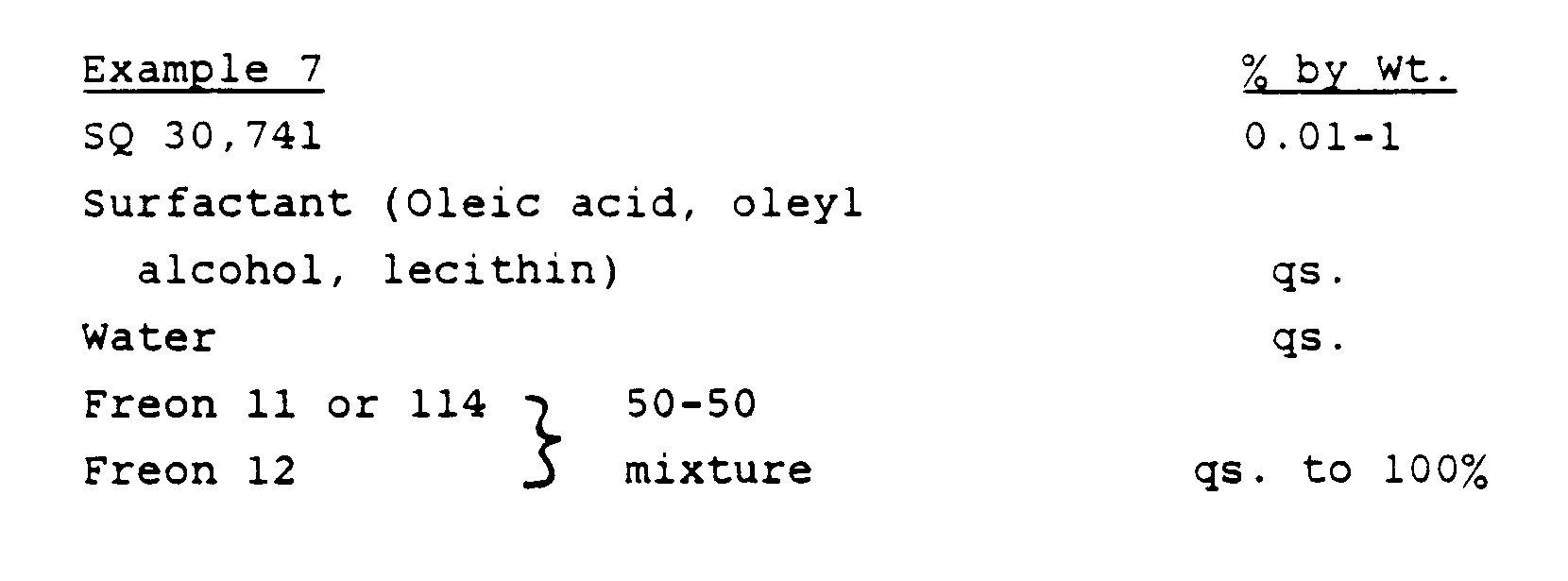
- The following aerosol (inhalation) formulations may be used in preventing or reversing the effects of protamine and may be administered by itself or in conjunction with an inhalation anesthetic.

- The effect of the thromboxane A₂ receptor antagonist SQ 30,741 on the pulmonary hypertensive response produced by the interaction of protamine with heparin was determined in pentobarbital-anesthetized pigs.
- Yucatan minipigs (Charles Rivers, Willmington, MA) of either sex weighing 24 to 25 kg were anesthetized with Na-pentabarbital (∼40 mg/kg, i.p.) and supplemented as required i.v. A jugular vein and carotid artery were cannulated with PE205 tubing and the arterial catheter attached to a Model P23D pressure transducer (Gould Inc., Oxnard, CA). The trachea was cannulated and the animal ventilated with a Model 613 respirator (Harvard Apparatus, Natick, MA). The heart was isolated by a left thoracotomy and suspended in a pericardial cradle. An EP435 or EP440 electromagnetic flow probe (Carolina Medical Electronics, Inc., King, NC) was attached to the pulmonary artery. A Model SPC350 5-French catheter pressure transducer (Millar Instruments Inc., Houston, TX) and an infusion cannula, constructed from a 22 gauge hypodermic needle tip attached to PE50 tubing, were inserted into the pulmonary artery proximal to the flow probe. Another catheter pressure transducer was inserted into the tip of the left atrium and placed at the same level as the pulmonary artery pressure transducer. Continuous recordings were made of arterial blood pressure (ABP), pulmonary artery pressure (Ppa) (Figue 2), left atrial pressure (Pla) and pulmonary artery flow (Qpa) (Figure 3) on a Model 7 recorder (Grass Instrument Co., Quincy, MA). Pulmonary vascular resistance (PVR) (Figure 1) was calculated from the ratio of (Ppa-Pla)/Qpa.
- A period of 30 minutes was allowed for equilibration, during which time blood gases were analyzed and respiration adjusted to obtain a PCO₂ of 39.9 to 46,5 mbar (30 to 35 mm Hg) and a PO₂ of 106,4 to 133 mbar (80 to 100 mm Hg.) Heparin of porcine intestinal mucosal origin (300 U/kg, i.v.; #H-3125, Sigma Chemical Co., St. Louis, MO) was administered 15 minutes before protamine (3 mg/kg; Lyphomed, Rosemont, IL). The protamine was injected into the pulmonary artery over a 15 second interval. SQ 30,741 (1 mg/kg) or Vehicle (1.5 ml saline) was also delivered directly into the pulmonary artery at 2 minutes before protamine. Physiological parameters were determined immediately before (0 minute) and at 2, 5, 10 and 20 minutes after protamine.
- Data were analyzed using a microcomputer statistics package (Systat, Evanston, IL). An analysis of variance employing repeated measures with grouping factors was used for between treatment comparisons, and a one-way repeated measures design was used for within group comparisons. All data in the text and Figures are expressed as mean ± SE.
- Control values for pulmonary artery pressure (Ppa), pulmonary artery flow (Qpa) and pulmonary vascular resistance (PVR) did not differ between the SQ 30,741 and saline groups. Following administration of protamine, Ppa and PVR were significantly increased with saline treatment (Figures 2 and 1, respectively). The pulmonary hypertension observed in saline-treated animals was maximal within 2 to 3 minutes and quickly subsided. The major factor accounting for the 808 ± 183% (p<0.05) increase in PVR was a 230 ± 26% (p<0.05) increase in (Ppa) without any change in Pla (-10 ± 17%, NS). There was a tendency for Qpa to decrease (Figure 3), but this did not attain statistical significance (-40 ± 13%, p = 0.11), probably attributable to the small number of animals. No changes were detected in SQ 30,741 treated animals in either PVR (14 ± 11%, NS), Ppa (19 ± 12%, NS) or Qpa (4 ± 2%, NS).
- The pulmonary hypertensive response associated with protamine administration following heparin was qualitatively similar to that observed in conscious pigs by Fischer, W. P., Fewell, J.E., Hill, D. E., Barnes, R. W. and Read, R. C., "Cardiovascular effects of protamine sulfate are dependent on the presence and type of circulating heparin," J. Thorac. Cardiovasc. Surg. 89:63-70, 1985. They observed that protamine alone did not evoke the response and that porcine mucosal heparin was more provocative than heparin obtained from beef lung. The same doses of heparin and protamine were used in this experiment as reported by Fischer et al, with the amount of protamine exceeding by 15% that calculated to totally reverse heparin activity.
- The ability of SQ 30,741 to prevent the increase in PVR produced by the protamine-heparin interaction demonstrates that TxA₂-receptor stimulation is essential for the response. Although a small number of animals were studied, highly significant (p <0.01) differences were detected between SQ 30,741 and saline treatments. Almost total (94%) blockade of the Ppa increase in response to the same stimulus was also reported with aspirin (Degges et al, 1987). However, the irreversibility of the cyclooxygenase inhibitor would be a disadvantage in many post-operative clinical settings in which protamine is used. Overall, these data suggest that SQ 30,741 would be a useful agent in reducing the acute toxicity of protamine in its use to reverse heparin-induced anticoagulation.
- In view of the above, it appears that TxA₂ receptor antagonists would be useful in reducing the potential toxic effects associated with protamine administration in clinical settings.
Claims (17)
- Use of a thromboxane A₂ receptor antagonist for the manufacture of a medicament for treating pulmonary hypertension caused by protamine induced neutralization of heparin in a mammalian species.
- The use as defined in Claim 1 wherein the thromboxane A₂ receptor antagonist is administered systemically.
- The use as defined in Claim 1 wherein the thromboxane A₂ receptor antagonist is administered intravenously, orally, intraarterially, intrapulmonary arterially, transdermally, or by inhalation.
- The use as defined in Claim 1 wherein the thromboxane A₂ receptor antagonist is administered during a protamine-induced response.
- The use as defined in Claim 1 wherein the thromboxane A₂ receptor antagonist is administered prior to administration of protamine.
- The use as defined in Claim 1 wherein the thromboxane A₂ receptor antagonist is a 7-oxabicycloheptane or a 7-oxabicycloheptene.
- The use as defined in Claim 1 wherein the thromboxane A₂ receptor antagonist is a 7-oxabicycloheptane substituted amino-prostaglandin analog.
- The use as defined in Claim 1 wherein the thromboxane A₂ receptor antagonist is a 7-oxabicycloheptane substituted diamide prostaglandin analog.
- The use as defined in Claim 1 wherein the thromboxane A₂ receptor antagonist is a phenoxyalkyl carboxylic acid.
- The use as defined in Claim 1 wherein the thromboxane A₂ receptor antagonist is a sulfonamidophenyl carboxylic acid.
- The use as defined in Claim 1 wherein the thromboxane A₂ receptor antagonist is an arylthioalkylphenyl carboxylic acid.
- The use as defined in Claim 1 wherein the thromboxane A₂ receptor antagonist is [1S-[1α,2β(5Z),3β(1E,3R,4S),4α]]-7-[3-(3-hydroxy-4-phenyl-1-pentenyl)-7-oxabicyclo[2.2.1]hept-2-yl]-5-heptenoic acid.
- The use as defined in Claim 1 wherein the thromboxane A₂ receptor antagonist has the name [1S-[1β,2α(5Z),3α,4β]]-7-[3-[[[[(1-oxoheptyl)amino]acetyl]amino]methyl]-7-oxabicyclo[2.2.1]hept-2-yl]-5-heptenoic acid or the corresponding tetrazole.
- The use as defined in Claim 1 wherein the thromboxane A₂ receptor antagonist has the name [1S-[1<α,2<β(Z),3<β,4<α]]-7-[3-[[[[(4-cyclohexyl-1-oxobutyl)amino]acetyl]amino]methyl]-7-oxabicyclo[2.2.1]hept-2-yl]-5-heptenoic acid.
- The use as defined in Claim 1 wherein the thromboxane A₂ receptor antagonist has the name [1S-[1α,2β(5Z),3β,4α]]-7-[3-[[2-(phenylamino)carbonyl]hydrazino]methyl]-7-oxabicyclo[2.2.1]hept-2-yl]-5-heptenoic acid.
- The use as defined in Claim 1 wherein the thromboxane A₂ receptor antagonist has the name 4-(3-((4-chlorophenyl)sulfonyl)propyl)benzene acetic acid.
- The use as defined in Claim 1 wherein the thromboxane A₂ receptor antagonist has the name or 4-[2-(benzenesulfamido)ethyl]phenoxyacetic acid or 4-[2-(4-chlorobenzenesulfonamido)-ethyl]phenylacetic acid.
Priority Applications (1)
| Application Number | Priority Date | Filing Date | Title |
|---|---|---|---|
| AT89303511T ATE92323T1 (en) | 1988-04-11 | 1989-04-10 | USE OF A THROMBOXAN A2 RECEPTOR ANTAGONIST IN THE MANUFACTURE OF A MEDICATION FOR THE TREATMENT OF PULMONARY HYPERTENSION CAUSED BY PROTAMINE-INDUCED NEUTRALIZATION OF HEPARIN. |
Applications Claiming Priority (2)
| Application Number | Priority Date | Filing Date | Title |
|---|---|---|---|
| US179694 | 1988-04-11 | ||
| US07/179,694 US5066480A (en) | 1988-04-11 | 1988-04-11 | Method of preventing or reducing adverse reactions to protamine using a thromboxane a2 receptor antagonist |
Publications (3)
| Publication Number | Publication Date |
|---|---|
| EP0337697A2 EP0337697A2 (en) | 1989-10-18 |
| EP0337697A3 EP0337697A3 (en) | 1990-08-16 |
| EP0337697B1 true EP0337697B1 (en) | 1993-08-04 |
Family
ID=22657593
Family Applications (1)
| Application Number | Title | Priority Date | Filing Date |
|---|---|---|---|
| EP89303511A Expired - Lifetime EP0337697B1 (en) | 1988-04-11 | 1989-04-10 | Use of a thromboxane a2 receptor antagonist for the manufacture of a medicament for treating pulmonary hypertension caused by protamine induced neutralization of hepamin |
Country Status (12)
| Country | Link |
|---|---|
| US (1) | US5066480A (en) |
| EP (1) | EP0337697B1 (en) |
| JP (1) | JPH0296537A (en) |
| AT (1) | ATE92323T1 (en) |
| AU (1) | AU624370B2 (en) |
| CA (1) | CA1336953C (en) |
| DE (1) | DE68907976T2 (en) |
| DK (1) | DK170989A (en) |
| HU (1) | HU206261B (en) |
| IE (1) | IE63735B1 (en) |
| NZ (1) | NZ228491A (en) |
| ZA (1) | ZA892412B (en) |
Families Citing this family (8)
| Publication number | Priority date | Publication date | Assignee | Title |
|---|---|---|---|---|
| DE69329333D1 (en) * | 1992-03-20 | 2000-10-05 | Cor Therapeutics Inc | INHIBITION OF FACTOR X BY GLYCOSYLATION |
| US7356737B2 (en) * | 2004-10-29 | 2008-04-08 | International Business Machines Corporation | System, method and storage medium for testing a memory module |
| US9693998B2 (en) | 2014-05-16 | 2017-07-04 | Cumberland Pharmaceuticals, Inc. | Compositions and methods of treating cardiac fibrosis with ifetroban |
| US12161632B2 (en) | 2014-05-16 | 2024-12-10 | Cumberland Pharmaceuticals Inc. | Compositions and methods of treating cardiac fibrosis with ifetroban |
| AU2016285566A1 (en) | 2015-06-30 | 2017-12-14 | Cumberland Pharmaceuticals, Inc. | Thromboxane receptor antagonists in AERD/asthma |
| EP3454850B1 (en) | 2016-05-11 | 2023-06-21 | Cumberland Pharmaceuticals Inc. | Compositions and methods of treating muscular dystrophy with thromboxane-a2 receptor antagonists |
| JP7305197B2 (en) | 2017-11-29 | 2023-07-10 | ヴァンダービルト ユニバーシティー | Methods of inhibiting tumor metastasis |
| US11494695B2 (en) | 2019-09-27 | 2022-11-08 | Google Llc | Training neural networks to generate structured embeddings |
Family Cites Families (6)
| Publication number | Priority date | Publication date | Assignee | Title |
|---|---|---|---|---|
| DE2809377A1 (en) * | 1978-03-04 | 1979-09-13 | Boehringer Mannheim Gmbh | PHENOXYALKYL CARBONIC ACID DERIVATIVES, METHOD FOR THE PRODUCTION THEREOF, AND MEDICINAL PRODUCTS CONTAINING THESE COMPOUNDS |
| DE3000377A1 (en) * | 1980-01-07 | 1981-07-09 | Boehringer Mannheim Gmbh, 6800 Mannheim | NEW SULPHONAMIDES, METHOD FOR THE PRODUCTION THEREOF AND MEDICINAL PRODUCTS CONTAINING THESE COMPOUNDS |
| ZA827529B (en) * | 1981-11-09 | 1983-09-28 | Squibb & Sons Inc | 7-oxabicycloheptane and 7-oxabicycloheptene compounds |
| US4416896A (en) * | 1982-05-17 | 1983-11-22 | E. R. Squibb & Sons, Inc. | 7-Oxabicyclopheptane substituted amino prostaglandin analogs useful in the treatment of thrombolytic disease |
| EP0153858A3 (en) * | 1984-02-29 | 1985-12-11 | The Upjohn Company | The therapeutic use of prostaglandins |
| US4663336A (en) * | 1985-07-01 | 1987-05-05 | E. R. Squibb & Sons, Inc. | 7-oxabicycloheptane substituted diamide and its congener prostaglandin analogs useful in the treatment of thrombotic disease |
-
1988
- 1988-04-11 US US07/179,694 patent/US5066480A/en not_active Expired - Lifetime
-
1989
- 1989-03-29 NZ NZ228491A patent/NZ228491A/en unknown
- 1989-03-31 ZA ZA892412A patent/ZA892412B/en unknown
- 1989-04-04 IE IE106189A patent/IE63735B1/en not_active IP Right Cessation
- 1989-04-10 DE DE89303511T patent/DE68907976T2/en not_active Expired - Fee Related
- 1989-04-10 DK DK170989A patent/DK170989A/en not_active Application Discontinuation
- 1989-04-10 AT AT89303511T patent/ATE92323T1/en not_active IP Right Cessation
- 1989-04-10 HU HU891710A patent/HU206261B/en not_active IP Right Cessation
- 1989-04-10 EP EP89303511A patent/EP0337697B1/en not_active Expired - Lifetime
- 1989-04-11 CA CA000596348A patent/CA1336953C/en not_active Expired - Fee Related
- 1989-04-11 JP JP1092793A patent/JPH0296537A/en active Pending
- 1989-04-11 AU AU32691/89A patent/AU624370B2/en not_active Ceased
Non-Patent Citations (8)
| Title |
|---|
| AM. J. SURG., vol. 154, December 1987; R.D.DEGGES et al., pp. 696-698* * |
| ANESTH. ANALG., vol. 68, no. 1, January, The Internatl. Anethesia Research Society; P.F.CONZEN et al., pp. 25-31* * |
| CIRCULATION, vol. 80, (4 suppl. 2) October 1989; G.MONTALESCOT et al., p. II-87, no. 0349* * |
| DORLAND'S MEDICAL DICTIONARY, 26th ed., 1985, Saunders Company; pp. 67, 1197* * |
| FED. PROC., vol. 46, no. 1, January 1987, Faseb; M.L.OGLETREE, pp. 133-138* * |
| J. THORAC. CARDIOVASC. SURG., vol. 89, no. 1, January 1985; W.P.FISER et al., pp. 63-70* * |
| PHARMOCOLOGY, vol. 34, July 1987, Karger AG, Basel (CH); W.A.SCHUMACHER et al., pp. 301-308* * |
| SURGERY, vol. 104, no. 1, July 1988; D.WISNER et al., pp. 91-97* * |
Also Published As
| Publication number | Publication date |
|---|---|
| IE63735B1 (en) | 1995-06-14 |
| DK170989D0 (en) | 1989-04-10 |
| HUT52372A (en) | 1990-07-28 |
| AU3269189A (en) | 1989-10-12 |
| DK170989A (en) | 1989-10-12 |
| CA1336953C (en) | 1995-09-12 |
| IE891061L (en) | 1989-10-11 |
| ATE92323T1 (en) | 1993-08-15 |
| NZ228491A (en) | 1997-03-24 |
| EP0337697A2 (en) | 1989-10-18 |
| ZA892412B (en) | 1990-01-31 |
| DE68907976T2 (en) | 1994-03-31 |
| AU624370B2 (en) | 1992-06-11 |
| EP0337697A3 (en) | 1990-08-16 |
| JPH0296537A (en) | 1990-04-09 |
| US5066480A (en) | 1991-11-19 |
| HU206261B (en) | 1992-10-28 |
| DE68907976D1 (en) | 1993-09-09 |
Similar Documents
| Publication | Publication Date | Title |
|---|---|---|
| Smith et al. | Pharmacokinetic and pharmacodynamic effects of diltiazem | |
| CA2043077C (en) | Prostaglandin analogues for use in medicine | |
| US7879909B2 (en) | Use of Treprostinil to treat neuropathic diabetic foot ulcers | |
| US5462726A (en) | Method of inhibiting side effects of solvents containing ricinoleic acid or castor oil or derivatives thereof employing a thromboxane A2 receptor antagonist and pharmaceutical compositions containing such solvents | |
| US4470965A (en) | Celiprolol for the treatment of glaucoma | |
| JP2002539154A (en) | Benzoindene prostaglandin inhalation delivery method | |
| KR20010015807A (en) | Use of 9-deoxy-2',9-alpha-methano-3-oxa-4,5,6-trinor-3,7-(1',3'-interphenylene)-13,14-dihydro-prostaglandin f1 to treat peripheral vascular disease | |
| US5066480A (en) | Method of preventing or reducing adverse reactions to protamine using a thromboxane a2 receptor antagonist | |
| EP0309801B1 (en) | Use of thromboxane a2 antagonists for the manufacture of a medicament for improving post-ischemic myocardial dysfunction | |
| Alexander et al. | A controlled trial of the effects of esmolol on cardiac function | |
| EP0340008B1 (en) | Method of preventing or reducing venous thrombosis using a thromboxane a2 receptor antagonist in conjunction with heparin and combination | |
| CA1336168C (en) | Method of preventing or treating toxemia in pregnancy using a thromboxane a_ receptor antagonist | |
| EP0351755A1 (en) | Combination of a calcium channel blocker and thromboxane A2 receptor antagonist or synthetase inhibitor and method for treating ischemia employing such combination | |
| Sääf et al. | Melatonin administration to dogs | |
| Sear et al. | Studies on morphine disposition: plasma concentrations of morphine and its metabolites in anesthetized middle-aged and elderly surgical patients | |
| US4857548A (en) | Method of preventing or reducing platelet loss during extracorporeal circulation using a thromboxane A2 receptor antagonist | |
| US4820733A (en) | Method of preventing or reducing platelet loss during extracorporeal circulation using a thromboxane A2 receptor antagonist | |
| Ray et al. | Haemodynamic responses to nicardipine in humans anaesthetised with halothane | |
| Robinson | Toxicity and pharmacology of cycloserine | |
| Demling | GJ, Burchard KW, Williams JJ, et al. Surgery 99: 744, 1986. Activated complement, thromboxane Az, prostacyclin, and activated granuloeytes have been implicated in hemodynamie dysfunction after trauma, in sepsis, and in hypovolemic and |
Legal Events
| Date | Code | Title | Description |
|---|---|---|---|
| PUAI | Public reference made under article 153(3) epc to a published international application that has entered the european phase |
Free format text: ORIGINAL CODE: 0009012 |
|
| AK | Designated contracting states |
Kind code of ref document: A2 Designated state(s): AT BE CH DE ES FR GB GR IT LI LU NL SE |
|
| PUAL | Search report despatched |
Free format text: ORIGINAL CODE: 0009013 |
|
| AK | Designated contracting states |
Kind code of ref document: A3 Designated state(s): AT BE CH DE ES FR GB GR IT LI LU NL SE |
|
| 17P | Request for examination filed |
Effective date: 19901219 |
|
| 17Q | First examination report despatched |
Effective date: 19910904 |
|
| GRAA | (expected) grant |
Free format text: ORIGINAL CODE: 0009210 |
|
| AK | Designated contracting states |
Kind code of ref document: B1 Designated state(s): AT BE CH DE ES FR GB GR IT LI LU NL SE |
|
| PG25 | Lapsed in a contracting state [announced via postgrant information from national office to epo] |
Ref country code: GR Free format text: LAPSE BECAUSE OF FAILURE TO SUBMIT A TRANSLATION OF THE DESCRIPTION OR TO PAY THE FEE WITHIN THE PRESCRIBED TIME-LIMIT Effective date: 19930804 Ref country code: ES Free format text: THE PATENT HAS BEEN ANNULLED BY A DECISION OF A NATIONAL AUTHORITY Effective date: 19930804 |
|
| REF | Corresponds to: |
Ref document number: 92323 Country of ref document: AT Date of ref document: 19930815 Kind code of ref document: T |
|
| REF | Corresponds to: |
Ref document number: 68907976 Country of ref document: DE Date of ref document: 19930909 |
|
| ET | Fr: translation filed | ||
| ITF | It: translation for a ep patent filed | ||
| PLBE | No opposition filed within time limit |
Free format text: ORIGINAL CODE: 0009261 |
|
| STAA | Information on the status of an ep patent application or granted ep patent |
Free format text: STATUS: NO OPPOSITION FILED WITHIN TIME LIMIT |
|
| EPTA | Lu: last paid annual fee | ||
| 26N | No opposition filed | ||
| EAL | Se: european patent in force in sweden |
Ref document number: 89303511.3 |
|
| REG | Reference to a national code |
Ref country code: GB Ref legal event code: IF02 |
|
| PGFP | Annual fee paid to national office [announced via postgrant information from national office to epo] |
Ref country code: SE Payment date: 20040406 Year of fee payment: 16 Ref country code: NL Payment date: 20040406 Year of fee payment: 16 |
|
| PGFP | Annual fee paid to national office [announced via postgrant information from national office to epo] |
Ref country code: GB Payment date: 20040407 Year of fee payment: 16 |
|
| PGFP | Annual fee paid to national office [announced via postgrant information from national office to epo] |
Ref country code: FR Payment date: 20040408 Year of fee payment: 16 |
|
| PGFP | Annual fee paid to national office [announced via postgrant information from national office to epo] |
Ref country code: LU Payment date: 20040415 Year of fee payment: 16 Ref country code: AT Payment date: 20040415 Year of fee payment: 16 |
|
| PGFP | Annual fee paid to national office [announced via postgrant information from national office to epo] |
Ref country code: CH Payment date: 20040416 Year of fee payment: 16 |
|
| PGFP | Annual fee paid to national office [announced via postgrant information from national office to epo] |
Ref country code: DE Payment date: 20040422 Year of fee payment: 16 |
|
| PGFP | Annual fee paid to national office [announced via postgrant information from national office to epo] |
Ref country code: BE Payment date: 20040611 Year of fee payment: 16 |
|
| PG25 | Lapsed in a contracting state [announced via postgrant information from national office to epo] |
Ref country code: LU Free format text: LAPSE BECAUSE OF NON-PAYMENT OF DUE FEES Effective date: 20050410 Ref country code: IT Free format text: LAPSE BECAUSE OF NON-PAYMENT OF DUE FEES;WARNING: LAPSES OF ITALIAN PATENTS WITH EFFECTIVE DATE BEFORE 2007 MAY HAVE OCCURRED AT ANY TIME BEFORE 2007. THE CORRECT EFFECTIVE DATE MAY BE DIFFERENT FROM THE ONE RECORDED. Effective date: 20050410 Ref country code: GB Free format text: LAPSE BECAUSE OF NON-PAYMENT OF DUE FEES Effective date: 20050410 Ref country code: AT Free format text: LAPSE BECAUSE OF NON-PAYMENT OF DUE FEES Effective date: 20050410 |
|
| PG25 | Lapsed in a contracting state [announced via postgrant information from national office to epo] |
Ref country code: SE Free format text: LAPSE BECAUSE OF NON-PAYMENT OF DUE FEES Effective date: 20050411 |
|
| PG25 | Lapsed in a contracting state [announced via postgrant information from national office to epo] |
Ref country code: LI Free format text: LAPSE BECAUSE OF NON-PAYMENT OF DUE FEES Effective date: 20050430 Ref country code: CH Free format text: LAPSE BECAUSE OF NON-PAYMENT OF DUE FEES Effective date: 20050430 Ref country code: BE Free format text: LAPSE BECAUSE OF NON-PAYMENT OF DUE FEES Effective date: 20050430 |
|
| BERE | Be: lapsed |
Owner name: E.R. *SQUIBB & SONS INC. Effective date: 20050430 |
|
| PG25 | Lapsed in a contracting state [announced via postgrant information from national office to epo] |
Ref country code: NL Free format text: LAPSE BECAUSE OF NON-PAYMENT OF DUE FEES Effective date: 20051101 Ref country code: DE Free format text: LAPSE BECAUSE OF NON-PAYMENT OF DUE FEES Effective date: 20051101 |
|
| EUG | Se: european patent has lapsed | ||
| REG | Reference to a national code |
Ref country code: CH Ref legal event code: PL |
|
| GBPC | Gb: european patent ceased through non-payment of renewal fee |
Effective date: 20050410 |
|
| PG25 | Lapsed in a contracting state [announced via postgrant information from national office to epo] |
Ref country code: FR Free format text: LAPSE BECAUSE OF NON-PAYMENT OF DUE FEES Effective date: 20051230 |
|
| NLV4 | Nl: lapsed or anulled due to non-payment of the annual fee |
Effective date: 20051101 |
|
| REG | Reference to a national code |
Ref country code: FR Ref legal event code: ST Effective date: 20051230 |
|
| BERE | Be: lapsed |
Owner name: E.R. *SQUIBB & SONS INC. Effective date: 20050430 |