EP0335706B1 - Thermocurable epoxy resin composition - Google Patents
Thermocurable epoxy resin composition Download PDFInfo
- Publication number
- EP0335706B1 EP0335706B1 EP89303132A EP89303132A EP0335706B1 EP 0335706 B1 EP0335706 B1 EP 0335706B1 EP 89303132 A EP89303132 A EP 89303132A EP 89303132 A EP89303132 A EP 89303132A EP 0335706 B1 EP0335706 B1 EP 0335706B1
- Authority
- EP
- European Patent Office
- Prior art keywords
- epoxy resin
- curing agent
- bisphenol
- set forth
- thermocurable composition
- Prior art date
- Legal status (The legal status is an assumption and is not a legal conclusion. Google has not performed a legal analysis and makes no representation as to the accuracy of the status listed.)
- Expired - Lifetime
Links
Classifications
-
- C—CHEMISTRY; METALLURGY
- C08—ORGANIC MACROMOLECULAR COMPOUNDS; THEIR PREPARATION OR CHEMICAL WORKING-UP; COMPOSITIONS BASED THEREON
- C08G—MACROMOLECULAR COMPOUNDS OBTAINED OTHERWISE THAN BY REACTIONS ONLY INVOLVING UNSATURATED CARBON-TO-CARBON BONDS
- C08G59/00—Polycondensates containing more than one epoxy group per molecule; Macromolecules obtained by polymerising compounds containing more than one epoxy group per molecule using curing agents or catalysts which react with the epoxy groups
- C08G59/18—Macromolecules obtained by polymerising compounds containing more than one epoxy group per molecule using curing agents or catalysts which react with the epoxy groups ; e.g. general methods of curing
- C08G59/40—Macromolecules obtained by polymerising compounds containing more than one epoxy group per molecule using curing agents or catalysts which react with the epoxy groups ; e.g. general methods of curing characterised by the curing agents used
- C08G59/50—Amines
- C08G59/5033—Amines aromatic
-
- C—CHEMISTRY; METALLURGY
- C08—ORGANIC MACROMOLECULAR COMPOUNDS; THEIR PREPARATION OR CHEMICAL WORKING-UP; COMPOSITIONS BASED THEREON
- C08G—MACROMOLECULAR COMPOUNDS OBTAINED OTHERWISE THAN BY REACTIONS ONLY INVOLVING UNSATURATED CARBON-TO-CARBON BONDS
- C08G59/00—Polycondensates containing more than one epoxy group per molecule; Macromolecules obtained by polymerising compounds containing more than one epoxy group per molecule using curing agents or catalysts which react with the epoxy groups
- C08G59/18—Macromolecules obtained by polymerising compounds containing more than one epoxy group per molecule using curing agents or catalysts which react with the epoxy groups ; e.g. general methods of curing
- C08G59/20—Macromolecules obtained by polymerising compounds containing more than one epoxy group per molecule using curing agents or catalysts which react with the epoxy groups ; e.g. general methods of curing characterised by the epoxy compounds used
- C08G59/22—Di-epoxy compounds
- C08G59/24—Di-epoxy compounds carbocyclic
- C08G59/245—Di-epoxy compounds carbocyclic aromatic
-
- C—CHEMISTRY; METALLURGY
- C08—ORGANIC MACROMOLECULAR COMPOUNDS; THEIR PREPARATION OR CHEMICAL WORKING-UP; COMPOSITIONS BASED THEREON
- C08G—MACROMOLECULAR COMPOUNDS OBTAINED OTHERWISE THAN BY REACTIONS ONLY INVOLVING UNSATURATED CARBON-TO-CARBON BONDS
- C08G59/00—Polycondensates containing more than one epoxy group per molecule; Macromolecules obtained by polymerising compounds containing more than one epoxy group per molecule using curing agents or catalysts which react with the epoxy groups
- C08G59/18—Macromolecules obtained by polymerising compounds containing more than one epoxy group per molecule using curing agents or catalysts which react with the epoxy groups ; e.g. general methods of curing
- C08G59/40—Macromolecules obtained by polymerising compounds containing more than one epoxy group per molecule using curing agents or catalysts which react with the epoxy groups ; e.g. general methods of curing characterised by the curing agents used
-
- C—CHEMISTRY; METALLURGY
- C08—ORGANIC MACROMOLECULAR COMPOUNDS; THEIR PREPARATION OR CHEMICAL WORKING-UP; COMPOSITIONS BASED THEREON
- C08G—MACROMOLECULAR COMPOUNDS OBTAINED OTHERWISE THAN BY REACTIONS ONLY INVOLVING UNSATURATED CARBON-TO-CARBON BONDS
- C08G59/00—Polycondensates containing more than one epoxy group per molecule; Macromolecules obtained by polymerising compounds containing more than one epoxy group per molecule using curing agents or catalysts which react with the epoxy groups
- C08G59/18—Macromolecules obtained by polymerising compounds containing more than one epoxy group per molecule using curing agents or catalysts which react with the epoxy groups ; e.g. general methods of curing
- C08G59/40—Macromolecules obtained by polymerising compounds containing more than one epoxy group per molecule using curing agents or catalysts which react with the epoxy groups ; e.g. general methods of curing characterised by the curing agents used
- C08G59/50—Amines
Definitions
- thermocurable epoxy resin composition relates generally to a thermocurable epoxy resin composition and, more specifically, to a thermocurable composition containing a specific Bisphenol A-type epoxy resin component and affording a cured resin product excellent in hardness, modulus, heat resistance and toughness.
- epoxy resins Because of their excellent resistance to heat and chemicals and excellent hardness and modulus, epoxy resins have been utilized for a wide variety of applicants. For example, epoxy resins are known to be used as a matrix material for fiber-reinforced composite plastics.
- One problem associated with the use of an epoxy resin as a matrix of a fiber-reinforced plastic is directed to its low toughness.
- Japanese Unexamined Patent Application (Tokkyo Kokai) No. 62-127,317 discloses an epoxy resin composition useful for the formation of a prepreg matrix resin, which includes a Bisphenol A-type epoxy resin having an epoxy equivalent of 2400-3300 and a number average molecular weight of 3750, and a curing agent. While such an epoxy resin composition can give improved moldability, the cured resin obtained therefrom fails to show satisfactory mechanical strength, particularly toughness.
- the present invention has been made with the above problem of conventional epoxy resin compositions in mind.
- thermocurable composition comprising: a Bisphenol A-type epoxy resin component which is a blend of a first, Bisphenol A-type epoxy resin having an epoxy equivalent in the range of 180-195 with a second, Bisphenol A-type epoxy resin having an epoxy equivalent of greater than 195, the amount and the molecular weight of said second epoxy resin being such that the proportion of said first epoxy resin is 10-40% based on the weight of said blend and that the number average molecular weight of said blend is 650-1300; and an epoxy resin curing agent capable of crosslinking the epoxy resin.
- thermocurable resin composition according to the present invention can afford a cured product having high modulus, hardness and toughness and excellent resistance to heat and chemicals.
- Fiber-reinforced plastics containing a matrix resin obtained from such a thermocurable resin composition exhibit improved mechanical strengths such as impact strength, fracture strength, resistance to thermal shock and adhesion.
- the thermocurable resin composition is excellent in tackiness, drape-formability, flowability and stability so that it is advantageously used for the formation of prepregs.
- Bisphenol A-type epoxy resin used herein is intended to refer to an epoxy resin obtained by reaction of Bisphenol A with epichlorohydrin and having as its main ingredient oligomers of the following general formula:
- epoxy equivalent which is also generally called “weight per epoxide equivalent” refers to the weight of the epoxy resin per 1 gram equivalent of epoxy group contained in the epoxy resin.
- the epoxy equivalent of the epoxy resin of the above formula in which n is 1 is 312.
- the Bisphenol A-type epoxy resin component to be used in the present invention is a blend of various different molecular weight oligomers.
- the Bisphenol A-type resin blend used in the present invention have a number average molecular weight of 650-1300 and that the content of that portion of the Bisphenol A-type epoxy resin blend which has an epoxy equivalent of 180-195 should be 10-40 % based on the weight of the Bisphenol A-type epoxy resin.
- the number average molecular weight of the Bisphenol A-type epoxy resin blend used in the present invention is lower than 650, the tackiness of the thermocurable resin composition becomes so increased that it becomes difficult to form prepregs. Further, the fluidity of the resin composition becomes so high that it becomes difficult to produce cured products having uniform matrix structures. Too high a number average molecular weight in excess of 1300, on the other hand, is disadvantageous because the tackiness becomes so poor that lamination of prepregs fails to be effected satisfactory.
- the number average molecular weight of the epoxy resin blend is preferably 650-1000.
- a content of the portion of the Bisphenol A-type epoxy resin blend which has an epoxy equivalent of 180-195 below 10 weight %, based on the Bisphenol A-type epoxy resin blend, is insufficient for imparting suitable tackiness to the thermocurable resin composition, so that lamination of prepregs obtained from the resin composition becomes difficult to perform.
- the content of the portion of the Bisphenol A-type epoxy resin having an epoxy equivalent of 180-195 is greater than 40 weight %, based on the Bisphenol A-type epoxy resin blend, the tackiness of the resin composition becomes excessively high to cause lowering of the processability thereof for the formation of prepregs. Additionally, the fluidity of the resin composition is increased to cause difficulties in obtaining cured product having a uniform matrix structure.
- the Bisphenol A-type epoxy resin blend to be used in the present invention can be obtained by blending two or more commercially available Bisphenol A-type resins.
- suitable resins include Epicoat 815, 827, 828, 834, 1001, 1002, 1004 and 1007 (Trademarks of Yuka-Shell Kabushiki Kaisha) whose properties are shown below: Epicoat Epoxy Equivalent Number Average Molecular Weight 815 181 - 191 330 827 180 - 190 828 184 - 194 380 834 230 - 270 470 1001 450 - 500 900 1002 600 - 700 1060 1004 800 - 900 1600 1007 1750 - 2200 2900
- the first Bisphenol A-type epoxy resin of the blend may be Epicoat 815, 827, 828 or a mixture thereof while the second Bisphenol A-type epoxy resin may be Epicoat 834, 1001, 1002, 1004, 1007 or a mixture thereof.
- an epoxy resin which is not a Bisphenol A-type epoxy resin can be incorporated into the thermocurable epoxy resin composition.
- the amount of such an additional epoxy resin should not exceed 50 % by weight based on the total weight of the Bisphenol A-type epoxy resin component and the additional epoxy resin, since otherwise there is caused a considerable reduction in toughness.
- additional epoxy resins include glycidyl ether-type epoxy resins such as Bisphenol F-type, Bisphenol S-type, novolac type and brominated Bisphenol A-type epoxy resins; alicyclic epoxy resins; glycidyl ester-type epoxy resins; glycidylamine-type epoxy resins; and heterocyclic epoxy resins.
- glycidyl ether-type epoxy resins such as Bisphenol F-type, Bisphenol S-type, novolac type and brominated Bisphenol A-type epoxy resins
- alicyclic epoxy resins such as Bisphenol F-type, Bisphenol S-type, novolac type and brominated Bisphenol A-type epoxy resins
- alicyclic epoxy resins such as Bisphenol F-type, Bisphenol S-type, novolac type and brominated Bisphenol A-type epoxy resins
- alicyclic epoxy resins such as Bisphenol F-type, Bisphenol S-type, novolac type and brominated Bisphenol A-type epoxy resin
- the curing agent is generally used in a stoichiometric amount with respect to the epoxy resin.
- Examples of the curing agents include:
- thermocurable epoxy resin composition of the present invention When the thermocurable epoxy resin composition of the present invention is to be used for the formation of molded articles such as mechanical parts, the use of diaminodiphenylmethane, diaminodiphenylsulfone and dicyanodiamide as the curing agent is preferred for reasons of obtainability of suitable toughness, heat resistance and machinability.
- thermocurable epoxy resin composition When the thermocurable epoxy resin composition is intended to be used for a carbon fiber-reinforced prepreg matrix, the use of dicyanodiamide, diaminodiphenylmethane and diaminodiphenylsulfone is also preferred for reasons of obtainability of suitable tackiness, drape-formability, flowability, workability and stability.
- R1 and R2 each stands for hydrogen, a lower alkyl group or a phenyl group
- Y and Y' each stands for hydrogen, a lower alkyl group or an electron attractive group
- R is a lower alkyl group
- m and n each is an integer of 1-4.
- R is an alkyl group having 1-3 carbon atoms
- X is -CH2-, -SO2-, -CO-, -O-, -C(CH3)2-or -CHC6H5
- Y and Y' each is hydrogen, a lower alkyl group, a halogen atom, a nitro group or a trifluoromethyl group
- R1 and R2 each is an alkyl group having 1-3 carbon atoms
- m and n each is 1 or 2.
- suitable compounds of the formula (I) are as follows:
- a compound of formula (I) can give a cured epoxy resin product having an improved toughness. It is desirable to use the compound of formula (I) in conjunction with another curing agent selected from primary amines such as aliphatic amines, aromatic amines, polyamidoamines and dicyanopolyamides; phenolic compounds such as bisphenols, phenolic resins, vinylphenol polymers; acid anhydrides such as maleic anhydride, succinic anhydride, methyltetrahydrophthalic anhydride, methylnadic anhydride and methylhexahydrophthalic anhydride; and mixtures thereof.
- primary amines such as aliphatic amines, aromatic amines, polyamidoamines and dicyanopolyamides
- phenolic compounds such as bisphenols, phenolic resins, vinylphenol polymers
- acid anhydrides such as maleic anhydride, succinic anhydride, methyltetrahydrophthalic anhydride, methylnadic
- the use of diaminodiphenylsulfone, diaminodiphenylmethane, dicyanodiamide or methylhexahydrophthalic anhydride is particularly preferred.
- the resulting cured product exhibits such excellent toughness, heat resistance, rigidity, mechanical strengths and other properties that are not expected from the use of them separately.
- Such a synergistic effect is considered to result from a unique structure of the cured product. That is, when an epoxy resin is reacted with the mixed-type curing agent at an elevated temperature, there are formed, at an early stage of the curing, high molecular weight, linear polymers as a result of the reaction of the epoxy resin and the second curing agent having two secondary amino groups, which is considered to contribute to improvement in toughness of the resulting cured product.
- the hydroxyl groups of the linear polymers thus formed further react, at a later stage of the curing, with the glycidyl groups of the epoxy resin.
- the first curing agent reacts with the epoxy resin.
- the curing involves at least the above three types of cross-linking reactions which proceed homogeneously and continuously to give a cured product having complicated cross-linkages and uniform morphology.
- the proportion of these two types of curing agents may be arbitrary. Preferably, however, these two curing agents are used in amounts so that the compound of the formula (I) accounts for 15 to 95 %, preferably 25 to 75 %, of a total of the amounts of active hydrogen of the two curing agents.
- the amount of the mixed curing agent is preferably such as to provide a ratio of equivalents of the active hydrogen of the mixed curing agent per equivalent of the epoxy group of the epoxy resin in the range of 0.6-1.4, more preferably 0.8-1.2.
- the curing agent may be mixed as is or in the form of a solution in a solvent with the Bisphenol A-type epoxy resin.
- the solvent may be, for example, a ketone such as acetone, methyl ethyl ketone or methyl isobutyl ketone; a cellosolve such as methyl cellosolve or ethyl cellosolve; or an amide such as dimethyl formamide.
- the mixing may be performed at room temperature or, to facilitate homogeneous mixing, at elevated temperatures.
- one or more additives may be incorporated into the resin mixtures.
- a reactive diluent such as olefin oxide, glycidyl methacrylate, styrene oxide or phenylglycidyl ether
- a curing accelerator such as phenol, a tertiary amine, imidazole, a boron trifluoride complex salt, pyrazole or aminotriazole
- a filler such as silica powder, alumina powder, mica or calcium carbonate.
- Amounts of these additives may generally range up to 15 % by weight for the reactive diluent, up to 5 % by weight for the curing accelerator, and up to 70 % by weight for the filler based on the total weight of the epoxy resin and the curing agent.
- the curing is generally performed at temperatures of 100-140 °C for 1-3 hours. This may be followed, if desired, by a post curing treatment which may be performed at 150-220 °C for 1-3 hours.
- thermocurable composition according to the present invention can provide a matrix resin, for example, for civil engineering and construction materials, coatings, lining materials, adhesives, molded materials, for electrical appliances (for example, mechanical parts, jigs and tools), fiber reinforced plastic composite materials and the like.
- the cured, epoxy resin articles obtained using the thermocurable composition of the present invention has excellent heat resistance, modulus, hardness, chemical resistance, toughness, flexibility, rigidity, strength, anti-cracking property, impact strength and rupture strength. It is especially suited as an FRP matrix resin for the production of composite articles with high mechanical strength.
- the resulting product is identified by infrared absorption spectrum (IR) and gel permeation chromatography (GPC) and confirmed to be a pure product of an epoxy resin curing agent, represented by the following formula:
- Epoxy resins were blended in amounts shown in Table 1 below and the resulting blend was heated to 150 °C to obtain a homogeneous mixture. After cooling to 80 °C, dicyanodiamide was mixed to the mixture in a stoichiometric amount, thereby to obtain a thermocurable composition. The composition was poured into a mold composed of two glass plates spaced apart from each other by a Teflon spacer, heated at 100 °C for 2 hours, and then cured at 200 °C for 2 hours in an oven.
- the cured product was sliced into test pieces with a size of 30 cm x 30 cm x 2 mm and the test pieces were subjected tested for Izod strength (IZOD) and glass transition temperature (Tg) to obtain the results summarized in Table 1.
- a prepreg was also prepared by impregnating carbon fibers (tensile strength: 350 kg/mm2, modulus: 32 t/mm2), arranged in parallel with each other, with the above epoxy resin composition. Workability for the fabrication of the prepreg was good.
- the prepreg showed the tackiness (TAC) as shown in Table 1.
- the prepreg was laminated in 12 layers and the laminate was cured under the same conditions as above to obtain carbon fiber-reinforced composite material whose compression after impact (CAI) was as shown in Table 1.
- Example 1 was repeated in the same manner as described except the compositions of the epoxy resin blends were changed as shown in Table 1. The results were as summarized in Table 1. The workability for the fabrication of the prepreg was good in the case of Examples 3-6 and 8. The composition of Example 7 is suited for the fabrication of machining parts.
- Example 1 was repeated in the same manner as described except the compositions of the epoxy resin blends were changed as shown in Table 1. The results were as summarized in Table 1. The toughness is poor in Comparative Examples 1-3. In the case of Comparative Example 4, good prepreg was not obtained.
- Example 1 was repeated in the same manner as described except that the compound obtained in Preparation Example 2 was used as the curing agent in place of dicyanodiamide. The results are summarized in Table 2.
- Example 1 was repeated in the same manner as described except that the compound obtained in Preparation Example 1 was used as the curing agent in place of dicyanodiamide. The results are summarized in Table 2.
- Comparative Example 1 was repeated in the same manner as described except that, as the curing agent, the compound obtained in Preparation Example 1 was used in place of dicyanodiamide. The results are summarized in Table 2.
- Comparative Example 5 was repeated in the same manner as described except that a mixed Bisphenol A-type resin having the composition shown in Table 2 was used. The results are summarized in Table 2.
- Example 1 was repeated in the same manner as described except that various mixed curing agents as shown in Table 3 were each used in place of dicyanodiamide. The results were as summarized in Table 3.
- Example 1 was repeated in the same manner as described except that the curing agent indicated in Table 3 was used in place of dicyanodiamide, thereby to obtain the results summarized in Table 3.
- Comparative Example 4 was repeated in the same manner as described except that the mixed curing agent indicated in Table 3 was used in place of dicyanodiamide. The results are shown in Table 3.
Landscapes
- Chemical & Material Sciences (AREA)
- Health & Medical Sciences (AREA)
- Chemical Kinetics & Catalysis (AREA)
- Medicinal Chemistry (AREA)
- Polymers & Plastics (AREA)
- Organic Chemistry (AREA)
- Epoxy Resins (AREA)
- Reinforced Plastic Materials (AREA)
- Compositions Of Macromolecular Compounds (AREA)
Description
- This invention relates generally to a thermocurable epoxy resin composition and, more specifically, to a thermocurable composition containing a specific Bisphenol A-type epoxy resin component and affording a cured resin product excellent in hardness, modulus, heat resistance and toughness.
- Because of their excellent resistance to heat and chemicals and excellent hardness and modulus, epoxy resins have been utilized for a wide variety of applicants. For example, epoxy resins are known to be used as a matrix material for fiber-reinforced composite plastics. One problem associated with the use of an epoxy resin as a matrix of a fiber-reinforced plastic is directed to its low toughness. For example, Japanese Unexamined Patent Application (Tokkyo Kokai) No. 62-127,317 discloses an epoxy resin composition useful for the formation of a prepreg matrix resin, which includes a Bisphenol A-type epoxy resin having an epoxy equivalent of 2400-3300 and a number average molecular weight of 3750, and a curing agent. While such an epoxy resin composition can give improved moldability, the cured resin obtained therefrom fails to show satisfactory mechanical strength, particularly toughness.
- The present invention has been made with the above problem of conventional epoxy resin compositions in mind.
- In accordance with the present invention there is provided a thermocurable composition comprising:
a Bisphenol A-type epoxy resin component which is a blend of a first, Bisphenol A-type epoxy resin having an epoxy equivalent in the range of 180-195 with a second, Bisphenol A-type epoxy resin having an epoxy equivalent of greater than 195, the amount and the molecular weight of said second epoxy resin being such that the proportion of said first epoxy resin is 10-40% based on the weight of said blend and that the number average molecular weight of said blend is 650-1300; and
an epoxy resin curing agent capable of crosslinking the epoxy resin. - The thermocurable resin composition according to the present invention can afford a cured product having high modulus, hardness and toughness and excellent resistance to heat and chemicals. Fiber-reinforced plastics containing a matrix resin obtained from such a thermocurable resin composition exhibit improved mechanical strengths such as impact strength, fracture strength, resistance to thermal shock and adhesion. Further, the thermocurable resin composition is excellent in tackiness, drape-formability, flowability and stability so that it is advantageously used for the formation of prepregs.
- The present invention will now be described in detail below.
- The term "Bisphenol A-type epoxy resin" used herein is intended to refer to an epoxy resin obtained by reaction of Bisphenol A with epichlorohydrin and having as its main ingredient oligomers of the following general formula:

The term "epoxy equivalent", which is also generally called "weight per epoxide equivalent", refers to the weight of the epoxy resin per 1 gram equivalent of epoxy group contained in the epoxy resin. For example, the epoxy equivalent of the epoxy resin of the above formula in which n is 1 is 312. As noted above, the Bisphenol A-type epoxy resin component to be used in the present invention is a blend of various different molecular weight oligomers. - It is important that the Bisphenol A-type resin blend used in the present invention have a number average molecular weight of 650-1300 and that the content of that portion of the Bisphenol A-type epoxy resin blend which has an epoxy equivalent of 180-195 should be 10-40 % based on the weight of the Bisphenol A-type epoxy resin.
- In case where the number average molecular weight of the Bisphenol A-type epoxy resin blend used in the present invention is lower than 650, the tackiness of the thermocurable resin composition becomes so increased that it becomes difficult to form prepregs. Further, the fluidity of the resin composition becomes so high that it becomes difficult to produce cured products having uniform matrix structures. Too high a number average molecular weight in excess of 1300, on the other hand, is disadvantageous because the tackiness becomes so poor that lamination of prepregs fails to be effected satisfactory. The number average molecular weight of the epoxy resin blend is preferably 650-1000.
- A content of the portion of the Bisphenol A-type epoxy resin blend which has an epoxy equivalent of 180-195 below 10 weight %, based on the Bisphenol A-type epoxy resin blend, is insufficient for imparting suitable tackiness to the thermocurable resin composition, so that lamination of prepregs obtained from the resin composition becomes difficult to perform. On the other hand, when the content of the portion of the Bisphenol A-type epoxy resin having an epoxy equivalent of 180-195 is greater than 40 weight %, based on the Bisphenol A-type epoxy resin blend, the tackiness of the resin composition becomes excessively high to cause lowering of the processability thereof for the formation of prepregs. Additionally, the fluidity of the resin composition is increased to cause difficulties in obtaining cured product having a uniform matrix structure.
- The Bisphenol A-type epoxy resin blend to be used in the present invention can be obtained by blending two or more commercially available Bisphenol A-type resins. Examples of suitable resins include Epicoat 815, 827, 828, 834, 1001, 1002, 1004 and 1007 (Trademarks of Yuka-Shell Kabushiki Kaisha) whose properties are shown below:
Epicoat Epoxy Equivalent Number Average Molecular Weight 815 181 - 191 330 827 180 - 190 828 184 - 194 380 834 230 - 270 470 1001 450 - 500 900 1002 600 - 700 1060 1004 800 - 900 1600 1007 1750 - 2200 2900 - Thus, for instance, the first Bisphenol A-type epoxy resin of the blend may be Epicoat 815, 827, 828 or a mixture thereof while the second Bisphenol A-type epoxy resin may be Epicoat 834, 1001, 1002, 1004, 1007 or a mixture thereof.
- When an improvement in heat resistance is desired at the sacrifice of toughness, an epoxy resin which is not a Bisphenol A-type epoxy resin can be incorporated into the thermocurable epoxy resin composition. However, the amount of such an additional epoxy resin should not exceed 50 % by weight based on the total weight of the Bisphenol A-type epoxy resin component and the additional epoxy resin, since otherwise there is caused a considerable reduction in toughness.
- Examples of such additional epoxy resins include glycidyl ether-type epoxy resins such as Bisphenol F-type, Bisphenol S-type, novolac type and brominated Bisphenol A-type epoxy resins; alicyclic epoxy resins; glycidyl ester-type epoxy resins; glycidylamine-type epoxy resins; and heterocyclic epoxy resins.
- Any curing agent may be used in the present invention. The curing agent is generally used in a stoichiometric amount with respect to the epoxy resin. Examples of the curing agents include:
- (A) Amine curing agent:
- (A-1) aliphatic primary amines such as diethylenetriamine, triethylenetetramine, tetraethylenepentamine, dipropylenetriamine, trimethylhexamethylenediamine, a polyether diamine, diethylaminopropylamine, menthendiamine, methaxylylenediamine and 3,9-bis(3-aminopropyl)-2,4,8,10-tetraspiro[5,5]undecane;
- (A-2) aromatic primary amines such as methaphenylenediamine, diaminodiphenylmethane, diaminodiphenylsulfone, and aromatic diamine eutectic mixtures;
- (A-3) modified amines such as amine adducts and cyanoethylated polyamines;
- (A-4) secondary and tertiary amines such as tetramethylguanidiene, pyperidine, pyridine, picoline, benzyldimethylamine, 2-(dimethylaminomethyl)phenol; and
- (A-5) polyamides such as condensation products of a dimer acid with a polyamine;
- (B) acid anhydrides:
- (B-1) aromatic acid anhydrides such as phthalic anhydride, trimellitic anhydride, ethylene glycol bis(anhydrotrimellitate), glycerol tris(anhydrotrimellitate), pyromellitic anhydride and 3,3′,4,4′-benzophenone tetracarboxylic anhydride;
- (B-2) alicyclic acid anydrides such as maleic anhydride, succinic anhydride, tetrahydrophthalic anhydride, methyltetrahydrophthalic anhydride, methylnadic anhydride, alkenylsuccinic anhydride, hexahydrophthalic anhydride, methylhexahydrophthalic anhydride, and methylcyclohexene tetracarboxylic anhydride;
- (B-3) aliphatic acid anhydrides, halogenated acid anhydrides, polycarboxylic anhydride and chloreside anhydride;
- (C) polyamide resins such as N,N′-bis(6-aminohexyl)adipamide;
- (D) imidazoles such as 2-methylimidazole, 2-ethyl-4-methylimidazole, 2-undecylimidazole, 2-heptadecylimidazole, 2-phenylimidazole, 1-benzyl-2-methylimidazole, 1-cyanoethyl-2-methylimidazole, 1-cyanoethyl-2-undecylimidazolium trimellitate, 2,4-diamino-6-[2-methylimidazolyl-(1)]-ethyl-S-triazine, 1-dodecyl-2-methyl-3-benzylimidazolium chloride, 2-phenylimidazolium isocyanulate, and 2-phenyl-4-methyl-5-hydroxymethylimidazole;
- (E) boron trifluoride-amine complexes;
- (F) dicyanodiamide and its derivatives such as o-tolyl biguanide and α-2,5-dimethylbiguanide;
- (G) organic acid hydrazides such as succinic acid hydrazide and adipic acid hydrazide;
- (H) diaminomaleonitrile and its derivatives;
- (I) melamine and its derivatives such as diallylmelamine;
- (J) amine imides;
- (K) polyamines; and
- (L) oligomers such as novolac phenol resins, novolac cresol resins and poly-p-vinylphenols.
- When the thermocurable epoxy resin composition of the present invention is to be used for the formation of molded articles such as mechanical parts, the use of diaminodiphenylmethane, diaminodiphenylsulfone and dicyanodiamide as the curing agent is preferred for reasons of obtainability of suitable toughness, heat resistance and machinability.
- When the thermocurable epoxy resin composition is intended to be used for a carbon fiber-reinforced prepreg matrix, the use of dicyanodiamide, diaminodiphenylmethane and diaminodiphenylsulfone is also preferred for reasons of obtainability of suitable tackiness, drape-formability, flowability, workability and stability.
- It is especially preferable to use as the curing agent at least one compound represented by the following general formula (I):

wherein X is -CR₁R₂-, -CO-, -COO-, -SO₂-, -SO-, -S-, -O-, -NR₁-, -SiR₁R₂- or -POR₁- where R₁ and R₂ each stands for hydrogen, a lower alkyl group or a phenyl group; Y and Y' each stands for hydrogen, a lower alkyl group or an electron attractive group; R is a lower alkyl group; and m and n each is an integer of 1-4. - Preferably, in the above formula (I), R is an alkyl group having 1-3 carbon atoms, X is -CH₂-, -SO₂-, -CO-, -O-, -C(CH₃)₂-or -CHC₆H₅, Y and Y' each is hydrogen, a lower alkyl group, a halogen atom, a nitro group or a trifluoromethyl group, R₁ and R₂ each is an alkyl group having 1-3 carbon atoms, and m and n each is 1 or 2. Illustrative of suitable compounds of the formula (I) are as follows:


- The use of a compound of formula (I) can give a cured epoxy resin product having an improved toughness. It is desirable to use the compound of formula (I) in conjunction with another curing agent selected from primary amines such as aliphatic amines, aromatic amines, polyamidoamines and dicyanopolyamides; phenolic compounds such as bisphenols, phenolic resins, vinylphenol polymers; acid anhydrides such as maleic anhydride, succinic anhydride, methyltetrahydrophthalic anhydride, methylnadic anhydride and methylhexahydrophthalic anhydride; and mixtures thereof. Of these, the use of diaminodiphenylsulfone, diaminodiphenylmethane, dicyanodiamide or methylhexahydrophthalic anhydride is particularly preferred. By using the compound (I) with the above curing agent, the resulting cured product exhibits such excellent toughness, heat resistance, rigidity, mechanical strengths and other properties that are not expected from the use of them separately.
- Such a synergistic effect is considered to result from a unique structure of the cured product. That is, when an epoxy resin is reacted with the mixed-type curing agent at an elevated temperature, there are formed, at an early stage of the curing, high molecular weight, linear polymers as a result of the reaction of the epoxy resin and the second curing agent having two secondary amino groups, which is considered to contribute to improvement in toughness of the resulting cured product. The hydroxyl groups of the linear polymers thus formed further react, at a later stage of the curing, with the glycidyl groups of the epoxy resin. At the same time, the first curing agent reacts with the epoxy resin. These two cross-linking reactions are considered to contribute to improvement in regidity and mechanical strengths of the cured product. Thus, the curing involves at least the above three types of cross-linking reactions which proceed homogeneously and continuously to give a cured product having complicated cross-linkages and uniform morphology.
- The proportion of these two types of curing agents may be arbitrary. Preferably, however, these two curing agents are used in amounts so that the compound of the formula (I) accounts for 15 to 95 %, preferably 25 to 75 %, of a total of the amounts of active hydrogen of the two curing agents. The amount of the mixed curing agent is preferably such as to provide a ratio of equivalents of the active hydrogen of the mixed curing agent per equivalent of the epoxy group of the epoxy resin in the range of 0.6-1.4, more preferably 0.8-1.2.
- For preparing the thermocurable composition according to the present invention, the curing agent may be mixed as is or in the form of a solution in a solvent with the Bisphenol A-type epoxy resin. The solvent may be, for example, a ketone such as acetone, methyl ethyl ketone or methyl isobutyl ketone; a cellosolve such as methyl cellosolve or ethyl cellosolve; or an amide such as dimethyl formamide. The mixing may be performed at room temperature or, to facilitate homogeneous mixing, at elevated temperatures.
- If desired, one or more additives may be incorporated into the resin mixtures. Illustrative of such additives are a reactive diluent such as olefin oxide, glycidyl methacrylate, styrene oxide or phenylglycidyl ether; a curing accelerator such as phenol, a tertiary amine, imidazole, a boron trifluoride complex salt, pyrazole or aminotriazole; and a filler such as silica powder, alumina powder, mica or calcium carbonate. Amounts of these additives may generally range up to 15 % by weight for the reactive diluent, up to 5 % by weight for the curing accelerator, and up to 70 % by weight for the filler based on the total weight of the epoxy resin and the curing agent.
- The curing is generally performed at temperatures of 100-140 °C for 1-3 hours. This may be followed, if desired, by a post curing treatment which may be performed at 150-220 °C for 1-3 hours.
- The thermocurable composition according to the present invention can provide a matrix resin, for example, for civil engineering and construction materials, coatings, lining materials, adhesives, molded materials, for electrical appliances (for example, mechanical parts, jigs and tools), fiber reinforced plastic composite materials and the like. The cured, epoxy resin articles obtained using the thermocurable composition of the present invention has excellent heat resistance, modulus, hardness, chemical resistance, toughness, flexibility, rigidity, strength, anti-cracking property, impact strength and rupture strength. It is especially suited as an FRP matrix resin for the production of composite articles with high mechanical strength.
- The following examples will further illustrate the present invention.
- In 276g (1 mole) of diaminodiphenylsulfone (DDS) in 1000 ml of a mixed solvent of water/ethanol (50/50) was charged 284g (2 moles) of methyl iodide (CH₃I), and the mixture was reacted at 60°C for 2 hours. The resulting crude product was purified by recrystallization with a water/ethanol (50/50) mixed solvent in duplicate.
- The resulting product is identified by infrared absorption spectrum (IR) and gel permeation chromatography (GPC) and confirmed to be a pure product of an epoxy resin curing agent, represented by the following formula:

- In 198g (1 mole) of diaminodiphenylmethane (DDM) in 1000 ml of a mixed solvent of water/ethanol (50/50) was charged 284g (2 moles) of methyl iodide (CH₃I), and the mixture was reacted at 60°C for 2 hours. The resulting crude product was purified by recrystallization with a water/ethanol (50/50) mixed solvent in duplicate.
- The resulting product is identified by IR and GPC and confirmed as a pure product of an epoxy resin curing agent, represented by the following formula:

- In place of diaminodiphenyl sulfone (DDS) used in Preparation Example 1, the process of Preparation Example 1 was followed in the same manner with the exception to use compounds of the following general formula:

(in which X is -CO-, -S- or -C(CH₃)₂-), yielding the following compounds:
- In place of diaminodiphenylsulfone (DDS) used in Preparation Example 1, the process of Preparation Example 1 was followed in the same manner with the exception to use a compound of the following general formula:
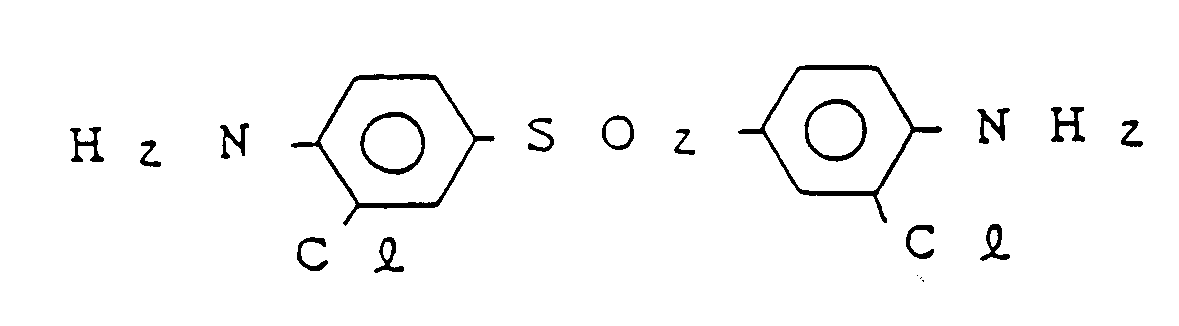
yielding a compound of the formula:
- In a solution of 198g (1 mole) of N,N-diaminodiphenylmethane (DDM) in 1,000 ml of a water/ethanol (50/50) mixed solvent was charged 312g (2 moles) of ethyl iodide (C₂H₅I), and the mixture was reacted at 60 °C for 3 hours. The resulting crude product was recrystallized twice from a water/ethanol (50/50) mixed solvent.
- The resulting reaction product was identified by means of IR and GPC to have the following formula:

- In place of diaminodiphenylsulfone (DDS) used in Preparation Example 1, the process of Preparation Example 1 was followed in the same manner with the exception to use a compound of the following general formula:

yielding a compound of the formula:
- Epoxy resins were blended in amounts shown in Table 1 below and the resulting blend was heated to 150 °C to obtain a homogeneous mixture. After cooling to 80 °C, dicyanodiamide was mixed to the mixture in a stoichiometric amount, thereby to obtain a thermocurable composition. The composition was poured into a mold composed of two glass plates spaced apart from each other by a Teflon spacer, heated at 100 °C for 2 hours, and then cured at 200 °C for 2 hours in an oven. The cured product was sliced into test pieces with a size of 30 cm x 30 cm x 2 mm and the test pieces were subjected tested for Izod strength (IZOD) and glass transition temperature (Tg) to obtain the results summarized in Table 1. A prepreg was also prepared by impregnating carbon fibers (tensile strength: 350 kg/mm², modulus: 32 t/mm²), arranged in parallel with each other, with the above epoxy resin composition. Workability for the fabrication of the prepreg was good. The prepreg showed the tackiness (TAC) as shown in Table 1. The prepreg was laminated in 12 layers and the laminate was cured under the same conditions as above to obtain carbon fiber-reinforced composite material whose compression after impact (CAI) was as shown in Table 1.
- Example 1 was repeated in the same manner as described except the compositions of the epoxy resin blends were changed as shown in Table 1. The results were as summarized in Table 1. The workability for the fabrication of the prepreg was good in the case of Examples 3-6 and 8. The composition of Example 7 is suited for the fabrication of machining parts.
- Example 1 was repeated in the same manner as described except the compositions of the epoxy resin blends were changed as shown in Table 1. The results were as summarized in Table 1. The toughness is poor in Comparative Examples 1-3. In the case of Comparative Example 4, good prepreg was not obtained.

- Example 1 was repeated in the same manner as described except that the compound obtained in Preparation Example 2 was used as the curing agent in place of dicyanodiamide. The results are summarized in Table 2.
- Example 1 was repeated in the same manner as described except that the compound obtained in Preparation Example 1 was used as the curing agent in place of dicyanodiamide. The results are summarized in Table 2.
- Examples 3, 6 and 8 were repeated in the same manner as described except that the compound obtained in Preparation Example 2 was used as the curing agent in place of dicyanodiamide. The results are summarized in Table 2.
- Comparative Examples 1 and 4 were repeated in the same manner as described except that, as the curing agent, the compound obtained in Preparation Example 2 was used in place of dicyanodiamide. The results are summarized in Table 2.
- Comparative Example 1 was repeated in the same manner as described except that, as the curing agent, the compound obtained in Preparation Example 1 was used in place of dicyanodiamide. The results are summarized in Table 2.
- Comparative Example 5 was repeated in the same manner as described except that a mixed Bisphenol A-type resin having the composition shown in Table 2 was used. The results are summarized in Table 2.

- Example 1 was repeated in the same manner as described except that various mixed curing agents as shown in Table 3 were each used in place of dicyanodiamide. The results were as summarized in Table 3.
- Examples 3, 6 and 8 were repeated in the same manner as described except that a mixed curing agent consisting of 28 parts by weight of the compound obtained in Preparation Example 2 and 72 parts by weight of dicyanodiamide was used in place of dicyanodiamide. The results are shown in Table 3.
- Example 1 was repeated in the same manner as described except that the curing agent indicated in Table 3 was used in place of dicyanodiamide, thereby to obtain the results summarized in Table 3.
- Comparative Example 4 was repeated in the same manner as described except that the mixed curing agent indicated in Table 3 was used in place of dicyanodiamide. The results are shown in Table 3.

Claims (10)
- A thermocurable composition comprising:
a Bisphenol A-type epoxy resin component which is a blend of a first, Bisphenol A-type epoxy resin having an epoxy equivalent in the range of 180-195 with a second, Bisphenol A-type epoxy resin having an epoxy equivalent of greater than 195, the amount and the molecular weight of said second epoxy resin being such that the proportion of said first epoxy resin is 10-40% based on the weight of said blend and that the number average molecular weight of said blend is 650-1300; and
an epoxy resin curing agent capable of crosslinking the epoxy resin. - A thermocurable composition as set forth in Claim 1, wherein the Bisphenol A-type epoxy resin blend has a number average molecular weight of 650-1000, 10-30% by weight thereof having an epoxy equivalent of 180-195.
- A thermocurable composition as set forth in Claim 1 or Claim 2, further comprising an additional epoxy resin which is not a Bisphenol A-type epoxy resin, in an amount of 50% by weight or less based on the total weight of said Bisphenol A-type epoxy resin component and said additional epoxy resin.
- A thermocurable composition as set forth in any preceding claim, wherein said curing agent comprises at least one compound represented by the following general formula:

- A thermocurable composition as set forth in Claim 4, wherein R is an alkyl group having 1-3 carbon atoms, X is -CH₂- -SO₂-, -CO-, -O-, -C(CH₃)₂- or -CHC₆H₅-, Y and Y' each is hydrogen, a lower alkyl group, a halogen atom, a nitro group or a trifluoromethyl group, R₁ and R₂ each is an alkyl group having 1-3 carbon atoms, and m and n each is 1 or 2.
- A thermocurable composition as set forth in any preceding claim, wherein said curing agent comprises a first component which is at least one compound selected from primary amines, phenolic compounds and acid anhydrides, and a second component which is at least one compound represented by the following general formula:

- A thermocurable composition as set forth in Claim 6, wherein said first and second curing agent components are used in amounts such that said first and second components account for 85 to 5% and 15 to 95%, respectively, of the total amount of active hydrogen of said first and second components.
- A thermocurable composition as set forth in Claim 6 or Claim 7, wherein said first curing agent component is at least one compound selected from aliphatic primary amines, aromatic primary amines, polyamido primary amines, dicyanopolyamides, bisphenols, phenolic resins, vinylphenol polymers, maleic anhydride, succinic anhydride, methyltetrahydrophthalic anhydride, methylnadic anhydride and methylhexahydrophthalic anhydride.
- A thermocurable composition as set forth in Claim 8, wherein said first curing agent component is diaminodiphenyl sulfone, diaminodiphenyl methane, dicyanodiamide or methylhexahydrophthalic anhydride.
- A thermocurable composition as set forth in any one of Claims 6-9, wherein the curing agent is used in an amount providing a ratio of equivalents of the active hydrogen of the curing agent per equivalent of the epoxy group of the epoxy resin in the range of 0.6 to 1.4.
Applications Claiming Priority (6)
| Application Number | Priority Date | Filing Date | Title |
|---|---|---|---|
| JP77325/88 | 1988-03-30 | ||
| JP7732588A JPH01247415A (en) | 1988-03-30 | 1988-03-30 | Epoxy resin composition |
| JP10886288A JPH02269115A (en) | 1988-04-29 | 1988-04-29 | Epoxy resin composition |
| JP10886188A JPH01278524A (en) | 1988-04-29 | 1988-04-29 | Epoxy resin composition |
| JP108862/88 | 1988-04-29 | ||
| JP108861/88 | 1988-04-29 |
Publications (3)
| Publication Number | Publication Date |
|---|---|
| EP0335706A2 EP0335706A2 (en) | 1989-10-04 |
| EP0335706A3 EP0335706A3 (en) | 1991-06-12 |
| EP0335706B1 true EP0335706B1 (en) | 1994-12-21 |
Family
ID=27302391
Family Applications (1)
| Application Number | Title | Priority Date | Filing Date |
|---|---|---|---|
| EP89303132A Expired - Lifetime EP0335706B1 (en) | 1988-03-30 | 1989-03-30 | Thermocurable epoxy resin composition |
Country Status (3)
| Country | Link |
|---|---|
| US (1) | US4912179A (en) |
| EP (1) | EP0335706B1 (en) |
| DE (1) | DE68920062T2 (en) |
Families Citing this family (12)
| Publication number | Priority date | Publication date | Assignee | Title |
|---|---|---|---|---|
| JPH0760918B2 (en) * | 1988-07-20 | 1995-06-28 | 三菱電機株式会社 | Laminating resin composition |
| US4985530A (en) * | 1988-07-29 | 1991-01-15 | Tonen Corporation | Thermosetting epoxy resin composition |
| DE3827626A1 (en) * | 1988-08-10 | 1990-03-08 | Teroson Gmbh | REACTIVE MELT ADHESIVE |
| US4940740A (en) * | 1989-04-21 | 1990-07-10 | Basf Aktiengesellschaft | Single phase toughened heat-curable resin systems exhibiting high strength after impact |
| US5200475A (en) * | 1991-06-03 | 1993-04-06 | Shell Oil Company | Epoxy resin compositions containing disecondary aromatic amines |
| ES2100511T3 (en) * | 1992-08-18 | 1997-06-16 | Ciba Geigy Ag | 2,2'-DIMETIL-5,5'-DIAMINODIFENIL SULFONA. |
| US6617399B2 (en) | 1999-12-17 | 2003-09-09 | Henkel Loctite Corporation | Thermosetting resin compositions comprising epoxy resins, adhesion promoters, curatives based on the combination of nitrogen compounds and transition metal complexes, and polysulfide tougheners |
| US6670430B1 (en) * | 1999-12-17 | 2003-12-30 | Henkel Loctite Corporation | Thermosetting resin compositions comprising epoxy resins, adhesion promoters, and curatives based on the combination of nitrogen compounds and transition metal complexes |
| WO2003024812A1 (en) * | 2001-09-17 | 2003-03-27 | Takeuchi Press Industries Co., Ltd., | Metal container having coating applied to inner surface thereof and method for production thereof |
| US6893736B2 (en) * | 2001-11-19 | 2005-05-17 | Henkel Corporation | Thermosetting resin compositions useful as underfill sealants |
| US6951907B1 (en) | 2001-11-19 | 2005-10-04 | Henkel Corporation | Composition of epoxy resin, secondary amine-functional adhesion promotor and curative of nitrogen-compound and transition metal complex |
| JP6062974B2 (en) * | 2014-02-24 | 2017-01-18 | 三ツ星ベルト株式会社 | Conductive composition |
Family Cites Families (6)
| Publication number | Priority date | Publication date | Assignee | Title |
|---|---|---|---|---|
| US3560388A (en) * | 1969-07-22 | 1971-02-02 | Memorex Corp | Magnetic coating composition with three component epoxy binder |
| US3957716A (en) * | 1973-10-01 | 1976-05-18 | Hercules Incorporated | Sized carbon fibers |
| JPS5182326A (en) * | 1975-01-17 | 1976-07-19 | Shinto Paint Co Ltd | KINZOKUYO PURAIMAASOSEIBUTSU |
| US4040993A (en) * | 1976-02-25 | 1977-08-09 | Westinghouse Electric Corporation | Low dissipation factor electrostatic epoxy wire coating powder |
| JPS61188478A (en) * | 1985-02-18 | 1986-08-22 | Toagosei Chem Ind Co Ltd | Adhesive composition |
| US4684678A (en) * | 1985-05-30 | 1987-08-04 | Minnesota Mining And Manufacturing Company | Epoxy resin curing agent, process, and composition |
-
1989
- 1989-03-28 US US07/329,890 patent/US4912179A/en not_active Expired - Fee Related
- 1989-03-30 DE DE68920062T patent/DE68920062T2/en not_active Expired - Fee Related
- 1989-03-30 EP EP89303132A patent/EP0335706B1/en not_active Expired - Lifetime
Also Published As
| Publication number | Publication date |
|---|---|
| US4912179A (en) | 1990-03-27 |
| EP0335706A3 (en) | 1991-06-12 |
| DE68920062D1 (en) | 1995-02-02 |
| EP0335706A2 (en) | 1989-10-04 |
| DE68920062T2 (en) | 1995-05-11 |
Similar Documents
| Publication | Publication Date | Title |
|---|---|---|
| EP0329456B1 (en) | Expoxy resin curing agent of a two-component type | |
| EP0122149B1 (en) | Metal fluoborate catalysed hindered aromatic amino curing agents for polyepoxide resins | |
| US5317068A (en) | Composition of tetraglycidyl, triglycidyl and diglycidyl epoxy resins | |
| EP0353089B1 (en) | Thermosetting epoxy resin composition | |
| US4912179A (en) | Bisphenol A epoxy resin mixtures with aromatic di-secondary amine | |
| US4687832A (en) | Novel epoxy resin compositions | |
| US20120238711A1 (en) | Epoxy resin compositions | |
| CN102958972A (en) | Polymer concrete composition | |
| US20120245306A1 (en) | Adducts based on divinylarene oxides | |
| JP3735896B2 (en) | Epoxy resin composition and semiconductor sealing material | |
| JPH1036485A (en) | Epoxy resin, epoxy resin composition and cured product thereof | |
| US4188474A (en) | Epoxy curing accelerator | |
| EP0440583A2 (en) | Latent epoxy resin hardeners | |
| KR102589546B1 (en) | Novel acid anhydride-based epoxy compound, epoxy resin composition containing the same, and cured product prepared therefrom | |
| US6812318B2 (en) | Epoxy resins, epoxy resin mixtures, epoxy resin compositions and products of curing of the same | |
| EP0251104A1 (en) | Curable epoxide composition | |
| JPH02103221A (en) | Amine-based curing agent for epoxy resin | |
| JPH02296858A (en) | Epoxy resin composition | |
| JP2003128882A (en) | Liquid epoxy resin mixture, epoxy resin composition and its cured product | |
| JPH0335016A (en) | Epoxy resin composition | |
| JPH059263A (en) | Epoxy resin composition | |
| JPH059262A (en) | Epoxy resin composition | |
| JPH01247416A (en) | Curable epoxy resin composition | |
| JPH04325518A (en) | Epoxy resin composition | |
| JPH01275619A (en) | Reactive diluent and resin composition containing same |
Legal Events
| Date | Code | Title | Description |
|---|---|---|---|
| PUAI | Public reference made under article 153(3) epc to a published international application that has entered the european phase |
Free format text: ORIGINAL CODE: 0009012 |
|
| AK | Designated contracting states |
Kind code of ref document: A2 Designated state(s): DE FR GB IT SE |
|
| PUAL | Search report despatched |
Free format text: ORIGINAL CODE: 0009013 |
|
| AK | Designated contracting states |
Kind code of ref document: A3 Designated state(s): DE FR GB IT SE |
|
| 17P | Request for examination filed |
Effective date: 19911205 |
|
| 17Q | First examination report despatched |
Effective date: 19931216 |
|
| GRAA | (expected) grant |
Free format text: ORIGINAL CODE: 0009210 |
|
| AK | Designated contracting states |
Kind code of ref document: B1 Designated state(s): DE FR GB IT SE |
|
| PG25 | Lapsed in a contracting state [announced via postgrant information from national office to epo] |
Ref country code: IT Free format text: LAPSE BECAUSE OF FAILURE TO SUBMIT A TRANSLATION OF THE DESCRIPTION OR TO PAY THE FEE WITHIN THE PRE;WARNING: LAPSES OF ITALIAN PATENTS WITH EFFECTIVE DATE BEFORE 2007 MAY HAVE OCCURRED AT ANY TIME BEFORE 2007. THE CORRECT EFFECTIVE DATE MAY BE DIFFERENT FROM THE ONE RECORDED.SCRIBED TIME-LIMIT Effective date: 19941221 |
|
| REF | Corresponds to: |
Ref document number: 68920062 Country of ref document: DE Date of ref document: 19950202 |
|
| ET | Fr: translation filed | ||
| PG25 | Lapsed in a contracting state [announced via postgrant information from national office to epo] |
Ref country code: SE Effective date: 19950321 |
|
| PLBE | No opposition filed within time limit |
Free format text: ORIGINAL CODE: 0009261 |
|
| STAA | Information on the status of an ep patent application or granted ep patent |
Free format text: STATUS: NO OPPOSITION FILED WITHIN TIME LIMIT |
|
| 26N | No opposition filed | ||
| PGFP | Annual fee paid to national office [announced via postgrant information from national office to epo] |
Ref country code: FR Payment date: 19970313 Year of fee payment: 9 |
|
| PGFP | Annual fee paid to national office [announced via postgrant information from national office to epo] |
Ref country code: GB Payment date: 19970321 Year of fee payment: 9 |
|
| PGFP | Annual fee paid to national office [announced via postgrant information from national office to epo] |
Ref country code: DE Payment date: 19970404 Year of fee payment: 9 |
|
| PG25 | Lapsed in a contracting state [announced via postgrant information from national office to epo] |
Ref country code: GB Free format text: LAPSE BECAUSE OF NON-PAYMENT OF DUE FEES Effective date: 19980330 |
|
| PG25 | Lapsed in a contracting state [announced via postgrant information from national office to epo] |
Ref country code: FR Free format text: THE PATENT HAS BEEN ANNULLED BY A DECISION OF A NATIONAL AUTHORITY Effective date: 19980331 |
|
| GBPC | Gb: european patent ceased through non-payment of renewal fee |
Effective date: 19980330 |
|
| PG25 | Lapsed in a contracting state [announced via postgrant information from national office to epo] |
Ref country code: DE Free format text: LAPSE BECAUSE OF NON-PAYMENT OF DUE FEES Effective date: 19981201 |
|
| REG | Reference to a national code |
Ref country code: FR Ref legal event code: ST |