EP0334586A1 - Carbohydrate lactam derivatives and their use in cosmetic compositions - Google Patents
Carbohydrate lactam derivatives and their use in cosmetic compositions Download PDFInfo
- Publication number
- EP0334586A1 EP0334586A1 EP19890302754 EP89302754A EP0334586A1 EP 0334586 A1 EP0334586 A1 EP 0334586A1 EP 19890302754 EP19890302754 EP 19890302754 EP 89302754 A EP89302754 A EP 89302754A EP 0334586 A1 EP0334586 A1 EP 0334586A1
- Authority
- EP
- European Patent Office
- Prior art keywords
- lactam
- hair
- composition according
- composition
- hair growth
- Prior art date
- Legal status (The legal status is an assumption and is not a legal conclusion. Google has not performed a legal analysis and makes no representation as to the accuracy of the status listed.)
- Granted
Links
- 239000000203 mixture Substances 0.000 title claims description 123
- -1 Carbohydrate lactam Chemical class 0.000 title claims description 30
- 239000002537 cosmetic Substances 0.000 title description 5
- 150000003951 lactams Chemical class 0.000 claims abstract description 56
- 210000004209 hair Anatomy 0.000 claims abstract description 54
- 230000000694 effects Effects 0.000 claims abstract description 49
- 239000013000 chemical inhibitor Substances 0.000 claims abstract description 46
- 230000003779 hair growth Effects 0.000 claims abstract description 44
- 230000000699 topical effect Effects 0.000 claims abstract description 28
- 102000005744 Glycoside Hydrolases Human genes 0.000 claims abstract description 11
- 108010031186 Glycoside Hydrolases Proteins 0.000 claims abstract description 11
- 125000002496 methyl group Chemical group [H]C([H])([H])* 0.000 claims abstract description 10
- 229910021645 metal ion Inorganic materials 0.000 claims abstract description 6
- 230000001939 inductive effect Effects 0.000 claims abstract description 5
- 239000003112 inhibitor Substances 0.000 claims description 34
- 210000004761 scalp Anatomy 0.000 claims description 22
- 239000003981 vehicle Substances 0.000 claims description 22
- 229960003632 minoxidil Drugs 0.000 claims description 20
- ZFMITUMMTDLWHR-UHFFFAOYSA-N Minoxidil Chemical compound NC1=[N+]([O-])C(N)=CC(N2CCCCC2)=N1 ZFMITUMMTDLWHR-UHFFFAOYSA-N 0.000 claims description 16
- 241000700159 Rattus Species 0.000 claims description 16
- 201000004384 Alopecia Diseases 0.000 claims description 14
- 238000012360 testing method Methods 0.000 claims description 13
- 230000003676 hair loss Effects 0.000 claims description 12
- 239000000126 substance Substances 0.000 claims description 12
- 229920002683 Glycosaminoglycan Polymers 0.000 claims description 11
- 238000000034 method Methods 0.000 claims description 11
- 150000001875 compounds Chemical class 0.000 claims description 10
- 230000002708 enhancing effect Effects 0.000 claims description 10
- 229940124563 hair growth stimulant Drugs 0.000 claims description 10
- ODHCTXKNWHHXJC-GSVOUGTGSA-N Pyroglutamic acid Natural products OC(=O)[C@H]1CCC(=O)N1 ODHCTXKNWHHXJC-GSVOUGTGSA-N 0.000 claims description 9
- 239000002253 acid Substances 0.000 claims description 9
- ODHCTXKNWHHXJC-UHFFFAOYSA-N acide pyroglutamique Natural products OC(=O)C1CCC(=O)N1 ODHCTXKNWHHXJC-UHFFFAOYSA-N 0.000 claims description 9
- 230000015572 biosynthetic process Effects 0.000 claims description 9
- 238000003786 synthesis reaction Methods 0.000 claims description 9
- ODHCTXKNWHHXJC-VKHMYHEASA-N 5-oxo-L-proline Chemical compound OC(=O)[C@@H]1CCC(=O)N1 ODHCTXKNWHHXJC-VKHMYHEASA-N 0.000 claims description 8
- 230000012010 growth Effects 0.000 claims description 8
- 239000004094 surface-active agent Substances 0.000 claims description 6
- 239000003961 penetration enhancing agent Substances 0.000 claims description 5
- 238000002360 preparation method Methods 0.000 claims description 5
- 150000002016 disaccharides Chemical class 0.000 claims description 4
- 230000008569 process Effects 0.000 claims description 4
- 102000003923 Protein Kinase C Human genes 0.000 claims description 3
- 108090000315 Protein Kinase C Proteins 0.000 claims description 3
- 239000012190 activator Substances 0.000 claims description 3
- 229920006317 cationic polymer Polymers 0.000 claims description 3
- 150000002772 monosaccharides Chemical class 0.000 claims description 3
- 241000700157 Rattus norvegicus Species 0.000 claims description 2
- 230000004700 cellular uptake Effects 0.000 claims description 2
- 150000001982 diacylglycerols Chemical class 0.000 claims description 2
- 229930182480 glucuronide Natural products 0.000 claims description 2
- 150000008273 hexosamines Chemical group 0.000 claims description 2
- 230000037311 normal skin Effects 0.000 claims description 2
- 229920001542 oligosaccharide Polymers 0.000 claims description 2
- 150000002482 oligosaccharides Chemical class 0.000 claims description 2
- 230000004044 response Effects 0.000 claims description 2
- 230000001225 therapeutic effect Effects 0.000 claims description 2
- 230000003442 weekly effect Effects 0.000 claims description 2
- 239000003102 growth factor Substances 0.000 claims 4
- SNRLLQGRGPHGAA-UHFFFAOYSA-N dibutyl decanedioate;1-dodecylazepan-2-one;2-hydroxyoctanoic acid Chemical class CCCCCCC(O)C(O)=O.CCCCCCCCCCCCN1CCCCCC1=O.CCCCOC(=O)CCCCCCCCC(=O)OCCCC SNRLLQGRGPHGAA-UHFFFAOYSA-N 0.000 claims 1
- 125000001483 monosaccharide substituent group Chemical group 0.000 claims 1
- 210000003491 skin Anatomy 0.000 description 23
- LFQSCWFLJHTTHZ-UHFFFAOYSA-N Ethanol Chemical compound CCO LFQSCWFLJHTTHZ-UHFFFAOYSA-N 0.000 description 14
- ZMXDDKWLCZADIW-UHFFFAOYSA-N N,N-Dimethylformamide Chemical compound CN(C)C=O ZMXDDKWLCZADIW-UHFFFAOYSA-N 0.000 description 13
- 150000002148 esters Chemical class 0.000 description 13
- 239000003623 enhancer Substances 0.000 description 12
- 238000009472 formulation Methods 0.000 description 12
- 239000006210 lotion Substances 0.000 description 10
- 235000015961 tonic Nutrition 0.000 description 10
- 230000001256 tonic effect Effects 0.000 description 10
- PEDCQBHIVMGVHV-UHFFFAOYSA-N Glycerine Chemical compound OCC(O)CO PEDCQBHIVMGVHV-UHFFFAOYSA-N 0.000 description 9
- 230000035515 penetration Effects 0.000 description 9
- XLYOFNOQVPJJNP-UHFFFAOYSA-N water Substances O XLYOFNOQVPJJNP-UHFFFAOYSA-N 0.000 description 9
- 125000000217 alkyl group Chemical group 0.000 description 8
- 210000003780 hair follicle Anatomy 0.000 description 8
- 230000003698 anagen phase Effects 0.000 description 7
- 230000031774 hair cycle Effects 0.000 description 7
- 230000003659 hair regrowth Effects 0.000 description 7
- CSCPPACGZOOCGX-UHFFFAOYSA-N Acetone Chemical compound CC(C)=O CSCPPACGZOOCGX-UHFFFAOYSA-N 0.000 description 6
- RTZKZFJDLAIYFH-UHFFFAOYSA-N Diethyl ether Chemical compound CCOCC RTZKZFJDLAIYFH-UHFFFAOYSA-N 0.000 description 6
- 230000002500 effect on skin Effects 0.000 description 6
- 239000003921 oil Substances 0.000 description 6
- 239000007787 solid Substances 0.000 description 6
- 102000053187 Glucuronidase Human genes 0.000 description 5
- 108010060309 Glucuronidase Proteins 0.000 description 5
- DNIAPMSPPWPWGF-UHFFFAOYSA-N Propylene glycol Chemical compound CC(O)CO DNIAPMSPPWPWGF-UHFFFAOYSA-N 0.000 description 5
- 125000002777 acetyl group Chemical group [H]C([H])([H])C(*)=O 0.000 description 5
- 125000002252 acyl group Chemical group 0.000 description 5
- 230000008901 benefit Effects 0.000 description 5
- 125000004432 carbon atom Chemical group C* 0.000 description 5
- 230000015556 catabolic process Effects 0.000 description 5
- 235000019441 ethanol Nutrition 0.000 description 5
- 230000002401 inhibitory effect Effects 0.000 description 5
- 235000019198 oils Nutrition 0.000 description 5
- 239000012071 phase Substances 0.000 description 5
- 239000002453 shampoo Substances 0.000 description 5
- 239000011734 sodium Substances 0.000 description 5
- 229910052708 sodium Inorganic materials 0.000 description 5
- 0 CC([*-])(C(C)([C@](C)(C(C)(C*)N1)[U])O*)C1=O Chemical compound CC([*-])(C(C)([C@](C)(C(C)(C*)N1)[U])O*)C1=O 0.000 description 4
- IAJILQKETJEXLJ-UHFFFAOYSA-N Galacturonsaeure Natural products O=CC(O)C(O)C(O)C(O)C(O)=O IAJILQKETJEXLJ-UHFFFAOYSA-N 0.000 description 4
- DGAQECJNVWCQMB-PUAWFVPOSA-M Ilexoside XXIX Chemical compound C[C@@H]1CC[C@@]2(CC[C@@]3(C(=CC[C@H]4[C@]3(CC[C@@H]5[C@@]4(CC[C@@H](C5(C)C)OS(=O)(=O)[O-])C)C)[C@@H]2[C@]1(C)O)C)C(=O)O[C@H]6[C@@H]([C@H]([C@@H]([C@H](O6)CO)O)O)O.[Na+] DGAQECJNVWCQMB-PUAWFVPOSA-M 0.000 description 4
- 241000276498 Pollachius virens Species 0.000 description 4
- 229920003171 Poly (ethylene oxide) Polymers 0.000 description 4
- JUJWROOIHBZHMG-UHFFFAOYSA-N Pyridine Chemical compound C1=CC=NC=C1 JUJWROOIHBZHMG-UHFFFAOYSA-N 0.000 description 4
- WYURNTSHIVDZCO-UHFFFAOYSA-N Tetrahydrofuran Chemical compound C1CCOC1 WYURNTSHIVDZCO-UHFFFAOYSA-N 0.000 description 4
- 230000036621 balding Effects 0.000 description 4
- 238000006243 chemical reaction Methods 0.000 description 4
- DOIRQSBPFJWKBE-UHFFFAOYSA-N dibutyl phthalate Chemical compound CCCCOC(=O)C1=CC=CC=C1C(=O)OCCCC DOIRQSBPFJWKBE-UHFFFAOYSA-N 0.000 description 4
- 230000006870 function Effects 0.000 description 4
- 125000000524 functional group Chemical group 0.000 description 4
- 210000003128 head Anatomy 0.000 description 4
- JVTAAEKCZFNVCJ-UHFFFAOYSA-N lactic acid Chemical compound CC(O)C(O)=O JVTAAEKCZFNVCJ-UHFFFAOYSA-N 0.000 description 4
- 239000003755 preservative agent Substances 0.000 description 4
- 230000035755 proliferation Effects 0.000 description 4
- 150000003839 salts Chemical class 0.000 description 4
- 229960000716 tonics Drugs 0.000 description 4
- ALSTYHKOOCGGFT-KTKRTIGZSA-N (9Z)-octadecen-1-ol Chemical compound CCCCCCCC\C=C/CCCCCCCCO ALSTYHKOOCGGFT-KTKRTIGZSA-N 0.000 description 3
- JEJLGIQLPYYGEE-UHFFFAOYSA-N 1,2-dipalmitoylglycerol Chemical compound CCCCCCCCCCCCCCCC(=O)OCC(CO)OC(=O)CCCCCCCCCCCCCCC JEJLGIQLPYYGEE-UHFFFAOYSA-N 0.000 description 3
- XDOFQFKRPWOURC-UHFFFAOYSA-N 16-methylheptadecanoic acid Chemical compound CC(C)CCCCCCCCCCCCCCC(O)=O XDOFQFKRPWOURC-UHFFFAOYSA-N 0.000 description 3
- QTBSBXVTEAMEQO-UHFFFAOYSA-N Acetic acid Chemical compound CC(O)=O QTBSBXVTEAMEQO-UHFFFAOYSA-N 0.000 description 3
- WFDIJRYMOXRFFG-UHFFFAOYSA-N Acetic anhydride Chemical compound CC(=O)OC(C)=O WFDIJRYMOXRFFG-UHFFFAOYSA-N 0.000 description 3
- VEXZGXHMUGYJMC-UHFFFAOYSA-M Chloride anion Chemical compound [Cl-] VEXZGXHMUGYJMC-UHFFFAOYSA-M 0.000 description 3
- 229920001287 Chondroitin sulfate Polymers 0.000 description 3
- YMWUJEATGCHHMB-UHFFFAOYSA-N Dichloromethane Chemical compound ClCCl YMWUJEATGCHHMB-UHFFFAOYSA-N 0.000 description 3
- LCGLNKUTAGEVQW-UHFFFAOYSA-N Dimethyl ether Chemical compound COC LCGLNKUTAGEVQW-UHFFFAOYSA-N 0.000 description 3
- XEKOWRVHYACXOJ-UHFFFAOYSA-N Ethyl acetate Chemical compound CCOC(C)=O XEKOWRVHYACXOJ-UHFFFAOYSA-N 0.000 description 3
- 241000233866 Fungi Species 0.000 description 3
- KFZMGEQAYNKOFK-UHFFFAOYSA-N Isopropanol Chemical compound CC(C)O KFZMGEQAYNKOFK-UHFFFAOYSA-N 0.000 description 3
- HEMHJVSKTPXQMS-UHFFFAOYSA-M Sodium hydroxide Chemical compound [OH-].[Na+] HEMHJVSKTPXQMS-UHFFFAOYSA-M 0.000 description 3
- 230000009471 action Effects 0.000 description 3
- 239000008346 aqueous phase Substances 0.000 description 3
- 239000002585 base Substances 0.000 description 3
- 102000005936 beta-Galactosidase Human genes 0.000 description 3
- 108010005774 beta-Galactosidase Proteins 0.000 description 3
- 239000004359 castor oil Substances 0.000 description 3
- 235000019438 castor oil Nutrition 0.000 description 3
- 150000001768 cations Chemical class 0.000 description 3
- 210000004027 cell Anatomy 0.000 description 3
- 239000003795 chemical substances by application Substances 0.000 description 3
- SASYSVUEVMOWPL-NXVVXOECSA-N decyl oleate Chemical compound CCCCCCCCCCOC(=O)CCCCCCC\C=C/CCCCCCCC SASYSVUEVMOWPL-NXVVXOECSA-N 0.000 description 3
- 235000014113 dietary fatty acids Nutrition 0.000 description 3
- 239000000839 emulsion Substances 0.000 description 3
- 239000000194 fatty acid Substances 0.000 description 3
- 229930195729 fatty acid Natural products 0.000 description 3
- 150000004665 fatty acids Chemical class 0.000 description 3
- 239000000499 gel Substances 0.000 description 3
- 235000011187 glycerol Nutrition 0.000 description 3
- ZEMPKEQAKRGZGQ-XOQCFJPHSA-N glycerol triricinoleate Natural products CCCCCC[C@@H](O)CC=CCCCCCCCC(=O)OC[C@@H](COC(=O)CCCCCCCC=CC[C@@H](O)CCCCCC)OC(=O)CCCCCCCC=CC[C@H](O)CCCCCC ZEMPKEQAKRGZGQ-XOQCFJPHSA-N 0.000 description 3
- 125000003976 glyceryl group Chemical group [H]C([*])([H])C(O[H])([H])C(O[H])([H])[H] 0.000 description 3
- 208000024963 hair loss Diseases 0.000 description 3
- BXWNKGSJHAJOGX-UHFFFAOYSA-N hexadecan-1-ol Chemical compound CCCCCCCCCCCCCCCCO BXWNKGSJHAJOGX-UHFFFAOYSA-N 0.000 description 3
- 125000002887 hydroxy group Chemical group [H]O* 0.000 description 3
- 150000002596 lactones Chemical class 0.000 description 3
- 239000007788 liquid Substances 0.000 description 3
- 239000011159 matrix material Substances 0.000 description 3
- 229910052751 metal Inorganic materials 0.000 description 3
- 239000002184 metal Substances 0.000 description 3
- 239000012569 microbial contaminant Substances 0.000 description 3
- 230000000813 microbial effect Effects 0.000 description 3
- 244000005700 microbiome Species 0.000 description 3
- 229940055577 oleyl alcohol Drugs 0.000 description 3
- XMLQWXUVTXCDDL-UHFFFAOYSA-N oleyl alcohol Natural products CCCCCCC=CCCCCCCCCCCO XMLQWXUVTXCDDL-UHFFFAOYSA-N 0.000 description 3
- FJKROLUGYXJWQN-UHFFFAOYSA-N papa-hydroxy-benzoic acid Natural products OC(=O)C1=CC=C(O)C=C1 FJKROLUGYXJWQN-UHFFFAOYSA-N 0.000 description 3
- 239000002304 perfume Substances 0.000 description 3
- 239000008194 pharmaceutical composition Substances 0.000 description 3
- 239000000843 powder Substances 0.000 description 3
- 238000004321 preservation Methods 0.000 description 3
- 230000002335 preservative effect Effects 0.000 description 3
- 239000000047 product Substances 0.000 description 3
- 239000003380 propellant Substances 0.000 description 3
- 239000002904 solvent Substances 0.000 description 3
- 238000004659 sterilization and disinfection Methods 0.000 description 3
- 238000003756 stirring Methods 0.000 description 3
- PUPZLCDOIYMWBV-UHFFFAOYSA-N (+/-)-1,3-Butanediol Chemical compound CC(O)CCO PUPZLCDOIYMWBV-UHFFFAOYSA-N 0.000 description 2
- QMMJWQMCMRUYTG-UHFFFAOYSA-N 1,2,4,5-tetrachloro-3-(trifluoromethyl)benzene Chemical compound FC(F)(F)C1=C(Cl)C(Cl)=CC(Cl)=C1Cl QMMJWQMCMRUYTG-UHFFFAOYSA-N 0.000 description 2
- VBICKXHEKHSIBG-UHFFFAOYSA-N 1-monostearoylglycerol Chemical compound CCCCCCCCCCCCCCCCCC(=O)OCC(O)CO VBICKXHEKHSIBG-UHFFFAOYSA-N 0.000 description 2
- 239000005995 Aluminium silicate Substances 0.000 description 2
- CIWBSHSKHKDKBQ-JLAZNSOCSA-N Ascorbic acid Chemical compound OC[C@H](O)[C@H]1OC(=O)C(O)=C1O CIWBSHSKHKDKBQ-JLAZNSOCSA-N 0.000 description 2
- 241000894006 Bacteria Species 0.000 description 2
- ZCTQGTTXIYCGGC-UHFFFAOYSA-N Benzyl salicylate Chemical compound OC1=CC=CC=C1C(=O)OCC1=CC=CC=C1 ZCTQGTTXIYCGGC-UHFFFAOYSA-N 0.000 description 2
- CURLTUGMZLYLDI-UHFFFAOYSA-N Carbon dioxide Chemical compound O=C=O CURLTUGMZLYLDI-UHFFFAOYSA-N 0.000 description 2
- HEDRZPFGACZZDS-UHFFFAOYSA-N Chloroform Chemical compound ClC(Cl)Cl HEDRZPFGACZZDS-UHFFFAOYSA-N 0.000 description 2
- FBPFZTCFMRRESA-FSIIMWSLSA-N D-Glucitol Natural products OC[C@H](O)[C@H](O)[C@@H](O)[C@H](O)CO FBPFZTCFMRRESA-FSIIMWSLSA-N 0.000 description 2
- FBPFZTCFMRRESA-JGWLITMVSA-N D-glucitol Chemical compound OC[C@H](O)[C@@H](O)[C@H](O)[C@H](O)CO FBPFZTCFMRRESA-JGWLITMVSA-N 0.000 description 2
- FWYXULJVROPNGE-HKBQPEDESA-N DG(15:0/15:0/0:0) Chemical compound CCCCCCCCCCCCCCC(=O)OC[C@H](CO)OC(=O)CCCCCCCCCCCCCC FWYXULJVROPNGE-HKBQPEDESA-N 0.000 description 2
- PYGXAGIECVVIOZ-UHFFFAOYSA-N Dibutyl decanedioate Chemical compound CCCCOC(=O)CCCCCCCCC(=O)OCCCC PYGXAGIECVVIOZ-UHFFFAOYSA-N 0.000 description 2
- IAZDPXIOMUYVGZ-UHFFFAOYSA-N Dimethylsulphoxide Chemical compound CS(C)=O IAZDPXIOMUYVGZ-UHFFFAOYSA-N 0.000 description 2
- LYCAIKOWRPUZTN-UHFFFAOYSA-N Ethylene glycol Chemical compound OCCO LYCAIKOWRPUZTN-UHFFFAOYSA-N 0.000 description 2
- CMBYOWLFQAFZCP-UHFFFAOYSA-N Hexyl dodecanoate Chemical compound CCCCCCCCCCCC(=O)OCCCCCC CMBYOWLFQAFZCP-UHFFFAOYSA-N 0.000 description 2
- 206010028980 Neoplasm Diseases 0.000 description 2
- GQPLMRYTRLFLPF-UHFFFAOYSA-N Nitrous Oxide Chemical compound [O-][N+]#N GQPLMRYTRLFLPF-UHFFFAOYSA-N 0.000 description 2
- ISWSIDIOOBJBQZ-UHFFFAOYSA-N Phenol Chemical compound OC1=CC=CC=C1 ISWSIDIOOBJBQZ-UHFFFAOYSA-N 0.000 description 2
- ATUOYWHBWRKTHZ-UHFFFAOYSA-N Propane Chemical compound CCC ATUOYWHBWRKTHZ-UHFFFAOYSA-N 0.000 description 2
- 208000001647 Renal Insufficiency Diseases 0.000 description 2
- VYPSYNLAJGMNEJ-UHFFFAOYSA-N Silicium dioxide Chemical compound O=[Si]=O VYPSYNLAJGMNEJ-UHFFFAOYSA-N 0.000 description 2
- PXIPVTKHYLBLMZ-UHFFFAOYSA-N Sodium azide Chemical compound [Na+].[N-]=[N+]=[N-] PXIPVTKHYLBLMZ-UHFFFAOYSA-N 0.000 description 2
- DTQVDTLACAAQTR-UHFFFAOYSA-N Trifluoroacetic acid Chemical compound OC(=O)C(F)(F)F DTQVDTLACAAQTR-UHFFFAOYSA-N 0.000 description 2
- XSQUKJJJFZCRTK-UHFFFAOYSA-N Urea Chemical compound NC(N)=O XSQUKJJJFZCRTK-UHFFFAOYSA-N 0.000 description 2
- 239000000443 aerosol Substances 0.000 description 2
- 229910052783 alkali metal Inorganic materials 0.000 description 2
- 150000001340 alkali metals Chemical class 0.000 description 2
- 125000005907 alkyl ester group Chemical group 0.000 description 2
- AEMOLEFTQBMNLQ-WAXACMCWSA-N alpha-D-glucuronic acid Chemical compound O[C@H]1O[C@H](C(O)=O)[C@@H](O)[C@H](O)[C@H]1O AEMOLEFTQBMNLQ-WAXACMCWSA-N 0.000 description 2
- 235000012211 aluminium silicate Nutrition 0.000 description 2
- 229940121363 anti-inflammatory agent Drugs 0.000 description 2
- 239000002260 anti-inflammatory agent Substances 0.000 description 2
- 230000009286 beneficial effect Effects 0.000 description 2
- WPYMKLBDIGXBTP-UHFFFAOYSA-N benzoic acid Chemical compound OC(=O)C1=CC=CC=C1 WPYMKLBDIGXBTP-UHFFFAOYSA-N 0.000 description 2
- SESFRYSPDFLNCH-UHFFFAOYSA-N benzyl benzoate Chemical compound C=1C=CC=CC=1C(=O)OCC1=CC=CC=C1 SESFRYSPDFLNCH-UHFFFAOYSA-N 0.000 description 2
- KVYGGMBOZFWZBQ-UHFFFAOYSA-N benzyl nicotinate Chemical compound C=1C=CN=CC=1C(=O)OCC1=CC=CC=C1 KVYGGMBOZFWZBQ-UHFFFAOYSA-N 0.000 description 2
- FUWUEFKEXZQKKA-UHFFFAOYSA-N beta-thujaplicin Chemical compound CC(C)C=1C=CC=C(O)C(=O)C=1 FUWUEFKEXZQKKA-UHFFFAOYSA-N 0.000 description 2
- 238000006065 biodegradation reaction Methods 0.000 description 2
- XSIFPSYPOVKYCO-UHFFFAOYSA-N butyl benzoate Chemical compound CCCCOC(=O)C1=CC=CC=C1 XSIFPSYPOVKYCO-UHFFFAOYSA-N 0.000 description 2
- 125000000484 butyl group Chemical group [H]C([*])([H])C([H])([H])C([H])([H])C([H])([H])[H] 0.000 description 2
- DHAZIUXMHRHVMP-UHFFFAOYSA-N butyl tetradecanoate Chemical compound CCCCCCCCCCCCCC(=O)OCCCC DHAZIUXMHRHVMP-UHFFFAOYSA-N 0.000 description 2
- BMGQDNIDDQSVDQ-UHFFFAOYSA-N carbamic acid;pyrimidine Chemical compound NC(O)=O.C1=CN=CN=C1 BMGQDNIDDQSVDQ-UHFFFAOYSA-N 0.000 description 2
- 230000003778 catagen phase Effects 0.000 description 2
- HVYWMOMLDIMFJA-DPAQBDIFSA-N cholesterol Chemical compound C1C=C2C[C@@H](O)CC[C@]2(C)[C@@H]2[C@@H]1[C@@H]1CC[C@H]([C@H](C)CCCC(C)C)[C@@]1(C)CC2 HVYWMOMLDIMFJA-DPAQBDIFSA-N 0.000 description 2
- 210000002808 connective tissue Anatomy 0.000 description 2
- 239000006071 cream Substances 0.000 description 2
- 230000000994 depressogenic effect Effects 0.000 description 2
- 210000004207 dermis Anatomy 0.000 description 2
- ALOUNLDAKADEEB-UHFFFAOYSA-N dimethyl sebacate Chemical compound COC(=O)CCCCCCCCC(=O)OC ALOUNLDAKADEEB-UHFFFAOYSA-N 0.000 description 2
- 229960001760 dimethyl sulfoxide Drugs 0.000 description 2
- NOPFSRXAKWQILS-UHFFFAOYSA-N docosan-1-ol Chemical compound CCCCCCCCCCCCCCCCCCCCCCO NOPFSRXAKWQILS-UHFFFAOYSA-N 0.000 description 2
- 239000003814 drug Substances 0.000 description 2
- 239000003974 emollient agent Substances 0.000 description 2
- RGXWDWUGBIJHDO-UHFFFAOYSA-N ethyl decanoate Chemical compound CCCCCCCCCC(=O)OCC RGXWDWUGBIJHDO-UHFFFAOYSA-N 0.000 description 2
- 125000001495 ethyl group Chemical group [H]C([H])([H])C([H])([H])* 0.000 description 2
- SHZIWNPUGXLXDT-UHFFFAOYSA-N ethyl hexanoate Chemical compound CCCCCC(=O)OCC SHZIWNPUGXLXDT-UHFFFAOYSA-N 0.000 description 2
- MMXKVMNBHPAILY-UHFFFAOYSA-N ethyl laurate Chemical compound CCCCCCCCCCCC(=O)OCC MMXKVMNBHPAILY-UHFFFAOYSA-N 0.000 description 2
- MMKRHZKQPFCLLS-UHFFFAOYSA-N ethyl myristate Chemical compound CCCCCCCCCCCCCC(=O)OCC MMKRHZKQPFCLLS-UHFFFAOYSA-N 0.000 description 2
- 238000002474 experimental method Methods 0.000 description 2
- 238000010438 heat treatment Methods 0.000 description 2
- IPCSVZSSVZVIGE-UHFFFAOYSA-N hexadecanoic acid Chemical compound CCCCCCCCCCCCCCCC(O)=O IPCSVZSSVZVIGE-UHFFFAOYSA-N 0.000 description 2
- 229940100463 hexyl laurate Drugs 0.000 description 2
- 239000003906 humectant Substances 0.000 description 2
- JYGXADMDTFJGBT-VWUMJDOOSA-N hydrocortisone Chemical compound O=C1CC[C@]2(C)[C@H]3[C@@H](O)C[C@](C)([C@@](CC4)(O)C(=O)CO)[C@@H]4[C@@H]3CCC2=C1 JYGXADMDTFJGBT-VWUMJDOOSA-N 0.000 description 2
- 239000004615 ingredient Substances 0.000 description 2
- 230000000977 initiatory effect Effects 0.000 description 2
- NNPPMTNAJDCUHE-UHFFFAOYSA-N isobutane Chemical compound CC(C)C NNPPMTNAJDCUHE-UHFFFAOYSA-N 0.000 description 2
- XUGNVMKQXJXZCD-UHFFFAOYSA-N isopropyl palmitate Chemical compound CCCCCCCCCCCCCCCC(=O)OC(C)C XUGNVMKQXJXZCD-UHFFFAOYSA-N 0.000 description 2
- NLYAJNPCOHFWQQ-UHFFFAOYSA-N kaolin Chemical compound O.O.O=[Al]O[Si](=O)O[Si](=O)O[Al]=O NLYAJNPCOHFWQQ-UHFFFAOYSA-N 0.000 description 2
- 201000006370 kidney failure Diseases 0.000 description 2
- 230000007246 mechanism Effects 0.000 description 2
- 150000001457 metallic cations Chemical class 0.000 description 2
- 125000001421 myristyl group Chemical group [H]C([*])([H])C([H])([H])C([H])([H])C([H])([H])C([H])([H])C([H])([H])C([H])([H])C([H])([H])C([H])([H])C([H])([H])C([H])([H])C([H])([H])C([H])([H])C([H])([H])[H] 0.000 description 2
- GLDOVTGHNKAZLK-UHFFFAOYSA-N octadecan-1-ol Chemical compound CCCCCCCCCCCCCCCCCCO GLDOVTGHNKAZLK-UHFFFAOYSA-N 0.000 description 2
- QIQXTHQIDYTFRH-UHFFFAOYSA-N octadecanoic acid Chemical compound CCCCCCCCCCCCCCCCCC(O)=O QIQXTHQIDYTFRH-UHFFFAOYSA-N 0.000 description 2
- 125000002347 octyl group Chemical group [H]C([*])([H])C([H])([H])C([H])([H])C([H])([H])C([H])([H])C([H])([H])C([H])([H])C([H])([H])[H] 0.000 description 2
- 150000002892 organic cations Chemical class 0.000 description 2
- 238000007254 oxidation reaction Methods 0.000 description 2
- 239000003208 petroleum Substances 0.000 description 2
- 230000001737 promoting effect Effects 0.000 description 2
- 125000001436 propyl group Chemical group [H]C([*])([H])C([H])([H])C([H])([H])[H] 0.000 description 2
- 229960004063 propylene glycol Drugs 0.000 description 2
- 235000013772 propylene glycol Nutrition 0.000 description 2
- 150000003214 pyranose derivatives Chemical group 0.000 description 2
- UMJSCPRVCHMLSP-UHFFFAOYSA-N pyridine Natural products COC1=CC=CN=C1 UMJSCPRVCHMLSP-UHFFFAOYSA-N 0.000 description 2
- GHMLBKRAJCXXBS-UHFFFAOYSA-N resorcinol Chemical compound OC1=CC=CC(O)=C1 GHMLBKRAJCXXBS-UHFFFAOYSA-N 0.000 description 2
- 230000002441 reversible effect Effects 0.000 description 2
- YGSDEFSMJLZEOE-UHFFFAOYSA-N salicylic acid Chemical compound OC(=O)C1=CC=CC=C1O YGSDEFSMJLZEOE-UHFFFAOYSA-N 0.000 description 2
- 239000000243 solution Substances 0.000 description 2
- 239000000600 sorbitol Substances 0.000 description 2
- 235000010356 sorbitol Nutrition 0.000 description 2
- 230000003637 steroidlike Effects 0.000 description 2
- 230000004936 stimulating effect Effects 0.000 description 2
- 230000000638 stimulation Effects 0.000 description 2
- 210000000434 stratum corneum Anatomy 0.000 description 2
- 235000000346 sugar Nutrition 0.000 description 2
- 229910021653 sulphate ion Inorganic materials 0.000 description 2
- 230000009885 systemic effect Effects 0.000 description 2
- 230000003797 telogen phase Effects 0.000 description 2
- YLQBMQCUIZJEEH-UHFFFAOYSA-N tetrahydrofuran Natural products C=1C=COC=1 YLQBMQCUIZJEEH-UHFFFAOYSA-N 0.000 description 2
- 210000001519 tissue Anatomy 0.000 description 2
- NOOLISFMXDJSKH-KXUCPTDWSA-N (-)-Menthol Chemical compound CC(C)[C@@H]1CC[C@@H](C)C[C@H]1O NOOLISFMXDJSKH-KXUCPTDWSA-N 0.000 description 1
- YPUPEDVTHSWZHZ-JAMMHHFISA-N (1-ethoxy-1-oxobutan-2-yl) (2s)-5-oxopyrrolidine-2-carboxylate Chemical compound CCOC(=O)C(CC)OC(=O)[C@@H]1CCC(=O)N1 YPUPEDVTHSWZHZ-JAMMHHFISA-N 0.000 description 1
- DHRIKYBCMBYPNN-CRMOQAEOSA-N (1-ethoxy-3-hydroxy-1-oxobutan-2-yl) (2s)-5-oxopyrrolidine-2-carboxylate Chemical compound CCOC(=O)C(C(C)O)OC(=O)[C@@H]1CCC(=O)N1 DHRIKYBCMBYPNN-CRMOQAEOSA-N 0.000 description 1
- PWTCCMJTPHCGMS-KHPPLWFESA-N (2-acetyloxy-3-hydroxypropyl) (z)-octadec-9-enoate Chemical compound CCCCCCCC\C=C/CCCCCCCC(=O)OCC(CO)OC(C)=O PWTCCMJTPHCGMS-KHPPLWFESA-N 0.000 description 1
- GNWCZBXSKIIURR-UHFFFAOYSA-N (2-docosanoyloxy-3-hydroxypropyl) docosanoate Chemical compound CCCCCCCCCCCCCCCCCCCCCC(=O)OCC(CO)OC(=O)CCCCCCCCCCCCCCCCCCCCC GNWCZBXSKIIURR-UHFFFAOYSA-N 0.000 description 1
- WYUPPBUYXIKWJB-YFKPBYRVSA-N (2-methoxy-2-oxoethyl) (2s)-5-oxopyrrolidine-2-carboxylate Chemical compound COC(=O)COC(=O)[C@@H]1CCC(=O)N1 WYUPPBUYXIKWJB-YFKPBYRVSA-N 0.000 description 1
- FPJHWYCPAOPVIV-VOZMEZHOSA-N (2R,3S,4R,5R,6R)-6-[(2R,3R,4R,5R,6R)-5-acetamido-2-(hydroxymethyl)-6-methoxy-3-sulfooxyoxan-4-yl]oxy-4,5-dihydroxy-3-methoxyoxane-2-carboxylic acid Chemical compound CO[C@@H]1O[C@H](CO)[C@H](OS(O)(=O)=O)[C@H](O[C@@H]2O[C@H]([C@@H](OC)[C@H](O)[C@H]2O)C(O)=O)[C@H]1NC(C)=O FPJHWYCPAOPVIV-VOZMEZHOSA-N 0.000 description 1
- WJTCHBVEUFDSIK-NWDGAFQWSA-N (2r,5s)-1-benzyl-2,5-dimethylpiperazine Chemical compound C[C@@H]1CN[C@@H](C)CN1CC1=CC=CC=C1 WJTCHBVEUFDSIK-NWDGAFQWSA-N 0.000 description 1
- AGUTXIBMYVFOMK-RWYGWLOXSA-N (2s)-1-hydroxy-3-(icosanoyloxy)propan-2-yl icosanoate Chemical compound CCCCCCCCCCCCCCCCCCCC(=O)OC[C@H](CO)OC(=O)CCCCCCCCCCCCCCCCCCC AGUTXIBMYVFOMK-RWYGWLOXSA-N 0.000 description 1
- IAJILQKETJEXLJ-KLVWXMOXSA-N (2s,3r,4r,5r)-2,3,4,5-tetrahydroxy-6-oxohexanoic acid Chemical compound O=C[C@H](O)[C@H](O)[C@@H](O)[C@H](O)C(O)=O IAJILQKETJEXLJ-KLVWXMOXSA-N 0.000 description 1
- ZQBULZYTDGUSSK-UHFFFAOYSA-N (3-hydroxy-2-octanoyloxypropyl) octanoate Chemical compound CCCCCCCC(=O)OCC(CO)OC(=O)CCCCCCC ZQBULZYTDGUSSK-UHFFFAOYSA-N 0.000 description 1
- QRFNDAVXJCGLFB-GJPGBQJBSA-N (3r,3ar,6s,6ar)-3,6-dihydroxy-3,3a,6,6a-tetrahydrofuro[3,2-b]furan-2,5-dione Chemical compound O1C(=O)[C@H](O)[C@H]2OC(=O)[C@@H](O)[C@H]21 QRFNDAVXJCGLFB-GJPGBQJBSA-N 0.000 description 1
- RGCVYEOTYJCNOS-UHFFFAOYSA-N (4-cyano-2-methylphenyl)boronic acid Chemical compound CC1=CC(C#N)=CC=C1B(O)O RGCVYEOTYJCNOS-UHFFFAOYSA-N 0.000 description 1
- ICLYJLBTOGPLMC-KVVVOXFISA-N (z)-octadec-9-enoate;tris(2-hydroxyethyl)azanium Chemical compound OCCN(CCO)CCO.CCCCCCCC\C=C/CCCCCCCC(O)=O ICLYJLBTOGPLMC-KVVVOXFISA-N 0.000 description 1
- BOSAWIQFTJIYIS-UHFFFAOYSA-N 1,1,1-trichloro-2,2,2-trifluoroethane Chemical compound FC(F)(F)C(Cl)(Cl)Cl BOSAWIQFTJIYIS-UHFFFAOYSA-N 0.000 description 1
- AFSHUZFNMVJNKX-UHFFFAOYSA-N 1,2-di-(9Z-octadecenoyl)glycerol Natural products CCCCCCCCC=CCCCCCCCC(=O)OCC(CO)OC(=O)CCCCCCCC=CCCCCCCCC AFSHUZFNMVJNKX-UHFFFAOYSA-N 0.000 description 1
- FVXRWZPVZULNCQ-ZPRYGCIXSA-N 1,2-diarachidonoyl-sn-glycerol Chemical compound CCCCC\C=C/C\C=C/C\C=C/C\C=C/CCCC(=O)OC[C@H](CO)OC(=O)CCC\C=C/C\C=C/C\C=C/C\C=C/CCCCC FVXRWZPVZULNCQ-ZPRYGCIXSA-N 0.000 description 1
- AWHAUPZHZYUHOM-UHFFFAOYSA-N 1,2-dibutyrin Chemical compound CCCC(=O)OCC(CO)OC(=O)CCC AWHAUPZHZYUHOM-UHFFFAOYSA-N 0.000 description 1
- DDMOUSALMHHKOS-UHFFFAOYSA-N 1,2-dichloro-1,1,2,2-tetrafluoroethane Chemical compound FC(F)(Cl)C(F)(F)Cl DDMOUSALMHHKOS-UHFFFAOYSA-N 0.000 description 1
- GNSDEDOVXZDMKM-UHFFFAOYSA-N 1,2-didecanoylglycerol Chemical compound CCCCCCCCCC(=O)OCC(CO)OC(=O)CCCCCCCCC GNSDEDOVXZDMKM-UHFFFAOYSA-N 0.000 description 1
- DRUFTGMQJWWIOL-ZDUSSCGKSA-N 1,2-dihexanoyl-sn-glycerol Chemical compound CCCCCC(=O)OC[C@H](CO)OC(=O)CCCCC DRUFTGMQJWWIOL-ZDUSSCGKSA-N 0.000 description 1
- ZQBULZYTDGUSSK-KRWDZBQOSA-N 1,2-dioctanoyl-sn-glycerol Chemical compound CCCCCCCC(=O)OC[C@H](CO)OC(=O)CCCCCCC ZQBULZYTDGUSSK-KRWDZBQOSA-N 0.000 description 1
- AFSHUZFNMVJNKX-LLWMBOQKSA-N 1,2-dioleoyl-sn-glycerol Chemical compound CCCCCCCC\C=C/CCCCCCCC(=O)OC[C@H](CO)OC(=O)CCCCCCC\C=C/CCCCCCCC AFSHUZFNMVJNKX-LLWMBOQKSA-N 0.000 description 1
- AFSHUZFNMVJNKX-CLFAGFIQSA-N 1,2-dioleoylglycerol Chemical compound CCCCCCCC\C=C/CCCCCCCC(=O)OCC(CO)OC(=O)CCCCCCC\C=C/CCCCCCCC AFSHUZFNMVJNKX-CLFAGFIQSA-N 0.000 description 1
- JEJLGIQLPYYGEE-XIFFEERXSA-N 1,2-dipalmitoyl-sn-glycerol Chemical compound CCCCCCCCCCCCCCCC(=O)OC[C@H](CO)OC(=O)CCCCCCCCCCCCCCC JEJLGIQLPYYGEE-XIFFEERXSA-N 0.000 description 1
- RYHBNJHYFVUHQT-UHFFFAOYSA-N 1,4-Dioxane Chemical compound C1COCCO1 RYHBNJHYFVUHQT-UHFFFAOYSA-N 0.000 description 1
- FILVIKOEJGORQS-UHFFFAOYSA-N 1,5-dimethylpyrrolidin-2-one Chemical compound CC1CCC(=O)N1C FILVIKOEJGORQS-UHFFFAOYSA-N 0.000 description 1
- RLPSARLYTKXVSE-UHFFFAOYSA-N 1-(1,3-thiazol-5-yl)ethanamine Chemical compound CC(N)C1=CN=CS1 RLPSARLYTKXVSE-UHFFFAOYSA-N 0.000 description 1
- AZUXKVXMJOIAOF-UHFFFAOYSA-N 1-(2-hydroxypropoxy)propan-2-ol Chemical compound CC(O)COCC(C)O AZUXKVXMJOIAOF-UHFFFAOYSA-N 0.000 description 1
- ZFPGARUNNKGOBB-UHFFFAOYSA-N 1-Ethyl-2-pyrrolidinone Chemical compound CCN1CCCC1=O ZFPGARUNNKGOBB-UHFFFAOYSA-N 0.000 description 1
- KBPLFHHGFOOTCA-UHFFFAOYSA-N 1-Octanol Chemical compound CCCCCCCCO KBPLFHHGFOOTCA-UHFFFAOYSA-N 0.000 description 1
- PWTCCMJTPHCGMS-YRBAHSOBSA-N 1-Oleoyl-2-acetyl-sn-glycerol Chemical compound CCCCCCCC\C=C/CCCCCCCC(=O)OC[C@H](CO)OC(C)=O PWTCCMJTPHCGMS-YRBAHSOBSA-N 0.000 description 1
- XTPPAVHDUJMWEX-UHFFFAOYSA-M 1-ethenylpyridin-1-ium;chloride Chemical compound [Cl-].C=C[N+]1=CC=CC=C1 XTPPAVHDUJMWEX-UHFFFAOYSA-M 0.000 description 1
- HBXWUCXDUUJDRB-UHFFFAOYSA-N 1-octadecoxyoctadecane Chemical compound CCCCCCCCCCCCCCCCCCOCCCCCCCCCCCCCCCCCC HBXWUCXDUUJDRB-UHFFFAOYSA-N 0.000 description 1
- NSXLMTYRMFVYNT-IUJDHQGTSA-N 1-stearoyl-2-arachidonoyl-sn-glycerol Chemical compound CCCCCCCCCCCCCCCCCC(=O)OC[C@H](CO)OC(=O)CCC\C=C/C\C=C/C\C=C/C\C=C/CCCCC NSXLMTYRMFVYNT-IUJDHQGTSA-N 0.000 description 1
- 238000001644 13C nuclear magnetic resonance spectroscopy Methods 0.000 description 1
- LGEZTMRIZWCDLW-UHFFFAOYSA-N 14-methylpentadecyl octadecanoate Chemical compound CCCCCCCCCCCCCCCCCC(=O)OCCCCCCCCCCCCCC(C)C LGEZTMRIZWCDLW-UHFFFAOYSA-N 0.000 description 1
- VOXZDWNPVJITMN-ZBRFXRBCSA-N 17β-estradiol Chemical compound OC1=CC=C2[C@H]3CC[C@](C)([C@H](CC4)O)[C@@H]4[C@@H]3CCC2=C1 VOXZDWNPVJITMN-ZBRFXRBCSA-N 0.000 description 1
- RAXXELZNTBOGNW-UHFFFAOYSA-N 1H-imidazole Chemical class C1=CNC=N1 RAXXELZNTBOGNW-UHFFFAOYSA-N 0.000 description 1
- HDIFHQMREAYYJW-FMIVXFBMSA-N 2,3-dihydroxypropyl (e)-12-hydroxyoctadec-9-enoate Chemical compound CCCCCCC(O)C\C=C\CCCCCCCC(=O)OCC(O)CO HDIFHQMREAYYJW-FMIVXFBMSA-N 0.000 description 1
- CHHHXKFHOYLYRE-UHFFFAOYSA-M 2,4-Hexadienoic acid, potassium salt (1:1), (2E,4E)- Chemical compound [K+].CC=CC=CC([O-])=O CHHHXKFHOYLYRE-UHFFFAOYSA-M 0.000 description 1
- CIVCELMLGDGMKZ-UHFFFAOYSA-N 2,4-dichloro-6-methylpyridine-3-carboxylic acid Chemical compound CC1=CC(Cl)=C(C(O)=O)C(Cl)=N1 CIVCELMLGDGMKZ-UHFFFAOYSA-N 0.000 description 1
- FLPJVCMIKUWSDR-UHFFFAOYSA-N 2-(4-formylphenoxy)acetamide Chemical compound NC(=O)COC1=CC=C(C=O)C=C1 FLPJVCMIKUWSDR-UHFFFAOYSA-N 0.000 description 1
- JKNCOURZONDCGV-UHFFFAOYSA-N 2-(dimethylamino)ethyl 2-methylprop-2-enoate Chemical compound CN(C)CCOC(=O)C(C)=C JKNCOURZONDCGV-UHFFFAOYSA-N 0.000 description 1
- OGLCQHRZUSEXNB-UHFFFAOYSA-N 2-Pinene-9, 10-diol Natural products OC1C(=O)OC2C(O)C(O)OC21 OGLCQHRZUSEXNB-UHFFFAOYSA-N 0.000 description 1
- ULNBAMNJNLQLOJ-AKGZTFGVSA-N 2-[(2s)-5-oxopyrrolidine-2-carbonyl]oxypropanoic acid Chemical compound OC(=O)C(C)OC(=O)[C@@H]1CCC(=O)N1 ULNBAMNJNLQLOJ-AKGZTFGVSA-N 0.000 description 1
- DUMAFWZFOOOEPH-UHFFFAOYSA-N 2-[bis(2-hydroxyethyl)amino]ethanol;dodecyl benzenesulfonate Chemical compound OCCN(CCO)CCO.CCCCCCCCCCCCOS(=O)(=O)C1=CC=CC=C1 DUMAFWZFOOOEPH-UHFFFAOYSA-N 0.000 description 1
- MSWZFWKMSRAUBD-GASJEMHNSA-N 2-amino-2-deoxy-D-galactopyranose Chemical compound N[C@H]1C(O)O[C@H](CO)[C@H](O)[C@@H]1O MSWZFWKMSRAUBD-GASJEMHNSA-N 0.000 description 1
- QTDIEDOANJISNP-UHFFFAOYSA-N 2-dodecoxyethyl hydrogen sulfate Chemical compound CCCCCCCCCCCCOCCOS(O)(=O)=O QTDIEDOANJISNP-UHFFFAOYSA-N 0.000 description 1
- ZNQVEEAIQZEUHB-UHFFFAOYSA-N 2-ethoxyethanol Chemical compound CCOCCO ZNQVEEAIQZEUHB-UHFFFAOYSA-N 0.000 description 1
- YEMWTVRIHVDMPF-DTIOYNMSSA-N 2-ethylhexyl (2s)-5-oxopyrrolidine-2-carboxylate Chemical compound CCCCC(CC)COC(=O)[C@@H]1CCC(=O)N1 YEMWTVRIHVDMPF-DTIOYNMSSA-N 0.000 description 1
- CCFWAONPPYWNDM-UHFFFAOYSA-N 2-ethylhexyl nonanoate Chemical compound CCCCCCCCC(=O)OCC(CC)CCCC CCFWAONPPYWNDM-UHFFFAOYSA-N 0.000 description 1
- LMKQNIJHUILJTN-GGYWPGCISA-N 2-hexyldecyl (2s)-5-oxopyrrolidine-2-carboxylate Chemical compound CCCCCCCCC(CCCCCC)COC(=O)[C@@H]1CCC(=O)N1 LMKQNIJHUILJTN-GGYWPGCISA-N 0.000 description 1
- OYINQIKIQCNQOX-UHFFFAOYSA-M 2-hydroxybutyl(trimethyl)azanium;chloride Chemical compound [Cl-].CCC(O)C[N+](C)(C)C OYINQIKIQCNQOX-UHFFFAOYSA-M 0.000 description 1
- 125000000954 2-hydroxyethyl group Chemical group [H]C([*])([H])C([H])([H])O[H] 0.000 description 1
- RFVNOJDQRGSOEL-UHFFFAOYSA-N 2-hydroxyethyl octadecanoate Chemical compound CCCCCCCCCCCCCCCCCC(=O)OCCO RFVNOJDQRGSOEL-UHFFFAOYSA-N 0.000 description 1
- GQATZTBBVSSQTP-AXDSSHIGSA-N 2-methylhexyl (2s)-5-oxopyrrolidine-2-carboxylate Chemical compound CCCCC(C)COC(=O)[C@@H]1CCC(=O)N1 GQATZTBBVSSQTP-AXDSSHIGSA-N 0.000 description 1
- OJIBJRXMHVZPLV-UHFFFAOYSA-N 2-methylpropyl hexadecanoate Chemical compound CCCCCCCCCCCCCCCC(=O)OCC(C)C OJIBJRXMHVZPLV-UHFFFAOYSA-N 0.000 description 1
- SGRCVQDBWHCTIS-UHFFFAOYSA-N 2-nonanoyloxypropyl nonanoate Chemical compound CCCCCCCCC(=O)OCC(C)OC(=O)CCCCCCCC SGRCVQDBWHCTIS-UHFFFAOYSA-N 0.000 description 1
- HQWLBRJUMWPIOA-WCSIJFPASA-N 2-octyldodecyl (2s)-5-oxopyrrolidine-2-carboxylate Chemical compound CCCCCCCCCCC(CCCCCCCC)COC(=O)[C@@H]1CCC(=O)N1 HQWLBRJUMWPIOA-WCSIJFPASA-N 0.000 description 1
- XLNUFYRMYPWCNL-ABLWVSNPSA-N 3,7-dimethyloctyl (2s)-5-oxopyrrolidine-2-carboxylate Chemical compound CC(C)CCCC(C)CCOC(=O)[C@@H]1CCC(=O)N1 XLNUFYRMYPWCNL-ABLWVSNPSA-N 0.000 description 1
- VRUFTFZZSSSPML-UHFFFAOYSA-N 3-hydroxyoxolane-2-carbaldehyde Chemical compound OC1CCOC1C=O VRUFTFZZSSSPML-UHFFFAOYSA-N 0.000 description 1
- HBTAOSGHCXUEKI-UHFFFAOYSA-N 4-chloro-n,n-dimethyl-3-nitrobenzenesulfonamide Chemical compound CN(C)S(=O)(=O)C1=CC=C(Cl)C([N+]([O-])=O)=C1 HBTAOSGHCXUEKI-UHFFFAOYSA-N 0.000 description 1
- HIQIXEFWDLTDED-UHFFFAOYSA-N 4-hydroxy-1-piperidin-4-ylpyrrolidin-2-one Chemical compound O=C1CC(O)CN1C1CCNCC1 HIQIXEFWDLTDED-UHFFFAOYSA-N 0.000 description 1
- 229940090248 4-hydroxybenzoic acid Drugs 0.000 description 1
- AMEMLELAMQEAIA-UHFFFAOYSA-N 6-(tert-butyl)thieno[3,2-d]pyrimidin-4(3H)-one Chemical compound N1C=NC(=O)C2=C1C=C(C(C)(C)C)S2 AMEMLELAMQEAIA-UHFFFAOYSA-N 0.000 description 1
- ZVAHHEYPLKVJSO-MGCNEYSASA-N 6-deoxy-D-galactono-1,5-lactone Chemical compound C[C@H]1OC(=O)[C@H](O)[C@@H](O)[C@H]1O ZVAHHEYPLKVJSO-MGCNEYSASA-N 0.000 description 1
- NAKFRQULMGLXBT-UHFFFAOYSA-N 6-methoxyquinolin-8-ol Chemical compound N1=CC=CC2=CC(OC)=CC(O)=C21 NAKFRQULMGLXBT-UHFFFAOYSA-N 0.000 description 1
- ZOZKYEHVNDEUCO-DKXJUACHSA-N Aceglatone Chemical compound O1C(=O)[C@H](OC(C)=O)[C@H]2OC(=O)[C@@H](OC(=O)C)[C@H]21 ZOZKYEHVNDEUCO-DKXJUACHSA-N 0.000 description 1
- 235000003911 Arachis Nutrition 0.000 description 1
- 244000105624 Arachis hypogaea Species 0.000 description 1
- 239000005711 Benzoic acid Substances 0.000 description 1
- WKBOTKDWSSQWDR-UHFFFAOYSA-N Bromine atom Chemical compound [Br] WKBOTKDWSSQWDR-UHFFFAOYSA-N 0.000 description 1
- 239000004358 Butane-1, 3-diol Substances 0.000 description 1
- NDKYEUQMPZIGFN-UHFFFAOYSA-N Butyl dodecanoate Chemical compound CCCCCCCCCCCC(=O)OCCCC NDKYEUQMPZIGFN-UHFFFAOYSA-N 0.000 description 1
- RVSFDYKVGUEZCX-AATLWQCWSA-N CC(=O)O[C@H](C(O)=O)[C@H]1OC(=O)[C@H](OC(C)=O)[C@H]1OC(C)=O Chemical compound CC(=O)O[C@H](C(O)=O)[C@H]1OC(=O)[C@H](OC(C)=O)[C@H]1OC(C)=O RVSFDYKVGUEZCX-AATLWQCWSA-N 0.000 description 1
- 240000004160 Capsicum annuum Species 0.000 description 1
- 235000008534 Capsicum annuum var annuum Nutrition 0.000 description 1
- 235000007862 Capsicum baccatum Nutrition 0.000 description 1
- OKTJSMMVPCPJKN-UHFFFAOYSA-N Carbon Chemical group [C] OKTJSMMVPCPJKN-UHFFFAOYSA-N 0.000 description 1
- 206010048610 Cardiotoxicity Diseases 0.000 description 1
- VOPWNXZWBYDODV-UHFFFAOYSA-N Chlorodifluoromethane Chemical compound FC(F)Cl VOPWNXZWBYDODV-UHFFFAOYSA-N 0.000 description 1
- DBAKFASWICGISY-BTJKTKAUSA-N Chlorpheniramine maleate Chemical compound OC(=O)\C=C/C(O)=O.C=1C=CC=NC=1C(CCN(C)C)C1=CC=C(Cl)C=C1 DBAKFASWICGISY-BTJKTKAUSA-N 0.000 description 1
- 244000060011 Cocos nucifera Species 0.000 description 1
- 235000013162 Cocos nucifera Nutrition 0.000 description 1
- 102000008186 Collagen Human genes 0.000 description 1
- 108010035532 Collagen Proteins 0.000 description 1
- 244000303965 Cyamopsis psoralioides Species 0.000 description 1
- ZZZCUOFIHGPKAK-UHFFFAOYSA-N D-erythro-ascorbic acid Natural products OCC1OC(=O)C(O)=C1O ZZZCUOFIHGPKAK-UHFFFAOYSA-N 0.000 description 1
- XECPAIJNBXCOBO-MMPJQOAZSA-N D-glucaro-1,4-lactone Chemical compound OC(=O)[C@@H](O)[C@H]1OC(=O)[C@H](O)[C@H]1O XECPAIJNBXCOBO-MMPJQOAZSA-N 0.000 description 1
- UYUXSRADSPPKRZ-SKNVOMKLSA-N D-glucurono-6,3-lactone Chemical compound O=C[C@H](O)[C@H]1OC(=O)[C@@H](O)[C@H]1O UYUXSRADSPPKRZ-SKNVOMKLSA-N 0.000 description 1
- SNPLKNRPJHDVJA-ZETCQYMHSA-N D-panthenol Chemical compound OCC(C)(C)[C@@H](O)C(=O)NCCCO SNPLKNRPJHDVJA-ZETCQYMHSA-N 0.000 description 1
- 229920000045 Dermatan sulfate Polymers 0.000 description 1
- YUXIBTJKHLUKBD-UHFFFAOYSA-N Dibutyl succinate Chemical compound CCCCOC(=O)CCC(=O)OCCCC YUXIBTJKHLUKBD-UHFFFAOYSA-N 0.000 description 1
- 239000004338 Dichlorodifluoromethane Substances 0.000 description 1
- 208000000059 Dyspnea Diseases 0.000 description 1
- 206010013975 Dyspnoeas Diseases 0.000 description 1
- 239000004150 EU approved colour Substances 0.000 description 1
- 102000004190 Enzymes Human genes 0.000 description 1
- 108090000790 Enzymes Proteins 0.000 description 1
- GYCKQBWUSACYIF-UHFFFAOYSA-N Ethyl salicylate Chemical compound CCOC(=O)C1=CC=CC=C1O GYCKQBWUSACYIF-UHFFFAOYSA-N 0.000 description 1
- 102000016359 Fibronectins Human genes 0.000 description 1
- 108010067306 Fibronectins Proteins 0.000 description 1
- 206010016807 Fluid retention Diseases 0.000 description 1
- DSLZVSRJTYRBFB-UHFFFAOYSA-N Galactaric acid Natural products OC(=O)C(O)C(O)C(O)C(O)C(O)=O DSLZVSRJTYRBFB-UHFFFAOYSA-N 0.000 description 1
- 108010010803 Gelatin Proteins 0.000 description 1
- 229920002971 Heparan sulfate Polymers 0.000 description 1
- VEXZGXHMUGYJMC-UHFFFAOYSA-N Hydrochloric acid Chemical compound Cl VEXZGXHMUGYJMC-UHFFFAOYSA-N 0.000 description 1
- HEFNNWSXXWATRW-UHFFFAOYSA-N Ibuprofen Chemical compound CC(C)CC1=CC=C(C(C)C(O)=O)C=C1 HEFNNWSXXWATRW-UHFFFAOYSA-N 0.000 description 1
- XXBSUZSONOQQGK-YVZJFKFKSA-N L-Arabino-1,5-lactone Chemical compound O[C@H]1COC(=O)[C@H](O)[C@H]1O XXBSUZSONOQQGK-YVZJFKFKSA-N 0.000 description 1
- LEVWYRKDKASIDU-IMJSIDKUSA-N L-cystine Chemical compound [O-]C(=O)[C@@H]([NH3+])CSSC[C@H]([NH3+])C([O-])=O LEVWYRKDKASIDU-IMJSIDKUSA-N 0.000 description 1
- SXZYCXMUPBBULW-NEEWWZBLSA-N L-galactono-1,4-lactone Chemical compound OC[C@H](O)[C@H]1OC(=O)[C@@H](O)[C@@H]1O SXZYCXMUPBBULW-NEEWWZBLSA-N 0.000 description 1
- 239000004166 Lanolin Substances 0.000 description 1
- 241000124008 Mammalia Species 0.000 description 1
- FXHOOIRPVKKKFG-UHFFFAOYSA-N N,N-Dimethylacetamide Chemical compound CN(C)C(C)=O FXHOOIRPVKKKFG-UHFFFAOYSA-N 0.000 description 1
- MMOXZBCLCQITDF-UHFFFAOYSA-N N,N-diethyl-m-toluamide Chemical compound CCN(CC)C(=O)C1=CC=CC(C)=C1 MMOXZBCLCQITDF-UHFFFAOYSA-N 0.000 description 1
- OVRNDRQMDRJTHS-CBQIKETKSA-N N-Acetyl-D-Galactosamine Chemical compound CC(=O)N[C@H]1[C@@H](O)O[C@H](CO)[C@H](O)[C@@H]1O OVRNDRQMDRJTHS-CBQIKETKSA-N 0.000 description 1
- SECXISVLQFMRJM-UHFFFAOYSA-N N-Methylpyrrolidone Chemical compound CN1CCCC1=O SECXISVLQFMRJM-UHFFFAOYSA-N 0.000 description 1
- OVRNDRQMDRJTHS-UHFFFAOYSA-N N-acelyl-D-glucosamine Natural products CC(=O)NC1C(O)OC(CO)C(O)C1O OVRNDRQMDRJTHS-UHFFFAOYSA-N 0.000 description 1
- MBLBDJOUHNCFQT-UHFFFAOYSA-N N-acetyl-D-galactosamine Natural products CC(=O)NC(C=O)C(O)C(O)C(O)CO MBLBDJOUHNCFQT-UHFFFAOYSA-N 0.000 description 1
- OVRNDRQMDRJTHS-FMDGEEDCSA-N N-acetyl-beta-D-glucosamine Chemical compound CC(=O)N[C@H]1[C@H](O)O[C@H](CO)[C@@H](O)[C@@H]1O OVRNDRQMDRJTHS-FMDGEEDCSA-N 0.000 description 1
- OVRNDRQMDRJTHS-OZRXBMAMSA-N N-acetyl-beta-D-mannosamine Chemical compound CC(=O)N[C@@H]1[C@H](O)O[C@H](CO)[C@@H](O)[C@@H]1O OVRNDRQMDRJTHS-OZRXBMAMSA-N 0.000 description 1
- MBLBDJOUHNCFQT-LXGUWJNJSA-N N-acetylglucosamine Natural products CC(=O)N[C@@H](C=O)[C@@H](O)[C@H](O)[C@H](O)CO MBLBDJOUHNCFQT-LXGUWJNJSA-N 0.000 description 1
- 206010028813 Nausea Diseases 0.000 description 1
- 241000772415 Neovison vison Species 0.000 description 1
- DRUKNYVQGHETPO-UHFFFAOYSA-N Nonanedioic acid dimethyl ester Natural products COC(=O)CCCCCCCC(=O)OC DRUKNYVQGHETPO-UHFFFAOYSA-N 0.000 description 1
- 241000283973 Oryctolagus cuniculus Species 0.000 description 1
- 229910019142 PO4 Inorganic materials 0.000 description 1
- 241001364096 Pachycephalidae Species 0.000 description 1
- KDLHZDBZIXYQEI-UHFFFAOYSA-N Palladium on carbon Substances [Pd] KDLHZDBZIXYQEI-UHFFFAOYSA-N 0.000 description 1
- 235000021314 Palmitic acid Nutrition 0.000 description 1
- 239000004146 Propane-1,2-diol Substances 0.000 description 1
- 229910006146 SO3M1 Inorganic materials 0.000 description 1
- 240000004808 Saccharomyces cerevisiae Species 0.000 description 1
- KEAYESYHFKHZAL-UHFFFAOYSA-N Sodium Chemical compound [Na] KEAYESYHFKHZAL-UHFFFAOYSA-N 0.000 description 1
- DBMJMQXJHONAFJ-UHFFFAOYSA-M Sodium laurylsulphate Chemical compound [Na+].CCCCCCCCCCCCOS([O-])(=O)=O DBMJMQXJHONAFJ-UHFFFAOYSA-M 0.000 description 1
- 239000004141 Sodium laurylsulphate Substances 0.000 description 1
- 229920002125 Sokalan® Polymers 0.000 description 1
- 229920002472 Starch Polymers 0.000 description 1
- 235000021355 Stearic acid Nutrition 0.000 description 1
- QAOWNCQODCNURD-UHFFFAOYSA-L Sulfate Chemical compound [O-]S([O-])(=O)=O QAOWNCQODCNURD-UHFFFAOYSA-L 0.000 description 1
- ULUAUXLGCMPNKK-UHFFFAOYSA-N Sulfobutanedioic acid Chemical class OC(=O)CC(C(O)=O)S(O)(=O)=O ULUAUXLGCMPNKK-UHFFFAOYSA-N 0.000 description 1
- 208000001871 Tachycardia Diseases 0.000 description 1
- DKGAVHZHDRPRBM-UHFFFAOYSA-N Tert-Butanol Chemical compound CC(C)(C)O DKGAVHZHDRPRBM-UHFFFAOYSA-N 0.000 description 1
- 229930003270 Vitamin B Natural products 0.000 description 1
- 229930003268 Vitamin C Natural products 0.000 description 1
- 206010052428 Wound Diseases 0.000 description 1
- 208000027418 Wounds and injury Diseases 0.000 description 1
- YFICNBBIYKTBLK-SMWREMLRSA-N [(2s)-3-hydroxy-2-octacosanoyloxypropyl] octacosanoate Chemical compound CCCCCCCCCCCCCCCCCCCCCCCCCCCC(=O)OC[C@H](CO)OC(=O)CCCCCCCCCCCCCCCCCCCCCCCCCCC YFICNBBIYKTBLK-SMWREMLRSA-N 0.000 description 1
- UZUBNIPDAIVWIE-IVMDWMLBSA-N [(3r,4r,5r,6r)-3-amino-2,5-dihydroxy-6-(hydroxymethyl)oxan-4-yl] hydrogen sulfate Chemical compound N[C@H]1C(O)O[C@H](CO)[C@@H](O)[C@@H]1OS(O)(=O)=O UZUBNIPDAIVWIE-IVMDWMLBSA-N 0.000 description 1
- DGEZNRSVGBDHLK-UHFFFAOYSA-N [1,10]phenanthroline Chemical compound C1=CN=C2C3=NC=CC=C3C=CC2=C1 DGEZNRSVGBDHLK-UHFFFAOYSA-N 0.000 description 1
- 239000002250 absorbent Substances 0.000 description 1
- 230000002745 absorbent Effects 0.000 description 1
- DPXJVFZANSGRMM-UHFFFAOYSA-N acetic acid;2,3,4,5,6-pentahydroxyhexanal;sodium Chemical compound [Na].CC(O)=O.OCC(O)C(O)C(O)C(O)C=O DPXJVFZANSGRMM-UHFFFAOYSA-N 0.000 description 1
- 229940048299 acetylated lanolin alcohols Drugs 0.000 description 1
- 239000004480 active ingredient Substances 0.000 description 1
- 239000013543 active substance Substances 0.000 description 1
- IAJILQKETJEXLJ-QTBDOELSSA-N aldehydo-D-glucuronic acid Chemical compound O=C[C@H](O)[C@@H](O)[C@H](O)[C@H](O)C(O)=O IAJILQKETJEXLJ-QTBDOELSSA-N 0.000 description 1
- 125000001931 aliphatic group Chemical group 0.000 description 1
- 239000003513 alkali Substances 0.000 description 1
- 229910001508 alkali metal halide Inorganic materials 0.000 description 1
- 150000008045 alkali metal halides Chemical class 0.000 description 1
- 229910052936 alkali metal sulfate Inorganic materials 0.000 description 1
- 125000003342 alkenyl group Chemical group 0.000 description 1
- 150000004996 alkyl benzenes Chemical class 0.000 description 1
- 231100000360 alopecia Toxicity 0.000 description 1
- TUFYVOCKVJOUIR-UHFFFAOYSA-N alpha-Thujaplicin Natural products CC(C)C=1C=CC=CC(=O)C=1O TUFYVOCKVJOUIR-UHFFFAOYSA-N 0.000 description 1
- 229910000323 aluminium silicate Inorganic materials 0.000 description 1
- 150000001412 amines Chemical class 0.000 description 1
- 150000003863 ammonium salts Chemical class 0.000 description 1
- 206010068168 androgenetic alopecia Diseases 0.000 description 1
- 238000010171 animal model Methods 0.000 description 1
- 125000000129 anionic group Chemical group 0.000 description 1
- 230000002421 anti-septic effect Effects 0.000 description 1
- 239000003963 antioxidant agent Substances 0.000 description 1
- 235000006708 antioxidants Nutrition 0.000 description 1
- 229940064004 antiseptic throat preparations Drugs 0.000 description 1
- 239000012736 aqueous medium Substances 0.000 description 1
- 125000004097 arachidonyl group Chemical group [H]C([*])([H])C([H])([H])C([H])([H])C([H])([H])/C([H])=C([H])\C([H])([H])/C([H])=C([H])\C([H])([H])/C([H])=C([H])\C([H])([H])/C([H])=C([H])\C([H])([H])C([H])([H])C([H])([H])C([H])([H])C([H])([H])[H] 0.000 description 1
- BTFJIXJJCSYFAL-UHFFFAOYSA-N arachidyl alcohol Natural products CCCCCCCCCCCCCCCCCCCCO BTFJIXJJCSYFAL-UHFFFAOYSA-N 0.000 description 1
- 125000001204 arachidyl group Chemical group [H]C([*])([H])C([H])([H])C([H])([H])C([H])([H])C([H])([H])C([H])([H])C([H])([H])C([H])([H])C([H])([H])C([H])([H])C([H])([H])C([H])([H])C([H])([H])C([H])([H])C([H])([H])C([H])([H])C([H])([H])C([H])([H])C([H])([H])C([H])([H])[H] 0.000 description 1
- 150000005840 aryl radicals Chemical class 0.000 description 1
- 150000001507 asparagine derivatives Chemical class 0.000 description 1
- 150000001540 azides Chemical class 0.000 description 1
- 210000004666 bacterial spore Anatomy 0.000 description 1
- 210000002469 basement membrane Anatomy 0.000 description 1
- 229960000686 benzalkonium chloride Drugs 0.000 description 1
- 229960001950 benzethonium chloride Drugs 0.000 description 1
- UREZNYTWGJKWBI-UHFFFAOYSA-M benzethonium chloride Chemical compound [Cl-].C1=CC(C(C)(C)CC(C)(C)C)=CC=C1OCCOCC[N+](C)(C)CC1=CC=CC=C1 UREZNYTWGJKWBI-UHFFFAOYSA-M 0.000 description 1
- 235000010233 benzoic acid Nutrition 0.000 description 1
- 229960004365 benzoic acid Drugs 0.000 description 1
- 229960002903 benzyl benzoate Drugs 0.000 description 1
- AGEZXYOZHKGVCM-UHFFFAOYSA-N benzyl bromide Chemical compound BrCC1=CC=CC=C1 AGEZXYOZHKGVCM-UHFFFAOYSA-N 0.000 description 1
- 125000001797 benzyl group Chemical group [H]C1=C([H])C([H])=C(C([H])=C1[H])C([H])([H])* 0.000 description 1
- 229950004580 benzyl nicotinate Drugs 0.000 description 1
- CADWTSSKOVRVJC-UHFFFAOYSA-N benzyl(dimethyl)azanium;chloride Chemical compound [Cl-].C[NH+](C)CC1=CC=CC=C1 CADWTSSKOVRVJC-UHFFFAOYSA-N 0.000 description 1
- MSWZFWKMSRAUBD-UHFFFAOYSA-N beta-D-galactosamine Natural products NC1C(O)OC(CO)C(O)C1O MSWZFWKMSRAUBD-UHFFFAOYSA-N 0.000 description 1
- 102000007478 beta-N-Acetylhexosaminidases Human genes 0.000 description 1
- 108010085377 beta-N-Acetylhexosaminidases Proteins 0.000 description 1
- 230000003115 biocidal effect Effects 0.000 description 1
- ZFMQKOWCDKKBIF-UHFFFAOYSA-N bis(3,5-difluorophenyl)phosphane Chemical compound FC1=CC(F)=CC(PC=2C=C(F)C=C(F)C=2)=C1 ZFMQKOWCDKKBIF-UHFFFAOYSA-N 0.000 description 1
- GDTBXPJZTBHREO-UHFFFAOYSA-N bromine Substances BrBr GDTBXPJZTBHREO-UHFFFAOYSA-N 0.000 description 1
- 229910052794 bromium Inorganic materials 0.000 description 1
- 239000001273 butane Substances 0.000 description 1
- 235000019437 butane-1,3-diol Nutrition 0.000 description 1
- WERYXYBDKMZEQL-UHFFFAOYSA-N butane-1,4-diol Chemical compound OCCCCO WERYXYBDKMZEQL-UHFFFAOYSA-N 0.000 description 1
- QBBAJUQOYIURHA-ZETCQYMHSA-N butyl (2s)-5-oxopyrrolidine-2-carboxylate Chemical compound CCCCOC(=O)[C@@H]1CCC(=O)N1 QBBAJUQOYIURHA-ZETCQYMHSA-N 0.000 description 1
- FAPWYRCQGJNNSJ-UBKPKTQASA-L calcium D-pantothenic acid Chemical compound [Ca+2].OCC(C)(C)[C@@H](O)C(=O)NCCC([O-])=O.OCC(C)(C)[C@@H](O)C(=O)NCCC([O-])=O FAPWYRCQGJNNSJ-UBKPKTQASA-L 0.000 description 1
- 229960002079 calcium pantothenate Drugs 0.000 description 1
- 201000011510 cancer Diseases 0.000 description 1
- 239000001728 capsicum frutescens Substances 0.000 description 1
- 239000004202 carbamide Substances 0.000 description 1
- 239000001569 carbon dioxide Substances 0.000 description 1
- 229910002092 carbon dioxide Inorganic materials 0.000 description 1
- 239000001768 carboxy methyl cellulose Substances 0.000 description 1
- 150000007942 carboxylates Chemical class 0.000 description 1
- 150000001732 carboxylic acid derivatives Chemical class 0.000 description 1
- MRUAUOIMASANKQ-UHFFFAOYSA-O carboxymethyl-[3-(dodecanoylamino)propyl]-dimethylazanium Chemical compound CCCCCCCCCCCC(=O)NCCC[N+](C)(C)CC(O)=O MRUAUOIMASANKQ-UHFFFAOYSA-O 0.000 description 1
- 231100000259 cardiotoxicity Toxicity 0.000 description 1
- 230000003197 catalytic effect Effects 0.000 description 1
- 238000009903 catalytic hydrogenation reaction Methods 0.000 description 1
- 238000010531 catalytic reduction reaction Methods 0.000 description 1
- 125000002091 cationic group Chemical group 0.000 description 1
- 229960000541 cetyl alcohol Drugs 0.000 description 1
- 229940074979 cetyl palmitate Drugs 0.000 description 1
- 230000008859 change Effects 0.000 description 1
- 229940099898 chlorophyllin Drugs 0.000 description 1
- 235000019805 chlorophyllin Nutrition 0.000 description 1
- 229940046978 chlorpheniramine maleate Drugs 0.000 description 1
- 235000012000 cholesterol Nutrition 0.000 description 1
- 239000003240 coconut oil Substances 0.000 description 1
- 235000019864 coconut oil Nutrition 0.000 description 1
- 229920001436 collagen Polymers 0.000 description 1
- 229940075614 colloidal silicon dioxide Drugs 0.000 description 1
- 238000009833 condensation Methods 0.000 description 1
- 230000005494 condensation Effects 0.000 description 1
- 238000012790 confirmation Methods 0.000 description 1
- 238000001816 cooling Methods 0.000 description 1
- 239000003246 corticosteroid Substances 0.000 description 1
- 229960001334 corticosteroids Drugs 0.000 description 1
- 230000001186 cumulative effect Effects 0.000 description 1
- 125000004122 cyclic group Chemical group 0.000 description 1
- 229960003067 cystine Drugs 0.000 description 1
- YWXABWYIMLHFSQ-ZDUSSCGKSA-N decyl (2s)-5-oxopyrrolidine-2-carboxylate Chemical compound CCCCCCCCCCOC(=O)[C@@H]1CCC(=O)N1 YWXABWYIMLHFSQ-ZDUSSCGKSA-N 0.000 description 1
- 125000002704 decyl group Chemical group [H]C([H])([H])C([H])([H])C([H])([H])C([H])([H])C([H])([H])C([H])([H])C([H])([H])C([H])([H])C([H])([H])C([H])([H])* 0.000 description 1
- 238000010511 deprotection reaction Methods 0.000 description 1
- 239000003599 detergent Substances 0.000 description 1
- GUJOJGAPFQRJSV-UHFFFAOYSA-N dialuminum;dioxosilane;oxygen(2-);hydrate Chemical class O.[O-2].[O-2].[O-2].[Al+3].[Al+3].O=[Si]=O.O=[Si]=O.O=[Si]=O.O=[Si]=O GUJOJGAPFQRJSV-UHFFFAOYSA-N 0.000 description 1
- RISLXYINQFKFRL-UHFFFAOYSA-N dibutyl nonanedioate Chemical compound CCCCOC(=O)CCCCCCCC(=O)OCCCC RISLXYINQFKFRL-UHFFFAOYSA-N 0.000 description 1
- LBXQUCHUHCBNTC-UHFFFAOYSA-N dibutyl octanedioate Chemical compound CCCCOC(=O)CCCCCCC(=O)OCCCC LBXQUCHUHCBNTC-UHFFFAOYSA-N 0.000 description 1
- 229960002097 dibutylsuccinate Drugs 0.000 description 1
- PXBRQCKWGAHEHS-UHFFFAOYSA-N dichlorodifluoromethane Chemical compound FC(F)(Cl)Cl PXBRQCKWGAHEHS-UHFFFAOYSA-N 0.000 description 1
- 235000019404 dichlorodifluoromethane Nutrition 0.000 description 1
- 229940042935 dichlorodifluoromethane Drugs 0.000 description 1
- 229940087091 dichlorotetrafluoroethane Drugs 0.000 description 1
- HCQHIEGYGGJLJU-UHFFFAOYSA-N didecyl hexanedioate Chemical compound CCCCCCCCCCOC(=O)CCCCC(=O)OCCCCCCCCCC HCQHIEGYGGJLJU-UHFFFAOYSA-N 0.000 description 1
- XXJPSODUGQZOHA-UHFFFAOYSA-N diethyl sulfate;2-(dimethylamino)ethyl 2-methylprop-2-enoate;1-ethenylpyrrolidin-2-one Chemical compound C=CN1CCCC1=O.CCOS(=O)(=O)OCC.CN(C)CCOC(=O)C(C)=C XXJPSODUGQZOHA-UHFFFAOYSA-N 0.000 description 1
- 229940028356 diethylene glycol monobutyl ether Drugs 0.000 description 1
- XXJWXESWEXIICW-UHFFFAOYSA-N diethylene glycol monoethyl ether Chemical compound CCOCCOCCO XXJWXESWEXIICW-UHFFFAOYSA-N 0.000 description 1
- 229940075557 diethylene glycol monoethyl ether Drugs 0.000 description 1
- ZCPCLAPUXMZUCD-UHFFFAOYSA-M dihexadecyl(dimethyl)azanium;chloride Chemical compound [Cl-].CCCCCCCCCCCCCCCC[N+](C)(C)CCCCCCCCCCCCCCCC ZCPCLAPUXMZUCD-UHFFFAOYSA-M 0.000 description 1
- 229940031578 diisopropyl adipate Drugs 0.000 description 1
- 229940031569 diisopropyl sebacate Drugs 0.000 description 1
- 239000003085 diluting agent Substances 0.000 description 1
- 238000010790 dilution Methods 0.000 description 1
- 239000012895 dilution Substances 0.000 description 1
- 239000004205 dimethyl polysiloxane Substances 0.000 description 1
- 235000013870 dimethyl polysiloxane Nutrition 0.000 description 1
- 229940014772 dimethyl sebacate Drugs 0.000 description 1
- GQOKIYDTHHZSCJ-UHFFFAOYSA-M dimethyl-bis(prop-2-enyl)azanium;chloride Chemical compound [Cl-].C=CC[N+](C)(C)CC=C GQOKIYDTHHZSCJ-UHFFFAOYSA-M 0.000 description 1
- REZZEXDLIUJMMS-UHFFFAOYSA-M dimethyldioctadecylammonium chloride Chemical compound [Cl-].CCCCCCCCCCCCCCCCCC[N+](C)(C)CCCCCCCCCCCCCCCCCC REZZEXDLIUJMMS-UHFFFAOYSA-M 0.000 description 1
- MIMDHDXOBDPUQW-UHFFFAOYSA-N dioctyl decanedioate Chemical compound CCCCCCCCOC(=O)CCCCCCCCC(=O)OCCCCCCCC MIMDHDXOBDPUQW-UHFFFAOYSA-N 0.000 description 1
- XWVQUJDBOICHGH-UHFFFAOYSA-N dioctyl nonanedioate Chemical compound CCCCCCCCOC(=O)CCCCCCCC(=O)OCCCCCCCC XWVQUJDBOICHGH-UHFFFAOYSA-N 0.000 description 1
- 150000002009 diols Chemical class 0.000 description 1
- 229960000525 diphenhydramine hydrochloride Drugs 0.000 description 1
- XFKBBSZEQRFVSL-UHFFFAOYSA-N dipropan-2-yl decanedioate Chemical compound CC(C)OC(=O)CCCCCCCCC(=O)OC(C)C XFKBBSZEQRFVSL-UHFFFAOYSA-N 0.000 description 1
- 239000002270 dispersing agent Substances 0.000 description 1
- 238000009826 distribution Methods 0.000 description 1
- 229960000735 docosanol Drugs 0.000 description 1
- LQZZUXJYWNFBMV-UHFFFAOYSA-N dodecan-1-ol Chemical compound CCCCCCCCCCCCO LQZZUXJYWNFBMV-UHFFFAOYSA-N 0.000 description 1
- HJXPPCPJEYUQFQ-HNNXBMFYSA-N dodecyl (2s)-5-oxopyrrolidine-2-carboxylate Chemical compound CCCCCCCCCCCCOC(=O)[C@@H]1CCC(=O)N1 HJXPPCPJEYUQFQ-HNNXBMFYSA-N 0.000 description 1
- QQQMUBLXDAFBRH-UHFFFAOYSA-N dodecyl 2-hydroxypropanoate Chemical compound CCCCCCCCCCCCOC(=O)C(C)O QQQMUBLXDAFBRH-UHFFFAOYSA-N 0.000 description 1
- 125000003438 dodecyl group Chemical group [H]C([H])([H])C([H])([H])C([H])([H])C([H])([H])C([H])([H])C([H])([H])C([H])([H])C([H])([H])C([H])([H])C([H])([H])C([H])([H])C([H])([H])* 0.000 description 1
- 229940079593 drug Drugs 0.000 description 1
- 239000003995 emulsifying agent Substances 0.000 description 1
- 239000002532 enzyme inhibitor Substances 0.000 description 1
- 210000002615 epidermis Anatomy 0.000 description 1
- 229960005309 estradiol Drugs 0.000 description 1
- 229930182833 estradiol Natural products 0.000 description 1
- 229960004756 ethanol Drugs 0.000 description 1
- BEFDCLMNVWHSGT-UHFFFAOYSA-N ethenylcyclopentane Chemical compound C=CC1CCCC1 BEFDCLMNVWHSGT-UHFFFAOYSA-N 0.000 description 1
- 150000002170 ethers Chemical class 0.000 description 1
- QYJOOVQLTTVTJY-YFKPBYRVSA-N ethyl (2s)-5-oxopyrrolidine-2-carboxylate Chemical compound CCOC(=O)[C@@H]1CCC(=O)N1 QYJOOVQLTTVTJY-YFKPBYRVSA-N 0.000 description 1
- LZCLXQDLBQLTDK-UHFFFAOYSA-N ethyl 2-hydroxypropanoate Chemical compound CCOC(=O)C(C)O LZCLXQDLBQLTDK-UHFFFAOYSA-N 0.000 description 1
- 229940005667 ethyl salicylate Drugs 0.000 description 1
- 238000011156 evaluation Methods 0.000 description 1
- 239000004744 fabric Substances 0.000 description 1
- 206010016256 fatigue Diseases 0.000 description 1
- 238000003818 flash chromatography Methods 0.000 description 1
- 239000012458 free base Substances 0.000 description 1
- 229910000286 fullers earth Inorganic materials 0.000 description 1
- 229910021485 fumed silica Inorganic materials 0.000 description 1
- YVIVRJLWYJGJTJ-UHFFFAOYSA-N gamma-Valerolactam Chemical compound CC1CCC(=O)N1 YVIVRJLWYJGJTJ-UHFFFAOYSA-N 0.000 description 1
- 239000008273 gelatin Substances 0.000 description 1
- 229920000159 gelatin Polymers 0.000 description 1
- 235000019322 gelatine Nutrition 0.000 description 1
- 235000011852 gelatine desserts Nutrition 0.000 description 1
- 229940097043 glucuronic acid Drugs 0.000 description 1
- UHUSDOQQWJGJQS-UHFFFAOYSA-N glycerol 1,2-dioctadecanoate Chemical compound CCCCCCCCCCCCCCCCCC(=O)OCC(CO)OC(=O)CCCCCCCCCCCCCCCCC UHUSDOQQWJGJQS-UHFFFAOYSA-N 0.000 description 1
- 229940075507 glyceryl monostearate Drugs 0.000 description 1
- 201000000079 gynecomastia Diseases 0.000 description 1
- OUGJWOSKKWKWRF-JTQLQIEISA-N heptyl (2s)-5-oxopyrrolidine-2-carboxylate Chemical compound CCCCCCCOC(=O)[C@@H]1CCC(=O)N1 OUGJWOSKKWKWRF-JTQLQIEISA-N 0.000 description 1
- PXDJXZJSCPSGGI-UHFFFAOYSA-N hexadecanoic acid hexadecyl ester Natural products CCCCCCCCCCCCCCCCOC(=O)CCCCCCCCCCCCCCC PXDJXZJSCPSGGI-UHFFFAOYSA-N 0.000 description 1
- BJXKLGPZWDKIHU-IBGZPJMESA-N hexadecyl (2s)-5-oxopyrrolidine-2-carboxylate Chemical compound CCCCCCCCCCCCCCCCOC(=O)[C@@H]1CCC(=O)N1 BJXKLGPZWDKIHU-IBGZPJMESA-N 0.000 description 1
- OHMBHFSEKCCCBW-UHFFFAOYSA-N hexane-2,5-diol Chemical compound CC(O)CCC(C)O OHMBHFSEKCCCBW-UHFFFAOYSA-N 0.000 description 1
- 229960000890 hydrocortisone Drugs 0.000 description 1
- 230000007062 hydrolysis Effects 0.000 description 1
- 238000006460 hydrolysis reaction Methods 0.000 description 1
- WGCNASOHLSPBMP-UHFFFAOYSA-N hydroxyacetaldehyde Natural products OCC=O WGCNASOHLSPBMP-UHFFFAOYSA-N 0.000 description 1
- 125000002768 hydroxyalkyl group Chemical group 0.000 description 1
- 125000004029 hydroxymethyl group Chemical group [H]OC([H])([H])* 0.000 description 1
- 229960001680 ibuprofen Drugs 0.000 description 1
- XZXIMDVKCYRCBQ-QHCPKHFHSA-N icosyl (2s)-5-oxopyrrolidine-2-carboxylate Chemical compound CCCCCCCCCCCCCCCCCCCCOC(=O)[C@@H]1CCC(=O)N1 XZXIMDVKCYRCBQ-QHCPKHFHSA-N 0.000 description 1
- 230000006872 improvement Effects 0.000 description 1
- 230000003752 improving hair Effects 0.000 description 1
- 229910052500 inorganic mineral Inorganic materials 0.000 description 1
- 239000000543 intermediate Substances 0.000 description 1
- SUMDYPCJJOFFON-UHFFFAOYSA-N isethionic acid Chemical class OCCS(O)(=O)=O SUMDYPCJJOFFON-UHFFFAOYSA-N 0.000 description 1
- 239000001282 iso-butane Substances 0.000 description 1
- 125000000959 isobutyl group Chemical group [H]C([H])([H])C([H])(C([H])([H])[H])C([H])([H])* 0.000 description 1
- 229940078545 isocetyl stearate Drugs 0.000 description 1
- NFLGAXVYCFJBMK-UHFFFAOYSA-N isomenthone Natural products CC(C)C1CCC(C)CC1=O NFLGAXVYCFJBMK-UHFFFAOYSA-N 0.000 description 1
- 125000001449 isopropyl group Chemical group [H]C([H])([H])C([H])(*)C([H])([H])[H] 0.000 description 1
- 229940093629 isopropyl isostearate Drugs 0.000 description 1
- 229940033357 isopropyl laurate Drugs 0.000 description 1
- 229940074928 isopropyl myristate Drugs 0.000 description 1
- 229940075495 isopropyl palmitate Drugs 0.000 description 1
- 229940089456 isopropyl stearate Drugs 0.000 description 1
- SBUJHOSQTJFQJX-NOAMYHISSA-N kanamycin Chemical compound O[C@@H]1[C@@H](O)[C@H](O)[C@@H](CN)O[C@@H]1O[C@H]1[C@H](O)[C@@H](O[C@@H]2[C@@H]([C@@H](N)[C@H](O)[C@@H](CO)O2)O)[C@H](N)C[C@@H]1N SBUJHOSQTJFQJX-NOAMYHISSA-N 0.000 description 1
- 229930027917 kanamycin Natural products 0.000 description 1
- 229960000318 kanamycin Drugs 0.000 description 1
- 229930182823 kanamycin A Natural products 0.000 description 1
- 235000014655 lactic acid Nutrition 0.000 description 1
- 235000019388 lanolin Nutrition 0.000 description 1
- 229940039717 lanolin Drugs 0.000 description 1
- 231100000636 lethal dose Toxicity 0.000 description 1
- 125000005644 linolenyl group Chemical group 0.000 description 1
- 125000005645 linoleyl group Chemical group 0.000 description 1
- 239000012263 liquid product Substances 0.000 description 1
- 238000012423 maintenance Methods 0.000 description 1
- 238000004519 manufacturing process Methods 0.000 description 1
- 239000000463 material Substances 0.000 description 1
- 239000001525 mentha piperita l. herb oil Substances 0.000 description 1
- 230000003458 metachromatic effect Effects 0.000 description 1
- HQGPKMSGXAUKHT-BYPYZUCNSA-N methyl (2s)-5-oxopyrrolidine-2-carboxylate Chemical compound COC(=O)[C@@H]1CCC(=O)N1 HQGPKMSGXAUKHT-BYPYZUCNSA-N 0.000 description 1
- 150000004702 methyl esters Chemical class 0.000 description 1
- 235000013336 milk Nutrition 0.000 description 1
- 239000008267 milk Substances 0.000 description 1
- 210000004080 milk Anatomy 0.000 description 1
- 239000011707 mineral Substances 0.000 description 1
- 239000002480 mineral oil Substances 0.000 description 1
- 235000010446 mineral oil Nutrition 0.000 description 1
- 230000011278 mitosis Effects 0.000 description 1
- 238000002156 mixing Methods 0.000 description 1
- 239000001788 mono and diglycerides of fatty acids Substances 0.000 description 1
- 229940078812 myristyl myristate Drugs 0.000 description 1
- YWFWDNVOPHGWMX-UHFFFAOYSA-N n,n-dimethyldodecan-1-amine Chemical compound CCCCCCCCCCCCN(C)C YWFWDNVOPHGWMX-UHFFFAOYSA-N 0.000 description 1
- WQEPLUUGTLDZJY-UHFFFAOYSA-N n-Pentadecanoic acid Natural products CCCCCCCCCCCCCCC(O)=O WQEPLUUGTLDZJY-UHFFFAOYSA-N 0.000 description 1
- 229950006780 n-acetylglucosamine Drugs 0.000 description 1
- IJDNQMDRQITEOD-UHFFFAOYSA-N n-butane Chemical compound CCCC IJDNQMDRQITEOD-UHFFFAOYSA-N 0.000 description 1
- GOQYKNQRPGWPLP-UHFFFAOYSA-N n-heptadecyl alcohol Natural products CCCCCCCCCCCCCCCCCO GOQYKNQRPGWPLP-UHFFFAOYSA-N 0.000 description 1
- 125000003136 n-heptyl group Chemical group [H]C([H])([H])C([H])([H])C([H])([H])C([H])([H])C([H])([H])C([H])([H])C([H])([H])* 0.000 description 1
- OFBQJSOFQDEBGM-UHFFFAOYSA-N n-pentane Natural products CCCCC OFBQJSOFQDEBGM-UHFFFAOYSA-N 0.000 description 1
- 230000008693 nausea Effects 0.000 description 1
- QJGQUHMNIGDVPM-UHFFFAOYSA-N nitrogen group Chemical group [N] QJGQUHMNIGDVPM-UHFFFAOYSA-N 0.000 description 1
- 239000001272 nitrous oxide Substances 0.000 description 1
- BGSPLDJSXSTGPV-KIYNQFGBSA-N nonan-2-yl (2s)-5-oxopyrrolidine-2-carboxylate Chemical compound CCCCCCCC(C)OC(=O)[C@@H]1CCC(=O)N1 BGSPLDJSXSTGPV-KIYNQFGBSA-N 0.000 description 1
- ZLOYQBAMRXWHFZ-LBPRGKRZSA-N nonyl (2s)-5-oxopyrrolidine-2-carboxylate Chemical compound CCCCCCCCCOC(=O)[C@@H]1CCC(=O)N1 ZLOYQBAMRXWHFZ-LBPRGKRZSA-N 0.000 description 1
- OXGBCSQEKCRCHN-UHFFFAOYSA-N octadecan-2-ol Chemical compound CCCCCCCCCCCCCCCCC(C)O OXGBCSQEKCRCHN-UHFFFAOYSA-N 0.000 description 1
- OQCDKBAXFALNLD-UHFFFAOYSA-N octadecanoic acid Natural products CCCCCCCC(C)CCCCCCCCC(O)=O OQCDKBAXFALNLD-UHFFFAOYSA-N 0.000 description 1
- HBRRZHBTWYEFRM-UHFFFAOYSA-N octadecanoic acid;sulfuric acid Chemical compound OS(O)(=O)=O.CCCCCCCCCCCCCCCCCC(O)=O HBRRZHBTWYEFRM-UHFFFAOYSA-N 0.000 description 1
- SJRXYWPYOIFJED-NRFANRHFSA-N octadecyl (2s)-5-oxopyrrolidine-2-carboxylate Chemical compound CCCCCCCCCCCCCCCCCCOC(=O)[C@@H]1CCC(=O)N1 SJRXYWPYOIFJED-NRFANRHFSA-N 0.000 description 1
- KSCKTBJJRVPGKM-UHFFFAOYSA-N octan-1-olate;titanium(4+) Chemical compound [Ti+4].CCCCCCCC[O-].CCCCCCCC[O-].CCCCCCCC[O-].CCCCCCCC[O-] KSCKTBJJRVPGKM-UHFFFAOYSA-N 0.000 description 1
- YYZUSRORWSJGET-UHFFFAOYSA-N octanoic acid ethyl ester Natural products CCCCCCCC(=O)OCC YYZUSRORWSJGET-UHFFFAOYSA-N 0.000 description 1
- SXDPDVGGPOQXTM-NSHDSACASA-N octyl (2s)-5-oxopyrrolidine-2-carboxylate Chemical compound CCCCCCCCOC(=O)[C@@H]1CCC(=O)N1 SXDPDVGGPOQXTM-NSHDSACASA-N 0.000 description 1
- UYDLBVPAAFVANX-UHFFFAOYSA-N octylphenoxy polyethoxyethanol Chemical compound CC(C)(C)CC(C)(C)C1=CC=C(OCCOCCOCCOCCO)C=C1 UYDLBVPAAFVANX-UHFFFAOYSA-N 0.000 description 1
- ZQPPMHVWECSIRJ-KTKRTIGZSA-N oleic acid group Chemical group C(CCCCCCC\C=C/CCCCCCCC)(=O)O ZQPPMHVWECSIRJ-KTKRTIGZSA-N 0.000 description 1
- 229940006093 opthalmologic coloring agent diagnostic Drugs 0.000 description 1
- 230000003287 optical effect Effects 0.000 description 1
- 230000003647 oxidation Effects 0.000 description 1
- MPQXHAGKBWFSNV-UHFFFAOYSA-N oxidophosphanium Chemical class [PH3]=O MPQXHAGKBWFSNV-UHFFFAOYSA-N 0.000 description 1
- JCGNDDUYTRNOFT-UHFFFAOYSA-N oxolane-2,4-dione Chemical compound O=C1COC(=O)C1 JCGNDDUYTRNOFT-UHFFFAOYSA-N 0.000 description 1
- 125000000913 palmityl group Chemical group [H]C([*])([H])C([H])([H])C([H])([H])C([H])([H])C([H])([H])C([H])([H])C([H])([H])C([H])([H])C([H])([H])C([H])([H])C([H])([H])C([H])([H])C([H])([H])C([H])([H])C([H])([H])C([H])([H])[H] 0.000 description 1
- 229940101267 panthenol Drugs 0.000 description 1
- 235000020957 pantothenol Nutrition 0.000 description 1
- 239000011619 pantothenol Substances 0.000 description 1
- 230000036961 partial effect Effects 0.000 description 1
- 238000005192 partition Methods 0.000 description 1
- 230000037361 pathway Effects 0.000 description 1
- GTCCGKPBSJZVRZ-UHFFFAOYSA-N pentane-2,4-diol Chemical compound CC(O)CC(C)O GTCCGKPBSJZVRZ-UHFFFAOYSA-N 0.000 description 1
- 235000019477 peppermint oil Nutrition 0.000 description 1
- RLZZZVKAURTHCP-UHFFFAOYSA-N phenanthrene-3,4-diol Chemical compound C1=CC=C2C3=C(O)C(O)=CC=C3C=CC2=C1 RLZZZVKAURTHCP-UHFFFAOYSA-N 0.000 description 1
- 235000021317 phosphate Nutrition 0.000 description 1
- 150000003013 phosphoric acid derivatives Chemical class 0.000 description 1
- 229920000435 poly(dimethylsiloxane) Polymers 0.000 description 1
- 229920001495 poly(sodium acrylate) polymer Polymers 0.000 description 1
- 229920000223 polyglycerol Polymers 0.000 description 1
- 229920000259 polyoxyethylene lauryl ether Polymers 0.000 description 1
- 229920001451 polypropylene glycol Polymers 0.000 description 1
- 229920000136 polysorbate Polymers 0.000 description 1
- 229920002451 polyvinyl alcohol Polymers 0.000 description 1
- 239000004302 potassium sorbate Substances 0.000 description 1
- 235000010241 potassium sorbate Nutrition 0.000 description 1
- 229940069338 potassium sorbate Drugs 0.000 description 1
- 230000003389 potentiating effect Effects 0.000 description 1
- 229960005205 prednisolone Drugs 0.000 description 1
- OIGNJSKKLXVSLS-VWUMJDOOSA-N prednisolone Chemical compound O=C1C=C[C@]2(C)[C@H]3[C@@H](O)C[C@](C)([C@@](CC4)(O)C(=O)CO)[C@@H]4[C@@H]3CCC2=C1 OIGNJSKKLXVSLS-VWUMJDOOSA-N 0.000 description 1
- 230000002265 prevention Effects 0.000 description 1
- 102000004196 processed proteins & peptides Human genes 0.000 description 1
- 108090000765 processed proteins & peptides Proteins 0.000 description 1
- BDERNNFJNOPAEC-UHFFFAOYSA-N propan-1-ol Chemical compound CCCO BDERNNFJNOPAEC-UHFFFAOYSA-N 0.000 description 1
- XEIOPEQGDSYOIH-MURFETPASA-N propan-2-yl (9z,12z)-octadeca-9,12-dienoate Chemical compound CCCCC\C=C/C\C=C/CCCCCCCC(=O)OC(C)C XEIOPEQGDSYOIH-MURFETPASA-N 0.000 description 1
- NEOZOXKVMDBOSG-UHFFFAOYSA-N propan-2-yl 16-methylheptadecanoate Chemical compound CC(C)CCCCCCCCCCCCCCC(=O)OC(C)C NEOZOXKVMDBOSG-UHFFFAOYSA-N 0.000 description 1
- ZPWFUIUNWDIYCJ-UHFFFAOYSA-N propan-2-yl octadecanoate Chemical compound CCCCCCCCCCCCCCCCCC(=O)OC(C)C ZPWFUIUNWDIYCJ-UHFFFAOYSA-N 0.000 description 1
- 239000001294 propane Substances 0.000 description 1
- BGXWNKLNZHEEMA-LURJTMIESA-N propyl (2s)-5-oxopyrrolidine-2-carboxylate Chemical compound CCCOC(=O)[C@@H]1CCC(=O)N1 BGXWNKLNZHEEMA-LURJTMIESA-N 0.000 description 1
- 125000006239 protecting group Chemical group 0.000 description 1
- 238000000425 proton nuclear magnetic resonance spectrum Methods 0.000 description 1
- LJXQPZWIHJMPQQ-UHFFFAOYSA-N pyrimidin-2-amine Chemical class NC1=NC=CC=N1 LJXQPZWIHJMPQQ-UHFFFAOYSA-N 0.000 description 1
- HNJBEVLQSNELDL-UHFFFAOYSA-N pyrrolidin-2-one Chemical compound O=C1CCCN1 HNJBEVLQSNELDL-UHFFFAOYSA-N 0.000 description 1
- 229940032044 quaternium-18 Drugs 0.000 description 1
- 238000011552 rat model Methods 0.000 description 1
- 230000000284 resting effect Effects 0.000 description 1
- 238000012552 review Methods 0.000 description 1
- 229960004889 salicylic acid Drugs 0.000 description 1
- 229940071089 sarcosinate Drugs 0.000 description 1
- FSYKKLYZXJSNPZ-UHFFFAOYSA-N sarcosine Chemical compound C[NH2+]CC([O-])=O FSYKKLYZXJSNPZ-UHFFFAOYSA-N 0.000 description 1
- 229920006395 saturated elastomer Polymers 0.000 description 1
- 229940116351 sebacate Drugs 0.000 description 1
- CXMXRPHRNRROMY-UHFFFAOYSA-L sebacate(2-) Chemical compound [O-]C(=O)CCCCCCCCC([O-])=O CXMXRPHRNRROMY-UHFFFAOYSA-L 0.000 description 1
- 239000008159 sesame oil Substances 0.000 description 1
- 235000011803 sesame oil Nutrition 0.000 description 1
- WXMKPNITSTVMEF-UHFFFAOYSA-M sodium benzoate Chemical compound [Na+].[O-]C(=O)C1=CC=CC=C1 WXMKPNITSTVMEF-UHFFFAOYSA-M 0.000 description 1
- 239000004299 sodium benzoate Substances 0.000 description 1
- 235000010234 sodium benzoate Nutrition 0.000 description 1
- 229960003885 sodium benzoate Drugs 0.000 description 1
- 235000019812 sodium carboxymethyl cellulose Nutrition 0.000 description 1
- 229920001027 sodium carboxymethylcellulose Polymers 0.000 description 1
- 235000002639 sodium chloride Nutrition 0.000 description 1
- BTURAGWYSMTVOW-UHFFFAOYSA-M sodium dodecanoate Chemical compound [Na+].CCCCCCCCCCCC([O-])=O BTURAGWYSMTVOW-UHFFFAOYSA-M 0.000 description 1
- 239000012312 sodium hydride Substances 0.000 description 1
- 229910000104 sodium hydride Inorganic materials 0.000 description 1
- 229940045998 sodium isethionate Drugs 0.000 description 1
- 229940082004 sodium laurate Drugs 0.000 description 1
- 235000019333 sodium laurylsulphate Nutrition 0.000 description 1
- NNMHYFLPFNGQFZ-UHFFFAOYSA-M sodium polyacrylate Chemical compound [Na+].[O-]C(=O)C=C NNMHYFLPFNGQFZ-UHFFFAOYSA-M 0.000 description 1
- JXKPEJDQGNYQSM-UHFFFAOYSA-M sodium propionate Chemical compound [Na+].CCC([O-])=O JXKPEJDQGNYQSM-UHFFFAOYSA-M 0.000 description 1
- 239000004324 sodium propionate Substances 0.000 description 1
- 235000010334 sodium propionate Nutrition 0.000 description 1
- 229960003212 sodium propionate Drugs 0.000 description 1
- IZWPGJFSBABFGL-GMFCBQQYSA-M sodium;2-[methyl-[(z)-octadec-9-enoyl]amino]ethanesulfonate Chemical compound [Na+].CCCCCCCC\C=C/CCCCCCCC(=O)N(C)CCS([O-])(=O)=O IZWPGJFSBABFGL-GMFCBQQYSA-M 0.000 description 1
- LADXKQRVAFSPTR-UHFFFAOYSA-M sodium;2-hydroxyethanesulfonate Chemical compound [Na+].OCCS([O-])(=O)=O LADXKQRVAFSPTR-UHFFFAOYSA-M 0.000 description 1
- CRPCXAMJWCDHFM-UHFFFAOYSA-M sodium;5-oxopyrrolidine-2-carboxylate Chemical compound [Na+].[O-]C(=O)C1CCC(=O)N1 CRPCXAMJWCDHFM-UHFFFAOYSA-M 0.000 description 1
- QAEVVAMQWJMMGX-UHFFFAOYSA-M sodium;didodecyl phosphate Chemical compound [Na+].CCCCCCCCCCCCOP([O-])(=O)OCCCCCCCCCCCC QAEVVAMQWJMMGX-UHFFFAOYSA-M 0.000 description 1
- 239000004334 sorbic acid Substances 0.000 description 1
- 235000010199 sorbic acid Nutrition 0.000 description 1
- 229940075582 sorbic acid Drugs 0.000 description 1
- 239000007921 spray Substances 0.000 description 1
- 238000010186 staining Methods 0.000 description 1
- 239000008107 starch Substances 0.000 description 1
- 235000019698 starch Nutrition 0.000 description 1
- 239000008117 stearic acid Substances 0.000 description 1
- 125000004079 stearyl group Chemical group [H]C([*])([H])C([H])([H])C([H])([H])C([H])([H])C([H])([H])C([H])([H])C([H])([H])C([H])([H])C([H])([H])C([H])([H])C([H])([H])C([H])([H])C([H])([H])C([H])([H])C([H])([H])C([H])([H])C([H])([H])C([H])([H])[H] 0.000 description 1
- 125000000547 substituted alkyl group Chemical group 0.000 description 1
- 150000005846 sugar alcohols Polymers 0.000 description 1
- 150000008163 sugars Chemical class 0.000 description 1
- 150000003467 sulfuric acid derivatives Chemical class 0.000 description 1
- 239000006188 syrup Substances 0.000 description 1
- 235000020357 syrup Nutrition 0.000 description 1
- 230000006794 tachycardia Effects 0.000 description 1
- 239000000454 talc Substances 0.000 description 1
- 229910052623 talc Inorganic materials 0.000 description 1
- BORJONZPSTVSFP-UHFFFAOYSA-N tetradecyl 2-hydroxypropanoate Chemical compound CCCCCCCCCCCCCCOC(=O)C(C)O BORJONZPSTVSFP-UHFFFAOYSA-N 0.000 description 1
- DZKXJUASMGQEMA-UHFFFAOYSA-N tetradecyl tetradecanoate Chemical compound CCCCCCCCCCCCCCOC(=O)CCCCCCCCCCCCC DZKXJUASMGQEMA-UHFFFAOYSA-N 0.000 description 1
- 239000002562 thickening agent Substances 0.000 description 1
- 238000004809 thin layer chromatography Methods 0.000 description 1
- 229940098465 tincture Drugs 0.000 description 1
- 238000011200 topical administration Methods 0.000 description 1
- 230000009466 transformation Effects 0.000 description 1
- 238000002054 transplantation Methods 0.000 description 1
- CYRMSUTZVYGINF-UHFFFAOYSA-N trichlorofluoromethane Chemical compound FC(Cl)(Cl)Cl CYRMSUTZVYGINF-UHFFFAOYSA-N 0.000 description 1
- 229940029284 trichlorofluoromethane Drugs 0.000 description 1
- OZOVXOAZDQCMAM-INIZCTEOSA-N tridecyl (2s)-5-oxopyrrolidine-2-carboxylate Chemical compound CCCCCCCCCCCCCOC(=O)[C@@H]1CCC(=O)N1 OZOVXOAZDQCMAM-INIZCTEOSA-N 0.000 description 1
- 229940117013 triethanolamine oleate Drugs 0.000 description 1
- ZIBGPFATKBEMQZ-UHFFFAOYSA-N triethylene glycol Chemical compound OCCOCCOCCO ZIBGPFATKBEMQZ-UHFFFAOYSA-N 0.000 description 1
- ITMCEJHCFYSIIV-UHFFFAOYSA-M triflate Chemical compound [O-]S(=O)(=O)C(F)(F)F ITMCEJHCFYSIIV-UHFFFAOYSA-M 0.000 description 1
- WJKHJLXJJJATHN-UHFFFAOYSA-N triflic anhydride Chemical compound FC(F)(F)S(=O)(=O)OS(=O)(=O)C(F)(F)F WJKHJLXJJJATHN-UHFFFAOYSA-N 0.000 description 1
- JBWKIWSBJXDJDT-UHFFFAOYSA-N triphenylmethyl chloride Chemical compound C=1C=CC=CC=1C(C=1C=CC=CC=1)(Cl)C1=CC=CC=C1 JBWKIWSBJXDJDT-UHFFFAOYSA-N 0.000 description 1
- GPRLSGONYQIRFK-MNYXATJNSA-N triton Chemical compound [3H+] GPRLSGONYQIRFK-MNYXATJNSA-N 0.000 description 1
- 125000002221 trityl group Chemical group [H]C1=C([H])C([H])=C([H])C([H])=C1C([*])(C1=C(C(=C(C(=C1[H])[H])[H])[H])[H])C1=C([H])C([H])=C([H])C([H])=C1[H] 0.000 description 1
- 238000005866 tritylation reaction Methods 0.000 description 1
- 238000000108 ultra-filtration Methods 0.000 description 1
- XWCIHBWSVCHGIS-AWEZNQCLSA-N undecyl (2s)-5-oxopyrrolidine-2-carboxylate Chemical compound CCCCCCCCCCCOC(=O)[C@@H]1CCC(=O)N1 XWCIHBWSVCHGIS-AWEZNQCLSA-N 0.000 description 1
- 235000019156 vitamin B Nutrition 0.000 description 1
- 239000011720 vitamin B Substances 0.000 description 1
- 235000019154 vitamin C Nutrition 0.000 description 1
- 239000011718 vitamin C Substances 0.000 description 1
- 239000007762 w/o emulsion Substances 0.000 description 1
- 238000005406 washing Methods 0.000 description 1
- 229930007845 β-thujaplicin Natural products 0.000 description 1
Classifications
-
- C—CHEMISTRY; METALLURGY
- C07—ORGANIC CHEMISTRY
- C07H—SUGARS; DERIVATIVES THEREOF; NUCLEOSIDES; NUCLEOTIDES; NUCLEIC ACIDS
- C07H19/00—Compounds containing a hetero ring sharing one ring hetero atom with a saccharide radical; Nucleosides; Mononucleotides; Anhydro-derivatives thereof
- C07H19/02—Compounds containing a hetero ring sharing one ring hetero atom with a saccharide radical; Nucleosides; Mononucleotides; Anhydro-derivatives thereof sharing nitrogen
- C07H19/04—Heterocyclic radicals containing only nitrogen atoms as ring hetero atom
- C07H19/044—Pyrrole radicals
-
- A—HUMAN NECESSITIES
- A61—MEDICAL OR VETERINARY SCIENCE; HYGIENE
- A61K—PREPARATIONS FOR MEDICAL, DENTAL OR TOILETRY PURPOSES
- A61K8/00—Cosmetics or similar toiletry preparations
- A61K8/18—Cosmetics or similar toiletry preparations characterised by the composition
- A61K8/30—Cosmetics or similar toiletry preparations characterised by the composition containing organic compounds
- A61K8/49—Cosmetics or similar toiletry preparations characterised by the composition containing organic compounds containing heterocyclic compounds
- A61K8/4906—Cosmetics or similar toiletry preparations characterised by the composition containing organic compounds containing heterocyclic compounds with one nitrogen as the only hetero atom
- A61K8/4913—Cosmetics or similar toiletry preparations characterised by the composition containing organic compounds containing heterocyclic compounds with one nitrogen as the only hetero atom having five membered rings, e.g. pyrrolidone carboxylic acid
-
- A—HUMAN NECESSITIES
- A61—MEDICAL OR VETERINARY SCIENCE; HYGIENE
- A61K—PREPARATIONS FOR MEDICAL, DENTAL OR TOILETRY PURPOSES
- A61K8/00—Cosmetics or similar toiletry preparations
- A61K8/18—Cosmetics or similar toiletry preparations characterised by the composition
- A61K8/30—Cosmetics or similar toiletry preparations characterised by the composition containing organic compounds
- A61K8/49—Cosmetics or similar toiletry preparations characterised by the composition containing organic compounds containing heterocyclic compounds
- A61K8/494—Cosmetics or similar toiletry preparations characterised by the composition containing organic compounds containing heterocyclic compounds with more than one nitrogen as the only hetero atom
- A61K8/4953—Cosmetics or similar toiletry preparations characterised by the composition containing organic compounds containing heterocyclic compounds with more than one nitrogen as the only hetero atom containing pyrimidine ring derivatives, e.g. minoxidil
-
- A—HUMAN NECESSITIES
- A61—MEDICAL OR VETERINARY SCIENCE; HYGIENE
- A61Q—SPECIFIC USE OF COSMETICS OR SIMILAR TOILETRY PREPARATIONS
- A61Q7/00—Preparations for affecting hair growth
-
- C—CHEMISTRY; METALLURGY
- C07—ORGANIC CHEMISTRY
- C07D—HETEROCYCLIC COMPOUNDS
- C07D207/00—Heterocyclic compounds containing five-membered rings not condensed with other rings, with one nitrogen atom as the only ring hetero atom
- C07D207/02—Heterocyclic compounds containing five-membered rings not condensed with other rings, with one nitrogen atom as the only ring hetero atom with only hydrogen or carbon atoms directly attached to the ring nitrogen atom
- C07D207/18—Heterocyclic compounds containing five-membered rings not condensed with other rings, with one nitrogen atom as the only ring hetero atom with only hydrogen or carbon atoms directly attached to the ring nitrogen atom having one double bond between ring members or between a ring member and a non-ring member
- C07D207/22—Heterocyclic compounds containing five-membered rings not condensed with other rings, with one nitrogen atom as the only ring hetero atom with only hydrogen or carbon atoms directly attached to the ring nitrogen atom having one double bond between ring members or between a ring member and a non-ring member with hetero atoms or with carbon atoms having three bonds to hetero atoms with at the most one bond to halogen, e.g. ester or nitrile radicals, directly attached to ring carbon atoms
- C07D207/24—Oxygen or sulfur atoms
- C07D207/26—2-Pyrrolidones
- C07D207/263—2-Pyrrolidones with only hydrogen atoms or radicals containing only hydrogen and carbon atoms directly attached to other ring carbon atoms
- C07D207/267—2-Pyrrolidones with only hydrogen atoms or radicals containing only hydrogen and carbon atoms directly attached to other ring carbon atoms with only hydrogen atoms or radicals containing only hydrogen and carbon atoms directly attached to the ring nitrogen atom
-
- C—CHEMISTRY; METALLURGY
- C07—ORGANIC CHEMISTRY
- C07D—HETEROCYCLIC COMPOUNDS
- C07D211/00—Heterocyclic compounds containing hydrogenated pyridine rings, not condensed with other rings
- C07D211/04—Heterocyclic compounds containing hydrogenated pyridine rings, not condensed with other rings with only hydrogen or carbon atoms directly attached to the ring nitrogen atom
- C07D211/68—Heterocyclic compounds containing hydrogenated pyridine rings, not condensed with other rings with only hydrogen or carbon atoms directly attached to the ring nitrogen atom having one double bond between ring members or between a ring member and a non-ring member
- C07D211/72—Heterocyclic compounds containing hydrogenated pyridine rings, not condensed with other rings with only hydrogen or carbon atoms directly attached to the ring nitrogen atom having one double bond between ring members or between a ring member and a non-ring member with hetero atoms or with carbon atoms having three bonds to hetero atoms, with at the most one bond to halogen, directly attached to ring carbon atoms
- C07D211/74—Oxygen atoms
- C07D211/76—Oxygen atoms attached in position 2 or 6
-
- C—CHEMISTRY; METALLURGY
- C07—ORGANIC CHEMISTRY
- C07D—HETEROCYCLIC COMPOUNDS
- C07D211/00—Heterocyclic compounds containing hydrogenated pyridine rings, not condensed with other rings
- C07D211/04—Heterocyclic compounds containing hydrogenated pyridine rings, not condensed with other rings with only hydrogen or carbon atoms directly attached to the ring nitrogen atom
- C07D211/68—Heterocyclic compounds containing hydrogenated pyridine rings, not condensed with other rings with only hydrogen or carbon atoms directly attached to the ring nitrogen atom having one double bond between ring members or between a ring member and a non-ring member
- C07D211/72—Heterocyclic compounds containing hydrogenated pyridine rings, not condensed with other rings with only hydrogen or carbon atoms directly attached to the ring nitrogen atom having one double bond between ring members or between a ring member and a non-ring member with hetero atoms or with carbon atoms having three bonds to hetero atoms, with at the most one bond to halogen, directly attached to ring carbon atoms
- C07D211/78—Carbon atoms having three bonds to hetero atoms with at the most one bond to halogen
-
- A—HUMAN NECESSITIES
- A61—MEDICAL OR VETERINARY SCIENCE; HYGIENE
- A61K—PREPARATIONS FOR MEDICAL, DENTAL OR TOILETRY PURPOSES
- A61K2800/00—Properties of cosmetic compositions or active ingredients thereof or formulation aids used therein and process related aspects
- A61K2800/74—Biological properties of particular ingredients
- A61K2800/78—Enzyme modulators, e.g. Enzyme agonists
- A61K2800/782—Enzyme inhibitors; Enzyme antagonists
Definitions
- the invention relates to novel lactams, particularly those having from 3 to 5 carbon atoms in the lactam ring, and to their synthesis.
- the invention also relates to the use of the novel lactams, and to certain known lactams in cosmetic or pharmaceutical compositions intended for topical application to skin or hair in order to promote hair growth.
- D-glucaro-1,5-lactam is identified by Meiji Seika Kaisha Ltd in GB 1 577 868 and certain alkyl esters thereof in GB 1 440 670 by the same patentee.
- novel lactams of the invention have the structure: where A and A 6 are -H, -CH 3 , or
- novel lactams according to the invention include the following:
- esterified forms of aldarolactams include the following:
- novel 1,5 lactams according to the invention can be prepared from an esterified deoxyamino uronic acid (for example, structure 17), by treatment with a base:-
- Another method suitable for the synthesis of 1,5 lactams according to the invention involves catalytic reduction of a 5-azido-1,4-lactone (19):- where Y and Z' are suitable protecting groups, for example trityl or benzyl.
- Y and Z' are suitable protecting groups, for example trityl or benzyl.
- C-6 is COOR (where R is alkyl)
- the above route yields aldarolactone (see pathway for structure (12)).
- Aldarolactams (20) may also be prepared from the corresponding aldonolactams (18) by catalytic oxidation reactions.
- L-idaro-1,5-lactam (12) involves a multi-stage synthesis starting from 1,2:5,6-di-D-glucofuranose (A). All reactions were followed by thin layer chromatography and structural confirmation of the intermediates was performed using proton and C-13 NMR, IR and in some cases optical rotation values.
- Tritylation of the primary hydroxyl group at position 6 was done by reacting (C) with triphenyl methyl chloride in dried pyridine as described by Gramera et al [J. Org. Chem. 28 (63) 1401]. This gave (D) as an oil which was purified by flash chromatography (petroleum ether (40/60): ethyl acetate 10:1 v/v) (95%, [ ⁇ ] D 25 -36.0°, C 2.97 (CHCI 3 )).
- the 5-0-acetate (E) was prepared according to Whistler and Lake [Methods in Carbohyd. Chem., 6, 286-291 (1972)] by reacting (D) with acetic anhydride and dry pyridine at 0°C. (E) was obtained as a syrup (80%). Preparation of (F) was achieved in three steps as described by Jacquinet et al. [Carbohyd. Res. 130, 221-241 (1984)]. (F) was obtained as an amorphous solid (450/o).
- the 5-triflate (G) was prepared by reacting (F) with trifluoromethane sulphonic anhydride under anhydrous conditions. This was followed by reacting the crude triflate (G) with sodium azide in DMF at ⁇ 50°C to give the inverted 5-azido- ⁇ -L-idofuranuronate (H). (H) was subsequently hydrolysed (500/o trifluoroacetic acid (aq.)) to give the diol (I). Selective oxidation at the anomeric hydroxyl was carried out using bromine in aqueous media. This reaction generated the 5-azido-idaro lactone (J). Under conditions of catalytic hydrogenation in the presence of 5-10% Pd/C, (J) gave the methyl ester of L-idaro-1,5-lactam (15), which was subjected to base hydrolysis to give the desired compound (12).
- the invention also relates to cosmetic and pharmaceutical compositions for topical application to mammalian skin or hair, containing certain lactams as enzyme inhibitors which are capable of promoting hair growth, especially terminal hair growth on the human scalp.
- hair growth cycle can be divided into three main stages, namely:
- compositions which is useful for increasing the rates of hair growth on mammalian skin, prolonging the anagen phase of the hair growth cycle and for treating various types of alopecias.
- the composition in question comprises a pyrimidine carbamate.
- Shansho Seigaku in JA-59/186911 describes a shampoo containing a mucopolysaccharide such as chondroitin sulphate.
- D-glucuronic acid and glucuronic acid-y-lactone also known as glucurono-6,3-lactone
- glucurono-6,3-lactone can be applied externally to the skin, together with vitamin C and water, ethanol or aqueous ethanol as a vehicle, as a scalp care agent.
- Kohler reports regrowth of hair following daily application for six months of a 1°/o solution of D-glucuronic acid.
- Kohler et al in DE OLS 26 19 100 also claims the use of glucuronic acid or glucuronic acid-y-lactone as inhibitors in agents for inhibiting the activity of (3-glucuronidase, particularly in combination with vitamin B' 12 .
- Kohler et al are concerned with (i-glucuronidase as found in unusually high concentrations in heating wounds and cancer tissues, they do state that the agents also have a beneficial effect on the loss of hair.
- glycosaminoglycan breakdown is an important early change in catagen, and since there is already evidence for a link between the presence of intact glycosaminoglycans and hair growth, we have suggested that prevention of glycosaminoglycan breakdown may lead to earlier onset and/or prolongation of anagen. This would effectively retard hair loss and reverse baldness.
- glycosaminoglycan breakdown may be prevented, inter alia, by inhibiting glycosidase activity.
- lactams as chemical inhibitors of key glycosidases, involved in the breakdown of glycosaminoglycan chains.
- chemical inhibitor is meant a substance that is physiologically suitable and safe for topical application to human skin, and which is capable of inhibiting glycosidase activity.
- One of the preferred lactams namely D-glucaro-1,5 -lactam, when employed together with an aminoglycosidic antibiotic such as Kanamycin, is claimed by Meiji Seika Kaisha Ltd in GB 1 577 868 as being useful in protecting against renal failure or insufficiency by oral or parental administration.
- the same patentee in GB 1 440 670 also discloses the alkyl ester of this lactam and its use when administered orally in the treatment of bladder tumours with associated ⁇ -glucuronidase activity.
- lactams when applied topically to skin will stimulate hair growth in view of their ability to inhibit glycosidase activity, as predicted on the basis of the theory outlined above.
- composition suitable for topical application to mammalian skin or hair for inducing, maintaining or increasing hair growth which comprises:
- a “chemical inhibitor” is a substance which is not only physiologically suitable and safe for topical application to skin, but which is capable of inhibiting glycosidase activity.
- the chemical inhibitor of glycosidase activity is chosen from lactams having the structure: where A and A 6 are -H, -CHs, or
- lactams derived from the above generic structure (1) is D-glucaro-1,5-lactam, an inhibitor of ⁇ -g'lucuronidase activity, having the structure (2)
- lactams include the following:
- Mixtures comprising two or more of the chemical inhibitors can be employed in the composition according to the invention.
- the total amount of chemical inhibitor present in the composition according to the invention is sufficient to increase hair growth in the rat, the model selected for this test, when said composition is applied topically thereto by at least 10% more than that obtainable using a control composition from which the said inhibitor has been omitted.
- the amount of chemical inhibitor should be sufficient to increase hair growth in the rat by at least 200 / 0 . more preferably by at least 30%, most preferably by at least 40% and ideally by at least 50%.
- the sufficient amount will depend on the effectiveness of a chemical inhibitor, some being more effective than others, but in general, an amount of from 0.0001 to 990/0, preferably from 0.1 to 20% by weight of the composition will provide an adequate dose to the skin after topical application.
- composition according to the invention also comprises a solid, semi-solid or liquid cosmetically and/or physiologically acceptable vehicle, to enable the chemical inhibitor to be conveyed to the skin at an appropriate dilution.
- vehicle will depend upon the method chosen for topical administration of the composition.
- the vehicle can itself be inert or it can possess physiological or pharmaceutical benefits of its own.
- compositions according to this invention can include water as a vehicle, and/or at least one cosmetically acceptable vehicle other than water.
- Vehicles other than water that can be used in compositions according to the invention can include liquids or solids as emollients, solvents, humectants, thickeners and powders. Examples of each of these types of vehicles, which can be used singly or as mixtures of one or more vehicles, are as follows:.
- Emollients such as stearyl alcohol, glyceryl monoricinoleate, glyceryl monostearate, propane-1,2-diol, butane-1,3-diol, mink oil, cetyl alcohol, ispropyl isostearate, stearic acid, isobutyl palmitate, isocetyl stearate, oleyl alcohol, isopropyl laurate, hexyl laurate, decyl oleate, octadecan-2-ol, isocetyl alcohol, eicosanyl alcohol, behenyl alcohol, cetyl palmitate, dimethylpolysiloxane, di-n-butyl sebacate, isopropyl myristate, isopropyl palmitate, isopropyl stearate, butyl stearate, polythylene glycol, triethylene glycol, lanolin, sesame oil, coconut oil, arachis oil,
- Propellants such as trichlorofluoromethane, dichlorodifluoromethane, dichlorotetrafluoroethane, monochlorodifluoromethane, trichlorotrifluoroethane, propane, butane, isobutane, dimethyl ether, carbon dioxide, nitrous oxide;
- Solvents such as ethyl alcohol, methylene chloride, isopropanol, acetone, castor oil, ethylene glycol monoethyl ether, diethylene glycol monobutyl ether, diethylene glycol monoethyl ether, dimethyl sulphoxide, dimethyl formamide, tetrahydrofuran;
- Humectants such as glycerin, sorbitol, sodium 2-pyrrolidone-5-carboxylate, soluble collagen, dibutyl phthalate, gelatin;
- Powders such as chalk, talc, fullers earth, kaolin, starch, gums, colloidal silicon dioxide, sodium polyacrylate, tetra alkyl and/or trialkyl aryl ammonium smectites, chemically modified magnesium aluminium silicate, organically modified montmorillonite clay, hydrated aluminium silicate, fumed silica, carboxyvinyl polymer, sodium carboxymethyl cellulose, ethylene glycol monostearate.
- composition according to the invention also preferably comprises a means for enhancing the activity of the chemical inhibitor, as herein defined, to aid its penetration into and/or through the skin, or otherwise to enhance its benefits in increasing hair growth.
- the activity enhancer can be chosen from a wide variety of molecules, in addition to some of the vehicles as hereinbefore described, which can function in different ways to enhance the hair growth effects of the chemical inhibitor.
- Particular classes of activity enhancers include other hair growth stimulants, penetration enhancers and cationic polymers, whose presence can further improve the delivery of the chemical inhibitor through the stratum corneum to its site of action in the immediate environment of the hair follicle.
- Some activity enhancers can also function as vehicles for the chemical inhibitor.
- the means for enhancing the activity of the chemical inhibitor can also take the form of an iontophoretic device as will be explained later. This and other means for enhancing the activity of said chemical inhibitors are now disclosed in greater detail.
- Examples of other substances which themselves possess the ability to stimulate or increase hair growth include, for example;
- the presence of a penetration enhancer can potentiate the benefit of the chemical inhibitor, by improving its delivery through the stratum corneum to its site of action in the immediate environment of the hair follicle close to the dermal papilla.
- the penetration enhancer can accordingly function in a variety of ways. It can for example, improve the distribution of the chemical inhibitor on the skin surface or, it can increase its partition into the skin from the composition when applied topically, so aiding its passage to its site of action. Other mechanisms enhancing the benefit of the chemical inhibitor may also be involved. Examples of penetration enhancers include:
- esters of pyroglutamic acid having the structure (57):- where Z is C 1 to C 30 alkyl, or and where Z' and Z" are the same or different and are each represented by H or the grouping (58): where
- esters of pyroglutamic acid where Z in structure (57) is Ci to C 30 alkyl are:
- esters of this group are those where Z in structure (1) is G 1 to C 14 alkyl, (linear or branched), especially C 1 to C 6 (linear or branched).
- esters of pyroglutamic acid where Z in structure (57) is are those where Z' and/or Z" having the structure shown for grouping (58), include straight and branched chain, saturated or unsaturated aliphatic groups having from 1 to 22 carbon atoms, such as the alkyl groups: methyl
- grouping (58) also include hydroxyalkyl groups having from 1 to 22 carbon atoms, such as:
- esters of pyroglutamic acid which are particularly suited to use as penetration enhancers are:
- esters of pyroglutamic acid are not exhaustive, there being many other examples expressed by the generic structure of these esters.
- penetration enhancers include:-
- Mixtures of two or more of the above surface active agents can be employed in the composition according to the invention.
- the amount of vehicle in the composition should preferably be sufficient to carry at least a portion of a selected chemical inhibitor factor to the skin in an amount which is which is sufficient effectively to enhance hair growth.
- the amount of the vehicle can comprise the balance of the composition, particularly where little or no other ingredients are present in the composition. Accordingly, the vehicle or vehicles can comprise from 1 to 99.9999%, preferably from 50 to 99.5% by weight of the compositions.
- the amount of activity enhancer when employed in accordance with the invention, will normally be from 0.1 to 50%, preferably from 0.5 to 25% and most preferably from 0.5 to 10% by weight of the composition.
- a further means for enhancing the activity of chemical inhibitor following topical application is the use of iontophoresis.
- a preferred iotophoretic device for this purpose comprises a pad of absorbent material, such as a nonwoven sheet or sponge, impregnated with a solution of chemical inhibitor as herein defined, the pad carrying an electrode, for example in the form of a metallic sheet, through which an electric current can be passed, in order to enhance delivery of the chemical inhibitor to and through the epidermal layer of the skin.
- composition according to the invention comprises a second hair growth stimulant in addition to at least one lactam, as herein defined.
- compositions according to the invention include the following, where minoxidil can be employed In compositions according to the invention with a lactam.
- composition according to the invention can also optionally comprise a perfume in an amount sufficient to make the composition acceptable to the consumer and pleasant to use.
- the perfume will form from 0.01 to 10% by weight of the composition.
- composition according to the invention is preferably preserved in such a manner that it will enjoy an extended shelf life following manufacture and prior to sale and use. Ideally the composition will have an indefinite shelf life.
- the chemical inhibitor is likely to be prone to attack by bacteria, moulds and fungi and other microbial influences, particularly at pH values near neturality that characterise the preferred composition.
- the shelf-life of the composition can therefore be unacceptably short due to the biodegradation of the inhibitor unless steps are taken to preserve the composition.
- the composition should preferably be free, or substantially free, from viable microbial contaminants that are capable of resulting in microbial spoilage of the composition, and/or biodegradation of the inhibitor prior to topical application of the composition to mammalian skin or hair. It is to be understood, however, that the invention is also concerned with compositions, as herein defined, which may contain viable but dormant microorganisms, such as bacterial spores, provided that the conditions of preservation do not result in substantial proliferation of the microorganisms prior to use of the composition.
- composition according to the invention can be preserved by sterilisation to remove or kill substantially all viable microbial contaminants. This can be achieved for example by irradiation using a lethal dose of gamma rays, by heat sterilisation or by ultrafiltration using techniques that are well established in the pharmaceutical industry.
- composition according to the invention can alternatively be preserved by adjusting its pH to a value that is either too low (e.g. pH ⁇ 2) or too high (e.g. pH > 12) to permit significant proliferation of microbial contaminants.
- the pH of the composition can accordingly be adjusted to desired high or low values by addition of an alkali or acid as a pH adjustant.
- composition according to the invention can also be preserved by including in it a chemical preservative which functions to prevent the growth of or kill bacteria, fungi or other microorganisms.
- Examples of chemical preservatives include ethanol, benzoic acid, sodium benzoate, sorbic acid, potassium sorbate, sodium propionate and the methyl, ethyl, propyl and butyl esters of p-hydroxybenzoic acid.
- the amount of chemical preservative that can be incorporated in the composition according to the invention will generally be from 0.05 to 50/0, preferably from 0.1 to 2010 by weight, the amount chosen being sufficient to arrest microbial proliferation.
- composition according to the invention can also be preserved by the inclusion of a water activity depressant such as glycerol, propylene glycol, sorbitol, sugars and salts, for examples alkali metal halides, sulphates and carboxylates.
- a water activity depressant such as glycerol, propylene glycol, sorbitol, sugars and salts, for examples alkali metal halides, sulphates and carboxylates.
- a water activity depressant sufficient should be incorporated in the composition according to the invention to reduce the water activity (aw) from 1 to ⁇ 0.9, preferably to ⁇ 0.85 and most preferably ⁇ 0.8, the lowest of these values being that at which yeasts, moulds and fungi will not proliferate.
- composition according to the invention can also contain adjuncts other than those already mentioned, depending on the form of the intended product. It is, for example, possible to include antiseptics, antioxidants, emulsifiers, colouring agents, detergents and antiinflammatory agents which can improve the stability and consumer appeal of the composition.
- antiinflammatory agents include steroidal (eg.,hydrocortisone and other corticosteroids) and non-steroidal (eg., ibuprofen and its derivatives) compounds.
- composition according to the invention can also be employed as a vehicle for a wide variety of cosmetically or pharmaceutically active ingredients, particularly ingredients which have some beneficial effect other than the promotion of hair growth when applied to the skin.
- the invention also provides a process for the preparation of a composition suitable for topical application to mammalian skin or hair which comprises mixing a chemical inhibitor as herein defined, with a suitable vehicle to provide a composition according to the invention, in which the inhibitor forms from 0.0001 to 99% by weight of the composition.
- composition of the invention can be formulated as a liquid, for example as a lotion, shampoo, conditioner or milk or use in conjunction with an applicator such as a roll-ball applicator, or a spray device such as an aerosol can containing propellant, or a container fitted with a pump to dispense the liquid product.
- an applicator such as a roll-ball applicator
- a spray device such as an aerosol can containing propellant
- a container fitted with a pump to dispense the liquid product for example as a lotion, shampoo, conditioner or milk or use in conjunction with an applicator such as a roll-ball applicator, or a spray device such as an aerosol can containing propellant, or a container fitted with a pump to dispense the liquid product.
- the propellant in providing an inert headspace within the container will aid in preserving the composition.
- composition of the invention can also be solid or semi-solid, for example a stick, cream or gel, for use in conjunction with a suitable applicator or simply a tube, bottle or lidded jar, or as a liquid-impregnated fabric, such as a tissue wipe.
- the invention accordingly also provides a closed container containing the composition as herein defined.
- the invention also provides for the use of a chemical inhibitor, as herein defined, for topical application to mammalian hair or skin particularly the scalp, for inducing, maintaining or increasing terminal hair growth, and/or converting vellus hair to growth as terminal hair.
- composition of the invention is accordingly primarily intended for topical application to the scalp of the human subject, particularly where the head is already bald or balding, in order to reduce or prevent the onset of baldness.
- the invention also provides for the use of the inhibitor in the preparation of a therapeutic composition for treating baldness.
- the amount of the composition and the frequency of application to the hair and/or scalp can vary widely, depending on personal needs, but it is suggested as an example that topical application of from 0.1 to 5g daily containing from 0.00001 to Ig of a selected chemical inhibitor over the period of at least six months will in most cases result in an improvement in hair growth.
- the effect of compounds on hair growth was assessed using male albino Wistar rats as an animal model.
- the rats were chosen from as few litters as possible and were each approximately 42 days of age at the start of the test.
- Each rat was housed individually to prevent licking,
- a positive response ie. an increase of at least 10% by weight of hair after 3 months treatment, compared with a control indicates the potential of the test compound to prevent hair loss and/or reverse baldness in human subjects.
- This Example illustrates a lotion according. to the invention which is suitable for topical application to the scalp in order to promote hair growth.
- the lotion has the following formulation:
- This Example illustrates a hair tonic which is suitable for application to hair or scalp.
- the hair tonic has the following formulation:
- This Example also illustrates a lotion which is suitable for topical application to the scalp.
- the lotion has the following formulation:
- This Example also illustrates a hair tonic which is suitable for application to hair or scalp.
- the hair tonic has the following formulation:
- the following formulations represent lotions which can be used topically in the treatment of bald or balding male or female heads.
- the following formulations represent creams which can be used in the treatment of baldness.
- This Example illustrates a water-in-oil high internal phase emulsion containing a glycosaminoglycanase inhibitor according to the invention.
- the emulsion consisted of 10% by volume oily phase and 90% by weight aqueous phase.
- the oily phase and the aqueous phase had the following constitution:
- the emulsion was prepared by taking 10 parts by volume of the oily phase and to it adding slowly with stirring 90 parts by volume of the aqueous phase.
- the high internal phase water-in-oil emulsion so formed can be applied topically to the scalp, to improve hair growth and regrowth.
- the following examples 14 to 18 illustrate shampoos for use in washing the hair and scalp, and for promoting hair growth on the scalp.
- Examples 19 to 24 illustrate powder compositions according to the invention which can be applied topically to the scalp.
- the following example illustrates a lotion according to the invention which can be applied topically to the scalp to prevent hair loss and stimulate hair regrowth. pH adjusted to 4.2 with sodium hydroxide
- the hair tonics had the following formulation:
- This example illustrates a microgel which is suitable for topical application to hair or scalp.
- the gel had the following formulation:
- This microgel was prepared by heating part A to 90°C and part C to 95° and then adding part C to part A with stirring. Part B was then added at 70°C and the final mixture cooled and poured into jars at 55° C to 60° C. On further cooling, a gel was formed.
- the shampoo had the following formulation:
- the following formulations represent lotions which can be used topically in the treatment of bald or balding male or female heads.
- This Example also illustrates a lotion which is suitable for topical application to the scalp:
- the lotion has the following formulation:
- This Example also illustrates a hair tonic which is suitable for application to hair or scalp.
- the hair tonic has the following formulation:
Landscapes
- Chemical & Material Sciences (AREA)
- Organic Chemistry (AREA)
- Health & Medical Sciences (AREA)
- Life Sciences & Earth Sciences (AREA)
- General Health & Medical Sciences (AREA)
- Animal Behavior & Ethology (AREA)
- Public Health (AREA)
- Veterinary Medicine (AREA)
- Birds (AREA)
- Epidemiology (AREA)
- Biochemistry (AREA)
- Biotechnology (AREA)
- Genetics & Genomics (AREA)
- Molecular Biology (AREA)
- Engineering & Computer Science (AREA)
- Dermatology (AREA)
- Cosmetics (AREA)
- Pharmaceuticals Containing Other Organic And Inorganic Compounds (AREA)
- Hydrogenated Pyridines (AREA)
- Saccharide Compounds (AREA)
- Pyrrole Compounds (AREA)
Abstract
- (i) a chemical inhibitor of glycosidase activity chosen from lactams having the structure:
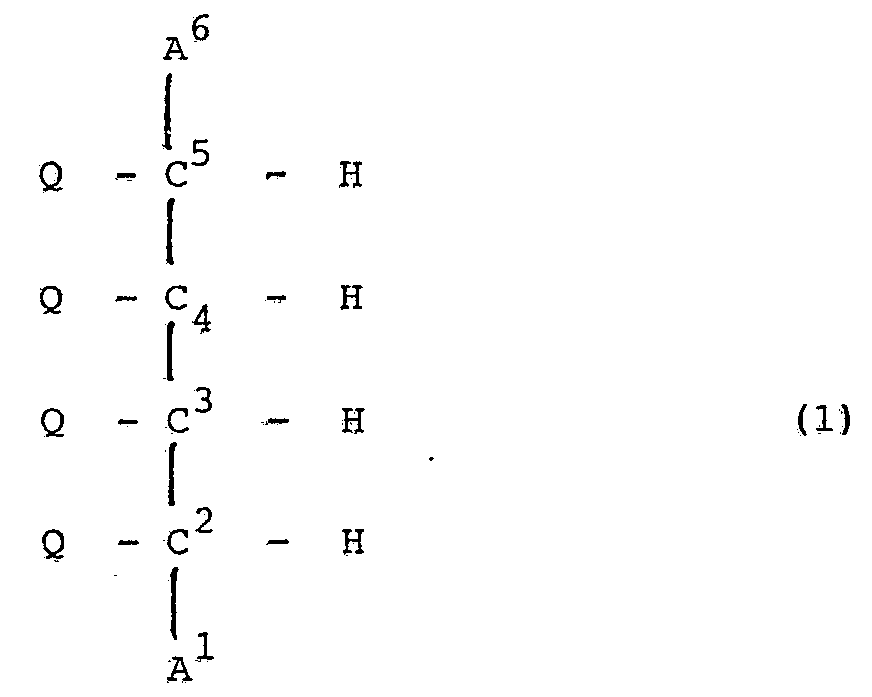
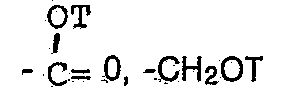

- A1 and A6 being the same or different, and at least one of which being the group:

- and where Q is -OT', -NHT' or a lactam linkage to A1 or A6; the Q groups being the same or different, and at least one of which is involved in a lactam linkage;
- and where T is the same or different and is chosen from
- -H, -CpH2p+1 or a metal ion,
- T' is -H or -COCpH2p+1, and
- p is an integer of from 1 to 22;
provided that:- where any of the Q groups is -OT' or -NHT',
then that group or groups can be of either stereochemical configuration with respect to the plane of the ring; and - A1 and A6 being the same or different, and at least one of which being the group:
- (ii) a cosmetically acceptalbe vehicle for the chemical inhibitor. Certain novel lactams are also claimed.
Description
- The invention relates to novel lactams, particularly those having from 3 to 5 carbon atoms in the lactam ring, and to their synthesis. The invention also relates to the use of the novel lactams, and to certain known lactams in cosmetic or pharmaceutical compositions intended for topical application to skin or hair in order to promote hair growth.
- D-glucaro-1,5-lactam is identified by Meiji Seika Kaisha Ltd in GB 1 577 868 and certain alkyl esters thereof in GB 1 440 670 by the same patentee.
- The novel lactams of the invention have the structure:


- A1 and A6 being the same or different, and at least one of which being the group:

- and where Q is -OT', -NHT' or a lactam linkage to A1 or A6;
- the Q groups being the same or different, and at least one of which is involved in a lactam linkage;
- and where T is the same or different and is chosen from
- -H. -CpH2p+1 or a metal ion,
- T' is -H or -COCpH2p+↑, and
- p is an integer of from 1 to 22;
provided that:- where any of the Q groups is -OT' or -NHCOT',
- Particular examples of novel lactams according to the invention include the following:
- L-Galactono-1,4-lactam, having the structure (3)

- L-Arabino-1,5-lactam, having this structure (4)

- D-Fucono-1,5-lactam, having the structure (5),

- D-Glucaro-1,4-lactam, having the structure (6):
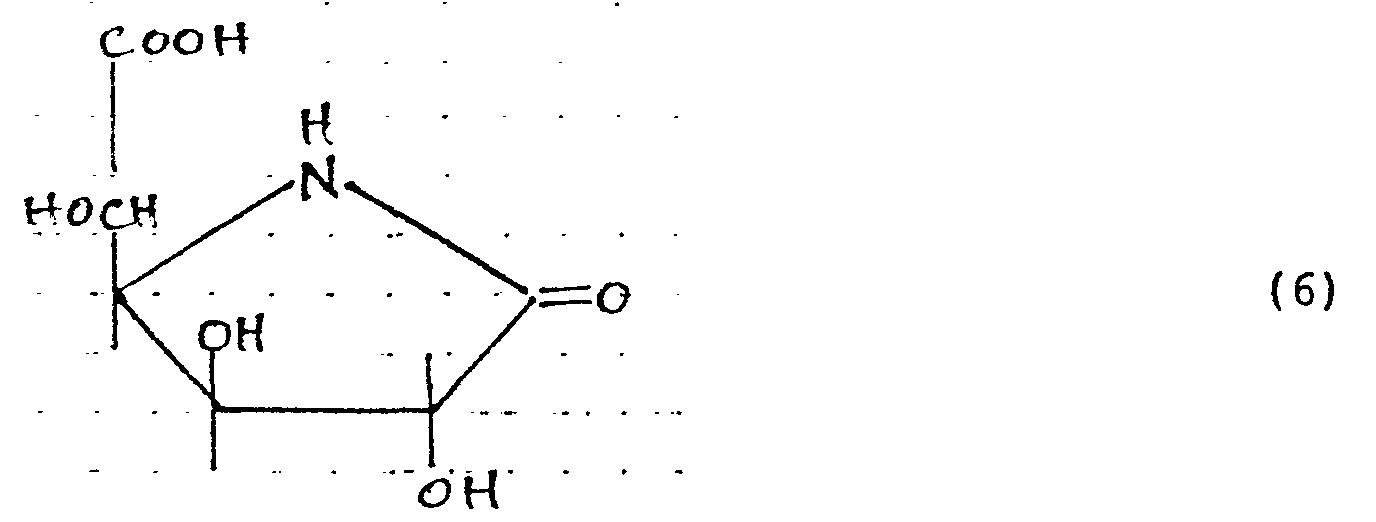
- D-Glucurono-6,3-lactam, having the structure (7):

- 1,2,5-tri-O-acetyl-D-glucurono-6,3-lactam having the structure (8):

- 2-Acetamido-2-deoxyglucono-1,5-lactam, having the structure (9):

- 2-Acetamido-2-deoxygalactono-1,5-lactam, having the structure (10):

- D-Glucaro-1,4:6,3-dilactam, having the structure (11):

- L-Idaro-1,5-lactam, as having the structure (12):
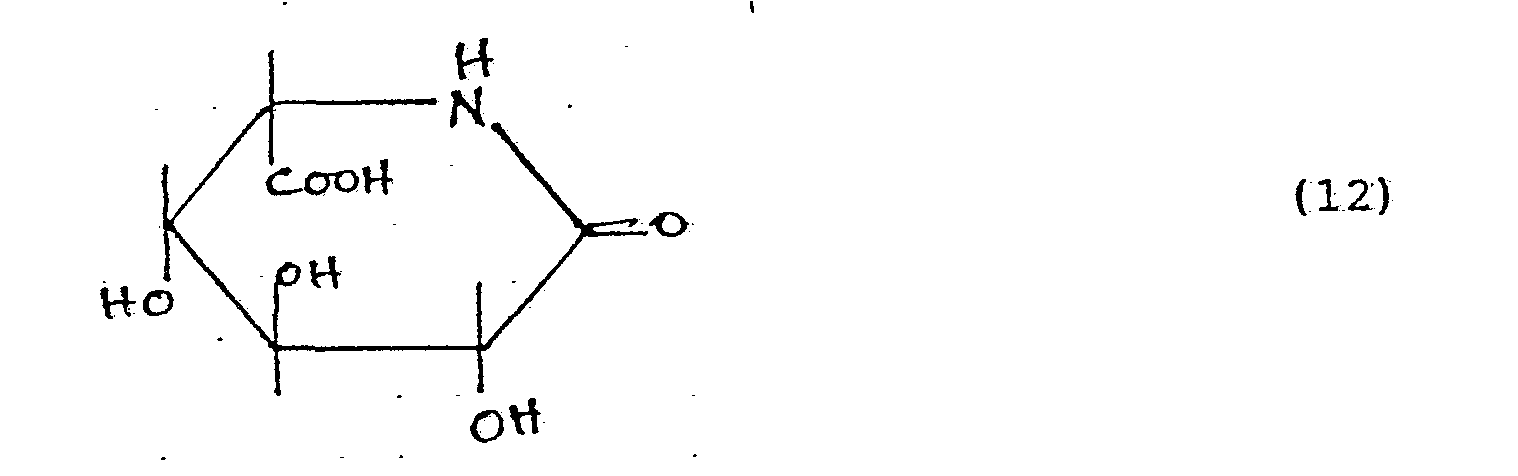
- Particular examples of esterified forms of aldarolactams include the following:
- 2,3,5-Tri-O-acetyl-D-glucaro-1,4-lactam, having the structure (13):

- 2,5-Di-O-acetyl-D-Glucaro-1,4:6,3-dilactam, having the structure (14):
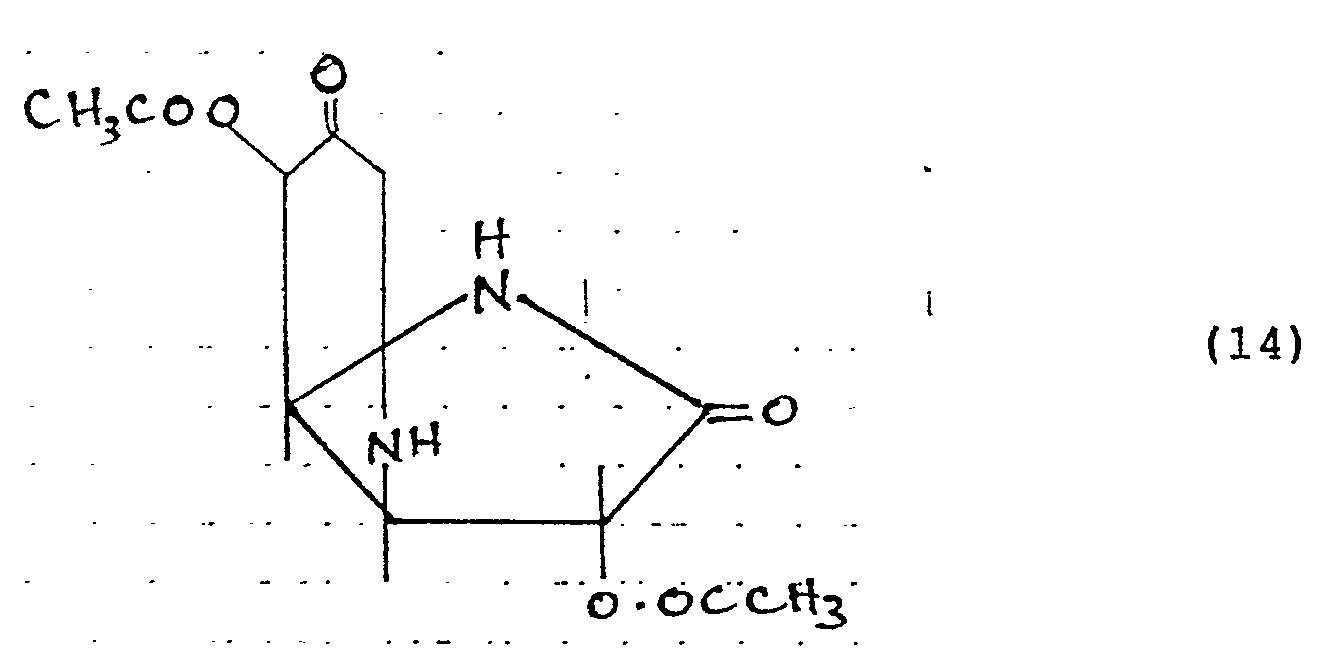
- L-ldaro-1,5-lactam methyl ester, having the structure (15):

- 2-Propionoamide-2-deoxyglucaro-1,5-lactam, having the structure (16):

- Certain of the novel 1,5 lactams according to the invention (eg. structure 18 below) can be prepared from an esterified deoxyamino uronic acid (for example, structure 17), by treatment with a base:-

- Another method suitable for the synthesis of 1,5 lactams according to the invention involves catalytic reduction of a 5-azido-1,4-lactone (19):-

- Aldarolactams (20) may also be prepared from the corresponding aldonolactams (18) by catalytic oxidation reactions.

- By way of example, the synthesis of a novel lactam according to the invnetion will now be described.
- The synthesis of L-idaro-1,5-lactam (12) involves a multi-stage synthesis starting from 1,2:5,6-di-D-glucofuranose (A). All reactions were followed by thin layer chromatography and structural confirmation of the intermediates was performed using proton and C-13 NMR, IR and in some cases optical rotation values.
- 3-O-Benzyl 1,2:5,6-di-O-isopropylidene-a -D-glucofuranose (B) was prepared by the reaction of (A) with benzyl bromide and sodium hydride in N,N-dimethyl-formamide (DMF) as described by Brimacombe et al., [Carbohyd. Res. 8, 82-88 (1968)].
- (B) was obtained as an oil in 95% yield ([a]D 25 -26.2° in ethanol).
- Selective deprotection of the 5,6-isopropylidene group to give (C) was achieved by dissolving crude (B) in 750/0 aqueous acetic acid and stirring overnight at room temperature, also as described by Brimacombe et al. This gave (C) as an oil (950/0, [α]D 25 -48.4°, C 2.50 (CHCl3)).
- Tritylation of the primary hydroxyl group at position 6 was done by reacting (C) with triphenyl methyl chloride in dried pyridine as described by Gramera et al [J. Org. Chem. 28 (63) 1401]. This gave (D) as an oil which was purified by flash chromatography (petroleum ether (40/60): ethyl acetate 10:1 v/v) (95%, [α]D 25 -36.0°, C 2.97 (CHCI3)).
- The 5-0-acetate (E) was prepared according to Whistler and Lake [Methods in Carbohyd. Chem., 6, 286-291 (1972)] by reacting (D) with acetic anhydride and dry pyridine at 0°C. (E) was obtained as a syrup (80%). Preparation of (F) was achieved in three steps as described by Jacquinet et al. [Carbohyd. Res. 130, 221-241 (1984)]. (F) was obtained as an amorphous solid (450/o).
- The 5-triflate (G) was prepared by reacting (F) with trifluoromethane sulphonic anhydride under anhydrous conditions. This was followed by reacting the crude triflate (G) with sodium azide in DMF at ~ 50°C to give the inverted 5-azido-β-L-idofuranuronate (H). (H) was subsequently hydrolysed (500/o trifluoroacetic acid (aq.)) to give the diol (I). Selective oxidation at the anomeric hydroxyl was carried out using bromine in aqueous media. This reaction generated the 5-azido-idaro lactone (J). Under conditions of catalytic hydrogenation in the presence of 5-10% Pd/C, (J) gave the methyl ester of L-idaro-1,5-lactam (15), which was subjected to base hydrolysis to give the desired compound (12).
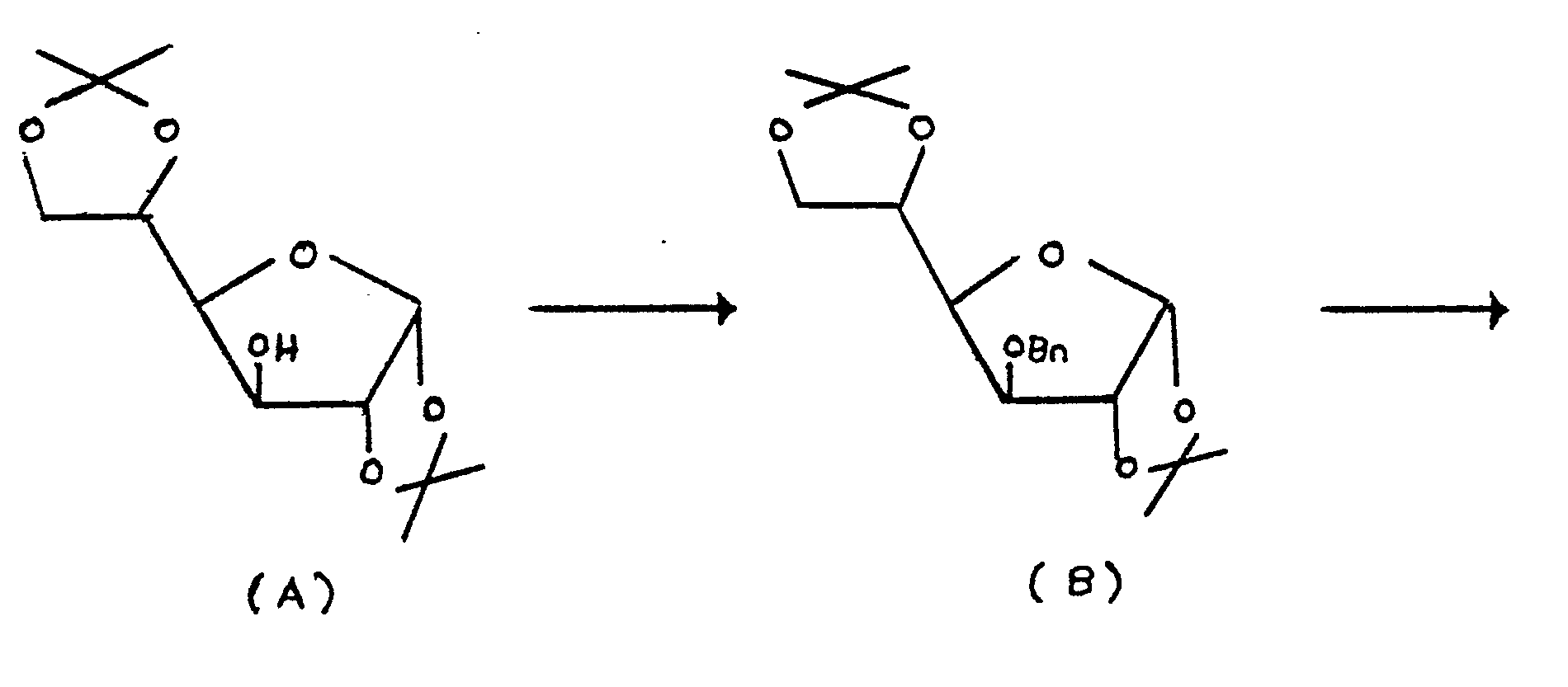


- The invention also relates to cosmetic and pharmaceutical compositions for topical application to mammalian skin or hair, containing certain lactams as enzyme inhibitors which are capable of promoting hair growth, especially terminal hair growth on the human scalp.
- it should be explained that in most mammals, hair does not grow continuously, but undergoes a cycle of activity involving alternate periods of growth and rest. The hair growth cycle can be divided into three main stages, namely:
- (i) the growth phase known as anagen, during which the hair follicle penetrates deep into the dermis with the cells of the bulb dividing rapidly and differentiating to form the hair,
- (ii) the transitional stage known as catagen, which is heralded by the cessation of mitosis, and during which the follicle regresses upwards through the dermis and hair growth ceases,
- (iii) the resting stage known as telogen, in which the regressed follicle contains a small secondary germ with an underlying ball of tightly packed dermal papilla cells.
- The initiation of a new anagen phase is revealed by rapid proliferation in the germ, expansion of the dermal papilla and elaboration of basement membrane components. The hair cycle is then repeated many times until, as a consequence of the onset of male pattern baldness, most of the hair follicles spend an increasing proportion of their time in the telogen stage, and the hairs produced become finer, shorter, and less visible; this is known as terminal to vellus transformation.
- Although there have been many claims in the scientific literature to the promotion or maintenance of hair growth by the topical application of hair tonics and the like, with the possible exception of minoxidil, none has been shown to be sufficiently free from disadvantageous clinical side effects, whether administered topically, orally or systemically, to warrant commercial exploitation as an ethical pharmaceutical, proprietary medicine, or as a cosmetic product. Possibly, the only means which has met with partial success for growing hair on the bald or balding human head is by transplantation of hair to the bald areas. This is, however, an extremely painful operation and is not always successful. Furthermore, it is immediately apparent to the casual observer that the subject has received a hair transplant and it may take many months or even years before hair regrowth, following this operation, assumes an appearance which resembles that of the original naturally growing hair.
- Among the many hair regrowth studies that have been reported in the literature, there is included the work of Bazzano as described in PCT International Publication No. WO 85/04577. This publication describes a composition which is useful for increasing the rates of hair growth on mammalian skin, prolonging the anagen phase of the hair growth cycle and for treating various types of alopecias. The composition in question comprises a pyrimidine carbamate.
- It has also been reported in US patent no. 4 139 619 to Chidsey assigned to the Upjohn Company, that a topical composition comprising minoxidil as the free base or acid addition salt thereof, or certain specified related iminopyrimidines, is useful in stimulating the conversion of vellus hair to growth as terminal hair, as well as increasing the rate of growth of terminal hair.
- In spite of the apparent stimulation of hair growth or regrowth reported independently by Bazzano and Chidsey, following topical application of minoxidil or related compounds, there is general concern that systemic side-effects can result, particularly following topical application of minoxidil. Thus it is generally recognised in the medical literature that the side effects of orally administered minoxidil are very serious, and include fluid retention, tachycardia, dyspnea, gynecomastia, fatigue, nausea and cardiotoxicity.
- In addition to the alleged benefits of employing the pyrimidine carbamates of Bazzano or minoxidil of Upjohn, many other hair regrowth studies have been reported in the literature. In particular, the work of Meyer et al (1961) in the Proceedings of the Society of Experimental and Biological Medicine, 108, 59-61, is worthy of mention. Meyer and his co-workers repeatedly injected acid mucopolysaccharides into the skin of shaved rabbits and reported observing the initiation of the hair growth cycle with stimulation of hair growth which in some instances appeared to be thicker than usual. They found that heparan sulphate was particularly active, while dermatan sulphate and chondroitin-6-sulphate were also active in this respect, but to a lesser extent.
- It has also been reported by Frajdenrajch in EP-A-O 035 919 to include chondroitin sulphate in a hair composition in order to prevent loss and encourage growth of the hair.
- Also, Shansho Seigaku in JA-59/186911 describes a shampoo containing a mucopolysaccharide such as chondroitin sulphate.
- There are also other references, mainly of Japanese origin, which claim the use of chondroitin sulphate in preparations for topical application to human skin, particularly as hair tonics.
- Kohler in DE OLS 24 38 534 reports that D-glucuronic acid and glucuronic acid-y-lactone (also known as glucurono-6,3-lactone) can be applied externally to the skin, together with vitamin C and water, ethanol or aqueous ethanol as a vehicle, as a scalp care agent. In a particular experiment, Kohler reports regrowth of hair following daily application for six months of a 1°/o solution of D-glucuronic acid.
- Kohler et al in DE OLS 26 19 100 also claims the use of glucuronic acid or glucuronic acid-y-lactone as inhibitors in agents for inhibiting the activity of (3-glucuronidase, particularly in combination with vitamin B'12. Whereas Kohler et al are concerned with (i-glucuronidase as found in unusually high concentrations in heating wounds and cancer tissues, they do state that the agents also have a beneficial effect on the loss of hair.
- The above review of the most relevant references concerning the alleged promotion of hair growth following topical or systemic application of specified molecules, has prompted the study in greater detail, of the biological and biochemical mechanisms involved in the control of the hair growth cycle. The reported role of the dermal papilla which is situated at the base of the hair follicle, and the closely related cells of the connective tissue sheath which surrounds the hair follicle are alleged to be of key importance in governing the cyclic behaviour of hair follicles. This has been shown, for example, directly by Oliver R F (1970) J Embryol Exp Morphol., 23, 219-236, and the changes in the dermal papilla during the hair cycle are consistent with these observations. At the end of anagen, there is a sudden loss of fibronectin [Couchman J R and Gibson W T, (1985) Dev Biol., 108,290-298] and metachromatic (glycosaminoglycan) staining [Montagna W etal, (1952) Q J Microsc Sci., 93, 241-245] from the connective tissue matrix of the dermal papilla which then undergoes condensation.
- Conversely, expansion and elaboration of new matrix is associated with the onset of anagen. A direct role of matrix components in stimulating hair growth was suggested by the work of Meyer et al (1961), [supra].
- It is accordingly apparent that glycosaminoglycan breakdown is an important early change in catagen, and since there is already evidence for a link between the presence of intact glycosaminoglycans and hair growth, we have suggested that prevention of glycosaminoglycan breakdown may lead to earlier onset and/or prolongation of anagen. This would effectively retard hair loss and reverse baldness.
- One of the more important classes of enzymes that are implicated in the breakdown of glycosaminoglycans are glycosidases. It follows that glycosaminoglycan breakdown may be prevented, inter alia, by inhibiting glycosidase activity.
- We have now identified certain lactams as chemical inhibitors of key glycosidases, involved in the breakdown of glycosaminoglycan chains.
- It should be explained by "chemical inhibitor" is meant a substance that is physiologically suitable and safe for topical application to human skin, and which is capable of inhibiting glycosidase activity.
- One of the preferred lactams, namely D-glucaro-1,5 -lactam, when employed together with an aminoglycosidic antibiotic such as Kanamycin, is claimed by Meiji Seika Kaisha Ltd in GB 1 577 868 as being useful in protecting against renal failure or insufficiency by oral or parental administration. The same patentee in GB 1 440 670 also discloses the alkyl ester of this lactam and its use when administered orally in the treatment of bladder tumours with associated β-glucuronidase activity.
- We have surprisingly found that these lactams, when applied topically to skin will stimulate hair growth in view of their ability to inhibit glycosidase activity, as predicted on the basis of the theory outlined above.
- Accordingly, the invention provides a composition suitable for topical application to mammalian skin or hair for inducing, maintaining or increasing hair growth which comprises:
- (i) a chemical inhibitor of glycosidase activity chosen from lactams having the structure:


- A and A6 being the same or different, and at least one of which being the group:

- and where Q is -OT', -NHT' or a lactam linkage to A1 or A6;
- the Q groups being the same or different, and at least one of which is involved in a lactam linkage;
- and where T is the same or different and is chosen from
- -H, -CpH2p+1 or a metal ion,
- T' is -H or -COCpH2p+1, and
- p is an integer of from 1 to 22;
provided that:- where any of the Q groups is -OT' or -NHT',
then that group or groups can be of either stereochemical configuration with respect to the plane of the ring; and
- A and A6 being the same or different, and at least one of which being the group:
- (ii) a cosmetically acceptable vehicle for the chemical inhibitor; the total amount of chemical inhibitor present in the composition being sufficient to increase hair growth in the rat, when said composition is applied topically thereto over a period of no more than 3 months, by at least 10% more than that obtainable using a control composition from which the said inhibitors have been omitted, in accordance with the Rat Hair Growth Test.
- As has already been stated, a "chemical inhibitor" is a substance which is not only physiologically suitable and safe for topical application to skin, but which is capable of inhibiting glycosidase activity.
- The chemical inhibitor of glycosidase activity is chosen from lactams having the structure:


- A1 and A6 being the same or different, and at least one of which being the group:

- and where Q is -OT', -NHT' or a lactam linkage to A1 or A6;
- the Q groups being the same or different, and at least one of which is involved in a lactam linkage;
- and where T is the same or different and is chosen form
- -H, -CpH2p+1 or a metal ion,
- T' is -H or -COCpH2p+1, and
- p is an integer of from 1 to 22;
provided that:- where any of the Q groups is -OT' or -NHT',
then that group or groups can be of either stereochemical configuration with respect to the plane of the ring. - A particular preferred example of the lactams derived from the above generic structure (1) is D-glucaro-1,5-lactam, an inhibitor of β-g'lucuronidase activity, having the structure (2)
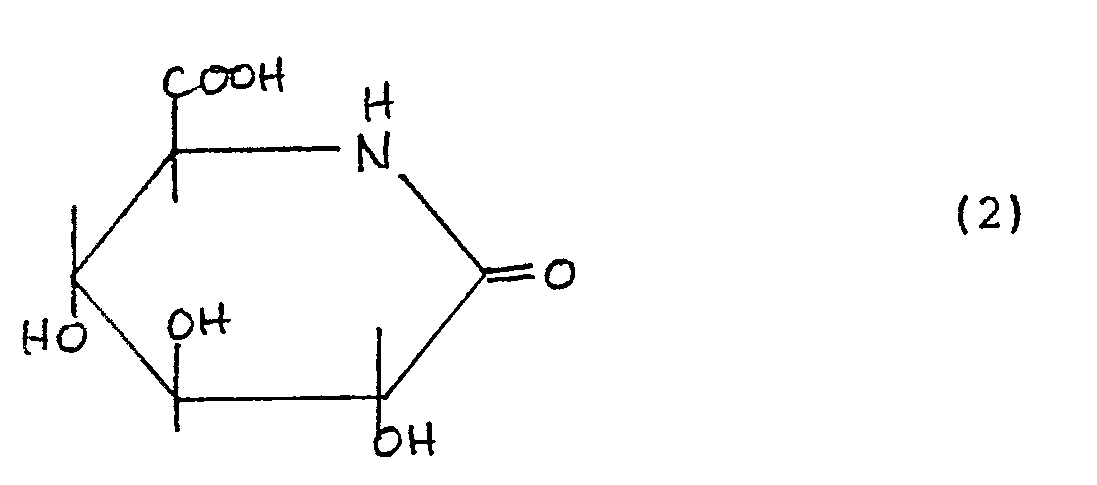
- Further examples of lactams include the following:
- L-Galactono-1,4-lactam, an inhibitor of β-galactosidase and β-N-acetylhexosaminidase activity, having the structure (3);
- L-Arabino-1,5-lactam, an inhibitor of β-galactosidase activity, having this structure (4);
- D-Fucono-1,5-lactam, an inhibitor of β-galactosidase activity, having the structure (5);
- D-Glucaro-1,4-lactam, an inhibitor of β-glucuronidase and a-L-iduronidase activity, having the structure (6):
- D-Glucurono-6,3-lactam, an inhibitor of R-glucuronidase activity, having the structure (7);
- 1,2,5-tri-O-acetyl-D-glucurono-6,3-lactam an inhibitor of β-glucuronidase and a-L-iduronidase activity having the structure (8);
- 2-Acetamido-2-deoxyglucono-1,5-lactam, an inhibitor of P-N-acetylhexosaminidase, having the structure (9);
- 2-Acetamido-2-deoxygalactono-1,5-lactam, an inhibitor of P-N-acetylehexosaminidase, having the structure (10);
- D-Glucaro-1,4:6,3-dilactam, an inhibitor of R-glucuronidase and a-L-iduronidase activity, having the structure (11);
- L-ldaro-1,5-lactam, and inhibitor of a-L-iduronidase activity, having the structure (12);
- Preferred examples of esterified forms of aldonolactams which give a more substained inhibitory effect are:
- 2,3,5-Tri-O-acetyl-D-glucaro-1,4-lactam, an inhibitor of β-glucuronidase and a-L-iduronidase activity, having the structure (13);
- 2,5-Di-O-acetyl-D-Glucaro-1,4:6,3-dilactam, an inhibitor of R-glucuronidase and a-L-iduronidase activity, having the structure (14);
- D-Glucaro-1,5-lactam methyl ester, an inhibitor of 0-glucuronidase activity, having the structure (15); and
- 2-Propionoamido-2-deoxygluraro-1,5-lactam, an inhibitor of β-glucuronidase acitivity, having the structure (16).
- Mixtures comprising two or more of the chemical inhibitors can be employed in the composition according to the invention.
- The total amount of chemical inhibitor present in the composition according to the invention is sufficient to increase hair growth in the rat, the model selected for this test, when said composition is applied topically thereto by at least 10% more than that obtainable using a control composition from which the said inhibitor has been omitted.
- Preferably, the amount of chemical inhibitor should be sufficient to increase hair growth in the rat by at least 200/ 0. more preferably by at least 30%, most preferably by at least 40% and ideally by at least 50%.
- The sufficient amount will depend on the effectiveness of a chemical inhibitor, some being more effective than others, but in general, an amount of from 0.0001 to 990/0, preferably from 0.1 to 20% by weight of the composition will provide an adequate dose to the skin after topical application.
- The composition according to the invention also comprises a solid, semi-solid or liquid cosmetically and/or physiologically acceptable vehicle, to enable the chemical inhibitor to be conveyed to the skin at an appropriate dilution. The nature of the vehicle will depend upon the method chosen for topical administration of the composition. The vehicle can itself be inert or it can possess physiological or pharmaceutical benefits of its own.
- It should be explained that vehicles are substances which can act as diluents, dispersants, or solvents for the chemical inhibitor which therefore ensure that it can be applied to and distributed evenly over the hair and/or scalp at an appropriate concentration. The vehicle is preferably one which can aid penetration of the inhibitors into the skin to reach the immediate environment of the hair follicle. Compositions according to this invention can include water as a vehicle, and/or at least one cosmetically acceptable vehicle other than water.
- Vehicles other than water that can be used in compositions according to the invention can include liquids or solids as emollients, solvents, humectants, thickeners and powders. Examples of each of these types of vehicles, which can be used singly or as mixtures of one or more vehicles, are as follows:.
- Emollients, such as stearyl alcohol, glyceryl monoricinoleate, glyceryl monostearate, propane-1,2-diol, butane-1,3-diol, mink oil, cetyl alcohol, ispropyl isostearate, stearic acid, isobutyl palmitate, isocetyl stearate, oleyl alcohol, isopropyl laurate, hexyl laurate, decyl oleate, octadecan-2-ol, isocetyl alcohol, eicosanyl alcohol, behenyl alcohol, cetyl palmitate, dimethylpolysiloxane, di-n-butyl sebacate, isopropyl myristate, isopropyl palmitate, isopropyl stearate, butyl stearate, polythylene glycol, triethylene glycol, lanolin, sesame oil, coconut oil, arachis oil, castor oil, acetylated lanolin alcohols, petroleum, mineral oil, butyl myristate, isostearic acid, palmitic acid, isopropyl linoleate, lauryl lactate, myristyl lactate, decyl oleate, myristyl myristate;
- Propellants, such as trichlorofluoromethane, dichlorodifluoromethane, dichlorotetrafluoroethane, monochlorodifluoromethane, trichlorotrifluoroethane, propane, butane, isobutane, dimethyl ether, carbon dioxide, nitrous oxide;
- Solvents, such as ethyl alcohol, methylene chloride, isopropanol, acetone, castor oil, ethylene glycol monoethyl ether, diethylene glycol monobutyl ether, diethylene glycol monoethyl ether, dimethyl sulphoxide, dimethyl formamide, tetrahydrofuran;
- Humectants, such as glycerin, sorbitol, sodium 2-pyrrolidone-5-carboxylate, soluble collagen, dibutyl phthalate, gelatin;
- Powders, such as chalk, talc, fullers earth, kaolin, starch, gums, colloidal silicon dioxide, sodium polyacrylate, tetra alkyl and/or trialkyl aryl ammonium smectites, chemically modified magnesium aluminium silicate, organically modified montmorillonite clay, hydrated aluminium silicate, fumed silica, carboxyvinyl polymer, sodium carboxymethyl cellulose, ethylene glycol monostearate.
- The composition according to the invention also preferably comprises a means for enhancing the activity of the chemical inhibitor, as herein defined, to aid its penetration into and/or through the skin, or otherwise to enhance its benefits in increasing hair growth.
- The activity enhancer can be chosen from a wide variety of molecules, in addition to some of the vehicles as hereinbefore described, which can function in different ways to enhance the hair growth effects of the chemical inhibitor. Particular classes of activity enhancers include other hair growth stimulants, penetration enhancers and cationic polymers, whose presence can further improve the delivery of the chemical inhibitor through the stratum corneum to its site of action in the immediate environment of the hair follicle.
- Some activity enhancers can also function as vehicles for the chemical inhibitor.
- The means for enhancing the activity of the chemical inhibitor can also take the form of an iontophoretic device as will be explained later. This and other means for enhancing the activity of said chemical inhibitors are now disclosed in greater detail.
- Examples of other substances which themselves possess the ability to stimulate or increase hair growth include, for example;
- Benzalkonium chloride
- Benzethonium chloride
- Phenol
- Estradiol
- Diphenhydramine hydrochloride
- Chlorpheniramine maleate
- Chlorophyllin derivatives
- Cholesterol
- Salicylic acid
- Cystine
- Red pepper tincture
- Benzyl nicotinate
- dl-Menthol
- Peppermint oil
- Calcium pantothenate
- Panthenol
- Castor oil
- Hinokitiol
- Prednisolone
- Resorcinol
- Further substances which themselves possess the ability to increase the rate of terminal hair growth include:
- (i) a-1,4 esterified disaccharides described by Choay S.A. in EP-A-0 064 012, having the structure (50):

- Z represents a functional nitrogen group, such as an azide or a group having the structure -NHB, in which B represents -H or a functional group such as acetyl or sulphate as a salt with an organic or mineral cation; M represents -H or SO3M1, where M1 is an organic or metallic cation, particularly an alkali metal; or an acetyl group;
- R represents a C1 to C4 alkyl radical, especially methyl; or an aryl radical;
- A represents a functional group such as an acid or -COOR1, where R1 represents -H or a C1 to C4 alkyl radical, especially methyl; or a metal, especially an alkali metal;
- (ii) esterified oligosaccharides as described by Unilever in EP-A-O 211 610, including at least one esterified disaccharide unit consisting of a uronic acid residue having the structure (51):


- R' is -H, C3 to C10 alkyl or

- R" is -H, Ci to C4 alkyl, -CO(CH2)mCH3, -SOsM',
- R"' is -H, -CO(CH2)mCH3, or -SO3M
- M' is -H, or a metallic or organic cation
- n is 0 or an integer of from 1 to 7, and
- m is 0 or the integer 1 or 2;
- the groups designated R" being the same or different, one R" group from each pyranose ring structure being linked by a glycosidic linkage having the configuration a-1,3, a-1,4, β-1,3 or β-1,4; and the -COOR', -CH20R" and -OR" groups being of either configuration with respect to the pyranose rings;
- R' is -H, C3 to C10 alkyl or
- (iii) Minoxidil and its derivatives, as described by The Upjohn Co in GB 1 167 735,
- (iv) Minoxidil glucuronides, as described by Unilever in EP-0 242 967,
- (v) Minoxidil sulphates, as described by The Upjohn Co. in WO 86/04231.
- (vi) Direct proteoglycanase inhibitors, such as 1,10-phenanthroline.
- (vii) Glycosaminoglycanase inhibitors, such as aldonolactones and esterified aldonolactones having the structure (53):

- A1 and A6 are -H, -CH3,

- B is OD" or a lactone linkage to position 1 or 6, or -NHCOCH3 and where
- D is -H or C2 to C8 alkyl,
- D' is the remainder of the molecule joined through another C atom at positions 2 to 5 to form a lactone,
- D" is -H or C2 (ie acetyl) to C4 acyl of either configuration with respect to the backbone of this molecule; preferred examples of which include:
- L-Galactono-1,4-lactone
- L-Arabino-1,5-lactone
- D-Fucono-1,5-lactone
- D-Glucaro-1,4-lactone
- D-Glucurono-6,3-laetone
- Galactaric acid lactone
- 2-Acetamido-2-deoxygluconolactone
- 2-Acetamido-2-deoxygalactono-lactone
- D-Glucaro-1,4:6,3-dilactone
- L-ldaro-1,4-lactone
- 2,3,5-Tri-O-acetyl-D-glucaro-1,4-lactone
- 2,5-Di-O-acetyl-D-glucaro-1,4:6,3-dilactone
- A1 and A6 are -H, -CH3,
- (viii) Glycosaminoglycanase inhibitors, such as monosaccharides and esterified monosaccharides having the structure (54):
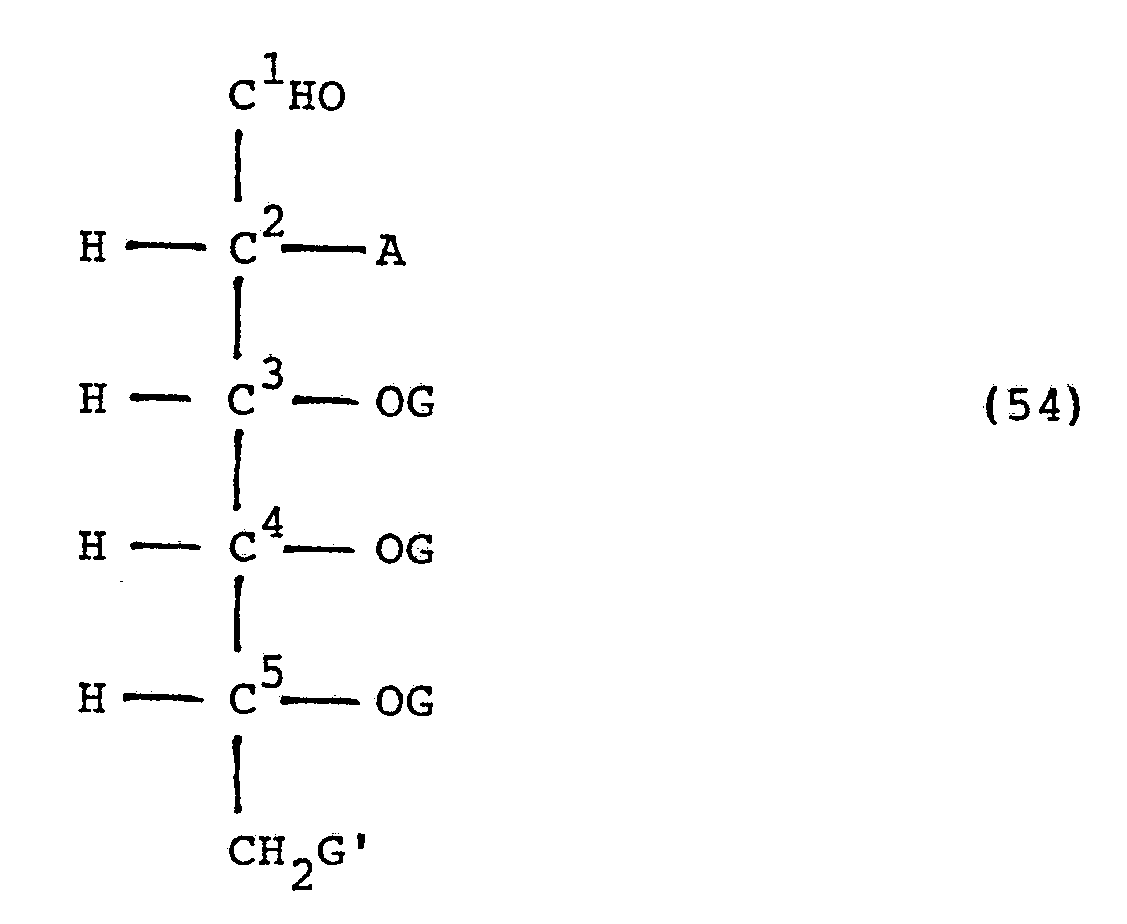
- where A is -OG or -NHCOCH3
- G is -H, -SO3M", C2 (ie acetyl) to C4 acyl
- G' is -H or -OG
- M" is -H or a metal cation
- wherein the functional groups can be in either configuration with respect to the backbone of the above molecule;
- preferred examples of which include:
- N-Acetylglucosamine
- N-Acetylgalactosamine
- D-Galactosamine
- D-Glucosamine-3-sulphate
- N-Acetylmannosamine
- (ix) glycosaminoglycan chain cellular uptake inhibitors such as, hexuronic acid and esters thereof which may be represented by the generic structure (55):

- G is -H, -SO3M", C2 (ie acetyl) to C4 acyl;
- D is -H or C2 to C8 alkyl
- M" is -H or a metal cation
- wherein the functional groups can be in either configuration with respect to the backbone of the above molecule;
- (x) chemical activators of protein kinase C enzymes chosen from diacylglycerols having the structure (56):

- where X is the same or different, and is represented by the grouping:

- where x is 0, or an integer of from 1 to 28, and
- y is 0, or an integer of from 1 to 5;
- the X groups being of either steriochemical configuration with respect to the carbon backbone of the glycerol molecule, and the double bonds being of either cis or trans configuration;
- preferred examples of which include:
- 1,2-Dibutanoyl-rac-glycerol
- 1,2-Dihexanoyl-sn-glycerol
- 1,2-Dioctanoyl-rac-glycerol
- 1,2-Dioctanoyl-sn-glycerol
- 1,2-Didecanoyl-rac-glycerol
- 1-Oleoyl-2-acetyl-rac-glycerol
- 1-Oleoyl-2-acetyl-sn-glycerol
- 1-Stearoyl-2-arachidonoyl-sn-glycerol
- 1,2-Distearoyl-rac-glycerol
- 1,2-Dipentadecanoyl-sn-glycerol
- 1,2-dipentadecanoyl-rac-glycerol
- 1,2-Dipalmitoyl-rac-glycerol
- 1,2-Dipalmitoyl-sn-glycerol
- 1,2-Diseptadecanoyl-rac-glycerol
- 1,2-Dioleoyl-sn-glycerol
- 1,2-Dioleoyl-rac-glycerol
- 1,2-Diarachidonoyl-sn-glycerol
- 1,2-Dieicosanoyl-sn-glycerol
- 1,2-Didoeicosanoyl-rac-glycerol, and
- 1,2-Dioctaeicosanoyl-sn-glycerol.
- where X is the same or different, and is represented by the grouping:
- As has been stated earlier, the presence of a penetration enhancer can potentiate the benefit of the chemical inhibitor, by improving its delivery through the stratum corneum to its site of action in the immediate environment of the hair follicle close to the dermal papilla.
- The penetration enhancer can accordingly function in a variety of ways. It can for example, improve the distribution of the chemical inhibitor on the skin surface or, it can increase its partition into the skin from the composition when applied topically, so aiding its passage to its site of action. Other mechanisms enhancing the benefit of the chemical inhibitor may also be involved.
Examples of penetration enhancers include: - 2-methyl propan-2-ol
- Propan-2-ol
- Ethyl-2-hydroxypropanoate
- Hexan-2,5-diol
- POE(2) ethyl ether
- Di(2-hydroxypropyl) ether
- Pentan-2,4-diol
- Acetone
- POE(2) methyl ether
- 2-hydroxypropionic acid
- 2-hydroxyoctanoic acid
- Propan-l-ol
- 1,4 Dioxane
- Tetrahydrofuran
- Butan-1,4-diol
- Propylene glycol dipelargonate
- Polyoxypropylene 15 stearyl ether
- Octyl alcohol
- POE ester of oleyl alcohol
- Oleyl alcohol
- Lauryl alcohol
- Dioctyl adipate
- Dicapryl adipate
- Diisopropyl adipate
- Diisopropyl sebacate
- Dibutyl sebacate
- Diethyl sebacate
- Dimethyl sebacate
- Dioctyl sebacate
- Dibutyl suberate
- Dioctyl azelate
- Debenzyl sebacate
- Dibutyl phthalate
- Dibutyl azelate
- Ethyl myristate
- Dimethyl azelate
- Butyl myristate
- Dibutyl succinate
- Didecyl phthalate
- Decyl oleate
- Ethyl caproate
- Ethyl salicylate
- Isopropyl palmitate
- Ethyl laurate
- 2-ethyl-hexyl pelargonate
- Isopropyl isostearate
- Butyl laurate
- Benzyl benzoate
- Butyl benzoate
- Hexyl laurate
- Ethyl caprate
- Ethyl caprylate
- Butyl stearate
- Benzyl salicylate
- 2-hydroxypropanoic acid
- 2-hyroxyoctanoic acid,
- Yet further penetration enhancers include esters of pyroglutamic acid having the structure (57):-


- u is zero or 1
- v is zero, or the integer 1 or 2,
- w is zero, or an integer of from 1 to 21
- s is zero, or an integer of from 1 to 4,
- y is zero, or the integer 1 or 2,
- z is zero, or an integer of from 1 to 22, and
- u + v + w + x + y + z is an integer of from 1 to 22;
- Examples of suitable esters of pyroglutamic acid where Z in structure (57) is Ci to C30 alkyl are:
- pyroglutamic acid methyl ester
- pyroglutamic acid ethyl ester
- pyroglutamic acid n-propyl ester
- pyroglutamic acid n-butyl ester
- pyroglutamic acid n-heptyl ester
- pyroglutamic acid n-octyl ester
- pyroglutamic acid n-nonyl ester
- pyroglutamic acid n-decyl ester
- pyroglutamic acid n-undecyl ester
- pyroglutamic acid n-dodecyl ester
- pyroglutamic acid n-tridecyl ester
- pyroglutamic acid n-tetradcyl ester
- pyroglutamic acid n-hexadecyl ester
- pyroglutamic acid n-octadecyl ester
- pyroglutamic acid n-eicosyl ester
- pyroglutamic acid iso-propyl ester
- pyroglutamic acid 2-methylhexyl ester
- pyroglutamic acid 2-ethylhexyl ester
- pyroglutamic acid 3,7-dimethyloctyl ester
- pyroglutamic acid 2-hexyldecyl ester
- pyroglutamic acid 2-octyldodecyl ester
- pyroglutamic acid 2,4,4-trimetyl-1-pentane ester
- pyroglutamic acid methyloctyl ester
- Particularly preferred esters of this group are those where Z in structure (1) is G1 to C14 alkyl, (linear or branched), especially C1 to C6 (linear or branched).
- Further examples of preferred esters of pyroglutamic acid, where Z in structure (57) is

- ethyl
- propyl
- iso-propyl
- butyl
- iso-butyl
- n-valeryl
- iso-valeryl
- n-caproyl
- n-heptyl
- n-caprylyl
- n-capryl
- lauryl
- myristyl
- palmityl
- stearyl, and
- arachidyl.
- and the C10-22 alkenyl groups:
- linoleyl
- linolenyl
- y-linolenyl
- arachidonyl, and
- columbinyl.
- Further examples of the grouping (58) also include hydroxyalkyl groups having from 1 to 22 carbon atoms, such as:
- hydroxymethyl
- 2-hydroxyethyl
- 2-hydroxy-n-propyl
- 3-hydroxy-n-propyl
- 2-hydroxy-n-butyl
- 3-hydroxy-n-butyl
- 4-hydroxy-n-butyl
- 5-hydroxy-n-valeryl
- 6-hydroxy-n-caproyl
- 2,3-dihydroxy-n-propyl
- 2,3-dihydroxy-n-butyl
- 12-hydroxystearyl.
- It is to be understood that the above list is not exhaustive, there being many other examples of alkyl or substituted alkyl groups expressed by the above generic grouping (58);
- Further specific examples of esters of pyroglutamic acid which are particularly suited to use as penetration enhancers are:
- 2-[pyroglutamoyloxy]-propionic acid
- methyl-2-[pyroglutamoyloxy]-acetate
- ethyl-2-[pyroglutamoyloxy]-n-propionate
- ethyl-2-[pyroglutamoyloxy]-n-butyrate
- ethyl-2-[pyroglutamoyloxy]-iso-butyrate
- ethyl-2-[pyroglutamoyloxy]-n-valerate
- ethyl-2-[pyroglutamoyloxy]-n-caproate
- ethyl-2-[pyroglutamoyloxy]-n-heptylate
- ethyl-2-[pyroglutamoyloxy]-n-caprylate
- ethyl-2-[pyroglutamoyloxy]-n-pelargonate
- ethyl-2-[pyroglutamoyloxy]-3-hydroxybutyrate
- iso-propyl-2-[pyroglutamoyloxy]-n-propionate
- iso-propyl-2-[pyrogl utamoyloxy]-n-caprylate
- n-propyl-2-[pyroglutamoyloxy]-n-propionate
- n-propyl-2-[pyroglutamoyloxy]-n-caprylate
- stearyl-2-[pyroglutamoyloxy]-n-propionate
- 12-hydroxystearyl-2-[pyroglutamoyloxy]-n-propionate
- stearyl-2-[pyroglutamoyloxy]-n-stearate
- palmityl-2-[pyroglutamoyloxy]-n-propionate
- linoleyl-2-[pyroglutamoyloxy]-n-propionate
- linoleyl-2-[pyroglutamoyloxy]-n-caprylate
- lauryl-2-[pyroglutamoyloxy]-n-caprylate
- stearyl-2-[pyroglutamoyloxy]-n-caprylate
- glyceryl mono(2-[pyroglutamoyloxy]-n-propionate)
- glyceryl mono(2-[pyroglutamoyloxy]-n-caprylate), and
- glyceryl di(2-[pyroglutamoyloxy]-n-propionate).
- It is to be understood that the above lists of specific examples of esters of pyroglutamic acid are not exhaustive, there being many other examples expressed by the generic structure of these esters.
- Further examples of penetration enhancers include:-
- Dimethyl sulphoxide
- N,N-Dimethyl acetamide
- N,N-Dimethyl formamide
- 2-Pyrrolidone
- 1-Methyl-2-pyrrolidone
- 5-Methyl-2-pyrrolidone
- 1,5-Dimethyl-2-pyrrolidone
- 1-Ethyl-2-pyrrolidone
- Phosphine oxides
- Sugar esters
- Tetrahydrofurfural alcohol
- Urea
- Diethyl-m-toluamide, and
- 1-Dodecylazacyloheptan-2-one Further examples of penetration enhancers include surface active agents, preferred examples of which include:
- (i) Anionic surface active agents, such as metallic or alkanolamine salts of fatty acids for example sodium laurate and triethanolamine oleate;
- alkyl benzene sulphonates, for example triethanolamine dodecyl benzene sulphonate;
- alkyl sulphates, for example sodium lauryl sulphate;
- alkyl ether sulphates, for example sodium lauryl ether sulphate [2 to 8 EO];
- sulphosuccinates, for example sodium dioctyl sulphonsuccinate;
- monoglyceride sulphates, for example sodium glycPryl monostearate monosulphate;
- isethionates, for example sodium isethionate;
- methyl taurides, for example Igepon T;
- acylsarcosinates, for example sodium myristyl sarcosinate;
- acyl peptides, for example Maypons and Lamepons;
- acyl lactylates,
- polyalkoxylated ether glycollates, for example trideceth-7 carboxylic acid;
- phosphates, for example sodium dilauryl phosphate.
- (ii) Cationic surface active agents, such as amine salts, for example sapamin hydrochloride; quartenary ammonium salts, for example Quaternium 5, Quaternium 31 and Quaternium 18;
- (iii) Amphoteric suface active agents, such as imidazol compounds, for example Miranol; N-alkyl amino acids, such as sodium cocaminopropionate and asparagine derivatives; betaines, for example cocoamidopropylbetaine
- (iv) Nonionic surface active agents, such as fatty acid alkanolamides, for example oleic ethanolamide; esters of polyalcohols, for example Span;
- polyglycerol esters, for example that esterified with C12-18 fatty acids and one or several OH groups; polyalkoxylated derivatives, for example polyoxy:polyoxyethylene stearate, and octylphenoxy polyethoxyethanol (TRITON X-100);
- ethers, for example polyoxyethylene lauryl ether;
- ester ethers, for example Tween;
- amine oxides, for example coconut and dodecyl dimethyl amine oxides.
- (i) Anionic surface active agents, such as metallic or alkanolamine salts of fatty acids for example sodium laurate and triethanolamine oleate;
- Mixtures of two or more of the above surface active agents can be employed in the composition according to the invention.
-
- Guar Hydroxypropyltrimonium chloride
- Quaternium-19
- Quaternium-23
- Quaternium-40
- Quaternium-57
- Poly(dipropyldiallylammonium chloride)
- Poly(methyl-p-propaniodiallylammonium chloride)
- Poly(diallylpiperidinium chloride)
- Poly(vinyl pyridinium chloride)
- Quaternised poly (vinyl alcohol)
- Quaternised poly (dimethylaminoethylmethacrylate); and mixtures thereof.
- The amount of vehicle in the composition, including water if present, should preferably be sufficient to carry at least a portion of a selected chemical inhibitor factor to the skin in an amount which is which is sufficient effectively to enhance hair growth. The amount of the vehicle can comprise the balance of the composition, particularly where little or no other ingredients are present in the composition. Accordingly, the vehicle or vehicles can comprise from 1 to 99.9999%, preferably from 50 to 99.5% by weight of the compositions.
- The amount of activity enhancer, when employed in accordance with the invention, will normally be from 0.1 to 50%, preferably from 0.5 to 25% and most preferably from 0.5 to 10% by weight of the composition.
- A further means for enhancing the activity of chemical inhibitor following topical application is the use of iontophoresis. A preferred iotophoretic device for this purpose comprises a pad of absorbent material, such as a nonwoven sheet or sponge, impregnated with a solution of chemical inhibitor as herein defined, the pad carrying an electrode, for example in the form of a metallic sheet, through which an electric current can be passed, in order to enhance delivery of the chemical inhibitor to and through the epidermal layer of the skin.
- Further preferred embodiments of the invention are those where the composition according to the invention comprises a second hair growth stimulant in addition to at least one lactam, as herein defined.
- Particularly preferred mixtures include the following, where minoxidil can be employed In compositions according to the invention with a lactam.
- Accordingly, preferred mixtures are:
- Minoxidil and D-glucaro-1,5-lactam
- Minoxidil and L-galactono-1,5-lactam
- Minoxidil and L-idaro-1,5-lactam
- Minoxidil and L-arabino-1,5-lactam
- Minoxidil and 2,3,5-tri-O-acetyl-D-glucaro-1,5-lactam
- Minoxidil and D-glucaro-1,5-lactam ethyl ester
- The composition according to the invention can also optionally comprise a perfume in an amount sufficient to make the composition acceptable to the consumer and pleasant to use. Usually, the perfume will form from 0.01 to 10% by weight of the composition.
- The composition according to the invention is preferably preserved in such a manner that it will enjoy an extended shelf life following manufacture and prior to sale and use. Ideally the composition will have an indefinite shelf life.
- It is accordingly apparent that the chemical inhibitor is likely to be prone to attack by bacteria, moulds and fungi and other microbial influences, particularly at pH values near neturality that characterise the preferred composition. The shelf-life of the composition can therefore be unacceptably short due to the biodegradation of the inhibitor unless steps are taken to preserve the composition.
- In order to be preserved, the composition should preferably be free, or substantially free, from viable microbial contaminants that are capable of resulting in microbial spoilage of the composition, and/or biodegradation of the inhibitor prior to topical application of the composition to mammalian skin or hair. It is to be understood, however, that the invention is also concerned with compositions, as herein defined, which may contain viable but dormant microorganisms, such as bacterial spores, provided that the conditions of preservation do not result in substantial proliferation of the microorganisms prior to use of the composition.
- Examples of methods that can be employed to achieve preservation of the composition, includes the following:
- The composition according to the invention can be preserved by sterilisation to remove or kill substantially all viable microbial contaminants. This can be achieved for example by irradiation using a lethal dose of gamma rays, by heat sterilisation or by ultrafiltration using techniques that are well established in the pharmaceutical industry.
- The composition according to the invention can alternatively be preserved by adjusting its pH to a value that is either too low (e.g. pH <2) or too high (e.g. pH > 12) to permit significant proliferation of microbial contaminants. The pH of the composition can accordingly be adjusted to desired high or low values by addition of an alkali or acid as a pH adjustant.
- The composition according to the invention can also be preserved by including in it a chemical preservative which functions to prevent the growth of or kill bacteria, fungi or other microorganisms.
- Examples of chemical preservatives include ethanol, benzoic acid, sodium benzoate, sorbic acid, potassium sorbate, sodium propionate and the methyl, ethyl, propyl and butyl esters of p-hydroxybenzoic acid. The amount of chemical preservative that can be incorporated in the composition according to the invention will generally be from 0.05 to 50/0, preferably from 0.1 to 2010 by weight, the amount chosen being sufficient to arrest microbial proliferation.
- The composition according to the invention can also be preserved by the inclusion of a water activity depressant such as glycerol, propylene glycol, sorbitol, sugars and salts, for examples alkali metal halides, sulphates and carboxylates. When employing a water activity depressant, sufficient should be incorporated in the composition according to the invention to reduce the water activity (aw) from 1 to < 0.9, preferably to < 0.85 and most preferably < 0.8, the lowest of these values being that at which yeasts, moulds and fungi will not proliferate.
- The composition according to the invention can also contain adjuncts other than those already mentioned, depending on the form of the intended product. It is, for example, possible to include antiseptics, antioxidants, emulsifiers, colouring agents, detergents and antiinflammatory agents which can improve the stability and consumer appeal of the composition. Examples of antiinflammatory agents include steroidal (eg.,hydrocortisone and other corticosteroids) and non-steroidal (eg., ibuprofen and its derivatives) compounds.
- The composition according to the invention can also be employed as a vehicle for a wide variety of cosmetically or pharmaceutically active ingredients, particularly ingredients which have some beneficial effect other than the promotion of hair growth when applied to the skin.
- The invention also provides a process for the preparation of a composition suitable for topical application to mammalian skin or hair which comprises mixing a chemical inhibitor as herein defined, with a suitable vehicle to provide a composition according to the invention, in which the inhibitor forms from 0.0001 to 99% by weight of the composition.
- The composition of the invention can be formulated as a liquid, for example as a lotion, shampoo, conditioner or milk or use in conjunction with an applicator such as a roll-ball applicator, or a spray device such as an aerosol can containing propellant, or a container fitted with a pump to dispense the liquid product.
- When the composition is contained in a pressurised aerosol container, the propellant in providing an inert headspace within the container will aid in preserving the composition.
- The composition of the invention can also be solid or semi-solid, for example a stick, cream or gel, for use in conjunction with a suitable applicator or simply a tube, bottle or lidded jar, or as a liquid-impregnated fabric, such as a tissue wipe.
- The invention accordingly also provides a closed container containing the composition as herein defined.
- The invention also provides for the use of a chemical inhibitor, as herein defined, for topical application to mammalian hair or skin particularly the scalp, for inducing, maintaining or increasing terminal hair growth, and/or converting vellus hair to growth as terminal hair.
- The composition of the invention is accordingly primarily intended for topical application to the scalp of the human subject, particularly where the head is already bald or balding, in order to reduce or prevent the onset of baldness.
- The invention also provides for the use of the inhibitor in the preparation of a therapeutic composition for treating baldness.
- The amount of the composition and the frequency of application to the hair and/or scalp can vary widely, depending on personal needs, but it is suggested as an example that topical application of from 0.1 to 5g daily containing from 0.00001 to Ig of a selected chemical inhibitor over the period of at least six months will in most cases result in an improvement in hair growth.
- The effect of compounds on hair growth was assessed using male albino Wistar rats as an animal model. The rats were chosen from as few litters as possible and were each approximately 42 days of age at the start of the test. Each rat was housed individually to prevent licking,
- In each comparison, 10 rats were used in each group and hair growth was assessed as follows:
- A small patch of normal skin (4cm x 4cm) on the upper back of each rat was clipped at the start and 0.3 ml of a hair growth stimulant composition (or a control) applied topically twice daily and once on Saturdays and Sundays to each clipped area. The concentration of test compound in the composition was 0:2 mg/ml.
- Hair was clipped from the area of the patch twice weekly, collected and weighed at each time point over a standard period of 3 months, and cumulative hair weight calculated. From these data, it was possible to estimate the effect of a hair growth stimulant as a test compound on the amount and duration of hair growth during the experiment. A positive response, ie. an increase of at least 10% by weight of hair after 3 months treatment, compared with a control indicates the potential of the test compound to prevent hair loss and/or reverse baldness in human subjects.
- Accordingly, when the chemical inhibitors, as herein defined, are. assessed either individually or in combination as test compounds by the Rat Hair Growth Test, an increase of at least 10% by weight of hair after 3 months treatment will be obtained. Usually, the 10% by'weight minimum value will be attained well before the end of this 3 month period.
- The invention is illustrated by the following examples, in each of which the lactam structure number is given in parenthesis.
- This Example illustrates a lotion according. to the invention which is suitable for topical application to the scalp in order to promote hair growth.
- The lotion has the following formulation:

- This Example illustrates a hair tonic which is suitable for application to hair or scalp.
- The hair tonic has the following formulation:

- This Example also illustrates a lotion which is suitable for topical application to the scalp.
- The lotion has the following formulation:

- This Example also illustrates a hair tonic which is suitable for application to hair or scalp.
- The hair tonic has the following formulation:

- The following formulations represent lotions which can be used topically in the treatment of bald or balding male or female heads.
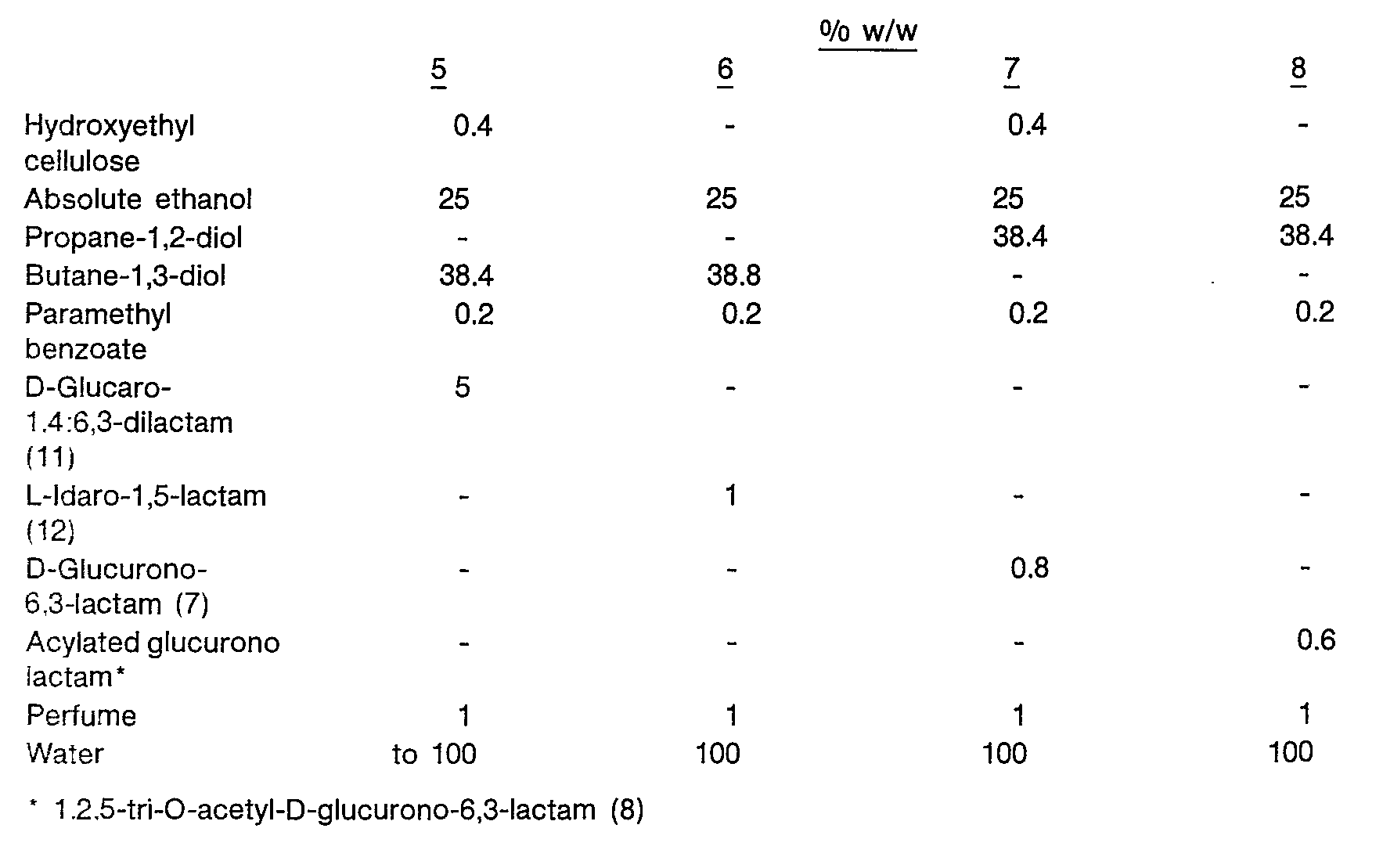
- The following formulations represent creams which can be used in the treatment of baldness.

- This Example illustrates a water-in-oil high internal phase emulsion containing a glycosaminoglycanase inhibitor according to the invention.
- The emulsion consisted of 10% by volume oily phase and 90% by weight aqueous phase.
- The oily phase and the aqueous phase had the following constitution:
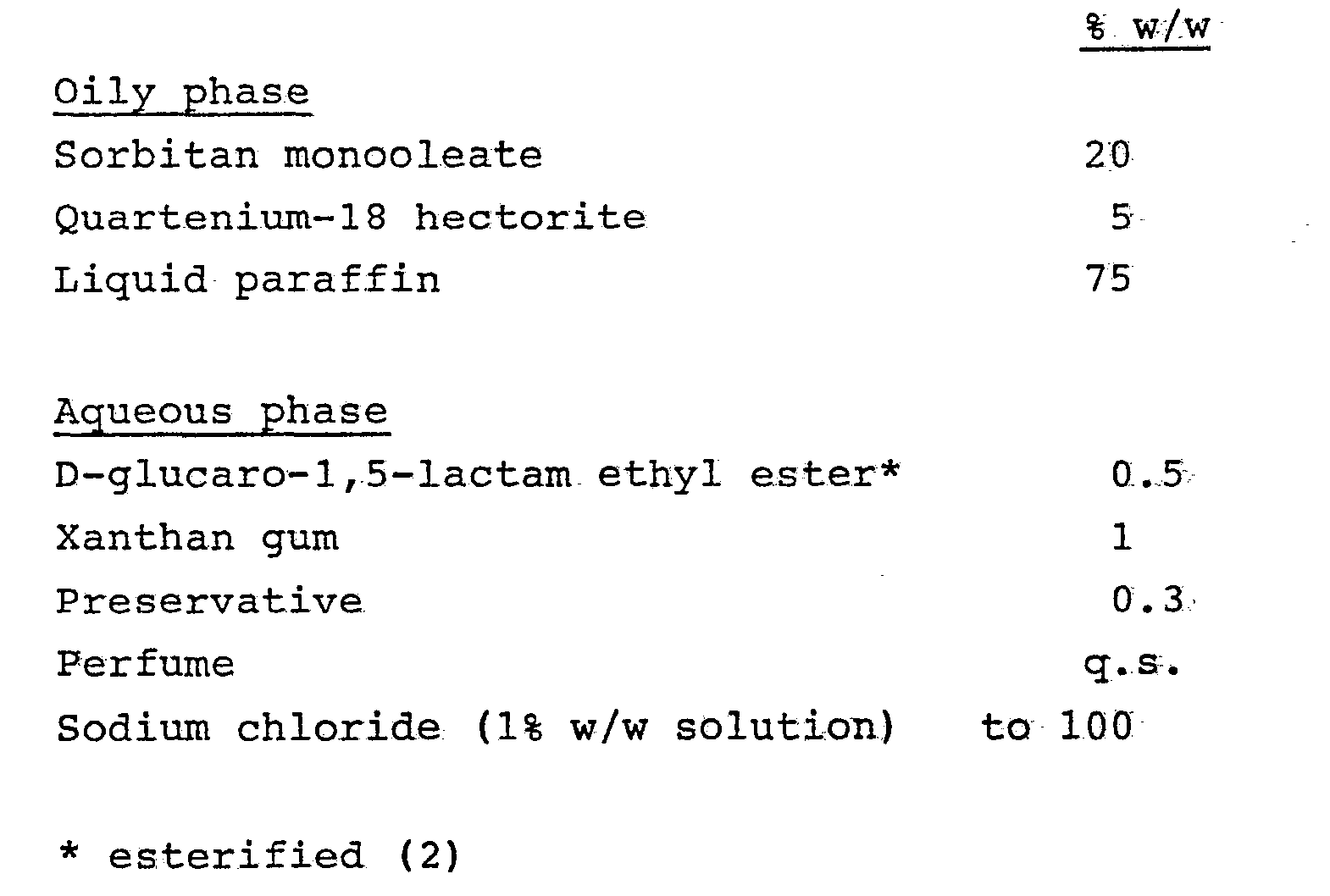
- The emulsion was prepared by taking 10 parts by volume of the oily phase and to it adding slowly with stirring 90 parts by volume of the aqueous phase.
- The high internal phase water-in-oil emulsion so formed can be applied topically to the scalp, to improve hair growth and regrowth.
- The following examples 14 to 18 illustrate shampoos for use in washing the hair and scalp, and for promoting hair growth on the scalp.
-

-

-

-
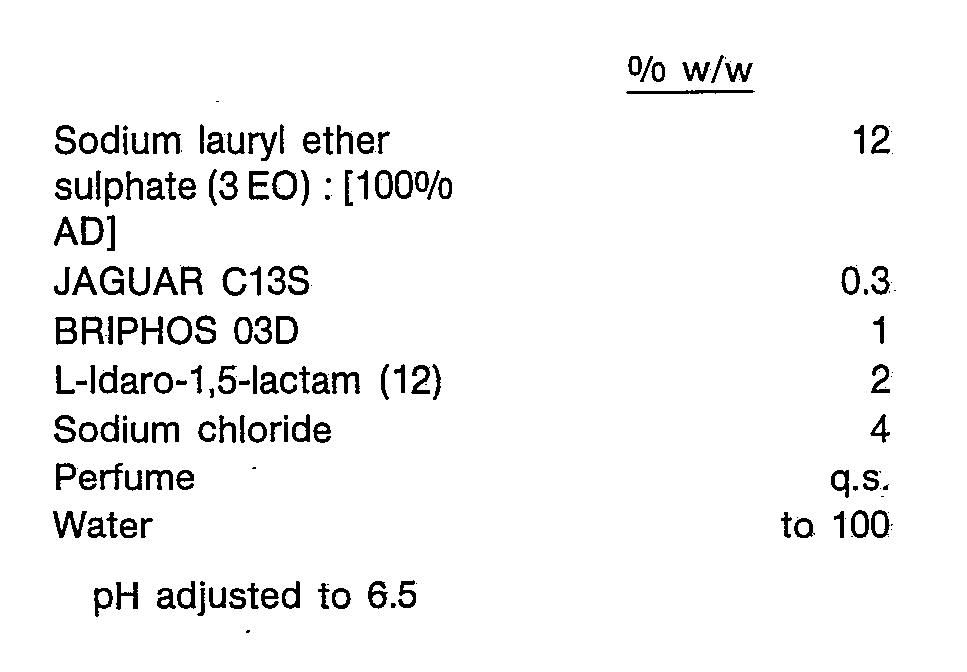
-

- The following Examples 19 to 24 illustrate powder compositions according to the invention which can be applied topically to the scalp.

- The following example illustrates a lotion according to the invention which can be applied topically to the scalp to prevent hair loss and stimulate hair regrowth.

- These examples illustrate hair tonics which are suitable for application to the hair and scalp. The hair tonics had the following formulation:

- This example illustrates a microgel which is suitable for topical application to hair or scalp.
- The gel had the following formulation:

- This microgel was prepared by heating part A to 90°C and part C to 95° and then adding part C to part A with stirring. Part B was then added at 70°C and the final mixture cooled and poured into jars at 55° C to 60° C. On further cooling, a gel was formed.
- These examples illustrate shampoos which are suitable for topical application to hair in orderto cleanse it, at the same time delivering chemical inhibitors to the scalp to enhance hair growth or regrowth.
- The shampoo had the following formulation:

- The following formulations represent lotions which can be used topically in the treatment of bald or balding male or female heads.

- This Example also illustrates a lotion which is suitable for topical application to the scalp:
- The lotion has the following formulation:
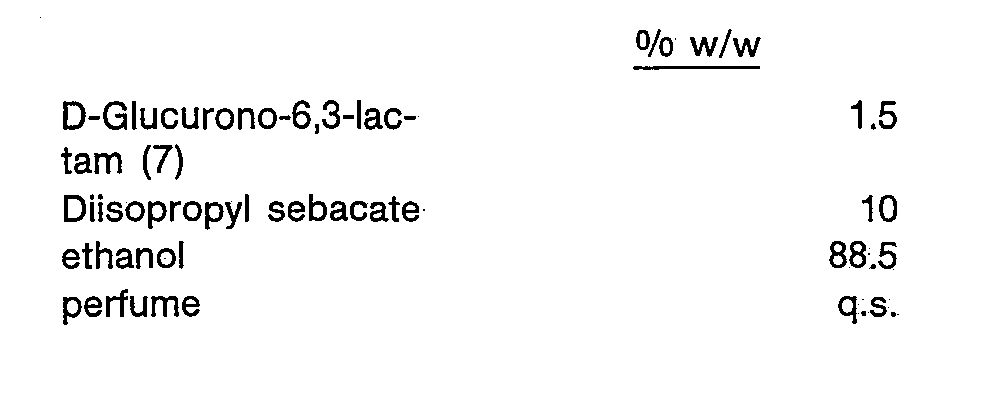
- This Example also illustrates a hair tonic which is suitable for application to hair or scalp.
- The hair tonic has the following formulation:

then that group or groups can be of either stereochemical configuration with respect to the plane of the ring. provided also that where the lactam has the structure:


provided that when the subgrouping (CH=CH) is present, then the total number of carbon atoms in said grouping is from 10 to 22.
Claims (28)

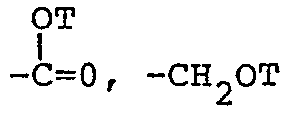


provided that:
then that group or groups can be of either stereochemical configuration with respect to the plane of the ring.
provided also that where the lactam has the structure:


provided that:
then that group or groups can be of either stereochemical configuration with respect to the plane of the ring; and
the effect on hair growth of a hair growth stimulant as a test compound being assessed as a positive response when the increase in hair growth, as measured by the accumulated weight of hair clippings over the 3 month period is at least 100/o greater than that resulting from topical application of a control composition under the same conditions during the same time period.
Applications Claiming Priority (2)
| Application Number | Priority Date | Filing Date | Title |
|---|---|---|---|
| GB888806892A GB8806892D0 (en) | 1988-03-23 | 1988-03-23 | Lactams their synthesis & use in cosmetic compositions |
| GB8806892 | 1988-03-23 |
Publications (2)
| Publication Number | Publication Date |
|---|---|
| EP0334586A1 true EP0334586A1 (en) | 1989-09-27 |
| EP0334586B1 EP0334586B1 (en) | 1994-05-18 |
Family
ID=10633955
Family Applications (1)
| Application Number | Title | Priority Date | Filing Date |
|---|---|---|---|
| EP89302754A Expired - Lifetime EP0334586B1 (en) | 1988-03-23 | 1989-03-21 | Carbohydrate lactam derivatives and their use in cosmetic compositions |
Country Status (7)
| Country | Link |
|---|---|
| US (1) | US4975441A (en) |
| EP (1) | EP0334586B1 (en) |
| JP (1) | JPH0662390B2 (en) |
| AT (1) | ATE105836T1 (en) |
| DE (1) | DE68915317T2 (en) |
| ES (1) | ES2056206T3 (en) |
| GB (1) | GB8806892D0 (en) |
Cited By (16)
| Publication number | Priority date | Publication date | Assignee | Title |
|---|---|---|---|---|
| EP0422765A1 (en) * | 1989-08-16 | 1991-04-17 | Unilever Plc | Cosmetic composition |
| US5328914A (en) * | 1990-07-20 | 1994-07-12 | L'oreal | Use of pyrimidine 3-oxide derivatives for slowing down hair loss and topical compositions used |
| DE4400221A1 (en) * | 1993-01-11 | 1994-07-14 | Tokyo Seimitsu Co Ltd | Process for the production of semiconductor wafers and plant therefor |
| US5772990A (en) * | 1991-06-20 | 1998-06-30 | L'oreal | Composition for slowing down the loss of hair based on pyrimidine N-oxides triaminosubstituted or their sulfoconjugated |
| EP0835092A4 (en) * | 1994-06-21 | 2000-05-10 | Jacques Antoun | COMPOSITION AND TREATMENT FOR THE CONTROL OF Baldness |
| EP2260845A2 (en) | 2002-06-21 | 2010-12-15 | L'Oréal | Use of polyphenols for the treatment of alopecia |
| WO2011047868A2 (en) | 2009-10-23 | 2011-04-28 | Lipotec, S.A. | Peptides used in the treatment and/or care of the skin, mucous membranes and/or hair and its use in cosmetic or pharmaceutical compositions |
| WO2011101153A1 (en) | 2010-02-18 | 2011-08-25 | Lipotec, S.A. | Liposomes for the treatment of textile materials |
| WO2011116962A1 (en) | 2010-03-24 | 2011-09-29 | Lipotec S.A. | Process of treatment of fibers and/or textile materials |
| WO2011116963A2 (en) | 2010-03-24 | 2011-09-29 | Lipotec S.A. | Lipid nanoparticle capsules |
| WO2012038061A2 (en) | 2010-09-21 | 2012-03-29 | Lipotec, S.A. | Nanocapsules containing microemulsions |
| WO2016069396A2 (en) | 2014-10-31 | 2016-05-06 | Lubrizol Advanced Materials, Inc. | Thermoplastic polyurethane film for delivery of active agents to skin surfaces |
| WO2017079248A1 (en) | 2015-11-05 | 2017-05-11 | Lubrizol Advanced Materials, Inc. | Thermoformable dual network hydrogel compositions |
| US9788553B2 (en) | 2009-10-30 | 2017-10-17 | Nestec S.A. | Double-crusted pizza products, and methods for producing same |
| WO2019200027A1 (en) | 2018-04-12 | 2019-10-17 | Lubrizol Advanced Materials, Inc. | Hair modification composition and method therefor |
| WO2022245758A1 (en) | 2021-05-17 | 2022-11-24 | Lubrizol Advanced Materials, Inc. | Hair color compositions for mitigating color loss |
Families Citing this family (8)
| Publication number | Priority date | Publication date | Assignee | Title |
|---|---|---|---|---|
| US5185325A (en) * | 1988-06-23 | 1993-02-09 | Chesebrough-Pond's Usa Co., Division Of Conopco, Inc. | Cosmetic composition |
| GB9118979D0 (en) * | 1991-09-04 | 1991-10-23 | Unilever Plc | Cosmetic composition |
| US5329044A (en) * | 1992-08-12 | 1994-07-12 | Kiely Donald E | Glucaric acid monoamides and their use to prepare poly(glucaramides) |
| US6770468B1 (en) | 1999-09-14 | 2004-08-03 | Genzyme Glycobiology Research Institute, Inc. | Phosphodiester-α-GlcNAcase of the lysosomal targeting pathway |
| US6534300B1 (en) | 1999-09-14 | 2003-03-18 | Genzyme Glycobiology Research Institute, Inc. | Methods for producing highly phosphorylated lysosomal hydrolases |
| US6800472B2 (en) | 2001-12-21 | 2004-10-05 | Genzyme Glycobiology Research Institute, Inc. | Expression of lysosomal hydrolase in cells expressing pro-N-acetylglucosamine-1-phosphodiester α-N-acetyl glucosimanidase |
| US6905856B2 (en) | 2001-12-21 | 2005-06-14 | Genzyme Glycobiology Research Institute, Inc. | Soluble GlcNAc phosphotransferase |
| US7099713B2 (en) | 2002-06-28 | 2006-08-29 | Battelle Memorial Institute | Skin conduction and transport systems |
Citations (2)
| Publication number | Priority date | Publication date | Assignee | Title |
|---|---|---|---|---|
| DE2357069A1 (en) * | 1972-11-17 | 1974-06-06 | Meiji Seika Co | D-GLUKARO-1,5-LACTAM DERIVATIVES AND THE PROCESS FOR THEIR PRODUCTION |
| EP0074191A2 (en) * | 1981-08-13 | 1983-03-16 | Gaf Corporation | Hair treatment preparation containing vinyl caprolactam/vinyl pyrrolidone/alkylacrylate polymer |
Family Cites Families (5)
| Publication number | Priority date | Publication date | Assignee | Title |
|---|---|---|---|---|
| JPS52128232A (en) * | 1976-04-16 | 1977-10-27 | Meiji Seika Kaisha Ltd | Drugs for alleviating toxicity to kidneys |
| US4139619A (en) * | 1976-05-24 | 1979-02-13 | The Upjohn Company | 6-Amino-4-(substituted amino)-1,2-dihydro-1-hydroxy-2-iminopyrimidine, topical compositions and process for hair growth |
| FR2477411A1 (en) * | 1980-03-05 | 1981-09-11 | Frajdenrajch Sophie | COMPOSITION FOR THE TREATMENT OF HAIR |
| JPS59186911A (en) * | 1983-04-05 | 1984-10-23 | Sansho Seiyaku Kk | Hair cosmetic |
| WO1985004577A1 (en) * | 1984-04-06 | 1985-10-24 | Gail Sansone Bazzano | Compositions used for hair growth |
-
1988
- 1988-03-23 GB GB888806892A patent/GB8806892D0/en active Pending
-
1989
- 1989-03-21 AT AT89302754T patent/ATE105836T1/en not_active IP Right Cessation
- 1989-03-21 EP EP89302754A patent/EP0334586B1/en not_active Expired - Lifetime
- 1989-03-21 DE DE68915317T patent/DE68915317T2/en not_active Expired - Fee Related
- 1989-03-21 ES ES89302754T patent/ES2056206T3/en not_active Expired - Lifetime
- 1989-03-22 US US07/326,954 patent/US4975441A/en not_active Expired - Lifetime
- 1989-03-23 JP JP1071628A patent/JPH0662390B2/en not_active Expired - Lifetime
Patent Citations (2)
| Publication number | Priority date | Publication date | Assignee | Title |
|---|---|---|---|---|
| DE2357069A1 (en) * | 1972-11-17 | 1974-06-06 | Meiji Seika Co | D-GLUKARO-1,5-LACTAM DERIVATIVES AND THE PROCESS FOR THEIR PRODUCTION |
| EP0074191A2 (en) * | 1981-08-13 | 1983-03-16 | Gaf Corporation | Hair treatment preparation containing vinyl caprolactam/vinyl pyrrolidone/alkylacrylate polymer |
Non-Patent Citations (5)
| Title |
|---|
| BULLETIN OF THE CHEMICAL SOCIETY OF JAPAN, vol. 51, no. 11, November 1978, pages 3261-3266; M. KINOSHITA: "Synthetic approach to 2,3,5-triamino-2,3,5-trideoxy-D-arabonic acid derivatives from 3,4,6-triazido-3,4,6-trideoxy-1,2-O-isopropylidene-alpha-D-glucopyranose" * |
| CHEMICAL ABSTRACTS, vol. 109, no. 25, December 1988, page 363, abstract no. 225518u, Columbus, Ohio, US; M. YUKIO et al.: "Inhibition of bêta-galactosidase by galactostatin, galactostatin-lactam, and l-deoxygalactostatin", & AGRIC. BIOL. CHEM. 1988, 52(7), 1649-54 * |
| JOURNAL OF ANTIBIOTICS, vol. 37, no. 12, 1984, pages 1579-1583; T. NIWA et al.: "Novel glycosidase inhibitors, nojirimycin B and D-mannonic-delta-lactam. Isolation, structure determination and biological property" * |
| JOURNAL OF ORGANIC CHEMISTRY, vol. 34, no. 3, March 1969, pages 675-681; S. HANESSIAN: "Sugar lactams. III. Synthesis of five-, six-, and seven-membered analogs1-3" * |
| JOURNAL OF THE CHEMICAL SOCIETY, no. 7, 1988, pages 483-485, Copyright the Royal Society of Chemistry; G.W.J. FLEET: "Delta-Lactams: synthesis from D-glucose, and preliminary evaluation as a fucosidase inhibitor, of L-fuconic-delta-lactam" * |
Cited By (24)
| Publication number | Priority date | Publication date | Assignee | Title |
|---|---|---|---|---|
| EP0422765A1 (en) * | 1989-08-16 | 1991-04-17 | Unilever Plc | Cosmetic composition |
| US5328914A (en) * | 1990-07-20 | 1994-07-12 | L'oreal | Use of pyrimidine 3-oxide derivatives for slowing down hair loss and topical compositions used |
| US5772990A (en) * | 1991-06-20 | 1998-06-30 | L'oreal | Composition for slowing down the loss of hair based on pyrimidine N-oxides triaminosubstituted or their sulfoconjugated |
| DE4400221A1 (en) * | 1993-01-11 | 1994-07-14 | Tokyo Seimitsu Co Ltd | Process for the production of semiconductor wafers and plant therefor |
| DE4400221C2 (en) * | 1993-01-11 | 1999-03-11 | Tokyo Seimitsu Co Ltd | Method of manufacturing a semiconductor wafer and plant therefor |
| EP0835092A4 (en) * | 1994-06-21 | 2000-05-10 | Jacques Antoun | COMPOSITION AND TREATMENT FOR THE CONTROL OF Baldness |
| EP2260845A2 (en) | 2002-06-21 | 2010-12-15 | L'Oréal | Use of polyphenols for the treatment of alopecia |
| US9138408B2 (en) | 2002-06-21 | 2015-09-22 | L'oreal | Use of taurine for treating alopecia |
| US8993716B2 (en) | 2009-10-23 | 2015-03-31 | Lipotec, S.A. | Peptides used in the treatment and/or care of the skin, mucous membranes and/or hair and its use in cosmetic or pharmaceutical compositions |
| WO2011047868A2 (en) | 2009-10-23 | 2011-04-28 | Lipotec, S.A. | Peptides used in the treatment and/or care of the skin, mucous membranes and/or hair and its use in cosmetic or pharmaceutical compositions |
| US9788553B2 (en) | 2009-10-30 | 2017-10-17 | Nestec S.A. | Double-crusted pizza products, and methods for producing same |
| WO2011101153A1 (en) | 2010-02-18 | 2011-08-25 | Lipotec, S.A. | Liposomes for the treatment of textile materials |
| US9717659B2 (en) | 2010-02-18 | 2017-08-01 | Lipotec, S.A. | Liposomes for the treatment of textile materials |
| WO2011116962A1 (en) | 2010-03-24 | 2011-09-29 | Lipotec S.A. | Process of treatment of fibers and/or textile materials |
| US9708757B2 (en) | 2010-03-24 | 2017-07-18 | Lipotec, S.A. | Process of treatment of fibers and/or textile materials |
| WO2011116963A2 (en) | 2010-03-24 | 2011-09-29 | Lipotec S.A. | Lipid nanoparticle capsules |
| WO2012038061A2 (en) | 2010-09-21 | 2012-03-29 | Lipotec, S.A. | Nanocapsules containing microemulsions |
| US10758490B2 (en) | 2010-09-21 | 2020-09-01 | Lipotec, S.A. | Nanocapsules containing microemulsions |
| WO2016069396A2 (en) | 2014-10-31 | 2016-05-06 | Lubrizol Advanced Materials, Inc. | Thermoplastic polyurethane film for delivery of active agents to skin surfaces |
| US10905646B2 (en) | 2014-10-31 | 2021-02-02 | Lubrizol Advanced Materials, Inc. | Thermoplastic polyurethane film for delivery of active agents to skin surfaces |
| WO2017079248A1 (en) | 2015-11-05 | 2017-05-11 | Lubrizol Advanced Materials, Inc. | Thermoformable dual network hydrogel compositions |
| WO2019200027A1 (en) | 2018-04-12 | 2019-10-17 | Lubrizol Advanced Materials, Inc. | Hair modification composition and method therefor |
| US11478412B2 (en) | 2018-04-12 | 2022-10-25 | Lubrizol Advanced Materials, Inc. | Hair modification composition and method therefor |
| WO2022245758A1 (en) | 2021-05-17 | 2022-11-24 | Lubrizol Advanced Materials, Inc. | Hair color compositions for mitigating color loss |
Also Published As
| Publication number | Publication date |
|---|---|
| ES2056206T3 (en) | 1994-10-01 |
| ATE105836T1 (en) | 1994-06-15 |
| DE68915317D1 (en) | 1994-06-23 |
| GB8806892D0 (en) | 1988-04-27 |
| US4975441A (en) | 1990-12-04 |
| DE68915317T2 (en) | 1994-09-08 |
| JPH0662390B2 (en) | 1994-08-17 |
| EP0334586B1 (en) | 1994-05-18 |
| JPH01283262A (en) | 1989-11-14 |
Similar Documents
| Publication | Publication Date | Title |
|---|---|---|
| EP0334586B1 (en) | Carbohydrate lactam derivatives and their use in cosmetic compositions | |
| US5037643A (en) | Cosmetic composition | |
| EP0277428B1 (en) | Cosmetic composition | |
| US5124354A (en) | Cosmetic composition containing an aryl-substituted ethylene | |
| EP0375388B1 (en) | Cosmetic composition | |
| AU625887B2 (en) | Hair growth promoting composition containing N-acylated amino acids | |
| EP0295092B1 (en) | Skin treatment composition | |
| US4871839A (en) | Skin treatment composition | |
| US5185325A (en) | Cosmetic composition | |
| EP0348184B1 (en) | Cosmetic composition | |
| US5358714A (en) | Cosmetic composition | |
| EP0572167B1 (en) | Cosmetic composition | |
| EP0517371B1 (en) | Hair growth composition containing citric acid esters | |
| CA1336965C (en) | Cosmetic composition | |
| US5158955A (en) | Cosmetic composition comprising an ester of pyroglutamic acid | |
| AU637390B2 (en) | Compositions containing hair growth promoters | |
| EP0398669B1 (en) | Cosmetic composition |
Legal Events
| Date | Code | Title | Description |
|---|---|---|---|
| PUAI | Public reference made under article 153(3) epc to a published international application that has entered the european phase |
Free format text: ORIGINAL CODE: 0009012 |
|
| AK | Designated contracting states |
Kind code of ref document: A1 Designated state(s): AT BE CH DE ES FR GB GR IT LI NL SE |
|
| 17P | Request for examination filed |
Effective date: 19891024 |
|
| 17Q | First examination report despatched |
Effective date: 19920228 |
|
| RAP3 | Party data changed (applicant data changed or rights of an application transferred) |
Owner name: UNILEVER N.V. Owner name: UNILEVER PLC |
|
| GRAA | (expected) grant |
Free format text: ORIGINAL CODE: 0009210 |
|
| RAP1 | Party data changed (applicant data changed or rights of an application transferred) |
Owner name: UNILEVER N.V. Owner name: UNILEVER PLC |
|
| AK | Designated contracting states |
Kind code of ref document: B1 Designated state(s): AT BE CH DE ES FR GB GR IT LI NL SE |
|
| REF | Corresponds to: |
Ref document number: 105836 Country of ref document: AT Date of ref document: 19940615 Kind code of ref document: T |
|
| REF | Corresponds to: |
Ref document number: 68915317 Country of ref document: DE Date of ref document: 19940623 |
|
| ITF | It: translation for a ep patent filed | ||
| ET | Fr: translation filed | ||
| REG | Reference to a national code |
Ref country code: GR Ref legal event code: FG4A Free format text: 3012108 |
|
| REG | Reference to a national code |
Ref country code: ES Ref legal event code: FG2A Ref document number: 2056206 Country of ref document: ES Kind code of ref document: T3 |
|
| EAL | Se: european patent in force in sweden |
Ref document number: 89302754.0 |
|
| PGFP | Annual fee paid to national office [announced via postgrant information from national office to epo] |
Ref country code: FR Payment date: 19950208 Year of fee payment: 7 |
|
| PGFP | Annual fee paid to national office [announced via postgrant information from national office to epo] |
Ref country code: SE Payment date: 19950213 Year of fee payment: 7 Ref country code: AT Payment date: 19950213 Year of fee payment: 7 |
|
| PGFP | Annual fee paid to national office [announced via postgrant information from national office to epo] |
Ref country code: DE Payment date: 19950217 Year of fee payment: 7 Ref country code: CH Payment date: 19950217 Year of fee payment: 7 |
|
| PGFP | Annual fee paid to national office [announced via postgrant information from national office to epo] |
Ref country code: BE Payment date: 19950223 Year of fee payment: 7 |
|
| PGFP | Annual fee paid to national office [announced via postgrant information from national office to epo] |
Ref country code: GB Payment date: 19950301 Year of fee payment: 7 |
|
| PGFP | Annual fee paid to national office [announced via postgrant information from national office to epo] |
Ref country code: ES Payment date: 19950307 Year of fee payment: 7 |
|
| PGFP | Annual fee paid to national office [announced via postgrant information from national office to epo] |
Ref country code: GR Payment date: 19950317 Year of fee payment: 7 |
|
| PLBE | No opposition filed within time limit |
Free format text: ORIGINAL CODE: 0009261 |
|
| STAA | Information on the status of an ep patent application or granted ep patent |
Free format text: STATUS: NO OPPOSITION FILED WITHIN TIME LIMIT |
|
| PGFP | Annual fee paid to national office [announced via postgrant information from national office to epo] |
Ref country code: NL Payment date: 19950331 Year of fee payment: 7 |
|
| 26N | No opposition filed | ||
| PG25 | Lapsed in a contracting state [announced via postgrant information from national office to epo] |
Ref country code: GB Effective date: 19960321 Ref country code: AT Effective date: 19960321 |
|
| PG25 | Lapsed in a contracting state [announced via postgrant information from national office to epo] |
Ref country code: SE Effective date: 19960322 Ref country code: ES Free format text: LAPSE BECAUSE OF NON-PAYMENT OF DUE FEES Effective date: 19960322 |
|
| PG25 | Lapsed in a contracting state [announced via postgrant information from national office to epo] |
Ref country code: LI Effective date: 19960331 Ref country code: CH Effective date: 19960331 Ref country code: BE Effective date: 19960331 |
|
| BERE | Be: lapsed |
Owner name: UNILEVER N.V. Effective date: 19960331 |
|
| PG25 | Lapsed in a contracting state [announced via postgrant information from national office to epo] |
Ref country code: GR Free format text: THE PATENT HAS BEEN ANNULLED BY A DECISION OF A NATIONAL AUTHORITY Effective date: 19960930 |
|
| PG25 | Lapsed in a contracting state [announced via postgrant information from national office to epo] |
Ref country code: NL Effective date: 19961001 |
|
| REG | Reference to a national code |
Ref country code: GR Ref legal event code: MM2A Free format text: 3012108 |
|
| GBPC | Gb: european patent ceased through non-payment of renewal fee |
Effective date: 19960321 |
|
| REG | Reference to a national code |
Ref country code: CH Ref legal event code: PL |
|
| PG25 | Lapsed in a contracting state [announced via postgrant information from national office to epo] |
Ref country code: FR Effective date: 19961129 |
|
| NLV4 | Nl: lapsed or anulled due to non-payment of the annual fee |
Effective date: 19961001 |
|
| PG25 | Lapsed in a contracting state [announced via postgrant information from national office to epo] |
Ref country code: DE Effective date: 19961203 |
|
| EUG | Se: european patent has lapsed |
Ref document number: 89302754.0 |
|
| REG | Reference to a national code |
Ref country code: FR Ref legal event code: ST |
|
| REG | Reference to a national code |
Ref country code: ES Ref legal event code: FD2A Effective date: 19990405 |
|
| PG25 | Lapsed in a contracting state [announced via postgrant information from national office to epo] |
Ref country code: IT Free format text: LAPSE BECAUSE OF NON-PAYMENT OF DUE FEES;WARNING: LAPSES OF ITALIAN PATENTS WITH EFFECTIVE DATE BEFORE 2007 MAY HAVE OCCURRED AT ANY TIME BEFORE 2007. THE CORRECT EFFECTIVE DATE MAY BE DIFFERENT FROM THE ONE RECORDED. Effective date: 20050321 |