EP0334062B1 - Bioabsorbable coating for a surgical article - Google Patents
Bioabsorbable coating for a surgical article Download PDFInfo
- Publication number
- EP0334062B1 EP0334062B1 EP89103601A EP89103601A EP0334062B1 EP 0334062 B1 EP0334062 B1 EP 0334062B1 EP 89103601 A EP89103601 A EP 89103601A EP 89103601 A EP89103601 A EP 89103601A EP 0334062 B1 EP0334062 B1 EP 0334062B1
- Authority
- EP
- European Patent Office
- Prior art keywords
- copolymer
- ligature
- suture
- caprolactone
- coating
- Prior art date
- Legal status (The legal status is an assumption and is not a legal conclusion. Google has not performed a legal analysis and makes no representation as to the accuracy of the status listed.)
- Expired - Lifetime
Links
Classifications
-
- A—HUMAN NECESSITIES
- A61—MEDICAL OR VETERINARY SCIENCE; HYGIENE
- A61L—METHODS OR APPARATUS FOR STERILISING MATERIALS OR OBJECTS IN GENERAL; DISINFECTION, STERILISATION OR DEODORISATION OF AIR; CHEMICAL ASPECTS OF BANDAGES, DRESSINGS, ABSORBENT PADS OR SURGICAL ARTICLES; MATERIALS FOR BANDAGES, DRESSINGS, ABSORBENT PADS OR SURGICAL ARTICLES
- A61L17/00—Materials for surgical sutures or for ligaturing blood vessels ; Materials for prostheses or catheters
- A61L17/14—Post-treatment to improve physical properties
- A61L17/145—Coating
-
- A—HUMAN NECESSITIES
- A61—MEDICAL OR VETERINARY SCIENCE; HYGIENE
- A61L—METHODS OR APPARATUS FOR STERILISING MATERIALS OR OBJECTS IN GENERAL; DISINFECTION, STERILISATION OR DEODORISATION OF AIR; CHEMICAL ASPECTS OF BANDAGES, DRESSINGS, ABSORBENT PADS OR SURGICAL ARTICLES; MATERIALS FOR BANDAGES, DRESSINGS, ABSORBENT PADS OR SURGICAL ARTICLES
- A61L27/00—Materials for grafts or prostheses or for coating grafts or prostheses
- A61L27/28—Materials for coating prostheses
- A61L27/34—Macromolecular materials
Definitions
- a bioabsorbable coating for a surgical article comprises a copolymer manufactured from the monomer caprolactone and at least one other copolymerizable monomer.
- the surgical article can be a bioabsorbable suture or a ligature.
- the surgical suture or ligature coated with the bioabsorbable copolymer has improved knot repositioning properties.
- the bioabsorbable coating of this invention has advantages over prior art coatings used with surgical sutures or ligatures. Specifically, sutures coated with the copolymer coating of this invention are less stiff than sutures using the coating described in the prior art. Also, the processes for coating a bioabsorbable surgical article are not clearly described in the prior art. That is, the process of this invention uses a copolymer manufactured from at least about 50 percent by weight of the monomer caprolactone and the remainder glycolide. Copolymers of these proportions are soluble in acetone, as contrasted with, for example, at least some if not all of the copolymers of lactide and glycolide discussed in the prior art.
- the bioabsorbable coating of this invention has superior and unexpected results over the known commercially available surgical suture or ligature coatings.
- the coating of this invention does not present a hazy appearance on a suture.
- the coating can be dissolved in acetone which seems to be less deleterious than other known solvents, for example, methylene chloride.
- suture characteristics such as knot-snug-in or repositioning, knot security, and tissue drag appear to be equal to, if not better than suture coatings disclosed in the prior art.
- copolymers described in this invention are random.
- random copolymer means the result of a copolymerization reaction in which all of the monomers are charged into the reactor simultaneously. It is to be understood that variations in reaction conditions can lead to some differences in the actual degree of randomness with respect to the distribution of comonomer units in a copolymer chain.
- a surgical article having improved knot repositioning characteristics comprising a strand, the strand having a bioabsorbable coating, the coating selected from the group characterized by random copolymer from 65 up to 70% by weight of the copolymer consisting of linkages of formula (I): and the remaining linkages comprising at least one of the formulas (II) to (VIII): or characterized by a block copolymer having one or more A blocks solely manufactured from the monomer caprolactone, wherein the caprolactone in the one or more A blocks is 40 percent by weight of the copolymer, and one or more B blocks manufactured from: the monomer caprolactone randomly coplymeriz- ed with one or more monomers selected from the group consisting of lactides, carbonates and a lactone other than caprolactone, the total caprolactone linkages in the copolymer being from 70 to 80 percent by weight of said copolymer.
- the remaining linkages are selected from the group consisting of formulas (II) and (III). In another embodiment the remaining linkages are selected from the group consisting of formula (II).
- the formula (II) is: In another specific embodiment, the formula (II) is:
- the inherent viscosity of the copolymer is 0.2 to 1.4 dl/g (0.5 g/dl in CHCl 3 , 30 ° C) and the melting point is less than 50 ° C.
- strand as used in this invention can be either a multifilament or a monofilament.
- a multifilament is preferred.
- the multifilament strand can be a braid.
- the surgical article coated with the above described polymers can be bioabsorbable.
- the bioabsorbable surgical article is a suture or ligature.
- the suture or ligature is manufactured from a polymer prepared from one or more monomers selected from the group consisting of lactides, carbonates and lactones. If the polymer in a strand, for example a suture or ligature, and the copolymer in the coating are prepared from the same monomers, it is to be understood that the copolymer in the coating has a melting point of less than 50 ° C or is noncrystalline, that is amorphous. It is to be further understood that this description applies by implication to the description of the invention in the claims.
- the suture or ligature is manufactured from a homopolymer prepared from the monomer glycolide. In another more specific embodiment, the suture or ligature is manufactured from a homopolymer prepared from the monomer lactide. In yet another more specific embodiment, the suture or ligature is manufactured from a copolymer prepared from the monomers glycolide and 1,3-dioxan-2-one. In a further specific embodiment, the suture or ligature is manufactured from a copolymer prepared from the monomers glycolide and lactide.
- the suture or ligature can be in multifilamentary form.
- the coating comprises about 1/10 to 5% by weight of the coated multifilamentary suture or ligature. In a more specific embodiment, the coating comprises about 1/2 to 3% by weight of the coated multifilamentary suture or ligature. In the more specific embodiment, the coating can comprise up to about 1 1/2 percent by weight of the coated multifilamentary suture or ligature.
- a process for coating a bioabsorbable surgical article comprises dissolving in acetone a random copolymer, from 65 to 70 percent by weight of the copolymer consists of linkages of formula (I): and the remaining linkages comprise at least one of the formulas (II) and (III): contacting the surgical article with the dissolved copolymer; maintaining the contact between the surgical article and dissolved copolymer until the copolymer on the surgical article comprises from about 1/10 to 5% by weight of the coated surgical article; removing the coated surgical article from the dissolved copolymer; and drying the copolymer coating on the surgical article.
- Parameters to be used in the maintaining step are fully described in the prior art.
- the caprolactone is E -caprolactone.
- random or randomly in this invention means the result of a copolymerization reaction in which all of the monomers are charged into a reactor simultaneously. It is to be understood that variations in reaction conditions can lead to some differences in the actual degree of randomness with respect to the distribution of comonomer units in a copolymer chain.
- a bioabsorbable coating for a surgical article comprising a block copolymer has also been invented.
- the block copolymer has one or more blocks manufactured from the monomer caprolactone.
- the caprolactone is E -caprolactone.
- the copolymer is a diblock copolymer.
- the copolymer has one or more A blocks solely manufactured from the monomer caprolactone, and one or more B blocks manufactured from one or more monomers selected from the group consisting of lactides, carbonates, lactones and oxalates, with the proviso that in the latter one or more B blocks, caprolactone can only be used with another monomer.
- the inherent viscosity of the block copolymer is about 0.1 to 1.0 dl/g (0.5 g/dl in CHCl 3 , 30 °C), the melting point of the block copolymer is less than 70 ° C, and the block copolymer is soluble in acetone or methylene chloride.
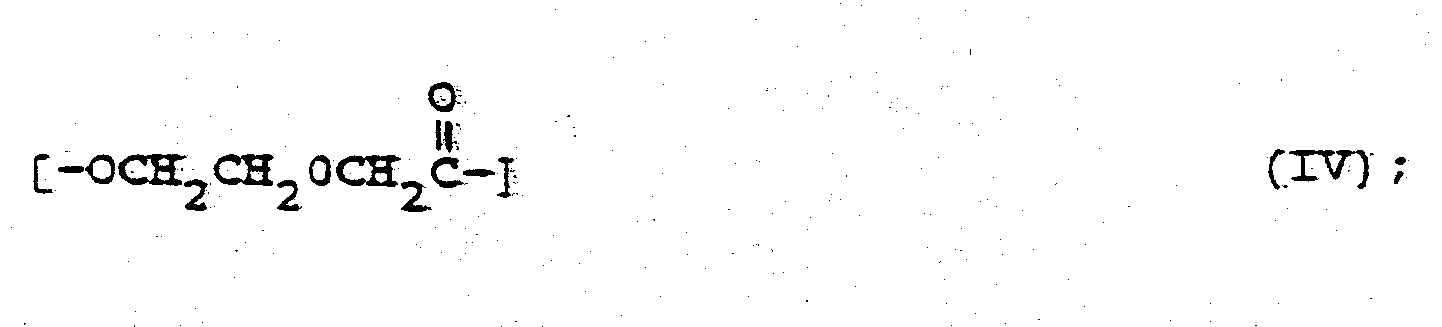
- the coating comprises a block copolymer consisting of one or more A blocks of formula (I): and the remaining one or more B blocks comprising one or more of the formulas (II) to (VI), either alone or in combination with formula (I): the total amount of formula (I) in the copolymer being from 70 to 80 percent by weight of said copolymer.
- the remaining one or more B blocks consist of formulas (I) and (II). In another embodiment the remaining one or more B blocks consist of formulas (II) and (III).
- the surgical article coated with the above-described polymers can be bioabsorbable.
- the bioabsorbable surgical article is a suture or ligature.
- the suture or ligature is manufactured from a polymer prepared from one or more monomers selected from the group consisting of lactides, carbonates and lactones. If the polymer in the suture or ligature and the copolymer in the coating are prepared from the same monomers, it is to be understood that the copolymer in the coating has a melting point less than about 70 ° C and is soluble in acetone or methylene chloride. It is to be further understood that this description applies by implication to the description of the invention in the claims.
- the suture or ligature is manufactured from a homopolymer prepared from the monomer glycolide. In another specific embodiment, the suture or ligature is manufactured from a polymer prepared from at least the monomer lactide. In yet another more specific embodiment, the suture or ligature is manufactured from a copolymer prepared from the monomers glycolide and 1,3-dioxan-2-one. In a further specific embodiment, the suture or ligature is manufactured from a copolymer prepared from the monomers glycolide and lactide.
- the suture or ligature can be in multifilamentary form.
- the coating comprises about 1/10 to 5% by weight of the coated multifilamentary suture or ligature. In a more specific embodiment, the coating comprises about 1/4 to 3% by weight of the coated multifilamentary suture or ligature. In the more specific embodiment, the coating can comprise up to about 2 1/2 percent by weight of the coated multifilamentary suture or ligature.
- a coating process for a bioabsorbable surgical article comprises dissolving in acetone a block copolymer having one or more A blocks manufactured solely from the monomer caprolactone and one or more B blocks manufactured from the monomers caprolactone and glycolide, where the glycolide in the one or more B blocks comprises up to 50 percent by weight of the copolymer and up to about 65 percent by weight of said B blocks; contacting the surgical article with the dissolved copolymer; maintaining the contact between the surgical article and the dissolved copolymer until the copolymer on the article comprises from about 1/10 to 5% by weight of the coated surgical article; removing the coated surgical article from the dissolved copolymer; and drying the copolymer coating on the surgical article.
- the caprolactone is E -caprolactone.
- E -Caprolactone (10g, 0.088 mole), lauryl alcohol (0.122g, 6.57 x 10- 4 mole) and stannous chloride dihydrate (0.988 mg, 4.38 x 10- 6 mole) were combined in a flask.
- the flask was flushed with nitrogen and evacuated.
- the flask was heated at 135 ° C in an oil bath for 24 hours.
- the resulting polymer had an ⁇ inh of 0.53 dl/g (0.5 g/dl in HFAS).
- E -Caprolactone (212.5g, 1.86 mole), I-lactide (37.5 g, 0.26 mole), lauryl alcohol (4.10 ml, 0.018 mole) and stannous chloride dihydrate (35.9 mg, 1.59 x 10- 4 mole) were combined in a stirred reactor under nitrogen at 175 ° C. The mixture was stirred at 175 ° C for 3 hours. The resulting polymer had a composition, as determined by 1 H NMR, of 84 wt. % E -caprolactone and 16 wt. % I-lactide. The inherent viscosity of the copolymer was 0.50 dl/g (0.5 g/dl in CHCl 3 ).
- E -Caprolactone (30.0 g, 0.26 mole), I-lactide (170.0g, 1.18 mole), lauryl alcohol (5.10g, 2.74 x 10- 2 mole) and stannous chloride dihydrate (0.0162 g, 7.2 x 10- 5 mole were combined in a stirred reactor under nitrogen at 180 ° C. The mixture was stirred at 180 ° C for 3 hours. The resulting polymer had a composition, as determined by 1 H NMR, of 13 wt. % E -caprolactone and 87 wt. % I-lactide. The ⁇ inh was 0.27 dl/g (0.5 g/dl in CHCl 3 ).
- E -Caprolactone (8.0 g, 0.070 mole), trimethylene carbonate (2.0 g, 0.020 mole), lauryl alcohol (0.283 g, 1.52 x 10- 3 mole) and stannous chloride dihydrate (2.02 mg, 8.91 x 10- 6 mole) were combined in a flask.
- the flask was flushed with nitrogen, evacuated and sealed.
- the flask was heated at 135 ° C for 24 hours.
- the resulting polymer had a composition, as measured by 1 H NMR, of 86 wt. % E -caprolactone and 14 wt. % trimethylene carbonate.
- the ⁇ inh of the copolymer was 0.26 dl/g (0.5 g/dl in HFAS).
- ⁇ -Caprolactone 40 g, 0.35 mole
- trimethylene carbonate 10 g. 0.098 mole
- lauryl alcohol (1.42 g, 7.6 x 10- 3 mole
- stannous chloride dihydrate 10.1 mg, 4.5 x 10- 5 mole
- the composition was determined by 1 H NMR to be 86 wt. % caprolactone and 14 wt. % trimethylene carbonate.
- ⁇ -Caprolactone (170 g, 1.49 mole), glycolide (30 g, 0.26 mole), lauryl alcohol (1.37 g, 7.3 x 10- 3 mole) and stannous octoate (0.052 g, 1.2 x 10- 4 mole) were combined in a stirred reactor under nitrogen at 180 ° C. The mixture was stirred at 180 ° C for 4.5 hours. The resulting polymer had an inherent viscosity of 0.68 dl/g (0.5 g/dl in CHCl 3 ). The composition was determined by 1 H NMR to be 85 wt. % ⁇ -caprolactone and 15 wt.% glycolide.
- a series of random copolymers of ⁇ -caprolactone and glycolide was prepared by the general procedure described in example 7. The bulk polymerizations were carried out in a stirred reactor under a slow nitrogen purge. The resulting polymers were dried in vacuum to remove residual monomer.
- Table 2 summarizes the in vitro performance for the coatings of this invention.
- Table 3 summarizes the in vivo performance for some of the bioabsorbable coatings of this invention.
- block copolymer described in this invention means a copolymer with a non-random distribution of comonomer units along the chain.
- a convenient shorthand notation to describe different block architectures utilizes alphabetic symbols for the individual block segments. The number and types of comonomer units within a block segment can be specified.
- AB represents a diblock copolymer
- ABA or BAB represents a triblock copolymer. More complex architectures such as tetrablocks or pentablocks, etc., can also be described using this notation, e.g. ABABA.
- a multiblock copolymer can be represented as ( ⁇ AB) ⁇ n . If more than two types of blocks are present, additional alphabetic symbols can be defined.
- Block copolymers are formed in this invention by the sequential addition of comonomers or mixtures of comonomers to a reactor. It is believed that with this type of preparation method, there can be a distribution of block size and block composition and that the chain architecture can be compromised by ester interchange reactions.
- E -Caprolactone (80g, 0.70 mole), lauryl alcohol (1.585 ml, 6.6 x 10- 3 mole) and stannous octoate (39.5 ul, 1.22 x 10- 4 mole) were combined in a stirred reactor at 180 ° C. The mixture was stirred while the temperature was increased to 200 ° C over 8 min. and stirring was continued for 1.5 hours. Glycolide (60g, 0.52 mole) and E -Caprolactone (60g, 0.53 mole) were added and the temperature was reduced to 180 ° C. Stirring was maintained for 2 hours longer. The copolymer was discharged from the reactor and was dried in a vacuum oven for 24 hours at about 50 ° C to remove residual monomer. The analyzed properties of the resulting copolymer are listed in Table 4, Section A.
- E -caprolactone-glycolide copolymers was prepared by the general procedure described in Example 20, although the polymerization temperature was maintained at about 180 ° C throughout the reaction in these examples. Specific preparative details and properties of the resulting copolymers are summarized in Table 4, Section A.
- Table 5 summarizes the in vitro performance for the bioabsorbable coatings of this invention.
- Table 6 summarizes the in vivo performance for some of the bioabsorbable coatings of this invention.
- E -Caprolactone (112 g, 0.98 mole), lauryl alcohol (0.193 g, 8.5 x 10- 4 mole) and stannous chloride dihydrate (19.15 mg, 8.5 x 10- 5 mole) were conbined in a stirred reactor at 162 ° C.
- the mixture was stirred at 162 ° C. for 6 hours.
- the temperature was increased to 180 ° C. and 16 g of 1-lactide was added (0.11 mole).
- the temperature was gradually increased to 220 ° C. over 1 hour and then 84 g 1-lactide was added.
- the mixture was stirred for 45 min.
- the resulting polymer had an inherent viscosity of 1.26 dl/g (0.5 g/dl in HFAS).
- the composition was determined by 1 H NMR to be 53 wt. % caprolactone and 47 wt. % lactide.
- E -Caprolactone 55 g, 0.482 mole
- diethylene glycol (0.201 g, 1.90 x 10- 3 mole)
- stannous chloride dihydrate 7.19 mg, 3.19 x 10- 5 mole
- the mixture was stirred for 2 hours at 162 ° C. to 172 ° C.
- 1-Lactide (20 g, 0.14 mole) and stannous chloride dihydrate (7.19 mg, 3.19 x 10- 5 mole) were added and the temperature was gradually increased to 220 °C.
- the mixture was stirred for 0.5 hours. More 1-lactide (140 g, 0.97 mole) was added.
- the mixture was stirred for 1 hour.
- the resulting copolymer ⁇ inh was 1.29 dl/g (0.5 g/dl in HFAS).
- Table 7 summarizes the in vitro performance for the bioabsorbable coatings of this invention.
Landscapes
- Health & Medical Sciences (AREA)
- Animal Behavior & Ethology (AREA)
- Chemical & Material Sciences (AREA)
- Veterinary Medicine (AREA)
- Public Health (AREA)
- General Health & Medical Sciences (AREA)
- Epidemiology (AREA)
- Life Sciences & Earth Sciences (AREA)
- Oral & Maxillofacial Surgery (AREA)
- Transplantation (AREA)
- Medicinal Chemistry (AREA)
- Dermatology (AREA)
- Engineering & Computer Science (AREA)
- Materials Engineering (AREA)
- Surgery (AREA)
- Vascular Medicine (AREA)
- Materials For Medical Uses (AREA)
- Polyesters Or Polycarbonates (AREA)
- Paints Or Removers (AREA)
Abstract
Description
- A bioabsorbable coating for a surgical article comprises a copolymer manufactured from the monomer caprolactone and at least one other copolymerizable monomer. The surgical article can be a bioabsorbable suture or a ligature. The surgical suture or ligature coated with the bioabsorbable copolymer has improved knot repositioning properties.
- The bioabsorbable coating of this invention has advantages over prior art coatings used with surgical sutures or ligatures. Specifically, sutures coated with the copolymer coating of this invention are less stiff than sutures using the coating described in the prior art. Also, the processes for coating a bioabsorbable surgical article are not clearly described in the prior art. That is, the process of this invention uses a copolymer manufactured from at least about 50 percent by weight of the monomer caprolactone and the remainder glycolide. Copolymers of these proportions are soluble in acetone, as contrasted with, for example, at least some if not all of the copolymers of lactide and glycolide discussed in the prior art.
- The use of a copolymer of caprolactone and glycolide as a suture is known in the prior art.
- The use of a copolymer of at least 90% by weight caprolactone and another biodegradable monomer, e.g. glycolide, as a coating is disclosed in the prior art. The prior art also discloses a copolymer and a homopolymer of E-caprolactone and as a suture coating, respectively.
- The bioabsorbable coating of this invention has superior and unexpected results over the known commercially available surgical suture or ligature coatings. For example, the coating of this invention does not present a hazy appearance on a suture. The coating can be dissolved in acetone which seems to be less deleterious than other known solvents, for example, methylene chloride. Further, suture characteristics such as knot-snug-in or repositioning, knot security, and tissue drag appear to be equal to, if not better than suture coatings disclosed in the prior art.
- The copolymers described in this invention are random. The term random copolymer means the result of a copolymerization reaction in which all of the monomers are charged into the reactor simultaneously. It is to be understood that variations in reaction conditions can lead to some differences in the actual degree of randomness with respect to the distribution of comonomer units in a copolymer chain.
- According to the present invention, a surgical article having improved knot repositioning characteristics is provided, the article comprising a strand, the strand having a bioabsorbable coating, the coating selected from the group characterized by random copolymer from 65 up to 70% by weight of the copolymer consisting of linkages of formula (I):

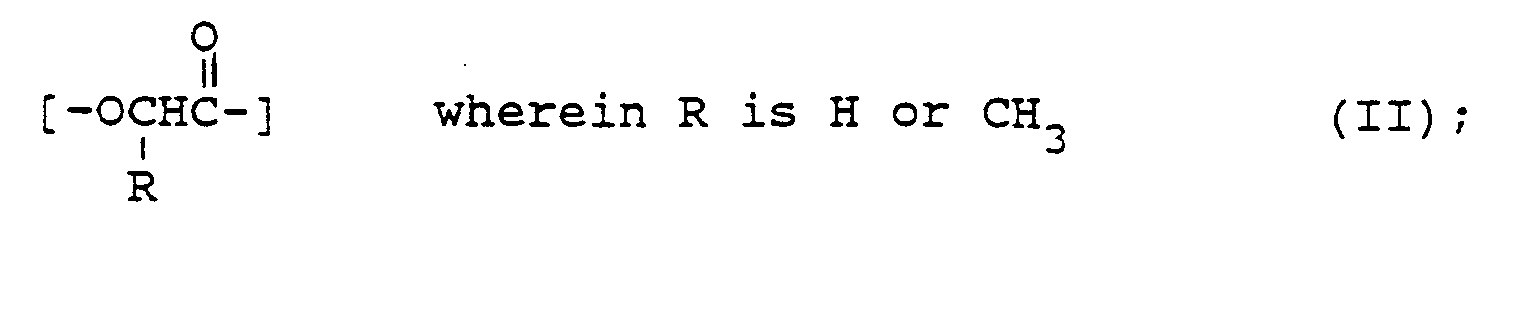


- In one embodiment, the remaining linkages are selected from the group consisting of formulas (II) and (III). In another embodiment the remaining linkages are selected from the group consisting of formula (II).
- In a specific embodiment, the formula (II) is:


- In a further embodiment, the inherent viscosity of the copolymer is 0.2 to 1.4 dl/g (0.5 g/dl in CHCl3, 30 ° C) and the melting point is less than 50 ° C.
- It is to be understood that the term strand as used in this invention can be either a multifilament or a monofilament. A multifilament is preferred. The multifilament strand can be a braid.
- The surgical article coated with the above described polymers can be bioabsorbable. In one embodiment, the bioabsorbable surgical article is a suture or ligature. In a specific embodiment, the suture or ligature is manufactured from a polymer prepared from one or more monomers selected from the group consisting of lactides, carbonates and lactones. If the polymer in a strand, for example a suture or ligature, and the copolymer in the coating are prepared from the same monomers, it is to be understood that the copolymer in the coating has a melting point of less than 50 ° C or is noncrystalline, that is amorphous. It is to be further understood that this description applies by implication to the description of the invention in the claims.
- In a more specific embodiment, the suture or ligature is manufactured from a homopolymer prepared from the monomer glycolide. In another more specific embodiment, the suture or ligature is manufactured from a homopolymer prepared from the monomer lactide. In yet another more specific embodiment, the suture or ligature is manufactured from a copolymer prepared from the monomers glycolide and 1,3-dioxan-2-one. In a further specific embodiment, the suture or ligature is manufactured from a copolymer prepared from the monomers glycolide and lactide.
- The suture or ligature can be in multifilamentary form. In a specific embodiment, the coating comprises about 1/10 to 5% by weight of the coated multifilamentary suture or ligature. In a more specific embodiment, the coating comprises about 1/2 to 3% by weight of the coated multifilamentary suture or ligature. In the more specific embodiment, the coating can comprise up to about 1 1/2 percent by weight of the coated multifilamentary suture or ligature.
- A process for coating a bioabsorbable surgical article has also been invented. The process comprises dissolving in acetone a random copolymer, from 65 to 70 percent by weight of the copolymer consists of linkages of formula (I):


- In one embodiment, the caprolactone is E-caprolactone.
- The term random or randomly in this invention means the result of a copolymerization reaction in which all of the monomers are charged into a reactor simultaneously. It is to be understood that variations in reaction conditions can lead to some differences in the actual degree of randomness with respect to the distribution of comonomer units in a copolymer chain.
- A bioabsorbable coating for a surgical article comprising a block copolymer has also been invented. The block copolymer has one or more blocks manufactured from the monomer caprolactone. In one embodiment, the caprolactone is E-caprolactone. In another embodiment the copolymer is a diblock copolymer.
- In a preferred embodiment, the copolymer has one or more A blocks solely manufactured from the monomer caprolactone, and one or more B blocks manufactured from one or more monomers selected from the group consisting of lactides, carbonates, lactones and oxalates, with the proviso that in the latter one or more B blocks, caprolactone can only be used with another monomer. In a further embodiment, the inherent viscosity of the block copolymer is about 0.1 to 1.0 dl/g (0.5 g/dl in CHCl3, 30 °C), the melting point of the block copolymer is less than 70 ° C, and the block copolymer is soluble in acetone or methylene chloride.
- In a specific embodiment, the coating comprises a block copolymer consisting of one or more A blocks of formula (I):


- In one embodiment, the remaining one or more B blocks consist of formulas (I) and (II). In another embodiment the remaining one or more B blocks consist of formulas (II) and (III).
- In a specific embodiment, the formula (II) is:

- The surgical article coated with the above-described polymers can be bioabsorbable. In one embodiment, the bioabsorbable surgical article is a suture or ligature. In a specific embodiment, the suture or ligature is manufactured from a polymer prepared from one or more monomers selected from the group consisting of lactides, carbonates and lactones. If the polymer in the suture or ligature and the copolymer in the coating are prepared from the same monomers, it is to be understood that the copolymer in the coating has a melting point less than about 70 ° C and is soluble in acetone or methylene chloride. It is to be further understood that this description applies by implication to the description of the invention in the claims.
- In a more specific embodiment, the suture or ligature is manufactured from a homopolymer prepared from the monomer glycolide. In another specific embodiment, the suture or ligature is manufactured from a polymer prepared from at least the monomer lactide. In yet another more specific embodiment, the suture or ligature is manufactured from a copolymer prepared from the monomers glycolide and 1,3-dioxan-2-one. In a further specific embodiment, the suture or ligature is manufactured from a copolymer prepared from the monomers glycolide and lactide.
- The suture or ligature can be in multifilamentary form. In a specific embodiment, the coating comprises about 1/10 to 5% by weight of the coated multifilamentary suture or ligature. In a more specific embodiment, the coating comprises about 1/4 to 3% by weight of the coated multifilamentary suture or ligature. In the more specific embodiment, the coating can comprise up to about 2 1/2 percent by weight of the coated multifilamentary suture or ligature.
- A coating process for a bioabsorbable surgical article comprises dissolving in acetone a block copolymer having one or more A blocks manufactured solely from the monomer caprolactone and one or more B blocks manufactured from the monomers caprolactone and glycolide, where the glycolide in the one or more B blocks comprises up to 50 percent by weight of the copolymer and up to about 65 percent by weight of said B blocks; contacting the surgical article with the dissolved copolymer; maintaining the contact between the surgical article and the dissolved copolymer until the copolymer on the article comprises from about 1/10 to 5% by weight of the coated surgical article; removing the coated surgical article from the dissolved copolymer; and drying the copolymer coating on the surgical article.
- In one embodiment, the caprolactone is E-caprolactone.
- The following examples describe the best mode of making and using the random copolymer coatings of this invention. Unless otherwise specified, all of the inherent viscosity (l1inh) measurements in the examples were conducted at 30 ° C. Inherent viscosities are expressed in units of deciliters per gram (dl/g). The solution concentrations used to measure ηinh are expressed in units of grams of polymer per deciliter of solution and are set in parentheses following the ηinh value. The solvents used were either chloroform (CHCl3) or hexafluoroacetone sesquihydrate (HFAS).
- A description of inherent viscosity using the nomenclature described above is disclosed in the prior art.
- A sample of E-caprolactone homopolymer was purchased from Scientific Polymer Products, Inc. The sample ηinh was measured as 0.27 dl/g (0.5 g/dl in CHCl3). GPC analysis in CH2CI2 using polystyrene standards gave MW = 17,600 and MN = 8500.
- E-Caprolactone (10g, 0.088 mole), lauryl alcohol (0.122g, 6.57 x 10⁻⁴ mole) and stannous chloride dihydrate (0.988 mg, 4.38 x 10⁻⁶ mole) were combined in a flask. The flask was flushed with nitrogen and evacuated. The flask was heated at 135 ° C in an oil bath for 24 hours. The resulting polymer had an ηinh of 0.53 dl/g (0.5 g/dl in HFAS). GPC analysis in CH2CI2 using polystyrene standards gave MW = 65,200 and MN = 26,900.
- E-Caprolactone (212.5g, 1.86 mole), I-lactide (37.5 g, 0.26 mole), lauryl alcohol (4.10 ml, 0.018 mole) and stannous chloride dihydrate (35.9 mg, 1.59 x 10⁻⁴ mole) were combined in a stirred reactor under nitrogen at 175 ° C. The mixture was stirred at 175 ° C for 3 hours. The resulting polymer had a composition, as determined by 1H NMR, of 84 wt. % E-caprolactone and 16 wt. % I-lactide. The inherent viscosity of the copolymer was 0.50 dl/g (0.5 g/dl in CHCl3).
- E-Caprolactone (30.0 g, 0.26 mole), I-lactide (170.0g, 1.18 mole), lauryl alcohol (5.10g, 2.74 x 10⁻² mole) and stannous chloride dihydrate (0.0162 g, 7.2 x 10⁻⁵ mole were combined in a stirred reactor under nitrogen at 180 ° C. The mixture was stirred at 180 ° C for 3 hours. The resulting polymer had a composition, as determined by 1H NMR, of 13 wt. % E-caprolactone and 87 wt. % I-lactide. The ηinh was 0.27 dl/g (0.5 g/dl in CHCl3).
- E-Caprolactone (8.0 g, 0.070 mole), trimethylene carbonate (2.0 g, 0.020 mole), lauryl alcohol (0.283 g, 1.52 x 10⁻³ mole) and stannous chloride dihydrate (2.02 mg, 8.91 x 10⁻⁶ mole) were combined in a flask. The flask was flushed with nitrogen, evacuated and sealed. The flask was heated at 135 ° C for 24 hours. The resulting polymer had a composition, as measured by 1H NMR, of 86 wt. % E-caprolactone and 14 wt. % trimethylene carbonate. The ηinh of the copolymer was 0.26 dl/g (0.5 g/dl in HFAS).
- ∈-Caprolactone (40 g, 0.35 mole), trimethylene carbonate (10 g. 0.098 mole), lauryl alcohol (1.42 g, 7.6 x 10⁻³ mole) and stannous chloride dihydrate (10.1 mg, 4.5 x 10⁻⁵ mole) were combined in a flask and heated for 24 hours under nitrogen at 135 ° C. The resulting polymer had an inherent viscosity of 0.42 dl/g (0.5 g/dl in HFAS). The composition was determined by 1H NMR to be 86 wt. % caprolactone and 14 wt. % trimethylene carbonate.
- ∈-Caprolactone (170 g, 1.49 mole), glycolide (30 g, 0.26 mole), lauryl alcohol (1.37 g, 7.3 x 10⁻³ mole) and stannous octoate (0.052 g, 1.2 x 10⁻⁴ mole) were combined in a stirred reactor under nitrogen at 180 ° C. The mixture was stirred at 180 ° C for 4.5 hours. The resulting polymer had an inherent viscosity of 0.68 dl/g (0.5 g/dl in CHCl3). The composition was determined by 1H NMR to be 85 wt. % ∈-caprolactone and 15 wt.% glycolide.
- A series of random copolymers of ∈-caprolactone and glycolide was prepared by the general procedure described in example 7. The bulk polymerizations were carried out in a stirred reactor under a slow nitrogen purge. The resulting polymers were dried in vacuum to remove residual monomer.
- Specific preparative details and properties of the resulting polymers are summarized in Table 1.

- Table 2 summarizes the in vitro performance for the coatings of this invention.


- Table 3 summarizes the in vivo performance for some of the bioabsorbable coatings of this invention.


- The following examples describe the best mode of making and using the block copolymer coatings of this invention. Unless otherwise specified, all of the inherent viscosity (ηinh) measurements in the examples were conducted at 30 ° C. Inherent viscosities are expressed in units of deciliters per gram (dl/g). The solution concentrations used to measure ηinh are expressed in units of grams of polymer per deciliter of solution and are set in parentheses following the ηinh value. The solvents used were either chloroform (CHCl3) or hexafluoroacetone sesquihydrate (HFAS).
- A description of inherent viscosity using the nomenclature described above is disclosed in the prior art.
- It is to be understood that an increase in the inherent viscosity of the copolymer will provide for an increase in the knot security but also an increase in the absorption time of the coated surgical article and in the work required to reposition a knot.
- The term block copolymer described in this invention means a copolymer with a non-random distribution of comonomer units along the chain. A convenient shorthand notation to describe different block architectures utilizes alphabetic symbols for the individual block segments. The number and types of comonomer units within a block segment can be specified. For example, AB represents a diblock copolymer, ABA or BAB represents a triblock copolymer. More complex architectures such as tetrablocks or pentablocks, etc., can also be described using this notation, e.g. ABABA. A multiblock copolymer can be represented as (̵AB)̵n. If more than two types of blocks are present, additional alphabetic symbols can be defined.
- Block copolymers are formed in this invention by the sequential addition of comonomers or mixtures of comonomers to a reactor. It is believed that with this type of preparation method, there can be a distribution of block size and block composition and that the chain architecture can be compromised by ester interchange reactions.
- E-Caprolactone (80g, 0.70 mole), lauryl alcohol (1.585 ml, 6.6 x 10⁻³ mole) and stannous octoate (39.5 ul, 1.22 x 10⁻⁴ mole) were combined in a stirred reactor at 180 ° C. The mixture was stirred while the temperature was increased to 200 ° C over 8 min. and stirring was continued for 1.5 hours. Glycolide (60g, 0.52 mole) and E-Caprolactone (60g, 0.53 mole) were added and the temperature was reduced to 180 ° C. Stirring was maintained for 2 hours longer. The copolymer was discharged from the reactor and was dried in a vacuum oven for 24 hours at about 50 ° C to remove residual monomer. The analyzed properties of the resulting copolymer are listed in Table 4, Section A.
- A series of E-caprolactone-glycolide copolymers was prepared by the general procedure described in Example 20, although the polymerization temperature was maintained at about 180°C throughout the reaction in these examples. Specific preparative details and properties of the resulting copolymers are summarized in Table 4, Section A.
- A series of copolymers containing E-caprolactone, glycolide and 1,3-dioxan-2-one were prepared by the same general procedure described in Example 20, with the exception that the second charge contained glycolide and 1,3-dioxan-2-one. The temperature was held at about 180 ° C throughout the reaction in each of these examples. Specific preparative details and properties of the resulting copolymers are summarized in Table 4, Section B.


- Table 5 summarizes the in vitro performance for the bioabsorbable coatings of this invention.


- Table 6 summarizes the in vivo performance for some of the bioabsorbable coatings of this invention.


- E-Caprolactone (55 g, 0.482 mole), lauryl alcohol (0.148 g, 7.92 x 10⁻⁴ mole) and stannous chloride dihydrate (7.19 mg, 3.19 x 10⁻⁵ mole) were combined in a stirred reactor at 154 ° C. The mixture was stirred for 2 hours at 162 ° C to 172 ° C. 1-Lactide (83 g, 0.58 mole) was added and the temperature was gradually increased to 220 °C. The mixture was stirred for 1 hour. More 1-lactide (77 g, 0.53 mole) was added. The mixture was stirred for 1 hour. The resulting copolymer ηinh was 1.15 dl/g (0.5 g/dl in HFAS). The composition, as measured by 1H NMR was 27 wt. % caprolactone and 73 wt. % lactide.
- E-Caprolactone (112 g, 0.98 mole), lauryl alcohol (0.193 g, 8.5 x 10⁻⁴ mole) and stannous chloride dihydrate (19.15 mg, 8.5 x 10⁻⁵ mole) were conbined in a stirred reactor at 162 ° C. The mixture was stirred at 162 ° C. for 6 hours. The temperature was increased to 180 ° C. and 16 g of 1-lactide was added (0.11 mole). The temperature was gradually increased to 220 ° C. over 1 hour and then 84 g 1-lactide was added. The mixture was stirred for 45 min. The resulting polymer had an inherent viscosity of 1.26 dl/g (0.5 g/dl in HFAS). The composition was determined by 1H NMR to be 53 wt. % caprolactone and 47 wt. % lactide.
- E-Caprolactone (55 g, 0.482 mole), diethylene glycol (0.201 g, 1.90 x 10⁻³ mole) and stannous chloride dihydrate (7.19 mg, 3.19 x 10⁻⁵ mole) were combined in a stirred reactor at 154 ° C. The mixture was stirred for 2 hours at 162 ° C. to 172 ° C. 1-Lactide (20 g, 0.14 mole) and stannous chloride dihydrate (7.19 mg, 3.19 x 10⁻⁵ mole) were added and the temperature was gradually increased to 220 °C. The mixture was stirred for 0.5 hours. More 1-lactide (140 g, 0.97 mole) was added. The mixture was stirred for 1 hour. The resulting copolymer ηinh was 1.29 dl/g (0.5 g/dl in HFAS). The composition, as measured by 1H NMR, was 26 wt. % caprolactone and 74 wt. % lactide.
- Table 7 summarizes the in vitro performance for the bioabsorbable coatings of this invention.


Claims (8)




Applications Claiming Priority (4)
| Application Number | Priority Date | Filing Date | Title |
|---|---|---|---|
| US172608 | 1988-03-24 | ||
| US07/172,608 US4788979A (en) | 1986-09-23 | 1988-03-24 | Bioabsorbable coating for a surgical article |
| US07/172,601 US4791929A (en) | 1986-09-23 | 1988-03-24 | Bioabsorbable coating for a surgical article |
| US172601 | 1988-03-24 |
Publications (3)
| Publication Number | Publication Date |
|---|---|
| EP0334062A2 EP0334062A2 (en) | 1989-09-27 |
| EP0334062A3 EP0334062A3 (en) | 1989-11-02 |
| EP0334062B1 true EP0334062B1 (en) | 1994-05-18 |
Family
ID=26868264
Family Applications (1)
| Application Number | Title | Priority Date | Filing Date |
|---|---|---|---|
| EP89103601A Expired - Lifetime EP0334062B1 (en) | 1988-03-24 | 1989-03-01 | Bioabsorbable coating for a surgical article |
Country Status (12)
| Country | Link |
|---|---|
| EP (1) | EP0334062B1 (en) |
| JP (1) | JP2901636B2 (en) |
| AT (1) | ATE105714T1 (en) |
| AU (1) | AU617161B2 (en) |
| CA (1) | CA1304647C (en) |
| DE (1) | DE68915315T2 (en) |
| DK (1) | DK146189A (en) |
| ES (1) | ES2053833T3 (en) |
| FI (1) | FI94490C (en) |
| IL (1) | IL89483A (en) |
| MX (1) | MX165057B (en) |
| NO (1) | NO891142L (en) |
Families Citing this family (12)
| Publication number | Priority date | Publication date | Assignee | Title |
|---|---|---|---|---|
| CA2005350A1 (en) * | 1988-12-14 | 1990-06-14 | James K. Tong | Insert member for use in an athletic shoe |
| AU654956B2 (en) * | 1990-05-01 | 1994-12-01 | Research Triangle Institute | Biodegradable polyesters for sustained drug delivery |
| US5100433A (en) | 1990-11-08 | 1992-03-31 | Ethicon, Inc. | Suture coated with a copolymer coating composition |
| DE4217165C1 (en) * | 1992-05-23 | 1993-08-19 | Rehau Ag + Co, 8673 Rehau, De | |
| JP3241505B2 (en) * | 1993-08-11 | 2001-12-25 | 高砂香料工業株式会社 | Biodegradable optically active copolymer and method for producing the same |
| DE19533245C1 (en) * | 1995-09-08 | 1996-10-10 | Rehau Ag & Co | Medical device, esp. catheter, hose, container or moulding |
| WO1997017063A1 (en) | 1995-11-09 | 1997-05-15 | Microbiological Research Authority | Microencapsulated dna for vaccination and gene therapy |
| US6270795B1 (en) | 1995-11-09 | 2001-08-07 | Microbiological Research Authority | Method of making microencapsulated DNA for vaccination and gene therapy |
| US6406719B1 (en) | 1998-05-13 | 2002-06-18 | Microbiological Research Authority | Encapsulation of bioactive agents |
| GB9810236D0 (en) | 1998-05-13 | 1998-07-08 | Microbiological Res Authority | Improvements relating to encapsulation of bioactive agents |
| US6093792A (en) * | 1998-09-16 | 2000-07-25 | University Of Massachusetts | Bioresorbable copolymers |
| US9896560B2 (en) * | 2015-06-02 | 2018-02-20 | Ethicon, Inc. | Lyophilized foams of end block containing absorbable polymers |
Family Cites Families (3)
| Publication number | Priority date | Publication date | Assignee | Title |
|---|---|---|---|---|
| BE806869A (en) * | 1972-11-03 | 1974-04-30 | Ethicon Inc | IMPROVED BRAID TIE WIRE |
| US4624256A (en) * | 1985-09-11 | 1986-11-25 | Pfizer Hospital Products Group, Inc. | Caprolactone polymers for suture coating |
| EP0261470B1 (en) * | 1986-09-23 | 1993-05-05 | American Cyanamid Company | Bioabsorbable coating for a surgical article |
-
1989
- 1989-03-01 DE DE68915315T patent/DE68915315T2/en not_active Expired - Lifetime
- 1989-03-01 ES ES89103601T patent/ES2053833T3/en not_active Expired - Lifetime
- 1989-03-01 AT AT89103601T patent/ATE105714T1/en not_active IP Right Cessation
- 1989-03-01 EP EP89103601A patent/EP0334062B1/en not_active Expired - Lifetime
- 1989-03-03 IL IL89483A patent/IL89483A/en not_active IP Right Cessation
- 1989-03-13 MX MX15254A patent/MX165057B/en unknown
- 1989-03-16 NO NO89891142A patent/NO891142L/en unknown
- 1989-03-22 CA CA000594433A patent/CA1304647C/en not_active Expired - Lifetime
- 1989-03-22 DK DK146189A patent/DK146189A/en not_active Application Discontinuation
- 1989-03-23 AU AU31704/89A patent/AU617161B2/en not_active Ceased
- 1989-03-23 FI FI891405A patent/FI94490C/en not_active IP Right Cessation
- 1989-03-23 JP JP1069402A patent/JP2901636B2/en not_active Expired - Lifetime
Also Published As
| Publication number | Publication date |
|---|---|
| ES2053833T3 (en) | 1994-08-01 |
| IL89483A0 (en) | 1989-09-10 |
| AU3170489A (en) | 1989-09-28 |
| ATE105714T1 (en) | 1994-06-15 |
| DK146189A (en) | 1989-09-25 |
| JPH01284262A (en) | 1989-11-15 |
| FI891405L (en) | 1989-09-25 |
| DE68915315D1 (en) | 1994-06-23 |
| DE68915315T2 (en) | 1995-01-19 |
| FI891405A0 (en) | 1989-03-23 |
| EP0334062A2 (en) | 1989-09-27 |
| DK146189D0 (en) | 1989-03-22 |
| AU617161B2 (en) | 1991-11-21 |
| EP0334062A3 (en) | 1989-11-02 |
| FI94490B (en) | 1995-06-15 |
| NO891142L (en) | 1989-09-25 |
| IL89483A (en) | 1992-06-21 |
| CA1304647C (en) | 1992-07-07 |
| NO891142D0 (en) | 1989-03-16 |
| FI94490C (en) | 1995-09-25 |
| MX165057B (en) | 1992-10-20 |
| JP2901636B2 (en) | 1999-06-07 |
Similar Documents
| Publication | Publication Date | Title |
|---|---|---|
| EP0261470B1 (en) | Bioabsorbable coating for a surgical article | |
| US4788979A (en) | Bioabsorbable coating for a surgical article | |
| US4857602A (en) | Bioabsorbable surgical suture coating | |
| EP0441537B1 (en) | Process for coating absorbable sutures | |
| EP0608921B1 (en) | Modified polyester composition and preparation process and use thereof | |
| Grijpma et al. | High molecular weight copolymers of L-lactide and ε-caprolactone as biodegradable elastomeric implant materials | |
| US5252701A (en) | Segmented absorbable copolymer | |
| EP0440448B1 (en) | Crystalline copolyesters of amorphous (lactide/glycolide) and p-dioxanone | |
| Kimura et al. | Preparation of block copoly (ester-ether) comprising poly (L-lactide) and poly (oxypropylene) and degradation of its fibre in vitro and in vivo | |
| JP3328285B2 (en) | Rubber-modified polylactide and / or glycolide compositions | |
| US5442032A (en) | Copolymers of 1,4-dioxepan-2-one and 1,5,8,12-tetraoxacyclotetradecane-7-14-dione | |
| WO1997015609A1 (en) | Method for the synthesis of environmentally degradable block copolymers | |
| WO1997015609A9 (en) | Method for the synthesis of environmentally degradable block copolymers | |
| JPH11263830A (en) | Novel copolymer composed of trimethylene carbonate and optically inactive lactide | |
| Eguiburu et al. | Functionalization of poly (L-lactide) macromonomers by ring-opening polymerization of L-lactide initiated with hydroxyethyl methacrylate-aluminium alkoxides | |
| Bero et al. | Application of zirconium (IV) acetylacetonate to the copolymerization of glycolide with ɛ-caprolactone and lactide | |
| Chen et al. | Synthesis and properties of poly (L‐lactide)‐Poly (Ethylene glycol) multiblock copolymers by coupling triblock copolymers | |
| US6228954B1 (en) | Blends of glycolide and/or lactide polymers and caprolactone and/or trimethylene carbonate polymers and absorabable surgical devices made therefrom | |
| Agarwal et al. | Ring opening polymerisations of cyclic esters and carbonate by rare-earth LnCp3 | |
| EP0334062A2 (en) | Bioabsorbable coating for a surgical article | |
| Cai et al. | Synthesis and characterization of polycaprolactone (B)–poly (lactide‐co‐glycolide)(A) ABA block copolymer | |
| Ouchi et al. | Synthesis of poly (L‐lactide) with one terminal D‐glucose residue and wettability of its film surface | |
| JPH082955B2 (en) | Block copolymer and method for producing the same | |
| Samyn et al. | Polydepsipeptides: Ring‐opening polymerization of 3‐Methyl‐2, 5‐Morpholinedione, 3, 6‐Dimethyl‐2, 5‐morpholinedione and copolymerization thereof with D, L‐Lactide | |
| KR20040002541A (en) | A block copolymer for surgical articles |
Legal Events
| Date | Code | Title | Description |
|---|---|---|---|
| PUAI | Public reference made under article 153(3) epc to a published international application that has entered the european phase |
Free format text: ORIGINAL CODE: 0009012 |
|
| PUAL | Search report despatched |
Free format text: ORIGINAL CODE: 0009013 |
|
| AK | Designated contracting states |
Kind code of ref document: A2 Designated state(s): AT BE CH DE ES FR GB GR IT LI NL SE |
|
| AK | Designated contracting states |
Kind code of ref document: A3 Designated state(s): AT BE CH DE ES FR GB GR IT LI NL SE |
|
| 17P | Request for examination filed |
Effective date: 19900321 |
|
| 17Q | First examination report despatched |
Effective date: 19910524 |
|
| RAP1 | Party data changed (applicant data changed or rights of an application transferred) |
Owner name: AMERICAN CYANAMID COMPANY |
|
| GRAA | (expected) grant |
Free format text: ORIGINAL CODE: 0009210 |
|
| AK | Designated contracting states |
Kind code of ref document: B1 Designated state(s): AT BE CH DE ES FR GB GR IT LI NL SE |
|
| REF | Corresponds to: |
Ref document number: 105714 Country of ref document: AT Date of ref document: 19940615 Kind code of ref document: T |
|
| REF | Corresponds to: |
Ref document number: 68915315 Country of ref document: DE Date of ref document: 19940623 |
|
| ET | Fr: translation filed | ||
| REG | Reference to a national code |
Ref country code: GR Ref legal event code: FG4A Free format text: 3011961 |
|
| REG | Reference to a national code |
Ref country code: ES Ref legal event code: FG2A Ref document number: 2053833 Country of ref document: ES Kind code of ref document: T3 |
|
| ITF | It: translation for a ep patent filed | ||
| EAL | Se: european patent in force in sweden |
Ref document number: 89103601.4 |
|
| PLBE | No opposition filed within time limit |
Free format text: ORIGINAL CODE: 0009261 |
|
| STAA | Information on the status of an ep patent application or granted ep patent |
Free format text: STATUS: NO OPPOSITION FILED WITHIN TIME LIMIT |
|
| PG25 | Lapsed in a contracting state [announced via postgrant information from national office to epo] |
Ref country code: BE Effective date: 19950331 |
|
| 26N | No opposition filed | ||
| BERE | Be: lapsed |
Owner name: AMERICAN CYANAMID CY Effective date: 19950331 |
|
| PGFP | Annual fee paid to national office [announced via postgrant information from national office to epo] |
Ref country code: GR Payment date: 19951219 Year of fee payment: 8 |
|
| PG25 | Lapsed in a contracting state [announced via postgrant information from national office to epo] |
Ref country code: GR Free format text: THE PATENT HAS BEEN ANNULLED BY A DECISION OF A NATIONAL AUTHORITY Effective date: 19970930 |
|
| REG | Reference to a national code |
Ref country code: GR Ref legal event code: MM2A Free format text: 3011961 |
|
| PGFP | Annual fee paid to national office [announced via postgrant information from national office to epo] |
Ref country code: NL Payment date: 19971231 Year of fee payment: 10 |
|
| PGFP | Annual fee paid to national office [announced via postgrant information from national office to epo] |
Ref country code: AT Payment date: 19980206 Year of fee payment: 10 |
|
| PGFP | Annual fee paid to national office [announced via postgrant information from national office to epo] |
Ref country code: SE Payment date: 19980302 Year of fee payment: 10 |
|
| PGFP | Annual fee paid to national office [announced via postgrant information from national office to epo] |
Ref country code: CH Payment date: 19980414 Year of fee payment: 10 |
|
| PG25 | Lapsed in a contracting state [announced via postgrant information from national office to epo] |
Ref country code: AT Free format text: LAPSE BECAUSE OF NON-PAYMENT OF DUE FEES Effective date: 19990301 |
|
| PG25 | Lapsed in a contracting state [announced via postgrant information from national office to epo] |
Ref country code: SE Free format text: LAPSE BECAUSE OF NON-PAYMENT OF DUE FEES Effective date: 19990302 |
|
| PG25 | Lapsed in a contracting state [announced via postgrant information from national office to epo] |
Ref country code: LI Free format text: LAPSE BECAUSE OF NON-PAYMENT OF DUE FEES Effective date: 19990331 Ref country code: CH Free format text: LAPSE BECAUSE OF NON-PAYMENT OF DUE FEES Effective date: 19990331 |
|
| PG25 | Lapsed in a contracting state [announced via postgrant information from national office to epo] |
Ref country code: NL Free format text: LAPSE BECAUSE OF NON-PAYMENT OF DUE FEES Effective date: 19991001 |
|
| EUG | Se: european patent has lapsed |
Ref document number: 89103601.4 |
|
| REG | Reference to a national code |
Ref country code: CH Ref legal event code: PL |
|
| NLV4 | Nl: lapsed or anulled due to non-payment of the annual fee |
Effective date: 19991001 |
|
| EUG | Se: european patent has lapsed |
Ref document number: 89103601.4 |
|
| REG | Reference to a national code |
Ref country code: FR Ref legal event code: TP |
|
| REG | Reference to a national code |
Ref country code: GB Ref legal event code: IF02 |
|
| REG | Reference to a national code |
Ref country code: ES Ref legal event code: PC2A |
|
| PGFP | Annual fee paid to national office [announced via postgrant information from national office to epo] |
Ref country code: ES Payment date: 20080326 Year of fee payment: 20 |
|
| PGFP | Annual fee paid to national office [announced via postgrant information from national office to epo] |
Ref country code: GB Payment date: 20080327 Year of fee payment: 20 |
|
| PGFP | Annual fee paid to national office [announced via postgrant information from national office to epo] |
Ref country code: DE Payment date: 20080430 Year of fee payment: 20 Ref country code: FR Payment date: 20080317 Year of fee payment: 20 |
|
| REG | Reference to a national code |
Ref country code: FR Ref legal event code: CD Ref country code: FR Ref legal event code: CA |
|
| PGFP | Annual fee paid to national office [announced via postgrant information from national office to epo] |
Ref country code: IT Payment date: 20080329 Year of fee payment: 20 |
|
| REG | Reference to a national code |
Ref country code: GB Ref legal event code: PE20 Expiry date: 20090228 |
|
| REG | Reference to a national code |
Ref country code: ES Ref legal event code: FD2A Effective date: 20090302 |
|
| PG25 | Lapsed in a contracting state [announced via postgrant information from national office to epo] |
Ref country code: GB Free format text: LAPSE BECAUSE OF EXPIRATION OF PROTECTION Effective date: 20090228 |
|
| PG25 | Lapsed in a contracting state [announced via postgrant information from national office to epo] |
Ref country code: ES Free format text: LAPSE BECAUSE OF EXPIRATION OF PROTECTION Effective date: 20090302 |