EP0333414A2 - Improved thermoplastic polyester resin and process for producing the same - Google Patents
Improved thermoplastic polyester resin and process for producing the same Download PDFInfo
- Publication number
- EP0333414A2 EP0333414A2 EP89302460A EP89302460A EP0333414A2 EP 0333414 A2 EP0333414 A2 EP 0333414A2 EP 89302460 A EP89302460 A EP 89302460A EP 89302460 A EP89302460 A EP 89302460A EP 0333414 A2 EP0333414 A2 EP 0333414A2
- Authority
- EP
- European Patent Office
- Prior art keywords
- weight
- parts
- resin
- copolymer
- thermoplastic polyester
- Prior art date
- Legal status (The legal status is an assumption and is not a legal conclusion. Google has not performed a legal analysis and makes no representation as to the accuracy of the status listed.)
- Withdrawn
Links
- 229920006230 thermoplastic polyester resin Polymers 0.000 title claims abstract description 18
- 238000000034 method Methods 0.000 title claims description 18
- 230000008569 process Effects 0.000 title claims description 16
- 239000000203 mixture Substances 0.000 claims abstract description 31
- 229920000089 Cyclic olefin copolymer Polymers 0.000 claims abstract description 29
- 229920000728 polyester Polymers 0.000 claims abstract description 26
- 238000010438 heat treatment Methods 0.000 claims abstract description 23
- 229920000098 polyolefin Polymers 0.000 claims abstract description 10
- 238000002844 melting Methods 0.000 claims abstract description 8
- 230000008018 melting Effects 0.000 claims abstract description 8
- 150000001732 carboxylic acid derivatives Chemical class 0.000 claims abstract description 6
- 238000004898 kneading Methods 0.000 claims abstract description 6
- -1 polybutylene terephthalate Polymers 0.000 claims description 32
- 229920001577 copolymer Polymers 0.000 claims description 21
- VGGSQFUCUMXWEO-UHFFFAOYSA-N Ethene Chemical compound C=C VGGSQFUCUMXWEO-UHFFFAOYSA-N 0.000 claims description 16
- 239000005977 Ethylene Substances 0.000 claims description 16
- 229920001169 thermoplastic Polymers 0.000 claims description 12
- 239000004416 thermosoftening plastic Substances 0.000 claims description 12
- 230000000694 effects Effects 0.000 claims description 10
- 229910052751 metal Inorganic materials 0.000 claims description 10
- 239000002184 metal Substances 0.000 claims description 10
- 229920001707 polybutylene terephthalate Polymers 0.000 claims description 10
- 239000000178 monomer Substances 0.000 claims description 9
- 229920005989 resin Polymers 0.000 claims description 9
- 239000011347 resin Substances 0.000 claims description 9
- 239000011256 inorganic filler Substances 0.000 claims description 7
- 229910003475 inorganic filler Inorganic materials 0.000 claims description 7
- 238000004519 manufacturing process Methods 0.000 claims description 6
- 239000004711 α-olefin Substances 0.000 claims description 6
- NIXOWILDQLNWCW-UHFFFAOYSA-N 2-Propenoic acid Natural products OC(=O)C=C NIXOWILDQLNWCW-UHFFFAOYSA-N 0.000 claims description 5
- 125000000391 vinyl group Chemical group [H]C([*])=C([H])[H] 0.000 claims description 5
- 229920002554 vinyl polymer Polymers 0.000 claims description 5
- 238000006243 chemical reaction Methods 0.000 claims description 4
- 239000011261 inert gas Substances 0.000 claims description 4
- SMZOUWXMTYCWNB-UHFFFAOYSA-N 2-(2-methoxy-5-methylphenyl)ethanamine Chemical compound COC1=CC=C(C)C=C1CCN SMZOUWXMTYCWNB-UHFFFAOYSA-N 0.000 claims description 3
- NIXOWILDQLNWCW-UHFFFAOYSA-M Acrylate Chemical compound [O-]C(=O)C=C NIXOWILDQLNWCW-UHFFFAOYSA-M 0.000 claims description 3
- 229920001634 Copolyester Polymers 0.000 claims description 3
- CERQOIWHTDAKMF-UHFFFAOYSA-N Methacrylic acid Chemical compound CC(=C)C(O)=O CERQOIWHTDAKMF-UHFFFAOYSA-N 0.000 claims description 3
- 229920001283 Polyalkylene terephthalate Polymers 0.000 claims description 3
- XTXRWKRVRITETP-UHFFFAOYSA-N Vinyl acetate Chemical compound CC(=O)OC=C XTXRWKRVRITETP-UHFFFAOYSA-N 0.000 claims description 3
- CERQOIWHTDAKMF-UHFFFAOYSA-M Methacrylate Chemical compound CC(=C)C([O-])=O CERQOIWHTDAKMF-UHFFFAOYSA-M 0.000 claims description 2
- 239000007787 solid Substances 0.000 claims description 2
- 239000008188 pellet Substances 0.000 description 18
- 230000000052 comparative effect Effects 0.000 description 14
- 230000000704 physical effect Effects 0.000 description 13
- 238000000465 moulding Methods 0.000 description 11
- IJGRMHOSHXDMSA-UHFFFAOYSA-N Atomic nitrogen Chemical compound N#N IJGRMHOSHXDMSA-UHFFFAOYSA-N 0.000 description 10
- 238000006116 polymerization reaction Methods 0.000 description 9
- VYPSYNLAJGMNEJ-UHFFFAOYSA-N Silicium dioxide Chemical compound O=[Si]=O VYPSYNLAJGMNEJ-UHFFFAOYSA-N 0.000 description 8
- 239000000835 fiber Substances 0.000 description 8
- VXNZUUAINFGPBY-UHFFFAOYSA-N 1-Butene Chemical compound CCC=C VXNZUUAINFGPBY-UHFFFAOYSA-N 0.000 description 7
- 239000011521 glass Substances 0.000 description 7
- 239000003365 glass fiber Substances 0.000 description 7
- FPYJFEHAWHCUMM-UHFFFAOYSA-N maleic anhydride Chemical compound O=C1OC(=O)C=C1 FPYJFEHAWHCUMM-UHFFFAOYSA-N 0.000 description 7
- 150000001875 compounds Chemical class 0.000 description 6
- 239000000945 filler Substances 0.000 description 6
- 239000007790 solid phase Substances 0.000 description 6
- 239000011324 bead Substances 0.000 description 5
- 238000005452 bending Methods 0.000 description 5
- 238000002425 crystallisation Methods 0.000 description 5
- 230000008025 crystallization Effects 0.000 description 5
- 239000007789 gas Substances 0.000 description 5
- 229920001225 polyester resin Polymers 0.000 description 5
- 239000004645 polyester resin Substances 0.000 description 5
- 229920000642 polymer Polymers 0.000 description 5
- 229920005992 thermoplastic resin Polymers 0.000 description 5
- XKRFYHLGVUSROY-UHFFFAOYSA-N Argon Chemical compound [Ar] XKRFYHLGVUSROY-UHFFFAOYSA-N 0.000 description 4
- 150000001991 dicarboxylic acids Chemical class 0.000 description 4
- 150000002148 esters Chemical class 0.000 description 4
- 229910052757 nitrogen Inorganic materials 0.000 description 4
- 238000006068 polycondensation reaction Methods 0.000 description 4
- AFFLGGQVNFXPEV-UHFFFAOYSA-N 1-decene Chemical compound CCCCCCCCC=C AFFLGGQVNFXPEV-UHFFFAOYSA-N 0.000 description 3
- LIKMAJRDDDTEIG-UHFFFAOYSA-N 1-hexene Chemical compound CCCCC=C LIKMAJRDDDTEIG-UHFFFAOYSA-N 0.000 description 3
- WSSSPWUEQFSQQG-UHFFFAOYSA-N 4-methyl-1-pentene Chemical compound CC(C)CC=C WSSSPWUEQFSQQG-UHFFFAOYSA-N 0.000 description 3
- 229920000049 Carbon (fiber) Polymers 0.000 description 3
- LYCAIKOWRPUZTN-UHFFFAOYSA-N Ethylene glycol Chemical compound OCCO LYCAIKOWRPUZTN-UHFFFAOYSA-N 0.000 description 3
- DNIAPMSPPWPWGF-UHFFFAOYSA-N Propylene glycol Chemical compound CC(O)CO DNIAPMSPPWPWGF-UHFFFAOYSA-N 0.000 description 3
- 241000276425 Xiphophorus maculatus Species 0.000 description 3
- 125000003545 alkoxy group Chemical group 0.000 description 3
- 125000000217 alkyl group Chemical group 0.000 description 3
- 238000000137 annealing Methods 0.000 description 3
- IISBACLAFKSPIT-UHFFFAOYSA-N bisphenol A Chemical compound C=1C=C(O)C=CC=1C(C)(C)C1=CC=C(O)C=C1 IISBACLAFKSPIT-UHFFFAOYSA-N 0.000 description 3
- 239000004917 carbon fiber Substances 0.000 description 3
- 150000001993 dienes Chemical group 0.000 description 3
- HQQADJVZYDDRJT-UHFFFAOYSA-N ethene;prop-1-ene Chemical group C=C.CC=C HQQADJVZYDDRJT-UHFFFAOYSA-N 0.000 description 3
- 239000012765 fibrous filler Substances 0.000 description 3
- 238000010559 graft polymerization reaction Methods 0.000 description 3
- 230000001771 impaired effect Effects 0.000 description 3
- 238000002347 injection Methods 0.000 description 3
- 239000007924 injection Substances 0.000 description 3
- 125000005395 methacrylic acid group Chemical class 0.000 description 3
- 238000002156 mixing Methods 0.000 description 3
- 230000004048 modification Effects 0.000 description 3
- 238000012986 modification Methods 0.000 description 3
- 229920000139 polyethylene terephthalate Polymers 0.000 description 3
- 239000005020 polyethylene terephthalate Substances 0.000 description 3
- 239000000843 powder Substances 0.000 description 3
- 239000000377 silicon dioxide Substances 0.000 description 3
- 239000000126 substance Substances 0.000 description 3
- 238000004381 surface treatment Methods 0.000 description 3
- CRSBERNSMYQZNG-UHFFFAOYSA-N 1-dodecene Chemical compound CCCCCCCCCCC=C CRSBERNSMYQZNG-UHFFFAOYSA-N 0.000 description 2
- 229910052582 BN Inorganic materials 0.000 description 2
- PZNSFCLAULLKQX-UHFFFAOYSA-N Boron nitride Chemical compound N#B PZNSFCLAULLKQX-UHFFFAOYSA-N 0.000 description 2
- KAKZBPTYRLMSJV-UHFFFAOYSA-N Butadiene Chemical compound C=CC=C KAKZBPTYRLMSJV-UHFFFAOYSA-N 0.000 description 2
- VTYYLEPIZMXCLO-UHFFFAOYSA-L Calcium carbonate Chemical compound [Ca+2].[O-]C([O-])=O VTYYLEPIZMXCLO-UHFFFAOYSA-L 0.000 description 2
- RTZKZFJDLAIYFH-UHFFFAOYSA-N Diethyl ether Chemical compound CCOCC RTZKZFJDLAIYFH-UHFFFAOYSA-N 0.000 description 2
- JIGUQPWFLRLWPJ-UHFFFAOYSA-N Ethyl acrylate Chemical compound CCOC(=O)C=C JIGUQPWFLRLWPJ-UHFFFAOYSA-N 0.000 description 2
- QIGBRXMKCJKVMJ-UHFFFAOYSA-N Hydroquinone Chemical compound OC1=CC=C(O)C=C1 QIGBRXMKCJKVMJ-UHFFFAOYSA-N 0.000 description 2
- UQSXHKLRYXJYBZ-UHFFFAOYSA-N Iron oxide Chemical compound [Fe]=O UQSXHKLRYXJYBZ-UHFFFAOYSA-N 0.000 description 2
- RRHGJUQNOFWUDK-UHFFFAOYSA-N Isoprene Chemical compound CC(=C)C=C RRHGJUQNOFWUDK-UHFFFAOYSA-N 0.000 description 2
- OFOBLEOULBTSOW-UHFFFAOYSA-N Propanedioic acid Natural products OC(=O)CC(O)=O OFOBLEOULBTSOW-UHFFFAOYSA-N 0.000 description 2
- 229910052581 Si3N4 Inorganic materials 0.000 description 2
- XLOMVQKBTHCTTD-UHFFFAOYSA-N Zinc monoxide Chemical compound [Zn]=O XLOMVQKBTHCTTD-UHFFFAOYSA-N 0.000 description 2
- MCMNRKCIXSYSNV-UHFFFAOYSA-N Zirconium dioxide Chemical compound O=[Zr]=O MCMNRKCIXSYSNV-UHFFFAOYSA-N 0.000 description 2
- 239000000654 additive Substances 0.000 description 2
- PNEYBMLMFCGWSK-UHFFFAOYSA-N aluminium oxide Inorganic materials [O-2].[O-2].[O-2].[Al+3].[Al+3] PNEYBMLMFCGWSK-UHFFFAOYSA-N 0.000 description 2
- 229910052786 argon Inorganic materials 0.000 description 2
- AYJRCSIUFZENHW-UHFFFAOYSA-L barium carbonate Chemical compound [Ba+2].[O-]C([O-])=O AYJRCSIUFZENHW-UHFFFAOYSA-L 0.000 description 2
- TZCXTZWJZNENPQ-UHFFFAOYSA-L barium sulfate Chemical compound [Ba+2].[O-]S([O-])(=O)=O TZCXTZWJZNENPQ-UHFFFAOYSA-L 0.000 description 2
- OSGAYBCDTDRGGQ-UHFFFAOYSA-L calcium sulfate Chemical compound [Ca+2].[O-]S([O-])(=O)=O OSGAYBCDTDRGGQ-UHFFFAOYSA-L 0.000 description 2
- 239000007822 coupling agent Substances 0.000 description 2
- 229910001873 dinitrogen Inorganic materials 0.000 description 2
- USIUVYZYUHIAEV-UHFFFAOYSA-N diphenyl ether Chemical compound C=1C=CC=CC=1OC1=CC=CC=C1 USIUVYZYUHIAEV-UHFFFAOYSA-N 0.000 description 2
- 238000001125 extrusion Methods 0.000 description 2
- 239000010419 fine particle Substances 0.000 description 2
- 125000005843 halogen group Chemical group 0.000 description 2
- 239000001307 helium Substances 0.000 description 2
- 229910052734 helium Inorganic materials 0.000 description 2
- SWQJXJOGLNCZEY-UHFFFAOYSA-N helium atom Chemical compound [He] SWQJXJOGLNCZEY-UHFFFAOYSA-N 0.000 description 2
- VZCYOOQTPOCHFL-UPHRSURJSA-N maleic acid Chemical compound OC(=O)\C=C/C(O)=O VZCYOOQTPOCHFL-UPHRSURJSA-N 0.000 description 2
- 239000011976 maleic acid Substances 0.000 description 2
- YWAKXRMUMFPDSH-UHFFFAOYSA-N pentene Chemical compound CCCC=C YWAKXRMUMFPDSH-UHFFFAOYSA-N 0.000 description 2
- PNJWIWWMYCMZRO-UHFFFAOYSA-N pent‐4‐en‐2‐one Natural products CC(=O)CC=C PNJWIWWMYCMZRO-UHFFFAOYSA-N 0.000 description 2
- 239000000047 product Substances 0.000 description 2
- GHMLBKRAJCXXBS-UHFFFAOYSA-N resorcinol Chemical compound OC1=CC=CC(O)=C1 GHMLBKRAJCXXBS-UHFFFAOYSA-N 0.000 description 2
- HQVNEWCFYHHQES-UHFFFAOYSA-N silicon nitride Chemical compound N12[Si]34N5[Si]62N3[Si]51N64 HQVNEWCFYHHQES-UHFFFAOYSA-N 0.000 description 2
- VZCYOOQTPOCHFL-UHFFFAOYSA-N trans-butenedioic acid Natural products OC(=O)C=CC(O)=O VZCYOOQTPOCHFL-UHFFFAOYSA-N 0.000 description 2
- OJOWICOBYCXEKR-APPZFPTMSA-N (1S,4R)-5-ethylidenebicyclo[2.2.1]hept-2-ene Chemical compound CC=C1C[C@@H]2C[C@@H]1C=C2 OJOWICOBYCXEKR-APPZFPTMSA-N 0.000 description 1
- PRBHEGAFLDMLAL-GQCTYLIASA-N (4e)-hexa-1,4-diene Chemical compound C\C=C\CC=C PRBHEGAFLDMLAL-GQCTYLIASA-N 0.000 description 1
- PMJHHCWVYXUKFD-SNAWJCMRSA-N (E)-1,3-pentadiene Chemical group C\C=C\C=C PMJHHCWVYXUKFD-SNAWJCMRSA-N 0.000 description 1
- HECLRDQVFMWTQS-RGOKHQFPSA-N 1755-01-7 Chemical compound C1[C@H]2[C@@H]3CC=C[C@@H]3[C@@H]1C=C2 HECLRDQVFMWTQS-RGOKHQFPSA-N 0.000 description 1
- ZUHPIMDQNAGSOV-UHFFFAOYSA-N 2-benzyl-2-phenylpropanedioic acid Chemical compound C=1C=CC=CC=1C(C(=O)O)(C(O)=O)CC1=CC=CC=C1 ZUHPIMDQNAGSOV-UHFFFAOYSA-N 0.000 description 1
- 239000005995 Aluminium silicate Substances 0.000 description 1
- ZOXJGFHDIHLPTG-UHFFFAOYSA-N Boron Chemical compound [B] ZOXJGFHDIHLPTG-UHFFFAOYSA-N 0.000 description 1
- 229910001369 Brass Inorganic materials 0.000 description 1
- RYGMFSIKBFXOCR-UHFFFAOYSA-N Copper Chemical compound [Cu] RYGMFSIKBFXOCR-UHFFFAOYSA-N 0.000 description 1
- 239000004593 Epoxy Substances 0.000 description 1
- LFQSCWFLJHTTHZ-UHFFFAOYSA-N Ethanol Chemical compound CCO LFQSCWFLJHTTHZ-UHFFFAOYSA-N 0.000 description 1
- 239000005909 Kieselgur Substances 0.000 description 1
- 229930182556 Polyacetal Natural products 0.000 description 1
- 239000004952 Polyamide Substances 0.000 description 1
- 239000004695 Polyether sulfone Substances 0.000 description 1
- 239000004697 Polyetherimide Substances 0.000 description 1
- 239000004698 Polyethylene Substances 0.000 description 1
- 239000004721 Polyphenylene oxide Substances 0.000 description 1
- 239000004743 Polypropylene Substances 0.000 description 1
- BLRPTPMANUNPDV-UHFFFAOYSA-N Silane Chemical compound [SiH4] BLRPTPMANUNPDV-UHFFFAOYSA-N 0.000 description 1
- GWEVSGVZZGPLCZ-UHFFFAOYSA-N Titan oxide Chemical compound O=[Ti]=O GWEVSGVZZGPLCZ-UHFFFAOYSA-N 0.000 description 1
- RTAQQCXQSZGOHL-UHFFFAOYSA-N Titanium Chemical compound [Ti] RTAQQCXQSZGOHL-UHFFFAOYSA-N 0.000 description 1
- YKTSYUJCYHOUJP-UHFFFAOYSA-N [O--].[Al+3].[Al+3].[O-][Si]([O-])([O-])[O-] Chemical compound [O--].[Al+3].[Al+3].[O-][Si]([O-])([O-])[O-] YKTSYUJCYHOUJP-UHFFFAOYSA-N 0.000 description 1
- 239000006096 absorbing agent Substances 0.000 description 1
- 239000002253 acid Substances 0.000 description 1
- 150000007513 acids Chemical class 0.000 description 1
- 229920000122 acrylonitrile butadiene styrene Polymers 0.000 description 1
- 239000004676 acrylonitrile butadiene styrene Substances 0.000 description 1
- 150000001279 adipic acids Chemical class 0.000 description 1
- 150000001336 alkenes Chemical class 0.000 description 1
- 229910052782 aluminium Inorganic materials 0.000 description 1
- XAGFODPZIPBFFR-UHFFFAOYSA-N aluminium Chemical compound [Al] XAGFODPZIPBFFR-UHFFFAOYSA-N 0.000 description 1
- 235000012211 aluminium silicate Nutrition 0.000 description 1
- 150000001408 amides Chemical class 0.000 description 1
- 150000008064 anhydrides Chemical class 0.000 description 1
- 239000003963 antioxidant agent Substances 0.000 description 1
- 239000002216 antistatic agent Substances 0.000 description 1
- 239000010425 asbestos Substances 0.000 description 1
- 230000015572 biosynthetic process Effects 0.000 description 1
- 229910052796 boron Inorganic materials 0.000 description 1
- 239000010951 brass Substances 0.000 description 1
- CDQSJQSWAWPGKG-UHFFFAOYSA-N butane-1,1-diol Chemical compound CCCC(O)O CDQSJQSWAWPGKG-UHFFFAOYSA-N 0.000 description 1
- 229910000019 calcium carbonate Inorganic materials 0.000 description 1
- 239000000378 calcium silicate Substances 0.000 description 1
- 229910052918 calcium silicate Inorganic materials 0.000 description 1
- OYACROKNLOSFPA-UHFFFAOYSA-N calcium;dioxido(oxo)silane Chemical compound [Ca+2].[O-][Si]([O-])=O OYACROKNLOSFPA-UHFFFAOYSA-N 0.000 description 1
- 239000006229 carbon black Substances 0.000 description 1
- BVKZGUZCCUSVTD-UHFFFAOYSA-N carbonic acid Chemical class OC(O)=O BVKZGUZCCUSVTD-UHFFFAOYSA-N 0.000 description 1
- 150000004649 carbonic acid derivatives Chemical class 0.000 description 1
- 150000001735 carboxylic acids Chemical class 0.000 description 1
- 239000003054 catalyst Substances 0.000 description 1
- 230000008859 change Effects 0.000 description 1
- 239000004927 clay Substances 0.000 description 1
- 239000003086 colorant Substances 0.000 description 1
- 238000007906 compression Methods 0.000 description 1
- 230000006835 compression Effects 0.000 description 1
- 238000010276 construction Methods 0.000 description 1
- 238000010924 continuous production Methods 0.000 description 1
- 238000007334 copolymerization reaction Methods 0.000 description 1
- 229910052802 copper Inorganic materials 0.000 description 1
- 239000010949 copper Substances 0.000 description 1
- 230000008878 coupling Effects 0.000 description 1
- 238000010168 coupling process Methods 0.000 description 1
- 238000005859 coupling reaction Methods 0.000 description 1
- QYQADNCHXSEGJT-UHFFFAOYSA-N cyclohexane-1,1-dicarboxylate;hydron Chemical compound OC(=O)C1(C(O)=O)CCCCC1 QYQADNCHXSEGJT-UHFFFAOYSA-N 0.000 description 1
- PDXRQENMIVHKPI-UHFFFAOYSA-N cyclohexane-1,1-diol Chemical compound OC1(O)CCCCC1 PDXRQENMIVHKPI-UHFFFAOYSA-N 0.000 description 1
- 238000000354 decomposition reaction Methods 0.000 description 1
- 125000000118 dimethyl group Chemical group [H]C([H])([H])* 0.000 description 1
- NJLLQSBAHIKGKF-UHFFFAOYSA-N dipotassium dioxido(oxo)titanium Chemical compound [K+].[K+].[O-][Ti]([O-])=O NJLLQSBAHIKGKF-UHFFFAOYSA-N 0.000 description 1
- 239000006185 dispersion Substances 0.000 description 1
- 229940069096 dodecene Drugs 0.000 description 1
- 239000000975 dye Substances 0.000 description 1
- 229920001971 elastomer Polymers 0.000 description 1
- 229920006351 engineering plastic Polymers 0.000 description 1
- 230000001747 exhibiting effect Effects 0.000 description 1
- 239000002657 fibrous material Substances 0.000 description 1
- 239000003063 flame retardant Substances 0.000 description 1
- 238000005187 foaming Methods 0.000 description 1
- 239000011888 foil Substances 0.000 description 1
- 150000002334 glycols Chemical class 0.000 description 1
- 239000008187 granular material Substances 0.000 description 1
- 229910052736 halogen Inorganic materials 0.000 description 1
- 150000002367 halogens Chemical class 0.000 description 1
- 229920001519 homopolymer Polymers 0.000 description 1
- 230000006872 improvement Effects 0.000 description 1
- 238000001746 injection moulding Methods 0.000 description 1
- 239000013067 intermediate product Substances 0.000 description 1
- 238000011835 investigation Methods 0.000 description 1
- 239000012948 isocyanate Substances 0.000 description 1
- 150000002513 isocyanates Chemical class 0.000 description 1
- LVHBHZANLOWSRM-UHFFFAOYSA-N itaconic acid Chemical class OC(=O)CC(=C)C(O)=O LVHBHZANLOWSRM-UHFFFAOYSA-N 0.000 description 1
- NLYAJNPCOHFWQQ-UHFFFAOYSA-N kaolin Chemical compound O.O.O=[Al]O[Si](=O)O[Si](=O)O[Al]=O NLYAJNPCOHFWQQ-UHFFFAOYSA-N 0.000 description 1
- 229910052743 krypton Inorganic materials 0.000 description 1
- DNNSSWSSYDEUBZ-UHFFFAOYSA-N krypton atom Chemical compound [Kr] DNNSSWSSYDEUBZ-UHFFFAOYSA-N 0.000 description 1
- 239000000314 lubricant Substances 0.000 description 1
- 239000000463 material Substances 0.000 description 1
- 239000000155 melt Substances 0.000 description 1
- 229910044991 metal oxide Inorganic materials 0.000 description 1
- 150000004706 metal oxides Chemical class 0.000 description 1
- 150000002739 metals Chemical class 0.000 description 1
- VNWKTOKETHGBQD-UHFFFAOYSA-N methane Chemical compound C VNWKTOKETHGBQD-UHFFFAOYSA-N 0.000 description 1
- 239000010445 mica Substances 0.000 description 1
- 229910052618 mica group Inorganic materials 0.000 description 1
- 150000002763 monocarboxylic acids Chemical class 0.000 description 1
- KYTZHLUVELPASH-UHFFFAOYSA-N naphthalene-1,2-dicarboxylic acid Chemical compound C1=CC=CC2=C(C(O)=O)C(C(=O)O)=CC=C21 KYTZHLUVELPASH-UHFFFAOYSA-N 0.000 description 1
- NXPPAOGUKPJVDI-UHFFFAOYSA-N naphthalene-1,2-diol Chemical compound C1=CC=CC2=C(O)C(O)=CC=C21 NXPPAOGUKPJVDI-UHFFFAOYSA-N 0.000 description 1
- 229910052754 neon Inorganic materials 0.000 description 1
- GKAOGPIIYCISHV-UHFFFAOYSA-N neon atom Chemical compound [Ne] GKAOGPIIYCISHV-UHFFFAOYSA-N 0.000 description 1
- SLCVBVWXLSEKPL-UHFFFAOYSA-N neopentyl glycol Chemical compound OCC(C)(C)CO SLCVBVWXLSEKPL-UHFFFAOYSA-N 0.000 description 1
- SJYNFBVQFBRSIB-UHFFFAOYSA-N norbornadiene Chemical compound C1=CC2C=CC1C2 SJYNFBVQFBRSIB-UHFFFAOYSA-N 0.000 description 1
- 239000002667 nucleating agent Substances 0.000 description 1
- JRZJOMJEPLMPRA-UHFFFAOYSA-N olefin Natural products CCCCCCCC=C JRZJOMJEPLMPRA-UHFFFAOYSA-N 0.000 description 1
- 230000003647 oxidation Effects 0.000 description 1
- 238000007254 oxidation reaction Methods 0.000 description 1
- 229920006287 phenoxy resin Polymers 0.000 description 1
- 239000013034 phenoxy resin Substances 0.000 description 1
- 239000000049 pigment Substances 0.000 description 1
- PMJHHCWVYXUKFD-UHFFFAOYSA-N piperylene Natural products CC=CC=C PMJHHCWVYXUKFD-UHFFFAOYSA-N 0.000 description 1
- 229920001643 poly(ether ketone) Polymers 0.000 description 1
- 229920002492 poly(sulfone) Polymers 0.000 description 1
- 229920002647 polyamide Polymers 0.000 description 1
- 229920001083 polybutene Polymers 0.000 description 1
- 229920000515 polycarbonate Polymers 0.000 description 1
- 239000004417 polycarbonate Substances 0.000 description 1
- 229920006393 polyether sulfone Polymers 0.000 description 1
- 229920001601 polyetherimide Polymers 0.000 description 1
- 229920000573 polyethylene Polymers 0.000 description 1
- 229920000306 polymethylpentene Polymers 0.000 description 1
- 239000011116 polymethylpentene Substances 0.000 description 1
- 229920006324 polyoxymethylene Polymers 0.000 description 1
- 229920006380 polyphenylene oxide Polymers 0.000 description 1
- 229920001155 polypropylene Polymers 0.000 description 1
- QQONPFPTGQHPMA-UHFFFAOYSA-N propylene Natural products CC=C QQONPFPTGQHPMA-UHFFFAOYSA-N 0.000 description 1
- 125000004805 propylene group Chemical group [H]C([H])([H])C([H])([*:1])C([H])([H])[*:2] 0.000 description 1
- 239000010453 quartz Substances 0.000 description 1
- 239000002994 raw material Substances 0.000 description 1
- 229910052895 riebeckite Inorganic materials 0.000 description 1
- 150000003839 salts Chemical class 0.000 description 1
- 150000003330 sebacic acids Chemical class 0.000 description 1
- 229910000077 silane Inorganic materials 0.000 description 1
- 150000004760 silicates Chemical class 0.000 description 1
- HBMJWWWQQXIZIP-UHFFFAOYSA-N silicon carbide Chemical compound [Si+]#[C-] HBMJWWWQQXIZIP-UHFFFAOYSA-N 0.000 description 1
- 229910010271 silicon carbide Inorganic materials 0.000 description 1
- 239000003381 stabilizer Substances 0.000 description 1
- 229910001220 stainless steel Inorganic materials 0.000 description 1
- 239000010935 stainless steel Substances 0.000 description 1
- 125000001424 substituent group Chemical group 0.000 description 1
- 150000003467 sulfuric acid derivatives Chemical class 0.000 description 1
- 230000008961 swelling Effects 0.000 description 1
- 239000000454 talc Substances 0.000 description 1
- 229910052623 talc Inorganic materials 0.000 description 1
- 238000009864 tensile test Methods 0.000 description 1
- 229920001897 terpolymer Polymers 0.000 description 1
- 229920001187 thermosetting polymer Polymers 0.000 description 1
- 239000010936 titanium Substances 0.000 description 1
- 229910052719 titanium Inorganic materials 0.000 description 1
- OGIDPMRJRNCKJF-UHFFFAOYSA-N titanium oxide Inorganic materials [Ti]=O OGIDPMRJRNCKJF-UHFFFAOYSA-N 0.000 description 1
- 239000010456 wollastonite Substances 0.000 description 1
- 229910052882 wollastonite Inorganic materials 0.000 description 1
- 229910052724 xenon Inorganic materials 0.000 description 1
- FHNFHKCVQCLJFQ-UHFFFAOYSA-N xenon atom Chemical compound [Xe] FHNFHKCVQCLJFQ-UHFFFAOYSA-N 0.000 description 1
- 239000011787 zinc oxide Substances 0.000 description 1
Classifications
-
- C—CHEMISTRY; METALLURGY
- C08—ORGANIC MACROMOLECULAR COMPOUNDS; THEIR PREPARATION OR CHEMICAL WORKING-UP; COMPOSITIONS BASED THEREON
- C08G—MACROMOLECULAR COMPOUNDS OBTAINED OTHERWISE THAN BY REACTIONS ONLY INVOLVING UNSATURATED CARBON-TO-CARBON BONDS
- C08G63/00—Macromolecular compounds obtained by reactions forming a carboxylic ester link in the main chain of the macromolecule
- C08G63/02—Polyesters derived from hydroxycarboxylic acids or from polycarboxylic acids and polyhydroxy compounds
- C08G63/12—Polyesters derived from hydroxycarboxylic acids or from polycarboxylic acids and polyhydroxy compounds derived from polycarboxylic acids and polyhydroxy compounds
- C08G63/40—Polyesters derived from ester-forming derivatives of polycarboxylic acids or of polyhydroxy compounds, other than from esters thereof
-
- C—CHEMISTRY; METALLURGY
- C08—ORGANIC MACROMOLECULAR COMPOUNDS; THEIR PREPARATION OR CHEMICAL WORKING-UP; COMPOSITIONS BASED THEREON
- C08L—COMPOSITIONS OF MACROMOLECULAR COMPOUNDS
- C08L67/00—Compositions of polyesters obtained by reactions forming a carboxylic ester link in the main chain; Compositions of derivatives of such polymers
-
- C—CHEMISTRY; METALLURGY
- C08—ORGANIC MACROMOLECULAR COMPOUNDS; THEIR PREPARATION OR CHEMICAL WORKING-UP; COMPOSITIONS BASED THEREON
- C08G—MACROMOLECULAR COMPOUNDS OBTAINED OTHERWISE THAN BY REACTIONS ONLY INVOLVING UNSATURATED CARBON-TO-CARBON BONDS
- C08G81/00—Macromolecular compounds obtained by interreacting polymers in the absence of monomers, e.g. block polymers
- C08G81/02—Macromolecular compounds obtained by interreacting polymers in the absence of monomers, e.g. block polymers at least one of the polymers being obtained by reactions involving only carbon-to-carbon unsaturated bonds
-
- C—CHEMISTRY; METALLURGY
- C08—ORGANIC MACROMOLECULAR COMPOUNDS; THEIR PREPARATION OR CHEMICAL WORKING-UP; COMPOSITIONS BASED THEREON
- C08L—COMPOSITIONS OF MACROMOLECULAR COMPOUNDS
- C08L67/00—Compositions of polyesters obtained by reactions forming a carboxylic ester link in the main chain; Compositions of derivatives of such polymers
- C08L67/02—Polyesters derived from dicarboxylic acids and dihydroxy compounds
Definitions
- the present invention relates to an improved theremoplastic polyester resin capable of forming moldings having excellent impact characteristics and physical properties, such as Young's modulus in flexure, which are hardly deteriorated.
- Thermoplastic polyester resins are widely used as engineering plastics for the production of automobiles and electric and electronic components, since they have excellent moldability, mechanical strength, electric characteristics and chemical characteristics.
- thermoplastic polyester resins Although they have the above-described characteristics, their impact resistance is problematic for some applications, so that these resins per se are often unsatisfactory for applications wherein a high impact resistance is required. Under these circumstances, various processes were proposed for improving the impact resistance of the thermoplastic polyester resins.
- a typical example of these processes comprises adding an impact resistance improver such as polycarbonate, olefinic polymer or rubbery polymer to the polyester.
- thermoplastic polyester resin without detriment to the excellent mechanical properties, particularly the rigidity and modulus of elasticity, as far as possible
- the inventors have found that an improved thermoplastic polyester satisfying the above described-purpose can be produced by melt kneading the thermoplastic polyester with a specific, modified olefin copolymer and keeping the mixture at a specific temperature to conduct the reaction in the solid phase.
- the present invention has been completed on the basis of this finding.
- the present invention relates to an improved thermoplastic polyester resin produced by melt kneading:
- the invention provides a process for preparing a thermoplastic polyester resin, which comprises the steps of melting and kneading (A) 99 to 40 parts by weight of a thermoplastic polyester and (B) 1 to 60 parts by weight of a modified olefin copolymer obtained by graft-polymerizing 0.01 to 10 parts by weight of an unsaturated carboxylic acid and/or a derivative thereof on 100 parts by weight of an olefin polymer and heating the kneaded mixture at a temperature between 100 degree C and a melting point of the kneaded mixture, in its solid state, for a period of not shorter than 30 minutes to effect grafting reaction between (A) and (B).
- the heating step is conducted in an inert gas or at a reduced pressure of 1.3kPa (10 torr) or lower. At the reduced pressure, the polyester is prevented from decomposition due to oxidation and then damaged properties.
- An inert gas to use here includes helium gas, nitrogen gas, neon gas, argon gas, krypton gas and xenon gas. Helium, nitrogen and argon are preferred.
- the kneaded mixture may further contain (C) 5 to 120 parts by weight of an inorganic filler per 100 parts by weight of the mixture of (A) and (B).
- the invention provides a thermoplastic polyester resin as produced by the process as defined above.
- (A) is a polyalkylene terephthalate or a polybutylene terephthalate or a copolyester containing polybutylene terephthalate for the major component.
- the olefin copolymer for the (B) is a copolymer of ethylene and alpha-olefin, preferably a polar vinyl monomer such as vinyl acetate, acrylic acid, methacrylic acid, an acrylate ester, a methacrylate ester, a metal acrylate and a metal methacrylate.
- a polar vinyl monomer such as vinyl acetate, acrylic acid, methacrylic acid, an acrylate ester, a methacrylate ester, a metal acrylate and a metal methacrylate.
- the olefin polymer is defined for a polyolefin and a polymer obtained from an olefin.
- thermoplastic polyesters (A) to be used in the present invention are those produced by polycondensation of a dicarboxylic acid compound with a dihydroxy compound, polycondensation of a hydroxy carboxylic acid compound or polycondensation of these three compounds.
- the polyesters (A) usable in the present invention include both homopolyesters and copolyesters.
- dicarboxylic acid compounds usable herein include known dicarboxylic acid compounds such as terephthalic, isophthalic, naphthalenedicarboxylic, diphenyldicarboxylic, diphenyl ether dicarboxylic, diphenylethanedicarboxylic, cyclohexanedicarboxylic, adipic and sebacic acids each of which may be substituted with an alkyl or alkoxy group or a halogen atom.
- dicarboxylic acid compounds can be used also in the form of ester-forming derivatives thereof, such as esters thereof with a lower alcohol, e.g. dimethyl esters. These compounds can be used either singly or as a combination of two or more of them.
- the dihydroxy compounds include, for example, ethylene glycol, propylene glycol, butanediol, neopentyl glycol, hydroquinone, resorcinol, dihydroxyphenyl, naphthalenediol, dihydroxydiphenyl ether, cyclohexanediol, 2,2-bis(4-hydroxyphenyl)-propane and di-ethoxylated bisphenol A. It includes also a polyoxyalkylene glycols which may have a substituent such as an alkyl, an alkoxy and a halogen. One or more of them in combination may be used.
- hydroxy carboxylic acids include, for example, hydroxybenzoic, hydroxynaphthoic and diphenylenoxycarboxylic acids each of which may be substituted with an alkyl or alkoxy group or a halogen atom. Further ester-forming derivatives of them are also usable. They can be used either singly or as a combination of two or more of them.
- thermoplastic polyesters formed by polycondensation of the above-described compounds as the monomeric components are usable as the components (A) of the present invention. They can be used either singly or as a combination of two or more of them. Among them, polyalkylene terephthalates are preferred and particularly polybutylene terephthalate and copolymers mainly comprising the same are particularly preferred.
- modified olefin copolymers (B) produced by graft polymerization of a polyolefin with an unsaturated carboxylic acid and/or a derivative thereof.
- the polyolefins constituting the skeleton of the copolymer (B) include homopolymers such as polyethylene, polypropylene, polybutene and polymethylpentene and copolymers of them.
- the comonomer components include ⁇ -olefinic units such as propylene, 1-butene, 1-pentene, 4-methyl-1-pentene, 1-hexene, 1-octent, 1-decene and 1-dodecene.
- the diene units include non-conjugated diene components such as 1,4-hexadiene, dicyclopentadiene, 5-ethylidene-2-norbornene and 2,5-norbornadiene as well as conjugated diene components such as butadiene, isoprene and piperylene.
- the copolymer may comprise a polar vinyl monomer.
- the polar vinyl monomer units include, for example, vinyl acetate, acrylic acid, methacrylic acid, arcylic esters, methacrylic esters and metal salts of acrylic and methacrylic acids.
- ethylene/ ⁇ -olefin copolymers are preferred. They include bipolymers such as ethylene/propylene copolymer, ethylene/1-butene copolymer, ethylene/4-methyl-1-pentene copolymer, ethylene/1-hexene copolymer, ethylene/1-octene copolymer and ethylene/1-decene copolymer; and terpolymers such as ethylene/propylene/1,4-hexadiene copolymer, ethylene/propylene/dicyclopentadiene copolymer, ethylene/propylene/5-ethylidene-2-norbornene copolymer, ethylene/1-butene/dicyclopentadiene copolymer and ethylene/1-butene/5-ethylidene-2-norbornene copolymer.
- bipolymers such as ethylene/propylene copolymer, ethylene/1-butene
- the monomers graft-polymerizable with the skeleton polymers are unsaturated carboxylic acids and/or derivatives thereof. They include ⁇ , ⁇ -ethylenically unsaturated dicarboxylic acids such as maleic, fumaric and itaconic acids and anhydrides, esters and amide and imide compounds thereof; and unsaturated monocarboxylic acids such as acrylic and methacrylic acids and esters thereof.
- maleic acid and/or maleic anhydride are(is) particularly preferred.
- the graft monomers are graft polymerized in an amount in the range of 0.01 to 10 parts by weight, preferably 0.05 to 5 parts by weight, for 100 parts by weight of the polyolefin.
- amount of the graft monomer is less than 0.01 part by weight, the impact resistance is not improved and, on the contrary, when it exceeds 100 parts by weight, a gel tends to be formed in the melt extrusion step.
- the degree of crystallization thereof is 40% or less, preferably 20% or less.
- the modified olefin copolymer is produced by any known graft polymerization process such as a process wherein an unsaturated carboxylic acid or the like is added to the above-described polyolefin and the mixture is melt kneaded preferably in the presence of a catalyst at 150 to 300°C.
- a commercially available modified olefin copolymer is also usable.
- the mixing weight ratio of the thermoplastic polyester (A) to the modified olefin copolymer (B) used in the present invention is 99 to 40 / 1 to 60, preferably 95 to 50 / 5 to 50.
- the components (A) and (B) are melt mixed with each other by a known ordinary method with a known ordinary apparatus to obtain molten mixtures of various shapes depending on the use thereof.
- the components (A) and (B) are previously thoroughly mixed with each other in the form of pellets or granules with a blender or the like and then the mixture is melt kneaded and extruded with a single-screw or twin-screw extruder to form pellets or it is molded into any desired shape such as strands or sheets to be further treated in the subsequent steps.
- the molten mixture used in the present invention preferably comprises a dispersion of fine particles of the thermoplastic polyester (A) and the graft-modified olefin copolymer (B) which are intimately adhered to one another.
- the dispersed fine particles constituting the molten mixture have a size of usually 10 ⁇ or less, preferably 3 ⁇ or less.
- the present invention is characterized in that the molten mixture prepared by the above-described process is heat treated at a specified temperature. Namely, the heat treatment msut be conducted at a temperature in the range of 100°C to the melting point of the mixture for at least 30 min, preferably at least 1 h.
- the heating temperature is lower than 100°C, the effect of the present invention cannot be sufficiently exhibited or a quite long time is taken for exhibiting the effect.
- the heating time varies depending on the heating temperature. Usually the higher the temperature, the shorter the time.
- the heat treatment is conducted by a process usually employed in the solid phase polymerization of polyesters.
- the heat treatment is conducted batchwise, continuously or by combination of a batchwise process with a continuous process.
- the atmosphere in which the heat treatment is conducted is not particularly limited, the treatment is preferably conducted under reduced pressure or in an inert gas such as nitrogen stream.
- the present invention is characterized in that the molten mixture of the thermoplastic polyester (A) with the modified olefin copolymer (B) is heat treated at a temperature in the range of 100°C to the melting point of the mixture. By this treatment, characteristics which cannot be obtained by merely melt kneading them can be obtained.
- thermoplastic polyester resin produced by the process of the present invention results neither from the mere modification due to the molecular orientation caused by annealing of the polyester, nor from the modification due to only an increase in the degree of polymerization by the solid phase polymerization. It is proved that this effect is not a mere annealing effect, since a remarkable impact resistance can be obtained by merely molding the improved thermoplastic polyester resin into pellets.
- the increase in the impact strength (toughness) of the molten mixture of the thermoplastic polyester (A) with the modified olefin copolymer (B) is not due to the mere annealing effect or increase in the degree of polymerization of the polyester but due to the fact that the reaction of the polyester (A) with the modified olefin copolymer (B) occurs by the heat treatment to form a chemical bond between them, i.e. a branched structure.
- the formation of the branched structure is evident not only from the remarkably improved impact value and tensile strength but also from the observation of behavior of dynamic viscoelasticity in a molten state and the like. For example, an increase in die swelling which has not been observed in the mere solid phase polymerization conducted in order to increase the degree of polymerization of the polyester is observed in the present invention. This fact also suggests that the product of the present invention has a branched structure.
- the improved thermoplastic polyester resin obtained by the present invention is characterized in that it can be molded by any of injection, extrusion, compression, foaming, blow and vacuum molding processes to form moldings having a high impact resistance without detriment to the modulus of elasticity and rigidity.
- components (A) and (B) may be melt-mixed and simultaneously molded into an intended shape and the moldings thus produced may be heat treated under special conditions to impart intended characteristics.
- the improved thermoplastic polyester resin of the present invention may comprise, in addition to the above-described components, small amounts of other thermoplastic resins to form a composition so far as the use thereof is not impaired.
- the thermoplastic resins used as the additional ones include, for example, polyamide, ABS, polyphenylene oxide, polyalkyl acrylate, polyacetal, polysulfone, polyether sulfone, polyether imide, polyether ketone, phenoxy resin and fluororesin. These thermoplastic resins can be used either singly or in the form of a mixture of two or more of them.
- thermoplastic resins may be added to the mixture of the components (A) and (B) and then melt kneaded in the production of the improved thermoplastic resin of the present invention.
- the effect of the present invention can be obtained also in such a case.
- An inorganic filler such as fibrous, granular or platy inorganic filler may be added to the improved thermoplastic polyester resin of the present invention to form a composition which is quite useful. The effect of the resin of the present invention can also be thus exhibited.
- the fibrous fillers include inorganic fibrous materials such as glass fibers, asbestos fibers, carbon fibers, silica fibers, silica/alumina fibers, zirconia fibers, boron nitride fibers, silicon nitride fibers, boron fibers, and potassium titanate fibers as well as fibrous metals, e.g. stainless steel, aluminum, titanium, copper and brass.
- Typical fibrous fillers are glass fibers and carbon fibers.
- the granular fillers include, for example, carbon black, silica, quartz powder, glass beads, glass powder, silicates such as calcium silicate, aluminum silicate, kaolin, talc, clay, diatomaceous earth and wollastonite; metal oxides such as iron oxide, titanium oxide, zinc oxide and alumina; metal carbonates such as calcium carbonate and barium carbonate; metal sulfates such as calcium sulfate and barium sulfate; silicon carbide; silicon nitride; boron nitride; and various metal powders.
- silicates such as calcium silicate, aluminum silicate, kaolin, talc, clay, diatomaceous earth and wollastonite
- metal oxides such as iron oxide, titanium oxide, zinc oxide and alumina
- metal carbonates such as calcium carbonate and barium carbonate
- metal sulfates such as calcium sulfate and barium sulfate
- silicon carbide silicon nitride
- the platy fillers include, for example, mica, glass flakes and various metal foils.
- inorganic fillers can be used either singly or as a combination of two or more of them. It is preferred to combine the fibrous filler, particularly glass fiber or carbon fiber with the granular and/or platy filler(s) in order to obtain excellent mechanical strengths, dimensional accuracy and electric properties.
- the filler in the presence of, if necessary, a coupling agent or a surface treatment which is a functional compound such as an epoxy, isocyanate, silane or titanate compound.
- a coupling agent or a surface treatment which is a functional compound such as an epoxy, isocyanate, silane or titanate compound.
- the fillers may be previously subjected to the surface treatment or coupling treatment, or the coupling agent or surface treatment may be added in the step of preparing the raw material.
- the inorganic filler is used in an amount of 5 to 120 parts by weight for 100 parts by weight of the mixture of the polymers (A) and (B). When the amount of the filler exceeds 120 parts by weight, the moldability of the mixture is impaired seriously.
- thermoplastic polyester resin of the present invention may contain, as a matter of course, known additives which are usually added to thermoplastic or thermosetting resins, such as stabilizers, e.g., antioxidants and U.V. absorbers; antistatic agents; flame retardants; colorants, e.g., dyes and pigments; lubricants; crystallization accelerators; and nucleating agents.
- stabilizers e.g., antioxidants and U.V. absorbers
- antistatic agents e.g., antistatic agents
- flame retardants e.g., dyes and pigments
- colorants e.g., dyes and pigments
- crystallization accelerators e.g., crystallization accelerators
- the inorganic filler(s) and the additives can be added in any step in the production of the improved polyester resin of the present invention, or immediately before the production of the intended final moldings.
- the impact strength of the improved polyester of the present invention is increased as high as 10-fold that of the original polyester without impairing other physical properties thereof.
- the improved polyester resin obtained by the treatment of the present invention has a higher elongation and a far higher impact strength than those of the intermediate product formed by merely melt blending the constitutents thereof, without lowering the tensile strength, bending strength and modulus of elasticity.
- the improved polyester resin treated by the present invention is thus quite tough.
- the improved thermoplastic polyester resin of the present invention having such characteristics can be suitably used as a material for automobile parts such as bumpers, trim plates and wheel covers, electric components and office automation appliances (housings).
- Polybutylene terephthalate having an intrinsic viscosity of 1.0 as the component (A) was mixed with a modified olefin copolymer (B-1) having a degree of crystallization of 5 %, produced by graft copolymerizing an ethylene/ ⁇ -olefin copolymer with maleic anhydride, as the component (B) in a ratio as shown in Table 1.
- the mixture was melt kneaded with an extruder at 250°C to form pellets, which were then heat treated under the conditions shown in Table 1 in a nitrogen stream.
- test pieces were prepared from the pellets by injection molding and the physical properties of them were determined by the following methods: Tensile test: the tensile strength (kg/cm2) and tensile elongation (%) were determined according to ASTM D 638. Bending test: the bending strength (kg/cm2) and Young's modulus in flexure (kg/cm2) of the test pieces having a thickness of 6.4 mm were determined according to ASTM D 790. Izod impact strength: the notched Izod impact strength (kg ⁇ cm/cm) of the test pieces having a thickness of 6.4 mm were determined according to ASTM D 256.
- the pellets were prepared in the same manner as that of Example 1 and the properties of them were examined in the same manner as that of Example 1 except that they were treated under heating conditions shown in Table 1.
- Polybutylene terephthalate per se was pelletized in the same manner as that of Example 1.
- the pellets were injection molded without heat treatment (Comparative Example 1) or the pellets were heat treated in the same manner as that of Example 1 and then injection molded (Comparative Example 2).
- the physical properties of the moldings thus formed are shown in Table 1.
- the heat treated polybutylene terephthalate prepared in Comparative Example 2 was mixed with the modified olefin copolymer (B-1) in a ratio shown in Table 1.
- the mixture was melt kneaded and pelletized.
- the pellets were molded without the heat treatment and the physical properties of the moldings were determined. The results are shown in Table 1.
- Pellets were prepared in the same manner as that of Example 1 except that a modified olefin copolymer (B-2) having a degree of crystallization of 3 %, produced by graft copolymerizing maleic acid, as the component (B) was used in an amount shown in Table 1.
- the pellets were heat treated and the physical properties thereof were determined. The results are shown in Table 1.
- Polyethylene terephthalate having an intrinsic viscosity (IV) of 0.8 as the component (A) was mixed with the modified olefin copolymer (B-1) produced by graft copolymerization with maleic anhydride as the component (B) in a ratio shown in Table 2.
- the mixture was melt kneaded with an extruder having a diameter for 30 mm to form pellets, which were then heat treated under the conditions shown in Table 2 in a nitrogen stream.
- the physical properties of the product were determined to obtain the results shown in Table 2.
- Pellets were prepared in the same manner as that of Example 1 except that glass fibers (Example 8) or glass beads (Example 9) in a relative amount shown in Table 2 was used in addition to the polybutylene terephthalate and the ethylene/ ⁇ -olefin copolymer (B-1) produced by grafting with maleic anhydride. The pellets were heat treated under the conditions shown in Table 2 and the physical properties thereof were determined. The results are shown in Table 2.
- Polybutylene terephthalate was mixed with glass fibers (Comparative Example 10) or glass beads (Comparative Example 11) in a ratio shown in Table 2.
- the mixture was pelletized in the same manner as that of Examples 8 and 9. The physical properties of them not subjected to the heat treatment was determined. The results are shown in Table 2.
- Example 3 The test was conducted in the same way as shown in Example 1, except that the component (B) was (B-3) a copolymer of ethylene and ethyl acrylate, grafted with maleic anhydride in the amount as shown in Table 3.
- Example 10 The test was conducted in the same way a shown in Example 10, except that the heating was omitted.
- Example 2 The test was conducted in the same way as shown in Example 1, except that the heating was effected at a reduced pressure of 133Pa (1 torr), not using the nitrogen gas.
- Example 8 The test was conducted in the same manner as shown in Example 8, except that the component (B) was a copolymer of ethylene and ethyl acrylate, grafted with maleic anhydride.
Landscapes
- Chemical & Material Sciences (AREA)
- Health & Medical Sciences (AREA)
- Chemical Kinetics & Catalysis (AREA)
- Medicinal Chemistry (AREA)
- Polymers & Plastics (AREA)
- Organic Chemistry (AREA)
- Compositions Of Macromolecular Compounds (AREA)
Abstract
Description
- The present invention relates to an improved theremoplastic polyester resin capable of forming moldings having excellent impact characteristics and physical properties, such as Young's modulus in flexure, which are hardly deteriorated.
- Thermoplastic polyester resins are widely used as engineering plastics for the production of automobiles and electric and electronic components, since they have excellent moldability, mechanical strength, electric characteristics and chemical characteristics.
- Although they have the above-described characteristics, their impact resistance is problematic for some applications, so that these resins per se are often unsatisfactory for applications wherein a high impact resistance is required. Under these circumstances, various processes were proposed for improving the impact resistance of the thermoplastic polyester resins. A typical example of these processes comprises adding an impact resistance improver such as polycarbonate, olefinic polymer or rubbery polymer to the polyester.
- Although moldings having an impact resistance improved to some extent can be obtained by these processes, their effect is yet insufficient and moldings having a quite high impact resistance could not be easily obtained as yet. When the polymer is used in a large amount in order to attain a high impact resistance, the excellent mechanical characteristics, particularly the modulus of elasticity and rigidity, of the polyester are impaired and also the chemical resistance thereof is often reduced unfavorably.
- After intensive investigations made for the purpose of improving the impact resistance of the thermoplastic polyester resin without detriment to the excellent mechanical properties, particularly the rigidity and modulus of elasticity, as far as possible, the inventors have found that an improved thermoplastic polyester satisfying the above described-purpose can be produced by melt kneading the thermoplastic polyester with a specific, modified olefin copolymer and keeping the mixture at a specific temperature to conduct the reaction in the solid phase. The present invention has been completed on the basis of this finding.
- The present invention relates to an improved thermoplastic polyester resin produced by melt kneading:
- (A) 99 to 40 parts by weight of a thermoplastic polyester and
- (B) 1 to 60 parts by weight of a modified olefin copolymer produced by graft polymerization of 100 parts by weight of a polyolefin with 0.01 to 10 parts by weight of an unsaturated carboxylic acid and/or a derivative thereof,
- The invention provides a process for preparing a thermoplastic polyester resin, which comprises the steps of melting and kneading (A) 99 to 40 parts by weight of a thermoplastic polyester and (B) 1 to 60 parts by weight of a modified olefin copolymer obtained by graft-polymerizing 0.01 to 10 parts by weight of an unsaturated carboxylic acid and/or a derivative thereof on 100 parts by weight of an olefin polymer and heating the kneaded mixture at a temperature between 100 degree C and a melting point of the kneaded mixture, in its solid state, for a period of not shorter than 30 minutes to effect grafting reaction between (A) and (B).
- It is preferred that the heating step is conducted in an inert gas or at a reduced pressure of 1.3kPa (10 torr) or lower. At the reduced pressure, the polyester is prevented from decomposition due to oxidation and then damaged properties. An inert gas to use here includes helium gas, nitrogen gas, neon gas, argon gas, krypton gas and xenon gas. Helium, nitrogen and argon are preferred.
- The kneaded mixture may further contain (C) 5 to 120 parts by weight of an inorganic filler per 100 parts by weight of the mixture of (A) and (B).
- The invention provides a thermoplastic polyester resin as produced by the process as defined above.
- It is preferable that (A) is a polyalkylene terephthalate or a polybutylene terephthalate or a copolyester containing polybutylene terephthalate for the major component.
- It is preferred that the olefin copolymer for the (B) is a copolymer of ethylene and alpha-olefin, preferably a polar vinyl monomer such as vinyl acetate, acrylic acid, methacrylic acid, an acrylate ester, a methacrylate ester, a metal acrylate and a metal methacrylate.
- In the invention, the olefin polymer is defined for a polyolefin and a polymer obtained from an olefin.
- Now the detailed description will be made on the construction of the present invention.
- The thermoplastic polyesters (A) to be used in the present invention are those produced by polycondensation of a dicarboxylic acid compound with a dihydroxy compound, polycondensation of a hydroxy carboxylic acid compound or polycondensation of these three compounds. The polyesters (A) usable in the present invention include both homopolyesters and copolyesters.
- Examples of the dicarboxylic acid compounds usable herein include known dicarboxylic acid compounds such as terephthalic, isophthalic, naphthalenedicarboxylic, diphenyldicarboxylic, diphenyl ether dicarboxylic, diphenylethanedicarboxylic, cyclohexanedicarboxylic, adipic and sebacic acids each of which may be substituted with an alkyl or alkoxy group or a halogen atom. These dicarboxylic acid compounds can be used also in the form of ester-forming derivatives thereof, such as esters thereof with a lower alcohol, e.g. dimethyl esters. These compounds can be used either singly or as a combination of two or more of them.
- The dihydroxy compounds include, for example, ethylene glycol, propylene glycol, butanediol, neopentyl glycol, hydroquinone, resorcinol, dihydroxyphenyl, naphthalenediol, dihydroxydiphenyl ether, cyclohexanediol, 2,2-bis(4-hydroxyphenyl)-propane and di-ethoxylated bisphenol A. It includes also a polyoxyalkylene glycols which may have a substituent such as an alkyl, an alkoxy and a halogen. One or more of them in combination may be used.
- The hydroxy carboxylic acids include, for example, hydroxybenzoic, hydroxynaphthoic and diphenylenoxycarboxylic acids each of which may be substituted with an alkyl or alkoxy group or a halogen atom. Further ester-forming derivatives of them are also usable. They can be used either singly or as a combination of two or more of them.
- The thermoplastic polyesters formed by polycondensation of the above-described compounds as the monomeric components are usable as the components (A) of the present invention. They can be used either singly or as a combination of two or more of them. Among them, polyalkylene terephthalates are preferred and particularly polybutylene terephthalate and copolymers mainly comprising the same are particularly preferred.
- Then the description will be made on the modified olefin copolymers (B) produced by graft polymerization of a polyolefin with an unsaturated carboxylic acid and/or a derivative thereof.
- The polyolefins constituting the skeleton of the copolymer (B) include homopolymers such as polyethylene, polypropylene, polybutene and polymethylpentene and copolymers of them.
- The comonomer components include α-olefinic units such as propylene, 1-butene, 1-pentene, 4-methyl-1-pentene, 1-hexene, 1-octent, 1-decene and 1-dodecene. The diene units include non-conjugated diene components such as 1,4-hexadiene, dicyclopentadiene, 5-ethylidene-2-norbornene and 2,5-norbornadiene as well as conjugated diene components such as butadiene, isoprene and piperylene.
- The copolymer may comprise a polar vinyl monomer. The polar vinyl monomer units include, for example, vinyl acetate, acrylic acid, methacrylic acid, arcylic esters, methacrylic esters and metal salts of acrylic and methacrylic acids.
- Among them, ethylene/α-olefin copolymers are preferred. They include bipolymers such as ethylene/propylene copolymer, ethylene/1-butene copolymer, ethylene/4-methyl-1-pentene copolymer, ethylene/1-hexene copolymer, ethylene/1-octene copolymer and ethylene/1-decene copolymer; and terpolymers such as ethylene/propylene/1,4-hexadiene copolymer, ethylene/propylene/dicyclopentadiene copolymer, ethylene/propylene/5-ethylidene-2-norbornene copolymer, ethylene/1-butene/dicyclopentadiene copolymer and ethylene/1-butene/5-ethylidene-2-norbornene copolymer. The monomers graft-polymerizable with the skeleton polymers are unsaturated carboxylic acids and/or derivatives thereof. They include α,β-ethylenically unsaturated dicarboxylic acids such as maleic, fumaric and itaconic acids and anhydrides, esters and amide and imide compounds thereof; and unsaturated monocarboxylic acids such as acrylic and methacrylic acids and esters thereof.
- Among these graft monomers, maleic acid and/or maleic anhydride are(is) particularly preferred.
- The graft monomers are graft polymerized in an amount in the range of 0.01 to 10 parts by weight, preferably 0.05 to 5 parts by weight, for 100 parts by weight of the polyolefin. When the amount of the graft monomer is less than 0.01 part by weight, the impact resistance is not improved and, on the contrary, when it exceeds 100 parts by weight, a gel tends to be formed in the melt extrusion step.
- The lower the degree of crystallization of the modified olefin copolymer, the better from the viewpoint of the improvement is the impact resistance. The degree of crystallization thereof is 40% or less, preferably 20% or less. The modified olefin copolymer is produced by any known graft polymerization process such as a process wherein an unsaturated carboxylic acid or the like is added to the above-described polyolefin and the mixture is melt kneaded preferably in the presence of a catalyst at 150 to 300°C. A commercially available modified olefin copolymer is also usable.
- The mixing weight ratio of the thermoplastic polyester (A) to the modified olefin copolymer (B) used in the present invention is 99 to 40 / 1 to 60, preferably 95 to 50 / 5 to 50. The components (A) and (B) are melt mixed with each other by a known ordinary method with a known ordinary apparatus to obtain molten mixtures of various shapes depending on the use thereof. For example, the components (A) and (B) are previously thoroughly mixed with each other in the form of pellets or granules with a blender or the like and then the mixture is melt kneaded and extruded with a single-screw or twin-screw extruder to form pellets or it is molded into any desired shape such as strands or sheets to be further treated in the subsequent steps.
- The molten mixture used in the present invention preferably comprises a dispersion of fine particles of the thermoplastic polyester (A) and the graft-modified olefin copolymer (B) which are intimately adhered to one another. The dispersed fine particles constituting the molten mixture have a size of usually 10 µ or less, preferably 3 µ or less.
- The present invention is characterized in that the molten mixture prepared by the above-described process is heat treated at a specified temperature. Namely, the heat treatment msut be conducted at a temperature in the range of 100°C to the melting point of the mixture for at least 30 min, preferably at least 1 h. When the heating temperature is lower than 100°C, the effect of the present invention cannot be sufficiently exhibited or a quite long time is taken for exhibiting the effect. The heating time varies depending on the heating temperature. Usually the higher the temperature, the shorter the time.
- The heat treatment is conducted by a process usually employed in the solid phase polymerization of polyesters. The heat treatment is conducted batchwise, continuously or by combination of a batchwise process with a continuous process. Although the atmosphere in which the heat treatment is conducted is not particularly limited, the treatment is preferably conducted under reduced pressure or in an inert gas such as nitrogen stream.
- As described above, the present invention is characterized in that the molten mixture of the thermoplastic polyester (A) with the modified olefin copolymer (B) is heat treated at a temperature in the range of 100°C to the melting point of the mixture. By this treatment, characteristics which cannot be obtained by merely melt kneading them can be obtained.
- It is well known that the mechanical properties of polyester resin moldings are modified as a result of a change in the molecular orientation thereof by the heat treatment. It is also known that the properties such as tensile elongation and impact strength are improved by an increase in the degree of polymerization by the solid phase polymerization or the like. However, surprisingly, the modification of the thermoplastic polyester resin produced by the process of the present invention results neither from the mere modification due to the molecular orientation caused by annealing of the polyester, nor from the modification due to only an increase in the degree of polymerization by the solid phase polymerization. It is proved that this effect is not a mere annealing effect, since a remarkable impact resistance can be obtained by merely molding the improved thermoplastic polyester resin into pellets. This fact is proved also from the results that the obtained impact resistance (toughness) is far higher than that obtained by merely melt blending a polyester having a degree of polymerization previously increased by the solid phase homopolymerization thereof with the modified olefin copolymer (B) used in the present invention and that other excellent properties are imparted to the resin of the present invention.
- Therefore, it is understood that the increase in the impact strength (toughness) of the molten mixture of the thermoplastic polyester (A) with the modified olefin copolymer (B) is not due to the mere annealing effect or increase in the degree of polymerization of the polyester but due to the fact that the reaction of the polyester (A) with the modified olefin copolymer (B) occurs by the heat treatment to form a chemical bond between them, i.e. a branched structure. The formation of the branched structure is evident not only from the remarkably improved impact value and tensile strength but also from the observation of behavior of dynamic viscoelasticity in a molten state and the like. For example, an increase in die swelling which has not been observed in the mere solid phase polymerization conducted in order to increase the degree of polymerization of the polyester is observed in the present invention. This fact also suggests that the product of the present invention has a branched structure.
- The improved thermoplastic polyester resin obtained by the present invention is characterized in that it can be molded by any of injection, extrusion, compression, foaming, blow and vacuum molding processes to form moldings having a high impact resistance without detriment to the modulus of elasticity and rigidity.
- Further the components (A) and (B) may be melt-mixed and simultaneously molded into an intended shape and the moldings thus produced may be heat treated under special conditions to impart intended characteristics.
- The improved thermoplastic polyester resin of the present invention may comprise, in addition to the above-described components, small amounts of other thermoplastic resins to form a composition so far as the use thereof is not impaired. The thermoplastic resins used as the additional ones include, for example, polyamide, ABS, polyphenylene oxide, polyalkyl acrylate, polyacetal, polysulfone, polyether sulfone, polyether imide, polyether ketone, phenoxy resin and fluororesin. These thermoplastic resins can be used either singly or in the form of a mixture of two or more of them.
- These additional thermoplastic resins may be added to the mixture of the components (A) and (B) and then melt kneaded in the production of the improved thermoplastic resin of the present invention. The effect of the present invention can be obtained also in such a case.
- An inorganic filler such as fibrous, granular or platy inorganic filler may be added to the improved thermoplastic polyester resin of the present invention to form a composition which is quite useful. The effect of the resin of the present invention can also be thus exhibited.
- The fibrous fillers include inorganic fibrous materials such as glass fibers, asbestos fibers, carbon fibers, silica fibers, silica/alumina fibers, zirconia fibers, boron nitride fibers, silicon nitride fibers, boron fibers, and potassium titanate fibers as well as fibrous metals, e.g. stainless steel, aluminum, titanium, copper and brass. Typical fibrous fillers are glass fibers and carbon fibers.
- The granular fillers include, for example, carbon black, silica, quartz powder, glass beads, glass powder, silicates such as calcium silicate, aluminum silicate, kaolin, talc, clay, diatomaceous earth and wollastonite; metal oxides such as iron oxide, titanium oxide, zinc oxide and alumina; metal carbonates such as calcium carbonate and barium carbonate; metal sulfates such as calcium sulfate and barium sulfate; silicon carbide; silicon nitride; boron nitride; and various metal powders.
- The platy fillers include, for example, mica, glass flakes and various metal foils.
- These inorganic fillers can be used either singly or as a combination of two or more of them. It is preferred to combine the fibrous filler, particularly glass fiber or carbon fiber with the granular and/or platy filler(s) in order to obtain excellent mechanical strengths, dimensional accuracy and electric properties.
- It is desirable to use the filler in the presence of, if necessary, a coupling agent or a surface treatment which is a functional compound such as an epoxy, isocyanate, silane or titanate compound. Alternatively the fillers may be previously subjected to the surface treatment or coupling treatment, or the coupling agent or surface treatment may be added in the step of preparing the raw material.
- The inorganic filler is used in an amount of 5 to 120 parts by weight for 100 parts by weight of the mixture of the polymers (A) and (B). When the amount of the filler exceeds 120 parts by weight, the moldability of the mixture is impaired seriously.
- The thermoplastic polyester resin of the present invention may contain, as a matter of course, known additives which are usually added to thermoplastic or thermosetting resins, such as stabilizers, e.g., antioxidants and U.V. absorbers; antistatic agents; flame retardants; colorants, e.g., dyes and pigments; lubricants; crystallization accelerators; and nucleating agents.
- The inorganic filler(s) and the additives can be added in any step in the production of the improved polyester resin of the present invention, or immediately before the production of the intended final moldings.
- It is evident from the above description and Examples that the impact strength of the improved polyester of the present invention is increased as high as 10-fold that of the original polyester without impairing other physical properties thereof. The improved polyester resin obtained by the treatment of the present invention has a higher elongation and a far higher impact strength than those of the intermediate product formed by merely melt blending the constitutents thereof, without lowering the tensile strength, bending strength and modulus of elasticity. The improved polyester resin treated by the present invention is thus quite tough.
- The improved thermoplastic polyester resin of the present invention having such characteristics can be suitably used as a material for automobile parts such as bumpers, trim plates and wheel covers, electric components and office automation appliances (housings).
- The following examples will further illustrate the present invention, which by no means limit the invention.
- Polybutylene terephthalate having an intrinsic viscosity of 1.0 as the component (A) was mixed with a modified olefin copolymer (B-1) having a degree of crystallization of 5 %, produced by graft copolymerizing an ethylene/α-olefin copolymer with maleic anhydride, as the component (B) in a ratio as shown in Table 1. The mixture was melt kneaded with an extruder at 250°C to form pellets, which were then heat treated under the conditions shown in Table 1 in a nitrogen stream.
- Then various test pieces were prepared from the pellets by injection molding and the physical properties of them were determined by the following methods:
Tensile test: the tensile strength (kg/cm²) and tensile elongation (%) were determined according to ASTM D 638.
Bending test: the bending strength (kg/cm²) and Young's modulus in flexure (kg/cm²) of the test pieces having a thickness of 6.4 mm were determined according to ASTM D 790.
Izod impact strength: the notched Izod impact strength (kg·cm/cm) of the test pieces having a thickness of 6.4 mm were determined according to ASTM D 256. - The results are shown in Table 1.
- The pellets were prepared in the same manner as that of Example 1 and the properties of them were examined in the same manner as that of Example 1 except that they were treated under heating conditions shown in Table 1.
- Polybutylene terephthalate per se was pelletized in the same manner as that of Example 1. The pellets were injection molded without heat treatment (Comparative Example 1) or the pellets were heat treated in the same manner as that of Example 1 and then injection molded (Comparative Example 2). The physical properties of the moldings thus formed are shown in Table 1.
- The heat treated polybutylene terephthalate prepared in Comparative Example 2 was mixed with the modified olefin copolymer (B-1) in a ratio shown in Table 1. The mixture was melt kneaded and pelletized. The pellets were molded without the heat treatment and the physical properties of the moldings were determined. The results are shown in Table 1.
- The physical properties of the pellets prepared in Examples 1 and 2 but not heat treated were determined. The results are shown in Table 1.
- Pellets were prepared in the same manner as that of Example 1 except that a modified olefin copolymer (B-2) having a degree of crystallization of 3 %, produced by graft copolymerizing maleic acid, as the component (B) was used in an amount shown in Table 1. The pellets were heat treated and the physical properties thereof were determined. The results are shown in Table 1.
- The physical properties of the pellets prepared in Example 6 but not heat treated was determined. The results are shown in Table 1.
- Polyethylene terephthalate having an intrinsic viscosity (IV) of 0.8 as the component (A) was mixed with the modified olefin copolymer (B-1) produced by graft copolymerization with maleic anhydride as the component (B) in a ratio shown in Table 2. The mixture was melt kneaded with an extruder having a diameter for 30 mm to form pellets, which were then heat treated under the conditions shown in Table 2 in a nitrogen stream. The physical properties of the product were determined to obtain the results shown in Table 2.
- The physical properties of the pellets prepared in Example 6 but not heat treated were determined. The results are shown in Table 2.
- Pellets were prepared in the same manner as that of Example 1 except that glass fibers (Example 8) or glass beads (Example 9) in a relative amount shown in Table 2 was used in addition to the polybutylene terephthalate and the ethylene/α-olefin copolymer (B-1) produced by grafting with maleic anhydride. The pellets were heat treated under the conditions shown in Table 2 and the physical properties thereof were determined. The results are shown in Table 2.
- The physical properties of the pellets prepared in Examples 8 and 9 but not heat treated were determined. The results are shown in Table 2.
- Polybutylene terephthalate was mixed with glass fibers (Comparative Example 10) or glass beads (Comparative Example 11) in a ratio shown in Table 2. The mixture was pelletized in the same manner as that of Examples 8 and 9. The physical properties of them not subjected to the heat treatment was determined. The results are shown in Table 2.
- The test was conducted in the same way as shown in Example 1, except that the component (B) was (B-3) a copolymer of ethylene and ethyl acrylate, grafted with maleic anhydride in the amount as shown in Table 3.
- The test was conducted in the same way a shown in Example 10, except that the heating was omitted.
- The test was conducted in the same way as shown in Example 1, except that the heating was effected at a reduced pressure of 133Pa (1 torr), not using the nitrogen gas.
- The test was conducted in the same manner as shown in Example 8, except that the component (B) was a copolymer of ethylene and ethyl acrylate, grafted with maleic anhydride.
- The test was effected in the same way as shown in Example 12, except that the heating was omitted.
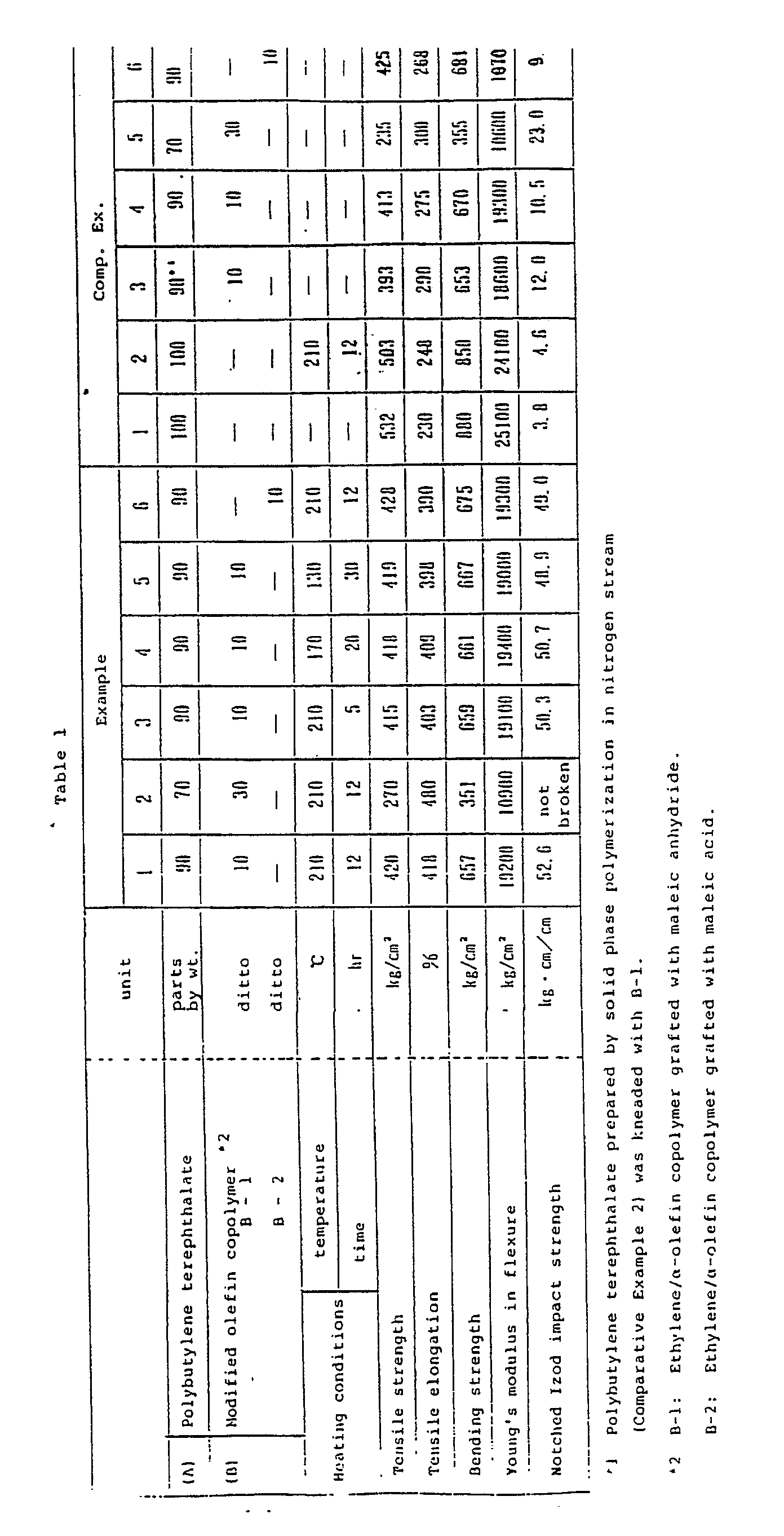
Table 2 unit Example Comp. Ex. 7 8 9 7 8 9 10 11 (A) Polybutylene terephthalate parts by wt. - 75 60 - 75 60 85 70 Polyethylene terephthalate ditto 70 - - 70 - - - - (B) Modified olefin copolymer B-1 ditto 30 10 10 30 10 10 - - Glass fiber ditto - 15 - - 15 - 15 - Glass beads ditto - - 30 - - 30 - 30 Heating conditions temperature °C 210 210 210 - - - - - time hr 12 12 12 - - - - - Tensile strength kg/cm² 263 738 415 257 684 360 950 535 Tensile elongation % 123 9.5 6.1 77.0 5.4 4.3 4.5 3.7 Bending strength kg/cm² 413 1220 805 408 1110 708 1590 935 Young's modulus in flexure kg/cm² 11700 38600 36800 11900 35100 33700 51000 40500 Notched Izod impact strength kg · cm/cm 51.0 13.5 5.1 18.0 8.1 2.7 6.0 2.3 Note) B-1: Ethylene/α-olefin copolymer grafted with maleic anhydride. Table 3 unit Example Comp. Ex. 10 11 12 12 13 (A) Polybutylene terephthalate parts by weight 90 90 75 90 75 Polyethylene terephthalate ditto - - - - - (B) Modified olefin copolymer B-1 ditto - 10 - - - B-3 ditto 10 - 10 10 10 Glass fiber ditto - - 15 - 15 Glass beads ditto - - - - - Heating conditions temperature °C 210 210 210 - - time hr 12 12 12 - - Tensile strength kg/cm² 427 421 744 425 735 Tensile elongation % 422 445 10.1 246 5.8 Bending strength kg/cm² 639 642 1150 662 1190 Young's modulus in flexure kg/cm² 20200 19100 39100 20100 38900 Notched Izod impact strength kg · cm/cm 55.0 50.9 15.0 11.9 8.0
Claims (9)
Applications Claiming Priority (2)
| Application Number | Priority Date | Filing Date | Title |
|---|---|---|---|
| JP6294688 | 1988-03-16 | ||
| JP62946/88 | 1988-03-16 |
Publications (2)
| Publication Number | Publication Date |
|---|---|
| EP0333414A2 true EP0333414A2 (en) | 1989-09-20 |
| EP0333414A3 EP0333414A3 (en) | 1991-03-06 |
Family
ID=13214981
Family Applications (1)
| Application Number | Title | Priority Date | Filing Date |
|---|---|---|---|
| EP19890302460 Withdrawn EP0333414A3 (en) | 1988-03-16 | 1989-03-13 | Improved thermoplastic polyester resin and process for producing the same |
Country Status (3)
| Country | Link |
|---|---|
| EP (1) | EP0333414A3 (en) |
| KR (1) | KR920006369B1 (en) |
| BR (1) | BR8900992A (en) |
Cited By (7)
| Publication number | Priority date | Publication date | Assignee | Title |
|---|---|---|---|---|
| WO1990012054A1 (en) * | 1989-04-12 | 1990-10-18 | Tonen Corporation | Polypropylene-polyester graft copolymer and production method thereof |
| WO1990012837A1 (en) * | 1989-04-18 | 1990-11-01 | Tonen Corporation | Process for production of polyolefin-polyester graft copolymer |
| EP0443736A3 (en) * | 1990-02-02 | 1992-04-22 | Tonen Corporation | Thermoplastic resin composition |
| EP0653461A3 (en) * | 1993-11-11 | 1996-10-09 | Kirin Brewery | Container composed of a saturated polyester resin composition. |
| EP0798331A4 (en) * | 1995-10-12 | 1998-12-23 | Kuraray Co | PROCESS FOR PRODUCING THERMOPLASTIC RESIN COMPOSITION |
| WO2019092018A1 (en) * | 2017-11-10 | 2019-05-16 | Covestro Deutschland Ag | Mineral-filled thermoplastic composition having good mechanical properties |
| US11767426B2 (en) | 2017-11-10 | 2023-09-26 | Covestro Deutschland Ag | Glass fiber filled thermoplastic composition having good mechanical properties |
Family Cites Families (3)
| Publication number | Priority date | Publication date | Assignee | Title |
|---|---|---|---|---|
| DE2454002A1 (en) * | 1974-11-14 | 1976-05-26 | Basf Ag | THERMOPLASTIC POLYBUTYLENE TEREPHTHALATE MOLDING COMPOUNDS WITH INCREASED TOUGHNESS |
| JPS558022B2 (en) * | 1975-02-10 | 1980-03-01 | ||
| US4707512A (en) * | 1984-07-16 | 1987-11-17 | Mitsubishi Chemical Industries Limited | Polyester resin composition |
-
1989
- 1989-03-03 BR BR898900992A patent/BR8900992A/en unknown
- 1989-03-07 KR KR1019890002794A patent/KR920006369B1/en not_active Expired
- 1989-03-13 EP EP19890302460 patent/EP0333414A3/en not_active Withdrawn
Cited By (11)
| Publication number | Priority date | Publication date | Assignee | Title |
|---|---|---|---|---|
| WO1990012054A1 (en) * | 1989-04-12 | 1990-10-18 | Tonen Corporation | Polypropylene-polyester graft copolymer and production method thereof |
| WO1990012837A1 (en) * | 1989-04-18 | 1990-11-01 | Tonen Corporation | Process for production of polyolefin-polyester graft copolymer |
| EP0443736A3 (en) * | 1990-02-02 | 1992-04-22 | Tonen Corporation | Thermoplastic resin composition |
| US5298557A (en) * | 1990-02-02 | 1994-03-29 | Tonen Corporation | Thermoplastic resin composition |
| US5444119A (en) * | 1990-02-02 | 1995-08-22 | Tonen Corporation | Thermoplastic resin composition |
| EP0653461A3 (en) * | 1993-11-11 | 1996-10-09 | Kirin Brewery | Container composed of a saturated polyester resin composition. |
| US5714220A (en) * | 1993-11-11 | 1998-02-03 | Mitsui Petrochemical Industries, Ltd. | Container composed of a saturated polyester resin composition |
| EP0798331A4 (en) * | 1995-10-12 | 1998-12-23 | Kuraray Co | PROCESS FOR PRODUCING THERMOPLASTIC RESIN COMPOSITION |
| WO2019092018A1 (en) * | 2017-11-10 | 2019-05-16 | Covestro Deutschland Ag | Mineral-filled thermoplastic composition having good mechanical properties |
| US11479666B2 (en) | 2017-11-10 | 2022-10-25 | Covestro Deutschland Ag | Mineral-filled thermoplastic composition having good mechanical properties |
| US11767426B2 (en) | 2017-11-10 | 2023-09-26 | Covestro Deutschland Ag | Glass fiber filled thermoplastic composition having good mechanical properties |
Also Published As
| Publication number | Publication date |
|---|---|
| BR8900992A (en) | 1989-10-24 |
| EP0333414A3 (en) | 1991-03-06 |
| KR920006369B1 (en) | 1992-08-03 |
| KR890014620A (en) | 1989-10-25 |
Similar Documents
| Publication | Publication Date | Title |
|---|---|---|
| US4172859A (en) | Tough thermoplastic polyester compositions | |
| EP0389055B1 (en) | Aromatic polycarbonate resin composition | |
| EP0275141B1 (en) | Epoxy containing impact modifiers for thermoplastic resins | |
| EP0566106A1 (en) | Engineering resin-propylene polymer graft composition | |
| EP0327300B1 (en) | Polyarylene sulfide resin composition | |
| CN1128713C (en) | Composite polyester resin moldings | |
| EP0333414A2 (en) | Improved thermoplastic polyester resin and process for producing the same | |
| US5349007A (en) | Lightweight thermoplastic polyester molding compositions, methods of making the same and molded articles formed thereof | |
| US5218043A (en) | Polyarylene sulfide resin composition and process for producing the same | |
| JPS5966448A (en) | thermoplastic resin composition | |
| EP0406010A1 (en) | Polyester resin composition | |
| JPH0940865A (en) | Polyarylene sulfide resin composition | |
| JPS6013837A (en) | Treated product of impact-resistant resin | |
| JP3224156B2 (en) | Polyacetal resin composition | |
| JP3224158B2 (en) | Polyacetal resin composition | |
| CA2171330C (en) | Thermoplastic polyester resin composition | |
| JPS61221260A (en) | Thermoplastic polyester composition | |
| JPH0819240B2 (en) | Method for producing improved polybutylene terephthalate resin composition | |
| JPH0480262A (en) | PPS-containing resin composition | |
| EP0332429A2 (en) | Thermoplastic polyester resin composition | |
| KR930007443B1 (en) | Improved halogenated polyester resin and process for the preparation thereof | |
| AU632537B2 (en) | Thermoplastic modifier compositions which imparts improved appearance and impact properties to molded thermoplastics | |
| JPH0790144A (en) | Polyolefin resin composition | |
| JP3162538B2 (en) | Polyester resin composition | |
| JPH09263685A (en) | Polyester resin composition |
Legal Events
| Date | Code | Title | Description |
|---|---|---|---|
| PUAI | Public reference made under article 153(3) epc to a published international application that has entered the european phase |
Free format text: ORIGINAL CODE: 0009012 |
|
| AK | Designated contracting states |
Kind code of ref document: A2 Designated state(s): AT BE CH DE ES FR GB GR IT LI LU NL SE |
|
| PUAL | Search report despatched |
Free format text: ORIGINAL CODE: 0009013 |
|
| AK | Designated contracting states |
Kind code of ref document: A3 Designated state(s): AT BE CH DE ES FR GB GR IT LI LU NL SE |
|
| 17P | Request for examination filed |
Effective date: 19910823 |
|
| 17Q | First examination report despatched |
Effective date: 19930809 |
|
| STAA | Information on the status of an ep patent application or granted ep patent |
Free format text: STATUS: THE APPLICATION IS DEEMED TO BE WITHDRAWN |
|
| 18D | Application deemed to be withdrawn |
Effective date: 19931221 |