EP0330511A2 - Stabilization of 13,14-dihydro-15-ketoprostaglandins - Google Patents
Stabilization of 13,14-dihydro-15-ketoprostaglandins Download PDFInfo
- Publication number
- EP0330511A2 EP0330511A2 EP89301888A EP89301888A EP0330511A2 EP 0330511 A2 EP0330511 A2 EP 0330511A2 EP 89301888 A EP89301888 A EP 89301888A EP 89301888 A EP89301888 A EP 89301888A EP 0330511 A2 EP0330511 A2 EP 0330511A2
- Authority
- EP
- European Patent Office
- Prior art keywords
- dihydro
- keto
- ester
- cyclodextrin
- composition
- Prior art date
- Legal status (The legal status is an assumption and is not a legal conclusion. Google has not performed a legal analysis and makes no representation as to the accuracy of the status listed.)
- Granted
Links
- XDTMQSROBMDMFD-UHFFFAOYSA-N C1CCCCC1 Chemical compound C1CCCCC1 XDTMQSROBMDMFD-UHFFFAOYSA-N 0.000 description 1
Classifications
-
- B—PERFORMING OPERATIONS; TRANSPORTING
- B82—NANOTECHNOLOGY
- B82Y—SPECIFIC USES OR APPLICATIONS OF NANOSTRUCTURES; MEASUREMENT OR ANALYSIS OF NANOSTRUCTURES; MANUFACTURE OR TREATMENT OF NANOSTRUCTURES
- B82Y5/00—Nanobiotechnology or nanomedicine, e.g. protein engineering or drug delivery
-
- A—HUMAN NECESSITIES
- A61—MEDICAL OR VETERINARY SCIENCE; HYGIENE
- A61K—PREPARATIONS FOR MEDICAL, DENTAL OR TOILETRY PURPOSES
- A61K31/00—Medicinal preparations containing organic active ingredients
- A61K31/557—Eicosanoids, e.g. leukotrienes or prostaglandins
-
- A—HUMAN NECESSITIES
- A61—MEDICAL OR VETERINARY SCIENCE; HYGIENE
- A61K—PREPARATIONS FOR MEDICAL, DENTAL OR TOILETRY PURPOSES
- A61K47/00—Medicinal preparations characterised by the non-active ingredients used, e.g. carriers or inert additives; Targeting or modifying agents chemically bound to the active ingredient
- A61K47/50—Medicinal preparations characterised by the non-active ingredients used, e.g. carriers or inert additives; Targeting or modifying agents chemically bound to the active ingredient the non-active ingredient being chemically bound to the active ingredient, e.g. polymer-drug conjugates
- A61K47/69—Medicinal preparations characterised by the non-active ingredients used, e.g. carriers or inert additives; Targeting or modifying agents chemically bound to the active ingredient the non-active ingredient being chemically bound to the active ingredient, e.g. polymer-drug conjugates the conjugate being characterised by physical or galenical forms, e.g. emulsion, particle, inclusion complex, stent or kit
- A61K47/6949—Medicinal preparations characterised by the non-active ingredients used, e.g. carriers or inert additives; Targeting or modifying agents chemically bound to the active ingredient the non-active ingredient being chemically bound to the active ingredient, e.g. polymer-drug conjugates the conjugate being characterised by physical or galenical forms, e.g. emulsion, particle, inclusion complex, stent or kit inclusion complexes, e.g. clathrates, cavitates or fullerenes
- A61K47/6951—Medicinal preparations characterised by the non-active ingredients used, e.g. carriers or inert additives; Targeting or modifying agents chemically bound to the active ingredient the non-active ingredient being chemically bound to the active ingredient, e.g. polymer-drug conjugates the conjugate being characterised by physical or galenical forms, e.g. emulsion, particle, inclusion complex, stent or kit inclusion complexes, e.g. clathrates, cavitates or fullerenes using cyclodextrin
-
- C—CHEMISTRY; METALLURGY
- C07—ORGANIC CHEMISTRY
- C07C—ACYCLIC OR CARBOCYCLIC COMPOUNDS
- C07C405/00—Compounds containing a five-membered ring having two side-chains in ortho position to each other, and having oxygen atoms directly attached to the ring in ortho position to one of the side-chains, one side-chain containing, not directly attached to the ring, a carbon atom having three bonds to hetero atoms with at the most one bond to halogen, and the other side-chain having oxygen atoms attached in gamma-position to the ring, e.g. prostaglandins ; Analogues or derivatives thereof
Definitions
- the present invention relates to the stabilization of 13,14-dihydro-15-ketoprostaglandins, which find various applications in the medical field.
- Prostaglandins are members of a class of organic carboxylic acids that are contained in human and most other mammalian tissues or organs and that exhibit a wide range of physiological activities.
- the natural prostaglandins are classified based on the structual feature of five-membered cycle moiety as: and also on the presence or absence of unsaturation and/or oxidation in the chain moiety as:
- prostaglandins While the prostaglandins have a wide range of physiological activities and are useful as medicaments based on their respective activities, they have a common fault that they are generally unstable. Various attempts have been made to improve the stability of prostaglandins.
- CD inclusion compounds of PGs or alkyl ester thereof with cyclodextrin
- Injectable preparations obtained by lyophilyzing PGs or analogues thereof and CD was disclosed in Japanese Patent Publication No. 43569/1979.
- Injectable preparation obtained by lyophilizing PGE or analogues thereof, CD and ascorbic acid or citric acid was disclosed in Japanese Patent Publication No. 43570/1979.
- Formation of inclusion compounds of PGF 2 ⁇ analogues with CD was disclosed in Japanese Patent Publication No. 24369/1986.
- Etherized CDs could be used in the same manner as CD itself for stabilizing PGE as disclosed in Japanese Patent Publication (unexamined) No. 10525/1984.
- the present invention provides a stabilized 13,14-dihydro-15-ketoprostaglandin composition
- a stabilized 13,14-dihydro-15-ketoprostaglandin composition comprising an intimate mixture of
- the present invention provides a method of preparing a stabilized 13,14-dihydro-15- ketoprostaglandin composition which comprises intimately mixing
- the present invention provides a method of stablizing 13,14-dihydro-15-ketoprostaglandins which comprises contacting (A) 13,14-dihydro-15-ketoprostaglandin with (B) etherized cyclodextrin in a solvent capable of at least partly dissolving at least one of (A) and (B).
- the present invention provides a stabilizer for 13,14-dihydro-15-ketoprostaglandins comprising etherized cyclodextrin.
- etherized CDs are useful for stabilization and solubilization of 13,14-dihydro-15-keto-PGs, after exhausting testing of various compounds. It is very surprising that etherized CDs are helpful in the case where CD is not helpful, in view of the close similarity of chemical structure between etherized and unetherized cyclodextrins. Etherized CDs appear to form adducts with 13,14-dihydro-15- keto-PGs and are presumed to form inclusion compounds analogously to CD.
- Nomenclature of 13,14-dihydro-15-keto-PGs herein uses the numbering system of prostanoic acid represented in the formula (A) shown above.
- the 13,14-dihydro-15-keto-PGs used in the invention are not limited to those having the same number of carbon atoms.
- the carbon atoms in the Formula (A) are numbered 2 to 7 on the alpha-chain starting from the alpha-carbon adjacent to the carboxylic carbon which is numbered 1 and towards the five-membered ring, 8 to 12 on the said ring starting from the carbon on which the alpha-chain is attached, and 13 to 20 on the omega-chain starting from the carbon adjacent to the ring.
- preferred compounds are those represented by the formula(I): selected from the group consisting of the following formulae: A1 is hydroxy, lower alkyl or hydroxy(lower)alkyl, Y1 is 0, 1 or 2 hydrogen atoms or oxo, Z is hydroxymethylcarbonyl, carboxy or a functional derivative of carboxy, R1 is saturated or unsaturated lower aliphatic hydrocarbon residue, R2 is saturated or unsaturated lower aliphatic hydrocarbon residue which is unsubstituted or substituted with at least one substituent selected from the group consisting of hydroxy, halo, lower-alkoxyphenyl and phenoxy, the symbol of a line and a dotted line is single bond or double bond, and the symbol of a line and two dotted line is single bond, double bond or triple bond, or a pharmaceutically acceptable salt thereof.
- lower is intended to include a group having 1 to 6 carbon atoms unless otherwise specified.
- lower as a group or a moiety in hydroxy(lower)alkyl includes saturated and straight or branched chain hydrocarbon radicals containing 1 to 6, preferably 1 to 5 and more preferably 1 to 4 carbon atoms, such as methyl, ethyl, propyl, isopropyl, butyl, isobutyl, t-butyl, pentyl and hexyl.
- lower alkoxy as a moiety in lower-alkoxy-phenyl refers to the group lower-alkyl-O-phenyl wherein lower alkyl is as defined above.
- halo as a radical denotes fluoro, chloro, bromo and iodo.
- esters and amides which are used as protective group for carboxy group include esters and amides which are used as protective group for carboxy group.
- the esters are aliphatic esters, for example, C1 ⁇ 6 alkyl ester such as methyl ester, ethyl ester, propyl ester, isopropyl ester, butyl ester, isobutyl ester, t-butyl ester, pentyl ester, 1-cyclopropylethyl ester, etc., lower alkenyl ester such as vinyl ester, allyl ester, etc., lower alkynyl ester such as ethynyl ester, propynyl ester, etc., lower alkoxy(lower)alkyl ester such as methoxymethyl ester, 1-methoxyethyl ester, etc., and aromatic esters, for example, optionally substituted aryl ester such as phenyl ester, tolyl ester
- amides examples include lower alkyl amides such as methylamide, ethylamide, etc., and lower alkylsulfonylamide such as methanesulfonylamide, ethanesulfonylamide, etc.
- saturated or unsaturated lower aliphatic hydrocarbon residue include straight or branched chain aliphatic hydrocarbon residue which may have at least one double or triple bond and up to 6 carbon atoms in the principal chain and up to 3 carbon atoms in any side chain. Such residue may be partly or completely cyclic.
- the configration of the ring and ⁇ - and/or omega chain in the above formula (I) may be the same as or different from that in the natural prostaglandins.
- the present invention also include a mixture of a compound having natural configuration and that of unnatural configuration.
- Suitable “pharmaceutically acceptable salt” includes conventional non-toxic salt, and may be a salt with an inorganic base, for example a metal salt such as an alkali metal salt (e.g. sodium salt, potassium salt, etc.) and an alkaline earth metal salt (e.g. calcium salt, magnesium salt, etc.), ammonium salt, a salt with an organic base, for example, an amine salt (e.g.
- trimethylamine salt triethylamine salt, cyclohexylamine salt, benzylamine salt, ethylenediamine salt, ethanolamine salt, diethanolamine salt, triethanolamine salt, tris(hydroxymethylamino)methane salt, procaine salt, caffeine salt, etc.
- a basic amino acid salt e.g. arginine salt, lysine salt, etc.
- These salts can be prepared by the conventional process, for example from the corresponding acid and base or by salt interchange.
- the above compounds of the formula (I) include, for example, 13,14-dihydro-15-keto-PGA1s, 13,14-dihydro-15-keto-PGA2s, 13,14-dihydro-15-keto-PGA3s, 13,14-dihydro-15-keto-PGB1s, 13,14-dihydro-15-keto-PGB2s, 13,14-dihydro-15-keto-PGB3s, 13,14-dihydro-15-keto-PGC1s, 13,14-dihydro-15-keto-PGC2s, 13,14-dihydro-15-keto-PGC3s, 13,14-dihydro-15-keto-PGD1s, 13,14-dihydro-15-keto-PGD2s, 13,14-dihydro-15-keto-PGD3s, 13,14-dihydro-15-keto-PGD1s, 13,14-dihydro-15-keto-PGD2s, 13,14-di
- Substituents on the carbon atom at 3-, 17- and/or 19-position include lower alkyl, for example, C1 ⁇ 4 alkyl, especially methyl and ethyl.
- Substituents on the carbon atom at 16-position include lower alkyl such as methyl, ethyl etc., hydroxy and halogen atom such as chlorine, fluorine etc.
- Substituents on the carbon atom at 20-position include saturated and unsaturated lower alkyl such as C1 ⁇ 4 alkyl, lower alkoxy such as C1 ⁇ 4 alkoxy and lower alkoxy (lower) alkyl such as C1 ⁇ 4 alkoxy-C1 ⁇ 4 alkyl.
- Prostaglandins having hydroxy substituent on the carbon atom at 9- and/or 11-position include PGDs, PGEs and PGFs, stereochemistry of which at 9- and/or 11-carbon atom being alpha, beta or a mixture thereof.
- 13,14-dihydro-15-keto-PGDs can be prepared according to the process described in EPO281239A1, 13,14-dihydro-15-keto-PGEs in EPO284180A1 and 13,14-dihydro-15-keto-PGFs in EPO289349 or European Patent Application No. 88308299.2, and other compounds can be prepared referring to the above processes.
- the compounds of the formula(I) wherein Z is a derivative of carboxy group can be prepared by reacting the corresponding free carboxylic acid or a reactive derivative thereof with an alcohol, amine or a reactive derivative at the hydroxy or amino group thereof.
- the reactive derivatives at the carboxy group include acid halides, acid anhydrides, activated esters and activated amides.
- acid halides acid chloride is most commonly used.
- the acid anhydrides include symmetiric anhydride and mixed anhydride. Examples of the latter are dialkyl phosphoric acid mixed anhydride, dialkyl phosphorous acid mixed anhydride, alkyl carbonic acid mixed anhydride and aliphatic acid (e.g.
- the activated ester include aliphatic ester such as methyl ester, ethyl ester and cyanomethyl ester, aromatic ester such as p-nitrophenyl ester, esters with N-hydroxy compounds such as N-hydroxysuccinimide.
- the activated amides include amides with imidazole, dimethylimidazole and triazole.
- the reactive derivatives at the hydroxy group include halide and sulfonic acid (e.g. methanesulfonic acid, toluenesulfonic acid etc.).
- the reactive derivatives at the amino group include Schiff's base with aldehydes (e.g.
- silyl compounds e.g. trimethylsilyl chloride, trimethylsilyl acetamide etc.
- phosphorus compounds e.g. phosphorus trichloride, phosphorus oxychloride etc.
- the reaction is advantageously carried out in the presence of a condensing agent.
- the condensing agents are N,N-dicyclohexylcarbodimide, N-cyclohexyl-N′-morpholinoethylcarbodiimide, N,N′-diisopropylcarbodiimide, N-ethylbenzisoxazolium salt, 2-chloro-1-methylpyridinium salt, N,N′-carbonyldiimidazole, phosphorus trichloride, phosphorus oxychloride etc.
- the reaction is usually carried out in a solvent.
- the solvents are dioxane, methylene chloride, tetrahydrofuran, dimethylformamide, pyridine, benzene, toluene, xylene etc.
- the etherified cyclodextrins used according to the present invention include lower-alkylated cyclodextrins such as methyl cyclodextrin, ethylcyclodextrin, propylcyclodextrin, dimethylcyclodextrin, trimethylcyclodextrin etc., lower-alkenylated cyclodextrins, hydroxy-lower-alkylated cyclodextrins such as hydroxyethylcyclodextrin, hydroxypropylcyclodextrin etc., lower-alkoxy-lower-alkylated cyclodextrines, aralkylated cyclodextrins, such as benzylcyclodextrin etc., halo-lower-alkylated cyclodextrins such as chloroethylcyclodextrin etc., and cyclodextrin-epichlor
- intimate mixture refers to a mixture wherein two or more substances are minutely mixed and dispersed as in a solid solution and wherein constituent substances cannot be visually distinguished. It is to be appreciated that the intimate mixture include a mixture wherein the mixed constituents form an adduct or inclusion compound.
- Said intimate mixture can be prepared, for example, by contacting a 13,14-dihydro-15-keto-PGs with an etherified cyclodextrine in a solvent or a solvent system in which at least one of them is at least partyl soluble and then removing said solvent or solvent system.
- Preferred solvents or solvent systems are those in which both the constituents are completely soluble. Examples of preferred solvents and solvent systems are water and hydrophilic organic solvents such as methanol, ethanol, dioxane, acetone etc. as well as a mixture thereof. Dissolution can be carried out at or below room temperature or with moderate heating. The removal of the solvent can preferablely be effected by dislillation under reduced pressure or lyophilization.
- Resulting residue can conveniently be pulverized.
- the etherized cyclodextrin is suitably used in an amount more than 5 times, preferably 5 or 7 to 200 times and more preferably 5 or 8 to 100 times the amount of the 13,14-dihydro-15-keto-PGs.
- the thus obtained powders can be converted into conventional solid or liquid preparations which are suitable for peroral or parenteral administration (e.g. intravenou. intraarterial, subcutaneous, intramuscular, intravaginal, intrauterine etc.) such as tablets, powders, granules, readily soluble solid, suspension etc.
- the preparation may be prepared by conventional process using carriers or diluents such as starch, lactose, dextrin, mannitol water, and lubricant, humectant, perfume, preservative, colorant etc.
- Aqueous solution may be prepared by directly dissolving the two ingredients and without passing through the powders.
- the amount contained therein of the 13,14-dihydro-15-keto-PGs will of course vary depending the treatment desired in obestetic-gynecologic, cardiovascular, gastromtestinal, ophthalmologic regions etc , and further on age, condition, severity of patient. In general, satisfactory results are obtainable in administration at a dosage of 0.005 - 500 mg.
- Example 1 The procedure in Example 1 was repeated using 2ml in place of 4ml of Solution A. An analogous white solid was obtained.
- Example 1 The procedure in Example 1 was repeated using 1ml in place of 4ml of Solution A. An analogous white solid was obtained.
- Example 2 The procedure in Example 2 was repeated using a solution (Solution B) containing 100mg/ml of dimethyl- ⁇ -CD in place of Solution A. An analogous white solid was obtained.
- Example 4 The procedure in Example 4 was repeated using 1ml in place of 2ml of Solution B. An analogous white solid was obtained.
- Comparative Example 1 The procedure in Comparative Example 1 was repeated using 10ml of a solution (Solution Y) containing 13.5mg/ml of ⁇ -CD in place of Solution X. An analogous result was obtained.
- Example 1 The procedure in Example 1 was repeated using 4ml of solution (Solution C) containing 100mg/ml of hydroxypropyl- ⁇ -CD in place of Solution A. An analogous white solid was obtained.
- Example 1 The procedure in Example 1 was repeated using 3ml of Solution A and a compound selected from Compound A, B, C, E and F. An analogous white solid was obtained.
- Comparative Example 1 The procedure in Comparative Example 1 was repeated using 3ml of Solution X and 10mg of PGE2 to give a homogeneous solution, which, on lyophilization, gave a white solid.
- Example 1 The procedure in Example 1 was repeated using 2ml of Solution A and Compound G. An analogous white solid was obtained.
Landscapes
- Health & Medical Sciences (AREA)
- Chemical & Material Sciences (AREA)
- Medicinal Chemistry (AREA)
- Pharmacology & Pharmacy (AREA)
- Life Sciences & Earth Sciences (AREA)
- General Health & Medical Sciences (AREA)
- Engineering & Computer Science (AREA)
- Epidemiology (AREA)
- Animal Behavior & Ethology (AREA)
- Public Health (AREA)
- Veterinary Medicine (AREA)
- Organic Chemistry (AREA)
- Nanotechnology (AREA)
- Bioinformatics & Cheminformatics (AREA)
- Biotechnology (AREA)
- General Engineering & Computer Science (AREA)
- Medical Informatics (AREA)
- Molecular Biology (AREA)
- Crystallography & Structural Chemistry (AREA)
- Biophysics (AREA)
- Pharmaceuticals Containing Other Organic And Inorganic Compounds (AREA)
- Medicinal Preparation (AREA)
- Furan Compounds (AREA)
- Acyclic And Carbocyclic Compounds In Medicinal Compositions (AREA)
- Medicines That Contain Protein Lipid Enzymes And Other Medicines (AREA)
Abstract
- a) a therapeutically effective amount of at least one compound selected from 13,14-dihydro-15-ketoprostaglandins and
- b) at least one compound selected from pharmaceutically acceptable etherized cyclodextrins.
Description
- The present invention relates to the stabilization of 13,14-dihydro-15-ketoprostaglandins, which find various applications in the medical field.
- Prostaglandins (hereinafter, referred to as PG) are members of a class of organic carboxylic acids that are contained in human and most other mammalian tissues or organs and that exhibit a wide range of physiological activities. Naturally occurring prostagladins possess as a common structural feature the prostanoic acid skeleton:


- Subscript 1 - - - 15-OH
- Subscript 2 - - - 5,6-unsaturated-15-OH
- Subscript 3 - - - 5,6- and 17,18-diunsaturated-15-OH.
- However, the presence of some 13,14-saturated prostaglandins, such as 13,14-dihydro-15-keto-PGD₂, 13,14-dihydro-15-keto-PGE₂ and 13, 14-dihydro-15-keto-PGF2α, are known as the metabolites which have been believed to have no physiological activity.
- While the prostaglandins have a wide range of physiological activities and are useful as medicaments based on their respective activities, they have a common fault that they are generally unstable. Various attempts have been made to improve the stability of prostaglandins.
- For example, formation of inclusion compounds of PGs or alkyl ester thereof with cyclodextrin (hereinafter, referred to as CD) was disclosed in Japanese Patent Publication No. 3362/1975. Injectable preparations obtained by lyophilyzing PGs or analogues thereof and CD was disclosed in Japanese Patent Publication No. 43569/1979. Injectable preparation obtained by lyophilizing PGE or analogues thereof, CD and ascorbic acid or citric acid was disclosed in Japanese Patent Publication No. 43570/1979. Formation of inclusion compounds of PGF2α analogues with CD was disclosed in Japanese Patent Publication No. 24369/1986. Etherized CDs could be used in the same manner as CD itself for stabilizing PGE as disclosed in Japanese Patent Publication (unexamined) No. 10525/1984.
- The inventors discovered that the 13,14-dihydro-15-keto-PGs have certain physiological activities, contrary to the traditional knowledge that they have no such activities (EP-A 0,284,180, EP-A 0,281,239, EP-A 0,289,349 and EP-A 0,292,177). Attempts have been made, in turn, to stabilize the 13,14-dihydro-15-keto-PGs by means of CD, which, however, have come out to be a failure, confirming that they cannot be stabilized by CD as the result of repeated experiments (unpublished). This means that the stabilization of 13,14-saturated-15-keto-PGs cannot be predicted from the stabilization of 13,14-unsaturated-15-keto-PGs.
- In the first aspect, the present invention provides a stabilized 13,14-dihydro-15-ketoprostaglandin composition comprising an intimate mixture of
- a) a therapeutically effective amount of at least one compound selected from 13,14-dihydro-15-ketoprostaglandins and
- b) at least one compound selected from pharmaceutically acceptable etherized cyclodextrins.
- In the second aspect, the present invention provides a method of preparing a stabilized 13,14-dihydro-15- ketoprostaglandin composition which comprises intimately mixing
- a) a therapeutically effective amount of at least one
- b) at least one compound selected from pharmaceutically acceptable etherized cyclodextrins.
- In the third aspect, the present invention provides a method of stablizing 13,14-dihydro-15-ketoprostaglandins which comprises contacting (A) 13,14-dihydro-15-ketoprostaglandin with (B) etherized cyclodextrin in a solvent capable of at least partly dissolving at least one of (A) and (B).
- In the fourth aspect, the present invention provides a stabilizer for 13,14-dihydro-15-ketoprostaglandins comprising etherized cyclodextrin.
- According to the invention, it has now be discovered that etherized CDs are useful for stabilization and solubilization of 13,14-dihydro-15-keto-PGs, after exhausting testing of various compounds. It is very surprising that etherized CDs are helpful in the case where CD is not helpful, in view of the close similarity of chemical structure between etherized and unetherized cyclodextrins. Etherized CDs appear to form adducts with 13,14-dihydro-15- keto-PGs and are presumed to form inclusion compounds analogously to CD.
- Nomenclature of 13,14-dihydro-15-keto-PGs herein uses the numbering system of prostanoic acid represented in the formula (A) shown above.
- While the formula (A) shows a basic skeleton having twenty carbon atoms, the 13,14-dihydro-15-keto-PGs used in the invention are not limited to those having the same number of carbon atoms. The carbon atoms in the Formula (A) are numbered 2 to 7 on the alpha-chain starting from the alpha-carbon adjacent to the carboxylic carbon which is numbered 1 and towards the five-membered ring, 8 to 12 on the said ring starting from the carbon on which the alpha-chain is attached, and 13 to 20 on the omega-chain starting from the carbon adjacent to the ring. When number of carbon atoms is decreased in the alpha-chain, the number is deleted in order starting from 2-position and when number of carbon atoms is increased in the alpha-chain, compounds are named as substituted derivatives having respective substituents at 1-position in place of carboxyl group (C-1).
- Within the 13,14-dihydro-15-ketoprostaglandins as described under item a) above, preferred compounds are those represented by the formula(I):


Y₁ is 0, 1 or 2 hydrogen atoms or oxo,
Z is hydroxymethylcarbonyl, carboxy or a functional derivative of carboxy,
R₁ is saturated or unsaturated lower aliphatic hydrocarbon residue,
R₂ is saturated or unsaturated lower aliphatic hydrocarbon residue which is unsubstituted or substituted with at least one substituent selected from the group consisting of hydroxy, halo, lower-alkoxyphenyl and phenoxy,
the symbol of a line and a dotted line is single bond or double bond, and the symbol of a line and two dotted line is single bond, double bond or triple bond, or a pharmaceutically acceptable salt thereof. - As used herein, the term "lower" is intended to include a group having 1 to 6 carbon atoms unless otherwise specified.
- The term "lower" as a group or a moiety in hydroxy(lower)alkyl includes saturated and straight or branched chain hydrocarbon radicals containing 1 to 6, preferably 1 to 5 and more preferably 1 to 4 carbon atoms, such as methyl, ethyl, propyl, isopropyl, butyl, isobutyl, t-butyl, pentyl and hexyl.
- The term "lower alkoxy" as a moiety in lower-alkoxy-phenyl refers to the group lower-alkyl-O-phenyl wherein lower alkyl is as defined above.
- The term "halo" as a radical denotes fluoro, chloro, bromo and iodo.
- The term "functional derivative" of the carboxy includes esters and amides which are used as protective group for carboxy group. Examples of the esters are aliphatic esters, for example, C₁₋₆ alkyl ester such as methyl ester, ethyl ester, propyl ester, isopropyl ester, butyl ester, isobutyl ester, t-butyl ester, pentyl ester, 1-cyclopropylethyl ester, etc., lower alkenyl ester such as vinyl ester, allyl ester, etc., lower alkynyl ester such as ethynyl ester, propynyl ester, etc., lower alkoxy(lower)alkyl ester such as methoxymethyl ester, 1-methoxyethyl ester, etc., and aromatic esters, for example, optionally substituted aryl ester such as phenyl ester, tolyl ester, t-butylphenyl ester, salicyl ester, 3,4-di- methoxyphenyl, etc., aryl(lower)alkyl ester such as benzyl ester, trityl ester, benzhydryl ester ester, etc. Examples of the amides are lower alkyl amides such as methylamide, ethylamide, etc., and lower alkylsulfonylamide such as methanesulfonylamide, ethanesulfonylamide, etc.
- The term "saturated or unsaturated lower aliphatic hydrocarbon residue" include straight or branched chain aliphatic hydrocarbon residue which may have at least one double or triple bond and up to 6 carbon atoms in the principal chain and up to 3 carbon atoms in any side chain. Such residue may be partly or completely cyclic. Examples of preferred residues for R₁ are -(CH₂)₄-, -(CH₂)₂CH=CH-, -(CH₂)₂CH(CH₃)CH₂-, =CH(CH₂)₃-, -(CH₂)₂-CH=CH-, -CH=CH-(CH₂)₄, etc., and examples of preferred residues for R₂ are -(CH₂)₅-, -(CH₂)₆-, -(CH₂)₇-, -(CH₂)₈-, -(CH₂)₉-, -(CH₂)₃CH(CH₃)CH₂-, -C(CH₃)₂(CH₂)₄-, -CH₂CH(CH₃)(CH₂)₄-, -CH₂CH(CH₃)(CH₂)₅-, -C(CH₃)(OCH₃)(CH₂)₄-, -C(CH₃)₂CH₂O(CH₂)₂, -C(CH₃)₂CH₂O(CH₂)₃-, cyclopentyl, cyclohexyl, -CH₂CH(CH₃)(CH₂)₂CH=CH(CH₃)CH₂-, -CH(CH₃)CH₂C=CCH₂-, phenyl, phenoxy, etc.
- The configration of the ring and α- and/or omega chain in the above formula (I) may be the same as or different from that in the natural prostaglandins. However, the present invention also include a mixture of a compound having natural configuration and that of unnatural configuration.
- Suitable "pharmaceutically acceptable salt" includes conventional non-toxic salt, and may be a salt with an inorganic base, for example a metal salt such as an alkali metal salt (e.g. sodium salt, potassium salt, etc.) and an alkaline earth metal salt (e.g. calcium salt, magnesium salt, etc.), ammonium salt, a salt with an organic base, for example, an amine salt (e.g. trimethylamine salt, triethylamine salt, cyclohexylamine salt, benzylamine salt, ethylenediamine salt, ethanolamine salt, diethanolamine salt, triethanolamine salt, tris(hydroxymethylamino)methane salt, procaine salt, caffeine salt, etc.), a basic amino acid salt (e.g. arginine salt, lysine salt, etc.) and the like. These salts can be prepared by the conventional process, for example from the corresponding acid and base or by salt interchange.
- The above compounds of the formula (I) include, for example,
13,14-dihydro-15-keto-PGA₁s, 13,14-dihydro-15-keto-PGA₂s,
13,14-dihydro-15-keto-PGA₃s, 13,14-dihydro-15-keto-PGB₁s,
13,14-dihydro-15-keto-PGB₂s, 13,14-dihydro-15-keto-PGB₃s,
13,14-dihydro-15-keto-PGC₁s, 13,14-dihydro-15-keto-PGC₂s,
13,14-dihydro-15-keto-PGC₃s, 13,14-dihydro-15-keto-PGD₁s,
13,14-dihydro-15-keto-PGD₂s, 13,14-dihydro-15-keto-PGD₃s,
13,14-dihydro-15-keto-PGE₁s, 13,14-dihydro-15-keto-PGE₂s,
13,14-dihydro-15-keto-PGE₃s, 13,14-dihydro-15-keto-PGF₁s,
13,14-dihydro-15-keto-PGF₂s, 13,14-dihydro-15-keto-PGF₃s,
13,14-dihydro-15-keto-PGI₁s, 13,14-dihydro-15-keto-PGI₂s,
13,14-dihydro-15-keto-PGI₃s, 13,14-dihydro-15-keto-PGJ₁s,
13,14-dihydro-15-keto-PGJ₂s, and
13,14-dihydro-15-keto-PGJ₃s. - Typical examples of the above compounds of the formula (I) include:
- (1) 13,14-dihydro-15-keto-PGA₁ methyl ester
- (2) 13,14-dihydro-15-keto-PGA₁ isopropyl ester
- (3) 13,14-dihydro-15-keto-PGA₂ methyl ester
- (4) 13,14-dihydro-15-keto-PGA₂ isopropyl ester
- (5) 13,14-dihydro-15-keto-20-ethyl-PGA₁ methyl ester
- (6) 13,14-dihydro-15-keto-20-ethyl-PGA₁ isopropyl ester
- (7) 13,14-dihydro-15-keto-20-ethyl-PGA₂ methyl ester
- (8) 13,14-dihydro-15-keto-20-ethyl-PGA₂ isopropyl ester
- (9) 13,14-dihydro-15-keto-PGA₂
- (10) 13,14-dihydro-15-keto-PGB₁ methyl ester
- (11) 13,14-dihydro-15-keto-PGB₁ isopropyl ester
- (12) 13,14-dihydro-15-keto-PGB₂ methyl ester
- (13) 13,14-dihydro-15-keto-PGB₂ isopropyl ester
- (14) 13,14-dihydro-15-keto-20-ethyl-PGB₁ methyl ester
- (15) 13,14-dihydro-15-keto-20-ethyl-PGB₁ isopropyl ester
- (16) 13,14-dihydro-15-keto-20-ethyl-PGB₂ methyl ester
- (17) 13,14-dihydro-15-keto-20-ethyl-PGB₂ isopropyl ester
- (18) 13,14-dihydro-15-keto-PGB₂
- (19) 13,14-dihydro-15-keto-PGC₁ methyl ester
- (20) 13,14-dihydro-15-keto-PGC₁ isopropyl ester
- (21) 13,14-dihydro-15-keto-PGC₂ methyl ester
- (22) 13,14-dihydro-15-keto-PGC₂ isopropyl ester
- (23) 13,14-dihydro-15-keto-20-ethyl-PGC₁ methyl ester
- (24) 13,14-dihydro-15-keto-20-ethyl-PGC₁ isopropyl ester
- (25) 13,14-dihydro-15-keto-20-ethyl-PGC₂ methyl ester
- (26) 13,14-dihydro-15-keto-20-ethyl-PGC₂ isopropyl ester
- (27) 13,14-dihydro-15-keto-PGC₂
- (28) 13,14-dihydro-15-keto-PGD₁ methyl ester
- (29) 13,14-dihydro-15-keto-PGD₁ ethyl ester
- (30) 13,14-dihydro-15-keto-PGD₂ ethyl ester
- (31) 13,14-dihydro-15-keto-PGD₂ buthyl ester
- (32) 13,14-dihydro-15-keto-5,6-dehydro-PGDA₂ methyl ester
- (33) 13,14-dihydro-15-keto-5,6-dehydro-9 -hydroxy-PGD₂
- (34) 13,14-dihydro-15-keto-5,6-dehydro-9 -hydroxy-PGD₂ methyl ester
- (35) 13,14-dihydro-15-keto-16R,S-fluoro-PGD₂ methyl ester
- (36) 13,14-dihydro-15-keto-16,16-dimethyl-PGD₂ methyl ester
- (37) 13,14-dihydro-15-keto-19-methyl-PGD₂ methyl ester
- (38) 13,14-dihydro-15-keto-20-methoxy-PGD₂
- (39) 13,14-dihydro-15-keto-20-methoxy-PGD₂ butyl ester
- (40) 13,14-dihydro-15-keto-16R,S-methyl-20-methoxy-PGD₂ methyl ester
- (41) 13,14-dihydro-15-keto-20-ethyl-PGD₁ methyl ester
- (42) 13,14-dihydro-15-keto-20-ethyl-PGD₁ ethyl ester
- (43) 13,14-dihydro-15-keto-20-ethyl-PGD₂ methyl ester
- (44) 13,14-dihydro-15-keto-20-ethyl-PGD₂ ethyl ester
- (45) 13,14-dihydro-15-keto-20-methoxyethyl-PGD₂ methyl ester
- (46) 13,14-dihydro-15-keto-PGD₂
- (47) 13,14-dihydro-15-keto-PGE₁ ethyl ester
- (48) 13,14-dihydro-6,15-diketo-PGE₁ ethyl ester
- (49) 13,14-dihydro-6,15-diketo-PGE₁ butyl ester
- (50) ±13,14-dihydro-6,15-diketo-PGE₁ ethyl ester
- (51) 13,14-dihydro-6,15-diketo-11-dehydroxy-11R-methyl-PGE₁ ethyl ester
- (52) 13,14-dihydro-6,15-diketo-16R,S-fluoro-11-dehydroxy-11R-methyl-PGE₁ ethyl ester
- (53) 13,14-dihydro-6,15-diketo-16,16-dimethyl-PGE₁ ethyl ester
- (54) 13,14-dihydro-6,15-diketo-19-methyl-PGE₁ methyl ester
- (55) 13,14-dihydro-6,15-diketo-11-dehydroxy-11R-hydroxymethyl-PGE₁ ethyl ester
- (56) 13,14-dihydro-15-keto-PGE₂
- (57) 13,14-dihydro-15-keto-PGE₂ methyl ester
- (58) 13,14-dihydro-15-keto-PGE₂ isopropyl ester
- (59) 13,14-dihydro-15-keto- Δ²-PGE₂ methyl ester
- (60) 13,14-dihydro-15-keto-16R,S-fluoro-PGE₂ ethyl ester
- (61) 13,14-dihydro-15-keto-3,16-dimethyl-PGE₂ methyl ester
- (62) 13,14-dihydro-15-keto-16R,S-hydroxy-PGE₂ ethyl ester
- (63) 13,14-dihydro-15-keto-19-methyl-PGE₂ ethyl ester
- (64) 13,14-dihydro-15-keto-20-methoxy-PGE₂ methyl ester
- (65) 13,14-dihydro-15-keto-20-methoxy-Δ²-PGE₂ methyl ester
- (66) 13,14-dihydro-15-keto-16,16-dimethyl-20-methoxy-PGE₂ methyl ester
- (67) 13,14-dihydro-15-keto-20-ethyl-PGE₁ methyl ester
- (68) 13,14-dihydro-6,15-diketo-20-ethyl-PGE₁ ethyl ester
- (69) 13,14-dihydro-6,15-diketo-20-ethyl-PGE₁ methyl ester
- (70) 13,14-dihydro-15-keto-20-ethyl-PGE₂ methyl ester
- (71) 13,14-dihydro-15-keto-20-ethyl-PGE₂ ethyl ester
- (72) 13,14-dihydro-15-keto-20-n-propyl-PGE₂ methyl ester
- (73) 13,14-dihydro-15-keto-20-ethyl-11-dehydroxy-11R-methyl-PGE₂ methyl ester
- (74) 13,14-dihydro-15-keto-PGE₂
- (75) 13,14-dihydro-15-keto-PGF1α ethyl ester
- (76) 13,14-dihydro-15-keto-PGF2α methyl ester
- (77) 13,14-dihydro-15-keto-PGF2α ethyl ester
- (78) 13,14-dihydro-15-keto-9 -hydroxy-PGF2α methyl ester
- (79) 13,14-dihydro-15-keto-16R,S-fluoro-PGF1α
- (80) 13,14-dihydro-15-keto-16R,S-fluoro-PGF2α
- (81) 13,14-dihydro-15-keto-16R,S-fluoro-11-dehydroxy-11R-methyl-PGF2α methyl ester
- (82) 13,14-dihydro-15-keto-16,16-dimethyl-PGF2α ethyl ester
- (83) 13,14-dihydro-15-keto-17S-methyl-PGF2α ethyl ester
- (84) 13,14-dihydro-15-keto-20-ethyl-PGF1α methyl ester
- (85) 13,14-dihydro-15-keto-20-ethyl-PGF2α
- (86) 13,14-dihydro-15-keto-20-ethyl-PGF2α methyl ester
- (87) 13,14-dihydro-15-keto-20-ethyl-PGF2α ethyl ester
- (88) 13,14-dihydro-15-keto-20-ethyl-PGF2α isopropyl ester
- (89) 13,14-dihydro-15-keto-20-ethyl-PGF2α butyl ester
- (90) 13,14-dihydro-15-keto-20-methyl-PGF2α methyl ester
- (91) 13,14-dihydro-15-keto-20-n-propyl-PGF2α methyl ester
- (92) 13,14-dihydro-15-keto-20-n-butyl-PGF2α methyl ester
- (93) 13,14-dihydro-15-keto-20-ethyl-16R,S-fluoro-PGF2α
- (94) 13,14-dihydro-15-keto-20-ethyl-16R,S-fluoro-PGF2α methyl ester
- (95) 13,14-dihydro-15-keto-20-ethyl-11-dehydroxy-11R-methyl-PGF2α methyl ester
- (96) 13,14-dihydro-15-keto-20-ethyl-16R,S-fluoro-11-dehydroxy-11R-methyl-PGF2α methyl ester
- (97) 13, 14-dihydro-15-keto-PGF2α
- Examples of substituents present in preferred compounds are as follows: Substituents on the carbon atom at 3-, 17- and/or 19-position include lower alkyl, for example, C₁₋₄ alkyl, especially methyl and ethyl. Substituents on the carbon atom at 16-position include lower alkyl such as methyl, ethyl etc., hydroxy and halogen atom such as chlorine, fluorine etc. Substituents on the carbon atom at 20-position include saturated and unsaturated lower alkyl such as C₁₋₄ alkyl, lower alkoxy such as C₁₋₄ alkoxy and lower alkoxy (lower) alkyl such as C₁₋₄ alkoxy-C₁₋₄ alkyl. Prostaglandins having hydroxy substituent on the carbon atom at 9- and/or 11-position include PGDs, PGEs and PGFs, stereochemistry of which at 9- and/or 11-carbon atom being alpha, beta or a mixture thereof.
- Within the above exemplified compounds, 13,14-dihydro-15-keto-PGDs can be prepared according to the process described in EPO281239A1, 13,14-dihydro-15-keto-PGEs in EPO284180A1 and 13,14-dihydro-15-keto-PGFs in EPO289349 or European Patent Application No. 88308299.2, and other compounds can be prepared referring to the above processes.
- The compounds of the formula(I) wherein Z is a derivative of carboxy group can be prepared by reacting the corresponding free carboxylic acid or a reactive derivative thereof with an alcohol, amine or a reactive derivative at the hydroxy or amino group thereof. The reactive derivatives at the carboxy group include acid halides, acid anhydrides, activated esters and activated amides. As the acid halides, acid chloride is most commonly used. The acid anhydrides include symmetiric anhydride and mixed anhydride. Examples of the latter are dialkyl phosphoric acid mixed anhydride, dialkyl phosphorous acid mixed anhydride, alkyl carbonic acid mixed anhydride and aliphatic acid (e.g. pivalic acid, trichloroacetic acid, etc.) mixed anhydride. The activated ester include aliphatic ester such as methyl ester, ethyl ester and cyanomethyl ester, aromatic ester such as p-nitrophenyl ester, esters with N-hydroxy compounds such as N-hydroxysuccinimide. The activated amides include amides with imidazole, dimethylimidazole and triazole. The reactive derivatives at the hydroxy group include halide and sulfonic acid (e.g. methanesulfonic acid, toluenesulfonic acid etc.). The reactive derivatives at the amino group include Schiff's base with aldehydes (e.g. acetaldehyde, isopentanal, benzaldehyde etc.), reaction products with silyl compounds (e.g. trimethylsilyl chloride, trimethylsilyl acetamide etc.) and reactive products with phosphorus compounds (e.g. phosphorus trichloride, phosphorus oxychloride etc.).
- When a free carboxylic acid is to be used, the reaction is advantageously carried out in the presence of a condensing agent. Examples of the condensing agents are N,N-dicyclohexylcarbodimide, N-cyclohexyl-N′-morpholinoethylcarbodiimide, N,N′-diisopropylcarbodiimide, N-ethylbenzisoxazolium salt, 2-chloro-1-methylpyridinium salt, N,N′-carbonyldiimidazole, phosphorus trichloride, phosphorus oxychloride etc. The reaction is usually carried out in a solvent. Examples of the solvents are dioxane, methylene chloride, tetrahydrofuran, dimethylformamide, pyridine, benzene, toluene, xylene etc.
- The etherified cyclodextrins used according to the present invention include lower-alkylated cyclodextrins such as methyl cyclodextrin, ethylcyclodextrin, propylcyclodextrin, dimethylcyclodextrin, trimethylcyclodextrin etc., lower-alkenylated cyclodextrins, hydroxy-lower-alkylated cyclodextrins such as hydroxyethylcyclodextrin, hydroxypropylcyclodextrin etc., lower-alkoxy-lower-alkylated cyclodextrines, aralkylated cyclodextrins, such as benzylcyclodextrin etc., halo-lower-alkylated cyclodextrins such as chloroethylcyclodextrin etc., and cyclodextrin-epichlorohydrin-copolymers. These are known or can be prepared by a process analogous to that for the known compounds.
- The term "intimate mixture" used herein refers to a mixture wherein two or more substances are minutely mixed and dispersed as in a solid solution and wherein constituent substances cannot be visually distinguished. It is to be appreciated that the intimate mixture include a mixture wherein the mixed constituents form an adduct or inclusion compound.
- Said intimate mixture can be prepared, for example, by contacting a 13,14-dihydro-15-keto-PGs with an etherified cyclodextrine in a solvent or a solvent system in which at least one of them is at least partyl soluble and then removing said solvent or solvent system. Preferred solvents or solvent systems are those in which both the constituents are completely soluble. Examples of preferred solvents and solvent systems are water and hydrophilic organic solvents such as methanol, ethanol, dioxane, acetone etc. as well as a mixture thereof. Dissolution can be carried out at or below room temperature or with moderate heating. The removal of the solvent can preferablely be effected by dislillation under reduced pressure or lyophilization. Resulting residue can conveniently be pulverized. The etherized cyclodextrin is suitably used in an amount more than 5 times, preferably 5 or 7 to 200 times and more preferably 5 or 8 to 100 times the amount of the 13,14-dihydro-15-keto-PGs.
- The thus obtained powders can be converted into conventional solid or liquid preparations which are suitable for peroral or parenteral administration (e.g. intravenou. intraarterial, subcutaneous, intramuscular, intravaginal, intrauterine etc.) such as tablets, powders, granules, readily soluble solid, suspension etc. The preparation may be prepared by conventional process using carriers or diluents such as starch, lactose, dextrin, mannitol water, and lubricant, humectant, perfume, preservative, colorant etc. Aqueous solution may be prepared by directly dissolving the two ingredients and without passing through the powders.
- For the above preparations, the amount contained therein of the 13,14-dihydro-15-keto-PGs will of course vary depending the treatment desired in obestetic-gynecologic, cardiovascular, gastromtestinal, ophthalmologic regions etc , and further on age, condition, severity of patient. In general, satisfactory results are obtainable in administration at a dosage of 0.005 - 500 mg.
- A more complete understanding of the present invention can be obtained by reference to the following Examples which are provided herein for purposes of illustration only, and are not intended to limit the scope of the invention.
- The following abbreviations are used in Examples.
CD: Cyclodextrine - Compound A: 13,14-Dihydro-15-keto-PGE₂ ethyl ester
- Compound B: 13,14-Dihydro-15-keto-19-methyl-PGE₂ ethyl ester
- Compound C: 13,14-Dihydro-6,15-diketo-PGE₁ ethyl ester
- Compound D: 13,14-Dihydro-6,15-diketo-19-methyl-PGE₁ ethyl ester
- Compound E: 13,14-Dihydro-6,15-diketo-11-dehydroxy-11R-methyl-PGE₁ ethyl ester
- Compound F: 13,14-Dihydro-15-keto-16R,S-fluoro-PGE₂
- Compound G: 13,14-Dihydro-15-keto-20-ethyl-PGF2α isopropyl ester
- An aliquot (4ml) of an aqueous solution (Solution A) containing 100mg/ml of dimethy-α-CD was added to 10mg of compound D. The resulted mixture was stirred at room temperature until it was homogeneous and lyophilized to give a white solid in which both the components were intimately mixed.
- An aliquot (4ml) of an aqueous solution (Solution X) containing 100mg/ml of α-CD was added to 10mg of compound D. The resulted mixture was stirred at room temperature but did not give a homogeneous solution and formed distinguishable solid and liquid phases.
- The procedure in Example 1 was repeated using 2ml in place of 4ml of Solution A. An analogous white solid was obtained.
- The procedure in Comparative Example 1 was repeated using 2ml in place of 4ml of Solution X. An analogous result was obtained.
- The procedure in Example 1 was repeated using 1ml in place of 4ml of Solution A. An analogous white solid was obtained.
- The procedure in Comparative Example 1 was repeated using 1ml in place of 4ml of Solution X. An analogous result was obtained.
- The procedure in Example 2 was repeated using a solution (Solution B) containing 100mg/ml of dimethyl-β-CD in place of Solution A. An analogous white solid was obtained.
- The procedure in Example 4 was repeated using 1ml in place of 2ml of Solution B. An analogous white solid was obtained.
- (β-CD: Compound D=13.5:1)
- The procedure in Comparative Example 1 was repeated using 10ml of a solution (Solution Y) containing 13.5mg/ml of β-CD in place of Solution X. An analogous result was obtained.
- the procedure in Comparative Example 1 was repeated using 1.25ml of a solution ( Solution Z) containing 240mg/ml of γ-CD. An analogous result was obtained.
- The procedure in Example 1 was repeated using 4ml of solution (Solution C) containing 100mg/ml of hydroxypropyl-β-CD in place of Solution A. An analogous white solid was obtained.
- The procedure in Example 1 was repeated using 3ml of Solution A and a compound selected from Compound A, B, C, E and F. An analogous white solid was obtained.
- The procedure in Comparative Example 1 was repeated using 3ml of Solution X and a compound selected from Compound A, B, C, E and F. An analogous result was obtained.
- The procedure in Comparative Example 1 was repeated using 3ml of Solution X and 10mg of PGE₂ to give a homogeneous solution, which, on lyophilization, gave a white solid.
- The procedure in Example 1 was repeated using 2ml of Solution A and Compound G. An analogous white solid was obtained.
- Each of the white solids obtained in Examples 1-5 was tested for heat stability by heating in a thermostatic oven held at 60°C. Residual rate of Compound D are shown in Table 1.
- Assay protocol for residual rate was as follows: The sample heated for a predetermined period of time was dissolved in aliquot of distilled water. A prescribed amount of the solution was assayed by High Performance Liquid Chromatography (HPLC) (Instrument: Hitachi 655A) under the following conditions.
Detection Wavelength 210nm
Mobile Phase CH₃CN:H₂O=1:1
Flow Rate 1ml/min
Column Package High Pore RP-18,
Particle Size: 10µm, 4x250mmTable 1 Sample Residual Rate of Compound D(%) 60°C, 5 Days 60°C, 14 Days Example 1 100 99 " 2 100 99 " 3 100 99 " 4 99 98 " 5 98 96 Compound D (as such) 86 56 - The above results demonstrate that the stability of Compound D was improved by etherized cyclodextrins.
- Each of the white solids obtained in Examples 3 and 5 was dissolved in distilled water to form a solution containing 44mg/ml (4mg Compound D/ml). The solution was tested for stability by placing in a stoppered vial for a predetermined period of time at room temperature. Residual rate of Compound D are shown in Table 2.
- Assay protocal for residual rate using internal standard HPLC was as follows:
- The sample (aqueous solution) left for a predetermined period of time at room temperature was combined with an acetonitrile solution containing an amount of internal standard. After mixing thoroughly, an aliquot of the solution was assayed by HPLC (instrument:Hitachi 655A) under the following conditions.
Detection Wavelength 282nm
Mobile Phase CH₃CN:H₂O=3:2
Flow Rate 1ml/min
Column Package High Pore RP-18,
Particle Size: 10µm,
4x250mmTable 2 Sample Residual Rate of Compound D(%) Room Temperature, Days 1 2 3 4 Example 3 98.4 96.8 95.9 89.2 " 5 99.5 96.6 96.0 91.3 - The above results demonstrate that the stability of Compound D was improved by etherized cyclodextrins.
Claims (11)

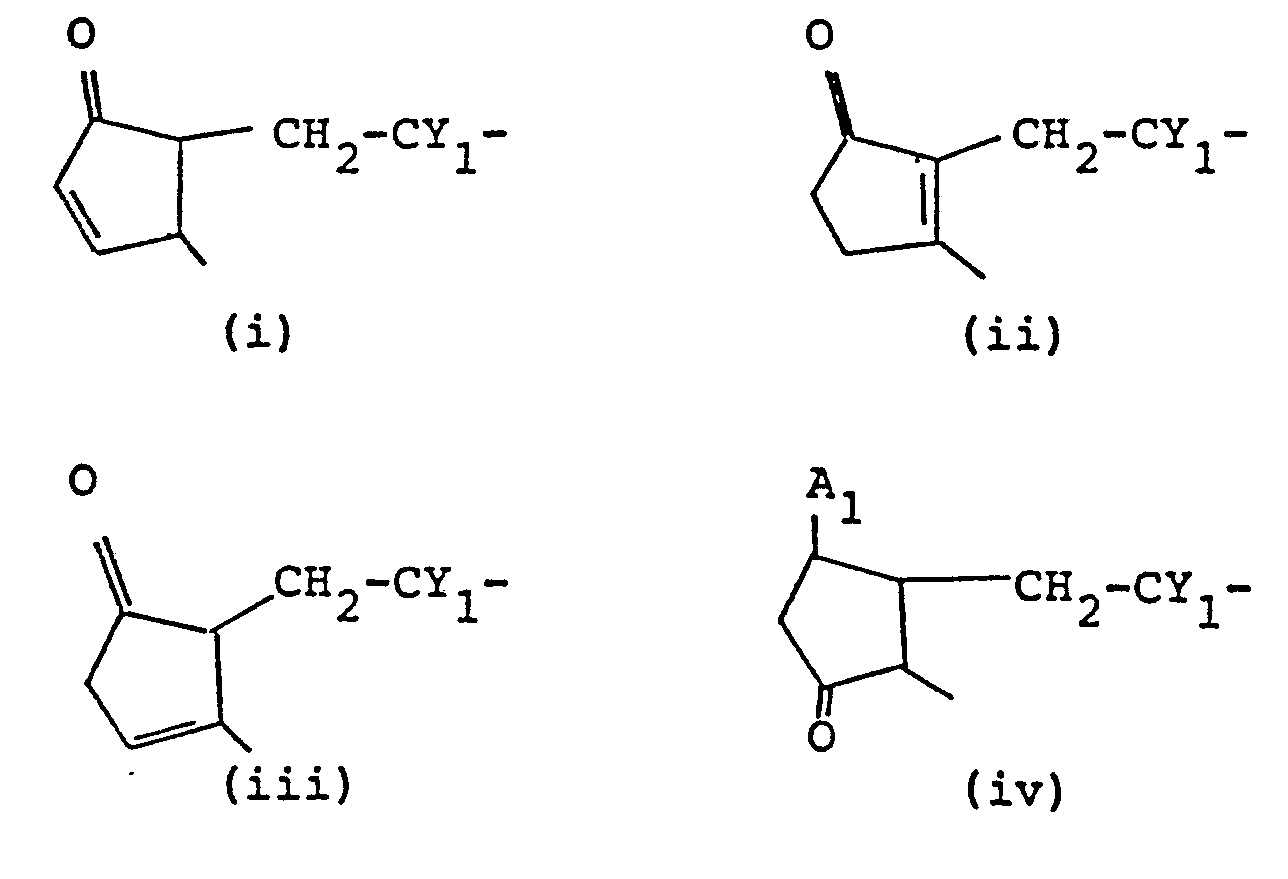

Y₁ is 0, 1 or 2 hydrogen atoms or oxo,
Z is hydroxymethylcarbonyl, carboxy or a functional derivative of carboxy,
R₁ is saturated or unsaturated lower aliphatic hydrocarbon residue,
R₂ is saturated or unsaturated lower aliphatic hydrocarbon residue which is unsubstituted or substituted with at least one substituent selected from the group consisting of hydroxy, halo, lower-alkoxyphenyl and phenoxy,
the symbol of a line and a dotted line is single bond or double bond, and
the symbol of a line and two dotted line is single bond, double bond or triple bond,
or a pharmaceutically acceptable salt thereof.
Priority Applications (1)
| Application Number | Priority Date | Filing Date | Title |
|---|---|---|---|
| AT89301888T ATE79260T1 (en) | 1988-02-26 | 1989-02-24 | STABILIZATION OF 13,14-DIHYDRO-15KETOPROSTAGLANDINS. |
Applications Claiming Priority (2)
| Application Number | Priority Date | Filing Date | Title |
|---|---|---|---|
| JP63045622A JP2597629B2 (en) | 1988-02-26 | 1988-02-26 | Stabilization of 13,14-dihydro-15-ketoprostaglandins |
| JP45622/88 | 1988-02-26 |
Publications (3)
| Publication Number | Publication Date |
|---|---|
| EP0330511A2 true EP0330511A2 (en) | 1989-08-30 |
| EP0330511A3 EP0330511A3 (en) | 1989-10-18 |
| EP0330511B1 EP0330511B1 (en) | 1992-08-12 |
Family
ID=12724473
Family Applications (1)
| Application Number | Title | Priority Date | Filing Date |
|---|---|---|---|
| EP89301888A Expired - Lifetime EP0330511B1 (en) | 1988-02-26 | 1989-02-24 | Stabilization of 13,14-dihydro-15-ketoprostaglandins |
Country Status (13)
| Country | Link |
|---|---|
| EP (1) | EP0330511B1 (en) |
| JP (1) | JP2597629B2 (en) |
| KR (1) | KR970005170B1 (en) |
| AT (1) | ATE79260T1 (en) |
| AU (1) | AU612791B2 (en) |
| CA (1) | CA1314483C (en) |
| DE (1) | DE68902401T2 (en) |
| ES (1) | ES2044087T3 (en) |
| GB (1) | GB2216004A (en) |
| GR (1) | GR3005933T3 (en) |
| NZ (1) | NZ228111A (en) |
| OA (1) | OA09236A (en) |
| ZA (1) | ZA891410B (en) |
Cited By (32)
| Publication number | Priority date | Publication date | Assignee | Title |
|---|---|---|---|---|
| EP0455264A3 (en) * | 1987-09-18 | 1991-11-27 | Ueno Seiyaku Oyo Kenkyujo Kk | Ocular hypotensive agents |
| US5075334A (en) * | 1989-07-27 | 1991-12-24 | K.K. Ueno Seiyaku Oyo Kenkyujo | Excretion of potassium ion by prostanoic acid derivatives |
| EP0366279A3 (en) * | 1988-10-01 | 1991-12-27 | R-Tech Ueno Ltd. | Ocular hypotensive agents |
| EP0435682A3 (en) * | 1989-12-28 | 1992-01-15 | Allergan, Inc. | The use of inclusion complexes of prostaglandins with cyclodextrins in the treatment of ocular hypertension |
| US5096927A (en) * | 1989-10-20 | 1992-03-17 | K.K. Ueno Seiyaku Oyo Kenkyujo | Treatment of hepatobiliary disease with 15-keto-prostaglandin compounds |
| US5126372A (en) * | 1989-08-09 | 1992-06-30 | K.K. Ueno Seiyaku Oyo Kenkyujo | Excretion of nonprotein nitrogen into the intestine by prostanoic acid derivatives |
| EP0430552A3 (en) * | 1989-11-22 | 1992-07-01 | Kabushiki Kaisha Ueno Seiyaku Oyo Kenkyujo | Treatment of pulmonary dysfunction with 15-keto-prostaglandin compounds |
| EP0430551A3 (en) * | 1989-11-22 | 1992-07-15 | Ueno Seiyaku Oyo Kenkyujo Kk | Treatment of cardiac dysfunction with 15-keto-prostaglandin compounds |
| US5166178A (en) * | 1987-09-18 | 1992-11-24 | K.K. Ueno Seiyaku Oyo Kenkyujo | Ocular hypotensive agents |
| US5194429A (en) * | 1988-10-01 | 1993-03-16 | K.K. Ueno Seiyaku Oyo Kenkyujo | Ocular hypotensive agents |
| US5212200A (en) * | 1987-09-18 | 1993-05-18 | R-Tech Ueno, Ltd. | Ocular hypotensive agents |
| US5212324A (en) * | 1990-04-04 | 1993-05-18 | R.-Tech Ueno Ltd. | Treatment of cataract with 15-keto-prostaglandin compounds |
| US5234954A (en) * | 1989-07-27 | 1993-08-10 | K.K. Ueno Seiyaku Oyo Kenkyujo | Treatment of hyperlipidemia with 15-keto-prostaglandin compounds |
| US5236907A (en) * | 1988-10-01 | 1993-08-17 | R-Tech Ueno Ltd. | Ocular hypotensive agents |
| US5252605A (en) * | 1991-03-14 | 1993-10-12 | R-Tech Ueno Ltd. | Promotion of wound-healing with 15-keto-prostaglandin compounds |
| US5254588A (en) * | 1989-11-22 | 1993-10-19 | Kabushikikaisha Ueno Seiyaku Oyo Kenkyujo | Treatment of pulmonary dysfunction with 15-ketoprostaglandin compounds |
| US5256696A (en) * | 1989-11-22 | 1993-10-26 | Kabushikikaisha Ueno Seiyaku Oyo Kenkyujo | Treatment of cardiac dysfunction with 15-ketoprostaglandin compounds |
| US5346921A (en) * | 1990-07-10 | 1994-09-13 | R-Tech Ueno, Ltd. | Treatment of inflammation with 15-keto-prostaglandin compounds |
| US5510383A (en) * | 1993-08-03 | 1996-04-23 | Alcon Laboratories, Inc. | Use of cloprostenol, fluprostenol and their salts and esters to treat glaucoma and ocular hypertension |
| US5565492A (en) * | 1988-07-18 | 1996-10-15 | Alcon Laboratories, Inc. | Prostaglandin combinations in glaucoma therapy |
| US5698733A (en) * | 1994-09-30 | 1997-12-16 | Alcon Laboratories, Inc. | Use of 9-deoxy prostaglandin derivatives to treat glaucoma |
| US5807892A (en) * | 1994-09-30 | 1998-09-15 | Alcon Laboratories, Inc. | Use of certain prostaglandin analogues to treat glaucoma and ocular hypertension |
| US5849792A (en) * | 1994-12-22 | 1998-12-15 | Alcon Laboratories, Inc. | Storage-stable prostaglandin compositions |
| US6011062A (en) * | 1994-12-22 | 2000-01-04 | Alcon Laboratories, Inc. | Storage-stable prostaglandin compositions |
| US6096783A (en) * | 1998-12-15 | 2000-08-01 | Alcon Laboratories, Inc. | Cyclobutane prostaglandin analogues as ocular hypotensive agents |
| US6169111B1 (en) | 1995-06-07 | 2001-01-02 | Alcon Laboratories, Inc. | Conformationally rigid aryl prostaglandins for use in glaucoma therapy |
| US6184250B1 (en) | 1993-08-03 | 2001-02-06 | Alcon Laboratories, Inc. | Use of cloprostenol and fluprostenol analogues to treat glaucoma and ocular hypertension |
| US6211226B1 (en) | 1998-12-17 | 2001-04-03 | Alcon Laboratories, Inc. | 11-Aza prostaglandins for the treatment of glaucoma and ocular hypertension |
| US6420422B1 (en) | 1987-09-18 | 2002-07-16 | Sucampo Pharmaceuticals, Inc. | Ocular hypotensive agents |
| EP1224934A3 (en) * | 1988-09-06 | 2003-03-26 | Pharmacia AB | Prostaglandin derivatives for the treatment of glaucoma or ocular hypertension |
| EP1681059B1 (en) * | 2003-11-07 | 2009-09-09 | Senju Pharmaceutical Co., Ltd. | Pharmaceutical composition containing prostaglandin |
| US8414904B2 (en) | 2007-04-24 | 2013-04-09 | Azad Pharma Ag | Ophthalmic oil-in-water emulsions containing prostaglandins |
Families Citing this family (1)
| Publication number | Priority date | Publication date | Assignee | Title |
|---|---|---|---|---|
| EP1562604B1 (en) * | 2002-10-23 | 2012-01-04 | Sucampo AG | Prostaglandin compounds for the treatment of obesity |
Citations (5)
| Publication number | Priority date | Publication date | Assignee | Title |
|---|---|---|---|---|
| EP0281239A2 (en) | 1987-01-28 | 1988-09-07 | Kabushiki Kaisha Ueno Seiyaku Oyo Kenkyujo | Prostaglandins of the D series, and tranquilizers and soporifics containing the same |
| EP0284180A1 (en) | 1987-01-28 | 1988-09-28 | Kabushiki Kaisha Ueno Seiyaku Oyo Kenkyujo | Prostaglandins E and anti ulcers containing same |
| EP0289349A1 (en) | 1987-04-30 | 1988-11-02 | Kabushiki Kaisha Ueno Seiyaku Oyo Kenkyujo | Prostaglandins of the F series |
| EP0292177A1 (en) | 1987-05-15 | 1988-11-23 | Kabushiki Kaisha Ueno Seiyaku Oyo Kenkyujo | Fervescence composition |
| EP0308135A2 (en) | 1987-09-18 | 1989-03-22 | R-Tech Ueno Ltd. | Ocular hypotensive agents |
Family Cites Families (2)
| Publication number | Priority date | Publication date | Assignee | Title |
|---|---|---|---|---|
| JPS5910525A (en) * | 1982-06-21 | 1984-01-20 | Teisan Seiyaku Kk | Stabilized composition of prostaglandin e |
| JPH0819004B2 (en) * | 1986-12-26 | 1996-02-28 | 日清製粉株式会社 | Sustained-release pharmaceutical preparation |
-
1988
- 1988-02-26 JP JP63045622A patent/JP2597629B2/en not_active Expired - Fee Related
-
1989
- 1989-02-23 ZA ZA891410A patent/ZA891410B/en unknown
- 1989-02-23 CA CA000591913A patent/CA1314483C/en not_active Expired - Fee Related
- 1989-02-23 NZ NZ228111A patent/NZ228111A/en unknown
- 1989-02-23 AU AU30298/89A patent/AU612791B2/en not_active Ceased
- 1989-02-24 ES ES89301888T patent/ES2044087T3/en not_active Expired - Lifetime
- 1989-02-24 OA OA59533A patent/OA09236A/en unknown
- 1989-02-24 EP EP89301888A patent/EP0330511B1/en not_active Expired - Lifetime
- 1989-02-24 DE DE8989301888T patent/DE68902401T2/en not_active Expired - Lifetime
- 1989-02-24 AT AT89301888T patent/ATE79260T1/en not_active IP Right Cessation
- 1989-02-24 GB GB8904232A patent/GB2216004A/en not_active Withdrawn
- 1989-02-25 KR KR89002257A patent/KR970005170B1/en not_active Expired - Fee Related
-
1992
- 1992-10-12 GR GR920402253T patent/GR3005933T3/el unknown
Patent Citations (5)
| Publication number | Priority date | Publication date | Assignee | Title |
|---|---|---|---|---|
| EP0281239A2 (en) | 1987-01-28 | 1988-09-07 | Kabushiki Kaisha Ueno Seiyaku Oyo Kenkyujo | Prostaglandins of the D series, and tranquilizers and soporifics containing the same |
| EP0284180A1 (en) | 1987-01-28 | 1988-09-28 | Kabushiki Kaisha Ueno Seiyaku Oyo Kenkyujo | Prostaglandins E and anti ulcers containing same |
| EP0289349A1 (en) | 1987-04-30 | 1988-11-02 | Kabushiki Kaisha Ueno Seiyaku Oyo Kenkyujo | Prostaglandins of the F series |
| EP0292177A1 (en) | 1987-05-15 | 1988-11-23 | Kabushiki Kaisha Ueno Seiyaku Oyo Kenkyujo | Fervescence composition |
| EP0308135A2 (en) | 1987-09-18 | 1989-03-22 | R-Tech Ueno Ltd. | Ocular hypotensive agents |
Non-Patent Citations (2)
| Title |
|---|
| UENO, R.; KUNO, S.; HAYAISHI, O.: "6th International conference on prostaglandins and related compounds", 1986, PRESS, article "A possible pathogenesis of acquired immune deficiency syndrome (AIDS) in homosexual males: an unexpected action of seminal PGE2 on AIDS-virus infection" |
| UENO, R.; KUNO, S.; HAYAISHI, O.: "Prostaglandin in Cancer Research", 1987, article "Prostaglandin E2, a seminal constituent, facilitates the replication of acquired immune deficiency syndrome (AIDS) virus in vitro" |
Cited By (42)
| Publication number | Priority date | Publication date | Assignee | Title |
|---|---|---|---|---|
| US6420422B1 (en) | 1987-09-18 | 2002-07-16 | Sucampo Pharmaceuticals, Inc. | Ocular hypotensive agents |
| EP0455264A3 (en) * | 1987-09-18 | 1991-11-27 | Ueno Seiyaku Oyo Kenkyujo Kk | Ocular hypotensive agents |
| US5212200A (en) * | 1987-09-18 | 1993-05-18 | R-Tech Ueno, Ltd. | Ocular hypotensive agents |
| US5166178A (en) * | 1987-09-18 | 1992-11-24 | K.K. Ueno Seiyaku Oyo Kenkyujo | Ocular hypotensive agents |
| US5565492A (en) * | 1988-07-18 | 1996-10-15 | Alcon Laboratories, Inc. | Prostaglandin combinations in glaucoma therapy |
| EP1224934A3 (en) * | 1988-09-06 | 2003-03-26 | Pharmacia AB | Prostaglandin derivatives for the treatment of glaucoma or ocular hypertension |
| US5194429A (en) * | 1988-10-01 | 1993-03-16 | K.K. Ueno Seiyaku Oyo Kenkyujo | Ocular hypotensive agents |
| EP0366279A3 (en) * | 1988-10-01 | 1991-12-27 | R-Tech Ueno Ltd. | Ocular hypotensive agents |
| EP0580268A3 (en) * | 1988-10-01 | 1994-02-23 | R Tech Ueno Ltd | |
| US5236907A (en) * | 1988-10-01 | 1993-08-17 | R-Tech Ueno Ltd. | Ocular hypotensive agents |
| USRE34756E (en) * | 1989-07-27 | 1994-10-11 | Kabushikikaisha Ueno Seiyaku Oyo Kenkyujo | Excretion of potassium ion by prostanoic acid derivatives |
| US5075334A (en) * | 1989-07-27 | 1991-12-24 | K.K. Ueno Seiyaku Oyo Kenkyujo | Excretion of potassium ion by prostanoic acid derivatives |
| US5234954A (en) * | 1989-07-27 | 1993-08-10 | K.K. Ueno Seiyaku Oyo Kenkyujo | Treatment of hyperlipidemia with 15-keto-prostaglandin compounds |
| US5126372A (en) * | 1989-08-09 | 1992-06-30 | K.K. Ueno Seiyaku Oyo Kenkyujo | Excretion of nonprotein nitrogen into the intestine by prostanoic acid derivatives |
| US5096927A (en) * | 1989-10-20 | 1992-03-17 | K.K. Ueno Seiyaku Oyo Kenkyujo | Treatment of hepatobiliary disease with 15-keto-prostaglandin compounds |
| EP0424156A3 (en) * | 1989-10-20 | 1992-04-22 | Kabushiki Kaisha Ueno Seiyaku Oyo Kenkyujo | Treatment of hepatobiliary disease with 15-keto-prostaglandin compounds |
| EP0430552A3 (en) * | 1989-11-22 | 1992-07-01 | Kabushiki Kaisha Ueno Seiyaku Oyo Kenkyujo | Treatment of pulmonary dysfunction with 15-keto-prostaglandin compounds |
| US5256696A (en) * | 1989-11-22 | 1993-10-26 | Kabushikikaisha Ueno Seiyaku Oyo Kenkyujo | Treatment of cardiac dysfunction with 15-ketoprostaglandin compounds |
| US5254588A (en) * | 1989-11-22 | 1993-10-19 | Kabushikikaisha Ueno Seiyaku Oyo Kenkyujo | Treatment of pulmonary dysfunction with 15-ketoprostaglandin compounds |
| EP0430551A3 (en) * | 1989-11-22 | 1992-07-15 | Ueno Seiyaku Oyo Kenkyujo Kk | Treatment of cardiac dysfunction with 15-keto-prostaglandin compounds |
| EP0435682A3 (en) * | 1989-12-28 | 1992-01-15 | Allergan, Inc. | The use of inclusion complexes of prostaglandins with cyclodextrins in the treatment of ocular hypertension |
| US5212324A (en) * | 1990-04-04 | 1993-05-18 | R.-Tech Ueno Ltd. | Treatment of cataract with 15-keto-prostaglandin compounds |
| US5686487A (en) * | 1990-04-04 | 1997-11-11 | R-Tech Ueno Ltd. | Treatment of cataract with 15-keto-prostaglandin compounds |
| US5346921A (en) * | 1990-07-10 | 1994-09-13 | R-Tech Ueno, Ltd. | Treatment of inflammation with 15-keto-prostaglandin compounds |
| US5252605A (en) * | 1991-03-14 | 1993-10-12 | R-Tech Ueno Ltd. | Promotion of wound-healing with 15-keto-prostaglandin compounds |
| US5510383A (en) * | 1993-08-03 | 1996-04-23 | Alcon Laboratories, Inc. | Use of cloprostenol, fluprostenol and their salts and esters to treat glaucoma and ocular hypertension |
| AU690120B2 (en) * | 1993-08-03 | 1998-04-23 | Alcon Laboratories, Inc. | Use of cloprostenol, fluprostenol and their analogues to treat glaucoma and ocular hypertension |
| US6723748B2 (en) | 1993-08-03 | 2004-04-20 | Alcon Manufacturing, Ltd. | Use of cloprostenol and fluprostenol analogues to treat glaucoma and ocular hypertension |
| US5665773A (en) * | 1993-08-03 | 1997-09-09 | Alcon Laboratories, Inc. | Cloprostenol and fluprostenol analogues and their use to treat glaucoma and ocular hypertension |
| US5889052A (en) * | 1993-08-03 | 1999-03-30 | Alcon Laboraties, Inc. | Use of cloprostenol and fluprostenol analogues to treat glaucoma and ocular hypertension |
| US6184250B1 (en) | 1993-08-03 | 2001-02-06 | Alcon Laboratories, Inc. | Use of cloprostenol and fluprostenol analogues to treat glaucoma and ocular hypertension |
| US6344478B2 (en) | 1993-08-03 | 2002-02-05 | Alcon Manufacturing, Ltd. | Use of cloprostenol and fluprostenol analogues to treat glaucoma and ocular hypertension |
| US5698733A (en) * | 1994-09-30 | 1997-12-16 | Alcon Laboratories, Inc. | Use of 9-deoxy prostaglandin derivatives to treat glaucoma |
| US5807892A (en) * | 1994-09-30 | 1998-09-15 | Alcon Laboratories, Inc. | Use of certain prostaglandin analogues to treat glaucoma and ocular hypertension |
| US6011062A (en) * | 1994-12-22 | 2000-01-04 | Alcon Laboratories, Inc. | Storage-stable prostaglandin compositions |
| US5849792A (en) * | 1994-12-22 | 1998-12-15 | Alcon Laboratories, Inc. | Storage-stable prostaglandin compositions |
| US6169111B1 (en) | 1995-06-07 | 2001-01-02 | Alcon Laboratories, Inc. | Conformationally rigid aryl prostaglandins for use in glaucoma therapy |
| US6096783A (en) * | 1998-12-15 | 2000-08-01 | Alcon Laboratories, Inc. | Cyclobutane prostaglandin analogues as ocular hypotensive agents |
| US6211226B1 (en) | 1998-12-17 | 2001-04-03 | Alcon Laboratories, Inc. | 11-Aza prostaglandins for the treatment of glaucoma and ocular hypertension |
| EP1681059B1 (en) * | 2003-11-07 | 2009-09-09 | Senju Pharmaceutical Co., Ltd. | Pharmaceutical composition containing prostaglandin |
| US8697751B2 (en) | 2003-11-07 | 2014-04-15 | Senju Pharmaceutical Co., Ltd. | Pharmaceutical composition containing prostaglandin |
| US8414904B2 (en) | 2007-04-24 | 2013-04-09 | Azad Pharma Ag | Ophthalmic oil-in-water emulsions containing prostaglandins |
Also Published As
| Publication number | Publication date |
|---|---|
| GB8904232D0 (en) | 1989-04-12 |
| DE68902401D1 (en) | 1992-09-17 |
| KR970005170B1 (en) | 1997-04-14 |
| ES2044087T3 (en) | 1994-01-01 |
| KR890012654A (en) | 1989-09-18 |
| JPH01221317A (en) | 1989-09-04 |
| AU612791B2 (en) | 1991-07-18 |
| OA09236A (en) | 1992-06-30 |
| EP0330511A3 (en) | 1989-10-18 |
| CA1314483C (en) | 1993-03-16 |
| AU3029889A (en) | 1989-08-31 |
| EP0330511B1 (en) | 1992-08-12 |
| ATE79260T1 (en) | 1992-08-15 |
| NZ228111A (en) | 1991-02-26 |
| GR3005933T3 (en) | 1993-06-07 |
| ZA891410B (en) | 1989-11-29 |
| GB2216004A (en) | 1989-10-04 |
| JP2597629B2 (en) | 1997-04-09 |
| DE68902401T2 (en) | 1992-12-10 |
Similar Documents
| Publication | Publication Date | Title |
|---|---|---|
| EP0330511B1 (en) | Stabilization of 13,14-dihydro-15-ketoprostaglandins | |
| EP0555693B1 (en) | Method of producing highly watersoluble cyclodextrin complex | |
| JP4202273B2 (en) | Inclusion compound of fumagillol derivative or salt thereof, and pharmaceutical composition containing the inclusion compound | |
| EP0619825B1 (en) | A method for preparing enteric-coated oral drugs containing acid-unstable compounds | |
| JP2597649B2 (en) | Trachea / bronchodilator | |
| US4191694A (en) | Prostaglandin-I2 derivatives | |
| IE904711A1 (en) | The Use of Inclusion Complexes of Prostaglandins with¹Cyclodextrins in the Treatment of Ocular Hypertension | |
| US5760017A (en) | Cyclodextrin derivatives usable in particular for solubilizing hydrophobic chemical compounds such as medicaments and their preparation process | |
| GB1604161A (en) | Compositions containing prostaglandin analogues | |
| IE51637B1 (en) | Pharmaceutical preparation | |
| JPS6152146B2 (en) | ||
| JPH0278699A (en) | Benzoylurea compound-albumin complex | |
| JP2007515425A (en) | Pharmaceutical composition | |
| EP0343904A1 (en) | Hypersphyxia causing composition | |
| AT396687B (en) | CYCLODEXTRINCLATHRATE OF 5-CYANOPROSTACYCLINE DERIVATIVES AND THEIR USE AS MEDICINAL PRODUCTS | |
| WO1999043736A1 (en) | Carrier polymers migrating into target organs and drug-containing polymers | |
| JPS6358810B2 (en) | ||
| US5254588A (en) | Treatment of pulmonary dysfunction with 15-ketoprostaglandin compounds | |
| JPH07157431A (en) | Stable prostaglandin e preparation | |
| JPS6054933B2 (en) | Method for stabilizing prostaglandin and prostaglandin-like compound preparations | |
| JP3059204B2 (en) | Stable prostaglandin I (II)-containing composition for skin application | |
| EP0007245B1 (en) | Pharmaceutical compositions comprising prostacyclin or a prostacyclin analogue containing an enol ether group | |
| JPS61502823A (en) | Novel carbacycline, its production method and use of the compound as a drug | |
| EP0330025A2 (en) | Antidiabetic composition comprising isocarbacyclin derivative | |
| HU190722B (en) | Process for producing new carbacycline esters and pharmaceutical compositions containing them |
Legal Events
| Date | Code | Title | Description |
|---|---|---|---|
| PUAI | Public reference made under article 153(3) epc to a published international application that has entered the european phase |
Free format text: ORIGINAL CODE: 0009012 |
|
| AK | Designated contracting states |
Kind code of ref document: A2 Designated state(s): AT BE CH DE ES FR GB GR IT LI LU NL SE |
|
| PUAL | Search report despatched |
Free format text: ORIGINAL CODE: 0009013 |
|
| AK | Designated contracting states |
Kind code of ref document: A3 Designated state(s): AT BE CH DE ES FR GB GR IT LI LU NL SE |
|
| 17P | Request for examination filed |
Effective date: 19900410 |
|
| 17Q | First examination report despatched |
Effective date: 19901211 |
|
| GRAA | (expected) grant |
Free format text: ORIGINAL CODE: 0009210 |
|
| AK | Designated contracting states |
Kind code of ref document: B1 Designated state(s): AT BE CH DE ES FR GB GR IT LI LU NL SE |
|
| REF | Corresponds to: |
Ref document number: 79260 Country of ref document: AT Date of ref document: 19920815 Kind code of ref document: T |
|
| REF | Corresponds to: |
Ref document number: 68902401 Country of ref document: DE Date of ref document: 19920917 |
|
| ET | Fr: translation filed | ||
| ITF | It: translation for a ep patent filed | ||
| PGFP | Annual fee paid to national office [announced via postgrant information from national office to epo] |
Ref country code: SE Payment date: 19930111 Year of fee payment: 5 |
|
| PGFP | Annual fee paid to national office [announced via postgrant information from national office to epo] |
Ref country code: LU Payment date: 19930121 Year of fee payment: 5 |
|
| PGFP | Annual fee paid to national office [announced via postgrant information from national office to epo] |
Ref country code: GR Payment date: 19930128 Year of fee payment: 5 |
|
| PGFP | Annual fee paid to national office [announced via postgrant information from national office to epo] |
Ref country code: CH Payment date: 19930129 Year of fee payment: 5 |
|
| PGFP | Annual fee paid to national office [announced via postgrant information from national office to epo] |
Ref country code: BE Payment date: 19930205 Year of fee payment: 5 |
|
| PGFP | Annual fee paid to national office [announced via postgrant information from national office to epo] |
Ref country code: AT Payment date: 19930226 Year of fee payment: 5 Ref country code: ES Payment date: 19930226 Year of fee payment: 5 |
|
| PGFP | Annual fee paid to national office [announced via postgrant information from national office to epo] |
Ref country code: NL Payment date: 19930228 Year of fee payment: 5 |
|
| REG | Reference to a national code |
Ref country code: GR Ref legal event code: FG4A Free format text: 3005933 |
|
| EPTA | Lu: last paid annual fee | ||
| PLBE | No opposition filed within time limit |
Free format text: ORIGINAL CODE: 0009261 |
|
| STAA | Information on the status of an ep patent application or granted ep patent |
Free format text: STATUS: NO OPPOSITION FILED WITHIN TIME LIMIT |
|
| 26N | No opposition filed | ||
| REG | Reference to a national code |
Ref country code: ES Ref legal event code: FG2A Ref document number: 2044087 Country of ref document: ES Kind code of ref document: T3 |
|
| PG25 | Lapsed in a contracting state [announced via postgrant information from national office to epo] |
Ref country code: LU Free format text: LAPSE BECAUSE OF NON-PAYMENT OF DUE FEES Effective date: 19940224 Ref country code: AT Effective date: 19940224 |
|
| PG25 | Lapsed in a contracting state [announced via postgrant information from national office to epo] |
Ref country code: ES Free format text: LAPSE BECAUSE OF NON-PAYMENT OF DUE FEES Effective date: 19940225 Ref country code: SE Effective date: 19940225 |
|
| PG25 | Lapsed in a contracting state [announced via postgrant information from national office to epo] |
Ref country code: CH Effective date: 19940228 Ref country code: BE Effective date: 19940228 Ref country code: LI Effective date: 19940228 |
|
| BERE | Be: lapsed |
Owner name: UENO SEIYAKU OYO KENKYUJO K.K. Effective date: 19940228 |
|
| PG25 | Lapsed in a contracting state [announced via postgrant information from national office to epo] |
Ref country code: GR Free format text: THE PATENT HAS BEEN ANNULLED BY A DECISION OF A NATIONAL AUTHORITY Effective date: 19940831 |
|
| PG25 | Lapsed in a contracting state [announced via postgrant information from national office to epo] |
Ref country code: NL Effective date: 19940901 |
|
| NLV4 | Nl: lapsed or anulled due to non-payment of the annual fee | ||
| REG | Reference to a national code |
Ref country code: CH Ref legal event code: PL |
|
| REG | Reference to a national code |
Ref country code: GR Ref legal event code: MM2A Free format text: 3005933 |
|
| EUG | Se: european patent has lapsed |
Ref document number: 89301888.7 Effective date: 19940910 |
|
| REG | Reference to a national code |
Ref country code: ES Ref legal event code: FD2A Effective date: 19990405 |
|
| REG | Reference to a national code |
Ref country code: GB Ref legal event code: IF02 |
|
| PG25 | Lapsed in a contracting state [announced via postgrant information from national office to epo] |
Ref country code: IT Free format text: LAPSE BECAUSE OF NON-PAYMENT OF DUE FEES Effective date: 20050224 |
|
| PGFP | Annual fee paid to national office [announced via postgrant information from national office to epo] |
Ref country code: GB Payment date: 20070221 Year of fee payment: 19 |
|
| PGFP | Annual fee paid to national office [announced via postgrant information from national office to epo] |
Ref country code: DE Payment date: 20070222 Year of fee payment: 19 |
|
| REG | Reference to a national code |
Ref country code: GB Ref legal event code: 732E |
|
| REG | Reference to a national code |
Ref country code: FR Ref legal event code: CA Ref country code: FR Ref legal event code: CD Ref country code: FR Ref legal event code: TP |
|
| PGFP | Annual fee paid to national office [announced via postgrant information from national office to epo] |
Ref country code: FR Payment date: 20070223 Year of fee payment: 19 |
|
| GBPC | Gb: european patent ceased through non-payment of renewal fee |
Effective date: 20080224 |
|
| REG | Reference to a national code |
Ref country code: FR Ref legal event code: ST Effective date: 20081031 |
|
| PG25 | Lapsed in a contracting state [announced via postgrant information from national office to epo] |
Ref country code: DE Free format text: LAPSE BECAUSE OF NON-PAYMENT OF DUE FEES Effective date: 20080902 |
|
| PG25 | Lapsed in a contracting state [announced via postgrant information from national office to epo] |
Ref country code: FR Free format text: LAPSE BECAUSE OF NON-PAYMENT OF DUE FEES Effective date: 20080229 |
|
| PG25 | Lapsed in a contracting state [announced via postgrant information from national office to epo] |
Ref country code: GB Free format text: LAPSE BECAUSE OF NON-PAYMENT OF DUE FEES Effective date: 20080224 |