EP0330220B1 - Process for the preparation and recovery of oxydiphthalic anhydrides - Google Patents
Process for the preparation and recovery of oxydiphthalic anhydrides Download PDFInfo
- Publication number
- EP0330220B1 EP0330220B1 EP89103251A EP89103251A EP0330220B1 EP 0330220 B1 EP0330220 B1 EP 0330220B1 EP 89103251 A EP89103251 A EP 89103251A EP 89103251 A EP89103251 A EP 89103251A EP 0330220 B1 EP0330220 B1 EP 0330220B1
- Authority
- EP
- European Patent Office
- Prior art keywords
- anhydride
- process according
- halophthalic
- oxydiphthalic
- potassium carbonate
- Prior art date
- Legal status (The legal status is an assumption and is not a legal conclusion. Google has not performed a legal analysis and makes no representation as to the accuracy of the status listed.)
- Expired - Lifetime
Links
- 150000008064 anhydrides Chemical class 0.000 title claims abstract description 63
- 238000000034 method Methods 0.000 title claims description 47
- 230000008569 process Effects 0.000 title claims description 40
- 238000002360 preparation method Methods 0.000 title claims description 15
- 238000011084 recovery Methods 0.000 title description 4
- BWHMMNNQKKPAPP-UHFFFAOYSA-L potassium carbonate Chemical compound [K+].[K+].[O-]C([O-])=O BWHMMNNQKKPAPP-UHFFFAOYSA-L 0.000 claims abstract description 84
- 229910000027 potassium carbonate Inorganic materials 0.000 claims abstract description 42
- 239000002904 solvent Substances 0.000 claims abstract description 39
- BCJIMAHNJOIWKQ-UHFFFAOYSA-N 4-[(1,3-dioxo-2-benzofuran-4-yl)oxy]-2-benzofuran-1,3-dione Chemical compound O=C1OC(=O)C2=C1C=CC=C2OC1=CC=CC2=C1C(=O)OC2=O BCJIMAHNJOIWKQ-UHFFFAOYSA-N 0.000 claims abstract description 25
- 239000012429 reaction media Substances 0.000 claims abstract description 7
- 238000001816 cooling Methods 0.000 claims abstract description 4
- 238000000746 purification Methods 0.000 claims abstract description 4
- 239000012535 impurity Substances 0.000 claims abstract description 3
- PBKONEOXTCPAFI-UHFFFAOYSA-N 1,2,4-trichlorobenzene Chemical compound ClC1=CC=C(Cl)C(Cl)=C1 PBKONEOXTCPAFI-UHFFFAOYSA-N 0.000 claims description 74
- 238000006243 chemical reaction Methods 0.000 claims description 42
- BTTRMCQEPDPCPA-UHFFFAOYSA-N 4-chlorophthalic anhydride Chemical group ClC1=CC=C2C(=O)OC(=O)C2=C1 BTTRMCQEPDPCPA-UHFFFAOYSA-N 0.000 claims description 30
- QQGYZOYWNCKGEK-UHFFFAOYSA-N 5-[(1,3-dioxo-2-benzofuran-5-yl)oxy]-2-benzofuran-1,3-dione Chemical compound C1=C2C(=O)OC(=O)C2=CC(OC=2C=C3C(=O)OC(C3=CC=2)=O)=C1 QQGYZOYWNCKGEK-UHFFFAOYSA-N 0.000 claims description 29
- NROKBHXJSPEDAR-UHFFFAOYSA-M potassium fluoride Chemical compound [F-].[K+] NROKBHXJSPEDAR-UHFFFAOYSA-M 0.000 claims description 14
- XJHCXCQVJFPJIK-UHFFFAOYSA-M caesium fluoride Chemical compound [F-].[Cs+] XJHCXCQVJFPJIK-UHFFFAOYSA-M 0.000 claims description 11
- BRKFQVAOMSWFDU-UHFFFAOYSA-M tetraphenylphosphanium;bromide Chemical compound [Br-].C1=CC=CC=C1[P+](C=1C=CC=CC=1)(C=1C=CC=CC=1)C1=CC=CC=C1 BRKFQVAOMSWFDU-UHFFFAOYSA-M 0.000 claims description 11
- UERPUZBSSSAZJE-UHFFFAOYSA-N 3-chlorophthalic anhydride Chemical group ClC1=CC=CC2=C1C(=O)OC2=O UERPUZBSSSAZJE-UHFFFAOYSA-N 0.000 claims description 9
- 239000007788 liquid Substances 0.000 claims description 9
- 239000011698 potassium fluoride Substances 0.000 claims description 8
- 235000003270 potassium fluoride Nutrition 0.000 claims description 7
- 229910052794 bromium Inorganic materials 0.000 claims description 6
- 229910052801 chlorine Inorganic materials 0.000 claims description 6
- 239000000460 chlorine Substances 0.000 claims description 6
- HVLLSGMXQDNUAL-UHFFFAOYSA-N triphenyl phosphite Chemical compound C=1C=CC=CC=1OP(OC=1C=CC=CC=1)OC1=CC=CC=C1 HVLLSGMXQDNUAL-UHFFFAOYSA-N 0.000 claims description 6
- RIOQSEWOXXDEQQ-UHFFFAOYSA-N triphenylphosphine Chemical compound C1=CC=CC=C1P(C=1C=CC=CC=1)C1=CC=CC=C1 RIOQSEWOXXDEQQ-UHFFFAOYSA-N 0.000 claims description 6
- 230000003197 catalytic effect Effects 0.000 claims description 5
- 229910052731 fluorine Inorganic materials 0.000 claims description 5
- 239000007787 solid Substances 0.000 claims description 5
- 229910052740 iodine Inorganic materials 0.000 claims description 4
- WAGFXJQAIZNSEQ-UHFFFAOYSA-M tetraphenylphosphonium chloride Chemical compound [Cl-].C1=CC=CC=C1[P+](C=1C=CC=CC=1)(C=1C=CC=CC=1)C1=CC=CC=C1 WAGFXJQAIZNSEQ-UHFFFAOYSA-M 0.000 claims description 4
- 230000002939 deleterious effect Effects 0.000 claims description 3
- 239000003444 phase transfer catalyst Substances 0.000 claims description 3
- RKHXQBLJXBGEKF-UHFFFAOYSA-M tetrabutylphosphanium;bromide Chemical compound [Br-].CCCC[P+](CCCC)(CCCC)CCCC RKHXQBLJXBGEKF-UHFFFAOYSA-M 0.000 claims description 3
- WKBOTKDWSSQWDR-UHFFFAOYSA-N Bromine atom Chemical compound [Br] WKBOTKDWSSQWDR-UHFFFAOYSA-N 0.000 claims 2
- GDTBXPJZTBHREO-UHFFFAOYSA-N bromine Substances BrBr GDTBXPJZTBHREO-UHFFFAOYSA-N 0.000 claims 2
- 125000001309 chloro group Chemical group Cl* 0.000 claims 2
- 229910052736 halogen Inorganic materials 0.000 claims 2
- ZCYVEMRRCGMTRW-UHFFFAOYSA-N 7553-56-2 Chemical compound [I] ZCYVEMRRCGMTRW-UHFFFAOYSA-N 0.000 claims 1
- PXGOKWXKJXAPGV-UHFFFAOYSA-N Fluorine Chemical compound FF PXGOKWXKJXAPGV-UHFFFAOYSA-N 0.000 claims 1
- 239000011737 fluorine Substances 0.000 claims 1
- 239000011630 iodine Substances 0.000 claims 1
- 238000001914 filtration Methods 0.000 abstract description 12
- 238000009835 boiling Methods 0.000 abstract description 5
- 238000006561 solvent free reaction Methods 0.000 abstract 1
- 235000011181 potassium carbonates Nutrition 0.000 description 28
- 239000000047 product Substances 0.000 description 27
- 239000000203 mixture Substances 0.000 description 19
- 239000000376 reactant Substances 0.000 description 14
- 239000003054 catalyst Substances 0.000 description 12
- 239000011541 reaction mixture Substances 0.000 description 11
- -1 tetramethyl diphenyl ethers Chemical class 0.000 description 8
- JHIVVAPYMSGYDF-UHFFFAOYSA-N cyclohexanone Chemical compound O=C1CCCCC1 JHIVVAPYMSGYDF-UHFFFAOYSA-N 0.000 description 6
- 239000000706 filtrate Substances 0.000 description 6
- LPXPTNMVRIOKMN-UHFFFAOYSA-M sodium nitrite Chemical compound [Na+].[O-]N=O LPXPTNMVRIOKMN-UHFFFAOYSA-M 0.000 description 6
- 238000004458 analytical method Methods 0.000 description 5
- 239000007789 gas Substances 0.000 description 5
- VLKZOEOYAKHREP-UHFFFAOYSA-N n-Hexane Chemical compound CCCCCC VLKZOEOYAKHREP-UHFFFAOYSA-N 0.000 description 5
- 238000003756 stirring Methods 0.000 description 5
- IJGRMHOSHXDMSA-UHFFFAOYSA-N Atomic nitrogen Chemical compound N#N IJGRMHOSHXDMSA-UHFFFAOYSA-N 0.000 description 4
- IAZDPXIOMUYVGZ-UHFFFAOYSA-N Dimethylsulphoxide Chemical compound CS(C)=O IAZDPXIOMUYVGZ-UHFFFAOYSA-N 0.000 description 4
- 239000012065 filter cake Substances 0.000 description 4
- 238000004817 gas chromatography Methods 0.000 description 4
- 230000035484 reaction time Effects 0.000 description 4
- OPVHOFITDJSMOD-UHFFFAOYSA-N 4-[(1,3-dioxo-2-benzofuran-5-yl)oxy]-2-benzofuran-1,3-dione Chemical compound C=1C=C2C(=O)OC(=O)C2=CC=1OC1=CC=CC2=C1C(=O)OC2=O OPVHOFITDJSMOD-UHFFFAOYSA-N 0.000 description 3
- ROFZMKDROVBLNY-UHFFFAOYSA-N 4-nitro-2-benzofuran-1,3-dione Chemical compound [O-][N+](=O)C1=CC=CC2=C1C(=O)OC2=O ROFZMKDROVBLNY-UHFFFAOYSA-N 0.000 description 3
- BCKVHOUUJMYIAN-UHFFFAOYSA-N 5-bromo-2-benzofuran-1,3-dione Chemical compound BrC1=CC=C2C(=O)OC(=O)C2=C1 BCKVHOUUJMYIAN-UHFFFAOYSA-N 0.000 description 3
- PGGASBAOLMMPHM-UHFFFAOYSA-N 5-chloro-3a,4,5,7a-tetrahydro-2-benzofuran-1,3-dione Chemical compound C1=CC(Cl)CC2C(=O)OC(=O)C12 PGGASBAOLMMPHM-UHFFFAOYSA-N 0.000 description 3
- XVMKZAAFVWXIII-UHFFFAOYSA-N 5-fluoro-2-benzofuran-1,3-dione Chemical compound FC1=CC=C2C(=O)OC(=O)C2=C1 XVMKZAAFVWXIII-UHFFFAOYSA-N 0.000 description 3
- HEMHJVSKTPXQMS-UHFFFAOYSA-M Sodium hydroxide Chemical compound [OH-].[Na+] HEMHJVSKTPXQMS-UHFFFAOYSA-M 0.000 description 3
- 238000005899 aromatization reaction Methods 0.000 description 3
- 230000008901 benefit Effects 0.000 description 3
- 238000004587 chromatography analysis Methods 0.000 description 3
- 238000001035 drying Methods 0.000 description 3
- 238000010438 heat treatment Methods 0.000 description 3
- 150000003839 salts Chemical class 0.000 description 3
- 235000010288 sodium nitrite Nutrition 0.000 description 3
- 239000000126 substance Substances 0.000 description 3
- KDLHZDBZIXYQEI-UHFFFAOYSA-N Palladium Chemical compound [Pd] KDLHZDBZIXYQEI-UHFFFAOYSA-N 0.000 description 2
- 239000002202 Polyethylene glycol Substances 0.000 description 2
- CDBYLPFSWZWCQE-UHFFFAOYSA-L Sodium Carbonate Chemical compound [Na+].[Na+].[O-]C([O-])=O CDBYLPFSWZWCQE-UHFFFAOYSA-L 0.000 description 2
- 239000002253 acid Substances 0.000 description 2
- 230000015572 biosynthetic process Effects 0.000 description 2
- 239000007795 chemical reaction product Substances 0.000 description 2
- 239000003795 chemical substances by application Substances 0.000 description 2
- 150000001875 compounds Chemical class 0.000 description 2
- 230000008878 coupling Effects 0.000 description 2
- 238000010168 coupling process Methods 0.000 description 2
- 238000005859 coupling reaction Methods 0.000 description 2
- 230000003247 decreasing effect Effects 0.000 description 2
- RTZKZFJDLAIYFH-UHFFFAOYSA-N ether Substances CCOCC RTZKZFJDLAIYFH-UHFFFAOYSA-N 0.000 description 2
- 125000005843 halogen group Chemical group 0.000 description 2
- 125000002496 methyl group Chemical group [H]C([H])([H])* 0.000 description 2
- 229910052757 nitrogen Inorganic materials 0.000 description 2
- XNGIFLGASWRNHJ-UHFFFAOYSA-N phthalic acid Chemical compound OC(=O)C1=CC=CC=C1C(O)=O XNGIFLGASWRNHJ-UHFFFAOYSA-N 0.000 description 2
- LGRFSURHDFAFJT-UHFFFAOYSA-N phthalic anhydride Chemical class C1=CC=C2C(=O)OC(=O)C2=C1 LGRFSURHDFAFJT-UHFFFAOYSA-N 0.000 description 2
- 229920001223 polyethylene glycol Polymers 0.000 description 2
- 235000015320 potassium carbonate Nutrition 0.000 description 2
- 239000000843 powder Substances 0.000 description 2
- 238000001556 precipitation Methods 0.000 description 2
- 238000001953 recrystallisation Methods 0.000 description 2
- 239000012265 solid product Substances 0.000 description 2
- XLYOFNOQVPJJNP-UHFFFAOYSA-N water Substances O XLYOFNOQVPJJNP-UHFFFAOYSA-N 0.000 description 2
- GEYOCULIXLDCMW-UHFFFAOYSA-N 1,2-phenylenediamine Chemical compound NC1=CC=CC=C1N GEYOCULIXLDCMW-UHFFFAOYSA-N 0.000 description 1
- 150000004821 1,3-dichlorobenzenes Chemical class 0.000 description 1
- XEZNGIUYQVAUSS-UHFFFAOYSA-N 18-crown-6 Chemical compound C1COCCOCCOCCOCCOCCO1 XEZNGIUYQVAUSS-UHFFFAOYSA-N 0.000 description 1
- SMDGQEQWSSYZKX-UHFFFAOYSA-N 3-(2,3-dicarboxyphenoxy)phthalic acid Chemical class OC(=O)C1=CC=CC(OC=2C(=C(C(O)=O)C=CC=2)C(O)=O)=C1C(O)=O SMDGQEQWSSYZKX-UHFFFAOYSA-N 0.000 description 1
- JRWYLUWSRBJKNX-UHFFFAOYSA-N 4-(1,3-dioxoisoindol-4-yl)oxyisoindole-1,3-dione Chemical compound O=C1NC(=O)C2=C1C=CC=C2OC1=CC=CC2=C1C(=O)NC2=O JRWYLUWSRBJKNX-UHFFFAOYSA-N 0.000 description 1
- WWJAZKZLSDRAIV-UHFFFAOYSA-N 4-fluoro-2-benzofuran-1,3-dione Chemical group FC1=CC=CC2=C1C(=O)OC2=O WWJAZKZLSDRAIV-UHFFFAOYSA-N 0.000 description 1
- MMVIDXVHQANYAE-UHFFFAOYSA-N 5-nitro-2-benzofuran-1,3-dione Chemical compound [O-][N+](=O)C1=CC=C2C(=O)OC(=O)C2=C1 MMVIDXVHQANYAE-UHFFFAOYSA-N 0.000 description 1
- ANYWGXDASKQYAD-UHFFFAOYSA-N 5-nitroisoindole-1,3-dione Chemical compound [O-][N+](=O)C1=CC=C2C(=O)NC(=O)C2=C1 ANYWGXDASKQYAD-UHFFFAOYSA-N 0.000 description 1
- CPELXLSAUQHCOX-UHFFFAOYSA-M Bromide Chemical compound [Br-] CPELXLSAUQHCOX-UHFFFAOYSA-M 0.000 description 1
- RZTAGFBAZGHXDJ-UHFFFAOYSA-N CC(C(CCC(C1)Oc2ccc(C(C)=O)c(C(O)=O)c2)C1C(C)=O)=O Chemical compound CC(C(CCC(C1)Oc2ccc(C(C)=O)c(C(O)=O)c2)C1C(C)=O)=O RZTAGFBAZGHXDJ-UHFFFAOYSA-N 0.000 description 1
- RZEKBQBCKARUIR-UHFFFAOYSA-N CC(c1cccc(Oc(cccc2C(C)=O)c2OC)c1C(C)=O)=O Chemical compound CC(c1cccc(Oc(cccc2C(C)=O)c2OC)c1C(C)=O)=O RZEKBQBCKARUIR-UHFFFAOYSA-N 0.000 description 1
- BVKZGUZCCUSVTD-UHFFFAOYSA-L Carbonate Chemical compound [O-]C([O-])=O BVKZGUZCCUSVTD-UHFFFAOYSA-L 0.000 description 1
- VEXZGXHMUGYJMC-UHFFFAOYSA-M Chloride anion Chemical compound [Cl-] VEXZGXHMUGYJMC-UHFFFAOYSA-M 0.000 description 1
- PIICEJLVQHRZGT-UHFFFAOYSA-N Ethylenediamine Chemical compound NCCN PIICEJLVQHRZGT-UHFFFAOYSA-N 0.000 description 1
- 239000004642 Polyimide Substances 0.000 description 1
- GTDPSWPPOUPBNX-UHFFFAOYSA-N ac1mqpva Chemical compound CC12C(=O)OC(=O)C1(C)C1(C)C2(C)C(=O)OC1=O GTDPSWPPOUPBNX-UHFFFAOYSA-N 0.000 description 1
- 150000001266 acyl halides Chemical class 0.000 description 1
- 238000013019 agitation Methods 0.000 description 1
- 229910052783 alkali metal Inorganic materials 0.000 description 1
- 150000001339 alkali metal compounds Chemical class 0.000 description 1
- 229910052977 alkali metal sulfide Inorganic materials 0.000 description 1
- 150000001408 amides Chemical class 0.000 description 1
- 239000000010 aprotic solvent Substances 0.000 description 1
- 239000002585 base Substances 0.000 description 1
- 230000031709 bromination Effects 0.000 description 1
- 238000005893 bromination reaction Methods 0.000 description 1
- 239000006227 byproduct Substances 0.000 description 1
- 230000000052 comparative effect Effects 0.000 description 1
- 238000002425 crystallisation Methods 0.000 description 1
- 230000008025 crystallization Effects 0.000 description 1
- 230000006324 decarbonylation Effects 0.000 description 1
- 238000006606 decarbonylation reaction Methods 0.000 description 1
- 150000004985 diamines Chemical class 0.000 description 1
- 150000001991 dicarboxylic acids Chemical class 0.000 description 1
- 238000004821 distillation Methods 0.000 description 1
- 230000007613 environmental effect Effects 0.000 description 1
- 150000002148 esters Chemical class 0.000 description 1
- 239000012467 final product Substances 0.000 description 1
- 238000005187 foaming Methods 0.000 description 1
- 239000011521 glass Substances 0.000 description 1
- 239000005337 ground glass Substances 0.000 description 1
- 229910000037 hydrogen sulfide Inorganic materials 0.000 description 1
- 230000007062 hydrolysis Effects 0.000 description 1
- 238000006460 hydrolysis reaction Methods 0.000 description 1
- 150000003949 imides Chemical class 0.000 description 1
- 238000010348 incorporation Methods 0.000 description 1
- 239000002198 insoluble material Substances 0.000 description 1
- 230000003993 interaction Effects 0.000 description 1
- 239000000543 intermediate Substances 0.000 description 1
- 238000010813 internal standard method Methods 0.000 description 1
- 238000002955 isolation Methods 0.000 description 1
- 239000000463 material Substances 0.000 description 1
- 238000002844 melting Methods 0.000 description 1
- 230000008018 melting Effects 0.000 description 1
- 229910052751 metal Inorganic materials 0.000 description 1
- 239000002184 metal Substances 0.000 description 1
- 239000000178 monomer Substances 0.000 description 1
- 150000002826 nitrites Chemical class 0.000 description 1
- 239000012299 nitrogen atmosphere Substances 0.000 description 1
- 230000003647 oxidation Effects 0.000 description 1
- 238000007254 oxidation reaction Methods 0.000 description 1
- 230000000737 periodic effect Effects 0.000 description 1
- 238000006068 polycondensation reaction Methods 0.000 description 1
- 229920001721 polyimide Polymers 0.000 description 1
- 238000010992 reflux Methods 0.000 description 1
- 238000001226 reprecipitation Methods 0.000 description 1
- 238000006798 ring closing metathesis reaction Methods 0.000 description 1
- 238000005070 sampling Methods 0.000 description 1
- 235000017550 sodium carbonate Nutrition 0.000 description 1
- 229910000029 sodium carbonate Inorganic materials 0.000 description 1
- 125000005207 tetraalkylammonium group Chemical group 0.000 description 1
- 125000005497 tetraalkylphosphonium group Chemical group 0.000 description 1
- SRPWOOOHEPICQU-UHFFFAOYSA-N trimellitic anhydride Chemical compound OC(=O)C1=CC=C2C(=O)OC(=O)C2=C1 SRPWOOOHEPICQU-UHFFFAOYSA-N 0.000 description 1
- 238000005406 washing Methods 0.000 description 1
Classifications
-
- C—CHEMISTRY; METALLURGY
- C07—ORGANIC CHEMISTRY
- C07C—ACYCLIC OR CARBOCYCLIC COMPOUNDS
- C07C51/00—Preparation of carboxylic acids or their salts, halides or anhydrides
- C07C51/54—Preparation of carboxylic acid anhydrides
- C07C51/567—Preparation of carboxylic acid anhydrides by reactions not involving carboxylic acid anhydride groups
Definitions
- This invention relates to a method for the preparation of oxydiphthalic anhydrides.
- the products are useful chemical intermediates for the further preparation of various compounds such as the corresponding dicarboxylic acids and the various derivatives thereof, including for example, the salts, esters, acyl halides, amides, imides and the like.
- the oxydiphthalic anhydrides are particularly useful as monomers in the preparation of polyimides, for example by polycondensation with a suitable diamine, such as ethylenediamine or phenylenediamine.
- Japanese Patent Document 80/136, 246 (Chem. Abst. 95:42680) teaches the coupling of 4-nitrophthalic anhydride in the presence of sodium nitrite to form 4,4′-oxydiphthalic anhydride.
- Japanese Patent Document 80/122, 738 (Chem. Abst. 94:83799)
- Mitsui disclose the reaction of 4-halophthalic acid or anhydride with a base to yield 4,4′-oxydiphthalic anhydride.
- Japanese Patent Document 80/127, 343 (Chem. Abst. 94:191942) the reaction of 4-halophthalic anhydride, Na2CO3 and NaNO2 in dimethyl sulfoxide to form 4,4′-dihydroxydiphthalylic anhydride is described.
- German Patent No. 2,416,594 (1975) discloses the coupling of 3-nitrophthalic anhydride in the presence of metal nitrites, such as sodium nitrite to form 3,3′-oxydiphthalic anhydride.
- U.S. Patent No. 4,499,285 to T. L. Evans teaches the solvent-free preparation of thioetherbis(phthalic anhydrides) by reaction of an alkali metal sulfide or alkali metal hydrogen sulfide with a halo- or nitro-substituted phthalic anhydride in the presence of a phase-transfer catalyst such as tetraalkylphosphonium bromide, tetraphenylphosphonium bromide, tetraalkylammonium chloride, 18-crown-6 or others.
- a phase-transfer catalyst such as tetraalkylphosphonium bromide, tetraphenylphosphonium bromide, tetraalkylammonium chloride, 18-crown-6 or others.
- U.S. Patent No. 4,697,023 to Willis T. Schwartz and Joseph A. Pawlak discloses a process for the preparation of oxydiphthalic anhydrides by reaction of a halophthalic anhydride with water and an alkali metal compound such as potassium fluoride, cesium fluoride or potassium carbonate in the presence of a polar, aprotic solvent.
- an alkali metal compound such as potassium fluoride, cesium fluoride or potassium carbonate
- diphthalic ether dianhydrides of the formula can be prepared by the neat reaction of a halophthalic anhydride of the formula where Hal is F, Cl, Br or I, with potassium carbonate in a reaction medium comprising a molar ratio of halophthalic anhydride to potassium carbonate of greater than 2 to 1.
- the process can be carried out in the presence of a catalyst for the reaction.
- the preferred catalyst is tetraphenylphosphonium bromide.
- the process can be carried out in the presence of a solvent that is a liquid at a temperature in the range of 30°C to the reaction temperature, that is non-deleterious to the reaction, that is a good solvent for the anhydride product at the reaction temperature, but is a poor solvent for the anhydride product at about 30°C.
- the preferred solvent is 1,2,4-trichlorobenzene.
- the oxydiphthalic anhydrides can be purified by filtering at an elevated temperature a solution of the oxydiphthalic anhydride in a solvent that is a liquid at a temperature in the range of 30°C to the reaction temperature, such as up to about 250°C; and that is a good solvent for the anhydride product at the reaction temperature but a poor solvent for the anhydride product at about 30°C. Then the solution is cooled to a temperature sufficiently low to precipitate the oxydiphthalic anhydride; followed by removing the oxydiphthalic anhydride from the solution by suitable methods such as filtration or centrifuging. Both the oxydiphthalic anhydrides produced by the neat reaction, and also by the solvent reaction may be purified by this process.
- the halogen atom on the halophthalic anhydride reactant functions as a leaving group and becomes the site for the formation of the ether bridge.
- the reactant is a 4-halophthalic anhydride such as where Hal is F, Cl, Br, or I
- the oxydiphthalic product will be 4,4′-oxydiphthalic anhydride characterized by the formula
- the reactant is 3-halophthalic anhydride
- the oxydiphthalic product will be 3,3′-oxydiphthalic anhydride, characterized by the formula
- a mixture of the 3-halo- and 4-halophthalic anhydrides may be employed as the starting reactant, to form, in addition to the 4,4′- and 3,3′-oxydiphthalic anhydride isomers, and a 3,4′-oxydiphthalic anhydride of the formula
- the halogen substituent on the starting halophthalic anhydride reactant may be F, Cl, Br or I.
- the preferred reactant is 4-fluoro- or 4-chlorophthalic anhydride.
- the halophthalic anhydride reactant is employed in a stoichiometric excess, that is in a molar ratio of halophthalic anhydride:potassium carbonate of greater than 2:1.
- a molar ratio of about 2.5:1 to about 5:1 is employed and preferably about 3:1 to about 5:1.
- the molar ratio of halophthalic anhydride to potassium carbonate is about 1.5:1 or greater, preferably about 2:1 or greater.
- a molar ratio of about 2:1 to about 5:1 is employed. It will be appreciated that higher ratios may be employed, with no definite upper limit except that excessively high ratios provide no additional advantage and require the handling of unnecessarily large quantities of the reactant.
- the excess halophthalic anhydride can be conveniently recycled.
- the process of the invention is preferably carried out at atmospheric pressure, but super-atmospheric pressure, for example under autogeneous conditions may be employed, if desired.
- the temperature at which the process is carried out may vary considerably, but will generally be within the range of 170° to 250° C.
- the anhydride reactant is the 4-halophthalic anhydride
- the preferred temperature is in the range of 190 to 230°C.
- the preferred temperature is in the range of 180 to 210°C.
- phase transfer agents or catalysts include compounds that are generally known as phase transfer agents or catalysts.
- Suitable phase transfer agents or catalysts include tetraphenylphosphonium bromide, tetraphenylphosphonium chloride, and tetrabutylphosphonium bromide.
- Other catalysts can be used such as triphenyl phosphine and triphenyl phosphite.
- the halo substituent is chloro-, bromo-, or iodo-, the incorporation of a catalytic amount of potassium fluoride or cesium fluoride will still further improve the efficiency of the neat reaction.
- the catalysts are employed in amounts of 0.1 to about 10 percent and preferably 0.5 to 5 percent by weight, based on the total weight of reactants.
- the solvent When a solvent is used for the reaction, the solvent is a liquid and is a poor solvent for the oxydiphthalic anhydride at about 30°C, and is still a liquid, but exhibits good solvent properties at the reaction temperatures of 170° to 250°C.
- This solvent should be essentially inert under the conditions of reaction and possess a high boiling point to permit reactions at the preferred temperature at atmospheric pressure.
- the solvent facilitates the removal of inorganic salts from the dissolved oxydiphthalic anhydride by filtration at elevated temperatures such as 150° to 250°C, preferably 150° to 210°C, and the recovery of the product at around room temperature by precipitation. 1,2,4-Trichlorobenzene passes these criteria.
- 4,4'-Oxydiphthalic anhydride is completely soluble in a 25 percent solution at 170°C, but essentially insoluble at room temperature. Gas chromatographic analysis shows less than 0.5 percent solubility at room temperature.
- solvents include 1,2- and 1,3-dichlorobenzenes.
- the solvents are used in a proportion of 10 to 500 weight percent of the halophthalic anhydride reactant, preferably 20 to 100 weight percent.
- the above-described process for recovery of oxydiphthalic anhydride from high boiling solvents can also be used to purify the product of the neat reaction.
- a reaction product can be dissolved in a solvent that is a liquid at a temperature in the range of 30°C to the reaction temperature, such as up to about 250°C; and that is a good solvent for the anhydride product at the reaction temperature but a poor solvent for the anhydride product at about 30°C.
- a preferred solvent is 1,2,4-trichlorobenzene.
- the solution can be filtered to remove solid impurities, and then cooled to precipitate the oxydiphthalic anhydride which can be filtered from the final solutions.
- any of the products of the invention can be further purified by re-dissolving the solid product in the above-described solvents, for example, 1,2,4-trichlorobenzene, followed by precipitation.
- solvents for example, 1,2,4-trichlorobenzene
- Other high boiling solvents such as cyclohexanone can be employed in this re-precipitation or recrystallization process.
- Reaction Time (Hours) Reaction Temperature (°C) 4-Chlorophthalic Anhydride (Area %) 4,4′-Oxydiphthalic Anhydride (Area %) 5.0 228 97.3 2.7 6.0 230 94.8 5.2 7.0 228 89.3 9.0 10.0 229 77.6 22.3 13.0 227 61.8 38.1 15.2 227 53.5 46.5 17.2 229 52.5 46.5
- Example 1 The reaction of Example 1 was repeated using 0.41 percent of tetraphenylphosphonium bromide by weight of the 4-chlorophthalic anhydride charged. The potassium carbonate, however, was added over a one-hour period and the temperature was lowered to 220°C. The results shown below were quite dramatic in that the reaction was accomplished in a short time of only about 3 hours.
- Reaction Time 4-Chlorophthalic Anhydride (Area %) 4,4′-Oxydiphthalic Anhydride (Area %) 0.0 93.8 5.3 0.5 89.7 9.4 1.0 85.5 16.6 1.5 78.3 20.8 2.0 69.0 29.7 3.0 52.3 46.9 3.5 51.9 48.0
- the final product was a light rose-beige material melting at 225.5 to 226.5°C.
- the yield was 72.8 percent.
- 4-Chlorophthalic anhydride and potassium carbonate were reacted in a mole ratio of anhydride to carbonate of 2 to 1 in 1,2,4-trichlorobenzene.
- Tetraphenylphosphonium bromide (0.6 grams) was added at room temperature and the batch was reheated to 200°C. The following results were obtained after the catalyst was added.
- the reaction mixture was kept at 180°C and samples were withdrawn immediately after the potassium carbonate addition and periodically afterwards for GC area percent analyses. The results of these analyses are given below. ***The 3-chlorophthalic anhydride was prepared by the chlorodenitration of 3-nitrophthalic anhydride.
- the product was purified by adding 70 grams hot 1,2,4-trichlorobenzene, and filtering the resulting solution. The filter cake was rinsed with 130 grams of 1,2,4-trichlorobenzene. The temperature of the solution was cooled to precipitate the product, which was analyzed by GC and found to contain 43.2 percent of 3,3'-oxydiphthalic anhydride, 47.8 percent of 3,4'-oxydiphthalic anhydride and 2.7 percent of 4,4'-oxydiphthalic anhydride. After drying in the oven, the yield was 16.8 grams or 40.2 percent of theory. ***The 3-chlorophthalic anhydride was prepared by the chlorodenitration of 3-nitrophthalic anhydride. **Made by aromatization of 4-chlorotetrahydrophthalic anhydride, disclosed EP-A-89 10 32 49.
- Example 1 The product of Example 1 was purified by the following method. To remove the insoluble materials in the reaction mixture, 200.7 grams of 1,2,4-trichlorobenzene (TCB) was added to the solid product and heated to about 200°C, and mixed well. The resulting hot mixture was then filtered through a glass Buchner funnel. The resulting filter cake then rinsed with about 144 grams of hot TCB (200°C) and both filtrates combined. This hot solution was then allowed to cool with agitation. After cooling the filtrate to room temperature, the product had precipitated and was collected by filtration. The solids were then washed with about 107 grams of cold TCB and dried in an air circulating oven at about 145°C overnight. 32.9 Grams of 4,4'-oxydiphthalic anhydride were recovered, reflecting a yield of 77.6 percent based on the K2CO3.
- TCB 1,2,4-trichlorobenzene
- TCB 1,2,4-trichlorobenzene
- Example 11 The product of Example 11 was treated with 104.0 grams of hot 1,2,4-trichlorobenzene and the mixture reheated to 210°C. After filtration hot, the filter cake was washed with an additional 100 grams of hot 1,2,4-trichlorobenzene, filtered and the filtrates combined. After cooling to room temperature, the product which crystallized was recovered by filtration and dried. The yield was 36.6 grams or 82.2 percent of theory.
- Example 14 To the reaction product of Example 14 was added 12 grams of hot 1,2,4-trichlorobenzene. The solution at 200°C was filtered to remove inorganic salts. The filter cake was washed with another 6 grams of hot 1,2,4-trichlorobenzene. The combined filtrates were allowed to cool to precipitate the 4,4′-oxydiphthalic anhydride product. Filtration of the product followed by drying yielded 5.5 grams (88.7 percent yield) of 4,4′-oxydiphthalic anhydride.
- Example 16 The flask contents in Example 16 was treated with 18.0 grams of refluxing cyclohexanone (157°C). The solids were filtered off, and washed with another 18.0 grams of hot cyclohexanone and again filtered. The filtrates were combined and allowed to cool to permit crystallization of the product, which was removed by filtration. After washing with 15 ml of 1,2,4-trichlorobenzene and 25 ml of hexane followed by drying, 7.25 grams (93.5 percent yield) of 4,4′-oxydiphthalic anhydride were obtained.
Landscapes
- Chemical & Material Sciences (AREA)
- Organic Chemistry (AREA)
- Chemical Kinetics & Catalysis (AREA)
- Engineering & Computer Science (AREA)
- Oil, Petroleum & Natural Gas (AREA)
- Furan Compounds (AREA)
- Indole Compounds (AREA)
- Saccharide Compounds (AREA)
- Polysaccharides And Polysaccharide Derivatives (AREA)
- Low-Molecular Organic Synthesis Reactions Using Catalysts (AREA)
- Organic Low-Molecular-Weight Compounds And Preparation Thereof (AREA)
- Cephalosporin Compounds (AREA)
Abstract
Description
- This invention relates to a method for the preparation of oxydiphthalic anhydrides. The products are useful chemical intermediates for the further preparation of various compounds such as the corresponding dicarboxylic acids and the various derivatives thereof, including for example, the salts, esters, acyl halides, amides, imides and the like. The oxydiphthalic anhydrides are particularly useful as monomers in the preparation of polyimides, for example by polycondensation with a suitable diamine, such as ethylenediamine or phenylenediamine.
- Various methods for the preparation of oxydiphthalic anhydrides have been described in the chemical literature. In such methods, shown to be useful in the preparation of oxy-diphthalic acids and anhydrides, involves the oxidation of tetramethyl diphenyl ethers. See Kolesnikov et al, Vysokomol. Soyed, A9, 612-18 (1967); Marvel et al, J. Am. Chem. Soc., 80, 1197 (1958); and Lavrova et al, Volokna Sin. Polim., 15-24 (1970).
- Three Japanese patents to Mitsui describe preparations based on reactions of substituted phthalic anhydrides. Japanese Patent Document 80/136, 246 (Chem. Abst. 95:42680) teaches the coupling of 4-nitrophthalic anhydride in the presence of sodium nitrite to form 4,4′-oxydiphthalic anhydride. In Japanese Patent Document 80/122, 738 (Chem. Abst. 94:83799) Mitsui disclose the reaction of 4-halophthalic acid or anhydride with a base to yield 4,4′-oxydiphthalic anhydride. In Japanese Patent Document 80/127, 343 (Chem. Abst. 94:191942) the reaction of 4-halophthalic anhydride, Na₂CO₃ and NaNO₂ in dimethyl sulfoxide to form 4,4′-dihydroxydiphthalylic anhydride is described.
- German Patent No. 2,416,594 (1975) discloses the coupling of 3-nitrophthalic anhydride in the presence of metal nitrites, such as sodium nitrite to form 3,3′-oxydiphthalic anhydride.
- R. L. Markezich and O. S. Zamek, J. Org. Chem., 42, 3431 (1977) describe reaction of 4-nitrophthalimide with potassium fluoride in dimethylsulfoxide to form the corresponding oxydiphthalimide which may be converted by hydrolysis to form the acid and ring closure to form the dianhydride.
- U.S. Patent No. 4,499,285 to T. L. Evans, teaches the solvent-free preparation of thioetherbis(phthalic anhydrides) by reaction of an alkali metal sulfide or alkali metal hydrogen sulfide with a halo- or nitro-substituted phthalic anhydride in the presence of a phase-transfer catalyst such as tetraalkylphosphonium bromide, tetraphenylphosphonium bromide, tetraalkylammonium chloride, 18-crown-6 or others.
- U.S. Patent No. 4,697,023 to Willis T. Schwartz and Joseph A. Pawlak, discloses a process for the preparation of oxydiphthalic anhydrides by reaction of a halophthalic anhydride with water and an alkali metal compound such as potassium fluoride, cesium fluoride or potassium carbonate in the presence of a polar, aprotic solvent. The major disadvantage of this process is the recovery of the product.
- It has now been found that diphthalic ether dianhydrides of the formula:

can be prepared by the neat reaction of a halophthalic anhydride of the formula
where Hal is F, Cl, Br or I, with potassium carbonate in a reaction medium comprising a molar ratio of halophthalic anhydride to potassium carbonate of greater than 2 to 1. - The process can be carried out in the presence of a catalyst for the reaction. The preferred catalyst is tetraphenylphosphonium bromide.
- The process can be carried out in the presence of a solvent that is a liquid at a temperature in the range of 30°C to the reaction temperature, that is non-deleterious to the reaction, that is a good solvent for the anhydride product at the reaction temperature, but is a poor solvent for the anhydride product at about 30°C. The preferred solvent is 1,2,4-trichlorobenzene.
- The oxydiphthalic anhydrides can be purified by filtering at an elevated temperature a solution of the oxydiphthalic anhydride in a solvent that is a liquid at a temperature in the range of 30°C to the reaction temperature, such as up to about 250°C; and that is a good solvent for the anhydride product at the reaction temperature but a poor solvent for the anhydride product at about 30°C. Then the solution is cooled to a temperature sufficiently low to precipitate the oxydiphthalic anhydride; followed by removing the oxydiphthalic anhydride from the solution by suitable methods such as filtration or centrifuging. Both the oxydiphthalic anhydrides produced by the neat reaction, and also by the solvent reaction may be purified by this process.
- In the process of the invention, the halogen atom on the halophthalic anhydride reactant functions as a leaving group and becomes the site for the formation of the ether bridge. Thus, when the reactant is a 4-halophthalic anhydride such as
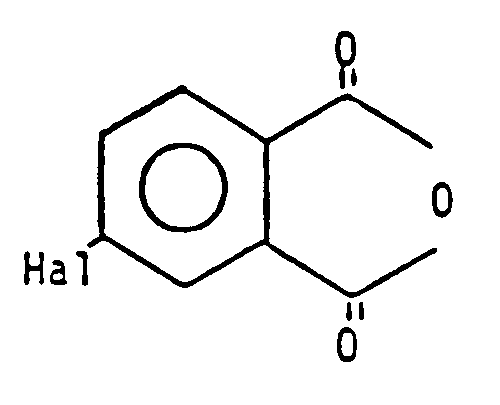
where Hal is F, Cl, Br, or I, the oxydiphthalic product will be 4,4′-oxydiphthalic anhydride characterized by the formula
When the reactant is 3-halophthalic anhydride, the oxydiphthalic product will be 3,3′-oxydiphthalic anhydride, characterized by the formula
Alternatively, a mixture of the 3-halo- and 4-halophthalic anhydrides may be employed as the starting reactant, to form, in addition to the 4,4′- and 3,3′-oxydiphthalic anhydride isomers, and a 3,4′-oxydiphthalic anhydride of the formula
The halogen substituent on the starting halophthalic anhydride reactant may be F, Cl, Br or I. The preferred reactant, based on economic as well as chemical considerations, is 4-fluoro- or 4-chlorophthalic anhydride. In the neat reaction, the halophthalic anhydride reactant is employed in a stoichiometric excess, that is in a molar ratio of halophthalic anhydride:potassium carbonate of greater than 2:1. Typically, a molar ratio of about 2.5:1 to about 5:1 is employed and preferably about 3:1 to about 5:1. In the solvent reaction, the molar ratio of halophthalic anhydride to potassium carbonate is about 1.5:1 or greater, preferably about 2:1 or greater. Typically, a molar ratio of about 2:1 to about 5:1 is employed. It will be appreciated that higher ratios may be employed, with no definite upper limit except that excessively high ratios provide no additional advantage and require the handling of unnecessarily large quantities of the reactant. The excess halophthalic anhydride can be conveniently recycled. - The process of the invention is preferably carried out at atmospheric pressure, but super-atmospheric pressure, for example under autogeneous conditions may be employed, if desired.
- The temperature at which the process is carried out may vary considerably, but will generally be within the range of 170° to 250° C. When the anhydride reactant is the 4-halophthalic anhydride, the preferred temperature is in the range of 190 to 230°C. For the 3-halophthalic anhydride reactant, the preferred temperature is in the range of 180 to 210°C.
- The catalysts useful in the process of the invention include compounds that are generally known as phase transfer agents or catalysts. Suitable phase transfer agents or catalysts include tetraphenylphosphonium bromide, tetraphenylphosphonium chloride, and tetrabutylphosphonium bromide. Other catalysts can be used such as triphenyl phosphine and triphenyl phosphite. In addition, it has been found that, when the halo substituent is chloro-, bromo-, or iodo-, the incorporation of a catalytic amount of potassium fluoride or cesium fluoride will still further improve the efficiency of the neat reaction. These catalysts can also be used with solvents that do not have a deleterious effect on the reaction. We have found that when the halophthalic anhydride reactant is fluorophthalic anhydride, the addition of KF or CsF provides no special advantage.
- Typically, the catalysts are employed in amounts of 0.1 to about 10 percent and preferably 0.5 to 5 percent by weight, based on the total weight of reactants.
- Among the advantages resulting from the process of this invention when no solvent is employed, are avoidance of potential interaction of solvents with reactants with possible formation of undesired by-products; the simplification of isolation of the oxydiphthalic anhydride product; and the minimization of solvent costs; subsequent disposal and attendant environmental problems.
- When a solvent is used for the reaction, the solvent is a liquid and is a poor solvent for the oxydiphthalic anhydride at about 30°C, and is still a liquid, but exhibits good solvent properties at the reaction temperatures of 170° to 250°C. This solvent should be essentially inert under the conditions of reaction and possess a high boiling point to permit reactions at the preferred temperature at atmospheric pressure. The solvent facilitates the removal of inorganic salts from the dissolved oxydiphthalic anhydride by filtration at elevated temperatures such as 150° to 250°C, preferably 150° to 210°C, and the recovery of the product at around room temperature by precipitation. 1,2,4-Trichlorobenzene passes these criteria. 4,4'-Oxydiphthalic anhydride is completely soluble in a 25 percent solution at 170°C, but essentially insoluble at room temperature. Gas chromatographic analysis shows less than 0.5 percent solubility at room temperature.
- Other suitable solvents include 1,2- and 1,3-dichlorobenzenes. The solvents are used in a proportion of 10 to 500 weight percent of the halophthalic anhydride reactant, preferably 20 to 100 weight percent.
- The above-described process for recovery of oxydiphthalic anhydride from high boiling solvents can also be used to purify the product of the neat reaction. Such a reaction product can be dissolved in a solvent that is a liquid at a temperature in the range of 30°C to the reaction temperature, such as up to about 250°C; and that is a good solvent for the anhydride product at the reaction temperature but a poor solvent for the anhydride product at about 30°C. A preferred solvent is 1,2,4-trichlorobenzene. The solution can be filtered to remove solid impurities, and then cooled to precipitate the oxydiphthalic anhydride which can be filtered from the final solutions.
- Any of the products of the invention can be further purified by re-dissolving the solid product in the above-described solvents, for example, 1,2,4-trichlorobenzene, followed by precipitation. Other high boiling solvents such as cyclohexanone can be employed in this re-precipitation or recrystallization process.
- The following examples are provided to further illustrate this invention and the manner in which it may be carried out. It will be understood, however, that the specific details given in the examples have been chosen for the purposes of illustration only and are not to be construed as limiting the invention. In the examples, unless otherwise indicated, all parts and percentages are by weight and all temperatures are in degrees Celsius.
- A mixture of a 99.2 percent pure 4-chlorophthalic anhydride* (100.0 grams, 0.543 mole), and potassium carbonate (18.9 grams, 0.137 mole) was heated in a nitrogen atmosphere to about 229°C, with stirring. Samples were withdrawn periodically and analyzed by gas chromatographic techniques, with the following results:
*Prepared by decarbonylation of trimellitic anhydride with Pd/C following the procedure of Verbicky, Dellacoletta and Williams, Tetrahedron letters, Vol. 23, No. 4, pp. 371-372, (1982). The decarbonylated product was purified by distillation and recrystallization. This procedure was used in all other examples except as noted. -
Reaction Time (Hours) Reaction Temperature (°C) 4-Chlorophthalic Anhydride (Area %) 4,4′-Oxydiphthalic Anhydride (Area %) 5.0 228 97.3 2.7 6.0 230 94.8 5.2 7.0 228 89.3 9.0 10.0 229 77.6 22.3 13.0 227 61.8 38.1 15.2 227 53.5 46.5 17.2 229 52.5 46.5 - A mixture of 98.3 percent pure 4-chlorophthalic anhydride (105 grams, 0.570 mole) and potassium fluoride (2.5 grams, 0.043 mole) was heated to about 229°C and potassium carbonate (19.8 grams, 0.143 mole) was added over a 65-minute period. Following the addition of potassium carbonate, the mixture was held at about 230°C with periodic sampling and analyses by gas chromatographic methods with the following results:
Reaction Time (Hours) Reaction Temperature (°C) 4-Chlorophthalic Anhydride (Area %) 4,4′-Oxydiphthalic Anhydride (Area %) 0.0 231 93.9 1.8 1.0 228 92.6 2.6 2.3 230 89.8 5.5 5.0 230 78.7 17.9 6.0 231 74.6 22.7 7.0 228 68.1 29.4 8.8 229 56.5 41.4 9.8 229 50.8 47.4 - A mixture of 99.2 percent pure 4-chlorophthalic anhydride (105.4 grams, 0.573 mole), cesium fluoride (1.0385 grams, 6.836 × 10⁻³ mole) and potassium carbonate (19.8 grams, 0.143 mole) was heated to about 220°C. When the temperature reached 220°C, the reaction exothermed to 235°C. The mixture appeared to have gelled, however, on further reaction, the mixture began to slowly decrease in viscosity. After 4.1 hours at 218-235°C, GC area percent analyses showed that the mixture contained 47.4 percent of the 4-chlorophthalic anhydride and 51.8 percent of the 4,4′-oxydiphthalic anhydride.
- A 93.2 percent pure 4-bromophthalic anhydride⁺ (100.0 grams, 0.411 mole) was heated with stirring to 212°C and purged with nitrogen for 25 minutes at 212 to 231°C to expel any water vapor. Tetraphenylphosphonium bromide (0.60 grams, 1.43 × 10⁻³ mole) was added to the hot 4-bromophthalic anhydride. Potassium carbonate (14.2 grams, 0.103 mole) was added to the hot mixture over a 65-minute period at 230 to 233°C. A sample withdrawn immediately after the potassium carbonate addition analyzed by GC as having 76 percent 4-bromophthalic and 19.9 percent 4,4′-oxydiphthalic anhydride. After an additional one-hour at 230°C, the 4-bromophthalic anhydride content decreased to 49.5 percent while the 4,4′-oxydiphthalic anhydride content increased to 46.7 percent.
⁺Made by bromination of phthalic acid in the presence of sodium hydroxide. - A 97.8 percent pure 4-fluorophthalic anhydride⁺⁺ (100.0 grams, 0.589 mole) was heated with stirring under a nitrogen pad to 227°C and 0.6 grams (1.43 X 10⁻³ mole) of the tetraphenylphosphonium bromide catalyst added. Potassium carbonate (20.3 grams, 0.147 mole) was added over a 59-minute period at 227 to 230°C. Some foaming occurred during the potassium carbonate addition and the mixture became very viscous. After heating for one hour at 229°C, the viscosity of the mixture decreased significantly and GC analysis showed the mixture to contain 44.0 percent of the 4-fluorophthalic anhydride and 53.5 percent of 4,4′-oxydiphthalic anhydride.
⁺ ⁺Made by reaction of 4-chlorophthalic anhydride with potassium fluoride. - The reaction of Example 1 was repeated using 0.41 percent of tetraphenylphosphonium bromide by weight of the 4-chlorophthalic anhydride charged. The potassium carbonate, however, was added over a one-hour period and the temperature was lowered to 220°C. The results shown below were quite dramatic in that the reaction was accomplished in a short time of only about 3 hours.
Reaction Time (Hours) 4-Chlorophthalic Anhydride (Area %) 4,4′-Oxydiphthalic Anhydride (Area %) 0.0 93.8 5.3 0.5 89.7 9.4 1.0 85.5 16.6 1.5 78.3 20.8 2.0 69.0 29.7 3.0 52.3 46.9 3.5 51.9 48.0 - The final product was a light rose-beige material melting at 225.5 to 226.5°C. The yield was 72.8 percent.
- 4-Chlorophthalic anhydride and potassium carbonate were reacted in a mole ratio of anhydride to carbonate of 2 to 1 in 1,2,4-trichlorobenzene. 60.0 Grams of 99 percent pure 4-chlorophthalic anhydride, 22.8 grams of potassium carbonate, 1.2 parts MPEG 2000 (methyl terminated polyethylene glycol with a molecular weight of 2000), were heated in 180.0 grams of 1,2,4-trichlorobenzene to 198° to 200°C and held 5.4 hours. No product formed. Tetraphenylphosphonium bromide (0.6 grams) was added at room temperature and the batch was reheated to 200°C. The following results were obtained after the catalyst was added.
Reaction Time (Hours) 4-Chlorophthalic Anhydride (Area %) 4,4′-Oxydiphthalic Anhydride (Area %) 3.6 96.2 2.0 5.0 88.5 9.6 11.2 57.4 40.7 12.5 52.3 45.9 15.4 43.7 53.9 17.3 36.0 61.9 24.3 16.3 81.1 - The reaction of 4-chlorophthalic anhydride with potassium carbonate in 1,2,4-trichlorobenzene with no catalyst at 210-215°C gave no product after 24.5 hours.
- 105.0 Grams of 4-chlorophthalic anhydride were charged to a reactor equipped with a stirrer and thermometer. The reactor was heated to 230°C and then 0.35 gram of tetraphenylphosphonium chloride was added to the reactor and mixed for one minute. 19.8 grams of potassium carbonate were added and the reaction mixture was heated with stirring at 225-230°C for 5 hours. A GC analysis of the contents showed it to contain 50.6 percent 4-chlorophthalic anhydride and 48.3 percent 4,4'-oxydiphthalic anhydride.
- 25.0 Grams of 4-chlorophthalic anhydride, 10.4 grams of potassium carbonate, 0.5 gram of tetraphenylphosphonium chloride, 0.5 gram of MPEG-2000 (methyl terminated polyethylene glycol with a molecular weight of 2000), and 146.5 grams of 1,2,4-trichlorobenzene were charged to a 500 ml flask equipped with a stirrer and thermometer. The mixture was heated with an oil bath to a temperature in the range of 204 to 205°C. The final reaction mixture after 5 hours consisted of 57.3 percent 4,4'-oxydiphthalic anhydride and 39.4 percent 4-chlorophthalic anhydride by GC area percent.
- 105.0 Grams of 4-chlorophthalic anhydride were added to a reactor equipped with a stirrer and thermometer. The contents were heated to 220°C and 0.63 gram of tetrabutylphosphonium bromide was added. Then 19.8 grams of potassium carbonate were added over a period of 65 minutes. The reaction was continued at about 220°C for 11 hours at which time GC analysis showed 49.6 percent (by area) 4-chlorophthalic anhydride and 49.6 percent (by area) of 4,4'-oxydiphthalic anhydride in the mixture.
- 105.0 Grams of 4-chlorophthalic anhydride were added to a reaction flask equipped with a stirrer and thermometer. The anhydride was heated to 230°C and 0.31 gram of triphenylphosphine was added. Then 19.8 grams of potassium carbonate were added from a powder funnel over a period of one hour. After 3.5 hours at 230°C, 45.5 percent of 4,4'-oxydiphthalic anhydride was present in the reaction mixture as determined by GC internal standard method. Purification in accord with Example 17, yielded 33.4 grams (83.6 percent yield) of 4,4'-oxydiphthalic anhydride.
- 105.0 Grams of 4-chlorophthalic anhydride were charged to a 250 ml reaction flask equipped with a stirrer and thermometer and heated to about 230°C. Then 0.28 grams of triphenylphosphite were added and allowed to mix for one minute. Then 19.8 grams of potassium carbonate were added with a powder funnel. The following results were obtained. 4,4'-Oxydiphthalic anhydride was present at 44.2 area percent after 6 hours at about 230°C. Purification in accord with Example 17, resulted in 71.5 percent yield of 4,4'-oxydiphthalic anhydride.
- 18.25 Grams (0.1 mole) of 4-chlorophthalic anhydride** and 0.03 gram of tetraphenylphosphonium bromide (0.165 percent on the 4-chlorophthalic anhydride) were mixed with 6.0 grams of 1,2,4-trichlorobenzene and the mixture heated to 225°C. Potassium carbonate (2.76 grams, 0.02 mole) was added over a period of 10 minutes and the reaction mixture heated at 225°C for 6 hours. The reaction mixture consisted of 34.1 percent 4,4'-oxydiphthalic anhydride and 63.3 percent 4-chlorophthalic anhydride.
**Made by aromatization of 4-chlorotetrahydrophthalic anhydride, disclosed in EP-A-89 10 32 49. - High purity 3-chlorophthalic anhydride*** (105.3 grams, 0.5767 mole) was charged into a 3-neck, 250 ml Morton flask equipped with a N₂ inlet, mechanical stirrer, a Claisen-type adapter, thermometer, gas pressure equalizing tube and a ground glass stopper. The 3-chlorophthalic anhydride was heated to 180°C and 0.327 gram of tetraphenylphosphonium bromide was added. The 3-chlorophthalic anhydride yellowed slightly upon heating to 180°C, and turned to a deeper yellow color upon the catalyst addition. Potassium carbonate (17.8 grams, 0.1288 mole) was added over a 53-minute period at 180 to 180.5°C. The reaction mixture was kept at 180°C and samples were withdrawn immediately after the potassium carbonate addition and periodically afterwards for GC area percent analyses. The results of these analyses are given below.
***The 3-chlorophthalic anhydride was prepared by the chlorodenitration of 3-nitrophthalic anhydride. -
Time (Hours) 3-Chlorophthalic Anhydride 3,3′-Oxydiphthalic Anhydride 0 99.8 0.0 1.0 97.8 1.6 2.0 92.3 6.9 3.0 86.8 12.7 4.0 81.7 17.6 5.5 72.4 26.4 6.5 67.9 30.9 7.5 62.6 35.5 8.25 59.5 39.5 - 50 Grams of 3-chlorophthalic anhydride*** and 50 grams of 4-chlorophthalic anhydride** were added to the reactor of Example 15A together with 0.33 grams tetraphenylphosphonium bromide. 9.3 Grams of potassium carbonate were added to the reactor over a period of one hour at about 230°C. Another 9.3 grams of potassium carbonate were added after 3 hours. The reaction mixture was kept at about 230°C. After 4 hours, a GC (gas chromotography) analysis of the reaction mixture showed it contained about 12.6 percent of 3,3'-oxydiphthalic anhydride, about 21.1 percent of 3,4'-oxydiphthalic anhydride and 7.8 percent of 4,4'-oxydiphthalic anhydride. The product was purified by adding 70 grams hot 1,2,4-trichlorobenzene, and filtering the resulting solution. The filter cake was rinsed with 130 grams of 1,2,4-trichlorobenzene. The temperature of the solution was cooled to precipitate the product, which was analyzed by GC and found to contain 43.2 percent of 3,3'-oxydiphthalic anhydride, 47.8 percent of 3,4'-oxydiphthalic anhydride and 2.7 percent of 4,4'-oxydiphthalic anhydride. After drying in the oven, the yield was 16.8 grams or 40.2 percent of theory.
***The 3-chlorophthalic anhydride was prepared by the chlorodenitration of 3-nitrophthalic anhydride.
**Made by aromatization of 4-chlorotetrahydrophthalic anhydride, disclosed EP-A-89 10 32 49. - A mixture of 18.2 grams (0.1 mole) of 4-chlorophthalic anhydride** and 4.2 grams of 1,2,4-trichlorobenzene were heated to 222°C. Granular potassium carbonate 3.45 grams (0.025 mole) was added and the mixture heated with stirring at 222 to 224°C for eight hours. A GC analysis of the reaction mixture showed it to contain 52.2 percent (area) of 4,4'-oxydiphthalic anhydride. The theoretical content should be 50 percent.
**Made by aromatization of 4-chlorotetrahydrophthalic anhydride, disclosed in EP-A-89 10 32 49. - The product of Example 1 was purified by the following method. To remove the insoluble materials in the reaction mixture, 200.7 grams of 1,2,4-trichlorobenzene (TCB) was added to the solid product and heated to about 200°C, and mixed well. The resulting hot mixture was then filtered through a glass Buchner funnel. The resulting filter cake then rinsed with about 144 grams of hot TCB (200°C) and both filtrates combined. This hot solution was then allowed to cool with agitation. After cooling the filtrate to room temperature, the product had precipitated and was collected by filtration. The solids were then washed with about 107 grams of cold TCB and dried in an air circulating oven at about 145°C overnight. 32.9 Grams of 4,4'-oxydiphthalic anhydride were recovered, reflecting a yield of 77.6 percent based on the K₂CO₃.
- 75 Grams of 1,2,4-trichlorobenzene (TCB) was added to the reaction mixture of Example 9. After heating to 200°C, the contents were filtered and the filtrate allowed to cool. The solids which crystallized were removed by filtration, washed with cold TCB and n-hexane and dried giving 36.2 grams of product (81.3 percent yield based on K₂CO₃).
- The product of Example 11 was treated with 104.0 grams of hot 1,2,4-trichlorobenzene and the mixture reheated to 210°C. After filtration hot, the filter cake was washed with an additional 100 grams of hot 1,2,4-trichlorobenzene, filtered and the filtrates combined. After cooling to room temperature, the product which crystallized was recovered by filtration and dried. The yield was 36.6 grams or 82.2 percent of theory.
- To the reaction product of Example 14 was added 12 grams of hot 1,2,4-trichlorobenzene. The solution at 200°C was filtered to remove inorganic salts. The filter cake was washed with another 6 grams of hot 1,2,4-trichlorobenzene. The combined filtrates were allowed to cool to precipitate the 4,4′-oxydiphthalic anhydride product. Filtration of the product followed by drying yielded 5.5 grams (88.7 percent yield) of 4,4′-oxydiphthalic anhydride.
- The flask contents in Example 16 was treated with 18.0 grams of refluxing cyclohexanone (157°C). The solids were filtered off, and washed with another 18.0 grams of hot cyclohexanone and again filtered. The filtrates were combined and allowed to cool to permit crystallization of the product, which was removed by filtration. After washing with 15 ml of 1,2,4-trichlorobenzene and 25 ml of hexane followed by drying, 7.25 grams (93.5 percent yield) of 4,4′-oxydiphthalic anhydride were obtained.
Claims (23)
- A process for the preparation of an oxydiphthalic anhydride of the general formula I


- A process for the preparation of an oxydiphthalic anhydride of the general formula I of Claim 1 comprising the reaction of a halophthalic anhydride of the general formula II wherein Hal is as defined in Claim 1 with potassium carbonate in the presence of a catalytic amount of a phase transfer catalyst, and a reaction medium comprising a solvent that is a liquid at a temperature in the range of 30°C to the reaction temperature, that is non-deleterious to the reaction, that is a good solvent for the anhydride product at the reaction temperature, but is a poor solvent for the anhydride product at about 30°C.
- The process of Claim 2 wherein the reaction medium comprises 1,2,4-trichlorobenzene and the molar ratio of halophthalic anhydride:potassium carbonate is about 1.5:1 or greater.
- The process according to any one of Claims 1 to 3 wherein the halogen radical of the halophthalic anhydride is chlorine, bromine or fluorine.
- The process according to any one of Claims 1 to 4 carried out at a temperature of 170° to 250° Celsius.
- The process according to any one of Claims 1 to 5 carried out at atmospheric pressure.
- The process according to any one of Claims 1 to 6 wherein the ratio of halophthalic anhydride: potassium carbonate is 2.5:1 to 5:1.
- The process according to any one of Claims 1 and 4 to 7 wherein the process is carried out in the presence of a phase transfer catalyst.
- The process according to any one of Claims 1 to 3 or 5 to 8 wherein the halogen radical of the halophthalic anhydride is chlorine, bromine or iodine and the process is carried out in the presence of a catalytic amount of potassium fluoride and/or cesium fluoride.
- The process according to Claim 1 for the preparation of 4,4'-oxydiphthalic anhydride wherein the halophthalic anhydride is a 4-halophthalic anhydride.
- The process according to Claim 2 for the preparation of 4,4'-oxydiphthalic anhydride wherein the halophthalic anhydride is a 4-halophthalic anhydride and the liquid reaction medium comprises 1,2,4-trichlorobenzene and wherein the molar ratio of 4-halophthalic anhydride:potassium carbonate is about 2:1 or greater.
- The process according to any one of Claims 10 or 11 wherein the 4-halophthalic anhydride is 4-chlorophthalic anhydride.
- The process according to Claim 12 carried out at a temperature of 190° to 230° Celsius at atmospheric pressure.
- The process according to Claim 1 for the preparation of 3,3'-oxydiphthalic anhydride wherein the halophthalic anhydride is a 3-halophthalic anhydride.
- The process according to Claim 2 for the preparation of 3,3'-oxydiphthalic anhydride wherein the halophthalic anhydride is a 3-halophthalic anhydride and the liquid reaction medium comprises 1,2,4-trichlorobenzene and wherein the molar ratio of 3-halophthalic anhydride:potassium carbonate is about 2:1 or greater.
- The process according to any one of Claims 14 or 15 wherein the 3-halophthalic anhydride is 3-chlorophthalic anhydride.
- The process according to Claim 16 carried out at a temperature of 180° to 210° Celsius at atmospheric pressure.
- The process according to any one of Claims 10, 12, 13, 14, 16 or 17 wherein the ratio of 3- or 4-chlorophthalic anhydride:potassium carbonate is 2.5:1 to 5:1.
- The process according to any one of Claims 11 to 13 and 15 to 17 wherein the ratio of 4-chlorophthalic anhydride:potassium carbonate is 2:1 to 5:1.
- The process according to any one of Claims 10, 12, 13, 14, 16, 17 or 18 carried out in the presence of a catalytic amount of potassium fluoride or cesium fluoride.
- The process according to any one of Claim 1 to 20 wherein the process is carried out in the presence of a catalytic amount of tetraphenylphosphonium bromide, tetraphenylphosphonium chloride, tetrabutylphosphonium bromide, triphenyl phosphine or triphenyl phosphite.
- A process for the purification of the oxydiphthalic anhydrides obtained by the processes according to claim 1 or 2, which comprises removing solid impurities from a hot solution of oxydiphthalic anhydride in a solvent, cooling the resulting solution of oxydiphthalic anhydride to a temperature sufficiently low to precipitate the oxydiphthalic anhydride, and removing the precipitated oxydiphthalic anhydride from the solution, wherein said solvent is a liquid at a temperature in the range of 30°C to 250°C, and said solvent is a good solvent for the anhydride product at a temperature of 170° to 250°C, but a poor solvent at a temperature of about 30°C.
- The process according to Claim 22 wherein the solvent is 1,2,4-trichlorobenzene.
Applications Claiming Priority (2)
| Application Number | Priority Date | Filing Date | Title |
|---|---|---|---|
| US07/160,036 US4870194A (en) | 1987-09-28 | 1988-02-24 | Process for the preparation and recovery of oxdiphthalic anhydrides |
| US160036 | 1988-02-24 |
Publications (3)
| Publication Number | Publication Date |
|---|---|
| EP0330220A2 EP0330220A2 (en) | 1989-08-30 |
| EP0330220A3 EP0330220A3 (en) | 1991-05-29 |
| EP0330220B1 true EP0330220B1 (en) | 1994-06-01 |
Family
ID=22575233
Family Applications (1)
| Application Number | Title | Priority Date | Filing Date |
|---|---|---|---|
| EP89103251A Expired - Lifetime EP0330220B1 (en) | 1988-02-24 | 1989-02-24 | Process for the preparation and recovery of oxydiphthalic anhydrides |
Country Status (10)
| Country | Link |
|---|---|
| US (1) | US4870194A (en) |
| EP (1) | EP0330220B1 (en) |
| JP (1) | JP2697886B2 (en) |
| AT (1) | ATE106380T1 (en) |
| BR (1) | BR8900450A (en) |
| CA (1) | CA1340428C (en) |
| DE (1) | DE68915570T2 (en) |
| ES (1) | ES2056979T3 (en) |
| IL (1) | IL88822A (en) |
| NO (1) | NO173333C (en) |
Families Citing this family (22)
| Publication number | Priority date | Publication date | Assignee | Title |
|---|---|---|---|---|
| US5003031A (en) * | 1989-05-15 | 1991-03-26 | Occidental Chemical Corporation | Polyimides and co-polyimides based on dioxydiphthalic anhydride |
| US5077415A (en) * | 1990-01-19 | 1991-12-31 | Ciba-Geigy Corporation | Disubstituted aromatic dianhydrides |
| US6706897B1 (en) * | 2003-02-24 | 2004-03-16 | General Electric Company | Method for preparing oxydiphthalic anhydrides using guanidinium salt as catalyst |
| US6727370B1 (en) | 2003-02-24 | 2004-04-27 | General Electric Company | Method for preparing oxydiphthalic anhydrides using bicarbonate as catalyst |
| JP4541774B2 (en) * | 2003-06-17 | 2010-09-08 | 株式会社日本触媒 | Method for producing bis-fluorinated phthalic anhydride |
| EP1640370A4 (en) | 2003-06-17 | 2008-10-08 | Nippon Catalytic Chem Ind | Bis (fluorine-containing phthalic anhydride) and method for production thereof |
| CN1805949B (en) * | 2003-06-17 | 2011-05-11 | 株式会社日本触媒 | Bis (fluorine-containing phthalic anhydride) and method for production thereof |
| US7495113B2 (en) * | 2004-12-22 | 2009-02-24 | Sabic Innovative Plastics | Method of purifying dianhydrides |
| US20060293528A1 (en) * | 2005-06-24 | 2006-12-28 | General Electric Company | Method of purifying dianhydrides |
| US7411032B2 (en) * | 2005-09-23 | 2008-08-12 | Sabic Innovative Plastics Ip B.V. | Method for making polyetherimides |
| US7408070B2 (en) * | 2005-09-23 | 2008-08-05 | Sabic Innovative Plastics Ip B.V. | Method for purifying bisimides |
| US7446214B2 (en) * | 2005-09-23 | 2008-11-04 | Sabic Innovative Plastics Ip B.V. | Method for purifying oxybisphthalic anhydrides |
| US7863463B2 (en) * | 2005-11-22 | 2011-01-04 | Sabic Innovative Plastics Ip B.V. | Method of purifying dianhydrides |
| US9161440B2 (en) * | 2006-06-26 | 2015-10-13 | Sabic Global Technologies B.V. | Articles comprising a polyimide solvent cast film having a low coefficient of thermal expansion and method of manufacture thereof |
| US7928154B2 (en) | 2006-06-26 | 2011-04-19 | Sabic Innovative Plastics Ip B.V. | Methods of preparing polymer-organoclay composites and articles derived therefrom |
| US8568867B2 (en) * | 2006-06-26 | 2013-10-29 | Sabic Innovative Plastics Ip B.V. | Polyimide solvent cast films having a low coefficient of thermal expansion and method of manufacture thereof |
| US8545975B2 (en) * | 2006-06-26 | 2013-10-01 | Sabic Innovative Plastics Ip B.V. | Articles comprising a polyimide solvent cast film having a low coefficient of thermal expansion and method of manufacture thereof |
| WO2008082417A1 (en) * | 2007-01-04 | 2008-07-10 | Sabic Innovative Plastics Ip B.V. | Method of purifying dianhydrides |
| EP2114849B1 (en) * | 2007-01-04 | 2017-03-01 | SABIC Global Technologies B.V. | Method of purifying dianhydrides |
| EP2271611B1 (en) * | 2008-03-28 | 2013-09-04 | SABIC Innovative Plastics IP B.V. | Method for preparing 4,4'-oxydiphthalic anhydride |
| US7674920B2 (en) * | 2008-03-28 | 2010-03-09 | Sabic Innovative Plastics Ip B.V. | Methods for preparing oxydiphthalic anhydrides, oxydiphthalic anhydrides prepared thereby, and polyetherimides derived therefrom |
| CN115490658B (en) * | 2022-10-11 | 2023-11-14 | 天津众泰材料科技有限公司 | Preparation method of 4,4' -oxydiphthalic anhydride |
Family Cites Families (3)
| Publication number | Priority date | Publication date | Assignee | Title |
|---|---|---|---|---|
| US4499285A (en) * | 1982-11-01 | 1985-02-12 | General Electric Company | Solvent free preparation of diarylthioethers |
| US4625037A (en) * | 1984-02-02 | 1986-11-25 | General Electric Company | Method for making thioether(bisphthalimide)s |
| US4697023A (en) * | 1986-10-03 | 1987-09-29 | Occidental Chemical Corporation | Process for the preparation of oxy-diphthalic anhydrides |
-
1988
- 1988-02-24 US US07/160,036 patent/US4870194A/en not_active Expired - Lifetime
- 1988-12-28 IL IL8882288A patent/IL88822A/en not_active IP Right Cessation
-
1989
- 1989-02-01 BR BR898900450A patent/BR8900450A/en unknown
- 1989-02-06 CA CA000590231A patent/CA1340428C/en not_active Expired - Fee Related
- 1989-02-22 NO NO890750A patent/NO173333C/en unknown
- 1989-02-22 JP JP1042877A patent/JP2697886B2/en not_active Expired - Lifetime
- 1989-02-24 DE DE68915570T patent/DE68915570T2/en not_active Expired - Fee Related
- 1989-02-24 AT AT89103251T patent/ATE106380T1/en active
- 1989-02-24 EP EP89103251A patent/EP0330220B1/en not_active Expired - Lifetime
- 1989-02-24 ES ES89103251T patent/ES2056979T3/en not_active Expired - Lifetime
Also Published As
| Publication number | Publication date |
|---|---|
| ATE106380T1 (en) | 1994-06-15 |
| BR8900450A (en) | 1989-09-26 |
| NO890750D0 (en) | 1989-02-22 |
| NO890750L (en) | 1989-08-25 |
| DE68915570D1 (en) | 1994-07-07 |
| EP0330220A2 (en) | 1989-08-30 |
| JP2697886B2 (en) | 1998-01-14 |
| US4870194A (en) | 1989-09-26 |
| NO173333C (en) | 1993-12-01 |
| IL88822A (en) | 1994-04-12 |
| CA1340428C (en) | 1999-03-09 |
| ES2056979T3 (en) | 1994-10-16 |
| EP0330220A3 (en) | 1991-05-29 |
| JPH01254673A (en) | 1989-10-11 |
| NO173333B (en) | 1993-08-23 |
| IL88822A0 (en) | 1989-07-31 |
| DE68915570T2 (en) | 1994-09-15 |
Similar Documents
| Publication | Publication Date | Title |
|---|---|---|
| CA1340428C (en) | Process for the preparation and recovery of oxydiphthalic anhydrides | |
| US5021168A (en) | Process for the preparation and recovery of oxydiphthalic anhydrides | |
| EP0264624B1 (en) | Process for the preparation of oxy-diphthalic anhydrides | |
| JP3204641B2 (en) | Process for producing oxydiphthalic anhydride | |
| US5637733A (en) | Syntheses of fluorescein compounds with excess resorcinol as a solvent | |
| HU193589B (en) | Process for preparing fluorinated phtaloyl- and terephtaloyl compounds | |
| CA1328880C (en) | Partly fluorinated carboxylic acids and derivatives thereof, processes for their preparation and their use | |
| WO1989001935A1 (en) | Process for the preparation of oxy-diphthalic anhydrides | |
| JPS6233223B2 (en) | ||
| US5153335A (en) | Process for the preparation of oxydiphthalic anhydride and acyloxyphthalic anhydrides | |
| US5523476A (en) | Processes for producing tetrafluorophthalic anhydride and fluorobenzoic acids | |
| US5047553A (en) | Tetrafluoro-N-phenylphthalimide | |
| US4680412A (en) | Preparation of fluorophthalimides | |
| JP3056539B2 (en) | Process for preparing oxydiphthalic anhydride and acyloxyphthalic anhydride | |
| JPH07206845A (en) | Process for producing 3,3 ', 4,4'-biphenyltetracarboxylic dianhydride | |
| CA1297485C (en) | Process for the preparation of oxydiphthalic anhydrides | |
| JPS6210510B2 (en) | ||
| JPS5949217B2 (en) | Method for producing substituted diphenyl ether | |
| EP0525066B1 (en) | Preparation of 3,4,6-trifluorophthalic acid | |
| WO1998027047A1 (en) | Process for the preparation of 4,4'-oxybisphthalic dianhydride | |
| USH992H (en) | Preparation of fluorobenzenes by the decarboxylation of fluorophthalic acids or benzoic acids | |
| US6187931B1 (en) | Process for making fluorophthalimides | |
| EP0378366B1 (en) | Preparation of 2-chloroterephthaloyl chloride | |
| JPS625897B2 (en) | ||
| JPS60112758A (en) | Production of n-phenylmaleimide |
Legal Events
| Date | Code | Title | Description |
|---|---|---|---|
| PUAI | Public reference made under article 153(3) epc to a published international application that has entered the european phase |
Free format text: ORIGINAL CODE: 0009012 |
|
| AK | Designated contracting states |
Kind code of ref document: A2 Designated state(s): AT BE CH DE ES FR GB IT LI NL SE |
|
| 17P | Request for examination filed |
Effective date: 19901228 |
|
| PUAL | Search report despatched |
Free format text: ORIGINAL CODE: 0009013 |
|
| AK | Designated contracting states |
Kind code of ref document: A3 Designated state(s): AT BE CH DE ES FR GB IT LI NL SE |
|
| 17Q | First examination report despatched |
Effective date: 19920403 |
|
| GRAA | (expected) grant |
Free format text: ORIGINAL CODE: 0009210 |
|
| AK | Designated contracting states |
Kind code of ref document: B1 Designated state(s): AT BE CH DE ES FR GB IT LI NL SE |
|
| REF | Corresponds to: |
Ref document number: 106380 Country of ref document: AT Date of ref document: 19940615 Kind code of ref document: T |
|
| REF | Corresponds to: |
Ref document number: 68915570 Country of ref document: DE Date of ref document: 19940707 |
|
| ITF | It: translation for a ep patent filed | ||
| ET | Fr: translation filed | ||
| REG | Reference to a national code |
Ref country code: ES Ref legal event code: FG2A Ref document number: 2056979 Country of ref document: ES Kind code of ref document: T3 |
|
| EAL | Se: european patent in force in sweden |
Ref document number: 89103251.8 |
|
| PG25 | Lapsed in a contracting state [announced via postgrant information from national office to epo] |
Ref country code: GB Effective date: 19950224 Ref country code: AT Effective date: 19950224 |
|
| PG25 | Lapsed in a contracting state [announced via postgrant information from national office to epo] |
Ref country code: SE Effective date: 19950225 Ref country code: ES Free format text: LAPSE BECAUSE OF NON-PAYMENT OF DUE FEES Effective date: 19950225 |
|
| PG25 | Lapsed in a contracting state [announced via postgrant information from national office to epo] |
Ref country code: LI Effective date: 19950228 Ref country code: CH Effective date: 19950228 Ref country code: BE Effective date: 19950228 |
|
| PLBE | No opposition filed within time limit |
Free format text: ORIGINAL CODE: 0009261 |
|
| STAA | Information on the status of an ep patent application or granted ep patent |
Free format text: STATUS: NO OPPOSITION FILED WITHIN TIME LIMIT |
|
| 26N | No opposition filed | ||
| BERE | Be: lapsed |
Owner name: OCCIDENTAL CHEMICAL CORP. Effective date: 19950228 |
|
| PG25 | Lapsed in a contracting state [announced via postgrant information from national office to epo] |
Ref country code: NL Effective date: 19950901 |
|
| GBPC | Gb: european patent ceased through non-payment of renewal fee |
Effective date: 19950224 |
|
| PG25 | Lapsed in a contracting state [announced via postgrant information from national office to epo] |
Ref country code: FR Effective date: 19951031 |
|
| NLV4 | Nl: lapsed or anulled due to non-payment of the annual fee |
Effective date: 19950901 |
|
| PG25 | Lapsed in a contracting state [announced via postgrant information from national office to epo] |
Ref country code: DE Effective date: 19951101 |
|
| EUG | Se: european patent has lapsed |
Ref document number: 89103251.8 |
|
| REG | Reference to a national code |
Ref country code: FR Ref legal event code: ST |
|
| REG | Reference to a national code |
Ref country code: ES Ref legal event code: FD2A Effective date: 19990503 |
|
| PG25 | Lapsed in a contracting state [announced via postgrant information from national office to epo] |
Ref country code: IT Free format text: LAPSE BECAUSE OF NON-PAYMENT OF DUE FEES Effective date: 20050224 |